Abstract
The interactions between topology and algebraic geometry expose various interesting properties. This paper proposes the deformations of topological n-manifolds over the automorphic polynomial ring maps and associated isomorphic imbedding of locally flat submanifolds within the n-manifolds. The manifold deformations include topologically homeomorphic bending of submanifolds at multiple directions under algebraic operations. This paper introduces the concept of a topological equivalence class of manifolds and the associated equivalent class of polynomials in a real ring. The concepts of algebraic compositions in a real polynomial ring and the resulting topological properties (homeomorphism, isomorphism and deformation) of manifolds under algebraic compositions are introduced. It is shown that a set of ideals in a polynomial ring generates manifolds retaining topological isomorphism under algebraic compositions. The numerical simulations are presented in this paper to illustrate the interplay of topological properties and the respective real algebraic sets generated by polynomials in a ring within affine 3-spaces. It is shown that the coefficients of polynomials generated by a periodic smooth function can induce mirror symmetry in manifolds. The proposed formulations do not consider the simplectic class of manifolds and associated quantizable deformations. However, the proposed formulations preserve the properties of Nash representations of real algebraic manifolds including Nash isomorphism.
MSC:
54H10; 57N25; 14J80
1. Introduction
The studies about algebraic forms of manifolds often require the elements of algebraic geometry and topology to gain deeper understandings. For example, the compact real algebraic n-manifolds are formulated over the polynomial ring , where the real algebraic field is considered as closed. The topological properties of real manifolds consider that the manifolds are the real algebraic varieties, and Seifert illustrated that such real algebraic manifolds can be approximated by a normal product bundle [1]. Nash generalized these results further by assuming that the associated real algebraic varieties are non-singular, and the topologies of the manifolds are compact, indicating that such real algebraic manifolds are embeddable in the topological spaces of higher dimensions [1,2]. Nash considered that the algebraic zero-set of is Zariski closed, and the resulting real algebraic manifolds are analytic as well as topologically connected, admitting homeomorphism of real algebraic manifolds. On the other hand, it is shown that, in the case of closed complex algebraic field , the polynomials are topologically equivalent if they maintain isolated singularities, and one can be deformed into the other by applying polynomial function in the complex field [3]. Interestingly, the topology of complex algebraic curves with isolated singularities and their deformations can be studied by employing the irreducible real algebraic polynomials. For example, if is holomorphic with germ at and has isolated singularity at , then the germ of the function can be viewed as a product of real algebraic polynomials, and it admits the deformations class of real algebraic polynomials within a small neighborhood at zero [4]. Note that the topological deformations may not always preserve the class of manifolds. Earlier, it was shown that, in the case of compact as well as complex analytic manifolds in the p-Kähler class, any small deformation results in the formation of a non-p-Kähler class of manifolds [5]. In other words, the topological deformations of manifolds are not stability invariant in all cases.
1.1. Preliminaries
Let us review the notions of topological deformation of spaces, imbedding and the isotopy in an n-manifold denoted as . First, we present the concept of topological deformation in the general form [6].
Definition 1.
Let a topological space be given as . The topological deformation of set into set is given by such that and , where is the respective identity function.
If we consider a topological n-manifold and the subspace , then the proper imbedding of into is defined as follows [6].
Definition 2.
If the injective function is an imbedding, then it is proper if .
This leads to the definition of the formation of the isotopy class and smooth imbedding, which is stated as follows, considering a family of imbedding [6,7].
Definition 3.
If is a set of imbedding, then it forms the isotopy of in if is continuous, where is also continuous. Moreover, if is a simplicial complex equipped with , then is piecewise-smooth if it is piecewise-smooth for each simplex .
Remark 1.
The isotopy of a locally flat submanifold can be suitably extended under covering maps if the locally flat submanifold is isomorphic to the corresponding proper imbedding and the respective submanifold is compact. Furthermore, two simplicial embeddings are isotopic if there is an isotopic homeomorphism maintaining Haefliger–Wu conditions [7].
Let be a compact 3-manifold with the incompressible boundary . The deformation of , generating a hyperbolic topological space , retains the local connectedness at parabolic points [8]. Note that and are in the homotopy equivalence class. Moreover, the retention of local connectivity within requires that the fibrations must not be separated. However, the deformation of topological manifold invites the formation of topological bumping. The formations of topological bumping due to deformation are first uncovered by Anderson and Canary [9]. The definition of bumping in a topological manifold due to deformation is presented as follows [8,9].
Definition 4.
Let be a topologically deformed manifold and the set be representing two locally connected components. The component set is defined to be topologically bumped at if .
The characterization of manifold components in is presented showing that the topological bump occurs in under deformation if it has incompressible [10]. Note that, if the deformation of does not produce any topological bump at , then it is a topological rigid point. This leads to the following theorem [8].
Theorem 1.
Let be a compact 3-manifold such that it preserves the non-cylindrical property for a surface . If the point is rigid, then there is no bump at that point.
The proof of the theorem is presented in detail in [8]. Interestingly, if we consider that is a point on an n-manifold generated in complex affine n-space, then for all , the neighborhoods are locally connected and locally homeomorphic real algebraic submanifolds [11]. This observation topologically bridges between the real algebraic varieties as manifolds and the holomorphic complex affine spaces.
1.2. Motivations
The varying degrees of deformations of topological manifolds retaining stabilities as well as homeomorphisms have applications in various domains of sciences, and they are largely dependent on the class of manifolds [12,13,14,15]. It was mentioned earlier that a topological manifold can be viewed as a real algebraic variety, and the topological manifolds can be formed over a special class of polynomials, called simplicial polynomials, in a real polynomial ring [1,16]. On the other hand, a real algebraic manifold can also be viewed as a topologically connected sheet of real algebraic variety, allowing for the formations of cusps and self-intersections [2]. Nash proposed that a proper representation of a real algebraic manifold needs the isolated sheet, and the isomorphic ring map between two rings can induce homeomorphism between the respective two real algebraic manifolds of analytic types [2]. On the other hand, in a complex field, the weighted homogeneous polynomials in a ring form manifolds involving the isolated singularities [17]. Interestingly, the manifold deformation has a relationship with algebraic power series and operations. For example, if is a simplectic n-manifold admitting the corresponding deformation algebra on the respective manifold, then forms the space of all algebraic power series with the complex variable , and the coefficients are in , employing algebraic and Poisson brackets [18]. Let us consider a pair of n-manifolds given as , where is locally flat. It was shown earlier that the closure of imbedding preserves the isomorphism property denoted as within the manifold, maintaining the corresponding isotopy class [6]. These observations motivate us to ask the following questions. (1) How can we generalize the topological deformation of manifolds, considering the bending and folding of manifolds over a polynomial ring? (2) What are the roles of automorphic ring maps in forming topological deformations of manifolds? (3) What are the different classes of axial symmetries generated during the deformations and is there any formation of a topologically equivalent class of polynomials, if any? This paper addresses these questions in relative detail by combining the elements of algebraic geometry and topology, considering the real algebraic sets and real polynomial rings.
1.3. Contributions
This paper proposes the formulations of topological n-manifolds over the polynomial ring, considering real field and its deformations, by employing the concept of automorphic ring map. The topological deformations of n-manifolds include bending of submanifolds at multiple directions under algebraic compositions. The proposed formulation admits the isomorphic embeddings of locally flat submanifold of manifold under the algebraic zero-set of the corresponding ideals . The locally flat submanifold preserves the isomorphism property given as , where is a local submanifold agreeing with and the composition is an automorphic ring map in over closed real field (details are presented in the following sections). Note that, as a distinction, the proposed formulations of n-manifold deformations do not assume that the manifold is in the simplectic class, and the quantizable deformation is not considered by forming any complex power series over the manifold. In this paper, the proposed formulations employ a generalized approach by using polynomial rings over the real algebraic field and the associated automorphic ring maps inducing manifold deformations. Moreover, the proposed formulations preserve the topological homeomorphism of the deformed manifolds in all cases and admit embeddable submanifolds, which are the Zariski closed algebraic sets. We preserve the concept of Nash representation of a real algebraic manifold by allowing for two aspects of it: (1) the formation of topologically connected sheets, where each component of the connected sheet can have representation of respective isolated sheet, and (2) employment of commutative ring automorphism as a modified form of Nash isomorphism between two rings, generating the equivalence class of real algebraic manifolds and . Moreover, the preservation of topological homeomorphism under deformations in the proposed formulations admits the notion of the property of analytic manifolds, as pointed out by Nash, under the ring-isomorphism. Furthermore, we introduce the concept of a topological equivalence class of real algebraic polynomials and real algebraic sets without considering singularities, and we show, through the numerical simulations, the existence of such a class under algebraic composition operations forming isomorphic manifolds. The numerical simulations show the formations of multiple axes of symmetries during the topological deformations of manifolds retaining isomorphisms and homeomorphisms. The interrelationships between PL-homeomorphism, self-homeomorphism, mirror symmetries and the formation of characteristic polynomials of the graph structures with varying symmetries (along with the applicational aspects) are explained in brief.
The rest of the paper is organized as follows. The concepts and definitions of the topological equivalence class and the automorphic ring maps are presented in Section 2. The formations of topological manifolds over the polynomial ring maps, their deformations and the concept of algebraic compositions over topological manifolds are presented in Section 3. The details about the numerical simulations are illustrated in Section 4. The PL-homeomorphism, self-homeomorphism with mirror symmetries and the applicational aspects of characteristic polynomials of graphs are illustrated in Section 5. Finally, Section 6 concludes the paper.
2. Automorphic Ring Maps and Topological Equivalence
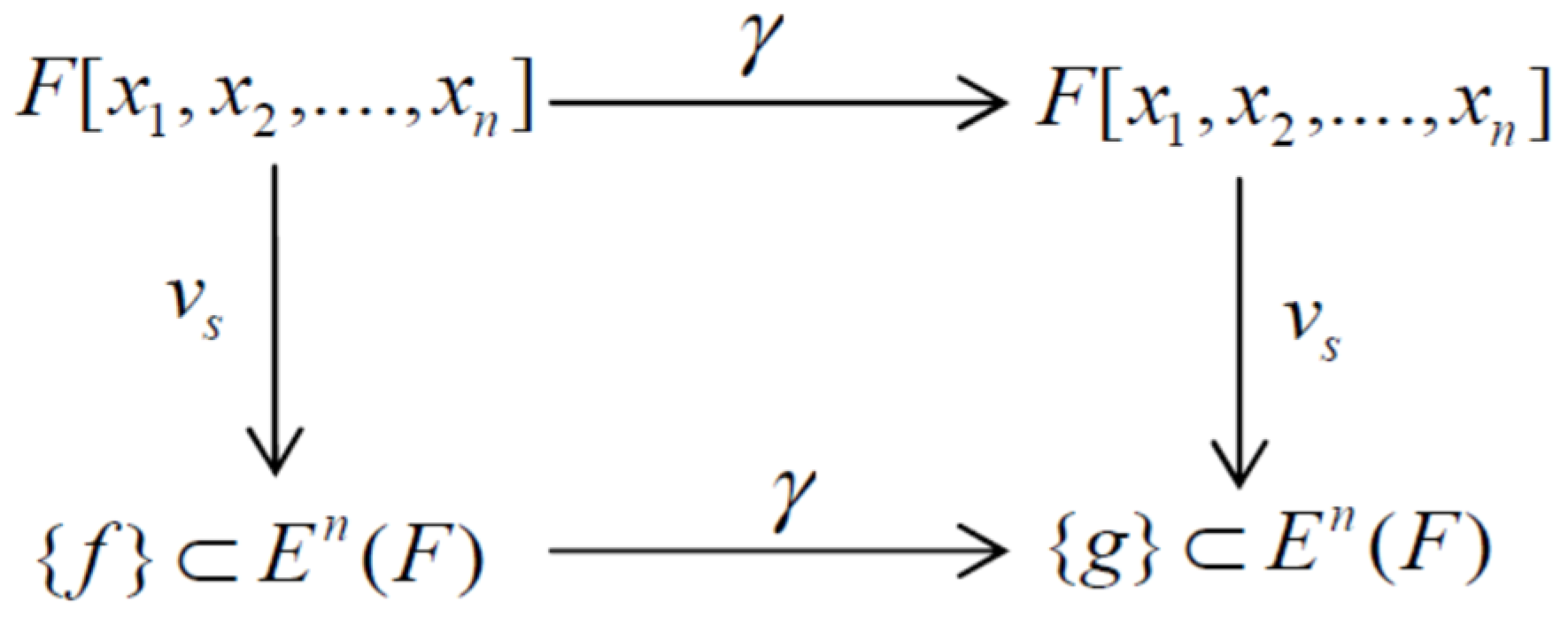
Let us consider a polynomial ring over the closed real algebraic field and a ring automorphism such that condition is admitted. Suppose we consider a selection function by following the principles of axioms of choice in the polynomial ring. The resulting definition of the polynomial ring map is given as follows.
Definition 5.
If is a polynomial ring over the respective closed algebraic field admitting automorphism and is a unique selection function for every , then is an automorphic ring map such that the following diagram commutes (see Figure 1):
Figure 1.
Commutative diagram of automorphic ring map.
Note that the automorphic ring map preserves the dimensionality within the respective polynomial ring; however, the degrees of polynomials can vary under automorphic ring maps.
Remark 2.
The preservation of dimensionality allows for the uniformity and homogeneity of the ring map. If we consider a topologically affine n-space and , then the automorphic ring map admits the following condition:
Example 1.
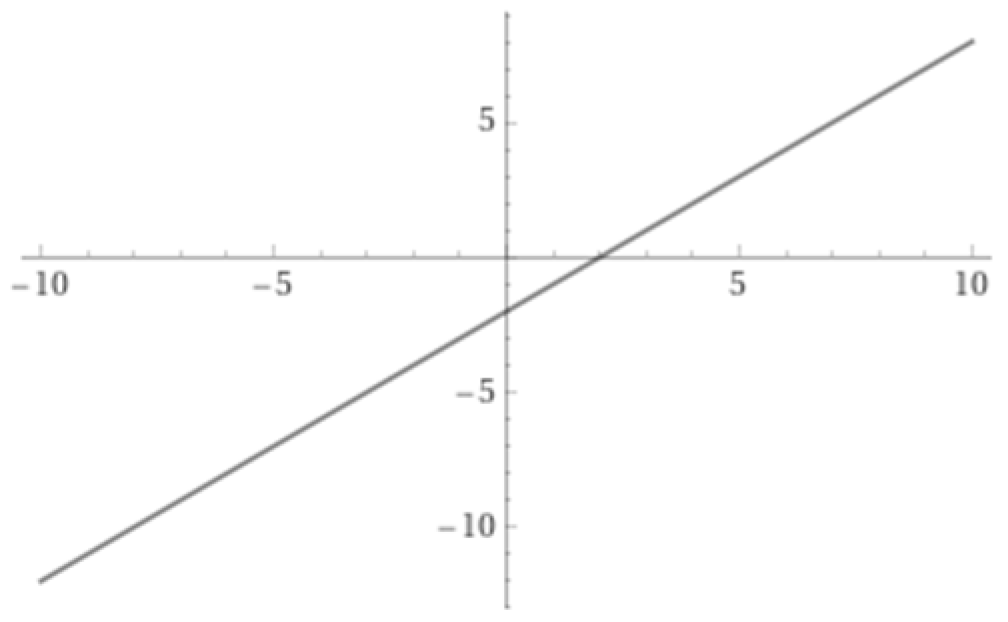
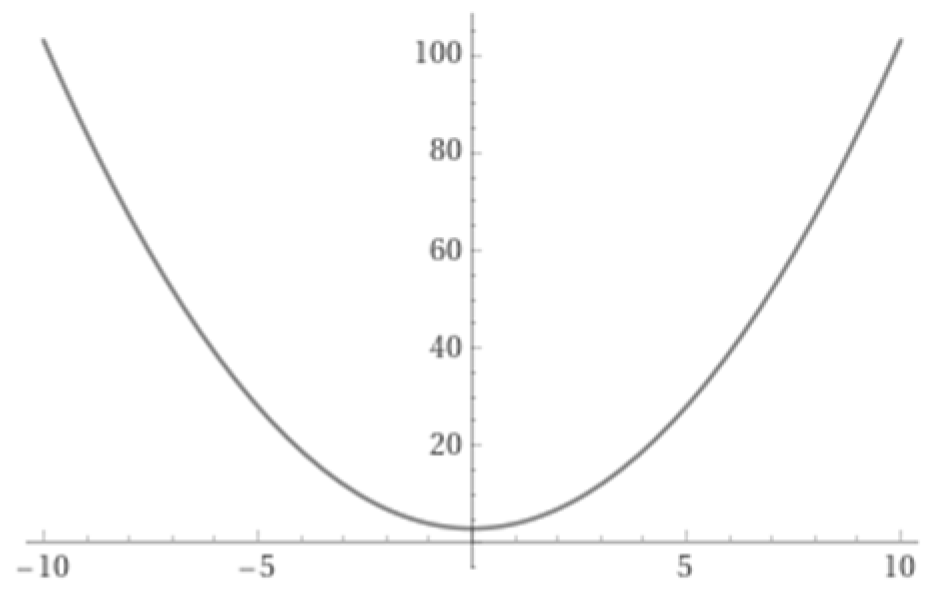
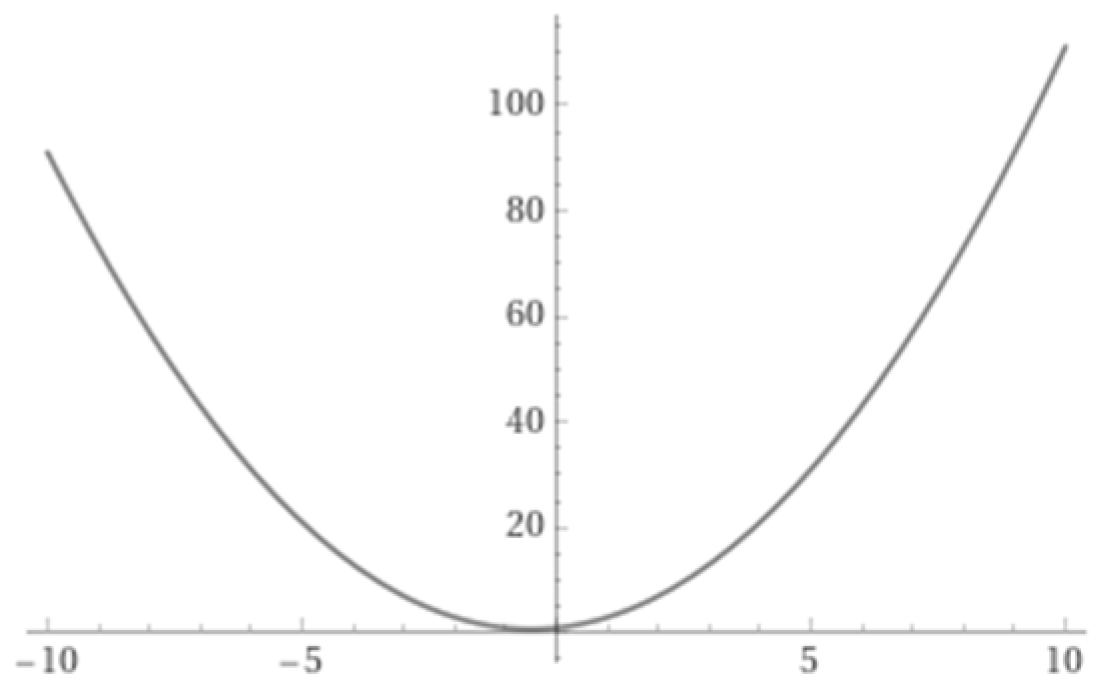
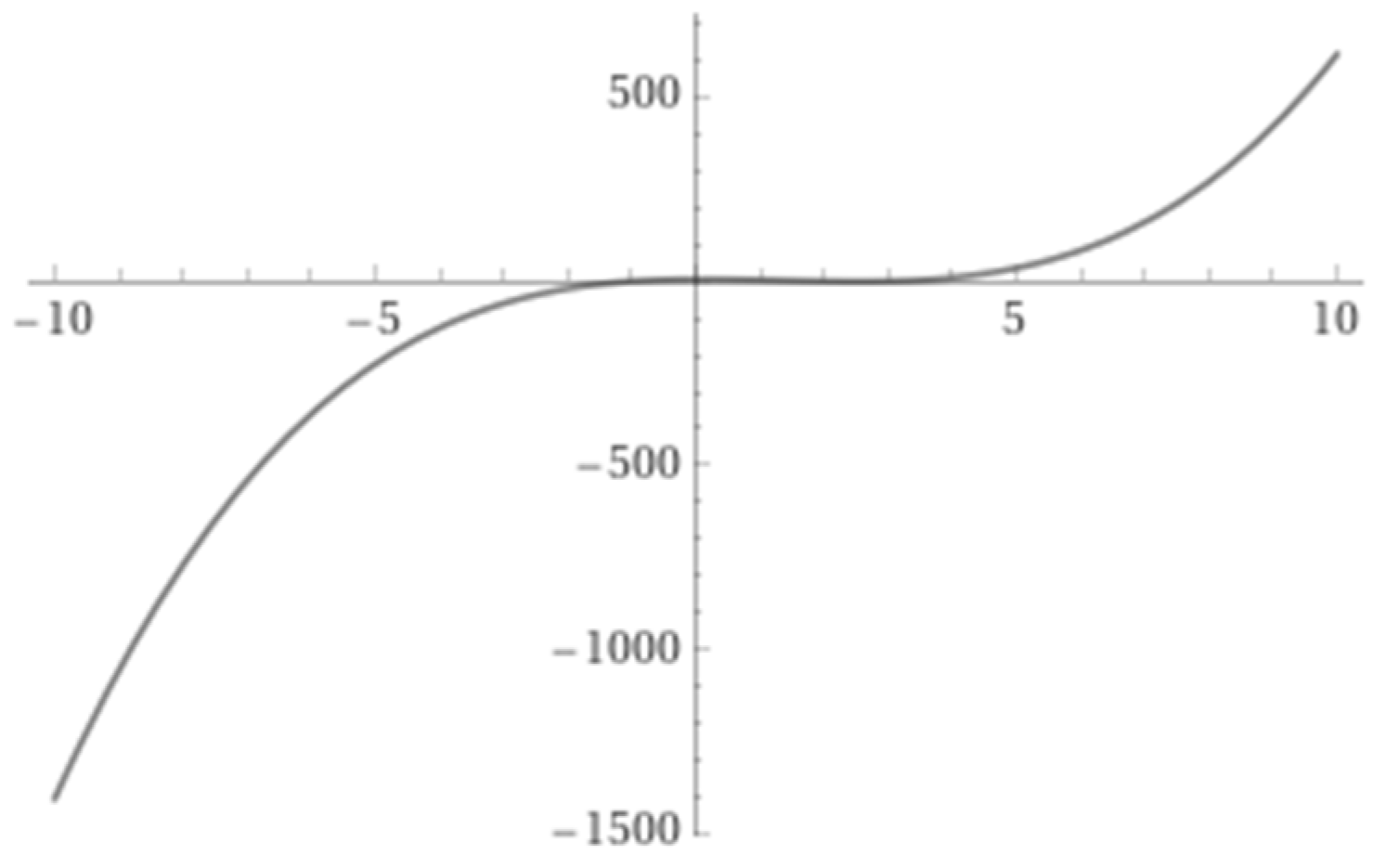
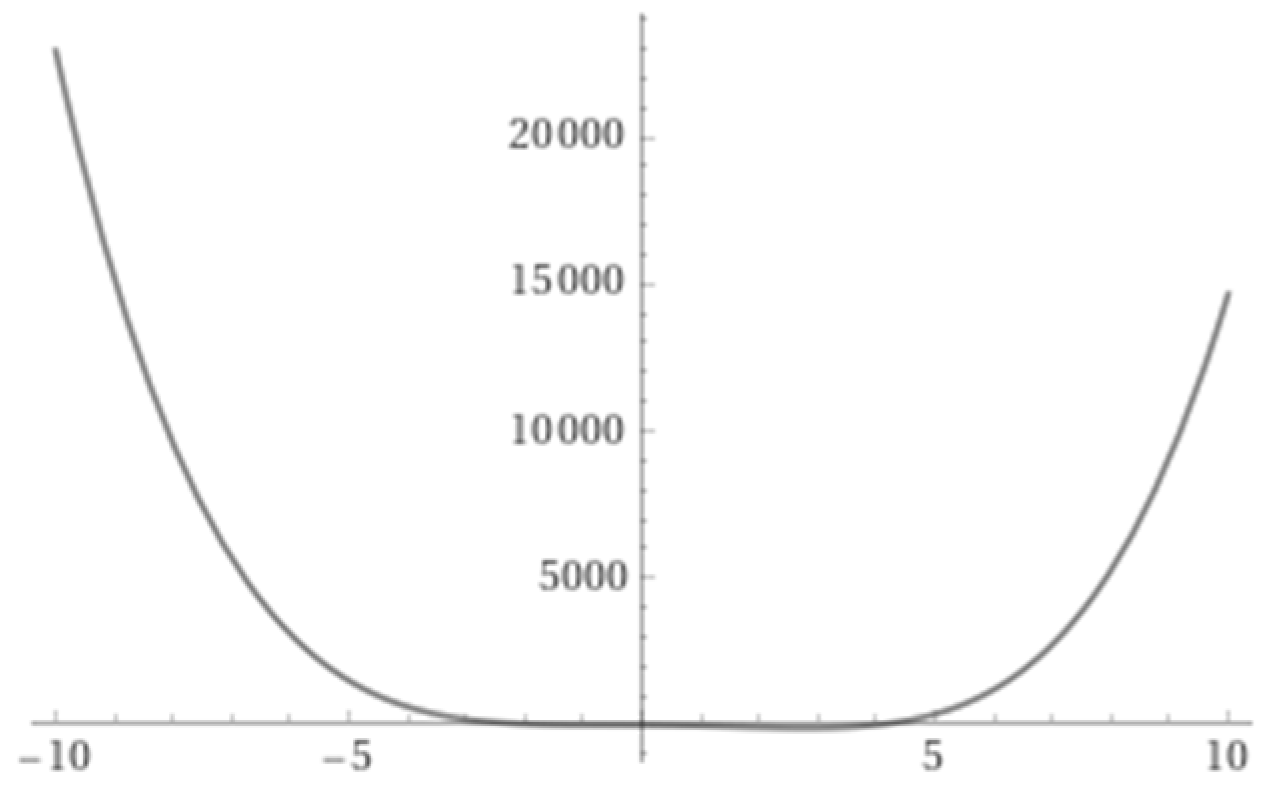
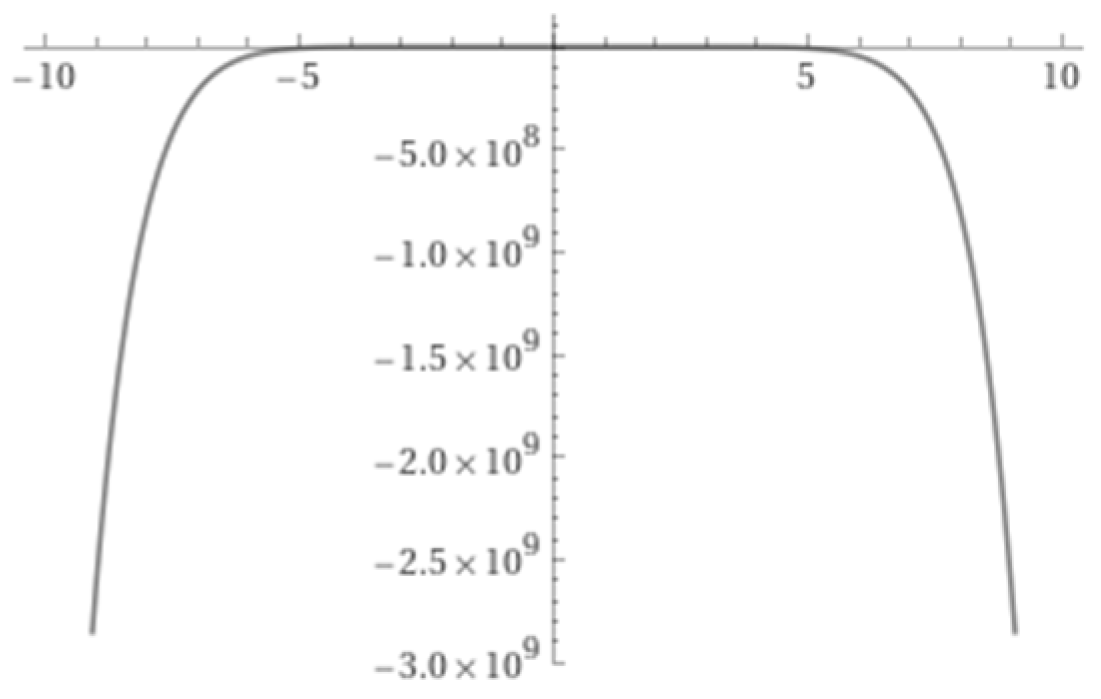
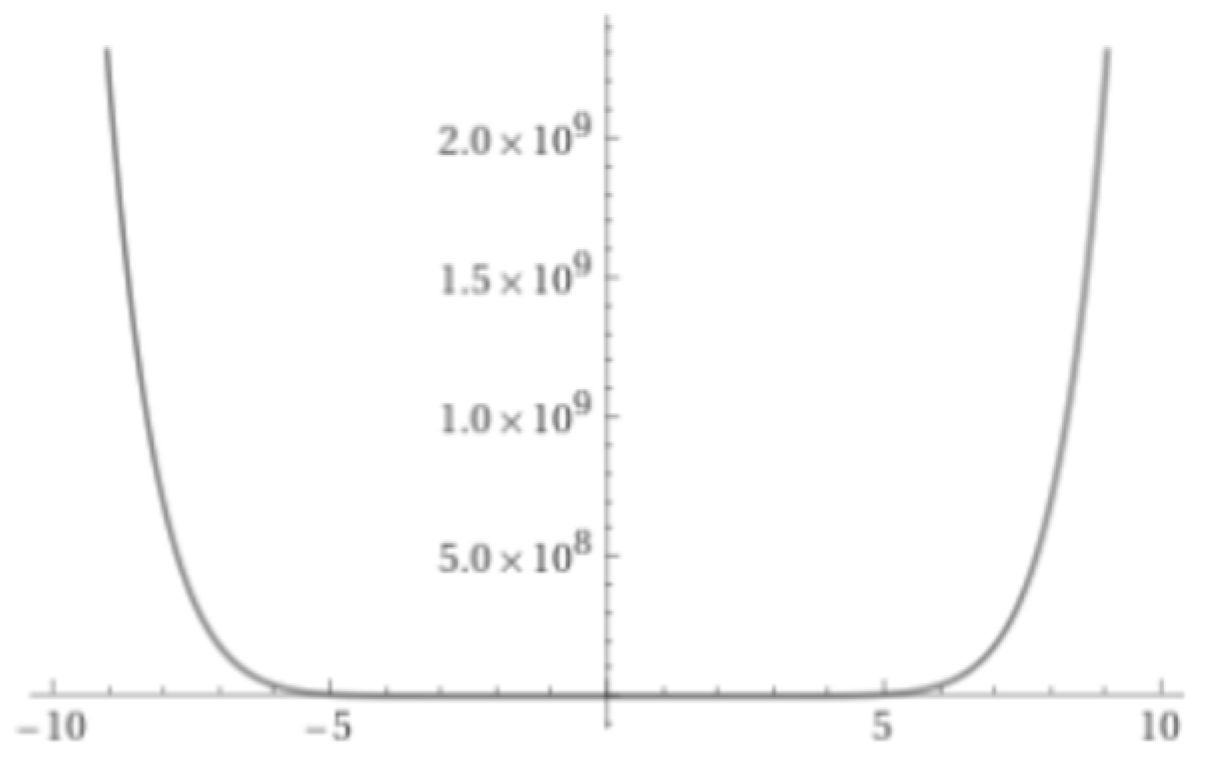
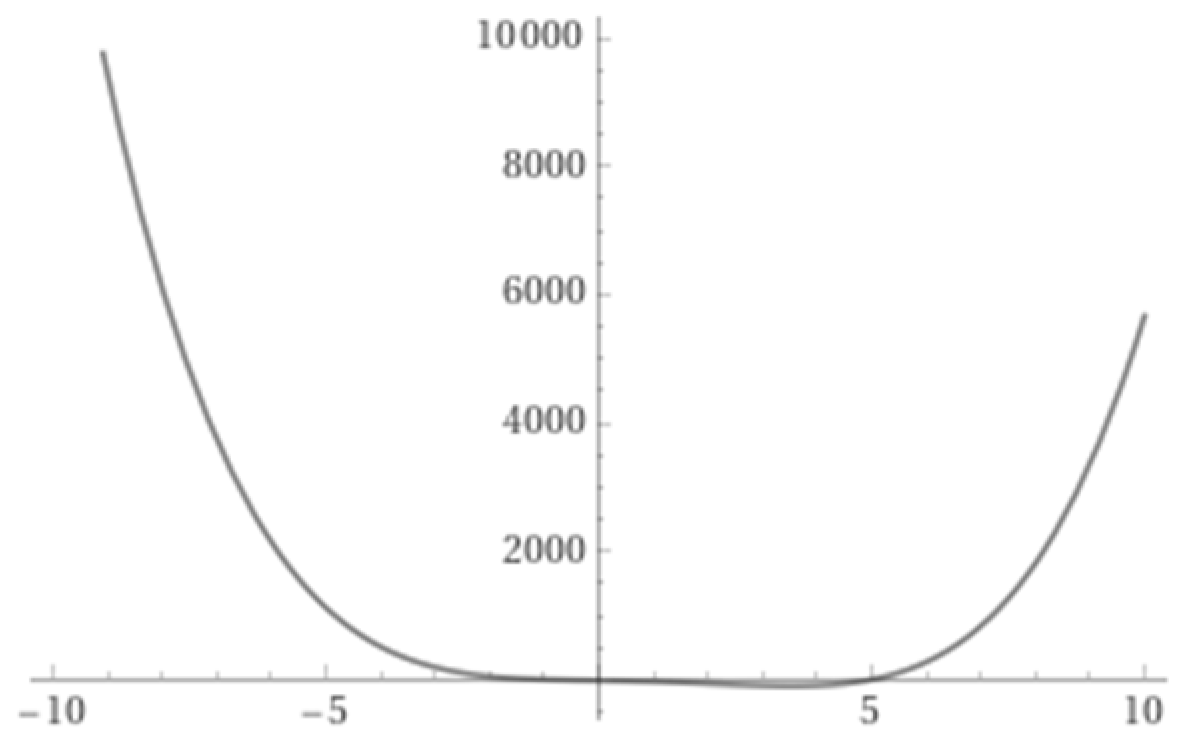
We present a set of examples by considering the varying dimensionalities. First, we present the polynomial and its forms, considering one dimension under two ring maps generating as illustrated in Figure 2, Figure 3 and Figure 4. Note that we have fixed and .
Figure 2.
The polynomial .
Figure 3.
The polynomial .
Figure 4.
The polynomial .
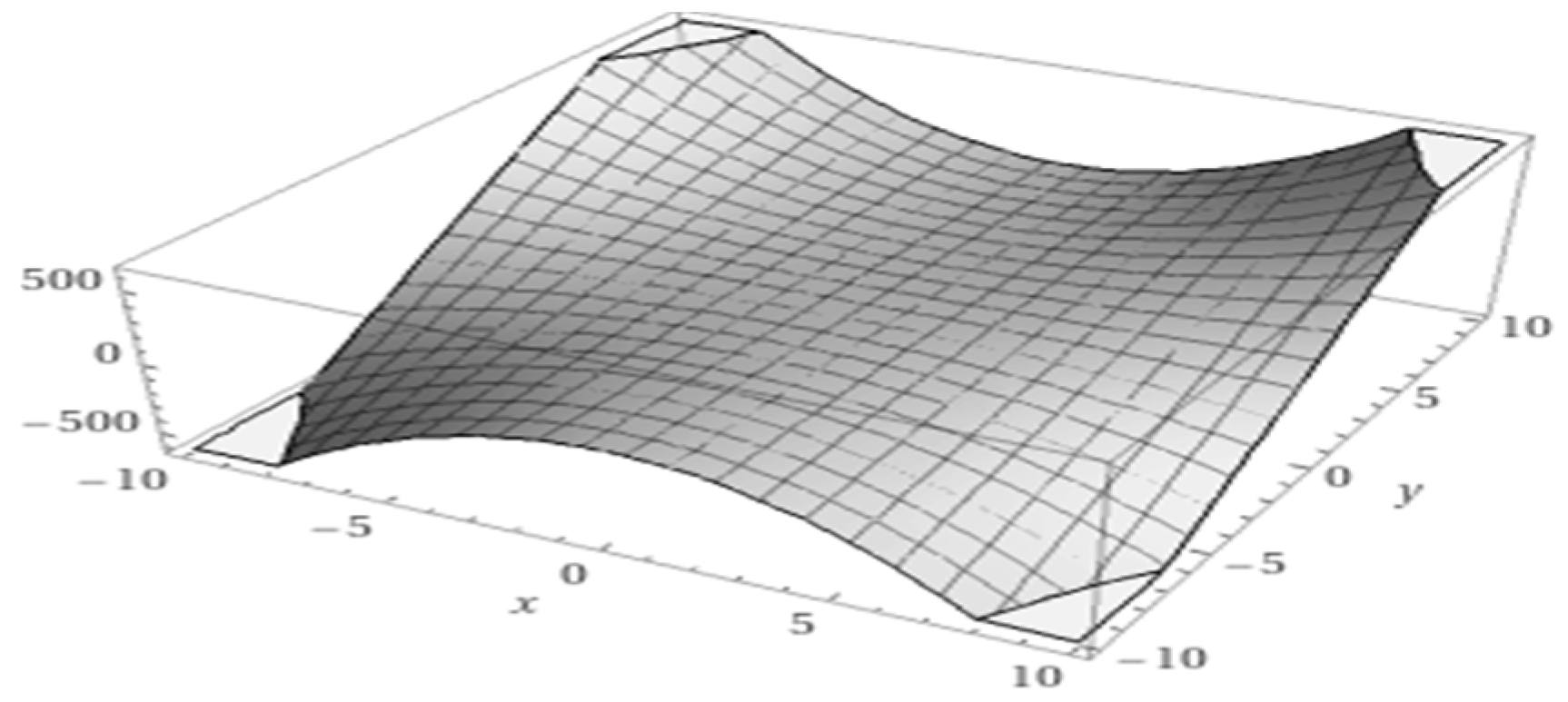
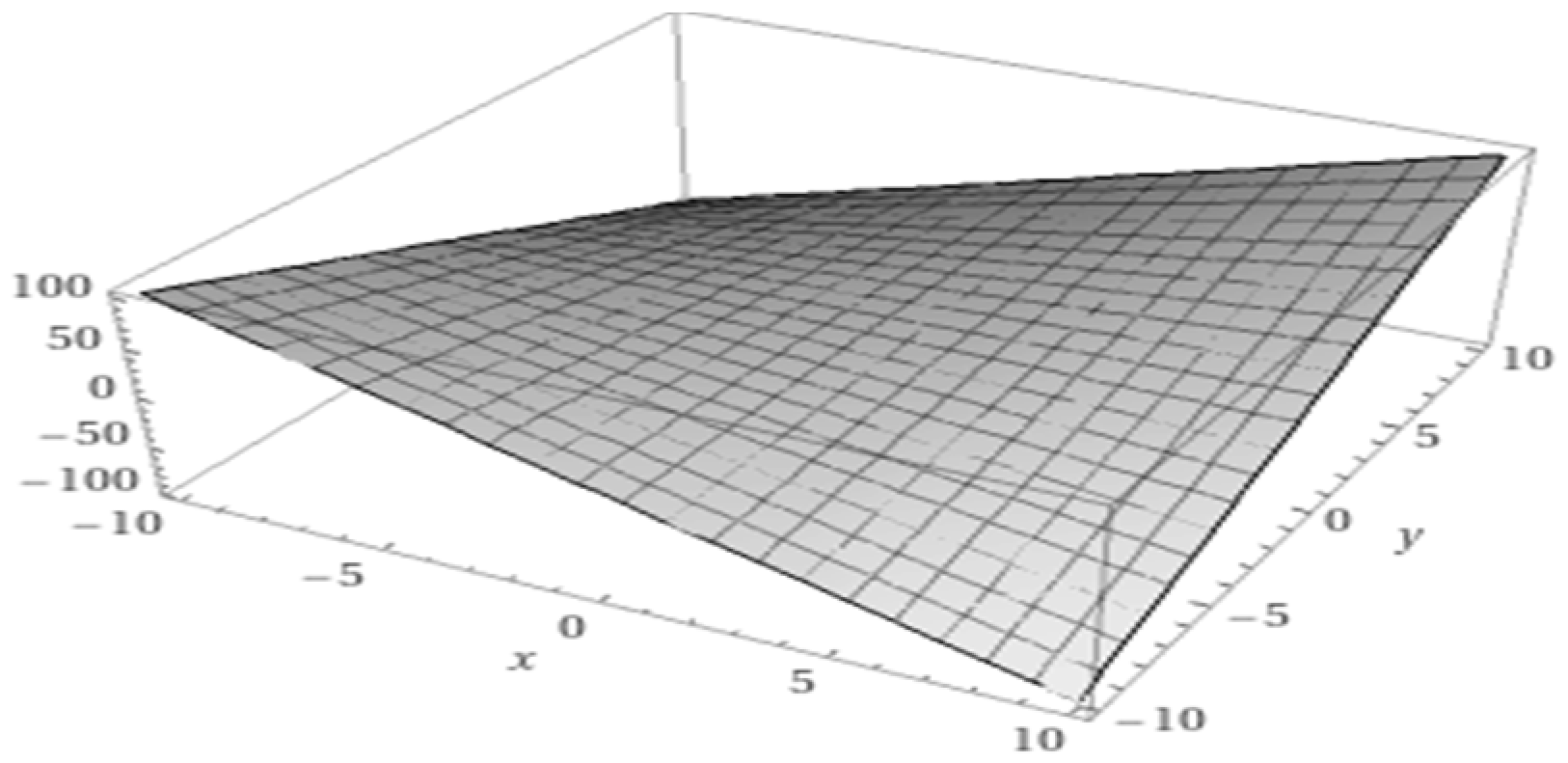
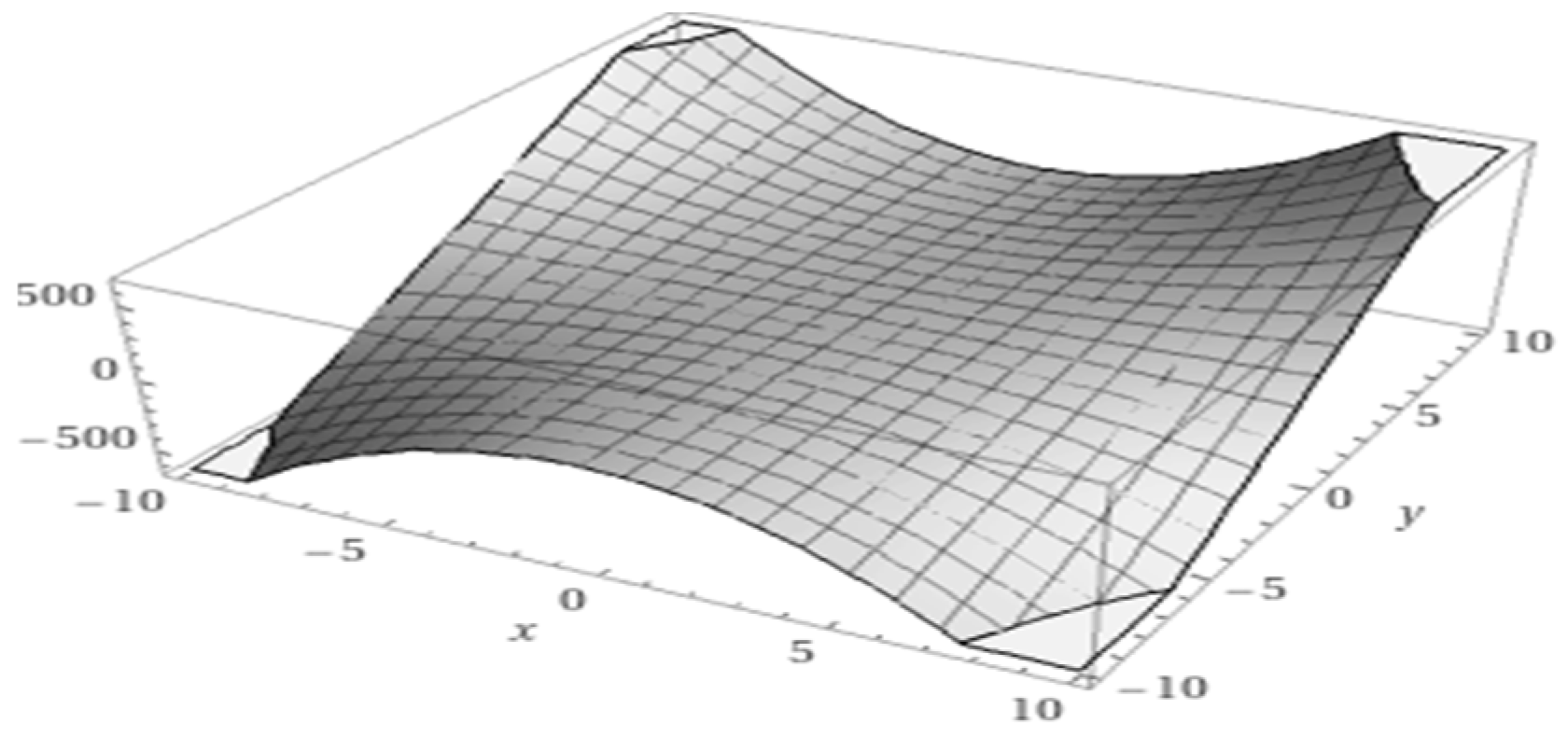
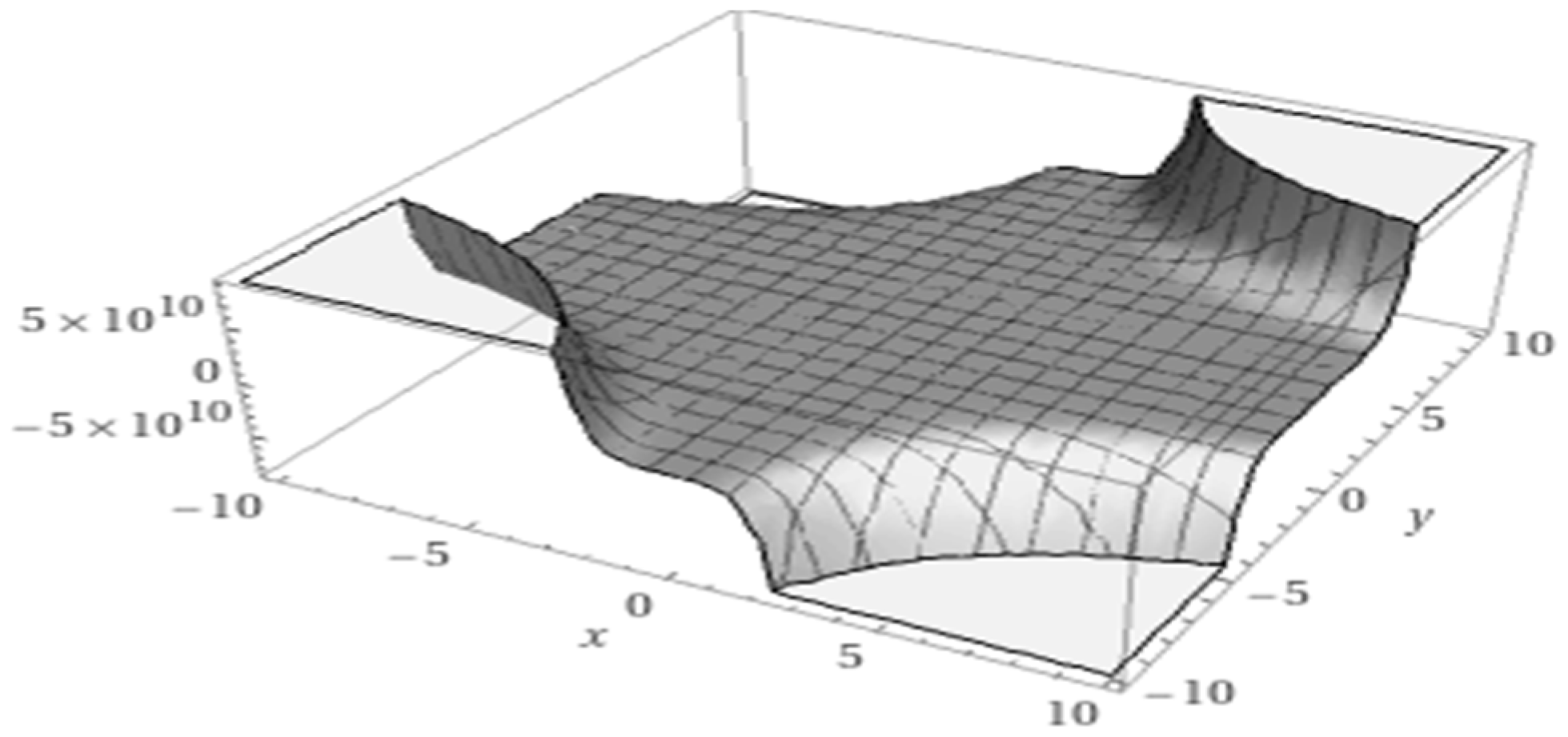
Next, we increase the dimensionality such that , and the results of the ring maps are illustrated in Figure 5, Figure 6 and Figure 7 as follows. Note that the polynomials have and .
Figure 5.
The manifold of polynomial .
Figure 6.
The manifold of polynomial .
Figure 7.
The manifold of polynomial .
It is interesting to note that, in all cases, the algebraic ring maps preserve the topological property of homeomorphisms in various dimensionalities. In some cases, the manifolds are isomorphic in nature. This shows that topological properties are retained in some cases even if the real algebraic sets generated by the ring maps vary to some extent. As a consequence, this invites the concept of a topological equivalence class of manifolds and the associated polynomials in a ring. The following definition presents the concept of a topological equivalence class of polynomials generated by the corresponding real algebraic sets.
Definition 6.
If are two polynomials with
over a closed field, then
is a topological equivalence class if the respective manifolds
and
admit the
property.
Note that the topological equivalence class of polynomials depends on the isomorphism property, which is relatively stronger than homeomorphism. As a result, the isomorphic manifolds representing the corresponding real algebraic sets are also in the topological equivalence class of manifolds. The existence of the topological equivalence class of polynomials is illustrated in detail through the numerical simulations as presented in the Numerical Simulation section (Section 4) of this paper.
3. Deformations of Topological Manifolds over Rings
In this section, we present the definitions and properties of real algebraic sets representing the respective topological manifolds and their deformations. Recall that the topological manifolds are generated retaining the homeomorphism property, irrespective of varying dimensionalities. Let us consider a polynomial such that it can be decomposed into , where . Thus, it preserves the algebraic zero-set as . This leads to the formation of a topological n-manifold and associated conditions, which are defined in the following section.
3.1. Definitions
First, we present the definition of formation of real algebraic manifolds in affine topological spaces.
Definition 7.
Let us consider a topological affine space generated by and . If condition is maintained such that , then is a topological n-manifold generated by in .
We can form another topological manifold over the polynomial ring with the employment of an automorphic ring map. This is called an image n-manifold, which is defined as follows.
Definition 8.
Let us consider a topological affine space and two polynomials such that . If the polynomial is decomposable as , then it generates an image n-manifold denoted as in if the following conditions are maintained:
Note that the decomposability of a set of polynomials in the ring is a necessary condition to form an image manifold under the suitable ring map. Moreover, it is interesting to note that an algebraic composition operation, denoted by , can be formulated considering and along with the automorphic ring map . The definition of algebraic composition operation is presented as follows.
Definition 9.
If are decomposable such that and the corresponding algebraic zero-sets are and , then the algebraic composition operation is defined as .
It is important to note that the algebraic composition operation under the automorphic ring map within a polynomial ring considers that the participating polynomials in the composition operation are decomposable into multiple irreducible components.
3.2. Topological and Algebraic Properties
This section presents the topological as well as algebraic properties of the proposed concepts and formulations. First, we show that two topological n-manifolds can be combined into a composite n-manifold through the algebraic composition operations in the set of corresponding polynomials in the real ring.
Theorem 2.
If and are two topological manifolds over the polynomial ring, then is also a topological manifold in an affine , and it is a composite topological manifold.
Proof.
Let and be two topological n-manifolds generated over the respective polynomial ring in . If the polynomials are decomposable, then the respective ideals are and, as a result, are also ideals. Note that the respective algebraic zero-sets maintain the condition that , where . Thus, the composed algebraic curve represented by preserves the condition that . Hence, the structure is also a manifold in . □
Note that the formations of composite n-manifolds from multiple real algebraic sets do not always require the automorphic ring maps for each and every irreducible component. In other words, we can consider that is invariant for some irreducible components representing prime ideals. It leads to the following corollary.
Corollary 1.
In each of the topological manifolds , and , the Zariski closed topological subspace is an algebraic variety representing the submanifold under invariant for under the ring map, where .
The proof of the corollary is relatively straightforward, and we present a set of examples accordingly in the Numerical Simulations section (Section 4). The concept of locally flat imbedding of a manifold and the isotopy class can be preserved in the proposed formulations. The following theorem illustrates that the isomorphic embedding within a manifold is admissible considering the respective real algebraic sets. Moreover, such isomorphic embedding is invariant to the automorphic ring map.
Theorem 3.
Let be an affine Zariski topological space, and consider for . There is an isomorphic embedding , where , and is a set of real algebraic manifolds.
Proof.
Let us consider a set of real algebraic manifolds given by and the corresponding algebraic set . This indicates that , where . If we consider an affine Zariski topological space such that isomorphism is preserved, then it admits the isomorphic embedding , where . □
The formation of a composite n-manifold can be considered as a topological deformation of the participating real algebraic sets. This observation is presented in the following lemma.
Lemma 1.
The composite manifold is a topological deformation of and over the respective polynomial ring.
Proof.
Note that is not isomorphic to and for . Thus, the composite n-manifold is a topological deformation of and . □
4. Numerical Simulations
In this section, we present the formation of topological manifolds over the polynomial ring maps, and the associated manifold deformations are formed through the algebraic composition operations as well as ring maps. The manifolds are numerically simulated in the topological product space such that . We present the results of the numerical simulations considering three distinct cases.
4.1. Case I: Considering
First, we consider that the polynomial rings are formed over closed real field such that for . Note that we are not restricting the . The formations of topological manifolds for various polynomials in a ring due to the applications of ring maps are illustrated in Figure 8 and Figure 9.
Figure 8.
The topological manifold of .
Figure 9.
The topological manifold of .
The formation of a composite topological manifold under automorphic ring maps and the algebraic composition operation is presented in Figure 10. Note that each of the topological manifolds is topologically homeomorphic, and the composite manifold given in Figure 10 is isomorphic to the topological manifold given in Figure 9.
Figure 10.
The topological manifold of .
It indicates that the composite 1-manifold is capable of retaining the isomorphism of one of the real algebraic sets under ring maps, and it is topologically homeomorphic to the other one.
4.2. Case II: Considering
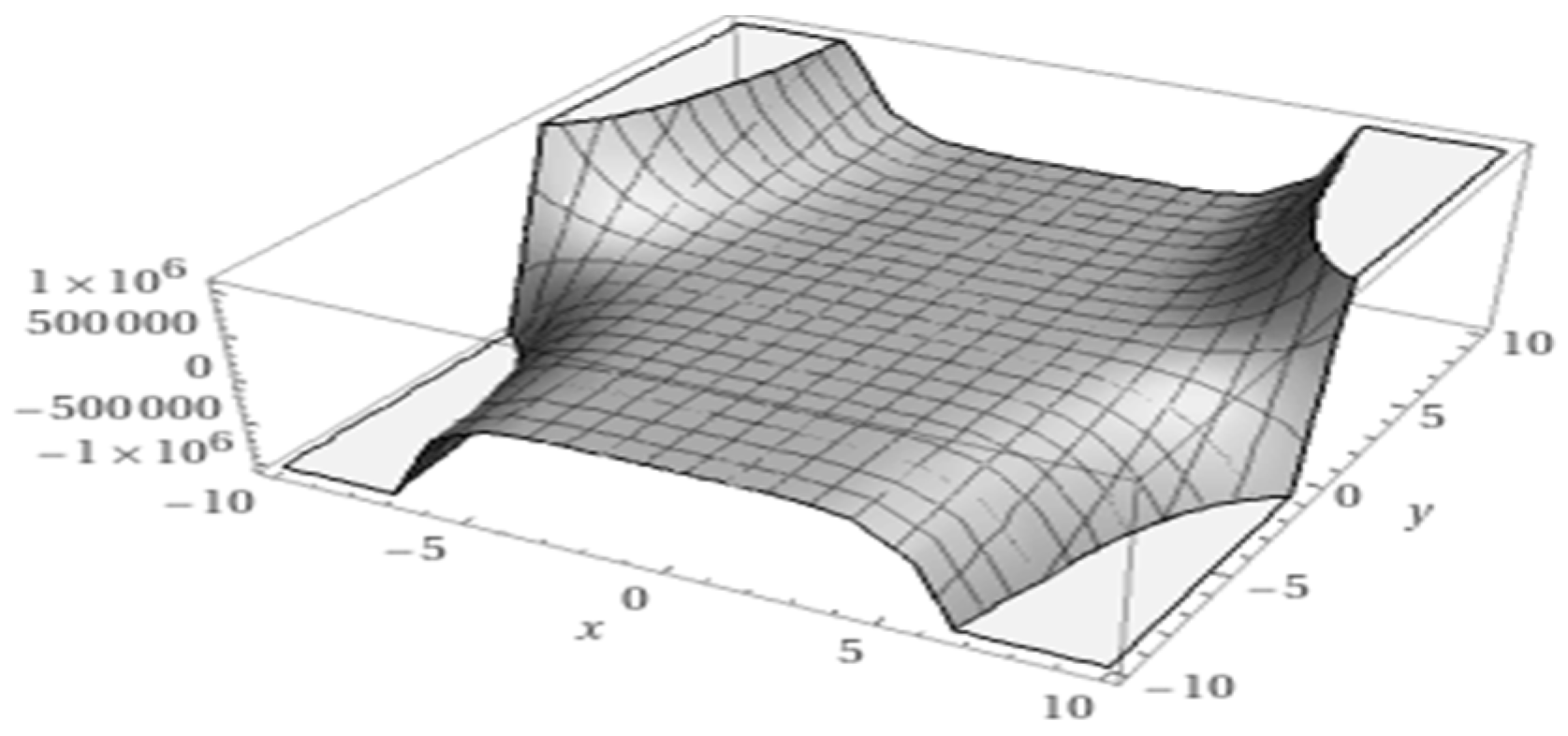
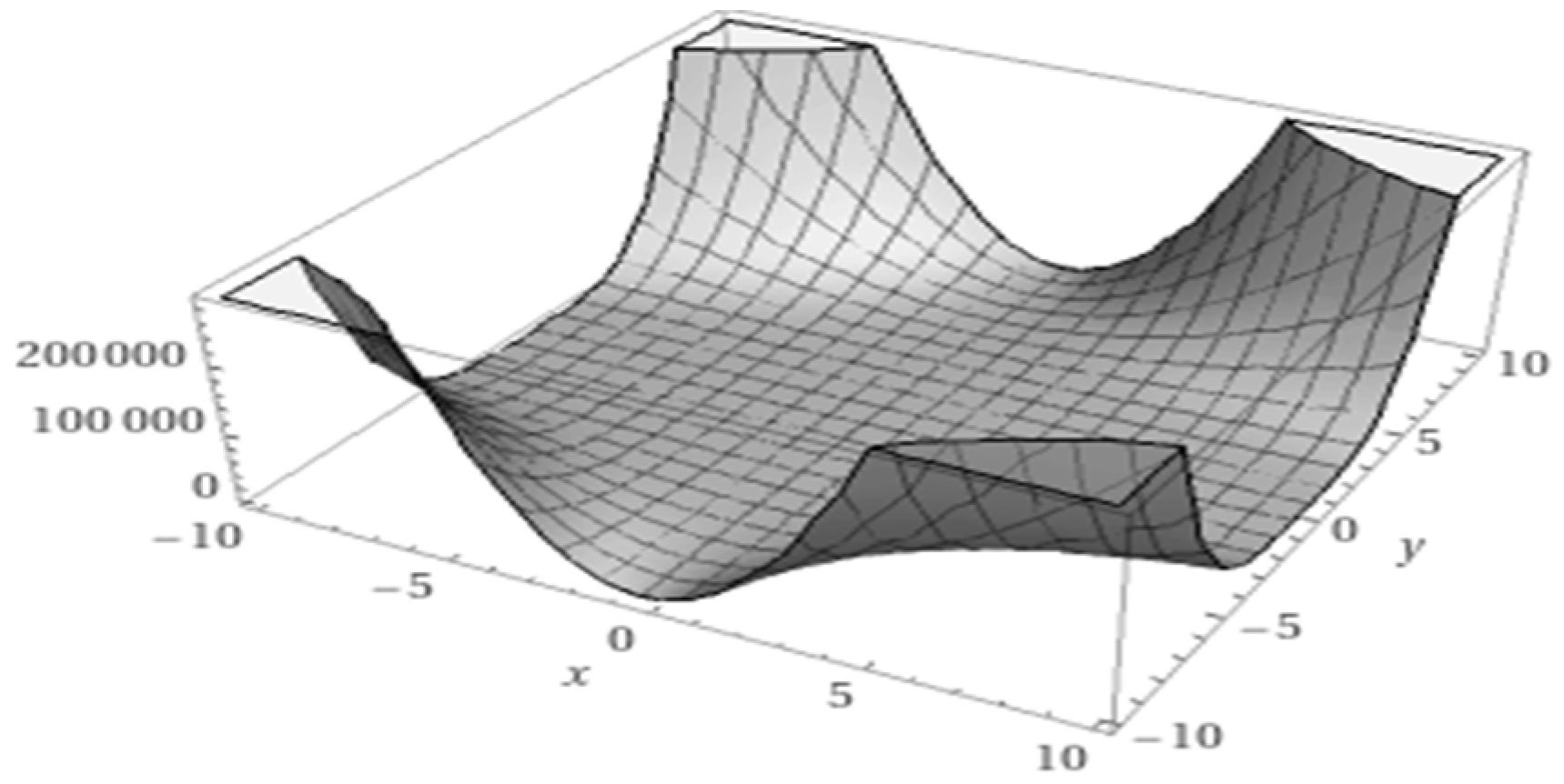
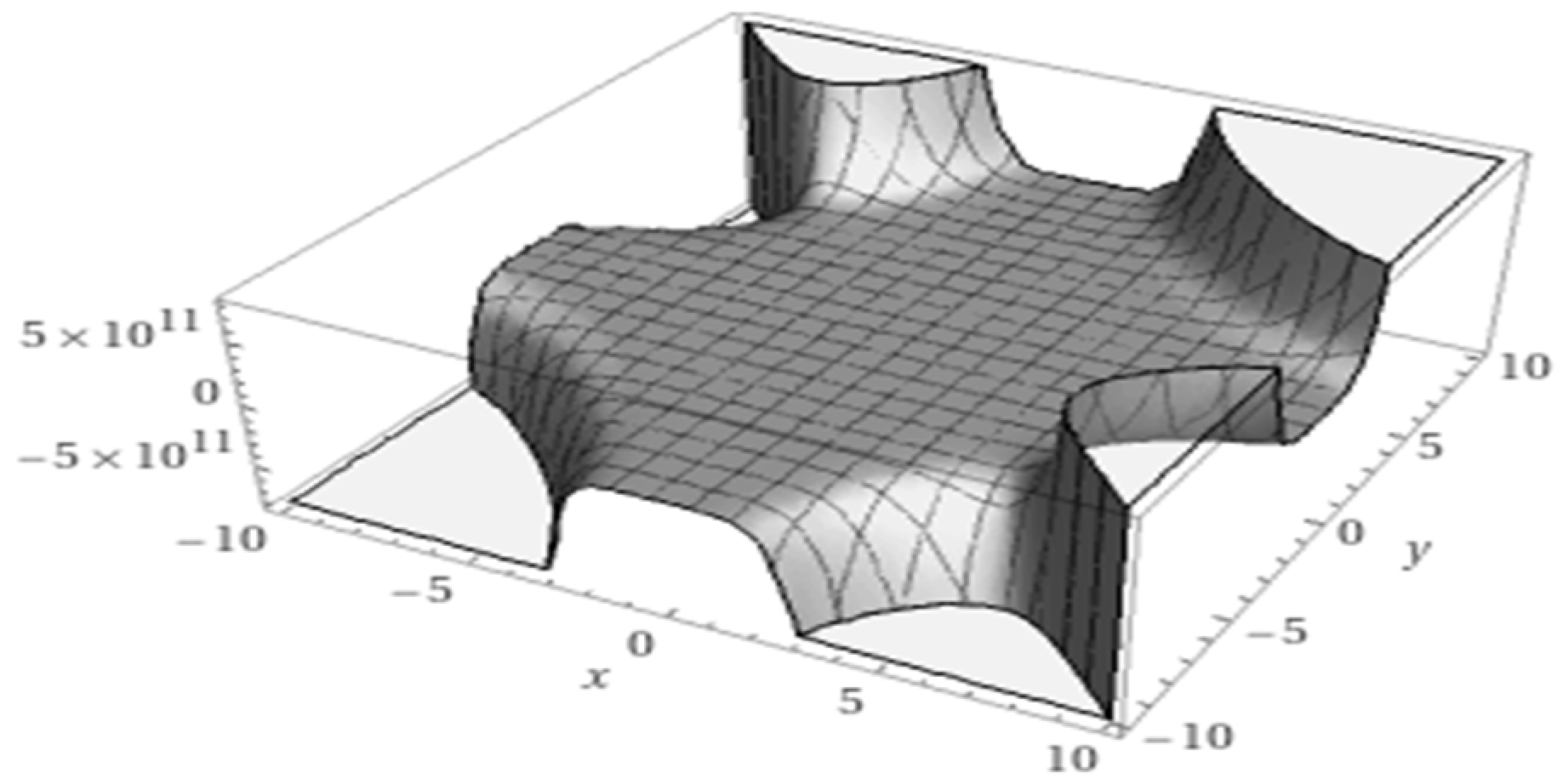
In this set of experiments, we increase the dimensionality while preserving the ring over the closed field of reals. The formations of the resulting topological manifolds with are illustrated in Figure 11 and Figure 12. Note that the respective manifolds have different proportions of topological bending retaining the homeomorphism property.
Figure 11.
The topological manifold of .
Figure 12.
The topological manifold of .
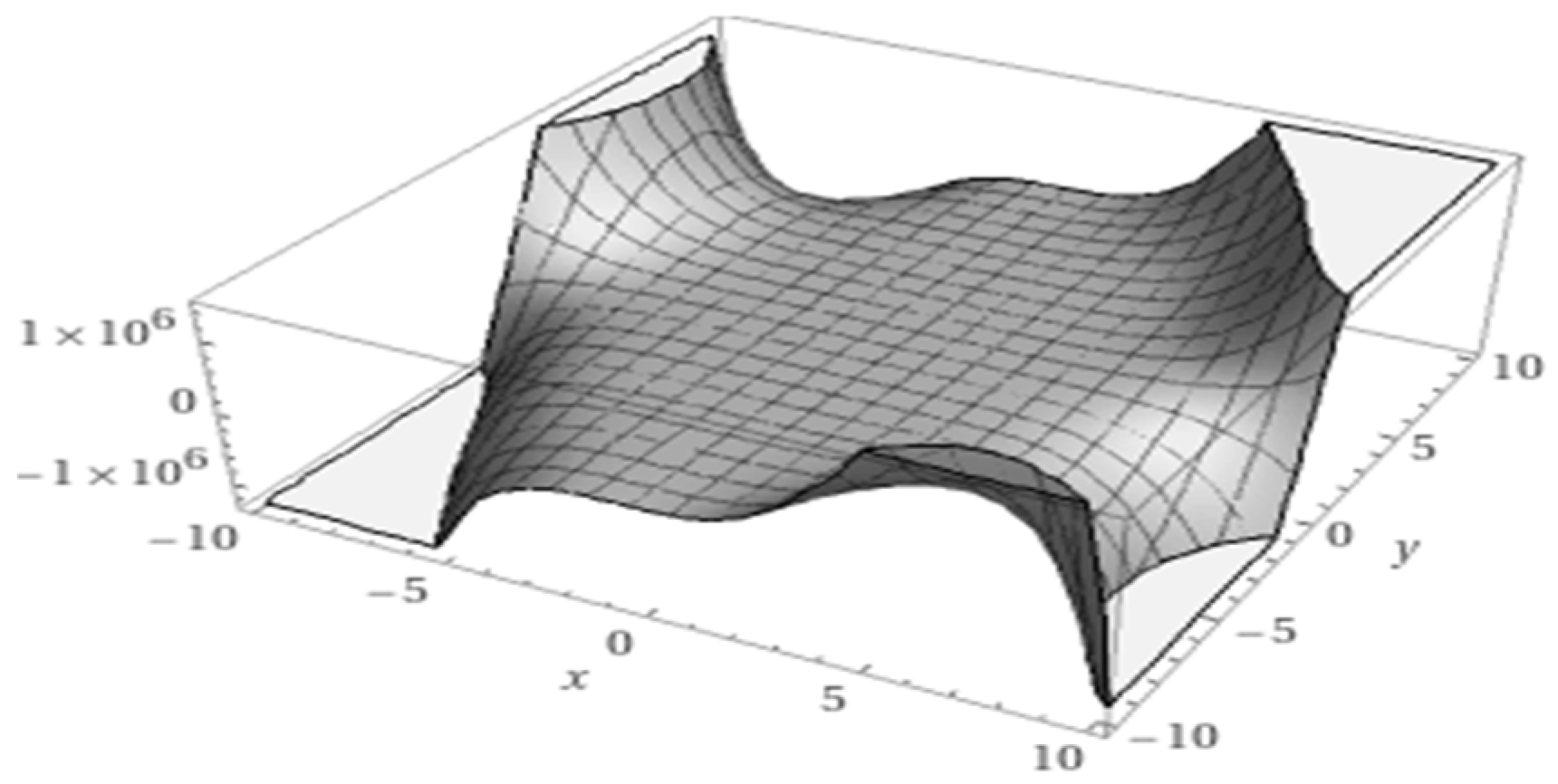
It is interesting to observe, considering Figure 11 and Figure 12, that the 2-manifolds are homeomorphic and not isomorphic. The formation of a composite topological manifold under ring maps and algebraic composition operation is illustrated in Figure 13.
Figure 13.
The topological manifold of .
Note that the topological deformations are pronounced in this case due to the applications of ring maps and algebraic composition operations in two dimensions. Interestingly, the composite manifold is homeomorphic and not isomorphic in this case, which is a different result as compared to one dimension. Moreover, note that the manifolds admit the locally flat submanifolds in all cases.
4.3. Case III: Considering with Higher Degrees of Polynomials
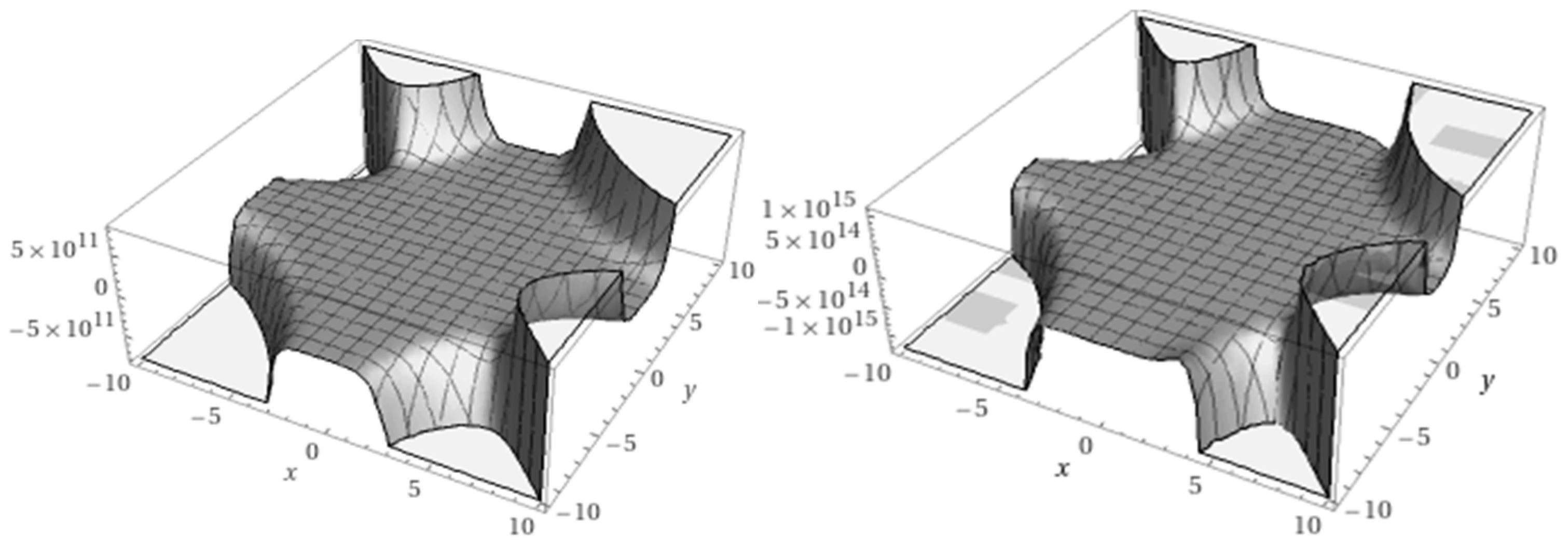
In this set of experiments, we maintain the algebraic field and dimensionality unaltered. However, we considerably increase the degrees of the polynomials forming the corresponding algebraic zero-sets. The topological manifolds participating in algebraic composition operations are illustrated in Figure 14 and Figure 15. Note that the manifolds are not isomorphic.
Figure 14.
The topological manifold of .
Figure 15.
The topological manifold of .
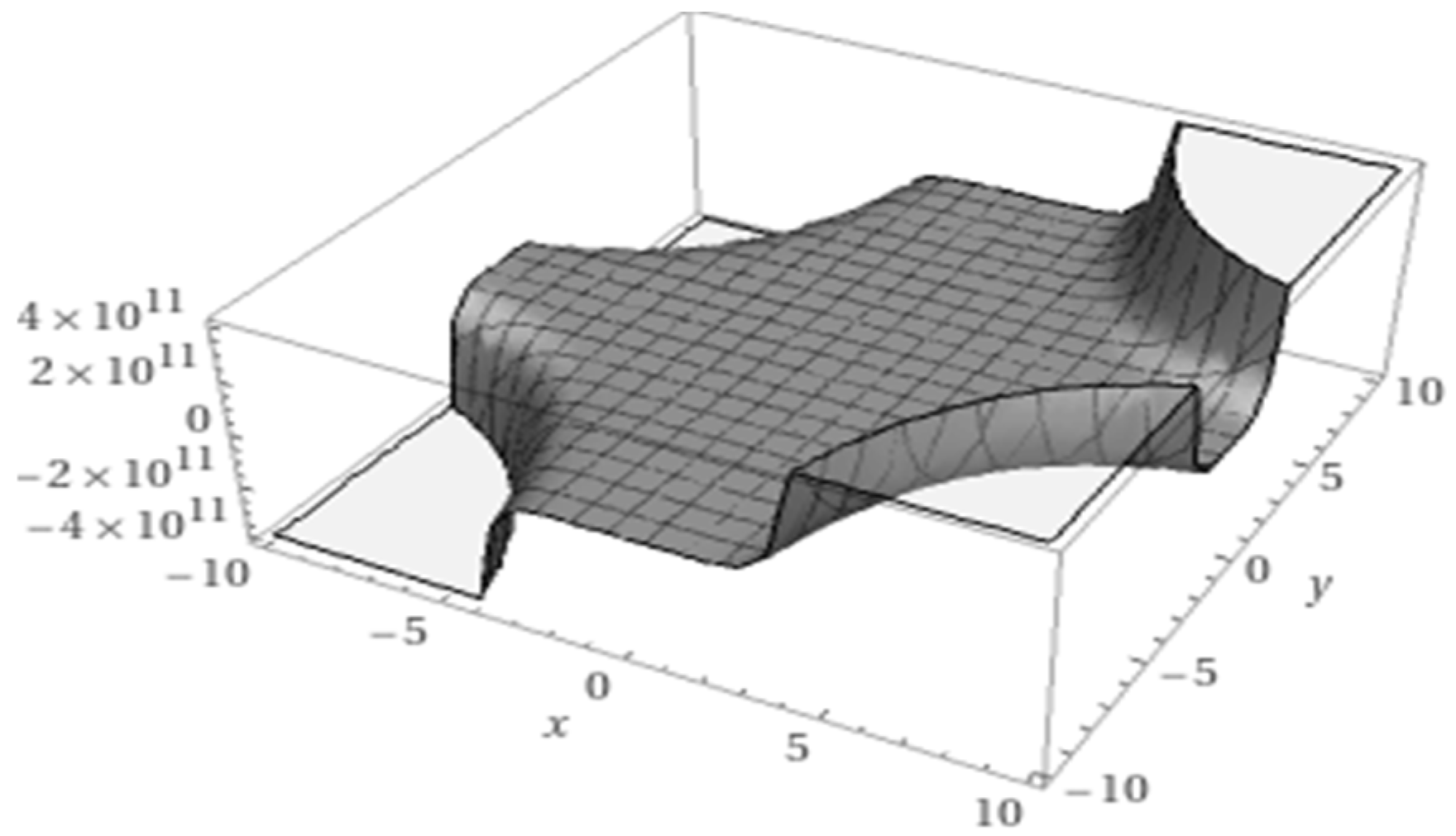
The effects of the ring maps and algebraic composition operation are pronounced within the resulting composite 2-manifold. The composite manifold is illustrated in Figure 16.
Figure 16.
The topological manifold of .
It is interesting to note that the higher degrees of topological deformations are induced in the manifold given in Figure 16 as compared to the manifold given in Figure 13. However, the deformed 2-manifolds retain the homeomorphism property and topological connectedness within the manifolds. This illustrates the resulting topological effects due to the increase in degrees of polynomials in a real algebraic ring in two dimensions. Furthermore, the deformed manifolds preserve locally flat submanifolds irrespective of the varying degrees of the polynomials in a ring.
4.4. Case IV: Topological Equivalence of Manifolds and Polynomials
In this section, we compare the topological structures of two manifolds under deformations generated by two different sets of polynomials with varying dimensions and degrees. We show the retention of isomorphism property under the algebraic composition operation. Consider two real algebraic zero-sets by considering and as presented in Figure 10 and Figure 16, respectively. Note that both admit locally flat submanifolds at different dimensions. Next, we simulate the topological 2-manifold generated by by combining the respective submanifolds under the algebraic composition operation. The resulting isomorphic manifolds are presented in Figure 17. The results illustrate that the manifolds generated by are topologically isomorphic under the respective algebraic composition operations, where .
Figure 17.
Equivalence class of and .
Interestingly, the topological deformations generate multiple axes of symmetries within the composite and deformed manifolds. Moreover, the mixed-axial symmetries of the composite manifolds under deformations are preserved, illustrating that the respective two sets of polynomials in a ring are topologically equivalent under algebraic compositions generating isomorphic topological manifolds. Thus, we can consider that the manifolds presented in Figure 17 are in a topologically equivalent class of manifolds, and the respective polynomials are also in an equivalence class within the polynomial ring under automorphic ring maps. Furthermore, the results illustrate that the real algebraic varieties of higher degrees generating locally flat submanifolds are invariant under algebraic composition operations.
Remark 3.
It is important to note that a topological equivalence class of manifolds is sensitive to the coefficients of the monomials. If an algebraic variety is irreducible, then the periodically varying coefficients can induce an equivalence class of manifolds or a set of manifolds with mirror symmetry depending upon the values of the coefficients under periodic smooth functions. This observation is presented in Figure 18, Figure 19 and Figure 20.
Figure 18.
Manifold generated by .
Figure 19.
Manifold with mirror symmetry generated by .
Figure 20.
Equivalent class of manifold generated by .
5. PL-Homeomorphism, Self-Homeomorphism and Applicational Aspects
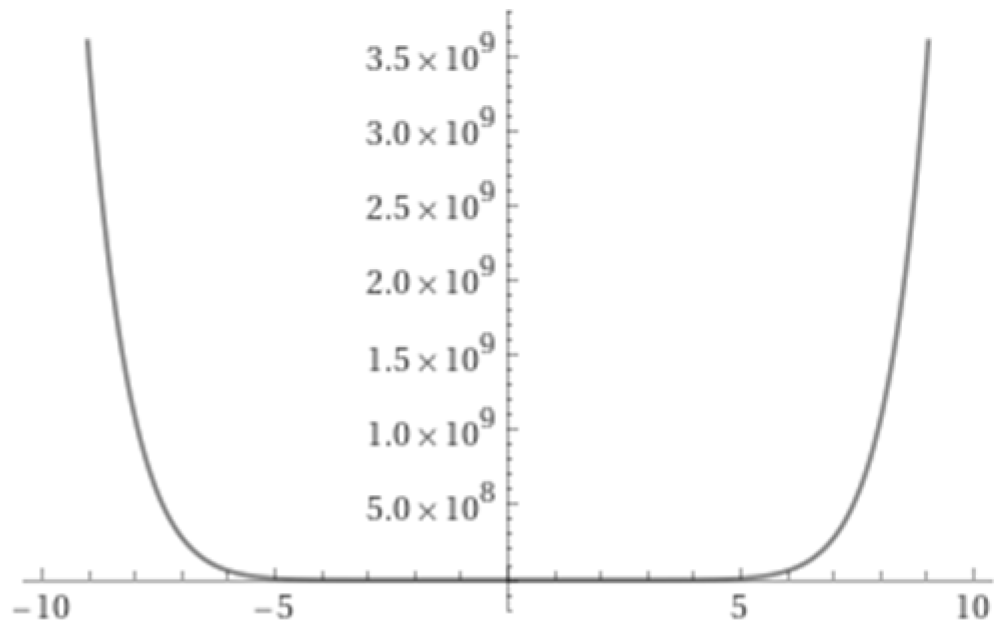
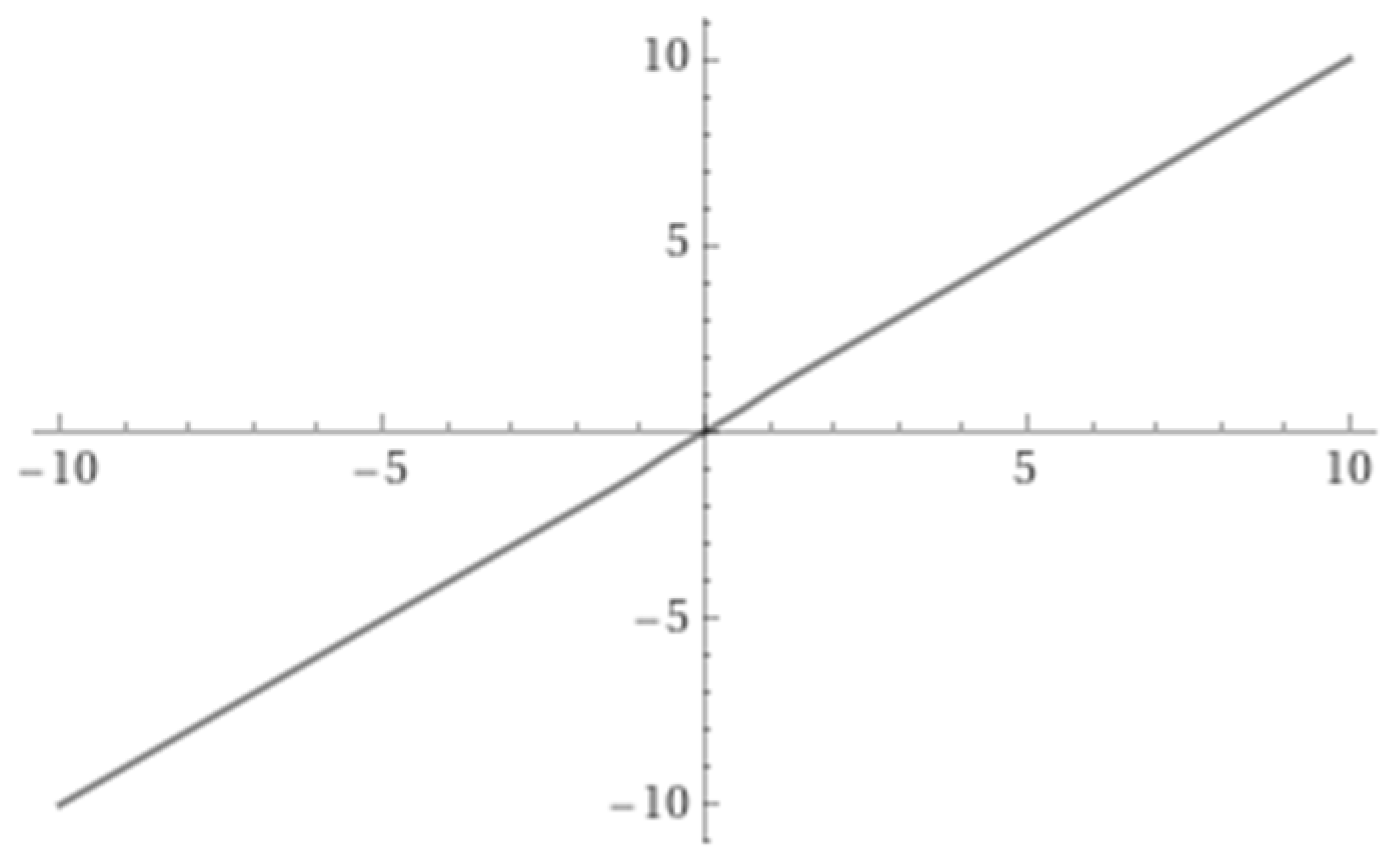
In this section, we consider the PL-homeomorphism and associated self-homeomorphic functions in general forms and the incorporation of mirror symmetry by topological deformations of manifolds. We briefly indicate the interrelationships between the characteristic polynomials of graphs, symmetries and the potential applicational aspects. Earlier, it was shown that the PL-homeomorphism and self-homeomorphism of a topological manifold cannot be considered as equivalent [19]. For example, the smooth and non-singular self-homeomorphism of the function represents a line with infinitely many isolated fixed points near origin as illustrated in Figure 21.
Figure 21.
Non-singular smooth line of with isolated fixed points near origin.
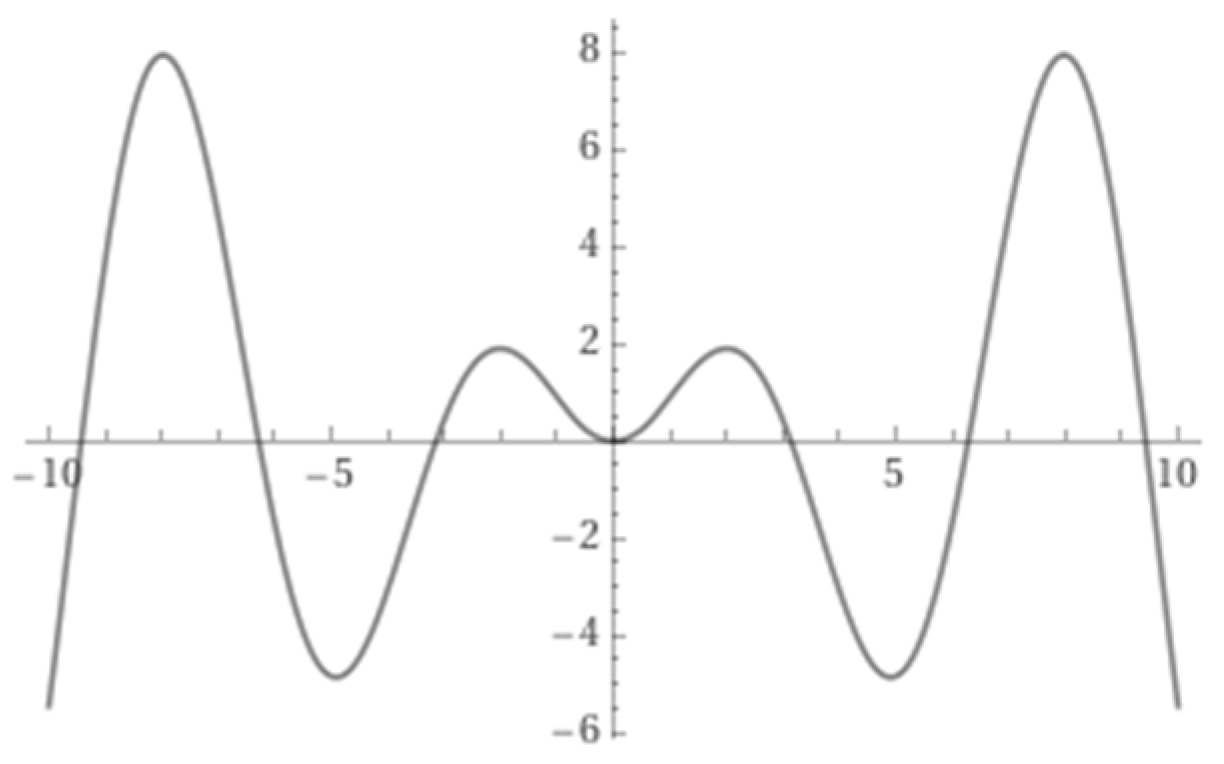
However, the multiplicative inclusion of a smooth periodic function into the corresponding self-homeomorphic function can induce mirror symmetry in the resulting topological manifold as illustrated in Figure 22. Note that, in this case, the function is not in a standard polynomial form.
Figure 22.
Induced mirror symmetry in topological manifold of .
Finally, this is to note that there is an interrelationship between polynomials and graphs with several applications. The derivation of a characteristic polynomial from a graph is an interesting concept. If a graph is given as , then the characteristic polynomial associated to the respective graph can be derived from the adjacency matrix of the graph [20]. Interestingly, the roots of a characteristic polynomial of a graph are the eigenvalues of the graph. Moreover, if the graph is a symmetric graph, then it admits semi-free actions of Abelian groups [20]. In other words, the symmetry or asymmetry of the graph structures affects the properties of the associated characteristic polynomials. In the views of applicational aspects involving the characteristic polynomials, symmetries and graphs in the domain of chemical sciences, the molecules can be represented in numerical forms representing the underlying graph structures with varying symmetries, and the chemical properties of the molecules vary accordingly [21,22].
6. Conclusions
The formations of algebraic varieties representing topological n-manifolds over a set of polynomials in a polynomial ring allow for the homeomorphic deformation of n-manifolds in an affine topological space. The notions of automorphic ring maps and the algebraic composition operation within a set of polynomials in a ring admit the corresponding manifold composition from a set of manifolds, and it induces the resulting deformations of manifolds within the composite manifolds. The deformations include topological bending of submanifolds at multiple directions while retaining the isomorphic embedding of a locally flat submanifold. The Nash isomorphism of manifolds is admissible in the proposed formulations. One of the reasons is that the proposed concept of a topologically equivalent class of polynomials gives rise to a set of isomorphic topological n-manifolds, where such a set of n-manifolds can be considered as a topological equivalence class of n-manifolds. The numerical simulations exhibit the topological deformations of the 1-manifolds and 2-manifolds in various forms, preserving homeomorphism and isomorphism under algebraic composition operations. It is important to note that the proposed formulations do not consider formations of singularities within the real algebraic sets, indicating that an n-manifold can be imbedded in a topological (n+1)-space. Moreover, the proposed formulations are generalized in nature without being specifically restricted to the simplectic class of topological manifolds.
Funding
This research (article processing charge) was funded by Gyeongsang National University.
Data Availability Statement
The data are contained within the article.
Acknowledgments
The author would like to thank the reviewers and editors for their valuable comments and suggestions during the peer-review process.
Conflicts of Interest
The author declares no conflict of interest.
References
- Wallace, A.H. Algebraic approximation of manifolds. Proc. London Math. Soc. 1957, 3, 196–210. [Google Scholar] [CrossRef]
- Nash, J. Real algebraic manifolds. Ann. Math. 1952, 56, 405–421. [Google Scholar] [CrossRef]
- Bodin, A.; Tibăr, M. Topological equivalence of complex polynomials. Adv. Math. 2006, 199, 136–150. [Google Scholar] [CrossRef][Green Version]
- A’Campo, N. Real deformations and complex topology of plane curve singularities. Ann. Fac. Sci. Toulouse 1999, 8, 5–23. [Google Scholar] [CrossRef]
- Alessandrini, L.; Bassanelli, G. Small deformations of a class of compact non-Kähler manifolds. Proc. Amer. Math. Soc. 1990, 109, 1059–1062. [Google Scholar]
- Edwards, R.D.; Kirby, R.C. Deformations of spaces of imbeddings. Ann. Math. 1971, 93, 63–88. [Google Scholar] [CrossRef]
- Ren, Y.; Wen, C.; Zhen, S.; Lei, N.; Luo, F.; Gu, D.X. Characteristic class of isotopy for surfaces. J. Syst. Sci. Complex. 2020, 33, 2139–2156. [Google Scholar] [CrossRef]
- Brock, J.F.; Bromberg, K.W.; Canary, R.D.; Minsky, Y.N. Local topology in deformation spaces of hyperbolic 3-manifolds. Geom. Topol. 2011, 15, 1169–1224. [Google Scholar] [CrossRef][Green Version]
- Anderson, J.W.; Canary, R.D. Algebraic limits of Kleinian groups which rearrange the pages of a book. Invent. Math. 1996, 126, 205–214. [Google Scholar] [CrossRef][Green Version]
- Anderson, J.W.; Canary, R.D.; McCullough, D. The topology of deformation spaces of Kleinian groups. Ann. Math. 2000, 152, 693–741. [Google Scholar] [CrossRef]
- Coupet, B.; Maylan, F.; Sukhov, A. Holomorphic maps of algebraic CR manifolds. Int. Math. Res. Not. 1999, 1999, 1–29. [Google Scholar] [CrossRef]
- Kollár, J. Deformations of elliptic Calabi-Yau manifolds. Recent Advances in Algebraic Geometry; Cambridge University Press: Cambridge, UK, 2014; Chapter 14; pp. 254–290. [Google Scholar]
- Zhuang, X.; Mastorakis, N. Learning by autonomous manifold deformation with an intrinsic deforming field. Symmetry 2023, 15, 1995. [Google Scholar] [CrossRef]
- Wang, Y.; Wang, B. Topological inference of manifolds with boundary. Comput. Geom. 2020, 88, 101606. [Google Scholar] [CrossRef]
- Siebenmann, L.C. Deformation of homeomorphisms on stratified sets. Comment. Math. Helv. 1972, 47, 123–163. [Google Scholar] [CrossRef]
- Bagchi, S. The properties of topological manifolds of simplicial polynomials. Symmetry 2024, 16, 102. [Google Scholar] [CrossRef]
- Gomez, R.R. Sasaki-Einstein 7-manifolds, Orlik polynomials and homology. Symmetry 2019, 11, 947. [Google Scholar] [CrossRef]
- Omori, H.; Maeda, Y.; Yoshiyoka, A. Weyl manifolds and deformation quantization. Adv. Math. 1991, 85, 224–255. [Google Scholar] [CrossRef]
- Siebenmann, L.C. Topological manifolds. In Proceedings of the International Congress of Mathematicians, Paris, France, 1–10 September 1970; Volume 2, pp. 133–163. [Google Scholar]
- Wang, K. Characteristic polynomials of symmetric graphs. Linear Algebra Its Appl. 1983, 51, 121–125. [Google Scholar] [CrossRef]
- Redzepovic, I.; Radenkovic, S.; Furtula, B. Effect of a ring onto values of Eigenvalue-based molecular descriptors. Symmetry 2021, 13, 1515. [Google Scholar] [CrossRef]
- Balasubramanian, K. New insights into aromaticity through novel delta polynomials and delta aromatic indices. Symmetry 2024, 16, 391. [Google Scholar] [CrossRef]
Disclaimer/Publisher’s Note: The statements, opinions and data contained in all publications are solely those of the individual author(s) and contributor(s) and not of MDPI and/or the editor(s). MDPI and/or the editor(s) disclaim responsibility for any injury to people or property resulting from any ideas, methods, instructions or products referred to in the content. |
© 2024 by the author. Licensee MDPI, Basel, Switzerland. This article is an open access article distributed under the terms and conditions of the Creative Commons Attribution (CC BY) license (https://creativecommons.org/licenses/by/4.0/).