1. Introduction
Curves, surfaces, and curve–surface pairs are essential structures in differential geometry. Willmore defined embedded surfaces on as embedding of S into Euclidean 3-space. He took the Euclidean metric of and induced it to a Riemannian structure on , considered an expression analogous to the left-hand member of the curvature K, and replaced it with the mean curvature on .
Similar to the work in [
1], in this study, we introduce a novel concept of embedded surface with curve–surface pairs, and present fresh insights by offering new characterizations for these pairs within Euclidean 3-space. This marks the first comprehensive exploration of curve–surface pairs theory in this context, establishing both necessary and sufficient conditions.
Frenet frame geometric studies were constructed in [
2,
3,
4,
5,
6,
7,
8]. Similar studies were conducted in [
9,
10,
11,
12,
13,
14,
15]. For example, Chen [
5] observed rectifying curves and an invariant of the rectifying curve. By using the Frenet frame, the envelope of the plane spanned is also examined in [
5,
13]. Moreover, Takeuchi and Izumiya [
12] showed the proofs that a developable surface with a geodesic as a rectifying curve is a conical surface. There are also other papers on this subject, as seen in [
16,
17,
18,
19,
20]. In addition, based on the results in [
7,
10,
15,
16], Takahashi studied the relations between the invariants of the Darboux curve and osculating Darboux curve in [
19].
A regular curve is defined by curvatures and and a curve–surface pair is defined by curvatures , and . A regular curve is called a general helix if its first and second curvatures and are not constant, but is constant.
Many papers have considered the involute–evolute curves. for example [
21,
22,
23]. Using a similar method, we produce a new ruled surface based on another ruled surface. In [
21],
-scroll, which is known as the rectifying developable surface, of any curve
and the involute
-scroll of the curve
are already defined as
. In [
21,
22,
23], special ruled surfaces of
-scroll and involute
-scroll are considered, which are associated with a space curve
with a curvature
and involute
.
The objective of this study is to analyze the Gaussian and mean curvatures of curve–surface pairs utilizing embedded surfaces across various curve–surface pair configurations. Additionally, we aim to perform developable operations on these curve–surface pairs, thoroughly investigating their properties. We employ the Gauss–Bonnet theorem by Willmore to characterize developable curve–surface pairs, particularly focusing on those whose position vectors align with the planes spanned by the osculating Darboux frame, as discussed in [
1]. Also, we obtain the
-scroll within a specific type of strip and the involute
-scroll within another type of strip, incorporating various differential geometric components such as the Weingarten map S, mean, and Gaussian curvatures. Notably, we explore the curvatures of the
invariants, denoted as
(Curvatures of a Strip) and determine
and
of the strip
along with the modified Darboux vector field of the involute
, following methodologies outlined in previous works [
1,
7,
16,
21,
22,
23].
Then, we review some basic concepts regarding curve–surface pairs, embedded surfaces, osculating Darboux frame, and -scroll with some differential geometric elements.
2. Preliminaries
Definition 1. Let be a curve where is a unit tangent vector of α at s and M is a surface in Euclidean 3-space. We define a surface element of M as the part of a tangent plane at the neighbour of the point. The locus of the these surface elements along the curve is called a curve–surface pair, shown as , [24]. Definition 2. Let be the tangent vector field of curve α, be the normal vector field of the curve α, and be the binormal vector field of curve α [17]. Frenet vectors of the curve are shown as Here, The strip vector fields of a strip that belong to curve α are . These vector fields are: Strip tangent vector field is
Strip normal vector field is
Strip binormal vector field is ([17]). Let
and
be the curve and the curve–surface pair’s vector fields. The curve–surface pair tangent vector field, normal vector field, and binormal vector field are provided by
and
. Curve
has two curvatures,
and
. A curve has a curve–surface pair with three curvatures
, which are the normal curvature, geodesic curvature, and geodesic torsion of the curve–surface pair. If
is the curve–surface pair’s vector fields on
, we have derivatives of the
,
Let
be the angle between
and
. From the last equation we have
If we substitute
in last equation, we obtain
and
From the last two equations, we obtain,
which denotes the relationship between the curvature
of a curve
and the normal curvature and the geodesic curvature of a curve–surface pair [
17].
By using similar operations, we obtain a new equation, as follows
which shows the relationship between
(torsion or second curvature of
and
curvatures of a curve–surface pair that belongs to the curve
From [
17] we can also write
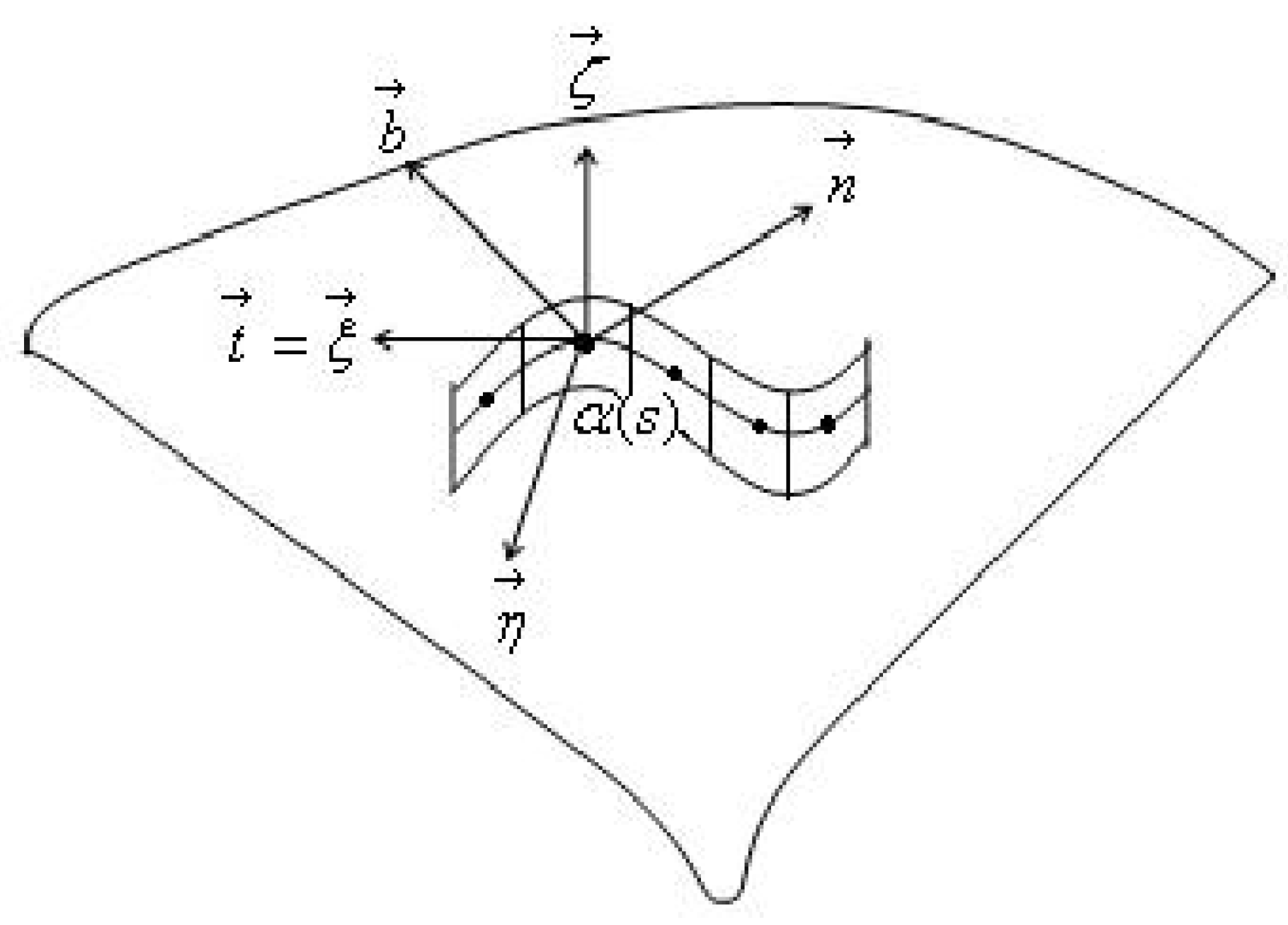
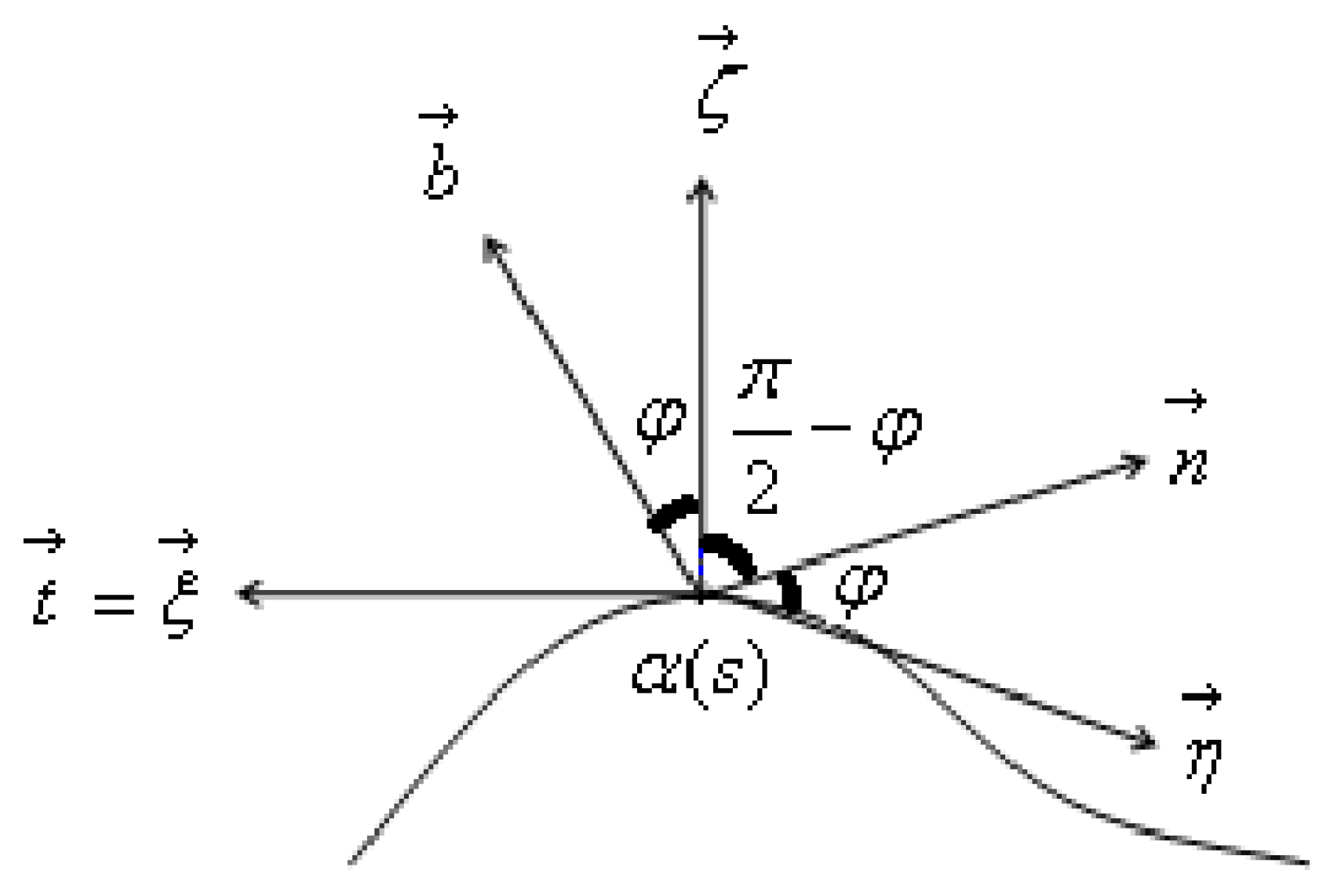
Definition 3. Let α be a curve in . If the geodesic curvature (torsion) of curve α is equal to zero, then the curve–surface pair ( is called a curvature curve–surface pair. In Figure 1, we see the relations between Frenet vector fields of curve α and the vector fields of [17]. If we take
as the angle between
and
, we can see in
Figure 2.
Definition 4. Let α be a curve in . If the geodesic curvature (torsion) of the curve α is equal to zero, then the curve–surface pair ( is called a curvature curve–surface pair [17]. Modified Darboux Vector Field of the Curve-Surface Pair and
In this section, we provide some preliminaries of the -scroll with some differential geometric elements.
Definition 5. Let the Frenet vector fields be of α and let the first and second curvatures of the curve be and , respectively. The quantities are collectively the Frenet Serret apparatus of the curves. Also, of the unit strip vector fields of and , are the curvatures of strip For any unit speed curve α, in terms of the Frenet–Serret apparatus, the Darboux vector can be expressed as Definition 6. Let a vector field bealong , under the condition that and it is called the modified Darboux vector field of α [21,22,23]. By using this definition, we can write
along
, under the condition that
and it is called the modified Darboux vector field of the strip
Definition 7. Let S be a closed orientable surface, differentiable of class , be a embedding on S into [1]. The Euclidean metric of induces a Riemannian structure on Let κ and τ denote the principal curvatures of and denote the mean and Gauss curvatures of f at respectively. is considered a hypersurface of We define the mean and Gauss curvatures formulae in different curve–surface pair curvatures in [6,7]. We use the Gauss–Bonnet theorem for different curvatures of the curve–surface pairs such thatwhere the right-hand member of (1) is the Euler characteristic of In particular, we define
by
We cannot expect
to be a topological invariant of
thus, we define
by
where the infimum is taken over the space
F of all
—embeddings of
S in
[
1].
4. The Developable Curve-Surface Pairs with an Osculating Darboux Frame
Now, we can give the following definitions, propositions and their proofs using the references [
2,
3,
4,
5,
6,
7,
8,
9,
10,
11,
12,
13,
14,
15,
16,
17,
18,
19,
20,
21,
22,
23].
Definition 8. Let be an orientable curve–surface pair and be a unit speed curve with a normal curvature geodesic curvature , and geodesic torsion If denotes the angle between the and We obtain the following equations,
Definition 9. These equations are part a special vector field on a tangent plane of an orientable curve–surface :
called an Osculating Darboux vector of a curve–surface pair, and the normalized osculating Darboux vector field is
We obtain,
The special case: If
constant, then
So, the equation is
That is, if the angle is constant, then the torsion of the curve–surface pair is equal to the torsion of the curve.
In the same way as reference [
16], we obtained the following propositions:
Proposition 1. Let be an orientable curve–surface on a closed orientable surface Then, is congruent to an osculating Darboux curve–surface pair only in the following two cases.
- (i)
is a plane curve–surface pair.
- (ii)
is a curve–surface pair with and
Proof. We demonstrate
If
as a plane curve–surface pair and by (
7) and (
8),
. So,
lies in planes
and
Then,
is congruent to an osculating Darboux curve–surface pair. Therefore,
is a curve–surface pair with
and
In a similar way, we demonstrate
Thus, this completes the proof of the proposition. □
Proposition 2. Let be an orientable curve–surface pair on a closed orientable surface S with If satisfies two of following conditions, the remaining condition holds up:
- (i)
is an asymptotic curve–surface pair on S.
- (ii)
is a congruent to a rectifying Darboux curve–surface pair on
- (iii)
is a curve–surface pair on a planar curve
Proof. We demonstrate that if
i holds up,
and
are equivalent. As
is an asymptotic curve–surface pair, using (
6) and (
7),
we obtain
So, this means that
lies in planes
and
Thus,
and
are equivalent. After this, we demonstrate
As
lies in planes
and
This means that
By (
6) and (
7),
and
So,
is an asymptotic curve-surface pair on
This completes the proof of the proposition. □
Proposition 3. Let be an orientable curve–surface pair on a closed orientable surface S with If satisfies two of following conditions, the remaining condition holds up,
- (i)
is a line of curvature curve–surface pair on
- (ii)
is a spherical curve–surface pair on
Proof. We demonstrate
If
is a line of curvature curve–surface pair on
then, using (
10) and (
11), we obtain
Using 10, by calculations, we obtain
Therefore,
is a spherical curve–surface pair. We demonstrate
As
is a spherical curve–surface pair, we obtain
which lies in planes
and
Thus,
Differentiating
with respect to
we use the following equations,
By using these equations, we obtain
so we obtain
Therefore,
is a line of curvature curve–surface pair on
This completes the proof of the proposition. □
Proposition 4. Let be an orientable curve–surface pair on a closed orientable surface S with , and If satisfies two of the following conditions, the remaining condition holds up,
- (i)
is a line of curvature of
- (ii)
is a congruent to an osculating Darboux curve–surface pair.
- (iii)
is a spherical curve-surface pair.
Proof. We obtain
As
is a line of curvature of
,
and
also we take
),
and
So, we get
Thus,
is a spherical curve-surface pair. We obtain
So
is a spherical curve and congruent to an osculating Darboux curve-surface pair. We show
Since
is a spherical curve-surface pair,
Since
is a line of curvature of
we get,
Thus, we get and Therefore, is a congruent to an osculating Darboux curve-surface pair. This completes the proof of the proposition. □
5. The Involute Curve–Surface Pair
Now we study the involute of a strip in .
Definition 10. Let and be the strips in The tangent lines of a strip generate a surface called the tores of the strip. If the strip , which lies on the tores, intersect the tangent lines orthogonally, it is called an involute of . If is an involute of , then by definition is an evolute of .
Theorem 3. Let ( be the involute of the strip ( The quantities and are collectively the Frenet–Serret apparatus of the curve α and the β, respectively. Also, the quantities and are collectively the Frenet–Serret apparatus of the strip ( and the (, respectively. The Frenet vectors of based on its evolute curve α, are given in [21] as followsThus, we can write the last equation in the same way as the strip Proof. It is obviously seen from (
6) and (
14). □
Theorem 4. Let β be the involute of curve The first curvature and the second curvature of areandSo, we can write this in the same way as the curvatures of the strip Proof. It is obviously seen. □
Theorem 5. Let β be the involute of the curve The modified Darboux vector field of the β in type of the strip isAlso, we find This is the modified Darboux vector field of the involute
Corollary 1. If the second curvature τ of curve α is a non-zero constant, then Hence, we have that the modified Darboux vector field of the β in type pf the strip is Also, we find in type of curve–surface pair: Proof. This is proven by the last two theorems. □
Theorem 6. In , the modified Darboux vector fields of a curve–surface pair ( and its β can not be perpendicular to each other.
Proof. The inner product of the curve–surface pair ( and its β is obviously proven. Their inner product is not equal to zero. So, the modified Darboux vector fields of a curve–surface pair ( and its β can not be perpendicular to each other. This completes the proof. □
6. The -Scroll and Involute -Scroll of
the Curve-Surface Pair in the
In this section, we consider the differential geometric and fundamental elements of the special ruled surface -scroll of the curve–surface pair and
A ruled surface is shown as a set of points whisked by a moving straight line. A ruled surface is one generated by the motion of a straight line in
[
21]. Choosing a directrix on the surface, i.e., a smooth unit speed curve–surface pair
orthogonal to the straight lines, and then choosing
to be unit vectors along the curve in the direction of the lines, velocity vectors
and
satisfy
. So, it is called the
B-scroll of the curve-surface. The special ruled surfaces
B-scroll of the curve-surface over null curves with null rulings in 3-dimensional Lorentzian space form were introduced by L. K. Graves. The first, second, and third fundamental forms of B-scrolls have been examined in [
14].
Definition 11. Let be the arclengthed curve–surface pair. Equationis the parametrization of the ruled curve–surface, which is called B-scroll (binormal scroll).
Definition 12. Let curve β be the involute of henceis the parametrization of the -scroll of β of the curve–surface pair. This rectifying developable surface is called -scroll of (. Theorem 7. If β is the involute curve of curve then the parametrization of the-scroll in terms of the Frenet–Serret apparatus of the curve α is Proof. The Definition 11 and the formulae of the curvatures of curve–surface pair can clearly be seen. □
Corollary 2. If the second curvature τ of the curve is constant but not equal to zero, then Hence, the parametrization of-scroll is Proof. The formulae of curvatures for the curve–surface pair and formulae of -scroll and -scroll can clearly be seen. □
Theorem 8. The -scroll and the -scroll of a non-planar curve–surface pair α and do not intersect each other, where .
Proof. Further, we know that is the distance between the arclengthed curves and So, the -scroll and the -scroll of a non-planar curve–surface pair and do not intersect each other, where . This proves the theorem. □