1. Introduction
The theory of groups and algebras exhibits numerous valuable connections, which are effectively utilized in areas such as homological algebra. Within this context, various intriguing extensions of groups have been explored, including groupoids, crossed complexes, crossed modules, double groupoids, and
-groupoids. Similarly, as groupoids extend the notion of groups, algebroids arise as a generalization of algebras, a theory developed by Mitchell [
1].
Brown and Higgins established a correspondence between the class of
-groupoids and complexes (over groupoids). In Mosa’s thesis [
2], a similar framework is constructed within an algebraic setting, aiming to explore potential applications in non-abelian homological and homotopical algebra. Mosa successfully demonstrates an equivalence between the category of crossed modules (over algebroids) and the category of special double algebroids with connections.
The definition of braided crossed modules captures symmetries inherent in the underlying crossed modules. Braided crossed modules expand the study of Lie algebras and open up possibilities for applications across a wide range of subjects where symmetry is important. Brown and Gilbert in [
3], when defining braided regular crossed modules over groupoids as algebraic models for homotopy-connected 3-types, first considered the monoidal closed category of crossed modules over groupoids. Then, they took into account dimensions one and two of a crossed complex
C of groupoids with a multiplication
over
C. The 2-truncated crossed complex with multiplication in this structure,
, results in a braided regular crossed module [
3], where the object set
representing the primary component of
C embodies a group structure, and the binary operation is supplied by
. Taken as a trivial group,
yields a crossed complex
C with
that is reduced, and; this structure gives rise to a crossed differential graded algebra over groups, as referenced in [
4]). Consequently, a braided crossed module of groups results from the 1-truncation of a crossed differential graded algebra of groups. Ulualan established the notion of braiding for a crossed module of Lie algebras as a Lie algebraic version of that provided by Brown and Gilbert in [
3]. Particularly, Lie algebras have been used extensively to examine the symmetries and transformations that preserve the basics of mathematical structures, including vector spaces, manifolds, and groups. Ulualan also demonstrated that the category of braided crossed modules of associative algebras is equivalent to that of braided categorical associative algebras.
In this work, we will give a definition of an appropriate tensor product “⊗” in the category of crossed complexes of Lie algebras and then we obtain a definition of crossed differential graded Lie algebra (dgla)
, where
C is a crossed complex of Lie algebras and
is a multiplication map from
to
C, satisfying particular conditions given in
Section 2. Using this structure, we can demonstrate that a braided crossed module of Lie algebras, as described in Ulualan, results from the 2-truncation of a crossed dgla,
. In
Section 3, using the tensor product ⊗ for the category of crossed complexes of Lie algebras, we define a multiplication map
as a bimorphism in the category of crossed complexes of Lie algebras to define a crossed differential graded algebra (dgla) of Lie algebras. Then, we show that a 2-truncated crossed dgla, together with a non-zero map
and zero maps
for
, is a braided crossed module of Lie algebras. In [
5], the construction of a functor from the category of simplicial Lie algebras to the category of braided crossed modules of Lie algebras is presented. However, it is mentioned that the inverse of this functor, which would allow for the transformation of objects from the category of braided crossed modules back to the category of simplicial Lie algebras, is left as an open problem for readers to investigate. In
Section 4, as an application of braided crossed modules of Lie algebras, we construct a functor from the category of braided crossed modules of Lie algebras to that of
reduced simplicial Lie algebras.
In order to develop a theory of crossed complexes over algebras and the desire to define a tensor product for crossed complexes of algebroids, we reflect upon the open question proposed by Brown in [
6]. Brown stated that crossed complexes over groupoids exhibit valuable connections and have applications in homological and homotopical algebra. However, this closed structure does not exist in the reduced case (i.e., one vertex case) or for groups, which limits the scope of the theory. To overcome this limitation, one would expect to develop a satisfactory theory of crossed complexes over algebroids. Keeping in mind what is done for groups and groupoids, our aim is to define the tensor product of crossed complexes of Lie algebroids. We explore the definition of appropriate tensor products and crossed differential graded Lie algebra (dgla) structures.
2. Preliminaries
L will be a fixed commutative ring. By a Lie algebra, we mean a unitary
L-bimodule
A endowed with a bilinear transformation
called a Lie bracket, satisfying antisymmetry and the Jacobi identity. That is, if
for all elements
X and
Y in the Lie algebra, the Lie bracket operation is antisymmetric, and the Jacobi identity expresses the compatibility of the Lie bracket operation with triple brackets, i.e., for any three elements (
, and
Z) in the Lie algebra, the following equalities hold:
and
A Lie algebra morphism, or a homomorphism of Lie algebras, is a mapping between two Lie algebras that preserve the Lie bracket operation. More formally, let
L and
be two Lie algebras. A Lie algebra morphism is a linear map
that satisfies the following condition:
for all elements
, in
L. The category of all Lie algebras will be denoted by
.
Definition 1 ([
7])
. Let and be two Lie k-algebras, then a Lie algebra action of on is a k-bilinear mapthat satisfies the following axioms:for for and . Example 1. Let A be a unitary and commutative ring and let L be an algebra over A. Define the functionthen we haveandfor . Thus, L is a Lie algebra with . Definition 2 ([
7,
8])
. A pre-crossed module of Lie algebras consists of a homomorphism of Lie algebras with the action of on , denoted by , for , . One requires that the following identity hold:for all and . If we also havethen is called a crossed module. Definition 3 ([
7,
8])
. A morphism of crossed modules of Lie algebras from to is given by a commutative diagramsuch that . We denote the category of braided crossed modules of Lie algebras by
Example 2. Let L be any A-bimodule. L is a Lie algebra with multiplication , . Define the action of A on L asfor and . Since for the zero morphism , we havefor and andfor , the zero morphism is a crossed module of Lie algebras. Definition 4 ([
5])
. A braided crossed module of Lie algebras is a crossed module of Lie algebras together with a braiding map , satisfying the following conditionsfor all for Morphisms of braided crossed modules of Lie algebras are defined for crossed modules of Lie algebras. A morphism of braided crossed modules of Lie algebras from to is given by a commutative diagram:preserving the action of on . We denote the category of braided crossed modules of Lie algebras by A Lie algebroid C is a category equipped with a -module structure on each hom set, denoted as , for objects x and y in the set of objects . The composition in L is required to be k-bilinear.
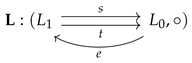
To define a Lie algebroid on a set of objects , we start with a directed graph , where functions s and t are the source and target maps, respectively, and e is the identity map on . These maps satisfy .
We denote as the set of morphisms in L from object x to object y. For an element l in L, which is an element of , we write it as . The notation represents the identity morphism in for object x.
A Lie algebroid consists of the following:
Each , for x and y in , is equipped with a -module structure.
There exists a k-bilinear function, denoted as , which represents the composition of morphisms in L. For elements a and b in , is their composition.
The axioms for Lie algebroid L are as follows:
Associativity: Composition in L is associative, meaning that for morphisms a, b, and c in , whenever defined.
Identity: The elements and , for objects x and y in , act as identities for composition. If , then .
The zero element of
is denoted as
. The Lie algebroid
can be represented by a diagram, as follows:
The notion of “whiskering” for an arbitrary category
C with a set of objects written as
is defined by Brown [
9]. Next, we adapt this definition for Lie algebroids.
Definition 5. A whiskering on the Lie algebroid consists of operationssatisfying the conditions W1–W5: - W1.
gives a Lie algebra structure on .
- W2.
- W3.
- W4.
If - W5.
and if , where for . If
L is a whiskered Lie algebroid, then the two multiplications
on
can be defined as
which implies
and the Lie bracket of
is given by
In order to define the crossed module in the category of Lie algebroids, the notion of a Lie algebroid action must first be defined. We can explain the connection between Lie algebroids and their transformations using this notion, which is similar to the one that appeared in G.H. Mosa’s Ph.D. thesis [
2].
Let be a set and be two Lie algebroids over . Assume that acts on on the right and on the left as follows
Let
and
, then we denote the right action
, and the left action of
on
by
, such that these actions satisfy the following axioms:
for all
for
,
and
.
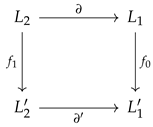
Definition 6. Let be two Lie algebroids over the same set A morphism is called a crossed module of Lie algebroids if there exists left and right actions of on , satisfying the following axioms:for all for and both sides are defined. We can show a crossed module of Lie algebroids ∂ from to by the following diagram: Morphisms of crossed modules of Lie algebroids
are pairs of Lie algebra morphisms
, such that the following diagram
commutes, and
and
, for all
for
. Thus, the category of crossed modules of Lie algebroids is obtained, and it is denoted by
.
3. Crossed Complexes over Lie Algebra(oid)s
Mosa, in [
2], defined crossed complexes of algebroids and explained the relations between truncated cases of crossed complexes of algebroids and
n-tuple algebroids, particularly for dimension 3. In this section, we define crossed complexes over Lie algebroids.
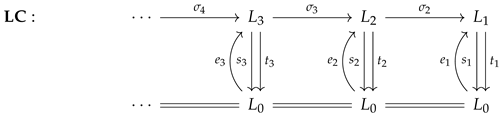
A crossed complex
of Lie algebroids consists of Lie algebroid morphisms over
satisfying the following conditions:
- (i)
each , is the identity on ;
- (ii)
acts on each for with the Lie algebroid action;
- (iii)
is a crossed module of Lie algebroids and induced action on for ;
- (iv)
for , preserves the actions of on , where acts on itself by the composition;
- (v)
for ,
A reduced crossed complex of Lie algebroids with is a crossed complex of Lie algebras. Next, we give the definition of the crossed complex of Lie algebras.
Definition 7. A crossed complex of Lie algebras is a chain complex of Lie algebrasin which is a crossed module of Lie algebras;
for , is a -module and acts trivially. That is, is an -module homomorphism;
for .
We will denote crossed complexes of Lie algebras with . In light of this, we consider a crossed complex to be a chain complex of Lie algebras formed up of a base crossed module of Lie algebras and a tail that is a complex of modules.
Next, our aim is to define an appropriate tensor product “⊗” for the category of crossed complexes over Lie algebras, with the notion of the coproduct for crossed modules of Lie algebras given in [
10] to ensure the universality of tensor product in each dimension. The two prerequisites that Baues lists [
11] when considering a tensor product are equivalent to the definition of “bimorphism”. In the following definition, we provide the definition of a bimorphism in the category of reduced crossed complexes of Lie algebroids.
Definition 8. Let L, M, and N be reduced crossed complexes of Lie algebroids over the singleton . A bimorphism is a family of mapsfor which satisfy the following conditions: where and - 1.
- 2.
- 3.
- 4.
- 5.
We will now define and construct a tensor product for Lie algebraic crossed complexes using the constructions (coproduct, free [
10]) of Lie algebraic crossed modules. The Brown–Higgins tensor product for crossed complexes [
12] (see also [
4,
13], which has a major effect on the definition we provide, is also a significant influence. Thus, we start by defining the term “tensor product of crossed complexes of Lie algebras” in the manner that will be the most helpful to us.
Definition 9. The tensor product of the crossed complexes L and M is then given by the universal morphism defined as follows:
Dimension 1: is the coproduct of algebras and . It is a free product with generators and l, where is the image of by the canonical inclusion and similarly, is the image of by the canonical inclusion . Then, we havefor , and . Dimension 2: In dimension 2, the second term of the tensor crossed complex, , is the crossed -module of Lie algebras defined by the coproduct of , and , where P is the Peiffer ideal and and are the pre-crossed -modules induced by the canonical maps and , and is the crossed -module associated with the double algebroid of Lie algebras . Thus, has generators , and with the relations:andand the operator is given on generators by Dimension ⩾3: is the coproduct of -modules , i . Each is defined from a -module by imposing the relation for and . These modules are given by the induced -module and via the canonical morphisms and . The generators will be written as and , for and , and their relations are To summarize, the crossed complex over ∗ is generated by elements where with the following relations:
For
For
For
For
For
For
and for
For
for
for
,
,
for
for
for
for
there are two possibilities depending on the action
where
is the degree of an element
that is if
if
The sum
and
of elements
are defined only in case
.
Proposition 1. The assignment defines a functor Proof. The boundaries must be consistent with the relations and the criterion must be met in order to demonstrate that is a well-defined crossed complex of Lie algebras. For some of the cases, we will check that .
For
and
,
For
and
,
For
and
,
For
and
,
□
For morphisms
and
, the induced map
is defined by
.
In the category of crossed complexes of Lie algebras, where the zero object ∗ is 0 in each degree, we obtain
The inclusions , and projections , are defined by , , , and .
Proposition 2. For any two crossed complexes of Lie algebras, the interchange mapdefined as commutes with the boundary maps. Proof. For
and
, we obtain
For
and
, we obtain
In an analogous way, the verification of the remaining relations can be demonstrated. □
4. Crossed Differential Graded Lie Algebras
Tonks [
14] introduced theories of crossed differential graded algebras and coalgebras. In this section, using the tensor product ⊗ for the category of crossed complexes of Lie algebras, we define a multiplication map
as a bimorphism in the category of crossed complexes of Lie algebras. Let
be a crossed complex of Lie algebras.
Definition 10. A multiplication map for this crossed complex is a family of maps satisfying the following conditions, where and :
For all and :for and for and ,
for ,for for and for ,
A crossed complex of Lie algebras L, together with the multiplication that meets the specified conditions, constitutes a crossed differential graded algebra (dgla) of Lie algebras. We denote such a crossed dgla by .
A k-truncation of is a crossed complex L of Lie algebras together with for and the maps are zero maps for
Theorem 1. For . A 2-truncated crossed dglatogether with a non-zero map and zero maps for is a braided crossed module of Lie algebras. Proof. Take
and
Then, from axiom
the braiding map is
k-bilinear.
From axiom
, we have
and, thus,
then, we obtain
Since
and
, we obtain
for all
and
. □
5. Braided Crossed Modules and Reduced Simplicial Algebras
In this section, as an application for braided crossed modules of Lie algebras, we will construct a functor from the category of braided crossed modules of Lie algebras to that of
reduced simplicial Lie algebras. We recall the construction of the inverse of this functor given in [
5].
A simplicial Lie algebra
consists of a family of Lie algebras
together with homomorphisms of Lie algebras
and
called, respectively, face and degeneracy maps, which satisfy the usual simplicial identities given in [
15]. A simplicial Lie algebra that has zero as its initial component is said to be reduced.
Given a simplicial Lie algebra
, the Moore complex
of this simplicial Lie algebra is the chain complex defined by
with the boundaries
induced from
by the restriction. The length of the Moore complex
is
k if for all
,
.
Akça and Arvasi defined the functions for simplicial Lie algebras. They defined an ideal in for each generated by elements for and .
The
k-bilinear morphisms
and
are given as
, and similarly,
where
are defined by composite projections
with
for
Definition 11. Let be a simplicial Lie algebra. For , let be the ideal of generated by degenerate elements, and suppose that . For , is the ideal of generated by the elements of the forms , and with
Example 3. For and Thus, and For the ideal of is generated by the elements of the forms;and Remark 1. For a simplicial Lie algebra
with a Moore complex of length 1,
is a crossed module of Lie algebras [
8].
Proposition 3. Let be a reduced simplicial Lie algebra and for Then the mapinduced from by restriction becomes a braided crossed module of Lie algebras together with the braiding mapfor all where the right hand side denotes a coset in , represented by an element in , and where Proof. - B1.
For
we have
Since
is a reduced simplicial algebra, we have
, and then we obtain
- B2.
From
we obtain
and from
we obtain
then for
and
, we have
- B3.
For
and
, from
we have
and from
we have
That is, for
and
, we have
- B4.
From
we have
and from
we have
Axioms and can be shown similarly. □
Theorem 2. The category of reduced simplicial Lie algebras with the Moore complex of length 2 is equivalent to that of the braided crossed modules of Lie algebras.
Proof. Let
be a reduced simplicial Lie algebra with the Moore complex of length 2. In the previous proposition, a braided crossed module of Lie algebras
is obtained. That is, there exists a functor
Conversely, assume that
is a braided crossed module of Lie algebras. We define
and
together with the zero homomorphisms. Since
is a crossed module of Lie algebras, using the action of
M on
K, we can define
, such that
We can define an action of
on
by
and
. Using this action, we can define
with the multiplication
where
and
for all
and
. The maps between
and
are
and
Now, we will show that these maps are homomorphisms of Lie algebras. For
and
, we show that they preserve the Lie bracket.
and
Similar way maps
and
are Lie algebra homomorphisms. These homomorphisms also satisfy the simplicial identities. Therefore, we obtain a 2-truncated reduced simplicial Lie algebra
There is a
functor from the category of 2-truncated reduced simplicial algebras to that of reduced simplicial Lie algebras with the Moore complex of length 2.
That is, there exists a functor
With this conclusion, it is clear that the Moore complex of reduced simplicial Lie algebras has a dimension of
. Arvasi and Akça [
15] demonstrate this using pairs of hyper-crossed complexes. Using the equality
we need to obtain
Using simplicial operators
and
, we have the following results:
This means that the size of the Moore complex is
. In this construction, for a braided crossed module
, we obtain
Using the definitions of
and
, we obtain
and
,
. Thus, we have
and similarly, for a reduced simplicial algebra
with a Moore complex of length 2, we obtain
. □
6. Conclusions
In this paper, we provide equivalent definitions for Lie algebras in the setting of whiskered structures, bimorphisms, crossed complexes, crossed differential graded algebras, and tensor products. We further demonstrate that a 2-truncation of the crossed differential graded Lie algebra obtained from our adapted definitions gives rise to a braided crossed module of Lie algebras, which was previously defined by Ulualan, and validates the reliability and accuracy of our formulations. Furthermore, the functor we construct from the braided crossed module of Lie algebras to simplicial Lie algebras enables systematic mapping between different categories of Lie algebras. This construction shows the validity of our adapted definitions and also establishes their compatibility with related categories of Lie algebras. Additionally, the features of the tensor products we obtained further underscore the accuracy and precision of our formulations.
Applications for Lie algebras and related algebraic structures may be found in a wide variety of studies, including physics, mathematical biology, and extensions to other algebraic structures. Mock-Lie algebras are vector spaces equipped with a bilinear product that is both commutative and satisfies the Jacobi identity, similar to Lie algebras. Indeed, mock-Lie algebras are critically important to the study of integrable systems, quantum groups, and the topological quantum field theory, among various areas of mathematics and theoretical physics [
16,
17]. Exploring the features, structures, and potential uses of mock-Lie algebras is significant in regard to the relationship between Lie algebras and mock-Lie algebras. This research could involve investigating mock-Lie algebra representations, analyzing how Lie algebraic categories interact with them, and looking at the functors between them.