1. Introduction
Here, we only work with simple, connected, and finite tree graphs. We assume that in a graph
,
and
represent the set of vertices and the set of edges, respectively. The degree of a vertex
v is denoted by the symbol
or
. The symbols
or
represent a vertex’s highest degree in a graph
G. Every acyclic graph is called a tree, which is denoted by
T. A leaf or a pendant vertex is a vertex of degree one. A branching vertex contains a degree more than or equal to three. We use the notation
to express the set of all neighbouring vertices to
v. Further, we assume that
. The graph
comes into existence when some transformations or operations are applied on
G. In such a case, we assume
or
is the vertex degree of
t in
G, whereas
. For the undefined terminologies and notations related to this work, the reader can consult [
1].
Graphs can be used to represent chemical substances (such as hydrocarbons) [
2]. A topological descriptor is a number (or combination of numbers) that captures a certain characteristic of the graph. If a certain molecular property resembles the descriptor, it is considered a topological index. This particular type of descriptor, known as a topological index, can be used to analyse the physicochemical characteristics of chemical substances. During the past few years, there has been extensive research into the structural and analytical properties of topological indices in the field of mathematical chemistry [
3,
4,
5]. For instance, topological indices have been used in (QSPR) and (QSAR) studies to model the properties of chemical compounds [
6,
7,
8]. Topological indices have theoretical and practical appeal because they are now essential resources for the investigation of numerous real-world issues in fields such as computer science [
9], physics [
10], and ecology [
11], among others.
Many topological index applications have been documented, the majority of which focus on investigating medical and pharmaceutical problems. A substantial and quickly growing field of study on this subject started midway through the 1990s, yielding a large amount of research, and this marked an important development in the study of topological indices mathematically. The work conducted by Erdös [
12,
13] should be particularly addressed within this scenario.
As an innovative method of describing heteroatoms in molecules, the idea of generalised molecular descriptors was put forth [
14,
15], in addition to evaluating structural variations [
16]. The Zagreb types of topological indices and Zagreb polynomials for a few nanotubes covered by cycles were discussed in [
17]. The regression relation between some topological indices and the sum-based geometric arithmetic index was determined in [
18]. In [
19], the authors showed the ability to use many topological indices for correlation, given the situation of typical temperatures of production; in addition, the authors assessed the common boiling temperatures of octane isomers. Siddiqui computed the exact formula for Zagreb indices and Zagreb polynomials for certain graphs,
,
, and
, with
, and they also determined the corresponding graphs, see [
20].
To achieve a forecast of a certain property of molecules, topological indices are primarily used; for more information, see [
21,
22,
23]. Finding the extremal graphs on a collection of graphs that satisfy the limitations imposed by the parameters that minimise (or maximise) the value of a topological index, is hence a straightforward challenge [
24,
25,
26].
Here, we present some topological indices related to our current work. In [
27], the variable sum connectivity index was explored as,
with
Note that
consequently,
and
denote the
and (
H harmonic index), respectively. See [
28,
29,
30,
31], etc., for more detail.
In 2004, Zhou et al. [
32] developed the Hyper Zagreb index as
which has been widely studied in different areas.
The Hyper Zagreb index and a number of the physicochemical characteristics of alkanes have been well correlated: vapor pressure, boiling points, surface areas, etc. The enthalpy of vaporisation (HVAP), acentric factor, heat of fusion (DHVAP) of octane isomers, and entropy are among the physicochemical parameters that have been assessed using the Hyper Zagreb index HM(G). In particular, the HM(G) highly correlates with the acentric factor [
33]. By
, we mean the maximum/minimum degree of a graph G; in terms of
and
, the extreme values on the Hyper Zagreb index of graph G have been examined [
34]. In [
35], the extreme values for the first and second Hyper Zagreb indices were established. Additionally, using benzenoid hydrocarbons’ boiling points as inputs, linear regression analysis was performed on degree-based indices. By comparison, the models corresponding to the other distance-based indices performed worse than the Hyper Zagreb index-based linear model.
In the current work, we characterize some nonsymmetric special classes of trees, which maximise or minimise the Hyper Zagreb index with n-vertex trees for (i) all odd degree vertices, (ii) fixed even degree vertices, and a (iii) fixed number of vertices of maximum degree.
4. On the Minimum and Maximum Hyper Zagreb Index of Trees with Fixed Even Degree Vertices
Let denote the set of all n-vertex trees in which every tree has a fixed number of even degree vertices. Let the cardinality of the even degree vertices be denoted by r, such that and .
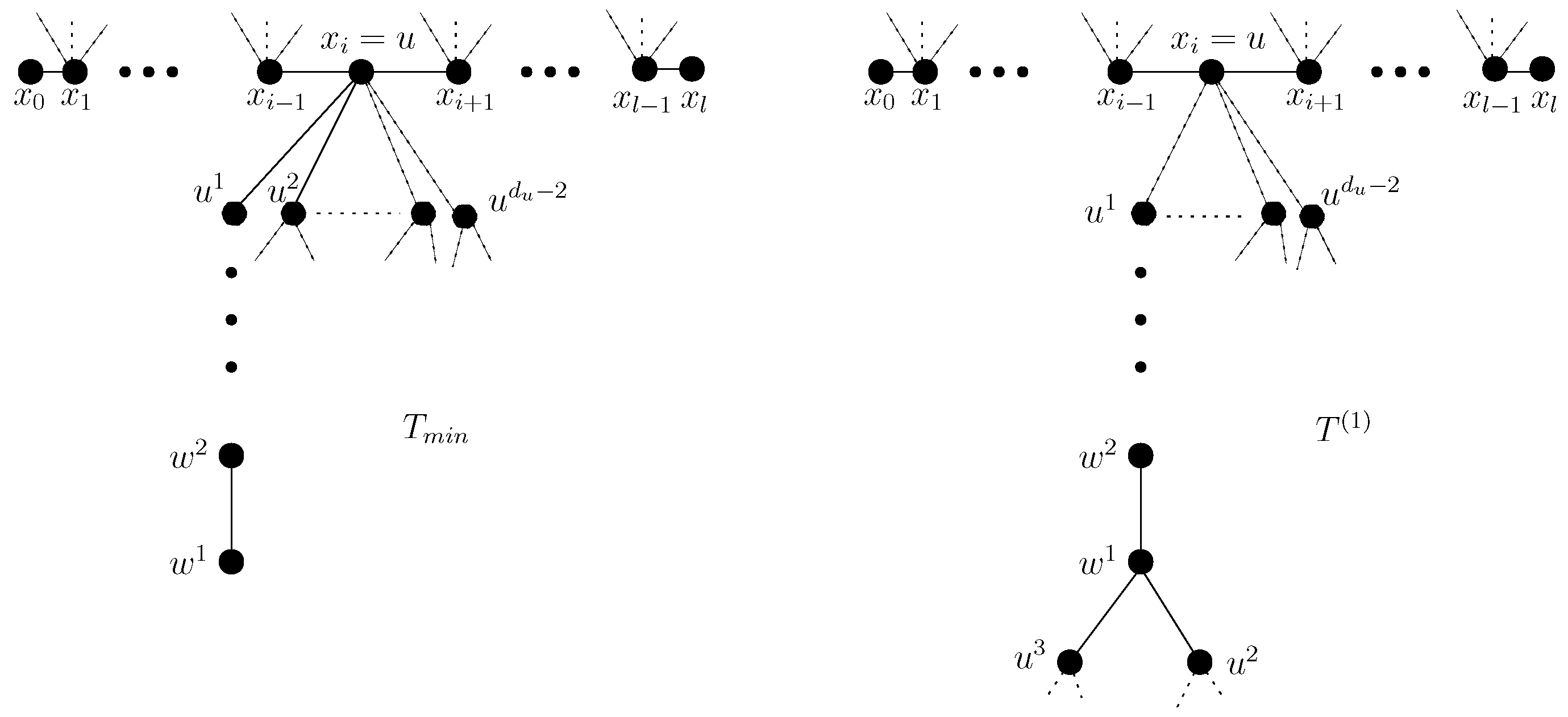
Lemma 2. Let be a tree having a minimum Hyper Zagreb index. Let be a path in , which contains the vertex u, where u has the maximum degree in , such that , and . We also assume that are the vertices adjacent to u, and are pendent vertices in . We define ( may be equal to ), as shown in Figure 2. Clearly, ; then, . Proof of Lemma 2. We first find the difference
−
for the Hyper Zagreb index. Note that
u and
are the only vertices whose degrees differ in
and
. Therefore,
and since
, is a contradiction. □
Lemma 3. Let and w be the vertices of a tree such that and , and and . We define from T as ; then, .
Let and t be the vertices of tree such that and , and , and (v may coincide with w). We define as ; then, .
Proof of Lemma 3. From the structure of
T and
we have,
and since
and
, this implies
.
From the structure of
T and
, we have,
and since
and
, this implies
. □
Thus, by Lemma 3, we conclude that in order to minimise the Hyper Zagreb index, we need to place the vertices of degree 2 between the vertices of degree 3, so that there is at least one vertex of degree 2 between any two vertices of degree 3 and the remaining vertices of degree 2 or one vertex of degree 2 and one vertex of degree 3. So, we conclude that the collection of all those trees, which contain
n vertices with the degree sequence
must contain a particular arrangement of vertices of degree 2 as described above. Note that if
, there are not enough vertices of degree 2 to be placed between any two vertices of degree 3. If
, in order to minimise the Hyper Zagreb index, we have to first put at least one vertex of degree 2 between any two vertices of degree 3 (if it is possible), and the remaining vertices of degree 2 are placed arbitrarily between two vertices of degree 2 or between a vertex of degree 3 and a vertex of degree 2.
Theorem 2. If , where , and , then when , and when The sign of equality holds if and only if T possesses the degree sequence Proof of Theorem 2. Let
minimise the Hyper Zagreb index. We claim that there does not exist any vertex of degree greater than 3 in
T. To prove this claim, we suppose that on the contrary, there exists at least one vertex, say
u, of a degree greater than 3 in
T. According to Lemma 2, we can find another tree
, such that
, which contradicts the choice of
T. When we apply this transformation successively on every vertex
u in
T, we will find a sequence of trees
with the relation
. Having in mind Lemmas 2 and Lemma 3 and the previous discussion, we conclude that the tree which minimises the Hyper Zagreb index contains the degree sequence with the particular arrangement of vertices defined above. Hence,
has the degree sequence,
□
Now, we provide some lemmas, which help us to prove Theorem 3.
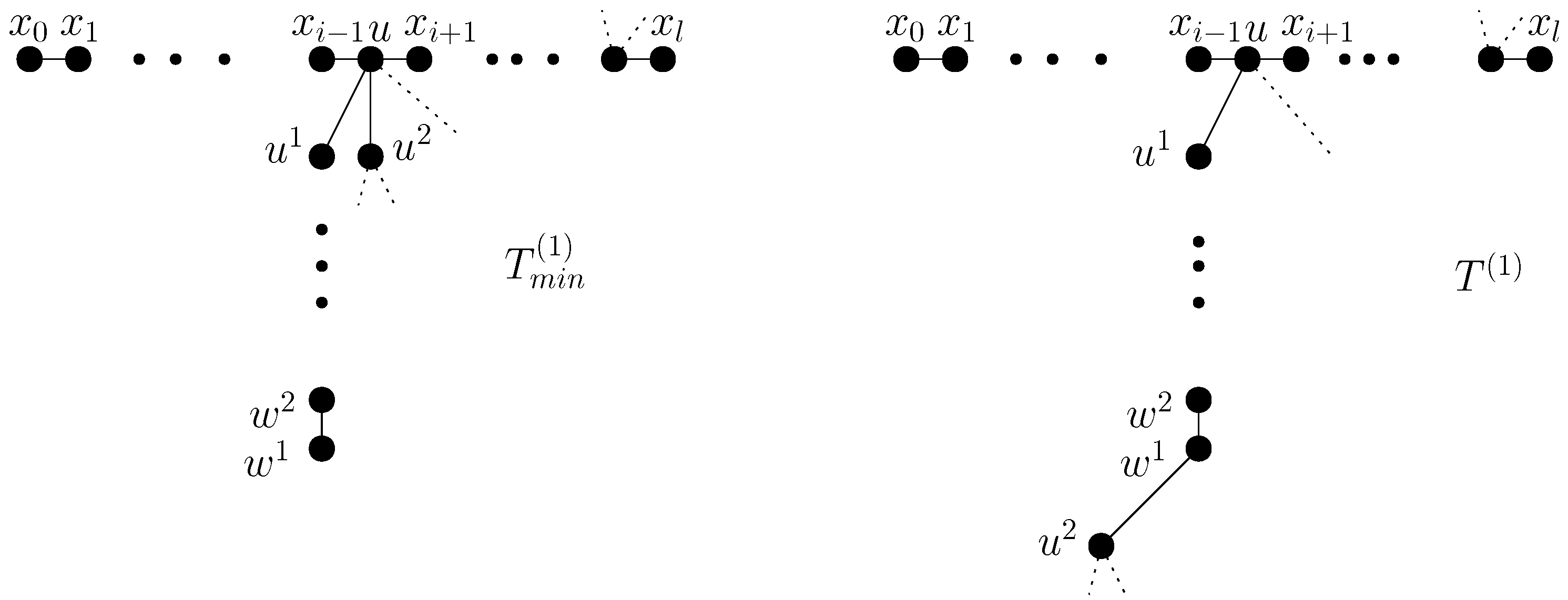
Lemma 4. Let , with a maximum Hyper Zagreb index. Let be a path in containing the vertices and , where , such that for , we have . Let be the vertices adjacent to the vertex u. We define , as shown in Figure 3. Clearly, ; then, . Proof of Lemma 4. We first find the difference
−
for the Hyper Zagreb index. Note that
u and
v are the only vertices whose degrees differ in
and
. Therefore,
and since
and
, we conclude
. □
Lemma 5. Let be a tree having a maximum Hyper Zagreb index. Let be a path in containing the vertex , where and ; , with . We also assume that are the vertices adjacent to in . We define ( may be equal to ), as shown in Figure 4. Clearly, ; then, . Proof of Lemma 5. We first find the difference
−
for the Hyper Zagreb index. Note that
u and
are the only vertices whose degrees differ in
and
. Therefore,
and since
and
, we conclude
. □
Lemma 6. Let and w be the vertices of a tree , such that and , and , with and . We define from T as ; then, .
Proof of Lemma 6. From the structure of
T and
, we have,
and since
and
, this implies
. □
Lemma 7. If there exists a pendent vertex adjacent to a branching vertex in the tree then the tree does not contain a vertex of degree two with both non-pendent neighbours.
Proof of Lemma 7. Suppose on the contrary that a pendent vertex
u is adjacent to a vertex
v of a degree greater than two, and there exists a vertex
w of degree two, such that
, and both
and
are non-pendent vertices. We define
, and clearly,
.
Hence,
. □
Theorem 3. If , where and , thenwhere k denotes the maximum degree of the vertex in T, the sign of equality can be easily obtained, if and only if T possesses the degree sequencewhere . Proof of Theorem 3. Let maximise the Hyper Zagreb index. We consider the following two cases for completion of the proof of the above theorem.
We claim that there does not exist any vertex of odd degree greater or equal to 3 in T. We suppose, on the contrary, that there exists at least one vertex of odd degree, say v, such that . According to the transformation defined in Lemma 4, we can find another tree , such that , which contradicts the choice of T. If we apply this transformation successively on every vertex v, we find a sequence of trees with the relation . It is easy to understand that in , there does not exist any branching vertex of odd degree.
We claim that there exists only one branching vertex of an even degree in . To prove this claim, we suppose, on the contrary, that there exists more than one branching vertex, say u, of even degree in . Then, by Lemma 5, we can find another tree , such that , and we obtain a contradiction. If we apply this transformation successively on every vertex having an even degree greater or equal to 4 in , we find a sequence of trees with the relation . It is easy to understand that in there exists only one branching vertex of an even degree, and the remaining even degree vertices are of degree 2.
From the above discussion and Lemmas 4–7, it follows that a tree , which maximises the Hyper Zagreb index, is a tree with only one branching vertex with degree k, such that an arbitrary vertex of degree one in is adjacent to a vertex of degree 2 (for ), or there are exactly pendent vertices with neighbours of degree 2 (for ).
Therefore, if , then for , and for . □
5. On the Minimum Hyper Zagreb Index of Trees with Fixed Vertices of Maximum Degree
Suppose that is the collection of all n-vertex trees, where k represents the number of vertices of maximum degree. Here, we discover the graphs of trees that possess the lower bound for the Hyper Zagreb index from . Since is only a member in , we consider for .
Lemma 8. If is a tree having a minimum Hyper Zagreb index, where , then the maximum degree of a vertex in equals 3.
Proof of Lemma 8. We suppose that
, and the vertex
u has the maximum degree
in
. We assume that
is the longest path in
containing the vertex
u. We also assume that the vertices
are the vertices adjacent to
u in
, and
is a pendent vertex connected to
u via
(
may be equal to
). We define
, as shown in
Figure 5.
and since
and
, this implies that
.
It is easy to observe that contains vertices of degree . In the same way, we apply the transformation defined in Lemma 8 on every vertex of degree . In every step from a tree , we obtain a tree that contains a lesser than its predecessor. We apply this transformation k times, and we reach a tree that contains k vertices of the maximum degree . Clearly, , and , which is a contradiction of the choice of . □
Theorem 4. If , then when , and when The sign of equality holds if and only if T possesses the degree sequence Proof of Theorem 4. Let
minimize the Hyper Zagreb index. According to Lemma 8, the degree sequence of the tree
is
where
. The relation
gives
,
Therefore,
for
, we have,
and for
, we have,
□
Corollary 1. Let be a tree with a minimum Hyper Zagreb index in the class of and be a tree with a minimum Hyper Zagreb index in the class of . If , then .