Abstract
Quantum calculus provides a significant generalization of classical concepts and overcomes the limitations of classical calculus in tackling non-differentiable functions. Implementing the q-concepts to obtain fresh variants of classical outcomes is a very intriguing aspect of research in mathematical analysis. The objective of this article is to establish novel Milne-type integral inequalities through the utilization of the Mercer inequality for q-differentiable convex mappings. In order to accomplish this task, we begin by demonstrating a new quantum identity of the Milne type linked to left and right q derivatives. This serves as a supporting result for our primary findings. Our approach involves using the q-equality, well-known inequalities, and convex mappings to obtain new error bounds of the Milne–Mercer type. We also provide some special cases, numerical examples, and graphical analysis to evaluate the efficacy of our results. To the best of our knowledge, this is the first article to focus on quantum Milne–Mercer-type inequalities and we hope that our methods and findings inspire readers to conduct further investigation into this problem.
MSC:
05A30; 26A51; 26D10; 26D15
1. Introduction
A function is said to be convex, if
The theory of convexity plays a vital role, through its numerous applications, in modern analysis. Additionally, convexity shares a strong connection with the notion of symmetry. Numerous significant properties of symmetric convex sets are documented in the literature. The advantageous aspect of the link between convexity and symmetry is that, by focusing on one of the notions, we can apply it to the other. In the analysis of physical problems, differences often arise which prompts the need for mathematical inequalities. Inequalities have a fundamental role in various areas of mathematics, particularly in mathematical analysis, wherein they feature in numerous problems. The field of inequalities was comprehensively and systematically studied by Hardy, Littlewood, and Polya, and their findings were compiled in the book “Inequalities”. Over the last few decades, mathematical inequalities and their applications have rapidly expanded and have had a significant impact on other modern mathematical disciplines, such as error analysis, integral operator theory, approximation theory, and information theory. Several well-known inequalities, including Simpson, Ostrowski, Hermite–Hadamard, and Gruss, provide bounds for the remainder of quadrature rules. Convexity plays a crucial role in obtaining refinements of these integral inequalities. Numerous inequalities can be derived directly from the applications of convex functions. One of them is Jensen’s inequality, which reads as follows:
Let and let nonnegative weights, such that . If is a convex function, then
where and , . In the following sequel, Mercer et al. [1] devised a new result related to Jensen’s inequality, known as the Jensen–Mercer inequality:
Let be a convex function, then
for each and , with .
Of all the inequalities, the Milne inequality is the one that provides estimates of error bounds for the Milne formula, which is valid under similar conditions to those of the Simpson inequality.
Assume that is a four times differentiable mapping on , and , then
In recent times, the Milne inequality has garnered significant attention from researchers. Budak et al. [2] introduced fractional analogs of this inequality by utilizing the properties of convex mappings, bounded functions, bounded variation, and Lipschitz conditions. Meftah et al. [3] studied some integral inequalities for the remainder of Milne formulae by employing local fractal integrals that involve the generalized convexity property of functions. Ali et al. [4] investigated the fractional error bounds estimates for Milne inequality associated with convex functions.
In the realm of conventional mathematical analysis, a fundamental research topic is quantum -calculus, which focuses on a meaningful modification of integration and differentiation techniques from a theoretical perspective. Jackson was the first person to systematically study the -derivative and integral operators. Jackson’s -operators played a pivotal role in the development of theory, which has had tremendous applications in special functions, modern mathematical analysis, physics, number theory, combinatorics, cryptography, etc. For more detail see [5,6]. The concept of integral inequalities has also been influenced by these ideas and has drawn the attention of mathematicians in the current era. To proceed further, let us recall the essentials of -calculus.
After noticing some limitations of classical operators in impulsive difference equations, Tariboon and Ntouyas introduced the concept of -derivative and integral over finite intervals, which are described as follows:
Definition 1
([7]). Suppose is a continuous function and , then
We say that is –differentiable on J, if exists for all .
Furthermore, we present the definite quantum -integral over the finite interval, which is also defined by Tariboon and Ntouyas [7].
Definition 2
([7]). Suppose is a continuous function. Then,
Our next theorem is regarded as -integral, which is useful for further study.
Theorem 1
([7]). If is a continuous function and , then the following identities hold:
Lemma 1
([7]). For a continuous functions , then
In [8] Bermuda et al. introduced the concept of right quantum derivatives and definite integrals, which are as follow:
Definition 3
([8]). Let be a continuous function and , then
Definition 4
([8]). Let be a continuous function. Then, the -definite integral on is defined as:
Now, we rewrite some further results.
Theorem 2
([8]). If is a continuous function and , then the following identities hold:
Lemma 2
([8]). For a continuous function , then
Kian and Moslehian [9] explored the Hermite–Hadamard inequality using inequality (1). Following this, Ogulmus et al. [10] utilized fractional calculus and Jensen–Mercer inequality to obtain a more general and refined form of existing results. Several recent articles have been published on this topic, as in [11,12,13].
Sudsutad et al. [14] explored the Holder’s inequality, Hermite–Hadamard’s inequalities, and Minkowski inequalities using quantum calculus. Noor et al. [15] established novel quantum estimates of Hermite–Hadamard-type inequalities. Alp et al. [16] successfully derived quantum mid-point-like inequalities and refined forms of the -Hermite–Hadamard inequality in 2018. Kalsoom et al. [17] formulated Ostrowski-type integral inequalities via generalized higher order n-polynomial preinvex functions. Ali et al. [18] investigated some -mid-point Hermite–Hadamard inequalities and studied trapezoid-like inequalities. Jhan et al. [19] examined the Hermite–Hadamard-type inequalities utilizing -concepts and presented some special cases to expand previous work. Mohammad et al. [20] computed the fractional Hermite–Hadamard inequality and derived new upper bounds of trapezoid-type inequalities using tempered fractional operators and differentiable convex mappings. Khan and colleagues [21] utilized green identities to establish Hermite–Hadamard-type inequalities in the context of calculus. Saleh and colleagues [22] discussed variants of dual Simpson-type integral inequality and some novel applications. Erden and Colleagues [23] investigated some error schemes of Simpson’s second-type rules, applying the convexity property of the functions. Authors [24] computed some new error estimates of Hermite–Hadamard inequality in association with co-ordinated convex mappings over a rectangle. Jain et al. [25] developed some new quantum variants of Saigo-type fractional operators and studied well-known inequalities by employing these operators. For further reading, interested readers can refer to [26,27,28,29,30,31,32,33].
Our paper aims to establish Milne–Mercer-type inequalities using the convexity property of the function in the context of quantum calculus. The first section provides an overview of convex functions and quantum calculus. The next section presents our main results on Milne–Mercer inequality with the help of -identity. In the final section, we provide some applications to special means, numerical examples, and graphical illustrations to validate our findings.
2. Main Results
Here, we present the main findings of our study.
2.1. Milne–Mercer Identity
The following section presents the development of a novel Milne inequality in the context of quantum calculus utilizing Mercer’s concepts. This new inequality is expected to have a significant impact on the development of new estimates for Milne quadrature formulae.
For the sake of brevity, we set .
Lemma 3.
Assume that be a continuous and -differentiable function, then the following identity holds:
where
Proof.
Consider the right hand side and apply -integration by parts, then
where
And
By inserting the values of and in (3), we acquire our required result. □
Now, we discuss some special cases of Lemma 3.
- If we take , then we have
- If we take and in Lemma 3, a new identity results in establishing Milne-type inequalities.
Remark 1.
If we take and and then we obtain the identity proved by Budak et al. [2].
2.2. Quantum Estimates of Milne–Mercer Inequality
In the upcoming section, we derive novel improvements on Milne-type inequalities by utilizing the Milne–Mercer identity, Jensen–Mercer inequality for convex functions, and various integral inequalities.
Theorem 3.
Assuming all the conditions of Lemma 3 hold, if and are both convex functions, then
Proof.
From Lemma 3, modulus property and convexity of and , then
After simplifying the latest expression, we obtain our result. □
- If we take and in Theorem 3, then a new estimate of Milne-type inequality results.
- If we take in Theorem 3, then we have
Theorem 4.
Considering all the assumptions of Lemma 3, if and are convex mappings, then
where
and .
Proof.
From Lemma 3, modulus property, Hölder’s inequality and convexity of and , then
In this way, we complete the required result. □
Here, we present some consequences of Theorem 4,
- If we take and in Theorem 4, then a new estimate of Milne-type inequality results.where is defined by .
- If we take , then
Theorem 5.
Assuming all the conditions outlined in Lemma 3, if the mappings and are convex, then
where .
Proof.
From Lemma 3, modulus property, Power mean inequality and convexity of and , then
Hence, we accomplish the required result. □
Here, we develop some consequences of Theorem 5.
- If we take and in Theorem 5, then a new estimate of Milne-type inequality results.
- If we take , then
Theorem 6.
Considering all the assumptions of Lemma 3, if ∃, such that and , for , then:
Proof.
Now, we establish some consequences of Theorem 6.
- If we take and in Theorem 6, then a new estimate of Milne-type inequality results.
- If we take , then
Theorem 7.
Considering all the assumptions of Lemma 3, if ∃, such that and for , then:
Proof.
The proof is straightforward as evident in Theorem 6. □
- If we take and in Theorem 7, then a new estimate of Milne-type inequality results.
- If we take , then
3. Applications
This section focuses on visualizing the accuracy and efficiency of our main findings. For this purpose, we establish some relations for special means of positive real numbers. For better understanding, we analyze our outcomes through numerical examples and in a pictorial way.
For arbitrary real numbers, we consider the following means:
- The arithmetic mean:
- The generalized log-mean:
Proposition 1.
Under the assumption of Theorem 3, for any &, then
Proof.
Considering the result obtained in (4) for the mapping , then , leads us to our required result. □
Proposition 2.
Under the assumption of Theorem 4, for any &, then
Proof.
Considering the result obtained in (6) for the mapping , then leads us to our required result. □
Error Bounds
To finalize some new error bounds of the Milne formula, we split the interval to obtain a partition such that with , and, then, we have the following quadrature scheme:
Then
represents the remainder term.
Proposition 3.
All the conditions of Theorem 3 are satisfied, so, then,
Proof.
Applying and in Theorem 3, and then taking the sum from to n over the subinterval we derive: we obtain our required result. □
Proposition 4.
All the conditions of Theorem 4 are satisfied, then
Proof.
Applying and in Theorem 4, and, then, taking the sum from to n over subinterval we obtain our required result. □
4. Graphical Illustrations
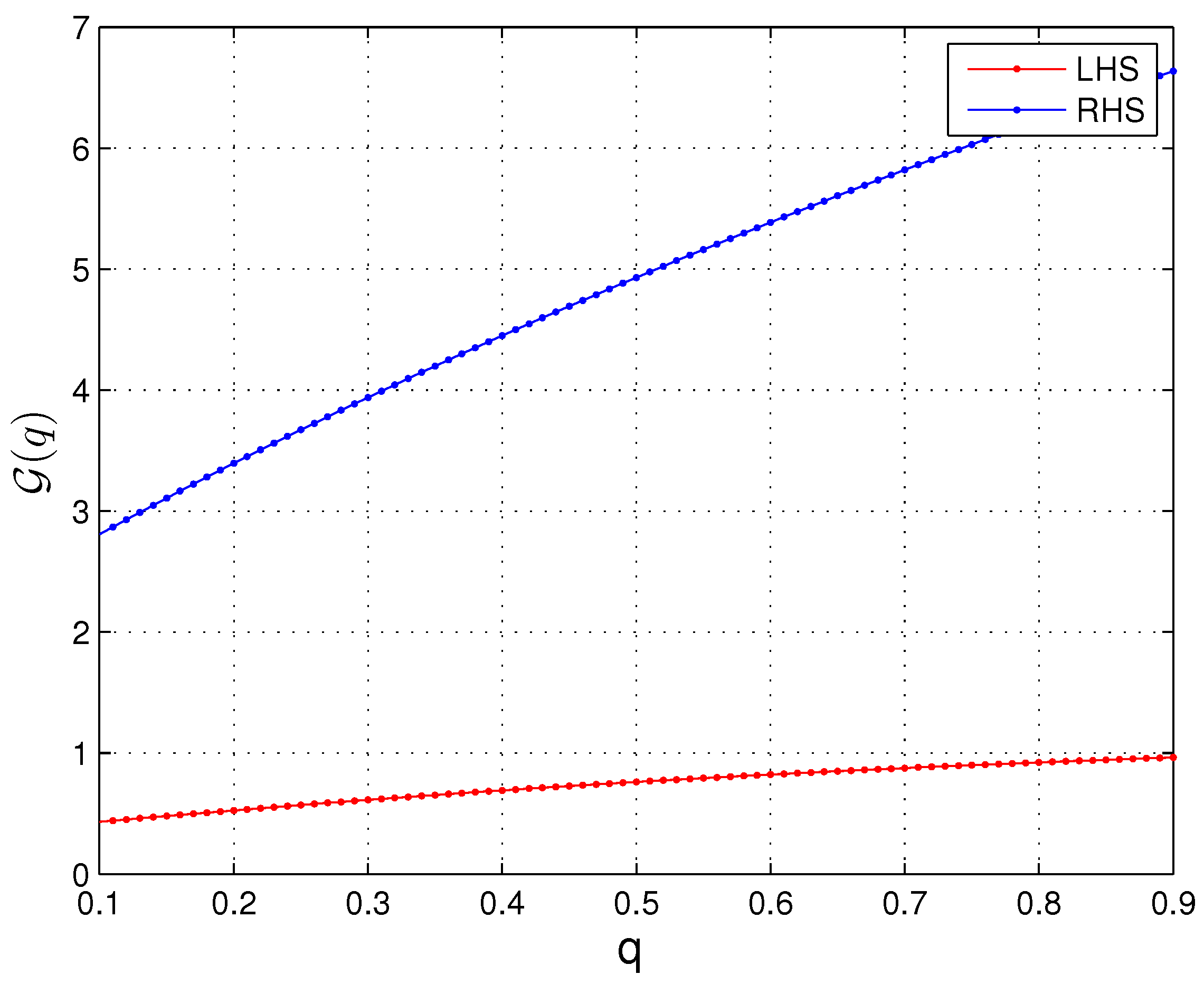
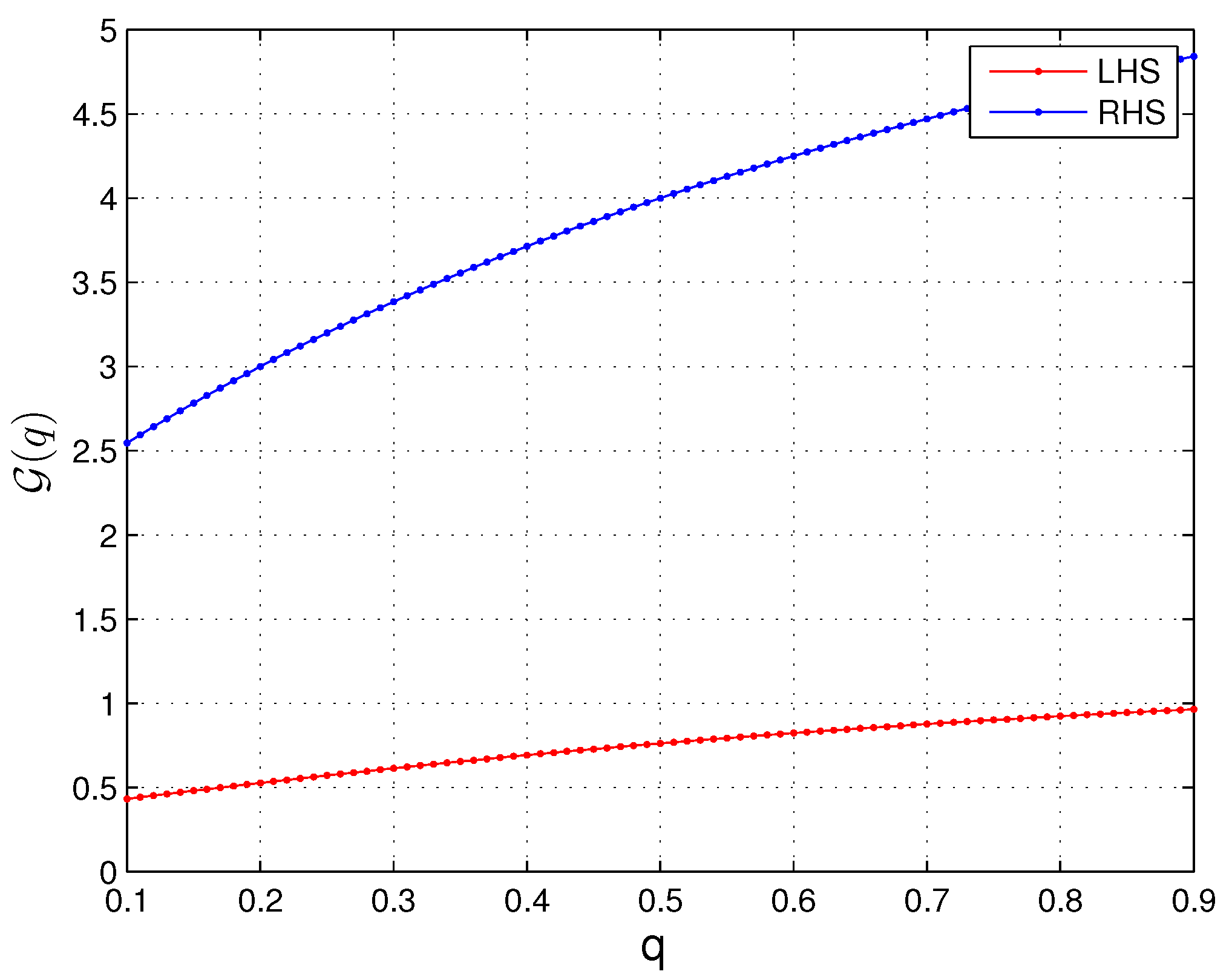
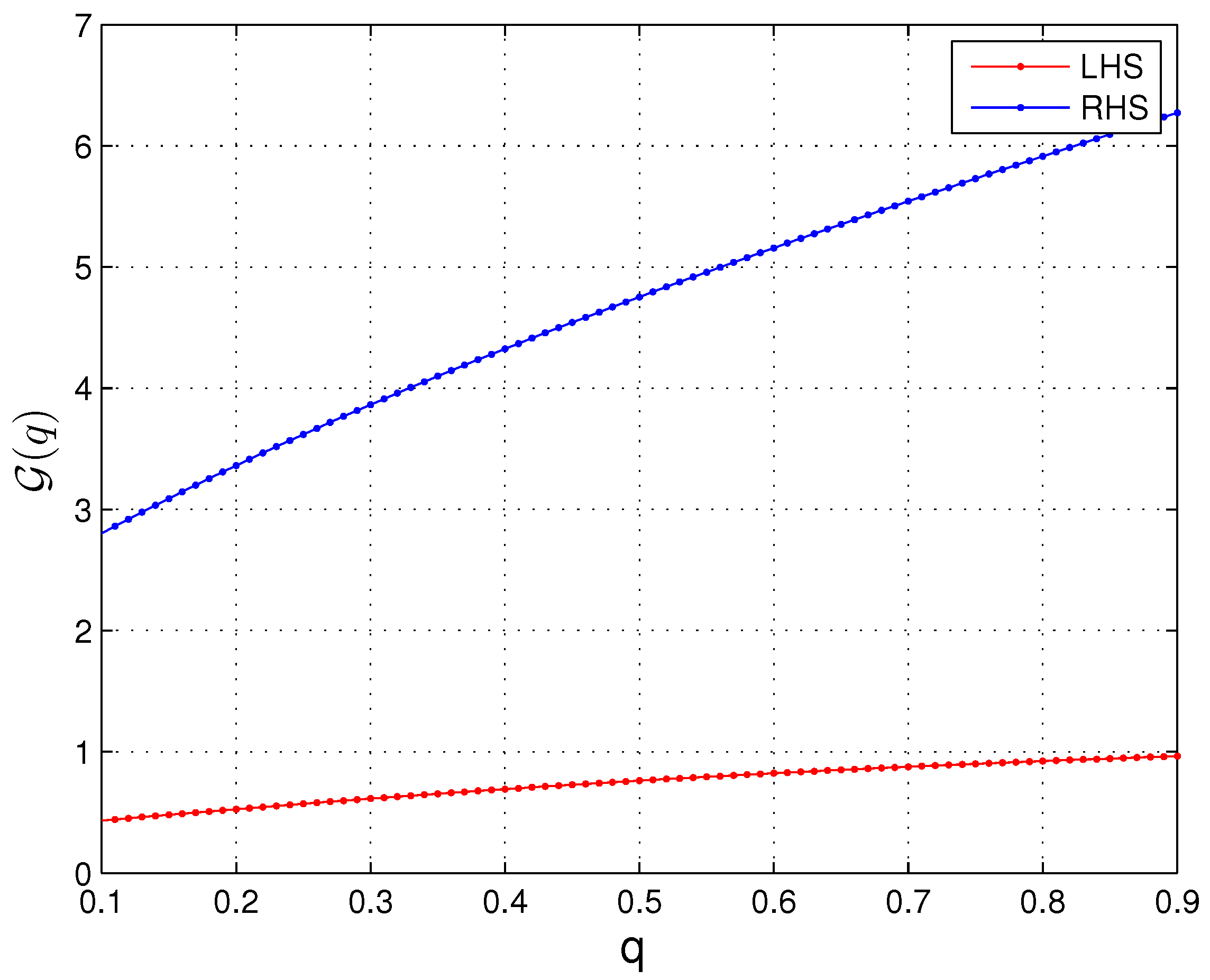
Here, we present the validity of our main outcomes in a pictorial way. First, we compare the left and right-hand sides of Theorem 3.
- If we take with and in Theorem 3, thenThe following Figure 1 shows the visual analysis of Theorem 3.
Figure 1. Depicts the comparative analysis between the left and right sides of Theorem 3.If we take in above expression, then we have . - If we take with and in Theorem 4 then weThe following Figure 2 shows the visual analysis of Theorem 4.
Figure 2. Depicts the comparative analysis between left and right sides of Theorem 4.If we take from the above expression, then we have - If we take with and in Theorem 5 thenThe following Figure 3 shows the visual analysis of Theorem 5.
Figure 3. Depicts the comparative analysis between left and right sides of Theorem 5.If we take from the above expression, then we have .
5. Conclusions
The theory of convex functions has received a significant response from researchers due to its applicable strength in every field of mathematics, economics, engineering, etc. They play a crucial role, particularly in the rapid expansion of inequalities. Employing the q concepts, together with convex functions or their generalization, is a very interesting way to obtain refinements of fundamental results. Over the past few decades, several mathematical inequalities have been derived to determine the error limits of classical quadrature and cubature rules. Among them is the Milne inequality, which offers bounds for the open method of Simpson-type inequality. In this paper, we derived a new q Milne–Mercer identity, and, moreover, based on this equality, some well-known inequalities, and convex mappings, we established some new error estimates of the Milne inequality. We also discussed some novel consequences of our main results. Furthermore, we provided some applications for special means and error bounds. The validity of the results was discussed in the last section of the study. It is our hope that this paper paves the way for future investigations into this inequality. Additionally, we plan to obtain the and fractional analogs of Milne-type inequalities in the future.
Author Contributions
Conceptualization, M.Z.J., M.U.A. and M.A.N.; methodology, M.U.A.; software, B.B.-M. and M.Z.J.; validation, M.U.A. and C.C.; formal analysis, M.Z.J., M.U.A. and C.C.; investigation, M.Z.J., M.U.A., A.G.K. and C.C.; writing—original draft preparation, B.B.-M., M.Z.J., M.U.A., A.G.K., C.C. and M.A.N.; writing—review and editing, M.Z.J. and M.U.A. supervision, M.U.A. All authors have read and agreed to the published version of the manuscript.
Funding
This Research is supported by Researchers Supporting Project number (RSP2023R158), King Saud University, Riyadh, Saudi Arabia.
Data Availability Statement
No data were used to support this study.
Acknowledgments
The authors are thankful to the editor and the anonymous reviewers for their valuable comments and suggestions. Muhammad Uzair Awan is thankful to Higher Education Commission of Pakistan for 8081/Punjab/NRPU/R&D/HEC/2017.
Conflicts of Interest
The authors declare that they have no conflict of interest.
References
- Mercer, A.M. A variant of Jensen’s inequality. J. Inequal Pure Appl. Math. 2003, 4, 73. [Google Scholar]
- Budak, H.; Kosem, P.; Kara, H. On new Milne-type inequalities for fractional integrals. J. Inequalities Appl. 2023, 2023, 10. [Google Scholar] [CrossRef]
- Meftah, B.; Lakhdari, A.; Saleh, W.; Kiliçman, A. Some New Fractal Milne-Type Integral Inequalities via Generalized Convexity with Applications. Fractal Fract. 2023, 7, 166. [Google Scholar] [CrossRef]
- Ali, M.A.; Zhang, Z.; Feckan, M. On Some Error Bounds for Milne’s Formula in Fractional Calculus. Mathematics 2023, 11, 146. [Google Scholar] [CrossRef]
- Kac, V.G.; Cheung, P. Quantum Calculus; Springer: New York, NY, USA, 2002; Volume 113. [Google Scholar]
- Alanazi, A.M.; Ebaid, A.; Alhawiti, W.M.; Muhiuddin, G. The falling body problem in quantum calculus. Front. Phys. 2020, 8, 43. [Google Scholar] [CrossRef]
- Tariboon, J.; Ntouyas, S.K. Quantum calculus on finite intervals and applications to impulsive difference equations. Adv. Differ. Equ. 2013, 2013, 282. [Google Scholar] [CrossRef]
- Bermudo, S.; Korus, P.; Valdes, J.N. On q-Hermite-Hadamard inequalities for general convex functions. Acta Math. Hung. 2020, 162, 364–374. [Google Scholar] [CrossRef]
- Kian, M.; Moslehian, M.S. Refinements of the operator Jensen-Mercer inequality. Electron. J. Linear Algebra 2013, 26, 742–753. [Google Scholar] [CrossRef]
- Ogulmus, H.; Sarikaya, M.Z. Hermite-Hadamard-Mercer type inequalities for fractional integrals. Filomat 2021, 35, 2425–2436. [Google Scholar] [CrossRef]
- Butt, S.I.; Kashuri, A.; Umar, M.; Aslam, A.; Gao, W. Hermite-Jensen-Mercer type inequalities via Ψ-Riemann-Liouville k -fractional integrals. AIMS Math. 2020, 5, 5193–5220. [Google Scholar] [CrossRef]
- Vivas-Cortez, M.; Ali, M.A.; Kashuri, A.; Budak, H. Generalizations of fractional Hermite-Hadamard-Mercer like inequalities for convex functions. AIMS Math. 2021, 6, 9397–9421. [Google Scholar] [CrossRef]
- Vivas-Cortez, M.; Awan, M.U.; Javed, M.Z.; Kashuri, A.; Noor, M.A.; Noor, K.I. Some new generalized k-fractional Hermite-Hadamard-Mercer type integral inequalities and their applications. AIMS Math. 2022, 7, 3203–3220. [Google Scholar] [CrossRef]
- Sudsutad, W.; Ntouyas, S.K.; Tariboon, J. Quantum integral inequalities for convex functions. J. Math. Inequal. 2015, 9, 781–793. [Google Scholar] [CrossRef]
- Noor, M.A.; Noor, K.I.; Awan, M.U. Some Quantum estimates for Hermite-Hadamard inequalities. Appl. Math. Comput. 2015, 251, 675–679. [Google Scholar] [CrossRef]
- Alp, N.; Sarıkaya, M.Z.; Kunt, M.; İşcan, İ. q-Hermite Hadamard inequalities and quantum estimates for midpoint type inequalities via convex and quasi-convex functions. J. King Saud Univ. Sci. 2018, 30, 193–203. [Google Scholar] [CrossRef]
- Kalsoom, H.; Vivas-Cortez, M. (q1,q2)-Ostrowski-Type Integral Inequalities Involving Property of Generalized Higher-Order Strongly n-Polynomial Preinvexity. Symmetry 2022, 14, 717. [Google Scholar] [CrossRef]
- Ali, M.A.; Budak, H.; Feckan, M.; Khan, S. A new version of q-Hermite-Hadamard’s midpoint and trapezoid type inequalities for convex functions. J. Math. Slovaca 2023, 73, 369–386. [Google Scholar] [CrossRef]
- Jhanthanam, S.; Tariboon, J.; Ntouyas, S.K.; Nonlaopon, K. On q-Hermite-Hadamard inequalities for differentiable convex functions. Mathematics 2019, 7, 632. [Google Scholar] [CrossRef]
- Mohammed, P.O.; Sarikaya, M.Z.; Baleanu, D. On the generalized Hermite-Hadamard inequalities via the tempered fractional integrals. Symmetry 2020, 12, 595. [Google Scholar] [CrossRef]
- Khan, M.A.; Mohammad, N.; Nwaeze, E.R.; Chu, Y.M. Quantum Hermite-Hadamard inequality by means of A Green function. Adv. Differ. Equ. 2020, 2020, 1–20. [Google Scholar]
- Saleh, W.; Meftah, B.; Lakhdari, A. Quantum dual Simpson type inequalities for q-differentiable convex functions. Int. J. Nonlinear Anal. Appl. 2023. [Google Scholar]
- Erden, S.; Iftikhar, S.; Kumam, P.; Thounthong, P. On error estimations of Simpson’s second type quadrature formula. Math. Methods Appl. Sci. 2020, 1–13. [Google Scholar] [CrossRef]
- Raees, M.; Anwar, M. New Estimation of Error in the Hadamard Inequality Pertaining to Coordinated Convex Functions in Quantum Calculus. Symmetry 2023, 15, 301. [Google Scholar] [CrossRef]
- Jain, S.; Goyal, R.; Agarwal, P.; Momani, S. Certain Saigo type fractional integral inequalities and their q-analogues. Int. J. Optim. Control Theor. Appl. 2023, 13, 1–9. [Google Scholar] [CrossRef]
- Kunt, M.; Aljasem, M. Fractional quantum Hermite-Hadamard type inequalities. Konuralp J. Math. 2020, 8, 122–136. [Google Scholar]
- Budak, H.; Ali, M.A.; Tarhanaci, M. Some new quantum Hermite–Hadamard-like inequalities for coordinated convex functions. J. Optim. Theory Appl. 2020, 186, 899–910. [Google Scholar] [CrossRef]
- Ali, M.A.; Budak, H.; Abbas, M.; Chu, Y.M. Quantum Hermite–Hadamard-type inequalities for functions with convex absolute values of second qυ2-derivatives. Adv. Differ. Equ. 2021, 2021, 7. [Google Scholar] [CrossRef]
- Al-Sa’di, S.U.; Bibi, M.; Muddassar, M. Some Hermite-Hadamard’s type local fractional integral inequalities for generalized γ-preinvex function with applications. Math. Methods Appl. Sci. 2023, 46, 2941–2954. [Google Scholar] [CrossRef]
- Chasreechai, S.; Ali, M.A.; Ashraf, M.A.; Sitthiwirattham, T.; Etemad, S.; Sen, M.D.L.; Rezapour, S. On New Estimates of q-Hermite-Hadamard Inequalities with Applications in Quantum Calculus. Axioms 2023, 12, 49. [Google Scholar] [CrossRef]
- Teklu, B.; Olivares, S.; Paris, M.G. Bayesian estimation of one-parameter qubit gates. J. Phys. At. B Mol. Opt. Phys. 2009, 42, 035502. [Google Scholar] [CrossRef]
- Brivio, D.; Cialdi, S.; Vezzoli, S.; Gebrehiwot, B.T.; Genoni, M.G.; Olivares, S.; Paris, M.G. Experimental estimation of one-parameter qubit gates in the presence of phase diffusion. Phys. Rev. A 2010, 81, 012305. [Google Scholar] [CrossRef]
- Xu, K.; Heo, J. New functional glasses containing semiconductor quantum dots. Phys. Scr. 2010, 2010, 014062. [Google Scholar] [CrossRef]
Disclaimer/Publisher’s Note: The statements, opinions and data contained in all publications are solely those of the individual author(s) and contributor(s) and not of MDPI and/or the editor(s). MDPI and/or the editor(s) disclaim responsibility for any injury to people or property resulting from any ideas, methods, instructions or products referred to in the content. |
© 2023 by the authors. Licensee MDPI, Basel, Switzerland. This article is an open access article distributed under the terms and conditions of the Creative Commons Attribution (CC BY) license (https://creativecommons.org/licenses/by/4.0/).