Abstract
Recently, developments and extensions of quadrature inequalities in quantum calculus have been extensively studied. As a result, several quantum extensions of Simpson’s and Newton’s estimates are examined in order to explore different directions in quantum studies. The main motivation of this article is the development of variants of Simpson–Newton-like inequalities by employing Mercer’s convexity in the context of quantum calculus. The results also give new quantum bounds for Simpson–Newton-like inequalities through Hölder’s inequality and the power mean inequality by employing the Mercer scheme. The validity of our main results is justified by providing examples with graphical representations thereof. The obtained results recapture the discoveries of numerous authors in quantum and classical calculus. Hence, the results of these inequalities lead us to the development of new perspectives and extensions of prior results.
MSC:
26A33; 26D15; 26E60
1. Introduction
Integral inequalities have historically been viewed as a classical field of research. From classical to contemporary applications, inequalities have been used in mathematical analysis. In 1934, Polya and Hardy introduced classical work on inequalities. Integral inequalities play a vital role in differential equation theory. Many researchers have studied integral inequalities in classical calculus, along with their applications (see [1,2]). Because the value of mathematical inequalities was well established in the past, inequalities such as the Hermite–Hadamard, Hölder, Ostrowski, Jensen, Hardy, and Cauchy–Schwartz inequalities have played an essential role in the theory of classical calculus and quantum calculus [3].
Convexity is a growing area of research that has applications in complex analysis, number theory, and many other fields. Convexity also has a significant impact on people’s lives with its numerous applications [1,3]. Convex functions are defined as follows.
Definition 1
([1]). Let be convex if, for every and every , we have:
which holds for every and every
Convexity theory also provides us with an amazing framework for initiating and developing numerical tools to tackle and study complicated problems in mathematics. Due to the number of expedient properties, they are magical, especially in optimization theory. The theories of mathematical inequalities and convex functions have a wonderful relationship. One of the most remarkable inequalities, which, we may say, is the natural extension of the convex function , is Jensen’s inequality [1], which is given as:
for all satisfying for . For , Jensen’s inequality (1) recaptures the definition of a convex function. There are several important applications of Jensen’s inequality in economics, finance, statistics, and optimization, but it is also the most effective inequality for predicting the estimations of the bounds of distance functions in information theory (see [4,5]).
In the year 2003, Mercer [6] introduced an interesting variant of Jensen’s inequality, which is called the Jensen–Mercer inequality:
which holds for all finite positive increasing sequences for , along with the weights defined in (1). Many scholars have investigated and studied the Jensen–Mercer inequality over the years, and they have even brought it to higher dimensions, using it for convex operators along with several purifications, operator variants for super-quadratic functions, improvements, and many generalizations with applications in information theory (see [7,8,9,10]).
In the applied sciences, there are a number of significant inequalities due to their important perspectives. However, the present study revolves around the renowned Simpson inequality [11], whose error estimates are written as:
where is a four-time continuously differentiable mapping on and
Simpson-type inequalities are a topic of great interest for many scholars, and they have been explored and studied for various classes of functions. Some fractional Simpson results were established with applications in [12,13].
One of the trickiest math problems to comprehend is in the history of quantum calculus, which is sometimes known as -calculus or -disease and dates back 300 years to Bernoulli and Euler. When there is no limit in calculus, it is referred as -calculus. Euler was the creator of -calculus and the inventor of the -parameter by using the -parameter in Newton’s work on infinite series. Jackson was the first to present the developing ideas about -calculus in a symmetrical manner in the nineteenth century by introducing -definite integrals [14]. Al-Salam presented a fractional integral operator and a -analog of the Riemann–Liouville fractional integral operator from 1966 to 1967 [15]. Due to its applicability in a wide range of domains, including mathematics, mechanics, and physics, there is now a tremendous rise in the area of -calculus. One can see this in [15,16,17] and the references therein. -difference operators are of huge importance because of their applications in a variety of mathematical disciplines, including orthogonal polynomials, basic hypergeometric functions, relativity, combinatorics, and mechanics. Many essential concepts of quantum calculus are covered in Kac and Cheung’s [18] book. These ideas help us to develop new inequalities, which can be useful in the discovery of new boundaries. The following are some of the fundamental definitions of quantum calculus.
2. Preliminaries
We first present the definitions of quantum derivatives and quantum integrals.
The -difference operator and -integral were first presented by Tariboon in [19]. Later, Bermudo et al. [20] intervened with the concept of the -derivative and -integral.
Definition 2
([20]). The -derivative of mapping is defined as:
which is a -Jackson derivative.
Definition 3
([20]). The -integral of mapping is defined as:
which is a -Jackson integral.
Theorem 1
([20]). If is a convex mapping that is differentiable on , then the following inequality is true:
where .
Lemma 1.
We have the equality
for .
It is pertinent to mention an important lemma of interest.
Lemma 2
([21]). For the continuous functions , the following inequality is true:
Despite our concentration on the thrill and romance of the development of quantum calculus and its applications in specific areas of the mathematical sciences and physics, -analogs of integral inequalities are a topic of supreme interest. Using the -derivative, -integral, -derivative, and -integral, several integral inequalities—namely, those of Hölder, Grüss, Ostrwoski, Hermite–Hadamrd, the trapezoid, and the midpoint —have been investigated with respect to various kinds of functions (see [20,22,23,24,25,26]). Some quantum integral inequalities in coordinates can be observed in [27,28]. New quantum versions of Simpson- and Newton-type inequalities relevant to convex functions were developed in [29,30,31], and their significance was established. Recently, Budak et al. introduced a variant of the quantum Hermite–Jensen–Mercer inequalities [32,33], while in [34], Bohner et al. provided their post-quantum extensions.
Motivated by the ongoing trend, the purpose of this study is to give an analysis of quantum Simpon-like inequalities under Mercer’s concept. We formulated new quantum auxiliary results. By applying convexity and the related Jensen–Mercer inequality, we give a variety of new estimates of Simpson’s quantum inequality.
3. Auxiliary Results
In this section, we describe our discovery of novel quantum Simpson–Mercer and quantum Newton–Mercer-like identities using -integrals.
Lemma 3.
Let a mapping be differentiable on . If , then, for all with , the following identity holds:
where
Proof.
Taking into account the fundamental properties of quantum integrals, we have
Now, as a consequence of Lemma 2, we get
and
Then, it follows that
Thus, the required equality is captured here. □
Remark 1.
If we set and in Lemma 3, it can be reduced to the following equality:
which was proven in [31].
Lemma 4.
With the suppositions of Lemma 3, we have the following identity:
where
Proof.
By using the fundamental properties of quantum integrals, we have
The desired results may be attained if steps similar to those in Lemma 3 are used for the rest of this proof. □
Remark 2.
If we set and in Lemma 4, it can be reduced to the following equality:
which was proven in [31].
3.1. Simpson–Mercer Formula-Type Inequalities
Theorem 2.
Let the assumptions of Lemma 3 hold. If is convex on , then the following inequality holds:
where
and .
Proof.
By taking the modulus in Lemma 3, we have
By using the convexity of , we get
Here, we have
and by using similar operations, we have
Hence, the proof is completed. □
We give the following example to show the validity of the results given in Theorem 2.
Example 1.
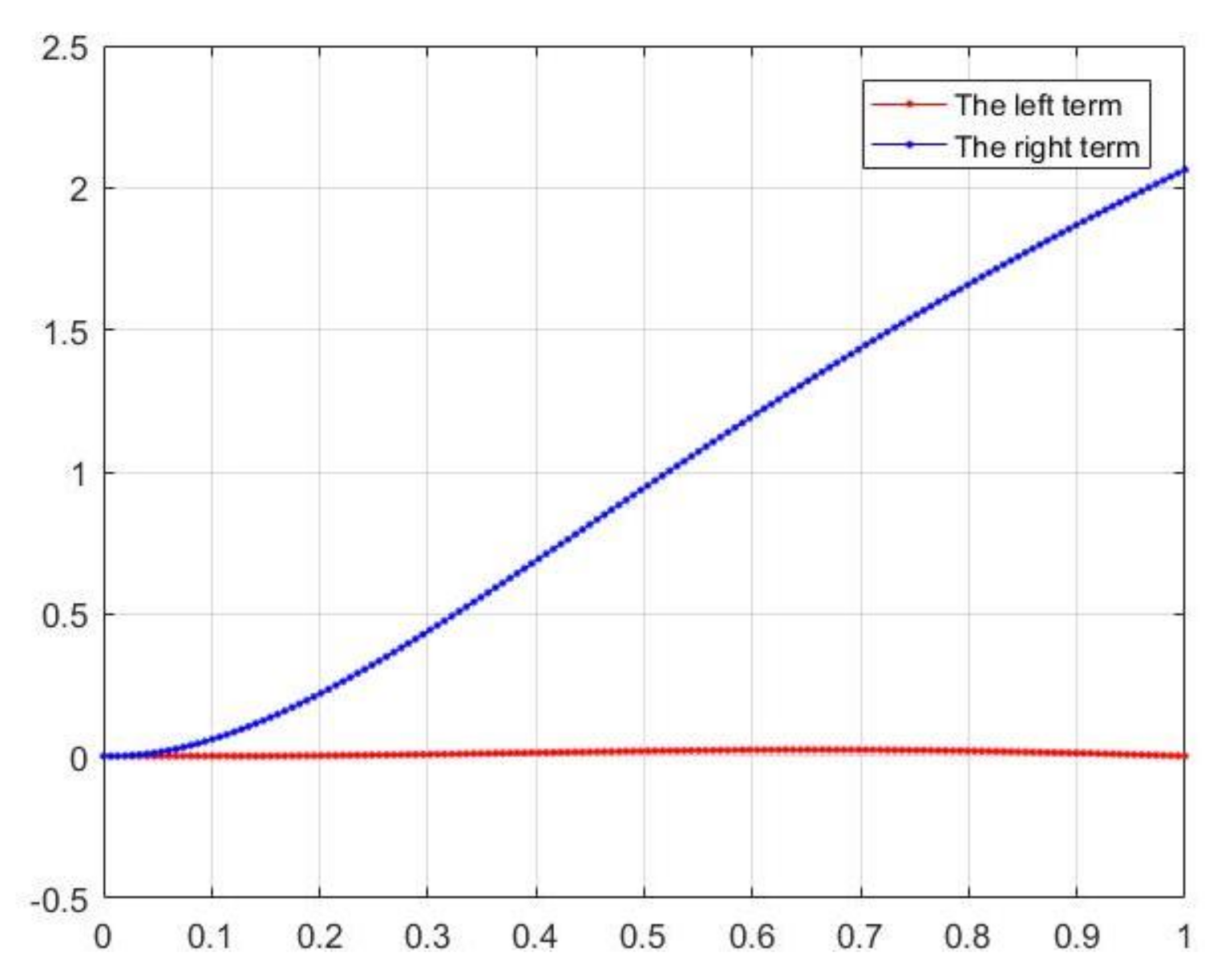
Let us consider the function defined by , and let and Then, we have , and is convex on Under these assumptions, we have
and
From Definition 3, we get
Hence, the left-hand side of the inequality (4) reduces to
Then, by using the inequality (4), we can write
Figure 1.
An example of the dependence of the inequality (6) on was computed and plotted with MATLAB.
Remark 3.
If we choose and in Theorem 2, we get Theorem 4 of [31].
Corollary 1.
With the assumptions of Theorem 2 with , , and , we have (see [35]):
Theorem 3.
Let the assumptions of Lemma 3 hold. If is convex on for some fixed , then the following inequality holds:
where and .
Proof.
Applying the well-known Hölder inequality for the -integral on the right-hand side of Lemma 3, we have
By using the convexity of , we obtain:
To calculate the integrals,
Similarly,
Here, we also have
and
By substituting these integrals, we get the required results. □
Remark 4.
If we put and into Theorem 3, then we get Theorem 5 of [31].
Theorem 4.
Let the assumptions of Lemma 3 hold. If is convex on for some fixed , then the following inequality holds:
where , and are defined in 2.
Proof.
By applying the power mean inequality on the right-hand side of Lemma 3, we have
Now, applying the convexity of , we have
By putting in the values of the integrals, we get required results. □
Remark 5.
If we put and into Theorem 4, we get Theorem 5 of [31].
Corollary 2.
With the suppositions of Theorem 4 with , , and , we have (see [35]):
3.2. Simpson–Mercer Formula-Type Inequalities
Theorem 5.
With the suppositions of Theorem 2, we have
where
and .
Proof.
Applying the modulus to Lemma 4, we attain
It is now sufficient to use similar steps to those in the results of Theorem 5 to find the desired outcomes. □
We give the following example to show the validity of the results given in Theorem 5.
Example 2.
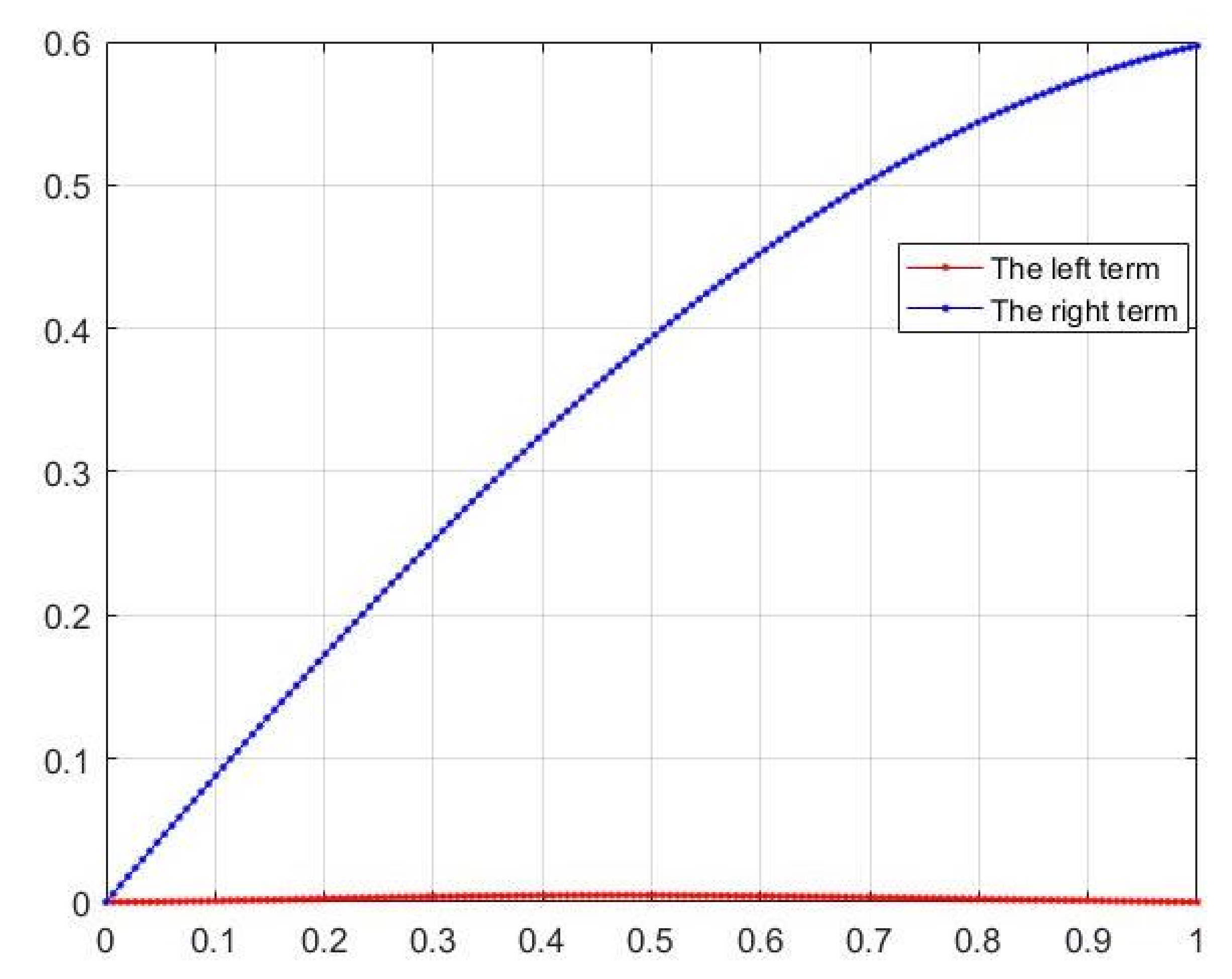
Let , and the function be as in Example 1. Then, is convex, and we get
and
Therefore, we have the equality from (9),
Finally, one can write the inequality (9) as follows and can see the validity of this inequality in Figure 2.
Figure 2.
An example of the dependence of the inequality (9) on was computed and plotted with MATLAB.
Remark 6.
If we choose and in Theorem 5, we get Theorem 6 of [31].
Theorem 6.
With the suppositions of Theorem 3, we have following inequality:
where .
Proof.
By applying Hölder’s inequality in Lemma 4, we attain
By applying a similar method to that used in the results of Theorem 3, we find the desired outcomes. □
Remark 7.
If we put and into Theorem 6, we get Theorem 8 of [31].
Theorem 7.
With the suppositions of Theorem 4, we have the inequality
, and are defined in Theorem 5.
Proof.
The proof of the theorem is analogous to the proof of Theorem 4. □
Remark 8.
If we put and into Theorem 7, we get Theorem 9 of [31].
4. Conclusions
In this article, we developed new analogs of Simpson–Mercer-like identities. Thus, by employing quantum integration and the Jensen–Mercer inequality for convex functions, we computed new quantum bounds. This novel framework is a convolution of the Simpon–Mercer concept and the estimation of the -definite integral. Some examples are also provided for the main inequalities. By employing the quantum Hölder and power mean integral inequalities, we analyzed new quantum inequalities that are in connection with previously published results. Little work has been done on quantum Mercer inequalities to date, so it is interesting to extend these findings to other general inequalities and convexities. One of the important problems is to check the validity of such results for their coordinate convexity. We presume that our newly announced concept will be the focus of much research in this fascinating field of quantum inequalities.
Author Contributions
Investigation, S.I.B. and H.B.; writing—original draft preparation, S.I.B. and H.B.; writing—review and editing, S.I.B., H.B. and K.N.; funding acquisition, K.N. All authors have read and agreed to the published version of the manuscript.
Funding
This work was funded in part by the National Natural Science Foundation of China (grant no. 62002079).
Data Availability Statement
Not applicable.
Conflicts of Interest
The authors declare no conflict of interest.
References
- Mitrinović, D.S.; Pečarić, J.E.; Fink, A.M. Classical and New Inequalities in Analysis; Mathematics and Its Applications (East and European Series); Kluwer Academic Publishers Group: Dordecht, The Netherlands, 1993; Volume 61. [Google Scholar]
- Qin, Y. Integral and Discrete Inequalities and Their Applications; Birkhauser; Springer International Publishing: Basel, Switzerland, 2016. [Google Scholar]
- Agarwal, P.; Dragomir, S.S.; Jleli, M.; Samet, B. Advances in Mathematical Inequalities and Applications; Springer: Singapore, 2018. [Google Scholar]
- Butt, S.I.; Bakula, M.K.; Pečarić, D.; Pečarić, J. Jensen-Grüss Inequality and its Applications for the Zipf-Mandelbrot Law. Math. Methods Appl. Sci. 2021, 44, 1664–1673. [Google Scholar] [CrossRef]
- Khan, S.; Khan, M.A.; Butt, S.I.; Chu, Y.M. A New Bound for the Jensen Gap Pertaining Twice Differentiable Functions with Applications. Adv. Differ. Equ. 2020, 1, 1–11. [Google Scholar] [CrossRef]
- Mercer, A.M. A Variant of Jensens Inequality. J. Inequal. Pure Appl. Math. 2003, 4, 73. [Google Scholar]
- Kian, M.; Moslehian, M.S. Refinements of the Operator Jensen–Mercer Inequality. Electron. J. Linear Algebra 2013, 26, 742–753. [Google Scholar] [CrossRef]
- Anjidani, E. Jensen–Mercer Operator Inequalities Involving Superquadratic Functions. Mediterr. J. Math. 2018, 15, 31. [Google Scholar] [CrossRef]
- Moradi, H.R.; Furuichi, S. Improvement and Generalization of Some Jensen–Mercer–Type Inequalities. J. Math. Inequal. 2020, 14, 377–383. [Google Scholar] [CrossRef]
- Khan, M.A.; Husain, Z.; Chu, Y.M. New Estimates for Csiszar Divergence and Zipf-Mandelbrot Entropy via Jensen-Mercer’s Inequality. Complexity 2020, 2020. [Google Scholar] [CrossRef]
- Dragomir, S.S.; Agarwal, R.P.; Cerone, P. On Simpson’s Inequality and Applications. J. Inequal. Appl. 2000, 5, 533–579. [Google Scholar] [CrossRef]
- Sarikaya, M.Z.; Set, E.; Ozdemir, M.E. On New Inequalities of Simpson’s Type for s-Convex Functions. Comput. Math. Appl. 2010, 60, 2191–2199. [Google Scholar] [CrossRef]
- Chen, J.; Huang, X. Some New Inequalities of Simpson’s Type for s-Convex Functions via Fractional Integrals. Filomat 2017, 31, 4989–4997. [Google Scholar] [CrossRef]
- Jackson, F.H. On a q-Definite Integrals. Q. J. Pure Appl. Math. 1910, 41, 193–203. [Google Scholar]
- Al-Salam, W. Some Fractional q-Integrals and q-Derivatives. Proc. Edinb. Math. Soc. 1966, 15, 135–140. [Google Scholar] [CrossRef]
- Ernst, T. A Comprehensive Treatment of Q-Calculus; Springer: Basel, Switzerland, 2012. [Google Scholar]
- Bokulich, A.; Jaeger, G. Philosophy of Quantum Information Theory and Entaglement; Cambridge University Press: Cambridge, UK, 2010. [Google Scholar]
- Kac, V.; Cheung, P. Quantum Calculus; Springer: Berlin, Germany, 2001. [Google Scholar]
- Tariboon, J.; Ntouyas, S.K. Quantum calculus on finite intervals and applications to impulsive difference equations. Adv. Differ. Equ. 2013, 1, 1–19. [Google Scholar] [CrossRef]
- Bermudo, S.; Kórus, P.; Valdes, J.E.N. On q-Hermite-Hadamard Inequalities for General Convex Functions. Acta Math. Hung. 2020, 162, 364–374. [Google Scholar] [CrossRef]
- Sial, I.B.; Mei, S.; Ali, M.A.; Nonlaopon, K. On Some Generalized Simpson’s and Newton’s Inequalities for (α,m)-Convex Functions in q-Calculus. Mathematics 2021, 9, 3266. [Google Scholar] [CrossRef]
- Tariboon, J.; Ntouyas, S.K. Quantum integral inequalities on finite intervals. J. Inequal. Appl. 2014, 2014, 121. [Google Scholar] [CrossRef]
- Alp, N.; Sarikaya, M.Z.; Kunt, M.; Iscan, I. q-Hermite Hadamard Inequalities and Quantum Estimates for Midpoint Type Inequalities Via Convex and Quasi-Convex Functions. J. King Saud Univ. Sci. 2018, 30, 193–203. [Google Scholar] [CrossRef]
- Mohammed, P.O. Some integral inequalities of fractional quantum type. Malaya J. Mat. 2016, 4, 93–99. [Google Scholar]
- Noor, M.A.; Noor, K.I.; Awan, M.U. Some quantum estimates for Hermite Hadamard inequalities. Appl. Math. Comput. 2015, 215, 675–679. [Google Scholar] [CrossRef]
- Xu, P.; Butt, S.I.; Ain, Q.U.; Budak, H. New Estimates for Hermite-Hadamard Inequality in Quantum Calculus via (α,m)-Convexity. Symmetry 2022, 14, 1394. [Google Scholar] [CrossRef]
- Alqudah, M.A.; Kashuri, A.; Mohammed, P.O.; Abdeljawad, T.; Raees, M.; Anwar, M.; Hamed, Y.S. Hermite-Hadamard Integral Inequalities on Co-ordinated Convex Functions in Quantum Calculus. Adv. Differ. Equ. 2021, 2021, 264. [Google Scholar] [CrossRef]
- Rashid, S.; Butt, S.I.; Kanwal, S.; Ahmad, H.; Wang, M.K. Quantum integral inequalities with respect to Raina’s function via coordinated generalized-convex functions with applications. J. Funct. Spaces 2021. [Google Scholar] [CrossRef]
- Budak, H.; Erden, S.; Ali, M.A. Simpson and Newton type inequalities for convex functions via newly defined quantum integrals. Math. Methods Appl. Sci. 2020, 44, 378–390. [Google Scholar] [CrossRef]
- Alp, N. Erratum: Simpson type Quantum Integral Inequalities for Convex Functions. Miskolc Math. Notes 2021, 22, 33–36. [Google Scholar] [CrossRef]
- Siricharuanun, P.; Erden, S.; Ali, M.A.; Budak, H.; Chasreechai, S.; Sitthiwirattham, T. Some New Simpson’s and Newton’s Formulas Type Inequalities for Convex Functions in Quantum Calculus. Mathematics 2021, 9, 16. [Google Scholar] [CrossRef]
- Budak, H.; Kara, H. On Quantum Hermite-Jensen-Mercer Inequalities. Miskolc Math. Notes 2016, accepted. [Google Scholar]
- Mosin, B.B.; Saba, M.; Javed, M.Z.; Awan, M.U.; Budak, H.; Nonlaopon, K. A Quantum Calculus View of Hermite-Hadamard-Jensen-Mercer Inequalities with Applications. Symmetry 2022, 14, 1246. [Google Scholar] [CrossRef]
- Bohner, M.; Budak, H.; Kara, H. Post-Quantum Hermite-Jensen-Mercer Inequalities. Rocky Mt. J. Math. 2022. in Press. [Google Scholar]
- Alomari, M.; Darus, M.; Dragomir, S.S. New Inequalities of Simpson’s Type for S-Convex Functions with Applications; Research Group in Mathematical Inequalities and Applications; Victoria University: Melbourne City, Australia, 2009; Volume 12, pp. 1–18. [Google Scholar]
Publisher’s Note: MDPI stays neutral with regard to jurisdictional claims in published maps and institutional affiliations. |
© 2022 by the authors. Licensee MDPI, Basel, Switzerland. This article is an open access article distributed under the terms and conditions of the Creative Commons Attribution (CC BY) license (https://creativecommons.org/licenses/by/4.0/).