1. Introduction
Symmetry is a major characteristic of mathematical beauty, and it is found in many branches of mathematics. A number of symmetric properties are widely studied, analyzed and applied in graph theory. For example, a well-known symmetrization operation is widely applied in the study of the Turán type problems in extremal graph theory, and the Lagrangian of hypergraphs concerned in this paper connects to a very symmetric function–the Lagrangian function (see [
1,
2] for surveys).
For a finite set
X and an integer
, let
. An
r-uniform hypergraph (
r-graph)
G on the vertex set
, is a subset of
. We simply denote
G as the edge set of
G. We call a 2-graph a simple graph. Denote
. Let
, denote
and
. An edge
will be simply denoted by
. Let
denote the complete
r-graph on vertex set
X with
. Denote
. Given an
r-graph
G on vertex set
, define the
Lagrangian function of
G as
where
.
can be interpreted as the density of a blow-up of
G divide
. Define the
Lagrangian of
G as
, where
We call a weighting
a
feasible weighting if
. We call a feasible weighting
optimal if
. Given
r-graphs
G and
F,
G is said to be
F-free if
G contains no copy of
F. The
Lagrangian density of
F is defined to be
The idea of continuous optimization is widely used not only in mathematics, but also in other disciplines (see [
3,
4] and so on). The hypergraph Lagrangian method, first introduced by Zykov [
5] in 1949, is such a continuous optimization method that is helpful to solve the extremal problems. One of the earliest applications of the hypergraph Lagrangian method was applied by Motzkin and Straus [
6] in 1965 to establish the connection (See Theorem 1) between the Lagrangian of a simple graph and its maximum clique number. A surprising application is that in the 1980’s, Frankl and Rödl [
7] used it to disprove a famous conjecture of Erdos. For more developments of the Lagrangian theory of hypergraphs see [
8,
9]. Actually, determining the Lagrangian density of general
r-graphs when
is interesting in itself. However, there are very few known results in Lagrangian density problems. We list some of the relevant results known so far as follows.
Since
is
F-free for an
n-vertex
r-graph
F, then
We call an n-vertex r-graph F-perfect if (We will show the value of in Fact 4).
Motzkin and Straus [
6] showed that every 2-graph
is
-perfect. Next, we turn our attention to the hypergraphs. Let
T be a tree or a forest that satisfies Erdos and Sós’ conjecture, and let
F be an
r-graph obtained by joining
fixed vertices into every edge of
T. Sidorenko [
10] proved that
F is
-perfect for large tree. Let
be the
r-graph with edge set
. Sidorenko [
9] showed that
is
-perfect for
and 4. Let
be the
r-uniform matching with
t pairwise disjoint edges. Let
denote a 3-uniform hypergraph with
t edges
satisfying that
for all
. Hefetz and Keevash [
11] showed that
is
-perfect. The authors [
12] proved that
and
are
-perfect. A result given by Bene Watts, Norin and Yepremyan [
13] suggested that
is not
-perfect for
. It is interesting to study the
-perfect
r-graphs. More results yielding
-perfect
r-graphs are in the papers [
10,
14,
15,
16,
17,
18,
19,
20,
21,
22]. It is worth mentioning that Yan and Peng [
23] recently proved that the Lagrangian density of a 3-graph is an irrational number, and independently, Wu [
24] showed that the Lagrangian density of
is an irrational number. These two results give a positive answer to the question posed by Baber and Talbot [
25]: whether there is an irrational Turán density of a single hypergraph. For more relevant Hypergraph Lagrangian results, one may refer to [
10,
17,
22,
26,
27,
28,
29,
30,
31,
32,
33,
34,
35,
36,
37,
38].
We call a graph
linear if any two edges of it share at most one vertex in common. Our original motivation is to seek some new tools to study the Lagrangian density of linear 3-graphs, and to give brief proofs. Denote the disjoint union of two
r-graphs
G and
H as
. In 2019, Yan and Peng [
22] posed an interesting conjecture.
Conjecture 1 - (i)
For an integer, there existssuch that a linear r-graph on at least vertices is-perfect.
- (ii)
For an integer, there existssuch that if G and H are two-perfect r-graphs withand, then is -perfect.
The other motivation of this paper is to find a class of -perfect 3-graphs to support Conjecture 1. We simplify to , i.e., . Let . In this paper, we show that is -perfect for all , proving that (ii) of Conjecture 1 holds for and , also supporting (i) of Conjecture 1 in some sense.
Theorem 1. Let be an integer and G be a 3-graph. If G is -free, then In particular, is λ-perfect.
The Lagrangian density problem is strongly related to the well-known Turán problem. For a given positive integer
n and an
r-graph
F, define the
Turán number of
F as the maximum number of edges attained by an
n-vertex
F-free
r-graph, and denote it as
. The
Turán density of
F is defined as
such a limit is known to exist. Denote the
extension of a graph
F as
, which is an
r-graph obtained from
F by adding
new vertices to each pair
that is not contained in any edge of
F. For example,
, where all
are different. A result of Sidorenko [
9,
10] yields that the Lagrangian density of
F is equal to the Turán density of
. Hence, we can directly obtain the following corollary by Theorem 1.
Corollary 1. Let be an integer. Then .
We remark that the lower bound for t can be improved slightly with some more tedious discussion, we omit it here.
3. Proof of Theorem 1
For a given r-graph G and , define the link graph of U in G as the hypergraph with edge set , and denote as . When or , we simply write as or .
Lemma 2. Let G be a dense 3-graph on vertex set . If , then for each vertex , there is a clique on s vertices contained in with .
ProofofLemma2. Let
be an optimum weighting on
G. Then, by Lemma 1, for every vertex
, we have
Note that
, which follows from
G being dense. Since
is a simple graph, by Motzkin–Straus Theorem,
where
s is the clique number of
. It follows that
. Thus, by Fact 4 and Motzkin–Straus Theorem, we have
It yields that , i.e., . Therefore, and we are done. □
Let
s be a positive integer. The
s-fold enlargement of the graph
F is obtained from
F by adding the same
s new vertices to every edge of
F. For example, the 3-graph
is the 1-fold enlargement of
, a path on
t vertices. The following proposition is a consequence of a result of Sidorenko [
10].
Proposition 1 (Sidorenko [
10]).
Let G be a 3-graph. If , then G contains a copy of the 1-fold enlargement of a path on vertices. Let
be two distinct
r-set. The
colex ordering on
is the ordering satisfying that
if
. For instance,
in
. Let
be the
r-graph consisting of the first
m sets in the colex ordering of
. There is a famous conjecture proposed by Frankl and Füredi [
39] in 1989. They conjectured that the Lagrangian of any
r-graph with
m edges is no more than
.
Note that if
, then
. Clearly,
is not covering pairs in
. Thus
is not dense by Fact 2. Hence
. Moreover, we have
since
. Therefore,
. For
, Talbot [
35] first showed the conjecture holds whenever
. After then, big progress has been made in [
28,
29,
30,
36,
37,
40].
Theorem 2 (Talbot [
35]).
Let m and ℓ be integers satisfyingthen for any 3-graph G with m edges, . Moreover, .
Corollary 2. Let G be a 3-graph with m edges. If , then .
ProofofCorollary2. For the contrary, suppose that . Let be the 3-graph obtained from G by adding arbitrarily s edges to G such that , where is an integer. By Fact 1, we have . Moreover, by Theorem 2, we have . Thus, , which contradicts that . □
We now give two crucial lemmas.
Lemma 3. Let and be two positive integers. Let G be a dense n-vertex 3-graph. If G is -free, then .
ProofofLemma3. For the contrary, suppose that
. Since
, by Proposition 1, there exists a copy of the 1-fold enlargement of a path on
vertices in
G. Denote this 3-graph as
S with
and
. Clearly,
forms a copy of
in
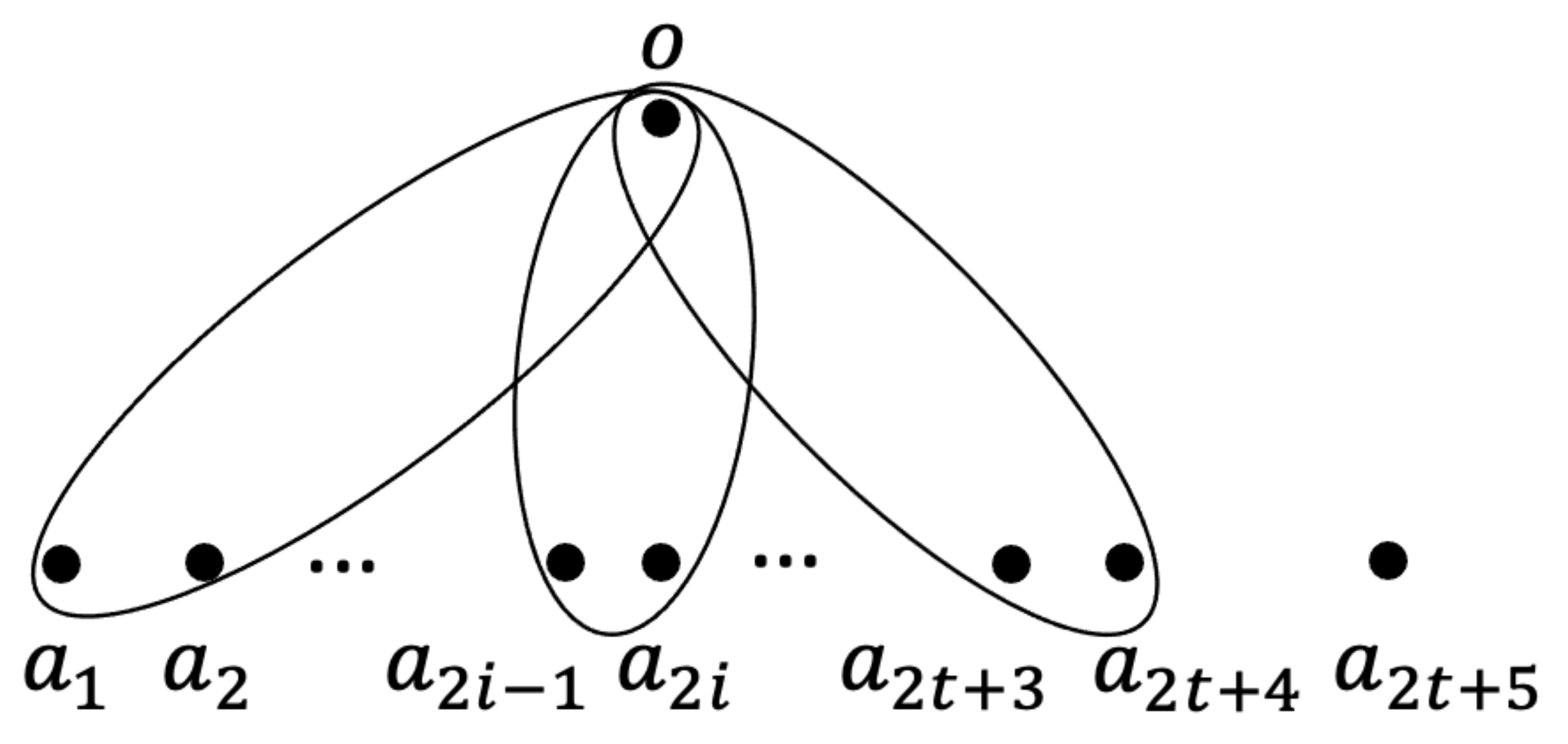
S (see
Figure 1).
For
, denote
Note that
contains a copy of
with edge set
, where
Since G is -free, H is -free. We claim that . Suppose that , and relabel the vertex set of H as . Without loss of generality, assume that . Since H is -free, thus there is no edge of H containing . If there is no edge of H containing or , then , which contradicts that . So there are at least two edges of H such that one contains 4 and the other contains 5. Without loss of generality, assume that . Similarly, there is no edge of H containing . So, , and thus, there is no edge of H containing . Therefore, , a contradiction. Hence, .
There are
such
, and for each
, there are at most
such
so that
. Note that
and
. Then
The roots of
are
and
. Since the quadratic function
concave,
is increasing in
, and decreasing in
. By direct calculation, we have
and
. Hence,
since
, that is,
. This is a contradiction with (
1). We complete the proof. □
Lemma 4. Let and be two positive integers. Let G be a dense n-vertex 3-graph. If G is -free, then .
ProofofLemma4. For the contrary, suppose that
. For each
, denote a maximum clique in
as
. Since
with
, by Lemma 2,
Furthermore, by Proposition 1, there exists a copy of the 1-fold enlargement of a path on
vertices in
G. Denote this 3-graph as
S with
and
. Clearly,
forms a copy of
in
S (see
Figure 1). If we delete one vertex of
with an odd number of subscript, then we can still find a copy of
in
S. However, If we delete one vertex of
with an even number of subscript, then we can only guarantee that there is a copy of
in
S. The situation is always ‘worse’ when the subscript of the deleted vertex is even than when it is odd.
Since , there are at least four vertices in , we denote four vertices among them as and denote . Since G is dense, then G covers pairs by Fact 2. We consider for all , recall that . □
Claim 1. for all.
ProofofClaim1. Suppose that there is such that . Recall that , so we can pick two vertices in , say . Thus, forms a copy of in . We will show that there exists a copy of in . Recall that , the worst case (For the sake of brevity of the proof, we consider only the worst case and omit other cases where or ) is and , where and . Assume that , delete and abandon . We can find a copy of with edge set in S. So, G contains a copy of , a contradiction. The proofs for or are similar. □
Claim 2. If, then for each,.
ProofofClaim2. Fix . First we prove that . Suppose that there is such that , then forms a copy of . It is not hard to see that there exists a copy of in . Thus, G contains a copy of , a contradiction. Similarly, . Now we suppose that . Then for and , . Otherwise forms a copy of , and clearly there exists a copy of in . Thus, G contains a copy of , a contradiction. Let . forms a copy of . Our goal is to find a copy of in , thus, we obtain a copy of in G and we are done. The worst case is , where . Assume that . In this case , we abandon and find a copy of with edge set in S. This copy of together with forms a copy of , and we are done. The proofs for or are similar. □
Claim 3. If, thenfor every pair,.
ProofofClaim3. Without loss of generality, assume that . By Claim 2, for every pair and . Let . Then forms a copy of in G. Our goal is to find a copy of in , thus we obtain a copy of in G and we are done. Similar to the proof of Claim 2, the worst case is , where , and there is a copy of not containing . This copy of together with forms a copy of , and we are done.
Now we continue to prove the lemma. We first claim that or or is contained in G. Otherwise, without loss of generality suppose that . By Claim 1, we have . If for some triple , and , , then forms a copy of in G. It is not hard to see that there is a copy of in , a contradiction. So we may assume that for every triple , and . Moreover, by Claim 3, for every pair , . Therefore, we have . Hence, we have shown that the claim holds. Without loss of generality, we assume that is contained in G. Let . Then forms a copy of . Our goal is to find a copy of in , thus we obtain a copy of in G and we are done. Similar to the proof of Claim 2, the worst case is , where . It is not hard to see that there exists a copy of in . This copy of together with forms a copy of . Thus we complete the proof. □
ProofofTheorem1. Let G be an -free 3-graph with vertex set . We can assume that G is dense, otherwise we replace G by a dense subgraph of G with . So G covers pairs by Fact 2. If , then by Fact 1. If , then we are done by Lemma 3. Now assume that . For the contrary, we suppose that . By Lemma 4, there exists a copy of in G, a contradiction. So . Since contains no , we have . Hence, . Thus, we complete the proof. □