Rotational Cryptanalysis on ChaCha Stream Cipher


Abstract
1. Introduction
2. Notation and ChaCha20 Stream Cipher Description
2.1. Notation
- ⊕ for the bitwise exclusive or (XOR), i.e., the addition in ;
- ⊞ for the -bit addition ;
- ⊟ for the -bit subtraction , i.e., the sum with the opposite of an element in ;
- for the -bit addition of k words ;
- for the vector bitwise OR operation between x and y;
- for the concatenation of x and y;
- for a non–cyclic left shift by one bit of x;
- ;
- and respectively for constant-distance left and right circular rotation of bits of a -bit word with ;
- for the Hamming weight of x;
- for the cardinality of a set I;
- for the characteristic function of a condition Z, which is equal to 1 when Z is satisfied and equal to 0 otherwise;
- ;
- if and only if we have for all ;
- , where, for ,and, considering ,with and ;
- for the operator which gives for any the integer satisfying
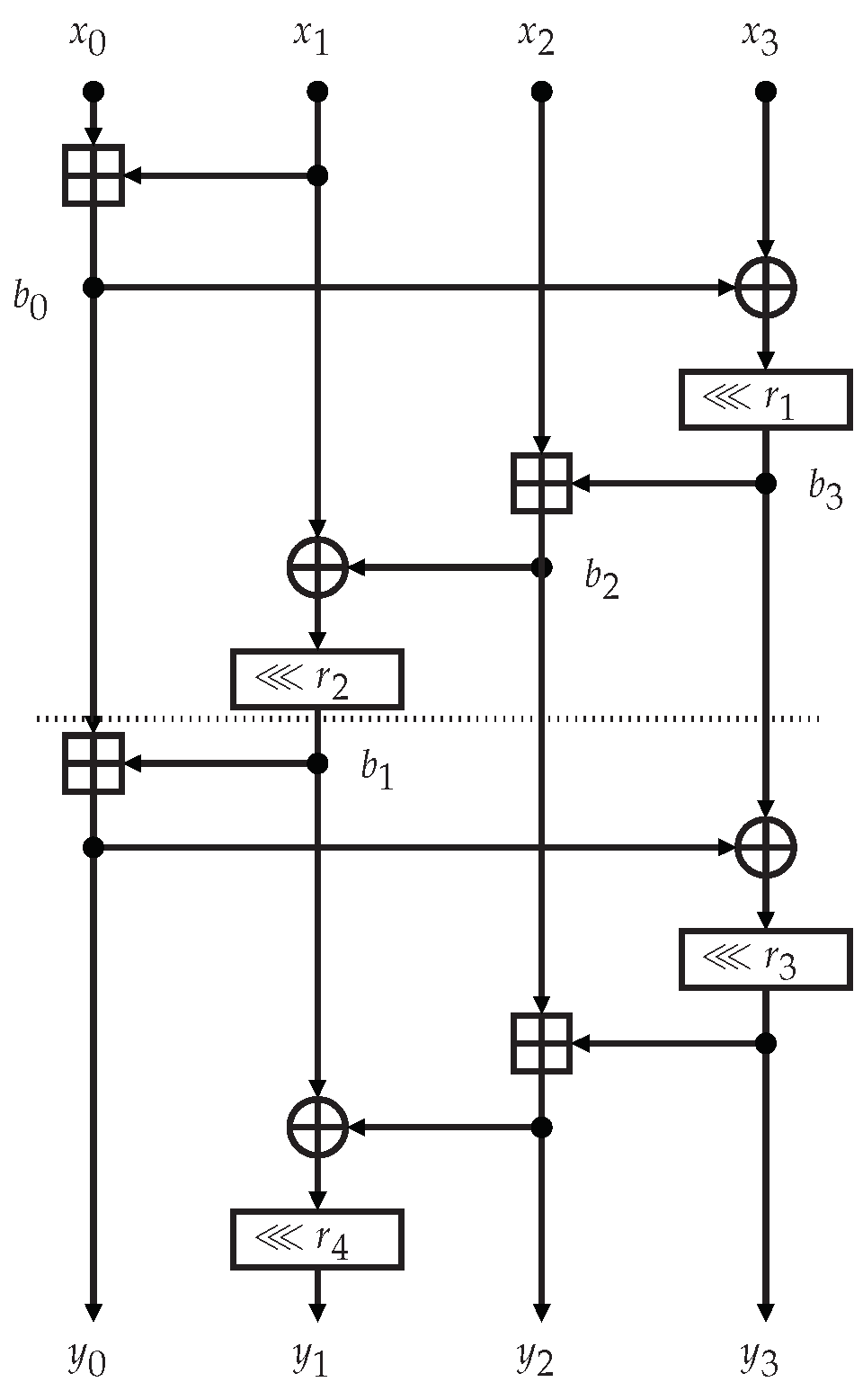
2.2. ChaCha20 Specification
2.3. Rotational and Rotational-XOR (RX) Cryptanalysis
- The rotational property is preserved through the XOR of rotational pairs and after a rotation by a constant value :
- The rotational property is preserved through a modular addition of two –bit words with a probability given byand computed in Corollary 4.12 of [10], this probability is a decreasing function of , thus it is maximized when ;
- In the case of chained modular additions of more than two –bit strings, must be evaluated using Lemma 2 in [14];
- with probability
- Given a random function , with probability
- ;
- for a fixed rotational amount .
3. Searching for Rotational/RX Pairs in ChaCha20
3.1. Conditions for the Rotational Propagation
3.2. On the Choices of the Input Relations and of a, b, c, d
- , i.e., which is equivalent to the equationand it gives possible values for ;
- , i.e., , , which is equivalent to the equationand it gives one value for only when and otherwise it is impossible;
- , i.e., , which is equivalent to the equationand it gives possible values for ;
- , i.e., , , which is equivalent to the equationand it gives one value for only when and otherwise it is impossible.
3.3. Probability of Rotational Propagation for 1 Bit Rotations
- : in this case when congruence (52) becomesComparing the two members it clearly holds if and only ifand, by definition of , the second congruence in (51) holds ifwhere is fixed by (53) and by the free choice of . Therefore we always have only 2 solutions when . When congruence (52) becomesgiving and conditions similar to (53)and the same conditions (54) for congruence (51). Thus also when we find that we do not have conditions on and we always have only 2 solutions. Finally if both members of the congruence (52) are less than and they have the same parity if and only if . Moreover, we havewhere the equality holds if and only if for all , andwhere the equalities hold if for all . Thus we findwhich gives for all and, if , we need for all and . Therefore we have solutions only when the constant is such that for all and, since also in these cases the same conditions (54) for congruence (51) hold, we have free for all and possible solutions.
- : in this case we necessarily have and since only when , thus (52) becomesand we have solutions only when , in order to preserve the same parity for both members. Under this supplementary condition, congruence (55) is equivalent tomoreover in this case the second congruence in (51) givesori.e., for every solution of (56) we have also two possibilities for . Thus, since (56) can be solved as in the previous case distinguishing between , , and , the number of solutions is doubled. So, if and , we find 4 solutions, while, if and for all , we have solutions.
- : in this last case we have in the first congruence in (51) so this congruence becomes the equalitySinceif we have solutions only when for all and , with the two possibilities for given byorso all are solutions. On the other hand, if and , from (57) we also need for all and , therefore and . Thus only is fixed and we have solutions. Finally, when and we also need for all and . Therefore and , thus also in this case we have only fixed and, consequently, there are solutions.
- ,
- and ,
- , , i.e., is the zero vector in ,
4. Discussion
- conditions (21) and (22) hold automatically from (23);
4.1. Propagation Probability of Rotational-XOR Pairs through ChaCha20 Quarter Round
- and , so , which gives when ;
- and with as before;
- and , , so , which gives when ;
- and with as for the first two constants.
4.2. ChaCha20 Alternative Constants Giving Non-Negligible Probability
5. Conclusions
Author Contributions
Funding
Institutional Review Board Statement
Informed Consent Statement
Data Availability Statement
Acknowledgments
Conflicts of Interest
References
- Bernstein, D.J. ChaCha, a Variant of Salsa20. In Workshop Record of SASC; 2008; Volume 8, pp. 3–5. Available online: https://cr.yp.to/chacha/chacha-20080120.pdf (accessed on 23 May 2022).
- Bernstein, D.J. Salsa20 Specification. In Technical Report, eSTREAM Project; 2005; Available online: http://www.ecrypt.eu.org/stream/salsa20pf.html (accessed on 23 May 2022).
- Nir, Y.; Langley, A. Chacha20 and poly1305 for IETF protocols. RFC 2018, 8439, 1–46. [Google Scholar] [CrossRef] [Scilit]
- Bernstein, D.J.; Hopwood, D.; Hülsing, A.; Lange, T.; Niederhagen, R.; Papachristodoulou, L.; Schneider, M.; Schwabe, P.; Wilcox-O’Hearn, Z. SPHINCS: Practical Stateless Hash–Based Signatures. In Advances in Cryptology—EUROCRYPT 2015; LNCS; Springer: Berlin/Heidelberg, Germany, 2015; Volume 9056, pp. 368–397. [Google Scholar] [CrossRef] [Scilit]
- Biham, E. New Types of Cryptanalytic Attacks Using Related Keys. J. Cryptol. 1994, 7, 229–246. [Google Scholar] [CrossRef] [Scilit]
- Kelsey, J.; Schneier, B.; Wagner, D. Related-key cryptanalysis of 3-way, biham-DES, CAST, DES-X, newDES, RC2, and TEA. In Information and Communications Security. ICICS 1997; LNCS; Springer: Berlin/Heidelberg, Germany, 1997; Volume 1334, pp. 233–246. [Google Scholar] [CrossRef] [Scilit]
- Knudsen, L.R.; Matusiewicz, K.; Thomsen, S.S. Observations on the Shabal Keyed Permutation. In Official Comment. 2009. Available online: http://www2.mat.dtu.dk/people/oldusers/S.Thomsen/shabal/shabal.pdf (accessed on 23 May 2022).
- Bernstein, D.J. Salsa20 Security. In Technical Report, eSTREAM Project; 2005; Available online: http://cr.yp.to/snuffle/security.pdf (accessed on 23 May 2022).
- Standaert, F.-X.; Piret, G.; Gershenfeld, N.; Quisquater, J.-J. Sea: A Scalable Encryption Algorithm for Small Embedded Applications. In Smart Card Research and Advanced Applications. CARDIS 2006; LNCS; Springer: Berlin/Heidelberg, Germany, 2006; Volume 3928, pp. 222–236. [Google Scholar] [CrossRef] [Scilit]
- Daum, M. Cryptanalysis of Hash Functions of the MD4-Family. Ph.D. Thesis, Ruhr University Bochum, Bochum, Germany, 2005. Available online: http://citeseerx.ist.psu.edu/viewdoc/download?doi=10.1.1.88.7847&rep=rep1&type=pdf (accessed on 23 May 2022).
- Khovratovich, D.; Nikolić, I. Rotational cryptanalysis of ARX. In Fast Software Encryption. FSE 2010; LNCS; Springer: Berlin/Heidelberg, Germany, 2010; Volume 6147, pp. 333–346. [Google Scholar] [CrossRef] [Scilit]
- Khovratovich, D.; Nikolić, I.; Rechberger, C. Rotational Rebound Attacks on Reduced Skein. In Advances in Cryptology—ASIACRYPT 2010; LNCS; Springer: Berlin/Heidelberg, Germany, 2010; Volume 6477, pp. 1–19. [Google Scholar] [CrossRef] [Scilit]
- Ferguson, N.; Lucks, S.; Schneier, B.; Whiting, D.; Bellare, M.; Kohno, T.; Callas, J.; Walker, J. The Skein Hash Function Family. Submiss. NIST (Round 3) 2010, 7, 3. [Google Scholar]
- Khovratovich, D.; Nikolić, I.; Pieprzyk, J.; Sokolowski, P.; Steinfeld, R. Rotational Cryptanalysis of ARX Revisited. In Fast Software Encryption. FSE 2015; LNCS; Springer: Berlin/Heidelberg, Germany, 2015; Volume 9054, pp. 519–536. [Google Scholar] [CrossRef] [Scilit]
- Guo, J.; Karpman, P.; Nikolić, I.; Wang, L.; Wu, S. Analysis of BLAKE2. In Topics in Cryptology—CT-RSA 2014; LNCS; Springer: Cham, Switzerland, 2014; Volume 8366, pp. 402–423. [Google Scholar] [CrossRef] [Scilit]
- Morawiecki, P.; Pieprzyk, J.; Srebrny, M. Rotational Cryptanalysis of Round-reduced Keccak. In Fast Software Encryption: 20th International Workshop; LNCS; Springer: Berlin/Heidelberg, Germany, 2013; Volume 8424, pp. 241–262. [Google Scholar] [CrossRef] [Scilit]
- Ashur, T.; Liu, Y. Rotational Cryptanalysis in the Presence of Constants. IACR Trans. Symmetric Cryptol. 2016, 2016, 57–70. [Google Scholar] [CrossRef] [Scilit]
- Ashur, T.; De Witte, G.; Liu, Y. An Automated Tool for Rotational-XOR Cryptanalysis of ARX-based Primitives. In Proceedings of the 2017 Symposium on Information Theory and Signal Processing in the Benelux (SITB 2017), Delft, The Netherlands, 11–12 May 2017. [Google Scholar]
- Ito, R. Rotational Cryptanalysis of Salsa Core Function. In Information Security. ISC 2020; LNCS; Springer: Cham, Switzerland, 2020; Volume 12472, pp. 129–145. [Google Scholar] [CrossRef] [Scilit]
- Barbero, S.; Bellini, E.; Makarim, R. Rotational Analysis of ChaCha Permutation. Adv. Math. Commun. 2021. [Google Scholar] [CrossRef] [Scilit]

Publisher’s Note: MDPI stays neutral with regard to jurisdictional claims in published maps and institutional affiliations. |
© 2022 by the authors. Licensee MDPI, Basel, Switzerland. This article is an open access article distributed under the terms and conditions of the Creative Commons Attribution (CC BY) license (https://creativecommons.org/licenses/by/4.0/).
Share and Cite
Barbero, S.; Bazzanella, D.; Bellini, E. Rotational Cryptanalysis on ChaCha Stream Cipher. Symmetry 2022, 14, 1087. https://doi.org/10.3390/sym14061087
Barbero S, Bazzanella D, Bellini E. Rotational Cryptanalysis on ChaCha Stream Cipher. Symmetry. 2022; 14(6):1087. https://doi.org/10.3390/sym14061087
Chicago/Turabian StyleBarbero, Stefano, Danilo Bazzanella, and Emanuele Bellini. 2022. "Rotational Cryptanalysis on ChaCha Stream Cipher" Symmetry 14, no. 6: 1087. https://doi.org/10.3390/sym14061087
APA StyleBarbero, S., Bazzanella, D., & Bellini, E. (2022). Rotational Cryptanalysis on ChaCha Stream Cipher. Symmetry, 14(6), 1087. https://doi.org/10.3390/sym14061087