Abstract
Nearly every area of mathematics, natural, social, and engineering now includes research into finding exact answers to nonlinear fractional differential equations (NFDES). In order to discover the exact solutions to the higher order Sasa-Satsuma equation in the sense of the beta derivative, the paper will discuss the modified simple equation (MSE) and exponential rational function (ERF) approaches. In general, symmetry and travelling wave solutions of the Sasa-Satsuma equation have a common correlation with each other, thus we reduce equations from wave transformations to ordinary differential equations with the help of Lie symmetries. Actually, we can say that wave moves are symmetrical. The considered procedures are effective, accurate, simple, and straightforward to compute. In order to highlight the physical characteristics of the solutions, we also provide 2D and 3D plots of the results.
PACS:
02.30 Jr; 02.70.Wz; 04.20.Jb
1. Introduction
Nowadays, academic researchers deal with many physical phenomena in plasma physics, physical chemistry, geophysics, fluid mechanics, nonlinear optics, electromagnetic theory, and fluid motion, and their mathematical models are expressed by NFDEs [1,2]. These equations are commonly used in various scientific disciplines and have been investigated from different viewpoints [3]. The exact solutions of these equations have gained more and more interest. For this reason, a lot of different techniques have been dealt with by researchers. Among this research, the following ones can be listed, for instance, Hosseini et al. derived new exact solutions of a new (4+1)-dimensional Burgers equation [4]. Dehingia et al. applied the Hopf-bifurcation [5]. Mirzazadeh et al. worked on the second-order nonlinear Schrödinger equation with weakly nonlocal and parabolic laws [6]. Aktar et al. obtained the soliton solutions of a biological model [7]. Mathanaranjan et al. applied the sinh-Gordon procedure [8]. Jannat et al. constructed different types of travelling wave solutions for the considered equation by employing the Auto-Backlund transformations [9]. Ala et al. applied the improved Bernoulli sub-equation function procedure [10]. Kaplan and Akbulut utilized the modified Kudryashov approach [11], Hosseini et al. used the homotopy analysis method (HAM) [12], Mahmood et al. utilized discrete fractional operators [13], Mohammed et al. employed discrete CF-fractional operators [14], Arshed et al. utilized the modified auxiliary equation (MAE) method [15].
The limit relationships between solitary wave solutions and periodic wave solutions, which correspond to the outer and inner trajectories of asymmetric homoclinic trajectories, were explored by the authors in [16]. We deal with the wave transformations, which are connected to the Lie symmetries of the equations, as a symmetry of an equation is a transformation that does not change the set of solutions to the equation [17].
In the current work, we will take into consideration the generalized (3+1)-dimensional nonlinear Sasa-Satsuma (3DNSS) equation in the sense of the beta derivative,
where is the soliton profile, and are real constants. This equation includes self-steepening, third order dispersion, and self-frequency shift, and is an integrable generalization of the NFDE. Yao et al. applied the mapping method, extended hyperbolic function technique, Bäcklund transformation, and improved generalized Riccati equation to find optical solitons of this equation [18]. Wazwaz and Mehanna obtained exponential, bright, singular, and dark soliton solutions of this equation [19].
This work is arranged as follows. We provide some fundamental details and certain features of the beta derivative in Section 2. Then, in Section 3, the preliminary information is given. In Section 4, we describe the MSE technique. In Section 5, we present the ERF technique. Then, in Section 6, we represent the applications of the adopted procedure. Finally, we provide a discussion on the results.
2. Some Useful Properties of the Beta Derivative
In the current part of the paper, we are going to give some definitions and basic results:
Definition 1.
Let be a function defined for all non-negative t. The β derivative of of order β is given by [20,21]:
and .
Some properties are given for derivative in the following theorem [22,23,24]:
Theorem 1.
Let and be β-differentiable functions for all and . Some basic properties are discussed as foloows:
3. Preliminary Information
In this piece of the work, we first introduce the background data for employing to convert a nonlinear partial differential problem to an ordinary differential equation (ODE). Therefore, the following time fractional NFDE will be taken into account:
where P inherits q and its various partial derivatives include fractional derivatives with respect to t and classical derivatives with respect to .
The wave transformation is defined as:
where and are constants to be calculated. Then, (3) is used in Equation (2) and equates the imaginary and real parts to zero; we discover an equation system. After that, we solve the resulting system to determine the parameters’ conditions and use those results. As a result, we obtain the following ODE, as follows, which is going to be integrated with respect to the possible times.
where the partial derivative is given with respect to .
4. Modified Simple Equation Technique
We can summarize the MSE technique, as follows [25,26]:
Firstly, the exact solution of Equation (4) can used to demonstrate a polynomial in as follows
Here, m is a positive integer, and it is the balancing number. It can be evaluated by applying the homogeneous balance principle between the highest order derivative term with the highest order nonlinear term, which is shown in Equation (4). Moreover, are arbitrary real constants to be calculated.
We obtain a polynomial of order with the derivatives of by inserting Equation (5) into Equation (4). After that, we obtain an algebraic equation system to be solved for finding and and by equating all the coefficients of to zero Finally, we substitute the values of c and into Equation (5) and we obtain the exact solutions of Equation (1).
5. The Exponential Rational Function Technique
Assume that Equation (4) has a solution of the following type [27,28]:
where are constants to be evaluated, and m is the balancing number. If we substitute Equation (6) into Equation (4), we discover a collection of algebraic equations in parameters and Hence, we can derive fresh answers to Equation (4).
6. Application of the Given Methods from the Solutions of This System
We shall look for the novel traveling wave solutions to Equation (1) in this piece of the work. Due to this, we first provide a mathematical examination of the problem under consideration.
6.1. Mathematical Analysis
We split Equation (1) into its real and imaginary components using the transformation specified in Equation (3):
and
If we integrate Equation (8) and take the integration constant as zero, we find the resultant equation as follows:
If we balance and Equation (7), we obtain
6.2. MSE Technique
According to the adopted technique, the exact solution of the Equation (7) is given by:
From the solutions of Equations (14) and (17), we find the following results for and
and
where . Then, if we substitute Equations (18) and (19) into Equations (15) and (16), we find a differential equation system for . After that, we solve this differential equation system and find the resultant equation
where
Therefore, the solution of
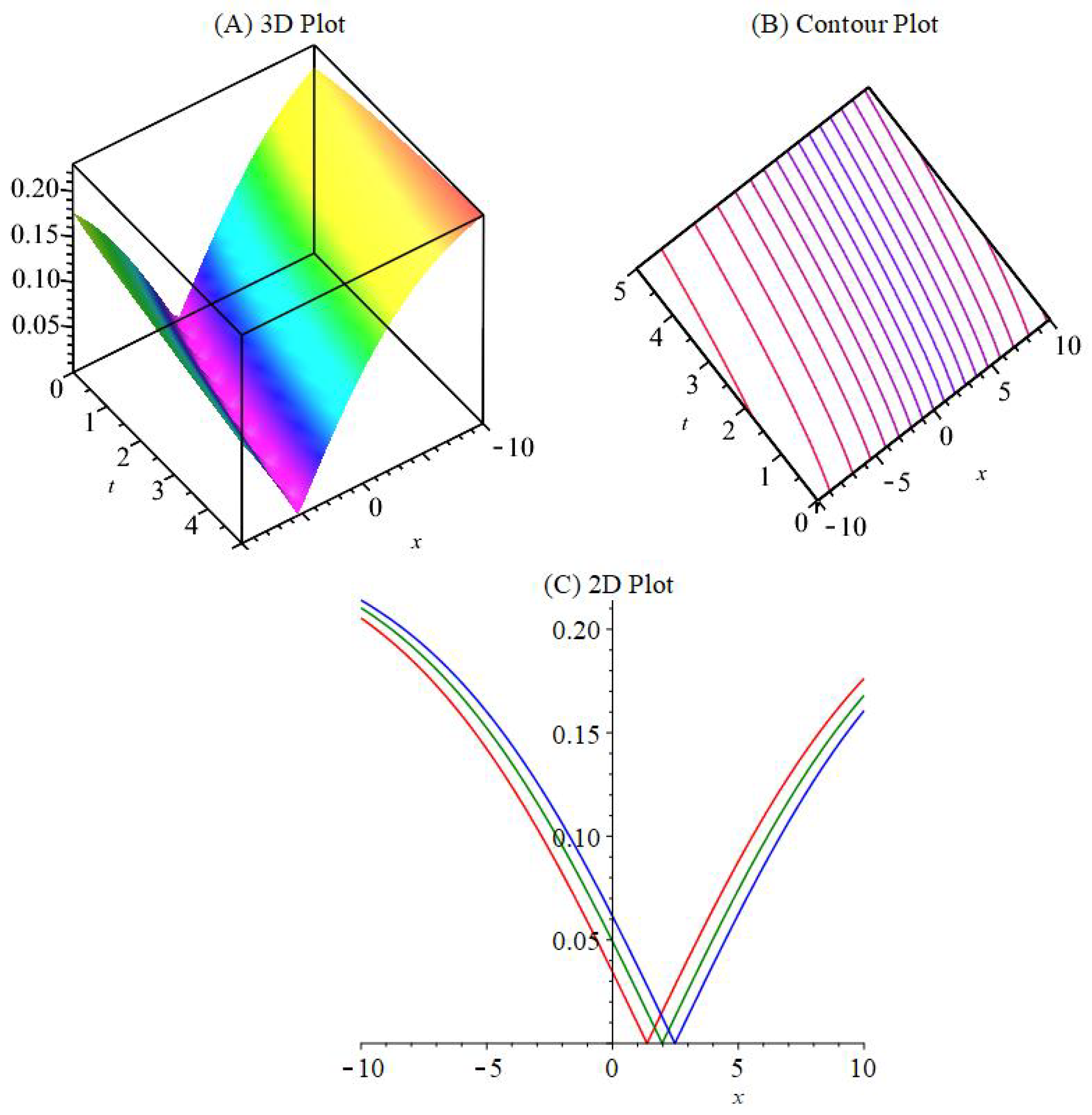
We plotted the above result in Figure 1.
Figure 1.
Figures plotted when = 0.3, = 0.1, = 0.2, = 0.1, = 0.2, = 0.2, = 0.1, = 1, = 1, = 3, = 1, y = z = = = 1, = 0.99.
6.3. ERF Technique
We will use the ERF method to solve Equation (1) in this subsection. The preferred response for has the form:
Substituting the Equation (20) into Equation (7), then gathering all of the coefficients of to zero, we obtain:
As a result, we may verify the following solutions:
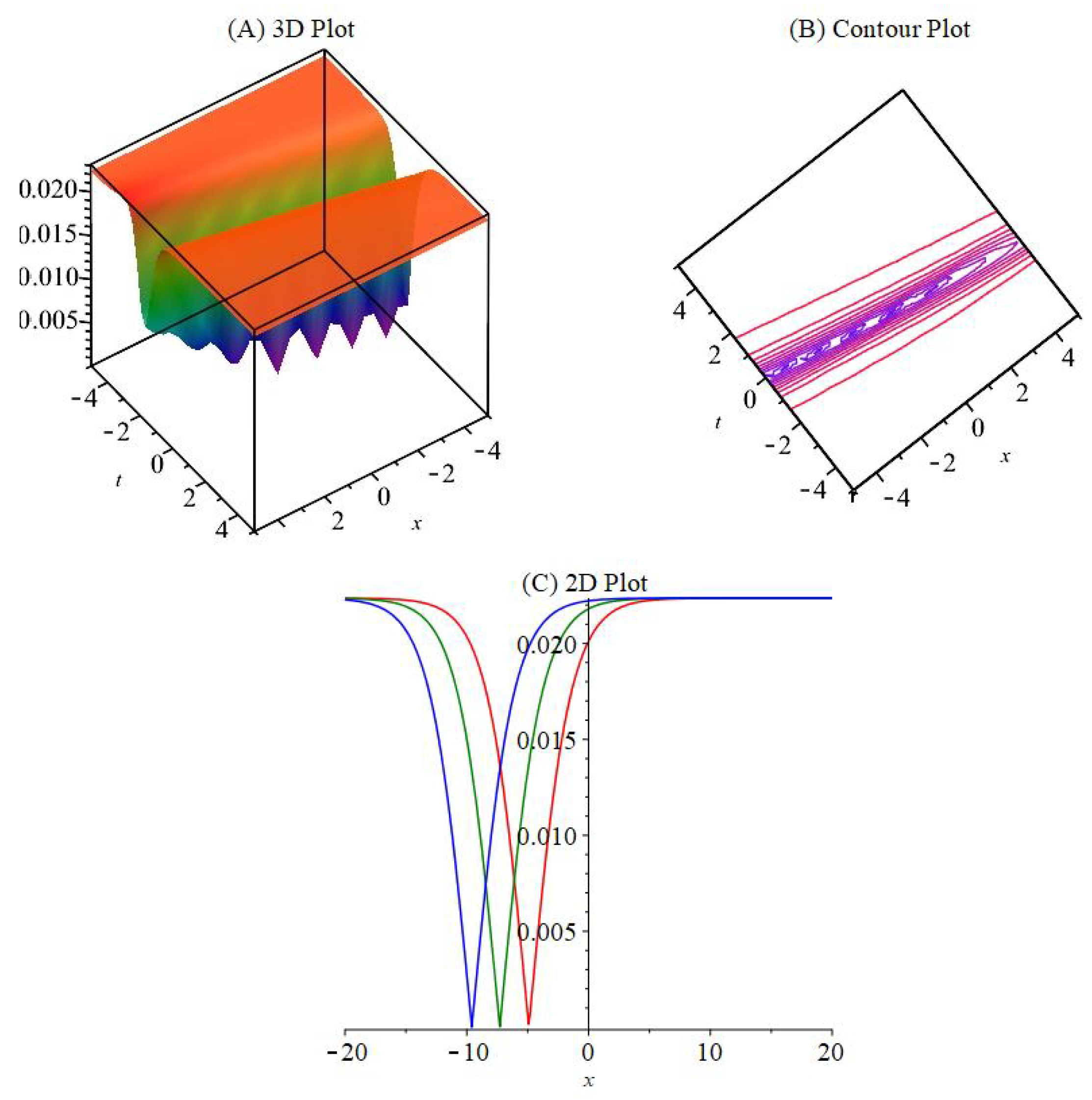
In Figure 2, we gave figure of the above solution.
Figure 2.
Figures plotted when = 0.3, = 0.1, = 0.2, = 0.2, = 0.2, = 0.1, = 1, = 1, = 3, = 1, y = z = 0.1, = 0.6.
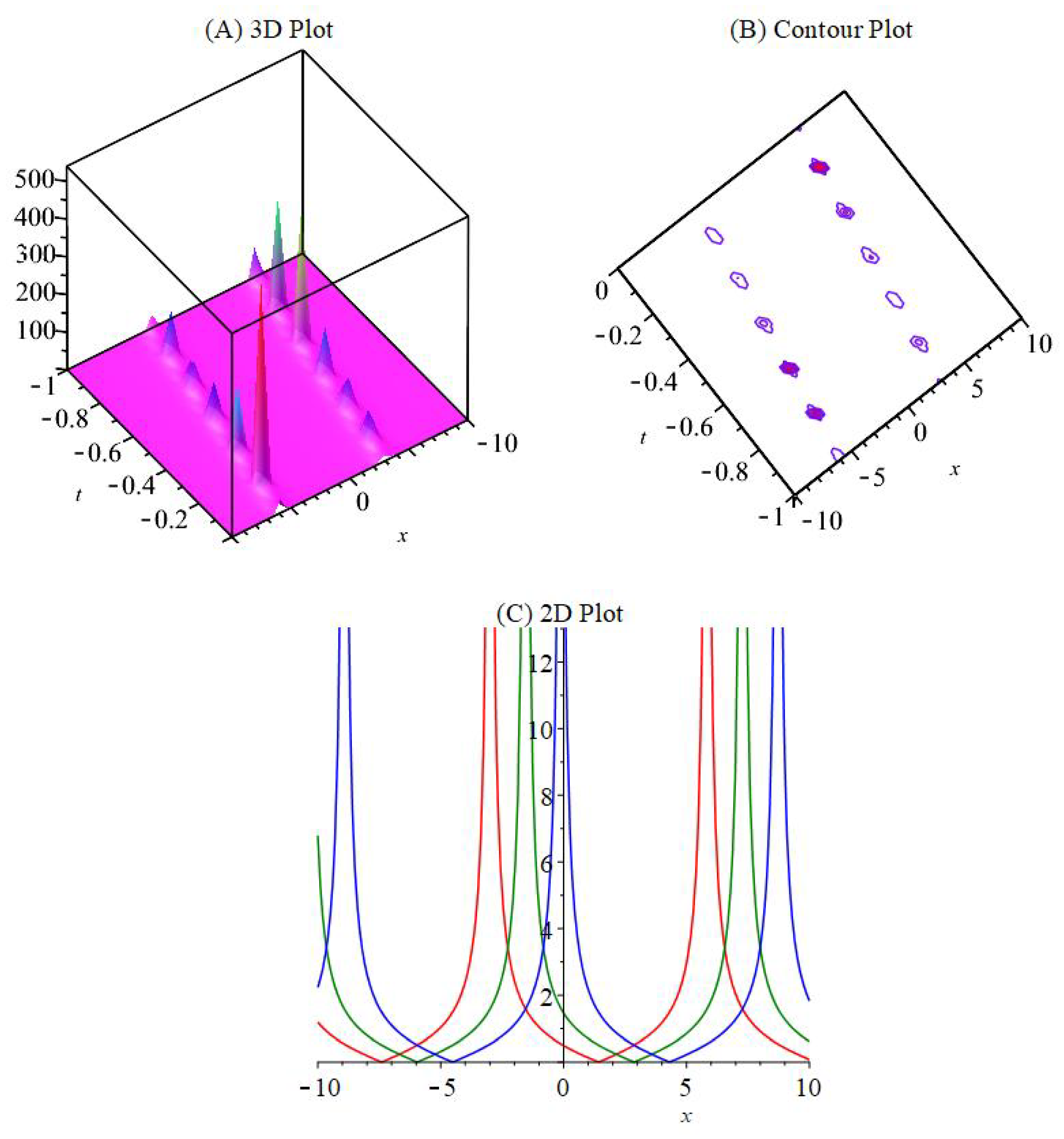
In Figure 3, we gave figures of the above solution.
Figure 3.
Figures plotted when = 3, = 2, = −3, = −0.6, = −0.8, = 0.9, = 1, = 1, = 1, = 1, y = z = 1, = 0.9.
7. Discussion on the Results
In this work, the higher order Sasa-Satsuma problem with the derivative is solved by the MSE and ERF method, leading to novel and important results. The periodic wave solutions that correspond to periodic trajectories surrounded by symmetric homogeneous orbits satisfy the concept of symmetry, making it likely that these solutions will be essential for understanding the dynamics of this equation and pinpointing some of its physical characteristics. In a variety of situations where the equation in question is pertinent, the validated solutions could be useful for gaining a greater knowledge of the interacting wave phenomena. In order to verify the accuracy of the recovered solution, it is also helpful to know that the exact answers retrieved are fed back into the original equation. In order to highlight the physical characteristics of the solutions, we also provide 3D and 2D plots of the obtained results. To the best of our understanding, the results offer a lot of promise for mathematical physics. To ensure that the outcomes were accurate, we employed Maple software.
Author Contributions
Funding acquisition, Emad Fadhal; Project administration, Muath Awadalla; Writing—original draft, Arzu Akbulut; Writing—review and editing, Emad Fadhal, Arzu Akbulut, Melike Kaplan, Muath Awadalla and Kinda Abuasbeh. All authors have read and agreed to the published version of the manuscript.
Funding
This work was supported by the Deanship of Scientific Research, Vice Presidency for Graduate Studies and Scientific Research, King Faisal University, Saudi Arabia [Grant No. 1701], through its KFU Research Summer initiative.
Institutional Review Board Statement
Not applicable.
Informed Consent Statement
Not applicable.
Data Availability Statement
Not applicable.
Conflicts of Interest
The authors declare no conflict of interest.
References
- Zhou, Y.; Vijayakumar, V.; Murugesu, R. Controllability for fractional evolution inclusions without compactness. Evol. Equ. Control Theory 2015, 4, 507–524. [Google Scholar] [CrossRef]
- Kavitha, K.; Vijayakumar, V.; Udhayakumar, R.; Ravichandran, C. Results on controllability of Hilfer fractional differential equations with infinite delay via measures of noncompactness. Asian J. Control 2022, 24, 1406–1415. [Google Scholar] [CrossRef]
- Ma, Y.K.; Vijayakumar, V.; Shukla, A.; Nisar, K.S.; Thilagavathi, K.; Nashine, H.K.; Singh, A.K.; Zakarya, M. Discussion on the existence of mild solution for fractional derivative by Mittag-Leffler kernel to fractional stochastic neutral differential inclusions. Alex. Eng. J. 2023, 63, 271–282. [Google Scholar] [CrossRef]
- Hosseini, K.; Samavat, M.; Mirzazadeh, M.; Salahshour, S.; Baleanu, D. A New (4+1)-Dimensional Burgers Equation: Its Bäcklund Transformation and Real and Complex N-Kink Solitons. Int. J. Appl. Comput. Math. 2022, 8, 172. [Google Scholar] [CrossRef]
- Dehingia, K.; Das, P.; Kumar, R.; Upadhyay, R.K.; Kumar, A.; Rihane, M.F.; Hosseini, K. Modelling and analysis of delayed tumour-immune system with hunting T-cells. Math. Comput. Simul. 2023, 203, 669–684. [Google Scholar] [CrossRef]
- Mirzazadeh, M.; Hosseini, K.; Dehingi, K.; Salahshour, S. A second-order nonlinear Schrödinger equation with weakly nonlocal and parabolic laws and its optical solitons. Optik 2021, 242, 166911. [Google Scholar] [CrossRef]
- Aktar, M.S.; Akbar, M.A.; Osman, M.S. Spatio-temporal dynamic solitary wave solutions and diffusion effects to the nonlinear diffusive predator-prey system and the diffusion-reaction equations. Chaos Solitons Fractals 2022, 160, 112212. [Google Scholar] [CrossRef]
- Mathanaranjan, T.; Kumar, D.; Rezazadeh, H.; Akinyemi, L. Optical solitons in metamaterials with third and fourth order dispersions. Opt. Quantum Electron. 2022, 54, 271. [Google Scholar] [CrossRef]
- Jannat, N.; Kaplan, M.; Raza, N. Abundant soliton-type solutions to the new generalized KdV equation via auto-Bäcklund transformations and extended transformed rational function technique. Opt. Quantum Electron. 2022, 54, 466. [Google Scholar] [CrossRef]
- Ala, V.; Demirbilek, U.; Mamedo, K.R. An application of improved Bernoulli sub-equation function method to the nonlinear conformable time-fractional SRLW equation. AIMS Math. 2020, 5, 3751–3761. [Google Scholar] [CrossRef]
- Kaplan, M.; Akbulut, A. A novel exploration for traveling wave solutions to the integrable equation of wave packet envelope. Partial. Equations Appl. Math. 2022, 5, 100312. [Google Scholar] [CrossRef]
- Hosseini, K.; Ilie, M.; Mirzazadeh, M.; Baleanu, D.; Park, C.; Salahshour, S. The Caputo-Fabrizio time-fractional Sharma-Tasso-Olver-Burgers equation and its valid approximations. Commun. Theor. Phys. 2022, 74, 075003. [Google Scholar] [CrossRef]
- Mahmood, S.A.; Mohammed, P.O.; Baleanu, D.; Aydi, H.; Hamed, Y.S. Analysing discrete fractional operators with exponential kernel for positivity in lower boundedness. AIMS Math. 2022, 7, 10387–10399. [Google Scholar] [CrossRef]
- Mohammed, P.O.; O’Regan, D.; Brzo, A.B.; Abualnaja, K.M.; Baleanu, D. Analysis of positivity results for discrete fractional operators by means of exponential kernels. AIMS Math. 2022, 7, 15812–15823. [Google Scholar] [CrossRef]
- Arshed, S.; Raza, N.; Butt, A.R.; Akgül, A. Exact solutions for Kraenkel-Manna-Merle model in saturated ferromagnetic materials using β-derivative. Phys. Scr. 2021, 96, 124018. [Google Scholar] [CrossRef]
- Zhang, W.; Ling, X.; Wang, B.B.; Li, S. Solitary and Periodic Wave Solutions of Sasa-Satsuma Equation and Their Relationship with Hamilton Energy. Complexity 2020, 2020, 8760179. [Google Scholar] [CrossRef]
- Mitofsky, A.M.; Carney, P.S. Symmetries and conservation laws for the wave equations of scalar statistical optics. J. Phys. A Math. Theoratical 2008, 41, 415207. [Google Scholar] [CrossRef]
- Yao, S.W.; Akinyemi, L.; Mirzazadeh, M.; Inc, M.; Hosseini, K.; Senol, M. Dynamics of optical solitons in higher-order Sasa-Satsuma equation. Results Phys. 2021, 30, 104825. [Google Scholar] [CrossRef]
- Wazwaz, A.M.; Mehanna, M. Higher-order Sasa-Satsuma equation: Bright and dark optical solitons. Optik 2021, 243, 167421. [Google Scholar] [CrossRef]
- Yue, X.G.; Zhang, Z.; Akbulut, A.; Kaabar, M.K.A.; Kaplan, M. A new computational approach to the fractional-order Liouville equation arising from mechanics of water waves and meteorological forecasts. J. Ocean. Eng. Sci. 2022, in press. [CrossRef]
- Martinez, Y.P.; Gomez-Aguilar, J.F.; Baleanu, D. Beta-derivative and sub-equation method applied to the optical solitons in medium with parabolic law nonlinearity and higher order dispersion. Optik 2018, 155, 357–365. [Google Scholar] [CrossRef]
- Atangana, A.; Alqahtani, R.T. Modelling the spread of river blindness disease via the Caputo fractional derivative and the beta-derivative. Entropy 2016, 18, 40. [Google Scholar] [CrossRef]
- Atangana, A.; Baleanu, D.; Alsaedi, A. Analysis of time-fractional Hunter-Saxton equation: A model of neumatic liquid crystal. Open Phys. 2016, 14, 145–149. [Google Scholar] [CrossRef]
- Ganji, D.D.; Sadighi, A. Application of homotopy-perturbation and variational iteration methods to nonlinear heat transfer and porous media equations. J. Comput. Appl. Math. 2007, 207, 24–34. [Google Scholar] [CrossRef]
- Khan, K.; Akbar, M.A.; Ali, N.H.M. The modified simple equation method for exact and solitary wave solutions of nonlinear evolution equation: The GZK-BBM equation and right-handed noncommutative Burgers equations. ISRN Math. Phys. 2013, 2013, 146704. [Google Scholar] [CrossRef]
- Bekir, A.; Akbulut, A.; Kaplan, M. Exact Solutions of Nonlinear Evolution Equations by Using Modified Simple Equation Method. Int. J. Nonlinear Sci. 2015, 19, 159–164. [Google Scholar]
- Kaplan, M.; Akbulut, A. A Mathematical Analysis of a Model Involving an Integrable Equation for Wave Packet Envelope. J. Math. 2022, 2022, 3486780. [Google Scholar] [CrossRef]
- Mohyud-Din, S.T.; Bibi, S. Exact solutions for nonlinear fractional differential equations using exponential rational function method. Opt. Quantum Electron. 2017, 49, 64. [Google Scholar] [CrossRef]
Publisher’s Note: MDPI stays neutral with regard to jurisdictional claims in published maps and institutional affiliations. |
© 2022 by the authors. Licensee MDPI, Basel, Switzerland. This article is an open access article distributed under the terms and conditions of the Creative Commons Attribution (CC BY) license (https://creativecommons.org/licenses/by/4.0/).