Abstract
We construct a four-dimensional lattice gauge theory in which fermions acquire mass without breaking symmetries as a result of gauge interactions. Our model consists of reduced staggered fermions transforming in the bifundamental representation of an gauge symmetry. This fermion representation ensures that single-site bilinear mass terms vanish identically. A symmetric four-fermion operator is however allowed, and we give numerical results that show that a condensate of this operator develops in the vacuum.
1. Introduction
Can we generate a mass for all physical states in a theory without breaking symmetries? Can we do this using gauge interactions only? In this paper, we describe a lattice model that is capable of realizing this scenario.
The model consists of a reduced staggered fermion coupled to an lattice gauge field. The fermion representation is chosen so that single-site fermion gauge-invariant bilinear terms vanish identically. A symmetric four-fermion operator remains invariant under these symmetries, and we present evidence that it condenses as a result of the gauge interactions. Since no symmetries are broken by this condensate, there are no massless Goldstone bosons, and the spectrum consists of color singlet composites of the elementary fermions. This scenario corresponds to symmetric mass generation realized in the context of a confining gauge theory. It gives an explicit and non-supersymmetric realization of a mechanism that has been proposed to gap chiral fermions in the continuum [1,2].
The model can be seen as a generalization of the Higgs–Yukawa theory described in [3], which uses strong quartic interactions to gap lattice fermions. This four-dimensional model is built on earlier work directed at symmetric mass generation with staggered fermions in two, three, and four dimensions [4,5,6,7,8,9,10]. Related work in the condensed matter physics community can be found here [11,12,13,14,15,16,17].
In the current paper, both of the subgroups of are gauged, and confinement rather than strong Yukawa interactions is used to generate the four-fermion condensate.
2. Staggered Fermion Model
We start from a staggered fermion action, which takes the form:
where are the usual staggered phases and is the symmetric difference operator whose action on a lattice field is given by:
This action has a staggered symmetry with the site parity operator. The fermions are additionally taken to transform under a global symmetry where G and H correspond to independent groups:
We also impose the reality condition:
To see that this reality condition is compatible with the non-abelian symmetry, consider the transformed fermion:
The reality condition is automatically satisfied if for real where . Substituting this expression into the kinetic term shows that the action can be written in an explicit invariant form:
Indeed, in this form, one can see that the kinetic term of this model is precisely the same as that considered in previous work with invariant staggered fermions [3].
Once this reality condition is imposed, it is not possible to write down single site mass terms since on account of the Grassmann nature of the fields. However, a four-fermion term invariant under is possible and takes the form:
The form of this four-fermion term also agrees with the earlier work [3].
To add such a four-fermion term to the action, we can use a Yukawa interaction with an auxiliary scalar field of the form:
where transforms in the adjoint representation of G, but is a singlet under H:
After integration over , a four-fermion term is produced with coupling . The addition of this term breaks the original staggered symmetry to a corresponding to:
where is an element of .
In [3], we showed that it is possible to achieve symmetric mass generation in this model for large values of the Yukawa coupling and vanishing gauge coupling. In this paper, we show that a four-fermion condensate can also be obtained by using strong gauge interactions and small Yukawa coupling. This result is important as it avoids the problem of relying on perturbatively irrelevant four-fermion operators to induce symmetric mass generation.
To do this, we need to generalize Equation (1) so that it is invariant under lattice gauge transformations. The following prescription does the job:
In addition, we add Wilson terms for G and H:
The resultant action is now invariant under the following gauge transformations:
The Yukawa interaction given in Equation (8) is automatically invariant under these local symmetries. (As an aside, we remark that four-fermion interactions similar to the ones considered here have previously been used to argue for the appearance of Higgs phases in strongly coupled lattice theories) [18].)
Finally, we note that the action of the model is invariant under a center symmetry transformation:
The existence of an exact center symmetry ensures that the Polyakov line:
is a good order parameter for confinement in this theory.
In the next section, we show numerical results that provide evidence that a four-fermion condensate appears in the theory even for small Yukawa coupling. We can think of this condensate as corresponding to the appearance of a bilinear mass term for the color singlet composite scalar . This scenario is similar to that advocated for by Tong et al. in [1] as a mechanism for gapping chiral fermions. It is important to remember though that this model targets a vector-like theory at short distances as .
3. Numerical Results
The fermion kinetic term including the Yukawa term takes the form:
where denotes the covariant difference operator appearing in Equation (11). Using the properties:
It is easy to verify that the fermion operator M is antisymmetric and each eigenvector with eigenvalue is paired with another with eigenvalue . Thus, the eigenvalues, which are generically complex, come in quartets . This ensures that the Pfaffian that results after fermion integration is generically real positive definite. We verified that this is indeed the case by computing the latter for ensembles of a small lattice size. (Notice though that pure imaginary eigenvalues come only in pairs, which allows for a sign change if such an eigenvalue crosses the origin. While this is logically possible, we did not see any sign of this in our simulations.) Thus, the model can be simulated using the RHMC algorithm [19]. We now turn to our numerical results.
3.1. The Yukawa Theory Limit
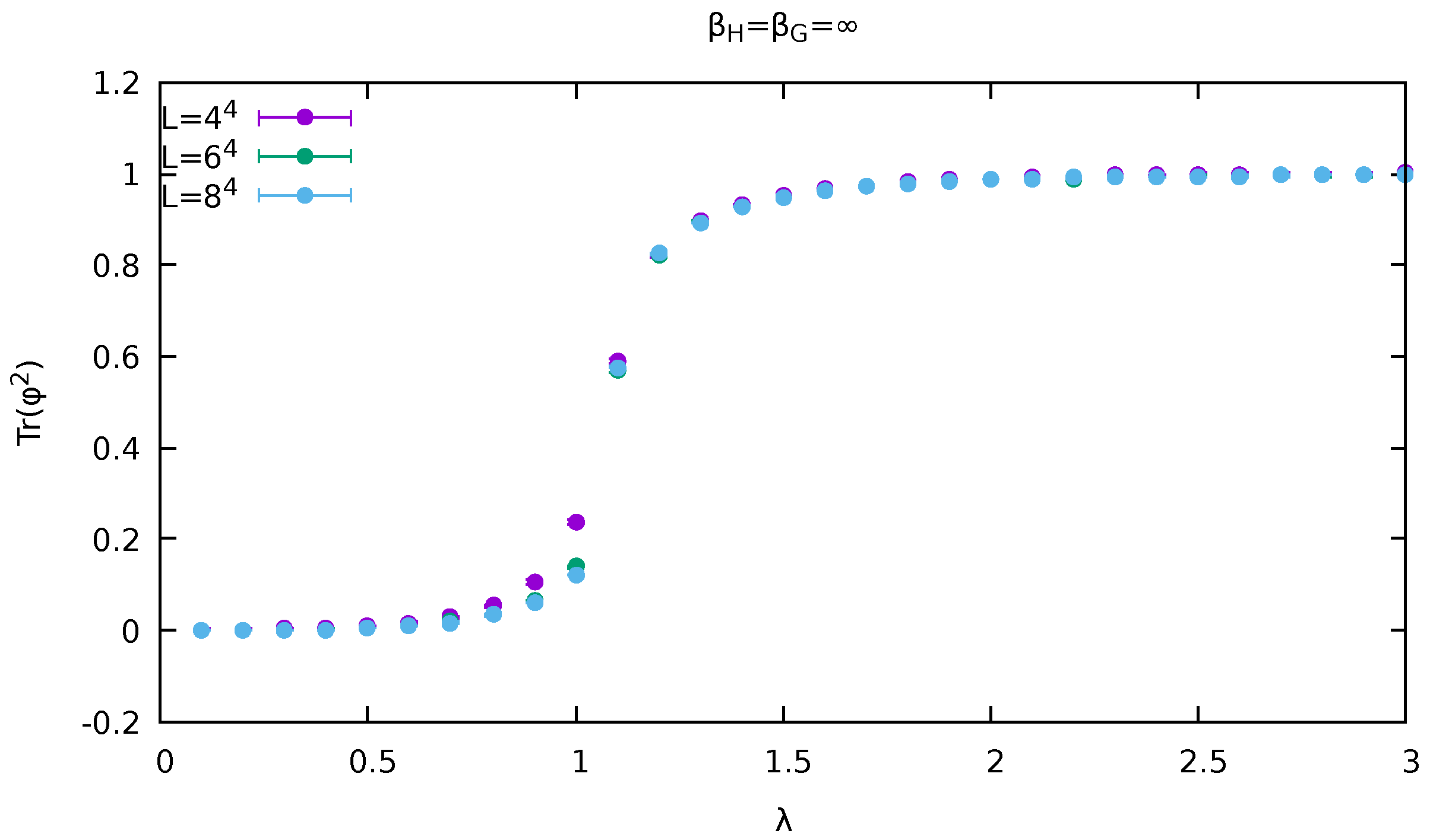
In the absence of gauge interactions, the model reduces to the Higgs–Yukawa theory examined in [3]. In this limit, the only way to drive a four-fermion condensate is through the use of a large Yukawa coupling . Figure 1 shows a picture of , which serves as a proxy for the four-fermion condensate vs. . The rapid growth near is identical to our earlier results for the pure four-fermion model in four dimensions. This conclusion is strengthened in Figure 2, which shows a plot of theassociated fermion susceptibility defined by:
Figure 1.
vs. for .
Figure 2.
vs. for .
This shows a peak that grows with volume close to the coupling where the enhanced four-fermion vev switches on.
3.2. The Gauge Theory Limit
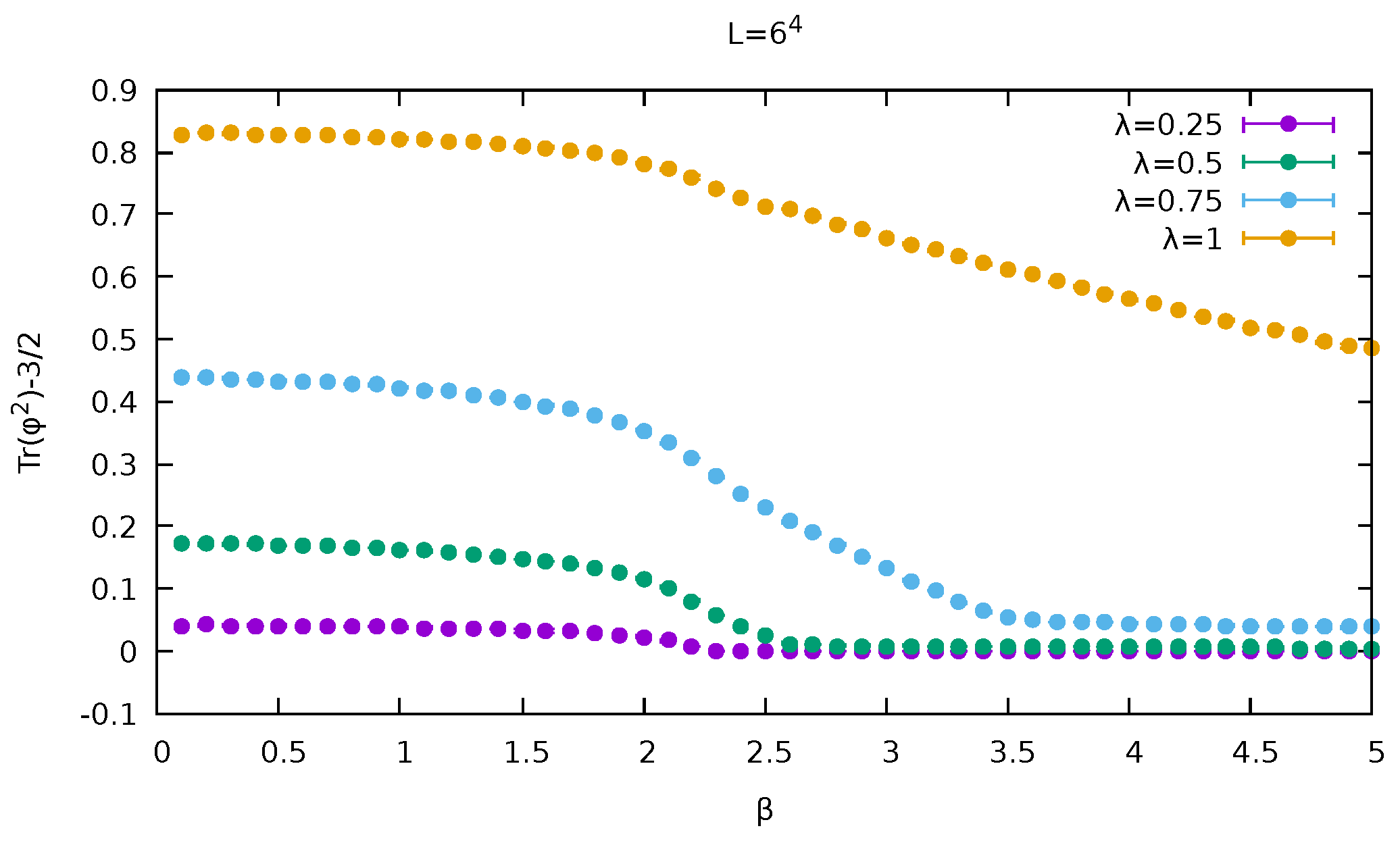
We now switch on the gauge interactions, setting and retaining only a small Yukawa coupling. Figure 3 shows a plot of vs. . The Yukawa coupling is small and fixed to for lattice sizes . Clearly, the condensate grows for . Notice that the appearance of this four-fermion vev is a result of the gauge interactions, not the explicit Yukawa coupling since the latter lies well below the threshold to drive the phase transition seen in Figure 1. Indeed, the effect of changing the value of the bare Yukawa coupling can be seen in Figure 4, which shows the condensate for a range of on an lattice. Clearly, for all , a condensate develops at small , but is driven to zero in the weak gauge coupling limit , consistent with Figure 1. Notice that the value of the condensate as scales according to as one might expect from perturbation theory. The case where is close to the threshold required to precipitate a condensate even in the absence of gauge interactions, and indeed, we see in this case that the condensate survives the limit.
Figure 3.
vs. for .
Figure 4.
vs. for .
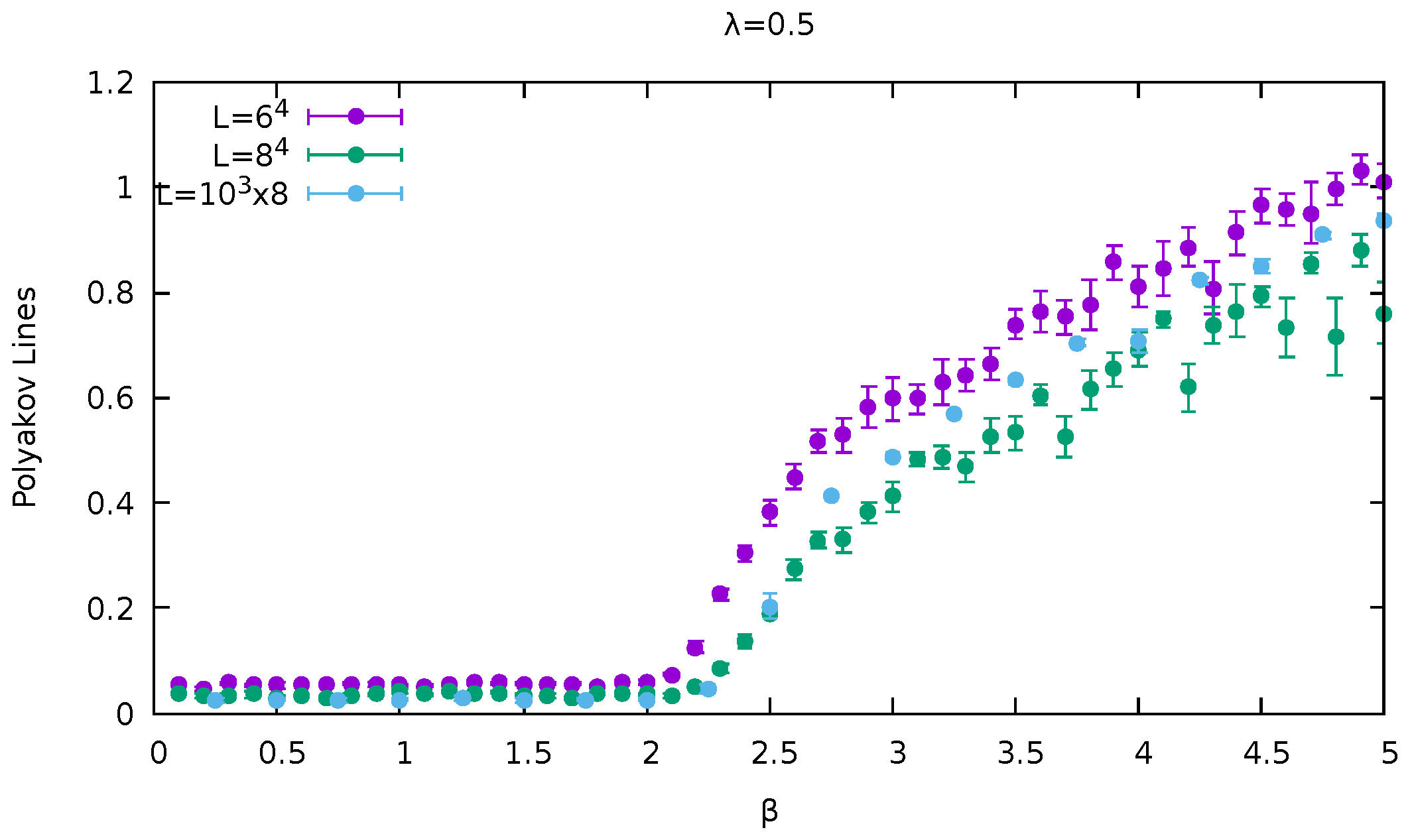
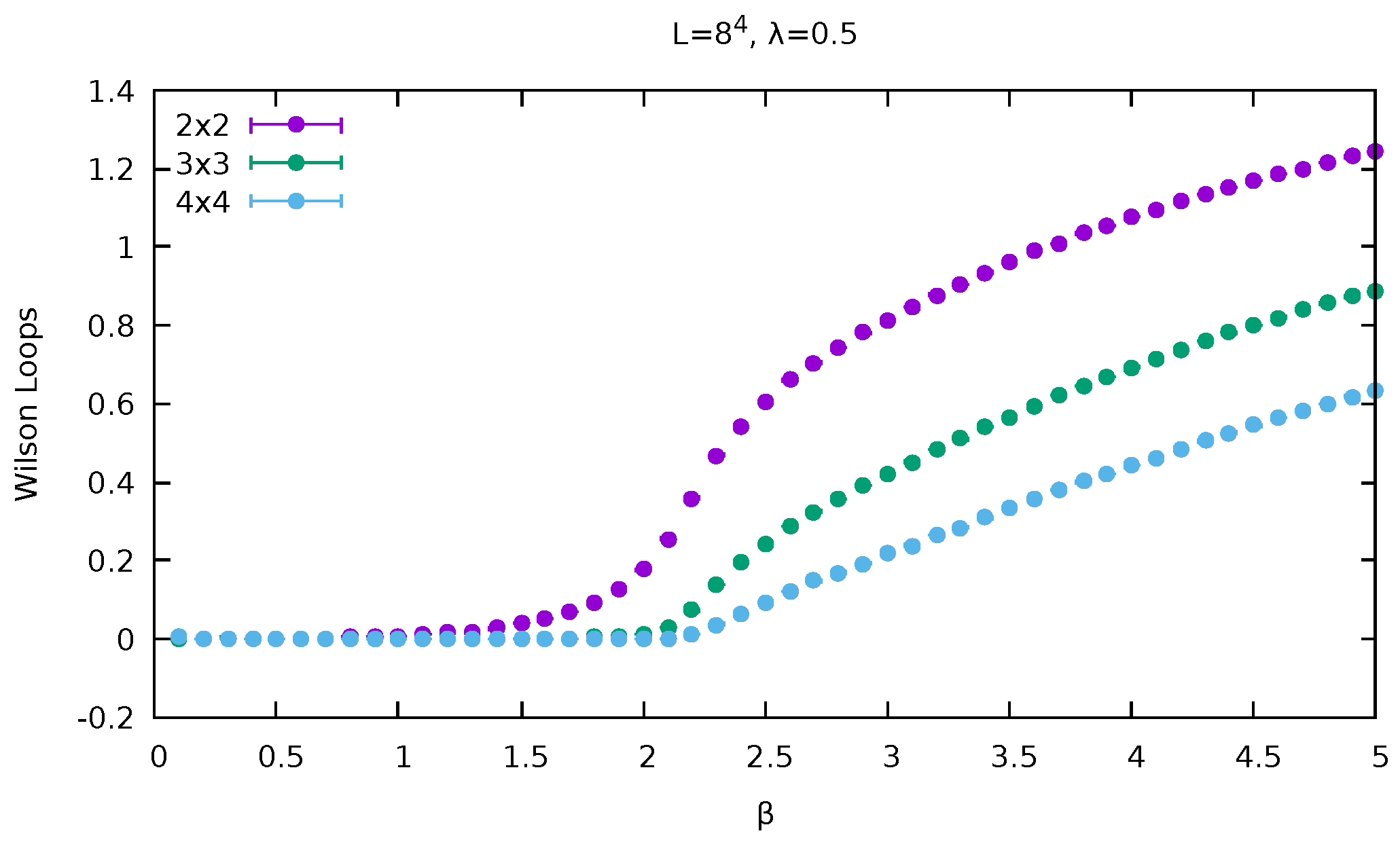
The fact that the regime where the four-fermion condensate is non-zero corresponds to confinement can be seen in Figure 5, which shows the absolute value of the Polyakov line averaged over the lattice over the same range in . It is clear that the Polyakov line vanishes for values of in which the four-fermion condensate grows. (We use the absolute value of the line in our measurements since the Polyakov line itself vanishes for all at finite volume as a consequence of the exact center symmetry.) A vanishing Polyakov line signals a confining phase for the gauge theory. This conclusion can be strengthened by looking at Wilson loops. The Wilson loops for and are shown in Figure 6 and clearly also decrease rapidly in the small regime.
Figure 5.
Polyakov line vs. for .
Figure 6.
Wilson loops vs. for .
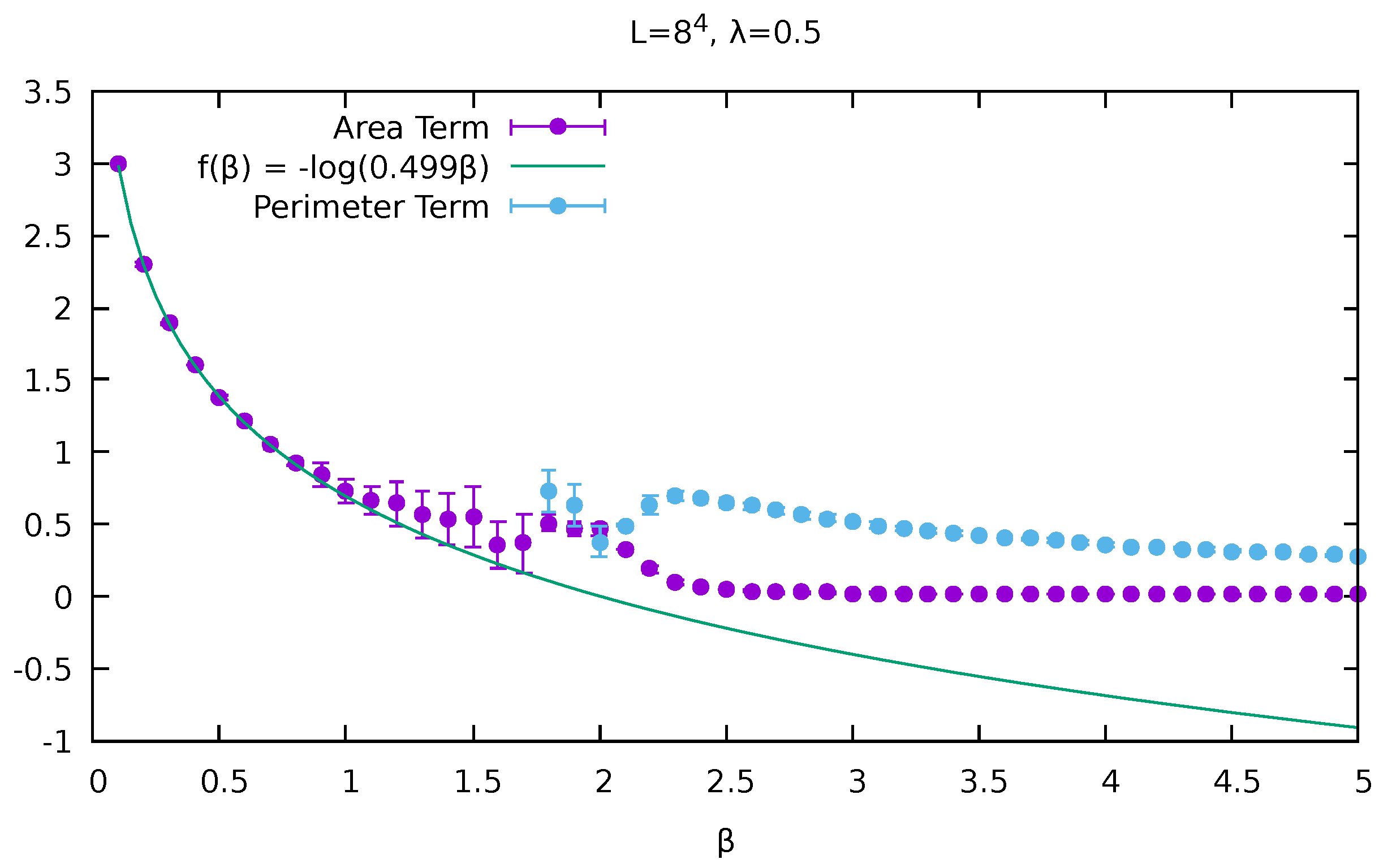
To extract the string tension, we fit the loops to an exponential of form corresponding to a combination of area and perimeter laws. For values of , the fit values of B and C are consistent with zero, and we hence fit only for A. However, around , the area term and the perimeter term become comparable, so we need to employ the full form of the exponential for couplings . This behavior can be seen in Figure 7, which shows the coefficients A and B versus .
Figure 7.
A and B vs. for .
The plot also shows the pure area law fit as a solid line, which yields an estimate of the string tension . This agrees well with a strong coupling analysis of the quenched gauge theory and is consistent with the absence of light fermions in this regime due to symmetric mass generation.
Of course, while the single-site fermion bilinear is forced to vanish by symmetry in this model, it is possible to construct other gauge-invariant and symmetric fermion mass terms that involve coupling different fermion fields within the hypercube [20,21]. It is logically possible that the model would choose to condense these other fermion bilinear operators rather than the four-fermion operator we have considered so far. To check for this, we added the simplest of these operators, the one link term, to the action with coupling .
where the phase [20]. Notice though that a vev for this operator as will necessarily break a set of discrete shift symmetries given by:
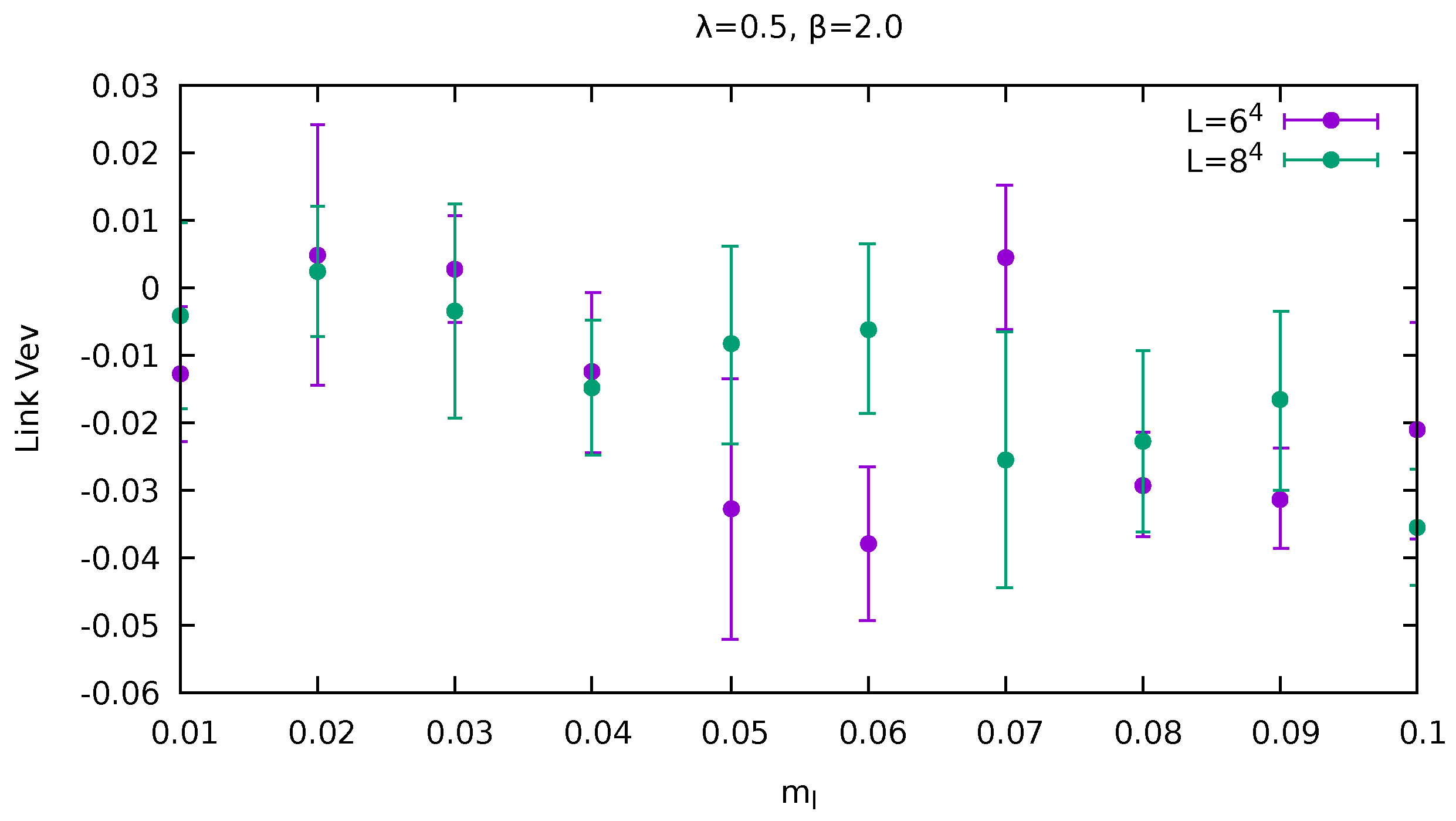
In Figure 8, we show a plot of the vev of this operator for several lattice sizes as a function of on a lattice for and . Notice that the measured vev is small in comparison with the four-fermion condensate and decreases smoothly to zero as with no significant dependence on the lattice volume. This result argues against the condensation of such a link term and a corresponding spontaneous breaking of these shift symmetries in the thermodynamic limit.
Figure 8.
Link vev vs. for at .
4. Conclusions
In this paper, we argued that a particular lattice gauge theory composed of massless reduced staggered fermions transforming under a local symmetry develops a four-fermion rather than bilinear-fermion condensate due to confinement. Furthermore, since this four-fermion condensate breaks no symmetries, there are no Goldstone bosons in the spectrum of the theory. This gives an explicit realization of symmetric mass generation in a lattice model that describes sixteen Majorana fermions at high energies. This number of fermion flavors is precisely what is needed to cancel certain discrete anomalies of Weyl fermions in the continuum [22,23,24]. Our work furnishes the first example of a lattice theory capable of supporting symmetric mass generation using gauge interactions only.
Author Contributions
Software, N.B.; analysis, G.C.T.; supervision, S.C.; writing-review and editing, N.B., S.C. and G.C.T. All authors have read and agreed to the published version of the manuscript.
Funding
This research was funded by the U.S. Department of Energy, Office of Science, Office of High Energy Physics under Award Number DE-SC0009998. Numerical calculations were performed using the USQCD facilities at Fermilab.
Institutional Review Board Statement
Not applicable.
Informed Consent Statement
Not applicable.
Data Availability Statement
Not applicable.
Conflicts of Interest
The authors declare no conflict of interest.
References
- Razamat, S.S.; Tong, D. Gapped Chiral Fermions. Phys. Rev. X 2021, 11, 011063. [Google Scholar] [CrossRef]
- Tong, D. Comments on Symmetric Mass Generation in 2d and 4d. arXiv 2021, arXiv:2104.03997. [Google Scholar]
- Butt, N.; Catterall, S.; Schaich, D. SO(4) invariant Higgs–Yukawa model with reduced staggered fermions. Phys. Rev. D 2018, 98, 114514. [Google Scholar] [CrossRef] [Green Version]
- Ayyar, V.; Chandrasekharan, S. Massive fermions without fermion bilinear condensates. Phys. Rev. D 2015, 91, 065035. [Google Scholar] [CrossRef] [Green Version]
- Catterall, S. Fermion mass without symmetry breaking. JHEP 2016, 1, 121. [Google Scholar] [CrossRef] [Green Version]
- Ayyar, V.; Chandrasekharan, S. Origin of fermion masses without spontaneous symmetry breaking. Phys. Rev. D 2016, 93, 081701. [Google Scholar] [CrossRef] [Green Version]
- Ayyar, V.; Chandrasekharan, S. Fermion masses through four-fermion condensates. JHEP 2016, 10, 58. [Google Scholar] [CrossRef] [Green Version]
- Ayyar, V.; Chandrasekharan, S. Generating a nonperturbative mass gap using Feynman diagrams in an asymptotically free theory. Phys. Rev. D 2017, 96, 114506. [Google Scholar] [CrossRef] [Green Version]
- Catterall, S. Chiral lattice fermions from staggered fields. Phys. Rev. D 2021, 104, 014503. [Google Scholar] [CrossRef]
- Butt, N.; Catterall, S.; Pradhan, A.; Toga, G.C. Anomalies and symmetric mass generation for Kaehler-Dirac fermions. arXiv 2021, arXiv:2101.01026. [Google Scholar]
- Grinenko, V.; Weston, D.; Caglieris, F.; Wuttke, C.; Hess, C.; Gottschall, T.; Maccari, I.; Gorbunov, D.; Zherlitsyn, S.; Wosnitza, J.; et al. State with spontaneously broken time-reversal symmetry above the superconducting phase transition. Nat. Phys. 2021, 17, 1254–1259. [Google Scholar] [CrossRef]
- Herland, E.V.; Babaev, E.; Sudbø, A. Phase transitions in a three dimensional U(1)×U(1) lattice London superconductor: Metallic superfluid and charge-4e superconducting states. Phys. Rev. B 2010, 82, 134511. [Google Scholar] [CrossRef] [Green Version]
- Weston, D.; Babaev, E. Composite order in SU(N) theories coupled to an Abelian gauge field. Phys. Rev. B 2021, 104, 075116. [Google Scholar] [CrossRef]
- You, Y.Z.; He, Y.C.; Xu, C.; Vishwanath, A. Symmetric Fermion Mass Generation as Deconfined Quantum Criticality. Phys. Rev. X 2018, 8, 011026. [Google Scholar] [CrossRef] [Green Version]
- Wang, C.; Senthil, T. Interacting fermionic topological insulators/superconductors in three dimensions. Phys. Rev. B 2014, 89, 195124. [Google Scholar] [CrossRef] [Green Version]
- Fidkowski, L.; Kitaev, A. The effects of interactions on the topological classification of free fermion systems. Phys. Rev. B 2010, 81, 134509. [Google Scholar] [CrossRef] [Green Version]
- You, Y.Z.; He, Y.C.; Vishwanath, A.; Xu, C. From Bosonic Topological Transition to Symmetric Fermion Mass Generation. Phys. Rev. B 2018, 97, 125112. [Google Scholar] [CrossRef] [Green Version]
- Catterall, S.; Veernala, A. Dynamical Gauge Symmetry Breaking in Strongly Coupled Lattice Theories. Phys. Rev. D 2013, 88, 114510. [Google Scholar] [CrossRef] [Green Version]
- Catterall, S.; Butt, N. Simulations of SU(2) lattice gauge theory with dynamical reduced staggered fermions. Phys. Rev. D 2019, 99, 014505. [Google Scholar] [CrossRef] [Green Version]
- van den Doel, C.; Smit, J. Dynamical Symmetry Breaking in Two Flavor SU(N) and SO(N) Lattice Gauge Theories. Nucl. Phys. B 1983, 228, 122–144. [Google Scholar] [CrossRef]
- Golterman, M.F.; Smit, J. Selfenergy and Flavor Interpretation of Staggered Fermions. Nucl. Phys. B 1984, 245, 61–88. [Google Scholar] [CrossRef]
- García-Etxebarria, I.n.; Montero, M. Dai-Freed anomalies in particle physics. JHEP 2019, 8, 3. [Google Scholar] [CrossRef] [Green Version]
- Dai, X.z.; Freed, D.S. eta invariants and determinant lines. J. Math. Phys. 1994, 35, 5155–5194. [Google Scholar] [CrossRef] [Green Version]
- Kapustin, A.; Thorngren, R.; Turzillo, A.; Wang, Z. Fermionic Symmetry Protected Topological Phases and Cobordisms. JHEP 2015, 12, 52. [Google Scholar] [CrossRef] [Green Version]
Publisher’s Note: MDPI stays neutral with regard to jurisdictional claims in published maps and institutional affiliations. |
© 2021 by the authors. Licensee MDPI, Basel, Switzerland. This article is an open access article distributed under the terms and conditions of the Creative Commons Attribution (CC BY) license (https://creativecommons.org/licenses/by/4.0/).