Article

Intersection Traffic Prediction Using Decision Tree Models


1
School of Computer Science, Guangzhou University, Guangzhou 510006, China
2
School of Information Technology, Deakin University, Geelong, VIC 3220, Australia
3
School of Mathematics and Computing Science, Guilin University of Electronic Technology, Guilin 541004, China
4
School of Software and Electrical Engineering, Swinburne University of Technology, Hawthorn, VIC 3122, Australia
*
Author to whom correspondence should be addressed.
Current address: Guangzhou Higher Education Mega Center, 230 Wai Huan Xi Road, Guangzhou 510006, China.
Symmetry 2018, 10(9), 386; https://doi.org/10.3390/sym10090386
Submission received: 19 August 2018 / Revised: 2 September 2018 / Accepted: 3 September 2018 / Published: 7 September 2018

Abstract

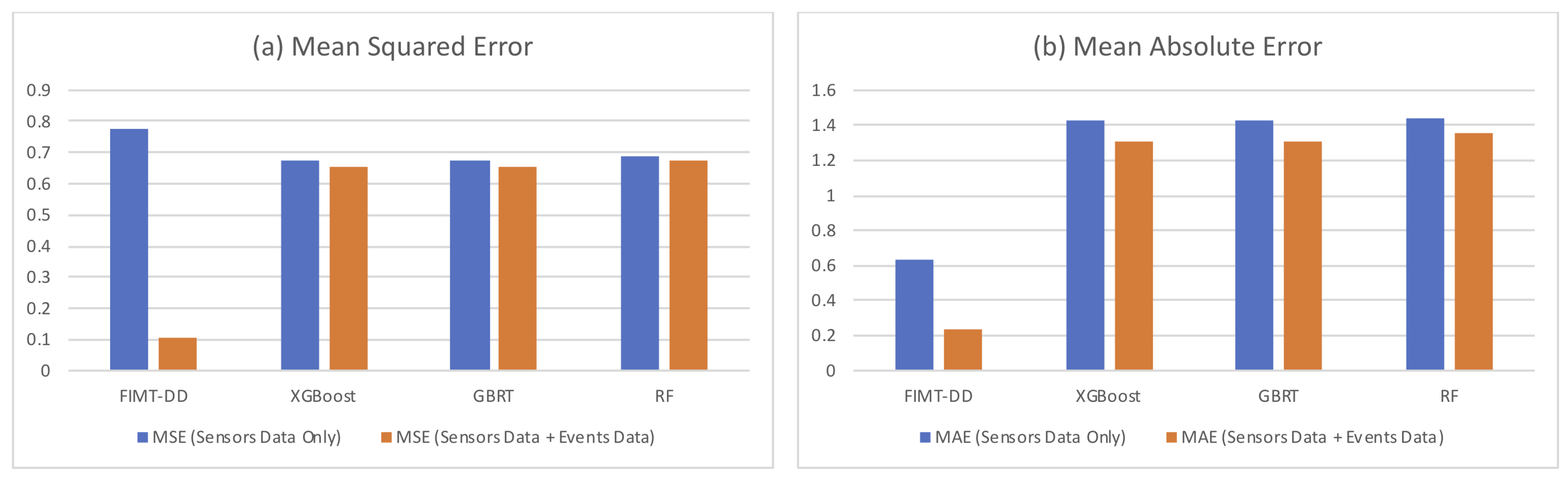
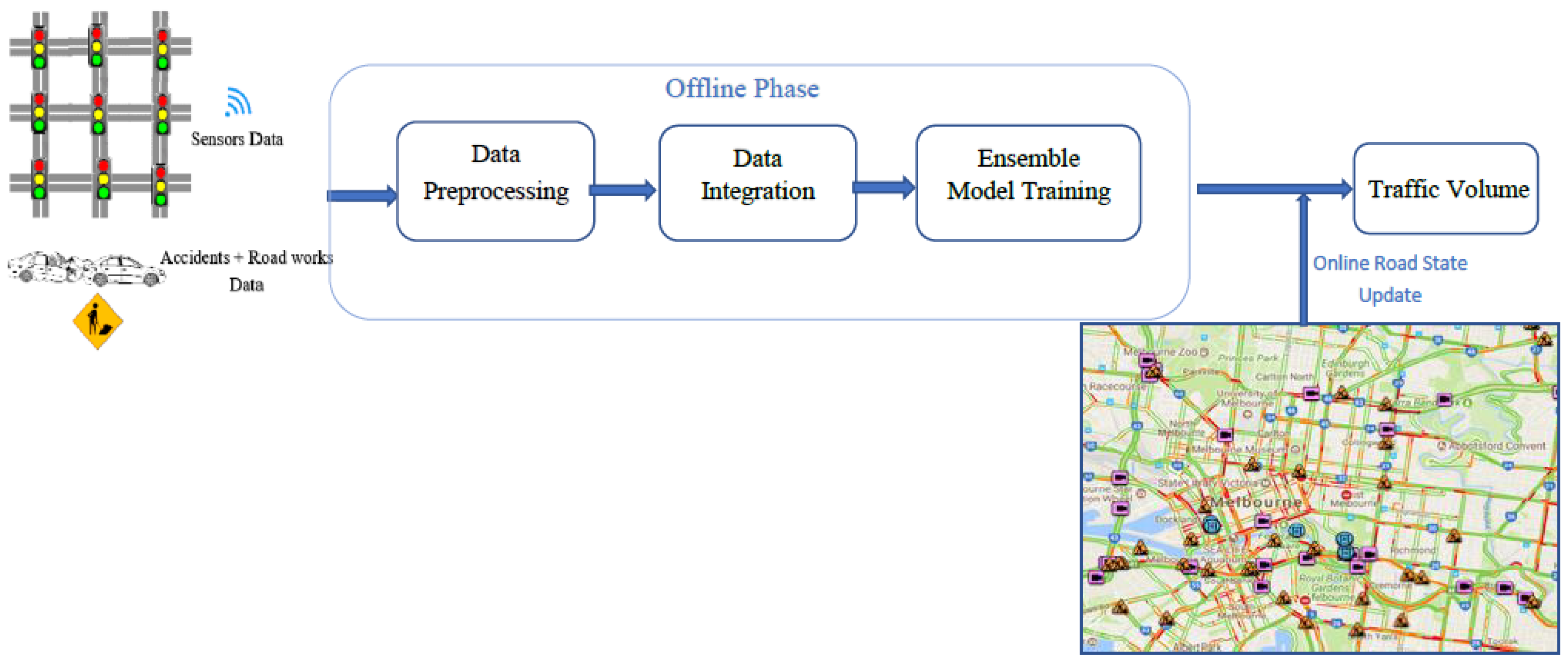
Traffic prediction is a critical task for intelligent transportation systems (ITS). Prediction at intersections is challenging as it involves various participants, such as vehicles, cyclists, and pedestrians. In this paper, we propose a novel approach for the accurate intersection traffic prediction by introducing extra data sources other than road traffic volume data into the prediction model. In particular, we take advantage of the data collected from the reports of road accidents and roadworks happening near the intersections. In addition, we investigate two types of learning schemes, namely batch learning and online learning. Three popular ensemble decision tree models are used in the batch learning scheme, including Gradient Boosting Regression Trees (GBRT), Random Forest (RF) and Extreme Gradient Boosting Trees (XGBoost), while the Fast Incremental Model Trees with Drift Detection (FIMT-DD) model is adopted for the online learning scheme. The proposed approach is evaluated using public data sets released by the Victorian Government of Australia. The results indicate that the accuracy of intersection traffic prediction can be improved by incorporating nearby accidents and roadworks information.
Keywords: traffic prediction; batch learning; online learning; decision tree; Fast Incremental Model Trees with Drift Detection (FIMT-DD) traffic prediction; batch learning; online learning; decision tree; Fast Incremental Model Trees with Drift Detection (FIMT-DD)