Article

Symmetry Breakings in Dual-Core Systems with Double-Spot Localization of Nonlinearity


by
Krzysztof B. Zegadlo
1,*,†,
Nguyen Viet Hung
2,†,
Aleksandr Ramaniuk
3,†,
Marek Trippenbach
3 and
Boris A. Malomed
4
1
Faculty of Physics, Astronomy and Applied Computer Science, Jagiellonian University, Lojasiewicza 11, PL-30-348 Krakow, Poland
2
Advanced Institute for Science and Technology, Hanoi University of Science and Technology, 100803 Hanoi, Vietnam
3
Faculty of Physics, University of Warsaw, ul. Pasteura 5, PL-02-093 Warszawa, Poland
4
Department of Physical Electronics, School of Electrical Engineering, Faculty of Engineering, Tel Aviv University, Tel Aviv 69978, Israel
*
Author to whom correspondence should be addressed.
These authors contributed equally to this work.
Symmetry 2018, 10(5), 156; https://doi.org/10.3390/sym10050156
Submission received: 29 April 2018 / Revised: 10 May 2018 / Accepted: 10 May 2018 / Published: 13 May 2018
(This article belongs to the Special Issue Broken Symmetry)

Abstract

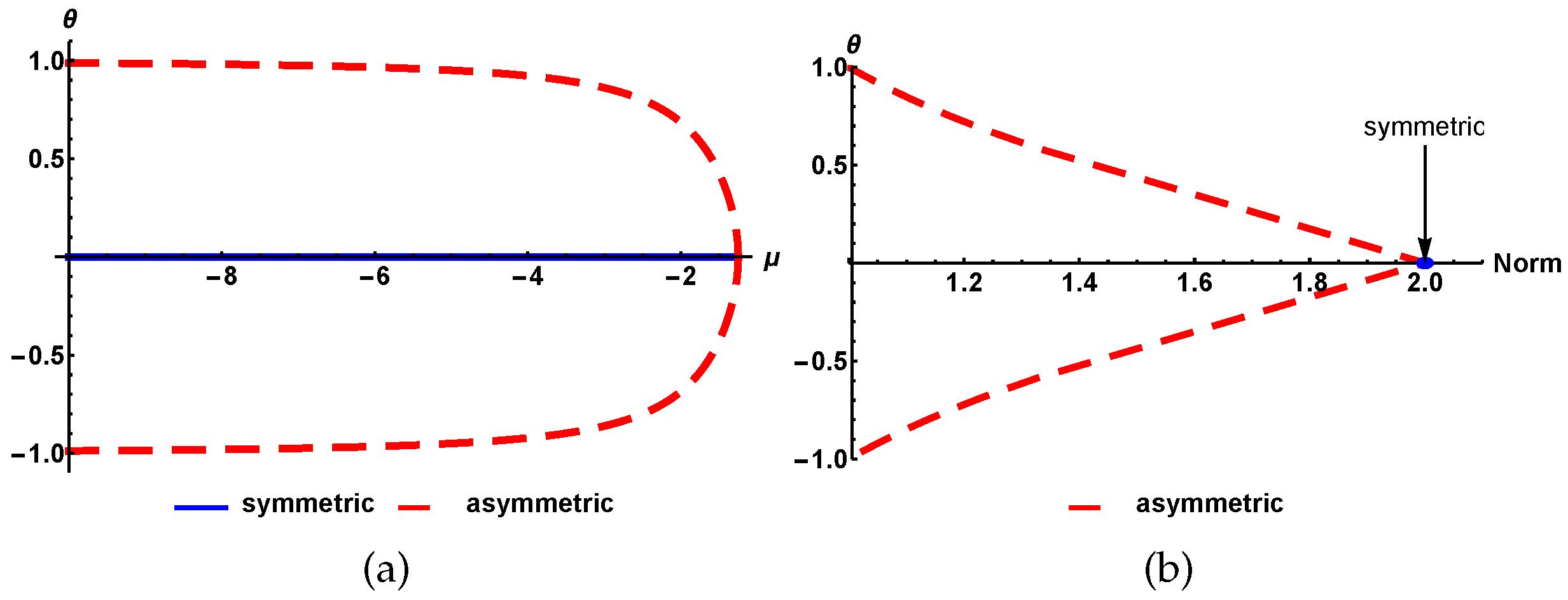
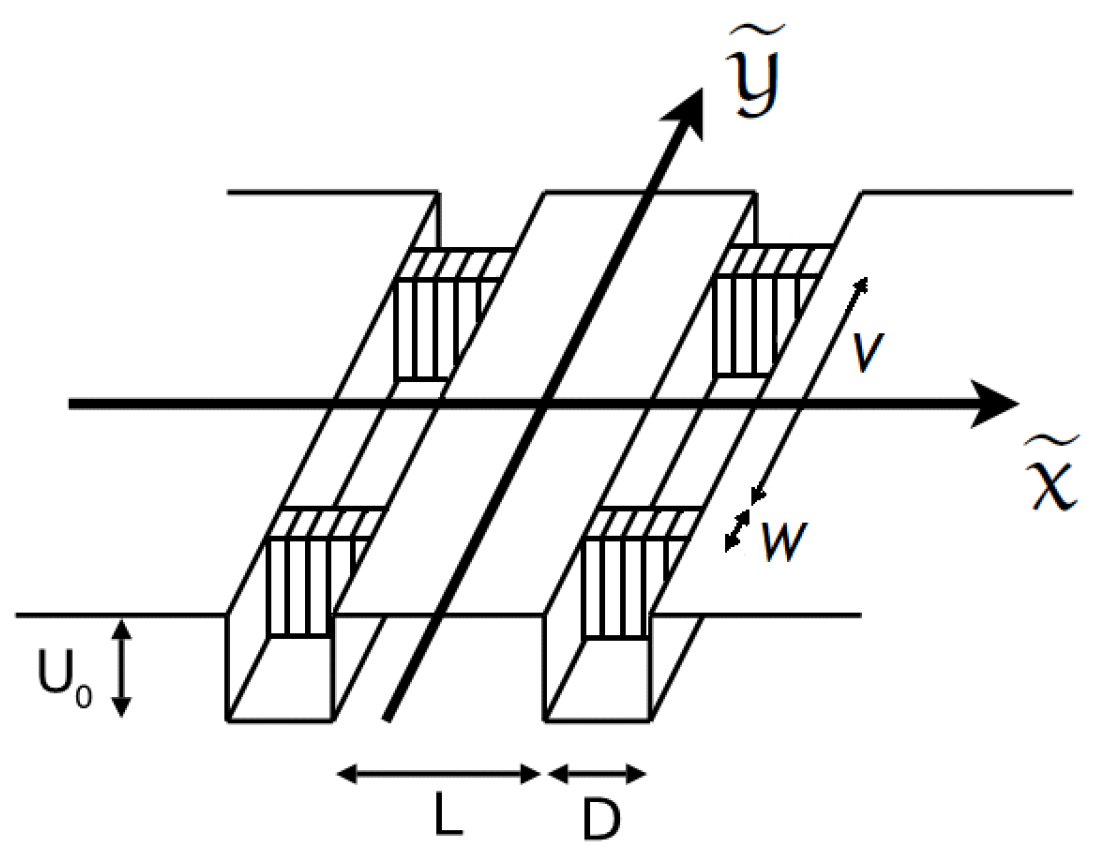
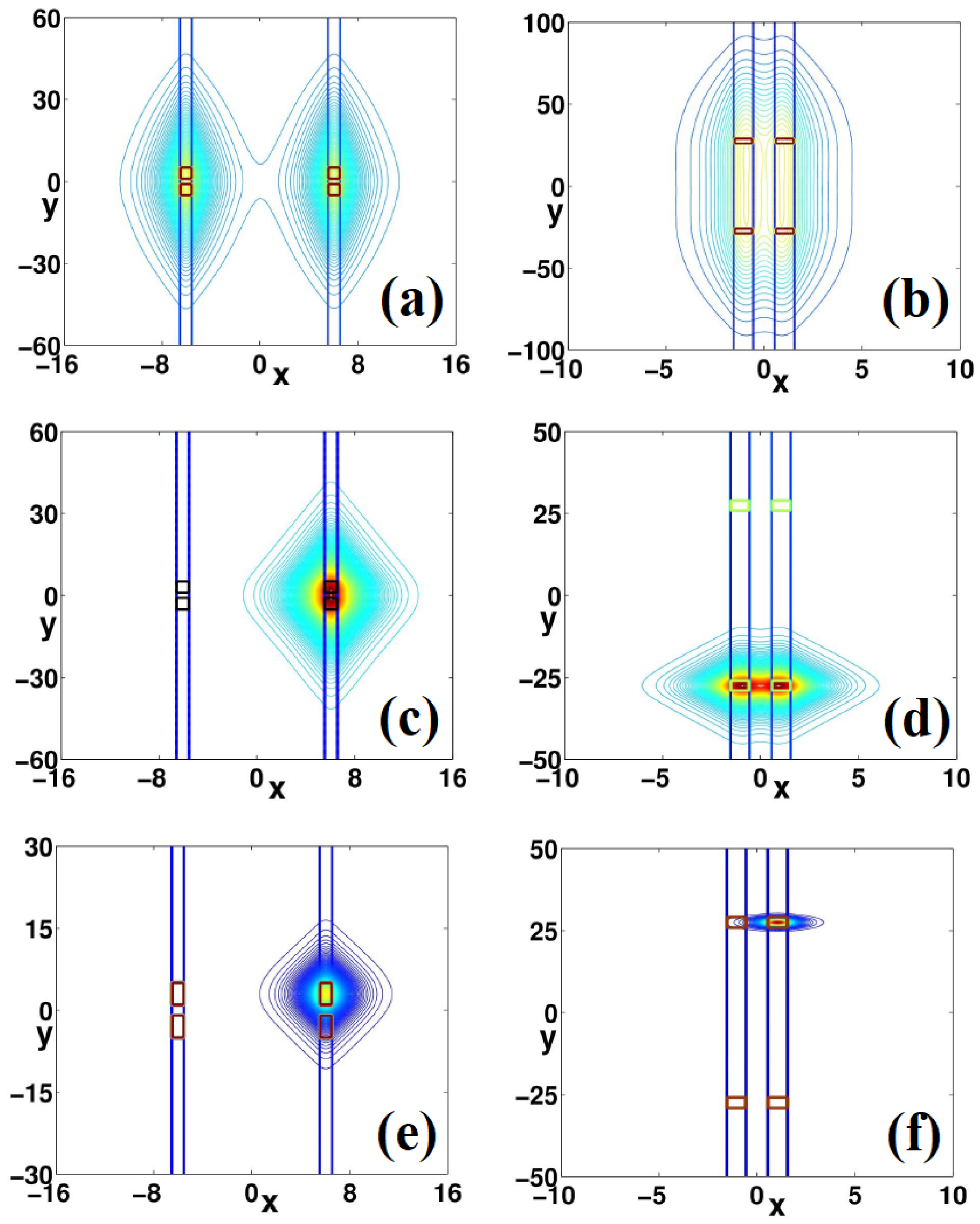
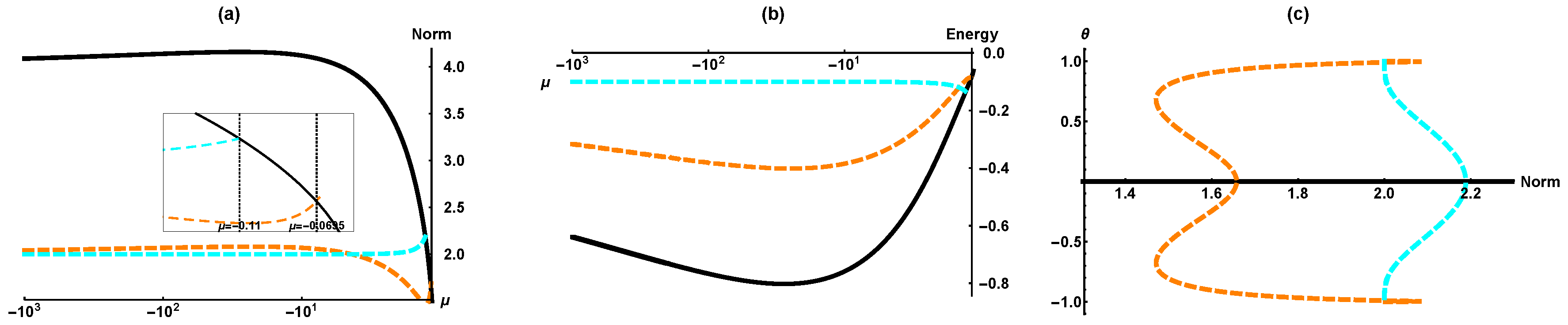
We introduce a dual-core system with double symmetry, one between the cores, and one along each core, imposed by the spatial modulation of local nonlinearity in the form of two tightly localized spots, which may be approximated by a pair of ideal delta-functions. The analysis aims to investigate effects of spontaneous symmetry breaking in such systems. Stationary one-dimensional modes are constructed in an implicit analytical form. These solutions include symmetric ones, as well as modes with spontaneously broken inter-core and along-the-cores symmetries. Solutions featuring the simultaneous (double) breaking of both symmetries are produced too. In the model with the ideal delta-functions, all species of the asymmetric modes are found to be unstable. However, numerical consideration of a two-dimensional extension of the system, which includes symmetric cores with a nonzero transverse thickness, and the nonlinearity-localization spots of a small finite size, produces stable asymmetric modes of all the types, realizing the separate breaking of each symmetry, and states featuring simultaneous (double) breaking of both symmetries.
Keywords: self-trapping; soliton; bifurcation; waveguide; parity; asymmetry; stability self-trapping; soliton; bifurcation; waveguide; parity; asymmetry; stability