Article

Runoff and Sediment Characteristics of Flood Events in the Chabagou Watershed on the Loess Plateau of China from 1959 to 2022

1
State Key Laboratory of Water Cycle and Water Security, China Institute of Water Resources and Hydropower Research, Beijing 100048, China
2
Chongqing Branch, Changjiang River Scientific Research Institute, Chongqing 400026, China
*
Author to whom correspondence should be addressed.
Land 2026, 15(3), 419; https://doi.org/10.3390/land15030419
Submission received: 4 January 2026 / Revised: 2 March 2026 / Accepted: 3 March 2026 / Published: 4 March 2026
(This article belongs to the Special Issue Climate Change and Soil Erosion: Challenges and Solutions)

Abstract

Flood events are major drivers of soil erosion and sediment yield on the Loess Plateau, where extensive ecological restoration has been implemented. This study investigates runoff–sediment dynamics by analyzing 215 flood events recorded in the Chabagou watershed (1959–2022), with a focus on changes under intensifying restoration efforts. Using long-term hydrological and rainfall data, we applied cluster and discriminant analyses to classify flood events based on sediment hysteresis loops and evaluated variations across three management periods (1959–1979, 1980–1999, and 2000–2022), characterized by progressive increases in check dam construction and vegetation recovery. The results show that the floods characterized by short duration, low peak flow, and low sediment concentration were predominant, accounting for 77.7% of the recorded 215 events. A clear decreasing trend was observed, with average sediment yield and peak discharge declining by approximately 68% and 52%, respectively. Anticlockwise hysteresis loops were most common (45.6%), followed by complex (27.9%) and figure-of-eight loops (23.7%). The proportion of figure-of-eight loops increased notably from 17% to 39%, indicating reduced sediment connectivity due to large-scale ecological restoration. Extreme rainfall events consistently produced complex hysteresis patterns, influenced mainly by rainfall intensity but increasingly modulated by human interventions. These results highlight adaptive watershed management strategies that target figure-of-eight and complex flood events to mitigate erosion and flood risks.

1. Introduction

Runoff and sediment transport are critical geomorphological processes that shape global landscapes and ecosystems, with significant implications for agricultural sustainability, soil productivity, and ecological health [1,2,3]. Globally, soil erosion generates annual sediment fluxes exceeding billions of tons, leading to severe environmental degradation, diminished reservoir storage capacity, and exacerbated flood risks [4,5]. Recent estimates have suggested that economic losses attributed to soil erosion and sedimentation amount to tens of billions of dollars each year, threatening food security and ecological stability [6,7,8]. Climate change exacerbates these problems through global intensification of extreme rainfall events, significantly altering runoff dynamics and increasing sediment yields during flood events [9,10,11]. Runoff and sediment processes at the flood-event scale are increasingly important, as individual storms can disproportionately contribute to annual sediment yield [12,13]. However, most traditional erosion studies aggregate data at annual or monthly scales, thereby obscuring the detailed runoff–sediment dynamics associated with extreme rainfall events [14,15].
Runoff–sediment hysteresis analysis provides an effective approach for examining sediment transport dynamics at the flood event scale [16,17,18]. Hysteresis describes the looping relationship between suspended sediment concentration (SSC) and discharge (Q) during individual flood hydrographs, reflecting sediment source contributions, connectivity, and depletion processes within watersheds [19]. Generally, clockwise loops indicate sediment mobilization from sources near gullies, whereas anticlockwise loops signify sediment originating from distant or delayed sources [20]. Recent methodological advances have further refined hysteresis analyses through quantitative metrics and statistical classifiers, enabling improved interpretations of sediment transport mechanisms and source dynamics at the event scale [21,22,23]. This approach has substantial scientific and practical value by facilitating early sediment peak warnings, identifying critical erosion zones, and optimizing targeted soil and water conservation measures under climatic extremes [24]. Nevertheless, despite these advancements, comprehensive studies systematically evaluating runoff–sediment hysteresis across long-term datasets and varying environmental conditions remain limited.
The Loess Plateau of China provides an ideal natural laboratory for flood-event-scale sediment research due to its historically severe erosion rates, highly erodible loess soils, complex topography, initially sparse vegetation cover, and frequent intense summer rainstorms [25,26,27]. Historically, the Loess Plateau has been recognized as one of the regions most susceptible to erosion globally, supplying substantial sediment loads that have profoundly shaped sedimentation patterns and the channel morphology of the downstream Yellow River [28,29]. In response to these extreme erosion conditions, extensive soil and water conservation measures, including the construction of numerous check dams, widespread terracing, and large-scale vegetation restoration programs such as the Grain-for-Green Program, have been systematically implemented across the plateau since the 1950s. These efforts have effectively reduced regional sediment yields by over 70% and significantly altered watershed sediment dynamics [30,31,32,33]. Nevertheless, individual extreme rainfall events persist in triggering severe flooding and significant sediment transport, indicating that event-scale runoff–sediment processes remain critically important and warrant further detailed investigation [34,35]. Nevertheless, Recent intense storms, notably the extreme rainfall event of July 2017 in the Wuding River basin, highlight ongoing vulnerabilities and underscore the importance of better understanding how improved vegetation cover and soil conservation measures modulate flood-event responses under contemporary climate extremes [36,37].
Previous runoff and sediment studies on the Loess Plateau predominantly adopted annual or monthly perspectives, potentially masking critical intra-event sediment dynamics [38]. Recent event-scale research has provided deeper insights into sediment transport processes under varying rainfall and land-use conditions, demonstrating clear linkages between ecological restoration measures and runoff–sediment responses. Specifically, these studies have highlighted significant reductions in sediment yields and shifts from simpler to increasingly complex hysteresis patterns following extensive vegetation restoration [39]. This pattern shift underscores how ecological restoration alters sediment availability and transport processes during flood events, emphasizing the value of event-scale analysis in detecting subtle environmental impacts [40]. Nevertheless, most event-based studies remain constrained by relatively short monitoring periods and limited data availability, limiting a comprehensive understanding of sediment dynamics across diverse climatic and ecological contexts.
The Chabagou watershed, located in the central hilly-gully region of the Loess Plateau, provides an exceptional setting for addressing these research gaps due to its long-term hydrological monitoring records spanning from 1959 to 2022. Consequently, this watershed, covering approximately 205 km2, has undergone significant soil and water conservation interventions, including check dams, terraces, and large-scale revegetation through the Grain-for-Green Program since the late 1950s [41]. Although several prior studies examined runoff and sediment dynamics in the Chabagou and neighboring watershed, most focused on annual scales or individual events, leaving event-scale hysteresis patterns over multi-decadal timescales poorly understood [42]. Given documented shifts in rainfall characteristics and dramatic land-cover changes, systematic flood-event analyses using classification methods are crucial for comprehensively understanding sediment dynamics under evolving environmental conditions. The present study capitalizes on this unique 64-year high-resolution event scale dataset to elucidate the long-term evolution of runoff sediment hysteresis patterns under phased ecological restoration.
Therefore, this study aims to systematically quantify runoff and sediment characteristics at the flood-event scale in the Chabagou watershed (1959–2022). We aim to (1) classify flood events based on hydrological and sedimentological responses, assessing temporal variability across ecological restoration phases; (2) analyze runoff–sediment hysteresis patterns using classification indicators to identify dominant sediment sources and transport mechanisms; and (3) determine key natural and human factors, including vegetation restoration measures, check dam and rainfall characteristics, influencing runoff–sediment responses, particularly during extreme rainfall events. The findings are expected to provide actionable insights into regional soil and water conservation management by identifying critical flood event types and hysteresis patterns that pose the greatest erosion and flood risks. By integrating long-term data with rigorous event-scale analysis, this study clarifies spatiotemporal dynamics and mechanisms of sediment transport under intensive soil and water conservation measures and climate variability, providing insights into watershed management and erosion control on the Loess Plateau and similar regions.

2. Materials and Methods

2.1. Study Area

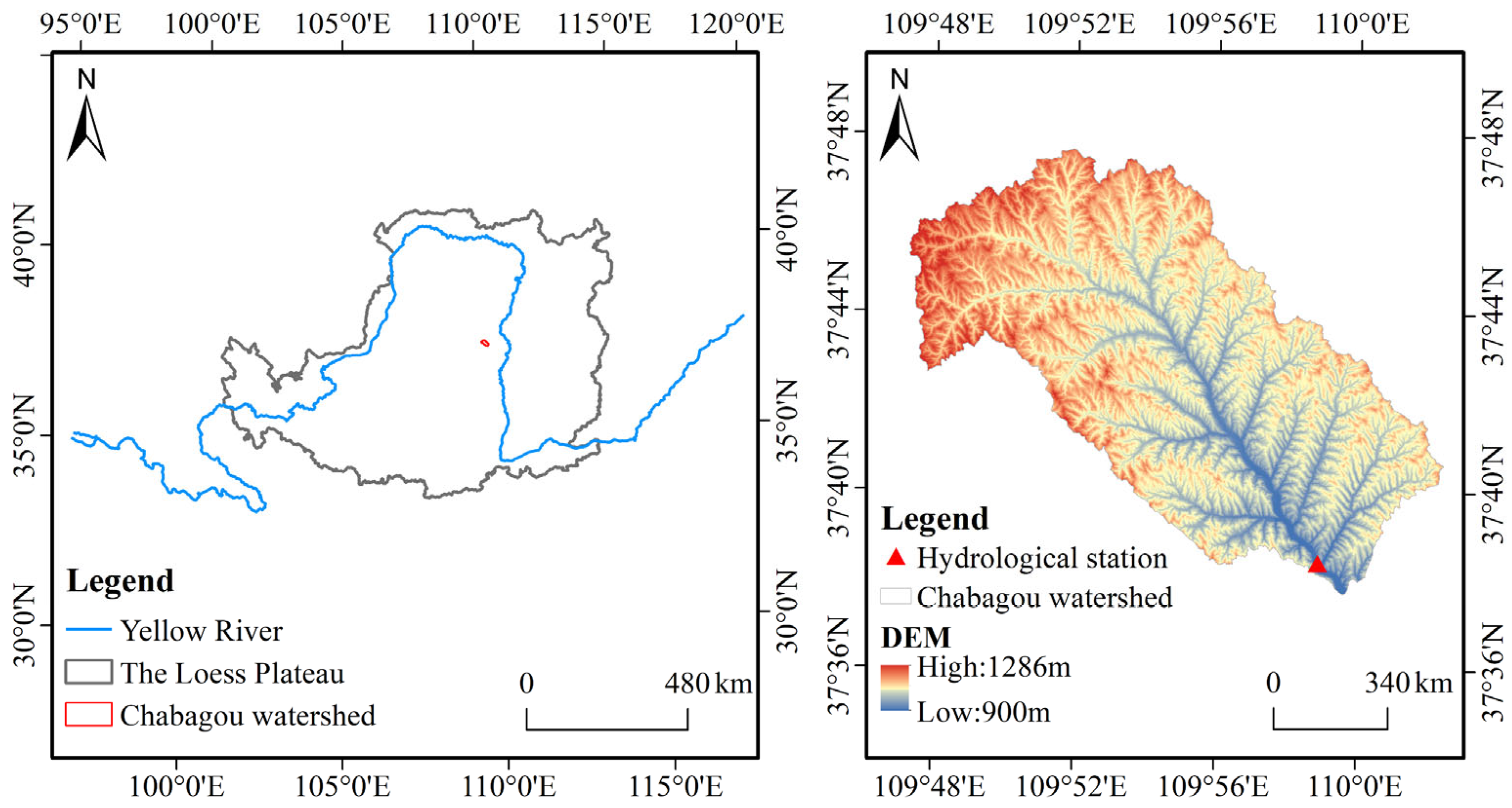
The Chabagou watershed (37.63°–37.79° N, 109.79°–110.04° E) is located in Zizhou County, Yulin City, Shaanxi Province, China. Within the hilly-gully region of the Loess Plateau, it is a headwater tributary of the Dali River, which in turn feeds the Wuding River [43]. The watershed covers an area of 205 km2 and features a dense and complex gully network composed of 18 primary gullies arranged symmetrically along a central gully running west to east for approximately 25.0 km. Relief is highly dissected, with elevations of 900–1286 m and a gully density of 1.05 km/km2. Topographically, ridge–valley landforms dominate the upper basin, mound–gully terrain prevails downstream, and the middle reach combines both [44]. The average slope angle is around 26°, ranging predominantly between 20° and 50°, with a maximum of 82° (Figure 1).
The climate is temperate continental, semi-arid monsoonal, with distinct seasons, frequent winter–spring dust events, and large diurnal temperature ranges. Mean annual precipitation is approximately 462.5 mm, with roughly 80% concentrated from June to September [36]. The historical maximum daily rainfall is 212.2 mm in July 2017. Mean annual temperature is around 9.2 °C, with an extreme temperature range of 68 °C and a frost period extending up to 180 days. Annual evaporation rates, ranging from 1600 to 1800 mm, significantly exceed precipitation levels. Soils are predominantly loose, recently deposited loess with high erodibility [41]. Land use is dominated by cultivated land, grassland and forest. Cultivated land covers 50% of the watershed, mainly grain and oil crops; grain accounts for 80% of the cultivated area. Historically, frequent severe floods have driven substantial investment in soil and water conservation measures.

2.2. Data Sources

Hydrological data from the Chabagou watershed for 1959–2022 include precipitation, runoff, and suspended sediment concentration. Data for 1959–1969 were obtained from the Hydrological Experimental Data of Zizhou Runoff Experimental Station in the Yellow River Basin (1959–1969), and data for 1970–2022 were taken from the Hydrological Yearbook of the Yellow River Basin (Vol. 4, Book 3) [44]. These datasets provided detailed records of discharge, sediment concentration, and rainfall data at various time intervals for individual flood events. Although monitoring techniques and methods have evolved over the six-decade period and may introduce certain uncertainties, the dataset provides a consistent basis for analyzing relative hydrological changes and comparing flood event characteristics across the different time periods examined. According to the established hydrological monitoring standards, an effective flood event in this study was defined as having a runoff depth exceeding 0.05 mm, a peak discharge greater than 0.1 m3/s, and a duration longer than 150 min [42]. Normalized Difference Vegetation Index (NDVI) data were sourced from the GIMMS NDVI dataset available on the Google Earth Engine platform. Annual maximum NDVI values were extracted for each pixel (30 m resolution) after cloud removal. Missing values due to cloud cover were interpolated using linear interpolation, and data smoothing was performed with Savitzky–Golay filtering to generate consistent, annual NDVI time series from 1986 to 2022. Data regarding the number of check dams in the Chabagou watershed from 1961 to 2010 were sourced from the local department of soil and water conservation.

2.3. Methods for Data Analysis

2.3.1. Statistical Analysis

Table 1 presents the hydrological variables and their corresponding abbreviations associated with flood events. These variables, including runoff, sediment, and flood duration, were used to characterize the hydrological and sediment transport dynamics of each flood event.
For a flood event, the flood mean discharge (Qm) was calculated using the following equation:
Q m = t 1 t 2 Q t d t T = Q t t T
S S C = t 1 t 2 S S C t d t T = S S C t t T
H t 1 , t 2 = t 1 t 2 Q t d t A = Q t t A
where ∆t was the monitoring interval time, ti was the time monitored by an event, Qt was the instantaneous discharge at the same moment, and A was the watershed area.
The flow variability (FV) was calculated using the following equation:
F V = Q p Q m
where Qp was the peak discharge, and Qm was the mean discharge.
The sediment yield (SY) was calculated using the following equation:
S Y t 1 , t 2 = t 1 t 2 Q t · S S C   d t A = Q t · S S C   t A
where ∆t was the monitoring interval time, ti was the time monitored by an event, Qt was the instantaneous discharge at the same moment, SSC was the suspended sediment concentration at the same moment, and A was the watershed area.

2.3.2. Classification of Flood Events

Classified flood events using an integrated methodology that combines cluster analysis and discriminant analysis. Because the hydrological and sediment data from the Chabagou watershed are not normally distributed, Spearman’s rank correlation coefficient was used to evaluate the relationships among multiple flood variables—a method suitable for non-normal data. Indicators showing strong correlations with key flood processes were selected for the subsequent classification.
The classification was conducted in two stages. Firstly, K-means clustering was applied to group flood events based on the selected indicators, aiming to maximize within-group similarity and between-group distinction. The stability of the clustering scheme was evaluated through sensitivity analyses that tested alternative indicator sets and different numbers of clusters; the results confirmed that the primary flood types remained consistent [45,46]. Secondly, discriminant analysis using Fisher’s function was performed to validate and refine the initial clusters, yielding the final classification scheme.

2.3.3. Hysteresis Analysis

SSC-Q hysteresis loops were utilized to characterize the dynamic relationships between runoff and instantaneous suspended sediment concentration (SSC) at the flood-event scale. These hysteresis loops were generated using recorded discharge (Q) and SSC data from individual flood events. Typically, hysteresis loops are categorized into four distinct shapes: clockwise, anticlockwise, figure-eight, and complex patterns [47]. We interpret these patterns as reflecting changes in sediment sources and depletion processes across flood events. Consequently, hysteresis loops not only effectively illustrate the runoff–sediment relationship but also offer valuable insights into the dynamics of suspended sediment supply and transport processes occurring during individual flood events.

3. Results

3.1. Flood Event Classification

This study analyzed the runoff and sediment transport characteristics of 215 flood events recorded in the Chabagou watershed between 1959 and 2022. Descriptive statistical analyses were conducted for peak discharge, mean discharge, runoff depth, flow variability, sediment yield, suspended sediment concentration, and flood duration (Table 2). Most variables exhibited significant variability, particularly peak discharge and sediment yield, with high coefficients of variation (1.6 and 1.7, respectively). The mean peak discharge was 109.5 m3/s (range: 0.5~1520.0 m3/s). In contrast, the average sediment yield was 2140.1 t/km2, with an even more dramatic range of 1.1 to 27,967.9 t/km2. The average flood duration was 2874.7 min, varying considerably between 315 and 19,974 min, indicating substantial differences in the persistence of flood events.
Moreover, notable differences emerged when comparing rising and falling limb durations. The rising limb had a shorter average duration (435.2 min) but displayed extremely high variability (CV = 1.8), whereas the falling limb was generally longer (2439.5 min) with lower variability (CV = 0.8). These statistical results highlight the complexity and heterogeneity of runoff and sediment dynamics during floods.
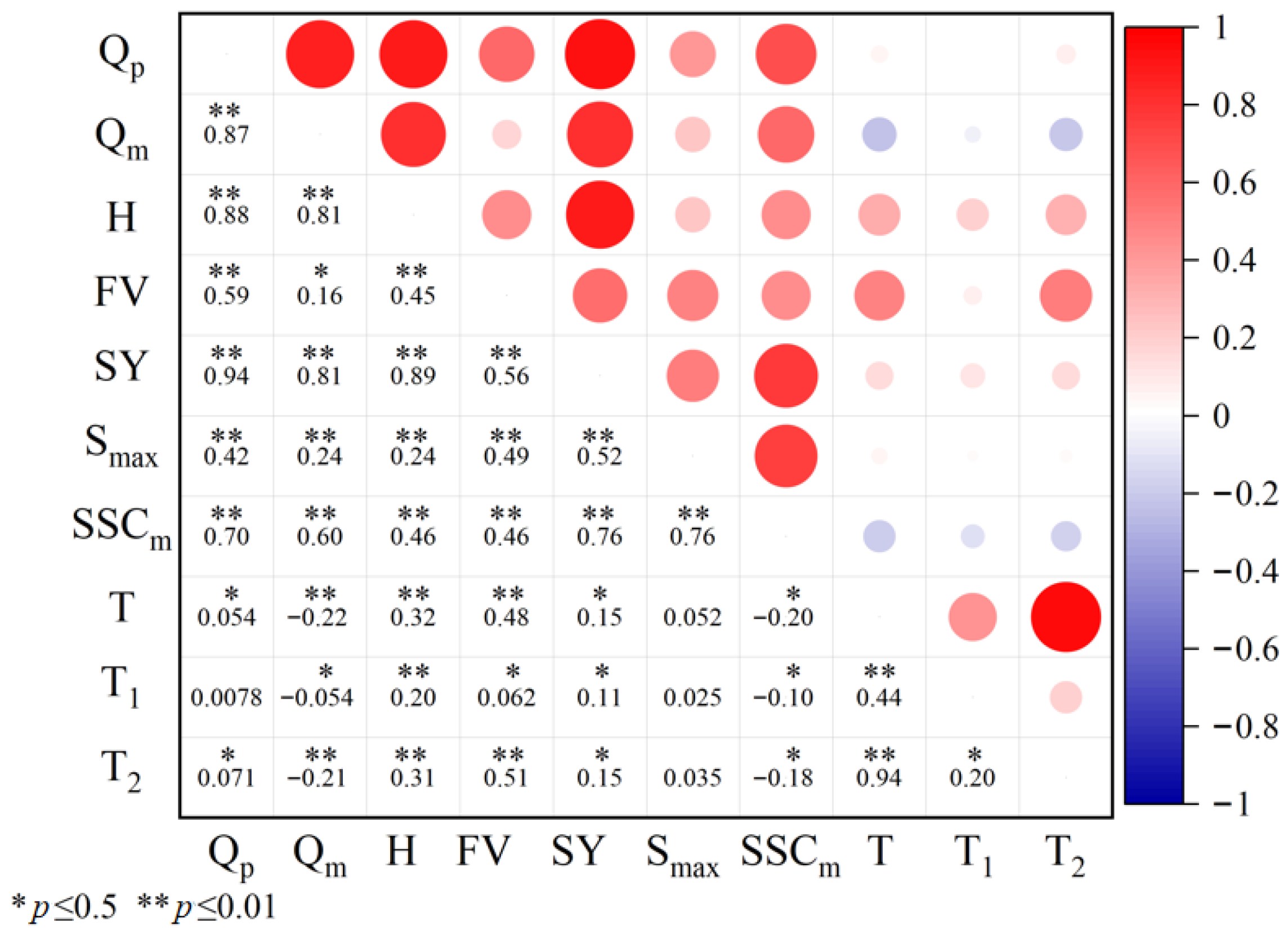
To identify suitable indicators for classifying flood event types, Spearman correlation analysis was employed to evaluate the relationships among runoff, sediment transport, and temporal characteristics of flood events (Figure 2). The results indicated that peak discharge was significantly correlated with runoff depth, mean discharge, and flow variability, showing correlation coefficients of 0.88, 0.87, and 0.59, respectively (p ≤ 0.01). Sediment yield exhibited significant correlations with mean suspended sediment concentration (r = 0.76) and maximum suspended sediment concentration (r = 0.52). Among these variables, peak discharge and runoff depth demonstrated the strongest correlations with sediment yield, having correlation coefficients as high as 0.94 and 0.89, respectively. Additionally, considerable variability was observed among peak discharge, runoff depth, and sediment yield across different flood events, with coefficients of variation exceeding 1.
Based on these correlation analyses and previous research findings, four indicators, including peak discharge, runoff depth, sediment yield, and flood duration, were ultimately selected for classifying flood event types. These indicators effectively characterize the flood processes.
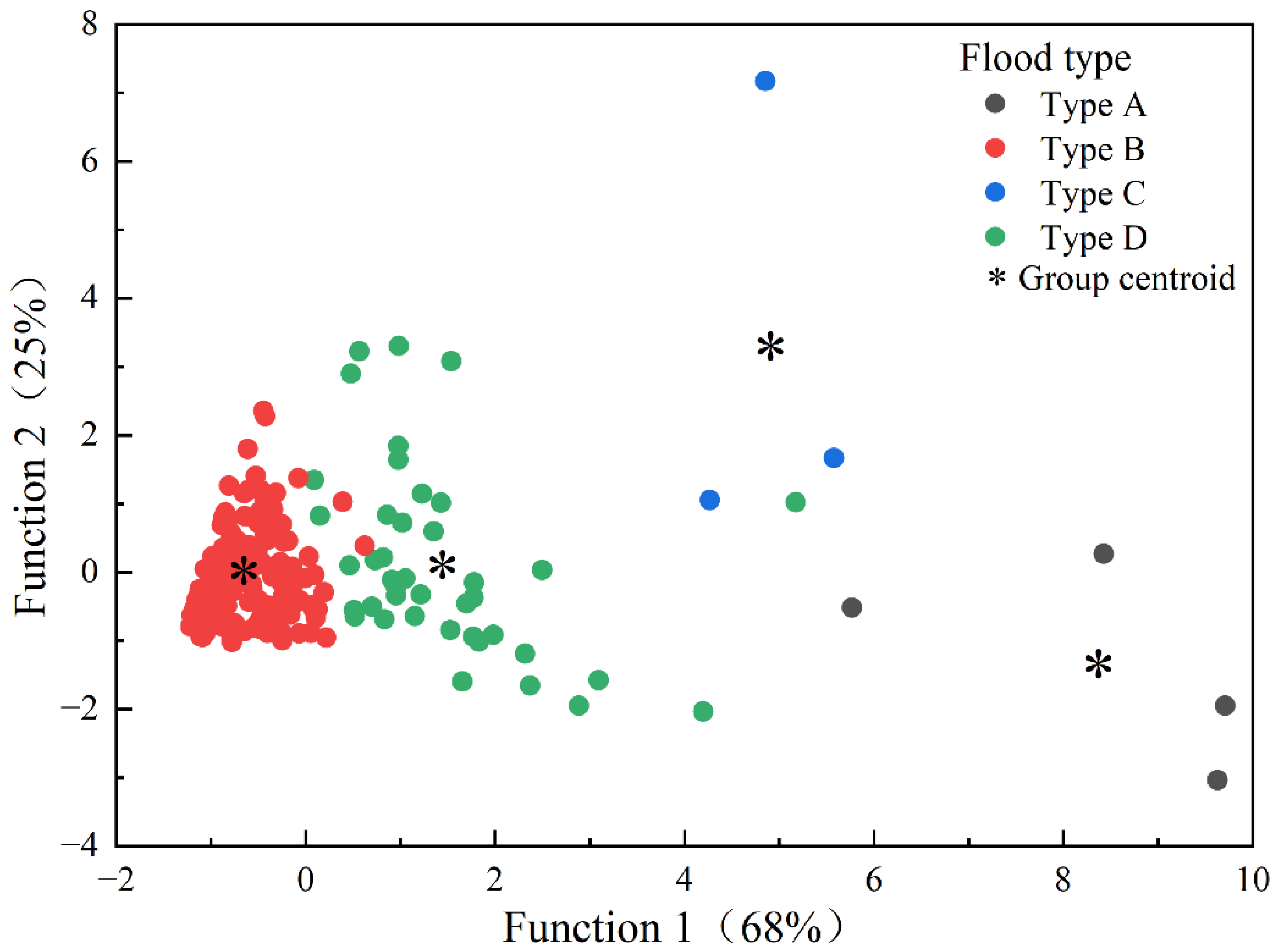
Using these four selected indicators, K-means clustering was applied to classify the 215 flood events into distinct categories, resulting in the identification of four flood types, as shown in Figure 3. Principal component analysis demonstrated that Functions 1 and 2 (the first two discriminant functions, which are linear combinations of the original four hydrological indicators designed to maximize separation between the pre-defined flood types) explained 68% and 25% of the variance, respectively, confirming that the two-dimensional space effectively captured most of the data variability. Among these flood types, Type B included the largest number of events, with 167 occurrences, exhibiting a dense and concentrated clustering pattern. In contrast, the boundaries between Types C and D were less distinct, comprising three and forty-one events, respectively. Type A was clearly separated from the other categories, consisting of only four extreme events.
The characteristics of each cluster center are summarized in Table 3. Type A represented extremely large flood events with moderate to long durations, high peak discharges, and elevated sediment concentrations. Type B events were characterized by short duration, low peak discharge, and minimal sediment concentration. Type C floods featured extended duration, moderate peak discharge, and high sediment concentration. Lastly, Type D floods exhibited intermediate features across duration, peak discharge, and sediment concentration, clearly fulfilling the study’s classification objectives.

3.2. Runoff and Sediment Characteristics of Flood Events

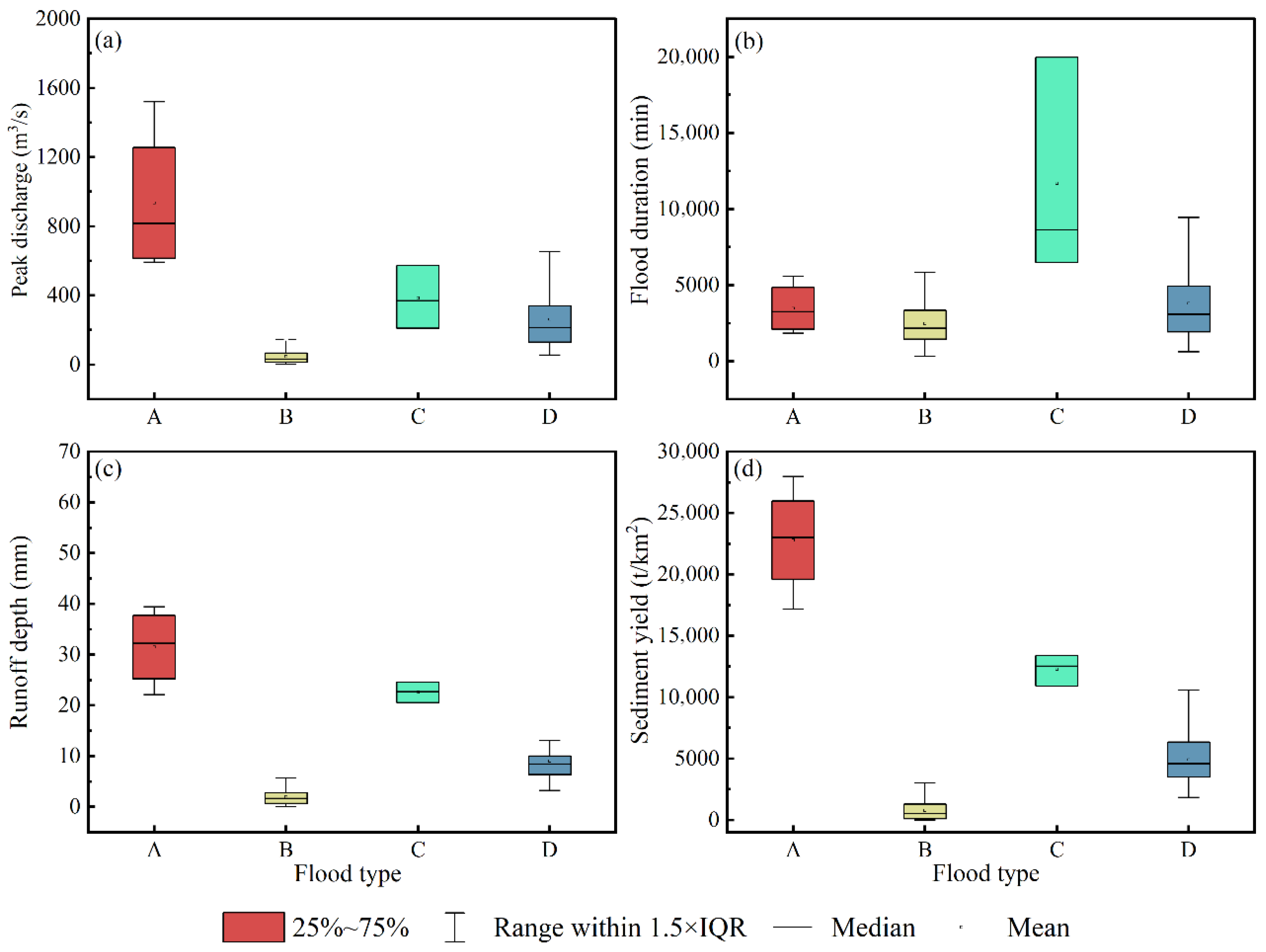
The objective of this analysis was to characterize hydrological differences among flood event types (A, B, C, and D) in the Chabagou watershed. Boxplots were used to illustrate the distributions of peak discharge, flood duration, runoff depth, and sediment yield for each type (Figure 4). Type A flood events showed the highest median peak discharge of approximately 800 m3/s, with an extreme maximum of 1520 m3/s, which was substantially greater than other flood types. Types C and D exhibited moderate median peak discharges of approximately 350 m3/s and 200 m3/s, respectively, whereas type B displayed the lowest and most concentrated peak discharge values. Regarding flood duration, type C events had significantly longer durations, with a median around 8000 min and an upper extreme approaching 20,000 min, in contrast to types A, B, and D, whose median durations were all below 5000 min.
Runoff depth was highest in type A floods, with a median of approximately 30 mm, followed by types C (20 mm) and D (10 mm), while type B floods had the lowest median runoff depth, close to zero. Similarly, sediment yield was highest in type A floods, with a median of approximately 22,500 t/km2, whereas type B floods again had the lowest median sediment yield, close to zero. Flood types C and D had intermediate sediment yields, with type D showing a relatively concentrated distribution. These results indicate that type A floods are associated with severe erosion and sediment transport processes, while type B events exhibit the weakest runoff and sediment response; types C and D display intermediate characteristics.
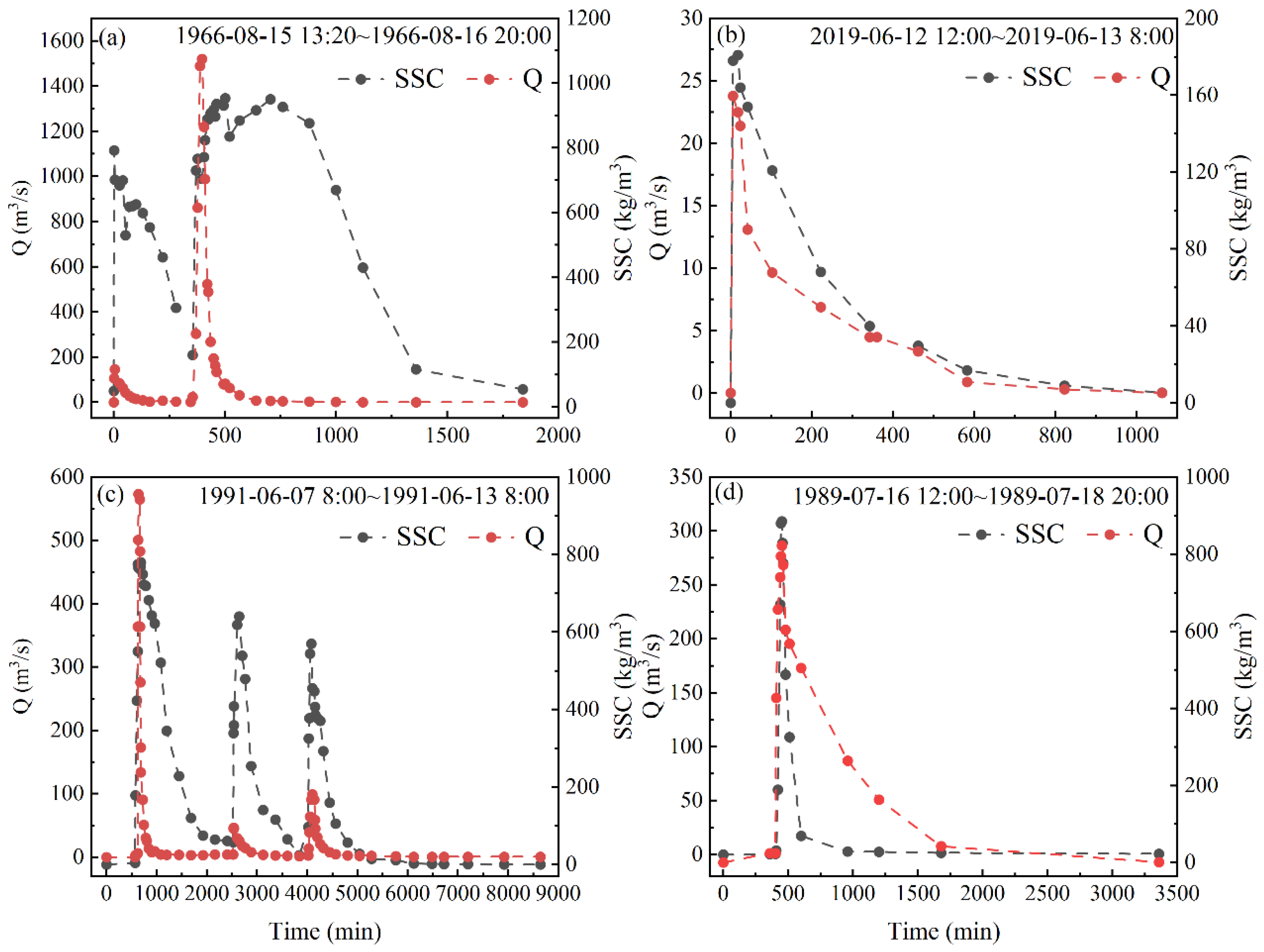
To further investigate the runoff and sediment transport processes associated with each flood type, four representative flood events were analyzed in detail (Figure 5). The type A flood event, occurring between August 15 and 16, 1966, lasted approximately 30.7 h and exhibited rapid rises and falls in both discharge and sediment concentration, peaking at 1520 m3/s and 953 kg/m3, respectively. In contrast, the type B flood event, observed from 12 to 13 June 2019, featured significantly lower peak discharge (23.8 m3/s) and sediment concentration (181 kg/m3), with both peaks occurring simultaneously, characterized by rapid increases followed by gradual declines.
The type C flood event (7–13 June 1991) displayed multiple peaks, achieving a peak discharge of 573 m3/s and sediment concentration of approximately 780 kg/m3, with a duration of nearly six days. The type D flood event (16–18 July 1989) had a moderate peak discharge (309 m3/s) and sediment concentration (822 kg/m3), with sediment concentration declining more rapidly than discharge during the falling limb. Comparative analysis of these selected flood events highlights the substantial variability in runoff and sediment transport dynamics, indicating that type A events pose the greatest hydrological and sediment-related risks. The differences observed among flood types emphasize the complexity of flood processes, influenced by rainfall characteristics, topography, and vegetation conditions.

3.3. Hysteresis Relationship Between Runoff and Sediment

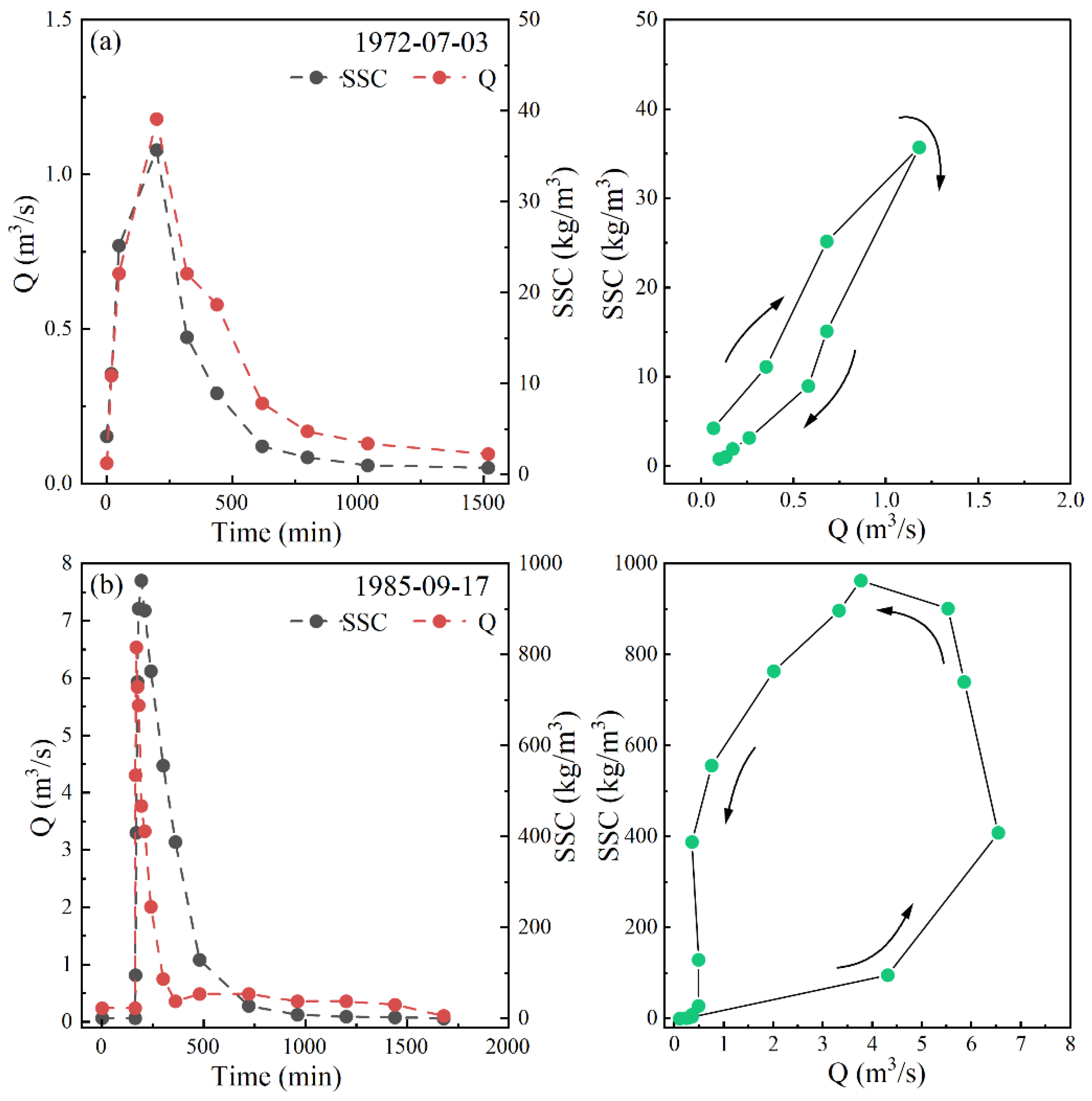
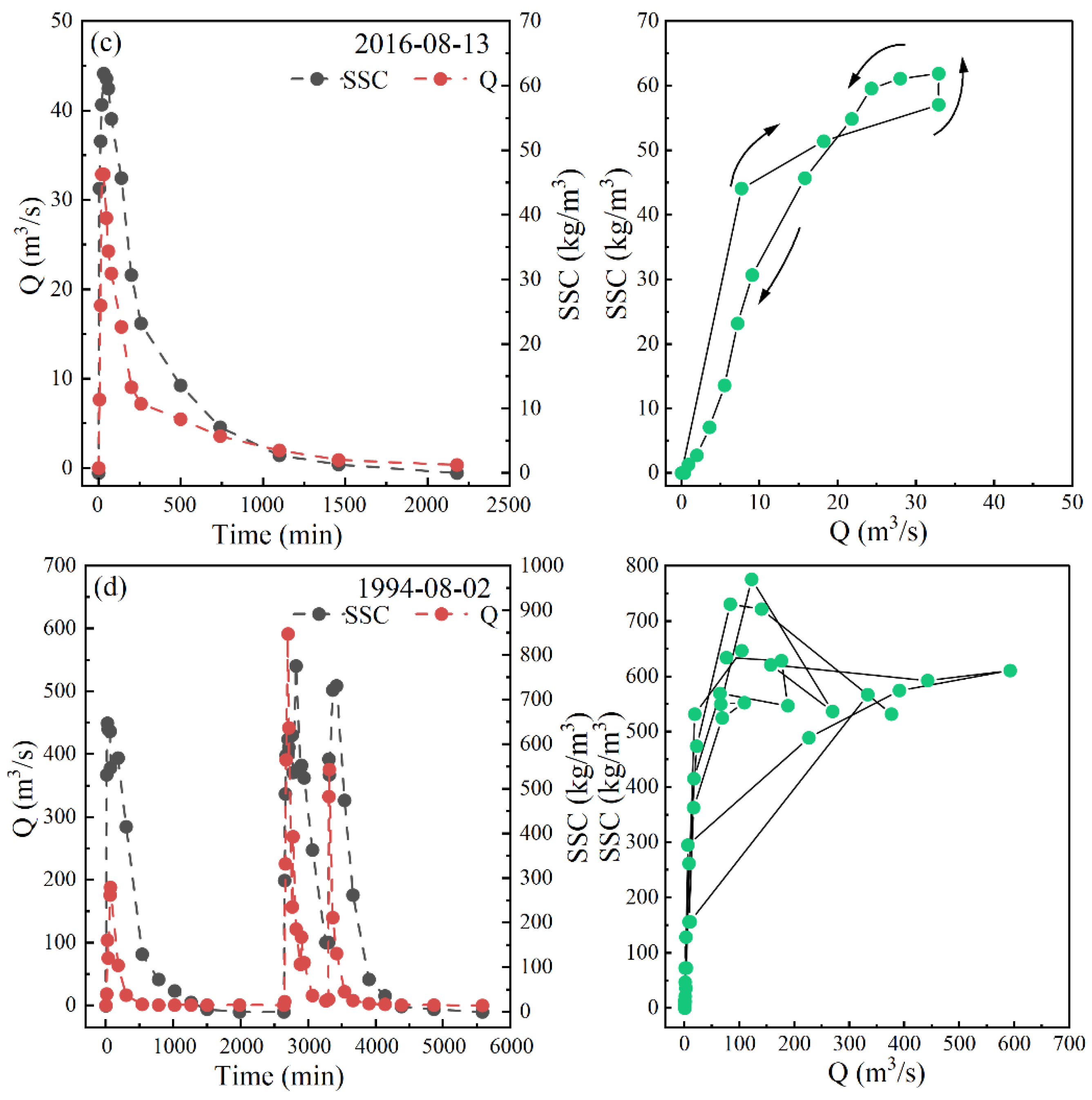
The purpose of this analysis was to investigate the hysteresis patterns between runoff and sediment transport during individual flood events in the Chabagou watershed. Through detailed examination of runoff–sediment relationships from 215 storm flood events, four primary hysteresis loop types were identified: clockwise, anticlockwise, figure-of-eight, and complex. Representative flood events for each hysteresis type were selected to illustrate their distinctive runoff and sediment characteristics, as depicted in Figure 6.
The flood event on 3 July 1972 exhibited a clockwise hysteresis loop (Figure 6a), characterized by nearly simultaneous peaks in discharge and suspended sediment concentration (SSC). However, notable differences in sediment transport intensity occurred between the rising and falling stages. At an identical discharge of 0.68 m3/s, the SSC during the rising stage was approximately 67% greater than during the recession stage. This clockwise pattern is consistent with interpretations in the literature [19], suggesting that sediment sources were likely located near the hydrological station or resulted from substantial sediment deposits in the early flood stage, leading to abundant sediment supply during the rising limb but limited availability during recession.
In contrast, the flood event on 17 September 1985 presented an anticlockwise hysteresis loop (Figure 6b), in which the discharge peak preceded the sediment peak. At a discharge of 3.77 m3/s during the recession stage, SSC reached its peak value of 963 kg/m3, markedly higher than the approximate 100 kg/m3 observed at the same discharge during the rising stage. Such anticlockwise loops are typically interpreted as indicating sediment contributions from more distant sources or delayed delivery from upstream areas [47].
The storm flood on 13 August 2016 revealed a figure-of-eight hysteresis loop (Figure 6c), with the discharge peak occurring before the sediment concentration peak. Initially, during the rising limb, SSC increased concurrently with discharge but gradually slowed due to sediment depletion. Early in the recession limb, a delayed upstream sediment supply reached the watershed outlet, resulting in an anticlockwise pattern at high flows. Subsequently, at lower flows, limited sediment availability caused the hysteresis to shift to a clockwise pattern, contributing to a rapid decrease in SSC during the late recession stage. This figure-of-eight pattern reflects a combination of sediment sources and delivery processes, with initial near-source supply followed by delayed contributions from upstream, a phenomenon documented in previous studies [20].
The flood event on 2 August 1994 exhibited a complex hysteresis loop, featuring multiple peaks in discharge and SSC, each parameter showing three distinct peaks (Figure 6d). At each peak, SSC peaked ahead of discharge, reflecting a complex sediment–runoff relationship. This complex loop pattern demonstrates considerable spatial heterogeneity in sediment sources throughout the flood event, influenced by varying soil erosion characteristics, vegetation cover, terrain conditions, and uneven rainfall distribution across the watershed [19].
Overall, these hysteresis loops effectively illustrated the dynamic processes of runoff and sediment transport during storm flood events, including variations in sediment source distribution within the watershed. Clockwise and figure-of-eight hysteresis patterns were interpreted as reflecting sediment sources located near the hydrological station, whereas anticlockwise loops were associated with distant sediment sources, and complex patterns were considered indicative of substantial spatial variability in sediment sources [19,20]. Statistical analysis revealed that among the 215 flood events analyzed, the proportions of clockwise, anticlockwise, figure-of-eight, and complex hysteresis loops were 2.8%, 45.6%, 23.7%, and 27.9%, respectively. These findings highlight the significant variability inherent in sediment transport processes and source distributions during flood events.

3.4. Response of Runoff–Sediment Hysteresis Relationships to the Flood Types

Based on the analysis of 215 flood events in the Chabagou watershed, distinct runoff–sediment hysteresis characteristics emerged among different flood types, as shown in Table 4. All four Type-A floods exhibited compound hysteresis curves, accounting for 1.9% of total events, reflecting complex sediment dynamics associated with extreme flood conditions. Among 167 Type-B floods, counterclockwise hysteresis was predominant (89 events, 41.4%), followed by compound hysteresis (34 events, 15.8%), clockwise figure-eight hysteresis (24 events, 11.2%), and counterclockwise figure-eight hysteresis (16 events, 7.4%). The three Type-C floods exclusively showed compound hysteresis, while among 41 Type-D floods, compound hysteresis was most frequent (19 events, 8.8%), followed by counterclockwise hysteresis (9 events, 4.2%).
Overall, counterclockwise hysteresis patterns were most common (98 events, 45.6%), indicating widespread delayed sediment responses during flood recession stages. Compound hysteresis ranked second (60 events, 27.9%), highlighting complex sediment dynamics influenced by changing sediment sources. Clockwise figure-eight and counterclockwise figure-eight curves appeared in 28 and 23 events, respectively, while clockwise hysteresis was the least common (6 events, 2.8%). These distributions underline the intricate interactions between hydrological conditions, erosion processes, and watershed characteristics across different flood types.

4. Discussion

4.1. Effects of Flood Event Type in Runoff–Sediment Hysteresis

The runoff–sediment hysteresis patterns observed in the Chabagou watershed result from the interplay of natural factors and human interventions. Natural factors primarily include rainfall characteristics, flood intensity, and geomorphological conditions, while anthropogenic influences mainly stem from soil conservation measures such as check dam construction, terracing, and vegetation restoration programs like the Grain-for-Green Project [42].
Natural processes significantly influence hysteresis types. Short-duration, high-intensity rainfall typically generates clockwise or figure-of-eight hysteresis loops due to rapid runoff generation and immediate sediment entrainment near the watershed outlet [14]. In contrast, long-duration, moderate-intensity storms often produce counterclockwise or complex hysteresis loops, reflecting delayed sediment contributions from distant sediment sources such as upstream hillslopes and channel banks [17,19]. This sediment lag occurs because sediment transport from remote sources requires a longer duration and sustained runoff conditions [47].
Human interventions have markedly altered sediment dynamics within the watershed. The construction of check dams has effectively trapped large quantities of sediment, reducing immediate sediment availability downstream, which delays sediment peaks and consequently increases the occurrence of anticlockwise hysteresis loops [20]. Meanwhile, vegetation restoration and terracing have improved infiltration capacity and stabilized soil structures, resulting in reduced erosion and runoff rates during rainfall events. Consequently, previously dominant clockwise loops, prevalent when sediment was abundant, have been gradually replaced by counterclockwise and complex hysteresis loops due to limited and delayed sediment supply.
In summary, the combined effect of rainfall characteristics, watershed geomorphology, and anthropogenic soil conservation measures jointly determines runoff–sediment hysteresis patterns. Understanding these combined influences is critical for predicting sediment transport responses and improving watershed management practices under changing environmental conditions.

4.2. Effects of Rainfall and Conservation Measures on Runoff–Sediment Hysteresis Across Different Periods

Aligned with the historical progression of ecological restoration on the Loess Plateau and supported by existing literature, this study adopts a tripartite chronological division: 1959–1979, 1980–1999, and 2000–2022 [48]. This framework corresponds to three successive phases of soil and water conservation policy. The first phase, from 1959 to 1979, focused primarily on single-measure engineering interventions, notably check dam construction. Subsequently, integrated small watershed management became widespread during 1980–1999. Following the implementation of the Grain for Green program in 1999, large-scale vegetation restoration has characterized the third phase. This periodization aligns with change points observed in local runoff and sediment records and supports comparative regional analysis.
Table 5 shows the distribution of runoff–sediment hysteresis loops in the study catchment across three periods (1959–1979, 1980–1999, 2000–2022). During 1959–1979, anticlockwise hysteresis loops dominated (60% of total events). This type of hysteresis occurs when sediment concentration peaks lag behind discharge peaks, indicating sediment sources situated farther upslope or a limited supply that only becomes mobilized after initial runoff. Only one clockwise hysteresis event, characterized by an early sediment peak, was recorded during this period, reflecting the scarcity of readily mobilizable sediment close to gullies [24,49].
The dominance of anticlockwise loops in the initial period aligns closely with catchment conditions at that time. Vegetation cover was minimal, conservation measures were sparse, and sediment connectivity between hillslopes and channels remained high. Historical records indicate frequent, intense summer storms capable of mobilizing sediment from upland areas after discharge had already peaked, further reinforcing the anticlockwise pattern. Concurrently, the initial stages of check dam construction (1950s–1970s) began influencing sediment transport by partially trapping sediment in upstream reservoirs. By temporarily retaining sediment, check dams reduced immediate downstream availability, resulting in delayed sediment peaks [46].
The 1980–1999 period revealed more heterogeneous hysteresis responses. Anticlockwise loops remained common (approximately 38%) but decreased proportionally compared to the previous period. Simultaneously, complex hysteresis loops notably increased, accounting for roughly 36% of observed events, accompanied by a moderate rise in figure-of-eight loops (approximately 23%). The increased occurrence of complex and figure-of-eight loops indicates that sediment transport during runoff events had become less straightforward, reflecting multiple sediment sources or phased sediment release [18]. This complexity corresponded to intensified conservation practices across the catchment [14].
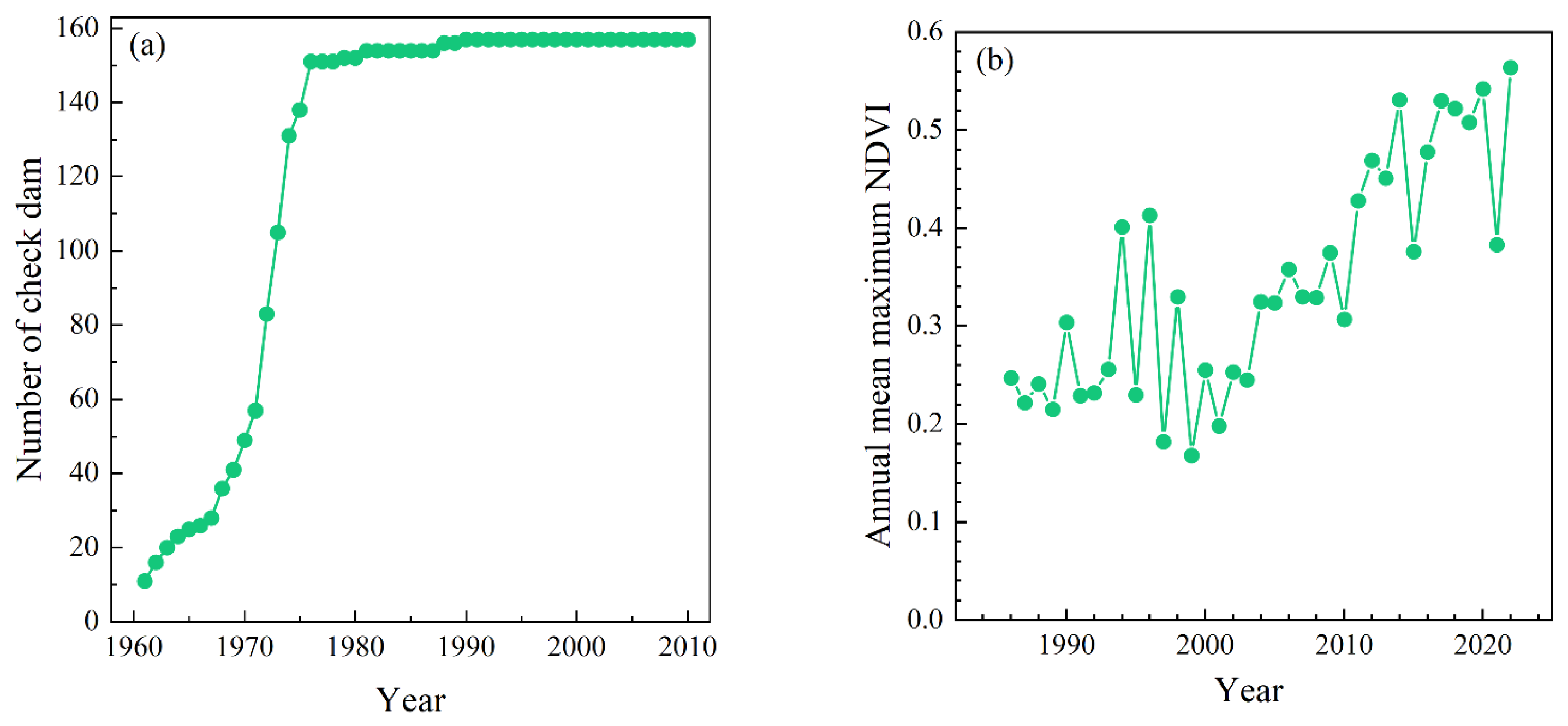
By this period, check dam construction had matured significantly, with tens of thousands of dams effectively reducing sediment supply downstream by trapping substantial sediment volumes (Figure 7). However, the mere presence of check dams does not guarantee proportional reductions in sediment connectivity; their functional characteristics and condition critically determine their effectiveness. Detailed surveys in the Chabagou watershed following the 2017 extreme rainstorm revealed substantial heterogeneity in dam functionality [36]. Among all check dams above the Caoping Hydrological Station, approximately 42.86% were damaged during the event, and dams were classified into three functional types: those with drainage canals (including destroyed dams), those with drainage culverts, and intact dams with 100% sediment interception efficiency. Critically, the sediment trapping efficiency varied dramatically across these types—dams with drainage canals averaged only 6.48% efficiency, while those with drainage culverts achieved 39.49% efficiency. This functional heterogeneity has important implications for sediment hysteresis patterns. Although dams with drainage canals control 71.95% of the upstream area, their low trapping efficiency means they provide limited sediment storage and continue to allow relatively rapid sediment transfer during floods. Conversely, intact dams and those with culverts, despite controlling smaller areas (26.54% and 1.51%, respectively), create localized zones of sediment retention that contribute to delayed sediment delivery and increased occurrence of anticlockwise and complex hysteresis loops. Thus, the shift toward more heterogeneous hysteresis patterns during 1980–1999 reflects not only increased dam numbers but also the emerging functional diversity of the dam network, with some structures acting as effective sediment traps while others function primarily as conveyance channels. Concurrently, hillside terracing expanded significantly—from approximately 10 km2 in 1980 to over 20 km2 by the late 1990s—further influencing sediment dynamics. Terraces intercept runoff, enhancing infiltration and reducing flow velocity, thereby decreasing sediment entrainment. The combination of nearly filled check dams and extensive terracing created spatial variability in sediment connectivity. Consequently, certain sub-catchments exhibited readily available sediment deposits, whereas others were effectively disconnected [50]. Such spatial heterogeneity facilitated multi-stage sediment transport, explaining the increase in complex and figure-of-eight hysteresis loops during this period [51].
Additionally, initial vegetation restoration measures during this period, though modest compared to later campaigns, improved soil stability. Even minor increases in vegetative cover significantly reduced sediment availability, resulting in delayed sediment mobilization and increased event complexity [47]. Thus, events frequently exhibited sediment transport occurring in multiple phases, with initial rapid flushing of nearby sediment sources followed by slower mobilization from distant hillslopes or storage areas.
During the most recent period (2000–2022), hysteresis patterns transitioned toward simpler responses with significantly reduced sediment yields. The total number of detectable hysteresis events notably declined (41 events in approximately 22 years), reflecting fewer sediment-rich runoff events. Among recorded events, figure-of-eight loops emerged as the predominant type (approximately 39%), surpassing anticlockwise loops (approximately 37%). Complex loops significantly declined, representing only 20% of events. This shift toward simplified hysteresis behavior indicated widespread sediment limitation across the catchment, with fewer abrupt sediment peaks.
This pronounced change aligns closely with extensive conservation initiatives, especially the large-scale vegetation restoration effort initiated under China’s Grain for Green program around 1999 [46]. Vegetation indices (NDVI) rose substantially from approximately 0.26 in the early 2000s to about 0.40 by the 2010s, reflecting significant grassland and forest regeneration (Figure 7). Improved vegetation cover substantially reduced soil erosion potential, protecting hillslope surfaces and enhancing infiltration. Concurrently, terraced areas continued expanding, reaching approximately 25.6 km2 by 2017, further stabilizing sediment [51].
Moreover, despite extensive silting of existing check dams, these structures continued to reduce downstream sediment loads by stabilizing upstream gullies. Collectively, these conservation measures significantly lowered sediment connectivity, effectively restricting sediment availability. Consequently, even during runoff events, sediment concentrations often remained low unless intense rainfall briefly provided enough energy to mobilize the limited available sediment. Under these conditions, figure-of-eight loops became more frequent, reflecting modest two-phase sediment mobilization rather than pronounced peaks [52].
Alterations in rainfall characteristics further influenced sediment transport dynamics across the studied periods. Long-term analysis (1959–2022) indicated a trend toward increased frequency of low-intensity rainfall events (<0.5 mm/h) and a corresponding decline in high-intensity rainfall events (>5 mm/h) (Table 6). Such changes reduced erosive rainfall potential, as gentle rains favored infiltration over runoff generation, significantly reducing sediment mobilization. Previously, intense rainfall events could overwhelm partial conservation structures, rapidly mobilizing sediment. However, post-2000, gentler rainfall events often produced limited runoff, reinforcing the effects of conservation measures. Thus, sediment transport became increasingly supply-limited, reflected in simpler hysteresis responses. Quantitative analysis indicated that the annual frequency of high-intensity rainfall (>10 mm/h) declined by approximately 60% from 1959–1979 to 2000–2022, while low-intensity rainfall (<2 mm/h) events increased by around 35%. These shifts in rainfall intensity distribution significantly contributed to the observed reductions in runoff generation and sediment transport capacity.
Seasonal rainfall distribution shifts also occurred, with historically common intense midsummer storms becoming less frequent. Historically, intense summer rains drove significant sediment transport events; their recent decline has dispersed sediment yields across smaller, less erosive events. Consequently, runoff events often exhibited weak hysteresis signals due to diminished sediment availability, further exemplifying reduced sediment connectivity within the catchment [53].
From a sediment connectivity perspective, the three studied periods illustrated distinct states. During 1959–1979, high connectivity allowed rapid mobilization of distant sediment sources, resulting predominantly in anticlockwise loops. In 1980–1999, spatially heterogeneous connectivity patterns emerged due to conservation interventions, promoting increased complex hysteresis forms. By 2000–2022, significantly reduced connectivity, driven by widespread vegetation recovery, terracing, and fully sediment-trapping check dams, favored simpler hysteresis forms. Sediment availability limitations were pervasive, reflected in smaller and less distinctive hysteresis loops.

4.3. Hysteresis Patterns in Extreme Rainfall Events

All extreme floods analyzed in this study exhibited complex hysteresis patterns in the discharge–sediment relationship. Table 7 summarizes the key hydro–sediment metrics of these events, demonstrating that none followed simple clockwise or anticlockwise loops. Instead, all events presented compound hysteresis loops driven by asynchronous sediment delivery processes. Such complexity commonly arises during extreme rainfall events. Intense and prolonged precipitation generates multiple runoff peaks and sequential sediment pulses from varied sources. As a result, sediment concentrations fluctuate out of synchronization with discharge. High-intensity rainfall initially mobilizes readily accessible sediment from channels or adjacent slopes, and subsequently, sediment from more distant hillslopes is mobilized as hydrological connectivity increases, resulting in compound hysteresis patterns [50].
The 2017 flood event (Type B) notably exhibited a complex hysteresis loop but featured significantly lower sediment yields relative to peak discharge compared to historical events of similar magnitude. This reduced sediment response indicates a substantial shift in catchment behavior and aligns with findings from other Loess Plateau studies [46]. Previous research consistently notes that extreme rainfall events often produce complex hysteresis loops due to mixed sediment sources and delayed sediment transport [54], with multi-peak sediment responses attributed to antecedent moisture conditions and enhanced sediment connectivity that enable gully delivery during extended flood recession phases [55].
Natural watershed characteristics and rainfall intensity primarily shape hysteresis patterns in extreme events, yet human interventions have progressively influenced these patterns over time. During the early period (1959–1979), sparse vegetation cover and highly erodible slopes facilitated rapid runoff and abundant sediment transport, frequently producing complex hysteresis loops characterized by high sediment yields. In the intermediate period (1980–1999), initial soil conservation measures such as localized reforestation and terracing began moderating sediment responses, resulting in gradually reduced peak sediment concentrations and total sediment yields. After 2000, extensive vegetation restoration combined with widespread check dam construction markedly altered sediment dynamics. Flood events between 2000 and 2017 produced significantly lower sediment outputs for comparable rainfall magnitudes, consistently displaying compound hysteresis loops indicative of sediment-limited conditions [56].
These findings hold significant implications for watershed management. Long-term eco-engineering measures, including reforestation, terracing, and check dam construction, have markedly increased watershed resilience against climatic extremes. Lower sediment yields mitigate downstream risks such as reservoir siltation and flood-induced gully aggradation [46]. Nonetheless, the potential occurrence of larger future extreme events necessitates ongoing investments in conservation infrastructure and adaptive management strategies. Future research should prioritize defining resilience thresholds, refining flood–sediment prediction models, and enhancing climate adaptation planning in erosion-prone regions globally.

4.4. Limitations and Future Prospects

This study systematically investigated the effects of rainfall characteristics and soil conservation measures on runoff–sediment hysteresis in small watersheds of the Loess Plateau, although several limitations remain. Firstly, the statistical representativeness of findings for specific flood types is constrained by sample size, particularly for Type A (n = 4) and Type C (n = 3) events. While their analysis offers illustrative insights, the results for these types should be interpreted with caution and not generalized. Secondly, the research primarily addressed rainfall features and specific conservation measures, while overlooking geomorphic factors, changes in gully networks, and their resultant impacts on landscape patterns. These factors are critical in determining soil moisture distribution and hydrological connectivity within watersheds but were not comprehensively analyzed in this study. Furthermore, the relatively low spatial resolution of the available data limits the ability to accurately capture fine-scale topographic influences on runoff–sediment processes, potentially constraining the precision and generalizability of the conclusions.
Future studies should utilize high-precision unmanned aerial vehicle (UAV) remote sensing technology to acquire centimeter-level, high-resolution terrain data. Integrating advanced machine learning techniques with spatial analysis methods would enable clearer elucidation of the intrinsic relationships between topographic factors and hydrological connectivity. Additionally, the development and refinement of sediment yield models at the flood-event scale, incorporating enhanced spatiotemporal data integration, will significantly enhance prediction accuracy and reliability. These improvements will foster a more comprehensive understanding of complex hydrological processes, enhance the effectiveness of ecological restoration measures, and provide robust scientific guidance for water–sediment management and flood disaster mitigation strategies on the Loess Plateau.

5. Conclusions

This study analyzed flood-event-scale runoff and sediment data (1959–2022) from the Chabagou watershed on the Loess Plateau, classifying flood types, characterizing runoff–sediment hysteresis patterns, and assessing the impacts of ecological restoration and conservation measures on flood-driven sediment dynamics over time. The main findings are as follows:
  • Based on peak discharge, runoff depth, sediment yield, and duration, 215 floods were classified into four types. Type A (4 events) had high peaks, large sediment, moderate to long durations; Type B (167 events) were frequent, short, low peaks, minimal sediment; Type C (3 events) had long durations, moderate peaks, high sediment; Type D (41 events) showed intermediate characteristics.
  • Runoff–sediment hysteresis relationships exhibited four primary patterns. Anticlockwise loops, indicating delayed sediment peaks relative to discharge, were predominant (45.6%). Complex loops accounted for 27.9%, figure-of-eight loops comprised 23.7%, and clockwise loops were the least common at 2.8%. The variation in hysteresis patterns was influenced by rainfall intensity, storm duration, and sediment availability, highlighting spatial and temporal differences in sediment transport dynamics during flood events.
  • Flood characteristics evolved distinctly under phased ecological restoration: high peak flows and sediment yields in 1959–1979 shifted to reduced peaks and longer durations during 1980–1999 due to check dam construction, and further to sediment-limited conditions with continued low peaks in 2000–2022 despite increased runoff depth. This long-term transition in hysteresis patterns from anticlockwise dominance to increased complexity and eventually to figure of eight prevalence reveals how progressive restoration progressively reduces sediment connectivity and availability, providing new insights into the co-evolution of hydrological and sediment regimes under sustained human intervention.
  • All extreme rainfall events generated complex multi-loop hysteresis, driven by asynchronous sediment delivery. While early events produced high sediment yields, post-2000 extreme floods showed markedly lower yields despite similar rainfall, reflecting sediment supply limitation from vegetation recovery and dam trapping. These findings underscore the need for adaptive watershed management to focus on figure-of-eight and complex hysteresis events as indicators of transitional erosion risk, and to maintain the sediment trapping capacity of check dam networks and vegetation cover to enhance resilience against future extreme storms.

Author Contributions

Conceptualization, J.X. and Y.C.; methodology and software, J.X. and J.Y.; validation, J.X.; formal analysis, J.X., J.Y. and P.D.; data curation, J.X. and Q.Z.; writing—original draft preparation, J.X.; writing—review and editing, W.L., P.D., Y.Z. and Z.Q.; supervision, P.D., Q.Z., Y.Z. and Z.Q. All authors have read and agreed to the published version of the manuscript.

Funding

This work was supported by the National Natural Science Foundation of China (U2243213; U2243212) and the National Key Research and Development Program of China (2023YFE0125600; 2021YFE0113800).

Data Availability Statement

The original contributions presented in this study are included in the article. Further inquiries can be directed to the corresponding author.

Acknowledgments

The authors are grateful to the editor and reviewers for their valuable comments and suggestions.

Conflicts of Interest

The authors declare no conflicts of interest.

References

  1. Walling, D.E. Human impact on land–ocean sediment transfer by the world’s rivers. Geomorphology 2006, 79, 192–216. [Google Scholar] [CrossRef]
  2. Zhang, L.; Li, W.; Chen, Z.; Hu, R.; Yin, Z.; Qin, C.; Li, X. Impacts and prediction of land use/cover change on runoff in the Jinghe River basin, China. Land 2025, 14, 626. [Google Scholar] [CrossRef]
  3. Chen, Y.; Zhang, P.; Zhao, Y.; Qu, L.; Du, P.; Wang, Y. Factors affecting runoff and sediment load changes in the Wuding River basin from 1960 to 2020. Hydrology 2022, 9, 198. [Google Scholar] [CrossRef]
  4. Borga, M.; Stoffel, M.; Marchi, L.; Marra, F.; Jakob, M. Hydrogeomorphic response to extreme rainfall in headwater systems: Flash floods and debris flows. J. Hydrol. 2014, 518, 194–205. [Google Scholar] [CrossRef]
  5. Fan, X.; Shi, C.; Shao, W.; Zhou, Y. The suspended sediment dynamics in the Inner-Mongolia reaches of the Upper Yellow River. Catena 2013, 109, 72–82. [Google Scholar] [CrossRef]
  6. Wang, Y.; Wang, S.; Wang, C.; Zhao, W. Runoff sensitivity increases with land use/cover change contributing to runoff decline across the middle reaches of the Yellow River basin. J. Hydrol. 2021, 600, 126536. [Google Scholar] [CrossRef]
  7. Hailemariam, G.W.; Zhao, J.; Moges, A. Identification of spatial patterns of soil erosion based on the combination of RUSLE and MCDA in the Ahferom District, Northern Ethiopia. Land 2024, 13, 1684. [Google Scholar] [CrossRef]
  8. Huang, D.; Pei, M.; Zhou, L.; Fan, H.; Jia, Y. Identification of sediment sources and exploration of scale effects in the black soil region of Northeast China. Catena 2020, 195, 104848. [Google Scholar] [CrossRef]
  9. Shi, C.; Zhou, Y.; Fan, X.; Shao, W. A study on the annual runoff change and its relationship with water and soil conservation practices and climate change in the middle Yellow River basin. Catena 2013, 100, 31–41. [Google Scholar] [CrossRef]
  10. Boardman, J.; Vandaele, K. Effect of the spatial organization of land use on muddy flooding from cultivated catchments and recommendations for the adoption of control measures. Earth Surf. Process. Landf. 2016, 41, 336–343. [Google Scholar] [CrossRef]
  11. Guerreiro, S.B.; Fowler, H.J.; Barbero, R.; Westra, S.; Lenderink, G.; Blenkinsop, S.; Lewis, E.; Li, X.F. Detection of continental-scale intensification of hourly rainfall extremes. Nat. Clim. Change 2018, 8, 803–807. [Google Scholar] [CrossRef]
  12. Baynes, E.R.C.; Kincey, M.E.; Warburton, J. Extreme flood sediment production and export controlled by reach-scale morphology. Geophys. Res. Lett. 2023, 50, 103042. [Google Scholar] [CrossRef]
  13. Polyakov, V.O.; Nearing, M.A.; Nichols, M.H.; Scott, R.L.; Stone, J.J.; McClaran, M.P. Long-term runoff and sediment yields from small semiarid watersheds in Southern Arizona. Water Resour. Res. 2010, 46, W09512. [Google Scholar] [CrossRef]
  14. Tian, P.; Zhai, J.; Zhao, G.; Mu, X. Dynamics of runoff and suspended sediment transport in a highly erodible catchment on the Chinese Loess Plateau. Land Degrad. Dev. 2016, 27, 839–850. [Google Scholar] [CrossRef]
  15. Rodrigo-Comino, J.; Senciales, J.M.; Ramos, M.C.; Martínez-Casasnovas, J.A.; Lasanta, T.; Brevik, E.C.; Ries, J.B.; Ruiz Sinoga, J.D. Understanding soil erosion processes in Mediterranean sloping vineyards (Montes de Málaga, Spain). Geoderma 2017, 296, 47–59. [Google Scholar] [CrossRef]
  16. Haddadchi, A.; Hicks, M. Interpreting event-based suspended sediment concentration and flow hysteresis patterns. J. Soils Sediments 2021, 21, 592–612. [Google Scholar] [CrossRef]
  17. Zhu, M.; Yu, X.; Li, Z.; Xu, X.; Ye, Z. Quantifying and interpreting the hysteresis patterns of monthly sediment concentration and water discharge in Karst Watersheds. J. Hydrol. 2023, 618, 129179. [Google Scholar] [CrossRef]
  18. Javed, A.; Hamshaw, S.D.; Rizzo, D.M. Multivariate event time series analysis using hydrological and suspended sediment data. J. Hydrol. 2021, 593, 125802. [Google Scholar] [CrossRef]
  19. Ran, Q.; Zong, X.; Ye, S.; Gao, J.; Hong, Y. Dominant mechanism for annual maximum flood and sediment events generation in the Yellow River basin. Catena 2020, 187, 104376. [Google Scholar] [CrossRef]
  20. Yang, P.; Li, R.; Gu, Z.; Qin, L.; Song, T.; Liu, Z.; Gao, J.; Yuan, J. Runoff sediment characteristics affected by erosive rainfall patterns in a small watershed in karst areas of southwest China. Catena 2022, 219, 106591. [Google Scholar] [CrossRef]
  21. Vercruysse, K.; Grabowski, R.C.; Rickson, R.J. Suspended sediment transport dynamics in rivers: Multi-scale drivers of temporal variation. Earth Sci. Rev. 2017, 166, 38–52. [Google Scholar] [CrossRef]
  22. Sherriff, S.C.; Rowan, J.S.; Fenton, O.; Jordan, P.; Melland, A.R.; Mellander, P.E.; Huallachain, D.O. Storm event suspended sediment-discharge hysteresis and controls in agricultural watersheds: Implications for watershed scale sediment management. Environ. Sci. Technol. 2016, 50, 1769–1778. [Google Scholar] [CrossRef] [PubMed]
  23. Buendia, C.; Bussi, G.; Tuset, J.; Vericat, D.; Sabater, S.; Palau, A.; Batalla, R.J. Effects of afforestation on runoff and sediment load in an upland Mediterranean catchment. Sci. Total Environ. 2016, 540, 144–157. [Google Scholar] [CrossRef] [PubMed]
  24. Ran, Q.; Tang, H.; Wang, F.; Gao, J. Numerical modelling shows an old check-dam still attenuates flooding and sediment transport. Earth Surf. Process. Landf. 2021, 46, 1549–1567. [Google Scholar] [CrossRef]
  25. Yuan, S.; Li, Z.; Chen, L.; Li, P.; Zhang, Z.; Zhang, J.; Wang, A.; Yu, K. Influence of check dams on flood hydrology across varying stages of their lifespan in a highly erodible catchment, Loess Plateau of China. Catena 2022, 210, 105864. [Google Scholar] [CrossRef]
  26. Zhao, G.; Kondolf, G.M.; Mu, X.; Han, M.; He, Z.; Rubin, Z.; Wang, F.; Gao, P.; Sun, W. Sediment yield reduction associated with land use changes and check dams in a catchment of the Loess Plateau, China. Catena 2017, 148, 126–137. [Google Scholar] [CrossRef]
  27. Zhang, L.T.; Li, Z.B.; Wang, H.; Xiao, J.B. Influence of intra-event-based flood regime on sediment flow behavior from a typical agro-catchment of the Chinese Loess Plateau. J. Hydrol. 2016, 538, 71–81. [Google Scholar] [CrossRef]
  28. Ma, L.; Wang, C.; Zhong, Y.; Pang, G.; Wang, L.; Long, Y.; Yang, Q.; Tang, B. Factors influencing ephemeral gullies at the regional scale: Formation and density. Land 2024, 13, 553. [Google Scholar] [CrossRef]
  29. Xiong, M.; Li, F.; Liu, X.; Liu, J.; Luo, X.; Xing, L.; Wang, R.; Li, H.; Guo, F. Characterization of ecosystem services and their trade-off and synergistic relationships under different land-use scenarios on the Loess Plateau. Land 2023, 12, 2087. [Google Scholar] [CrossRef]
  30. Li, P.; Xie, Z.; Yan, Z.; Dong, R.; Tang, L. Assessment of vegetation restoration impacts on soil erosion control services based on a biogeochemical model and RUSLE. J. Hydrol. Reg. Stud. 2024, 53, 101830. [Google Scholar] [CrossRef]
  31. Zhang, Y.; Bi, Z.; Zhang, X.; Yu, Y. Influence of landscape pattern changes on runoff and sediment in the Dali River watershed on the Loess Plateau of China. Land 2019, 8, 180. [Google Scholar] [CrossRef]
  32. Sun, W.; Shao, Q.; Liu, J.; Zhai, J. Assessing the effects of land use and topography on soil erosion on the Loess Plateau in China. Catena 2014, 121, 151–163. [Google Scholar] [CrossRef]
  33. Chen, Q.; Mao, Y.; Morrison, R.J.; Lü, Y.; Hong, H.; Xue, X. Land use change characteristics and driving forces in a Loess Plateau watershed: Implications for runoff and sediment yield. Land 2022, 11, 2163. [Google Scholar]
  34. Liu, H.; Chen, Y.; Du, P.; Wang, Y.; Zhao, Y.; Qu, L. Analysis of the changes and causes of runoff and sediment load in the middle reaches of the Yellow River from 1950 to 2022. Land 2024, 13, 1482. [Google Scholar] [CrossRef]
  35. Jiang, L.; Liu, Y. Response of runoff-sediment system to vegetation variation in the Yellow River basin in the last 20 years. Land 2023, 12, 428. [Google Scholar] [CrossRef]
  36. Bai, L.; Wang, N.; Jiao, J.; Chen, Y.; Tang, B.; Wang, H.; Chen, Y.; Yan, X.; Wang, Z. Soil erosion and sediment interception by check dams in a watershed for an extreme rainstorm on the Loess Plateau, China. Int. J. Sediment Res. 2020, 35, 408–416. [Google Scholar] [CrossRef]
  37. Zheng, H.; Miao, C.; Wu, J.; Lei, X.; Liao, W.; Li, H. Temporal and spatial variations in water discharge and sediment load on the Loess Plateau, China: A high-density study. Sci. Total Environ. 2019, 666, 875–886. [Google Scholar] [CrossRef]
  38. Hu, J.; Zhao, G.; Mu, X.; Tian, P.; Gao, P.; Sun, W. Quantifying the impacts of human activities on runoff and sediment load changes in a Loess Plateau catchment, China. J. Soils Sediments 2019, 19, 3866–3880. [Google Scholar] [CrossRef]
  39. Jia, L.; Yu, K.X.; Li, Z.B.; Li, P.; Zhang, J.Z.; Wang, A.N.; Ma, L.; Xu, G.C.; Zhang, X. Temporal and spatial variation of rainfall erosivity in the Loess Plateau of China and its impact on sediment load. Catena 2022, 210, 105931. [Google Scholar] [CrossRef]
  40. Zhao, W.; Zhang, X.; Jiao, J.; Yang, B.; Ma, X.; Xu, Q.; Yan, X.; Ling, Q.; Jian, J. High-risk driving factors of rain-induced flooding hazard events on the Loess Plateau and its ecological subregions. J. Hydrol. 2025, 649, 132475. [Google Scholar] [CrossRef]
  41. Chen, Y.; Li, J.; Zhang, Z.; Jiao, J.; Wang, N.; Bai, L.; Liang, Y.; Xu, Q.; Zhang, S. Modeling soil loss under rainfall events using machine learning algorithms. J. Environ. Manag. 2024, 352, 120004. [Google Scholar] [CrossRef]
  42. Tan, X.; Jia, Y.; Yang, D.; Niu, C.; Hao, C. Turning points in the impact of earlier green-up on evapotranspiration and gross primary productivity in a semi-arid grassland watershed. J. Hydrol. 2023, 616, 128755. [Google Scholar] [CrossRef]
  43. Chen, Y.; Li, J.; Jiao, J.; Bai, L.; Wang, N.; Chen, T.; Zhang, Z.; Xu, Q.; Han, J. Assessing the risk of check dam failure due to heavy rainfall using machine learning on the Loess Plateau, China. Int. Soil Water Conserv. Res. 2024, 12, 506–520. [Google Scholar] [CrossRef]
  44. Zhang, L.; Li, Z.; Wang, S. Spatial scale effect on sediment dynamics in basin-wide floods within a typical agro-watershed: A case study in the hilly loess region of the Chinese Loess Plateau. Sci. Total Environ. 2016, 572, 476–486. [Google Scholar] [CrossRef] [PubMed]
  45. Williams, G.P. Sediment concentration versus water discharge during single hydrologic events in rivers. J. Hydrol. 1989, 111, 89–106. [Google Scholar] [CrossRef]
  46. Hu, J.; Gao, P.; Mu, X.; Zhao, G.; Sun, W.; Li, P.; Zhang, L. Runoff-sediment dynamics under different flood patterns in a Loess Plateau catchment, China. Catena 2019, 173, 234–245. [Google Scholar] [CrossRef]
  47. Long, Y.; Lei, M.; Li, T.; Xiao, P.; Liu, S.; Xu, J.; Tang, F.; Hu, X.; Hu, X.; Nie, X.; et al. Suspended sediment-discharge hysteresis characteristics and controlling factors in a small watershed of southern China. Catena 2024, 243, 108198. [Google Scholar] [CrossRef]
  48. Mu, X.; Hu, C.; Gao, P.; Wang, F.; Zhao, G. Key issues and reflections of research on sediment flux of the Yellow River. Yellow River 2017, 39, 1–4. [Google Scholar]
  49. Yu, B.; Shi, Z.; Zhang, Y. Linking hydrological and landscape characteristics to suspended sediment-discharge hysteresis in Wudinghe River Basin on the Loess Plateau, China. Catena 2023, 228, 107169. [Google Scholar] [CrossRef]
  50. Sheng, F.; Yi, T.; Wang, Y.; Zheng, H.; Liu, S.; Nie, X.; Hu, L.; Li, H. Changes in sediment connectivity and its impact on sediment transport in a typical watershed of Southern Jiangxi Province, China. Ecol. Indic. 2025, 171, 113204. [Google Scholar] [CrossRef]
  51. Misset, C.; Recking, A.; Legout, C.; Poirel, A.; Cazilhac, M.; Esteves, M.; Bertrand, M. An attempt to link suspended load hysteresis patterns and sediment sources configuration in alpine catchments. J. Hydrol. 2019, 576, 72–84. [Google Scholar] [CrossRef]
  52. Fang, H.; Li, Q.; Cai, Q.; Liao, Y. Spatial scale dependence of sediment dynamics in a gullied rolling loess region on the Loess Plateau in China. Environ. Earth Sci. 2011, 64, 693–705. [Google Scholar] [CrossRef]
  53. Bettel, L.; Fox, J.; Husic, A.; Mahoney, T.; Marin-Ramirez, A.; Zhu, J.; Tobin, B.; Al-Aamery, N.; Osborne, C.; Riddle, B.; et al. Hydrologic pathways and baseflow contributions, and not the proximity of sediment sources, determine the shape of sediment hysteresis curves: Theory development and application in a karst basin in Kentucky USA. J. Hydrol. 2025, 649, 132300. [Google Scholar] [CrossRef]
  54. Zhao, Y.; Cao, W.; Hu, C.; Wang, Y.; Wang, Z.; Zhang, X.; Xie, G. Analysis of changes in characteristics of flood and sediment yield in typical basins of the Yellow River under extreme rainfall events. Catena 2019, 177, 31–40. [Google Scholar] [CrossRef]
  55. Li, Z.; Xu, X.; Zhu, J.; Xu, C.; Wang, K. The contributions of the largest erosive events to sediment yields in karst catchments. Water Resour. Res. 2020, 56, 025839. [Google Scholar] [CrossRef]
  56. Duan, J.; Liu, Y.; Yang, J.; Tang, C.; Shi, Z. Role of groundcover management in controlling soil erosion under extreme rainfall in citrus orchards of southern China. J. Hydrol. 2020, 582, 124290. [Google Scholar] [CrossRef]
Figure 1. Location of Chabagou watershed and hydrological station within the watershed.
Land 15 00419 g001
Figure 2. Correlation analysis of runoff and sediment indicators for individual flood events.
Land 15 00419 g002
Figure 3. Classification results of flood event types. Note: Function 1 and Function 2 denote the projections of the discriminant function onto the abscissa (horizontal axis) and ordinate (vertical axis), respectively.
Land 15 00419 g003
Figure 4. Hydrological characteristics of different flood event types. (a) Peak discharge; (b) Flood duration; (c) Runoff depth; (d) Sediment yield.
Land 15 00419 g004
Figure 5. Discharge and sediment concentration hydrographs for different types of flood events. (a) Type A flood event; (b)Type B flood event; (c) Type C flood event; (d) Type D flood event.
Land 15 00419 g005
Figure 6. Examples of SSC-Q hysteresis loop types. (a) Clockwise, (b) Anticlockwise, (c) Figure-of-eight, and (d) Complex.
Land 15 00419 g006aLand 15 00419 g006b
Figure 7. Construction of check dams and NDVI changes in the Chabagou watershed. (a) Number of check dam; (b) Annual mean maximum NDVI.
Land 15 00419 g007
Table 1. Flood variables and correlated abbreviations.
Runoff-Relative VariablesSediment-Relative VariablesTime-Relative Variables
Peak discharge (Qp, m3/s)Sediment yield (SY, t/km2)Flood duration (T, min)
Mean discharge (Qm, m3/s)Maximum suspended sediment concentration
(Smax, kg/m3)
Rising limb duration
(T1, min)
Runoff depth (H, mm)Mean suspended sediment concentration (SSCm, kg/m3)Falling limb duration
(T2, min)
Flow variability (FV)Instantaneous suspended sediment concentration
(SSC, kg/m3)
Table 2. Statistical characteristics of runoff and sediment transport during flood events in the Chabagou watershed (1959–2022).
Characteristics IndexMinimumMaximumMeanStandard
Deviation
Coefficient of Variation
Qp (m3/s)0.51520.0109.5178.71.6
Qm (m3/s)0.248.15.57.61.4
H (mm)0.145.44.26.11.5
FV2.268.619.012.70.7
SY (t/km2)1.127,967.92140.13718.11.7
Smax (kg/m3)3.81220.0654.4282.50.4
SSCm (kg/m3)1.8970.8427.3247.80.6
T (min)315.019,974.02874.72205.10.8
T1 (min)3.06408.0435.2768.01.8
T2 (min)180.017,154.02439.51840.50.8
Table 3. Cluster center characteristics of different flood event types.
Flood TypesQp (m3/s)H (mm)SY (t/km2)T (min)
Type A936.331.522,783.93478.3
Type B47.22.0781.42475.1
Type C384.722.612,283.611,698.0
Type D262.39.04918.23797.8
Table 4. Distribution of runoff–sediment hysteresis loops under different flood event types.
Flood TypesClockwiseAnticlockwiseFigure-of-EightComplexTotal
Type A00044 (100.0%)
Type B4 (2.4%)89 (53.3%)40 (24.0%)34 (20.4%)167 (100.0%)
Type C0003 (100.0%)3 (100.0%)
Type D2 (4.9%)9 (22.0%)11 (26.8%)19 (46.3%)41 (100.0%)
Total6 (2.8%)98 (45.6%)51 (23.7%)60 (27.9%)215 (100.0%)
Note: Values in parentheses represent the proportion of a specific hysteresis type within each flood event category (row percentages).
Table 5. Distribution of runoff–sediment hysteresis loops under different periods.
PeriodsClockwiseAnticlockwiseFigure-of-EightComplexTotal
1959–19791 (1.3%)46 (59.7%)13 (16.9%)17 (22.1%)77 (100.0%)
1980–19993 (3.1%)37 (38.1%)22 (22.7%)35 (36.1%)97 (100.0%)
2000–20222 (4.9%)15 (36.6%)16 (39.0%)8 (19.5%)41 (100.0%)
Total6 (2.8%)98 (45.6%)51 (23.7%)60 (27.9%)215 (100.0%)
Note: Values in parentheses represent the proportion of a specific hysteresis type within each time period (row percentages).
Table 6. Distribution of rainfall intensity classes under different periods.
Rainfall Intensity Class (mm·h−1)Number of Events by Period
1959–19791980–19992000–2022
<0.5341254441
0.5~1.0185133186
1.0~2.0178138156
2.0~5.0145105105
5.0~10.0522924
10.0~20.01884
≥20.01341
Table 7. Hydrological and sediment metrics of extreme flood events.
DatePeak Discharge (m3/s)Flood Duration (min)Runoff Depth (mm)Sediment Yield (t/km2)Flood Types
17 July 1966993237136.127,967.9D
15 August 19661520184028.422,032.1D
31 July 1977640412222.117,167.3D
2 August 1994592558039.423,968.3D
5 August 197821119,97422.710,917.5C
7 June 1991573864024.613,395.8C
1 September 1995370648020.612,537.3C
26 July 2017339493845.45138.6B
Disclaimer/Publisher’s Note: The statements, opinions and data contained in all publications are solely those of the individual author(s) and contributor(s) and not of MDPI and/or the editor(s). MDPI and/or the editor(s) disclaim responsibility for any injury to people or property resulting from any ideas, methods, instructions or products referred to in the content.