Article

Spatiotemporal Variations and Driving Factors of Ecosystem Health in the Pinglu Canal Economic Zone

1
Key Laboratory of Environment Change and Resources Use in Beibu Gulf, Ministry of Education, Guangxi Key Laboratory of Earth Surface Processes and Intelligent Simulation, Nanning Normal University, Nanning 530001, China
2
School of Geographical Sciences and Planning, Nanning Normal University, Nanning 530001, China
*
Author to whom correspondence should be addressed.
Land 2026, 15(1), 85; https://doi.org/10.3390/land15010085
Submission received: 26 November 2025 / Revised: 24 December 2025 / Accepted: 30 December 2025 / Published: 31 December 2025
(This article belongs to the Section Landscape Ecology)

Abstract

Quantitative assessment of ecosystem health (EH) effectively provides a scientific reference for regional landscape ecological development and socio-ecological system coordination. This study combined the VORSH framework and the XGBoost-SHAP model to assess EH and its spatiotemporal driving factors in the Pinglu Canal Economic Zone. The results show that the comprehensive ecosystem health index (EHI) generally remained at a moderate level during this period, exhibiting a pattern of initial decline followed by recovery, resulting in an overall improving trend. The period from 2005 to 2010 was identified as a critical transitional phase, during which EH began to recover and gradually improve. The Pinglu Canal Economic Zone exhibits distinct spatial heterogeneity in EH. Areas with poor and unhealthy grades are primarily distributed around urban peripheries, plain regions, and near certain water bodies. In contrast, healthy and relatively healthy areas are predominantly located in the densely vegetated mountainous regions of the southwest, north, and east. Between 2000 and 2020, the EH status demonstrated a significant overall upward trend, with most areas experiencing slight improvement and only a few regions exhibiting significant degradation. Topography and temperature were the primary factors driving the spatiotemporal variations in EH, while the influence of human activities continued to intensify with ongoing socioeconomic development.

1. Introduction

EH defined as the comprehensive capacity of an ecosystem to maintain its organizational structure, functional stability, and service sustainability [1,2]. A healthy ecosystem underpins human survival and socio-economic development, serving as a cornerstone for regional sustainable development. In recent years, however, ecological crises, including global climate change, biodiversity loss, and environmental pollution, have been intensifying [3,4,5]. Human disturbances from urbanization, land-use change, and engineering construction are profoundly altering the structure, function, and pattern of regional ecosystems [6,7,8,9]. Against this backdrop, reconciling large-scale engineering projects with ecological conservation and identifying a balance between development and protection have emerged as pressing global scientific and practical imperatives. In recent years, China has elevated ecological civilization to a national strategic priority [10], with its extensive infrastructure initiatives offering valuable case studies for exploring such a balance.
Ecosystem health assessment (EHA) has become a core component of integrated ecosystem evaluation and a focal point in macro-ecology research. Quantitative assessment of EH is crucial for environmental management at regional scales [11]. In recent years, the field of EH has developed rapidly, with advances in multi-scale assessments, improved evaluation frameworks, and applications across different ecosystem types. Current EHA studies have covered diverse systems including wetlands [12], forests [13], rivers [14], croplands [15], sandy lands [16], watersheds [17], lakes [18], coal mining areas [19], and urban environments [20]. The commonly used methods for EHA include the indicator species method and the indicator system approach. The indicator species method is suitable for single-type natural ecosystems [21]. The indicator system approach incorporates various conceptual models, such as the Vigor–Organization–Resilience (VOR) framework [22], the Pressure–State–Response framework [23,24], and the Driving Force–Pressure–State–Impact–Response framework [25]. Among these, the VOR framework proposed by Rapport has become a classical paradigm for ecosystem health assessment [26], focusing primarily on the internal structure and function of ecosystems [27,28]. As human disturbances intensify, they can accelerate ecosystem recovery or degradation processes and affect ecosystem service functions. Therefore, in human-dominated landscapes, the VOR framework alone is insufficient to fully assess EH status. To address this limitation, scholars have extended and optimized the VOR framework by incorporating dimensions such as ecosystem services or human disturbance [29,30]. Several studies have demonstrated that multi-dimensional assessment frameworks can simultaneously reflect the internal state of ecosystems and their capacity to respond to external pressures. However, with the growing interaction between human activities and ecosystems, research on EH should increasingly adopt a coupled human–ecosystem perspective. Thus, how to quantitatively assess EH in regions experiencing rapid urbanization and high ecological vulnerability remains a topic requiring further exploration.
Identifying the driving mechanisms behind EH changes is a prerequisite for implementing precise ecological regulation. Traditional statistical methods, often reliant on linear assumptions, identify key drivers by quantifying factor contributions using techniques such as correlation analysis [31], multiple linear regression, and Geodetector [32]. However, changes in EH are influenced by both natural and socio-economic factors, and their intrinsic mechanisms are characterized by high complexity and nonlinearity. However, these methods often struggle to address nonlinearity, multicollinearity, and the interpretation of individual variable effects. In recent years, machine learning models have provided new pathways for studying driving mechanisms, leveraging their powerful capabilities in feature recognition and nonlinear fitting [33]. Commonly used models include, Random Forest, and Extreme Gradient Boosting (XGBoost). Among these, the XGBoost model performs exceptionally well in ranking variable importance, identifying factor interactions, and fitting response curves, though its “black-box” nature limits the interpretability of its results. The application of the Shapley Additive exPlanations (SHAP) framework effectively enhances model interpretability and deepens the understanding of underlying driving mechanisms [34].
Therefore, a scientific assessment of the EH is essential to inform strategies for maintaining ecological integrity and guiding sustainable socio-ecological development. This study aims to provide a theoretical basis and decision-making support for landscape ecological construction and socio-ecological system coordination in the Pinglu Canal Economic Zone. The research goals include (1) establishing a five-dimensional assessment framework covering vigor, organization, resilience, services, and human disturbance (VORSH); (2) analyzing the spatiotemporal patterns and trends of EH from 2000 to 2020; and (3) exploring the factors driving EH using a Bayesian-optimized XGBoost-SHAP model.

2. Materials and Methods

2.1. Study Area

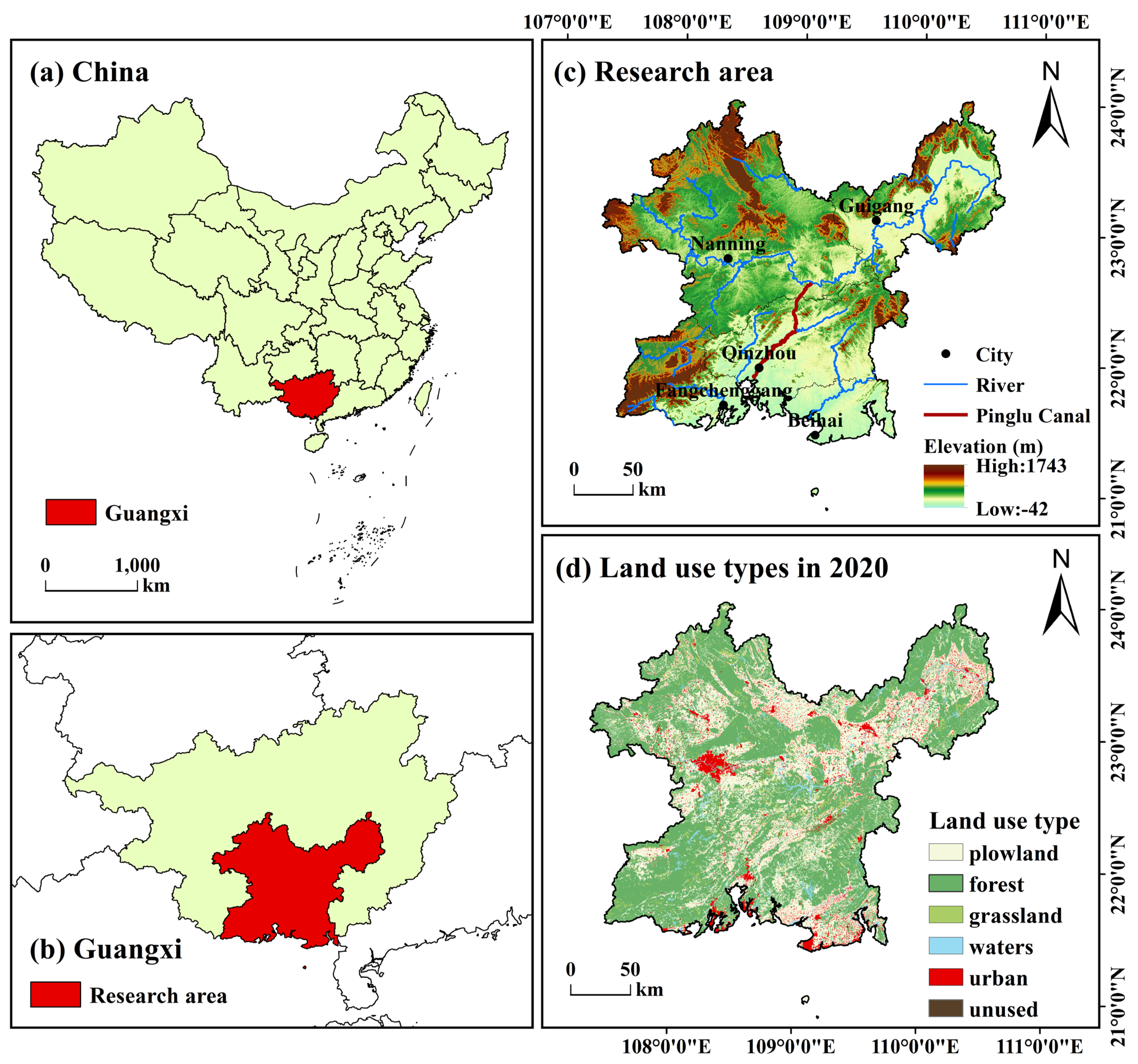
The Pinglu Canal spans 134.2 km and serves as a vital link between the Beibu Gulf Economic Zone and the Pearl River–Xijiang River Economic Belt [35,36]. The Pinglu Canal Economic Zone is located in southern Guangxi Zhuang Autonomous Region (20°00′–24°03′ N, 107°19′–110°39′ E). It comprises five prefecture-level cities along the canal: Nanning, Qinzhou, Beihai, Fangchenggang, and Guigang, which together include 29 counties or districts (Figure 1). According to the Master Plan of the Pinglu Canal Economic Zone, the region covers a total area of approximately 53,000 km2, with a resident population of about 20 million. Its gross regional product reaches 1059.06 billion yuan, accounting for 42.8% of the total gross domestic product of Guangxi. The Economic Zone is characterized by a typical subtropical monsoon climate, with abundant precipitation and a dense river network [37]. It also contains significant ecological barriers, such as the Shiwandashan and Liuwandashan mountain ranges.
Based on the 2020 land use data, forest land and cropland were the dominant land use types in the Pinglu Canal Economic Zone. Among these, cropland accounted for the largest proportion, while unused land covered the smallest area. According to land use changes in the Pinglu Canal Economic Zone from 2000 to 2020, the two most significantly changing land use types were cropland and urban land. The area of cropland decreased annually, while urban land expanded continuously due to rapid socio-economic development [38].

2.2. Data Sources

The data used in this study comprised remote sensing products and socioeconomic statistics. The remote sensing data included land use, DEM, NDVI, habitat quality, NEP, and nighttime light datasets (Table 1). Socioeconomic data were derived from the Master Plan of the Pinglu Canal Economic Zone, municipal statistical yearbooks of cities along the canal, and the Guangxi Statistical Yearbook. The land use data of the study area were reclassified into six major categories—cropland, grassland, forest land, water body, construction land, and unused land. These data were used to calculate the comprehensive land use degree index and the ecosystem resilience coefficient, and to assess ecosystem services. Landscape pattern indices were computed using FRAGSTATS 4.2 software and GIS tools to analyze ecosystem organization. All source data underwent preprocessing in ArcGIS 10.8, which included unifying the coordinate system (WGS_1984_UTM_Zone_49N), converting units, resampling, mask clipping, and normalization. All raster data were resampled to a consistent 30-m resolution to mitigate potential errors arising from resolution discrepancies.

2.3. Methodology

2.3.1. EHA Framework

Based on an understanding of the ecosystem characteristics and land use patterns in the Pinglu Canal Economic Zone, and following the principles of scientific validity, representativeness, and practicality, a comprehensive ecosystem health assessment index system was constructed. The system comprises nine indicators selected across five dimensions: vigor, organization, resilience, services, and human disturbance (Table 2). Among these, ecosystem vigor, organization, and resilience reflect the internal characteristics of the ecosystem itself, ecosystem services serve as a manifestation of EH, and human disturbance represents the external pressures currently faced by the ecosystem.
(1)
Ecosystem vigor
Ecosystem vigor (V) reflects the primary productivity and metabolic capacity of an ecosystem [26]. It is characterized by habitat quality and the NDVI. The NDVI index effectively reflects regional vegetation coverage and its dynamics. Areas with higher NDVI values generally indicate better vegetation cover, which supports ecosystem functions such as soil and water conservation, habitat provision, and food supply. Habitat quality refers to the essential living conditions that habitats provide for species. The level of habitat quality directly influences species diversity and biological community structure, thereby significantly affecting the vigor and health of ecosystems. Habitat quality was assessed using the InVEST model, while NDVI values were obtained from the MOD13Q1-NDVI data product. The V was calculated as follows:
Q x j = H j × ( 1 D x j z D x j z + K z )
V = N D V I + Q
In the equation, Q x j denotes the habitat quality for land use type j under disturbance, ranging from 0 to 1. Higher values signify better quality and greater species suitability. H j denotes the habitat suitability of land use type j , and K is the half-saturation parameter. V represents the ecosystem vigor value.
(2)
Ecosystem organization
Ecosystem organization (O) reflects the structural stability of an ecosystem, which is determined by landscape heterogeneity and landscape connectivity [39]. This study selected three landscape indices to characterize organization from the aspects of landscape heterogeneity and connectivity: SHDI, CONTAG, and COHESION. High SHDI values indicate greater species diversity and higher landscape heterogeneity. High CONTAG values reflect good connectivity of a dominant patch type within the landscape, meaning higher contagion corresponds to better landscape connectivity. COHESION represents the aggregation degree of a specific patch type, with higher COHESION values indicating better landscape connectivity. These indices collectively assess the spatial structure, diversity, and connectivity of regional ecosystems, forming an essential foundation for effective landscape management and biodiversity conservation. Based on the moving window method (implemented in FRAGSTATS 4.2), spatial distribution maps of the three indices were generated. Ecosystem organization was then calculated and measured based on these results. The formula for O is as follows:
O i = S H D I i + C O H E S I O N i + C O N T A G i
where O i represents the ecosystem organization in year i , S H D I i denotes the Shannon’s Diversity Index in year i , C O H E S I O N i indicates the Patch Cohesion Index in year i , and C O N T A G i represents the Contagion Index in year i .
(3)
Ecosystem resilience
Ecosystem resilience (R) refers to the capacity of an ecosystem to maintain or return to a healthy and stable state through self-regulation under disturbances and stresses from both natural and anthropogenic factors [40]. Based on previous studies, ecosystem resilience is characterized and calculated using the resilience coefficients of different land use and land cover types and NEP. Resilience coefficients for various land use types (cropland 0.5, forest 0.9, grassland 0.7, water 0.95, urban 0.4, others 0.1) were derived from the elasticity assignment method [41]. The R was calculated using the following formulas:
R C i = j = 1 n A j × C j
N E P = N P P R H
R i = R C i + N E P i
where R C i represents the ecosystem resilience coefficient in year i , where A j is the area proportion and C is the resilience coefficient for land use type j . NPP represents the total carbon fixed by the ecosystem through photosynthesis. R H represents heterotrophic respiration, which is the total carbon released through respiration by non-photosynthetic organisms (such as decomposers and microorganisms) in the ecosystem. N E P i represents the Net Ecosystem Productivity value for a specific grid cell in year i , and R i denotes the ecosystem resilience in year i .
(4)
Ecosystem service
Ecosystem services (S) refer to the capacity of ecosystems to provide goods and services to human society, including provisioning, supporting, regulating, and cultural services. Ecosystem service value represents the total value humans derive from ecosystems. Generally, a higher regional ecosystem service value indicates a stronger service capacity. Based on the equivalent factor method, this study utilized the Chinese ESV equivalent coefficient table proposed by Xie Gaodi et al. [42], defining the economic value represented by one standard ESV equivalent as one-seventh of the grain output per unit area, and calculated the ESV coefficients for the study area (Table 3). Based on the actual cropping patterns in the Pinglu Canal Economic Zone, rice, maize, and sugarcane were selected as the main crops in the study area. In combination with the land-use-based ecosystem service valuation approach introduced by Costanza et al. [43], the ecosystem service value of the Pinglu Canal Economic Zone was estimated using the following formula. The specific calculation formulas are as follows:
E S V = α × E a × S
E a = 1 7 i = 1 n m i p i q i M
In these formulas, α represents the ecosystem equivalent factor. S denotes the total area of the six land use types (ha). E a indicates the total economic value of food production services provided by the ecosystem per unit area (CNY·ha−1). The subscript i represents the main crop types in the area. p i is the national average price of the i -th crop in the study year (CNY·t−1). q i represents the yield per unit area of the i -th crop (t·ha−1). m i is the planting area of the i -th crop (ha). M stands for the total planting area of all crops (ha).
(5)
Human disturbance
Human disturbance (H) index reflects the intensity of interference and impact from human socio-economic activities on ecosystems. Lower human disturbance generally corresponds to better EH [44]. This study employed two indicators to calculate the human disturbance index: the comprehensive land use degree index and the nighttime light index. The comprehensive degree of land use reflects the scope and intensity of human land utilization over time, representing the collective impact of human activities on the natural environment. The specific calculation formulas are as follows [45]:
L a = 100 × i = 1 4 A i × C i
where L a is the comprehensive land use degree index, with a value range from 100 to 400. A i is the assigned grade index for the i -th land use degree class (Table 4). C i is the area percentage of the i-th land use degree class.
Total and average nighttime light intensity serve as indicators for the spatial distribution and intensity of regional socio-economic activities [46]. The specific calculation formulas are as follows:
T N L I = i = 1 n D N i
A N L I = T N L I n
where D N i denotes the digital number of the i -th pixel in the region, derived from nighttime light data processed using ArcGIS 10.8 software. n is the total number of pixels in the region. T N L I represents the total nighttime light index of the region, and A N L I denotes the average nighttime light index of the region.
Integrating both the comprehensive land use degree index and the average nighttime light index for the Pinglu Canal Economic Zone, the human disturbance index was calculated as:
H = L a + A N L I
where H is the human disturbance index, L a is the comprehensive land use degree index, and A N L I is the average nighttime light index.

2.3.2. Ecosystem Health Index

This study developed an EHA framework for the Pinglu Canal Economic Zone based on five dimensions: V, O, R, S, and H [25]. As these indicators are all key components of ecosystem health evaluation, they were assigned equal weights. Given the differences in indicator types and measurement units within the evaluation system, all indicators were normalized using the range standardization method, which transforms the original data into dimensionless values ranging between 0 and 1 [47]. A multiplicative model was then applied. To prevent the product of the five normalized values from becoming excessively small and thereby reducing discernible differences between results, the fifth root of the product was taken. The specific calculation formula is as follows.
E H I = V × O × R × S × H 5
In this formula, E H I represents the Ecosystem Health Index, V represents ecosystem vigor, O represents ecosystem organization, R represents ecosystem resilience, S represents ecosystem services, and H represents human disturbance.
As there is no universally accepted standard for classifying EH levels, this study employed the natural breaks method based on previous research to categorize the EH of the Pinglu Canal Economic Zone into five grades: Poor [0–0.44), Unhealthy [0.44–0.56), Sub-healthy [0.56–0.65), Relatively healthy [0.65–0.78), and Healthy [0.78–1].

2.3.3. Ecosystem Health Trends

The trends of EH were assessed using the Theil–Sen median trend analysis, with the following calculation formula [48]:
β = M e d i a n y j y i j i ,   j > i
In this formula, Median represents the median operator, and y j and y i denote the comprehensive EHI for year j and year i , respectively. A β value greater than 0 indicates an increasingly healthy trend for the ecosystem, a value less than 0 suggests a deteriorating trend, and a value equal to 0 implies no discernible trend.
To assess the statistical significance of the EH trends, the Mann–Kendall (MK) test was applied [49]. The MK test, suitable for detecting trends in long-term series data, calculates the statistic S as follows:
S = i = 1 n 1 j = i + 1 n s g n y j y i , j > i  
where s g n ( ) is the sign function, defined as:
s g n y j y i 1 , 0 1 , , y j y i > 0 y j y i = 0 y j y i < 0
Trend testing employs the sample statistic S , which is then standardized to yield the Z statistic as follows:
Z = S 1 V a r S S > 0 0 S = 0 S + 1 V a r S S < 0
The variance of S , V a r S , is calculated as:
V a r S = n n 1 2 n + 5 18
where n is the number of data points in the time series.
Trend significance was evaluated with a two-tailed test (α = 0.05). Significance was determined based on the |Z| statistic: |Z| > 1.96 for the 95% confidence level, and |Z| > 2.58 for the 99% level. All significance categories are detailed in Table 5.

2.3.4. Driving Factor Analysis

The XGBoost model is an efficient, gradient-boosted decision tree algorithm known for its high predictive accuracy and robustness against overfitting [50]. Its core principle involves iteratively constructing multiple regression trees, enabling the model to progressively approximate the true labels, while regularization techniques control model complexity to enhance generalization capability. The model’s prediction in the m -th iteration is the sum of outputs from the first m trees:
y ^ i ( m ) = k = 1 m f k x i               ( f k F )
The objective function combines training loss and a regularization term, formulated as:
L ( m ) = i = 1 N l   [ y i , y ^ i ( m 1 ) + f m ( x i ) ] + Ω ( f )
Ω ( f ) = γ T + 1 2 λ j = 1 T w j 2
In the equation, L ( m ) represents the loss function, y ^ i ( m 1 ) denotes the model’s predicted value from the ( m 1 ) -th iteration, Ω ( f ) is the regularization term introduced to control the complexity of the trees, T indicates the number of leaf nodes, w j refers to the weight of leaf node, and γ and λ are regularization parameters that govern the penalty intensity of the regularization term.
SHAP is a method rooted in cooperative game theory for interpreting predictions from machine learning models [51]. It serves as an interpretability tool by quantifying each input feature’s marginal contribution to the prediction. The primary calculation is given by:
i = S N { i } | S | ! ( | N | | S | 1 ) ! | N | !   [ f ( S { i } ) f ( S ) ]
where N denotes the complete feature set, S any subset excluding feature i , and | S | the cardinality of S , the terms f ( S ) and f ( S { i } ) measure the prediction contribution of subset S excluding and including feature i , respectively.
This study employs the XGBoost-SHAP model to examine the strength and direction of factors influencing EH in the Pinglu Canal Economic Zone. The dataset was divided in an 8:2 ratio for model training and testing. For hyperparameter optimization, a Bayesian optimization algorithm combined with three-fold cross-validation was used to efficiently identify the optimal parameter set, thereby enhancing the model’s generalization capability without compromising its stability. The model’s performance was evaluated by employing three metrics: the coefficient of determination (R2), mean squared error (MSE), and root mean squared error (RMSE).

3. Results

3.1. Spatiotemporal Evolution Analysis of V, O, R, S, and H

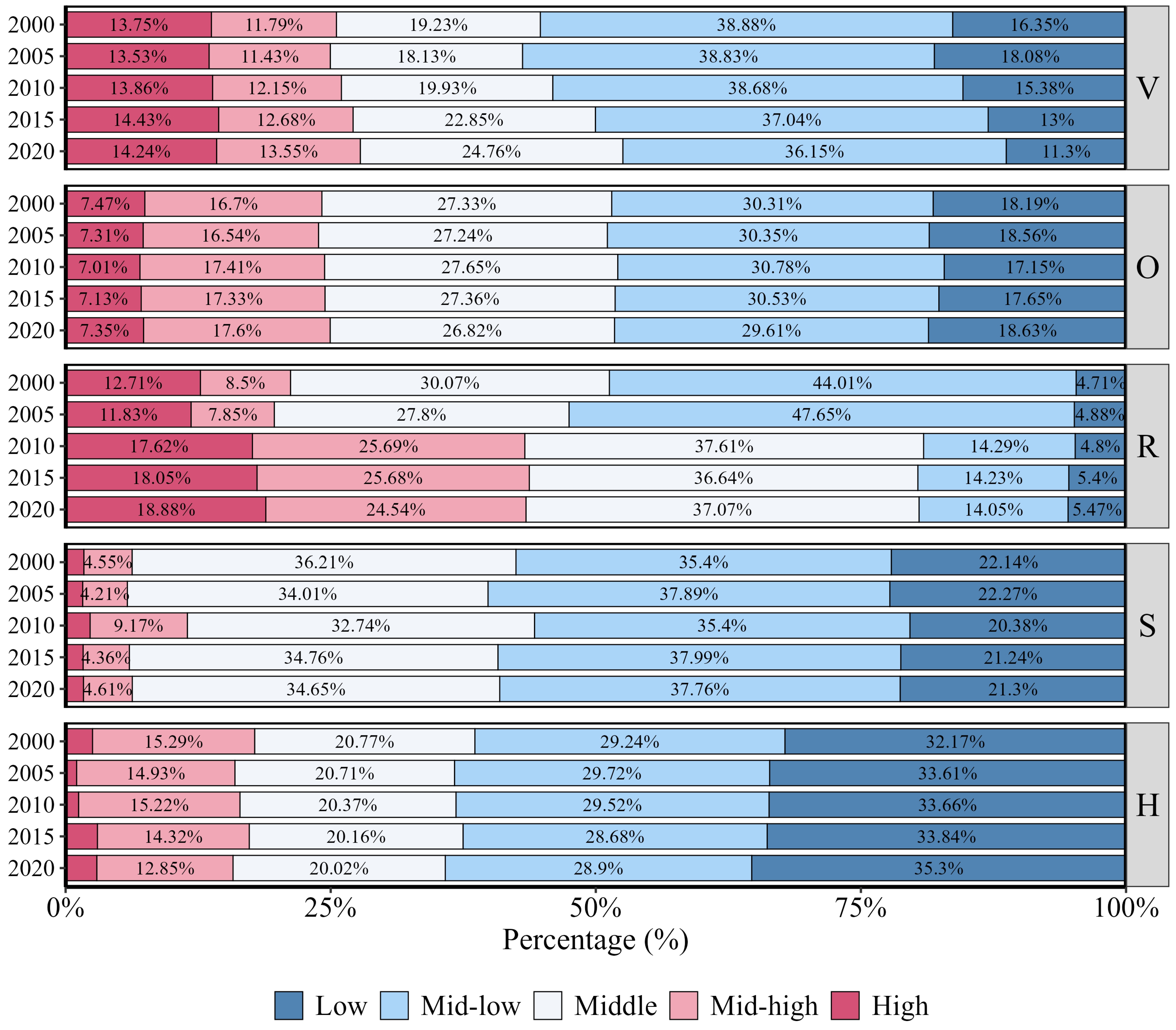
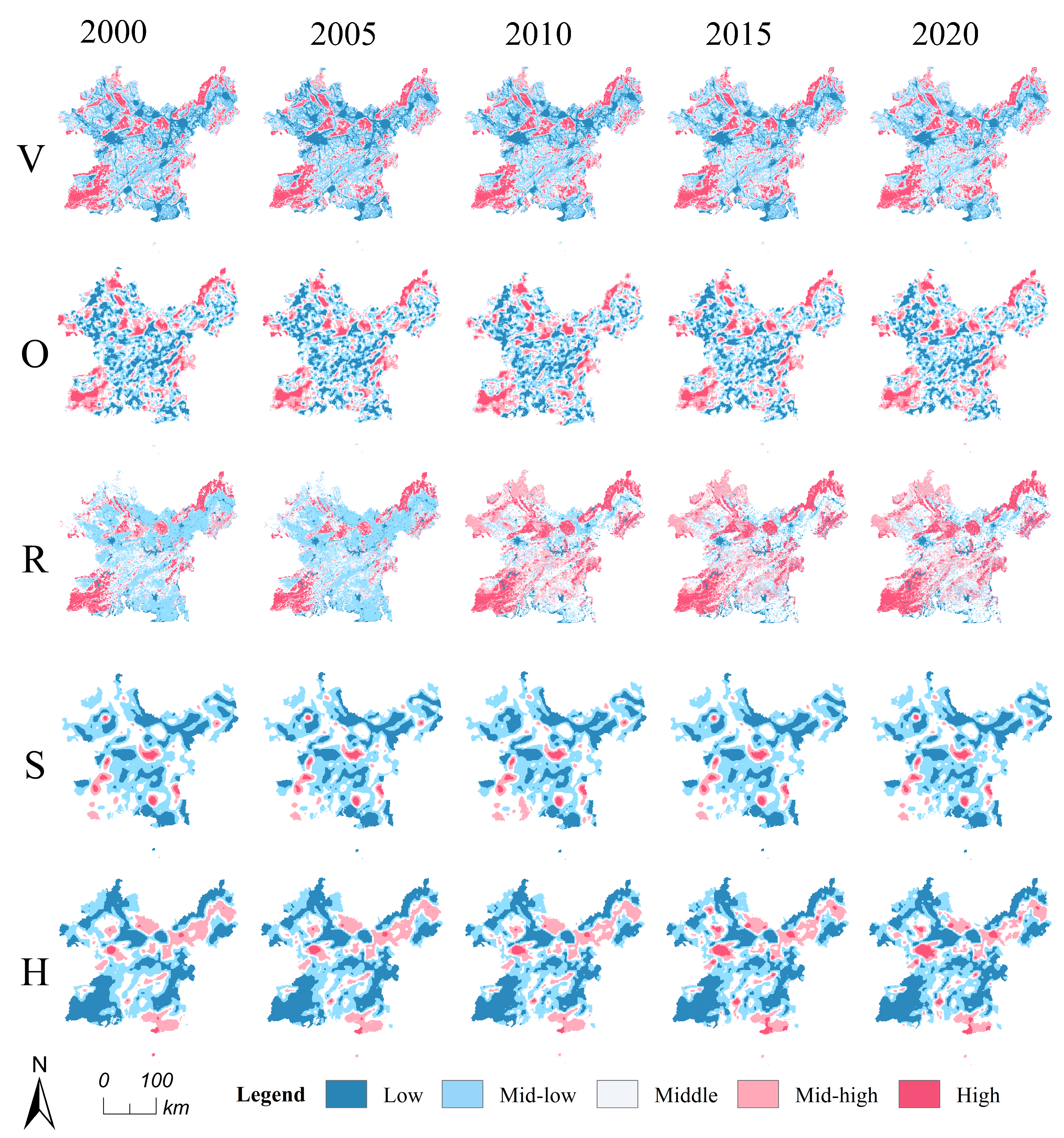
Temporal variation characteristics (Figure 2) show that from 2000 to 2020, the overall vigor exhibited an improving trend, with the proportion of low-grade areas decreasing by 5.05%, while the proportions of mid-high-grade and high-grade areas increased by 1.76% and 0.94%, respectively. Figure 2 indicates that areas with high V values were mainly concentrated in forest-covered regions rich in species diversity. Organization showed a slight overall declining trend, with relatively small inter-annual fluctuations in the proportions of each grade. During 2005–2010, resilience increased significantly, with an average annual growth rate of 17.02%. The proportions of the middle, mid-high, and high resilience grades increased by 6.17%, 16.06%, and 7.00%, respectively, indicating enhanced ecosystem resistance to external pressures and self-recovery capacity. In terms of spatial changes (Figure 3), areas with rising R values during the study period were widely distributed, primarily in forest and grassland-covered regions, while construction land, water, and coastal areas showed lower R values with little inter-annual variation. Ecosystem services remained at a relatively low level overall, with small proportions of mid-high and high grades, exhibiting a fluctuating downward trend. Human disturbance remained at a low level throughout the study period, with high proportions of low, mid-low, and middle grades. High H values radiated outward from major urban centers, and ecosystems in cropland and water bodies were significantly influenced by human activities. This explains why, while health improved in ecological project zones, health grades remained consistently low around urban areas and in agricultural and aquatic regions.

3.2. Spatiotemporal Dynamics of the EHI

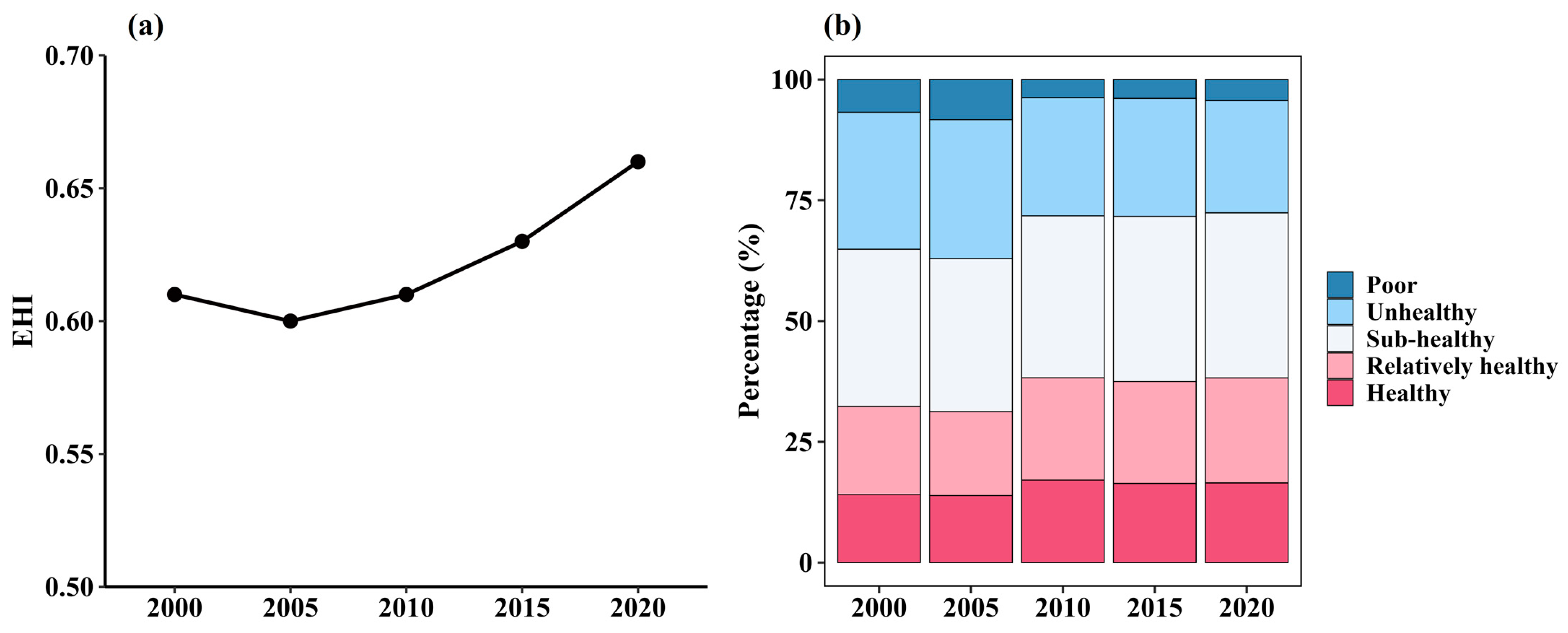
From 2000 to 2020, the average EHI of the Pinglu Canal Economic Zone increased from 0.61 to 0.66, representing a growth rate of 8.2%. The EH exhibited a positive developmental trend, characterized by the contraction of negative grades (poor and unhealthy) and the expansion of positive grades (healthy and relatively healthy) (Figure 4). In terms of annual variation (Figure 4b), the period 2000–2005 was a phase of EH decline. During this stage, the area proportions of the poor and unhealthy grades expanded, with growth rates of 22.71% and 1.45%, respectively. From 2005 to 2010, EH showed an improving trend. The areas of relatively healthy and healthy grades increased significantly, while the proportions of poor and unhealthy grades decreased. Regional resilience and vigor improved simultaneously during this period. The implementation of major ecological projects, such as converting cropland to forest and constructing shelterbelts, led to the notable improvement in this phase by effectively enhancing the ecosystem’s self-restoration capacity. After 2010, the EHI fluctuated within a high range of 0.63–0.66, and the structure of health grades tended to stabilize. This indicates that following the release of benefits from earlier ecological projects, the EH entered a new phase of dynamic equilibrium.
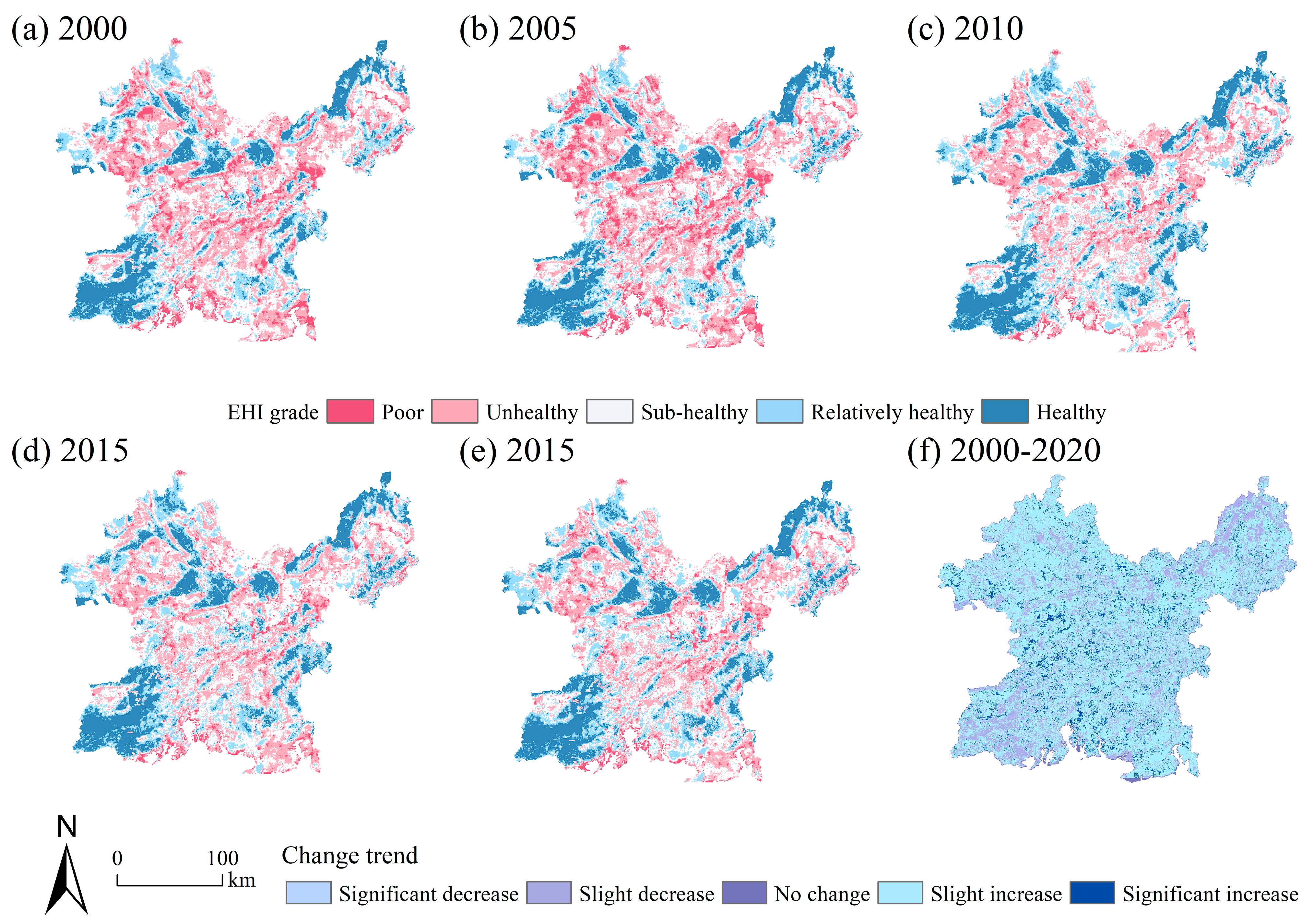
The EH of the Pinglu Canal Economic Zone exhibits significant spatial heterogeneity (Figure 5). Healthy and relatively healthy areas are primarily distributed in the southwestern, northern, and eastern mountainous regions, such as the contiguous forested areas of the Shiwandashan and Damingshan ranges. These regions feature high forest coverage and rich species diversity, providing strong vitality and resilience for the ecosystem. Unhealthy and poor areas are mainly located in the northwestern, central, and southeastern parts, radiating outward from central towns at the municipal and county levels and spreading along watershed axes. These zones are key areas for urban construction, agricultural cultivation, and industrial development and are significantly influenced by socio-economic activities. This spatial pattern reflects that environmental challenges in construction land, water bodies, and coastal areas within the Pinglu Canal Economic Zone are more pronounced than in forested mountainous regions. Regarding the change trends from 2000 to 2020 (Figure 5f), areas with significant EH improvement are mostly situated in mountainous zones and their surrounding buffer areas. Areas showing slight improvement are widely distributed, accounting for 68.27% of the total area. In contrast, degraded areas are predominantly characterized by slight degradation, are widely scattered, and are closely associated with land use types such as forest land, cropland, and newly expanded construction land. This indicates that accelerated urbanization and increased land demand have led to the gradual replacement of semi-natural and natural landscapes by human-dominated landscapes.

3.3. Driving Factors Analysis

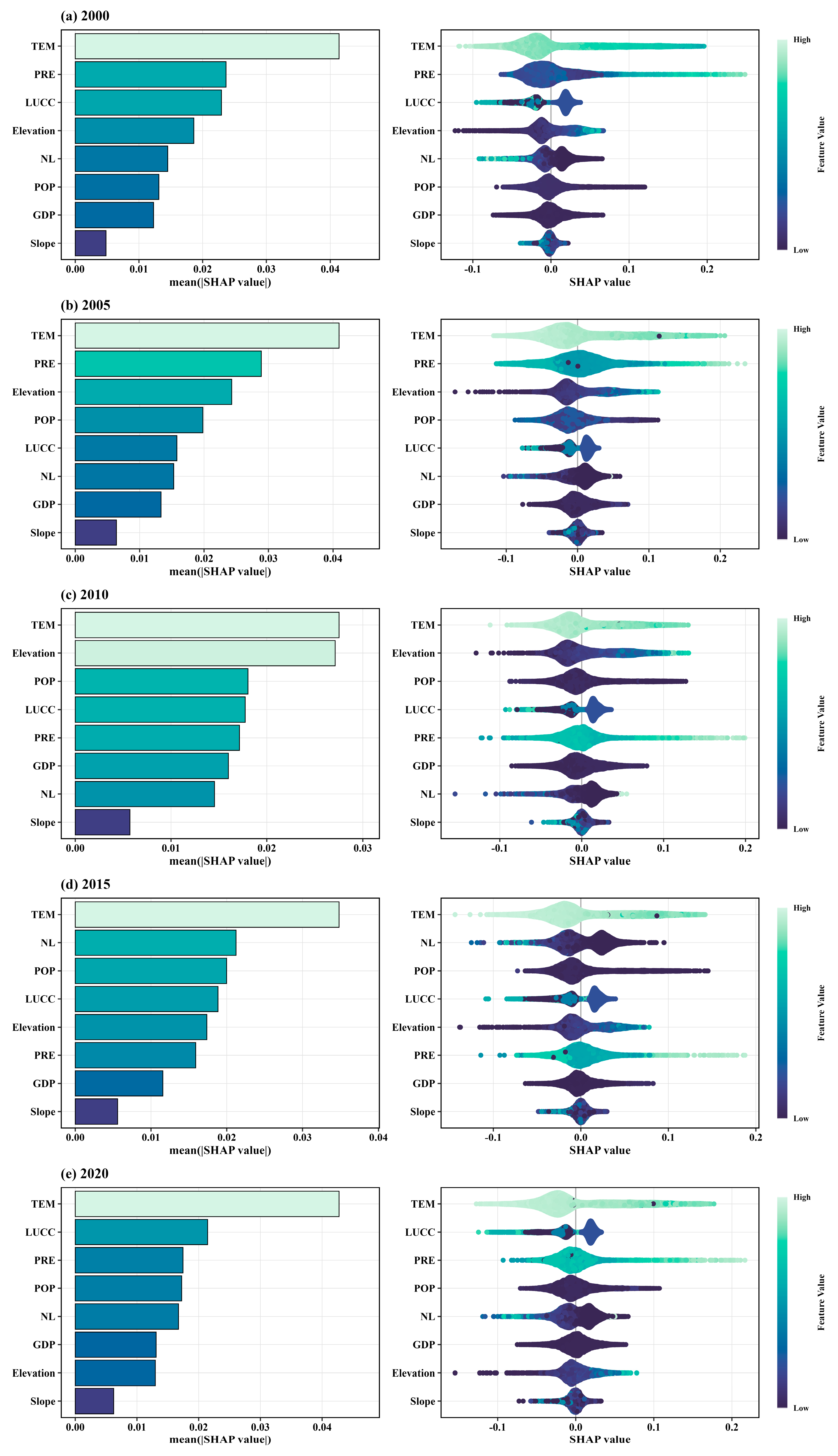
To further investigate the driving mechanisms of EH in the study area, eight influencing factors were selected for analysis. These factors include annual mean temperature (TEM), annual precipitation (PRE), elevation, slope, population density (POP), GDP, nighttime light intensity (NL), and land use and land cover (LUCC). Using the XGBoost-SHAP model, this study quantified how the impacts of these factors on EH varied from 2000 to 2020 (Figure 6). The results indicate that from 2000 to 2020, TEM consistently remained the primary factor influencing the EHI of the Pinglu Canal Economic Zone, while Slope exhibited the weakest influence, highlighting the critical role of temperature in regulating the regional ecological environment. SHAP dependence analysis further reveals that PRE and Elevation are positively correlated with EHI, meaning that areas with higher precipitation and elevation tend to have healthier regional ecosystems. In contrast, high values of TEM, NL, and Slope are predominantly distributed in regions with negative SHAP values, indicating a negative correlation with EHI. The analysis of LUCC shows that different land cover types have varying effects on EHI, among which forest land exerts a positive influence. Compared with 2000, the impact of socio-economic development factors and land use types on regional EH increased by 2020.
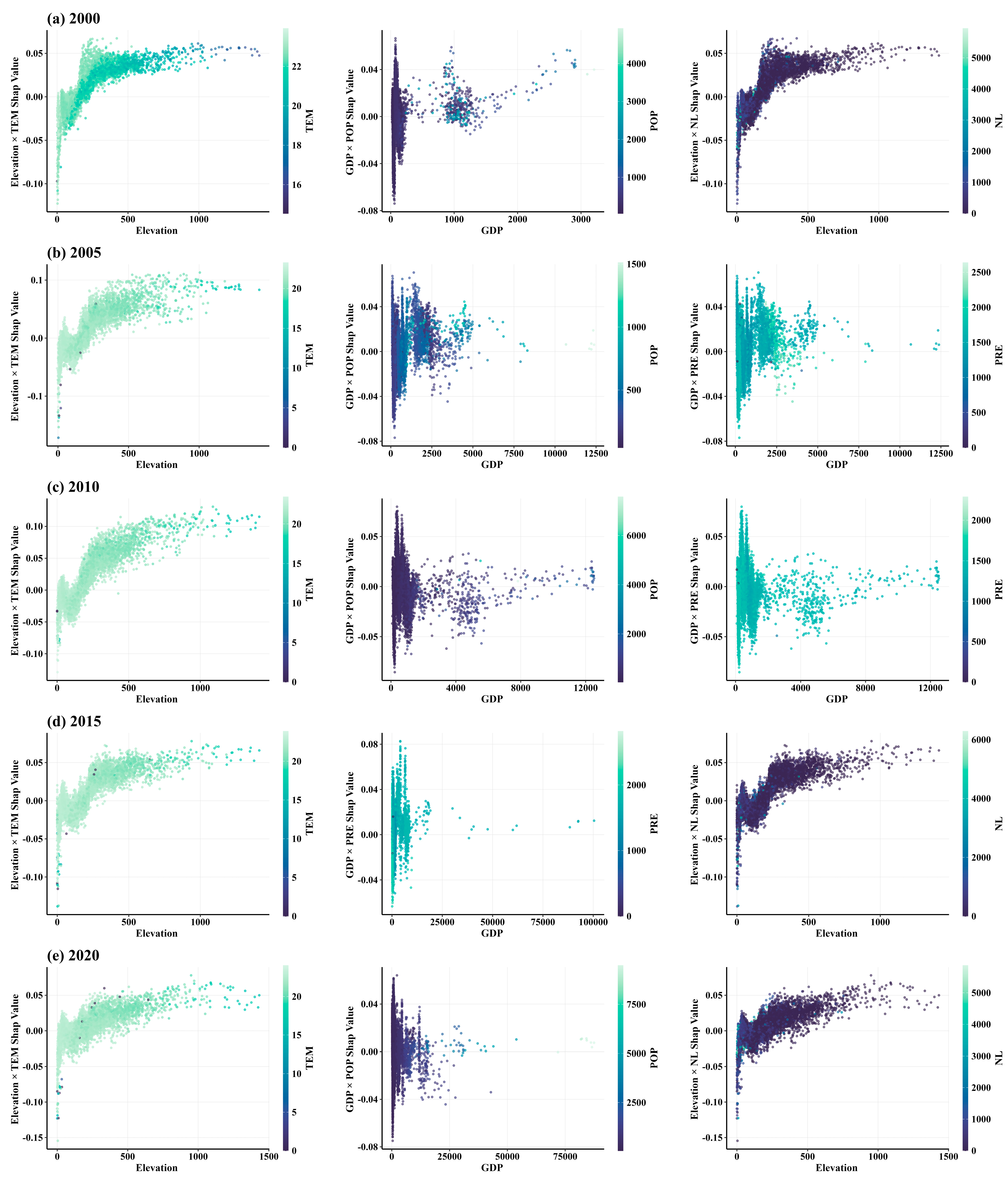
Changes in EH result from the combined effects of natural and anthropogenic factors. Figure 7 presents the top three interacting factor pairs in terms of importance for each year, including the combinations of Elevation and Tem, GDP and POP, Elevation and NL, and GDP and PRE. The results show significant differences in temporal dynamics and effect strength among these factor pairs. Over the 20-year period, the interaction between Elevation and Tem contributed the most, indicating that it is the primary factor influencing EHI and reflecting the long-term synergistic regulatory role of topographic and climatic factors on EH. Specifically, rising temperatures in low-elevation areas reduce the interactive contribution. The interaction between GDP and POP exhibits a dual nature. In economically underdeveloped regions, POP exerts both positive and negative effects on EHI. The interaction between GDP and PRE mainly demonstrates a moderately positive synergistic effect, meaning that in areas with higher levels of economic development, sufficient precipitation is more conducive to EHI improvement. The interaction between Elevation and NL indicates that ecological pressure induced by human activities is more pronounced in low-elevation areas.

4. Discussion

4.1. Spatiotemporal Analysis of Ecosystem Health in the Pinglu Canal Economic Zone

The EH in the study area exhibited a pattern of sharp decline from 2000 to 2005, followed by a subsequent increase. During 2000–2005, the V-O-R-S indicators and the EHI showed a declining trend, indicating degradation of the ecological environment. This temporal dynamic may be attributed to the fact that Guangxi’s long-term resource-dependent industrial structure and extensive economic growth model had not yet undergone fundamental transformation, coupled with weak ecological awareness and lagging development of environmental policies [52]. These findings are largely consistent with the conclusions reached by Dou et al. Such unrestricted resource exploitation led to the fragmentation of natural habitats, exacerbating landscape fragmentation and reducing diversity [53]. This unrestrained resource exploitation fragmented natural habitats, intensifying landscape fragmentation and reducing biodiversity. From 2005 to 2010, the V-R-S-H indicators and EHI in the study area showed a positive improving trend, with substantial reductions in areas classified as poor and unhealthy. The productivity of the ecosystem and its resistance to external disturbances significantly increased, enhancing its capacity to withstand pressures. This improvement may be attributed to the launch of the “11th Five-Year Plan” period, during which Guangxi responded to national initiatives by making the major decision to construct an “Ecological Guangxi”. This involved organizing and advancing a series of ecological construction projects across various ecological zones, including urban eco-environmental improvement projects, the Pearl River Basin and coastal shelterbelt system project, and offshore marine ecosystem protection projects [54]. These findings align with the conclusions of Zhang et al. [55]. Ecological construction connected isolated natural patches into continuous landscape units, significantly enhancing ecosystem resistance to extreme climate events and human disturbances, and optimizing ecosystem structure. After 2010, the health status of the ecosystem in the study area steadily improved, with the annual mean values of ecosystem organization and resilience reaching their highest levels in 2020. Environmental construction projects played a crucial role in maintaining regional EH, especially under the guidance of the “Two Mountains” theory and the new development philosophy, which emphasize the equal importance of ecological conservation and socio-economic development. Additionally, the rise in public ecological awareness, improvements in laws and regulations, and the maturity of ecological restoration projects provided further momentum for enhancing the EH level.
From a spatial perspective, regional EH exhibits a distribution pattern of higher levels in the southwest, north, and east, and lower levels in the northwest, central, and southeast parts of the study area. The Shiwandashan mountain range in the southwest, the interconnected Damingshan and Dayaoshan ranges in the north, and the Liuwandashan range in the east show high EH levels. These areas benefit from higher terrain, which reduces human disturbance, as well as large forest patches and complex vegetation community structures. Furthermore, forest ecosystems in these regions efficiently perform core service functions such as water conservation, carbon sequestration, and biodiversity protection, which contribute to supporting higher EH levels. This finding aligns with the ecological security protection zones identified by Dang et al. using the InVEST-circuit theory model [37]. The central and northeastern parts of the region comprise the Guangxi Basin, which includes alluvial plains such as the Central Guangxi Plain and the Yujiang–Xunjiang River Valley Plain. The flat terrain and fertile soil in this area provide inherent advantages for agricultural production and infrastructure development. However, intensive agricultural production and the expansion of township construction land have led to landscape fragmentation and artificialization, resulting in relatively low EH levels. Simultaneously, Qin et al. concluded in their analysis that this area exhibits severe conflicts between urban–ecological and agricultural–ecological functions [56]. The southern and southeastern parts of the study area, where EH levels are relatively low, correspond to the urban centers of Qinzhou and Beihai cities. The ecological environment in this area faces combined pressures from urban expansion and population concentration, as well as disturbances from coastal heavy industries and port construction. Additionally, the region is frequently affected by typhoons, where extreme wind and rain damage vegetation, leading to urban waterlogging and the spread of industrial pollution. Wen et al. noted that areas with low to moderate ecological function values in the Pinglu Canal Economic Zone are concentrated in urban cores and highly overlap with high-intensity development zones, which is largely consistent with the findings of this study [57].
However, as of 2020, the overall EH of the study area remained at a sub-healthy level, characterized by weak ecosystem organization, inadequate ecosystem services, and localized ecological degradation. These conditions persist under the long-term dual influence of protective effects from environmental policies and stress effects induced by human development. Spatial distribution patterns of EH indicate that the estuary section of the Pinglu Canal and key engineering nodes along its route, such as the Madao Junction, are currently located within areas exhibiting relatively poor EH. Existing research demonstrates that artificial canal construction inevitably compromises the continuity and integrity of natural landscapes along river basins, significantly impacting regional landscape patterns [58]. Consequently, future management strategies should prioritize the development of more targeted ecological conservation measures. These should integrate waterway dredging operations with the implementation of ecological revetment construction to prevent engineering activities from exacerbating regional ecological degradation.

4.2. Impact of Natural and Social Factors on Ecosystem Health

The dynamics of environmental conditions, socioeconomic development, and land use collectively and interactively influence regional EH, both directly and indirectly [59,60]. Furthermore, driving mechanisms typically involve complex nonlinear processes and interaction effects between natural and anthropogenic factors rather than single-factor influences. Results indicate that air temperature and topography were the primary factors affecting EH in the Pinglu Canal Economic Zone (Figure 6 and Figure 7). Temperature is a foundational environmental variable influencing the structure, functioning, and health state of ecosystems [61]. Located in a subtropical monsoon climate zone, the Pinglu Canal Economic Zone benefits from sufficient hydrothermal conditions that support regional vegetation growth. By constraining human activities and shaping landscape patterns, topography indirectly influences plant growth and ecosystem vigor, which in turn drives spatial heterogeneity in EH [62,63]. Among the six land cover types, forest land exerts a positive effect on EH. Moderate- to high-elevation areas are predominantly covered by forest land and exhibit relatively healthy environmental conditions. With increasing elevation, temperatures decrease and precipitation increases within a certain range, which favors the growth and maintenance of natural vegetation. The growth of natural vegetation enriches regional species diversity and enhances capacities for carbon sequestration, soil retention, and water conservation. Low-elevation areas, characterized by flat terrain, convenient transportation, and abundant water resources, have become core zones for population concentration and economic development. The urban heat island effect accelerates surface water evaporation, affecting plant growth and survival. With accelerating global warming, Guangxi is experiencing a sustained warming trend [64], leading to intensified soil moisture evaporation and imposing extreme thermal stress on local vegetation and urban green spaces. Simultaneously, in recent years, the accelerated urbanization process has progressively strengthened the influence of socio-economic development factors on ecosystem health. Intensive agricultural activities, expansion of construction land, and emissions from coastal petrochemical industries directly impact the health of ecosystems.

4.3. Implications and Recommendations for Ecological Conservation and Management

The assessment of ecological health status and its spatiotemporal dynamics is of paramount importance to both scientific inquiry and policy formulation. The maintenance of EH and sustainable development in the Pinglu Canal Economic Zone requires implementing multi-level ecological regulation measures and scientifically grounded, locally adapted zoning strategies. Derived from the preceding analysis, the following management recommendations aim to enhance EH conservation in the Pinglu Canal Economic Zone. In river basins and coastal areas with relatively low EH levels, ecological protection and restoration efforts should be actively conducted. This includes continuing to advance comprehensive pollution control around key rivers such as the Yongjiang and Qinjiang Rivers, and major reservoirs, including Xijin Reservoir, Hepu Reservoir, and Dawangtan Reservoir. Strengthening ecological risk prevention for coastal petrochemical industries is also crucial. Regions including the Nanning Basin, Wuming Basin, and Yujiang Plain exhibit relatively low EH levels. Dominated by construction land and cropland with sparse vegetation, these areas require a management strategy that controls construction expansion, enhances living environment governance, reduces agricultural non-point source pollution, and advances eco-agriculture development. In contrast, forested areas at higher elevations exhibit superior EH and abundant natural resources, where conservation and restoration efforts should be enhanced to maintain biodiversity and ensure ecological security. For future land use policies, priority should be given to protecting the ecologically sound mountainous and forested areas, and implementing afforestation projects effectively. In densely populated and rapidly developing areas, enhanced human regulation of the ecological environment is necessary. Local economic development should proceed in tandem with ecological protection efforts.

4.4. Limitations and Prospects

This study enhanced the conventional VOR framework by incorporating ecosystem services and human disturbance into the assessment indicator system, establishing a VORSH-based ecosystem health evaluation model. Through raster-scale analysis of the EH status and trends in the Pinglu Canal Economic Zone, it contributes to regional EH research. However, the study still has limitations. The indicator selection exhibits a degree of simplification, particularly regarding human disturbance variables, which were calculated based on land use intensity and nighttime light. Although this approach is useful, it may not fully capture critical disturbance processes. Additional factors such as industrial emissions, road density, and habitat fragmentation should also be considered. Therefore, future research could integrate more diverse evaluation indicators, as well as metrics that better reflect natural environmental conditions and engineering-induced disturbances, to achieve a more comprehensive assessment of EH.
This study relies on multi-source remote sensing datasets to quantify regional EH and its influencing factors. The uncertainty arising from mismatched spatial resolutions of the data inevitably introduces some degree of influence on the results. Therefore, it is recommended that future research adopt more advanced multi-scale spatiotemporal remote sensing data and employ finer-grained models and algorithms.
The condition of regional EH evolves in response to ecosystem dynamics, changes in human activities, and improvements in management and conservation strategies. Accordingly, future research could incorporate a comprehensive assessment of regional EH following the completion of the Pinglu Canal construction project, comparing changes in EH status before and after the canal’s development.

5. Conclusions

By employing an enhanced VORSH assessment framework and the XGBoost-SHAP model, and integrating multi-source data, this study analyzed the spatiotemporal evolution characteristics and driving factors of EH in the Pinglu Canal Economic Zone from 2000 to 2020. The main findings are as follows: (1) V, R, and S showed an improving trend, while O and H remained relatively stable. (2) The annual mean values of the comprehensive EHI in 2000, 2005, 2010, 2015, and 2020 were 0.61, 0.60, 0.61, 0.63, and 0.66, respectively. The EH remained at a sub-healthy level, exhibiting an initial decline followed by an overall upward trend. (3) Spatially, EH displayed heterogeneity, with lower levels in the northwest, central, and southeastern parts, and higher levels in the southwest, north, and east. Approximately 68.27% of the area experienced EH improvement. (4) Topographic and temperature factors were identified as the primary drivers of EH changes, while the influence of human activities on EH continued to intensify with social development.

Author Contributions

Conceptualization, Q.H., B.H. and Y.X.; Methodology, Q.H. and R.R.; Software, Q.H. and R.R.; Validation, Q.H. and R.R.; Formal analysis, Q.H.; Investigation, Q.H. and J.L.; Resources, Q.H.; Data curation, Q.H. and J.L.; Writing—original draft, Q.H. and R.R.; Writing—review & editing, Q.H., B.H. and Y.X.; Visualization, Q.H.; Supervision, B.H.; Project administration, Q.H.; Funding acquisition, B.H. All authors have read and agreed to the published version of the manuscript.

Funding

This research was funded by National Natural Science Foundation of China grant number 42571364; National Natural Science Foundation of China grant number 42071135; Guangxi Science and Technology Major Project grant number AA23062039-2; and Guangxi Science and Technology Major Project grant number AA24263011-3.

Data Availability Statement

The original contributions presented in the study are included in the article, further inquiries can be directed to the corresponding author.

Conflicts of Interest

The authors declare no conflict of interest.

Abbreviations

The following abbreviations are used in this manuscript:
EHIEcosystem Health Index
EHEcosystem Health
VEcosystem vigor
OEcosystem organization
REcosystem resilience
SEcosystem services
HHuman disturbance

References

  1. Costanza, R.; Norton, B.G.; Haskell, B.D. Ecosystem Health: New Goals for Environmental Management. In Ecosystem Health New Goals for Environmental Management; Island Press: Washington, DC, USA, 1992. [Google Scholar]
  2. Mallee, H. The Evolution of Health as an Ecological Concept. Curr. Opin. Environ. Sustain. 2017, 25, 28–32. [Google Scholar] [CrossRef]
  3. Ogwu, M.C.; Ojo, A.O.; Alaka, A.C. Biodiversity and Human Health: The Interconnections of Species Loss and Ecosystem Services. In Innovative Approaches in Environmental Health Management: Processes, Technologies, and Strategies for a Sustainable Future; Chibueze Izah, S., Chidozie Ogwu, M., Eds.; Springer Nature: Cham, Switzerland, 2025; pp. 113–141. [Google Scholar]
  4. Ramanathan, J. Global Warming and Climate Change. In Pathogens and Environmental Impact on Life Forms: Multi-faceted Pathogen Society Interactome; Sethuraman, R., Pandey, R., Eds.; Springer Nature: Cham, Switzerland, 2025; pp. 175–234. ISBN 978-3-031-80029-0. [Google Scholar]
  5. Habibullah, M.S.; Din, B.H.; Tan, S.-H.; Zahid, H. Impact of Climate Change on Biodiversity Loss: Global Evidence. Environ. Sci. Pollut. Res. 2022, 29, 1073–1086. [Google Scholar] [CrossRef] [PubMed]
  6. Deng, S.; Luo, M.; Wang, W.; Lan, S.; Xu, W.; Mai, X.; Zhang, W. Assessment of Biodiversity and Landscape Changes during the Pinglu Canal Construction and the Benefits of Ecological Restoration Based on Rao’s Q Index. Ecol. Eng. 2025, 219, 107709. [Google Scholar] [CrossRef]
  7. Cheng, Y.; Liu, J.; Xu, H.; Zhu, G. Impacts of Pinglu Canal Construction and Its Ecological Route Selection on Landscape Pattern and Suggestions on Environmental Protection. In Proceedings of the 3rd International Conference on Green Energy, Environment and Sustainable Development (GEESD2022), Beijing, China, 29–30 June 2022; IOS Press: Amsterdam, The Netherlands, 2022; pp. 616–627. [Google Scholar]
  8. Han, Z.; Yin, D.; Zhao, R.; Liu, Z.; Cheng, R.; Lin, G.; Jia, H. The Ecological Effect of Ship Canals on Wetlands. Water 2024, 16, 3324. [Google Scholar] [CrossRef]
  9. Xie, Y.; Zhang, Y.; Luo, J.; Bi, L.; Tong, K. Spatiotemporal Heterogeneity and Influencing Factors of Human Activity Intensity in the Guangxi Beibu Gulf Zone, China. Environ. Sustain. Indic. 2024, 22, 100372. [Google Scholar] [CrossRef]
  10. Guo, Y.; Yang, L.; Wang, L.; Li, H.; Ge, Q. Assessment of Ecological Civilization Construction from the Perspective of Environment and Health in China. Eco-Environ. Health 2024, 3, 281–289. [Google Scholar] [CrossRef]
  11. Lei, J.; Li, C.; Yang, W. Ecosystem Health Assessment and Approaches to Improve Sichuan Province Based on an Improved Vigor Organization Resilience Model. Ecol. Indic. 2023, 155, 110925. [Google Scholar] [CrossRef]
  12. Du, W.; Tong, S.; Zhang, M.; Xin, Y.; Zhang, D.; Xing, X.; An, Y.; Cui, G.; Liu, G. Revealing the Spatiotemporal Dynamics and Nonlinear Interaction-Driven Mechanisms of Wetland Ecosystem Health in Northeast China Using Interpretable Machine Learning. Ecol. Indic. 2025, 178, 113878. [Google Scholar] [CrossRef]
  13. Zihui, L.; Kangwen, Z.; Yong, B.; Ya, Z.; Wantao, Y.; Jie, W.; Weizhi, C.; Chunfeng, D.; Kun, Q.; Kaixuan, Z. Rigidity and Resilience Framework-Based Health Diagnosis of Mountain Forest Ecosystems: A Case Study of Yiliang County in Yunnan Province. J. Clean. Prod. 2025, 507, 145569. [Google Scholar] [CrossRef]
  14. Zhou, X.; Liu, G.; Wu, Y.; Wang, G.; Xu, Y.; Liu, T. XGBoost-SHAP Based Multi-Scale Evaluation and Nonlinear Response of River Health in Guangdong Province. Ecol. Indic. 2025, 178, 114138. [Google Scholar] [CrossRef]
  15. Xu, K.; Fan, Y.; Hou, Y.; Ma, S.; Wang, J.; Wang, S. Uncovering the Impact Mechanism and Spatiotemporal Evolution between Farmland Ecosystem Health and Optimal Crop Patterns. J. Clean. Prod. 2025, 494, 144959. [Google Scholar] [CrossRef]
  16. Pang, D.; Zhao, M.; Hu, Y.; Cai, L.; Liu, X.; Zhao, W. Ecosystem Health Assessment and Driver Analysis in the Otindag Sandy Land, China. Ecol. Front. 2025, 45, 1397–1406. [Google Scholar] [CrossRef]
  17. Wang, Y.; Xue, H.; Li, A.; Ma, X.; Sun, A.; Zhang, J. Spatial-Temporal Differentiation and Influencing Factors of Ecosystem Health in Three-River-Source National Park. Ecol. Indic. 2025, 171, 113183. [Google Scholar] [CrossRef]
  18. Zhao, Z.; Wei, F.; Wu, H.; Yang, M.; Jin, X.; Wang, P.; Wang, Q. A Framework to Comprehensively Assess Lake Health from a Perspective of Ecosystem Integrity and Services. Ecol. Indic. 2025, 171, 113169. [Google Scholar] [CrossRef]
  19. Chen, Y.; Yu, X.; Xu, D.; Peng, J. A Spatial Machine Learning Approach to Exploring the Impacts of Coal Mining and Ecological Restoration on Regional Ecosystem Health. Environ. Res. 2025, 264, 120379. [Google Scholar] [CrossRef] [PubMed]
  20. Wu, K.; Han, L. Assessing Urban Ecosystem Health Using Emergy and Set Pair Analysis: A Comparative Study of Typical Chinese Cities. Ecol. Indic. 2025, 178, 114102. [Google Scholar] [CrossRef]
  21. Zhao, C.; Shao, N.; Yang, S.; Ren, H.; Ge, Y.; Zhang, Z.; Zhao, Y.; Yin, X. Integrated Assessment of Ecosystem Health Using Multiple Indicator Species. Ecol. Eng. 2019, 130, 157–168. [Google Scholar] [CrossRef]
  22. Costanza, R. Ecosystem Health and Ecological Engineering. Ecol. Eng. 2012, 45, 24–29. [Google Scholar] [CrossRef]
  23. Khatun, R.; Das, S. Assessment of Wetland Ecosystem Health in Rarh Region, India through P-S-R (Pressure-State-Response) Model. Sci. Total Environ. 2024, 951, 175700. [Google Scholar] [CrossRef]
  24. Sahana, M.; Saini, M.; Areendran, G.; Imdad, K.; Sarma, K.; Sajjad, H. Assessing Wetland Ecosystem Health in Sundarban Biosphere Reserve Using Pressure-State-Response Model and Geospatial Techniques. Remote Sens. Appl. Soc. Environ. 2022, 26, 100754. [Google Scholar] [CrossRef]
  25. Liu, L.; Li, J.; Wang, J.; Liu, F.; Cole, J.; Sha, J.; Jiao, Y.; Zhou, J. The Establishment of an Eco-Environmental Evaluation Model for Southwest China and Eastern South Africa Based on the DPSIR Framework. Ecol. Indic. 2022, 145, 109687. [Google Scholar] [CrossRef]
  26. Rapport, D.J. What Constitutes Ecosystem Health? Perspect. Biol. Med. 1989, 33, 120–132. [Google Scholar] [CrossRef]
  27. Lin, X.; Wang, Z.; Bao, Y. Integrating Ecosystem Stress into the Assessment of Ecosystem Health in Karst Areas and Exploring Its Driving Factors. Ecol. Indic. 2024, 167, 112662. [Google Scholar] [CrossRef]
  28. Das, M.; Das, A.; Mandal, A. Research Note: Ecosystem Health (EH) Assessment of a Rapidly Urbanizing Metropolitan City Region of Eastern India—A Study on Kolkata Metropolitan Area. Landsc. Urban Plan. 2020, 204, 103938. [Google Scholar] [CrossRef]
  29. Han, P.; Hu, H.; Zhou, J.; Wang, M.; Zhou, Z. Integrating Key Ecosystem Services to Study the Spatio-Temporal Dynamics and Determinants of Ecosystem Health in Wuhan’s Central Urban Area. Ecol. Indic. 2024, 166, 112352. [Google Scholar] [CrossRef]
  30. Daily, G.C. Nature’s Services: Societal Dependence on Natural Ecosystems (1997). In The Future of Nature: Documents of Global Change; Robin, L., Sörlin, S., Warde, P., Eds.; Yale University Press: New Haven, CT, USA, 2013; pp. 454–464. ISBN 978-0-300-18847-9. [Google Scholar]
  31. Zang, C.; Liu, J.; Wang, X.; Liu, Q.; Zhang, X. Evaluating Water Ecological Health in Dam-Impacted River: A New Approach Framework. Ecol. Indic. 2024, 161, 111998. [Google Scholar] [CrossRef]
  32. Xiao, Z.; Liu, R.; Gao, Y.; Yang, Q.; Chen, J. Spatiotemporal Variation Characteristics of Ecosystem Health and Its Driving Mechanism in the Mountains of Southwest China. J. Clean. Prod. 2022, 345, 131138. [Google Scholar] [CrossRef]
  33. Liu, B.; Ding, M.; Shaham, S.; Rahayu, W.; Farokhi, F.; Lin, Z. When Machine Learning Meets Privacy: A Survey and Outlook. ACM Comput. Surv. 2021, 54, 31. [Google Scholar] [CrossRef]
  34. Zhou, B.; Chen, G.; Yu, H.; Zhao, J.; Yin, Y. Revealing the Nonlinear Impact of Human Activities and Climate Change on Ecosystem Services in the Karst Region of Southeastern Yunnan Using the XGBoost–SHAP Model. Forests 2024, 15, 1420. [Google Scholar] [CrossRef]
  35. Liu, X.; Liu, Y.; Wang, S.; Dong, G. New Canal Construction and Marine Emissions Strategy: A Case of Pinglu. Front. Mar. Sci. 2024, 10, 1303879. [Google Scholar] [CrossRef]
  36. Yin, N.; Qiao, R.; Liang, Z.; Lu, W.; Liu, L.; Ji, J.; Zhong, R.; Yang, F.; Li, J. Identification of Spatial Pathways for Aquatic Ecological Risk Spread under Multi-Stressor Synergies: A Case Study of the Pinglu Canal. Ecol. Indic. 2025, 178, 113915. [Google Scholar] [CrossRef]
  37. Dang, Z.; Hu, B.; Gao, C.; Wen, S.; Ren, J.; Liang, Y. Construction and Optimization of the Ecological Security Pattern of Pinglu Canal Economic Zone Based on the InVEST-Circuit Theory Model. Land 2025, 14, 1103. [Google Scholar] [CrossRef]
  38. Wen, S.; Hu, B.; Xie, W.; Gao, C. Land Use Scenario Simulation and Habitat Quality Change in Pinglu River Economic Belt Based on PLUS-InVEST Model. Environ. Sci. 2025, 46, 5122–5133. [Google Scholar] [CrossRef]
  39. Peng, J.; Liu, Y.; Wu, J.; Lv, H.; Hu, X. Linking Ecosystem Services and Landscape Patterns to Assess Urban Ecosystem Health: A Case Study in Shenzhen City, China. Landsc. Urban Plan. 2015, 143, 56–68. [Google Scholar] [CrossRef]
  40. Colding, J. ‘Ecological Land-Use Complementation’ for Building Resilience in Urban Ecosystems. Landsc. Urban Plan. 2007, 81, 46–55. [Google Scholar] [CrossRef]
  41. Li, F.; Zhou, W.; Shao, Z.; Zhou, X.; Fu, X. Landscape Pattern Changes and Ecosystem Health Assessment in the Western Qinling Mountains from 2000 to 2018. Acta Ecol. Sin. 2023, 43, 1338–1352. [Google Scholar] [CrossRef]
  42. Xie, G.; Zhang, C.; Zhen, L.; Zhang, L. Dynamic Changes in the Value of China’s Ecosystem Services. Ecosyst. Serv. 2017, 26, 146–154. [Google Scholar] [CrossRef]
  43. Costanza, R.; d’Arge, R.; de Groot, R.; Farber, S.; Grasso, M.; Hannon, B.; Limburg, K.; Naeem, S.; O’Neill, R.V.; Paruelo, J.; et al. The Value of the World’s Ecosystem Services and Natural Capital. Ecol. Econ. 1998, 25, 3–15. [Google Scholar] [CrossRef]
  44. Zhao, L.; Fan, X.; Xiao, S. Remote-Sensing Indicators and Methods for Coastal-Ecosystem Health Assessment: A Review of Progress, Challenges, and Future Directions. Water 2025, 17, 1971. [Google Scholar] [CrossRef]
  45. Zhuang Dafang, L.J. Study on the Model of Regional Differentiationof Land Use Degree in China. J. Nat. Resour. 1997, 12, 105–111. [Google Scholar] [CrossRef]
  46. Saad, R.; Portnov, B.A. Investigating the Relationship Between Nighttime Light Emissions and Economic Growth in European NUTS-3 Regions, 2001–2021. Sustainability 2025, 17, 10287. [Google Scholar] [CrossRef]
  47. Ye, D.; Yang, L.; Zhou, M. Spatiotemporal Variation in Ecosystem Health and Its Driving Factors in Guizhou Province. Land 2023, 12, 1439. [Google Scholar] [CrossRef]
  48. Lu, D.; Xu, J.; Yue, W.; Mao, W.; Yang, D.; Wang, J. Response of PM2.5 Pollution to Land Use in China. J. Clean. Prod. 2020, 244, 118741. [Google Scholar] [CrossRef]
  49. Sen, P.K. Estimates of the Regression Coefficient Based on Kendall’s Tau. J. Am. Stat. Assoc. 1968, 63, 1379–1389. [Google Scholar] [CrossRef]
  50. Chen, T.; Guestrin, C. XGBoost: A Scalable Tree Boosting System. In Proceedings of the 22nd ACM SIGKDD International Conference on Knowledge Discovery and Data Mining, San Francisco, CA, USA, 13–17 August 2016; pp. 785–794. [Google Scholar] [CrossRef]
  51. Lundberg, S.; Lee, S.-I. A Unified Approach to Interpreting Model Predictions. Adv. Neural Inf. Process. Syst. 2017, 51, 4768–4777. [Google Scholar]
  52. Yang, Y.; Chen, J.; Lan, Y.; Zhou, G.; You, H.; Han, X.; Wang, Y.; Shi, X. Landscape Pattern and Ecological Risk Assessment in Guangxi Based on Land Use Change. Int. J. Environ. Res. Public Health 2022, 19, 1595. [Google Scholar] [CrossRef]
  53. Dou, S.; Zhang, N.; Liu, D.; Jing, J.; Xu, Y.; Gao, H. Exploration of Spatiotemporal Changes of Ecosystem Health in Guangxi BeibuGulf Economic Zone by Coupling of VOR and InVEST Models. Guangxi Sci. 2024, 31, 581–592. [Google Scholar] [CrossRef]
  54. Hu, Y.; Batunacun; Zhen, L.; Zhuang, D. Assessment of Land-Use and Land-Cover Change in Guangxi, China. Sci. Rep. 2019, 9, 2189. [Google Scholar] [CrossRef]
  55. Zhang, N.; Dou, S.; Xu, Y.; Jing, J.; Zhang, H. Temporalspatial Changes of Ecosystem Health in Guangxi in the Past 14 Years. J. Guilin Univ. Technol. 2021, 41, 370–378. [Google Scholar]
  56. Qin, X.; Liu, S.; Ye, Z.; Deng, Y.; Huang, Y. Multifunctional Conflict Identification and Zoning Regulation in Territorial Space of Pinglu Canal Economic Belt. Res. Soil Water Conserv. 2026, 33, 317–329+350. [Google Scholar] [CrossRef]
  57. Wen, S.; Hu, B.; Bao, T.; Xie, W.; Lao, Y.; Gao, J. Research on the Synergistic Path of Optimisation of Territorial Spatial Functions and Carbon Emissions Reduction: Analysis of Decoupling Effect Based on Pinglu Canal Economic Belt. Ecol. Environ. Sci. 2025, 1–17. [Google Scholar]
  58. Wang, Z.; Cai, Q.; Zhao, B.; Xu, Y.; Tang, T. Quantification of Spatial Structure for Watershed Ecosystem and the Corresponding Index Systems. J. Earth Sci. Environ. 2021, 1, 135–149. [Google Scholar]
  59. Álvarez Martínez, J.-M.; Suárez-Seoane, S.; De Luis Calabuig, E. Modelling the Risk of Land Cover Change from Environmental and Socio-Economic Drivers in Heterogeneous and Changing Landscapes: The Role of Uncertainty. Landsc. Urban Plan. 2011, 101, 108–119. [Google Scholar] [CrossRef]
  60. Sun, F.; Miao, Y.; Xiong, Z. Spatiotemporal Variations and Driving Factors of Ecosystem Health in Anhui Province, China. Environ. Sustain. Indic. 2025, 28, 100935. [Google Scholar] [CrossRef]
  61. Parmesan, C.; Morecroft, M.D.; Trisurat, Y.; Adrian, R.; Anshari, G.Z.; Arneth, A.; Gao, Q.; Gonzalez, P.; Harris, R.; Price, J.; et al. Terrestrial and Freshwater Ecosystems and Their Services. In Climate Change 2022: Impacts, Adaptation and Vulnerability. Contribution of Working Group II to the Sixth Assessment Report of the Intergovernmental Panel on Climate Change; Pörtner, H.-O., Roberts, D.C., Tignor, M.M.B., Poloczanska, E.S., Mintenbeck, K., Alegría, A., Craig, M., Langsdorf, S., Löschke, S., Möller, V., et al., Eds.; Cambridge University Press: Cambridge, UK; New York, NY, USA, 2022. [Google Scholar]
  62. Bi, X.; Shi, K.; Fu, Y.; Zhou, W.; Zhao, R.; Bao, H. Influence Mechanism of Natural Factors and Human Socio-Economic Activities on Ecosystem Health in Arid Regions of Central Asia: A Case Study of Fuyun Area, Northwest China. Ecol. Indic. 2025, 173, 113356. [Google Scholar] [CrossRef]
  63. de Lima, G.T.N.P.; dos Santos Hackbart, V.C.; Bertolo, L.S.; dos Santos, R.F. Identifying Driving Forces of Landscape Changes: Historical Relationships and the Availability of Ecosystem Services in the Atlantic Forest. Ecosyst. Serv. 2016, 22, 11–17. [Google Scholar] [CrossRef]
  64. Hu, S.; Tang, X. Spatial Polarisation of Extreme Temperature Responses and Its Future Persistence in Guangxi, China: A Multiscale Analysis over 1940–2023. Atmosphere 2025, 16, 1046. [Google Scholar] [CrossRef]
Figure 1. Study area overview. (a) Location of Guangxi in China; (b) Location of the Pinglu Canal Economic Zone in Guangxi; (c) DEM; (d) Land use in 2020.
Land 15 00085 g001
Figure 2. Area proportions by grade for V, O, R, S, and H from 2000 to 2020. (In the figure, only values exceeding 4% in area proportion are labeled. The unlabeled values are as follows: for S-High, 1.70% in 2000, 1.62% in 2005, 2.31% in 2010, 1.65% in 2015, and 1.68% in 2020; for H-High, 2.54% in 2000, 1.04% in 2005, 1.23% in 2010, 3.00% in 2015, and 2.94% in 2020).
Land 15 00085 g002
Figure 3. Spatial distribution of the normalized results for the five dimensions, 2000–2020. (V represents Vigor, O represents Organization, R represents Resilience, S represents Service, and H represents Human Disturbance).
Land 15 00085 g003
Figure 4. Temporal patterns of ecosystem health, 2000–2020. (a) Annual mean values of ecosystem health, 2000–2020; (b) area proportions by grade, 2000–2020.
Land 15 00085 g004
Figure 5. Spatial distribution of ecosystem health grades and temporal change trend, 2000–2020: (a) 2000; (b) 2005; (c) 2010; (d) 2015; (e) 2020; (f) Spatial distribution of ecosystem health temporal change trend, 2000–2020.
Land 15 00085 g005
Figure 6. Feature importance and SHAP values of driving factors for ecosystem health (2000–2020): (a) 2000, (b) 2005, (c) 2010, (d) 2015, (e) 2020.
Land 15 00085 g006
Figure 7. Top three interacting factor pairs of ecosystem health drivers from 2000 to 2020: (a) 2000, (b) 2005, (c) 2010, (d) 2015, (e) 2020.
Land 15 00085 g007
Table 1. Data types and sources.
Data TypeSpatial
Resolution
Data Source
Land Use30 mResource and Environmental Science and Data Center (https://www.resdc.cn/) (accessed on 24 June 2024)
Population Distribution1 km
GDP1 km
NEP500 m
DEM30 mGeospatial Data Cloud (https://www.gscloud.cn/) (accessed on 25 June 2024)
Habitat Quality30 mCalculated using the InVEST Habitat Quality model
Nighttime Light Data1 kmLuoJia-01 website (http://59.175.109.173:8888/app/login.html) (accessed on 24 June 2024)
NDVIMOD13Q1 product, NASA (https://www.earthdata.nasa.gov/) (accessed on 20 March 2024)
Annual Mean TemperatureNational Tibetan Plateau Data Center (https://data.tpdc.ac.cn/) (accessed on 15 January 2025)
Annual Precipitation
Table 2. EHA indicators and their interpretation.
ItemsIndicatorsAttributeDescriptions
VigorHabitat Quality+Higher habitat quality indicates greater ecosystem vitality.
NDVI+A higher NDVI value suggests stronger ecosystem vitality.
OrganizationShannon’s Diversity Index (SHDI)+A higher SHDI value indicates greater heterogeneity and stronger landscape organization.
Contagion Index (CONTAG)+A high CONTAG value represents good connectivity of a dominant patch type in the landscape, signifying stronger landscape organization.
Patch Cohesion Index (COHESION)+A high COHESION index reflects a high aggregation degree of a specific patch type, indicating better connectivity and stronger landscape organization.
ResilienceResilience Coefficient (RC) The resilience coefficient is assigned based on the recovery difficulty associated with different land use types.
NEP+An NEP > 0 indicates the ecosystem acts as a carbon sink, reflecting better ecosystem resilience, whereas an NEP < 0 denotes a carbon source and suggests poorer resilience.
Ecosystem serviceEcosystem Service Value (ESV)+This value measures the capacity of the ecosystem to provide products and services.
Human disturbanceComprehensive Land Use Degree This index reflects the intensity and extent of human land use. A higher comprehensive land use intensity indicates a greater human disturbance index.
Nighttime Light IndexA higher nighttime light index indicates greater intensity of human activities.
Table 3. ESV per unit area of land use types in the Pinglu Canal Economic Zone in 2020 (CNY·ha−1).
TypesCroplandForestGrasslandWaterConstruction LandUnused Land
Food Production2845.64 678.15 600.89 2060.19 025.75
Raw Materials630.93 1545.15 884.17 592.31 077.26
Gas Regulation2291.97 5090.40 8215.03 1982.94 051.50
Climate Regulation1197.49 15,245.44 6017.49 5897.31 00.00
Hydrological Regulation 3849.99 9725.84 6017.49 263,292.89 077.26
Environmental Purification347.66 4463.76 2712.59 14,292.60 0257.52
Soil Retention1339.13 6206.34 3785.61 2394.98 0 180.27
Nutrient Cycling399.16 472.13 291.86 180.27 00.00
Biodiversity437.79 5648.37 3442.24 6566.87 0 51.50
Aesthetic Landscape 193.14 2480.82 1519.39 4867.21 0 25.75
Table 4. Assignment of land use degree grades.
TypeUnused Land GradeForest, Grassland,
Waterbody Grade
Agricultural Land GradeUrban Settlement Land Grade
Land Use TypeUnused land or difficult-to-use landForest land, grassland, water bodiesCropland, garden land, artificial grasslandUrban residential land, transportation land
Land Use Degree Grade Index1234
Table 5. Trend categories of the Mann–Kendall test.
β Z Trend Category Trend Description
β > 02.58 < Z3Highly Significant Increase
1.96 < Z ≤ 2.582Significant Increase
Z ≤ 1.961Slight Increase
β = 0 0No Change
β < 0Z ≤ 1.96−1Slight Decrease
1.96 < Z ≤ 2.58−2Significant Decrease
2.58 < Z−3Highly Significant Decrease
Disclaimer/Publisher’s Note: The statements, opinions and data contained in all publications are solely those of the individual author(s) and contributor(s) and not of MDPI and/or the editor(s). MDPI and/or the editor(s) disclaim responsibility for any injury to people or property resulting from any ideas, methods, instructions or products referred to in the content.