Tiered Risk Assessment for Petroleum Hydrocarbons C6–C9: A Case Study at a Typical Decommissioned Petroleum Refinery Site in Gansu Province


Abstract
1. Introduction
2. Materials and Methods
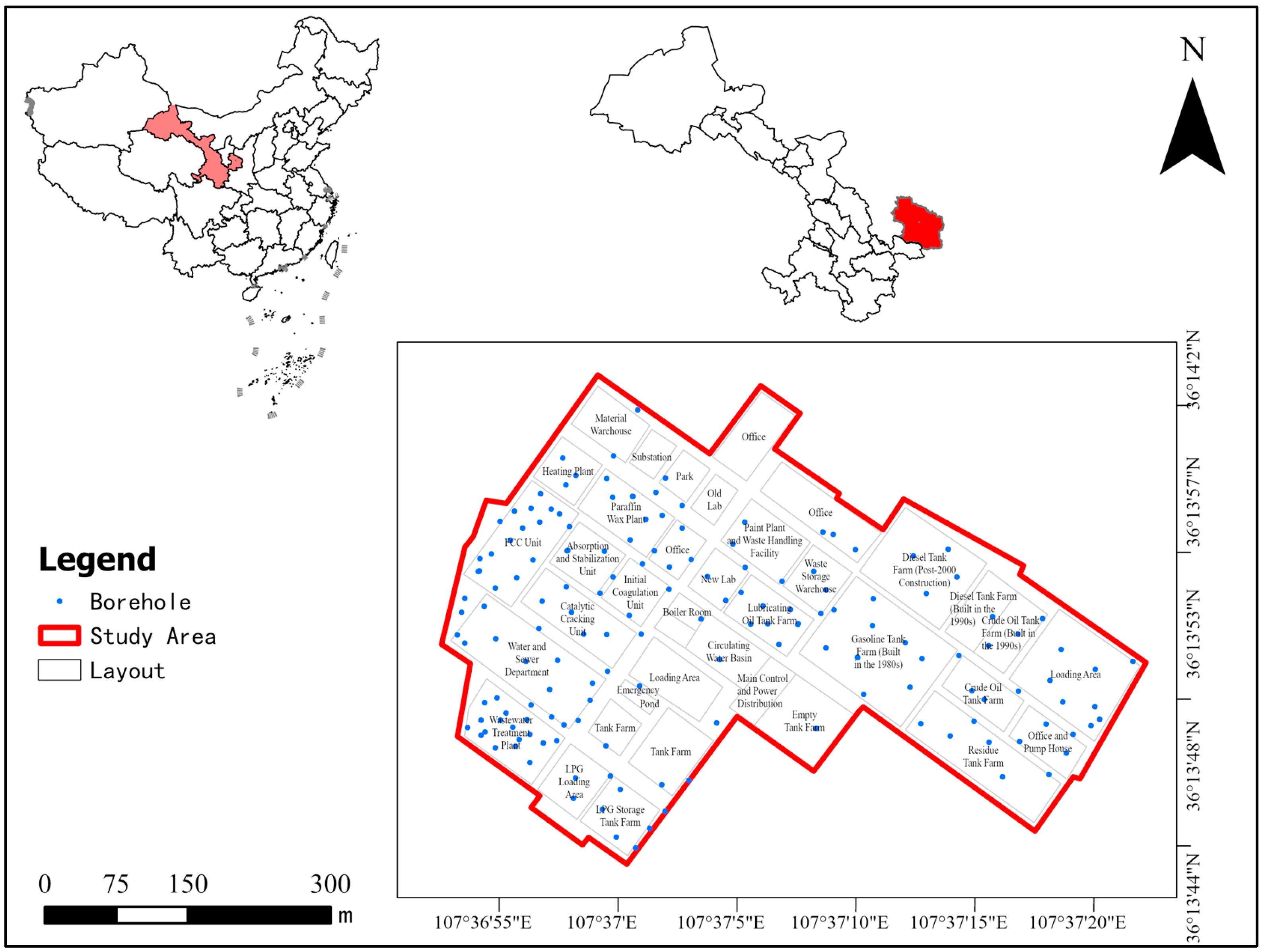
2.1. Study Area
2.2. Sample Collection and Testing
2.2.1. Soil Sample Collection and Preservation
2.2.2. Sample Testing and Laboratory Quality Control
2.3. Risk Assessment Models and Parameters
- (1)
- Soil risk control value (SRCV) based on non-carcinogenic effects via oral ingestion,
- (2)
- SRCV based on non-carcinogenic effects via dermal contact,
- (3)
- SRCV based on non-carcinogenic effects via inhalation of soil particles,
- (4)
- SRCV based on non-carcinogenic effects via inhaling outdoor air containing gaseous contaminants derived from surface soil,
- (5)
- SRCV based on non-carcinogenic effects via inhaling outdoor air containing gaseous contaminants derived from subsurface soil,
- (6)
- SRCV based on non-carcinogenic effects via inhaling indoor air containing gaseous contaminants derived from subsurface soil,
- (7)
- Formulae for the volatilization factor of contaminant diffusion (FVFCD) from surface soil to outdoor air:
- (8)
- FVFCD from subsurface soil to outdoor air:
- (9)
- FVFCD from subsurface soil to indoor air:
- (10)
- SRCV based on the integrated non-carcinogenic effects of all six exposure pathways, :
2.4. Tiered Risk Assessment
3. Results
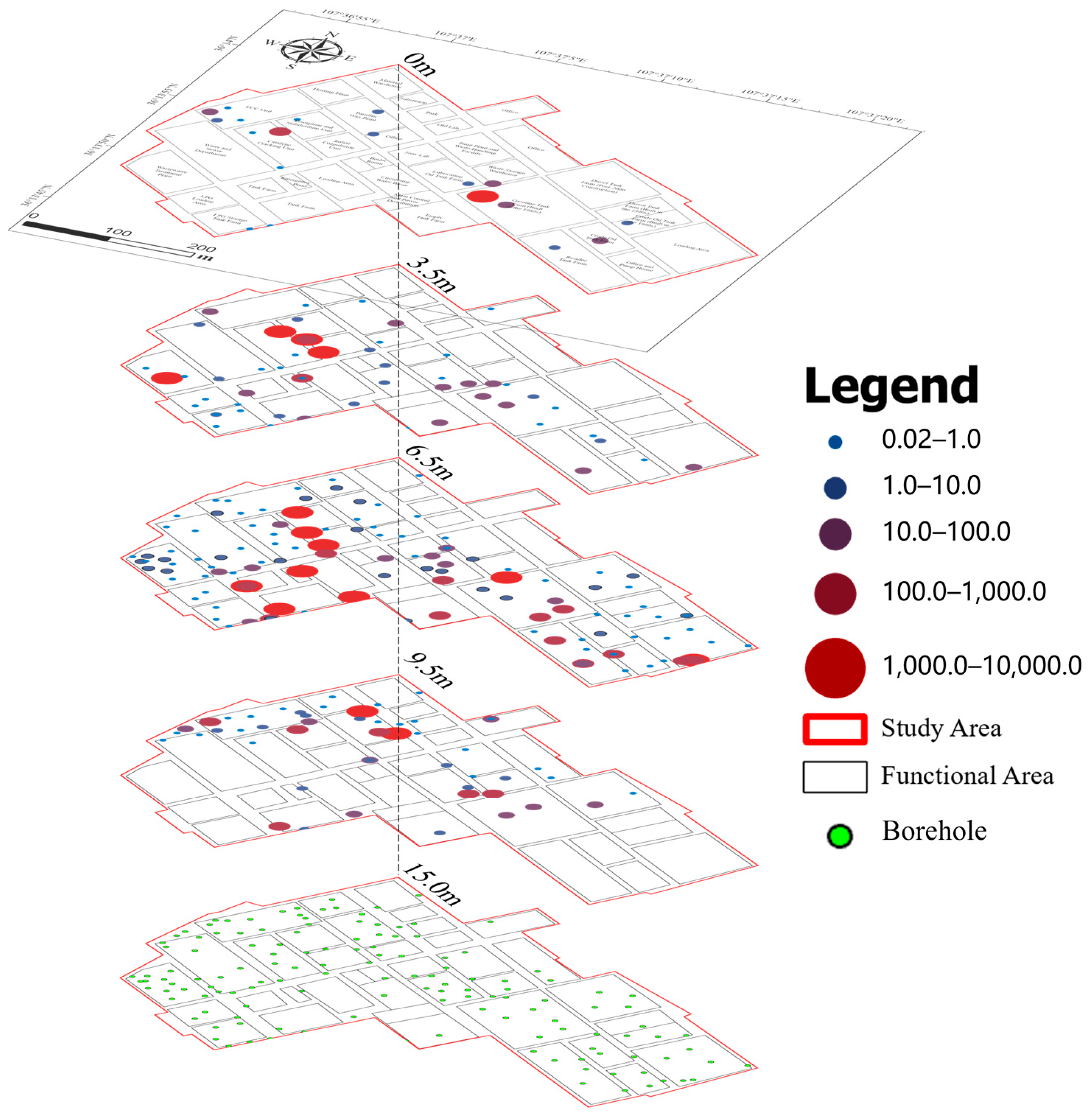
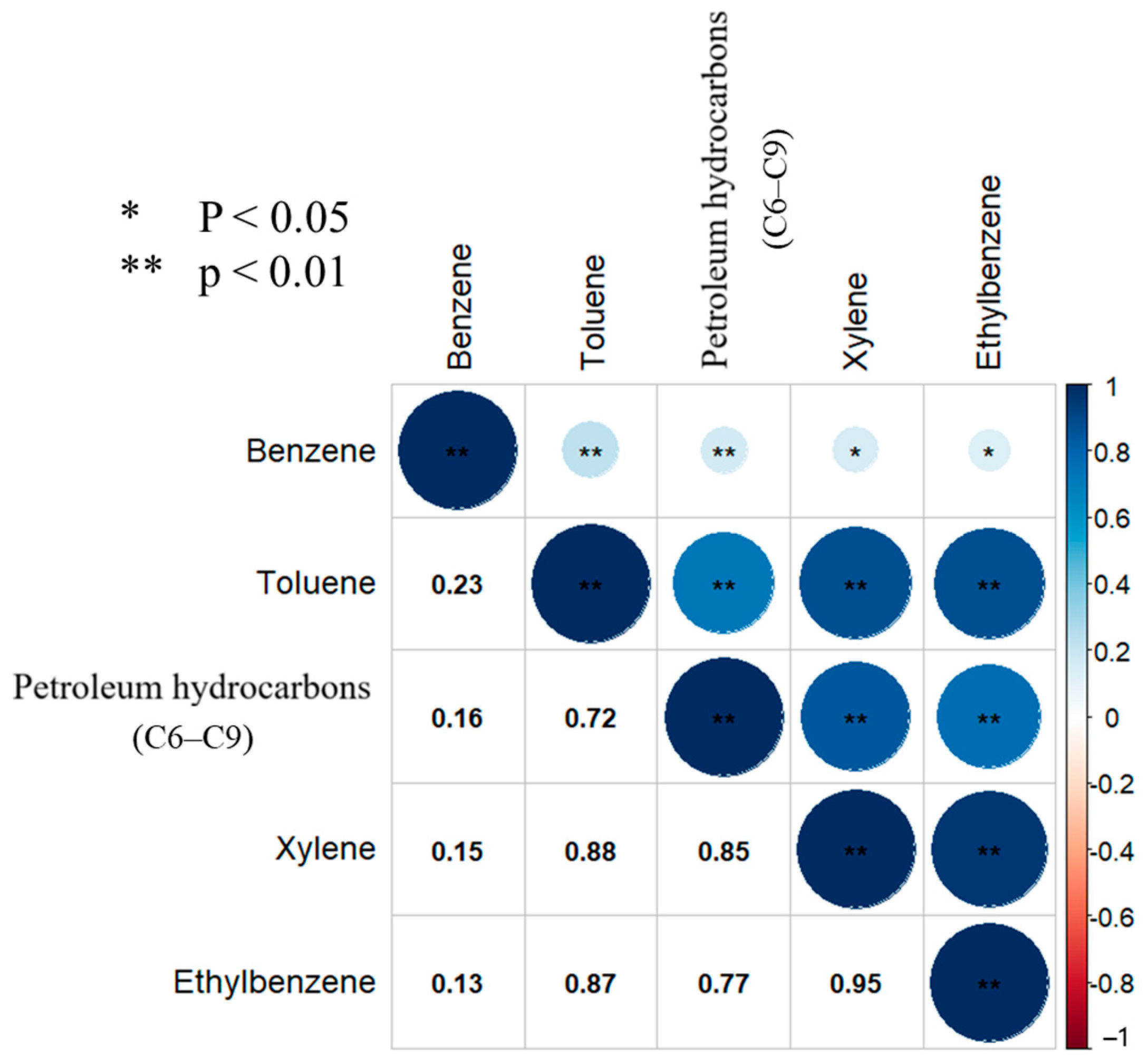
3.1. Characteristics of PHCs C6–C9 Contamination in Soil
3.2. Risk Assessment Results
3.2.1. Tier 1
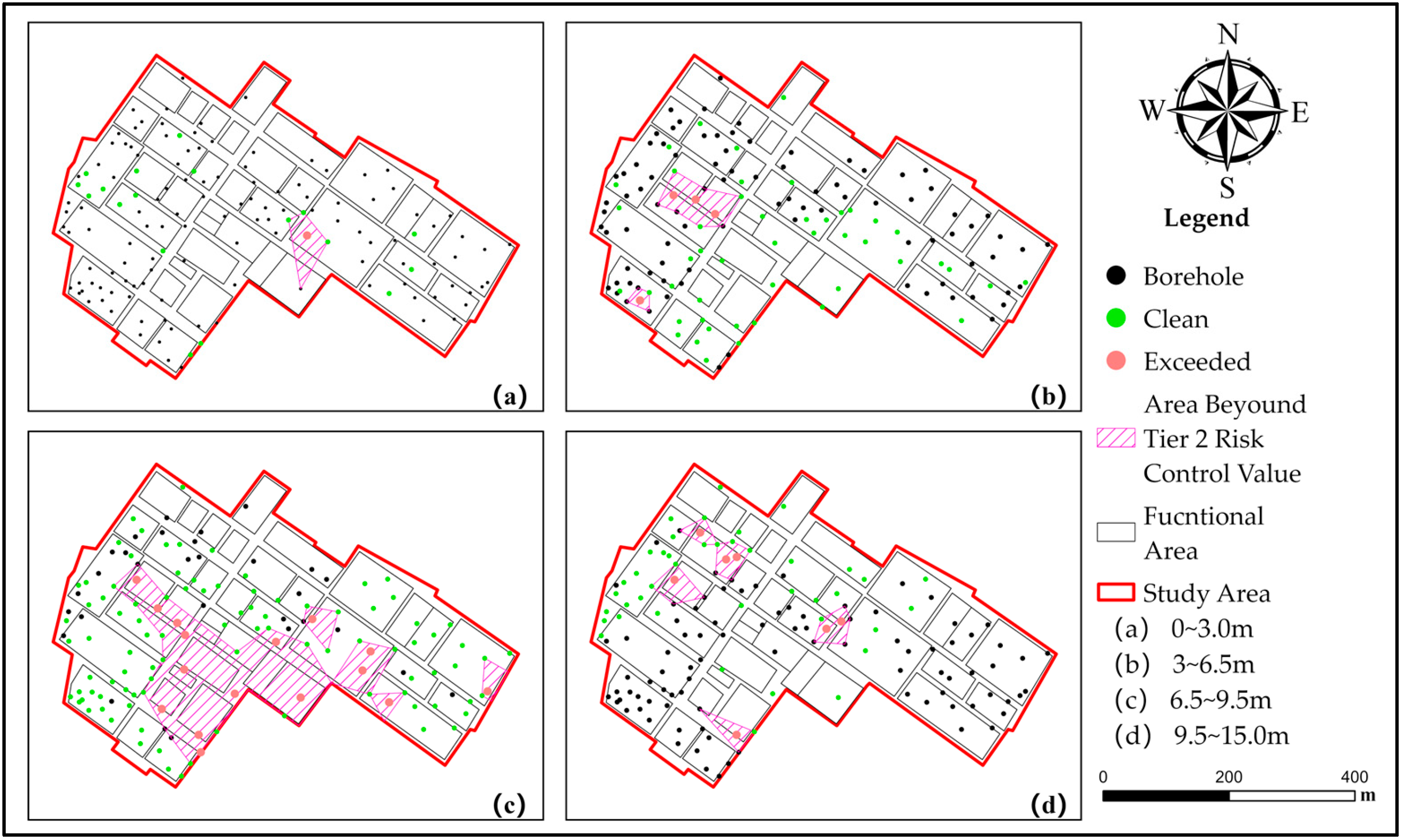
3.2.2. Tier 2 vs. 3
3.3. Economic Benefits
4. Discussion
4.1. Tiered Risk Assessment Enhances Precision and Aligns with Green, Low-Carbon Principles
4.2. Localized Studies Are Needed to Establish Additional Parameters for PHC Risk Assessment
5. Conclusions
Author Contributions
Funding
Data Availability Statement
Conflicts of Interest
Abbreviations
| PHC | Petroleum Hydrocarbon |
| TPH | Total Petroleum Hydrocarbon |
| BTEX | Benzene, Toluene, Ethylbenzene, and Xylene |
| USEPA | The United States Environmental Protection Agency |
| VOC | Volatile Organic Compound |
References
- Fei, H.W.; Wang, J.; Gao, Z.Y. Review and near-term outlook of China’s refining industry in 2022. Int. Pet. Econ. 2023, 31, 53–58. [Google Scholar]
- Brown, D.M.; Okoro, S.; van Gils, J.; van Spanning, R.; Bonte, M.; Hutchings, T.; Linden, O.; Egbuche, U.; Bruun, K.B.; Smith, J.W. Comparison of landfarming amendments to improve bioremediation of petroleum hydrocarbons in Niger Delta soils. Sci. Total Environ. 2017, 596–597, 284–292. [Google Scholar] [CrossRef]
- Ossai, I.C.; Ahmed, A.; Hassan, A.; Hamid, F.S. Remediation of soil and water contaminated with petroleum hydrocarbon: A review. Environ. Technol. Innov. 2020, 17, 100526. [Google Scholar] [CrossRef]
- Sammarco, P.W.; Kolian, S.R.; Warby, R.A.F.; Bouldin, J.L.; Subra, W.A.; Porter, S.A. Concentrations in human blood of petroleum hydrocarbons associated with the BP/Deepwater Horizon oil spill, Gulf of Mexico. Arch. Toxicol. 2016, 90, 829–837. [Google Scholar] [CrossRef] [PubMed]
- Peng, S.Q.; Li, J.; Han, L.; Zhang, W.Y.; Chen, M.F.L.; Chen, X.Y.; Gu, H.Y.; Zhou, Y.; Hou, S.L. Analysis of characteristic pollutants and health risks in the petroleum refining industry in China. Chin. J. Environ. Eng. 2024, 18, 3071–3080. [Google Scholar]
- Li, Y.; Xu, D.; Li, J.; Li, Y.; Go, F. Establishment and verification of the recognition method of the priority pollutants in groundwater of the typical petroleum refining enterprise. Chin. J. Environ. Eng. 2019, 13, 2770–2780. [Google Scholar]
- Zhu, K.X. Study on Refined Risk Assessment of Petroleum Hydrocarbon in Contaminated Sites. Master’s Thesis, Chinese Research Academy of Environmental Sciences, Beijing, China, 2022; pp. 1–2. [Google Scholar]
- Liu, D.Q. Current situation and trend of petroleum hydrocarbon related standard system in contaminated site soils of China. Environ. Monit. China 2020, 36, 138–146. [Google Scholar] [CrossRef]
- Yang, L.; Shi, J.; Chen, Q.; Long, T. Human health risk assessment of petroleum hydrocarbons in contaminated sites from the perspective of components and propertie. Asian J. Ecotoxicol. 2021, 16, 56–65. [Google Scholar]
- Sahoo, A.K.; Madgaonkar, S.R.; Chivukula, N.; Karthikeyan, P.; Ramesh, K.; Marigoudar, S.R.; Sharma, K.V.; Samal, A. Network-based investigation of petroleum hydrocarbons-induced ecotoxicological effects and their risk assessment. Environ. Int. 2024, 194, 109163. [Google Scholar] [CrossRef]
- TPH Risk Evaluation Team. TPH Risk Evaluation at Petroleum-Contaminated Sites; Interstate Technology & Regulatory Council: Washington, DC, USA, 2018. [Google Scholar]
- Friebel, E.; Nadebaum, P. Health Screening Levels for Petroleum Hydrocarbons in Soil and Groundwater Summary; Cooperative Research Centre for Contamination Assessment and Remediation of the Environment: Adelaide, Australia, 2011. [Google Scholar]
- Canadian Council of Ministers of the Environment. Canada-Wide Standards for Petroleum Hydrocarbons (PHC) in Soil; Canadian Council of Ministers of the Environment: Winnipeg, MB, Canada, 2008.
- GB36600-2018; Soil Environmental Quality Risk Control Standard for Soil Contamination of Development Land. China Environment Publishing Group: Beijing, China, 2018.
- Brewer, R.; Nagashima, J.; Kelley, M.; Heskett, M.; Rigby, M. Risk-based evaluation of total petroleum hydrocarbons in vapor intrusion studies. Int. J. Environ. Res. Public Health 2013, 10, 2441–2467. [Google Scholar] [CrossRef]
- Ji, M.; Yang, J.; Zhang, S.Y.; Li, X.M.; Li, Q.Q. Characteristics and risk assessment of carbon chain components of petroleum hydrocarbon contamination in soil and groundwater of typical enterprise retired sites in Shanghai. Res. Environ. Sci. 2024, 37, 2547–2556. [Google Scholar]
- Zhang, Z.; Yan, X.; Gao, F.; Thai, P.; Wang, H.; Chen, D.; Zhou, L.; Gong, D.; Li, Q.; Morawska, L.; et al. Emission and health risk assessment of volatile organic compounds in various processes of a petroleum refinery in the Pearl River Delta, China. Environ. Pollut. 2018, 238, 452–461. [Google Scholar] [CrossRef] [PubMed]
- Jiang, H.; Wu, Q.T. Discussion on potential issues of risk controlling standards of contaminated sites in China from perspectives of screening values and land uses. Asian J. Ecotoxicol. 2023, 18, 79–90. [Google Scholar]
- Jiang, L.; Zhong, M.-S.; Liang, J.; Yao, J.-J.; Xia, T.-X.; Fan, Y.-L.; Li, J.-D.; Tang, Z.-Q. Application and benefit evaluation of tiered health risk assessment approach on site contaminated by benzene. Environ. Sci. 2013, 34, 1034–1043. [Google Scholar]
- HJ 25.1-2019; Technical Guidelines for Investigation on Soil Contamination of Land for Construction. China Environment Publishing Group: Beijing, China, 2019.
- HJ 25.2-2019; Technical Guidelines for Monitoring During Risk Control and Remediation of Soil Contamination of Land for Construction. China Environment Publishing Group: Beijing, China, 2019.
- HJ 1020-2019; Soil and Sediment-Determination of Petroleum Hydrocarbons (C6–C9)-Purge and Trap/Gas Chromatography. China Environment Publishing Group: Beijing, China, 2019.
- HJ 605-2011; Soil and Sediment-Determination of Volatile Organic Compounds Purge and Trap Gas Chromatography/Mass Spectrometry Method. China Environmental Press: Beijing, China, 2011.
- HJ 25.3-2019; Technical Guidelines for Risk Assessment of Soil Contamination of Land for Constructor. China Environment Publishing Group: Beijing, China, 2019.
- Ministry of Environmental Protection of the People’s Republic of China. Exposure Factors Handbook of Chinese Population (Adults); China Environment Publishing Group: Beijing, China, 2013; pp. 29–30. [Google Scholar]
- Department of Ecology and Environment of Gansu Province. Official Report on the State of Ecology and Environment in Gansu Province (2024); Gansu Department of Ecology and Environment of Gansu Province: Lanzhou, China, 2025; Available online: https://125.74.7.101:50625/info/1198/42535.htm (accessed on 19 October 2025).
- United States Environmental Protection Agency. Regional Screening Level (RSL) Chemical-Specific Parameters Supporting Table November 2024; Regional Screening Levels (RSLs)-Generic Tables US EPA; United States Environmental Protection Agency: Washington, DC, USA, 2025.
- United States Environmental Protection Agency. Regional Screening Level (RSL) Summary Table (TR=1E-06, HQ=1) November 2024 [EB/OL]; Regional Screening Levels (RSLs)-Generic Tables|US EPA; United States Environmental Protection Agency: Washington, DC, USA, 2025.
- Mahammedi, C.; Mahdjoubi, L.; Booth, C.; Butt, T. Framework for preliminary risk assessment of brownfield sites. Sci. Total Environ. 2022, 807, 151069. [Google Scholar] [CrossRef]
- Jiang, L.; Liang, J.; Zhong, M.S.; Zhang, R.H.; Xia, T.X.; Zhao, Y. Challenges and response to risk management of complex contaminated sites. Res. Environ. Sci. 2021, 34, 458–467. [Google Scholar]
- Yuan, B.; Du, P.; Li, A.Y.; Zhang, H.; Chen, J.; Zhang, Y.H.; Wang, H.Y. Development and research progress of tiered risk assessment of contaminated sites. Res. Environ. Sci. 2023, 36, 19–29. [Google Scholar]
- Jiao, W.; Fang, Y.; Li, S.; Yue, Y.; Ding, N.; Qin, Z.; Zhang, H. Risk management and control of contaminated sites in the United States: Development process, evolution characteristics and enlightenment. Chin. J. Environ. Eng. 2021, 15, 1821–1830. [Google Scholar]
- Vorhees, D.J.; Weisman, W.H.; Gustafson, J.B. Total Petroleum Hydrocarbon Criteria Working Group Volume 5: Human Health Risk Based Evaluation of Petroleum Release Sites: Implementing the Working Group Approach; Amherst Scientific Publishers: Amherst, MA, USA, 1999. [Google Scholar]
- Canade-Wide Standard for Petroleum Hydrocarbons (PHC) in Soil User Guidance; The Canadian Council of Ministers of the Environment: Winnipeg, MB, Canada, 2001.
- Li, T. Study on Distribution and Migration Characteristics of Typical Pollutant in Petroleum Refining Sites. Master’s Thesis, China University of Petroleum, Dongying, China, 2020; pp. 24–53. [Google Scholar]
- Luo, S. Study on the Pollution Characteristics and Migration Behavior of Benzene Series in the Soil of Typical Petrochemical Industrial Sites; Chongqing University: Chongqing, China, 2021; pp. 25–66. [Google Scholar]
- Pei, F.; Luo, Z.J.; Peng, J.J.; Qi, S.H. Phenols pollutants in soil and shallow groundwater of a retired refinery site. Environ. Sci. 2012, 33, 4251–4255. [Google Scholar]
- Li, X. Study on Pollution Characteristics, Influencing Factors, and Risk Assessment of Oil Refining Industry Sites. Master’s Thesis, Xiangtan University, Xiangtan, China, 2022; pp. 1–2. [Google Scholar]
- Yuan, L.; Wu, Y.; Fan, Q.; Li, P.; Liang, J.; Wang, Z.; Li, R.; Shi, L. Spatial distribution, composition, and source analysis of petroleum pollutants in soil from the Changqing Oilfield, northwest China. Mar. Pollut. Bull. 2022, 185, 114338. [Google Scholar] [CrossRef]
- Ma, J. Suggestion for setting upper limit values of groundwater remediation targe values. Chin. J. Environ. Eng. 2023, 17, 3474–3477. [Google Scholar]
- The Government of the Hong Kong Special Administrative Region Environmental Protection Department. Risk-Based Remediation Goals; The Government of the Hong Kong Special Administrative Region Environmental Protection Department: Hong Kong, China, 2007.
- The Ministry for the Environment. Guidelines for Assessing and Managing Petroleum Hydrocarbon Contaminated Sites in New Zealand Module 4 Tier 1 Soil Acceptance Criteria, 2nd ed.; The Ministry for the Environment: Wellington, New Zealand, 2011; pp. 50–71.
- Sun, Y.; Wang, J.; Guo, G.; Li, H.; Jones, K. A comprehensive comparison and analysis of soil screening values derived and used in China and the UK. Environ. Pollut. 2020, 256, 113404. [Google Scholar] [CrossRef] [PubMed]
- Gou, N.N.; Liu, Z.L.; Wu, M.L.; Tang, S.W.; Hu, S.Y.; Y, Y.; Ke, S.J. The toxicological risks and combined toxic effects of equivalent alkanes and polycyclic aromatic hydrocarbon components in total petroleum hydrocarbons. Asian J. Ecotoxicol. 2025, 20, 156–169. [Google Scholar]
- DB4401/T 102.7—2023; Soil Pollution Prevention and Control of Land for Construction—Part 7: Technical Specifications for Risk Assessment of Soil Contamination. Guangzhou Municipal Administration for Market Regulation: Guangzhou, China, 2023.
- Jiang, H.; Wu, Q.T. Probabilistic analysis of the health risk screening errors in a petroleum hydrocarbon contaminated sensitive site. Ecol. Environ. 2024, 33, 645–654. [Google Scholar]
- Park, I.S.; Park, J.W. Determination of a risk management primer at petroleum-contaminated sites: Developing new human health risk assessment strategy. J. Hazard. Mater. 2011, 185, 1374–1380. [Google Scholar] [CrossRef]
- Li, W.; Li, J.; Chen, A.; Zhong, M.; Song, L. Health risk assessment of a lubricant contaminated site. Asian J. Ecotoxicol. 2021, 16, 137–146. [Google Scholar]
- Ge, F.; Zhang, Z.X.; Fu, H.; Tang, S.; Xu, K.; Song, X.; Wang, Q.; Luo, Y. Distribution of organic contaminated sites in China: Status quo and prospect. Soils 2021, 53, 1132–1141. [Google Scholar]
- Duan, X.; Cao, S.; Guan, J.; Hu, L.; Sun, C.; Yan, C.; Zhao, X.; Wu, F. A more scientific blood lead reference value urgently needs to be updated in China: From a national and international insight. Eco-Environ. Health 2025, 4, 100127. [Google Scholar] [CrossRef]



| Parameter | Analytical Method | Limit of Detection | Instrumentation | Relative Percent Difference/(%) |
|---|---|---|---|---|
| Petroleum hydrocarbons C6–C9 | HJ 1020-2019 | 0.04 mg·kg−1 | Purge and trap gas Chromatography–mass spectrometry Amoxt 7890/5977B | 0.7–11.3 |
| Benzene | HJ 605-2011 | 1.9 μgkg−1 | 0.3–14.0 | |
| Toluene | 1.3 μgkg−1 | 1.1–19.8 | ||
| Ethylbenzene | 1.2 μgkg−1 | 0.4–9.7 | ||
| Xylene | 1.2 μgkg−1 | 0.7–13.4 |
| Parameter | Definition | Data | |||
|---|---|---|---|---|---|
| Tier 1 | Source | Tier 2 | Source | ||
| Daily oral ingestion rate of soils of adults, mg·d−1 | 100 | [24] | 100 | [24] | |
| Exposure duration of adults, a | 25 | [24] | 25 | [24] | |
| Exposure frequency of adults, d·a−1 | 250 | [24] | 250 | [24] | |
| Absorption factor of oral ingestion (unitless) | 1 | [24] | 1 | [24] | |
| Average body weight of adults, kg | 61.8 | [24] | 58.4 | [25] | |
| Average time for non-carcinogenic effect, d | 9125 | [24] | 9125 | [24] | |
| Soil allocation factor (unitless) | 0.33 | [24] | 0.33 | [24] | |
| Acceptable hazard quotient for individual contaminant (unitless) | 1 | [24] | 1 | [24] | |
| Average height of adults, cm | 161.5 | [24] | 161.5 | [24] | |
| Skin exposure ratio of adults (unitless) | 0.18 | [24] | 0.18 | [24] | |
| Adherence rate of soil on skin for adults, mg·cm−2 | 0.2 | [24] | 0.2 | [24] | |
| Daily exposure frequency of dermal contact event, once·d−1 | 1 | [24] | 1 | [24] | |
| Content of inhalable particulates in ambient air, mg·m−3 | 119 | [24] | 52 | [26] | |
| Daily air inhalation rate of adults, m3·d−1 | 14.5 | [24] | 14.6 | [25] | |
| Retention fraction of inhaled particulates in body (unitless) | 0.75 | [24] | 0.75 | [24] | |
| Fraction of soil-borne particulates in outdoor air (unitless) | 0.5 | [24] | 0.5 | [24] | |
| Outdoor exposure frequency of adults, d·a−1 | 62.5 | [24] | 62.5 | [24] | |
| Fraction of soil-borne particulates in indoor air (unitless) | 0.8 | [24] | 0.8 | [24] | |
| Indoor exposure frequency of adults, d·a−1 | 187.5 | [24] | 187.5 | [24] | |
| Soil bulk density, kg·dm−3 | 1.5 | [24] | 1.71 | Measured | |
| Averaging time for vapor flux, a | 25 | [24] | 25 | [24] | |
| Ambient air velocity in mixing zone, cm·s−1 | 200 | [24] | 200 | [24] | |
| W | Width of source zone area, cm | 4000 | [24] | 55,827 | Measured |
| Mixing zone height, cm | 200 | [24] | 200 | [24] | |
| A | Source zone area, cm2 | 16,000,000 | [24] | 982,160,000 | Measured |
| Density of soil particulates, kg·dm−3 | 2.65 | [24] | 2.71 | Measured | |
| Soil water content, kg·kg−1 | 0.2 | [24] | 0.162 | Measured | |
| Density of water, kg·dm−3 | 1 | [24] | 1 | [24] | |
| Organic matter content in soils, g·kg−1 | 15 | [24] | 15 | [24] | |
| d | Concentrations of contaminants in surface soil, cm | 50 | [24] | 650 | Measured |
| Concentrations of contaminants in subsurface soil, cm | 50 | [24] | 650 | Measured | |
| Thickness of subsurface soil, cm | 100 | [24] | 850 | Measured | |
| Volume/infiltration area ratio of enclosed space, cm | 300 | [24] | 300 | [24] | |
| Air exchange rate of enclosed space, once·d−1 | 20 | [24] | 20 | [24] | |
| Areal fraction of cracks in foundations/walls (unitless) | 0.005 | [24] | 0.005 | [24] | |
| Thickness of enclosed-space foundation or wall, cm | 35 | [24] | 35 | [24] | |
| Soil air content—soil-filled foundation cracks (unitless) | 0.26 | [24] | 0.26 | [24] | |
| Soil water content—soil-filled foundation cracks (unitless) | 0.12 | [24] | 0.12 | [24] | |
| Henry’s law constant (unitless) | 1.86 | [27] | 1.86 | [27] | |
| Diffusivity in air, cm2·s−1 | 7.35 × 10⁻² | [27] | 7.35 × 10⁻² | [27] | |
| Diffusivity in water, cm2·s−1 | 8.38 × 10⁻⁶ | [27] | 8.38 × 10⁻⁶ | [27] | |
| Organic carbon partition coefficient, cm3·g−1 | 1.72 × 10² | [27] | 1.72 × 10² | [27] | |
| Chronic oral reference dose, mg·kg−1·d−1; | 0.005 | [28] | 0.005 | [28] | |
| Chronic inhalation reference concentration, mg·cm−3 | 0.4 | [28] | 0.4 | [28] | |
| Fraction of contaminant absorbed in gastrointestinal tract (unitless) | 1 | [28] | 1 | [28] | |
| Fraction of contaminant absorbed dermally from soil (unitless) | / | [28] | / | [28] | |
| Parameter | Definition | Data | |||
|---|---|---|---|---|---|
| Aliphatic Hydrocarbons C6–C8 | Aliphatic Hydrocarbons C > 8 to C10 | Aromatic Hydrocarbons C > 8 to C10 | Source | ||
| Henry’s law constant (unitless) | 50 | 80 | 0.48 | [33] | |
| Diffusivity in air, cm2·s−1 | 0.1 | 0.1 | 0.1 | [33] | |
| Diffusivity in water, cm2·s−1 | 1.00 × 10⁻⁵ | 1.00 × 10⁻⁵ | 1.00 × 10⁻⁵ | [33] | |
| Organic carbon partition coefficient, cm3·g−1 | 3.98 × 10³ | 3.16 × 10⁴ | 1.58 × 10³ | [33] | |
| Chronic oral reference dose, mg·kg−1·d−1; | 5 | 0.1 | 0.04 | [33] | |
| Chronic inhalation reference concentration, mg·cm−3 | 18.4 | 1 | 0.2 | [33] | |
| Fraction of contaminant absorbed in gastrointestinal tract (unitless) | 1 | 1 | 1 | [34] | |
| Fraction of contaminant absorbed dermally from soil | 0.2 | 0.2 | 0.2 | [34] | |
| Mass fraction of each subfraction within the F1 (unitless) | 0.55 | 0.36 | 0.09 | [34] | |
| No. | Country/Region | Standard Name | Target Compound/Fraction | Value (mg kg−1) | Source |
|---|---|---|---|---|---|
| 1 | Hong Kong, China | Risk-Based Remediation Goals | C6–C8 | Industry/park 10,000 | [41] |
| 2 | USA | Regional Screening Level | Total PHCs (aliphatic low) | Industry 1900 | [28] |
| 3 | Canada | Canada-Wide Standard for PHC in Soil User Guidance | F1 | Commercial/industry 170–240 Soil texture-specific | [34] |
| 4 | New Zealand | Guidelines for Assessing and Managing PHC-Contaminated Sites in New Zealand Module 4 Tier 1 Soil Acceptance Criteria | C7–C9 | Commercial/industry 120–16,000 Soil texture- and depth-specific | [42] |
| 5 | Australia | Health Screening Levels for PHC in Soil and Groundwater Summary | C6–C10 | Commercial/industry 310–26,000 Soil texture, depth, and land-use specific | [12] |
| Depth (m) | Tier 2 (m3) | Tier 3 (m3) | Reduction in Volume (m3) | Reduction Rate (%) |
|---|---|---|---|---|
| 0–3.0 | 17,734 | 17,734 | 0 | 0 |
| 3.0–6.5 | 38,407 | 38,407 | 0 | 0 |
| 6.5–9.5 | 238,096 | 30,906 | 207,190 | 87.0 |
| 9.5–15.0 | 87,668 | 0 | 87,668 | 100.0 |
| Total | 381,904 | 87,047 | 294,857 | 77.2 |
| Tiered Risk Assessment | Remediation Technology | Cost USD m−3 (CNY as of November 2025) | Remediation Volume m3 | Total Cost million (CNY as of November 2025) |
|---|---|---|---|---|
| Tier 2 | Ambient temperature desorption (0–6.5 m) | 70.2 (500) | 56,141 | 54.2 (386) |
| In situ chemical oxidation (6.5–15.0 m) | 154.47 (1100) | 325,763 | ||
| Tier 3 | Ambient temperature desorption (0–6.5 m) | 70.2 (500) | 56,141 | 8.7 (62) |
| In situ chemical oxidation (6.5–15.0 m) | 154.47 (1100) | 30,906 |
Disclaimer/Publisher’s Note: The statements, opinions and data contained in all publications are solely those of the individual author(s) and contributor(s) and not of MDPI and/or the editor(s). MDPI and/or the editor(s) disclaim responsibility for any injury to people or property resulting from any ideas, methods, instructions or products referred to in the content. |
© 2025 by the authors. Licensee MDPI, Basel, Switzerland. This article is an open access article distributed under the terms and conditions of the Creative Commons Attribution (CC BY) license.
Share and Cite
Zhu, K.; Zhang, C.; Guo, G.; Yuan, R. Tiered Risk Assessment for Petroleum Hydrocarbons C6–C9: A Case Study at a Typical Decommissioned Petroleum Refinery Site in Gansu Province. Land 2026, 15, 86. https://doi.org/10.3390/land15010086
Zhu K, Zhang C, Guo G, Yuan R. Tiered Risk Assessment for Petroleum Hydrocarbons C6–C9: A Case Study at a Typical Decommissioned Petroleum Refinery Site in Gansu Province. Land. 2026; 15(1):86. https://doi.org/10.3390/land15010086
Chicago/Turabian StyleZhu, Kaixuan, Chao Zhang, Guanlin Guo, and Rongxiao Yuan. 2026. "Tiered Risk Assessment for Petroleum Hydrocarbons C6–C9: A Case Study at a Typical Decommissioned Petroleum Refinery Site in Gansu Province" Land 15, no. 1: 86. https://doi.org/10.3390/land15010086
APA StyleZhu, K., Zhang, C., Guo, G., & Yuan, R. (2026). Tiered Risk Assessment for Petroleum Hydrocarbons C6–C9: A Case Study at a Typical Decommissioned Petroleum Refinery Site in Gansu Province. Land, 15(1), 86. https://doi.org/10.3390/land15010086