Spatiotemporal Evolution and the Impact of Changing Political–Economic Systems on Tourism Spatial Planning and Land Use: The Case of Kupari, Dubrovnik, Croatia

Abstract
1. Introduction
2. Theoretical Framework and Literature Review
3. Methodology and Data
4. The Impact of PESs on the Development of the Tourist Resort of Kupari
4.1. Croatia in the Austro-Hungarian Monarchy
4.2. Between the World Wars
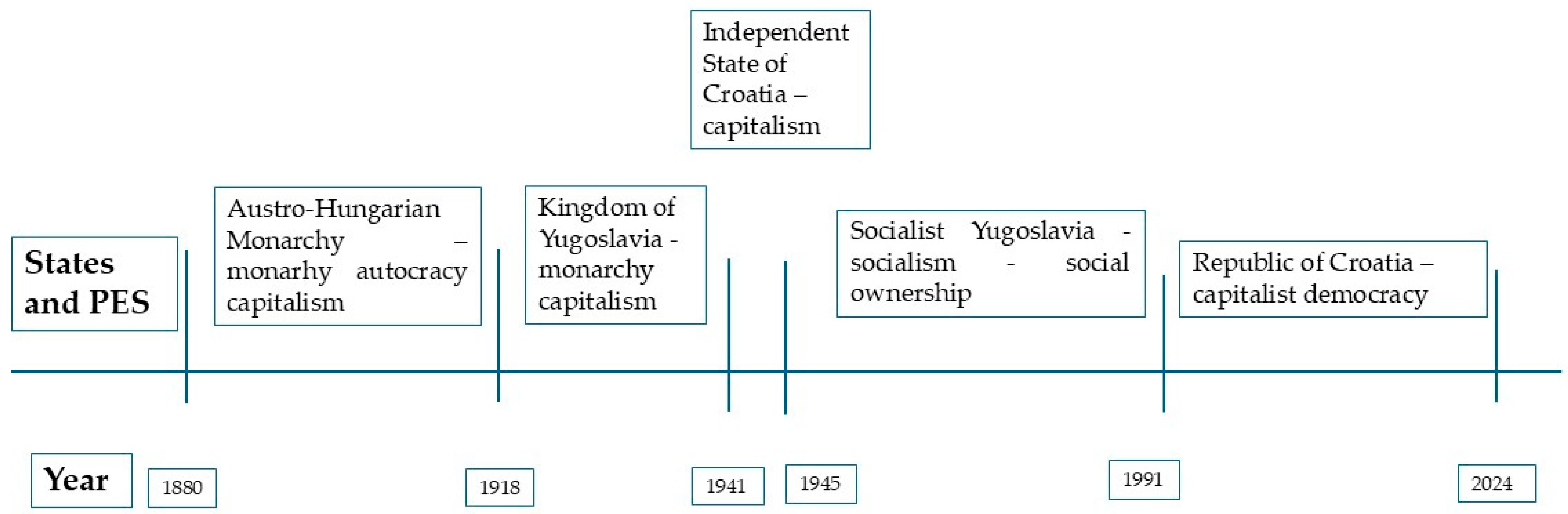
4.3. From a Capitalist Monarchical Autocracy to a Socialist One-Party Autocracy
4.3.1. Early Post-War Period
4.3.2. Spatial Planning and Tourism Boom in the 1960s and 1970s
4.3.3. Protection of Nature and Deflation of Expansionist Tourism Plans
4.4. From Socialism to Democracy and Capitalism
5. Discussion
6. Conclusions
Author Contributions
Funding
Data Availability Statement
Acknowledgments
Conflicts of Interest
Abbreviations
| PES | Political and economic system |
| WW I | World War I |
| WW II | World War II |
| JNA | Jugoslavenska narodna armija/Yugoslav People’s Army |
| SIZ | Self-governing interest community (so-called SIZ) |
| AH | Austro-Hungarian Monarchy |
| IUP | Institute of Urban Planning/Urbanistički institut |
| SFRJ | Socialist Federal Republic of Yugoslavia (SFRJ) |
Appendix A

| PES Change | From AH Monarchy to Kingdom of Yugoslavia | To Socialism | To a Capitalist Democracy |
|---|---|---|---|
| Political change | Same type—from one monarchical autocracy to another. | New type of a political system—still an authoritarian regime, with monarchy as a ruler is replaced by single-party rule. | New type of a political system—single-party rule was replaced by a multi-party system with the introduction of democracy. |
| Economic change | Same type—capitalism. | New type of economic system—state and social ownership replaced private ownership, with a planned economy. | New type of economic system—private ownership dominates over social ownership and private interest towers over social interest in a market economy. |
| Administrative change | New territorial organization, as the centre of power shifted from Vienna to Belgrade. There were three administrative-territorial reforms. | Territorially largely the same but a new administrative organization. | New territorial organization, with much smaller local-level units. |
| PES Change | From AH Monarchy to Kingdom of Yugoslavia | To Socialist One-Party Autocracy | To a Capitalist Democracy |
|---|---|---|---|
| Path dependency | Issues regarding lack of suitable equipment and a qualified workforce persisted, and public administration still faced issues in providing infrastructure for tourism projects. Legislation took time to be adopted, and laws from the previous PES were in use a decade after the PES change. Investors pushed for informal solutions, permits from the AH Monarchy were used until administration could be reorganized. Legislation formally provided a relatively high level of consciousness regarding the need to save land as a valuable resource. Initial discord between the cadastre and land registries emerged. | Implementation capacities and education were initially poor, with equipment missing, but improvements occurred during the 1960s. Protection of land as a resource persisted among experts and in legislation, but implementation was haphazard—illegal construction spread. | Protection mechanisms aimed at preserving land as a valuable resource lapsed, but illegal construction persisted. Unharmonized cadastre and land registry books were inherited from the previous PES. |
| Change | As a result of administrative changes, an initial loss of implementation capacities occurred. | As a result of administrative changes, an initial loss of implementation capacities occurred. As a result of the new system of ownership, discord between the cadastre and land registries increased. | As a result of administrative changes, an initial loss of implementation capacities occurred. |
| PES Change | From AH Monarchy to Kingdom of Yugoslavia | To Socialism | To a Capitalist Democracy |
|---|---|---|---|
| Legislation and its effect | One new, more sophisticated law adopted 13 years after the regime change referred to the whole territory of the Kingdom of Yugoslavia, not just the Dalmatia area. It recognized tourism as land use and spatial planning categories. Territorial and administrative shifts slowed down the adoption and implementation of legislation—administrative centres changed, slowing down the ability of the administration to provide infrastructure and permits. | Legislation referred specifically to Croatia as one of the socialist states within Yugoslavia. A plethora of carefully planned laws and regulations aimed at social interest was introduced: 1960s—sophisticated guidelines for the development of spatial plans and increasingly data-driven long-term planning; 1970s—spatial planning became all-encompassing, looking into broader, cross-regional territory and planning how the best use for the social interest; 1980s—orientation toward natural protection and care for the environment. Spatial planners imposed expertise over politics and played a decisive role in defining legislation allowing for the protection of land. This was because tourism was used to demonstrate the success of socialism. Due to a lack of importance of private ownership, mismatches between land registries and the cadastre increased. | Frequent changes in legislation and fragmentation across policy fields occurred in an attempt to simultaneously keep protection mechanisms established during the earlier period and to ensure the functioning of the market economy. |
| PES Change | From AH Monarchy to Kingdom of Yugoslavia | To Socialism | To a Capitalist Democracy |
|---|---|---|---|
| Kupari | Kupari was transformed from an industrial zone to a luxurious tourism resort. Permits and legislation from a previous PES were used for project implementation. | The resort was initially renovated by Czech owners but then nationalized and handed over to the Yugoslav military. Following the trends of the 1960s, the number and quality of capacities were increased, while attention was dedicated to careful integration of the natural environment and sparing use of land as a valuable resource. Kupari remained a luxury resort. | War damage, property rights issues, mismatches between land registries and the cadastre, legislative fragmentation and a lack of intersectoral cooperation put the resort out of use. Plans were made to redevelop Kupari as a luxury resort. |
| 1. | At the beginning of the twentieth century, the Habsburg public administration was quite inefficient (e.g., the costs of collecting taxes in the Kingdom of Dalmatia exceeded the taxes collected) [30]. |
| 2. | As documented by Leček [36], illiteracy rates in the Kingdom of Dalmatia were very high, and an educated workforce was lacking for all sectors of the economy. |
| 3. | After WW I, the Kingdom of Dalmatia initially joined the State of Slovenes, Croats and Serbs, later called the Kingdom of Yugoslavia. |
| 4. | From 1918 to 1922, the Kingdom kept the subdivisions of predecessor states. In 1922, a new territorial organization divided the country into thirty-three provinces. In 1929, a system of nine regions was implemented. In 1939, a single Region of Croatia was formed from two existing regions (and from sections of others) [41]. |
| 5. | The Act prescribed the content of spatial plans, as well as the method and manner of their adoption. |
| 6. | The South Adriatic Regional Plan (1964–1968) covered the territory of several now former republics, from Croatia and Bosnia and Herzegovina to Montenegro to the Yugoslav–Albanian border. The General Urban Plan for the Dubrovnik area was adopted in 1969 on the basis of a series of studies and expert reports on the historical factors of development, as well as the natural and socio-economic characteristics of the Dubrovnik region [53]. |
| 7. | After a certain spatial-planning document was passed, the self-governing interest communities (so-called SIZs) financed the equipment and arrangement of land. |
| 8. | Unlike other sectors, the army was very well organized, including for the entire army’s vacation. |
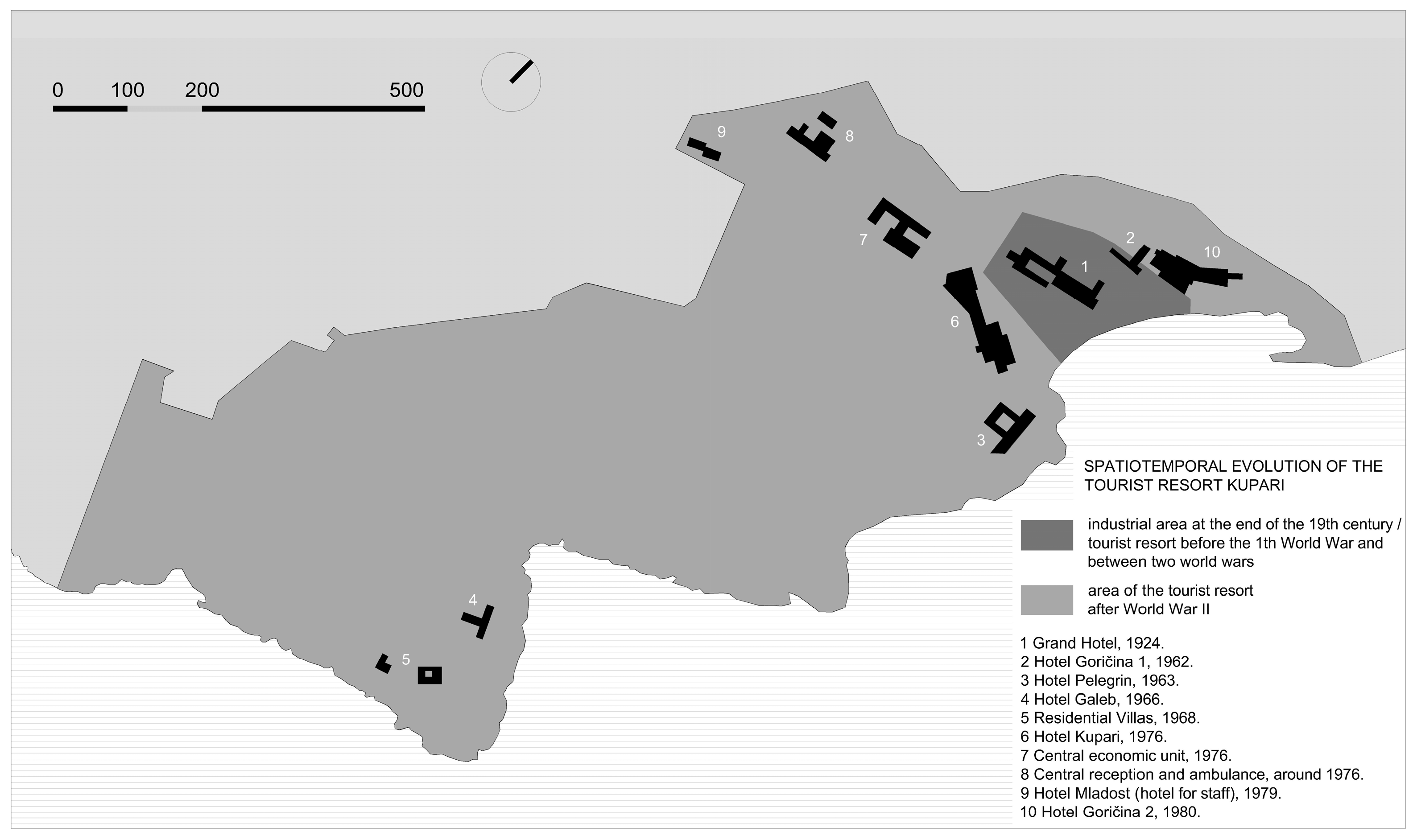
| 9. | This plan was authored by the Town Planning Institute and foresaw the construction of another hotel in Srebreno Bay, as well as the construction of a third villa in the separate residential zone. |
| 10. | The Facilities Construction Act 1975 [61] was passed in the same year; however, its provisions were not applied to the construction of facilities within the military compound for the purposes of JNA. |
References
- Kytzia, S.; Walz, A.; Wegmann, M. How Can Tourism Use Land More Efficiently? A Model-Based Approach to Land-Use Efficiency for Tourist Destinations. Tour. Manag. 2011, 32, 629–640. [Google Scholar] [CrossRef]
- Risteskia, M.; Kocevskia, J.; Arnaudov, K. Spatial Planning and Sustainable Tourism as Basis for Developing Competitive Tourist Destinations. Procedia-Soc. Behav. Sci. 2012, 44, 375–386. [Google Scholar] [CrossRef]
- Bramwell, B.; Meyer, D. Power and Tourism Policy Relations in Transition. Ann. Tour. Res. 2007, 34, 766–788. [Google Scholar] [CrossRef]
- Elliott, C.; Udovč, A. Nature Conservation and Spatial Planning in Slovenia: Continuity in Transition. Land Use Policy 2005, 22, 265–276. [Google Scholar] [CrossRef]
- Williams, A.M.; Vladimir, B. Tourism in Transition: Economic Change in Central Europe; IBTauris: London, UK; New York, NY, USA, 2000. [Google Scholar]
- Brooker, P. Authoritarian Regimes. In Comparative Politics; Oxford University Press: Oxford, UK, 2017; Available online: https://www.oxfordpoliticstrove.com/10.1093/hepl/9780198737421.001.0001/hepl-9780198737421-chapter-6 (accessed on 1 August 2025).
- North, D. Institutions, Institutional Change and Economic Performance; Cambridge University Press: Cambridge, UK, 1990. [Google Scholar]
- Hillier, J. Shadows of Power: An Allegory of Prudence in Land-Use Planning; Routledge: Oxfordshire, UK, 2002. [Google Scholar]
- Alexander, E.R. Transaction-Cost Theory of Land Use Planning and Development Control. Town Plan. Rev. 2001, 72, 45–75. [Google Scholar] [CrossRef]
- Rudbeck Jepsen, M.; Kuemmerle, T.; Müller, D.; Erb, K.; Verburg, P.H.; Haberl, H.; Vesterager, J.P.; Andrič, M.; Antrop, M.; Austrheim, G.; et al. Transitions in European Land-Management Regimes between 1800 and 2010. Land Use Policy 2015, 49, 53–64. [Google Scholar] [CrossRef]
- Alexander, E.R.; Faludi, A. Planning and Plan Implementation: Notes on Evaluation Criteria. Environ. Plan. B Plan. Des. 1989, 16, 127–140. [Google Scholar] [CrossRef]
- Thomas, D.; Minett, J.; Hopkins, S.; Hamnett, S.; Faludi, A.; Barrell, D. A Comparative Study of Local Planning and Development in the Netherlands and England. In Flexibility and Commitment in Planning, 1st ed.; Springer: Dordrecht, The Netherlands, 1983. [Google Scholar]
- Capoccia, G.; Kelemen, R.D. The Study of Critical Junctures: Theory, Narrative, and Counterfactuals in Historical Institutionalism. World Politics 2007, 59, 341–369. [Google Scholar] [CrossRef]
- Mahoney, J.; Thleen, K. Theory of Gradual Institutional Change. In Explaining Institutional Change: Ambiguity, Agency, and Power; Cambridge University Press: Cambridge, UK, 2010. [Google Scholar] [CrossRef]
- Pierson, P. Increasing Returns, Path Dependence, and the Study of Politics. Am. Political Sci. Rev. 2000, 94, 251–267. [Google Scholar] [CrossRef]
- Petursson, J.G.; Vedeld, P. The ‘Nine Lives’ of Protected Areas. A Historical-Institutional Analysis from the Transboundary Mt Elgon, Uganda and Kenya. Land Use Policy 2015, 42, 251–263. [Google Scholar] [CrossRef]
- Yakusheva, N. Managing Protected Areas in Central Eastern Europe: Between Path-Dependence and Europeanisation. Land Use Policy 2019, 87, 104036. [Google Scholar] [CrossRef]
- Coral, C.; Bokelmann, W.; Bonatti, M.; Carcamo, R.; Sieber, S. Understanding Institutional Change Mechanisms for Land Use: Lessons from Ecuador’s History. Land Use Policy 2021, 108, 105530. [Google Scholar] [CrossRef]
- Andrić, N. Regionalni aspekti planiranja turizma. Turizam 1962, 10, 18–26. [Google Scholar]
- Milić, B. Izrada prostornih planova za turistička područja. Turizam 1963, 11, 10–13. [Google Scholar]
- Kranjčević, J.; Hajdinjak, S. Tourism Urbanization in Croatia. The Cases of Poreč in Istria and Makarska in Dalmatia. Sudosteuropa 2019, 67, 393–420. [Google Scholar] [CrossRef]
- Bernhardt, C. Planning Urbanization and Urban Growth in the Socialist Period: The Case of East German New Towns, 1945–1989. J. Urban Hist. 2005, 32, 104–119. [Google Scholar] [CrossRef]
- Drzewiecki, H.; French, R.A.; Ian Hamilton, F.E. (Eds.) The Socialist City: Spatial Structure and Urban Policy. Town Plan. Rev. 1980, 51, 3. [Google Scholar] [CrossRef]
- Hall, D.R. Tourism Change in Central and Eastern Europe. In European Tourism: Regions, Spaces and Restructuring; Montanari, A., Williams, A.M., Eds.; Wiley: Hoboken, NJ, USA, 1995; pp. 221–244. [Google Scholar]
- Hall, D.R. Tourism Development and Sustainability Issues in Central and South-Eastern Europe. Tour. Manag. 1998, 19, 423–431. [Google Scholar] [CrossRef]
- Hall, D. From ‘bricklaying’ to ‘Bricolage’: Transition and Tourism Development in Central and Eastern Europe. Tour. Geogr. 2008, 10, 410–428. [Google Scholar] [CrossRef]
- Krtalić, V. Uređenje Građevnog Zemljišta: Analiza Inozemnih Propisa: Prilozi za Moguće Oblikovanje Hrvatskih Propisa/Arrangement of Construction Land: Analysis of Foreign Regulations: Contributions to the Possible Design of Croatian Regulations/; Ministarstvo Zaštite Okoliša i Prostornog Uređenja: Zagreb, Croatia, 2000.
- Krtalić, V. Planiranje Korištenja Zemljišta—Usporedba Načina i Sustava Planiranja u Nekim Državama Članicama EU i Republike Hrvatske/Land Use Planning—A Comparison of Planning Methods and Systems in Some EU Member States and the Republic of Croatia; Novi Informator: Zagreb, Croatia, 2009. [Google Scholar]
- Bachvarov, M. End of the Model? Tourism in Post-Communist Bulgaria. Tour. Manag. 1997, 18, 43–50. [Google Scholar] [CrossRef]
- MacMillan, M. The War That Ended Peace: How Europe Abandoned Peace for the First World War; Profile Books: London, UK, 2013. [Google Scholar]
- Kranjčević, J. Transformation of Space for Tourism—Between Desire and Reality. In Myths of Tourism; Čavlek, N., Ed.; Department of Tourism and Communication Studies, University of Zadar: Zadar, Croatia, 2013; pp. 199–214. [Google Scholar]
- Smrekar, M. Priručnik za Političku Upravnu Službu u Kraljevinah Hrvatskoj i Slavoniji; Knjiga Treća: Zagreb, Croatia, 1902. [Google Scholar]
- Butorac, D. Jedinstvena Evidencija o Nekretninama—Objedinjavanje Podataka Katastra Zemljišta i Podataka Zemljišne Knjige—Da ili ne? Geod. List. 2017, 71, 143–162. [Google Scholar]
- Kranjčević, J. Tourism on the Croatian Adriatic Coast and World War I. Acad. Tur. 2019, 12, 41–53. [Google Scholar]
- Piplović, S. Rad na gospodarskom unaprjeđenju Dalmacije na prijelazu 19. u 20. stoljeće. Godišnjak Njemačke Narodnos. Zajed. 2011, 18, 199–228. [Google Scholar]
- Leček, S. Pokušaji smanjivanja nepismenosti u Banskoj Hrvatskoj početkom 20. stoljeća. Rad. Zavoda Za Hrvat. Povij. Filoz. Fak. Sveučilišta U Zagreb. 1993, 26, 123–150. [Google Scholar]
- Kranjčević, J. Zanemarena Baštine—Prostorne Strukture Sela; Srednja Europa: Zagreb, Croatia, 2018. [Google Scholar]
- Gradjevni Pravilnik. Regional Parliament of the Kingdom of Dalmatia. 1886. Available online: https://alex.onb.ac.at/cgi-content/alex?aid=lda&datum=1886&page=33&size=45 (accessed on 1 August 2025).
- Rudolf, P. Dobro Došli Na Českom Jadranu. MCP Vestn. 2004, 7, 2–24. [Google Scholar]
- Perić, I. Razvitak Turizma u Dubrovniku i Okolici od Pojave Parobrodarstva do 1941. Godine; Zavod za Povijesne Znanosti Istraživačkog Centra Jugoslavenske Akademije Znanosti i Umjetnosti u Dubrovniku: Dubrovnik, Croatia, 1983. [Google Scholar]
- Hrženjak, J. Napomene o lokalnoj i regionalnoj samoupravi u Hrvatskoj. Hrvat. I Komparat. Javna Uprava Časopis Za Teor. I Praksu Javne Uprave 2009, 9, 999–1010. [Google Scholar]
- Građevinski Zakonik. Službene Novine Kraljevina Jugoslavija; Službene Novine: Beograd, Serbia, 1931.
- Barić, N. Railway Lines in the Coastal Belt of the Independent State of Croatia until the Fall of Kindom of Italy. Časopis Za Suvremenu Povij. 2019, 51, 879–908. [Google Scholar] [CrossRef]
- Kranjčević, J. Turizam u prostornim planovima makarskog primorja. In Zbornik Makarsko Primorje Danas; Mustapić, M., Hrstić, I., Eds.; Institut Ivo Pilar: Makarska, Croatia, 2012; pp. 211–230. [Google Scholar]
- Kobašić, A. Osamdeset godina organiziranog turizma u Župi dubrovačkoj. In Zbornik Župe Dubrovačke; Ćosić, S., Ed.; Svezak III: Općina Župa Dubrovačka, Croatia, 2000; pp. 160–187. [Google Scholar]
- Kranjčević, J. Turističko i prostorno planiranje u Hrvatskoj i Jugoslaviji 1960-ih. Časopis Za Suvremenu Povij. 2021, 53, 1183–1207. [Google Scholar] [CrossRef]
- Ivković, M.; Džapo, M.; Lasić, Z. Jedan od načina obnove evidencija vlasništva i nekretnina. In Treći Hrvatski Kongres o Katastru s Međunarodnim Sudjelovanjem; Nikolić, P., Ed.; Hrvatsko Geodetsko Društvo: Zagreb, Croatia, 2005; pp. 137–145. [Google Scholar]
- Mihić Lj, J. Kupari Kod Dubrovnika—More, Klima, Vegetacija i Njihov Uticaj na Ljudski Organizam; Vojno-Ugostiteljska Ustanova za Odmor i Rekreaciju “Kupari”: Dubrovnik, Croatia, 1973. [Google Scholar]
- Urbanistički Institut SR Hrvatske. Urbanistički Institut SR Hrvatske 1947–1987; Salaj, B., Ed.; Monografija; Urbanistički Institut SR Hrvatske: Zagreb, Croatia, 1988.
- Narodne Novine (NN). Zakon o Nacionalizaciji Najamnih Zgrada i Građevinskog Zemljišta (Sl 51/1958, 52/1958, 3/1959, 24/1959, 24/1961, 1/1963) [Nationalisation of Private Companies Act, Official Gazette 51/1958, 52/1958, 3/1959, 24/1959, 24/1961, 1/1963]; Narodne Novine (NN): Zagreb, Croatia, 1958.
- Petrović, B.; Žuljić, S. Metodologija Regionalnog Planiranja Methodology of Regional Spatial Planning; Urbanistički Institut Narodne Republike Hrvatske: Zagreb, Croatia, 1956. [Google Scholar]
- Metodologija i Uputstva za Izradu Dugoročnog Programa Razvitka Turizma. Primorska Turistička Područja; Komisija za Turizam Odbora za Privredu Izvršnog Vijeća Sabora Narodne Republike Hrvatske: Zagreb, Croatia, 1959.
- Benić, B.; Žunić, A. Turistički sklop nekadašnjega vojnog odmarališta u Kuparima. Prostor 2019, 27, 284–297. [Google Scholar] [CrossRef]
- Narodne Novine (NN). Zakon o Urbanističkom i Regionalnom Prostornom Planiranju, (Narodne Novine 21/1961) [Urban Planning and Regional Spatial Planning Act]; Narodne Novine (NN): Zagreb, Croatia, 1961.
- United Nations Development Programme. Regionalni Plan Južnog Jadrana/The South Adriatic Regional Plan. Vlada SFRJ Jugoslavije, Urbanistički Institut Sr Hrvatske, Republički Zavod za Urbanizam SR Crne Gore, Urbanistički Zavod SR Bosne i Hercegovine, Institut za Ekonomiku Turizma, Međunarodni Konzultativni Konzorcij Tekne Milano i Cekop Warszawa. Available online: https://books.google.co.jp/books/about/Regionalni_prostorni_plan_Ju%C5%BEnog_Jadran.html?id=0D9mnQAACAAJ&redir_esc=y (accessed on 1 August 2025).
- United Nations Development Programme. Koordinacioni Regionalni Prostorni Plan Gornjeg Jadran: Koordinacijski Regionalni Prostorski Načrt Gornjega Jadrana; Projekt Gornji Jadran: Čiovo, Croatia, 1972. [Google Scholar]
- Yugoslavia; UN; UNDP. Project of Protection of Human Environment of Yugoslavia’s Adriatic Region: Project Findings and Recommendations; United Nations: New York, NY, USA, 1979; Available online: https://digitallibrary.un.org/record/17932?ln=en (accessed on 1 August 2025).
- Petrović, B. Pojmovni okvir projekta Zaštita čovjekove sredine Jugoslavenske jadranske regije. Turizam 1973, 21, 2–4. [Google Scholar]
- Narodne Novine (NN). Zakon o Prostornom Uređenju I Korištenju Zemljišta (NN 14/1973) [Physical Planning and Land Use Act, Official Gazette 14/73]; Narodne Novine (NN): Zagreb, Croatia, 1973.
- Narodne Novine (NN). Urbanistički Plan Sportsko Rekreacijske i Turističke Zone Župe Dubrovačke—Kupari. Dubrovnik, 1976 [Urban Plan of the Sports, Recreation and Tourism Zone of Župa Dubrovačka—Kupari, Dubrovnik, 1976]; Narodne Novine (NN): Zagreb, Croatia, 1976.
- Narodne Novine (NN). Zakon o Izgradnji Objekata (NN 20/1975) [The Facilities Construction Act]; Narodne Novine (NN): Zagreb, Croatia, 1975.
- Arsenić, T. Aspekti Programiranja Centra za Odmor i Rekreaciju Aktivnih Vojnih Lica; Magistarski Rad, Sveučilište u Zagrebu: Zagreb, Croatia, 1989.
- Ustava Socijalističke Republike Hrvatske. Social Planning Act, Official Gazette, Official Gazette 40/1978 [Social Planning Act, Official Gazette, Official Gazette 40/1978]; Predsjednik Predsjedništva SR Hrvatske: Zagreb, Croatia, 1990.
- Narodne Novine (NN). Zakon o Udruženom Radu (Službeni List SFRJ 53/1976) [Associated Labour Act, Official Gazette SFRJ 53/1976]; Narodne Novine (NN): Zagreb, Croatia, 1976.
- Narodne Novine (NN). Zakon o Prostornom Planiranju i Uređivanju Prostora (NN 54/80, 16/86) [Spatial Planning and Physical Planning Act]; Narodne Novine (NN): Zagreb, Croatia, 1980.
- Narodne Novine (NN). Zakon o Građevinskom Zemljištu (NN 54/1980) [Construction Land Act]; Narodne Novine (NN): Zagreb, Croatia, 1980.
- Narodne Novine (NN). Zakon o Izgradnji Objekata (Official Gazette NN 52/1981) [Law on Construction of Buildings]; Narodne Novine (NN): Zagreb, Croatia, 1981.
- Bičanić, I. Privatization in Croatia. East Eur. Politics Soc. 1993, 7, 422–439. [Google Scholar] [CrossRef]
- Franičević, V. Privatization in Croatia: Legacies and Context. East. Eur. Econ. 1999, 37, 5–54. [Google Scholar] [CrossRef]
- Borić Poljanec, S. Privatizacija Hrvatske Hotelske Industrije: Reforma i Anomija. Društvena Istraživanja 2004, 13, 27–48. [Google Scholar]
- Narodne Novine (NN). Zakon o Prostornom Planiranju (NN 30/1994) [Physical Planning Act, Official Gazette 30/1994]; Narodne Novine (NN): Zagreb, Croatia, 1994.
- Narodne Novine (NN). Zakon o Privatizaciji (NN 21/1996) [Laws, proscribing privatization Official Gazette 21/1996]; Narodne Novine (NN): Zagreb, Croatia, 1996.
- Narodne Novine (NN). Zakon o Turističkoj Djelatnosti (NN 8/1986) [Law on Tourism Activities Official Gazette 8/1986]; Narodne Novine (NN): Zagreb, Croatia, 1986.
- Narodne Novine (NN). Zakon o Zaštiti Okoliša (NN 82/1994) [Environmental Protection Act, Official Gazette 82/1994]; Narodne Novine (NN): Zagreb, Croatia, 1994.
- Krtalić, V. Planiranje razvoja države, regionalno i lokalno planiranje. Pravo I Porezi 2019, 28, 18–27. [Google Scholar]
- Narodne Novine (NN). Zakon o Prostornom Planiranju i Izgradnji Objekata (NN 76/07) [Physical Planning and Building Act, Official Gazette NN 76/07]; Narodne Novine (NN): Zagreb, Croatia, 2007.
- Narodne Novine (NN). Zakon o Prostornom Uređenju 2013 (NN 153/13, 65/17, 114/18, 39/19, 98/19, 67/23) [Physical Planning Act, Official Gazette 153/13, 65/17, 114/18, 39/19, 98/19, 67/23]; Narodne Novine (NN): Zagreb, Croatia, 2013.
- Hajdinjak, S. When Bureaucrats Constrain the Grabbing Hand; Central European University: Vienna, Austria, 2017. [Google Scholar]
- Župa Dubrovačka Zaključak o Ispravci Tehničke Pogreške u Odluci o Donošenju Izmjena i dopuna Prostornog Plana Uređenja Općine Župa Dubrovačka 2018 (Službeni Glasnik 2/2018). Available online: https://zupa-dubrovacka.hr/Dokumenti/SluzbeniGlasnik/SG_2018/Sluzbeni%20glasnik%2018-02.pdf (accessed on 1 August 2025).
- Radeljak, P. Spatial Planning in the Area of Šibenik-Knin County Since the Second Half of the 20th Century. Sociol. I Prost. 2012, 50, 345–377. [Google Scholar] [CrossRef][Green Version]
- Kontrec, D. Land Registration System of the Republic of Croatia. 2010. Available online: https://www.elra.eu/land-registration-system-of-the-republic-of-croatia/ (accessed on 1 August 2025).
- Lorencin, D. Kreće Zadnja Faza Velikog Projekta Kupari Upotpunjenog u Privlačan Investicijski Paket. 2015. Available online: https://vlada.gov.hr/vijesti/ministar-lorencin-krece-zadnja-faza-velikog-projekta-kupari-upotpunjenog-u-privlacan-investicijski-paket/16708 (accessed on 1 August 2025).
- Staničić, F.; Bogović, M. koncesije na pomorskom dobru—Odnos zakona o koncesijama i zakona o pomorskom dobru i morskim lukama. Prav. Vjesn. 2017, 33, 73–104. [Google Scholar] [CrossRef][Green Version]
- Narodne Novine (NN). Zakon o Koncesijama (NN 69/2017) [Concessions Act, Official Gazette 69/2017]; Narodne Novine (NN): Zagreb, Croatia, 2017.
- Narodne Novine (NN). Zakon o Pomorskom Dobru i Morskim Lukama (NN 158/03) [The Maritime Domain and Seaports Act, Official Gazette 158/2003]; Narodne Novine (NN): Zagreb, Croatia, 2003.
- Odluka o Namjeri Davanja Koncesije za Realizaciju Turističkog Projekta Kupari. Vlada Republike Hrvatske Zagreb. 2019. Available online: https://mmpi.gov.hr/more/vijesti-337/vlada-rh-usvojena-odluka-o-namjeri-davanja-koncesije-za-realizaciju-turistickog-projekta-kupari/17492 (accessed on 1 August 2025).


Disclaimer/Publisher’s Note: The statements, opinions and data contained in all publications are solely those of the individual author(s) and contributor(s) and not of MDPI and/or the editor(s). MDPI and/or the editor(s) disclaim responsibility for any injury to people or property resulting from any ideas, methods, instructions or products referred to in the content. |
© 2025 by the authors. Licensee MDPI, Basel, Switzerland. This article is an open access article distributed under the terms and conditions of the Creative Commons Attribution (CC BY) license.
Share and Cite
Hajdinjak, S.; Kranjčević, J.; Benić, B. Spatiotemporal Evolution and the Impact of Changing Political–Economic Systems on Tourism Spatial Planning and Land Use: The Case of Kupari, Dubrovnik, Croatia. Land 2026, 15, 41. https://doi.org/10.3390/land15010041
Hajdinjak S, Kranjčević J, Benić B. Spatiotemporal Evolution and the Impact of Changing Political–Economic Systems on Tourism Spatial Planning and Land Use: The Case of Kupari, Dubrovnik, Croatia. Land. 2026; 15(1):41. https://doi.org/10.3390/land15010041
Chicago/Turabian StyleHajdinjak, Sanja, Jasenka Kranjčević, and Božo Benić. 2026. "Spatiotemporal Evolution and the Impact of Changing Political–Economic Systems on Tourism Spatial Planning and Land Use: The Case of Kupari, Dubrovnik, Croatia" Land 15, no. 1: 41. https://doi.org/10.3390/land15010041
APA StyleHajdinjak, S., Kranjčević, J., & Benić, B. (2026). Spatiotemporal Evolution and the Impact of Changing Political–Economic Systems on Tourism Spatial Planning and Land Use: The Case of Kupari, Dubrovnik, Croatia. Land, 15(1), 41. https://doi.org/10.3390/land15010041