Spatiotemporal Reconstruction of Cropland Cover on the Korean Peninsula over the Past Millennium from Historical Archives and Remote-Sensing-Based Data




Abstract
1. Introduction
2. Materials and Methods
2.1. Study Area
2.2. Data Sources
2.2.1. Cropland Data
- (1)
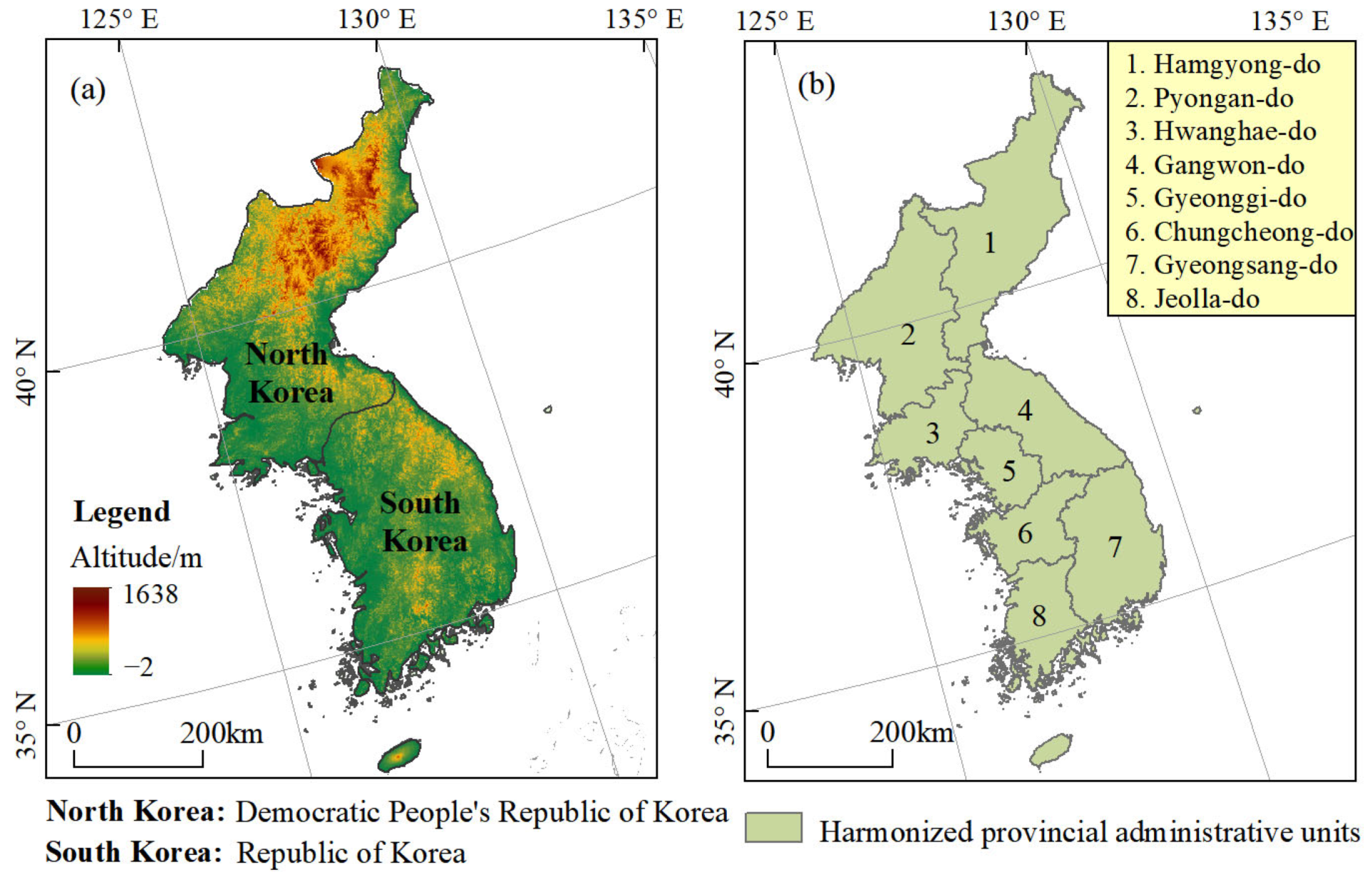
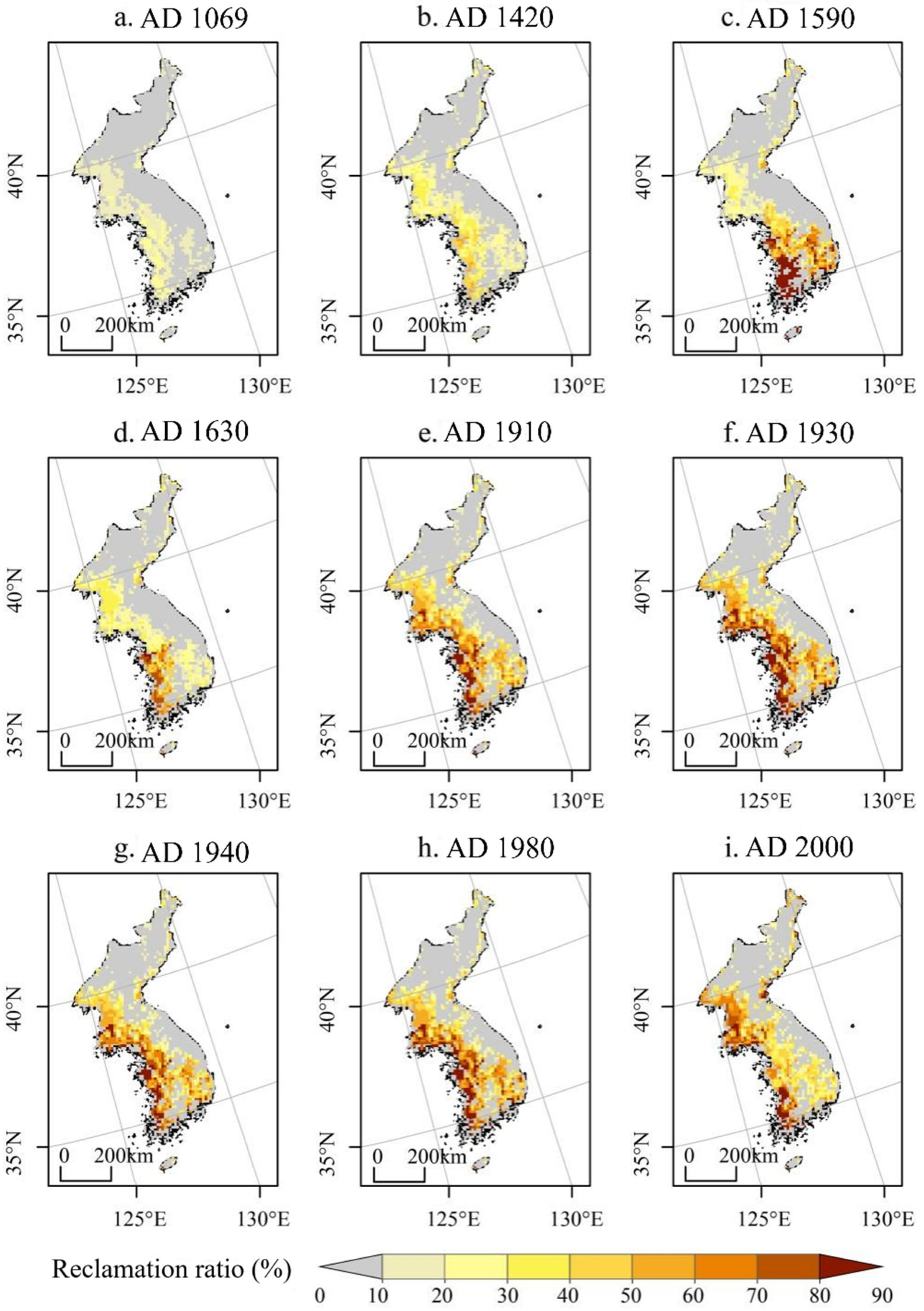
- Historical cropland data for the Goryeo Dynasty was sourced from the History of Goryeo (《高麗史》) [46], while records for the Joseon Dynasty were compiled from official historical documents, including the Annals of King Sejong (《世宗實錄》) [47] and the Supplementary Literature Compilation (《增補文獻備考》) [48] (Table 1). Key benchmark years—1069, 1420, 1590, and 1634—were selected based on their origin in nationwide land surveys, making them reliable indicators of actual cropland extent for their respective periods. Spatially, the data exhibit a distinct hierarchical structure: Goryeo-era records provide national-scale aggregates, whereas Joseon-era documentation offers provincial-level spatial granularity, enabling more detailed geographical analysis.
- (2)
- The cropland data for the Japanese colonial period were derived from the Korean Economic Yearbook 1918, which contains comprehensive survey records for 23 time points [49]. These surveys, conducted by specially trained Japanese surveyors between 1910 and 1918, systematically documented cropland topography, parcel boundaries, and ownership. Despite the colonial motivations behind the data collection—which included land appropriation and tax expansion—the meticulous surveys provide a relatively accurate representation of cropland development during that era. Annual cropland verification and registration continued until 1940.
- (3)
- Modern cropland statistical data from 1975 to 2000 for South Korea were obtained from Statistics Korea (http://kosis.kr/statHtml/statHtml.do?orgId=101&tblId=DT_1EB001&language=en&conn_path=I3) (accessed on 15 July 2025). For North Korea, cropland area data were primarily sourced from the Food and Agriculture Organization (FAO) of the United Nations. These datasets represent the most widely used and internationally harmonized time-series for comparative agricultural statistics.
2.2.2. Other Modern Basic Data
- (1)
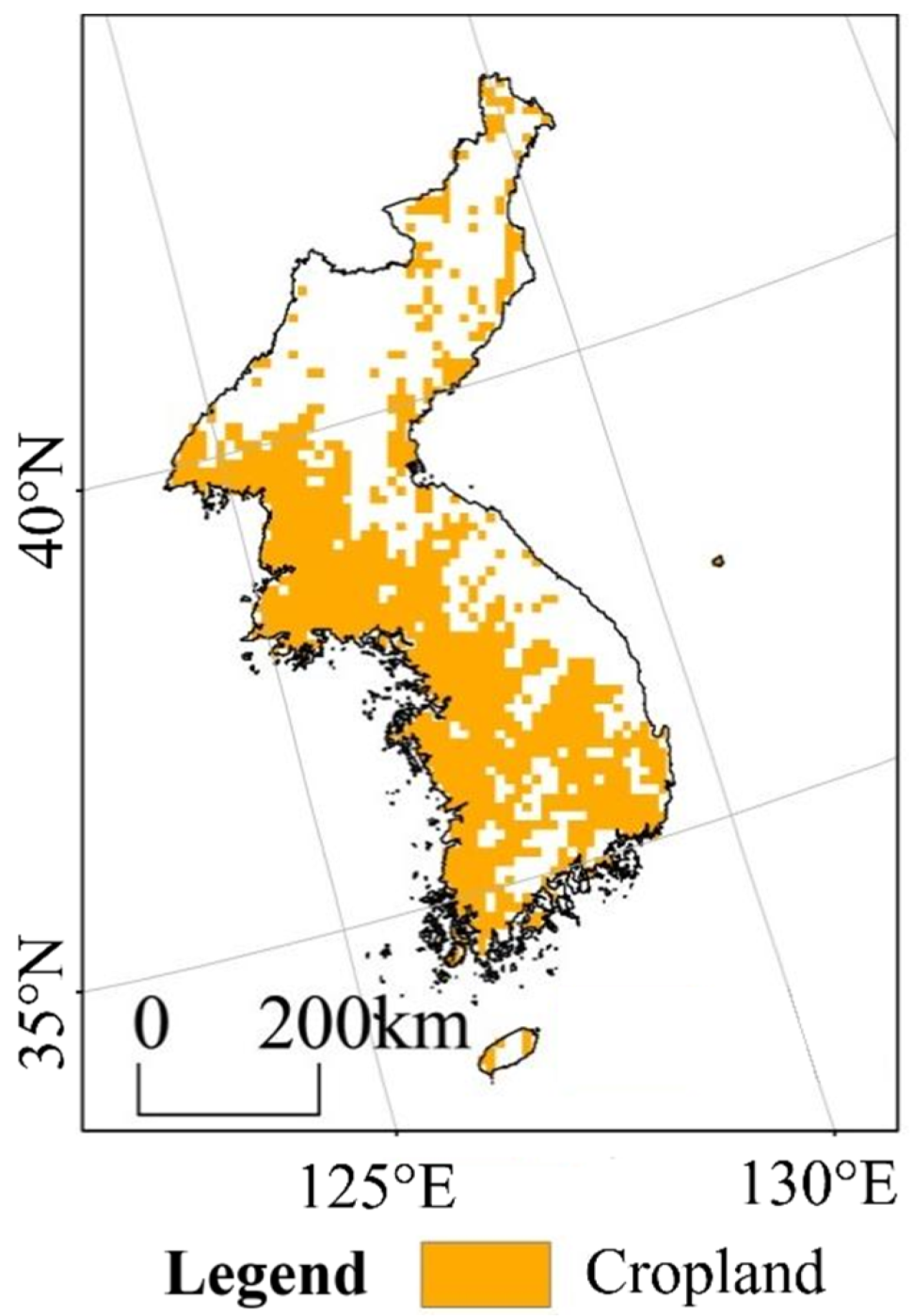
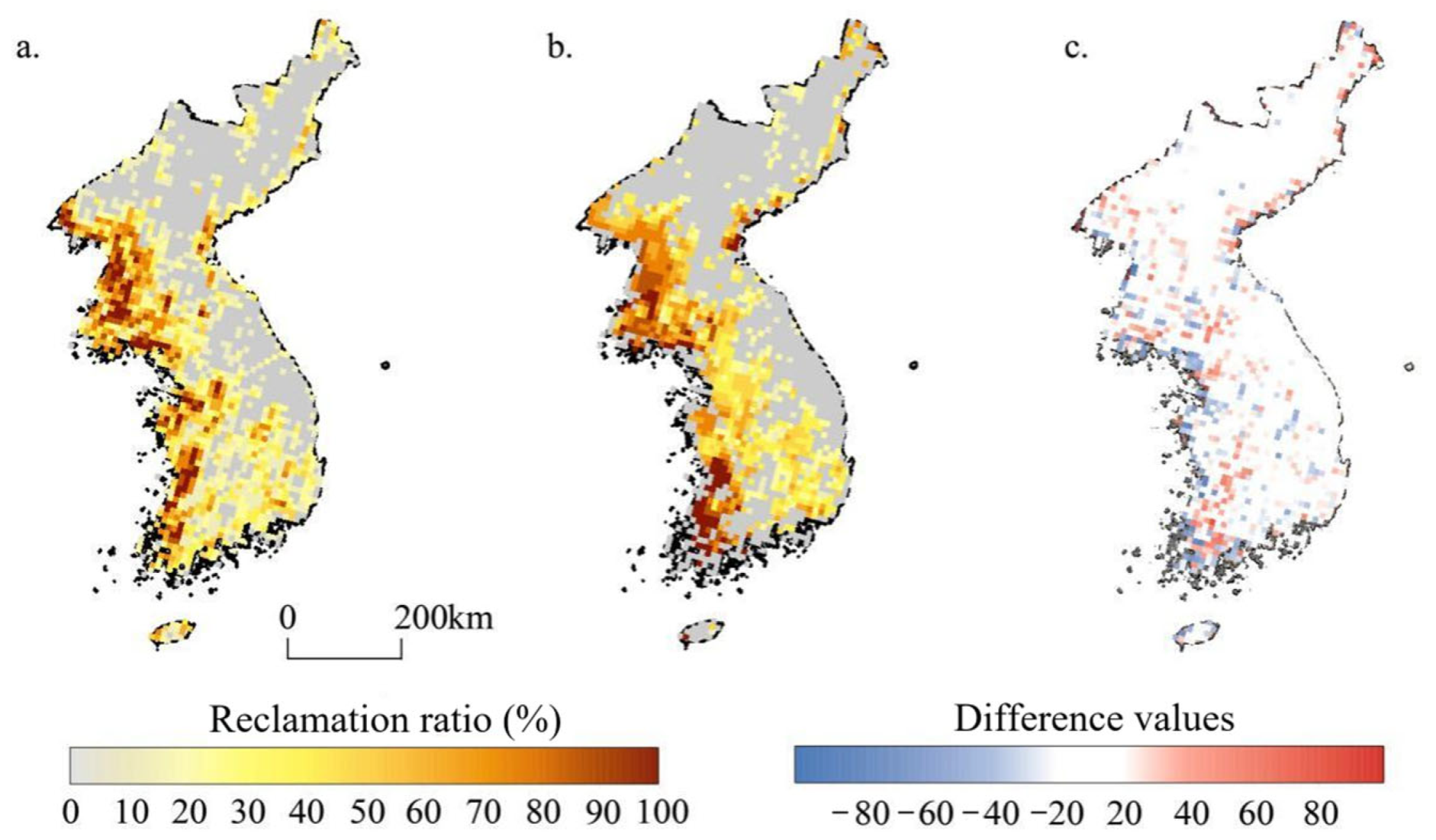
- The modern cropland data were obtained from the global land cover product by Liu et al. [50], accessible at http://data.ess.tsinghua.edu.cn/ (accessed on 15 July 2025). This dataset was generated on the Google Earth Engine (GEE) platform using the latest GLASS Climate Data Records (1982–2015). It features annual land cover classifications—including cropland, forest, grassland, shrubland, tundra, barren land, and ice/snow—with an overall accuracy of 82.81%, confirming its high reliability for large-scale land-cover analysis.
- (2)
- Topographic data, comprising elevation and slope, were derived from the Shuttle Radar Topography Mission (SRTM) Digital Elevation Model (DEM) (V4.1), provided by the United States Geological Survey (USGS) (http://srtm.csi.cgiar.org/) (accessed on 15 July 2025). Slope was calculated from the DEM to maintain data integrity and spatial resolution.
- (3)
- Climatic parameters, including growing degree days and precipitation averages for the 1960–1990 period, were sourced from the FAO’s Global Agro-ecological Zones (GAEZ) database (https://gaez.fao.org, accessed on 16 July 2025).
- (4)
- Soil texture data, including clay, silt, and sand content, were retrieved from SoilGrids (www.soilgrids.org) (accessed on 10 July 2025) at a spatial resolution of 250 m.
2.3. Methods for Cropland Area Reconstruction
2.3.1. Historical Cropland Area Correction
2.3.2. Regional Cropland Area Reconstruction
2.4. Methods for Spatially Explicit Allocation
2.4.1. Determination of the Maximum Extent of Cropland
2.4.2. Land Suitability Model for Cultivation
- (1)
- Elevation and slopewhere and are normalized elevation and slope values for grid j within province i (range [0, 1]), respectively; and are the maximum elevation and slope values in province i, respectively; and are the original elevation and slope values for grid j in province i, respectively.
- (2)
- Accumulated temperaturewhere represents the normalized cumulative temperature value for grid j within province i (range [0, 1]); denotes the maximum cumulative temperature value in province i; is the original cumulative temperature value for grid j in province i.
- (3)
- The soil texturewhere , , and represent the sand-to-clay ratio, sand content, and clay content for grid j in province i, respectively; is the normalized sand-to-clay ratio of grid j in province i; and are the maximum sand-to-clay ratio in province i and the original sand-to-clay ratio of grid j in province i, respectively.
- (4)
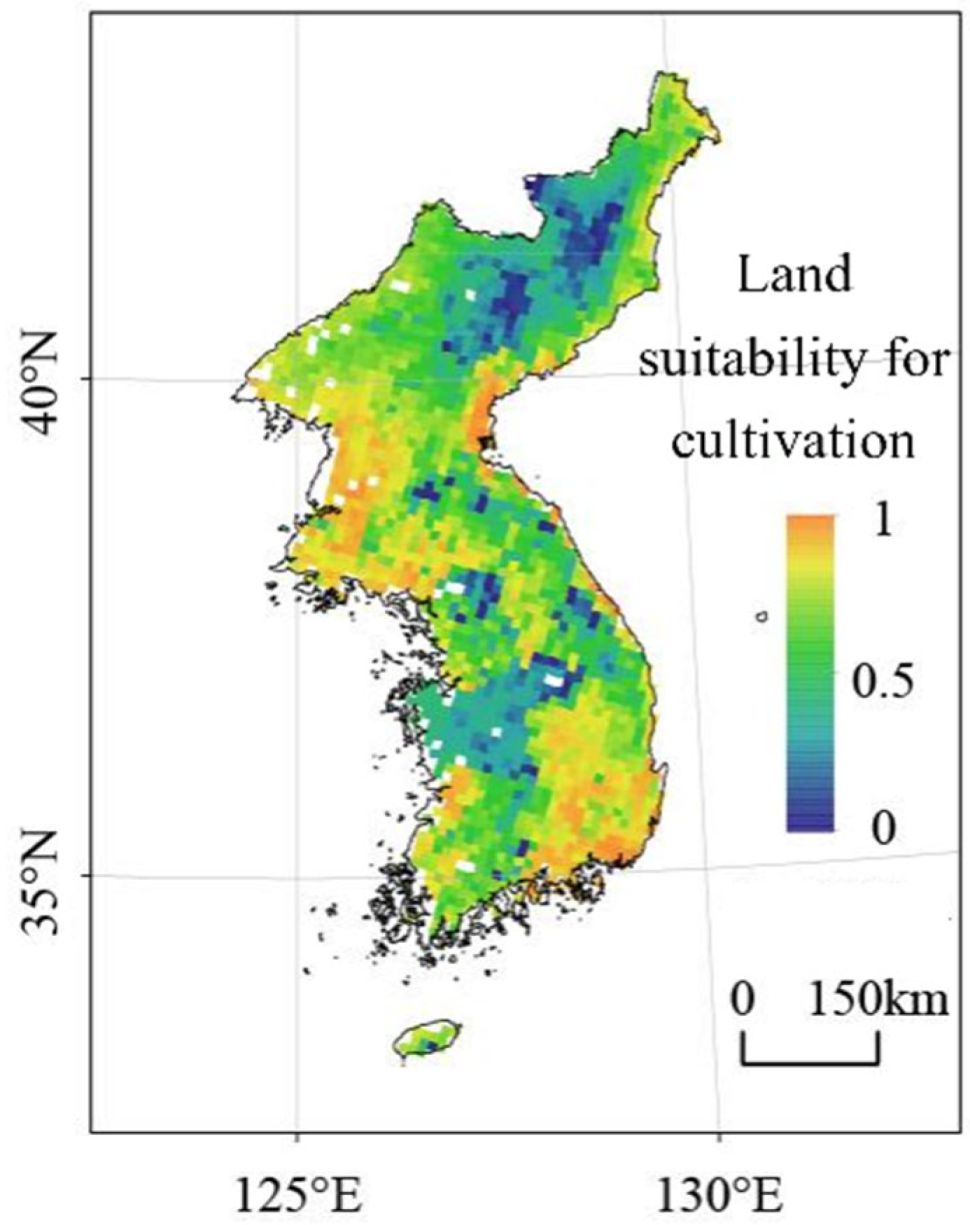
- Land suitability model for cultivation:where is the land suitability for cultivation of grid j in province i; , , , and are the normalized elevation, slope, cumulative temperature, and sand-to-clay ratio of grid j in province i, respectively.
2.4.3. Gridding Allocation Method for Cropland
3. Results
3.1. Changes of Cropland Area
3.2. Spatial Pattern Changes of Cropland Cover
4. Discussion
4.1. Comparison with Satellite-Based Data
4.2. Comparison with Historical Reconstructions
4.3. Comparison with Previous Studies
4.4. Limitations of the Study
5. Conclusions
Author Contributions
Funding
Data Availability Statement
Acknowledgments
Conflicts of Interest
References
- Ellis, E.C.; Gauthier, N.; Klein Goldewijk, K.; Bird, R.B.; Boivin, N.; Díaz, S.; Fuller, D.Q.; Gill, J.L.; Kaplan, J.O.; Kingston, N.; et al. People have shaped most of terrestrial nature for at least 12,000 years. Proc. Natl. Acad. Sci. USA 2021, 118, e2023483118. [Google Scholar] [CrossRef]
- Cao, B.W.; Yu, L.; Li, X.C.; Chen, M.; Li, X.; Hao, P.Y.; Gong, P. A 1 km global cropland dataset from 10000 BCE to 2100 CE. Earth Syst. Sci. Data 2021, 13, 5403–5421. [Google Scholar] [CrossRef]
- Roberts, N. How humans changed the face of Earth. Science 2019, 65, 865–866. [Google Scholar] [CrossRef] [PubMed]
- Stephens, L.; Fuller, D.; Boivin, N.; Rick, T.; Gauthier, N.; Kay, A.; Marwick, B.; Armstrong, C.G.D.; Barton, C.M.; Denham, T.; et al. Archaeological assessment reveals Earth’s early transformation through land use. Science 2019, 365, 897–902. [Google Scholar] [CrossRef]
- Sanderman, J.; Hengl, T.; Fiske, G.J. Soil carbon debt of 12,000 years of human land use. Proc. Natl. Acad. Sci. USA 2017, 114, 10811–10816. [Google Scholar] [CrossRef]
- Foley, J.A.; Defries, R.; Asner, G.P.; Barford, C.; Bonan, G.; Carpenter, S.R.; Chapin, F.S.; Coe, M.T.; Daily, G.C.; Gibbs, H.K.; et al. Global consequences of land use. Science 2005, 309, 570–574. [Google Scholar] [CrossRef] [PubMed]
- Rocha, A.M.d.; Franceschi, M.; Panosso, A.R.; Carvalho, M.A.C.d.; Moitinho, M.R.; Martins Filho, M.V.; Oliveira, D.M.d.S.; Freitas, D.A.F.d.; Yamashita, O.M.; La Scala, N., Jr. Effects of land use changes on CO2 emission dynamics in the Amazon. Agronomy 2025, 15, 488. [Google Scholar] [CrossRef]
- Castellano, M.J.; Archontoulis, S.V.; Helmers, M.J.; Poffenbarger, H.J.; Six, J. Sustainable intensification of agricultural drainage. Nat. Sustain. 2019, 2, 914–921. [Google Scholar] [CrossRef]
- Findell, K.L.; Berg, A.; Gentine, P.; Krasting, J.P.; Lintner, B.R.; Malyshev, S.; Santanello, J.A., Jr.; Shevliakova, E. The impact of anthropogenic land-use and land-cover change on regional climate extremes. Nat. Commun. 2017, 8, 989. [Google Scholar] [CrossRef]
- Yang, F.; Dong, G.; Meng, X.; Richard, A.; Houghton; Gao, Y.; He, F.; Li, M.; Li, W.; Liu, Z.; et al. Annual carbon emissions from land-use change in China from 1000 to 2019. Earth Syst. Sci. Data Discuss. 2025, in review. [Google Scholar] [CrossRef]
- Houghton, R.A.; Nassikas, A.A. Global and regional fluxes of carbon from land-use and land-cover change 1850–2015. Glob. Biogeochem. Cycles 2017, 31, 456–472. [Google Scholar] [CrossRef]
- Past Global Changes Working Group. LandCover6k. Real Project. 2014. Available online: http://www.real-project.eu/landcover6k-pages-working-group/ (accessed on 20 June 2025).
- Klein Goldewijk, K.; Beusen, A.; Doelman, J.; Stehfest, E. Anthropogenic land-use estimates for the Holocene—HYDE 3.2. Earth Syst. Sci. Data 2017, 9, 927–953. [Google Scholar] [CrossRef]
- Klein Goldewijk, K.; Beusen, A.; Van Drecht, G.; De Vos, M. The HYDE 3.1 spatially explicit database of human-induced global land-use change over the past 12,000 years. Glob. Ecol. Biogeogr. 2011, 20, 73–86. [Google Scholar] [CrossRef]
- Ramankutty, N.; Foley, J.A. Estimating historical changes in global land cover: Croplands from 1700 to 1992. Glob. Biogeochem. Cycles 1999, 13, 997–1027. [Google Scholar] [CrossRef]
- Ramankutty, N. Global Cropland and Pasture Data from 1700–2007. Available online: https://search.dataone.org/view/Global_Cropland_and_Pasture_Data_from_1700-2007.xml (accessed on 15 June 2025).
- Pongratz, J.; Reick, C.; Raddatz, T.; Claussen, M. A reconstruction of global agricultural areas and land cover for the last millennium. Glob. Biogeochem. Cycles 2008, 22, 1–16. [Google Scholar] [CrossRef]
- Kaplan, J.O.; Ruddiman, W.F.; Crucifix, M.C.; Ellis, E.C.; Ruddiman, W.F.; Lemmen, C.; Klein Goldewijk, K. Holocene carbon emissions as a result of anthropogenic land-cover change. Holocene 2011, 21, 775–791. [Google Scholar] [CrossRef]
- Liu, S.; Wang, Y.; Zhang, G.J.; Wei, L.; Wang, B.; Yu, L. Contrasting influences of biogeophysical and biogeochemical impacts of historical land use on global economic inequality. Nat. Commun. 2022, 13, 2479. [Google Scholar] [CrossRef]
- Li, D.; Tian, P.; Luo, H.; Hu, T.; Dong, B.; Cui, Y.; Khan, S.; Luo, Y. Impacts of land use and land cover changes on regional climate in the Lhasa River basin, Tibetan Plateau. Sci. Total Environ. 2020, 742, 13. [Google Scholar] [CrossRef] [PubMed]
- Le Quéré, C.; Andrew, R.M.; Friedlingstein, P.; Sitch, S.; Hauck, J.; Pongratz, J.; Pickers, P.A.; Korsbakken, J.I.; Peters, G.P.; Canadell, J.G.; et al. Global carbon budget 2018. Earth Syst. Sci. Data 2018, 10, 2141–2194. [Google Scholar] [CrossRef]
- Zhang, B.; Tian, H.; Lu, C.; Lu, C.Q.; Dangal, S.R.S.; Yang, J.; Pan, S.F. Global manure nitrogen production and application in cropland during 1860–2014: A 5-arcmin gridded global dataset for Earth system modeling. Earth Syst. Sci. Data 2017, 9, 667–678. [Google Scholar] [CrossRef]
- Klein Goldewijk, K.; Verburg, P.H. Uncertainties in global-scale reconstructions of historical land use: An illustration using the HYDE data set. Landsc. Ecol. 2013, 28, 861–877. [Google Scholar] [CrossRef]
- Fang, X.Q.; Zhao, W.Y.; Zhang, C.P.; Zhang, D.Y.; Wei, X.Q.; Qiu, W.L.; Ye, Y. Methodology for credibility assessment of historical global LUCC datasets. Sci. China Earth Sci. 2020, 63, 13. [Google Scholar] [CrossRef]
- Zhao, C.S.; He, F.N.; Yang, F.; Li, S.C. Uncertainties of global historical land use scenarios in past-millennium cropland reconstruction in China. Quat. Int. 2022, 641, 87–96. [Google Scholar] [CrossRef]
- Li, M.J.; He, F.N.; Zhao, C.S.; Yang, F. Evaluation of global historical cropland datasets with regional historical evidence and remotely sensed satellite data from the Xinjiang area of China. Remote Sens. 2022, 14, 4226. [Google Scholar] [CrossRef]
- Hua, L.; Li, S.; Gao, D.; Li, W. Uncertainties of global historical land use datasets in pasture reconstruction for the Tibetan Plateau. Remote Sens. 2022, 14, 3777. [Google Scholar] [CrossRef]
- Zhang, D.Y.; Fang, X.Q.; Yang, L.E. Comparison of the HYDE cropland data over the past millennium with regional historical evidence from Germany. Reg. Environ. Change 2021, 21, 15. [Google Scholar] [CrossRef]
- Li, S.C.; He, F.N.; Zhang, X.Z.; Zhou, T.Y. Evaluation of global historical land use scenarios based on regional datasets on the Qinghai-Tibet Area. Sci. Total Environ. 2019, 657, 1615–1628. [Google Scholar] [CrossRef] [PubMed]
- Kaplan, J.O.; Krumhardt, K.M.; Gaillard, M.J.; Sugita, S.; Trondman, A.K.; Fyfe, R.; Marquer, L.; Mazier, F.; Nielsen, A.B. Constraining the deforestation history of Europe: Evaluation of historical land use scenarios with pollen-based land cover reconstructions. Land 2017, 6, 91. [Google Scholar] [CrossRef]
- Li, B.B.; Jansson, U.; Ye, Y.; Widgren, M. The spatial and temporal change of cropland in the Scandinavian Peninsula during 1875-1999. Reg. Environ. Change 2013, 13, 1325–1336. [Google Scholar] [CrossRef]
- Kaplan, J.O.; Krumhardt, K.M.; Zimmermann, N. The prehistoric and preindustrial deforestation of Europe. Quat. Sci. Rev. 2009, 28, 3016–3034. [Google Scholar] [CrossRef]
- Gaillard, M.J.; Morrison, K.D.; Madella, M.; Whitehouse, N. Past land use and land-cover change: The challenge of quantification at the subcontinental to global scales. Past Land Use and Land Cover 2018, 26, 3. [Google Scholar]
- Pan, H.X.; Chen, Q.; Wu, Z.L.; Zhi, Z.M.; Fang, W.G.; Sun, J.Q.; Shi, Y.N. Reconstruction of cropland for the Rikaze Area of China since the Tubo Dynasty (AD 655). Land 2025, 14, 994. [Google Scholar] [CrossRef]
- Liu, X.; Liu, H.L. The application of ANN-FLUS model in reconstructing historical cropland distribution changes: A case study of Vietnam from 1885 to 2000. J. Nat. Resour. 2024, 39, 1473–1492. [Google Scholar] [CrossRef]
- Ye, Y.; Li, J.; Fang, X.Q.; Zhang, D.Y.; Zhao, Z.L.; Wu, Z.L.; Lu, Y.J.; Li, B.B. Reconstruction of cropland change in European countries using integrated multisource data since AD 1800. Boreas 2023, 52, 60–77. [Google Scholar] [CrossRef]
- He, F.N.; Yang, F.; Zhao, C.S.; Li, S.C.; Li, M.J. Spatially explicit reconstruction of cropland cover for China over the past millennium. Sci. China Earth Sci. 2023, 53, 115–131. [Google Scholar] [CrossRef]
- Li, S.C.; Liu, Y.T.; Li, J.R.; Zhang, X.Z. Mapping cropping patterns in the North China Plain over the past 300 years and an analysis of the drivers of change. J. Geogr. Sci. 2024, 34, 2074–2088. [Google Scholar] [CrossRef]
- Dias, L.C.P.; Pimenta, F.M.; Santos, A.B.; Costa, M.H.; Ladle, R.J. Patterns of land use, extensification, and intensification of Brazilian agriculture. Glob. Change Biol. 2016, 22, 2887–2903. [Google Scholar] [CrossRef]
- Fuchs, R.; Herold, M.; Verburg, P.H.; Clevers, J.G.P.W. A high-resolution and harmonized model approach for reconstructing and analyzing historic land changes in Europe. Biogeosciences 2013, 10, 1543–1559. [Google Scholar] [CrossRef]
- Piao, Y.; Xiao, Y.; Ma, F.D.; Park, S.J.; Lee, D.K. Monitoring land-use/land-cover and landscape-pattern changes at a local scale: A case study of Pyongyang. Remote Sens. 2023, 15, 1592. [Google Scholar] [CrossRef]
- Dong, Y.L.; Yu, H.; Wang, Z.M.; Li, M.Y. Land cover change of the DPRK and its driving forces from 1990 to 2015. J. Nat. Resour. 2019, 34, 288–300. [Google Scholar] [CrossRef]
- Yu, H.; Zhang, B.; Wang, Z.M.; Ren, C.Y.; Mao, D.H.; Jia, M.M. Land cover change and its driving forces in the Republic of Korea since the 1990s. Sci. Geogr. Sin. 2017, 37, 1755–1763. [Google Scholar]
- Park, S.Y.; Tak, H.M. Land-use changes and climate patterns in Southeast Korea. J. Korean Assoc. Geographic Inf. Stud. 2013, 16, 47–64. [Google Scholar] [CrossRef][Green Version]
- Bai, F.N.; Li, D.X. The Economic History of Korea; Yanbian University Press: Yanji, China, 1988. [Google Scholar]
- Jeong, I.J. The History of Goryeo; Southwest University Press: Chongqing, China, 2014. [Google Scholar]
- Hwangbo, R. The Annals of King Sejong; The Research Institute for Oriental Culture of Gakushuin University: Tokyo, Japan, 1953. [Google Scholar]
- Hong, B.H.; Lee, M.R.; Park, Y.D. Supplementary Literature Compilation; Meibundo: Toyama, Japan, 1981. [Google Scholar]
- Zhang, J.R. 1948 Korean Economic Yearbook; Korea Bank Investigation Department: Seoul, Republic of Korea, 1948. [Google Scholar]
- Liu, H.; Gong, P.; Wang, J.; Clinton, N.; Bai, Y.; Liang, S. Annual dynamics of global land cover and its long-term changes from 1982 to 2015. Earth Syst. Sci. Data 2020, 12, 1217–1243. [Google Scholar] [CrossRef]
- Kim, Y. Study on the Land System of Goryeo; Daewangsa: Seoul, Republic of Korea, 1980. [Google Scholar]
- Hiroshi, A. The restoration of Korean ancient Gyeolbe-je (結負制) and the origin of Japanese Dai-sei (代制). Soc. Hist. Metrol. Jpn. 2009, 31, 139–152. [Google Scholar]



| Data Types | Temporal Coverage | Spatial Coverage | Data Sources |
|---|---|---|---|
| Historical cropland data | AD 1069 | National | The History of Goryeo [46] |
| AD 1420, 1590, and 1634 | Province | The Annals of King Sejong [47] and the Supplementary Literature Compilation [48] | |
| Cropland survey data | 1910–1940 | National | The Korean Economic Yearbook 1918 [49] |
| Cropland statistical data | 1975–2000 | National | Statistics Korea (http://kosis.kr/statHtml/statHtml.do?orgId=101&tblId=DT_1EB001&language=en&conn_path=I3) (accessed on 15 July 2025); the Food and Agriculture Organization (FAO) of the United Nations |
| Modern Remote sensing-based data | 1982–2015 | 30 m × 30 m | Liu et al. [50], http://data.ess.tsinghua.edu.cn/ (accessed on 15 July 2025) |
| Topographic data | 1960–2000 | 90 m × 90 m | The United States Geological Survey (USGS) (http://srtm.csi.cgiar.org/) (accessed on 15 July 2025) |
| Climatic parameters | 1960–1990 | 10 m × 10 m | The Global Agro-ecological Zones (GAEZ) (https://gaez.fao.org) (accessed on 13 June 2025) |
| Soil texture data | 2010 | 250 m × 250 m | SoilGrids (www.soilgrids.org) (accessed on 10 July 2025) |
| Difference Level (%) | <−80 | −80~−70 | −70~−60 | −60~−50 | −50~−40 | −40~−30 | −30~−20 | −20~−10 | −10~0 |
|---|---|---|---|---|---|---|---|---|---|
| Proportion of grid numbers (%) | 0.14 | 0.52 | 0.47 | 1.04 | 2.32 | 2.84 | 6.35 | 13.47 | 36.94 |
| Difference level (%) | 0~10 | 10~20 | 20~30 | 30~40 | 40~50 | 50~60 | 60~70 | 70~80 | >80 |
| Proportion of grid numbers (%) | 12.23 | 9.48 | 7.25 | 3.56 | 2.18 | 0.95 | 0.19 | 0.05 | 0.00 |
Disclaimer/Publisher’s Note: The statements, opinions and data contained in all publications are solely those of the individual author(s) and contributor(s) and not of MDPI and/or the editor(s). MDPI and/or the editor(s) disclaim responsibility for any injury to people or property resulting from any ideas, methods, instructions or products referred to in the content. |
© 2026 by the authors. Licensee MDPI, Basel, Switzerland. This article is an open access article distributed under the terms and conditions of the Creative Commons Attribution (CC BY) license.
Share and Cite
Li, M.; Zhao, C.; He, F.; Li, S.; Yang, F. Spatiotemporal Reconstruction of Cropland Cover on the Korean Peninsula over the Past Millennium from Historical Archives and Remote-Sensing-Based Data. Land 2026, 15, 117. https://doi.org/10.3390/land15010117
Li M, Zhao C, He F, Li S, Yang F. Spatiotemporal Reconstruction of Cropland Cover on the Korean Peninsula over the Past Millennium from Historical Archives and Remote-Sensing-Based Data. Land. 2026; 15(1):117. https://doi.org/10.3390/land15010117
Chicago/Turabian StyleLi, Meijiao, Caishan Zhao, Fanneng He, Shicheng Li, and Fan Yang. 2026. "Spatiotemporal Reconstruction of Cropland Cover on the Korean Peninsula over the Past Millennium from Historical Archives and Remote-Sensing-Based Data" Land 15, no. 1: 117. https://doi.org/10.3390/land15010117
APA StyleLi, M., Zhao, C., He, F., Li, S., & Yang, F. (2026). Spatiotemporal Reconstruction of Cropland Cover on the Korean Peninsula over the Past Millennium from Historical Archives and Remote-Sensing-Based Data. Land, 15(1), 117. https://doi.org/10.3390/land15010117