1. Introduction
The Danube Delta is one of the most important wetlands in Europe, recognised as a UNESCO Biosphere Reserve, a component of the Natura 2000 network and a Ramsar site, covering an area of 580,000 ha [
1,
2]. According to the authors Iordache and Malageanu [
3], it includes a wide variety of ecosystems (23 natural and 7 anthropogenic ecosystems), including a complex hydrographic network, represented by a multitude of river branches interconnected with a labyrinth of lakes, channels, river islands, etc. The exceptional biodiversity of the Danube Delta, represented by thousands of plant and animal species, including endemic and threatened species [
3], is, however, vulnerable to both the effects of climate change and the pressures generated by human activities, including tourism activities [
2]. In general, climate has a major influence on tourism, too, determining both tourists’ choice of destinations and tourism activities [
4,
5]. Therefore, Matzarakis and Endler [
6] state that in order to ensure thermal comfort and a quality tourist experience, climatic elements must fall within appropriate values for the human body. Thus, in this context of increasing temperatures, changing precipitation and intensifying extreme phenomena, it is necessary to understand how these changes influence people, ecosystems and tourism resources of the region, in order to substantiate adaptive management measures and sustainable development.
On the other hand, nature-based tourism, as a form of sustainable tourism, has been distinguished in recent decades by a continuously growing demand, which has led to a growing interest among researchers, demonstrating the need for a sustainable tourism development plan in natural areas. According to Kim et al. [
7], in the last decade, nature-based tourism has gained popularity worldwide, which has led to an increasing number of tourists turning to an environmentally friendly form of tourism, mainly by visiting national parks and protected areas. Therefore, natural resources, which can be exploited through tourism, are extremely valuable for many emerging countries, which successfully participate in the competition on the international tourism market. Jarolímková et al. [
8] show that developed countries attract the majority of tourists and revenues due to the adequate development of infrastructure, skilled workforce and constant innovations which they introduce and implement in all tourism-related activities.
Taking into account all of the above, the novelty of this research lies in the development and application of an integrated analytical framework which brings together the climate dimension, biodiversity and tourism, analysed behaviourally in a single socio-ecological approach. Unlike previous studies, which separately analyse the effects of climate change on biodiversity or on tourism, our research simultaneously investigates the relationships among climate change, biodiversity and nature-based tourism in the DDBR, while integrating the perceptions and behavioural intentions of Generation Z, identified among young people who travelled to the natural area of the DDBR. The methodological novelty is supported by the complementary use of ARDL models for the analysis of longitudinal relationships and the PLS-SEM technique for the assessment of behavioural mechanisms, which allows for a more complex understanding of the interactions between the biophysical and social components of the system analysed. In addition, our research proposes an adaptive management framework based on empirical evidence, contributing to the literature on sustainable tourism, namely nature-based tourism, but also the resilience of socio-ecological systems in the context of climate change.
Starting from these theoretical considerations and the need to develop adaptive management strategies for destinations under climate change pressure, our research aims to answer the following research questions:
RQ1—What are the relationships among climate change, biodiversity and nature-based tourism in the DDBR?
RQ2—To what extent does biodiversity mediate the effects of climate change on tourism activity?
RQ3—How do Generation Z youth perceive the impact of climate change on the biodiversity and tourist attractiveness of the DDBR?
RQ4—What is the behaviour of Generation Z in practising nature-based tourism?
RQ5—What adaptive management measures can contribute to maintaining tourism competitiveness and biodiversity in the context of climate change?
This article is organised into the following sections: introduction, literature review and development of research hypotheses, research methodology, results, discussion and conclusions. The results obtained are of interest in terms of sustainable tourism, more precisely nature-based tourism in protected areas, especially since no study on this topic has been conducted in Eastern Europe yet.
2. Literature Review
Climate change, biodiversity and nature-based tourism form an interdependent system, in which the degradation of one component affects the functioning of the entire socio-ecological system.
Thus, climate change, driven by global warming, is considered the most severe problem for humanity [
9,
10], much more severe than terrorist, economic, political or health threats. Through its impact on the planet’s ecology, precipitation, temperature and weather patterns, as mentioned by Chung et al. [
11], global warming will affect the lives of each and every one of us. The effects of global warming, such as intense heat waves, increased extreme weather events, melting ice caps, and rising sea levels, are just a few of the phenomena which affect the biodiversity of many tourist destinations and have been studied by researchers [
2,
5,
12,
13]. In addition, warming and acidification of marine waters will lead to a decrease in biodiversity [
14], according to Woodhead et al. [
13], just a small temperature variation, for a short period of time, causes corals, which are a particular attraction for tourists and shelters of exceptional biodiversity, to reject the algae they feed on, leading to the sudden bleaching and death of entire reefs.
On the other hand, tourism activity is impossible without interaction with the natural environment, but this interaction involves mutual interconditioning [
5,
15], because the environment, through its potential expressed by natural wealth, represents the determining factor of travel, the reason for tourists’ travel [
16], while a clean environment cannot exist without the practice of quality tourism. In this sense, biodiversity is the central element of the attractiveness of nature-based tourist destinations [
9,
17], as are natural parks, reserves or protected areas.
Research in the field [
9,
15,
18,
19] shows that tourism contributes to global warming, especially through carbon dioxide emissions from aeroplanes and vehicles [
19], the use of energy and fuels for various installations and equipment, excessive urbanisation of areas of tourist interest [
5] or deforestation carried out for the construction of infrastructure specific to tourism development. At the same time, studies conducted by Ștefănică et al. [
16] and Marković Vukadin et al. [
5] indicate that tourism activity is directly affected, because tourists are very sensitive to weather variations. Choosing destinations with an unfavourable climate can expose visitors to extreme weather phenomena, reducing the comfort and quality of the tourist experience through the occurrence of thermal stress. Thus, research demonstrates that one of the most important factors in tourists’ preferences is represented by climatic conditions. The study conducted by Scott et al. [
9] shows how vulnerable tourism is to climate change.
On the other hand, the World Tourism Organisation (UNTWO) [
20] published the trends of tourism service consumers, among which the most relevant shows the tendency of people towards a healthy life through tourism, which is carried out in step with nature. The tourism sector has grown greatly, with tourists’ preferences changing, and they are becoming increasingly interested in protecting the environment [
21] by increasing awareness of sustainable tourism [
22]. Therefore, increased attention has been paid to sustainable development, in the context where studies have shown that tourism is one of the main contributors to environmental pollution and deterioration [
16,
23]. Furthermore, it has been observed that tourists are interested in the concept of nature-based tourism, through their tendency to travel to quiet natural places, where they can have new experiences and emotions [
24]. At the same time, specialists concerned with the field of sustainable development have analysed the impact of tourism activities carried out by adopting responsible behaviour in relation to the natural environment, thus promoting forms of travel with reduced environmental impact [
25,
26]. Closely related to this concern, studies conducted globally have also shown a good understanding and receptivity to sustainable travel among young tourists [
22,
27].
Sustainable development involves the relationship between humans and the environment and the responsibilities of the current generation towards future generations, tourism being a system with social, environmental and economic impacts on a global scale [
28]. Therefore, the role of sustainable tourism is given by the adoption of sustainable practices in and by the tourism industry. Thus, nature-based tourism has developed within sustainable tourism. Peter [
29] shows that most tourism activities can be described as nature-based, because nature has a main role in attracting tourists to holiday destinations.
Poria et al. [
30] suggest that education has an important role, whose main purpose is to facilitate the understanding of the protection and conservation of the natural environment by the participants in tourism activities. Thus, Tilden [
31] showed that through education one reaches understanding, through understanding one reaches appreciation, and through appreciation one reaches protection; thus, there can be a nexus between protection and nature-based tourism. Furthermore, Poria et al. [
30] analyse tourists’ preferences and validate the relationship between motivation for visiting and preferences for a variety of experiences. Thus, nature-based tourism stimulates a certain type of travel; that is, people are motivated by the desire to enjoy wildlife or isolated natural areas or simply to discover these areas untouched by civilisation [
32]. Kim et al. [
7] show that personal values represent a real challenge for researchers, because they define the consumer’s real behaviour. Schultz et al. [
33] establish a connection between people’s attitude towards nature and their reaction (attitude) towards environmental problems. Thus, the way a person perceives the environment can also have consequences for the sustainability of tourism. An important step in clarifying the relationship between humans and the environment was made by Dunlap and Van Liere [
34] with the New Environmental Paradigm (NEP). This approach proposes a scale with items to measure a new ecological vision of the world, challenging to some extent the older concepts about the human–nature relationship [
35]. Subsequently, Stern et al. [
36,
37] developed a new model—Value–Belief–Norm (VBN), which suggests that a person’s values interact with perceptions of a given situation, which will generate a certain behaviour. Within the VBN theory, values represent the source of concern for environmental issues and pro-environmental behaviour.
Consequently, knowledge is essential in the sustainable use and development of tourism resources made available by nature. Given that, in the coming years, Generation Z will form the main target market for tourism [
38], it is important to understand how young people will use their knowledge about environmental protection while practising nature-based tourism. Since young people will have their own savings, they will be able to purchase tourism products and services on their own. Regarding the social behaviour of this generation, which is relatively different from that of their predecessors, it should be borne in mind that young people from Generation Z have grown up and developed in an era of new technologies.
Therefore, the literature has highlighted the fact that climate change represents one of the most important challenges for biodiversity conservation and the development of sustainable tourism in protected areas [
39,
40]. At the same time, several studies highlight that biodiversity is a key determinant of the attractiveness of nature-based tourism destinations, contributing both to increasing the recreational value of ecosystems and to strengthening the competitiveness of ecotourism destinations [
11,
41]. However, the relationships among climate change, biodiversity and tourism are often analysed separately, and there is still little research which simultaneously investigates the interdependencies among these components within complex socio-ecological systems, such as protected areas [
42,
43].
Furthermore, the recent literature on adaptive management of tourist destinations highlights the need to integrate the behavioural dimension in assessing the effects of climate change, in particular by understanding the perceptions and attitudes of younger generations towards biodiversity conservation and sustainable tourism [
44,
45]. In this context, Generation Z represents a segment of strategic interest, characterised by a high level of sensitivity towards environmental issues and a growing influence on the global tourism market [
46,
47].
Based on the proposed conceptual framework and the empirical evidence reported in the literature regarding the relationships among climate change, biodiversity and nature-based tourism, we formulated the following research hypotheses (
Table 1).
3. Research Methodology
3.1. Study Area, Data and Methods
The DDBR is located in south-eastern Romania at the mouth of the Danube River, representing one of the largest and best-preserved wetlands in Europe. The reserve supports exceptional biodiversity and provides cultural ecosystem services that underpin nature-based tourism. The DDBR was selected as the study area because it is highly vulnerable to climate change while simultaneously experiencing increasing tourism pressure, making it an appropriate socio-ecological system for investigating the relationships among climate change, biodiversity and nature-based tourism within an adaptive management framework [
54,
55].
This research adopts a mixed, sequential and integrative methodological design, called the Integrated Climate–Biodiversity–Tourism–Gen Z Adaptive Framework, developed to investigate the relationships among climate change, biodiversity and nature-based tourism in the DDBR, as well as to assess the role of Generation Z perceptions and behaviours in underpinning adaptive management strategies. The choice of this design is determined by the multidimensional nature of the phenomenon analysed and the need to integrate biophysical, tourism and behavioural components into a unitary analytical framework, capable of capturing the complexity of contemporary socio-ecological systems [
44,
50].
The conceptual model of the research assumes the existence of a causal mechanism in which climate change influences biodiversity, and changes in biodiversity are subsequently reflected in the dynamics of nature-based tourism:
Climate Change → Biodiversity → Nature-Based Tourism
In this context, biodiversity is analysed as a link between climate processes and the tourism performance of the destination, while the perceptions and behavioural intentions of Generation Z are investigated as relevant factors for the future development of sustainable tourism and for the formulation of adaptive management policies.
From an operational perspective, the research design is structured in two complementary components. The first component of the research design is longitudinal and uses climate change indicators, biodiversity indicators, and tourism indicators for the period of 2000–2025. The climate change analysis is conceptually based on annual temperature, precipitation and extreme climate events (EXT). However, due to data availability constraints, the econometric analysis relies on annual mean temperature (TEMP) as the empirical climate indicator. For the biodiversity dimension, the Biodiversity Climate Stress Index (BCSI) was employed as a composite indicator to capture the climatic pressure exerted on the natural capital of the DDBR. We assessed the tourism dimension through the number of arrivals and the number of overnight stays at the tourist destination.
Given the longitudinal nature of the database and the relatively small size of the temporal sample, in our study, we use ARDL models and the Error Correction Model (ECM) to investigate the relationships among variables [
56,
57]. This approach allows for the simultaneous assessment of short-term and long-term effects among variables with different orders of statistical integration.
In this research, we estimated three complementary econometric models.
The first model analyses the influence of climate change on biodiversity, using BCSI as the dependent variable and climate change indicators as explanatory factors. The second model investigates the effect of biodiversity on the performance of nature-based tourism, measured by the number of arrivals and the number of overnight stays at the tourist destination. The third model estimates the direct effects of climate change on tourism activity.
Next, we assessed the mediating role of biodiversity by integrating the results of the three models, in order to identify the mechanism by which climate change influences tourism through natural capital.
Before estimating the econometric models, we performed stationarity tests using the Augmented Dickey–Fuller (ADF) procedure, followed by verification of the existence of cointegration relationships using the Bounds test. In the case of identifying stable long-term relationships, we estimated the corresponding ECM, which allowed the assessment of the speed of adjustment of the system to imbalances generated by climate or ecological shocks.
The second component of the research design is represented by the behavioural analysis based on primary data collected through a questionnaire applied to young people from Generation Z.
For this component, we used the PLS-SEM method, recommended in the recent literature for exploratory studies which include latent constructs and aim to develop predictive models [
52,
53]. The application of PLS-SEM allowed the simultaneous assessment of the relationships among climate change awareness, concern for biodiversity, attitude towards sustainable tourism and intention to visit the DDBR.
We carried out the analysis process in two successive stages. In the first stage, we evaluated the measurement model using reliability and validity indicators, namely Cronbach’s Alpha, Composite Reliability (CR), Average Variance Extracted (AVE) and Heterotrait–Monotrait Ratio (HTMT). In the second stage, we estimated the structural model using path coefficients, coefficients of determination (R2), effect size (f2) and predictive relevance (Q2) in order to test the hypotheses formulated.
By combining ARDL–ECM with the PLS-SEM technique, this research proposes an integrated approach capable of capturing both the objective dimension of the relationships among climate change, biodiversity and tourism, as well as the subjective dimension associated with the perceptions and behaviours of young Generation Z. This methodological integration contributes to the substantiation of adaptive management strategies for nature-based tourism in the DDBR, in the context of the challenges generated by climate change.
3.2. Research Purpose and Objectives
The purpose of our research is to analyse the relationships among climate change, biodiversity and nature-based tourism in the DDBR by assessing how the perceptions and behaviour of young Generation Z can contribute to the substantiation of adaptive management strategies for sustainable tourism.
To answer the questions formulated above and to ensure a systematic investigation of the relationships among climate change, biodiversity and nature-based tourism in the DDBR, our research proposes a set of interdependent objectives, built in accordance with the conceptual framework of the study and with the recommendations of the literature on the analysis of socio-ecological systems and adaptive management of tourist destinations [
9,
58,
59]. This study adopts the socio-ecological resilience perspective, according to which biodiversity conservation and human behavioural responses jointly determine the adaptive capacity of protected areas under climate change. Within this framework, CA, BC, Sustainable Tourism Attitude (STA) and Visit Intention (VI) represent complementary components of the social dimension of resilience.
Since climate change simultaneously influences ecological processes and economic activities dependent on natural resources, the objectives of our research aim both to identify the relationships among the biophysical components of the analysed system, and to evaluate the behavioural dimension represented by the perceptions and intentions of Generation Z.
In this sense, the investigative approach is structured on six major directions of analysis.
O1. Analysing the dynamics of climate change in the DDBR by evaluating the evolution of the main climate indicators during the period of 2000–2025.
O2. Investigating the relationship between climate variables and biodiversity indicators, in order to identify the effects associated with changes in environmental conditions on the ecosystems specific to the DDBR.
O3. Assessing the influence of biodiversity and environmental factors on nature-based tourism by analysing the dynamics of the number of arrivals and the number of overnight stays at the tourist destination.
O4. Identifying the climate and biodiversity factors which contribute most significantly to explaining variations in tourism activity and the attractiveness of the destination.
O5. Analysis of the perceptions and behavioural intentions of Generation Z regarding climate change, biodiversity conservation and nature-based tourism.
O6. Integrating econometric, biodiversity and behavioural results in order to formulate adaptive management recommendations aimed at underpinning the sustainability of nature-based tourism in the context of climate change.
3.3. Sampling and Research Variables
To test the hypotheses formulated and to investigate the relationships among climate change, biodiversity and nature-based tourism, in our research we use a sample extracted from an integrated database, built by combining secondary sources of statistical data on climate change and biodiversity with primary information collected through a questionnaire addressed to young people from Generation Z. This approach allows the simultaneous capture of the ecological, economic and behavioural dimensions which characterise the socio-ecological systems specific to protected areas and responds to recent recommendations in the literature on the use of multiple data sources for the analysis of tourism sustainability and the impact of climate change on nature-based destinations [
44,
49,
50].
The database was structured in two complementary components. The first component is a longitudinal dataset covering the period of 2000–2025, used to investigate the relationships among climate change, biodiversity and tourism activity in the DDBR. The second component is made up of primary data obtained through a sociological survey conducted among Generation Z representatives, used to assess perceptions and behaviours associated with biodiversity conservation and nature-based tourism.
As for the longitudinal component, it includes tourism, climate and biodiversity indicators collected on the DDBR. The tourism indicators included in the analysis are represented by the number of arrivals and the number of overnight stays recorded at the tourist destination during the period analysed, as they are considered relevant indicators of the tourist performance and attractiveness of the destination.
The climate dimension is captured through the main parameters used in the literature to assess the impact of climate change on tourism and ecosystems, namely temperature, precipitation and climate extremes. The temperature component of the longitudinal database was developed using annual observations from the Sulina meteorological station (ECA&D station ID 969), located in the eastern sector of the DDBR (45°10′00″ N, 29°43′59″ E; elevation: 3 m a.s.l.). Annual mean air temperature (TEMP) data were obtained from the European Climate Assessment & Dataset (ECA&D) and cover the period of 2000–2025. Prior to the econometric analysis, the temperature series was checked for chronological consistency, missing observations and implausible annual values. No missing annual observations or values requiring interpolation or imputation were identified; therefore, the complete series of 26 annual observations was retained.
PREC was initially considered as one of the climatic indicators included in the conceptual framework. However, a homogeneous station-level PREC series covering the entire 2000–2025 period under conditions comparable to the TEMP series was not available. Consequently, PREC was not retained in the correlation matrix or in the final ARDL specifications. This approach avoids the use of incomplete or non-comparable observations and improves the transparency and reproducibility of the empirical analysis. The use of a single reference station is justified by the relatively homogeneous climatic conditions of the low-altitude Danube Delta and by the widespread use of Sulina observations in regional climatological studies focusing on the coastal wetland environment.
The biodiversity component is represented by indicators of biodiversity and ecosystem status, used as proxy variables to assess the natural capital which supports the development of nature-based tourism.
In the absence of a complete and homogeneous annual series on the state of biodiversity for the entire period analysed (2000–2025), our research uses a proxy indicator, BCSI, built to capture the pressure exerted by climate change on the natural capital of the DDBR. The use of composite indicators and proxy variables is common in the literature on climate change and socio-ecological systems, especially when long-term ecological data are incomplete or difficult to standardise [
60,
61]. The BCSI assumes that increasing global warming exerts pressure on habitats and species characteristic of wetland ecosystems, thereby affecting natural capital and the cultural ecosystem services supporting nature-based tourism [
48,
49]. In line with studies using synthetic indicators to assess the vulnerability of ecosystems to climate change [
61,
62], the index is constructed by inversely normalising the annual mean temperature (Equation (1)):
Interpretation:
Higher temperatures reduce the score, as they increase stress on habitats and species.
For the Danube Delta, the values for minimum and maximum average temperature are
Thus, high BCSI values indicate a low level of climate stress on biodiversity, while low values reflect the intensification of climate pressures on habitats and species characteristic of the DDBR. Through this approach, the index allows the integration of the ecological dimension into the econometric models developed in the research and facilitates the investigation of the relationships among climate change, biodiversity and nature-based tourism.
To complete the time series analysis and investigate the behavioural dimension of nature-based tourism, our research uses a primary dataset obtained by applying a questionnaire on the orientation of young tourists towards the environment by identifying travel motivations associated with nature-based tourism. The questionnaire was designed to assess respondents’ perceptions of climate change, biodiversity conservation, and behaviours associated with choosing natural destinations.
The resulting database included 419 respondents and 67 items, including variables related to tourism experiences, tourists’ attitudes towards the environment, their perceptions regarding nature conservation, travel motivations, and participants’ socio-demographic characteristics. From the perspective of the sample structure, 90.2% of the respondents are under 25 years of age, which confirms the relevance of the research for the segment formed by young people of Generation Z and justifies the use of this group as the target population of the analysis.
To ensure the relevance of the responses to the study objectives, the questionnaire included a filter question regarding previous travel experience to a nature-based tourism destination. Of the 419 respondents, 331 people (79.0%) reported previous experience visiting nature-based destinations, while 88 respondents (21.0%) did not have such experiences. Consequently, analyses of young people’s perceptions of nature-based tourism and behavioural intentions were conducted exclusively based on the subsample of respondents who had direct experience in consuming tourism products associated with the natural environment.
The structure of the research instrument included several conceptual dimensions relevant to the literature on sustainable tourism and pro-ecological behaviour, namely environmental orientation, perception of the human–nature relationship, attitudes towards biodiversity conservation, motivations associated with nature-based tourism, level of satisfaction with tourism experiences and future visit intentions. This structure allows for the investigation of the mechanisms through which ecological values and climate change concerns influence the tourism behaviour of Generation Z and contribute to the understanding of the potential of this segment to support the development of sustainable tourism models within the DDBR.
In line with the Integrated Climate–Biodiversity–Tourism–Gen Z Adaptive Framework, we grouped the research variables into four complementary dimensions: climate, biodiversity, tourism and behavioural. The climate dimension is represented by the level of temperature, precipitation and extreme weather events, indicators frequently used to assess the effects of climate change on ecosystems and tourism activities [
48,
50]. The biodiversity component is operationalised through the BCSI, used to capture the pressure exerted by climate change on the natural capital of the DDBR. The tourism dimension is reflected by the number of arrivals and the number of overnight stays at the tourist destination, and the behavioural component integrates constructs associated with climate change awareness, BC and intention to participate in nature-based tourism activities, with applicability in the context of the DDBR. This structure allows for the integrated investigation of the relationships among climate, biodiversity, nature-based tourism and the behaviour of Generation Z (
Table 2).
4. Results and Discussions
4.1. Descriptive Statistics of Research Variables
Before estimating the econometric models and testing the relationships formulated by the research hypotheses, we carried out a descriptive analysis of the variables included in the database. The econometric literature recommends this stage for evaluating the data distribution, identifying extreme values and understanding the general characteristics of the series analysed [
52,
63].
The descriptive analysis of the climate dimension is shown in
Table 3. Therefore, the average annual temperature recorded an average value of 12.77 °C, with an obvious increasing trend after 2019. The maximum value was reached in 2024 (14.33 °C), confirming the climate warming process observed at the level of the Danube Delta.
Also, the descriptive analysis of the biodiversity dimension is presented in
Table 3. We can see that the BCSI highlights a progressive reduction in climatic conditions favourable to biodiversity in recent years of the period analysed. The minimum values recorded after 2023 reflect the intensification of climatic pressure on the ecosystems of the DDBR.
The descriptive statistical analysis of the tourism dimension is presented in
Table 4, providing a preliminary picture of the variability of climate, biodiversity and tourism indicators and allowing the identification of any asymmetries or deviations from normality which may influence the results of subsequent econometric estimates.
The results highlight a high variability of tourist activity during the period analysed. The maximum values recorded in recent years suggest an increase in the tourist attractiveness of the DDBR, while the high standard deviations indicate important fluctuations in tourist demand.
Regarding the characteristics of the Generation Z sample, we present its structure in
Table 5.
The sample is predominantly made up of respondents who had previous experience in nature-based tourism, which provides an adequate basis for the analysis of perceptions and behavioural intentions associated with Generation Z.
In order to analyse the behavioural dimension, the latent constructs included in the PLS-SEM model were operationalised based on groups of items derived from the questionnaire applied to Generation Z. Their structure is presented in
Table 6, as follows:
The behavioural model operationalises the social dimension of socio-ecological resilience through four interconnected latent constructs (CA, BC, STA and VI), representing the adaptive behavioural responses of Generation Z to climate change and biodiversity conservation.
4.2. Correlation Analysis of the Longitudinal Variables
In order to explore the relationships among the research variables, we calculated the Pearson correlation matrix, the results of which are presented in
Table 7.
The results highlight a positive and strong correlation between tourist arrivals (ARR) and the number of overnight stays (OVN), confirming that the evolution of the two tourism characterisation indicators follows similar trends. The annual mean temperature (TEMP) shows moderate positive associations with tourism activity, suggesting that years characterised by higher temperatures tend to be associated with higher levels of tourism flows. In contrast, the BCSI is negatively correlated with tourism indicators, a result which can be explained by the fact that low values of the index reflect the intensification of climate stress associated with warmer periods.
However, the correlations do not provide information on causal relationships or dynamic properties of the time series. Consequently, the next step consists of checking the stationarity of the variables using the ADF test, a necessary condition for estimating ARDL models.
4.3. Testing the Properties of Time Series
To verify the ARDL premises, we applied the ADF test, recommended for identifying the order of integration of time series before estimating dynamic models [
56,
57] (Equation (2)).
where
represents the series analysed;
represents the difference operator;
represents the temporal trend;
represents the error term.
The null hypothesis (
) assumes the existence of a unit root and the non-stationary character of the series, while the alternative hypothesis (
) assumes its stationarity (
Table 8).
The results confirm that the series are not integrated to higher order I(2), which allows the application of the ARDL methodology.
Confirmation of the stationarity of the series allowed the analysis of cointegration relationships. Thus, we assessed the existence of a long-term equilibrium mechanism among the climate dimension, biodiversity and the performance of nature-based tourism in the DDBR by means of the Bounds test (
Table 9) [
56].
The results of the Bounds test do not confirm the existence of a stable long-term equilibrium relationship among the variables of climate, biodiversity and the indicators of tourism activity. This result suggests that the influence of climate change on nature-based tourism in the DDBR is manifested rather through dynamic mechanisms and short- and medium-term cumulative effects than through stable long-term structural relationships [
48,
50]. The estimation of an ECM is conditional on the prior identification of a cointegration relationship among variables, since the error correction mechanism reflects the temporary deviation of the system from its long-term equilibrium trajectory [
56,
64]. In this case, the results of the Bounds test did not confirm the existence of a long-term equilibrium relationship, which makes the estimation of an ECM inappropriate. Consequently, the empirical analysis was limited to the interpretation of the dynamic structure captured by the ARDL models, without introducing an explicit adjustment mechanism towards equilibrium.
4.4. ARDL Model Estimation
To test the hypotheses formulated and to investigate the relationships among climate change, biodiversity and nature-based tourism, we estimated ARDL models, suitable for the simultaneous analysis of short-term dynamic relationships and possible long-term equilibrium relationships among the variables analysed [
56]. The econometric specifications used are presented in Equations (3)–(7). These represent the general theoretical form of the relationships investigated, while the final empirical estimates were defined following the econometric specification process, based on the statistical properties of time series and the principle of parsimony. In this context, precipitation was maintained at the conceptual level to capture the multidimensional nature of climate change, without being retained in the final estimates, as it did not provide additional explanatory information in relation to the variables analysed.
Therefore, we present the estimated models below:
Model 1. Influence of climate change on biodiversity (H1)
where
= Biodiversity Climate Stress Index;
= annual mean temperature;
= precipitation;
= extreme climate events.
Model 2. Influence of biodiversity on nature-based tourism (H2)
Tourist overnight stays
where
= tourist arrivals;
= tourist overnight stays.
Model 3. Influence of climate change on tourism (H3)
Tourist overnight stays (OVN)
After defining the econometric specifications, we estimated the ARDL models corresponding to the hypotheses formulated. The results allow the evaluation of the effects exerted by climate change and biodiversity on tourism activity in the DDBR, both from the perspective of the statistical significance of the coefficients and the direction of the relationships identified.
Table 10 summarises the results of the main ARDL estimates.
The results highlight a high temporal persistence of tourism activity, with the coefficients of the lagged dependent variables being positive and statistically significant. This result suggests that the evolution of tourist flows in the DDBR is influenced to a significant extent by the performances recorded in previous periods. In contrast, the temperature and the BCSI present effects of low intensity and statistically insignificant, indicating that the relationships among climate change, biodiversity and tourism are complex and mediated by additional factors of an economic, infrastructural and behavioural nature.
4.5. PLS-SEM Analysis of the Behaviour of Generation Z Youth
In accordance with the conceptual framework of the research, we investigated the relationships among the latent constructs through a structural model estimated by the PLS-SEM method [
52,
53]. The model aims to assess the direct and indirect effects of climate change awareness and BC on the intention to participate in nature-based tourism activities among Generation Z. The structure of the model is presented in Equations (8)–(10), as follows:
where
= Climate Awareness;
= Biodiversity Concern;
= Sustainable Tourism Attitude;
= Visit Intention;
= path coefficients;
= residual terms.
The reliability and validity of the measurement model were evaluated using the criteria recommended in the PLS-SEM literature. Internal consistency was assessed through Cronbach’s Alpha and CR, adopting the minimum threshold of 0.70 (
Table 11). Convergent validity was evaluated using the AVE ≥ 0.50, whereas discriminant validity was assessed using the HTMT < 0.90.
According to the recommended thresholds, all constructs satisfy the criteria for internal consistency, with Cronbach’s Alpha and CR values exceeding 0.70. Convergent validity is supported for BC and STA (AVE > 0.50), while the slightly lower AVE values observed for CA and VI remain acceptable in exploratory PLS-SEM studies when CR exceeds 0.70 [
52].
All HTMT values remain below the recommended threshold of 0.90, confirming satisfactory discriminant validity and indicating that the latent constructs represent distinct conceptual dimensions [
52] (
Table 12).
The statistical significance of the direct structural relationships was assessed through bootstrapping, based on bootstrap standard errors, t-statistics, p-values, and 95% confidence intervals.
The bootstrapping results for the structural model indicate that most of the hypothesised direct relationships are statistically significant (
Table 13). CA exerts a positive and significant effect on BC and STA, confirming that greater awareness of climate change is associated with stronger pro-environmental attitudes. BC has the strongest direct influence on VI, highlighting its central role in explaining Generation Z’s behavioural intentions towards nature-based tourism. In contrast, the direct effect of CA on VI is not statistically significant, suggesting that this relationship may operate indirectly through the mediating constructs included in the model. The corresponding indirect effects are examined in the following section using the bootstrapping procedure.
To further examine the mediated mechanisms implied by the structural model, specific and total indirect effects were estimated using a non-parametric bootstrapping procedure with 5000 resamples (
Table 14). The results confirm the existence of significant indirect relationships among the latent constructs. CA exerts a positive indirect effect on STA through BC (β = 0.174,
p < 0.001). Furthermore, CA indirectly influences VI through BC (β = 0.254,
p < 0.001) and, to a lesser extent, through STA (β = 0.044,
p = 0.003). BC also has a positive indirect effect on VI through STA (β = 0.070,
p = 0.017). The serial indirect pathway linking CA, BC, STA and VI is likewise significant (β = 0.025,
p = 0.049). Overall, the total indirect effect of CA on VI is positive and statistically significant (β = 0.324,
p < 0.001), whereas its direct effect remains non-significant. These findings indicate that the influence of CA on behavioural intention is transmitted primarily through BC and, to a lesser extent, through STA.
The values of the coefficients of determination indicate a moderate explanatory capacity of the structural model. In particular, the model explains 44.3% of the variation in the intention to participate in nature-based tourism activities (VI), confirming the relevance of the constructs included to explain the behaviour of Generation Z. At the same time, 22.1% of the variation in the orientation towards nature-based tourism (STA) and 10.3% of the variation in the BC are explained by the estimated structural relationships (
Table 15).
To complete the interpretation of the PLS-SEM results and provide an applied perspective on the tourism behaviour of Generation Z, we carried out a synthetic characterisation of the respondents’ eco-behavioural orientation by integrating the main dimensions investigated in the research (
Table 16).
The results highlight a favourable eco-behavioural profile among Generation Z, characterised by a high level of CA, a strong BC and a positive predisposition towards participating in nature-based tourism activities. These findings suggest the existence of significant potential for the development of adaptive management strategies and tourism products oriented towards the responsible valorisation of the natural capital of the DDBR (
Table 17).
4.6. Hypothesis Assessment and Synthesis of Results
In order to synthesise the results obtained,
Table 18 presents the status of the research hypotheses, the methods used for testing and the main conclusions drawn from the empirical analysis.
The results highlight the fact that climate change and biodiversity are relevant components of the socio-ecological system analysed, but their influence on tourism activity is not manifested exclusively through direct and stable long-term relationships. While hypothesis H1 is supported by the results obtained for the climate and biodiversity dimensions, H2–H4 benefit from partial empirical support, suggesting the existence of complex mechanisms through which natural capital and climatic conditions influence nature-based tourism. These findings are consistent with the recent literature highlighting the multidimensional nature of the relationships among climate change, biodiversity and tourism in protected areas [
49,
50].
To validate the behavioural dimension of the research, we tested hypotheses H5 and H6 using the PLS-SEM structural model, in order to investigate the relationships among climate change awareness, BC and intentions associated with nature-based tourism among Generation Z. The results confirm that BC is a significant determinant of the intention to visit nature-based destinations, while climate change awareness contributes to strengthening attitudes favourable to sustainable tourism. These findings support the importance of integrating the ecological dimension into tourism management and promotion strategies in the DDBR, especially among younger generations. From a socio-ecological resilience perspective, the findings suggest that biodiversity conservation and environmental awareness reinforce the adaptive capacity of the DDBR. However, increasing interest in nature-based tourism among Generation Z may also generate additional ecological pressure on fragile wetland ecosystems if visitor growth is not accompanied by adaptive management and effective visitor monitoring.
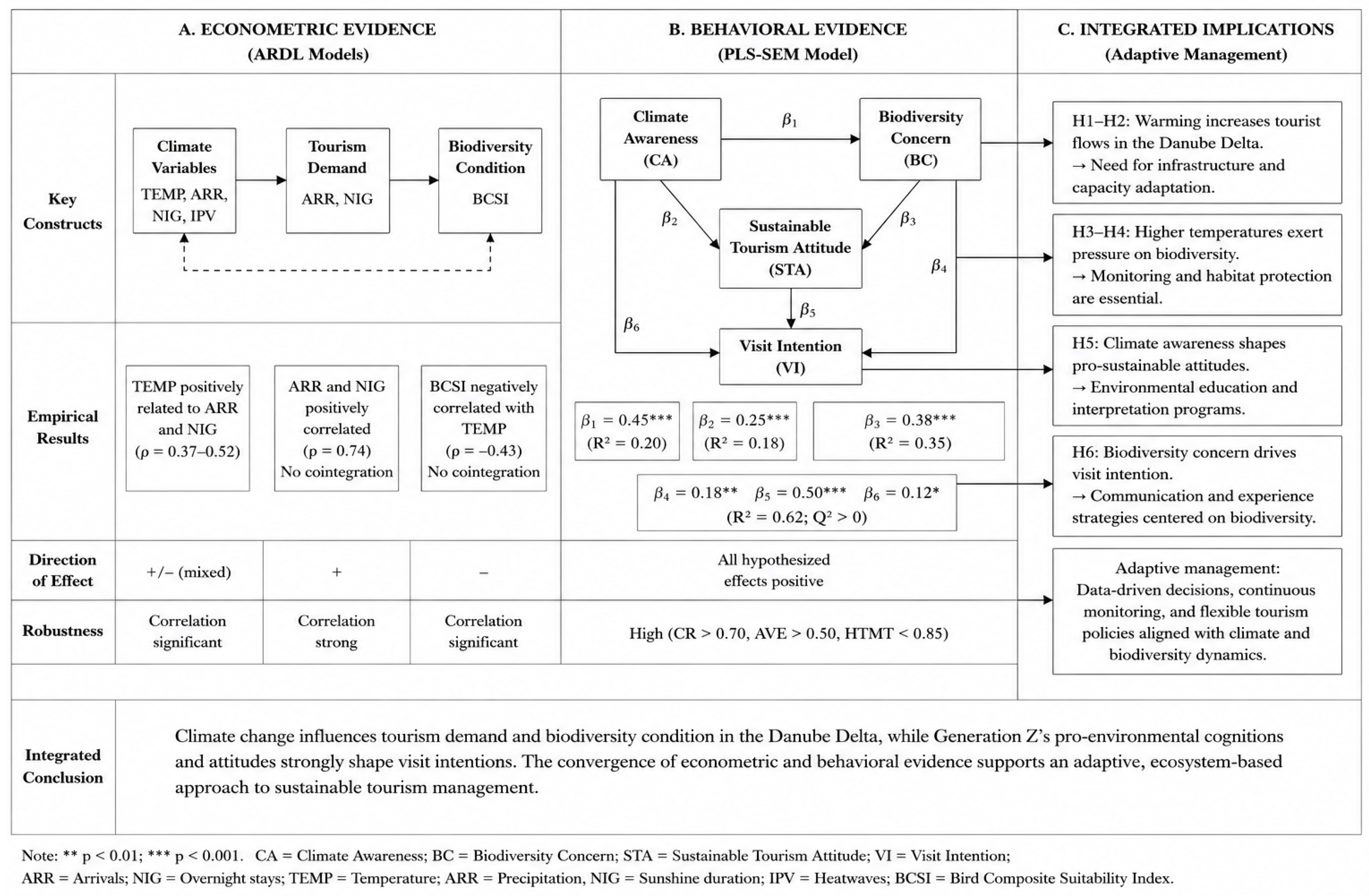
To integrate the econometric and behavioural results, our research proposes an adaptive management matrix—Adaptive Climate–Biodiversity–Tourism Matrix—shown in
Figure 1, which connects evidence on climate and tourism dynamics with the perceptions of Generation Z. This approach allows the transformation of empirical results into action directions applicable to the adaptive management of nature-based tourism in the DDBR.
5. Conclusions
This research investigated the relationships among climate change, biodiversity and nature-based tourism in the DDBR, through an integrated analytical framework which brings together climatic, ecological, tourist and behavioural dimensions. The results confirm the interdependent nature of the socio-ecological system analysed, and emphasise the need for adaptive management strategies which ensure the equilibrium between biodiversity conservation and the development of tourism activities in the context of intensifying climate pressures.
In relation to RQ1, our research highlights the existence of nexuses among climate change, biodiversity and tourism activity. The temperature increase trend observed in the period 2000–2025 is associated with changes in ecological conditions and with transformations in tourism dynamics, confirming the fact that nature-based tourism depends on the functioning and conservation of natural capital.
Regarding RQ2, the results suggest that biodiversity plays an interface role between climate processes and tourism activity. Although the econometric analysis did not reveal stable long-term cointegration relationships, biodiversity remains a central determinant of the tourist attractiveness of the DDBR and underpins the provision of cultural ecosystem services that support nature-based tourism and recreation.
Regarding RQ3 and RQ4, the behavioural analysis indicates that Generation Z shows a high level of sensitivity towards climate issues and biodiversity conservation. BC significantly influences the intention to participate in nature-based tourism activities, suggesting that ecological values are becoming increasingly important in the process of choosing tourist destinations.
In relation to RQ5, the results support the need to implement adaptive management strategies aimed simultaneously at biodiversity conservation and strengthening tourism resilience. Continuous monitoring of climate conditions, protection of vulnerable habitats, development of ecotourism products with reduced environmental impact and intensification of ecological education and awareness programmes are priority directions for maintaining the tourism competitiveness of the DDBR in the context of climate change.
From a theoretical perspective, our research contributes to the literature on socio-ecological systems by integrating climatic, ecological, tourist and behavioural dimensions into a unified analytical framework. From a practical perspective, this study proposes a Climate–Biodiversity–Tourism–Generation Z Adaptive Framework, capable of supporting the development of evidence-based policies and strategies for the sustainable management of tourism in protected natural areas.
The results of the behavioural component suggest that Generation Z can represent a relevant actor in supporting the adaptive management of protected natural destinations, through its favourable orientation towards biodiversity conservation and participation in nature-based tourism activities.
The empirical findings support adaptive management strategies directly linked to the quantitative results of this study. Since Biodiversity Concern emerged as the strongest determinant of VI, biodiversity education and awareness programmes should be prioritised. Likewise, the observed climatic pressure on biodiversity highlights the need for continuous ecological monitoring to balance tourism development with biodiversity conservation and strengthen socio-ecological resilience.
The main limitation of this research is associated with the availability of longitudinal ecological data and the focus of the behavioural component on Generation Z. Although Machine Learning-based methods offer important advantages in a predictive context, the small size of the time series and the explanatory objective of the research justified the use of ARDL and PLS-SEM models, which allow the interpretation of the relationships among variables and the testing of the theoretical hypotheses formulated.
Future research can expand the analytical framework by integrating additional ecological indicators, comparative approaches between destinations, and predictive models based on artificial intelligence and decision support systems, capable of simultaneously integrating climatic, ecological, and tourism information in order to substantiate the adaptive management of protected natural areas.




 ,
,