The Mechanism of Young People’s Perceptions of Urban Parks on Their Recommendation Intentions


Abstract
1. Introduction
2. Theoretical Framework and Research Hypotheses
2.1. Theoretical Foundation
2.1.1. Research Subject Selection
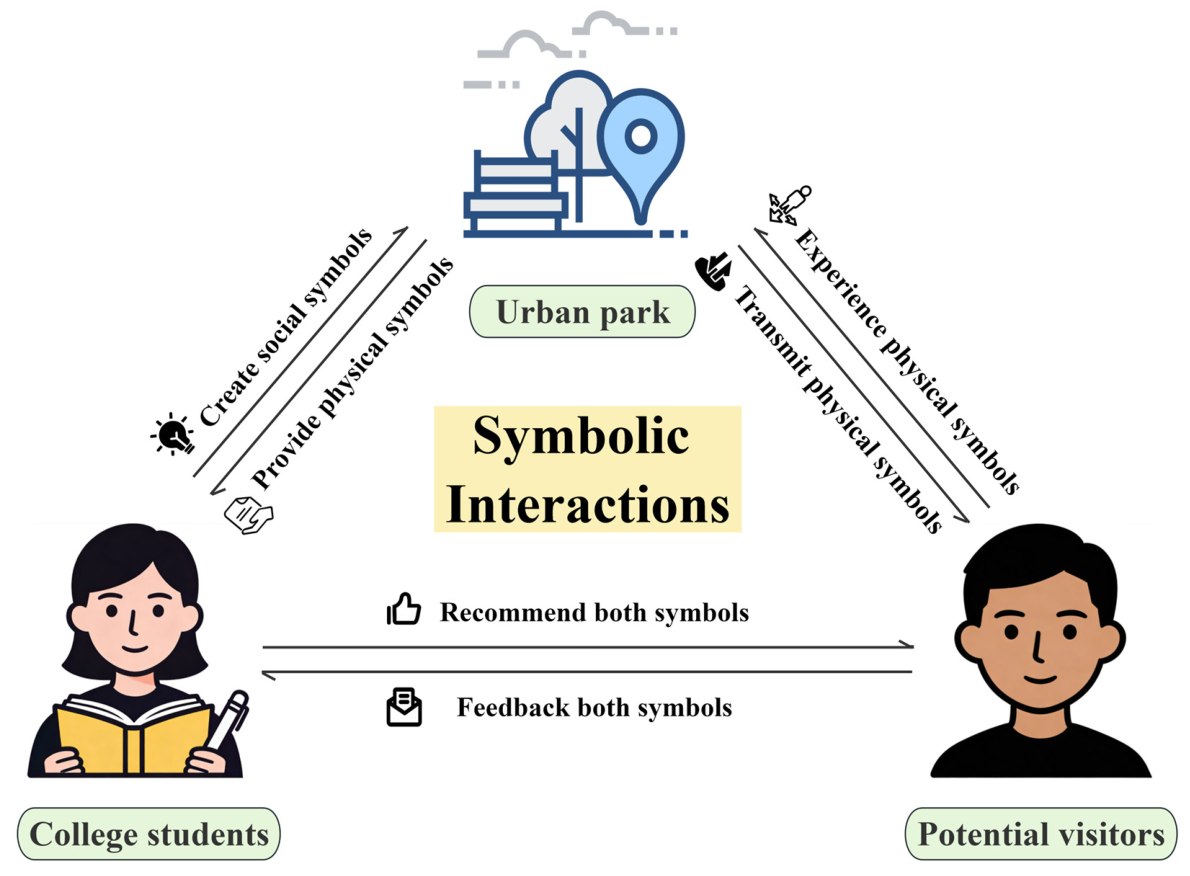
2.1.2. The Logic of Symbolic Interactionism
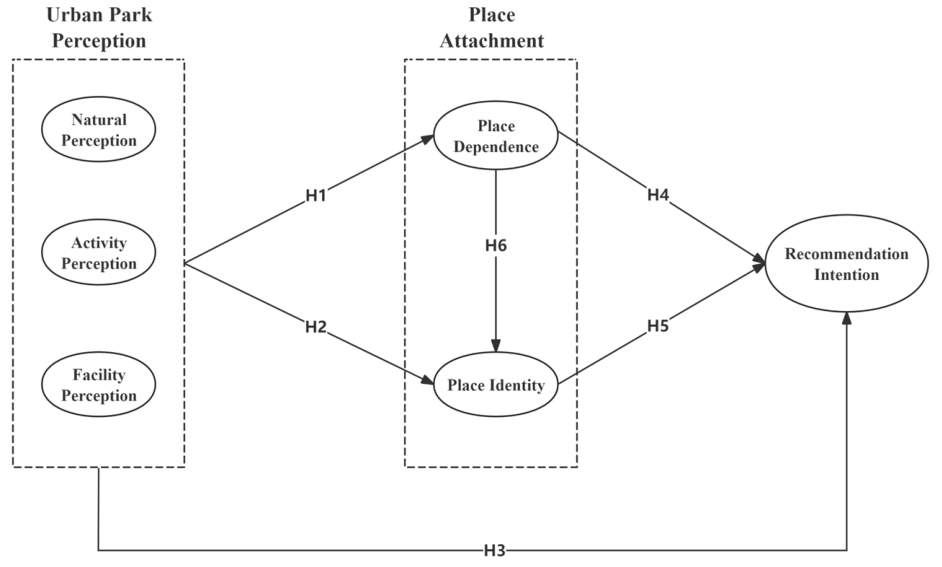
2.2. Research Questions and Hypotheses
2.2.1. Perception and Place Attachment to Urban Parks
2.2.2. Perception and Recommendation Intentions of Urban Parks
2.2.3. Place Attachment and Recommendation Intentions to Urban Parks
2.2.4. Place Dependence and Place Identity on Urban Parks
2.2.5. The Mediating Role of Place Attachment to Urban Parks
3. Materials and Methods
3.1. Questionnaire Design
3.2. Data Collection
3.3. Data Analysis
4. Results
4.1. Demographic Background of the Respondents
4.2. Reliability and Validity Testing
4.3. Goodness-of-Fit Testing of the Measurement Model
4.4. Correlation Analysis
4.5. Hypothesis Testing of the Model
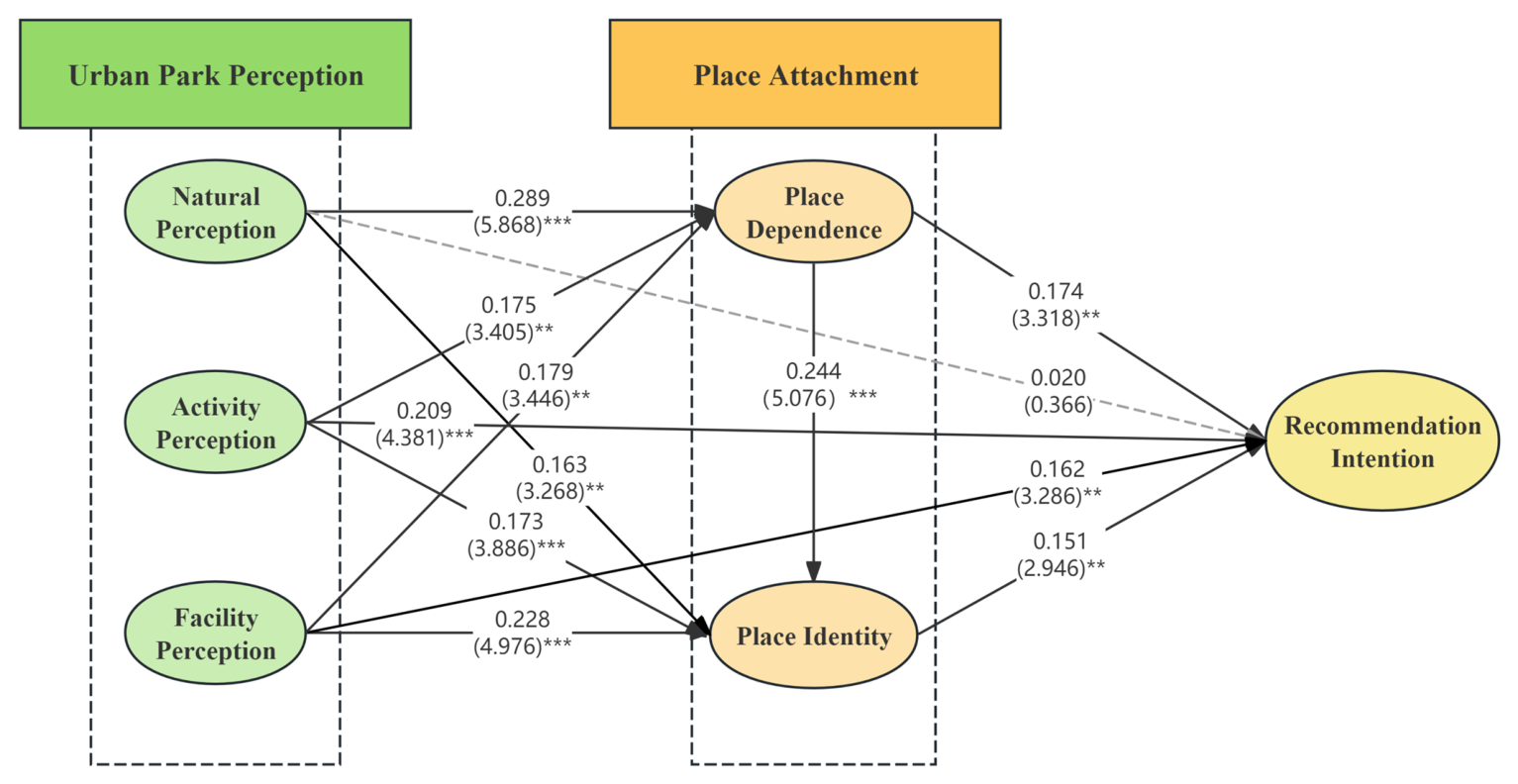
4.5.1. Direct Effect Test of Model
4.5.2. Mediating Effect Test Based on Bootstrap
4.6. Additional Analyses
4.6.1. Robustness Tests
4.6.2. Model Comparison Tests
4.6.3. fsQCA Analysis
5. Discussion
5.1. Key Findings and Comparisons with Previous Studies
5.2. Policy Implications
5.3. Contributions
5.4. Limitations
6. Conclusions
Author Contributions
Funding
Institutional Review Board Statement
Informed Consent Statement
Data Availability Statement
Acknowledgments
Conflicts of Interest
Appendix A

| Probability of Going to the Park | Types of Parks Frequently Visited | Followers to the Park | |
|---|---|---|---|
| Gender | 0.12 | 0.98 | 0.23 |
| Age | 0.82 | 0.39 | 0.05 |
| Ethnic groups | 0.92 | 0.43 | 0.29 |
| Education level | 0.15 | 0.10 | 0.58 |
| Major | 0.04 * | 0.46 | 0.26 |
| Average monthly consumption expenditure | 0.33 | 0.61 | 0.25 |
Appendix B
| Hypothesis | Path | No-Control Model | With Control Model | Change |
|---|---|---|---|---|
| H1a | NP → PD | 0.289 *** | 0.299 *** | 0.010 |
| H1b | AP → PD | 0.175 ** | 0.169 ** | −0.006 |
| H1c | FP → PD | 0.179 ** | 0.180 *** | 0.001 |
| H2a | NP → PI | 0.163 ** | 0.161 ** | −0.002 |
| H2b | AP → PI | 0.173 *** | 0.175 *** | 0.002 |
| H2c | FP → PI | 0.228 *** | 0.228 *** | 0.000 |
| H3 | PD → PI | 0.244 *** | 0.245 *** | 0.001 |
| H4 | PI → RI | 0.151 ** | 0.152 ** | 0.001 |
| H5a | NP → RI | 0.02 | 0.031 | 0.011 |
| H5b | AP → RI | 0.209 *** | 0.199 *** | −0.010 |
| H5c | FP → RI | 0.162 ** | 0.163 *** | 0.001 |
| H6 | PD → RI | 0.174 ** | 0.167 ** | −0.007 |
| Hypothesis | Path | No-Control Model | With Control Model |
|---|---|---|---|
| Percentile 95%CI | |||
| H7a | NP → PD → PI → RI | [0.004, 0.021] | [0.004, 0.022] |
| H7b | AP → PD → PI → RI | [0.002, 0.015] | [0.002, 0.014] |
| H7c | FP → PD → PI → RI | [0.002, 0.016] | [0.002, 0.016] |
Appendix C
| Model | Δχ2 | AIC | BIC | R2 |
|---|---|---|---|---|
| Partial mediation model (M0) | — | 3272.105 | 3344.44 | 0.289 |
| Full mediation model (M3) | 38.383 *** | 3304.488 | 3364.767 | 0.22 |
Appendix D
| Condition | Configuration 1 | Configuration 2 | Configuration 3 | Configuration 4 | Configuration 5 | Configuration 6 | Configuration 7 |
|---|---|---|---|---|---|---|---|
| NP | ⊗ | ● | ⊗ | ⊗ | |||
| AP | ● | ● | ⊗ | ● | |||
| FP | ● | ● | ● | ⊗ | ● | ● | |
| PD | ● | ⊗ | ● | ● | |||
| PI | ⊗ | ⊗ | ● | ● | ● | ||
| Raw coverage | 0.367 | 0.374 | 0.34 | 0.247 | 0.331 | 0.351 | 0.346 |
| Unique coverage | 0.021 | 0.016 | 0.013 | 0.012 | 0.052 | 0.004 | 0.000 |
| Consistency | 0.884 | 0.872 | 0.899 | 0.883 | 0.873 | 0.884 | 0.893 |
| Overall consistency | 0.817 | ||||||
| Overall coverage | 0.616 | ||||||
References
- Tong, A.; Qian, X.; Xu, L.; Wu, Y.; Ma, Q.; Shi, Y.; Feng, M.; Lu, Z. Demand-Led Optimization of Urban Park Services. Forests 2023, 14, 2371. [Google Scholar] [CrossRef] [Scilit]
- Bai, X.; Sadia, S. Park City Leads the Way of Urban Development and Innovation in China. J. Environ. Eng. Landsc. Manag. 2023, 31, 240–247. [Google Scholar] [CrossRef] [Scilit]
- Cheng, Y.; Zhang, J.; Wei, W.; Zhao, B. Effects of Urban Parks on Residents’ Expressed Happiness before and during the COVID-19 Pandemic. Landsc. Urban Plan. 2021, 212, 104118. [Google Scholar] [CrossRef] [Scilit] [PubMed]
- Lis, A.; Zalewska, K.; Iwankowski, P.; Betkier, K.; Bilska, P.; Dudar, V.; Łągiewka, A. Evaluation of Sense of Safety and Privacy in Parks in Relation to the Topography, the Presence of Dense Vegetation and Other People in the Area. Landsc. Urban Plan. 2024, 242, 104948. [Google Scholar] [CrossRef] [Scilit]
- Li, X.; Li, X.; Zhang, M.; Luo, Q.; Li, Y.; Dong, L. Urban Park Attributes as Predictors for the Diversity and Composition of Spontaneous Plants—A Case in Beijing, China. Urban For. Urban Green. 2024, 91, 128185. [Google Scholar] [CrossRef] [Scilit]
- Liu, C.; Xie, M.; Meng, S.; Zhang, C.; Zhang, Y. International Experience and Implication of the Full-Process Practice of Opening and Sharing in Megacity Parks. Landsc. Archit. 2024, 31, 41–47. [Google Scholar] [CrossRef] [Scilit]
- Zhang, L.; Xu, X.; Guo, Y. The Impact of a Child-Friendly Design on Children’s Activities in Urban Community Pocket Parks. Sustainability 2023, 15, 10073. [Google Scholar] [CrossRef] [Scilit]
- Wu, Y.; You, Y.; Zhou, W.; Lan, S. Nonlinear Relationship Between the Elderly’s Perception of Green Spaces and Their Activity Characteristics. Landsc. Archit. 2025, 32, 96–104. [Google Scholar] [CrossRef] [Scilit]
- Xie, X.; Liu, B. Perception and Experience of Urban Park Landscape by the Visually Impaired. Landsc. Archit. 2023, 30, 113–121. [Google Scholar]
- Chew, E.Y.T.; Jahari, S.A. Destination Image as a Mediator between Perceived Risks and Revisit Intention: A Case of Post-Disaster Japan. Tour. Manag. 2014, 40, 382–393. [Google Scholar] [CrossRef] [Scilit]
- Liu, W.; Liu, D. Mechanism of Word-of-Mouth Tourism Recommendations Based on Destination Trust. Tour. Trib. 2018, 33, 63–74. [Google Scholar]
- Ma, K.; Jiang, B. Voice of Urban Park Visitors: Exploring Destination Attributes Influencing Behavioural Intentions through Online Review Mining. Complex Intell. Syst. 2023, 9, 2571–2583. [Google Scholar] [CrossRef] [Scilit]
- Yao, X.; Sun, Y.; Sun, B.; Huang, Y. The Impact of the Urban Forest Park Recreation Environment and Perceived Satisfaction on Post-Tour Behavioral Intention—Using Tongzhou Grand Canal Forest Park as an Example. Forests 2024, 15, 330. [Google Scholar] [CrossRef] [Scilit]
- Stanovčić, T.; Manojlović, M.; Perovic, D. The Relationship between Cultural Tourist Experience and Recommendation Intention: Empirical Evidence from Montenegr. Sustainability 2021, 13, 13144. [Google Scholar] [CrossRef] [Scilit]
- Liu, J.; Wu, Y.; Jiang, X.; Jin, D. Tourists’ Preferences and Willingness to Pay for Biodiversity, Concession Activity and Recreational Management in Wuyishan National Park in China: A Choice Experiment Method. Forests 2024, 15, 629. [Google Scholar] [CrossRef] [Scilit]
- Han, X. The Impact of Native Plants and Biophilic Design on Tourist Emotions and Behavioral Intentions—A Case Study of Nanhu Park in Xinxiang City. J. Southwest Univ. Nat. Sci. Ed. 2025, 47, 248–256. [Google Scholar]
- Masullo, M.; Cioffi, F.; Li, J.; Maffei, L.; Ciampi, G.; Sibilio, S.; Scorpio, M. Urban Park Lighting Quality Perception: An Immersive Virtual Reality Experiment. Sustainability 2023, 15, 2069. [Google Scholar] [CrossRef] [Scilit]
- Pristouris, K.; Nakos, H.; Stavrakas, Y.; Kotsopoulos, K.I.; Alexandridis, T.; Barda, M.S.; Ferentinos, K.P. An Integrated System for Urban Parks Touring and Management. Urban Sci. 2021, 5, 91. [Google Scholar] [CrossRef] [Scilit]
- Nursyamsiah, R.A.; Setiawan, R.P. Does Place Attachment Act as a Mediating Variable That Affects Revisit Intention toward a Revitalized Park? Alex. Eng. J. 2023, 64, 999–1013. [Google Scholar] [CrossRef] [Scilit]
- Yao, Y.; Jia, G. The Effect of Social Media Travel Experience Sharing on Potential Tourists’ Impulsive Travel Intention: Based on Presence Perspective. Nankai Bus. Rev. 2021, 24, 72–82. [Google Scholar]
- Morgan, P. Towards a Developmental Theory of Place Attachment. J. Environ. Psychol. 2010, 30, 11–22. [Google Scholar] [CrossRef] [Scilit]
- Lauwerijssen, R.; Mell, I.; Barker, A. Understanding Greenspace Attachment across the Life-Course: The Role of Personal History in Establishing Spatial Meaning amongst Older People in the Netherlands. Front. Sustain. Cities 2025, 7, 1544990. [Google Scholar] [CrossRef] [Scilit]
- Pretty, G.H.; Chipuer, H.M.; Bramston, P. Sense of Place amongst Adolescents and Adults in Two Rural Australian Towns: The Discriminating Features of Place Attachment, Sense of Community and Place Dependence in Relation to Place Identity. J. Environ. Psychol. 2003, 23, 273–287. [Google Scholar] [CrossRef] [Scilit]
- Tanrıverdi Kaya, A.; Yılmaz, C. Place Attachment and Mobility in the Context of Tiny Houses: A Generational Analysis in Türkiye. Buildings 2025, 15, 832. [Google Scholar] [CrossRef] [Scilit]
- Li, J.; Zhang, J.; Shi, Y.; Li, X. Divergent Pathways to Place Attachment: How Heterogeneous Communities Shape Human–Green Space Relationships in Beijing. Land 2026, 15, 471. [Google Scholar] [CrossRef] [Scilit]
- Blumer, H. Sociological Implications of the Thought of George Herbert Mead. Am. J. Sociol. 1966, 71, 535–544. [Google Scholar] [CrossRef] [Scilit] [PubMed]
- Thrasher, F.M. How to Study the Boys’ Gang in the Open. J. Educ. Sociol. 1928, 1, 244–254. [Google Scholar] [CrossRef] [Scilit]
- Park, R.E. Human Migration and the Marginal Man. Am. J. Sociol. 1928, 33, 881–893. [Google Scholar] [CrossRef] [Scilit]
- Mead, G.H. The Genesis of the Self and Social Control. Int. J. Ethics 1925, 35, 251–277. [Google Scholar] [CrossRef] [Scilit]
- Addo, R. Homeless Individuals’ Social Construction of a Park: A Symbolic Interactionist Perspective. Qual. Rep. 2018, 23, 2063–2074. [Google Scholar] [CrossRef] [Scilit]
- Peters, K.; Elands, B.; Buijs, A. Social Interactions in Urban Parks: Stimulating Social Cohesion? Urban For. Urban Green. 2010, 9, 93–100. [Google Scholar] [CrossRef] [Scilit]
- Smith, R.W.; Bugni, V. Symbolic Interaction Theory and Architecture. Symb. Interact. 2006, 29, 123–155. [Google Scholar] [CrossRef] [Scilit]
- Svendsen, E.; Campbell, L.; Mcmillen, H. Stories, Shrines, and Symbols: Recognizing Psycho-Social-Spiritual Benefits of Urban Parks and Natural Areas. J. Ethnobiol. 2016, 36, 881–907. [Google Scholar] [CrossRef] [Scilit]
- Ekinci, Y.; Sirakaya-Turk, E.; Preciado, S. Symbolic consumption of tourism destination brands. J. Bus. Res. 2013, 66, 711–718. [Google Scholar] [CrossRef] [Scilit]
- Wu, X.; Guo, W.; Lin, K.; Chen, Q. The Formation Mechanism of Recreational Attraction in Wuyishan National Park. Issues For. Econ. 2024, 44, 438. [Google Scholar]
- Yao, W.; Yun, J.; Zhang, Y.; Meng, T.; Mu, Z. Usage Behavior and Health Benefit Perception of Youth in Urban Parks: A Case Study from Qingdao, China. Front. Public Health 2022, 10, 923671. [Google Scholar] [CrossRef] [Scilit] [PubMed]
- Moore, J.B.; Cook, A.; Schuller, K.; Lu, Y.; Yuan, Z.; Maddock, J.E. Physical Activity and Park Use of Youth in Nanchang, China. Prev. Med. Rep. 2017, 8, 256–260. [Google Scholar] [CrossRef] [Scilit] [PubMed]
- Almeida, M.J.; Fonseca, F. Proximity and Active Accessibility to Urban Green Spaces in Porto Through the Lens of the 15-Minute City. Urban Sci. 2025, 9, 458. [Google Scholar] [CrossRef] [Scilit]
- Li, Z.F.; Nie, X.Y. Mechanism of Collective Memory of Cultural Tourism Destinations on Place Attachment of Tourists: A Case of Wuzhen, Pingyao and Phoenix Town. Area Res. Dev. 2018, 37, 95–100. [Google Scholar]
- Castañeda, N.R.; Pineda-Pinto, M.; Gulsrud, N.M.; Cooper, C.; O’Donnell, M.; Collier, M. Exploring the Restorative Capacity of Urban Green Spaces and Their Biodiversity through an Adapted One Health Approach: A Scoping Review. Urban For. Urban Green. 2024, 100, 128489. [Google Scholar] [CrossRef] [Scilit]
- Lee, N. Third Place and Psychological Well-Being: The Psychological Benefits of Eating and Drinking Places for University Students in Southern California, USA. Cities 2022, 131, 104049. [Google Scholar] [CrossRef] [Scilit]
- Suarez-Fernandez, S.; Perez-Villadoniga, M.J.; Prieto-Rodriguez, J. Price Salience in Opinion Polls and Observed Behavior: The Case of Spanish Cinema. Econ. Model. 2022, 111, 105848. [Google Scholar] [CrossRef] [Scilit]
- Yoo-Lee, E.; Heon Lee, T.; Velez, L. Planning Library Spaces and Services for Millennials: An Evidence-based Approach. Libr. Manag. 2013, 34, 498–511. [Google Scholar] [CrossRef] [Scilit]
- Brown, G.; Rhodes, J.; Dade, M. An Evaluation of Participatory Mapping Methods to Assess Urban Park Benefits. Landsc. Urban Plan. 2018, 178, 18–31. [Google Scholar] [CrossRef] [Scilit]
- Peirce, C.S. Collected Papers of Charles Sanders Peirce; Harvard University Press: Cambridge, MA, USA, 1931. [Google Scholar]
- Hu, J.; Wu, J.; Sun, Y.; Zhao, X.; Hu, G. Spatiotemporal Influence of Urban Park Landscape Features on Visitor Behavior. Sustainability 2023, 15, 5248. [Google Scholar] [CrossRef] [Scilit]
- Zeng, Y.; Deal, B. What Role Do Urban Parks Play in Forming a Sense of Place? Lessons for Geodesign Using Social Media. Land 2023, 12, 1960. [Google Scholar] [CrossRef] [Scilit]
- Wu, X.; Ma, Y.; Wang, Y.; Zhao, J.; Wu, J. Evaluating the Social Sustainability of Urban Blue-Green Infrastructure: A Visual Perception Study on the Restorative Capacity of Public Spaces. Land 2026, 15, 642. [Google Scholar] [CrossRef] [Scilit]
- Xu, L.; Meng, D.; Tan, S.B.; Li, J.; Zhang, X. Neurological Benefits of Third Places for Young Adults in Healthy Urban Environments. Front. Archit. Res. 2025, 14, 1350–1363. [Google Scholar] [CrossRef] [Scilit]
- Sant’Anna, M.V.; Zhou, W.; Xu, Y. Assessing Appropriation of Space in Urban Green Spaces: Three Case Studies in Downtown Shanghai. Land 2024, 13, 1893. [Google Scholar] [CrossRef] [Scilit]
- Yu, J.; Zo, H.; Kee Choi, M.; Ciganek, A.P. User Acceptance of Location-Based Social Networking Services: An Extended Perspective of Perceived Value. Online Inf. Rev. 2013, 37, 711–730. [Google Scholar] [CrossRef] [Scilit]
- Stedman, R.C. Toward a Social Psychology of Place: Predicting Behavior from Place-Based Cognitions, Attitude, and Identity. Environ. Behav. 2002, 34, 561–581. [Google Scholar] [CrossRef] [Scilit]
- Darabaneanu, D.; Maci, D.; Oprea, I.M. Influence of Environmental Perception on Place Attachment in Romanian Rural Areas. Sustainability 2024, 16, 1106. [Google Scholar] [CrossRef] [Scilit]
- Zhang, F.; Zhou, G.; Wen, K.-H.; Jiang, T.; Bahn, G.-S. How Do Sense of Place and Perceived Restorativeness Affect Psychological Benefits from Urban Green Spaces for Older Adults? A Cross-Sectional Study. Land 2025, 14, 2288. [Google Scholar] [CrossRef] [Scilit]
- Zong, M.; Yanai, S.; Wang, R. Exploring the Use and Perceptions of Community Parks with Engagement Activities: A Case Study of Tokyo, Japan. Front. Sustain. Cities 2025, 7, 1599193. [Google Scholar] [CrossRef] [Scilit]
- Voigt, A.; Kabisch, N.; Wurster, D.; Haase, D.; Breuste, J. Structural Diversity: A Multi-Dimensional Approach to Assess Recreational Services in Urban Parks. Ambio 2014, 43, 480–491. [Google Scholar] [CrossRef] [Scilit] [PubMed]
- Shi, W.; Mahdzar, S.S.S.; Li, W. Park Inclusive Design Index as a Systematic Evaluation Framework to Improve Inclusive Urban Park Uses: The Case of Hangzhou Urban Parks. Appl. Sci. 2023, 13, 12954. [Google Scholar] [CrossRef] [Scilit]
- Kyle, G.; Graefe, A.; Manning, R.; Bacon, J. Effects of Place Attachment on Users’ Perceptions of Social and Environmental Conditions in a Natural Setting. J. Environ. Psychol. 2004, 24, 213–225. [Google Scholar] [CrossRef] [Scilit]
- Bigné, J.E.; Sánchez, M.I.; Sánchez, J. Tourism Image, Evaluation Variables and after Purchase Behaviour: Inter-Relationship. Tour. Manag. 2001, 22, 607–616. [Google Scholar] [CrossRef] [Scilit]
- Eusébio, C.; Vieira, A.L. Destination Attributes’ Evaluation, Satisfaction and Behavioural Intentions: A Structural Modelling Approach. J. Tour. Res. 2013, 15, 66–80. [Google Scholar] [CrossRef] [Scilit]
- Trauer, B.; Ryan, C. Destination Image, Romance and Place Experience—An Application of Intimacy Theory in Tourism. Tour. Manag. 2005, 26, 481–491. [Google Scholar] [CrossRef] [Scilit]
- Zou, W.; Wei, W.; Ding, S.; Xue, J. The Relationship between Place Attachment and Tourist Loyalty: A Meta-Analysis. Tour. Manag. Perspect. 2022, 43, 100983. [Google Scholar] [CrossRef] [Scilit]
- López-Mosquera, N.; Sánchez, M. Direct and Indirect Effects of Received Benefits and Place Attachment in Willingness to Pay and Loyalty in Suburban Natural Areas. J. Environ. Psychol. 2013, 34, 27–35. [Google Scholar] [CrossRef] [Scilit]
- Loureiro, S.M.C. The Role of the Rural Tourism Experience Economy in Place Attachment and Behavioral Intentions. Int. J. Hosp. Manag. 2014, 40, 1–9. [Google Scholar] [CrossRef] [Scilit]
- Song, H.-M.; Kim, K.-S.; Yim, B.H. The Mediating Effect of Place Attachment on the Relationship between Golf Tourism Destination Image and Revisit Intention. Asia Pac. J. Tour. Res. 2017, 22, 1182–1193. [Google Scholar] [CrossRef] [Scilit]
- Santos, V.R.; Ramos, P.; Almeida, N. The Relationship between Involvement, Destination Emotions and Place Attachment in the Porto Wine Cellars. Int. J. Wine Bus. Res. 2017, 29, 401–415. [Google Scholar] [CrossRef] [Scilit]
- Huo, X.; Tian, H.; Wang, Z.; Xu, J.; Tang, Z. Recreation Specialization and Leisure Satisfaction among Long-Distance Running: An Examination of the Mediating Role of Place Dependence and Place Identity. Front. Psychol. 2025, 16, 1543861. [Google Scholar] [CrossRef] [Scilit] [PubMed]
- Kuo, H.-M.; Su, J.-Y.; Wang, C.-H.; Kiatsakared, P.; Chen, K.-Y. Place Attachment and Environmentally Responsible Behavior: The Mediating Role of Destination Psychological Ownership. Sustainability 2021, 13, 6809. [Google Scholar] [CrossRef] [Scilit]
- Lee, Y.-K.; Pei, F.; Ryu, K.; Choi, S. Why the Tripartite Relationship of Place Attachment, Loyalty, and pro-Environmental Behaviour Matter? Asia Pac. J. Tour. Res. 2019, 24, 250–267. [Google Scholar] [CrossRef] [Scilit]
- Halpenny, E.A. Pro-Environmental Behaviours and Park Visitors: The Effect of Place Attachment. J. Environ. Psychol. 2010, 30, 409–421. [Google Scholar] [CrossRef] [Scilit]
- Zhang, C.; Bai, K. Brand Personality of Rural Tourism Destinations and Tourists’ Loyalty: Mediating Effect of Place Attachment. Tour. Trib. 2011, 26, 49–57. [Google Scholar]
- Jia, Y.; Lin, D. The Impacts of Destination Quality on Tourist Satisfaction and Tourist Loyalty with Place Attachment as the Mediator and Gender as the Moderator. Tour. Sci. 2017, 31, 65–78. [Google Scholar]
- Gallarza, M.G.; Gil Saura, I. Value Dimensions, Perceived Value, Satisfaction and Loyalty: An Investigation of University Students’ Travel Behaviour. Tour. Manag. 2006, 27, 437–452. [Google Scholar] [CrossRef] [Scilit]
- Qu, Y.; Dong, Y. Comparative Analysis of the Network Mechanism of Official Projection-Tourist Attachment to Destination: Based on the Driving Force of Hainan’s Revisit. Nankai Bus. Rev. 2021, 24, 5. [Google Scholar]
- CJJ/T 85-2017; Standard for Classification of Urban Green Space. China Architecture & Building Press: Beijing, China, 2017.
- Xie, X.; Li, Y.; Wang, R.; Gou, Z. Park Recreation Intention and Satisfaction of Blue-Collar Workers Based on the ACSI Model: A Case Study of Anning Industrial Park in Yunnan. Land 2023, 12, 798. [Google Scholar] [CrossRef] [Scilit]
- Kaltenborn, B.P.; Bjerke, T. Associations between Environmental Value Orientations and Landscape Preferences. Landsc. Urban Plan. 2002, 59, 1–11. [Google Scholar] [CrossRef] [Scilit]
- Williams, D.R.; Vaske, J.J. The Measurement of Place Attachment: Validity and Generalizability of a Psychometric Approach. For. Sci. 2003, 49, 830–840. [Google Scholar] [CrossRef] [Scilit]
- Zeithaml, V.A.; Berry, L.L.; Parasuraman, A. The Behavioral Consequences of Service Quality. J. Mark. 1996, 60, 31–46. [Google Scholar] [CrossRef] [Scilit]
- Gao, W.; Tang, B.M.; Liu, B. Effects of Landscape Characteristic Perception of Campus on College Students’ Mental Restoration. Behav. Sci. 2025, 15, 470. [Google Scholar] [CrossRef] [Scilit] [PubMed]
- Cronbach, L.J. Coefficient Alpha and the Internal Structure of Tests. Psychometrika 1951, 16, 297–334. [Google Scholar] [CrossRef] [Scilit]
- Kaiser, H.F.; Rice, J. Little Jiffy, Mark Iv. Educ. Psychol. Meas. 1974, 34, 111–117. [Google Scholar] [CrossRef] [Scilit]
- Fornell, C.; Larcker, D.F. Evaluating Structural Equation Models with Unobservable Variables and Measurement Error. J. Mark. Res. 1981, 18, 39–50. [Google Scholar] [CrossRef] [Scilit]
- Long Lirong, Z.H. Statistical Remedies for Common Method Biases. Adv. Psychol. Sci. 2004, 12, 942–950. [Google Scholar]
- Podsakoff, P.M.; MacKenzie, S.B.; Lee, J.-Y.; Podsakoff, N.P. Common Method Biases in Behavioral Research: A Critical Review of the Literature and Recommended Remedies. J. Appl. Psychol. 2003, 88, 879–903. [Google Scholar] [CrossRef] [Scilit] [PubMed]
- Hayes, A.F. Introduction to Mediation, Moderation, and Conditional Process Analysis: A Regression-Based Approach; The Guilford Press: New York, NY, USA, 2013. [Google Scholar]
- Ragin, C.C. Set Relations in Social Research: Evaluating Their Consistency and Coverage. Political Anal. 2006, 14, 291–310. [Google Scholar] [CrossRef] [Scilit]
- Woodside, A.G. Moving beyond Multiple Regression Analysis to Algorithms: Calling for Adoption of a Paradigm Shift from Symmetric to Asymmetric Thinking in Data Analysis and Crafting Theory. J. Bus. Res. 2013, 66, 463–472. [Google Scholar] [CrossRef] [Scilit]
- China Academy of Urban Planning & Design. China Major Urban Parks Evaluation Report (2024); China Academy of Urban Planning & Design: Beijing, China, 2024. [Google Scholar]
- Marquaridt, D.W. Generalized Inverses, Ridge Regression, Biased Linear Estimation, and Nonlinear Estimation. Technometrics 1970, 12, 591–612. [Google Scholar] [CrossRef] [Scilit]
- Kim, J.H. Multicollinearity and Misleading Statistical Results. Korean J. Anesthesiol. 2019, 72, 558–569. [Google Scholar] [CrossRef] [Scilit] [PubMed]
- Hayduk, L. Structural Equation Modeling with LISREL: Essentials and Advances; Jhu Press: Baltimore, MD, USA, 1987; Volume 14. [Google Scholar]
- Bagozzi, R.P.; Yi, Y. On the Evaluation of Structural Equation Models. J. Acad. Mark. Sci. 1988, 16, 74–94. [Google Scholar] [CrossRef]
- Hu, L.; Bentler, P.M. Fit Indices in Covariance Structure Modeling: Sensitivity to Underparameterized Model Misspecification. Psychol. Methods 1998, 3, 424–453. [Google Scholar] [CrossRef]
- Hu, L.; Bentler, P.M. Cutoff Criteria for Fit Indexes in Covariance Structure Analysis: Conventional Criteria versus New Alternatives. Struct. Equ. Model. A Multidiscip. J. 1999, 6, 1–55. [Google Scholar] [CrossRef] [Scilit]
- Hair, J.F.; Babin, B.J.; Krey, N. Covariance-Based Structural Equation Modeling in the Journal of Advertising: Review and Recommendations. J. Advert. 2017, 46, 163–177. [Google Scholar] [CrossRef] [Scilit]
- Rodgers, J.L.; Nicewander, W.A. Thirteen Ways to Look at the Correlation Coefficient. Am. Stat. 1988, 42, 59–66. [Google Scholar] [CrossRef] [Scilit] [PubMed]
- Gilal, N.G.; Zhang, J.; Gilal, F.G. Linking Product Design to Consumer Behavior: The Moderating Role of Consumption Experience. Psychol. Res. Behav. Manag. 2018, 11, 169–185. [Google Scholar] [CrossRef] [Scilit] [PubMed]
- Wang, Y.; Su, T. The Impacts of Friendly Designs on the Long-Term Sustainability of Modern Urban Parks. Sustainability 2025, 17, 830. [Google Scholar] [CrossRef] [Scilit]
- Luo, S.; Li, K.; Zhang, S.; Chen, J.; Wu, R.; Yang, J.; Li, X.; Li, H.; Zang, T.; Yang, M.; et al. What Would a Park Afford Our Youth? Perceived Affordance Values of Urban Parks from the Perspective of Generation Z. Trees For. People 2026, 26, 101390. [Google Scholar] [CrossRef] [Scilit]
- Campbell, A.V.; Depow, G.J.; Agarwal, S.; Inzlicht, M. Effortful Leisure Is a Source of Meaning in Everyday Life. Commun. Psychol. 2025, 3, 112. [Google Scholar] [CrossRef] [Scilit] [PubMed]
- Zhang, Y.; Hu, Y.; Wei, Y.; Xie, Y. Can Pocket Parks Be Compared to Community Parks in the Restoration Effect of Physical and Mental Health for Young Adults? A Comparative Experiment in High-Density Urban Green Spaces. Front. Public Health 2025, 13, 1610497. [Google Scholar] [CrossRef] [Scilit] [PubMed]
- Rivera, E.; Timperio, A.; Loh, V.H.Y.; Deforche, B.; Veitch, J. Adolescents’ Perceptions of Park Characteristics That Discourage Park Visitation. Urban For. Urban Green. 2022, 74, 127669. [Google Scholar] [CrossRef] [Scilit]
- Garustowicz, A.; Dawidowicz, A. Typology of Public Open Space Smart Infrastructure in Green City and Its Evaluation by Generation Z–Case Study of the City of Olsztyn, Poland. J. Environ. Manag. 2025, 394, 127412. [Google Scholar] [CrossRef] [Scilit] [PubMed]



| Construct | Item (Please Comment on the Park You Often Visit) | |
|---|---|---|
| Urban park perception | UPP1: Natural perception | UPP1-1: Number of trees |
| UPP1-2: Lawn coverage | ||
| UPP1-3: Plant species | ||
| UPP1-4: Landscape richness | ||
| UPP1-5: Environmental tranquility | ||
| UPP1-6: Air quality | ||
| UPP2: Activity perception | UPP2-1: Bazaar activities | |
| UPP2-2: Competitive activities | ||
| UPP2-3: Sports activities | ||
| UPP2-4: Immersive activities | ||
| UPP2-5: Music performance activities | ||
| UPP3: Facility perception | UPP3-1: Rest service facilities | |
| UPP3-2: Barrier-Free Facilities | ||
| UPP3-3: Sports facilities | ||
| UPP3-4: Social facilities | ||
| UPP3-5: Interactive facilities | ||
| UPP3-6: Safety facilities | ||
| UPP3-7: Digital and intelligent facilities | ||
| UPP3-8: Supporting facilities for commercial services | ||
| Place attachment | PA1: Place dependence | PA1-1: I need to rely on the park to do what I want to do. |
| PA1-2: I get more satisfaction in the park than in other public spaces. | ||
| PA1-3: My activities in the park cannot be replaced by other public spaces. | ||
| PA1-4: The park is the best place to do what I want to do. | ||
| PA1-5: It is difficult for me to get the same quality experience in other public spaces. | ||
| PA2: Place identity | PA2-1: I like to go to the park. | |
| PA2-2: I have good memories in the park. | ||
| PA2-3: After leaving the park, I will have nostalgia. | ||
| PA2-4: The park means a lot to me. | ||
| PA2-5: The park has become a part of my life. | ||
| Recommendation intention | RI1: I will give a positive evaluation of the park to others. | |
| RI2: I will share my good memories of the park with others. | ||
| RI3: I will encourage others to visit the park. | ||
| Measures | Measure Types | Number | Proportion (%) |
|---|---|---|---|
| Gender | Male | 211 | 51.3 |
| Female | 200 | 48.7 | |
| Age | 19 | 82 | 20.0 |
| 20 | 90 | 21.9 | |
| 21 | 67 | 16.3 | |
| 22 | 84 | 20.4 | |
| 23 | 88 | 21.4 | |
| Ethnic groups | Han ethnicity | 373 | 90.8 |
| Ethnic minority | 38 | 9.2 | |
| Education level | Junior college | 107 | 26.0 |
| Undergraduate | 304 | 74.0 | |
| Major | Natural science | 206 | 50.1 |
| Humanities and social sciences | 205 | 49.9 | |
| Average monthly consumption expenditure | 1000 yuan and below | 38 | 9.2 |
| 1001–2000 yuan | 211 | 51.3 | |
| 2001–3000 yuan | 78 | 19.0 | |
| 3001–5000 yuan | 69 | 16.8 | |
| Over 5000 yuan | 15 | 3.6 | |
| Probability of going to the park | Occasionally go | 207 | 50.4 |
| Often go | 158 | 38.4 | |
| Frequently | 46 | 11.2 | |
| Types of parks frequently visited * | Comprehensive park | 195 | 47.8 |
| Community park | 187 | 45.9 | |
| Specialized park | 125 | 30.2 | |
| Pocket park | 117 | 28.3 | |
| Followers to the park | None | 150 | 36.2 |
| Friend | 108 | 26.1 | |
| Family | 83 | 20.1 | |
| Lover | 61 | 14.7 | |
| Clubs/Organizations | 12 | 2.9 |
| Dimension | Items | Unstd. | S.E. | z-Value | Std. | Cronbach’s α | AVE | CR |
|---|---|---|---|---|---|---|---|---|
| Natural perception | NP1 | 1 | 0.991 | 0.932 | 0.705 | 0.934 | ||
| NP2 | 0.782 | 0.031 | 25.465 | 0.794 | ||||
| NP3 | 0.821 | 0.032 | 25.483 | 0.795 | ||||
| NP4 | 0.816 | 0.028 | 29.078 | 0.834 | ||||
| NP5 | 0.812 | 0.033 | 24.946 | 0.788 | ||||
| NP6 | 0.802 | 0.029 | 27.438 | 0.817 | ||||
| Activity perception | AP1 | 1 | 1 | 0.933 | 0.744 | 0.935 | ||
| AP2 | 0.810 | 0.031 | 26.233 | 0.798 | ||||
| AP3 | 0.788 | 0.032 | 24.948 | 0.782 | ||||
| AP4 | 0.851 | 0.027 | 31.639 | 0.85 | ||||
| AP5 | 0.869 | 0.026 | 33.763 | 0.866 | ||||
| Facility perception | FP1 | 1 | 0.976 | 0.941 | 0.673 | 0.942 | ||
| FP2 | 0.853 | 0.035 | 24.703 | 0.792 | ||||
| FP3 | 0.814 | 0.035 | 23.524 | 0.776 | ||||
| FP4 | 0.822 | 0.032 | 25.447 | 0.802 | ||||
| FP5 | 0.826 | 0.032 | 26.039 | 0.809 | ||||
| FP6 | 0.872 | 0.031 | 27.97 | 0.831 | ||||
| FP7 | 0.856 | 0.034 | 24.864 | 0.794 | ||||
| FP8 | 0.782 | 0.035 | 22.475 | 0.76 | ||||
| Place dependence | PD1 | 1 | 0.994 | 0.915 | 0.695 | 0.919 | ||
| PD2 | 0.816 | 0.031 | 25.952 | 0.804 | ||||
| PD3 | 0.837 | 0.031 | 26.843 | 0.814 | ||||
| PD4 | 0.791 | 0.034 | 23.084 | 0.765 | ||||
| PD5 | 0.795 | 0.034 | 23.495 | 0.771 | ||||
| Place identity | PI1 | 1 | 0.963 | 0.917 | 0.696 | 0.919 | ||
| PI2 | 0.899 | 0.036 | 24.937 | 0.814 | ||||
| PI3 | 0.761 | 0.038 | 20.288 | 0.738 | ||||
| PI4 | 0.849 | 0.035 | 24.365 | 0.805 | ||||
| PI5 | 0.901 | 0.034 | 26.701 | 0.837 | ||||
| Recommendation intention | RI1 | 1 | 0.998 | 0.904 | 0.773 | 0.910 | ||
| RI2 | 0.836 | 0.032 | 25.818 | 0.832 | ||||
| RI3 | 0.800 | 0.034 | 23.382 | 0.795 |
| NP | AP | FP | PD | PI | RI | |
|---|---|---|---|---|---|---|
| NP | 0.839 | |||||
| AP | 0.436 | 0.863 | ||||
| FP | 0.441 | 0.434 | 0.820 | |||
| PD | 0.443 | 0.371 | 0.377 | 0.879 | ||
| PI | 0.448 | 0.434 | 0.466 | 0.470 | 0.834 | |
| RI | 0.327 | 0.423 | 0.400 | 0.383 | 0.405 | 0.835 |
| Variables | Tolerance | VIF |
|---|---|---|
| Natural perception | 0.688 | 1.454 |
| Activity perception | 0.667 | 1.500 |
| Facility perception | 0.658 | 1.519 |
| Place dependence | 0.651 | 1.536 |
| Place identity | 0.732 | 1.367 |
| Fit Indices | Model Indicator Values | Standard | Conclusion | Source |
|---|---|---|---|---|
| CMIN/df | 1.319 | <5 Acceptable; <3 Good fit | Good fit | Hayduk [92] |
| GFI | 0.914 | >0.8 Acceptable; >0.9 Good fit | Good fit | Bagozzi and Yi [93] |
| CFI | 0.988 | >0.8 Acceptable; >0.9 Good fit | Good fit | Bagozzi and Yi [93] |
| NFI | 0.951 | >0.9 Acceptable; >0.95 Good fit | Good fit | Hu and Bentler [95] |
| TLI (NNFI) | 0.986 | >0.8 Acceptable; >0.9 Good fit | Good fit | Hair et al. [96] |
| RMSEA | 0.028 | <0.08 | Good fit | Hair et al. [96] |
| SRMR | 0.029 | <0.08 | Good fit | Hu and Bentler [94] |
| Model Summary | Acceptable Model Fit | |||
| Hypothesis | Path | Effect | Percentile 95%CI | Test Results | |
|---|---|---|---|---|---|
| Lower | Upper | ||||
| H7a | NP → PD → PI → RI | 0.010 | 0.004 | 0.021 | Supported |
| H7b | AP → PD → PI → RI | 0.006 | 0.002 | 0.015 | Supported |
| H7c | FP → PD → PI → RI | 0.006 | 0.002 | 0.016 | Supported |
Disclaimer/Publisher’s Note: The statements, opinions and data contained in all publications are solely those of the individual author(s) and contributor(s) and not of MDPI and/or the editor(s). MDPI and/or the editor(s) disclaim responsibility for any injury to people or property resulting from any ideas, methods, instructions or products referred to in the content. |
© 2026 by the authors. Licensee MDPI, Basel, Switzerland. This article is an open access article distributed under the terms and conditions of the Creative Commons Attribution (CC BY) license.
Share and Cite
Zhang, Y.; Xia, Z.; Yuan, C. The Mechanism of Young People’s Perceptions of Urban Parks on Their Recommendation Intentions. Land 2026, 15, 1520. https://doi.org/10.3390/land15081520
Zhang Y, Xia Z, Yuan C. The Mechanism of Young People’s Perceptions of Urban Parks on Their Recommendation Intentions. Land. 2026; 15(8):1520. https://doi.org/10.3390/land15081520
Chicago/Turabian StyleZhang, Yuchen, Zheyi Xia, and Chengcheng Yuan. 2026. "The Mechanism of Young People’s Perceptions of Urban Parks on Their Recommendation Intentions" Land 15, no. 8: 1520. https://doi.org/10.3390/land15081520
APA StyleZhang, Y., Xia, Z., & Yuan, C. (2026). The Mechanism of Young People’s Perceptions of Urban Parks on Their Recommendation Intentions. Land, 15(8), 1520. https://doi.org/10.3390/land15081520