Article

Long-Term Analysis of White Stork Ecology and Environmental Trends in the Slovenian Karst Landscape

by
Aleksandar Šobot
1,*,
Jasmina Starc
1,
Nezmir Hodžić
1,2,
Jelena Komazec
3,
Lea-Marija Colarič-Jakše
4,
Diana Bilić-Šobot
4,
Idris Babatunde Adeyemi
5,6 and
Sergej Gričar
6
1
Faculty of Economics and Informatics, University of Novo Mesto, Na Loko 2, 8000 Novo Mesto, Slovenia
2
Faculty of Computer Science, Engineering and Economics, Østfold University of Applied Sciences, B R A Veien 4, 1757 Halden, Norway
3
The Faculty of Mathematics, Natural Sciences and Information Technologies, University of Primorska, Glagoljaška 8, 6000 Koper, Slovenia
4
Landscape Governance College Grm Novo Mesto, Ljubljanska Cesta 28, 8000 Novo Mesto, Slovenia
5
Institute of Social Science, Social Science University of Ankara, Hükümet Meydanı No: 2, Ulus, 06050 Altındağ, Türkiye
6
Faculty of Business and Management Sciences, University of Novo Mesto, Na Loko 2, 8000 Novo Mesto, Slovenia
*
Author to whom correspondence should be addressed.
Land 2026, 15(7), 1273; https://doi.org/10.3390/land15071273
Submission received: 29 May 2026 / Revised: 13 July 2026 / Accepted: 14 July 2026 / Published: 15 July 2026

Abstract

Long-term environmental change and local habitat variation may affect breeding birds in the Slovenian Karst landscape. The White Stork (Ciconia ciconia), a species associated with open agricultural and wetland mosaics, was used as the focal species. We descriptively reviewed nest records collected between 2005 and 2025 from 17 nesting sites in five municipalities. Because monitoring periods differed among sites and reproductive records were incomplete, the analysis was limited to site-year summaries of nest status, egg records, recorded young, nest persistence, and selected weather variables. Nesting patterns varied markedly among sites. Planina and Nova vas showed persistent occupancy, whereas Rakitnik and Dilce had interrupted occupancy or periods in which the nest was no longer recorded. Persistent occupancy did not consistently coincide with complete reproductive records. Postojna weather records indicated generally higher annual mean temperatures and fewer snowy days in recent years, but these patterns are presented only as regional environmental context. The study demonstrates the value of standardised, long-term nest-level monitoring for identifying local changes that broader regional summaries may obscure.

1. Introduction

Rapid biodiversity loss characterises the current era, driven by multiple, interacting anthropogenic pressures [1,2]. Bird populations in agricultural landscapes have undergone especially significant declines. In Europe, the Farmland Bird Index declined by 58% between 1980 and 2024, while the overall bird index decreased by 19% during the same period [3]. These trends are commonly attributed to agricultural intensification, which simplifies farmland habitats, reduces heterogeneity and food availability, and increases chemical inputs, thereby degrading ecological conditions essential for farmland bird communities [4,5,6,7]. Simultaneously, climate change interacts with land-use change in agricultural landscapes, further altering environmental conditions and seasonal resources critical to bird populations [8].
The White Stork (Ciconia ciconia) is a focal species of relevance due to its strong association with open agricultural landscapes, particularly farmland and wetland mosaics near human settlements [9,10,11]. This species is widely regarded as an indicator of farmland bird diversity and environmental conditions, as well as a charismatic flagship species [10,12,13]. At the European scale, the White Stork is widely distributed, currently classified as Least Concern, and shows an overall upward population trend, although substantial variation occurs at local and regional levels [14]. Additionally, the species is listed in Annex I of the EU Birds Directive, which requires special conservation measures for its habitat [15]. As a long-distance migrant [16], the White Stork faces a range of pressures across breeding grounds, migration routes, and wintering areas [14]. Therefore, a comprehensive understanding of its conservation status requires a full annual-cycle perspective.
On the breeding grounds, White Stork population dynamics are reflected not only by the number of breeding pairs but also by nest and brood parameters that describe breeding outcomes [9,11,17]. Nest occupancy indicates the ongoing suitability and use of breeding sites over time and depends on habitat quality, nesting structure, and the surrounding landscape context [11]. Nest characteristics, such as size, location, and reuse, can influence breeding performance. Nest-site fidelity and reuse are associated with reduced breeding failure, whereas nest changes incur a reproductive cost [18]. Larger nests are linked to earlier arrival and higher reproductive success [19]. Successive stages of reproductive output, eggs, hatchlings, and fledged young, should be considered separately, as different factors may influence each stage of the breeding cycle. Clutch size is associated with food availability and arrival date [20,21], whereas hatchling and fledgling survival are more strongly influenced by weather conditions during incubation and chick development [17,21,22]. Breeding outcomes also depend on the broader nesting context, including access to wetlands and river valleys, habitat quality around the nest, the structure supporting the nest, and, increasingly, proximity to buildings and landfills [9,11]. Collectively, nest occupancy, clutch size, hatchlings, fledged young, brood loss, and nest substrate provide a biologically meaningful framework for analysing variation in White Stork population dynamics.
Systematic monitoring of the White Stork in Slovenia has been ongoing for several decades. Between 1999 and 2010, the breeding population was primarily concentrated in northeastern and southeastern Slovenia, although the breeding range expanded into new areas, including the Karst landscape [17]. The Karst region, part of the Dinaric karst, includes agricultural land, settlements, and intermittent wetland systems, such as karst depressions with pronounced seasonal hydrological variation [23,24]. In the broader Cerknica system, water level and vegetation have been identified as strong drivers of bird diversity and abundance, indicating that local hydrology is likely important for interpreting nesting dynamics in the region [25]. Previous research in Slovenia has mainly addressed broader population dynamics or wetland bird communities, while long-term nest-level data from the Karst region have not yet been comprehensively synthesised.
This study provides a descriptive analysis of White Stork nesting records in Slovenia’s Karst landscape from 2005 to 2025. It examines nest status and occupancy, recorded eggs and young, nest persistence or disappearance, nest substrate, and site-level environmental descriptors across the municipalities of Postojna, Cerknica, Bloke, Pivka, and Logatec. By retaining the nesting site as the primary unit of description, the study identifies local patterns that may be obscured in broader regional summaries.
The paper is structured as follows. Section 2 presents the theoretical background directly relevant to White Stork nest occupancy, reproductive records, local habitat conditions, and weather context. Section 3 describes the study area, data, and descriptive analytical approach. Section 4 reports the observed nesting and environmental patterns; Section 5 discusses their ecological and conservation implications; and Section 6 presents the conclusions and limitations.

2. Theoretical Background

2.1. White Stork Ecology in Agricultural Landscapes

The White Stork is closely associated with open agricultural landscapes, especially mosaics of meadows, pastures, arable land, wetlands, and human settlements [9,11]. Agricultural intensification, habitat simplification, and the loss of semi-natural elements can reduce food availability and habitat quality for farmland birds [4,8,26]. Because White Storks use visible, repeatedly occupied nests and forage in human-modified landscapes, they are suitable for long-term nest-based monitoring and for assessing local environmental conditions [10,12,13].

2.2. Nest Occupancy and Reproductive Records

Nest occupancy reflects the continued use of a breeding site, but it should not be equated with reproductive success. Occupancy, egg presence, hatching, chick survival, and fledging represent distinct stages of the breeding cycle and may respond to different ecological conditions [11,17,21]. Nest-site fidelity and reuse can reduce breeding failure, whereas changes in nest location may entail reproductive costs [18]. Nest substrate, surrounding habitat, access to wetlands or grasslands, and territory quality can also influence breeding performance [9,11,27].
White Storks commonly nest on chimneys, roofs, trees, and utility poles. Long-term monitoring in Slovenia has documented a shift from traditional nest supports toward power-line structures [17]. Records of nest disappearance and the appearance of new nests must nevertheless be interpreted cautiously when individual birds are not marked, because a new site cannot be attributed to the same breeding pair.

2.3. Weather and Breeding Conditions

Weather can affect White Stork reproduction most strongly during incubation and the first weeks of nestling development, when low temperatures and prolonged rainfall may reduce survival [17,21,22,28]. Annual or regional weather averages, however, may not represent conditions at individual nests during critical breeding stages. In this study, temperature, precipitation, and snowfall records are therefore used to describe the broader environmental context rather than to infer direct effects on reproductive outcomes.

2.4. The Slovenian Karst Landscape and Research Gap

The Slovenian Karst forms part of the Dinaric karst and contains agricultural land, settlements, intermittent wetlands, and pronounced hydrological variability [23,24]. In the Cerknica system, water level and vegetation influence bird diversity and abundance, illustrating the ecological heterogeneity of this landscape [25].
Although White Storks have been monitored nationally for several decades, long-term nest-level patterns in the Karst landscape have not been comprehensively synthesised [17]. The available records differ in duration and completeness, but they permit a descriptive comparison of persistent, intermittent, lost, and newly recorded nesting sites.

2.5. Research Objectives

The study describes White Stork nesting dynamics in the Slovenian Karst landscape from 2005 to 2025. It focuses on differences among municipalities and nesting sites, the distinction between nest occupancy and recorded reproductive activity, the occurrence of lost and newly recorded nests within municipalities, and long-term weather patterns as environmental context. Because the dataset is heterogeneous and includes incomplete reproductive records, the analysis is exploratory and descriptive.

2.6. Research Questions

The study addresses the following research questions:
RQ1: How do nest occupancy and recorded reproductive outcomes vary among municipalities and individual nesting sites in the Karst landscape?
RQ2: Does persistent nest occupancy consistently coincide with recorded eggs or young?
RQ3: Where previously recorded nests disappeared, were new or alternative nesting sites subsequently documented within the same municipality?
RQ4: What long-term patterns are evident in the selected temperature, precipitation, and snowfall records used as regional environmental context?

3. Materials and Methods

3.1. Study Area and Period

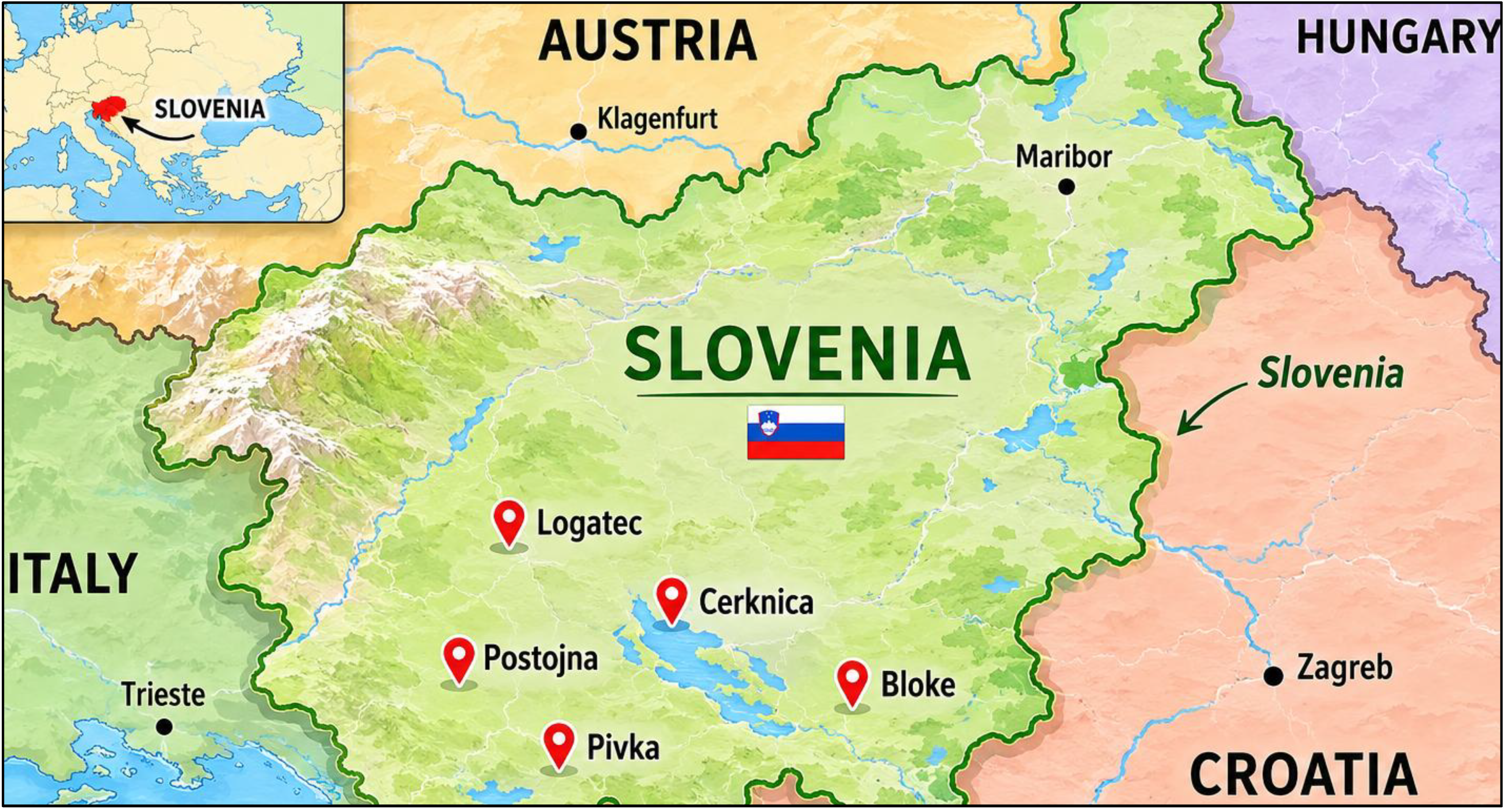
The study examines Slovenia’s Karst region, characterised by a human-modified karst landscape. It includes agricultural areas, settlements, and wetlands in close proximity. The analysis covers 2005–2025 and five municipalities: Postojna, Cerknica, Bloke, Pivka, and Logatec (Figure 1).
Observed nesting locations within these municipalities comprised Rakitnik, Planina, Dilce, Hrašče, and Studenec in Postojna; Martinjak, Gorenje jezero, Dolenje Jezero, Iga vas, and Viševek 1 and 2 in Cerknica; Nova vas in Bloke; Pivka and Trnje in Pivka; as well as Logatec, Tičnica, and Stara cesta in Logatec.
The nesting location served as the primary spatial unit of analysis, as the available data consist of repeated observations of nests and nesting activity at specific sites over time. This approach enabled comparisons among long-established, intermittently occupied, abandoned, and newly recorded nesting locations within each municipality. The same framework was applied to summarise nesting dynamics across the Karst region.

3.2. White Stork Nesting Data

White Stork nesting dynamics were documented through a monitoring application designed for nest census and reporting. Observers recorded nest presence and status, visiting or breeding pairs, egg presence and, when available, hatchlings or fledged young. A reproductive record was used only when it was explicitly reported; unfilled fields were retained as missing. Information on the nest support or substrate was included when recorded.
In addition to nest monitoring, the environmental characteristics surrounding each nesting site were described using a 2000 m buffer. For every nesting location, the dominant land cover, dominant agricultural land use, presence of wetlands or other water bodies, presence of settlements or landfills, and nest substrate were recorded. These variables were included to provide an ecological context for interpreting long-term nesting dynamics. The environmental characteristics of all monitored nesting sites are presented in Table 1.
The available time series varied in duration across locations. Some nests were documented throughout most or all of the 2005–2025 period, while others were first reported later, recorded for shorter intervals, or disappeared during the observation period. This uneven data availability was considered in interpreting the results, especially when comparing locations with long-term records to those with only recent observations.
For analysis, each annual record was retained in the status category reported in the monitoring data: empty nest (HO), visitors (HB, HB1, or HB2), occupied nest with a breeding pair (HPa), nest no longer present or recorded, or missing (n/a). Egg and young records were analysed separately from occupancy. Individually marked birds were not tracked; therefore, a nest documented at another site within the same municipality was treated as a newly or alternatively recorded site, not as confirmed movement by the same pair.

3.3. Weather Data

Weather data were sourced from publicly available records provided by the Slovenian Environment Agency. Postojna was selected as the reference location due to its central position within the study region and the availability of continuous, long-term meteorological records for the observation period.
The weather description included annual mean daily temperature [°C], annual maximum and minimum daily temperatures [°C], annual precipitation [mm], and the number of days with snow. Mean daily temperature during the approximate incubation period (late March to April), together with mean daily temperature and precipitation during the approximate hatching period (late April to early May), was also summarised. These variables provide environmental context only; no causal relationship with nesting outcomes was inferred.

3.4. Data Processing

Data were organised into a longitudinal database consisting of repeated observations of White Stork nesting locations across municipalities and years. The primary unit of observation was the nesting location, with records collected annually between 2005 and 2025. For each location, the variables include the continuity of nest presence, the occurrence of visiting or breeding pairs, the presence of eggs, and, where available, reproductive outcomes. This structure facilitated comparison of patterns between locations and municipalities. Following the location-level review, findings were summarised for the Karst region to compare stable, irregular, and newly recorded nesting patterns across municipalities.
For descriptive summaries, n/a was treated as missing and excluded from counts. HO, HB, HB1, HB2, HPa, and “nest is gone” were retained as distinct observed categories. The absence of an egg or young entry was not interpreted as confirmed biological absence unless it had been explicitly recorded as such.
In addition, weather data obtained from the Slovenian Environment Agency were aggregated into annual values for mean, minimum, and maximum temperature, precipitation, and the number of snowy days. These variables were used to describe long-term weather patterns and provide contextual information for interpreting nesting records.

3.5. Descriptive Data Analysis

The study used descriptive techniques to examine temporal and spatial patterns in White Stork nesting records across the Slovenian Karst landscape.
Site-year records of nest status, egg presence, recorded young, and nest disappearance were summarised in tables and narrative descriptions. Weather records were summarised annually and displayed graphically. Comparisons among locations and municipalities were interpreted as exploratory because monitoring periods and data completeness differed substantially.
No inferential statistical tests were applied. Correlations, regression models, and between-municipality significance tests were omitted because the samples were small and uneven, reproductive data were incomplete, and repeated observations from the same nesting sites were not independent. Data organisation and descriptive summaries were prepared in Microsoft Excel.

4. Results

4.1. Stork Population Dynamics

The monitored White Stork nesting sites differed in their surrounding environmental characteristics (Table 1). Most nests were in built-up areas or forest-dominated landscapes, while grassland represented the predominant agricultural land use within a 2000 m radius. Wetlands or other water bodies were present near most nesting sites, particularly in the municipalities of Cerknica and Pivka. Chimneys were the most common nesting substrate, whereas only a few nests were located on trees or utility poles. These environmental characteristics provide the ecological context for the long-term nesting dynamics described below.

4.1.1. Postojna

Postojna was selected as the central municipality of the Karst region for analysis. Annual nest-status records from 2005 to 2025 were available for Rakitnik and Planina, while records began in 2006 for Dilce, in 2012 for Hrašče, and in 2019 for Studenec. Reproductive fields were not complete for every site-year.
Postojna exhibited uneven and locally specific nesting dynamics (Table 2). Planina showed persistent occupancy across the full period, while Studenec was occupied throughout its shorter 2019–2025 record, with eggs recorded annually and young recorded in 2024 and 2025. Rakitnik and Dilce showed interruptions, periods of non-occupancy, or loss of the recorded nest. Hrašče was intermittent, with confirmed breeding activity in 2013–2015, visitor records thereafter, and the nest no longer recorded from 2024. These observations show marked site-level variation within the municipality.

4.1.2. Cerknica

In Cerknica, six nesting records were documented: Martinjak, Gorenje Jezero, Dolenje Jezero, Iga vas, and two sites in Viševek. Martinjak provided the most extensive time series, spanning 2005 to 2025. Data collection commenced in 2014 for Gorenje Jezero, in 2016 for Dolenje Jezero, in 2019 for Iga vas, in 2020 for the first Viševek site, and in 2024 for the second Viševek site.
Martinjak had the longest Cerknica series, with an occupied nest recorded annually from 2005 to 2025. Eggs were recorded in 18 of the 21 years; the egg field was unavailable for 2021–2023. No counts of young were available for this site. Gorenje Jezero was occupied annually from 2014 onward, with eggs recorded in 11 of 12 years and young recorded in 2018 (n = 5), 2019 (n = 3), 2021 (n = 3), and 2024 (n = 5). Dolenje Jezero was occupied annually from 2016 onward; eggs were recorded in 2017, 2018, 2020, and 2021, and young were recorded in 2018 (n = 4).
Iga vas had a shorter and less stable record. An occupied nest with eggs was recorded in 2019, followed by a visiting pair in 2020; the nest was no longer recorded from 2021 onward. At the first Viševek site, an occupied nest with eggs was recorded from 2020 to 2023, with three young recorded in 2021; the nest was no longer recorded from 2024. At the second Viševek site, an occupied nest was recorded in 2024 and a visiting pair in 2025, but egg and young fields were unavailable in both years.
Overall, Cerknica exhibited a mixed pattern of White Stork nesting activity, with some sites maintaining long-term nesting presence and others experiencing nest disappearance in the past two years, as shown in Table 3. Martinjak, Gorenje Jezero, and Dolenje Jezero sustained repeated or long-term nesting, although reproductive outcomes varied among these sites. In contrast, Iga vas and the first Viševek site showed declines in nesting activity and the loss of previously recorded nests. These findings indicate that nesting dynamics varied considerably between locations within the same municipality.

4.1.3. Bloke

In Bloke, data were available only for Nova vas. The nest was occupied from 2007 to 2025 except in 2019, when a visiting pair was recorded. Egg status was unavailable throughout the series, while young were recorded in 2012 (n = 6), 2014 (n = 6), and 2021 (n = 3). Nova vas therefore represents persistent occupancy, but the incomplete reproductive fields preclude a complete account of breeding outcomes (Table 4).

4.1.4. Pivka

In the municipality of Pivka, records were available for two locations: Pivka and Trnje (Table 5). Trnje was recorded only in 2025, when an occupied nest and eggs were confirmed. Records for Pivka began in 2007. The nest was occupied in 2007 and 2008, empty in 2009 and 2010, and no longer recorded in 2011. It was again recorded as occupied from 2012 to 2023, visited by a pair in 2024, and occupied in 2025.
These findings indicate a generally persistent, though not fully continuous, nesting pattern in Pivka, along with the recent establishment of an additional nesting location in Trnje.

4.1.5. Logatec

Three locations were identified within Logatec: Logatec, Tičnica, and Stara cesta. At the original Logatec site, a visiting pair was recorded in 2018, an occupied nest with eggs in 2019 and 2020, a visiting pair in 2021, and an empty nest in 2022. Tičnica was occupied in 2024 and 2025, with eggs recorded in 2025. Stara cesta was occupied with eggs in both 2024 and 2025. No counts of young were available for any of the three sites.
The original Logatec nest was last recorded as occupied in 2020, was visited in 2021, was recorded as empty in 2022, and was no longer recorded from 2023 onward (Table 6). The records from Tičnica and Stara cesta in 2024 and 2025 document other active nesting sites within the same municipality, but they do not establish movement by the same pair.

4.1.6. Summary Comparison Between Municipalities

A comparison across the Karst region reveals a clear contrast between sites with persistent nesting activity and those characterised by irregular occupancy, nest disappearance, or a lack of confirmed breeding. Planina in Postojna, Martinjak in Cerknica, and Nova vas in Bloke exhibited long-term presence of nesting pairs, indicating relatively stable nesting conditions at these locations. Conversely, Rakitnik and Dilce in Postojna, along with Iga vas and the first Viševek location in Cerknica, experienced interrupted nesting activity, nest disappearance, or intermittent occupancy.
Records of young varied among sites with persistent occupancy. Young were recorded in selected years at Planina, Gorenje Jezero, and Nova vas, whereas no young counts were available for Martinjak despite continuous occupancy. This contrast may reflect both biological variation and incomplete reporting. Occupancy, egg records, and records of young must therefore be interpreted as separate monitoring indicators. The disappearance of one nest also did not necessarily coincide with the absence of the species from the wider municipality, although individual relocation could not be confirmed.

4.2. Descriptive Weather Patterns

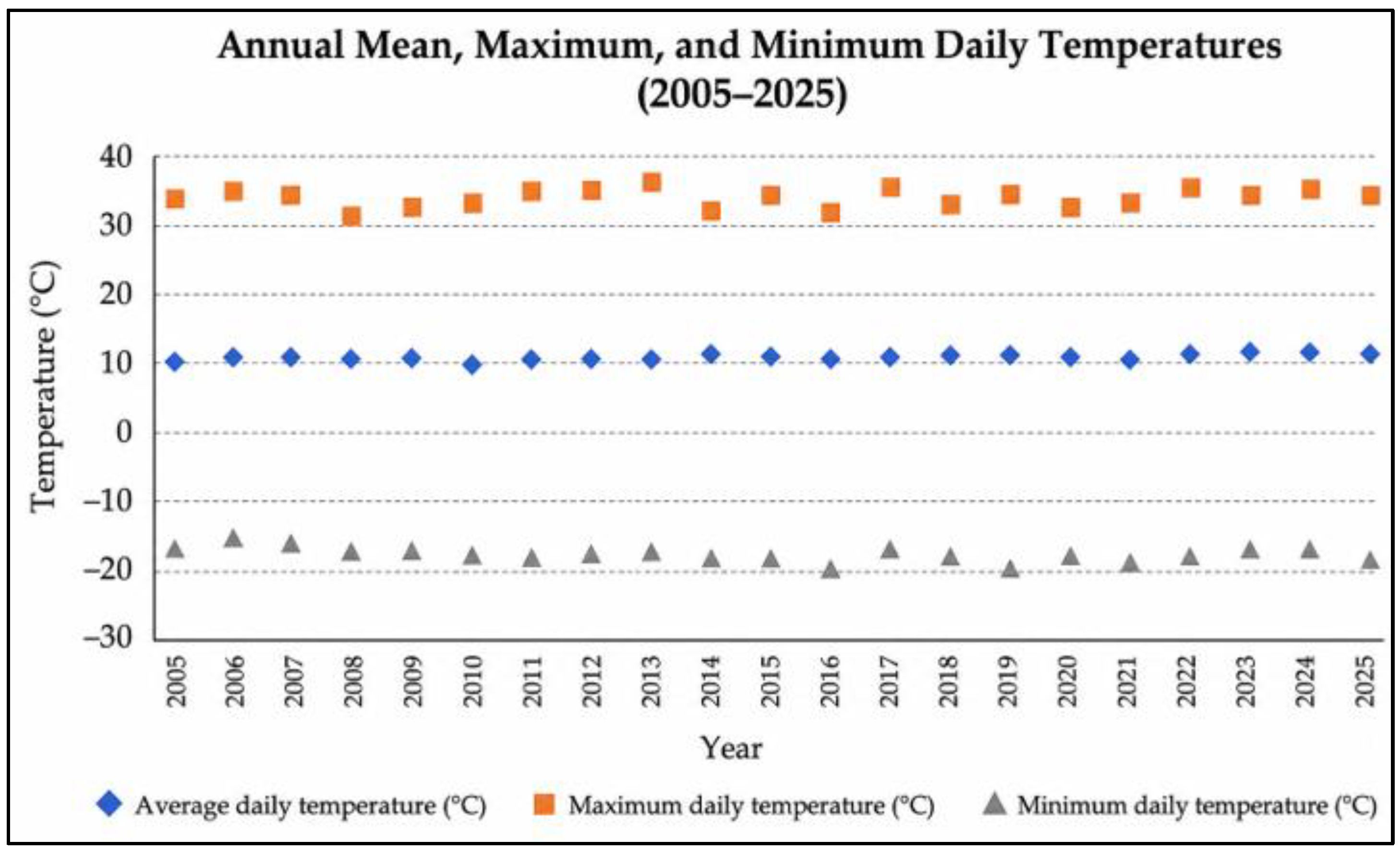
This section describes the selected weather records used as regional environmental context. Postojna was used because it is centrally located within the study area and has a continuous series for 2005–2025 (Figure 2). Annual mean, maximum, and minimum daily temperature, annual precipitation, and the number of snowy days are reported in Appendix A Table A18; breeding-period summaries are reported in Appendix A Table A19 and Table A20.
Annual mean daily temperature ranged from 8.92 °C in 2005 to a maximum of 11.51 °C in 2024 and was 11.06 °C in 2025. Annual maximum daily temperature varied between 31.2 °C and 36.4 °C, while the annual minimum ranged from −19.5 °C to −6.8 °C. Mean temperatures were generally higher in the later part of the series, and several recent annual minima were less negative; however, these observations are descriptive and were not evaluated with a formal trend test.
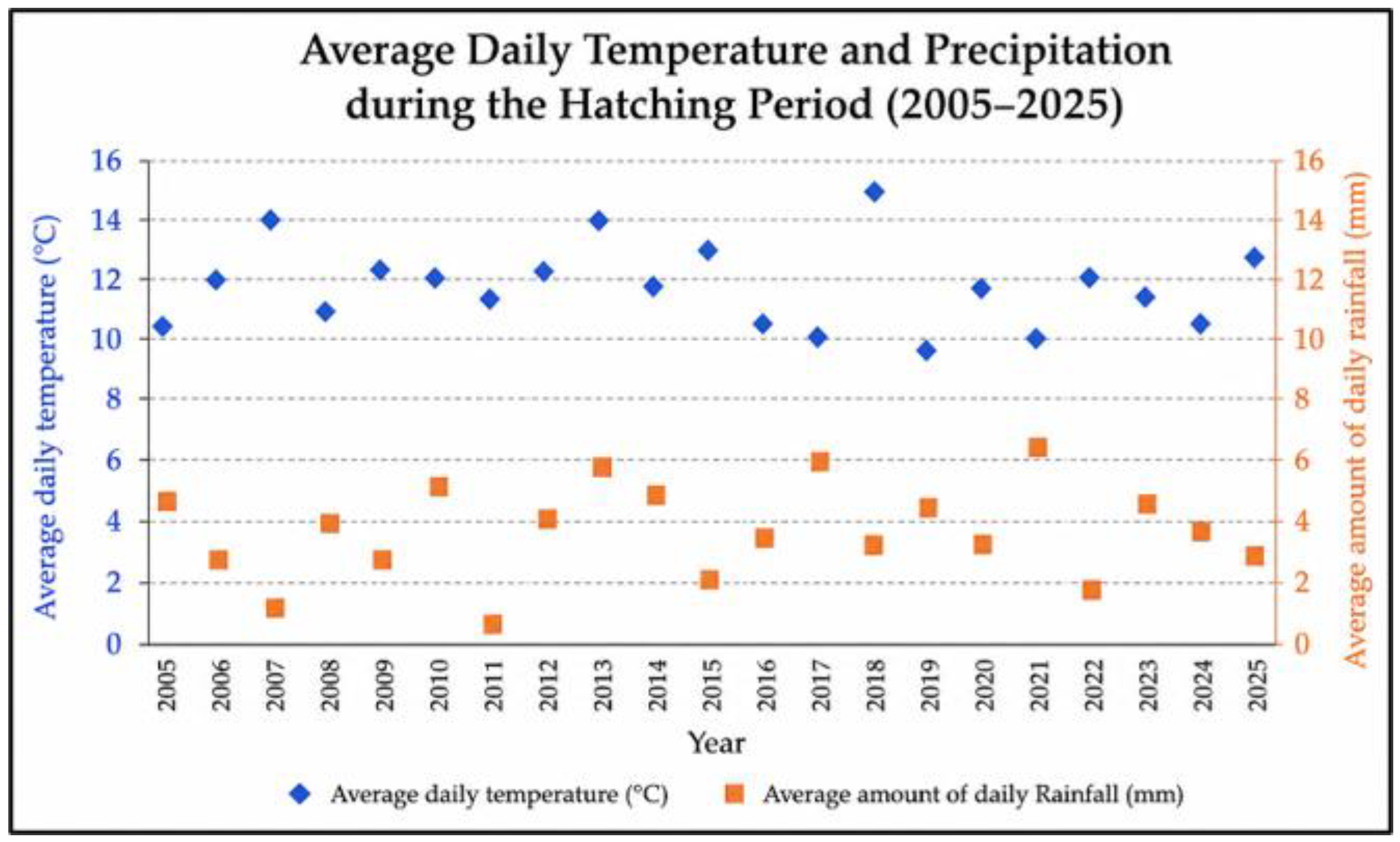
Mean temperature during the approximate incubation period is listed in Appendix A Table A19. Mean daily temperature and precipitation during the approximate hatching period are listed in Appendix A Table A20 and illustrated in Figure 3.
During the approximate hatching period, mean daily temperature ranged from 9.51 °C to 14.90 °C, while mean daily precipitation ranged from 0.43 mm to 6.32 mm. Both variables fluctuated substantially among years. The figure is intended to show interannual variation only; no monotonic trend or relationship with reproductive records is inferred.
The annual and breeding-period weather records provide context for the conditions under which nesting was monitored. They should not be used as direct explanations for nest disappearance, occupancy, or reproductive outcomes because site-specific exposure and complete reproductive data were unavailable.

5. Discussion

5.1. Variation in Nest Occupancy and Reproductive Records Among Sites

The descriptive records answer RQ1 by showing substantial variation among municipalities and individual nesting sites. Planina and Studenec in Postojna showed persistent occupancy over their respective monitoring periods, whereas Rakitnik and Dilce had interrupted occupancy or periods in which the nest was no longer recorded. Similar contrasts occurred within Cerknica. The site descriptors in Table 1 provide ecological context, but the small number of sites and categorical variables do not permit quantitative assessment of habitat effects [11,17].

5.2. Persistent Occupancy and Recorded Reproductive Activity

The observations address RQ2 by showing that persistent occupancy did not consistently coincide with complete reproductive records. Martinjak, for example, was continuously occupied, but no counts of young were available. This cannot be interpreted as reproductive failure because missing observations are not confirmed absences. Occupancy, eggs, and records of young must therefore be reported as separate monitoring indicators.

5.3. Lost and Newly Recorded Nesting Sites

The observations answer RQ3 by showing that, in several municipalities, other active nesting sites were recorded after a previously monitored nest disappeared or ceased to be occupied. In Logatec, Tičnica and Stara cesta were documented after activity at the original Logatec site ended. Because individual birds were not marked or tracked, these records cannot demonstrate relocation by the same pair; they document only the presence of alternative sites within the wider municipal area.

5.4. Weather Patterns as Environmental Context

The weather records address RQ4 by documenting interannual variation, generally higher annual mean temperatures in the later part of the series, and fewer snowy days in several recent years. No formal trend or association tests were performed, so these patterns are environmental context rather than explanations of nesting outcomes. Conditions during critical incubation and nestling periods, local hydrology, habitat quality, and food availability may be more relevant than annual regional averages [21,25,28].
This study complements national and international research by providing a long-term, nest-level description of White Stork activity in the Karst landscape [11,17,18]. Its principal contribution is the documentation of local persistence, interruptions, nest loss, newly recorded sites, and incomplete or differing reproductive records. The findings support continued standardised monitoring rather than generalisation from heterogeneous historical data.
For conservation practice, individual nests should be evaluated in their local landscape context, including nest safety, nearby foraging habitat, wetland availability, and changes in nesting structures. More complete and standardised future data would allow formal testing of the roles of weather, habitat, hydrology, and land use.

6. Conclusions

The nesting records show that White Stork activity in the Karst landscape was highly localised and uneven. Persistent occupancy was documented at sites such as Planina, Martinjak, and Nova vas, whereas Rakitnik, Dilce, Iga vas, and the first Viševek site showed interruption, non-occupancy, or loss of the recorded nest.
Persistent occupancy did not consistently coincide with complete records of eggs or young. In several municipalities, other active sites were recorded after an earlier nest disappeared, although movement of individual pairs could not be established. Postojna weather records provide regional context only. The heterogeneous and incomplete data do not support causal conclusions or inferential comparisons among municipalities.
Conservation and monitoring should therefore focus on the stability, safety, and reproductive documentation of individual nests, especially where nests disappear or new sites emerge. Future studies should use standardised annual protocols, distinguish missing information from confirmed absence, and collect complete records of eggs, hatchlings, fledged young, habitat conditions, and local weather.

Limitations and Future Research Directions

These conclusions should be viewed in light of several limitations. Monitoring periods differed among nesting sites, and reproductive records, particularly counts of young, were incomplete and inconsistently available. Missing observations were excluded from interpretation and were not treated as confirmed absence. Individual birds were not marked, so newly recorded nests within a municipality cannot be attributed to the same breeding pairs. Weather data from Postojna provide regional context and may not represent conditions at each nest during critical breeding stages. Habitat descriptors were used only for site characterisation because the number of sites was small and the variables were categorical. These limitations precluded reliable inferential analysis. Future research should combine standardised long-term monitoring with GIS-based habitat metrics, local weather and hydrological data, bird tracking, and complete reproductive records.


Author Contributions

Conceptualization, A.Š.; methodology, A.Š., N.H. and D.B.-Š.; software, A.Š.; validation, S.G., J.S. and A.Š.; formal analysis, J.K., I.B.A., A.Š., J.S., D.B.-Š. and L.-M.C.-J.; investigation, A.Š. and D.B.-Š.; resources, A.Š. and D.B.-Š.; data curation, A.Š.; writing—original draft preparation, A.Š., J.S., N.H., J.K., I.B.A., L.-M.C.-J., D.B.-Š. and S.G.; writing—review and editing, A.Š., J.S. and S.G.; visualization, A.Š., J.S., D.B.-Š. and S.G.; supervision, A.Š., J.S. and S.G.; project administration, A.Š.; funding acquisition, A.Š., J.S., D.B.-Š. and S.G. All authors have read and agreed to the published version of the manuscript.

Funding

This research received no external funding.

Data Availability Statement

The original contributions presented in the study are included in the article/Appendix A. Further inquiries can be directed to the corresponding author.

Acknowledgments

During the preparation of this manuscript, the authors used ChatGPT (OpenAI, GPT-5.5; OpenAI, San Francisco, CA, USA) for literature synthesis and structuring of the academic text. The authors have carefully reviewed and edited the generated content and take full responsibility for the final version of this publication. For language improvement and proofreading, the authors used GrammarlyPRO v 1.2.212.1789. We thank Urška Očko, Education Coordinator at the NGO BirdLife Slovenia, for providing the data. Nezmir Hozdić is an Erasmus+ student at Østfold University of Applied Sciences for the 2025/2026 academic year.

Conflicts of Interest

The authors declare no conflicts of interest.

Abbreviations

The following abbreviations are used in this manuscript:
HOEmpty nest, no sign of activity.
HBVisitors, where we may also see traces of activity, e.g., droppings under the nest, but not necessarily; the number of visitors is not known.
HB1One visitor, one White Stork, was present at the nest occasionally, usually for less than a month or longer, but irregularly.
HB2Two visitors-two storks (a pair) were present at the nest intermittently. They did not lay eggs.
HPaNest occupied. We consider a pair of storks a breeding pair if, in the first half of the breeding period, they occupied or used the nest for at least 4 weeks.

Appendix A

Table A1. Full nesting data for Martinjak (Cerknica).
YearOccupancyObserved EggsObserved Hatching
2025HPaYesn/a
2024HPaYesn/a
2023HPan/an/a
2022HPan/an/a
2021HPan/an/a
2020HPaYesn/a
2019HPaYesn/a
2018HPaYesn/a
2017HPaYesn/a
2016HPaYesn/a
2015HPaYesn/a
2014HPaYesn/a
2013HPaYesn/a
2012HPaYesn/a
2011HPaYesn/a
2010HPaYesn/a
2009HPaYesn/a
2008HPaYesn/a
2007HPaYesn/a
2006HPaYesn/a
2005HPaYesn/a
n/a—No data available.
Table A2. Full nesting data for Gorenje jezero (Cerknica).
YearOccupancyObserved EggsObserved Hatching
2025HPan/an/a
2024HPaYes5
2023HPaYesn/a
2022HPaYesn/a
2021HPaYes3
2020HPaYesn/a
2019HPaYes3
2018HPaYes5
2017HPaYesn/a
2016HPaYesn/a
2015HPaYesn/a
2014HPaYesn/a
n/a—No data available.
Table A3. Full nesting data for Dolenje jezero (Cerknica).
YearOccupancyObserved EggsObserved Hatching
2025HPan/an/a
2024HPan/an/a
2023HPan/an/a
2022HPan/an/a
2021HPaYesn/a
2020HPaYesn/a
2019HPan/an/a
2018HPaYes4
2017HPaYesn/a
2016HPan/an/a
n/a—No data available.
Table A4. Full nesting data for Iga vas (Cerknica).
YearOccupancyObserved EggsObserved Hatching
2025Nest is gonen/an/a
2024Nest is gonen/an/a
2023Nest is gonen/an/a
2022Nest is gonen/an/a
2021Nest is gonen/an/a
2020HB2n/an/a
2019HpaYesn/a
n/a—No data available.
Table A5. Full nesting data for Viševek–1 (Cerknica).
YearOccupancyObserved EggsObserved Hatching
2025Nest is gonen/an/a
2024Nest is gonen/an/a
2023HPaYesn/a
2022HPaYesn/a
2021HPaYes3
2020HPaYesn/a
n/a—No data available.
Table A6. Full nesting data for Viševek–2 (Cerknica).
YearOccupancyObserved EggsObserved Hatching
2025HB2n/an/a
2024Hpan/an/a
n/a—No data available.
Table A7. Full nesting data for Rakitnik (Postojna).
YearOccupancyObserved EggsObserved Hatching
2025Nest is gonen/an/a
2024Nest is gonen/an/a
2023HB2n/an/a
2022HOn/an/a
2021HPan/an/a
2020HB2n/an/a
2019Nest is gonen/an/a
2018Nest is gonen/an/a
2017Nest is gonen/an/a
2016Nest is gonen/an/a
2015Nest is gonen/an/a
2014Nest is gonen/an/a
2013Nest is gonen/an/a
2012Nest is gonen/an/a
2011Nest is gonen/an/a
2010HOn/an/a
2009HOn/an/a
2008HB2n/an/a
2007HB2n/an/a
2006HPan/an/a
2005HPan/an/a
n/a—No data available.
Table A8. Full nesting data for Planina (Postojna).
YearOccupancyObserved EggsObserved Hatching
2025HPaYesn/a
2024HB2Non/a
2023HPaYesn/a
2022HPaYes5
2021HPaYesn/a
2020HPaYesn/a
2019HPaYesn/a
2018HPaYes2
2017HPaYes4
2016HPaYes3
2015HPaYesn/a
2014HPaYesn/a
2013HPaYesn/a
2012HPaYesn/a
2011HPaYesn/a
2010HPaYesn/a
2009HPaYesn/a
2008HPaYesn/a
2007HPaYesn/a
2006HPaYesn/a
2005HPaYesn/a
n/a—No data available.
Table A9. Full nesting data for Dilce (Postojna).
YearOccupancyObserved EggsObserved Hatching
2025HOn/an/a
2024HOn/an/a
2023HOn/an/a
2022HOn/an/a
2021HOn/an/a
2020HB2n/an/a
2019HPaYes3
2018HPaYesn/a
2017HPaYesn/a
2016HPaYesn/a
2015HPaYesn/a
2014HPaYes4
2013HPaYesn/a
2012HPaYesn/a
2011HPaYesn/a
2010HPaYes3
2009HPaYesn/a
2008HPaYesn/a
2007HPaYes3
2006HPaYesn/a
n/a—No data available.
Table A10. Full nesting data for Hrašče (Postojna).
YearOccupancyObserved EggsObserved Hatching
2025Nest is gonen/an/a
2024Nest is gonen/an/a
2023HB2n/an/a
2022HOn/an/a
2021HB2n/an/a
2020HB1n/an/a
2019HB1n/an/a
2018HB2n/an/a
2017HB2n/an/a
2016HOn/an/a
2015HPaYesn/a
2014HPaYesn/a
2013HPan/an/a
2012HBn/an/a
n/a—No data available.
Table A11. Full nesting data for Studenec (Postojna).
YearOccupancyObserved EggsObserved Hatching
2025HPaYes5
2024HPaYes2
2023HPaYesn/a
2022HPaYesn/a
2021HPaYesn/a
2020HPaYesn/a
2019HPaYesn/a
n/a—No data available.
Table A12. Full nesting data for Pivka (Pivka).
YearOccupancyObserved EggsObserved Hatching
2025HPan/an/a
2024HB2n/an/a
2023HPan/an/a
2022HPan/an/a
2021HPan/an/a
2020HPan/an/a
2019HPan/an/a
2018HPan/an/a
2017HPan/an/a
2016HPan/an/a
2015HPan/an/a
2014HPan/an/a
2013HPan/an/a
2012HPan/an/a
2011Nest is gonen/an/a
2010HOn/an/a
2009HOn/an/a
2008HPan/an/a
2007HPan/a4
n/a—No data available.
Table A13. Full nesting data for Trnje (Pivka).
YearOccupancyObserved EggsObserved Hatching
2025HPaYesn/a
n/a—No data available.
Table A14. Full nesting data for Nova vas (Bloke).
YearOccupancyObserved EggsObserved Hatching
2025HPan/an/a
2024HPan/an/a
2023HPan/an/a
2022HPan/an/a
2021HPan/a3
2020HPan/an/a
2019HB2n/an/a
2018HPan/an/a
2017HPan/an/a
2016HPan/an/a
2015HPan/an/a
2014HPan/a6
2013HPan/an/a
2012HPan/a6
2011HPan/an/a
2010HPan/an/a
2009HPan/an/a
2008HPan/an/a
2007HPan/an/a
n/a—No data available.
Table A15. Full nesting data for Logatec (Logatec).
YearOccupancyObserved EggsObserved Hatching
2025Nest is gonen/an/a
2024Nest is gonen/an/a
2023Nest is gonen/an/a
2022HOn/an/a
2021HB2n/an/a
2020HPaYesn/a
2019HPaYesn/a
2018HB2n/an/a
n/a—No data available.
Table A16. Full nesting data for Tičnica (Logatec).
YearOccupancyObserved EggsObserved Hatching
2025HPaYesn/a
2024HPan/an/a
n/a—No data available.
Table A17. Full nesting data for Stara cesta (Logatec).
YearOccupancyObserved EggsObserved Hatching
2025HPaYesn/a
2024HPaYesn/a
n/a—No data available.
Table A18. Observed weather phenomena in Postojna.
YearAverage Daily Temperature [°C]Maximum Daily Temperature [°C]Minimum Daily Temperature [°C]Amount of Rainfall [mm]Number of Days with Snow
20058.9234−19.51249.127
20069.9635−14.61194.716
200710.3434.6−11.61277.511
200810.0431.2−11.61525.313
200910.3032.4−181582.419
20109.1633.2−191939.837
201110.1435.1−121078.120
201210.4135.4−18.11123.621
201310.1336.4−10.51622.331
201411.1231.9−8.92069.410
201510.7834.5−12.91009.917
201610.3131.4−121548.417
201710.2535.7−14.61836.420
201810.9232.9−15.51426.733
201910.9634.6−101669.313
202010.6832.6−9.61540.210
202110.0433.1−12.11404.523
202211.3435.6−12.21139.914
202311.4134.1−91768.515
202411.5135.4−111833.97
202511.0634.2−6.81749.87
Note: [°C]—degrees Celsius.
Table A19. Average temperature during the incubation period (Late March to April).
YearAverage Daily Temperature [°C]
20058.07
20067.94
20079.86
20086.47
20098.55
20108.88
20119.46
20129.05
20137.10
20149.99
20158.37
20168.53
20179.47
20189.23
20198.99
20208.19
20216.04
20228.01
20237.52
20249.64
20259.29
Note: [°C]—degrees Celsius.
Table A20. Average temperature and precipitation during the hatching period (Late April to early May).
YearAverage Daily Temperature [°C]Average Amount of Daily Rainfall [mm]
200510.324.65
200611.782.74
200713.911.29
200810.773.78
200912.182.73
201011.955.13
201111.280.43
201212.153.98
201313.925.62
201411.634.75
201512.942.04
201610.273.45
20179.915.85
201814.903.12
20199.514.39
202011.623.14
20219.896.32
202211.901.69
202311.364.47
202410.393.54
202512.752.77
Note: [°C]—degrees Celsius.

References

  1. Ceballos, G.; Ehrlich, P.R.; Barnosky, A.D.; García, A.; Pringle, R.M.; Palmer, T.M. Accelerated Modern Human–Induced Species Losses: Entering the Sixth Mass Extinction. Sci. Adv. 2015, 1, e1400253. [Google Scholar] [CrossRef] [PubMed]
  2. IPBES. Global Assessment Report on Biodiversity and Ecosystem Services of the Intergovernmental Science-Policy Platform on Biodiversity and Ecosystem Services; Brondizio, E.S., Settele, J., Díaz, S., Ngo, H.T., Eds.; IPBES Secretariat: Bonn, Germany, 2019; p. 1144. [Google Scholar]
  3. PECBMS. European Wild Bird Indices, 2025 Update. Available online: https://pecbms.info/european-wild-bird-indices-2025-update/ (accessed on 18 April 2026).
  4. Donald, P.F.; Green, R.E.; Heath, M.F. Agricultural Intensification and the Collapse of Europe’s Farmland Bird Populations. Proc. Boil. Sci. 2001, 268, 25–29. [Google Scholar] [CrossRef] [PubMed]
  5. Moorcroft, D.; Wilson, J.D.; Bradbury, R.B. Diet of Nestling Linnets Carduelis cannabina on Lowland Farmland before and after Agricultural Intensification. Bird Study 2006, 53, 156–162. [Google Scholar] [CrossRef]
  6. Hallmann, C.A.; Foppen, R.P.B.; Van Turnhout, C.A.M.; De Kroon, H.; Jongejans, E. Declines in Insectivorous Birds Are Associated with High Neonicotinoid Concentrations. Nature 2014, 511, 341–343. [Google Scholar] [CrossRef] [PubMed]
  7. Frenzel, M.; Everaars, J.; Schweiger, O. Bird Communities in Agricultural Landscapes: What Are the Current Drivers of Temporal Trends? Ecol. Indic. 2016, 65, 113–121. [Google Scholar] [CrossRef]
  8. Gaüzère, P.; Barbaro, L.; Calatayud, F.; Princé, K.; Devictor, V.; Raison, L.; Sirami, C.; Balent, G. Long-Term Effects of Combined Land-Use and Climate Changes on Local Bird Communities in Mosaic Agricultural Landscapes. Agric. Ecosyst. Environ. 2020, 289, 106722. [Google Scholar] [CrossRef]
  9. Janiszewski, T.; Minias, P.; Wojciechowski, Z.; Podlaszczuk, P. Habitat Selection by White Storks Breeding in a Mosaic Agricultural Landscape of Central Poland. Wilson J. Ornithol. 2014, 126, 591–599. [Google Scholar] [CrossRef]
  10. Kronenberg, J.; Andersson, E.; Tryjanowski, P. Connecting the Social and the Ecological in the Focal Species Concept: Case Study of White Stork. Nat. Conserv. 2017, 22, 79–105. [Google Scholar] [CrossRef]
  11. Bialas, J.T.; Dylewski, Ł.; Tobolka, M. Determination of Nest Occupation and Breeding Effect of the White Stork by Human-Mediated Landscape in Western Poland. Environ. Sci. Pollut. Res. 2020, 27, 4148–4158. [Google Scholar] [CrossRef] [PubMed]
  12. Tobolka, M.; Sparks, T.H.; Tryjanowski, P. Does the White Stork Ciconia ciconia Reflect Farmland Bird Diversity? Ornis Fenn. 2012, 89, 222–228. [Google Scholar] [CrossRef]
  13. Bjedov, D.; Mikuška, A.; Velki, M. From Wetlands to Landfills: White Stork (Ciconia ciconia L., 1758) as a Reliable Bioindicator of Ecosystem Health. Arch. Ind. Hyg. Toxicol. 2025, 76, 1–15. [Google Scholar] [CrossRef] [PubMed]
  14. Bird Life International. European Red List of Birds; Publications Office of the European Union: Luxembourg, 2021; Available online: https://birdlifedata.blob.core.windows.net/sub-global/3835_ciconia_ciconia.pdf (accessed on 15 June 2026).
  15. European Union. Directive 2009/147/EC of the European Parliament and of the Council of 30 November 2009 on the Conservation of Wild Birds; European Union: Brussels, Belgium, 2009; Volume 2009/147/EC, pp. 7–25. [Google Scholar]
  16. Berthold, P.; Kaatz, M.; Querner, U. Long-Term Satellite Tracking of White Stork (Ciconia ciconia) Migration: Constancy versus Variability. J. Ornithol. 2004, 145, 356–359. [Google Scholar] [CrossRef]
  17. Denac, D. Population Dynamics of the White Stork Ciconia ciconia in Slovenia between 1999 and 2010. Acrocephalus 2010, 31, 101–114. [Google Scholar] [CrossRef]
  18. Vergara, P.; Aguirre, J.I.; Fargallo, J.A.; Dávila, J.A. Nest-site Fidelity and Breeding Success in White Stork Ciconia ciconia. Ibis 2006, 148, 672–677. [Google Scholar] [CrossRef]
  19. Vergara, P.; Gordo, O.; Aguirre, J.I. Nest Size, Nest Building Behaviour and Breeding Success in a Species with Nest Reuse: The White Stork Ciconia ciconia. Ann. Zool. Fenn. 2010, 47, 184–194. [Google Scholar] [CrossRef]
  20. Tortosa, F.S.; Pérez, L.; Hillström, L. Effect of Food Abundance on Laying Date and Clutch Size in the White Stork Ciconia ciconia. Bird Study 2003, 50, 112–115. [Google Scholar] [CrossRef]
  21. Eggers, U.; Arens, M.; Firla, M.; Wallschläger, D. To Fledge or Not to Fledge: Factors Influencing the Number of Eggs and the Eggs-to-Fledglings Rate in White Storks Ciconia ciconia in an Agricultural Environment. J. Ornithol. 2015, 156, 711–723. [Google Scholar] [CrossRef]
  22. Jovani, R.; Tella, J.L. Age-related Environmental Sensitivity and Weather Mediated Nestling Mortality in White Storks Ciconia ciconia. Ecography 2004, 27, 611–618. [Google Scholar] [CrossRef]
  23. Bonacci, O. Poljes, Ponors and Their Catchments. In Treatise on Geomorphology; Shroder, J., Frumkin, A., Eds.; Elsevier: Amsterdam, The Netherlands, 2013; Volume 6, pp. 112–120. ISBN 978-0-08-088522-3. [Google Scholar]
  24. Sackl, P.; Durst, R.; Kotrošan, D.; Stumberger, B. (Eds.) Dinaric Karst Poljes—Floods for Life; EuroNatur: Radolfzell, Germany, 2014; ISBN 978-3-00-045287-1. [Google Scholar]
  25. Kmecl, P.; Gamser, M.; Ploj, A.; Jančar, T. The Challenges of Bird Conservation on an Intermittent Karst Lake: The Interplay between Changing Water Level and Agriculture. Aquat. Conserv. 2022, 32, 1544–1556. [Google Scholar] [CrossRef]
  26. Benton, T.G.; Vickery, J.A.; Wilson, J.D. Farmland Biodiversity: Is Habitat Heterogeneity the Key? Trends Ecol. Evol. 2003, 18, 182–188. [Google Scholar] [CrossRef]
  27. Janiszewski, T.; Minias, P.; Wojciechowski, Z. Occupancy Reliably Reflects Territory Quality in a Long-lived Migratory Bird, the White Stork. J. Zool. 2013, 291, 178–184. [Google Scholar] [CrossRef]
  28. Kosicki, J.Z. Effect of Weather Conditions on Nestling Survival in the White Stork Ciconia ciconia Population. Ethol. Ecol. Evol. 2012, 24, 140–148. [Google Scholar] [CrossRef]
Figure 1. Research locations scheme. Note: The author’s Canva (https://www.canva.com/) compilation does not include any border lines, unlike an official map. The scheme is to be used exclusively to present locations within the Karst Landscape Region in Slovenia.
Land 15 01273 g001
Figure 2. Annual mean, maximum, and minimum daily temperature records in Postojna (2005–2025).
Land 15 01273 g002
Figure 3. Average daily temperature and precipitation during the approximate hatching period (2005–2025).
Land 15 01273 g003
Table 1. Environmental characteristics of monitored White Stork nesting sites in the Slovenian Karst region.
MunicipalityNest LocationDominant Land Cover (<2000 m)Agricultural Land Use (<2000 m)Wetland/Water Body (<2000 m)Settlement/Landfill (<2000 m)Nest Substrate
PostojnaRakitnikBuilt-up areaGrasslandNoYesChimney
PostojnaPlaninaBuilt-up areaPastureYesYesChimney
PostojnaDilceBuilt-up areaCroplandNoYesChimney
PostojnaHraščeBuilt-up areaCroplandNoYesChimney
PostojnaStudenecBuilt-up areaCroplandNoYesChimney
CerknicaMartinjakForestGrasslandYesYesChimney
CerknicaGorenje JezeroForestGrasslandYesYesChimney
CerknicaDolenje JezeroForestGrasslandYesYesTree
CerknicaIga vasForestGrasslandYesYesChimney
CerknicaViševek 1ForestGrasslandYesYesTree
CerknicaViševek 2ForestGrasslandYesYesPole
BlokeNova vasForestGrasslandYesYesChimney
PivkaPivkaBuilt-up areaGrasslandYesYesChimney
PivkaTrnjeWetlandGrasslandYesYesPole
LogatecLogatecBuilt-up areaGrasslandNoYesChimney
LogatecTičnicaBuilt-up areaGrasslandNoYesPole
LogatecStara cestaBuilt-up areaGrasslandNoYesPole
Dominant land cover categories: Built-up area, Forest, Wetland, Water body, Shrubland, Uncultivated land. Agricultural land use categories: Cropland, Grassland, Pasture, Fallow land.
Table 2. Nesting data for Postojna.
Nest Occupancy
YearRakitnikPlaninaDilceHraščeStudenec
2025Nest is goneHPaHONest is goneHPa
2024Nest is goneHB2HONest is goneHPa
2023HB2HPaHOHB2HPa
2022HOHPaHOHOHPa
2021HPaHPaHOHB2HPa
2020HB2HPaHB2HB1HPa
2019Nest is goneHPaHPaHB1HPa
2018Nest is goneHPaHPaHB2n/a
2017Nest is goneHPaHPaHB2n/a
2016Nest is goneHPaHPaHOn/a
2015Nest is goneHPaHPaHPan/a
2014Nest is goneHPaHPaHPan/a
2013Nest is goneHPaHPaHPan/a
2012Nest is goneHPaHPaHBn/a
2011Nest is goneHPaHPan/an/a
2010HOHPaHPan/an/a
2009HOHPaHPan/an/a
2008HB2HPaHPan/an/a
2007HB2HPaHPan/an/a
2006HPaHPaHPan/an/a
2005HPaHPan/an/an/a
Note: HO—Empty nest with no sign of activity. HB—Visitors observed, which may include traces of activity such as droppings under the nest, though this is not always present; the number of visitors is unspecified. HB1—One visitor: a single White Stork was present at the nest occasionally, typically for less than a month or for longer periods, but irregularly. HB2—Two visitors: two storks (a pair) were present at the nest intermittently and did not lay eggs. HPa—Nest occupied. A pair of storks is considered a breeding pair if, during the first half of the breeding period, they occupied or used the nest for at least four weeks. n/a—No data available.
Table 3. Nesting data for Cerknica.
Nest Occupancy
YearMartinjakGorenje JezeroDolenje JezeroIga VasViševek-1Viševek-2
2025HPaHPaHPaNest is goneNest is goneHB2
2024HPaHPaHPaNest is goneNest is goneHPa
2023HPaHPaHPaNest is goneHPan/a
2022HPaHPaHPaNest is goneHPan/a
2021HPaHPaHPaNest is goneHPan/a
2020HPaHPaHPaHB2HPan/a
2019HPaHPaHPaHPan/an/a
2018HPaHPaHPan/an/an/a
2017HPaHPaHPan/an/an/a
2016HPaHPaHPan/an/an/a
2015HPaHPan/an/an/an/a
2014HPaHPan/an/an/an/a
2013HPan/an/an/an/an/a
2012HPan/an/an/an/an/a
2011HPan/an/an/an/an/a
2010HPan/an/an/an/an/a
2009HPan/an/an/an/an/a
2008HPan/an/an/an/an/a
2007HPan/an/an/an/an/a
2006HPan/an/an/an/an/a
2005HPan/an/an/an/an/a
Note: HO—Empty nest with no sign of activity. HB—Visitors present, with possible traces of activity such as droppings under the nest; the number of visitors is unspecified. HB1—One visitor: a single White Stork was present at the nest occasionally, typically for less than a month or for a longer period, but irregularly. HB2—Two visitors: a pair of storks was present at the nest intermittently, without egg laying. HPa—Nest occupied: a pair of storks is considered a breeding pair if, during the first half of the breeding period, they occupied or used the nest for at least 4 weeks. n/a—No data available.
Table 4. Nesting data for Bloke.
Nest Occupancy
YearNova Vas
2025HPa
2024HPa
2023HPa
2022HPa
2021HPa
2020HPa
2019HB2
2018HPa
2017HPa
2016HPa
2015HPa
2014HPa
2013HPa
2012HPa
2011HPa
2010HPa
2009HPa
2008HPa
2007HPa
Note: HPa indicates a nest is occupied. A pair of storks is classified as a breeding pair if, during the first half of the breeding period, they occupy or use the nest for a minimum of four weeks.
Table 5. Nesting data for Pivka.
Nest Occupancy
YearPivkaTrnje
2025HPaHPa
2024HB2n/a
2023HPan/a
2022HPan/a
2021HPan/a
2020HPan/a
2019HPan/a
2018HPan/a
2017HPan/a
2016HPan/a
2015HPan/a
2014HPan/a
2013HPan/a
2012HPan/a
2011Nest is gonen/a
2010HOn/a
2009HOn/a
2008HPan/a
2007HPan/a
Note: HO—Empty nest, no sign of activity; HB2—Two visitors, specifically a pair of storks, were present at the nest intermittently but did not lay eggs; HPa—Nest occupied. A pair of storks is classified as a breeding pair if, during the first half of the breeding period, they occupied or used the nest for at least four weeks; n/a—no data available.
Table 6. Nesting data for Logatec.
Nest Occupancy
YearLogatecTičnicaStara Cesta
2025Nest is goneHPaHPa
2024Nest is goneHPaHPa
2023Nest is gonen/an/a
2022HOn/an/a
2021HB2n/an/a
2020HPan/an/a
2019HPan/an/a
2018HB2n/an/a
Note: HO—Empty nest, no sign of activity. HB2—Two storks (a pair) were present at the nest intermittently but did not lay eggs. HPa—Nest occupied. A pair of storks is classified as a breeding pair if, during the first half of the breeding period, they occupied or used the nest for at least four weeks. n/a—No data available.
Disclaimer/Publisher’s Note: The statements, opinions and data contained in all publications are solely those of the individual author(s) and contributor(s) and not of MDPI and/or the editor(s). MDPI and/or the editor(s) disclaim responsibility for any injury to people or property resulting from any ideas, methods, instructions or products referred to in the content.