Article

From Regional Practices to Sustainable Development: A Review of Green and Low-Carbon Rural Construction in China’s Yangtze River Delta

1
Visual Image Research Base of Chinese Nation, Southeast University, Nanjing 210096, China
2
School of Architecture, Southeast University, Nanjing 210096, China
*
Authors to whom correspondence should be addressed.
Land 2026, 15(7), 1266; https://doi.org/10.3390/land15071266
Submission received: 3 June 2026 / Revised: 11 July 2026 / Accepted: 13 July 2026 / Published: 14 July 2026

Abstract

With the intensifying global climate change and the full implementation of China’s “dual-carbon” strategy, the green and low-carbon transition in rural areas has become a core issue in urban and rural construction. As China’s most economically developed and highly urbanized region, the Yangtze River Delta (YRD) holds typical demonstrative significance in the research and practice of green and low-carbon rural construction. This study retrieves 4166 core documents from the China National Knowledge Infrastructure (CNKI), Web of Science (WoS), and Scopus published between 1997 and 2025 to perform multi-database bibliometric analysis and knowledge mapping analysis. CiteSpace and VOSviewer are employed to conduct a comparative analysis of domestic and international literature and to delineate the knowledge evolutionary trends, core research hotspots, and research trajectories in this field. The findings reveal that the research on green and low-carbon rural construction in the YRD has experienced three stages. The first stage involves the introduction of foundational low-carbon concepts, the second stage centers around green transition and policy response, and the third stage is driven by the national rural revitalization and “dual-carbon” strategies. Moreover, five principal research directions have been determined, including spatial planning based on “low-carbon control units”, excavation of green wisdom from traditional villages, discussion of passive green strategies, retrofitting of existing rural residences and integration of low-carbon technologies, and precision rural construction based on industry–space synergy. Consequently, by constructing a dual-thread evolutionary framework integrating the natural ecosystem with the social system, this study systematically extracts the theoretical contributions, paradigm characteristics, and transferable empirical models from the research on green and low-carbon rural construction in the YRD, and proposes a future agenda to facilitate the shift in research paradigm from “problem solving” to “forward planning”. Ultimately, this study aims to offer a demonstrative “YRD solution” for the sustainable development of rural areas in China and beyond.

1. Introduction

1.1. Research Background and Problem Statement

Against the backdrop of escalating global climate crisis and tightening resource constraints, green and low-carbon development has emerged as a core imperative in urban and rural construction. Data from the International Energy Agency (IEA) show that direct and indirect carbon emissions over the entire building life cycle account for approximately 37% of global total carbon emissions [1]. In China, building-related emissions constitute as much as 50.6% of the national total carbon emissions [1]. Following the principle of sustainable development, China has made substantial achievements in the domain of green buildings. However, a deep-seated problem of “overemphasis on metrics and technologies” has become increasingly prominent; that is, an excessive reliance on high-tech solutions has underrated the inherent harmony that should exist among humans, buildings, and nature [2].
Notably, China’s rural revitalization strategy puts agricultural and rural modernization on an equal footing with urbanization, positioning rural construction at the cusp of a systemic transformation towards ecological conservation, environmental governance, integrated industrial development, and urban–rural coordination [3]. Statistics show that China’s permanent rural population accounts for 36.11% of the national total, and the floor area of rural buildings constitutes over 60% [4]. Thus, due to their vast quantity and wide distribution, rural buildings represent a critical arena for green and low-carbon transition and sustainable development. However, the prolonged absence of theoretical frameworks and technical guidelines for this endeavor has led to two extreme approaches in practice: (1) the indiscriminate adoption of high-carbon construction logic and technical systems from urban areas [5,6]; (2) the formalist replication of traditional settlement morphologies1 while ignoring contemporary production and living needs [6]. This predicament erodes regional cultural identities, leading to a monotonous “thousand villages, one face” phenomenon. It also precipitates a serious disconnect between modern low-carbon technologies and rural resource endowments, alongside a systemic erosion of traditional climate-adaptive construction wisdom. Ultimately, these challenges have given rise to deeper problems, such as a paradoxical increase—rather than decrease—in rural carbon emissions and the prohibitively high operational and maintenance costs of rural low-carbon projects [7].
In this context, green and low-carbon rural construction has become a key paradigm for resolving this rural development predicament and achieving the carbon peaking and carbon neutrality goals (hereinafter the “dual-carbon2” goals) [8]. This paradigm is defined as a composite symbiosis built through a model that combines carbon reduction regulation with spatial optimization, wherein rural space serves as the carrier, carbon emission reduction is the objective, natural resource recycling is the principle, and a sustainable human settlement is the goal [8,9]. Table 1 details the national policies related to low-carbon emission reduction and ecological conservation in rural areas issued over the past decade. These policies have provided robust institutional safeguards and action guidelines for green and low-carbon rural construction.

1.2. Typicality of the Yangtze River Delta and Research Significance

The Yangtze River Delta (YRD) encompasses three provinces (Jiangsu, Zhejiang, and Anhui) and one municipality (Shanghai). As China’s most economically developed and highly urbanized region, its GDP accounted for nearly one–quarter (24.7%) of the national total in 2025, with an urbanization rate exceeding 70% [19]. More importantly, the YRD’s explorations and practices in green and low-carbon rural construction hold national demonstrative significance.
The entire YRD lies within a typical hot-summer and cold-winter climate zone, characterized by high temperatures and humidity in summer, cold and damp conditions in winter, and frequent calm winds [20]. It also features a complex geomorphologic pattern where plains, water networks, mountains, hills, and coastal islands coexist [21]. These unique climatic and geographical conditions render indoor heat and humidity problems particularly acute and significantly increase the complexity of achieving indoor climate regulation and low-carbon construction in buildings [2,7,22].
Because of this complexity, the YRD serves as a natural laboratory for research on green and low-carbon rural construction. On one hand, through long-term climatic adaptation, traditional settlements in this region have amassed a rich repository of local construction wisdom, representing an effective technical system that relies on passive strategies to cope with the hot and humid climate [23,24]. On the other hand, industrial transformation and lifestyle changes driven by rapid urbanization have plunged these rural areas into an actual predicament where high-carbon buildings, homogenized landscapes, and degraded ecosystems coexist [8,25]. Therefore, this study aims to systematically explore pathways that integrate this traditional vernacular wisdom with modern sustainable development goals, thereby offering a replicable and transferable empirical paradigm for China’s rural development.

1.3. Research Framework and Purpose

This paper systematically reviews the literature on green and low-carbon rural construction in the YRD from 1997 to 2025, addressing the following core questions: (1) What are the principal research directions and strategy frameworks in this field? (2) What are the evolutionary characteristics and development trends? (3) What are the limitations of existing studies, and what directions should be prioritized in future research?
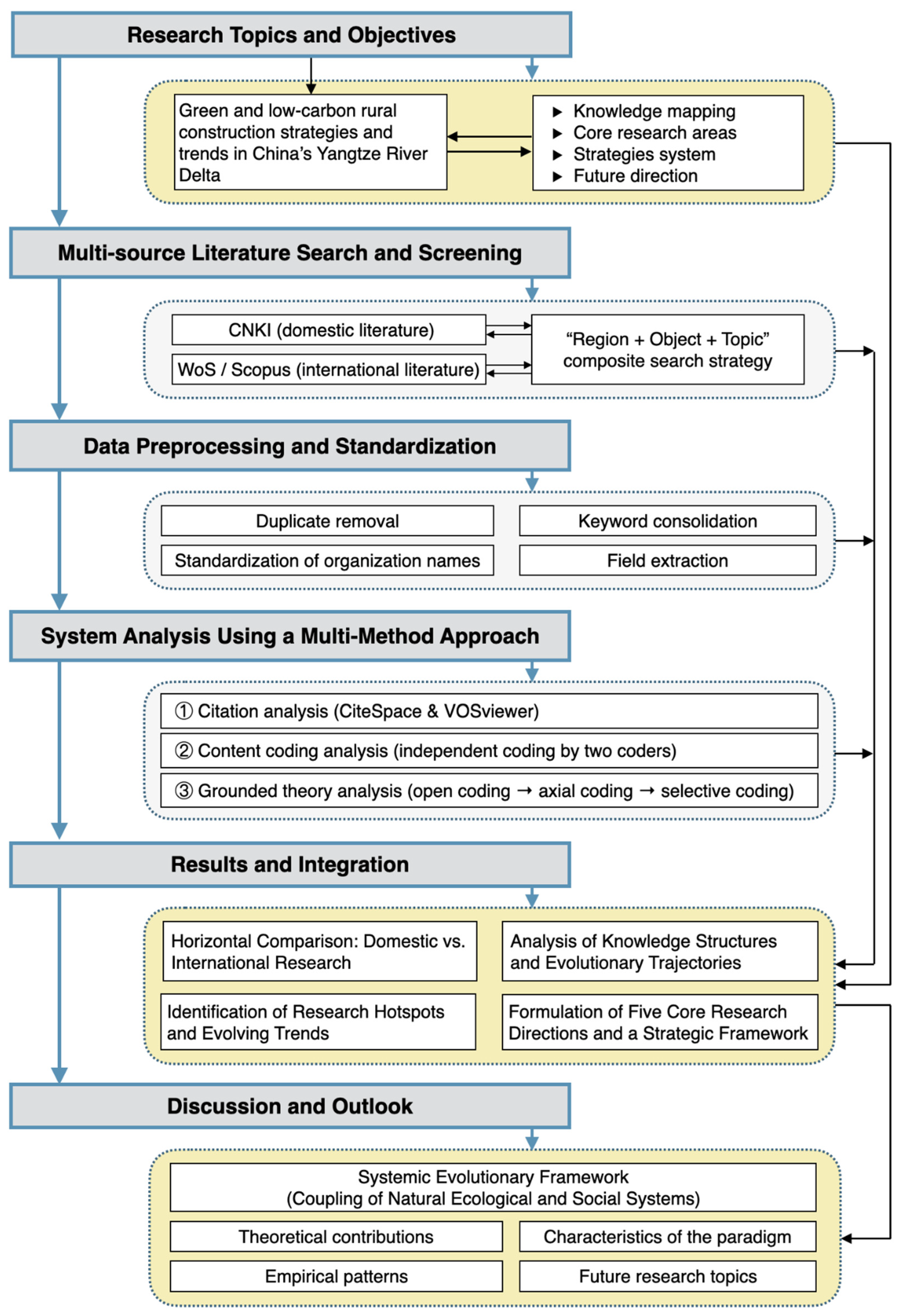
As shown in Figure 1, this review integrates multi-database bibliometric analysis with knowledge mapping. It sources Chinese-language literature from the CNKI and English-language literature from WoS and Scopus, constructing a database of 4166 core documents to enable a horizontal comparison between domestic and international research. CiteSpace 6.2.R4 and VOSviewer 1.6.19 [26] are employed to perform a quantitative analysis across multiple dimensions (i.e., annual publication volume, institutional cooperation networks, keyword co-occurrence and clustering, and keyword bursts). Building on this, LLM-assisted key point extraction is combined with in-depth manual review to identify the key triggers behind highly cited articles and to reveal the factors—such as policy guidance and technological breakthroughs—that have propelled paradigm shifts in the field. Finally, the study elucidates the logic behind research focus shifts over time and establishes causal links between specific research contexts and applicable technologies, thereby recognizing the underlying reasons for key transitions. This approach aims to overcome the high subjectivity and insufficient systematic rigor often found in conventional literature reviews.
Unlike conventional reviews that primarily focus on identifying research hotspots, this study distills two core evolutionary threads—namely, “natural ecology” (constituting the spatial–morphological foundation) and “social system” (constituting the structural-social cohesion)—based on extensive literature analysis and further reveals the shifting coupling intensities and interactive mechanisms between these two threads across different stages of rural construction. This framework offers a dynamic evolutionary model capable of explaining why rural construction in the Yangtze River Delta has maintained its vitality through long-term socioeconomic and environmental changes.
This study primarily consists of three components:
(1)
Systematic Literature Review and Knowledge Mapping: Centered on the research on green and low-carbon rural construction in the YRD, this section comprehensively analyzes the temporal publication trends, academic cooperation networks, and knowledge structures and thus constructs a knowledge evolution graph that visualizes the similarities and differences between domestic and international research, thereby providing scholars in this field with a systematic literature review with visual knowledge graphs and feasible research methodologies.
(2)
Core Research Directions and Strategy Systems: This section dissects the technical pathways and practical models of the five principal research directions and summarizes the green and low-carbon rural construction experiences forged in the regional background of high population density, high-strength exploitation, and high environmental pressure, offering important solutions and references for the low-carbon transition of rural areas with diverse characteristics across China.
(3)
Research Limitations and Prospects: This section objectively discusses the limitations of existing studies, identifies potential research hotspots and key scientific questions, and proposes priority directions, thereby providing forward guidance for further efforts.

2. Materials and Methods

2.1. Literature Retrieval and Screening

Chinese-language literature was sourced from the CNKI, covering core journals such as Architectural Journal and Urban and Rural Planning. English-language literature was retrieved from WoS and Scopus, covering high-quality international journals in building science, environmental science, and related disciplines. Since relevant articles in the CNKI prior to 1997 were sparse, totaling fewer than 10, the search timeframe was set from 1 January 1997 to 31 December 2025, and the search was conducted on 15 February 2026. For WoS and Scopus, where a stable volume of articles appeared after 1998, the search timeframe was from 1 January 1998 to 31 December 2025, with the search conducted on 20 February 2026.
Core search terms were determined through preliminary searches and expert consultation, adopting a composite “region–object–theme” retrieval strategy. Region terms included “Yangtze River Delta (YRD)”, “Shanghai”, “Jiangsu”, “Zhejiang”, “Anhui”, “Jiangnan”, “Southern Jiangsu”, “Northern Zhejiang”, “Taihu Lake Basin”, “Nanjing”, “Suzhou”, “Wuxi”, “Changzhou”, “Hangzhou”, “Huzhou”, “Jiaxing”, etc. Object terms included “Rural”, “Countryside”, “Village”, “Settlement”, “Hamlet”, “Town”, “Vernacular”, “Dwelling”, “Building”, and “Planning”, etc. Theme terms included “Green”, “Low Carbon”, “Ecological”, “Energy Saving”, “Sustainable”, “Climate Adaptation”, “Climate Resilience”, “Passive Technique”, and “Retrofitting”, etc.
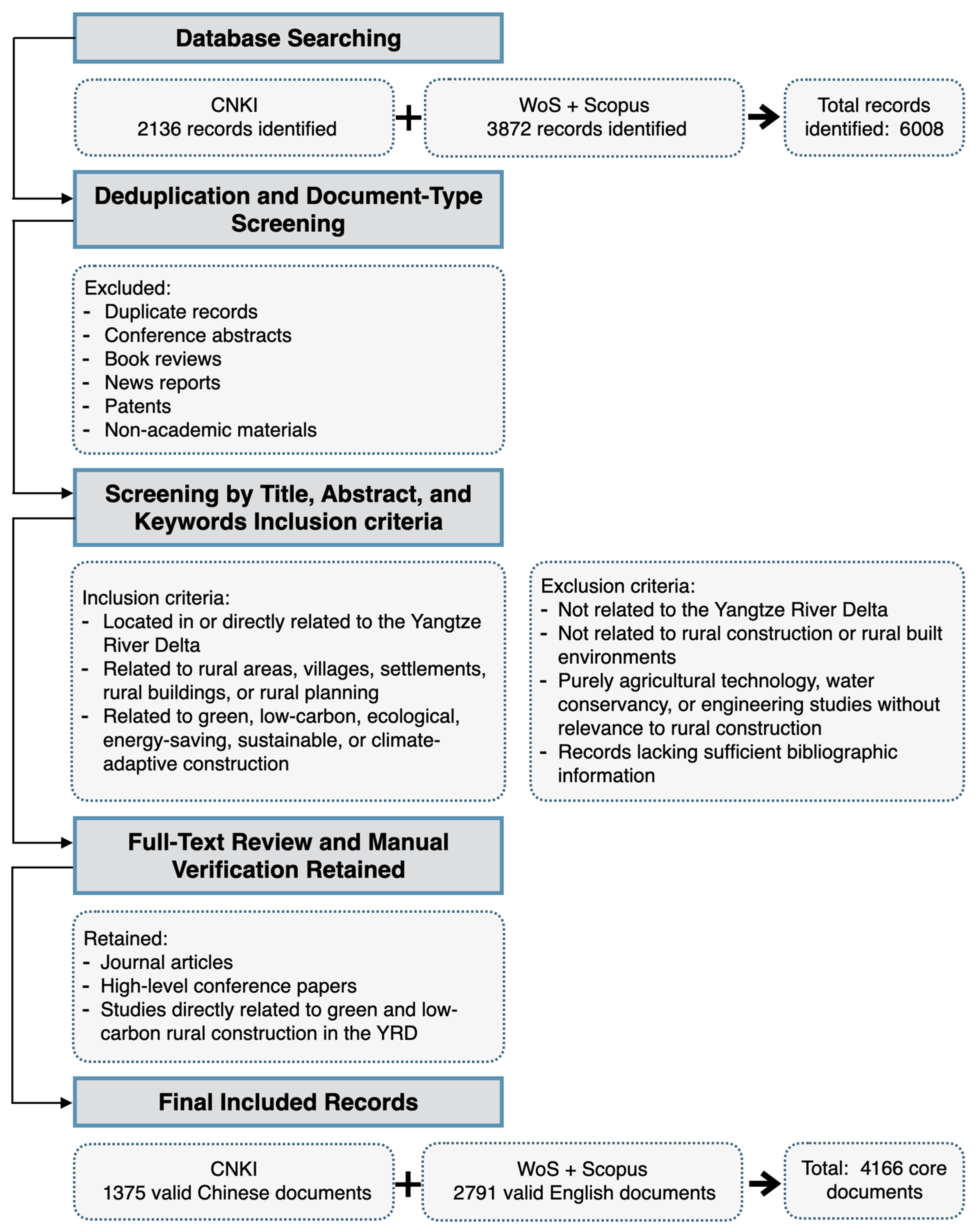
As shown in Figure 2, the preliminary search yielded 2136 domestic and 3872 international documents. A secondary screening was then conducted based on the following criteria: (1) the research object is located within the YRD as defined in this study; (2) conference abstracts, book reviews, news reports, patents, and duplicate records were excluded; (3) literature irrelevant to architecture, rural construction, and green and low-carbon development, such as pure research on agricultural technology and water conservancy, was excluded, and this exclusion is justified by the study’s focus on low-carbon construction at the built environment level, while interdisciplinary topics such as ecological compensation are left for future research; (4) journal articles and high-level conference papers were retained. Ultimately, 1375 valid Chinese documents and 2791 English documents formed the database for bibliometric analysis.

2.2. Data Preprocessing

Standard preprocessing of the screened samples was performed to ensure bibliometric accuracy. First, EndNote 20 was used for automatic, followed by manual deduplication. Then, keywords were consolidated and normalized; for instance, “Village Low Carbon” versus “Low-Carbon Village”, “Jiangnan Water Town” versus “Water Network Plain”, and “Farmhouse” versus “Rural Residence” were unified under the standard terms. Institution names were also normalized; for example, all name variants of Southeast University Architectural Design & Research Institute Co., Ltd. were unified as “Southeast University Architectural Design & Research Institute” to avoid statistical bias. Finally, core fields (e.g., publication year, author, institution, keyword, abstract) were extracted and exported into formats compatible with CiteSpace and VOSviewer [26].

2.3. Analytical Methods

2.3.1. Bibliometric Analysis

CiteSpace 6.2.R4 and VOSviewer 1.6.19 were employed for a systematic quantitative analysis of the 4166 core documents. The time slice was set to two years, with “Keyword” and “Author” selected as node types. Pathfinder network scaling was applied to prune the co-occurrence networks, eliminating redundant connections and highlighting core academic associations. The top 50 high-frequency nodes in each time slice were extracted. Through the analysis of annual publication volumes, institutional cooperation networks, keyword co-occurrence and clustering, burst keywords, and timeline graphs, the evolutionary trajectory of research hotspots and the research frontiers in this field were identified.

2.3.2. Content Coding Analysis

To determine the distribution characteristics of research themes, the study extracted topic statements from the titles, abstracts, and keywords and yielded a total of 2075 initial coding units. Two independent coders were appointed to categorize and tally these units in order to ensure the scientific validity and reliability of the coding results. Upon completion of the coding process, a consistency check was performed, achieving a Cohen’s Kappa of 0.911, which indicates a high degree of inter-coder consistency.

2.3.3. Grounded Theory Analysis

The open coding, axial coding, and selective coding were adopted for grounded theory analysis on 203 high-frequency keywords, distilling core categories and theoretical frameworks [27]. The open coding examined and conceptually refined the high-frequency keywords to form 32 initial categories. The axial coding integrated the 32 initial categories into nine principal categories according to their causal, subordinate, and associative relationships. The selective coding captured the core logical relationships among the principal categories and integrated them into two core categories. At this point, a systematic evolutionary framework for the research on the green and low-carbon rural construction in the YRD was constructed. To enhance methodological transparency and reproducibility, Table 2 illustrates the stepwise refinement process from open coding to selective coding.

2.3.4. LLM-Assisted Interpretive Analysis

Building upon the bibliometric analysis, this study incorporates LLM-assisted key point extraction as an intermediate step bridging bibliometric results and grounded theory coding. GPT-4o was employed as the auxiliary model, guided by a three-tiered structured prompt design (task specification → output format constraints → quality anchoring) to accomplish the following tasks: (1) distill core themes and academic connotations for each cluster based on keyword co-occurrence results; (2) infer potential driving factors (policy, technology, or methodology) behind burst keywords by examining their time windows and burst strengths; (3) preliminarily synthesize potential research direction classifications based on clustering characteristics and burst evolution patterns.
The LLM was involved only in the preliminary labeling of the above three tasks. All outputs were independently reviewed by two researchers, with discrepancies resolved through discussion until consensus was reached (Cohen‘s Kappa = 0.911). In this study, the LLM serves as a “primary screening and summarization assistant,” primarily used to accelerate information extraction and initial classification. All core judgments were manually verified and traced back to the original literature sources.

3. Results

3.1. Publication Volumes and Trends

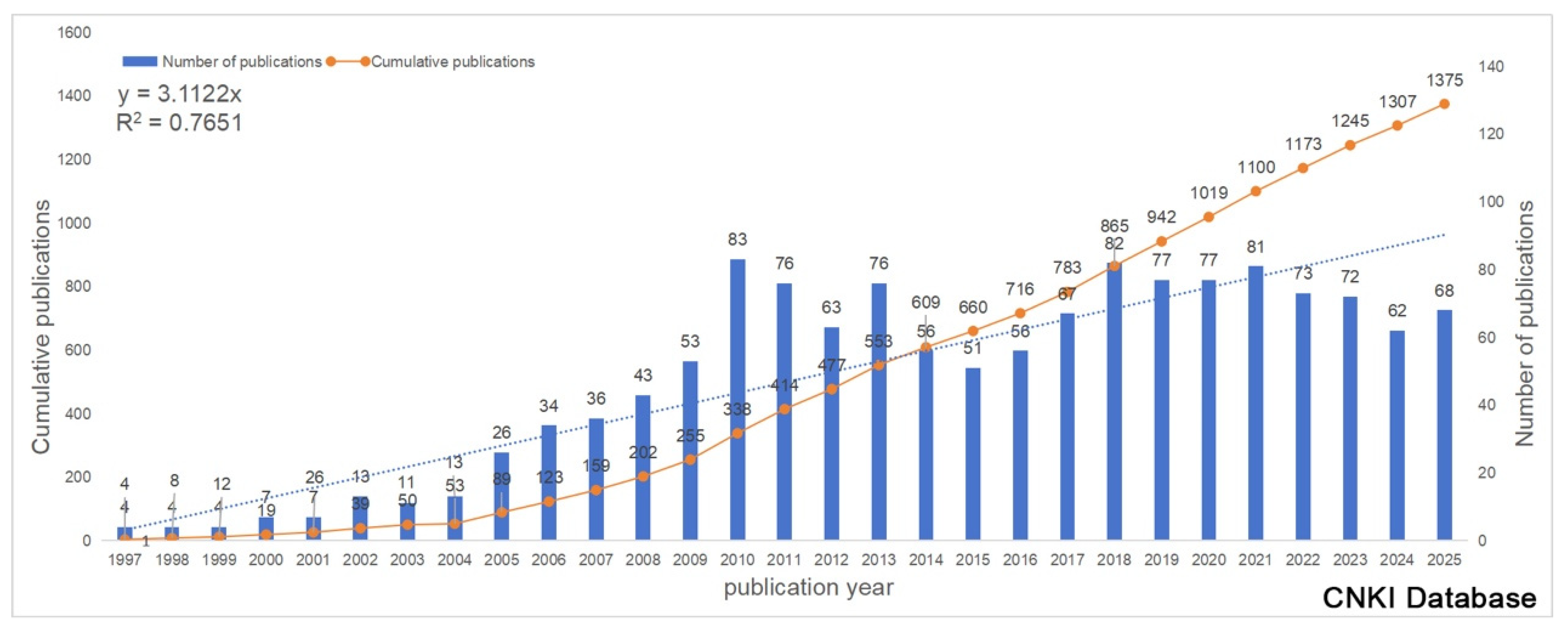
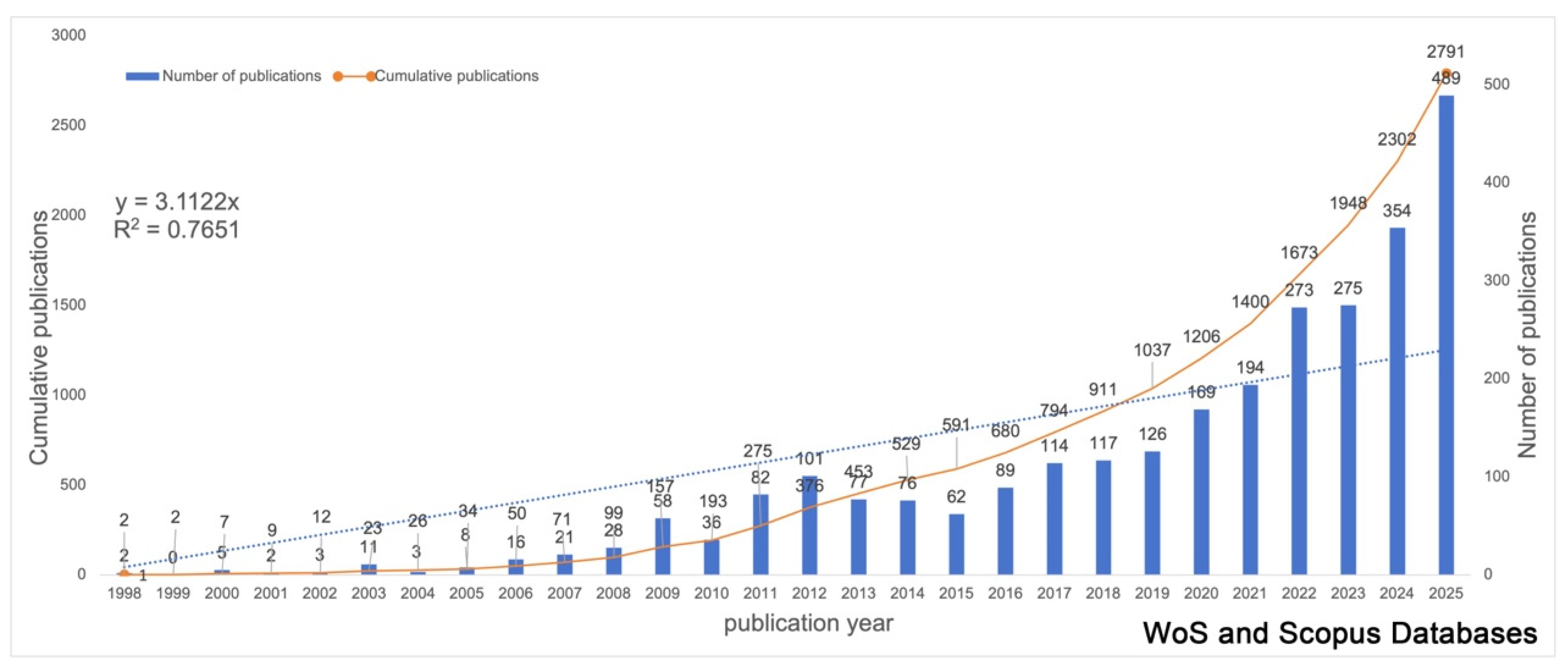
Figure 3 and Figure 4 illustrate the quantitative distribution of literature in the CNKI and WoS/Scopus, respectively. As Table 3 shows, research in this field has undergone distinct growth phases.
In the CNKI, domestic research totals 1375 publications, with its growth highly consistent with policy releases. The initial stage (1997–2005) saw annual publications rise from four to 26, totaling 89. These studies focused on basic technologies like energy-saving retrofitting [28,29], without systematic investigation of the YRD’s rural buildings. A rapid growth phase occurred from 2006 to 2016, with annual volume climbing from 34 to a peak of 83 in 2010, accumulating 627 publications. The “Socialist New Countryside” initiative (2005) [30] and the “Beautiful Countryside” initiative (2013) [31] shifted the paradigm from solely exploring energy-saving technologies to an interdisciplinary integration of low-carbon construction and rural development, expanding into rural planning, green building, and landscape design [31,32,33]. The green technology showcase at Expo 2010 Shanghai further catalyzed this boom [34]. A plateau stage lasted from 2017 to 2025, with annual volumes stabilizing between 62 and 82, accumulating 659 publications. The rural revitalization strategy (2017) [35] and the “dual-carbon” goals (2020) [36] drove an upgrade to systemic low-carbon rural construction, introducing cutting-edge directions like industry–space synergy, carbon mapping, and adaptive governance [37,38]. Notably, the post-2020 plateau indicates a domestic research transition from “quantitative accumulation” to “qualitative improvement”.
International research in WoS and Scopus totals 2791 publications, marked by late-emerging, explosive growth that continues today. The slow-growth period (1998–2008) saw annual publications rise from 2 to 28, totaling 99, with studies focusing on general topics like energy efficiency and building physics [39,40]. Rapid growth occurred between 2009 and 2019 (from 53 to 126 articles annually; total 938). International consensuses like the 2009 Copenhagen Climate Change Conference [41] and the 2015 Paris Agreement [42] propelled low-carbon issues to prominence, bringing the YRD as a typical urbanized region in China into the international research spotlight [42,43]. An explosive phase followed from 2020 to 2025, with annual publications surging from 169 to 489—far exceeding the prior linear trend—and a total of 1754 published. Core drivers include global carbon neutrality timelines (2030–2050) and international attention on China’s “dual-carbon” commitments [44,45]. Accordingly, research hotspots have shifted from building energy conservation to renewable energy, zero-carbon buildings, and sustainable rural development [46,47,48,49].

3.2. Core Research Institutions and Cooperation Networks

Analysis of core research institutions and their cooperation networks reveals the landscape of knowledge production, the distribution of academic influence, and the cooperation characteristics in this field [27], providing empirical evidence for fostering cross-regional and interdisciplinary collaboration.
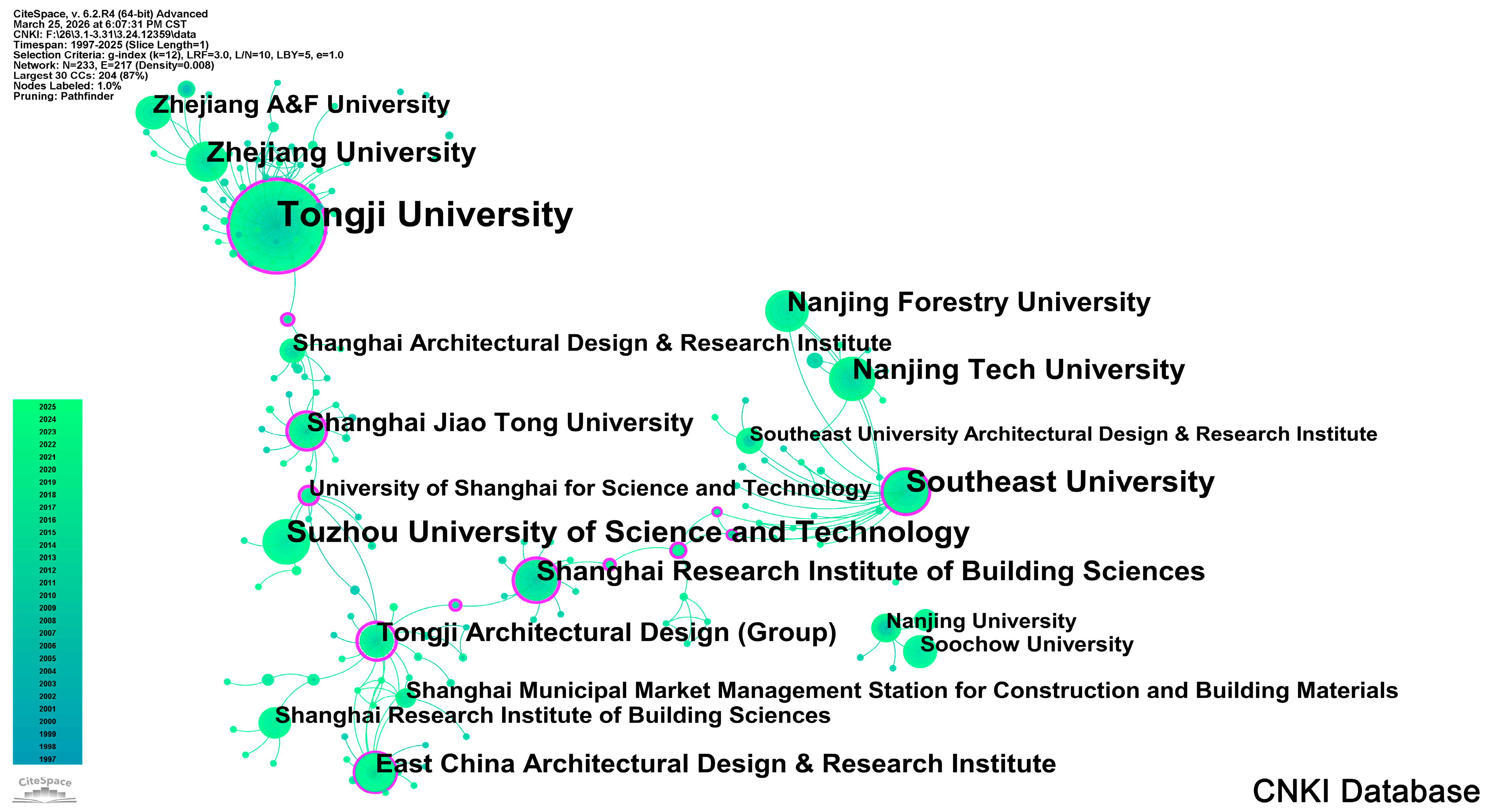
As shown in Figure 5 and Table 4, domestic research is characterized by “university dominance, geographic concentration, and deep industry–university–research integration.” Tongji University (frequency: 212) and its Tongji Architectural Design (Group) (frequency: 38) form a dual academic and practical core in Shanghai, acting as both a primary source of academic output and a hub for technology commercialization. Southeast University (frequency: 156) and its Architectural Design & Research Institute (frequency: 24) form the Nanjing core, and together with Tongji create a “Shanghai–Nanjing dual-core” dynamic. These two entities contributed 47.2% of the core articles, serving as the principal wellspring of domestic research. Other important nodes include architectural design and research institutes (e.g., East China Architectural Design & Research Institute, Shanghai Research Institute of Building Sciences), which specialize in engineering practice and technological adaptation [50,51,52,53]. However, the density of the domestic cooperation network is low, at only 0.083, highlighting a lack of cross-regional and interdisciplinary synergy. Cooperation largely remains confined to institutions within the same city or province, and the integration of architecture with disciplines like environmental science and agricultural economics requires further strengthening to support more comprehensive solutions that integrate spatial planning, ecological conservation, and sustainable rural industries.
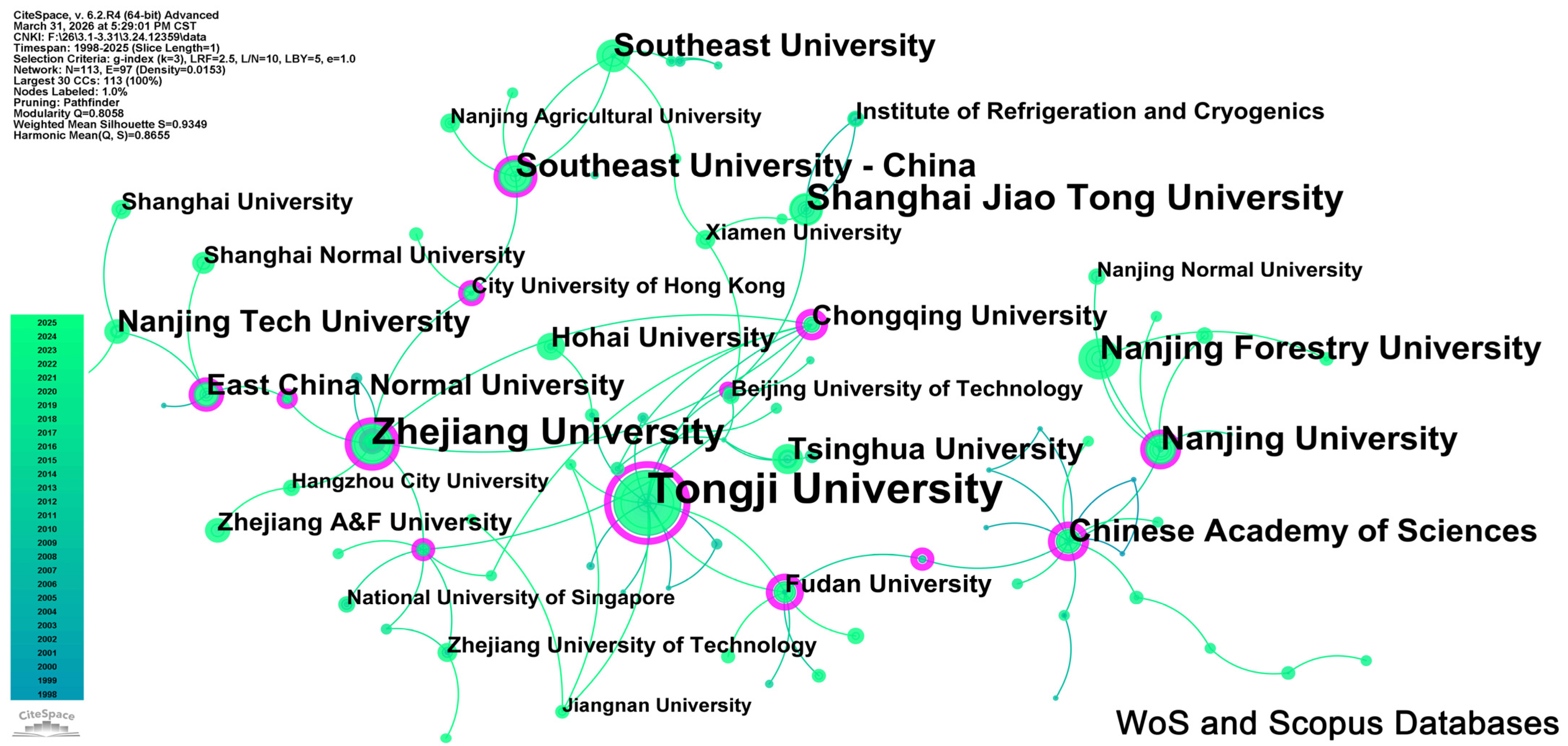
Figure 6 reveals that international research is overwhelmingly dominated by Chinese institutions. Tongji University, with a frequency of 308 and a centrality of 0.69, is the clear leader, while Southeast University, Zhejiang University, Shanghai Jiao Tong University, and Nanjing University form a second echelon, underpinning the international influence of top YRD architectural universities. The international cooperation network features high interdisciplinarity, cross-regional coordination, and frequent exchanges. Agriculture and forestry institutions like Nanjing Agricultural University and Nanjing Forestry University are highly active [45,54,55,56], reflecting an interdisciplinary fusion of rural ecology, low-carbon agriculture/forestry, and sustainable construction. Meanwhile, institutions outside the YRD, such as the Chinese Academy of Sciences and Tsinghua University, serve as important complementary forces [23,41,57]. International partners like the City University of Hong Kong and the National University of Singapore have also established close ties with YRD institutions in building physics and passive design [58], further expanding the frontiers of international cooperation.

3.3. Analysis of Keyword Co-Occurrence and Clustering

In this study, VOSviewer, with the minimum occurrence threshold set to 4, was used for an analysis of keyword co-occurrence and clustering to accurately identify the core themes and knowledge structure of the research on green and low-carbon rural construction in the YRD.
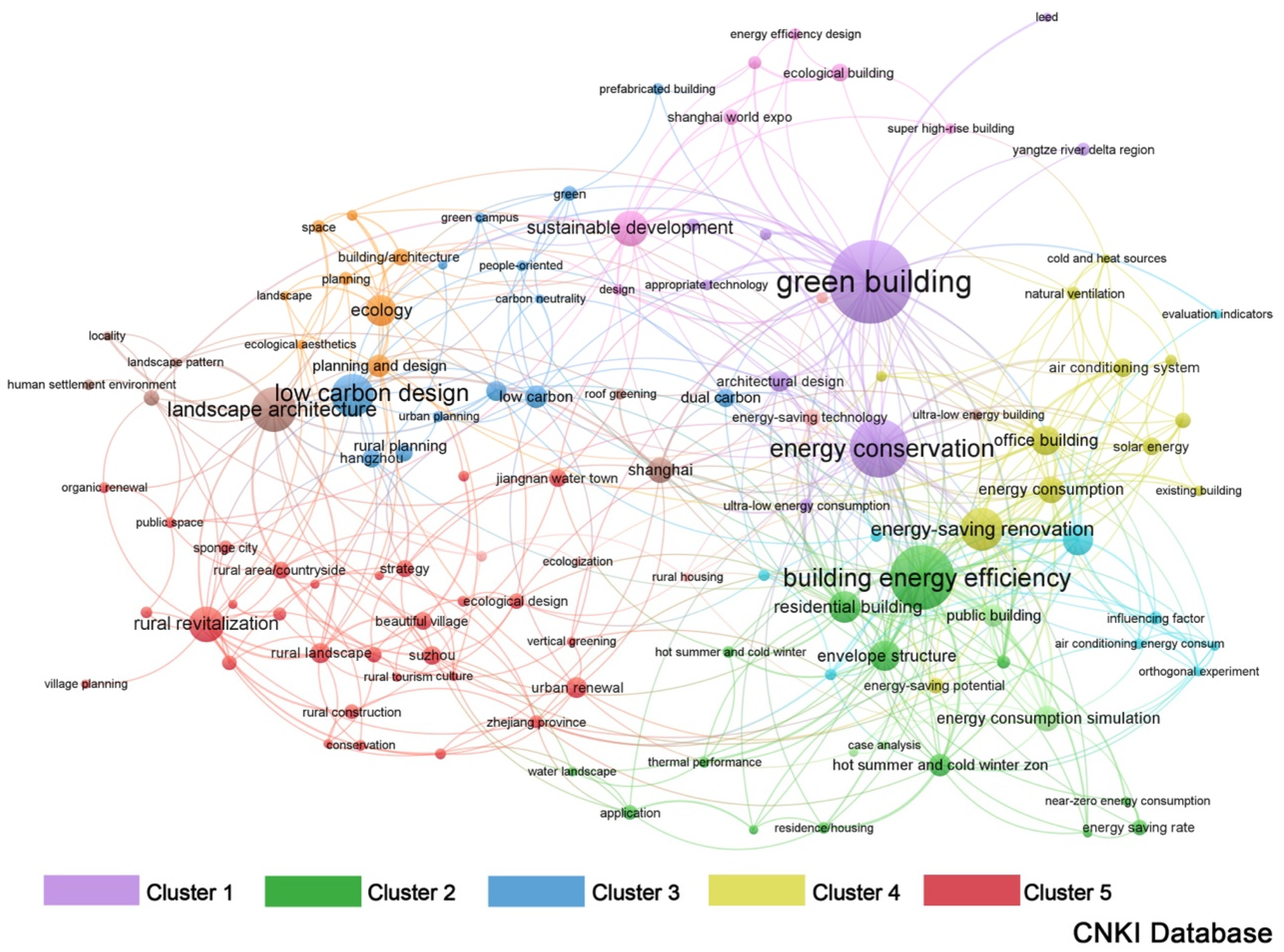
Figure 7 illustrates the five core clusters of domestic literature on green and low-carbon rural construction in the YRD. The purple cluster (Comprehensive Theory and Technology System for Green Building) includes high-frequency keywords such as “Green Building” (occurrences: 88), “Energy Conservation” (54), “Sustainable Development” (18), “Architectural Design” (12), “Ultra-Low Energy Building” (8), “Ecological Building” (7), and “Energy-Saving Technology” (5). This cluster focuses on the implementation of energy-saving, ecological, and sustainability goals in individual buildings, with stress on ultra-low energy building design and the integrated application of energy-saving technologies [36,50,52,53,59,60,61], laying a foundational consensus that “green buildings are key carriers of the low-carbon transition in rural areas”. This reflects the theoretical deepening trend of green building research, evolving from a narrow focus on energy conservation to an integrated multi-objective systems approach. The green cluster (Building Energy Efficiency and Climate-Adaptive Technologies) includes “Building Energy Efficiency” (64), “Envelope Structure” (18), “Residential Building” (17), “Hot-Summer and Cold-Winter Zone” (10), “Energy Consumption Simulation” (9), and “Thermal Performance” (8). These studies center on the thermal performance optimization of building envelopes, the simulation of residential energy consumption, and the thermal performance evaluation in the hot-summer and cold-winter climate zone [20,29,31,38,58,62,63], exhibiting a radical response to the climatic characteristics of the YRD. The blue cluster (Low-Carbon Design and Carbon-Neutral Villages) includes “Low-Carbon Design” (64), “Low-Carbon” (21), “Low-Carbon Rural Area” (18), “Carbon Neutrality” (16), “Dual-Carbon” (12), and “Rural Planning” (9). Driven by China’s “dual-carbon” strategy, the research focus has shifted from green and energy-saving technologies to low- and zero-carbon objectives and whole-life-cycle carbon management [7,25,49,59,64,65,66,67,68]. This establishes green and low-carbon rural construction as a systemic design paradigm featuring ecological carbon sinks [69,70]. The yellow cluster (Energy-Saving Retrofitting of Existing Buildings and Renewable Energy Utilization) includes “Energy-Saving Renovation” (45), “Energy Consumption” (31), “Solar Energy” (4), “Air Conditioning System” (3), “Natural Ventilation” (2), and “Existing Building” (2). This cluster concerns the low-cost retrofitting of vast existing rural residences with appropriate low-carbon technologies [21,29,30,31,32,35,36,50,52,53,71,72], indicating a shift in research focus from constructing new green buildings to reconstructing existing buildings with green solutions3. The red cluster (Rural Revitalization and Rural Spatial Renewal) includes “Rural Revitalization” (30), “Rural Landscape” (7), “Urban Renewal” (15), “Beautiful Village” (6), “Rural Area/Countryside” (4), “Ecological Design” (5), and “Strategy” (3). This cluster emphasizes the comprehensive improvement of the rural human settlement environment by means of rural landscape protection, beautiful village construction, spatial renewal, and ecological design in the context of rural revitalization [8,9,20,21,30,63,64,65,66,73]. Moreover, it reflects a shift in research paradigm from the application of green building technologies towards the comprehensive revitalization via rural spatial governance and integrated industry–society–ecology coordination [74,75].
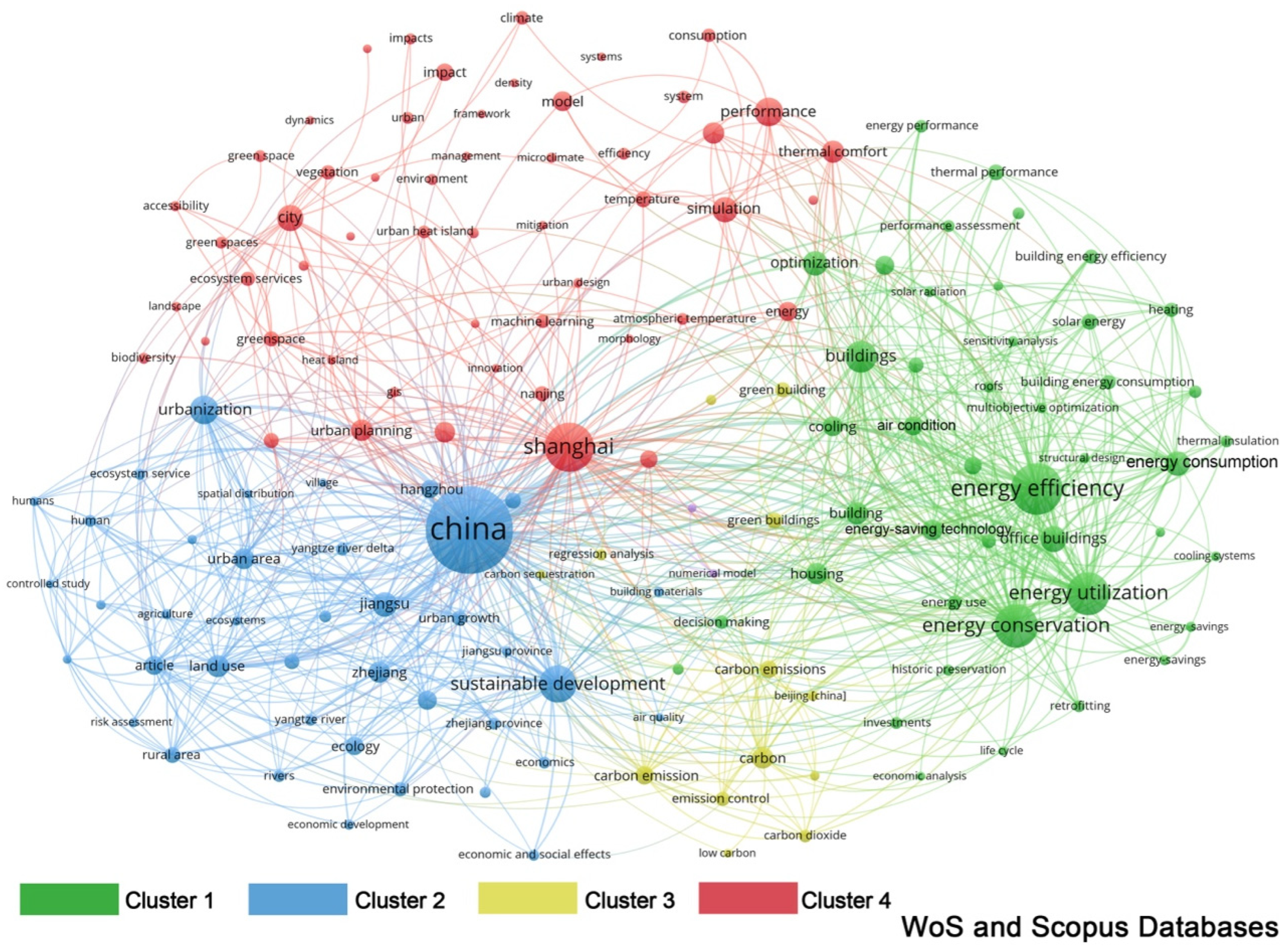
Figure 8 illustrates the four core clusters of international literature. The green cluster (Building Energy Efficiency Improvement and Energy-Saving Technology System) includes “Energy Efficiency” (346), “Energy Conservation” (289), “Energy Utilization” (285), “Optimization/Multi-Objective Optimization” (118), “Energy Saving” (55), “Cooling” (36), “Thermal Performance” (30), “Thermal Insulation” (30), and “Historic Preservation” (12). This cluster focuses on energy utilization efficiency, multi-objective optimization, and thermal performance [22,33,40,41,54,76], with heritage protection serving as an important consideration in the energy-saving retrofitting of historic buildings [32,42,53]. These studies properly resonate with the practical needs of building renewal for numerous traditional villages in the YRD, suggesting a methodological evolution from the singular focus on energy efficiency towards the multi-objective optimization of energy efficiency, cost, and heritage conservation [77,78,79]. The blue cluster (Sustainable Development and Regional Human–Land Relationships) includes “Sustainable Development” (201), “Land Use” (118), “Urbanization” (104), “Jiangsu” (98), “Zhejiang” (76), “Rural Area” (55), “Ecology” (54), “Human” (34), “Environmental Protection” (29), and “Economic Development” (13). Taking Jiangsu and Zhejiang Provinces as subjects, these studies explore the synergistic relationships among land use, ecological conservation, and rural economic development amidst the rapid urbanization of the YRD [2,3,4,5,23,44,45,46,80], achieving a scale transition from building technologies to regional human–land systems [81]. The yellow cluster (Carbon Emission Accounting, Emission Control Strategies, and Carbon Sink Mechanisms) includes “Carbon” (84), “Carbon Emission/Emissions” (111), “Emission Control” (30), “Regression Analysis” (16), and “Carbon Sequestration” (15). This cluster employs quantitative methods such as regression analysis to identify factors influencing carbon emissions [49,54,55,56,57,82,83,84,85,86] and explores the carbon sink potential of natural ecosystems [87,88], providing data support for low-carbon planning. The red cluster (Regional Microclimate and Performance Simulation) includes “Shanghai” (279), “Performance” (128), “Simulation” (94), “Thermal Comfort” (77), “Model” (66), “Heat Island” (39), “Temperature” (31), and “Climate” (26). This cluster concentrates on regional-scale microclimate simulation, thermal comfort evaluation, and climate model construction [55,79,80,89,90,91,92], forming a complementary “building–region” scale pair with the green cluster that focuses on the energy efficiency of individual buildings.

3.4. Burst Keywords and Evolution of Research Frontiers

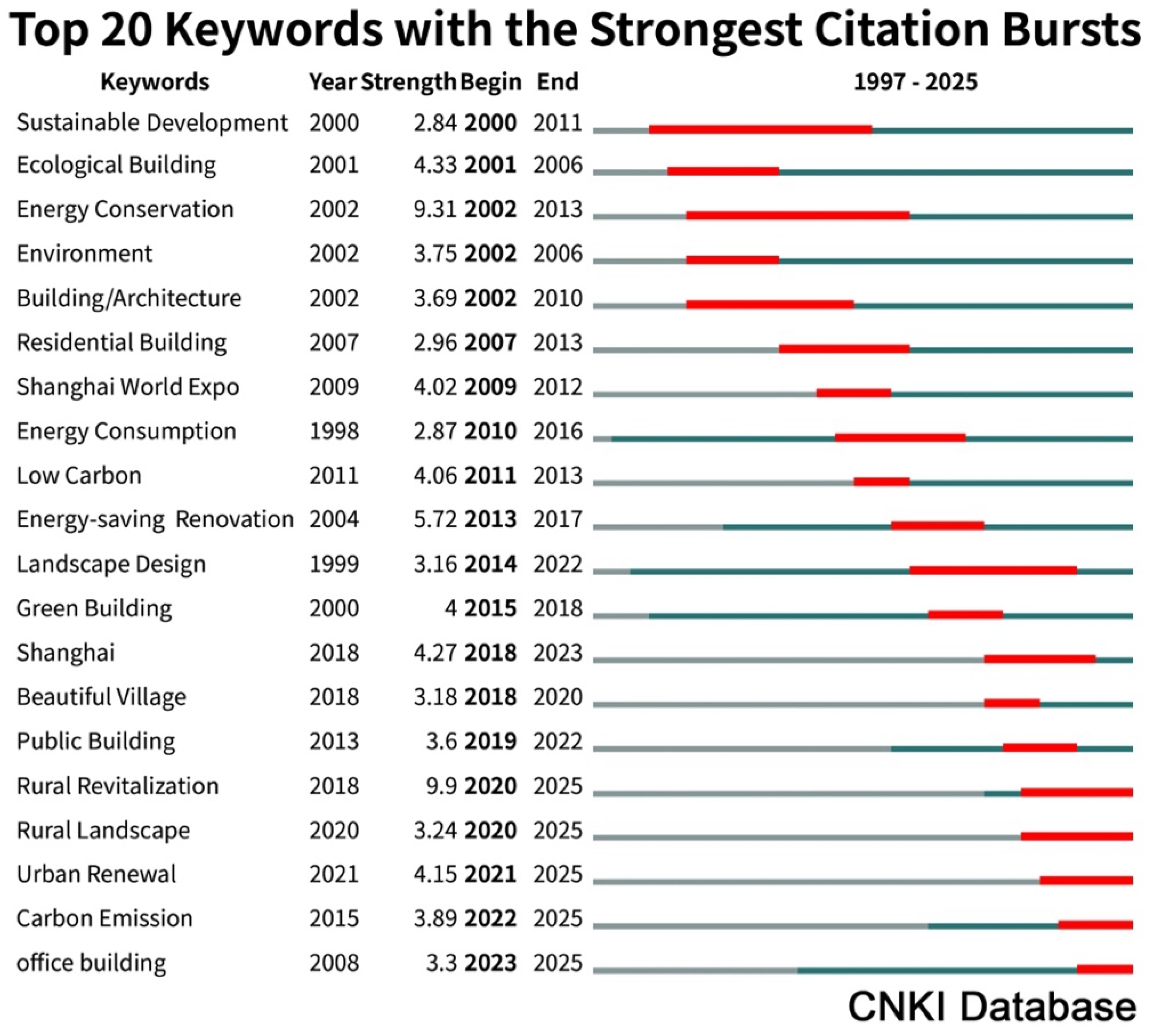
Temporal keyword burst analysis4 can accurately capture the shift in research hotspots during specific periods and thus reveals the research trajectory in this field. As shown in Figure 9, a total of 20 high-strength burst keywords are identified from domestic literature. Based on these burst keywords, the 1997–2025 period is divided into three evolutionary stages.
Stage I (2000–2010) involved the introduction of basic low-carbon concepts. The burst of “Sustainable Development” (strength: 2.84; 2000–2011) and “Ecological Building” (4.33; 2001–2006) marked the entry of the concepts of sustainability and ecological building into the Chinese architectural academic community [20,30,53]. “Energy Conservation” burst in 2002 with a strength of up to 9.31 and persisted for 11 years [30,31,32]. Over the same period, “Environment” (3.75) and “Building/Architecture” (3.69) burst [51,52,59]. These keywords established energy-saving technology as a core foundational topic with substantial influence.
Stage II (2009–2018) involved green transition and policy response. In 2009, the “Shanghai World Expo” (4.02), by showcasing green buildings and low-carbon technologies worldwide [34], vigorously propelled domestic research in this field. The burst of “Low-Carbon” (4.06) in 2011 and “Green Building” in 2015 (4.00) marked an upgrade in research paradigm from energy-saving to green and low carbon [21,65,66,93]. In 2013, “Energy-Saving Renovation” burst with a strength of 5.72, making the retrofitting of existing buildings a hotspot [94]. Following the release of the “Beautiful Countryside Construction” initiative and policies related to public building energy conservation [95,96], “Beautiful Village” (3.18) and “Public Building” (3.60) burst in 2018.
Stage III (2020–2025) involved rural revitalization and “dual-carbon” goals. “Rural Revitalization” burst with the highest strength of 9.90 in 2020 and persisted until 2025 [71,73,97]. “Rural Landscape” (3.24) burst over the same period [66], reflecting the strong traction of national strategies. The burst of “Carbon Emission” in 2021 (3.89) and “Urban Renewal” in 2022 (4.15) [50,52] indicated that the research focus has shifted towards total carbon emission control and integrated urban–rural development. At the practical level, the sustained bursts of “Rural Revitalization” and “Carbon Emission” directly correspond to the synergistic advancement of industrial restructuring and low-carbon emission reduction in rural planning, while the high-intensity burst of “Urban Renewal” reflects the shifting demand for built environment renewal strategies in rural areas under the context of urban–rural integration.
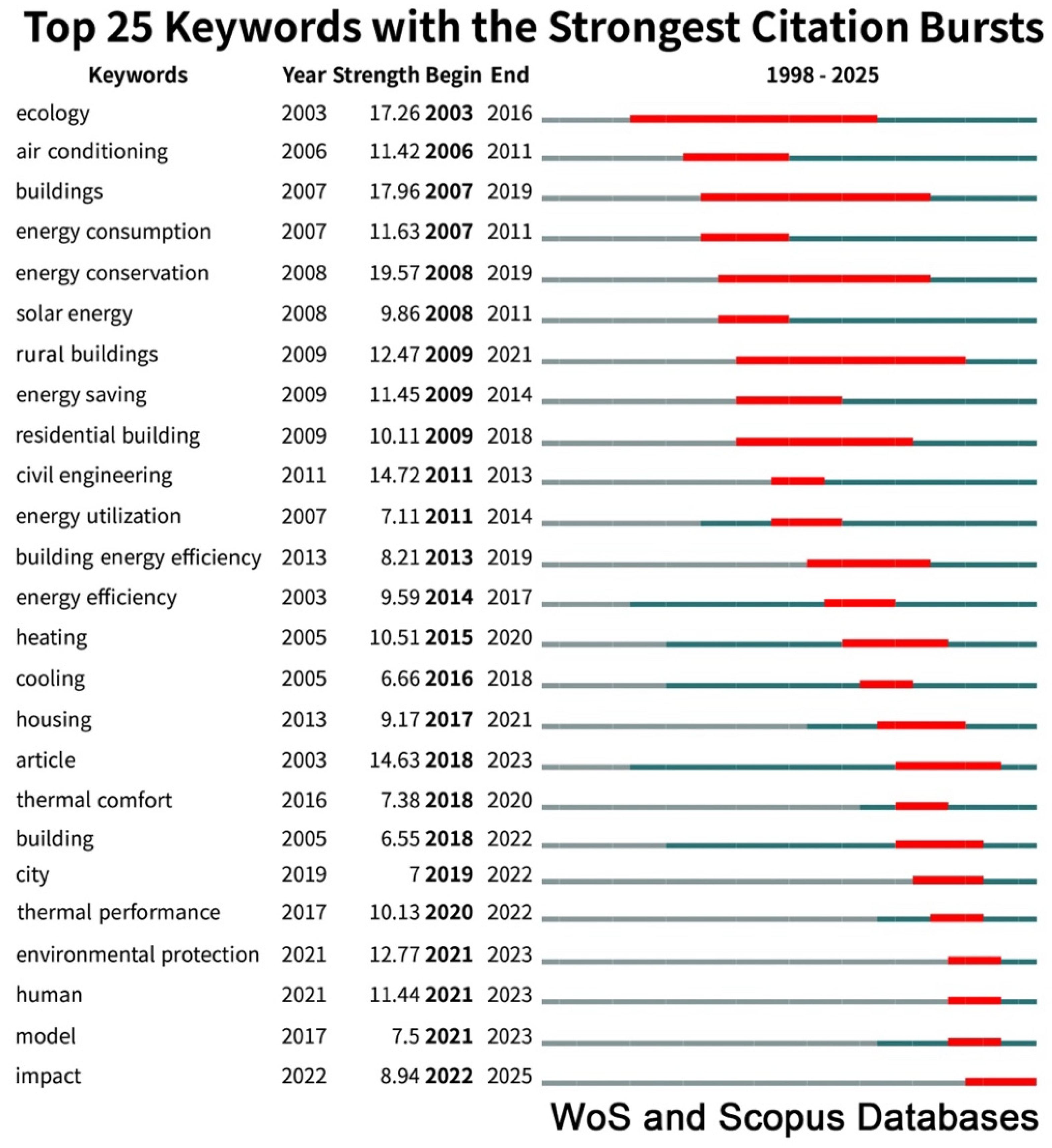
Figure 10 presents the 25 high-strength burst keywords in international literature. The 1998–2025 period is divided into four evolutionary stages.
Stage I (2003–2008) concerned the formation of foundational low-carbon concepts. Keywords such as “Ecology” (17.26, 2003–2016), “Buildings” (17.96, 2007–2019), “Energy Conservation” (19.57, 2008–2019), and “Solar Energy” (9.86, 2008–2011) burst with high strengths and persisted for a long time [40,77], representing a package of green and low-carbon concepts. Among these, “Energy Conservation” ranked first with a strength of 19.57 [41] and became an internationally recognized research hotspot.
Stage II (2009–2015) was a period of emerging technologies and evaluation methods. “Rural Buildings” (12.47, 2009–2021), “Energy Saving” (11.45, 2009–2014), and “Residential Building” (10.11, 2009–2018) burst intensively [43,76]. The research theme shifted from concept promotion to technical implementation and evaluation systems, with life cycle assessment, renewable energy, and passive design being widely applied [23,33,37]. In 2011, the short-term, high-strength burst of “Civil Engineering” (14.72) [81] represented a concentrated explosion of relevant technologies such as thermal comfort models and building simulation tools.
Stage III (2016–2020) involved systematic integration and cross-domain expansion. “Cooling” (6.66, 2016–2018), “Housing” (9.17, 2017–2021), “Thermal Comfort” (7.38, 2018–2020), “Building” (6.55, 2018–2022), and “Thermal Performance” (10.13, 2020–2022) burst and persisted, suggesting that the quantitative evaluation of building thermal performance5 became a core direction [42,83,84]. “Article” bursting twice between 2018 and 2023 indicated a surge in review studies [54,57], whereby foundational topics were reintegrated in a new technical context.
Stage IV (2021–2025) involved zero-carbon transition and comprehensive impact assessment. “Environmental Protection” (12.77), “Human” (11.44), and “Model” (7.50) burst intensively, indicating that frontier topics such as zero-carbon and carbon neutrality have become dominant [22,45]. “Impact” burst with a strength of 8.94 and persisted until 2025 [46,47,48,49], suggesting that the international research focus is shifting from technological development to comprehensive impact assessment of technology application.

3.5. Research Hotspots and Evolutionary Trends

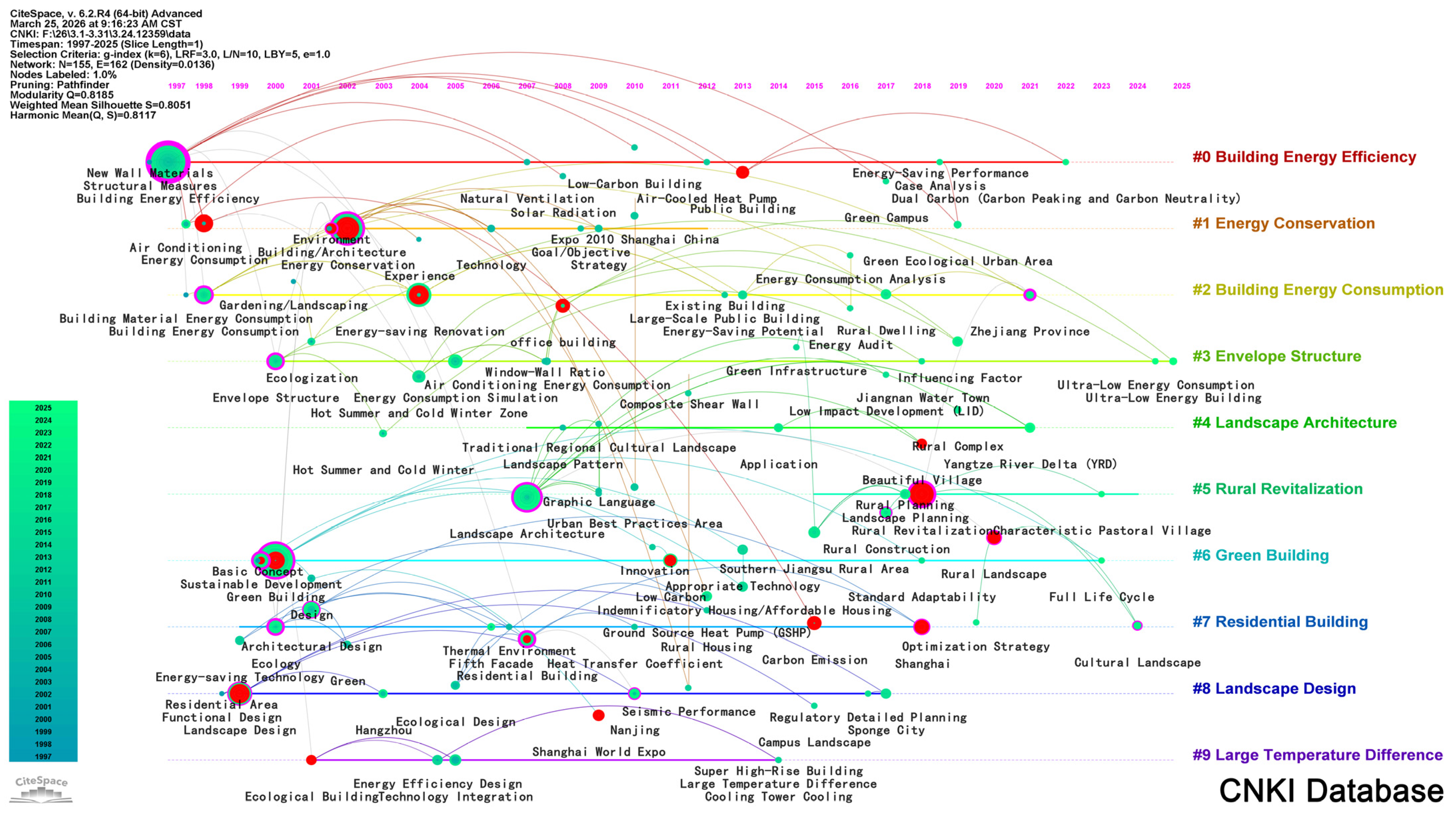
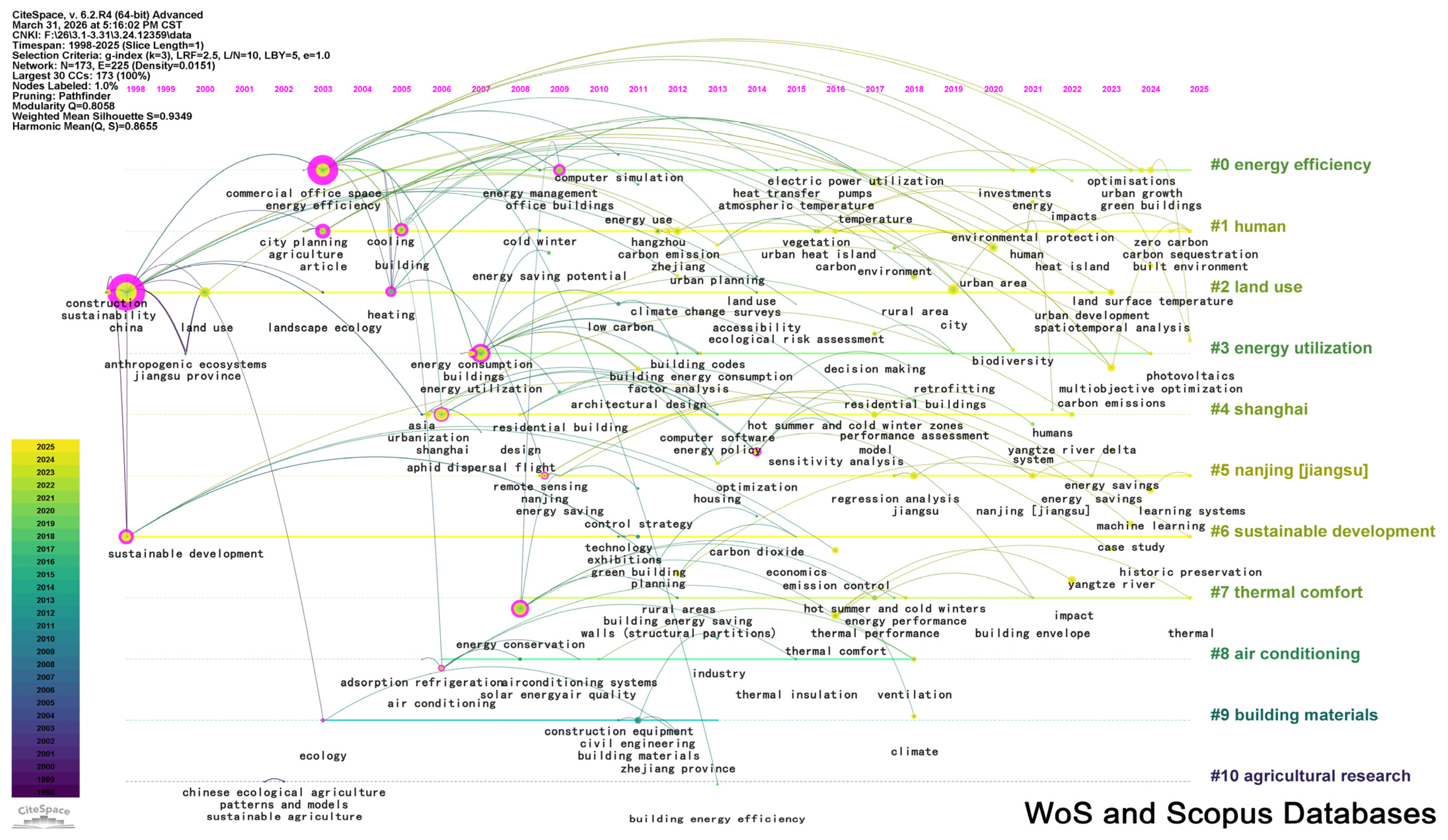
Based on the keyword timeline map, the research lineage, thematic clusters, and evolutionary trends of green and low-carbon rural construction in the YRD can be clearly identified.
For domestic literature, the research hotspots and evolutionary trends (Figure 11) reveal that this field exhibits significant policy-oriented characteristics, forming a clustering system centered around #0 Building Energy Efficiency, #5 Rural Revitalization, and #6 Green Building that responded to the national rural revitalization and dual-carbon strategies. The research themes have progressively extended from pure technical dimensions such as “Building Energy Conservation” and “Envelope Structure” [28,30,31] to regional dimensions such as “Yangtze River Delta (YRD),” “Rural Construction,” and “Traditional Regional Cultural Landscape” [29,35,36]. Meanwhile, the high relevance between “Appropriate Technology” and “Regional Characteristic” [32,64] underscores the great attention domestic research places on the matching between local climate and technology application. Temporally, studies published before 2000 centered on “Building Energy Consumption” and “Energy-Saving Renovation”; after 2010, keywords such as “Beautiful Village”, “Low-Carbon Village”, and “Bioclimatic Design” burst intensively [58,59,60,61,62]; after 2020, emerging concepts such as “Carbon Neutrality”, “Sponge City”, and “Whole Life Cycle” entered the spotlight [73], forming an evolutionary logic from technology-driven energy-saving to low-carbon ecology and regional sustainability. Moreover, settlement types with distinct regional characteristics in the YRD, such as “Jiangnan Water Town” and “Rural Complex”, have become research hotspots, demonstrating the proactive exploration and modern translation of regional construction wisdom.
For international literature, in contrast, the research hotspots and evolutionary trends (Figure 12) are both oriented by technology. Core research themes include #0 Energy Efficiency and #3 Energy Utilization. These studies revolve around building energy consumption (e.g., computer simulation) and low-carbon technologies (e.g., photovoltaics) [55,79,80,89], indicating a concentrated focus on the pathway of achieving carbon reduction via technology application. Regionally, #4 Shanghai and #5 Nanjing are key nodes, while keywords such as “Yangtze River Delta (YRD)” and “Rural Area” possess relatively smaller node sizes, suggesting that international literature has made few efforts to systematically explore the villages within the YRD yet considered villages surrounding Shanghai, Nanjing, and other key Jiangnan cities as research subjects [98]. Temporally, from 1998 to 2010, international literature was dominated by foundational concepts, such as “Energy Saving” and “Construction Sustainability”; after 2010, “Land Use”, “Sustainable Development”, and “Biodiversity” have emerged as primary keywords, indicating a research shift from singular energy efficiency improvement to holistic ecological sustainable development [23,33,81,82]. Notably, the relatively low strength of keywords reflecting regionalism, such as “Regionality” and “Traditional Settlements”, suggests that international literature so far has failed to deeply excavate the regional culture and construction wisdom of villages in the YRD.

3.6. Principal Research Directions and Strategies

The research identifies major thematic clusters and their evolutionary trajectories through keyword co-occurrence, clustering, and burst analyses of the core literature. A total of 2075 thematic coding units were extracted from titles, abstracts, and keywords to provide an initial mapping of the distribution of research themes. The proportion of each research direction was then derived from content coding frequency statistics, while cross-cutting literature was assigned to the most relevant category according to its core contribution. The resulting five research directions correspond to the main knowledge clusters and collectively cover key strategic domains, including spatial planning, traditional wisdom, passive technologies, housing retrofitting, and industry–space synergy. This demonstrates the representativeness and explanatory power of the proposed categories, as well as the stability of the analytical framework.

3.6.1. Low-Carbon Rural Spatial Planning and Evaluation Centered on “Low–Carbon Control Units”

Representing the largest research branch (24.4% of total publications), this direction is grounded in system theory and carbon cycle theory. These studies seek to realize low-carbon objectives by rural spatial units, forming a complete logical chain from carbon element analysis and unit definition to pathway implementation and evaluation feedback. However, the practical application of low-carbon control units also faces constraints such as high initial investment, limited village-level maintenance capacity, fragmented land ownership, uneven local fiscal capacity, and insufficient technical support. Therefore, this theoretical framework needs to be combined with cost-sensitive and locally adaptive implementation strategies.
These studies focus on the analysis of carbon cycle elements. Drawing on urban metabolism theory6, rural space is deconstructed into four core elements: stationary carbon sources (building energy), mobile carbon sources (transportation), process carbon sources (energy supply), and natural carbon sinks (green spaces and water bodies) [94]. This elemental system demonstrates strong self-similarity across spatial scales—from neighborhoods to villages and regions—providing a theoretical basis for cross-scale low-carbon regulation [69,94].
The concept of “low-carbon control unit” has been proposed [75]. A natural village is defined as the basic unit, with its spatial structure deconstructed into elements like boundaries, streets, lanes, and landmarks. Village boundaries function as interfaces regulating material and energy exchange; streets and lanes guide the flow of mobile carbon sources; and landmarks (e.g., ancient trees, ancestral halls) act as “low-carbon regulators”, achieving an organic coupling between carbon cycle mechanisms and spatial form [35,75,85].
An innovative “Demand–Source–Sink” pathway has been developed. “Demand” involves minimizing energy demand by virtue of compact layout, mixing functions, transit-oriented development, and envelope insulation, among others, to construct a multi-level carbon reduction system encompassing rural planning, land use, public transport, and building entities [24,83]. “Source” entails replacing traditional fossil fuels with renewable energy sources (e.g., solar energy, geothermal energy, and biomass energy) and exploring new integration patterns of regional energy. “Sink” refers to the construction of a village-level carbon sink system through the protection of farmland and water bodies and the deployment of green roofs and permeable pavements, so as to enhance the ecosystem’s carbon absorption capacity [67,68,69]. Existing empirical and simulation studies have also provided quantitative evidence. Compared with the pre-renovation baseline, external wall insulation, roof insulation, window replacement, ventilation optimization, and equipment upgrading can reduce building energy consumption by approximately 20–25%, 10–15%, 8–12%, 5–8%, and 5–10%, respectively [50,68,69].
An evaluation system integrating “Demand”, “Source”, “Sink”, and “Policy Guidance” for low-carbon countryside has been developed, which is dominated by qualitative analysis of spatial strategies and supplemented by quantitative analysis of control strategies [94]. Also, the analytic hierarchy process7 (AHP) has been employed for weight assignment [7,49], and its performance has been validated in multiple villages in Zhejiang, Jiangsu, and Anhui provinces. Together, they provide scientific tools for the performance evaluation and dynamic optimization of low-carbon rural construction. Future evaluation systems should further incorporate implementation cost, operation and maintenance difficulty, resident participation, and long-term governance capacity, so that low-carbon spatial strategies can be more feasible, affordable, and replicable in different rural contexts.

3.6.2. Excavation of Green Wisdom and Organic Renewal Strategies from Traditional Villages

Accounting for 19.8% of the total volume, these studies focus on extracting climate-adaptive construction wisdom from traditional villages in water network plains and mountains to guide the organic renewal of contemporary villages towards green and low-carbon development.
In the Taihu Lake Basin, water network plain villages have developed a construction paradigm of “born of and living by the water” [32,89]. Villages are laid out linearly, crosswise, or in clusters along the waterways, which serve dual functions as transportation routes and ventilation corridors [99]. Buildings are arranged perpendicular to the waterways, characterized by narrow frontages and deep floor plates; the high-density layout creates a compound shading effect and reduces the shape coefficient [94]. Cooling alleys (height-to-width ratio: 1:5–1:10) serve as the core cooling solution for these villages. ENVI–met has verified that cooling alleys with a width of 1–2 m provide the optimal cooling performance and can reduce the temperature by 1.8–2.5 °C [94]. Farmland, riverbanks, and courtyards constitute a multi-layered gradient regulation system [95], working together to improve the village microclimate.
Mountainous villages, represented by those in the mountainous areas in southwestern Zhejiang, embody the construction wisdom of “adapting to the mountain and leveraging the terrain” [72]. Local people make use of enclosing mountains to maintain climatic stability. PHOENICS has indicated that settling the village against a backing mountain can reduce the wind speed within the village from 0.6 to 1.0 m/s to approximately 0.1 m/s [93], effectively blocking cold winter winds. Water system modification involves using artificial facilities, such as S-shaped streams, dams, ponds, and irrigation channels, to regulate rainfall runoff and improve the microclimate [46,50]. Additionally, local people demonstrate the efficient utilization of local resources (e.g., earth, wood, bricks, tiles, and stones) [38,50].
Organic renewal strategies adhere to the principles of “minimal intervention and local integration.” The overall planning follows seasonal cycles, preserves the “mountain–water–field–dwelling” landscape pattern, and eschews large-scale demolition and construction [21,51]. Micro-renewal is adopted for node space. For instance, an abandoned sheep pen has been transformed into an agricultural lecture hall. This preserves the original structure, implants new functions, and continues traditional craftsmanship by using local materials [65].

3.6.3. Passive Green Building Construction Based on Climatic and Geomorphologic Characteristics

These studies account for 14.1% and view climate, geomorphology, and green building construction as a complex adaptive system, aiming to achieve passive energy-saving and carbon reduction from the perspectives of architectural spatial morphology and construction design [63].
These studies have identified the priority of passive strategies by effectiveness in the YRD that has a hot-summer and cold-winter climate: natural ventilation > building thermal mass with night ventilation > building thermal mass > indirect evaporative cooling > passive solar utilization > direct evaporative cooling [59,63]. Among these, natural ventilation increases the comfortable time ratio by up to 21%, positioning it as the most critical climate regulation measure in this region [79].
The “prototype–translation” mechanism abstracts traditional construction wisdom elements (e.g., skywells, eaves corridors, cooling alleys, and cavity walls) into technical prototypes [58] and achieves adaptive integration between traditional wisdom and modern design via material renewal, scale optimization, and topological transformation [58]. This strategy resolves the long-standing challenge of integrating traditional experience with modern technology systems.
The multi-level construction strategy refers to the construction of an integrated technology system at the macro- (e.g., cluster layout, adaptation to local geomorphology, and natural ventilation), meso- (e.g., climatic buffer zones, self-shading forms, and adaptive sections), and micro- (e.g., bioclimatic interfaces, and composite walls and roofs) scales [58,63]. It provides a systematic design methodology for the practice of green rural buildings in the YRD.

3.6.4. Retrofitting of Existing Rural Residences and Integration of Low-Carbon Technologies

These studies account for approximately 12.7%. With a focus on the vast existing rural housing stock, they aim to improve building energy efficiency and indoor environmental quality through low-cost, appropriate technologies, constituting a core component of “stock optimization” in green and low-carbon rural construction.
Regarding energy efficiency, existing rural residences in the YRD generally suffer from insufficient thermal performance of external walls (heat transfer coefficient: approximately 1.7 W/(m2·K)), low airtightness of doors and windows (6.4 W/(m2·K)), and the absence of roof insulation (2.8 W/(m2·K)) [50,53]. Air conditioning energy consumption in summer accounts for 40–60% of total energy consumption, while winter heating relies on inefficient electric heaters or stoves, resulting in severe energy waste [51].
Based on orthogonal experiments and energy consumption simulations, the priority order of energy-saving retrofitting measures has been determined as a general reference: external wall insulation (20–25%) > roof insulation (10–15%) > external window replacement (8–12%) > natural ventilation optimization (5–8%) > equipment replacement for higher energy efficiency (5–10%) [50]. However, these priorities should be adjusted according to village geomorphology and microclimate. Plain and water network villages should emphasize shading, moisture control, and cross-ventilation, while hilly and mountain villages should give more attention to wall and roof insulation, airtightness, and thermal bridge control. Specific technical pathways include: (1) applying external insulation to external walls with EPS panels8 or rock wool boards (≤0.79 W/(m2·K)) [66], or using internal insulation or self-insulating blocks for buildings within traditional feature conservation areas [42]; (2) adding an insulation layer to flat roofs (≤0.51 W/(m2·K)) or an attic air layer to sloped roofs [95]; (3) replacing external windows with thermal break aluminum alloy frames and Low-E insulating glass (≤2.7 W/(m2·K)) and installing flexible external shading structures [54]. At the same time, specific parameters should be locally calibrated rather than applied as fixed standards.
Regarding the integrated application of renewable energy, priority is given to solar water heating systems [52,78]. Where economic conditions permit, air source heat pumps (coefficient of performance: ≥3.0) and ground source heat pumps (requiring a relatively large area for pipe laying) are recommended. Meanwhile, an 8 m3 household biogas digester that uses crop straw and livestock manure to produce biomass energy can satisfy the cooking and partial lighting needs of a three- or four-person household, achieving waste recycling [53,54].
Comprehensive improvement of indoor environmental quality can be achieved by regulating the window-to-wall ratio to ≤0.45 and installing skylights to enhance daylighting [93], using raised floors or adding damp-proof courses to prevent rising damp [79], installing controllable ventilation openings to ensure fresh air exchange at least once per hour, and deploying external shading structures and vertical greening to further reduce the air conditioning load in summer [91,92], among others.

3.6.5. “Small and Micro Rural Complex” and Industry–Space Synergy in Precision Rural Construction

Accounting for 8.5%, these studies regard villages in the YRD as small and micro rural complexes and accordingly propose a precision rural construction model to address the contradiction between industrial development and spatial conservation [48].
The concept of the “Basic Unit Complex” has been proposed, with family farms, rural cooperatives, and basic villages serving as three core carriers [73]. It highlights small scale, intensive cultivation, and farmer orientation, which precisely accord with the YRD’s natural landscape featuring limited land, dense population, and fragmented terrain, thereby mitigating the risks of excessive land consolidation and farmer marginalization [74,90].
A five-sphere low-carbon cooperation mechanism has been established, where farmers serve as the mainstay, government as the guide, science and technology as the support, enterprises as the facilitators, and society as the participants [74,75]. For instance, the Puxin Family Farm in Huzhou City, Zhejiang Province has built a mutual trust community between urban and rural areas via an O2O platform called Xiaomei Cooperative, enabling direct sales of agricultural products with farmers’ monthly incomes stably exceeding CNY 4000 [35]. This family farm pioneers a sustainable operation model that organically links external resources (e.g., technology, capital, and market) with internal entities (e.g., farmers and cooperatives).
Emphasis has been placed on the deep coupling between industrial units and spatial units, as well as the synchronous development of industrial planning and spatial design. For instance, Shangping and Xiaping Villages in Suichang County have developed an industrial calendar based on their specialty agricultural products and designed multiple functional areas (e.g., landscape tourism, industrial experience, and cultural and art) [71]. These two villages dynamically exemplify the integration between the primary and tertiary industries [67,80], providing a replicable precision paradigm for the modern low-carbon transformation of rural industries in the YRD.

4. Discussion

4.1. A Systematic Evolutionary Framework for Research on Green and Low-Carbon Rural Construction in the YRD

Based on the quantitative analysis of multi-database bibliometrics and the systematic discussion of core research directions, this study endeavors to construct a systematic evolutionary framework for the research on green and low-carbon rural construction in the YRD. The framework is logically structured along two threads: the natural ecosystem and the social system. The natural ecosystem encompasses hydrological networks, geomorphologic textures, and local climatic conditions, representing the spatial substrate and ecological boundaries of rural construction [44,46,99]. The social system involves industrial transformation, lifestyle patterns, and policy systems, acting as the social support network and evolutionary dynamic mechanism of rural construction [7,23,99,100]. Through continuous coupling via material–energy exchange and socio-cultural interaction, these two threads have driven the regional rural construction system to experience three evolutionary phases: from passive adaptation of humans conforming to nature, to proactive industry-driven nature reformation during early industrialization, and to systematic multi-factor optimization in the current era of ecological civilization.
The core objective of this evolutionary framework is to seek a dynamic equilibrium between the rigid constraints of carbon peaking and carbon neutrality and the development imperatives of rural revitalization. It expects to achieve an incremental reduction in whole-life-cycle carbon emissions and a continuous growth of ecological carbon sink capacity as the regional rural construction system experiences a stepwise evolutionary pattern from low-carbon to zero-carbon and then to carbon-negative [59]. Notably, this evolution is not linear but follows a development mechanism of adaptive cycles [101]. Drawing on the Panarchy theory9 from ecosystem resilience studies [91], the evolutionary process can be divided into four iterative phases: exploitation, conservation, release, and reorganization. These four phases constitute a complete feedback regulation cycle that contributes to the ecosystem’s dynamic adaptation and resilience enhancement. This cycle mechanism also explains the underlying reason why villages in the YRD have been able to sustain their vitality over thousands of years and multiple historical changes; that is, their construction system possesses an intrinsic resilience of self-regulation and continuous evolution. This framework provides an integrative perspective for understanding the theoretical logic and evolutionary law of green and low-carbon rural construction in the YRD.

4.2. Theoretical Contributions: From Local Knowledge to a Transferable Theoretical Framework

The essential theoretical contribution of the research on green and low-carbon rural construction in the YRD lies in that they break the limitations of traditional empirical cognition to translate local knowledge into a transferable theoretical framework with universal explanatory power.
First, the traditional construction wisdom in this region has long been regarded as “pre-scientific” experience that struggles to interface with modern building technology systems. However, the “prototype–translation” mechanism [61,63] resolves this challenge by abstracting traditional spaces and elements into invariants (i.e., prototypes) and accomplishing their modern translation via material renewal, scale optimization, and topological transformation. This methodology has been proven efficient in both water network plain and mountainous settlements in the YRD, providing a general operational guide for other regions in China (e.g., southern Fujian and south of the Five Ridges) to excavate their traditional construction wisdom.
Second, the “low-carbon control unit” theory [75] has achieved a methodological leap from carbon emission accounting to spatial control of carbon reduction. Its core innovation lies in that it identifies the self-similarity of the four carbon cycle elements (i.e., stationary carbon sources, mobile carbon sources, process carbon sources, and natural carbon sinks) across various spatial scales and establishes a unified context for cross-scale regulation. This concept has become an all-round theoretical framework guiding the spatial planning and low-carbon performance evaluation of rural areas.
Third, the “human–land relationship” cognitive schema [63] and the “heterogeneous isomorphism” theory [25] constitute the foundational paradigm for research on villages as a complex system. While the former defines rural construction as a product of the interactions between geographical conditions and human activities, the latter reveals the intrinsic connections among ecology, industry, society, and space [102,103]. This paradigm expands the research horizon to the overall social–ecological system and lays a theoretical basis for systemic rural construction investigation.

4.3. Paradigm Characteristics of Low-Carbon Practices in the YRD

Through long-term theoretical exploration and practical construction, practices of green and low-carbon rural construction in the YRD have gradually crystallized into a paradigm with distinct regional features. It possesses the following core properties.
First, this paradigm is region-specific, focusing on adapting universal technologies to local conditions. It consistently focuses on the climatic characteristics and the composite geomorphologic landscape of the YRD rather than indiscriminate use of generic low-carbon techniques. This property guarantees that practices of green and low-carbon rural construction in the YRD are always region-specific and grounded in local conditions, allowing them to genuinely take root in the ecological texture and the historical and cultural context of the region.
Second, this paradigm features a systemic thinking spanning from individual buildings to the urban–rural continuum. As villages in the YRD are defined as a complex adaptive system involving multi-dimensional ecology, industry, society, and space elements, these studies follow a three-scale perspective from micro-level individual buildings to meso-level settlement units/village systems and to the macro-level rural–urban continuum [23,41]. Researchers are no longer confined to improving the energy efficiency of building entities but holistically take land use, transportation organization, industrial layout, community governance, and ecological restoration into account [48,103], embodying a systemic approach that emphasizes holism and interconnectivity.
Third, this paradigm is practice-oriented, advancing a closed loop from theoretical construction to empirical verification. A series of empirical studies conducted across the YRD—including the organic renewal of modest dwellings in Zhangluwan Village, Deqing County, Zhejiang [60], the place-based design practice in Jingwu Village, Anji County, Zhejiang [65], the construction of Puxin Family Farm in Huzhou as a small and micro rural complex [35,96], the characteristic pastoral countryside construction in Qianjiadu Village, Nanjing, Jiangsu [42], and rural construction practices in Zuyuan Village, Xiuning County, Anhui [51]—jointly demonstrate the practice-oriented nature of this paradigm. These empirical studies have not only verified the scientific validity and applicability of the theoretical framework, but also continuously generated iterative optimization strategies through real construction processes, forming a closed loop of “theory–empirical evidence–feedback–improvement”. This characteristic makes the YRD paradigm a replicable and transferable practical model for low-carbon rural construction in China.

4.4. Empirical Models Based on Low-Carbon Practices in the YRD

As China’s most economically developed and highly urbanized region, the YRD has witnessed the most dramatic rural transformation across the country and thus forged unique first-mover advantages in green and low-carbon rural construction. Its experiences in green and low-carbon rural construction, formed in a restricted context of high population density, high-strength exploitation, and high environmental pressure, are both applicable to developed areas and hold significant reference value for other rapidly urbanizing regions in China.
Experience I: The technical route of “prioritizing appropriate passive technologies” has universal guiding significance. The hot-summer and cold-winter climate of the YRD dictate that passive strategies (e.g., natural ventilation, shading structures, and thermal mass) offer the highest cost-effectiveness. The general principle of “applying appropriate solutions according to local climatic conditions and building forms” is applicable to all climate zones in China: while passive solar heating and insulation are suitable for northern regions, shading and ventilation have priority in southern regions. Studies on green and low-carbon rural construction in the YRD have concluded a ranking by effectiveness (natural ventilation > thermal mass > indirect evaporative cooling > passive solar utilization), providing a methodological demonstration for other regions to establish a place-based ranking.
Experience II: “Prioritizing existing stock and gradual retrofitting” is the optimal path for Chinese countryside, which holds a vast number of rural residences. For rural residences in YRD, the retrofitting priority is external wall insulation > roof insulation > window replacement > natural ventilation optimization > equipment replacement, with an external wall heat transfer coefficient of ≤0.79 W/(m2·K) and a window-to-wall ratio of ≤0.45 being the optimal parameters. These criteria can serve as retrofitting benchmarks for other hot-summer and cold-winter regions in China. This pathway emphasizes the application of low-cost, appropriate technologies instead of high-investment active strategies, suitable for economically less-developed regions.
Experience III: The “urban–rural continuum” perspective [6,41,88] breaks the stereotype of studying villages in isolation. Studies on green and low-carbon rural construction in the YRD regard villages as urban–rural nodes that provide ecological, cultural, and leisure services, rather than isolated carbon reduction units [104]. This perspective offers an important inspiration that rural decarbonization cannot be discussed in a vacuum but must be coordinated with urban carbon emission reduction, ecological compensation10, industrial transfer, and other aspects.

4.5. Future Research Agenda: From Problem Solving to Forward Planning

Based on the above discussion, future research may explore the following four directions so as to accelerate the elevation of the YRD from a pioneering demonstration zone in green and low-carbon rural construction to a national leadership zone.
Agenda I: Short-term task: Establish a standardized knowledge and data foundation for the YRD experience. (1) Develop a standardized knowledge system for the “YRD experience”; (2) construct a hierarchical category database and case library for established technical pathways, construction models, and evaluation tools; (3) compile the Technical Guidelines for Green and Low-Carbon Rural Construction in the YRD covering the entire life cycle of planning, design, construction, operation, and maintenance to stipulate the technical selection criteria and implementation rules for different village settlements, and establish it as a reference standard for national low-carbon rural construction through multiple pilot verifications and revisions in different regions. At this stage, universities and research institutes should take the lead in knowledge systematization and case comparison, while local governments should provide data support and coordinate pilot villages.
Agenda II: Medium-term task: Promote theoretical refinement and cross-sector collaborative innovation. (1) Continue to advance the theoretical refinement and generalization of local experiences into universal theories, future efforts should also focus on building cross-regional and interdisciplinary collaborative research platforms for domestic institutions, deepening industry–university–research partnerships, so as to provide a more solid foundation for knowledge production and local experiences in green and low-carbon rural construction; (2) strengthen international publication and academic dialog, refine original achievements such as “prototype–translation”, “small and micro rural complex”, and “low-carbon control unit” into theoretical concepts with universal explanatory power, and construct a theoretical system for green and low-carbon rural construction with Chinese characteristics; (3) conduct comparative studies with overseas exemplary models such as Europe’s “nearly-zero-energy villages” [101] and Japan’s “Satoyama Initiative” [105], further consolidating the Chinese green and low-carbon rural construction paradigm through dialog. At this stage, universities, research institutes, professional associations, and international academic networks should jointly promote theoretical dialog, methodological innovation, and knowledge dissemination.
Agenda III: Medium-term to long-term task: improve implementation mechanisms through technology–society–governance integration. (1) Deepen integrative research on technology, humanity, and governance; (2) introduce concepts from behavioral geography, environmental psychology, and public administration to systematically reveal the socio-psychological mechanisms of villagers’ low-carbon behaviors, disparities in policy perception, and barriers to technology adoption; (3) construct a synergistic framework for precise technology supply, proactive behavior adoption, and long-term institutional guarantee, with a focus on cost-sharing of low-carbon technologies, villager participation, and low-carbon governance [106], so as to resolve the persistent predicaments of “technology application being divorced from actual needs” and “good technologies struggling to be implemented”. At this stage, village collectives, residents, local governments, design teams, and technology providers should be jointly involved in participatory planning, cost-sharing mechanisms, post-occupancy evaluation, and long-term operation and maintenance.
Agenda IV: Long-term task: promote cross-regional adaptation and national knowledge transfer. (1) Conduct cross-regional comparative and knowledge transfer research; (2) select typical cross-administrative regions with different development levels (e.g., the Beijing–Tianjin–Hebei region, the Pearl River Delta, and the Chengdu–Chongqing region) to examine the transferability of the “YRD experience”; (3) stipulate the applicable conditions, boundaries, and adaptation parameters of different construction models to provide precise technical guidance and recommendations for green and low-carbon rural construction across China. At this stage, national and regional policy departments should work with research institutions and local governments to identify transferable models, establish adaptation parameters, and formulate differentiated implementation guidelines for different rural regions.
Overall, research on green and low-carbon rural construction in the YRD has entered a critical turning point from “quantitative accumulation” to “qualitative improvement”. On the premise of solidifying existing technological and practical advantages, future efforts should focus more on theoretical refinement and generalization, methodological innovation, experience promotion, and international cooperation, thereby contributing a “YRD solution” with demonstrative significance for China’s sustainable rural development [107,108].

5. Conclusions

Based on 4166 core documents retrieved from the CNKI, WoS, and Scopus spanning 1997 to 2025, this study employs bibliometric analysis and knowledge mapping to systematically delineate the knowledge evolutionary trends and research hotspots in the field of green and low-carbon rural construction in the YRD. It reveals a research trajectory from mere building energy conservation to systemic green and low-carbon layout and to macro-level green and low-carbon construction driven by the national rural revitalization initiative and “dual-carbon” goals and distills five principal research directions and a comprehensive green and low-carbon rural construction strategy system. The main conclusions are as follows:
(1)
Academic research exhibits a distinctive characteristic of coupling development with national strategies and global agendas. The three pivotal leaps in domestic research coincide highly with the release of China’s policy milestones (i.e., the 2005 Construction of Socialism New Countryside, the 2013 Beautiful Countryside Construction, the 2017 Rural Revitalization, and the 2020 dual-carbon Goals). National policies serve as the direct driver for the iteration of research hotspots. The “Beautiful Countryside Construction” initiative has steered domestic research from building energy conservation towards green transformation of rural ecology. The dual-carbon goals have spawned frontier directions (e.g., carbon emission accounting and pathways for zero-carbon villages), propelling a research shift from exploration of basic technologies to systematic green and low-carbon rural construction. In contrast, international research experiences an exponential increase in the later stage, primarily driven by the global carbon neutrality agenda. The recent burst of keywords such as “Impact” and “Assessment” demonstrates a shift in research focus from development of generic technologies to comprehensive assessment of environmental and social impact.
(2)
The five evolutionary characteristics depict the trajectory of the research on green and low-carbon rural construction in the YRD. First, the shift from technological superimposition to local wisdom translation reveals that researchers no longer blindly stack modern energy-saving technologies in building design but systematically excavate traditional construction wisdom and thus establish a “prototype–translation” mechanism, achieving localized adaptation of exogenous technical solutions. Second, the shift from building energy conservation to systemic village–unit regulation indicates that the research scale has expanded from buildings to the entire village and various “low-carbon control units”, at which point a holistic carbon reduction approach that considers villages as a multi-dimensional space has been established. Third, the shift from physical space optimization to industry–space–society integration suggests that the studies are no longer confined to the architecture and planning perspectives but achieve deep integration of architecture and planning with rural industrial development, community governance, and ecological conservation. Fourth, the shift from qualitative description to data-driven quantitative analysis signifies the extensive application of energy consumption simulation, carbon mapping, and structural equation modeling, which significantly enhance the research findings’ scientific rigor and verifiability. Finally, the shift from replicating urban practices to cognizing urban and rural areas as a continuum dismantles the urban–rural dichotomy and underscores the functional positioning of villages as composite nodes for ecological services, cultural heritage, and leisure consumption, reflecting a systemic perspective of urban–rural integration.
(3)
The five core research directions constitute a three-dimensional strategy system. First, centered on “low-carbon control units”, research on the rural spatial planning and evaluation system (24.4%) develops the “Demand–Source–Sink” pathway and an AHP tool from the carbon cycle perspective. Second, research on the excavation of green wisdom11 and organic renewal strategies from traditional villages (19.8%) distills the climate-adaptive ecological wisdom for two types of settlements: water network plain and mountainous villages and proposes a renewal strategy of “minimal intervention and local integration”. Third, research on the passive green building construction based on climatic and geomorphologic characteristics (14.1%) proposes three core technical pathways: the prioritization of passive strategies, the “prototype–translation” mechanism, and the multi-level (i.e., macro, meso, and micro) construction strategy. Fourth, research on the retrofitting of existing rural residences and the integration of low-carbon technologies (12.7%) prioritizes envelope insulation and determines optimal quantization parameters for building structures. Finally, research on the “small and micro rural complex” and industry–space synergy (8.5%) explores low-carbon rural development models by coupling industrial units with spatial units. These five reciprocal directions constitute a complete strategy system spanning from individual buildings to the entire YRD, from single technologies to integrated solutions, and from energy conservation to zero-carbon.
(4)
The “YRD experience” holds strong promotional value for other regions in China. The passive strategy–priority technical route, the small and micro precision rural construction model, the existing stock–priority retrofitting pathway, and the systemic thinking of the urban–rural continuum have all been forged in a restricted context of high population density, high-strength exploitation, and high environmental pressure, carrying great reference significance for other rapidly urbanizing regions in China. Future efforts may focus on model parameterization to establish a matching graph for regional conditions, construction strategies, and expected effects, advancing the transformation of experience into theories and standards.
Limitations and Future Research. Although this study covers core Chinese and international databases and conducts a comparative analysis, several limitations should be acknowledged. Database selection and language bias may have led to the omission of some non-English and regional research outputs. The keyword co-occurrence analysis focuses more on frequency than on deeper semantic interpretation, making it difficult to fully capture the practical impact and quality of research outputs. Despite the double-coder verification (Cohen’s Kappa = 0.911), the coding process inevitably involves a degree of subjectivity. Moreover, bibliometric methods have inherent limitations in revealing the social and practical outcomes of research. Residents’ low-carbon behaviors, technology adoption, participation mechanisms, and rural governance capacities also remain insufficiently examined and require further study. In the future, more text mining and knowledge reasoning methods could be introduced for cross-regional comparative analysis, thereby facilitating the diffusion of the “YRD experience” to other regions in China and even other developing countries, contributing solutions and wisdom to global sustainable rural development.

Author Contributions

Conceptualization, T.M. and T.Z.; methodology, T.M. and Y.W.; software, T.M.; validation, T.M., T.Z. and Y.W.; investigation, T.M.; resources, T.M.; data curation, T.M.; writing—original draft preparation, T.M.; writing—review and editing, T.M.; visualization, T.M.; supervision, T.Z.; funding acquisition, T.M. All authors have read and agreed to the published version of the manuscript.

Funding

This research was funded by the General Project of Social Science Foundation of Jiangsu Province (Grant No. 22YSB015).

Institutional Review Board Statement

Not applicable.

Informed Consent Statement

Not applicable.

Data Availability Statement

The data presented in this research are available on request from the corresponding authors.

Conflicts of Interest

The authors declare no conflict of interest.

Notes

1
“Settlement morphologies” refers to the physical form and spatial organization of rural settlements, including the layout of buildings, streets, lanes, courtyards, public spaces, water systems, farmland, and their relationships with the surrounding landscape.
2
China’s “dual-carbon” strategy refers to the major strategic deployment made by China to achieve the goals of carbon peaking and carbon neutrality; specifically, China aims to have its carbon dioxide emissions peak before 2030 and strives to achieve carbon neutrality before 2060.
3
“Green solutions” refers to planning, design, construction, and retrofitting strategies that reduce energy consumption, lower carbon emissions, improve environmental performance, and make better use of local resources. In the context of rural construction, examples include passive ventilation, shading, envelope insulation, energy-saving windows, solar water heating, photovoltaic systems, biomass energy utilization, permeable paving, rainwater collection, green roofs, and the use of low-carbon or locally available materials.
4
“Temporal keyword burst analysis” identifies keywords whose occurrence increases sharply during a specific period. A “burst” does not simply refer to high frequency; rather, it indicates a sudden and statistically significant increase in the use of a keyword over time. Therefore, burst keywords can help reveal emerging research frontiers, shifts in scholarly attention, and short-term hotspots within a given field.
5
“Thermal performance” refers to the ability of a building or building component to regulate heat transfer and maintain a comfortable indoor thermal environment. It is commonly evaluated through indicators such as insulation capacity, heat transfer coefficient, indoor temperature stability, heating and cooling energy demand, and overall thermal comfort.
6
“Urban metabolism theory” views cities or settlements as systems that continuously consume, transform, and discharge materials, energy, water, and waste. In the context of low-carbon rural construction, this theory helps analyze how rural spaces generate carbon emissions, consume energy and resources, and interact with natural carbon sinks such as farmland, forests, water bodies, and green spaces.
7
“AHP” refers to the Analytic Hierarchy Process, a structured decision-making method used to evaluate complex problems involving multiple criteria. It decomposes a decision problem into a hierarchy of goals, criteria, and alternatives, and then assigns relative weights through pairwise comparisons. In the context of rural planning and low-carbon evaluation, AHP can help assess the relative importance of factors such as spatial layout, energy use, ecological performance, infrastructure, and social-economic benefits.
8
“EPS” refers to expanded polystyrene, a lightweight rigid foam insulation material commonly used in external wall insulation boards. In rural housing retrofitting, EPS panels can be applied to exterior walls to improve thermal insulation, reduce heat transfer, and lower heating and cooling energy demand.
9
“Panarchy theory” is a framework used to explain how complex systems, such as ecosystems or social–ecological systems, evolve through repeated adaptive cycles of growth, conservation, release, and reorganization. In this study, it is used to understand how rural construction systems in the Yangtze River Delta adjust to environmental, social, and economic changes over time while maintaining resilience and adaptability.
10
“Ecological compensation” refers to a policy or economic mechanism through which individuals, communities, or regions that provide ecological services, such as farmland protection, forest conservation, water source protection, carbon sequestration, or biodiversity maintenance, receive financial or institutional compensation. In the context of rural development, it helps encourage local residents and communities to protect ecological resources while supporting sustainable livelihoods.
11
In this research, “green wisdom” refers to the climate-adaptive, resource-efficient, and ecologically responsive construction knowledge embedded in traditional rural settlements, including settlement layout, spatial organization, material use, natural ventilation, shading, water management, and other passive environmental strategies.

References

  1. China’s Urban and Rural Construction Sector Carbon Emission Research Report. 2025. Available online: https://www.cabee.org/site/content/25853.html (accessed on 24 January 2026).
  2. Ge, K.; Wang, Y.; Ke, S.; Lu, X. Research on the spatiotemporal evolution and driving mechanism of coupling coordinating between green transition of urban land use and urban land use efficiency: A case study of the Yangtze River Delta in China. Environ. Sci. Pollut. Res. 2024, 31, 57002–57024. [Google Scholar]
  3. Jiao, Z.; Zhang, W. Fiscal Support for Agriculture and Agricultural Economic Resilience: Empirical Evidence from the Yangtze River Delta Urban Agglomeration. Sustainability 2026, 18, 3594. [Google Scholar] [CrossRef] [Scilit]
  4. Zhang, Z.; Wang, R.; Zhang, S.; Meng, W. Explainable machine learning reveals the nonlinear relationships between green innovation and coordinated urban-rural development: Evidence from the Yangtze River Delta urban agglomeration, China. Environ. Impact Assess. Rev. 2026, 118, 108320. [Google Scholar] [CrossRef] [Scilit]
  5. Yan, D.; Li, P.; Liang, X. The urban-rural income gap, green innovation and urban carbon emissions: An empirical study in the Yangtze River Delta, China. Habitat Int. 2025, 164, 103525. [Google Scholar] [CrossRef] [Scilit]
  6. Su, M.; Cheng, N.; Wang, Y.; Cao, Y. Urban-Rural Integration of Human Well-Being and Adaptive Governance Framework from the Perspective of Urban-Rural Continuum. Trans. Chin. Soc. Agric. Eng. 2026, 42, 298–306. [Google Scholar]
  7. Wang, Y.; Miao, L.; Pu, X.; Wang, Z.; Zhou, C. Evolution Review and Vision Change of Rural Human Settlement Research in Northern Zhejiang Based on Knowledge Map. New Archit. 2026, 1, 105–111. [Google Scholar] [CrossRef] [Scilit]
  8. Zhang, F.; Zhang, J.; Hussain, M. The Impact of Multidimensional Regional Integration on Low-Carbon Development: Empirical Evidence from the Yangtze River Delta. Land 2025, 14, 2071. [Google Scholar] [CrossRef] [Scilit]
  9. Wang, Z.; Wang, S.; Qiu, X. Study on Evaluation System of Regional Green Dwellings in the Yangtze River Delta. South Archit. 2008, 2, 20–23. [Google Scholar]
  10. Guiding Opinions on Accelerating the Development of Agricultural Circular Economy. Available online: https://baike.baidu.com/reference/19368647/533aYdO6cr3_z3kATPzfzv73MXvFM4iut7LSV-NzzqIP0XOpX5nyFIY28tRx-fhxWgjF_4JhZtRajOusWA8P8fUQcOs1QKpmn3b-VTPAybqJ-N41ntVAvdIHBfE (accessed on 22 January 2026).
  11. Opinions on Leveraging Innovative Systems and Mechanisms to Promote Green Agricultural Development. Available online: https://www.gov.cn/zhengce/202203/content_3635278.htm (accessed on 22 January 2026).
  12. Opinions on Fully, Accurately, and Comprehensively Implementing the New Development Philosophy to Achieve Carbon Peaking and Carbon Neutrality. Available online: https://www.gov.cn/zhengce/2021-10/24/content_5644613.htm (accessed on 24 January 2026).
  13. The 14th Five-Year Plan for Advancing Agricultural and Rural Modernization. Available online: https://www.gov.cn/zhengce/content/2022-02/11/content_5673082.htm (accessed on 31 January 2026).
  14. Action Plan on Rural Construction. Available online: https://www.gov.cn/zhengce/2022-05/23/content_5691881.htm (accessed on 24 January 2026).
  15. Implementation Plan for Emission Reduction and Carbon Sequestration in Agriculture and Rural Areas. Available online: https://baike.baidu.com/reference/61664899/533aYdO6cr3_z3kATKHezanwM3zDM9Wrv73UWrdzzqIP0XOpX5nyFI899pk88Lh_HQXctZYtMoZHxKX6DVRF7-hDLrNxF-tm8nP5WjvFyLn4p51s (accessed on 1 February 2026).
  16. Opinions on Accelerating the Comprehensive Green Transformation of Economic and Social Development. Available online: https://www.gov.cn/gongbao/2024/issue_11546/202408/content_6970974.html (accessed on 1 February 2026).
  17. Guiding Opinions on Accelerating the Comprehensive Green Transformation of Agricultural Development to Promote Rural Ecological Revitalization. Available online: https://www.gov.cn/zhengce/zhengceku/202412/content_6995343.htm (accessed on 3 February 2026).
  18. All-Around Rural Revitalization Plan (2024–2027). Available online: https://www.gov.cn/gongbao/2025/issue_11846/202502/content_7002798.html (accessed on 24 January 2026).
  19. Report on the Integrated Development of the Yangtze River Delta Released: Last Year’s. Economic Output Accounted for Nearly a Quarter of the Nation’s Total. 2025. Available online: http://js.people.com.cn/n2/2026/0508/c360301-41573711.html (accessed on 31 January 2026).
  20. He, Y.; Wang, Z. Study on Spatial Structure Evaluation Model of Wetland Human Settlements in the Yangtze River Delta. Archit. J. 2009, S2, 7–10. [Google Scholar]
  21. Wang, Z.; Qian, Z. Concept and Strategy of Organic Renewal of Rural Human Settlements. J. Hum. Settl. West China 2015, 30, 15–19. [Google Scholar]
  22. Kong, Y.; Ntarmah, A. Developing a rural ecological assessment index for Jiangsu Province, China. J. Nat. Conserv. 2021, 64, 126093. [Google Scholar] [CrossRef] [Scilit]
  23. Zheng, Z.; Zheng, B. Study on Spatial Structure of Yangtze River Delta Region Urban Agglomeration and Its Effects on Urban and Rural Regions. J. Urban Plan. Dev. 2012, 138, 78–89. [Google Scholar] [CrossRef] [Scilit]
  24. Zhang, Z.; Qiu, Z.; Wang, Z. Evolution Mechanism and Renewal Strategy of Traditional Rural Settlements Based on Typological Method. Archit. J. 2017, S2, 7–12. [Google Scholar]
  25. Wang, Z.; Xiang, Y.; Wu, Y. Consensus, Dilemma and Strategy: Exploration of Low-Carbon Rural Construction in the Yangtze River Delta Region. New Archit. 2016, 4, 33–39. [Google Scholar]
  26. Ju, F. Mapping the Knowledge Structure of Image Recognition in Cultural Heritage: A Scientometric Analysis Using CiteSpace, VOSviewer, and Bibliometrix. Imaging 2024, 10, 272. [Google Scholar] [CrossRef] [Scilit]
  27. Huang, J.; Jiang, C.; Xu, R.; Singh, R.; Mahapatra, S. A review on distributed energy resources and MicroGrid. Renew. Sustain. Energy Rev. 2008, 12, 2472–2483. [Google Scholar] [CrossRef] [Scilit]
  28. Yang, W. Research on Building Energy Conservation Technology in Jiangsu Region. J. Southeast Univ. 1997, S1, 143–147. [Google Scholar]
  29. Zhou, X. Discussion on the Application of Renewable Energy Technologies for Energy Conservation in Buildings in the Yangtze River Delta. Energy Eng. 2004, 1, 1–5. [Google Scholar] [CrossRef] [Scilit]
  30. Li, C.; Zhu, X. Ecological Human Settlement Construction in Southern Jiangsu Rural Areas. Resid. Sci. 2006, 11, 15–18. [Google Scholar]
  31. Cao, Y.; Wang, Z. Energy-Saving Considerations on New Rural Construction in Huzhou City, Zhejiang Province. Zhejiang Constr. 2008, 6, 47–50. [Google Scholar]
  32. Bao, L. Preliminary Study on Climate-Adaptive Construction Strategies of Traditional Jiangnan Architecture: A Case Study of Tongli Ancient Town in Suzhou. Archit. 2008, 2, 5–12. [Google Scholar]
  33. Wang, W.; Qi, F.; Ma, J.; Xu, N.; Tian, L.; Dai, F. Research on Energy-Saving Reconstruction on a Nontraditional Rural House in Zhejiang Province. Sustain. Cities Dev. Environ. Prot. 2013, 361–363, 271–275. [Google Scholar] [CrossRef] [Scilit]
  34. Yun, L.; Li, L.; Shan, M. The application of green technology concepts in the construction of venues for the Shanghai World Expo. Sci. Technol. Prog. Policy 2010, 19, 127–129. [Google Scholar]
  35. Fu, J.Y.; Wang, Z.; Qian, Z.L.; Sun, J.J. Strategy and Practice of “Basic Unit Complex” for Precise Rural Construction in Jiangnan: A Case Study of “Puxin Family Farm” in Huzhou, Zhejiang. Urban. Archit. 2017, 10, 14–17. [Google Scholar]
  36. Wang, W.; Guo, S.; Zuo, W. Research on the Correlation between Architectural Contextual Elements and Green Building Construction Technologies—Taking the Yangtze River Delta as an Example. J. Xi’an Univ. Archit. Technol. 2020, 4, 20–126. [Google Scholar]
  37. Hu, J.; Lou, C.; Wang, J.; Choi, S. Exploration of low-carbon rural tourism in Zhejiang: A Case Study of lu Ci Cun, Tonglu County. In Proceedings of the 2015 International Forum on Energy, Environment Science and Materials, Shenzhen, China, 25–26 September 2015; Volume 40, pp. 1258–1261. [Google Scholar]
  38. Ma, S.; Li, Z.; Wang, Y.; Zheng, X. Analysis of Green Construction Development in Rural Areas of Jiangsu Province. Village Town Constr. 2019, 1, 71–73. [Google Scholar]
  39. Barker, T.; Junankar, S.; Pollitt, H.; Summerton, P. Carbon leakage from unilateral Environmental Tax Reforms in Europe, 1995–2005. Energy Policy 2007, 35, 6281–6292. [Google Scholar] [CrossRef] [Scilit]
  40. Peng, C.; Wu, Z. In situ measuring and evaluating the thermal resistance of building construction. Energy Build. 2008, 40, 2076–2082. [Google Scholar] [CrossRef] [Scilit]
  41. Ren, H.; Zhou, W.; Nakagami, K. Transition to a Low-carbon Energy System through Cooperation between Urban and Rural Areas: Case Study of a Model Area in China. In Proceedings of the 2010 Second International Conference on Computer Engineering and Applications, Singapore, 26–28 February 2010; Volume 5, pp. 55–58. [Google Scholar]
  42. Fu, J.; Wang, Z. Comparison of critical success paths for historic district renovation and redevelopment projects in China. Habitat Int. 2017, 67, 54–68. [Google Scholar] [CrossRef] [Scilit]
  43. Liu, J.; Hu, R.; Yang, L. Regeneration of vernacular architecture: New rammed earth houses on the upper reaches of the Yangtze River. Front. Energy Power Eng. China 2010, 4, 93–99. [Google Scholar]
  44. Qu, L.; Li, Y.; Feng, W. Spatial-temporal differentiation of ecologically-sustainable land across selected settlements in China: An urban-rural perspective. Ecol. Indic. 2020, 112, 105783. [Google Scholar] [CrossRef] [Scilit]
  45. Tan, S.; Hu, B.; Kuang, B.; Zhou, M. Regional differences and dynamic evolution of urban land green use efficiency within the Yangtze River Delta, China. Land Use Policy 2021, 106, 105449. [Google Scholar] [CrossRef] [Scilit]
  46. You, T.; Yan, S. Spatial Differentiation and Driving Force Detection of Rural Settlements in the Yangtze River Delta Region. Sustainability 2023, 15, 8774. [Google Scholar] [CrossRef] [Scilit]
  47. Wu, Y.; Sun, Y.; Zhou, C.; Li, Y.; Wang, X.; Yu, H. Spatial–Temporal Characteristics of Carbon Emissions in Mixed-Use Villages: A Sustainable Development Study of the Yangtze River Delta Region, China. Sustainability 2023, 15, 15060. [Google Scholar] [CrossRef] [Scilit]
  48. Liu, N.; Chen, Y.; Su, F. Research on the spatial differences and influencing factors of integrated urban-rural development in the Yangtze River Delta. Front. Sustain. Cities 2023, 4, 1077653. [Google Scholar] [CrossRef] [Scilit]
  49. Wen, C.; Zheng, J.; Hu, B.; Lin, Q. Study on the Spatiotemporal Evolution and Influencing Factors of Agricultural Carbon Emissions in the Counties of Zhejiang Province. Int. J. Environ. Res. Public Health 2023, 20, 189. [Google Scholar]
  50. Wei, Y.; Jiang, L.; Xu, J. Application Research of Low-Energy Technology in Residential Buildings in Jiangnan Water Towns and Villages. Jiangsu Constr. 2021, 5, 109–114. [Google Scholar]
  51. Lin, T.; Wang, Z.; Gao, J. A Review of Research on Rural Spatial Agglomeration Development. Archit. Cult. 2013, 4, 68–69. [Google Scholar]
  52. Deng, H.; Li, Z.; Ma, S. Current Situation and Appropriate Technologies of Green Rural Construction in Jiangsu Province. Jiangsu Agric. Sci. 2021, 9, 14–18. [Google Scholar]
  53. Yang, W.; Xu, J.; Huang, X. Study on Indoor Environment of Low-Energy Dwellings in Jiangnan Water Towns. Eco-City Green Build. 2016, 4, 30–35. [Google Scholar]
  54. Wang, J.; Gao, W.; Wang, C. A Study on the Rural Residence in the Northern Area of Zhejiang Province from the Perspective of Green Living Environment. IOP Conf. Ser. Mater. Sci. Eng. 2018, 359, 012051. [Google Scholar] [CrossRef] [Scilit]
  55. Zhu, Y.; Wang, C.; Sakai, T. Remote Sensing-Based Analysis of Landscape Pattern Evolution in Industrial Rural Areas: A Case of Southern Jiangsu, China. Sustainability 2019, 11, 4994. [Google Scholar] [CrossRef] [Scilit]
  56. Li, Z.; Zhao, D.; Yan, H. Evaluation and dynamic mechanism of green low-carbon transformation of agriculture in Yangtze River Delta region. Int. J. Low-Carbon Technol. 2024, 19, 2431–2445. [Google Scholar] [CrossRef] [Scilit]
  57. Wang, Z.; Fu, J. Urban-rural spatial transformation process and influences from the perspective of land use: A case study of the Pearl River Delta Region. Habitat Int. 2020, 104, 102234. [Google Scholar] [CrossRef] [Scilit]
  58. Zheng, Y.; Wang, Z.; Qian, Z.L. “Prototype-Translation” Construction Strategy of Green Buildings Based on Regional Climate: A Case Study of Singapore Green Buildings. South Archit. 2020, 1, 28–34. [Google Scholar]
  59. Zhou, C.; Wang, Z.; Qiu, Z.; Guo, R. Low-Carbon Building Space Construction Strategy from the Perspective of “Energy-Carbon Quantity”. New Archit. 2023, 4, 149–153. [Google Scholar]
  60. Wang, Z.; Zheng, Y.; Chen, C.; Qian, Z.L. Micro-Activation Organic Renewal of Simple-House Villages: A Case Study of Zhangluwan Village in Deqing, Zhejiang. Archit. J. 2016, 8, 79–83. [Google Scholar]
  61. Wang, Z.; Qian, Z.; Wang, Z.; Zheng, Y. Analysis of Normative Documents for Green Building Design in the Yangtze River Delta: Based on Content Analysis Method. New Archit. 2020, 5, 98–103. [Google Scholar]
  62. Wang, J. Bioclimatic Design of Traditional Dwellings in Western Zhejiang Province. J. Jiangnan Univ. 2008, 6, 339–344. [Google Scholar]
  63. Zheng, Y.; Wang, Z. Study on Green Rural Dwelling Mode in the Yangtze River Delta Region Based on Regional Climate Characteristics. Community Des. 2025, 1, 44–48. [Google Scholar]
  64. Sun, P.; Wang, Z.; Qian, Z.; Pu, X. The adaptive mechanism and efficiency transition of rural land utilization under the “separation of powers” framework—Based on the empirical study of rural land utilization in Zhejiang Province. J. Hum. Settl. West China 2025, 2, 17–24. [Google Scholar] [CrossRef] [Scilit]
  65. Wang, Z.; Wang, J. “Local Design” Strategies and Methods for Low-Carbon Villages: Construction Practice of Jingwu Village in Anji County. Urban. Archit. 2015, 11, 32–35. [Google Scholar]
  66. Wang, Z.; Wang, J. Research and Practice on Rural Residential Spatial Forms in Northern Zhejiang under the Context of Low-Carbon Development. New Archit. 2015, 1, 31–37. [Google Scholar]
  67. Ding, J.; Chen, Y.; Hu, H.; Han, Y. Low Carbon Tourism Based Rural Landscape Renovation Planning: Zhujiawan Village, Lili Town. Planners 2016, 1, 51–56. [Google Scholar]
  68. Wu, Y.Y.; Wang, Z.; Zhu, X.Q. Research Progress, Connotation and Construction Path of Low-Carbon Rural Communities. Huazhong Archit. 2016, 34, 26–30. [Google Scholar]
  69. Wu, Y.; Wang, Z.; Zhu, X. Construction of Carbon Map and Analysis of Spatiotemporal Characteristics of Low-Carbon Villages: A Case Study of the Yangtze River Delta Region. South Archit. 2022, 1, 98–105. [Google Scholar]
  70. Miao, L.; Zhu, L.; Wang, Z.; Zhou, C. Evolution and Analysis of Spatial Environment Renewal in Small Towns of Zhejiang Province. Archit. Cult. 2023, 8, 132–136. [Google Scholar] [CrossRef] [Scilit]
  71. Huang, Y.; Qian, X.; Yan, X.; Zou, C. Research on the Evolution and Driving Factors of the Spatial Correlation Network for Green Technology Transfer in the Yangtze River Delta Region. Sci. Technol. Prog. Policy 2022, 39, 45–55. [Google Scholar]
  72. Xu, Q.; Yang, K.; Huang, Y. The pattern types, evolution and development strategies of rural spaces in the water network area of the Yangtze River Delta. Sci. Technol. Prog. Policy 2012, 3, 336–340. [Google Scholar]
  73. Fu, J.Y.; Wang, Z.; Sun, J.J. Industrial Planning and Design Strategy of “Micro Pastoral Complex” in Jiangnan. Huazhong Archit. 2020, 5, 44–47. [Google Scholar]
  74. Wang, Z.; Xu, D.; Qian, Z. “Micro Pastoral Complex” Based on Precise Agriculture Assistance. J. Hum. Settl. West China 2019, 3, 89–96. [Google Scholar] [CrossRef] [Scilit]
  75. Zhu, C.; Wang, Z.; Qian, Z. Analysis of Village “Basic Unit” from Multidimensional Perspectives: Based on Research on Water Villages in Hangjiahu Plain. Archit. Cult. 2019, 10, 200–203. [Google Scholar]
  76. Banias, G.; Achillas, C.; Vlachokostas, C.; Moussiopoulos, N.; Tarsenis, S. Assessing multiple criteria for the optimal location of a construction and demolition waste management facility. Build. Environ. 2010, 45, 2317–2326. [Google Scholar] [CrossRef] [Scilit]
  77. Pao, H.T.; Tsai, C.M. CO2 emissions, energy consumption and economic growth in BRIC countries. Energy Policy 2010, 38, 7850–7860. [Google Scholar] [CrossRef] [Scilit]
  78. Zhu, T.; Chang, X.; Zhu, F.; Shen, Y.; Zhu, L.; Xu, C. Empirical study on sustainable energy development goals: Analysis of rural roof distributed photovoltaic systems in Jiangsu, China. Phys. Chem. Earth 2024, 136, 103711. [Google Scholar] [CrossRef] [Scilit]
  79. Min, T.; Zhang, T. Coupling adaptation mode and regulation strategy for the wind–thermal climate environment of vernacular dwellings in Jiangnan, China based on regional bioclimatic evaluation. J. Asian Archit. Build. Eng. 2025, 25, 2589–2615. [Google Scholar] [CrossRef] [Scilit]
  80. Gong, S.; Zhang, L.; Pang, J. The Spatial–Temporal Evolution of the Trade-Offs and Synergy between the Suburban Rural Landscape’s Production–Living–Ecological Functions: A Case Study of Jiashan in the Yangtze River Delta Eco-Green Integrated Development Demonstration Zone, China. Sustainability 2024, 16, 7439. [Google Scholar] [CrossRef] [Scilit]
  81. Chuai, X.; Huang, X.; Lai, L.; Wang, W.; Peng, J.; Zhao, R. Land use structure optimization based on carbon storage in several regional terrestrial ecosystems across China. Environ. Sci. Policy 2012, 25, 50–61. [Google Scholar]
  82. Chuai, X.; Huang, X.; Wang, W.; Wu, C.; Zhao, R. Spatial Simulation of Land Use based on Terrestrial Ecosystem Carbon Storage in Coastal Jiangsu, China. Sci. Rep. 2014, 4, 5667. [Google Scholar] [CrossRef] [Scilit] [PubMed]
  83. Ge, J.; Luo, X.; Lu, J. Evaluation system and case study for carbon emission of villages in Yangtze River Delta region of China. J. Clean. Prod. 2017, 153, 220–229. [Google Scholar] [CrossRef] [Scilit]
  84. Wang, R.; Jiang, Z. Energy consumption in China’s rural areas: A study based on the village energy survey. J. Clean. Prod. 2017, 143, 452–461. [Google Scholar] [CrossRef] [Scilit]
  85. Wang, Q.; Zhou, L.; Zheng, L.; Li, J.; Li, X.; Zhou, H. Research on the Design of Carbon-Neutralized Building in Rural China: A Case Study of “Impression of Yucun”. Energies 2023, 16, 5870. [Google Scholar] [CrossRef] [Scilit]
  86. Ma, Z.; Duan, X.; Wang, L.; Wang, Y.; Kang, J.; Yun, R. Dynamic evolutionary characteristics and influence mechanisms of carbon emission intensity in counties of the Yangtze River Delta, China. Environ. Sci. Pollut. Res. 2023, 30, 119974–119987. [Google Scholar] [CrossRef] [Scilit]
  87. Bai, J.; Chen, H.; Gu, X.; Ji, Y.; Zhu, X. Temporal and spatial characteristics of carbon emissions from cultivated land use and their influencing factors: A case study of the Yangtze River Delta region. Int. Rev. Econ. Financ. 2024, 96, 103501. [Google Scholar] [CrossRef] [Scilit]
  88. Zhang, J.; Chen, Z.; Hu, B.; Zhu, D. Do Regional Integration Policies Promote Integrated Urban–Rural Development? Evidence from the Yangtze River Delta Region, China. Land 2024, 13, 1501. [Google Scholar] [CrossRef] [Scilit]
  89. Yang, Z.; Wang, H.; Kharchenko, A. Spatial typologies and structural characteristics of Jiangnan water town settlements: A “water system–human settlement” perspective. Front. Earth Sci. 2025, 13, 1652780. [Google Scholar] [CrossRef] [Scilit]
  90. Zuo, Y.; Zhang, L. Research on Local Ecosystem Cultural Services in the Jiangnan Water Network Rural Areas: A Case Study of the Ecological Green Integration Demonstration Zone in the Yangtze River Delta, China. Land 2023, 12, 1373. [Google Scholar] [CrossRef] [Scilit]
  91. Wei, Y.; Wang, W. Rural Resilience Assessments in the Yangtze River Delta Based on the DPSIR Model. Sustainability 2025, 17, 4725. [Google Scholar] [CrossRef] [Scilit]
  92. Min, T.; Zhang, T. Construction Wisdom of Traditional Dwellings in China’s Yangtze River Delta: A Study Based on Daylighting Environment. Heritage 2025, 8, 517. [Google Scholar] [CrossRef] [Scilit]
  93. Wang, Z.; Fan, L.Y.; Chen, Z.Y. Study on the “Ecological Human Settlement” Model in New Rural Areas: A Case Study of Rural Areas in Jiangnan of China. Archit. J. 2011, 4, 22–26. [Google Scholar]
  94. Chen, X.; Zheng, B.; Fu, X. Field Measurement and Analysis of Cooling Effect of Cold Alleys in Dwellings. Archit. J. 2013, 2, 82–85. [Google Scholar]
  95. Wang, Z.; Zhu, H. Reflections on New Rural Construction in Northern Zhejiang Region. Archit. Cult. 2014, 11, 129–130. [Google Scholar]
  96. Wang, Z.; Xu, D.; Qian, Z. Adaptive Construction Strategy of Rural Industry and Space: A Case Study of Shangxiaping Village in Suichang County. South Archit. 2019, 1, 100–106. [Google Scholar]
  97. Li, N. Research on the Implementation of the Rural Revitalization Strategy in the Yangtze River Delta. Shanghai Rural Econ. 2020, 9, 29–33. [Google Scholar]
  98. Zhang, Q.; Wang, J. Multi-functional coupling-based rural ecological pattern construction and network prioritization evaluation: A case study of Jiangning District, Nanjing. Ecol. Indic. 2024, 166, 112277. [Google Scholar] [CrossRef] [Scilit]
  99. Lou, Y.; Huang, L.; Li, A.; Feng, T.; Wang, K. The Evolution of the Centennial Pattern of Rural Settlements in the Taihu River Basin and Its Influencing Factors: A Case Study of Huzhou City, Zhejiang Province. Res. Soil Water Conserv. 2025, 4, 320–331. [Google Scholar]
  100. Meng, C.; Chen, Y.; Yang, J.; Su, X.; Guo, W.; Zhang, K. Association between Multilevel Landscape Characteristics and Rural Sustainability: A Case Study of the Water-Net Region in the Yangtze River Delta, China. Ecol. Inform. 2024, 82, 102677. [Google Scholar] [CrossRef] [Scilit]
  101. Lin, S. Quantifying future smart village transformation: An assessment of Zhejiang’s future villages under carbon peaking and carbon neutrality goals. J. Asian Archit. Build. Eng. 2025, 24, 4172–4194. [Google Scholar]
  102. Zhang, Y.; Huang, J.; Zhang, K.; Guo, Y.; Hu, D.; Wang, Z. Evaluation of Regional Characteristics of Rural Landscapes in the Yangtze River Delta from the Perspective of the Ecological–Production–Living Concept. Sustainability 2025, 17, 5057. [Google Scholar] [CrossRef] [Scilit]
  103. Xu, K.; Wen, S.; Duan, K.; Hua, W. Exploring the Impact Mechanism on Collaborative Governance of Urban–Rural Integrated Development in the Yangtze River Delta Region. Land 2025, 14, 2393. [Google Scholar] [CrossRef] [Scilit]
  104. Wang, M.; Hu, C.; Jiang, Q.; Shan, T.; Xue, T.; Xiao, Y.; Tao, R.; Mei, Y. Analysis of the spatial-temporal characteristics and influencing factors of carbon emission efficiency in the Yangtze river delta region of China under the “dual carbon” goals. Air Qual. Atmos. Health 2025, 18, 3431–3448. [Google Scholar] [CrossRef] [Scilit]
  105. Song, S.; Su, M.; Kong, L.; Kong, M.; Ma, Y. Assessing the Economic Value of Carbon Sinks in Farmland Using a Multi-Scenario System Dynamics Model. Agriculture 2025, 15, 69. [Google Scholar]
  106. Weng, H.; Shi, M.; Wang, C.; Chen, J.; Li, Z. Urban–rural differences in residents’ low-carbon behavioral drive: An empirical study based on an extended theory of planned behavior. Cities 2025, 163, 106012. [Google Scholar] [CrossRef] [Scilit]
  107. Sun, H.; Gao, G. Construction of an Evaluation Index System for High-Quality Development of the Ecological Green Integration Demonstration Zone in the Yangtze River Delta. Sci. Dev. 2021, 9, 68–73. [Google Scholar]
  108. Lin, S.; Zhang, H.; Lam, J. Assessing agritourism-integrated rural human settlement environment under the “dual-carbon” goal: Evidence from Zhejiang, China. J. Asian Archit. Build. Eng. 2025, 24, 5981–6003. [Google Scholar] [CrossRef] [Scilit]
Figure 1. Workflow of the research framework.
Land 15 01266 g001
Figure 2. Literature retrieval and screening process.
Land 15 01266 g002
Figure 3. Volume and trend of domestic literature.
Land 15 01266 g003
Figure 4. Volume and trend of international literature.
Land 15 01266 g004
Figure 5. Distribution of domestic research institutions and their collaboration network.
Land 15 01266 g005
Figure 6. Distribution of international research institutions and their cooperation network.
Land 15 01266 g006
Figure 7. Keyword co-occurrence clustering analysis of domestic literature.
Land 15 01266 g007
Figure 8. Keyword co-occurrence clustering analysis of international literature.
Land 15 01266 g008
Figure 9. Keyword burst analysis of domestic literature.
Land 15 01266 g009
Figure 10. Keyword burst analysis of international literature.
Land 15 01266 g010
Figure 11. Hotspots and evolutionary trends of domestic literature.
Land 15 01266 g011
Figure 12. Hotspots and evolutionary trends of international literature.
Land 15 01266 g012
Table 1. National policies related to green and low-carbon rural development in the past decade (partial).
YearIssuing AuthorityDocument TitleCore Low–Carbon Requirement
2016National Development and Reform Commission, Ministry of Agriculture et al.Guiding Opinions on Accelerating the Development of Agricultural Circular Economy [10]Promote the resource recycling of agricultural waste, reduce agricultural greenhouse gas emissions, and lay a foundation for low-carbon rural development.
2017General Office of the CPC Central Committee, General Office of the State CouncilOpinions on Leveraging Innovative Systems and Mechanisms to Promote Green Agricultural Development [11]Define the overall requirements for green agricultural development, with carbon emission reduction and ecological conservation serving as core components.
2021CPC Central Committee, State CouncilOpinions on Fully, Accurately, and Comprehensively Implementing the New Development Philosophy to Achieve Carbon Peaking and Carbon Neutrality [12]For the first time at the national strategic level, incorporate green, low-carbon agricultural and rural development, alongside carbon sequestration enhancement, into the “dual-carbon” layout.
2022State CouncilThe 14th Five-Year Plan for Advancing Agricultural and Rural Modernization [13]Promote clean energy development in rural areas and propel the low-carbon transformation of rural energy.
2022General Office of the CPC Central Committee, General Office of the State CouncilAction Plan on Rural Construction [14]Underline the adherence to green and low-carbon principles in rural construction, and implement green planning, design, and construction.
2022Ministry of Agriculture and Rural Affairs, National Development and Reform CommissionImplementation Plan for Emission Reduction and Carbon Sequestration in Agriculture and Rural Areas [15]Deploy 10 major actions, specifying pathways for emission reduction and carbon sequestration in crop farming, agricultural machinery, and rural energy.
2024CPC Central Committee, State CouncilOpinions on Accelerating the Comprehensive Green Transformation of Economic and Social Development [16]Expedite green agricultural and rural development and implement actions for emission reduction and carbon sequestration in agriculture and rural areas.
2024Ministry of Agriculture and Rural AffairsGuiding Opinions on Accelerating the Comprehensive Green Transformation of Agricultural Development to Promote Rural Ecological Revitalization [17]Adopt low-carbon and circular development as a key approach for rural areas, promote the intensive utilization of resources, and build a low-carbon industry chain.
2025CPC Central Committee, State CouncilAll-Around Rural Revitalization Plan (2024–2027) [18]Dedicate a specific chapter to “green and low-carbon agricultural development”, advancing agricultural emission reduction (e.g., carbon and methane) and carbon sequestration.
Table 2. Coding hierarchy.
Core Category (Selective Coding)Principal Category (Axial Coding)Initial Category (Open Coding)Representative Keywords
Natural ecosystemClimate-responsive construction wisdomPassive climate regulation strategiesCold lanes, skywells, natural ventilation, shading
Traditional architectural spatial morphologyBuilding form factor, orientation, courtyard and skywell layout
Local materials and tectonicsCavity walls, timber frames, rammed earth walls
Geomorphologically Adaptive Construction PatternsWater network plain settlementsWater-oriented development, river–street–water–lane system, row-house layout
Hilly and mountainous settlementsTerrain-responsive construction, backing onto hills and facing water, terraced layout
Modern low-carbon technology integrationBuilding envelope energy-efficiency technologiesExternal wall insulation, Low-E insulating glass units
Renewable energy utilizationSolar water heating, ground source heat pumps, biogas
Social systemIndustry–space synergy mechanismsRural industrial transformationIntegration of primary–secondary–tertiary industries, small and micro rural complex
Spatial functional hybridizationThreshing ground/activity plaza, host–guest shared spaces
Policy–institutional driversNational strategic responsesRural revitalization, dual-carbon goals, beautiful countryside initiative
Local practical innovationsLocalized design, rural renewal community
Community–stakeholder participationVillagers as subjective agentsSelf-built construction, collaborative construction, subjective agency
Multi-stakeholder collaborationFive-in-one framework (farmers–government–science–enterprise–society)
Table 3. Quantitative characteristics and trends of domestic and international literature.
DimensionDomesticInternational
Annual publication volume4–83 articles2–489 articles
Cumulative publication volume1375 articles2791 articles
Growth patternLinear–plateauExponential (post-2017 explosion)
Recent trend (2020–2025)Decline with fluctuations (77 → 68)Sustained high-speed growth (169 → 489)
Primary driversNational policies: New Rural Construction (2005), Beautiful Countryside Construction (2013), Rural Revitalization (2017), Dual-Carbon Goals (2020)Global Carbon Neutrality Agenda, IPCC Reports, International Technical Cooperation
Table 4. Top domestic institutions by publication volume and their characteristics.
InstitutionTypeGeographyResearch Interests
Tongji University + Tongji Architectural Design (Group)Comprehensive university + affiliated design instituteShanghaigreen buildings, rural planning, conservation of Jiangnan water–town settlements
Southeast University + Southeast University Architectural Design & Research InstituteComprehensive university + affiliated design instituteNanjing, JiangsuBuilding energy conservation, green building design methodologies, climate-adaptive strategies
Shanghai Research Institute of Building SciencesResearch instituteShanghaiBuilding energy efficiency testing, green building standards, existing building retrofitting
East China Architectural Design & Research InstituteDesign instituteShanghaiBuilding technology science, renewable energy, rural energy systems
Zhejiang UniversityComprehensive universityHangzhou, ZhejiangRural human settlement environment, low-carbon rural construction system, prototype–translation theory
Suzhou University of Science and TechnologyLocal universitySuzhou, JiangsuRegional architecture, planning of water network villages
Shanghai Architectural Design & Research InstituteDesign instituteShanghaiGreen building design & practice, urban renewal
Zhejiang A&F UniversityIndustry-specific universityHangzhou, ZhejiangRural ecology, agricultural landscape, low-carbon assessment for rural areas
Nanjing Tech UniversityLocal universityNanjing, JiangsuBuilding physics, energy-saving materials
Nanjing Forestry UniversityIndustry-specific universityNanjing, JiangsuRural landscape, ecological forestry, landscape architecture planning
Disclaimer/Publisher’s Note: The statements, opinions and data contained in all publications are solely those of the individual author(s) and contributor(s) and not of MDPI and/or the editor(s). MDPI and/or the editor(s) disclaim responsibility for any injury to people or property resulting from any ideas, methods, instructions or products referred to in the content.