1. Introduction
Forest degradation in the Brazilian Amazon is driven by multiple processes, among which selective logging plays an important role, affecting forest structure, biodiversity, carbon stocks, and ecosystem functioning [
1,
2,
3]. Although its impacts are often less visually evident than those caused by clear-cut deforestation, selective logging can initiate degradation trajectories that increase forest vulnerability to fire, recurrent disturbance, and long-term biomass loss [
2,
3,
4]. Previous studies have shown that forest degradation in the Brazilian Amazon may exceed deforestation in spatial extent, evidencing the need for improved methods for monitoring and characterizing forest degradation processes, including selective logging [
3,
5,
6].
Methodologies to monitor and detect selective logging and related disturbances in the Amazon often use remote sensing techniques [
2,
7,
8,
9,
10]. Within this context, Landsat imagery has historically supported large-scale forest monitoring because of its long and consistent temporal archive [
11], while more recent sensors such as Sentinel-2 offer finer spatial detail and high revisit frequency [
12,
13,
14]. Nonetheless, mapping selective logging remains difficult because imagery features that characterize logging-related activities are usually small, spatially fragmented, and spectrally heterogeneous [
10,
15,
16,
17]. Disturbed areas may contain exposed soil, canopy damage, remnant forest, and regenerating vegetation within the same polygon, which increases class overlap and mixed-pixel effects, particularly in coarser-resolution imagery [
1,
7,
15]. In addition, vegetation recovery can rapidly reduce the spectral visibility of disturbances. Further, persistent cloud cover limits the availability of cloud-free optical images during the most informative observation window [
18,
19,
20].
In the Brazilian Amazon, selective logging and forest degradation have been monitored through systems such as DEGRAD, DETEX, and, more recently, Deter [
9,
21]. These systems are essential for near-real-time deforestation monitoring and support for regulatory enforcement. However, these systems were primarily designed to generate forest disturbance alerts rather than to provide a detailed description of the land-cover classes that compose selective logging areas [
9,
21]. A more detailed classification of land-cover classes related to selective logging may improve the interpretation of disturbance intensity and assessments of biomass loss and carbon emissions [
1,
3,
7,
22,
23]. In addition, recent studies have emphasized the importance of distinguishing selective logging from other forms of forest degradation, particularly fire-related degradation, because these processes differ in spatial pattern, intensity, and implications for forest monitoring [
24].
The distinction among land-cover classes such as exposed soil, degraded forest due to collateral damage, regeneration, and remaining forest is important for both operational and ecological reasons. Exposed-soil classes such as log decks, roads, and skid trails indicate the infrastructure footprint of timber extraction, while degraded forest represents collateral canopy damage and partial biomass loss [
1,
2,
7]. Regeneration, in turn, provides evidence of post-disturbance recovery and may indicate different disturbance trajectories [
16,
18,
20]. The discrimination of these land-cover classes can therefore improve the characterization of forest disturbance associated with selective logging and support monitoring activities in both managed and unmanaged areas [
3,
5,
25,
26].
Among the optical remote sensing products currently available, Sentinel-2 MSI and Landsat-8 OLI are especially relevant for forest monitoring applications. While Landsat provides a valuable historical archive due to its long-term continuity [
8,
11], Sentinel-2 enables finer spatial detail and spectral configuration suitable for vegetation analysis, which may improve the detection of small and heterogeneous logging features [
12,
13,
17].
Previous studies have already suggested the potential of Sentinel-2 for selective logging applications. For example, Lima et al. [
13] compared Sentinel-2 and Landsat-8 imagery for detecting selective logging disturbances in managed forest areas in southern Amazonas using a multitemporal
approach. Their study showed that Sentinel-2 improved the detection of logging infrastructure and disturbed forest patterns when compared with Landsat-8, particularly for small and spatially heterogeneous features. Similar advantages of Sentinel-2 for identifying canopy impacts and fine-scale disturbance have also been reported in other tropical forest studies [
17,
26]. However, these studies were restricted to a limited number of forest management areas focused on a small number of classes, particularly remaining forest and bare soil, without distinguishing areas affected by collateral forest damage from those undergoing vegetation regeneration [
5,
7,
25,
27].
Given this gap, a classification method capable of handling complex and heterogeneous spectral responses is required. In this context, Random Forest (RF) algorithm is well suited to this task because it is a robust non-parametric classifier with strong classification performance, ability to model nonlinear relationships, and relative resistance to overfitting [
28,
29]. RF has also shown good performance in previous forest disturbance and selective logging studies based on optical imagery, supporting its use in comparative assessments involving different image products [
8,
16,
25]. Although more recent approaches, such as XGBoost and deep learning models, have shown promising results for selective logging detection [
6,
30], Random Forest was considered suitable for the objectives of this study. In addition to performing well with moderate sample sizes, this method requires less parameterization complexity and provides a more direct solution for the operational comparison of image products under a multi-class approach.
This study evaluates the performance of Sentinel-2 (10 m and 20 m) and Landsat-8 (30 m and pansharpened 15 m) image products for the classification of land-cover classes associated with selective logging in terra firma forests in the central region of Mato Grosso, Brazilian Amazon, for the year 2017, using the Random Forest algorithm and a single visually interpreted reference sample set. Within this applied context, the main objective is to assess whether the use of widely available optical image products meaningfully affects the annual discrimination of selective logging-related classes under operational mapping conditions. In addition, the resulting classified maps are used to characterize Deter selective logging alerts and areas under Sustainable Forest Management Plans (SFMP).
2. Materials and Methods
2.1. Study Area
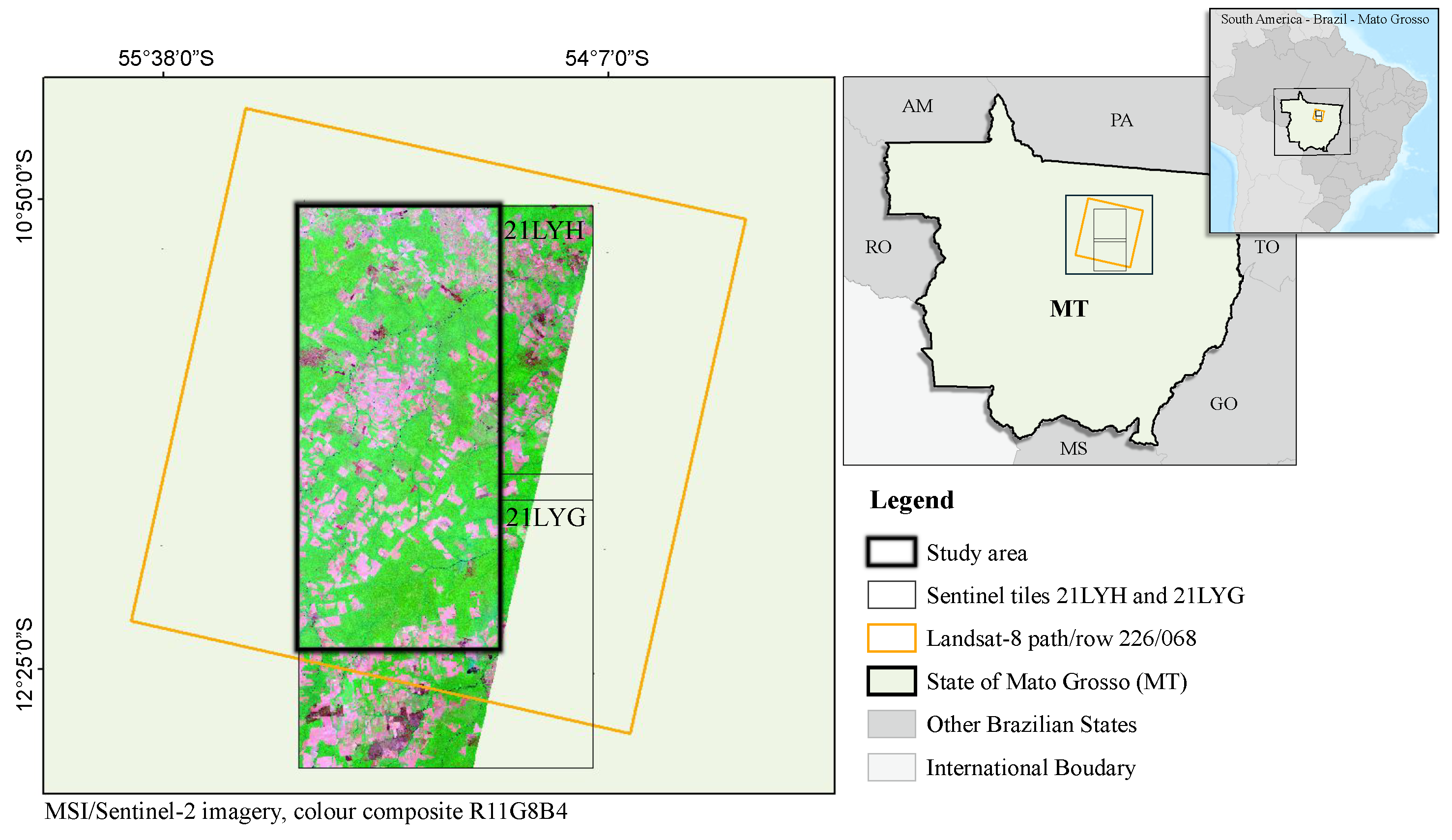
The study area is located in the northwestern region of the state of Mato Grosso, within the Brazilian Legal Amazon (
Figure 1). This region has experienced intense forest-use dynamics, becoming one of the main areas where selective logging, forest degradation, and fire occurrence is frequently reported. Mato Grosso is also notably known for the large number of Sustainable Forest Management Plans officially approved by the state’s environmental agency, making it suitable for evaluating the performance of different optical image products in the classification of land-cover classes associated with selective logging. Nonetheless, unauthorized logging and other irregular forest-use practices remain a major concern in the region, which highlights the importance of effective forest monitoring and regulatory enforcement. In this study, the analysis focused on terra firma forest areas, where selective logging-related disturbance is more directly represented under the monitoring conditions considered here.
2.2. Datasets
In this study, two optical satellite datasets acquired in October 2017 were used (
Figure 1). The first data set consisted of one Landsat-8 OLI scene (path/row 226/068), acquired on 15 October 2017 and obtained from the United States Geological Survey. The second dataset consisted of two Sentinel-2 MSI Level-1C tiles (21LYG and 21LYH), acquired on 14 October 2017 and obtained from the Copernicus data portal. In addition to the satellite imagery, ancillary cartographic datasets were used to support masking and post-classification analyses.
For image selection, three main criteria were considered: (i) the concentration of Deter selective logging alerts within the temporal window of interest and in the study region; (ii) low cloud cover; and (iii) the closest acquisition date between Landsat-8 and Sentinel-2 images. Among the scenes evaluated during the initial study design, only the October 2017 image set met these three criteria. This choice allowed a more controlled comparison among the products under the same seasonal context. The satellite imagery and ancillary datasets used in the study are summarized in
Table 1.
The spectral bands selected for the analysis and their respective spatial resolutions are presented in
Table 2. Band selection was based on spectral correspondence between the two sensors and on the suitability of these bands for vegetation and disturbance analysis. The selected bands included the blue, green, red, near-infrared, shortwave infrared 1, and shortwave infrared 2 regions of the electromagnetic spectrum. In addition, the Landsat-8 panchromatic band was used to generate a pansharpened product.
Three ancillary geospatial datasets were also used: Prodes deforestation data, Deter selective logging alerts, and spatial data on Sustainable Forest Management Plans (SFMP) in Mato Grosso. Prodes data were used exclusively to generate a forest mask and exclude previously deforested and non-forest areas from the classification domain. Deter selective logging polygons and SFMP spatial data were used in post-classification analyses as contextual layers. Once a map was classified, it was intersected with polygons from Deter and SFMPs to characterize the composition and spatial distribution of mapped land-cover classes within official alert areas and authorized forest management areas.
2.3. Image Preprocessing
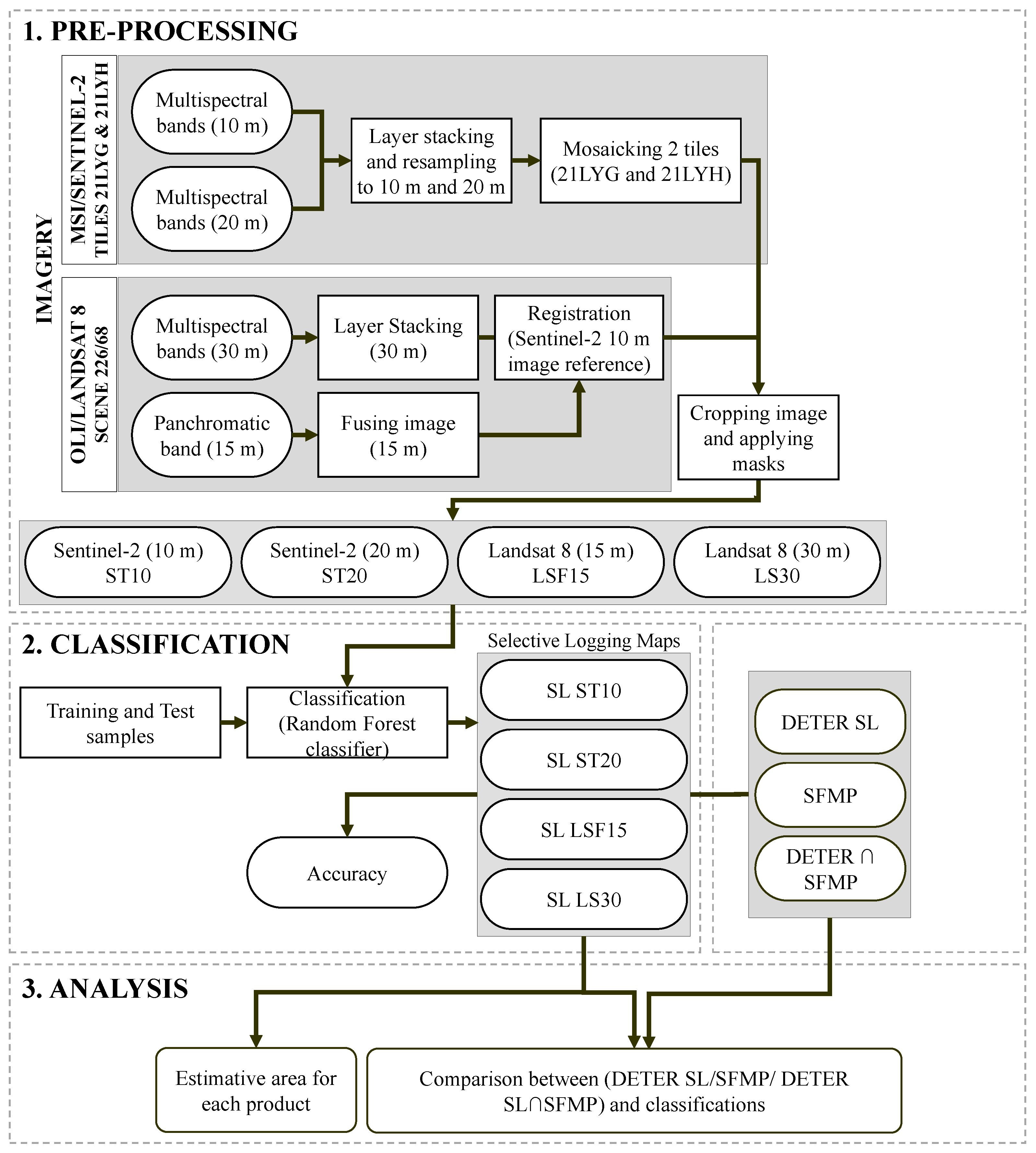
Four image products were generated for analysis: two derived from Sentinel-2 (ST10 and ST20) and two derived from Landsat-8 (LS30 and LSF15). The main preprocessing steps are summarized in
Figure 2.
The comparison framework adopted in this study was intentionally based on image products in their native or operationally derived spatial configurations. The objective was not to isolate purely spectral differences between sensors, but to evaluate the performance of these products under conditions more closely aligned with those commonly encountered in selective logging mapping, including the use of single-date imagery, an operationally accessible, relatively simple classifier, and a set of reference samples.
For the ST10 product, Sentinel-2 bands originally available at 20 m were resampled to 10 m using nearest-neighbor interpolation. Likewise, for the ST20 product, Sentinel-2 bands originally available at 10 m were resampled to 20 m using the same method. This resampling procedure was adopted to harmonize the spatial resolution of the multispectral bands within each product and allow the use of a consistent band set in the classification process. Resampling does not create new spatial information but enables internal compatibility among spectral bands for comparison. After resampling, the Sentinel-2 tiles were mosaicked to produce the final ST10 and ST20 products.
The LS30 product was obtained by stacking the selected Landsat-8 multispectral bands at 30 m spatial resolution. To generate the LSF15 product, the 15 m panchromatic band was fused with the 30 m multispectral bands using the PanSharp algorithm, developed by [
33] and implemented in the PCI Geomatica 2013 software (PCI Geomatics, Richmond Hill, ON, Canada). The PanSharp algorithm was selected because, among the image fusion procedures preliminarily tested during preprocessing, it provided the most suitable visual result for this application. This choice is also supported by previous evaluations indicating that PCI PanSharp consistently produces high-quality fusion results across different sensors and image datasets [
34]. The LSF15 product was included in the analysis to assess whether the increase in apparent spatial detail could improve the discrimination of small selective logging-related features.
To improve spatial correspondence among products, the Landsat-based products were geometrically registered to the Sentinel-2 mosaic at 10 m spatial resolution. Nine control points were distributed across the scene, and a first-order polynomial transformation with nearest-neighbor interpolation was applied. The final registration error was kept below 0.5 pixels. This registration step was necessary to reduce positional mismatch among products prior to sample extraction and class comparison.
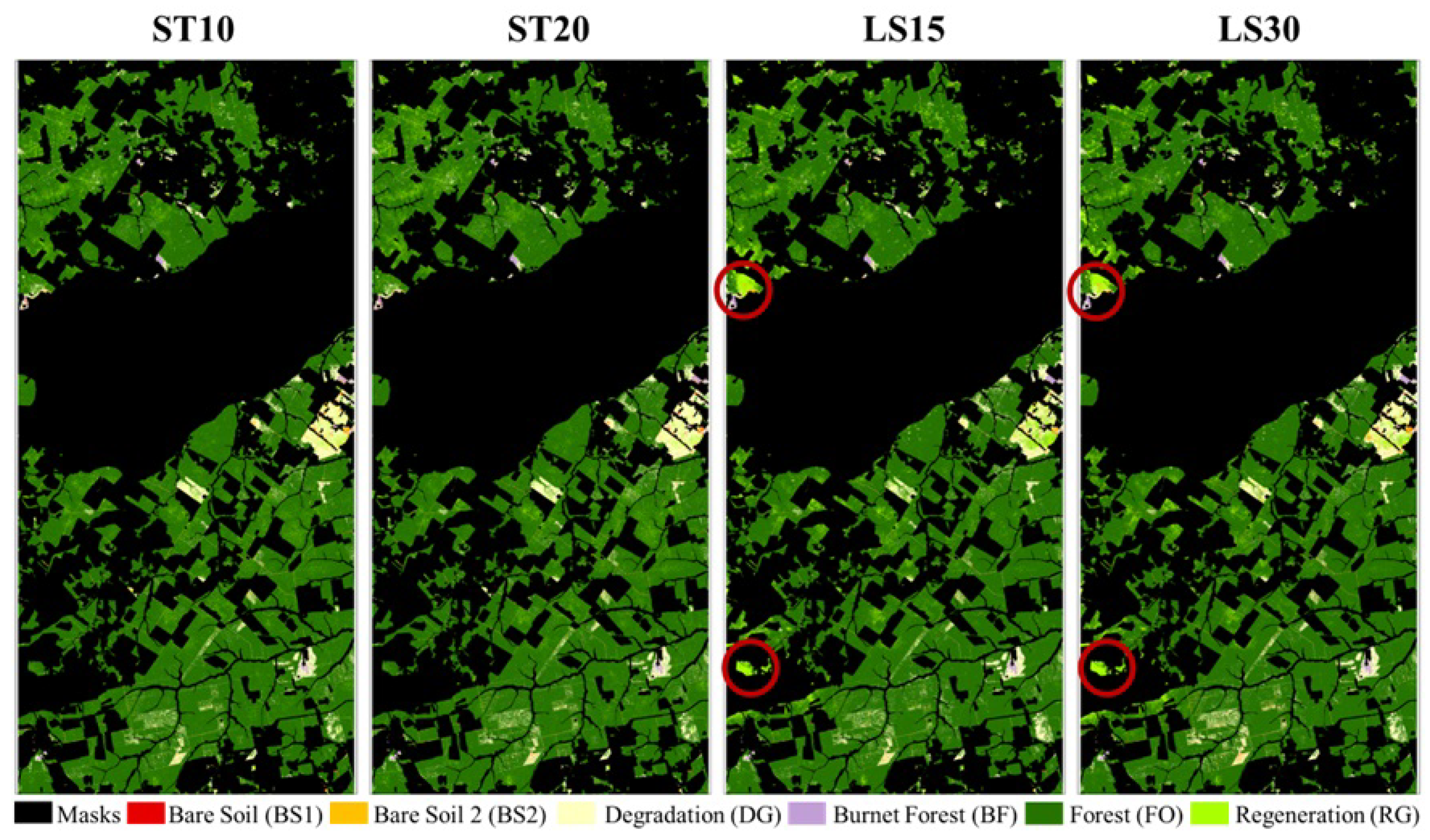
We also implemented an exclusion mask to exclude areas where we cannot, by definition, detect land-cover classes related to the selective logging of terra firma forests. This mask combined manually vectorized cloud and shadow areas, riparian forest environments, and previously deforested areas derived from Prodes 2018. Cloud and shadow regions were manually delineated over the Landsat-8 image because automatic masking tests were not sufficient to capture all clearly affected areas. Riparian forest environments were also manually masked before classification and accounted for approximately 370.04 km2 of the study area, corresponding to about 3.0% of the total number of pixels in the image.
As the final step in the imagery pre-processing to reduce incompatibilities between 30 m Landsat data and the finer-resolution Sentinel-2 products, a 100 m buffer was added around the Prodes deforestation mask. This final exclusion mask was applied to all image products prior to classification (
Figure 3).
2.4. Land-Cover Classes
Six land-cover classes associated with selective logging were defined: Bare Soil 1 (BS1), Bare Soil 2 (BS2), Degradation (DG), Burnt Forest (BF), Forest (FO), and Regeneration (RG). Two bare-soil classes were defined because regions with exposed soil associated with logging activities showed substantial spatial and spectral variability in the study area, particularly between compact log decks and narrow linear features such as roads and skid trails. The defined selective logging land-cover classes used in the classification and their main visual interpretation criteria are described in
Table 3. These classes were defined and interpreted under the specific seasonal and illumination conditions of the selected image set. Therefore, the present study does not assume full spectral separability under all seasonal or illumination conditions, but rather evaluates class discrimination within a controlled temporal context.
2.5. Sampling Design
A single reference sample set was used for all four image products in order to maximize comparability among classifications. A total of 3528 point samples were collected through visual interpretation of representative spatial patterns for each class. After sample collection, the full reference set was randomly split into training and validation subsets following a 70/30 proportion. As a result, 2520 samples were used for training (420 points per class), and 1008 were reserved for validation (168 points per class). Sample selection was not based solely on the 10 m Sentinel-2 product; instead, representative pixels were checked jointly across the four image products, and the corresponding Landsat pixels were adjusted within their neighborhood when necessary in order to maintain spatial correspondence among products with different pixel sizes. Although the reference set was randomly divided into training and validation subsets, the procedure did not include a spatially explicit design to control spatial autocorrelation between them.
The classification of the four image products was performed in the R versions 3.6.* and 4.2.* environment using the
randomForest package [
28,
35]. Random Forest was selected because it is a widely used classifier in remote sensing, performs well with heterogeneous spectral responses, requires limited parameter tuning, and is well suited to applied classification problems based on moderate sample sizes. Preliminary tests carried out during the development of the study also indicated better performance of RF than other previously tested classifiers, such as SVM. Since the focus of this manuscript is the comparison of image products rather than the benchmarking of classification algorithms, RF was adopted as a robust and operationally accessible approach. The classifier was implemented with the default package settings:
ntree = 500,
mtry = 2 (calculated as
floor(sqrt(p)), with
p = 6 predictor bands),
nodesize = 1, and
importance = TRUE.
Each of the four image products was classified independently using the same set of land-cover classes and the same sample design, enabling direct comparison of the resulting maps in terms of class discrimination and thematic consistency.
2.6. Accuracy Assessment and Post-Classification Analyses
The performance of the RF classification was assessed through metrics drawn from confusion matrices in the reference samples reserved for validation. User’s accuracy (UA), producer’s accuracy (PA), and overall accuracy (OA) were calculated for each classified image product following standard accuracy assessment procedures [
36]. To support the interpretation of overall accuracy differences among products, 95% confidence intervals were estimated for OA using the binomial standard error, computed as
, and
, where
n is the number of validation samples. These metrics were used to compare the ability of each image product to discriminate the six land-cover classes associated with selective logging.
After classification, the resulting maps were analyzed in three complementary ways. First, the area occupied by each land-cover class was estimated for each image product, allowing comparison of thematic proportions across ST10, ST20, LS30, and LSF15. Second, the classified maps were intersected with the Deter’s selective logging polygons to characterize the composition of land-cover classes within official alert areas. Third, the classified maps were intersected with the SFMP polygons to characterize the distribution of mapped classes within authorized forest management areas. The intersection with Deter and SFMP polygons not aimed to validate Deter or SFMP data, but to use the classified maps as a basis for describing the spatial composition of disturbance-related classes in these two contexts.
4. Discussion
The comparison between the classification models generated from the ST10, ST20, LSF15, and LS30 products showed that all products were suitable to classify land-cover classes associated with selective logging with a high overall accuracy. However, overall accuracy alone is not sufficient to evaluate a product’s performance. In this context, products with similar OA may still differ substantially in their ability to discriminate specific land-cover classes, especially those associated with fine-scale disturbance features. In this study, class-specific accuracy and map-derived class proportions provided a more informative basis for comparison between products than OA alone. Since all products were evaluated using the same reference sample design, the resulting class proportions are valuable for class-specific accuracy comparison between products. Differences of only one to two percentage points in overall accuracy concealed more relevant differences in the discrimination of classes associated with fine-scale disturbance features, particularly BS2, DG, and RG. Despite only modestly outperforming the other products in terms of overall accuracy, ST10 provided the most balanced combination of user’s and producer’s accuracy, indicating greater consistency in separating classes that typically coexist within logging-disturbed areas [
13,
17,
37].
The results are consistent with the expectation that finer spatial resolution improves the detection of small and heterogeneous logging-related features and agrees with the findings of Lima et al. [
13], who also reported improved detection of selective logging-related disturbance patterns and logging infrastructure with Sentinel-2 compared to Landsat-8. Unlike Lima et al. [
13], who focused mainly on disturbance detection and logging infrastructure in managed forest areas, the present study adopts a broader class structure that also distinguishes collateral degradation and regeneration. This difference in legend design is important because it expands the interpretation of selective logging beyond the exposed-soil signal alone. In this sense, our results are consistent with the advantages previously reported for Sentinel-2, while also showing that product differences remain relatively small in terms of overall accuracy under an operational comparison framework. Selective logging areas usually contain narrow roads, skid trails, compact exposed-soil patches, damaged canopy, and remnant forest in close spatial proximity. Under these conditions, coarser products are more susceptible to mixed pixels, which tend to exaggerate broader disturbance classes and reduce thematic precision for narrow or fragmented features. This may explain the LS30’s larger proportions estimates of BS2 and DG both in the full classified area and within Deter and SFMP polygons [
1,
2,
7,
13,
15,
17,
26].
Note that the lower producer’s accuracy observed for BS2 across all products reinforces the above interpretation. Compared with larger and more compact log decks, roads and skid trails are narrow, elongated features that are particularly sensitive to spatial resolution and positional mismatch. Their lower classification performance suggests that they remain one of the most difficult components of selective logging to map with optical imagery, even when overall classification accuracy is high.
The behavior of BS2 deserves additional attention because this class represents narrow linear infrastructure such as roads and skid trails, which are especially difficult to discriminate with medium-resolution optical imagery. The lower producer’s accuracy of BS2 across all products indicates that this limitation is not restricted to a single sensor or product, but reflects a broader difficulty in detecting narrow exposed-soil features under the spatial and spectral conditions evaluated here. In the case of LSF15, the lower BS2 producer’s accuracy relative to LS30 suggests that pansharpening may not necessarily improve the discrimination of linear bare-soil features and may even introduce additional uncertainty. However, this result should be interpreted cautiously, since the present study was not designed to isolate the spectral effects of image fusion. Future work could investigate this issue more directly by testing alternative classifiers and approaches specifically targeted at narrow linear infrastructure detection.
Recent deep learning studies based on Sentinel-2 imagery indicate promising potential for the detection of selective logging infrastructure and other fine-scale forest disturbance patterns, particularly narrow linear features such as roads and skid trails. Although algorithm comparison was beyond the scope of the present study, these advances suggest a relevant direction for future work aimed at improving the discrimination of classes such as BS2 [
19,
26].
By contrast, FO and BF achieved high accuracy, likely because they present stronger spectral separability under the conditions of this study. Nonetheless, the apparently perfect producer’s accuracy of BF should be interpreted with caution because the class occupied a small area and may have been represented by a limited number of highly distinctive samples [
2,
10,
13,
15,
17,
26].
An additional point concerns the thematic treatment of exposed-soil classes. In this study, BS1 and BS2 were trained separately. Although both bare soils represent exposed soil associated with selective logging, they differ in spatial organization and may also present distinct spectral and textural characteristics. This distinction supports a detailed characterization of the logging infrastructure. At the same time, the confusion observed between these two classes suggests that, for more operational applications, it may be useful to assess the classification accuracy at an aggregated thematic level, in which exposed-soil subclasses are considered jointly.
Meanwhile, area estimates for the entire classified domain should be interpreted with caution in the context of selective logging. Classes such as BS1 and BS2 are not exclusive to logging-related disturbance and may also occur in previously deforested areas or in other land-use contexts. The exclusion mask was designed to address this issue by restricting the classification domain to forest areas compatible with the objectives of the study. However, as usual in masking procedures, the exclusion mask was unable to remove all potentially confounding areas. Thus, scene-wide class proportions provide a useful general summary of each product’s behavior, but are not considered sufficient on their own to interpret the selective logging signal.
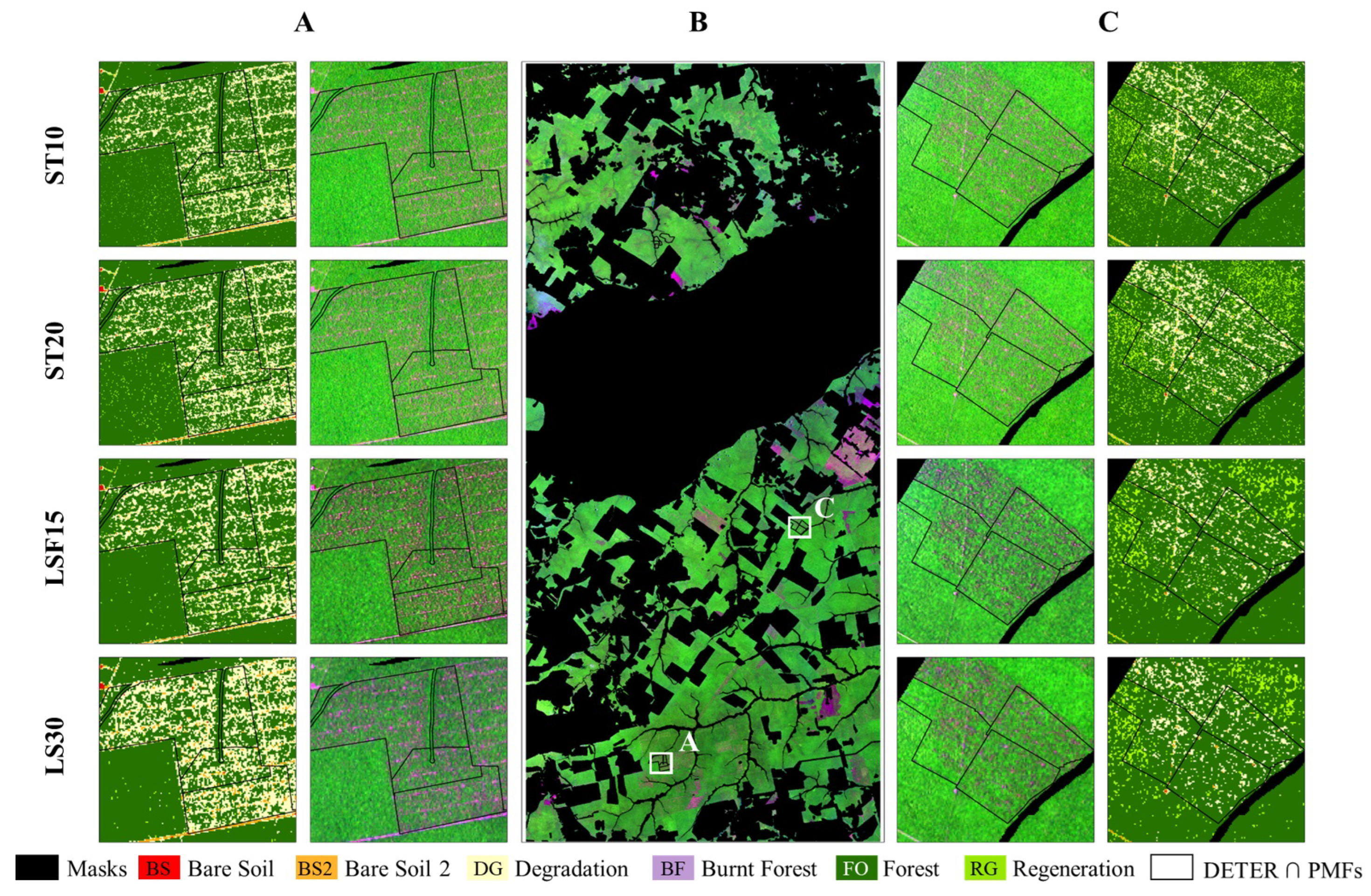
Additionally, the comparison between Sentinel-2 and Landsat-based products also emphasizes the importance of separating image product performance from preprocessing effects. The larger RG patches mapped by Landsat-derived products cannot be attributed solely to spatial resolution, but also appear to reflect residual atmospheric haze in some portions of the Landsat-8 scene. Likewise, the small BF areas mapped in SFMP regions by Landsat products were visually associated with cloud and shadow remnants not entirely excluded by the mask. Therefore, part of the apparent disagreement among products may reflect preprocessing artifacts rather than true differences in disturbance detection [
8,
12,
19,
38]. The interpretation of the RG class also deserves particular caution in the context of single-date optical imagery. Regeneration may represent a transitional condition with spectral characteristics partially overlapping those of other vegetation-related classes. As such, its visual definition is inherently more uncertain than that of more structurally distinct classes. In the present study, this limitation is compounded by the presence of residual atmospheric haze in part of the Landsat-8 scene. Although training and validation samples were not collected directly over the affected area, we cannot discard the possibility of this effect contributing to the occurrence of more aggregated RG patches in specific portions of the Landsat-derived products. The use of multitemporal datasets within methodologies designed to deal with scarce input data, such as [
39], could provide further insights regarding these issues, particularly by enabling a more robust assessment of class separability under varying seasonal conditions.
Further considerations include the performance of the pansharpened Landsat product (LSF15). Although this product provides a finer apparent spatial detail than the original 30 m Landsat imagery, its spectral information derives from multispectral bands at coarser resolution and may be affected by distortions introduced during the pansharpening process. Therefore, while LSF15 can be useful as an intermediate product for exploring the effect of enhanced spatial detail on the discrimination of selective logging-related features, its thematic performance should be interpreted with caution. The results suggested that increasing the apparent spatial resolution through image fusion does not necessarily translate into the same classification benefits obtained from a sensor with native finer multispectral resolution, such as Sentinel-2 at 10 m.
Regarding the other products, ST10 achieved the highest overall accuracy and the most balanced combination of user’s and producer’s accuracies across classes, while LS30 achieved the second-highest overall accuracy and remained competitive across several classes. This indicates that the original 30 m Landsat product still provides useful thematic information for selective logging-related classification. By contrast, neither ST20 nor the pansharpened Landsat product (LSF15) consistently outperformed the LS30 product [
13,
17,
40].
It is also important to note a limitation concerning riparian forest environments, which showed spectral behavior partially similar to RG during preliminary analyses. These areas were excluded through masking to reduce class confusion and improve thematic consistency. Although this decision restricted the classification domain of the products, it avoided the inclusion of a non-target class that could have increased uncertainty in the comparison among image products. This limitation also indicates that some ambiguities observed in single-date classifications may be better addressed in future studies using multi-temporal approaches and by expanding the thematic legend to include additional land-cover classes that are spectrally similar to the target classes, rather than masking them prior to classification [
15,
16,
18,
19,
20,
38].
Future methodological improvements to this study may also benefit from the incorporation of vegetation-based metrics and spectral mixture approaches. The inclusion of indices such as NDVI may refine the separation between vegetation-related classes, particularly FO, RG, and partially DG areas. Additionally, Linear Spectral Mixture Models may provide useful information on the relative contributions of vegetation, soil, and shadow fractions within mixed pixels. Such approaches may be especially relevant for improving the discrimination of classes such as BS2 and DG, which are strongly affected by subpixel heterogeneity and partial canopy opening [
12,
20,
24,
41,
42].
The Deter and SFMP analyses provide an important applied perspective for the interpretation of the classified maps. In all products, Deter polygons were characterized by larger proportions of exposed soil and degradation and by lower remaining forest cover than SFMP areas. This suggests that Deter alerts tend to correspond to more advanced, spatially evident, or operationally detectable stages of selective logging disturbance. In contrast, SFMP areas retained larger forest proportions and smaller exposed-soil fractions, which is compatible with lower visible impact at the date of image acquisition. These differences are relevant because they indicate that land-cover composition derived from classification models can help describe disturbance patterns inside alert polygons and managed areas [
9,
17,
21,
22,
26].
In this respect, the Deter and SFMP analyses should not be interpreted as a direct validation of the classified maps, but rather as a contextual assessment of thematic coherence. These spatial contexts provide a more plausible framework for the occurrence of selective logging-related disturbance. The predominance of exposed soil and degradation within the Deter polygons, and the larger proportion of remaining forest within the SFMP areas, suggest that the classified products captured meaningful differences in disturbance structure across these two contexts. This result reinforces the interpretation that class composition within spatially constrained polygons may be more informative than scene-wide area totals alone for evaluating the consistency of selective logging-related classifications. In this case, these differences should be interpreted as variations in the spatial composition and a visible intensity of disturbance rather than as a direct assessment of management performance. In the case of the intersection between Deter and SFMP, the mapped DG and BS features indicate the presence of selective logging-related disturbance, but their interpretation is more informative as a characterization of disturbance structure than as a direct evaluation of compliance. Nonetheless, such spatial patterns may serve as useful indications for future assessments aimed at examining whether disturbance organization within managed areas are compatible with expected management practices [
17,
22].
Although this study was developed for a selective logging context in the Brazilian Amazon, the general methodological framework may also be adapted to other forest regions affected by selective logging or related degradation processes. In particular, the comparison of image products, the use of a class-based legend, and the evaluation of class-specific accuracies may be transferred to other contexts, provided that suitable reference samples and locally appropriate interpretation criteria are available. Datasets such as Deter were not required for the classification itself and were only used to guide the impact analysis. Therefore, the absence of a directly equivalent dataset in other countries does not prevent the application of the classification framework, although it may limit the possibility of comparable contextual analyses.
Despite these limitations, the results demonstrate that Sentinel-2 at 10 m offers a clear advantage for the discrimination of land-cover classes associated with selective logging, particularly when the objective is not only to detect disturbed areas, but also to describe their internal structure. Further, Landsat products remain valuable because of their historical archive and relevance for long-term analyses of forest dynamics [
8,
11,
22]. In operational terms, the findings suggest that finer-resolution optical imagery can improve the interpretation of selective logging patterns and may support the refinement of alert systems and the monitoring of managed forest areas in the Amazon [
12,
13,
17,
26].
5. Conclusions
Selective logging remains a difficult process to detect and characterize with optical satellite imagery because it produces small-scale, heterogeneous, and short-lived disturbance features. In this study, four optical image products, Sentinel-2 at 10 m and 20 m, and Landsat-8 at 30 m and pansharpened 15 m, were compared for the classification of land-cover classes associated with selective logging in the central region of the state of Mato Grosso, in the Brazilian Amazon, for the year 2017.
All classification models from the four products achieved high overall accuracy, but the land-cover classification derived from Sentinel-2 at 10 m showed the most consistent class-specific performance under the evaluated conditions, with a more balanced combination of user’s and producer’s accuracies across the mapped classes. Although differences in overall accuracy among products were relatively small, class-specific analyses revealed more meaningful distinctions. Landsat-based products tended to estimate larger areas of exposed soil and, in some portions of the scene, larger regeneration patches. The latter pattern could be associated with residual atmospheric haze, indicating that both coarser spatial resolution and preprocessing limitations have the potential to influence the representation of selective logging-related disturbance patterns. In contrast, the land-cover classification from Sentinel-2 at 10 m showed greater capacity to represent the internal heterogeneity of disturbed areas, particularly for classes associated with narrow infrastructure features and mixed canopy damage.
Interpretations involving the RG class should be made cautiously, given the sensitivity of this class to both residual atmospheric effects and the limitations inherent to single-date optical imagery. In this sense, the differences observed for RG should not be interpreted in isolation as evidence of spatial resolution effects alone, but rather as the result of the interaction among resolution, preprocessing, and the thematic uncertainty of this class.
The results also showed that the land-cover classification from the original 30 m Landsat product remained competitive across several classes and achieved better overall performance than both ST20 and the pansharpened Landsat product. This suggests that the advantages of Sentinel-2 are most clearly expressed when its native 10 m spatial resolution is preserved, whereas reducing Sentinel-2 data to 20 m or increasing apparent Landsat spatial detail through pansharpening does not necessarily lead to improved thematic discrimination. Meanwhile, area estimates for the full classified scene should be interpreted with caution, because some classes associated with selective logging, especially exposed-soil classes, are not exclusive to this process and may also occur in other land-use contexts. In this respect, the characterization of class composition within Deter selective logging alerts and Sustainable Forest Management Plan areas provided a more informative contextual basis for evaluating the coherence of the classified products.
The intersection of classified maps with Deter selective logging alerts and Sustainable Forest Management Plan areas showed that Deter polygons tend to contain higher proportions of exposed soil and degraded forest and lower remaining forest cover than managed areas. This result suggests that Deter alerts are more associated with advanced or visible stages of forest disturbance. This difference should be interpreted primarily as a pattern of mapped disturbance composition. Therefore, more detailed classifications may provide a useful basis for future analysis of how disturbance patterns are spatially organized within managed areas and areas under selective logging alert systems.
Overall, the results demonstrate the value of finer spatial resolution optical imagery for improving the classification of land-cover classes associated with selective logging and supporting forest disturbance monitoring in the Amazon, particularly Sentinel-2 at 10 m spatial resolution. Future studies could expand this assessment to multi-temporal analyses in larger portions of the Amazon, and improve sampling and masking strategies. Additional methodological advances may include the integration of vegetation indices in the classification model, such as NDVI, and spectral mixture approaches, which may improve the discrimination of vegetation-related and mixed disturbance classes. The present findings support the adoption of Sentinel-2 imagery in subsequent multi-temporal approaches aimed at investigating the temporal dynamics of selective logging-related disturbance patterns.




 ,
,