Article

Cultures of Habitat: Geoheritage Places and Landscapes

1
Applied Heritage and Resource Solutions and School of Anthropology, University of Arizona, Tucson, AZ 85718, USA
2
Applied Indigenous Studies, Northern Arizona University, Flagstaff, AZ 86011, USA
3
Retired Regional Cultural Anthropologist, National Park Service, Omaha, NE 68139, USA
4
Applied Heritage and Resource Solutions, Tucson, AZ 85718, USA
*
Author to whom correspondence should be addressed.
Land 2026, 15(7), 1123; https://doi.org/10.3390/land15071123 (registering DOI)
Submission received: 24 May 2026 / Revised: 20 June 2026 / Accepted: 22 June 2026 / Published: 24 June 2026
(This article belongs to the Special Issue Natural Landscape and Cultural Heritage (Second Edition))

Abstract

Cultural habitats are the relationships between traditional peoples and the plants, animals, and geological features of their ancestral landscapes. These relationships form the human dimension of geoheritage. However, research on cultural habitats and research on geoheritage have typically developed separately. This review brings these two frameworks together by drawing on four decades of ethnobotanical and ethnoecological studies, involving 24 research projects with Native American tribes and traditional communities in North America and the Caribbean. Using ethnographic methods, habitat mapping, and indices to measure cultural significance, the research documented how traditional communities use plants and define the extent of their cultural habitats. Analysis of six case studies shows that each cultural habitat is closely tied to a unique geological or landform feature. In all cases, the official heritage boundaries set by nomination processes are smaller than the areas traditional peoples recognize as their cultural habitats. This gap comes from differences between Western approaches to defining heritage and the ways indigenous and traditional communities understand their responsibilities to the land. The review calls for wider standards of evidence, collaborative approaches to setting boundaries, and co-stewardship to be included in geoheritage management policies.

1. Introduction

Cultural habitats, defined as the co-constitutive relationships between traditional peoples and the plants, animals, and geological features of their ancestral landscapes, represent the essential human dimension of geoheritage. However, research on cultural habitats and geoheritage has largely progressed in parallel, with each field developing robust empirical and conceptual frameworks without systematic engagement with the other. This synthesis contends that integration of these frameworks is both conceptually necessary and practically indispensable, as neither can adequately address heritage land management challenges in isolation. Based on four decades of collaborative research, including 24 ethnobotanical and ethnoecological studies with Native American tribes and traditional communities across North America and the Caribbean, this analysis demonstrates that every documented cultural habitat is physically embedded within a geologically or topographically distinctive location. Furthermore, every formal heritage boundary established through nomination processes is consistently smaller than the cultural habitat recognized by affiliated traditional peoples.
This synthesis pursues four interrelated aims: (1) to consolidate and interpret findings from 24 collaborative ethnobotanical and ethnoecological studies conducted between 1976 and 2025; (2) to demonstrate the structural interdependence of cultural habitat and geoheritage frameworks; (3) to document the persistent gap between formally recognized heritage boundaries and community-defined functional cultural habitat extents; and (4) to provide concrete methodological and policy recommendations for the IUCN Geoheritage Specialist Group and national heritage management agencies. The central finding is that this boundary gap is not a site-specific management issue but a structural consequence of the epistemological divide between Western ontological frameworks and the Living Universe perspective of indigenous and traditional peoples. This necessitates structural reform of nomination criteria and co-stewardship mechanisms.
The conceptual foundation for this synthesis is grounded in Nabhan’s [1] articulation of cultures of habitat, which provides the theoretical basis for understanding the persistent, ancient, and co-constitutive relationships between traditional peoples and the plants, animals, and natural elements of their homelands. Nabhan defines cultures of habitat as the connections between biodiversity and cultural diversity, arguing that the longer a traditional people occupy a habitat, the more biologically diverse it becomes. This argument has significant empirical implications, which the research program documented here has repeatedly confirmed. For this analysis, a cultural habitat is operationally defined as a social construction produced over time by a traditional people to define the existence and purpose of a culturally important place and its components. Three features of this definition are emphasized. First, a cultural habitat is an artifact of human culture, not merely a natural feature, even when the physical substrate is geologically distinctive. Second, a cultural habitat may or may not currently be controlled by the traditional people whose cultural practices created it; many of the cultural habitats documented here exist on lands from which affiliated peoples were removed through colonial processes. Third, traditional peoples are functionally defined as those who have lived and used their homelands for more than two hundred years, a duration sufficient to produce the co-adaptive processes through which Traditional Ecological Knowledge (TEK) develops.

1.1. Geoheritage: The International Framework

A substantial body of ecological and geological scholarship has responded to the United Nations’ call to identify geological places and landscapes as cultural heritage deserving of preservation [2,3]. Geologists have advocated for the preservation of specific geological and hydrological sites for the benefit of science and to enhance public awareness of Earth’s history and processes. The subsequent incorporation of human values into geoheritage identification criteria marks a significant conceptual expansion, although this has not yet been fully operationalized to accommodate the perspectives and knowledge systems of affiliated indigenous and traditional peoples.
The International Union for Conservation of Nature (IUCN) and the World Commission on Protected Areas (WCPA) maintain a Geoheritage Specialist Group that has identified the need for heritage preservation approaches capable of integrating both scientific and cultural significance criteria. The breadth of current scholarly engagement is exemplified by the Special Issue of Land entitled ‘Geoparks, Geotrails, and Geotourism—Linking Geology, Geoheritages, and Geoeducation,’ edited by Brocx and Semeniuk, which includes studies from Europe, Australia, the United States, Latin America, and Asia [4,5,6,7,8]. These studies highlight the complexities involved in preserving, interpreting, and managing geoheritage sites, particularly the recurring challenge that geosites and geoscapes require well-defined boundaries to facilitate interpretation, regulation, and management.

1.2. Theoretical Framework: TEK, the Living Universe, and the Epistemological Divide

The concept of Traditional Ecological Knowledge (TEK) has received extensive scholarly attention. Berkes [9] defines TEK as knowledge, practices, and beliefs about the relationships among living beings and their environments, transmitted and adapted across generations. TEK is not merely a collection of facts, but a knowledge system embedded in language, ceremony, and cultural context. This analysis employs the term TEK in preference to related terms such as indigenous knowledge (IK) and local knowledge (LK) [10], as Berkes’s knowledge-practice-belief framework most accurately captures the analytical focus: a system encompassing ecological observation, management systems, social institutions, and cosmological worldviews through which observation is generated and validated. Unlike local knowledge formulations, TEK emphasizes cultural depth, intergenerational transmission, and co-adaptive relationships between a people and a specific landscape, distinguishing it from ethnographic documentation or folklore preservation. The one context in which this boundary is explicitly contested, the Barbados case, where the knowledge-holding community’s relationship with the site was established through colonial displacement rather than ancient continuity, is addressed in the corresponding vignette.
Johnson and Aldridge [11] identify a key documentation problem: when TEK is recorded for Western resource management purposes, its relational and ceremonial contexts are often removed, thereby altering its meaning. McGregor [12] characterizes TEK as “an ongoing, living process of coming to know,” highlighting its evolving and participatory nature. Menzies [13] situates these dynamics within the broader politics of natural resource management. At a deeper level, Deloria and Wildcat [14] contend that indigenous knowledge embodies a fundamentally different worldview, referred to in this analysis as the Living Universe, in which knowledge and environment are inseparable, in contrast to Western scientific assumptions. The Living Universe refers to the indigenous ontological framework in which the natural world—including plants, animals, rivers, geological features, and atmospheric events—is understood as animate, communicative, and morally relational: a community of beings with mutual obligations, rather than an inert physical system subject to human classification.
Cajete [15] describes Native science as ‘a metaphorical context for understanding relationships, process, and whole systems,’ asserting that indigenous knowledge systems are validated through distinct methods, organized by different categories, and oriented toward different questions than Western ecology, yet are equally rigorous in their empirical engagement. Berkes [9] contends that TEK encodes thousands of years of adaptive experience with specific ecosystems and often contains ecological information aboutlong-term dynamics, rare events, and subtle relationships that Western scientific monitoring programs cannot independently generate. Kimmerer [16] identifies the practical consequence as the difference between a worldview organized around ‘What is it?’ and one organized around ‘Who is it?’, a grammatical distinction with significant implications for land management decision-making. Gazing Wolf et al. [10] demonstrate that indigenous knowledge systems possess their own standards of ontology, epistemology, hypothesis testing, and peer review, and that treating indigenous knowledge as supplementary to Western science is a structural feature of settler-colonial institutions rather than an epistemological deficit. Furthermore, TEK has been established as foundational for community vitality, resilience, well-being, and sustainability [17,18,19].
The research program described in this analysis was designed to address both epistemological and ethical considerations. All participating cultural groups were fully informed of the research objectives and voluntarily shared TEK with the explicit aim of protecting cultural habitat elements. Study reports were reviewed by tribal and community representatives for accuracy prior to submission.

1.3. The Central Argument and Case Study Structure

The twenty-four studies forming the empirical foundation of this analysis consistently support a finding with significant theoretical implications: every documented cultural habitat is physically embedded in a geologically or topographically distinctive location. Geology shapes hydrology, hydrology shapes plant communities, and plant communities influence the possibilities for human cultural adaptation over millennia. In this sense, cultural habitats represent the human dimension of geoheritage. They are living cultural systems constructed by traditional peoples in co-adaptation with the geological substrates that define geosites and geoscapes.
This theoretical claim has direct implications for heritage management. Any geoheritage nomination or management framework that does not incorporate TEK and the spatial understandings of affiliated traditional peoples will result in nominations and boundaries that incompletely represent the functional extent of the heritage resource. Conversely, TEK documentation and cultural habitat assessment that do not engage with the geological distinctiveness of the sites under study will overlook the physical foundation upon which cultural significance is constructed.
A central challenge addressed in this analysis is the issue of heritage boundaries. Geoheritage nomination processes, which require defined geographic boundaries for National Register of Historic Places (NRHP), IUCN, and UNESCO registrations, contrast with indigenous heritage concepts, where sacred landscapes are often understood as relational and unbounded. These differing perspectives generate competing expectations regarding the spatial delimitation of cultural habitats. The two primary cases and four supplementary vignettes presented here illustrate various dimensions of this boundary tension. The Buffalo National River case demonstrates a successful co-produced boundary negotiation at the scale of a plant gathering area. The Bahamas case illustrates how community-defined marine boundaries systematically differ from biologically derived ones. The Barbados case reveals how colonial dispossession created a de facto ecological boundary that inadvertently preserved a unique cultural habitat. The Pipestone case documents the consequences of boundary failure, specifically the progressive erosion of indigenous authority over a sacred geosite through the imposition of successive colonial boundaries.

2. Materials and Methods

This section describes the methodological architecture of both the primary research program and the present synthesis. The 24 studies summarized in Table 1 are the primary research: each was conducted as an original ethnobotanical and ethnoecological investigation, employing a consistent suite of ethnographic and quantitative field methods adapted to the ecological, cultural, and regulatory context of the study. The present manuscript is an integrative synthesis of findings from those 24 primary studies and a second-order analysis that draws on the accumulated empirical record to identify structural patterns and theoretical implications not visible within any single study. The synthesis method is primarily thematic and comparative: findings from individual studies are analyzed across cases to identify convergences, divergences, and structural regularities in the relationship between cultural habitat extent and heritage boundary definition. The quantitative EICS and CICS models, described in Section 2.3, were the primary analytical instruments of the 24 field studies; they generated the significance scores and habitat assessments on which this synthesis draws. The synthesis itself does not re-run these models on new data; rather, it interprets their documented outcomes in relation to the geoheritage framework and the boundary problem that is the central concern of this analysis. Quantitative findings from individual studies are reported where they illuminate the comparative argument; qualitative ethnographic evidence is foregrounded where it addresses the epistemological dimensions that quantitative indices cannot capture.

2.1. The Research Program: 24 Studies, 1976–2025

The empirical claims advanced in this analysis rest on a systematic program of ethnobotanical and ethnoecological research spanning five decades, 24 studies, and cultural consultations with dozens of Native American tribes and traditional communities across North America and the Caribbean. The program was conducted under the institutional affiliations of the University of Wisconsin-Parkside, the University of Michigan, and the University of Arizona, with funding from a range of national and international agencies. All participating cultural groups were fully informed of research purposes, voluntarily shared TEK, and reviewed all findings for accuracy before submission. Table 1 summarizes the principal characteristics of the 24 studies. Details of all projects are available at the Richard Stoffle Collections Archive at the University of Arizona.

2.2. Field Methods and Ethnographic Approach

The 24 studies employed a consistent suite of ethnographic and ethnobotanical field methods, adapted to the particular ecological, cultural, and regulatory context of each study. Field sessions were conducted with tribal cultural staff, plant specialists, and elders in the study areas; participants led the research team through habitats they identified as culturally significant and described plant uses in the context of habitat relationships rather than as isolated species accounts. Multi-tribal studies required separate field sessions with each participating ethnic group to ensure that distinct cultural knowledge systems were documented independently before being combined for cross-study comparison. In direct support of the study’s central thesis integrating cultural habitat and geoheritage frameworks, all studies triangulated ethnobotanical field data with archival, historical, and botanical survey data; this triangulation enabled both the validation and contextualization of field observations within broader ecological and cultural narratives, thereby reinforcing the argument for structural interdependence between empirical documentation and theoretical synthesis. Voucher specimens were collected at study sites with sufficient plant material and are archived at the University of Arizona herbarium; details are provided in the individual study reports cited in Table 1.

2.3. Quantifying Cultural Meaning: The EICS and CICS Models

While parameterized ethnobotanical models represent a methodological advancement by enabling more precise quantification and comparison of cultural significance across ecological and cultural contexts, it is critical to recognize their limitations. These models, such as the EICS and CICS, provide a structured means for documenting plant use and support systematic analysis, regulatory documentation, and cross-study comparison. However, they are limited in their capacity to capture the full ceremonial, spiritual, and relational dimensions that are fundamental to Traditional Ecological Knowledge (TEK). The quantification process inherently abstracts complex cultural meanings, potentially oversimplifying or excluding aspects of significance that are context-dependent or expressed through non-quantifiable cultural protocols and relationships. Therefore, the results produced by these models should be considered as structured approximations rather than comprehensive valuations of cultural significance. It is essential that model-based assessments are supplemented by direct community evaluation and iterative reassessment to ensure the integrity and completeness of the cultural knowledge represented.
Turner developed an Index of Cultural Significance (ICS) to document the cultural significance of individual plant species and their uses [48]. Stoffle, Halmo, Evans, and Olmsted [49] adapted Turner’s framework by eliminating the ranking of uses within quality-of-use and assigning equal value to all uses while adding each plant part used; adding storage and management variables to intensity-of-use; eliminating the lowest value from exclusivity-of-use; and adding a contemporary use variable category. The habitat-level application of the CICS model was first evaluated in a NEPA ethnobotany study conducted on public lands in central Utah [50], funded by the US Air Force, with field data from representatives of three Native American ethnic groups. For each ethnic group, an Ethnic Index of Cultural Significance (EICS) score is calculated by summing the cultural significance values for plants identified by that group.
EICS = Sum (p/u x i x e x c) El
In this equation, p/u = total number of uses and/or plant parts used for a specific purpose; i = intensity of use; e = exclusivity of use; c = contemporary use; El = ethnic group designation. Where a cultural resource has been used by more than one ethnic group, its total significance is the Cumulative Index of Cultural Significance (CICS):
CICS = Sum (p/u X i X e X c)El + (p/u X i X e X c)E2 + (p/u X i X e X c)E3
Habitat evaluations are accomplished by summing the Cumulative Index of Cultural Significance (CICS) scores for all recorded plants within a habitat area. The Ethnic Index of Cultural Significance (EICS) is calculated for each ethnic group by aggregating the significance values assigned to plants identified by that group, while the CICS aggregates these values across all groups represented in a given habitat. Following Turner’s [48] caution, these scores should be understood as appraisals or estimates of cultural significance rather than definitive valuations, and ideally, Native Americans should evaluate the cultural significance of their own cultural resources. The EICS and CICS scores are tools for structured comparison and regulatory documentation, not substitutes for indigenous self-assessment.
Synthesizing the key methodological limitations encountered, a central issue arises from the interplay between the analytical strengths of quantified cultural significance scores and the inherent epistemological constraints of quantifying Traditional Ecological Knowledge (TEK). The literature, as well as the present research, repeatedly highlights this tension. Berkes [9] notes that while certain ecological dimensions of TEK—such as empirical knowledge of species distribution and habitat relationships—lend themselves to documentation within Western scientific paradigms and are thus often incorporated in resource management, deeper dimensions of TEK prove much less amenable to quantification.
Specifically, the spiritual, ceremonial, and relational aspects integral to TEK remain structurally resistant to reduction through index-based approaches. This results in systematic underrepresentation of these core components in any quantitative assessment. The EICS and CICS models, for instance, robustly reflect the breadth and intensity of plant use as recorded across multiple groups, but do not adequately capture the ceremonial significance or unique relational roles of certain species, particularly where their use is context-specific or restricted. Thus, any attempt to quantify TEK through such metrics must be understood as necessarily partial, shaping not only the scope of data collected but also the interpretation of research findings. Recognizing these methodological constraints is essential for an informed synthesis of results and for situating empirical conclusions within a broader understanding of TEK’s complexity.
Kimmerer [16] frames this limitation in terms directly relevant to the epistemological arguments advanced in Section 4.3. Drawing on Potawatomi botanical knowledge and Western plant ecology, she argues that indigenous plant knowledge constitutes a grammar of animacy—a relational framework in which plants are understood as beings with agency, purpose, and reciprocal obligations toward the humans who gather them. Within this framework, the significance of a plant is not an attribute that can be scored in isolation from the relationship between the plant and the people who know it; it is a property of that relationship, which changes as the relationship changes and which requires the ongoing participation of both parties to remain valid. The implication for ethnobotanical documentation is that significance assessments should be understood as time-stamped records of a living relationship rather than fixed valuations of a static resource.

2.4. Methodological Evolution and Recurring Lessons Across 24 Studies

The 24 studies document a sustained methodological evolution driven by three converging forces: the emergence of federal regulatory requirements following the passage of the National Environmental Policy Act (NEPA) of 1969; the insistence of Native American plant specialists that plants and landscapes be understood holistically; and the research program’s own progressive refinement of quantitative and ethnographic methods through successive field campaigns.
The earliest studies were primarily focused on identifying and cataloging individual culturally significant plants, reflecting regulatory compliance frameworks. Almost immediately, the logic of habitat-level analysis was pressed upon the program by Native American plant specialists, who consistently argued for protecting plants by sustaining their habitats rather than cataloging individual specimens. This shift is consistent with Deur and Turner’s [51] documentation of active plant cultivation and landscape management practices across the Northwest Coast and with Nabhan’s [1] argument that the biological richness of cultural habitats is itself a product of long-term human stewardship.
Plant gathering is a spiritual activity for Native and traditional peoples, requiring protocols that respect ceremonial sequencing and the primacy of elder knowledge. Multi-tribal studies confirmed that culturally and scientifically defined habitat communities do not always coincide. Triangulating ethnobotanical field data with historical accounts proved essential. A botanist capable of providing verified scientific identification is required on every research team.
The Utah study also raised a conceptual question: whether a long, topographically varied valley constitutes a single habitat or might better be conceived as a geoscape composed of multiple discrete geosites—a question that the geoheritage framework is uniquely positioned to address [50].
A central finding across all 24 studies is that every Native and traditional representative who participated demonstrated deep care for the plants involved, expressed through ceremony, storytelling, and the willingness to spend time walking the land with researchers. This care serves as evidence of the living cultural habitat relationships that this analysis seeks to document and protect, and it represents a form of evidence that EICS and CICS scores, however refined, can only approximate.
The research program’s practice of submitting all study reports to participating tribal and community representatives for review before submission is a partial response to the epistemological limitations identified above—returning interpretive authority to the knowledge holders at the stage of representation, even where initial data collection necessarily operates within an externally defined framework. McGregor’s [12] argument that TEK must be understood as a living process rather than a captured dataset suggests that the most appropriate long-term framework for this kind of research is not the single-study compliance report but the ongoing collaborative relationship—the kind of relationship that the plant gathering agreements documented later in this analysis have begun to establish.

3. Case Studies and Comparative Synthesis

Six cases were selected from the twenty-four-study corpus for detailed presentation, using three explicit selection criteria. First, the six cases collectively represent the full scalar range of cultural habitats documented across the program. These range from a single geomorphological feature (Ojibway Lake Superior geosite) to a multi-jurisdictional, multi-tribal ceremonial landscape spanning two states (Sugarloaf geoscape). Second, the six cases represent the full range of cultural and historical contexts encountered across the program, including ancient continuous indigenous occupation (Ojibway, multi-tribal Colorado River), treaty-recognized occupancy disrupted by forced removal (Cherokee at Buffalo National River), progressive colonial boundary imposition at a continent-wide ceremonial site (Pipestone), and cultural habitat formation under conditions of colonial displacement rather than ancient continuity (Barbados). Third, the six cases represent the full spectrum of heritage management outcomes documented in the program. The cases are examples of a successful and replicable co-stewardship agreement (Buffalo National River) to a formally approved but spatially incomplete TCP nomination (Sugarloaf) to a progressive history of boundary failure and indigenous authority erosion (Pipestone). The remaining eighteen studies in the corpus provided the quantitative EICS and CICS data and cross-study comparative findings reported in Section 4.1 and Section 4.2; full reports for all studies are archived at the Richard Stoffle Collections Archive at the University of Arizona and are cited in Table 1.

3.1. Case 1—A Geosite: Lake Superior, Southern Shore (Ojibway)

A geologically, biologically, and culturally significant geosite on Lake Superior’s southern shore in Michigan illustrates how the convergence of geomorphological distinctiveness and indigenous cultural attachment generates a heritage resource whose significance can neither be fully understood nor adequately protected through geological or cultural assessment alone. Ethnographic interviews conducted with Ojibway tribal elders uniformly identify this location as requiring better protection and management [52].
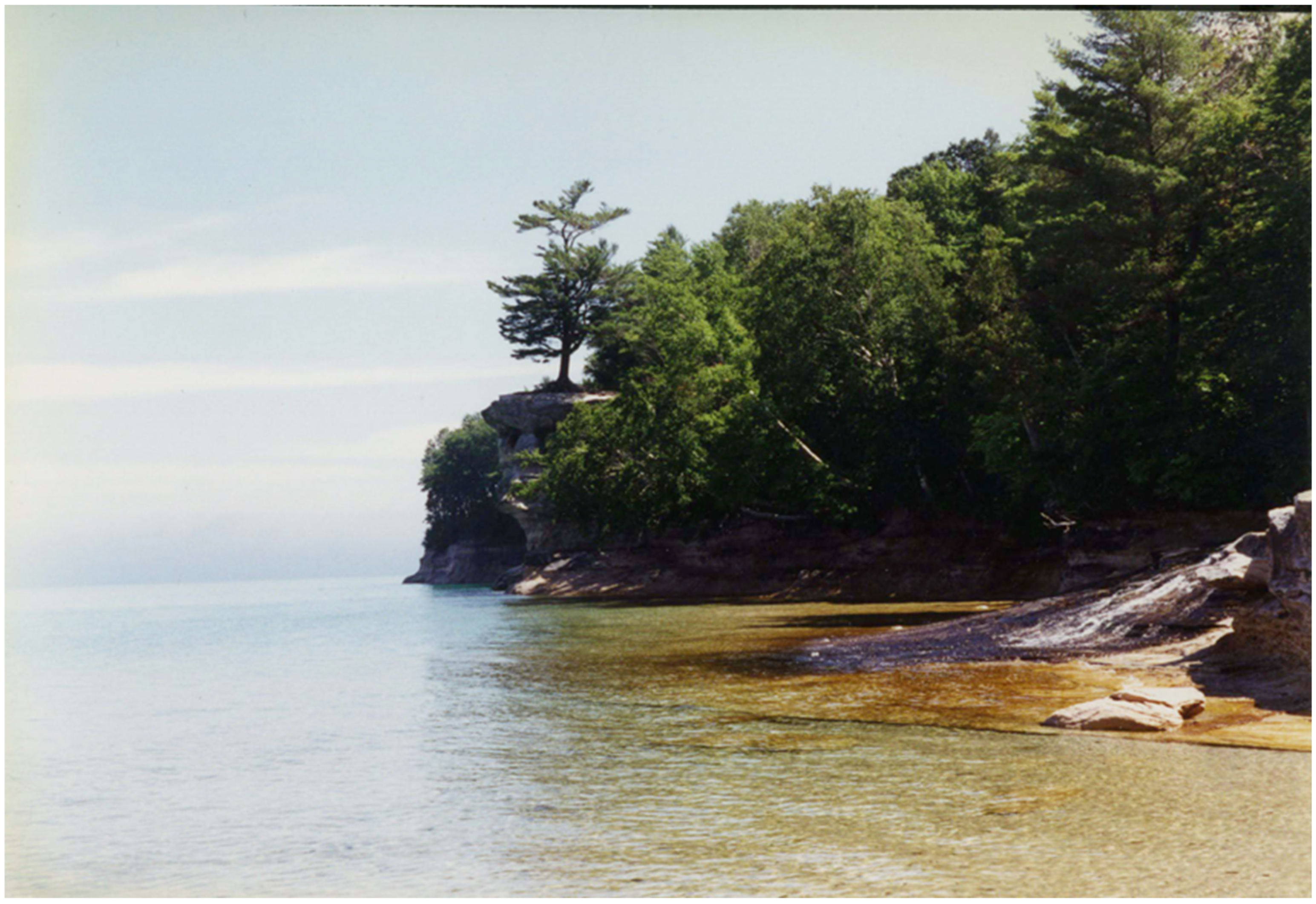
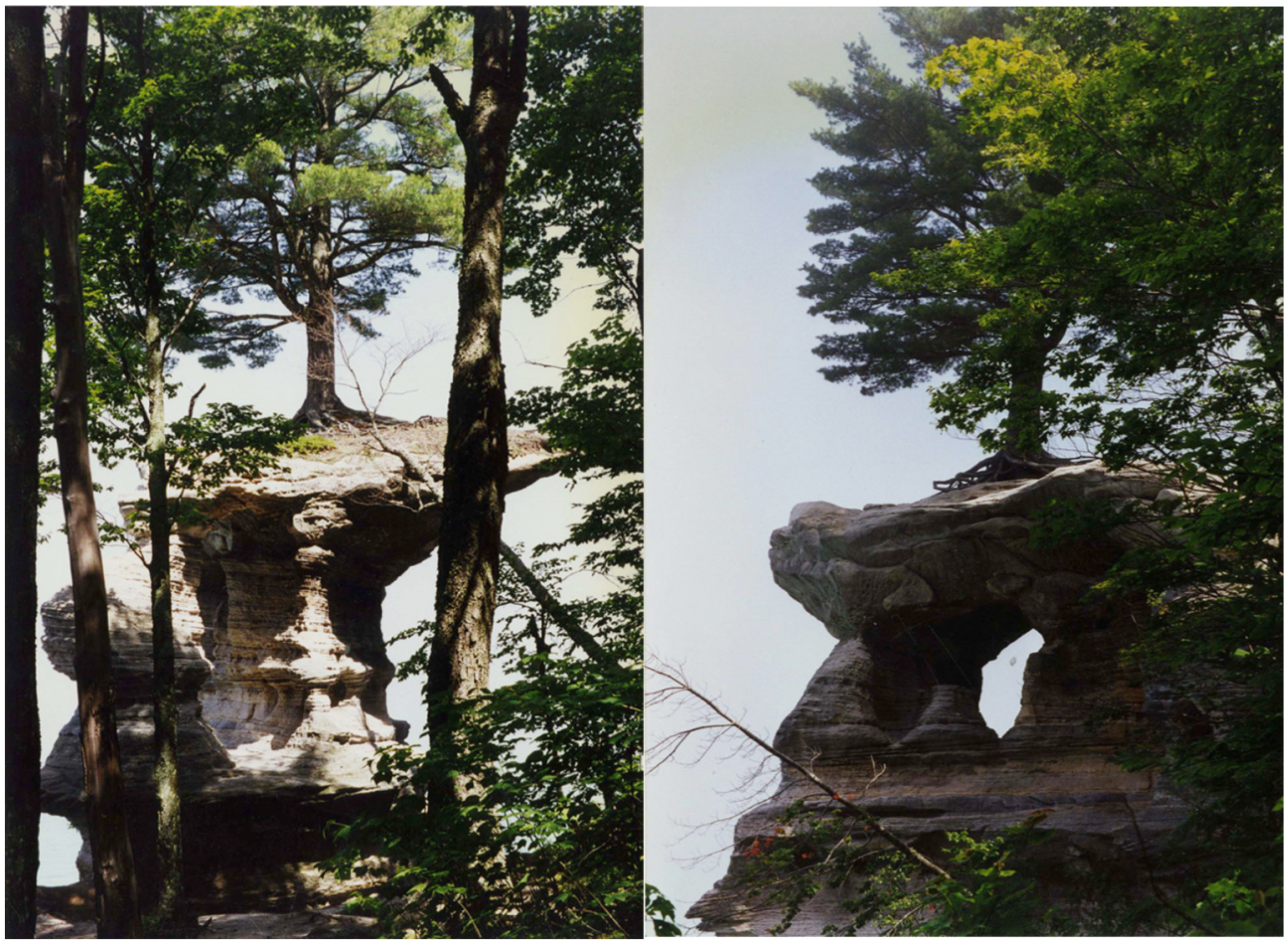
The geosite is defined by a tree growing from a tall stone pillar, isolated from the surrounding cliff—a geomorphological feature produced by differential erosion of the lake shoreline (Figure 1). Below the pillar lies the open water of Lake Superior (Figure 2). Along the shore, a freshwater stream joins the lake at a large waterfall. These features, in combination, constitute what Ojibway culture recognizes as a convergence of three of the five culturally distinct types of water—the lake, the stream, and the waterfall—each of which carries independent ceremonial and medicinal significance.
The theoretical implication for the geoheritage framework is clear: the functional extent of a geosite cannot be determined solely by physical edges. A geoheritage nomination bound to the pillar would protect its most visually distinctive element while failing to protect the relational ecology of water types that constitute its cultural significance. The formally recognized boundary at this site, if nominated, would predictably be smaller than the Ojibway-defined functional cultural habitat—the first instance of the structural boundary pattern documented across all six cases.

3.2. Case 2—A Geoscape: Sugarloaf Mountain, Colorado River (Multi-Tribal)

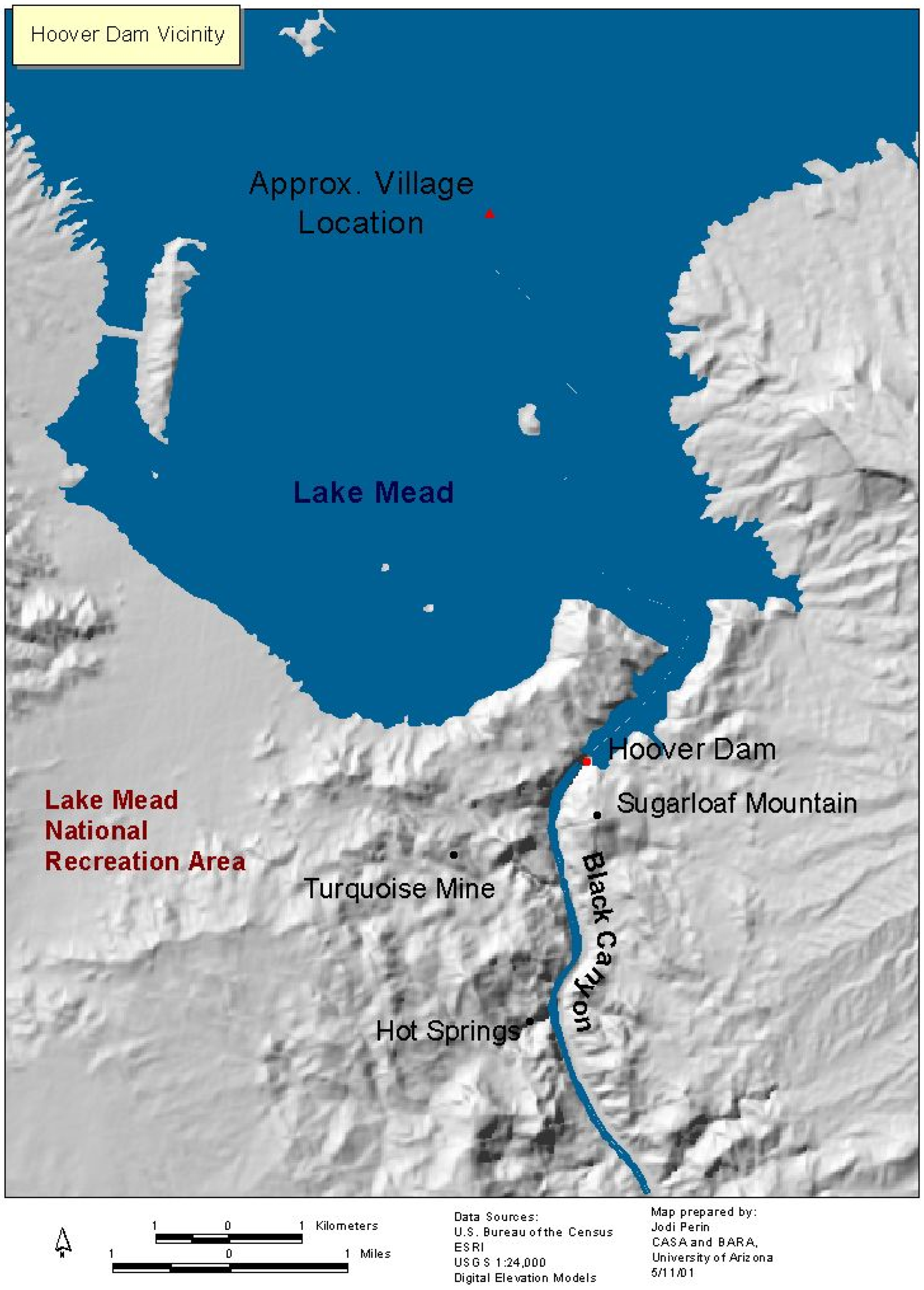
The Sugarloaf geoscape on the Colorado River represents the opposite end of the scalar spectrum: a spatially extensive, multi-jurisdictional, and ceremonially intricate heritage landscape documented through multiple ethnographic studies with representatives of the Fort Mojave, Colorado River Indian Tribes, Hualapai, Havasupai, Navajo, Hopi, Zuni, and multiple Paiute tribes. Sugarloaf Mountain is designated a World Balancing site—a location where the ceremonial maintenance of cosmological order is both possible and necessary [53].
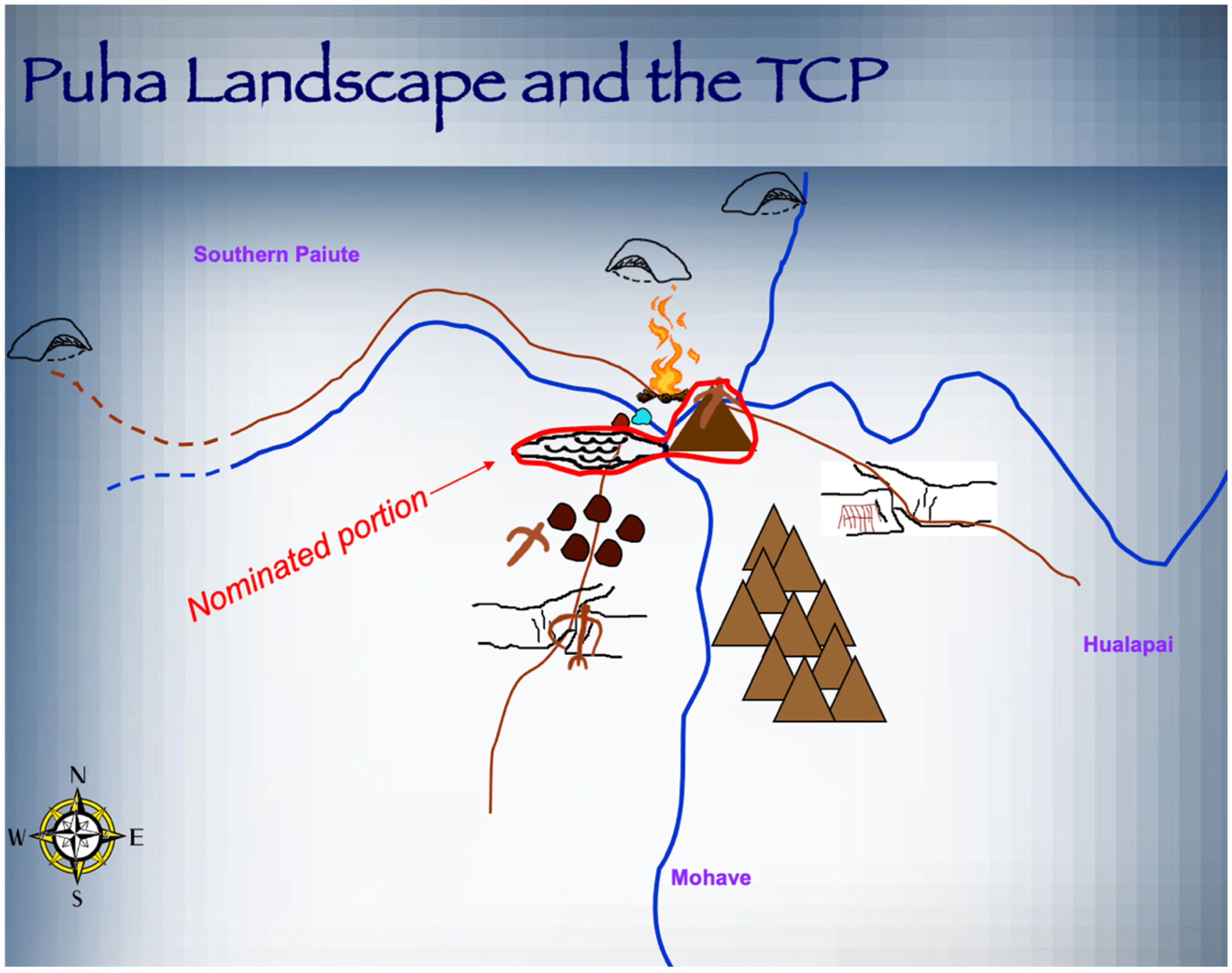
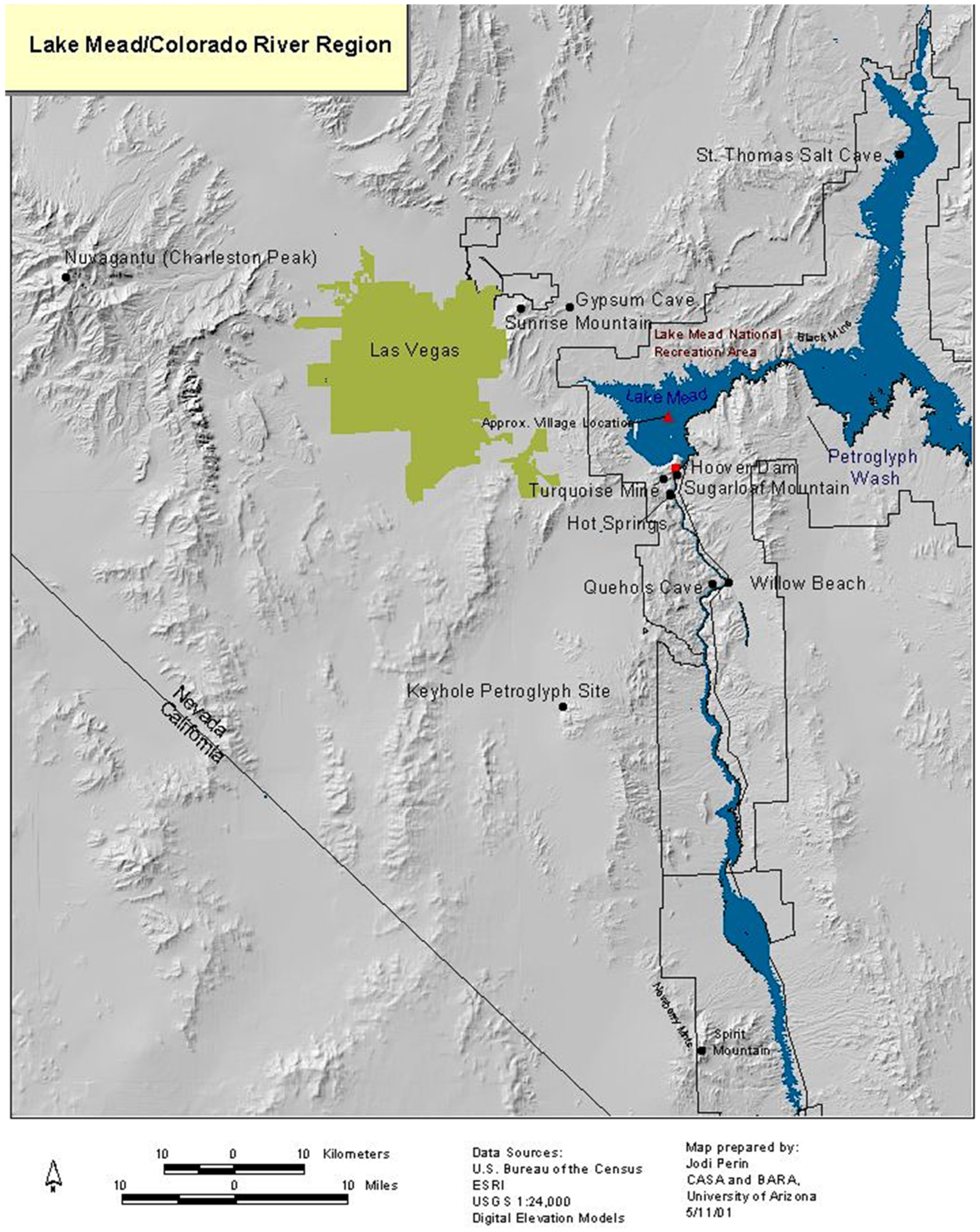
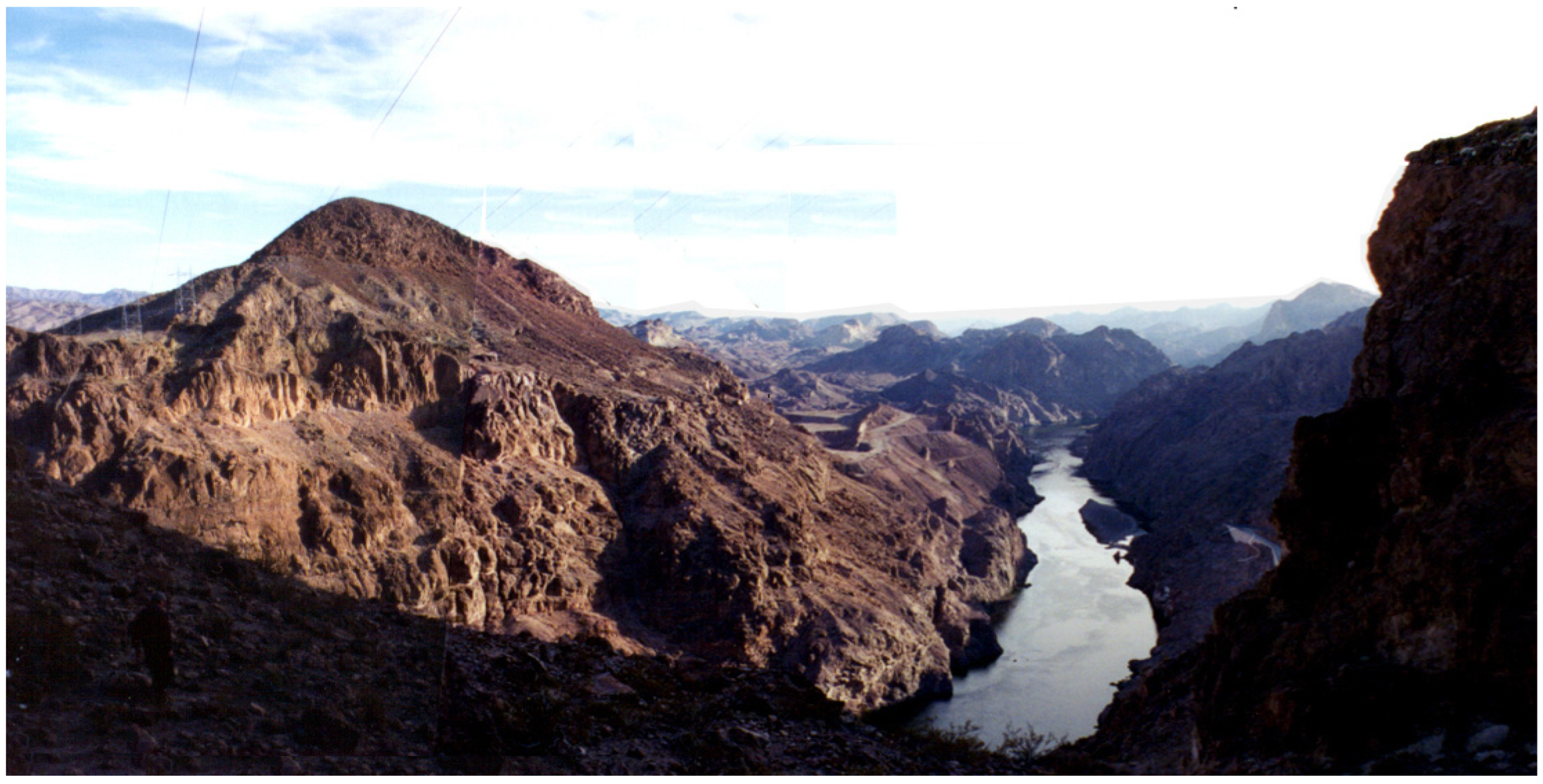
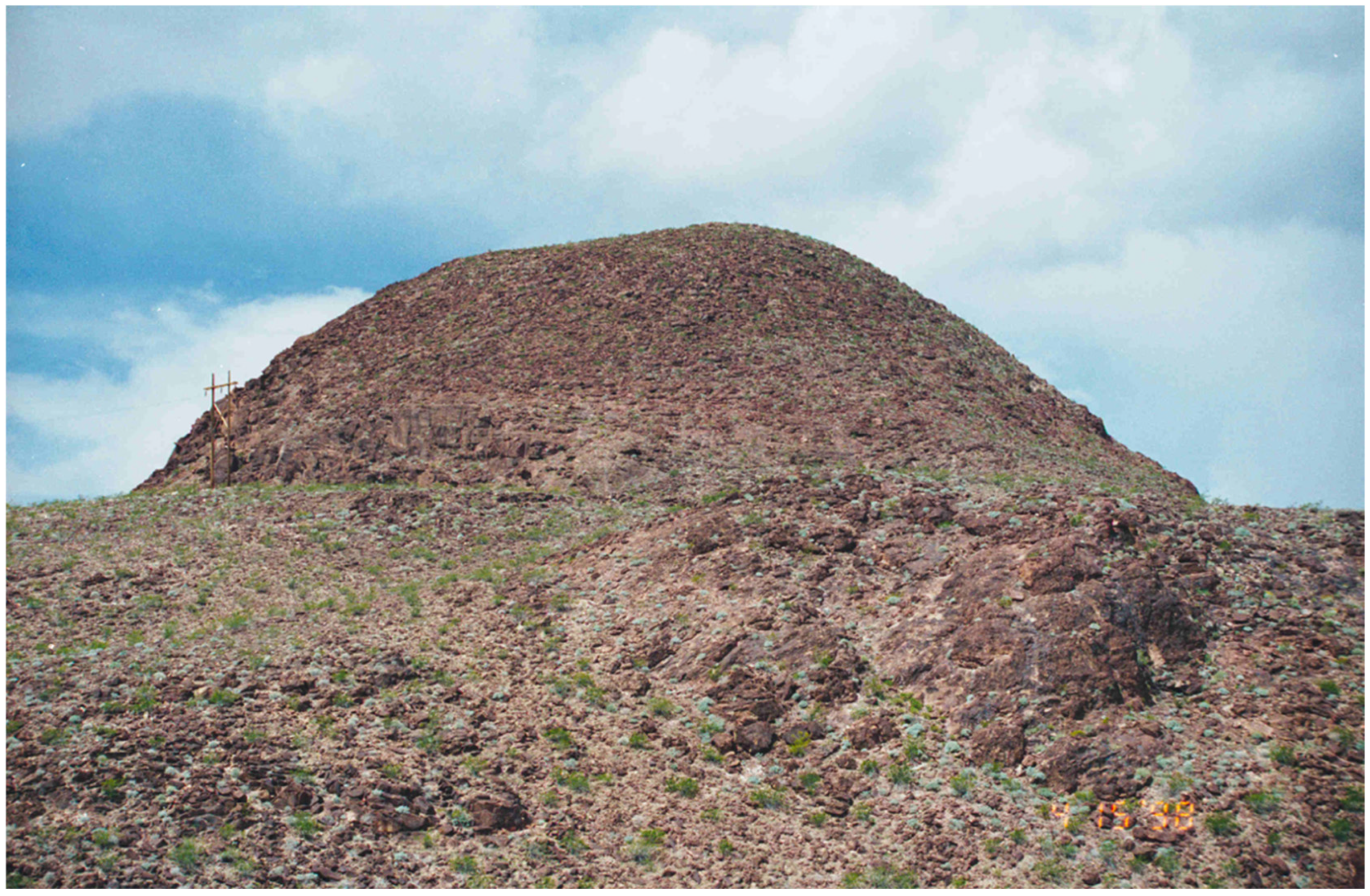
Its geoheritage significance derives from a series of physically interrelated features (Figure 3, Figure 4 and Figure 5): the volcanic mountain of Sugarloaf itself (Figure 6 and Figure 7), situated at the boundary of two desert physiographic provinces; its position on the Colorado River—an Origin River in the ceremonial traditions of multiple tribes; a narrow canyon to the west whose walls carry flowing hot springs; freshwater streams falling into the river from both banks; a turquoise mine produced by volcanic activity; Gypsum Cave, understood as a spiritual entrance; and two pilgrimage trails from the east and west that functionally connect the geoscape to tribal territories across a much larger region.
A Traditional Cultural Property (TCP) nomination for the Sugarloaf geoscape has been formally approved, encompassing components in Arizona and Nevada, as well as a portion of the Colorado River corridor. Yet participating tribes expressed disappointment that the nomination boundary—constrained by jurisdictional and administrative boundaries of multiple federal land management agencies—excluded the turquoise mine, Gypsum Cave, the volcanic lava field, and the full network of pilgrimage trails. A World Balancing site whose ceremonial integrity depends on the spatial relationship among a summit, a river, a hot spring canyon, a volcanic constriction, and two pilgrimage corridors cannot be adequately protected by a boundary that encompasses only the summit and the canyon.
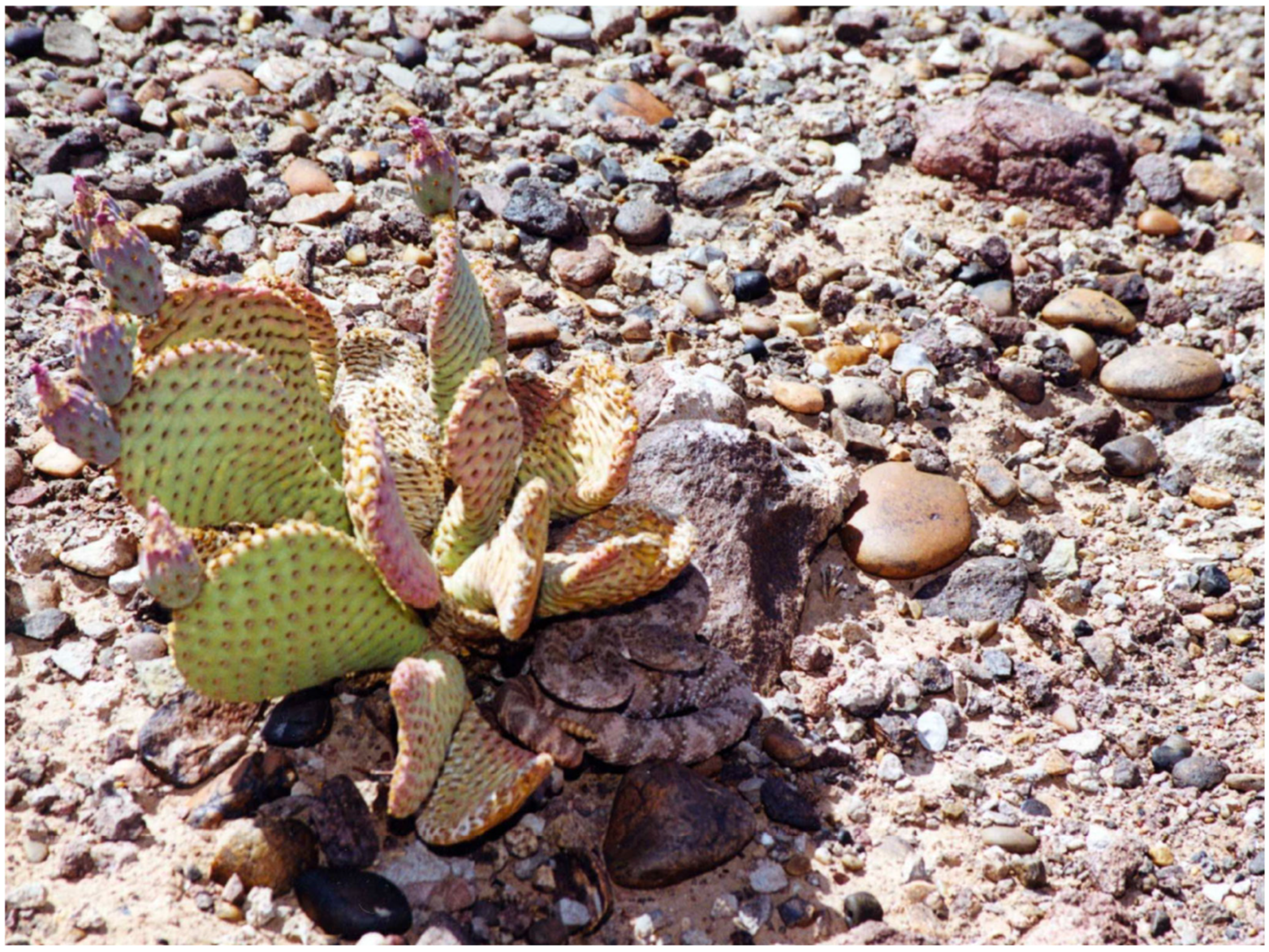
The encounter of a Hualapai tribal elder with a Grand Canyon Pink Rattlesnake on the trail to the Sugarloaf summit (Figure 8)—in which the elder remained seated with the snake for most of the morning, later reporting to the official project meeting that the two had spent the time talking about the sacred mountain and its long history as a World Balancing geosite—encapsulates the epistemological stakes of the Living Universe perspective discussed in Section 4. Within the relational ontology that structures the engagement of participating tribes with the Sugarloaf geoscape, the rattlesnake is a defender of culturally important places and a recognized interlocutor on matters of ceremonial significance. How heritage management institutions respond to this form of evidence—whether they treat it as irrelevant to nomination criteria, as supplementary cultural context, or as a primary form of testimony about the spiritual significance of the geosite—has direct implications for the completeness of any geoheritage assessment. The question is not one of cultural sensitivity but of evidence standards: what counts as admissible knowledge about the nature and extent of a heritage resource, and who has the authority to determine that standard.

3.3. Supplementary Case Study Vignettes

3.3.1. Vignette 1—Plant Gathering in National Parks: Buffalo National River, Arkansas

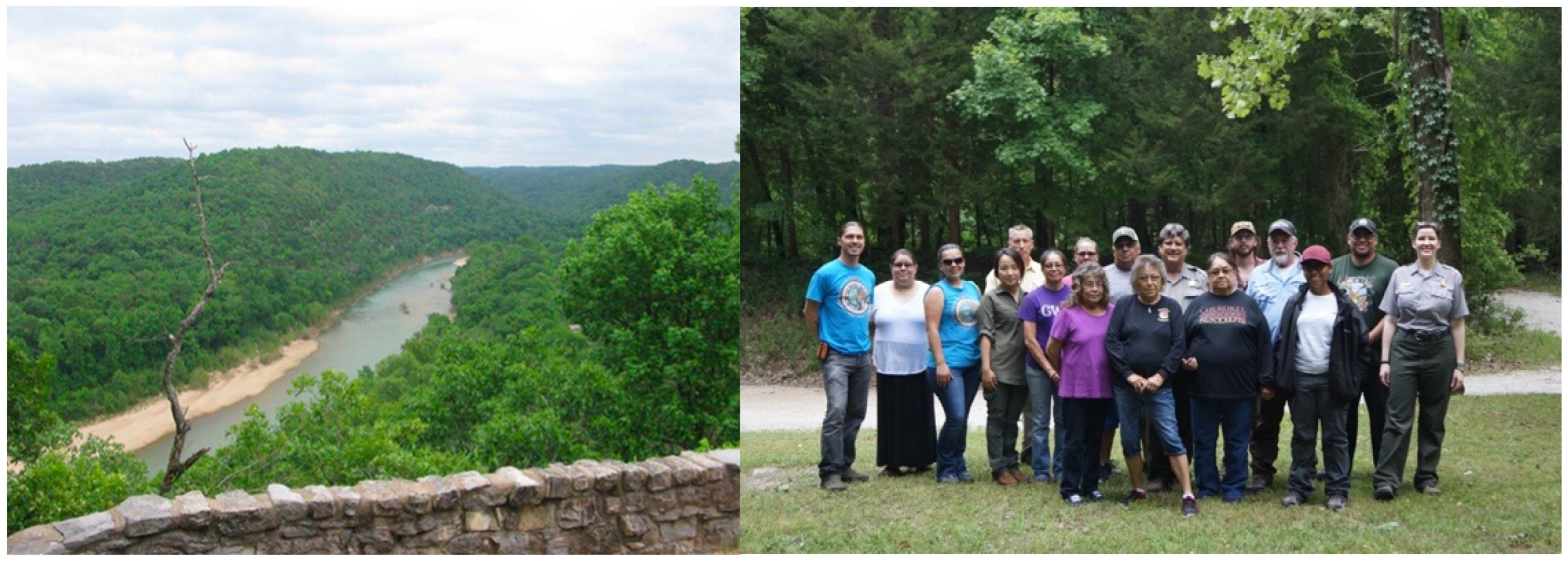
Buffalo National River has a deep and well-documented Cherokee historical association, grounding the cultural-habitat claims that the gathering agreement was designed to protect. American Indian occupation of the Buffalo River corridor extends approximately 10,000 years, spanning the Paleoindian through the Historic periods. The Cherokee connection intensified during the late eighteenth and early nineteenth centuries: Western Cherokee—the Old Settlers—began crossing the Mississippi River into French and later Spanish Louisiana following the Treaty of Hopewell (1785), establishing settlements along the St. Francis and White Rivers and subsequently extending their presence into the Ozark Plateau. The 1817 treaty with the United States formally delineated the Buffalo River and its tributaries as Cherokee reserved lands. A subsequent treaty in 1828 canceled the earlier treaty and forced the removal of the Cherokee people to Oklahoma. This removal was completed by the Trail of Tears in 1838. The Trail of Tears itself passed approximately twenty miles north of what is now Buffalo National River, meaning that the park lands were among the last ancestral landscapes traversed by Cherokee people before their forced relocation. The Cherokee Nation’s connection to the Buffalo River corridor is therefore not a claim of continuous residence but a claim of ancestral association, treaty-recognized occupancy, and disrupted stewardship—the precise pattern of colonial dispossession that the plant gathering framework under 36 CFR § 2.6 was designed in part to address [45].
The Buffalo National River case (Figure 9) illustrates the most direct and policy-actionable relationship between cultural habitat documentation and heritage management outcomes: the negotiation and execution of a plant gathering agreement on National Park Service (NPS)-managed land under 36 CFR § 2.6 [54]. It represents what is to date among the most successful instances of boundary negotiation between a federal agency and a federally recognized tribe within this research program, and the regulatory framework it operated under was itself informed by an earlier study in the program. The development of NPS plant-gathering agreements proceeded through a two-stage process, with direct methodological implications for the broader program. The NPS published the initial regulatory framework following more than twenty-four years of debate; the research program was asked to evaluate draft protocols through collaboration with three Odawa tribes and Sleeping Bear Dunes National Park [43]. The resulting revisions were incorporated into the Final Rule [54], which listed the approved Sleeping Bear Dunes study as a suggested guide. The Buffalo National River agreement with the Cherokee Nation of Oklahoma was among the first executed under the finalized framework (Figure 10) [45].
The plant gathering agreement documented at Buffalo National River represents a model of participatory boundary definition with direct relevance to geoheritage nomination more broadly. The boundary was negotiated through the agreement, identifying which habitats within the park are appropriate gathering areas, and was produced through a trilateral process involving NPS management, Cherokee Nation representatives, and the research team, with elders walking the land and participating in small group consultations carefully structured to respect the ceremonial sensitivity of plant TEK. The resulting gathering area boundary is not a line drawn on a map by administrators; it is a co-produced cultural-ecological boundary that reflects Cherokee understanding of which habitats within the park maintain the physical and spiritual conditions necessary for gathering to be appropriate.
The geological and ecological character of Buffalo National River is itself the foundation of the cultural habitat under the gathering agreement. The park protects a 135-mile free-flowing, undammed river corridor within the Ozark Plateau, one of the largest karst formations in the mid-continent United States. The geologically layered landscape—Mississippian and Pennsylvanian sandstone, shale, limestone, and dolomite, dissected by the river into tall bluffs and distinct valley systems—supports three distinct ecoregions within the park’s boundaries (the Upper Boston Mountains, the Dissected Springfield Plateau-Elk River Hills, and the White River Hills) and eight documented plant community types, including upland oak-hickory forest, riparian forest, rivercane thickets, and cedar glades. Over 1780 plant species occur within the park. Karst hydrology, expressed through springs, seeps, and more than 300 limestone and dolomite caves, sustains the moisture regime that supports mesophytic hardwood communities that contain the highest concentrations of Cherokee medicinal species. The geoheritage significance of the Buffalo River corridor and its cultural habitat significance are structurally inseparable: the geological substrate shapes the hydrology; the hydrology shapes the plant communities; the plant communities are the material basis for the Cherokee ethnobotanical TEK protected by the gathering agreement.
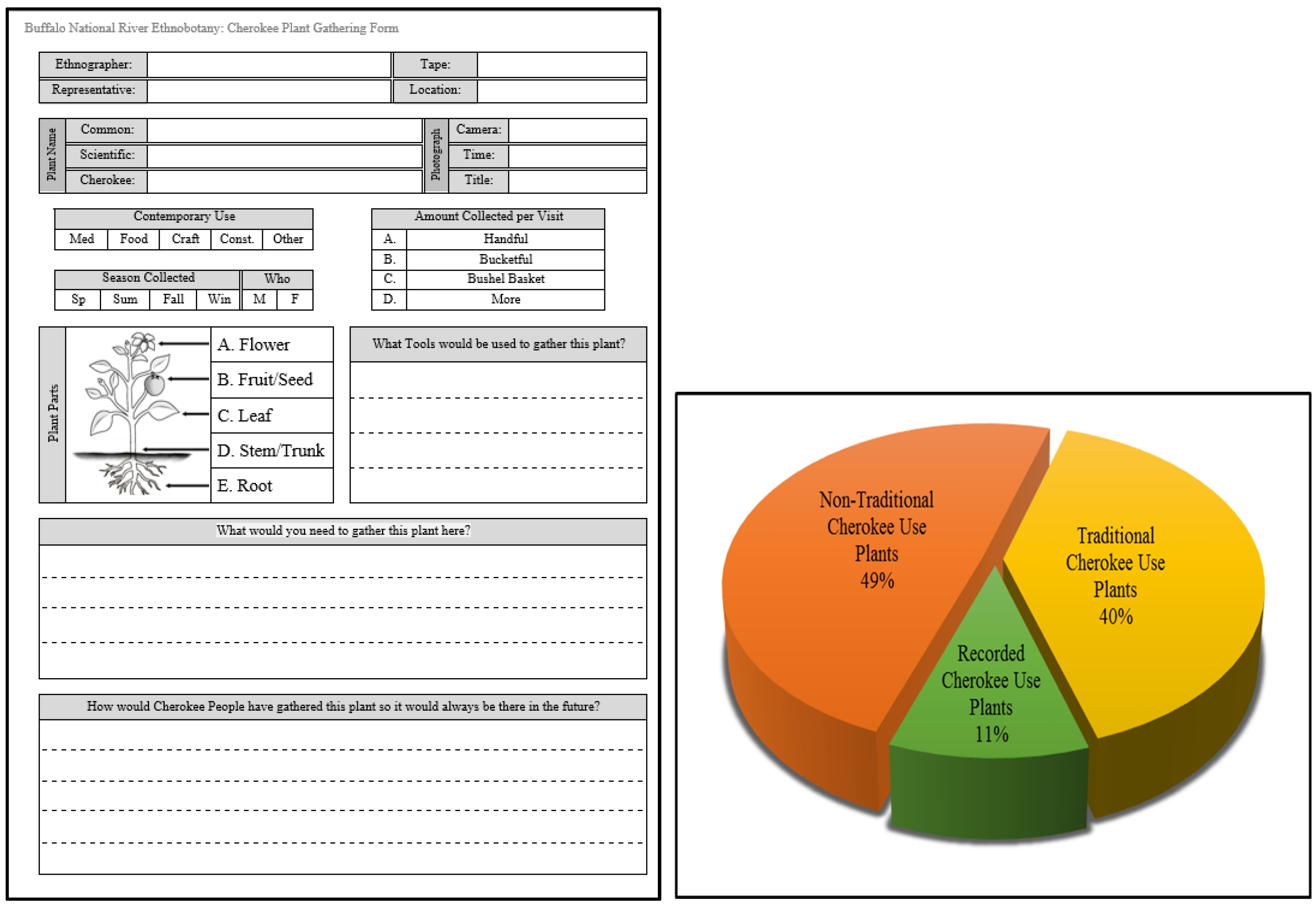
The study that produced the ethnobotanical foundation for the gathering agreement was conducted in two phases, with a deliberate emphasis on reflexive engagement and methodological transparency. Phase one involved constructing a Traditional Cherokee Plant Inventory by systematically cross-referencing the park’s documented flora against five published Cherokee ethnobotanical compilations spanning 1932 to 2009. Importantly, the research team remained attentive throughout this process to the interpretive limitations and potential biases inherent in aligning historically documented knowledge with present-day plant distributions. Of the 1780 plant species documented within Buffalo National River, 281 had been previously recorded as traditional Cherokee use plants—plants whose presence in the park’s karst-supported ecology had been maintained even as Cherokee access to these species on tribal trust lands in Oklahoma had progressively diminished due to historical displacement. Phase two was an ethnographic field program conducted in May 2017 with the Cherokee Nation’s Medicine Keepers, the formally constituted body of elder knowledge holders whose institutional mandate—expressed in the Cherokee phrase nvwoti asquangododi, “to keep the medicine going”—articulates precisely the TEK maintenance function that the gathering agreement was designed to validate. Medicine Keepers Anna Sixkiller, Phyllis Edwards, Bonnie Kirk, and Gary Vann, accompanied by Cherokee helpers and a trilateral research team from the University of Arizona, the University of Colorado Boulder, and NPS staff, conducted field sessions at two ecologically differentiated sites within the park: Lost Valley, in the Upper Boston Mountains, and Rush Landing, at the confluence of Rush Creek and the Buffalo River in the Springfield-Salem plateau zone. The selection of these sites reflected a conscious effort to ensure that the full diversity of plant communities recognized as culturally significant by Cherokee participants under the agreement was documented, while also upholding protocols of mutual consent, iterative consultation, and shared interpretive authority.
The field sessions documented 76 plants of contemporary interest to the Cherokee Nation, with medicinal applications constituting the primary use category (53 plants, 70 percent of the total), followed by food plants (35 plants, 46 percent). Medicinal plants were consistently gathered in small quantities—a handful or less—a pattern that reflects the ceremonial and relational protocols governing Cherokee plant medicine rather than simple resource economics. Among the most culturally significant plants documented was rivercane (Arundinaria gigantea), present in stands along the Buffalo River corridor. Rivercane was central to Cherokee women’s material culture for over a millennium, used to construct baskets, mats, and ceremonial and utilitarian objects. The Eastern Cherokee’s forced relocation to higher, cooler elevations reduced their access to rivercane; the Western Cherokee’s removal to Oklahoma placed them near the western limit of the plant’s growing range, where cultivation is only marginally possible. The gathering agreement at Buffalo National River thus directly addresses a resource deficit produced by forced removal—restoring legal access to stands of a culturally critical plant species whose presence in the park is itself a product of the geological and hydrological conditions the park was established to protect.
The ethnographic record from the field sessions documents the epistemological character of Cherokee plant TEK in direct empirical terms relevant to the Living Universe argument developed in Section 4.3. Cherokee representatives described gathering protocols organized around reciprocal obligations rather than resource extraction: “You never ever collect more than what you need and you always leave some.” Before gathering any medicinal plant, the gatherer is expected to address the plant directly: “You have to tell the plant your name. If it is a medicinal plant, you tell [the plant] what you want that medicine for, and who you are getting it for, to cure.” The sustainability ethic expressed in these protocols is not incidental to Cherokee plant knowledge but constitutive of it, consistent with the Medicine Keepers’ teaching that if the plants are not used with respect, the Creator will withdraw them. This is the grammatical structure of animacy that Kimmerer [16] identifies as basic to indigenous plant knowledge: the plant is not a resource, but a relative, and the gathering relationship is not an extraction, but an obligation maintained through ceremony and protocol. Kimmerer’s more recent elaboration of this system [55] extends the gift-economy and reciprocity argument, showing that orienting human-nature relations around gratitude, reciprocity, and community—precisely the relational logic expressed in the Cherokee gathering protocols described here—constitutes a foundational alternative to the extractive model underlying conventional resource management. Importantly, these TEK protocols inherently challenge the Western-imposed boundaries common in geoheritage and conservation frameworks. The relational and unbounded nature of these obligations means that the functional extent of a cultural habitat—as defined by TEK—cannot be effectively circumscribed by administratively convenient or static boundaries. In accepting these protocols as the operational basis for sustainable harvest planning, the gathering agreement implicitly acknowledges a form of ecological governance that the Western ontological framework of conventional resource management cannot produce from within its own evidentiary categories and highlights the persistent tension between culturally appropriate boundaries and those recognized in formal management systems.
From a geoheritage perspective, Buffalo National River represents a cultural habitat whose physical substrate—a free-flowing, undammed river corridor within a forested karst landscape—is both the ecological foundation of the protected Cherokee plant communities and the defining geological feature of the site. The plant gathering agreement, while modest in its administrative scope, recognizes that the Cherokee Nation’s relationship with this specific cultural habitat has continuing vitality and legal standing. The elder’s observation during a park walk—that being in the park was like being back home in the east, before removal to Oklahoma—articulates precisely the cultural habitat relationship that Nabhan [1] describes: a people’s ancient ecological knowledge expressed in a landscape whose physical character activates cultural memory and ceremonial identity. The technical report documents this connection in the Medicine Keepers’ own words at Lost Valley: “To me, when I entered [Lost Valley], it was just like I was back in our traditional home in the east again. Now that is the way I felt, and I still feel the same way. And if we can take medicine from here, it would be a blessing.” A second elder at Rush Landing extended the observation in a direction directly relevant to climate-driven habitat loss: “This area is just like some places in North Carolina that we have seen… When you see the plants here, some of them are more abundant and bigger than they are at home on our reservation in Oklahoma. And I am thinking, are our plants disappearing from Oklahoma?” The gathering agreement thus operates simultaneously as heritage recognition, as a response to the colonial disruption of TEK transmission, and as an adaptive management mechanism for a cultural plant community under climate pressure—a convergence of functions that geoheritage management frameworks are not presently designed to accommodate but which the Buffalo National River case demonstrates are structurally possible when co-stewardship is built into the management model [56] in their analysis of academic literature, documented the barriers that prevent this kind of outcome from becoming routine practice in U.S. public land management—including insufficient financial support for TEK integration, institutional norms that treat indigenous knowledge as supplementary data rather than primary evidence, and the difficulty of bridging local and national management scales—confirming that the Buffalo National River case represents an exception achieved against significant structural resistance rather than the operation of a functional and generalized management framework. The governance conditions necessary to replicate this kind of outcome are precisely those Kimmerer and Artelle [57] identify as requiring active support from heritage and natural resource management agencies.

3.3.2. Vignette 2—Marine Protected Areas as Geoscapes: Bahamas Biocomplexity Project

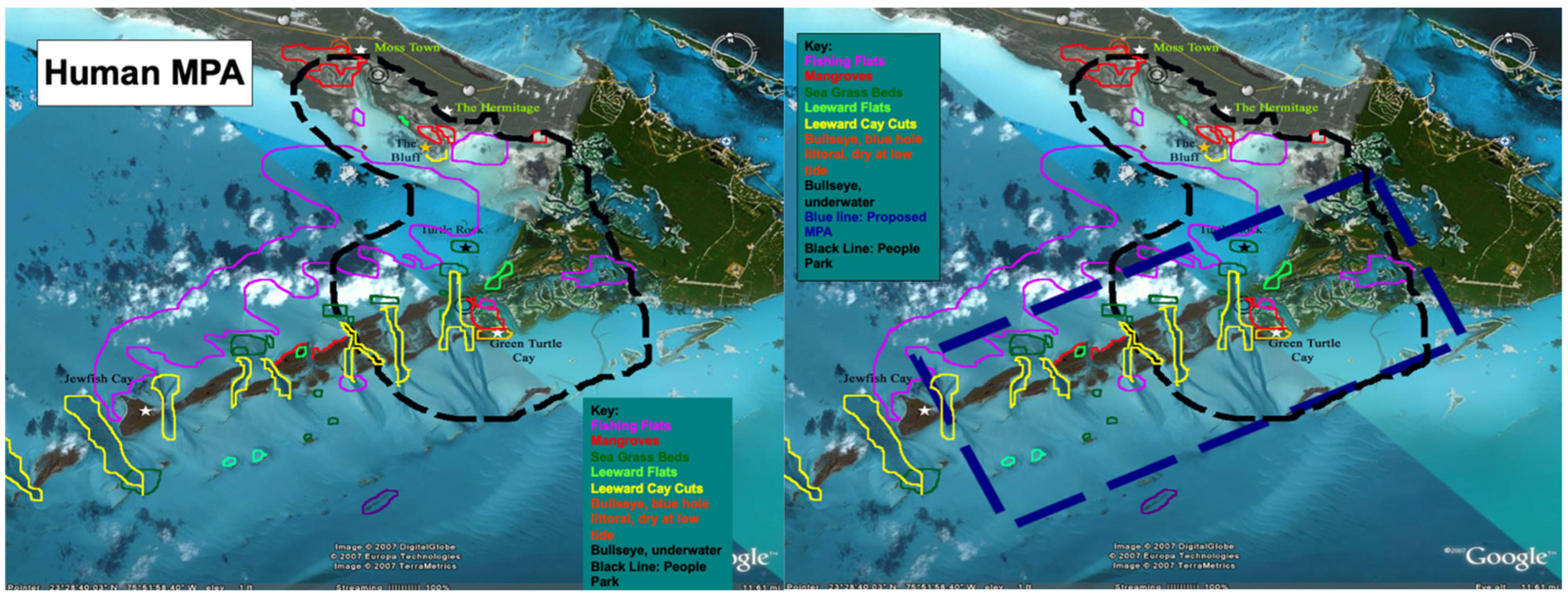
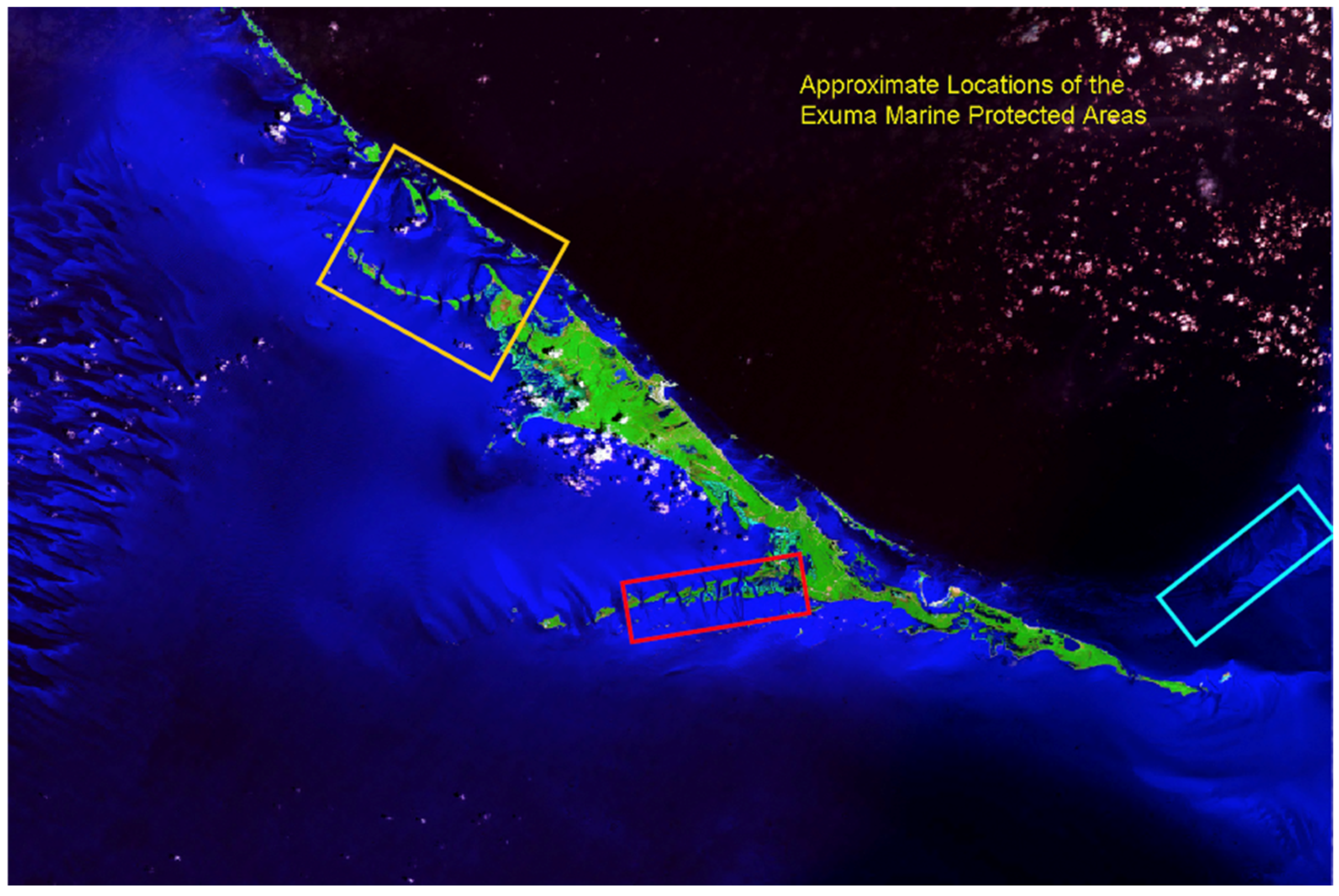
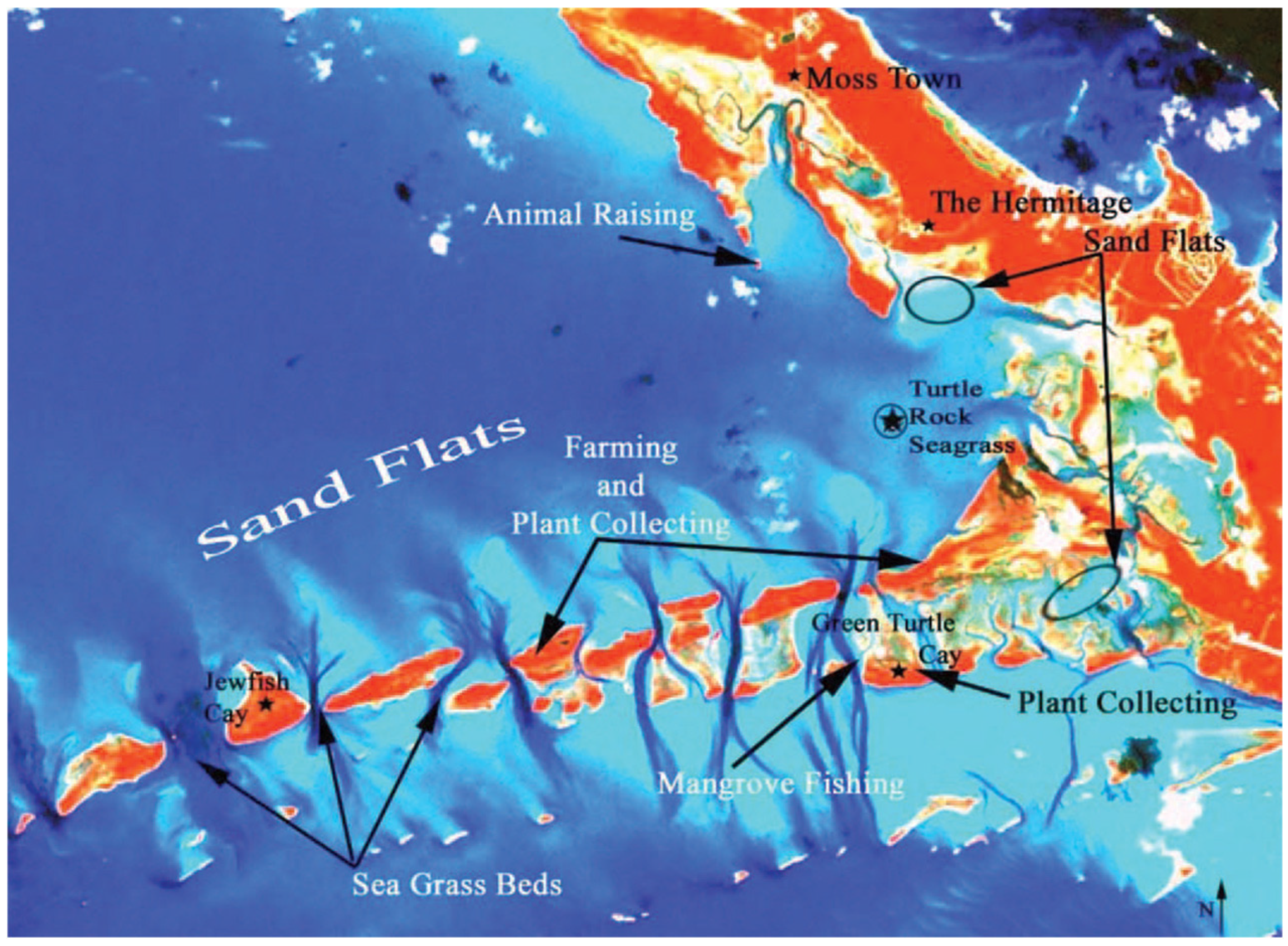
The Bahamas Biocomplexity Project illustrates a methodological frontier: extending cultural habitat mapping into submarine environments [58]. The US National Science Foundation funded the project to investigate community responses to proposed Marine Protected Area (MPA) boundaries across the Bahamas. The University of Arizona and College of the Bahamas research team focused on six settlements in the Exumas Islands and Cays (Figure 11). The method developed—cultural habitat bathymetry—integrated ethnographic, biological, and spatial data collection across the land–sea interface [3,33,34,59,60]. Study boats were composed of ethnographers discussing ethnoecology, marine biologists conducting plant and fish inventories, and GPS specialists ensuring accurate spatial placement of findings. Community-derived MPA boundaries were consistently larger, more ecologically integrated, and more attentive to functional relationships across habitat types than boundaries produced by single-discipline scientific assessment. The case demonstrates that the cultural habitat concept is not limited to terrestrial landscapes and that communities whose traditional knowledge and subsistence practices are oriented toward marine environments possess equally sophisticated and spatially definable cultural habitat geographies—geographies that differ systematically from those produced by marine biology alone. The boundary tension in this case is between scientifically derived Marine Protected Area (MPA) boundaries and community-defined ones.
The findings from this research, grounded in hundreds of interviews and a methodologically innovative program of cultural habitat bathymetric mapping, provide a theoretically coherent account of the mismatch between scientifically derived and community-defined marine boundaries.
Study locations were determined through recommendations from all participants, with greater weight given to high-value community areas (Figure 12). Mapping proceeded from water to land so that the functional interrelationships of the two environments could be documented: land plants provide materials for fishing and boating and leaves that fall into quiet marine zones; nearby cays serve as camping and processing areas for gathering marine plants and fishing. Community members were subsequently asked to design their own MPAs using human-defined variables, and the resulting community-derived boundaries were compared with the biologically derived ones (Figure 13).
From a geoheritage perspective, the Bahamas case demonstrates that current geoheritage frameworks must be expanded to recognize and protect marine and coastal cultural habitats. Moreover, the bathymetric cultural mapping method developed for this project, which integrates ethnographic, biological, and spatial data, provides a model for how such expansion can be operationalized. This empirical approach directly informs the policy recommendations advanced in this review by illustrating that boundary definition processes should incorporate methodologies capable of representing culturally significant marine environments. Adopting such integrative methods would enable heritage management agencies to better align nomination and management protocols with community-derived understandings, as recommended in the policy section of this analysis.

3.3.3. Vignette 3—An African Ancestry Littoral: Barbados

The Barbados littoral case introduces a distinct origin pathway for cultural habitat formation: the creation of a new cultural habitat by a displaced people with no prior ecological relationship to the landscape. Workers on the plantation—initially African-ancestry enslaved persons and indentured Scots-Irish laborers—found the saline coastal zone a critical resource and managed it carefully, incorporating it into their lives and over generations, transforming it into a cultural habitat containing more than one hundred plant species [35], many found nowhere else on the island. As many as two hundred traditional use plants remain embedded in living community practice [3,61]. Bush tea—a medicinal preparation made from plants collected by local elders—represents one of the most fully documented examples of TEK maintenance within a displaced community context.
A segment of the Barbados littoral has been designated locally as the Heritage Route or the Railway Trail by the Barbados government [35] This case is theoretically important because it demonstrates that cultural habitats are not exclusively the product of ancient, continuous occupation—the temporal requirement emphasized in Nabhan’s [1] framework—and raises questions about the time thresholds and social processes through which cultural habitats acquire the depth of TEK and the material condition of biological richness that make them candidates for geoheritage recognition.
The Barbados littoral—the coastal zone defined by salt spray and wave action [3]—was preserved from sugar plantation development precisely because its saline soils were hostile to the commercial crop. Workers on the plantation initially found the littoral a critical resource and managed it carefully, incorporating it into their lives and, over generations, transforming it into a culturally significant habitat. It represents one of the most fully documented examples of TEK maintenance within a displaced community context: the knowledge of necessary plants, preparation protocols, and appropriate contexts of use has been maintained and transmitted across generations despite the absence of any continuity with an ancestral homeland.
From a geoheritage perspective, the Barbados case raises a fundamental question about the scope of the IUCN and International Commission on Geoheritage frameworks: whether those frameworks are sufficiently flexible to accommodate cultural habitats whose traditional peoples are defined not by ancient occupation of the site but by the creation of a new cultural relationship with it under conditions of colonial coercion. The ecological boundary of the Barbados littoral—the salt spray gradient—was maintained not by indigenous sovereignty but by the commercial disinterest of colonial planters, a form of inadvertent preservation whose significance for geoheritage management is considerable.

3.3.4. Vignette 4—Colonial Pressure at a Sacred Geosite: Pipestone National Monument, Minnesota

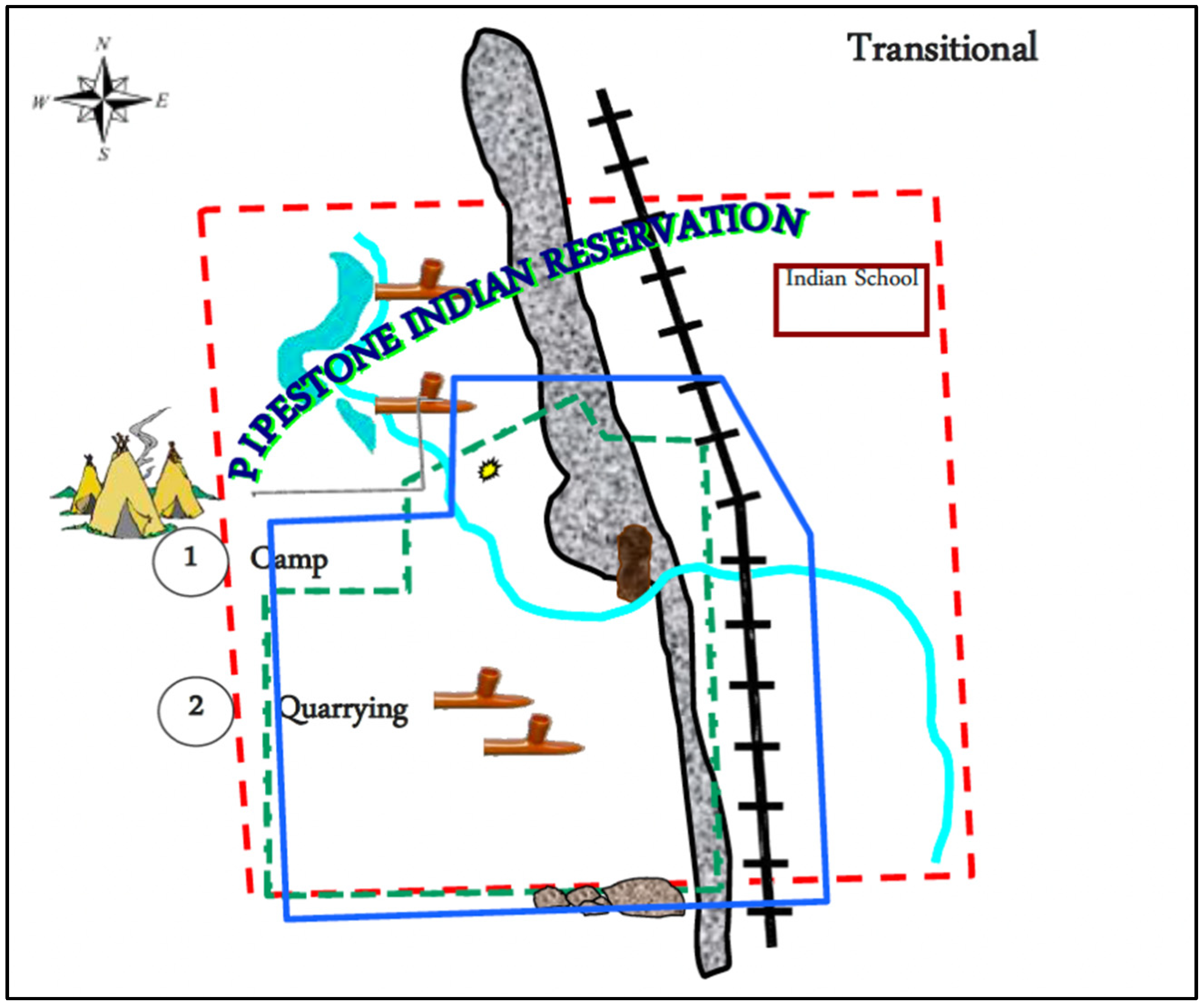
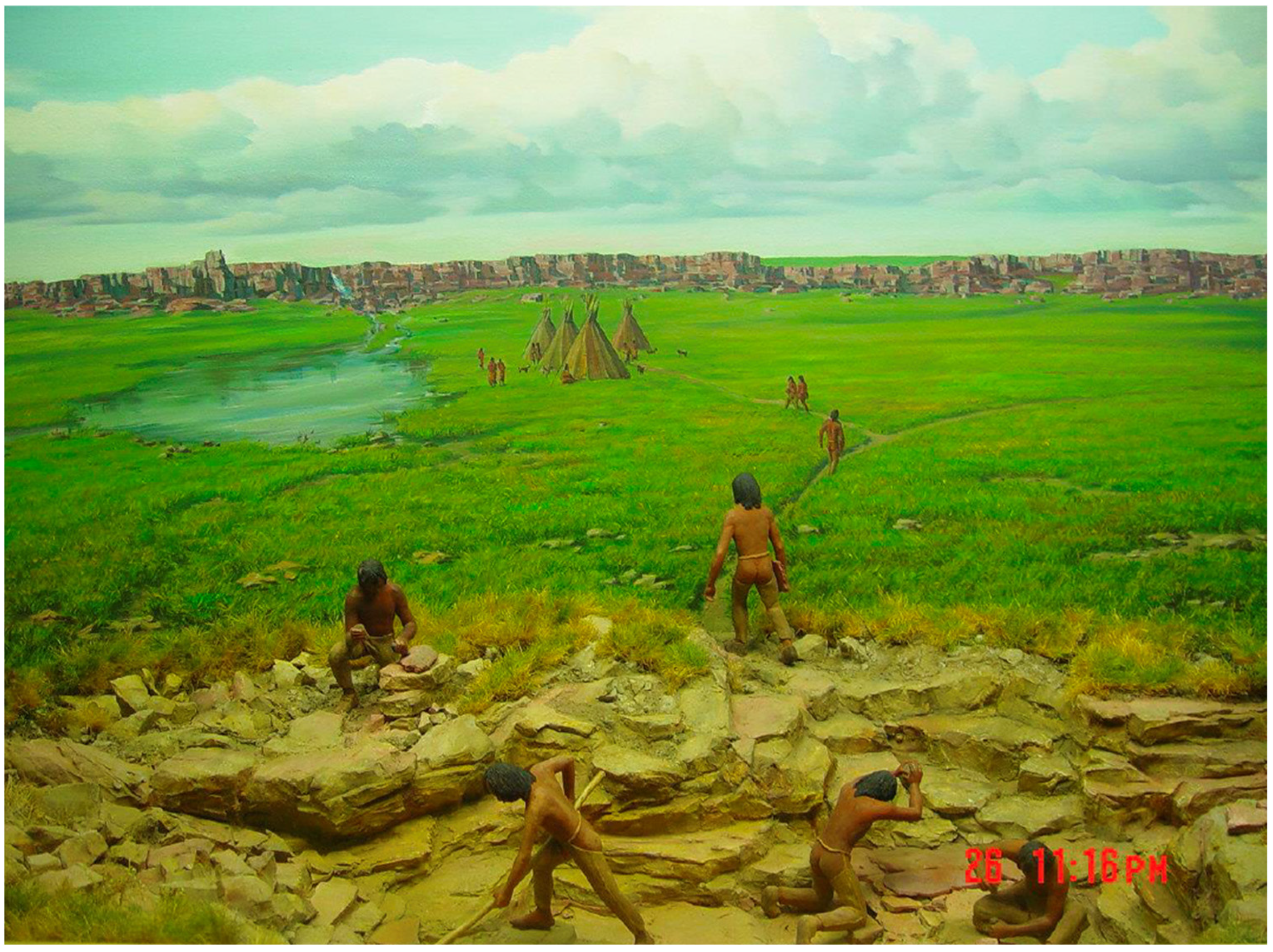
The Pipestone National Monument case presents the most complex management environment encountered across the 24 studies and the most fully documented instance of progressive erosion of indigenous spatial authority over a sacred geosite through the imposition of successive colonial and administrative boundaries. The Pipestone quarry at Pipestone, Minnesota, is geologically distinctive: its catlinite deposit is a Precambrian red argillite layer of rare quarriable extent, exposed by Pleistocene glaciation. The site was a ceremonial destination of continent-wide significance, with Native American peoples from across North America traveling established pilgrimage routes to obtain pipestone for sacred pipes (Figure 14).
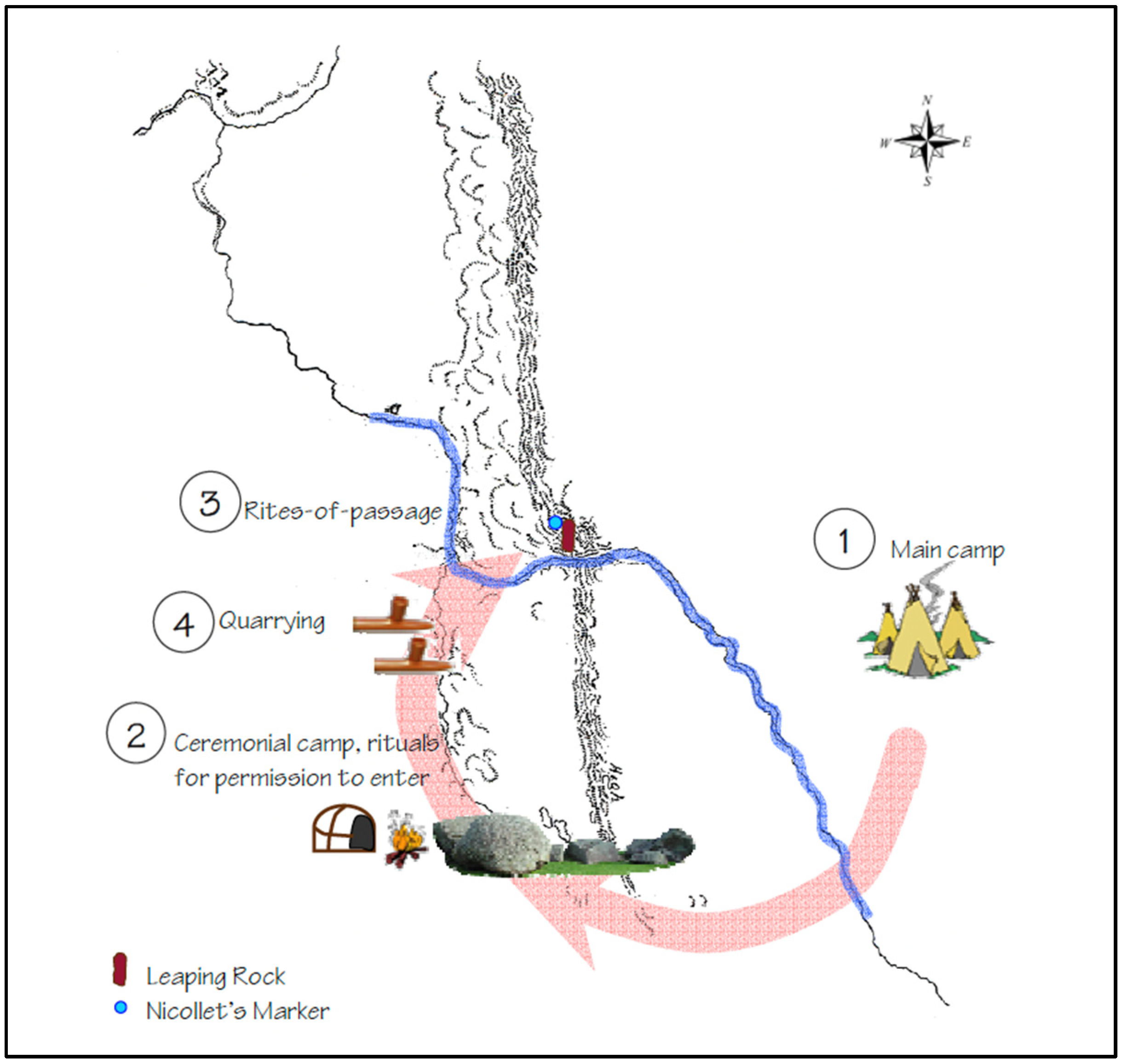
The White Buffalo Woman narrative, in which the sacred pipe was given to human beings at a location spiritually situated beneath a mirrored sky dimension, situates the Pipestone geosite within a cosmological geography that extends far beyond the physical quarry—a spatial logic that subsequent colonial boundary-making systematically ignored. The traditional use of the geosite followed a ceremonially sequenced protocol: camp was established above the wetland only after permission to enter was granted by thunder; the Three Maidens rock formation was visited, and specific plants gathered for prayers; the rites-of-passage location beside a stone pillar and natural waterfall was visited in sequence. Plants like red willow were planted and maintained at each stopping location for pilgrims. This ceremonially sequenced landscape (Figure 15) use is precisely the kind of TEK that quantitative significance indices cannot capture and that successive colonial boundary decisions did not accommodate.
The subsequent history of the geosite documents the consequences of boundary failure in systematic detail: US Army commercial extraction, settler farming, construction of the Indian School, railway encroachment, the dynamiting of the ceremonially significant wetland, and the establishment of the town of Pipestone on adjacent land. Despite this extensive history of boundary imposition and resource appropriation, tribal representatives identified more than ninety traditional-use plants during their field visits—a finding that speaks directly to the resilience of TEK under conditions of colonial disruption [36].
The history of Pipestone also documents consequences that go beyond a simple boundary list. The US Army’s recognition of the pipestone quarry’s significance in a peace treaty placed formal control in Lakota hands, but the Army simultaneously commissioned the manufacture of thousands of peace pipes from the quarry for use in treaty ceremonies throughout the West—a commercial extraction that operated independently of the ceremonial protocols through which traditional peoples understood appropriate quarry use. Each colonial intervention imposed a new boundary or use regime that further contracted the functional cultural habitat without reference to the spatial logic of its traditional use (Figure 16).
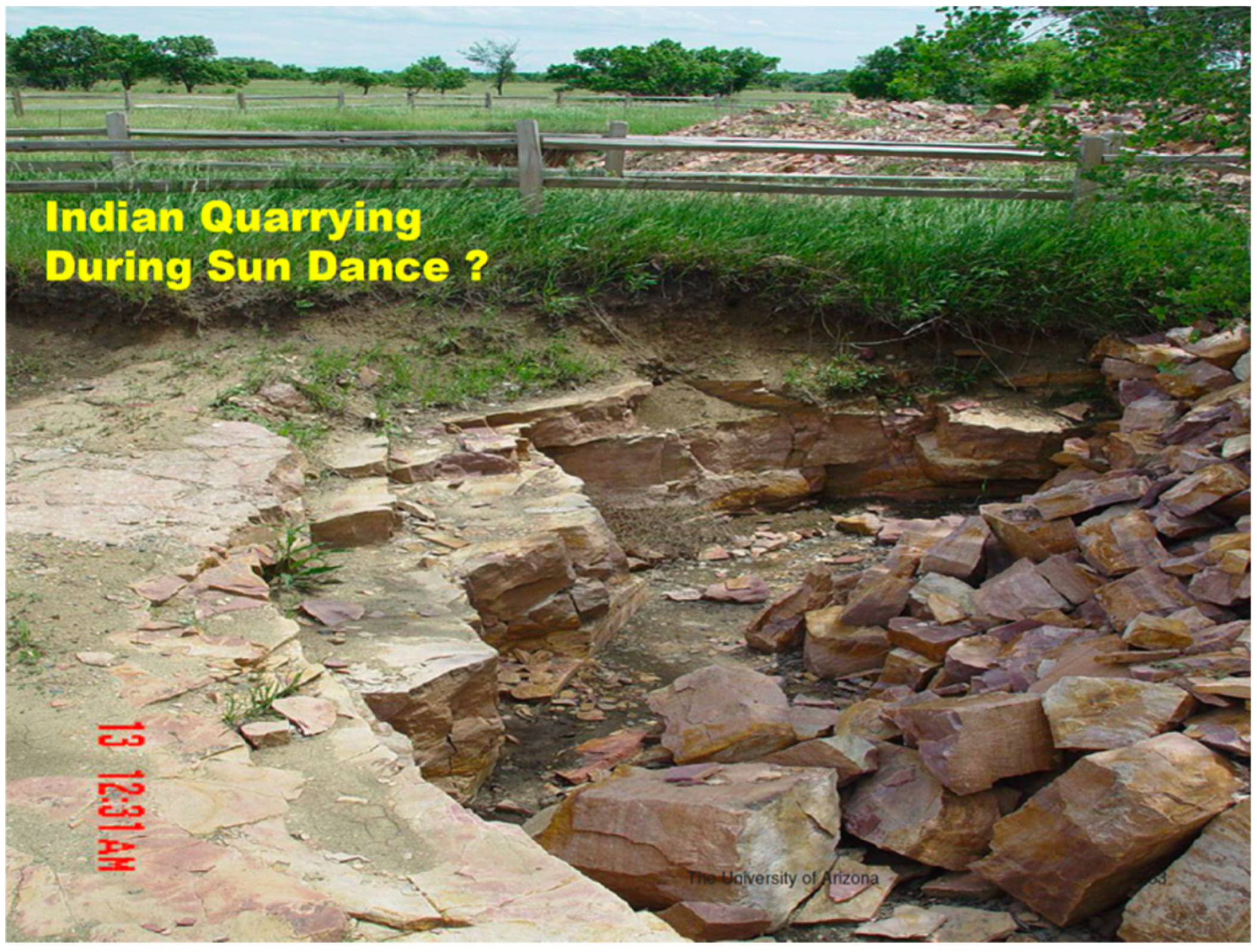
Following NPS acquisition, additional layers of complexity accumulated: the revegetation of the park with mail-order exotic trees and shrubs by a superintendent’s wife (now the dominant vegetation); the commercial appropriation of the Three Maidens sacred stones as a backdrop for the Catawba Hiawatha pageant (Figure 17), in which non-Indians performed “Indian” ceremony for tourists; and the granting of quarrying rights to a Sun Dance group that subsequently sold participation tickets to non-Indians (Figure 18). The research team’s ethnobotanical study at Pipestone [36] was conducted in the context of these ongoing controversies; tribal representatives arrived with extensive, documented grievances about violations permitted at their sacred geosite and used the official study process to place those grievances on public record.
The title agreed upon for the University of Arizona report—Takuskanskan Cannomoke, Ever Changing Pipestone Quarries—reflects both the shifting but culturally persistent importance of Pipestone and the elders’ understanding that Takuskanskan, the moving god or god of motion in Dakota tradition [62], governs a landscape whose meaning has been continuously contested but whose cultural centrality has never been extinguished.
The resolution of the exotic tree controversy—the recommendation to retain the non-native plantings because they now constitute the only habitat for birds and animals in a landscape otherwise converted to industrial agriculture—illustrates a form of pragmatic ecological accommodation that extends the cultural habitat concept to include managed vegetation communities whose origins are colonial but whose current cultural functions are traditional.

4. Discussion

4.1. The Geological Substrate of Cultural Significance

Across all six cases, as well as throughout the broader 24-study corpus, every documented cultural habitat is located at a site with distinctive geological or geomorphological features. For instance, the Sugarloaf geoscape is shaped by a volcanic massif that constricts a major river at the boundary of two physiographic provinces, and the Pipestone geosite is defined by its unique Precambrian catlinite layer exposed by Pleistocene glaciation. Similarly, the Barbados littoral is characterized by the gradient between carbonate wave platforms and the island’s interior, while the Buffalo National River habitat is anchored by its free-flowing karst river corridor. In these and other cases, geology is not merely an incidental backdrop but constitutes the physical foundation upon which cultural habitats are established and maintained. These empirically grounded examples reinforce the central theoretical claim of this analysis: cultural habitats represent the human dimension of geoheritage, and integration of these frameworks is necessary for effective preservation.
The specificity of that geological foundation bears elaboration across the six cases. The Sugarloaf geoscape is defined by a volcanic massif constricting a major river at the boundary of two desert physiographic provinces. The Pipestone geosite is defined by a Precambrian catlinite deposit exposed by Pleistocene glaciation—one of the very few quarriable deposits of its kind on the continent. The Ojibway Lake Superior geosite is defined by a resistant stone pillar isolated by differential wave erosion at the margin of a glacially formed freshwater sea. The Barbados littoral is defined by the geomorphological gradient between carbonate wave platforms and the island interior, a gradient that colonial agricultural practice inadvertently preserved as a cultural habitat. The Bahamas’ cultural habitats are defined by the carbonate shelf topography, seagrass distribution, and tidal current patterns of the Exumas island chain—features invisible to standard cadastral boundary-making. Buffalo National River is defined by a free-flowing, undammed karst river corridor—a geologically distinctive landform of increasing rarity in the eastern United States, whose hydrological character sustains the plant communities at the heart of Cherokee TEK. In each case, the cultural habitat could not exist in its documented form in the absence of the specific geological substrate, and the geoheritage significance of each site is substantially incomplete without the cultural and ecological system that has developed upon it.

4.2. The Structural Boundary Problem

The cases consistently reveal that formal heritage nomination boundaries are always smaller than the cultural habitats recognized by traditional or community peoples. This boundary gap demonstrates that heritage and conservation processes, constrained by legal and administrative requirements, cannot accommodate the flexible and relational nature of cultural habitats defined by Traditional Ecological Knowledge. A specific policy consequence of this boundary gap is that the resulting heritage management frameworks systematically exclude areas of cultural and ecological significance as defined by indigenous knowledge holders, thereby limiting opportunities for co-stewardship and undermining the effectiveness of long-term resource protection. In short, the boundary problem is a direct outcome of the deeper epistemological divide between Western management frameworks and indigenous understandings of place.
It is useful to distinguish between the several types of boundaries that appear in this analysis, as they operate on different logics and generate different kinds of management conflict. Formal heritage and administrative boundaries are legally defined lines that determine jurisdictional authority, regulatory coverage, and resource protection obligations; they are set by nomination processes and ratified by management agencies. Ecological system boundaries are empirically defined zones within which specific plant communities and habitat relationships are sustained. Community-defined cultural habitats are the spatially expressed understandings of affiliated traditional peoples about the area within which their cultural practices, ceremonial obligations, and ecological relationships are functionally embedded. Ceremonial landscape boundaries operate at a different spatial and ontological register entirely: they encompass pilgrimage routes, cosmological alignments, and relational obligations that extend across jurisdictions and are not reducible to fixed cartographic lines. The boundary gap documented across all six cases is primarily the gap between the first category (formal heritage boundaries) and the third and fourth categories (community-defined extents and ceremonial landscapes); the second category (ecological boundaries) sometimes aligns with indigenous understandings and sometimes does not, as the Bahamas marine case illustrates.
The conceptual vocabulary of fuzzy boundaries, which describes thresholds and gradient zones between distinguishable states rather than rigid divisions among discrete categories, offers partial analytical insight into this gap. This framework has been developed in other disciplines, particularly in studies of the urban water–land interface. Dal Cin, de Mesquita Lima, and Barreiros Proença [63] argue that the boundary between water and land is best understood as a threshold zone characterized by gradients, overlaps, and functional interdependencies that resist fixed delimitation. The gradient model closely corresponds to two of the boundary types identified above. Ecological ecosystem boundaries and community-defined cultural habitats, such as the plant-gathering ranges documented in this study, are gradient phenomena in which use intensity, significance, and obligation diminish with distance from the core geosite but do not terminate at any administratively defined line. Nomination processes that establish formal heritage boundaries impose categorical edges on these gradient realities, resulting in a predictable structural undersizing of those boundaries. Nevertheless, the gradient model has limitations. It does not address the fourth boundary type, the ceremonial landscape, where pilgrimage routes, cosmological alignments, and relational obligations constitute a spatial claim of a fundamentally different ontological order. The following section elaborates on this distinction as the generative mechanism underlying the boundary problem.
Addressing this structural gap should be a priority for the IUCN Geoheritage Specialist Group and the International Commission on Geoheritage as they develop criteria and procedures for geoheritage nominations involving living indigenous and traditional communities. The boundary negotiation model developed at Buffalo National River represents one practical approach; the explicit documentation of the gap between the administratively feasible and functionally appropriate boundary in the Sugarloaf TCP nomination represents another.

4.3. Epistemological Divides and the Living Universe

The concept of epistemological divides—fundamental differences in how people from diverse cultural backgrounds understand the world—has been articulated in contributions to environmental communication research [64]. One axis of this divide concerns whether Nature is alive and sentient, with human-like feelings and ethical standing, or largely inert. For Native American peoples across the 24 studies, the first position is foundational: nature is alive, communicative, and morally significant; relationships with plants, animals, rivers, and stones carry obligations as well as opportunities. Plants are gathered with prayers and explanations; their agreement to be taken is sought and recognized; their seeds, leaves, roots, and stems provide energy and healing when the protocols of respectful interaction are honored.
The epistemological implications for land management are illustrated by the Sugarloaf case, discussed above. A Hualapai tribal representative spent most of a morning in conversation with a Grand Canyon Pink Rattlesnake on the trail to the Sugarloaf summit and reported the conversation to the official project meeting as substantive evidence of the geosite’s ceremonial significance. The question of how a science-trained land manager should respond to this testimony—whether to treat it as anecdote, as cultural metaphor, or as primary evidence about the nature of the heritage resource—is not a question about cultural sensitivity. It is a question about the standards of evidence that geoheritage management systems are willing to apply and whether the Living Universe perspective constitutes a legitimate form of knowing about heritage landscapes.
The epistemological divide is the generative mechanism of the boundary problem. Heritage nomination processes produce systematically undersized boundaries precisely because they are organized around evidentiary categories—material evidence, measurable area, jurisdictional ownership, scientifically reproducible assessment—developed within a Western ontological framework that defines nature as inert, bounded, and subject to human classification. When indigenous and traditional peoples argue that a geosite’s functional extent includes a pilgrimage corridor, a mirrored sky dimension, or ceremonial obligations created by a conversation with a rattlesnake, they are not asserting the limits of a different but equivalent spatial claim. They assert that the heritage resource itself is constituted by relational obligations that cannot be spatially bounded as nomination processes require, because those obligations exist in a Living Universe rather than a cartographic one. The result is structural and predictable: every formal boundary that has been negotiated across the six cases in this analysis is smaller than the community-defined functional cultural habitat, not because heritage managers have been unwilling to accommodate indigenous perspectives, but because the evidentiary architecture of nomination processes has no category for the kind of spatial claim that a Living Universe ontology generates. Recognizing this structural relationship between the epistemological divide and the boundary problem is the first step toward designing nomination procedures that can genuinely accommodate cultural habitats as living systems. Recent scholarship confirms the structural character of this divide. Gazing Wolf et al. [10] document that indigenous knowledge systems possess their own standards of ontology, epistemology, hypothesis testing, and peer review—and that the persistent framing of indigenous knowledge as merely supplementary to Western science reflects a structural feature of settler-colonial institutions rather than any epistemological deficit in indigenous science itself. Chew [65] demonstrates that communicative tensions in natural resource co-management, conventionally attributed to intercultural misunderstanding, are more accurately understood as expressions of ontological incommensurability—the same incommensurability this analysis identifies as the generative mechanism of the heritage boundary gap. Campion et al. [66] offer practical guidance towards navigating ontological difference in Indigenous land and sea management partnerships, arguing that conservation systems that lack appreciation for ontological difference structurally restrict indigenous self-determination.

4.4. The Colonial Context of Ethnobotanical Research

In practice, the apparent simplicity of ethnobotanical research design is complicated by the broader historical context: international colonialism, large-scale population loss, removal from ancestral lands, denial of land ownership rights, environmental degradation, and the renaming of places by colonizers. Assessing the cultural significance of heritage places requires engagement with this history, as it is integral to the heritage itself. Contemporary land managers are typically trained in Western scientific traditions that conceptualize habitats and their resources as components of Nature rather than as partners in a Living Universe. The challenge of maintaining cross-cultural competency within land management agencies is a structural issue that plant-gathering agreements and cultural habitat assessments alone cannot fully resolve, although they contribute to mitigation. The preceding discussion of boundary failure and colonial context implicates the methodological limitations of the research program itself, which are addressed in the following section.

4.5. Limitations

The geographic distribution of the 24 studies is uneven: thirteen were conducted in the arid and semi-arid landscapes of the American Southwest and Great Basin. The theoretical generalizations advanced in this analysis should be understood as strongly supported by arid-land and Great Basin contexts and more tentatively supported elsewhere. Findings from these environments may not be directly transferable to regions with substantially different ecological, cultural, or historical characteristics. Future research extending the cultural habitat and geoheritage synthesis to boreal, Arctic, tropical, and Caribbean island environments is needed before the framework can be considered globally applicable. Broader validation will require additional case studies in these contrasting regions, as well as comparative analyses to determine where adaptations to the framework are necessary. This transparency about the current scope and transferability of findings is intended to guide readers and practitioners considering application beyond the documented study areas.
The documentation problem identified by Johnson [11] and elaborated by McGregor [12] applies to this research program. The EICS and CICS scores measure the breadth and intensity of documented plant use but cannot represent the ceremonial primacy of plants whose significance is expressed through restricted use, nor the dimensions of plant relationship that Kimmerer [16] terms the grammar of animacy. All significance assessments are temporally bounded; therefore, it is essential that findings from early studies serve as baseline evidence to be periodically reassessed in light of current community perspectives and knowledge. From an ethical and reflexive standpoint, this ongoing reassessment is not only a methodological necessity but a fundamental ethical obligation. Continued dialogue with community representatives ensures that determinations of cultural significance remain aligned with evolving community practices, values, and self-determined priorities, and upholds the ethical standards of collaborative research by recognizing community authority over interpretations and uses of their knowledge.

5. Conclusions

The cumulative evidence from four decades of collaborative ethnobotanical and ethnoecological research with indigenous and traditional peoples, encompassing 24 studies and numerous cultural communities, establishes an explicit thesis: integrating cultural habitat and geoheritage frameworks is both conceptually essential and practically indispensable for understanding and managing heritage landscapes. Specifically, this body of research demonstrates that cultural habitats—defined as the sustained relationships between traditional peoples and the plants, animals, and geological features of their ancestral landscapes—form the indispensable human dimension of geoheritage. The geological or geomorphological distinctiveness observed in every documented cultural habitat is not merely a setting, but the foundational substrate upon which systems of meaning, use, and stewardship are built and maintained by traditional peoples. Therefore, only by synthesizing cultural habitat and geoheritage frameworks can heritage landscapes be effectively identified, managed, and protected. This integration supports the continued perpetuation of traditional knowledge systems and ensures the safeguarding of unique geocultural resources for future generations.
The six cases examined collectively illustrate a consistent structural pattern: every formal heritage boundary achieved through nomination or conservation designation is smaller than the functionally appropriate cultural habitat as understood by its affiliated peoples. The mechanism producing that gap is the same in every case: the evidentiary architecture of nomination processes is organized around Western ontological categories that have no structural accommodation for the relational, ceremonially sequenced, and Living Universe spatial claims that indigenous and traditional peoples bring to heritage negotiations.
We recommend the following, prioritized policy actions for the IUCN Geoheritage Specialist Group and national heritage management agencies. First, protocols for assessing heritage importance should be formally revised to expand the standard of admissible evidence, explicitly prioritizing cultural expert testimony, ceremonial knowledge, and oral histories as primary evidence rather than supplementary sources. Second, institutional procedures should require the participatory involvement of affected communities as co-designers in geoheritage nomination processes. This includes ensuring resources for equitable community engagement in boundary definition and mandating that any differences between administrative and community-defined boundaries are clearly documented and justified. Third, ongoing co-stewardship agreements should be established as an operational standard in geoheritage management practices, so that co-management, monitoring, and continuous knowledge exchange are structurally embedded in site management. Collectively, these recommendations support the current policy trajectory recognizing Indigenous science as a distinct and necessary knowledge system for environmental stewardship [57].
These recommendations are not without precedent. Practical implementation mechanisms already exist at multiple scales that could be adapted, extended, or replicated. At the federal land management scale, the NPS plant gathering agreement framework under 36 CFR § 2.6 demonstrates that co-produced, community-negotiated cultural habitat boundaries can be formally incorporated into agency management frameworks within existing statutory authority. At the international scale, IUCN Protected Area Management Category V (Protected Landscape/Seascape) and Category VI (Protected Area with Sustainable Use) provisions explicitly accommodate co-stewardship relationships and community-defined resource management zones and could be adapted to require documentation of the gap between administrative and community-defined boundaries as part of nomination standards. At the heritage designation scale, UNESCO World Heritage Outstanding Universal Value documentation procedures already include provisions for associative cultural values and living cultural traditions; extending these provisions to require participatory boundary co-production with affiliated communities would constitute a structural reform consistent with the recommendations advanced here.
The persistent challenge of integrating TEK into U.S. public land management, as Souther et al. [56] analyzed in their review of the academic literature, stems from procedural and evidentiary barriers. Addressing this will require transformative policy change, as advocated in the recent consensus guidelines from the Ecological Society of America’s TEK Section, which emphasize that Indigenous knowledge systems must be positioned at the core of research and conservation institutions rather than functioning as peripheral data sources [10,67].
Whyte’s [68] concept of collective continuance provides the appropriate standard for evaluating whether heritage management frameworks possess an authenticity engaged with indigenous ontologies: the capacity of indigenous and traditional peoples to maintain and adapt their ecological knowledge systems across eras. By this standard, the measure of a successful geoheritage nomination is not whether the geological features of the site are protected from physical damage—though this is necessary—but whether the nomination process and management framework support the conditions under which the cultural habitat remains a living system: inhabited by the knowledge that makes it meaningful, managed through the relationships that make it function, and available for the ceremonial practices that maintain the reciprocal obligations between human and non-human communities that the Living Universe framework recognizes as the foundation of sustainable ecological stewardship.

Author Contributions

Conceptualization, R.S. and K.V.V.; Methodology, R.S. and M.J.E.; Formal Analysis, R.S., K.V.V. and M.J.E.; Investigation, R.S., K.V.V., M.J.E. and B.R.; Resources, R.S.; Data Curation, M.J.E. and K.V.V.; Writing—Original Draft Preparation, R.S.; Writing—Review and Editing, K.V.V., M.J.E. and B.R.; Visualization, R.S.; Supervision, R.S.; Project Administration, R.S.; Funding Acquisition, R.S. All authors have read and agreed to the published version of the manuscript.

Funding

Funding for the research used in this manuscript was provided by a number of agencies, including the United States National Park Service, Federal Highway Administration, the Department of Defense, Department of Energy, the Bureau of Land Management, the United States Forest Service, and the National Science Foundation.

Institutional Review Board Statement

Studies conducted under the auspices of the University of Arizona were conducted in accordance with and approved by the University of Arizona Institutional Review Board. Studies conducted at the University of Wisconsin-Parkside (1976–1986) and the University of Michigan were subject to the ethical oversight of those institutions. All studies followed the professional ethical standards of the American Anthropological Association current at the time.

Informed Consent Statement

Informed consent for participation was obtained from all tribal and community representatives involved in the studies summarized in this manuscript. Given the ethnographic nature of the research, consent was obtained verbally in culturally appropriate forms at the commencement of each field session, consistent with the professional standards of the American Anthropological Association. Community representatives and tribal cultural staff reviewed all study reports for accuracy prior to submission and publication. A copy of the verbal consent protocol used in recent studies is available from the corresponding author.

Data Availability Statement

The data presented in this study are available on request from the corresponding author. Individual study reports supporting the findings are archived at the Richard Stoffle Collections Archive at the University of Arizona, Tucson, AZ, USA. Selected reports may contain culturally sensitive Traditional Ecological Knowledge shared by tribal and community participants under restricted-use protocols; access to such materials is subject to the terms of the original community consent agreements.

Acknowledgments

The authors wish the thank the tribes and tribal members who participated in the number studies that helped make this essay possible. We also wish to thank researchers from the University of Arizona and the College of the Bahamas who aided in these studies.

Conflicts of Interest

The authors declare no conflicts of interest.

References

  1. Nabhan, G. Cultures of Habitat: On Nature, Culture, and Story; Counterpoint Press: Washington, DC, USA, 1997. [Google Scholar]
  2. Zedeño, M.; Stoffle, R. Tracking the Role of Pathways in the Evolution of a Human Landscape: The St. Croix Riverway in Ethnohistorical Perspective. In The Colonization of Unfamilar Landscapes; Rockman, M., Steele, J., Eds.; Routledge: London, UK, 2003; pp. 59–80. [Google Scholar]
  3. Stoffle, B.; Stoffle, R. At the Sea’s Edge: Elders and Children in the Littorals of Barbados and the Bahamas. Hum. Ecol. 2007, 35, 547–558. [Google Scholar] [CrossRef][Green Version]
  4. Geoparks, Geotrails, and Geotourism—Linking Geology, Geoheritage, and Geoeducation. 2024. Available online: https://www.mdpi.com/journal/land/special_issues/geoparks_geotrails_geotourism (accessed on 10 September 2024).
  5. Stoffle, R.; Van Vlack, K.; Lim, H.H.; Bell, A. Mateo Tepe or Devils Tower: Native and Tourist Differences in Geosite Interpretations. Land 2024, 13, 357. [Google Scholar] [CrossRef]
  6. Lewis, I.D. Evolution of Geotourism in Australia from Kanawinka Global Geopark and Australian National Landscapes to GeoRegions and Geotrails: A Review and Lessons Learned. Land 2023, 12, 1190. [Google Scholar] [CrossRef]
  7. Semeniuk, T.A. The Hornsby Quarry Geosite, NSW, Australia—A Geoheritage Treasure. Land 2022, 11, 2124. [Google Scholar] [CrossRef]
  8. Aoulad-Sidi-Mhend, A.; Maaté, A.; Amri, I.; Hlila, R.; Chakiri, S.; Maaté, S.; Martín-Martín, M. The Geological Heritage of the Talassemtane National Park and the Ghomara Coast Natural Area (NW of Morocco). Geoheritage 2019, 11, 1005–1025. [Google Scholar] [CrossRef]
  9. Berkes, F. Sacred Ecology, 4th ed.; Routledge: New York, NY, USA, 2008. [Google Scholar]
  10. Gazing Wolf, J.; Ignace, D.D.; David-Chavez, D.M.; Jennings, L.L.; Smiles, D.; Blanchard, P.; Simmons, E.; Doan-Crider, D.; Kills, R.P.S.-S.; Montgomery, M.; et al. Centering Indigenous Knowledges in Ecology and Beyond. Front. Ecol. Environ. 2024, 22, e2776. [Google Scholar] [CrossRef]
  11. Johnson, M. (Ed.) Lore: Capturing Traditional Environmental Knowledge; IDRC: Ottawa, ON, Canada, 1992. [Google Scholar]
  12. McGregor, D. Coming Full Circle: Indigenous Knowledge, Environment, and Our Future. Am. Indian Q. 2004, 28, 385–410. [Google Scholar] [CrossRef]
  13. Menzies, C.R. (Ed.) Traditional Ecological Knowledge and Natural Resource Management; University of Nebraska Press: Lincoln, Nebraska, 2006. [Google Scholar]
  14. Deloria, V.; Wildcat, D. Power and Place: Indian Education in America; Fulcrum Publishing: Golden, CO, USA, 2001. [Google Scholar]
  15. Cajete, G. Native Science: Natural Laws of Interdependence; Clear Light Publishers: Santa Fe, NM, USA, 2000. [Google Scholar]
  16. Kimmerer, R.W. Braiding Sweetgrass: Indigenous Wisdom, Scientific Knowledge and Teachings of Plants; Milkweed Editions: Minneapolis, MN, USA, 2015. [Google Scholar]
  17. Maffi, L. Biocultural Diversity and Sustainability. In The SAGE Handbook of Environment and Society; Pretty, J., Ball, A., Benton, T., Guivant, J., Lee, D., Orr, D., Pfeffer, M., Ward, H., Eds.; SAGE Publications: London, UK, 2007; pp. 267–280. [Google Scholar] [CrossRef]
  18. Zent, S.; Maffi, L. Final Report on Indicator No. 2: Methodology for Developing a Vitality Index of Traditional Environmental Knowledge (VITEK) for the Project “Global Indicators of the Status and Trends of Linguistic Diversity and Traditional Knowledge; Terralingua: Salt Spring Island, BC, Canada, 2019; Available online: https://terralingua.org/wp-content/uploads/2019/04/VITEK_Report.pdf (accessed on 10 September 2024).
  19. Murin, I.; Hanko, J.; Aláč, J. Lived Heritage and Local Cultures: Depopulation in Slovakia. Int. J. Herit. Stud. 2025, 31, 1279–1296. [Google Scholar] [CrossRef]
  20. Stoffle, R.; Dobyns, H. Nuvagantu: Nevada Indians Comment on the Intermountain Power Project; Cultural Resources Series 7; Bureau of Land Management Nevada: Reno, NV, USA, 1983.
  21. Stoffle, R.; Evans, M.; Dobyns, H. Puaxant Tuvip: Utah Indians Comment on the Intermountain Power Project, Utah Section of Intermountain Adelanto Bipole I Proposal; University of Wisconsin-Parkside, Applied Urban Field School: Kenosha, WI, USA, 1981. [Google Scholar]
  22. Stoffle, R.; Evans, M.; Dobyns, H. Nungwu Uakapi: Southern Paiute Indians Comment on the Intermountain Power Project. Revised Intermountain-Adelanto Bipole I Proposal; University of Wisconsin-Parkside, Applied Urban Field School: Kenosha, WI, USA, 1983. [Google Scholar]
  23. Bean, L.J.; Vane, S.; Dobyns, H.; Martin, K.; Stoffle, R.; White, D. Persistence and Power: A Study of Native American Peoples in the Sonoran Desert and the Devers-Palo Verde High Voltage Transmission Line; Cultural Systems Research, Inc.: Menlo Park, CA, USA, 1978. [Google Scholar]
  24. Stoffle, R.; Evans, M.; Halmo, D. Native American Plant Resources in the Yucca Mountain Area, Nevada; Institute for Social Research: Ann Arbor, MI, USA, 1989. [Google Scholar]
  25. Stoffle, R.; Evans, M.; Halmo, D. Paitu Nanasuagaindu Pahonupi (Three Sacred Valleys): An Assessment of Native American Cultural Resources Potentially Affected by Proposed U.S. Air Force Electronic Combat Test Capability Actions and Alternatives at the Utah Test and Training Range; University of Michigan: Ann Arbor, MI, USA, 1989. [Google Scholar]
  26. Stoffle, R. Caribbean Fisherman Farmers: A Social Impact Assessment of Smithsonian King Crab Mariculture; Institute for Social Research: Ann Arbor, MI, USA, 1986. [Google Scholar]
  27. Stoffle, R.; Evans, M.; Stoffle, B.; Kessel, C. American Indians and Fajada Butte; University of Arizona: Tucson, AZ, USA, 1994. [Google Scholar]
  28. Arnold, R.; Cloquet, D.; Cornelius, B.; Frank, M.; Moose, G.; Stoffle, R. TEVITSI YAKAKANTE (It Is Crying Hard): American Indian Rapid Cultural Assessment of DOE Nevada Operations Office Environmental Restoration Activities at Double Tracks, Clean Slate, and the Central Nevada Test Area; Bureau of Applied Research in Anthropology, University of Arizona: Tucson, AZ, USA, 1997. [Google Scholar]
  29. Arnold, R.; Cloquet, D.; Cornelius, B.; Frank, M.; Moose, G.; Stoffle, R.; Dewey-Hefley, G. Paa’oatsa Hunuvi (Water Bottle Canyon): American Indian Rapid Cultural Assessment of Archaeological Site 26NY10133, Nevada Test Site; Bureau of Applied Research in Anthropology, University of Arizona: Tucson, AZ, USA, 1998. [Google Scholar]
  30. Stoffle, R.; Pittaluga, F.; Earnest, T.; Eisenberg, A.; Amato, J.; Dewey-Hefley, G. Pah Hu Wichi (From Big Spring Running Down): Big Spring Ethnographic Assessment US 95 Corridor Study; Bureau of Applied Research in Anthropology, University of Arizona: Tucson, AZ, USA, 1998. [Google Scholar]
  31. Stoffle, R.; Carroll, A.; Eisenberg, A.; Amato, J. Ethnographic Assessment of Kaibab Paiute Cultural Resources: The Grand Staircase-Escalante National Monument, Utah; Bureau of Applied Research in Anthropology, University of Arizona: Tucson, AZ, USA, 2004. [Google Scholar]
  32. Zedeño, M.; Basaldu, C.; Hamm, K.; Eisenberg, A. Ethnographic Overview and Assessment, St. Croix River National Scenic Riverway; Bureau of Applied Research in Anthropology, University of Arizona: Tucson, AZ, USA, 2001. [Google Scholar]
  33. Stoffle, B.; Stoffle, R.; Van Vlack, K. Sustainable Use of the Littoral by Traditional People of Barbados and Bahamas. Sustainability 2020, 12, 4764. [Google Scholar] [CrossRef]
  34. O’Meara, N. Environmental Multiplicity in the Bahamas: Situating Traditional Ecological Knowledge and Conservation Ethics in Cultural Landscapes. Master’s Thesis, Northern Arizona University, Flagstaff, AZ, USA, 2009. [Google Scholar]
  35. Stoffle, B.; Stoltz, A. Heritage Littoral Landscapes in African Ancestry Coastal Communities of Bath Plantation Land, St. John, Barbados. Geol. Earth Mar. Sci. 2025, 7, 1–13. [Google Scholar] [CrossRef]
  36. Toupal, R.; Stoffle, R.; O’Meara, N.; Dumbauld, J. Takuskanskan Cannomoke, Ever Changing Pipestone Quarries: Sioux Cultural Landscapes and Ethnobotany of Pipestone National Monument, Minnesota; Bureau of Applied Research in Anthropology, University of Arizona: Tucson, AZ, USA, 2004. [Google Scholar]
  37. Stoffle, R. Bandelier National Monument A Study of Natural Resource Use Among Culturally Affiliated Pueblo Communities Final Presentation; Bureau of Applied Research in Anthropology, University of Arizona: Tucson, AZ, USA, 2007. [Google Scholar]
  38. Stoffle, R.; O’Meara, N.; Toupal, R.; Buttram, M.; Dumbauld, J. Bandelier National Monument A Study of Natural Resource Use among Culturally Affiliated Pueblo Communities; Bureau of Applied Research in Anthropology, University of Arizona: Tucson, AZ, USA, 2007. [Google Scholar]
  39. Toupal, R.; Stoffle, R.; Dobyns, H. Traditional Saguaro Harvest in the Tucson Mountain District, Saguaro National Park; Bureau of Applied Research in Anthropology, University of Arizona: Tucson, AZ, USA, 2006. [Google Scholar]
  40. Stoffle, R.; Van Vlack, K.; De Sola, S.; Acosta, H.; Johnson, H.; Dukes, P.; Savage, J.; Beck, K. Southern Paiute Ethnographic Study for the Lake Powell Pipeline EIS: Report Regarding Study Plan 23-Ethnographic Resources, for Kaibab Band of Paiute Indians, San Juan Southern Paiute Tribe, and Paiute Indian Tribe of Utah, for the Lake Powell Hydroelectric System; Bureau of Applied Research in Anthropology, University of Arizona: Tucson, AZ, USA, 2011. [Google Scholar]
  41. Solar PEIS. Ethnographic Analyses for Nine Proposed SEZs. Social Energy Development Programmatic EIS Information Center. Available online: https://solareis.anl.gov/documents/ethnographic/index.cfm (accessed on 28 July 2022).
  42. Argonne National Lab. Utility-Scale Solar Programmatic EIS. Bureau of Land Management. Argonne. Available online: https://blmsolar.anl.gov/solar-peis (accessed on 28 July 2022).
  43. Stoffle, R.; Brooks, K.; Pickering, E.; Sittler, C.; Van Vlack, K. Climate Change Impacts on Odawa Contemporary Use Plants and Culture at Sleeping Bear Dunes National Lake Shore; Bureau of Applied Research in Anthropology, University of Arizona: Tucson, AZ, USA, 2015. [Google Scholar]
  44. Van Vlack, K.; Stoffle, R.; Sittler, C.; Pickering, E.; Brooks, K. Ethnographic Evaluation of Effigy Mounds National Monument; Bureau of Applied Research in Anthropology, University of Arizona: Tucson, AZ, USA, 2015. [Google Scholar]
  45. Stoffle, R.; Carroll, C.; Sittler, C.; Albertie, M.; Lim, H.; Pickering, E. Ethnobotany and Traditional Ecological Knowledge at Buffalo National River, Arkansas; Bureau of Applied Research in Anthropology, University of Arizona: Tucson, AZ, USA, 2019. [Google Scholar]
  46. Stoffle, R.; Larsson, S.; Van Vlack, K.; Baumann, S.; Yarrington, L.; Lim, H.; Bell, A.; Eguino-Uribe, B. Landscapes of Fire and Ice: Section 110 Traditional Use Study of ELMA’s Lava Influenced Archaeological Landscape; Bureau of Applied Research in Anthropology, University of Arizona: Tucson, AZ, USA, 2025. [Google Scholar]
  47. Rizo, B.; Stoffle, R.; Larsson, S.; Payne, K. Ethnoecology Habitat Assessment Culebra, Puerto Rico; Applied Heritage and Resource Solutions LLC.: Tucson, AZ, USA, 2026. [Google Scholar]
  48. Turner, N.J. “The Importance of a Rose”: Evaluating the Cultural Significance of Plants in Thompson and Lillooet Interior Salish. Am. Anthropol. 1988, 90, 272–290. [Google Scholar] [CrossRef]
  49. Stoffle, R.W.; Halmo, D.B.; Evans, M.J.; Olmsted, J.E. Calculating the Cultural Significance of American Indian Plants: Paiute and Shoshone Ethnobotany at Yucca Mountain, Nevada. Am. Anthropol. 1990, 92, 416–432. [Google Scholar] [CrossRef]
  50. Stoffle, R.W.; Halmo, D.B.; Evans, M.J. Puchuxwavaats Uapi (To Know About Plants): Traditional Knowledge and the Cultural Significance of Southern Paiute Plants. Hum. Organ. 1999, 58, 416–429. [Google Scholar] [CrossRef]
  51. Deur, D.; Turner, N. Keeping It Living; University of Washington Press: Seattle, WA, USA, 2005. [Google Scholar]
  52. Zedeño, M.; Stoffle, R.; Pittaluga, F.; Dewey-Hefley, G.; Basaldu, C.; Porter, M. Ojibway Natural Resource Use in the Western Great Lakes; Bureau of Applied Research in Anthropology, University of Arizona: Tucson, AZ, USA, 2001. [Google Scholar]
  53. Stoffle, R.; Zedeño, M.; Eisenberg, A.; Toupal, R.; Carroll, A.; Pittaluga, F.; Amato, J.; Earnest, T. Ha’tata (The Backbone of the River): American Indian Ethnographic Studies Regarding the Hoover Dam Bypass Project; Bureau of Applied Research in Anthropology, University of Arizona: Tucson, AZ, USA, 2000. [Google Scholar]
  54. National Park Service. Gathering of Certain Plants or Plant Parts by Federally Recognized Indian Tribes for Traditional Purposes. Fed. Regist. 2016, 81, 45024–45034. [Google Scholar]
  55. Kimmerer, R.W. The Serviceberry: Abundance and Reciprocity in the Natural World; Scribner: New York, NY, USA, 2024. [Google Scholar]
  56. Souther, S.; Colombo, S.; Lyndon, N.N. Integrating Traditional Ecological Knowledge into US Public Land Management: Knowledge Gaps and Research Priorities. Front. Ecol. Evol. 2023, 11, 988126. [Google Scholar] [CrossRef]
  57. Kimmerer, R.W.; Artelle, K.A. Time to Support Indigenous Science. Science 2024, 383, 243. [Google Scholar] [CrossRef] [PubMed]
  58. American Museum of Natural History. Bahamas Biocomplexity Project: Improving Marine Protected Areas for Conservation and Sustainability. Available online: https://www.amnh.org/research/center-for-biodiversity-conservation/research-and-conservation/biodiversity-exploration-and-monitoring/past-projects/bahamas-biocomplexity-project (accessed on 30 November 2020).
  59. Stoffle, R.; Minnis, J. Marine Protected Areas and the Coral Reefs of the Traditional Settlement in the Exumas, Bahamas. Coral Reefs 2007, 26, 1023–1032. [Google Scholar] [CrossRef][Green Version]
  60. Stoffle, R.; Minnis, J.; Murphy, A.; Van Vlack, K.; O’Meara, N.; Smith, T.; McDonald, T. Two-MPA Model for Siting a Marine Protected Area: Bahamas Case. Coast. Manag. 2010, 38, 501–517. [Google Scholar]
  61. Randall, R. Vegetation Zones and Environment of the Barbados Coast. Master’s Thesis, McGill University, Montreal, QC, Canada, 1968. [Google Scholar]
  62. Riggs, S.R. A Dakota–English Dictionary; Minnesota Historical Society Press: St. Paul, MN, USA, 1980. [Google Scholar]
  63. Dal Cin, F.; de Mesquita Lima, J.; Proença, S.B. From Reading to Design: Framing the Fuzziness. In Fuzzy Boundaries: Threshold Between Water and Land; Dal Cin, F., de Mesquita Lima, J., Proença, S.B., Eds.; Routledge: London, UK, 2025; pp. 15–30. [Google Scholar] [CrossRef]
  64. Sjölander-Lindqvist, A.; Murin, I.; Dove, M. (Eds.) Anthropological Perspectives on Environmental Communication; Palgrave: London, UK, 2022. [Google Scholar]
  65. Chew, S. Talking across Worlds: The Ontological Turn and Communication in Natural Resource Co-Management with Indigenous Communities. Prog. Environ. Geogr. 2024, 3, 250–270. [Google Scholar] [CrossRef] [PubMed]
  66. Campion, O.B.; West, S.; Degnian, K.; Djarrbal, M.; Ignjic, E.; Ramandjarri, C.; Malibirr, G.W.; Guwankil, M.; Djigirr, P.; Biridjala, F.; et al. Balpara: A Practical Approach to Working with Ontological Difference in Indigenous Land & Sea Management. Soc. Nat. Resour. 2024, 37, 695–715. [Google Scholar] [CrossRef]
  67. Gazing Wolf, J.; Simmons, E.; Blanchard, P.; Jennings, L.L.; Ignace, D.D.; David-Chavez, D.M.; Smiles, D.; Montgomery, M.; Plenty Sweetgrass-She Kills, R.; Nelson, M.K.; et al. A Path to Reconciliation between Indigenous and Settler–Colonial Epistemologies. Front. Ecol. Environ. 2025, 23, e2847. [Google Scholar] [CrossRef]
  68. Whyte, K. Too Late for Indigenous Climate Justice: Ecological and Relational Tipping Points. WIREs Clim. Change 2020, 11, e603. [Google Scholar] [CrossRef]
Figure 1. Geoheritage Place Overlooking Lake Superior.
Land 15 01123 g001
Figure 2. Lake Superior, Minnesota, United States.
Land 15 01123 g002
Figure 3. Diagram of Sugarloaf Geoscape with the Nominated Core and the Surrounding Functionally Interrelated Components; Associated Tribally designed Pilgrimage Trails Noted.
Land 15 01123 g003
Figure 4. The Region Surrounding the Sugar Loaf Geoscape and the Colorado River with Key Geosites Labeled.
Land 15 01123 g004
Figure 5. The SugarLoaf Geoscape, Hoover Dam, Black Canyon and Lake Mead.
Land 15 01123 g005
Figure 6. Sugar Loaf Mountain on Left, Looking South through Black Canyon Along the Colorado River.
Land 15 01123 g006
Figure 7. North Side of Sugar Loaf Covered in Plants.
Land 15 01123 g007
Figure 8. Beaver Tail Cacti Shading a Grand Canyon Pink Rattlesnake on Sugar Loaf.
Land 15 01123 g008
Figure 9. The Naturally Flowing Buffalo National River (Left) the NPS, Tribal Representatives and UofA Researchers (Right).
Land 15 01123 g009
Figure 10. Ethnobotanical Collection Form (Left) and Data Analysis (Right).
Land 15 01123 g010
Figure 11. Map of Three Proposed MPS in Exumas, Bahamas.
Land 15 01123 g011
Figure 12. Mapping of Land and Marine Environment with the Arrows Pointing to important Locations and the Star Noting a Small Island [60].
Land 15 01123 g012
Figure 13. Modeling MPA With Only Human Variables and With Ecology and Human Variables [60].
Land 15 01123 g013
Figure 14. Painting of the Pipestone Geosite Based on Nicellot’s Observations (Source: NPS Museum).
Land 15 01123 g014
Figure 15. Diagram of Traditional Use Pattern of the Pipestone Geosite.
Land 15 01123 g015
Figure 16. The Pipestone Geosite Under Colonial Settler and US Government Control (Blue is the current Monument Boundary; Green is the 1957 Monument Boundary; Red is the Boundary of the former Pipestone Indian Reservation).
Land 15 01123 g016
Figure 17. The Three Sisters at Pipestone NP with Town Lake in the Background and the manicured NPS grass.
Land 15 01123 g017
Figure 18. Pipestone Quarry in the foreground and the Sun Dance in the Background.
Land 15 01123 g018
Table 1. Summary of 24 ethnobotanical and ethnoecological research studies, 1976–2025.
YearProjectLocationNumber of Tribes or CommunitiesFunding Agency
1976Intermountain Power Project [20,21,22]Nevada, Utah, USA5 SCE
1978Devers-Palo Verde [23]California, USA4 SCE
1986Yucca Mountain—Ethnobotany [24]Nevada, USA17 DOE
1989Utah Test and Training Range [25]Utah, USA3 DOD
1990Coastal Population and
Environmental Changes [26]
Dominican Republic1NASA
1992Fajada Butte,
Chaco Canyon NM [27]
New Mexico, USA6 NPS
1997Double Tracks and Clean Slate Radioactive Waste Mitigation [28]Nevada, USA5 DOE
1997Kistler Rocket Launch, NTS [29]Nevada, USA17 DOE
1998Big Springs Heritage Site [30]Nevada, USA6 US Federal Highway Administration
1999Grand Staircase Escalante NM [31]Utah, USA4 NPS
2000St. Croix National Scenic
Riverway [32]
Wisconsin, USA4NPS
2000Hot Creek Valley NAGPRANevada, USA17 DOE
2002Bahamas Biocomplexity Project [3,33,34]Bahamas6 NSF
2002Barbados Community Studies [3,33,35]Barbados1NSF
2002Pipestone NM, Ethnobotany [36]Minnesota, USA4NPS
2003Bandelier NM [37,38]New Mexico, USA3 NPS
2003Saguaro Fruit Harvest, Saguaro NP [39]Arizona, USA1 NPS
2011Lake Powell Pipeline [40]Arizona, Utah, USA3State of Utah
2011Solar PEIS [41,42]Utah,
Nevada, USA
6BLM
2015Sleeping Bear Dunes NP [43]Michigan, USA3NPS
2015Effigy Mounds NM [44]Iowa, USA4NPS
2018Buffalo National River [45]Arkansas, USA1NPS
2025El Malpais NM [46]New Mexico, USA4NPS
2026Culebra Ethnoecology [47]Puerto Rico, USA1Doris Duke/Applied Heritage and Resource Solutions, LLC
Abbreviations: DOD = US Department of Defense; DOE = US Department of Energy; NASA = National Aeronautics and Space Administration; NAGPRA = Native American Graves Protection and Repatriation Act; NM = National Monument; NP = National Park; NPS = National Park Service; NSF = National Science Foundation; NTS = Nevada Test Site; SCE = Southern California Edison;
Disclaimer/Publisher’s Note: The statements, opinions and data contained in all publications are solely those of the individual author(s) and contributor(s) and not of MDPI and/or the editor(s). MDPI and/or the editor(s) disclaim responsibility for any injury to people or property resulting from any ideas, methods, instructions or products referred to in the content.