Construction of Multi-Functional Composite Resilient Ecological Networks in High-Density Cities


Abstract
1. Introduction
- (1)
- How can “source” and “sink” landscapes for avian habitat conservation, thermal regulation, and cultural recreation be scientifically defined and identified within intricate high-density urban environments?
- (2)
- How can the “source-sink” framework be leveraged to transcend the limitations of traditional single-target networks and construct a CEN that effectively mitigates spatial conflicts?
- (3)
- How can complex network theory be employed to quantitatively optimize the topological structure of this CEN and evaluate its structural robustness under various targeted disturbance scenarios?
2. Study Area and Data Sources
2.1. Overview of the Study Area
- (1)
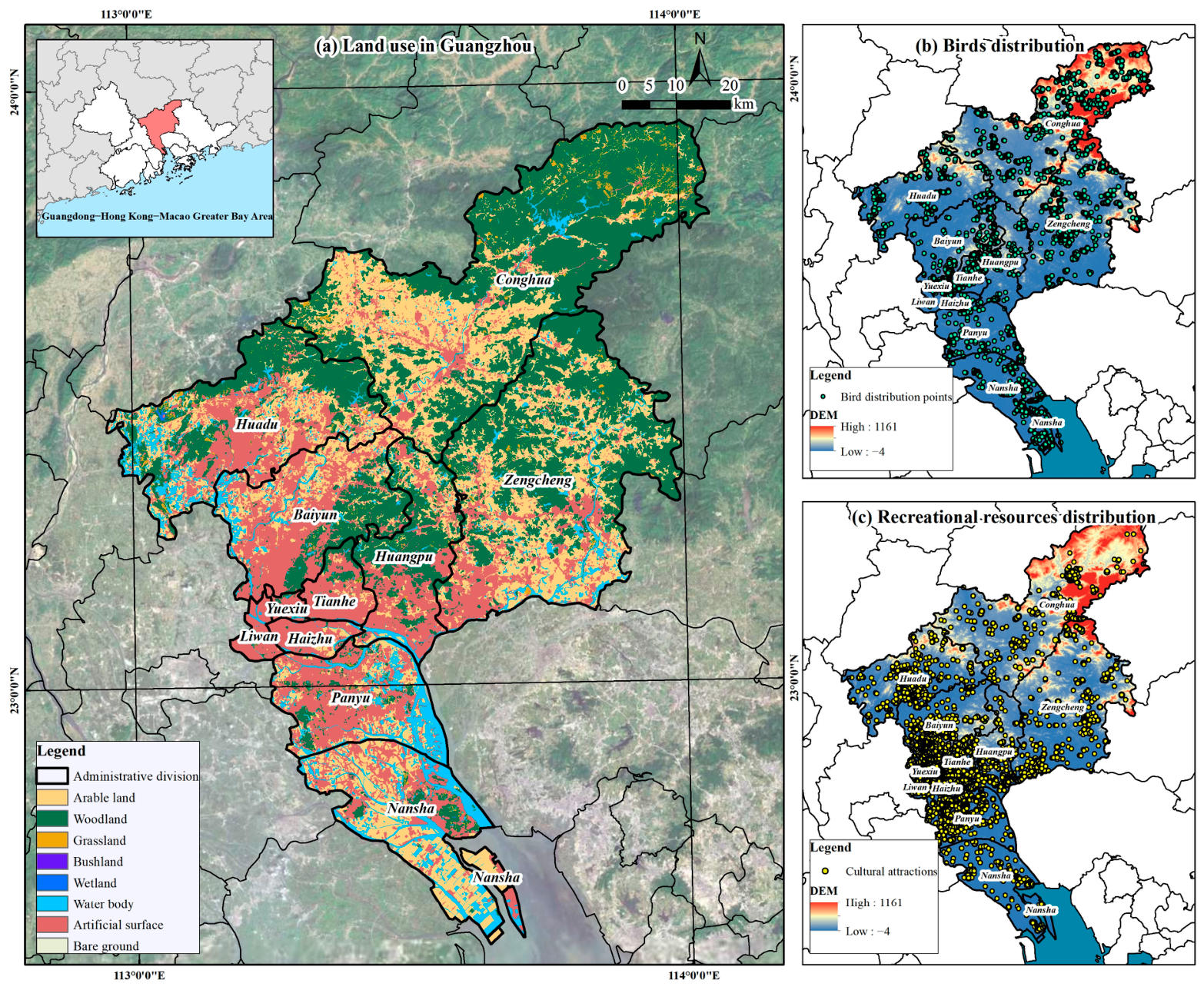
- Avian habitats: Urban sprawl has severely fragmented core habitats, such as northern woodlands and southern wetlands, thereby drastically reducing ecological connectivity.
- (2)
- Thermal environment: Dense building clusters and intense human activities have triggered severe UHI effects, highlighting the urgent need for ventilation corridors between cold sources and heat sinks.
- (3)
- Cultural recreation: The massive population generates immense demand for high-quality outdoor leisure spaces.
2.2. Data Sources
3. Methods
3.1. Research Framework
3.2. Identification of Single-Function “Source-Sink” Landscape Patches
3.2.1. Identification of “Source-Sink” Landscape Patches for Bird Habitat Conservation
3.2.2. Identification of “Source-Sink” Landscape Patches for Thermal Environment Regulation
3.2.3. Identification of “Source-Sink” Landscape Patches for Cultural Recreation
3.3. Construction of Resistance Surfaces for Single-Function ENs
3.3.1. Construction of the Resistance Surface for the Bird Habitat Conservation Network
3.3.2. Construction of the Resistance Surface for the Thermal Environment Regulation Network
3.3.3. Construction of the Resistance Surface for the Cultural Recreation Network
3.4. Construction of Single-Function “Source-Sink” ENs
3.5. Construction of Multi-Functional “Source-Sink” CENs
3.5.1. Identification of Composite “Source-Sink” Landscape Nodes
3.5.2. Construction of Composite Resistance Surfaces and Extraction of Multi-Functional Corridor Networks
3.6. Comprehensive Evaluation and Optimization of the Multi-Functional “Source-Sink” CEN
3.6.1. Analysis of Static Topological Characteristics of the Complex Network
3.6.2. Edge-Addition Optimization Strategies for the Composite Corridor Network
- (1)
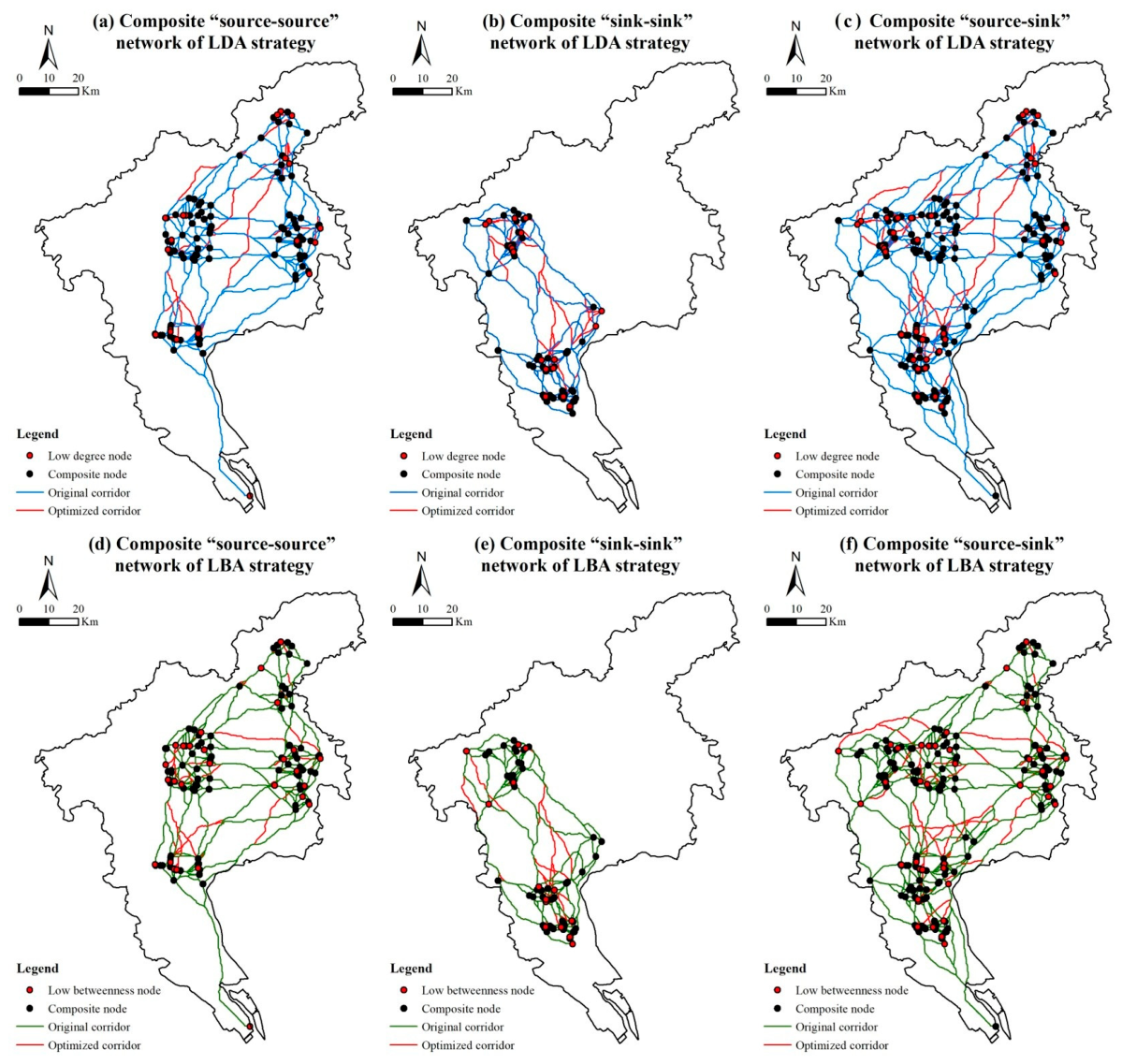
- LDA strategy: The degree values of all nodes were counted and sorted in ascending order, prioritizing the connection of nodes with the lowest degrees.
- (2)
- LBA strategy: The betweenness centrality values of all nodes were counted and sorted in ascending order. Edges were then added between the two unconnected nodes possessing the lowest betweenness centrality.
3.6.3. Robustness Analysis of Composite Corridor Network
4. Results
4.1. Spatial Patterns of Single-Function “Source-Sink” Landscape Patches and ENs
4.1.1. Spatial Distribution Characteristics of Single-Function “Source-Sink” Landscape Patches
4.1.2. Spatial Patterns of Single-Function “Source-Sink” ENs
4.2. Construction Results of the Multi-Functional “Source-Sink” CENs
4.2.1. Spatial Distribution of Composite "Source-Sink" Landscape Nodes
4.2.2. Spatial Patterns of the Multi-Functional “Source-Sink” CENs
4.3. Comprehensive Evaluation and Optimization Results of the Multi-Functional “Source-Sink” CENs
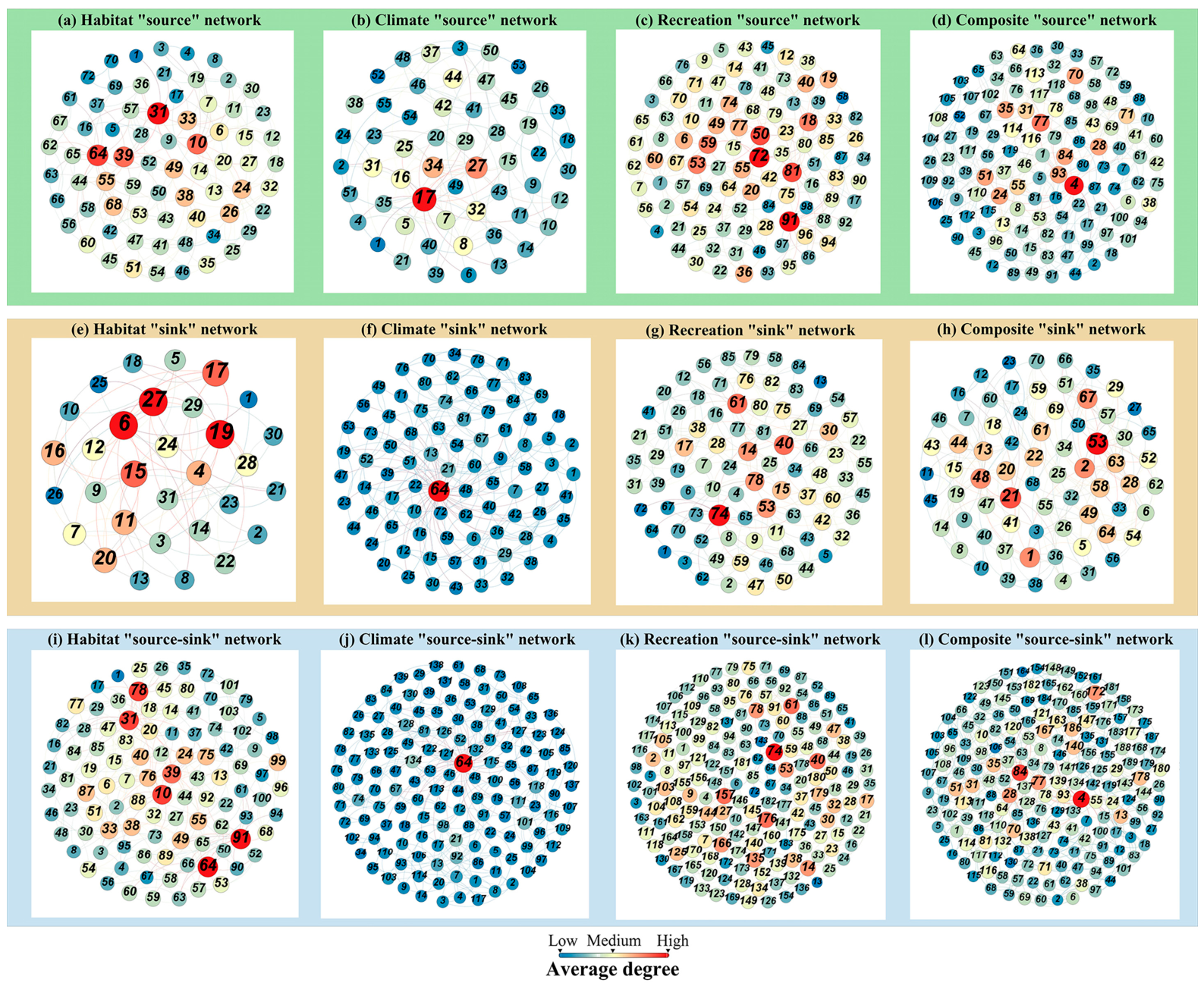
4.3.1. Static Topological Characteristics of the Identified Complex Network
4.3.2. Network Optimization Effects Under Different Edge-Addition Strategies
4.3.3. Comparison of Robustness Performance Under Simulated Network Attacks
5. Discussion
5.1. Constructing a CEN Tailored to the Underlying Landscape Patterns of High-Density Cities Based on the “Source-Sink” Theory
5.2. Evaluating the Structural Characteristics of the CEN in High-Density Cities Based on Complex Network Theory
5.3. Optimizing the Composite “Source-Sink” Network via Edge-Addition Strategies and Assessing Its Robustness
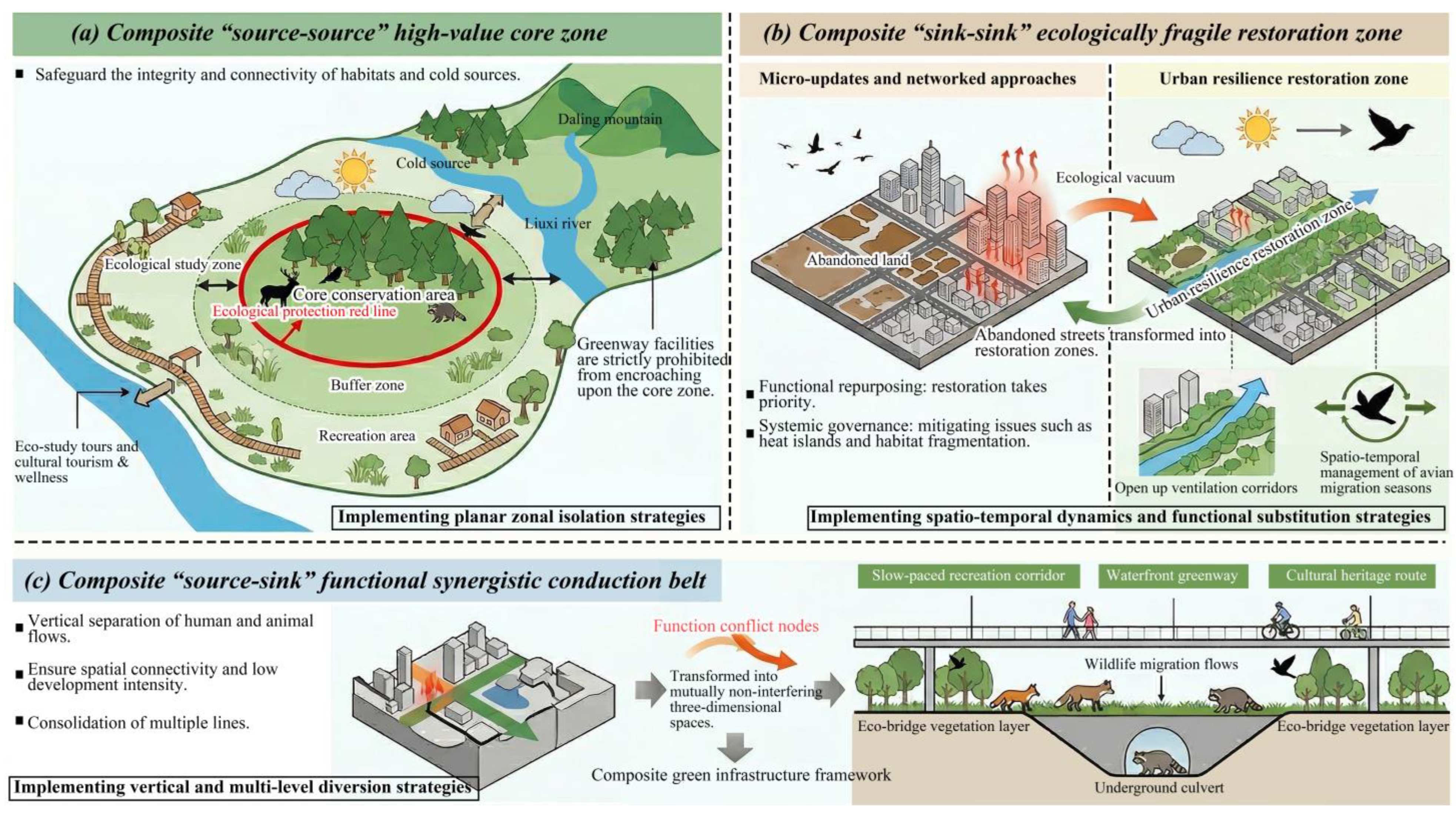
5.4. Management of Multi-Functional Spatial Conflicts and Spatial Planning Implementation Pathways for CENs in High-Density Cities
5.5. Limitations
6. Conclusions
- (1)
- The EN constructed based on the “source-sink” theory exhibited a clear and hierarchical structure. This approach facilitated the identification and reinforcement of key ecological elements across multiple scales [24], effectively reflecting the complex mosaic landscape characteristics of high-density megacities. Furthermore, it transcended the traditional single-objective conservation paradigm by proactively identifying ecological core “sources” and restoration-demanding “sinks” across three dimensions: bird habitat conservation, thermal regulation, and cultural recreation. This directly answered the first research question by providing a scientifically rigorous mechanism to define and identify multi-dimensional “source” and “sink” landscapes within intricate urban environments, establishing a precise spatial foundation for targeted governance.
- (2)
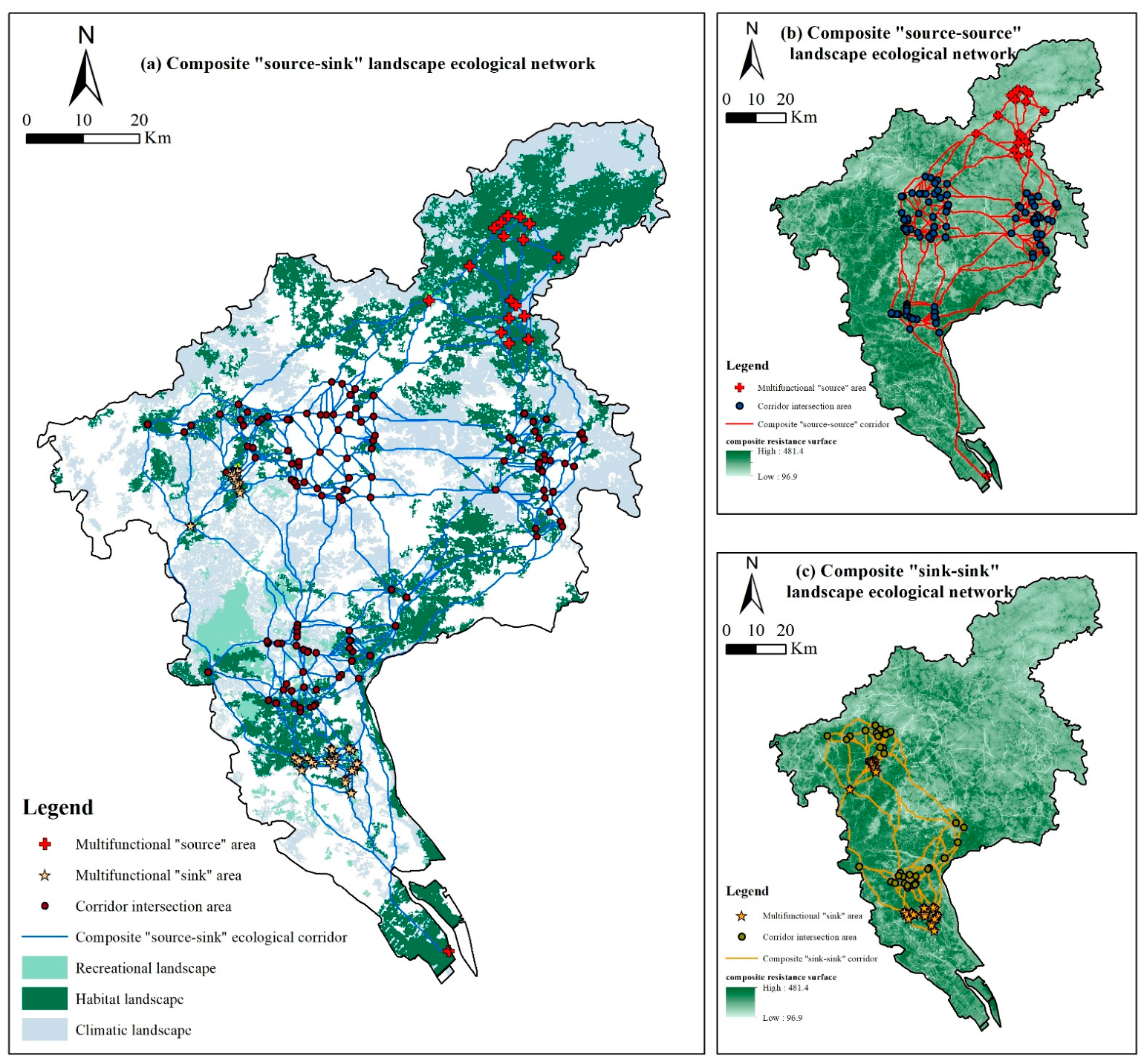
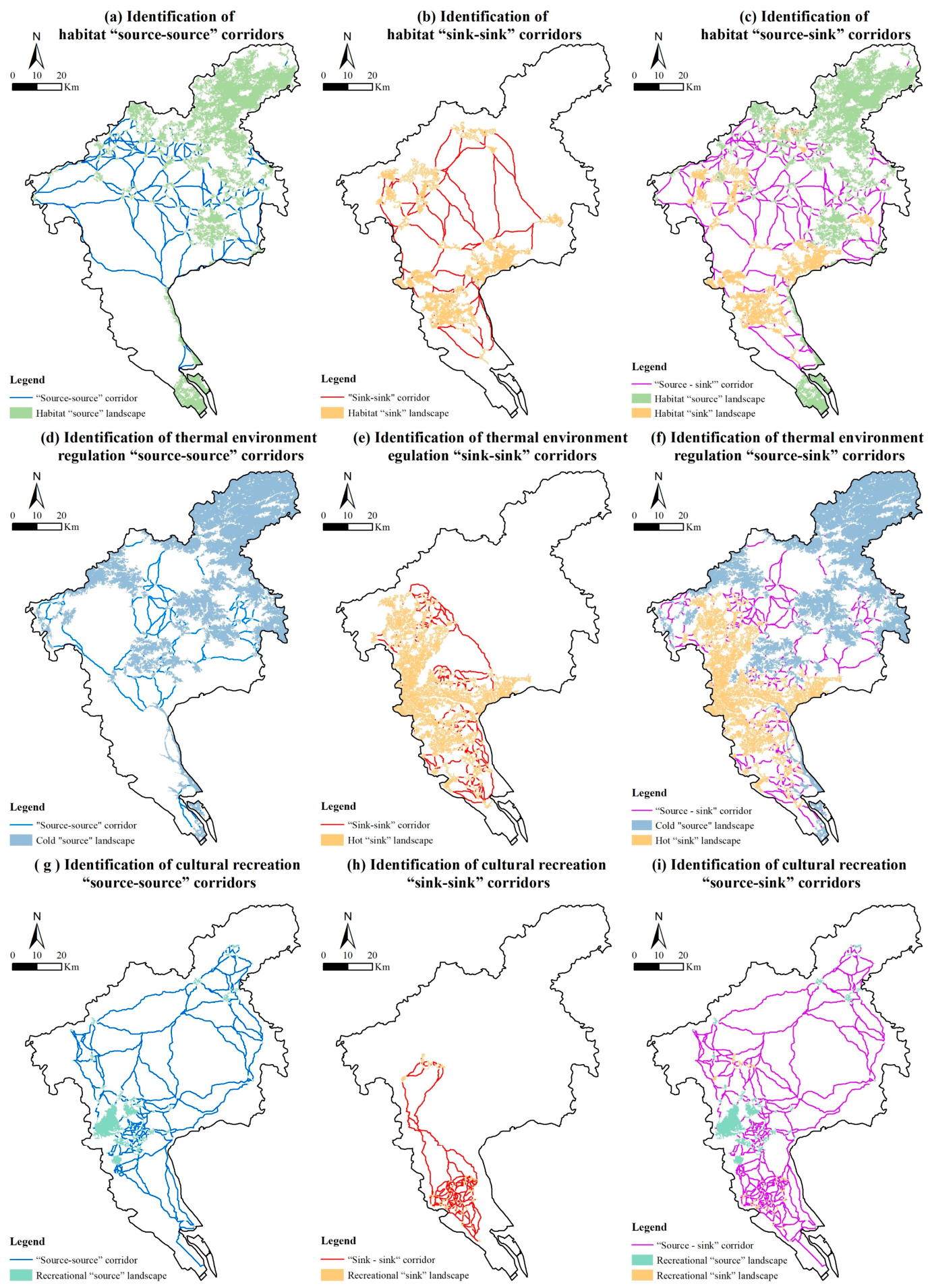
- Driven by natural and anthropogenic forces, the single-function networks exhibited pronounced spatial heterogeneity. The recreational network, characterized by its dispersed web structure, featured the longest corridors and most extensive coverage. In contrast, the habitat and climate networks emphasized the clustered configurations and connectivity of avian habitats and urban cold islands. By integrating these layers, we established a vital urban green skeleton comprising 1137 composite corridors. This framework effectively balanced spatial conflicts in high-density areas by directing cooling effects toward heat sinks, facilitating species dispersal into marginal habitats, and ensuring equitable recreational coverage. This result directly answered the second research question, demonstrating how the “source-sink” framework successfully transcended traditional single-target limitations to construct a multi-functional CEN that actively and effectively mitigated socio-ecological spatial conflicts.
- (3)
- Compared to other analytical methods, complex network analysis excelled in identifying critical nodes or structural bottlenecks, providing robust decision support for systematic regulation [54,59]. Regarding topological performance, the CENs generally exhibited a higher average degree (6.171) than the single-function ENs [60], reflecting stronger node connectivity and a greater diversity of functional flow paths. However, the single-function ENs outperformed them in average clustering coefficient (0.480) and global network efficiency (0.253). This disparity underscored the necessity of coupling multi-functional integration with targeted structural optimization to safeguard the transmission efficiency of specific pathways. This addressed the topological evaluation aspect of the third research question, signifying that quantitative assessment was indispensable because structural integration did not automatically guarantee optimal functional efficiency.
- (4)
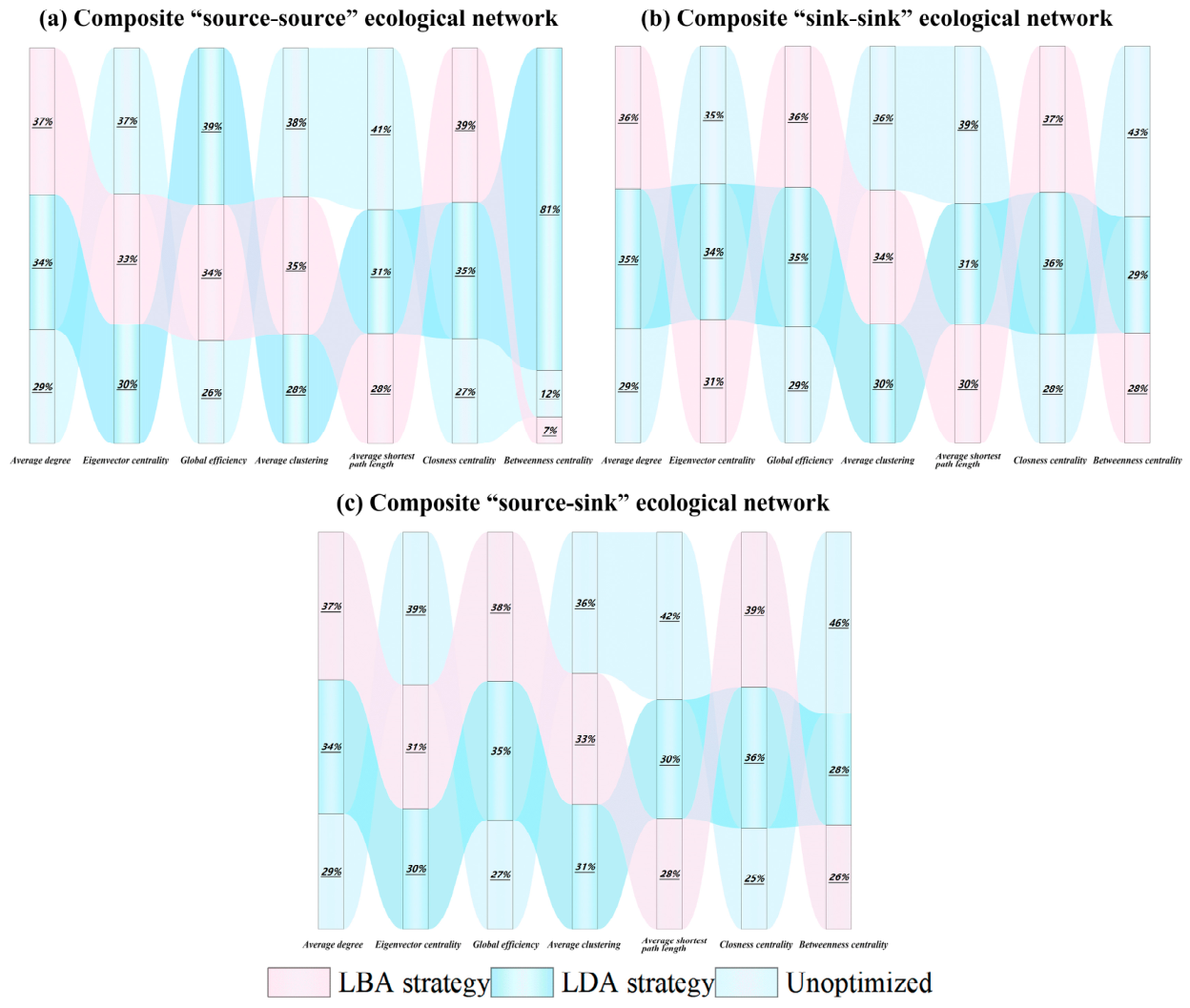
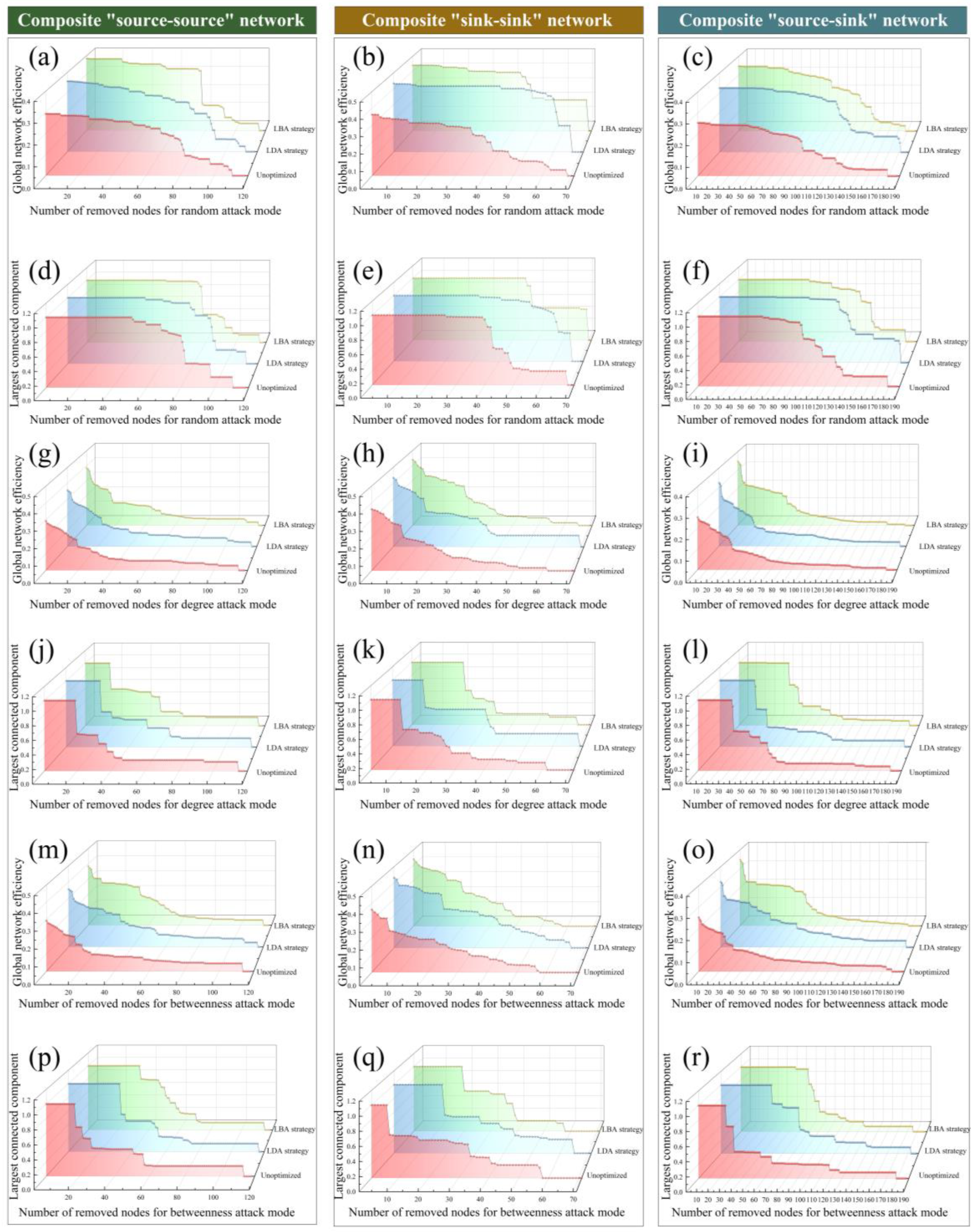
- Optimization and robustness simulations confirmed that the LBA strategy was the optimal approach for the CEN. By prioritizing the reinforcement of peripheral or bridging nodes, this strategy elevated the network’s average degree to 7.903 and achieved a clustering coefficient of 0.447, successfully balancing global connectivity with local aggregation. This paradigm significantly delayed network collapse under targeted disturbances, establishing it as our best optimization scheme. This conclusively answered the quantitative optimization and evaluation components of the third research question, demonstrating how complex network theory equips planners with a mathematically validated strategy (the LBA approach) to safeguard the CEN’s structural robustness under various targeted disturbance scenarios.
Supplementary Materials
Author Contributions
Funding
Data Availability Statement
Acknowledgments
Conflicts of Interest
References
- Yao, M.; Yao, B.; Cenci, J.; Liao, C.; Zhang, J. Visualisation of high-density city research evolution, trends, and outlook in the 21st century. Land 2023, 12, 485. [Google Scholar] [CrossRef]
- Chen, Y.; Peng, L.; Cao, W. Health evaluation and coordinated development characteristics of urban agglomeration: Case study of Fujian Delta in China. Ecol. Indic. 2021, 121, 107149. [Google Scholar] [CrossRef]
- Wang, D.; Wang, P.; Chen, G.; Liu, Y. Ecological–social–economic system health diagnosis and sustainable design of high-density cities: An urban agglomeration perspective. Sustain. Cities Soc. 2022, 87, 104177. [Google Scholar] [CrossRef]
- Wei, L.; Yanbin, C. China’s Economic Growth and High-Quality Development: 2020–2035. China Econ. 2021, 16, 2–17. [Google Scholar] [CrossRef] [PubMed]
- Cao, L.; Wang, K.; Zhao, X.; Zhang, Y. Optimizing composite ecological networks through synergistic risk management, ecological conservation, and recreational integration: A case study of Beijing’s shallow mountain regions. Ecol. Indic. 2025, 170, 113026. [Google Scholar] [CrossRef]
- Vuilleumier, S.; Prélaz-Droux, R. Map of ecological networks for landscape planning. Landsc. Urban Plan. 2002, 58, 157–170. [Google Scholar] [CrossRef]
- Baguette, M.; Blanchet, S.; Legrand, D.; Stevens, V.M.; Turlure, C. Individual dispersal, landscape connectivity and ecological networks. Biol. Rev. 2013, 88, 310–326. [Google Scholar] [CrossRef] [PubMed]
- Geng, J.; Yu, K.; Sun, M.; Xie, Z.; Huang, R.; Wang, Y.; Zhao, Q.; Liu, J. Construction and Optimisation of Ecological Networks in High-Density Central Urban Areas: The Case of Fuzhou City, China. Remote Sens. 2023, 15, 5666. [Google Scholar] [CrossRef]
- Forman, R.T. Some general principles of landscape and regional ecology. Landsc. Ecol. 1995, 10, 133–142. [Google Scholar] [CrossRef]
- Dong, X.; Wang, F.; Fu, M. Research progress and prospects for constructing ecological security pattern based on ecological network. Ecol. Indic. 2024, 168, 112800. [Google Scholar] [CrossRef]
- Li, X.; Ou, X.; Sun, X.; Li, H.; Li, Y.; Zheng, X. Urban biodiversity conservation: A framework for ecological network construction and priority areas identification considering habit differences within species. J. Environ. Manag. 2024, 365, 121512. [Google Scholar] [CrossRef] [PubMed]
- Qian, M.; Huang, Y.; Cao, Y.; Wu, J.; Xiong, Y. Ecological network construction and optimization in Guangzhou from the perspective of biodiversity conservation. J. Environ. Manag. 2023, 336, 117692. [Google Scholar] [CrossRef] [PubMed]
- Li, H.; Zhang, T.; Cao, X.; Yao, L. Active utilization of linear cultural heritage based on regional ecological security pattern along the straight road (Zhidao) of the Qin Dynasty in Shaanxi Province, China. Land 2023, 12, 1361. [Google Scholar] [CrossRef]
- Liu, F.; Liu, J.; Zhang, Y.; Hong, S.; Fu, W.; Wang, M.; Dong, J. Construction of a cold island network for the urban heat island effect mitigation. Sci. Total Environ. 2024, 915, 169950. [Google Scholar] [CrossRef] [PubMed]
- Yan, J.; Fan, S.; Tian, G.; Mu, T.; Liu, H.; Zhang, Y.; Mu, B. Assessing and Optimizing the Connectivity of the Outdoor Green Recreation Network in Zhengzhou from the Perspective of Green Travel. Land 2024, 13, 2085. [Google Scholar] [CrossRef]
- Wu, Z.; Cheng, S.; Xu, K.; Qian, Y. Ecological network resilience evaluation and ecological strategic space identification based on complex network theory: A case study of Nanjing city. Ecol. Indic. 2024, 158, 111604. [Google Scholar] [CrossRef]
- Cao, W.; Jia, G.; Yang, Q.; Sun, H.; Wang, L.; Svenning, J.-C.; Wen, L. Construction of ecological network and its temporal and spatial evolution characteristics: A case study of Ulanqab. Ecol. Indic. 2024, 166, 112344. [Google Scholar] [CrossRef]
- Yang, H.; Xu, W.; Chen, Z.; Xie, X.; Yu, J.; Lei, X.; Guo, S.; Ding, Z. Ecological network construction for bird communities in high-density urban areas: A perspective of integrated approaches. Ecol. Indic. 2024, 158, 111592. [Google Scholar] [CrossRef]
- Hou, W.; Zhai, L.; Walz, U. Identification of spatial conservation and restoration priorities for ecological networks planning in a highly urbanized region: A case study in Beijing-Tianjin-Hebei, China. Ecol. Eng. 2023, 187, 106859. [Google Scholar] [CrossRef]
- Luo, J.; Fu, H. Construct the future wetland ecological security pattern with multi-scenario simulation. Ecol. Indic. 2023, 153, 110473. [Google Scholar] [CrossRef]
- Hashemi, R.; Darabi, H. The review of ecological network indicators in graph theory context: 2014–2021. Int. J. Environ. Res. 2022, 16, 24. [Google Scholar] [CrossRef]
- Bai, J.; Sun, R.; Liu, Y.; Chen, J.; Li, X. Integrating ecological and recreational functions to optimize ecological security pattern in Fuzhou City. Sci. Rep. 2025, 15, 778. [Google Scholar] [CrossRef] [PubMed]
- Yuan, Y.; Yuan, Y.; Bai, Z.; Ma, R.; Huang, Y. Ecological restoration strategies of mining areas based on composite ecological networks: A comprehensive framework and case study. Ecol. Eng. 2025, 220, 107750. [Google Scholar] [CrossRef]
- Xu, Z.; Dong, B.; Qu, J.; Wang, H.; Han, Y.; Gao, X. Optimization of composite ecological network patterns in Anhui Province based on multi-functional coupling of ecology-climate-economy. Ecol. Indic. 2024, 166, 112524. [Google Scholar] [CrossRef]
- Chen, L.; Fu, B.; Zhao, W. Source-sink landscape theory and its ecological significance. Front. Biol. China 2008, 3, 131–136. [Google Scholar] [CrossRef]
- Guan, S.; Zhang, X.; Zhang, T.; Hu, H. Considering the supply and demand of urban heat island mitigation: A study on the construction of “source-flow-sink” cooling corridor network of blue and green landscape. Ecol. Indic. 2025, 174, 113448. [Google Scholar] [CrossRef]
- Xiang, Y.; Cen, Q.; Peng, C.; Huang, C.; Wu, C.; Teng, M.; Zhou, Z. Surface urban heat island mitigation network construction utilizing source-sink theory and local climate zones. Build. Environ. 2023, 243, 110717. [Google Scholar] [CrossRef]
- Liu, X.; Hu, Z.; Wang, Y.; Wang, M.; Hou, W. Resilience assessment and spatial optimization of urban ecological network based on complex network theory and PLUS model. Urban Ecosyst. 2025, 28, 170. [Google Scholar] [CrossRef]
- Xiang, Q.; Yu, H.; Huang, H.; Li, F.; Ju, L.; Hu, W.; Yu, P.; Deng, Z.; Chen, Y. Assessing the resilience of complex ecological spatial networks using a cascading failure model. J. Clean. Prod. 2024, 434, 140014. [Google Scholar] [CrossRef]
- Guo, H.; Cai, Y.; Li, B.; Tang, Y.; Qi, Z.; Huang, Y.; Yang, Z. An integrated modeling approach for ecological risks assessment under multiple scenarios in Guangzhou, China. Ecol. Indic. 2022, 142, 109270. [Google Scholar] [CrossRef]
- Junda, H.; Jinling, H.; Chaojin, C. Construction of ecological network with protected areas as the main region in Guangzhou City, China. Chin. J. Appl. Ecol. 2024, 35, 247. [Google Scholar] [CrossRef] [PubMed]
- Wu, W.-B.; Ma, J.; Banzhaf, E.; Meadows, M.E.; Yu, Z.-W.; Guo, F.-X.; Sengupta, D.; Cai, X.-X.; Zhao, B. A first Chinese building height estimate at 10 m resolution (CNBH-10 m) using multi-source earth observations and machine learning. Remote Sens. Environ. 2023, 291, 113578. [Google Scholar] [CrossRef]
- Pulliam, H.R. Sources, sinks, and population regulation. Am. Nat. 1988, 132, 652–661. [Google Scholar] [CrossRef]
- Zhou, Y.; Li, B.; Li, P.Y.; Yao, J.; Chen, M.K.; Tang, M.; Zhang, L.; Chen, J. Optimization of complex green space ecological network pattern based on the multi-functional coupling of ecology-climate adaption-recreation. Acta Ecol. Sin. 2024, 44, 5854–5866. [Google Scholar] [CrossRef]
- Huang, W.J.; Lin, G.J.; Chi, B.; Yan, Y.; Chen, J.; Li, X.H. Optimization of the composite blue-green ecological network pattern in estuarine basin type cities based on the “source-sink” theory: Taking the central urban area of Fuzhou as an example. Chin. J. Appl. Environ. Biol. 2025. [Google Scholar] [CrossRef]
- Radosavljevic, A.; Anderson, R.P. Making better Maxent models of species distributions: Complexity, overfitting and evaluation. J. Biogeogr. 2014, 41, 629–643. [Google Scholar] [CrossRef]
- Yao, Z.; Jiang, C.; Zong-Cheng, C.; Shi-Yuan, Z.; Guo-Dong, Z. Construction of Ecological Security Pattern Based on Ecological Sensitivity Assessment in Jining City, China. Pol. J. Environ. Stud. 2022, 31, 5383–5404. [Google Scholar] [CrossRef] [PubMed]
- Battin, J. When good animals love bad habitats: Ecological traps and the conservation of animal populations. Conserv. Biol. 2004, 18, 1482–1491. [Google Scholar] [CrossRef]
- Tang, L.; Shao, R.; Zhou, X.; Zhang, Y.; Chen, Z.; Yang, L.; Li, H. Topological and Source–Sink Integrated Analysis of Urban Thermal Environment Networks in a Megacity: Longitudinal Insights from Guangzhou. Sustain. Cities Soc. 2026, 137, 107156. [Google Scholar] [CrossRef]
- Alexander, C. Normalised difference spectral indices and urban land cover as indicators of land surface temperature (LST). Int. J. Appl. Earth Obs. Geoinf. 2020, 86, 102013. [Google Scholar] [CrossRef]
- Hernández-Morcillo, M.; Plieninger, T.; Bieling, C. An empirical review of cultural ecosystem service indicators. Ecol. Indic. 2013, 29, 434–444. [Google Scholar] [CrossRef]
- Li, N.; Zhang, M. Distribution characteristics and influencing factors of tourist attractions in Tianjin based on POI big data. Environ. Dev. Sustain. 2024. [Google Scholar] [CrossRef]
- Xu, C.; Yu, Q.; Wang, F.; Qiu, S.; Ai, M.; Zhao, J. Identifying and optimizing ecological spatial patterns based on the bird distribution in the Yellow River Basin, China. J. Environ. Manag. 2023, 348, 119293. [Google Scholar] [CrossRef] [PubMed]
- Zhang, D.; Zeng, S.; Shi, W.; Namaiti, A.; Zeng, J. Constructing an Ecological Network Integrating Avian Biodiversity and Ecosystem Services in Highly Urbanized Areas: A Case Study of Tianjin, China. Glob. Ecol. Conserv. 2025, 60, e03677. [Google Scholar] [CrossRef]
- Mu, Y.; Xie, Y.; Zhang, L.; Chen, Y. An enhanced normalized difference impervious surface index. Sci. Surv. Mapp. 2018, 43, 83–87. [Google Scholar]
- McRae, B.H.; Dickson, B.G.; Keitt, T.H.; Shah, V.B. Using circuit theory to model connectivity in ecology, evolution, and conservation. Ecology 2008, 89, 2712–2724. [Google Scholar] [CrossRef] [PubMed]
- Chen, D.; Su, H. Identification of influential nodes in complex networks with degree and average neighbor degree. IEEE J. Emerg. Sel. Top. Circuits Syst. 2023, 13, 734–742. [Google Scholar] [CrossRef]
- Saxena, A.; Iyengar, S. Centrality measures in complex networks: A survey. arXiv 2020, arXiv:2011.07190. [Google Scholar] [CrossRef]
- Barthelemy, M. Betweenness centrality in large complex networks. Eur. Phys. J. B 2004, 38, 163–168. [Google Scholar] [CrossRef]
- Nesterov, A.I. On clustering coefficients in complex networks. arXiv 2024, arXiv:2401.02999. [Google Scholar] [CrossRef]
- Dorogovtsev, S.N.; Mendes, J.F. The shortest path to complex networks. arXiv 2004, arXiv:cond. [Google Scholar] [CrossRef]
- Pedroche, F.; Tortosa, L.; Vicent, J.F. An eigenvector centrality for multiplex networks with data. Symmetry 2019, 11, 763. [Google Scholar] [CrossRef]
- Wang, Y.; Zhou, X.; Ding, C.; Li, W.; Huang, L.; Ge, B.; Song, Y. Construction and optimization of the watershed-scale ecological network based on network characteristic analysis: A case study of the Lancang River Basin. Ecol. Indic. 2025, 171, 113164. [Google Scholar] [CrossRef]
- Song, S.; Wang, S.; Shi, M.; Hu, S.; Xu, D. Multiple scenario simulation and optimization of an urban green infrastructure network based on complex network theory: A case study in Harbin City, China. Ecol. Process. 2022, 11, 33. [Google Scholar] [CrossRef]
- Artime, O.; Grassia, M.; De Domenico, M.; Gleeson, J.; Makse, H.; Mangioni, G.; Perc, M.; Radicchi, F. Robustness and resilience of complex networks. Nat. Rev. Phys. 2024, 6, 114–131. [Google Scholar] [CrossRef]
- Wu, Y.; Chen, Z.; Zhao, X.; Liu, Y.; Zhang, P.; Liu, Y. Robust analysis of cascading failures in complex networks. Phys. A-Stat. Mech. Its Appl. 2021, 583, 126320. [Google Scholar] [CrossRef]
- Boccaletti, S.; Bianconi, G.; Criado, R.; Del Genio, C.I.; Gómez-Gardenes, J.; Romance, M.; Sendina-Nadal, I.; Wang, Z.; Zanin, M. The structure and dynamics of multilayer networks. Phys. Rep. 2014, 544, 1–122. [Google Scholar] [CrossRef] [PubMed]
- Zhang, Z.; Wang, X.; Yin, C.; Wen, Q.; Yang, Y.; Lu, X. Construction and Optimization of an Ecological Network Based on Circuit Theory and Complex Network Analysis: A Case of Anyang City, China. Land 2026, 15, 469. [Google Scholar] [CrossRef]
- Song, S.; Xu, D.; Hu, S.; Shi, M. Ecological network optimization in urban central district based on complex network theory: A case study with the urban central district of Harbin. Int. J. Environ. Res. Public Health 2021, 18, 1427. [Google Scholar] [CrossRef] [PubMed]
- Albert, R.; Barabási, A.-L. Statistical mechanics of complex networks. Rev. Mod. Phys. 2002, 74, 47. [Google Scholar] [CrossRef]





| Data Type | Data Source | Resolution |
|---|---|---|
| Remote sensing imagery | The remote sensing imagery data for September 2022 is sourced from the United States Geological Survey (USGS). | 30 m |
| Digital elevation model (DEM) | Geospatial data cloud (https://www.gscloud.cn, accessed on 26 March 2025) | 30 m |
| Land use | The 2020 land use data is sourced from Globe Land 30. | 30 m |
| Bird species distribution points | The 2022 survey data from 100 systematic transects originated from the Institute of Zoology, Guangdong Academy of Sciences, while citizen science species records were sourced from the China Birding Records Center. (http://www.birdreport.cn, accessed on 17 February 2024) | - |
| Cultural and recreational resource site | 2022 List of Grade A Tourist Attractions in Guangzhou (Guangdong Provincial Department of Culture and Tourism), AutoNavi Map POI Data | - |
| Surface temperature | Inversion of remote sensing image data using ENVI software (version 3.4.4) | 30 m |
| River system | Planning Center, Guangdong Provincial Institute of Water Resources and Hydropower Research | - |
| Road traffic | National Geographic Information Resource Catalog Service System | - |
| Annual average temperature | National Climate Data Center (https://www.ncei.noaa.gov/, accessed on 27 March 2025) | 1 km |
| Annual average precipitation | National Climate Data Center (https://www.ncei.noaa.gov/, accessed on 27 March 2025) | 1 km |
| Vegetation cover | Calculating using remote sensing imagery | 30 m |
| Nighttime lighting | National Earth System Science Data Center (https://www.geodata.cn/main/, accessed on 19 April 2025) | 1 km |
| Population density | European Commission Global Human Settlements Layer Dataset (https://human-settlement.emergency.copernicus.eu/, accessed on 19 April 2025) | 100 m |
| Building height | European Commission Global Human Settlements Layer Dataset (https://human-settlement.emergency.copernicus.eu/, accessed on 19 April 2025) | 30 m |
| Building density | China’s First Building Height Dataset [32] | 10 m |
| Research Steps | Objectives | Main Analytical Processes | Core Outcomes and Outputs |
|---|---|---|---|
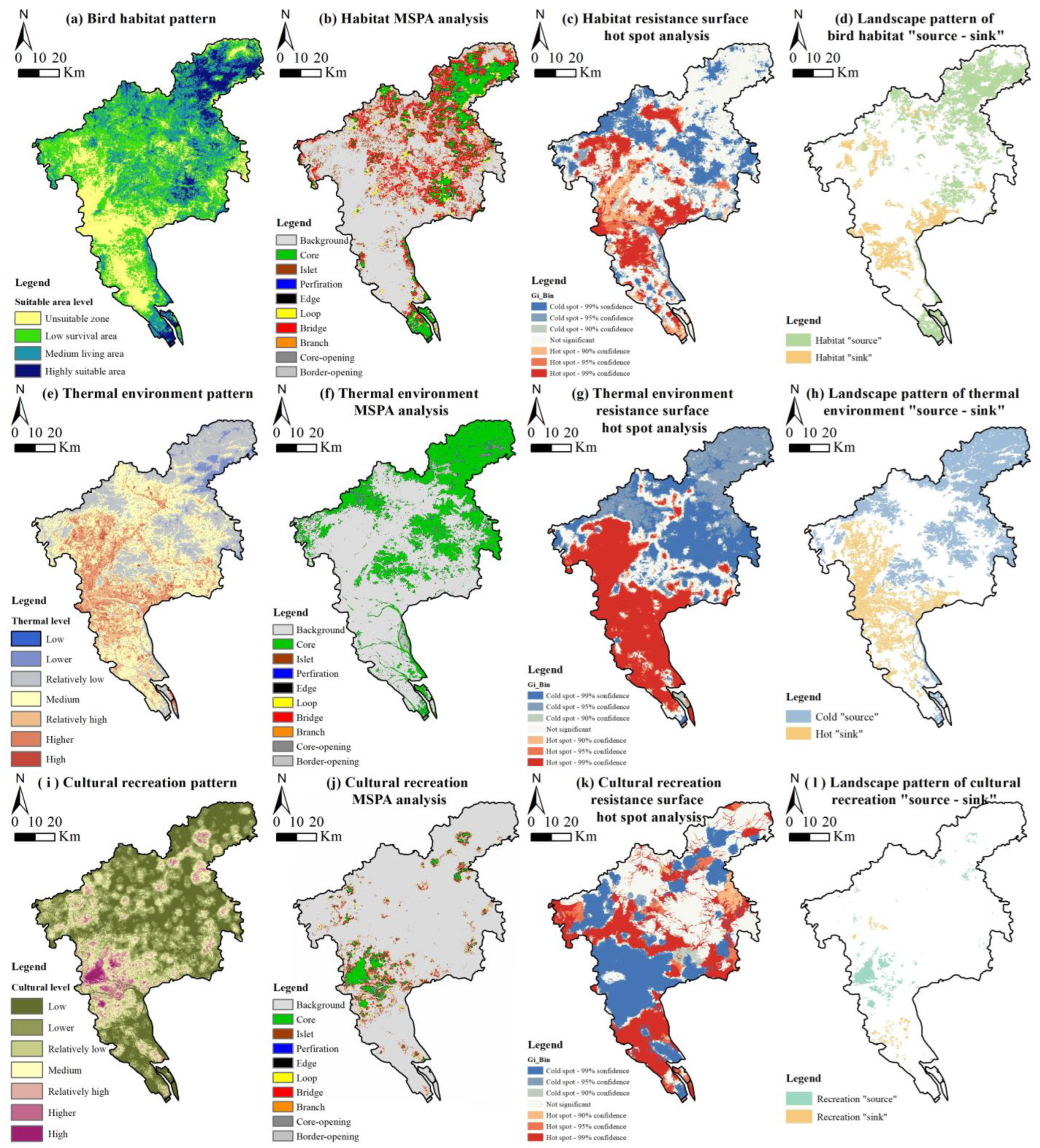
| Step 1: Identification of single-function “source-sink” landscape patches | Aims to spatially delineate the “source” areas of ecological service supply and the “sink” areas of demand for three core functions. | By comprehensively applying the MaxEnt model, MSPA, LST retrieval, Conefor landscape connectivity analysis, and hotspot analysis, core “sources” were extracted; furthermore, high-resistance hotspots were identified as “sinks.” | Single-function source and sink patches for bird habitat, thermal regulation, and cultural recreation. |
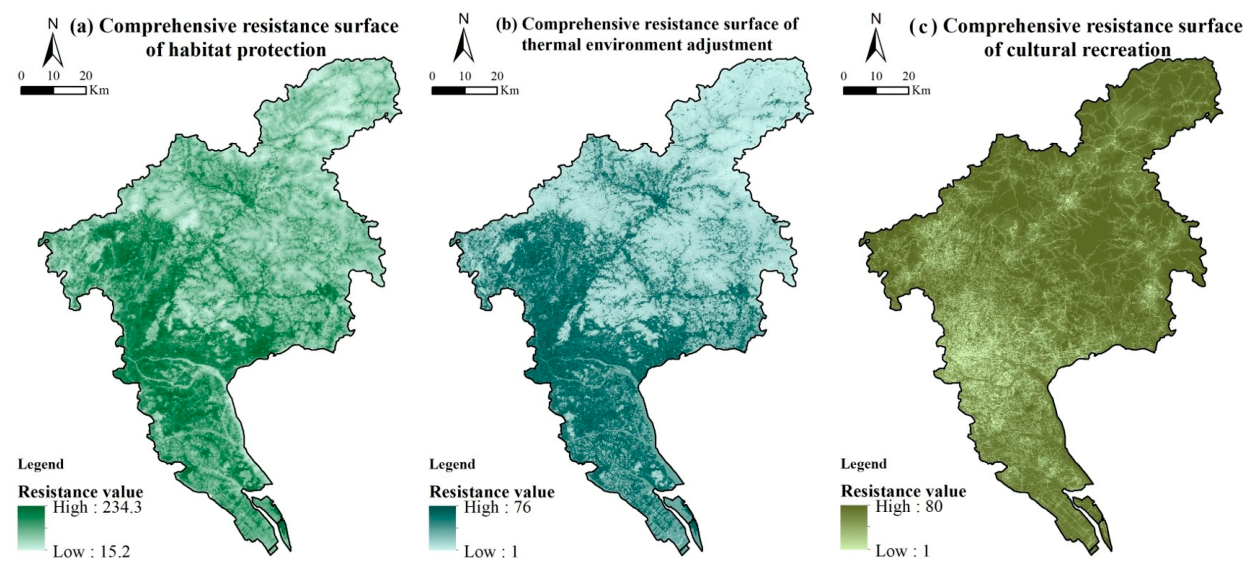
| Step 2: Construction of single-function resistance surfaces | To establish functionally heterogeneous resistance surface representing natural and anthropogenic barriers. | The AHP analysis method was employed to select, classify, and assign weights to multi-dimensional indicators (e.g., 11 items for bird habitat, 5 for the thermal environment, and 5 for recreation). | Three heterogeneous resistance surfaces tailored to each specific network function. |
| Step 3: Extraction of single-objective corridors and synthesis of multi-functional CEN | To extract independent networks and integrate them into a multi-functional framework that mitigates spatial conflicts. | Single-target pathways were extracted using circuit-theoretic model; patch centroids and corridor intersections were overlaid—in conjunction with hotspot analysis—to identify composite nodes; a composite resistance surface was generated through buffer analysis, and a composite “source-sink” network was constructed. | Constructing a multifunctional CEN (comprising composite “source-source,” “sink-sink,” and “source-sink” corridors). |
| Step 4: Analysis of static topological characteristics | To quantitatively assess the connectivity of different network structures and identify structural bottlenecks. | Utilizing Gephi software (version 0.10.1), patches were abstracted as nodes and corridors as edges to construct an undirected, scale-free network, and topological indices were calculated. | Baseline network evaluation metrics (Average degree, centralities, clustering coefficient, and shortest path length). |
| Step 5: Edge-addition optimization strategies | To direct topological optimization and forge redundant alternative pathways under realistic urban constraints. | Sort node degrees and betweenness centralities in ascending order, and use MATLAB software (version R2025b) to simulate the LDA and LBA edge-addition strategies under a 30% upper threshold. | Optimized composite “source-sink” landscape corridor network configurations. |
| Step 6: Robustness analysis of the CEN | To evaluate and compare network stability and resilience under external shocks pre- and post-optimization. | Simulated network attack scenarios (random node attacks, degree-based attacks, and betweenness-based attacks); evaluated the degradation rates of network efficiency and connectivity. | Network robustness curves tracking global network efficiency (E) and largest connected component (M) to verify the optimal strategy. |
| Resistance Factors | Weight | Indicator Grading | Resistance Value |
|---|---|---|---|
| Landscape ecological risk | 0.18 | High risk (>0.07) | 80 |
| Higher risk (0.04–0.07) | 60 | ||
| Moderate risk (0.03–0.04) | 40 | ||
| Lower risk (0.02–0.03) | 20 | ||
| Low risk (<0.02) | 1 | ||
| Landscape types | 0.16 | Construction land | 80 |
| Bare ground | 60 | ||
| Arable land | 40 | ||
| Grassland, shrub | 20 | ||
| Woodland, wetland, water bodies | 1 | ||
| Elevation | 0.04 | >800 m | 80 |
| 600–800 m | 60 | ||
| 400–600 m | 40 | ||
| 200–400 m | 20 | ||
| <200 m | 1 | ||
| Slope | 0.03 | >35° | 80 |
| 25–35° | 60 | ||
| 15–25° | 40 | ||
| 8–15° | 20 | ||
| 0–8° | 1 | ||
| Vegetation coverage | 0.14 | 0–0.2 | 80 |
| 0.2–0.4 | 60 | ||
| 0.4–0.6 | 40 | ||
| 0.6–0.8 | 20 | ||
| 0.8–1.0 | 1 | ||
| Water body buffer distance | 0.06 | >1500 m | 80 |
| 800–1500 m | 60 | ||
| 500–800 m | 40 | ||
| 200–500 m | 20 | ||
| <200 m | 1 | ||
| Road buffer distance | 0.07 | >1500 m | 80 |
| 800–1500 m | 60 | ||
| 500–800 m | 40 | ||
| 200–500 m | 20 | ||
| <200 m | 1 | ||
| Normalized nighttime light index | 0.08 | >0.3 | 80 |
| 0.1–0.3 | 60 | ||
| 0.04–0.1 | 40 | ||
| 0.01–0.04 | 20 | ||
| <0.01 | 1 | ||
| Population density | 0.06 | >2000 | 80 |
| 1000–2000 | 60 | ||
| 500–1000 | 40 | ||
| 50–500 | 20 | ||
| <50 | 1 | ||
| Building height | 0.08 | >100 m | 80 |
| 28–100 m | 60 | ||
| 24–28 m | 40 | ||
| 10–24 m | 20 | ||
| <10 m | 1 | ||
| Building density | 0.1 | >60 | 80 |
| 45–60 | 60 | ||
| 35–45 | 40 | ||
| 15–35 | 20 | ||
| <15 | 1 |
| Resistance Indicator | Weight | Indicator Grading | Resistance Value |
|---|---|---|---|
| Building density | 0.3 | >60 | 80 |
| 45–60 | 60 | ||
| 35–45 | 40 | ||
| 15–35 | 20 | ||
| <15 | 1 | ||
| NDVI | 0.25 | 0–0.2 | 80 |
| 0.2–0.4 | 60 | ||
| 0.4–0.6 | 40 | ||
| 0.6–0.8 | 20 | ||
| 0.8–1.0 | 1 | ||
| ENDISI | 0.2 | Impermeable surface | 80 |
| Other types | 1 | ||
| Elevation | 0.15 | <200 m | 80 |
| 200–400 m | 60 | ||
| 400–600 m | 40 | ||
| 600–800 m | 20 | ||
| >800 m | 1 | ||
| Slope | 0.1 | >35° | 80 |
| 25–35° | 60 | ||
| 15–25° | 40 | ||
| 8–15° | 20 | ||
| 0–8° | 1 |
| Resistance Indicator | Weight | Indicator Grading | Resistance Value |
|---|---|---|---|
| Accessibility of recreational patches | 0.2 | >2000 m | 80 |
| 2000 m | 60 | ||
| 1500 m | 40 | ||
| 1000 m | 20 | ||
| 500 m | 1 | ||
| Road classification | 0.15 | Non-road area | 80 |
| High way | 60 | ||
| Expressway | 40 | ||
| Secondary roads, branch roads | 20 | ||
| Main road | 1 | ||
| The cultural service value of the path | 0.2 | 1–2 | 80 |
| 3–4 | 60 | ||
| 5–6 | 40 | ||
| 7–8 | 20 | ||
| 9–10 | 1 | ||
| Density of scenic spots along the path | 0.15 | 1 | 80 |
| 2 | 60 | ||
| 3 | 40 | ||
| 4 | 20 | ||
| 5 | 1 | ||
| Water buffer distance | 0.3 | >600 m | 80 |
| 600 m | 60 | ||
| 300 m | 40 | ||
| 100 m | 20 | ||
| 50 m | 1 |
| Indicator Name | Definition | Formula | Note |
|---|---|---|---|
| Average degree [47] | The importance of a node reflects the number of connections to the node. | Where N is the total number of nodes in the network, and ki is the number of edges directly connected to node i. | |
| Closeness centrality [48] | Reflects the proximity of a node to other nodes in the network. | Where dij represents the shortest path length between node i and node j. | |
| Betweenness centrality [49] | Measures the degree to which a node plays the role of an information hub in the network. | Where σst is the total number of shortest paths from node s to node t, and σsti is the total number of paths through node i among the shortest paths of these nodes. | |
| Average clustering coefficient [50] | The degree of aggregation of network nodes reflects the frequency of ecological information transmission between nodes. | Where Ci is the clustering coefficient, ki is the actual number of edges connecting node i, and L is the actual number of edges from node i to adjacent nodes. | |
| Average shortest path length [51] | Measures the average distance of all nodes in the network and reflects the tightness of the network connection. | Where dij is the shortest path length from node i to j. | |
| Eigenvector centrality [52] | Reflects the importance of connected nodes in the network. | Where is a constant (eigenvalue), Aij is an element in the adjacency matrix, indicating whether nodes i and j are connected. | |
| Global network efficiency [53] | Measures the efficiency of information transmission between nodes in the network. The higher the value, the higher the transmission efficiency. | Where N is the total number of network nodes, dij is the shortest path length from node i to j. |
| Network Type | Indicator Name | ||||||
|---|---|---|---|---|---|---|---|
| Average Degree | Eigenvector Centrality | Global Network Efficiency | Average Clustering Coefficient | Average Shortest Path Length | Closeness Centrality | Betweenness Centrality | |
| Habitat “source” network | 5.070 | 0.106 | 0.345 | 0.514 | 3.671 | 0.277 | 0.038 |
| Climate “source” network | 4.145 | 0.096 | 0.328 | 0.447 | 3.751 | 0.301 | 0.048 |
| Recreation “source” network | 4.938 | 0.074 | 0.285 | 0.469 | 4.600 | 0.222 | 0.037 |
| Composite “source” network | 5.982 | 0.069 | 0.293 | 0.483 | 4.396 | 0.232 | 0.029 |
| Habitat “sink” network | 4.516 | 0.164 | 0.457 | 0.486 | 2.741 | 0.372 | 0.060 |
| Climate “sink” network | 4.833 | 0.080 | 0.413 | 0.565 | 2.808 | 0.368 | 0.022 |
| Recreation “sink” network | 4.917 | 0.089 | 0.313 | 0.467 | 4.111 | 0.248 | 0.037 |
| Composite “sink” network | 6 | 0.098 | 0.364 | 0.508 | 3.521 | 0.288 | 0.037 |
| Habitat “source-sink” network | 5.215 | 0.086 | 0.302 | 0.517 | 4.235 | 0.240 | 0.032 |
| Climate “source-sink” network | 4.848 | 0.056 | 0.340 | 0.542 | 3.319 | 0.320 | 0.016 |
| Recreation “source-sink” network | 5.114 | 0.051 | 0.221 | 0.456 | 6.085 | 0.167 | 0.028 |
| Composite “source-sink” network | 6.171 | 0.052 | 0.253 | 0.480 | 4.992 | 0.203 | 0.021 |
Disclaimer/Publisher’s Note: The statements, opinions and data contained in all publications are solely those of the individual author(s) and contributor(s) and not of MDPI and/or the editor(s). MDPI and/or the editor(s) disclaim responsibility for any injury to people or property resulting from any ideas, methods, instructions or products referred to in the content. |
© 2026 by the authors. Licensee MDPI, Basel, Switzerland. This article is an open access article distributed under the terms and conditions of the Creative Commons Attribution (CC BY) license.
Share and Cite
Li, H.; Du, J.; Guo, W.; Xu, Q.; Zhu, J.; Xu, Z.; Gao, W. Construction of Multi-Functional Composite Resilient Ecological Networks in High-Density Cities. Land 2026, 15, 1097. https://doi.org/10.3390/land15061097
Li H, Du J, Guo W, Xu Q, Zhu J, Xu Z, Gao W. Construction of Multi-Functional Composite Resilient Ecological Networks in High-Density Cities. Land. 2026; 15(6):1097. https://doi.org/10.3390/land15061097
Chicago/Turabian StyleLi, Hui, Jiaheng Du, Wanqi Guo, Qing Xu, Jinli Zhu, Zhenzhou Xu, and Wei Gao. 2026. "Construction of Multi-Functional Composite Resilient Ecological Networks in High-Density Cities" Land 15, no. 6: 1097. https://doi.org/10.3390/land15061097
APA StyleLi, H., Du, J., Guo, W., Xu, Q., Zhu, J., Xu, Z., & Gao, W. (2026). Construction of Multi-Functional Composite Resilient Ecological Networks in High-Density Cities. Land, 15(6), 1097. https://doi.org/10.3390/land15061097