Article

A Reproducible Space–Time Cube Workflow for Domestic Tourism Mobility: Madrid-Origin Flows Across Spain (September 2019–September 2025)


by
José Manuel Sánchez-Martín
Faculty of Business, Finance, and Tourism, University of Extremadura, Avenida de la Universidad, S/N, 10071 Cáceres, Spain
Land 2026, 15(5), 887; https://doi.org/10.3390/land15050887 (registering DOI)
Submission received: 29 April 2026 / Revised: 17 May 2026 / Accepted: 19 May 2026 / Published: 20 May 2026
(This article belongs to the Special Issue Spatial Patterns and Urban Indicators on Land Use and Climate Change)

Abstract

This study analyzes domestic tourism mobility in Spain using aggregated and anonymized mobile phone data, with a particular focus on the outbound market of the municipality of Madrid and its territorial redistribution between September 2019 and September 2025. Using experimental statistics from the National Institute of Statistics (INE), a monthly series of origin–destination flows to all Spanish municipalities was constructed, harmonizing the municipal database and incorporating intensive indicators to improve inter-territorial comparability. The spatiotemporal dynamics were integrated into a Space–Time Cube (monthly resolution), and Emerging Hot Spot Analysis (EHSA) was applied to classify the persistence, intensification, or attenuation of high- and low-intensity clusters. Additionally, the grouping of time series allowed for the identification of seasonal patterns associated with coastal, urban, and nearby inland destinations. The results show: (i) a synchronous disruption in the spring of 2020 linked to COVID-19; (ii) a staggered recovery beginning in 2021, consolidating in 2023–2025; and (iii) a dual structural pattern, with a strong concentration of volumes in large urban and coastal hubs, along with high relative intensities in small municipalities in the ring surrounding Madrid. EHSA identifies intensifying hotspots in established coastal systems (Costa del Sol and Costa Blanca) and cooling or attenuated dynamics in parts of the inland region, consistent with the reconfiguration of the “tourism radius” following the pandemic. Limitations arising from statistical confidentiality and the representativeness of the source are discussed, and future research directions are proposed based on the integration of the information with expenditure and transportation data and on spatiotemporal modeling to support destination planning and management.

1. Introduction

Resilience in tourism refers to the capacity of territorial systems to absorb disturbances, reorganize, and recover or transform their functions without losing their identity. In the case of mobility, this manifests in the relative stability of corridors and centrality, in variations in travel distance, as well as in spatial reconfigurations of demand in response to events resulting from restrictions, perceptions of risk, or disruptions in connectivity. These variations are not explained solely by volumes, but by frictions, rhythms, infrastructures, and regulations that modulate which trips are triggered and with what intensity, shaping a socio-technical framework where accessibility and temporality act as structuring forces [1,2,3]. In this sense, the pandemic caused by COVID-19 constitutes an exogenous shock particularly well-suited for observing differential resilience, as it generates heterogeneous contractions and recoveries depending on destination types and territorial scales [4,5].
In this context, urban areas occupy a dual role in this debate, as they are simultaneously major source markets and urban destinations underpinned by functional centrality, the presence of advanced services, and cultural attractiveness. Evidence from the pandemic period suggests, however, that urban destinations and more internationalized systems suffered more intense and prolonged impacts, while nearby destinations with lower perceived density or greater dependence on the domestic markets showed greater relative resilience and earlier recoveries. In Spain, analyses using mobile data for the summers of 2019–2021 originating in Madrid point to an intensification of nearby and lower-density destinations compared to a decline in urban destinations, thus reinforcing the idea of a temporary rescaling of tourism behavior and a selective reorganization of centralities.
Consequently, tourism resilience should not be understood as an automatic return to the previous state, but rather as a process combining normalization, persistence, and potential new trajectories, influenced by connectivity, the territorial structure of the product, and the adaptability of destinations. Operationally, the origin–destination (OD) model allows us to observe how hierarchies are maintained or shifted and how dominant corridors emerge following a disruption, while the use of high-frequency data sources (mobile telephony) expands observational capacity and, at the same time, requires intertemporal comparability, traceability, and methodological reproducibility [6,7]. This framework ties into the contemporary debate on big data topics highly relevant in both tourism and mobility—which calls for transforming massive data into actionable knowledge through transparent and replicable methodologies.
This theoretical framework justifies the design of this study, while also guiding the interpretation of results toward an analysis of tourist flows originating in Madrid—an aspect that allows us to assess how a major metropolis redistributes its tourism demand during pre-, peri-, and post-pandemic cycles. This makes it possible to identify both persistence (structural destinations) and intensifications or attenuations (signs of relative strengthening or weakening in attractiveness). Integration into a Space–Time Cube (STC) and classification using Emerging Hotspot Spatial Analysis (EHSA) allow for the operationalization of ‘resilience’ as spatiotemporal patterns grounded in statistical evidence and facilitate the comparison of trajectories between destinations using a reproducible protocol [8,9,10,11,12]. In this way, the article aims to link resilience theory and urban tourism mobility, while also pursuing an analytical framework transferable to other source markets or inter-urban comparisons.
Domestic tourism mobility constitutes a field of convergence between the geography of mobility, the economics of tourism, and spatial big data analytics. Within this framework, internal flows are not mere counts of trips, but rather constellations of mobility where accessibility, safety, seasonality, and the attractiveness of places structure the territorial organization of demand [13,14,15].
The formalization of these processes through origin–destination (OD) matrices provide an analytical language for observing the production and reproduction of hierarchies, centralities, and peripheries, as well as the emergence of dominant corridors and the redistribution of demand in response to shocks or gradual changes in supply and connectivity. Interpreted as weighted graphs or networks, OD matrices connect classical approaches to spatial interaction (attractiveness and distance/cost friction) with approaches centered on connectivity, path dependence, and dynamic reconfiguration. This potential is reinforced by high-frequency, large-scale data sources, which expand observational capacity. However, they also demand greater rigor in terms of external validity, intertemporal comparability, traceability, and reproducibility of analytical procedures [16,17], in line with the debate on big data in tourism and mobility [18,19].
Data from mobile networks have established themselves as a key input for estimating dynamic populations and flows with high spatiotemporal resolution. In the analysis of tourism mobility, they allow for the observation of trajectories, sequences, and patterns of concentration that are difficult to capture with traditional surveys [20]. However, their use requires robust inference protocols when modeling OD matrices, testing seasonality, or detecting structural reconfigurations. This is due to three main limitations. On the one hand, they do not directly observe “tourism” but rather signals of presence and movement, so they require certain data cleaning steps. On the other hand, they may incorporate coverage biases linked to demographic structure, the urban–rural habitat dichotomy, and device usage. Finally, aggregation and anonymization, while necessary, shift the emphasis toward calibration, validation, and transparent documentation of the pipeline [21,22,23]. Consequently, the literature recommends systematically auditing coverage and spatiotemporal variations, especially at fine scales [24,25].
In Spain, the incorporation of this data into official statistics has advanced through its open-access publication and its use to improve the geographic and functional disaggregation of mobility, in line with statistical modernization, although challenges regarding sustainable access, quality assurance, and statistical confidentiality persist. At the same time, without strict assumptions or complementary sources, it remains difficult to accurately distinguish tourists from non-tourists and to capture semantic dimensions of travel (motivation, experience, opinions, or spending), which reinforces the need to combine sources and validate them systematically [26,27,28,29], as the National Institute of Statistics (INE) does before publishing information on tourist mobility.
Operationally, OD inference based on network signaling is typically organized into a pipeline that integrates quality control, detection of residence and significant locations, spatial aggregation, deduplication and expansion with calibrated factors, and external validation against surveys, counts, and administrative records [30]. Nevertheless, comparative evidence indicates that reliability decreases when very fine spatial resolutions are enforced and that short trips are particularly sensitive to detection biases and edge effects. Therefore, the design of spatial units and temporal scales must balance resolution and robustness and be documented to facilitate replication and transfer [31,32]. In particular, the construction and calibration of OD matrices from Call Data Records (CDR) improves when trip inference is combined with external counts or network constraints, reinforcing the desirability of explicit calibration/validation strategies to maintain intertemporal comparability and explanatory power [33].
On this basis, advanced spatiotemporal approaches allow for the characterization of the territorial dynamics of tourism demand using pattern mining techniques [34,35]. In particular, the construction of Space–Time Cubes (STC) and the application of Emerging Hot Spot Analysis (EHSA) facilitate the detection of clusters and intensity trends with an explicit statistical foundation. EHSA applies a spatiotemporal formulation of the Getis–Ord Gi* statistic and complements it with trend tests to classify the evolution of hot and cold spots by location. Furthermore, the 3D visualization of the cube supports the exploration of local patterns and comparisons between locations [36,37,38,39].
For all these reasons, approaching domestic tourism mobility from a mobility perspective means treating flows as socio-technical systems where infrastructure, regulation, rhythms, and frictions converge. These factors determine which connections are activated and with what intensity, going beyond a mere count of trips [14,15]. In operational terms, this perspective requires tools capable of capturing relational structure and change, hence the relevance of formalizing demand as origin–destination matrices and analyzing them with mobile data, always under explicit protocols for inference, calibration, and validation to ensure comparability and external validity [20,25]. In turn, the shift from analyzing tourist volumes to seeking dynamics in technical demand that identify persistence and regime changes with a statistical foundation and a spatiotemporal interpretation justifies the integration of OD series into a Space–Time Cube and the application of Emerging Hot Spot Analysis as a framework for detecting local trends over time. This complementary framework aligns with the agenda of tourism analytics based on big data and smart tourism, which underscores the need to transform massive data signals into actionable knowledge through transparent and reproducible methodologies [18,19].
The 2020 health crisis profoundly and selectively reshaped the tourism mobility system. In Europe and Spain. Recent studies have detected more intense and prolonged contractions in large urban areas and highly internationalized destinations, compared to the relative resilience of nearby and less densely populated destinations, which saw early rebounds during the recovery; a partial renationalization of flows and the consolidation of short- and medium-distance corridors are also observed [40,41]. Empirical evidence on Spain shows that regional tourism resilience during the summer of 2020 was heterogeneous and was associated, among other factors, with prior specialization in the domestic market and population density [41]. Meanwhile, analysis using mobile data for the summers of 2019–2021 from Madrid reveals nearby, lower-density winners, as opposed to urban losers, underscoring the usefulness of these sources for measuring the spatially unequal impact of the pandemic [32]. The analysis of broad time series covering pre-, peri-, and post-pandemic stages thus allows us to distinguish shifts in trends, normalization processes, and corridor realignments, as well as to assess the persistence or reversal of changes induced by the disruption.
Although international demand is key for many destinations, the source used (aggregated mobile phone data from the INE) describes resident mobility; therefore, the analysis is limited to the Madrid source market. Consequently, a comparison with international flows is proposed as a future line of research through triangulation with complementary tourism statistics. The analysis examines, at high resolution, the territorial redistribution of demand and its reconfiguration during the pre-, peri-, and post-pandemic cycles. It also seeks to identify trends, persistence, and regime shifts by integrating the time series into a STC and applying EHSA. Additionally, other contributions are proposed, such as evaluating the differential impact of COVID-19 and the 2022–2025 recovery on corridors, centralities, and peripheries; documenting a reproducible protocol for analysis and external validation that can be transferred to other origins or geographic areas; and establishing a research agenda focused on integration with expenditure and transportation data and the development of spatiotemporal forecasting models based on big data and machine learning, in line with recent developments in tourism analytics and “smart tourism” ecosystems [42,43,44,45,46,47].
In this context, the study aims to identify and quantify monthly origin–destination (OD) flows of domestic tourism between September 2019 and September 2025 using aggregated and anonymized mobile data published by the INE as experimental statistics. To this end, a reproducible three-stage protocol is implemented: (i) construction and harmonization of the monthly OD series, ensuring intertemporal comparability in the face of changes in coverage [30]; (ii) integration of the series into a Space–Time Cube (STC) and application of Emerging Hot Spot Analysis (EHSA) to obtain trend categories comparable across locations, supported by 3D exploration of the cube to contextualize the local temporal structure [48]; and (iii) grouping of time series by destination to identify seasonal signatures and evaluate their relationship with territorial attributes, contrasting typologies associated with coast–interior, urban–rural gradients, and land accessibility corridors [36,49].
Taken together, this study aims to provide a territorial analysis of domestic tourism mobility that integrates mobility theory, spatial interaction, and spatiotemporal mining, under criteria of transparency and reproducibility consistent with best practices in the use of big data.

2. Materials and Methods

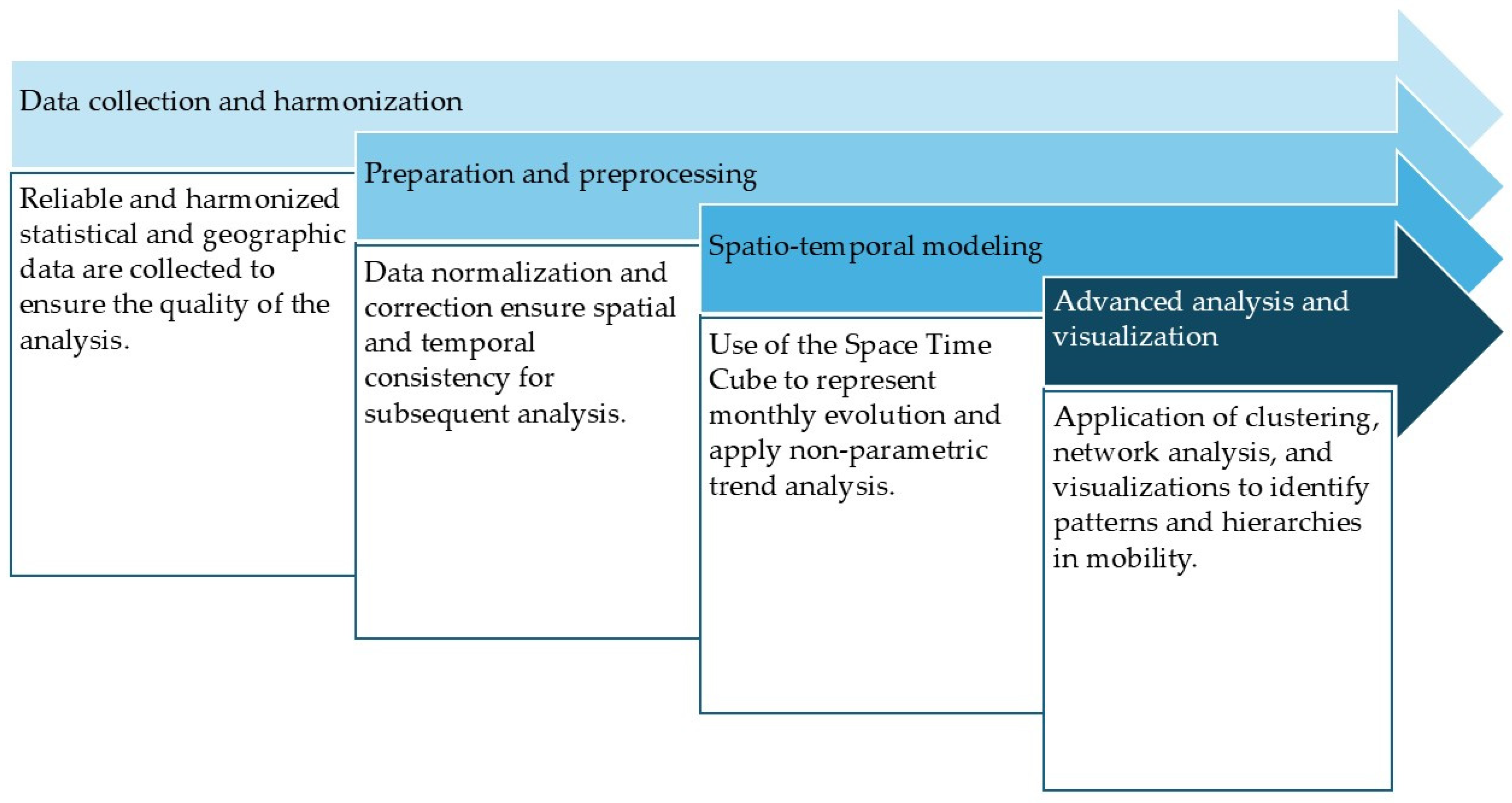
The methodological procedure is divided into four phases (Figure 1) designed to ensure spatiotemporal consistency and reproducibility, and to facilitate a multiscale analysis of domestic tourism mobility in Spain, considering residents of Madrid, the country’s capital and most populous city.
The first phase focuses on the compilation and harmonization of the official data source, which integrates the INE’s mobility matrices, identifiers, and the creation of municipal centroids based on the Geographic Nomenclature of Municipalities and Population Entities and BTN100 cartography. To this end, a single municipal boundary has been established and georeferenced, thereby ensuring spatiotemporal comparability. In addition, data censored by the source itself has been removed to ensure compliance with confidentiality rules. Second, the geometric integrity of both the centroids and the cartographic projection used—which, for Spain, corresponds to ETRS89/UTM—was verified; where necessary, conservative territorial interpolation was employed to resolve boundary discrepancies. Once alphanumeric and cartographic consistency was verified, a spatiotemporal model was generated using the ArcGIS Pro 3.6 Space–Time Cube tool and multiscale reading of localized features. Finally, using the same software, advanced analysis was performed using the Emerging Hot Spot Analysis (EHSA) tool, which detects clusters and intensity trends.

2.1. Study Area and Units of Analysis

The analysis focuses on the mobility of residents in the municipality of Madrid across the entire Spanish territory. The municipality is taken as the primary operational unit because it is the most detailed stable territorial level for modeling OD flows in tourism and interprovincial domestic mobility, which facilitates the integration of territorial variables with cartographic products.
Municipalities are identified using the official INE code, with boundaries and centroids obtained from the Geographic Nomenclature of Municipalities and Population Entities (NGMEP) [50], which ensures nominal and spatial consistency over time [51]. To ensure temporal traceability and avoid errors due to additions/deletions or renaming, a unique list of municipalities (as of 2025) is adopted as a structural reference for the entire series, acting as a “dictionary” to harmonize OD tables and geographic layers and thus facilitate future replications [52].
The primary unit of analysis used by this source is the OD flows generated by residents of Madrid (origin) to municipalities in the rest of Spain’s provinces (destination), excluding the Community of Madrid. On this basis, comparable indicators are calculated using official denominators and certified geometries. When the objective is regional synthesis and comparison, certain results are aggregated to the NUTS-3 level (provinces). Given the Modifiable Areal Unit Problem (MAUP), it is recognized that changes in scale and zoning can alter correlations and significance. Therefore, provincial outputs are accompanied by coverage/cohesion metrics and, where appropriate, are compared with direct calculations at the provincial scale [53,54,55,56].
The assessment of spatiotemporal patterns relies on validated frameworks and methods. STC is used for regularized series at the municipal scale, and EHSA is employed as a spatiotemporal extension of the local Getis–Ord statistic (Gi*) to identify hot/cold clusters and their evolution [57,58,59].

2.2. Sources and Variables

The empirical basis comes from the INE’s experimental statistics on mobility derived from mobile phone data, collected between September 2019 and September 2025. This period provides aggregated and anonymized matrices that allow for the characterization of daily mobility and seasonal population in Spain, with methodological consistency across phases. In line with this and following INE criteria, tourist trips are defined as journeys outside the usual place of residence that involve at least one overnight stay and whose purpose at the destination is not work-related. Operationally, they are identified by the predominant presence of the device during nighttime hours (10:00 PM–6:00 AM), confirmed the following day, which excludes trips without an overnight stay.
Consequently, the data source itself emphasizes that the flows analyzed correspond to tourism in the statistical sense, including leisure, business, or other personal reasons, and not to daily commuting [60]. These criteria are used to construct the monthly OD flows, while daily commuting is retained solely as a methodological reference.
The reference population comprises mobile phones registered to residents of Spain, excluding foreign numbers on roaming. The observational unit consists of mobile devices, and the counts are subsequently extrapolated to the population aged 12 to 89 based on factors and population figures published by the INE. The geographic scope covers the entire national territory, divided into 3214 mobility areas for which N × N matrices and summaries by area of residence and destination are published. Furthermore, to ensure the integrity and legality of the information provided, the data source itself (INE) applies confidentiality and suppression rules.
The integration of mobility statistics with official cartography is facilitated through territorial codes and reference coordinates. The Nomenclature of Municipalities and Population Entities (NGMEP) serve as the nominal and geometric basis for municipalities and entities, compiling official names, coordinates, elevation, and population data on a national scale. The NGMEP is distributed in CSV/MDB format, with a WGS84 reference system compatible with ETRS89/REGCAN95, through the CNIG Download Center and under terms of use compatible with CC-BY 4.0 [61].
For contextualization and topographic support of the analysis, the National Topographic Database 1:100,000 (BTN100) is used, a continuous GIS-oriented geographic database that includes, among others, themes such as administrative units, altimetry, hydrography, population entities, transportation networks, pipelines, and geodetic control points. BTN100 is distributed as a Shapefile, with ETRS89 for peninsular Spain/the Balearic Islands/Ceuta and Melilla and REGCAN95 for the Canary Islands, in UTM zone projection; it also offers WMS/WMTS services and technical product documentation.
In the analysis, the primary reference unit is the municipality (INE code), whose geometry and centroids are extracted from the NGMEP; spatial representation and analysis are performed on BTN100 layers, adhering to the reference systems (ETRS89/REGCAN95) and the UTM projection. The publication thresholds and population elevation criteria defined by the INE are maintained, ensuring the spatiotemporal consistency and reproducibility of the exercise.

2.3. Preparation and Preprocessing

Preparation and preprocessing are aimed at ensuring the spatiotemporal consistency, traceability, and reproducibility of the results based on official statistical and cartographic sources. First, a reference time frame is adopted for the INE’s list of municipalities and their codes by province, covering the entire analyzed series. This approach avoids inconsistencies arising from municipal additions/deletions, mergers, or renaming and allows for the construction of a table of changes that serves as a dictionary of correspondences between annual data and other sources, minimizing matching errors and double counting.
Next, the geometry and municipal centroids are obtained from the National Topographic Base 1:100,000 (BTN100) [62], a multipurpose reference map whose specifications document reference systems, class structure, and product quality control.
Confidentiality and missing values are managed by explicitly preserving non-available values in the municipal matrices and quantifying their effect in each aggregation or visualization. This situation arises from censoring at the source when fewer than 30 observations are reached, so that origin–destination cells are published only when at least one of the operators exceeds that threshold. Additionally, entry and exit totals by area are reported, allowing for aggregated estimates while maintaining statistical confidentiality. The location of terminals is inferred from cell towers, with varying precision ranging from tens of meters in urban centers to hundreds of meters and even kilometers in rural areas; therefore, movements between neighboring areas are interpreted with caution and incorporate, where appropriate, sensitivity analyses.
An additional problem arises when data gaps due to censoring affect certain months, requiring imputation to ensure the continuity of statistical analyses. In such cases, censored cells are treated as values bounded by the interval [13,41], and the midpoint (15) is imputed as a neutral replacement, as it minimizes bias toward the extremes of the plausible range. In the analyzed dataset, comprising over 36,500 records exported from the cube, any bin in which the three scenarios (TUR_ESC_1, TUR_ESC_15, TUR_ESC_29) did not match was considered “censored,” identifying 114 censored bins, equivalent to ~0.31% of the total. In these bins, the observed values follow the pattern (1, 15, 29) exactly, confirming that the only difference between scenarios is due to imputation within the range [13,49]. The magnitude of the aggregate effect is marginal, as shown by the fact that the total sum of the indicator is 69,226,180 (scenario 15), 69,224,584 (scenario 1), and 69,227,776 (scenario 29), with differences between scenarios of 1596 units for both (15 vs. 1) and (29 vs. 15), representing a relative variation of ≈0.0023% of the total. The censoring affects 59 municipalities (out of 500 in the STC), with a maximum bias per municipality of 70 units (5 bins × 14 units), and is concentrated in a few months, notably March and April 2020, corresponding to the mobility restrictions imposed nationwide.
To assess the robustness of the results with respect to this imputation, a sensitivity analysis was conducted by replicating the data flow across the three scenarios (1, 15, and 29) and comparing the stability of patterns and indicators. No significant changes were observed in the EHSA assignment when comparing the three cubes. The stability of EHSA was further corroborated by directly comparing the categorical output by municipality, and the summary of the 500 municipalities analyzed shows complete agreement (100%) in CATEGORY and PATTERN among scenarios 1, 15, and 29, with no class changes detected, indicating that discrepancies between scenarios are limited exclusively to censored bins (0.31%) and do not alter the overall pattern structure (Table 1).
When geometric mismatches are detected due to changes in municipal boundaries between years or the need to re-express series on a stable reference geography, conservative areal interpolation is applied, which preserves the total area and smooths discontinuities in bordering entities. This prevents errors, biases, or spurious patterns that arise when aggregated data are transferred from one set of zones to another where boundaries do not align. This approach, proposed by Tobler (1979), is a methodological standard for conversion between administrative grids and can be supplemented, when suitable auxiliary data are available, with areal/dasymetric interpolation techniques [63].
Finally, the preprocessing is documented through source metadata detailing the origin (INE-EM, NGMEP, BTN100), reference systems (WGS84/ETRS89/REGCAN95, UTM) other aspects of interest, such as licensing conditions (CNIG, CC-BY 4.0 compatible) and the applied transformation table, explicitly recording the decisions made to mitigate the setting of the reference cut-off, aggregation rules, coverage reporting, and internal heterogeneity, in line with established methodological practice.

2.4. Spatiotemporal Modeling

2.4.1. Space–Time Cube (STC) at the Municipal Level

A Space–Time Cube (STC) was created in ArcGIS Pro using the “Create Space-Time Cube From Defined Locations” tool, with the centroids of the county seats as defined locations and a monthly time step. The generated netCDF file stores, by location, the complete time series and diagnostic statistics, including the trend estimated using the nonparametric Mann–Kendall test. Within this same software, its representation as a Space–Time Cube Layer facilitates 3D exploration and interactive switching between variables and themes, accelerating the interpretation of spatiotemporal patterns [64,65]. To ensure metric consistency, a projected coordinate system was used. Furthermore, the netCDF format, due to its self-descriptive and portable structure, facilitates the exchange, archiving, and iterative updating of the dataset, reinforcing the reproducibility of the analytical workflow.
Trends were calculated by municipality by applying Mann–Kendall to each series, which allows for the detection of monotonic trends without assuming normality of residuals. Although Seasonal Kendall could be used in the presence of marked seasonality, the monthly granularity and the stability of the distributions justified the use of the classical version with a two-sided test [66]. Spatiotemporal clusters were identified using Emerging Hot Spot Analysis, which implements Getis-Ord Gi* in the STC and classifies the evolution of hot/cold spots, while also testing the trend of the z-scores with Mann–Kendall. These results were incorporated as new variables into the cube, facilitating their direct comparison with the original time series [67,68,69,70]. Finally, the derived products were explored in 3D scenes and 2D projections, adjusting themes and ranges to highlight relevant patterns; the exploration experience introduced in version 3.6 streamlines variable switching and temporal navigation within a single environment [71].

2.4.2. Emerging Hot Spot Analysis (EHSA)

Furthermore, EHSA detects and classifies the spatiotemporal dynamics of hot/cold spots based on a Space–Time Cube (STC) with bins (fixed location + regular interval). It calculates, by time step, local clustering using Getis–Ord Gi* and, by location, evaluates the trend of z-scores using Mann–Kendall to classify trends, controlling for multiplicity and spatial dependence with FDR [57]. In mobility, this approach distinguishes stable centralities from hourly/seasonal variations and sudden changes. Additionally, evidence from GPS, CDR, and micromobility demonstrates its utility for characterizing peaks, validating volumes, and supporting operational decisions (infrastructure redistribution/design), including applications in cycling mobility with seasonal analysis of categories [72,73,74]. The protocol requires defining the intensity metric (CDR, pings/visits, entries-exits, trips), recognizing biases (especially in CDR), and applying anonymization, aggregation, thresholds, a projected system, and a constant spatial unit; the STC must be reviewed in 2D/3D, and the Gi* neighborhood (fixed distance, k-nearest neighbors, or contiguity) must be selected consistently, evaluating sensitivity through parameter replication [75,76,77,78]. The interpretation is descriptive, not causal, and must incorporate ethical safeguards against re-identification and cartographic biases. Furthermore, the interpretation of hotspots must be grounded in theory and context, with the reasoning behind EHSA–Mann–Kendall monotonic changes being transferable to persistent increases/decreases in use [79,80,81,82].

3. Results

3.1. Mobility in the Provincial and Municipal Context

The first approach to the distribution of mobility is conducted through a provincial analysis, constructed by aggregating municipal data and resident population figures by province. Additionally, relative intensity is calculated using the ratio of travelers from Madrid to the resident population at the destinations. This approach clearly distinguishes between provinces that attract large volumes of visitors due to their tourism capacity and population size, and provinces where the flow from Madrid accounts for a disproportionate share of the resident population, indicating tourism specialization, frequent daytrips, and/or a significant second-home component.
In the national aggregate for destinations outside the Community of Madrid—since the source does not count movements within the province itself—the annual series shows a marked recovery following the initial impact of the pandemic in 2020, which was caused by mobility restrictions and the lockdown of the population (Table 2). In fact, the total volume rises from 10,488,611 visitors in 2020 to 13,980,113 in 2021, representing a 33.3% year-over-year increase. This increase in travel rises to 17,074,838 in 2022, 19,450,094 in 2023, and 19,267,553 in 2024, the year in which a slight correction in the trend is observed. Despite the uncertainties introduced by the limited number of years available for analysis, the growth trend is consistent, although it follows a process of gradual recovery. This is reflected in the fact that in 2020, local trips—which are shorter in duration and involve less logistical uncertainty—predominate. In contrast, the most intense market expansion occurs between 2021 and 2022; and in 2023–2024, a stabilization is observed around a high threshold, consistent with the restructuring of tourism consumption patterns and the return of urban and coastal destinations to positions of prominence.
From a spatial perspective, the resulting provincial hierarchy reveals a dual pattern, showing the persistence of a belt surrounding the source center—precisely where the provinces surrounding Madrid are located, intensely connected by radial corridors. Simultaneously, there is a post-pandemic consolidation of major urban–cultural and sun-and-beach destinations. In the 2020–2024 aggregate, Toledo leads (7,848,399), followed by Alicante (4,848,660), Ávila (4,532,130), Segovia (4,163,335), and Guadalajara (4,050,715). This top tier is rounded out by Valencia (3,476,203), Barcelona (2,996,045), and Málaga (2,929,651), along with provinces on the Cantabrian coast (Asturias, Cantabria) and high-capacity Atlantic coastal and cultural destinations (Cádiz), as well as Ciudad Real as a key inland destination (Table 3). The concentration in these provinces is not temporary but structural: it combines accessibility from Madrid, density, and the quality of cultural resources (historic cities and heritage sites), and/or coastal tourism economies with significant accommodation capacity.
The comparison allows us to identify the mechanisms of spatial reorganization. In 2020, the Top 5 is dominated by provinces near Madrid, notably Toledo, Ávila, Guadalajara, and Segovia, joined by Alicante as a highly attractive coastal destination. In contrast, by 2024, the hierarchy retains the surrounding core, but the Mediterranean arc and mobility toward large urban and coastal areas are reinforced, so that Valencia, Barcelona, and Málaga gain greater relative weight. It follows that in the scenario of greater friction and restrictions (2020), demand favors proximity, favoring short getaways. In contrast, in the post-pandemic period, demand more fully reintroduces “tourist distance” and the search for vacation products (Mediterranean coast) and cultural centrality (major cities and World Heritage cities).
The inclusion of the quotient reflecting the ratio of travelers to the resident population is essential to avoid interpretations biased by demographic size (Table 4). In 2024, the highest intensities are recorded in inland provinces near Madrid with relatively low populations: Ávila (6.73) and Segovia (6.28) lead the indicator, followed by Guadalajara (3.12), then followed by Soria (2.47), Toledo (2.32), and Cuenca (2.29), which maintain values above 2. These levels indicate that the annual inflow from Madrid far exceeds the resident population, which is consistent with the combination of cultural tourism (historic capitals and heritage sites), rural and nature tourism (mountain ranges, protected areas, reservoirs, and mid-mountain landscapes), and particularly favorable accessibility for weekend getaways and day trips. In contrast, provinces with large populations, such as Barcelona or Valencia, may exhibit very high absolute volumes yet moderate intensities (0.134 and 0.321 in 2024, respectively), reflecting a denominator effect: tourist attraction is distributed across a large residential population.
The municipal level adds a crucial explanatory dimension. In this regard, provincial intensity may be elevated by the existence of enclaves with a very high degree of tourism specialization that concentrate visitor flows, particularly in provinces with highly fragmented municipalities (Table 5). The dispersion of the municipal ratio of visitors to population in 2024 (VIAJ/PO24), analyzed using mean, median, standard deviation, minimum, and maximum, shows particularly high values in Segovia and Guadalajara, where the municipal mean exceeds 13,900 and variability is very marked, with extreme maximums indicating peaks of attraction in specific municipalities (mountain destinations, unique heritage sites, recreational areas, and second-home hubs). Ávila follows the same pattern but with less extremity, while Toledo and Cuenca exhibit high municipal average intensities and moderate variability, consistent with a broader distribution of tourism resources and the coexistence of urban cultural tourism (capital cities and historic districts) and rural nature tourism (mountain regions and inland areas). In coastal and metropolitan provinces, municipal intensity tends to be distributed more heterogeneously, and the aggregate provincial value is obscured by the demographic weight of large municipalities.
In interpretive terms, the performance of the provinces in the ring surrounding the state capital (Toledo, Ávila, and Segovia) reflects a comparative advantage based on their functional proximity to the main source market and their high suitability for short-duration trips. In these areas, the cultural tourism offering centers on historic cities boasting world-class monumental heritage and urban landscapes with a high degree of heritage values complemented by rural tourism resources. In fact, these cities are included in UNESCO’s World Heritage List. Furthermore, they are complemented by landscapes characterized by the relief of the Central System, mountainous areas, as well as a network of reservoirs and a wide range of outdoor activities. This creates a product particularly suited to day trips and weekend getaways. The empirical result is a high-frequency mobility pattern, with high intensities and a marked municipal concentration that tends to polarize around major heritage and recreational hubs. Guadalajara deserves special mention, as an important demographic corridor extends from Madrid to this city, which sometimes serves as a place of residence.
Meanwhile, along the Mediterranean coast, Alicante and Valencia illustrate the structural importance of the “sun and beach” combination, complemented by residential tourism. Their dynamism throughout the period analyzed and the absolute volumes achieved place them among the top destinations for the Madrid market, in a context where the greater effective distance is offset by accommodation capacity, product diversity, and economies of scale associated with longer stays. Barcelona’s recovery is particularly telling given its profile as a destination for urban cultural tourism. In this regard, the relative increase observed between 2020 and 2024 suggests a rebound in travel to large metropolitan areas, which were traditionally more exposed to the initial impact of restrictions, the perception of risk in densely populated environments, and the disruption of event-related schedules. At the same time, Málaga and Cádiz are consolidating their dual coastal and cultural appeal, while Asturias and Cantabria highlight the capacity of the Atlantic–Cantabrian landscapes and nature tourism to attract demand in the post-pandemic era, in line with preferences for open spaces and lower perceived density.
Therefore, the 2020–2024 period outlines a tourism mobility system originating in Madrid characterized by:
  • A sharp quantitative recovery followed by a recent stabilization;
  • A spatial structure in which proximity acts as a cross-cutting factor influencing resilience and travel frequency;
  • A gradual shift toward coastal and urban destinations as the post-pandemic context normalizes.
An integrated analysis of absolute volumes and the VIAJ/PO24 ratio, supplemented by evidence of municipal dispersion, allows for a simultaneous understanding of provincial hierarchy and local concentration. It provides a robust diagnosis under changing conditions of mobility and risk perception regarding the differential role of tourism-territorial products—based on cultural heritage, nature, and the rural world—in addition to the ever-present sun-and-beach tourism. However, this is sufficient only to provide an approximation of the reality shaping mobility at a more granular level: the municipalities.
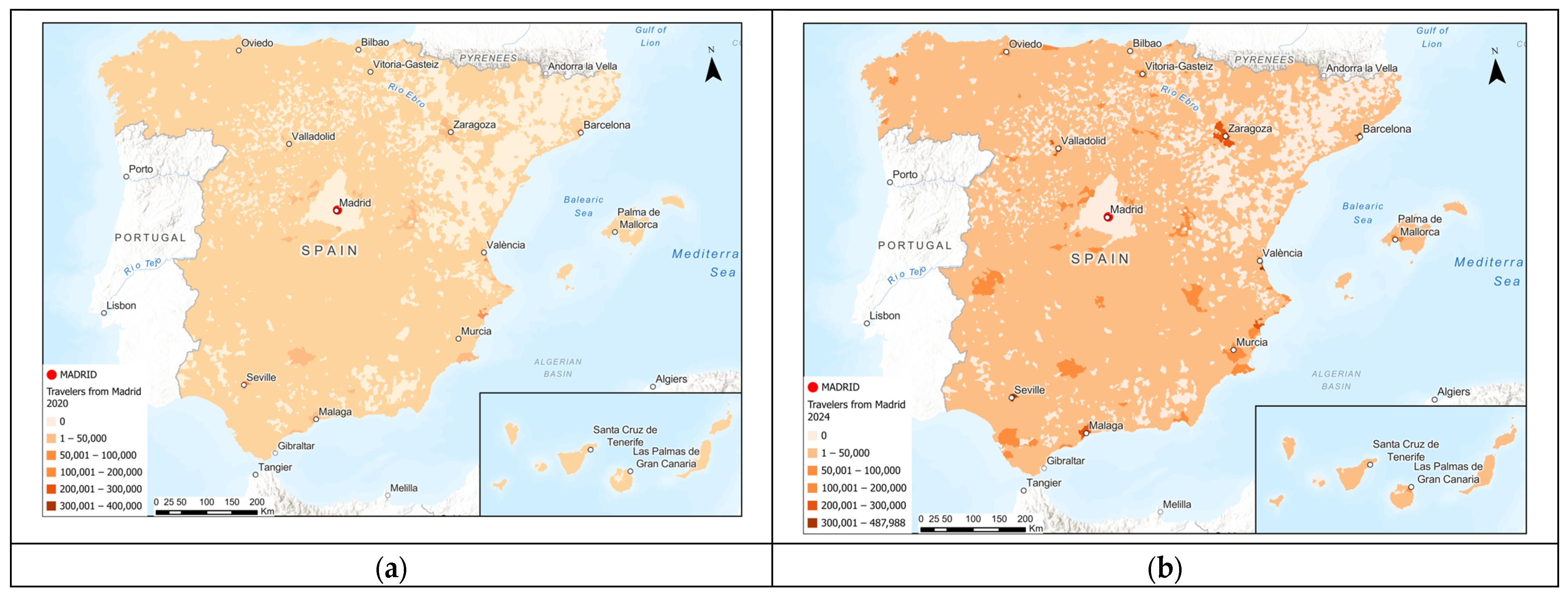
The analysis at the municipal level of trips originating in the municipality of Madrid during the 2020–2024 period allows for a high-resolution reconstruction of the spatial configuration of demand and its reorganization between the pandemic phase and the post-pandemic stage, avoiding the aggregation effects that often obscure territorial heterogeneity.
In terms of spatial distribution, the phenomenon has broad, though not universal, coverage. Taking as a reference the 8124 municipalities that potentially act as destinations, those recording at least 15 visitors on average per month from Madrid range from 5169 in 2020 to 5487 in 2023, standing at 5398 in 2024 (Table 6). Consequently, coverage ranges approximately between 63.6% and 67.5% of the total number of municipalities. This pattern suggests that, despite the high outbound capacity of the Madrid market, mobility is not distributed evenly. A threshold of accessibility, visibility, and/or reception capacity limits the attraction of visitor flows in certain parts of the municipal system, particularly during years of heightened mobility friction.
The second structural feature is the concentration of flows in a small number of destinations (Table 7). The distribution of cumulative volume for the 2020–2024 period shows marked inequality. The 10 municipalities with the highest visitor numbers account for 12.5% of the total number of travelers. In contrast, if the top 25 are considered, they account for 22.0%; conversely, the 50 most visited destinations account for 31.8%, while the top 100 reach 43.0%. This confirms a hierarchical structure with a strong dominance of the main hubs. Furthermore, this pattern indicates that the receiving municipal system is organized around a relatively limited set of dominant hubs, notably large cities, administrative capitals, and established tourist destinations, which act as the main sinks for the Madrid market. In contrast, the remaining municipalities participate in a more sporadic and heterogeneous manner. Likewise, normalization by population shows that this reduced aggregate contribution can coexist with high intensities in certain municipalities of small or medium demographic size, where the flow represents a relatively high pressure on the resident stock, reflecting local tourism specialization and/or recurrence associated with proximity.
In line with the concentration pattern described, the municipal ranking by cumulative volume between 2020 and 2024 is clearly led by large urban municipalities that combine functional centrality, high interregional connectivity, a density of cultural resources, and a broad and diversified accommodation base (Table 8). Within this framework, Barcelona leads the period with 1,912,465 visitors from Madrid, followed by Valencia (1,387,060) and Seville (1,177,096). Next come capitals and major cities that play a structuring role in the Spanish urban network, notably Alicante, Málaga, Zaragoza, and Valladolid, along with destinations with a strong focus on tourism, heritage, and recreation, such as Toledo, Salamanca, Granada, and Córdoba. Equally significant is the weight of highly specialized coastal destinations associated with the vacation economy, featuring prominent cities such as Benidorm and Marbella, as well as hubs along the Cantabrian coast with high tourist appeal, with Santander as a standout city. Overall, this profile reveals a dual logic of demand from Madrid, where, on the one hand, the structural attraction of large cities stands out, supported by the diversity of services, facilities, and cultural assets; and on the other, the relevance of destinations oriented toward leisure and tourism, particularly along the Mediterranean coast and in heritage-rich urban enclaves in the interior, which function as hubs for cultural consumption and getaways.
The contrast between absolute magnitude and relative intensity provides a decisive interpretive key to understanding the geography of travel from Madrid. While large metropolitan areas and regional capitals account for the highest volumes per unit of area due to their functional centrality and high capacity to absorb migrants, the maximum values—the ratio of travelers to resident population—confirm that these tend to be located in smaller municipalities, where the flow from Madrid represents a much higher relative burden on the resident population.
To reduce statistical noise associated with extremely small denominators, the identification of intensity peaks is restricted to municipalities with a population exceeding 500 inhabitants in 2024, so that the indicator more reliably reflects the relative pressure of the flow rather than fluctuations typical of very small localities (Table 9). Under these conditions, particularly high intensities emerge in the central peninsular region, where there is a strong presence of municipalities in the provinces of Ávila, Segovia, Guadalajara, and Toledo. This circumstance is consistent with patterns of high recurrence, such as those characteristics of weekends, with the weight of rural and nature tourism, and with dynamics linked to second homes in areas close to the main source market.
The simultaneous emergence of high-mountain destinations outside the immediate radius suggests, however, that demand from Madrid also drives destinations with highly distinctive landscapes and a strongly seasonal offering. Even so, the core of greatest intensity is consistently concentrated in the immediate vicinity, where distance is a lesser constraint and the potential frequency of travel is higher.
The breakdown by municipal size also confirms that the high concentration of passenger flow in large cities does not negate the importance of a wide range of small municipalities in receiving travelers from Madrid (Table 10). In 2024, municipalities with more than 100,000 inhabitants (54) account for 26.6% of the annual total, while the group with populations between 20,000 and 99,999 inhabitants (340) account for an additional 25.1%, meaning that medium-large and large municipalities together account for roughly half of the observed volume. However, the group of municipalities with fewer than 1000 inhabitants (4936) still attracts 15.7% of visitors, a figure that makes perfect sense when one notes that the average ratio of travelers to residents in this category is significantly higher, although the median remains at low levels. This combination is characteristic of strongly asymmetric distributions, where there is a limited subset of small municipalities—highly specialized or favored by conditions of accessibility and visibility—that concentrate very high intensities and raise the group’s average, while the majority maintain moderate shares and intensities.
The temporal dimension introduces a relevant interpretive nuance, given that the weight of destinations located in the ring surrounding the main source market intensifies at the peak of disruption (2020) and gradually decreases as post-pandemic normalization takes hold, without ever fully dissipating (Table 11). Taking as a proxy the group of provinces in the central peninsular region (Toledo, Guadalajara, Ávila, Segovia, Cuenca, and Ciudad Real), their contribution to the annual total of visitors from Madrid reaches 35.8% in 2020 and declines to a range of approximately 29–33% between 2021 and 2024, with a low point in 2023 (28.9%) and stabilization in 2024 (29.1%). This pattern is consistent with a mechanism of gradually expanding the tourism radius, such that in the initial phase, demand favors nearby destinations, given the lower overall cost, greater flexibility of travel, and reduced uncertainty. Conversely, as the recovery progresses, the destination pool expands to include coastal destinations and large metropolitan areas, which regain prominence in the travel portfolio of the Madrid market, although proximity maintains a structural role in supporting repeat visits and short getaways.
Overall, the municipal scale reveals a mobility system originating in Madrid that exhibits clear and empirically consistent structural features. There is, therefore, a broad but incomplete territorial distribution, a high concentration of flow in a small number of key destinations, and a marked duality between magnitude and intensity (Figure 2a,b). Within this framework, large cities and established tourist destinations account for the bulk of absolute volumes, by virtue of their functional centrality, connectivity, and capacity to accommodate visitors. Simultaneously, a group of smaller municipalities records very high values for the traveler-to-resident ratio, consistent with patterns of short-term getaways, day trips, and rural or nature tourism, as well as with patterns of repeat visits facilitated by proximity to the main source market.

3.2. Space–Time Cube

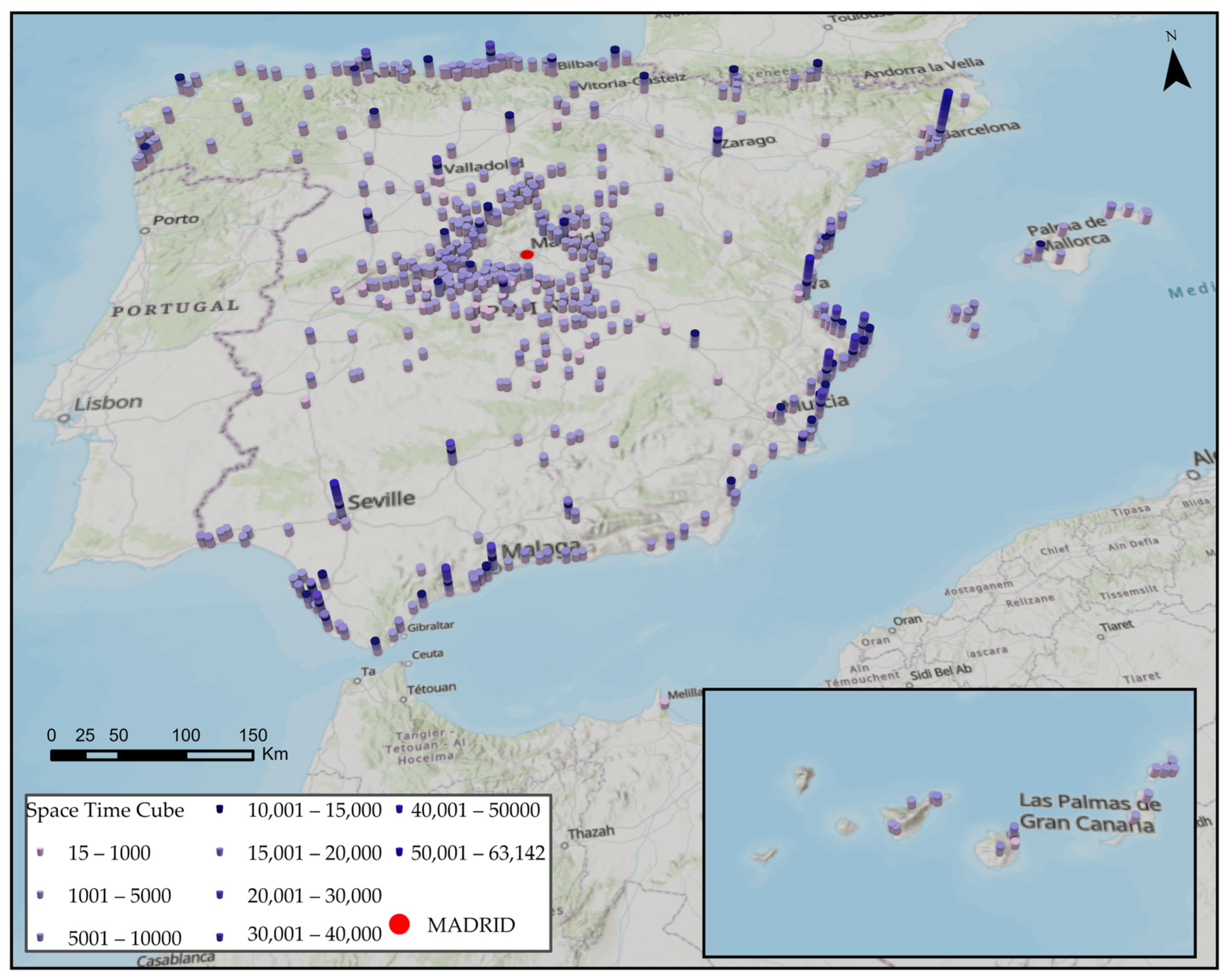
The Space–Time Cube (STC) representation was constructed using the monthly series of tourists derived from mobile phone records. The spatial unit of analysis is the centroid of the municipal capital, identified by the INE code, which allows for capturing the territorial hierarchy of the tourism system and the marked intraregional heterogeneity among destinations. The time axis is defined monthly, from September 2019 to September 2025, providing a sufficiently broad analysis window to detect structural patterns, disruptions, and recovery processes. Furthermore, the 500 municipalities most visited by residents of Madrid were used for the calculations.
The STC representation highlights the existence of a clear structural tourism seasonality, observable in most municipalities with sustained tourism activity. This pattern manifests itself in the systematic repetition of peaks during the summer months and troughs in the winter months, forming a succession of periodic peaks in the three-dimensional visualization, the amplitude of which varies depending on each municipality’s tourism weight. Overlaid on this regular behavior is an abrupt and synchronized disruption in the spring of 2020, associated with mobility restrictions resulting from the COVID-19 pandemic. In virtually all municipalities, this episode resulted in a sharp drop in tourist volume, which in the STC takes the form of a clearly defined transverse trough.
Starting in 2021, a phase of gradual recovery is observed, which intensifies in 2022 and consolidates during the 2023–2025 period. This recovery, however, exhibits marked territorial heterogeneity. Municipalities with higher prior tourist volumes show a rapid and sustained rebound, while municipalities with low demand exhibit more erratic trajectories, with persistently low values and a greater presence of censored observations associated with statistical confidentiality. In the three-dimensional view, leading destinations not only recover their seasonal peaks but also show a rise in the baseline level, indicating of a sustained increase in the average monthly volume of tourists and, therefore, a structural strengthening of their position within the tourism system.
Overlaid on this regular pattern is an abrupt and synchronized disruption in April and May 2020, coinciding with the period of the strictest mobility restrictions associated with the COVID-19 pandemic. In many municipalities, especially those with lower tourist volumes, this decline results in very low values, which in some cases are replaced by the 15. This value has been used to replace actual observations of fewer than 30 tourists, in accordance with the INE’s application of statistical confidentiality. While this treatment allows for the continuity of the spatiotemporal cube to be maintained, its presence has been explicitly considered in the interpretation of the results, avoiding an overestimation of dynamics in destinations with residual demand.
Starting in 2021, the STC shows a phase of gradual recovery, which intensifies in 2022 and clearly consolidates during the 2023–2025 period. This recovery is not limited to a temporary reversal of the pandemic shock; rather, in many destinations, it translates into an increase in the average monthly number of tourists, suggesting a process of net expansion in demand. In the 3D visualization, this behavior is reflected in a rise in the cube’s “base level” in the post-pandemic years, accompanied by higher and more sustained summer peaks.
From a spatial perspective, the STC highlights a very pronounced territorial heterogeneity (Figure 3). Municipalities with the highest cumulative volume of tourists exhibit stable and robust temporal profiles, with rapid recoveries and sustained growth, while other destinations show more fragile trajectories and greater dependence on seasonal peaks. This coexistence of patterns reinforces the idea of a hierarchical tourism system, in which the recovery is not distributed uniformly.
It is evident that the Mediterranean coast is the favorite destination for Madrid residents to spend their vacations, with well-defined areas in the Barcelona region, the coast of the Valencian Community, as well as the Costa del Sol and the Costa de Cádiz. Obviously, the appeal of the beaches is evident in other areas of the Mediterranean and the Andalusian Atlantic coast. The Cantabrian and Galician Atlantic coastlines also attract significant numbers of visitors. Furthermore, a clear cluster is detected around Madrid, aligned with the main highway routes, and, finally, a group of major cities scattered throughout the region, such as Seville, Córdoba, Zaragoza, and Valladolid.

3.3. EHSA

The municipal STC (Top 500 by cumulative volume) increases spatial contrast and allows for the comparison of temporal profiles among leading destinations. The heat map, created using all municipalities, simultaneously reveals synchronous spikes (vertical bands) and spatial persistence (horizontal bands), as well as differentiated seasonality according to destination type (Figure 4). The 3D scene (surface) synthesizes these dynamics: the trough associated with 2020 appears as a transverse depression, while the recovery generates summer peaks and, in many destinations, a rise in the baseline level in the post-pandemic years.
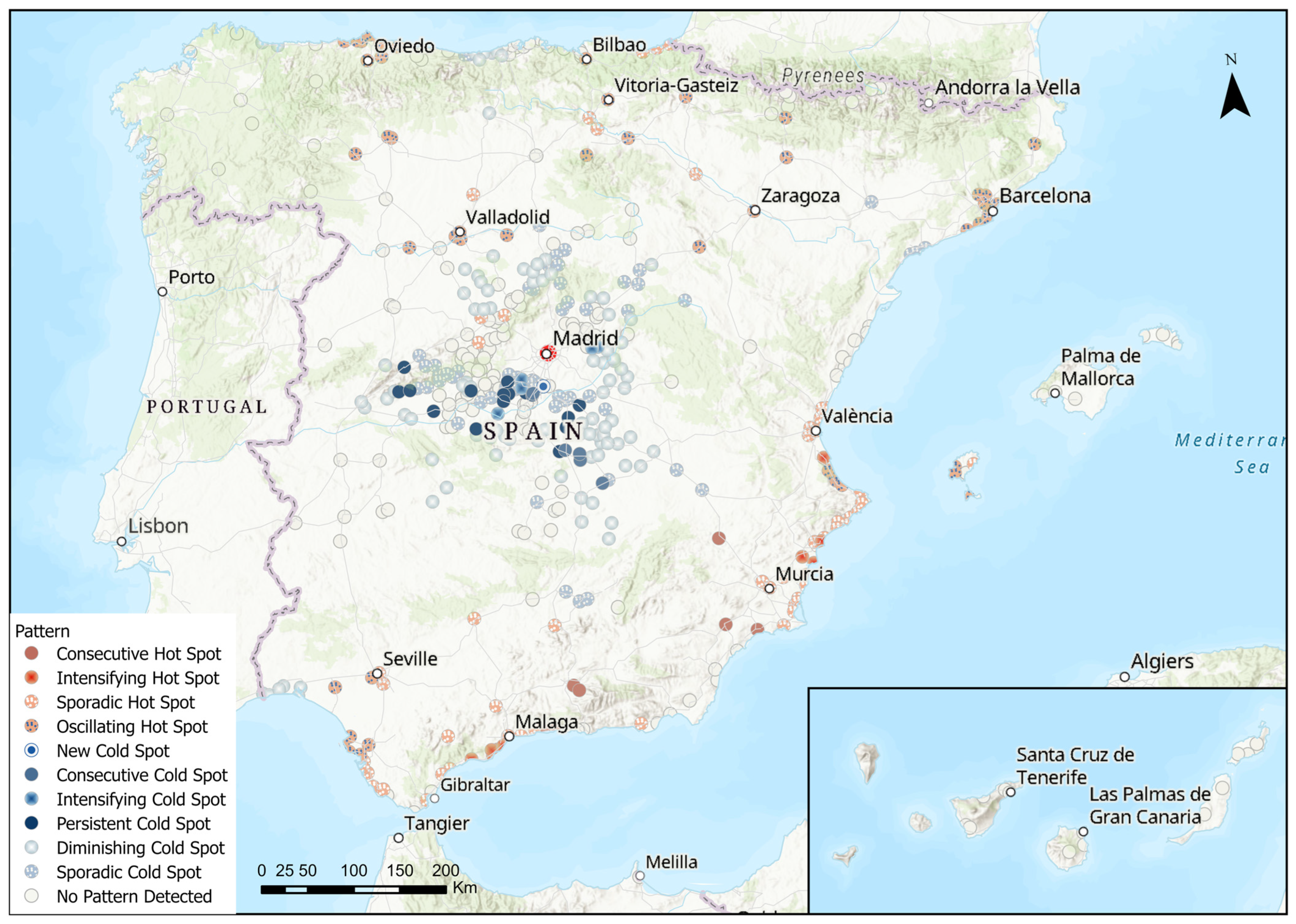
The Emerging Hot Spot Analysis (EHSA) was performed on the previously constructed space–time cube (STC) for the monthly series September 2019–September 2025 (73 intervals), applying a spatial conceptualization based on the 8 nearest neighbors (8NN) and a 12-month time window. This parameterization defines a local context sensitive to the territorial structure of tourism systems (metropolitan rings, coastal continuums, and accessibility corridors) and, at the same time, introduces an annual “memory” that smooths out spurious monthly fluctuations, so that significance is interpreted as a sustained or recurring feature of tourism behavior. In geostatistical terms, each municipality is evaluated by comparing its local mean (municipality + neighborhood) with the global mean of the cube; when the difference exceeds what would be expected under randomness, the local Getis-Ord Gi* statistic produces positive or negative z-scores [83,84,85,86]. The temporal dimension is then integrated using the Mann–Kendall test applied to the sequence of z-scores, generating TREND_Z and TREND_P; low values (p < 0.05) indicate a monotonic strengthening or weakening of clustering, while high values suggest stability or the absence of a detectable trend.
Table 12 addresses the article’s objective of characterizing the territorial redistribution of the source market in the municipality of Madrid by summarizing (i) the frequency of each EHSA pattern (n and %), (ii) the evidence and direction of temporal change (proportion with TREND_P < 0.05 and medians of TREND_P and TREND_Z), and (iii) representative destinations (Top-3 by cumulative volume). The most frequent pattern is ‘No Pattern Detected’ (n = 194; 38.8%). This does not equate to the absence of a signal, but rather to the fact that numerous destinations show clustering patterns that do not meet the thresholds for persistence or consecutivity required by canonical EHSA typologies under the annual window. Consistent with this, this group exhibits a high incidence of significant trends (≈91.8%), indicating widespread changes in clustering intensity without a dominant pattern.

4. Discussion

The central purpose of this study—to characterize domestic tourism mobility originating in the municipality of Madrid using aggregated mobile data, identify the structure of origin–destination (OD) flows, and propose a reproducible spatiotemporal protocol—has been successfully achieved in both its empirical and methodological aspects. The monthly time series 09/2019–09/2025 allows for continuous observation of the pre-pandemic scenario, the 2020 shock, and the subsequent recovery, thereby enabling the evaluation of reconfigurations in corridors, centralities, and destinations with a sufficiently long temporal perspective to distinguish regime shifts from seasonal fluctuations. In operational terms, integration into a Space–Time Cube (STC), the application of Emerging Hot Spot Analysis (EHSA), and the grouping of temporal signatures have functioned as a coherent pipeline to translate large volumes of information into interpretable and comparable categories, while maintaining traceability and replicability.
The spatial interpretation derived from the results is geographically consistent with three structuring mechanisms: the friction of distance and the principle of proximity, differential accessibility associated with transport corridors and networks, and the role of density and urban hierarchy in the organization of the tourism system. During 2020–2021, a shift in the “tourism radius” toward nearby and, often, less dense destinations is observed, consistent with travel decisions characterized by lower overall costs, greater flexibility, and less uncertainty. In contrast, starting in 2022, a recovery is already evident in which urban and coastal destinations are once again gaining strength, without proximity losing their structural role as a foundation for recurring getaways. This sequence aligns with prior evidence regarding unequal resilience during the COVID-19 pandemic, with more intense impacts on urban and internationalized destinations and a relatively earlier recovery in nearby domestic destinations characterized by nature and low perceived density [40,46].
Additionally, it should be emphasized that this study does not aim to “rediscover” coastal seasonality, but rather to operationalize, using a reproducible protocol (STC–EHSA), how centralities and corridors are maintained, reinforced, or attenuated over time following an exogenous shock. In particular, the EHSA classification allows us to distinguish destinations where “clustering” is persistent from those where it intensifies or weakens, and to compare trajectories among municipalities in a homogeneous manner across the pre-, peri-, and post-pandemic cycles. This analysis provides an operational basis for managing peaks (capacity/mobility) and for strategies of temporal and spatial deconcentration, without confusing it with an exhaustive assessment of the destination’s total demand, which would require a different type of treatment and analysis.
The observed empirical evidence allows us to interpret outbound tourism mobility from Madrid as a process of territorial resilience in which three dynamics coexist. The first is the absorption of the shock caused by the abrupt and synchronous contraction that occurred in the spring of 2020 because of the mobility restrictions imposed during the pandemic. The second consists of adaptive reorganization, with a temporary prioritization of nearby destinations and those perceived as having lower density. Finally, the third dynamic concerns the structural reconfiguration triggered by the gradual return to urban and coastal destinations, though without the disappearance of the proximity component. Conceptually, this interpretation aligns with resilience understood as the system’s capacity to reorganize itself amid frictions, regulations, and shifts in risk perception, rather than as an automatic “return” to the previous state. From the perspective of the mobility shift, the adjustment is not expressed solely as a decline or increase in volumes, but as a change in the socio-technical assemblages that enable or limit certain trips. Among these are effective accessibility, travel rhythms, restrictions, and opportunity costs, which temporarily reorder centralities and peripheries [14,15].
Within this framework, the rescaling of the “tourism radius” can be understood as an operational mechanism for demand resilience: during the phase of maximum friction (2020–2021), the system prioritizes destinations with lower overall costs (time/distance) and greater reversibility, reinforcing the proximity ring. During normalization, the radius re-expands toward vacation destinations (coastal areas) and large urban areas, which regain their position within Madrid’s tourism portfolio. This transition is supported by the evolution of the mobility share toward the central ring, which reaches peak levels in 2020 and then declines toward a stabilized range in the post-pandemic period (Table 11), without ever fading away, suggesting that proximity acts as a structural “buffer” of recurrence even as longer-distance travel normalizes. The combination of this pattern with the staggered recovery of 2022–2025 thus suggests a resilience that combines persistence (proximity and short getaways) and reconvergence toward structural destinations (urban and coastal), consistent with the literature on more intense impacts on urban/internationalized destinations and the relative resilience of nearby domestic destinations [40,41].
This framework allows for an explicit connection between the EHSA results and the theoretical discussion. In this sense, the persistent and growing categories can be interpreted as operational indicators of spatial resilience due to the maintenance or reinforcement of clustering over time. In contrast, the decreasing/attenuated categories point to a relative loss of centrality in the local context. Thus, the coexistence of hotspots in consolidated coastal systems and cold or attenuated dynamics in parts of the interior is consistent with a selective restructuring of the host system, where the pandemic crisis accelerates already latent adjustments and recovery is not distributed homogeneously. This approach does not attribute causality but provides a structural interpretation of how centralities reorganize under perturbation and recovery, relying on an explicit statistical framework (Gi* + trend) and false discovery rate control [57,85].
The combination of provincial and municipal-level data plays a decisive role in achieving the goal of a “detailed territorial analysis.” At the provincial level, comparing absolute volumes with rates normalized by the receiving population helps distinguish destinations with high capacity and large populations from those where the influx from Madrid is relatively intense, indicating specialization in tourism, day trips, and/or second homes. At the municipal level, uneven distribution coexists with very high relative intensities in small and medium-sized municipalities near the source market, revealing potential pressures on local services and capacity that would be diluted at higher levels of aggregation. This result reinforces the idea of a hierarchical and polycentric system, where accessibility from the main source market and the uniqueness of the tourism product (heritage, coastal, rural-nature) modulate stability and seasonality.
From a methodological standpoint, the adoption of STC and EHSA adds value because it allows for the distinction of persistence, intensifications, attenuations, and emergences under an explicit statistical framework based on the local statistic Gi* and trend tests (Mann–Kendall) on z-scores, with control for false discoveries [57,85]. Parameterization using k-nearest neighbors’ spatial neighborhood and temporal neighborhood is particularly suitable for tourism because it dampens high-frequency noise and limits significance to sustained or recurring behaviors. In turn, temporal clustering complements the EHSA by incorporating the dimension of “how each destination behaves” throughout the year, distinguishing between coastal, urban, and inland-proximity seasonal patterns. This classification aligns with recent research that leverages mobile data to describe seasonality and tourism rhythms with greater granularity than traditional sources [16,37,49].
A key issue for the validity of the analysis and its reproducibility in standard working environments is the effective size of the cube and its derived products. In a cube of locations defined by the centroids of population centers, the number of bins grows as the product of locations and time steps [87,88]. If the complete set of destination municipalities (8124) were included for the 73 months of the period, the cube would result in approximately 593,000 bins, which significantly increases the computational cost of EHSA (calculation of Gi* per bin and storage of output variables in the netCDF). Although the official ArcGIS Pro documentation emphasizes as a structural limit that cube creation fails if the parameters produce more than 2 billion bins, in practice performance and memory capacity become significant constraints on desktop computers, especially when the workflow materializes the cube into layers/features for visualization or when intermediate tables are used [89]. At the same time, including all municipalities with available data would result in many having high monthly values that are anonymized, requiring them to be imputed, which could distort the results and compromise the analyses.
In this context, the decision to work with the 500 most-visited destinations should not be interpreted as an arbitrary simplification, but rather as a complexity control strategy that maintains comparability among leading destinations without compromising the stability of the procedure. With 500 destinations and 73 months, 36,500 bins are generated—a size that allows EHSA and clustering to be performed within reasonable timeframes and facilitates 3D/2D inspection of the cube. Furthermore, this selection precisely preserves the subset where a substantial portion of demand is concentrated and where management implications (capacity, mobility, territorial pressure) are most critical. It should be noted that, in some workflows, the threshold of 65,536 rows acts as an indirect constraint when working with legacy Excel formats (.xls). If the panel is pre-structured in that format, the pruning of locations becomes, de facto, mandatory [90,91]. Consequently, the adopted design prevents a limitation of the format or the data preparation environment from being confused with an intrinsic limitation of EHSA.
The other condition determining the interpretation is the management of statistical confidentiality. The source suppresses cells with low counts, which introduces unobserved values in residual demand segments. To maintain the temporal continuity of the STC, a conservative scenario was employed in which the value 15 is assigned to months/destinations with no data, assuming they represent low flows below the publication threshold. Furthermore, to verify its validity, a check was performed using extreme values (1 and 29), which demonstrated the soundness of the results by not introducing a large number of “padded” data points. This decision preserves the cube’s structure, although it has known statistical effects: since it reduces variance in low-demand destinations, it may smooth out actual disruptions and, consequently, underdetect changes or produce apparent stabilizations in marginal locations. Therefore, the interpretation of EHSA categories should be understood as evidence of relative patterns within a framework of censored data, and not as an exhaustive measurement of dynamics at the tail end of the system. The literature has emphasized that the use of aggregated mobile data requires documenting these suppression mechanisms and, where possible, cross-checking consistency with external sources (surveys, accommodation, traffic) to calibrate biases [17,22,23].
Even with these caveats, the study’s objectives are soundly met in terms of identifying and mapping patterns consistent with proximity, accessibility, and density, and in demonstrating how the pandemic temporarily reshaped demand without erasing underlying structures. Similarly, the objective of providing a replicable protocol is supported by the specification of parameters (monthly resolution, neighborhoods, standardization) and by the combination of cartographic products and statistical analyses. Compliance is necessarily partial in the semantic dimension of travel, which reinforces the need to combine sources and add context [31]. In line with this, it should be emphasized that, although the analysis adheres to statistical definitions of ‘tourist travel’ (overnight stays away from the usual residence), the source does not allow for identifying the motivation for travel at the individual level (leisure, business, visiting family/friends, etc.) nor for distinguishing tourists from non-tourists with complete precision. Therefore, the results are interpreted in terms of aggregate patterns of domestic tourism mobility (trips with overnight stays), avoiding causal or motivational attributions at the micro level. Within this framework, trips for personal reasons, including visits to family and friends (VFR), sometimes linked to a return to places of origin, form part of domestic tourism in a statistical sense provided they meet the overnight stay criterion, even if their specific motivation cannot be distinguished using aggregated mobility data [60]. In line with this, the qualitative dimension of travel—to specify the type of accommodation, the reason, the organization, the experience, and even opinions—requires integration with surveys or administrative/commercial records, as proposed by the INE itself to complement the use of mobile phone data with lighter field operations and triangulation of sources.
It should also be noted that the experimental tourism mobility statistics based on mobile telephony used in this study are designed to describe the mobility of the resident population (national numbering) and, therefore, do not directly capture the incoming international component (foreign tourists on roaming). Consequently, the results should be interpreted as an assessment of the reorganization of domestic demand originating from Madrid—particularly useful for analyzing the resilience and resizing of the tourism radius—rather than as a comprehensive estimate of total demand for each destination. The future integration of the international component will require combining data with complementary official sources (accommodation, expenditure, and transportation) to construct a dual assessment (domestic + inbound).
In terms of implications, the evidence derived from the STC–EHSA–clustering analysis translates into policy and management recommendations with a level of territorial specificity difficult to achieve with traditional sources. Temporary firm clusters can guide campaigns segmented by season and destination type, aimed at temporal dispersion and the promotion of responsible travel. The identification of persistent or intensifying hotspots suggests prioritizing capacity and mobility management measures where pressure is recurrent. At the same time, the relative expansion toward nearby, less dense destinations in 2020–2021 opens an opportunity to consolidate local nature and culture circuits, reducing pressure on dense areas and distributing territorial benefits, provided that local capacity and environmental fragility are factored into the design. Finally, the approach supports a tourism intelligence agenda based on territorial parameters and continuous evaluation and, inevitably, posits data governance as an enabling condition: stable agreements, methodological documentation, and ethical safeguards in the processing and mapping of location data [30,66].
Alongside this, the study opens avenues for improvement that reinforce the scope of the originally proposed objectives. The first is the integration with sources of expenditure, accommodation, and transportation data to add semantic context and validate biases. The second is the development of spatiotemporal forecasting models within the dataset that enable operational anticipation, while preserving interpretability and territorial coherence. The third is replication using other data sources to build national comparisons. Finally, the fourth is to delve deeper into municipal-level detail through sensitivity analyses (neighborhoods, scales, suppression thresholds) and stability tests against the MAUP [37,53,54].

5. Conclusions

This study shows that aggregated mobile data allow for the description and mapping, with spatiotemporal resolution, of domestic tourism mobility originating in Madrid during 09/2019–09/2025, encompassing the pre-pandemic phase, the 2020 shock, and the recovery. The combination of monthly OD matrices and a reproducible workflow enable the identification of structural regularities and regime shifts.
The results reveal a synchronous break in spring 2020 and a staggered recovery beginning in 2021, which consolidated in 2023–2025. Geographically, a dual pattern emerges: a concentration of travel volumes in a few urban and coastal destinations, alongside high relative intensities in small and medium-sized municipalities in the ring surrounding Madrid, reinforcing the need to interpret absolute magnitudes and intensity indicators together. In parallel, a rescaling of travel radius is observed: in 2020–2021, nearby destinations gain prominence, and during normalization, coastal systems and large urban areas regain importance without proximity losing its structural role.
The main methodological contribution is the operationalization of a GIS-integrated protocol (monthly STC, EHSA, and series grouping) that converts large OD series into comparable and mappable categories for diagnosis and monitoring, with parameters tailored for tourism by smoothing out monthly noise. In practical terms, the results can guide capacity and mobility management in persistent or intensifying hotspots, strategies for temporal and spatial deconcentrating based on seasonal patterns, and the identification of municipalities with high relative pressure despite moderate volumes.
The study is limited, albeit minimally, by censoring due to statistical confidentiality, the representativeness of the aggregated source, and the inability to fully infer qualitative dimensions of travel. Future lines of work include triangulation with data on accommodation, spending, and transportation; spatiotemporal modeling and forecasting; replication of the protocol for other data sources; and additional sensitivity analysis, even if this comes at the cost of losing territorial detail. In summary, the integration of mobile data into a reproducible spatiotemporal framework provides a transparent and updatable empirical basis for interpreting the territorial reorganization of domestic demand and supporting planning and management decisions.

Supplementary Materials

The following supporting information can be downloaded at: https://www.mdpi.com/article/10.3390/land15050887/s1, Table S1: EHSA Results Top500.

Funding

This research has been co-funded by the European Union, European Regional Development Fund (85%), and the Regional Government of Extremadura. Managing authority: Ministry of Finance (Spain). Grant GR24076.

Data Availability Statement

These data were derived from the following resources available in the public domain: [INE. Estudios de Movilidad a Partir de la Telefonía móvil (Estadística Experimental). Available online: https://www.ine.es/experimental/movilidad/experimental_em.htm (accessed on 19 March 2026)].

Conflicts of Interest

The authors declare no conflicts of interest. The funders had no role in the design of the study; in the collection, analysis, or interpretation of data; in the writing of the manuscript; or in the decision to publish the results.

Abbreviations

The following abbreviations are used in this manuscript:
INENational Institute of Statistics (Spain)
NGMEPGeographic Nomenclature of Municipalities and Population Units (IGN/CNIG)
NUTSNomenclature of Territorial Units for Statistics (Eurostat)
ODOrigin–Destination
CDRCall Data Records
STCSpace–Time Cube
EHSAEmerging Hot Spot Analysis
Gi*Getis–Ord Local Statistic
MAUPModifiable Areal Unit Problem
DTWDynamic Time Warping

References

  1. Adey, P. If Mobility Is Everything Then It Is Nothing: Towards a Relational Politics of (Im)mobilities. Mobilities 2006, 1, 75–94. [Google Scholar] [CrossRef]
  2. Xiang, B. (Im)mobility Infrastructure: A 21st-Century Dystopia? Appl. Mobilities 2024, 9, 392–397. [Google Scholar] [CrossRef]
  3. Kaufmann, V.; Drevon, G. Introducing Rhythmology in Mobility Studies. Sustainability 2022, 14, 10356. [Google Scholar] [CrossRef]
  4. Bartelet, H.A.; Fleming-Muñoz, D.; Phillips, G.L.; Curnock, M.I. From Reef to Region: A Multi-Scalar Analysis of Tourism Resilience. Tour. Geogr. 2026, 28, 342–362. [Google Scholar] [CrossRef]
  5. Chaturvedi, S.; Chatterjee, D. Temporal Resil. of International Tourism Post COVID-19: Survival Analysis of Time to Recovery in 34 Countries. Qual. Quant. 2026. [Google Scholar] [CrossRef]
  6. Fan, Q.; Yu, C.; Zuo, J. Predicting Urban Rail Transit Network Origin–Destination Matrix Under Operational Incidents with Deep Counterfactual Inference. Appl. Sci. 2025, 15, 6398. [Google Scholar] [CrossRef]
  7. Witayangkurn, A.; Arai, A.; Shibasaki, R. Development of Big Data-Analysis Pipeline for Mobile Phone Data with Mobipack and Spatial Enhancement. ISPRS Int. J. Geo-Inf. 2022, 11, 196. [Google Scholar] [CrossRef]
  8. Cui, J.; Liu, Y.; Sun, J.; Hu, D.; He, H. G-STC-M Spatio-Temporal Analysis Method for Archaeological Sites. ISPRS Int. J. Geo-Inf. 2021, 10, 312. [Google Scholar] [CrossRef]
  9. Morckel, V.; Durst, N. Using Emerging Hot Spot Analysis to Explore Spatiotemporal Patterns of Housing Vacancy in Ohio Metropolitan Statistical Areas. Urban Aff. Rev. 2023, 59, 309–328. [Google Scholar] [CrossRef]
  10. Çalışkan, M.; Anbaroğlu, B. Space Time Cube Analytics in QGIS and Python for Hot Spot Detection. SoftwareX 2023, 24, 101498. [Google Scholar] [CrossRef]
  11. Sun, J.; Chen, S.; Huang, Y.; Rong, H.; Li, Q. Harnessing GPS Spatiotemporal Big Data to Enhance Visitor Experience and Sustainable Management of UNESCO Heritage Sites: A Case Study of Mount Huangshan, China. ISPRS Int. J. Geo-Inf. 2025, 14, 396. [Google Scholar] [CrossRef]
  12. Xu, R.; Yang, X.; Tian, S. Use of Space-Time Cube Model and Spatiotemporal Hot Spot Analyses in Fisheries—A Case Study of Tuna Purse Seine. Fishes 2023, 8, 525. [Google Scholar] [CrossRef]
  13. Cresswell, T. Towards a politics of mobility. Environ. Plan. D. Soc. Space 2010, 28, 17–31. [Google Scholar] [CrossRef]
  14. Hannam, K.; Sheller, M.; Urry, J. Editorial: Mobilities, immobilities and moorings. Mobilities 2006, 1, 1–22. [Google Scholar] [CrossRef]
  15. Sheller, M.; Urry, J. The new mobilities paradigm. Environ. Plan. A Econ. Space 2006, 38, 207–226. [Google Scholar] [CrossRef]
  16. Raun, J.; Ahas, R.; Tiru, M. Measuring tourism destinations using mobile tracking data. Tour. Manag. 2016, 57, 202–212. [Google Scholar] [CrossRef]
  17. Cáceres, N.; Romero, L.M.; Benítez, F.G. Exploring strengths and weaknesses of mobility inference from mobile phone data vs. travel surveys. Transp. A Transp. Sci. 2020, 16, 574–601. [Google Scholar] [CrossRef]
  18. Gretzel, U.; Sigala, M.; Xiang, Z.; Koo, C. Smart tourism: Foundations and developments. Electron Mark. 2015, 25, 179–188. [Google Scholar] [CrossRef]
  19. Li, J.; Xu, L.; Tang, L.; Wang, S.; Li, L. Big data in tourism research: A literature review. Tour. Manag. 2018, 68, 301–323. [Google Scholar] [CrossRef]
  20. Saluveer, E.; Raun, J.; Tiru, M.; Altin, L.; Kroon, J.; Snitsarenko, T.; Aasa, A.; Silm, S. Methodological framework for producing national tourism statistics from mobile positioning data. Ann. Tour. Res. 2020, 81, 102895. [Google Scholar] [CrossRef]
  21. Mamei, M.; Bicocchi, N.; Lippi, M.; Mariani, S.; Zambonelli, F. Evaluating origin–destination matrices obtained from CDR data. Sensors 2019, 19, 4470. [Google Scholar] [CrossRef]
  22. Landmark, A.D.; Arnesen, P.; Södersten, C.J.; Hjelkrem, O.A. Mobile phone data in transportation research: Methods for benchmarking against other data sources. Transportation 2021, 48, 2883–2905. [Google Scholar] [CrossRef]
  23. Reif, J.; Schmücker, D. Exploring new ways of visitor tracking using big data sources: Opportunities and limits of passive mobile data for tourism. J. Destin. Mark. Manag. 2020, 18, 100481. [Google Scholar] [CrossRef]
  24. Li, Z.; Ning, H.; Jing, F.; Lessani, M.N. Understanding the bias of mobile location data across spatial scales and over time: A comprehensive analysis of SafeGraph data in the United States. PLoS ONE 2024, 19, e0294430. [Google Scholar] [CrossRef]
  25. Sinclair, M.; Maadi, S.; Zhao, Q.; Hong, J.; Ghermandi, A.; Bailey, N. Assessing the socio-demographic representativeness of mobile phone application data. Appl. Geogr. 2023, 158, 102997. [Google Scholar] [CrossRef]
  26. Shoval, N.; Ahas, R. The use of tracking technologies in tourism research: The first decade. Tour. Geogr. 2016, 18, 587–606. [Google Scholar] [CrossRef]
  27. Nyns, S.; Schmitz, S. Using mobile data to evaluate unobserved tourist overnight stays. Tour. Manag. 2022, 89, 104453. [Google Scholar] [CrossRef]
  28. Grassini, L.; Dugheri, G. Mobile phone data and tourism statistics: A broken promise? Natl. Account. Rev. 2021, 3, 50–68. [Google Scholar] [CrossRef]
  29. Lyu, J.; Khan, A.; Bibi, S.; Chan, J.H.; Qi, X. Big data in action: An overview of big data studies in tourism and hospitality literature. J. Hosp. Tour. Manag. 2022, 51, 346–360. [Google Scholar] [CrossRef]
  30. Guo, D.; Zhu, X. Origin–destination flow data smoothing and mapping. IEEE Trans. Vis. Comput. Graph. 2014, 20, 2043–2052. [Google Scholar] [CrossRef] [PubMed]
  31. Fekih, M.; Bellemans, T.; Smoreda, Z.; Bonnel, P.; Furno, A.; Galland, S. A data-driven approach for origin–destination matrix construction from cellular network signalling data: A case study of Lyon region (France). Transportation 2021, 48, 1671–1702. [Google Scholar] [CrossRef]
  32. Yang, M.; Pan, Y.; Darzi, A.; Ghader, S.; Xiong, C.; Zhang, L. A data-driven travel mode share estimation framework based on mobile device location data. Transportation 2022, 49, 1339–1383. [Google Scholar] [CrossRef]
  33. Iqbal, M.S.; Choudhury, C.F.; Wang, P.; González, M.C. Development of origin–destination matrices using mobile phone call data. Transp. Res. Part C Emerg. Technol. 2014, 40, 63–74. [Google Scholar] [CrossRef]
  34. Dau, H.A.; Silva, D.F.; Petitjean, F.; Forestier, G.; Bagnall, A.; Mueen, A.; Keogh, E. Optimizing dynamic time warping’s window width for time series data mining applications. Data Min. Knowl. Discov. 2018, 32, 1074–1120. [Google Scholar] [CrossRef]
  35. Guo, D. Flow mapping and multivariate visualization of large spatial interaction data. IEEE Trans. Vis. Comput. Graph. 2009, 15, 1041–1048. [Google Scholar] [CrossRef] [PubMed]
  36. Park, S.; Xu, Y.; Jiang, L.; Chen, Z.; Huang, S. Spatial structures of tourism destinations: A trajectory data mining approach leveraging mobile big data. Ann. Tour. Res. 2020, 84, 102973. [Google Scholar] [CrossRef]
  37. Xu, Y.; Li, J.; Xue, J.; Park, S.; Li, Q. Tourism geography through the lens of time use: A computational framework using fine-grained mobile phone data. Ann. Am. Assoc. Geogr. 2021, 111, 1420–1444. [Google Scholar] [CrossRef]
  38. Younes, S.; Oloufa, A. A geospatial framework for spatiotemporal crash hotspot detection using space–time cube modeling and emerging pattern analysis. Urban Sci. 2025, 9, 411. [Google Scholar] [CrossRef]
  39. Esri Blog. Introducing a New Space Time Cube Visualization Experience in ArcGIS Pro. 2025. Available online: https://www.esri.com/arcgis-blog/products/arcgis-pro/announcements/introducing-a-new-space-time-cube-visualization-experience-in-arcgis-pro (accessed on 19 March 2026).
  40. Arbulú, I.; Razumova, M.; Rey-Maquieira, J.; Sastre, F. Can domestic tourism relieve the COVID-19 tourist industry crisis? The case of Spain. J. Destin. Mark. Manag. 2021, 20, 100568. [Google Scholar] [CrossRef]
  41. Duro, J.A.; Pérez-Laborda, A.; Fernández, M. Territorial tourism resilience in the COVID-19 summer. Ann. Tour. Res. Empir. Insights 2022, 3, 100039. [Google Scholar] [CrossRef]
  42. González-Olmos, B.; Velasco-Gimeno, M. Measuring tourism using mobile network data. Span. J. Stat. 2024, 6, 7–19. [Google Scholar] [CrossRef]
  43. Gretzel, U.; Werthner, H.; Koo, C.; Lamsfus, C. Conceptual foundations for understanding smart tourism ecosystems. Comput. Hum. Behav. 2015, 50, 558–563. [Google Scholar] [CrossRef]
  44. Duro, J.A.; Pérez-Laborda, A.; Turrion-Prats, J.; Fernández-Fernández, M. COVID-19 and tourism vulnerability. Tour. Manag. Perspect. 2021, 38, 100819. [Google Scholar] [CrossRef]
  45. Falk, M.; Hagsten, E.; Lin, X. Uneven domestic tourism demand in times of pandemic. Tour. Econ. 2022, 29, 596–611. [Google Scholar] [CrossRef]
  46. Condeço-Melhorado, A.; García-Palomares, J.C.; Gutiérrez, J. The uneven impact of the COVID-19 pandemic on domestic tourist flows: What does mobile phone data tell us? J. Hosp. Tour. Technol. 2024, 15, 345–362. [Google Scholar] [CrossRef]
  47. Borowiecki, K.; Pedersen, M.; Mitchell, S. Using big data to measure cultural tourism in Europe. Tour. Econ. 2024, 31, 477–503. [Google Scholar] [CrossRef]
  48. Esri. An Overview of the Space Time Cube Visualization Toolset—ArcGIS Pro Documentation. 2026. Available online: https://pro.arcgis.com/en/pro-app/latest/tool-reference/space-time-pattern-mining/an-overview-of-the-space-time-cube-visualization-toolset.htm (accessed on 19 March 2026).
  49. Zaragozí, B.; Trilles, S.; Gutiérrez, A. Passive mobile data for studying seasonal tourism mobilities: An application in a Mediterranean coastal destination. ISPRS Int. J. Geo-Inf. 2021, 10, 98. [Google Scholar] [CrossRef]
  50. IGN/CNIG. Nomenclátor Geográfico de Municipios y Entidades de Población (NGMEP)—Centro de Descargas. 2024. Available online: https://centrodedescargas.cnig.es/CentroDescargas/catalogo.do?Serie=NGMEN (accessed on 19 March 2026).
  51. INE. Relación de Municipios y sus Códigos por Provincias (1 de Enero de 2025). 2025. Available online: https://ine.es/dyngs/INEbase/es/operacion.htm?c=Estadistica_C&cid=1254736177031&menu=ultiDatos&idp=1254735976614 (accessed on 19 March 2026).
  52. INE. Estudios de Movilidad a Partir de la Telefonía móvil (Estadística Experimental). Available online: https://www.ine.es/experimental/movilidad/experimental_em.htm (accessed on 19 March 2026).
  53. Openshaw, S. The Modifiable Areal Unit Problem (CATMOG 38); Geo Books: Norwich, UK, 1983; Available online: https://books.google.com/books/about/The_Modifiable_Areal_Unit_Problem.html?id=OJbgswEACAAJ (accessed on 19 March 2026).
  54. Wong, D.W.S. The Modifiable Areal Unit Problem (MAUP). In WorldMinds: Geographical Perspectives on 100 Problems; Janelle, D.G., Warf, B., Hansen, K., Eds.; Springer: Dordrecht, The Netherlands, 2004; pp. 571–575. [Google Scholar] [CrossRef]
  55. Alvarez Díaz, M.; D’Hombres, B.; Ghisetti, C.; Pontarollo, N. Analysing domestic tourism flows at the provincial level in Spain by using spatial gravity models. Int. J. Tour. Res. 2020, 22, 403–415. [Google Scholar] [CrossRef]
  56. Viera-González, J.M.; Hernández-Martín, R. Multiscale perspectives on the seasonality of tourism flows in Spain and spatial compensation. Rev. Reg. Res. 2025, 1–24. [Google Scholar] [CrossRef]
  57. Getis, A.; Ord, J.K. The analysis of spatial association by use of distance statistics. Geogr. Anal. 1992, 24, 189–206. [Google Scholar] [CrossRef]
  58. Anselin, L. Local indicators of spatial association—LISA. Geogr. Anal. 1995, 27, 93–115. [Google Scholar] [CrossRef]
  59. Wang, Z.; Lam, N.S.N. Extending Getis–Ord statistics to account for local space–time autocorrelation in spatial panel data. Prof. Geogr. 2020, 72, 411–420. [Google Scholar] [CrossRef]
  60. El Instituto Nacional de Estadística (INE). Medición del Turismo Interno a Partir de la Posición de los Teléfonos Móviles; Proyecto Técnico; INE: Madrid, Spain, 2022. Available online: https://ine.es/experimental/turismo_moviles/exp_moviles_turismo_interno.pdf (accessed on 12 May 2026).
  61. CNIG. Nomenclátor Geográfico de Municipios y Entidades de Población (NGMEP). 2024. Available online: https://centrodedescargas.cnig.es/CentroDescargas/detalleArchivo?sec=9000004 (accessed on 19 March 2026).
  62. CNIG. BTN100—Base Topográfica Nacional 1:100.000 (Descarga y Licencia). 2015–2021. Available online: https://centrodedescargas.cnig.es/CentroDescargas/btn100 (accessed on 19 March 2026).
  63. Tobler, W.R. Smooth pycnophylactic interpolation for geographical regions. J. Am. Stat. Assoc. 1979, 74, 519–530. [Google Scholar] [CrossRef]
  64. Esri. Normalization for choropleth maps. ArcGIS Blog. 2025. Available online: https://www.esri.com/arcgis-blog/products/arcgis-online/mapping/normalization-for-choropleth-maps (accessed on 19 March 2026).
  65. Esri. Create Space Time Cube from Defined Locations (Space Time Pattern Mining)—ArcGIS Pro Documentation. 2026. Available online: https://pro.arcgis.com/en/pro-app/latest/tool-reference/space-time-pattern-mining/createcubefromdefinedlocations.htm (accessed on 19 March 2026).
  66. Hirsch, R.M.; Slack, J.R.; Smith, R.A. Techniques of trend analysis for monthly water quality data. Water Resour. Res. 1982, 18, 107–121. [Google Scholar] [CrossRef]
  67. Esri. Generate Origin–Destination Links (Analysis)—ArcGIS Pro Documentation. 2026. Available online: https://pro.arcgis.com/en/pro-app/latest/tool-reference/analysis/generate-origin-destination-links.htm (accessed on 19 March 2026).
  68. Esri. Time Series Clustering (Space Time Pattern Mining)—ArcGIS Pro Documentation. 2026. Available online: https://pro.arcgis.com/en/pro-app/latest/tool-reference/space-time-pattern-mining/time-series-clustering.htm (accessed on 19 March 2026).
  69. Esri. How Create Space Time Cube Works—ArcGIS Pro Documentation. 2026. Available online: https://pro.arcgis.com/en/pro-app/latest/tool-reference/space-time-pattern-mining/learnmorecreatecube.htm (accessed on 19 March 2026).
  70. Esri. How Emerging Hot Spot Analysis Works—ArcGIS Pro Documentation. 2026. Available online: https://pro.arcgis.com/en/pro-app/latest/tool-reference/space-time-pattern-mining/learnmoreemerging.htm (accessed on 19 March 2026).
  71. Esri. Emerging Hot Spot Analysis (Space Time Pattern Mining)—ArcGIS Pro Documentation. 2026. Available online: https://pro.arcgis.com/en/pro-app/latest/tool-reference/space-time-pattern-mining/emerginghotspots.htm (accessed on 19 March 2026).
  72. Peng, X.; Wang, C.; Liu, K.; Quiñones, A.; Li, S.; Shan, J. Exploration of municipal mobility using smartphone GPS data. ISPRS Ann. Photogramm. Remote Sens. Spat. Inf. Sci. 2020, V-4, 209–215. [Google Scholar] [CrossRef]
  73. Arias Molinares, D.; García Palomares, J.C.; Romanillos, G.; Gutiérrez, J. Uncovering spatiotemporal micromobility patterns through the lens of space–time cubes and GIS tools. J. Geogr. Syst. 2023, 25, 403–427. [Google Scholar] [CrossRef]
  74. Pino Cáceres, M.D.M.; Torrecillas Lozano, C.; Cáceres Sánchez, N.; Pino Mejías, J.L. Using Getis–Ord Gi* maps to understand bicycle mobility during the winter season in Valencia, Spain. DYNA 2022, 97, 436–444. [Google Scholar] [CrossRef]
  75. Hoteit, S.; Chen, G.; Viana, A.; Fiore, M. Filling the gaps: On the completion of sparse call detail records for mobility analysis. In Proceedings of CHANTS’16; Association for Computing Machinery: New York, NY, USA, 2016. [Google Scholar] [CrossRef]
  76. Esri. How Time Series Clustering works—ArcGIS Pro Documentation. 2026. Available online: https://pro.arcgis.com/en/pro-app/latest/tool-reference/space-time-pattern-mining/learnmoretimeseriesclustering.htm (accessed on 19 March 2026).
  77. Sepehri-Boroujeni, S.; Cleave, E. The Spatial and Temporal Distribution of Airbnb and Its Potential Impact on the Rental Market: A Case Study of City of Toronto, Ontario, Canada. In Regional and Urban Change and Geographical Information Systems and Science; Springer: Cham, Switzerland, 2023; pp. 195–215. [Google Scholar] [CrossRef]
  78. Esri. Hot Spot Analysis (Getis–Ord Gi*)—ArcGIS Pro Documentation. 2026. Available online: https://pro.arcgis.com/en/pro-app/latest/tool-reference/spatial-statistics/hot-spot-analysis.htm (accessed on 19 March 2026).
  79. Sieg, L.; Gibbs, H.; Gibin, M.; Cheshire, J. Ethical challenges arising from the mapping of mobile phone location data. Cartogr. J. 2024, 61, 256–269. [Google Scholar] [CrossRef]
  80. Derakhshan, S.; Dialesandro, J.; Turner, V.K.; Longcore, T. Space-time dynamics in hazard exposure analysis: Smartphone locations show pedestrian routes are inflexible to extreme heat events. npj Nat. Hazards 2025, 2, 2. [Google Scholar] [CrossRef]
  81. Ghanghermeh, A.; Roshan, G.; Asadi, K.; Attia, S. Spatiotemporal analysis of urban heat islands and vegetation cover using emerging hotspot analysis in a humid subtropical climate. Atmosphere 2024, 15, 161. [Google Scholar] [CrossRef]
  82. Penn State. Data Standardization (GEOG 486: Cartography and Visualization). Available online: https://courses.ems.psu.edu/geog486/node/880 (accessed on 19 March 2026).
  83. Sánchez-Martín, J.-M.; Rengifo-Gallego, J.-I.; Blas-Morato, R. Hot Spot Analysis versus Cluster and Outlier Analysis: An enquiry into the grouping of rural accommodation in Extremadura (Spain). ISPRS Int. J. Geo-Inf. 2019, 8, 176. [Google Scholar] [CrossRef]
  84. Sánchez Martín, J.M.; Sánchez Rivero, M.; Rengifo Gallego, J.I. Patrones de distribución de la oferta turística mediante técnicas geoestadísticas en Extremadura (2004–2014). Boletín De La Asoc. Española De Geogr. 2018, 76, 276–302. [Google Scholar] [CrossRef]
  85. Ord, J.K.; Getis, A. Local Spatial Autocorrelation Statistics: Distributional Issues and an Application. Geogr. Anal. 1995, 27, 286–306. [Google Scholar] [CrossRef]
  86. Longley, P.; Batty, M. Spatial Analysis: Modelling in a GIS Environment; John Wiley & Sons: New York, NY, USA, 1996; p. 395. [Google Scholar]
  87. Esri. Visualize the Space-Time Cube—ArcGIS Pro Documentation. 2026. Available online: https://pro.arcgis.com/en/pro-app/latest/tool-reference/space-time-pattern-mining/visualizing-cube-data.htm (accessed on 19 March 2026).
  88. Esri. Visualize Space Time Cube in 3D (Space Time Pattern Mining)—ArcGIS Pro Documentation. 2026. Available online: https://pro.arcgis.com/en/pro-app/latest/tool-reference/space-time-pattern-mining/visualizecube3d.htm (accessed on 19 March 2026).
  89. Esri. Introduction to Space Time Cubes—ArcGIS Pro Documentation. 2026. Available online: https://pro.arcgis.com/en/pro-app/latest/tool-reference/space-time-pattern-mining/space-time-cubes-101.htm (accessed on 19 March 2026).
  90. Microsoft. My Excel 2010 Only Has 65,536 Rows, How Do I Change That to the 1 Million Plus Rows I’m Supposed to Have. (Excel 97–2003.xls Format Limitation). Microsoft Q&A. 2013. Available online: https://learn.microsoft.com/en-us/answers/questions/4866035/my-excel-2010-only-has-65-536-rows-how-do-i-change (accessed on 19 March 2026).
  91. Microsoft Office Excel 2003 Documentation. Excel Specifications and Limits (Worksheet Size 65,536 Rows by 256 Columns). Available online: https://documentation.help/MS-Office-Excel-2003/xlrefChartingSpecifications1.htm (accessed on 19 March 2026).
Figure 1. Workflow.
Figure 1. Workflow.
Land 15 00887 g001
Figure 2. Distribution of travelers from Madrid in 2020 (a) and 2024 (b).
Land 15 00887 g002
Figure 3. Space–Time Cube.
Land 15 00887 g003
Figure 4. Category Map (EHSA).
Land 15 00887 g004
Table 1. Summary of sensitivity analysis by extremes.
BlockMetricResult
STC (bins)Records/bins exported36,500
STC (bins)Censored bins (no match between scenarios)114 (≈0.31%)
STC (bins)Pattern in censored bins(1, 15, 29) in all cases
AggregatesTotal sum of the indicator (scale 1/15/29)69,224,584/69,226,180/69,227,776
AggregatesAggregate difference (15–1) and (29–15)1596 and 1596 (≈0.0023% of the total)
Spatial distributionMunicipalities in STC/municipalities with censored data500/59
Spatial distributionMaximum bias per municipality (sum over the period)70 units (5 bins × 14)
Temporal distributionConcentration of censoringMainly time steps 7 and 8 (Mar–Apr 2020)
EHSA (classes)Municipalities evaluated500
EHSA (classes)Stability of CATEGORY and PATTERN (1 vs. 15 vs. 29)100% match; 0 class changes
Table 2. Travelers from Madrid to the rest of the country.
YearTravelersYear-over-Year % Change
202010,488,611
202113,980,11333.3
202217,074,83822.1
202319,450,09413.9
202419,267,553−0.9
Table 3. Leading Provinces by Cumulative Visitors 2020–2024 (Top 12).
VisitorsChange (%)2024 Ratio
ProvinceCumulative
2020 to 2024
202020242020–2024
(% Change)
Travelers/
Overnight Stays
Toledo7,848,3991,235,3651,715,27038.82.317
Alicante4,848,660611,0801,155,50789.10.580
Ávila4,532,130653,5111,070,05663.76.730
Segovia4,163,335599,877985,00464.26.282
Guadalajara4,050,715650,797872,32634.03.117
Valencia3,476,203414,793870,353109.80.321
Barcelona2,996,045251,290787,740213.50.134
Malaga2,929,651346,922723,524108.60.408
Asturias2,266,138289,349564,60895.10.560
Cádiz2,247,676279,613552,73997.70.442
Ciudad Real2,165,017320,585508,46658.61.032
Cantabria2,070,241256,813522,591103.50.883
Table 4. Visitor intensity relative to residents in 2024 (Top 12).
ProvinceTravelers/residentsVisitors in 2024Population 2024
Ávila6.7301,070,056158,989
Segovia6.282985,004156,788
Guadalajara3.117872,326279,860
Soria2.465222,23090,150
Toledo2.3171,715,270740,148
Cuenca2.292452,971197,606
Cáceres1.242481,521387,820
Zamora1.216201,584165,832
Salamanca1.201393,655327,685
Burgos1.045375,028358,948
Ciudad Real1.032508,466492,640
Cantabria0.883522,591591,563
Table 5. Municipal dispersion of the VIAJ/PO24 ratio.
ProvinceAverageMedianStd. Dev.Min.Max.
Segovia15.2469.02517.849092.648
Guadalajara13.9157.85924.7690315.810
Ávila10.1176.62611.543057.630
Cuenca5.1742.3288.509081.333
Toledo4.9872.8675.597037.956
Soria4.0881.3247.581065.938
Ciudad Real2.2821.5312.728016.465
Burgos2.2190.5575.481081.118
Cáceres2.2111.1403.219028.415
Salamanca1.9990.7753.899039.227
Valladolid1.6340.4668.2330121.579
Zamora1.5380.7842.555021.395
Table 6. Municipalities receiving visitors from Madrid *.
YearMunicipalities with Visitors
(Monthly Average ≥ 30)
Total MunicipalitiesCoverage (%)
20205169812463.6
20215277812465.0
20225294812465.2
20235487812467.5
20245398812466.4
* Those with fewer than 30 passengers in any month of the series are not included.
Table 7. Number of municipalities receiving travelers.
Top-k MunicipalitiesShare of the Total
2020–2024 (%)
1012.5
2522.0
5031.8
10043.0
Table 8. Most Visited Cities.
MunicipalityProvinceVisitors
2020–2024
TT20TT24Change from 2020
By 2024 (%)
Population
2024
TRAVEL/POP
2024
BarcelonaBarcelona1,912,465148,633487,988328.3%1,702,5470.29
ValenciaValencia1,387,060156,487358,638229.2%825,9480.43
SevillaSeville1,177,096108,417318,259293.6%687,4880.46
AlicanteAlicante955,175109,476244,735223.6%358,7200.68
MalagaMalaga931,89897,804251,250256.9%591,6370.04
ZaragozaZaragoza823,99790,909213,425234.8%686,9860.31
ValladolidValladolid795,59195,430202,323212.0%300,6180.67
ToledoToledo688,43296,920152,407157.3%86,5261.76
GranadaGranada682,97972,934161,273221.1%232,7170.69
SalamancaSalamanca655,51280,445164,771204.8%144,8661.14
MarbellaMálaga611,80680,270142,110177.0%159,0000.89
BenidormAlicante601,47665,052145,599223.8%74,6631.95
SantanderCantabria579,70168,393152,843223.5%174,1010.88
CórdobaCórdoba557,60359,136150,306254.2%322,8110.47
SegoviaSegovia557,27375,692125,586165.9%51,5252.44
Table 9. Municipalities with the highest ratio of tourists to residents.
MunicipalityProvincePopulation 2024Travelers
TT24
TRAVEL/PO24AVG TRAVEL/PO
Average 2020–2024
MaelloÁvila70023,62733.75328.389
NavamorcuendeToledo59917,67029.49921.179
Albalate de ZoritaGuadalajara114633,28329.04323.234
BoceguillasSegovia72118,14925.17221.641
Sallent de GállegoHuesca151636,42424.02619.167
Naut AranLleida189944,24723.30016.573
MarugánSegovia76317,13522.45716.879
La AdradaÁvila279660,35321.58517.669
NombelaToledo89518,62920.81519.885
SepúlvedaSegovia98819,55519.79316.870
SanchidriánÁvila70813,97319.73614.537
Pedro BernardoÁvila75814,95019.72317.102
Santa María del TiétarÁvila55310,32218.66520.214
EscalonaToledo380169,53118.29314.043
RiazaSegovia214438,54817.97911.845
Table 10. Passengers disaggregated by size of destination municipality.
Population Bracket (2024)Visitors 2024Visitors 2020–2024Average VIAJ/PO24VIAJ/PO24
Median
2024 Visitor Share (%)
<10003,021,51013,223,2443.1760.15815.7
1000–49993,087,01913,146,5730.8110.20416.0
5000–19,9993,194,06213,708,5010.4250.15316.6
20,000–99,9994,835,79420,177,3090.3370.14825.1
≥100,0005,129,16820,005,5820.3500.29726.6
Table 11. Share of mobility toward the central ring.
YearCentral Ring Share (%)Rest (%)
202035.864.2
202132.767.3
202230.369.7
202328.971.1
202429.170.9
Table 12. Summary of EHSA results for the Top 500 destinations (frequency, evidence of trend, and representative cases).
EHSA Patternn%% with
TREND_P < 0.05
Median
TREND_P
Median
TREND_Z
Representative Municipalities (Top 3)
No Pattern Detected19438.891.71.0 × 10−96.11Toledo, Salamanca, Santander
Diminishing Cold Spot9218.498.98.1 × 10−43.35Alcázar de San Juan, Albalate de Zorita, Corral de Almaguer
Sporadic Cold Spot6112.286.91.9 × 10−53.38Albacete, Illescas, Ciudad Real
Sporadic Hot Spot5711.4100.0<1 × 10−107.52Valencia, Seville, Alicante
Oscillating Hot Spot5210.4100.0<1 × 10−107.41Barcelona, Zaragoza, Valladolid
Persistent Cold Spot153.00.00.2590.92Oropesa, Fuensalida, Torrijos
Intensifying Hot Spot102.0100.0<1 × 10−108.21Marbella, Torremolinos, Elche
Consecutive Hot Spot71.4100.0<1 × 10−107.50Granada, Mazarrón, Monachil
Consecutive Cold Spot61.2100.00.0062.25Herencia, Madridejos, Villafranca de los Caballeros
Intensifying Cold Spot51.0100.08.4 × 10−4−3.34Casarrubios del Monte, Puebla de Montalbán, Hontoba
New Cold Spot10.2100.02.4 × 10−9−5.97Elusive
Note: TREND_P is interpreted as evidence of a monotonic trend (Mann–Kendall) in the intensity of Gi* clustering under 8NN and a 12-step time window; p < 0.05 indicates a significant trend. Detailed EHSA results can be found in the Supplementary Materials accompanying the main text (Table S1: EHSA Results Top500).
Disclaimer/Publisher’s Note: The statements, opinions and data contained in all publications are solely those of the individual author(s) and contributor(s) and not of MDPI and/or the editor(s). MDPI and/or the editor(s) disclaim responsibility for any injury to people or property resulting from any ideas, methods, instructions or products referred to in the content.