Article

Projecting Land Use Change and Associated Sea-Level Rise Effect on Habitat Quality in the Guangdong–Hong Kong–Macao Greater Bay Area


1
State Key Laboratory of Subtropical Building and Urban Science & School of Design, South China University of Technology, Guangzhou 510006, China
2
School of Design, South China University of Technology, Guangzhou 510006, China
*
Author to whom correspondence should be addressed.
Land 2026, 15(5), 888; https://doi.org/10.3390/land15050888 (registering DOI)
Submission received: 11 April 2026 / Revised: 24 April 2026 / Accepted: 5 May 2026 / Published: 20 May 2026
(This article belongs to the Section Land Use, Impact Assessment and Sustainability)

Abstract

It is crucial to evaluate the spatio-temporal dynamics of habitat quality, which is highly sensitive to land use change. Sea-level rise and rapid urbanization are major driving forces of this change, yet their coupled impacts on future habitat quality remain poorly quantified, particularly in highly urbanized coastal regions such as the Guangdong–Hong Kong–Macao Greater Bay Area (GBA). This study develops an integrated framework combining the Dyna-CLUE (Dynamic Conversion of Land Use and its Effects) model and SLAMM (Sea Level Affecting Marshes Model), incorporating local sea-level rise data and climate projections under the SSP3–7.0 scenario to simulate land use transitions and their impacts on coastal land use patterns and habitat quality across short-, medium-, and long-term periods. The results indicate that (1) by the end of the 21st century, accelerated urban expansion is projected to dominate land use change, with associated declines in habitat quality; (2) sea-level rise exerts heterogeneous effects on coastal wetlands, with wetland area increasing by 3232 ha between 2020 and 2050, followed by a decrease of 4110 ha by 2100, potentially contributing to habitat degradation; and (3) between 2020 and 2100, the proportion of lower-grade habitats will increase from 14.59% to 27.60%, whereas higher-grade habitats will decline from 5.49% to 4.47%. These findings highlight the need to regulate urban expansion, accommodate coastal wetland migration, and prioritize the conservation of high-quality habitats. The proposed framework provides a context-specific analytical approach for scenario-based assessment of land use management under combined urbanization and climate change pressures.

1. Introduction

Habitat quality represents an ecosystem’s capacity to provide suitable conditions for species, critically influencing biodiversity maintenance and ecosystem services [1,2,3]. Assessing habitat quality is therefore essential for maintaining ecological health, biodiversity, and resource sustainability, while also informing protection and management decisions [4]. However, land use and land cover (LULC) change is widely recognized as a primary driver of habitat quality alteration, posing a central challenge in the context of global environmental change and sustainable development [5,6,7,8]. LULC dynamics are mainly controlled by economically driven population expansion and urban growth [9,10,11]. For instance, as one of the world’s most populous nations, China has undergone rapid urbanization, with its urban population proportion surging from 19.40% in 1980 to 52.60% in 2012, thereby exerting increasing pressure on regional habitat quality and ecosystem integrity [12,13,14].
Furthermore, climate-induced sea-level rise (SLR) has become a pivotal driver in reshaping coastal land patterns [15,16,17,18]. In synergy with nature reserve mandates and socio-economic shifts, SLR poses a persistent threat to both ecosystems and human settlements [19,20,21,22,23]. Projections for the GBA indicate sea-level increases of 0.09 m, 0.21 m, and 0.68 m by 2030, 2050, and 2100, respectively [24]. This trend coincides with extensive urban sprawl and remains modulated by regional legacies, such as historical reclamation and institutional policy constraints.
Currently, research gaps persist regarding the synergistic impacts of urbanization and climate change on habitat quality in deltaic regions like the Pearl River Delta. Quantifying future LULC dynamics under these dual drivers is therefore essential for evaluating habitat quality in developed coastal zones [25,26,27,28,29] and for informing ecosystem response forecasts, vulnerability assessments, and long-term management strategies [10,30].
In recent years, Geographic Information System (GIS)-based modeling approaches have been increasingly adopted to monitor and simulate coastal land use dynamics, including urban expansion, agricultural land transformation, forest degradation, wetland change, and the associated impacts on habitat quality at national and local scales [31,32,33,34]. Among commonly used land use simulation models, such as SLEUTH (Slope Land use Excluded Urban Topology Hillshade) [35,36], FLUS (Future Land Use Simulation) [37], and Cellular Automata (CA) models [38], the Dyna-CLUE (Dynamic Conversion of Land Use and its Effects) model is distinguished by its integration of top-down land use demand allocation with bottom-up, location-specific conversion processes, enabling a comprehensive representation of urban growth dynamics [39,40]. Specifically, Dyna-CLUE first determines the future total area of each land use type (top-down demand) and then allocates these changes to specific grid cells based on logistic regression probabilities and conversion rules (bottom-up allocation).
For simulating coastal responses to sea-level rise, the Sea-Level Affecting Marshes Model (SLAMM) is one of the most widely applied tools. It has been successfully used in coastal wetlands worldwide, including the Pearl River Estuary, to project habitat changes under SLR. Unlike the simple “bathtub” inundation model, SLAMM employs linear relationships and decision tree logic to simulate the transition of coastal coverage types, and by integrating physical processes such as inundation, erosion, and sedimentation, it quantitatively assesses the impact degree and spatial heterogeneity of sea level rise and has a user-friendly modeling interface [41].
Although relevant research has been continuously advancing, most of the simulations in the Chinese coastal areas still treat urban expansion and sea level rise as independent factors, and the analyses are mostly static overlays. For instance, some studies did not consider sea level rise when simulating urban expansion [42,43], and the assessment based on SLAMM often assumes static land use, ignoring the combined effects of the two [44,45]. In fact, the interactive feedback between climate processes and socio-economic factors is crucial for the resilience of the coastal zone. Therefore, this study couples Dyna-CLUE with SLAMM to capture the dynamic spatial competition between human expansion and wetland migration.
In addition, most habitat quality assessments employ highly generalized primary land use classifications, which may overlook significant ecological differences among subcategories within the same major class. Neglecting such heterogeneity may introduce uncertainty into habitat quality assessments.
From a spatial perspective, previous research has largely focused on national-, provincial-, or basin-scale analyses [14,42,46]. Although such studies are valuable for identifying broad patterns, they often fail to capture the complex land use dynamics and ecological processes occurring at the urban agglomeration scale. Consequently, systematic prediction and analysis of wetland dynamics within urban agglomerations remain limited, hindering a nuanced understanding of localized environmental change.
To address these gaps, this study establishes three objectives aligned with the critical knowledge gaps identified above: (1) Under the SSP3–7.0 scenario, evaluate the coupled impacts of sea-level rise and socioeconomically driven land use change on habitat quality by constructing an integrated framework coupling the SLAMM and Dyna-CLUE models; (2) retain land use subclass information during data processing to investigate how such information alters the magnitude and spatial patterns of habitat quality assessments; and (3) use the Guangdong–Hong Kong–Macao Greater Bay Area as a case study to derive city-specific ecological protection recommendations based on the simulated land use and habitat quality trends. The findings are intended to support policymakers and coastal managers in formulating effective and forward-looking strategies to mitigate.

2. Materials and Methods

2.1. Study Area

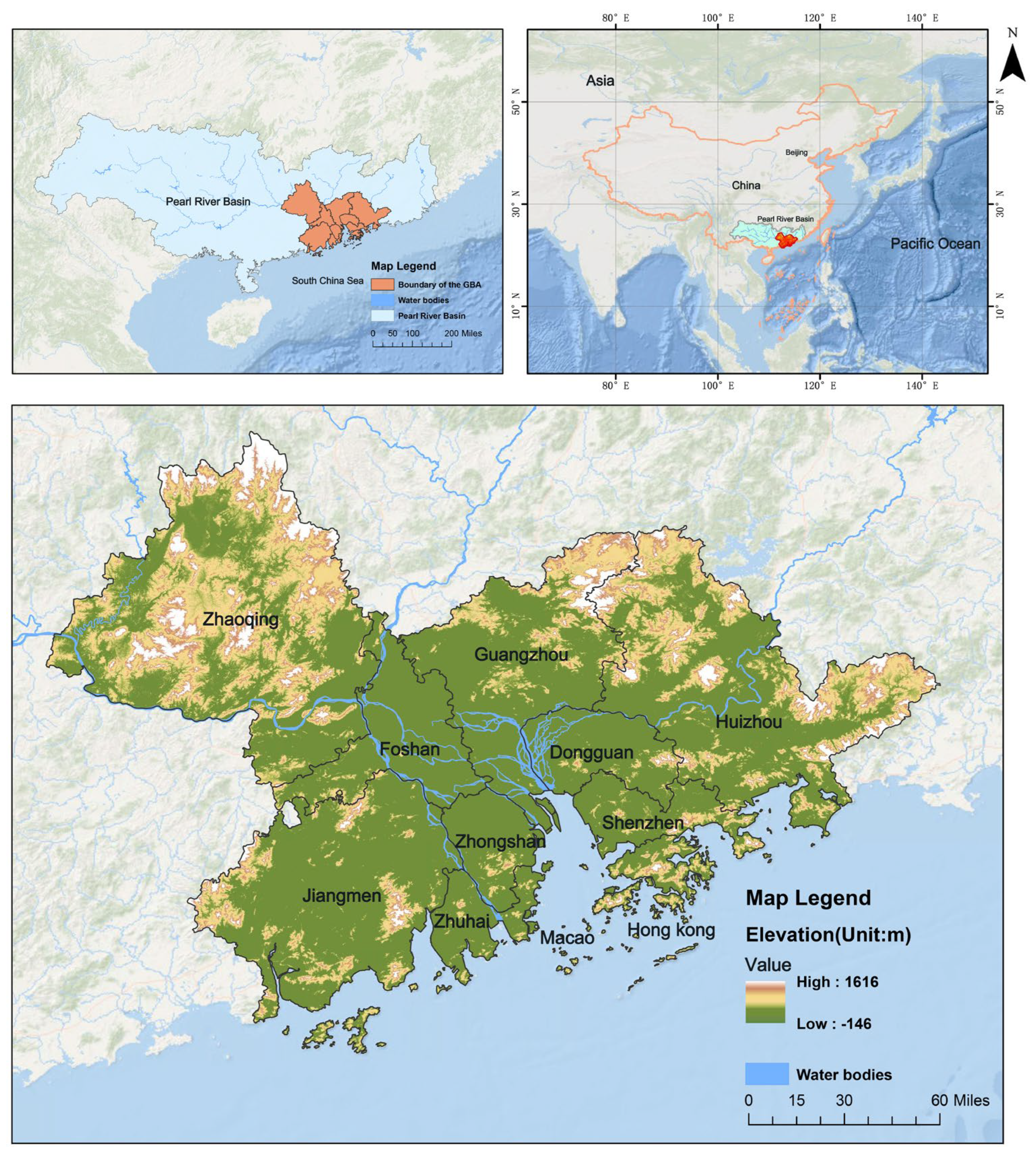
The Guangdong–Hong Kong–Macao Greater Bay Area (GBA) in Figure 1, spanning 21–25° N, 111–116° E in southern China, is a substantial megacity at the Pearl River estuary, featuring elevations ranging from −79 to 1611 m. This expansive landscape spans 55,913 km2 and comprises a populous community of approximately 86.7 million, ranking among the world’s densest cities. Known for its rich biodiversity, GBA preserves different habitats like forests, grasslands, wetlands, and marine ecosystems. Notably, the wetland ecosystems here, especially those along the Pearl River estuary, encompass various types, including coastal mudflats, inland mudflats, coastal tidal flats, inland tidal flats, artificial ponds, mangroves, salt pans, forest swamps, shrub swamps, and wet meadows, making GBA China’s coastal metropolis with the greatest wetland resource abundance. In addition, balancing conservation needs against development pressures poses significant challenges for future regional conservation and land use planning.

2.2. Data Collection and Pre-Processing

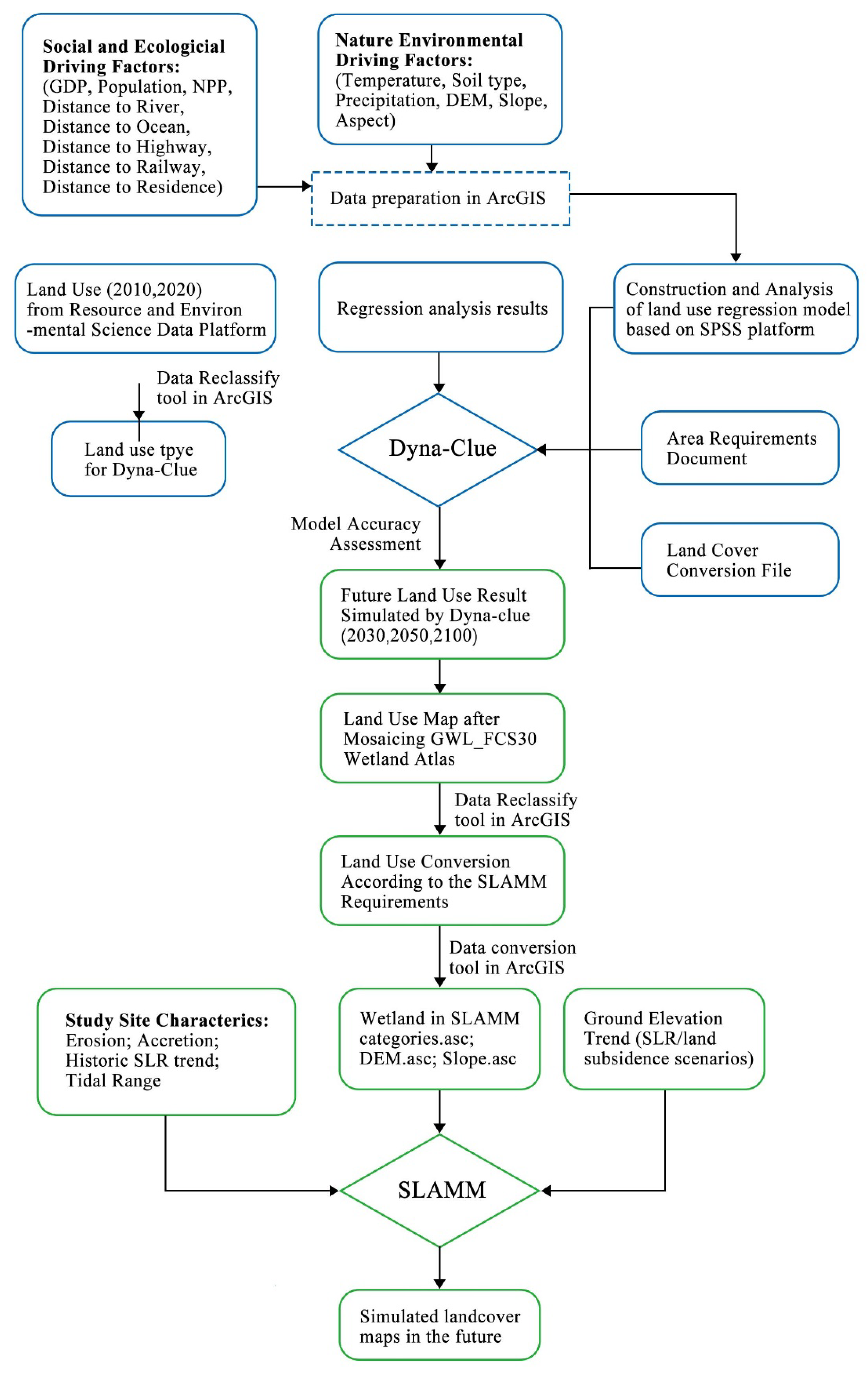
This research framework, displayed in Figure 2, utilizes the following methods with respective data backing from Table 1. The main steps in the present study are presented as follows: (1) land cover classification; (2) driving force investigation using SPSS 29 (Statistical Product and Service Solutions) software and accuracy assessment; (3) projection of future city expansion maps by using Dyna-CLUE; (4) prediction of coastal LULC change after sea-level rise by using SLAMM; and (5) projection of the future impact of SLR on coastal land use and habitat quality after quantification by INVEST.

2.3. Land Cover Classification Conversion

Data on scenario-based land use in China were obtained from the Data Center for Resources and Environmental Sciences, Chinese Academy of Sciences [47], at a spatial resolution of 30 m for the years 2010 and 2020. Instead of strictly adhering to the 2010 baseline, 2012 was chosen as the environmental benchmark to shield the model from climate-induced stochasticity. Official meteorological data [48,49] confirm that 2012 was a climatologically neutral year in Guangdong, with precipitation and temperatures aligning with long-term averages. Furthermore, they align temporally with the land use calibration period (2010–2020), thereby facilitating model driving and ensuring consistency across the simulation framework. This methodological adjustment enhances the robustness of our driving force analysis by providing a more consistent biophysical context. According to the requirements of the Dyna-CLUE model, the minimum area of each land use type participating in the simulation must not be less than 3% of the total area. Therefore, this study reclassified the CNLUCC land use dataset in ArcGIS 10.7 (Table 2), following the principle of retaining as many secondary land use categories as possible while ensuring effective model operation.
Land use systems and their changes are complex, as they are constrained by natural factors and simultaneously influenced by socio-economic, technological, and political drivers. The integration of these driving forces can, in turn, affect global environmental processes and human activities. Information on the natural environmental and socio-economic datasets used for urban expansion simulation is summarized in Table 1.
An additional classification step was introduced to meet the detailed wetland coding requirements of the SLAMM, improve habitat-oriented land use classification, and maintain data accuracy. The corresponding land-cover transformations between models are summarized in Table 3.
Throughout the modeling process, secondary land use classifications were retained to ensure the accuracy and reliability of the simulation results. For the interpretation and presentation of the results, these secondary classifications were subsequently unified, as detailed in Table 4.

2.4. Driving Forces Investigation and Accuracy Assessment

The reference model was constructed using transportation maps and remote sensing data from 2010 and 2020, because this period encompasses the most intense stage of urbanization in the GBA, the driving forces behind the land use changes during this period are highly representative. We computed DEM, aspect, slope, precipitation, temperature, soil type, GDP, population, NPP, and distances to the ocean, rivers, highways, and residential areas (as shown in Table 1). These variables were derived using ArcGIS buffering tools and transformed into ASCII format.
Subsequently, these factors were analyzed using logistic regression in SPSS (Statistical Product and Service Solutions). Model performance was evaluated using the ROC curve method [50], where values above the diagonal line (y = x) indicate acceptable predictive performance, with values ranging from 0.5 to 1. An ROC value closer to 1 represents higher predictive accuracy. The ROC values obtained for different land use types were as follows: agricultural land (0.81), dry land (0.65), tree cover (0.92), shrubland (0.70), sparse tree cover (0.62), other tree cover (0.68), grassland (0.89), inland open water (0.79), artificial pond (0.97), town (0.73), countryside (0.73), and industrial land (0.79). We validated the simulated 2020 land use against the observed data, achieving satisfactory accuracy (Kappa > 0.80). The simulated wetland extent also showed good agreement with the reference wetland map. However, the low ROC values for some categories (e.g., 0.62–0.70) suggest prediction uncertainty, which may affect subsequent model outputs; a full uncertainty propagation analysis is recommended for future work.

2.5. Predicting Future Coastal LULC Change

Dyna-CLUE is an advanced version of the CLUE-S model that could integrate both high-level land use demand and bottom-up local dynamics to spatially allocate land use changes. This model can effectively simulate land use distribution patterns by conducting quantitative analyses and summarizing interactions and competitions among diverse land use types. Thus, this model was particularly useful when applied within the Greater Bay Area, as it had the ability to consider changes in socio-economic and biophysical factors to predict future land use for different benchmark years. Moreover, Dyna-CLUE considered local land use conversion restrictions, such as the current protected areas in the region, as a conditional layer in the modeling stage, ensuring compliance with existing regulations and helping generate more realistic future land use scenarios.
The implementation of Dyna-CLUE consists of two distinct modules: a non-spatial land use demand module and a spatially land use allocation module. Future land use demand for 2030, 2050, and 2100 was determined by extrapolating the observed transition trends from the 2010–2020 period (Table 5). This approach establishes a baseline development trajectory that assumes the persistence of contemporary urbanization drivers and socio-economic dynamics in the absence of radical institutional or policy interventions. The land use demand module can be assisted by various external model specifications, which range from simple trend extrapolations to complex economic models, all aiming to calculate land use conversions. Supported by the Dyna-CLUE software 2.0, the second pattern-based module utilizes processed rasters of driving factors to calculate and synthesize the distribution probability of all land use types for each cell on the map. The resulting land use maps for 2030, 2050, and 2100 were then used as the baseline land cover input for the SLAMM. Due to the limited availability of historical land-cover data, calibration was conducted using 2010 data and validated against the 2020 map. Model performance was supported by ROC and Kappa metrics. Future land use demand was derived through trend extrapolation, representing a baseline scenario; thus, the results should be interpreted as scenario-based projections without explicit uncertainty quantification.

2.6. Future Impact of SLR on Coastal Land Use

The Sea Level Affecting Marshes Model (SLAMM) v-6.7 shows wetland alterations and shoreline land cover shifts under various sea-level rise scenarios, including short-term (2030), medium-term (2050), and long-term (2100) predictions, the technical document provides further information on this version’s capabilities [41]. In addition, it identifies potential shifts in submergence due to SLR. Under accelerated situations, anticipated LULC changes are tabulated and mapped using GIS tools. SLAMM uses an array of categories based on unique LULC codes (Table 3) to classify shorelines within the study region. Data input includes a 30 m DEM and intertidal gradients. Crucially, the hydrogeological parameters (Table 6) were specifically extracted from regional monitoring records and peer-reviewed studies focused on the Pearl River Estuary (e.g., Zhuhai, Shenzhen Bay, and Kiao Island). This localized parameterization enables the model to better represent specific regional dynamics rather than relying on generic global defaults.
The Shared Socioeconomic Pathway SSP3–7.0, a high-emission pathway, was chosen as the background for further projections, which presents challenging situations for progress in environmental sustainability due to possible regional rivalries [51]. The sea-level rise projections (median: 0.09 m, 0.21 m, and 0.68 m by 2030, 2050, and 2100) are taken from the NASA IPCC AR6 tool under SSP3–7.0. These values equal RCP8.5 projections, but we adopt SSP3–7.0 for consistency with our socioeconomic assumptions.

2.7. Projecting Future Impact of SLR on Coastal Land Use and Habitat Quality

The final land use maps, which integrate the urban expansion simulated by Dyna-CLUE and the coastal wetland changes simulated by SLAMM, were then used as input for the InVEST-HQ model to analyze GBA’s habitat quality. INVEST-HQ was employed to analyze GBA’s habitat quality: land use determined degradation level via threat evaluation, habitat type susceptibility, and suitability based on INVEST-HQ, a Stanford/Nature Conservancy/WWF collaboration.
INVEST-HQ, with its minimal data requirement and superior spatial visualization, is prevalent in urban ecology. Its parameters were derived by comparing the official technical manual with local empirical studies in the Pearl River Delta region. In addition, it has been used to assess habitat quality shifts in Scotland, China, and Portugal. Habitat quality ranges between 0 and 1 represent better-quality conditions.
Five prerequisites for performing INVEST-HQ include LULC maps, threat factor data, source information, access to sources causing degradation, habitat types, and their vulnerability to threats. The threat sources fall under five categories, including Croplands, Cities/Towns, Rural Settlements, Other Construction Land, Unused Land, and Land Applications. Threat maps are created in ArcGIS, where cultivated land has a raster value of 1 while all others receive a raster value of 0. Distances between habitats and sources, threat weights, decay rates, and habitat suitability are parameterized by synthesizing regional ecological findings with established InVEST guidelines [42,43,44,45,46]. The coefficients (Table 7 and Table 8) were adopted from existing studies, a common approach under data constraints. Although not specifically calibrated for the study area and thus not fully capturing local variability, previous studies suggest that model outputs are generally more robust in representing broad spatial patterns than absolute values. Therefore, the results are interpreted mainly in a relative sense. It should be noted that the modeling framework is constrained by the limited temporal availability of land use data (2010 and 2020) and the use of generalized parameter settings in the InVEST model (3.15.1). Therefore, the simulations are intended to capture broad spatial patterns under the given scenario rather than precise quantitative predictions.

3. Results

3.1. Spatiotemporal Changes of Urban Sprawl

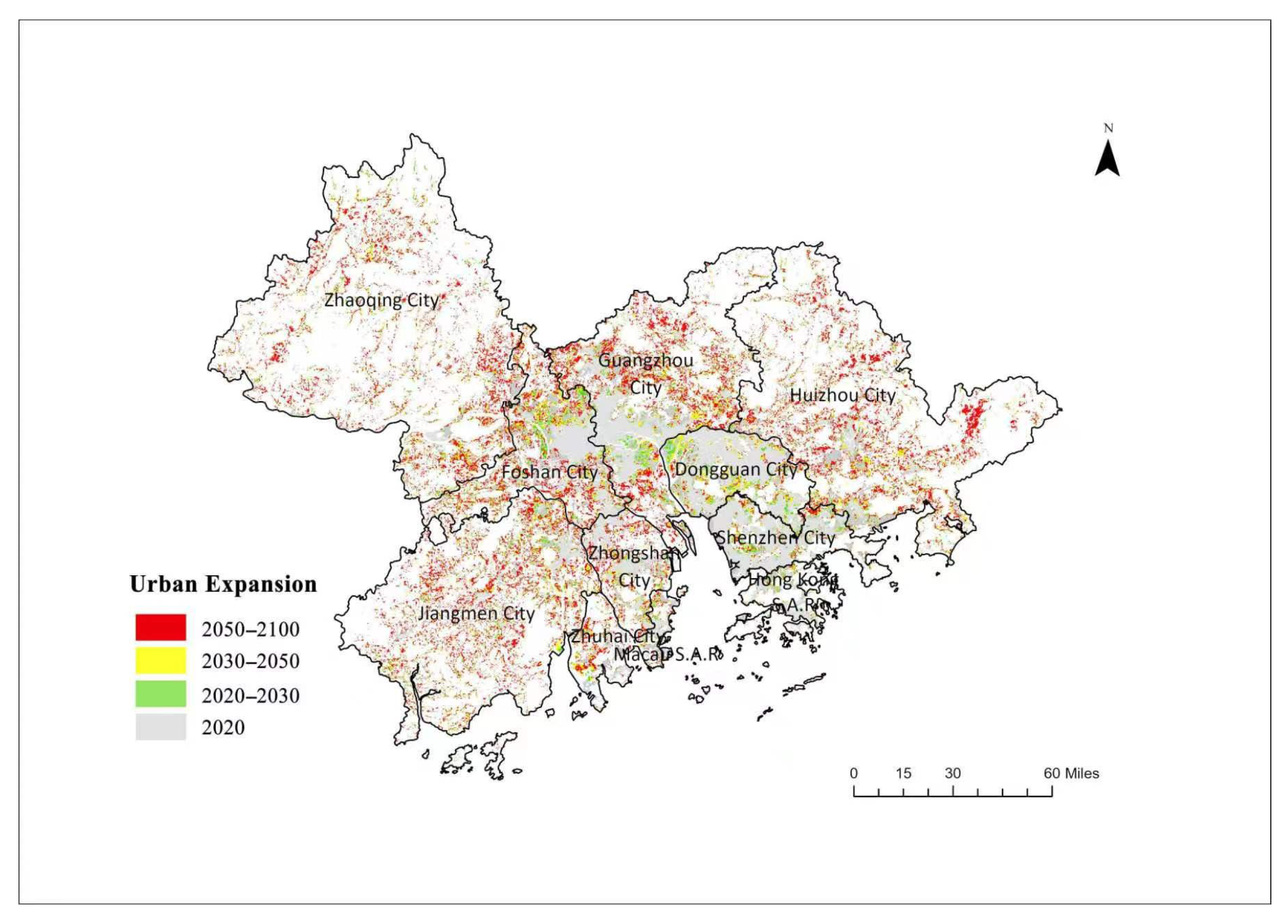
The analysis of habitat quality changes over time was preceded by an examination of urban sprawl and sea-level rise in the GBA. The AUC values predicted by the GLM ranged from 0.62 to 0.92 (Table 9), indicating that the selected driving factors in the urban sprawl model exhibited strong explanatory capability for land use type occurrence. Figure 3 illustrates the increase in construction land in the GBA, while Figure 4 presents the sources of land expansion.
Figure 3 shows the projected urban expansion trends, with rapid expansion originating from the core areas of the Guangdong–Hong Kong–Macao Greater Bay Area (including Dongguan, Shenzhen, Foshan, Guangzhou, and Zhongshan) from 2050 to 2100, followed by a marked spread across the entire bay area. Regions such as Zhaoqing, Jiangmen, and Huizhou are expected to become key expansion areas. In contrast, urban expansion between 2020 and 2030 in the Pearl River Delta is comparatively uniform, slow, and spatially scattered.
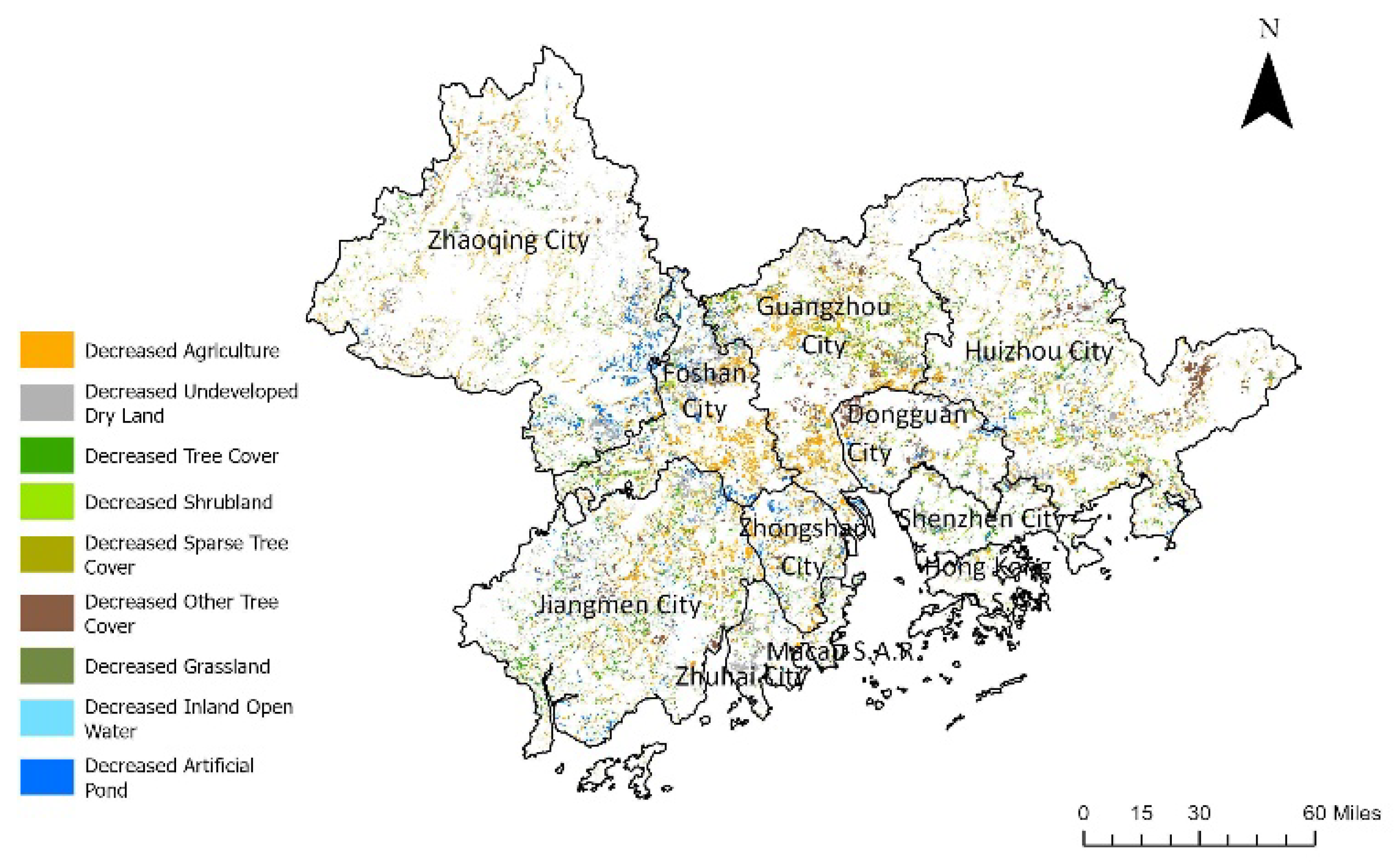
Figure 4 indicates that arable land is the primary conversion type for construction land expansion, primarily located in Guangzhou, Foshan, Shenzhen, and Zhongshan. Forestland and unused land follow suit, concentrated in Dongguan and Shenzhen. Notably, coastal areas of Shenzhen and Zhuhai, inland Foshan and Zhongshan have experienced significant loss of artificial pond area, impacting habitat quality. Grasslands and open forests contribute less to urban expansion due to their relatively limited initial extent. To further illustrate the spatial differences in construction land expansion, a statistical summary of construction land changes for each city from 2020 to 2100 is presented in Table 10.
Parallel to habitat projections, these deterministic urban expansion maps necessitate a prudent interpretation. Since localized performance variations—reflected in lower ROC values—may permeate the modeling chain, these results delineate broader spatial orientations rather than absolute certainties, serving as a scientifically grounded baseline for regional planning.

3.2. Spatiotemporal Changes of Urban Sprawl of Sea-Level Rise

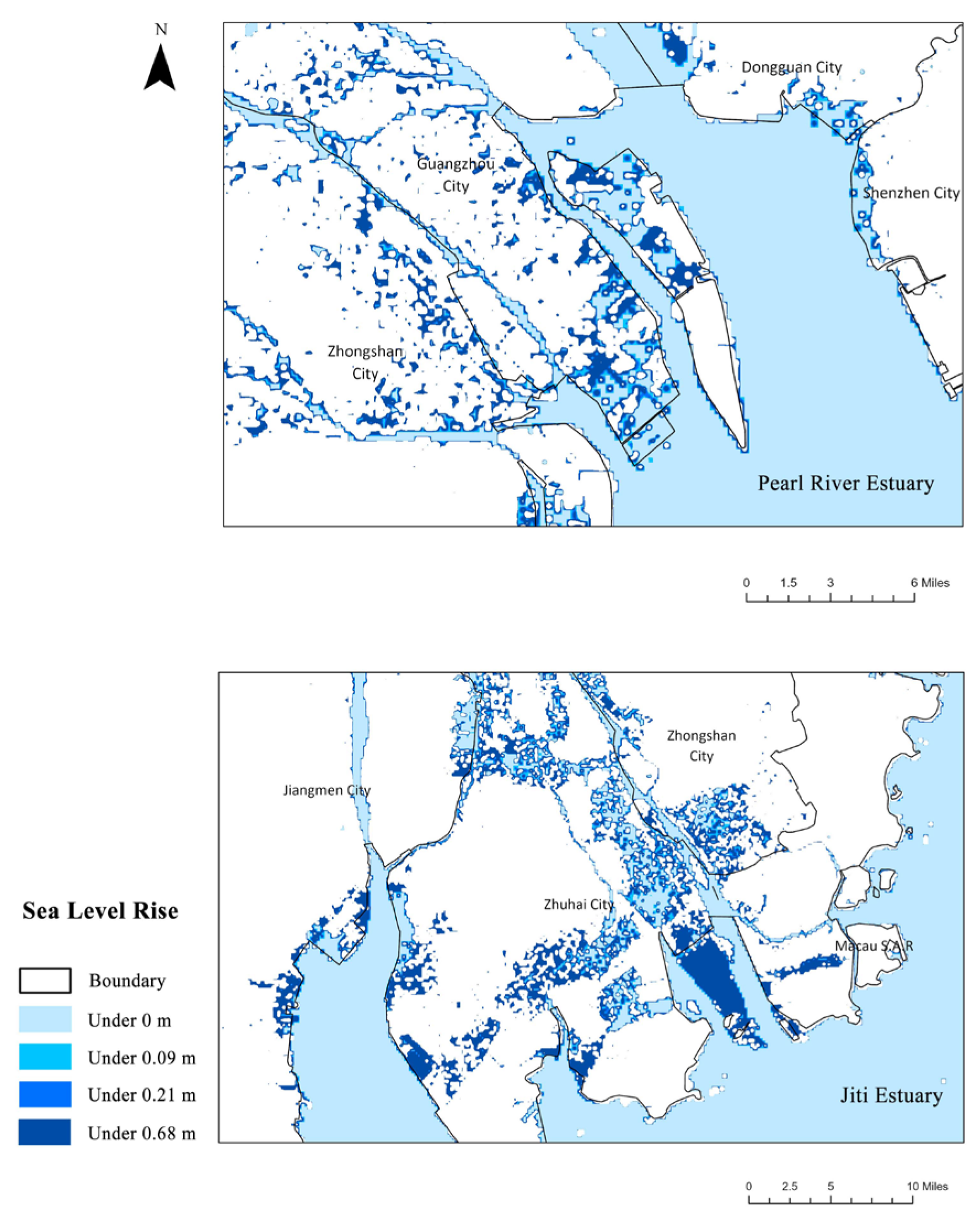
Figure 5 shows the potential inundation areas in the coastal region of the Guangdong–Hong Kong–Macao Greater Bay Area (GBA) under four sea-level rise scenarios (0 m, 0.09 m, 0.21 m, and 0.68 m). The results indicate that the low-lying areas around the Pearl River Estuary are the most vulnerable, with particularly significant impacts near Zhuhai, Zhongshan, and Jiangmen. As the sea-level rise increases, the inundation areas continue to expand.
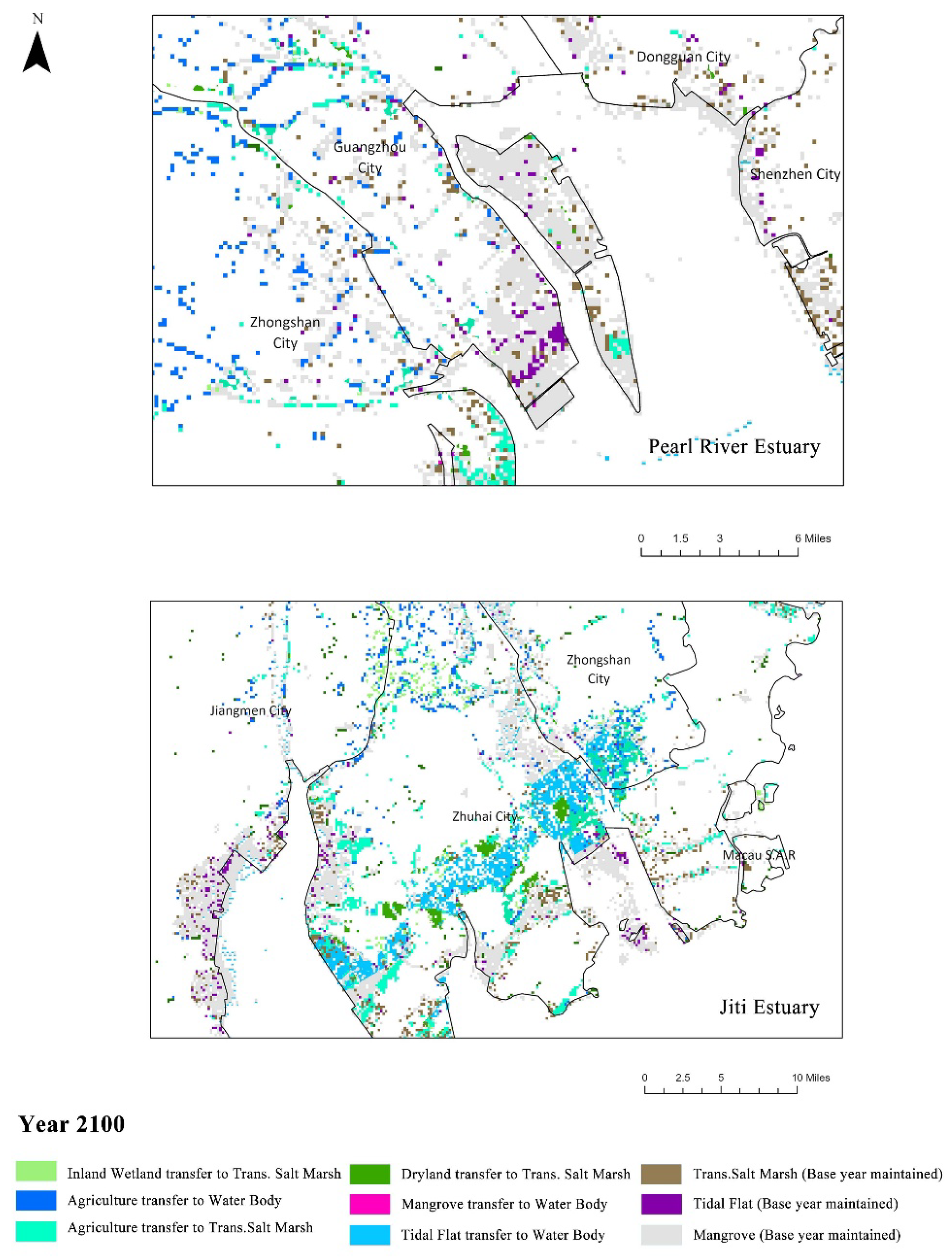
Figure 6 and Table 11 illustrate the land cover changes in 2100, showing that some inland wetlands and drylands have transformed into transitional salt marshes, farmlands and mangroves have turned into water bodies, and tidal flats have shown a trend of converting to water areas, while some salt marshes, tidal flats, and mangrove areas remain relatively stable.

3.3. Future Land Cover Map Under the Influence of Sea-Level Rise

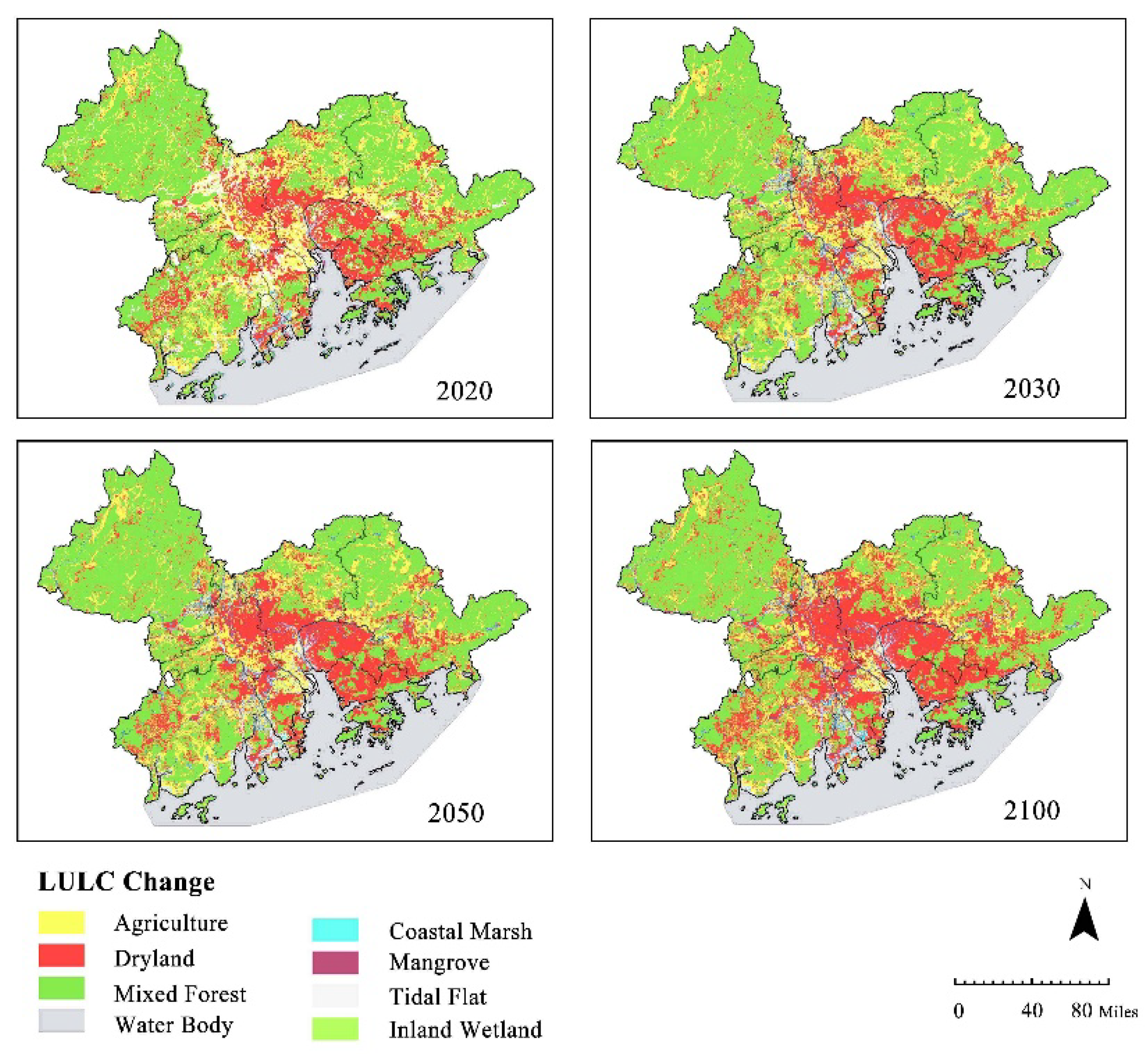
The 2020 base map predicts future LULC shifts for 2030–2100 (Figure 7) (Table 12, Table 13 and Table 14). These predictions were generated by the Dyna-CLUE model (Section 2.5), which was calibrated using 2010–2020 land cover data and driven by logistic regression probabilities of natural and socio-economic factors (Table 1). Table 3 presents the percentages of statistic areas. The findings suggest that agricultural land, unused land, and mixed forest areas will shrink over time. Agricultural land will diminish from 14.91% in 2020 to 9.63% by 2100, while unused land will fall from 6.21% to 3.70%. Mixed forests will reduce by 233,167 ha, or approximately 3.80% of the total area. This reduction stems from urban sprawl turning into construction plots. As they are influenced by rising sea level, inland wetlands may only slightly decline. Notably, the area of coastal wetlands will increase from 2.13% to 2.24% between 2020 and 2050 and then decrease to 2.20% from 2050 to 2100.

3.4. Spatiotemporal Variation in Habitat Quality

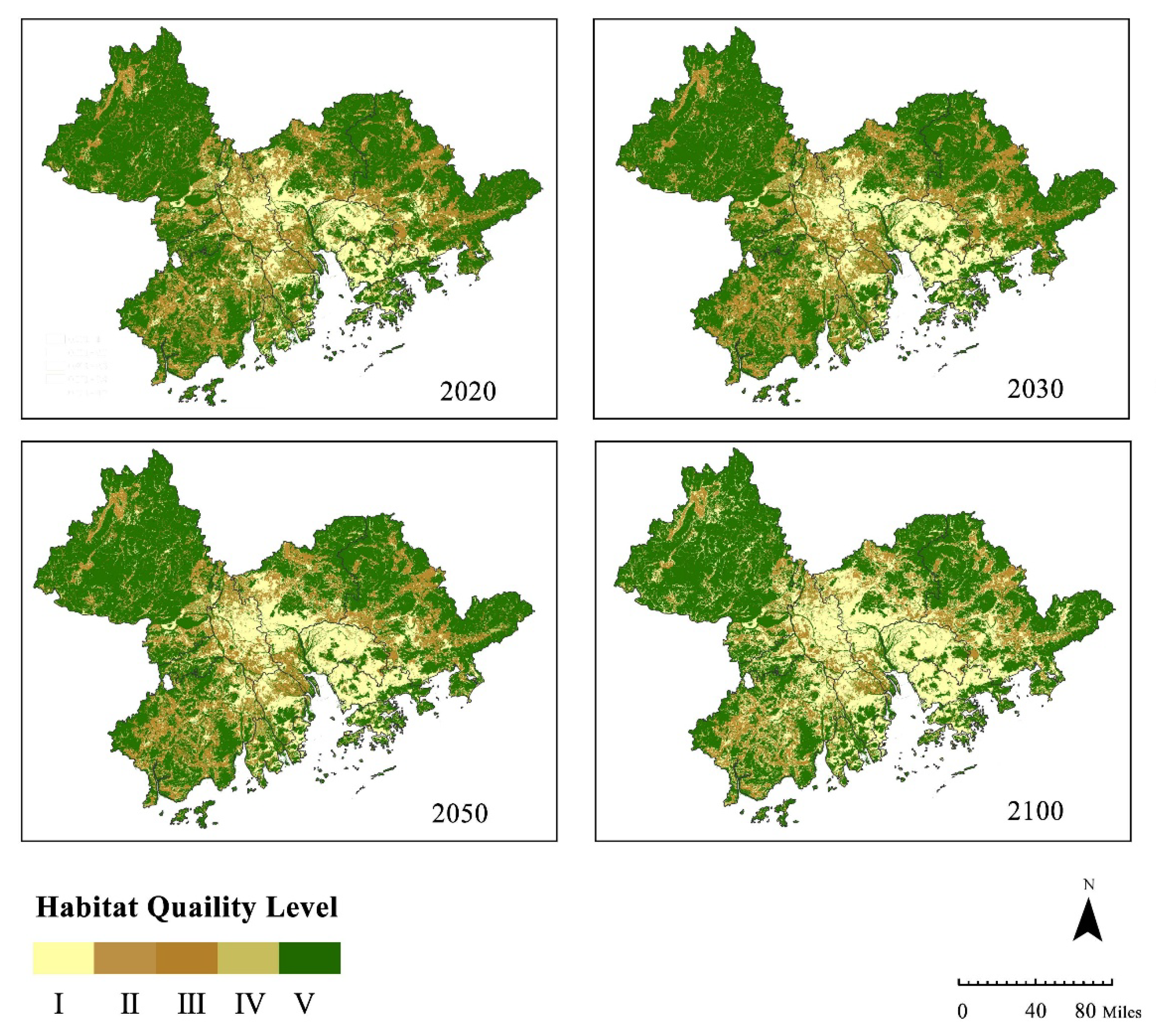
Under the SSP3–7.0 scenario, Figure 8 shows that the habitat quality of the Guangdong–Hong Kong–Macao Greater Bay Area (GBA) has generally declined during the period from 2020 to 2100. The average habitat quality decreased from 0.79 to 0.67, indicating a general downward trend. Moreover, this pattern suggests a potential reduction in ecosystem functioning. The habitat quality was categorized into five tiers for easy interpretation: I (0–0.2), II (0.2–0.4), III (0.4–0.6), IV (0.6–0.8), and V (0.8–1.0) (Table 12 and Table 13). The central portion of the delta exhibits the highest vulnerability to degradation, particularly as these transformations accelerate in the period beyond 2050. A downward trajectory in quality ratings is prominently observed across core urban centers, specifically within the cities of Guangzhou, Foshan, Dongguan, and Shenzhen. Overall, the area of low-quality habitats is constantly expanding, while the area of high-quality habitats is gradually shrinking over time (Table 14). These SSP3–7.0 projections, while lacking statistical intervals due to model determinism, maintain high spatial fidelity via historical validation (Kappa > 0.80). Thus, results function as risk-oriented benchmarks rather than absolute numerical forecasts.

3.5. Response of Land Use Change to Habitat Quality

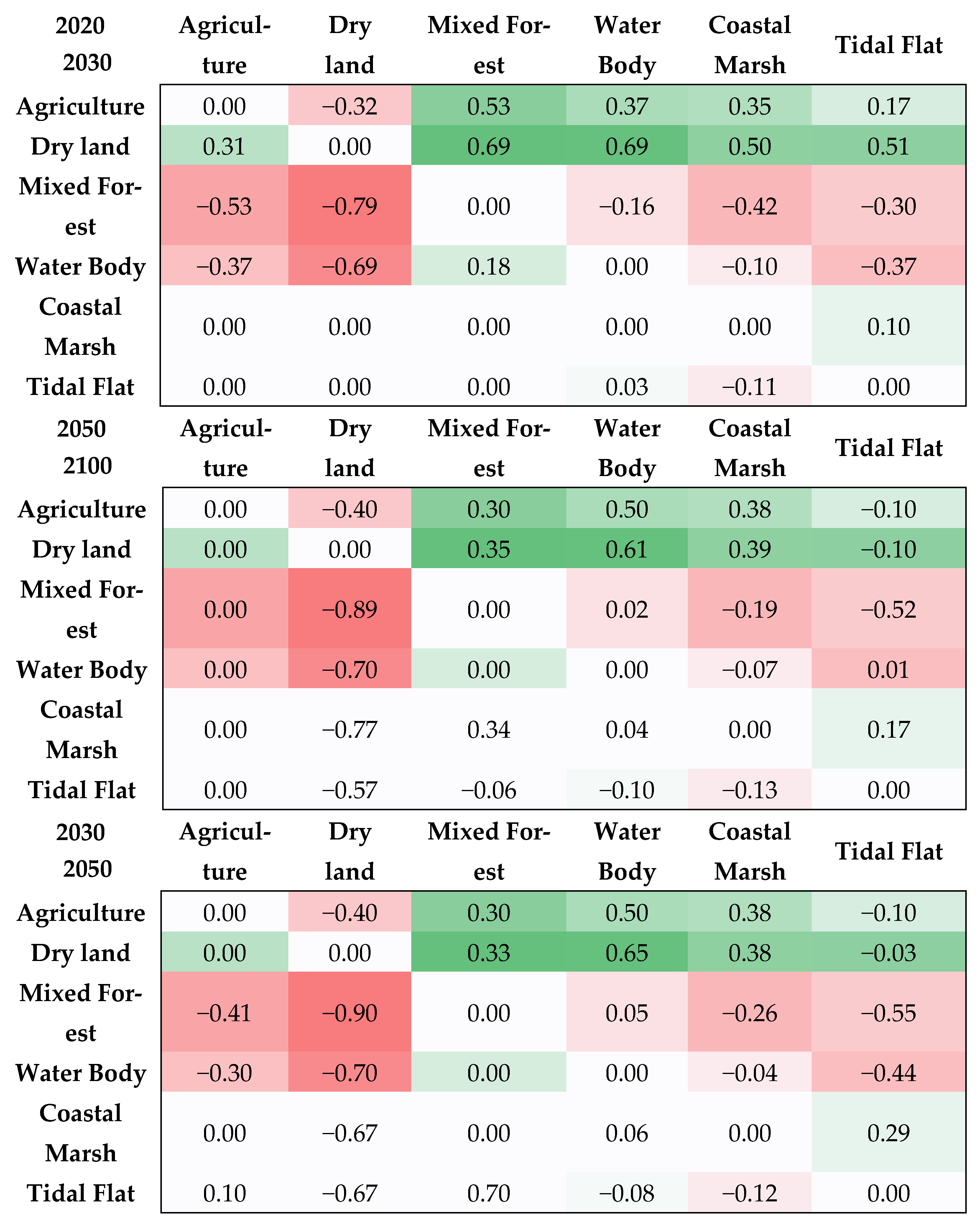
The Habitat Quality Contribution Ratio assesses a habitat’s effect on ecosystem health and stability. Under the SSP3–7.0 scenario, Figure 9 presents contribution rates from land use shifts between 2020–2030, 2030–2050, and 2050–2100.
The figure shows that, between 2020 and 2030, positive contributions include the following: conversions from agriculture to mixed forest, water body, coastal marsh, and tidal flat; dry land to mixed forest, water body, coastal marsh, and tidal flat; water body to mixed forest; and coastal wetlands to tidal flat. The highest contribution (0.69) is from dry land to mixed forest or water bodies. In contrast, agricultural land shifts contribute negatively (from −0.32 to 0.53).
Negative contributions include the following: agriculture to dry land; mixed forest to agriculture, dry land, water body, coastal marsh, and tidal flat; water body to agriculture, dry land, coastal marsh, and tidal flat; and tidal flat to coastal flat. The most negative shift is from mixed forest to dry land (−0.79). Water body shifts also remain negative, with the most negative being water body to dry land (−0.69).
Over time, the contribution rate of dry land to mixed forest decreases from 0.69 to 0.33 and 0.35. The contribution of mixed forest to coastal marsh gradually reduces, indicating a lessening negative impact, but still causing some harm. Notably, conversions of agriculture and dry land to tidal flat shift from positive (0.17 and 0.51, respectively) in the initial period to negative (−0.10 and −0.03 by 2030–2050, and both −0.01 by 2050–2100). This suggests that, while initially beneficial, these shifts ultimately become detrimental. All results are scenario-specific projections under SSP3–7.0 and reflect relative trends.

4. Discussion

4.1. Specific Wetland Types Exhibit Varied Sensitivity to Sea-Level Rise

Our simulations indicate that salt marshes, mangroves, and tidal flats exhibit markedly different sensitivities to sea-level rise, consistent with findings from other deltaic systems [52,53,54]. The simulation results of the sea level impact model (SLAMM) on the effects of sea level rise on various coastal wetlands show that salt marshes exhibit high resilience in the simulation, which is related to the salt-tolerant characteristics and sediment accumulation capacity of salt marshes as proposed in previous studies. Salt marshes also promote sediment accumulation through rapid deposition and siltation, thereby mitigating seawater erosion by intercepting wave energy. Through continuous growth and vertical accretion, salt marsh plant communities can adjust to changes in sea level. Moreover, salt marsh ecosystems exhibit a degree of self-regulation, with interdependent organisms adapting to environmental shifts.
In contrast, the model results indicate that the mangroves in the study area are relatively less affected by sea level rise. This might be related to their current spatial distribution and elevation conditions. Most mangroves in the Guangdong–Hong Kong–Macao Greater Bay Area are located in Shenzhen Bay, Zhenhai Bay, Qiao Island, and other relatively high-elevation areas, making them less vulnerable to sea-level rise. This spatial buffering effect has also been observed in Southeast Asian mangroves [55]. Scattered coastal mangrove wetlands within the study area are expected to experience gradual area reductions under rising sea levels; however, their limited spatial extent suggests that their contribution to overall habitat quality decline is relatively minor. Nevertheless, our model does not currently take into account the effects of changes in freshwater runoff or sudden storm surges, which could potentially accelerate the loss of mangroves [56].
Inland wetlands are more prone to submergence, whereas coastal tidal flats tend to persist, which may be related to their broader elevation ranges, as suggested by previous research. Tidal flats are unique coastal ecosystems adapted to fluctuating tidal regimes. The elevation gradient within tidal flat habitats facilitates plant adaptation, in contrast to inland wetlands located at lower elevations, which may experience more intense seawater erosion under rising sea levels. Although portions of tidal flats may be inundated, ecosystem structure and function can remain stable in more resilient areas, demonstrating their adaptive capacity. The simulated contraction of tidal flat area aligns with the global trajectories observed under accelerated sea-level rise. However, as the modeling framework omits lateral sediment redistribution and anthropogenic interventions—such as beach nourishment, which will be discussed in subsequent sections—these results should be interpreted as an upper-bound projection rather than a definitive scenario. Although the trends presented in Table 10 are consistent with conventional ecological understanding, they represent prognostic simulations rather than direct empirical evidence.

4.2. Human Disturbance Modifies Wetland Responses to Sea-Level Rise

Some studies suggest coastal wetlands actively adjust their positions in the intertidal zone to bolster ecosystem resilience during sea-level rise. Nguyen et al. investigated Singapore’s coast [57], finding that these wetlands can counter SLR through their own sedimentation rates. Thus, SLR alone is not a primary cause of coastal wetland degradation.
However, this adaptive capacity may be substantially altered by human activities. Notably, the projected growth of salt marshes significantly exceeds documented rates in other mid-latitude systems. This discrepancy likely stems from the model’s idealized parameters, which assume an unrestricted sediment supply and the absence of anthropogenic barriers. In reality, such optimal conditions are seldom realized in estuarine environments that have undergone intensive human modification [58], where physical obstructions often impede natural wetland expansion. Furthermore, although the research framework integrates the Dyna-CLUE model and SLAMM to simulate landscape dynamics, it lacks explicit representation of historical or future land reclamation activities. Furthermore, the model does not account for the potential obstructive effects of “hard” infrastructure, such as seawalls and levees, which may impede the landward migration of wetlands—a phenomenon often referred to as coastal squeeze. It should be noted that these factors are not explicitly incorporated in the current modeling framework and therefore represent potential sources of uncertainty. Although our modeling framework does not explicitly simulate reclamation history or policy scenarios, empirical evidence suggests that the Guangdong–Hong Kong–Macao Greater Bay Area has experienced intensive shoreline development, with large-scale reclamation and landfilling potentially modifying natural coastlines and disrupting natural habitat succession processes. Such activities are particularly evident along the Lingdingyang coast (including Zhuhai, Zhongshan, Shenzhen, and Dongguan), the Daya Bay coast in Huizhou, and the Huangmao Sea coast in Jiangmen. The significance of this exclusion is underscored by findings from the Mekong [59] and Yangtze [60] systems, which show that land reclamation exacerbates SLR-driven losses by restricting available habitat space. The modeling premise of unimpeded landward transgression deviates from the reality of heavily modified coastlines. The exclusion of these anthropogenic variables necessitates a prudent interpretation of the findings and underscores the imperative for future research to incorporate explicit reclamation scenarios. Accordingly, the projected trajectories should be regarded as an optimistic baseline for coastal evolution rather than a definitive scenario.

4.3. Recommendation for Ecological Protection

Given the above uncertainties, especially the model’s optimistic assumptions, these recommendations are risk-informed strategic directions, not deterministic prescriptions. Site-specific feasibility and adaptive management are required. Building on the simulated trends, we derive city-specific recommendations that account for local land availability and urbanization stage. According to our study on the contribution of various land types to habitat quality, we recommend a shift in land use practices that positively affect habitat quality in ecosystem management and conservation, emphasizing habitats of high ecological value to enhance system stability and health.

4.3.1. Promote Land Use Practices Beneficial to Habitat Quality

Our findings indicate that the transformation of dry land into mixed forest contributes most significantly to habitat quality improvement. However, most dry land has already been urbanized, making it difficult to dismantle existing built-up areas. Therefore, we advocate for striking a balance between urban development and the effective implementation of ecological red line principles. For cities with limited potential for green space expansion, including Hong Kong, Macao, and Shenzhen, habitat enhancement can be achieved through technological advancements such as park quality improvement and vertical greening. In rapidly expanding cities lacking sufficient green space, such as Dongguan, Zhongshan, Foshan, and Zhuhai, ecological service quality can be improved by increasing green areas and reorganizing the urban green network structure. In addition, cities with abundant land area and high forest coverage, such as Guangzhou, Jiangmen, Zhaoqing, and Huizhou, should maintain current forest coverage through measures such as controlling urban expansion and strengthening green belt protection.
Moreover, the conversion of cultivated land into mixed forest and water bodies also makes significant contributions to habitat quality, indicating that policies such as returning farmland to forests and lakes can significantly enhance habitat quality. In the near future (2020–2030), the impact of returning farmland to forests is better than that of returning farmland to lakes. However, over time, the contribution rate of cultivated land transforming into mixed forests will decrease, while the contribution rate of transforming into water bodies will increase. Considering this trend, we suggest prioritizing the implementation of policies such as returning farmland to lakes in future planning with limited resources.

4.3.2. Prioritize Coastal Wetland Protection

Coastal ecosystems protect shorelines from erosion and provide essential habitats for marine birds, fish, and amphibians. Existing research indicates that coastal wetlands exhibit resilience to sea-level rise, partly through inland migration. As a result, timely adjustments to land use strategies, such as returning reclaimed farmlands and ponds upstream of wetlands, can guarantee sufficient space for wetland expansion. Critically, because urban expansion dominates habitat loss, land use planning tools (e.g., urban growth boundaries, ecological red lines) are more urgent than SLR-focused measures, and adaptation must be habitat-specific given the varied sensitivities of coastal wetlands. The presence of anthropogenic barriers and resultant coastal hardening severely restricts the capacity for wetlands to migrate inland. To address this spatial constraint, future coastal planning should prioritize controlled realignment measures or multifunctional hybrid strategies over idealized natural migration assumptions.

5. Conclusions

In conclusion, under the SSP3–7.0 scenario, ecosystem quality in the Guangdong–Hong Kong–Macao Greater Bay Area is projected to show a declining tendency under the combined pressures of rapid urbanization and rising sea levels. This study presents an integrated modeling framework for assessing changes in habitat quality by combining the Dyna-CLUE model and SLAMM for future land use simulation and applying the InVEST model to project habitat quality from 2020 to 2100.
The key findings, which are contingent on this scenario, are summarized as follows: (1) Urban expansion is associated with declines in habitat quality, with construction spreading across the region. (2) Coastal wetlands are projected to increase and then decrease due to sea-level rise, increasing by 1327 ha between 2020 and 2030 and 3231.99 ha between 2020 and 2050, primarily from salt marshes encroaching on agricultural lands, inland wetlands, and drylands, potentially contributing to short-term improvements in coastal habitats. However, by 2100, urban sprawl is projected to lower total wetland area by 878 ha, which may further affect habitat conditions. (3) Low-quality habitats increased by 725,956 ha during the study period, while IV and V habitats decreased by approximately 290,033 ha, with mixed forest conversion resulting in the most significant loss. Overall, the results suggest a long-term tendency toward habitat degradation in the region.
Several governance pathways are suggested to augment the policy utility of this research. These include: (1) enforcing stringent restrictive zoning to preclude irreversible development within ecological redlines; (2) instituting adaptive transition buffers that facilitate landward wetland transgression under escalating sea levels; and (3) integrating synergistic spatial frameworks to harmonize urbanization demands with climate resilience for enduring ecosystem stability.
Despite these findings, several limitations should be acknowledged. First, both the Dyna-CLUE model and SLAMM involve inherent simplifications in representing land conversion processes and coastal dynamics. Second, some key parameters—such as intertidal erosion rates, sea-level rise, and tidal ranges—were derived from global datasets and may deviate from local conditions, which could introduce uncertainties into the simulation results. Third, the simulations were conducted under the SSP3–7.0 scenario; therefore, while the magnitude of projected changes may vary under alternative scenarios, the overall direction of habitat degradation is likely to remain similar within comparable contexts. Fourth, the moderate ROC values for several land use classes (0.62–0.70) may propagate uncertainty through the model chain, which was not fully quantified.
To enhance predictive precision, future research should leverage high-fidelity remote sensing data and unmanned aerial vehicle (UAV) monitoring to more effectively resolve fine-scale coastal dynamics and anthropogenic influences. Furthermore, recognizing that urban sprawl is rarely a linear process, subsequent investigations should transcend constant-rate assumptions by incorporating diversified development scenarios that reflect specific policy interventions and ecological mandates. While the present study establishes a scenario-based analytical framework within the study context, the reliance on a single-scenario architecture remains an acknowledged constraint. Consequently, we advocate for multi-pathway simulations in future scholarly efforts to better encapsulate the complexities of evolving land use governance and systematically mitigate inherent modeling uncertainties.

Author Contributions

Conceptualization, M.Z.; methodology, M.Z.; supervision, M.Z.; funding acquisition, M.Z.; software, X.D.; validation, X.D. and J.S.; formal analysis, X.D.; investigation, X.D.; data curation, X.D.; writing—original draft preparation, X.D.; visualization, X.D.; resources, J.S.; writing—review and editing, J.S.; project administration, J.S. All authors have read and agreed to the published version of the manuscript.

Funding

This research was funded by the National Natural Science Foundation of China (grant number 32271735), the Guangdong Provincial Philosophy and Social Science Planning Project (GD24CYS34), and the Fundamental Research Funds for the Central Universities Cultivation Project (CGPY202409). The APC was funded by the corresponding author’s research fund.

Data Availability Statement

Data Availability Statement: The land cover data (CNLUCC) for 2010 and 2020 are available from the Resource and Environment Science and Data Center (RESDC) at https://www.resdc.cn (accessed on 13 December 2025). The Digital Elevation Model (Copernicus DEM) is available from Open Topography (https://portal.opentopography.org (accessed on 13 December 2025)). Climate data (precipitation, temperature) and socio-economic data (GDP, population, NPP) are also available from RESDC. The sea-level rise projections were obtained from the NASA IPCC AR6 Sea Level Projection Tool (https://sealevel.nasa.gov/ipcc-ar6-sea-level-projection-tool (accessed on 13 December 2025)). The simulated future land use maps (2030, 2050, 2100) and habitat quality outputs generated in this study are available from the corresponding author upon reasonable request.

Acknowledgments

The authors would like to thank the relevant personnel for their administrative and technical support during the manuscript preparation. In addition, thanks are extended to the future land use de-institutions that provided data support and experimental conditions necessary for this research.

Conflicts of Interest

The authors declare no conflicts of interest.

References

  1. Daily, G.C. Nature’s Services: Societal Dependence on Natural Ecosystems; Island Press: Washington, DC, USA, 1997. [Google Scholar]
  2. Costanza, R.; d’Arge, R.; de Groot, R.; Farber, S.; Grasso, M.; Hannon, B.; Limburg, K.; Naeem, S.; O’Neill, R.V.; Paruelo, J.; et al. The value of the world’s ecosystem services and natural capital. Nature 1997, 387, 253–260. [Google Scholar] [CrossRef]
  3. Zhang, H.; Wu, C.; Li, J.; Wu, J. Assessing the impact of land-use change on ecosystem services in rapidly urbanizing regions. Land Use Policy 2020, 99, 105045. [Google Scholar]
  4. Smith, A.; Brown, K.; Jones, P. Urban expansion and its impacts on ecological systems: A global perspective. Sustainability 2020, 12, 4567. [Google Scholar]
  5. Kindu, M.; Schneider, T.; Teketay, D.; Knoke, T. Land use/land cover change analysis using object-based classification approach in Munessa-Shashemene landscape of the Ethiopian Highlands. Remote Sens. 2016, 8, 2411–2435. [Google Scholar] [CrossRef]
  6. Kubiszewski, I.; Costanza, R.; Anderson, S.; Sutton, P. The future value of ecosystem services: Global scenarios and national implications. Ecosyst. Serv. 2017, 26, 289–301. [Google Scholar] [CrossRef]
  7. Tolessa, T.; Dechassa, C.; Simane, B. Land use/land cover dynamics in response to climate change and anthropogenic activities in Ethiopia. Environ. Syst. Res. 2017, 6, 1. [Google Scholar]
  8. Eshetu, A.A.; Assen, M.; Woldearegay, K. Impacts of land use/land cover change on ecosystem services in rapidly urbanizing landscapes. Land 2023, 12, 145. [Google Scholar]
  9. Geist, H.J.; Lambin, E.F. Proximate causes and underlying driving forces of tropical deforestation. BioScience 2002, 52, 143–150. [Google Scholar] [CrossRef]
  10. Halmy, M.W.A.; Gessler, P.E.; Hicke, J.A.; Salem, B.B. Land use/land cover change detection and prediction in the north-western coastal desert of Egypt using Markov–CA. Appl. Geogr. 2015, 63, 101–112. [Google Scholar] [CrossRef]
  11. Yohannes, H.; Soromessa, T.; Argaw, M.; Dewan, A. Spatiotemporal changes of land use/land cover and ecosystem service values in Ethiopia. Environ. Syst. Res. 2021, 10, 1. [Google Scholar]
  12. Statistics Bureau of the People’s Republic of China. China Statistical Yearbook 2012; China Statistics Press: Beijing, China, 2012.
  13. Wu, F.; Zhang, F.; Webster, C. Informality and the development and demolition of urban villages in the Chinese peri-urban area. Urban Stud. 2013, 50, 1919–1934. [Google Scholar] [CrossRef]
  14. Seto, K.C.; Güneralp, B.; Hutyra, L.R. Global forecasts of urban expansion to 2030 and direct impacts on biodiversity and carbon pools. Proc. Natl. Acad. Sci. USA 2012, 109, 16083–16088. [Google Scholar] [CrossRef]
  15. Nicholls, R.J.; Wong, P.P.; Burkett, V.; Codignotto, J.; Hay, J.; McLean, R.; Ragoonaden, S.; Woodroffe, C.D. Coastal systems and low-lying areas. In Climate Change 2007: Impacts, Adaptation and Vulnerability; IPCC: Cambridge, UK, 2010; pp. 315–356. [Google Scholar]
  16. Wong, P.P.; Losada, I.J.; Gattuso, J.P.; Hinkel, J.; Khattabi, A.; McInnes, K.; Saito, Y.; Sallenger, A. Coastal systems and low-lying areas. In IPCC AR5 Working Group II; IPCC: Cambridge, UK, 2014. [Google Scholar]
  17. Neumann, B.; Vafeidis, A.T.; Zimmermann, J.; Nicholls, R.J. Future coastal population growth and exposure to sea-level rise and coastal flooding. PLoS ONE 2015, 10, e0118571. [Google Scholar] [CrossRef]
  18. IPCC. Special Report on the Ocean and Cryosphere in a Changing Climate; IPCC: Geneva, Switzerland, 2019. [Google Scholar]
  19. Church, J.A.; Clark, P.U.; Cazenave, A.; Gregory, J.M.; Jevrejeva, S.; Levermann, A.; Merrifield, M.A.; Milne, G.A.; Nerem, R.S.; Nunn, P.D.; et al. Sea level change. In Climate Change 2013: The Physical Science Basis; IPCC: Cambridge, UK, 2013. [Google Scholar]
  20. Vitousek, S.; Barnard, P.L.; Fletcher, C.H.; Frazer, N.; Erikson, L.; Storlazzi, C.D. Doubling of coastal flooding frequency within decades due to sea-level rise. Sci. Rep. 2017, 7, 1399. [Google Scholar] [CrossRef]
  21. Becker, M.; Karpytchev, M.; Papa, F. Sea level rise in coastal regions. Ocean Sci. 2019, 15, 395–413. [Google Scholar]
  22. Nicholls, R.J.; Hutton, C.W.; Lázár, A.N. Integrated assessment of coastal flooding and adaptation. Ocean Coast. Manag. 2018, 153, 1–11. [Google Scholar]
  23. Ghoussein, Y.; Pizarro, O.; Williams, S.B. Coastal flooding prediction under sea-level rise scenarios. Coast. Eng. 2018, 138, 33–44. [Google Scholar]
  24. Li, G.; Li, X.; Yao, Q.; Wang, H. Projected sea-level rise and high tide flooding along the coast of China under SSP scenarios. Sci. Total Environ. 2022, 822, 153521. [Google Scholar]
  25. Turner, R.E.; Kearney, M.S.; Parkinson, R.W. Sea-level rise and wetland loss in the northern Gulf of Mexico. Estuar. Coast. Shelf Sci. 2007, 74, 444–454. [Google Scholar]
  26. Belinda, R.; Smith, J.A.; Brown, L.M.; Johnson, P.; Williams, K.; Taylor, D. Coastal wetland response to sea-level rise. Wetl. Ecol. Manag. 2009, 17, 45–56. [Google Scholar]
  27. Mahmood, R.; Pielke, R.A.; Dirmeyer, P.A.; McAlpine, C.; Lawton, R.O.; Flanner, M.G.; Santanello, J.A.; Beltrán-Przekurat, A.; Mearns, L.O.; Findell, K.L.; et al. Impact of land use change on climate variability. Earth-Sci. Rev. 2015, 146, 1–17. [Google Scholar]
  28. Narayan, S.; Beck, M.W.; Wilson, P.; Thomas, C.J.; Guerrero, A.; Shepard, C.C.; Reguero, B.G.; Franco, G.; Ingram, J.C.; Trespalacios, D. The value of coastal wetlands for flood damage reduction. Sci. Rep. 2017, 7, 9463. [Google Scholar] [CrossRef]
  29. Prakasam, C.; Singh, R.B.; Kumar, P.; Sharma, P.; Das, S.; Roy, P.S.; Ghosh, S. Coastal land use change and vulnerability assessment under sea-level rise. Land 2022, 11, 1345. [Google Scholar]
  30. Fairchild, T.P.; Bennett, W.G.; Day, B.; Skov, M.; Moller, I.; Beaumont, N.; Karunarathna, H.; Griffin, J.N. Coastal Wetlands Mitigate Storm Flooding and Associated Costs in Estuaries. Environ. Res. Lett. 2021, 16, 074034. [Google Scholar] [CrossRef]
  31. Xie, G.; Zhen, L.; Lu, C.; Xiao, Y.; Chen, C. Expert knowledge based valuation method of ecosystem services in China. J. Nat. Resour. 2008, 23, 911–919. [Google Scholar]
  32. Gordon, D.; Nelson, E.; Balmford, A.; Green, R.E.; Sutherland, W.J. Land-use dynamics and ecosystem services. Ecol. Econ. 2009, 68, 1819–1826. [Google Scholar]
  33. Estoque, R.C.; Murayama, Y. Landscape pattern and ecosystem service value changes. Appl. Geogr. 2013, 44, 1–10. [Google Scholar]
  34. Xie, G.; Zhang, C.; Zhang, L.; Chen, W.; Li, S. Improvement of ecosystem service valuation method. Ecol. Indic. 2015, 58, 354–363. [Google Scholar]
  35. Clarke, K.C.; Hoppen, S.; Gaydos, L. A self-modifying cellular automaton model of historical urbanization in the San Francisco Bay area. Environ. Plan. B 1997, 24, 247–261. [Google Scholar] [CrossRef]
  36. Jantz, C.A.; Goetz, S.J.; Shelley, M.K. Using the SLEUTH urban growth model to simulate the impacts of future policy scenarios on urban land use in the Baltimore-Washington metropolitan area. Environ. Plan. B 2003, 30, 251–271. [Google Scholar] [CrossRef]
  37. Liu, X.; Liang, X.; Li, X.; Xu, X.; Ou, J.; Chen, Y.; Li, S.; Wang, S.; Pei, F. A future land use simulation model (FLUS) for simulating urban growth under different scenarios. Landsc. Urban Plan. 2017, 168, 94–105. [Google Scholar] [CrossRef]
  38. White, R.; Engelen, G. Cellular automata and fractal urban form: A cellular modelling approach to the evolution of urban land-use patterns. Environ. Plan. A 1993, 25, 1175–1199. [Google Scholar] [CrossRef]
  39. Peters, J.; Brown, S.; Nicholls, R.J.; Hinkel, J.; Lincke, D. Coastal vulnerability assessment under climate change. Ocean Coast. Manag. 2019, 178, 104809. [Google Scholar]
  40. Verburg, P.H.; Overmars, K.P. Combining top-down and bottom-up dynamics in land use modeling: Exploring the future of abandoned farmlands in Europe with the Dyna-CLUE model. Ecol. Model. 2009, 220, 1241–1252. [Google Scholar] [CrossRef]
  41. Clough, J.S.; Park, R.A.; Fuller, R. SLAMM 6.7 Technical Documentation; Warren Pinnacle Consulting: Warren, VT, USA, 2016. [Google Scholar]
  42. Yuan, X.S.; Zhou, J.; Hu, B.B.; Li, X.; Chen, Y.; Zhang, H.; Wang, J. Multi-scenario simulation and prediction of ecological-productive-living spaces in Guangdong-Hong Kong-Macao Greater Bay Area based on FLUS model. Sci. Geogr. Sin. 2023, 43, 564–574. [Google Scholar]
  43. Zou, Z.D.; Zhao, X.Y.; Liu, S.Y.; Zhou, C.S. Driving Forces and Future Scenario Simulation of Urban Agglomeration Expansion in China: A Case Study of the Pearl River Delta Urban Agglomeration. Remote Sens. 2025, 17, 2455. [Google Scholar] [CrossRef]
  44. Liang, S.S.; Hu, W.J.; Wu, P.Q.; Zhang, Y.; Liu, H.; Chen, J.; Wang, L. Prediction of the joint impacts of sea level rise and land development on distribution patterns of mangrove communities. For. Ecosyst. 2023, 10, 100100. [Google Scholar] [CrossRef]
  45. Wen, L.; Hughes, M.G. Coastal Wetland Responses to Sea Level Rise: The Losers and Winners Based on Hydro-Geomorphological Settings. Remote Sens. 2022, 14, 1888. [Google Scholar] [CrossRef]
  46. Chen, C.; Shen, J.; Gao, X.; Li, Z.; Sun, F. Spatiotemporal changes of ecosystem services value and cross regional ecological compensation in the Yangtze River Basin. Environ. Dev. Sustain. 2024, 28, 9549–9583. [Google Scholar] [CrossRef]
  47. Resource and Environment Science and Data Center (RESDC). Available online: https://www.resdc.cn (accessed on 20 January 2026).
  48. Guangdong Meteorological Bureau. 2012 Guangdong Climate Bulletin; Guangdong Meteorological Bureau: Guangzhou, China, 2013. (In Chinese)
  49. Wu, H.; Du, Y.; Luo, X. Characteristics of climate change and its values in Guangdong from 1961 to 2012. Guangdong Meteorol. 2014, 36, 1–6. (In Chinese) [Google Scholar]
  50. Pontius, R.G., Jr.; Schneider, L.C. Land-cover change model validation by an ROC method for the Ipswich watershed, Massachusetts, USA. Agric. Ecosyst. Environ. 2001, 85, 239–248. [Google Scholar] [CrossRef]
  51. Riahi, K.; van Vuuren, D.P.; Kriegler, E.; Edmonds, J.; O’Neill, B.C.; Fujimori, S.; Bauer, N.; Calvin, K.; Dellink, R.; Fricko, O.; et al. The Shared Socioeconomic Pathways and their energy, land use, and greenhouse gas emissions implications. Glob. Environ. Chang. 2017, 42, 153–168. [Google Scholar] [CrossRef]
  52. Schuerch, M.; Spencer, T.; Temmerman, S.; Kirwan, M.L.; Wolff, C.; Lincke, D.; McOwen, C.J.; Pickering, M.D.; Reef, R.; Vafeidis, A.T.; et al. Future response of global coastal wetlands to sea-level rise. Nature 2018, 561, 231–234. [Google Scholar] [CrossRef]
  53. Tessler, Z.D.; Vörösmarty, C.J.; Grossberg, M.; Dodds, W.K.; Apse, C.D.; Bunn, S.E.; Budd, W.F. Profiling risk and sustainability in coastal deltas of the world. Science 2015, 349, 638–643. [Google Scholar] [CrossRef]
  54. Crosby, S.C.; Sax, D.F.; Palmer, M.E.; Booth, H.S.; Deegan, L.A.; Bertness, M.D.; Leslie, H.M. Salt marsh resilience to sea-level rise: The importance of anticipated landward expansion. Estuaries Coasts 2016, 39, 1565–1573. [Google Scholar]
  55. Lovelock, C.E.; Adame, M.F.; Bennion, V.; Hayes, M.A.; O’Mara, J.K.; Reef, R.; Ruess, R.W.; Sanderman, J.; Bianchi, T.S.; Alongi, D.M. The vulnerability of Indo-Pacific mangrove forests to sea-level rise. Nature 2015, 526, 559–563. [Google Scholar] [CrossRef]
  56. Ward, R.D.; Friess, D.A.; Day, R.H.; Mackenzie, R.A.; Hochard, J.P.; Russell, M.J.; Boumans, R.M.J. Terrestrial-aquatic connectivity maintaining sediment supply to support coastal wetland accretion. Sci. Rep. 2016, 6, 28931. [Google Scholar]
  57. Nguyen, H.T.; Friess, D.A.; Huang, X.; Chen, L.; Lovelock, C.E.; Yip, L.Y. Mangrove responses to sea-level rise: A case study of Singapore. Estuar. Coast. Shelf Sci. 2013, 127, 42–51. [Google Scholar]
  58. Kirwan, M.L.; Megonigal, J.P. Tidal wetland stability in the face of human impacts and sea-level rise. Nature 2013, 504, 53–60. [Google Scholar] [CrossRef] [PubMed]
  59. Anthony, E.J.; Brunier, G.; Besset, M.; Goichot, M.; Dussouillez, P.; Thanh, H.N. Linking river delta formation to coastal resilience and vulnerability. Sci. Rep. 2015, 5, 11367. [Google Scholar]
  60. Zhou, Y.; Ning, Z.; Chen, L.; Liu, J.; Zhang, H.; Wang, S. Coastal squeeze of wetlands due to sea-level rise and anthropogenic activities. Mar. Policy 2017, 74, 70–85. [Google Scholar]
Figure 1. Study area and elevation within the Guangdong-Hong Kong-Macao Greater Bay Area.
Land 15 00888 g001
Figure 2. Workflow of the paper.
Land 15 00888 g002
Figure 3. Urban expansion map of GBA from 2020 to 2100.
Land 15 00888 g003
Figure 4. Map of construction land growth from 2020 to 2100.
Land 15 00888 g004
Figure 5. Sea level rise inundation map in coastal land of GBA.
Land 15 00888 g005
Figure 6. Map of coastal land change.
Land 15 00888 g006
Figure 7. Future coastal LULC change prediction of GBA for the years 2030, 2050, and 2100 based on the year 2020.
Land 15 00888 g007
Figure 8. Spatial and temporal variation in habitat quality grade.
Land 15 00888 g008
Figure 9. Habitat quality contribution rate calculation based on the INVEST model. In the matrices, green cells represent positive contributions, while red cells represent negative contributions. The color intensity corresponds to the absolute magnitude of the contribution.
Land 15 00888 g009
Table 1. Data sources.
Data TypeDataYearResolutionData Sources
LandcoverLandcover2010, 202030 mhttps://www.resdc.cn/DOI/DOI.aspx?DOIID=54 (accessed on 1 December 2025)
Natural environment dataDem, Aspect, Slope-30 mhttps://portal.opentopography.org/datasets (accessed on 1 December 2025)
Precipitation20121 kmhttps://www.resdc.cn/DOI/ (accessed on 1 December 2025)
Temperature20121 km
Soil type-1 kmhttps://www.resdc.cn/data.aspx?DATAID=145 (accessed on 1 December 2025)
Socio-economic dataGDP (Gross Domestic Product)20101 kmhttps://www.resdc.cn/DOI/DOI.aspx?DOIID=33 (accessed on 1 December 2025)
Population20101 kmhttps://www.resdc.cn/DOI/DOI.aspx?DOIID=32 (accessed on 1 December 2025)
NPP (Net Primary Productivity)20101 kmhttps://www.resdc.cn/data.aspx?DATAID=204 (accessed on 1 December 2025)
Distance to ocean-30 mhttps://www.resdc.cn/DOI/DOI.aspx?DOIID=54 (accessed on 1 December 2025)
Distance to river-30 mhttps://www.webmap.cn/commres.do?method=result100W (accessed on 1 December 2025)
Distance to highway-30 m
Distance to railway-30 m
Distance to residence-30 m
Table 2. Conversions between CNLUCC land use types and Dyna-CLUE and SLAMM categories.
CNLUCC Land Use TypesDyna-CLUE Categories
11“Paddy Field”Agriculture (0)
12“Dry land”, 61“Sandy Land”, 66“Bare Rock and Gravel land”, 67“Other Unused Land”Dry Land (1)
21“Tree Cover”Tree Cover (2)
22“Shrubland”Shrubland (3)
23“Sparse Tree Cover”Sparse Tree Cover (4)
24“Other Tree Cover”Other Tree Cover (5)
31“High Coverage Tree Cover”
32“Medium Coverage Tree Cover”, 33“Low Coverage Tree Cover”
Grassland (6)
41“River”, 42“Lake”, 45”Mudflat”, 46“Tidal Flat”, 64“Marshland”Inland Open Water (7)
43“Reservoir and Pond”Artificial Pond (8)
51“Town”Town (9)
52“Rural Residential Land”Countryside (10)
53“Industrial And Transportation”Industrial Land (11)
Table 3. Conversions of SLAMM categories.
Land Use TypesSLAMM Categories
Dyna-CLUE Categories0“Agriculture”,1“Dry field”, 2“Tree cover”, 3“Shrubland”, 4“Sparse tree cover”,
5“Other tree Cover”, 6“Grassland”
Undeveloped dry land (2)
7“Inland Open Water”, 8“Artificial Pond”Inland open water (15)
9“Town”, 10“Countryside”, 11“Industrial land”Developed land (1)
DCGWL_FCS3014“Salt marsh”Trans. salt marsh (7)
12“Mangrove”Mangrove (9)
13“Tidal flat”Tidal flat (11)
Table 4. Land use class scheme.
N.Primary Land CoverSecondary Land Cover Classes
1AgriculturePaddy Field
2Dry LandDry Land, Town, Countryside, Industrial Land, Flooded Developed Dry Land
3Mixed ForestTree Cover, Shrub Land, Sparse Tree Cover,
Other Tree Cover, Grassland
4Water BodyInland Open Water, Artificial Pond, Open Ocean
5Coastal MarshTrans-Salt Marsh, Regularly Flooded Marsh,
6MangroveMangrove
7Tidal FlatTidal Flat, Ocean Beach
8Inland WetlandInland-Fresh Marsh, Swamp
Table 5. Land use change statistics in the Guangdong–Hong Kong–Macao Greater Bay Area from 2010 to 2020.
Land Use
Type
Area 2010 (ha)Area 2020 (ha)Change (ha)Change
(%)
Agriculture897,775830,504−67,271−7.49%
Undeveloped
Dry Land
366,835345,949−20,886−5.69%
Developed
Dry Land
737,594814,346+76,752+10.41%
Mixed Forest3,114,7013,072,793−41,908−1.35%
Water Body325,310313,030−12,280−3.77%
Coastal Wetland91,158118,505+27,347+29.99%
Inland Wetland63,05174,036+10,985+17.4%
Total5,596,4245,559,637−36,787−0.66%
Table 6. List of hydrogeological parameters used in SLAMM.
Data/ParameterData DescriptionData Source
Land subsidence/upliftAt 1.69 cm/year in Zhuhai-Zhongshan district, 1.44 cm/year in Jiangmen district and 0.72 cm/year in Guangzhou-Zhongshan districthttps://xueshu.baidu.com/usercenter/paper/show?paperid=145u0aa00h5y0a80r54u0v606n554257 (accessed on 1 December 2025)
Tidal rangeTidal range ECU global shoreline vector in the study area with range of 1.88–3.22 mhttps://www.tandfonline.com/doi/full/10.1080/1755876X.2018.1529714 (accessed on 1 December 2025)
Mangrove
accretion rate
At 57 mm/year for Xijiang estuary Pingsha, 13.8 mm/year for Shenzhen Bay and 32.5 mm/year for Kiao Islandhttps://www.tandfonline.com/doi/full/10.1080/1755876X.2018.1529714 (accessed on 1 December 2025)
https://xueshu.baidu.com/usercenter/paper/show?paperid=1e0u00c0sx6e0v00tj510gg007117568&site=xueshu_se&hitarticle=1 (accessed on 1 December 2025)
https://xueshu.baidu.com/usercenter/paper/show?paperid=1e3f0m407q2p0620cg270x6083691904&site=xueshu_se (accessed on 1 December 2025)
https://xueshu.baidu.com/usercenter/paper/show?paperid=1v6p0gf0vn2w0pb0046n02p03j092614&site=xueshu_se&hitarticle=1 (accessed on 1 December 2025)
SLR rateFixed rise 0.09 m by 2030, 0.21 m by 2050, 0.68 m by 2100 RCP8.5https://sealevel.nasa.gov/ipcc-ar6-sea-level-projection-tool (accessed on 1 December 2025)
Land cover mapLand cover grid data, generated through overlapping layers of DCGWL_FCS30, the global wetland map product of 2020 [2], the result of Dyna-CLUE model result of 2030, 2050, 2100 (30 m)https://essd.copernicus.org/articles/13/2753/2021/ (accessed on 1 December 2025)
DEMCopernicus DEM (30 m)https://portal.opentopography.org/raster?opentopoID=OTSDEM.032021.4326.3 (accessed on 1 December 2025)
SlopeGenerate based on DEM data using the “Slope” tool in ArcMap-NA
Table 7. Treat factors and related coefficients.
Threat Factordr max (km)Weight wrDistance–Decay
Function
Cropland50.5Exponential
City/Town91.0Exponential
Rural Settlements60.6Exponential
Other Construction Land21.0Exponential
Undeveloped Dry Land10.4Linear
Table 8. Sensitivity of habitat types to each threat factor. CUL, cultivated land; CL, construction land; RS, rural settlement; OCL, other construction land; UL, unused land.
Habitat TypeHabitat SuitabilitySensitivity
CULCLRSOCLUL
Paddy Field0.40.30.80.80.60.7
Dry Land0.40.20.50.50.40.5
Tree Cover10.80.80.90.80.8
Shrubland0.90.650.70.80.60.7
Sparse Tree Cover0.90.70.60.80.80.8
Other Tree Cover0.80.80.850.80.80.8
Grassland0.70.550.60.70.70.7
Inland Open Water0.90.30.650.70.60.7
Artificial Pond0.70.50.50.70.60.7
Town000000
Rural Residential Land000000
Industrial And Transportation000000
Swamp0.50.50.60.70.70.7
Inland-Fresh Marsh0.80.50.60.70.70.7
Trans. Salt Marsh0.80.50.60.70.70.7
Regularly Flooded Marsh0.50.50.60.70.70.7
Mangrove0.90.50.60.70.70.7
Tidal Flat0.90.50.60.70.70.7
Ocean Beach0.30.50.50.60.60.6
Estuarine Open Water0.80.30.650.70.60.7
Open Ocean0.80.30.650.70.60.7
Flooded Developed Dry Land0.50.20.50.50.40.5
Table 9. AUC values and areas of land use types in 2020, 2030, 2050, and 2100 (measured in ha).
Land Use TypeAUCArea (ha/%)
2020203020502100
ha%ha%ha%ha%
Agriculture0.81830,50414.91793,89914.28717,35512.92532,2739.63
Undeveloped Dry Land0.73345,9496.21325,9455.86292,1705.26204,2273.70
Developed Dry Land0.75814,34614.62904,86916.281,090,53619.641,543,62727.93
Mixed Forest0.763,072,79355.183,057,02554.992,993,74853.922,839,62651.38
Water Body0.88313,0305.62282,2915.08260,9314.70214,2303.88
Coastal Wetland-118,5052.13122,1002.20124,4492.24121,7602.20
Inland Wetland-74,0361.3373,5081.3273,1961.3271,1321.29
Total -5,559,6371005,559,6371005,559,6371005,559,637100
Table 10. Statistical summary of construction land expansion sources by city.
CityConstruction Land 2020 (ha)Construction Land 2100 (ha)Increase
(ha)
Increase
(ha)
Guangzhou721,972722,4264540.06%
Shenzhen193,083194,52114380.74%
Foshan380,688380,68800.00%
Dongguan245,284245,3841000.04%
Huizhou1,129,3681,131,20518370.16%
Zhuhai155,029158,30932802.12%
Jiangmen936,920939,34724270.26%
Zhongshan174,516174,8703540.20%
Zhaoqing1,495,0541,495,075210.00%
Hong Kong107,258111,59943414.05%
Macao316134002397.56%
Table 11. Sensitivity of habitat types.
Year2020203020502100
Mangrove8353.358291.798299.628299.44
Tidal Flat102,073.95102,387.69101,312.2890,198.9
Salt Marsh15,259.2316,334.119,306.6226,309.7
Todal125,686.53127,013.58128,918.52124,808.04
Table 12. Quantitative description of changes in habitat quality levels (ha).
Year IIIIIIIVV
2020814,345.6501,180,759.68306,532.713,279,013.02
2030902,732.4459.271,125,446.94292,586.313,259,426.14
20501,087,783.38481.051,015,714.17278,828.373,197,844.09
21001,540,301.58493.65744,343.47249,533.193,045,979.17
Table 13. Quantitative description of changes in habitat quality levels (%).
Year IIIIIIIVV
202014.59 0.00 21.16 5.49 58.76
203016.18 0.01 20.17 5.24 58.41
205019.49 0.01 18.20 5.00 57.30
210027.60 0.01 13.34 4.47 54.58
Table 14. Change in habitat level in different periods (%).
Period IIIIIIIVV
2020–20301.580.01−0.99−0.25−0.35
2030–20503.320.00−1.97−0.25−1.10
2050–21008.110.00−4.86−0.52−2.72
Disclaimer/Publisher’s Note: The statements, opinions and data contained in all publications are solely those of the individual author(s) and contributor(s) and not of MDPI and/or the editor(s). MDPI and/or the editor(s) disclaim responsibility for any injury to people or property resulting from any ideas, methods, instructions or products referred to in the content.