A Reproducible Space–Time Cube Workflow for Domestic Tourism Mobility: Madrid-Origin Flows Across Spain (September 2019–September 2025)


Abstract
1. Introduction
2. Materials and Methods
2.1. Study Area and Units of Analysis
2.2. Sources and Variables
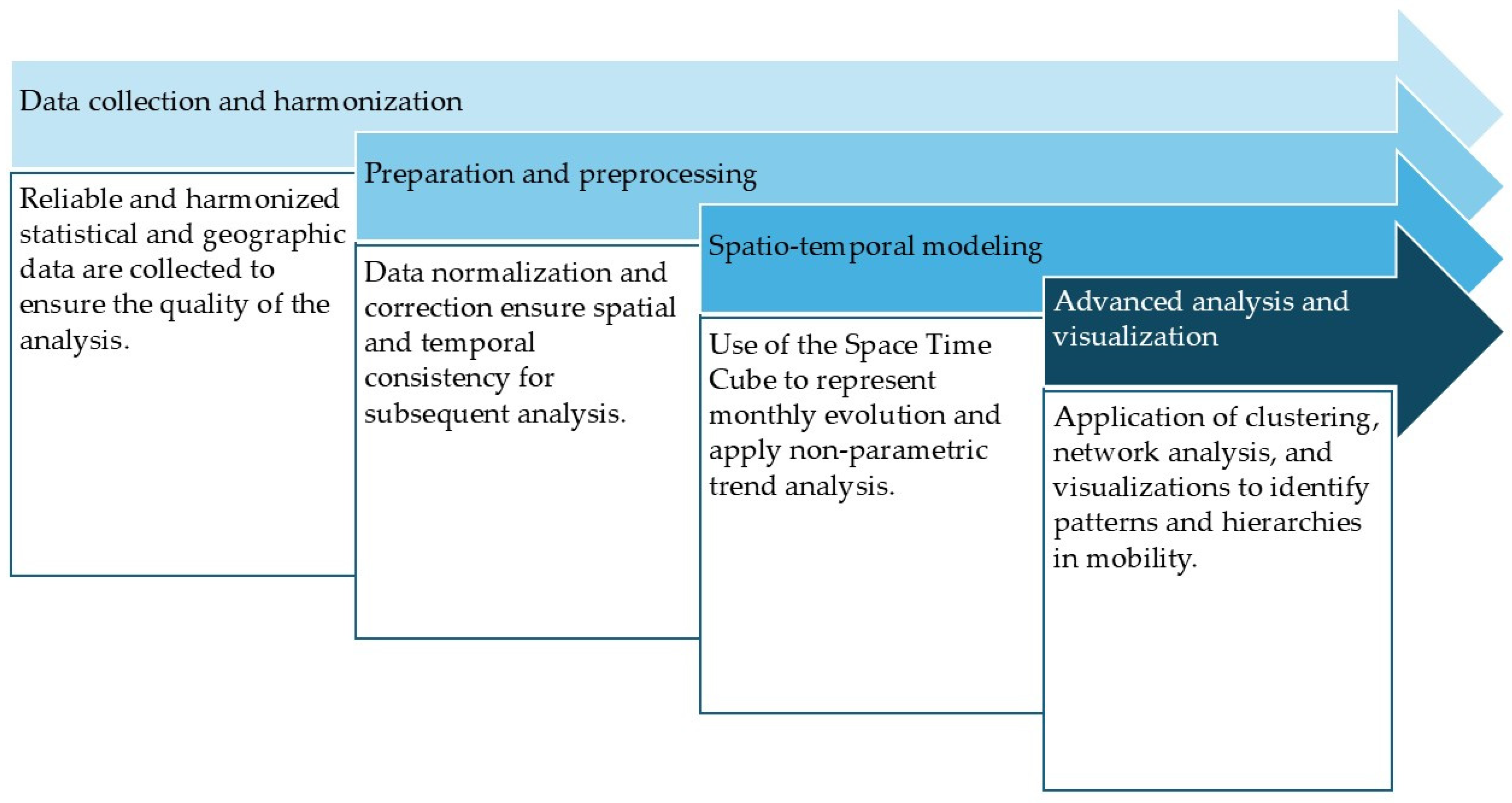
2.3. Preparation and Preprocessing
2.4. Spatiotemporal Modeling
2.4.1. Space–Time Cube (STC) at the Municipal Level
2.4.2. Emerging Hot Spot Analysis (EHSA)
3. Results
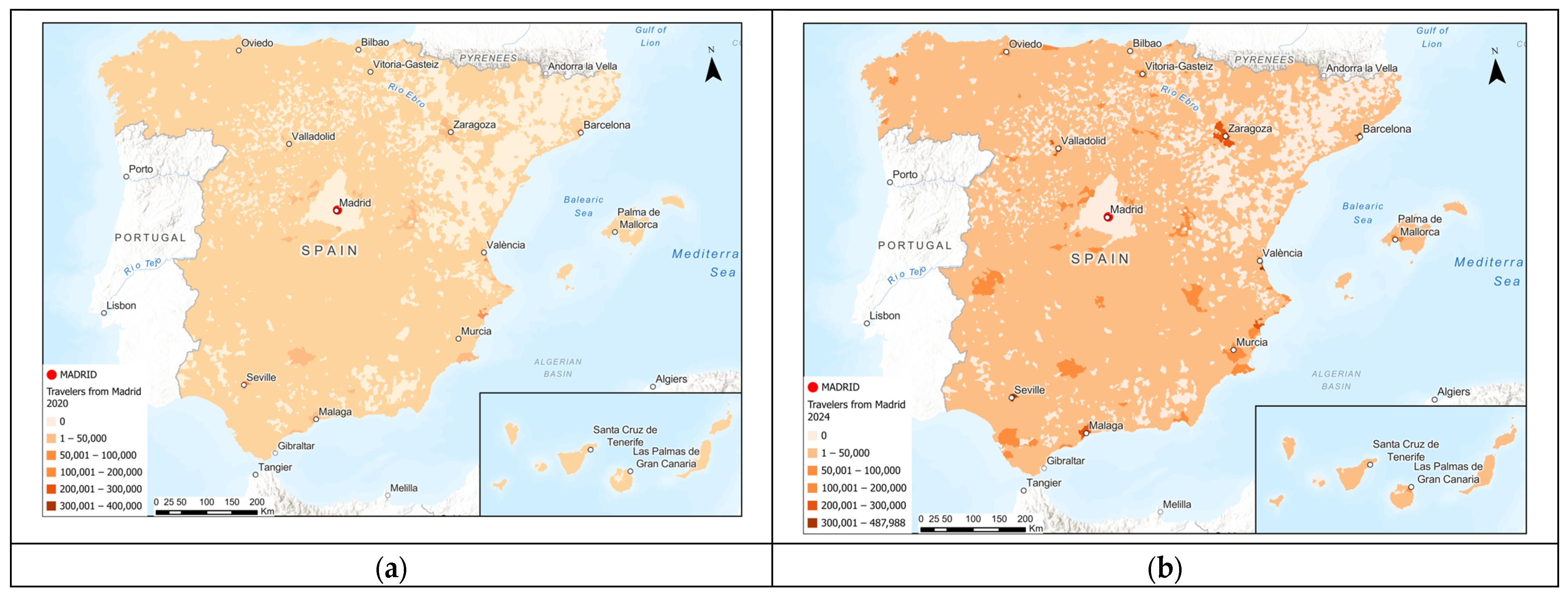
3.1. Mobility in the Provincial and Municipal Context
- A sharp quantitative recovery followed by a recent stabilization;
- A spatial structure in which proximity acts as a cross-cutting factor influencing resilience and travel frequency;
- A gradual shift toward coastal and urban destinations as the post-pandemic context normalizes.
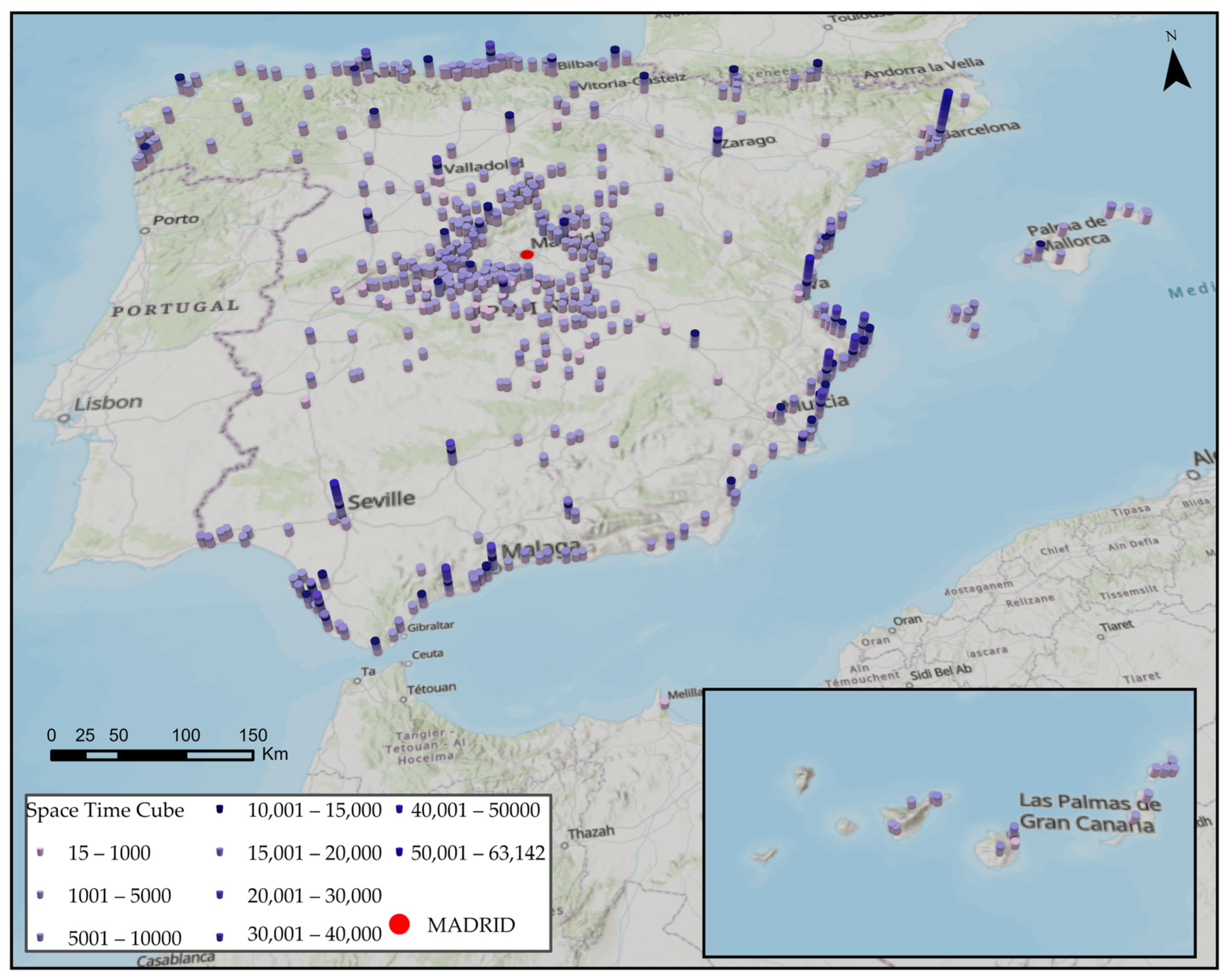
3.2. Space–Time Cube
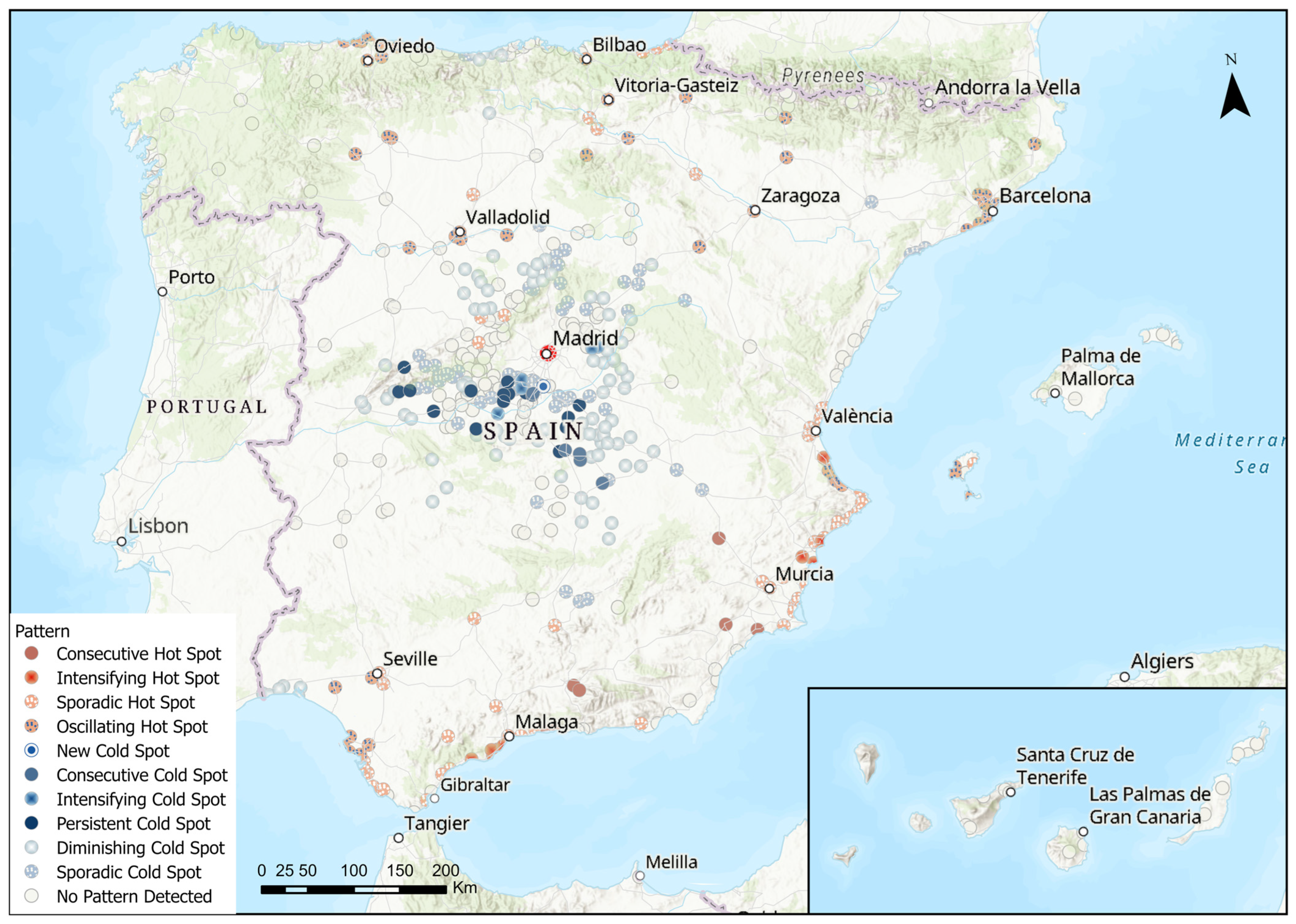
3.3. EHSA
4. Discussion
5. Conclusions
Supplementary Materials
Funding
Data Availability Statement
Conflicts of Interest
Abbreviations
| INE | National Institute of Statistics (Spain) |
| NGMEP | Geographic Nomenclature of Municipalities and Population Units (IGN/CNIG) |
| NUTS | Nomenclature of Territorial Units for Statistics (Eurostat) |
| OD | Origin–Destination |
| CDR | Call Data Records |
| STC | Space–Time Cube |
| EHSA | Emerging Hot Spot Analysis |
| Gi* | Getis–Ord Local Statistic |
| MAUP | Modifiable Areal Unit Problem |
| DTW | Dynamic Time Warping |
References
- Adey, P. If Mobility Is Everything Then It Is Nothing: Towards a Relational Politics of (Im)mobilities. Mobilities 2006, 1, 75–94. [Google Scholar] [CrossRef]
- Xiang, B. (Im)mobility Infrastructure: A 21st-Century Dystopia? Appl. Mobilities 2024, 9, 392–397. [Google Scholar] [CrossRef]
- Kaufmann, V.; Drevon, G. Introducing Rhythmology in Mobility Studies. Sustainability 2022, 14, 10356. [Google Scholar] [CrossRef]
- Bartelet, H.A.; Fleming-Muñoz, D.; Phillips, G.L.; Curnock, M.I. From Reef to Region: A Multi-Scalar Analysis of Tourism Resilience. Tour. Geogr. 2026, 28, 342–362. [Google Scholar] [CrossRef]
- Chaturvedi, S.; Chatterjee, D. Temporal Resil. of International Tourism Post COVID-19: Survival Analysis of Time to Recovery in 34 Countries. Qual. Quant. 2026. [Google Scholar] [CrossRef]
- Fan, Q.; Yu, C.; Zuo, J. Predicting Urban Rail Transit Network Origin–Destination Matrix Under Operational Incidents with Deep Counterfactual Inference. Appl. Sci. 2025, 15, 6398. [Google Scholar] [CrossRef]
- Witayangkurn, A.; Arai, A.; Shibasaki, R. Development of Big Data-Analysis Pipeline for Mobile Phone Data with Mobipack and Spatial Enhancement. ISPRS Int. J. Geo-Inf. 2022, 11, 196. [Google Scholar] [CrossRef]
- Cui, J.; Liu, Y.; Sun, J.; Hu, D.; He, H. G-STC-M Spatio-Temporal Analysis Method for Archaeological Sites. ISPRS Int. J. Geo-Inf. 2021, 10, 312. [Google Scholar] [CrossRef]
- Morckel, V.; Durst, N. Using Emerging Hot Spot Analysis to Explore Spatiotemporal Patterns of Housing Vacancy in Ohio Metropolitan Statistical Areas. Urban Aff. Rev. 2023, 59, 309–328. [Google Scholar] [CrossRef]
- Çalışkan, M.; Anbaroğlu, B. Space Time Cube Analytics in QGIS and Python for Hot Spot Detection. SoftwareX 2023, 24, 101498. [Google Scholar] [CrossRef]
- Sun, J.; Chen, S.; Huang, Y.; Rong, H.; Li, Q. Harnessing GPS Spatiotemporal Big Data to Enhance Visitor Experience and Sustainable Management of UNESCO Heritage Sites: A Case Study of Mount Huangshan, China. ISPRS Int. J. Geo-Inf. 2025, 14, 396. [Google Scholar] [CrossRef]
- Xu, R.; Yang, X.; Tian, S. Use of Space-Time Cube Model and Spatiotemporal Hot Spot Analyses in Fisheries—A Case Study of Tuna Purse Seine. Fishes 2023, 8, 525. [Google Scholar] [CrossRef]
- Cresswell, T. Towards a politics of mobility. Environ. Plan. D. Soc. Space 2010, 28, 17–31. [Google Scholar] [CrossRef]
- Hannam, K.; Sheller, M.; Urry, J. Editorial: Mobilities, immobilities and moorings. Mobilities 2006, 1, 1–22. [Google Scholar] [CrossRef]
- Sheller, M.; Urry, J. The new mobilities paradigm. Environ. Plan. A Econ. Space 2006, 38, 207–226. [Google Scholar] [CrossRef]
- Raun, J.; Ahas, R.; Tiru, M. Measuring tourism destinations using mobile tracking data. Tour. Manag. 2016, 57, 202–212. [Google Scholar] [CrossRef]
- Cáceres, N.; Romero, L.M.; Benítez, F.G. Exploring strengths and weaknesses of mobility inference from mobile phone data vs. travel surveys. Transp. A Transp. Sci. 2020, 16, 574–601. [Google Scholar] [CrossRef]
- Gretzel, U.; Sigala, M.; Xiang, Z.; Koo, C. Smart tourism: Foundations and developments. Electron Mark. 2015, 25, 179–188. [Google Scholar] [CrossRef]
- Li, J.; Xu, L.; Tang, L.; Wang, S.; Li, L. Big data in tourism research: A literature review. Tour. Manag. 2018, 68, 301–323. [Google Scholar] [CrossRef]
- Saluveer, E.; Raun, J.; Tiru, M.; Altin, L.; Kroon, J.; Snitsarenko, T.; Aasa, A.; Silm, S. Methodological framework for producing national tourism statistics from mobile positioning data. Ann. Tour. Res. 2020, 81, 102895. [Google Scholar] [CrossRef]
- Mamei, M.; Bicocchi, N.; Lippi, M.; Mariani, S.; Zambonelli, F. Evaluating origin–destination matrices obtained from CDR data. Sensors 2019, 19, 4470. [Google Scholar] [CrossRef]
- Landmark, A.D.; Arnesen, P.; Södersten, C.J.; Hjelkrem, O.A. Mobile phone data in transportation research: Methods for benchmarking against other data sources. Transportation 2021, 48, 2883–2905. [Google Scholar] [CrossRef]
- Reif, J.; Schmücker, D. Exploring new ways of visitor tracking using big data sources: Opportunities and limits of passive mobile data for tourism. J. Destin. Mark. Manag. 2020, 18, 100481. [Google Scholar] [CrossRef]
- Li, Z.; Ning, H.; Jing, F.; Lessani, M.N. Understanding the bias of mobile location data across spatial scales and over time: A comprehensive analysis of SafeGraph data in the United States. PLoS ONE 2024, 19, e0294430. [Google Scholar] [CrossRef]
- Sinclair, M.; Maadi, S.; Zhao, Q.; Hong, J.; Ghermandi, A.; Bailey, N. Assessing the socio-demographic representativeness of mobile phone application data. Appl. Geogr. 2023, 158, 102997. [Google Scholar] [CrossRef]
- Shoval, N.; Ahas, R. The use of tracking technologies in tourism research: The first decade. Tour. Geogr. 2016, 18, 587–606. [Google Scholar] [CrossRef]
- Nyns, S.; Schmitz, S. Using mobile data to evaluate unobserved tourist overnight stays. Tour. Manag. 2022, 89, 104453. [Google Scholar] [CrossRef]
- Grassini, L.; Dugheri, G. Mobile phone data and tourism statistics: A broken promise? Natl. Account. Rev. 2021, 3, 50–68. [Google Scholar] [CrossRef]
- Lyu, J.; Khan, A.; Bibi, S.; Chan, J.H.; Qi, X. Big data in action: An overview of big data studies in tourism and hospitality literature. J. Hosp. Tour. Manag. 2022, 51, 346–360. [Google Scholar] [CrossRef]
- Guo, D.; Zhu, X. Origin–destination flow data smoothing and mapping. IEEE Trans. Vis. Comput. Graph. 2014, 20, 2043–2052. [Google Scholar] [CrossRef] [PubMed]
- Fekih, M.; Bellemans, T.; Smoreda, Z.; Bonnel, P.; Furno, A.; Galland, S. A data-driven approach for origin–destination matrix construction from cellular network signalling data: A case study of Lyon region (France). Transportation 2021, 48, 1671–1702. [Google Scholar] [CrossRef]
- Yang, M.; Pan, Y.; Darzi, A.; Ghader, S.; Xiong, C.; Zhang, L. A data-driven travel mode share estimation framework based on mobile device location data. Transportation 2022, 49, 1339–1383. [Google Scholar] [CrossRef]
- Iqbal, M.S.; Choudhury, C.F.; Wang, P.; González, M.C. Development of origin–destination matrices using mobile phone call data. Transp. Res. Part C Emerg. Technol. 2014, 40, 63–74. [Google Scholar] [CrossRef]
- Dau, H.A.; Silva, D.F.; Petitjean, F.; Forestier, G.; Bagnall, A.; Mueen, A.; Keogh, E. Optimizing dynamic time warping’s window width for time series data mining applications. Data Min. Knowl. Discov. 2018, 32, 1074–1120. [Google Scholar] [CrossRef]
- Guo, D. Flow mapping and multivariate visualization of large spatial interaction data. IEEE Trans. Vis. Comput. Graph. 2009, 15, 1041–1048. [Google Scholar] [CrossRef] [PubMed]
- Park, S.; Xu, Y.; Jiang, L.; Chen, Z.; Huang, S. Spatial structures of tourism destinations: A trajectory data mining approach leveraging mobile big data. Ann. Tour. Res. 2020, 84, 102973. [Google Scholar] [CrossRef]
- Xu, Y.; Li, J.; Xue, J.; Park, S.; Li, Q. Tourism geography through the lens of time use: A computational framework using fine-grained mobile phone data. Ann. Am. Assoc. Geogr. 2021, 111, 1420–1444. [Google Scholar] [CrossRef]
- Younes, S.; Oloufa, A. A geospatial framework for spatiotemporal crash hotspot detection using space–time cube modeling and emerging pattern analysis. Urban Sci. 2025, 9, 411. [Google Scholar] [CrossRef]
- Esri Blog. Introducing a New Space Time Cube Visualization Experience in ArcGIS Pro. 2025. Available online: https://www.esri.com/arcgis-blog/products/arcgis-pro/announcements/introducing-a-new-space-time-cube-visualization-experience-in-arcgis-pro (accessed on 19 March 2026).
- Arbulú, I.; Razumova, M.; Rey-Maquieira, J.; Sastre, F. Can domestic tourism relieve the COVID-19 tourist industry crisis? The case of Spain. J. Destin. Mark. Manag. 2021, 20, 100568. [Google Scholar] [CrossRef]
- Duro, J.A.; Pérez-Laborda, A.; Fernández, M. Territorial tourism resilience in the COVID-19 summer. Ann. Tour. Res. Empir. Insights 2022, 3, 100039. [Google Scholar] [CrossRef]
- González-Olmos, B.; Velasco-Gimeno, M. Measuring tourism using mobile network data. Span. J. Stat. 2024, 6, 7–19. [Google Scholar] [CrossRef]
- Gretzel, U.; Werthner, H.; Koo, C.; Lamsfus, C. Conceptual foundations for understanding smart tourism ecosystems. Comput. Hum. Behav. 2015, 50, 558–563. [Google Scholar] [CrossRef]
- Duro, J.A.; Pérez-Laborda, A.; Turrion-Prats, J.; Fernández-Fernández, M. COVID-19 and tourism vulnerability. Tour. Manag. Perspect. 2021, 38, 100819. [Google Scholar] [CrossRef]
- Falk, M.; Hagsten, E.; Lin, X. Uneven domestic tourism demand in times of pandemic. Tour. Econ. 2022, 29, 596–611. [Google Scholar] [CrossRef]
- Condeço-Melhorado, A.; García-Palomares, J.C.; Gutiérrez, J. The uneven impact of the COVID-19 pandemic on domestic tourist flows: What does mobile phone data tell us? J. Hosp. Tour. Technol. 2024, 15, 345–362. [Google Scholar] [CrossRef]
- Borowiecki, K.; Pedersen, M.; Mitchell, S. Using big data to measure cultural tourism in Europe. Tour. Econ. 2024, 31, 477–503. [Google Scholar] [CrossRef]
- Esri. An Overview of the Space Time Cube Visualization Toolset—ArcGIS Pro Documentation. 2026. Available online: https://pro.arcgis.com/en/pro-app/latest/tool-reference/space-time-pattern-mining/an-overview-of-the-space-time-cube-visualization-toolset.htm (accessed on 19 March 2026).
- Zaragozí, B.; Trilles, S.; Gutiérrez, A. Passive mobile data for studying seasonal tourism mobilities: An application in a Mediterranean coastal destination. ISPRS Int. J. Geo-Inf. 2021, 10, 98. [Google Scholar] [CrossRef]
- IGN/CNIG. Nomenclátor Geográfico de Municipios y Entidades de Población (NGMEP)—Centro de Descargas. 2024. Available online: https://centrodedescargas.cnig.es/CentroDescargas/catalogo.do?Serie=NGMEN (accessed on 19 March 2026).
- INE. Relación de Municipios y sus Códigos por Provincias (1 de Enero de 2025). 2025. Available online: https://ine.es/dyngs/INEbase/es/operacion.htm?c=Estadistica_C&cid=1254736177031&menu=ultiDatos&idp=1254735976614 (accessed on 19 March 2026).
- INE. Estudios de Movilidad a Partir de la Telefonía móvil (Estadística Experimental). Available online: https://www.ine.es/experimental/movilidad/experimental_em.htm (accessed on 19 March 2026).
- Openshaw, S. The Modifiable Areal Unit Problem (CATMOG 38); Geo Books: Norwich, UK, 1983; Available online: https://books.google.com/books/about/The_Modifiable_Areal_Unit_Problem.html?id=OJbgswEACAAJ (accessed on 19 March 2026).
- Wong, D.W.S. The Modifiable Areal Unit Problem (MAUP). In WorldMinds: Geographical Perspectives on 100 Problems; Janelle, D.G., Warf, B., Hansen, K., Eds.; Springer: Dordrecht, The Netherlands, 2004; pp. 571–575. [Google Scholar] [CrossRef]
- Alvarez Díaz, M.; D’Hombres, B.; Ghisetti, C.; Pontarollo, N. Analysing domestic tourism flows at the provincial level in Spain by using spatial gravity models. Int. J. Tour. Res. 2020, 22, 403–415. [Google Scholar] [CrossRef]
- Viera-González, J.M.; Hernández-Martín, R. Multiscale perspectives on the seasonality of tourism flows in Spain and spatial compensation. Rev. Reg. Res. 2025, 1–24. [Google Scholar] [CrossRef]
- Getis, A.; Ord, J.K. The analysis of spatial association by use of distance statistics. Geogr. Anal. 1992, 24, 189–206. [Google Scholar] [CrossRef]
- Anselin, L. Local indicators of spatial association—LISA. Geogr. Anal. 1995, 27, 93–115. [Google Scholar] [CrossRef]
- Wang, Z.; Lam, N.S.N. Extending Getis–Ord statistics to account for local space–time autocorrelation in spatial panel data. Prof. Geogr. 2020, 72, 411–420. [Google Scholar] [CrossRef]
- El Instituto Nacional de Estadística (INE). Medición del Turismo Interno a Partir de la Posición de los Teléfonos Móviles; Proyecto Técnico; INE: Madrid, Spain, 2022. Available online: https://ine.es/experimental/turismo_moviles/exp_moviles_turismo_interno.pdf (accessed on 12 May 2026).
- CNIG. Nomenclátor Geográfico de Municipios y Entidades de Población (NGMEP). 2024. Available online: https://centrodedescargas.cnig.es/CentroDescargas/detalleArchivo?sec=9000004 (accessed on 19 March 2026).
- CNIG. BTN100—Base Topográfica Nacional 1:100.000 (Descarga y Licencia). 2015–2021. Available online: https://centrodedescargas.cnig.es/CentroDescargas/btn100 (accessed on 19 March 2026).
- Tobler, W.R. Smooth pycnophylactic interpolation for geographical regions. J. Am. Stat. Assoc. 1979, 74, 519–530. [Google Scholar] [CrossRef]
- Esri. Normalization for choropleth maps. ArcGIS Blog. 2025. Available online: https://www.esri.com/arcgis-blog/products/arcgis-online/mapping/normalization-for-choropleth-maps (accessed on 19 March 2026).
- Esri. Create Space Time Cube from Defined Locations (Space Time Pattern Mining)—ArcGIS Pro Documentation. 2026. Available online: https://pro.arcgis.com/en/pro-app/latest/tool-reference/space-time-pattern-mining/createcubefromdefinedlocations.htm (accessed on 19 March 2026).
- Hirsch, R.M.; Slack, J.R.; Smith, R.A. Techniques of trend analysis for monthly water quality data. Water Resour. Res. 1982, 18, 107–121. [Google Scholar] [CrossRef]
- Esri. Generate Origin–Destination Links (Analysis)—ArcGIS Pro Documentation. 2026. Available online: https://pro.arcgis.com/en/pro-app/latest/tool-reference/analysis/generate-origin-destination-links.htm (accessed on 19 March 2026).
- Esri. Time Series Clustering (Space Time Pattern Mining)—ArcGIS Pro Documentation. 2026. Available online: https://pro.arcgis.com/en/pro-app/latest/tool-reference/space-time-pattern-mining/time-series-clustering.htm (accessed on 19 March 2026).
- Esri. How Create Space Time Cube Works—ArcGIS Pro Documentation. 2026. Available online: https://pro.arcgis.com/en/pro-app/latest/tool-reference/space-time-pattern-mining/learnmorecreatecube.htm (accessed on 19 March 2026).
- Esri. How Emerging Hot Spot Analysis Works—ArcGIS Pro Documentation. 2026. Available online: https://pro.arcgis.com/en/pro-app/latest/tool-reference/space-time-pattern-mining/learnmoreemerging.htm (accessed on 19 March 2026).
- Esri. Emerging Hot Spot Analysis (Space Time Pattern Mining)—ArcGIS Pro Documentation. 2026. Available online: https://pro.arcgis.com/en/pro-app/latest/tool-reference/space-time-pattern-mining/emerginghotspots.htm (accessed on 19 March 2026).
- Peng, X.; Wang, C.; Liu, K.; Quiñones, A.; Li, S.; Shan, J. Exploration of municipal mobility using smartphone GPS data. ISPRS Ann. Photogramm. Remote Sens. Spat. Inf. Sci. 2020, V-4, 209–215. [Google Scholar] [CrossRef]
- Arias Molinares, D.; García Palomares, J.C.; Romanillos, G.; Gutiérrez, J. Uncovering spatiotemporal micromobility patterns through the lens of space–time cubes and GIS tools. J. Geogr. Syst. 2023, 25, 403–427. [Google Scholar] [CrossRef]
- Pino Cáceres, M.D.M.; Torrecillas Lozano, C.; Cáceres Sánchez, N.; Pino Mejías, J.L. Using Getis–Ord Gi* maps to understand bicycle mobility during the winter season in Valencia, Spain. DYNA 2022, 97, 436–444. [Google Scholar] [CrossRef]
- Hoteit, S.; Chen, G.; Viana, A.; Fiore, M. Filling the gaps: On the completion of sparse call detail records for mobility analysis. In Proceedings of CHANTS’16; Association for Computing Machinery: New York, NY, USA, 2016. [Google Scholar] [CrossRef]
- Esri. How Time Series Clustering works—ArcGIS Pro Documentation. 2026. Available online: https://pro.arcgis.com/en/pro-app/latest/tool-reference/space-time-pattern-mining/learnmoretimeseriesclustering.htm (accessed on 19 March 2026).
- Sepehri-Boroujeni, S.; Cleave, E. The Spatial and Temporal Distribution of Airbnb and Its Potential Impact on the Rental Market: A Case Study of City of Toronto, Ontario, Canada. In Regional and Urban Change and Geographical Information Systems and Science; Springer: Cham, Switzerland, 2023; pp. 195–215. [Google Scholar] [CrossRef]
- Esri. Hot Spot Analysis (Getis–Ord Gi*)—ArcGIS Pro Documentation. 2026. Available online: https://pro.arcgis.com/en/pro-app/latest/tool-reference/spatial-statistics/hot-spot-analysis.htm (accessed on 19 March 2026).
- Sieg, L.; Gibbs, H.; Gibin, M.; Cheshire, J. Ethical challenges arising from the mapping of mobile phone location data. Cartogr. J. 2024, 61, 256–269. [Google Scholar] [CrossRef]
- Derakhshan, S.; Dialesandro, J.; Turner, V.K.; Longcore, T. Space-time dynamics in hazard exposure analysis: Smartphone locations show pedestrian routes are inflexible to extreme heat events. npj Nat. Hazards 2025, 2, 2. [Google Scholar] [CrossRef]
- Ghanghermeh, A.; Roshan, G.; Asadi, K.; Attia, S. Spatiotemporal analysis of urban heat islands and vegetation cover using emerging hotspot analysis in a humid subtropical climate. Atmosphere 2024, 15, 161. [Google Scholar] [CrossRef]
- Penn State. Data Standardization (GEOG 486: Cartography and Visualization). Available online: https://courses.ems.psu.edu/geog486/node/880 (accessed on 19 March 2026).
- Sánchez-Martín, J.-M.; Rengifo-Gallego, J.-I.; Blas-Morato, R. Hot Spot Analysis versus Cluster and Outlier Analysis: An enquiry into the grouping of rural accommodation in Extremadura (Spain). ISPRS Int. J. Geo-Inf. 2019, 8, 176. [Google Scholar] [CrossRef]
- Sánchez Martín, J.M.; Sánchez Rivero, M.; Rengifo Gallego, J.I. Patrones de distribución de la oferta turística mediante técnicas geoestadísticas en Extremadura (2004–2014). Boletín De La Asoc. Española De Geogr. 2018, 76, 276–302. [Google Scholar] [CrossRef]
- Ord, J.K.; Getis, A. Local Spatial Autocorrelation Statistics: Distributional Issues and an Application. Geogr. Anal. 1995, 27, 286–306. [Google Scholar] [CrossRef]
- Longley, P.; Batty, M. Spatial Analysis: Modelling in a GIS Environment; John Wiley & Sons: New York, NY, USA, 1996; p. 395. [Google Scholar]
- Esri. Visualize the Space-Time Cube—ArcGIS Pro Documentation. 2026. Available online: https://pro.arcgis.com/en/pro-app/latest/tool-reference/space-time-pattern-mining/visualizing-cube-data.htm (accessed on 19 March 2026).
- Esri. Visualize Space Time Cube in 3D (Space Time Pattern Mining)—ArcGIS Pro Documentation. 2026. Available online: https://pro.arcgis.com/en/pro-app/latest/tool-reference/space-time-pattern-mining/visualizecube3d.htm (accessed on 19 March 2026).
- Esri. Introduction to Space Time Cubes—ArcGIS Pro Documentation. 2026. Available online: https://pro.arcgis.com/en/pro-app/latest/tool-reference/space-time-pattern-mining/space-time-cubes-101.htm (accessed on 19 March 2026).
- Microsoft. My Excel 2010 Only Has 65,536 Rows, How Do I Change That to the 1 Million Plus Rows I’m Supposed to Have. (Excel 97–2003.xls Format Limitation). Microsoft Q&A. 2013. Available online: https://learn.microsoft.com/en-us/answers/questions/4866035/my-excel-2010-only-has-65-536-rows-how-do-i-change (accessed on 19 March 2026).
- Microsoft Office Excel 2003 Documentation. Excel Specifications and Limits (Worksheet Size 65,536 Rows by 256 Columns). Available online: https://documentation.help/MS-Office-Excel-2003/xlrefChartingSpecifications1.htm (accessed on 19 March 2026).



| Block | Metric | Result |
|---|---|---|
| STC (bins) | Records/bins exported | 36,500 |
| STC (bins) | Censored bins (no match between scenarios) | 114 (≈0.31%) |
| STC (bins) | Pattern in censored bins | (1, 15, 29) in all cases |
| Aggregates | Total sum of the indicator (scale 1/15/29) | 69,224,584/69,226,180/69,227,776 |
| Aggregates | Aggregate difference (15–1) and (29–15) | 1596 and 1596 (≈0.0023% of the total) |
| Spatial distribution | Municipalities in STC/municipalities with censored data | 500/59 |
| Spatial distribution | Maximum bias per municipality (sum over the period) | 70 units (5 bins × 14) |
| Temporal distribution | Concentration of censoring | Mainly time steps 7 and 8 (Mar–Apr 2020) |
| EHSA (classes) | Municipalities evaluated | 500 |
| EHSA (classes) | Stability of CATEGORY and PATTERN (1 vs. 15 vs. 29) | 100% match; 0 class changes |
| Year | Travelers | Year-over-Year % Change |
|---|---|---|
| 2020 | 10,488,611 | — |
| 2021 | 13,980,113 | 33.3 |
| 2022 | 17,074,838 | 22.1 |
| 2023 | 19,450,094 | 13.9 |
| 2024 | 19,267,553 | −0.9 |
| Visitors | Change (%) | 2024 Ratio | |||
|---|---|---|---|---|---|
| Province | Cumulative 2020 to 2024 | 2020 | 2024 | 2020–2024 (% Change) | Travelers/ Overnight Stays |
| Toledo | 7,848,399 | 1,235,365 | 1,715,270 | 38.8 | 2.317 |
| Alicante | 4,848,660 | 611,080 | 1,155,507 | 89.1 | 0.580 |
| Ávila | 4,532,130 | 653,511 | 1,070,056 | 63.7 | 6.730 |
| Segovia | 4,163,335 | 599,877 | 985,004 | 64.2 | 6.282 |
| Guadalajara | 4,050,715 | 650,797 | 872,326 | 34.0 | 3.117 |
| Valencia | 3,476,203 | 414,793 | 870,353 | 109.8 | 0.321 |
| Barcelona | 2,996,045 | 251,290 | 787,740 | 213.5 | 0.134 |
| Malaga | 2,929,651 | 346,922 | 723,524 | 108.6 | 0.408 |
| Asturias | 2,266,138 | 289,349 | 564,608 | 95.1 | 0.560 |
| Cádiz | 2,247,676 | 279,613 | 552,739 | 97.7 | 0.442 |
| Ciudad Real | 2,165,017 | 320,585 | 508,466 | 58.6 | 1.032 |
| Cantabria | 2,070,241 | 256,813 | 522,591 | 103.5 | 0.883 |
| Province | Travelers/residents | Visitors in 2024 | Population 2024 |
|---|---|---|---|
| Ávila | 6.730 | 1,070,056 | 158,989 |
| Segovia | 6.282 | 985,004 | 156,788 |
| Guadalajara | 3.117 | 872,326 | 279,860 |
| Soria | 2.465 | 222,230 | 90,150 |
| Toledo | 2.317 | 1,715,270 | 740,148 |
| Cuenca | 2.292 | 452,971 | 197,606 |
| Cáceres | 1.242 | 481,521 | 387,820 |
| Zamora | 1.216 | 201,584 | 165,832 |
| Salamanca | 1.201 | 393,655 | 327,685 |
| Burgos | 1.045 | 375,028 | 358,948 |
| Ciudad Real | 1.032 | 508,466 | 492,640 |
| Cantabria | 0.883 | 522,591 | 591,563 |
| Province | Average | Median | Std. Dev. | Min. | Max. |
|---|---|---|---|---|---|
| Segovia | 15.246 | 9.025 | 17.849 | 0 | 92.648 |
| Guadalajara | 13.915 | 7.859 | 24.769 | 0 | 315.810 |
| Ávila | 10.117 | 6.626 | 11.543 | 0 | 57.630 |
| Cuenca | 5.174 | 2.328 | 8.509 | 0 | 81.333 |
| Toledo | 4.987 | 2.867 | 5.597 | 0 | 37.956 |
| Soria | 4.088 | 1.324 | 7.581 | 0 | 65.938 |
| Ciudad Real | 2.282 | 1.531 | 2.728 | 0 | 16.465 |
| Burgos | 2.219 | 0.557 | 5.481 | 0 | 81.118 |
| Cáceres | 2.211 | 1.140 | 3.219 | 0 | 28.415 |
| Salamanca | 1.999 | 0.775 | 3.899 | 0 | 39.227 |
| Valladolid | 1.634 | 0.466 | 8.233 | 0 | 121.579 |
| Zamora | 1.538 | 0.784 | 2.555 | 0 | 21.395 |
| Year | Municipalities with Visitors (Monthly Average ≥ 30) | Total Municipalities | Coverage (%) |
|---|---|---|---|
| 2020 | 5169 | 8124 | 63.6 |
| 2021 | 5277 | 8124 | 65.0 |
| 2022 | 5294 | 8124 | 65.2 |
| 2023 | 5487 | 8124 | 67.5 |
| 2024 | 5398 | 8124 | 66.4 |
| Top-k Municipalities | Share of the Total 2020–2024 (%) |
|---|---|
| 10 | 12.5 |
| 25 | 22.0 |
| 50 | 31.8 |
| 100 | 43.0 |
| Municipality | Province | Visitors 2020–2024 | TT20 | TT24 | Change from 2020 By 2024 (%) | Population 2024 | TRAVEL/POP 2024 |
|---|---|---|---|---|---|---|---|
| Barcelona | Barcelona | 1,912,465 | 148,633 | 487,988 | 328.3% | 1,702,547 | 0.29 |
| Valencia | Valencia | 1,387,060 | 156,487 | 358,638 | 229.2% | 825,948 | 0.43 |
| Sevilla | Seville | 1,177,096 | 108,417 | 318,259 | 293.6% | 687,488 | 0.46 |
| Alicante | Alicante | 955,175 | 109,476 | 244,735 | 223.6% | 358,720 | 0.68 |
| Malaga | Malaga | 931,898 | 97,804 | 251,250 | 256.9% | 591,637 | 0.04 |
| Zaragoza | Zaragoza | 823,997 | 90,909 | 213,425 | 234.8% | 686,986 | 0.31 |
| Valladolid | Valladolid | 795,591 | 95,430 | 202,323 | 212.0% | 300,618 | 0.67 |
| Toledo | Toledo | 688,432 | 96,920 | 152,407 | 157.3% | 86,526 | 1.76 |
| Granada | Granada | 682,979 | 72,934 | 161,273 | 221.1% | 232,717 | 0.69 |
| Salamanca | Salamanca | 655,512 | 80,445 | 164,771 | 204.8% | 144,866 | 1.14 |
| Marbella | Málaga | 611,806 | 80,270 | 142,110 | 177.0% | 159,000 | 0.89 |
| Benidorm | Alicante | 601,476 | 65,052 | 145,599 | 223.8% | 74,663 | 1.95 |
| Santander | Cantabria | 579,701 | 68,393 | 152,843 | 223.5% | 174,101 | 0.88 |
| Córdoba | Córdoba | 557,603 | 59,136 | 150,306 | 254.2% | 322,811 | 0.47 |
| Segovia | Segovia | 557,273 | 75,692 | 125,586 | 165.9% | 51,525 | 2.44 |
| Municipality | Province | Population 2024 | Travelers TT24 | TRAVEL/PO24 | AVG TRAVEL/PO Average 2020–2024 |
|---|---|---|---|---|---|
| Maello | Ávila | 700 | 23,627 | 33.753 | 28.389 |
| Navamorcuende | Toledo | 599 | 17,670 | 29.499 | 21.179 |
| Albalate de Zorita | Guadalajara | 1146 | 33,283 | 29.043 | 23.234 |
| Boceguillas | Segovia | 721 | 18,149 | 25.172 | 21.641 |
| Sallent de Gállego | Huesca | 1516 | 36,424 | 24.026 | 19.167 |
| Naut Aran | Lleida | 1899 | 44,247 | 23.300 | 16.573 |
| Marugán | Segovia | 763 | 17,135 | 22.457 | 16.879 |
| La Adrada | Ávila | 2796 | 60,353 | 21.585 | 17.669 |
| Nombela | Toledo | 895 | 18,629 | 20.815 | 19.885 |
| Sepúlveda | Segovia | 988 | 19,555 | 19.793 | 16.870 |
| Sanchidrián | Ávila | 708 | 13,973 | 19.736 | 14.537 |
| Pedro Bernardo | Ávila | 758 | 14,950 | 19.723 | 17.102 |
| Santa María del Tiétar | Ávila | 553 | 10,322 | 18.665 | 20.214 |
| Escalona | Toledo | 3801 | 69,531 | 18.293 | 14.043 |
| Riaza | Segovia | 2144 | 38,548 | 17.979 | 11.845 |
| Population Bracket (2024) | Visitors 2024 | Visitors 2020–2024 | Average VIAJ/PO24 | VIAJ/PO24 Median | 2024 Visitor Share (%) |
|---|---|---|---|---|---|
| <1000 | 3,021,510 | 13,223,244 | 3.176 | 0.158 | 15.7 |
| 1000–4999 | 3,087,019 | 13,146,573 | 0.811 | 0.204 | 16.0 |
| 5000–19,999 | 3,194,062 | 13,708,501 | 0.425 | 0.153 | 16.6 |
| 20,000–99,999 | 4,835,794 | 20,177,309 | 0.337 | 0.148 | 25.1 |
| ≥100,000 | 5,129,168 | 20,005,582 | 0.350 | 0.297 | 26.6 |
| Year | Central Ring Share (%) | Rest (%) |
|---|---|---|
| 2020 | 35.8 | 64.2 |
| 2021 | 32.7 | 67.3 |
| 2022 | 30.3 | 69.7 |
| 2023 | 28.9 | 71.1 |
| 2024 | 29.1 | 70.9 |
| EHSA Pattern | n | % | % with TREND_P < 0.05 | Median TREND_P | Median TREND_Z | Representative Municipalities (Top 3) |
|---|---|---|---|---|---|---|
| No Pattern Detected | 194 | 38.8 | 91.7 | 1.0 × 10⁻⁹ | 6.11 | Toledo, Salamanca, Santander |
| Diminishing Cold Spot | 92 | 18.4 | 98.9 | 8.1 × 10⁻⁴ | 3.35 | Alcázar de San Juan, Albalate de Zorita, Corral de Almaguer |
| Sporadic Cold Spot | 61 | 12.2 | 86.9 | 1.9 × 10⁻⁵ | 3.38 | Albacete, Illescas, Ciudad Real |
| Sporadic Hot Spot | 57 | 11.4 | 100.0 | <1 × 10⁻¹⁰ | 7.52 | Valencia, Seville, Alicante |
| Oscillating Hot Spot | 52 | 10.4 | 100.0 | <1 × 10⁻¹⁰ | 7.41 | Barcelona, Zaragoza, Valladolid |
| Persistent Cold Spot | 15 | 3.0 | 0.0 | 0.259 | 0.92 | Oropesa, Fuensalida, Torrijos |
| Intensifying Hot Spot | 10 | 2.0 | 100.0 | <1 × 10⁻¹⁰ | 8.21 | Marbella, Torremolinos, Elche |
| Consecutive Hot Spot | 7 | 1.4 | 100.0 | <1 × 10⁻¹⁰ | 7.50 | Granada, Mazarrón, Monachil |
| Consecutive Cold Spot | 6 | 1.2 | 100.0 | 0.006 | 2.25 | Herencia, Madridejos, Villafranca de los Caballeros |
| Intensifying Cold Spot | 5 | 1.0 | 100.0 | 8.4 × 10⁻⁴ | −3.34 | Casarrubios del Monte, Puebla de Montalbán, Hontoba |
| New Cold Spot | 1 | 0.2 | 100.0 | 2.4 × 10⁻⁹ | −5.97 | Elusive |
Disclaimer/Publisher’s Note: The statements, opinions and data contained in all publications are solely those of the individual author(s) and contributor(s) and not of MDPI and/or the editor(s). MDPI and/or the editor(s) disclaim responsibility for any injury to people or property resulting from any ideas, methods, instructions or products referred to in the content. |
© 2026 by the author. Licensee MDPI, Basel, Switzerland. This article is an open access article distributed under the terms and conditions of the Creative Commons Attribution (CC BY) license.
Share and Cite
Sánchez-Martín, J.M. A Reproducible Space–Time Cube Workflow for Domestic Tourism Mobility: Madrid-Origin Flows Across Spain (September 2019–September 2025). Land 2026, 15, 887. https://doi.org/10.3390/land15050887
Sánchez-Martín JM. A Reproducible Space–Time Cube Workflow for Domestic Tourism Mobility: Madrid-Origin Flows Across Spain (September 2019–September 2025). Land. 2026; 15(5):887. https://doi.org/10.3390/land15050887
Chicago/Turabian StyleSánchez-Martín, José Manuel. 2026. "A Reproducible Space–Time Cube Workflow for Domestic Tourism Mobility: Madrid-Origin Flows Across Spain (September 2019–September 2025)" Land 15, no. 5: 887. https://doi.org/10.3390/land15050887
APA StyleSánchez-Martín, J. M. (2026). A Reproducible Space–Time Cube Workflow for Domestic Tourism Mobility: Madrid-Origin Flows Across Spain (September 2019–September 2025). Land, 15(5), 887. https://doi.org/10.3390/land15050887