Article

A Contribution–Vigor–Organization–Resilience Assessment–Genetic Algorithm–Circuit Theory Framework for Eco-System Health Evaluation and Ecological Security Pattern Optimization in the Daiyun Mountain Rim, Southeast China

1
College of Rural Revitalization, Fujian Agriculture and Forestry University, Fuzhou 350002, China
2
Institute of Multifunctional Agricultural Applications, Fujian Agriculture and Forestry University, Fuzhou 350002, China
3
Institute of Agroecology, Fujian Agriculture and Forestry University, Fuzhou 350002, China
4
College of Life Sciences, Fujian Agriculture and Forestry University, Fuzhou 350002, China
5
College of Agriculture, Fujian Agriculture and Forestry University, Fuzhou 350002, China
*
Author to whom correspondence should be addressed.
Land 2026, 15(5), 860; https://doi.org/10.3390/land15050860 (registering DOI)
Submission received: 28 March 2026 / Revised: 13 May 2026 / Accepted: 15 May 2026 / Published: 17 May 2026

Abstract

Scientifically assessing ecosystem health and optimizing ecological source areas (ESAs) are essential for effective environmental management, particularly in ecologically strategic mountain barrier regions. However, existing studies face challenges in identifying and optimizing ESAs. To address these limitations, this study integrated the contribution–vigor–organization–resilience (CVOR)-based ecosystem health framework, a genetic algorithm (GA), and circuit theory to assess ecosystem health, optimize ESAs, and identify ecological corridors (EC) and restoration priorities in the Daiyun Mountain Rim. The results demonstrate the following: (1) a significant ecosystem health decline from 2012 to 2022, evidenced by a 38.97% to 21.09% reduction in high-priority ecological zones accompanied by increased landscape fragmentation; (2) delineation of 90 GA-optimized ESA and 248 EC (2164.71 km), forming an interconnected ecological network; (3) enhanced connectivity metrics through GA optimization, showing α-index improvements of 0.15–0.23 and β-index gains of 0.05–0.08 compared to the traditional large-patch and morphological spatial pattern analysis (MSPA)-based ESA selection methods; (4) development of a tiered spatial strategy featuring primary/secondary restoration clusters and a “three-belt–one area–multiple clusters” framework for adaptive landscape governance. Although uncertainties remain due to the selected study period, parameter settings, and lack of field-based validation, this framework provides a useful reference for ecological planning, restoration prioritization, and ecosystem management in similar mountainous ecological barrier regions.

1. Introduction

Healthy, stable, and resilient ecosystems sustain the continuous provision of ecosystem services and constitute a fundamental basis for socio-economic sustainability and regional ecological security [1,2,3]. However, global climate change and rapid socio-economic development, particularly accelerating urbanization, have intensified non-agricultural land conversion, increased geological hazards [4], aggravated soil erosion [5], and encroached upon ecological spaces, thereby undermining regional ecological security [6,7]. Such pressures are particularly acute in mountainous ecological security barrier regions, where rapid economic growth and excessive resource exploitation threaten ecosystem health and the stability of ecological security patterns (ESP) [8,9]. In response, developing scientifically sound and systematically integrated ESP has become a key research priority [10]. ESP has been widely acknowledged as a powerful instrument for safeguarding regional ecosystem security [11]. By preventing ecosystem degradation and biodiversity loss while enhancing resilience and adaptive capacity, ESP contributes to the long-term stability of regional ecological networks [12,13].
ESP originated from related concepts such as ecological networks, green infrastructure, and ecological redlines [14], with early research primarily focusing on biodiversity conservation and nature protection [15]. With increasing demand for constructing regional ESP to mitigate ecological risks, Chinese scholars have systematically investigated the theories and methods for developing ESP [16,17]. Subsequently, ESP research evolved from static, single-landscape components and patch configurations to a greater focus on ecological spatial expansion and comprehensive pattern optimization, with the “Ecological Source Areas (ESA) Identification–Resistance Surface Construction–Ecological Corridors (EC) Extraction” framework emerging as the paradigmatic approach for ESP construction.
Identifying ESA is a core link in constructing ESP [18]. Accurate ESA identification leads to more precise EC delineation [19]. Existing approaches to ESA identification have mainly relied on important ecological land areas, ecological sensitivity, and high-value ecosystem service areas, while giving limited consideration to ecosystem health and integrated ecological quality [18,20,21]. Previous studies have suggested that ecological source identification should incorporate patches with high ecosystem health and their surrounding ecological context to better balance ecological requirements with regional conditions [22,23]. Ecosystem health assessment requires a robust methodological framework and provides a fundamental basis for evaluating ecosystem structural integrity and functional stability [24]. A healthy ecosystem is maintained by strong self-regulation and self-repair mechanisms, which support the sustained provision of ecosystem services [25]. A classic framework for ecosystem health assessment is the vigor–organization–resilience (VOR) framework proposed by Costanza [25]. Although this framework has a solid theoretical foundation and clearly defined indicators, its effectiveness is constrained when addressing the complex coupling between human and natural systems. To address these limitations, scholars have incorporated ecosystem services into the VOR framework as the “contribution” dimension, leading to the development of the contribution–vigor–organization–resilience (CVOR) framework [22,26,27,28,29]. International ecosystem assessment frameworks, including the MEA, SEEA EA, and EU MAES, define ecosystem services as the goods and services generated by ecosystems that are essential for human well-being. These services primarily reflect the functional contributions of ecosystems to society. In comparison, ecosystem health provides an integrated diagnosis of ecosystem structure, function, and resilience, thereby offering a more comprehensive perspective on overall ecosystem state [1,7,30,31]. Therefore, this study uses ecosystem services to characterize the “contribution” dimension of the CVOR framework and applies the CVOR framework to assess ecosystem health and identify ESAs in the study area. This approach facilitates the more comprehensive integration of multiple ecological functions, improves the quality of ecological source identification, and provides a more reliable foundation for ESP optimization.
The spatial distribution of ESA significantly influences network node coverage, overall connectivity, and stability of ecological networks [19,32]. The methods for identifying ESA include the protected area definition [33], morphological spatial pattern analysis (MSPA) [34], and comprehensive ecosystem service evaluation [35]. The protected area definition approach selects larger nature reserves or forest parks within the study area as ESA [36]. MSPA, based on mathematical morphological principles for measuring structural connectivity, enables the morphological extraction of large, continuous natural patches (core areas) as ESA [37]. The comprehensive ecosystem service evaluation approach selects patches with the highest integrated assessment values, enhancing the accuracy of ESA identification [35]. However, these conventional methods tend to prioritize large patches with high index values, potentially overlooking smaller patches that are critical for ecological connectivity. Furthermore, these identification methods are relatively simplistic, heavily reliant on simplistic linear models, and are more subjective [21,38], potentially resulting in localized corridor coverage and weak overall connectivity. Therefore, optimizing the number and spatial configuration of ESA while maintaining ESA quality remains a key challenge in ESP construction.
As a representative population-based intelligent optimization method, the genetic algorithm (GA) possesses strong global search capability and robustness [39,40], and has been widely applied in land ecological security prediction [41], evaluation model optimization [42], and ecological planning [43]. Previous studies have shown that, by simultaneously accounting for multiple factors such as patch area, spatial distance, and ecological quality, GA can optimize both the number and spatial configuration of ESA, thereby enhancing ecological network coverage and overall connectivity [21,32]. Therefore, introducing GA into the identification of ESAs can help reduce subjective human bias, improve the precision of ESP optimization, and strengthen the coverage of critical ecological nodes.
The existing construction of EC predominantly employs the Minimum Cumulative Resistance (MCR) model, which can effectively and rapidly simulate and quantify the least-cost path for the flow of species, information, and energy between ESA [44]. However, it overlooks the random dispersal behavior of organisms and fails to provide crucial information such as EC width and ecological pinch points necessary for constructing ESP [45]. In contrast, the EC simulated by circuit theory better aligns with the behavioral characteristics of organisms [46], compensating for the aforementioned shortcomings of the MCR model. Therefore, integrating GA with the CVOR ecosystem health assessment framework for ESA identification, and further incorporating circuit theory for corridor extraction and key node detection, can enhance both the scientific rigor and spatial rationality of ESP construction.
In summary, although existing studies have made considerable progress in ecosystem health assessment, ESA identification, EC extraction, and ESP construction, three key limitations remain. First, insufficient attention has been given to ecosystem health in ESA identification. Second, insufficient optimization of ESA quantity and spatial configuration may overlook small but strategically important patches that are critical for ecological connectivity. Third, traditional MCR models have a limited capacity to effectively identify critical information such as ecological pinch points. These limitations highlight the need for an integrated analytical framework that combines ecosystem health assessment, spatial optimization of ESA, and circuit-theory-based identification of key ecological nodes. Such a framework can enhance connectivity within ESP and improve its applicability in ecological management.
The Daiyun Mountain Rim region is located in the hilly region of southeastern China and forms an important regional geomorphological backbone and ecological barrier. Extending northeast–southwest and broadly parallel to the coastline, the mountain range strongly influences regional climate regulation, hydrological processes, soil and water conservation, and ESP [47,48]. As a major headwater region of several river systems, including the Dazhangxi and Youxi tributaries of the Minjiang River, as well as the Jinjiang and Mulanxi rivers, Daiyun Mountain is essential for downstream water supply and hydrological regulation. The region also preserves relatively representative and intact mountain forest ecosystems along the southeastern coast of China. It harbors one of the largest primary Pinus taiwanensis communities at the southern edge of its distribution in mainland China and is therefore regarded as an important biodiversity gene pool along the southeastern coast [49,50]. Together, Daiyun Mountain and its surrounding areas form a key ecological barrier in southeastern China, supporting ecological security, soil and water conservation, biodiversity conservation, and climate regulation in the hilly region of southeastern China [51,52,53]. However, the conflict between conserving ecosystem health and sustaining rapid economic development remains pronounced within this ecological barrier region [54,55]. Therefore, the Daiyun Mountain Rim provides a representative case for testing ESP optimization methods in subtropical mountain barrier regions where ecological conservation, landscape connectivity, and development pressure interact strongly.
In contrast to previous studies, this study takes the Daiyun Mountain Rim in the hilly region of southeastern China as the study area and develops an integrated analytical framework combining CVOR, GA, and circuit theory. Within this framework, ecosystem health is first evaluated using the CVOR approach, and ESA is subsequently identified. A GA is then applied to optimize the number and spatial configuration of these ESAs. Finally, EC, pinch points, and priority restoration areas are delineated based on an integrated resistance surface and circuit theory, thereby enhancing the scientific rigor and practical relevance of regional ESP development. Specifically, this study seeks to: (a) assess ecosystem health and its spatiotemporal variation in the Daiyun Mountain Rim using the CVOR framework; (b) optimize the number and spatial configuration of ESA through a GA in order to enhance ecological network node coverage and overall connectivity; and (c) identify EC, key nodes, and priority restoration areas based on circuit theory, thereby constructing a regional ESP. The findings are expected to provide methodological support for ESP optimization, restoration prioritization, and integrated ecosystem management in similar ecologically strategic mountain barrier regions.

2. Materials and Methods

2.1. Overview of the Study Area

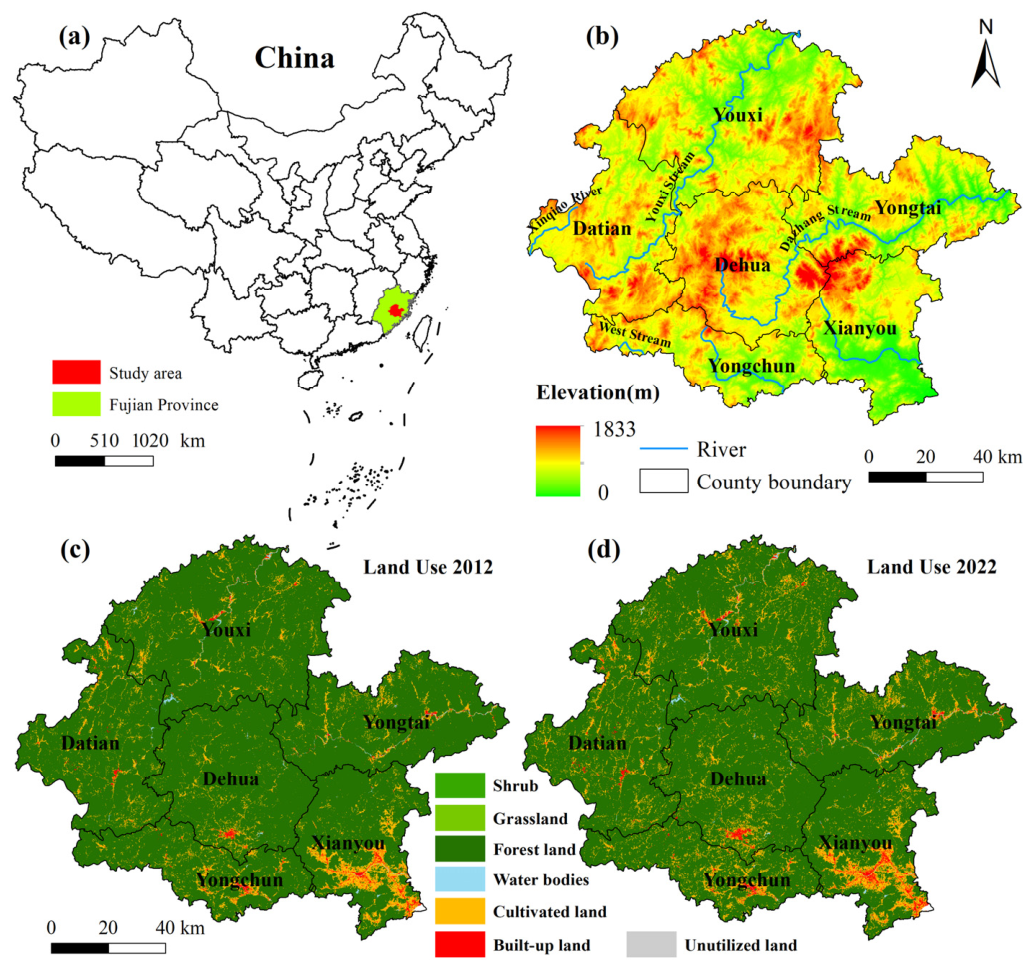
The Daiyun Mountain Rim (25°21′–26°10′ N, 118°11′–118°55′ E) is a multifunctional zone integrating regional development and ecological functions in southeastern China [56]. It is centered on Xiaodaiyun, the main peak of the Daiyun Mountains (Figure 1), which is known as the “Roof of Central Fujian” and reaches 1856 m above sea level. The first-ring belt of the region covers six counties in four prefecture-level cities of Fujian Province, including Dehua and Yongchun in Quanzhou, Yongtai in Fuzhou, Youxi and Datian in Sanming, and Xianyou in Putian. Located on the western coast of the Taiwan Strait, the region contains several important protected areas, including the Daiyun Mountain National Nature Reserve, Tengshan Protected Area, and Mulanxi Headwaters Protected Area. To promote regional coordination and foster the integration of green industries, in 2023, the six counties formed the Daiyun Mountain Rim Green Economic Industry Regional Alliance centered around the Daiyun Mountains in southern China [55]. The region spans approximately 13,424 km2, with an elevation ranging from 0 to 1833 m. Its topography includes plains, hills, and mountains, and is predominantly covered by forests (Figure 1). In 2022, the average temperature ranged from 12.6 to 21.3 °C, with an annual average precipitation ranging from 1280 to 1847 mm, characterized by abundant atmospheric precipitation and a humid climate.

2.2. Data Sources

The data utilized in this study primarily encompass land-use data, Digital Elevation Model (DEM), Net Primary Productivity (NPP), Normalized Difference Vegetation Index (NDVI), climate data, and other relevant datasets in the Daiyun Mountain Rim from 2012 to 2022 (Table 1). In accordance with the research objectives and the ecological reality of the Daiyun Mountain Rim, the land-use types have been categorized into seven classifications: cultivated land, shrub, forest land, grassland, unutilized land, water bodies, and built-up land. A series of landscape metrics was calculated for each 300 m × 300 m grid cell using Fragstats (v4.3 beta University of Massachusetts Amherst, Amherst, MA, USA) software based on land-use data. To mitigate data discrepancies, ArcGIS (v10.8, Esri, Redlands, CA, USA) was employed to convert vector data to raster format, with the coordinate systems of all datasets unified to Albers Conic Equal Area during the analysis process, and all raster datasets were resampled to a consistent spatial resolution of 30 m.

2.3. Selection and Assessment of Contribution–Vigor–Organization–Resilience Components

2.3.1. Contribution Assessment

In the CVOR framework, Contribution represents the capacity of ecosystems to support human well-being through ecosystem services [1]. Climate regulation, biodiversity maintenance, soil retention, and water provision are widely regarded as key ecosystem services [20]. In the Daiyun Mountain Rim region, an important mountainous ecological barrier and headwater region of multiple river systems, these functions are particularly critical for maintaining regional ecological security [49,50]. Accordingly, this study used four key ecosystem services—climate regulation, biodiversity maintenance, soil retention, and water provision—to characterize the “contribution” dimension of the CVOR framework. These services were quantified using the corresponding modules of the Integrated Valuation of Ecosystem Services and Tradeoffs (InVEST) model [30].
1. Climate Regulation. This study employed the module of the InVEST (v3.14.0, Natural Capital Project, Stanford University, Stanford, CA, USA) software, named “carbon storage and sequestration”. This module holistically considers the above-ground carbon pool (Cabove), below-ground carbon pool (Cbelow), soil carbon pool (Csoil), and dead organic carbon pool (Cdead), and by combining the areas of various land use/cover types, it integrates and calculates the carbon storage in the study area at the pixel scale, as expressed in Equation (1). The soil attribute values required for calculating the soil carbon densities of different soils in the study area were obtained from the World Soil Database, sourced from the FAO. Equation (2) represents the formula for calculating the topsoil carbon density (Csoil). The aboveground and belowground vegetation carbon density data were sourced from the National Ecosystem Science Data Center (http://www.cnern.org.cn/, accessed on 1 May 2026), while the dead organic matter carbon density data were assigned to each land-use type using the parameter values reported by Han et al. [57].
C i - total = C i - above +   C i - below +   C i - soil + C i - dead
C soil = TOC × y × H × 10 1
In the aforementioned equations, Ci-above, Ci-below, Ci-soil, and Ci-dead represent the above-ground biomass carbon density, below-ground biomass carbon density, soil carbon density, and dead organic matter carbon density (t·hm−2), respectively, for the i-th land-use type.
Csoil denotes the soil carbon density (t·hm−2), TOC represents the organic carbon content (t·t−1), y is the average soil bulk density (kg·m−3), and H is the average topsoil thickness (m) for various soils.
2. Biodiversity Maintenance. Habitat quality denotes the capability or potential of an ecosystem to offer suitable environmental conditions for the survival and reproduction of individual organisms and populations. Maintaining high habitat quality is crucial for the conservation of biodiversity [58]. We used the Habitat Quality module from the InVEST software to assess the capacity for biodiversity maintenance, based on three factors: land use data, the sensitivity of habitat types to threat factors, and parameters related to threat factors [59,60].
3. Soil Retention. To quantify the soil retention service for the study area, we employed the Sediment Delivery Ratio (SDR) model, which is a component of the InVEST software. The formula for the calculation is as follows [61]:
RUSLE i = RKLS i USLE i
RKLS i = R i K i LS i
USLE i = R i K i LS i C i P i
In Equations (3)–(5), RUSLEi represents the soil retention amount for the i-th grid cell, RKLSi signifies the potential soil loss of that cell, and USLEi denotes the actual soil loss occurring within the cell. Ri, Ki, LSi, Ci, and Pi denote the rainfall erosivity factor, soil erodibility factor, slope length and slope factor, vegetation coverage factors, and soil retention measurement factor of grid cell i, respectively. The C and P coefficients are referred to the research of Xu et al. [62], while the calculation formula for the soil erodibility factor K is referred to the research of Williams et al. [63]. The rainfall erosivity factor is computed utilizing the method proposed by Zhang and Fu [64] for estimating erosivity from the annual average precipitation in the study area.
4. Water Provision. To quantify the water provision service of the study area, we utilized the annual water yield model from the InVEST software. The water yield is expressed as the difference between the annual average precipitation and the actual evapotranspiration, calculated using the following equation:
Y ( x ) = 1 AET ( x ) P ( x ) × P ( x )
In Equation (6), AET(x) signifies the actual evapotranspiration of grid cell x, and P(x) denotes the annual average precipitation over the same grid cell.

2.3.2. Vigor Assessment

Ecosystem Vigor refers to the ability of an ecosystem to maintain active levels of metabolism and primary productivity. It is generally represented by Net Primary Productivity (NPP) [65]. The MOD17A3 global NPP data product released by NASA has been widely utilized in ecosystem studies. Consequently, this research uses this NPP data to characterize Ecosystem Vigor [66].

2.3.3. Organization Assessment

Ecosystem Organization depicts the level of structural stability within an ecosystem, serving as a crucial indicator for assessing ecosystem health [67]. It aims to quantitatively describe the interactions among the subsystems within an ecosystem and their overall level of coordination by comprehensively considering landscape connectivity and landscape heterogeneity factors. Landscape heterogeneity, maintained by landscape diversity [68], can be characterized using the Shannon Diversity Index (SHDI) and the Modified Simpson’s Evenness Index (MSIEI).
Landscape connectivity reflects the interrelatedness and linkages between the overall landscape and important ecological patches [69]. In this study, the Largest Patch Index (LPI), Splitting Index (Split), and Contagion Index (CONTAG) were utilized to quantify landscape connectivity. Higher index values indicate better landscape connectivity and stronger Ecosystem Organization [70].

2.3.4. Resilience Assessment

Ecosystem Resilience denotes the capability of an ecosystem to maintain its inherent structure, functions, and processes stable after being subjected to natural or anthropogenic disturbances and pressures, reflecting its capacity to resist and adapt to external perturbations [71]. In this study, we referred to the resilience coefficients of different land use types [21,69,70] and adjusted the resilience coefficients of grid cells based on NDVI data. The calculation is given as follows:
RC i = NDVI i NDVI mean j × RC j
In the equation, RCi represents the resilience coefficient of grid cell i; NDVIi represents the NDVI value of grid cell i; NDVImeanj represents the average NDVI value of land use type j to which grid cell i belongs; and the land-use type j resilience coefficient is denoted by RCj.

2.4. Ecosystem Health Assessment

This study used the CVOR framework to assess ecosystem health. Ecosystem health quantifies the overall state of the ecosystem and its capacity to recover from external disturbances. The ecosystem health was calculated from four components: ecosystem contribution, ecosystem vigor, ecosystem organization, and ecosystem resilience, with the formula as follows [72]:
EHI = W c × C + W v × V + W o × O + W r × R
In Equation (8), EHI signifies the ecosystem health index of the study region, while C, V, O, and R denote the ecosystem’s contribution, vigor, organization, and resilience, respectively, in the study region. Wc, Wv, Wo, and Wr denote the corresponding weighting coefficients for the factors C, V, O, and R. To mitigate potential biases arising from data background uncertainty, natural spatial non-uniformity, or temporal fluctuations, this study employs a hybrid subjective-objective weighting approach that combines the entropy method and Analytic Hierarchy Process (AHP). Following previous studies [46,66], weights were assigned to the evaluation indicators (Table 2). This approach helps minimize potential biases associated with solely subjective or objective weighting methods [73], thereby facilitating a more reasonable calculation of the weighting coefficients for the ES evaluation indicators in the Daiyun Mountain Rim.

2.5. Morphological Spatial Pattern Analysis

MSPA is a mathematical morphology-based method for identifying, segmenting, and interpreting spatial patterns of land-cover types in raster images [74,75]. It extracts core areas and connecting structures from land-cover maps, thereby characterizing landscape connectivity. MSPA commonly classifies landscapes into seven categories: core, bridge, loop, branch, edge, perforation, and islet. Among these categories, core areas serve as important sources of ecological processes and are essential for biodiversity conservation and ecosystem functioning [33,76]. Considering the natural characteristics of the study area and previous studies, forests, water bodies, shrublands, and grasslands were defined as foreground, whereas other land-use types strongly affected by human activities were defined as background for core-area extraction [37].

2.6. Genetic Algorithm

ESAs, serving as ecological nodes for the flow and transmission of ecological elements, possess dual attributes: spatial characteristics and functional properties [16,77]. The functional properties can be characterized by ecosystem health, while spatial attributes can be represented through parameters such as area and distance. Given the necessity to simultaneously consider these two categories of attributes, the identification of ESA inherently constitutes a multi-criteria optimization problem [32]. GA is a heuristic search algorithm inspired by natural selection and genetic mechanisms, aimed at enhancing information search efficiency and discovering better solutions [77]. The optimization process commences with a pool of random initial solutions, utilizing a fitness function to assess the quality of each prospective individual. High-quality individuals possess a higher probability of survival. The population undergoes selection, crossover, mutation, and iterative processes in pursuit of the global optimum. This study employs a GA implemented in MATLAB (R2016a, MathWorks, Natick, MA, USA) to extract the optimal set of ESAs.
Initially, three pivotal factors influencing the determination of ESA within the study area are considered: the ESA area (A), the distance between the ESA and the center of the study area (L), and the ecosystem health index of the ESA (H). Consequently, the objective function is formulated as:
f ( x ) = Maxf ( A , L , H )
Subsequently, basic quantitative standard conditions are established for these three critical factors, as presented in Table 3. Furthermore, during the initialization of the population, the initial iteration number G is set to 0, and the maximum iteration number G is established at 250. Employing the natural break method, the region with the highest ecosystem health index is designated as the ESA, while ESA patches with an area below 0.1 km2 are discarded. Ultimately, for the 3432 identified ESA, different chromosome lengths are assigned: N = 110, 100, 90, 80, 70, 60, and 50, with an initial population size P = 1000, crossover probability CR = 0.8, mutation probability MR = 0.2, and generation gap GGAP = 0.8.
The scale of ESA significantly influences the regulation of the connectedness of the regional landscape and the facilitation of energy and material flow [78]. Generally, larger ESA areas tend to provide more ecological benefits and possess stronger resistance to disturbances [79,80]. The ecosystem health level of ESA reflects the ecosystem’s resilience and stability, with a favorable ecosystem health index contributing to the maintenance of balance among system elements [81]. The distance between ESA and the center of the study area reflects the spatial relationship between patches. When more resource patches surround a species’ habitat, this landscape pattern is more conducive to the survival of the target species, implying that ecological resources nearer to the central area are more readily accessible [82]. Furthermore, this study refers to the findings of Wu et al. [21], assigning a weight of 0.5 to the ESA area, 0.3 to the ecosystem health index of the ESA, and 0.2 to the distance between the center of the study area and ESA. Accordingly, the fitness function formula is constructed as follows:
f ( x ) = i = 1 n A i × 0 . 5 + i = 1 n H i × 0 . 3 + i = 1 n L i × 0 . 2
In Equation (10), Ai, Hi, and Li represent the area, ecosystem health index, and distance from the study area center of the i-th ESA, respectively. f(x) denotes the fitness function of ESA.

2.7. Landscape Connectivity Assessment

Landscape connectivity reflects the ease with which matter, energy, and information move through an ecosystem [83]. To determine the optimal number of ESAs, this study used the integral index of connectivity (IIC), probability of connectivity (PC), and fragmentation index (FN) to quantify overall connectivity, potential connectivity, and fragmentation, respectively [21]. The delta probability of connectivity (dPC) was used to evaluate the contribution of individual source patches to overall connectivity [21]. All metrics were calculated using Conefor (v2.6, Universidad Politécnica de Madrid, Madrid, Spain). The calculation is given as follows:
PC = i = 1 n j = 1 n a i × a j × p ij A l 2
IIC = i = 1 n j = 1 n a i × a j 1 + nl ij A l
dPC = PC PC remove PC × 100 %
FN = N p 1 N c
In these equations, n denotes the total number of patches; ai and aj represent the areas of patches i and j, respectively; A l 2 is the total area of the study region; and p ij indicates the connection probability between patches i and j; and nij represents the number of connections, or potential connection paths, between patches i and j. PCremove denotes the probability of connectivity of the remaining landscape after a given patch is removed. For the fragmentation index, 0 ≤ FN ≤ 1, where Np is the total number of landscape patches, and Nc represents the ratio of the total landscape area to the area of the smallest patch.

2.8. Resistance Surface Construction

The resistance surface is a spatial distribution layer that indicates the degree to which landscape heterogeneity impedes species migration and ecological flows. It quantifies the resistance or barrier effect of different landscape element changes caused by human activities on biological migration and movement. This study, referring to the works of Ai et al. [84], Li et al. [85], and Chen et al. [86], selects factors such as land cover type, elevation, slope, NDVI, and distance from highways, primary roads, and secondary roads as resistance factors, and constructs and assigns values to the resistance surface.

2.9. Ecological Corridor Construction Based on Circuit Theory

ECs are crucial pathways for the flow of ecological elements [87], serving as conduits for the circulation and movement of energy and materials between ESA. They form the fundamental framework for maintaining ecosystem functioning and regional ES [8]. Circuit theory treats ecological resistance values as circuit resistance values, effectively expressing the relationship between ESA and EC [88]. It accurately simulates random biotic flows within landscapes [22] and effectively provides essential spatial information on corridor width and ecological pinch points. This study employs the Linkage Mapper (v2.0, The Nature Conservancy, Seattle, WA, USA) software based on circuit theory to identify EC. By considering the proportion of path length to cost-weighted distance, the ECs are categorized into three types: low, moderate, and high resistance. Utilizing the Pinch point Mapper tool and the natural break method, high cumulative current areas are designated as ecological pinch points. Barrier points were extracted using the Barrier Mapper tool and subsequently classified into three restoration-priority categories using the Jenks natural breaks classification method: primary ecological restoration clusters, secondary ecological restoration clusters, and general improvement areas.

3. Results

3.1. Spatial Distribution of Contribution

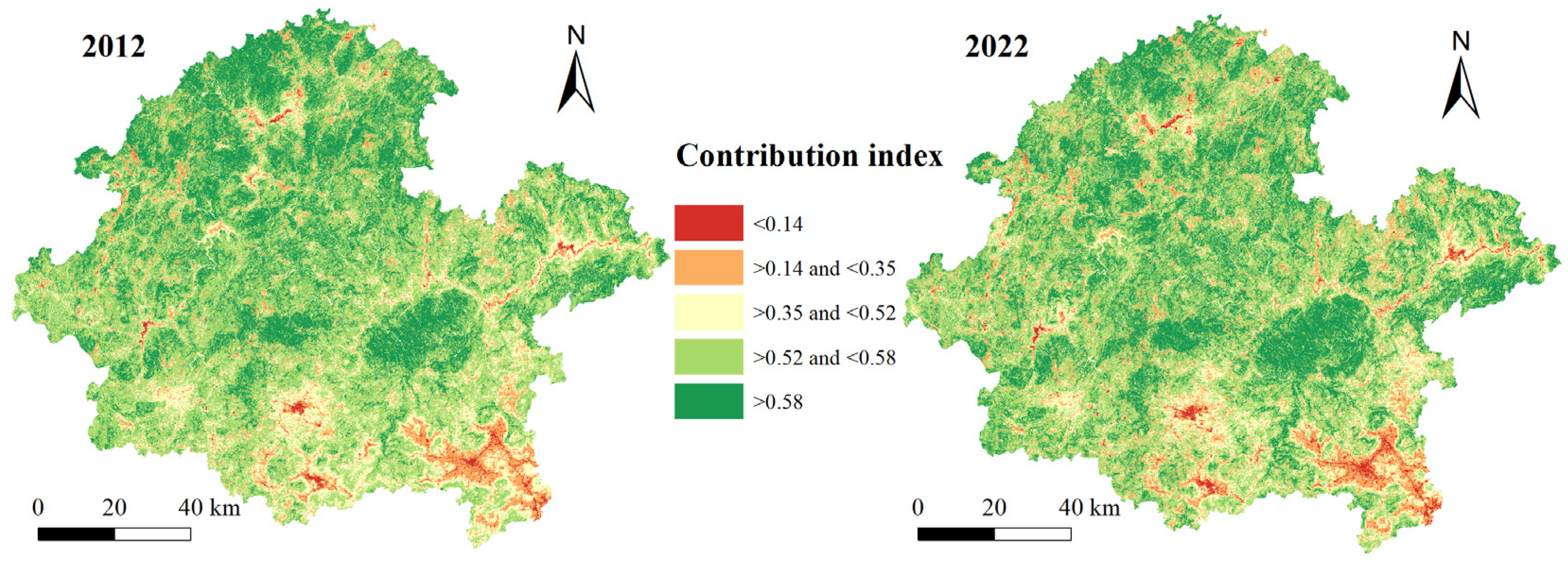
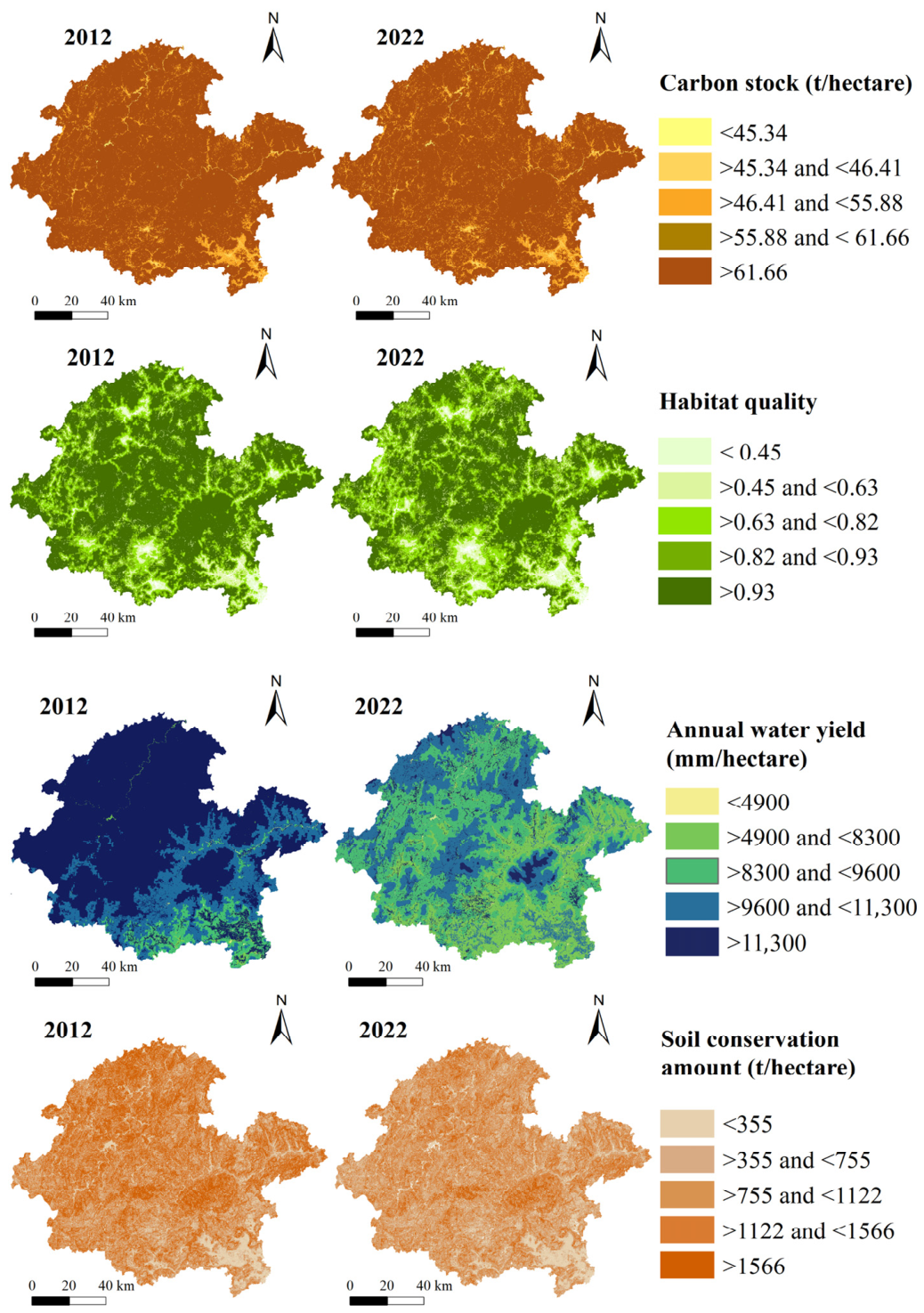
The spatial distribution of carbon storage, annual water yield, habitat quality, and soil retention in the Daiyun Mountain Rim in 2012 and 2022 is illustrated in Figure 2. The spatial distribution of ecosystem contribution, derived from the overlay of these four ecosystem services, is depicted in Figure 3. In 2012 and 2022, the ecosystem contribution index of the study area remained relatively stable overall. High-value areas of the ecosystem contribution index were mainly distributed around major nature reserves and forest parks, including Xianyou, Dehua, Yongtai, Datian, and Youxi counties. The medium-value regions were predominantly composed of cultivated land and adjacent forest land. The low-value regions mainly comprised construction land, with the largest contiguous low-value area situated in the southeastern part of the region.

3.2. Spatial Distribution of Ecosystem Health

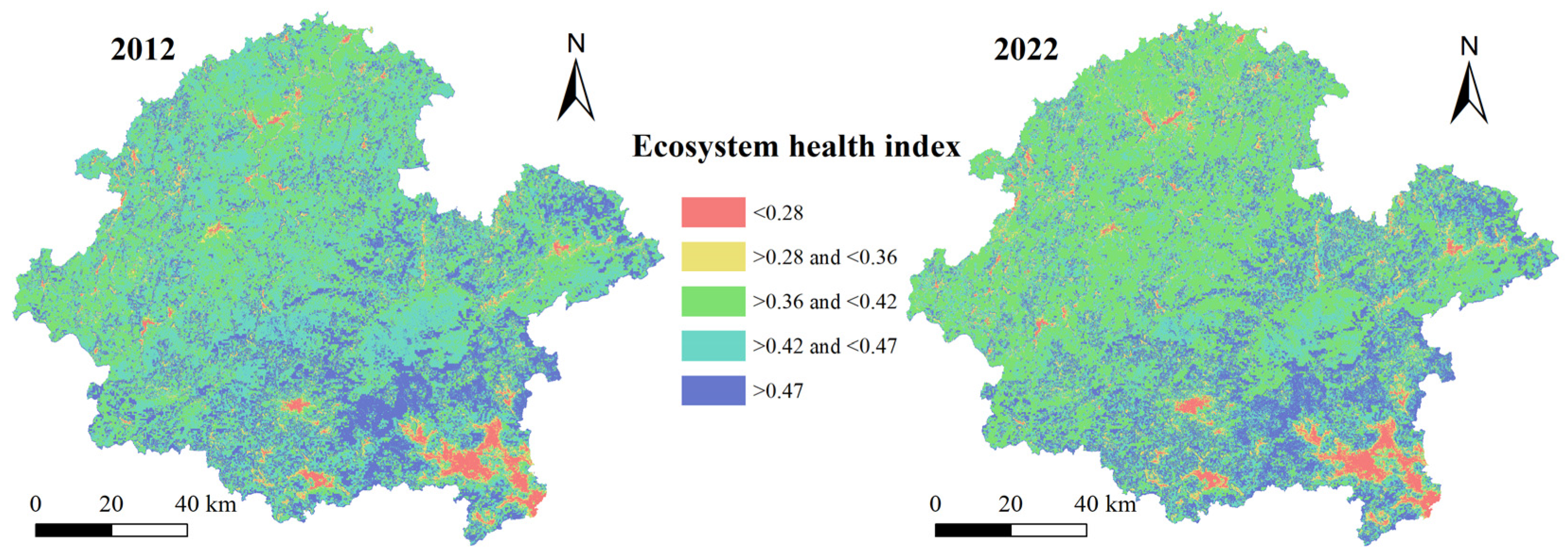
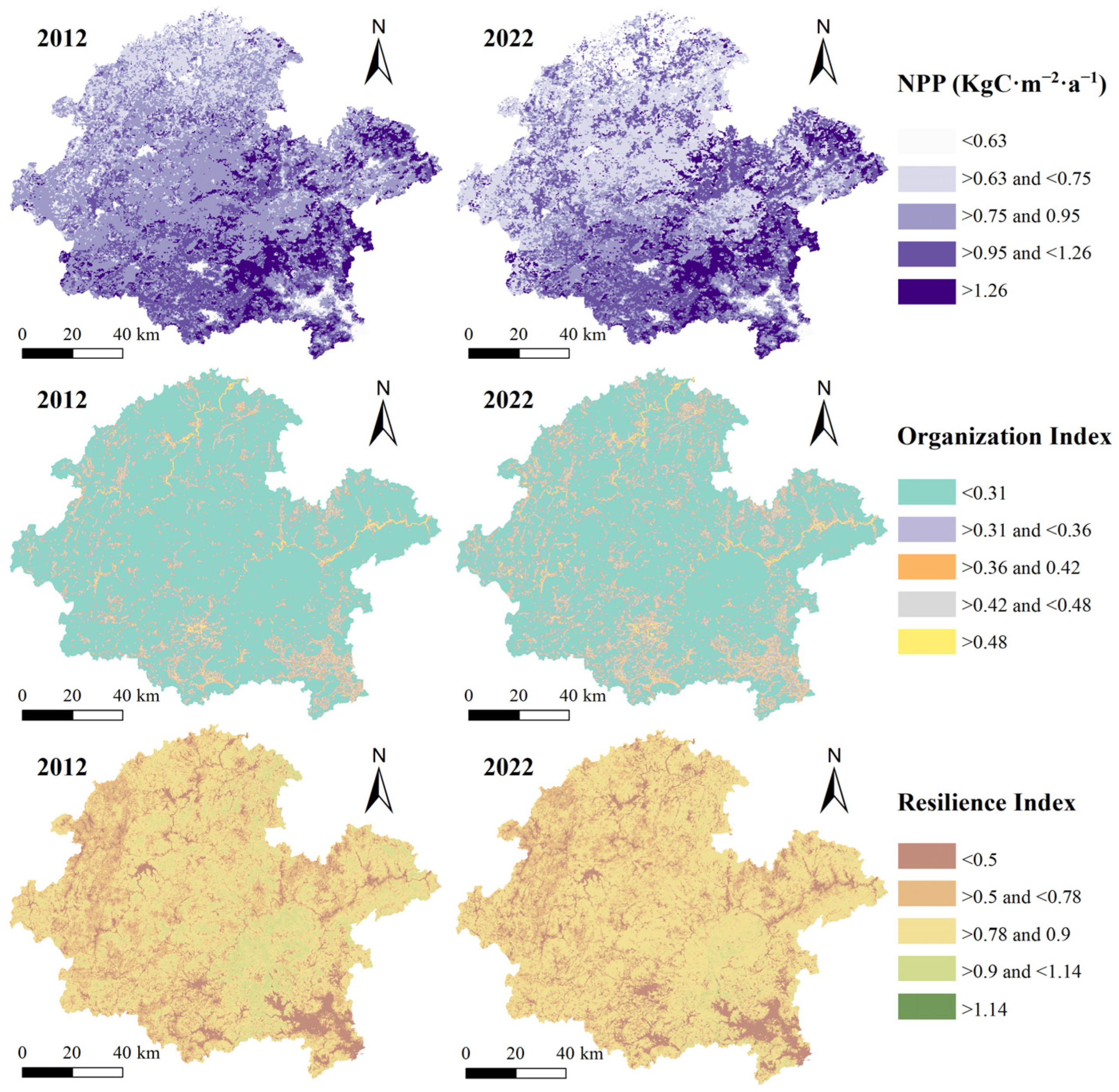
The spatial distribution of Vigor, Organization, and Resilience in the Daiyun Mountain Rim for the years 2012 and 2022 is illustrated in Figure 4. The spatial pattern of the Ecosystem Health Index (EHI), derived from the overlay of the contribution, vigor, organization, and resilience, is depicted in Figure 5. From 2012 to 2022, the overall ecosystem health level in the Daiyun Mountain Rim region showed a declining trend and exhibited pronounced spatial heterogeneity. Areas with moderate to high values were predominantly forest land, and the highest values were primarily distributed in the central-eastern part of the study area. Low-value areas were more scattered, mainly located in construction land, cultivated land, and the surrounding areas of cultivated land. Spatially, the ecosystem health level in the Daiyun Mountain Rim exhibited a “low–high–low” stepped structure pattern, transitioning from southeastern to northwestern.

3.3. Spatiotemporal Patterns of Ecosystem Health

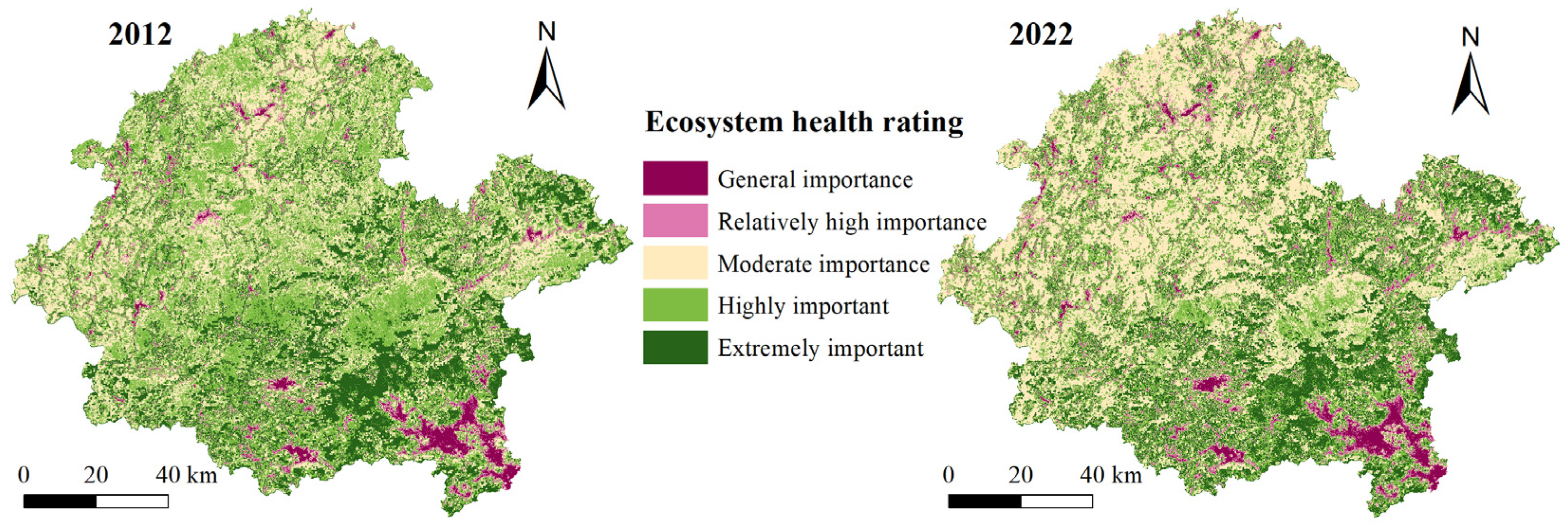
Based on the natural break method, the Ecosystem Health level (EHI) was classified into five safety levels: Generally Important (EHI < 0.28), Moderately Important (0.28 < EHI < 0.36), Intermediately Important (0.36 < EHI < 0.42), Highly Important (0.42 < EHI < 0.47), and Extremely Important (EHI > 0.47) (Figure 6). From 2012 to 2022, the ecosystem health grade structure of the study area changed markedly. Extremely Important and Highly Important areas generally contracted, while the Generally Important, Moderately Important, and Intermediately Important areas expanded, indicating a decline in regional ecosystem health quality. The high-value regions of the Ecosystem Health Index in 2012 and 2022 were highly correlated with the high-value regions of NPP, primarily due to the more consistent spatial distribution of contribution, organization, and resilience in 2012 and 2022, while the changes in NPP spatial distribution had a greater impact on the Ecosystem Health Index.
From the standpoint of spatial patterns, the ecosystem health pattern in the Daiyun Mountain Rim exhibited regional variations between 2012 and 2022. The Extremely Important areas showed a dispersed distribution pattern in both years, with larger patches primarily distributed in the eastern region, particularly within Xianyou County, while towards the western areas, the Extremely Important areas were dispersed in the form of small fragmented patches. Compared to 2012, the fragmentation of larger Extremely Important patches was more severe in 2022. The Generally Important areas mainly consisted of construction land and cultivated land with high levels of human disturbance, with a poor ecological environment, hindering species migration and material and energy flows. In 2022, the Moderately Important areas expanded significantly, mainly transitioning from areas above the Intermediately Important level in the form of small patches. The areas with significant changes were primarily located in the northwestern part of the study zone, with Youxi County exhibiting the most notable changes.

3.4. Identifying the Ecological Source Areas

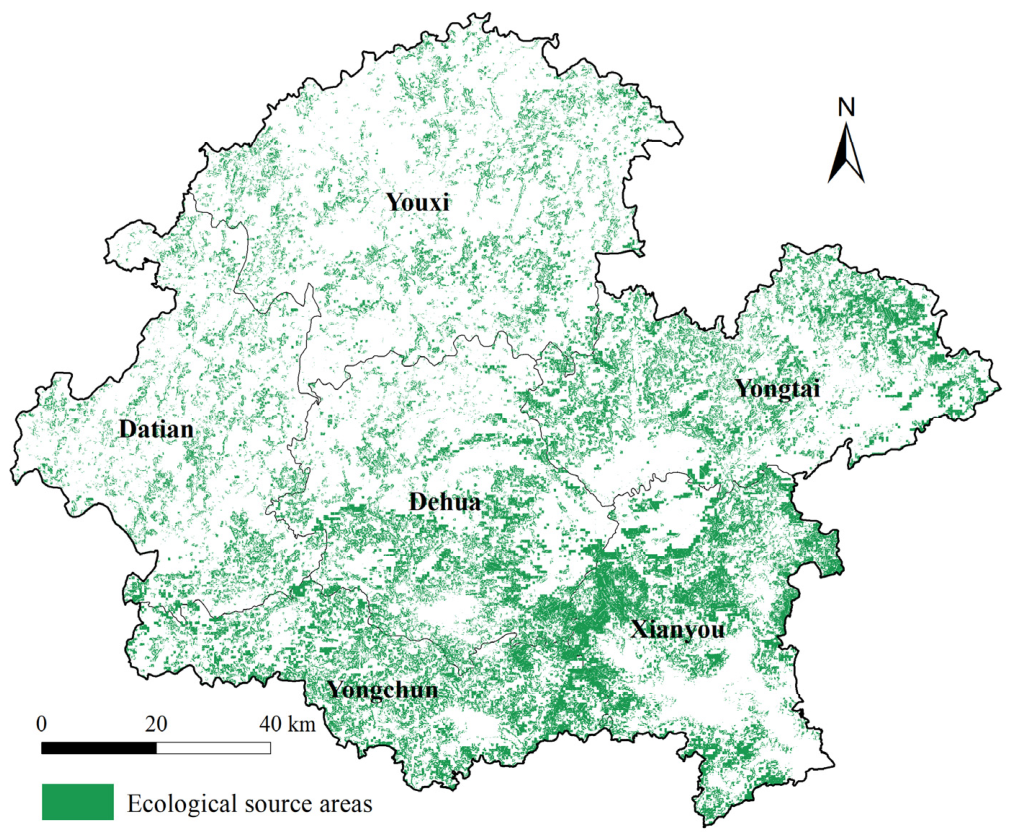
Based on the ecosystem health layer of 2022, this study identified the Extremely Important areas as ESA (Figure 7). From the standpoint of a spatial distribution pattern, the ESA exhibited a scattered distribution, with larger patches primarily situated in the eastern part of the study area. The total area of ESA was 2840.27 km2, accounting for roughly 21.25% of the total study area. From a land-use perspective, forest land accounted for 99.96% of the ESA, indicating that forest land has extremely high ecosystem health levels and played a vital part in maintaining the overall regional ecosystem health.
This study performed multiple GA calculations for different chromosome lengths, ultimately obtaining the optimal ESA. Table 4 lists the comparison of landscape connectivity results for different chromosome lengths. When the number of ESAs was 90, the total area of ESAs was maximized, with the highest IIC of 0.0537 and PC of 0.0742, while the fragmentation index remained relatively low.

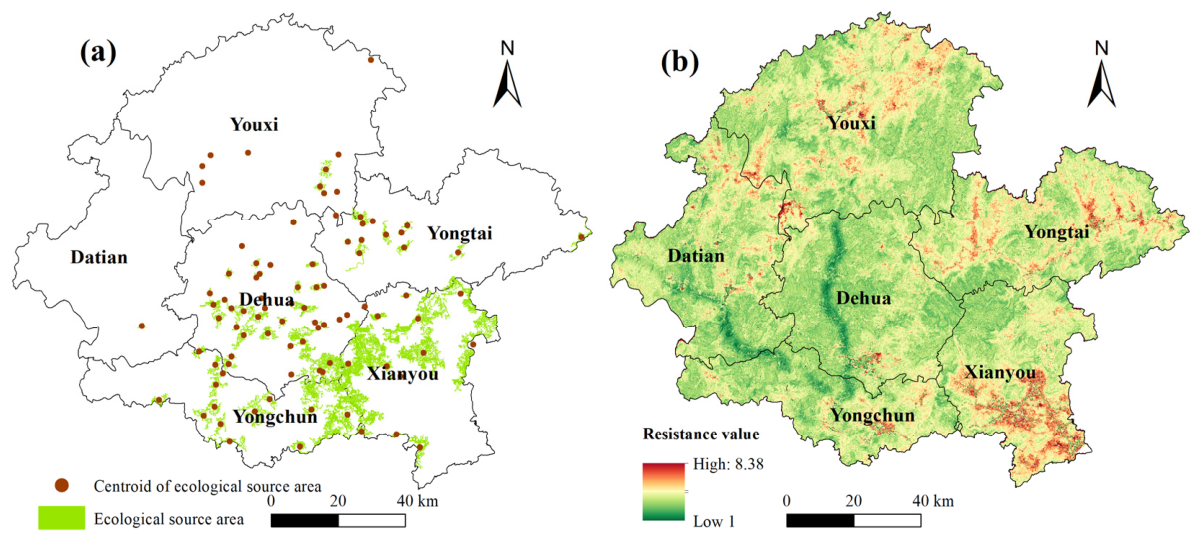
3.5. Optimal Ecological Source Areas and Resistance Surface Analysis

Utilizing GA, this study ultimately determined 90 optimal ESAs (Figure 8), encompassing a total area of 813.62 km2, which accounts for 6.1% of the entire study area. The patch sizes of these optimal ESAs vary significantly, with the largest patch spanning 154.84 km2 and the smallest patch measuring 0.11 km2. Dehua County had the highest number of optimal ESAs, while Xianyou County had the largest area of optimal ESAs. The integrated resistance surface of the study region (Figure 8) shows that areas with relatively high resistance are primarily composed of built-up land, cultivated land, and water bodies. These three land-use types generally have gentle slopes and relatively low elevations. Construction land is concentrated in county towns and townships, severely obstructing the flow of ecological information and energy. Although cultivated land is more scattered, it is highly fragmented, posing a significant barrier to species migration, second only to construction land.

3.6. Identification of the Ecological Corridors

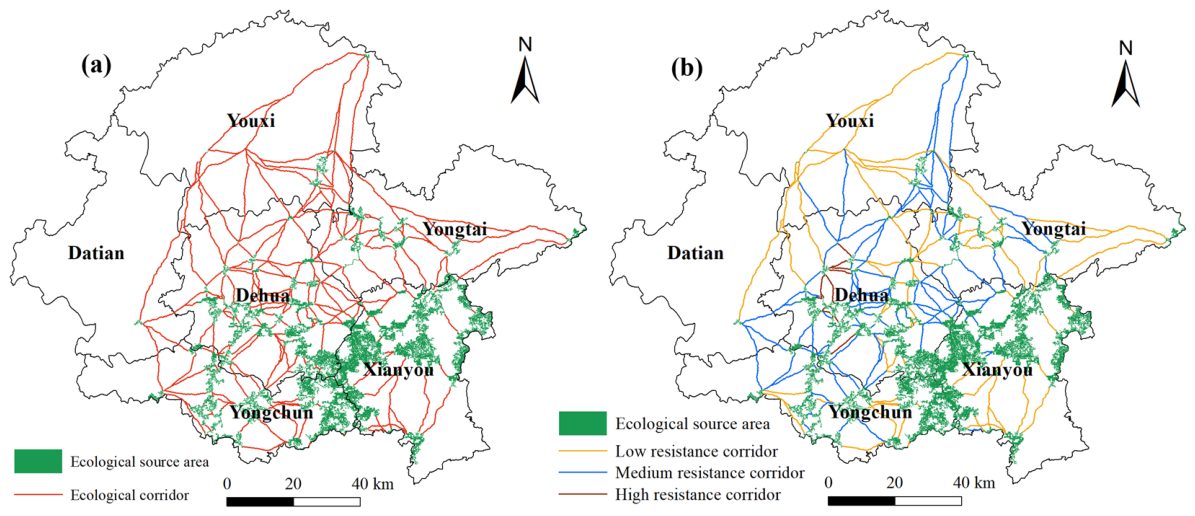
Leveraging ESA and comprehensive resistance surface, the Linkage Mapper tool identified 248 EC (Figure 9), spanning a total length of 2164.71 km, with a mean length of 8.73 km, forming a web-like corridor network. Among these, 99 were low-resistance corridors; 130 were moderate-resistance corridors; and 19 were high-resistance corridors, essentially forming an interconnected loop of corridors across the entire study region. Within the central region of the study area, specifically in Dehua County, the EC were relatively dense yet shorter in length, with low, moderate, and high-resistance corridors interspersed. This area encompasses the Daiyun Mountains National Nature Reserve and the Shiniu Mountain Forest Park, characterized by numerous ESA and a high level of ES. In contrast, the western regions of Youxi County and Datian County, as well as the northeastern part of the study area, exhibited fewer ESA, leading to a more dispersed distribution of EC with greater lengths, predominantly comprising low and moderate-resistance corridors, with corridors exceeding 20 km in length primarily located in these areas.
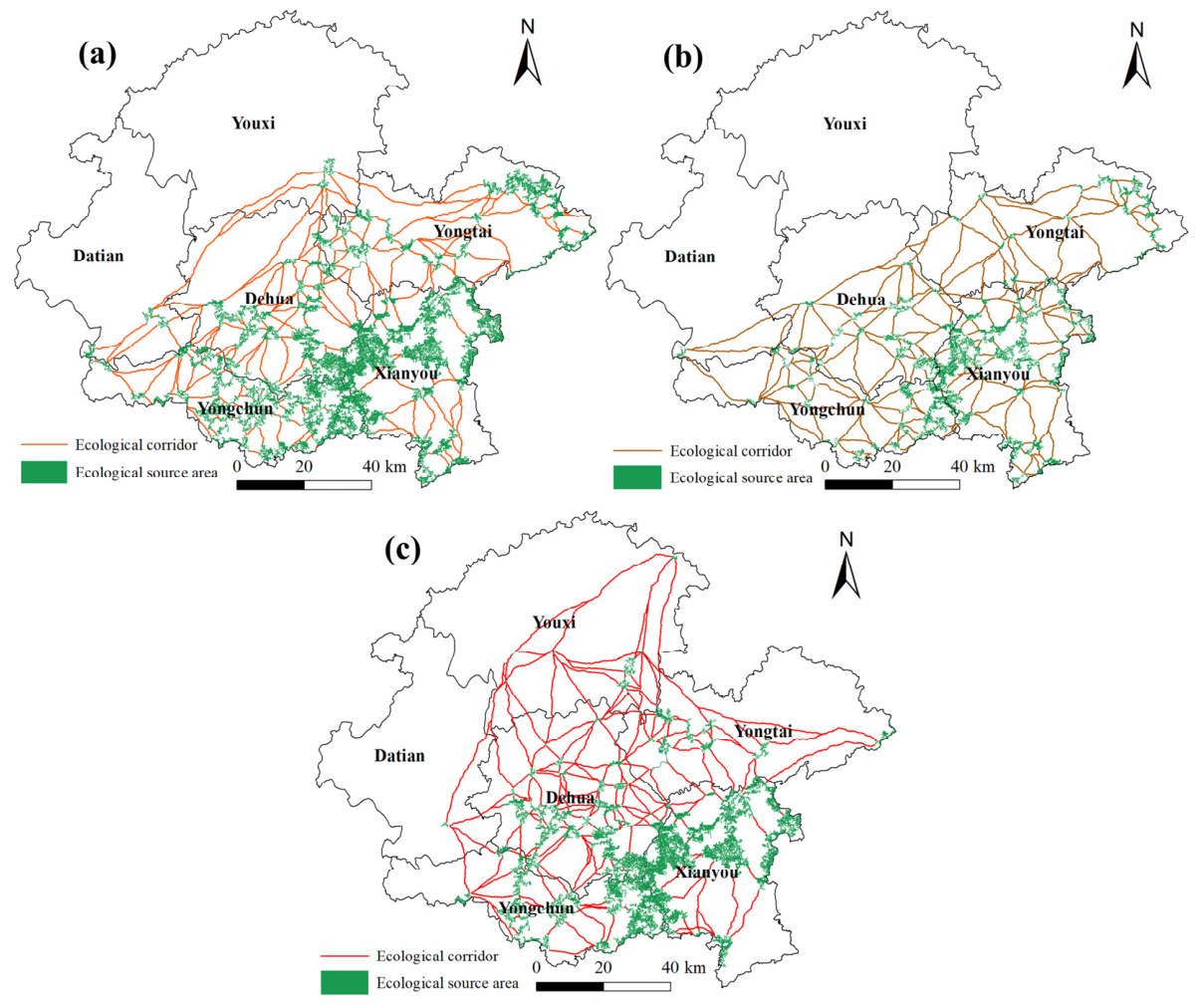
EC generated using different ESA identification methods exhibited substantial differences in spatial coverage and connectivity (Figure 10 and Table 5). The traditional large-patch method and the MSPA method each identified 90 ESA, and the EC derived from them showed relatively limited and localized spatial coverage. However, the ESA constructed using the GA and the EC derived from them achieved a more extensive coverage across the study area. Comparative analysis revealed that (Table 5), in contrast to the selection of large habitat patches and the MSPA method, the optimized EC exhibited an increase of 0.15 and 0.23 in α, and an increase of 0.05 and 0.08 in β, respectively. Differences in C values among the three approaches were minimal.

3.7. Constructing the Ecological Security Pattern

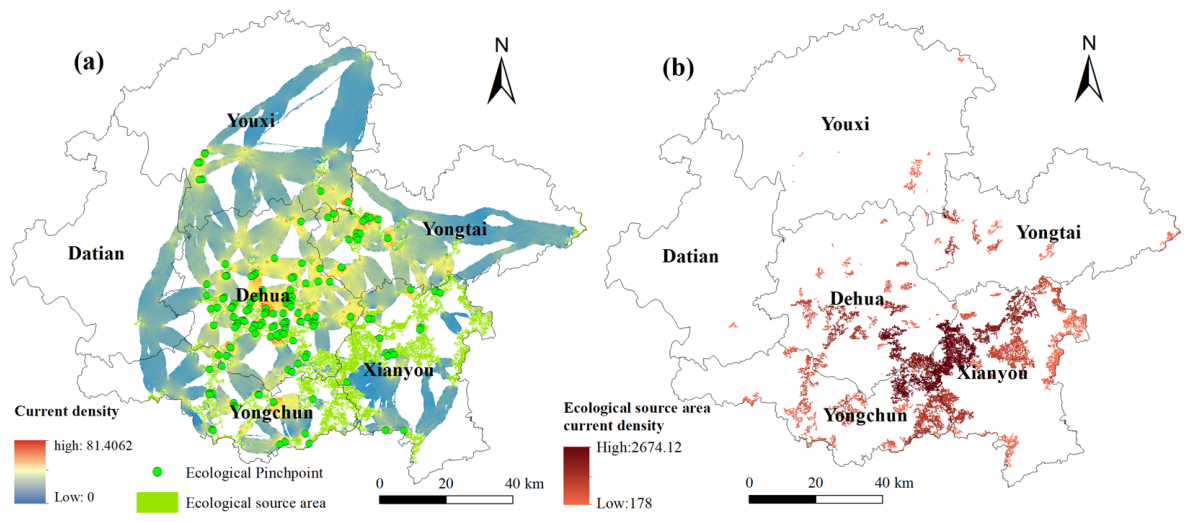
This study identified a total of 143 ecological pinch points. From the perspective of spatial distribution patterns (Figure 11a), ecological pinch points were relatively dense within Dehua County and the border area between Yongtai County and Youxi County, where ESAs, despite their relatively small areas, were densely distributed, playing a crucial role in sustaining the regional ecosystem’s species and energy flow. The higher the current density value of an ESA, the more significant its role in maintaining regional landscape connectivity. As evident from Figure 11b, patches with high current density values generally exhibited larger areas, primarily concentrated in the border regions of Dehua County, Yongchun County, and Xianyou County.
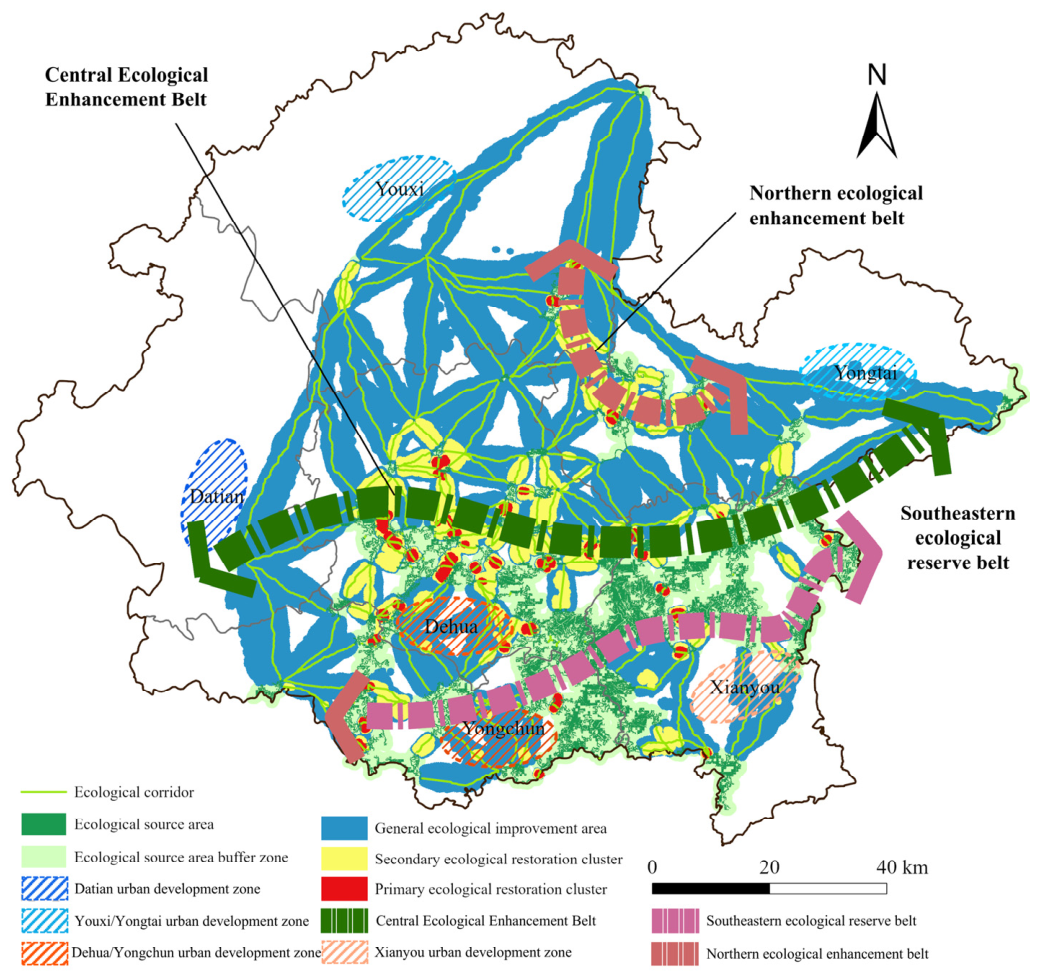
Based on various ecological and geographical factors, this study constructed an ESP for the Daiyun Mountain Rim. Based on the basic attributes and ecological significance of ecological nodes, this study delineated two levels of ecological restoration clusters and a general ecological improvement area (Figure 12), covering a combined area of 5736.13 km2, which accounts for 42.94% of the study region. The primary ecological restoration cluster covers an area of 166.79 km2, accounting for only 2.91% of the total restoration and improvement area, and is relatively scattered, mainly located at the connection points between adjacent patches. The secondary ecological restoration cluster covers an area of 920.54 km2, constituting 16.05% of the total restoration and improvement area, mainly distributed within Dehua County. The general ecological improvement area covers an area of 4648.8 km2, constituting 81.04% of the total restoration and improvement area, primarily distributed along the sides of EC, complementing the ecological restoration clusters and collectively optimizing the ESP.
Based on the identified restoration and improvement areas, combined with the spatial distribution of ESA, EC, and ecological pinch points, this study proposes a “Three Belts, One Area, and Multiple Clusters” spatial optimization layout for ES (Figure 12). The “Three Belts” refer to the Southeastern Ecological Reserve Belt, the Central Ecological Enhancement Belt, and the Northern Ecological Enhancement Belt. The Southeastern Ecological Reserve Belt is an area with a concentration of large ESA, high current density, low resistance, and a high level of ecological health. The Central Ecological Enhancement Belt encompasses three nature reserves, one forest park, and the Daiyun Mountains National Nature Reserve. This area is dominated by forest land as the leading landscape type and is a densely distributed area for ESA, EC, and ecological pinch points, with minimal disturbance from human activities, rich ecological resources, and ecosystem health at a higher level. “One Area” refers to the urban development area surrounding the county towns of the six counties. Among them, the county towns of Xianyou, Yongtai, Dehua, and Yongchun have EC running through them, while Datian and Youxi counties have EC distributed along the northern and southern edges of the urban areas. “Multiple Clusters” refer to the multiple ecological improvement and restoration clusters that influence ecological flows, which are concentrated areas for EC construction.

4. Discussion

4.1. Applicability and Reliability of the Contribution–Vigor–Organization–Resilience, Genetic Algorithm, and Circuit Theory Framework in Ecological Security Pattern Construction

ESP inevitably exhibits deficiencies in its adaptive capacity and spatial coverage [89]. Previous research predominantly concentrated on extracting ESA based on singular ecological functions [18,20,21], neglecting consideration of the quality of ESA and the optimization of the spatial distribution of ESA [20]. As ecosystem health becomes increasingly crucial in enhancing the adaptive capacity of ESP [90,91], this study, based on the “Contribution–Vigor–Organization–Resilience” framework for assessing ecosystem health levels, GA, and circuit theory, identifies optimal ESA and EC, thereby improving corridor spatial coverage and connectivity. The results of this study are broadly consistent with previous studies in Fujian Province and the southeastern coastal region of China regarding water yield and the spatial patterns of ecosystem services. In particular, the county-level spatial patterns of water yield and ecosystem services are similar to those reported by Chen et al. [92] and Bao et al. [93]. This consistency suggests that forestland, nature reserves, and water conservation areas remain important spatial foundations for sustaining regional ecosystem services and ecological security. Unlike previous studies that mainly identified ESP based on ecosystem services [9,35], this study integrates ecosystem health assessment, ESA optimization, and EC extraction. This integrated approach strengthens ecological network connectivity. Wang et al. [94] used GA to extract the optimal terrestrial ESA and optimal aquatic ESA of cities, verifying that the optimized EC performed better than the pre-optimized EC, achieving good results. Another study [21] used GA to extract the optimal ESA in the northwest Weihe River basin and compared it with traditional ESA acquisition methods using landscape connectivity indices, showing that GA outperformed traditional methods. Consistent with previous Chinese case studies, this study generated multiple ESA configurations by varying chromosome length and evaluated them using landscape connectivity indices, including FN, IIC, and PC. The optimal configuration was obtained when N = 90. Compared with the traditional large-patch and MSPA-based methods, the GA-optimized ESA produced EC with broader spatial coverage and stronger connectivity. These results indicate that GA can be applied not only to ESA optimization at urban and watershed scales, but also to ESA number determination and spatial configuration optimization in mountainous ecological barrier regions such as the Daiyun Mountain Rim. Given that GA applications in ESA optimization remain limited, this study integrates GA with CVOR-based ecosystem health assessment and circuit theory, thereby extending its use in ecological spatial planning and providing methodological support for ecological source identification and corridor connectivity enhancement.
This study employs the CVOR framework to investigate the Daiyun Mountain Rim, aiming to enhance ecosystem service capacity and improve ESA quality. The area is characterized by complex geographical features and landscape fragmentation. Previous studies have demonstrated that the most intensive land use changes occur in the northwestern and southeastern portions [55], which corresponds with the significant ecosystem health deterioration identified in these areas through our framework. Studies in comparable mountainous ecological barrier regions, including the Sichuan–Yunnan ecological barrier and the Funiu Mountain region, have shown that ESPs are jointly shaped by forest ecosystems, topographic gradients, and human activities [8,9]. Similarly, this study found that high-ecosystem-health areas and major ESAs in the Daiyun Mountain Rim region were mainly distributed in forestland, nature reserves, forest parks, and scenic areas. By contrast, construction land, cultivated land, and adjacent areas generally exhibited lower ecosystem health and higher ecological resistance. These findings highlight the central role of forest ecosystems and protected areas in ESP construction across China’s mountainous ecological barrier regions. This correlation is logical, as anthropogenic land use changes are the primary drivers of spatial pattern alterations and overall supply variations in ecosystem services [95]. Increased human activities lead to declining ecosystem services, ultimately compromising ecosystem health [96]. The ESA identified in this study is primarily distributed across nature reserves, small protected areas, forest parks, and scenic areas, aligning with the ecological points specified in the “Territorial Spatial Planning (2021–2035)” of six counties. Thus, the CVOR framework effectively reflects the actual ecological conditions of the study area.

4.2. Management Strategies for Ecological Security Pattern Optimization in the Daiyun Mountain Rim

The Daiyun Mountain Rim is situated in the southeastern hilly area of China. The results show that the area has a high degree of forest vegetation coverage, significant elevation differences, and complex terrain, serving as the source of multiple rivers and home to nature reserves. Consequently, regional development in the Daiyun Mountain Rim reflects a continuous process of balancing ecological constraints with economic demands [55]. With the implementation of sustainable development strategies, optimizing the ESP of the Daiyun Mountain Rim not only presents a crucial pathway for reconciling ecological conservation with economic development, but also provides practical support for ecological governance and green development in the Daiyun Mountain Rim [8,9,10]. Using multi-source data on land use, topography, and vegetation, this study assessed ecosystem health changes in the Daiyun Mountain Rim region, optimized the number and spatial configuration of ESA using a GA, and evaluated the resulting ESP through EC suitability comparison. The findings suggest that ESP optimization should shift from individual patch protection toward the coordinated configuration of transregional ESA, EC, and priority restoration zones. This transition from “site-specific protection” to “regional coordination” is particularly relevant for the Daiyun Mountain Rim region, which serves as an important mountainous ecological barrier, water conservation area, and reservoir of biodiversity in southeastern China. Protecting ESA, enhancing corridor connectivity, and optimizing restoration zones in this region can inform ecological security network construction in similar mountainous ecological barrier regions [49,50,54].
The “Three Belts, One Area, Multiple Clusters” ecological security spatial optimization pattern proposed in this study is, on a macro level, the specific implementation for the Daiyun Mountain region of the construction of the “Two Poles, Two Belts, Three Axes, Six Bays Area” ecological pattern outlined in the “National Main Functional Area Planning Outline” [97]. On a microscopic level, it comprehensively considers factors such as ecosystem health, comprehensive ecological resistance, optimal ESA and EC, and delineation of restoration and improvement areas, resulting in a more detailed and precise ecological spatial layout that supports preventive ecological management at the source, providing a more scientific reference and guidance for the new pattern of green economic development in the Daiyun Mountain Rim. In addition, the cross-jurisdictional collaboration among the “four cities and six counties” in the Daiyun Mountain Rim has already established a certain foundation for regional governance, thereby providing practical conditions for implementing the optimized ESP. For example, at the judicial level, the ecological protection judicial alliance helps alleviate administrative boundary constraints in the enforcement of cross-regional pollution control and ecological damage regulation. At the administrative and industrial levels, the regional alliance mechanism provides an institutional basis for coordinated ecological protection, the realization of ecological product value, and the sharing of ecological restoration responsibilities [98,99]. On this basis, the optimized ESP proposed in this study can serve not only to identify priority areas for protection and restoration, but also to provide spatial decision support for cross-regional ecological governance, ecological compensation, and coordinated management. For the “three belts”, ESA with high ecosystem health, densely distributed ecological pinch points, and high-resistance corridors within the southeastern ecological conservation belt and central ecological enhancement belt should be prioritized for short-term management. Construction land expansion, forestland conversion, and road-induced fragmentation should be strictly controlled to prevent further forest landscape fragmentation. Around nature reserves, the spatial configuration of EC and pinch points should be optimized, with emphasis on improving landscape connectivity within the two levels of ecological restoration clusters. Assisted natural regeneration (ANR) or near-natural regeneration can be adopted to transform degraded land into more productive forest ecosystems [47], thereby facilitating species dispersal and ecological flows among nature reserves. The northern ecological enhancement belt, located at the boundary between Yongtai and Youxi counties, is an important transitional zone connecting ESA in the northeastern and northwestern parts of the study area. Short-term management should focus on maintaining existing corridor continuity and restoring ecological pinch points and narrow corridor sections. In the “one area”, ecosystem service provision is relatively vulnerable. However, because these areas are densely populated, demand for ecosystem services is high, and ecological restoration can generate substantial comprehensive benefits [100]. Urban development should therefore be coordinated with urban green space system planning, EC layout, and green infrastructure development. These measures can help develop secondary urban ESA, supplement the existing ESA, and strengthen urban ecological connectivity. For the “multiple clusters”, hierarchical governance should follow the sequence of first-level ecological restoration clusters, second-level restoration clusters, and general improvement areas. These clusters should function as ecological buffers, corridor reinforcement zones, and links among ESA. Because cultivated land is interspersed across these areas, EC is highly susceptible to human disturbance. Artificial forest belts should therefore be established at cropland–corridor interfaces to maintain corridor connectivity and stability and enhance ecosystem services along both sides of the corridors.
For vegetation restoration, priority should be given to cost-effectiveness, and in the face of conflicts between ecological benefits and restoration costs, the demands of local residents, opportunities for the agricultural sector, and biodiversity conservation should be integrated [101]. Following the spiderweb spatial layout of ESA and EC, and relying on township governments to integrate food production, understory economy products, and other forest-based products, can aid in transforming vegetation restoration into an economically viable endeavor. Priority should be given to comprehensive treatment of ESA and key restoration and improvement areas, with protection gradually radiating outward from ESA as the center, progressively addressing soil and water loss areas, ultimately achieving overall optimization of the regional ESP. For ecological restoration clusters and similar areas, implementing afforestation programs serves as a crucial intervention measure for ecological compensation [27]. For instance, economically developed townships can establish horizontal ecological compensation mechanisms by providing afforestation funds to ecological restoration areas in exchange for corresponding forestland resource rights. This compensation approach directly alleviates the ecological restoration burden on economically underdeveloped areas while promoting optimal allocation of regional ecological resources. Regarding issues such as mining development and heavy metal pollution, a scientific and reasonable ecological value accounting system and regional ecological compensation standards should be established based on the principle of “whoever develops, restores.” These measures not only contribute to enhancing the ecological livability of the Daiyun Mountain Rim but also provide a useful reference for ecological planning, restoration, and sustainable management in similar ecologically strategic mountain barrier regions.

4.3. Research Limitations and Future Prospects

Although this study developed an ESP optimization framework integrating CVOR-based ecosystem health assessment, a GA, and circuit theory, several limitations should be acknowledged. First, the assessment was conducted for only two time points, 2012 and 2022. This design captures regional changes over the past decade but has limited capacity to characterize long-term trajectories and future scenarios. Second, ecosystem health assessment, resistance surface construction, and GA optimization require weight assignment, resistance-value setting, and parameter selection. Different parameter combinations may affect ESA identification and EC extraction. Future studies should combine machine learning with multi-scenario parameter comparisons to evaluate the effects of weights, resistance values, and GA parameters, thereby improving model stability and reproducibility. Finally, corridors, pinch points, and priority restoration areas identified using circuit theory mainly represent potential ecological flow pathways and require further validation using species distribution data, field surveys, long-term monitoring, or genetic connectivity data. Future research should integrate long-term remote sensing observations, land-use change simulations, and climate change scenarios to support dynamic prediction and uncertainty analysis of ESP, thereby improving the ecological reliability and management applicability of the findings.

5. Conclusions

This study developed an integrated framework combining CVOR-based ecosystem health assessment, GA-based ecological source optimization, and circuit theory–based corridor extraction to optimize the ESP of the Daiyun Mountain Rim. Apart from optimizing the layout of ESA and EC, it also explores the scope and corresponding optimization strategies for improving ES in the Daiyun Mountain Rim by identifying ecological pinch points and obstacles. Furthermore, this study employs graph theory to compare the connectivity indices of EC extracted using different methods, determining the effectiveness of the optimization and the feasibility of the optimization scheme. The main research conclusions are as follows:
1. The overall health level of the Daiyun Mountain Rim ecosystem exhibits a trapezoidal structure feature of “low-high-low” formation trending from southeast to northwest. From 2012 to 2022, the overall ecosystem health level declined, accompanied by a contraction of high-health areas, indicating that this mountainous ecological barrier region is facing increasing ecological security pressures under the combined effects of land-use change and landscape fragmentation.
2. The GA-based optimization produced a more spatially balanced ESA configuration and supported the construction of a corridor network across the study area.
3. Compared to traditional methods of ESA identification that rely on large habitat patches and MSPA, the EC derived from GA-optimized ESA exhibited greater spatial coverage and overall connectivity. These improvements demonstrate the high applicability of GA in determining optimal ESA, providing a reliable methodology for constructing regional ESP.
4. This study divides the optimization of the ecological pattern in the research area into primary ecological restoration clusters, secondary ecological restoration clusters, and general improvement areas. Combined with important ecological nodes, a “three-belt, one area, multiple clusters” ESP optimization layout strategy is proposed. This spatial pattern provides a basis for prioritizing ecological restoration and improving cross-county ecological connectivity in the Daiyun Mountain Rim.
Overall, the integrated CVOR–GA–circuit theory framework is applicable to mountainous ecological barrier regions such as the Daiyun Mountain Rim, where complex terrain, fragmented ESA, and strong cross-county connectivity requirements are prominent. However, the selected study period, parameter settings, and lack of field-based validation may introduce uncertainty into the results. Future research should integrate long-term remote sensing data, land-use change simulations, climate change scenarios, and species monitoring data to support dynamic prediction of ESP and EC-effectiveness validation, thereby improving the ecological reliability and management applicability of the findings.

Author Contributions

Conceptualization, Y.J. and G.C.; methodology, Y.J.; software, Y.J.; validation, Y.J., Q.F. (Qidi Fan) and Q.F. (Qiaohong Fan); formal analysis, Y.J.; investigation, G.C.; resources, K.S.; data curation, Q.F. (Qidi Fan) and K.S.; writing—original draft preparation, Y.J. and G.C.; writing—review and editing, W.L. and S.F.; visualization, G.C.; supervision, W.L.; project administration, W.L. and S.F.; funding acquisition, S.F. All authors have read and agreed to the published version of the manuscript.

Funding

This research was funded by Fujian Provincial Financial Science and Education Special Project: General Concept and Development Strategies for Rural Vitalization Through Industrial Development, grant number K8119A01A.

Data Availability Statement

The original contributions of this work are fully contained in the study. Further requests for additional information can be directed to the corresponding author.

Conflicts of Interest

The authors declare no conflicts of interest.

References

  1. Reid, W.; Mooney, H.; Cropper, A.; Capistrano, D.; Carpenter, S.; Chopra, K. Millennium Ecosystem Assessment. Ecosystems and Human Well-Being: Synthesis; Island Press: Washington, DC, USA, 2005. [Google Scholar]
  2. Steffen, W.; Richardson, K.; Rockström, J.; Cornell, S.E.; Fetzer, I.; Bennett, E.M.; Biggs, R.; Carpenter, S.R.; de Vries, W.; de Wit, C.A.; et al. Planetary Boundaries: Guiding Human Development on a Changing Planet. Science 2015, 347, 1259855. [Google Scholar] [CrossRef]
  3. Joppa, L.N.; Boyd, J.W.; Duke, C.S.; Hampton, S.; Jackson, S.T.; Jacobs, K.L.; Kassam, K.-A.S.; Mooney, H.A.; Ogden, L.A.; Ruckelshaus, M.; et al. Government: Plan for Ecosystem Services. Science 2016, 351, 1037. [Google Scholar] [CrossRef]
  4. Lin, J.H.; Chen, W.H.; Qi, X.H.; Hou, H.R. Risk Assessment and Its Influencing Factors Analysis of Geological Hazards in Typical Mountain Environment. J. Clean. Prod. 2021, 309, 127077. [Google Scholar] [CrossRef]
  5. Ministry of Water Resources of the PRC; National Development and Reform Commission; Ministry of Finance; Ministry of Land and Resources. National Soil and Water Conservation Plan (2015–2030); Ministry of Water Resources of China: Beijing, China, 2015.
  6. IPBES. Global Assessment Report on Biodiversity and Ecosystem Services of the Intergovernmental Science-Policy Platform on Biodiversity and Ecosystem Services; Zenodo: Bonn, Germany, 2019. [Google Scholar]
  7. Maes, J.; Teller, A.; Erhard, M.; Condé, S.; Vallecillo, S.; Barredo Cano, J.I.; Paracchini, M.L.; Abdul Malak, D.; Trombetti, M.; Vigiak, O.; et al. Mapping and Assessment of Ecosystems and Their Services: An EU Wide Ecosystem Assessment in Support of the EU Biodiversity Strategy; Publications Office of the European Union: Luxembourg, 2020; ISBN 978-92-76-17833-0. [Google Scholar]
  8. Li, C.; Wu, Y.; Gao, B.; Zheng, K.; Wu, Y.; Wang, M. Construction of Ecological Security Pattern of National Ecological Barriers for Ecosystem Health Maintenance. Ecol. Indic. 2023, 146, 109801. [Google Scholar] [CrossRef]
  9. Wang, Z.; Huo, J.; Shi, Z.; Zhu, W.; Mao, J.; Yan, S.; Liu, S. Ecological Security Pattern Construction Integrating “Connectivity-Importance-Niche” Approach Under Vertical Zonation: A Case Study in Funiu Mountain Area, China. Ecol. Evol. 2026, 16, e72848. [Google Scholar] [CrossRef]
  10. Tang, L.; Liang, G.; Gu, G.; Xu, J.; Duan, L.; Zhang, X.; Yang, X.; Lu, R. Study on the Spatial-Temporal Evolution Characteristics, Patterns, and Driving Mechanisms of Ecological Environment of the Ecological Security Barriers on China’s Land Borders. Environ. Impact Assess. Rev. 2023, 103, 107267. [Google Scholar] [CrossRef]
  11. Su, Y.; Chen, X.; Liao, J.; Zhang, H.; Wang, C.; Ye, Y.; Wang, Y. Modeling the Optimal Ecological Security Pattern for Guiding the Urban Constructed Land Expansions. Urban For. Urban Green. 2016, 19, 35–46. [Google Scholar] [CrossRef]
  12. Imdad, K.; Sahana, M.; Ravetz, J.; Areendran, G.; Gautam, O.; Dwivedi, S.; Chaudhary, A.; Sajjad, H. A Sustainable Solution to Manage Ecosystem Health of Wetlands in Urban and Peri-Urban Areas of Lucknow District, India Using Geospatial Techniques and Community Based Pragmatic Approach. J. Clean. Prod. 2023, 414, 137646. [Google Scholar] [CrossRef]
  13. Li, J.; Liu, Y.; Gani, A.A.; Wu, J.; Dai, Y. Identification of Ecological Security Patterns for the Qiandongnan Ecotourism Area in Southwest China Using InVEST and Circuit Theory. Forests 2023, 14, 1316. [Google Scholar] [CrossRef]
  14. Shu, R.; Ma, G.; Zou, Y.; Guo, N.; Su, H.; Zhang, G. Bibliometric Analysis of Ecological Security Pattern Construction: Current Status, Evolution, and Development Trends. Ecol. Indic. 2024, 169, 112754. [Google Scholar] [CrossRef]
  15. Hess, G.R.; Fischer, R.A. Communicating Clearly about Conservation Corridors. Landsc. Urban Plan. 2001, 55, 195–208. [Google Scholar] [CrossRef]
  16. Yu, K. Ecologically Strategic Points in Landscape and Surface Model. Acta Geogr. Sin. 1998, 53, 11–20. [Google Scholar] [CrossRef]
  17. Ma, K.M.; Fu, B.J.; Li, X.Y. The Regional Pattern for Ecological Security (RPES): The Concept and Theoretical Basis. Acta Ecol. Sin. 2004, 24, 761–768. [Google Scholar]
  18. Peng, J.; Zhao, H.J.; Wu, J.S. Research Progress and Prospect on Regional Ecological Security Pattern Construction. Geogr. Res. 2017, 36, 407–419. Available online: https://www.dlyj.ac.cn/EN/10.11821/dlyj201703001 (accessed on 1 May 2026).
  19. Yu, Q.; Yue, D.; Wang, Y.; Su, K.; Fang, M.; Ma, H.; Zhang, Q.; Huang, Y. Optimization of Ecological Node Layout and Stability Analysis of Ecological Network in Desert Oasis: A Typical Case Study of Ecological Fragile Zone Located at Deng Kou County (Inner Mongolia). Ecol. Indic. 2018, 84, 304–318. [Google Scholar] [CrossRef]
  20. Chen, D.; Guo, K.; Zeng, W.; Wang, F. Zoning-Grading Optimization of Watershed Ecological Security Network Integrating Function and Structure: A Case Study in the Three Gorges Reservoir Area. J. Clean. Prod. 2026, 538, 147160. [Google Scholar] [CrossRef]
  21. Wu, X.T.; Pan, J.H.; Zhu, X.W. Optimizing the Ecological Source Area Identification Method and Building Ecological Corridor Using a Genetic Algorithm: A Case Study in Weihe River Basin, NW China. Ecol. Inform. 2024, 80, 102519. [Google Scholar] [CrossRef]
  22. Zhao, Y.; He, L.; Bai, W.; He, Z.; Luo, F.; Wang, Z. Prediction of Ecological Security Patterns Based on Urban Expansion: A Case Study of Chengdu. Ecol. Indic. 2024, 158, 111467. [Google Scholar] [CrossRef]
  23. Xu, X.; Tan, Y.; Chen, S.; Yang, G. Changing Patterns and Determinants of Natural Capital in the Yangtze River Delta of China 2000–2010. Sci. Total Environ. 2014, 466–467, 326–337. [Google Scholar] [CrossRef]
  24. Rapport, D.J.; Bohm, G.; Buckingham, D.; Cairns, J.; Costanza, R.; Karr, J.R.; Dekruijf, H.A.M.; Levins, R.; McMichael, A.J.; Nielsen, N.O.; et al. Reply to Calow: Critics of Ecosystem Helath misrepresented. Ecosyst. Health 2000, 6, 5–6. [Google Scholar]
  25. Costanza, R. Ecosystem Health and Ecological Engineering. Ecol. Eng. 2012, 45, 24–29. [Google Scholar] [CrossRef]
  26. Du, W.; Tong, S.; Zhang, M.; Xin, Y.; Zhang, D.; Xing, X.; An, Y.; Cui, G.; Liu, G. Revealing the Spatiotemporal Dynamics and Nonlinear Interaction-Driven Mechanisms of Wetland Ecosystem Health in Northeast China Using Interpretable Machine Learning. Ecol. Indic. 2025, 178, 113878. [Google Scholar] [CrossRef]
  27. Zou, Y.; Wang, S.; Luo, X.; Jin, H.; Xiao, X.; Li, Y. A New Multivariate Index for Ecological Security Assessment in the China-Myanmar Border Region. J. Environ. Manag. 2024, 364, 121447. [Google Scholar] [CrossRef] [PubMed]
  28. Bi, X.; Fu, Y.; Wang, P.; Zhang, Y.; Yang, Z.; Hou, F.; Li, B. Ecosystem Health Assessment Based on Deep Learning in a Mountain-Basin System in Central Asia’s Arid Regions, China. Ecol. Indic. 2024, 165, 112148. [Google Scholar] [CrossRef]
  29. Li, X.; Yu, K.; Xu, G.; Li, P.; Li, Z.; Shi, P.; Jia, L.; Yang, Z.; Yue, Z. Quantifying Thresholds of Key Drivers for Ecosystem Health in Large-Scale River Basins: A Case Study of the Upper and Middle Yellow River. J. Environ. Manag. 2025, 383, 125480. [Google Scholar] [CrossRef]
  30. Nelson, E.; Mendoza, G.; Regetz, J.; Polasky, S.; Tallis, H.; Cameron, D.; Chan, K.M.; Daily, G.C.; Goldstein, J.; Kareiva, P.M.; et al. Modeling Multiple Ecosystem Services, Biodiversity Conservation, Commodity Production, and Tradeoffs at Landscape Scales. Front. Ecol. Environ. 2009, 7, 4–11. [Google Scholar] [CrossRef]
  31. United Nations; European Union; Food and Agriculture Organization of the United Nations; International Monetary Fund; Organisation for Economic Co-operation and Development; World Bank. System of Environmental-Economic Accounting—Ecosystem Accounting (SEEA EA); United Nations: New York, NY, USA, 2021.
  32. Zhang, X.L.; Jin, X.B.; Zhao, Q.L.; Ren, J.; Han, B.; Liang, X.Y.; Zhou, Y.K. Identification and Optimization of Hierarchical Ecological Nodes Based on Multi-Target Genetic Algorithm: Take Jintan District of Changzhou as an Example. J. Nat. Resour. 2020, 35, 174–189. [Google Scholar] [CrossRef]
  33. Lin, J.; Huang, C.; Wen, Y.; Liu, X. An Assessment Framework for Improving Protected Areas Based on Morphological Spatial Pattern Analysis and Graph-Based Indicators. Ecol. Indic. 2021, 130, 108138. [Google Scholar] [CrossRef]
  34. Nie, H.; Zhao, Y.; Zhu, J.; Ning, A.; Zheng, W. Ecological Security Pattern Construction in Typical Oasis Area Based on Ant Colony Optimization: A Case Study in Yili River Valley, China. Ecol. Indic. 2024, 169, 112770. [Google Scholar] [CrossRef]
  35. Wang, S.; Zhang, R.; Wang, J.; Li, Q.; Wang, R.; Li, Y.; Zhang, L. Identification and Optimization of Ecological Corridors in the Middle Reaches of the Yellow River Basin. J. Clean. Prod. 2025, 512, 145676. [Google Scholar] [CrossRef]
  36. Huang, H.; Zhang, M.; Yu, K.; Gao, Y.; Liu, J. Construction of Complex Network of Green Infrastructure in Smart City under Spatial Differentiation of Landscape. Comput. Commun. 2020, 154, 380–389. [Google Scholar] [CrossRef]
  37. Zhang, S.; Zhang, Y.; Xiong, K.; Yu, Y.; He, C.; Zhang, S.; Wang, Z. Construction of Forest Ecological Security Patterns Based on MSPA Model and Circuit Theory in the Desertification Control Forests in South China Karst. npj Herit. Sci. 2025, 13, 432. [Google Scholar] [CrossRef]
  38. Li, S.; Chen, Y.; Hou, C.; Peng, W. Resilience Assessment and Optimization of Ecological Networks under Multi-Scenario Disturbances: A 40-Year Analysis in Northwest China’s Agro-Pastoral Transition Zone. J. Clean. Prod. 2026, 538, 147323. [Google Scholar] [CrossRef]
  39. Li, X.; Fu, J.; Jiang, D.; Lin, G.; Cao, C. Land Use Optimization in Ningbo City with a Coupled GA and PLUS Model. J. Clean. Prod. 2022, 375, 134004. [Google Scholar] [CrossRef]
  40. Holland, J. Adaptation in Natural and Artificial Systems; MIT Press: Cambridge, MA, USA, 1975; Volume 6, pp. 126–137. [Google Scholar]
  41. Zhang, Z.; Jiang, W.; Ling, Z.; Guo, X.; Song, J.; Xiao, Z.; Yin, X. Urban Land Use Prediction and Construction Effectiveness Assessment Supporting SDG 11.3.1 and Regional Planning Goals. Land Use Policy 2026, 162, 107893. [Google Scholar] [CrossRef]
  42. Jiao, L.; Wang, L.; Lu, H.; Fan, Y.; Zhang, Y.; Wu, Y. An Assessment Model for Urban Resilience Based on the Pressure-State-Response Framework and BP-GA Neural Network. Urban Clim. 2023, 49, 101543. [Google Scholar] [CrossRef]
  43. Xiao, S.; Peng, J.; Hu, T.; Tang, H. Constructing Ecological Network Based on Multi-Objective Genetic Algorithms: A Case Study of Changsha City, China. Landsc. Ecol. 2024, 39, 212. [Google Scholar] [CrossRef]
  44. Sun, D.; Wu, X.; Wen, H.; Ma, X.; Zhang, F.; Ji, Q.; Zhang, J. Ecological Security Pattern Based on XGBoost-MCR Model: A Case Study of the Three Gorges Reservoir Region. J. Clean. Prod. 2024, 470, 143252. [Google Scholar] [CrossRef]
  45. Wang, Z.; Yang, Z.; Yu, X.; Peng, J. A Combined Heat Island and Cold Island Network Approach for Mitigating Urban Thermal Risk. Sustain. Cities Soc. 2025, 129, 106495. [Google Scholar] [CrossRef]
  46. Wang, X.F.; Zhu, M.N.; Zhang, X.R.; Ma, J.H.; Zhou, J.T.; Cheng, T.; Zheng, Y.Y. Ecological Security Pattern Construction of the Three-River Source Region Based on Source-Resistance-Corridor. Acta Ecol. Sin. 2024, 44, 4609–4623. [Google Scholar] [CrossRef]
  47. Yang, Y.; Wang, L.; Yang, Z.; Xu, C.; Xie, J.; Chen, G.; Lin, C.; Guo, J.; Liu, X.; Xiong, D.; et al. Large Ecosystem Service Benefits of Assisted Natural Regeneration. J. Geophys. Res. Biogeosci. 2018, 123, 676–687. [Google Scholar] [CrossRef]
  48. Wang, X.; Chen, Y.; Chen, Y.; Ding, Y.; Fang, S.; Hao, Z.; He, Z.; Hu, G.; Jia, S.; Li, B.; et al. Plant Community Data along Elevational Gradients in China’s 17 Mountains. Sci. Data 2025, 13, 100. [Google Scholar] [CrossRef] [PubMed]
  49. Su, S.; Liu, J.; He, Z.; Zheng, S.; Hong, W.; Xu, D. Ecological Species Groups and Interspecific Association of Dominant Tree Species in Daiyun Mountain National Nature Reserve. J. Mt. Sci. 2015, 12, 637–646. [Google Scholar] [CrossRef]
  50. Jiang, L.; Liu, Y.; He, Z.; Gu, X.; Liu, J.; Feng, X.; Zheng, S.; Xu, D. Classification and Ordination of the Pinus Taiwanensis Forest on Daiyun Mountain, Fujian Province, China. Taiwania 2020, 65, 119–128. [Google Scholar] [CrossRef]
  51. Zhao, Y.; Yu, Z.; Tang, Y.; Li, H.; Yang, B.; Li, F.; Zhao, W.; Sun, J.; Chen, J.; Li, Q.; et al. Peatland Initiation and Carbon Accumulation in China over the Last 50,000 Years. Earth Sci. Rev. 2014, 128, 139–146. [Google Scholar] [CrossRef]
  52. Zheng, Z.; Wei, J.; Huang, K.; Xu, Q.; Lu, H.; Tarasov, P.; Luo, C.; Beaudouin, C.; Deng, Y.; Pan, A.; et al. East Asian Pollen Database: Modern Pollen Distribution and Its Quantitative Relationship with Vegetation and Climate. J. Biogeogr. 2014, 41, 1819–1832. [Google Scholar] [CrossRef]
  53. Ying, L.X.; Wang, J.; Zhou, Y. Ecological-Environmental Problems and Solutions in the Minjiang River Basin, Fujian Province, China. Acta Ecol. Sin. 2019, 39, 8857–8866. [Google Scholar] [CrossRef]
  54. Weng, A.; Liu, Q.; Lin, Y.; Muhammad Nizamani, M.; Wen, L.; Zhou, Y.; Wang, H.; Li, B. Dynamic Conservation Strategies for Protected Areas of Fujian Province: From Integrated Perspective of the Adaptability of Habitat and Carbon Storage to Climate. Ecol. Indic. 2024, 168, 112773. [Google Scholar] [CrossRef]
  55. Chen, G.; Peng, Q.; Fan, Q.; Lin, W.; Su, K. Spatial-Temporal Variation and Driving Forces of Carbon Storage at the County Scale in China Based on a Gray Multi-Objective Optimization-Patch-Level Land Use Simulation-Integrated Valuation of Ecosystem Services and Tradeoffs-Optimal Parameter-Based Geographical Detector Model: Taking the Daiyun Mountain’s Rim as an Example. Land 2025, 14, 14. [Google Scholar] [CrossRef]
  56. Zhou, K.; Fan, J.; Zhou, D.J.; Qian, Z.D.; Yu, H.; Liu, H.C.; Zhang, J. Chinese Academy of Strategic Pattern and Optimization of China’s Eco-Regions during Fifteenth Five-Year Plan Period. Bull. Chin. Acad. Sci. 2024, 39, 676–688. [Google Scholar] [CrossRef]
  57. Han, Y.; Ding, S.T.; Yang, T.B. Spatial and Temporal Distribution and Driving Factors of Carbon Storage in Zhongtiao Mountain Ecosystem in Southern Shanxi Province. China Environ. Sci. 2023, 43, 1298–1306. [Google Scholar] [CrossRef]
  58. Wang, Y.; Pan, J. Building Ecological Security Patterns Based on Ecosystem Services Value Reconstruction in an Arid Inland Basin: A Case Study in Ganzhou District, NW China. J. Clean. Prod. 2019, 241, 118337. [Google Scholar] [CrossRef]
  59. Teng, Y.L.; Xie, M.M.; Wang, H.H.; Chen, Y.; Li, F. Land Use Transition in Resource-Based Cities and Its Impact on Habitat Quality:A Case of Wuhai City. Acta Ecol. Sin. 2022, 42, 7941–7951. [Google Scholar] [CrossRef]
  60. Zhou, J.; Cai, M.; Huang, Z.; Guo, F.; Zhai, J. Spatio-Temporal Evolution Characteristics and Prediction of Habitat Quality in Jiangxi Province. Acta Ecol. Sin. 2023, 43, 7623–7636. [Google Scholar] [CrossRef]
  61. Chen, Y.; Ma, Y.; Pan, J.; Zhang, S.; Zhang, X.; Wu, R.; Li, X. Integrating Ecosystem Health Diagnosis into the Construction of Ecological Security Network—A Case Study in Qujing City, China. Ecol. Indic. 2023, 146, 109780. [Google Scholar] [CrossRef]
  62. Xu, L.; Zhang, H.; Zhang, M.; Wang, K. Spatial-Temporal Variation Characteristics of the Soil Conservation Function and Its Economic Value in the Southern Hill and Mountain Area, China. Resour. Environ. Yangtze Basin 2015, 24, 1599–1605. (In Chinese) [Google Scholar]
  63. Williams, J.R.; Renard, K.G.; Dyke, P.T. EPIC: A New Method for Assessing Erosion’s Effect on Soil Productivity. J. Soil Water Conserv. 1983, 38, 381–383. [Google Scholar] [CrossRef]
  64. Zhang, W.B.; Fu, J.S. Rainfall Erosivity Estimation Under Different Rainfall Amount. Resour. Sci. 2003, 25, 35–41. [Google Scholar]
  65. Wu, Y.M.; Li, C.; Gao, B.P.; Wang, M.J.; Yan, Y.; Zheng, K.J. Construction of Urban Ecological Security Pattern in Highland Lakes Cites: The Case of Dali City. Acta Ecol. Sin. 2023, 43, 8153–8166. [Google Scholar] [CrossRef]
  66. Zhu, J.; Ke, X.; Zhou, T.; He, L. Ecological Security Evaluation of Natural Resources in Wuhan City Based on a Framework of Contribution, Vigor, Organization and Resilience. Bull. Soil Water Conserv. 2023, 43, 248–255+306. [Google Scholar] [CrossRef]
  67. Kang, P.; Chen, W.; Hou, Y.; Li, Y. Linking Ecosystem Services and Ecosystem Health to Ecological Risk Assessment: A Case Study of the Beijing-Tianjin-Hebei Urban Agglomeration. Sci. Total Environ. 2018, 636, 1442–1454. [Google Scholar] [CrossRef]
  68. Turner, M.G. Landscape Ecology: The Effect of Pattern on Process. Annu. Rev. Ecol. Syst. 1989, 20, 171–197. [Google Scholar] [CrossRef]
  69. Peng, J.; Liu, Y.X.; Li, T.Y.; Wu, J.S. Regional Ecosystem Health Response to Rural Land Use Change: A Case Study in Lijiang City, China. Ecol. Indic. 2017, 72, 399–410. [Google Scholar] [CrossRef]
  70. Yuan, M.N.; Liu, Y.X.; Man, M.; Tian, L.; Peng, J. Ecosystem Health Assessment Based on the Framework of Vigor, Organization, Resilience and Contribution in Guangzhou City. Chin. J. Ecol. 2019, 38, 1249–1257. [Google Scholar] [CrossRef]
  71. Gao, B.P.; Wu, Y.M.; Li, C.; Zheng, K.J.; Wu, Y. Ecosystem Health Responses of Urban Agglomerations in Central Yunnan Based on Land Use Change. Int. J. Environ. Res. Public Health 2022, 19, 12399. [Google Scholar] [CrossRef] [PubMed]
  72. Yu, H.Q.; Jiang, Q.; Wang, Z.J.; He, J.L.; He, C. Application of VOR and CVOR Index for Health Assessment of Desert Steppe in Ningxia—Taking Yanchi County for Example. Acta Agrestia Sin. 2018, 26, 584–590. [Google Scholar] [CrossRef]
  73. Yang, H.; Xu, W.; Chen, Z.; Xie, X.; Yu, J.; Lei, X.; Guo, S.; Ding, Z. Ecological Network Construction for Bird Communities in High-Density Urban Areas: A Perspective of Integrated Approaches. Ecol. Indic. 2024, 158, 111592. [Google Scholar] [CrossRef]
  74. Soille, P.; Vogt, P. Morphological Segmentation of Binary Patterns. Pattern Recognit. Lett. 2009, 30, 456–459. [Google Scholar] [CrossRef]
  75. Vogt, P.; Riitters, K.H.; Estreguil, C.; Kozak, J.; Wade, T.G.; Wickham, J.D. Mapping Spatial Patterns with Morphological Image Processing. Landsc. Ecol. 2007, 22, 171–177. [Google Scholar] [CrossRef]
  76. Vogt, P.; Riitters, K. GuidosToolbox: Universal Digital Image Object Analysis. Eur. J. Remote Sens. 2017, 50, 352–361. [Google Scholar] [CrossRef]
  77. Deng, S.; Li, Y.; Wang, J.; Cao, R.; Li, M. A Feature-Thresholds Guided Genetic Algorithm Based on a Multi-Objective Feature Scoring Method for High-Dimensional Feature Selection. Appl. Soft Comput. 2023, 148, 110765. [Google Scholar] [CrossRef]
  78. Yang, X.L.; Ye, X.Y.; Zhao, X.M.; Nie, B.B.; Rao, J.F. Study on Construction and Optimization of Ecological Corridor Based on MSPA and MCR: A Case Study of Xinjian District in Nanchang City. Areal Res. Dev. 2023, 42, 85–91. [Google Scholar] [CrossRef]
  79. Gao, J.; Du, F.; Zuo, L.; Jiang, Y. Integrating Ecosystem Services and Rocky Desertification into Identification of Karst Ecological Security Pattern. Landsc. Ecol. 2021, 36, 2113–2133. [Google Scholar] [CrossRef]
  80. Wang, H.Y.; Niu, W.H.; Song, M.; Zhang, B.B.; Jin, Y.Y. Construction and Spatial Optimization of Ecological Network in Shaanxi Province Based on LUCC and Its ESV Response. Resour. Sci. 2023, 45, 1380–1395. [Google Scholar] [CrossRef]
  81. Liu, Y.X.; Peng, J.; Wang, A.; Xie, P.; Han, Y.N. New Research Progress and Trends in Ecosystem Health. Acta Ecol. Sin. 2015, 35, 5920–5930. [Google Scholar] [CrossRef]
  82. Chen, L.; Fu, B.; Zhao, W. Source-Sink Landscape Theory and Its Ecological Significance. Acta Ecol. Sin. 2006, 26, 1444–1449. [Google Scholar] [CrossRef]
  83. Saura, S.; Pascual-Hortal, L. A New Habitat Availability Index to Integrate Connectivity in Landscape Conservation Planning: Comparison with Existing Indices and Application to a Case Study. Landsc. Urban Plan. 2007, 83, 91–103. [Google Scholar] [CrossRef]
  84. Ai, J.W.; Yu, K.Y.; Huang, R.X.; Geng, J.W.; Xie, Z.; Liu, J. The Impact of Wind Power Projects on Potential Ecological Corridors Based on the MSPA-MCR Model. Acta Ecol. Sin. 2023, 43, 3665–3676. [Google Scholar] [CrossRef]
  85. Li, H.; Zheng, Y.T.; Huang, H.; Chen, F.P. Construction of Lushan Ecological Network Based on MSPA and MCR Model. J. Cent. South Univ. For. Technol. 2024, 44, 98–107. [Google Scholar] [CrossRef]
  86. Chen, Z.A.; Ma, B.B.; Wei, X.J.; Zeng, L.Q.; Jiang, X.H. Construction and Optimization of Ecological Network of Nanchang City Based on MSPA and MCR Model. Bull. Soil Water Conserv. 2021, 41, 139–147. [Google Scholar] [CrossRef]
  87. Cui, X.; Deng, W.; Yang, J.; Huang, W.; de Vries, W.T. Construction and Optimization of Ecological Security Patterns Based on Social Equity Perspective: A Case Study in Wuhan, China. Ecol. Indic. 2022, 136, 108714. [Google Scholar] [CrossRef]
  88. Yi, L.; Sun, Y.; Yin, S.H.; Wei, X. Construction of Ecological Security Pattern: Concept, Framework and Prospect. Ecol. Environ. Sci. 2022, 31, 845–856. [Google Scholar] [CrossRef]
  89. Lu, Y.; Huang, D.; Liu, Y.; Zhang, Y.; Jing, Y.; Chen, H.; Zhang, Z.; Liu, Y. Exploring the Optimization and Management Methods of Ecological Networks Based on the Cluster Mode: A Case Study of Wuhan Metropolis, China. Land Use Policy 2024, 137, 107021. [Google Scholar] [CrossRef]
  90. Yu, D.; Zhou, Z.; Chen, M.; Liu, J.e.; Wang, N.; Zhu, B.; Cao, Y. Identifying the Driving Mechanisms of Ecosystem Health in a Typical Ecologically Fragile Region: A Study Based on the XGBoost–SHAP Model. Ecol. Indic. 2025, 181, 114472. [Google Scholar] [CrossRef]
  91. Xiao, W.; Fan, W.; Wei, Y.; Kelleher, L.; Yuan, W.; Zheng, S.; Shi, Z. Dynamics of Ecosystem Health in the Guanzhong-Tianshui Economic Zone: A Catboost and SHAP-based Analysis from 1990 to 2020. Ecol. Indic. 2025, 181, 114431. [Google Scholar] [CrossRef]
  92. Chen, Z.; Lin, J.; Huang, J. Linking Ecosystem Service Flow to Water-Related Ecological Security Pattern: A Methodological Approach Applied to a Coastal Province of China. J. Environ. Manag. 2023, 345, 118725. [Google Scholar] [CrossRef]
  93. Bao, Z.; Shifaw, E.; Deng, C.; Sha, J.; Li, X.; Hanchiso, T.; Yang, W. Remote Sensing-Based Assessment of Ecosystem Health by Optimizing Vigor-Organization-Resilience Model: A Case Study in Fuzhou City, China. Ecol. Inform. 2022, 72, 101889. [Google Scholar] [CrossRef]
  94. Wang, Z.L.; Li, Z.G.; Fang, S.M. Construction and Optimization of Ecological Security Pattern Based on Genetic Algorithm and Graph Theory: A Case Study of Wuhan City. Sci. Geogr. Sin. 2022, 42, 1685–1694. [Google Scholar] [CrossRef]
  95. Su, K.; Wei, D.Z.; Lin, W.X. Evaluation of Ecosystem Services Value and Its Implications for Policy Making in China—A Case Study of Fujian Province. Ecol. Indic. 2020, 108, 105752. [Google Scholar] [CrossRef]
  96. Li, Y.; Qin, L.; Wang, Y.; Liu, H.; Zhang, M.; Hao, H. Ecosystem Health Assessment of the Largest Lake Wetland in the Yellow River Basin Using an Improved Vigor-Organization-Resilience-Services Model. Ecol. Indic. 2024, 166, 112539. [Google Scholar] [CrossRef]
  97. Chen, A.; Ng, Y.; Zhang, E.; Tian, M. National Main Functional Area Plan. In Dictionary of Geotourism; Springer: Singapore, 2020; p. 422. ISBN 978-981-13-2538-0. [Google Scholar]
  98. Zhang, R.; Li, L.; Lin, Z. Fujian Dehua: Multiple Measures to Carry Out Ecological Prosecution Supervision. Available online: https://www.spp.gov.cn/dfjcdt/201706/t20170602_192025.shtml (accessed on 2 March 2026).
  99. Fujian Daily. Giving Lucid Waters and Lush Mountains “Value” and “Vitality”. Available online: https://fujian.gov.cn/xwdt/fjyw/202512/t20251221_7048634.htm (accessed on 2 March 2026).
  100. Wu, S.; Zhao, C.; Yang, L.; Huang, D.; Wu, Y.; Xiao, P. Spatial and Temporal Evolution Analysis of Ecological Security Pattern in Hubei Province Based on Ecosystem Service Supply and Demand Analysis. Ecol. Indic. 2024, 162, 112051. [Google Scholar] [CrossRef]
  101. Melo, F.P.L.; Parry, L.; Brancalion, P.H.S.; Pinto, S.R.R.; Freitas, J.; Manhães, A.P.; Meli, P.; Ganade, G.; Chazdon, R.L. Adding Forests to the Water–Energy–Food Nexus. Nat. Sustain. 2021, 4, 85–92. [Google Scholar] [CrossRef]
Figure 1. Overview of the Daiyun Mountain Rim in China. (a) Location of the study area; (b) elevation distribution of the study area; (c) land-use types in 2012; (d) land-use types in 2022.
Land 15 00860 g001
Figure 2. The spatial distribution of ecosystem contributions in the Daiyun Mountain Rim in 2012 and 2022.
Land 15 00860 g002
Figure 3. The spatial distribution of ecosystem contribution factors in the Daiyun Mountain Rim in 2012 and 2022.
Land 15 00860 g003
Figure 4. The spatial distribution of ecosystem vigor, organization index, and resilience index in the Daiyun Mountain Rim in 2012 and 2022.
Land 15 00860 g004
Figure 5. Spatial distribution of ecosystem health index in the Daiyun Mountain Rim in 2012 and 2022.
Land 15 00860 g005
Figure 6. Spatial distribution of ecosystem health levels in the Daiyun Mountain Rim in 2012 and 2022.
Land 15 00860 g006
Figure 7. Spatial distribution of ecological source areas in the Daiyun Mountain Rim in 2022.
Land 15 00860 g007
Figure 8. Spatial distribution of optimal ecological source areas and resistance surface in the Daiyun Mountain Rim. (a) Ecological source areas and their centroids; (b) ecological resistance surface of the study area.
Land 15 00860 g008
Figure 9. Spatial distribution of ecological corridors in the Daiyun Mountain Rim. (a) Ecological source areas and ecological corridors; (b) classification of ecological corridors.
Land 15 00860 g009
Figure 10. Spatial distribution of ecological source areas and ecological corridors identified by different methods. (a) Ecological corridors extracted based on the selection of large habitat patches; (b) ecological corridors extracted using the morphological spatial pattern analysis method; (c) ecological corridors extracted based on the genetic algorithm.
Land 15 00860 g010
Figure 11. Spatial distribution of ecological node current density in the Daiyun Mountain Rim. (a) Current density and ecological pinch points; (b) current density of ecological source areas.
Land 15 00860 g011
Figure 12. The ecological spatial optimization layout for the Daiyun Mountain Rim.
Land 15 00860 g012
Table 1. Main information and sources of data.
Dataset NameSpatial ResolutionData Source
Land-use data for 2012, 202230 mThe 30 m annual land cover datasets and their dynamics in China from 1985 to 2022
(https://zenodo.org/records/8176941, accessed on 5 December 2025)
DEM30 mGeospatial data cloud
(https://www.gscloud.cn/, accessed on 5 December 2025)
annual precipitation1000 mChinese Academy of Sciences (https://www.resdc.cn, accessed on 5 December 2025)
Evapotranspiration data1000 m
Soil data1000 mFAO (www.fao.org/, accessed on 5 December 2025)
Bedrock depth data100 mhttp://globalchange.bnu.edu.cn/research/cdtb.jsp, accessed on 5 December 2025
NPP500 mNASA (https://www.earthdata.nasa.gov/, accessed on 5 December 2025)
NDVI250 m
Distance to highway500 mNational catalogue service for geographic information
(https://www.webmap.cn, accessed on 5 December 2025)
Distance to primary roads500 m
Distance to secondary roads500 m
Table 2. Weights of ecosystem health assessment indicators.
Target LayerStandard LayerWeightsFactor LayerWeights
Ecosystem health assessmentContribution0.4Carbon storage and sequestration0.28
Water yield0.11
Habitat quality0.17
Soil retention0.44
Vigor0.17NPP1
Organization0.3SHDI0.26
MSIEI0.24
LPI0.1
CONTAG0.17
Split0.23
Resilience0.13Resilience coefficients1
Table 3. Quantitative standards for the area of ecological source area patches, distance between the ecological source area and the center of the study area, and ecosystem health index.
A/m2Assign Values to AL/mAssign Values to LHAssign Values to H
>60,380,0009<24,5009>0.50999
20,970,000–60,380,000724,500–39,40070.4995–0.50997
5,200,000–20,970,000539,400–52,30050.4925–0.49955
1,240,000–5,200,000352,300–65,00030.4861–0.49253
<1,240,0001>65,0001<0.48611
Table 4. Comparison of landscape connectivity of ecological source areas under different chromosome lengths.
Chromosome LengthsESA Area/km2FNIICPC
110762.760.07100.05010.0668
100765.570.07370.05040.0688
90813.620.06160.05370.0742
80750.830.05190.04960.0673
70753.390.04570.05050.0689
60684.900.05380.04630.0621
Table 5. Comparison of parameters before and after optimization using genetic algorithm.
αβC
Selection of large habitat patches2.610.890.11
MSPA methodology2.530.860.1
Genetic algorithm optimization2.760.940.11
Disclaimer/Publisher’s Note: The statements, opinions and data contained in all publications are solely those of the individual author(s) and contributor(s) and not of MDPI and/or the editor(s). MDPI and/or the editor(s) disclaim responsibility for any injury to people or property resulting from any ideas, methods, instructions or products referred to in the content.