Article

Chronology and Environmental Responses of Nebkhas in the Aibi Lake Basin, Central Asia

1
College of Geography Science and Tourism, Xinjiang Normal University, Urumqi 830017, China
2
Xinjiang Arid Area Lake Environment and Resources Laboratory, Key Laboratory of Xinjiang Uygur Autonomous Region, Urumqi 830017, China
3
School of Geography and Ocean Science, Nanjing University, Nanjing 210023, China
4
Department of Solar Energy and Environmental Physics, Blaustein Institutes for Desert Research, Ben-Gurion University of the Negev, Be’er Sheva 84990, Israel
*
Authors to whom correspondence should be addressed.
These authors contributed equally to this work.
Land 2026, 15(5), 861; https://doi.org/10.3390/land15050861 (registering DOI)
Submission received: 18 April 2026 / Revised: 13 May 2026 / Accepted: 15 May 2026 / Published: 17 May 2026

Abstract

Central Asia is a typical arid region where surface water resources are scarce and primarily sustained by westerly precipitation and glacier meltwater. Lakes and their drainage basins therefore play a critical role in sustaining fragile oasis ecosystems, and their responses to climatic variability and human activities provide key insights into regional environmental change. Aibi Lake, a representative terminal lake in arid Central Asia, is surrounded by abundant nebkhas developed on the dried lakebed. These landforms reflect the coupled vegetation-aeolian processes. However, their formation and evolution remain poorly constrained due to limited high-precision chronology. Here we establish a robust chronology for nebkha development in the southeastern Aibi Lake basin by integrating single-grain K-feldspar pIR50IR150 dating with Cs-137 measurements, and reconstruct environmental changes using grain-size distributions and magnetic susceptibility. Internal checks indicate that the single-grain pIR50IR150 protocol is suitable for dating young nebkha sediments. Cs-137 is mainly concentrated in the upper ~30 cm, within which two fallout horizons (1963 and 1986) are identified despite the relatively coarse sampling resolution in the uppermost section. The K-feldspar pIR50IR150 age at ~30 cm agrees with the independent Cs-137 constraint, further supporting the reliability of the established chronology. The combined age control indicates that the main nebkha body accumulated over the past ~200 years, whereas the underlying deposits likely reflect erosion and reworking of inter-nebkha surfaces during nebkha development. The recent nebkha formation initiated around ~200 years ago, followed by slow accretion under weak aeolian conditions, rapid growth since the mid-20th century driven by intensified aridification and accelerated lake shrinkage, and a recent decline in sediment accumulation associated with surface stabilization. These results demonstrate that young Nitraria nebkhas can serve as sensitive archives for reconstructing recent aeolian activity and environmental change at decadal-to-centennial timescales in arid terminal lake basins.

1. Introduction

Central Asia, located in the interior of the Eurasian continent, is characterized by scarce precipitation, intense evaporation, and limited water resources [1,2]. In this ecologically fragile region, water resources are essential for maintaining ecological security, agricultural development, and socio-economic stability [3], while lake basins are highly sensitive to changes in regional water balance, climatic variability, and anthropogenic disturbance [2,4,5]. Aibi Lake, a typical endorheic terminal lake in the southwestern Junggar Basin, lies downwind of the Alataw Pass, a major strong-wind corridor in northern Xinjiang, making the lake and its surrounding environments particularly responsive to climate change and human activities [6,7]. As an important agricultural and industrial area in Xinjiang and a key corridor linking China and Central Asia [8,9,10], the Aibi Lake basin provides an ideal setting for investigating environmental evolution and its responses to climatic and anthropogenic forcing in arid regions.
Previous studies of environmental evolution in the Aibi Lake basin have mainly relied on lake sediments, lacustrine terraces, and pollen records to reconstruct lake-level fluctuations and climatic changes over millennial timescales [6,11,12,13,14]. Remote sensing imagery and modern observations have further documented changes in lake area and ecological conditions over recent decades [15,16]. These studies indicate that, under the dominant influence of the westerlies, the Aibi Lake basin has experienced repeated cold-wet and warm-dry fluctuations, accompanied by substantial lake-level changes. More recently, intensified human activities have accelerated regional aridification and lake-ecosystem degradation [17,18]. However, existing research has mainly focused on either millennial-scale environmental evolution or recent decadal changes, whereas high-precision chronological constraints and systematic reconstructions over the past few centuries remain limited. As a result, environmental evolution in the Aibi Lake basin at this intermediate timescale remains poorly understood.
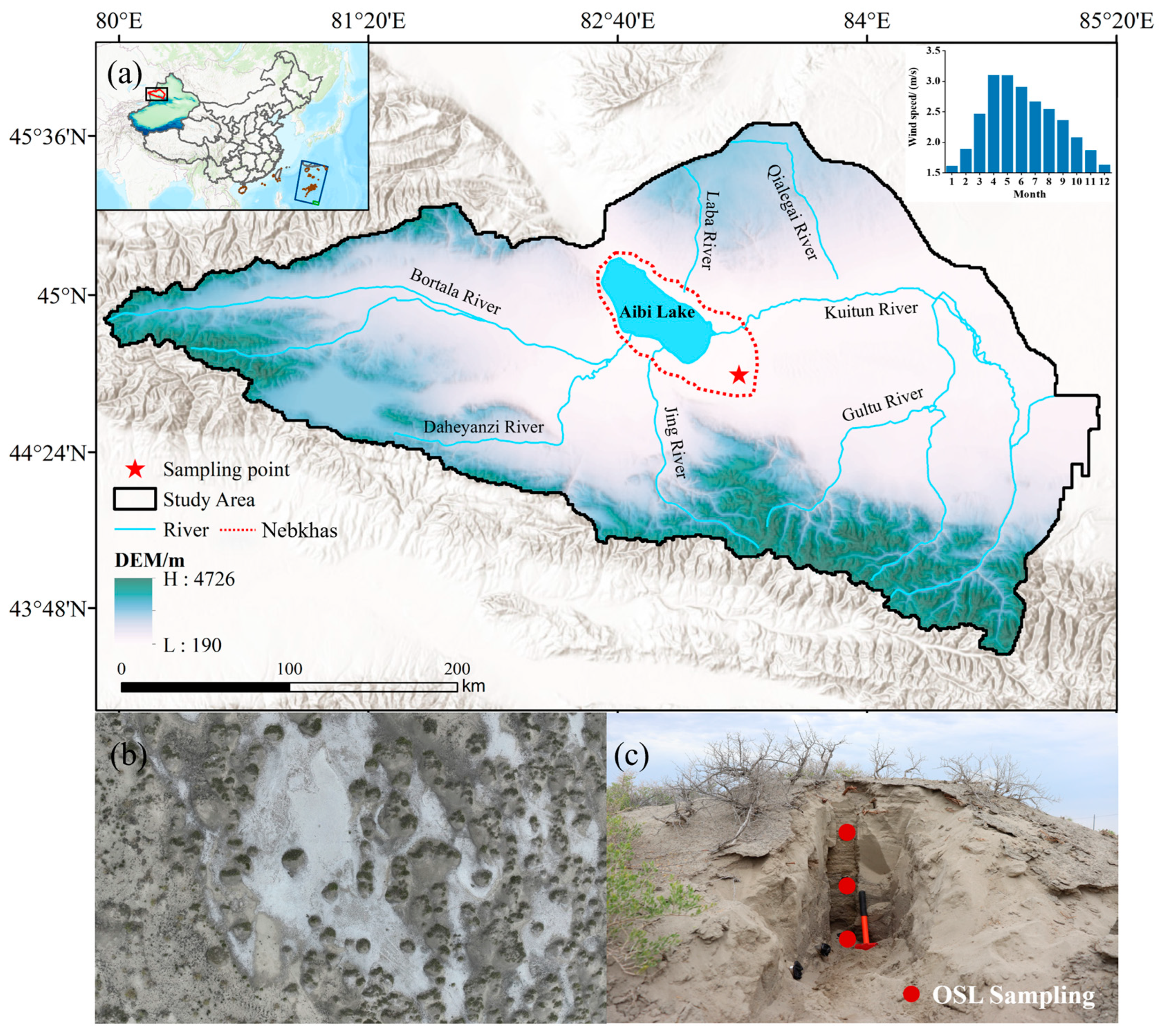
In the Aibi Lake basin, nebkhas are widely distributed across lakeshore zones, lake terraces, and distal alluvial-fan surfaces, particularly in the southeastern basin and along major wind corridors (Figure 1). As typical biogeomorphic landforms in arid and semi-arid regions, they form through the accumulation of aeolian sand trapped by shrubs or other vegetation [19,20]. The dominant nebkha-forming species in the basin include Tamarix, Haloxylon ammodendron, Nitraria, Kalidium foliatum, and Ephedra [21,22]. Among them, Nitraria shrubs are highly tolerant of drought, salinity, alkalinity, and sand burial, and therefore play an important role in sand fixation and dune stabilization. Evidence from the Mu Us dune field in northern China indicates that Nitraria nebkhas generally have relatively young developmental ages [23,24], making them suitable ecological archives for investigating centennial-scale environmental change. Owing to their depositional continuity and sensitivity to environmental forcing [25,26], nebkha sediments can preserve integrated signals of aeolian activity, vegetation dynamics, and human disturbance, while also recording the influence of lake-level fluctuations on aeolian processes within the basin [22,27]. Despite this potential, previous nebkha studies in the Aibi Lake basin have mainly focused on morphology and spatial distribution using RTK surveys, high-resolution remote sensing, and GIS-based analyses [28,29]. Chronological constraints on nebkha development remain limited, and the few available luminescence studies have been restricted to older Tamarix nebkhas, with basal OSL ages of ~1.8 × 10⁴ yr, ~4.3 × 10³ yr, and ~4.8 × 10³ yr for profiles of 175 cm, 130 cm, and 360 cm, respectively [22,30]. Therefore, robust high-precision constraints on the short-timescale development of young Nitraria nebkhas are still lacking, limiting our ability to resolve recent environmental change and its driving mechanisms in the Aibi Lake basin.
Optically stimulated luminescence (OSL) dating has been widely and successfully applied to determine the depositional ages of aeolian sediments in deserts and dune fields across northern China [31,32,33,34,35,36]. However, for very young samples, luminescence signals may suffer from insufficient signal sensitivity, potentially limiting the reliability of age estimates. In this context, K-feldspar offers distinct advantages for dating young sediments owing to its higher signal intensity and signal-to-noise ratio [37]. When combined with low-temperature post-infrared infrared stimulated luminescence protocols (post-IR IRSL; pIRIR) [38], anomalous fading and residual doses can be effectively reduced, enabling reliable age determination for sediments deposited since the Holocene [39,40,41]. Nevertheless, incomplete bleaching of K-feldspar grains prior to burial may introduce significant age overestimation, particularly in rapidly deposited nebkha sediments [42]. Recently developed single-grain measurement techniques allow for more refined chronological resolution and provide a direct assessment of pre-burial bleaching, thereby further enhancing the robustness and reliability of luminescence age estimates [43,44]. Another important approach is Cs-137 dating, which relies on the accumulation of this artificial radionuclide derived from atmospheric nuclear weapons testing and nuclear accidents [26], such as the initial detectable fallout (1954), the global atmospheric thermonuclear weapon testing (1963) and the Chernobyl accident (1986). Peaks in Cs-137 fallout within sediment profiles serve as temporal markers, assuming rapid adsorption to surface soils and minimal downward migration [45]. As a result, Cs-137 has been widely applied to reconstruct short-term sedimentary processes and has been increasingly used to constrain the development of nebkhas in certain dune fields of northern China [23,24,46]. However, the relatively short half-life of Cs-137 limits the effectiveness of this method over time [47].
Given the distinct advantages, limitations, and temporal applicability of different dating methods, integrating multiple approaches offers an effective strategy for constructing a high-precision chronological framework for nebkhas [24,46]. In this study, we investigate a representative Nitraria nebkha from the Aibi Lake basin by combining single-grain K-feldspar pIR50IR150 dating, Cs-137 measurements, grain-size analysis, and magnetic susceptibility. The specific objectives are to: (1) assess the reliability and applicability of single-grain K-feldspar pIR50IR150 dating for young nebkha sediments; (2) establish a robust chronological framework through cross-validation between luminescence ages and independent Cs-137 constraints; and (3) reconstruct the developmental history of the nebkha and evaluate its responses to aeolian activity, lake-level fluctuations, vegetation dynamics, and human disturbance at decadal-to-centennial timescales. This study provides new chronological and sedimentological evidence for understanding the short-timescale evolution of nebkhas and their potential as sensitive archives of recent environmental change in arid terminal lake basins.

2. Study Area

Aibi Lake, the largest saline and terminal lake in Xinjiang, is located in the western Junggar Basin (Figure 1a), with an area of ~540 km2 and a catchment exceeding 5 × 10⁵ km2 [48]. The basin is bounded by the Junggar, Tianshan, and Altai Mountains and the Gurbantunggut Desert, and experiences a temperate continental arid climate (mean annual temperature 6–8 °C, precipitation 90–180 mm, evaporation 1500–3500 mm). Downwind of the strong-wind corridor of the Alataw Pass, it is subject to strong winds (>180 days/yr), making it a major dust source in northern Xinjiang [49]. Aibi Lake is a typical endorheic basin serving as the primary convergence zone for surface water and groundwater in the southwestern Junggar Basin. It is characterized by a high phreatic water table and pronounced salinization, with its hydrological balance maintained predominantly by surface runoff. Of the 47 rivers in the basin, only the Jinghe and Bortala rivers provide perennial inflow [6], while the others are ephemeral due to aridity and upstream water use. Runoff mainly originates from precipitation, groundwater recharge, and glacier–snow melt [50]. Vegetation types in the Aibi Lake region are diverse, with small-tree deserts and shrub/semi-shrub deserts constituting the dominant communities, while tree deserts, meadows, and marshes occur in a patchy, mosaic-like distribution [51]. These eco-hydrological conditions support widespread nebkhas on the lacustrine plain and adjacent geomorphic units around the lake, particularly in the southeastern basin [22].

3. Materials and Methods

3.1. Sample Collection

Based on remote sensing interpretation and field surveys, a representative Nitraria nebkha in the southeastern part of the Aibi Lake (44.704° N, 83.322° E) was excavated and sampled in August 2024 (Figure 1b). The nebkha exhibits an elliptical planform and reaches a height of approximately one meter. At the dune center, a vertical profile perpendicular to its long axis was excavated, and samples were collected continuously from top to bottom (Figure 1c). Due to the loose nature of the upper sand layers in the nebkha, sampling was relatively difficult. Therefore, sampling intervals were 5 cm for the top 10 cm and 2.5 cm for the 10–90 cm segment. The collected samples were subsequently analyzed for Cs-137, grain size distribution, and magnetic susceptibility. Three OSL samples were collected from the main profile at depths of 30 cm, 60 cm, and 90 cm (Figure 1c). The collection of OSL samples was conducted using stainless steel tubes (5 cm × 25 cm), which were horizontally inserted into the profile. Upon removal from the profile, the tubes were immediately sealed in black opaque plastic bags, with both ends tightly plugged to prevent light exposure and minimize moisture loss. All chronological and proxy samples were processed and analyzed at Nanjing University.

3.2. Luminescence Dating

Sample preparation was carried out under subdued red-light conditions. Approximately 3–4 cm of material from both ends of each stainless-steel tube was removed to eliminate any potentially light-exposed material; these fractions were subsequently used for water content and environmental dose rate determinations. The unexposed central portion was wet-sieved to obtain the target grain size fraction (90–150 μm). Samples were then treated with 30% H2O2 to remove organic matter and with 10% HCl to dissolve carbonates. After dispersion, the grains were etched with 10% HF for 15 min to remove surface contamination and the α-irradiated outer layer, followed by a further 10% HCl treatment to dissolve any fluorides formed during HF etching. K-feldspar fractions (ρ < 2.58 g/cm3) were separated using the heavy liquid sodium polytungstate (3Na2WO4·9WO3·H2O) and subsequently mounted onto single-grain discsfor measurement.
Luminescence measurements were performed using a Risø TL/OSL DA-20 automated reader (DTU Physics, Roskilde, Denmark) equipped with a calibrated 90Sr/90Y β source. Single-grain K-feldspar aliquots were stimulated using an 830 nm IR laser (~126 mW/cm2) in combination with a Schott BG3 filter and a Schott BG39 filter. Grains were mounted on single-grain discs containing the 10 × 10 array of holes (each 200 μm depth by 200 μm in diameter). Single-grain discs were checked under the microscope to verify that each hole contained only one grain. The post-IR IRSL (pIR50IR150) single-grain protocol (Table S1) was applied following the published procedure [43]. For the pIR50IR150 protocol, the first 0.2 s of the signal was integrated for growth curve construction, while the background was calculated from the last 0.3 s of the signal. To assess the bleaching characteristics of the samples, a representative sample (NJU4578) was exposed to a Hönle UVACUBE 400 for 72 h, and subsequently measured using the same pIR50IR150 protocol (three aliquots; ~100 grains per aliquot). A dose recovery test was performed to evaluate the reliability of the pIR50IR150 protocol on the representative sample (NJU4578). Bleached samples were given a known laboratory β dose (25 s, ~2.65 Gy) and the dose recovery ratio was then calculated (three aliquots; ~100 grains per aliquot). Although anomalous fading is a common concern for low-temperature feldspar signals (e.g., IR50), previous studies have suggested that low-temperature pIRIR signal of K-feldspar samples is stable and have low g-values [6]. Also, laboratory fading rates may be artifacts related to inaccurate sensitivity correction after storage [52,53]. Moreover, for very young samples, corrected and uncorrected ages typically remain consistent within error limits [24,54]. Therefore, fading tests (g-values) were not conducted in this study.
The concentrations of U, Th, and K in the samples were measured using a HPGe γ-spectrometer. Each sample was stored for over 28 days and then measured for 24 h to achieve acceptable counting uncertainties. A water content of 5.0% ± 2.5% was assumed for dose rate calculations [55,56]. The dose rate was calculated using the conversion factors of Guérin et al. (2011) [57]. The external α-dose rate was estimated using an α-value of 0.15 ± 0.05 [58]. The internal dose rate of K-feldspar grains was calculated based on a K content of 12.5 ± 0.5% [59] and an Rb content of 400 ± 100 ppm [60]. Cosmic-ray dose rates were determined following Prescott and Hutton (1994) [61], considering the latitude and longitude of the sampling sites, sample elevation, and burial depth. Final sample ages were calculated on the DRACv1.2 website based on the equivalent doses and dose rates [62].

3.3. Cs-137 Dating

Sediment samples were pretreated by drying at 80 °C and sieving through a 200-mesh filter. A 50 g subsample was then used for Cs-137 activity measurement. Each subsample was sealed in a plastic cup and measured for 72,000 s to ensure sufficient precision. The Cs-137 activity was quantified based on gamma emissions at 661.7 keV and expressed on a mass basis (Bq/kg). The principles and calculation methods for Cs-137 dating have been described previously [23].

3.4. Grain Size Measurements

Grain size distributions were measured using a Malvern Mastersizer 2000 laser particle analyzer (Malvern Instruments Ltd., Malvern, UK), with a measurement range of 0.02–2000 μm. The samples were oven-dried and treated with 30% H2O2 and 10% HCl to remove organic matter and carbonates, respectively. The residues were dispersed in an ultrasonic bath with 10 mL of 10% sodium hexametaphosphate ((NaPO3)6) prior to measurement.

3.5. Magnetic Susceptibility Measurements

Magnetic susceptibility was measured with a Bartington MS2 meter (Bartington Instruments Ltd., Witney, UK) at low (0.47 kHz, χlf) and high (4.7 kHz, χhf) frequencies. Samples were dried at low temperature, packed into cubic plastic boxes, and measured three times in different orientations, with the mean value taken as the final result. Frequency-dependent magnetic susceptibility (χfd) is calculated as the difference between χlf and χhf.

4. Results

4.1. Luminescence Characteristics and Ages

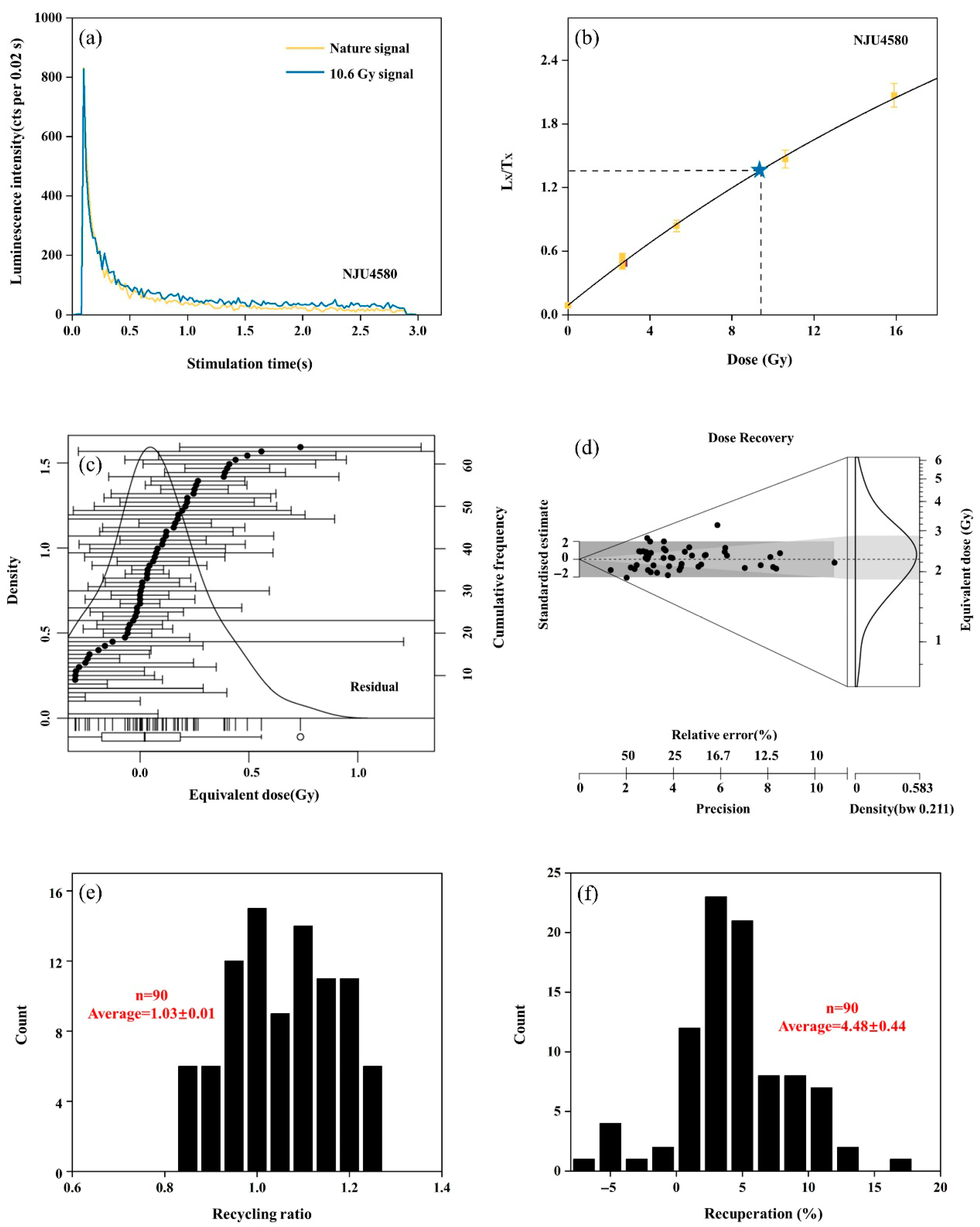
Overall, the single-grain K-feldspar luminescence signals of most samples exhibited rapid decay to background levels within the first one second (Figure 2a), and their dose–response curves displayed exponential growth trends (Figure 2b), indicating that the luminescence signals are possess favorable characteristics for dating. However, due to the relatively young age of the samples, the overall signal intensity of the profile was relatively low (Figure 2a). Three aliquots (100 grains per aliquot) were measured to quantify the residual dose, yielding 64 valid residual dose values (64/300), with grains exhibiting anomalous decay or growth curves excluded. The accepted grains display a high degree of clustering in residual dose values. Because negative De estimates cannot be accommodated in logged age models, the residual dose was evaluated using the unlogged Central Age Model [63], which is better suited to low-dose samples. The K feldspar pIR50IR150 signal yielded a residual dose of 0.022 ± 0.028 Gy, corresponding to a deposition age of approximately 6 years, with overdispersion (OD) values close to zero (Figure 2c). These results indicate that the K feldspar samples from the nebkha in the study area were well bleached prior to burial. Given that the equivalent dose (De) values with and without residual dose subtraction are consistent within the error range and the samples exhibit good bleachability, residual doses were retained in subsequent dose recovery experiments and age calculations to avoid introducing additional uncertainty. The dose recovery test for single-grain pIR50IR150 signals of NJU4578 is shown in Figure 2d. The ratio of the measured dose (without residual dose subtraction) to the given dose for the pIR50IR150 signal was 0.91 ± 0.05; the mean recycling ratio across all grains was 1.07 ± 0.04, and the maximum recuperation value was 3.72%, below the 5% threshold. These results demonstrate that the single-grain pIR50IR150 protocol is suitable for dating K-feldspar samples in the study area.
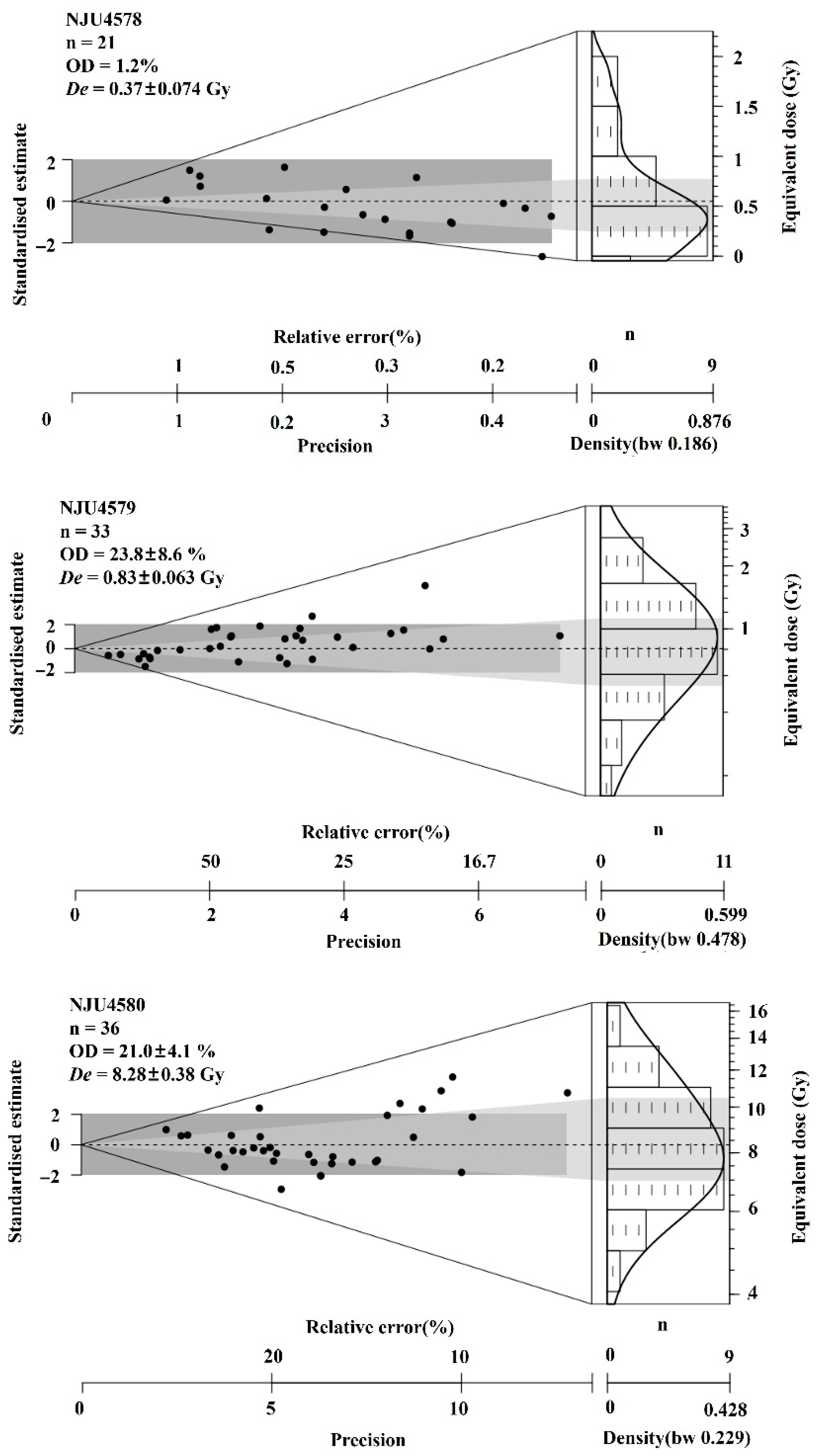
For De determination, grains with poor IRSL properties were rejected using the rejection criteria: (1) rejection of grains exhibiting anomalous decay or growth curves; (2) the initial Tn signal being less than three times the standard deviation of the corresponding background signal; (3) the relative error on the test dose signal exceeding 20%; and (4) the recycling ratio was outside the acceptable range of ±20% of unity [54]. In total, 1100 grains were measured, of which 90 passed the selection criteria. The relatively low proportion of accepted grains is likely due to the young depositional ages of the samples [54]. For the accepted grains, recycling ratios fall within the acceptable range of 0.8–1.2 (Figure 2e), confirming effective sensitivity correction and good reproducibility of laboratory-irradiated signals. Recuperation values are generally below 5%, although a small number of grains exceed this threshold (Figure 2f). Such elevated recuperation is expected for very young samples, in which the natural and zero-dose signals are closely spaced [24,41]. Overall, the De distributions of the accepted grains are relatively uniform, with OD values ranging from 1% to 24% (Table 1, Figure 3). This provides additional evidence that the samples were adequately bleached prior to burial and that the resulting single-grain De estimates are robust. Based on these De estimates, the nebkha profile yields ages of 92 ± 19, 226 ± 21, and 2215 ± 145 a at depths of 30, 60, and 90 cm, respectively (Table 1; Figure 4). The ages for the 30 and 60 cm samples were derived using CAMUL [63], whereas the age for the 90 cm sample was calculated using the CAM [64]. All three ages are consistent with the stratigraphic sequence, and indicate that the main body of the sand dune (upper 60 cm) developed over the past two centuries.

4.2. Cs-137 Dating Results

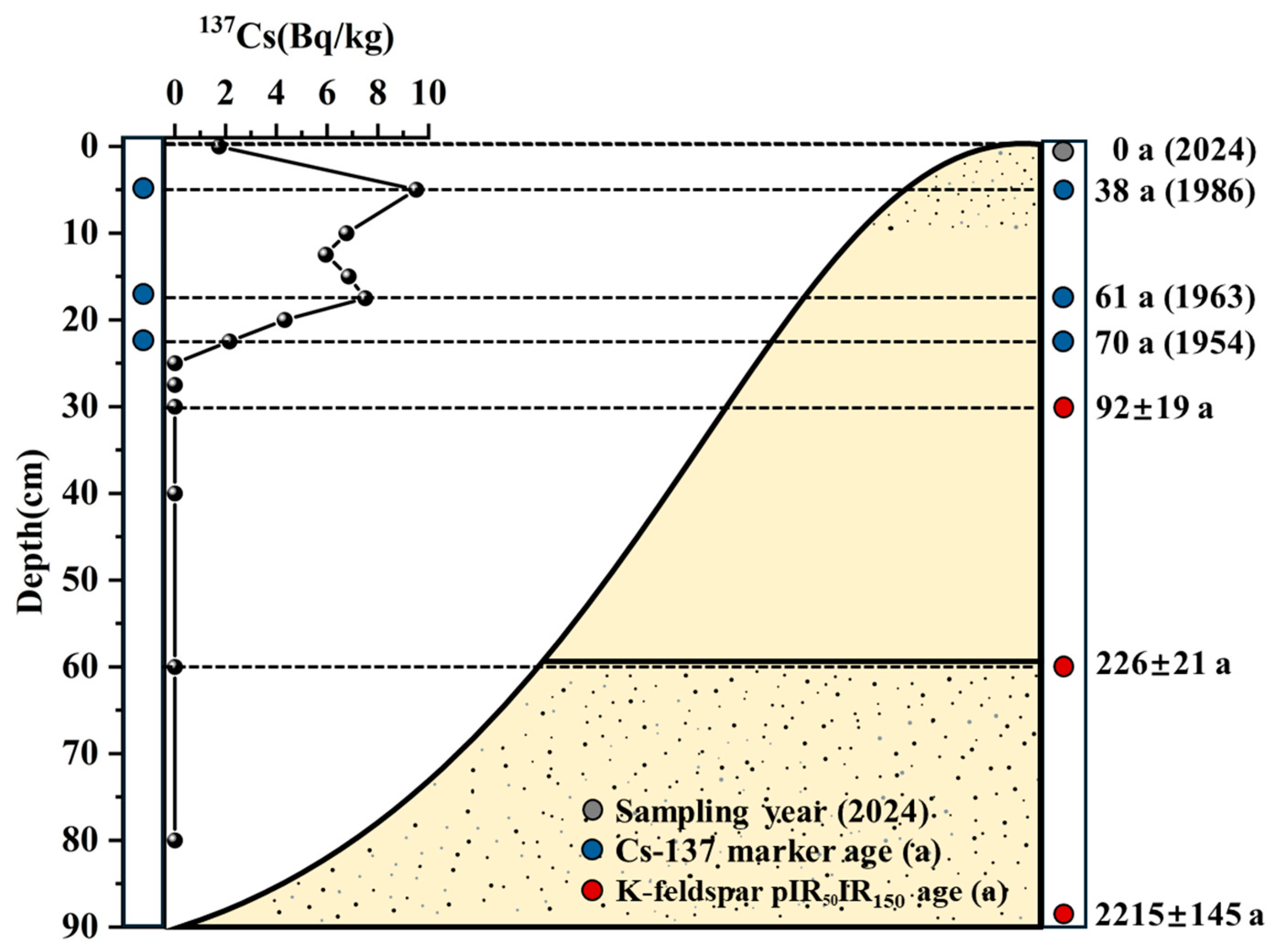
In the nebkha profile, Cs-137 activity was first detected at a depth of ~22.5 cm, corresponding to the onset of atmospheric fallout in 1954. A pronounced peak at ~17 cm is consistent with the 1963 fallout maximum associated with global atmospheric nuclear weapons testing, whereas another distinct peak at ~5 cm is interpreted as reflecting fallout related to the 1986 Chernobyl accident, with an intensity even exceeding that of the 1963 peak (Figure 4). Despite the relatively coarse sampling resolution, both major anthropogenic Cs-137 fallout events are clearly recorded in the upper part of the profile.

4.3. Variations in Environmental Proxies

4.3.1. Grain-Size Characteristics

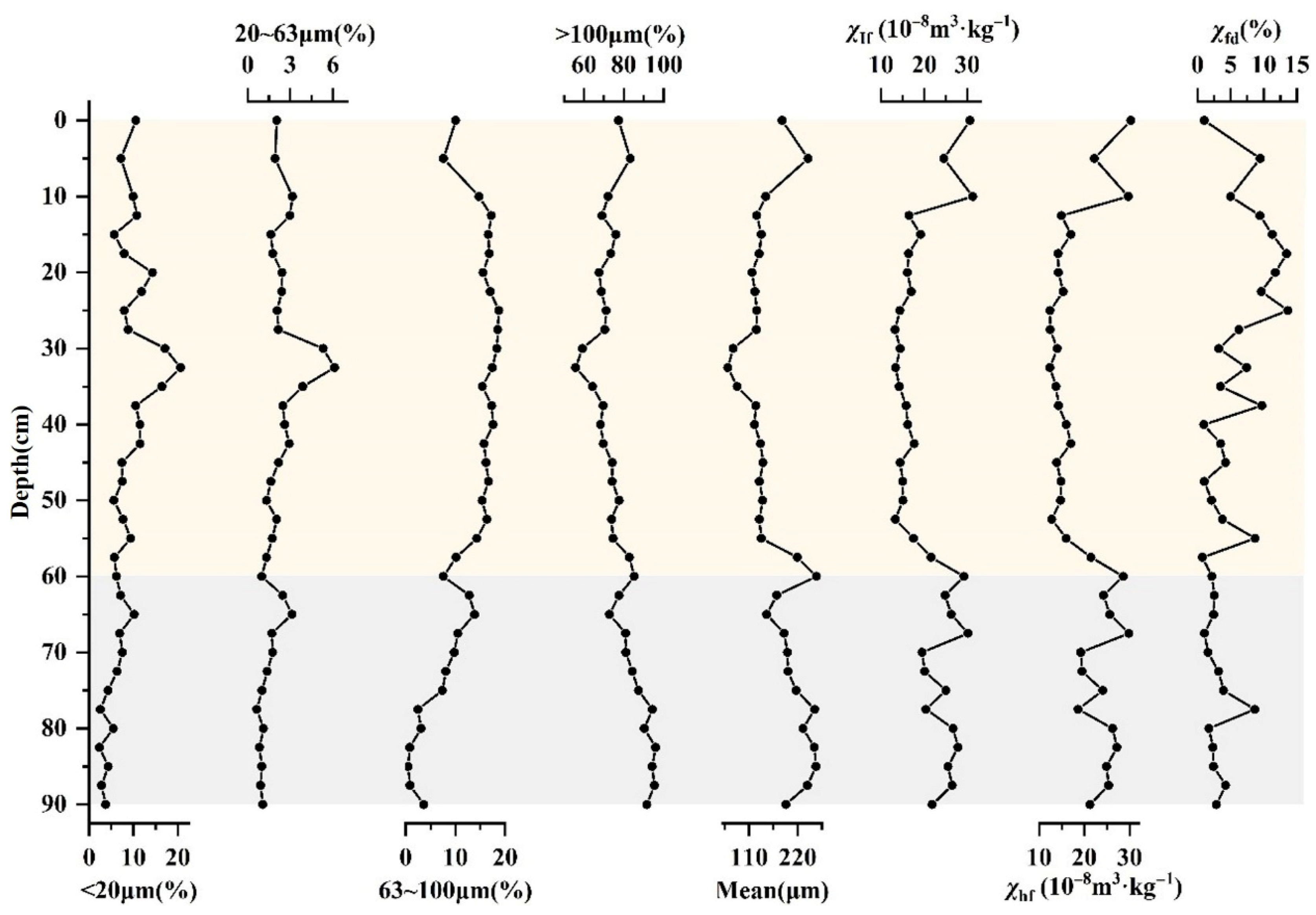
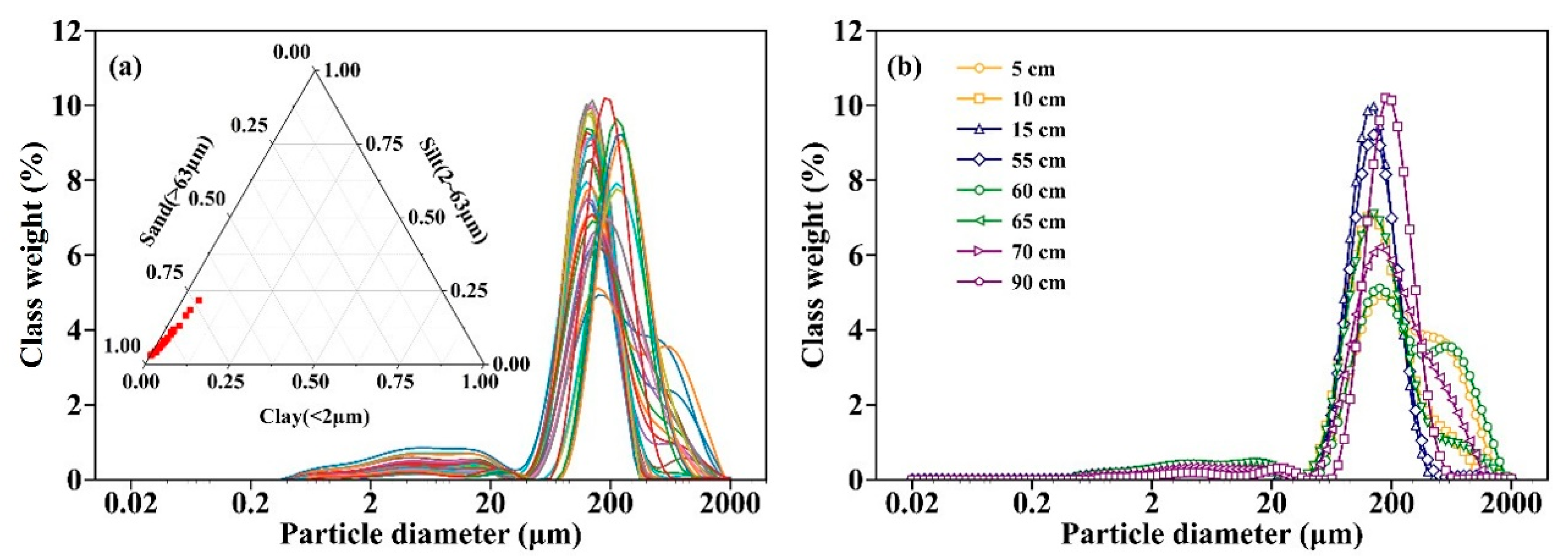
The grain-size distributions of all samples from the nebkha profile display a predominantly unimodal pattern (Figure 5a). Textural class analysis (inset in Figure 5a) shows that the deposits are dominated by the sand fraction (>63 μm), with a substantial contribution from coarse particles (>100 μm). The >100 μm fraction accounts for an average of 77.29%, indicating that coarse sand constitutes the principal sediment component. The mean grain size ranges from 62 to 262 μm, falling within the typical saltation component of aeolian deposits. These features suggest that sediment transport and accumulation in the nebkha were primarily governed by saltation processes.
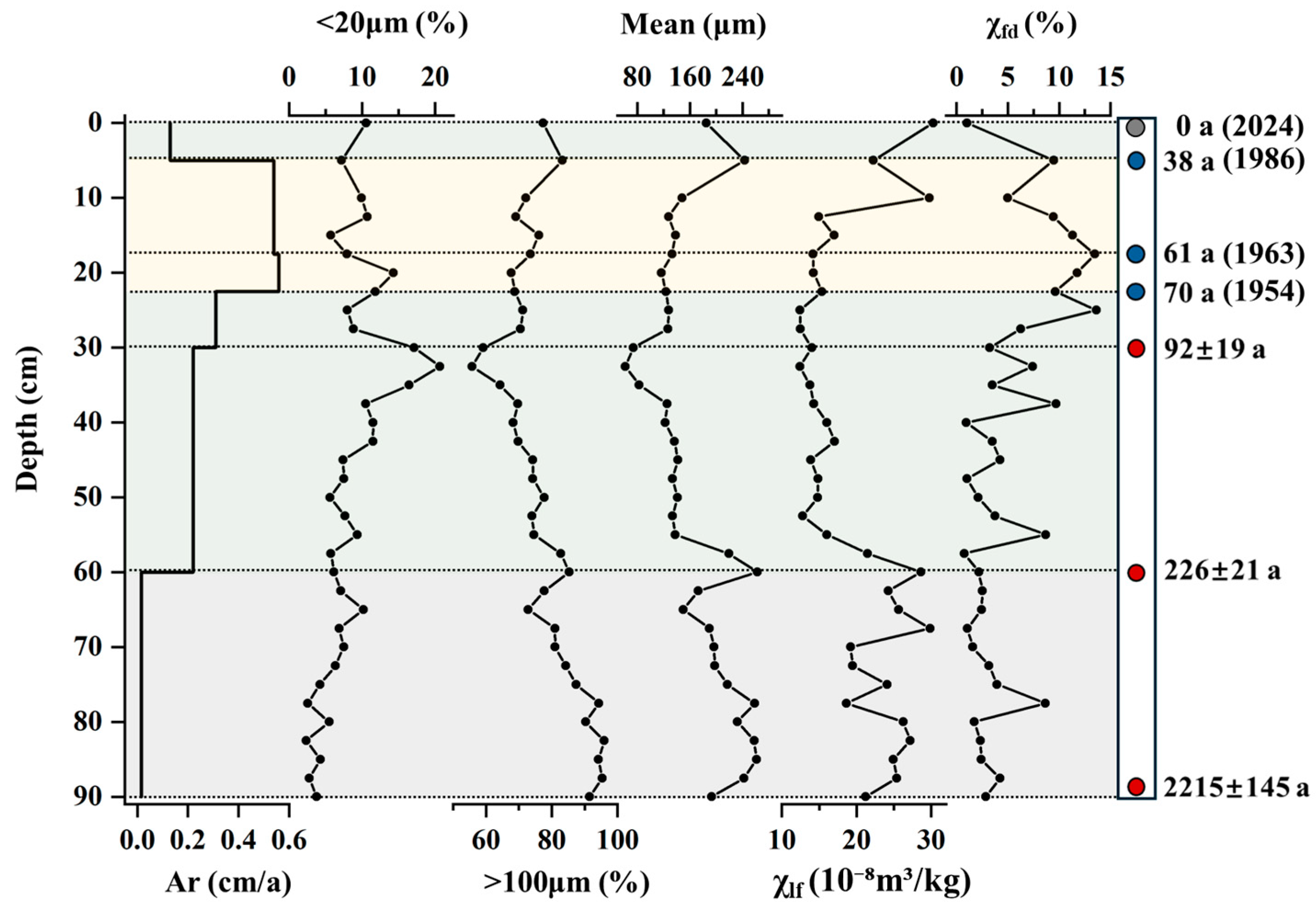
Vertical variations in grain size are evident throughout the profile (Figure 5a,b). Two facies transitions were observed in the field at approximately 60 cm and 10 cm depth, and samples from these transitional intervals exhibit bimodal grain-size distributions (yellow and green curves in Figure 5b). This bimodality contrasts with the predominantly unimodal distributions in the remaining sections and likely reflects shifts in sedimentary processes and/or wind regime during these intervals. Overall, the grain size exhibits a three-stage change along the profile (Figure 6). The lower part of the profile (90–60 cm) is characterized by the highest coarse-grain input, with the proportion of >100 μm particles generally exceeding 75% and both median and mean grain sizes reaching their maximum values. The middle part (60–10 cm) shows an enrichment of finer material, with the coarse fraction decreasing to ~65–70% and reduced grain-size variability. Notably, within this interval, a pronounced fine-grained peak occurs at approximately 35 cm depth, where the <20 μm fraction increases to nearly 20%, while the proportion of particles >100 μm decreases markedly to <60%. In the uppermost section (10–0 cm), coarse particles increase again to >72%, together with a marked rise in both median and mean grain sizes. However, in the near-surface samples, the abundance of coarse particles declines again, whereas fine-grained components show a relative enrichment.

4.3.2. Magnetic Susceptibility

χlf and χhf show highly consistent down-profile trends (Figure 6). χfd% remains generally low across the profile, indicating a limited contribution from superparamagnetic (SP) particles and suggesting that the magnetic signal is dominated by detrital inputs with weak pedogenic modification. In addition, χfd% displays only localized increases, whereas χlf and χhf vary more systematically with depth, implying that variations in magnetic susceptibility are mainly controlled by changes in sediment source and grain-size composition rather than by soil formation processes.
Magnetic susceptibility exhibits clear vertical variability that broadly covaries with grain-size changes (Figure 6). In the lower section (90–60 cm), magnetic susceptibility reaches its maximum values and coincides with the coarsest deposits and the highest abundance of >100 μm particles, while χfd% is typically <5%. In the middle section (60–10 cm), magnetic susceptibility decreases as the fine fraction increases, and χfd% shows minor localized enhancements, consistent with comparatively weaker detrital magnetic input and slightly increased fine-grained contributions. In the upper section (10–0 cm), magnetic susceptibility increases again in concert with the renewed enrichment of coarse particles, whereas χfd% decreases. This co-variation indicates a positive coupling between magnetic susceptibility and coarse-grained content, consistent with a source-controlled magnetic mechanism dominated by coarse detrital magnetite input.
Overall, the combined grain-size and magnetic parameters reveal pronounced stratigraphic changes (Figure 6). The predominance of coarse particles and the coherent covariation between magnetic susceptibility and the coarse fraction suggest that magnetic susceptibility provides a reliable proxy for tracking changes in detrital input and aeolian activity in the Aibi Lake basin during nebkha formation.

5. Discussion

5.1. Robustness of the Nebkha Chronology

The chronology of the ABH3 profile is constrained by cross-validation between single-grain K-feldspar pIR50IR150 dating and the Cs-137 record, providing age control from the centennial scale to the past several decades. Single-grain K-feldspar pIR50IR150 results demonstrate that the nebkha samples possess favorable luminescence characteristics for dating (Figure 2a,b). The very low and well-clustered residual doses indicate effective bleaching prior to burial, while dose recovery tests show acceptable recycling ratios and low recuperation (Figure 2c,d), confirming that the applied protocol is suitable for these samples. Moreover, the accepted single-grain De values are relatively concentrated and exhibit low OD values (Figure 3). Together, these results indicate that the luminescence ages are robust and can be regarded as reliable estimates of the depositional ages of the nebkha sediments.
The Cs-137 dating results provide independent constraints on depositional processes over the past decades. Three key horizons can be identified in the upper profile, corresponding to the onset of fallout in 1954, the global fallout maximum around 1963, and an enhanced near-surface signal associated with 1986 (Figure 4). These horizons are broadly consistent with established fallout chronologies [45,65]. The absence of detectable Cs-137 activity below 30 cm depth indicates that these sediments predate 1954. Considering sedimentation rates and associated uncertainties, the OSL age of 92 ± 19 years (ca. 1932 CE) at 30 cm depth is consistent with the initial appearance of Cs-137 at 22.5 cm depth (ca. 1954 CE), thereby reinforcing the internal consistency of the chronological model (Figure 4). Consequently, their consistency with the luminescence chronology further strengthens the age framework. An interesting feature within this overall profile is that the near-surface Cs-137 peak is slightly higher than the 1963 peak. This differs from most lake sediment records from northwestern China and Central Asia, in which the dominant Cs-137 maximum is typically associated with the 1963 fallout [65]. Given that the majority of Cs-137 released by the 1986 Chernobyl accident was deposited across Europe, whereas other former Soviet Union countries received less than 1% of the total deposition and only a small fraction reached the lower stratosphere, the direct atmospheric input to Xinjiang was likely very limited. Against this background, the observation that the Cs-137 activity associated with the 1986 horizon exceeds that of the 1963 peak is more plausibly attributed to regional redistribution processes rather than direct fallout [66]. Additionally, since the mid-20th century, intensified human activities and the expansion of cultivated land, together with relatively wet conditions during 1987–1988 in Xinjiang, likely enhanced soil erosion within the catchment, promoting the remobilization and redeposition of Cs-137 and resulting in localized enrichment in sediments [66]. Similar phenomena have been reported in other lake sediment records from Xinjiang [67], further indicating a region-specific pattern of Cs-137 redistribution.
Based on these observations, an integrated chronological model was developed, primarily grounded in Cs-137 and single-grain K-feldspar pIR50IR150 ages to build a robust temporal framework for the ABH3 nebkha profile. This chronology places the main body of the nebkha accumulated mainly during the past ~200 years (Figure 4). Sand accumulation rates (Ar) were accordingly reconstructed using the depth positions of the chronological horizons identified from the Cs-137 profile together with the OSL ages (Figure 7). The uppermost Cs-137 peak at ~5 cm yields an average accumulation rate of 13 cm/100 a for the period 1986–2024. The second peak at ~17.5 cm, corresponding to the 1963 fallout maximum, indicates a substantially higher accumulation rate of 54 cm/100 a for 1963–1986. The first appearance of Cs-137 at ~22.5 cm marks the onset of fallout in 1954, from which an accumulation rate of 56 cm/100 a is calculated for 1954–1963. The OSL chronology provides additional constraints for earlier deposition. The sample at 30 cm depth yields an age of ~92 years (~1932 CE), corresponding to an average accumulation rate of 31 cm/100 a for 1932–1954. The sample at 60 cm depth gives an age of ~226 years BP (~1798 CE), yielding a mean accumulation rate of 22 cm/100 a for 1798–1932. In contrast, the interval between 60 and 90 cm shows a markedly lower net accumulation rate of ~1.5 cm/100 a.
The pronounced age difference between the 60 cm and 90 cm samples suggests that the lower 60–90 cm interval should not be regarded as part of the continuously accumulated main nebkha body. Instead, this interval more likely represents an underlying pre-nebkha substrate or reworked inter-nebkha/lacustrine-aeolian deposits. Accordingly, the age of 2215 ± 145 a at 90 cm is interpreted as the age of the deepest dated underlying deposit in this profile, rather than the basal age of the main nebkha body. The main phase of nebkha development is therefore constrained by the upper ~60 cm, which accumulated mainly over the past ~200 years. Overall, the reconstructed chronology reveals pronounced temporal variability in sand accumulation during nebkha development.

5.2. Nebkha Development and Aeolian Activity in the Aibi Lake Basin

Within the chronological framework established above, the ABH3 profile records the developmental history of the nebkha and associated variations in aeolian activity during the past ~200 years. The age–depth relationship and sedimentation rates indicate that the profile can be divided into two main units: a lower pre-nebkha substrate (60–90 cm) and an upper section (0–60 cm) representing the principal phase of nebkha accretion (Figure 7). The interval between 60 and 90 cm is characterized by an extremely low net accumulation rate (~1.5 cm/100 a), abundant very coarse sand and gravel, and the absence of diagnostic aeolian sedimentary features, suggesting that it more likely represents antecedent deposits rather than material directly associated with nebkha growth. This interpretation further suggests that inter-dune erosion may have occurred during nebkha development, whereas the upper 60 cm records the main phase of vertical accretion, with a mean net accumulation rate of ~30 cm/100 a, consistent with the rapid aggradation typical of nebkhas. By integrating sedimentological proxies, including grain-size composition and magnetic susceptibility, with the well-constrained chronology, the ABH3 nebkha provides an effective archive for reconstructing recent environmental evolution in the Aibi Lake basin [19,23,27]. Previous studies have shown that grain-size variations in nebkha and aeolian deposits are closely related to changes in local aeolian transport conditions, sediment supply, and surface stability [25,26,42]. Therefore, the grain-size parameters used here provide relative indicators of aeolian environmental change.
The OSL age of 226 ± 21 a at 60 cm depth indicates that substantial nebkha development had begun by around ~1800 CE. This initiation broadly coincides with the late phase of the Little Ice Age in northwestern China, when relatively cool and humid conditions [21], together with enhanced meltwater input from glacier advances in the Tianshan Mountains [12,68] and relatively high lake levels, may have favored the expansion of salt-tolerant shrubs and the initial trapping of aeolian sand around vegetation [22]. From approximately 1800 CE to the mid-twentieth century, the nebkha underwent relatively slow but sustained accretion, with accumulation rates of 22–31 cm/100 a. Sedimentologically, this interval is characterized by declining proportions of coarse particles (>100 μm), enrichment of fine fractions (<20 μm), an overall fining trend in grain size, and relatively low magnetic susceptibility (Figure 7), collectively indicating comparatively weak aeolian activity. During this interval, vegetation expansion and improved surface moisture conditions would have increased surface resistance to wind erosion and limited sediment availability, resulting in relatively stable sand accumulation rates. However, the grain-size record reveals a pronounced fining signal in the early 20th century (ca. 1920 CE; Figure 7), characterized by increased proportions of particles <20 μm and a concomitant decrease in coarse-grained components. This feature likely reflects enhanced episodic dust input rather than local coarse-sand accumulation. Previous studies indicate that during the 1910s–1930s, the North Atlantic Oscillation, Arctic Oscillation, and Siberian High indices all exhibited pronounced variability [21,69], suggesting that the study region experienced strong climatic fluctuations driven by atmospheric circulation instability. As wind is a primary driver of dust entrainment and transport [70], these circulation anomalies likely promoted intensified upper-tropospheric westerlies and enhanced long-distance dust transport during 1910–1930 [71]. Fine particles transported over long distances were efficiently intercepted and retained by shrub canopies, resulting in the observed enrichment of fine-grained sediments within the nebkha deposits.
A major shift occurred from the mid-20th century onward, when sedimentation rates increased sharply after the 1950s, reaching 56 cm/100 a for 1954–1963 and 54 cm/100 a for 1963–1986, indicating a phase of accelerated nebkha accretion. This transition is accompanied by marked sediment coarsening and a sharp increase in magnetic susceptibility, both of which indicate intensified aeolian activity and enhanced detrital input (Figure 7). This transition broadly coincides with rapid socio-economic development following the establishment of the Xinjiang Autonomous Region in 1955, including agricultural expansion, large-scale land reclamation, irrigation diversion, and increased water extraction, which may have substantially reduced riverine inflow to Aibi Lake [17,56]. Progressive lake shrinkage exposed large areas of lakebed sediment, providing abundant material for aeolian transport. Grain-size records further reveal a pronounced coarsening peak around the 1986 (at ~5 cm depth; Figure 7), consistent with regional evidence for anomalously strong wind forcing and hydroclimatic perturbations during this interval, including documented local strong-wind events in 1986 at Aibi Lake [72] and a persistent lake-level decline culminating in a minimum in 1987 at nearby Bosten Lake [5]. In contrast, the uppermost part of the profile records a decline in sedimentation rate to 13 cm/100 a for 1986–2024, together with overall fining and reduced net accumulation, indicating weakened net aeolian aggradation and enhanced surface stability in recent decades (Figure 7). This trend most likely reflects the combined effects of vegetation recovery, the establishment of biological soil crusts, and reduced human disturbance following the implementation of ecological conservation and land-management measures. In addition, a regional climatic background characterized by recent warming and humidification likely contributed to vegetation growth and surface stabilization [73].
Comparison with previously studied Tamarix nebkhas around Aibi Lake highlights the heterogeneity of nebkha development in the basin. Tamarix nebkhas generally preserve much older basal ages, ranging from several thousand years to late Pleistocene ages [22,30], indicating longer-term preservation and multi-stage accumulation histories. By contrast, the Nitraria nebkha studied here mainly accumulated over the past ~200 years and records rapid accretion after the mid-20th century. These differences suggest that Tamarix and Nitraria nebkhas may record environmental change over different timescales, providing complementary archives for reconstructing regional aeolian activity and landscape evolution.
Taken together, the ABH3 nebkha records a three-stage developmental history during the past ~200 years: an initial phase of relatively slow and stable accretion from ~1800 CE to the mid-20th century, a phase of accelerated accretion and intensified aeolian activity from the mid-20th century to the late 20th century, and a recent phase of reduced net accumulation and enhanced stabilization. This well-constrained developmental pattern demonstrates that nebkha sediments in the Aibi Lake basin serve as sensitive archives of centennial-scale aeolian dynamics and recent environmental change, highlighting the coupled controls of lake-level fluctuations, sediment availability, vegetation trapping, and human disturbance on nebkha growth.

6. Conclusions

This study demonstrates a robust chronological framework for the Nitraria nebkha around Aibi Lake using single-grain K-feldspar pIR50IR150 and Cs-137 dating, and reconstructs regional aeolian activity and environmental evolution through integrated analyses of grain size and magnetic susceptibility. We concluded the following:
(1) The single-grain K-feldspar pIR50IR150 protocol is well suited for these young nebkha sediments, showing adequate bleaching and satisfactory dose recovery ratios, thereby yielding reliable De values and depositional ages. Cs-137 recording sediment accumulation over the past ~70 years and clearly capturing the 1963 and 1986 fallout horizons. The luminescence ages closely match the independent Cs-137 constraint, providing external validation of the chronology.
(2) Cross-validation of the two dating methods indicates that the main nebkha body (upper ~60 cm) accumulated over the past ~200 years with broadly stable sedimentation, whereas the underlying deposits likely comprise erosion-derived, reworked inter-nebkha material during the nebkha development.
(3) Nebkha development shows three stages: slow accumulation under weak aeolian conditions (ca. 1800–1960), rapid growth since the mid-20th century associated with stronger aridity and lake shrinkage, and a recent decline in sediment accumulation linked to ecological restoration and surface stabilization. These trends broadly agree with other independent regional environmental reconstructions.

Supplementary Materials

The following supporting information can be downloaded at: https://www.mdpi.com/article/10.3390/land15050861/s1, Table S1: Single-grain K-feldspar pIR50IR150 protocol.

Author Contributions

Conceptualization, R.Q., Y.W. (Ying Wang), Z.X., Y.W. (Yonghui Wang) and S.Y.; methodology, R.Q., Y.W. (Ying Wang) and S.Y.; software, R.Q. and Y.W. (Ying Wang); validation, F.X. and S.L.; formal analysis, R.Q. and Y.W. (Ying Wang); investigation, R.Q., F.X., S.L., Z.X. and H.Y.; resources, Z.X., Y.W. (Yonghui Wang) and S.Y.; data curation, R.Q. and Y.W. (Ying Wang); writing—original draft preparation, R.Q. and Y.W. (Ying Wang); writing—review and editing, F.X., S.L., Z.X., H.Y., Y.W. (Yonghui Wang) and S.Y.; visualization, R.Q. and Y.W. (Ying Wang); supervision, Y.W. (Yonghui Wang) and S.Y.; project administration, Z.X., Y.W. (Yonghui Wang) and S.Y.; funding acquisition, Z.X., Y.W. (Yonghui Wang) and S.Y. All authors have read and agreed to the published version of the manuscript.

Funding

This research is supported by the National Natural Science Foundation of China (Grant No. 42572236; 42361144846; 42261051), and the Fundamental Research Funds for the Central Universities of China (Grant No. 2026300318).

Data Availability Statement

The original contributions presented in the study are included in the article. Further inquiries can be directed to the corresponding author.

Acknowledgments

We would like to express our sincere thanks to the anonymous reviewers.

Conflicts of Interest

The authors declare no conflicts of interest.

References

  1. Chen, F.; Chen, J.; Huang, W.; Chen, S.; Huang, X.; Jin, L.; Jia, J.; Zhang, X.; An, C.; Zhang, J. Westerlies Asia and monsoonal Asia: Spatiotemporal differences in climate change and possible mechanisms on decadal to sub-orbital timescales. Earth-Sci. Rev. 2019, 192, 337–354. [Google Scholar] [CrossRef]
  2. Huang, W.; Duan, W.; Chen, Y. Unravelling lake water storage change in Central Asia: Rapid decrease in tail-end lakes and increasing risks to water supply. J. Hydrol. 2022, 614, 128546. [Google Scholar] [CrossRef]
  3. Duan, W.; Zou, S.; Chen, Y.; Nover, D.; Fang, G.; Wang, Y. Sustainable water management for cross-border resources: The Balkhash Lake Basin of Central Asia, 1931–2015. J. Clean. Prod. 2020, 263, 121614. [Google Scholar] [CrossRef]
  4. Chen, F.; Yu, Z.; Yang, M.; Ito, E.; Wang, S.; Madsen, D.B.; Huang, X.; Zhao, Y.; Sato, T.; Birks, H.J.B. Holocene moisture evolution in arid central Asia and its out-of-phase relationship with Asian monsoon history. Quat. Sci. Rev. 2008, 27, 351–364. [Google Scholar] [CrossRef]
  5. Guo, M.; Wu, W.; Zhou, X.; Chen, Y.; Li, J. Investigation of the dramatic changes in lake level of the Bosten Lake in northwestern China. Theor. Appl. Climatol. 2015, 119, 341–351. [Google Scholar] [CrossRef]
  6. Li, G.; Wang, X.; Yang, H.; Jin, M.; Qin, C.; Wang, Y.; Jonell, T.N.; Pan, L.; Chen, C.; Zhao, W. Asynchronous Holocene lake evolution in arid mid-latitude Asia is driven by glacial meltwater and variations in Westerlies and the East Asian summer monsoon. Geol. Soc. Am. Bull. 2024, 136, 4579–4594. [Google Scholar] [CrossRef]
  7. Pan, L.; Li, G.; Chen, C.; Liu, Y.; Lai, J.; Yang, J.; Jin, M.; Wang, Z.; Wang, X.; Ding, W. Late Holocene decoupling of lake and vegetation ecosystem in response to centennial-millennial climatic changes in arid Central Asia: A case study from Aibi Lake of western Junggar Basin. Palaeogeogr. Palaeoclimatol. Palaeoecol. 2024, 646, 112233. [Google Scholar] [CrossRef]
  8. Wang, W.; Feng, Z.; Ran, M.; Zhang, C. Holocene climate and vegetation changes inferred from pollen records of Lake Aibi, northern Xinjiang, China: A potential contribution to understanding of Holocene climate pattern in East-central Asia. Quat. Int. 2013, 311, 54–62. [Google Scholar] [CrossRef]
  9. Jia, H.; Wu, J.; Zhang, H.; Yi, S. Pollen-based climate reconstruction from Ebi Lake in northwestern China, Central Asia, over the past 37,000 years. Quat. Int. 2020, 544, 96–103. [Google Scholar] [CrossRef]
  10. Dong, G.; Du, L.; Yang, L.; Lu, M.; Qiu, M.; Li, H.; Ma, M.; Chen, F. Dispersal of crop-livestock and geographical-temporal variation of subsistence along the Steppe and Silk Roads across Eurasia in prehistory. Sci. China Earth Sci. 2022, 65, 1187–1210. [Google Scholar] [CrossRef]
  11. Guosheng, L. Records of stable oxygen and carbon isotopes and abrupt climatic changes in Aibi Lake since 20 ka BP. Haiyáng Dìzhì Yu Dìsìjì Dìzhì 1993, 13, 75–84. [Google Scholar]
  12. Yan, S.; Mu, G.; Nobuhiko, H.; Masao, U.; Naomi, H. Environmental evolution information from Aiby Lake since the last 2500a. Arid Land Geogr. 2003, 26, 225–231. [Google Scholar]
  13. Wu, J.; Liu, J.; Wang, S. Climatic change record from stable isotopes in Lake Aibi, Xinjiang during the past 1500 years. Quat. Sci. 2004, 24, 585–590. [Google Scholar]
  14. Wang, L.; Zhang, Y.; Kong, Z. Late pleistocene-holocene vegetation and climate change in Ebinur Betula wetland, Xinjiang, NW China. Epis. J. Int. Geosci. 2021, 44, 249–257. [Google Scholar] [CrossRef]
  15. Meng, X.; Meng, B.; Wang, Y.; Liu, Z.; Ji, X.; Yu, D. Influence of climate change and human activities on water resources in Ebinur lake in recent 60 years. J. China Hydrol. 2015, 35, 90–96. [Google Scholar]
  16. Zhang, Y.; Zhang, F.; Wang, J.; Ren, Y.; Ghulam, A.; Kung, H.T.; Chen, Y. Analysis of the temporal and spatial dynamics of landscape patterns and hemeroby index of the Ebinur Lake Wetland Nature Reserve, Xinjiang, over the last 40 years. Shengtai Xuebao 2017, 37, 7082. [Google Scholar] [CrossRef]
  17. Long, M.; Wu, J.; Liu, W.; Abuduwaili, J. Distinguishing between anthropogenic and climatic impacts on lake size: A modeling approach using data from Ebinur Lake in arid northwest China. J. Limnol. 2014, 73, 350–357. [Google Scholar] [CrossRef]
  18. Zhang, Z.; Shen, Z.; Zhang, S.; Chen, J.; Chen, S.; Li, D.; Zhang, S.; Liu, X.; Wu, D.; Sheng, Y. Lake level evidence for a mid-Holocene East Asian summer monsoon maximum and the impact of an abrupt late-Holocene drought event on prehistoric cultures in north-central China. Holocene 2023, 33, 382–399. [Google Scholar] [CrossRef]
  19. Tengberg, A. Nebkha dunes as indicators of wind erosion and land degradation in the Sahel zone of Burkina Faso. J. Arid Environ. 1995, 30, 265–282. [Google Scholar] [CrossRef]
  20. Hesp, P.A.; Smyth, T.A. Nebkha flow dynamics and shadow dune formation. Geomorphology 2017, 282, 27–38. [Google Scholar] [CrossRef]
  21. Chen, S.J.; Hou, P.; Li, W.H.; Li, H. Comprehensive Scientific Survey of the Xinjiang Ebinur Lake Wetland Nature Reserve; Xinjiang Science & Technology Press: Urumqi, China, 2006; pp. 32–51. [Google Scholar]
  22. Jin, J.; Cao, X.; Li, Z.; Chen, X.; Hu, F.; Xia, J.; Wang, X. Record for climate revolution in aeolian deposit of Nabkhas around the Ebinur Lake. J. Desert Res. 2013, 33, 1314–1323. [Google Scholar]
  23. Li, S.; Mason, J.A.; Xu, Y.; Xu, C.; Zheng, G.; Li, J.; Yizhaq, H.; Pan, S.; Lu, H.; Xu, Z. Biogeomorphology of nebkhas in the Mu Us dune field, north-central China: Chronological and morphological results. Geomorphology 2021, 394, 107979. [Google Scholar] [CrossRef]
  24. Wang, Y.; Li, S.; Yi, S.; Xu, Z. Multiple age control of young nebkhas in the Mu Us dune field, north-central China. Quat. Geochronol. 2024, 82, 101531. [Google Scholar] [CrossRef]
  25. Wang, X.; Xiao, H.; Li, J.; Qiang, M.; Su, Z. Nebkha development and its relationship to environmental change in the Alaxa Plateau, China. Environ. Geol. 2008, 56, 359–365. [Google Scholar] [CrossRef]
  26. Li, J.; Wang, Y.; Yao, Q. Nebkhas origination in arid and semi-arid regions: An overview. Acta Ecol. Sin. 2020, 40, 500–505. [Google Scholar] [CrossRef]
  27. Zhang, H.; Li, S.; Mason, J.A.; Yizhaq, H.; Gui, D.; Xu, Z. Biogeomorphological niche of a landform: Machine learning approaches reveal controls on the geographical distribution of Nitraria tangutorum nebkhas. Earth Surf. Process. Landf. 2024, 49, 1515–1529. [Google Scholar] [CrossRef]
  28. Bai, B. The Spatial Pattern Analysis of Nebkhas in the Ebinur Lake Basin Base on GPS and GIS. Master’s. Thesis, Xinjiang Normal University, Urumqi, China, 2008. [Google Scholar]
  29. Li, X.Y. The Spatial Pattern Analysis of Nebkhas in the Ebinur Lake Periphery Based on RS and DEM. Master’s. Thesis, Xinjiang Normal University, Urumqi, China, 2010. [Google Scholar]
  30. Cao, X.D. The Paleoclimate Records of Nabkhas Around Ebinur Lake in Northern Xinjiang Since Last Glaciation. Master’s. Thesis, Xinjiang Normal University, Urumqi, China, 2010. [Google Scholar]
  31. Lu, H.; Yi, S.; Xu, Z.; Zhou, Y.; Zeng, L.; Zhu, F.; Feng, H.; Dong, L.; Zhuo, H.; Yu, K. Chinese deserts and sand fields in Last Glacial Maximum and Holocene Optimum. Chin. Sci. Bull. 2013, 58, 2775–2783. [Google Scholar] [CrossRef]
  32. Xu, Z.; Lu, H.; Yi, S.; Vandenberghe, J.; Mason, J.A.; Zhou, Y.; Wang, X. Climate-driven changes to dune activity during the Last Glacial Maximum and deglaciation in the Mu Us dune field, north-central China. Earth Planet. Sci. Lett. 2015, 427, 149–159. [Google Scholar] [CrossRef]
  33. Xu, Z.; Mason, J.A.; Xu, C.; Yi, S.; Bathiany, S.; Yizhaq, H.; Zhou, Y.; Cheng, J.; Holmgren, M.; Lu, H. Critical transitions in Chinese dunes during the past 12,000 years. Sci. Adv. 2020, 6, eaay8020. [Google Scholar] [CrossRef] [PubMed]
  34. Yang, X.; Du, J.; Liang, P.; Zhang, D.; Chen, B.; Rioual, P.; Zhang, F.; Li, H.; Wang, X. Palaeoenvironmental changes in the central part of theTaklamakan Desert, northwestern China sincethe late Pleistocene. Chin. Sci. Bull. 2021, 66, 3205–3218. [Google Scholar] [CrossRef]
  35. Fan, Y.; Li, Z.; Cai, Q.; Yang, G.; Zhang, Q.; Zhao, H.; Chen, F.; Maghsoudi, M. Dating of the late Quaternary high lake levels in the Jilantai area, northwestern China, using optical luminescence of quartz and K-feldspar. J. Asian Earth Sci. 2022, 224, 105024. [Google Scholar] [CrossRef]
  36. Long, H.; Zhang, J.; Huang, X.; Zhang, A.; Yang, N.; He, M.; Yang, L. Single-grain K-feldspar luminescence dating of the late Quaternary rapid decline in the largest Lake over the Tibetan Plateau. Quat. Geochronol. 2024, 81, 101503. [Google Scholar] [CrossRef]
  37. Madsen, A.T.; Murray, A.S. Optically stimulated luminescence dating of young sediments: A review. Geomorphology 2009, 109, 3–16. [Google Scholar] [CrossRef]
  38. Thomsen, K.J.; Murray, A.S.; Jain, M.; Bøtter-Jensen, L. Laboratory fading rates of various luminescence signals from feldspar-rich sediment extracts. Radiat. Meas. 2008, 43, 1474–1486. [Google Scholar] [CrossRef]
  39. Reimann, T.; Tsukamoto, S. Dating the recent past (<500 years) by post-IR IRSL feldspar–Examples from the North Sea and Baltic Sea coast. Quat. Geochronol. 2012, 10, 180–187. [Google Scholar] [CrossRef]
  40. Long, H.; Haberzettl, T.; Tsukamoto, S.; Shen, J.; Kasper, T.; Daut, G.; Zhu, L.; Mäusbacher, R.; Frechen, M. Luminescence dating of lacustrine sediments from T angra Y umco (southern T ibetan P lateau) using post-IR IRSL signals from polymineral grains. Boreas 2015, 44, 139–152. [Google Scholar] [CrossRef]
  41. Buckland, C.E.; Bailey, R.M.; Thomas, D.S. Using post-IR IRSL and OSL to date young (<200 yrs) dryland aeolian dune deposits. Radiat. Meas. 2019, 126, 106131. [Google Scholar] [CrossRef]
  42. Lang, L.; Wang, X.; Hasi, E.; Hua, T. Coppice dune formation and its significance to environmental change reconstructions in arid and semiarid areas. Acta Geogr. Sin. 2012, 67, 1526. [Google Scholar]
  43. Nian, X.; Zhang, W.; Liu, R.; Qiu, F.; Seppä, H. Underestimated single-aliquot quartz OSL ages of Late-Pleistocene sediments due to the dominance of medium component. Quat. Sci. Rev. 2024, 332, 108656. [Google Scholar] [CrossRef]
  44. Duller, G.A. Single-grain optical dating of Quaternary sediments: Why aliquot size matters in luminescence dating. Boreas 2008, 37, 589–612. [Google Scholar] [CrossRef]
  45. Ritchie, J.C.; McHenry, J.R. Application of radioactive fallout cesium-137 for measuring soil erosion and sediment accumulation rates and patterns: A review. J. Environ. Qual. 1990, 19, 215–233. [Google Scholar] [CrossRef]
  46. Dong, Z.; Xu, Y.; Li, S.; Li, X.; Wang, Y.; Xu, Z. Records of anthropogenic plutonium isotopes in wind-blown sand deposits: Tracing global fallout in northern China’s semi-arid dune fields. J. Environ. Radioact. 2025, 285, 107658. [Google Scholar] [CrossRef]
  47. Xu, Y.; Pan, S.; Wu, M.; Zhang, K.; Hao, Y. Association of Plutonium isotopes with natural soil particles of different size and comparison with 137Cs. Sci. Total Environ. 2017, 581, 541–549. [Google Scholar] [CrossRef]
  48. Wang, Y. Study on the Influence of the Change of Water Resources and Its Impact on Ecological Security in the Arid: An Example of Ebinur Lake Basin in Xinjiang. Ph. D. Thesis, Xinjiang University, Urumqi, China, 2018. [Google Scholar]
  49. Wang, Y.; Jiao, L. The characteristics and storage of soil organic carbon in the Ebinur lake wetland. Acta Ecol. Sininca 2016, 36, 5893–5901.5891. [Google Scholar]
  50. Liu, S.; Yao, X.; Guo, W.; Xu, J.; Shangguan, D.; Wei, J.; Bao, W.; Wu, L. The contemporary glaciers in China based on the Second Chinese Glacier Inventory. Acta Geogr. Sin. 2015, 70, 3–16. [Google Scholar]
  51. Chen, F.; Huang, X.; Zhang, J.; Holmes, J.; Chen, J. Humid little ice age in arid central Asia documented by Bosten Lake, Xinjiang, China. Sci. China Ser. D Earth Sci. 2006, 49, 1280–1290. [Google Scholar] [CrossRef]
  52. Buylaert, J.P.; Jain, M.; Murray, A.S.; Thomsen, K.J.; Thiel, C.; Sohbati, R. A robust feldspar luminescence dating method for Middle and Late P leistocene sediments. Boreas 2012, 41, 435–451. [Google Scholar] [CrossRef]
  53. Long, H.; Shen, J.; Tsukamoto, S.; Chen, J.; Yang, L.; Frechen, M. Dry early Holocene revealed by sand dune accumulation chronology in Bayanbulak Basin (Xinjiang, NW China). Holocene 2014, 24, 614–626. [Google Scholar] [CrossRef]
  54. Reimann, T.; Thomsen, K.J.; Jain, M.; Murray, A.S.; Frechen, M. Single-grain dating of young sediments using the pIRIR signal from feldspar. Quat. Geochronol. 2012, 11, 28–41. [Google Scholar] [CrossRef]
  55. Yang, L.; Long, H.; Cheng, H.; He, Z.; Hu, G. OSL dating of a mega-dune in the eastern Lake Qinghai basin (northeastern Tibetan Plateau) and its implications for Holocene aeolian activities. Quat. Geochronol. 2019, 49, 165–171. [Google Scholar] [CrossRef]
  56. Zhang, F.; Wang, J.; Ma, L.; Tuersun, D. OSL chronology reveals Late Pleistocene floods and their impact on landform evolution in the lower reaches of the Keriya River in the Taklimakan Desert. J. Geogr. Sci. 2023, 33, 945–960. [Google Scholar] [CrossRef]
  57. Guérin, G.; Mercier, N.; Adamiec, G. Dose-rate conversion factors: Update. Anc. TL 2011, 29, 5–8. [Google Scholar] [CrossRef]
  58. Balescu, S.; Lamothe, M. Comparison of TL and IRSL age estimates of feldspar coarse grains from waterlain sediments. Quat. Sci. Rev. 1994, 13, 437–444. [Google Scholar] [CrossRef]
  59. Huntley, D.J.; Baril, M. The K content of the K-feldspars being measured in optical dating or in thermoluminescence dating. Anc. TL 1997, 15, 11–13. [Google Scholar] [CrossRef]
  60. Huntley, D.J.; Hancock, R.; Ancient, T. The Rb contents of the K-feldspar grains being measured in optical dating. Anc. TL 2001, 19, 43–46. [Google Scholar] [CrossRef]
  61. Prescott, J.R.; Hutton, J.T. Cosmic ray contributions to dose rates for luminescence and ESR dating: Large depths and long-term time variations. Radiat. Meas. 1994, 23, 497–500. [Google Scholar] [CrossRef]
  62. Durcan, J.A.; King, G.E.; Duller, G.A. DRAC: Dose Rate and Age Calculator for trapped charge dating. Quat. Geochronol. 2015, 28, 54–61. [Google Scholar] [CrossRef]
  63. Arnold, L.J.; Roberts, R.G.; Galbraith, R.F.; DeLong, S. A revised burial dose estimation procedure for optical dating of youngand modern-age sediments. Quat. Geochronol. 2009, 4, 306–325. [Google Scholar] [CrossRef]
  64. Galbraith, R.F.; Roberts, R.G.; Laslett, G.M.; Yoshida, H.; Olley, J.M. Optical dating of single and multiple grains of quartz from Jinmium rock shelter, northern Australia: Part I, experimental design and statistical models. Archaeometry 1999, 41, 339–364. [Google Scholar] [CrossRef]
  65. Lan, J.; Wang, T.; Chawchai, S.; Cheng, P.; Zhou, K.e.; Yu, K.; Yan, D.; Wang, Y.; Zang, J.; Liu, Y. Time marker of 137Cs fallout maximum in lake sediments of Northwest China. Quat. Sci. Rev. 2020, 241, 106413. [Google Scholar] [CrossRef]
  66. Lan, B.; Li, J.X.; Zhang, D.L.; Yang, Y.P. Interpretation of 137Cs time markers of Xinjiang. Arid Land Geogr. 2017, 40, 504–511. [Google Scholar]
  67. Zhang, C.-j.; Cao, J.; Lei, Y.-b.; Shang, H.-m. The chronological characteristics of Bosten Lake Holocene sediment environment in Xinjiang, China. Acta Sedimentol. Sin. 2004, 22, 494–499. [Google Scholar]
  68. Tudryn, A.; Tucholka, P.; Gibert, E.; Gasse, F.; Wei, K. A late Pleistocene and Holocene mineral magnetic record from sediments of Lake Aibi, Dzungarian Basin, NW China. J. Paleolimnol. 2010, 44, 109–121. [Google Scholar] [CrossRef]
  69. Li, B.; Chen, Y.; Shi, X. Why does the temperature rise faster in the arid region of northwest China? J. Geophys. Res. Atmos. 2012, 117, D16115. [Google Scholar] [CrossRef]
  70. Liu, X.; Yin, Z.Y.; Zhang, X.; Yang, X. Analyses of the spring dust storm frequency of northern China in relation to antecedent and concurrent wind, precipitation, vegetation, and soil moisture conditions. J. Geophys. Res. Atmos. 2004, 109, D16210. [Google Scholar] [CrossRef]
  71. Ma, L.; Wu, J.; Abuduwaili, J. Variation in aeolian environments recorded by the particle size distribution of lacustrine sediments in Ebinur Lake, northwest China. SpringerPlus 2016, 5, 481. [Google Scholar] [CrossRef] [PubMed]
  72. Wei, X.; Jiang, H.; Xu, H.; Li, Y.; Shi, W.; Guo, Q.; Zhang, S. Climate transition over the past two centuries revealed by lake Ebinur in Xinjiang, northwest China. J. Arid Environ. 2023, 216, 105025. [Google Scholar] [CrossRef]
  73. Shi, Y.; Shen, Y.; Li, D.; Zhang, G.; Ding, Y.; Hu, R.; Kang, E. Discussion on the present climate change from warm-dry to warm wet in northwest China. Quat. Sci. 2003, 23, 152–164. [Google Scholar]
Figure 1. (a) Location and topography of the Aibi Lake Basin, showing the sampling site (star) and the approximate distribution of nebkhas around Aibi Lake (red dotted outline). (b) Digital orthophoto map of the nebkhas in Aibi Lake basin. The nebkhas developed on a desiccated lake bed, with the greyish tones representing lacustrine deposits. (c) Sampling section of the nebkha.
Land 15 00861 g001
Figure 2. Luminescence characteristics of the nebkha samples. (a) Decay curves of the OSL nature dose (yellow line) and regeneration dose (blue line) for sample NJU4580. (b) Dose–response curve of the pIR50IR150 signal for sample NJU4580. Yellow squares indicate regenerated-dose points, the black curve represents the fitted growth curve, and the blue star marks the equivalent dose (De). (c) Residual test of sample NJU4578. (d) Dose recovery test of sample NJU4578 (with the given laboratory β dose of ~2.65 Gy). (e) Recycling ratios of all accepted grains. (f) Recuperations of all accepted grains.
Land 15 00861 g002
Figure 3. Abanico plots showing single-grain K-feldspar pIR50IR150 De distributions of the samples.
Land 15 00861 g003
Figure 4. Chronological framework of the ABH3 nebkha profile constrained by Cs-137 marker horizons and single-grain K-feldspar pIR50IR150 ages. The grey circle denotes the sampling year, blue circles denote Cs-137 marker ages, and red circles denote luminescence ages at 30, 60, and 90 cm. The upper 0–60 cm represents the main nebkha body, while the lower 60–90 cm is interpreted as pre-nebkha substrate or reworked deposit.
Land 15 00861 g004
Figure 5. (a) Grain-size distribution of all 35 samples, with colored lines representing individual samples from different depths. The inset shows the ternary diagram of clay, silt, and sand components, with red dots denoting individual samples. (b) Grain-size distributions of eight representative samples from different stratigraphic units in the nebkha section.
Land 15 00861 g005
Figure 6. Down-profile variations in environmental proxies, including grain size and magnetic susceptibility, in the nebkha section. Black dots represent measured values of individual samples at different depths. The yellow shaded area indicates the upper main nebkha body at 0–60 cm, whereas the grey shaded area indicates the lower pre-nebkha substrate or reworked deposit at 60–90 cm.
Land 15 00861 g006
Figure 7. Chronology-constrained sediment accumulation rates and environmental proxy variations in the ABH3 nebkha profile. Black dots represent measured values of individual samples at different depths. The grey, blue, and red circles denote the sampling year, Cs-137 marker ages, and single-grain K-feldspar pIR50IR150 ages, respectively. Dotted lines indicate the corresponding depth–age constraints. Yellow shaded areas indicate phases of relatively active aeolian activity, green shaded areas indicate relatively stable aeolian conditions, and the grey shaded area marks the lower pre-nebkha substrate or reworked deposit.
Land 15 00861 g007
Table 1. The environmental radioactivity and luminescence dating results of nebkha sediments in this study.
Lab NumbersSamplesU
(Bq/kg)
Th
(Bq/kg)
K
(Bq/kg)
CAM De (Gy)Number aOD
(%) b
Dose Rate
(Gy/ka)
CAM Age (a) c
NJU4578ABH3-3038.17 ± 6.6419.78 ± 0.73648.24 ± 14.170.37 ± 0.07421/300~1.24.02 ± 0.1992 ± 19
NJU4579ABH3-6031.50 ± 6.6717.00 ± 0.70612.32 ± 13.750.83 ± 0.06333/40023.8 ± 8.63.67 ± 0.18226 ± 21
NJU4580ABH3-9027.79 ± 6.0817.21 ± 0.67671.43 ± 14.068.28 ± 0.3836/40021.0 ± 4.13.74 ± 0.182215 ± 145
a This column refers to the number of acceptable grains to the total number of grains in single-grain dating. b This column refers to the overdispersion of the equivalent dose (De) distribution. c Luminescence ages are expressed in years before 2024 CE, the year of sampling. The unit “a” denotes years.
Disclaimer/Publisher’s Note: The statements, opinions and data contained in all publications are solely those of the individual author(s) and contributor(s) and not of MDPI and/or the editor(s). MDPI and/or the editor(s) disclaim responsibility for any injury to people or property resulting from any ideas, methods, instructions or products referred to in the content.