Article

Urban Expansion and Landscape Pattern Dynamics in Urban Agglomerations: A Case Study of the Guanzhong Plain Urban Agglomeration, China

1
School of Geography and Tourism, Shaanxi Normal University, Xi’an 710119, China
2
School of Geography and Environment, Jiangxi Normal University, Nanchang 330022, China
*
Author to whom correspondence should be addressed.
Land 2026, 15(5), 768; https://doi.org/10.3390/land15050768
Submission received: 10 March 2026 / Revised: 15 April 2026 / Accepted: 21 April 2026 / Published: 30 April 2026

Abstract

Urban agglomerations serve as crucial spatial carriers for advancing people-centered new urbanization. However, the integrated analysis of urban expansion dynamics, landscape pattern responses, and their driving mechanisms, particularly in ecologically sensitive, late-developing urban agglomerations, remains insufficiently understood. Taking the Guanzhong Plain Urban Agglomeration (GPUA) as the study area, this paper utilizes the Urban Expansion Rate Index (UERI), Urban Expansion Intensity Index (UEII), Landscape Expansion Index (LEI), and Landscape Pattern Metrics (LPMs) to examine urban land expansion and landscape pattern changes, and employs GeoDetector to analyze the driving forces behind these changes. The findings indicate that from 1990 to 2020, the urban land area of the GPUA expanded continuously, with UERI and UEII showing an “increase-then-decrease” trend. Significant disparities exist among cities in the urban expansion areas, with the coexistence of “edge” and “infilling” modes profoundly influencing landscape responses. The driving forces of urban expansion have undergone a stage-specific transition from socioeconomic dominance to ecological policies and natural constraints, with policy–institutional control, socioeconomic development drivers, natural endowment constraints, and improved locational conditions collectively shaping the GPUA’s “spatial landscape” system. The findings of this study provide a scientific basis for territorial spatial governance and sustainable development in ecologically fragile urban agglomerations.

1. Introduction

Urban agglomerations represent a comprehensive spatial organizational form at an advanced stage of urban development, serving as core units for regional competition within globalization [1,2]. Major global urban agglomerations in North America and Europe [3,4], as well as rapidly expanding urban agglomerations in China [5,6,7], have undergone significant urban expansion accompanied by landscape fragmentation and ecological encroachment. Research has revealed interactive stress responses between urban expansion and ecological environments [8,9,10], confirmed phased spatial structure evolution [2,11], and identified synergistic driving effects of geographical and socioeconomic factors [12,13]. Methodologically, integrated paradigms incorporating remote sensing and GIS technologies [5,8], landscape pattern analysis [14], gravity models [15], spatial regression model [16], and urban simulation models [17] have provided support for delineating urban growth boundaries [18] and analyzing urban-ecological interactions [6,9].
However, existing research exhibits significant geographical imbalance and insufficient theoretical integration. International studies have long focused on the low-density sprawl and landscape fragmentation mechanisms of the US Sun Belt urban agglomerations [3,19], such as Atlanta and Riverside–San Bernardino–Ontario metropolitan areas. Ewing and Hamidi [20] found in their nationwide analysis of 221 US metropolitan areas that sprawling regions are associated with significantly greater automobile reliance and longer private-vehicle commutes. This pattern has been attributed to decentralized employment, unincorporated fringe land, and groundwater availability [21]. To counteract the uncontrolled expansion associated with decentralized employment and low-density fringe development, European planning frameworks have increasingly emphasized containment strategies. The European Environment Agency [22] noted that through green belt policies and urban growth boundary controls, these regions effectively suppressed landscape fragmentation, forming polycentric networked patterns, although peri-urban areas still face risks of agricultural landscape fragmentation. In recent years, research has shifted toward the landscape pattern responses to rapid expansion in Global South urban agglomerations. Obiefuna et al. [23] found in their study of Lagos, State, Nigeria, that between 1984 and 2015, the dominance of built-up areas increased significantly, while rapid urban development markedly fragmented ecological assets and simplified patch geometries, as reflected by declining perimeter-area fractal dimension and mean shape indices. Salem et al. [24] found that edge expansion dominated peri-urban growth in the Greater Cairo, resulting in significant landscape fragmentation evidenced by decreasing mean patch size (MPS) and largest patch index (LPI). These studies have revealed the expansion characteristics and landscape differentiation patterns of urban agglomerations at different development stages, but theoretical interpretations of the “expansion process–landscape pattern response” in late-developing urban agglomerations remain insufficient.
In China, the research has primarily concentrated on more mature eastern agglomerations such as the Beijing–Tianjin–Hebei region [25,26], the Yangtze River Delta [27,28], and the Pearl River Delta [29,30], resulting in a substantial accumulation of case studies. However, for urban agglomerations in less–developed regions of central and western China, particularly those at rapid developmental stages, the literature remains insufficient in terms of long-term dynamic monitoring and spatial expansion mechanism analysis [31,32], lacking systematic and continuous spatial evolution analysis. The Guanzhong Plain Urban Agglomeration (GPUA), a crucial supporting region for the “Belt and Road” Initiative and ecological civilization construction [33], exemplifies this gap. While existing studies have examined ecological effects [34], economic linkages [35], and land-use evolution [36,37] in the GPUA, they often emphasize cross-sectional comparisons at single time points, lacking systematic analysis of dynamic expansion processes across urbanization stages, corresponding landscape pattern evolution, and underlying driving mechanisms.
To address these gaps, this study makes three specific contributions: (i) integrating urban expansion dynamics, landscape patterns, and driving mechanisms within a unified “Process–Pattern–Mechanism” framework; (ii) revealing stage-specific characteristics across distinct development phases (1990–2020); and (iii) advancing theoretical understanding of spatial landscape co-evolution in ecologically sensitive, late-developing regions. Taking the GPUA as a case, we employ an integrated analytical framework combining the Urban Expansion Rate Index (UERI) [38], Urban Expansion Intensity Index (UEII) [5], Landscape Expansion Index (LEI) [39], Landscape Pattern Metrics (LPMs) [40], and GeoDetector [41] to examine: (1) the spatiotemporal evolution patterns of urban land expansion in the GPUA; (2) the spatiotemporal changes and regional differences in urban landscape patterns within the agglomeration; and (3) the responsive relationship between urban space and landscape systems in urban agglomerations, and reveal their evolutionary mechanisms. The results of this study can help deepen the theoretical understanding of the spatial evolution mechanisms of urban agglomerations. The findings also provide a scientific basis and decision support for the optimized governance of territorial space, ecological environment protection, and sustainable development in urban agglomeration areas.
This paper is organized as follows: Section 1 (the present section) outlines the research background, the literature gaps, and objectives; Section 2 presents the study area and methodological framework; Section 3 reports the synthesized findings; Section 4 discusses the theoretical implications; and Section 5 concludes with policy recommendations.

2. Materials and Methods

2.1. Study Area

The GPUA is geographically located between 33.35°~36.72° N and 104.57°~112.22° E (Figure 1). It spans three provinces: Shaanxi, Gansu, and Shanxi. It extends from Tianshui in Gansu Province in the west to Linfen in Shanxi Province in the east, bounded by the Beishan Mountains to the north and the northern foothills of the Qinling Mountains to the south [33]. According to the Development Plan for the Guanzhong Plain Urban Agglomeration (2017–2035) [42], the spatial scope of the GPUA includes 11 prefecture-level cities (e.g., Xi’an, Xianyang, Baoji, Tianshui, and Linfen), 28 districts, and 62 counties, covering a planned area of 107,100 km2. In 2020, the GPUA had a permanent resident population of 39.2731 million and a GDP of 2115.436 billion yuan, accounting for 2.78% and 2.09% of the national totals, respectively. The industrial structure ratio (primary: secondary: tertiary) was 6.8:26.6:66.7. The urban population was 24.0895 million, resulting in an urbanization rate of 61.34%. Currently, the GPUA is in a critical period characterized by the nascent stage of urban agglomeration development and the economic transition of its regional economy. It serves as not only a vital growth pole for Northwest China’s development but also a strategic pivot for China’s westward opening-up. It holds significant importance within the national New Urbanization Strategy, the “Belt and Road” Initiative, and the strategic framework for Ecological Protection and High-Quality Development in the Yellow River Basin. With the rapid advancement of urbanization and industrialization, the region faces increasingly prominent issues related to intensive territorial spatial development and the consequent socioeconomic and resource-environmental problems. The contradiction between urban agglomeration development and ecological environmental protection is gradually intensifying [34]. Therefore, selecting the GPUA as a case study to analyze its urban spatial expansion processes and landscape pattern characteristics holds outstanding typical significance and representativeness.

2.2. Research Methods

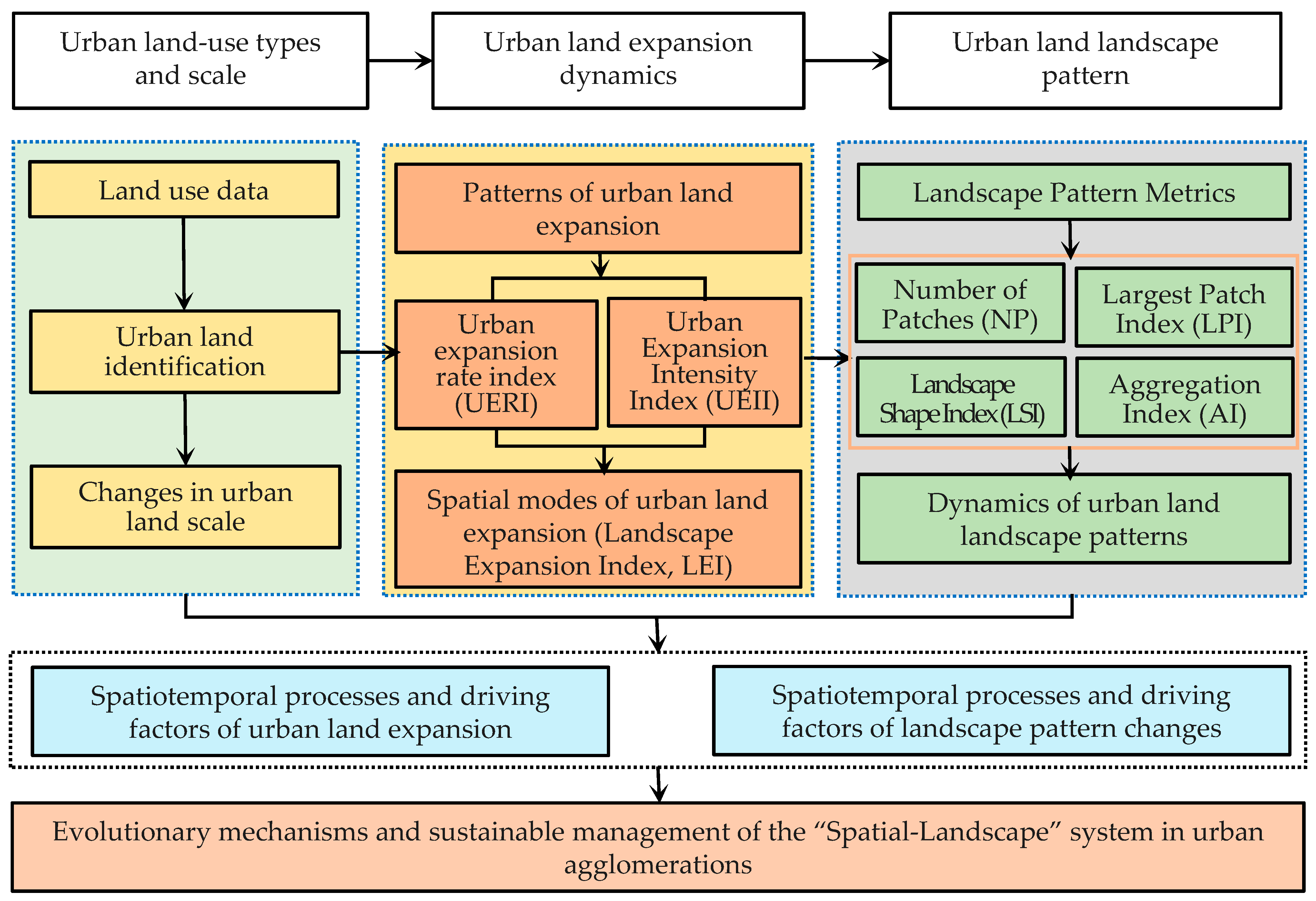
This research aims to comprehensively reveal the spatiotemporal processes of urban expansion, the evolution characteristics of landscape patterns, and their formation mechanisms within the GPUA. To achieve this objective, the study adopts an integrated analytical framework of “Process Characterization–Pattern Analysis–Mechanism Exploration” [27,30], with each dimension addressed by complementary quantitative tools (Figure 2).
Process Characterization employs the Urban Expansion Rate Index (UERI) and Urban Expansion Intensity Index (UEII) to quantify the velocity and spatial pressure of urban land growth, while the Landscape Expansion Index (LEI) identifies distinct expansion modes (infilling, edge, or outlying). Pattern Analysis utilizes Landscape Pattern Metrics (LPMs), specifically the Number of Patches (NP), Largest Patch Index (LPI), Landscape Shape Index (LSI), and Aggregation Index (AI), to capture the morphological and structural responses of landscapes to urban expansion. Mechanism Exploration applies GeoDetector to identify dominant driving forces and their interactions across different development stages.
This methodological integration is deliberately selected: UERI and UEII enable standardized comparisons across cities of varying sizes; LEI links spatial processes to fragmentation mechanisms; LPMs provide ecologically meaningful measures of landscape structure; and GeoDetector reveals nonlinear relationships and spatial heterogeneity in driving effects. Together, these tools establish a coherent diagnostic chain from expansion dynamics to landscape consequences and their governing factors.

2.2.1. Urban Expansion Rate Index

The UERI refers to the average annual growth rate of urban land area within an urban agglomeration over a specific period, used to characterize the relative speed of urban expansion [38]. The formula is as follows:
U E R I i = U i t 2 U i t 1 U i t 1 × Δ t × 100
where UERIi is the Urban Expansion Rate Index of the i city; U i t 1 and U i t 2 represent the urban land area of the i city at times t1 and t2, respectively; and Δt represents the number of years between t1 and t2.

2.2.2. Urban Expansion Intensity Index

The UEII refers to the ratio of the expanded urban land area to the total geographical area of the unit, reflecting the spatial pressure of expansion [5]. The formula is as follows:
U E I I i = A i t 2 A i t 1 A i t 1 × Δ t × 100
where UEIIi is the Urban Expansion Intensity Index of the i city; A i t 1 and A i t 2 represent the urban land area of the i city at times t1 and t2, respectively; and Δt represents the number of years between t1 and t2.

2.2.3. Landscape Expansion Index

The Landscape Expansion Index (LEI) is a metric adapted from landscape ecology methods, characterizing urban spatial expansion patterns and morphological features by determining the spatial relationships and combination characteristics between existing urban land (patches) and newly added urban land (patches) [39]. The calculation formula is as follows:
L E I = 100 × A u A u + A V
where LEI is the Landscape Expansion Index of the newly added urban land patch; Au is the intersection area between the buffer zone of the new land patch and the existing built-up land patch; and Av is the intersection area between the buffer zone of the new land patch and non-urban land patches. The classification criteria are: if LEI = 0, the urban expansion mode is outlying; if 0 < LEI ≤ 0.5, the urban expansion mode is edge; if 0.5 < LEI ≤ 1, the urban expansion mode is infilling.

2.2.4. Landscape Pattern Metrics

LPMs are quantitative indices that highly compress spatial structure information of landscapes, effectively characterizing features related to spatial configuration and compositional structure. Applying the Landscape Pattern Metrics method can reveal the morphological characteristics of urban spatial expansion under rapid urbanization [40,43]. Therefore, this study selects four key landscape pattern metrics: ① Number of Patches (NP), ② Largest Patch Index (LPI), ③ Landscape Shape Index (LSI), and ④ Aggregation Index (AI) (Table 1). These metrics are used to characterize the patch quantity, dominant patch scale, shape complexity, and spatial aggregation degree of the urban land landscape within the urban agglomeration, respectively, thereby depicting the impact of urban expansion on landscape ecological patterns at a macro scale. The study specifically employs Fragstats 4.2 software to calculate the aforementioned indices, quantitatively revealing the evolution characteristics of the landscape pattern in the GPUA.

2.2.5. Geodetector

Geodetector is a tool for detecting and utilizing spatial heterogeneity [41]. It consists of four modules: factor detection, risk detection, ecological detection, and interaction detection. This study employs the factor detection and interaction detection modules to identify the factors influencing urban spatial expansion in urban agglomerations, using the q-statistic for measurement. The calculation formula is as follows:
q = 1 1 N σ 2 h = 1 L N h σ h 2
where the q is the determinant power index of regional differentiation of urban land expansion or landscape pattern changes; h = 1,⋯,L represents the classification number of influencing factor X; Nh and N are the number of cities in the h-th stratum and the total number of municipal administrative units, respectively; σ h and σ h 2 are the variances of the urban expansion area index Y for stratum h and all cities, respectively. The value range of q is [0, 1]. When q = 0, it indicates that factor X has no influence on urban expansion or landscape pattern changes, and the intensity of urban expansion or landscape pattern changes follows a random distribution. The larger the q value, the greater the influence of factor X on the regional differentiation of urban expansion area and landscape pattern indices.
Considering the actual urban development of the Guanzhong Plain Urban Agglomeration and referring to existing research results [12,28,44,45], this study selects 10 indicators from four dimensions: natural geographical conditions, location accessibility, socioeconomic level, and policy institutions (Table 2), to detect the influence of each indicator on urban spatial expansion and landscape pattern changes in the urban agglomeration.

2.3. Data Sources and Processing

(1)
Land Use Data. Land use/cover data for the years 1990, 2000, 2010, and 2020 were obtained from the Data Center for Resources and Environmental Sciences, Chinese Academy of Sciences (http://www.resdc.cn) (accessed on 25 August 2025). This dataset was generated through manual visual interpretation and field verification based on Landsat TM/ETM imagery, with a spatial resolution of 30 m × 30 m. In accordance with existing land-use classification research [36], this study reclassified the original land-use data into two main categories: urban land and non-urban land. Urban land refers to built-up areas, including large, medium, and small cities, as well as counties and towns. Subsequently, the ArcGIS 10.8 software was used to extract the urban land area. By spatially overlaying the four temporal layers, the expanded urban land areas for the three periods (1990–2000, 2000–2010, 2010–2020) were sequentially extracted. Finally, the extracted land area was validated against the China City Statistical Yearbook (12 September 2025). The overall accuracy exceeded 0.9, meeting the precision requirements for this study. The specific expansion dynamics for individual cities within the agglomeration during each period were obtained using the mask extraction method.
(2)
Other Data. Socioeconomic data related to the GPUA were primarily sourced from the 2021 China City Statistical Yearbook, the statistical bulletins on national economic and social development of relevant provinces, cities, counties (districts), and other publicly available statistical materials. The vector maps and Digital Elevation Model (DEM) data were sourced from the National Geomatics Center of China (NGCC) (https://www.ngcc.cn/) (accessed on 25 August 2025). Additionally, as only Xifeng District of Qingyang City falls within the GPUA boundaries, the vector data for Qingyang City used in this study represents Xifeng District specifically, ensuring consistency with the administrative scope defined in policy documents and data sources.

3. Results

3.1. Spatiotemporal Heterogeneity of Urban Expansion in the GPUA

3.1.1. Overall Expansion Characteristics

From 1990 to 2020, the GPUA’s urban land expanded significantly, from 528.35 km2 to 1237.90 km2 (Table 3). The expansion rates and intensities exhibited a distinct “increase-then-decrease” trend (Figure 3). The period 2000–2010 showed peak expansion (UERI: 5.21%, UEII: 0.0333%, expanded area: 356.03 km2), compared to lower rates in 1990–2000 (UERI: 2.93%, UEII: 0.0145%) and 2010–2020 (UERI: 1.91%, UEII: 0.0186%). The overall average annual UEII for 1990–2020 was 0.0221%.

3.1.2. City-Level Expansion Dynamics

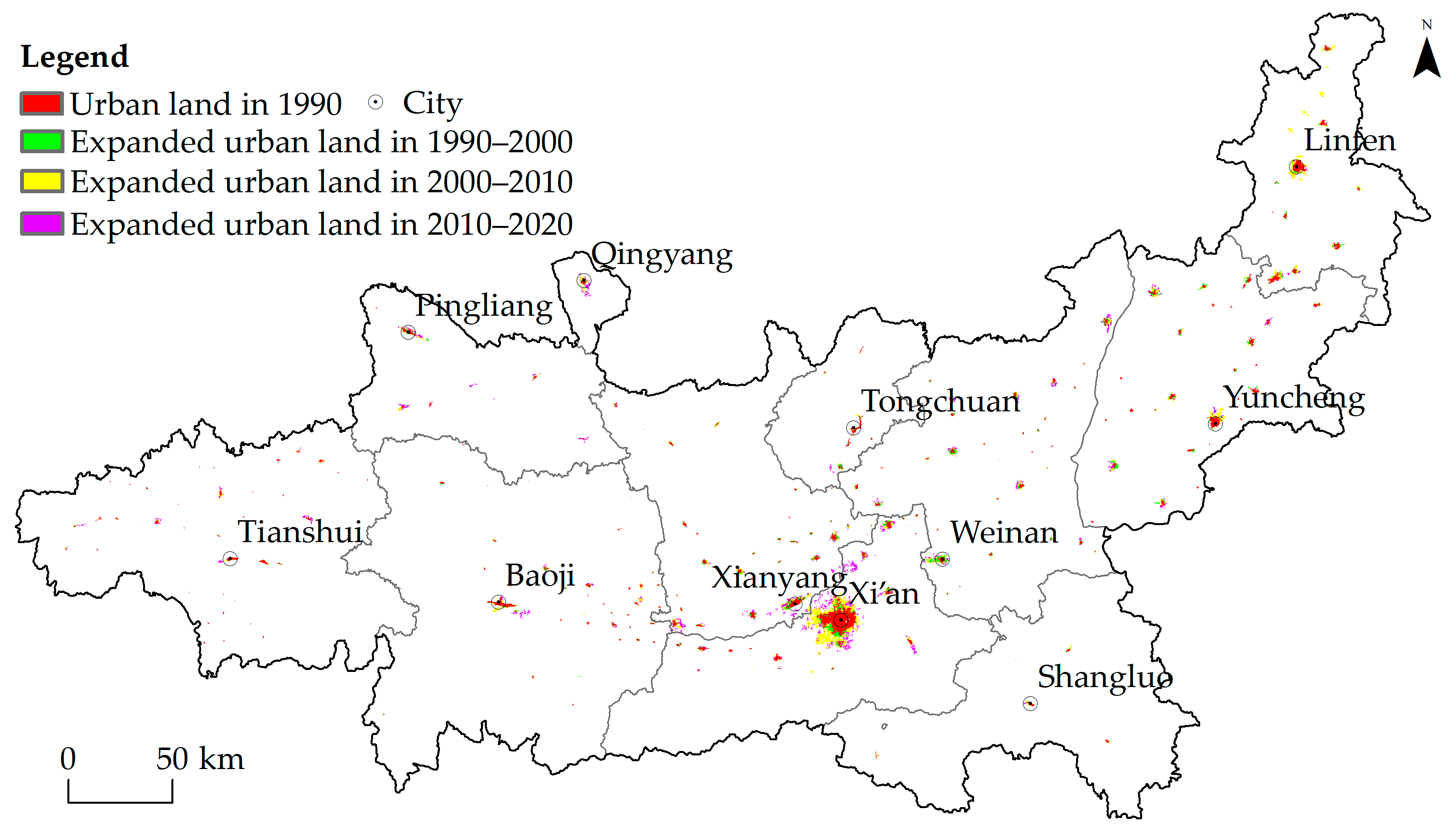
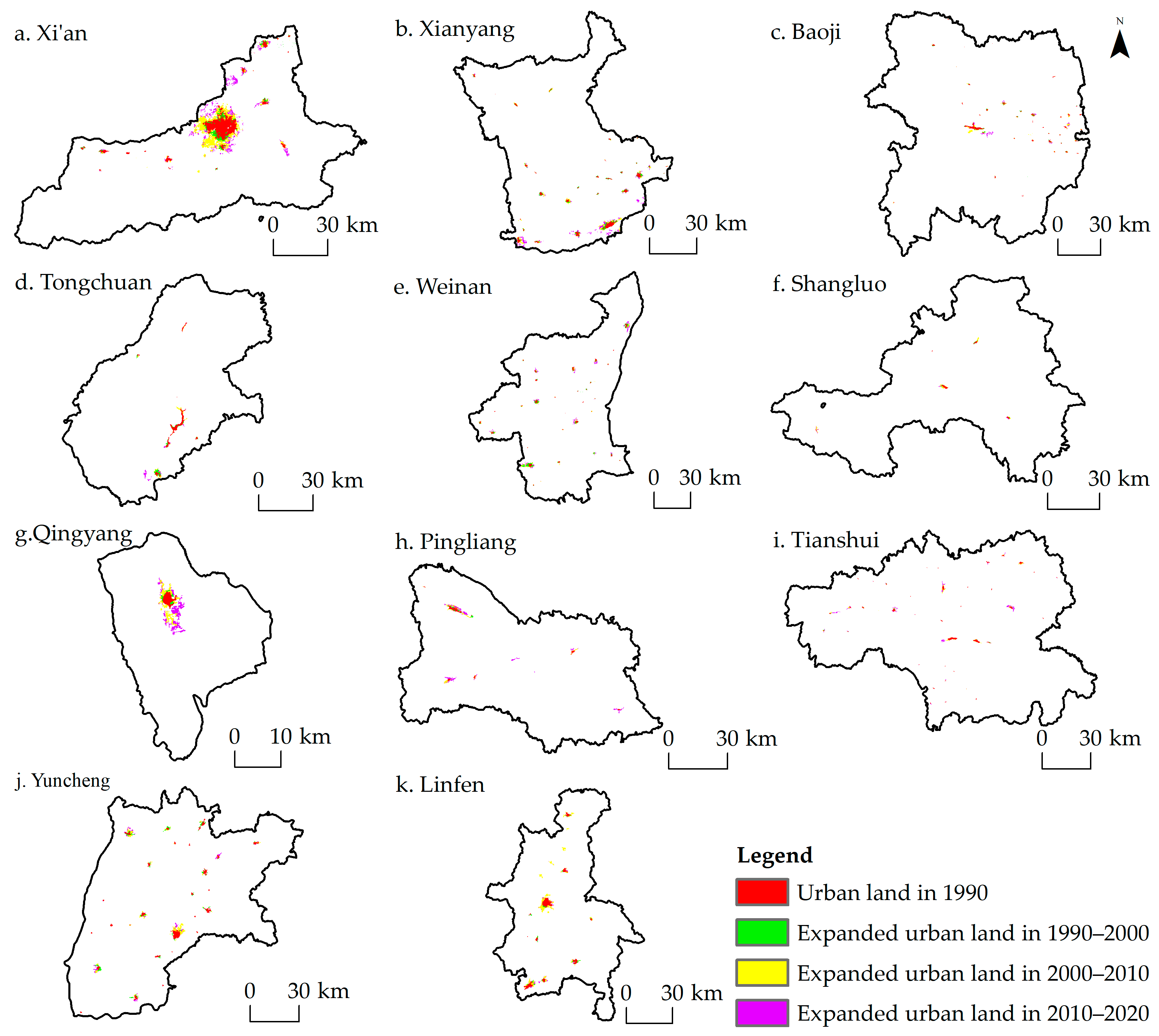
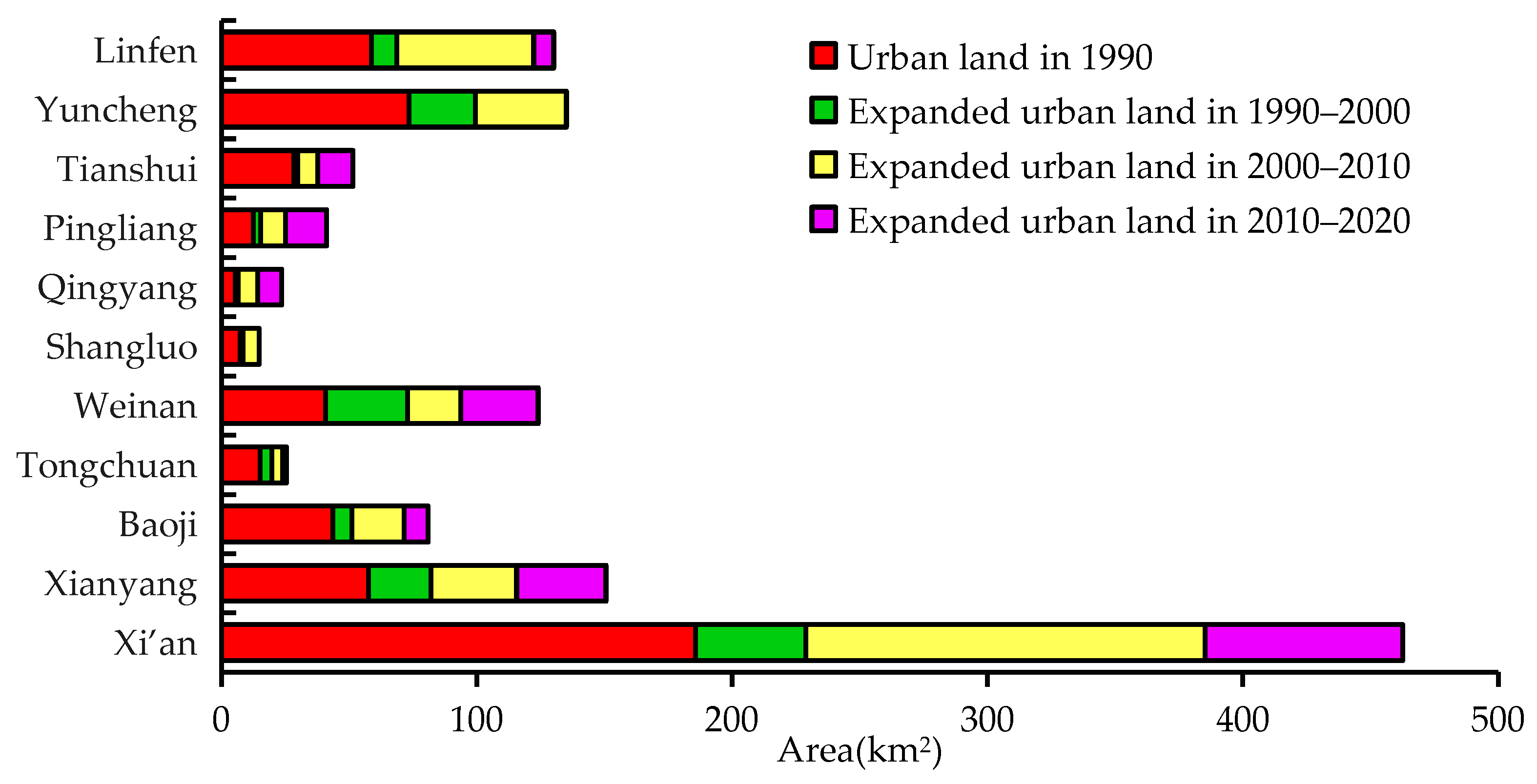
From 1990 to 2020, the built-up expansion area varied significantly among cities within the GPUA (Figure 4 and Figure 5). Xi’an city recorded the largest expansion area (276.96 km2), followed by Xianyang city (92.88 km2) and Weinan city (83.17 km2). Cities like Qingyang, Tongchuan, and Shangluo experienced relatively smaller-scale expansion.
Examining the temporal evolution, the cities with larger built-up areas in 1990 were Xi’an (185.62 km2), Yuncheng (73.40 km2), and Linfen (58.70 km2). By 2000, the top three were Xi’an (228.87 km2), Yuncheng (99.42 km2), and Xianyang (82.16 km2). In 2010, they were Xi’an (385.28 km2), Yuncheng (135.04 km2), and Linfen (122.31 km2). By 2020, the ranking was Xi’an (462.58 km2), Xianyang (150.54 km2), and Yuncheng (134.77 km2). As the provincial capital of Shaanxi and the agglomeration’s core, Xi’an boasts a high level of socioeconomic development. Its strong radiating and driving effects on surrounding counties and districts attract the concentration of production factors, promoting rapid urban spatial expansion and a significantly leading urbanization process compared to other cities. Concurrently, Xianyang has also developed rapidly, expanding its land by 92.88 km2 over 30 years. Together with Xi’an, it forms a “one primary, one auxiliary” twin-city structure within the Xi’an Metropolitan Area. However, a monocentric development pattern with Xi’an at its core has persisted in the long term.

3.1.3. Spatiotemporal Changes in UERI and UEII

(1)
Spatiotemporal Heterogeneity of UERI
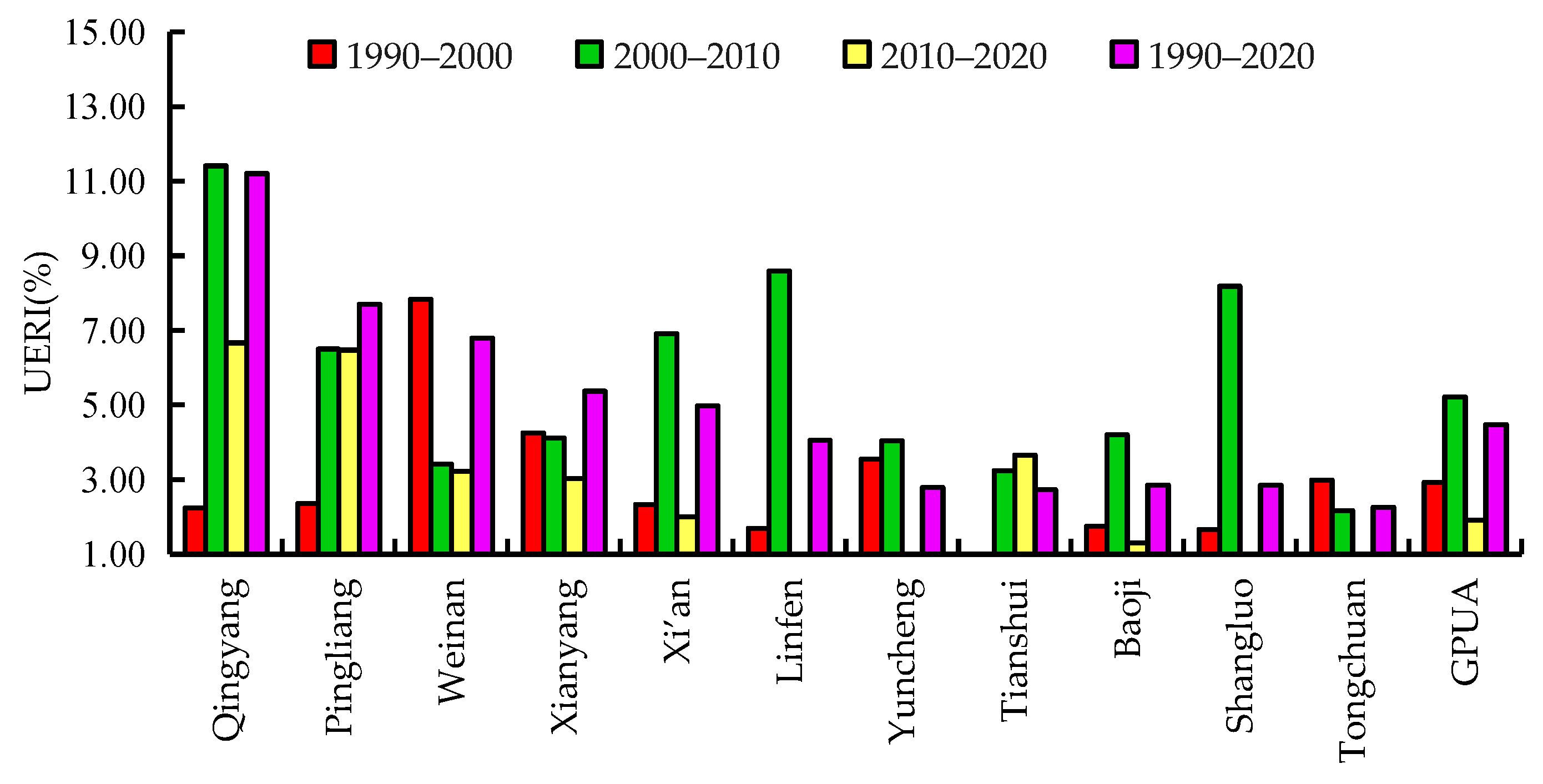
With the acceleration of urbanization, the urban land area of each city within the GPUA has continued to increase. However, the UERI vary significantly, reflecting spatial heterogeneity (Figure 6). Over the past 30 years, the GPUA’s overall UERI has exhibited a fluctuating trend, which can be divided into three specific stages:
  • (1)
    Slow Growth Stage (1990–2000). Except for Weinan City (7.83%), the UERI for other cities were generally below 4.5%, indicating relatively slow growth.
    (2)
    Accelerated Expansion Stage (2000–2010). During this period, the UERI of most cities increased significantly. Cities such as Qingyang, Shangluo, Linfen, Xi’an, and Pingliang all had UERI values exceeding 6.0%, indicating rapid urban land spatial expansion.
    (3)
    Decelerated Development Stage (2010–2020). After a period of rapid urban land expansion, most cities’ UERI fell below 4.25%, except for Pingliang (6.47%) and Qingyang (6.66%) maintained relatively high expansion rates, but the overall expansion of the agglomeration tended to moderate.
Figure 6. Changes in the Urban Expansion Rate Index (UERI) of cities in the GPUA.
Land 15 00768 g006
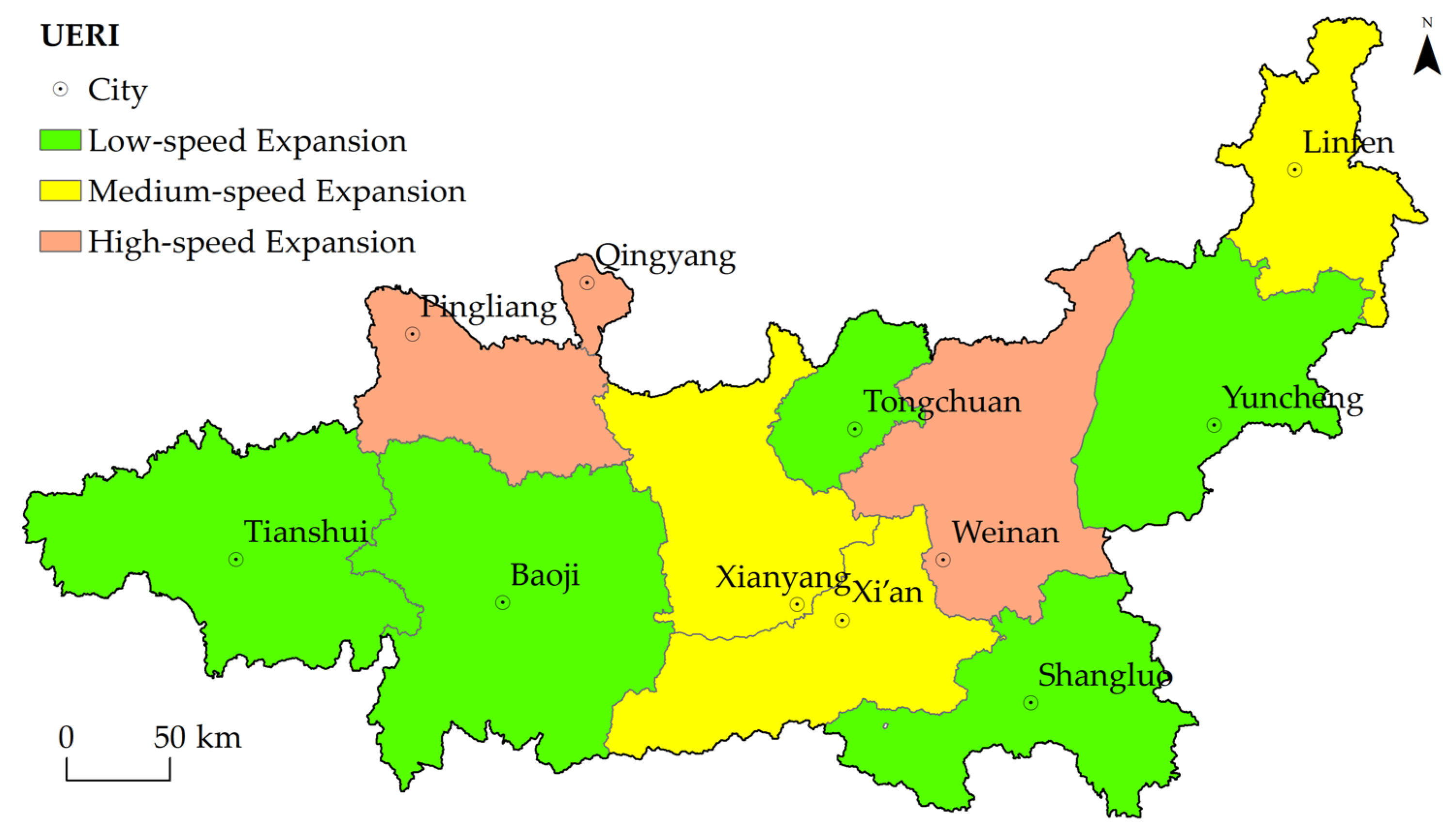
Using the Natural Breaks (Jenks) tool in ArcGIS 10.8, the UERI for each city was classified into three categories: High-speed Expansion (>6.69), Medium-speed Expansion (3.19~6.69), and Low-speed Expansion (<3.19). Spatially, high-speed expansion cities comprise Qingyang, Pingliang, and Weinan. The medium-speed expansion cities are Xi’an, Xianyang, and Linfen. The low-speed expansion cities are Yunchen, Tianshui, Baoji, Shangluo, and Tongchuan (Figure 7). Although Xi’an is the provincial capital and a National Central City, its expansion rate is at a medium-speed level. The primary reasons are twofold: first, Xi’an developed earlier with a larger initial built-up area, resulting in a larger expansion base; second, its expansion rate is constrained to a medium level due to topographic limitations, territorial spatial management controls, and ecological and environmental protection policies.
(2)
Spatiotemporal Heterogeneity of UEII
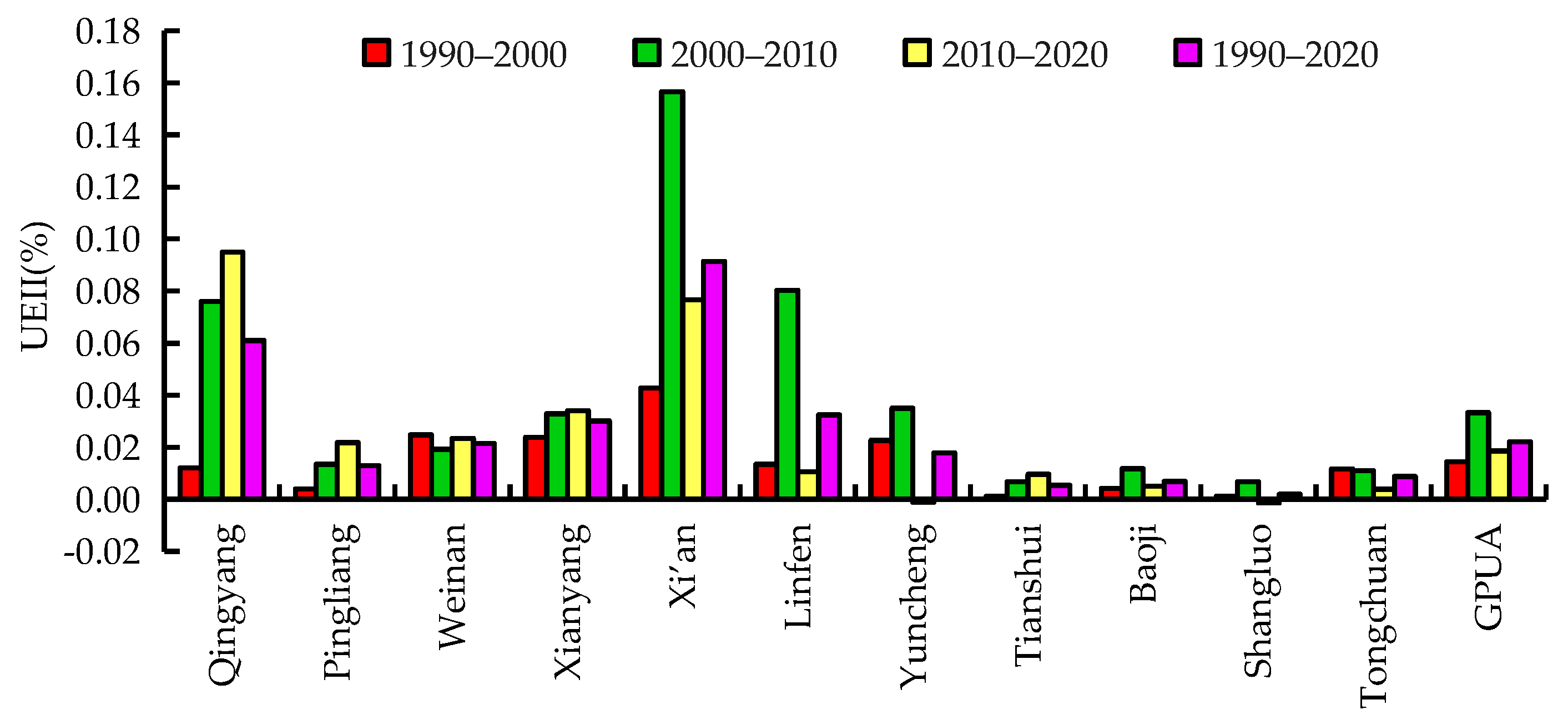
There were clear differences in expansion intensity among the cities within the GPUA (Figure 8). From 1990 to 2020, Xi’an City had the highest UEII at 0.0914%, followed by Qingyang City at 0.0610%. The UEII for the remaining nine cities was relatively low. The UEII also exhibited phased characteristics: from 1990 to 2000, the UEII for all cities within the agglomeration was relatively small, all below 0.05%; from 2000 to 2010, the UEII generally increased; from 2010 to 2020, except for Qingyang City (0.0949%), which continued to rise, all other cities showed a decelerating trend.
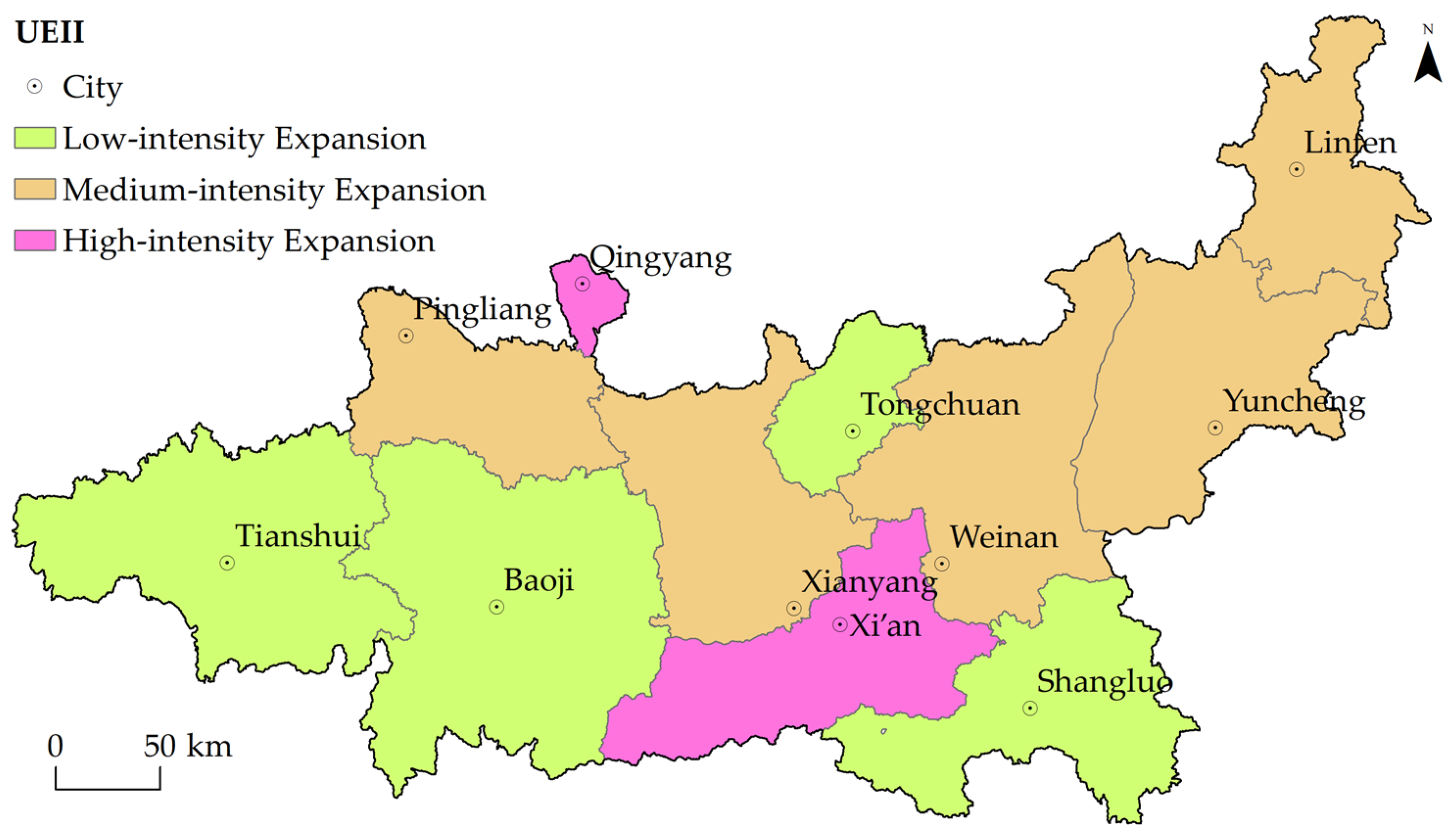
Based on the UEII and using the Natural Breaks (Jenks) tool in ArcGIS 10.8, urban land expansion intensity was classified into three categories: High-intensity Expansion (>0.04), Medium-intensity Expansion (0.01~0.04), and Low-intensity Expansion (<0.01). The high-intensity expansion cities are Xi’an and Qingyang. The medium-intensity expansion cities include Pingliang, Xianyang, Weinan, Yuncheng, and Linfen. The low-intensity expansion cities are Tongchuan, Shangluo, Baoji, and Tianshui (Figure 9). This spatial hierarchy indicates that Xi’an, as a National Central City, drives urban spatial expansion intensity far above that of other cities, while Qingyang experiences rapid expansion given its limited administrative scope (main urban districts only).

3.1.4. Urban Spatial Expansion Modes

During 1990–2020, urban expansion in the GPUA exhibited distinct stage-specific characteristics (Table 4). The period 1990–2000 was characterized by the coexistence of infilling and edge expansion (mixed stage), with a mean LEI of 0.49. Five cities—Xianyang, Baoji, Shangluo, Tianshui, and Tongchuan—recorded LEI values exceeding 0.50, indicating infilling expansion, while Xi’an and Weinan demonstrated edge expansion patterns. During 2000–2010, the GPUA entered a stage of comprehensive edge expansion, with the mean LEI declining to 0.36 as nine of eleven cities shifted to this mode. Xi’an exhibited an extremely low LEI of 0.17, indicating continuous outward sprawl along transportation corridors. During 2010–2020, expansion patterns diverged: the mean LEI rebounded to 0.47. While core cities maintained low-LEI edge expansion, peripheral cities—including Linfen, Shangluo, and Yuncheng—transitioned to high-intensity infilling development (LEI > 0.90), exhibiting characteristics of stock optimization and inner-city redevelopment.
Geographically, the GPUA displayed a clear core-periphery gradient. As the core city, Xi’an maintained persistent edge expansion throughout the thirty-year period (LEI: 0.17–0.36), demonstrating continuous peripheral sprawl. Secondary cities such as Xianyang, Baoji, and Tianshui underwent a transition from high-LEI infilling development in the early stage to low-LEI edge expansion in the later period. In contrast, peripheral cities including Linfen and Shangluo exhibited LEI values exceeding 0.90 after 2010, associated with high-intensity infilling expansion. This created a contrasting spatial pattern between peripheral densification and core sprawl.

3.2. Changes in Urban Landscape Patterns in the GPUA

3.2.1. Overall Evolution Characteristics

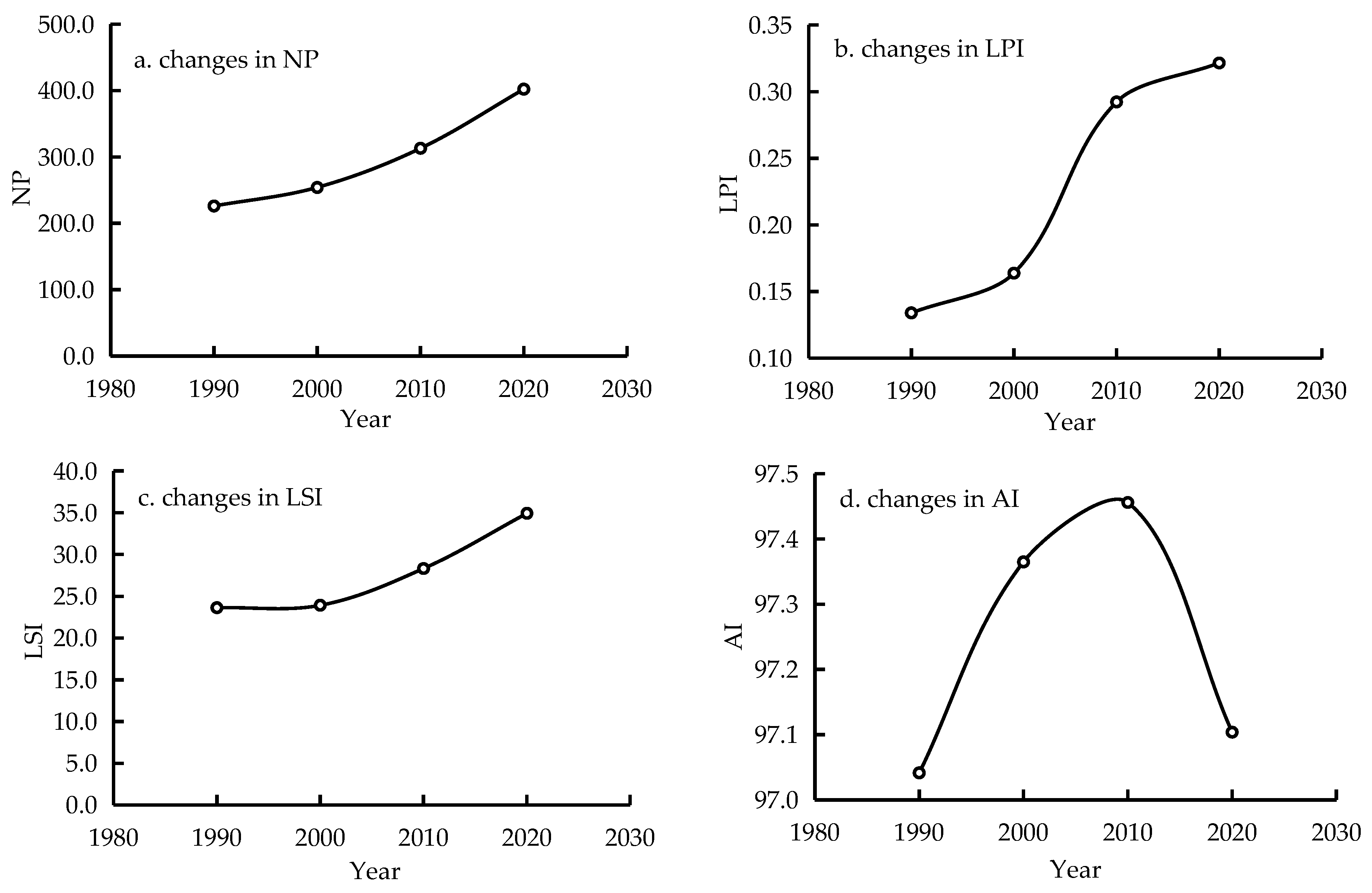
From 1990 to 2020, significant changes occurred in the urban land landscape pattern of the GPUA alongside the advancement of urbanization (Figure 10). Over the 30 years, the NP for urban land continuously increased, rising from 226 to 402. The LPI showed a marked upward trend, the most pronounced increase among the metrics, growing from 0.13 to 0.32. The overall LSI increased from 23.63 to 36.93, with relatively modest changes from 1990 to 2000, followed by sustained rapid growth after 2000. Conversely, the AI for urban land exhibited an inverted “U-shaped” evolutionary trend, first rising and then falling. It increased from 97.04 in 1990 to 97.46 in 2010, before declining to 97.10 during 2010–2020. These changes indicate that the urban landscape of the GPUA has generally trended towards increased fragmentation and complexity.
Specifically, the continuous increase in NP reflects the intensifying fragmentation of the urban land landscape. The significant rise in LPI suggests that urban land has gradually aggregated during the expansion process, forming dominant patches of notable scale as urbanization progressed. The overall increase in LSI reflects that the shape of urban land has become more irregular under the combined influence of human development and natural conditions, with the complexity of built-up area edges becoming notably more pronounced since 2000. The AI, which rose first and then fell, peaked in 2010 (97.46). Its fluctuation is closely related to urban expansion modes. The 1990–2010 period was dominated by edge-expansion and infilling, leading to a gradual increase in patch aggregation. After 2010, leapfrog (outlying) expansion became dominant, and the rapid development of new urban districts and development zones somewhat reduced spatial aggregation among patches. Overall, over 30 years, the continuous expansion of urban land in the GPUA has been accompanied by strengthening trends in landscape fragmentation, heterogeneity, and shape complexity.

3.2.2. City-Level Landscape Dynamics

Different expansion modes profoundly shape urban landscape morphology and spatial structure in the GPUA, specifically manifested in the differential evolution of metrics such as the NP, LPI, LSI, and AI (Figure 11).
(1)
Changes in the NP. From 1990 to 2020, the NP for cities within the GPUA generally showed an increasing trend, reflecting a tendency towards dispersion and fragmentation in the urban land landscape. Among them, Xi’an and Xianyang exhibited the most significant NP growth, indicating that their urban land became highly fragmented during rapid expansion. Cities like Weinan and Baoji experienced relatively moderate NP growth, suggesting their expansion methods were more concentrated and orderly. The NP for Shangluo and Tianshui remained largely stable, reflecting limited spatial expansion or a predominance of infilling development. Although starting small, the NP for Qingyang and Pingliang increased, indicating that urban land distribution remained relatively aggregated during their expansion process.
(2)
Changes in LPI. The LPI for cities within the GPUA showed an overall upward trend, indicating the gradual formation of significantly sized dominant patches during urban land expansion, thereby enhancing spatial agglomeration effects. Xi’an’s LPI steadily rose from 1.42 to 3.41, consistently ranking first, highlighting its spatial dominance as the core city during expansion. Cities like Xianyang and Weinan also showed significant LPI growth, reflecting a tendency for urban land to concentrate during expansion. Qingyang’s LPI increased from 0.54 to 1.26. Despite its limited overall scale, this indicates a clear trend of land agglomeration during its expansion. The LPI values for Shangluo and Tianshui were low with minimal growth, suggesting these cities have small-scale dominant construction land patches and limited expansion intensity.
(3)
Changes in the LSI. From 1990 to 2020, the LSI for cities within the GPUA showed a consistent upward trend, reflecting increasing complexity and irregularity in the morphological form of the urban land landscape. Xi’an recorded the most significant LSI increase (8.41 → 15.55), indicating a sharp rise in the complexity of its urban land boundary morphology during rapid expansion. Xianyang (9.48 → 14.43) and Baoji (10.66 → 13.25) followed, also exhibiting clear trends of morphological complexity during their expansion. In contrast, Shangluo (3.91 → 4.82), Tongchuan (6.10 → 7.17), and Qingyang (2.08 → 7.93) had relatively low LSIs with slow growth. Shangluo’s development is constrained by topographic conditions, leading to stagnation and maintaining a relatively regular landscape form. Tongchuan’s morphological evolution is relatively moderate due to its smaller urban land scale. Although Qingyang’s LSI grew relatively quickly, its overall index remains low, indicating its urban land morphology is still relatively simple.
(4)
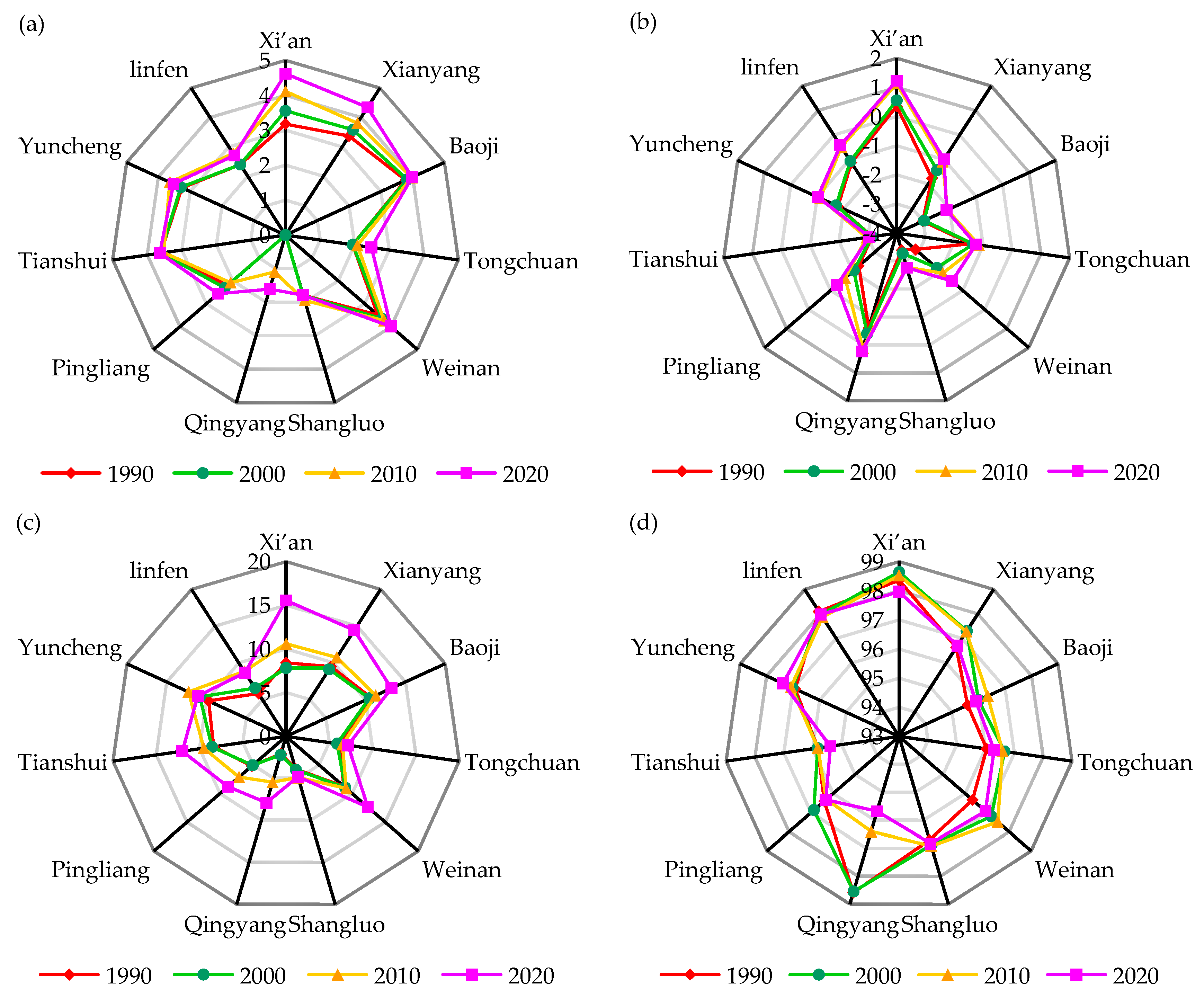
Changes in the AI. During the study period, the AI for cities within the GPUA was generally high (>95), indicating that urban land distribution overall possessed strong spatial aggregation (Figure 11). The AI values for cities that developed earlier, such as Xi’an, Linfen, and Yuncheng, consistently remained high with minor fluctuations, reflecting relatively intensive land use and stable spatial structures. Notably, Qingyang’s AI decreased significantly (98.58 → 95.68), consistent with the characteristic of construction land becoming more dispersed during its rapid expansion. The AI for Tianshui, Baoji, and Tongchuan remained at relatively low levels over the long term, suggesting a more dispersed spatial layout, likely influenced by urban planning or natural topographic barriers. Overall, over 30 years, the fluctuation in the spatial aggregation of urban land in this region has been limited. The AI for the vast majority of cities varied within a range of less than two units, indicating that the urban agglomeration has maintained a high degree of spatial compactness during expansion, without widespread spatial fragmentation.

3.3. Driving Factors of Urban Expansion and Landscape Dynamics in the GPUA

3.3.1. Driving Factors of Urban Land Expansion

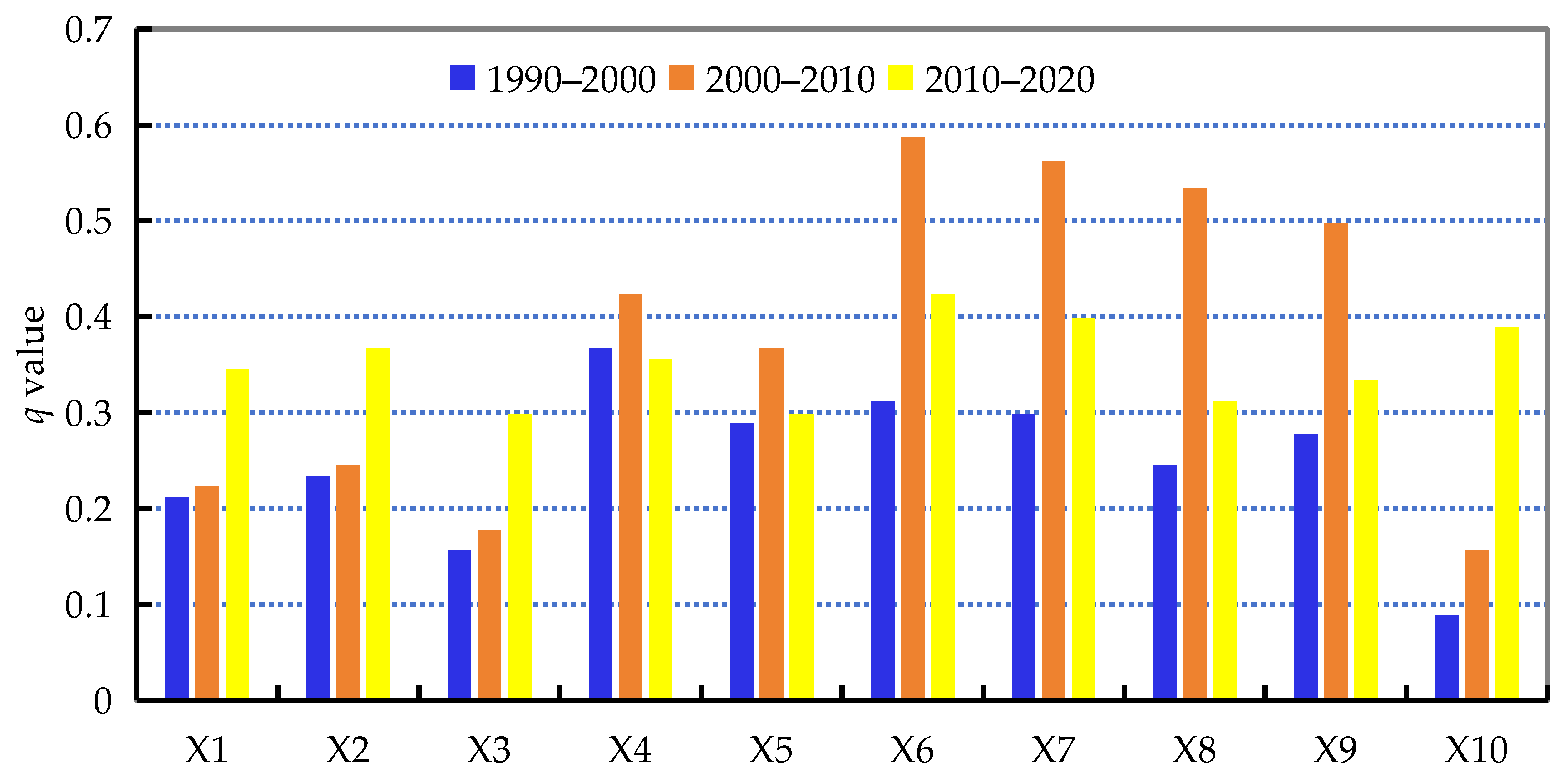
The explanatory power of driving factors of urban land expansion in the GPUA exhibit distinct stage-specific characteristics (Figure 12). During 1990–2000, urban expansion was primarily associated with central location (X4: q = 0.367) and population growth (X6: q = 0.312), with weak constraints from topographic relief (X1: q = 0.212) and ecological regulation (X10: q = 0.089), consistent with scattered infilling expansion centered on Xi’an.
During 2000–2010, socioeconomic factors became the dominant driving forces, with population growth (q = 0.587), economic growth (q = 0.562), investment intensity (q = 0.534), and development intensity (q = 0.498) all showing explanatory power exceeding 0.49. This coincided with rapid extensive expansion under the Western Development Strategy. The significant role of transportation accessibility (q = 0.367) coincided with the direction of urban expansion.
During 2010–2020, ecological regulation intensity (q = 0.389) emerged as the primary constraining factor, with the explanatory power of slope (q = 0.367) and topographic relief (q = 0.345) increasing significantly. Meanwhile, the explanatory power of socioeconomic factors generally declined to the range of 0.312–0.423. This shift in dominant explanatory factors coincided with the implementation of the Qinling Ecological Protection Red Line, indicating that the dual constraints of natural topography and policy gradually emerged as the primary limiting conditions for urban expansion.

3.3.2. Driving Factors of Landscape Pattern Changes

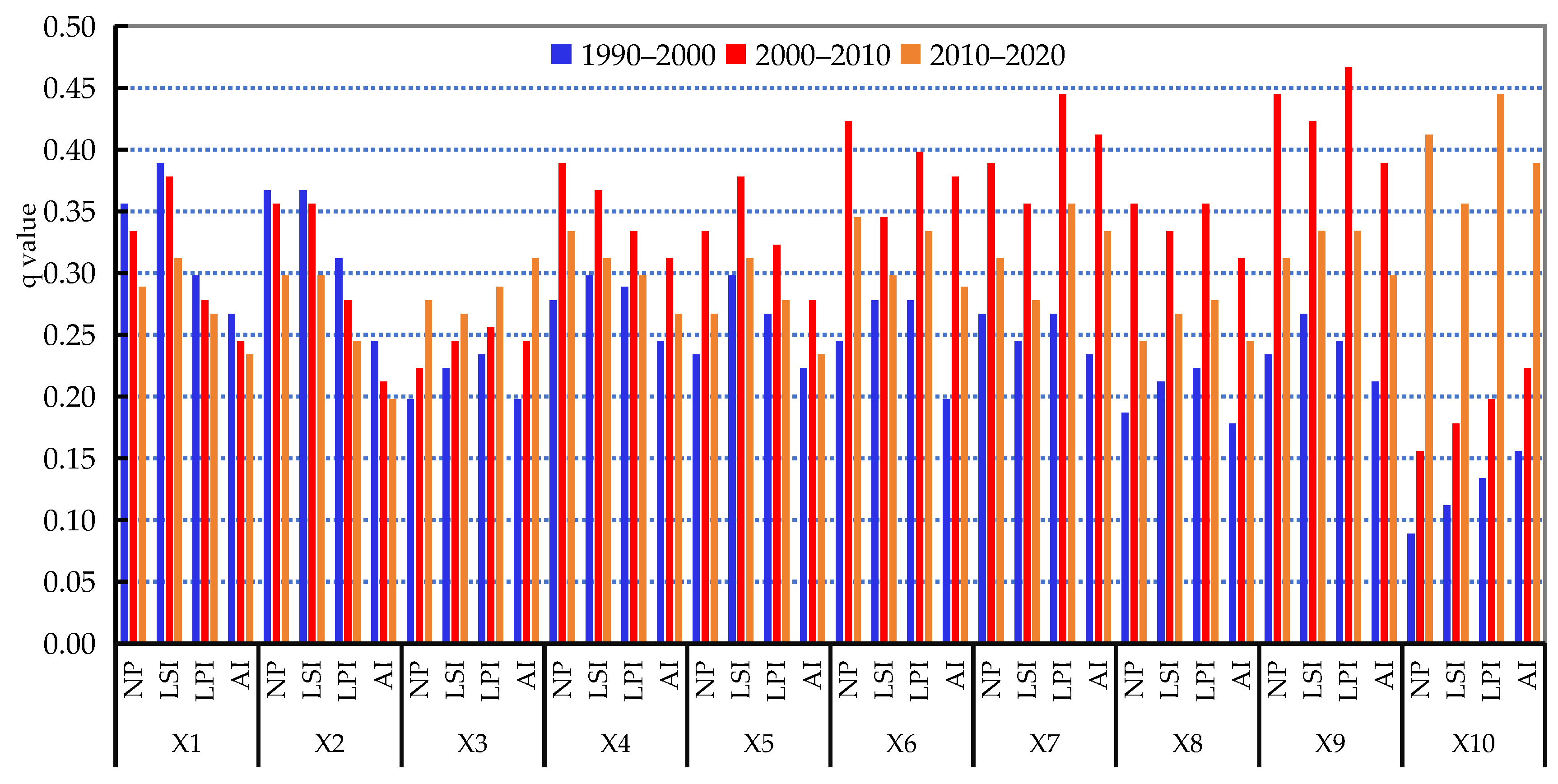
The explanatory power of the dominant driving factors of landscape pattern changes in the GPUA exhibited significant temporal dynamics (Figure 13).
During 1990–2000, natural factors showed strong explanatory capacity: topographic relief (q = 0.356–0.389) and slope (q = 0.312–0.367) showed the strongest explanatory power for NP and LSI, indicating that topography was associated with low-fragmentation, regular landscape patterns by constraining expansion space. Ecological constraint distance (q = 0.198–0.234) showed weaker explanatory power for AI.
During 2000–2010, development intensity showed explanatory power exceeding 0.40 for NP (q = 0.445), LSI (q = 0.423), and LPI (q = 0.467). Population growth (q = 0.423) and economic growth (q = 0.412) showed strong explanatory capacity for AI, These high q-values paralleled development zone construction and economic agglomeration, consistent with increased patch fragmentation and morphological complexity. Transportation accessibility (q = 0.378) showed strong explanatory power for LSI, indicating that road networks exacerbated boundary irregularities.
During 2010–2020, ecological regulation showed the strongest explanatory power across all landscape indices, with the highest q-values for LPI (q = 0.445), NP (q = 0.412), AI (q = 0.389), and LSI (q = 0.356), while the explanatory power of socioeconomic factors generally declined. This shift in explanatory power distribution indicates the effectiveness of ecological policies in suppressing landscape fragmentation. Concurrently, the explanatory power of ecological constraint distance on AI increased to 0.312, while that of slope on LSI declined to 0.289, consistent with urban expansion readapting to the topographic background and its association with urban morphology.

4. Discussion

4.1. Phased Characteristics and Comparative Context

The GPUA’s “increase-then-decrease” expansion trajectory exhibits both parallels and distinctions with other urban agglomerations. The 2000–2010 rapid expansion phase, during which socioeconomic factors (population growth, economic growth, and investment intensity) showed the strongest explanatory power, paralleled the market-driven sprawl patterns widely documented in US metropolitan areas [20,45]. However, the critical difference lies in the post-2010 transformation pathway. While such cities often exhibit persistent edge expansion and landscape fragmentation despite growth management efforts [20], the GPUA witnessed a leap in the constraining power of ecological regulation intensity over urban expansion during 2010–2020. This, coupled with natural constraints from topographic relief and slope, formed a deceleration mechanism under the dual constraints of policy and nature. This is also one of the key findings of the present study.
Compared with eastern Chinese agglomerations, the GPUA demonstrates temporal lag but earlier policy intervention. While the Yangtze River Delta and Pearl River Delta regions underwent forced “stock renewal” at urbanization rates exceeding 70% [46,47], the GPUA established rigid ecological red line constraints at approximately 60% urbanization. Notably, the high UERI observed in cities such as Qingyang requires cautious interpretation considering the analytical units. Geodetector results indicate that for these cities, development intensity exhibits high explanatory power while ecological regulation exhibits weak explanatory power, reflecting the statistical characteristics of a “small base-high growth rate” influenced by limited statistical scope (only main urban districts) and topographic effects, rather than genuine regional integrated expansion. In contrast, although Xi’an exhibited a medium expansion rate, it faced significant constraints from ecological red lines and topography. If examining only the main urban districts, its UERI still ranks first, reflecting the “high-intensity, high-constraint” expansion paradox of the central city under the topographic constraints of the northern foothills of the Qinling Mountains and ecological protection red lines [34,37].

4.2. Differentiated Landscape Evolution Mechanisms

The evolution of landscape patterns is a geographical representation of the interaction between urban expansion modes, regional economic development levels, and geographical conditions [47]. The GPUA exhibits a distinctive “core sprawl-peripheral infilling” spatial pattern that diverges from other Chinese urban agglomerations. In the Yangtze River Delta and Pearl River Delta regions, landscape fragmentation is predominantly driven by land finance and industrial agglomeration under market mechanisms, with ecological policies mostly serving as auxiliary constraints [35,46]. By contrast, the GPUA demonstrates “differentiated responses” under single-core dominance. As the core of the GPUA, Xi’an maintained low-LEI edge expansion after 2010, with the Landscape Shape Index (LSI) dominated by transportation location and development intensity, exhibiting characteristics of “continuous core fragmentation”. Conversely, peripheral cities such as Linfen and Shangluo shifted to high-LEI infilling expansion after 2010, where ecological regulation exhibited the highest explanatory power for NP and LPI. This configuration contrasts with the “core infilling–peripheral sprawl” pattern of the Yangtze River Delta and the polycentric network structure of the Pearl River Delta [12,46], reflecting spatial compromise strategies under strict ecological red line and farmland protection constraints.
Furthermore, landscape fragmentation and complexity are not solely determined by the rate of urban land expansion. Cities such as Tianshui exhibited high-landscape fragmentation during 2000–2010 associated with development intensity and population growth, resembling the “disordered fragmentation” observed in Lagos State, Nigeria [23]. However, post-2010 ecological regulation coincided with suppressed fragmentation, unlike the uncontrolled fragmentation in Global South cities lacking effective institutional containment [24]. Shangluo maintained high-landscape connectivity and low fragmentation given absolute topographic dominance, consistent with its role as a regional ecological barrier in central and western Chinese urban agglomerations [1,37].

4.3. Responsive Relationship Between Spatial Expansion and Landscape Patterns

Urban land expansion leads to landscape pattern changes, yet the specific responses are mediated by expansion modes and policy interventions [5,35]. In the GPUA, expansion mode differentiation explains the variation in landscape patterns. Xi’an’s continuous edge expansion (1990–2020) resulted in surging NP and LSI; however, after 2010, ecological regulation and topographic constraints gradually emerged as primary limiting factors, contributing to stabilized landscape morphology (LSI) and improved connectivity (AI). Cities such as Tianshui similarly underwent landscape fragmentation driven by edge expansion during 2000–2010, which was effectively suppressed by ecological regulations after 2010. In contrast, Shangluo’s continuous infilling expansion, combined with topographic dominance, maintained long-term high connectivity and low fragmentation.
Unlike Global South cities that experienced uncontrolled fragmentation during rapid urbanization due to institutional gaps [24], and differing from Chengdu–Chongqing’s spatially balanced fragmentation under a dual-core structure [48], the GPUA exhibits a “core sprawl–peripheral infilling” adaptive differentiation under strong ecological constraints. More importantly, while eastern agglomerations (Yangtze River Delta, Pearl River Delta) achieved stock renewal at late urbanization stages through market mechanisms [12,46], the GPUA established rigid ecological red lines at the mid-stage [49], enabling earlier policy intervention. While core cities such as Xi’an maintained continuous low-LEI edge expansion, they curbed morphological disorganization and restored connectivity through ecological regulation and topographic constraints [50]; meanwhile, peripheral cities such as Linfen and Shangluo shifted to high-LEI infilling development, achieving effective suppression of landscape fragmentation [51]. Therefore, the spatial governance of urban agglomerations should coordinate expansion modes with landscape response relationships and implement differentiated regulation.

4.4. Implications

(1)
Implications for Planning and Management. The urban land expansion and landscape pattern evolution of the GPUA indicate that the region remains in the primary stage of urban agglomeration development, characterized by internal development imbalances, limited radiating and driving capacity from the core city, and insufficient synergy among cities [33,34]. Based on the identified “increase-then-decrease” trajectory and “core sprawl–peripheral infilling” pattern, spatial governance should adopt differentiated strategies: for core cities (Xi’an), strict growth boundary management is needed to curb edge sprawl and optimize existing stock; for peripheral cities (Linfen, Shangluo), infilling development and inner-city renewal should be prioritized. The demonstrated effectiveness of early ecological intervention suggests that establishing rigid ecological red lines and “Three Zones and Three Lines” controls during mid-stage urbanization can effectively suppress landscape fragmentation, offering a replicable pathway for late-developing, ecologically sensitive regions. Additionally, constructing ecological corridors connecting the Qinling Mountains with peripheral barriers would enhance regional landscape connectivity.
(2)
Research Limitations and Future Prospects. While this study reveals spatiotemporal patterns and explanatory power transitions using multi-period remote sensing data, three limitations remain: first, reliance on land use classification data limits in-depth socioeconomic mechanism analysis; second, intrinsic feedback mechanisms between expansion and landscape patterns require further exploration; third, city-level analysis masks micro-scale heterogeneity and cross-regional ecological effect transmission. Future research should integrate multi-source data (nighttime light, POI) and machine learning for micro-scale heterogeneity analysis; quantify ecosystem service impacts; and conduct scenario modeling for urban growth boundaries to enhance practical applications for territorial governance.

5. Conclusions

Using the UERI, UEII, LEI, LPMs and Geodetector, this study analyzed the spatiotemporal dynamics of urban land expansion and landscape pattern evolution in the GPUA, as well as the driving mechanisms underlying its space–landscape system changes. The main conclusions are as follows:
First, the urban land expansion in the agglomeration exhibited distinct three-phase characteristics. From 1990 to 2020, the GPUA experienced significant urban land growth, with expansion rates and intensities showing an “increase-then-decrease” trend. Edge expansion and infilling expansion modes coexisted, with 2000–2010 being an accelerated expansion period dominated by edge expansion. Spatially, the agglomeration structure gradually evolved from a monocentric form centered on Xi’an to an axial development pattern with Xi’an-Xianyang as the dual-core pole.
Second, internal expansion dynamics displayed significant spatial heterogeneity. The UERI and UEII varied markedly among cities within the agglomeration. Xi’an, as the core city, registered a medium expansion rate but the highest expansion intensity, reflecting its dominant spatial drive despite ecological and planning constraints. Cities with smaller initial land bases experienced relatively swift expansion, while those constrained by geographical conditions expanded more slowly.
Third, landscape pattern evolution was closely related to the stages and modes of urban expansion. The landscape pattern of the GPUA underwent marked changes: Number of Patches, Largest Patch Index, and Landscape Shape Index displayed consistent upward trends, whereas Aggregation Index followed an inverted U-shaped trajectory. Rapidly expanding cities exhibited increasingly complex landscape morphology with intensified fragmentation, while slowly expanding cities maintained higher spatial compactness.
Finally, the explanatory power of urban expansion factors underwent stage-specific transitions, shifting from socioeconomic factors to ecological policies and topographic constraints. This shift indicates that early institutional intervention, specifically the establishment of ecological red lines at mid-stage urbanization, can effectively suppress landscape fragmentation. For territorial planning, this suggests the need for differentiated spatial governance: strict growth boundary management for core cities to curb sprawl, and prioritized infilling development for peripheral cities. These findings provide a scientific basis for territorial spatial governance and sustainable development in ecologically fragile urban agglomerations.

Author Contributions

Conceptualization, H.W. and Y.S.; methodology, Y.W. and A.Z.; software, S.Q.; formal analysis, H.W. and Y.S.; investigation, Y.W., S.Q. and A.Z.; writing—original draft preparation, H.W. and Y.S.; writing—review and editing, H.W., Y.W. and Y.S.; visualization, Y.W. and S.Q.; supervision, Y.S.; project administration, Y.S.; funding acquisition, Y.S. All authors have read and agreed to the published version of the manuscript.

Funding

This research was funded by the “Natural Science Basic Research Program of Shaanxi”, grant number “2025JC-YBQN-343”, and the “Fundamental Research Funds for the Central Universities”, grant number “GK202501009”.

Data Availability Statement

Detailed data sources and processing procedures are comprehensively documented in Section 2.3 of the manuscript, ensuring full transparency and reproducibility. However, due to confidentiality clauses in the data use agreements with the data providers, the derived datasets cannot be publicly deposited but are available upon reasonable request to the corresponding author.

Acknowledgments

The authors would like to thank the anonymous reviewers for their comments and suggestions.

Conflicts of Interest

The authors declare no conflicts of interest.

References

  1. Fang, C.L. The basic law of the formation and expansion in urban agglomerations. J. Geogr. Sci. 2019, 29, 1699–1712. [Google Scholar] [CrossRef]
  2. Cao, H.J.; Li, Y.; Weng, M.; Li, J.; Wang, Y.; Weng, Q. Deciphering the evolving trajectories of China’s megaregions from 1992 to 2020: A novel morphological approach based on global land cover products. Appl. Geogr. 2024, 164, 103205. [Google Scholar] [CrossRef]
  3. Dewar, M.; Epstein, D. Planning for “megaregions” in the United States. J. Plan. Lit. 2007, 22, 108–124. [Google Scholar] [CrossRef]
  4. Turok, I.; Mykhnenko, V. The trajectories of European cities, 1960–2005. Cities 2007, 24, 165–182. [Google Scholar] [CrossRef]
  5. Ouyang, X.; Zhu, X. Spatio-temporal characteristics of urban land expansion in Chinese urban agglomerations. Acta Geogr. Sin. 2020, 75, 571–588. [Google Scholar]
  6. Tian, P.; Liu, Y.C.; Li, J.L.; Pu, H.; Liao, Q. Spatiotemporal patterns of urban expansion and trade-offs and synergies among ecosystem services in urban agglomerations of China. Ecol. Indic. 2023, 148, 110057. [Google Scholar] [CrossRef]
  7. Xiao, R.; Yu, X.Y.; Xiang, T.; Xu, Y.; Li, L.; Huang, B. Exploring the coordination between physical space expansion and social space growth of China’s urban agglomerations based on hierarchical analysis. Land Use Policy 2021, 109, 105700. [Google Scholar] [CrossRef]
  8. Guo, Y.Q.; Jiao, L.M.; Xu, G. Urban land-population-economy simulation model: Transitioning from 2D to multidimensional dynamics with cyclic feedback. Appl. Geogr. 2025, 183, 103719. [Google Scholar] [CrossRef]
  9. Sui, Y.Y.; Hu, J.S.; Zhang, N.Q.; Zhang, M.; Xu, Y. Exploring the dynamic equilibrium relationship between urbanization and ecological environment: A case study of Shandong Province, China. Ecol. Indic. 2024, 158, 111456. [Google Scholar] [CrossRef]
  10. Sha, A.M.; Zhang, J.J.; Pan, Y.J.; Zhang, X.; Li, M.; Wang, X. How to recognize and measure the impact of phasing urbanization on eco-environment quality: An empirical case study of 19 urban agglomerations in China. Technol. Forecast. Soc. Change 2025, 210, 123845. [Google Scholar] [CrossRef]
  11. Yan, S.Q.; Hu, M.L.; Ma, X.D.; Zhang, J.; Li, R. Exploring the nexus between spatial configuration of urban agglomerations and land use efficiency: A bidimensional analysis considering transport network connectivity. Cities 2025, 167, 106353. [Google Scholar] [CrossRef]
  12. Lv, T.G.; Hu, H.; Han, H.Y.; Zhang, X.M.; Fan, H.B.; Yan, K.G. Towards sustainability: The spatiotemporal patterns and influence mechanism of urban sprawl intensity in the Yangtze River Delta urban agglomeration. Habitat Int. 2024, 148, 103089. [Google Scholar] [CrossRef]
  13. Li, L.N.; Chen, W.F.; Liu, Y.S. Influence of Economic Growth on Expansion of Urban Construction Land in the Yellow River Basin of China and Its Policy Implications. Chin. Geogr. Sci. 2025, 35, 1359–1375. [Google Scholar] [CrossRef]
  14. Ran, P.L.; Frazier, A.E.; Xia, C.; Li, S.; Zhao, W. How does urban landscape pattern affect ecosystem health? Insights from a spatiotemporal analysis of 212 major cities in China. Sustain. Cities Soc. 2023, 99, 104963. [Google Scholar] [CrossRef]
  15. Gu, X.Y.; Tang, X.Y.; Chen, T.; Wang, Y.; Zhang, L. Predicting the network shift of large urban agglomerations in China using the deep-learning gravity model: A perspective of population migration. Cities 2024, 145, 104680. [Google Scholar] [CrossRef]
  16. Chen, W.X.; Wang, G.Z.; Gu, T.C.; Pan, S.P.; Zeng, J. Simulating the impact of urban expansion on ecosystem services in Chinese urban agglomerations: A multi-scenario perspective. Environ. Impact Assess. Rev. 2023, 103, 107275. [Google Scholar] [CrossRef]
  17. Wang, Y.D.; Zhang, D.; He, C.Y.; Li, P.; Zhao, X. Simulating the effects on carbon sinks caused by urban expansion using a coupled urban-ecological model. J. Clean. Prod. 2025, 520, 146184. [Google Scholar] [CrossRef]
  18. Bai, Q.X.; Liu, Z.F.; Gong, B.H.; Li, X.; Wang, H. Delineation of future urban growth boundaries on the Qinghai-Xizang Plateau by integrating socioeconomic development and ecosystem services conservation. Geogr. Sustain. 2025, 6, 100282. [Google Scholar] [CrossRef]
  19. Hamidi, S.; Ewing, R. A longitudinal study of changes in urban sprawl between 2000 and 2010 in the United States. Landsc. Urban Plan. 2014, 128, 72–82. [Google Scholar] [CrossRef]
  20. Ewing, R.; Hamidi, S.; Grace, J.B. Compactness versus sprawl: A review of recent evidence from around the world. J. Plan. Lit. 2016, 31, 413–432. [Google Scholar]
  21. Burchfield, M.; Overman, H.G.; Puga, D.; Turner, M.A. Causes of sprawl: A portrait from space. Q. J. Econ. 2006, 121, 587–633. [Google Scholar] [CrossRef]
  22. European Environment Agency. Urban Sprawl in Europe: Causes, Consequences and Policy Responses; Publications Office of the European Union: Luxembourg, 2016. [Google Scholar]
  23. Obiefuna, J.N.; Okolie, C.J.; Atagbaza, A.O.; Omoegun, A. Spatio-temporal land cover dynamics and emerging landscape patterns in western part of Lagos State, Nigeria. Environ. Socio-Econ. Stud. 2021, 9, 53–69. [Google Scholar] [CrossRef]
  24. Salem, M.; Tsutsumida, N. Impacts of rapid urban expansion on peri-urban landscapes in the Global South: Insights from landscape metrics in Greater Cairo. Sustainability 2024, 16, 2316. [Google Scholar] [CrossRef]
  25. Ji, J.W.; Wang, S.X.; Zhou, Y.; Liu, W.L.; Wang, L.T. Studying the coupling coordination degree between socio-economic and eco-environment of Jing-Jin-Ji urban agglomeration during 2001–2015. IOP Conf. Ser. Earth Environ. Sci. 2021, 675, 012043. [Google Scholar] [CrossRef]
  26. Tang, F.L.; Zeng, P.; Guo, Y.Y.; Li, X.; Chen, M. Decoding the spatiotemporal dynamics and driving mechanisms of ecological resilience in the Beijing-Tianjin-Hebei urban agglomeration: A deep learning approach. Urban Clim. 2025, 61, 102436. [Google Scholar] [CrossRef]
  27. Wang, X.; Che, L.; Zhou, L.; Xu, J.G. Spatio-temporal dynamic simulation of land use and ecological risk in the Yangtze River Delta urban agglomeration, China. Chin. Geogr. Sci. 2021, 31, 829–847. [Google Scholar] [CrossRef]
  28. Hu, H.; Yan, K.G.; Shi, Y.; Lv, T.G.; Han, H.Y. Decrypting resilience: The spatiotemporal evolution and driving factors of ecological resilience in the Yangtze River Delta Urban Agglomeration. Environ. Impact Assess. Rev. 2024, 106, 107540. [Google Scholar] [CrossRef]
  29. Sun, C.G.; Zhang, S.Y.; Song, C.C.; Xu, J.H.; Fan, F.L. Investigation of dynamic coupling coordination between urbanization and the eco-environment: A case study in the Pearl River Delta Area. Land 2021, 10, 190. [Google Scholar] [CrossRef]
  30. Jiang, Y.X.; Sun, Z.Y.; Wei, D.; Li, X.; Zhang, H. Revealing the spatiotemporal pattern of urban vibrancy at the urban agglomeration scale: Evidence from the Pearl River Delta, China. Appl. Geogr. 2025, 181, 103694. [Google Scholar] [CrossRef]
  31. Fang, C.L.; Zhou, C.H.; Gu, C.L.; Huang, L.; Li, B. A proposal for the theoretical analysis of the interactive coupled effects between urbanization and the eco-environment in mega-urban agglomerations. J. Geogr. Sci. 2017, 27, 1431–1449. [Google Scholar] [CrossRef]
  32. Chen, S.H.; Cui, C.Y.; Dong, J.; Wang, L.; Zhang, H. Implementation of the sustainable development goals in urban agglomeration: Progress and synergies. Environ. Impact Assess. Rev. 2026, 116, 108102. [Google Scholar] [CrossRef]
  33. Ye, H.; Song, Y.Y.; Xue, D.Q. Multi-Scenario Simulation of Land Use and Habitat Quality in the Guanzhong Plain Urban Agglomeration, China. Int. J. Environ. Res. Public Health 2022, 19, 8703. [Google Scholar] [CrossRef]
  34. Song, Y.Y.; Xia, S.Y.; Xue, D.Q.; Tang, Y.; Zhang, L.W. Land Space Change Process and Its Eco-Environmental Effects in the Guanzhong Plain Urban Agglomeration of China. Land 2022, 11, 1547. [Google Scholar] [CrossRef]
  35. Ye, S.S.; Cao, M.M.; Hu, S. Evolution of economic connection network structure in the Guanzhong Plain City Cluster and its impact on economic growth. Arid Land Geogr. 2022, 45, 277–286. [Google Scholar]
  36. Bai, Z.D.; Ao, Y.; Jiang, L.F.; Wu, B.L. Spatial Temporal Evolution of Land Use in Guanzhong Plain Urban Agglomeration Based on GIS. Henan Sci. Technol. 2021, 40, 89–92. [Google Scholar]
  37. Ye, H.; Song, Y.Y.; Xue, D.Q.; Xia, S.Y.; Tang, Y.; Zhang, L.W. Construction of an ecological security pattern for the Guanzhong Plain urban agglomeration: Scale perspective and hierarchy demand. Front. Environ. Sci. 2023, 11, 1136630. [Google Scholar] [CrossRef]
  38. Hu, P.P.; Li, F.; Hu, D.; Sun, X.; Liu, Y.L.; Chen, X.C. Spatial and temporal characteristics of urban expansion in Pearl River Delta urban agglomeration from 1980 to 2015. Acta Ecol. Sin. 2021, 41, 7063–7072. [Google Scholar]
  39. Liu, S.; Tong, Z.M.; Liu, Y.L.; Chen, H.T.; Liu, Y.F. What is the quality of urban expansion under different expansion patterns? A study of Chinese cities. Cities 2026, 168, 106409. [Google Scholar] [CrossRef]
  40. O’Neill, R.V.; Krummel, J.R.; Gardner, R.H.; Sugihara, G.; Jackson, B.; DeAngelis, D.L.; Milne, B.T.; Turner, M.G.; Zygmunt, B.; Christensen, S.W.; et al. Indices of landscape pattern. Landsc. Ecol. 1988, 1, 153–162. [Google Scholar] [CrossRef]
  41. Wang, J.F.; Xu, C.D. Geodetector: Principle and prospective. Acta Geogr. Sin. 2017, 72, 116–134. [Google Scholar]
  42. National Development and Reform Commission; Ministry of Housing and Urban-Rural Development. Guanzhong Plain Urban Agglomeration Development Plan (2017–2035); National Development and Reform Commission: Beijing, China; Ministry of Housing and Urban-Rural Development: Beijing, China, 2018. [Google Scholar]
  43. Schneider, A.; Woodcock, C.E. Compact, dispersed, fragmented, extensive? A comparison of urban growth in twenty-five global cities using remotely sensed data, pattern metrics and census information. Urban Stud. 2008, 45, 659–692. [Google Scholar] [CrossRef]
  44. He, X.; Zhou, Y.Q. Urban spatial growth and driving mechanisms under different urban morphologies: An empirical analysis of 287 Chinese cities. Landsc. Urban Plan. 2024, 248, 105096. [Google Scholar] [CrossRef]
  45. Jackson, K.T. Crabgrass Frontier: The Suburbanization of the United States; Oxford University Press: New York, NY, USA, 1985. [Google Scholar]
  46. Wu, C.; Zhang, L.; Cai, L.; Cai, W.; Cheng, X. Urbanization-driven landscape pattern changes and their ecological effects in the Pearl River Delta, China. Landsc. Urban Plan. 2023, 235, 104755. [Google Scholar]
  47. Chen, K.L.; Li, Y.S.; Gong, J.Z. Uncommon characteristics of coastal landscape pattern stability in Guangdong Province and its quantitative causation with regional economic development. Habitat Int. 2026, 167, 103647. [Google Scholar] [CrossRef]
  48. Li, W.J.; Kang, J.W.; Wang, Y. What dominates land use conflicts across different urban expansion patterns?—Evidence from the Chengdu-Chongqing Urban Agglomeration, China. Land Degrad. Dev. 2026, 37, 1–21. [Google Scholar] [CrossRef]
  49. Zhao, C.X.; Liu, Y.L.; Yan, Z.X.; Xi, J.L. Coupled Coordination Relationships between Economy and Ecosystem Services at the County Scale: Evidence from the Guanzhong Plain Urban Agglomeration in China. J. Urban Plan. Dev. 2025, 151, 05024012. [Google Scholar] [CrossRef]
  50. Ma, J.H.; Fu, X.X.; Song, C.; Li, Z.H.; Chen, L.L.; Zhou, M.L.; Huang, X. Landscape fragmentation exacerbates social-ecological system degradation in the Qinling Mountains by weakening ecosystem services. Ecol. Indic. 2025, 178, 114130. [Google Scholar] [CrossRef]
  51. Dong, Y.; Zhou, L.; Che, T.; Gao, H.; Sun, Q.K.; Wang, W.D. Spatiotemporal Heterogeneity and Key Driving Factors of Ecological Land Fragmentation in Guanzhong Plain Urban Agglomeration, China. Chin. Geogr. Sci. 2025, 35, 1392–1410. [Google Scholar] [CrossRef]
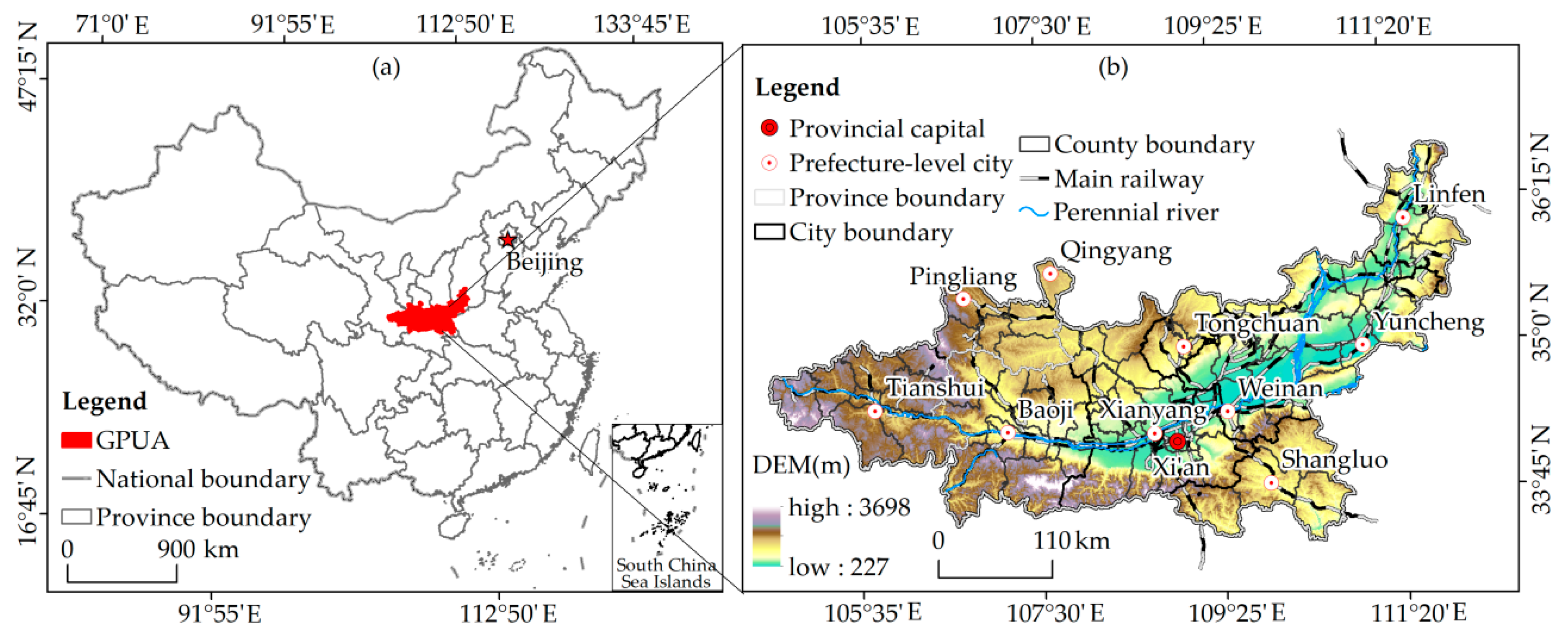
Figure 1. Geographical overview of the Guanzhong Plain Urban Agglomeration (GPUA): (a) location and (b) administrative divisions and elevation.
Land 15 00768 g001
Figure 2. Research framework for urban land expansion and landscape pattern dynamics.
Land 15 00768 g002
Figure 3. Changes in urban land expansion patterns of the GPUA.
Land 15 00768 g003
Figure 4. Changes in urban expansion patterns of cities in the GPUA.
Land 15 00768 g004
Figure 5. Changes in urban land expansion area of cities in the GPUA.
Land 15 00768 g005
Figure 7. Spatial distribution of Urban Expansion Rate Index (UERI) of cities in the GPUA.
Land 15 00768 g007
Figure 8. Changes in the Urban Expansion Intensity Index (UEII) of cities in the GPUA.
Land 15 00768 g008
Figure 9. Spatial distribution of Urban Expansion Intensity Index (UEII) of cities in the GPUA.
Land 15 00768 g009
Figure 10. Changes in Landscape Pattern Metrics (LPMs) of urban land in the GPUA from 1990 to 2020. Notes: (a). Number of Patches (NP), (b). Largest Patch Index (LPI), (c). Landscape Shape Index (LSI), (d). Aggregation Index (AI).
Land 15 00768 g010
Figure 11. Changes in urban land LPMs of cities in the GPUA from 1990 to 2020: (a) NP, (b) LPI, (c) LSI and (d) AI. Notes: To better visualize curve variations, NP and LPI values were plotted on a log-scaled axes.
Land 15 00768 g011
Figure 12. The q-values of Key Driving Factors for Urban Land Expansion in the GPUA, 1990–2020.
Land 15 00768 g012
Figure 13. The q-values of Key Driving Factors for Landscape Pattern Changes in the GPUA, 1990–2020.
Land 15 00768 g013
Table 1. Landscape pattern metrics and their relationships with urban land expansion.
Landscape Pattern MetricEcological MeaningRelationship with Urban Land Expansion
Number of Patches (NP)The total count of patches of a specific landscape type.Reflects the spatial fragmentation of urban land. A higher NP value indicates a more dispersed distribution of construction land and a higher degree of landscape fragmentation.
Largest Patch Index (LPI)The proportion of the area covered by the largest patch to the total landscape area.Characterizes the spatial dominance of urban land. A larger LPI value suggests that urban expansion tends to form concentrated, contiguous dominant areas, indicating a more aggregated expansion mode.
Landscape Shape Index (LSI)The degree of deviation of a patch shape from a standard geometric shape of the same area.Reflects the complexity of urban land patch shapes. A higher LSI value indicates more irregular urban fringe morphology and higher complexity in the boundaries of spatial expansion.
Aggregation Index (AI)The degree of spatial adjacency among patches of the same typeCharacterizes the spatial aggregation and connectivity of urban land. A higher AI value indicates a higher degree of spatial clustering and better connectivity among construction land patches.
Note: the contents of this table are compiled based on references [40,43].
Table 2. Driving factors for spatial evolution and landscape pattern changes in GPUA.
DimensionVariable CodeIndicatorQuantification Method
Natural geographical conditionsX1Topographic reliefStandard deviation of elevation within municipal area (m)
X2SlopeAverage slope within municipal area (°)
X3Ecological constraint distanceMinimum distance to Qinling ecological red line (km)
Location accessibilityX4Central locationStraight-line distance to downtown Xi’an (km)
X5Transportation locationDistance to nearest highway exit (km)
Socioeconomic levelX6Population growth rateAnnual growth rate of resident population in municipal districts (%)
X7Economic growth rateAnnual growth rate of GDP in municipal districts (%)
X8Investment intensityAnnual growth rate of fixed asset investment in municipal districts (%)
Policy institutions X9Development intensityAnnual expansion rate of development zone area (%)
X10Ecological regulation intensityProportion of ecological protection red line area (%)
Table 3. Urban Land Scale and Expansion Dynamics of the GPUA, 1990–2020.
YearUrban Land Area(km2)Proportion of Urban Land to the GPUA Area (%)PeriodExpanded Urban Land Area (km2)Urban Expansion Rate Index (UERI) (%)Urban Expansion Intensity Index (UEII) (%)
1990528.350.491990–2000154.682.930.0145
2000683.030.642000–2010356.035.210.0333
20101039.060.972010–2020198.841.910.0186
20201237.901.161990–2020709.554.480.0221
Table 4. LEI Values of Cities in the GPUA from 1990 to 2020.
CitiesLEI (Expansion Mode), 1990–2000LEI (Expansion Mode), 2000–2010LEI (Expansion Mode), 2010–2020
Xi’an0.36 (edge)0.17 (edge)0.26 (edge)
Xianyang0.54 (infilling)0.44 (edge)0.27 (edge)
Baoji0.65 (infilling)0.47 (edge)0.42 (edge)
Linfen0.39 (edge)0.21 (edge)0.95 (infilling)
Pingliang0.46 (edge)0.31 (edge)0.34 (edge)
Qingyang0.44 (edge)0.19 (edge)0.28 (edge)
Shangluo0.75 (infilling)0.33 (edge)0.93 (infilling)
Tianshui0.63 (infilling)0.43 (edge)0.36 (edge)
Tongchuan0.50 (edge)0.67 (infilling)0.44 (edge)
Weinan0.32 (edge)0.51 (infilling)0.26 (edge)
Yuncheng0.29 (edge)0.25 (edge)0.64 (infilling)
Disclaimer/Publisher’s Note: The statements, opinions and data contained in all publications are solely those of the individual author(s) and contributor(s) and not of MDPI and/or the editor(s). MDPI and/or the editor(s) disclaim responsibility for any injury to people or property resulting from any ideas, methods, instructions or products referred to in the content.