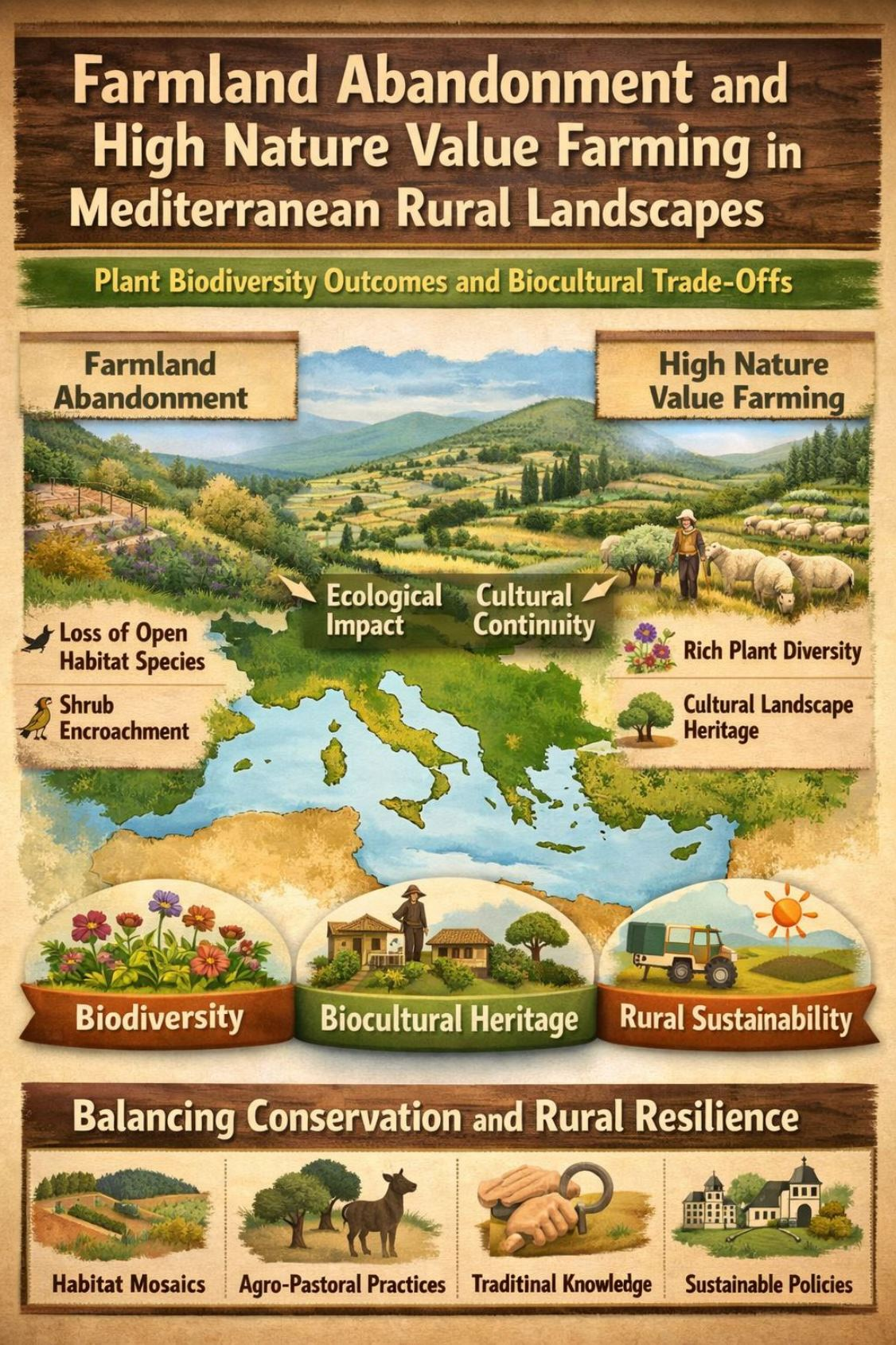
Farmland Abandonment and High Nature Value Farming in Mediterranean Landscapes: Plant Biodiversity Outcomes and Biocultural Trade-Offs


Abstract
1. Introduction
1.1. Mediterranean Rural Landscapes as Biocultural Systems
1.2. Historical Role of Low-Intensity Farming and Grazing in Maintaining Plant Biodiversity
1.3. Land-Use Transitions in the Mediterranean Basin
1.4. Ecological Implications for Plant Biodiversity
1.5. Knowledge Gaps in the Current Literature
1.6. Objectives and Review Questions
2. Materials and Methods
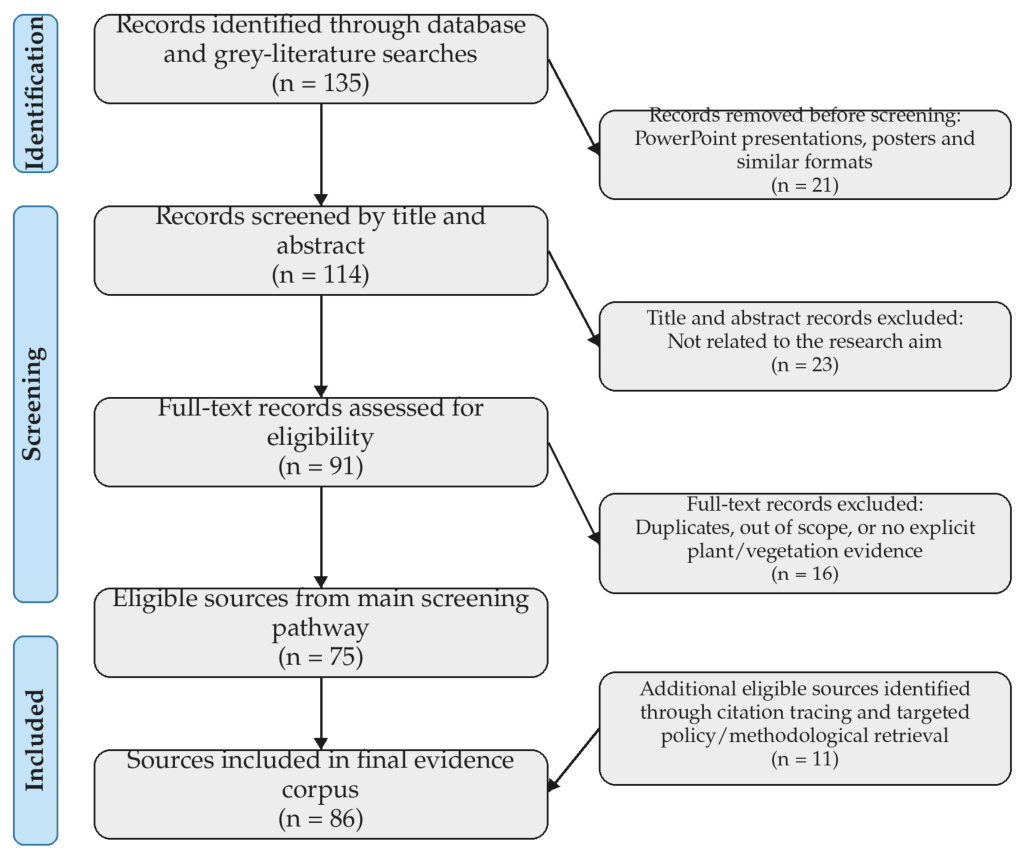
2.1. Search Strategy and Selection Criteria
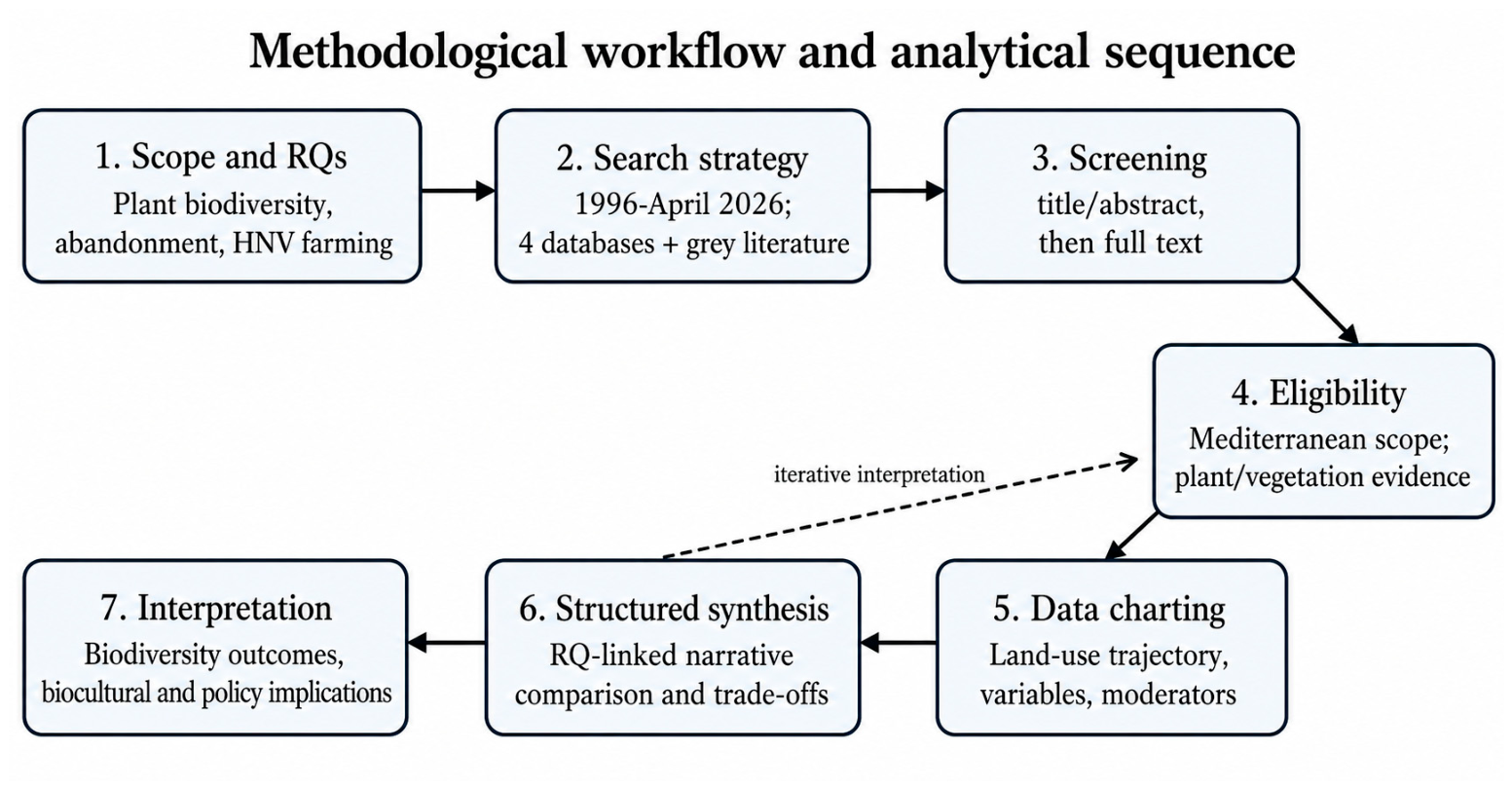
2.2. Thematic Framework and Data Charting


| Research Question | Main Analytical Focus | Data-Charting Fields | Synthesis Location |
|---|---|---|---|
| RQ1 | Abandonment effects on plant richness, diversity, composition, and succession. | Land-use history; time since abandonment; grazing cessation; richness; diversity indices; floristic composition; vegetation structure. | Section 3.3; Section 4.1. |
| RQ2 | HNV systems support plant diversity and floristic distinctiveness. | HNV system type; grazing regime; agro-pastoral mosaic structure; agroforestry attributes; indicator plants; habitat specialists. | Section 3.4; Section 4.3 and Section 4.5. |
| RQ3 | Moderators explaining divergent biodiversity responses. | Elevation; aridity; fire regime; landscape heterogeneity; connectivity; prior management intensity; grazing continuity. | Section 3.5. |
| RQ4 | Trade-offs between rewilding-oriented abandonment and biocultural landscape maintenance. | Ecosystem-service co-responses; biocultural values; policy instruments; livelihood viability; intensification risk. | Section 3.6; Section 4.2, Section 4.4 and Section 4.5. |
| Charting Category | Coding Basis | Descriptive Charting Result | Interpretation |
|---|---|---|---|
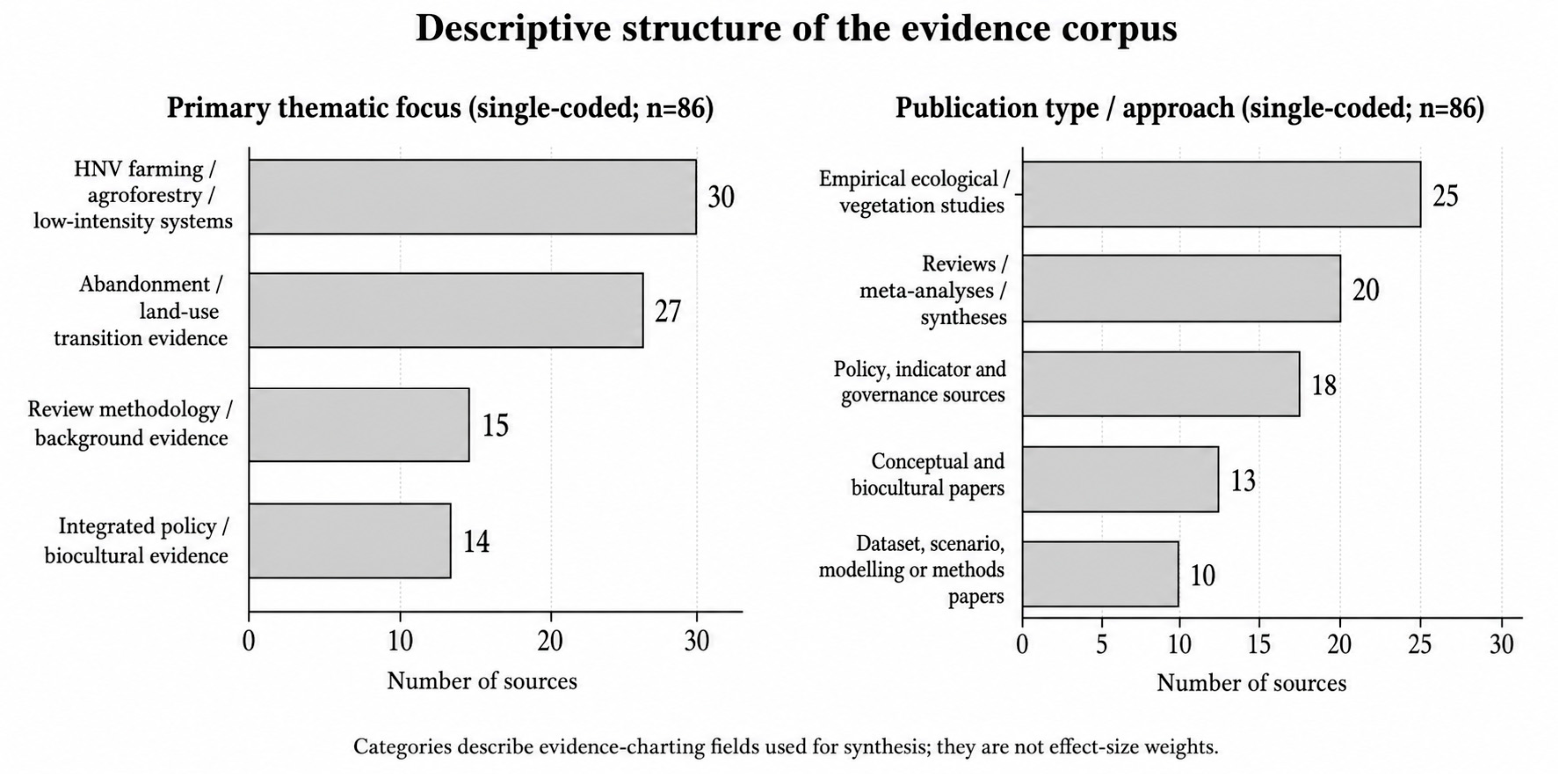
| Primary thematic focus | Single-coded; n = 86 | HNV farming/agroforestry/low-intensity systems = 30; farmland abandonment/land-use transition = 27; review methodology/general biodiversity/background evidence = 15; integrated policy/social-ecological/biocultural evidence = 14. | The corpus is balanced between abandonment and HNV farming evidence, with additional sources used for methods, policy interpretation, and biocultural framing. |
| Publication type or approach | Single-coded; n = 86 | Empirical ecological/vegetation studies = 25; reviews/meta-analyses/syntheses = 20; policy, indicator and governance sources = 18; conceptual/biocultural papers = 13; dataset/scenario/modelling or methods papers = 10. | The review integrates direct vegetation evidence with secondary syntheses, policy sources, and social-ecological interpretation. |
| Biodiversity and vegetation variables detected | Multi-coded | Species richness/diversity indices = 33; floristic composition/turnover/indicator species/habitat specialists = 29; vegetation structure/succession/shrub encroachment/woody recruitment = 31. | These variables separate total richness from compositional change and open-habitat specialist decline. |
| Management, ecosystem-process and policy variables detected | Multi-coded | Grazing/management intensity/HNV indicators/mosaic structure = 28; soil/carbon/hydrology/fire/erosion/ecosystem services = 24; biocultural values/governance/policy instruments/livelihood viability = 17. | These variables support the assessment of management mechanisms, trade-offs, and policy relevance. |
3. Results
3.1. General Structure of the Evidence Base
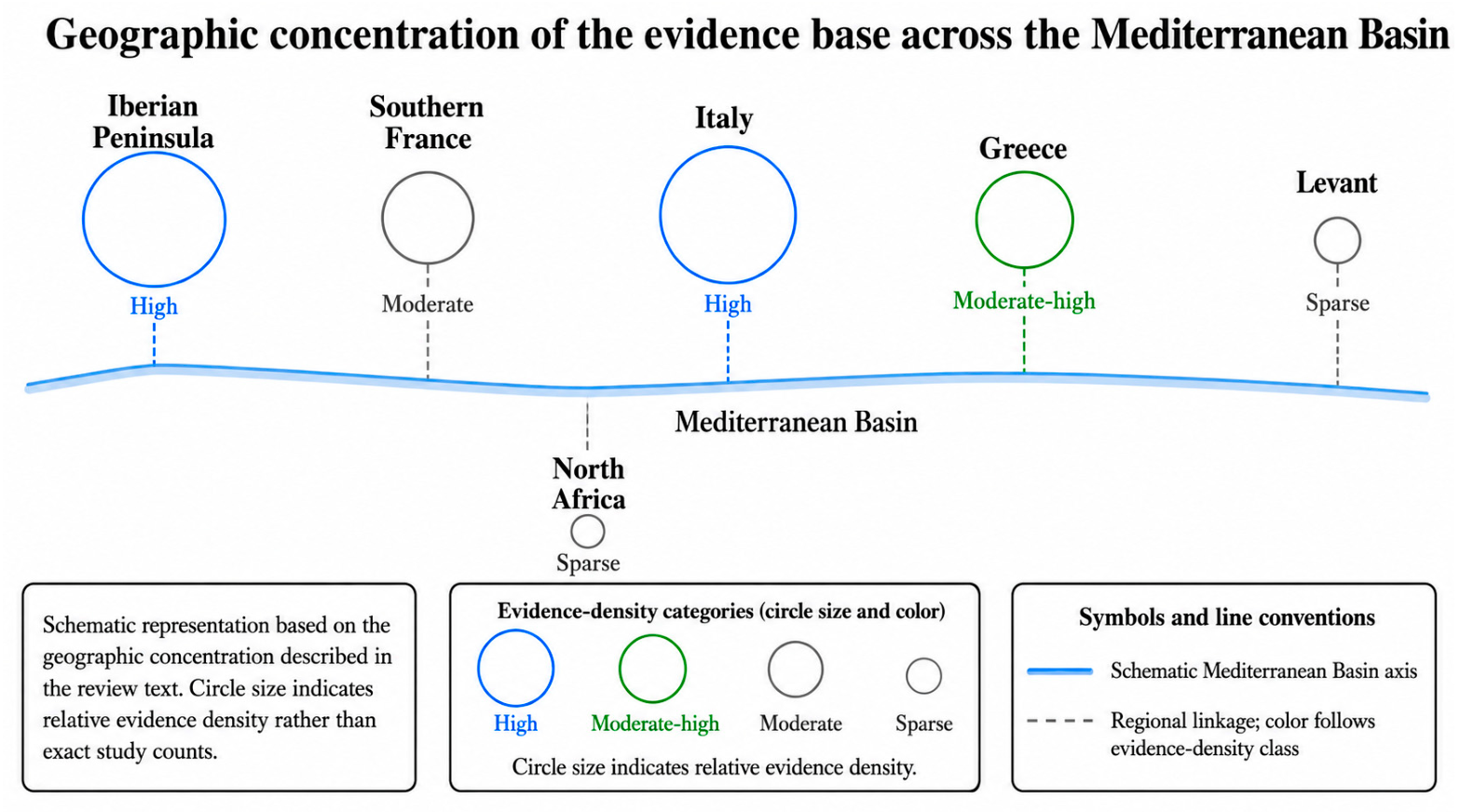
3.2. Geographic Distribution and Thematic Concentration
3.3. Effects of Farmland Abandonment on Plant Biodiversity
3.3.1. Short-Term Ecological Responses
3.3.2. Long-Term Succession Trajectories
3.3.3. Loss of Open-Habitat Specialists and Compositional Turnover
3.3.4. Soil and Ecosystem-Process Co-Responses
3.4. Biodiversity Outcomes Under High Nature Value Farming
3.4.1. Extensive Grazing Systems
3.4.2. Traditional Agro-Pastoral Mosaics
3.4.3. Mediterranean Agroforestry Systems
3.4.4. Indicator Plants, Habitat Specialists and Monitoring Implications
3.5. Moderating Factors
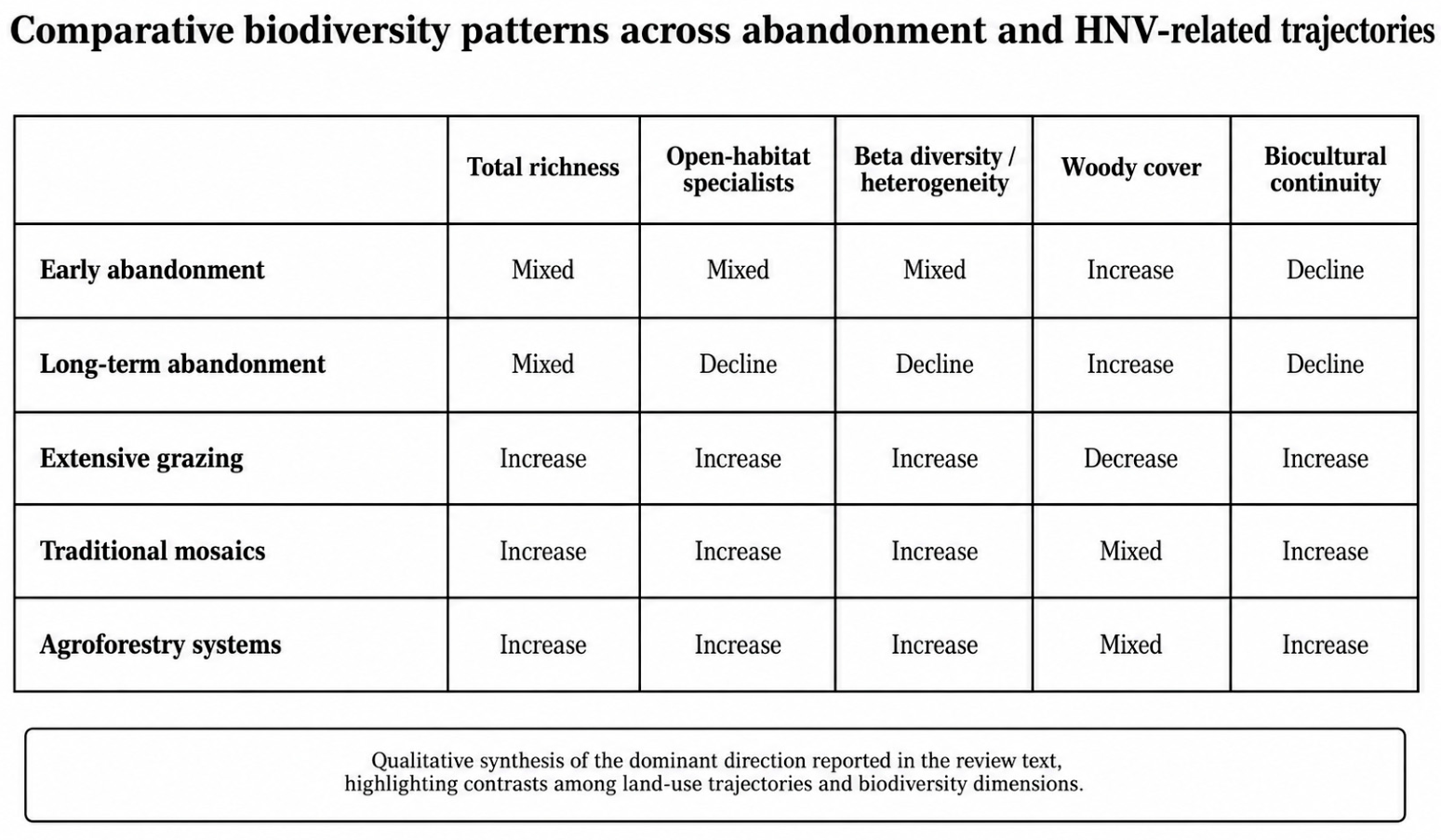
3.6. Comparative Patterns Across Abandonment and HNV Trajectories
4. Discussion
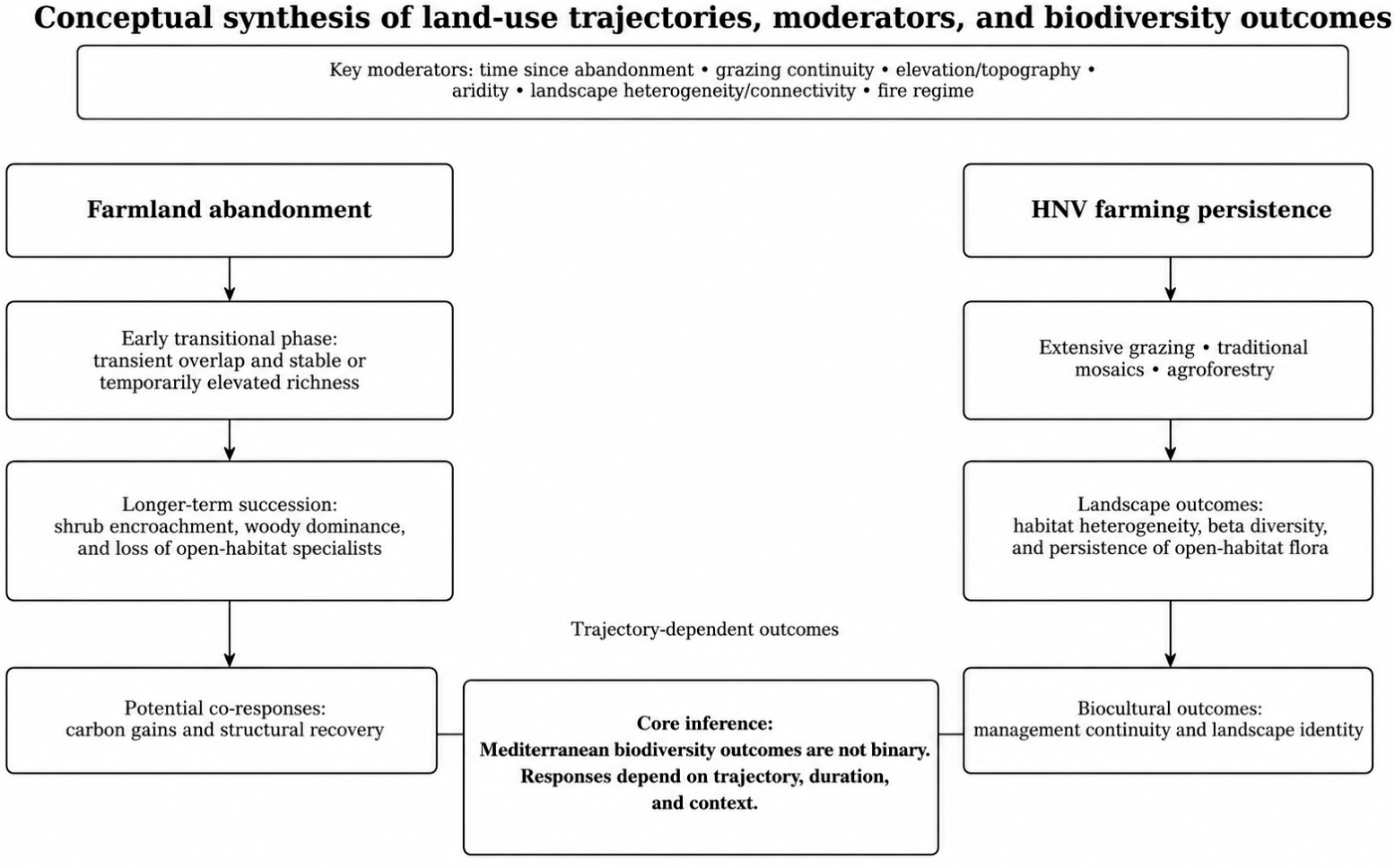
4.1. Reframing Abandonment as a Context-Dependent Biodiversity Process
4.2. Trade-Offs Between Rewilding and Cultural Landscapes
4.3. Implications for HNV Policy and Agri-Environment Governance
4.4. Agricultural Intensification as a Third Land-Use Trajectory
4.5. Implications for Biodiversity Conservation and Rural Planning
4.6. Research Gaps and Future Directions
5. Conclusions
Funding
Data Availability Statement
Acknowledgments
Conflicts of Interest
Abbreviations
| CAP | Common Agricultural Policy |
| HNV | High Nature Value |
| PRISMA | Preferred Reporting Items for Systematic Reviews and Meta-Analyses |
| PRISMA-ScR | Preferred Reporting Items for Systematic Reviews and Meta-Analyses Extension for Scoping Reviews |
References
- Myers, N.; Mittermeier, R.A.; Mittermeier, C.G.; da Fonseca, G.A.B.; Kent, J. Biodiversity hotspots for conservation priorities. Nature 2000, 403, 853–858. [Google Scholar] [CrossRef]
- Blondel, J.; Aronson, J.; Bodiou, J.-Y.; Boeuf, G. The Mediterranean Region: Biological Diversity in Space and Time, 2nd ed.; Oxford University Press: Oxford, UK, 2010. [Google Scholar]
- Grove, A.T.; Rackham, O. The Nature of Mediterranean Europe: An Ecological History; Yale University Press: New Haven, CT, USA, 2003. [Google Scholar]
- Antrop, M. Why landscapes of the past are important for the future. Landsc. Urban Plan. 2005, 70, 21–34. [Google Scholar] [CrossRef]
- Lindholm, K.-J.; Ekblom, A. A framework for exploring and managing biocultural heritage. Anthropocene 2019, 25, 100195. [Google Scholar] [CrossRef]
- Plieninger, T.; Abunnasr, Y.; D’Ambrosio, U.; Guo, T.; Kizos, T.; Kmoch, L.; Topp, E.; Varela, E. Biocultural conservation systems in the Mediterranean region: The role of values, rules, and knowledge. Sustain. Sci. 2023, 18, 823–838. [Google Scholar] [CrossRef]
- Bindi, L.; Conti, M.; Belliggiano, A. Sense of place, biocultural heritage, and sustainable knowledge and practices in three Italian rural regeneration processes. Sustainability 2022, 14, 4858. [Google Scholar] [CrossRef]
- Bignal, E.M.; McCracken, D.I. Low-intensity farming systems in the conservation of the countryside. J. Appl. Ecol. 1996, 33, 413–424. [Google Scholar] [CrossRef]
- Bignal, E.M.; McCracken, D.I. The nature conservation value of European traditional farming systems. Environ. Rev. 2000, 8, 149–171. [Google Scholar] [CrossRef]
- Halada, L.; Evans, D.; Romão, C.; Petersen, J.-E. Which habitats of European importance depend on agricultural practices? Biodivers. Conserv. 2011, 20, 2365–2378. [Google Scholar] [CrossRef]
- Bignal, E.M. Using an ecological understanding of farmland to reconcile nature conservation requirements, EU agriculture policy and world trade agreements. J. Appl. Ecol. 1998, 35, 949–954. [Google Scholar] [CrossRef]
- Joffre, R.; Rambal, S.; Ratte, J.-P. The dehesa system of southern Spain and Portugal as a natural ecosystem mimic. Agrofor. Syst. 1999, 45, 57–79. [Google Scholar] [CrossRef]
- Moreno, G.; Aviron, S.; Berg, S.; Crous-Duran, J.; França, A.; de Jalón, S.G.; Hartel, T.; Mirck, J.; Pantera, A.; Palma, J.H.N.; et al. Agroforestry systems of high nature and cultural value in Europe: Provision of commercial goods and other ecosystem services. Agrofor. Syst. 2018, 92, 877–891. [Google Scholar] [CrossRef]
- Bagella, S.; Filigheddu, R.; Caria, M.C.; Girlanda, M.; Roggero, P.P. Contrasting land uses in Mediterranean agro-silvo-pastoral systems generated patchy diversity patterns of vascular plants and below-ground microorganisms. Comptes Rendus Biol. 2014, 337, 717–724. [Google Scholar] [CrossRef] [PubMed]
- Bagella, S.; Caria, M.C.; Farris, E.; Rossetti, I.; Filigheddu, R. Traditional land uses enhanced plant biodiversity in a Mediterranean agro-silvo-pastoral system. Plant Biosyst. 2016, 150, 201–207. [Google Scholar] [CrossRef]
- Rodríguez-Rojo, M.P.; Roig, S.; López-Carrasco, C.; Redondo García, M.M.; Sánchez-Mata, D. Which factors favour biodiversity in Iberian dehesas? Sustainability 2022, 14, 2345. [Google Scholar] [CrossRef]
- Andersen, E.; Baldock, D.; Bennett, H.; Beaufoy, G.; Bignal, E.M.; Brouwer, F.; Elbersen, B.; Eiden, G.; Godeschalk, F.; Jones, G.; et al. Developing a High Nature Value Farmland Indicator; Report for the European Environment Agency; European Environment Agency: Copenhagen, Denmark, 2004. [Google Scholar]
- European Environment Agency. High Nature Value Farmland: Characteristics, Trends and Policy Challenges; EEA Report No. 1/2004; Office for Official Publications of the European Communities: Luxembourg, 2004. [Google Scholar]
- Paracchini, M.L.; Petersen, J.-E.; Hoogeveen, Y.; Bamps, C.; Burfield, I.; van Swaay, C. High Nature Value Farmland in Europe: An Estimate of the Distribution Patterns on the Basis of Land Cover and Biodiversity Data; EUR 23480 EN; Office for Official Publications of the European Communities: Luxembourg, 2008. [Google Scholar]
- Lomba, A.; Moreira, F.; Klimek, S.; Jongman, R.H.G.; Sullivan, C.; Moran, J.; Poux, X.; Honrado, J.P.; Pinto-Correia, T.; Plieninger, T.; et al. Back to the future: Rethinking the socioecological systems underlying High Nature Value farmlands. Front. Ecol. Environ. 2020, 18, 36–42. [Google Scholar] [CrossRef]
- MacDonald, D.; Crabtree, J.R.; Wiesinger, G.; Dax, T.; Stamou, N.; Fleury, P.; Gutiérrez Lazpita, J.; Gibon, A. Agricultural abandonment in mountain areas of Europe: Environmental consequences and policy response. J. Environ. Manag. 2000, 59, 47–69. [Google Scholar] [CrossRef]
- Ustaoglu, E.; Collier, M.J. Farmland abandonment in Europe: An overview of drivers, consequences, and assessment of the sustainability implications. Environ. Rev. 2018, 26, 396–416. [Google Scholar] [CrossRef]
- Levers, C.; Schneider, M.; Prishchepov, A.V.; Estel, S.; Kuemmerle, T. Spatial variation in determinants of agricultural land abandonment in Europe. Sci. Total Environ. 2018, 644, 95–111. [Google Scholar] [CrossRef]
- Terres, J.-M.; Nisini, L.; Anguiano, E. Farmland abandonment in Europe: Identification of drivers and indicators, and development of a composite indicator of risk. Land Use Policy 2015, 49, 20–34. [Google Scholar] [CrossRef]
- Lasanta, T.; Arnáez, J.; Pascual, N.; Ruiz-Flaño, P.; Errea, M.P.; Lana-Renault, N. Space–time process and drivers of land abandonment in Europe. Catena 2017, 149, 810–823. [Google Scholar] [CrossRef]
- Rey Benayas, J.M.; Martins, A.; Nicolau, J.M.; Schulz, J.J. Abandonment of agricultural land: An overview of drivers and consequences. CAB Rev. 2007, 2, 1–14. [Google Scholar] [CrossRef]
- Munroe, D.K.; van Berkel, D.B.; Verburg, P.H.; Olson, J.L. Alternative trajectories of land abandonment: Causes, consequences and research challenges. Curr. Opin. Environ. Sustain. 2013, 5, 471–476. [Google Scholar] [CrossRef]
- Lasanta, T.; Nadal-Romero, E.; Arnáez, J. Managing abandoned farmland to control the impact of re-vegetation on the environment. The state of the art in Europe. Environ. Sci. Policy 2015, 52, 99–109. [Google Scholar] [CrossRef]
- García-Ruiz, J.M.; Lana-Renault, N. Hydrological and erosive consequences of farmland abandonment in Europe, with special reference to the Mediterranean region—A review. Agric. Ecosyst. Environ. 2011, 140, 317–338. [Google Scholar] [CrossRef]
- Lomba, A.; Alves, P.; Jongman, R.H.G.; McCracken, D.I. Reconciling nature conservation and traditional farming practices: A spatially explicit framework to assess the extent of High Nature Value farmlands in the European countryside. Ecol. Evol. 2015, 5, 1031–1044. [Google Scholar] [CrossRef]
- Lomba, A.; Strohbach, M.; Jerrentrup, J.S.; Dauber, J.; Klimek, S.; McCracken, D.I. Making the best of both worlds: Can high-resolution agricultural administrative data support the assessment of High Nature Value farmlands across Europe? Ecol. Indic. 2017, 72, 118–130. [Google Scholar] [CrossRef]
- Varela, E.; Jay, M.; Flinzberger, L.; Mobarak, C.; Plieninger, T. A review of high nature value farming systems in Europe: Biodiversity, ecosystem services, drivers, innovations and future prospects. People Nat. 2025, 7, e70048. [Google Scholar] [CrossRef]
- Plieninger, T.; Hui, C.; Gaertner, M.; Huntsinger, L. The impact of land abandonment on species richness and abundance in the Mediterranean Basin: A meta-analysis. PLoS ONE 2014, 9, e98355. [Google Scholar] [CrossRef] [PubMed]
- van der Zanden, E.H.; Verburg, P.H.; Schulp, C.J.E.; Verkerk, P.J. Trade-offs of European agricultural abandonment. Land Use Policy 2017, 62, 290–301. [Google Scholar] [CrossRef]
- Quintas-Soriano, C.; Buerkert, A.; Plieninger, T. Effects of land abandonment on nature contributions to people and good quality of life components in the Mediterranean region: A review. Land Use Policy 2022, 116, 106053. [Google Scholar] [CrossRef]
- Debussche, M.; Escarré, J.; Lepart, J.; Houssard, C.; Lavorel, S. Changes in Mediterranean plant succession: Old-fields revisited. J. Veg. Sci. 1996, 7, 519–526. [Google Scholar] [CrossRef]
- Bonet, A. Secondary succession of semi-arid Mediterranean old-fields in south-eastern Spain: Insights for conservation and restoration of degraded lands. J. Arid Environ. 2004, 56, 213–233. [Google Scholar] [CrossRef]
- Lesschen, J.P.; Cammeraat, L.H.; Nieman, T.; Cerli, C. Development of spatial heterogeneity in vegetation and soil properties after land abandonment in a semi-arid ecosystem. J. Arid Environ. 2008, 72, 2082–2092. [Google Scholar] [CrossRef]
- Molina, J.A.; Martín-Sanz, J.P.; Valverde-Asenjo, I.; Sánchez-Jiménez, A.; Moya, D.; Quintana, J.R. Mediterranean grassland succession as an indicator of changes in ecosystem biodiversity and functionality. Biodivers. Conserv. 2023, 32, 95–118. [Google Scholar] [CrossRef]
- Peco, B.; Sánchez, A.M.; Azcárate, F.M. Abandonment in grazing systems: Consequences for vegetation and soil. Agric. Ecosyst. Environ. 2006, 113, 284–294. [Google Scholar] [CrossRef]
- Peco, B.; Carmona, C.P.; de Pablos, I.; Azcárate, F.M. Effects of grazing abandonment on functional and taxonomic diversity of Mediterranean grasslands. Agric. Ecosyst. Environ. 2012, 152, 27–32. [Google Scholar] [CrossRef]
- Carmona, C.P.; Azcárate, F.M.; de Bello, F.; Ollero, H.S.; Lepš, J.; Peco, B. Taxonomical and functional diversity turnover in Mediterranean grasslands: Interactions between grazing, habitat type and rainfall. J. Appl. Ecol. 2012, 49, 1084–1093. [Google Scholar] [CrossRef]
- Tardella, F.M.; Catorci, A. Context-dependent effects of abandonment vs. grazing on functional composition and diversity of sub-Mediterranean grasslands. Community Ecol. 2015, 16, 254–266. [Google Scholar] [CrossRef][Green Version]
- Uchida, K.; Ushimaru, A. Biodiversity declines due to abandonment and intensification of agricultural lands: Patterns and mechanisms. Ecol. Monogr. 2014, 84, 637–658. [Google Scholar] [CrossRef]
- Hempel, S.; Herzog, F.; Batáry, P.; Öckinger, E.; Knop, E. The impact of abandonment and intensification on the biodiversity of agriculturally marginal grasslands: A systematic review. Basic Appl. Ecol. 2025, 88, 9–18. [Google Scholar] [CrossRef]
- Plieninger, T.; Flinzberger, L.; Hetman, M.; Horstmannshoff, I.; Reinhard-Kolempas, M.; Topp, E.; Moreno, G.; Huntsinger, L. Dehesas as high nature value farming systems: A social-ecological synthesis of drivers, pressures, state, impacts, and responses. Ecol. Soc. 2021, 26, 23. [Google Scholar] [CrossRef]
- Buchadas, A.; Tocco, C.; Mulas, M.; Marrosu, G.M.; Rega, C.; Bagella, S. Assessing the potential delivery of ecosystem services by farmlands under contrasting management intensities. Ecol. Soc. 2022, 27, 5. [Google Scholar] [CrossRef]
- Dalpasso, A.; Ficetola, G.F.; Calvi, G.; Costanzo, A.; Falaschi, M.; Polidori, C.; Rubolini, D.; Brambilla, M. High nature value farmlands to identify crucial agroecosystems for multi-taxa conservation. Biol. Conserv. 2025, 305, 111094. [Google Scholar] [CrossRef]
- Tsiftsis, S.; Mastrogianni, A.; Kiziridis, D.A.; Xystrakis, F.; Pleniou, M.; Tsiripidis, I. Land-Use Changes Largely Determine the Trajectory of Plant Species Distributions under Climatic Uncertainty in a Mediterranean Landscape. Land 2025, 14, 1438. [Google Scholar] [CrossRef]
- Benedetti, Y. Trends in High Nature Value farmland studies: A systematic review. Eur. J. Ecol. 2017, 3, 19–32. [Google Scholar] [CrossRef]
- Quintas-Soriano, C.; Torralba, M.; García-Martín, M.; Plieninger, T. Narratives of land abandonment in a biocultural landscape of Spain. Reg. Environ. Change 2023, 23, 144. [Google Scholar] [CrossRef]
- Navarro, L.M.; Pereira, H.M. Rewilding abandoned landscapes in Europe. Ecosystems 2012, 15, 900–912. [Google Scholar] [CrossRef]
- Otero, I.; Boada, M.; Tàbara, J.D. Land abandonment, landscape, and biodiversity: Questioning the restorative character of the forest transition in the Mediterranean. Ecol. Soc. 2015, 20, 7. [Google Scholar] [CrossRef]
- Pe’er, G.; Finn, J.A.; Díaz, M.; Birkenstock, M.; Lakner, S.; Röder, N.; Kazakova, Y.; Šumrada, T.; Bezák, P.; Concepción, E.D.; et al. How can the European Common Agricultural Policy help halt biodiversity loss? Recommendations by over 300 experts. Conserv. Lett. 2022, 15, e12901. [Google Scholar] [CrossRef]
- Moran, J.; Sullivan, C.A.; McCracken, D.I. Management of high nature value farmland in the Republic of Ireland: 25 years evolving toward locally adapted results-orientated solutions and payments. Ecol. Soc. 2021, 26, 20. [Google Scholar] [CrossRef]
- Bernard, B.; Ficko, A.; Hinojosa, L.; Moreno, G.; Varela, E.; Hartel, T.; Sutcliffe, L.M.E.; Plieninger, T. Innovation brokers in High Nature Value farming areas: A strategic approach to engage effective socioeconomic and agroecological dynamics. Ecol. Soc. 2023, 28, 20. [Google Scholar] [CrossRef]
- Page, M.J.; McKenzie, J.E.; Bossuyt, P.M.; Boutron, I.; Hoffmann, T.C.; Mulrow, C.D.; Shamseer, L.; Tetzlaff, J.M.; Akl, E.A.; Brennan, S.E.; et al. The PRISMA 2020 statement: An updated guideline for reporting systematic reviews. BMJ 2021, 372, n71. [Google Scholar] [CrossRef] [PubMed]
- Moher, D.; Liberati, A.; Tetzlaff, J.; Altman, D.G.; PRISMA Group. Preferred reporting items for systematic reviews and meta-analyses: The PRISMA statement. PLoS Med. 2009, 6, e1000097. [Google Scholar] [CrossRef]
- Tricco, A.C.; Lillie, E.; Zarin, W.; O’Brien, K.K.; Colquhoun, H.; Levac, D.; Moher, D.; Peters, M.D.J.; Horsley, T.; Weeks, L.; et al. PRISMA extension for scoping reviews (PRISMA-ScR): Checklist and explanation. Ann. Intern. Med. 2018, 169, 467–473. [Google Scholar] [CrossRef]
- Arksey, H.; O’Malley, L. Scoping studies: Towards a methodological framework. Int. J. Soc. Res. Methodol. 2005, 8, 19–32. [Google Scholar] [CrossRef]
- Levac, D.; Colquhoun, H.; O’Brien, K.K. Scoping studies: Advancing the methodology. Implement. Sci. 2010, 5, 69. [Google Scholar] [CrossRef]
- Peters, M.D.J.; Marnie, C.; Tricco, A.C.; Pollock, D.; Munn, Z.; Alexander, L.; McInerney, P.; Godfrey, C.M.; Khalil, H. Updated methodological guidance for the conduct of scoping reviews. JBI Evid. Synth. 2020, 18, 2119–2126. [Google Scholar] [CrossRef]
- Pollock, D.; Peters, M.D.J.; Khalil, H.; McInerney, P.; Alexander, L.; Tricco, A.C.; Munn, Z. Recommendations for the extraction, analysis, and presentation of results in scoping reviews. JBI Evid. Synth. 2023, 21, 520–532. [Google Scholar] [CrossRef]
- Subedi, Y.R.; Kristiansen, P.; Cacho, O. Drivers and consequences of agricultural land abandonment and its reutilisation pathways: A systematic review. Environ. Dev. 2022, 42, 100681. [Google Scholar] [CrossRef]
- Ostermann, O.P. The need for management of nature conservation sites designated under Natura 2000. J. Appl. Ecol. 1998, 35, 968–973. [Google Scholar] [CrossRef]
- Nadal-Romero, E.; Cammeraat, E.; Serrano-Muela, P.; Lana-Renault, N.; Regüés, D. How do soil organic carbon stocks change after cropland abandonment in Mediterranean humid mountain areas? Sci. Total Environ. 2016, 566–567, 741–752. [Google Scholar] [CrossRef]
- Bell, S.M.; Barriocanal, C.; Terrer, C.; Rosell-Melé, A. Soil organic carbon accumulation rates on Mediterranean abandoned agricultural lands. Sci. Total Environ. 2021, 759, 143535. [Google Scholar] [CrossRef]
- Sullivan, C.; Finn, J.; Ó hÚallacháin, D.; Green, S.; Matin, S.; Meredith, D.; Clifford, B.; Moran, J. The development of a national typology for High Nature Value farmland in Ireland based on farm-scale characteristics. Land Use Policy 2017, 67, 401–414. [Google Scholar] [CrossRef]
- Ferraz-de-Oliveira, M.I.; Bernués, A.; Rodrigues, M.; Salez-Baptista, E.; Varela, E.; Peco, B.; Moreno, G.; Herrera, P.M.; Lecegui, A.; Bach, H.; et al. Scenarios for the future of High Nature Value farming systems in Europe. Ecol. Soc. 2022, 27, 39. [Google Scholar] [CrossRef]
- Almeida, M.; Azeda, C.; Guiomar, N.; Pinto-Correia, T. The effects of grazing management in montado fragmentation and heterogeneity. Agrofor. Syst. 2016, 90, 69–85. [Google Scholar] [CrossRef]
- Sales-Baptista, E.; Cancela d’Abreu, M.; Ferraz-de-Oliveira, M.I. Overgrazing in the montado? The need for monitoring grazing pressure at paddock scale. Agrofor. Syst. 2016, 90, 57–68. [Google Scholar] [CrossRef]
- Verdinelli, M.; Pittarello, M.; Caria, M.C.; Piga, G.; Roggero, P.P.; Marrosu, G.M.; Arrizza, S.; Fadda, M.L.; Lombardi, G.; Lonati, M.; et al. Congruent responses of vascular plant and ant communities to pastoral land-use abandonment in mountain areas throughout different biogeographic regions. Ecol. Process. 2022, 11, 35. [Google Scholar] [CrossRef]
- Bell, S.M.; Barriocanal, C.; Terrer, C.; Rosell-Melé, A. Management opportunities for soil carbon sequestration following agricultural land abandonment. Environ. Sci. Policy 2020, 108, 104–111. [Google Scholar] [CrossRef]
- Padilla, F.M.; Vidal, B.; Sánchez, J.; Pugnaire, F.I. Land-use changes and carbon sequestration through the twentieth century in a Mediterranean mountain ecosystem: Implications for land management. J. Environ. Manag. 2010, 91, 2688–2695. [Google Scholar] [CrossRef]
- Novara, A.; Gristina, L.; Rühl, J.; Pasta, S.; D’Angelo, G.; La Mantia, T.; Pereira, P. Agricultural land abandonment in Mediterranean environment provides ecosystem services via soil carbon sequestration. Sci. Total Environ. 2017, 576, 420–429. [Google Scholar] [CrossRef]
- Robledano-Aymerich, F.; Martínez-Fernández, J.; Esteve-Selma, M.A.; Calvo, J.F. Ecogeomorphological consequences of land abandonment in semiarid Mediterranean areas: Integrated assessment of physical evolution and biodiversity. Agric. Ecosyst. Environ. 2014, 197, 222–242. [Google Scholar] [CrossRef]
- Hidalgo-Galvez, M.D.; Matías, L.; Cambrollé, J.; Gutiérrez, J.M.; Pérez-Ramos, I.M. Impact of climate change on pasture quality in Mediterranean dehesas subjected to different grazing histories. Plant Soil 2023, 488, 465–483. [Google Scholar] [CrossRef]
- Lecegui, A.; Olaizola, A.; Varela, E. Disentangling the role of management practices on ecosystem services delivery in Mediterranean silvopastoral systems: Synergies and trade-offs through expert-based assessment. For. Ecol. Manag. 2022, 517, 120273. [Google Scholar] [CrossRef]
- Varela, E.; Pulido, F.; Moreno, G.; Zavala, M.Á. Unravelling opportunities, synergies, and barriers for enhancing silvopastoralism in the Mediterranean. Land Use Policy 2022, 118, 106140. [Google Scholar] [CrossRef]
- López-Sánchez, A.; San Miguel, A.; Dirzo, R.; Roig, S. Scattered trees and livestock grazing as keystone structures for sustainable use and conservation of Mediterranean dehesas. J. Nat. Conserv. 2016, 33, 58–67. [Google Scholar] [CrossRef]
- Plieninger, T. Compatibility of livestock grazing with stand regeneration in Mediterranean holm oak parklands. J. Nat. Conserv. 2007, 15, 1–9. [Google Scholar] [CrossRef]
- Gardi, C.; Visioli, G.; Conti, F.D.; Scotti, M.; Menta, C.; Bodini, A. High Nature Value Farmland: Assessment of soil organic carbon in Europe. Front. Environ. Sci. 2016, 4, 47. [Google Scholar] [CrossRef]
- Torres-Miralles, M.; Jeanneret, P.; Lamminen, M.; Joly, F.; Dumont, B.; Tuomisto, H.; Herzon, I. High nature value farming systems in Europe: A dataset encompassing the environmental impact assessment of farms and extensive ruminant food products. Data Brief 2025, 58, 111164. [Google Scholar] [CrossRef]
- Varela, E.; Pulido, F.; Moreno, G.; Zavala, M.Á. Targeted policy proposals for managing spontaneous forest expansion in the Mediterranean. J. Appl. Ecol. 2020, 57, 2373–2380. [Google Scholar] [CrossRef]
- Baur, I.; Nax, H.H. Measures against the abandonment of common property summer pastures: Experimental evidence from joint appropriation–provision games. Ecol. Soc. 2021, 26, 4. [Google Scholar] [CrossRef]
- Lomba, A.; McCracken, D.I.; Herzon, I. Editorial: High Nature Value farming systems in Europe. Ecol. Soc. 2023, 28, 20. [Google Scholar] [CrossRef]




Disclaimer/Publisher’s Note: The statements, opinions and data contained in all publications are solely those of the individual author(s) and contributor(s) and not of MDPI and/or the editor(s). MDPI and/or the editor(s) disclaim responsibility for any injury to people or property resulting from any ideas, methods, instructions or products referred to in the content. |
© 2026 by the author. Licensee MDPI, Basel, Switzerland. This article is an open access article distributed under the terms and conditions of the Creative Commons Attribution (CC BY) license.
Share and Cite
Solomou, A.D. Farmland Abandonment and High Nature Value Farming in Mediterranean Landscapes: Plant Biodiversity Outcomes and Biocultural Trade-Offs. Land 2026, 15, 793. https://doi.org/10.3390/land15050793
Solomou AD. Farmland Abandonment and High Nature Value Farming in Mediterranean Landscapes: Plant Biodiversity Outcomes and Biocultural Trade-Offs. Land. 2026; 15(5):793. https://doi.org/10.3390/land15050793
Chicago/Turabian StyleSolomou, Alexandra D. 2026. "Farmland Abandonment and High Nature Value Farming in Mediterranean Landscapes: Plant Biodiversity Outcomes and Biocultural Trade-Offs" Land 15, no. 5: 793. https://doi.org/10.3390/land15050793
APA StyleSolomou, A. D. (2026). Farmland Abandonment and High Nature Value Farming in Mediterranean Landscapes: Plant Biodiversity Outcomes and Biocultural Trade-Offs. Land, 15(5), 793. https://doi.org/10.3390/land15050793