Article

Sustainable Third Places in Historic Urban Landscapes: Multi-Dimensional Assessment of Nakhon Si Thammarat, Thailand


by
Wirut Thinnakorn
,
Pittida Chotikachorntham
*,
Jantanee Bejrananda
and
Supawadee Chaupram
School of Architecture and Design, Walailak University, Nakhon Si Thammarat 80160, Thailand
*
Author to whom correspondence should be addressed.
Land 2026, 15(5), 792; https://doi.org/10.3390/land15050792
Submission received: 20 March 2026 / Revised: 4 May 2026 / Accepted: 5 May 2026 / Published: 8 May 2026
(This article belongs to the Section Urban Contexts and Urban-Rural Interactions)

Abstract

Historic urban landscapes (HULs) represent complex environments where contemporary daily life interacts with living heritage. This study focuses on “third places,” informal social spaces outside home and work, as critical infrastructure for urban resilience. Addressing the lack of multidimensional assessments in Southeast Asian heritage contexts, this study develops and applies a context-sensitive assessment framework that integrates the HUL approach with four sustainability pillars: physical, environmental, socio-cultural, and governance–economic. Nakhon Si Thammarat was selected as a representative case study of a multicultural living heritage town where Buddhist, Muslim, and Chinese cultural layers uniquely converge within its urban fabric. Through field surveys and spatial mapping, 17 sites were empirically identified based on Oldenburg’s characteristics and evaluated via a structured rubric. Findings reveal a significant systemic imbalance: while the socio-cultural dimension is highly sustainable (M = 2.44), driven by robust cultural diversity, the environmental (M = 1.03) and governance–economic (M = 1.38) dimensions are considerably weaker. Key deficiencies include poor low-carbon accessibility and limited community participation. Notably, religious courtyards emerged as effective “living heritage” prototypes (M = 2.04), bridging sacred and secular functions. The study suggests that historic urban management should prioritize micro-scale environmental retrofitting and co-management models, leveraging existing social capital rather than wholesale urban restructuring. This flexible framework is transferable to other multicultural historic towns in the region with comparable contextual conditions.

1. Introduction

The concept of third places, as defined by Oldenburg (1989), refers to informal public spaces that people use in their daily lives outside of the home (first place) and the workplace (second place) [1]. These third places create informal interactions, build social capital, and strengthen a sense of community belonging, enhancing a bond of community [1]. A review of the literature exposes that research on third places over the past decade indicates that third places play a vital role in social infrastructure, helping to strengthen communities, reduce social isolation, and enhance the well-being of the elderly, children, and minorities [2,3]. Goosen and Cilliers (2020) indicated that the third place could enhance social sustainability through social capital, neighborly interactions, and a sense of community belonging [4]. The rapid urbanization in Southeast Asian historic towns poses a significant threat to traditional third places, often leading to their physical decay or functional displacement [5]. Current management strategies frequently fail because they overlook the complex interplay between physical heritage and social vitality [6,7]. Without a multidimensional assessment tool, urban planners risk making one-sided decisions that preserve physical structures while inadvertently destroying the social fabric that makes these places sustainable [1,8]. However, research on third places primarily focuses on spatial aspects in modern cities in Western countries, with an emphasis on social dimensions, while neglecting other dimensions of urban sustainability, including physical, environmental, cultural, governance, and economic dimensions. To address this limitation, this study adopts a multidimensional understanding of sustainability (covering physical, environmental, socio-cultural, and governance–economic pillars), which is further operationalized in Section 3. By moving beyond a singular focus, the study provides a more holistic assessment of how third places function within the complexities of historic urban landscapes. These dimensions are all essential components of sustainability. Furthermore, third places in historic towns, with their specific physical structures, cultural rituals, lifestyles, beliefs, and informal governance patterns of common spaces, have received limited scholarly attention. This is despite the fact that these historic towns have been facing pressures from urban expansion, climate change, and the mismanagement of tourism [9].
On the contrary, the Historic Urban Landscape (HUL) approach, endorsed by UNESCO in 2011 as an integrated framework viewing historic towns as multi-layered landscapes of tangible and intangible natural and cultural values, emphasizes the integration of heritage conservation with social, economic, and environmental goals [6]. This approach suggests opportunities to study the third place as an integral component of the living historic urban landscape. This has led some research to expand the scope of third-place theory into cultural and environmental sustainability dimensions, such as the studies of Al Shami et al. (2024), which has expanded the scope of the third place to cultural and environmental aspects by exploring the role of the third place in promoting cultural dialog and community identity [10], and Purnamasari et al. (2025), which has linked the characteristics of the third place with environmental sustainability criteria [11]. However, these studies still focus only on certain dimensions, and there is no comprehensive assessment framework that encompasses all dimensions of sustainability for the third place in historic towns specifically. This underlines the current lack of an empirical assessment framework that links third-place theory with the concept of sustainability across multiple dimensions in the context of heritage towns.
While existing heritage assessment studies often prioritize physical conservation or economic tourism potential [12,13] and sustainability frameworks typically focus on broad urban scales [7], this study seeks to contribute to the current discourse by exploring the integration of the ‘third place’ sociological concept within the HUL framework [6,14]. A central focus of this study is to shift the emphasis from primarily static heritage values toward a more nuanced understanding of the functional and social vitality within ‘living heritage’ spaces [15]. This multidimensional approach aims to offer complementary insights into how social interactions are supported by and, in turn, contribute to the resilience of the physical and environmental layers in a historic town [7,16].
Therefore, this research aims to (I) develop a comprehensive framework for assessing the sustainability of third places across multiple dimensions, including physical, environmental, socio-cultural, and governance–economic aspects; and (II) apply the framework to the third places identified in the historic town district of Nakhon Si Thammarat, Thailand, a city with a history spanning over 1200 years. There is a confluence of Thai Buddhist, Thai Muslim, and Chinese–Thai cultures, and it remains a living heritage city. This research aims to bridge an existing gap in the literature by proposing a sustainability assessment framework that integrates third-place theory with the HUL approach, thereby enhancing opportunities to apply the framework to other historic towns in Southeast Asia with similar multicultural characteristics. The main contribution lies in proposing and empirically testing an applied, context-sensitive assessment framework for third places in a historic town, rather than in advancing a new theoretical model of third places or HULs.
This study is structured as follows: Section 2 provides a comprehensive literature review on the conceptual frameworks of third places and the historic urban landscape (HUL). Section 3 describes the research methodology, including the case study selection and the development of the multidimensional assessment rubric. Section 4 presents the evaluation results for the 17 selected third-place sites in Nakhon Si Thammarat. Section 5 discusses the key findings and provides recommendations for future urban heritage management. Section 7 presents the conclusions, and finally, Section 8 acknowledges the study limitations.

2. Literature Review

2.1. Concept and Core Significances of Third Places

Third places constitute informal environments that are accessible and situated beyond the confines of the home and workplace. These places support daily social interactions and cultivate a sense of belonging, serving as a core element of urban social infrastructure that promotes sustainability [1,2,17]. From the literature review, the concept of third place was introduced by the sociologist Ray Oldenburg, who described third places as “anchors” of community life—venues where people meet familiar faces and form new friendships [14]. These places, such as coffee shops, bars, libraries, and community centers, are defined more by social activities than by physical design, with gatherings occurring voluntarily and regularly in an informal setting that go beyond formal or transactional roles [1]. According to Oldenburg (1989), third places’ interpretations have been framed as “pure sociability”, where interaction is pursued for the enjoyment of everyday life and the temporary suspension of status hierarchies [1,18]. In this context, third places function as “everyday public spheres”, where people participate in informal conversations and social exchanges, separate from the structured environments of formal institutions or organized groups [14].
The Great Good Place (1989) examines third places as distinct from home and the workplace, indicating that they are places people must visit [1]. This place possesses the following eight characteristics [1,2,17,19]:
  • Neutral ground: A primary feature that facilitates voluntary participation devoid of territorial claims or time pressures, thereby promoting egalitarian interactions regardless of social status.
  • Leveler: This equality is expressed as social integration, where socioeconomic differences are inconsistent.
  • Conversation: Casual conversation is the main activity, with supplementary activities regarded as secondary.
  • Accessibility and accommodation: The third place must be located within walking distance and be eligible for frequent visits.
  • Regulars: The presence of regular visitors who anchor the place’s identity, welcoming newcomers. And to perpetuate continuity.
  • Low profile: Maintaining an unassuming image, avoiding ostentation and luxury, but emphasizing simplicity and friendliness that encourages people to spend more time there without feeling intimidated.
  • Playful mood: An atmosphere characterized by enjoyment and friendliness, with spontaneous laughter and merriment that enhance psychological comfort.
  • Home away from home: A second home atmosphere, fostering a deep sense of belonging, like the security and safety of a home.
Furthermore, Waxman (2006) and Rhubart et al. (2022) have shown that places with these characteristics can foster social capital and community cohesion more effectively than formal areas [19,20]. For this reason, this study adopts the eight characteristics as a framework for evaluating which areas of the case study are considered third places.
However, the conceptualization of third places in Southeast Asian historic towns requires a careful rethinking of the strictly secular definitions prevalent in Western urban theory. Western informal social spaces such as cafés, bars, pubs, and community squares emphasize voluntary association, a playful atmosphere, and conversation among strangers, embodying Oldenburg’s ideals of neutrality, social leveling, and non-hierarchical interaction [14]. In contrast, Southeast Asian public spaces, particularly temple compounds (wat) and ritual grounds, operate as sacred–profaned hybrids in which religious practice, merit-making, and community life are deeply intertwined [21]. Despite these differences, both types of spaces function as social anchors that foster belonging, informal support networks, and a “home away from home” through high accessibility and inclusivity beyond the home and workplace [1,16]. In historic Thai towns such as Nakhon Si Thammarat, temples therefore serve as multidimensional platforms where religious praxis catalyzes informal social interaction and bridges social divides, thereby embodying the functional essence of a third place within a distinct cultural morphology [5,22].

2.2. Extending the Concept of the Third Place from Sociology to Sustainable Cities

UNESCO endorsed the Recommendation on the Historic Urban Landscape (HUL) in 2011 as a global policy framework for the conservation of urban heritage, integrating it with the Sustainable Development Goals [6]. The HUL approach defines the historic urban landscape as ‘the urban area as the result of the overlapping historical values and characteristics, both cultural and natural.’ This also broadens the scope of conservation beyond monuments and physical structures to encompass wider dimensions, including the built environment, spatial structures, and natural features, as well as social practices, cultural processes, economic activities, and intangible aspects of heritage related to diversity and identity [6]. Furthermore, it emphasizes the importance of public spaces such as streets, markets, temple courtyards, mosques, and libraries, which serve as ‘multicultural public spaces’ that accommodate both residents and provide venues for daily life activities, where social interactions occur collectively [23]. Particularly in Thailand, where physical spaces are intertwined with intangible cultural heritage that coexist in ways that are difficult to separate, these areas are referred to as ‘third places,’ which help make diversity ‘real’ through shared experiences rather than merely being policies on paper. This aligns with modern conceptions of historic towns, where third places act as mediators between tangible cultural heritage and social practices in everyday life, helping preserve the identity of places and communities and ensuring it is maintained and passed down through generations.
Similarly, many studies on cultural sustainability indicate that the third place embedded within these heritage cities is not merely a remnant of memory but a vital infrastructural element [10]. Similarly, many third places are in historic districts, such as ancient markets, town squares, cafés in old neighborhoods, or historic parks, which are the main structures of the “historic urban landscape” [6]. For example, cafés in Vienna and bistros in the historic districts of France serve as spaces that foster community, friendliness, and the continuity of ‘life on the street’, which is at the heart of historic European cities [15].
Furthermore, other contemporary studies indicate that the third place contributes to social sustainability by serving as a “social glue” that responds to the decline in digital interactions, such as community bonds and informal information centers. Moreover, in a multicultural town, the third place facilitates the development of both bonding social capital within groups and bridging social capital across groups by leveraging weak ties among individuals from different backgrounds who repeatedly use the same space [24]. For example, the article “Bridging Social Capital in third Places” highlights that, despite gentrification in some third places, this process facilitates connections between existing residents and new arrivals, thereby reducing social divisions [18]. Likewise, Yahya and Wood (2017) identified third places as spaces that affirm self-identity and support empathy for other identities, opening opportunities to meet people from diverse cultures and backgrounds and stimulating cross-cultural learning [25]. In this context, the third place in historic towns acts as a junction where tangible heritage, local cultural practices, and social interactions converge, contributing to the long-term resilience and livability of the towns.
From an economic perspective, Littman (2021) proposed a model in which the third place serves as a component of resilience through the combined mechanisms of social capital and the psychological sense of community [18]. Jeffres et al. (2009) found that communities with frequently used third places tend to report higher levels of quality of life, neighborhood attachment, and civic well-being [26].
Recent scholarly efforts have begun to move beyond a purely social focus to address the multifaceted nature of third places in diverse contexts. For instance, Al Shami et al. (2024) expanded the scope to include cultural and environmental dimensions, exploring how these spaces promote cultural dialog and strengthen community identity [10]. Similarly, Purnamasari et al. (2025) attempted to link specific characteristics of third places with broader environmental sustainability criteria [11]. While these studies signify a crucial shift toward a more comprehensive understanding, they often remain focused on isolated dimensions. In the complex setting of a living historic town, these dimensions cannot be evaluated as separate entities; rather, they function as an integrated whole. This highlights a persistent gap: the lack of an empirical assessment framework that holistically links third-place theory to all sustainability, physical, environmental, socio-cultural, and governance–economic dimensions and is specifically tailored for the historic urban landscape.
Building on this identified gap, this study asserts that social sustainability in heritage contexts remains precarious without the integrated support of physical, environmental, and governance pillars. Within a HUL framework, physical integrity is more than an esthetic concern; it is a prerequisite for the very social interactions described above. Likewise, environmental comfort and robust governance are essential to mitigate the pressures of urbanization and tourism. Consequently, this study argues that expanding the assessment beyond a purely social dimension is not only beneficial but necessary to capture the complex interdependencies among the layers that define a multicultural living heritage city such as Nakhon Si Thammarat.

3. Materials and Methods

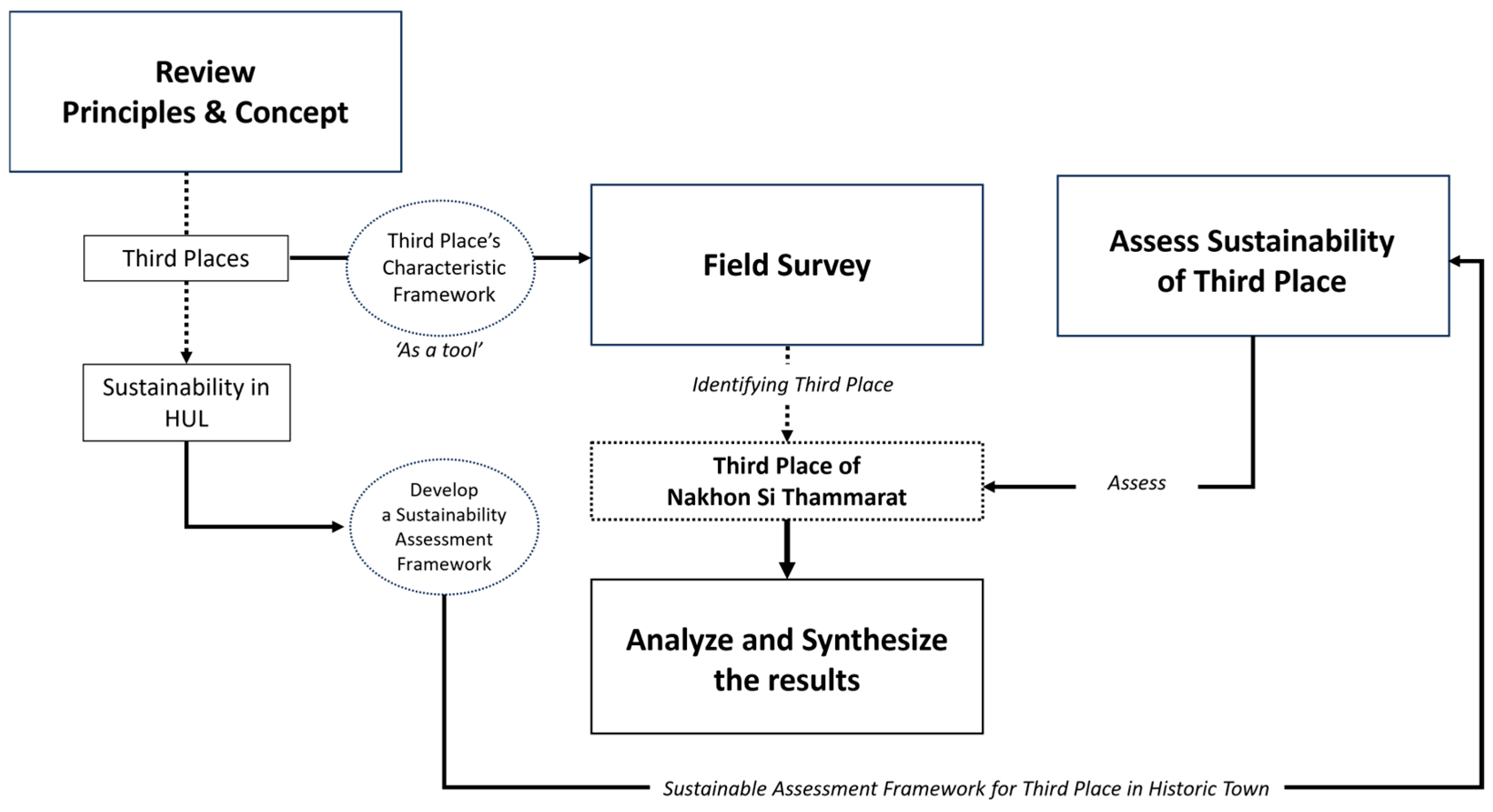
To achieve the research objectives of developing a framework for evaluating the sustainability of third places within historic towns and applying this framework to propose approaches that promote urban conservation and development based on the concept of sustainable cities, this study comprises six main steps (Figure 1).
  • Review the principles and concepts of the third place and sustainable cities to create a theoretical framework and define a practical definition of the sustainable third place within the context of a historic town.
  • Conduct a field survey of the case study to identify the location, identities, activities, and physical and intangible characteristics of the actual third places, following the criteria of the third-place characteristics framework adopted by Ray Oldenburg’s concept.
  • Develop a framework for assessing the sustainability of the third place, identify indicators, and establish evaluation criteria.
  • Pilot the assessment of the sustainability of third places in the Nakhon Si Thammarat historic town case study to analyze the strengths, weaknesses, and sustainability levels of third places.
  • Analyze and compare to identify factors influencing the level of sustainability of the third place and obstacles hindering the sustainability of the historic town.
  • Synthesize the results to present strategic approaches for the conservation and development of third places within a sustainable city.

3.1. Conceptual Framework

Third Places of the Historic Town of Nakhon Si Thammarat, Thailand

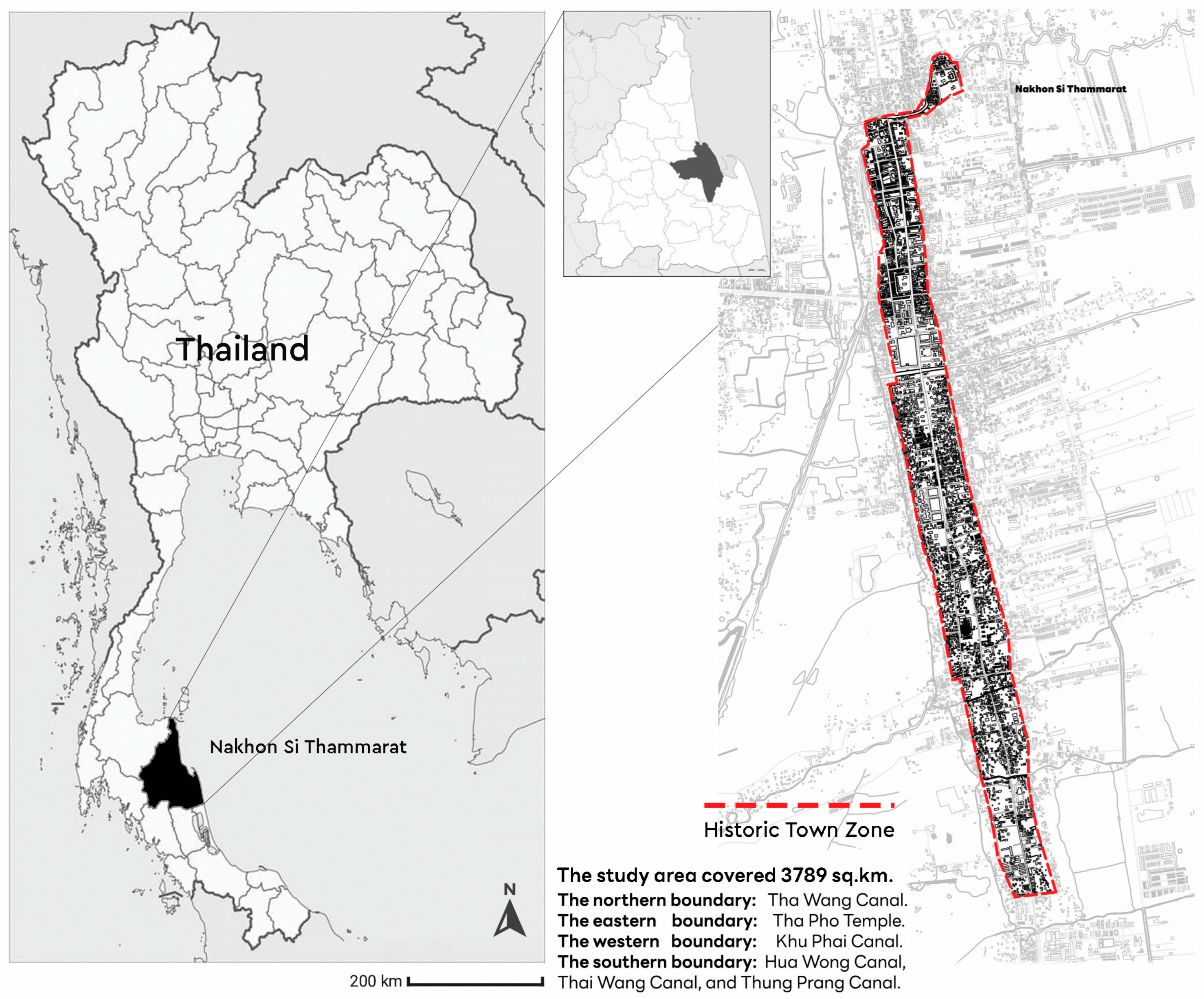
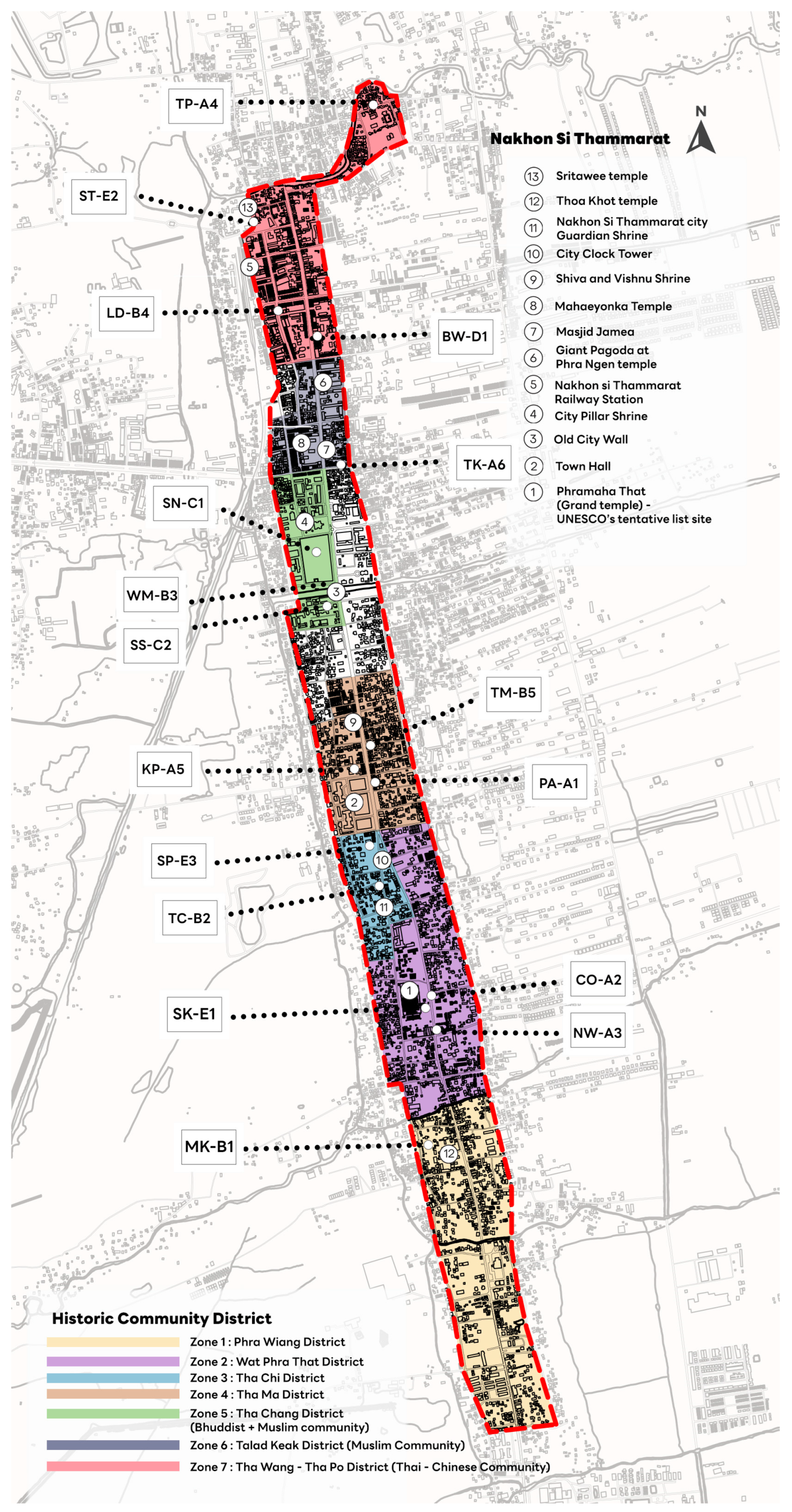
Nakhon Si Thammarat, a historic town, has a long history spanning four eras: Tambra Linga, Ayutthaya, Thon Buri, and Rattanakosin [27]. Its culture is deeply rooted in a mix of Buddhist and Brahman beliefs, and later Muslim and Chinese communities emerged, which continue to influence the town’s culture and traditions to this day. In the context of social space, the third place in the historic town of Nakhon Si Thammarat is a community area in daily life that acts as a bridge between the old town’s structure and modern community life. It also functions as a gathering spot where people come together to talk, participate in activities, and take part in informal cultural ceremonies. This aligns with Oldenburg’s idea of a third place as a ‘true public space’ [28]. This study defines a third place using the eight characteristics adopted by Ray Oldenburg [1]. The framework provides a basis for identifying which areas within the historic town of Nakhon Si Thammarat (Case study; Figure 2) have the traits of a third place. The field survey was conducted through systematic site observations across the historic district, covering the old community zones shown in Figure 3. Each potential site was examined in relation to its physical setting, accessibility, user presence, everyday activities, and intangible social characteristics, with particular attention given to the eight defining characteristics of a third place proposed by Oldenburg. Field notes and photo documentation were recorded for each site to support subsequent classification and comparison.
A site was included as a third place when repeated field observations confirmed that it functioned as an informal gathering space beyond home and work and exhibited a sufficient combination of Oldenburg’s characteristics, such as neutrality, accessibility, regular use, conversation, and a home-away-from-home atmosphere. The final set of 17 sites, therefore, emerged from empirical identification in the field rather than from a predetermined sampling quota. From the survey, 17 sites were identified as third places, and these can be grouped into five categories based on their physical features (Table 1).
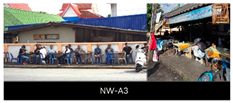
  • Community coffeehouses, teahouses, and cafés serve as informal venues for conversations or meetings. Typically situated in historic town buildings or along historic streets, these locations foster social interaction. Field surveys in the case study area identified six sites, labeled as third places: PA-A1, CO-A2, NW-A3, TP-A4, KP-A5, and TK-A6.
  • Traditional markets include open-air and indoor markets that historically functioned as centers for trade, social gathering, and exchanges within communities or neighborhoods. Field surveys in the case study area identified five sites, labeled as third places: MK-B1, TC-B2, WM-B3, LD-B4, and TM-B5.
  • Historic parks and promenades are public green areas or waterfront walkways designated for shared use. They serve as sites for leisure, relaxation, or hosting events, festivals, and ceremonies. This group includes two sites: SN-C1 and SS-C2.
  • Cultural centers and guildhalls are historic buildings; The third place in this group has been adapted for exhibitions, art, performances, and community activities. They often serve as the center of the community. Only one site in this group was identified: BW-D1.
  • Religious courtyards and temple grounds: There are spaces such as temple yards, churches, mosques, plazas, or adjacent gardens, which in the past served both spiritual and community functions. Three sites were identified: SK-E1, ST-E2, and SP-E3.

3.2. The Third Place Under the Concept of Sustainability in Historic Towns

To address the multidimensionality of sustainability in historic towns, this study operationalizes the theoretical synthesis established in Section 2 into a concrete assessment framework. The framework transitions from abstract concepts to empirical measurement by categorizing the sustainability of third places into four integrated pillars: physical, environmental, socio-cultural, and governance–economic.
  • Physical Dimension: This refers to spatial arrangement, accessibility, safety, and comfort for people by creating connected networks that can be walked through and have flexible boundaries to support daily activities [6,29]. It highlights the integration of new functions into the existing streetscape and heritage buildings without impacting the original town’s character form.
  • Environmental Dimension: This refers to the promotion of a lifestyle that emphasizes accessibility, including low-carbon transportation and responsiveness to climate conditions, such as walking, cycling, and green spaces providing shade. These measures create outdoor environments with comfortable temperatures, intended to reduce reliance on air-conditioned areas [4,11].
  • Socio-Cultural Dimension: This considers the third place as an informal social infrastructure that promotes social capital, interactions among neighbors, and a sense of community belonging [4,25,30]. It is defined as a cultural infrastructure in which activities, memories, and local stories are transmitted and transformed into a ‘living’ space rather than merely a static backdrop [31,32], thereby emphasizing a sense of ownership and the continuity of local identity.
  • Governance–Economic Dimension: This refers to participatory management, including decision-making, community-led oversight of the area, and economic vitality rooted in the local context, such as small businesses and community-driven projects [4,6].
The selection of specific indicators for each pillar was guided by the need to capture the interdependency between the historic urban fabric and contemporary use. Rather than treating these dimensions as separate categories, they are evaluated as interconnected layers that contribute to the site’s overall resilience [6,10]. To minimize subjectivity, a structured rubric with explicit behavioral descriptors for each level (0–3) was developed (Table 2, ensuring that each score corresponds to observable conditions. Each indicator was translated into this standardized scoring rubric as shown in the following table [8] (Table 2).
To ensure reliability and minimize researcher bias, the assessment was conducted through a triangulation approach, incorporating site observations, photo documentation, and cross-verification by three researchers [33,34]. This multi-source and multi-investigator triangulation ensures the validity of the findings and mitigates subjectivity. Discrepancies in scoring were discussed and reconciled through consensus to ensure inter-rater reliability [35].
Furthermore, this study employs equal weighting for all indicators, as both the HUL approach and the overarching concept of sustainability advocate for a balanced, holistic consideration across all dimensions [6,36]. By assigning equal weight to each pillar, this research ensures a comprehensive assessment in which the physical, environmental, socio-cultural, and governance dimensions are treated as interdependent and equally vital to urban resilience [7,15].
This structured approach enables the qualitative characteristics of Nakhon Si Thammarat’s historic district to be converted into quantifiable data, facilitating comparative analysis across the 17 selected sites. The detailed indicators are presented in Table 3.
All indicators listed in Table 3 were operationalized using this 0–3 scale, and site-level scores for each dimension were calculated as the arithmetic mean of the corresponding indicator scores.

4. Results

Based on the field survey in the case study area, 17 sites were found to exhibit characteristics consistent with third places according to Ray Oldenburg’s conceptual framework. These third places identified in the survey are located across seven old community districts within the historic town of Nakhon Si Thammarat (Figure 3), including:
Zone 1. In Phra Wiang District one site was identified: MK-B1.
Zone 2. In Wat Phra That District four sites were identified: CO-A2, NW-A3, and SK-E1.
Zone 3. In Tha Chi District two sites were identified: TC-B2 and SP-E3.
Zone 4. In Tha Ma District three sites were identified: PA-A1, TM-B5, and KP-A5.
Zone 5. In Tha Chang District three sites were identified: SN-C1, SS-C2, and WM-B3.
Zone 6. In Talad Khaek District one site was identified: TK-A6.
Zone 7. In Tha Wang-Tha Pho District four sites were identified: BW-D1, LD-B4, TP-A4, and ST-E2.
Moreover, the third places category within the group of community coffeehouses, teahouses, and cafés comprises the largest number of sites, with six. The traditional markets group includes five sites. The group of historic parks and promenades contains two sites. The fourth group, which encompasses cultural centers and guildhalls, has the fewest samples, with merely one site. Lastly, the fifth group, comprising religious courtyards and temple grounds, includes three sites. Each category has distinct contextual features that can be summarized in two main points.

4.1. The Intensity of Third-Place Characteristics

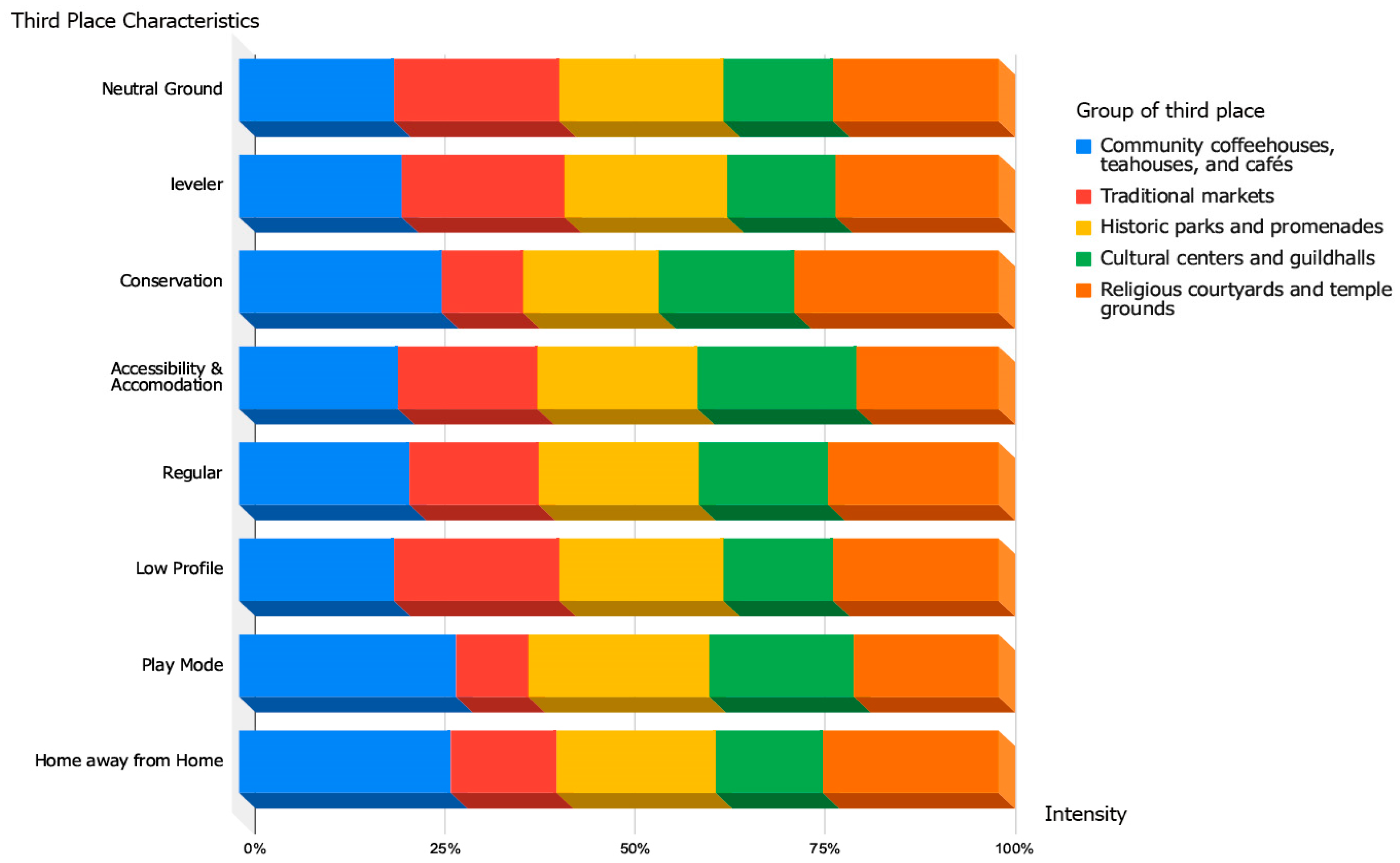
Overall, the third places within the group of community coffeehouses, teahouses, and cafes consistently demonstrate a high level of intensity in third-place characteristics, particularly in neutral ground, leveler, conversation, accessibility and accommodation, low profile, and playfulness. These third places are typically situated along sidewalks, street corners, or near important urban nodes, government offices, and religious sites. Such locations facilitate a relaxed environment where individuals can engage in informal interactions without haste. Similarly, the third places in the traditional markets group also exhibit the characteristics of a highly intense third place, with a clearly defined place due to the overlap of economic activities and the ongoing encounters between vendors and local people. The historic parks and promenades, as well as religious courtyards and temple grounds, score highly in accessibility, informal recreation, and ritual use, reinforcing their role as urban-level stages for both formal events and spontaneous gatherings. Conversely, some sites characterized by a more formal design, such as the KP-A5 and the renovated historic building BW-D1, still retain essential characteristics of third place. The findings indicate that the intensity of the third places in the mentioned historic town is determined not by the type of place or its reconfiguration, but by the degree of flexibility in use and social permeability (Figure 4).

4.2. Socio-Spatial Configurations and Everyday Practices of Third Places

Based on a comprehensive analysis across various contexts, including location, physical, intangible, and activities, the evidence revealed that third places are often located on crucial “spatial boundaries,” such as temple perimeters, old city walls, Thai–Chinese commercial districts, and areas near historic parks. These places merge sacred, commercial, and residential areas together. Physically, the spatial forms are different from permanent, fixed structures as they are instead stalls, temporary markets, and foldable seating, demonstrating a highly flexible spatial infrastructure adaptable to changing uses over time. The intangible dimensions reflect the role of the third place as the ‘city’s living room’, ‘the center of community storytelling’, ‘a buffer zone between sacred spaces and residential areas’, and ‘stages for interreligious and cultural dialog’, thereby laying the long-term foundations of social and cultural capital.
In terms of activities, each third place accommodates multiple functions simultaneously, such as interaction, conversation, exchange, recreation, exercise, ritual participation, and diverse group activities. These often overlap between ‘daily life’ and ‘urban rituals and festivals’. The overlapping activities within these places, along with their perforated, flexible physical forms and symbolic meanings and their diverse functions, make the historic town’s third place a socio-cultural infrastructure that supports cross-group interactions across age, religion, and social status in urban life.

4.3. Sustainability Assessment of the Third Place in Nakhon Si Thammarat Historic Town

There are four dimensions for evaluating the sustainability of the 17 third places in Nakhon Si Thammarat historic town: physical, environmental, socio-cultural, and governance–economic. This systematic assessment was conducted as detailed in the scoring rubric in Section 3.2. and the assessment is based on the predefined indicators within each dimension, as detailed in Table 3. The scoring criteria for the third-place sustainability level are shown in Table 4, and the results for third-place assessments in each dimension are summarized in Table 5.

4.3.1. Dimension Level

The sustainability assessment of the 17 third places in the historic town of Nakhon Si Thammarat covers four dimensions. The results are presented as follows.
  • Physical Dimension: The result has an average score of M = 1.90 (SD = 0.54), which is classified as Moderately Sustainable. This dimension was identified as the indicator for visibility and openness, which scored the highest (M = 2.12), particularly among traditional markets, historic parks and promenades, and religious courtyards and temple grounds. These areas feature physical spaces that are openly visible, helping reduce risk, enhance natural surveillance, and facilitate informal social monitoring. Meanwhile, the indicator for walkability and accessibility remains at a moderate level (M = 1.71), indicating that although many third places are open and conducive to natural surveillance, connections to pedestrian networks, bicycle lanes, and public transportation remain limited and require further development.
  • Environmental Dimension: The assessment results show greater inconsistencies in this dimension than in others. Specifically, several third places, which are embedded in the groups of historic parks and promenades, and religious courtyards and temple grounds, scored highly on indicators related to green spaces and shade, owing to the presence of large trees and microclimate elements conducive to daily use at various times. Conversely, commercial areas such as groups of community coffeehouses, teahouses, and cafés located on narrow streets or in densely built-up neighborhoods have limited green and shaded elements, resulting in moderate or low environmental comfort, especially during hot weather. Additionally, the environmental dimension received the lowest average scores across all dimensions (M = 1.03, SD = 0.60), particularly on the low-carbon access indicator, which had an average score of only M = 0.88, categorized as ‘Low Sustainability’ and a significant limitation on the proportion of users accessing the areas by walking, cycling, or public transport. This is related to the physical dimension.
  • Socio-Cultural Dimension: The assessment results indicate that this dimension is among the strongest in the third places within Nakhon Si Thammarat historic town, which received the highest average score (M = 2.44, SD = 0.23), indicating ‘High Sustainability’. The highest-scoring indicators, in order, were cultural diversity (M = 2.94), social interaction frequency (M = 2.88), and local culture practices (M = 2.82). This suggests that the third place continues to function as a robust social and cultural infrastructure. Qualitative evidence supports this, with the presence of ‘regulars’ and many areas being described as ‘the city’s living room’, ‘the community’s storytelling hub’, or ‘a buffer zone between sacred spaces and residential areas’. This reflects the perception that people view these spaces as extensions of community identity rather than merely neutral public spaces. Furthermore, the third place within the historic town of Nakhon Si Thammarat also demonstrates its potential to support a diverse range of local cultural activities. Empirical evidence shows that many of these areas accommodate both daily rituals and traditions, such as morning tea ceremonies, making merit, and almsgiving. At the same time, the third place serves as a venue for festivals, processions, and religious ceremonies that are uniquely characteristic of Nakhon Si Thammarat. These activities are not merely ‘events’ occurring in open spaces; rather, the places themselves hold significant historical and symbolic meaning, closely linking contemporary life with ritual pathways, temples, and the old market streets. Additionally, several third places connect Thai Buddhist, Thai Muslim, and Thai–Chinese communities through trade and everyday conversations, thereby creating a “visible diversity” of cultural users and practices that aligns with the cultural diversity indicator in the assessment framework.
  • Governance–Economic Dimension: The assessment result has an average score of M = 1.38 (SD = 0.49), reflecting ‘Moderate Sustainability.’ Traditional markets and community cafes notably bolster local economic vitality by supporting small-scale entrepreneurs and preserving local labor skills, thereby enhancing the district’s economic resilience.
However, ‘Community Participation in Management’ ranked lowest (M = 0.94), revealing a systemic gap in inclusive decision-making. Significant disparities in participatory governance exist across typologies; for instance, MK-B1 (traditional market) achieved the highest score (3.00) due to its long-standing, community-led management model, governed by local stakeholders with direct interests in its preservation. In contrast, SN-C1 (historic park) relies on top-down municipal administration, where centralized decision-making limits bottom-up engagement. This suggests that in this historical context, economic and social reliance drives participatory governance more effectively than purely recreational utility does.
Furthermore, religious courtyards (e.g., WP-A1) exhibit a distinctive ‘faith-based hybrid governance’ model. These spaces maintain high sustainability through co-management involving the monastic community and lay committees. Functioning as ‘sacred community commons’ rather than mere public assets, these courtyards serve as informal economic hubs for traditional artisans and vendors. Here, social responsibility is intrinsically motivated by religious merit-making rather than formal administrative mandates, ensuring resilience through deep-rooted cultural connections.

4.3.2. Third Place’s Group Level

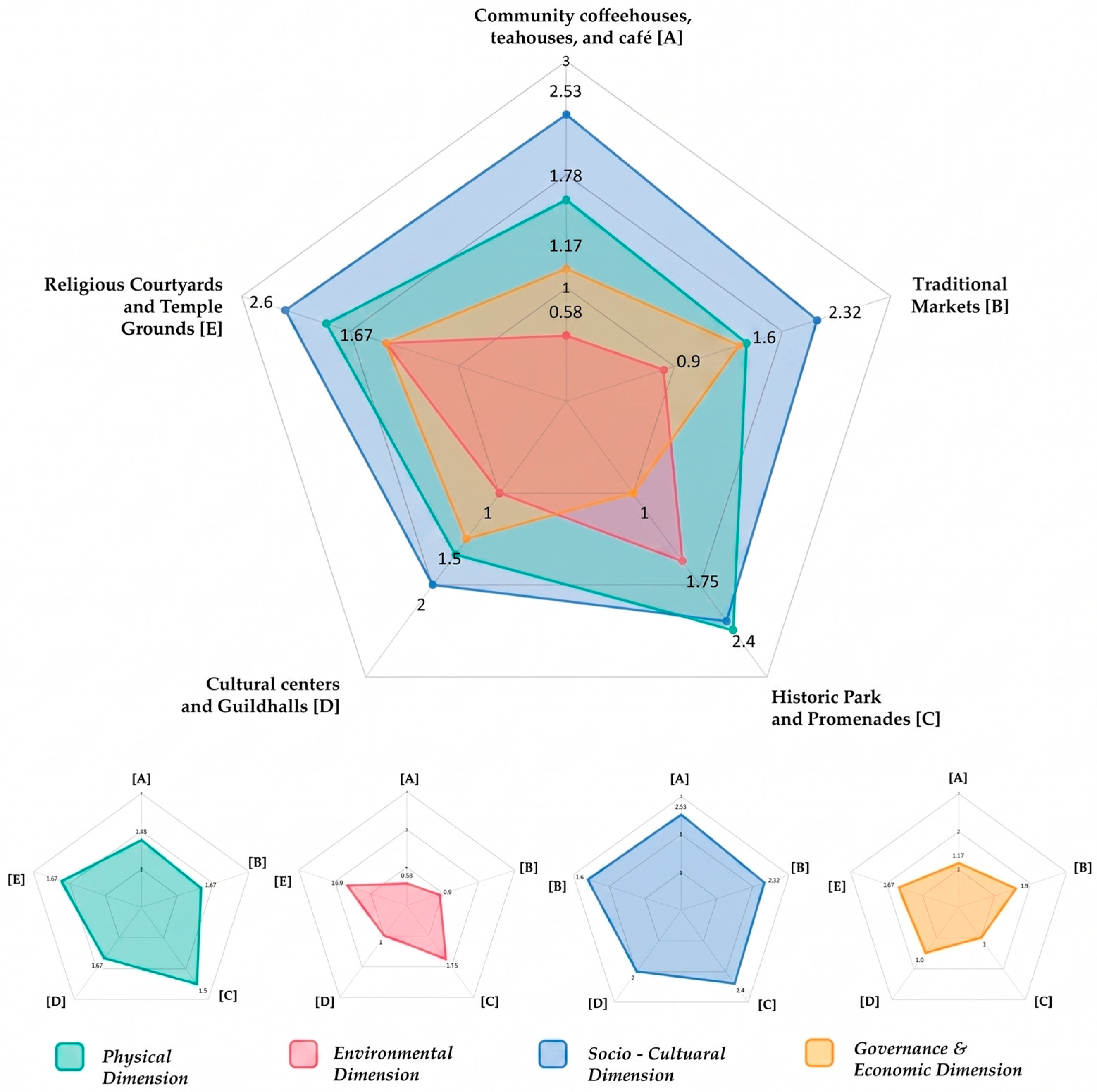
Religious courtyards and temple grounds were rated as having a high sustainability level (M = 2.04), with high scores in two dimensions: socio-cultural (2.60) and physical (2.22). This reflects the role of these third places, particularly temple yards, as mediators connecting sacred areas with contemporary urban life in a sustainable manner. Meanwhile, the historic park and promenades group has a lower overall score (M = 1.91), with a strength in the physical dimension (2.50), the highest among all third-place groups.
Conversely, the governance–economic dimension shows a low level of sustainability (1.00). Similarly, the community coffeehouses, teahouses, and cafés scored highest in the socio-cultural dimension (2.53), but the environmental dimension had the lowest sustainability level (0.58) due to a lack of green spaces and limited low-carbon access, with access primarily by private car. The pedestrian network is sparse and lacks shade. Meanwhile, the traditional markets group has an overall score of 1.62 (M = 1.62), which is similar to the community teahouses but has an additional strength in governance–economic (1.60), especially MK-B1, which has the highest community participation score (3.00) because the community is directly involved in place management (Figure 5).

4.3.3. Site Level

Among the 17 third places evaluated, three sites (17.6%) achieved a high level of sustainability: SK-E1 (M = 2.24), WM-B3 (M = 2.09), and SN-C1 (M = 2.02). These third places are all open spaces well connected to the urban road network, communities, and key cultural landmarks. The remaining 14 sites (82.4%) are classified as moderately sustainable, with none falling into the low sustainability category. This shows that the third places in Nakhon Si Thammarat historic town can maintain a level of sustainability, despite gaps in environmental and governance–economic dimensions.

4.3.4. Indicators of Systemic Strengths and Weaknesses

The study indicates that the third places in Nakhon Si Thammarat have strengths in the socio-cultural dimension. However, there are some concerns regarding low-carbon accessibility and community participation in area management. Therefore, addressing these issues is essential for effective policy development to ensure the sustainable development of the historic town (Table 6).

5. Discussion

5.1. Socio-Cultural Performance of Third Places

The assessment within the socio-cultural dimension yielded average scores ranging from 2.00 to 2.60 across all groups, indicating a level of “High Sustainability” within the study’s specific scope. These results suggest that third places in Nakhon Si Thammarat may function in ways consistent with Oldenburg’s (1989) theoretical framework, potentially serving as the “heart of community social life” where grassroots interactions are cultivated through daily use [1]. Furthermore, the findings align with the observations of Goosen and Cilliers (2020), suggesting that these spaces serve as informal social infrastructures that may bolster social capital and a shared sense of community [4].
Qualitative insights from systematic field observations provide localized examples that support these scores. For instance, sites in Zone 7, Tha Wang District (e.g., TP-A4, LD-B4), were observed to be functioning as gathering hubs where intergenerational conversations occur, illustrating how these places can transition from physical containers to places enriched by social narratives. This perspective is consistent with Al-Shami et al. (2024), who argue that cultural third places can facilitate dialog and identity within heritage streetscapes [31].
A notable observation is the performance of religious courtyards and temple grounds. The ‘living heritage’ aspect is illustrated in sites like SK-E1, where daily activities appear deeply integrated with traditions such as almsgiving, potentially fostering a unique synergy between the monastic and lay communities. By bridging the sacred and the secular, these courtyards offer a localized perspective that complements Oldenburg’s Western-centric framework by incorporating spiritual elements characteristic of Southeast Asian historic towns.
Furthermore, the high score for cultural diversity (M = 2.94) is supported by observed instances of co-presence among Thai Buddhists, Thai Muslims, and Thai–Chinese communities. Observations in Zone 5 and Zone 7 revealed interactions through trade and shared leisure, providing preliminary evidence that cultural diversity in Nakhon Si Thammarat may be sustained by the socially situated conditions of the urban fabric. This suggests that these third places could be important instruments for maintaining the town’s multi-ethnic identity and living heritage.

5.2. Physical Dimension and Urban Form

The physical dimension shows the sustainability score as the second highest. The groups of historic parks and promenades and religious courtyards and temple grounds are classified as ‘Highly Sustainable’, while community coffeehouses, teahouses and cafés, traditional markets, and cultural centers and guildhalls are considered ‘Moderately Sustainable’. This shows that the network of small streets, as well as the flexible boundaries of buildings, is favorable for the visibility of places, and that the area’s adaptability is an essential indicator of the space’s physical sustainability. This is in line with Gehl (2010) and Speck (2012), who emphasize the importance of dense urban structures, land-use mix, and the presence of small blocks with continuous buildings in creating favorable conditions for urban activities [40,41]. Nevertheless, the moderate scores in third place for the groups of community coffeehouses, teahouses, and cafés, and traditional markets still reveal that a physical urban form alone does not guarantee physical sustainability. Instead, the conditions of semi-public boundaries, adaptable furniture, and cross-sightline design continue to shape spatial competence at the micro level.

5.3. Environmental Vulnerabilities of Socially Strong Third Places

The environmental dimension is the most significant gap in sustainability in this research. The low scores are largely due to limitations in green infrastructure, shading, and low-carbon connectivity within the historic town’s core, which mirror challenges commonly observed in compact historic towns with constrained land for green spaces, drainage retrofits, and automobile use, as public transportation coverage remains insufficient across the entire city [44,51,52]. These patterns raise concerns for the conservation and development of historic towns, where the compactness of the city, although favorable for walkability and social interaction, can hinder the extension of green spaces, the improvement of permeable drainage, and adaptation to microclimatic conditions [51,53]. The paradox is that the third places most capable of creating social capital are also the most vulnerable to environmental issues, a tension increasingly recognized in climate-risk assessments for dense urban heritage districts [51,54]. This has important implications for planning climate change adaptation in historic towns, especially in Thailand and Southeast Asia, where the systematic integration of environmental considerations into historic town management is still emerging [55].
In practical terms, this imbalance means that socially vibrant third places often operate in microclimatic conditions that are uncomfortable or exclusionary for vulnerable users, such as older adults, children, and those without access to private vehicles. Without consistent shade, permeable surfaces, and low-carbon access, everyday use tends to shift to cooler hours or indoor, air-conditioned environments, weakening the role of open-air public spaces as day-long social infrastructure. For historic urban management and public-space design, addressing these environmental deficits around existing third places should therefore be a priority, for example, through targeted tree planting, lightweight shading structures, and improved pedestrian connections within the compact town core.

5.4. Governance, Participation, and Thai Administrative Context

The governance–economic dimension is rated ‘Moderately Sustainable’, reflecting a governance landscape in which many third places are ‘co-produced’ and ‘co-managed’ by residents, traders, and religious institutions. For example, temple committees, local trader associations, and community networks are involved in third places within the tradition markets and religious courtyards and temple grounds groups, which demonstrate greater capacity than the historic parks and promenades group. The latter are often managed by central municipal agencies that offer limited community participation. This observation follows the Urban Institute’s (n.d.) findings, which suggest that a reduction in third places may be linked to reduced investment in public infrastructure, as well as a shift towards top-down management styles that exclude the communities that use these places most [50,56]. Therefore, strengthening participatory governance mechanisms through co-management agreements, co-design processes with communities, and stewardship programs is a key step towards elevating this dimension to a ‘Highly Sustainable’ level.
These governance patterns are closely linked to Thailand’s administrative context, in which public spaces such as parks and promenades are typically planned, financed, and managed through municipal or provincial bureaucracies with only limited institutionalized roles for community organizations [57]. This top-down mode of provision through standardized design templates, contracted maintenance, and consultation processes that emphasize information delivery rather than shared decision-making tends to position residents primarily as users or beneficiaries rather than co-managers, thereby reducing incentives for local groups to invest in long-term stewardship [57]. As a result, parks and promenades often follow a uniform design across cities and are experienced as regulated amenities rather than context-specific community assets, which can conflict with locally embedded cultural practices and everyday rhythms. By contrast, traditional markets and temple grounds are often embedded in hybrid governance arrangements that combine formal regulations with informal negotiation among traders, temple committees, and neighborhood leaders, allowing more room for everyday participation and context-specific rule-making [21,58]. For historic urban management, the imbalance in the governance–economic dimension suggests that extending such co-management tools, neighborhood committees, and participatory design processes to more formally planned public spaces could help translate existing social capital into more durable institutional support for third places.

5.5. Integrating the HUL Perspective and Policy Implications

Overall, the sustainability of third places, as indicated in this study, reveals an imbalance among the dimensions. Specifically, the social–cultural dimension has a large capacity, while the physical dimension remains relatively robust. On the other hand, there is a need for improvement in the environmental and governance–economic dimensions. It should be noted that all indicators were assigned equal weights; as a result, the dimension scores represent a balanced aggregation of indicators rather than an optimization based on stakeholder-specific priorities. This pattern has direct implications for UNESCO’s Historic Urban Landscape (HUL) approach, which emphasizes integrating heritage conservation with social, economic, and environmental goals [6]. The findings of this study indicate that historic towns already possess high levels of social and cultural capital embedded in their third-place networks. Sustainability strategies should build upon these existing strengths rather than viewing heritage cities solely as areas lacking and in need of a “Complete Overhaul”. From a policy perspective, the imbalance between strong socio-cultural assets and weaker environmental and governance conditions suggests that historic towns such as Nakhon Si Thammarat lack not social infrastructure, but the environmental and institutional frameworks needed to keep it resilient. Rather than pursuing wholesale physical renewal, historic urban management could focus on incremental environmental retrofits around existing third places and on creating formal avenues for communities, religious institutions, and local traders to participate in decision-making. This would better align HUL-based strategies with everyday realities and support the ways people already use and value these sites.
Implementing dimension-specific strategies that focus on enhancing environmental quality and participatory governance, while simultaneously maintaining social and cultural mechanisms that currently sustain these spaces, will help position the third place as a “Proactive Agent” in sustainable urban development within the historic urban landscape, rather than merely as an “Object” of conservation in isolation.
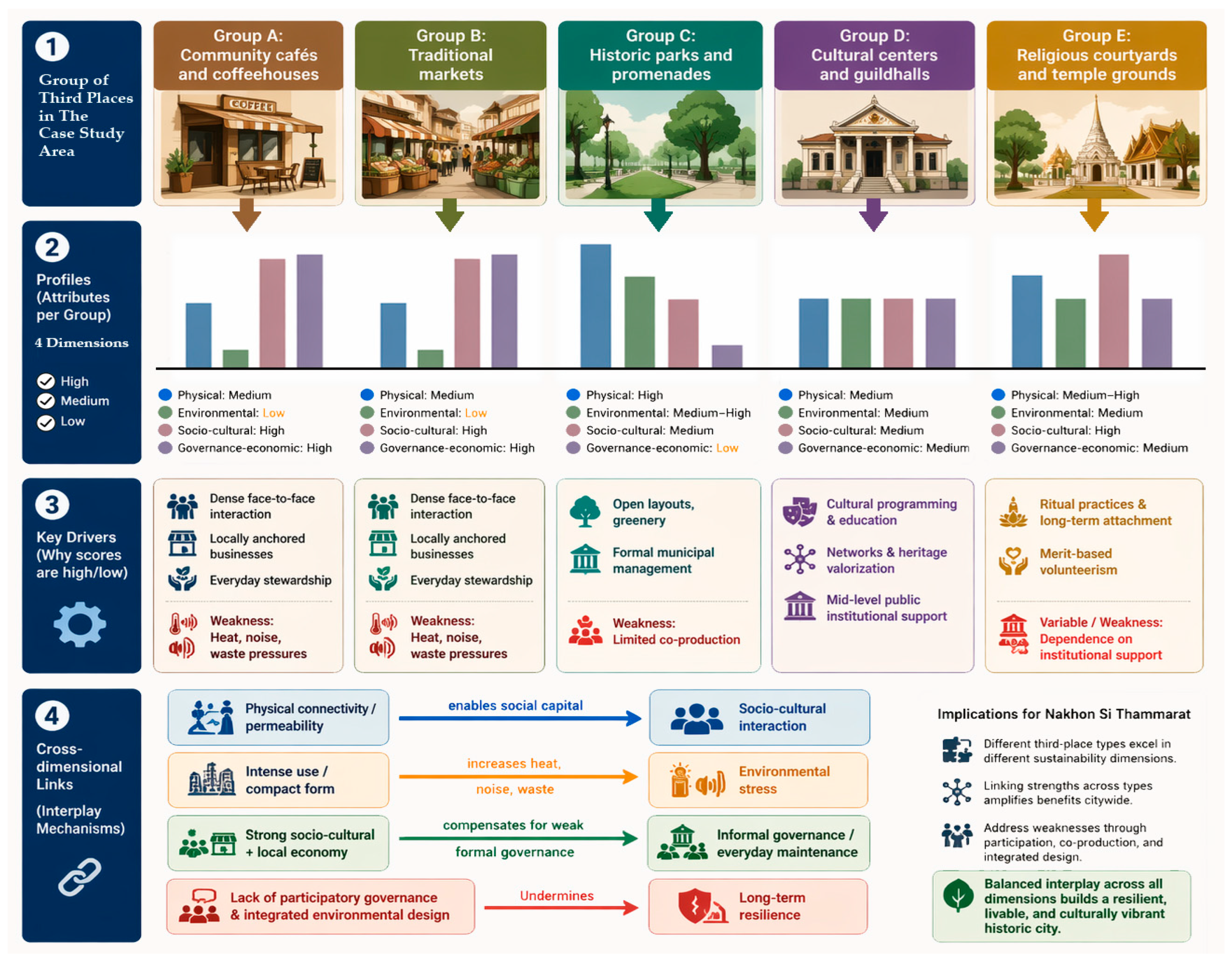
Across the five typological groups, the findings indicate that social capital and creative everyday use of space are the most robust dimensions of third places in Nakhon Si Thammarat, while environmental performance is comparatively weaker. These contrasts should be read in light of the differing number of sites in each typological group, which may influence the relative mean scores and highlight some patterns more strongly than others within this case study context. This pattern is particularly evident in traditional markets, community coffeehouses, teahouses, and cafés, and religious courtyards and temple grounds, where dense daily use, overlapping activities, and long-standing social networks generate high socio-cultural scores but simultaneously intensify pressures on shading, thermal comfort, noise, and waste management. In these sites, micro-scale adaptations such as informal awnings, portable fans, or ad hoc tree planting are mainly driven by users and small business owners rather than by integrated environmental design, making the environmental dimension more vulnerable to climatic stress and limited municipal investment despite strong social vitality (Figure 6).

6. Suggestions

The discussion of the research findings demonstrates a high level of sustainability in the social–cultural dimension and robustness in the physical dimension. Meanwhile, gaps remain in the environmental and governance–economic dimensions. This study proposes approaches to advance the development of third-place areas within the historic town of Nakhon Si Thammarat as follows.
Firstly, policies and spatial measures should be developed using ‘third places’ as a foundation to promote social and cultural sustainability. The roles of temple yards, traditional markets, and community teahouses and cafes should be recognized as informal social infrastructure that helps build social capital, trust, and a sense of shared ownership within the community. These third places should be considered as the main ‘social nodes’ in urban development plans and heritage plans [59,60], which will enhance existing potentials and align with the concept that third places are a key mechanism in fostering social sustainability in modern cities [4].
Secondly, the physical quality of the third place should be elevated by adopting design approaches that emphasize pedestrian movement and flexible usage. This is particularly important for groups of traditional markets, community coffee and tea houses, and cafes with moderate physical sustainability ratings. Micro-level design guidelines, such as organizing semi-public edges, maintaining continuous sightlines between interior and exterior spaces, and using adaptable freestanding furniture that does not compromise architectural heritage, will help enhance the ‘spatial capacity’ of the third place. This will enable it to better support social and economic activities within the constraints of historic urban structures.
Thirdly, to address environmental gaps, a ‘micro-scale green retrofit’ strategy should be implemented, focusing on compact urban layouts rather than solely on creating large parks. This approach is supported by recent evidence from other religious sites in Nakhon Si Thammarat, where targeted landscape improvements have been shown to effectively enhance both cultural landscape values and microclimatic comfort [61]. This could involve planting shade trees and ground cover in religious yards and temple grounds, traditional markets, and historic parks and promenades; adding vertical gardens on suitable heritage buildings; and using permeable paving in specific areas to better manage surface water and enhance microclimate conditions. At the same time, a low-carbon mobility network should be developed, including shaded walkways, bicycle routes, and links to small-scale public transport, to connect clusters of third places. Research shows that providing easy access to green spaces and third places via daily transit routes offers both environmental and social benefits, especially in densely populated cities [62].
Fourthly, in terms of governance–economic, a model of ‘co-management’ (co-governance) for the third place should be developed to be more systematic and clearer. This can be achieved through a joint management agreement between the municipality, temples, traders’ associations, and community networks. A sub-area committee should be established to involve stakeholders in setting rules for space use, budget allocation, and ongoing maintenance. This mechanism will enhance the third place’s capacity to become a ‘co-produced community infrastructure,’ reducing reliance on central management and aligning with social sustainability concepts, including modern urban heritage management approaches that emphasize the roles of multiple stakeholder groups [38].
Finally, at the macro level, integrating the third-place sustainability assessment results with the application of the Historic Urban Landscape (HUL) concept in Thailand’s heritage towns is essential. Using various dimension-specific indicators as policy and investment priorities guides the focus on enhancing environmental and governance–economic aspects while simultaneously preserving and expanding social–cultural capital. The aim is to shift the role of third places from merely being “objects of conservation” to that of active agents in sustainable urban development within historical cityscapes. This approach can serve as a model for other multicultural historic towns in the region [4,63].

7. Conclusions

This study developed and empirically applied a multidimensional framework for assessing the sustainability of third places in a historic urban landscape, integrating third-place theory with the Historic Urban Landscape (HUL) approach across four dimensions: physical, environmental, socio-cultural, and governance–economic. The findings show that third places in Nakhon Si Thammarat’s historic town function as socially vibrant everyday spaces, supported by relatively robust physical conditions but constrained by environmental vulnerabilities and uneven participatory governance.
The main theoretical contribution of this study lies in operationalizing established sustainability dimensions and the HUL perspective at the micro-scale of informal public spaces. In doing so, it extends third-place theory beyond its predominantly Western and socially focused applications and demonstrates how third places in a multicultural historic town function as socio-spatial infrastructures that link tangible heritage, everyday practices, and urban resilience. Rather than treating third places as residual amenities or static heritage objects, the study highlights their active role in sustaining the living historic urban landscape.
The findings also reveal an imbalance among sustainability dimensions: socio-cultural capacity is strong and physical conditions are generally supportive, whereas the environmental and governance–economic dimensions remain comparatively weak and require more targeted intervention. This suggests that planning and heritage management in historic towns should build on the existing social and cultural strengths of third-place networks while improving environmental quality and participatory governance mechanisms. The limitations of the present study and directions for further research are presented in the following section.

8. Limitations

This study is based on a single case study of Nakhon Si Thammarat’s historic district, and the proposed framework has been empirically tested only within this specific cultural and urban context. The 17 third places were identified through a systematic application of Oldenburg’s eight characteristics rather than predetermined quotas for each typology. As a result, the five third-place categories exhibit uneven group sizes, with some groups represented by only one or a few sites. This pattern reflects the actual distribution of qualifying third places in the study area but limits the statistical robustness of between-group comparisons and underscores the exploratory nature of this application. While the framework may inform similar assessments in other Southeast Asian heritage cities with comparable characteristics, its use beyond Nakhon Si Thammarat will require context-sensitive adjustment of indicators and validation against local conditions, ideally through multi-case studies and further calibration of the indicator set.

Author Contributions

Conceptualization, P.C. and W.T.; methodology, P.C.; validation, P.C., W.T., and J.B.; formal analysis, P.C.; investigation, W.T.; resources, S.C.; data curation, S.C.; writing—original draft preparation, P.C.; writing—review and editing, P.C. and W.T.; visualization, J.B.; supervision, P.C.; project administration, P.C.; funding acquisition, P.C. All authors have read and agreed to the published version of the manuscript.

Funding

This study was supported by Walailak University under the WU grant, the New Researcher Development scheme (Contract Number WU67234).

Institutional Review Board Statement

This study has been approved as an exemption from ethical review for human research by the Human Research Ethics Committee of Walailak University under the project series ‘Study of the Components and Changes in the Cultural Landscape of the Old Town of Nakhon Si Thammarat’ to propose sustainable cultural landscape management approaches.’ Certification number WUEC-25-185-01.

Data Availability Statement

The original contributions presented in the study are included in the article; further inquiries can be directed to the corresponding author.

Conflicts of Interest

The authors declare no conflicts of interest.

Abbreviations

The following abbreviations are used in this manuscript:
HULHistoric Urban Landscape
UNESCOThe United Nations Educational, Scientific and Cultural Organization
MMedian
SDStandard Deviation

References

  1. Oldenburg, R. The Great Good Place: Cafés, Coffee Shops, Community Centers, Beauty Parlors, General Stores, Bars, Hangouts, and How They Get You through the Day; Paragon House: New York, NY, USA, 1989. [Google Scholar]
  2. Finlay, J.; Esposito, M.; Kim, M.H.; Gomez-Lopez, I.; Clarke, P. Closure of “Third Places”? Exploring Potential Consequences for Collective Health and Wellbeing. Health Place 2019, 60, 102225. [Google Scholar] [CrossRef]
  3. Sugiyama, T.; Carver, A.; Koohsari, M.J.; Veitch, J. Third Places for Older Adults’ Social Engagement: A Scoping Review and Research Agenda. Gerontologist 2023, 63, 1103–1116. [Google Scholar] [CrossRef]
  4. Goosen, Z.; Cilliers, E.J. Enhancing Social Sustainability through the Planning of Third Places: A Theory-Based Framework. Soc. Indic. Res. 2020, 150, 835–866. [Google Scholar] [CrossRef]
  5. Ujang, N. Place Attachment and Continuity of Urban Place Identity in Malaysia. Procedia Soc. Behav. Sci. 2012, 42, 156–167. [Google Scholar] [CrossRef]
  6. UNESCO. Recommendation on the Historic Urban Landscape. UNESCO World Heritage Centre. 2011. Available online: https://whc.unesco.org/en/hul/ (accessed on 4 March 2026).
  7. Guzmán, P.C.; Pereira Roders, A.R.; Colenbrander, B.J.F. Bridging the Gap between Urban Development and Cultural Heritage Protection. In Proceedings of the 34th Annual Conference of the International Association for Impact Assessment (IAIA14), Viña del Mar, Chile, 8–11 April 2014. [Google Scholar]
  8. Ornelas, C.; Sousa, F.; Guedes, J.M.; Breda-Vázquez, I. Monitoring and Assessment Heritage Tool: Quantify and Classify Urban Heritage Buildings. SSRN 2022, 137, 1–18. Available online: https://ssrn.com/abstract=4182562 (accessed on 22 April 2026). [CrossRef]
  9. Farhan, S.L.; Hasan, S.A.; Rahim, L.A.L.; Ebraheem, A.K.; Al-Hussaini, Z.I.H.; Ebraheem, M.A.; Alkinani, A.S.; Al-Rawe, M.K.; Jassim, A.H.; Shok, M.E. Balancing Heritage Preservation and Sustainable Development in Historic Cities: A Case Study of Old Najaf in the Context of Global Best Practices. Int. J. Sustain. Dev. Plan. 2025, 20, 1041–1051. [Google Scholar] [CrossRef]
  10. Al-Shami, H.W.; Al-Alwan, H.A.S.; Abdulkareem, T.A. Cultural Sustainability in Urban Third Places: Assessing the Impact of “Co-Operation in Science and Technology” in Cultural Third Places. Ain Shams Eng. J. 2024, 15, 102465. [Google Scholar] [CrossRef]
  11. Purnamasari, L.; Sihombing, A.; Fuad, A.; Adam, M. The Spatial Practices of Working Women in Third Place: Contributions to Urban Environmental Sustainability. Int. J. Technol. 2025, 16, 1124–1142. [Google Scholar] [CrossRef]
  12. Pereira Roders, A.; van Oers, R. Guidance on Heritage Impact Assessments: Learning from Its Application on World Heritage Site Management. J. Cult. Herit. Manag. Sustain. Dev. 2012, 2, 104–114. [Google Scholar] [CrossRef]
  13. Throsby, D. The Economics of Cultural Policy; Cambridge University Press: Cambridge, UK, 2010. [Google Scholar]
  14. Oldenburg, R.; Brissett, D. The Third Place. Qual. Sociol. 1982, 5, 265–284. [Google Scholar] [CrossRef]
  15. Bandarin, F.; van Oers, R. The Historic Urban Landscape: Managing Heritage in an Urban Century; Wiley-Blackwell: Chichester, UK, 2012. [Google Scholar] [CrossRef]
  16. Daly, P.; Winter, T. (Eds.) Routledge Handbook of Heritage in Asia; Routledge: London, UK; New York, NY, USA, 2012. [Google Scholar]
  17. Littman, D.M. Third Place Theory and Social Work: Considering Collapsed Places. J. Soc. Work 2021, 21, 1225–1242. [Google Scholar] [CrossRef]
  18. Littman, D.M. Third Places, Social Capital, and Sense of Community as Components of Resilience. Am. J. Community Psychol. 2021, 68, 403–416. [Google Scholar] [CrossRef]
  19. Waxman, L. The Coffee Shop: Social and Physical Factors Influencing Place Attachment. J. Inter. Des. 2006, 31, 35–53. [Google Scholar] [CrossRef]
  20. Rhubart, D.; Sun, Y.; Pendergrast, C.; Monnat, S. Sociospatial Disparities in “Third Place” Availability in the United States. Socius 2022, 8, 1–11. [Google Scholar] [CrossRef]
  21. Askew, M. Bangkok: Place, Practice and Representation; Routledge: London, UK, 2002. [Google Scholar]
  22. Turner, V. The Ritual Process: Structure and Anti-Structure; Aldine de Gruyter: New York, NY, USA, 1969. [Google Scholar]
  23. Sinlapasai, D. Public Life in Bangkok’s Urban Spaces. Open House Int. 2013, 38, 62–73. [Google Scholar] [CrossRef]
  24. Sustainability Directory. Why Are Third Places Important for Social Sustainability? Lifestyle Sustain. Directory 2025. Available online: https://lifestyle.sustainability-directory.com/question/why-are-third-places-important-for-social-sustainability/ (accessed on 4 March 2026).
  25. Yahya, R.; Wood, E.A. Play as Third Space between Home and School: Bridging Cultural Discourses. J. Early Child. Res. 2017, 15, 305–322. [Google Scholar] [CrossRef]
  26. Jeffres, L.W.; Bracken, C.C.; Jian, G.; Gao, Y. The Impact of Third Places on Community Quality of Life. Appl. Res. Qual. Life 2009, 4, 333–345. [Google Scholar] [CrossRef]
  27. Thinnakorn, W. The Urban Image Conservation and Development of Nakhon Si Thammarat’s Old Town Community in Thailand. Nakhara J. Environ. Des. Plan. 2021, 20, 120. [Google Scholar] [CrossRef]
  28. Oldenburg, R.; Christensen, B. Third Places: True Citizen Spaces. UNESCO Courier 2023. Available online: https://courier.unesco.org/en/articles/third-places-true-citizen-spaces (accessed on 4 March 2026).
  29. Abouelmagd, D.; Elrawy, S. Cultural Heritage and Sustainable Urban Development: The Case of Port Said City in Egypt. Cogent Soc. Sci. 2022, 8, 2067079. [Google Scholar] [CrossRef]
  30. Williams, S.A.; Hipp, J.R. How Great and How Good? Third Places, Neighbor Interaction, and Cohesion in the Neighborhood Context. Soc. Sci. Res. 2019, 77, 68–78. [Google Scholar] [CrossRef]
  31. Al-Shami, H.W. Creative Place-Making as a Critical Approach to Promoting Cultural Third-Places: Insights from Al-Mutanabi Street in Baghdad, Iraq. ISVS E-J. 2024, 10, 265–284. [Google Scholar]
  32. Nocca, F. Integrating Cultural Heritage in Urban Sustainable Development: A Conceptual Framework. In Integrating Cultural Heritage in Urban Development; ICOMOS: Paris, France, 2017. [Google Scholar]
  33. Denzin, N.K. The Research Act: A Theoretical Introduction to Sociological Methods; McGraw-Hill: New York, NY, USA, 1978. [Google Scholar]
  34. Patton, M.Q. Qualitative Research & Evaluation Methods: Integrating Theory and Practice, 4th ed.; SAGE Publications: Thousand Oaks, CA, USA, 2015. [Google Scholar]
  35. Noble, H.; Heale, R. Triangulation in research, with examples. Evid. Based Nurs. 2019, 22, 67–68. [Google Scholar] [CrossRef]
  36. Tarne, P.; Lehmann, A.; Finkbeiner, M. Introducing weights to life cycle sustainability assessment—How do decision-makers weight sustainability dimensions? Int. J. Life Cycle Assess. 2019, 24, 530–542. [Google Scholar] [CrossRef]
  37. Lee, J.H.; Tan, T.H. Neighborhood Walkability or Third Places? Determinants of Social Support and Loneliness among Older Adults. J. Plan. Educ. Res. 2019, 41, 39–52. [Google Scholar] [CrossRef]
  38. Gaglione, F.; Cottrill, C.; Gargiulo, C. Urban services, pedestrian networks and behaviors to measure elderly accessibility. Transp. Res. Part D Transp. Environ. 2021, 90, 102687. [Google Scholar] [CrossRef]
  39. Strommer, T.; Munkácsy, A.; Földes, D. How Walkable Is an Urban Street? An Expert-Based Public Space and Walkability Assessment Method. Eur. Transp. Stud. 2025, 2, 100040. [Google Scholar] [CrossRef]
  40. Gehl, J. Cities for People; Island Press: Washington, DC, USA, 2010. [Google Scholar]
  41. Speck, J. Walkable City: How Downtown Can Save America, One Step at a Time; Farrar, Straus and Giroux: New York, NY, USA, 2012. [Google Scholar]
  42. Samadi, Z.; Mohd Yunus, R.; Omar, D.; Bakri, A.F. Experiencing Urban through On-Street Activity. Procedia Soc. Behav. Sci. 2015, 170, 653–658. [Google Scholar] [CrossRef]
  43. Liu, J. Space Design Guide for Public Areas in a Multicultural Environment: Based on the Theory of Social Atomism. Archit. Des. Res. 2021, 34, 21–39. [Google Scholar] [CrossRef]
  44. Vadiati, N.; Kashkooli, A.M.S. Environmental Sustainability of Newly Developed City Squares in Historic Cities: Case Study of Isfahan–Iran. Procedia Eng. 2011, 21, 829–837. [Google Scholar] [CrossRef]
  45. Nasehi, H.; Saberi, H.; Ghaedrahmati, S.; Khademolhoseiny, A. Modeling the Role of Third Places in Social Sustainability in Isfahan. Urban Struct. Funct. Stud. 2022, 9, 153–176. [Google Scholar]
  46. Haselbacher, M.; Kuokkanen, K.; Palonen, E.; Reeger, U. Inclusion and Exclusion in Urban Public Space: Contemporary Challenges in Vienna and Helsinki. Urban Plan. 2024, 9, 1–18. [Google Scholar] [CrossRef]
  47. Zhou, S.L. Understanding “Inclusiveness” in Public Space. In UBC SCARP/VIVA Vancouver; University of British Columbia: Vancouver, BC, Canada, 2019; Available online: https://sustain.ubc.ca/sites/default/files/2019-50_Understanding%20Inclusiveness%20in%20Public%20Space_Zhou.pdf (accessed on 4 March 2026).
  48. Bolici, R.; Gambaro, M.; Giordano, C. The Regaining of Public Spaces to Enhance the Historic Urban Landscape. Int. J. Crime Justice Soc. Democr. 2017, 6, 45–56. [Google Scholar] [CrossRef]
  49. Jokilehto, J. Considerations on Authenticity and Integrity in World Heritage Context. In Proceedings of the International Conference on Authenticity and Integrity in an African Context, Great Zimbabwe, Zimbabwe, 2006; UNESCO: Great Zimbabwe, Zimbabwe, 2006; Available online: https://journals.ed.ac.uk/ear/article/view/9747/12439 (accessed on 10 November 2025).
  50. Crowley, M.; Knepper, R. Translocal Pathways of Immigrant Settlement and Incorporation. Annu. Rev. Sociol. 2019, 45, 57–76. [Google Scholar]
  51. Alkhafaji, A.; Althabhawi, G. The Role of Ecosystem to Enhance Sustainable Revitalization: Al-Kifl Historic City Center as a Case Study. J. Appl. Sci. Technol. Trends 2025, 6, 61–73. [Google Scholar] [CrossRef]
  52. OECD. Compact City Policies: A Comparative Assessment; OECD Green Growth Studies; OECD Publishing: Paris, France, 2012. [Google Scholar]
  53. Ali, A.G. Tracing the Roots of Historic Cities: Embracing Sustainable Green Cities and Navigating Threats through Original Characteristics. Adv. Res. Conserv. Sci. 2024, 5, 15–41. [Google Scholar] [CrossRef]
  54. IPCC. Asia. In Climate Change 2022: Impacts, Adaptation and Vulnerability. Contribution of Working Group II to the Sixth Assessment Report of the Intergovernmental Panel on Climate Change; Pörtner, H.-O., Roberts, D.C., Tignor, M., Poloczanska, E.S., Mintenbeck, K., Alegría, A., Craig, M., Langsdorf, S., Löschke, S., Möller, V., et al., Eds.; Cambridge University Press: Cambridge, UK; New York, NY, USA, 2023; pp. 1457–1580. [Google Scholar]
  55. International Climate Initiative (IKI). URBAN: Urban Resilience Building and Nature: Innovating Urban Planning for Resiliency with Nature-Based Solutions and Climate Risk Models in Thailand, 2025. Available online: https://www.international-climate-initiative.com/en/project/urban-urban-resilience-building-and-nature-innovating-urban-planning-for-resiliency-with-nature-based-solutions-and-climate-risk-models-in-thailand-22-ii-194-tha-a-urban/ (accessed on 28 April 2026).
  56. Urban Institute. How Third Places Contribute to Thriving Communities. Urban Wire 2024. Available online: https://www.urban.org/urban-wire/how-third-places-contribute-thriving-communities (accessed on 4 October 2025).
  57. Ratanawaraha, A. Institutional Issues in Integrating Land Use Planning and Water Management in Thailand; Research Report; Thailand Development Research Institute Foundation (TDRI): Bangkok, Thailand, 2016. [Google Scholar]
  58. Paksukcharern, K. Sustaining Urban Spatial Network of Historical Communities Through the Reuse of Temple Grounds and Social Space–A Case Study of Rattanakosin, Bangkok. Nakhara J. Environ. Des. Plan. 2016, 12, 177–186. [Google Scholar]
  59. Martí, P.; Serrano-Estrada, L.; Aboutorabi, M. Culturally Diverse Street-Level Urban Activities through the Lens of Digital Footprints. Sustainability 2021, 13, 11141. [Google Scholar] [CrossRef]
  60. Hussein, F.; Stephens, J.; Tiwari, R. Memory for Social Sustainability: Recalling Cultural Memories in Zanqit Alsitat Historical Street Market, Alexandria, Egypt. Sustainability 2020, 12, 8141. [Google Scholar] [CrossRef]
  61. Thinnakorn, W.; Anurak, T.; Phibul, P.; Kangkasara, P.; Satik, S. Landscape Improvement to Promote Cultural Landscape Values Toward Sustainability: A Case Study of Wat Khongkhaliab, Nakhon Si Thammarat Province, Thailand. Nakhara J. Environ. Des. Plan. 2025, 24, 515. [Google Scholar] [CrossRef]
  62. Przewoźna, P.; Inglot, A.; Mielewczyk, M.; Maczka, K.; Matczak, P. Accessibility to Urban Green Spaces: A Critical Review of WHO Recommendations in the Light of Tree-Covered Areas Assessment. Ecol. Indic. 2024, 166, 112548. [Google Scholar] [CrossRef]
  63. Cunha Ferreira, T.; Rey-Pérez, J.; Pereira Roders, A.; Tarrafa Silva, A.; Coimbra, I.; Breda Vazquez, I. The Historic Urban Landscape Approach and the Governance of World Heritage in Urban Contexts: Reflections from Three European Cities. Land 2023, 12, 1020. [Google Scholar] [CrossRef]
Figure 1. The steps of the method used in this study.
Land 15 00792 g001
Figure 2. Map of the study area: Nakhon Si Thammarat historic town.
Land 15 00792 g002
Figure 3. The map shows the locations of the third places in the historic town of Nakhon Si Thammarat, identified through a field survey.
Land 15 00792 g003
Figure 4. This graph illustrates the intensity of characteristics of the third place in each group.
Land 15 00792 g004
Figure 5. The radar chart compares the results for the four dimensions of sustainability in the assessment of third places.
Land 15 00792 g005
Figure 6. Interplay between third-place groups and multi-dimensional sustainability in Nakhon Si Thammarat. Different third-place groups show distinct sustainability profiles: strong social capital and local governance in traditional markets, community coffeehouses, teahouses, and cafés; greener but more top-down parks; and ritual-anchored temple grounds. The diagram highlights how physical form, environmental comfort, social capital, and governance arrangements interact to produce these contrasting outcomes.
Land 15 00792 g006
Table 1. Third places were identified in the study area.
Group of Third PlacesSite Picture
Community coffeehouses,
teahouses, and cafés
(6 sites)
Land 15 00792 i001Land 15 00792 i002
Land 15 00792 i003Land 15 00792 i004
Land 15 00792 i005Land 15 00792 i006
Traditional markets
(5 sites)
Land 15 00792 i007Land 15 00792 i008
Land 15 00792 i009Land 15 00792 i010
Land 15 00792 i011
Historic parks
and promenades
(2 sites)
Land 15 00792 i012Land 15 00792 i013
Cultural centers
and guildhalls
(1 site)
Land 15 00792 i014
Religious courtyards
and temple grounds
(3 sites)
Land 15 00792 i015Land 15 00792 i016
Land 15 00792 i017
Table 2. Evaluation rubric for indicator scoring in sustainability assessment.
ScoreLevelAlignment with Sustainability
0NoneNo evidence
1LowWeak or absent sustainability contribution
2ModeratePartial sustainability contribution
3HighStrong sustainability contribution
Table 3. An illustration of the framework’s dimensions, indicators, and descriptions for assessing the sustainability of the third place.
DimensionIndicatorsScore 0
(None)
Score 1
(Low)
Score 2
(Moderate)
Score 3
(High)
Walkability and
Accessibility
(IP1)
Total absence of
pedestrian paths
or permanent
obstructions.
Dilapidated paths
with high barriers;
extremely difficult
access for most users.
Fair connectivity
with minor
obstacles; accessible
but lacks
universal design.
Seamless
connectivity with high-quality paths and universal design integration.
Indicator Description: Pedestrian pathways and public transportation networks that facilitate convenient and safe access and utilization of the third place by the community.
Source: [37,38,39]
PhysicalSpatial Comfort
and Flexibility
(IP2)
Perceived as
hazardous or
abandoned; total
lack of lighting
and surveillance.
Minimal or broken amenities; rigid layout that discourages
prolonged staying.
Adequate comfort with basic amenities; supports common uses.Optimal comfort with flexible,
high-quality
amenities and
diverse seating
options.
Indicator Description: Physical comfort, layout flexibility, and diverse seating arrangements that accommodate both individual and group activities, thereby fostering physical and mental well-being.
Source: [40,41,42]
Visibility
and Openness
(IP3)
Completely
enclosed or
visually blocked;
zero natural
surveillance.
Poor visibility with
numerous blind spots; feels unsafe or isolated.
Fair visibility with some natural
surveillance; minor obstructed sightlines.
Excellent visibility and openness: clear sightlines that foster a high sense of safety.
Indicator Description: Enhanced openness and visibility in an area reduces blind spots, delivering a sense of security through natural surveillance and fostering informal social interactions.
Source: [28,43]
EnvironmentGreenery
and Shade
(IE1)
Complete absence
of greenery or
natural shading.
Minimal greenery;
insufficient canopy cover for climate
comfort.
Moderate
vegetation
providing shade
for primary activity areas.
Abundant greenery; extensive canopy cover that
significantly
mitigates heat.
Indicator Description: The proportion of green space and tree shade contributes to a comfortable climate conducive to daily life.
Source: [11,26]
Low-Carbon Access
(IE2)
Zero access via
Low-carbon
modes; entirely
dependent on
private vehicles.
Minimal low-carbon
access due to poor
infrastructure or
safety concerns.
Moderate use of
low-carbon modes; presence of basic
supporting
infrastructure.
Predominant use of walking, cycling, or public transport with excellent
support.
Indicator Description: The proportion of users who access third places by walking, cycling, or public transportation.
Source: [11,40,44]
Socio-CulturalSense of
Belonging
(IS1)
Users feel
completely
alienated;
no historical or emotional
connection.
Weak attachment;
perceived as a generic or purely functional public area.
Good level of
attachment; users
recognize the site as part of their
community.
Strong sense of
ownership; site is deeply rooted in
local collective
identity.
Indicator Description: The perception that places reflect the identity, culture, and stories of the community helps people feel that the place belongs to them, rather than being just a generic public area.
Source: [31,45]
Social Interaction
Frequency
(IS2)
No social
interaction
observed; site
functions as a
dead or vacant space.
Sparse or fleeting
interactions; limited
primarily to
pre-existing groups.
Regular social
encounters;
formation of new
social ties is visible.
Vibrant community hub with frequent, diverse, and deep social interactions.
Indicator Description: The frequency of meetings, conversations, and group activities among users of the place.
Source: [2,45]
Inclusiveness
and Safety
(IS3)
Explicitly
exclusive or
unsafe; total lack
of hospitality for
diverse groups.
Low inclusiveness;
barriers (physical or
social) exist for
vulnerable groups.
Fairly inclusive;
most groups can
use the space
comfortably with
minor issues.
Highly inclusive
and welcoming;
proactively
accommodates all social groups.
Indicator Description: Inclusivity for all groups, encompassing structural aspects (design and accessibility) and socio-cultural elements (norms, hospitality, and non-discrimination), particularly for vulnerable populations such as women, children, the elderly, persons with disabilities, ethnic minorities, and migrants.
Source: [2,46,47]
Local Cultural
Practices
(IS4)
No visible
cultural practices or traditions
occurring within the site.
Rare or seasonal
cultural expressions; limited to formal
events.
Regular cultural
activities; daily
traditions are
consistently
maintained.
A “living heritage” space; cultural
rituals are a core part of the daily function.
Indicator Description: Support for everyday activities, traditions, and rituals.
Source: [1,10,48,49]
Cultural Diversity
(IS5)
Total cultural
homogeneity;
no presence or
interaction of
diverse
backgrounds.
Low diversity;
presence of different groups is rare or
separate.
Visible diversity;
different cultures
coexist and interact
in specific periods.
High diversity;
vibrant cross-
cultural interactions occur naturally and regularly.
Indicator Description: Visible diversity and “social-policy conditions” that allow different cultures to coexist, meet, and interact in third places without exclusion.
Source: [10,43,47]
Governance—EconomicCommunity
Participation
in Management
(IG1)
Management is
entirely top-down; zero community involvement.
Minimal involvement; community is
informed but has no decision power.
Consultative
participation;
community
feedback is sought
on specific issues.
Bottom-up/
collaborative;
community leads management and decision-making.
Indicator Description: Local people’s participation in the design, maintenance, and decision-making regarding these places is crucial.
Source: [1,4,50]
Local Economic
Vitality
(IG2)
No economic
activity or entirely dominated by
external
corporations.
Minimal local
micro-
entrepreneurship;
inconsistent or
declining activity.
Stable local
businesses that
support the
community’s daily economic needs.
Thriving and diverse local economy that enhances the area’s resilience.
Indicator Description: Support small businesses, local community shops and activities, an increase in new business registrations, changes in property values and rentals, and the retention of a local workforce with creative skills.
Source: [19,39]
Table 4. This table shows the average scores used to assess sustainability levels.
Sustainability LevelAn Average Score (Points)
Minimally Sustainable0.00–0.99
Moderately Sustainable1.00–1.99
Highly Sustainable2.00–3.00
Table 5. Results of sustainability assessment of third places in Nakhon Si Thammarat historic town.
Third PlacesPhysical Environmental Socio-Cultural Governance & Economic
IP1IP2IP3(M) IE1IE2(M) IS1IS2IS3IS4IS5(M) IG1IG2(M)
1. Community coffeehouses, teahouses, and cafés
PA-A11.002.002.001.67 0.001.000.50 2.003.001.003.003.002.40 0.002.001.00
CO-A21.002.003.002.00 0.001.000.50 3.003.001.003.003.002.60 0.003.001.50
NW-A31.002.003.002.00 0.001.000.50 3.003.001.003.003.002.60 0.002.001.00
TP-A41.002.002.001.67 1.001.001.00 3.003.001.003.003.002.60 0.002.001.00
KP-A51.002.002.001.67 1.000.000.50 2.003.001.003.003.002.40 0.003.001.50
TK-A61.002.002.001.67 0.001.000.50 3.003.001.003.003.002.60 0.002.001.00
Group’s Mean Score 1.78 0.58 2.53 1.17
2. Traditional markets
MK-B11.001.000.000.67 2.000.001.00 3.003.001.003.003.002.60 3.002.002.50
TC-B21.003.002.002.00 0.001.000.50 3.003.001.003.003.002.60 2.002.002.00
WM-B32.003.003.002.67 3.001.002.00 1.003.001.003.003.002.20 1.002.001.50
LD-B42.001.003.002.00 0.001.000.50 1.003.001.003.003.002.20 1.002.001.50
TM-B52.000.001.001.00 0.001.000.50 1.002.001.003.003.002.00 0.001.000.50
Group’s Mean Score 1.67 0.90 2.32 1.60
3. Historic parks and promenades
SN-C13.002.003.002.67 3.001.002.00 1.003.002.003.003.002.40 1.001.001.00
SS-C23.002.002.002.33 2.001.001.50 1.003.002.003.003.002.40 1.001.001.00
Group’s Mean Score 2.50 1.75 2.40 1.00
4. Cultural centers and guildhalls
BW-D12.002.001.001.67 1.001.001.00 1.002.002.002.003.002.00 1.002.001.50
Group’s Mean Score 1.67 1.00 2.00 1.50
5. Religious courtyards and temple grounds
SK-E13.002.003.002.67 2.001.001.50 3.003.002.003.003.002.80 2.002.002.00
ST-E22.002.002.002.00 2.001.001.50 3.003.002.002.003.002.60 2.001.001.50
SP-E32.002.002.002.00 3.001.002.00 3.003.002.002.002.002.40 2.001.001.50
Group’s Mean Score 2.22 1.67 2.60 1.67
Dimension’s Mean Score1.90 1.03 2.44 1.38
Minimally Sustainable
Moderately Sustainable
Highly Sustainable
Table 6. A summary of the sustainability indicators that identify the systemic strengths and weaknesses of the third places in the historic town of Nakhon Si Thammarat.
LevelIndicatorAn Average Score
Strength (>2.00)Cultural Diversity2.94
Social Interaction Frequency2.88
Local Culture Practices2.82
Sense of Belonging2.18
Visibility and Openness2.12
Weakness (<1.00)Community Participation in Management0.94
Low-carbon Access0.88
Disclaimer/Publisher’s Note: The statements, opinions and data contained in all publications are solely those of the individual author(s) and contributor(s) and not of MDPI and/or the editor(s). MDPI and/or the editor(s) disclaim responsibility for any injury to people or property resulting from any ideas, methods, instructions or products referred to in the content.