Sustainable Third Places in Historic Urban Landscapes: Multi-Dimensional Assessment of Nakhon Si Thammarat, Thailand


Abstract
1. Introduction
2. Literature Review
2.1. Concept and Core Significances of Third Places
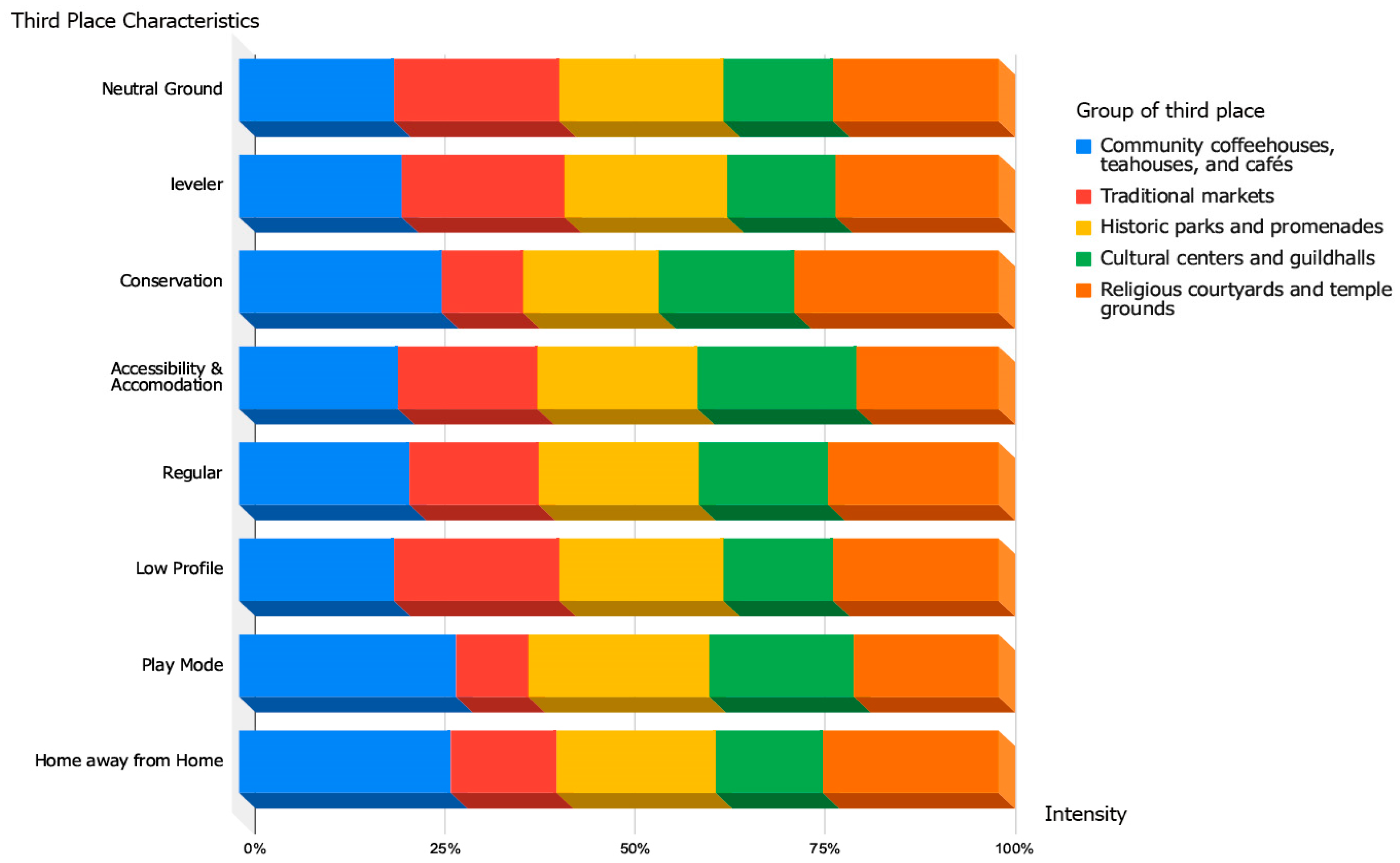
- Neutral ground: A primary feature that facilitates voluntary participation devoid of territorial claims or time pressures, thereby promoting egalitarian interactions regardless of social status.
- Leveler: This equality is expressed as social integration, where socioeconomic differences are inconsistent.
- Conversation: Casual conversation is the main activity, with supplementary activities regarded as secondary.
- Accessibility and accommodation: The third place must be located within walking distance and be eligible for frequent visits.
- Regulars: The presence of regular visitors who anchor the place’s identity, welcoming newcomers. And to perpetuate continuity.
- Low profile: Maintaining an unassuming image, avoiding ostentation and luxury, but emphasizing simplicity and friendliness that encourages people to spend more time there without feeling intimidated.
- Playful mood: An atmosphere characterized by enjoyment and friendliness, with spontaneous laughter and merriment that enhance psychological comfort.
- Home away from home: A second home atmosphere, fostering a deep sense of belonging, like the security and safety of a home.
2.2. Extending the Concept of the Third Place from Sociology to Sustainable Cities
3. Materials and Methods
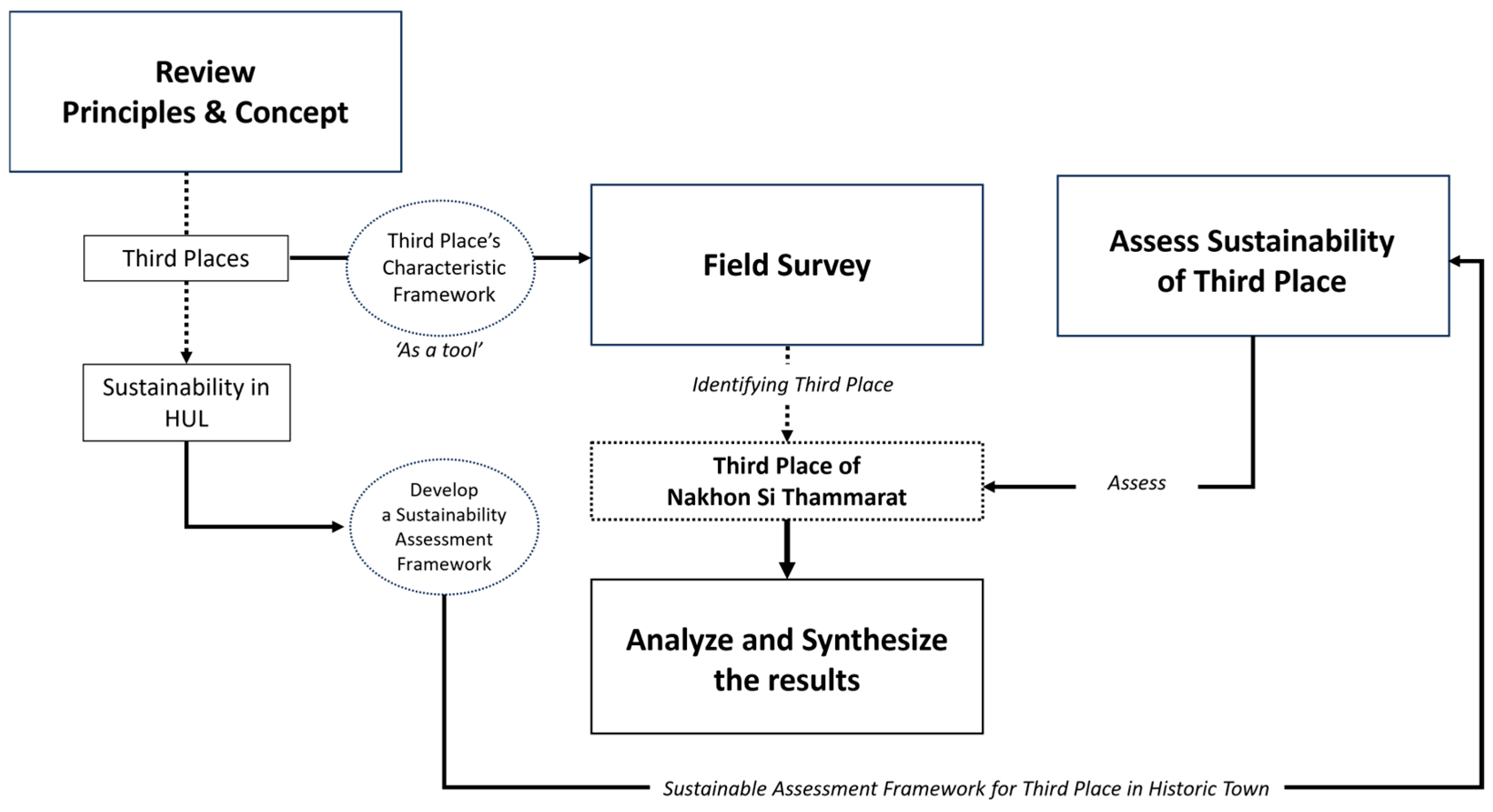
- Review the principles and concepts of the third place and sustainable cities to create a theoretical framework and define a practical definition of the sustainable third place within the context of a historic town.
- Conduct a field survey of the case study to identify the location, identities, activities, and physical and intangible characteristics of the actual third places, following the criteria of the third-place characteristics framework adopted by Ray Oldenburg’s concept.
- Develop a framework for assessing the sustainability of the third place, identify indicators, and establish evaluation criteria.
- Pilot the assessment of the sustainability of third places in the Nakhon Si Thammarat historic town case study to analyze the strengths, weaknesses, and sustainability levels of third places.
- Analyze and compare to identify factors influencing the level of sustainability of the third place and obstacles hindering the sustainability of the historic town.
- Synthesize the results to present strategic approaches for the conservation and development of third places within a sustainable city.
3.1. Conceptual Framework
Third Places of the Historic Town of Nakhon Si Thammarat, Thailand
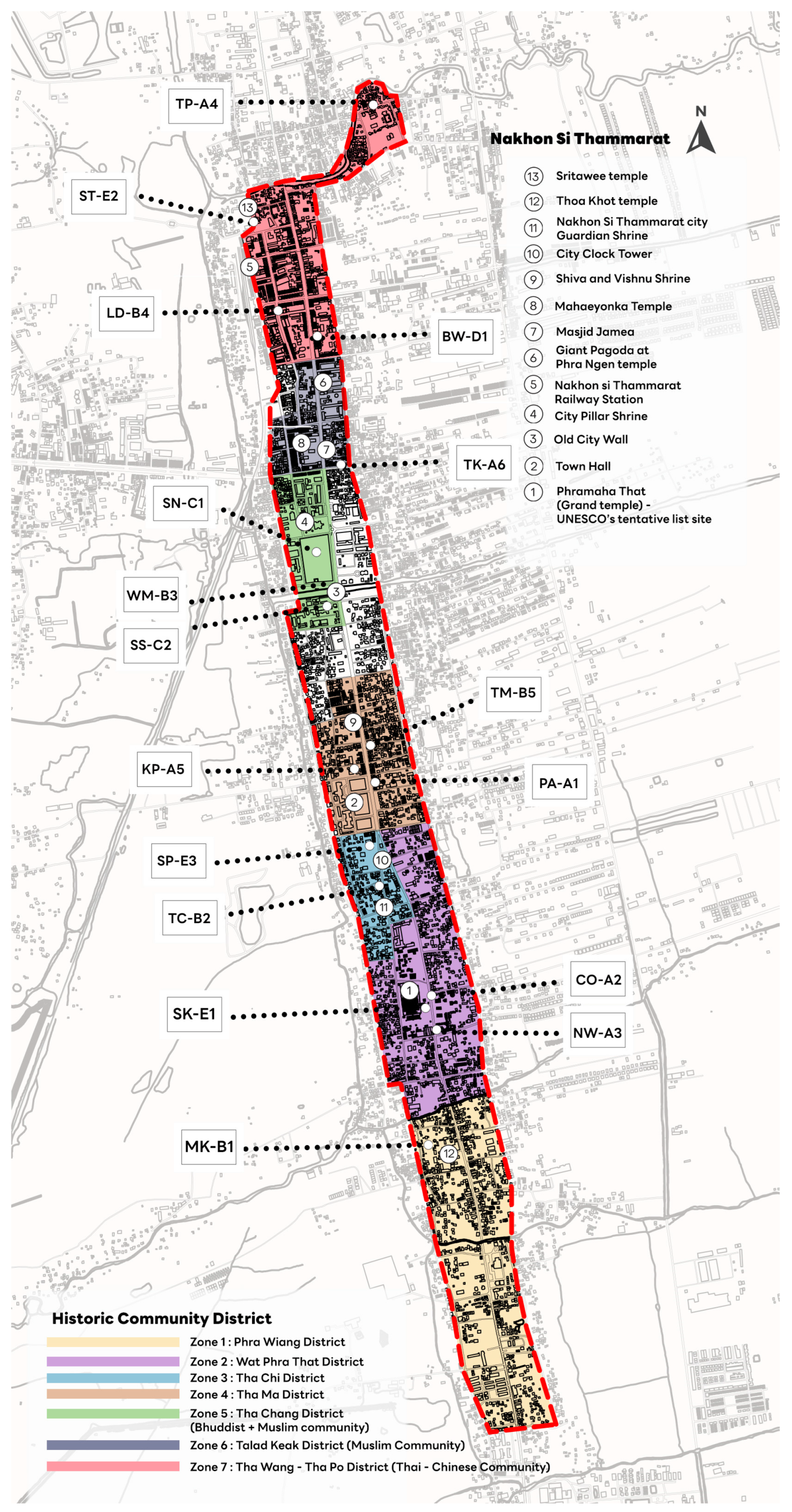
- Community coffeehouses, teahouses, and cafés serve as informal venues for conversations or meetings. Typically situated in historic town buildings or along historic streets, these locations foster social interaction. Field surveys in the case study area identified six sites, labeled as third places: PA-A1, CO-A2, NW-A3, TP-A4, KP-A5, and TK-A6.
- Traditional markets include open-air and indoor markets that historically functioned as centers for trade, social gathering, and exchanges within communities or neighborhoods. Field surveys in the case study area identified five sites, labeled as third places: MK-B1, TC-B2, WM-B3, LD-B4, and TM-B5.
- Historic parks and promenades are public green areas or waterfront walkways designated for shared use. They serve as sites for leisure, relaxation, or hosting events, festivals, and ceremonies. This group includes two sites: SN-C1 and SS-C2.
- Cultural centers and guildhalls are historic buildings; The third place in this group has been adapted for exhibitions, art, performances, and community activities. They often serve as the center of the community. Only one site in this group was identified: BW-D1.
- Religious courtyards and temple grounds: There are spaces such as temple yards, churches, mosques, plazas, or adjacent gardens, which in the past served both spiritual and community functions. Three sites were identified: SK-E1, ST-E2, and SP-E3.
3.2. The Third Place Under the Concept of Sustainability in Historic Towns
- Physical Dimension: This refers to spatial arrangement, accessibility, safety, and comfort for people by creating connected networks that can be walked through and have flexible boundaries to support daily activities [6,29]. It highlights the integration of new functions into the existing streetscape and heritage buildings without impacting the original town’s character form.
- Environmental Dimension: This refers to the promotion of a lifestyle that emphasizes accessibility, including low-carbon transportation and responsiveness to climate conditions, such as walking, cycling, and green spaces providing shade. These measures create outdoor environments with comfortable temperatures, intended to reduce reliance on air-conditioned areas [4,11].
- Socio-Cultural Dimension: This considers the third place as an informal social infrastructure that promotes social capital, interactions among neighbors, and a sense of community belonging [4,25,30]. It is defined as a cultural infrastructure in which activities, memories, and local stories are transmitted and transformed into a ‘living’ space rather than merely a static backdrop [31,32], thereby emphasizing a sense of ownership and the continuity of local identity.
4. Results
4.1. The Intensity of Third-Place Characteristics
4.2. Socio-Spatial Configurations and Everyday Practices of Third Places
4.3. Sustainability Assessment of the Third Place in Nakhon Si Thammarat Historic Town
4.3.1. Dimension Level
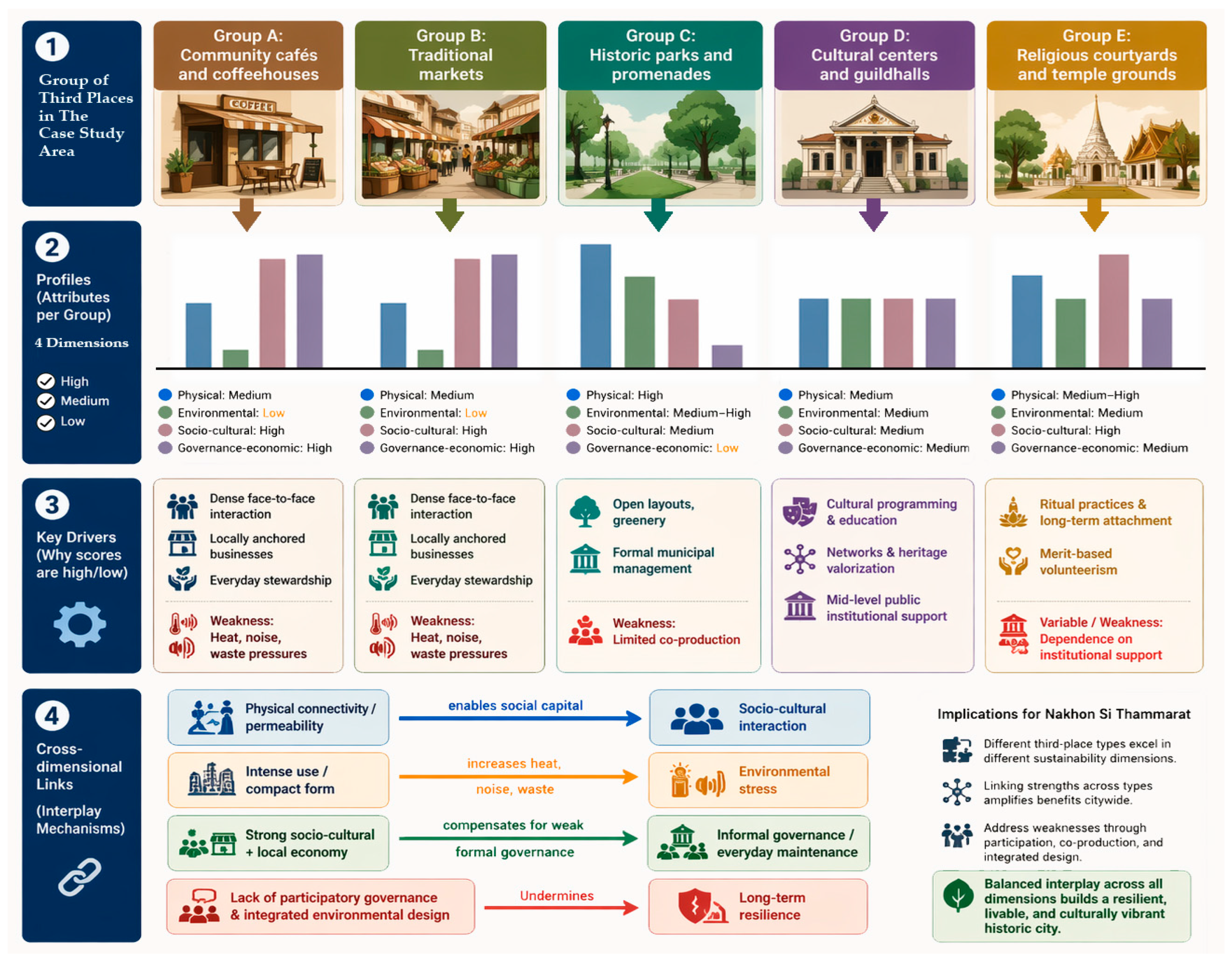
- Physical Dimension: The result has an average score of M = 1.90 (SD = 0.54), which is classified as Moderately Sustainable. This dimension was identified as the indicator for visibility and openness, which scored the highest (M = 2.12), particularly among traditional markets, historic parks and promenades, and religious courtyards and temple grounds. These areas feature physical spaces that are openly visible, helping reduce risk, enhance natural surveillance, and facilitate informal social monitoring. Meanwhile, the indicator for walkability and accessibility remains at a moderate level (M = 1.71), indicating that although many third places are open and conducive to natural surveillance, connections to pedestrian networks, bicycle lanes, and public transportation remain limited and require further development.
- Environmental Dimension: The assessment results show greater inconsistencies in this dimension than in others. Specifically, several third places, which are embedded in the groups of historic parks and promenades, and religious courtyards and temple grounds, scored highly on indicators related to green spaces and shade, owing to the presence of large trees and microclimate elements conducive to daily use at various times. Conversely, commercial areas such as groups of community coffeehouses, teahouses, and cafés located on narrow streets or in densely built-up neighborhoods have limited green and shaded elements, resulting in moderate or low environmental comfort, especially during hot weather. Additionally, the environmental dimension received the lowest average scores across all dimensions (M = 1.03, SD = 0.60), particularly on the low-carbon access indicator, which had an average score of only M = 0.88, categorized as ‘Low Sustainability’ and a significant limitation on the proportion of users accessing the areas by walking, cycling, or public transport. This is related to the physical dimension.
- Socio-Cultural Dimension: The assessment results indicate that this dimension is among the strongest in the third places within Nakhon Si Thammarat historic town, which received the highest average score (M = 2.44, SD = 0.23), indicating ‘High Sustainability’. The highest-scoring indicators, in order, were cultural diversity (M = 2.94), social interaction frequency (M = 2.88), and local culture practices (M = 2.82). This suggests that the third place continues to function as a robust social and cultural infrastructure. Qualitative evidence supports this, with the presence of ‘regulars’ and many areas being described as ‘the city’s living room’, ‘the community’s storytelling hub’, or ‘a buffer zone between sacred spaces and residential areas’. This reflects the perception that people view these spaces as extensions of community identity rather than merely neutral public spaces. Furthermore, the third place within the historic town of Nakhon Si Thammarat also demonstrates its potential to support a diverse range of local cultural activities. Empirical evidence shows that many of these areas accommodate both daily rituals and traditions, such as morning tea ceremonies, making merit, and almsgiving. At the same time, the third place serves as a venue for festivals, processions, and religious ceremonies that are uniquely characteristic of Nakhon Si Thammarat. These activities are not merely ‘events’ occurring in open spaces; rather, the places themselves hold significant historical and symbolic meaning, closely linking contemporary life with ritual pathways, temples, and the old market streets. Additionally, several third places connect Thai Buddhist, Thai Muslim, and Thai–Chinese communities through trade and everyday conversations, thereby creating a “visible diversity” of cultural users and practices that aligns with the cultural diversity indicator in the assessment framework.
- Governance–Economic Dimension: The assessment result has an average score of M = 1.38 (SD = 0.49), reflecting ‘Moderate Sustainability.’ Traditional markets and community cafes notably bolster local economic vitality by supporting small-scale entrepreneurs and preserving local labor skills, thereby enhancing the district’s economic resilience.
4.3.2. Third Place’s Group Level
4.3.3. Site Level
4.3.4. Indicators of Systemic Strengths and Weaknesses
5. Discussion
5.1. Socio-Cultural Performance of Third Places
5.2. Physical Dimension and Urban Form
5.3. Environmental Vulnerabilities of Socially Strong Third Places
5.4. Governance, Participation, and Thai Administrative Context
5.5. Integrating the HUL Perspective and Policy Implications
6. Suggestions
7. Conclusions
8. Limitations
Author Contributions
Funding
Institutional Review Board Statement
Data Availability Statement
Conflicts of Interest
Abbreviations
| HUL | Historic Urban Landscape |
| UNESCO | The United Nations Educational, Scientific and Cultural Organization |
| M | Median |
| SD | Standard Deviation |
References
- Oldenburg, R. The Great Good Place: Cafés, Coffee Shops, Community Centers, Beauty Parlors, General Stores, Bars, Hangouts, and How They Get You through the Day; Paragon House: New York, NY, USA, 1989. [Google Scholar]
- Finlay, J.; Esposito, M.; Kim, M.H.; Gomez-Lopez, I.; Clarke, P. Closure of “Third Places”? Exploring Potential Consequences for Collective Health and Wellbeing. Health Place 2019, 60, 102225. [Google Scholar] [CrossRef]
- Sugiyama, T.; Carver, A.; Koohsari, M.J.; Veitch, J. Third Places for Older Adults’ Social Engagement: A Scoping Review and Research Agenda. Gerontologist 2023, 63, 1103–1116. [Google Scholar] [CrossRef]
- Goosen, Z.; Cilliers, E.J. Enhancing Social Sustainability through the Planning of Third Places: A Theory-Based Framework. Soc. Indic. Res. 2020, 150, 835–866. [Google Scholar] [CrossRef]
- Ujang, N. Place Attachment and Continuity of Urban Place Identity in Malaysia. Procedia Soc. Behav. Sci. 2012, 42, 156–167. [Google Scholar] [CrossRef]
- UNESCO. Recommendation on the Historic Urban Landscape. UNESCO World Heritage Centre. 2011. Available online: https://whc.unesco.org/en/hul/ (accessed on 4 March 2026).
- Guzmán, P.C.; Pereira Roders, A.R.; Colenbrander, B.J.F. Bridging the Gap between Urban Development and Cultural Heritage Protection. In Proceedings of the 34th Annual Conference of the International Association for Impact Assessment (IAIA14), Viña del Mar, Chile, 8–11 April 2014. [Google Scholar]
- Ornelas, C.; Sousa, F.; Guedes, J.M.; Breda-Vázquez, I. Monitoring and Assessment Heritage Tool: Quantify and Classify Urban Heritage Buildings. SSRN 2022, 137, 1–18. Available online: https://ssrn.com/abstract=4182562 (accessed on 22 April 2026). [CrossRef]
- Farhan, S.L.; Hasan, S.A.; Rahim, L.A.L.; Ebraheem, A.K.; Al-Hussaini, Z.I.H.; Ebraheem, M.A.; Alkinani, A.S.; Al-Rawe, M.K.; Jassim, A.H.; Shok, M.E. Balancing Heritage Preservation and Sustainable Development in Historic Cities: A Case Study of Old Najaf in the Context of Global Best Practices. Int. J. Sustain. Dev. Plan. 2025, 20, 1041–1051. [Google Scholar] [CrossRef]
- Al-Shami, H.W.; Al-Alwan, H.A.S.; Abdulkareem, T.A. Cultural Sustainability in Urban Third Places: Assessing the Impact of “Co-Operation in Science and Technology” in Cultural Third Places. Ain Shams Eng. J. 2024, 15, 102465. [Google Scholar] [CrossRef]
- Purnamasari, L.; Sihombing, A.; Fuad, A.; Adam, M. The Spatial Practices of Working Women in Third Place: Contributions to Urban Environmental Sustainability. Int. J. Technol. 2025, 16, 1124–1142. [Google Scholar] [CrossRef]
- Pereira Roders, A.; van Oers, R. Guidance on Heritage Impact Assessments: Learning from Its Application on World Heritage Site Management. J. Cult. Herit. Manag. Sustain. Dev. 2012, 2, 104–114. [Google Scholar] [CrossRef]
- Throsby, D. The Economics of Cultural Policy; Cambridge University Press: Cambridge, UK, 2010. [Google Scholar]
- Oldenburg, R.; Brissett, D. The Third Place. Qual. Sociol. 1982, 5, 265–284. [Google Scholar] [CrossRef]
- Bandarin, F.; van Oers, R. The Historic Urban Landscape: Managing Heritage in an Urban Century; Wiley-Blackwell: Chichester, UK, 2012. [Google Scholar] [CrossRef]
- Daly, P.; Winter, T. (Eds.) Routledge Handbook of Heritage in Asia; Routledge: London, UK; New York, NY, USA, 2012. [Google Scholar]
- Littman, D.M. Third Place Theory and Social Work: Considering Collapsed Places. J. Soc. Work 2021, 21, 1225–1242. [Google Scholar] [CrossRef]
- Littman, D.M. Third Places, Social Capital, and Sense of Community as Components of Resilience. Am. J. Community Psychol. 2021, 68, 403–416. [Google Scholar] [CrossRef]
- Waxman, L. The Coffee Shop: Social and Physical Factors Influencing Place Attachment. J. Inter. Des. 2006, 31, 35–53. [Google Scholar] [CrossRef]
- Rhubart, D.; Sun, Y.; Pendergrast, C.; Monnat, S. Sociospatial Disparities in “Third Place” Availability in the United States. Socius 2022, 8, 1–11. [Google Scholar] [CrossRef]
- Askew, M. Bangkok: Place, Practice and Representation; Routledge: London, UK, 2002. [Google Scholar]
- Turner, V. The Ritual Process: Structure and Anti-Structure; Aldine de Gruyter: New York, NY, USA, 1969. [Google Scholar]
- Sinlapasai, D. Public Life in Bangkok’s Urban Spaces. Open House Int. 2013, 38, 62–73. [Google Scholar] [CrossRef]
- Sustainability Directory. Why Are Third Places Important for Social Sustainability? Lifestyle Sustain. Directory 2025. Available online: https://lifestyle.sustainability-directory.com/question/why-are-third-places-important-for-social-sustainability/ (accessed on 4 March 2026).
- Yahya, R.; Wood, E.A. Play as Third Space between Home and School: Bridging Cultural Discourses. J. Early Child. Res. 2017, 15, 305–322. [Google Scholar] [CrossRef]
- Jeffres, L.W.; Bracken, C.C.; Jian, G.; Gao, Y. The Impact of Third Places on Community Quality of Life. Appl. Res. Qual. Life 2009, 4, 333–345. [Google Scholar] [CrossRef]
- Thinnakorn, W. The Urban Image Conservation and Development of Nakhon Si Thammarat’s Old Town Community in Thailand. Nakhara J. Environ. Des. Plan. 2021, 20, 120. [Google Scholar] [CrossRef]
- Oldenburg, R.; Christensen, B. Third Places: True Citizen Spaces. UNESCO Courier 2023. Available online: https://courier.unesco.org/en/articles/third-places-true-citizen-spaces (accessed on 4 March 2026).
- Abouelmagd, D.; Elrawy, S. Cultural Heritage and Sustainable Urban Development: The Case of Port Said City in Egypt. Cogent Soc. Sci. 2022, 8, 2067079. [Google Scholar] [CrossRef]
- Williams, S.A.; Hipp, J.R. How Great and How Good? Third Places, Neighbor Interaction, and Cohesion in the Neighborhood Context. Soc. Sci. Res. 2019, 77, 68–78. [Google Scholar] [CrossRef]
- Al-Shami, H.W. Creative Place-Making as a Critical Approach to Promoting Cultural Third-Places: Insights from Al-Mutanabi Street in Baghdad, Iraq. ISVS E-J. 2024, 10, 265–284. [Google Scholar]
- Nocca, F. Integrating Cultural Heritage in Urban Sustainable Development: A Conceptual Framework. In Integrating Cultural Heritage in Urban Development; ICOMOS: Paris, France, 2017. [Google Scholar]
- Denzin, N.K. The Research Act: A Theoretical Introduction to Sociological Methods; McGraw-Hill: New York, NY, USA, 1978. [Google Scholar]
- Patton, M.Q. Qualitative Research & Evaluation Methods: Integrating Theory and Practice, 4th ed.; SAGE Publications: Thousand Oaks, CA, USA, 2015. [Google Scholar]
- Noble, H.; Heale, R. Triangulation in research, with examples. Evid. Based Nurs. 2019, 22, 67–68. [Google Scholar] [CrossRef]
- Tarne, P.; Lehmann, A.; Finkbeiner, M. Introducing weights to life cycle sustainability assessment—How do decision-makers weight sustainability dimensions? Int. J. Life Cycle Assess. 2019, 24, 530–542. [Google Scholar] [CrossRef]
- Lee, J.H.; Tan, T.H. Neighborhood Walkability or Third Places? Determinants of Social Support and Loneliness among Older Adults. J. Plan. Educ. Res. 2019, 41, 39–52. [Google Scholar] [CrossRef]
- Gaglione, F.; Cottrill, C.; Gargiulo, C. Urban services, pedestrian networks and behaviors to measure elderly accessibility. Transp. Res. Part D Transp. Environ. 2021, 90, 102687. [Google Scholar] [CrossRef]
- Strommer, T.; Munkácsy, A.; Földes, D. How Walkable Is an Urban Street? An Expert-Based Public Space and Walkability Assessment Method. Eur. Transp. Stud. 2025, 2, 100040. [Google Scholar] [CrossRef]
- Gehl, J. Cities for People; Island Press: Washington, DC, USA, 2010. [Google Scholar]
- Speck, J. Walkable City: How Downtown Can Save America, One Step at a Time; Farrar, Straus and Giroux: New York, NY, USA, 2012. [Google Scholar]
- Samadi, Z.; Mohd Yunus, R.; Omar, D.; Bakri, A.F. Experiencing Urban through On-Street Activity. Procedia Soc. Behav. Sci. 2015, 170, 653–658. [Google Scholar] [CrossRef]
- Liu, J. Space Design Guide for Public Areas in a Multicultural Environment: Based on the Theory of Social Atomism. Archit. Des. Res. 2021, 34, 21–39. [Google Scholar] [CrossRef]
- Vadiati, N.; Kashkooli, A.M.S. Environmental Sustainability of Newly Developed City Squares in Historic Cities: Case Study of Isfahan–Iran. Procedia Eng. 2011, 21, 829–837. [Google Scholar] [CrossRef]
- Nasehi, H.; Saberi, H.; Ghaedrahmati, S.; Khademolhoseiny, A. Modeling the Role of Third Places in Social Sustainability in Isfahan. Urban Struct. Funct. Stud. 2022, 9, 153–176. [Google Scholar]
- Haselbacher, M.; Kuokkanen, K.; Palonen, E.; Reeger, U. Inclusion and Exclusion in Urban Public Space: Contemporary Challenges in Vienna and Helsinki. Urban Plan. 2024, 9, 1–18. [Google Scholar] [CrossRef]
- Zhou, S.L. Understanding “Inclusiveness” in Public Space. In UBC SCARP/VIVA Vancouver; University of British Columbia: Vancouver, BC, Canada, 2019; Available online: https://sustain.ubc.ca/sites/default/files/2019-50_Understanding%20Inclusiveness%20in%20Public%20Space_Zhou.pdf (accessed on 4 March 2026).
- Bolici, R.; Gambaro, M.; Giordano, C. The Regaining of Public Spaces to Enhance the Historic Urban Landscape. Int. J. Crime Justice Soc. Democr. 2017, 6, 45–56. [Google Scholar] [CrossRef]
- Jokilehto, J. Considerations on Authenticity and Integrity in World Heritage Context. In Proceedings of the International Conference on Authenticity and Integrity in an African Context, Great Zimbabwe, Zimbabwe, 2006; UNESCO: Great Zimbabwe, Zimbabwe, 2006; Available online: https://journals.ed.ac.uk/ear/article/view/9747/12439 (accessed on 10 November 2025).
- Crowley, M.; Knepper, R. Translocal Pathways of Immigrant Settlement and Incorporation. Annu. Rev. Sociol. 2019, 45, 57–76. [Google Scholar]
- Alkhafaji, A.; Althabhawi, G. The Role of Ecosystem to Enhance Sustainable Revitalization: Al-Kifl Historic City Center as a Case Study. J. Appl. Sci. Technol. Trends 2025, 6, 61–73. [Google Scholar] [CrossRef]
- OECD. Compact City Policies: A Comparative Assessment; OECD Green Growth Studies; OECD Publishing: Paris, France, 2012. [Google Scholar]
- Ali, A.G. Tracing the Roots of Historic Cities: Embracing Sustainable Green Cities and Navigating Threats through Original Characteristics. Adv. Res. Conserv. Sci. 2024, 5, 15–41. [Google Scholar] [CrossRef]
- IPCC. Asia. In Climate Change 2022: Impacts, Adaptation and Vulnerability. Contribution of Working Group II to the Sixth Assessment Report of the Intergovernmental Panel on Climate Change; Pörtner, H.-O., Roberts, D.C., Tignor, M., Poloczanska, E.S., Mintenbeck, K., Alegría, A., Craig, M., Langsdorf, S., Löschke, S., Möller, V., et al., Eds.; Cambridge University Press: Cambridge, UK; New York, NY, USA, 2023; pp. 1457–1580. [Google Scholar]
- International Climate Initiative (IKI). URBAN: Urban Resilience Building and Nature: Innovating Urban Planning for Resiliency with Nature-Based Solutions and Climate Risk Models in Thailand, 2025. Available online: https://www.international-climate-initiative.com/en/project/urban-urban-resilience-building-and-nature-innovating-urban-planning-for-resiliency-with-nature-based-solutions-and-climate-risk-models-in-thailand-22-ii-194-tha-a-urban/ (accessed on 28 April 2026).
- Urban Institute. How Third Places Contribute to Thriving Communities. Urban Wire 2024. Available online: https://www.urban.org/urban-wire/how-third-places-contribute-thriving-communities (accessed on 4 October 2025).
- Ratanawaraha, A. Institutional Issues in Integrating Land Use Planning and Water Management in Thailand; Research Report; Thailand Development Research Institute Foundation (TDRI): Bangkok, Thailand, 2016. [Google Scholar]
- Paksukcharern, K. Sustaining Urban Spatial Network of Historical Communities Through the Reuse of Temple Grounds and Social Space–A Case Study of Rattanakosin, Bangkok. Nakhara J. Environ. Des. Plan. 2016, 12, 177–186. [Google Scholar]
- Martí, P.; Serrano-Estrada, L.; Aboutorabi, M. Culturally Diverse Street-Level Urban Activities through the Lens of Digital Footprints. Sustainability 2021, 13, 11141. [Google Scholar] [CrossRef]
- Hussein, F.; Stephens, J.; Tiwari, R. Memory for Social Sustainability: Recalling Cultural Memories in Zanqit Alsitat Historical Street Market, Alexandria, Egypt. Sustainability 2020, 12, 8141. [Google Scholar] [CrossRef]
- Thinnakorn, W.; Anurak, T.; Phibul, P.; Kangkasara, P.; Satik, S. Landscape Improvement to Promote Cultural Landscape Values Toward Sustainability: A Case Study of Wat Khongkhaliab, Nakhon Si Thammarat Province, Thailand. Nakhara J. Environ. Des. Plan. 2025, 24, 515. [Google Scholar] [CrossRef]
- Przewoźna, P.; Inglot, A.; Mielewczyk, M.; Maczka, K.; Matczak, P. Accessibility to Urban Green Spaces: A Critical Review of WHO Recommendations in the Light of Tree-Covered Areas Assessment. Ecol. Indic. 2024, 166, 112548. [Google Scholar] [CrossRef]
- Cunha Ferreira, T.; Rey-Pérez, J.; Pereira Roders, A.; Tarrafa Silva, A.; Coimbra, I.; Breda Vazquez, I. The Historic Urban Landscape Approach and the Governance of World Heritage in Urban Contexts: Reflections from Three European Cities. Land 2023, 12, 1020. [Google Scholar] [CrossRef]



| Group of Third Places | Site Picture |
|---|---|
| Community coffeehouses, teahouses, and cafés (6 sites) |   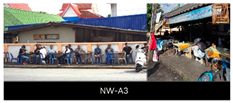    |
| Traditional markets (5 sites) |      |
| Historic parks and promenades (2 sites) |   |
| Cultural centers and guildhalls (1 site) |  |
| Religious courtyards and temple grounds (3 sites) | 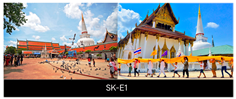   |
| Score | Level | Alignment with Sustainability |
|---|---|---|
| 0 | None | No evidence |
| 1 | Low | Weak or absent sustainability contribution |
| 2 | Moderate | Partial sustainability contribution |
| 3 | High | Strong sustainability contribution |
| Dimension | Indicators | Score 0 (None) | Score 1 (Low) | Score 2 (Moderate) | Score 3 (High) | |||
|---|---|---|---|---|---|---|---|---|
| Walkability and Accessibility (IP1) | Total absence of pedestrian paths or permanent obstructions. | Dilapidated paths with high barriers; extremely difficult access for most users. | Fair connectivity with minor obstacles; accessible but lacks universal design. | Seamless connectivity with high-quality paths and universal design integration. | ||||
| Indicator Description: Pedestrian pathways and public transportation networks that facilitate convenient and safe access and utilization of the third place by the community. Source: [37,38,39] | ||||||||
| Physical | Spatial Comfort and Flexibility (IP2) | Perceived as hazardous or abandoned; total lack of lighting and surveillance. | Minimal or broken amenities; rigid layout that discourages prolonged staying. | Adequate comfort with basic amenities; supports common uses. | Optimal comfort with flexible, high-quality amenities and diverse seating options. | |||
| Indicator Description: Physical comfort, layout flexibility, and diverse seating arrangements that accommodate both individual and group activities, thereby fostering physical and mental well-being. Source: [40,41,42] | ||||||||
| Visibility and Openness (IP3) | Completely enclosed or visually blocked; zero natural surveillance. | Poor visibility with numerous blind spots; feels unsafe or isolated. | Fair visibility with some natural surveillance; minor obstructed sightlines. | Excellent visibility and openness: clear sightlines that foster a high sense of safety. | ||||
| Indicator Description: Enhanced openness and visibility in an area reduces blind spots, delivering a sense of security through natural surveillance and fostering informal social interactions. Source: [28,43] | ||||||||
| Environment | Greenery and Shade (IE1) | Complete absence of greenery or natural shading. | Minimal greenery; insufficient canopy cover for climate comfort. | Moderate vegetation providing shade for primary activity areas. | Abundant greenery; extensive canopy cover that significantly mitigates heat. | |||
| Indicator Description: The proportion of green space and tree shade contributes to a comfortable climate conducive to daily life. Source: [11,26] | ||||||||
| Low-Carbon Access (IE2) | Zero access via Low-carbon modes; entirely dependent on private vehicles. | Minimal low-carbon access due to poor infrastructure or safety concerns. | Moderate use of low-carbon modes; presence of basic supporting infrastructure. | Predominant use of walking, cycling, or public transport with excellent support. | ||||
| Indicator Description: The proportion of users who access third places by walking, cycling, or public transportation. Source: [11,40,44] | ||||||||
| Socio-Cultural | Sense of Belonging (IS1) | Users feel completely alienated; no historical or emotional connection. | Weak attachment; perceived as a generic or purely functional public area. | Good level of attachment; users recognize the site as part of their community. | Strong sense of ownership; site is deeply rooted in local collective identity. | |||
| Indicator Description: The perception that places reflect the identity, culture, and stories of the community helps people feel that the place belongs to them, rather than being just a generic public area. Source: [31,45] | ||||||||
| Social Interaction Frequency (IS2) | No social interaction observed; site functions as a dead or vacant space. | Sparse or fleeting interactions; limited primarily to pre-existing groups. | Regular social encounters; formation of new social ties is visible. | Vibrant community hub with frequent, diverse, and deep social interactions. | ||||
| Indicator Description: The frequency of meetings, conversations, and group activities among users of the place. Source: [2,45] | ||||||||
| Inclusiveness and Safety (IS3) | Explicitly exclusive or unsafe; total lack of hospitality for diverse groups. | Low inclusiveness; barriers (physical or social) exist for vulnerable groups. | Fairly inclusive; most groups can use the space comfortably with minor issues. | Highly inclusive and welcoming; proactively accommodates all social groups. | ||||
| Indicator Description: Inclusivity for all groups, encompassing structural aspects (design and accessibility) and socio-cultural elements (norms, hospitality, and non-discrimination), particularly for vulnerable populations such as women, children, the elderly, persons with disabilities, ethnic minorities, and migrants. Source: [2,46,47] | ||||||||
| Local Cultural Practices (IS4) | No visible cultural practices or traditions occurring within the site. | Rare or seasonal cultural expressions; limited to formal events. | Regular cultural activities; daily traditions are consistently maintained. | A “living heritage” space; cultural rituals are a core part of the daily function. | ||||
| Indicator Description: Support for everyday activities, traditions, and rituals. Source: [1,10,48,49] | ||||||||
| Cultural Diversity (IS5) | Total cultural homogeneity; no presence or interaction of diverse backgrounds. | Low diversity; presence of different groups is rare or separate. | Visible diversity; different cultures coexist and interact in specific periods. | High diversity; vibrant cross- cultural interactions occur naturally and regularly. | ||||
| Indicator Description: Visible diversity and “social-policy conditions” that allow different cultures to coexist, meet, and interact in third places without exclusion. Source: [10,43,47] | ||||||||
| Governance—Economic | Community Participation in Management (IG1) | Management is entirely top-down; zero community involvement. | Minimal involvement; community is informed but has no decision power. | Consultative participation; community feedback is sought on specific issues. | Bottom-up/ collaborative; community leads management and decision-making. | |||
| Indicator Description: Local people’s participation in the design, maintenance, and decision-making regarding these places is crucial. Source: [1,4,50] | ||||||||
| Local Economic Vitality (IG2) | No economic activity or entirely dominated by external corporations. | Minimal local micro- entrepreneurship; inconsistent or declining activity. | Stable local businesses that support the community’s daily economic needs. | Thriving and diverse local economy that enhances the area’s resilience. | ||||
| Indicator Description: Support small businesses, local community shops and activities, an increase in new business registrations, changes in property values and rentals, and the retention of a local workforce with creative skills. Source: [19,39] | ||||||||
| Sustainability Level | An Average Score (Points) |
|---|---|
| Minimally Sustainable | 0.00–0.99 |
| Moderately Sustainable | 1.00–1.99 |
| Highly Sustainable | 2.00–3.00 |
| Third Places | Physical | Environmental | Socio-Cultural | Governance & Economic | |||||||||||||||
|---|---|---|---|---|---|---|---|---|---|---|---|---|---|---|---|---|---|---|---|
| IP1 | IP2 | IP3 | (M) | IE1 | IE2 | (M) | IS1 | IS2 | IS3 | IS4 | IS5 | (M) | IG1 | IG2 | (M) | ||||
| 1. Community coffeehouses, teahouses, and cafés | |||||||||||||||||||
| PA-A1 | 1.00 | 2.00 | 2.00 | 1.67 | 0.00 | 1.00 | 0.50 | 2.00 | 3.00 | 1.00 | 3.00 | 3.00 | 2.40 | 0.00 | 2.00 | 1.00 | |||
| CO-A2 | 1.00 | 2.00 | 3.00 | 2.00 | 0.00 | 1.00 | 0.50 | 3.00 | 3.00 | 1.00 | 3.00 | 3.00 | 2.60 | 0.00 | 3.00 | 1.50 | |||
| NW-A3 | 1.00 | 2.00 | 3.00 | 2.00 | 0.00 | 1.00 | 0.50 | 3.00 | 3.00 | 1.00 | 3.00 | 3.00 | 2.60 | 0.00 | 2.00 | 1.00 | |||
| TP-A4 | 1.00 | 2.00 | 2.00 | 1.67 | 1.00 | 1.00 | 1.00 | 3.00 | 3.00 | 1.00 | 3.00 | 3.00 | 2.60 | 0.00 | 2.00 | 1.00 | |||
| KP-A5 | 1.00 | 2.00 | 2.00 | 1.67 | 1.00 | 0.00 | 0.50 | 2.00 | 3.00 | 1.00 | 3.00 | 3.00 | 2.40 | 0.00 | 3.00 | 1.50 | |||
| TK-A6 | 1.00 | 2.00 | 2.00 | 1.67 | 0.00 | 1.00 | 0.50 | 3.00 | 3.00 | 1.00 | 3.00 | 3.00 | 2.60 | 0.00 | 2.00 | 1.00 | |||
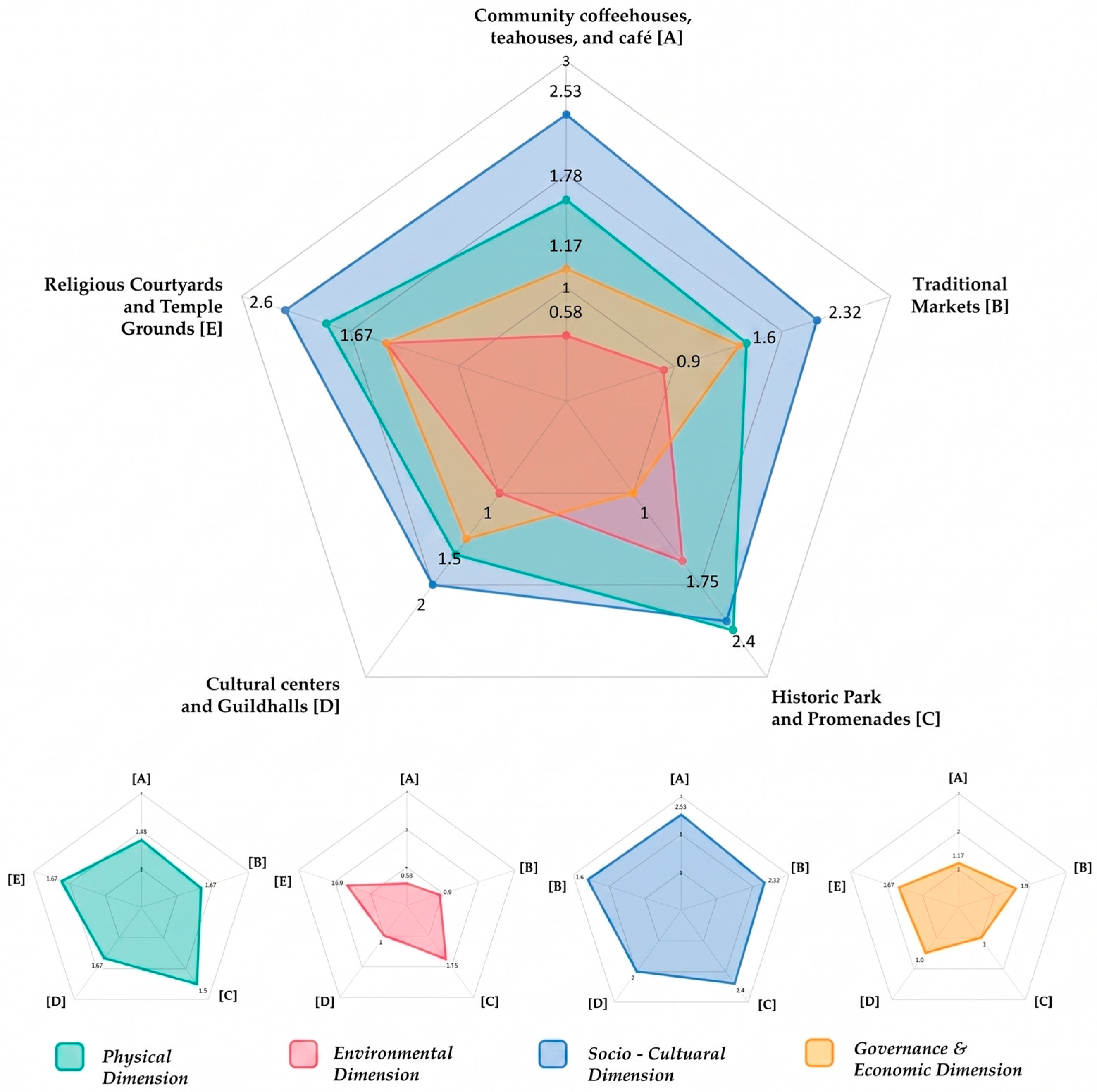
| Group’s Mean Score | 1.78 | 0.58 | 2.53 | 1.17 | |||||||||||||||
| 2. Traditional markets | |||||||||||||||||||
| MK-B1 | 1.00 | 1.00 | 0.00 | 0.67 | 2.00 | 0.00 | 1.00 | 3.00 | 3.00 | 1.00 | 3.00 | 3.00 | 2.60 | 3.00 | 2.00 | 2.50 | |||
| TC-B2 | 1.00 | 3.00 | 2.00 | 2.00 | 0.00 | 1.00 | 0.50 | 3.00 | 3.00 | 1.00 | 3.00 | 3.00 | 2.60 | 2.00 | 2.00 | 2.00 | |||
| WM-B3 | 2.00 | 3.00 | 3.00 | 2.67 | 3.00 | 1.00 | 2.00 | 1.00 | 3.00 | 1.00 | 3.00 | 3.00 | 2.20 | 1.00 | 2.00 | 1.50 | |||
| LD-B4 | 2.00 | 1.00 | 3.00 | 2.00 | 0.00 | 1.00 | 0.50 | 1.00 | 3.00 | 1.00 | 3.00 | 3.00 | 2.20 | 1.00 | 2.00 | 1.50 | |||
| TM-B5 | 2.00 | 0.00 | 1.00 | 1.00 | 0.00 | 1.00 | 0.50 | 1.00 | 2.00 | 1.00 | 3.00 | 3.00 | 2.00 | 0.00 | 1.00 | 0.50 | |||
| Group’s Mean Score | 1.67 | 0.90 | 2.32 | 1.60 | |||||||||||||||
| 3. Historic parks and promenades | |||||||||||||||||||
| SN-C1 | 3.00 | 2.00 | 3.00 | 2.67 | 3.00 | 1.00 | 2.00 | 1.00 | 3.00 | 2.00 | 3.00 | 3.00 | 2.40 | 1.00 | 1.00 | 1.00 | |||
| SS-C2 | 3.00 | 2.00 | 2.00 | 2.33 | 2.00 | 1.00 | 1.50 | 1.00 | 3.00 | 2.00 | 3.00 | 3.00 | 2.40 | 1.00 | 1.00 | 1.00 | |||
| Group’s Mean Score | 2.50 | 1.75 | 2.40 | 1.00 | |||||||||||||||
| 4. Cultural centers and guildhalls | |||||||||||||||||||
| BW-D1 | 2.00 | 2.00 | 1.00 | 1.67 | 1.00 | 1.00 | 1.00 | 1.00 | 2.00 | 2.00 | 2.00 | 3.00 | 2.00 | 1.00 | 2.00 | 1.50 | |||
| Group’s Mean Score | 1.67 | 1.00 | 2.00 | 1.50 | |||||||||||||||
| 5. Religious courtyards and temple grounds | |||||||||||||||||||
| SK-E1 | 3.00 | 2.00 | 3.00 | 2.67 | 2.00 | 1.00 | 1.50 | 3.00 | 3.00 | 2.00 | 3.00 | 3.00 | 2.80 | 2.00 | 2.00 | 2.00 | |||
| ST-E2 | 2.00 | 2.00 | 2.00 | 2.00 | 2.00 | 1.00 | 1.50 | 3.00 | 3.00 | 2.00 | 2.00 | 3.00 | 2.60 | 2.00 | 1.00 | 1.50 | |||
| SP-E3 | 2.00 | 2.00 | 2.00 | 2.00 | 3.00 | 1.00 | 2.00 | 3.00 | 3.00 | 2.00 | 2.00 | 2.00 | 2.40 | 2.00 | 1.00 | 1.50 | |||
| Group’s Mean Score | 2.22 | 1.67 | 2.60 | 1.67 | |||||||||||||||
| Dimension’s Mean Score | 1.90 | 1.03 | 2.44 | 1.38 | |||||||||||||||
| Minimally Sustainable | |||||||||||||||||||
| Moderately Sustainable | |||||||||||||||||||
| Highly Sustainable | |||||||||||||||||||
| Level | Indicator | An Average Score |
|---|---|---|
| Strength (>2.00) | Cultural Diversity | 2.94 |
| Social Interaction Frequency | 2.88 | |
| Local Culture Practices | 2.82 | |
| Sense of Belonging | 2.18 | |
| Visibility and Openness | 2.12 | |
| Weakness (<1.00) | Community Participation in Management | 0.94 |
| Low-carbon Access | 0.88 |
Disclaimer/Publisher’s Note: The statements, opinions and data contained in all publications are solely those of the individual author(s) and contributor(s) and not of MDPI and/or the editor(s). MDPI and/or the editor(s) disclaim responsibility for any injury to people or property resulting from any ideas, methods, instructions or products referred to in the content. |
© 2026 by the authors. Licensee MDPI, Basel, Switzerland. This article is an open access article distributed under the terms and conditions of the Creative Commons Attribution (CC BY) license.
Share and Cite
Thinnakorn, W.; Chotikachorntham, P.; Bejrananda, J.; Chaupram, S. Sustainable Third Places in Historic Urban Landscapes: Multi-Dimensional Assessment of Nakhon Si Thammarat, Thailand. Land 2026, 15, 792. https://doi.org/10.3390/land15050792
Thinnakorn W, Chotikachorntham P, Bejrananda J, Chaupram S. Sustainable Third Places in Historic Urban Landscapes: Multi-Dimensional Assessment of Nakhon Si Thammarat, Thailand. Land. 2026; 15(5):792. https://doi.org/10.3390/land15050792
Chicago/Turabian StyleThinnakorn, Wirut, Pittida Chotikachorntham, Jantanee Bejrananda, and Supawadee Chaupram. 2026. "Sustainable Third Places in Historic Urban Landscapes: Multi-Dimensional Assessment of Nakhon Si Thammarat, Thailand" Land 15, no. 5: 792. https://doi.org/10.3390/land15050792
APA StyleThinnakorn, W., Chotikachorntham, P., Bejrananda, J., & Chaupram, S. (2026). Sustainable Third Places in Historic Urban Landscapes: Multi-Dimensional Assessment of Nakhon Si Thammarat, Thailand. Land, 15(5), 792. https://doi.org/10.3390/land15050792