Interactive Effects of Climate and Land-Use Changes on the Spatiotemporal Evolution of Water Ecosystem Services in the Yellow River Basin, China


Abstract
1. Introduction
2. Study Area and Research Methods
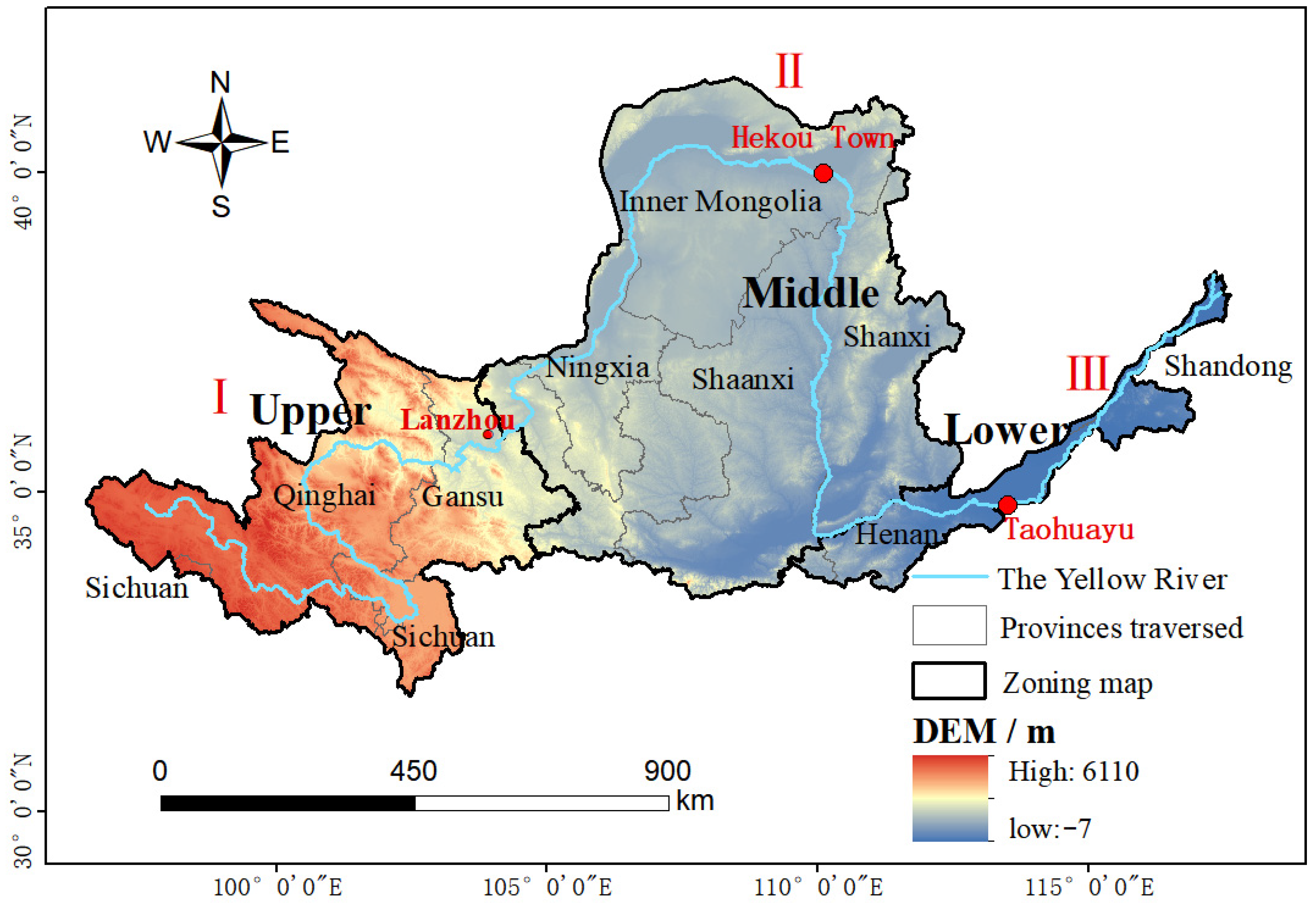
2.1. Study Area
2.2. Data Sources
2.3. Research Methods
2.3.1. Methods for Assessing Water Ecosystem Services
- (1)
- Water yield
- (2)
- Soil conservation function
- (3)
- Water purification capacity
2.3.2. Scenario Simulation Method
2.3.3. Geodetector Method
3. Results
3.1. Spatial-Temporal Patterns of Water Ecosystem Services
3.1.1. Water Yield
3.1.2. Soil Conservation
3.1.3. Water Purification
3.2. Influence of Driving Factors on Water Ecosystem Services
3.2.1. Influence of Climate
3.2.2. Influence of Land Use
3.2.3. Identification of Dominant Factors
4. Discussion
4.1. Spatial Patterns and Driving Mechanisms
4.2. Contributions and Limitations
4.3. Policy Implications
5. Conclusions
- (1)
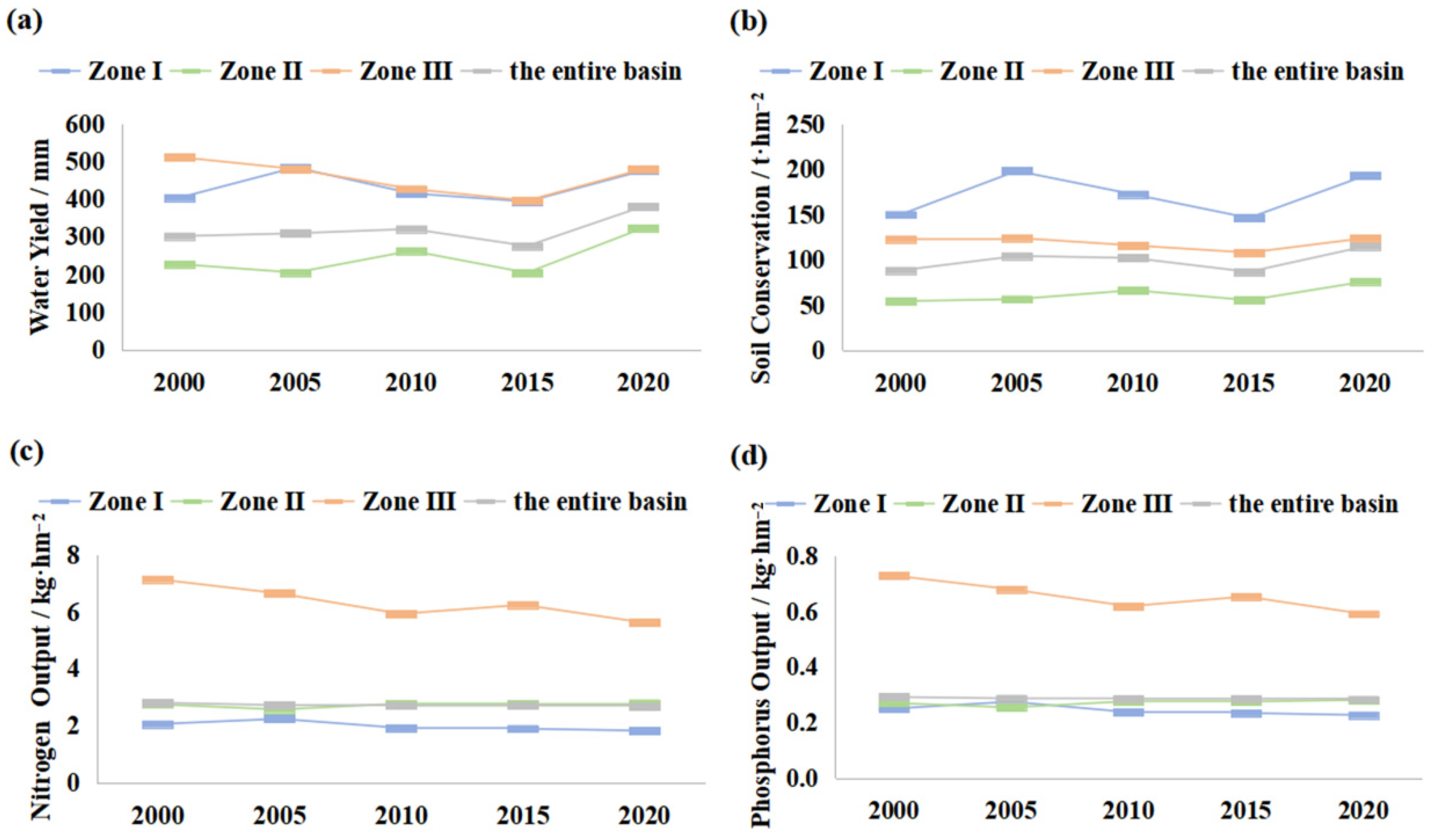
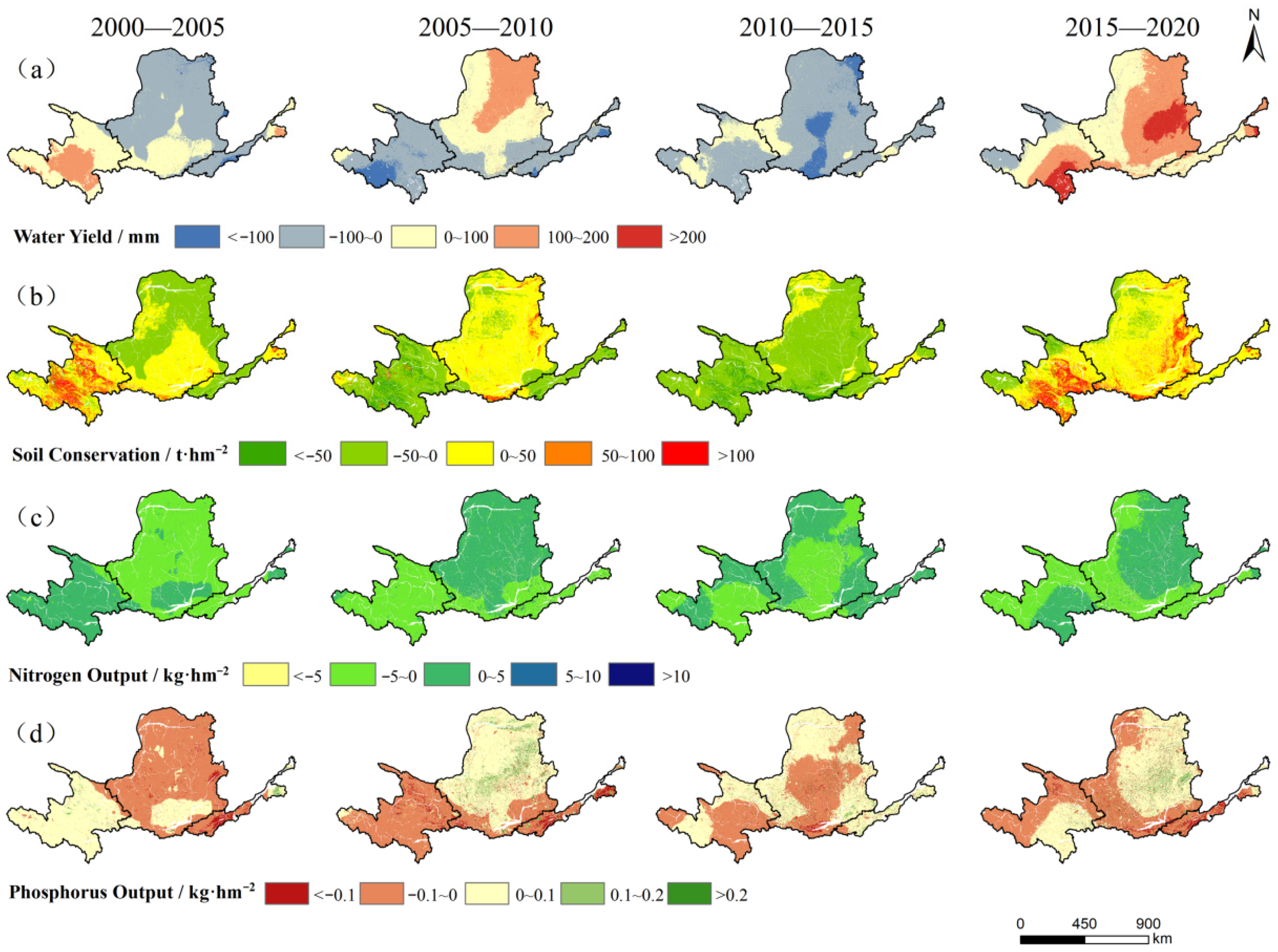
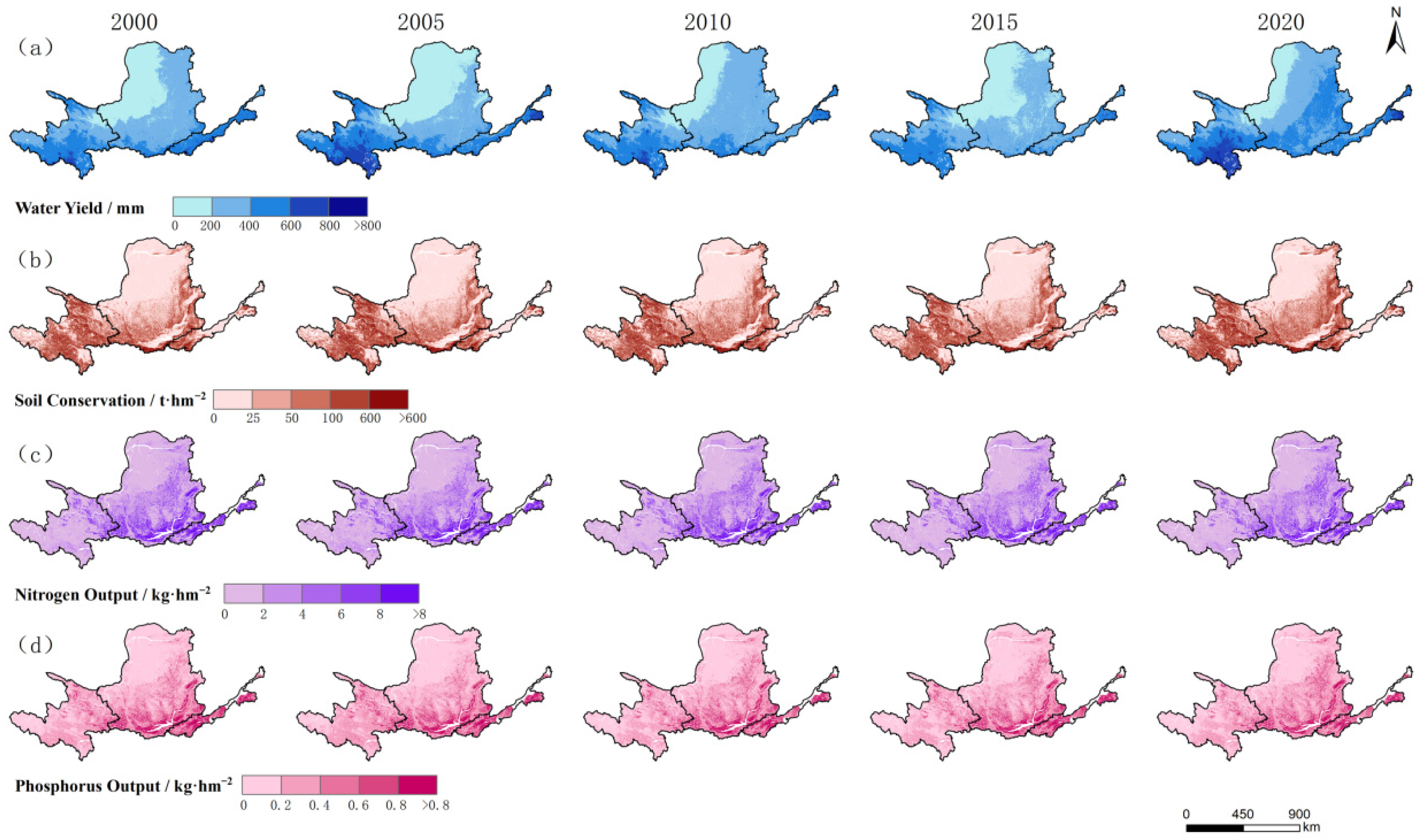
- From 2000 to 2020, water yield and soil conservation in the YRB showed generally increasing trends with interannual fluctuations, rising by 26.24% and 30.19%, respectively. In contrast, nitrogen and phosphorus outputs declined slightly by 4.82% and 3.08%, indicating a modest improvement in water purification. Spatially, all three services exhibited higher values in the southeast and lower values in the northwest, with clear distinctions among the three topographic zones. The multiyear average water yields in Zones I, II, and III were 434.50, 244.42, and 458.87 mm; the soil conservation amounts were 171.90, 61.64, and 118.91 t·hm−2; the nitrogen outputs were 1.98, 2.72, and 6.31 kg·hm−2; and the phosphorus outputs were 0.24, 0.27, and 0.65 kg·hm−2, respectively.
- (2)
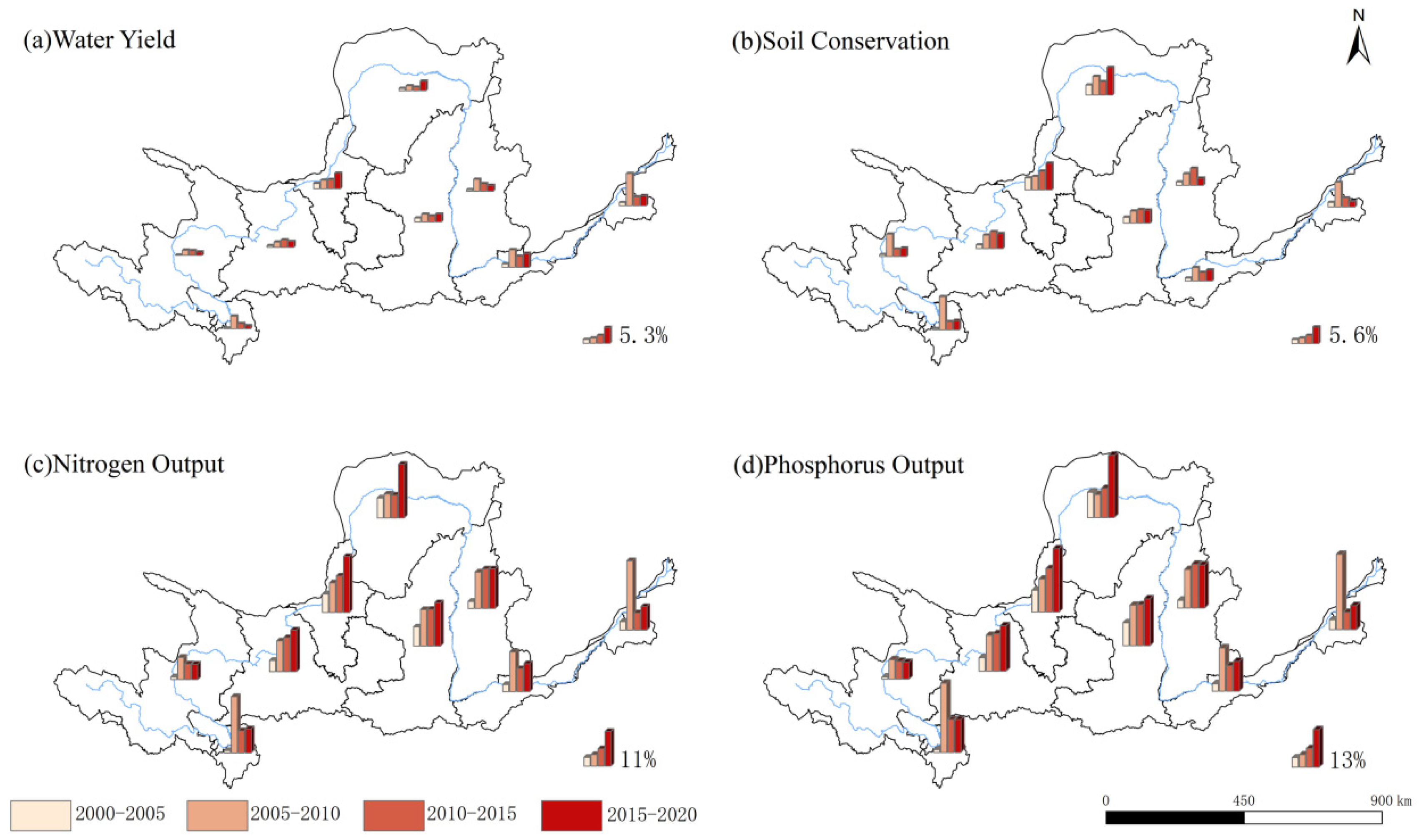
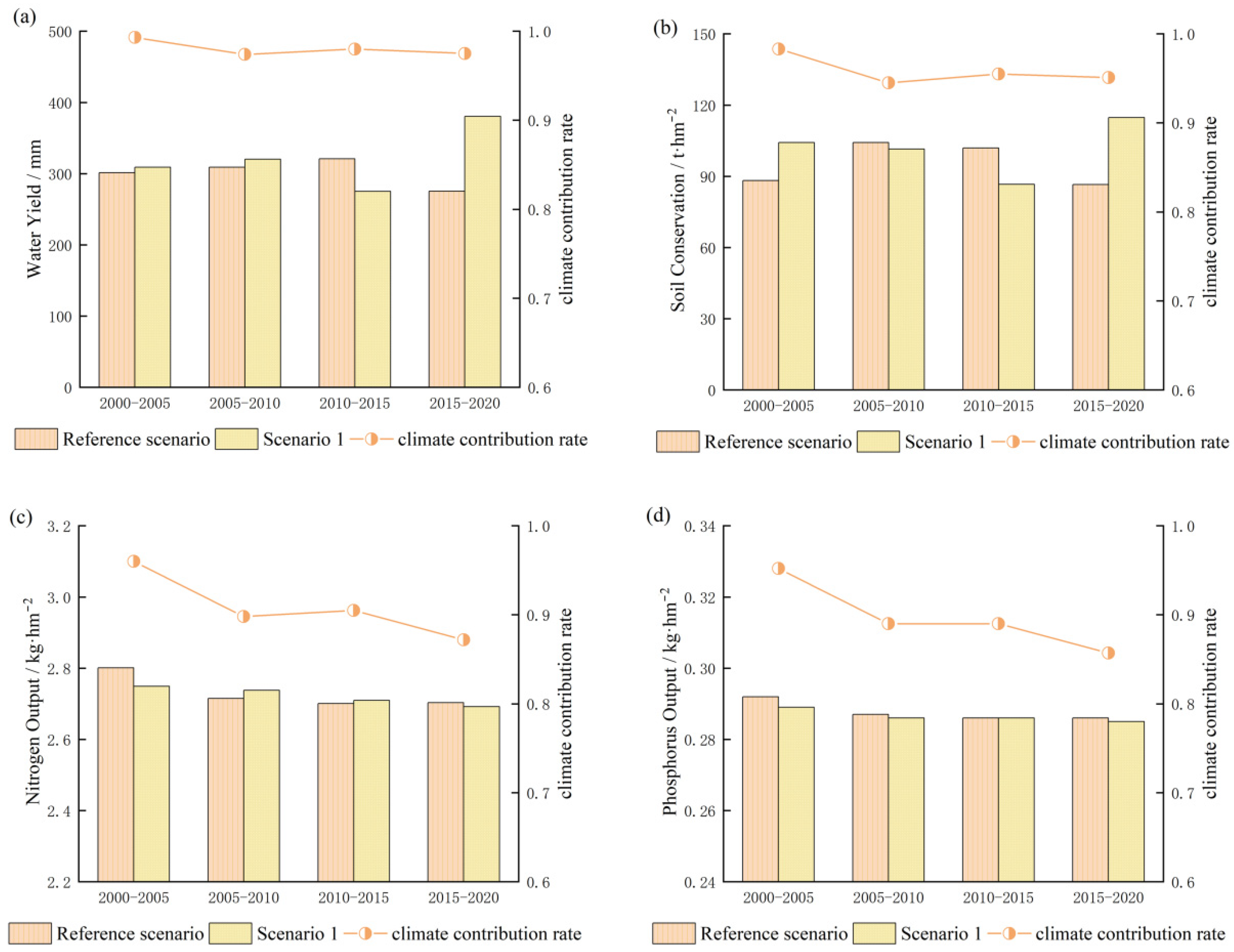
- Climate is a pivotal regulatory driver of water ecosystem change in the YRB. The contribution rates of climate change to variations in water yield, soil conservation, nitrogen export, and phosphorus export were 97.4–99.3, 94.5–98.3, 87.2–96.0, and 85.7–95.2%, respectively. Further analysis revealed that while the influence of climate on basin services is diminishing, land-use impacts are increasing over time, with particularly pronounced effects on nitrogen and phosphorus outputs. This highlights the necessity of giving greater attention and focus to land use in future research.
- (3)
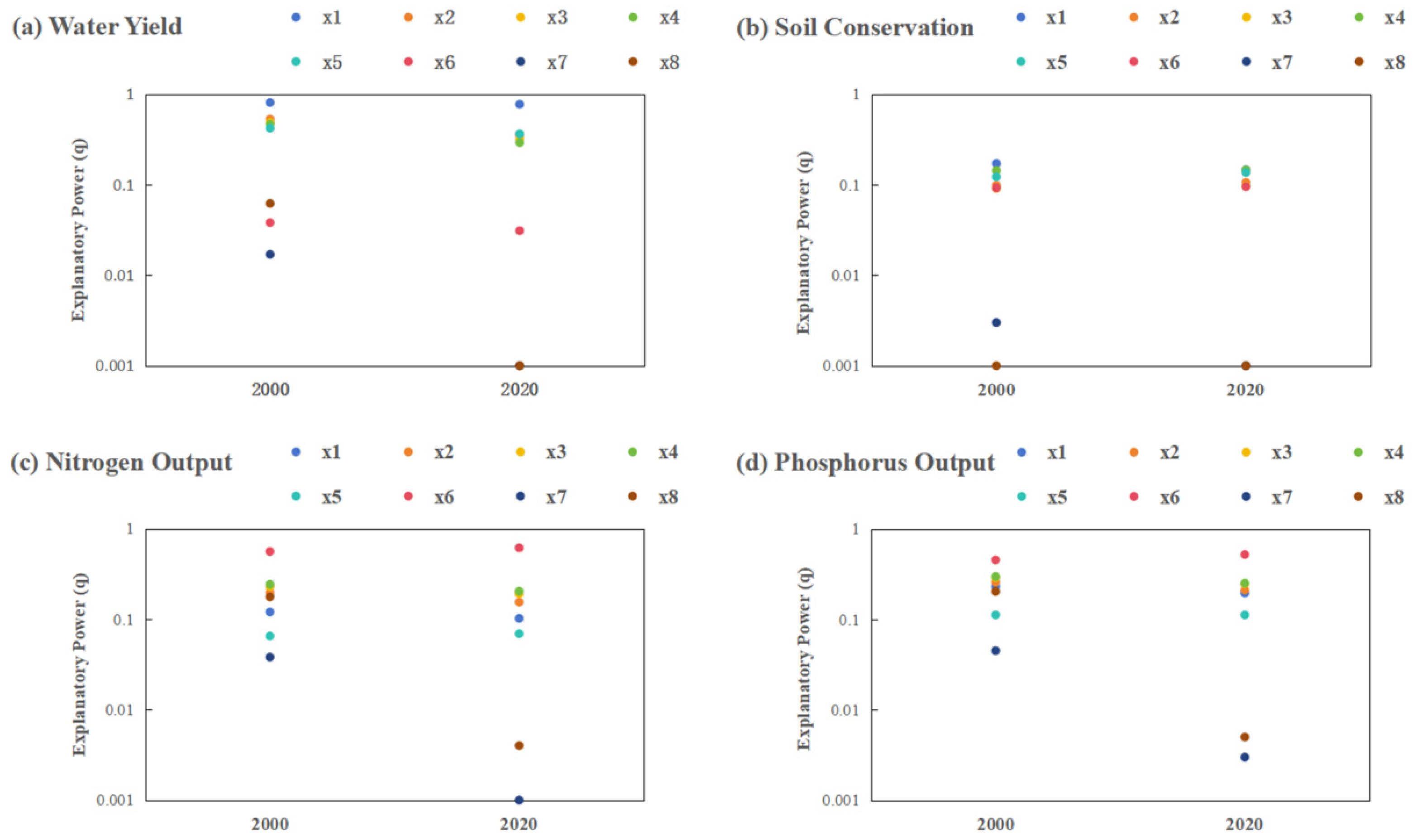
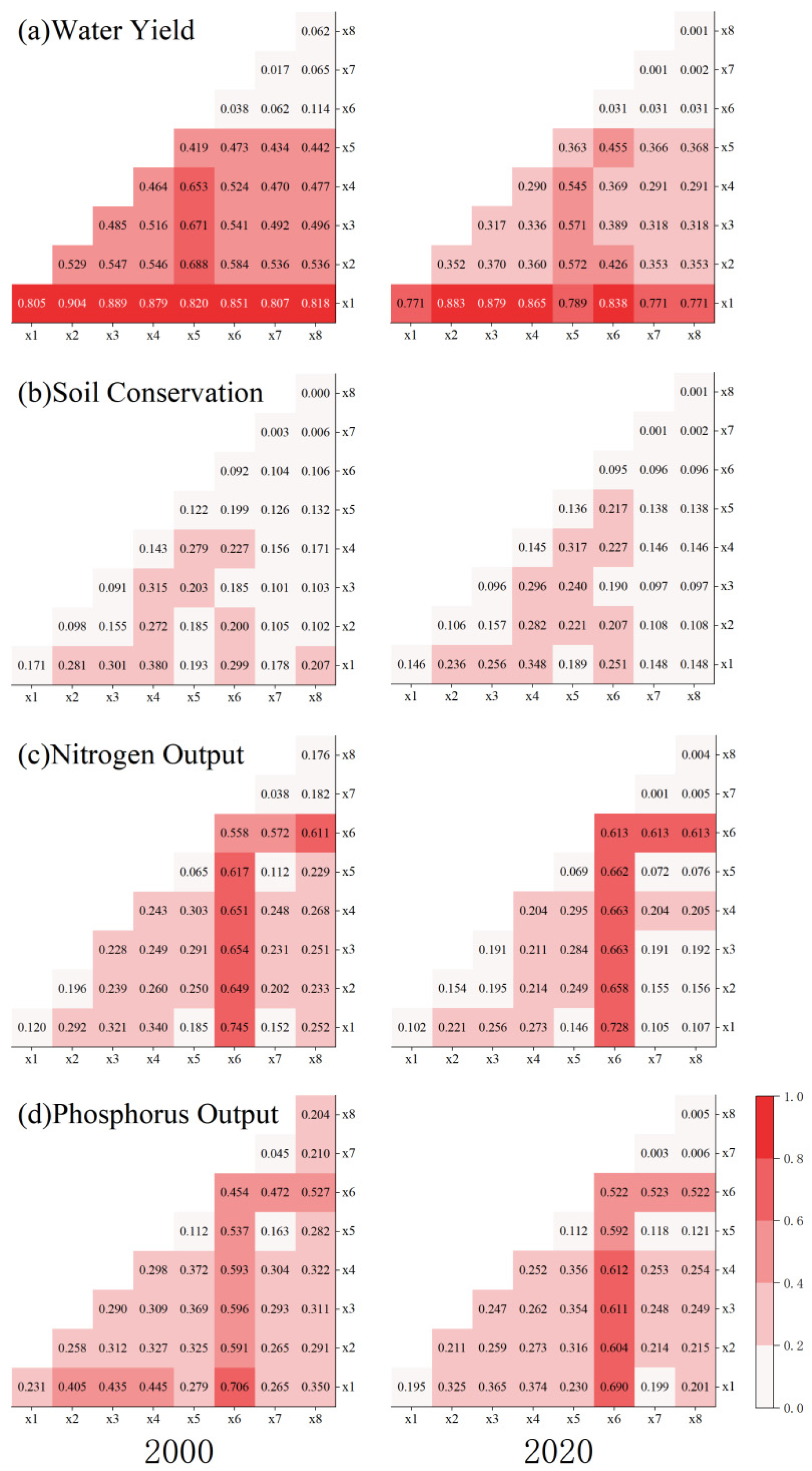
- The interaction between different influencing factors increases the explanatory strength of individual factors in explaining the spatial heterogeneity of WES. Specifically, climate and topography, when coupled with other factors, markedly intensify spatial variation in water yield and soil conservation services. The interaction between land use and other factors further accentuated the spatial heterogeneity of the water purification capacity within the basin.
- (4)
- Regionally differentiated policy strategies are essential. In Zone I (headwater area), climate-adaptive ecological protection should be prioritized, including grazing restrictions, glacier-permafrost monitoring, and control of urban non-point source pollution. In Zone II (Loess Plateau), soil and water conservation projects, precision fertilization, land-use structure optimization, and riparian buffers should be prioritized. In Zone III (lower plain), management strategies must include the control of construction-land expansion, promotion of sponge city development, upgrading of wastewater treatment, implementation of precision fertilization, and restoration of wetland parks. Across the basin, a cross-zonal coordination mechanism (e.g., water quality trading or ecological compensation) and an improved flood-drought engineering system are required to address climate-induced extremes.
Supplementary Materials
Author Contributions
Funding
Data Availability Statement
Conflicts of Interest
References
- Millennium Ecosystem Assessment. Ecosystems and Human Well-Being: Synthesis; Island Press: Washington, DC, USA, 2005. [Google Scholar] [CrossRef]
- Valente, R.A.; de Mello, K.; Metedieri, J.F.; Américo, C. A multicriteria evaluation approach to set forest restoration priorities based on water ecosystem services. J. Environ. Manag. 2021, 285, 112049. [Google Scholar] [CrossRef] [PubMed]
- Deng, G.Y.; Jiang, H.B.; Zhu, S.Y.; Wen, Y.; He, C.; Wang, X.; Sheng, L.; Guo, Y.; Cao, Y. Projecting the response of ecological risk to land use/land cover change in ecologically fragile regions. Sci. Total Environ. 2024, 914, 169908. [Google Scholar] [CrossRef]
- Mengist, W.; Soromessa, T.; Legese Feyisa, G.L. Responses of soil and water-related ecosystem services to landscape dynamics in the eastern Afromontane biodiversity Hotspot. Heliyon 2023, 9, e22639. [Google Scholar] [CrossRef]
- Adelisardou, F.; Mederly, P.; Minkina, T. Assessment of soil- and water-related ecosystem services with coupling the factors of climate and land-use change (Example of the Nitra region, Slovakia). Environ. Geochem. Health 2023, 45, 6605–6620. [Google Scholar] [CrossRef]
- Bejagam, V.; Keesara, V.R.; Sridhar, V. Impacts of climate change on water provisional services in Tungabhadra basin using InVEST Model. River Res. Appl. 2022, 38, 94–106. [Google Scholar] [CrossRef]
- Tu, G.Y.; Lu, Q.; Zhang, F.Q.; Xia, Y.; Yan, B. The spatio-temporal interactions between rapid urbanization and multiple ecosystem services at the county scale in the Poyang Lake Basin. Geomat. Nat. Hazards Risk 2025, 16, 2480252. [Google Scholar] [CrossRef]
- Li, J.H.; Xie, B.G.; Gao, C.; Zhou, K.C.; Liu, C.C.; Zhao, W.; Xiao, J.Y.; Xie, J. Impacts of natural and human factors on WES in the Dongting Lake Basin. J. Clean. Prod. 2022, 370, 133400. [Google Scholar] [CrossRef]
- Chen, H.Y.; Cai, W.B. Multi-scale analysis of water purification ecosystem service flow in Taihu Basin for land management and ecological compensation. Land 2024, 13, 1694. [Google Scholar] [CrossRef]
- Feng, X.; Zhang, T.; Feng, P.; Li, J. Evaluation and tradeoff-synergy analysis of ecosystem services in Luanhe River Basin. Ecohydrology 2022, 15, e2473. [Google Scholar] [CrossRef]
- Li, W.; Lu, S.S.; Zhao, Z.L.; Yin, L.J.; Zhao, W.Q.; Wu, J.F.; Su, W.C. Effects of land use on water conservation and water quality purification in watersheds: A case study of the Wujiang River Basin. Acta Ecol. Sin. 2023, 43, 8375–8389. [Google Scholar] [CrossRef]
- Li, W.; Zhao, Z.L.; Lu, S.S.; Zhao, W.Q. Spatiotemporal differentiation of water quality purification function based on InVEST model. J. Irrig. Drain. 2022, 41, 105–113. [Google Scholar] [CrossRef]
- Zhang, S.Y.; Chen, R.R.; Cheng, X. Spatiotemporal evolution of WES and their responses to land use changes in the Longxi River Basin, Chongqing. J. Soil Water Conserv. 2023, 37, 173–183. [Google Scholar] [CrossRef]
- Bi, Y.Z.; Zheng, L.; Wang, Y.; Li, J.; Yang, H.; Zhang, B. Coupling relationship between urbanization and WES in China’s Yangtze River economic Belt and its socio-ecological driving forces: A county-level perspective. Ecol. Indic. 2023, 146, 109871. [Google Scholar] [CrossRef]
- Tang, S.; Zhu, C.J.; Gao, J.; Bian, H.Y. Analysis of spatio-temporal changes and influencing factors of WES in Southwest China under complex terrain. J. Soil Water Conserv. 2024, 38, 244–252. [Google Scholar] [CrossRef]
- Chen, Y.M.; Zhai, Y.P.; Gao, J.X. Spatial patterns in ecosystem services supply and demand in the Jing-Jin-Ji region, China. J. Clean. Prod. 2022, 361, 132177. [Google Scholar] [CrossRef]
- Wang, M.; Lei, G. Relative and Cumulative Effects of Climate and Land Use Change on Hydrological Ecosystem Services in Northeast China. Land 2023, 12, 1298. [Google Scholar] [CrossRef]
- Gong, J.Y.; Hu, C.; He, L.X.; Cui, L.Y.; Wu, B.Q.; Lei, J.P. Exploring the impact of climate change on ecosystem services based on nature-based solutions. Acta Ecol. Sin. 2025, 45, 6623–6633. [Google Scholar] [CrossRef]
- Shadmehri Toosi, A.; Batelaan, O.; Shanafield, M.; Guan, H. Land Use-Land Cover and Hydrological Modeling: A Review. WIREs Water 2025, 12, e70013. [Google Scholar] [CrossRef]
- Fu, B.J.; Zhang, L.W. Land-use change and ecosystem services: Concepts, methods and progress. Prog. Geogr. 2014, 33, 441–446. [Google Scholar] [CrossRef]
- Hou, J.X.; Pan, H.H.; Du, Z.Q.; Wu, Z.T.; Zhang, H. Spatial-temporal analysis of WES in the YRB of Shanxi Province. Arid Land Geogr. 2024, 47, 1047–1060. [Google Scholar] [CrossRef]
- Shao, S.; Yang, Y. Effects of precipitation and land use/cover changes on the spatio-temporal distribution of the water yield in the Huang-Huai-Hai basin, China. Environ. Earth Sci. 2021, 80, 812. [Google Scholar] [CrossRef]
- Xu, W.B.; Rao, L.Y. Impact of land use and climate change on ecosystem services in the agro-pastoral ecotone. Environ. Sci. 2023, 44, 5114–5124. [Google Scholar] [CrossRef]
- Wang, Y.; Xue, Z.C.; Wu, Z.Y.; Jin, S.; Jiang, B.Y. Impacts of climate and land use/cover change on water yield services and nitrogen-phosphorus purification capacity in the Wulie River Basin. J. Anhui Agric. Sci. 2022, 50, 54–60+67. [Google Scholar] [CrossRef]
- Zhang, K.; Fang, B.; Zhang, Z.; Xia, C.; Liu, Q.; Liu, K. Spatial optimisation based on ecosystem service spillover effect and cross-scale knowledge integration: A case study of the YRB. J. Geogr. Sci. 2025, 35, 1080–1114. [Google Scholar] [CrossRef]
- Wu, K.; Xing, A.; Wei, G.; Xin, H.; Wei, Y.; Su, L.; Zhou, J. Evaluation of coupling coordination degree between tourism urbanization and ecosystem services in urban agglomerations in the yellow river basin. Sci. Rep. 2025, 15, 22427. [Google Scholar] [CrossRef]
- Wang, S.; Zhang, R.; Wang, J.F.; Li, Q.; Wang, R.; Li, Y.; Zhang, L. Identification and optimization of ecological corridors in the middle reaches of the YRB. J. Clean. Prod. 2025, 512, 145676. [Google Scholar] [CrossRef]
- Wang, J.F.; Lu, Z.H.; Zhen, Z.L.; Wu, Q. Evolution of the ecological security pattern of the Yellow River Basin based on ecosystem services: A case study of the Shanxi section, China. Front. Environ. Sci. 2024, 12, 1477843. [Google Scholar] [CrossRef]
- Li, X.; Chen, D.S.; Yang, C.H.; Cao, J. Optimization of ecosystem services trade-offs based on NSGA-III and TOPSIS: A case study of the Lower Yellow River Region, China. Ecol. Indic. 2025, 173, 113379. [Google Scholar] [CrossRef]
- Fan, L.T.; Wang, X.C.; Chen, Z.C.; Chen, R.B.; Liu, X.J.; He, Y.T.; Wang, S.Z. Analysis of Spatial and Temporal Evolution of Ecosystem Services and Driving Factors in the Yellow River Basin of Henan Province, China. Forests 2024, 15, 1547. [Google Scholar] [CrossRef]
- Kong, D.X.; Miao, C.; Gou, J.J.; Zhang, Q.; Su, T. Sediment reduction in the middle Yellow River basin over the past six decades: Attribution, sustainability, and implications. Sci. Total Environ. 2023, 882, 163475. [Google Scholar] [CrossRef] [PubMed]
- Peng, S.Z.; Ding, Y.X.; Liu, W.Z.; Li, Z. 1 km monthly temperature and precipitation dataset for China from 1901 to 2017. Earth Syst. Sci. Data 2019, 11, 1931–1946. [Google Scholar] [CrossRef]
- Peng, S.Z.; Ding, Y.X.; Wen, Z.M.; Li, Z. Spatiotemporal change and trend analysis of potential evapotranspiration over the Loess Plateau of China during 2011–2100. Agric. For. Meteorol. 2017, 233, 183–194. [Google Scholar] [CrossRef]
- Yan, F.P.; Shangguan, W.; Zhang, J.; Hu, B. Depth-to-bedrock map of China at a spatial resolution of 100 meters. Sci. Data 2020, 7, 2. [Google Scholar] [CrossRef]
- You, Z.; Feng, Z.M.; Yang, Y.Z. Relief Degree of Land. Surface Dataset of China (1 km). J. Glob. Change Data Discov. 2018, 2, 151–155. [Google Scholar] [CrossRef]
- Yang, J.L.; Dong, J.W.; Xiao, X.M.; Dai, J.H.; Wu, C.Y.; Xia, J.Y.; Zhao, G.S.; Zhao, M.M.; Li, Z.L.; Zhang, Y.; et al. Divergent shifts in peak photosynthesis timing of temperate and alpine grasslands in China. Remote Sens. Environ. 2019, 233, 111395. [Google Scholar] [CrossRef]
- Natural Capital Project. InVEST 3.14.1 User’s Guide; Natural Capital Project: Stanford, CA, USA, 2022; Available online: https://invest.readthedocs.io/en/stable/ (accessed on 29 January 2024).
- Mukhopadhyay, A.; Hati, J.P.; Acharyya, R.; Pal, R.; Tuladhar, N.; Habel, M. Global trends in using the InVEST model suite and related research: A systematic review. Ecohydrol. Hydrobiol. 2025, 25, 389–405. [Google Scholar] [CrossRef]
- Yang, J.; Xie, B.P.; Zhang, D.G. Spatio-temporal variations in water yield in the YRB and its response to precipitation and land use change based on the InVEST model. Chin. J. Appl. Ecol. 2020, 31, 2731–2739. [Google Scholar] [CrossRef]
- Zhu, C.X.; Zhong, S.Z.; Long, Y.; Yan, D. Spatial-Temporal evolution and driving forces of ecosystem services in the YRB. Chin. J. Ecol. 2023, 42, 2502–2513. [Google Scholar] [CrossRef]
- Fang, L.L.; Xu, D.H.; Wang, L.C.; Niu, Z.G.; Zhang, M. Research on changes, trade-offs, and synergies of ecosystem services in the Yangtze River and YRBs. Geogr. Res. 2021, 40, 821–838. [Google Scholar] [CrossRef]
- Fan, X.M.; Jing, X.; Xiao, B.W.; Ma, X.L.; He, J.S. Spatio-temporal changes of ecosystem services driven by climate and land use changes in Hainan and Haibei Prefectures, Qinghai. Acta Pratacult. Sin. 2022, 31, 17–30. [Google Scholar] [CrossRef]
- Yang, J.; Xie, B.P.; Zhang, D.G.; Tao, W. Climate and land use change impacts on water yield ecosystem service in the YRB, China. Environ. Earth Sci. 2021, 80, 72. [Google Scholar] [CrossRef]
- Gai, Y.Y.; Zhao, H.; Wang, F.Q. Spatio-temporal changes in ecosystem-service supply and demand and their driving factors in the YRB. Environ. Sci. 2025, 46, 3672–3680. [Google Scholar] [CrossRef]
- Wang, J.F.; Xu, C.D. GeoDetector: Principle and prospect. Acta Geogr. Sin. 2017, 72, 116–134. [Google Scholar] [CrossRef]
- Fang, L.L.; Wang, L.C.; Chen, W.X.; Sun, J.; Cao, Q.; Wang, S.; Wang, L. Identifying the impacts of natural and human factors on ecosystem service in the Yangtze and YRBs. J. Clean. Prod. 2021, 314, 127995. [Google Scholar] [CrossRef]
- Geng, W.L.; Li, Y.Y.; Zhang, P.Y.; Yang, D.; Jing, W.; Rong, T. Analyzing spatio-temporal changes and trade-offs/synergies among ecosystem services in the YRB, China. Ecol. Indic. 2022, 138, 108825. [Google Scholar] [CrossRef]
- Wu, C.X.; Qiu, D.X.; Gao, P.; Mu, X.; Zhao, G. Application of the InVEST model for assessing water yield and its response to precipitation and land use in the Weihe River Basin, China. J. Arid Land 2022, 14, 426–440. [Google Scholar] [CrossRef]






| Type | Description | Resolution | Sources |
|---|---|---|---|
| Meteorological data | Precipitation Potential Evapotranspiration Mean annual temperature | Raster, 1 km | National Earth System Science Data Center (https://www.geodata.cn/): Annual Precipitation Dataset for China (1901–2023) [32] Monthly Potential Evapotranspiration Dataset for China (1901–2024) [33] Mean Annual Temperature Dataset for China (1901–2023) [32] |
| Land use data | Land use types | Raster, 1 km | Resource and Environmental Science Data Platform, Chinese Academy of Sciences (https://www.resdc.cn/): Annual China Multi-period Land Use Remote Sensing Monitoring Dataset (CNLUCC) |
| Soil data | Plant available water content Soil erodibility factor | Raster, 1 km | National Glacier, Permafrost and Desert Science Data Center (http://www.ncdc.ac.cn/): China Soil Map based Harmonized World Soil Database (HWSD) (v1.1) |
| Rooting depth | Raster, 1 km | Depth-to-bedrock Map of China (https://doi.org/10.1038/s41597-019-0345-6) [34] | |
| Topographic data | DEM | Raster, 30 m | Geospatial Data Cloud (https://www.gscloud.cn/) |
| Topographic relief | Raster, 1 km | Relief Degree of Land Surface Dataset of China (https://doi.org/10.3974/geodp.2018.02.04) [35] | |
| Vegetation data | NDVI | Raster, 30 m | National Ecological Science Data Center (https://nesdc.org.cn/): China 30 m Annual Maximum NDVI Dataset (2000–2022) [36] |
| Socioeconomic data | Population density GDP | Raster, 1 km | Resource and Environmental Sciences Data Platform, Chinese Academy of Sciences (https://www.resdc.cn/): Annual China 1 km Gridded Population Dataset Annual China 1 km Gridded GDP Dataset |
| Land-Use Type | Root Depth (mm) | Kx |
|---|---|---|
| Cropland | 2100 | 0.65 |
| Forest land | 5300 | 1 |
| Grassland | 2400 | 0.65 |
| Water area | 100 | 1 |
| Construction land | 100 | 0.3 |
| Unused land | 100 | 0.5 |
| Land-Use Type | Cropland | Forest Land | Grassland | Water Area | Construction Land | Unused Land |
|---|---|---|---|---|---|---|
| C | 0.23 | 0.08 | 0.24 | 0 | 0 | 1 |
| P | 0.3 | 1 | 1 | 0 | 0 | 1 |
| Land-Use Type | load_p | eff_p | load_n | eff_n |
|---|---|---|---|---|
| Cropland | 3.57 | 0.48 | 27 | 0.25 |
| Forest land | 1.36 | 0.67 | 1.4 | 0.4 |
| Grassland | 0.93 | 0.6 | 4 | 0.35 |
| Water area | 0 | 0.4 | 0 | 0.02 |
| Construction land | 2.1 | 0.26 | 6.3 | 0.05 |
| Unused land | 0.79 | 0.26 | 6.3 | 0.05 |
| Input Parameter | Climate Change Parameters | Land-Use Parameters |
|---|---|---|
| Scenario 1 | 2005 | 2000 |
| Scenario 2 | 2000 | 2005 |
| Reference scenario | 2000 | 2000 |
| Scenario 1 | 2010 | 2005 |
| Scenario 2 | 2005 | 2010 |
| Reference scenario | 2005 | 2005 |
| Scenario 1 | 2015 | 2010 |
| Scenario 2 | 2010 | 2015 |
| Reference scenario | 2010 | 2010 |
| Scenario 1 | 2020 | 2015 |
| Scenario 2 | 2015 | 2020 |
| Reference scenario | 2015 | 2015 |
| Criterion | Interaction |
|---|---|
| q(x1 ∩ x2) < Min[q (x1), q(x2)] | nonlinear weakening |
| Min(q(x1), q(x2)) < q(x1 ∩ x2) < Max[q(x1), q(x2)] | Single-factor nonlinear weakening |
| q(x1 ∩ x2) > Max[q(x1), q(x2)] | dual-factor amplification |
| q(x1 ∩ x2) = q(x1) + q(x2) | independence |
| q(x1 ∩ x2) > q(x1) + q(x2) | nonlinear amplification |
| Land-Use Type | Qinghai | Sichuan | Gansu | Ningxia | Neimeng | Shanxi | Shaanxi | Henan | Shandong | |
|---|---|---|---|---|---|---|---|---|---|---|
| 2000–2005 | Cropland | −0.52 | 0 | −8.34 | −9.38 | 0.09 | −4.39 | −17.17 | −4.39 | 2.74 |
| Forest land | −0.04 | 0.11 | 5.05 | 2.48 | 6.63 | −0.13 | 10.98 | −0.2 | 0.02 | |
| Grassland | −7.07 | −0.1 | 2.05 | 2.53 | −19.79 | 2.31 | 2.85 | −0.36 | −3.96 | |
| Water area | 0.3 | −0.01 | 0.13 | 0.08 | −0.69 | 0.52 | 0.54 | 2.35 | 0.49 | |
| Construction land | 0.28 | 0 | 1.44 | 1.51 | 2.9 | 1.66 | 3 | 2.85 | 1.33 | |
| Unused land | 7.05 | 0 | −0.33 | 2.78 | 10.86 | 0.03 | −0.2 | −0.25 | −0.62 | |
| 2005–2010 | Cropland | 2.93 | 0.1 | −14.68 | 1.2 | 25.3 | −14.48 | −19.89 | −1.46 | −2 |
| Forest land | 0.03 | 3.53 | 3.42 | 1.53 | −6.19 | 1.71 | 2.52 | −0.84 | −0.98 | |
| Grassland | 72 | −10.7 | 6.07 | −3.98 | −12.07 | −2.91 | 12.68 | −4.76 | −5.67 | |
| Water area | 1.97 | 0.8 | 0.3 | 0.01 | −0.8 | −2.06 | −0.89 | −0.03 | 1.49 | |
| Construction land | 0.49 | 0.23 | 3.46 | 4.96 | 0.82 | 17.75 | 7.68 | 7.31 | 8.77 | |
| Unused land | −77.42 | 6.04 | 1.43 | −3.72 | −7.06 | −0.01 | −2.1 | −0.22 | −1.61 | |
| 2010–2015 | Cropland | −0.21 | −0.02 | −4.2 | 1.43 | −1.61 | −2.44 | −0.45 | −3.16 | −1.89 |
| Forest land | 0.08 | −0.25 | −0.2 | 0.03 | 0.08 | −1.06 | −0.48 | 0.17 | 0.12 | |
| Grassland | −0.83 | 0.01 | 1.1 | −3.28 | −0.11 | 0.64 | −2.24 | −0.16 | 0.1 | |
| Water area | 0.2 | −0.15 | 0.29 | 0.26 | 0.36 | 0.09 | 0.21 | 0.78 | 0.23 | |
| Construction land | 0.77 | 0 | 2.48 | 3.32 | 3.72 | 2.78 | 2.29 | 2.42 | 1.45 | |
| Unused land | −0.03 | 0.42 | 0.43 | −1.73 | −2.42 | −0.02 | 0.67 | −0.01 | 0.02 | |
| 2015–2020 | Cropland | 0.03 | 0 | −5.31 | −4.23 | −26.37 | 0.46 | −9.92 | −4.57 | −0.65 |
| Forest land | −0.33 | 0.07 | −0.14 | −0.12 | 8.53 | −0.45 | −1.65 | 0.81 | −0.16 | |
| Grassland | −1.4 | −0.35 | 2.35 | 1.64 | 12.06 | −3.08 | 3.61 | −0.59 | 0.06 | |
| Water area | 0.68 | 0.36 | 0.21 | 0.3 | 1.42 | 0.32 | 1.21 | 0.03 | 2.08 | |
| Construction land | 1.34 | 0.07 | 4.65 | 3.39 | 11.69 | 2.74 | 7.32 | 4.27 | −1.27 | |
| Unused land | −0.26 | −0.17 | −1.7 | −0.99 | −7.35 | 0 | −0.53 | 0.01 | −0.12 |
Disclaimer/Publisher’s Note: The statements, opinions and data contained in all publications are solely those of the individual author(s) and contributor(s) and not of MDPI and/or the editor(s). MDPI and/or the editor(s) disclaim responsibility for any injury to people or property resulting from any ideas, methods, instructions or products referred to in the content. |
© 2026 by the authors. Licensee MDPI, Basel, Switzerland. This article is an open access article distributed under the terms and conditions of the Creative Commons Attribution (CC BY) license.
Share and Cite
Liu, H.; Huo, X.; Li, M.; Ma, H. Interactive Effects of Climate and Land-Use Changes on the Spatiotemporal Evolution of Water Ecosystem Services in the Yellow River Basin, China. Land 2026, 15, 791. https://doi.org/10.3390/land15050791
Liu H, Huo X, Li M, Ma H. Interactive Effects of Climate and Land-Use Changes on the Spatiotemporal Evolution of Water Ecosystem Services in the Yellow River Basin, China. Land. 2026; 15(5):791. https://doi.org/10.3390/land15050791
Chicago/Turabian StyleLiu, Huancai, Xingyu Huo, Man Li, and Huiqiang Ma. 2026. "Interactive Effects of Climate and Land-Use Changes on the Spatiotemporal Evolution of Water Ecosystem Services in the Yellow River Basin, China" Land 15, no. 5: 791. https://doi.org/10.3390/land15050791
APA StyleLiu, H., Huo, X., Li, M., & Ma, H. (2026). Interactive Effects of Climate and Land-Use Changes on the Spatiotemporal Evolution of Water Ecosystem Services in the Yellow River Basin, China. Land, 15(5), 791. https://doi.org/10.3390/land15050791