Article

Drought Characterization in Southern Angola Using SPI and SPEI: Implications for Impacts and Adaptation

1
Department of Civil Engineering and Georesources, Faculty of Engineering of the University of Porto (FEUP), 4200-465 Porto, Portugal
2
Interdisciplinary Centre of Marine and Environmental Research (CIIMAR), University of Porto, Av. General Norton de Matos, S/N, 4450-208 Matosinhos, Portugal
*
Authors to whom correspondence should be addressed.
Land 2026, 15(5), 728; https://doi.org/10.3390/land15050728
Submission received: 16 March 2026 / Revised: 20 April 2026 / Accepted: 21 April 2026 / Published: 25 April 2026
(This article belongs to the Special Issue Land and Drought: An Environmental Assessment Through Remote Sensing)

Abstract

Drought in Angola is a recurrent and cyclical natural phenomenon that poses significant environmental, economic, and social challenges, affecting water resources, agriculture, ecosystems, livestock, and vulnerable communities. This study investigates the temporal evolution and spatial behavior of drought in the provinces of Cunene, Huila, and Namibe over the period 1980–2024. Drought conditions were assessed using the Standardized Precipitation Index (SPI) and the Standard Precipitation–Evapotranspiration Index (SPEI) at multiple time scales. Trends were evaluated using the Modified Mann–Kendall test and Sen’s slope estimator, while drought intensity was analyzed using run theory. The results reveal a clear intensification of drought conditions in the last decade, characterized by an increase in frequency and intensity, particularly after 2010. Extreme drought events were identified in the early 1980s, the mid-1990s, and more recently in 2019 and 2021. Despite some regional variability, the three provinces exhibit consistent temporal patterns, with drought events generally occurring simultaneously over the study period. These findings highlight the increasing pressure on water and environmental systems and underscore the need for improved drought monitoring and forecasting approaches to support more effective adaptation and decision-making.

1. Introduction

Drought is a recurring extreme climate event over land characterized by below normal precipitation over a period of months to years [1]. It affects more people globally than any other natural hazard, causing severe economic, ecological, and human losses [2]. With the growing risks associated with climate change, both the frequency and magnitude of droughts are expected to intensify in the coming decades [3]. Droughts pose serious challenges to agriculture, water resources, ecosystems, and human well-being, contributing to food insecurity, forced migration, disease outbreaks, and social instability. They also exacerbate environmental degradation, reducing annual surface runoff and affecting both groundwater and surface water supplies essential for agriculture, industry, and domestic use [4,5].
Globally, drought events are becoming more prolonged and widespread, with climate projections indicating an increase in extreme droughts in many regions [6,7]. Drought frequency is expected to increase in several regions, including northern South America, the Mediterranean, southern Africa, and Australia [8]. Sub-Saharan Africa is particularly vulnerable, with populations regularly affected by recurrent droughts [9]. Southern Africa, including Angola, has faced increasingly severe and frequent droughts since the 2011–2012 agricultural season due to prolonged rainfall deficits and uneven precipitation patterns [10]. For instance, the Horn of Africa experienced a multi-year drought between 2020 and 2023 that led to devastating socio-economic impacts [11]. Similarly, countries such as Madagascar and South Africa have faced severe drought events in recent years, affecting agriculture, water supply, and public health [12,13].
In Angola, approximately 7.9 million people (nearly 31% of the population) are exposed to drought annually, with around 1.9 million suffering direct impacts. Of these, 0.93 million are children and 1.01 million are adolescents, adults, and elderly persons [14]. Southern Angola has been particularly affected, with over 1.5 million people impacted by the 2013/2014 drought alone, most of them poor, rural, and agropastoral communities [15]. In 2016, 1.14 million people in the provinces of Cunene, Huila, and Namibe were affected by worsening drought conditions, which intensified from 2013 through the extremely dry seasons of 2016–2019 [10,16]. Drought is also associated with significant environmental impacts, including groundwater degradation, reduced water availability, and the drying of boreholes, as well as broader environmental degradation processes [17]. The 2021 drought was reported as the worst in 40 years, with southwestern Angola receiving only 40–60% of average rainfall, leading to severe crop failure and an unprecedented food and nutrition crisis [18].
The economic impacts of the 2016 drought across all sectors in the three most affected provinces, Cunene, Huila and Namibe, were estimated at more than US$749 million, with agriculture, livestock, and fisheries being the hardest hit. Beyond direct economic losses, the Post-Disaster Needs Assessment (PDNA) also reported increases in malnutrition, family abandonment, domestic violence, and deforestation linked to charcoal production [19]. In the Water, Sanitation, and Hygiene (WASH) sector alone, damage was estimated at US$52.5 million, with 80% of boreholes inoperable representing 18% of total sectoral damage. Losses in food security and nutrition were estimated at US$82 million and US$32.8 million, respectively [10].
Despite the severity of these impacts, many existing adaptation strategies remain short-term and reactive. While some measures provide temporary relief, they often undermine longer-term resilience-building [20]. As such, the development of integrated drought monitoring and early warning systems are increasingly recognized as essential for effective management. These systems help characterize droughts in terms of their severity, spatial extent, and duration key for timely response [21,22]. Countries such as the United States, Canada, Brazil, and Mexico have developed national drought monitors, while Europe hosts several regional systems, including Portugal’s Drought Observatory and the Netherlands’ integrated monitoring framework. Other systems operate in Spain (Júcar Basin), Italy (Po Basin), Switzerland, and Syros Island, Greece [23,24].
Droughts are particularly complex to manage due to their variable spatial and temporal characteristics [25]. While both developed and developing countries experience their effects, developing regions are often disproportionately affected due to socio-economic vulnerabilities [5], as observed in Angola. Understanding the propagation of different drought types is vital for improving early warning and adaptation strategies [26].
This study analyzes drought conditions in southern Angola from 1980 to 2024 using the Standardized Precipitation Index (SPI) and the Standardized Precipitation–Evapotranspiration Index (SPEI). The Modified Mann–Kendall test and Sen’s slope estimator are employed to identify and quantify trends in drought, the intensity was evaluated based on the theory of runs. The study also examines the socio-economic consequences and evaluates current adaptation strategies adopted by communities, government institutions, and NGOs. Based on these findings, a drought monitoring and forecasting system is proposed to strengthen resilience and support a shift from reactive crisis response to proactive drought governance in southern Angola.

2. Materials and Methods

2.1. Study Area

Angola is located in Southern Africa and borders the Democratic Republic of Congo, Congo, Namibia and Zambia, covering an area of 1,246,700 km2. Administratively, it is divided into 21 provinces, 326 municipalities and 378 communes [15,27]. However, the spatial data used in this study are based on the former administrative division of 18 provinces, due to the availability and consistency of geospatial datasets. This does not affect the analysis, as the study area focuses on the provinces of Cunene, Huila, and Namibe. On the coast, the average annual rainfall is less than 600 mm, but the province of Cabinda, to the north, sometimes reaches values of around 800 mm, while the province of Namibe, on the south coast, only reaches 50 mm annual [28]. In inland regions, precipitation varies between 600 mm and 1000 mm. To the north and northeast, the country has a humid tropical climate, with high temperatures and rainfall. The average temperature drops below 19 °C, or even less, during the dry season, with marked daily temperature variations. This is also the climate that characterizes the southeast of the country. The southwest is semi-arid, with annual rainfall that normally varies between 500 and 800 mm, with low temperatures in the dry season and at night. The east has a moderate tropical climate and the south has a desert climate [28]. According to the Köppen–Geiger classification [29], the study area is predominantly characterized by arid and semi-arid climates. The coastal region of Namibe is mainly classified as hot desert (BWh), while Cunene and parts of Huila are dominated by hot semi-arid conditions (BSh). Elevated areas in Huila include regions classified as temperate highland climates (Cwb) [29]. The study focuses on southern Angola, specifically the provinces of Cunene, Huila, and Namibe. These three provinces are in the southernmost region of the country, as illustrated in Figure 1.

2.2. Data Source and Research Methods

As of the time of this study, in situ climate data for Angola remain unavailable. Consequently, a methodological framework similar to that used by [30] was adopted, relying on reanalysis datasets to assess drought frequency and intensity in southern Angola. Climate variables were sourced from the ERA5-Land monthly averaged reanalysis dataset provided by the European Centre for Medium-Range Weather Forecasts (ECMWF) via the Copernicus Climate Data Store (CDS). The ERA5-Land dataset was selected due to its higher spatial resolution (0.1° × 0.1°, approximately 9 km), monthly temporal resolution, and suitability for regional-scale analysis. This dataset offers a significant improvement over ERA5 and the older ERA-Interim, which have coarser spatial resolutions of approximately 31 km and 80 km, respectively [31]. The study area was defined using provincial shapefiles, from which the bounding box coordinates were derived for data extraction via the CDS API. A spatial mask based on these shapefiles was subsequently applied to ensure that only grid cells within the study area were retained for analysis.
Monthly data on total precipitation (P) and potential evapotranspiration (PET) were retrieved for the period from January 1980 to December 2024 using the CDS API in a Python 3.11.7 environment. Precipitation values were used to compute the Standardized Precipitation Index (SPI), while PET data and precipitation were used to compute the Standardized Precipitation Evapotranspiration Index (SPEI) through the climatic water balance (D = P − PET). Both indices were used because SPI relies on precipitation, whereas SPEI incorporates both precipitation and potential evapotranspiration, allowing the inclusion of temperature effects in drought assessment. This distinction is particularly important in contexts where temperature plays an increasing role in moisture deficits, and SPEI tends to identify more drought events than SPI in arid and semi-arid regions [32]. Both indices were calculated at monthly resolution to capture short- and medium-term drought conditions. All data processing and drought index computations were conducted entirely in Python, ensuring a reproducible and transparent workflow.
The SPI was calculated following the approach proposed by [33] which involves fitting the time series of accumulated precipitation to a Gamma probability distribution. This was done separately for each calendar month to preserve seasonal characteristics. The Gamma distribution parameters were obtained using maximum likelihood estimation, and the cumulative probability was adjusted to account for zero precipitation occurrences. The cumulative distribution function (CDF) was then transformed into a standard normal variable to obtain the SPI. This procedure was implemented for multiple time scales at 1, 3, 6, 9, and 12 months to assess drought conditions relevant to different hydrological processes.
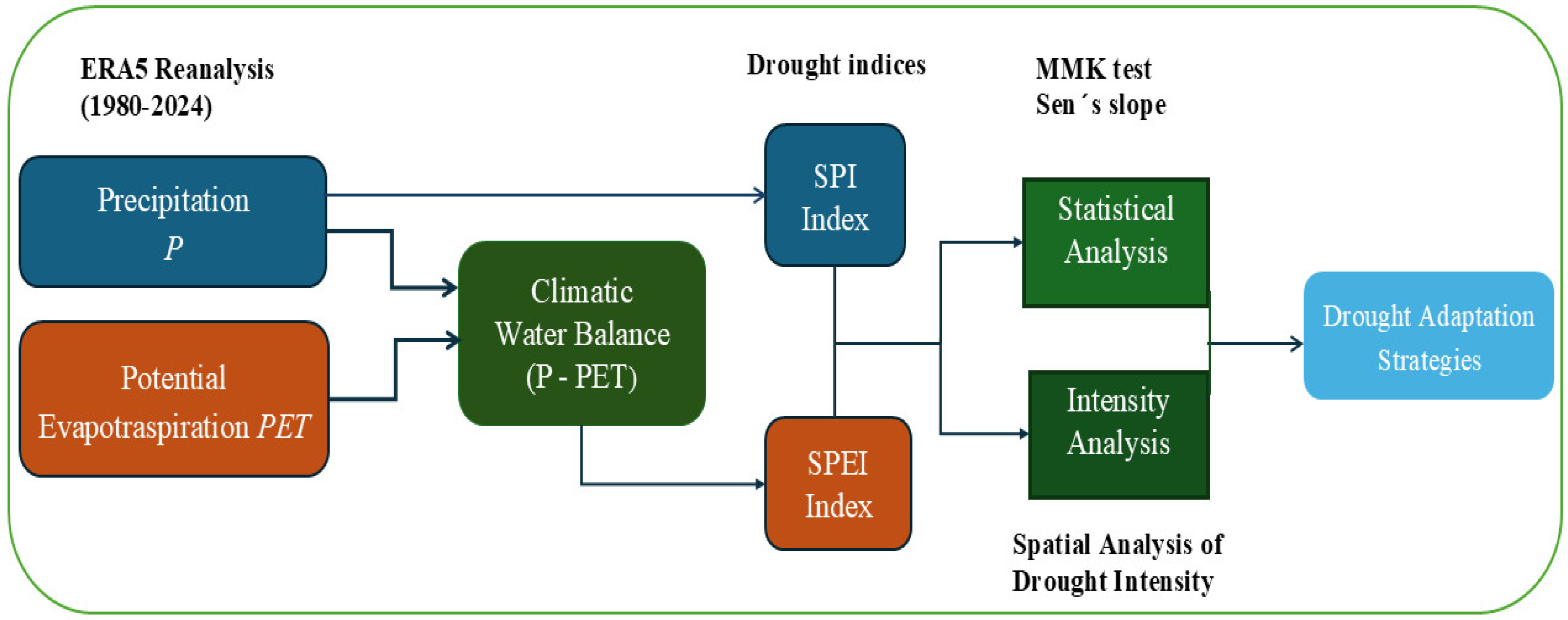
The SPEI was calculated based on the same accumulation periods, using a log-logistic distribution to model the series of climatic water balance, as proposed by [34]. This allowed the incorporation of temperature effects into the drought characterization. To examine drought evolution over time, the calculated SPI and SPEI values were grouped by decade (1980s, 1990s, 2000s, 2010s), allowing a comparative analysis of drought severity across temporal periods. To fully understand the dynamics of drought variability and evolution, additional statistical approaches were implemented. The Modified Mann–Kendall (MMK) test was applied to detect statistically significant monotonic trends in SPI-12 and SPEI-12 time series over the study period. The magnitude of these trends was quantified using Sen’s slope estimator. Furthermore, to better characterize spatial drought intensification in southern Angola, the run theory approach was employed. The overall methodological workflow is summarized in Figure 2.

2.2.1. Standardized Precipitation Index (SPI)

The Standardized Precipitation Index (SPI) is a widely used drought index based solely on precipitation data. Its simplicity, low data requirements, and standardized nature make it suitable for drought monitoring across different climatic regions [35].
SPI is particularly suitable for semi-arid regions, as it quantifies precipitation anomalies across multiple time scales, offering insights into drought duration, intensity, and spatial extent [36]. Additionally, SPI is computationally efficient and statistically robust, eliminating the influence of seasonal and geographic variability in precipitation patterns [37]. A key advantage of the SPI over other drought indices is its ability to characterize different drought types by calculating the index over various time scales [38]. The SPI is computed from monthly precipitation data aggregated over selected accumulation periods, typically 3, 6, 12, 24, or 48 months [33].
The computation of SPI involves fitting an incomplete gamma probability distribution to historical monthly precipitation data. This process is performed independently for each location and for each calendar month to account for seasonal variability. The gamma probability density function (PDF) is defined as follows [39]:
g ( x k )   =   1 β α Γ ( α ) x k α 1 e x p   !   x k β ,         x k   > 0 ,   α   >   0 ,   β > 0
where x k represents the accumulated precipitation over a k -month period, α and β the shape and scale parameters of the distribution, and Γ ( α ) the gamma function.
The cumulative distribution function G ( x k ) is obtained by integrating the gamma probability density function from zero up to the observed precipitation amount x k .
G x k = 0 x k g u   d u   1 β α Γ α   0 x k u α 1   e x p   !   u β   d u
By applying the substitution t   =   u / β ,   the cumulative probability can be expressed in terms of the lower incomplete gamma function, which facilitates numerical evaluation of G   ( x   k ) .
G ( x k ) = 1 Γ ( α )   0 x k / β t α 1 e t   d t
Since the gamma distribution is undefined at zero, the cumulative probability is corrected by incorporating the empirical probability q of zero precipitation months.
H x k = q + ( 1 q ) G ( x k )
For cumulative probabilities in the lower half of the distribution, the SPI value is computed using the [40] approximation, with t defined as a transformation of H ( x k )
Z = S P I = t c 0 + c 1 t + c 2 t 2 1 + d 1 t + d 2 t 2 + d 3 t 3 , t = ln 1 H x k 2   f o r   0 < H x k < 0.5
Transformation for 0.5 < H < 1 for comulative probabilities above 0.5 , a systmmetric form of the Abramowitz and Stegun approximation is applied, using a corresponding definition of the transformed variable t ,
  Z = S P I = t c 0 + c 1 t + c 2 t 2 1 + d 1 t + d 2 t 2 + d 3 t 3 , t = ln 1 ( 1 H x k ) 2   f o r   0.5 < H x k < 1.0
The constants c 0 , c 1 ,   c 2 , d 1 , d 2 and d 3 are empirical coefficients used in the [40] approximation to convert cumulative probabilities into standard normal variates.
c 0   = 2.515517 ,   c 1 = 0.802853 ,   c 2   = 0.010328 d 1   = 1.432788 ,   d 2 = 0.189269 ,   d 3 = 0.001308

2.2.2. The Standardized Precipitation Evapotranspiration Index (SPEI)

The SPEI is a multiscalar drought index that integrates the influence of precipitation and temperature on drought development, thus offering a more comprehensive assessment of climatic water balance compared to indices based solely on precipitation, hence improving its effectiveness as a robust tool for monitoring and analysing drought events [34,41]. By estimating the surplus or deficit of water based on precipitation variations, the SPEI can assess the frequency of drought severities on various time scales [42].
The procedure to calculate the index is detailed and involves a climatic water balance, the accumulation of deficit surplus at different time scales, and the adjustment to a log-logistic probability distribution. Mathematically, the SPEI is similar to SPI, but it includes the role of temperature [34].
The first step in calculating the SPEI is the estimation of monthly PET. Following the temperature-based method used in [34], PET is obtained as:
P E T   =   16 K 10 T I m
where K is a correction coefficient computed as a function of the latitude and month, T is the monthly mean temperature ° C ; I is the annual heat index, obtained as the sum of the 12 monthly heat-index values and m is a coefficient depending on I .
After computing P E T , the water balance for month i is determined as the difference between precipitation P and potential evapotranspiration:
D i = P i P E T i ,
The monthly water-balance series D i is then aggregated over a time scale k , following the same procedure used for the SPI.
The probability density function of a variable following a three-parameter log-logistic distribution can be written as:
f x = β α x γ α β 1 1 + x γ α β 2 ,
where β , α and γ are scale, shape, and origin parameters, respectively, for D values in the range ( γ > D < ) .
The cumulative distribution of the D series, assuming a three-parameter log-logistic model, can be expressed as follows:
F ( x ) = 1 + α x γ β 1
The cumulative probability F ( x ) is subsequently converted into a standardized drought index (SPEI) using the classical approximation developed by [40].
S P E I = W C 0 + C 1 W + C 2 W 2 1 + d 1 W + d 2   W 2 + d 3   W 3
where
W = 2 l n ( P )   f o r   P 0.5
where P represents the exceedence probability associated with a given water-balance value, computed as P = 1 F x . When P >   0.5 , it is replaced with 1 P and the final SPEI value is assigned the opposite sign to preserve symmetry. The empirical coefficients used in this transformation are C 0 = 2.515517 ,     C 1 =   0.802853 ,     C 2 =   0.010328 ,     d 1 =   1.432788 ,     d 2   =   0.189269 and d 3 =   0.001308 .
Due to their standardized formulation, both the SPI and the SPEI allow for consistent comparison of hydrological anomalies across diverse climatic regions. Positive values of SPI and SPEI denote wetter-than-median conditions, whereas negative values reflect drier-than-median conditions. The magnitude of these indices provides a basis for categorizing the intensity of wet or dry events. Table 1 presents a widely accepted classification scheme, applicable to both SPI and SPEI, for interpreting the severity of drought or wetness episodes [33,35,37,39].

2.2.3. Modified Mann–Kendall Test

In many hydrological and climatological studies, non-parametric rank-based statistical tests, such as the Mann–Kendall test, are widely used to detect trends in time series data [43]. To assess drought trend over the study period, the Modified Mann–Kendall (MMK) test applied to both the SPI and the SPEI time series.
Trend detection techniques are typically classified into parametric and non-parametric methods. Parametric tests assume that the data are normally distributed and independent, while non-parametric tests only require independence. The classical Mann–Kendall test is a non-parametric method based on the following test statistic:
S = i = 1 n 1 j = i + 1 n s g n ( X j X i )
where n is the number of data points, X i and X j are the data values in time series i and j   j > i , respectively, and s g n X j     X i is the sign function as:
sgn X j X i = + 1   i f   X j X i > 0 0 ,   i f   X j X i = 0 1   i f   X j X i < 0
The variance of the S statistics is given by:
V a r S = n n 1 2 n + 5 ( i = 1 m t i ( t i 1 ) ( 2 t i + 5 ) 18
where n is the number of data points, m is the number of tied groups, and t i represents the number of data points in the tied group. A tied group refers to a set of observations with identical values. When the sample size exceeds n   > 10 , the standard normal test statistic Z s is calculated using Equation (15):
z s = S 1 V a r ( S ) ,                   i f   S > 0 0 ,                                               i f   S = 0 . S + 1 V a r ( S ) ,                   i f   S < 0
Positive values of Z s indicate increasing trends, while negative values suggest decreasing trends. The significance of the trend is evaluated at a specified significance level α . The null hypothesis of no trend is rejected, and a statistically significant trend is assumed to exist in the time series when Z s   >   Z 1     α / 2   [44].
The Mann–Kendall (MK) trend test is one of the most widely used methods for detecting trends in hydrometeorological time series. Its application, however, assumes that the data is serially independent. As noted in the literature, the effect of serial correlation can be mitigated through approaches such as pre whitening, variance correction, or over whitening, as implemented in the Modified Mann–Kendall (MMK) procedure [45]. Since drought indices often display serial correlation, where current conditions depend on conditions in previous months, the Modified Mann–Kendall test is used to correct for this temporal dependence in the SPI and SPEI time series.
V a r ( S ) * = v a r S n n S *
where n / n s * is the effective sample size. The ratio n / n s * is computed using the following empirical expression:
n n s * = 1 +   2 n ( n 1 ) ( n 2 ) i = 1 n 1 ( n i ) ( n i 1 ) ( n i 2 ) p s ( i )
Here, p s ( i ) is the autocorrelation of the ranks at lag i . By incorporating this correction, the Modified MK test provides a more conservative and reliable evaluation of trend significance in autocorrelated hydrometeorological series.

2.2.4. Sen’s Slope Estimator

The Sen’s slope estimator, introduced by Sen [46], is a non-parametric method used to determine the magnitude of a linear trend in time series data [47]. It calculates the slope as the median of all pairwise slopes between data points. The estimator is given by:
Q = M e d i a n X j X i j i  
where X j   and   X i are values of the variable at time steps i and j , respectively, for all 1 i < j n . This method is robust against outliers and does not require the data to follow any specific distribution, making it suitable for hydrometeorological applications.

2.2.5. The Theory of Runs

To better understand the intensification of drought in southern Angola, the run theory method originally proposed by [48] was applied. The methodological implementation followed the approach adopted by [49] who analyzed drought frequency, intensity, and spatial distribution in Turkey using a similar framework.
Within this framework, a drought event is defined as a continuous sequence (run) of SPI or SPEI values falling below a predefined threshold K . In this study, the threshold was set to K − 0.5, representing the onset of moderate drought conditions. Drought intensity is quantified based on the cumulative deviation of index values below the selected threshold over the duration of the drought event. Accordingly, drought intensity was calculated as:
I = n   =   1 T | K K i | T
where K represents the threshold value, K i denotes the value of the SPI or SPEI at time i , and T is the duration (run-length) of the drought event.
After applying the run theory to the SPI and SPEI time series, the resulting values were used to generate spatial maps representing drought intensity across different periods. These maps were derived from gridded datasets by computing drought intensity at each grid cell using Python-based geospatial libraries. A spatial mask derived from the study area shapefile was then applied to ensure precise alignment between the gridded data and the defined study area boundaries.

3. Results

3.1. Temporal Characterization of Drought Based on SPI and SPEI

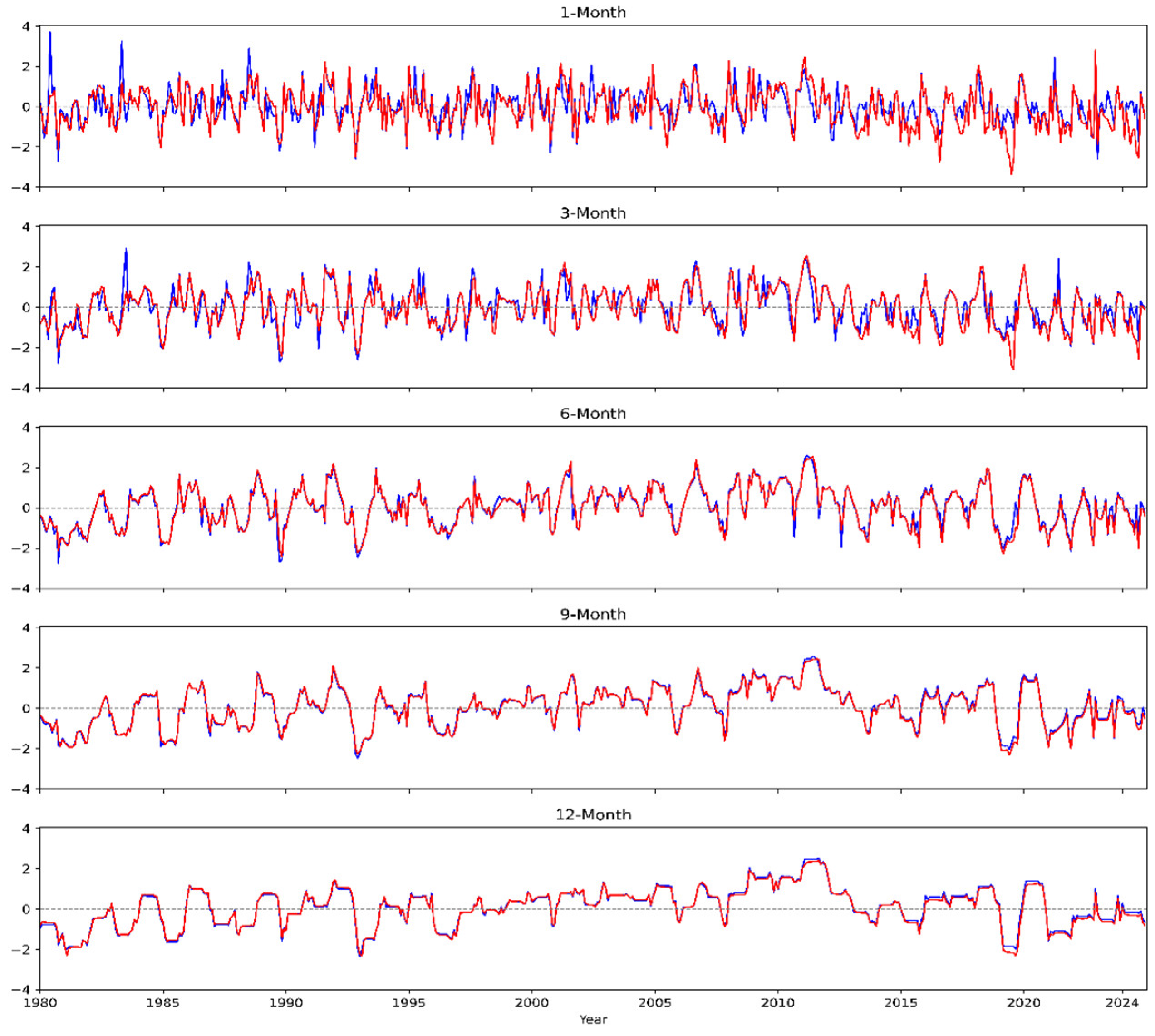
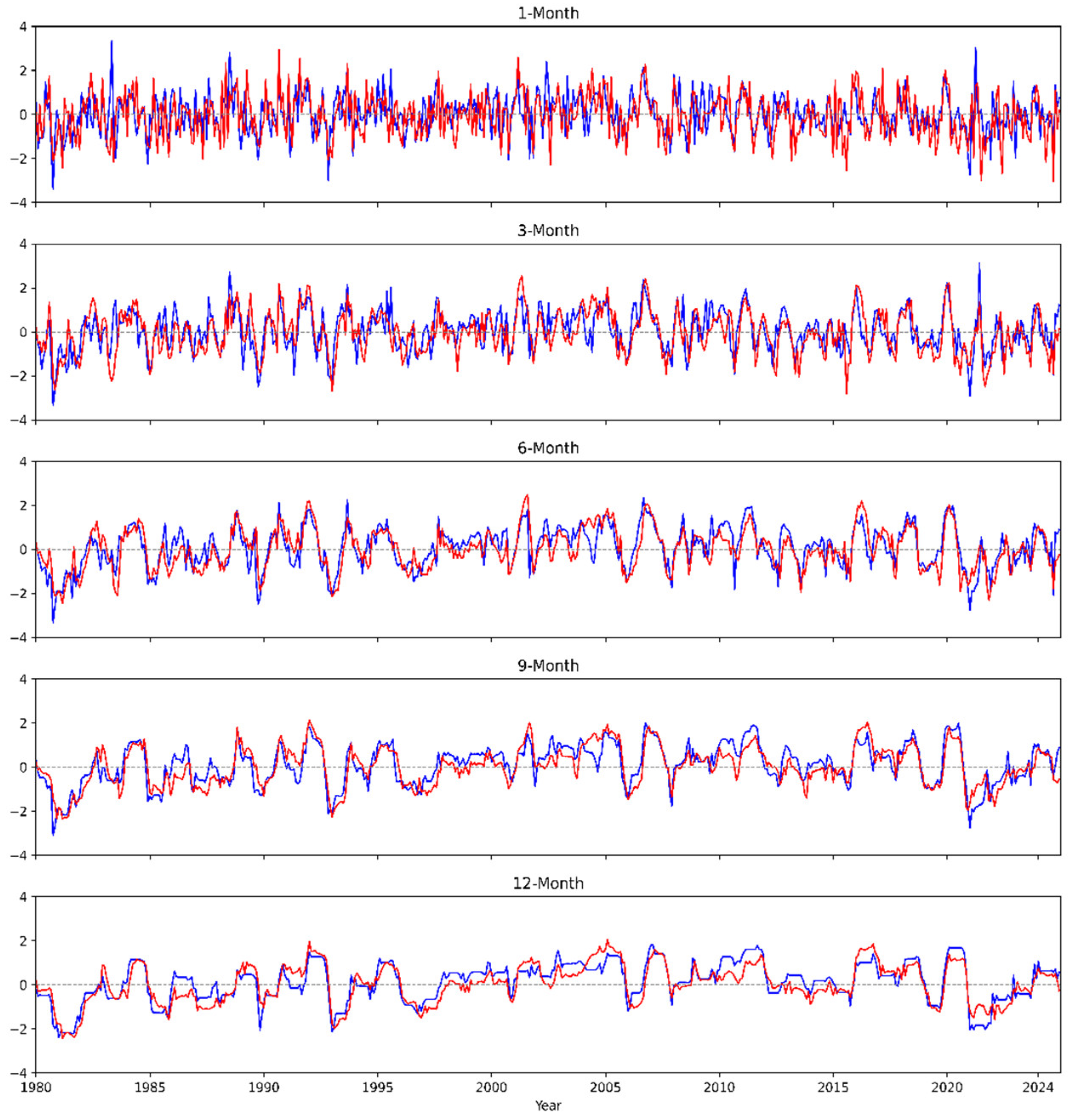
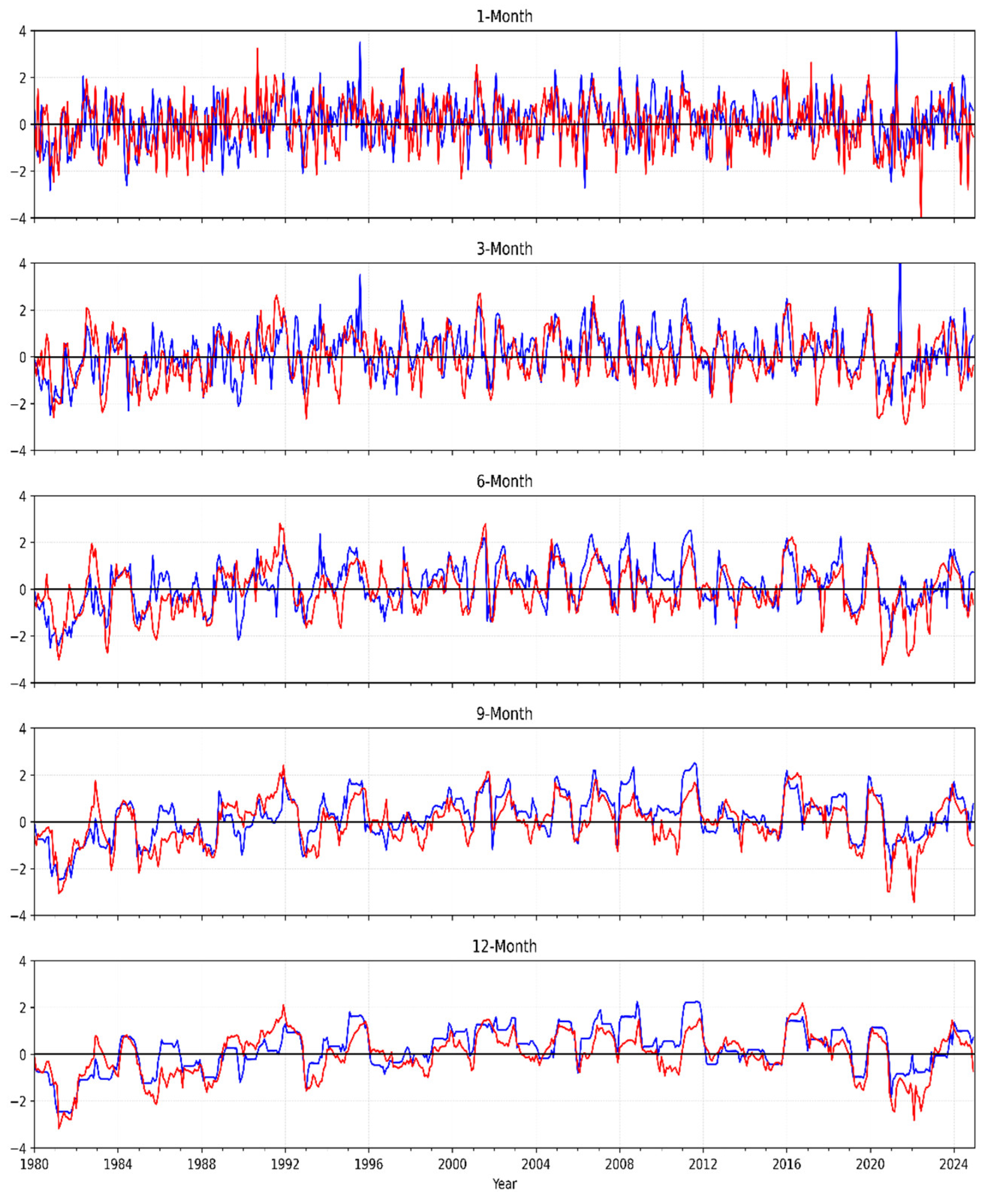
To better understand drought dynamics in southern Angola, the analysis was conducted separately for each province. Figure 3 illustrates the SPI and SPEI values for Cunene province, with the SPI series shown in blue and the SPEI series in red. Both indices were analyzed at time scales of 1, 3, 6, 9, and 12 months to capture the multi-temporal characteristics of drought conditions.
During the study period, several drought events were recorded at both short- and long-term time scales. Among the most notable events were those that occurred in the early and mid-1980s, the early 1990s, and in 2019. These episodes were consistently identified across different time scales and represent the most extreme drought events within the period of analysis.
Figure 4 illustrates the temporal evolution of drought conditions in Huila Province from 1980 to 2024. Across all analyzed time scales, multiple drought events were identified. Similar to the pattern observed in Cunene Province, the most severe and persistent drought episodes occurred in the early 1980s, the early 1990s, and in 2019. During these periods, drought intensity ranged from moderate to extreme, as consistently captured by both the SPI and SPEI time series. Overall, the results highlight the recurrent nature of drought in Huila.
Figure 5 presents the temporal variation in drought in Namibe province from 1980 to 2024, based on SPI (blue) and SPEI (red) indices calculated at different time scales. The analysis highlights several major drought episodes over the past four decades. The most pronounced drought event occurred in the early 1980s, characterized by extreme drought conditions. This was followed by additional significant drought episodes in the early 1990s and again in 2019, both identified across multiple time scales.
The analysis indicates that short-term indices (SPI-1 to SPI-3 and SPEI-1 to SPEI-3) are more sensitive to capturing drought intensity, often detecting more frequent and severe drought events. In contrast, longer-term indices (SPI-6, SPEI-6, SPI-9, SPEI-9 and SPI-12, SPEI-12) appear better suited for detecting the persistence and frequency of droughts, although they tend to smooth out short-lived extreme events. A comparison between SPI and SPEI reveals a consistent pattern across time scales, though SPEI tends to indicate more intense drought conditions, particularly during episodes of high temperature and low precipitation [32]. For example, the extreme drought recorded in 2019 and 2021 is more pronounced in the SPEI series than in the SPI series in Cunene and Namibe, likely due to the incorporation of potential evapotranspiration in the SPEI formulation, which captures the additional stress imposed by high temperatures.
When analyzing drought across southern Angola, a clear similarity emerges among Cunene, Huila, and Namibe. All three provinces exhibit comparable temporal patterns and, for most drought episodes, show similar levels of frequency and intensity. Major drought events identified in one province are generally reflected in the others, indicating consistent spatial behavior across the region over the study period. Although some differences are observed during specific extreme episodes, the overall dynamics of drought remain similar across the three provinces.

3.2. Drought Trend Analysis (MMK and Sen’s Slope)

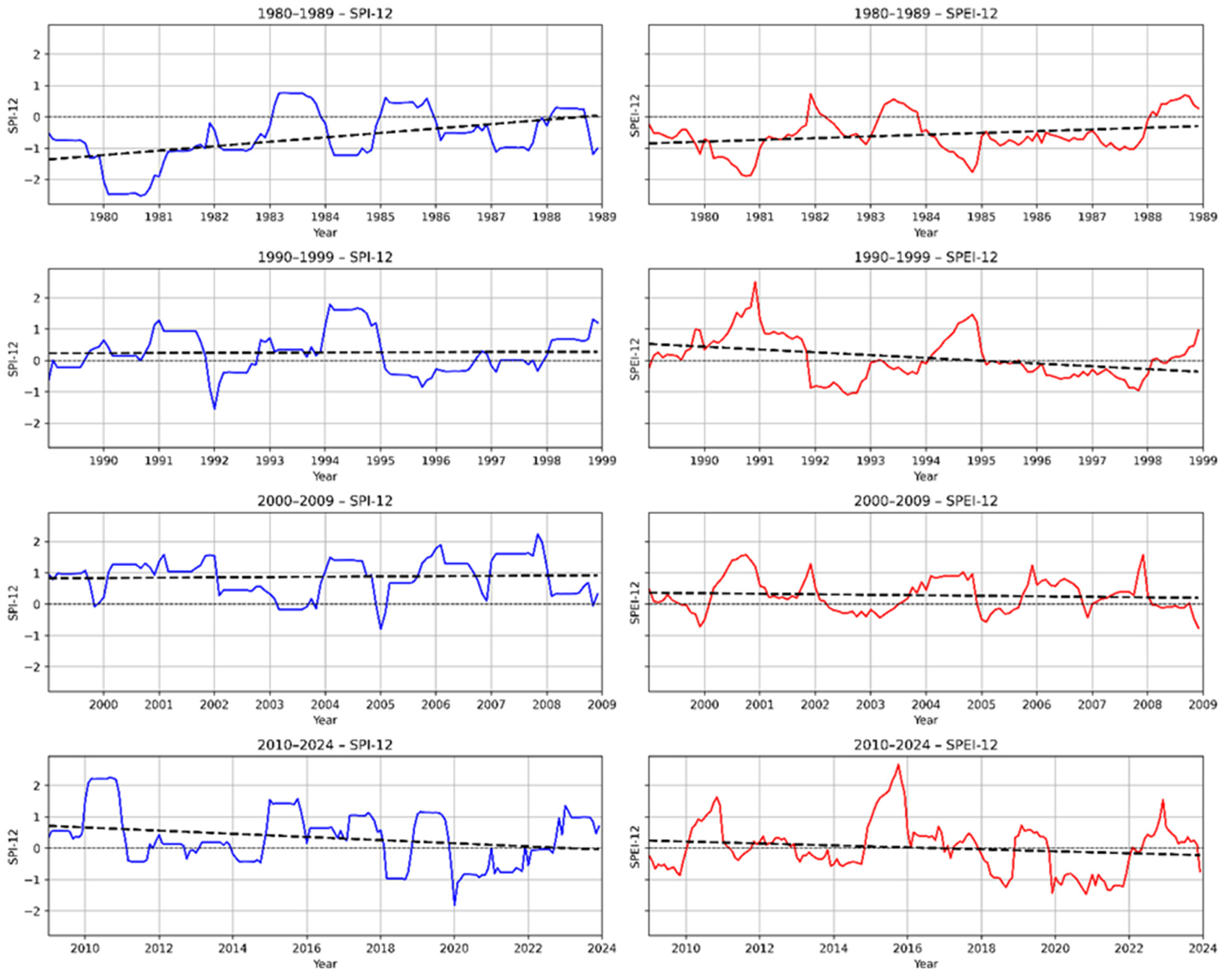
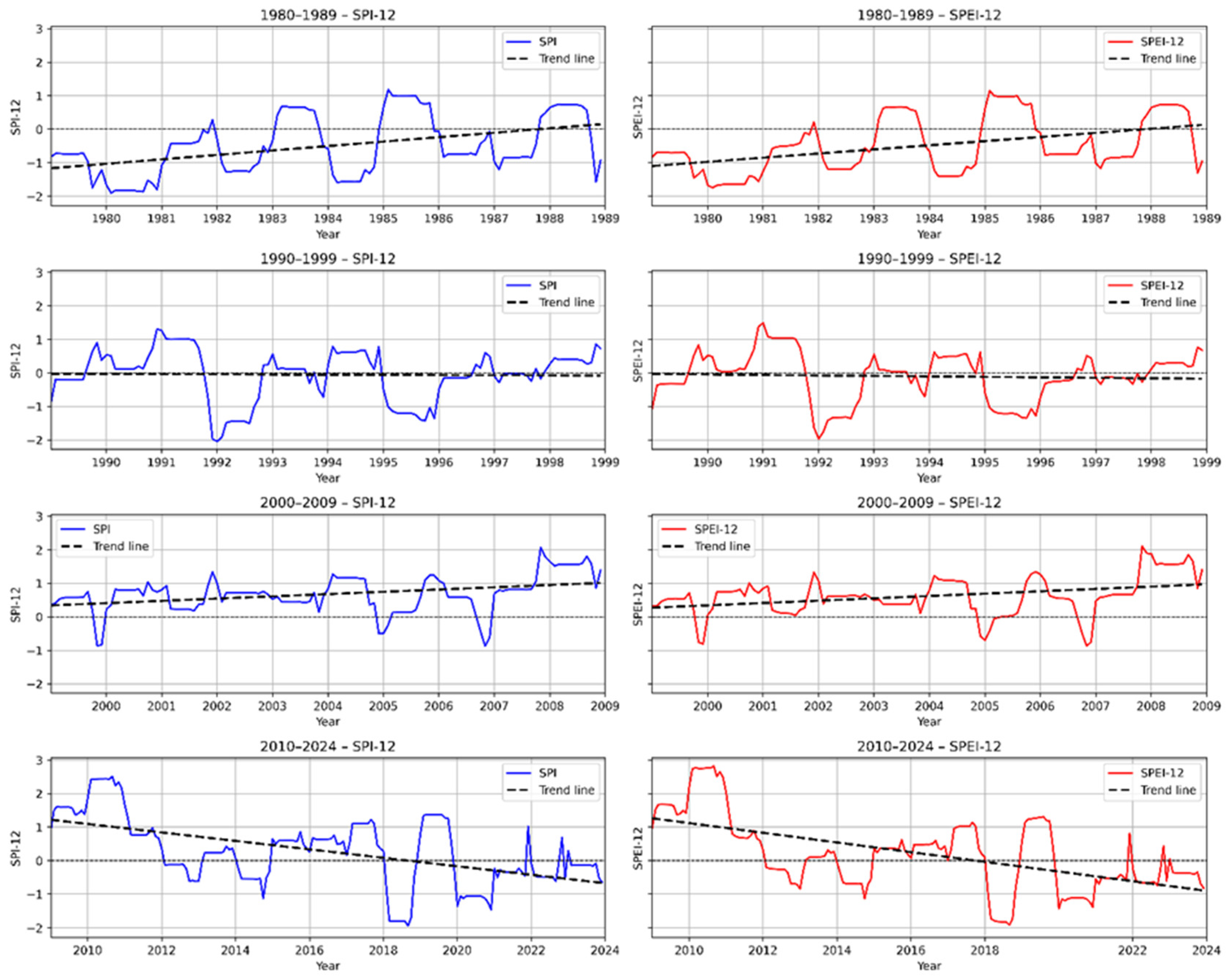
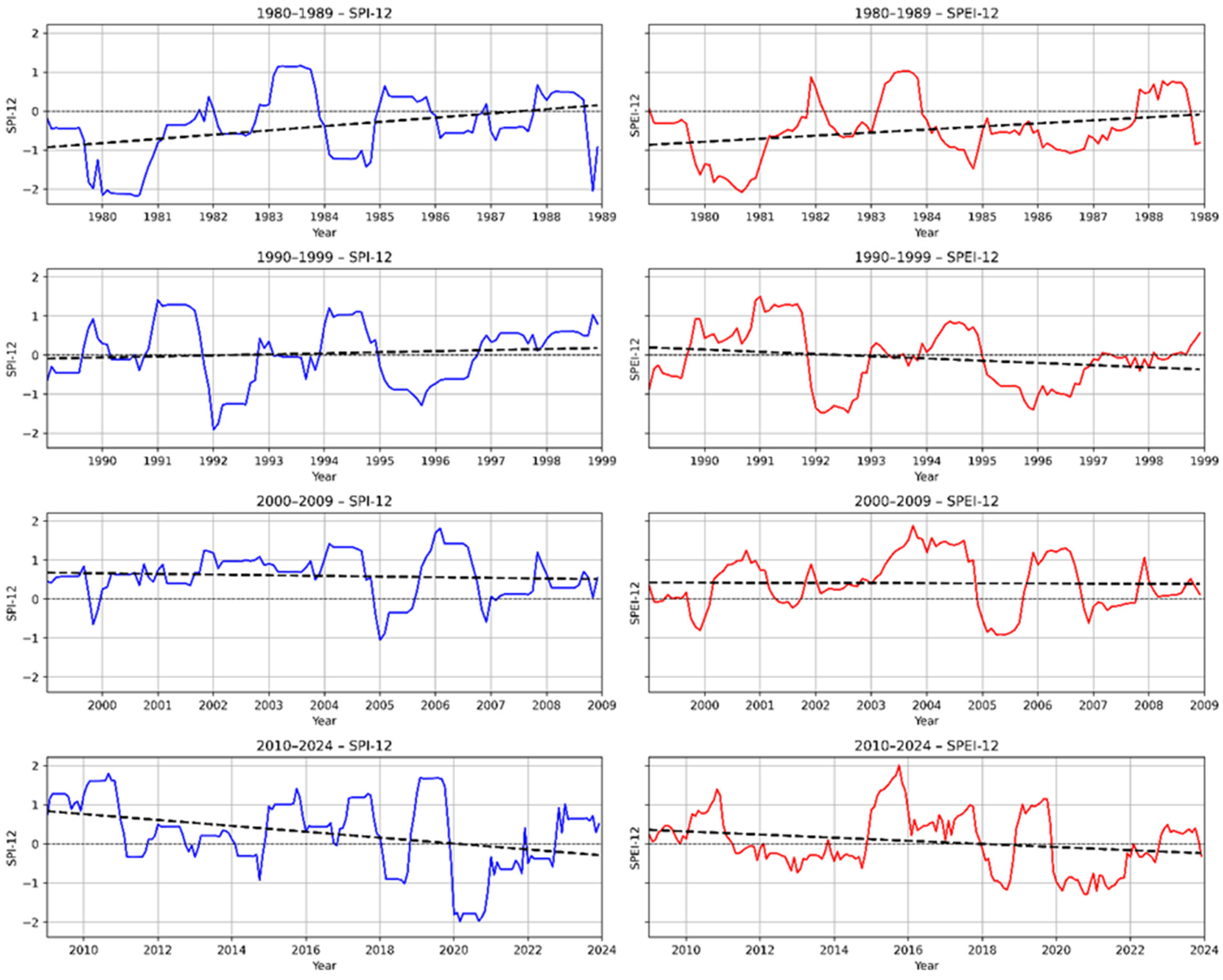
To better assess the evolution of drought conditions in southern Angola, it is essential to examine not only the temporal distribution of drought events, but also the magnitude of their trends. For this purpose, the Modified Mann–Kendall (MMK) trend test was applied to detect monotonic trends in the SPI-12 and SPEI-12 series for each province. This non-parametric test is well-suited for climatic time series, as it accounts for autocorrelation, which is common in drought-related data. To quantify the magnitude of these trends, the Sen’s slope estimator was used in parallel. This method provides a robust measure of the rate of change in drought intensity over time and complements the significance testing offered by the MMK test. Given that drought is a gradual and cumulative phenomenon, where past conditions can influence present and future impacts, the time series was divided into four consecutive periods: 1980–1989, 1990–1999, 2000–2009, and 2010–2024. This temporal segmentation allows for a more detailed identification of when drought conditions began to intensify and how their severity and persistence evolved over the decades.
Figure 6 shows the decadal evolution of drought in Cunene Province based on SPI-12 and SPEI-12 values, with trend lines derived from Sen’s slope estimator. During the 1980–1989 period, both indices indicate an increasing trend, suggesting less drought activity during this decade. This trend is slightly more pronounced in the SPEI-12 series. During the 1990–1999 decade, SPI-12 remained relatively stable, showing no clear increasing or decreasing trend, while SPEI-12 showed a slight increasing tendency, although the change was not substantial.
For the 2000–2009 period, both indices show a moderate increasing trend, indicating a possible reduction in drought conditions during this time. In contrast, during the most recent period (2010–2024), both SPI-12 and SPEI-12 exhibit a clear decreasing trend, indicating a tendency toward drier conditions in Cunene Province.
Overall, the analysis reveals a shift toward more pronounced drought conditions in recent decades, particularly from 2010 onwards, as indicated by both indices.
Figure 7 presents the drought trends for Huila Province across four analysis periods (1980–1989, 1990–1999, 2000–2009, and 2010–2024), based on the SPI-12 and SPEI-12 indices. In the 1980–1989 period, both SPI-12 and SPEI-12 exhibit an increasing trend, indicating a general decrease in drought conditions during this decade. During the 1990–1999 period, the two indices show diverging trends. SPI-12 suggests a slight increasing trend, while SPEI-12 displays a modest decreasing trend, indicating some variability in drought conditions depending on the index used. In the 2000–2009 decade, both indices remain relatively stable, with no clear increasing or decreasing trend observed. This suggests that drought conditions in Huila were relatively consistent throughout this period. In the most recent period (2010–2024), both SPI-12 and SPEI-12 show decreasing trend, pointing to a general increase in drought conditions. The SPI-12 series suggests a more marked trend over this period. Overall, the results show that Huila experienced a decline in drought during the 1980s, mixed or stable conditions during the 1990s and 2000s, and a clear increase in drought conditions from 2010 onwards.
Figure 8 presents the drought trends for Namibe Province across the four study periods (1980–1989, 1990–1999, 2000–2009, and 2010–2024), as assessed using the SPI-12 and SPEI-12 indices. In the 1980–1989 period, both indices show an increasing trend, indicating a general reduction in drought conditions during this decade. The increasing trend is more pronounced in the SPI-12 series. During the 1990–1999 period, SPI-12 exhibits a slight increasing trend, indicating marginally wetter conditions. In contrast, SPEI-12 shows a weak decreasing trend, suggesting a subtle shift toward drier conditions; however, the magnitude of this change is small and does not represent a substantial alteration in overall drought distinction. In the 2000–2009 period, both indices remain relatively stable, without significant increasing or decreasing tendencies. The SPEI-12 series shows a subtle downward trend, though still within a range of natural variability. In the most recent period (2010–2024), both SPI-12 and SPEI-12 indicate an upward trend, suggesting an increase in drought conditions in Namibe Province. The trend is slightly more accentuated in the SPI-12 values. Overall, the results for Namibe indicate relatively stable or improving conditions in the earlier decades, followed by a noticeable increase in drought trends in the 2010–2024 period, as captured by both indices.
When analyzing drought trends across the three southern provinces of Angola, Cunene, Huila, and Namibe, a general pattern emerges. All provinces experienced a decline in drought conditions during the early decades (1980s and 1990s), followed by a notable increase in the most recent years (2010–2024). Among the three, Cunene exhibited the most substantial positive trend, particularly in the 2010s, with both SPI-12 and SPEI-12 indicating a consistent increase in harvest values. In Huila, the trend analysis indicates an increasing and near-stable during the earlier decades, followed by a noticeable shift in the most recent period (2010–2024). In Namibe, a positive trend is observed during the first decade (1980–1989), followed by near-stable tendencies in the subsequent two decades, and a negative trend in the most recent period (2010–2024). When analyzed separately, the SPI-12 often exhibits slightly more pronounced trends than the SPEI-12 in these provinces. Despite some variation between indices, the general direction of change is consistent pointing to a worsening drought scenario in recent years. These findings are in line with the results of [50], who identified the most severe droughts in southern Angola occurring during 2014–2016 and 2019–2020, reinforcing the observed trend of increasing drought frequency in the last decade.

3.3. Spatial Patterns of Drought Intensity

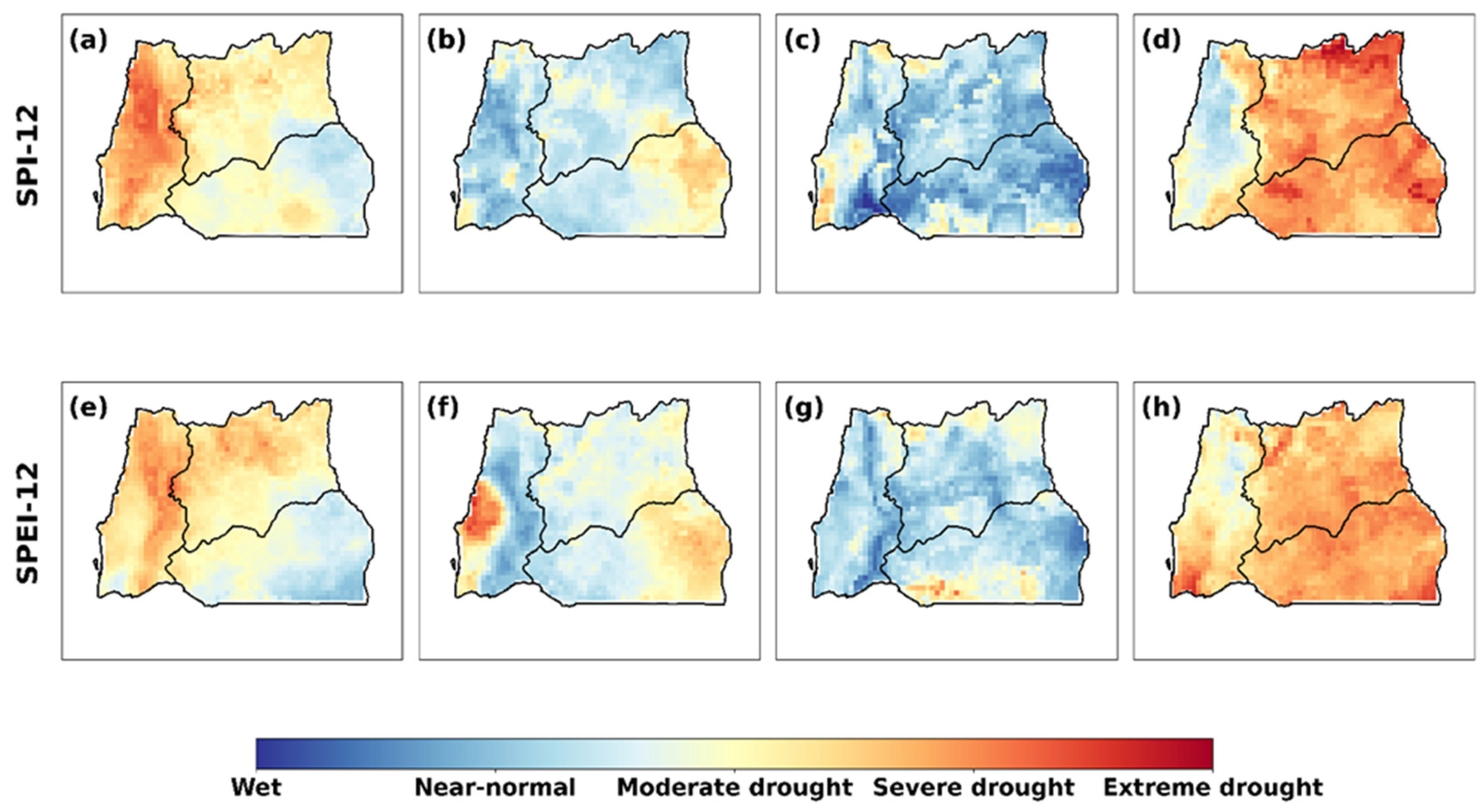
Given the complexity of drought as a spatially continuous phenomenon that does not conform to administrative boundaries, spatial drought intensity is analyzed in Figure 9 across four distinct periods. During the first period, drought conditions were widespread and particularly severe, with severe to extreme drought dominating Namibe, severe drought prevailing in Huila, and moderate to severe drought affecting Cunene. In the second and third periods, drought intensity weakened considerably, with conditions ranging from wet to severe drought across the region. However, in the final period, drought conditions intensified again, expanding spatially and reaching moderate to extreme levels throughout much of southern Angola.

4. Discussion

4.1. Drought Impacts and Challenges in Southern Angola

Due to its geographical location, Angola is frequently affected by natural disasters of hydrometeorological origin [51]. In recent decades, drought in southern Angola has intensified significantly in both frequency and intensity. These events have led to recurrent livestock losses, the spread of diseases associated with malnutrition such as malaria and respiratory infections, particularly among children and the elderly and the migration of young people from rural areas. Communities have resorted to coping with mechanisms such as digging artisanal wells in intermittent riverbeds, sending family members to urban relatives, and reducing daily meals from three to one [28].
The intensification of drought observed in this study for Cunene, Huila, and Namibe highlights several emerging challenges for southern Angola. This study shows that, after a period of relative stability in the 1980s and 1990s, drought conditions have worsened significantly in the last decade, with persistent negative SPI-12 and SPEI-12 anomalies. The results of this study are in agreement with [52], who identified the southern region of Angola as the most drought-prone area using SPI and IDI indices. Their analysis also highlights the 1990s as a period marked by prolonged and intense drought events, notably the 1992–1997 episode, which represents one of the longest droughts recorded in the country. At the regional level, the results are in consistent with [50], who documented recurrent extreme drought events in Namibia over the past decade, notably in 2013, 2016, and 2019, which led to the declaration of national emergency states. At the global scale, the results agree with recent studies [53], which show that large and persistent drought events have become increasingly frequent in recent decades. Several regions, including the Amazon, Central Africa, Northern North America, and parts of Eurasia, have been identified as hotspots of recurrent drought events, with evolving spatiotemporal patterns in terms of growth, contraction, and severity. Similarly [54], identified major global drought hotspots, including Amazonia, southern South America, the Mediterranean region, most of Africa, and northeastern China. These findings further confirm that drought frequency and intensity have increased in recent decades, not only in southern Angola but also across several regions worldwide.
These worsening trends in southern Angola underscore the urgent need to understand drought behavior more comprehensively, including its onset, duration, spatial propagation, and localized impacts. Strengthening drought monitoring is therefore essential not only for identifying the most affected areas but also for distinguishing the true effects of drought from underlying socio-economic vulnerabilities faced by rural communities.
However, effective harvest management requires more than monitoring; it also depends on the capacity to anticipate events before they reach critical levels. Preventive measures are most effective when early warning information is available, and predicting drought conditions becomes fundamental in this context. Recent advances in artificial intelligence have demonstrated strong potential for forecasting hydroclimatic extremes, including drought. Integrating these tools into a national early warning framework would improve preparedness and enhance the timing and efficiency of governmental and community responses.
Beyond forecasting, AI can support more effective communication, particularly in remote regions with high levels of illiteracy and linguistic diversity. Automated translation into national languages and text-to-speech capabilities would allow climate information to reach vulnerable populations more clearly and inclusively. Such technologies could facilitate personalized text and audio alerts sent directly to mobile phones, guiding communities on optimal routes for transhumance, the distribution of water and food supplies, and other locally relevant adaptation actions.
Projections indicate that drought conditions in southern Angola may worsen considerably by the end of the 21st century. In some regions, the number of days under moderate drought may increase by up to 30%, and some models forecast a tenfold increase in such events [55,56].
In response to recent droughts, the government, NGOs, and local communities have implemented various adaptation and mitigation strategies. However, several gaps persist. According to [14], key challenges include the lack of systematic drought monitoring, limited understanding of drought-related risks, low public awareness, and insufficient institutional capacity to respond to drought impacts. The impacts of drought and the main drought management measures adopted in southern Angola are summarized in Table 2.

4.2. Drought Adaptation Strategies

Despite the efforts made, many of the current drought management measures in southern Angola have proven insufficient. In some cases, they may even exacerbate existing social issues. For example, splitting families can lead to abandonment and household instability; school dropouts due to pastoral labor contribute to illiteracy and social exclusion; urban migration can result in vulnerability to exploitation; and malnutrition resulting from food shortages increases susceptibility to disease. Charcoal production, often used as a coping strategy, contributes to environmental degradation.
Given the recurrent and intensifying drought patterns identified in southern Angola, the development of a modern, locally adapted, and sustainable drought monitoring and forecasting framework is essential. An effective system for Angola should integrate both monitoring and forecasting components within a unified structure.
The monitoring component should prioritize drought characterization in the provinces of Cunene, Huila, and Namibe, where recurrent drought events have been identified. Considering the limited in situ meteorological coverage, a hybrid approach combining ground observations and satellite remote sensing data is required to ensure adequate spatial representation. A multi-index framework is recommended, incorporating SPI, SPEI, Standardized Streamflow Index (SRI), Streamflow Drought Index (SDI), Vegetation Health Index (VHI), and Normalized Difference Vegetation Index (NDVI). The integration of meteorological, hydrological, and vegetation-based indicators allows for a multidimensional assessment of drought conditions. Monthly drought maps accompanied by standardized severity classifications, proposed by [28], would facilitate consistent interpretation and communication.
Beyond monitoring, forecasting capability is critical to shift from reactive crisis response to proactive risk management. A data-driven forecasting framework based on machine learning techniques, particularly Long Short-Term Memory (LSTM) networks, is suitable for modeling temporal dependencies in hydroclimatic series. Predictive models should integrate local climatic variables, large-scale teleconnection indices, and antecedent drought conditions to capture both climatic forcing and drought persistence.
To ensure effective dissemination and social inclusion, the information generated by the monitoring and forecasting components must be accessible to vulnerable populations, particularly in rural areas with high illiteracy rates. Multilingual communication tools and audio-based dissemination mechanisms should therefore be incorporated to enhance reach and usability.
Such a drought monitoring and forecasting framework would not only respond to the specific hydroclimatic context of Angola but also contribute to advancing drought research and operational practice in data-scarce regions. By integrating satellite observations, machine learning approaches, and natural language processing within a single analytical structure, the system would allow climate information to be processed, interpreted, and communicated more effectively. From a scientific perspective, this integration promotes a more comprehensive understanding of drought dynamics by linking climatic drivers, temporal persistence, and spatial variability within a unified framework. At the same time, improving the accessibility and clarity of drought information strengthens its practical relevance, supporting evidence-based decision-making across local and national governance levels.

4.3. Limitations

This study presents some limitations that should be acknowledged. First, the analysis relies on reanalysis data from ECMWF, as no in situ observations were available to validate the datasets used. Second, the study does not include a systematic evaluation of adaptation strategies, due to the lack of socio-economic data, policy reviews, or stakeholder-based information such as local interviews. As a result, conclusions related to adaptation are limited to general implications derived from the observed drought patterns.
Future research should address these limitations by incorporating in situ observations for validation purposes and by integrating socio-economic and policy data to better assess adaptation strategies. In addition, further studies should focus on recent drought events and explore the use of machine learning algorithms for drought forecasting, including the integration of future climate projections such as those from the Coupled Model Intercomparison Project Phase six (CMIP6).

5. Conclusions

Drought in southern Angola is not a recent phenomenon; however, the results indicate a clear intensification in its frequency, duration, and severity over the study period, particularly between 2010 and 2024. The analysis based on SPI-12 and SPEI-12 highlights a higher occurrence of severe and extreme drought events in recent decades, with notable episodes identified in 2019, 2021, and 2022. All three provinces, Cunene, Huila, and Namibe experienced worsening drought conditions, with Cunene showing the most pronounced severity. Despite some regional differences, the three provinces exhibit consistent temporal patterns, with drought events occurring simultaneously across the study area. This suggests a coherent regional behavior of drought dynamics in southern Angola.
The observed intensification of drought conditions implies increasing pressure on water resources, ecosystems, and livelihoods. These findings highlight the importance of strengthening drought monitoring and early warning systems to support timely and informed decision-making. In this context, this study proposes the development of a drought monitoring and forecasting system as a proactive approach to improve preparedness and response. By providing timely and locally relevant information, such a system can support decision-makers and communities in anticipating drought conditions and reducing their impacts.

Author Contributions

P.L. conceptualized the study and curated the data; P.L., E.C. and P.R.-S. developed the methodology and prepared the original draft; P.L., E.C. and P.R.-S. reviewed and edited the manuscript; E.C. and P.R.-S. provided supervision and funding acquisition. All authors have read and agreed to the published version of the manuscript.

Funding

The authors would like to express gratitude to the Instituto Nacional de Gestão de Bolsas de Estudo de Angola for funding the PhD program, under the Programa de Envio Anual de 300 Licenciados/Mestres Angolanos com Elevado Desempenho e Mérito Académico para as Melhores Universidades do Mundo, approved by Presidencial Decree No. 67/19 of 22 February, Edition 2021.

Data Availability Statement

The data used in this study will be made available upon request.

Conflicts of Interest

The author declares no conflicts of interest.

References

  1. Dai, A. Drought under Global Warming: A Review. Wiley Interdiscip. Rev. Clim. Change 2011, 2, 45–65. [Google Scholar] [CrossRef]
  2. Aliyar, Q.; Zulfiqar, F.; Datta, A.; Kuwornu, J.K.M.; Shrestha, S. Drought Perception and Field-Level Adaptation Strategies of Farming Households in Drought-Prone Areas of Afghanistan. Int. J. Disaster Risk Reduct. 2022, 72, 102862. [Google Scholar] [CrossRef]
  3. López-Otal, M.; Domínguez-Castro, F.; Latorre, B.; Vela-Tambo, J.; Gracia, J. SeqIA: A Python Framework for Extracting Drought Impacts from News Archives. Environ. Model. Softw. 2025, 187, 106382. [Google Scholar] [CrossRef]
  4. Rahman, G.; Jung, M.K.; Kim, T.W.; Kwon, H.H. Drought Impact, Vulnerability, Risk Assessment, Management and Mitigation under Climate Change: A Comprehensive Review. KSCE J. Civ. Eng. 2025, 29, 100120. [Google Scholar] [CrossRef]
  5. Miyan, M.A. Droughts in Asian Least Developed Countries: Vulnerability and Sustainability. Weather Clim. Extrem. 2015, 7, 8–23. [Google Scholar] [CrossRef]
  6. Zia, R.; Nawaz, M.S.; Siddique, M.J.; Hakim, S.; Imran, A. Plant Survival under Drought Stress: Implications, Adaptive Responses, and Integrated Rhizosphere Management Strategy for Stress Mitigation. Microbiol. Res. 2021, 242, 126626. [Google Scholar] [CrossRef]
  7. Paez-Trujillo, A.M.; Hernandez-Suarez, J.S.; Alfonso, L.; Hernandez, B.; Maskey, S.; Solomatine, D. An Optimisation Approach for Planning Preventive Drought Management Measures. Sci. Total Environ. 2024, 948, 174842. [Google Scholar] [CrossRef]
  8. Zhao, X.; Hao, Z.; Huang, R.; Feng, A.; Singh, V.P. Temporally Compounding Droughts at the Global Scale: Distribution, Propagation, and Projection. Glob. Planet. Change 2025, 253, 104905. [Google Scholar] [CrossRef]
  9. Luetkemeier, R.; Liehr, S. Drought Sensitivity in the Cuvelai Basin: Empirical Analysis of Seasonal Water and Food Consumption Patterns. Biodivers. Ecol. 2018, 6, 160–167. [Google Scholar] [CrossRef]
  10. Government of Angola; United Nations Development Programme; European Union; World Bank. Droughts in Angola 2012–2016: Post Disaster Needs Assessment (PDNA); Government of Angola: Luanda, Angola, 2018.
  11. Odongo, R.A.; Schrieks, T.; Streefkerk, I.; de Moel, H.; Busker, T.; Haer, T.; MacLeod, D.; Michaelides, K.; Singer, M.; Assen, M.; et al. Drought Impacts and Community Adaptation: Perspectives on the 2020–2023 Drought in East Africa. Int. J. Disaster Risk Reduct. 2025, 119, 105309. [Google Scholar] [CrossRef]
  12. Barimalala, R.; Wainwright, C.; Kolstad, E.W.; Demissie, T.D. The 2019–2021 Drought in Southern Madagascar. Weather Clim. Extrem. 2024, 46, 100723. [Google Scholar] [CrossRef]
  13. Orievulu, K.S.; Iwuji, C.C. Institutional Responses to Drought in a High HIV Prevalence Setting in Rural South Africa. Int. J. Environ. Res. Public Health 2022, 19, 434. [Google Scholar] [CrossRef] [PubMed]
  14. Mateus, N.P.A. Assessment of the Impacts of Natural Disasters Related to Drought in Angola; Universidade Estadual Paulista “Júlio de Mesquita Filho” (UNESP): São José dos Campos, Brazil, 2022. [Google Scholar]
  15. UNDP; CNPC. Lições Aprendidas Sobre a Recuperação Pós-Desastre: Caso de Estudo: A Seca de 2013–2014 na Província do Cunene (Angola); UNDP; CNPC: Luanda, Angola, 2017. [Google Scholar]
  16. Serrat-Capdevila, A.; Limones, N.; Marzo-Artigas, J.; Wijnen, M.; Petrucci, B. Water Security and Drought Resilience in the South of Angola; World Bank: Washington, DC, USA, 2022. [Google Scholar]
  17. Blanes, R.L.; Cardoso, C.V.; Bahu, H.A.; Fortuna, C. Drought in Angola. Situation Report 2020–2021. Causes, Responses and Solutions. Research Report; University of Gothenburg and ISCED: Göteborg, Sweden; Lubango, Angola, 2022. [Google Scholar]
  18. United Nations Office for the Coordination of Humanitarian Affairs (OCHA). Angola Rapid Response Drought 2021; Central Emergency Response Fund (CERF): New York, NY, USA, 2022. [Google Scholar]
  19. Serrat-Capdevila, A.; Limones, N.; Marzo-Artigas, J.; Wijnen, M.; Petrucci, B. Resiliência à Seca e Segurança Hídrica No Sul de Angola; World Bank: Washington, DC, USA, 2019. [Google Scholar]
  20. Hawkins, P.; Geza, W.; Mabhaudhi, T.; Sutherland, C.; Queenan, K.; Dangour, A.; Scheelbeek, P. Dietary and Agricultural Adaptations to Drought among Smallholder Farmers in South Africa: A Qualitative Study. Weather Clim. Extrem. 2022, 35, 100413. [Google Scholar] [CrossRef] [PubMed]
  21. Vicente-Serrano, S.M.; Domínguez-Castro, F.; Reig, F.; Beguería, S.; Tomas-Burguera, M.; Latorre, B.; Peña-Angulo, D.; Noguera, I.; Rabanaque, I.; Luna, Y.; et al. A near Real-Time Drought Monitoring System for Spain Using Automatic Weather Station Network. Atmos. Res. 2022, 271, 106095. [Google Scholar] [CrossRef]
  22. Hayes, M.J.; Svoboda, M.D.; Wardlow, B.D.; Anderson, M.C.; Kogan, F. Drought Monitoring: Historical and Current Perspectives. 2012. Available online: https://www.researchgate.net/publication/312493499_Drought_Monitoring_Historical_and_Current_Perspectives (accessed on 20 April 2026).
  23. Acácio, V.; Andreu, J.; Assimacopoulos, D.; Bifulco, C.; Di Carli, A.; Dias, S.; Kampragou, E.; Monteagudo, D.H.; Rego, F.; Seidl, I.; et al. Review of Current Drought Monitoring Systems and Identification of (Further) Monitoring Requirements. 2013. Available online: https://www.isa.ulisboa.pt/ceabn/uploads/docs/projectos/drought/DROUGHT_TR_6.pdf (accessed on 20 April 2026).
  24. Gonçalves, S.T.N.; Vasconcelos, F.d.C., Jr.; Sakamoto, M.S.; Silveira, C.d.S.; Martins, E.S.P.R. Índices e Metodologias de Monitoramento de Secas: Uma Revisão. Rev. Bras. Meteorol. 2021, 36, 495–511. [Google Scholar] [CrossRef]
  25. Woodmansee, G.; Macon, D.; Schohr, T.; Roche, L. Building Ranch Resilience to Drought: Management Capacity, Planning, and Adaptive Learning During California’s 2012–2016 Drought. Rangel. Ecol. Manag. 2024, 98, 63–72. [Google Scholar] [CrossRef]
  26. Geng, X.; Lei, X.; Song, X.; Zhang, J.; Liu, W. Impact of Human Activities on the Propagation Dynamics from Meteorological to Hydrological Drought in the Nenjiang River Basin, Northeast China. J. Hydrol. Reg. Stud. 2025, 58, 102214. [Google Scholar] [CrossRef]
  27. Miguel, A. Angola passa a contar com três novas províncias. RFI. 2024. Available online: https://www.rfi.fr/pt/%C3%A1frica-lus%C3%B3fona/20241231-angola-passa-a-contar-com-tr%C3%AAs-novas-prov%C3%ADncias (accessed on 20 April 2026).
  28. Bonga, J.Y.H. Tecnologias Para a Mitigação dos Efeitos da Seca na Bacia Hidrográfica do Rio Caculuvar Em Angola. 2016. Available online: https://ri.ufs.br/handle/riufs/4244 (accessed on 20 April 2026).
  29. Beck, H.E.; Zimmermann, N.E.; McVicar, T.R.; Vergopolan, N.; Berg, A.; Wood, E.F. Present and Future Köppen-Geiger Climate Classification Maps at 1-Km Resolution. Sci. Data 2018, 5, 180214. [Google Scholar] [CrossRef]
  30. Aschale, T.M.; Cancelliere, A.; Palazzolo, N.; Buonacera, G.; Peres, D.J. Analysis of the Spatiotemporal Trends of Standardized Drought Indices in Sicily Using ERA5-Land Reanalysis Data (1950–2023). Water 2024, 16, 2593. [Google Scholar] [CrossRef]
  31. Muñoz-Sabater, J.; Dutra, E.; Agustí-Panareda, A.; Albergel, C.; Arduini, G.; Balsamo, G.; Boussetta, S.; Choulga, M.; Harrigan, S.; Hersbach, H.; et al. ERA5-Land: A State-of-the-Art Global Reanalysis Dataset for Land Applications. Earth Syst. Sci. Data 2021, 13, 4349–4383. [Google Scholar] [CrossRef]
  32. Mwinjuma, M.; Wang, R.; Mtupili, M.; Twaha, M. Comparisons of SPI and SPEI in Capturing Drought Dynamics: A Global Assessment across Arid and Humid Regions. Atmos. Res. 2026, 329, 108475. [Google Scholar] [CrossRef]
  33. Mckee, T.B.; Doesken, N.J.; Kleist, J. The Relationship of Drought Frequency and Duration to Time Scales. In Proceedings of the 8th Conference on Applied Climatology, Anaheim CA, USA, 17–22 January 1993. [Google Scholar]
  34. Vicente-Serrano, S.M.; Beguería, S.; López-Moreno, J.I. A Multiscalar Drought Index Sensitive to Global Warming: The Standardized Precipitation Evapotranspiration Index. J. Clim. 2010, 23, 1696–1718. [Google Scholar] [CrossRef]
  35. Kourtis, I.M.; Vangelis, H.; Tigkas, D.; Mamara, A.; Nalbantis, I.; Tsakiris, G.; Tsihrintzis, V.A. Drought Assessment in Greece Using SPI and ERA5 Climate Reanalysis Data. Sustainability 2023, 15, 15999. [Google Scholar] [CrossRef]
  36. Karavitis, C.A.; Alexandris, S.; Tsesmelis, D.E.; Athanasopoulos, G. Application of the Standardized Precipitation Index (SPI) in Greece. Sustainability 2011, 3, 787–805. [Google Scholar] [CrossRef]
  37. Liu, C.; Yang, C.; Yang, Q.; Wang, J. Spatiotemporal Drought Analysis by the Standardized Precipitation Index (SPI) and Standardized Precipitation Evapotranspiration Index (SPEI) in Sichuan Province, China. Sci. Rep. 2021, 11, 1280. [Google Scholar] [CrossRef]
  38. Patel, N.R.; Chopra, P.; Dadhwal, V.K. Analyzing Spatial Patterns of Meteorological Drought Using Standardized Precipitation Index. Meteorol. Appl. 2007, 14, 329–336. [Google Scholar] [CrossRef]
  39. Asadi Zarch, M.A.; Sivakumar, B.; Sharma, A. Droughts in a Warming Climate: A Global Assessment of Standardized Precipitation Index (SPI) and Reconnaissance Drought Index (RDI). J. Hydrol. 2014, 526, 183–195. [Google Scholar] [CrossRef]
  40. Abramowitz, M.; Stegun, I.A. Handbook of Mathematical Functions with Formulas, Graphs, and Mathematical Tables, 10th ed.; US Government Printing Office: New York, NY, USA, 1965.
  41. Ullah, I.; Ma, X.; Yin, J.; Asfaw, T.G.; Azam, K.; Syed, S.; Liu, M.; Arshad, M.; Shahzaman, M. Evaluating the Meteorological Drought Characteristics over Pakistan Using in Situ Observations and Reanalysis Products. Int. J. Climatol. 2021, 41, 4437–4459. [Google Scholar] [CrossRef]
  42. Alasow, A.A.; Hamed, M.M.; Shahid, S. Spatiotemporal Variability of Drought and Affected Croplands in the Horn of Africa. Stoch. Environ. Res. Risk Assess. 2024, 38, 281–296. [Google Scholar] [CrossRef]
  43. Yue, S.; Pilon, P.; Cavadias, G. Power of the Mann-Kendall and Spearman’s Rho Tests for Detecting Trends in Hydrological Series. J. Hydrol. 2002, 259, 254–271. [Google Scholar] [CrossRef]
  44. Gocic, M.; Trajkovic, S. Analysis of Changes in Meteorological Variables Using Mann-Kendall and Sen’s Slope Estimator Statistical Tests in Serbia. Glob. Planet. Change 2013, 100, 172–182. [Google Scholar] [CrossRef]
  45. Alashan, S. Combination of Modified Mann-Kendall Method and Şen Innovative Trend Analysis. Eng. Rep. 2020, 2, e12131. [Google Scholar] [CrossRef]
  46. Author, T.; Kumar Sen, P. Estimates of the Regression Coefficient Based on Kendall’s tau. J. Am. Stat. Assoc. 1968, 63, 1379–1389. [Google Scholar]
  47. Gumus, V.; Simsek, O.; Avsaroglu, Y.; Agun, B. Spatio-temporal Trend Analysis of Drought in the GAP Region, Turkey. Nat. Hazards 2021, 109, 1759–1776. [Google Scholar] [CrossRef]
  48. Yevjevich, V. An Objective Approach to Definitions and Investigations of Continental Hydrologic Droughts; Colorado State University: Fort Collins, CO, USA, 1967. [Google Scholar]
  49. Serkendiz, H.; Tatli, H.; Kılıç, A.; Çetin, M.; Sungur, A. Analysis of Drought Intensity, Frequency and Trends Using the Spei in Turkey. Theor. Appl. Climatol. 2024, 155, 2997–3012. [Google Scholar] [CrossRef]
  50. Liu, X.; Zhou, J. Assessment of the Continuous Extreme Drought Events in Namibia during the Last Decade. Water 2021, 13, 2942. [Google Scholar] [CrossRef]
  51. Mateus, N.P.A.; Marengo, J.A.; Cunha, A.P.M.A.; Diogo, A.M.; António, J.F. Spatial–Temporal Characterization of Droughts in Angola. Int. J. Climatol. 2024, 44, 370–392. [Google Scholar] [CrossRef]
  52. Francés, A.P.; Ramalho, E.C.; Monteiro Santos, F.; Llorente, J.M.; Mateus, T.; Martín-Banda, R.; Cuervo, I.; García Lobón, J.L.; Dala, V.; Ditutala, M.; et al. Contribution of the Time Domain Electromagnetic Method to the Study of the Kalahari Transboundary Multilayered Aquifer Systems in Southern Angola. Hydrogeol. J. 2024, 32, 1709–1727. [Google Scholar] [CrossRef]
  53. Varghese, F.C.; Saminathan, S.; Mitra, S. Global Compound Drought–Hot Events: Insights from a 3D-Event Based Framework, Intercontinental Synchronization, and the Evolving Influence of Climatic Drivers. J. Hydrol. 2026, 668, 135050. [Google Scholar] [CrossRef]
  54. Spinoni, J.; Barbosa, P.; De Jager, A.; McCormick, N.; Naumann, G.; Vogt, J.V.; Magni, D.; Masante, D.; Mazzeschi, M. A New Global Database of Meteorological Drought Events from 1951 to 2016. J. Hydrol. Reg. Stud. 2019, 22, 100593. [Google Scholar] [CrossRef]
  55. Correia, C.D.N.; Amraoui, M.; Santos, J.A. Assessment of Climate Change in Angola and Potential Impacts on Agriculture. Climate 2025, 13, 12. [Google Scholar] [CrossRef]
  56. Soares, P.M.M.; Careto, J.A.M.; Lima, D.C.A. Future Extreme and Compound Events in Angola: CORDEX-Africa Regional Climate Modelling Projections. Weather Clim. Extrem. 2024, 45, 100691. [Google Scholar] [CrossRef]
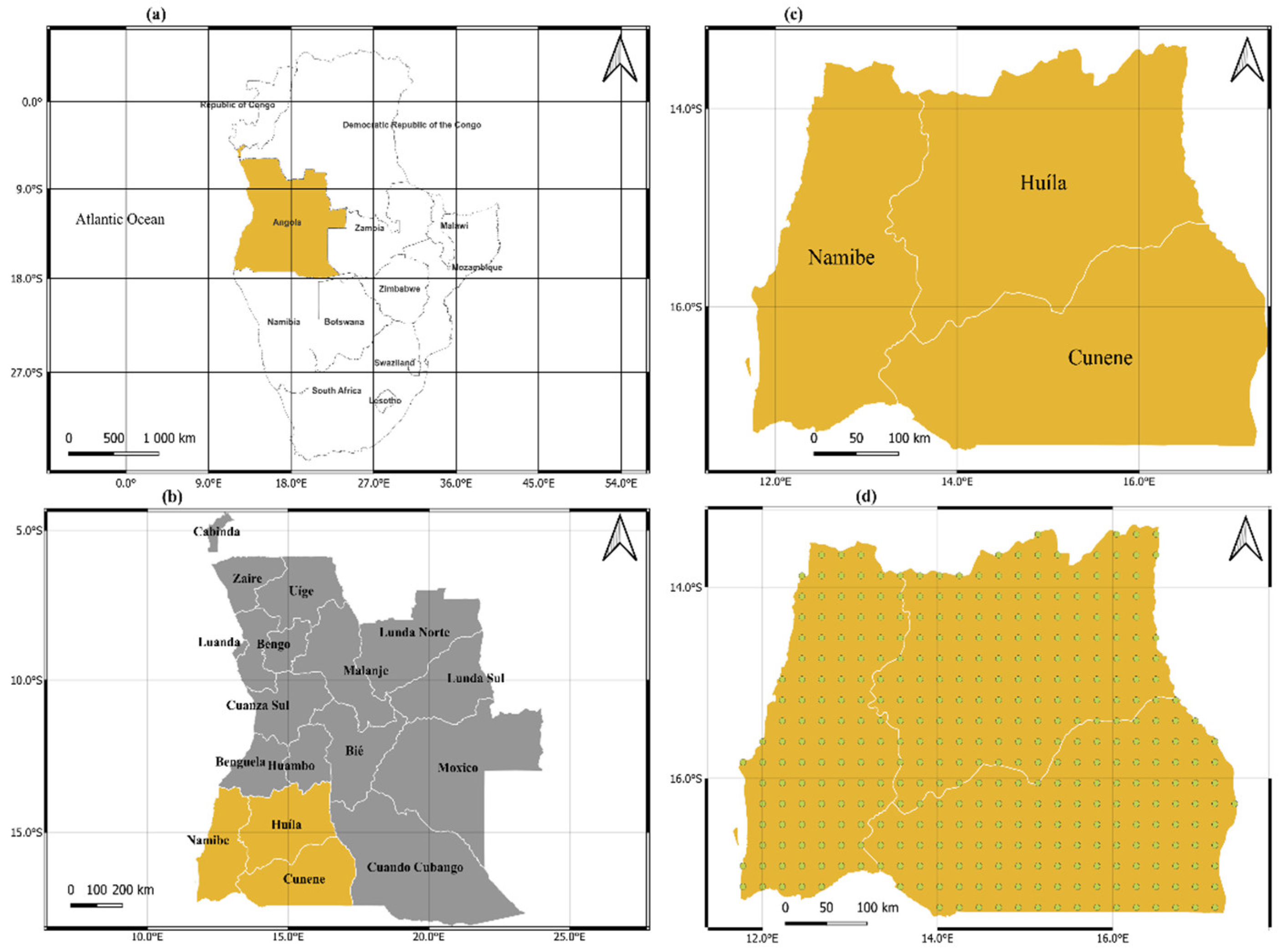
Figure 1. Study area: (a) location of Angola in Southern Africa, with Angola highlighted in yellow; (b) map of Angola showing the study area in southern Angola (Cunene, Huila, and Namibe) highlighted in yellow; (c) detailed view of the study area, including the provinces of Cunene, Huila, and Namibe, highlighted in yellow; (d) spatial representation of the grid corresponding to the ERA5-Land spatial resolution over the study area, where green points indicate the grid cells used in the analysis.
Land 15 00728 g001
Figure 2. Methodological framework for drought characterization and spatial trend analysis in southern Angola.
Land 15 00728 g002
Figure 3. Temporal variation in drought in Cunene (1980–2024): SPI in blue, SPEI in red.
Land 15 00728 g003
Figure 4. Temporal variation in drought in Huila (1980–2024): SPI in blue, SPEI in red.
Land 15 00728 g004
Figure 5. Drought variation over time in Namibe (1980–2024), with SPI shown in blue and SPEI in red.
Land 15 00728 g005
Figure 6. Temporal evolution of drought trends in Cunene based on 12-month drought indices (SPI-12 and SPEI-12).
Land 15 00728 g006
Figure 7. Temporal evolution of drought trends in Huila is based on 12-month drought indices (SPI-12 and SPEI-12).
Land 15 00728 g007
Figure 8. Temporal evolution of drought trends in Namibe based on 12-month drought indices (SPI-12 and SPEI-12).
Land 15 00728 g008
Figure 9. Spatial distribution of drought intensity in southern Angola: (a) SPI-12 1980–1989, (b) SPI-12 1990–1999, (c) SPI-12 2000–2009, (d) SPI-12 2010–2024, (e) SPEI-12 1980–1989, (f) SPEI-12 1990–1999, (g) SPEI-12 2000–2009, (h) SPEI-12 2010–2024.
Land 15 00728 g009
Table 1. Classification of drought intensity based on SPI and SPEI values.
SPI/SPEI ValueCategory
≥2.00Extremely wet
1.50 to 1.99Severely wet
1.00 to 1.49Moderately wet
0 to 0.99Mild wet
0 to −0.99Mild drought
−1.00 to −1.49Moderate drought
−1.50 to −1.99Severe drought
≤−2Extreme drought
Table 2. Drought Impacts and Management Strategies ([10,15,17]).
Drought ImpactsManagement Strategies
Depletion of food and seed stocks; increased poverty and vulnerability.Emergency food distribution, agricultural support with seeds and inputs.
Loss of livestock due to water and pasture scarcity; increased livestock mortality.Boreholes, dam and chimpaca construction/rehabilitation; use of transhumance knowledge.
Limited access to water for human, livestock, and agriculture; increased distance to sources.Water delivery via tankers and motorcycle cisterns; rainwater harvesting (cisternas-calçadão); rural water systems.
Increased malnutrition, hunger, school dropout, and child labor.Nutrition programs, educational integration, health monitoring, and resilience training.
Environmental degradation from charcoal production and deforestation.Promotion of sustainable energy practices (e.g., solar pumps); agroecological training.
Institutional gaps and delays in long-term recovery planning.National and Provincial Recovery Plans; CNPC/UNDP coordination; training and planning workshops.
Migration and displacement due to drought and resource scarcity.Development of rural villages with access to water and energy; conflict mediation and support programs.
Disclaimer/Publisher’s Note: The statements, opinions and data contained in all publications are solely those of the individual author(s) and contributor(s) and not of MDPI and/or the editor(s). MDPI and/or the editor(s) disclaim responsibility for any injury to people or property resulting from any ideas, methods, instructions or products referred to in the content.