Article

Ecological Processes and Nature-Based Solutions in Urban Railway Corridors: Perth and Beijing

1
School of Design, The University of Western Australia, Perth, WA 6009, Australia
2
College of Landscape Architecture, Northeast Forestry University, Harbin 150040, China
3
Division of Nature Conservation, Beijing Academy of Forestry and Landscape Architecture, Beijing 100102, China
*
Authors to whom correspondence should be addressed.
Land 2026, 15(5), 714; https://doi.org/10.3390/land15050714
Submission received: 16 March 2026 / Revised: 16 April 2026 / Accepted: 20 April 2026 / Published: 24 April 2026

Abstract

Urban railway corridors—including abandoned, redesigned, and in-use lines—can support biodiversity and ecological connectivity in fragmented cities, yet their ecological dynamics and roles in Nature-based Solutions (NbS) remain poorly understood. Addressing this requires a context-sensitive approach that differentiates corridor types and compares their ecological functions. This study compares vegetation dynamics along railway corridors in two cities with contrasting socio-ecological contexts—Perth (Western Australia) and Beijing (China)—using a typology-based comparative approach. The results show that: (1) vegetation dynamics differ fundamentally between the two cities, with Perth characterized by vertically structured vegetation dominated by native tree layers and non-native disturbance-tolerant annual groundcover, while Beijing supports more continuous vegetation with widespread natural regeneration of native species; and (2) these differences correspond to distinct suggested NbS strategies. For Perth, NbS should combine phenology-aware management (wet versus dry seasons) with disturbance-based zoning and staged native planting strategies. In contrast, Beijing corridors are characterized by more uniform disturbance patterns but differentiated corridor typologies, indicating NbS structured around corridor-type management with a stronger emphasis on the support of native groundcover establishment and allowing for self-sustaining regeneration. These findings highlight how different contexts shape vegetation dynamics and provide comparative ecological insights for developing context-specific NbS for urban railway corridors.

1. Introduction

1.1. Urban Railway Corridors as Part of Urban Green Infrastructure

Contemporary urban environments consist of fragmented green spaces and corridors that weaken ecological connectivity and ecosystem functioning [1,2]. Urban Green Infrastructure (UGI), a planned network of natural and semi-natural spaces, enhances urban resilience by supporting ecosystem services such as climate regulation, stormwater management, carbon sequestration, and human well-being [3,4]. Within this framework, Urban Green Corridors (UGCs) can offer critical linear linkages to reconcile fragmented habitats and maintain ecological connectivity, while also acting as ecological–cultural ecotones that facilitate interactions across urban landscapes [5,6]. Among UGCs, urban railway corridors are distinguished by their long-distance continuity and engineered structures. Their nutrient-poor ballast substrates further support distinctive patterns of spontaneous vegetation and seed dispersal [7]. These corridors also provide opportunities for spontaneous ecological processes within dense urban environments, supporting efforts to integrate nature into highly modified landscapes [8]. Historically, abandoned railway corridors have been among the earliest spaces reused as elongated greenways and rail trails, as demonstrated by numerous Rails-to-Trails initiatives [9,10], including the High Line in New York, as well as emerging examples of railway reuse in Asia-Pacific contexts (e.g., [11,12]).

1.2. Typologies of Urban Railway Corridors

To account for context-dependent variations in urban railway corridors, this study focuses on two cities—Perth (Western Australia) and Beijing (China)—that differ in climate, socio-cultural conditions, and governance.
In this study, urban railway corridors include passenger, freight, and industrial railways that may vary in operational status, including abandoned, redesigned, and active states. While in-use corridors are typically less accessible, abandoned and redesigned corridors provide ample opportunities for ecological investigation.
Corridor typologies are not equally represented across the two cities, particularly due to restricted access to active railway corridors in Beijing. In Perth, the field survey includes sites representing all three typologies, whereas in Beijing, in-use railway corridors are restricted by fencing and operational constraints, limiting opportunities for ecological enhancement.
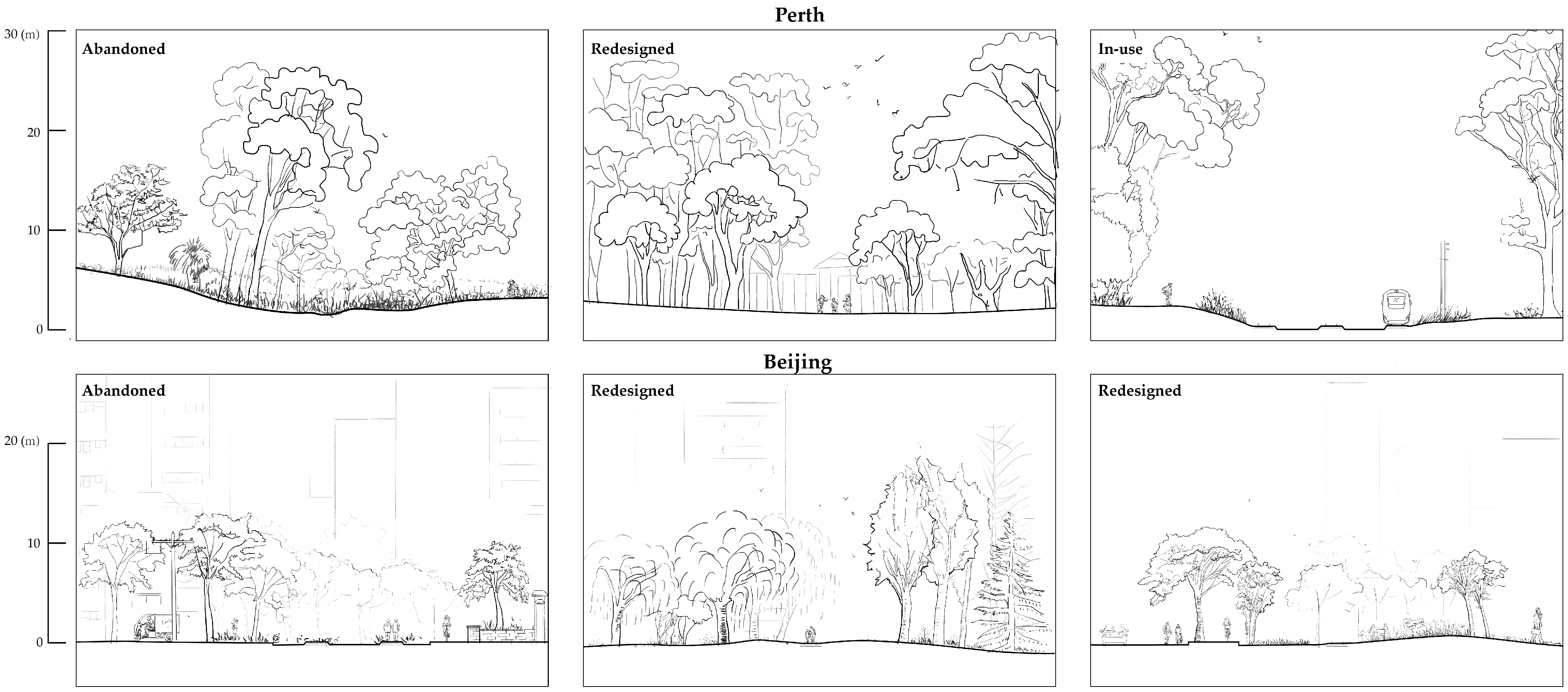
Accordingly, urban railway corridors are classified into three typologies based on their operational status: (1) abandoned/decommissioned, (2) redesigned/converted, and (3) in-use/active (Figure 1).
(1)
Abandoned (Decommissioned) Railway Corridors
Abandoned (decommissioned) railway corridors are railways that have ceased operation and are no longer maintained for transport purposes. Management interventions are minimal, allowing for spontaneous vegetation succession and the development of novel habitats (i.e., abandoned railway areas may undergo ecological succession towards forest communities and act as habitats supporting greater biodiversity) [7,13].
(2)
Redesigned (Converted) Railway Corridors
Redesigned (converted) railway corridors refer to former railway spaces that have undergone planned spatial transformation to accommodate new urban functions and public uses. Such interventions often involve modifications to spatial configuration and vegetation structure, resulting in hybrid socio-ecological landscapes integrating recreational, ecological, and infrastructural functions [14,15].
(3)
In-use (Active) Railway Corridors
In-use (active) railway corridors refer to passenger, freight, and industrial railway lines that remain in service and are subject to regular or occasional rail traffic. These corridors are typically inaccessible to the public and characterized by recurrent physical disturbance associated with railway operation and maintenance activities, which alters vegetation composition and constrains spontaneous vegetation development [16,17]. In addition, soil characteristics along railway corridors—such as chemical composition and pH influenced by ballast materials and maintenance practices—may further shape vegetation establishment and plant species composition [18,19].

1.3. Design Barriers and Ecological Potential of Urban Railway Corridors

Historically, urban railway corridors have received limited attention in planning and design practice, as vegetation management has primarily focused on ensuring railway safety and operational efficiency rather than biodiversity conservation or landscape functions [20,21]. Furthermore, public perceptions of vegetation along railway corridors as untidy, unsafe, or residual limit their recognition as potential ecological assets [22].
Recent studies suggest that railway corridors can host rich spontaneous vegetation [23], largely due to frequent disturbances (e.g., maintenance activities and soil disruption) and relatively low-intensity management. These conditions favor colonizing and stress-tolerant plant species [24,25]. However, this ecological significance is highly context-dependent, varying with local environmental, design, and management conditions. In urban environments, where continuous vegetation is scarce, railway corridors may provide new opportunities for biodiversity conservation, habitat connectivity, and environmental education [26].

1.4. NbS and Contextual Applications in Urban Railway Corridors

Despite variations across railway corridor typologies, existing research gaps largely relate to limited understanding and integration of key ecological processes, such as disturbance, succession, and seed dispersal. To address these challenges, this research adopts NbS as the guiding conceptual framework for designing resilient and biodiversity-friendly railway corridors. NbS emphasizes process-driven approaches to protect, restore, and enhance biodiversity and ecosystem functioning, while simultaneously responding to contemporary urban pressures such as water scarcity, urban heat island effects, and biodiversity decline [27,28].
When considering urban railway corridors, NbS may take different forms depending on local conditions and management contexts. Previous studies on railway vegetation and biodiversity highlight several approaches to support ecosystem functioning, including reduced management intensity to facilitate spontaneous vegetation development, design interventions (e.g., spatial configuration and planting design), and management strategies such as adjusted maintenance practices, selective vegetation control, and the use of stress-tolerant or native plant assemblages [26,29,30].
This study introduces a typology-based comparative perspective on urban railway corridors, linking biodiversity-related ecological characteristics to differentiated design and maintenance considerations. In doing so, it bridges urban ecology and landscape architectural practice by providing a basis for context-responsive NbS applications.

1.5. Research Gap and Study Contributions

Despite the growing application of NbS in urban railway corridors, important gaps remain across different urban railway corridor typologies. In abandoned corridors, limited understanding exists regarding post-disturbance ecological processes, including spontaneous succession, habitat recovery, and transitions from ruderal to more stable plant assemblages [31]. In redesigned corridors repurposed as public open spaces, design and maintenance practices are often driven by safety and recreational considerations, with limited evidence on their long-term ecological effects on vegetation structure and habitat quality [7]. In in-use corridors, research has largely focused on vegetation composition, while the ecological mechanisms shaping plant communities under continuous disturbance remain understudied [16,32,33].
While these studies have improved understanding of vegetation patterns and ecological characteristics, they remain fragmented across different railway corridor typologies, with insufficient comparative evidence across contexts. In addition, ecological knowledge is often not well integrated into design and management practices, as existing studies give limited consideration to how ecological processes and design outcomes vary across different urban contexts, thereby constraining the development of context-sensitive strategies.
This study addresses these gaps by providing a typology-based comparative analysis of vegetation patterns and ecological processes across urban railway corridors, generating contextual comparative evidence to inform specific, site-related design and management approaches.

1.6. Studied Areas and Comparative Design

This study examines urban railway corridors in Perth and Beijing using a typology-based framework. The selected study sites include abandoned, redesigned, and in-use railway corridors, representing different stages of railway corridor development, although not all typologies are equally represented in each city. This design enables a site-based comparison of ecological processes across different corridor typologies and urban contexts.

1.7. Research Aim and Objectives

This study aims to examine how vegetation patterns and associated ecological processes vary across three typologies of urban railway corridors in different socio-ecological contexts, and to explore their implications for NbS-informed design and management (Supplementary Figure S1). Specifically, this study seeks to:
(1)
Compare vegetation composition, structure, and plant diversity across selected abandoned, redesigned, and in-use railway corridor sites in Perth and Beijing;
(2)
Explore how disturbance conditions (either human-induced or spontaneously driven), successional trajectories, and management practices are associated with vegetation outcomes and implications for NbS.

2. Materials and Methods

2.1. Comparative Study Framework

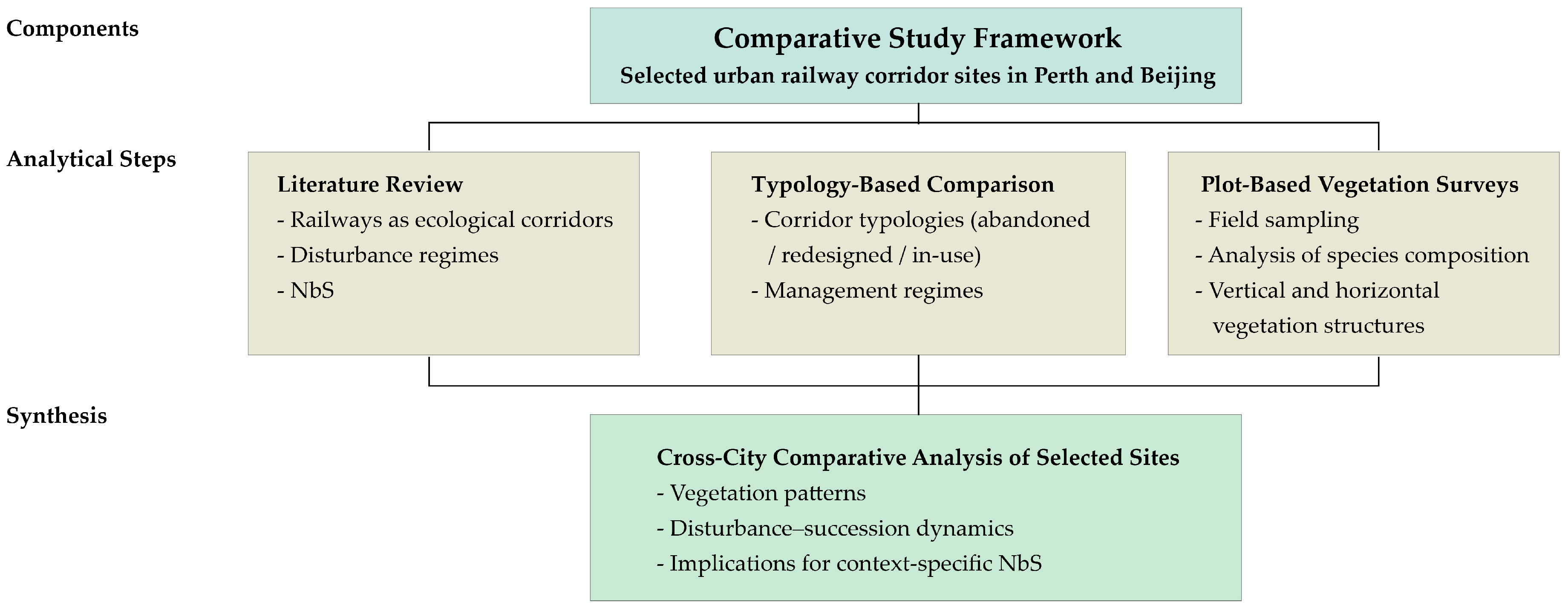
This study adopts a comparative framework to examine selected urban railway corridor sites in Perth and Beijing. The framework integrates a literature review, a typology-based comparison, and plot-based vegetation surveys, which are synthesized into a cross-city comparative analysis (Figure 2).

2.2. Study Area Context

Key socio-ecological characteristics of the study areas are summarized in Table 1.

2.2.1. Perth, Western Australia

Perth’s urban vegetation dynamics are shaped by its Mediterranean climate and reliance on groundwater resources, particularly the Gnangara groundwater system [37,50].
Seasonality in Perth is characterized by a summer–winter contrast, with hot, dry summers (December–February) and cool, wet winters (May–August), with most rainfall occurring between May and October [51]. As a result, vegetation growth in urban railway corridors is concentrated in the cooler and wetter months from late autumn to spring (approximately May to October), whereas summer conditions impose substantial water stress on urban vegetation systems. In this study, the period from May to October is defined as the primary vegetation growth season for analysis, corresponding to cooler and wetter conditions.
Vegetation dynamics in Perth are further shaped by hydrological constraints associated with long-term groundwater decline in the Gnangara system—the primary water source for irrigating public open spaces, street trees, and railway-edge vegetation [37,50]. These pressures are particularly significant within the Swan Coastal Plain bioregion, a global biodiversity hotspot characterized by high levels of plant endemism [52]. As a result, vegetation dynamics within urban railway corridors occur under conditions of hydrological limitation and high conservation sensitivity, further compounded by recurrent fire risk characteristic of the region.
The historical development of Perth’s railway network has shaped a low-density, corridor-based urban structure. Since the late nineteenth century, railway expansion has closely followed suburban growth, beginning with the Fremantle–Guildford line in 1881 and extending eastward into agricultural districts [53,54,55]. Early railway development promoted corridor-based urbanization along station precincts [49], while subsequent post-war suburbanization and car-dependent expansion during the 1950s–1980s transformed many railway corridors from primary transport arteries into secondary urban edges [56,57]. These development patterns have contributed to the current distribution and functional differentiation of railway corridor typologies studied in this research.
Governance arrangements further shape ecological outcomes in Perth. Railway-edge vegetation is managed within a multi-agency framework guided by safety (including fire risk and accessibility), visibility, and infrastructure integrity priorities under the Public Transport Authority of Western Australia [58,59,60,61]. As a result, vegetation management emphasizes disturbance regulation rather than ecological restoration, resulting in strong disturbance filtering at the ground layer.

2.2.2. Beijing, China

Beijing is the capital city of China, located on the northern edge of the North China Plain and characterized by a warm-temperate monsoon climate with strong seasonal precipitation [62]. In contrast to Perth, vegetation dynamics in Beijing are strongly influenced by rapid urbanization and repeated land-use change [63].
Seasonality plays an important role in shaping vegetation dynamics in Beijing. The region experiences a temperate monsoon climate characterized by cold and dry winters and hot, humid summers, with most precipitation occurring during the summer monsoon period [64]. In this study, the winter period (December–February) and summer period (June–August) are defined as representative seasonal conditions to support the analysis of vegetation dynamics.
Under these climatic conditions, vegetation growth in urban railway corridors is seasonal, occurring mainly from spring to early autumn (approximately April to October), while winter dormancy and summer heat stress play important roles in shaping plant community dynamics.
Following the establishment of earlier railway lines, Beijing’s railway network was reconfigured during the socialist industrialization phase after 1949 to support planned industrial zones and new settlements, adopting a ring-and-radial structure aligned with the city’s expanding functional layout [65]. Subsequent removals and reconfigurations erased parts of the historic network but left behind disused corridors characterized by compacted substrates and embankment remnants, which constitute the physical basis for the spatial analysis conducted in this study [66]. Railway infrastructure governance in Beijing involves multiple institutional layers, including national railway corporations supervised by central ministries, municipal transport departments, and urban transit authorities, with strong emphasis on infrastructure safety and operational reliability [67,68].
In abandoned railway sections, reports indicate prolonged periods of minimal routine management, during which vegetation becomes overgrown and disturbance processes proceed largely unchecked until safety concerns trigger intervention [11]. In redesigned or converted corridors, vegetation composition and ecological performance are instead governed by municipal greening and park-management standards applied across urban parks, greenbelts, and greenway systems, rather than by the operational priorities that structure active rail corridors [69].

2.3. Urban Railway Corridor Typology

The railway corridor typology introduced in Section 1.3 was used as a classification framework to guide site selection and comparative analysis. Each selected study site was assigned to a corridor type based on observable and verifiable characteristics.
Corridor type assignment followed three criteria. First, operational status was assessed based on the presence or absence of active rail traffic at the time of survey, verified through field observation and online sources. Second, maintenance was assessed by identifying evidence of routine railway maintenance (e.g., ballast renewal and vegetation clearance for safety) or its absence. Signs of vegetation management, such as cutting, mowing, weeding, or irrigation, were also noted. Third, physical modification was assessed by whether rail infrastructure (e.g., tracks or ballast) had been removed or substantially altered as part of planned conversions to parks, greenways, or other recreational corridors. Indicators included the installation of paved paths, urban furniture, or the introduction of designed vegetation, pathways, and public-use facilities.
A site was classified as in-use when the railway line was confirmed to be operational. It was classified as abandoned when rail services had ceased and routine railway maintenance was no longer evident, resulting in largely unmanaged vegetation, regardless of whether tracks or ballast remained. A site was classified as redesigned when former railway alignments had undergone planned physical transformation, typically involving the removal or modification of rail infrastructure and the introduction of designed vegetation, paths, and facilities for public use. This rule-based classification ensured that the corridor type reflected the functional and management conditions of the selected sites at the time of survey.

2.4. Field Survey Methods

2.4.1. Site Selection

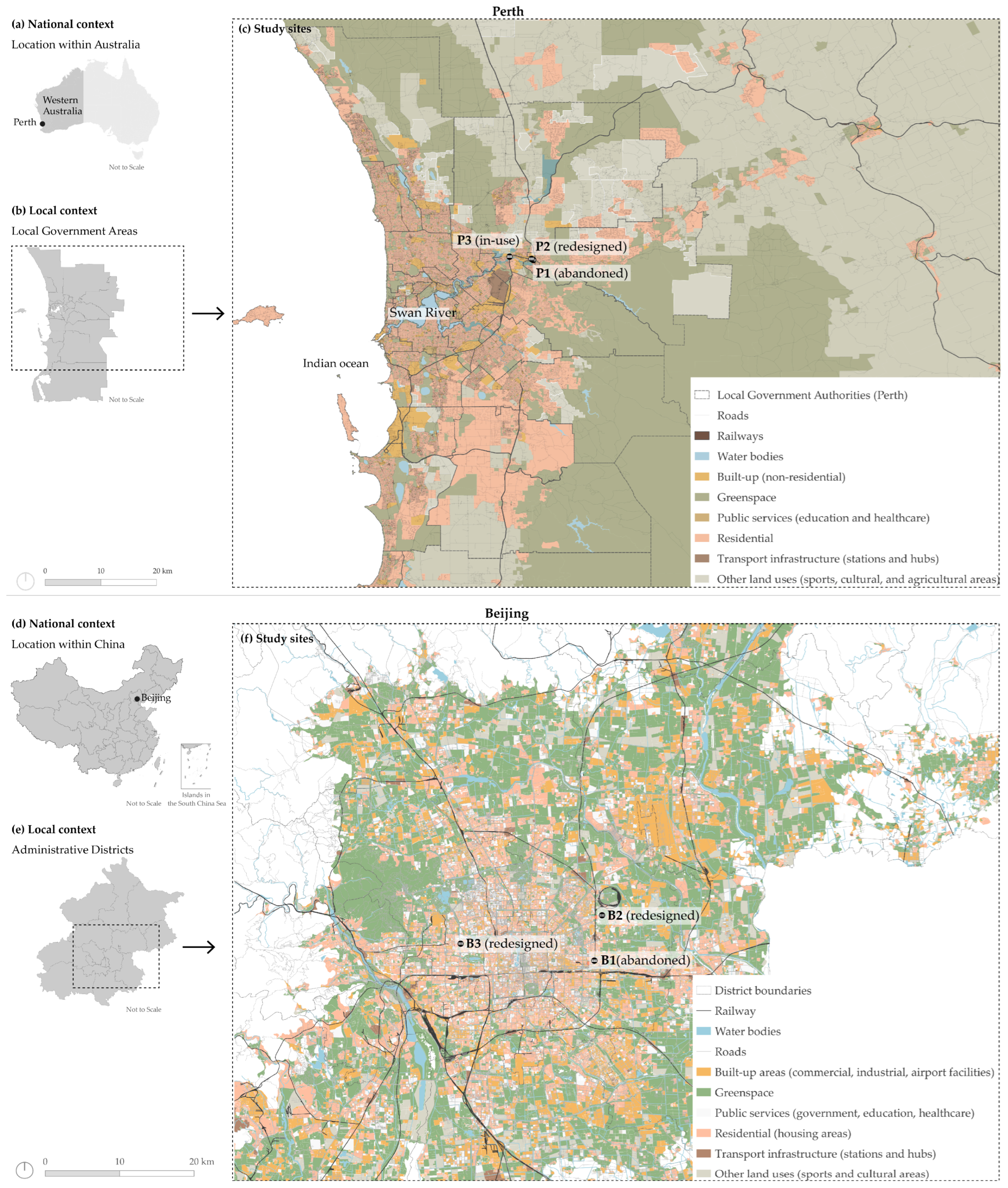
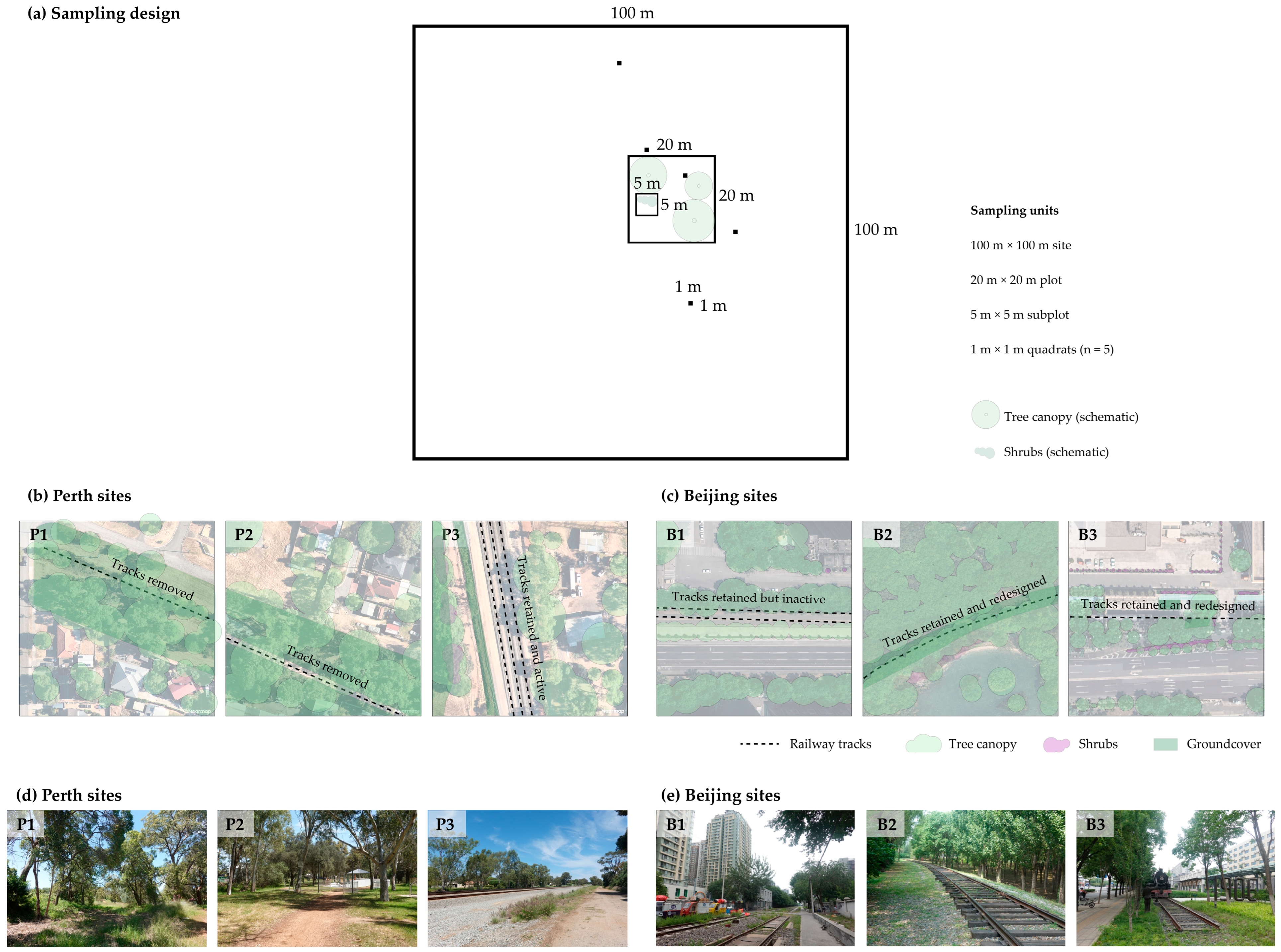
Study sites were selected to represent the defined urban railway corridor typologies (abandoned, redesigned, and in-use) (Figure 3 and Figure 4). To ensure comparability, each site was delineated as a 100 × 100 m sampling area. In Perth, three sites were selected, representing one abandoned corridor (P1), one redesigned corridor (P2), and one in-use corridor (P3). In Beijing, three sites were also selected; however, due to restricted access to operational railways, sampling focused on one abandoned corridor (B1) and two redesigned corridors (B2 and B3) integrated into publicly accessible open spaces. The Perth sites were coded as P1–P3 and the Beijing sites as B1–B3 for reference throughout the study. The locations and geographic coordinates of all sampling sites are provided in Supplementary Table S1.
In urban contexts, railway corridors that are abandoned or available for redesign are relatively limited, as much rail infrastructure remains operational. Some abandoned railways have been removed, or have been repurposed (e.g., “rail-to-trail” conversions). Due to these constraints and restricted site accessibility, random sampling is not feasible. Therefore, site selection focused on accessible corridors suitable for field investigation. The selected sites were chosen to capture variation across different urban railway corridor typologies, rather than to represent statistically typical conditions.
Due to access restrictions, in-use railway corridors in Beijing could not be included in the field survey. While this results in an asymmetry in the dataset across typologies, the comparative analysis focuses on ecological and structural differences and similarities rather than strict city-to-city equivalence. The inclusion of the in-use corridor site in Perth provides a reference for high-disturbance conditions, while the Beijing sites capture abandoned and redesigned corridor typologies.
The selected sites were chosen to capture variation across urban railway corridor typologies and to serve as illustrative, typology-based examples, rather than statistically representative samples of all railway corridors.

2.4.2. Survey Periods

Surveys were conducted during the peak growing seasons in each city to maximize species detectability and ensure reliable identification based on diagnostic morphological and phenological traits. In Perth, surveys were conducted in September–November 2024 and August–September 2025, coinciding with the Swan Coastal Plain bioregion spring growing season following winter rainfall.
In Beijing, field surveys were carried out in June–July 2024 and April–May 2025, corresponding to the main growing period of temperate herbaceous and woody vegetation.
During each survey period, phenological stages were recorded for the groundcover layer and classified into five categories: vegetative, budding, flowering, heading, and fruiting, with “heading” referring to the emergence of inflorescences in grass species (e.g., Setaria spp.), representing distinct stages in the life cycle of herbaceous plant species.

2.4.3. Sampling Design

A consistent, stratified sampling design was applied across all study sites to capture vertical vegetation structure within urban railway corridors. Sampling was stratified into three vegetation layers: tree canopy layer, shrub layer, and groundcover layer.
Vegetation was sampled using a nested quadrat design (Figure 4). At each site, a 20 × 20 m plot was established to record tree species. Tree-layer attributes, including tree species richness, total canopy cover (%), and mean tree height (m), were estimated within a single 20 × 20 m plot. Consequently, tree-layer metrics are presented descriptively without measures of variance, as only one plot was surveyed per site.
Within this plot, a 5 × 5 m subplot was used to assess shrub vegetation, with 1–3 subplots established per site depending on vegetation availability. Groundcover vegetation was sampled using five 1 × 1 m quadrats. Ground-layer quadrats were distributed across the 100 × 100 m site area to capture within-site heterogeneity and were not restricted to the tree plot.
This stratified sampling design follows common field survey practices in urban vegetation studies, where overstory (tree), mid-story (shrub), and understory (groundcover) layers are typically sampled using layer-specific quadrat sizes (e.g., [70]).

2.4.4. Species Identification and Trait Recording

Plant species (vascular plants) were documented in the field. Each plant was photographed to capture diagnostic morphological features, including flowers, leaves, stems, fruits, and seeds.
Species identifications were verified using regionally appropriate taxonomic resources, including FloraBase for Perth, iPlant and the Plant Photo Bank of China (PPBC) for Beijing, and World Flora Online for global nomenclatural consistency. When photographic evidence was insufficient or taxonomic uncertainty remained, uncertain specimens were cross-checked with expert botanists. Authoritative floras, including Flora of Beijing [71] and Western Weeds [72], were also consulted.
For each recorded species, a set of functional and descriptive traits were documented, including family and genus affiliation, life form, seed dispersal mode, phenological stage, and percent cover within each quadrat. Plant height was not recorded, as it primarily reflects local maintenance practices rather than intrinsic ecological or functional traits relevant to this study.

2.5. Literature Review and Analytical Framework Development

A targeted literature review was conducted to support the development of the analytical framework used in this study. The review followed a PRISMA-informed approach, incorporating four main stages: identification, screening, eligibility, and inclusion.
Relevant studies were identified through keyword-based searches in major academic databases, including Scopus and Google Scholar. Because search functions and indexing systems differ across databases, the search strings were adapted accordingly while retaining the same core concepts. For example, the Scopus search combined terms such as (“urban railway” OR “railway corridor” OR “rail infrastructure”) AND (vegetation OR ecology OR biodiversity). Equivalent keyword combinations were used in Google Scholar. Given the large number of results returned by Google Scholar, only the first 200–300 records sorted by relevance were screened.
Following the identification stage, retrieved records were screened, based on titles and abstracts to assess their relevance to the research scope.
Studies were included if they explicitly examined vegetation structure, successional dynamics, or management interventions within urban or peri-urban railway environments. Studies not directly related to ecological processes in linear transport corridors were excluded.
The overall literature selection process is illustrated in a PRISMA-based flow diagram (Figure 5), followed by a summary of key literature informing each analytical dimension (Table 2). These dimensions were applied to structure the empirical analysis and compare vegetation patterns across railway sites in Perth and Beijing (Supplementary Figure S2).

2.6. Data Analysis and Comparative Procedures

Vegetation data from all sites were analyzed using comparative analyses across selected sites representing different corridor typologies in the two cities.
Phenological-stage composition of groundcover plants was recorded during field surveys by classifying each species into phenological categories, including vegetative (V), budding, flowering (Fl), heading, and fruiting (F). The number of species in each phenological stage was calculated for each quadrat and summarized as mean ± SD per site.
Groundcover diversity was assessed using Shannon index (H′), species richness and evenness. Shannon index and evenness were calculated for each of the five 1 × 1 m quadrats per site based on species cover values and summarized as mean ± SD at the site level.
Plant life-form composition was then analyzed by classifying species into major life-form categories, including trees, shrubs, annuals, biennials, perennials, climbing annuals, and climbing perennials [66]. The mean number of species per life-form category was calculated for each site across quadrats.
Seed dispersal strategies were classified for each species into barochory, anemochory (AN), epizoochory (EP), endozoochory (EN), ballistic dispersal, hydrochory (HY), and myrmecochory (MY), following standard dispersal classification frameworks [78,79]. The mean number of species associated with each dispersal type was summarized per site.
Tree-layer structure and biogeographic composition were assessed based on observations from a single 20 × 20 m plot per site. Structural attributes included total canopy cover (calculated as the sum of canopy cover values for all tree species), tree density (standardized to individuals per 400 m2), and observed height range (minimum and maximum values). Species origin (native vs. non-native) was determined based on the taxonomic and floristic references described in Section 2.4.4.
Comparisons among corridor typologies and between cities were based on descriptive and visual comparisons of site-level summaries (mean ± SD). Data processing, calculations, and visualization were conducted using Microsoft Excel.

3. Results

3.1. Vegetation Patterns Along Railway Corridors in Perth

3.1.1. Phenological Stage Composition (Perth)

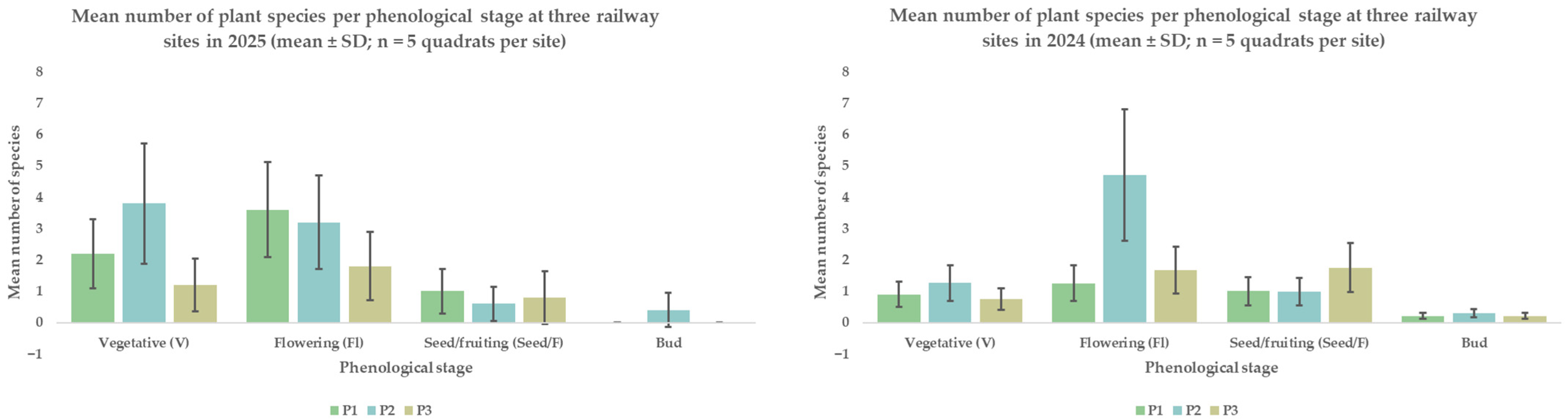
Seasonal comparisons showed that vegetative and flowering stages dominated both survey periods across the sampled railway sites, while bud stages were scarce (Figure 6). Fruiting stages were present at the abandoned railway corridor (P1) in both sampling periods, whereas the redesigned corridor (P2) and the in-use corridor (P3) showed lower values with greater variation. The most pronounced seasonal change between sampling periods occurred at P2, primarily due to an increase in flowering species. In contrast, flowering representation at P1 and P3 showed relatively small changes.

3.1.2. Groundcover Diversity (Perth): Shannon Index, Richness, Evenness

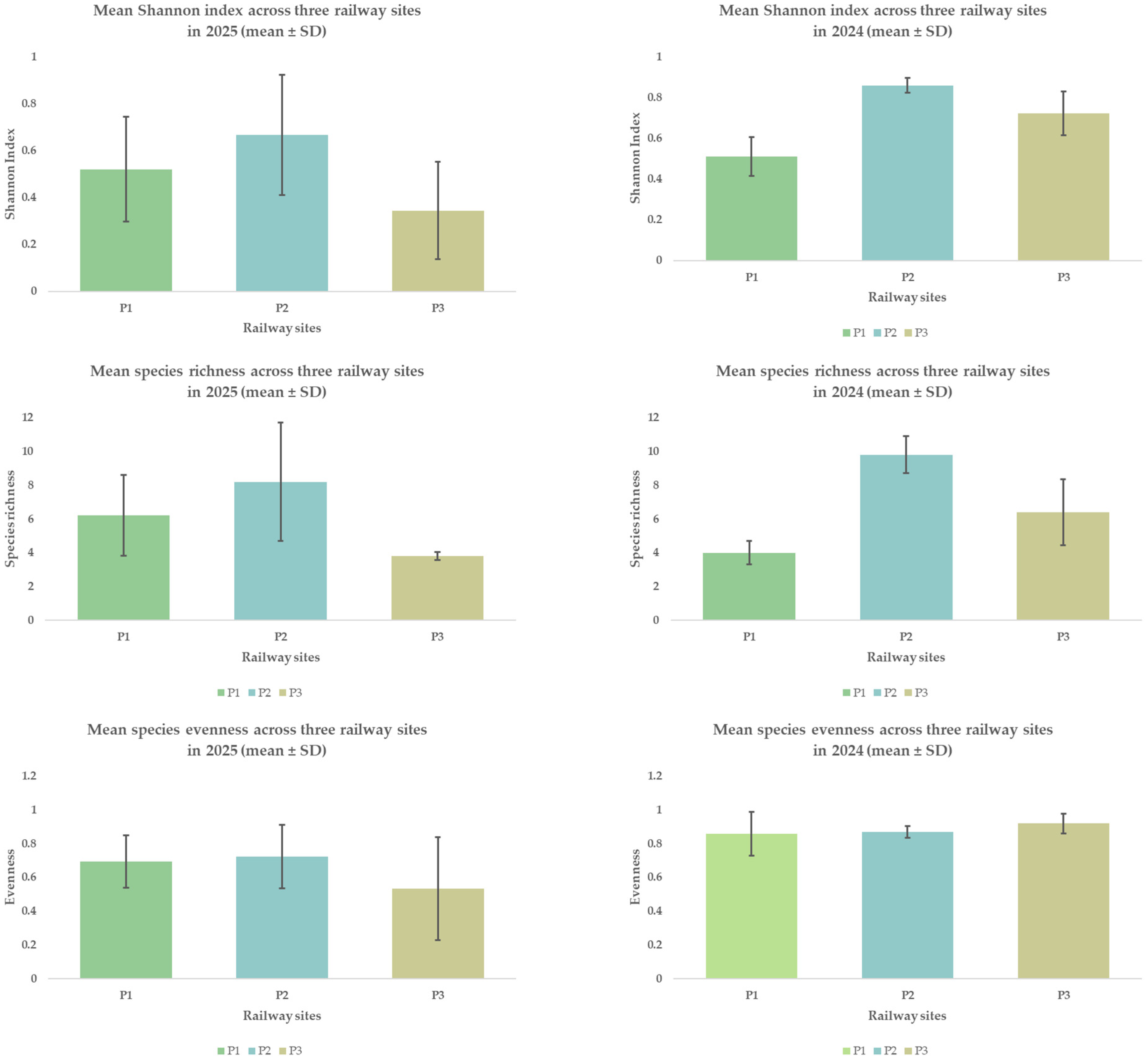
Groundcover plant diversity varied among the sampled railway sites and between seasons, as reflected by Shannon index (H′), species richness, and evenness (Figure 7).
In both spring (mid-September 2025) and early summer (late October 2024), P2 consistently showed the highest Shannon index (spring: H′ = 0.67 ± 0.26; early summer: H′ = 0.86 ± 0.04) and species richness (spring: 8.2 ± 3.49 species; early summer: 9.8 ± 1.10 species).
P1 showed lower Shannon diversity than P2 and values that were comparable to or higher than P3 depending on the seasons (P3; spring: H′ = 0.34 ± 0.21; early summer: H′ = 0.72 ± 0.11). At P1, species richness (spring: 6.2 ± 2.39 species; early summer: 4.0 ± 0.71 species) and evenness (spring: 0.69 ± 0.15; early summer: 0.86 ± 0.13) were intermediate relative to the other sites.
Evenness was broadly similar across sites in both seasons, although lower values were observed at P3 in spring (P3: 0.53 ± 0.30).
Seasonal differences were evident across sites, with higher Shannon index and species richness in early summer at P2 and P3 (e.g., P2 richness: 9.8 ± 1.10 species in early summer vs. 8.2 ± 3.49 species in spring), whereas P1 showed relatively little seasonal change in Shannon index.
Despite these seasonal differences, the relative ranking of the sampled railway sites remained consistent across sampling periods, with P2 consistently exhibiting the highest diversity.

3.1.3. Plant Life Form Composition (Perth)

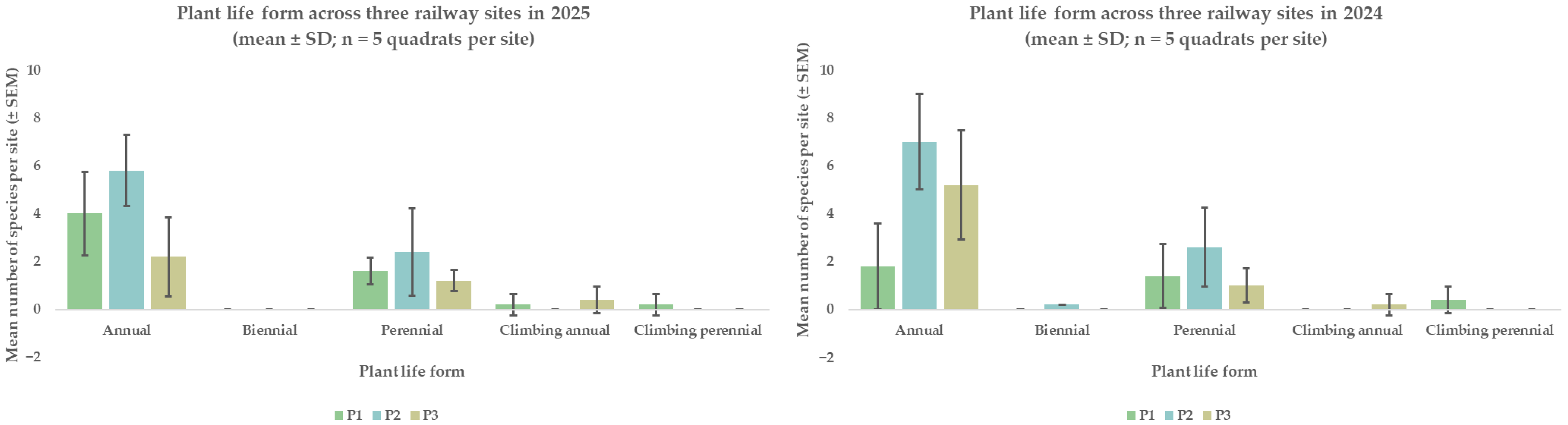
Plant life form composition varied among the sampled railway sites and between survey periods (Figure 8). Across all sampled sites and periods, groundcover vegetation was dominated by annual species, whereas perennial species were consistently less abundant. Biennial species and climbing life forms (both annual and perennial) were rare across all sites.
P2 supported the highest mean number of annual species in both sampling periods (spring 2025: 5.8 ± 1.48; early summer 2024: 7.0 ± 2.00), with a marked increase in early summer compared to spring. In contrast, P1 showed lower values (spring: 4.0 ± 1.73; early summer: 1.8 ± 1.79), indicating a decline between sampling periods. P3 exhibited lower values in spring but higher numbers in early summer (5.2 ± 2.28 species).
Perennial species were present at all sites but occurred at lower mean numbers than annual species. P2 showed the highest mean number of perennial species in both sampling periods (spring: 2.4 ± 1.82; early summer: 2.6 ± 1.64), while P3 supported the lowest values with limited seasonal change. P1 showed intermediate values (spring: 1.6 ± 0.55; early summer: 1.4 ± 1.34).

3.1.4. Seed Dispersal Types (Perth)

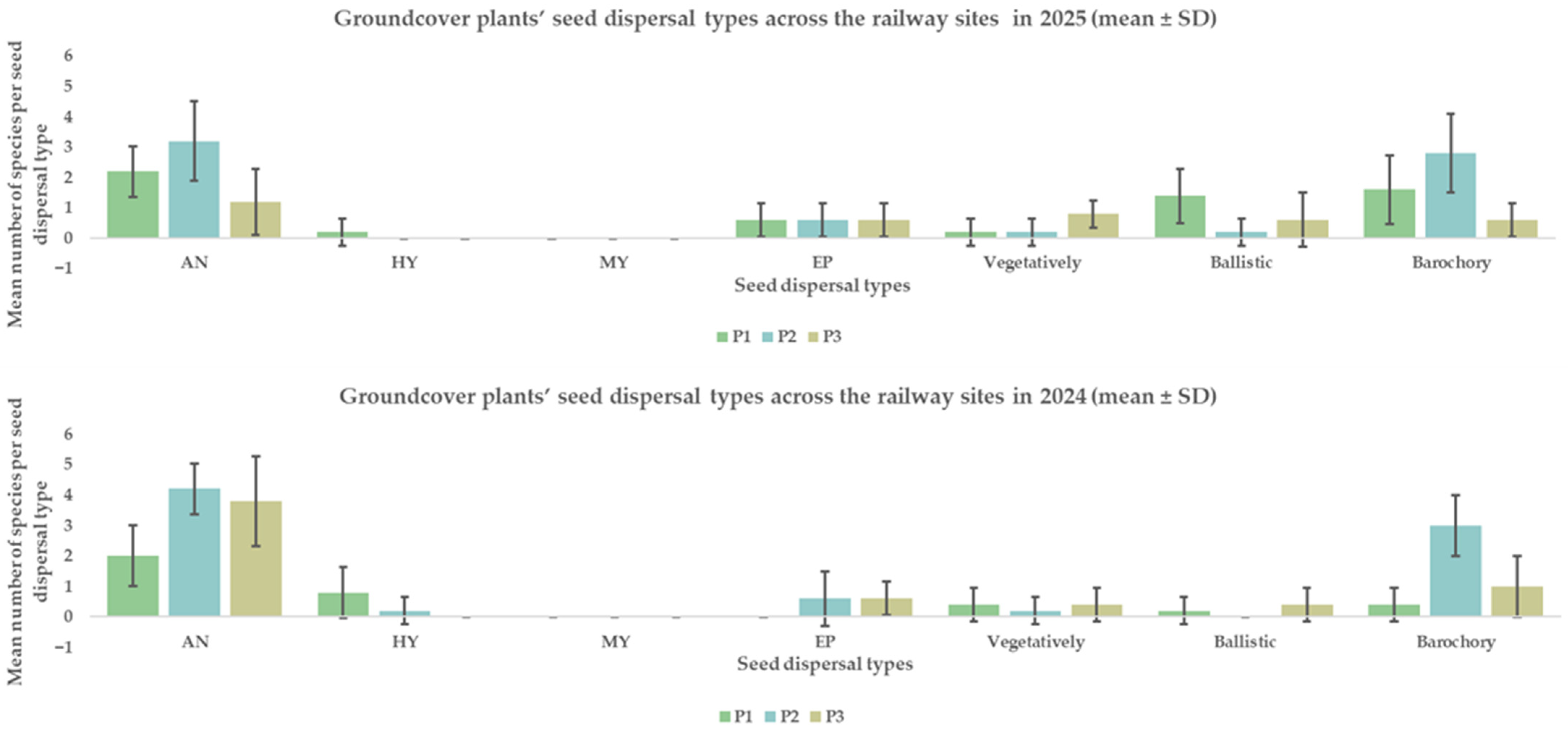
Seed dispersal types of groundcover plants varied among the surveyed railway sites and between survey periods (Figure 9).
Across both survey periods, anemochory (AN) was the dominant dispersal type, particularly at P2, which consistently showed the highest mean number of species. P3 was also largely dominated by AN species, although values varied between survey periods. In contrast, P1 showed a more diverse representation of dispersal types, with relatively higher contributions from barochory, hydrochory (HY), and ballistic dispersal compared with P3. Barochory was also relatively prominent at P2 across both survey periods.
Seasonal differences were observed, particularly in AN species, which showed higher mean values at P2 and P3 in late October 2024 (P2: 4.2 ± 0.84; P3: 3.8 ± 1.48 species) compared with mid-September 2025 (P2: 3.2 ± 1.30; P3: 1.2 ± 1.10 species).
Seed dispersal types of tree species recorded across the three sites were dominated by autochory (AU) (Supplementary Table S2). Most native tree species, particularly Myrtaceae taxa such as Eucalyptus spp. and Corymbia calophylla, were classified as AU, accounting for the majority of tree species recorded across all sites. Other dispersal types were represented by a small number of species, including anemochorous species such as Jacaranda mimosifolia (exotic) and Xanthorrhoea spp. (native), as well as endozoochorous species (EN) such as Melia azedarach, Schinus terebinthifolius, and Olea europaea.

3.1.5. Tree-Layer Structure and Biogeographic Composition (Perth)

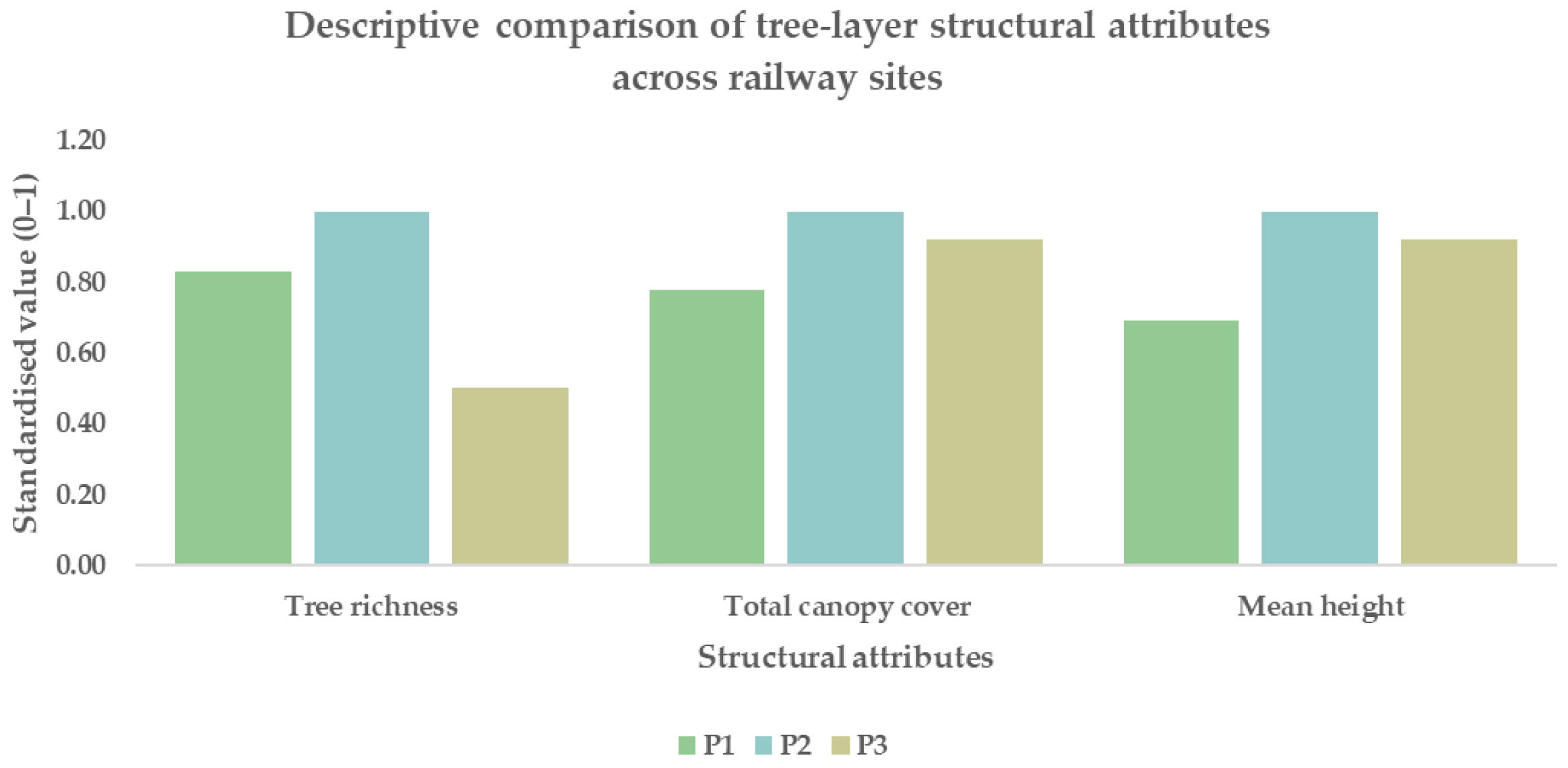
Tree-layer structural attributes differed among the three railway sites (Figure 10). P2 exhibited the highest standardized values (scaled 0–1) across all tree-layer metrics, including tree richness, total canopy cover, and mean tree height (all = 1.00 after standardization).
In contrast, P1 showed moderate tree richness (0.83) and canopy cover (0.78) but the lowest mean tree height (0.69). P3 was characterized by low tree richness (0.50) but relatively high canopy cover (0.92) and mean tree height (0.92).
At P1, Xanthorrhoea spp. and Schinus terebinthifolius saplings contributed to the vertical layer at heights comparable to the shrub layer, while at P3, Olea europaea occupied a similar intermediate vertical layer.

3.2. Vegetation Patterns Along Railway Corridors in Beijing

3.2.1. Phenological Stage Composition (Beijing)

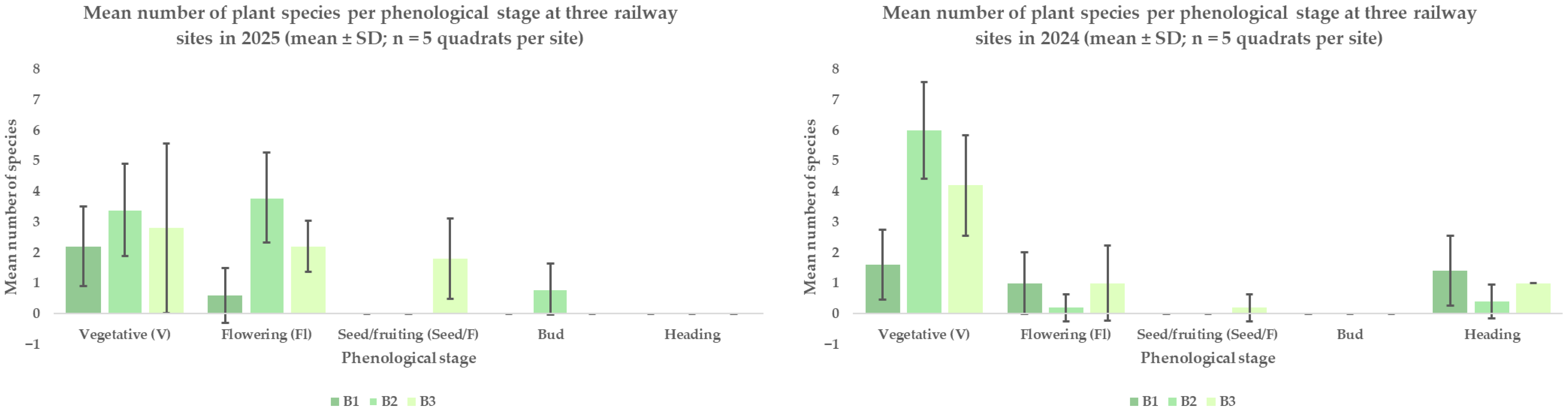
Distinct phenological patterns were observed across the three railway sites in Beijing over the survey periods (Figure 11). The three Beijing sites included one abandoned railway (B1) and two redesigned railways (B2 and B3).
In late April 2025 (spring), groundcover vegetation across the three sites was dominated by vegetative-stage species (B1: 2.2 ± 1.30; B2: 3.4 ± 1.52; B3: 2.8 ± 2.77). Flowering stage species were particularly abundant at B2 (3.8 ± 1.48) and B3 (2.2 ± 0.84), while remaining low at B1 (0.6 ± 0.89). Other reproductive stages (bud, seed/fruiting, and heading) were generally rare across sites, with bud-stage species recorded mainly at B2.
Earlier, in early July 2024 (summer), vegetative-stage species increased across all railway sites, particularly at B2 and B3 (B2: 6.0 ± 1.51; B3: 4.2 ± 1.64), while B1 (1.6 ± 1.14) supported fewer vegetative-stage species. Meanwhile, flowering and other reproductive stages remained generally low across sites.

3.2.2. Groundcover Diversity (Beijing): Shannon Index, Richness, Evenness

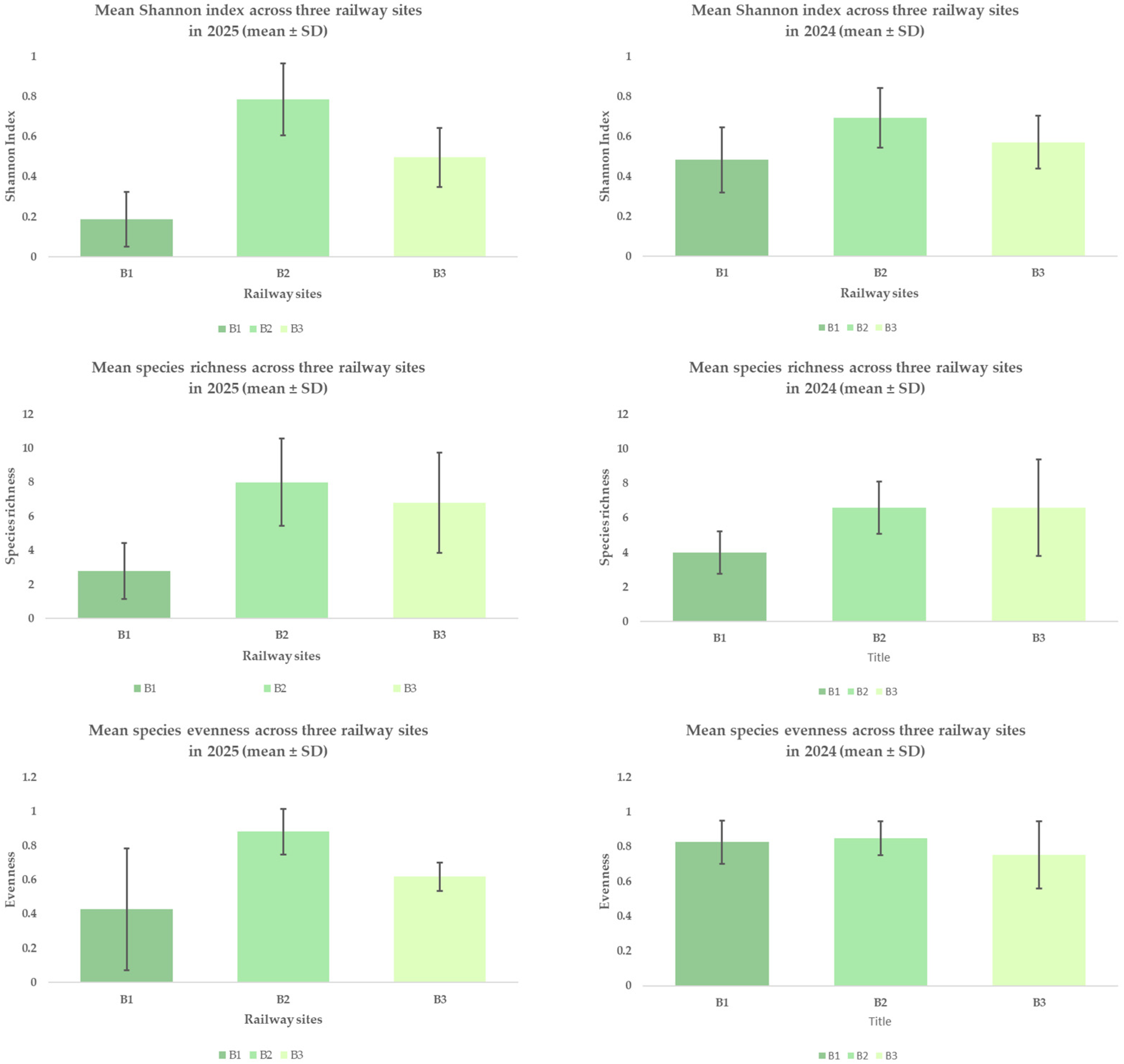
Groundcover diversity metrics varied among three railway sites and between survey periods in Beijing (Figure 12).
In late April 2025, B2 exhibited higher Shannon diversity (H′ = 0.79 ± 0.18), species richness (8.0 ± 2.55 species), and evenness (0.88 ± 0.13) than B1 (H′ = 0.19 ± 0.14; richness = 2.8 ± 1.64; evenness = 0.43 ± 0.36), while intermediate values were observed at B3 (H′ = 0.50 ± 0.15; richness = 6.8 ± 2.95; evenness = 0.62 ± 0.08).
By early July 2024, Shannon diversity remained highest at B2 (H′ = 0.69 ± 0.15), compared with B1 (H′ = 0.48 ± 0.16) and B3 (H′ = 0.57 ± 0.13). Species richness was likewise higher at B2 (6.6 ± 1.52 species) than at B1 (4.0 ± 1.22 species), while B3 showed comparable richness (6.6 ± 2.79 species). Evenness showed less pronounced variation among sites (B1: 0.83 ± 0.12; B2: 0.85 ± 0.10; B3: 0.75 ± 0.19).

3.2.3. Plant Life Form Composition (Beijing)

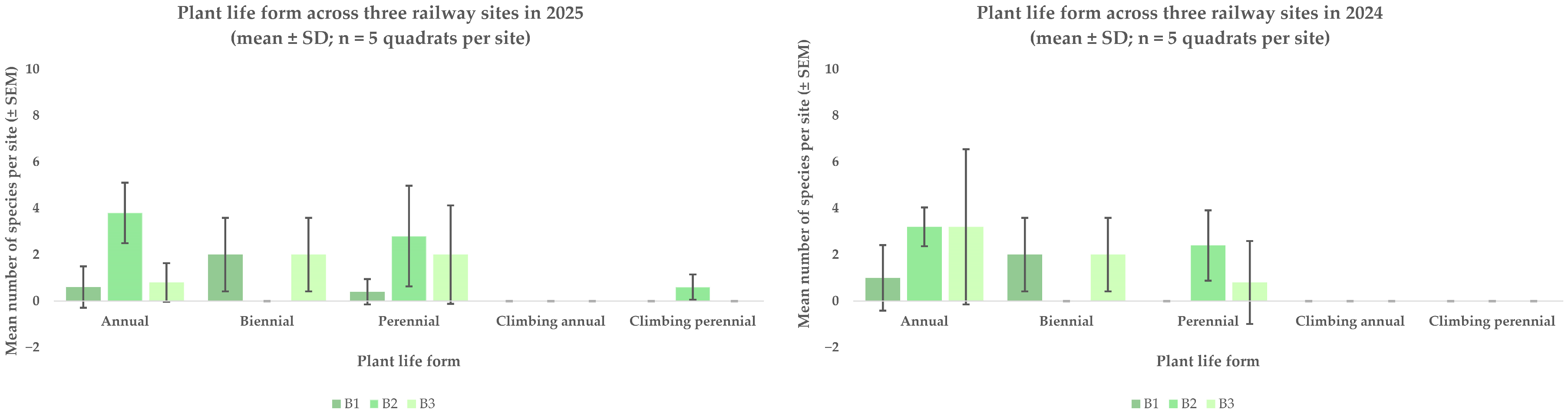
Plant life form composition varied among the surveyed railway sites and between survey periods in Beijing (Figure 13).
In late spring 2025, groundcover vegetation across three railway sites was dominated by annual species (B1: 0.6 ± 0.89; B2: 3.8 ± 1.30; B3: 0.8 ± 0.84). Biennial species were relatively abundant at B1 and B3 (B1: 2.0 ± 1.58; B2: 0 ± 0; B3: 2.0 ± 1.58), while perennial species occurred at lower mean numbers (B1: 0.4 ± 0.55; B2: 2.8 ± 2.17; B3: 2.0 ± 2.12). Climbing life forms were rare, with climbing perennial species recorded only at B2 (0.6 ± 0.55).
By early summer 2024, annual species remained the dominant life form across railway sites (B1: 1.0 ± 1.41; B2: 3.2 ± 0.84; B3: 3.2 ± 3.35). Perennial species were present but occurred at lower mean numbers (B1: 0 ± 0; B2: 2.4 ± 1.52; B3: 0.8 ± 1.79). Biennial species showed moderate variation among sites (B1: 2.0 ± 1.58; B2: 0 ± 0; B3: 2.0 ± 1.58), while climbing annual and climbing perennial species remained absent across all three railway sites.

3.2.4. Seed Dispersal Types (Beijing)

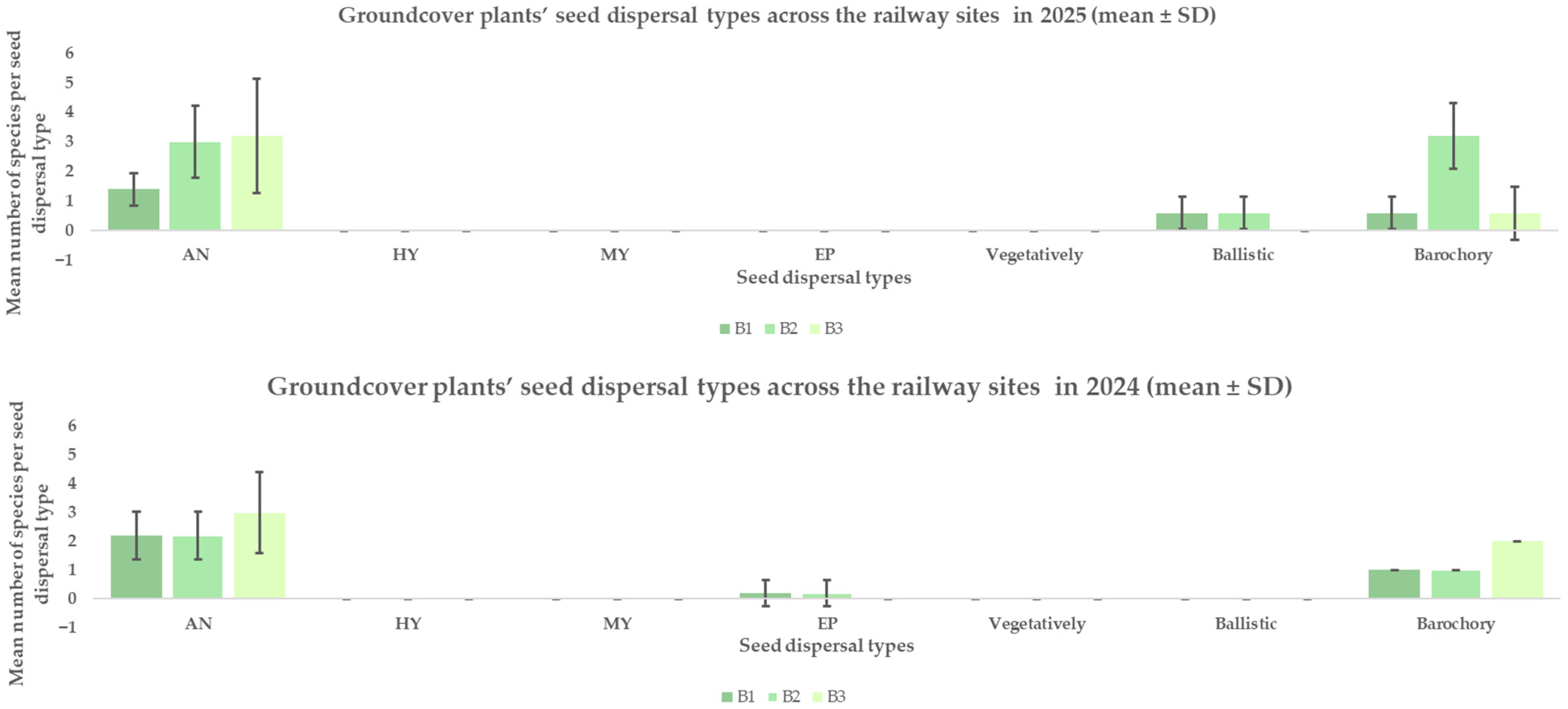
Seed dispersal strategies of groundcover plants varied across the surveyed railway sites and survey periods in Beijing (Figure 14). Dispersal types included anemochory (AN), barochory, ballistic dispersal, hydrochory (HY), myrmecochory (MY), endozoochory (EN), epizoochory (EP), and vegetative spread.
In late spring 2025, AN was the dominant dispersal type, with barochory also relatively prominent, particularly at B2 across three railway sites (AN: B1 = 1.4 ± 0.55; B2 = 3.0 ± 1.22; B3 = 3.2 ± 1.92; barochory: B1 = 0.6 ± 0.55; B2 = 3.2 ± 1.10; B3 = 0.6 ± 0.89). Barochory was most pronounced at B2, with lower values at B1 and B3. Ballistic dispersal was recorded at low levels (B1 = 0.6 ± 0.55; B2 = 0.6 ± 0.55), while other dispersal types (HY, MY, EP, and vegetative spread) were negligible or absent.
By early summer 2024, AN remained the dominant dispersal type across all sites (B1 = 2.2 ± 0.84; B2 = 2.2 ± 0.84; B3 = 3.0 ± 1.41). Barochory occurred at moderate levels (B1 = 1.0 ± 0; B2 = 1.0 ± 0; B3 = 2.0 ± 0). EP was recorded only sporadically (B1 = 0.2 ± 0.45; B2 = 0.2 ± 0.45). The seed dispersal types of tree species recorded across the three railway sites were dominated by AN and EN (Supplementary Table S2). Native tree species such as Ulmus pumila, Populus spp., and Salix matsudana were predominantly dispersed by AN.
The seed dispersal types of shrub species recorded across three railway sites in Beijing were dominated by EN (Supplementary Table S2). Native shrub species such as Lonicera maackii and non-native species, including Euonymus japonicus and Rosa chinensis were classified as EN.

3.2.5. Tree- and Shrub-Layer Structure and Biogeographic Composition (Beijing)

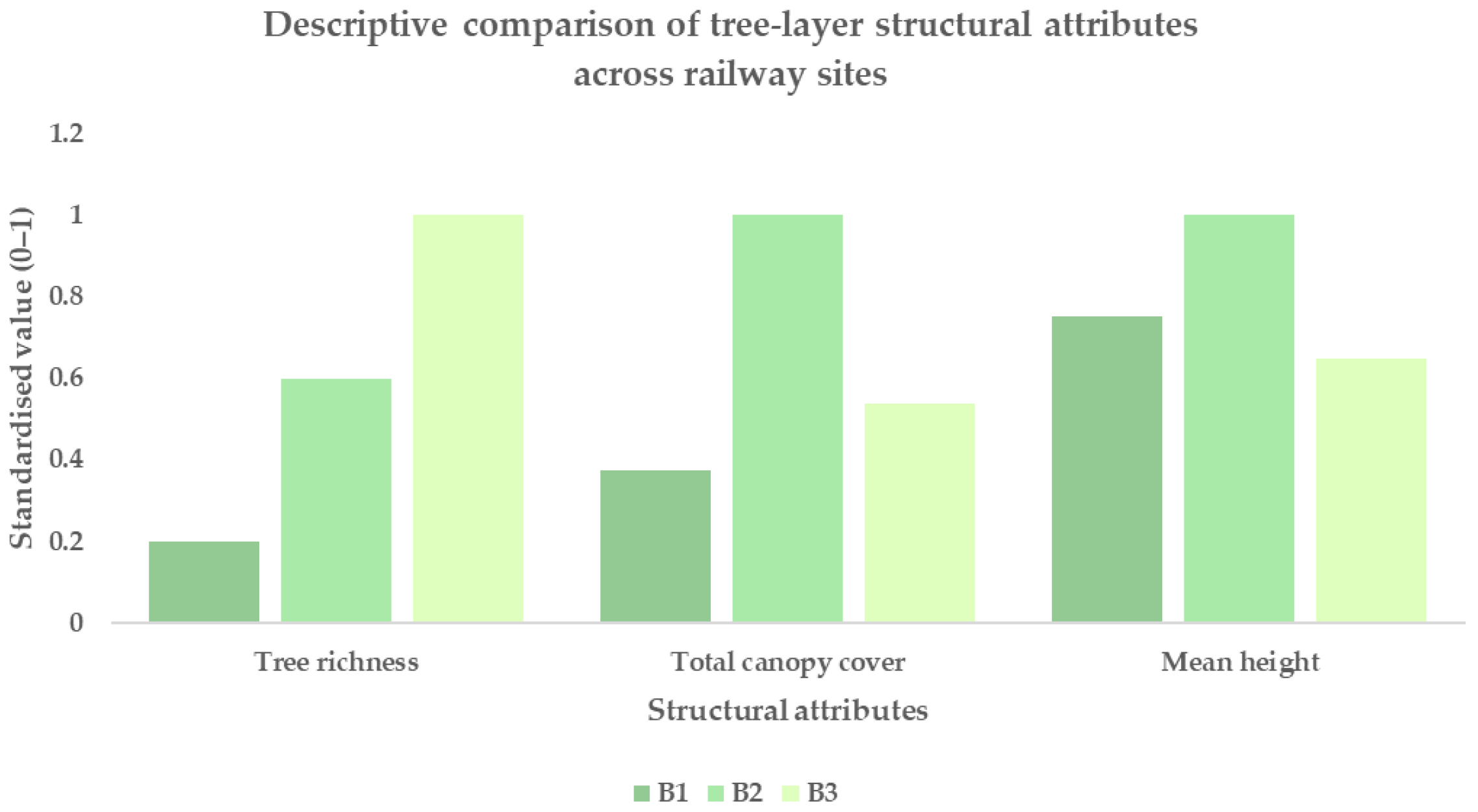
Compared with B1, both redesigned sites (B2 and B3) showed a more developed tree-layer structure. B1 exhibited the lowest standardized values for tree richness (0.20), total canopy cover (0.38), and mean tree height (0.75), and the overstorey was dominated by Ulmus pumila. Tree saplings were present at low abundance, including saplings of Ulmus pumila (Figure 15).
B2 and B3 exhibited different tree-layer structural patterns. B2 showed the highest standardized total canopy cover (1.00) and mean tree height (1.00), while tree richness was moderate (0.60). The tree layer at B2 consisted mainly of Populus spp., Salix matsudana, and Juniperus formosana. Tree saplings of woody taxa were observed beneath the overstorey, including individuals of Populus spp. and Salix spp.
In contrast, B3 exhibited the highest standardized tree richness (1.00) but lower canopy cover (0.5375) and mean height (0.65) than B2. Dominant tree taxa at this site included Styphnolobium japonicum, Malus × micromalus, and Paulownia tomentosa. Tree saplings occurred sporadically, including individuals of Paulownia tomentosa and Styphnolobium japonicum.
Shrub-layer vegetation was generally sparse across sites. Lonicera maackii occurred in small groups at B2, whereas shrubs were rare or absent at B1 and B3.

3.3. Seasonal Context Beyond the Main Survey Periods in Perth and Beijing

In addition to the spring and early summer surveys, a supplementary field survey was conducted in Perth to document groundcover species persisting during late-summer dry season conditions. This survey was undertaken on 4 February 2024, corresponding to peak summer conditions. Under these conditions, only a limited subset of groundcover species was recorded across areas adjacent to the three Perth railway sites, including species such as Euphorbia spp., Eragrostis curvula, Hypochaeris radicata, Plantago lanceolata, and Conyza spp., with minor occurrences of Ehrharta spp. and lawn-associated grasses (e.g., Pennisetum clandestinum and Cynodon dactylon). These supplementary observations were carried out in urban green corridors adjacent to, but not strictly within, the defined sampling plots of the railway sites.
During the same period, the tree layer remained present and structurally intact, with dominant tree species observed primarily in vegetative or flowering stages. No shrub layer was recorded across the areas adjacent to the three Perth railway sites during either the main surveys or the supplementary observations, resulting in a two-layer vegetation structure composed of tree and groundcover strata.
In Beijing, to provide seasonal context beyond the main survey periods, supplementary observations were used to describe vegetation conditions outside the primary survey windows. During early spring, groundcover vegetation was dominated by overwintering and early emerging herbaceous species, including rosette-forming and perennial taxa such as Orychophragmus violaceus, Capsella bursa-pastoris, Taraxacum mongolicum, and Plantago asiatica, forming continuous or semi-continuous groundcover across urban green corridors prior to full canopy development.
Supplementary late-autumn observations indicated that groundcover vegetation remained widespread across urban green corridors despite progressive yellowing and senescence in the tree canopy. The ground layer was primarily composed of overwintering, perennial, and late-senescing species (species retaining aboveground tissues into late autumn), including Orychophragmus violaceus, Capsella bursa-pastoris, Taraxacum mongolicum, Plantago asiatica, Artemisia spp., and Setaria viridis.
In contrast to the sampled Perth sites, a sparse shrub layer was present at some of the surveyed Beijing sites. Species such as Lonicera spp. were occasionally observed retaining green foliage into the late growing season, contributing limited low- to mid-layer structural complexity along railway corridors.
In the tree layer, deciduous species commonly associated with railway corridors in Beijing—including Populus spp., Salix spp., Ulmus spp., Robinia pseudoacacia, and Ailanthus altissima—exhibited clear seasonal phenological variation, ranging from bud break in spring to advanced leaf senescence prior to winter.

3.4. Cross-City Comparison of Vegetation Patterns in Perth and Beijing

Clear contrasts were observed between the surveyed railway corridor sites in Beijing (B1–B3) and Perth (P1–P3) in vegetation structure, life form composition, biogeographic patterns, and dispersal strategies. In Beijing, both groundcover and woody vegetation (tree and shrub layers) contained a high proportion of native species at the surveyed sites. For example, B1 supported particularly low groundcover richness (fewer than 3 species per site on average), yet native species still constituted the majority of the recorded flora.
In contrast, P1 supported higher groundcover richness (approximately 6 species per site) but was dominated by non-native taxa in the groundcover layer, while native species were largely confined to the tree layer.
More broadly, Perth surveyed corridors showed stronger layer-level differentiation, with a regionally native tree layer present but a groundcover flora composed almost entirely of non-native species, highlighting a biogeographic disconnect between woody and groundcover layers. Across P1–P3, vegetation structure was characterized by the absence of a continuous intermediate-height woody component.
Across cities, mean surveyed tree height showed a clearer and more consistent contrast than canopy cover or tree richness. Perth railway corridor sites supported a relatively tall tree layer, with mean tree heights ranging from approximately 7.5 m at P1 to over 10 m at P2 and P3, whereas tree height in Beijing’s surveyed railway corridors was generally lower, reflecting differences in vegetation history, species composition, and management context.
Phenological stage composition also differed between the two cities. In Perth, both sampling periods (mid-September 2025 and late October 2024) were dominated by vegetative and flowering stages across the railway sites, while bud stages showed limited representation, consistent with surveys conducted after the main budding phase. Reproductive stages were more clearly expressed in Perth than in Beijing: seed/fruiting stages were consistently recorded at P1 across both sampling periods, whereas P2 and P3 showed lower and more variable representation of seed/fruiting stages, indicating clearer differentiation among the surveyed sites in reproductive development. In Beijing, phenological composition was characterized by a predominance of vegetative stages across both survey periods. In late April 2025, groundcovers across B1–B3 were predominantly vegetative, with only limited flowering and very few later reproductive stages. By early July 2024, vegetative-stage representation increased further across the Beijing sites (B1–B3), but flowering and other reproductive stages remained sparsely represented, resulting in a limited shift towards later phenological stages compared with Perth.
Groundcover vegetation life form composition further distinguished the two cities. In Perth, groundcovers were dominated by annual species across the surveyed sites and survey periods, with perennial species occurring at low abundance. Biennial and climbing life forms were rare or absent, indicating a relatively narrow life-form spectrum. In Beijing, groundcover species were also dominated by annuals but consistently included perennial species, particularly at B2 and B3, indicating the co-occurrence of short-lived and longer-lived life forms within the same corridors. Biennial and climbing life forms occurred at low abundance but were present across sites, contributing to a broader life-form spectrum relative to Perth.
At the level of primary seed dispersal types, the surveyed railway corridor sites in Perth and Beijing showed contrasting dispersal patterns. In Perth, although AN dominated groundcover vegetation overall, P1 exhibited a broader range of dispersal types, including barochory, HY, vegetative dispersal, and ballistic dispersal. In contrast, groundcover vegetation in Beijing was characterized by a narrower set of primary dispersal types across sites and survey periods. AN and barochory consistently accounted for the majority of groundcover species, similar to the pattern observed in Perth (e.g., HY, MY, EP, and vegetative dispersal) were absent or occurred only sporadically.
Clear differences were also evident in the tree layer. In Perth, tree dispersal mechanisms were dominated by native barochorous taxa, particularly Myrtaceae (e.g., Eucalyptus spp. and Corymbia calophylla), while other dispersal types were represented by only a few species. In Beijing, primary dispersal types of woody vegetation were more evenly divided between AN and EN, with native trees (e.g., Ulmus pumila, Populus spp., Salix matsudana) predominantly AN and non-native trees largely animal-dispersed. Shrub species recorded at the surveyed Beijing sites were almost exclusively non-native and EN, including taxa such as Euonymus japonicus and Rosa chinensis.
Secondary seed dispersal was inferred for several plant species in both Perth and Beijing based on published trait information, but it was not directly observed in this study. In both cities, most trees along railway corridors were planted, which limits conclusions about how seeds are dispersed under field conditions. In Perth, secondary dispersal pathways were mainly inferred for woody species based on well-known traits. For example, Melaleuca spp. can release seeds after fire, and Eucalyptus species may experience short-distance redistribution of seeds after they fall (barochory).
Groundcover species in Perth were also associated with secondary dispersal pathways. Species such as Plantago lanceolata, Trifolium spp., Medicago polymorpha, and Portulaca oleracea are known to disperse seeds via animals, water, or surface movement. As a result, secondary dispersal may therefore influence local establishment but does not alter the overall dominance of AN species.
A similar pattern was found in Beijing. Tree species were mostly classified as AN, with HY often noted as a secondary pathway for species such as Populus spp. and Salix matsudana. Because tree species composition was relatively similar among sites, differences in dispersal mechanisms in the woody layer were limited. In contrast, groundcover species in Beijing sites were associated with a wider range of potential secondary dispersal pathways, including animal-mediated, water-mediated, and human-related redistribution. This was inferred for species such as Chenopodium album, Plantago asiatica, Trigonotis peduncularis, and Viola philippica.
Across cities, tree-layer structures showed contrasting patterns. In Perth, the surveyed railway sites supported a consistently well-developed tree layer dominated by south-west Australian Myrtaceae, particularly Eucalyptus spp., Corymbia spp., and Melaleuca spp., with relatively little variation among sites. In contrast, Beijing surveyed railway corridors exhibited greater site-level variability in tree-layer development, with the redesigned sites showing higher canopy cover and tree richness than abandoned sites; dominant taxa included Populus spp., Salix matsudana, and Ulmus pumila. In addition to the tree layer, a distinct shrub layer was present at B3, including species such as Euonymus japonicus, and Rosa chinensis.
Supplementary observations revealed contrasting late-season and early-season groundcover dynamics between Perth and Beijing railway corridors. Under peak summer conditions in Perth (February 2024), groundcover vegetation was restricted to a small subset of drought- and heat-tolerant species, resulting in very low species richness, low evenness, and fragmented, mosaic spatial patterns. In contrast, supplementary early spring and late-autumn information for Beijing indicated that groundcover vegetation remained continuous or semi-continuous outside the main survey periods, supported by overwintering and perennial species that retained aboveground structures into late autumn.

4. Discussion

4.1. Socio-Ecological Contexts Shaping Vegetation Patterns in Perth and Beijing Railway Corridors

The contrasting vegetation dynamics observed across the surveyed railway sites in Perth and Beijing are related to differences in evolutionary history, disturbance patterns, and the development and governance of railway infrastructure. The South-west Australian Floristic Region is characterized by long-term geological isolation, environmental stability, nutrient-poor soils, and exceptionally high levels of endemism [37]. These conditions have promoted highly specialized native plant taxa adapted to nutrient-poor soils and seasonal drought. Although these traits contribute to the region’s exceptional floristic richness, they may also reduce tolerance to frequent physical disturbance and limit the capacity for rapid recolonization of disturbed substrates [80].
In native woodlands of south-western Australia, fire patterns have historically been shaped by both natural ignition sources (e.g., lightning) and long-standing Indigenous burning practices [81,82]. Prior to European colonization, human influences on vegetation were present but likely differed in intensity and spatial pattern from the large-scale agricultural and urban disturbances observed in Europe and northern China. Native Xanthorrhoea and Corymbia species represent elements of pre-colonial vegetation, indicating the persistence of woodland species that predate railway development.
A possible explanation is that, in the evolutionary context of Perth urban railway corridors, native plant species are largely confined to the tree layer, while the groundcover layer is dominated by non-native annual species. Many dominant native trees rely on short-distance seed dispersal (e.g., barochory) and long lifespans that enable persistence once established but limit rapid recolonization of repeatedly disturbed ground.
In contrast, many non-native groundcover species along Perth railways originate from the Northern Hemisphere and from comparatively disturbance-rich landscapes and exhibit contrasting life-history strategies. They produce large quantities of easily dispersed seeds and complete their life cycles rapidly, allowing them to exploit recurrent disturbance associated with railway maintenance, operation, and human use. Previous surveys of urban green spaces in Perth show that groundcover originally planted as lawn has transitioned to ground surface composed almost entirely of non-native annual species, reflecting these life-history and dispersal differences [37]. A notable example of this pattern is Olea europaea, which occurred only sporadically across railway sites but represents bird-mediated dispersal (EN) in the Perth region. Although olive dispersal is frequently associated with introduced frugivores such as starlings (Sturnus vulgaris) in other regions, these birds are absent from Western Australia. Nevertheless, native birds (e.g., Barnardius zonarius semitorquatus) may also contribute to the dispersal of olive seeds into remnant bushland and protected areas, where the species is recognized as an environmental weed in Western Australia [83], although direct regional evidence remains limited.
In contrast, vegetation responses in railway corridors in Beijing reflect different evolutionary and historical contexts. Northern China has experienced repeated glacial–interglacial cycles and large-scale range shifts, together with long histories of natural and anthropogenic disturbance (e.g., climate fluctuations, river dynamics, agriculture, and urban expansion). These processes have shaped flora characterized by high tolerance to environmental variability and disturbance [84,85,86].
Palaeoecological evidence indicates shifts in vegetation composition between the Last Glacial Maximum and the Holocene climatic optimum, with both climate change and long-term human land use exerting strong influences on contemporary plant assemblages [87,88]. As a result, many native species in the Beijing flora exhibit functional traits characteristic of ruderal species, enabling re-establishment following disturbance [89].
Ecologically, Beijing belongs to the northern temperate vegetation zone historically dominated by deciduous broadleaf forests, with common tree taxa including Quercus spp., Ulmus spp., Acer spp., and Pinus tabuliformis [62]. Long histories of agricultural expansion and urbanization from the early–mid Holocene onward reshaped lowland vegetation [90].
Consistent with these combined evolutionary and historical contexts, studies of railway green corridors in Beijing indicate that vegetation is characterized by a largely native tree layer and a groundcover layer also dominated by native species, with ruderal and introduced taxa occurring mainly as secondary components in herbaceous and shrub strata [89]. Field surveys further show that native species are distributed across both woody (tree and shrub) and groundcover layers [73], reflecting strong regenerative capacity and vertical integration.
These differences do not imply inherent resistance of Beijing vegetation to invasion or vulnerability of Perth vegetation. Rather, they highlight how evolutionary history and long-term disturbance patterns interact to shape plant community responses in urban railway corridors.
The similarities observed between the two cities arise from four key shared characteristics of railway corridors: standardized track structures, ballast-derived soil conditions, recurrent disturbance and safety-oriented maintenance practices, and the resulting dominance of ruderal vegetation. Railways worldwide share standardized track systems consisting of steel rails mounted on sleepers and supported by ballast, although sleeper materials (e.g., timber, concrete, or steel) may vary [91]. Additionally, ballast substrates typically create coarse, well-drained, and nutrient-poor soil conditions that influence vegetation establishment and species composition [7]. Moreover, these infrastructures create comparable linear spatial configurations, disturbance patterns, and maintenance constraints [16,23]. As a result, groundcover vegetation is dominated by annual and short-lived perennial species with ruderal or pioneer strategies. The recurrence of similar life forms and genera (e.g., Plantago) across cities suggests a convergence in vegetation composition and functional traits. This, in turn, may indicate a tendency toward structural and functional homogenization in urban railway environments, a pattern also reported in urban ecosystems worldwide [92,93].

4.2. Contemporary Ecological Processes Shaping Urban Railway Corridor Vegetation

Disturbance patterns and groundcover dynamics differ between the two cities. In Perth, frequent disturbance associated with railway maintenance, combined with strong summer heat and drought, may create environmental filters that favor species capable of rapid establishment and completion of their life cycles, consistent with patterns observed in other highly disturbed urban green spaces in Perth [37]. As a result, groundcover vegetation along redesigned and in-use railway corridors (P2 and P3) is dominated by fast-growing non-native annual species. In Beijing, railway corridors also experience repeated disturbance; however, native species frequently persist or rapidly re-establish through dispersal and growth aligned with summer rainfall, particularly among perennial life forms. As a result, native plants are maintained in both the groundcover and woody layers, in contrast to the stronger vertical separation observed in Perth. These contrasting responses suggest that the ecological effects of disturbance in urban railway corridors depend not only on disturbance intensity, but also on regional species pools and historical disturbance legacies [75].
Railway corridor soils may be modified by ballast, residual chemicals, oils, and other contaminants, including toxic compounds historically used in railway sleepers, which can accumulate in adjacent soils and alter soil chemical and biological conditions [94,95,96]. Because plant performance is closely linked to soil conditions, such altered substrates may influence plant establishment and regeneration dynamics within railway corridors [97]. However, soil properties and chemical conditions were not directly measured in this study, and these factors are therefore proposed as potential explanations rather than confirmed drivers.
In Perth, native tree seedlings, including Eucalyptus spp. and Agonis flexuosa, were occasionally observed but rarely persisted beyond early establishment stages, suggesting that recruitment into mature tree populations is constrained under typical urban corridor conditions. These conditions include compacted urban construction soils, altered substrates, and repeated physical disturbance associated with maintenance activities and human use [37]. Ballast-derived substrates often present particularly challenging conditions for seedling establishment, as they are composed of coarse crushed stone with high permeability and limited moisture retention [98]. Elevated concentrations of trace metals have been widely reported in soils adjacent to railway infrastructure, reflecting emissions from rail abrasion and operational activities [18]. Moreover, these artificial substrates differ substantially from the deeper sandy soils in which many native south-west Australian tree species typically establish in natural environments. Under the Mediterranean climate of Perth, prolonged summer drought further exacerbates these constraints by reducing soil moisture availability during critical early growth stages. Woody vegetation in Perth railway corridors appears to be maintained primarily through the persistence of existing mature individuals rather than by ongoing natural regeneration. In contrast, observations from Beijing indicate that native tree seedlings were frequently recorded, suggesting ongoing natural regeneration and early stages of succession. Common regenerating taxa included Ailanthus altissima, Populus spp., and Ulmus pumila [89].
Seasonal and phenological patterns further reinforce these contrasting ecological responses in the two cities. In Perth, flowering and seed production were more evident during the main survey period, particularly at the abandoned site (P1), indicating that reproductive activity in the groundcover layer is strongly influenced by disturbance patterns and site management. However, supplementary observations during peak summer conditions showed a sharp contraction of groundcover vegetation, with only a small subset of drought- and heat-tolerant species persisting. In Beijing, groundcover vegetation during the main survey periods was dominated by vegetative growth stages, reflecting early- to mid-season development. Supplementary observations in early spring and late autumn revealed that canopy cover was limited during these periods, as trees were either leafing out or shedding foliage.

4.3. Urban Railway Corridors in Perth and Beijing Within Urban Corridor Studies

The patterns observed in this study are consistent with previous research on railway corridors and other urban linear infrastructures in both south-western Australia and northern China.
Stewart & Ignatieva [99] documented a broad inventory of spontaneous urban vegetation across abandoned sites, walls, and surface cracks in south-west Australian cities, recording 145 species across multiple urban spontaneous biotopes. Relative to this broader inventory, our comparison of urban railway corridors with urban vacant land in Perth (Fremantle) and Albany (Western Australia) identified 22 shared species, indicating substantial overlap in ruderal flora between these two habitat types. Despite this similarity, overall richness differed, with railway corridors supporting approximately 65 spontaneous species, or roughly 45–50% of the total richness reported by Stewart & Ignatieva [99]. Shared taxa included widespread disturbance-tolerant species such as Cynodon dactylon, Medicago polymorpha, Sonchus oleraceus, Plantago lanceolata, Poa annua, Portulaca oleracea, and Hypochaeris radicata, suggesting a shared urban ruderal species pool. However, railway corridors in Perth also supported taxa frequently associated with open and highly disturbed substrates (e.g., Briza maxima, Briza minor, Rostraria cristata, Vulpia bromoides), which are also commonly found in other urban ruderal habitats in Perth such as unmanaged street verges and disturbed lawns [37]. Similar patterns have been reported in other urban contexts [100], although their relevance to the present study is likely to depend on local environmental conditions and disturbance patterns. Together, these comparisons suggest that railway corridors represent a disturbance-filtered subset of the broader urban ruderal flora, shaped by both shared species pools and habitat-specific environmental constraints.
In Beijing, redesigned railway sites (B2 and B3) showed strong overlap in dominant groundcover species with those reported for urban park and park-edge vegetation by Li et al. [74], reflecting similar responses to urban disturbance and spontaneous colonization. These redesigned railway sites retain a linear spatial configuration and remain constrained by track infrastructure, safety clearance, and maintenance access [73,74]. As a result, sites B2 and B3 function primarily as vegetated corridors that support continuity of common urban disturbance-tolerant species. In this study, the abandoned railway site (B1) was characterized by particularly low plant diversity, suggesting that abandonment alone does not necessarily promote spontaneous ecological recovery in dense urban contexts. This site remains subject to persistent environmental stress, including soil compaction, informal human disturbance, and limited habitat heterogeneity. Such conditions favor only a small subset of highly disturbance- and human-traffic-tolerant species (e.g., Plantago spp., Eleusine indica, Digitaria sanguinalis, Setaria viridis, Poa annua, Portulaca oleracea, Polygonum aviculare, Tribulus terrestris, Chenopodium album, and Amaranthus retroflexus). These patterns are consistent with findings from studies of railway and transport corridors, which suggest that environmental constraints and disturbance legacies can limit vegetation recovery in linear infrastructure habitats even where active management is reduced (e.g., [26]).
Differences in diversity patterns between Perth and Beijing reflect contrasting redesign pathways rather than differences in basic ecological responses. In Perth, the redesigned railway corridor (P2) was converted into a heritage recreational trail/linear park/greenway after the tracks were removed. Although the site is still actively managed and used by the public, removing the railway infrastructure fundamentally changed the types of disturbance. Frequent, high-impact disturbances linked to railway operations were replaced by more regular, lower-intensity park management activities. Together, these changes increased habitat heterogeneity and supported higher plant diversity compared with railway corridors that remain in use (P3). However, this plant biodiversity in Perth is mainly composed of non-native plants and thus is not valued as a positive biodiversity outcome since these species are seen as weeds. In contrast, redesigned sites in Beijing (B2 and B3) retained their railway function, with tracks left in place and planting arranged along the linear rail structure. As a result, infrastructure constraints, ongoing management, and strong edge-dominated conditions continued to shape vegetation patterns. Under these conditions, plant diversity was slightly higher than in the abandoned site (B1) but remained substantially lower than in park-integrated railway corridors (e.g., B2), where vegetation is embedded within broader park landscapes, and higher than in corridors located within high-density urban environments (e.g., B3). However, in the case of Perth, the goal of increasing plant biodiversity in all railway typologies requires restoring the native component of vegetation and suppressing or managing the dominance of existing non-native “weedy” vegetation. Thus, removal of disturbances and “leaving nature alone” would not be effective in Perth as it may be in Beijing and in other cities where natural vegetation has high self-revegetation capacity (e.g., European cities [76]).
Similar patterns have also been reported in studies of urban vegetation in temperate cities (e.g., [77,101]), although the extent to which these patterns apply to the present study is likely to depend on local environmental conditions and disturbance patterns. Overall plant species richness in railway corridors tended to be lower than might be expected in more heterogeneous urban landscapes, reflecting the spatial constraints and filtering effects characteristic of linear infrastructure environments. The consistently moderate to low diversity observed across abandoned, redesigned, and in-use railway sites therefore indicates that railway corridors are shaped by persistent human-induced and environmental filtering [102].

4.4. Implications for NbS

4.4.1. NbS for Urban Railway Corridor Planting Design and Management in Perth

These recommendations are informed by observations and practical implementation within the UWA Living Lab projects [37,103,104] and reflect site-based management experience. Plant selection and management approaches are adapted from these experimental settings to the specific environmental conditions of urban railway corridors. While these approaches have been tested in experimental and managed settings, their performance in railway corridor conditions may require further site-specific validation.
The redesigned site in Perth (P2) suggests that, in this case, replacing high-intensity railway disturbance with more regular and lower-intensity management may support higher vegetation diversity and structural complexity. Ecological improvement may be more likely where redesign (e.g., pathway construction) or maintenance reduces disturbance severity, increases habitat heterogeneity, or alters disturbance timing (e.g., seasonal weeding and cutting), regardless of whether railway tracks are retained or removed.
However, increased woody cover alone does not necessarily result in effective microclimatic buffering at the ground level. Native tree species commonly occurring along railway corridors, particularly Eucalyptus spp., typically have vertically oriented, narrow leaves and relatively open canopies, with foliage positioned well above the ground surface. In addition, beyond disturbance patterns, vegetation structure also plays a key role in shaping microclimatic outcomes. This suggests the importance of structural complexity, rather than canopy presence alone, in supporting ground-layer resilience in the studied railway corridors. Accordingly, the retention of existing trees, together with the development of a structurally diverse shrub layer, is essential for maintaining canopy shade and microclimate buffering.
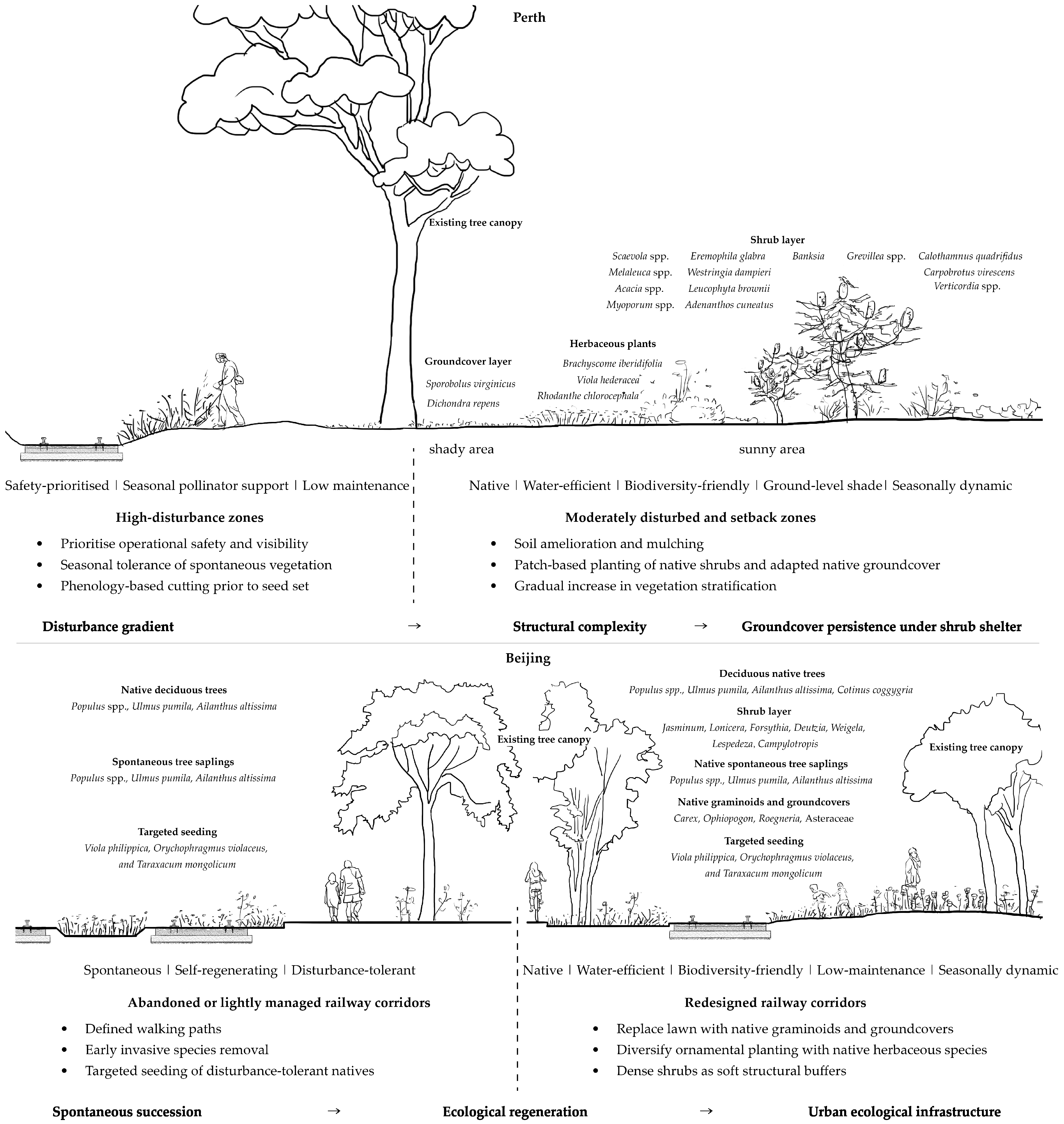
In practice, this NbS is expressed through differentiated planting and maintenance strategies across disturbance gradients (Figure 16):
(1)
High-disturbance zones adjacent to tracks and high-use paths
In high-disturbance railway environments such as track-adjacent zones, vegetation management must operate under strong environmental filtering and strict safety constraints. In Perth urban railway corridors, spontaneous annual species cannot be fully eliminated due to persistent soil seed banks and rapid recolonization. At the same time, public expectations and safety requirements preclude leaving spontaneous vegetation unmanaged.
A phenology-based management approach is recommended, in which spontaneous vegetation is tolerated during the growing season, where it may provide biodiversity benefits (e.g., supporting wildlife such as insects and birds, and contributing to fire prevention), and is then selectively cut or slashed after flowering but prior to seed set. This approach may include maintaining narrow low-vegetation buffers directly adjacent to tracks.
(2)
Moderately disturbed and setback zones
Further from the track edge, where disturbance intensity is reduced and microclimatic conditions are less extreme, greater flexibility exists to enhance vegetation structure and diversity. Successful establishment in these zones requires a sequential strategy, beginning with targeted soil creation or improvement and mulching to moderate surface temperatures and reduce evaporative loss. This should be followed by the introduction of native shrubs and selected native groundcover species adapted to the nutrient-poor soils and draught periods typical for Western Australia.
In sunnier areas on open embankments, native annual everlasting species such as Rhodanthe chlorocephala may be established in spring to provide seasonal color and ecological functions. However, as everlastings remain in bloom for no more than two months, they function as temporary interventions rather than permanent groundcover. Their role is primarily seasonal and aesthetic, while also providing biodiversity value by supporting native pollinators (e.g., native bees) [105].
In shaded and semi-shaded areas, groundcover species such as Dichondra repens and Sporobolus virginicus are more suitable due to their tolerance of reduced light availability and surface moisture variability. Where management objectives include supporting local Western Australian native pollinators, planting strategies should prioritize native species that provide floral resources and seasonal groundcover without reliance on high irrigation inputs.
Low-growing mixed native shrubs should form the structural backbone of these zones, planted in discrete patches rather than continuous belts. Species such as Scaevola spp., Melaleuca spp., Acacia spp., Myoporum spp., Eremophila glabra, Westringia dampieri, Leucophyta brownii, Adenanthos cuneatus, Calothamnus quadrifidus, and Carpobrotus virescens can provide near-ground shading, reduce surface temperatures, and buffer soil moisture loss. Suitable native groundcover options include Brachyscome iberidifolia and Viola hederacea. Nectar-producing shrubs such as Banksia, Grevillea, and Verticordia can further support native pollinators. Over time, these shrub patches create microhabitats that support the establishment and survival of selected groundcover species planted beneath or between them. This horizontal structure is consistent with the spatial character of remnant natural woodlands and shrublands in the Perth–Peel region. To reduce establishment costs and improve long-term resilience, a staged implementation strategy is recommended: begin with low-density planting of key shrub species such as Myoporum spp. and Grevillea spp., followed by progressive infill as vegetation structure stabilizes and site conditions improve.

4.4.2. NbS for Urban Railway Corridor Vegetation Design Management in Beijing

Species identification and interpretation in the Beijing case are informed by field observations and long-term professional experience from co-authors based in China. These insights provide practical guidance for vegetation design and management; however, their application in railway corridor contexts may require further validation under site-specific conditions.
In the Beijing railway corridors, the tree layer appears to play a central role in moderating near-ground microclimate, while spontaneous groundcover is predominantly native and exhibits strong seasonal persistence without intensive management intervention.
In the Beijing case, the effectiveness of the tree layer appears to be primarily determined by canopy continuity and density (e.g., the degree to which tree crowns form relatively uninterrupted cover). Common tree species, including deciduous trees Populus spp., Ulmus pumila, and Ailanthus altissima, typically form dense canopies with foliage positioned lower in the vertical profile. During the growing season, these structural traits provide shading, reduce soil temperatures, and limit evaporative stress, thereby creating favorable conditions for groundcover persistence and tree regeneration. These findings underscore the importance of preserving existing tree canopy structure to maintain microclimate regulation and support groundcover persistence. Observations from the Beijing sites are consistent with the role of spring ephemeral plants in the broader Northern China region, which are vital for early spring ecosystem function, rapidly completing their life cycle in 1–2 months to exploit favorable early-season resource conditions, including soil moisture, high light availability prior to canopy closure, and pollination opportunities. They provide early-season forage for wildlife, help stabilize soils prone to wind erosion, and contribute to regional biodiversity. This pattern suggests that NbS should work with the existing hybrid structure rather than attempting either complete naturalization (going wild) or comprehensive redesign. Early spring groundcover species, although limited in number, include near-ephemeral taxa such as Capsella bursa-pastoris and, to a lesser extent, Trigonotis peduncularis, which complete their life cycles prior to full canopy closure and are typical of early-season ruderal flora exploiting high light availability. In contrast, late-season groundcover remains active following leaf senescence, represented by persistent or cool-season taxa, such as Ophiopogon japonicus, Carex spp., Poa pratensis, and Lolium perenne, which maintain green cover into autumn. This seasonal complementarity reflects the semi-natural character of many Beijing urban railway corridors, where spontaneous regeneration and moderate disturbance combine to maintain dynamic yet persistent vegetation communities.
At the same time, block plantings of ornamental shrubs and groundcovers (e.g., the non-native Euonymus japonicus, horticultural Rosa chinensis, and temperate grasses of predominantly European origin) indicate that artificial interventions remain embedded within some redesigned Beijing railway corridors. These plantings are typically spatially discrete rather than continuous, forming patchy design elements within otherwise spontaneously structured vegetation. This pattern suggests that many corridors function as hybrid socio-ecological systems, where natural regeneration coexists with localized and partly non-native landscape inputs. Accordingly, NbS in Beijing railway corridors may benefit from working with existing vegetation structures and ecological processes rather than introducing additional planting or artificial diversification.
The widespread presence of naturally regenerating native tree seedlings further suggests that, where disturbance intensity remains moderate, some abandoned or lightly managed corridors may gradually develop into small woodland patches.
Unlike Perth, where disturbance varies primarily along spatial gradients within corridors, disturbance in Beijing tends to be pervasive rather than spatially stratified. As a result, zoning-based planting and maintenance strategies may be difficult to implement and potentially unstable over time. Accordingly, NbS in Beijing may be more effective when structured around corridor type rather than within-corridor zoning, with implications for abandoned and redesigned corridors. In-use corridors, which remain subject to operational safety regulations and railway management requirements, offer comparatively limited scope for ecological redesign.
(1)
Abandoned or lightly managed railway corridors
Management should aim to channel and moderate disturbance rather than restrict it. Clearly defined walking paths can reduce trampling, while avoiding repeated substrate regrading allows soils and vegetation to stabilize over time. Routine monitoring and early removal of invasive species (e.g., Solidago canadensis and wind-dispersed Erigeron canadensis) are particularly important in high-use areas. Abandoned corridors should therefore be treated as self-organizing systems, where spontaneous succession and natural regeneration sustain ecological function under continuous urban disturbance. In addition, low-intensity assisted regeneration—such as the targeted seeding of disturbance-tolerant native herbaceous plants (e.g., Viola philippica, Orychophragmus violaceus, and Taraxacum mongolicum), together with late-autumn flowering native Asteraceae species—may help guide succession, increase seasonal groundcover continuity, and suppress the establishment of invasive species without disrupting self-organizing dynamics.
(2)
Redesigned or transitioning railway corridors
For redesigned railway corridors in Beijing, the primary objective should not be limiting public access but strengthening ecological resilience under chronic disturbance. Given their full accessibility and pronounced edge effects, these corridors should be conceived as disturbance-adapted systems rather than high-maintenance landscape installations. In particular, exotic lawn grasses (e.g., ryegrass) could be progressively replaced by native, drought- and cold-tolerant perennial graminoids and groundcovers, including species from genera such as Carex (often associated with higher moisture tolerance), together with Ophiopogon and Roegneria, which contribute to vegetation persistence and recovery under conditions of intense summer rainfall. Where ornamental block plantings already exist at some redesigned urban railway sites, like site B3, a gradual transition strategy may be preferable to wholesale replacement. Rather than removing these elements entirely, selected patches can be progressively diversified with native herbaceous plants and graminoids or selectively thinned to allow greater spontaneous regeneration. In contrast, at some redesigned sites (e.g., B2), spontaneous vegetation has successfully established within ballast substrates. Targeted sowing of early-spring native herbaceous species (e.g., Viola philippica, Orychophragmus violaceus, and Taraxacum mongolicum), together with late-autumn flowering herbaceous species (e.g., native Asteraceae), may reinforce existing vegetation communities. Additional introduction of native shrubs (e.g., Lespedeza and Campylotropis) can further enhance seasonal diversity through late-season flowering and fruiting, while also increasing structural complexity. Incorporating autumn-foliage species (e.g., Cotinus coggygria) may further contribute to seasonal light availability and visual dynamics along urban railway corridors.
In areas subject to concentrated human use—such as entrances, informal gathering nodes, and popular photo locations—dense shrub species commonly used in northern China (e.g., Jasminum, Lonicera, Forsythia, Deutzia or Weigela) can be incorporated as soft structural buffers. Rather than restricting access, these plantings help guide pedestrian movement, reduce diffuse trampling, and enhance vertical structural complexity. Allowing partial spontaneous regeneration alongside such structural guidance can further support vegetation stabilization under persistent urban disturbance. At the same time, fire risk during Beijing’s dry autumn and winter should also be considered, particularly in relation to vertical fuel continuity. This implies avoiding overly dense shrub layers and maintaining breaks between herbaceous and woody strata.

4.5. Comparison of NbS Between Perth and Beijing Urban Railway Corridors

This study adopts a comparative, typology-based approach to examine NbS in urban railway corridors in Perth and Beijing, focusing on context-specific insights rather than aiming for universal generalization.
The asymmetry in the dataset limits direct comparison of high-disturbance conditions, as in-use railway corridors were only observed in selected Perth sites. As a result, high-disturbance ecological characteristics are primarily interpreted based on the Perth case.
However, the analysis remains focused on typology-based relationships between ecological characteristics and recommended NbS strategies, rather than on strict city-to-city equivalence.
This study primarily relies on descriptive and visual comparison to examine vegetation patterns and corridor characteristics. While this approach limits the extent of statistical inference, it is well-suited to the exploratory and practice-oriented aims of the research, particularly in informing landscape design and management strategies for NbS. By identifying patterns across the studied corridor typologies, the analysis provides insights that may inform design and maintenance for stakeholders such as landscape architects and green space managers.
Future research could build on this work by incorporating more quantitative methods and interdisciplinary approaches, including integration with urban ecology and social science perspectives (e.g., acceptance of NbS by citizens).
Overall, this study demonstrates how biodiversity-related ecological patterns across different railway corridor typologies can inform differentiated, context-sensitive design and management strategies, with implications for practical application.
Differences between Perth and Beijing railway corridors are evident in disturbance patterns, management structures, and vegetation organization. To facilitate comparison between the two cities, the main NbS identified in this study are summarized in Table 3.

5. Conclusions

This study provides typology-based, context-specific insights into NbS in urban railway corridors, highlighting how vegetation patterns relate to corridor typologies and disturbance conditions.
In Perth, vegetation dynamics are closely linked to seasonal phenological phases (wet-dry seasons) and spatial disturbance gradients, suggesting NbS that combine phenology-aware management with disturbance-based zoning and staged native planting strategies (e.g., stage 1, 2, 3, etc.). In contrast, Beijing corridors are characterized by more uniform disturbance patterns but differentiated corridor typologies, indicating NbS structured around corridor-type management, with a stronger emphasis on native groundcover establishment and allowing for self-sustaining regeneration.
Several limitations should be acknowledged. First, the spatial extent of surveyed corridors and the observational nature of the data—particularly for tree and shrub layers—limit inference regarding longer-term successional trajectories. In addition, potentially relevant environmental factors such as soil properties and substrate conditions were not directly measured, thus limiting assessment of their role in shaping vegetation patterns. Second, while spontaneous vegetation may be ecologically functional, its acceptance is strongly shaped by social and cultural perceptions. In contexts such as Perth, spontaneous vegetation is frequently interpreted as “weeds,” which constrains the feasibility of low-intervention management approaches despite their ecological rationale.
Future research could incorporate direct measurements of soil properties to further examine these relationships, analyze successfully implemented NbS case studies, and expand comparative analysis across a wider range of socio-ecological contexts and corridor types to better understand how NbS strategies can be adapted to different urban conditions.
Despite these limitations, the results provide an empirical basis for developing differentiated NbS strategies for urban railway corridors that respect natural succession while recognizing the mediating role of design, planning, and public perception. More broadly, the study highlights the need for NbS that are ecologically informed, socially acceptable, and context-specific.

Supplementary Materials

The following supporting information can be downloaded at: https://www.mdpi.com/article/10.3390/land15050714/s1, Table S1. Site coordinates, survey dates, and maintenance regimes of the sampled railway corridors in Perth (Australia) and Beijing (China); Table S2. Plant species recorded in surveyed sites; Table S3. Introduction status and origin of plant species recorded in surveyed sites. Figure S1. Conceptual diagram illustrating the research aim and objectives in relation to urban railway corridors and NbS. Figure S2. Conceptual framework linking literature-derived ecological processes, analytical dimensions, and empirical analysis.

Author Contributions

Conceptualization, L.L.; methodology, L.L. and M.I.; investigation, L.L., M.I., S.K. and J.L.; formal analysis, L.L. and M.I.; data curation, L.L.; validation, M.I. and J.L.; visualization, L.L.; writing—original draft preparation, L.L.; writing—review and editing, L.L., M.I., S.K., Y.H. and J.L.; supervision, M.I., S.K. and Y.H. All authors have read and agreed to the published version of the manuscript.

Funding

This research was supported by the Australian Government Research Training Program (RTP) Domestic Fees Offset Scholarship and the University of Western Australia International Fee Scholarship. These funding sources do not have specific grant numbers.

Data Availability Statement

The data presented in this study are not publicly available due to ongoing research and data ownership considerations.

Acknowledgments

The authors gratefully acknowledge Alexander Segger George for his assistance in identifying difficult-to-distinguish plant species and for driving to the survey sites in Perth during the summer of 2024 to support additional field data collection. We also sincerely thank Mingming Zhuge from Northeast Forestry University (China) for his valuable assistance during the 14-day field investigation in Beijing in the summer of 2024.

Conflicts of Interest

The authors declare no conflicts of interest. The funders had no role in the design of the study; in the collection, analysis, or interpretation of data; in the writing of the manuscript; or in the decision to publish the results.

Abbreviations

The following abbreviations are used in this manuscript:
UGCUrban Green Corridor
UGIUrban Green Infrastructure
NbSNature-based Solutions
ANAnemochory
ENEndozoochory
EPEpizoochory
HYHydrochory
MYMyrmecochory

References

  1. Zhang, Q.; Tang, F.; Chen, H.; Li, F.; Chen, Z.; Jiao, Y. Assessing landscape fragmentation and ecological connectivity to support regional spatial planning: A case study of Jiangsu province, China. Ecol. Indic. 2024, 162, 112063. [Google Scholar] [CrossRef]
  2. Forman, R.T. Land Mosaics: The Ecology of Landscapes and Regions; Cambridge University Press: Cambridge, UK, 1995. [Google Scholar]
  3. Tzoulas, K.; Korpela, K.; Venn, S.; Yli-Pelkonen, V.; Kaźmierczak, A.; Niemela, J.; James, P. Promoting ecosystem and human health in urban areas using Green Infrastructure: A literature review. Landsc. Urban Plan. 2007, 81, 167–178. [Google Scholar] [CrossRef]
  4. Elliott, R.M.; Motzny, A.E.; Majd, S.; Chavez, F.J.V.; Laimer, D.; Orlove, B.S.; Culligan, P.J. Identifying linkages between urban green infrastructure and ecosystem services using an expert opinion methodology. Ambio 2020, 49, 569–583. [Google Scholar] [CrossRef] [PubMed]
  5. Zhang, Z.; Meerow, S.; Newell, J.P.; Lindquist, M. Enhancing landscape connectivity through multifunctional green infrastructure corridor modeling and design. Urban For. Urban Green. 2019, 38, 305–317. [Google Scholar] [CrossRef]
  6. Kullmann, K. Thin parks / thick edges: Towards a linear park typology for (post)infrastructural sites. J. Landsc. Archit. 2011, 6, 70–81. [Google Scholar] [CrossRef]
  7. Hutniczak, A.; Urbisz, A.; Urbisz, A.; Strzeleczek, Ł. Factors Affecting Plant Composition in Abandoned Railway Areas with Particular Emphasis on Forest Proximity. Diversity 2022, 14, 1141. [Google Scholar] [CrossRef]
  8. Kilbane, S.; Roös, P.B. City wild: How making space for nature might help achieve the sustainable and resilient city. In Resilient and Sustainable Cities: Research, Policy and Practice; Allam, Z., Chabaud, D., Gall, C., Pratlong, F., Moreno, C., Eds.; Elsevier: Amsterdam, The Netherlands, 2023; pp. 427–440. [Google Scholar]
  9. Quattrone, M.; Tomaselli, G.; D’Emilio, A.; Russo, P. Analysis and evaluation of abandoned railways aimed at greenway conversion: A methodological application in the Sicilian landscape using multi-criteria analysis and geographical information system. J. Agric. Eng. 2018, 49, 151–163. [Google Scholar] [CrossRef]
  10. Scherrer, P.; Dimmock, K.; Lamont, M.; Ripoll González, L. Rail trails literature: Current status and future research. J. Leis. Res. 2021, 52, 97–119. [Google Scholar] [CrossRef]
  11. Zhang, C.; Dai, S.; Xia, H. Reuse of Abandoned Railways Leads to Urban Regeneration: A Tale from a Rust Track to a Green Corridor in Zhangjiakou. Urban Rail Transit 2020, 6, 104–115. [Google Scholar] [CrossRef]
  12. Lamont, M.; Scherrer, P.; Dimmock, K. Participant-governed networks as catalysts for sustainable transport and tourism infrastructure: The Northern Rivers Rail Trail, Australia. Tour. Recreat. Res. 2023, 48, 368–383. [Google Scholar] [CrossRef]
  13. Dylewski, Ł.; Tobolka, M. Unused railway lines as a contributor to bird abundance, species richness and diversity in intensively managed farmland. Agric. Ecosyst. Environ. 2022, 326, 107820. [Google Scholar] [CrossRef]
  14. García-Mayor, C.; Martí, P.; Castaño, M.; Bernabeu-Bautista, Á. The Unexploited Potential of Converting Rail Tracks to Greenways: The Spanish Vías Verdes. Sustainability 2020, 12, 881. [Google Scholar] [CrossRef]
  15. Rovelli, R.; Senes, G.; Fumagalli, N.; Sacco, J.; De Montis, A. From railways to greenways: A complex index for supporting policymaking and planning. A case study in Piedmont (Italy). Land Use Policy 2020, 99, 104835. [Google Scholar] [CrossRef]
  16. Hansen, M.J.; Clevenger, A.P. The influence of disturbance and habitat on the presence of non-native plant species along transport corridors. Biol. Conserv. 2005, 125, 249–259. [Google Scholar] [CrossRef]
  17. Uchida, T.; Furuno, M.; Furuno, H.; Arase, T.; Okano, T. Railway tracks vegetation in relation to various management, Kumamoto, Japan. GEOMATE J. 2025, 28, 76–83. [Google Scholar] [CrossRef]
  18. Wilkomirski, B.; Galera, H.; Sudnik-Wójcikowska, B.; Staszewski, T.; Malawska, M. Railway tracks-habitat conditions, contamination, floristic settlement—A review. Environ. Nat. Resour. Res. 2012, 2, 86. [Google Scholar] [CrossRef]
  19. Brtnický, M.; Pecina, V.; Juřička, D.; Kowal, P.; Vašinová Galiová, M.; Baltazár, T.; Radziemska, M. Can rail transport-related contamination affect railway vegetation? A case study of a busy railway corridor in Poland. Chemosphere 2022, 293, 133521. [Google Scholar] [CrossRef]
  20. Blackwood, L.; Renaud, F.G. Barriers and tools for implementing Nature-based solutions for rail climate change adaptation. Transp. Res. Part D Transp. Environ. 2022, 113, 103529. [Google Scholar] [CrossRef]
  21. Vandevelde, J.-C.; Penone, C. Ecological Roles of Railway Verges in Anthropogenic Landscapes: A Synthesis of Five Case Studies in Northern France. In Railway Ecology; Rodrigues, L.B.-d.-Á., Barrientos, R., Beja, P., Pereira, H.M., Eds.; Springer: Cham, Switzerland, 2017; pp. 261–276. [Google Scholar]
  22. Ament, R.; Clevenger, A.P.; van der Ree, R. Addressing Ecological Connectivity in the Development of Roads, Railways and Canals; IUCN: Gland, Switzerland, 2023. [Google Scholar] [CrossRef]
  23. Villemey, A.; Jeusset, A.; Vargac, M.; Bertheau, Y.; Coulon, A.; Touroult, J.; Vanpeene, S.; Castagneyrol, B.; Jactel, H.; Witte, I.; et al. Can linear transportation infrastructure verges constitute a habitat and/or a corridor for insects in temperate landscapes? A systematic review. Environ. Evid. 2018, 7, 5. [Google Scholar] [CrossRef]
  24. Winkler, J.; Hotárek, M.; Mugutdinov, A. Seasonal vegetation changes on a selected section of a railway line in the South Moravian region (Czech Republic)—A case study. Acta Sci. Polonorum. Archit. 2025, 24, 451–461. [Google Scholar] [CrossRef]
  25. Luo, Q.; Li, X.; Zhang, M.; Fan, S.; Dong, L. Environmental filtering effects of surrounding landscape patterns and habitat attributes on species composition and diversity of spontaneous plants in urban green spaces. J. Environ. Manag. 2026, 397, 128102. [Google Scholar] [CrossRef]
  26. Penone, C.; Machon, N.; Julliard, R.; Le Viol, I. Do railway edges provide functional connectivity for plant communities in an urban context? Biol. Conserv. 2012, 148, 126–133. [Google Scholar] [CrossRef]
  27. Dushkova, D.; Haase, D. Not simply green: Nature-based solutions as a concept and practical approach for sustainability studies and planning agendas in cities. Land 2020, 9, 19. [Google Scholar] [CrossRef]
  28. Ignatieva, M.; Dushkova, D.; Martin, D.J.; Mofrad, F.; Stewart, K.; Hughes, M. From One to Many Natures: Integrating Divergent Urban Nature Visions to Support Nature-Based Solutions in Australia and Europe. Sustainability 2023, 15, 4640. [Google Scholar] [CrossRef]
  29. Rupprecht, C.D.; Byrne, J.A. Informal urban greenspace: A typology and trilingual systematic review of its role for urban residents and trends in the literature. Urban For. Urban Green. 2014, 13, 597–611. [Google Scholar] [CrossRef]
  30. Hu, X.; Lima, M.F. The association between maintenance and biodiversity in urban green spaces: A review. Landsc. Urban Plan. 2024, 251, 105153. [Google Scholar] [CrossRef]
  31. International Union of Railways. UIC Guidelines on Managing Railway Assets for Biodiversity; International Union of Railways: Paris, France, 2023. [Google Scholar]
  32. Wrzesień, M.; Denisow, B.; Mamchur, Z.; Chuba, M.; Resler, I. Composition and structure of the flora in intra-urban railway areas. Acta Agrobot. 2016, 69, 1666. [Google Scholar] [CrossRef]
  33. Mell, H.; Fack, V.; Percevault, L.; Vanpeene, S.; Bertheau, Y.; Coulon, A.; de Lachapelle, F.F.; Guinard, E.; Jeusset, A.; Le Mitouard, E.; et al. Can linear transportation infrastructure verges constitute a habitat and/or a corridor for vascular plants in temperate ecosystems? A systematic review. Environ. Evid. 2024, 13, 4. [Google Scholar] [CrossRef]
  34. Department of Biodiversity. Geomorphology and the Environment of the Swan Coastal Plain; Government of Western Australia: Perth, WA, Australia, 2026. [Google Scholar]
  35. Bureau of Meteorology. Climate Statistics for Perth. Available online: https://www.bom.gov.au/climate/current/annual/wa/perth.shtml (accessed on 17 February 2026).
  36. Bureau of Meteorology. Southern Rainfall Decline in Australia. Available online: https://www.bom.gov.au/climate/updates/articles/a010-southern-rainfall-decline.shtml (accessed on 17 September 2025).
  37. Ignatieva, M.; Nielsen, S.; Martin, D.J. Recognising lawns as a part of “designed nature”. Pioneering study of lawn’s plant biodiversity in Australian context. Urban Ecosyst. 2025, 28, 137. [Google Scholar] [CrossRef]
  38. Government of Western Australia Department of Water Environmental Regulation. Rebalancing Our Groundwater. Available online: https://www.wa.gov.au/service/natural-resources/water-resources/rebalancing-our-groundwater (accessed on 6 March 2026).
  39. Public Transport Authority. Our History—Public Transport Authority. Available online: https://www.pta.wa.gov.au/about-us/our-role/our-history (accessed on 1 February 2026).
  40. Public Transport Authority of Western Australia. About the Public Transport Authority. Available online: https://www.pta.wa.gov.au/about-us (accessed on 7 March 2026).
  41. Beijing Municipal Government. Demographic Geography. Available online: https://english.beijing.gov.cn/beijinginfo/facts/demographicgeography/202005/t20200518_1900888.html (accessed on 5 February 2026).
  42. Beijing Municipal Government. Climate. Available online: https://www.beijing.gov.cn/renwen/bjgk/bjgk/qh/201911/t20191106_1872564.html (accessed on 6 February 2026).
  43. Long, D.; Yang, W.; Scanlon, B.R.; Zhao, J.; Liu, D.; Burek, P.; Pan, Y.; You, L.; Wada, Y. South-to-North Water Diversion stabilizing Beijing’s groundwater levels. Nat. Commun. 2020, 11, 3665. [Google Scholar] [CrossRef]
  44. Zhu, L.; Gong, H.; Chen, Y.; Wang, S.; Ke, Y.; Guo, G.; Li, X.; Chen, B.; Wang, H.; Teatini, P. Effects of Water Diversion Project on groundwater system and land subsidence in Beijing, China. Eng. Geol. 2020, 276, 105763. [Google Scholar] [CrossRef]
  45. Cao, Z. Past, Present and Future Development of China’s Railways. Jpn. Railw. Transp. Rev. 1997, 11, 18–23. [Google Scholar]
  46. Liu, Z.; Liu, S. Polycentric Development and the Role of Urban Polycentric Planning in China’s Mega Cities: An Examination of Beijing’s Metropolitan Area. Sustainability 2018, 10, 1588. [Google Scholar] [CrossRef]
  47. National Railway Administration of the People’s Republic of China. About the NRA. Available online: https://www.nra.gov.cn/xxgk/gkml/ (accessed on 12 March 2026).
  48. Water Corporation. Perth’s Unique Water Source Mix. Available online: https://www.watercorporation.com.au/about-us/latest-updates/may-2024/perths-unique-water-source-mix (accessed on 3 March 2026).
  49. Curtis, C. Evolution of the Transit-oriented Development Model for Low-density Cities: A Case Study of Perth’s New Railway Corridor. Plan. Pract. Res. 2008, 23, 285–302. [Google Scholar] [CrossRef]
  50. Gelsinari, S.; Bourke, S.; McCallum, J.; McFarlane, D.; Hall, J.; Silberstein, R.; Thompson, S. Nonstationary recharge responses to a drying climate in the Gnangara Groundwater System, Western Australia. J. Hydrol. 2024, 633, 131007. [Google Scholar] [CrossRef]
  51. Australian Bureau of Statistics. Available online: https://www.abs.gov.au/census/find-census-data/quickstats/2021/5GPER (accessed on 30 September 2025).
  52. Monks, L.; Barrett, S.; Beecham, B.; Byrne, M.; Chant, A.; Coates, D.; Cochrane, J.A.; Crawford, A.; Dillon, R.; Yates, C. Recovery of threatened plant species and their habitats in the biodiversity hotspot of the Southwest Australian Floristic Region. Plant Divers. 2019, 41, 59–74. [Google Scholar] [CrossRef]
  53. Railway Reserves Heritage Trail. Available online: https://www.mundaring.wa.gov.au/leisure-lifestyle/parks-playgrounds-and-trails/walking-and-cycling-trails/railway-reserves-heritage-trail.aspx (accessed on 25 October 2025).
  54. Rail Heritage WA. Railways in WA. Available online: https://railheritagewa.org.au/info/files/WA_railway_development.pdf (accessed on 19 October 2025).
  55. State Library of Western Australia. Railways. Available online: https://webarchive.slwa.wa.gov.au/wepon/transport/html/railways.html (accessed on 17 October 2025).
  56. Committee for Perth. What We Thought Would Kill Us: The Evolution of Perth’s Passenger Rail. Available online: https://committeeforperth.com.au/wp-content/uploads/2023/09/What-We-Thought-Would-Kill-Us-2-The-Evolution-of-Perths-Passenger-Rail-2011.pdf (accessed on 13 October 2025).
  57. Curtis, C. Transitioning to transit-oriented development: The case of Perth, Western Australia. Urban Policy Res. 2012, 30, 275–292. [Google Scholar] [CrossRef]
  58. Australian Transport. Australian Transport Assessment and Planning Framework. Available online: https://www.atap.gov.au/framework/index (accessed on 15 November 2025).
  59. Public Transport Authority of Western Australia. World-Class Public Transport: Annual Report 2024–25; Public Transport Authority of Western Australia: Perth, WA, Australia, 2025. [Google Scholar]
  60. Arc Infrastructure. Communication Procedure for Emergency Works in Arc Infrastructure Rail Corridor. Available online: https://www.arcinfra.com/ARCInfrastructure/media/documents/W503-300-017-Communication-Procedure-for-Emergency-Works-Rev-2-00.pdf (accessed on 24 October 2025).
  61. Public Transport Authority of Western Australia. Our Role—Public Transport Authority of Western Australia. Available online: https://www.pta.wa.gov.au/about-us/our-role (accessed on 15 November 2025).
  62. Ma, J.; Liu, Q. Flora of Beijing: An overview and suggestions for future research. Urban Habitats 2003, 1, 30–44. [Google Scholar]
  63. Li, D.; Wu, S.; Liang, Z.; Li, S. The impacts of urbanization and climate change on urban vegetation dynamics in China. Urban For. Urban Green. 2020, 54, 126764. [Google Scholar] [CrossRef]
  64. Liu, J.; Schlünzen, K.H.; Frisius, T.; Tian, Z. Effects of urbanization on precipitation in Beijing. Phys. Chem. Earth Parts A/B/C 2021, 122, 103005. [Google Scholar] [CrossRef]
  65. Faivre, N.; Fritz, M.; Freitas, T.; de Boissezon, B.; Vandewoestijne, S. Nature-Based Solutions in the EU: Innovating with nature to address social, economic and environmental challenges. Environ. Res. 2017, 159, 509–518. [Google Scholar] [CrossRef] [PubMed]
  66. Luan, X.; Xiang, P.; Jia, F. The Interconnectivity and Spatio-Temporal Evolution of Rail Transit Network Based on Multi-Element Flows: A Case Study of Beijing-Tianjin-Hebei Urban Agglomeration, China. Land 2024, 13, 249. [Google Scholar] [CrossRef]
  67. Zhang, M.; Xu, J.; Chung, C.K.L. Politics of Scale, Bargaining Power and Its Spatial Impacts: Planning for Intercity Railways in the Pearl River Delta, China. China Q. 2020, 243, 676–700. [Google Scholar] [CrossRef]
  68. Amos, P.; Bullock, R. Governance and Structure of the Railway Industry: Three Pillars; World Bank: Washington, DC, USA, 1997. [Google Scholar]
  69. Beijing Municipal Forestry and Parks Bureau. Available online: https://english.beijing.gov.cn/government/departments/202006/t20200625_1932670.html (accessed on 12 January 2026).
  70. Threlfall, C.G.; Ossola, A.; Hahs, A.K.; Williams, N.S.; Wilson, L.; Livesley, S.J. Variation in vegetation structure and composition across urban green space types. Front. Ecol. Evol. 2016, 4, 66. [Google Scholar] [CrossRef]
  71. He, S.Y. Flora of Beijing, 2nd ed.; Beijing Publishing House: Beijing, China, 1992. (In Chinese) [Google Scholar]
  72. Hussey, B.M.J.; Keighery, G.J.; Dodd, J.S.G.; Lloyd, S.G.; Cousens, R.D. Western Weeds: A Guide to the Weeds of Western Australia; Weeds Society of Western Australia: Perth, WA, Australia, 2007. [Google Scholar]
  73. Zhao, D.; Yang, Q.; Sun, M.; Xue, Y.; Liu, B.; Jia, B.; McNulty, S.; Zhang, Z. Urbanization and greenspace effect on plant biodiversity variations in Beijing, China. Urban For. Urban Green. 2023, 89, 128119. [Google Scholar] [CrossRef]
  74. Li, X.-P.; Fan, S.-X.; Guan, J.-H.; Zhao, F.; Dong, L. Diversity and influencing factors on spontaneous plant distribution in Beijing Olympic Forest Park. Landsc. Urban Plan. 2019, 181, 157–168. [Google Scholar] [CrossRef]
  75. Miller, A.D.; Inamine, H.; Buckling, A.; Roxburgh, S.H.; Shea, K. How disturbance history alters invasion success: Biotic legacies and regime change. Ecol. Lett. 2021, 24, 687–697. [Google Scholar] [CrossRef]
  76. Del Tredici, P. Spontaneous Urban Vegetation: Reflections of Change in a Globalized World. Nat. Cult. 2010, 5, 17–37. [Google Scholar] [CrossRef]
  77. Zhu, H.; Zhao, C.; Li, F.; Shen, P.; Liu, L.; Hu, Y. Distribution Patterns of Urban Spontaneous Vegetation Diversity and Their Response to Habitat Heterogeneity: A Case Study of Five Cities in Heilongjiang Province, China. Plants 2024, 13, 2982. [Google Scholar] [CrossRef] [PubMed]
  78. Traveset, A.; Rodríguez-Pérez, J. Seed Dispersal. In Encyclopedia of Ecology; Jørgensen, S.E., Fath, B.D., Eds.; Academic Press: Oxford, UK, 2008; pp. 3188–3194. [Google Scholar]
  79. Ong, L.; McConkey, K.R.; Campos-Arceiz, A. The ability to disperse large seeds, rather than body mass alone, defines the importance of animals in a hyper-diverse seed dispersal network. J. Ecol. 2022, 110, 313–326. [Google Scholar] [CrossRef]
  80. Lambers, H.; Ahmedi, I.; Berkowitz, O.; Dunne, C.; Finnegan, P.M.; Hardy, G.E.S.J.; Jost, R.; Laliberté, E.; Pearse, S.J.; Teste, F.P. Phosphorus nutrition of phosphorus-sensitive Australian native plants: Threats to plant communities in a global biodiversity hotspot. Conserv. Physiol. 2013, 1, cot010. [Google Scholar] [CrossRef]
  81. Burrows, N.D. Linking fire ecology and fire management in south-west Australian forest landscapes. For. Ecol. Manag. 2008, 255, 2394–2406. [Google Scholar] [CrossRef]
  82. Enright, N.J.; Thomas, I. Pre-European Fire Regimes in Australian Ecosystems. Geogr. Compass 2008, 2, 979–1011. [Google Scholar] [CrossRef]
  83. Urban Bushland Council WA Inc. Olive. Available online: https://www.bushlandperth.org.au/weeds/olive/ (accessed on 15 March 2026).
  84. Liu, X.; Hesse, P.; Liu, T.; Bloemendal, J. High resolution climate record from the Beijing area during the Last Glacial-Interglacial Cycle. Geophys. Res. Lett. 1998, 25, 349–352. [Google Scholar] [CrossRef]
  85. Tian, S.; Sun, J.; Gong, Z. Loess deposits in Beijing and their paleoclimatic implications during the last interglacial-glacial cycle. Quat. Sci. Rev. 2017, 177, 78–87. [Google Scholar] [CrossRef]
  86. Zhang, J.; Hao, Q.; Li, S.-H. An absolutely dated record of climate change over the last three glacial–interglacial cycles from Chinese loess deposits. Geology 2022, 50, 1116–1120. [Google Scholar] [CrossRef]
  87. Li, M.; Zhang, S.; Xu, Q.; Xiao, J.; Wen, R. Spatial patterns of vegetation and climate in the North China Plain during the Last Glacial Maximum and Holocene climatic optimum. Sci. China Earth Sci. 2019, 62, 1279–1287. [Google Scholar] [CrossRef]
  88. Wang, S.; Xu, X.; Shrestha, N.; Zimmermann, N.E.; Tang, Z.; Wang, Z. Response of spatial vegetation distribution in China to climate changes since the Last Glacial Maximum (LGM). PLoS ONE 2017, 12, e0175742. [Google Scholar] [CrossRef]
  89. Liu, L.; Ignatieva, M.; Kilbane, S. Urban Green Corridors: Pathways for Nature-Based Solutions by Design in Perth and Beijing. In Proceedings of the 8th Fábos Conference on Landscape and Greenway Planning: Healing Place and Planet; University of Massachusetts Amherst Libraries: Amherst, MA, USA, 2025. [Google Scholar] [CrossRef]
  90. Liu, M.; Tian, H. China’s land cover and land use change from 1700 to 2005: Estimations from high-resolution satellite data and historical archives. Glob. Biogeochem. Cycles 2010, 24, GB3003. [Google Scholar] [CrossRef]
  91. de Melo, A.L.O.; Kaewunruen, S.; Papaelias, M.; Bernucci, L.L.B.; Motta, R. Methods to Monitor and Evaluate the Deterioration of Track and Its Components in a Railway In-Service: A Systemic Review. Front. Built Environ. 2020, 6, 118. [Google Scholar] [CrossRef]
  92. Ignatieva, M.; Stewart, G. Homogeneity of urban biotopes and similarity of landscape design language in former colonial cities. In Ecology of Cities and Towns: A Comparative Approach; Hahs, A.K.B., Jürgen, H., McDonnell, M.J., Eds.; Cambridge University Press: Cambridge, UK, 2009; pp. 399–421. [Google Scholar]
  93. Jin, C.; Hu, S.; Da, L.; Hu, Y.; Yang, Y. Biotic Homogenization and Rewilding of Urban Greening. In Resilient Urban Environments; Springer: Cham, Switzerland, 2024; pp. 165–188. [Google Scholar]
  94. Wierzbicka, M.; Bemowska-Kałabun, O.; Gworek, B. Multidimensional evaluation of soil pollution from railway tracks. Ecotoxicology 2015, 24, 805–822. [Google Scholar] [CrossRef]
  95. Jiasheng, C.; Tingting, L.; Lin, W. Soil heavy metal pollution in the soil of railway traffic: A mini-review. Acad. J. Agric. Life Sci. 2020, 1, 1–8. [Google Scholar]
  96. Pisarek, I.; Śmieszkoł, K.; Cichoń, A.; Śliwa, M.; Latała-Matysiak, D.; Łuczak, K.; Kusza, G.M. Impacts of railway transportation on the enrichment of heavy metals in hortisols of allotment gardens in the city of Zawadzkie. J. Ecol. Eng. 2025, 26, 416–425. [Google Scholar] [CrossRef] [PubMed]
  97. Chen, Z.; Wang, K.; Ai, Y.W.; Li, W.; Gao, H.; Fang, C. The effects of railway transportation on the enrichment of heavy metals in the artificial soil on railway cut slopes. Environ. Monit. Assess. 2014, 186, 1039–1049. [Google Scholar] [CrossRef]
  98. Guo, Y.; Xie, J.; Fan, Z.; Markine, V.; Connolly, D.P.; Jing, G. Railway ballast material selection and evaluation: A review. Constr. Build. Mater. 2022, 344, 128218. [Google Scholar] [CrossRef]
  99. Stewart, K.; Ignatieva, M. Recognising the Fourth Nature: A Case Study of Spontaneous Urban Vegetation in Southwest Australian Cities. Land 2025, 14, 467. [Google Scholar] [CrossRef]
  100. Celesti-Grapow, L.; Pyšek, P.; Jarošík, V.; Blasi, C. Determinants of native and alien species richness in the flora of Rome. Divers. Distrib. 2006, 12, 490–501. [Google Scholar] [CrossRef]
  101. Kühn, I.; Klotz, S. Urbanization and homogenization—Comparing the floras of urban and rural areas in Germany. Biol. Conserv. 2006, 127, 292–300. [Google Scholar] [CrossRef]
  102. Kraft, N.J.; Adler, P.B.; Godoy, O.; James, E.C.; Fuller, S.; Levine, J.M. Community assembly, coexistence and the environmental filtering metaphor. Funct. Ecol. 2015, 29, 592–599. [Google Scholar] [CrossRef]
  103. The University of Western Australia. Lawn as an Ecological and Cultural Phenomenon in Perth: Searching for Sustainable Solutions in Times of a Drying Climate. Available online: https://www.uwa.edu.au/projects/lawn-project (accessed on 11 March 2026).
  104. Ignatieva, M. LivingLab3 Brochure 2024; The University of Western Australia: Crawley, WA, Australia, 2024. [Google Scholar] [CrossRef]
  105. Plant Health Australia. Native Bees. Available online: https://beeaware.org.au/pollination/native-bees/ (accessed on 24 October 2025).
Figure 1. Illustrative diagrams showing existing urban railway corridor typologies: abandoned, redesigned, and in-use corridors. Top row: Perth; Bottom row: Beijing. In-use corridors are not shown in Beijing due to restricted access.
Land 15 00714 g001
Figure 2. Methodological framework integrating literature review, typology-based comparison, and plot-based vegetation surveys across selected sites in Perth and Beijing.
Land 15 00714 g002
Figure 3. Spatial context of the study sites in Perth and Beijing. (ac) Perth and (df) Beijing: national context, local context, and study sites, respectively. P1–P3 denote the Perth sites (abandoned, redesigned, and in-use urban railway corridors), whereas B1–B3 denote the Beijing sites (representing one abandoned and two redesigned corridors). The dashed box indicates the location of the study area within Beijing.
Land 15 00714 g003
Figure 4. Sampling design, spatial configuration, and representative photographs of study sites. (a) Schematic illustration of the sampling design. (b,c) Field survey sites in Perth (b) and Beijing (c). (d,e) Representative site photographs from Perth (d) and Beijing (e). P1–P3 and B1–B3 denote the study sites in Perth and Beijing, respectively.
Land 15 00714 g004
Figure 5. PRISMA-based flow diagram of the literature selection process for framework development.
Land 15 00714 g005
Figure 6. Mean number of plant species per phenological stage at three railway sites (mean ± SD; n = 5 groundcover quadrats (1 × 1 m) per site). (Left) Perth, mid-September 2025; (Right) Perth, late October 2024.
Land 15 00714 g006
Figure 7. Shannon index (H′), species richness, and evenness of groundcover plant species across three railway sites (mean ± SD; n = 5 groundcover quadrats (1 × 1 m) per site). Data are shown for Perth in mid-September 2025 and late October 2024.
Land 15 00714 g007
Figure 8. Mean number of groundcover plant species by life form at three railway sites (mean ± SD; n = 5 groundcover quadrats (1 × 1 m) per site). Data are shown for Perth in mid-September 2025 and late October 2024.
Land 15 00714 g008
Figure 9. Seed dispersal types of groundcover plants across the railway sites (mean ± SD; n = 5 groundcover quadrats (1 × 1 m) per site). Data are shown for Perth in mid-September 2025 and late October 2024.
Land 15 00714 g009
Figure 10. Tree-layer structural attributes across railway sites in Perth (2024–2025). Values represent standardized (0–1) tree-layer attributes derived from a single 20 m × 20 m plot per site; error bars are not shown due to the absence of plot-level replication. All metrics were scaled to a 0–1 range to facilitate relative comparison among sites.
Land 15 00714 g010
Figure 11. Number of plant species per phenological stage across three railway sites (mean ± SD; n = 5 groundcover quadrats (1 × 1 m) per site). (Left) Beijing, end of April 2025; (Right) Beijing, beginning of July 2024.
Land 15 00714 g011
Figure 12. Shannon index (H′), species richness, and evenness of groundcover plant species across three railway sites (mean ± SD; n = 5 groundcover quadrats (1 × 1 m) per site). (Left) Beijing, end of April 2025; (Right) Beijing, beginning of July 2024.
Land 15 00714 g012
Figure 13. Plant life forms across three railway sites (mean ± SD; n = 5 groundcover quadrats (1 × 1 m) per site). (Left) Beijing, end of April 2025; (Right) Beijing, beginning of July 2024.
Land 15 00714 g013
Figure 14. Seed dispersal types of groundcover plants across the railway sites (mean ± SD; n = 5 groundcover quadrats (1 × 1 m) per site). (above) Beijing, end of April 2025; (below) Beijing, beginning of July 2024.
Land 15 00714 g014
Figure 15. Tree-layer structural attributes across railway sites in Beijing (2024–2025). Values represent standardized (0–1) tree-layer attributes derived from a single 20 m × 20 m plot per site; error bars are not shown due to the absence of plot-level replication. All metrics were scaled to a 0–1 range to facilitate relative comparison among sites.
Land 15 00714 g015
Figure 16. Conceptual framework illustrating suggested NbS for urban railway corridors in Perth and Beijing, which are based on implications of this study. The top row represents the Perth case, while the bottom row illustrates the Beijing case.
Land 15 00714 g016
Table 1. Socio-ecological contexts of Perth and Beijing relevant to urban railway corridor ecology. Sources: [34,35,36,37,38,39,40,41,42,43,44,45,46,47,48,49].
CategoryPerthBeijing
Geographic settingCoastal city between the Darling Scarp and the Indian Ocean; sandy and alluvial soilsLocated on the northern margin of the North China Plain, with mountainous terrain to the north and west (Yanshan and Taihang mountain ranges) and extensive alluvial plains
Urban structureLow-density metropolitan form with predominantly north–south expansion pattern between the Indian Ocean and the Darling ScarpHigh-density metropolitan region with polycentric spatial structure
Population~2.3 million>21 million
Climate typeHot summer Mediterranean climateWarm-temperate semi-humid monsoon climate
Climate characteristics and trend• Mean maximum temperature ~24.9 °C
• Mean annual rainfall ~720 mm
• Winter precipitation concentration
• High fire risk under prolonged hot and dry summer conditions
• Mean annual temperature ~12–13 °C
• Annual precipitation ~550–600 mm
• Summer rainfall dominance
• High risk of seasonal waterlogging under intense summer rainfall and urban runoff
Water resources• High reliance on groundwater
• Groundwater decline in the Gnangara system (up to ~10 m)
• Desalination contribution (~30–40% of drinking water)
• Severe water scarcity
• Long-term groundwater depletion
• Increasing reliance on reclaimed water and the South–North Water Transfer Project
Railway development trajectoryRailway network established in the late 19th century and expanded through suburban growthRailway network expanded rapidly after 1949 alongside industrialization
Urban–railway relationshipRailway corridors radiating from the city center and embedded within low-density suburban landscapesRail network with ring-and-radial structure supporting metropolitan expansion
Governance and managementMulti-agency governance involving transport authorities and safety regulators, focusing on railway safety, maintenance, and infrastructure managementMulti-level governance involving national and municipal agencies with strong emphasis on operational reliability
Table 2. Key literature sources informing the analytical framework.
Analytical DimensionKey Literature
Corridor typology and configuration[5,11,12,22,23]
Vegetation structure and composition[7,18,32,73,74]
Disturbance patterns[16,17,75]
Vegetation succession and dynamics[29,76,77]
Management practices and intervention[17,30,31]
NbS framework[27,28,65]
Table 3. Comparison of NbS for Perth and Beijing.
DimensionsPerthBeijing
Disturbance patternVaries across corridor (clear spatial gradient)Occurs widely rather than confined to specific zones
Management structureZoning within corridorsDifferentiation by corridor types
Vegetation structure focusStaged shrub buffering: framework planting + gradual infillPrioritize native groundcover planting and natural regeneration; use shrubs for soft guidance where needed
Groundcover approachSeasonal tolerance + phased infill plantingNative groundcover priority; shrubs used selectively for disturbance buffering
Management intensityHigher during establishment; seasonally timedChronic, low-to-moderate intensity management
Recovery pathwayPatch-based buffering structureSelf-sustaining regeneration
Disclaimer/Publisher’s Note: The statements, opinions and data contained in all publications are solely those of the individual author(s) and contributor(s) and not of MDPI and/or the editor(s). MDPI and/or the editor(s) disclaim responsibility for any injury to people or property resulting from any ideas, methods, instructions or products referred to in the content.