Article

Grid-Based Analysis of the Spatial Relationships and Driving Factors of Land-Use Carbon Emissions and Landscape Ecological Risk: A Case Study of the Hexi Corridor, China


1
School of Environment and Urban Construction, Lanzhou City University, Lanzhou 730070, China
2
Technique College of Agriculture and Forestry, Longnan Normal University, Longnan 742500, China
*
Author to whom correspondence should be addressed.
Land 2026, 15(4), 669; https://doi.org/10.3390/land15040669
Submission received: 26 March 2026 / Revised: 15 April 2026 / Accepted: 16 April 2026 / Published: 18 April 2026
(This article belongs to the Section Land Systems and Global Change)

Abstract

Rapid urbanization and agricultural expansion in arid regions have profoundly altered carbon cycles and landscape stability. Focusing on the Hexi Corridor, China, this study integrates multi-source geospatial data (1990–2020) to analyze the spatiotemporal evolution and driving factors of land-use carbon emissions (LUCE) and landscape ecological risks (LER). By integrating carbon accounting, LER assessment, bivariate spatial autocorrelation, and the Optimal Parameter Geographic Detector (OPGD), we quantify the intricate relationship between carbon dynamics and landscape integrity. Results indicate a transformative pattern of anthropogenic expansion and natural contraction, with a 2315.49 km2 net loss of unused land. Net carbon emissions surged 4.6-fold, while forest and grassland sinks exhibited a significant “lock-in effect” due to fragile ecological foundations. Simultaneously, LER followed an “inverted U-shaped” trajectory; the refined 5 × 5 km grid scale revealed a significant drop in high-risk areas from 44.65% to 10.96% following ecological restoration. Spatial analysis reveals a significant “spatial mismatch” between LUCE and LER, with oases manifesting “high carbon–low risk” clustering. Driver detection confirms a driving asymmetry. LUCE is dominated by anthropogenic factors (nighttime light, q > 0.90), whereas LER is profoundly constrained by natural backgrounds. Future governance must shift toward a collaborative system centered on source-based emission control and precise regional management to synergize low-carbon transition with landscape security.

1. Introduction

With the intensification of global warming, greenhouse gas emissions—primarily carbon dioxide—have become a focal point of international concern. Guided by the “dual carbon” targets of reaching a carbon peak and achieving carbon neutrality, exploring the mechanisms of the terrestrial ecosystem carbon cycle has acquired urgent practical significance [1,2]. As the most direct manifestation of human-induced alterations to the natural environment, land-use/cover change (LUCC) is widely recognized as a critical factor driving the evolution of global carbon source and sink patterns [3,4]. The Hexi Corridor, situated in the arid region of Northwest China, serves as a critical ecological security barrier for the nation. Between 2000 and 2020, accelerated urbanization and the development of the “Silk Road Economic Belt” triggered dramatic shifts in land-use patterns, leading to significant landscape ecological risks [5]. Research indicates that land-use transitions—specifically the conversion of unused land to cropland and the continuous expansion of construction land—have directly impacted regional soil and terrestrial carbon pools. Consequently, carbon storage in the Hexi Corridor has exhibited spatiotemporal fluctuations characterized by an initial increase followed by a subsequent decline [4,6,7]. These structural shifts in land patterns not only intensify carbon emission pressures but also profoundly alter landscape integrity, subjecting the regional environment to increasingly complex ecological stressors.
Current academic research has shifted from fundamental land-use carbon emission accounting [8,9] toward more complex collaborative governance studies [10]. Scholars have begun to focus on the “double-edged sword” effect of land-use optimization under “dual carbon” targets, attempting to perform coupled assessments of carbon effects from the perspective of landscape ecological risk [11] and exploring coordinated development strategies between carbon emission efficiency and land ecological security [12]. These efforts aim to balance low-carbon development with ecological safety through territorial space optimization [13]. Regarding accounting methodologies, researchers have transitioned from macro-scales to refined scales such as counties and grids [1,14,15]. Recent studies have increasingly shifted toward refined scales to capture the spatial non-stationarity of environmental variables. For instance, Liu et al. [16] developed a grid-scale framework to evaluate the intricate human-nature relationships across China, providing a methodological foundation for high-resolution ecological assessments. The integration of geospatial big data and nighttime light data has corrected biases inherent in traditional inventory methods [17], providing data support for capturing the spatial non-stationarity of carbon emissions [18]. In simulation and assessment, models such as PLUS and InVEST have been utilized to explore the response of carbon sources/sinks to land-use transitions [4,6], identifying construction land expansion as the dominant factor driving increases in carbon emission intensity [19,20]. However, under the unique ecological endowment of arid regions, the stability of “oasis–desert” systems is strictly constrained by water resource “red lines” [7], where carbon emission growth often entails natural habitat encroachment and impaired landscape connectivity. The intrinsic coupling mechanism by which these shifts feed back into landscape ecological risk evolution via altered patch structures, especially the spatial mismatch and trade-off relationships between carbon emissions and landscape risks, remains to be further clarified [12,15]. Particularly for typically vulnerable areas like the Hexi Corridor, identifying the spatial spillover effects of carbon emissions alongside the dynamic evolution of landscape risks, and constructing differentiated low-carbon governance pathways [3,21], are critical issues that must be addressed to fulfill “dual carbon” targets. However, existing studies have largely focused on land-use carbon emissions or landscape ecological risk separately, with limited attention to their joint spatial relationship. In particular, in arid oasis systems, the spatial distributions of carbon emissions and ecological risk are not necessarily synchronized. Areas characterized by intensive human activities may exhibit high carbon emissions but relatively low ecological risk due to artificial management and stabilized land-use structures, whereas ecologically fragile desert–oasis transition zones may present low carbon emissions but high ecological risk. This spatial inconsistency can be conceptualized as a form of spatial mismatch between LUCE and LER.
The Hexi Corridor in northwest China has been chosen as the focal area for this study due to its unique geographical and ecological characteristics. As an arid region, the Hexi Corridor faces significant challenges related to land use, carbon emissions, and ecological risk. The decision to focus on this area stems from the recognition, based on existing theoretical sources and empirical studies, that regions with arid climates are particularly vulnerable to environmental degradation. These areas often experience intensified land-use pressures due to rapid urbanization, agricultural expansion, and limited natural resources, making them more susceptible to the dual risks of high carbon emissions and ecological instability. Additionally, the Hexi Corridor is part of a broader research initiative that aims to investigate the interactions between human activities and ecological processes in arid and semi-arid regions. This study aims to contribute to this body of work by offering a detailed analysis of LUCE and LER dynamics in the region, providing insights into the spatial mismatch between carbon emissions and landscape ecological risk. The selection of this case study is therefore based on both the ecological vulnerability of the region and its relevance to ongoing research on socio-ecological transformations in dryland ecosystems.
Accordingly, this study takes the Hexi Corridor as the research area and aims to clarify the relationship between LUCE and LER in an arid oasis system. Specifically, the study is designed to: (1) analyze the spatiotemporal evolution of land use, LUCE, and LER from 1990 to 2020; (2) identify whether LUCE and LER exhibit significant spatial mismatch and characterize their local clustering patterns; and (3) reveal the driving factors behind this mismatch from the perspective of anthropogenic disturbance and natural environmental constraints. In this way, the study seeks to better explain the non-synchronous human–environment response in arid landscapes and provide a scientific basis for the refined management of land resources in arid regions, offering decision-making references for achieving regional high-quality green transitions and strengthening ecological security barriers [22,23].

2. Materials and Methods

2.1. Study Area

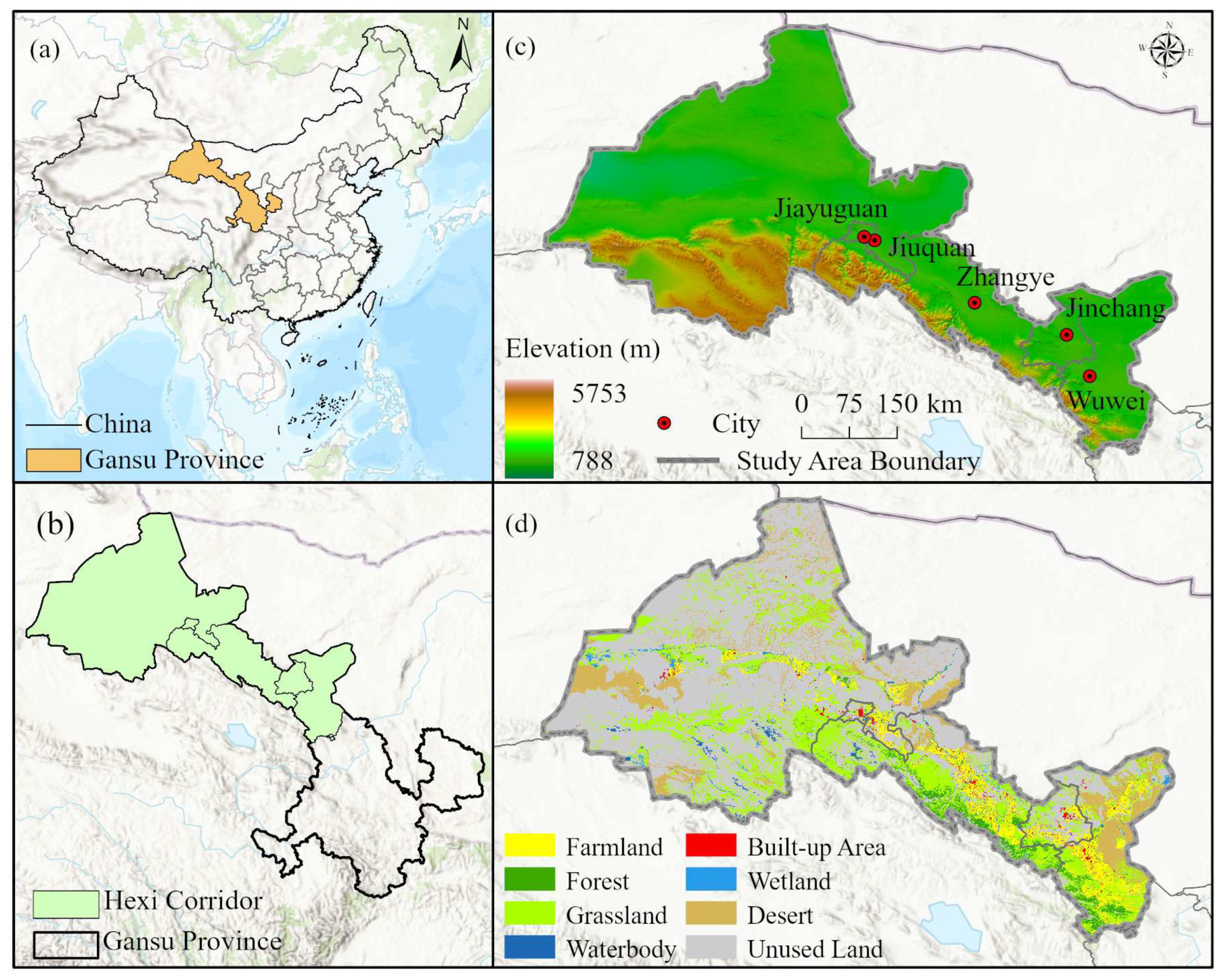
The Hexi Corridor is situated in northwestern Gansu Province (37°15′–41°30′ N, 92°21′–104°45′ E), positioned west of the Yellow River and flanked by the Qilian Mountains to the south and the Badain Jaran Desert to the north. As a vital artery of the Silk Road, the corridor encompasses five prefecture-level cities—Jiuquan, Jiayuguan, Zhangye, Jinchang, and Wuwei—comprising 20 counties. By 2024, the region supported a total population of 4.31 million across an area of approximately 271,000 km2, accounting for half of the total land area of Gansu Province (Figure 1). The topography exhibits significant relief, characterized by northwest-trending mountains and valleys. Specifically, the Qilian Mountains to the south predominantly exceed elevations of 4000 m, while the Mazong Mountains to the north range between 2000 and 2500 m [24]. The region is characterized by an arid to semi-arid continental monsoon climate [25]. Although annual precipitation in most areas remains below 200 mm, the abundant ice and snow meltwater from the Qilian Mountains nourishes the internal drainage systems, forming three independent endorheic basins: the Shiyang River, Heihe River, and Shule River basins.
The regional climate is arid, characterized by sparse precipitation and frequent sandstorms driven by intense aeolian activity [26]. This climatic harshness, coupled with a fragile ecological foundation and acute water scarcity, renders the region highly sensitive to global climate change [27]. In terms of land cover, the Hexi Corridor is dominated by unused land, grassland, and desert [5]. In recent years, catalyzed by rapid socio-economic development, the region has undergone dramatic land-use transitions. The escalating demand for energy consumption and intensive land exploitation has triggered a series of challenges for local ecological stability and carbon emission dynamics.

2.2. Data Sources and Processing

This study utilized a multi-source dataset comprising four primary components: administrative divisions, Land Use/Land Cover (LULC), socioeconomic data, and climate and environmental data (Table 1). The administrative data were used to define the spatial extent of the Hexi Corridor. To perform the core analysis, LULC, socioeconomic, and environmental variables were synergized to quantify LUCE and evaluate LER. Furthermore, these integrated datasets were employed to uncover the underlying driving factors through bivariate spatial autocorrelation and the Optimal Parameters-based Geographical Detector (OPGD) model.
The aforementioned data underwent the following preprocessing steps: (1) LULC Data: The original datasets, with an overall classification accuracy greater than 90%, were reclassified into eight major categories based on land resource attributes: farmland, forest, grassland, waterbody, wetland, built-up area, desert, and unused land. (2) Nighttime Light Data: To maintain temporal consistency, we utilized the improved time-series DMSP-OLS-like dataset (1992–2022) developed by integrating DMSP-OLS and SNPP-VIIRS data [28]. The 1992 imagery was used as a proxy for 1990 due to data availability. (3) Terrain and Distance Factors: Digital Elevation Model (DEM) data were utilized to calculate slopes. Euclidean distances were employed to calculate distances to rivers, canals, reservoirs and lakes, highways, railways, and roads of all levels within the study area. (4) Statistical Data: Energy consumption and socioeconomic data were obtained from Gansu statistical yearbooks to determine carbon emission coefficients and quantify the stress of human activities on carbon emissions and ecological risks. To facilitate the research, all spatial data, including vector and raster layers, were reprojected to the Asia North Albers Equal Area Conic coordinate system using ArcGIS 10.7. Considering the area of the study region and the computational load of the samples, this study divided the Hexi Corridor into grids of 5 km × 5 km using the fishnet tool in ArcGIS 10.7, resulting in a total of 10,395 effective evaluation units.

2.3. Research Methods

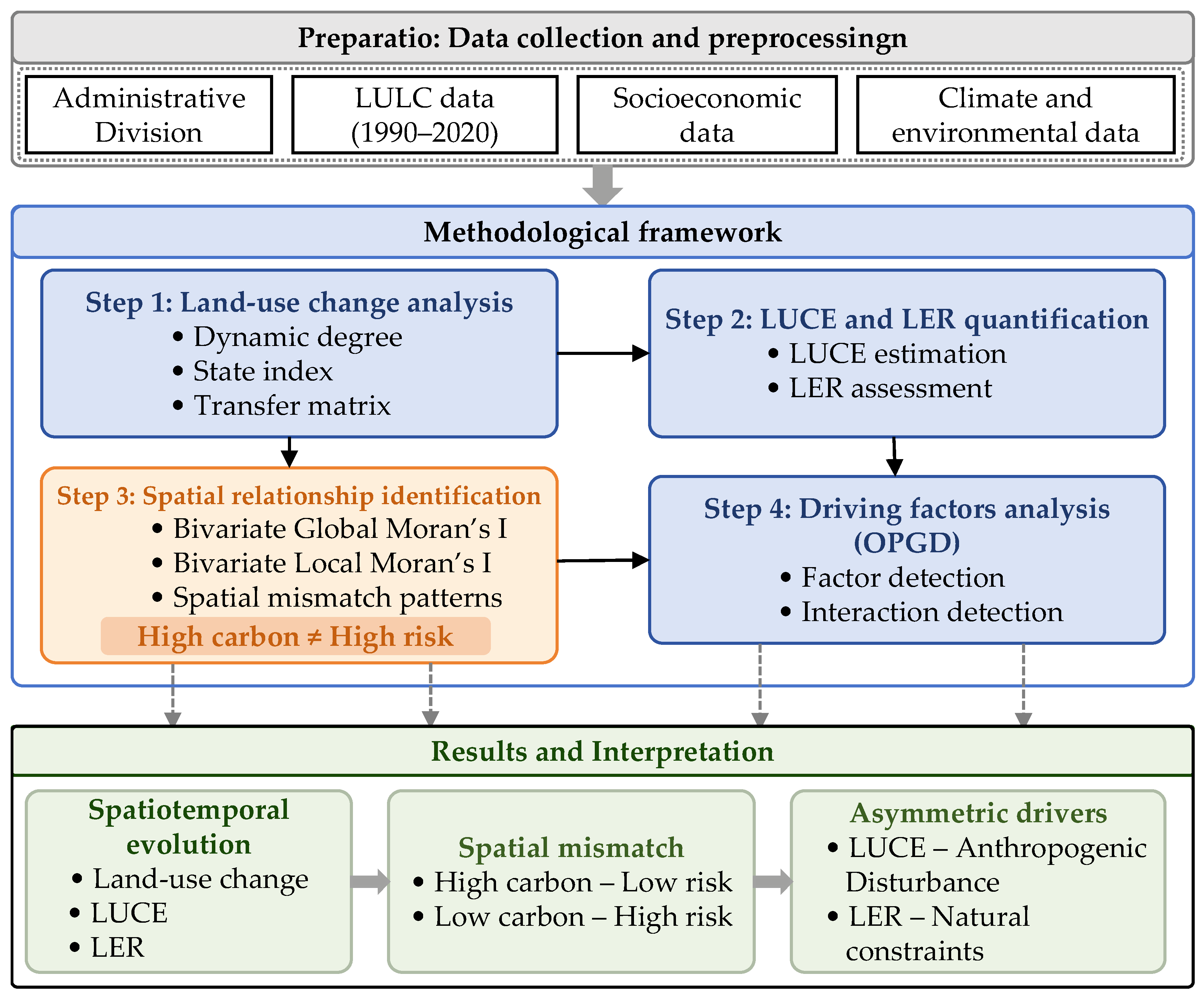
To better address the research objectives, the methodological framework of this study was organized into four interrelated steps, moving from land-use transition to pattern identification and mechanism explanation (Figure 2). First, land-use change analysis was conducted to characterize the spatiotemporal transformation of the regional land system and to provide the basis for subsequent carbon and ecological assessments. Second, LUCE estimation and LER assessment were performed to quantify the carbon effects and ecological consequences of land-use transitions, respectively. Third, bivariate spatial autocorrelation was employed to identify the spatial relationship between LUCE and LER and to determine whether significant spatial mismatch existed between them, with particular attention to local clustering patterns. Finally, the Optimal Parameter Geographic Detector (OPGD) was applied to reveal the driving factors and interaction mechanisms underlying the observed patterns of LUCE, LER, and their mismatch. Through this stepwise procedure, the study integrates land-use transition, carbon dynamics, ecological risk, spatial association, and driving mechanisms into a coherent analytical framework, thereby linking methodological steps with the corresponding results and their interpretation.

2.3.1. Analysis of Land-Use Change

(1)
Land-use Dynamic Degree
The Land-use Dynamic Degree quantitatively describes the magnitude of land-use changes, thereby revealing the intensity of specific land-use transitions within the region. The calculation formula is as follows [29]:
K   =   S end -   S start S start   ×   1 t   ×   100 %
where K represents the dynamic degree of a specific land-use type during the study period; Sstart and Send denote the area of that specific land-use type at the beginning and end of the study period, respectively; and t signifies the time interval of the research.
(2)
Land-use State Index
The Land-use State Index reveals the change trends and operational status of specific land-use types, which is of great significance for measuring the degree of regional land utilization. The calculation formula is as follows [30]:
P   =   Δ S in   -   Δ S out Δ S in   +   Δ S out
where P is the state index of a specific land-use type, with a value range of [−1, 1]; ΔSin represents the total area of other land-use types converted into type i during the study period; and ΔSout denotes the area of type i converted into other land-use types.
(3)
Land-use Transfer Matrix
The analysis of transitions between various land-use types within a specific period is typically conducted using the land use transfer matrix. This model not only identifies the direction and sources of transitions for each land-use type by the end of the study period but also quantifies the numerical characteristics of these shifts, thereby reflecting the overall features of land-use change within the study area. Its mathematical expression is as follows [31]:
S   =     S 11     S 1 n     S 21     S 2 n     S n 1     S nn  
where n represents the total number of land-use types; i and j denote the land-use types at the beginning and the end of the study period, respectively (i, j = 1, 2, …n) and Sij signifies the area of land-use type i converted into type j during the research interval.

2.3.2. Land-Use Carbon Emission Accounting

(1)
Estimation of Carbon Emissions and Sequestration
Land-use carbon emissions are categorized into two components: direct carbon emissions and indirect carbon emissions. The former refers to carbon emissions or sequestration triggered by land-use changes, encompassing cropland, woodland, grassland, water bodies, wetlands, deserts, and unused land. The latter involves the estimation of carbon emissions from built-up land. In this study, the carbon emission coefficient method is employed to calculate direct carbon emissions. Specifically, the total direct carbon emissions are derived by summing the products of the area of each land-use type and its corresponding carbon emission coefficient. The calculation formula is as follows [14]:
C d   = L i = U i δ i
where Cd represents the total direct carbon emissions; Li denotes the carbon emissions generated by the i-th land-use type; Ui is the area of the i-th land-use type; and δi signifies the carbon emission coefficient for each respective the i-th land-use type. Drawing upon existing literature and considering the specific ecological conditions of the study area [32], the carbon emission coefficients for carbon sink categories, namely woodland, grassland, water bodies, wetlands, and unused land, were assigned values of −0.644, −0.021, −0.253, −0.41, and −0.005 t/hm2, respectively. For the carbon source category, the coefficient for cropland was set at 0.422 t/hm2. In contrast, given the extreme sparsity of vegetation in deserts and the negligible emissions from soil respiration, the coefficient for desert areas was treated as zero.
Indirect carbon emission estimation, specifically carbon emissions from built-up land, refers to the emissions generated by human activities during land utilization. These are calculated based on the energy consumption carbon emission measurement method provided by the IPCC Guidelines for National Greenhouse Gas Inventories. The standard coal conversion factors and carbon emission coefficients are detailed in Table 2. Given the difficulty in obtaining energy consumption data at the grid scale, this study adopts the methodology of [33] to indirectly estimate carbon emissions from construction land using nighttime light (NTL) data. To verify the correlation and validity between NTL data and carbon emissions, a linear regression was performed to fit the total NTL brightness values and energy-related carbon emissions in Gansu Province from 1992 to 2020. The fitting results yielded a coefficient of determination (R2 = 0.941) with a significance level of p < 0.05. Consequently, NTL data demonstrate a strong correlation with energy consumption, carbon emissions, and can be reliably used for grid-scale carbon emission measurements in the Hexi Corridor. Based on this, the comprehensive formula for land-use carbon emissions is as follows:
C I   = C n = E n ×   α n ×   β n
where CI represents the carbon emissions from built-up land; Cn denotes the carbon emissions generated by the n-th energy type; En signifies the consumption of the n-th energy type; βn is the standard coal conversion factor for the n energy type; and αn represents the carbon emission coefficient of the n-th energy type.
The formula for net land-use carbon emissions is as follows:
C   =   C d   +   C I
(2)
Land-use Carbon Emission Index
Land-use change affects regional ecosystem stability, which in turn influences regional LER. Drawing upon existing research [34,35], this study develops the LUCE index to evaluate the spatial patterns of carbon emission across each grid in the Hexi Corridor. The LUCE index is determined by the area and the corresponding carbon emission coefficients of various land-use types within each grid. Specifically, a higher LUCE index signifies a greater volume of carbon emissions within the unit grid. The calculation formula is as follows:
CR   = j = 1 n S j K j S
where CR represents the LUCE; Sj and Kj denote the area and the corresponding carbon emission coefficient of the j-th land-use type within the grid, respectively; and S signifies the total land area of the study region.
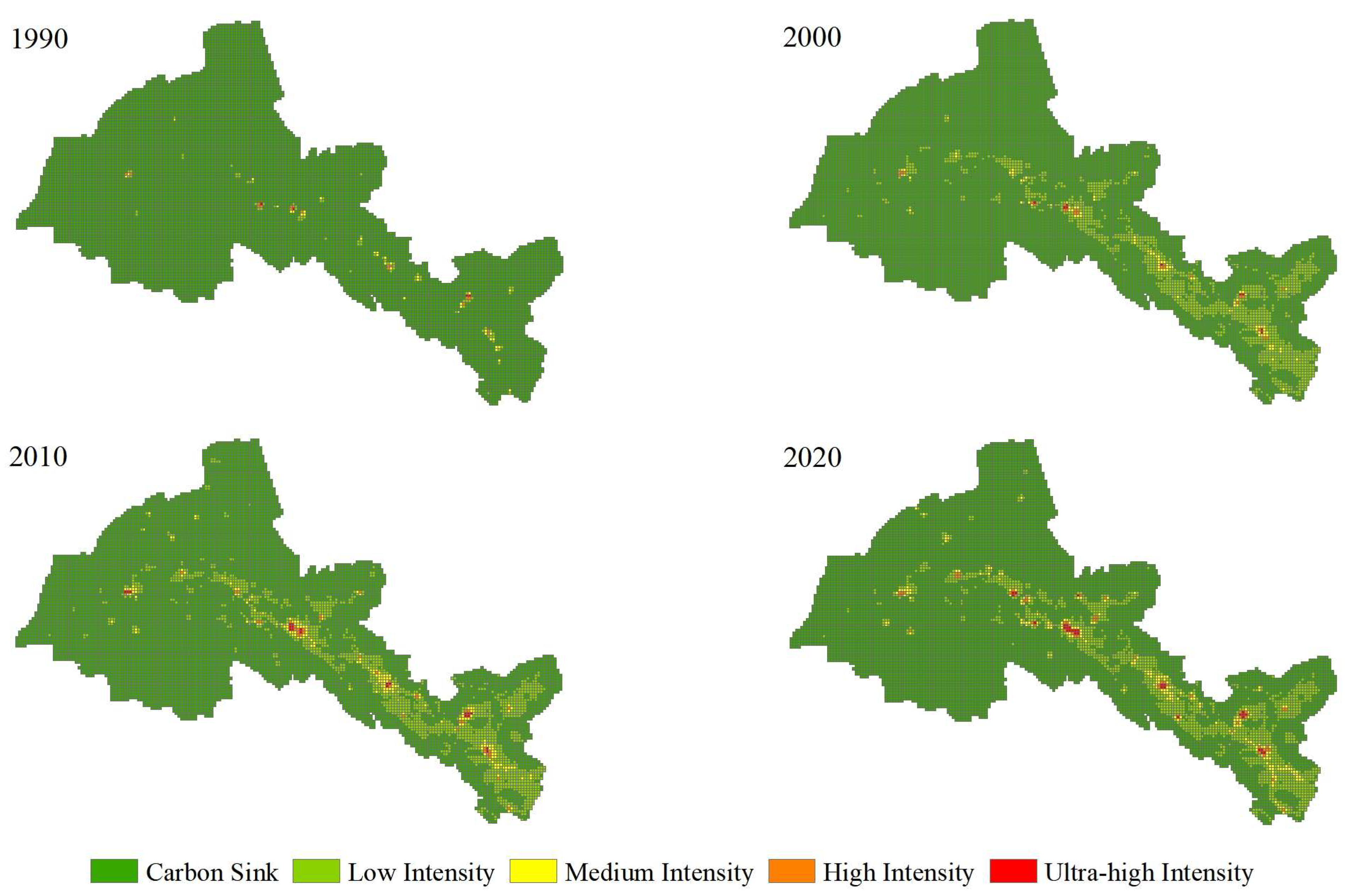
To intuitively reflect the spatiotemporal evolution of LUCE in the Hexi Corridor and ensure the comparability of assessment results across different historical periods, this study moved beyond the traditional independent annual classification approach. Instead, a “unified threshold method for the entire period” was adopted for the spatial visualization of the four-period dataset. Based on the distinct physical attributes of carbon sources and sinks and following the research of [36], the entire region was initially divided into carbon sink areas (CR < 0) and carbon source areas (CR > 0). For the carbon source areas, this study combined the frequency distribution histograms of multi-year data [37] and used the statistical characteristics of the 2020 data as a baseline. Integrating the Natural Breaks (Jenks) method with subsequent rounding treatments, a unified classification standard applicable to all periods was established. Ultimately, the study area was classified into five levels: carbon sink area (<0), low carbon source area (0–5), medium carbon source area (5–20), high carbon source area (20–45), and ultra-high carbon source area (>45). This scheme not only preserves the statistical distribution characteristics of the data but also guarantees the longitudinal comparability of the results across different years.

2.3.3. Landscape Ecological Risk Assessment

(1)
Landscape Unit Partitioning
Landscape patterns exhibit significant spatial heterogeneity; therefore, the scientific partitioning of assessment units is a fundamental prerequisite for conducting landscape ecological risk assessments. According to the principles of landscape ecology, the area of a risk unit should be 2–5 times the average patch area within the study region [38]. Taking into account the scale characteristics and the actual patch distribution in the Hexi Corridor, this study adopted a 5 km × 5 km grid as the assessment unit. Using the Fishnet tool in ArcGIS 10.7, the study area was partitioned into 10,395 risk units. Subsequently, Fragstats 4.2 was employed to calculate the landscape ecological risk index for each risk unit, providing the input data for subsequent spatial interpolation.
(2)
Landscape Ecological Risk Index
LER is evaluated by calculating the Landscape Ecological Risk Index (ERI) for each risk unit. The calculation of ERI is based on the landscape loss index and the proportion of each landscape type. The specific formula is as follows [39,40]:
ERI   = i = 1 n A ki A k R i
where Aki represents the area of land cover type i in the k-th risk unit (in hm2), and Ri is the landscape loss index of land cover type i.
The Landscape Loss Index (Ri) comprehensively reflects the degree of internal attribute loss within a landscape under both natural and anthropogenic disturbances. This index is constructed by the superposition of the Landscape Disturbance Index (Ei) and the Landscape Vulnerability Index (Fi):
R i   =   E i   ×   F i
Drawing upon previous studies and considering the specific ecological context of the Hexi Corridor [41,42], values were assigned to landscape vulnerability and subsequently normalized [43]. Based on the sensitivity of different landscapes, the vulnerability levels were ranked from low to high as follows: built-up area = 1, forest = 2, grassland = 3, farmland = 4, waterbody = 5, wetland = 6, unused land = 7, and desert = 8.
The Landscape Disturbance Index Ei is calculated through a weighted summation of the Landscape Fragmentation Index Ci, the Landscape Isolation Index Ni, and the Landscape Dominance Index Di:
E i   =   a C i   +   b N i   +   c D i
where a, b and c represent the weights of the respective indices, satisfying a + b + c = 1. In this study, the weights for landscape fragmentation, isolation, and dominance were assigned values of 0.5, 0.3, and 0.2, respectively [41,44,45]. The calculation methods for each index are as follows:
C i   =   n i / A i
N i = A 2 A i n i A
D i = Q i M i 4 + L i 2
where Ci, Ni and Di represent landscape fragmentation index, landscape isolation index, and landscape dominance index, respectively; ni is the number of landscape type i; A is the total area of the landscape; Ai is the area of landscape type i; Qi is the ratio of the number of grids of landscape type i to the total number of grids; Mi is the ratio of the number of patches of the landscape type i to the total number of patches; Li is the ratio of the area of the landscape type i to the total grid area.

2.3.4. Bivariate Spatial Autocorrelation

Bivariate spatial autocorrelation is an extension and expansion of existing spatial analysis theories, designed to spatially characterize the degree of clustering and the specific features between different attribute variables. In this study, the Global Moran’s I was employed to examine the spatial relationship and correlation intensity between LUCE and LER in the Hexi Corridor. Meanwhile, the Local Moran’s I was used to reflect the local spatial clustering characteristics of these two variables.
The formula for global bivariate spatial autocorrelation is as follows:
M   =   a = 1 m b = 1 m W ab   ×   ( x a   -   x - )   ×   ( y b   -   y - ) S 2 × a = 1 m b = 1 m W ab
where M represents the bivariate global spatial autocorrelation index; m denotes the total number of grids; Wab is the spatial weight matrix; xa and yb are the observed values of the independent and dependent variables in grid units a and b, respectively; and S2 signifies the sample variance.
The formula for bivariate local spatial autocorrelation is as follows:
M a   =   Z a b = 1 m W ab Z b
where Ma represents the bivariate local Moran’s I; m denotes the total number of grids; Wab is the spatial connectivity matrix; and Za and Zb are the variance-normalized values of the attribute variables for grid units a and b, respectively.

2.3.5. Optimal Parameters Geographic Detector (OPGD)

The Optimal Parameters Geographic Detector (OPGD) was employed to quantitatively analyze the spatial differentiation characteristics of LUCE and LER in the Hexi Corridor, as well as to reveal their underlying driving factors. Compared to the traditional Geographic Detector, OPGD can automatically select the parameter combination with the highest explanatory power by calculating q-values across various discretization methods and classification intervals [46]. Although the OPGD model typically involves the optimization of both spatial scales and factor discretization, this study fixed the spatial analysis scale at 5 km. This decision was made because the 5 km grid was determined as the optimal ecological risk assessment unit based on the average patch area of the study region, thus carrying explicit landscape ecological significance [43]. On this basis, OPGD was utilized to focus on screening the optimal discretization method and the optimal number of intervals for each driving factor to ensure the accuracy of the statistical results. Given the complex coupling characteristics of “water-soil-human” systems in arid oases, and drawing upon research findings from the Hexi Corridor and Northwest China [47,48,49], ten potential driving factors were selected from the dimensions of “natural constraints” and “anthropogenic disturbance” (Table 3).

3. Results

3.1. Spatiotemporal Evolution Characteristics of Land-Use

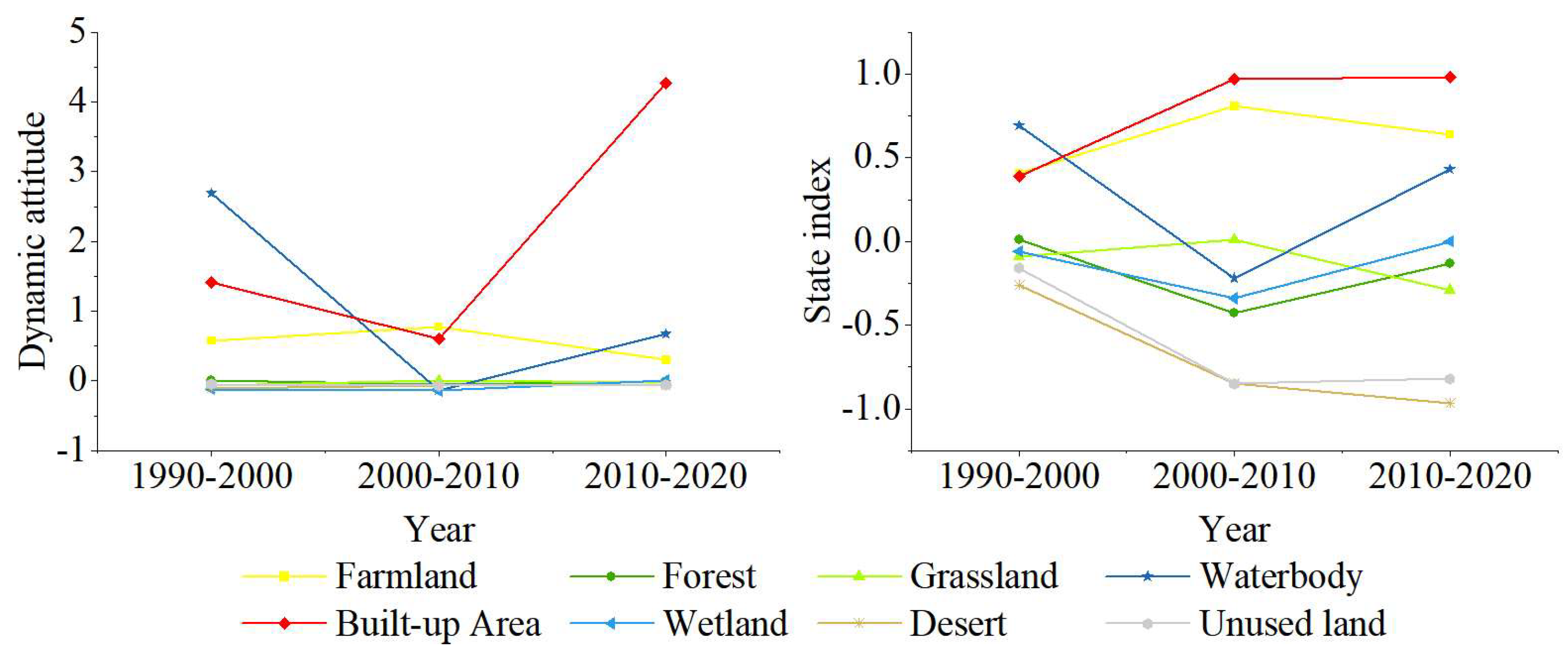
By calculating the land-use dynamic degree and status index, it is evident that land-use changes in the Hexi Corridor over the past 30 years exhibit distinct stage-specific characteristics (Figure 3). From the perspective of dynamic degree, the most dramatic change occurred in built-up areas. Its dynamic degree soared from a low-level operation during 1990–2010 to 4.27 between 2010 and 2020, representing explosive growth and reflecting a significant acceleration of the urbanization process. Waterbodies showed substantial fluctuations in the early stage (with a dynamic degree of 2.69 from 1990 to 2000) and stabilized in later periods despite minor oscillations. In contrast, the dynamic degree of farmland peaked at only 0.78, while that of grassland remained extremely low, ranging from −0.06 to 0.00. Overall, traditional land-use types maintained a slow and steady pace of change.
Combined with the status index analysis, the expansion and contraction trends of various land-use types are clearly demarcated. Built-up areas remained in a state of extreme expansion, with the index continuously climbing from 0.39 to 0.98, identifying it as the primary expansion type in the region. Farmland showed a pronounced expansion trend after 2000, with status indices consistently exceeding 0.60. Conversely, the status indices for desert and unused land continued to decline, reaching lows of −0.97 and −0.82, respectively, reflecting the extensive development and conversion of reserve land resources. Notably, the indices for forest and grassland frequently fell into negative territory (e.g., grassland dropped to −0.29 during 2010–2020), indicating that ecological lands are facing significant pressure from encroachment during the process of construction and expansion. Overall, the study area presents an evolutionary pattern characterized by the “rapid expansion of anthropogenic landscapes and the continuous conversion of natural backgrounds”. This trend provides direct empirical support for the subsequent analysis of increasing carbon emissions and rising landscape ecological risks.
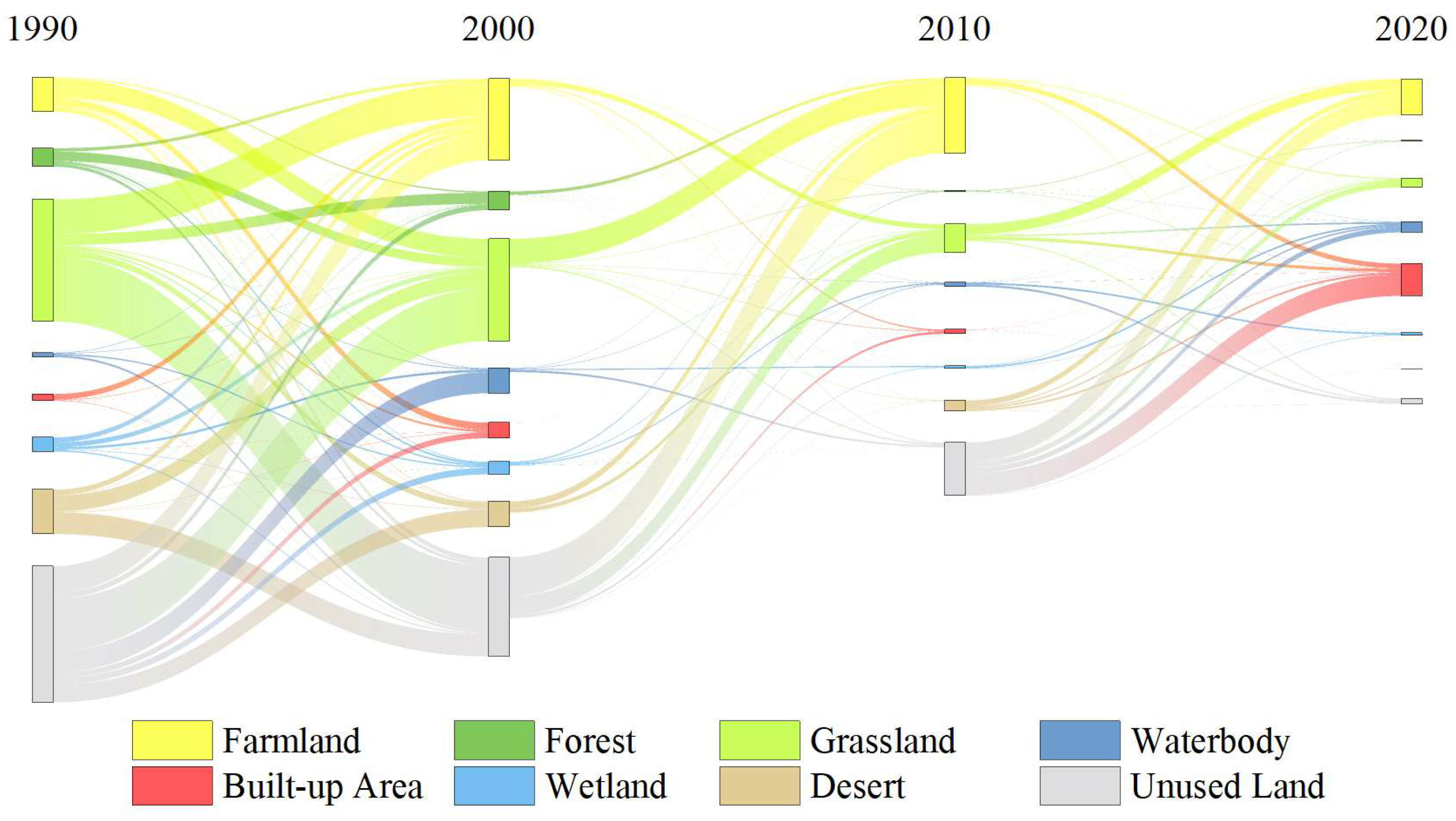
The calculation of the land-use transfer matrix (Table 4, Figure 4) reveals that the land-use structure of the Hexi Corridor underwent significant adjustments between 1990 and 2020. The overall evolutionary trend is characterized by the continuous expansion of anthropogenic land types and a substantial contraction of unused land. Regarding the source–sink characteristics of total volume changes, unused land served as the primary output source of land transfer during this period. Its total transferred-out area reached 3914.96 km2, far exceeding the transferred-in area of 1599.47 km2, indicating a state of intense net loss. In contrast, farmland and built-up areas exhibited typical sink characteristics. Farmland recorded the largest inflow at 3078.46 km2, which is approximately 4.2 times its outflow. Similarly, the transferred-in area of built-up land (849.19 km2) was significantly higher than its outflow. These shifts in source–sink patterns intuitively reflect the high-intensity oasis agricultural development and rapid urbanization processes that have occurred in the region over the past 30 years.
Analysis of the primary land-use transfer paths reveals that the expansion of farmland was achieved mainly through the reclamation of unused land and grassland, which contributed 1356.63 km2 and 1088.98 km2 to the newly added farmland, respectively. This indicates that the growth of agricultural scale relies heavily on the encroachment upon ecological spaces. Simultaneously, grassland and unused land exhibited complex bidirectional replacement characteristics: on one hand, influenced by ecological restoration projects, 1192.30 km2 of unused land was converted into grassland; on the other hand, 1045.95 km2 of grassland degraded back into unused land. This large-scale mutual transformation reveals the fragility of the regional ecological environment, where the effectiveness of ecological governance coexists with the risks of land degradation in both space and time. Furthermore, the area of waterbodies increased, with 404.23 km2 primarily sourced from unused land. This trend may be linked to water resource changes under the background of regional climate warming and humidification. The evolution of built-up areas profoundly reflects the reshaping of land-use patterns by the urbanization process. Data show that the newly added built-up area mainly originated from unused land (477.54 km2) and farmland (212.05 km2), illustrating that urban expansion involves both the development of barren land and the encroachment on surrounding high-quality farmland. From the temporal evolution perspective (Figure 4), the land transfer paths remained relatively stable during 1990–2000 and 2000–2010. However, the Sankey diagram for 2010–2020 displays the most densely interwoven and complex flow lines, with a significant widening of the flows toward built-up areas. This phenomenon indicates that with the acceleration of regional socio-economic development over the last decade, the intensity and activity of land-use transition reached their peak, further enhancing the role of anthropogenic activities in shaping the surface landscape.

3.2. Spatiotemporal Evolution of LUCE

3.2.1. Spatiotemporal Patterns of Carbon Sources and Sinks

Combined with the analysis of the LUCE accounting table (Table 5), the net LUCE in the Hexi Corridor exhibited a sharp upward trend from 1990 to 2020. Net emissions surged from 2.81 million tonnes to 15.87 million tonnes, indicating that the region is currently in a high-risk expansion phase. Regarding the composition and dynamic relationship between carbon sources and sinks, the study area demonstrates a significant asymmetrical feature characterized by “strong sources and weak sinks”. As the core carbon source, built-up area saw its emissions climb from 3.03 million tonnes to 15.99 million tonnes, a growth of approximately 4.2 times. It serves as the absolute dominant driver for the expanding regional carbon deficit, primarily attributed to the accelerated urbanization process and the rigid growth of industrial energy consumption in the Hexi Corridor. Although carbon emissions from farmland increased slightly, its contribution to total emissions was gradually diluted by built-up land.
In contrast, the carbon sink system exhibited a pronounced “lock-in effect” and high stability. The total carbon sequestration of various sink types (forest, grassland, waterbody, and wetland) remained consistently around −0.78 million tonnes over the 30-year period, with minimal fluctuations. This indicates that under the constraints of the fragile ecological background in arid regions, the carbon sequestration increments from forest and grass ecological construction are far from sufficient to offset the explosive growth of carbon sources triggered by the disordered expansion of built-up area. Consequently, the “scissors gap” between carbon sources and sinks continues to widen, posing severe challenges to the carbon balance capacity of the regional ecosystem.

3.2.2. Analysis of Spatiotemporal Evolution of LUCE

From the dimension of temporal evolution (Table 6), the LUCE in the study area underwent a rapid transition from “low emission, high security” to “high emission, high risk” between 1990 and 2020. In 1990, the vast majority of the Hexi Corridor was classified as carbon sink areas, covering an area of 244,030 km2 (98.63%), highlighting its significant role as an ecological security barrier. However, with the implementation of the Western Development Strategy and the advancement of urbanization, the spatial extent of carbon sink areas was markedly squeezed, shrinking to 204,523 km2 (82.66%) by 2020. Simultaneously, the area of ultra-high carbon source zones surged from 100 km2 (0.04%) in 1990 to 775 km2 (0.31%) in 2020, a nearly seven-fold increase. The area of high carbon source zones also climbed from 425 km2 to 1425 km2. Notably, between 2000 and 2010, the extent of ultra-high carbon source zones more than doubled (increasing from 225 km2 to 525 km2). This expansion rate aligns closely with the abrupt change period observed in built-up land carbon emission data in Table 5. This correlation suggests that high-intensity land development activities during this period significantly reshaped the regional carbon emission baseline, subjecting the originally fragile arid oasis environment to continuously intensifying carbon stress.
From the dimension of spatial distribution (Figure 5), the LUCE in the Hexi Corridor exhibits a typical pattern of “oasis clustering and point-axis diffusion”, along with a distinct “center-periphery” zonal structure. High-risk areas do not spread uniformly but are highly concentrated within oases with relatively superior water and soil resources. These areas are distributed in a bead-like fashion along the Northwest-Southeast geographical and transportation axis connecting Wuwei, Jinchang, Zhangye, Jiuquan, and Jiayuguan. The built-up areas of various oasis cities, as the most intensive zones of construction land, form “heat island” cores of high carbon emissions. These transition outward into low-to-medium risk rings dominated by farmland, while the vast peripheral deserts, forests, and grasslands constitute the low-carbon background matrix. This spatial differentiation profoundly reveals that human interference with the carbon cycle in the Hexi Corridor is highly space-selective. The high degree of overlap between high-risk areas and urbanization development axes suggests that future low-carbon governance in this region should focus on spatial structure optimization and the intensive utilization of oasis urban nodes.

3.3. Analysis of Spatiotemporal Evolution of LER

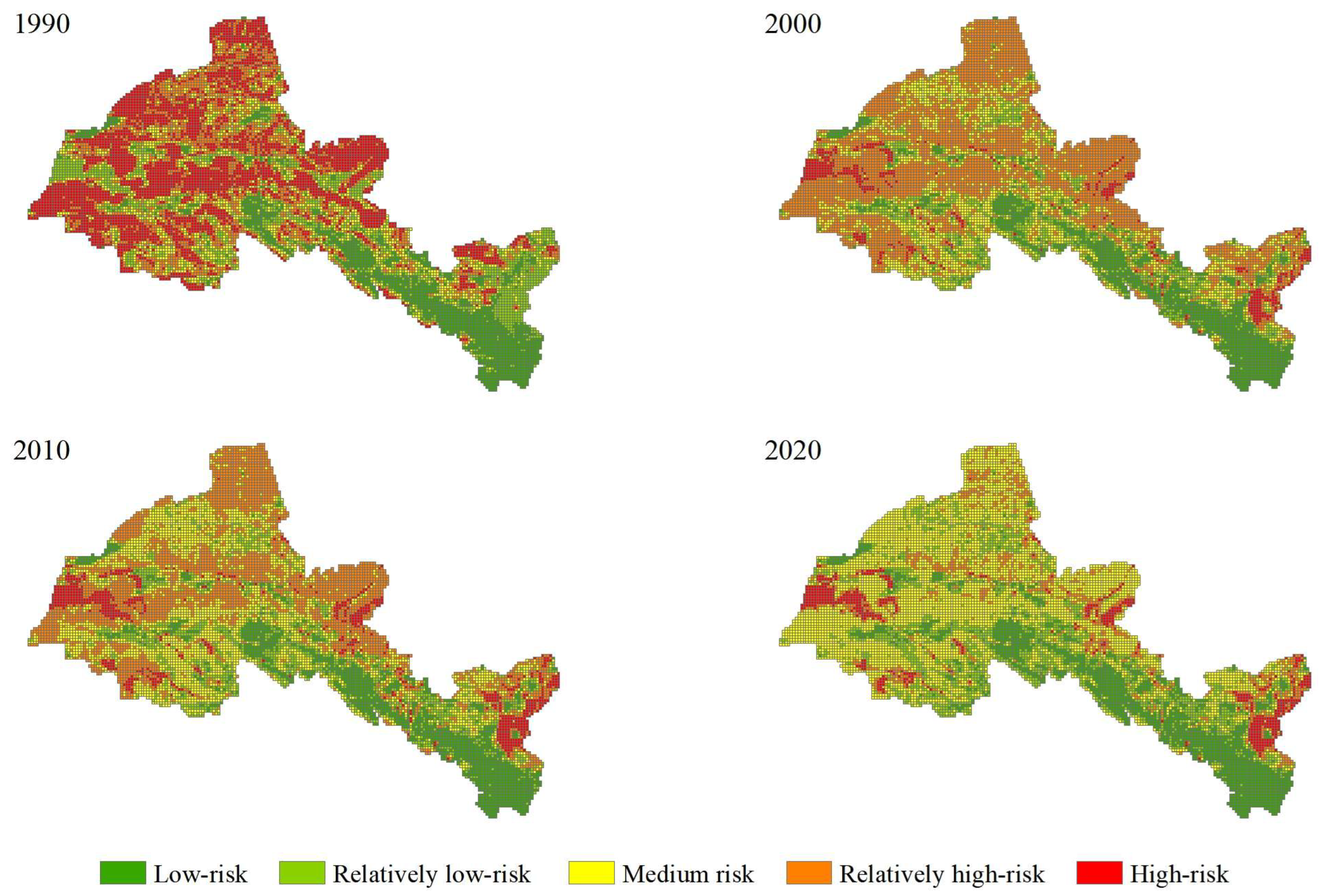
From the temporal dimension (Table 7), the structure of LER in the Hexi Corridor underwent significant reorganization from 1990 to 2020, generally characterized by a transition from high-level risk toward medium- and low-level risk. The area proportions of low and lower ecological risk zones exhibited a fluctuating upward trend, increasing from 15.02% and 15.94% to 17.43% and 20.14%, respectively, indicating a gradual improvement in the quality of the regional ecological background. The area of high ecological risk zones showed a pronounced inverted “U-shaped” change: its proportion was 20.25% in 1990, surged to a peak of 44.65% in 2000, and subsequently fell back rapidly to 10.96% by 2020. The proportion of medium ecological risk zones maintained a continuous and substantial upward trend, climbing from 14.57% to 45.45%, thereby replacing high-risk zones as the dominant risk type in the study area. Conversely, the proportion of higher ecological risk zones showed a continuous decline, dropping from 34.22% to 6.06%. This evolution suggests that with the construction of the national ecological security barrier and the implementation of relevant ecological restoration policies, extremely fragile high-risk patches within the region have been effectively curtailed. Consequently, ecological pressure has transitioned from intense fluctuations toward a more stable state of moderate intensity.
From the perspective of the spatial distribution of LER (Figure 6), the Hexi Corridor exhibits a significant “low in the south and high in the north” zonal differentiation pattern, with the northern foothills of the Qilian Mountains and the oasis heartland serving as the boundary. Low and relatively low ecological risk zones are the primary sources of regional ecological security. Their spatial distribution is relatively stable, highly concentrated in the water conservation area of the southern Qilian Mountains, and shows a trend of penetrating toward the northern oasis margins. High and relatively high ecological risk zones were extensively distributed in the desert areas and oasis-margin ecotones of the central and western corridor during the early period (1990–2000). Their spatial pattern was characterized by “continuous patch” coverage, showing a trend of region-wide diffusion particularly in 2000. Medium ecological risk zones rapidly filled the spaces vacated by the receding high-risk zones in the later period (2010–2020). These are mainly distributed in the oasis agricultural areas of the central corridor and the transition zones of unused land, forming a buffer zone connecting the southern ecological barrier with the northern desert matrix.

3.4. Spatial Correlation Analysis Between LUCE and LER

3.4.1. Bivariate Global Spatial Autocorrelation Analysis

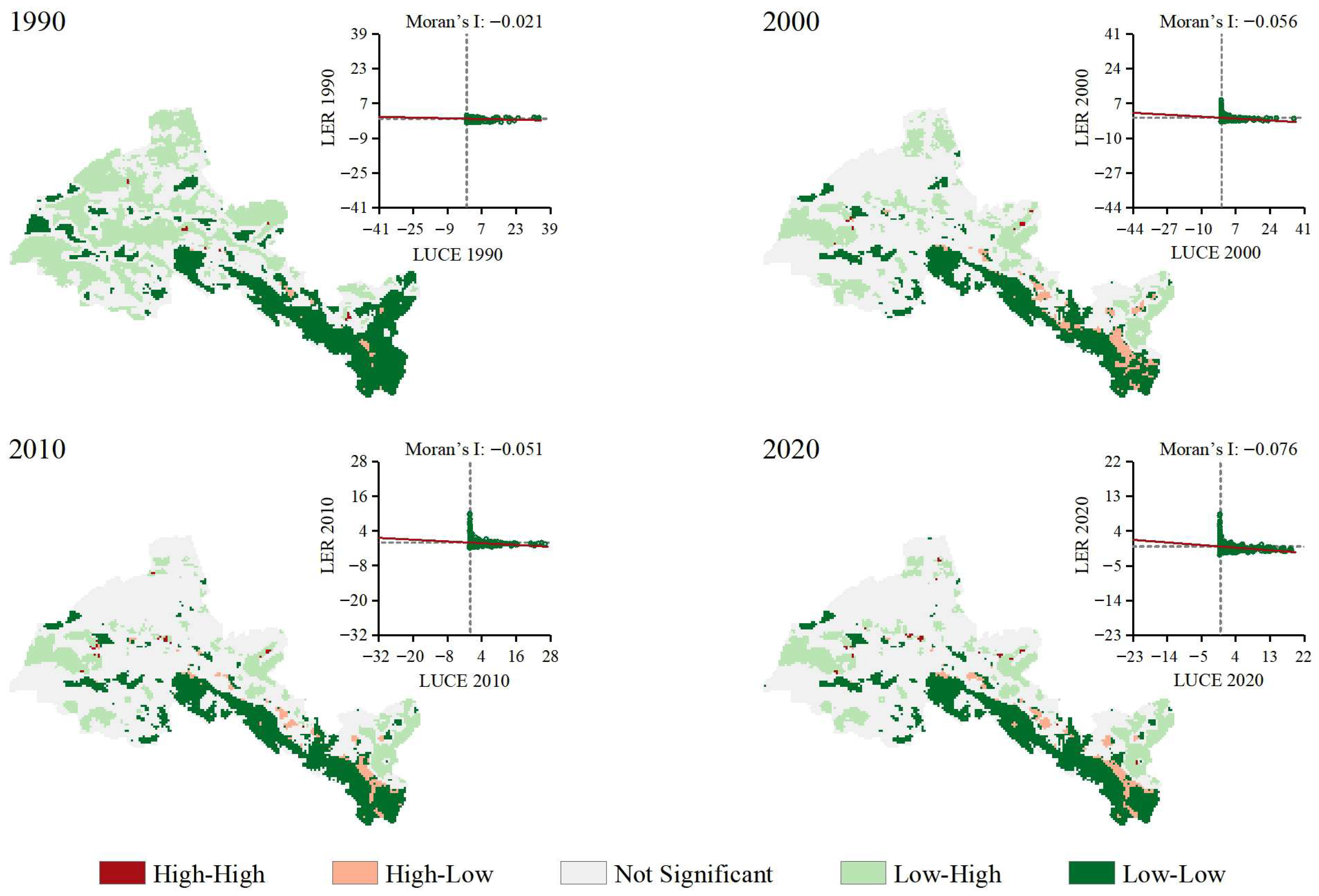
To reveal the overall spatial correlation between LUCE and LER, the bivariate global Moran’s I for both variables from 1990 to 2020 was calculated using GeoDa software 1.20. The results show that the Global Moran’s I indices for 1990, 2000, 2010, and 2020 were −0.021, −0.056, −0.051, and −0.076, respectively. All indices passed the significance test at the 1% level (p < 0.01), indicating a significant negative spatial correlation between LUCE and LER in the Hexi Corridor.
From the perspective of temporal evolution, the absolute value of the Moran’s I index exhibited a fluctuating upward trend (increasing from 0.021 to 0.076). This indicates that the negative spatial correlation between the two variables gradually strengthened over time, with the spatial clustering effect becoming increasingly pronounced. However, overall, the absolute values of the global correlation coefficients remained below 0.1, suggesting a weak linear relationship and the presence of significant spatial heterogeneity. Consequently, further analysis using local spatial autocorrelation is required to reveal the specific characteristics of their local spatial mismatch.

3.4.2. Bivariate Local Spatial Autocorrelation Analysis

Based on the LISA cluster maps (Figure 7), the local spatial correlation patterns between LUCE and LER were further explored. It can be observed that between 1990 and 2020, the spatial correlation pattern of these two variables in the Hexi Corridor exhibited significant characteristics of “north–south differentiation and oasis clustering”. Furthermore, as time progressed, the spatial lock-in effect became increasingly pronounced.
The Low-Low (L-L) clusters are stably distributed in the water conservation areas of the southern Qilian Mountains and high-altitude mountainous regions. As the “ecological security barrier” of the Hexi Corridor, this region is dominated by forestland, high-coverage grassland, and permanent ice and snow. Due to the dual constraints of rugged topography and natural reserve policies, industrial and mining construction activities are extremely minimal, maintaining carbon emission intensity at a low level. Simultaneously, the ecosystem possesses a complete structure, high landscape connectivity, and strong resistance to disturbance, thereby forming a significant synergy zone of low LUCE and low LER.
The High-Low (H-L) clusters are concentrated in the bead-like oasis urban belt in the central corridor, including core urban districts such as Liangzhou, Ganzhou, and Suzhou. The spatial distribution of this region highly coincides with that of cropland and built-up area. Since 2000, driven by the Western Development Strategy, the processes of urbanization and industrialization within the oases have accelerated. The resulting surge in energy consumption has led to a sharp increase in carbon emission intensity. However, from a landscape ecology perspective, artificially managed oasis agricultural systems and hardened urban construction land possess extremely high landscape stability, effectively blocking the natural encroachment of desertification. Consequently, this region exhibits a distinctive spatial mismatch characterized by “high carbon emissions and low ecological risk”, representing the most intensive coupling between human activities and the natural environment in the Hexi Corridor.
The Low-High (L-H) clusters are primarily distributed in the peripheral areas surrounding oases and the desert–Gobi regions at the fringes of the Tengger and Badain Jaran Deserts in the north. The land-use types in these regions are dominated by unused land, sandy land, and degraded grassland. Although the lack of industrial carbon source inputs maintains carbon emissions at low levels, these areas are characterized by severe water scarcity, extremely low vegetation coverage, and intense landscape fragmentation. Located at the frontline of desertification expansion, these regions exhibit high ecological sensitivity, making them typical high-ecological-risk zones under a low-carbon background. Consequently, these areas represent the most challenging regions for ecological governance within the Hexi Corridor.
The High-High (H-H) clusters exhibited a sporadic and scattered distribution during the study period, without forming large-scale contiguous areas. These patches primarily correspond to independent industrial and mining areas or heavy industrial nodes of resource-based cities located at the oasis margins. High-intensity resource extraction activities not only generate substantial carbon emissions but also severely disturb the originally fragile desert-oasis ecotones. This has led to a sharp increase in local landscape fragmentation, forming conflict hotspots characterized by the dual stress of both high LUCE and high LER.

3.5. Driving Factors for the Evolution of LUCE and LER

The Optimal Parameters Geographic Detector (OPGD) was utilized to quantitatively identify the driving factors for LUCE and LER, respectively. The results indicate that the driving factors for the two variables differ significantly, exhibiting a typical characteristic where “LUCE is dominated by anthropogenic factors, while LER is constrained by the natural background”.

3.5.1. Factor Detection Results

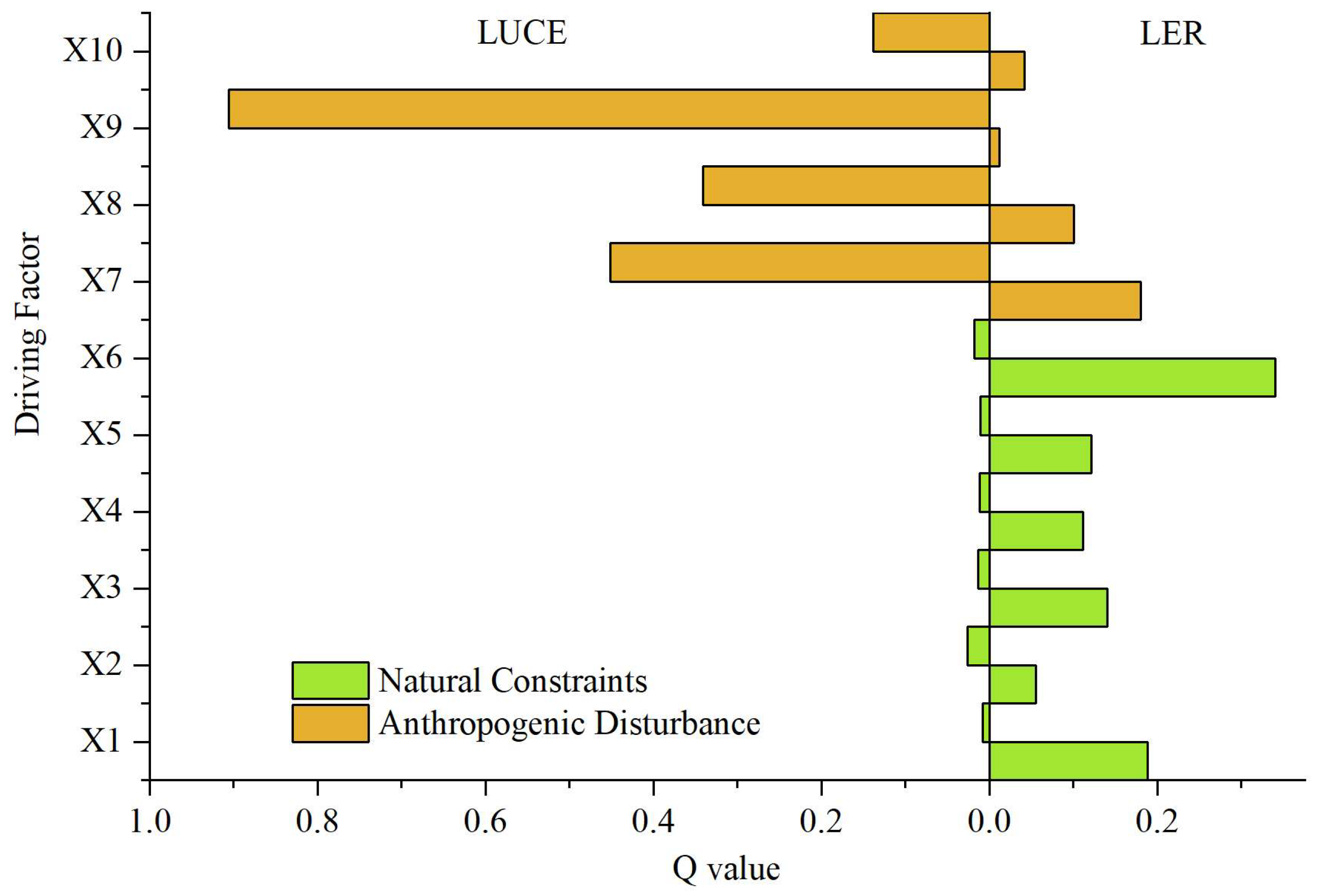
From the factor detection results (Table 8), a significant disparity exists between the driving factors of LUCE and LER in the Hexi Corridor. Overall, these factors exhibit a characteristic where “LUCE are dominated by socio-economic factors, while LER is constrained by the natural background” (Figure 8). This asymmetry of driving forces serves as the underlying cause for the spatial “mismatch” observed between the patterns of LUCE and LER within the region.
Regarding LUCE, socio-economic factors exhibited exceptionally strong explanatory power. The nighttime light index (X9) maintained a q-value consistently above 0.90 across all four study years, serving as the absolute dominant factor for the spatial differentiation of regional carbon emissions. This intuitively reflects the powerful influence of urbanization construction and human nocturnal economic activities on energy consumption. Meanwhile, population density (X7) and GDP density (X8) showed high contribution rates prior to 2010. Although their influence slightly declined in the later period due to industrial transformation, they remained crucial factors supporting the growth of carbon emissions. Furthermore, the distance to roads (X10) also demonstrated a certain driving effect on carbon emissions. This confirms the previously mentioned evolution trend where high-risk carbon emission zones exhibit “point-axis diffusion” along major transportation corridors.
Regarding LER, the driving force structure is more complex and is primarily constrained by vegetation levels and the natural environment. The NDVI (X6) had a multi-year average q-value of 0.34, ranking first among all factors. This indicates that in arid and semi-arid regions, vegetation status is the core variable determining landscape stability and resistance to disturbance. Among the natural factors, the explanatory power of precipitation (X1), altitude (X3), and temperature (X5) followed closely and remained relatively stable, constituting the natural background for the spatial distribution of regional landscape ecological risk. Notably, the driving force of population density (X7) on landscape ecological risk decreased from 0.29 in 1990 to 0.12 in 2020. This shift reflects that with the implementation of ecological restoration projects in recent years, the negative disturbances of human activities on the surface landscape are being gradually controlled. The evolution of LER is transitioning from early anthropogenic interference back toward natural regulation.

3.5.2. Interaction Detection of Driving Factors

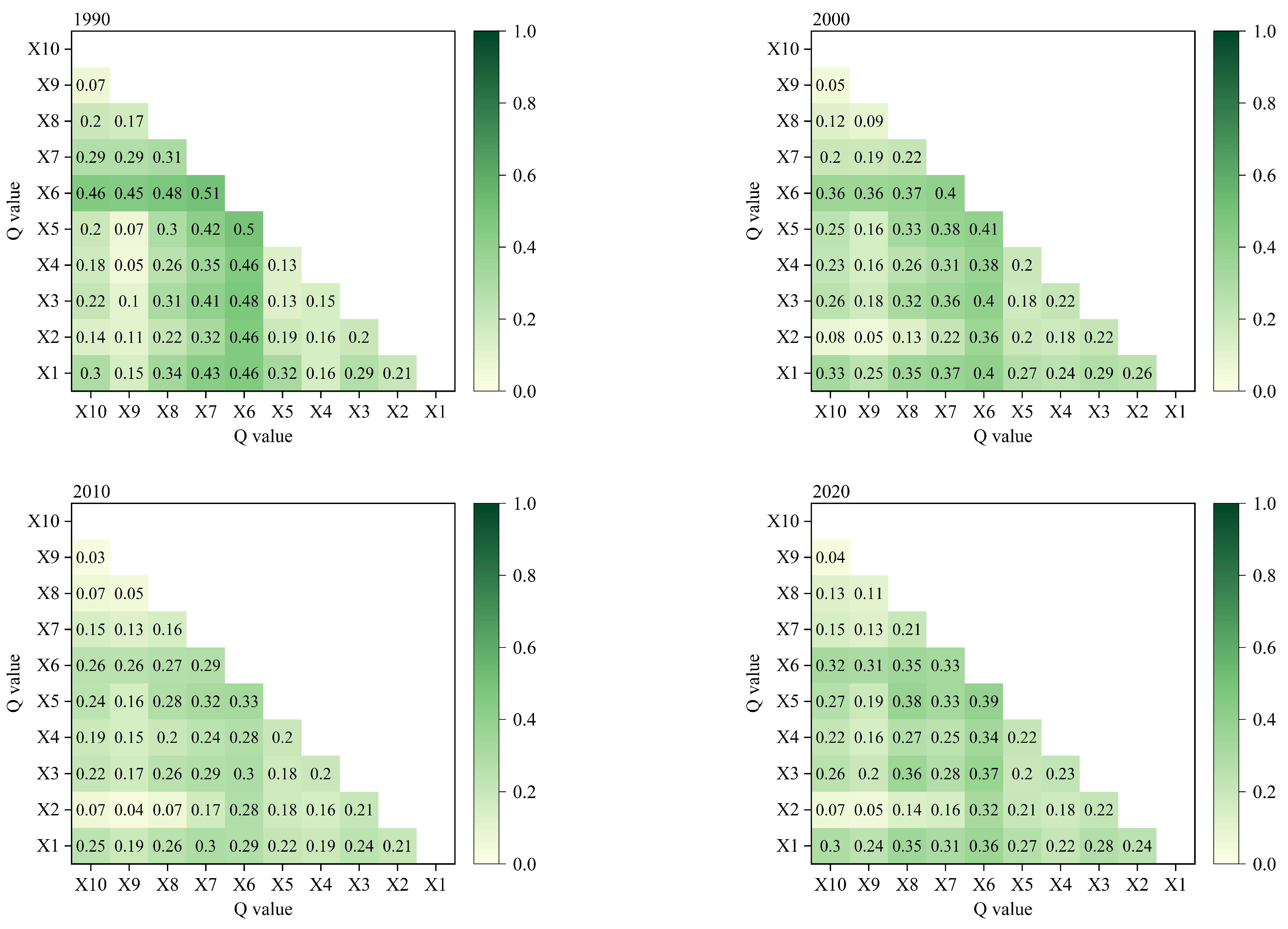
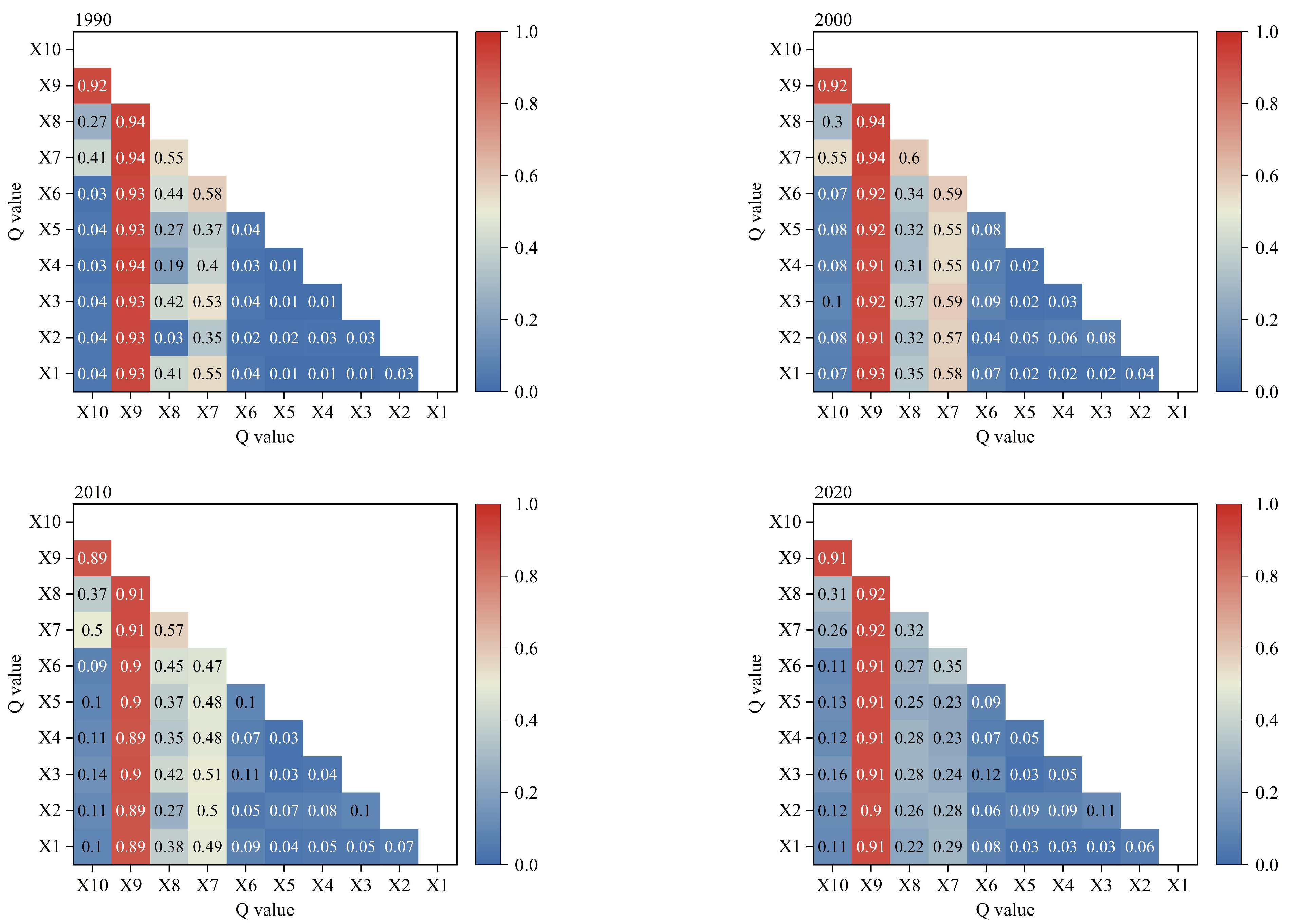
To further reveal the synergistic effects among various driving factors, the interaction detector was employed to analyze the impact of different factor combinations on LUCE (Figure 9) and LER (Figure 10). The results demonstrate that the explanatory power of any two interacting factors was greater than that of a single factor. The types of interaction were predominantly characterized by bivariate enhancement and nonlinear enhancement. These findings indicate that the evolution of the human-environment relationship in the Hexi Corridor is not a linear superposition of individual factors but rather the result of the collective drive of multiple factors.
Regarding LUCE, socio-economic factors exhibited exceptionally strong synergistic effects. The q-values of the nighttime light index (X9) after interacting with other factors were all above 0.90, maintaining its absolute dominant position. This indicates that regardless of the natural background conditions, the intensity of human activity remains the core determinant of the spatial pattern of carbon emissions. Notably, the explanatory power of population density (X7) and GDP density (X8) significantly improved after interaction, predominantly exhibiting nonlinear enhancement. This suggests that the coupling process of population aggregation and economic development significantly amplifies the carbon emission pressure generated by energy consumption. Furthermore, although the single-factor explanatory power of natural factors such as precipitation (X1) was extremely low, their q-values slightly increased when combined with social factors like nighttime lights. This reflects that oases with superior water and soil resources, due to their higher capacity to carry high-intensity human activities, frequently become areas of highly concentrated carbon emissions.
Regarding LER, natural constraints and anthropogenic disturbances exhibit complex intertwined effects. The interaction q-values between NDVI (X6) and other natural factors (such as precipitation X1 and altitude X3) remained consistently high (above 0.40), indicating that vegetation status and the climatic background together form the foundation of landscape stability. Notably, around 2000, the interaction explanatory power between population density (X7) and NDVI (X6) was particularly strong. This reflects the intense disturbance of human activities on surface landscape reshaping during the oasis expansion process of that period. Over time, the interaction detection in 2020 revealed that the synergistic effects between natural factors have become increasingly prominent. The combination of precipitation, temperature, and altitude effectively explains the zonal patterns of LER. This further confirms that while human activities have altered local landscape patterns, the ecological vulnerability of the Hexi Corridor remains profoundly under the comprehensive constraints of the natural background on a macro scale.
The results from the OPGD provide deeper insights into the interactions between anthropogenic and natural factors in shaping LUCE and LER spatial patterns. For example, high nighttime light intensity (X9) and low NDVI (X6) in urbanized oasis areas lead to high LUCE and low LER clustering, highlighting the complex socio-ecological dynamics in arid regions where urban development and environmental degradation coexist. The OPGD results confirm that LUCE is primarily driven by human-induced factors, such as nighttime light, while LER is more strongly influenced by natural conditions, particularly NDVI. This interaction underscores the non-linear relationship between LUCE and LER, further explaining the spatial mismatch observed in the Hexi Corridor.
Additionally, the interaction between anthropogenic factors, such as population density (X7) and GDP (X8), and natural factors like NDVI and precipitation (X1), reveals how human activities and natural conditions jointly shape landscape patterns. This finding highlights that LUCE and LER should not be viewed in isolation but as the result of the interaction between human activities and natural constraints.

4. Discussion

4.1. Mechanism and Explanation of the Carbon Sink “Ceiling Effect” Under Water Resource Constraints

The research results indicate that despite the implementation of large-scale ecological restoration in the Hexi Corridor from 1990 to 2020, the total carbon sequestration of forest and grassland remained consistently at approximately −0.78 million tonnes, without the expected growth. This phenomenon profoundly reveals the water resource threshold effect of ecosystems in arid regions. In the Hexi Corridor, vegetation coverage and carbon sequestration potential are strictly limited by precipitation and the total amount of available water resources. This is highly consistent with the conclusions of [50], who argued that the effectiveness of ecological construction in Northwest arid regions is strongly constrained by water resource carrying capacity.
Unlike humid regions with sufficient heat and water, indiscriminate afforestation in arid areas may trigger conflicts in ecological water consumption. Neglecting the balance of water resources in favor of excessive “greening” may instead weaken the stability of the ecosystem [51]. Furthermore, a study by Wu et al. [52] on China’s carbon sequestration carrying capacity (CSCC) over the past 40 years pointed out that the carbon sequestration potential in Northwest arid and semi-arid regions has approached saturation, and the sequestration rate is entering a “plateau period”. This further corroborates the rationality of the stable trend in carbon sinks observed in this study. He et al. [53] also found in remote sensing monitoring of typical arid regions that although vegetation contributes to carbon sequestration, the maintenance of carbon balance is extremely dependent on ecological stability supported by water resources, especially against the backdrop of surging energy emissions. From the perspective of climate response, terrestrial vegetation carbon sinks in Northwest China exhibit much higher sensitivity to precipitation than to other factors; fluctuations in moisture directly determine the surplus or deficit of the carbon pool [54]. Therefore, the trend of carbon sinks in this study conforms to the natural law of “determining greening based on water availability”, indicating that relying solely on expanding green spaces is insufficient to offset the explosive growth of carbon emissions from built-up areas.

4.2. “Carbon Lock-In” and Spatial Mismatch Driven by Oasis Urbanization

While natural backgrounds limit the growth of carbon sinks, the concentration of human activities further reshapes the regional carbon risk pattern. Spatial detection results indicate that the nighttime light index (X9) possesses exceptionally high explanatory power for carbon emissions (q > 0.90). This growth model, which is highly dependent on oases, has formed a significant “carbon lock-in” effect: due to the high concentration of population and industries within the narrow oases of the Hexi Corridor, urbanization exhibits distinct characteristics of spatial intensification and “point-axis diffusion” [55]. This pattern leads to a high aggregation of resource elements within specific spaces. As Liu and Zhu [56] pointed out in their research on carbon emission constraints, when urban growth is highly dependent on existing energy structures and spatial forms, it creates a significant path dependency, resulting in a “carbon lock-in” state that is difficult to break.
Simultaneously, artificial irrigation and greening management have enhanced the landscape stability within the oases, creating a spatial mismatch characterized by “high LUCE and low LER”. This pattern should not be understood as a contradiction, but rather as a reflection of the different dimensions captured by LUCE and LER. LUCE mainly measures the carbon pressure associated with land development intensity, energy consumption, and human activities, whereas LER primarily reflects the structural stability and vulnerability of landscape patterns. In arid oasis systems such as the Hexi Corridor, these two processes are not necessarily synchronized. Specifically, oasis urban areas concentrate population, industry, transport infrastructure, and energy use, which leads to high LUCE. However, these same areas are also characterized by relatively compact and stable land-use structures dominated by built-up land and managed farmland. Artificial irrigation, greening projects, shelterbelt systems, and long-term land engineering can reduce landscape fragmentation and enhance local landscape stability. As a consequence, although carbon emissions are high, the ecological risk reflected by landscape pattern metrics may remain comparatively low.
This pattern does not necessarily imply that oasis urban areas are ecologically “better” in an absolute sense. Rather, it indicates that the ecological risks captured by LER differ from carbon pressures in both process and spatial expression. In contrast to oasis interiors, the desert margins and oasis–desert ecotones of the Hexi Corridor are more strongly constrained by water scarcity, vegetation degradation, and desertification dynamics. These areas may have relatively low carbon emissions due to limited human activity, but they are highly vulnerable in terms of landscape integrity and ecological sensitivity, thereby forming the contrasting “low carbon–high risk” pattern. Therefore, the LUCE–LER mismatch reflects a non-synchronous human–environment response in arid regions: the oasis interior tends to accumulate carbon emissions under intensive development, while the ecological frontier bears a disproportionate risk burden under fragile natural constraints.
Lan et al. [47] confirmed in their study of the Hexi Corridor that socio-economic factors play a dominant role in contributing to LER. However, this landscape stability maintained by human intervention is potentially vulnerable. The latest research by Pei et al. [57] on the Hexi Corridor indicates a severe mismatch between the high-intensity emissions of socio-economic systems and the low-risk appearance of landscape systems within the “nature–society–landscape” coupling system. The observed spatial mismatch between LUCE and LER reflects the complex trade-offs in regional development. This aligns with findings by Liu et al. [58], who emphasize that synergistic development in China must navigate the inherent conflicts between economic growth and environmental constraints. To some extent, this mismatch is also influenced by the difference in indicator construction and grid-based representation, because LUCE emphasizes emission intensity, whereas LER emphasizes landscape structure. Nevertheless, the persistent oasis–margin differentiation observed in both the spatial autocorrelation results and driver analysis suggests that the mismatch primarily reflects a real process of coupled yet uneven socio-ecological transformation rather than a simple scale artifact. If this high-density carbon stress is ignored, simple expansion of green spaces may mask potential systemic degradation crises.

4.3. Response of Landscape Pattern Evolution to Climate Warming, Humidification, and Anthropogenic Interference

Beyond socio-economic driving forces, the background of climate warming and humidification has also profoundly influenced the stability of landscape patterns. This study found that the interaction explanatory power of NDVI (X6) and precipitation (X1) on landscape ecological risk significantly strengthened after 2010. This aligns with the findings of Jia et al. [59], who suggested that vegetation greening in the Northwest arid regions exhibits a significant feedback mechanism in response to precipitation. Such shifts in water-use efficiency have enhanced the buffering effect of vegetation on landscape stability.
However, while increased precipitation has improved landscape connectivity to some extent, it may also accelerate landscape fragmentation due to the expansion of human activities into peripheral areas. Research by Zhang et al. [60] indicated that land-use changes along the Silk Road Economic Belt exhibit strong policy responsiveness. Monitoring by Nie et al. [5] specifically for the Hexi Corridor further confirmed that with the delineation of ecological red lines and the implementation of national strategies, the driving force of human interference on risk is transitioning toward a stable state of moderate intensity. This has caused the proportion of LER to exhibit a pronounced inverted “U-shaped” downward trend. The reshaping of this pattern not only reflects the positive outcomes of ecological engineering but also reveals the active synergistic effect between artificial intervention and climate warming and humidification in reconstructing the landscape patterns of arid regions [61].

4.4. Differentiated Low-Carbon Governance Paths Under the Background of “Source–Sink Asymmetry”

Based on the aforementioned “source–sink asymmetry” (where carbon sinks can neutralize less than 5% of net emissions), the focus of regional carbon balance must undergo a strategic shift from “expanding green space to increase sinks” to “source-based emission control”. Effective land-use policy must account for the indirect impacts of urban expansion. As suggested by Liu et al. [62] in Land Use Policy, understanding the characteristics and key drivers of urban land flows is essential for optimizing territorial space and achieving carbon neutrality goals. Given this situation, future efforts should reference the Urban Growth Boundary (UGB) delineation strategies for Chinese arid oases proposed by Gong et al. [63] to scientifically define urban expansion limits and prevent LUCE from spreading to the peripheral desertification fronts. He and Yang [18] pointed out that improving the intensity of land use for construction is key to alleviating the carbon deficit in Northwest China.
Specific governance paths should fully integrate the “nature–society–landscape” systemic restoration zoning proposed by Pei et al. [57] to achieve differentiated and precise management. In intensive urban areas, the advantages of wind and solar energy resources in the Hexi Corridor should be leveraged to break the path dependency of carbon emission growth. In ecological functional zones, as suggested by Wei et al. [64], the relationship between land-use intensity and ecosystem services should be coordinated to deeply integrate the low-carbon transition with ecological barrier protection [65]. Such a multi-dimensional synergistic governance system will facilitate the reshaping of the Hexi Corridor’s spatial pattern from “high-carbon mismatch” to “low-carbon synergy” under the constraints of its arid natural background.

4.5. Methodological Reflection, Discrepancies, and Research Prospects

The evolutionary trend of LER in this study—characterized by an “inverted U-shaped” decline—presents a notable divergence from the relatively high-level stability reported in our previous work. We attribute this discrepancy primarily to the refinement of grid scales and computational frameworks. In this study, we employed a finer 5 × 5 km grid (10,395 units) compared to the 8 × 8 km unit (4176 units) used previously. This increased spatial resolution is more sensitive in capturing the “downgrading” shift in high-risk patches, particularly within the fragmented oasis–desert ecotones. Furthermore, while the previous study relied on spatial interpolation, which can exert a “smoothing effect” and potentially mask localized ecological improvements, the direct grid-based calculations used here preserve the discrete spatial heterogeneity of risk transitions. The implementation of a unified threshold classification across all periods in this work further enhances longitudinal comparability, effectively revealing the positive impacts of national ecological restoration on reducing systemic risk. Additionally, the analysis scale for the Geographic Detector was also refined. While the previous work identified 20 km as the optimal scale for LER drivers, this study fixed the analysis at 5 km to maintain consistency with the assessment units, thereby providing a more direct link between land-use carbon dynamics and landscape risk mechanisms.
It should also be acknowledged that the observed mismatch between LUCE and LER is partly associated with differences in indicator construction and spatial representation. LUCE mainly reflects the carbon pressure generated by land-use intensity and human activities, whereas LER captures the structural stability and vulnerability of landscape patterns. Consequently, a certain degree of divergence between the two indicators is methodologically inevitable. Moreover, although the 5 × 5 km grid adopted in this study improves the identification of local heterogeneity, some fine-scale processes at oasis margins may still be generalized within grid units. Nevertheless, the spatial differentiation consistently detected in the local autocorrelation analysis and OPGD results suggests that the mismatch between LUCE and LER is not simply an artifact of scale, but rather reflects a real process of uneven socio-ecological transformation in arid oasis systems.
Despite these refinements, several avenues for future exploration remain. Future research should prioritize the integration of high-resolution data fusion, utilizing UAV-based imagery or LiDAR to capture fine-scale features in arid oases. Moreover, coupling machine learning algorithms with spatial dynamic models, such as PLUS or InVEST, would allow for multi-scenario simulations of LER evolution, providing proactive, evidence-based management recommendations. Ultimately, developing integrated socio-ecological-climate models that incorporate policy interventions and long-term climate impacts will be essential to fully elucidate the deep-seated mechanisms driving regional ecological safety.

5. Conclusions

Based on a comprehensive analysis of LUCC, LUCE, and LER in the Hexi Corridor from 1990 to 2020, the following conclusions are drawn:
(1)
Land-use exhibited a transition pattern characterized by the “explosive expansion of anthropogenic landscapes and the continuous contraction of the natural background”. Between 1990 and 2020, both the land-use dynamic degree and status index of built-up land in the Hexi Corridor soared simultaneously, while the net loss of unused land reached 2315.49 km2. This oasis evolution, achieved at the cost of encroaching upon grasslands and developing barren lands, has supported economic growth but also profoundly reshaped the material foundation of the regional landscape.
(2)
The carbon budget faces the dual pressure of “strong sources and weak sinks” and spatial imbalance. Net carbon emissions surged by approximately 4.6 times, with built-up land serving as the dominant carbon source. Constrained by the fragile ecological background of the arid region, forest and grassland carbon sinks exhibit a significant “lock-in effect”. Their carbon sequestration increments are far insufficient to offset the explosive growth of source emissions, leading to a continuous widening of the “scissors gap” between carbon sources and sinks.
(3)
The evolution of LER exhibits distinct stages, characterized by a “downward shift in risk levels” and a “trend toward stability”. The proportion of high-risk zones followed an “inverted U-shaped” trajectory, peaking in 2000 and subsequently falling significantly from 44.65% to 10.96% by 2020. This trend, effectively revealed through a refined 5 × 5 km grid scale and unified threshold classification, provides a more granular reflection of the positive impacts of national ecological restoration compared to coarser-scale assessments.
(4)
LUCE-LER exhibit a significant spatial mismatch, which reflects a non-synchronous human–environment response in the arid oasis system and is fundamentally rooted in the asymmetry of driving factors. Local spatial autocorrelation indicates that central oases exhibit “High-Low” (high carbon–low risk) clustering, whereas oasis margins and desert–oasis transition zones are dominated by “Low-High” (low carbon–high risk) patterns. This mismatch suggests that areas with high carbon emissions do not necessarily correspond to areas with high ecological risk. OPGD results further confirm an asymmetric driver structure: LUCE is mainly dominated by anthropogenic factors, especially nighttime light (q > 0.90), whereas LER is more strongly constrained by natural background conditions, particularly NDVI. The asymmetry of drivers explains why the high carbon emissions in urbanized oases do not always coincide with high ecological risk, whereas the low carbon emissions in desert margins correspond to higher ecological vulnerability.
(5)
Future governance must shift toward a collaborative system centered on source-based emission control and precise regional management. While the current grid-scale framework provides robust evidence, future research should move toward high-resolution data fusion (e.g., UAV and LiDAR) and multi-scenario dynamic simulations to capture finer ecological processes and provide proactive management recommendations. Only by coordinating anthropogenic drivers with the rigid constraints of the natural environment can the deep coupling of “low-carbon transition” and “landscape security” in arid oases be achieved. This integrated approach will ensure more effective management strategies for both carbon emissions and ecological risk in arid regions.
In addition to these efforts, future research should consider the significance of landscape diversity, which is often overlooked but plays a critical role in shaping ecological dynamics. Landscape diversity, especially in arid and semi-arid regions, can significantly affect land-use and ecological processes. Incorporating this factor into future studies will help to improve spatial models and management strategies, leading to more resilient ecosystems and more effective land-use planning in these vulnerable regions.

Author Contributions

Conceptualization, X.N. and K.L.; methodology, X.N.; software, X.N.; validation, C.W. and W.H.; formal analysis, K.L.; investigation, X.N.; resources, X.N.; data curation, X.N.; writing—original draft preparation, X.N.; writing—review and editing, X.N.; visualization, C.W.; supervision, K.L.; project administration, W.H.; funding acquisition, X.N. All authors have read and agreed to the published version of the manuscript.

Funding

This research was funded by the Philosophy and Social Science Plan Project of Gansu Province (grant no. 2024YB099).

Data Availability Statement

The data used to support the findings of this study are available from the corresponding author upon request.

Conflicts of Interest

The authors declare no conflicts of interest.

Abbreviations

The following abbreviations are used in this manuscript:
LUCELand-Use Carbon Emissions
LERLandscape Ecological Risks
OPGDOptimal Parameter Geographic Detector
LULCLand Use/Land Cover

References

  1. Huang, H.; Jia, J.; Chen, D.; Liu, S. Evolution of spatial network structure for land-use carbon emissions and carbon balance zoning in Jiangxi province: A social network analysis perspective. Ecol. Indic. 2024, 158, 111508. [Google Scholar] [CrossRef]
  2. Yuan, X.; Bai, X.; Zhou, Z.; Luo, G.; Li, J.; Ran, C.; Zhang, S.; Xiong, L.; Liao, J.; Du, C.; et al. Global impacts of land use on terrestrial carbon emissions since 1850. Sci. Total Environ. 2025, 963, 178358. [Google Scholar] [CrossRef] [PubMed]
  3. Ye, C.; Ming, T. Land use carbon emissions estimation and carbon emissions control strategy effect scenario simulation in Zhejiang province. Heliyon 2023, 9, e20783. [Google Scholar] [CrossRef] [PubMed]
  4. Zhang, Y.; Naerkezi, N.; Zhang, Y.; Wang, B. Multi-scenario land use/cover change and its impact on carbon storage based on the coupled GMOP-PLUS-InVEST model in the Hexi Corridor, China. Sustainability 2024, 16, 1402. [Google Scholar] [CrossRef]
  5. Nie, X.; Wang, C.; Li, K.; Gao, F.; Huang, W.; Li, X. Spatiotemporal analysis of landscape ecological risk and its influencing factors based on land cover changes in the Hexi Corridor, northwest China, 2000–2020. Environ. Sustain. Indic. 2025, 28, 100888. [Google Scholar] [CrossRef]
  6. Jiang, X.; Li, X.; Han, H.; Xu, M.; Ling, H. Influence of land use transformation on carbon storage change in Gansu province. Arid Land Geogr. 2024, 12, 2075–2082. [Google Scholar]
  7. Li, Y.; Liu, W.; Feng, Q.; Zhu, M.; Yang, L.; Zhang, J. Effects of land use and land cover change on soil organic carbon storage in the Hexi regions, northwest China. J. Environ. Manag. 2022, 312, 114911. [Google Scholar] [CrossRef]
  8. Du, H.; Wei, W.; Zhang, X.; Ji, X. Spatio-temporal evolution and influencing factors of energy-related carbon emissions in the yellow river basin: Based on the DMSP/OLS and NPP/VIIRS nighttime light data. Geogr. Res. 2021, 40, 2051–2065. [Google Scholar]
  9. Liu, Y.; Zhou, S.; Zhang, G. Spatio-temporal dynamics and driving forces of multi-scale emissions based on nighttime light data: A case study of the pearl river delta urban agglomeration. Sustainability 2023, 15, 8234. [Google Scholar] [CrossRef]
  10. Wang, Y.; Jin, X. Land use, spatial planning, and their influence on carbon emissions: A comprehensive review. Land 2025, 14, 1406. [Google Scholar] [CrossRef]
  11. Qiu, J.; Ju, Z.; Wang, H.; Wu, J. The double-edged sword effects of land use optimization based on dual carbon goals: A perspective from landscape ecological risk. J. Environ. Manag. 2025, 380, 125044. [Google Scholar] [CrossRef] [PubMed]
  12. Hong, Y.; Yu, H.; Lu, Y.; Peng, L. Balancing low-carbon and eco-friendly development: Coordinated development strategy for land use carbon emission efficiency and land ecological security. Environ. Sci. Pollut. Res. 2024, 31, 9495–9511. [Google Scholar] [CrossRef] [PubMed]
  13. Huang, A.; Wang, Y.; Tian, L.; Liu, L.; Xia, J.; Liang, Y.; Sun, M.; Zhuang, Y. Research progress of carbon effect in land use system: Mechanisms, simulations and optimization. J. Nat. Resour. 2024, 39, 2450–2470. [Google Scholar] [CrossRef]
  14. Liu, C.; Hu, S.; Wu, S.; Song, J.; Li, H. County-level land use carbon emissions in China: Spatiotemporal patterns and impact factors. Sustain. Cities Soc. 2024, 105, 105304. [Google Scholar] [CrossRef]
  15. Wang, D.; Jing, Y.; Han, S.; Gao, M. Spatio-temporal relationship of land-use carbon emission and ecosystem service value in Nansi lake basin based upon a grid square. Acta. Ecologica. Sinica. 2022, 42, 9604–9614. [Google Scholar]
  16. Liu, H.; Lu, J.; Li, X.; Wang, Y.; Xu, D.; Yin, J.; Xu, G. Evaluating human-nature relationships at a grid scale in China, 2000–2020. Habitat Int. 2025, 156, 103282. [Google Scholar] [CrossRef]
  17. Xu, F.; Zheng, M.; Zheng, X.; Liu, D.; Wang, P.; Ma, Y.; Wang, X.; Zhang, X. Geospatial big data-driven fine-scale carbon emission modeling. Remote Sens. 2025, 17, 3185. [Google Scholar] [CrossRef]
  18. He, J.; Yang, J. Spatial–temporal characteristics and influencing factors of land-use carbon emissions: An empirical analysis based on the GTWR model. Land 2023, 12, 1506. [Google Scholar] [CrossRef]
  19. Fang, W.; Luo, P.; Luo, L.; Zha, X.; Nover, D. Spatiotemporal characteristics and influencing factors of carbon emissions from land-use change in Shaanxi province, China. Environ. Sci. Pollut. Res. 2023, 30, 123480–123496. [Google Scholar] [CrossRef]
  20. Qiu, A.; Yue, H.; You, Z.; An, H. Forecasting of factors influencing carbon emission from land-use in Liaoning province, China, under the “double carbon” target. Ecol. Model. 2025, 509, 111255. [Google Scholar] [CrossRef]
  21. Sun, Y.; Zhi, J.; Han, C.; Xue, C.; Zhao, W.; Liu, W.; Bao, S. The impact of future land use change on carbon emission and its optimization strategy. Forests 2024, 15, 1292. [Google Scholar] [CrossRef]
  22. Gao, M.; Shao, Z.; Zhang, L.; Qiao, Z.; Yang, Y.; Zhao, L. Coupling and coordination relationship between carbon emissions from land use and high-quality economic development in Inner Mongolia, China. Land 2025, 14, 354. [Google Scholar] [CrossRef]
  23. Wang, Y.; Zhai, C.; Liu, C.; Chen, Z. Analysis of spatiotemporal differences and influencing factors of land use carbon emissions in Ningxia. Environ. Sci. 2024, 45, 5049–5059. [Google Scholar]
  24. Shao, W.; Wang, Q.; Guan, Q.; Zhang, J.; Yang, X.; Liu, Z. Environmental sensitivity assessment of land desertification in the Hexi Corridor, China. Catena 2023, 220, 106728. [Google Scholar] [CrossRef]
  25. Zhang, X.; Cui, X.; Liang, S. Evolution and optimization of an ecological network in an arid region based on MSPA-MCR: A case study of the Hexi Corridor. Sustainability 2024, 16, 1704. [Google Scholar] [CrossRef]
  26. Sun, D.; Ji, Z.; Wang, Y.; Zhang, W. Assessment and forecasting of water ecological security and obstacle factor diagnosis in the Hexi Corridor of northwest China. Sci. Rep. 2024, 14, 23507. [Google Scholar] [CrossRef]
  27. Wei, W.; Nan, S.; Xie, B.; Liu, C.; Zhou, J.; Liu, C. The spatial-temporal changes of supply-demand of ecosystem services and ecological compensation: A case study of Hexi Corridor, northwest China. Ecol. Eng. 2023, 187, 106861. [Google Scholar] [CrossRef]
  28. Wu, Y.; Shi, K.; Chen, Z.; Liu, S.; Chang, Z. Developing improved time-series DMSP-OLS-like data (1992–2019) in China by integrating DMSP-OLS and SNPP-VIIRS. IEEE Trans. Geosci. Remote Sens. 2022, 60, 1–14. [Google Scholar] [CrossRef]
  29. Liang, X.; Jin, X.; Ren, J.; Gu, Z.; Zhou, Y. A research framework of land use transition in Suzhou city coupled with land use structure and landscape multifunctionality. Sci. Total Environ. 2020, 737, 139932. [Google Scholar] [CrossRef]
  30. Yang, Q.; Wang, L.; LIi, Y.; Qin, X. Land use spatial equilibrium from the perspective of supply and demand matching: A case study of Jiangsu province. Resour. Sci. 2021, 43, 932–943. [Google Scholar] [CrossRef]
  31. Wang, Z.; Shi, P.; Li, X.; Liu, Y.; Shi, J. Response mechanism and promotion path of habitat quality to land use change in Hexi Corridor area. Environ. Sci. 2024, 45, 6910–6921. [Google Scholar]
  32. Li, Z.; Zhou, D.; Jiang, J.; Ma, J.; Zhu, X.; Shi, P.; Zhang, J.; Dong, Q. Spatial and temporal evolution characteristics of carbon emission from land use and influencing factors in Gansu province. Environ. Sci. 2024, 45, 5040–5048. [Google Scholar]
  33. Song, M.; Zhang, L.; Gao, Y.; Li, E. Spatiotemporal evolution and influence mechanism of the carbon footprint of energy consumption at county level in the Yellow River Basin. Sci. Total Environ. 2023, 883, 163710. [Google Scholar] [CrossRef] [PubMed]
  34. Piao, L.; Zhang, P.; Zhao, S.; Dong, J.; Duan, Q. Carbon emission from land use in Yanshan-Taihang Mountain area of Hebei province: Study on spatial and temporal differentiation of risk. Appl. Sci. 2025, 15, 1886. [Google Scholar] [CrossRef]
  35. Zhou, H.; Zhao, X. Spatial relationships between land use carbon emissions and ecological risk in Changsha-Zhuzhou-Xiangtan urban agglomeration based on grid scale. Acta. Ecologica. Sinica. 2025, 45, 10898–10909. [Google Scholar]
  36. Chuai, X.; Huang, X.; Wang, W.; Zhao, R.; Zhang, M.; Wu, C. Land use, total carbon emissions change and low carbon land management in coastal Jiangsu, China. J. Clean. Prod. 2015, 103, 77–86. [Google Scholar] [CrossRef]
  37. Lv, Q.; Liu, H.; Wang, J.; Liu, H.; Shang, Y. Multiscale analysis on spatiotemporal dynamics of energy consumption CO2 emissions in China: Utilizing the integrated of DMSP-OLS and NPP-VIIRS nighttime light datasets. Sci. Total Environ. 2020, 703, 134394. [Google Scholar] [CrossRef]
  38. Chen, H.; Chen, H.; Huang, X.; Zhang, S.; He, T.; Gao, Z. Landscape ecological risk assessment and driving factor analysis in southwest China. Sci. Rep. 2024, 14, 23208. [Google Scholar] [CrossRef]
  39. Sui, L.; Yan, Z.; Li, K.; Wang, C.; Shi, Y.; Du, Y. Prediction of ecological security network in northeast China based on landscape ecological risk. Ecol. Indic. 2024, 160, 111783. [Google Scholar] [CrossRef]
  40. Zhang, W.; Chang, W.J.; Zhu, Z.C.; Hui, Z. Landscape ecological risk assessment of Chinese coastal cities based on land use change. Appl. Geogr. 2020, 117, 102174. [Google Scholar] [CrossRef]
  41. Qian, Y.; Dong, Z.; Yan, Y.; Tang, L. Ecological risk assessment models for simulating impacts of land use and landscape pattern on ecosystem services. Sci. Total Environ. 2022, 833, 155218. [Google Scholar] [CrossRef] [PubMed]
  42. Zhang, X.; Yu, J.; Feng, H.; Yao, L.; Li, X.; Du, H.; Liu, Y. Landscape ecological risk and drivers of land-use transition under the perspective of differences in topographic gradient. Land 2024, 13, 876. [Google Scholar] [CrossRef]
  43. Wang, Q.; Zhang, P.; Chang, Y.; Li, G.; Chen, Z.; Zhang, X.; Xing, G.; Lu, R.; Li, M.; Zhou, Z. Landscape pattern evolution and ecological risk assessment of the Yellow River Basin based on optimal scale. Ecol. Indic. 2024, 158, 111381. [Google Scholar] [CrossRef]
  44. Liu, J.; Wen, C.; Liu, Z.; Yu, Y. From isolation to linkage: Holistic insights into ecological risk induced by land use change. Land Use Policy 2024, 140, 107116. [Google Scholar] [CrossRef]
  45. Mo, W.; Wang, Y.; Zhang, Y.; Zhuang, D. Impacts of road network expansion on landscape ecological risk in a megacity, China: A case study of Beijing. Sci. Total Environ. 2017, 574, 1000–1011. [Google Scholar] [CrossRef]
  46. Song, Y.; Wang, J.; Ge, Y.; Xu, C. An optimal parameters-based geographical detector model enhances geographic characteristics of explanatory variables for spatial heterogeneity analysis: Cases with different types of spatial data. GIScience Remote Sens. 2020, 57, 593–610. [Google Scholar] [CrossRef]
  47. Lan, J.; Chai, Z.; Tang, X.; Wang, X. Landscape ecological risk assessment and driving force analysis of the Heihe River Basin in the Zhangye area of China. Water 2023, 15, 3588. [Google Scholar] [CrossRef]
  48. Ngabire, M.; Wang, T.; Liao, J.; Sahbeni, G. Quantitative analysis of desertification-driving mechanisms in the Shiyang River Basin: Examining interactive effects of key factors through the geographic detector model. Remote Sens. 2023, 15, 2960. [Google Scholar] [CrossRef]
  49. Zhao, C.; Liu, Y.; Yan, Z. Effects of land-use change on carbon emission and its driving factors in Shaanxi province from 2000 to 2020. Environ. Sci. Pollut. Res. 2023, 30, 68313–68326. [Google Scholar] [CrossRef]
  50. Yang, Q.; Jia, S.; Li, C.; Chen, W.; Liang, Y.; Chen, Y. Study on spatio-temporal evolution characteristics of vegetation carbon sink in the Hexi Corridor, China. Land 2025, 14, 2215. [Google Scholar] [CrossRef]
  51. Chen, H.; Ren, J.; Ren, W.; Luan, H.; Luo, L. Land use change patterns and landscape ecological risk assessment in the process of watershed ecological compensation. Front. Environ. Sci. 2025, 13, 1723453. [Google Scholar] [CrossRef]
  52. Wu, L.; Zhang, Y.; Luo, G.; Chen, D.; Yang, D.; Yang, Y.; Tian, F. Characteristics of vegetation carbon sink carrying capacity and restoration potential of China in recent 40 years. Front. For. Glob. Change 2023, 6, 1266688. [Google Scholar] [CrossRef]
  53. He, X.; Zhang, F.; Zhou, T.; Jim, C.Y.; Ma, X.; Wang, B.; Tan, M.L.; Wei, L.; Zhang, Y.; Zhang, X. Remote sensing assessment of carbon balance vis-a-vis energy-related emissions and vegetation sequestration in a typical arid region of China from 2001 to 2020. Int. J. Digit. Earth 2025, 18, 2544964. [Google Scholar] [CrossRef]
  54. Zhang, X.; Liu, C.; Jiang, Y. Spatiotemporal dynamics of terrestrial vegetation carbon sinks and its response to climate change in northwest China. Front. Environ. Sci. 2025, 13, 1550501. [Google Scholar] [CrossRef]
  55. Fang, C. The basic law of the formation and expansion in urban agglomerations. J. Geogr. Sci. 2019, 29, 1699–1712. [Google Scholar] [CrossRef]
  56. Liu, P.; Zhu, B. Temporal-spatial evolution of green total factor productivity in China’s coastal cities under carbon emission constraints. Sustain. Cities Soc. 2022, 87, 104231. [Google Scholar] [CrossRef]
  57. Pei, Y.; Wei, W.; Wei, X.; Yang, X.; Xie, B.; Zhou, J.; Zhang, Y.; Liu, C. Ecological risk assessment and ecological restoration zoning based on nature-society- landscape systems: A case study of Hexi Corridor, northwest China. Hum. Ecol. Risk Assess. Int. 2025, 31, 1040–1061. [Google Scholar] [CrossRef]
  58. Liu, H.; Xiong, J.; Hong, S.; Zhou, B. Social, economic, and environmental development in China through the lens of synergies and trade-offs. J. Clean. Prod. 2025, 509, 145634. [Google Scholar] [CrossRef]
  59. Jia, Z.; Lin, T.; Guo, X.; Zheng, Y.; Geng, H.; Zhang, J.; Chen, Y.; Liu, W.; Lin, M. Vegetation greening mitigates the positive impacts of climate change on water availability in northwest China. J. Hydrol. 2024, 644, 132086. [Google Scholar] [CrossRef]
  60. Zhang, X.; Yao, L.; Luo, J.; Liang, W. Exploring changes in land use and landscape ecological risk in key regions of the belt and road initiative countries. Land 2022, 11, 940. [Google Scholar] [CrossRef]
  61. He, Y.; Liu, X.; Wu, D.; Li, S.; Zhou, P. Ecological risks and patterns associated with land use/cover changes along the belt and road initiative routes. Land Degrad. Dev. 2025, 36, 2075–2094. [Google Scholar] [CrossRef]
  62. Liu, H.; Xiong, J.; Song, T. Characteristics and key drivers of virtual urban land flows in China. Land Use Policy 2026, 163, 107923. [Google Scholar] [CrossRef]
  63. Gong, B.; Liu, Z.; Zhou, L.; He, C. Delimiting urban growth boundaries for oases by incorporating the protection of ecosystem services and modes of urban expansion: A case study of China’s drylands. Landsc. Ecol. 2025, 40, 105. [Google Scholar] [CrossRef]
  64. Wei, X.; Yu, L.; Wei, W.; Xie, B.; Zhou, J.; Li, X.; Liu, C.; Zhang, Y.; Ma, Z. Evaluation of coordinated development between land use intensity and ecosystem services in ecologically vulnerable region: A case study of Hexi Corridor, northwest China. Environ. Prog. Sustain. Energy 2025, 44, e14637. [Google Scholar] [CrossRef]
  65. Liu, Y.; Yao, X.; Tian, Z.; Zhang, Y. Evaluation of the importance of ecological service function and analysis of influencing factors in the Hexi Corridor from 2000 to 2020. Land 2024, 13, 1283. [Google Scholar] [CrossRef]
Figure 1. Overview of the study area: (a) Location of Gansu Province in China; (b) location of the Hexi Corridor in Gansu Province; (c) elevation of the Hexi Corridor; (d) land use in the Hexi Corridor in 2020.
Land 15 00669 g001
Figure 2. Analytical framework of the study.
Land 15 00669 g002
Figure 3. Dynamic attitude and state index of land-use types in the Hexi Corridor.
Land 15 00669 g003
Figure 4. Transfer trajectory map of Land-use change in the Hexi Corridor from1990 to 2020.
Land 15 00669 g004
Figure 5. Spatial pattern of LUCE from 1990 to 2020.
Land 15 00669 g005
Figure 6. Spatial distribution of LER from 1990 to 2020.
Land 15 00669 g006
Figure 7. LISA cluster map of LUCE and LER from 1990 to 2020.
Land 15 00669 g007
Figure 8. Comparison of mean driving factor values of LUCE and LER from 1990 to 2020.
Land 15 00669 g008
Figure 9. Detecting the interactive driving factors of LUCE between 1990 and 2020.
Land 15 00669 g009
Figure 10. Detecting the interactive driving factors of LER between 1990 and 2020.
Land 15 00669 g010
Table 1. Data sources.
Data TypeData NameOriginal Data FormatData Source
Administrative DivisionStudy Area BoundaryVector DataChinese Academy of Sciences, Resource and Environment Science Data Center (https://www.resdc.cn)
LULC DataLULC DataRaster 30 m ResolutionThe land cover datasets (2000–2020) (https://www.resdc.cn)
Socioeconomic DataNighttime Light DataRaster 1 km ResolutionDeveloping time-series of improved DMSP-OLS-like data (1992–2019) in China by integrating DMSP-OLS and SNPP-VIIRS
Energy consumption datastatistical dataGansu Development Yearbook (1991–2021) (https://tjj.gansu.gov.cn)
GDP DensityRaster 1 km ResolutionChinese Academy of Sciences, Resource and Environment Science Data Center (https://www.resdc.cn)
Population Density
Road dataVector DataThe Geospatial Data Cloud (http://www.gscloud.cn)
Climate and Environmental DataDEMRaster 30 m ResolutionThe Geospatial Data Cloud (http://www.gscloud.cn)
River and lake systemVector Data
Average Annual TemperatureRaster 1 km ResolutionChinese Academy of Sciences, Resource and Environment Science Data Center (https://www.resdc.cn)
Average Annual Precipitation
NDVI
Table 2. Carbon emission factors for each type of relevant energy consumption/t·t−1.
Energy CategoryCoalCokeCrude OilGasolineKeroseneDiesel OilFuel OilLiquefied Petroleum GasElectricity
Standard coal conversion factor0.71430.97141.42861.47141.47141.45711.42861.2280.1229
Carbon emission factor0.75590.8550.58570.55380.57140.59210.61850.58570.2132
Table 3. Potential driving factors and their abbreviations.
DimensionIDDriving FactorUnitData Processing Method
Natural ConstraintsX1Annual PrecipitationmmArcGIS 10.8/Extraction by Mask
X2Distance to WaterkmCalculated (ArcGIS 10.8)
X3ElevationmArcGIS 10.8/Extraction by Mask
X4Slope°ArcGIS 10.8/Slope Tool
X5Annual Temperature °CArcGIS 10.8/Extraction by Mask
X6NDVI-ArcGIS 10.8/Extraction by Mask
Anthropogenic DisturbanceX7Population Densityperson/km2ArcGIS 10.8/Extraction by Mask
X8GDP Density104 CNY/km2ArcGIS 10.8/Extraction by Mask
X9Nighttime Light IndexNW/cm2/srArcGIS 10.8/Extraction by Mask
X10Distance to RoadskmCalculated (ArcGIS 10.8)
Table 4. Area transfer of land-use in the Hexi Corridor from 1990 to 2020 (km2).
FarmlandForestGrasslandWaterbodyBuilt-UpWetlandDesertUnused LandOut Total
Farmland 26.22362.9212.26212.0514.1613.1493.93734.67
Forest114.19 154.777.2610.4130.477.3446.09370.52
Grassland1088.98192.70 43.0798.2829.4695.651045.952594.09
Waterbody13.551.0613.30 3.0328.620.1968.36128.11
Built-up92.231.627.723.76 0.310.174.04109.85
Wetland97.463.1691.2056.828.67 6.6722.67286.66
Desert315.428.55329.1920.7939.216.57 318.421038.15
Unused land1356.63101.691192.30404.23477.54119.63262.93 3914.96
Into total3078.46335.012151.40548.19849.19229.22386.081599.47
Table 5. Land-use Carbon emissions accounting from 1990 to 2020 (104t).
YearBuilt-Up AreaFarmlandCarbon SourceForestGrasslandWaterbodyWetlandUnused LandCarbon SinkNet Carbon Emission
1990302.96156.731359.692−47.721−11.288−3.160−9.070−6.985−78.225281.467
2000620.10660.015680.120−47.758−11.215−4.011−8.960−6.953−78.898601.222
20101278.53964.6761343.216−47.519−11.216−3.954−8.836−6.907−78.4331264.783
20201599.10766.6201665.727−47.490−11.190−4.218−8.835−6.868−78.6011587.126
Table 6. Area changes of LUCE from 1990 to 2020.
1990200020102020
Area
/km2
Proportion
/%
Area
/km2
Proportion
/%
Area
/km2
Proportion
/%
Area
/km2
Proportion
/%
Carbon Sink244,03098.63211,29785.40206,28083.37204,52082.66
Low Intensity19350.7833,01813.3535,05014.1735,44714.33
Medium Intensity9250.3722750.9245851.8552482.12
High Intensity4250.176000.249750.3914250.58
Ultra-high Intensity1000.042250.095250.217750.31
Table 7. Area changes of LER from 1990 to 2020.
1990200020102020
Area
/km2
Proportion
/%
Area
/km2
Proportion
/%
Area
/km2
Proportion
/%
Area
/km2
Proportion
/%
Low-risk39,02515.0238,45014.8038,82514.9545,27517.43
Relatively low-risk41,42515.9436,50014.0539,55015.2352,32520.14
Medium risk37,87514.5755,92521.5272,85028.05118,05045.45
High-risk52,62520.25116,02544.6589,05034.2828,47510.96
Relatively high-risk88,92534.2212,9754.9919,6007.5515,7506.06
Table 8. Factor detection results of driving factors from 1990 to 2020.
IDLUCE (Q Value)LER (Q Value)
1990200020102020Avg.Rank1990200020102020Avg.Rank
X10.000.010.020.010.01100.140.230.170.210.192
X20.010.020.030.040.0350.110.050.030.040.068
X30.000.010.020.020.0170.100.150.150.170.144
X40.000.010.010.020.0180.040.140.130.140.116
X50.000.010.010.020.0190.070.130.140.160.125
X60.010.020.020.030.0260.450.350.250.310.341
X70.520.580.490.210.4520.290.190.130.120.183
X80.410.340.410.200.3430.170.090.040.100.107
X90.920.900.890.900.9110.000.020.010.020.0110
X100.130.170.140.120.1440.060.040.030.040.049
Disclaimer/Publisher’s Note: The statements, opinions and data contained in all publications are solely those of the individual author(s) and contributor(s) and not of MDPI and/or the editor(s). MDPI and/or the editor(s) disclaim responsibility for any injury to people or property resulting from any ideas, methods, instructions or products referred to in the content.