Grid-Based Analysis of the Spatial Relationships and Driving Factors of Land-Use Carbon Emissions and Landscape Ecological Risk: A Case Study of the Hexi Corridor, China


Abstract
1. Introduction
2. Materials and Methods
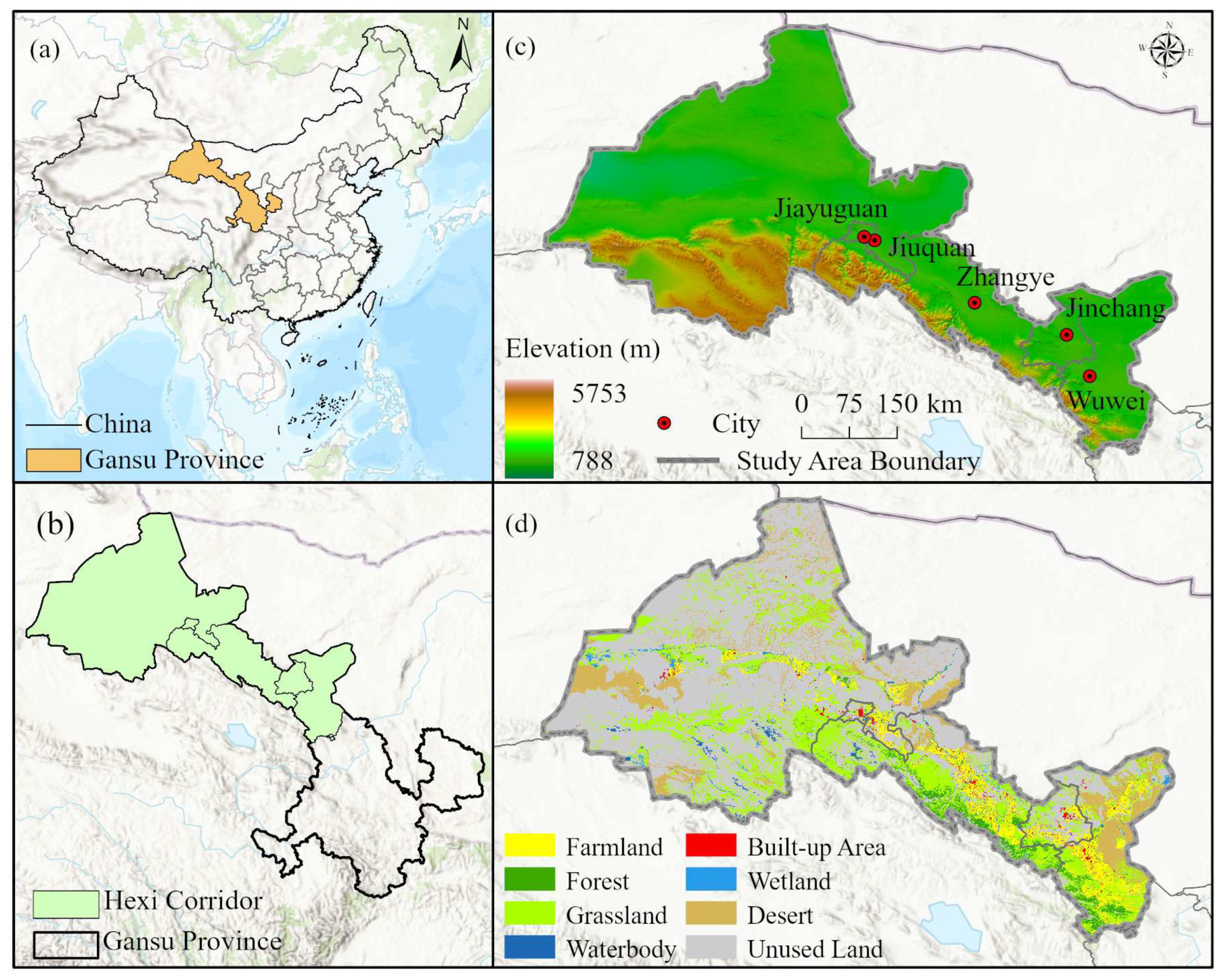
2.1. Study Area
2.2. Data Sources and Processing
2.3. Research Methods
2.3.1. Analysis of Land-Use Change
- (1)
- Land-use Dynamic Degree
- (2)
- Land-use State Index
- (3)
- Land-use Transfer Matrix
2.3.2. Land-Use Carbon Emission Accounting
- (1)
- Estimation of Carbon Emissions and Sequestration
- (2)
- Land-use Carbon Emission Index
2.3.3. Landscape Ecological Risk Assessment
- (1)
- Landscape Unit Partitioning
- (2)
- Landscape Ecological Risk Index
2.3.4. Bivariate Spatial Autocorrelation
2.3.5. Optimal Parameters Geographic Detector (OPGD)
3. Results
3.1. Spatiotemporal Evolution Characteristics of Land-Use
3.2. Spatiotemporal Evolution of LUCE
3.2.1. Spatiotemporal Patterns of Carbon Sources and Sinks
3.2.2. Analysis of Spatiotemporal Evolution of LUCE
3.3. Analysis of Spatiotemporal Evolution of LER
3.4. Spatial Correlation Analysis Between LUCE and LER
3.4.1. Bivariate Global Spatial Autocorrelation Analysis
3.4.2. Bivariate Local Spatial Autocorrelation Analysis
3.5. Driving Factors for the Evolution of LUCE and LER
3.5.1. Factor Detection Results
3.5.2. Interaction Detection of Driving Factors
4. Discussion
4.1. Mechanism and Explanation of the Carbon Sink “Ceiling Effect” Under Water Resource Constraints
4.2. “Carbon Lock-In” and Spatial Mismatch Driven by Oasis Urbanization
4.3. Response of Landscape Pattern Evolution to Climate Warming, Humidification, and Anthropogenic Interference
4.4. Differentiated Low-Carbon Governance Paths Under the Background of “Source–Sink Asymmetry”
4.5. Methodological Reflection, Discrepancies, and Research Prospects
5. Conclusions
- (1)
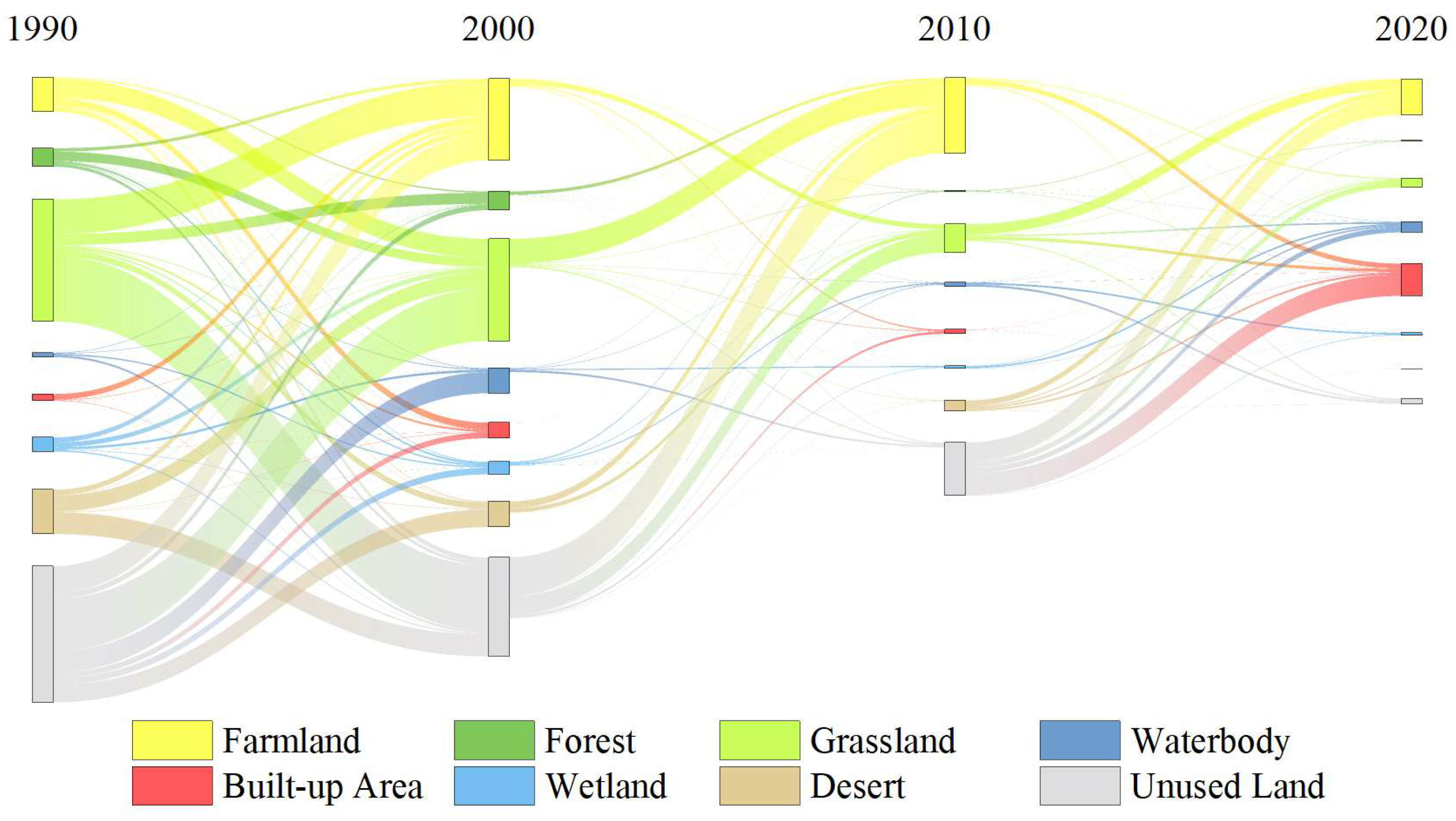
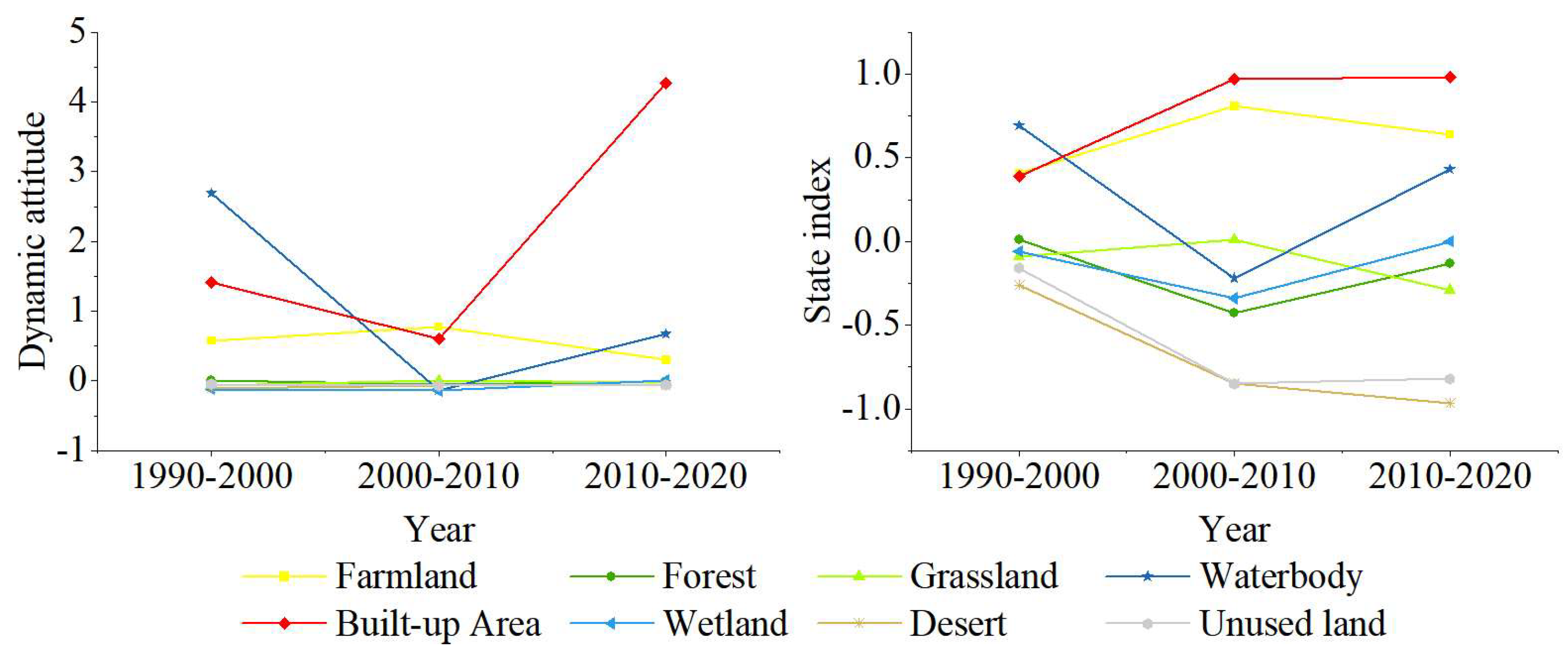
- Land-use exhibited a transition pattern characterized by the “explosive expansion of anthropogenic landscapes and the continuous contraction of the natural background”. Between 1990 and 2020, both the land-use dynamic degree and status index of built-up land in the Hexi Corridor soared simultaneously, while the net loss of unused land reached 2315.49 km2. This oasis evolution, achieved at the cost of encroaching upon grasslands and developing barren lands, has supported economic growth but also profoundly reshaped the material foundation of the regional landscape.
- (2)
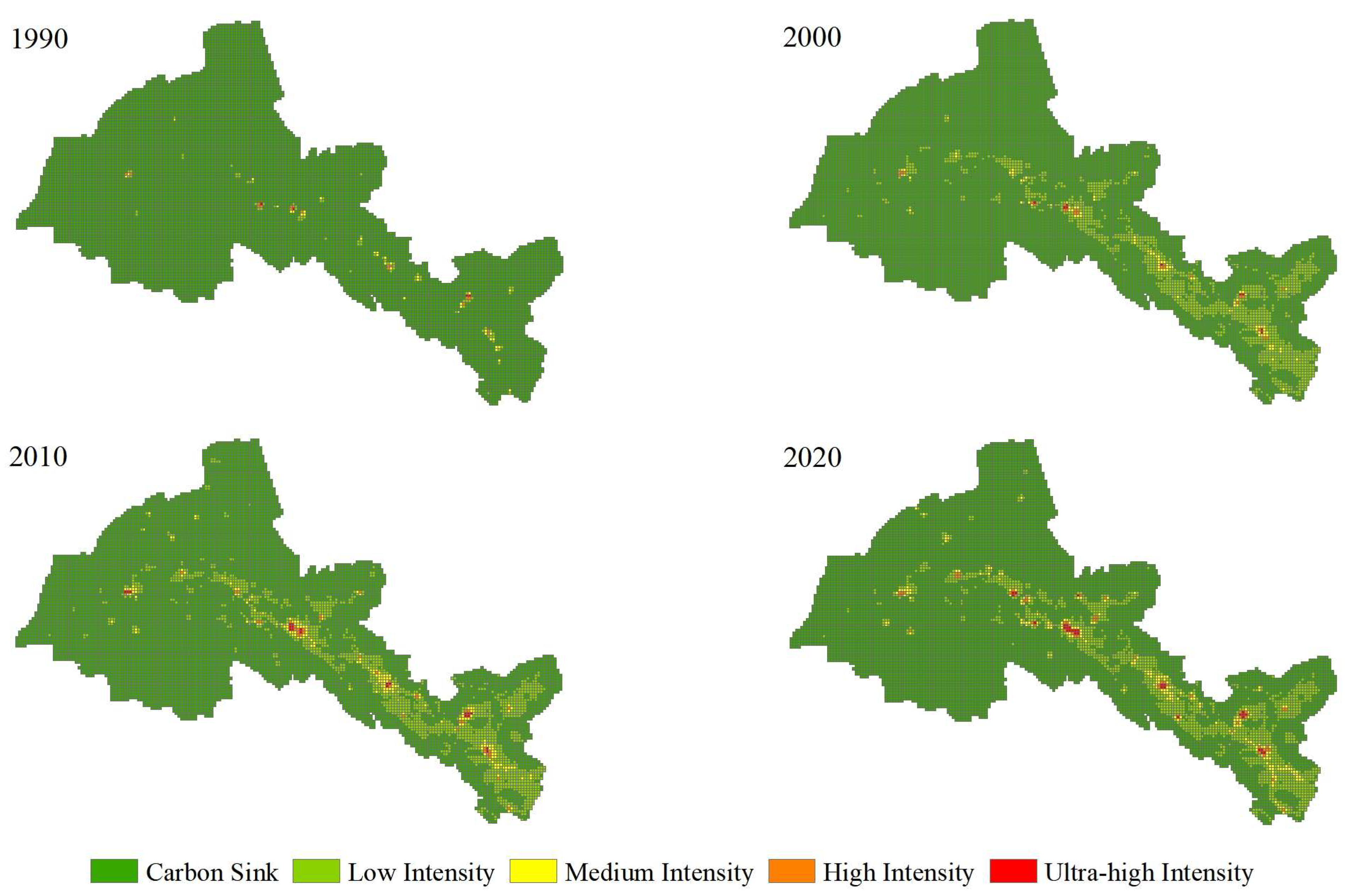
- The carbon budget faces the dual pressure of “strong sources and weak sinks” and spatial imbalance. Net carbon emissions surged by approximately 4.6 times, with built-up land serving as the dominant carbon source. Constrained by the fragile ecological background of the arid region, forest and grassland carbon sinks exhibit a significant “lock-in effect”. Their carbon sequestration increments are far insufficient to offset the explosive growth of source emissions, leading to a continuous widening of the “scissors gap” between carbon sources and sinks.
- (3)
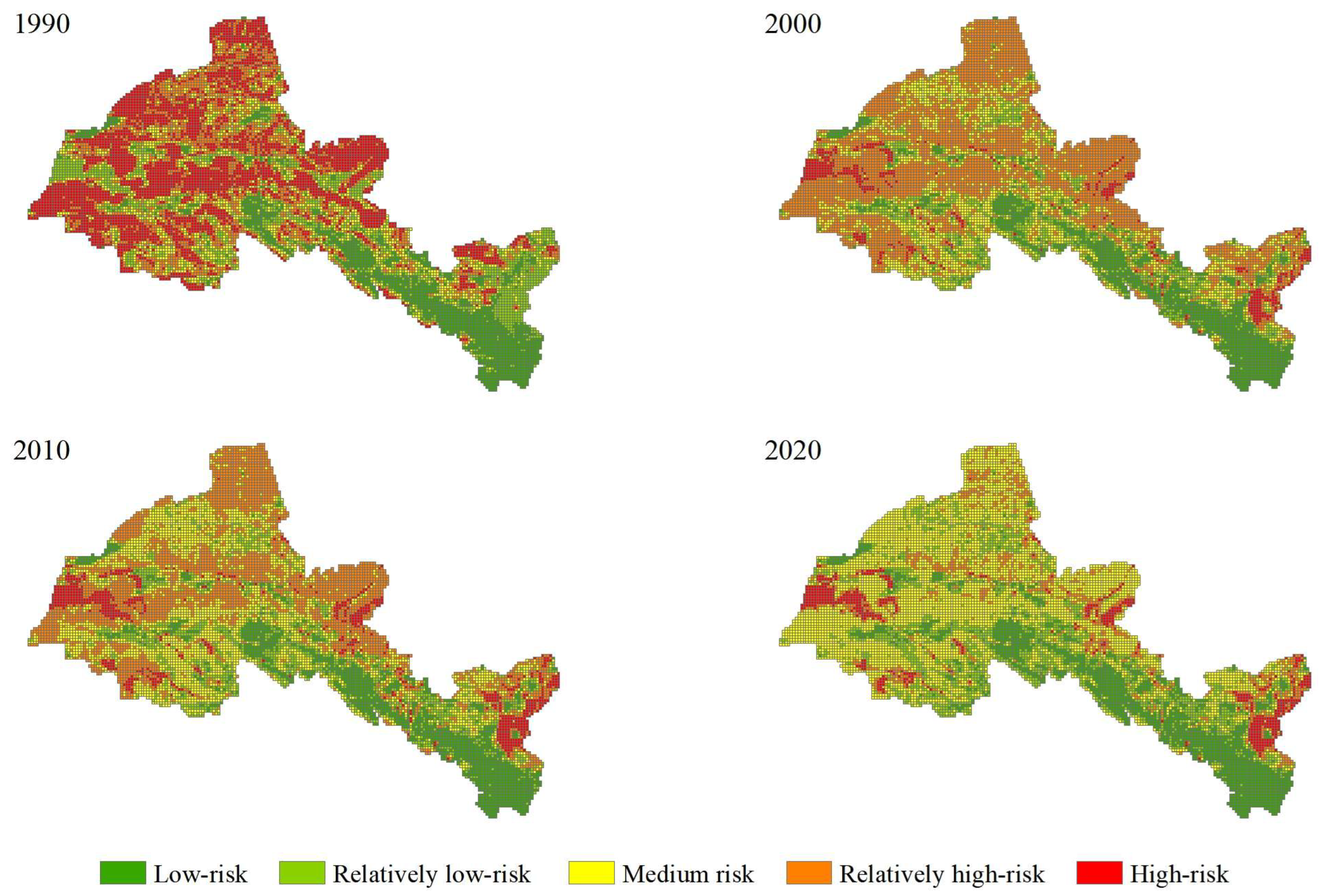
- The evolution of LER exhibits distinct stages, characterized by a “downward shift in risk levels” and a “trend toward stability”. The proportion of high-risk zones followed an “inverted U-shaped” trajectory, peaking in 2000 and subsequently falling significantly from 44.65% to 10.96% by 2020. This trend, effectively revealed through a refined 5 × 5 km grid scale and unified threshold classification, provides a more granular reflection of the positive impacts of national ecological restoration compared to coarser-scale assessments.
- (4)
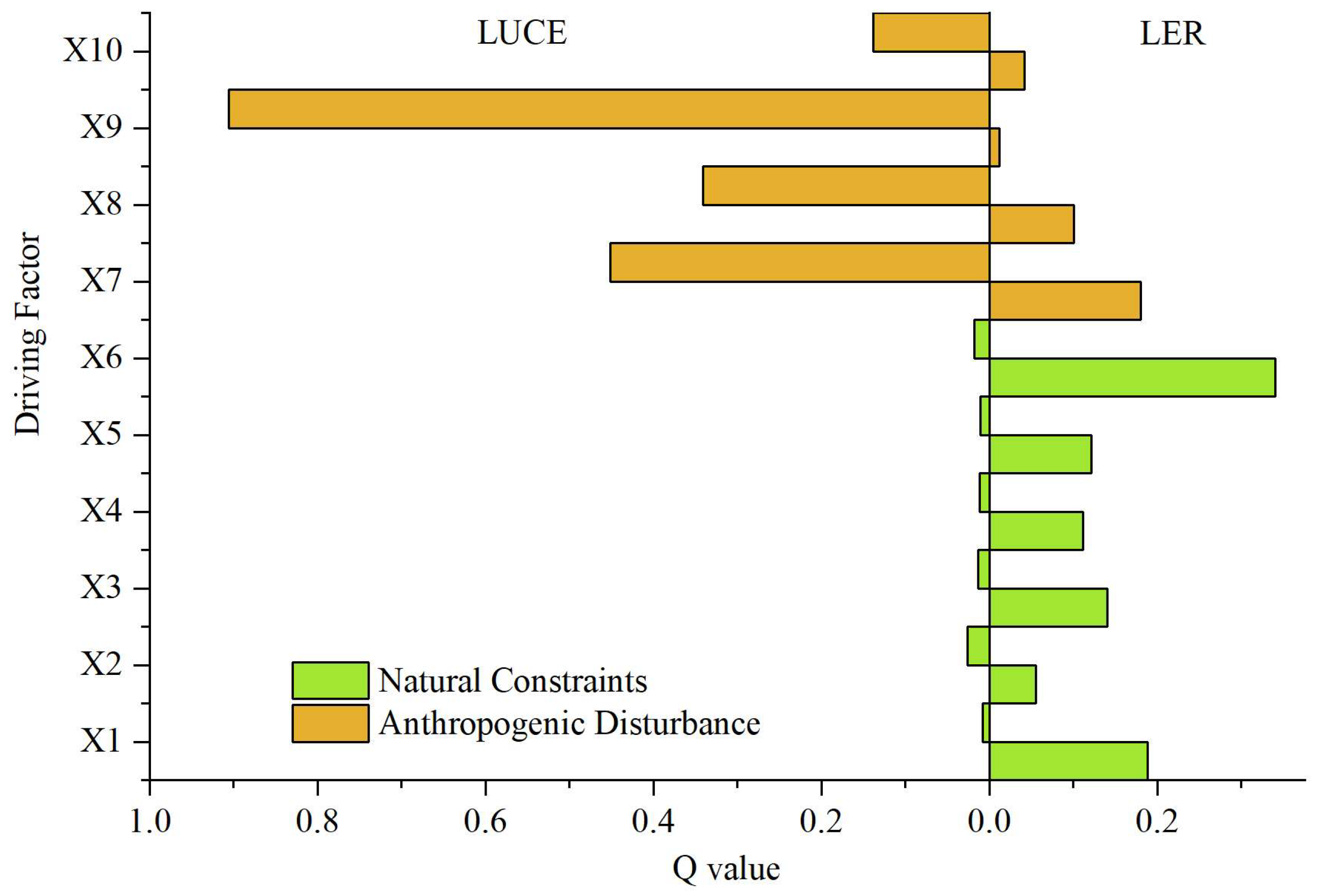
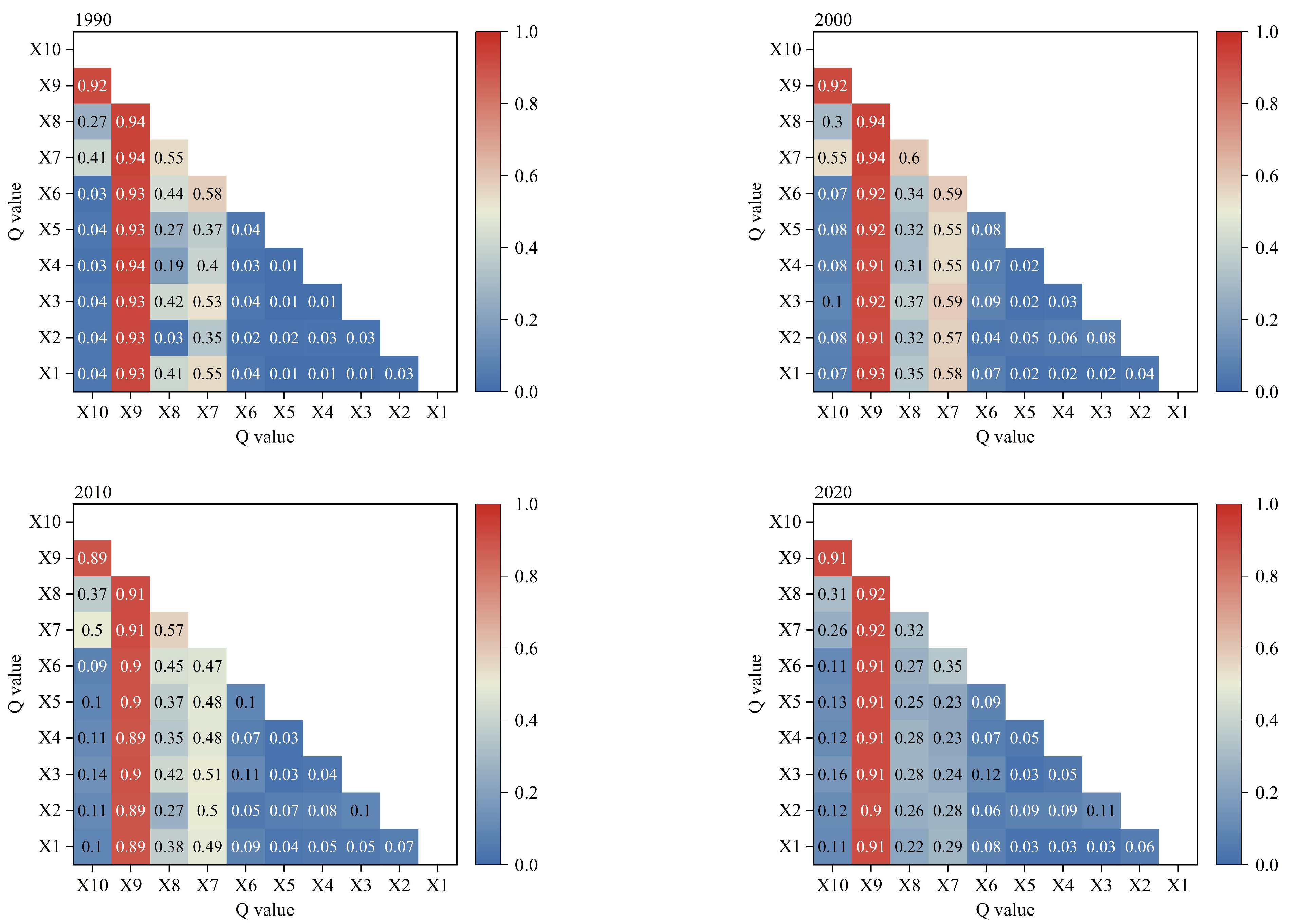
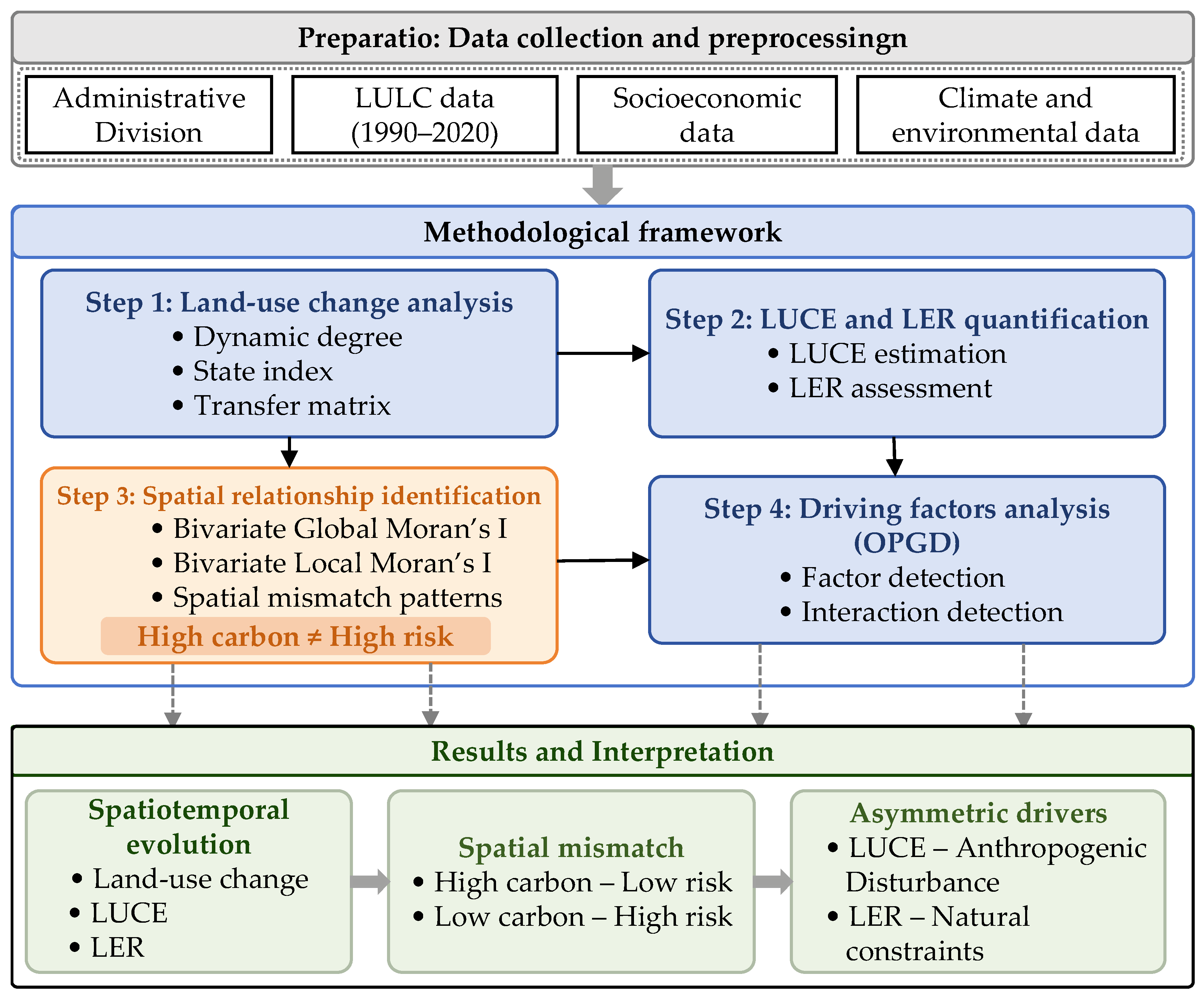
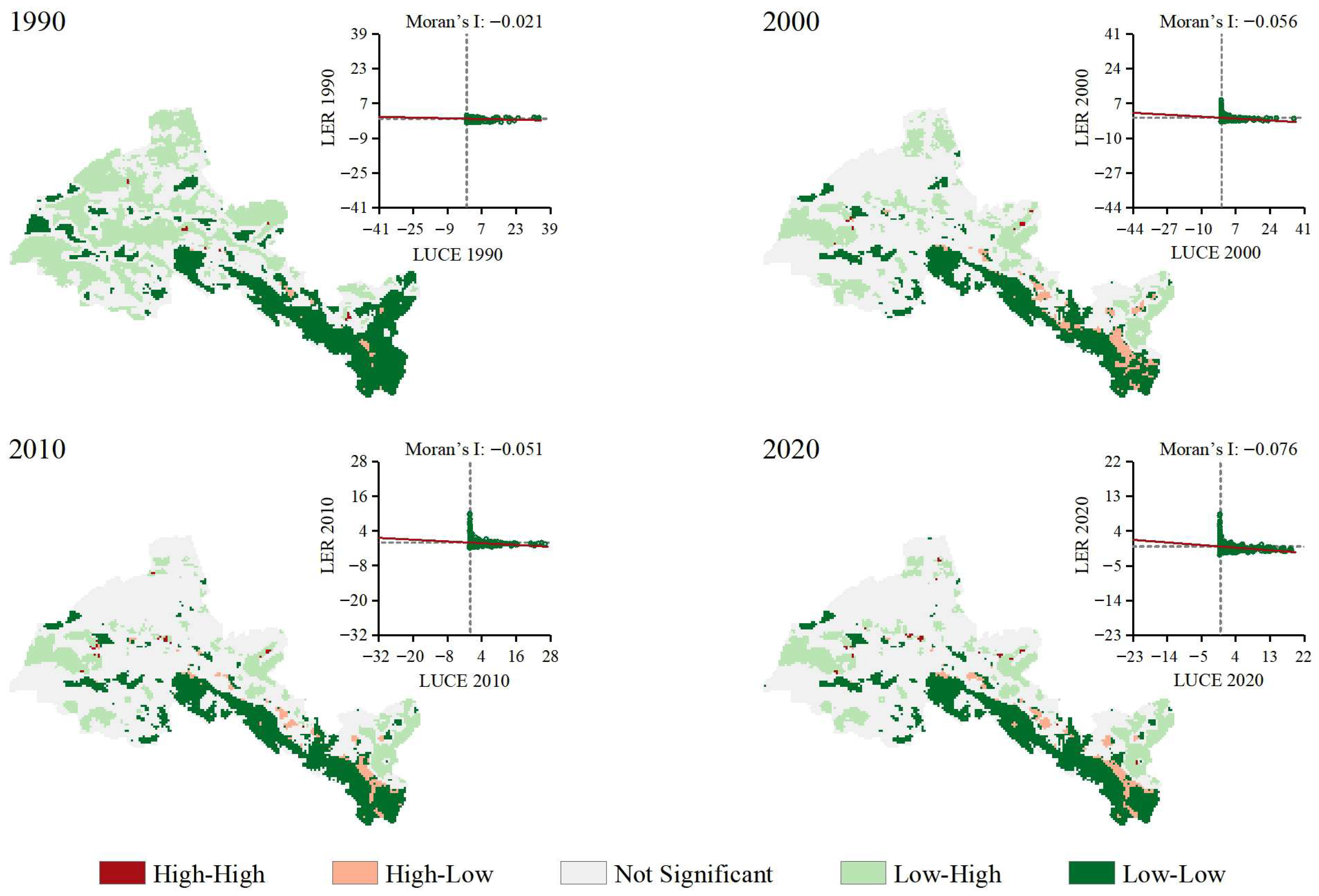
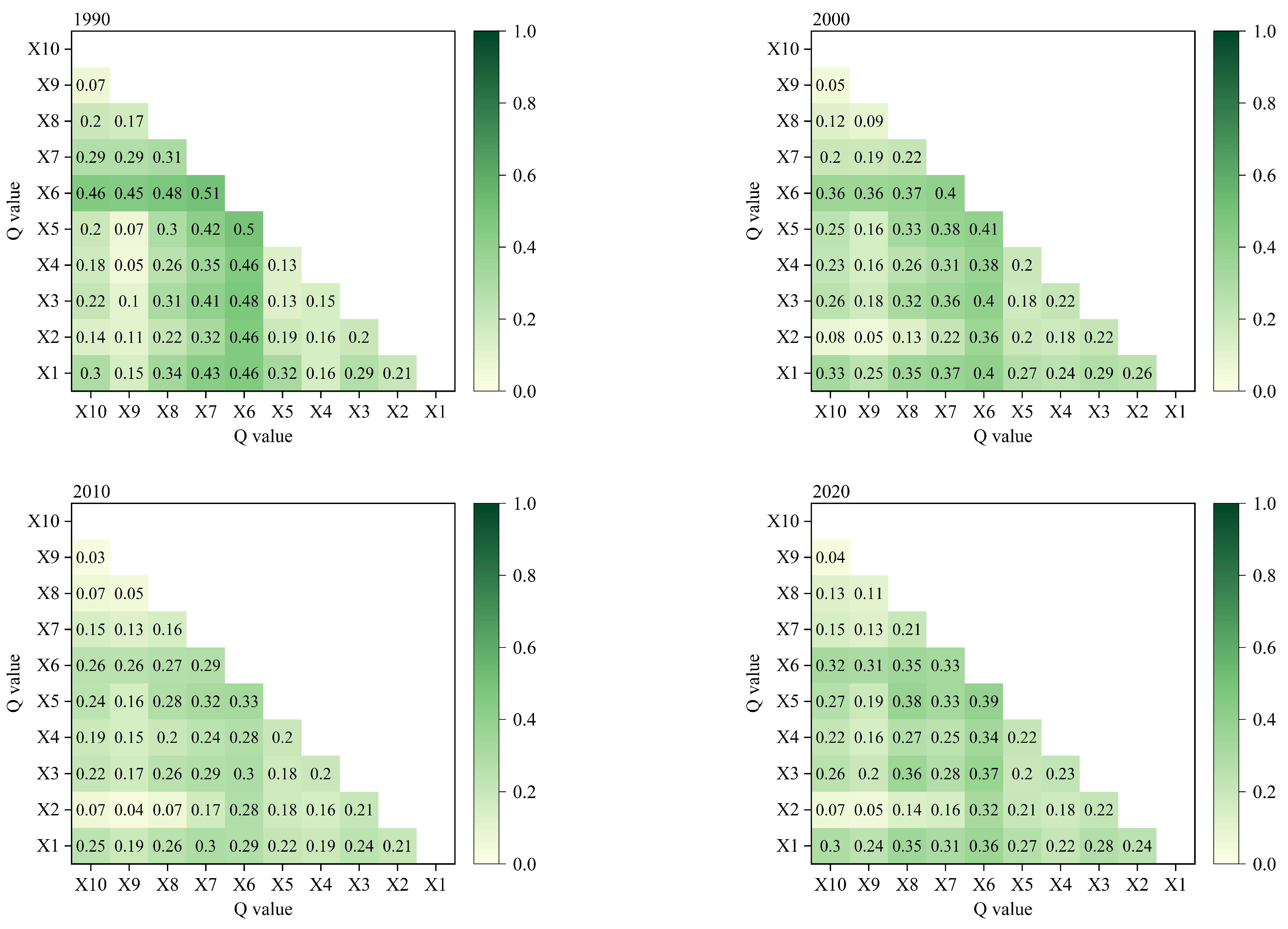
- LUCE-LER exhibit a significant spatial mismatch, which reflects a non-synchronous human–environment response in the arid oasis system and is fundamentally rooted in the asymmetry of driving factors. Local spatial autocorrelation indicates that central oases exhibit “High-Low” (high carbon–low risk) clustering, whereas oasis margins and desert–oasis transition zones are dominated by “Low-High” (low carbon–high risk) patterns. This mismatch suggests that areas with high carbon emissions do not necessarily correspond to areas with high ecological risk. OPGD results further confirm an asymmetric driver structure: LUCE is mainly dominated by anthropogenic factors, especially nighttime light (q > 0.90), whereas LER is more strongly constrained by natural background conditions, particularly NDVI. The asymmetry of drivers explains why the high carbon emissions in urbanized oases do not always coincide with high ecological risk, whereas the low carbon emissions in desert margins correspond to higher ecological vulnerability.
- (5)
- Future governance must shift toward a collaborative system centered on source-based emission control and precise regional management. While the current grid-scale framework provides robust evidence, future research should move toward high-resolution data fusion (e.g., UAV and LiDAR) and multi-scenario dynamic simulations to capture finer ecological processes and provide proactive management recommendations. Only by coordinating anthropogenic drivers with the rigid constraints of the natural environment can the deep coupling of “low-carbon transition” and “landscape security” in arid oases be achieved. This integrated approach will ensure more effective management strategies for both carbon emissions and ecological risk in arid regions.
Author Contributions
Funding
Data Availability Statement
Conflicts of Interest
Abbreviations
| LUCE | Land-Use Carbon Emissions |
| LER | Landscape Ecological Risks |
| OPGD | Optimal Parameter Geographic Detector |
| LULC | Land Use/Land Cover |
References
- Huang, H.; Jia, J.; Chen, D.; Liu, S. Evolution of spatial network structure for land-use carbon emissions and carbon balance zoning in Jiangxi province: A social network analysis perspective. Ecol. Indic. 2024, 158, 111508. [Google Scholar] [CrossRef] [Scilit]
- Yuan, X.; Bai, X.; Zhou, Z.; Luo, G.; Li, J.; Ran, C.; Zhang, S.; Xiong, L.; Liao, J.; Du, C.; et al. Global impacts of land use on terrestrial carbon emissions since 1850. Sci. Total Environ. 2025, 963, 178358. [Google Scholar] [CrossRef] [Scilit] [PubMed]
- Ye, C.; Ming, T. Land use carbon emissions estimation and carbon emissions control strategy effect scenario simulation in Zhejiang province. Heliyon 2023, 9, e20783. [Google Scholar] [CrossRef] [Scilit] [PubMed]
- Zhang, Y.; Naerkezi, N.; Zhang, Y.; Wang, B. Multi-scenario land use/cover change and its impact on carbon storage based on the coupled GMOP-PLUS-InVEST model in the Hexi Corridor, China. Sustainability 2024, 16, 1402. [Google Scholar] [CrossRef] [Scilit]
- Nie, X.; Wang, C.; Li, K.; Gao, F.; Huang, W.; Li, X. Spatiotemporal analysis of landscape ecological risk and its influencing factors based on land cover changes in the Hexi Corridor, northwest China, 2000–2020. Environ. Sustain. Indic. 2025, 28, 100888. [Google Scholar] [CrossRef] [Scilit]
- Jiang, X.; Li, X.; Han, H.; Xu, M.; Ling, H. Influence of land use transformation on carbon storage change in Gansu province. Arid Land Geogr. 2024, 12, 2075–2082. [Google Scholar]
- Li, Y.; Liu, W.; Feng, Q.; Zhu, M.; Yang, L.; Zhang, J. Effects of land use and land cover change on soil organic carbon storage in the Hexi regions, northwest China. J. Environ. Manag. 2022, 312, 114911. [Google Scholar] [CrossRef] [Scilit]
- Du, H.; Wei, W.; Zhang, X.; Ji, X. Spatio-temporal evolution and influencing factors of energy-related carbon emissions in the yellow river basin: Based on the DMSP/OLS and NPP/VIIRS nighttime light data. Geogr. Res. 2021, 40, 2051–2065. [Google Scholar]
- Liu, Y.; Zhou, S.; Zhang, G. Spatio-temporal dynamics and driving forces of multi-scale emissions based on nighttime light data: A case study of the pearl river delta urban agglomeration. Sustainability 2023, 15, 8234. [Google Scholar] [CrossRef] [Scilit]
- Wang, Y.; Jin, X. Land use, spatial planning, and their influence on carbon emissions: A comprehensive review. Land 2025, 14, 1406. [Google Scholar] [CrossRef] [Scilit]
- Qiu, J.; Ju, Z.; Wang, H.; Wu, J. The double-edged sword effects of land use optimization based on dual carbon goals: A perspective from landscape ecological risk. J. Environ. Manag. 2025, 380, 125044. [Google Scholar] [CrossRef] [Scilit] [PubMed]
- Hong, Y.; Yu, H.; Lu, Y.; Peng, L. Balancing low-carbon and eco-friendly development: Coordinated development strategy for land use carbon emission efficiency and land ecological security. Environ. Sci. Pollut. Res. 2024, 31, 9495–9511. [Google Scholar] [CrossRef] [Scilit] [PubMed]
- Huang, A.; Wang, Y.; Tian, L.; Liu, L.; Xia, J.; Liang, Y.; Sun, M.; Zhuang, Y. Research progress of carbon effect in land use system: Mechanisms, simulations and optimization. J. Nat. Resour. 2024, 39, 2450–2470. [Google Scholar] [CrossRef] [Scilit]
- Liu, C.; Hu, S.; Wu, S.; Song, J.; Li, H. County-level land use carbon emissions in China: Spatiotemporal patterns and impact factors. Sustain. Cities Soc. 2024, 105, 105304. [Google Scholar] [CrossRef] [Scilit]
- Wang, D.; Jing, Y.; Han, S.; Gao, M. Spatio-temporal relationship of land-use carbon emission and ecosystem service value in Nansi lake basin based upon a grid square. Acta. Ecologica. Sinica. 2022, 42, 9604–9614. [Google Scholar]
- Liu, H.; Lu, J.; Li, X.; Wang, Y.; Xu, D.; Yin, J.; Xu, G. Evaluating human-nature relationships at a grid scale in China, 2000–2020. Habitat Int. 2025, 156, 103282. [Google Scholar] [CrossRef] [Scilit]
- Xu, F.; Zheng, M.; Zheng, X.; Liu, D.; Wang, P.; Ma, Y.; Wang, X.; Zhang, X. Geospatial big data-driven fine-scale carbon emission modeling. Remote Sens. 2025, 17, 3185. [Google Scholar] [CrossRef] [Scilit]
- He, J.; Yang, J. Spatial–temporal characteristics and influencing factors of land-use carbon emissions: An empirical analysis based on the GTWR model. Land 2023, 12, 1506. [Google Scholar] [CrossRef] [Scilit]
- Fang, W.; Luo, P.; Luo, L.; Zha, X.; Nover, D. Spatiotemporal characteristics and influencing factors of carbon emissions from land-use change in Shaanxi province, China. Environ. Sci. Pollut. Res. 2023, 30, 123480–123496. [Google Scholar] [CrossRef] [Scilit]
- Qiu, A.; Yue, H.; You, Z.; An, H. Forecasting of factors influencing carbon emission from land-use in Liaoning province, China, under the “double carbon” target. Ecol. Model. 2025, 509, 111255. [Google Scholar] [CrossRef] [Scilit]
- Sun, Y.; Zhi, J.; Han, C.; Xue, C.; Zhao, W.; Liu, W.; Bao, S. The impact of future land use change on carbon emission and its optimization strategy. Forests 2024, 15, 1292. [Google Scholar] [CrossRef] [Scilit]
- Gao, M.; Shao, Z.; Zhang, L.; Qiao, Z.; Yang, Y.; Zhao, L. Coupling and coordination relationship between carbon emissions from land use and high-quality economic development in Inner Mongolia, China. Land 2025, 14, 354. [Google Scholar] [CrossRef] [Scilit]
- Wang, Y.; Zhai, C.; Liu, C.; Chen, Z. Analysis of spatiotemporal differences and influencing factors of land use carbon emissions in Ningxia. Environ. Sci. 2024, 45, 5049–5059. [Google Scholar]
- Shao, W.; Wang, Q.; Guan, Q.; Zhang, J.; Yang, X.; Liu, Z. Environmental sensitivity assessment of land desertification in the Hexi Corridor, China. Catena 2023, 220, 106728. [Google Scholar] [CrossRef] [Scilit]
- Zhang, X.; Cui, X.; Liang, S. Evolution and optimization of an ecological network in an arid region based on MSPA-MCR: A case study of the Hexi Corridor. Sustainability 2024, 16, 1704. [Google Scholar] [CrossRef] [Scilit]
- Sun, D.; Ji, Z.; Wang, Y.; Zhang, W. Assessment and forecasting of water ecological security and obstacle factor diagnosis in the Hexi Corridor of northwest China. Sci. Rep. 2024, 14, 23507. [Google Scholar] [CrossRef] [Scilit]
- Wei, W.; Nan, S.; Xie, B.; Liu, C.; Zhou, J.; Liu, C. The spatial-temporal changes of supply-demand of ecosystem services and ecological compensation: A case study of Hexi Corridor, northwest China. Ecol. Eng. 2023, 187, 106861. [Google Scholar] [CrossRef] [Scilit]
- Wu, Y.; Shi, K.; Chen, Z.; Liu, S.; Chang, Z. Developing improved time-series DMSP-OLS-like data (1992–2019) in China by integrating DMSP-OLS and SNPP-VIIRS. IEEE Trans. Geosci. Remote Sens. 2022, 60, 1–14. [Google Scholar] [CrossRef] [Scilit]
- Liang, X.; Jin, X.; Ren, J.; Gu, Z.; Zhou, Y. A research framework of land use transition in Suzhou city coupled with land use structure and landscape multifunctionality. Sci. Total Environ. 2020, 737, 139932. [Google Scholar] [CrossRef] [Scilit]
- Yang, Q.; Wang, L.; LIi, Y.; Qin, X. Land use spatial equilibrium from the perspective of supply and demand matching: A case study of Jiangsu province. Resour. Sci. 2021, 43, 932–943. [Google Scholar] [CrossRef] [Scilit]
- Wang, Z.; Shi, P.; Li, X.; Liu, Y.; Shi, J. Response mechanism and promotion path of habitat quality to land use change in Hexi Corridor area. Environ. Sci. 2024, 45, 6910–6921. [Google Scholar]
- Li, Z.; Zhou, D.; Jiang, J.; Ma, J.; Zhu, X.; Shi, P.; Zhang, J.; Dong, Q. Spatial and temporal evolution characteristics of carbon emission from land use and influencing factors in Gansu province. Environ. Sci. 2024, 45, 5040–5048. [Google Scholar]
- Song, M.; Zhang, L.; Gao, Y.; Li, E. Spatiotemporal evolution and influence mechanism of the carbon footprint of energy consumption at county level in the Yellow River Basin. Sci. Total Environ. 2023, 883, 163710. [Google Scholar] [CrossRef] [Scilit] [PubMed]
- Piao, L.; Zhang, P.; Zhao, S.; Dong, J.; Duan, Q. Carbon emission from land use in Yanshan-Taihang Mountain area of Hebei province: Study on spatial and temporal differentiation of risk. Appl. Sci. 2025, 15, 1886. [Google Scholar] [CrossRef] [Scilit]
- Zhou, H.; Zhao, X. Spatial relationships between land use carbon emissions and ecological risk in Changsha-Zhuzhou-Xiangtan urban agglomeration based on grid scale. Acta. Ecologica. Sinica. 2025, 45, 10898–10909. [Google Scholar]
- Chuai, X.; Huang, X.; Wang, W.; Zhao, R.; Zhang, M.; Wu, C. Land use, total carbon emissions change and low carbon land management in coastal Jiangsu, China. J. Clean. Prod. 2015, 103, 77–86. [Google Scholar] [CrossRef] [Scilit]
- Lv, Q.; Liu, H.; Wang, J.; Liu, H.; Shang, Y. Multiscale analysis on spatiotemporal dynamics of energy consumption CO2 emissions in China: Utilizing the integrated of DMSP-OLS and NPP-VIIRS nighttime light datasets. Sci. Total Environ. 2020, 703, 134394. [Google Scholar] [CrossRef] [Scilit]
- Chen, H.; Chen, H.; Huang, X.; Zhang, S.; He, T.; Gao, Z. Landscape ecological risk assessment and driving factor analysis in southwest China. Sci. Rep. 2024, 14, 23208. [Google Scholar] [CrossRef] [Scilit]
- Sui, L.; Yan, Z.; Li, K.; Wang, C.; Shi, Y.; Du, Y. Prediction of ecological security network in northeast China based on landscape ecological risk. Ecol. Indic. 2024, 160, 111783. [Google Scholar] [CrossRef] [Scilit]
- Zhang, W.; Chang, W.J.; Zhu, Z.C.; Hui, Z. Landscape ecological risk assessment of Chinese coastal cities based on land use change. Appl. Geogr. 2020, 117, 102174. [Google Scholar] [CrossRef] [Scilit]
- Qian, Y.; Dong, Z.; Yan, Y.; Tang, L. Ecological risk assessment models for simulating impacts of land use and landscape pattern on ecosystem services. Sci. Total Environ. 2022, 833, 155218. [Google Scholar] [CrossRef] [Scilit] [PubMed]
- Zhang, X.; Yu, J.; Feng, H.; Yao, L.; Li, X.; Du, H.; Liu, Y. Landscape ecological risk and drivers of land-use transition under the perspective of differences in topographic gradient. Land 2024, 13, 876. [Google Scholar] [CrossRef] [Scilit]
- Wang, Q.; Zhang, P.; Chang, Y.; Li, G.; Chen, Z.; Zhang, X.; Xing, G.; Lu, R.; Li, M.; Zhou, Z. Landscape pattern evolution and ecological risk assessment of the Yellow River Basin based on optimal scale. Ecol. Indic. 2024, 158, 111381. [Google Scholar] [CrossRef] [Scilit]
- Liu, J.; Wen, C.; Liu, Z.; Yu, Y. From isolation to linkage: Holistic insights into ecological risk induced by land use change. Land Use Policy 2024, 140, 107116. [Google Scholar] [CrossRef] [Scilit]
- Mo, W.; Wang, Y.; Zhang, Y.; Zhuang, D. Impacts of road network expansion on landscape ecological risk in a megacity, China: A case study of Beijing. Sci. Total Environ. 2017, 574, 1000–1011. [Google Scholar] [CrossRef] [Scilit]
- Song, Y.; Wang, J.; Ge, Y.; Xu, C. An optimal parameters-based geographical detector model enhances geographic characteristics of explanatory variables for spatial heterogeneity analysis: Cases with different types of spatial data. GIScience Remote Sens. 2020, 57, 593–610. [Google Scholar] [CrossRef] [Scilit]
- Lan, J.; Chai, Z.; Tang, X.; Wang, X. Landscape ecological risk assessment and driving force analysis of the Heihe River Basin in the Zhangye area of China. Water 2023, 15, 3588. [Google Scholar] [CrossRef] [Scilit]
- Ngabire, M.; Wang, T.; Liao, J.; Sahbeni, G. Quantitative analysis of desertification-driving mechanisms in the Shiyang River Basin: Examining interactive effects of key factors through the geographic detector model. Remote Sens. 2023, 15, 2960. [Google Scholar] [CrossRef] [Scilit]
- Zhao, C.; Liu, Y.; Yan, Z. Effects of land-use change on carbon emission and its driving factors in Shaanxi province from 2000 to 2020. Environ. Sci. Pollut. Res. 2023, 30, 68313–68326. [Google Scholar] [CrossRef] [Scilit]
- Yang, Q.; Jia, S.; Li, C.; Chen, W.; Liang, Y.; Chen, Y. Study on spatio-temporal evolution characteristics of vegetation carbon sink in the Hexi Corridor, China. Land 2025, 14, 2215. [Google Scholar] [CrossRef] [Scilit]
- Chen, H.; Ren, J.; Ren, W.; Luan, H.; Luo, L. Land use change patterns and landscape ecological risk assessment in the process of watershed ecological compensation. Front. Environ. Sci. 2025, 13, 1723453. [Google Scholar] [CrossRef] [Scilit]
- Wu, L.; Zhang, Y.; Luo, G.; Chen, D.; Yang, D.; Yang, Y.; Tian, F. Characteristics of vegetation carbon sink carrying capacity and restoration potential of China in recent 40 years. Front. For. Glob. Change 2023, 6, 1266688. [Google Scholar] [CrossRef] [Scilit]
- He, X.; Zhang, F.; Zhou, T.; Jim, C.Y.; Ma, X.; Wang, B.; Tan, M.L.; Wei, L.; Zhang, Y.; Zhang, X. Remote sensing assessment of carbon balance vis-a-vis energy-related emissions and vegetation sequestration in a typical arid region of China from 2001 to 2020. Int. J. Digit. Earth 2025, 18, 2544964. [Google Scholar] [CrossRef] [Scilit]
- Zhang, X.; Liu, C.; Jiang, Y. Spatiotemporal dynamics of terrestrial vegetation carbon sinks and its response to climate change in northwest China. Front. Environ. Sci. 2025, 13, 1550501. [Google Scholar] [CrossRef] [Scilit]
- Fang, C. The basic law of the formation and expansion in urban agglomerations. J. Geogr. Sci. 2019, 29, 1699–1712. [Google Scholar] [CrossRef] [Scilit]
- Liu, P.; Zhu, B. Temporal-spatial evolution of green total factor productivity in China’s coastal cities under carbon emission constraints. Sustain. Cities Soc. 2022, 87, 104231. [Google Scholar] [CrossRef] [Scilit]
- Pei, Y.; Wei, W.; Wei, X.; Yang, X.; Xie, B.; Zhou, J.; Zhang, Y.; Liu, C. Ecological risk assessment and ecological restoration zoning based on nature-society- landscape systems: A case study of Hexi Corridor, northwest China. Hum. Ecol. Risk Assess. Int. 2025, 31, 1040–1061. [Google Scholar] [CrossRef] [Scilit]
- Liu, H.; Xiong, J.; Hong, S.; Zhou, B. Social, economic, and environmental development in China through the lens of synergies and trade-offs. J. Clean. Prod. 2025, 509, 145634. [Google Scholar] [CrossRef] [Scilit]
- Jia, Z.; Lin, T.; Guo, X.; Zheng, Y.; Geng, H.; Zhang, J.; Chen, Y.; Liu, W.; Lin, M. Vegetation greening mitigates the positive impacts of climate change on water availability in northwest China. J. Hydrol. 2024, 644, 132086. [Google Scholar] [CrossRef] [Scilit]
- Zhang, X.; Yao, L.; Luo, J.; Liang, W. Exploring changes in land use and landscape ecological risk in key regions of the belt and road initiative countries. Land 2022, 11, 940. [Google Scholar] [CrossRef] [Scilit]
- He, Y.; Liu, X.; Wu, D.; Li, S.; Zhou, P. Ecological risks and patterns associated with land use/cover changes along the belt and road initiative routes. Land Degrad. Dev. 2025, 36, 2075–2094. [Google Scholar] [CrossRef] [Scilit]
- Liu, H.; Xiong, J.; Song, T. Characteristics and key drivers of virtual urban land flows in China. Land Use Policy 2026, 163, 107923. [Google Scholar] [CrossRef] [Scilit]
- Gong, B.; Liu, Z.; Zhou, L.; He, C. Delimiting urban growth boundaries for oases by incorporating the protection of ecosystem services and modes of urban expansion: A case study of China’s drylands. Landsc. Ecol. 2025, 40, 105. [Google Scholar] [CrossRef] [Scilit]
- Wei, X.; Yu, L.; Wei, W.; Xie, B.; Zhou, J.; Li, X.; Liu, C.; Zhang, Y.; Ma, Z. Evaluation of coordinated development between land use intensity and ecosystem services in ecologically vulnerable region: A case study of Hexi Corridor, northwest China. Environ. Prog. Sustain. Energy 2025, 44, e14637. [Google Scholar] [CrossRef] [Scilit]
- Liu, Y.; Yao, X.; Tian, Z.; Zhang, Y. Evaluation of the importance of ecological service function and analysis of influencing factors in the Hexi Corridor from 2000 to 2020. Land 2024, 13, 1283. [Google Scholar] [CrossRef] [Scilit]






| Data Type | Data Name | Original Data Format | Data Source |
|---|---|---|---|
| Administrative Division | Study Area Boundary | Vector Data | Chinese Academy of Sciences, Resource and Environment Science Data Center (https://www.resdc.cn) |
| LULC Data | LULC Data | Raster 30 m Resolution | The land cover datasets (2000–2020) (https://www.resdc.cn) |
| Socioeconomic Data | Nighttime Light Data | Raster 1 km Resolution | Developing time-series of improved DMSP-OLS-like data (1992–2019) in China by integrating DMSP-OLS and SNPP-VIIRS |
| Energy consumption data | statistical data | Gansu Development Yearbook (1991–2021) (https://tjj.gansu.gov.cn) | |
| GDP Density | Raster 1 km Resolution | Chinese Academy of Sciences, Resource and Environment Science Data Center (https://www.resdc.cn) | |
| Population Density | |||
| Road data | Vector Data | The Geospatial Data Cloud (http://www.gscloud.cn) | |
| Climate and Environmental Data | DEM | Raster 30 m Resolution | The Geospatial Data Cloud (http://www.gscloud.cn) |
| River and lake system | Vector Data | ||
| Average Annual Temperature | Raster 1 km Resolution | Chinese Academy of Sciences, Resource and Environment Science Data Center (https://www.resdc.cn) | |
| Average Annual Precipitation | |||
| NDVI |
| Energy Category | Coal | Coke | Crude Oil | Gasoline | Kerosene | Diesel Oil | Fuel Oil | Liquefied Petroleum Gas | Electricity |
|---|---|---|---|---|---|---|---|---|---|
| Standard coal conversion factor | 0.7143 | 0.9714 | 1.4286 | 1.4714 | 1.4714 | 1.4571 | 1.4286 | 1.228 | 0.1229 |
| Carbon emission factor | 0.7559 | 0.855 | 0.5857 | 0.5538 | 0.5714 | 0.5921 | 0.6185 | 0.5857 | 0.2132 |
| Dimension | ID | Driving Factor | Unit | Data Processing Method |
|---|---|---|---|---|
| Natural Constraints | X1 | Annual Precipitation | mm | ArcGIS 10.8/Extraction by Mask |
| X2 | Distance to Water | km | Calculated (ArcGIS 10.8) | |
| X3 | Elevation | m | ArcGIS 10.8/Extraction by Mask | |
| X4 | Slope | ° | ArcGIS 10.8/Slope Tool | |
| X5 | Annual Temperature | °C | ArcGIS 10.8/Extraction by Mask | |
| X6 | NDVI | - | ArcGIS 10.8/Extraction by Mask | |
| Anthropogenic Disturbance | X7 | Population Density | person/km2 | ArcGIS 10.8/Extraction by Mask |
| X8 | GDP Density | 104 CNY/km2 | ArcGIS 10.8/Extraction by Mask | |
| X9 | Nighttime Light Index | NW/cm2/sr | ArcGIS 10.8/Extraction by Mask | |
| X10 | Distance to Roads | km | Calculated (ArcGIS 10.8) |
| Farmland | Forest | Grassland | Waterbody | Built-Up | Wetland | Desert | Unused Land | Out Total | |
|---|---|---|---|---|---|---|---|---|---|
| Farmland | 26.22 | 362.92 | 12.26 | 212.05 | 14.16 | 13.14 | 93.93 | 734.67 | |
| Forest | 114.19 | 154.77 | 7.26 | 10.41 | 30.47 | 7.34 | 46.09 | 370.52 | |
| Grassland | 1088.98 | 192.70 | 43.07 | 98.28 | 29.46 | 95.65 | 1045.95 | 2594.09 | |
| Waterbody | 13.55 | 1.06 | 13.30 | 3.03 | 28.62 | 0.19 | 68.36 | 128.11 | |
| Built-up | 92.23 | 1.62 | 7.72 | 3.76 | 0.31 | 0.17 | 4.04 | 109.85 | |
| Wetland | 97.46 | 3.16 | 91.20 | 56.82 | 8.67 | 6.67 | 22.67 | 286.66 | |
| Desert | 315.42 | 8.55 | 329.19 | 20.79 | 39.21 | 6.57 | 318.42 | 1038.15 | |
| Unused land | 1356.63 | 101.69 | 1192.30 | 404.23 | 477.54 | 119.63 | 262.93 | 3914.96 | |
| Into total | 3078.46 | 335.01 | 2151.40 | 548.19 | 849.19 | 229.22 | 386.08 | 1599.47 |
| Year | Built-Up Area | Farmland | Carbon Source | Forest | Grassland | Waterbody | Wetland | Unused Land | Carbon Sink | Net Carbon Emission |
|---|---|---|---|---|---|---|---|---|---|---|
| 1990 | 302.961 | 56.731 | 359.692 | −47.721 | −11.288 | −3.160 | −9.070 | −6.985 | −78.225 | 281.467 |
| 2000 | 620.106 | 60.015 | 680.120 | −47.758 | −11.215 | −4.011 | −8.960 | −6.953 | −78.898 | 601.222 |
| 2010 | 1278.539 | 64.676 | 1343.216 | −47.519 | −11.216 | −3.954 | −8.836 | −6.907 | −78.433 | 1264.783 |
| 2020 | 1599.107 | 66.620 | 1665.727 | −47.490 | −11.190 | −4.218 | −8.835 | −6.868 | −78.601 | 1587.126 |
| 1990 | 2000 | 2010 | 2020 | |||||
|---|---|---|---|---|---|---|---|---|
| Area /km2 | Proportion /% | Area /km2 | Proportion /% | Area /km2 | Proportion /% | Area /km2 | Proportion /% | |
| Carbon Sink | 244,030 | 98.63 | 211,297 | 85.40 | 206,280 | 83.37 | 204,520 | 82.66 |
| Low Intensity | 1935 | 0.78 | 33,018 | 13.35 | 35,050 | 14.17 | 35,447 | 14.33 |
| Medium Intensity | 925 | 0.37 | 2275 | 0.92 | 4585 | 1.85 | 5248 | 2.12 |
| High Intensity | 425 | 0.17 | 600 | 0.24 | 975 | 0.39 | 1425 | 0.58 |
| Ultra-high Intensity | 100 | 0.04 | 225 | 0.09 | 525 | 0.21 | 775 | 0.31 |
| 1990 | 2000 | 2010 | 2020 | |||||
|---|---|---|---|---|---|---|---|---|
| Area /km2 | Proportion /% | Area /km2 | Proportion /% | Area /km2 | Proportion /% | Area /km2 | Proportion /% | |
| Low-risk | 39,025 | 15.02 | 38,450 | 14.80 | 38,825 | 14.95 | 45,275 | 17.43 |
| Relatively low-risk | 41,425 | 15.94 | 36,500 | 14.05 | 39,550 | 15.23 | 52,325 | 20.14 |
| Medium risk | 37,875 | 14.57 | 55,925 | 21.52 | 72,850 | 28.05 | 118,050 | 45.45 |
| High-risk | 52,625 | 20.25 | 116,025 | 44.65 | 89,050 | 34.28 | 28,475 | 10.96 |
| Relatively high-risk | 88,925 | 34.22 | 12,975 | 4.99 | 19,600 | 7.55 | 15,750 | 6.06 |
| ID | LUCE (Q Value) | LER (Q Value) | ||||||||||
|---|---|---|---|---|---|---|---|---|---|---|---|---|
| 1990 | 2000 | 2010 | 2020 | Avg. | Rank | 1990 | 2000 | 2010 | 2020 | Avg. | Rank | |
| X1 | 0.00 | 0.01 | 0.02 | 0.01 | 0.01 | 10 | 0.14 | 0.23 | 0.17 | 0.21 | 0.19 | 2 |
| X2 | 0.01 | 0.02 | 0.03 | 0.04 | 0.03 | 5 | 0.11 | 0.05 | 0.03 | 0.04 | 0.06 | 8 |
| X3 | 0.00 | 0.01 | 0.02 | 0.02 | 0.01 | 7 | 0.10 | 0.15 | 0.15 | 0.17 | 0.14 | 4 |
| X4 | 0.00 | 0.01 | 0.01 | 0.02 | 0.01 | 8 | 0.04 | 0.14 | 0.13 | 0.14 | 0.11 | 6 |
| X5 | 0.00 | 0.01 | 0.01 | 0.02 | 0.01 | 9 | 0.07 | 0.13 | 0.14 | 0.16 | 0.12 | 5 |
| X6 | 0.01 | 0.02 | 0.02 | 0.03 | 0.02 | 6 | 0.45 | 0.35 | 0.25 | 0.31 | 0.34 | 1 |
| X7 | 0.52 | 0.58 | 0.49 | 0.21 | 0.45 | 2 | 0.29 | 0.19 | 0.13 | 0.12 | 0.18 | 3 |
| X8 | 0.41 | 0.34 | 0.41 | 0.20 | 0.34 | 3 | 0.17 | 0.09 | 0.04 | 0.10 | 0.10 | 7 |
| X9 | 0.92 | 0.90 | 0.89 | 0.90 | 0.91 | 1 | 0.00 | 0.02 | 0.01 | 0.02 | 0.01 | 10 |
| X10 | 0.13 | 0.17 | 0.14 | 0.12 | 0.14 | 4 | 0.06 | 0.04 | 0.03 | 0.04 | 0.04 | 9 |
Disclaimer/Publisher’s Note: The statements, opinions and data contained in all publications are solely those of the individual author(s) and contributor(s) and not of MDPI and/or the editor(s). MDPI and/or the editor(s) disclaim responsibility for any injury to people or property resulting from any ideas, methods, instructions or products referred to in the content. |
© 2026 by the authors. Licensee MDPI, Basel, Switzerland. This article is an open access article distributed under the terms and conditions of the Creative Commons Attribution (CC BY) license.
Share and Cite
Nie, X.; Wang, C.; Li, K.; Huang, W. Grid-Based Analysis of the Spatial Relationships and Driving Factors of Land-Use Carbon Emissions and Landscape Ecological Risk: A Case Study of the Hexi Corridor, China. Land 2026, 15, 669. https://doi.org/10.3390/land15040669
Nie X, Wang C, Li K, Huang W. Grid-Based Analysis of the Spatial Relationships and Driving Factors of Land-Use Carbon Emissions and Landscape Ecological Risk: A Case Study of the Hexi Corridor, China. Land. 2026; 15(4):669. https://doi.org/10.3390/land15040669
Chicago/Turabian StyleNie, Xiaoying, Chao Wang, Kaiming Li, and Wanzhuang Huang. 2026. "Grid-Based Analysis of the Spatial Relationships and Driving Factors of Land-Use Carbon Emissions and Landscape Ecological Risk: A Case Study of the Hexi Corridor, China" Land 15, no. 4: 669. https://doi.org/10.3390/land15040669
APA StyleNie, X., Wang, C., Li, K., & Huang, W. (2026). Grid-Based Analysis of the Spatial Relationships and Driving Factors of Land-Use Carbon Emissions and Landscape Ecological Risk: A Case Study of the Hexi Corridor, China. Land, 15(4), 669. https://doi.org/10.3390/land15040669