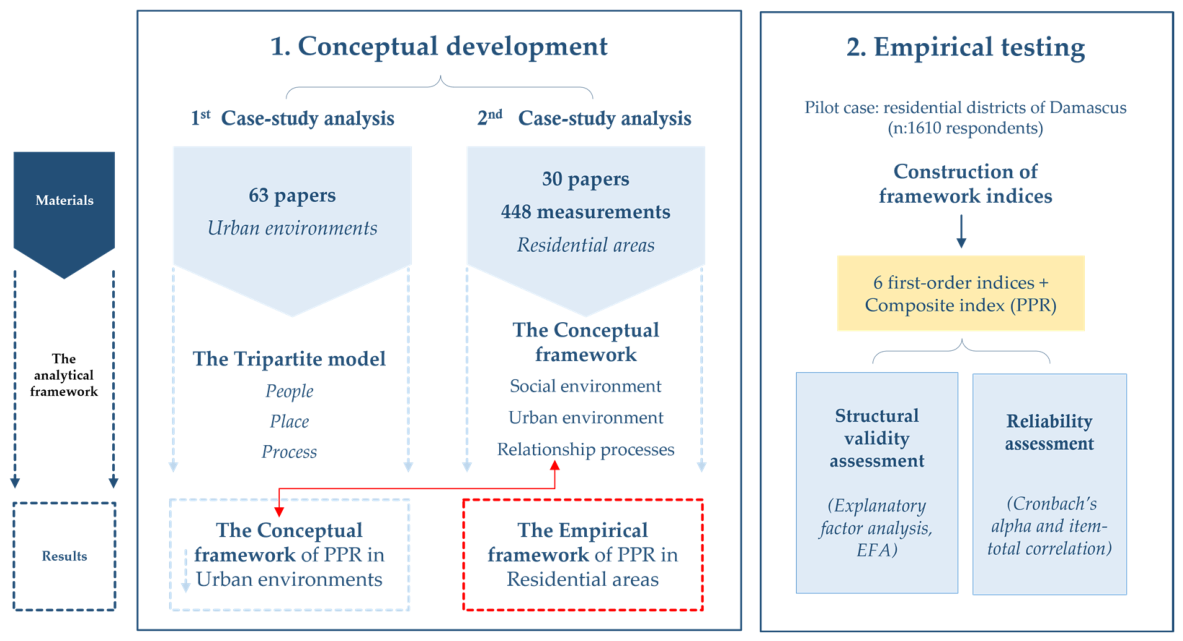
Measuring People–Place Relationships in Residential Environments: Framework Development and Pilot Testing in Damascus



Abstract
1. Introduction
2. Materials and Methods
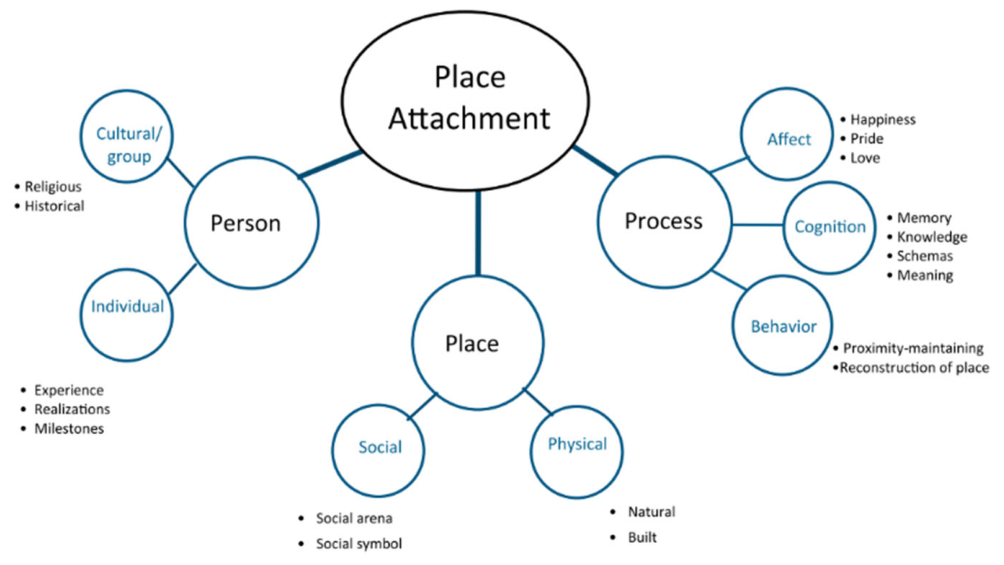
2.1. The Conceptual Development: Two Rounds of Case-Study Analysis
Indicators Selection Logic
2.2. Construction of the Framework Indices
2.2.1. Structural Validity Assessment (EFA)
2.2.2. Internal Consistency (Cronbach’s Alpha and Item–Total Correlation)
3. Results
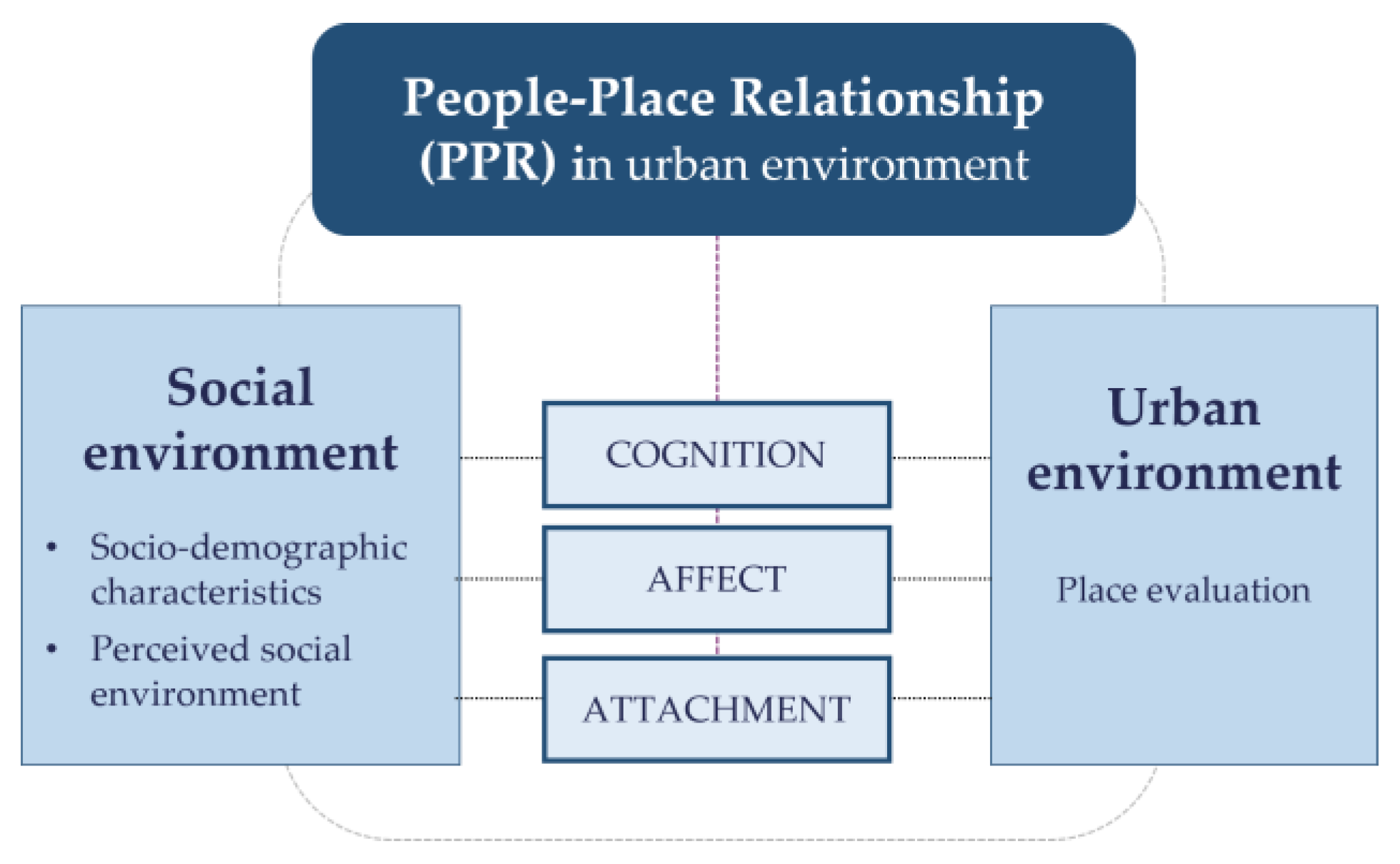
3.1. Conceptual Framework of PPR in Design Disciplines
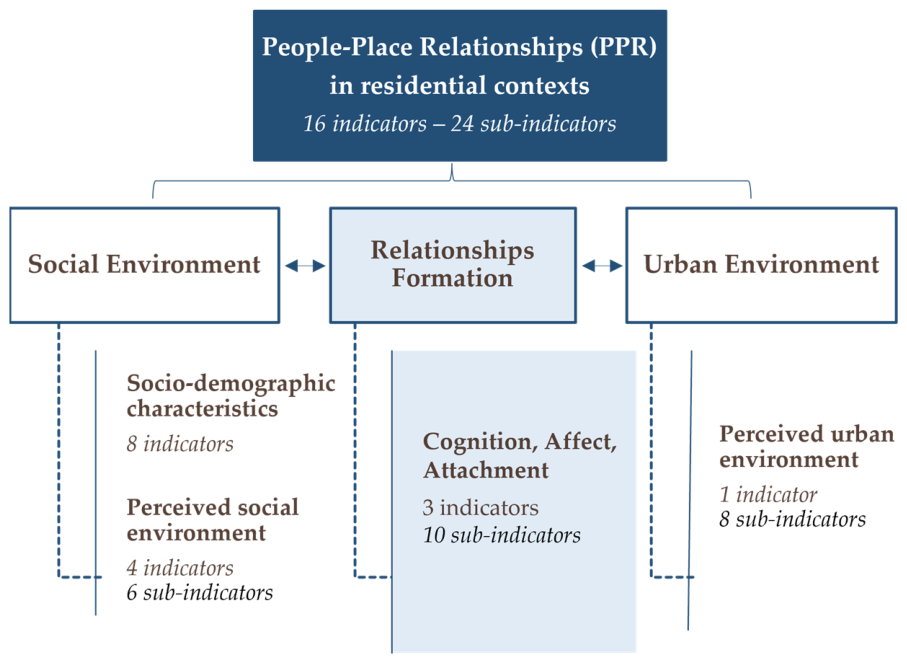
3.2. Empirical Framework of PPR in Residential Contexts
3.3. The Framework Indices: Structural Validity and Reliability
3.3.1. Structural Validity of the Framework (EFA)
3.3.2. Reliability Assessment (Cronbach’s Alpha and Item–Total Correlation)
4. Discussion
5. Conclusions
Author Contributions
Funding
Data Availability Statement
Acknowledgments
Conflicts of Interest
Abbreviations
| PPR | People–Place Relationships |
| SOP | Sense of Place |
| PA | Place Attachment |
| PI | Place Identity |
| SLR | Systematic Literature Review |
| PAF | Principal Axis Factoring |
| EFA | Exploratory Factor Analysis |
Appendix A

| SLR Questions | Analytical Aspects | Categories | |
|---|---|---|---|
| Is there any geographical reference/significance to the conceptual frameworks? | Geographical context of study | Study location | Europe, Asia, North America, South America, Australia, South Africa, Middle East, Turkey, Iran |
| Scale of place | Country–Regional–City- Rural Areas–Town–Neighborhood–Urban/Rural Facilities (Building) | ||
| Type of place | Natural settings; Urban/Rural Landscape; Tourist Destination (e.g., Festival); Urban Environment; Residential/House Development; Risk Area | ||
| Conceptual framework | Concept used in the study | PA/SOP/PI | |
| Concept’s dimensions | |||
| What are the methods used to study the concepts PA and SOP, and which dimensions were considered? | Methods/tools | Questionnaire/survey; Qualitative interview; Models (attachment scale/designated scale); Workshop/focus group; On-site narratives; Photo-based methods (photo elicitation/photo projective method); Participatory mapping (public participation GIS, participant observation); Mixed methods | |
| What is the relevance and application of operationalizing PA and SOP in a planning context? | Application | Pro-environmental behavior; Climate change adaptation; Tourism and recreation; Wellbeing and quality of life; Public policy and spatial planning | |
| Source | Indicator | Sub-Dimension | Dimensions |
|---|---|---|---|
| [106] | 1. Is there an area around here where you are now living which you would say you belong to? | Sense of belonging | PPR Process |
| 2. How interested are you to know what goes on in “Home area” | Knowledge | PPR Process | |
| 3. Supposing that for some reason you had to move away from … how sorry or pleased would you be to leave? | Behavior/rootedness | PPR Process | |
| [71] | 4. Institutional ties—the extent to which the respondent’s family was formally involved in the neighborhood? | Social PPR Process | Social enviro |
| 5. Sociable neighboring—a scale measuring the degree to which members of the respondent’s family talked, spent time with neighbors | Social PPR Process | Social enviro | |
| 6. Organizational involvement—membership and activity in a neighborhood organization | Social PPR Process | Social enviro | |
| 7. Kin in neighborhood—whether various relatives lived in the neighborhood | Social PPR Process | Social enviro | |
| 8. Friend in neighborhood—the presence of at least some of the respondent’s friends in the neighborhood | Social PPR Process | Social enviro | |
| 9. Happy with neighborhood—how happy the respondent was with the neighborhood | Affect | PPR Process | |
| 10. Unhappy to leave—how unhappy the respondent would be if he or she had to move | Affect | PPR Process | |
| [96] | 11. In general, is it pretty easy or pretty difficult for you to tell a stranger in your neighborhood? | Social PPR Process | Social enviro |
| 12. Would you say that you really feel a part of your neighborhood, or do you think of it more as just a place to live? | Identity | PPR Process | |
| 13. How about kids in your immediate neighborhood? How many of them do you know by name? | Social PPR Process | Social enviro | |
| 14. How many years have you personally lived in your present neighborhood? | length of residency | Socio-demographics | |
| 15. Do you own your home, or do you rent it? | Tenure status | Socio-demographics | |
| 16. Do you expect to be living in this neighborhood 2 years from now? | Behavior/rootedness | PPR Process | |
| [70] | 17. Owner status | Tenure status | Socio-demographics |
| 18. Length of address in the neighborhood | length of residency | Socio-demographics | |
| 19. Assessment of overall perceived similarity with neighbors on the block | Social PPR Process | Social enviro | |
| 20. Proportion of addresses on the block where he or she was acquainted with someone | Social PPR Process | Social enviro | |
| 21. Belongingness to any other local organizations to which other residents on the block also belong | Social PPR Process | Social enviro | |
| 22. Reliance on neighbors (3 items) | Social PPR Process | Social enviro | |
| 23. Ability to provide a neighborhood name | Knowledge | PPR Process | |
| 24. Gardening in back (as rated by the authors) | Green space | Urban enviro | |
| [100] | 25. Holiday decorating Behavior (4 items) | Perceived quality | Urban enviro |
| 26. Index of neighboring Behaviors (amount and kind of contact with neighbors, 1 to 11) | Social PPR Process | Social enviro | |
| 27. Scale of satisfaction (5 items) | Affect | PPR Process | |
| 28. Scale of identification (4 items) | Identity | PPR Process | |
| 29. Scale of sense of security on the block (5 items) | Perceived quality | Urban enviro | |
| 30. Scale of pride in the home’s physical appearance (6 items) | Affect | PPR Process | |
| 31. Scale of sense of privacy (2 items) | Perceived quality | Urban enviro | |
| 32. Scale of pleasure derived from decorating the home (2 items) | Affect | PPR Process | |
| [107] | 33. If I could keep the home I now have, but could move it to another neighborhood, I probably would move it | Behavior/rootedness | PPR Process |
| 34. I am interested in what happens in this neighborhood | Knowledge | PPR Process | |
| 35. If I had to move from this neighborhood now, I would be sorry to leave it | Behavior/rootedness | PPR Process | |
| 36. I plan to be living in this neighborhood still five years from now | Behavior/rootedness | PPR Process | |
| 37. I feel like I am definitely part of this neighborhood | Identity | PPR Process | |
| [101] | 38. How attached do you feel to your neighborhood? | Attachment | PPR Process |
| 39. How satisfied or dissatisfied are you with your neighborhood as a place to live? | Affect | PPR Process | |
| 40. How good or bad is your neighborhood as a place to live? | Affect | PPR Process | |
| 41. How much do you like or dislike your neighborhood as a place to live? | Affect | PPR Process | |
| [20] | 42. I have got native feelings for Heidelberg | Affect | PPR Process |
| 43. I see myself as a ‘Heidelbergian’ | Identity | PPR Process | |
| 44. I feel really at home at Heidelberg | Attachment | PPR Process | |
| 45. The town is like a part of myself | Identity | PPR Process | |
| 46. External evaluation | Perceived quality | Urban enviro | |
| 47. Continuity with personal past | Memories | PPR Process | |
| 48. Perception of familiarity | Knowledge | PPR Process | |
| 49. Commitment | Behavior/rootedness | PPR Process | |
| [108] | 50. Social contacts in home and near home-home territories | Social PPR Process | Social enviro |
| 51. Personal intentions about home and near home-home territories | Behavior/rootedness | PPR Process | |
| 52. Behaviors within home and near home-home territories | Behavior/rootedness | PPR Process | |
| 53. Opinions about home and near home-home territories | Knowledge | PPR Process | |
| [99] | 54. Embeddedness, a sense of belonging in, being part of, and feeling at home in the residential environs | Sense of belonging | PPR Process |
| 55. Community, a sense of being involved with and tied to geographically based social group | Social PPR Process | Social enviro | |
| 56. At-easiness, a sense of being unconstrained and comfortable in a familiar place | Affect | PPR Process | |
| 57. Uniqueness of place, a belief in the uniqueness of one’s home locale, a place that is unequalled and irreplaceable | Affect | PPR Process | |
| 58. Care and concern, a sense of responsibility and commitment to continue to attend to and tend for a home place | Behavior/rootedness | PPR Process | |
| 59. Unity of identities, a joining of the identity of self and referent group(s) to the physical setting | Identity | PPR Process | |
| 60. Bodily orientation, unconscious orientation of the body and bodily routines in the | Affect | PPR Process | |
| 61. Appropriation of place, perceived or actual possession and/or control over place | Perceived quality | Urban enviro | |
| 62. Centeredness, home place as a focal point of one’s experiential space, a point of departure and return | Identity | PPR Process | |
| 63. Descriptions about where the interviewees currently lived and their plans for the future | Behavior/rootedness | PPR Process | |
| [102] | 64. General attachment | Attachment | PPR Process |
| 65. Satisfaction with the apartment | Affect | PPR Process | |
| 66. Feelings of rootedness | Behavior/rootedness | PPR Process | |
| 67. Safe haven, the home is a safe haven where the resident can relax and feel secure | Affect | PPR Process | |
| 68. Connection, the home is a place to spend time with family members and to feel a sense of belonging and connection | Affect | PPR Process | |
| 69. Activity, the home is a place to carry out daily activities that the resident enjoys easily | Perceived quality | Urban enviro | |
| 70. Identity, through personalization and as a repository for identity linked objects | Identity | PPR Process | |
| [46] | 71. This is the ideal neighborhood to live in | Affect | PPR Process |
| 72. Now this neighborhood is a part of me | Identity | PPR Process | |
| 73. There are places in the neighborhood to which I am very emotionally attached | Attachment | PPR Process | |
| 74. It would be very hard for me to leave this neighborhood | Behavior/rootedness | PPR Process | |
| 75. I would willingly leave this neighborhood | Behavior/rootedness | PPR Process | |
| 76. I would not willingly leave this neighborhood for another | Behavior/rootedness | PPR Process | |
| [98] | 77. Feeling at ease | Affect | PPR Process |
| 78. Feeling at home | Affect | PPR Process | |
| 79. Being interested in the future of the neighborhood | Behavior/rootedness | PPR Process | |
| 80. Happiness/unhappiness to leave | Affect | PPR Process | |
| 81. Presence of relatives/friends in the neighborhood | Social PPR Process | Social enviro | |
| 82. Occurrence of encounters with familiar people | Social PPR Process | Social enviro | |
| 83. Nature of neighboring relationships | Social PPR Process | Social enviro | |
| 84. Satisfaction with neighboring relationships | Affect | PPR Process | |
| 85. Nature of relationships with shopkeepers | Social PPR Process | Social enviro | |
| 86. Satisfaction with relationships with shopkeepers | Affect | PPR Process | |
| [103] | 87. How attached do you feel to [Specific place]? | Attachment | PPR Process |
| 88. How satisfied are you with [Specific place]? | Affect | PPR Process | |
| 89. In comparison to with the EX-USSR, are you satisfied with [Specific place] more, less or the same? | Affect | PPR Process | |
| 90. How sorry would you be to leave [Specific place] now? | Behavior/rootedness | PPR Process | |
| 91. To what extent do you feel that this is your country/neighborhood/apartment? | Identity | PPR Process | |
| [104] | 92. Feelings of place attachment | Attachment | PPR Process |
| 93. Importance of localized ancestry | Social PPR Process | Social enviro | |
| 94. Feelings of being an insider | Identity | PPR Process | |
| 95. Motivation to remain on the locale | Behavior/rootedness | PPR Process | |
| [82] | 96. Moving from place to place is exciting and fun | Preferences | Socio-demographics |
| 97. I could not be happy living in one place for the rest of my life | Preferences | Socio-demographics | |
| 98. Living close to certain natural features such as the ocean or mountains is very important to me | Preferences | Socio-demographics | |
| 99. I like going places where no-one knows me | Preferences | Socio-demographics | |
| 100. There is not much of a future for me in my home town | Preferences | Socio-demographics | |
| 101. Most of the people that I knew when I was growing up have moved away | Preferences | Socio-demographics | |
| 102. I am extremely satisfied with my present home | Affect | PPR Process | |
| 103. My family is very close-knit and I would be unhappy if I could not see them on a regular basis | Social PPR Process | Social enviro | |
| 104. I have several close, life-long friends that I never want to lose | Social PPR Process | Social enviro | |
| 105. I love to reminisce about the places I played when I was a child | Childhood | Socio-demographics | |
| [109] | 106. Proud to live in the neighborhood | Affect | PPR Process |
| 107. Sorry to move out | Behavior/rootedness | PPR Process | |
| 108. Have plans to move out during the next year | Behavior/rootedness | PPR Process | |
| 109. Local social ties | Social PPR Process | Social enviro | |
| 110. Economic and social investment in the locale | Social PPR Process | Social enviro | |
| 111. Satisfaction with the neighborhood | Affect | PPR Process | |
| [52] | 112. Clarity of personal neighborhood image | Knowledge | PPR Process |
| 113. Clarity of official neighborhood image | Knowledge | PPR Process | |
| 114. Correspondence of personal to official neighborhood image | Knowledge | PPR Process | |
| 115. Neighborhood name | Knowledge | PPR Process | |
| 116. Neighborhood size | Knowledge | PPR Process | |
| 117. The neighborhood is (has): | Perceived quality | Urban enviro | |
| 118. Attractive | Perceived quality | Urban enviro | |
| 119. Clean | Perceived quality | Urban enviro | |
| 120. Quiet | Perceived quality | Urban enviro | |
| 121. Well-maintained | Perceived quality | Urban enviro | |
| 122. Adequate recreational space | Perceived quality | Urban enviro | |
| 123. Cleanliness | Perceived quality | Urban enviro | |
| 124. Type of people | Social PPR Process | Social enviro | |
| 125. Shopping facilities | Perceived quality | Urban enviro | |
| 126. Housing | Perceived quality | Urban enviro | |
| 127. Crime | Perceived quality | Urban enviro | |
| 128. Neighbor recognition | Knowledge | PPR Process | |
| 129. Social life mostly in neighborhood | Social PPR Process | Social enviro | |
| 130. Just a place to live? | Affect | PPR Process | |
| 131. Grocery shopping | Perceived quality | Urban enviro | |
| 132. Drugstore shopping | Perceived quality | Urban enviro | |
| 133. Restaurants | Perceived quality | Urban enviro | |
| 134. Bars | Perceived quality | Urban enviro | |
| 135. Art fair | Perceived quality | Urban enviro | |
| 136. Length of residence | length of residency | Socio-demographics | |
| 137. Tenure status | Tenure status | Socio-demographics | |
| 138. Household income | Household income | Socio-demographics | |
| 139. Occupation | Occupation | Socio-demographics | |
| [74] | 140. This place is very important to me. | Affect | PPR Process |
| 141. This place means a lot to me. | Affect | PPR Process | |
| 142. I am rooted in this place. | Behavior/rootedness | PPR Process | |
| 143. I feel this place is a part of my life | Identity | PPR Process | |
| 144. Lots of activities in my daily life are strongly connected with this place. | experiences | PPR Process | |
| 145. If my situation changes (e.g., health or financial status), I won’t be able to continue living in this place. | Behavior/rootedness | PPR Process | |
| 146. If I don’t make efforts to maintain health, I can no longer live in this place. | Behavior/rootedness | PPR Process | |
| 147. Living at this place makes me feel secure. | Affect | PPR Process | |
| 148. This is a good place for me to live. | Affect | PPR Process | |
| 149. I prefer to live here compared to other places. | Affect | PPR Process | |
| 150. I wish to live in this place for a long time. | Behavior/rootedness | PPR Process | |
| 151. I cannot bear to move out of this place. | Behavior/rootedness | PPR Process | |
| 152. I think the facilities and services for daily life in this place will remain suitable for me in the future. | Perceived quality | urban enviro | |
| 153. I think the health, leisure, medical facilities, and services in this place will remain suitable for me in the future. | Perceived quality | Urban enviro | |
| 154. I think the social activities and social occasions in this place will remain suitable for me in the future. | Social PPR Process | Social enviro | |
| 155. I have a familiar feeling toward this place. | Affect | PPR Process | |
| 156. I live in this place because my family members, relatives, and friends are here. | Social PPR Process | Social enviro | |
| 157. I am very close to the residents of this place. | Social PPR Process | Social enviro | |
| 158. I often hang out with the relatives and friends in this place. | Social PPR Process | Social enviro | |
| [75] | 159. I feel secure in Mavişehir | Affect | PPR Process |
| 160. I would not like to move out from here | Behavior/rootedness | PPR Process | |
| 161. I want to be involved in what is going on here | Behavior/rootedness | PPR Process | |
| 162. I know Mavişehir very well | Knowledge | PPR Process | |
| 163. I defend Mavişehir when somebody criticizes it | Behavior/rootedness | PPR Process | |
| 164. I miss Mavişehir when I am not here | Behavior/rootedness | PPR Process | |
| 165. I am proud of this place | Affect | PPR Process | |
| 166. I am rooted in Mavişehir | Behavior/rootedness | PPR Process | |
| 167. Mavişehir is a part of myself | Identity | PPR Process | |
| 168. I have no influence on its affairs | Identity | PPR Process | |
| 169. I leave Mavişehir with pleasure | Behavior/rootedness | PPR Process | |
| 170. I don’t like Mavişehir | Affect | PPR Process | |
| 171. Evaluation | Perceived quality | Urban enviro | |
| 172. Attachment | Attachment | PPR Process | |
| 173. Familiarity | Knowledge | PPR Process | |
| 174. Commitment | Behavior/rootedness | PPR Process | |
| 175. Continuity | memories | PPR Process | |
| 176. Sex | Sex | Socio-demographics | |
| 177. Age | Age | Socio-demographics | |
| 178. Income | Household income | Socio-demographics | |
| 179. Ownership | Tenure status | Socio-demographics | |
| 180. Education | Educational level | Socio-demographics | |
| 181. Marital status | Martial status | Socio-demographics | |
| 182. Household size | Household size | Socio-demographics | |
| 183. Length of residency | length of residency | Socio-demographics | |
| 184. Birthplace | Birthplace | Socio-demographics | |
| [73] | 185. I am very attached to… | Attachment | PPR Process |
| 186. …… is very special to me. | Attachment | PPR Process | |
| 187. I identify strongly with …… | Identity | PPR Process | |
| 188. I feel …… is a part of me. | Identity | PPR Process | |
| 189. …… means a lot to me. | Affect | PPR Process | |
| 190. I have a lot of fond memories of…. | memories | PPR Process | |
| 191. Living in this community says a lot of who I am. | Identity | PPR Process | |
| 192. The best place. whether community or activities | Affect | PPR Process | |
| 193. No other place can compare. | Affect | PPR Process | |
| 194. I would not substitute any other area. | Behavior/rootedness | PPR Process | |
| 195. Living life in … is better than living anywhere in the world. | Affect | PPR Process | |
| 196. Satisfies my needs better than any other place. | Affect | PPR Process | |
| 197. Doing my activities in … is more important to me than doing them in any other place. | Affect | PPR Process | |
| 198. There is no better place I would like to live in than …… | Affect | PPR Process | |
| [49] | 199. I would be sorry to move out of this neighborhood without the people I live with/appreciate | Behavior/rootedness | PPR Process |
| 200. I would be sorry if the people I lived with/appreciate moved out from this neighborhood without me | Behavior/rootedness | PPR Process | |
| 201. I would be sorry if I and the people I lived with/appreciate moved out of my neighborhood | Behavior/rootedness | PPR Process | |
| 202. I am very attached to my neighborhood | Attachment | PPR Process | |
| 203. This neighborhood is very special to me | Identity | PPR Process | |
| 204. My neighborhood has distinct features and shows my personal preference | Identity | PPR Process | |
| 205. I feel this neighborhood is a part of me | Identity | PPR Process | |
| 206. My neighborhood is significantly important to me | Identity | PPR Process | |
| 207. My neighborhood is identifiable | Identity | PPR Process | |
| 208. My neighborhood is generally comfortable and functional | Perceived quality | Urban enviro | |
| 209. My neighborhood is the best place for what I would like to do | Behavior/rootedness | PPR Process | |
| 210. No other place can compare to my neighborhood | Affect | PPR Process | |
| 211. I get more satisfaction out of living in this neighborhood | Affect | PPR Process | |
| 212. Doing what I do in my neighborhood is more important to me than doing it in any other place | Behavior/rootedness | PPR Process | |
| 213. The neighborhood is well associated with nature | Perceived quality | Urban enviro | |
| 214. My garden/balcony or green spaces in the neighborhood is sufficient | green space | Urban enviro | |
| 215. I prefer spending time in the garden or communal spaces in the neighborhood rather than the alternatives outside | green space | Urban enviro | |
| 216. There are specific activities performed in the garden/balcony or communal spaces in my neighborhood | green space | Urban enviro | |
| 217. I would prefer to live in a greener neighborhood | preferences | Socio-demographics | |
| 218. Green spaces and buildings are well balanced in the neighborhood | green space | Urban enviro | |
| 219. Green spaces encourage me to use the neighborhood actively | green space | Urban enviro | |
| 220. I feel social bonding is strong in my neighborhood | Social PPR Process | Social enviro | |
| 221. People living in the same neighborhood think about themselves and have little interest in others | Social PPR Process | Social enviro | |
| 222. I think the family/neighborhood values are respected in my neighborhood | Social PPR Process | Social enviro | |
| 223. I am satisfied with my close relationships with family members/friends/neighbors in the neighborhood | Social PPR Process | Social enviro | |
| 224. People of the same neighborhood are often acquainted | Social PPR Process | Social enviro | |
| 225. I feel I belong to this neighborhood | Sense of belonging | PPR Process | |
| 226. There is a peaceful rhythm of life in the neighborhood | Perceived quality | urban enviro | |
| 227. It is a neighborhood with many points of interest/my house is not only a dormitory | Perceived quality | Urban enviro | |
| 228. I think I am a part of this neighborhood | Identity | PPR Process | |
| 229. I feel familiar with my neighborhood | Knowledge | PPR Process | |
| 230. I moved to this neighborhood because of its familiarity to me | Knowledge | PPR Process | |
| 231. I feel this neighborhood reflects my cultural and social values | Identity | PPR Process | |
| 232. Spatial organization of the neighborhood provides enough opportunities for social PPR Process | Perceived quality | Urban enviro | |
| 233. There is a lack of meeting places in this neighborhood | Perceived quality | Urban enviro | |
| 234. This neighborhood is good for me to interact with other people | Perceived quality | Urban enviro | |
| [50] | 235. There are parks for children to play freely. | Perceived quality | Urban enviro |
| 236. There are more and more green spaces. | green space | Urban enviro | |
| 237. There are enough parks and public spaces. | green space | Urban enviro | |
| 238. There is at least a garden/park where people can meet. | green space | Urban enviro | |
| 239. The neighborhood offers opportunities for play and hobbies. | Perceived quality | Urban enviro | |
| 240. The neighborhood has interesting local history and culture. | Perceived quality | Urban enviro | |
| 241. I see and speak to other people when I am walking in my neighborhood. | Social PPR Process | Social enviro | |
| 242. The place I live in can fulfill my needs. | Affect | PPR Process | |
| 243. As far as I am concerned, there are no better places to be than at the place I live in. | Affect | PPR Process | |
| 244. I think the place I live in is walkable. | Perceived quality | Urban enviro | |
| 245. My neighbors share similar values with me. | Social PPR Process | Social enviro | |
| 246. I feel that I am part of the place I live in. | Identity | PPR Process | |
| 247. I have positive relationships with my neighbors. | Social PPR Process | Social enviro | |
| 248. I feel relaxed when I’m at the place I live in. | Affect | PPR Process | |
| 249. I feel happiest when I’m at the place I live in. | Affect | PPR Process | |
| 250. The place I live in is my favorite place to be. | Affect | PPR Process | |
| 251. I really miss the place I live in when I’m away from it for too long. | Behavior/rootedness | PPR Process | |
| 252. My neighbors and I share common goals. | Social PPR Process | Social enviro | |
| 253. I enjoy being involved in community affairs of the place I live in. | Social PPR Process | Social enviro | |
| 254. I am willing to spare my leisure time to help the place I live in. | Behavior/rootedness | PPR Process | |
| 255. I am willing to devote my resources to help the place I live in. | Behavior/rootedness | PPR Process | |
| [51] | 256. Open spaces/Positive | green space | Urban enviro |
| 257. Service facilities/Positive | Perceived quality | Urban enviro | |
| 258. Lack of maintenance/Negative | Perceived quality | Urban enviro | |
| 259. Overcrowding//Negative | Perceived quality | Urban enviro | |
| 260. Daily encounters/Positive | Social PPR Process | Social enviro | |
| 261. Number of relatives/Positive | Social PPR Process | Social enviro | |
| 262. Cultural tensions/Negative | Social PPR Process | Social enviro | |
| 263. Lack of contribution/Negative | Social PPR Process | Social enviro | |
| 264. Accessibility problems/Negative | Perceived quality | Urban enviro | |
| 265. Crimes/Negative | Perceived quality | Urban enviro | |
| [35] | 266. “I feel this neighborhood is a part of me,” | Identity | PPR Process |
| 267. “This neighborhood is very special to me,” | Identity | PPR Process | |
| 268. “I identify strongly with this neighborhood,” | Identity | PPR Process | |
| 269. “I am very attached to this neighborhood,” | Attachment | PPR Process | |
| 270. “Visiting this neighborhood says a lot about who I am,” | Identity | PPR Process | |
| 271. “This neighborhood means a lot to me | Identity | PPR Process | |
| 272. This neighborhood is the best place for what I like to do,” | Affect | PPR Process | |
| 273. “No other place can compare to this neighborhood,” | Affect | PPR Process | |
| 274. “I get more satisfaction out of visiting this neighborhood than any other,” | Affect | PPR Process | |
| 275. “Doing what I do at this neighborhood is more important to me than doing it in any other place,” | Behavior/rootedness | PPR Process | |
| 276. “I wouldn’t substitute any other area for doing the types of things I do at this neighborhood.” | Behavior/rootedness | PPR Process | |
| 277. Floor area, layout, interior design, building quality, ventilation, and natural lighting | Perceived quality | Urban enviro | |
| 278. Building aesthetics, noise, walking environment, parking, green space, general cleanliness, and public facilities | Perceived quality | Urban enviro | |
| 279. Health services, entertainment, commercial services, public transport, and education | Perceived quality | Urban enviro | |
| 280. “Neighbors are friendly,” | Social PPR Process | Social enviro | |
| 281. “Wanting to be involved in community improvement,” | Social PPR Process | Social enviro | |
| 282. “Wanting to be involved in collective activities,” | Social PPR Process | Social enviro | |
| 283. “Kids often play with each other in open space,” | Social PPR Process | Social enviro | |
| 284. “Neighbors often chat with each other in open space,” | Social PPR Process | Social enviro | |
| 285. “Neighbors would confront kids when they see kids spraying graffiti,” | Social PPR Process | Social enviro | |
| 286. “There are harmonious relationships in this community,” | Social PPR Process | Social enviro | |
| 287. “I know most of the people in this community.” | Social PPR Process | Social enviro | |
| 288. “Feel safe if out alone at night in this neighborhood,” | Perceived quality | Urban enviro | |
| 289. “Feel safe if stopped by a stranger for directions,” | Affect | PPR Process | |
| 290. “Not worry about criminal victimization,” | Perceived quality | Urban enviro | |
| 291. “Neighborhood has good security facilities” | Perceived quality | Urban enviro | |
| 292. Years of residence | length of residency | Socio-demographics | |
| 293. Gender | sex | Socio-demographics | |
| 294. Homeownership | Tenure status | Socio-demographics | |
| [94] | 295. Accessibility: Accessibility related to public transportation | Perceived quality | Urban enviro |
| 296. Accessibility: Accessibility related to school | Perceived quality | Urban enviro | |
| 297. Accessibility: Distance to workplace | Perceived quality | Urban enviro | |
| 298. Accessibility: Availability of internet/telephone network | Perceived quality | Urban enviro | |
| 299. Accessibility: Availability of electricity network | Perceived quality | Urban enviro | |
| 300. Accessibility: Accessibility related to market | Perceived quality | Urban enviro | |
| 301. Accessibility: Intensity of passing vehicles | Perceived quality | Urban enviro | |
| 302. Accessibility: Proximity to city center | Perceived quality | Urban enviro | |
| 303. Accessibility: Accessibility related to hospital/clinic | Perceived quality | Urban enviro | |
| 304. Accessibility: Availability of parking space | Perceived quality | Urban enviro | |
| 305. Environmental Health: Noise | Perceived quality | Urban enviro | |
| 306. Environmental Health: Air pollution | Perceived quality | Urban enviro | |
| 307. Environmental Health: Animal pest | Perceived quality | Urban enviro | |
| 308. Environmental Health: Housing density | Perceived quality | Urban enviro | |
| 309. Environmental Health: Rubbish | Perceived quality | Urban enviro | |
| 310. Environmental Health: Chaotic housing | Perceived quality | Urban enviro | |
| 311. Environmental Health: Water pollution | Perceived quality | Urban enviro | |
| 312. Environmental Health: Land pollution | Perceived quality | Urban enviro | |
| 313. Environmental Health: Traffic congestion | Perceived quality | Urban enviro | |
| 314. Availability of Infrastructure: Quality of drinking water | Perceived quality | Urban enviro | |
| 315. Availability of Infrastructure: Availability of drinking water | Perceived quality | Urban enviro | |
| 316. Availability of Infrastructure: Road width | Perceived quality | Urban enviro | |
| 317. Availability of Infrastructure: Availability of water supply | Perceived quality | Urban enviro | |
| 318. Availability of Infrastructure: Condition of road surface | Perceived quality | Urban enviro | |
| 319. Housing Affordability: Adequacy of the number of indoor spaces | Perceived quality | Urban enviro | |
| 320. Housing Affordability: Physical resistance of the house | Perceived quality | Urban enviro | |
| 321. Housing Affordability: Bathroom inside | Perceived quality | Urban enviro | |
| 322. Housing Affordability: Availability of yard/garden | Perceived quality | Urban enviro | |
| 323. Housing Affordability: Size | Perceived quality | Urban enviro | |
| 324. Availability of Public Facilities: Availability of recreational facilities | Perceived quality | Urban enviro | |
| 325. Availability of Public Facilities: Availability of sports facilities | Perceived quality | Urban enviro | |
| 326. Availability of Public Facilities: Availability of tourist attraction | Perceived quality | Urban enviro | |
| 327. Availability of Public Facilities: Availability of sewage drainage | Perceived quality | Urban enviro | |
| 328. Social Solidarity: Community participation | Social PPR Process | Social enviro | |
| 329. Social Solidarity: Community motivation | Social PPR Process | Social enviro | |
| 330. Social Solidarity: Natural environment | Social PPR Process | Social enviro | |
| 331. Social Solidarity: Convenience of the environment | Social PPR Process | Social enviro | |
| 332. Social Solidarity: Mutual cooperation | Social PPR Process | Social enviro | |
| 333. Social Solidarity: Convenience of the climate | Social PPR Process | Social enviro | |
| 334. Social Solidarity: High-quality of society | Social PPR Process | Social enviro | |
| 335. Environmental Security: Gambling | Perceived quality | Urban enviro | |
| 336. Environmental Security: Networking of drug users | Perceived quality | Urban enviro | |
| 337. Environmental Security: Prostitution | Perceived quality | Urban enviro | |
| 338. Environmental Security: Juvenile delinquency (brawl) | Perceived quality | Urban enviro | |
| 339. Environmental Security: Crime (robbery, theft) | Perceived quality | Urban enviro | |
| 340. Environmental Security: Outdoor security at night | Perceived quality | Urban enviro | |
| 341. Environmental Security: Natural disaster threat | Perceived quality | Urban enviro | |
| 342. Social Cohesion: Social tolerance among neighbors | Social PPR Process | Social enviro | |
| 343. Social Cohesion: PPR Process and communication among neighbors | Social PPR Process | Social enviro | |
| 344. Social Cohesion: Diversity of ethnic/cultural/religious communities | Social PPR Process | Social enviro | |
| 345. Social Cohesion: Pleasant atmosphere | Social PPR Process | Social enviro | |
| 346. Economic Capacity: Life fulfilment | Economic | Socio-demographics | |
| 347. Economic Capacity: Employment status | occupation | Socio-demographics | |
| 348. Economic Capacity: Monthly income | Household income | Socio-demographics | |
| 349. Economic Capacity: Homeownership status | Tenure status | Socio-demographics | |
| 350. Territoriality: Privacy | Perceived quality | Urban enviro | |
| 351. Territoriality: Driving safety | Perceived quality | Urban enviro | |
| 352. Functional: I prefer to live in …… compared to other places (COMPARISON) | Affect | PPR Process | |
| 353. Functional: There is no other place I want to live in other than …… (COMPARISON) | Affect | PPR Process | |
| 354. Functional: …… is truly meaningful to me (MEANING) | Identity | PPR Process | |
| 355. Functional: I have an emotional attachment to …… … (ATTACHMENT) | Attachment | PPR Process | |
| 356. Functional: Many of my friends/family prefer to live in …… compared to other places (COMPARISON) | Affect | PPR Process | |
| 357. Cognitive: I can recognize …… strongly (RECOGNITION) | Knowledge | PPR Process | |
| 358. Cognitive: I am satisfied because I have lived in …… … for a long time (LONG STAY) | Affect | PPR Process | |
| 359. Cognitive: My experience during staying in …… is unforgettable (POSITIVE EXPERIENCE) | experiences | PPR Process | |
| 360. Cognitive: I am satisfied with my life in …… (SATISFACTION) | Affect | PPR Process | |
| 361. Cognitive: …… fulfills my needs well (SATISFACTION) | Affect | PPR Process | |
| 362. Cognitive: I am satisfied because I was born in …… (BIRTHPLACE) | Birthplace | Socio-demographics | |
| 363. Cognitive: My memory in …… makes me feel more in love with this place (LOVE) | memories | PPR Process | |
| [97] | 364. Gender | sex | Socio-demographics |
| 365. Time of residency | length of residency | Socio-demographics | |
| 366. Accessibility | Perceived quality | Urban enviro | |
| 367. Social infrastructure | Perceived quality | Urban enviro | |
| 368. Open spaces | green space | Urban enviro | |
| 369. Places for daily operations | Perceived quality | Urban enviro | |
| 370. Sense of community | Social PPR Process | Social enviro | |
| 371. Social relations | Social PPR Process | Social enviro | |
| 372. Social network | Social PPR Process | Social enviro | |
| 373. Sense of place | Knowledge | PPR Process | |
| 374. Security and safety | Perceived quality | Urban enviro | |
| 375. Participation | Social PPR Process | Social enviro | |
| 376. Future of space | Behavior/rootedness | PPR Process | |
| [95] | 377. I feel at home in this area | affect | PPR Process |
| 378. I feel a sense of familiarity when I am in this area | Knowledge | PPR Process | |
| 379. I am proud of this area | Affect | PPR Process | |
| 380. I have personal memories that link me to this area | memories | PPR Process | |
| 381. This area is the best place for the activities I like to do | experiences | PPR Process | |
| 382. Living in this area says a lot about who I am | Identity | PPR Process | |
| 383. For the activities I like to do most, no other place can compare to this area | Affect | PPR Process | |
| 384. I know folk tales about this area | Knowledge | PPR Process | |
| 385. I have heard personal stories that took place in this area | Knowledge | PPR Process | |
| 386. I think the landscape genesis is visible in this area | Perceived quality | Urban enviro | |
| 387. I have learned more about the historical features of this area | Knowledge | PPR Process | |
| 388. Belonging to volunteer groups in this area is very important to me | preferences | Socio-demographics | |
| 389. I feel connected to the neighborhood/street where I live | Identity | PPR Process | |
| 390. The friendships developed in this area strongly connect me to it | Social PPR Process | Social enviro | |
| 391. Age | Age | Socio-demographics | |
| 392. Education | educational level | Socio-demographics | |
| 393. Family situation | Household income | Socio-demographics | |
| 394. Gender | sex | Socio-demographics | |
| 395. Owned property | Tenure status | Socio-demographics | |
| 396. Distance to … here river. | Perceived quality | Urban enviro | |
| 397. Born in the area | Birthplace | Socio-demographics | |
| 398. Length of residence | length of residency | Socio-demographics | |
| [105] | 399. PI-1: I am very attached to the UGS and visit on a regular basis. | Attachment | PPR Process |
| 400. PI-2: I have a lot of fond memories of my nearby UGS. | memories | PPR Process | |
| 401. PI-3: I miss it when I am away for a long time. | Affect | PPR Process | |
| 402. PI-4: The UGS close to my house/office reminds me of what I am and my heritage. | green space | Urban enviro | |
| 403. PI-5: The UGS reminds me of some of my loved ones (parents, children, spouse, etc.) | green space | Urban enviro | |
| 404. PD-1: Living close to UGS is good for my health/physical agility | green space | Urban enviro | |
| 405. PD-2: Living close to UGS makes me feel more protected from natural disasters | green space | Urban enviro | |
| 406. PD-3: I prefer to live close to UGS because I believe it offers a good and clean-living environment. | green space | Urban enviro | |
| 407. PD-4: I feel mentally rejuvenated when I visit a nearby UGS | green space | Urban enviro | |
| 408. PD-5: UGS has a lot of impacts on my health and wellbeing | green space | Urban enviro | |
| 409. PD-6: I feel my UGS should be protected at any cost | green space | Urban enviro | |
| 410. PD-7: Doing an activity in my UGS means more to me than doing it anywhere else | green space | Urban enviro | |
| 411. SB-1: Visiting UGS helps to improve my family bonding | green space | Urban enviro | |
| 412. SB-2: UGS helps me to socialize within my community | green space | Urban enviro | |
| 413. SB-3: I have made a lot of new friends while visiting the nearby UGS | green space | Urban enviro | |
| 414. SB-4: UGS helped my community to conduct social events (e.g., flea markets, community performances, etc.) | green space | Urban enviro | |
| 415. SB-5: Our nearby UGS contributed hugely to developing a sense of community | green space | Urban enviro | |
| 416. NB-1: When I spend time in the nearby UGS, I feel a deep feeling of oneness | green space | Urban enviro | |
| 417. NB-2: I would feel less attached if the native plants and animals in the UGS disappear | green space | Urban enviro | |
| 418. NB-3: I learn a lot about myself when spending time in the UGS | green space | Urban enviro | |
| 419. NB-4: I feel a general sense of well-being when visiting the UGS | green space | Urban enviro | |
| [110] | 420. Identity; personal | Identity | PPR Process |
| 421. Dependence; personal | Behavior/rootedness | PPR Process | |
| 422. Social bonding | Social PPR Process | Social enviro | |
| 423. Nature bonding | green space | Urban enviro | |
| [45] | 424. Architecture: Building aesthetics | Perceived quality | Urban enviro |
| 425. Architecture: Building density | Perceived quality | Urban enviro | |
| 426. Architecture: Building volume | Perceived quality | Urban enviro | |
| 427. Accessibility: Internal practicability | Perceived quality | Urban enviro | |
| 428. Accessibility: External connections | Perceived quality | Urban enviro | |
| 429. Green areas | green space | Urban enviro | |
| 430. People and social relations: Security | Social PPR Process | Social enviro | |
| 431. People and social relations: Discretion | Social PPR Process | Social enviro | |
| 432. People and social relations: Sociability | Social PPR Process | Social enviro | |
| 433. Welfare services: Educational services | Perceived quality | Urban enviro | |
| 434. Welfare services: Social health services | Perceived quality | Urban enviro | |
| 435. Cultural–recreational services: Sport services | Perceived quality | Urban enviro | |
| 436. Cultural–recreational services: Socio-cultural activities | Perceived quality | Urban enviro | |
| 437. Commercial services | Perceived quality | Urban enviro | |
| 438. Public transport | Perceived quality | Urban enviro | |
| 439. Pace of life: Relaxing/distressing | Perceived quality | Urban enviro | |
| 440. Pace of life: Stimulating/boring | Perceived quality | Urban enviro | |
| 441. Environmental health | Perceived quality | Urban enviro | |
| 442. Maintenance and care | Perceived quality | Urban enviro | |
| [46] | 443. This is the ideal neighborhood to live in. | Affect | PPR Process |
| 444. Now this neighborhood is a part of me. | Identity | PPR Process | |
| 445. There are places in the neighborhood to which I am very emotionally attached. | Attachment | PPR Process | |
| 446. It would be very hard for me to leave this neighborhood. | Behavior/rootedness | PPR Process | |
| 447. I would willingly leave this neighborhood. | Behavior/rootedness | PPR Process | |
| 448. I would not willingly leave this neighborhood for another. | Behavior/rootedness | PPR Process |
Appendix B
| Dimension | Indicators | Question Used in Google Form | Answer | * | |
|---|---|---|---|---|---|
| Define the place | Define the district | Which district do you live in? | Choose from the 16 districts | I | |
| Define the neighborhood | Which neighborhood do you live in (within the selected district)? | Choose from the list of neighborhoods | I | ||
| Define the residential block (optional) | What is the name of the street or block where you live? If there is no official name, please mention a well-known landmark near your residence | Short answer | II | ||
| Socio-demographics background | Sex | Sex | Male/Female | III | |
| Age | Age group | 18 or less/19–29/30–44/45–59/60 or more | III | ||
| Educational level | What is your educational level? | Elementary & lower/Basic education/Secondary/Intermediate institutes/University degree & above | III | ||
| N. of children | Are there any children under the age of 16 living in your household? | Yes/No | III | ||
| Residential duration | How long have you been living in your current neighborhood? | less than 5/5–15 years/15–30 years/more than 30 | III | ||
| Type of housing | What type of housing do you live in? | Apartment in a residential building (5 floors or less)/Apartment in a residential building (6 floors or more)/Independent (villa)/Traditional (inner courtyard)/connected or informal | III | ||
| Tenure status | What is the tenure status of the house you live in? | Own/Rent | III | ||
| Childhood location | Where did you spend most of your childhood? | In the same neighborhood where I live now, In a different neighborhood in Damascus, In another city in Syria, Outside Syria | III | ||
| Perceived social environment | Perceived similarities with neighbors | How much do you have in common with your neighbors in the following aspects? | Social class and economic status | V | |
| Cultural and ethnic background | |||||
| Religious practices and beliefs | |||||
| Nature of neighboring relationships | How would you describe the nature of your relationship with your neighbors? | Based on family connections/friendships (e.g., from school, work, etc.)/proximity (e.g., living close by)/shared interests/same social class/no relation | IV | ||
| Social interactions | amount | Rate the following statements about your neighborhood community on a scale from 1 to 5: | I often interact with my neighbors | V | |
| quality | I have positive relationships with my neighbors. | ||||
| bonding outcome | There are harmonious relationships in my neighborhood community | ||||
| Places for social interactions | Where do you most commonly interact with your neighbors? | Religious places (e.g., mosque, church)/Public spaces (e.g., street, local shops or markets)/GS (e.g., gardens, open areas)/Sports facilities (e.g., gym, sports courts)/Neighborhood organizations (e.g., community/cultural centers)/At home (e.g., inviting neighbors over)/social event | IV | ||
| Perceived urban environment | Perceived quality of neighborhood | Please rate the following qualities of your neighborhood: | Safety/Calmness/Cleanliness/Privacy/Aesthetics/Availability of main services (e.g., water, electricity, transportation)/Adequate recreational spaces (e.g., green areas, gardens)/Walkability (e.g., pedestrian-friendly streets, ease of walking) | V | |
| Relationship formation | Cognition (Knowledge, Memory, Experience) | Please rate the following statements about your familiarity and experiences with your neighborhood | I know this neighborhood very well | V | |
| I have profound memories in this neighborhood | |||||
| I have positive experiences in this neighborhood | |||||
| Affect (Emotion, Satisfaction) | Please rate the following statements about your feelings and satisfaction with living in your neighborhood | I feel happy and comfortable living in this neighborhood. | V | ||
| I am proud of living in this neighborhood | |||||
| I think my neighborhood is a good place to live | |||||
| I am satisfied with my relationships with neighbors | |||||
| Rootedness, Identity, Attachment | To what extent do you agree with the following statements about your relationship with your neighborhood? | If I had to move from this neighborhood now, I would be sorry to leave it | |||
| For me, this neighborhood is just a place to live | |||||
| I feel strongly attached to my neighborhood | |||||
References
- Ilovan, O.-R.; Markuszewska, I. (Eds.) Preserving and Constructing Place Attachment in Europe; GeoJournal Library; Springer International Publishing: Cham, Switzerland, 2022; Volume 131, ISBN 978-3-031-09774-4. [Google Scholar]
- Stephenson, J. People and Place. Plan. Theory Pract. 2010, 11, 9–21. [Google Scholar] [CrossRef] [Scilit]
- Low, S.M.; Altman, I. Place Attachment. In Place Attachment; Altman, I., Low, S.M., Eds.; Springer: Boston, MA, USA, 1992; pp. 1–12. ISBN 978-1-4684-8753-4. [Google Scholar]
- Counted, A.V. Making Sense of Place Attachment: Towards a Holistic Understanding of People-Place Relationships and Experiences. Environ. Space Place 2016, 8, 7–32. [Google Scholar] [CrossRef] [Scilit]
- Erfani, G. Reconceptualising Sense of Place: Towards a Conceptual Framework for Investigating Individual-Community-Place Interrelationships. J. Plan. Lit. 2022, 37, 452–466. [Google Scholar] [CrossRef] [Scilit]
- Lewicka, M. Place attachment: How far have we come in the last 40 years? J. Environ. Psychol. 2011, 31, 207–230. [Google Scholar] [CrossRef] [Scilit]
- Giuliani, M.V. Theory of Attachment and Place Attachment. In Psychological Theories for Environmental Issues; Bonnes, M., Lee, T., Bonaiuto, M., Eds.; Ashgate: Aldershot, UK, 2003; pp. 137–170. ISBN 978-0-7546-1888-1. [Google Scholar]
- Hu, M.; Chen, R. A Framework for Understanding Sense of Place in an Urban Design Context. Urban Sci. 2018, 2, 34. [Google Scholar] [CrossRef] [Scilit]
- Ghasemi, M.; Lamit, H.; Shafaghat, A. The Association Between Riverscape and Place Attachment in Historical Cities in Malaysia. J. Teknol. 2014, 70, 147–154. [Google Scholar] [CrossRef] [Scilit]
- Gehl, J. Life Between Buildings: Using Public Space; Van Nostrand Reinhold: New York, NY, USA, 1987; ISBN 978-0-442-23011-1. [Google Scholar]
- Jacobs, J. The Death and Life of Great American Cities; Random House: New York, NY, USA, 2002; ISBN 978-0-375-50873-8. [Google Scholar]
- Tartaglia, S. Different Predictors of Quality of Life in Urban Environment. Soc. Indic. Res. 2013, 113, 1045–1053. [Google Scholar] [CrossRef] [Scilit]
- Palang, H.; Printsmann, A.; Alumäe, H.; Kaur, E.; Oja, T.; Prede, M.; Pungas-Kohv, P.; Reimann, M.; Sooväli-Sepping, H. Local people as shapers of sustainability of rural landscapes. WIT Trans. Ecol. Environ. 2003, 19, 873–882. [Google Scholar]
- Shrestha, S.; Medley, K.E. Landscape Mapping: Gaining “Sense of Place” for Conservation in the Manaslu Conservation Area, Nepal. J. Ethnobiol. 2016, 36, 326–347. [Google Scholar] [CrossRef] [Scilit]
- Höfer, W. Local Identity on a Regional Level: Approaches and methodology of managing suburban cultural landscapes in New Jersey. 4D Tájépítészeti és Kertművészeti Folyóirat 2023, 69, 2–9. [Google Scholar] [CrossRef] [Scilit]
- Fekete, A.; Thu, T.D.; Viet, D.D. Urban identities of the Vietnamese Northwest Mountain Region. 4D Tájépítészeti és Kertművészeti Folyóirat 2023, 67, 2–21. [Google Scholar] [CrossRef] [Scilit]
- Fekete, A.; Abuhayya, M. Urban green spaces: The role of greenery and natural elements in promoting visitors’ attachment and well-being. Acta Hortic. Regiotect. 2023, 26, 157–167. [Google Scholar] [CrossRef] [Scilit]
- Yousef, R.; Valánszki, I. Developing a conceptual framework for studying people-place relationship. 4D J. Landsc. Archit. Gard. Art 2023, 69, 30–41. [Google Scholar] [CrossRef] [Scilit]
- Nelson, J.; Ahn, J.J.; Corley, E.A. Sense of place: Trends from the literature. J. Urban. Int. Res. Placemaking Urban Sustain. 2020, 13, 236–261. [Google Scholar] [CrossRef] [Scilit]
- Lalli, M. Urban-related identity: Theory, measurement, and empirical findings. J. Environ. Psychol. 1992, 12, 285–303. [Google Scholar] [CrossRef] [Scilit]
- Manzo, L.; Devine-Wright, P. (Eds.) Place Attachment: Advances in Theory, Methods and Applications, 2nd ed.; Routledge: London, UK, 2020; ISBN 978-0-429-27444-2. [Google Scholar]
- Duggan, J.; Cvitanovic, C.; van Putten, I. Measuring sense of place in social-ecological systems: A review of literature and future research needs. Ecosyst. People 2023, 19, 2162968. [Google Scholar] [CrossRef] [Scilit]
- Masterson, V.A.; Stedman, R.C.; Enqvist, J.; Tengö, M.; Giusti, M.; Wahl, D.; Svedin, U. The contribution of sense of place to social-ecological systems research: A review and research agenda. Ecol. Soc. 2017, 22, 49. [Google Scholar] [CrossRef] [Scilit]
- Scannell, L.; Gifford, R. Defining place attachment: A tripartite organizing framework. J. Environ. Psychol. 2010, 30, 1–10. [Google Scholar] [CrossRef] [Scilit]
- Hashemnezhad, H. Comparison the concepts of sense of place and attachment to place in architectural studies. Malays. J. Soc. Space 2013, 9, 107–117. [Google Scholar]
- Tuan, Y. Space and Place: The Perspective of Experience; University of Minnesota Press: Minneapolis, MN, USA, 1977; ISBN 978-0-8166-0808-9. [Google Scholar]
- Relph, E.C. Place and Placelessness; Pion: Billerica, MA, USA, 1976; ISBN 978-0-85086-111-2. [Google Scholar]
- Steele, F. The Sense of Place; CBI Pub. Co.: Boston, MA, USA, 1981; ISBN 978-0-8436-0135-0. [Google Scholar]
- Puren, K.; Drewes, J.E. Local Sense(s) of Place in a Global World: Towards a Normative Framework for Spatial Planners. In Changing Senses of Place: Navigating Global Challenges; Di Masso, A., Raymond, C.M., Williams, D.R., Manzo, L.C., von Wirth, T., Eds.; Cambridge University Press: Cambridge, UK, 2021; pp. 287–300. ISBN 978-1-108-47726-0. [Google Scholar]
- Beidler, K.J.; Morrison, J.M. Sense of place: Inquiry and application. J. Urban. Int. Res. Placemaking Urban Sustain. 2016, 9, 205–215. [Google Scholar] [CrossRef] [Scilit]
- Puren, K.; Roos, V.; Coetzee, H. Sense of place: Using people’s experiences in relation to a rural landscape to inform spatial planning guidelines. Int. Plan. Stud. 2017, 23, 1–21. [Google Scholar] [CrossRef] [Scilit]
- Sebastien, L. The power of place in understanding place attachments and meanings. Geoforum 2020, 108, 204–216. [Google Scholar] [CrossRef] [Scilit]
- Stedman, R. Is It Really Just a Social Construction?: The Contribution of the Physical Environment to Sense of Place. Soc. Nat. Resour. 2003, 16, 671–685. [Google Scholar] [CrossRef] [Scilit]
- Najafi, M.; Shariff, M.K.B.M. The Concept of Place and Sense of Place In Architectural Studies. Int. J. Hum. Soc. Sci. 2011, 6, 187–193. [Google Scholar]
- Chang, J.; Lin, Z.; Vojnovic, I.; Qi, J.; Wu, R.; Xie, D. Social environments still matter: The role of physical and social environments in place attachment in a transitional city, Guangzhou, China. Landsc. Urban Plan. 2023, 232, 104680. [Google Scholar] [CrossRef] [Scilit]
- Fried, M. Residential Attachment: Sources of Residential and Community Satisfaction. J. Soc. Issues 1982, 38, 107–119. [Google Scholar] [CrossRef] [Scilit]
- Meesters, J. The Meaning of Activities in the Dwelling and Residential Environment: A Structural Approach in People-Environment Relations; IOS Press: Amsterdam, The Netherlands, 2009. [Google Scholar]
- Clark, W.A.V. Rethinking Neighborhoods: Connections and Cohesion; Edward Elgar Publishing: Cheltenham, UK, 2024; ISBN 978-1-0353-0794-4. [Google Scholar]
- Turton, C. Defining Residential Place Attachment and Exploring Its Contribution to Community and Personal Environmental Actions; University of Surrey: Guildford, UK, 2016. [Google Scholar]
- Baffoe, G.; Kintrea, K. Towards Understanding the Landscapes of Neighbourhood Research: An Insight from Bibliometric Analysis. Sustainability 2022, 14, 3115. [Google Scholar] [CrossRef] [Scilit]
- Kearns, A.; Parkinson, M. The Significance of Neighbourhood. Urban Stud. 2001, 38, 2103–2110. [Google Scholar] [CrossRef] [Scilit]
- Olson, P. Urban Neighborhood Research: Its Development and Current Focus. Urban Aff. Q. 1982, 17, 491–518. [Google Scholar] [CrossRef] [Scilit]
- Mahayni, R. Preserving old neighborhoods of Damascus, Syria. In City Space + Globalization: An International Perspective; Dandekar, H., Ed.; The University of Michigan: Ann Arbor, MI, USA, 1998; ISBN 978-1-891197-04-8. [Google Scholar]
- Hidalgo, M.C.; Hernández, B. Place attachment: Conceptual and Empirical Questions. J. Environ. Psychol. 2001, 21, 273–281. [Google Scholar] [CrossRef] [Scilit]
- Bonaiuto, M.; Fornara, F.; Ariccio, S.; Ganucci Cancellieri, U.; Rahimi, L. Perceived Residential Environment Quality Indicators (PREQIs) relevance for UN-HABITAT City Prosperity Index (CPI). Habitat Int. 2015, 45, 53–63. [Google Scholar] [CrossRef] [Scilit]
- Bonaiuto, M.; Aiello, A.; Perugini, M.; Bonnes, M.; Ercolani, A.P. Multidimensional perception of residential environment quality and Neighbourhood attachment in the urban environment. J. Environ. Psychol. 1999, 19, 331–352. [Google Scholar] [CrossRef] [Scilit]
- Fornara, F.; Bonaiuto, M.; Bonnes, M. Cross-Validation of Abbreviated Perceived Residential Environment Quality (PREQ) and Neighborhood Attachment (NA) Indicators. Environ. Behav. 2010, 42, 171–196. [Google Scholar] [CrossRef] [Scilit]
- Mao, Y.; Fornara, F.; Manca, S.; Bonnes, M.; Bonaiuto, M. Perceived Residential Environment Quality Indicators and neighborhood attachment: A confirmation study on a Chinese sample in Chongqing. PsyCh J. 2015, 4, 123–137. [Google Scholar] [CrossRef] [Scilit]
- Gokce, D.; Chen, F. Multimodal and scale-sensitive assessment of sense of place in residential areas of Ankara, Turkey. J. Hous. Built. Environ. 2021, 36, 1077–1101. [Google Scholar] [CrossRef] [Scilit]
- Ng, M.K.; Yeung, T.C.; Kwan, M.-P.; Tieben, H.; Lau, T.Y.T.; Zhu, J.; Xu, Y. Place qualities, sense of place and subjective well-being: A study of two typical urban neighbourhoods in Hong Kong. Cities Health 2022, 6, 1122–1133. [Google Scholar] [CrossRef] [Scilit]
- Kamalipour, H.; Yeganeh, A.; Alalhesabi, M. Predictors of Place Attachment in Urban Residential Environments: A Residential Complex Case Study. Procedia -Soc. Behav. Sci. 2012, 35, 459–467. [Google Scholar] [CrossRef] [Scilit]
- Smith, R.L. Activism and Social Status as Determinants of Neighborhood Identity. Prof. Geogr. 1985, 37, 421–432. [Google Scholar] [CrossRef] [Scilit]
- Yousef, R.; Valánszki, I. Beyond greens: Urban development and green space availability in residential areas of Damascus. City Environ. Interact. 2025, 28, 100235. [Google Scholar] [CrossRef] [Scilit]
- Andersson, T.; Djeflat, A. The Changing Landscape of the Middle East. In The Real Issues of the Middle East and the Arab Spring: Addressing Research, Innovation and Entrepreneurship; Springer: New York, NY, USA, 2013; pp. 19–57. ISBN 978-1-4614-5247-8. [Google Scholar]
- Bianca, S. Urban Form in the Arab World: Past and Present; Thames & Hudson: London, UK; New York, NY, USA, 2000; ISBN 978-0-500-28205-2. [Google Scholar]
- Kiet, A. Arab Culture and Urban Form. Focus 2011, 8, 10. [Google Scholar] [CrossRef] [Scilit]
- Rabbat, N. Arab Cities and Identity Crisis. In The Arab City: Architecture and Representation; Andraos, A., Akawi, N., Eds.; Columbia Books on Architecture and the City; Columbia University Press: New York, NY, USA, 2016; ISBN 978-1-941332-14-6. [Google Scholar]
- Saad, S.A. The myth of Nasser’s Arabism. CAIRO (1956–1970), A Political-Urban paradox. Int. J. Eng. Appl. Sci. Technol. 2020, 5, 37–45. [Google Scholar] [CrossRef] [Scilit]
- Madbouly, M. Revisiting Urban Planning in the Middle East North Africa Region; UN Habitat: Nairobi, Kenya, 2009; Available online: https://www.semanticscholar.org/paper/Revisiting-Urban-Planning-in-the-Middle-East-North-Madbouly/c5aef180bc18cf2095959ee6de58076ee69ffc8e (accessed on 13 August 2024).
- Stewart, D.J. Middle East Urban Studies II: Growth, Environment, and Economic Development. Urban Geogr. 2002, 23, 388–394. [Google Scholar] [CrossRef] [Scilit]
- Abu-lughod, J. Urbanization and social change in the Arab world. Ekistics 1983, 50, 223–231. [Google Scholar]
- Bonine, M.E. Urban Studies in The Middle East. Rev. Middle East Stud. 1976, 10, 1–37. [Google Scholar] [CrossRef] [Scilit]
- Sawaan, M. History of Urban Planning and Development in the Middle East as a Context of Syrian Post-war Re-construction. Asian Cult. Stud. 2018, 44, 107–122. [Google Scholar]
- Aouad, D. Neighborhood Planning for a Divided City: The Case of Beirut. Urban Plan. 2022, 7, 129–141. [Google Scholar] [CrossRef] [Scilit]
- Silver, H. Divided Cities in the Middle East. City Community 2010, 9, 345–357. [Google Scholar] [CrossRef] [Scilit]
- Soliman, A. Housing and the State in the Middle East. In International Encyclopedia of Housing and Home; Elsevier: London, UK, 2012; pp. 346–354. ISBN 978-0-08-047171-6. [Google Scholar]
- Stern, D. Ethno-ideological segregation and metropolitan development. Geoforum 1990, 21, 397–409. [Google Scholar] [CrossRef] [Scilit]
- Aly, D.; Dimitrijevic, B. Public green space quantity and distribution in Cairo, Egypt. J. Eng. Appl. Sci. 2022, 69. [Google Scholar] [CrossRef] [Scilit]
- Rabbat, N. A Brief History of Green Spaces in Cairo. In Cairo: Renewing the Historic City; Jodidio, P., Ed.; Prestel: Munich, Germany, 2018; pp. 77–89. [Google Scholar]
- Taylor, R.B.; Gottfredson, S.D.; Brower, S. Attachment to place: Discriminant validity, and impacts of disorder and diversity. Am. J. Community Psychol. 1985, 13, 525–542. [Google Scholar] [CrossRef] [Scilit]
- Stueve, A.; Gerson, K.; Fischer, C.S. The Structure and Determinants of Attachment to Place; Institute of Urban & Regional Development, University of California: Berkeley, CA, USA, 1975; Available online: https://escholarship.org/uc/item/0q753327 (accessed on 13 December 2025).
- Bonaiuto, M.; Fornara, F.; Alves, S.; Ferreira, I.; Mao, Y.; Moffat, E.; Piccinin, G.; Rahimi, L. Urban environment and well-being: Cross-cultural studies on Perceived Residential Environment Quality Indicators (PREQIs). Cogn. Process 2015, 16, 165–169. [Google Scholar] [CrossRef] [Scilit]
- Boley, B.B.; Strzelecka, M.; Yeager, E.P.; Ribeiro, M.A.; Aleshinloye, K.D.; Woosnam, K.M.; Mimbs, B.P. Measuring place attachment with the Abbreviated Place Attachment Scale (APAS). J. Environ. Psychol. 2021, 74, 101577. [Google Scholar] [CrossRef] [Scilit]
- Cheng, S.P.; Tsai, T.I.; Chen, I.J. Development and Psychometric Evaluation of the Place Attachment for Community-Dwelling Older Adults Scale. J. Appl. Gerontol. 2021, 40, 620–628. [Google Scholar] [CrossRef] [Scilit]
- Kaba, B. Measuring neighborhood attachment and urban-related identity among residents of gated communities: A case study in Mavişehir. Eur. J. Geogr. 2018, 9, 66–80. [Google Scholar]
- Williams, D.; Vaske, J. The Measurement of Place Attachment: Validity and Generalizability of a Psychometric Approach. For. Sci. 2003, 49, 830–840. [Google Scholar] [CrossRef] [Scilit]
- Kyle, G.; Graefe, A.; Manning, R. Testing the Dimensionality of Place Attachment in Recreational Settings. Environ. Behav. 2005, 37, 153–177. [Google Scholar] [CrossRef] [Scilit]
- Nunnally, J.C.; Bernstein, I.H. Psychometric Theory; McGraw-Hill Companies, Incorporated: Columbus, OH, USA, 1994; ISBN 978-0-07-047849-7. [Google Scholar]
- DeVellis, R.F. Scale Development: Theory and Applications; Sage Publications: Thousand Oaks, CA, USA, 2003; ISBN 978-0-7619-2604-7. [Google Scholar]
- George, D.; Mallery, P. SPSS for Windows Step by Step: A Simple Guide and Reference: 11.0 Update, 4th ed.; Allyn & Bacon: Boston, MA, USA, 2003. [Google Scholar]
- Hausmann, A.; Slotow, R.; Burns, J.; Di Minin, E. The ecosystem service of sense of place: Benefits for human well-being and biodiversity conservation. Environ. Conserv. 2015, 43, 117–127. [Google Scholar] [CrossRef] [Scilit]
- McAndrew, F.T. The measurement of ‘Rootedness’ and the prediction of attachment to home-towns in college students. J. Environ. Psychol. 1998, 18, 409–417. [Google Scholar] [CrossRef] [Scilit]
- Zabetian, E.; Kheyroddin, R. Comparative evaluation of relationship between psychological adaptations in order to reach thermal comfort and sense of place in urban spaces. Urban Clim. 2019, 29, 100483. [Google Scholar] [CrossRef] [Scilit]
- Ardoin, N.M.; Schuh, J.S.; Gould, R.K. Exploring the dimensions of place: A confirmatory factor analysis of data from three ecoregional sites. Environ. Educ. Res. 2012, 18, 583–607. [Google Scholar] [CrossRef] [Scilit]
- Bousquet, F.; Rocle, N.; Rey-Valette, H.; Meur-Ferec, C.; Vye, D.; Lautrédou Audouy, N.; Amalric, M.; Blanchet, L.; Lyser, S.; Blondy, C.; et al. Interdisciplinary exploration of the links between sense of place and individual concern. The case of river and coastal risks in metropolitan France. Nat. Sci. Soc. 2021, 29, 141–158. [Google Scholar] [CrossRef] [Scilit]
- Magee, L.; Handmer, J.; Neale, T.; Ladds, M. Locating the intangible: Integrating a sense of place into cost estimations of natural disasters. Geoforum 2016, 77, 61–72. [Google Scholar] [CrossRef] [Scilit]
- Burholt, V. The Dimensionality of ‘Place Attachment’ for Older People in Rural Areas of South West England and Wales. Environ. Plan A 2012, 44, 2901–2921. [Google Scholar] [CrossRef] [Scilit]
- Kyle, G.; Graefe, A.; Manning, R.; Bacon, J. Effect of Activity Involvement and Place Attachment on Recreationists’ Perceptions of Setting Density. J. Leis. Res. 2004, 36, 209–231. [Google Scholar] [CrossRef] [Scilit]
- Douglas, A.; Wessels, J.-A.; Pope, J.; Morrison-Saunders, A.; Hughes, M. Measuring Kruger visitors’ place attachment to specific camps. KOEDOE -Afr. Prot. Area Conserv. Sci. 2019, 61, a1559. [Google Scholar] [CrossRef] [Scilit]
- Petzold, K. Multi-Locality and the Mechanisms of Place Attachment. The Example of Long Distance Commuting. Soz. Welt 2013, 64, 291–316. [Google Scholar]
- Shao, Y.; Liu, B. Place Attachment Assessment System in Contemporary Urbanism. Procedia Eng. 2017, 198, 152–168. [Google Scholar] [CrossRef] [Scilit]
- Nugroho, S.; Zhang, J. Explorations of Young People’s Sense of Place Using Urban Design Qualities in Surabaya, Indonesia. Sustainability 2022, 14, 472. [Google Scholar] [CrossRef] [Scilit]
- Lin, C.-C.; Lockwood, M. Assessing sense of place in natural settings: A mixed-method approach. J. Environ. Plan. Manag. 2014, 57, 1441–1464. [Google Scholar] [CrossRef] [Scilit]
- Widya, A.; Kusuma, H.E.; Lubis, R. The Correlational Relationship between Residential Satisfaction, Place Attachment, and Intention to Move: A Preliminary Study in Belawan, Medan. J. Reg. City Plan. 2019, 30, 191. [Google Scholar] [CrossRef] [Scilit]
- Verbrugge, L.; van den Born, R. The role of place attachment in public perceptions of a re-landscaping intervention in the river Waal (The Netherlands). Landsc. Urban Plan. 2018, 177, 241–250. [Google Scholar] [CrossRef] [Scilit]
- Riger, S.; Lavrakas, P.J. Community ties: Patterns of attachment and social interaction in urban neighborhoods. Am. J. Community Psychol. 1981, 9, 55–66. [Google Scholar] [CrossRef] [Scilit]
- Akcali, S.; Cahantimur, A. The Pentagon Model of Urban Social Sustainability: An Assessment of Sociospatial Aspects, Comparing Two Neighborhoods. Sustainability 2022, 14, 4990. [Google Scholar] [CrossRef] [Scilit]
- Bahi-Fleury, G. Histoire, Identité Résidentielles et Attachement au Quartier Actuel: Étude sur les Habitants de la Ville de Paris. Doctoral Dissertation, Université Paris V René Descartes, Paris, France, 1997. [Google Scholar]
- Feldman, R.M. Constancy and Change in Attachments to Types of Settlements. Environ. Behav. 1996, 28, 419–445. [Google Scholar] [CrossRef] [Scilit]
- Brown, B.B.; Werner, C.M. Social Cohesiveness, Territoriality, and Holiday Decorations: The Influence of Cul-de-Sacs. Environ. Behav. 1985, 17, 539–565. [Google Scholar] [CrossRef] [Scilit]
- Ringel, N.B.; Finkelstein, J.C. Differentiating neighborhood satisfaction and neighborhood attachment among urban residents. Basic Appl. Soc. Psychol. 1991, 12, 177–193. [Google Scholar] [CrossRef] [Scilit]
- Harris, P.B.; Brown, B.B.; Werner, C.M. Privacy regulation and place attachment: Predicting attachments to a student family housing facility. J. Environ. Psychol. 1996, 16, 287–301. [Google Scholar] [CrossRef] [Scilit]
- Churchman, A.; Mitrani, M. The Role of the Physical Environment in Culture Shock. Environ. Behav. 1997, 29, 64–86. [Google Scholar] [CrossRef] [Scilit]
- Hay, R. Toward a Theory of Sense of Place. Trumpeter 1988, 1988, 159–164. [Google Scholar]
- Dasgupta, R.; Basu, M.; Hashimoto, S.; Estoque, R.C.; Kumar, P.; Johnson, B.A.; Mitra, B.K.; Mitra, P. Residents’ place attachment to urban green spaces in Greater Tokyo region: An empirical assessment of dimensionality and influencing socio-demographic factors. Urban For. Urban Green. 2022, 67, 127438. [Google Scholar] [CrossRef] [Scilit]
- Kasarda, J.D.; Janowitz, M. Community Attachment in Mass Society. Am. Sociol. Rev. 1974, 39, 328–339. [Google Scholar] [CrossRef] [Scilit]
- Austin, D.M.; Baba, Y. Social determinants of neighborhood attachment. Sociol. Spectr. 1990, 10, 59–78. [Google Scholar] [CrossRef] [Scilit]
- Fuhrer, U.; Kaiser, F.G.; Hartig, T. Place attachment and mobility during leisure time. J. Environ. Psychol. 1993, 13, 309–321. [Google Scholar] [CrossRef] [Scilit]
- Mesch, G.S.; Manor, O. Social ties, environmental perception, and local attachment. Environ. Behav. 1998, 30, 504–519. [Google Scholar] [CrossRef] [Scilit]
- Raymond, C.M.; Brown, G.; Weber, D. The measurement of place attachment: Personal, community, and environmental connections. J. Environ. Psychol. 2010, 30, 422–434. [Google Scholar] [CrossRef] [Scilit]


| Cronbach’s Alpha (α) | Internal Consistency |
|---|---|
| α ≥ 0.9 | Excellent |
| 0.8 ≤ α < 0.9 | Good |
| 0.7 ≤ α < 0.8 | Acceptable |
| 0.6 ≤ α < 0.7 | Questionable |
| 0.5 ≤ α < 0.6 | Poor |
| α < 0.5 | Unacceptable |
| Dimension | Indicators | Items (Sub-Indicator) | |
|---|---|---|---|
| People–Place Relationships formation 3 indicators 10 sub-indicators |
|
| |
| |||
| |||
|
| ||
| |||
| |||
| |||
|
| ||
| |||
| |||
| Social environment 12 indicators 6 sub-indicators | Socio-demographics |
| |
| |||
| |||
| |||
| |||
| |||
| |||
| |||
| Perceived social environment |
|
| |
| |||
| |||
| Based on: family connections/friendships/proximity/shared interests/same social class/no relation | ||
|
| ||
| |||
| |||
| Religious places/Public spaces/Green spaces/Sports facilities/Neighborhood organizations/at home/social event | ||
| Urban environment 1 indicator 8 sub-indicators | Perceived quality of neighborhood |
| |
| |||
| |||
| |||
| |||
| |||
| |||
| |||
| Items | Factor 1 | Factor 2 | Factor 3 |
|---|---|---|---|
| Satisfaction | 0.927 | - | - |
| Emotion | 0.857 | - | - |
| Social Satisfaction | 0.599 | - | - |
| Proud | 0.581 | - | - |
| Memory | - | 0.891 | - |
| Knowledge | - | 0.790 | - |
| Experience | 0.339 | 0.598 | - |
| Identity | - | - | 0.835 |
| Attachment | - | - | 0.640 |
| Behavior | 0.303 | - | 0.607 |
| One-Factor Solution—Similarity | One-Factor Solution—Interaction | ||
|---|---|---|---|
| Items | Factor 1 | Items | Factor 1 |
| Cultural-ethnic | 0.927 | Interaction Amount | 0.651 |
| Religion | 0.588 | Interaction Quality | 0.819 |
| Social-economic | 0.562 | Bounding Outcome | 0.572 |
| Eigenvalue: 1.936; Explained variance: 50.66% KMO: 0.625; Bartlett’s test: χ2(3) = 1083.34, p < 0.001 Extraction PAF | Eigenvalue: 1.920; Explained variance: 47.41% KMO: 0.656; Bartlett’s test: χ2(3) = 981.54, p < 0.001 Extraction PAF | ||
| One-Factor Solution—Quality | |||
| Items | Factor 1 | Eigenvalue: 4.294; Explained variance: 47.49% KMO: 0.887; Bartlett’s test: χ2(28) = 5786.40, p < 0.001 Extraction PAF | |
| Cleanliness | 0.823 | ||
| Aesthetics | 0.821 | ||
| Walkability | 0.704 | ||
| Privacy | 0.671 | ||
| Green | 0.670 | ||
| Calmness | 0.641 | ||
| Services | 0.566 | ||
| Safety | 0.565 | ||
| Index Name | Item–Total Correlations | Cronbach’s Alpha (0.70 ≤ α ≤ 0.90) | N of Items |
|---|---|---|---|
| PPR Main Index | Cognition: 0.574 Affection: 0.706 Attachment: 0.702 | α = 0.807 | 3 |
| Cognition Index | Knowledge: 0.697 Memory: 0.738 Experience: 0.678 | α = 0.834 | 3 |
| Affect Index | Emotion: 0.798 Proud: 0.759, Satisfaction: 0.795 Social satisfaction: 0.515 | α = 0.864 | 4 |
| Attachment Index | Behave: 0.696 Identity: 0.630 Attachment: 0.743 | α = 0.830 | 3 |
| Similarity Index | Socio-economic similarity 0.482 Cultural-ethnic similarity: 0.654 Religion: 0.511 | α = 0.722 | 3 |
| Interactions Index | Amount: 0.523, Quality: 0.607, Bonding outcome: 0.475 | α = 0.712 | 3 |
| Quality Index | Safety: 0.531 Calmness: 0.586 Cleanliness: 0.756 Privacy: 0.622 Aesthetic: 0.755 Services: 0.534 Green: 0.625 Walkability: 0.662 | α = 0.874 | 8 |
Disclaimer/Publisher’s Note: The statements, opinions and data contained in all publications are solely those of the individual author(s) and contributor(s) and not of MDPI and/or the editor(s). MDPI and/or the editor(s) disclaim responsibility for any injury to people or property resulting from any ideas, methods, instructions or products referred to in the content. |
© 2026 by the authors. Licensee MDPI, Basel, Switzerland. This article is an open access article distributed under the terms and conditions of the Creative Commons Attribution (CC BY) license.
Share and Cite
Yousef, R.; Borkó, A.É.; Valánszki, I. Measuring People–Place Relationships in Residential Environments: Framework Development and Pilot Testing in Damascus. Land 2026, 15, 665. https://doi.org/10.3390/land15040665
Yousef R, Borkó AÉ, Valánszki I. Measuring People–Place Relationships in Residential Environments: Framework Development and Pilot Testing in Damascus. Land. 2026; 15(4):665. https://doi.org/10.3390/land15040665
Chicago/Turabian StyleYousef, Rahaf, Anna Éva Borkó, and István Valánszki. 2026. "Measuring People–Place Relationships in Residential Environments: Framework Development and Pilot Testing in Damascus" Land 15, no. 4: 665. https://doi.org/10.3390/land15040665
APA StyleYousef, R., Borkó, A. É., & Valánszki, I. (2026). Measuring People–Place Relationships in Residential Environments: Framework Development and Pilot Testing in Damascus. Land, 15(4), 665. https://doi.org/10.3390/land15040665