Waterlogging and Land System Transformation in Pakistan’s Indus Basin Irrigation System: Six Decades of Management and Governance Lessons



Abstract
1. Introduction
2. Review Methodology
3. Main Features of the IBIS
4. Waterlogging Development Scenario
5. Waterlogging Management Scenario
5.1. Policies, Strategies, Plans, Programs, and Projects
5.2. Drainage Institution Development
5.3. Drainage Infrastructure Development
5.3.1. Vertical Subsurface Drains—Drainage Tubewells
5.3.2. Horizontal Subsurface Drains—Tile Drains
5.3.3. Surface Drains
5.3.4. Outfall Drains
5.4. Drainage Infrastructure Operation and Maintenance Scenario
5.5. Drainage Infrastructure Performance Scenario
5.6. Drainage Water Management
5.6.1. Water Conservation Measures
On-Farm Water Management (OFWM) Measures
Biological Drainage
5.6.2. Measures for the Reuse of Wastewater
5.6.3. Wastewater Disposal Measures
Drainage Effluent Disposal Policy
Experiences of Disposal of Drainage Effluent
6. Conclusions
Author Contributions
Funding
Data Availability Statement
Conflicts of Interest
References
- Mohanavelu, A.; Naganna, S.R.; Al-Ansari, N. Irrigation induced salinity and sodicity hazards on soil and groundwater: An overview of its causes, impacts and mitigation strategies. Agriculture 2021, 11, 983. [Google Scholar] [CrossRef]
- Prajapati, G.S.; Rai, P.K.; Mishra, V.N.; Singh, P.; Shahi, A.P. Remote sensing-based assessment of waterlogging and soil salinity: A case study from Kerala, India. Results Geophys. Sci. 2021, 7, 100024. [Google Scholar] [CrossRef]
- Zaman, S.B.; Ahmad, S. Salinity and waterlogging in the Indus Basin of Pakistan: Economic loss to agricultural economy. In Managing Natural Resources for Sustaining Future Agriculture; Natural Resources Division, Pakistan Agricultural Research Council: Islamabad, Pakistan, 2009; pp. 4–8. [Google Scholar]
- Eswar, D.; Karuppusamy, R.; Chellamuthu, S. Drivers of soil salinity and their correlation with climate change. Curr. Opin. Environ. Sustain. 2021, 50, 310–318. [Google Scholar] [CrossRef]
- Khondoker, M.; Mandal, S.; Gurav, R.; Hwang, S. Freshwater shortage, salinity increase, and global food production: A need for sustainable irrigation water desalination—A scoping review. Earth 2023, 4, 223–240. [Google Scholar] [CrossRef]
- Shahid, S.A.; Zaman, M.; Heng, L. Soil salinity: Historical perspectives and a world overview of the problem. In Guideline for Salinity Assessment, Mitigation and Adaptation Using Nuclear and Related Techniques; Springer: Cham, Switzerland, 2018; pp. 43–53. [Google Scholar] [CrossRef]
- Rengasamy, P. Soil salinization. In Oxford Research Encyclopedia of Environmental Science; Oxford University Press: Oxford, UK, 2016; pp. 1–33. [Google Scholar] [CrossRef]
- Bennett, S.J.; Barrett-Lennard, E.G.; Colmer, T.D. Salinity and waterlogging as constraints to saltland pasture production: A review. Agric. Ecosyst. Environ. 2009, 129, 349–360. [Google Scholar] [CrossRef]
- Ayub, M.A.; Ahmad, H.R.; Ali, M.; Rizwan, M.; Ali, S.; Rehman, M.Z.U.; Waris, A.A. Salinity and its tolerance strategies in plants. In Plant Life Under Changing Environment; Academic Press: Cambridge, MA, USA, 2020; pp. 47–76. [Google Scholar] [CrossRef]
- Pessarakli, M.; Szabolcs, I. Soil salinity and sodicity as particular plant/crop stress factors. In Handbook of Plant and Crop Stress, 4th ed.; CRC Press: Boca Raton, FL, USA, 2021. [Google Scholar]
- Giordano, R.; Milella, P.; Portoghese, I.; Vurro, M.; Apollonio, C.; D’Agostino, D.; Lamaddalena, N.; Scardigno, A.; Piccinni, A.F. An innovative monitoring system for sustainable management of groundwater resources: Objectives, stakeholder acceptability and implementation strategy. In Proceedings of the IEEE Workshop on Environmental Energy and Structural Monitoring Systems (EESMS), Taranto, Italy, 9 September 2010; IEEE: New York, NY, USA, 2010; pp. 32–37. [Google Scholar] [CrossRef]
- Liu, Y.; Zhang, J.; Pan, T.; Chen, Q.; Qin, Y.; Ge, Q. Climate-associated major food crops production change under multi-scenario in China. Sci. Total Environ. 2022, 811, 151393. [Google Scholar] [CrossRef]
- Mutiibwa, D.; Fleisher, D.H.; Resop, J.P.; Timlin, D.; Reddy, V.R. Regional food production and land redistribution as adaptation to climate change in the U.S. northeast seaboard. Comput. Electron. Agric. 2018, 154, 54–70. [Google Scholar] [CrossRef]
- Awad, S.R.; El Fakharany, Z.M. Mitigation of waterlogging problem in El-Salhiya area, Egypt. Water Sci. 2020, 34, 1–12. [Google Scholar] [CrossRef]
- Kumar, R.; Singh, J. Integrated approach for the management of waterlogging and salinity problems in Haryana. In Proceedings of the 8th ICID International Drainage Workshop, New Delhi, India, 31 January–4 February 2000; pp. 363–373. [Google Scholar]
- Aslam, M.; Haq, A.U.; Javaid, M. Indus Basin experiences on disposal of agricultural drainage effluent. In Proceedings of the 20th International Congress on Irrigation and Drainage, Lahore, Pakistan, 13–18 October 2008. [Google Scholar] [CrossRef]
- Prathapar, S.A.; Aslam, M.; Ejaz, S. Disposal of drainage waters—Recycling and reuse. In Proceedings of the 8th ICID International Drainage Workshop, New Delhi, India, 31 January–4 February 2000; Available online: https://www.researchgate.net/publication/272157848 (accessed on 14 February 2026).
- Tanji, K.K.; Kielen, N.C. Agricultural Drainage Water Management in Arid and Semi-Arid Areas; FAO Irrigation and Drainage Paper No.61; FAO: Rome, Italy, 2002. [Google Scholar]
- Apollonio, C.; Delle Rose, M.; Fidelibus, C.; Orlanducci, L.; Spasiano, D. Water management problems in a karst flood-prone endorheic basin. Environ. Earth Sci. 2018, 77, 676. [Google Scholar] [CrossRef]
- Qureshi, A.S.; Perry, C. Managing water and salt for sustainable agriculture in the Indus Basin of Pakistan. Sustainability 2021, 13, 5303. [Google Scholar] [CrossRef]
- Qureshi, A.S. Water management in the Indus Basin in Pakistan: Challenges and opportunities. Mt. Res. Dev. 2011, 31, 252–260. [Google Scholar] [CrossRef]
- Basharat, M.; Rizvi, S.A. Irrigation and drainage efforts in Indus Basin—A review of past, present and future requirements. In Proceedings of the 2nd World Irrigation Forum, Chiang Mai, Thailand, 6–8 November 2016. [Google Scholar]
- Aslam, M.; Prathapar, S.A. Strategies to Mitigate Secondary Salinization in the Indus Basin of Pakistan: A Selective Review; Research Report 97; IWMI: Colombo, Sri Lanka, 2006. [Google Scholar]
- Qureshi, A.S.; Sarwar, A. Managing salinity in the Indus Basin of Pakistan. Int. J. River Basin Manag. 2009, 7, 111–117. [Google Scholar] [CrossRef]
- Chaudhry, S.A. Pakistan: Indus Basin water strategy—Past, present and future. Lahore J. Econ. 2010, 15, 187–211. [Google Scholar] [CrossRef]
- Memon, M.Y.; Scheumann, W. Reforming Governance Systems for Drainage in Pakistan: Toward an Interdisciplinary and Integrated Approach to Agricultural Drainage; World Bank: Washington, DC, USA, 2003. [Google Scholar]
- Qureshi, A.S. Challenges and opportunities of groundwater management in Pakistan. In Groundwater of South Asia; Springer: Singapore, 2018; pp. 735–756. [Google Scholar] [CrossRef]
- Ali, A. Improving Salinity and Agricultural Water Management in the Indus Basin, Pakistan: Issues, Management and Opportunities; Charles Sturt University: Albury, Australia, 2023. [Google Scholar]
- Scheumann, W.; Freisem, C. The role of drainage for sustainable agriculture. J. Appl. Irrig. Sci. 2002, 37, 33–61. [Google Scholar]
- Selin, H.; Selin, N.E. The human–technical–environmental systems framework for sustainability analysis. Sustain. Sci. 2023, 18, 791–808. [Google Scholar] [CrossRef]
- Janjua, S.; Hassan, I.; Muhammad, S.; Ahmed, S.; Ahmed, A. Water management in Pakistan’s Indus Basin: Challenges and opportunities. Water Policy 2021, 23, 1329–1343. [Google Scholar] [CrossRef]
- Basharat, M. Water management in the Indus Basin in Pakistan: Challenges and opportunities. In Indus River Basin; Elsevier: Amsterdam, The Netherlands, 2019; pp. 375–388. [Google Scholar]
- Water Sector Task Force (WSTF). A Productive and Water-Secure Pakistan: Infrastructure, Institutions and Strategy; Ministry of Water Resources: Islamabad, Pakistan, 2012; Available online: https://sar-climate.adpc.net/wp-content/uploads/2022/05/PK-IWRM-CS-32.pdf (accessed on 8 February 2026).
- Qureshi, A.S.; McCornick, P.G.; Qadir, M.; Aslam, Z. Managing salinity and waterlogging in the Indus Basin of Pakistan. Agric. Water Manag. 2008, 95, 1–10. [Google Scholar] [CrossRef]
- Aslam, M.; Matsuno, Y.; Hatcho, N. Performance evaluation of fresh groundwater skimming wells in the Indus Basin irrigation system of Pakistan: A selective review. Mem. Fac. Agric. Kindai Univ. 2016, 50, 5–23. [Google Scholar]
- Aslam, M.; Shehzad, M.U.; Ali, A.; Ali, N.; Chaiyasan, K.; Tahir, H.; Joyklad, P.; Hussain, Q. Seepage and groundwater numerical modelling for managing waterlogging in the vicinity of the Trimmu–Sidhnai link canal. Infrastructures 2022, 7, 144. [Google Scholar] [CrossRef]
- Zaghloul, E.A.; Abdeen, M.M.; Elbeih, S.F.; Soliman, M.A. Waterlogging problems in Egypt’s deserts: Case study Abu Mena archaeological site using geospatial techniques. Egypt. J. Remote Sens. Space Sci. 2020, 23, 387–399. [Google Scholar] [CrossRef]
- El Abd, E.S.A.; El Osta, M.M. Waterlogging in the new reclaimed areas northeast El Fayoum, Western Desert, Egypt: Reasons and solutions. J. Water Resour. Prot. 2014, 6, 1631–1645. [Google Scholar] [CrossRef]
- Government of Canada; Government of Pakistan. Landforms, Soils, and Land Use of the Indus Plain, West Pakistan; Government of Canada: Toronto, ON, Canada, 1958; Available online: http://www.pide.org.pk/pdf/PDR/1963/Volume2/250-278.pdf (accessed on 10 February 2026).
- Ashraf, M.; Fatima, B.; Hasan, F.U.; Salam, H.A. Adapting to Salinity in the Southern Indus Basin: Policy Review; Pakistan Council for Research in Water Resources: Islamabad, Pakistan, 2022. Available online: https://www.researchgate.net/publication/360164854_Adapting-to-Salinity-in-the-Southern-Indus-Basin-ASSIB-Project-2022 (accessed on 19 February 2026).
- Bhatti, A.K. A Review of Planning Strategies of Salinity Control and Reclamation Projects in Pakistan. In Proceedings of the Symposium 25th International Course on Land Drainage: Twenty-Five Years of Drainage Experience, Wageningen, The Netherlands, 24–28 November 1986; Available online: https://edepot.wur.nl/312990#page=210 (accessed on 15 February 2026).
- Water and Power Development Authority (WAPDA). Revised Action Program for Irrigated Agriculture. Main Report, Vol. 1; Master Planning Division: Lahore, Pakistan, 1979. [Google Scholar]
- Pakistan National Drainage Program Project (PNDPP). Progress Report on Status of Implementation of the Action Plan; World Bank: Washington, DC, USA, 2007; Available online: https://aconsole-static.s3.amazonaws.com/media/public/cases/34-Second_Management_Progress_Report_Annex_English.pdf (accessed on 15 February 2026).
- Government of Pakistan. Pakistan Water Sector Strategy; National Water Sector Strategy; Office of the Chief Engineering Advisor/Chairman Federal Flood Commission, Ministry of Water and Power: Islamabad, Pakistan, 2002. Available online: https://www.ircwash.org/resources/pakistan-water-sector-strategy-national-water-sector-strategy (accessed on 10 February 2026).
- El Bastawesy, M.; Ali, R.R.; Faid, A.; El Osta, M. Assessment of waterlogging in agricultural megaprojects in the closed drainage basins of the Western Desert of Egypt. Hydrol. Earth Syst. Sci. 2013, 17, 1493–1501. [Google Scholar] [CrossRef]
- Sufi, A.B.; Hussain, Z.; Sultan, S.J.; Tariq, I. Integrated water resource management in Pakistan. In Proceedings of the Symposium on Changing Environmental Pattern and Its Impact with Special Focus on Pakistan; Pakistan Engineering Congress: Lahore, Pakistan, 2011; pp. 36–49. Available online: https://pecongress.org.pk/wp-content/uploads/2024/06/4-Intergrated-Water-Resource-Management-in-Pakistan-4.pdf (accessed on 20 February 2026).
- Chandio, A.S.; Lee, T.S.; Mirjat, M.S. The extent of waterlogging in the lower Indus Basin (Pakistan)—A modeling study of groundwater levels. J. Hydrol. 2012, 426–427, 103–111. [Google Scholar] [CrossRef]
- Iqbal, S. Left Bank Outfall Drain (LBOD) Project: A Mega Failure. In Proceedings of the 18th Scandinavian Academy of Management Conference; Aarhus School of Business: Aarhus, Denmark, 2005; pp. 1–16. Available online: https://www.academia.edu/14831578/Left_Bank_Outfall_Drain_LBOD_Project_A_Mega_Failure (accessed on 20 February 2026).
- Butt, R.; Munir, N.; Bhatti, M.I.; Almas, A.S.; Rehman, G.; Hamid, A.; Soomro, T.; Hussain, A.; Tabassum, M.; Yousaf, K. Waterlogging and Salinity Management in the Sindh Province, Pakistan. Volume 1, Supplement I-D. Drainage in the LBOD Project: Impact Assessment; International Water Management Institute: Colombo, Sri Lanka, 1998; p. H024979. Available online: https://hdl.handle.net/10568/39495 (accessed on 26 February 2026).
- World Bank. Investigation Report: Pakistan—National Drainage Program Project; World Bank: Washington, DC, USA, 2004; Available online: https://documents1.worldbank.org/curated/en/963611468290115625/pdf/30704.pdf (accessed on 15 February 2026).
- Asian Development Bank (ADB). Left Bank Outfall Drain Project (Stage-I); Project Completion Report; ADB: Manila, Philippines, 2000; Available online: https://www.adb.org/sites/default/files/project-documents/pcr-pak17055.pdf (accessed on 15 February 2026).
- Rehman, G.; Hussain, A.; Hamid, A.; Almas, A.S.; Tabassum, M.; Nomani, M.A.; Yousaf, K. Waterlogging and Salinity Management in the Sindh Province. Volume 1—The Irrigated Landscape: Resource Availability Across the Hydrological Divides; IWMI Pakistan Report R-070.1; International Irrigation Management Institute: Lahore, Pakistan, 1998; Available online: https://hdl.handle.net/10568/39491 (accessed on 15 February 2026).
- Ata-Ur-Rehman, C. Salinity management in the Indus Basin. In Proceedings of the Workshop Groundwater and Irrigation Management Issues, Lahore, Pakistan, 21–22 April 1996. [Google Scholar]
- Mahessar, A.A.; Ansari, K.; Arain, G.M.; Kori, S.M.; Qureshi, S.; Qureshi, A.L. Impact of Right Bank Outfall Drain-I (RBOD-I)/Main Nara Valley Drain (MNVD) on Manchar Lake, Sindh, Pakistan. Eng. Technol. Appl. Sci. Res. 2019, 9, 5074–5079. [Google Scholar] [CrossRef]
- Soomro, A.; Qureshi, A.L.; Memon, N.A.; Abro, Z. Efficacy of watercourse lining in Sindh. Agric. Sci. 2018, 9, 1215–1227. [Google Scholar] [CrossRef]
- Khaskheli, R.; Abbasi, M.H.; Marvi, H.; Bhutto, A. The Cause of the Disasters in Sindh: The Failure of LBOD, Incomplete RBOD Project, and Non-Functional Old Natural Waterways—A Review of the Evidence. J. Archit. Built Environ. Res. 2024, 1, 1–7. [Google Scholar] [CrossRef]
- Westcot, D.W. Reuse and disposal of higher salinity subsurface drainage water—A review. Agric. Water Manag. 1988, 14, 483–511. [Google Scholar] [CrossRef]
- Asian Development Bank (ADB). Water Sector Strategy for Pakistan; Asian Development Bank: Manila, Philippines, 2002. Available online: https://www.mowr.gov.pk/Download (accessed on 10 February 2026).
- Ahmad, A.; Iftikhar, H.; Chaudhry, G. Water resources and conservation strategy of Pakistan. Pak. Dev. Rev. 2007, 46, 997–1009. [Google Scholar] [CrossRef]
- Alam, I.; Rehman, A.; Khan, M.A.; Zada, N.; Shahid, A.; Khan, J.; Islam, M.U. Promoting water conservation in agricultural practices. Khyber J. Public Policy 2024, 3, 119–146. [Google Scholar]
- Kahlown, M.A.; Gill, M.A.; Ashraf, M. Evaluation of Resource Conservation Technologies in Rice-Wheat System of Pakistan; Research Report 1; Pakistan Council of Research in Water Resources: Islamabad, Pakistan, 2002. Available online: https://www.researchgate.net/profile/Muhammad-Ashraf-275/publication/238686972 (accessed on 20 February 2026).
- Kahlown, M.A.; Raoof, A.; Zubair, M.; Kemper, W.D. Water use efficiency and economic feasibility of growing rice and wheat with sprinkler irrigation in the Indus Basin of Pakistan. Agric. Water Manag. 2007, 87, 292–298. [Google Scholar] [CrossRef]
- Du, T.; Kang, S.; Zhang, J.; Li, F. Water use and yield responses of cotton to alternate partial root-zone drip irrigation in the arid area of northwest China. Irrig. Sci. 2008, 26, 147–159. [Google Scholar] [CrossRef]
- Ahmad, M.-u.-D.; Masih, I.; Turral, H.; Giordano, M.; Masood, Z. Opportunities and Challenges in Saving Water and Improving Productivity through Resource Conservation Technologies: Examples from Pakistan. In Proceedings of the International Workshop on Water Saving Technologies; International Water Management Institute (IWMI): Colombo, Sri Lanka, 2006; pp. 120–139. Available online: https://cgspace.cgiar.org/items/492bbaf3-a950-426a-878a-706df59ad60a (accessed on 20 February 2026).
- Kahlown, M.A.; Azam, M.; Kemper, W.D. Soil management strategies for rice–wheat rotations in Pakistan’s Punjab. J. Soil Water Conserv. 2006, 61, 40–44. [Google Scholar] [CrossRef]
- Ahmad, M.-u.-D.; Turral, H.; Masih, I.; Giordano, M.; Masood, Z. Water Saving Technologies: Myths and Realities Revealed in Pakistan’s Rice–Wheat System; Research Report 108; International Water Management Institute: Colombo, Sri Lanka, 2007; p. 38. Available online: https://research.aciar.gov.au/aik-saath/sites/_co-lab.aciar.gov.au.aik-saath/files/2020-09/Water%20Saving%20Technologies%20Myths%20and%20realities.pdf (accessed on 20 February 2026).
- Ashraf, M.; Ejaz, K.; Arshad, M.D. Water use efficiency and economic feasibility of laser land leveling in irrigated areas of Pakistan. Sci. Technol. Dev. 2017, 36, 115–127. Available online: https://www.scribd.com/document/756577814/Water-Use-Efficiency-Economic-Feasibility-of-Laser-Land-Leveling-Irrigated-Areas-of-Pakistan-2017 (accessed on 20 February 2026).
- Farooq, U.; Iqbal, M. Attaining and maintaining self-sufficiency in wheat production: Institutional efforts and farmers’ limitations. Pak. Dev. Rev. 2000, 39, 487–514. [Google Scholar]
- Lashari, B.K.; Anwar, A.; Aslam, M. Efficient application of water on farm: Consensus action paper. In Proceedings of the 73rd Annual Session of the Pakistan Engineering Congress, Lahore, Pakistan, January 2014–December 2015; Pakistan Engineering Congress: Lahore, Pakistan, 2015. [Google Scholar]
- Tanji, K.K.; Karajeh, F.F. Saline drain water reuse in agroforestry systems. J. Irrig. Drain. Eng. 1993, 119, 170–180. [Google Scholar] [CrossRef]
- Kapoor, A.S. Bio-Drainage of Lands Under Irrigation in Dry Arid Regions with Particular Reference to the Indira Gandhi Nahar Project (IGNP), Rajasthan; Indira Gandhi Nahar Board, Government of Rajasthan: Jaipur, India, 1997. Available online: https://api.mountainscholar.org/server/api/core/bitstreams/d55dc6d4-4f66-4e4b-803b-a7f50e488d74/content (accessed on 15 February 2026).
- Sow, S.; Ranjan, S. Biodrainage: An environment friendly technique to deal with waterlogging and salinity. Agric. Food E-Newsl. 2021, 3, 10471. [Google Scholar]
- Gafni, A.; Zohar, Y. Sodicity, conventional drainage and bio-drainage in Israel. Aust. J. Soil Res. 2001, 39, 1269–1278. [Google Scholar] [CrossRef]
- Heuperman, A.F.; Kapoor, A.S.; Denecke, H.W. Biodrainage—Principles, Experiences and Applications; Knowledge Synthesis Report No. 6; FAO: Rome, Italy, 2002; p. 79. Available online: https://www.fao.org/4/y3796e/y3796e00.htm (accessed on 15 February 2026).
- Hafeez, A.; Basharat, M. Effect of Deep-Rooted Vegetation on Water Table; Publication No. 230; International Waterlogging and Salinity Research Institute, WAPDA: Lahore, Pakistan, 2003. [Google Scholar]
- Qureshi, R.H.; Barrett-Lennard, E.G. Saline Agriculture for Irrigated Land in Pakistan: A Handbook; Monograph No. 50; ACIAR: Canberra, Australia, 1998; 142p.
- Khanzada, A.N.; Morris, J.D.; Ansari, R.; Slavich, P.G.; Collopy, J.J. Groundwater uptake and sustainability of Acacia and Prosopis plantations in southern Pakistan. Agric. Water Manag. 1998, 36, 121–139. [Google Scholar] [CrossRef]
- Sharma, D.P.; Tyagi, N.K. On-farm management of saline drainage water in arid and semi-arid regions. Irrig. Drain. 2004, 53, 87–103. [Google Scholar] [CrossRef]
- Murtaza, G.; Qadir, A.A.; Shehzad, T.; Farooqi, Z.U.R. Treatment and Management of Brackish Water for Safe Use in Agriculture. In Proceedings of the Pakistan Engineering Congress, World Water Day 2022; Pakistan Engineering Congress: Lahore, Pakistan, 2022; Paper No. 186; Available online: https://pecongress.org.pk/wp-content/uploads/2025/04/Paper-No.-186.pdf (accessed on 20 February 2026).
- Saqib, A.I.; Ahmed, K.; Bhatti, M.K.; Qadir, G.; Nawaz, M.Q.; Anjum, M.A.; Naseem, A.R.; Sheikh, A.A.; Akhter, B. Management of brackish water for crop production in two different textured soils. Pak. J. Agric. Res. 2021, 34, 614–624. [Google Scholar] [CrossRef]
- Ali, T.; Kahlown, M.A. Role of gypsum in amelioration of saline-sodic and sodic soil. Int. J. Agric. Biol. 2001, 3, 326–332. Available online: https://www.fspublishers.org/published_papers/34846_..pdf (accessed on 15 February 2026).
- Chaudhry, M.R. Management of Water Resources towards a National Drainage Accord. In Proceedings of the Roundtable Meeting Held at IWASRI, Lahore, Pakistan, November 2000; Irrigation Works and Systems Research Institute: Lahore, Pakistan, 2000; Available online: https://www.fao.org/4/y3690e/y3690e08.htm (accessed on 15 February 2026).
- Chaudhry, M.R.; Iqbal, M.; Subhani, K.M. Management of brackish water: Impact on soil and crops. Pak. J. Soil Sci. 2001, 20, 33–38. [Google Scholar]
- Murtaza, G.; Ghafoor, A.; Qadir, M. Irrigation and soil management strategies for using saline-sodic water in a cotton-wheat rotation. Agric. Water Manag. 2006, 81, 98–114. [Google Scholar] [CrossRef]
- Qadir, M.; Ghafoor, A.; Murtaza, G. Amelioration Strategies for Saline Soils: A Review. Land Degrad. Dev. 2001, 12, 357–386. [Google Scholar] [CrossRef]
- Hussain, N. Use of Brackish Water for Sustained Crop Production While Maintaining Soil Health. Ph.D. Thesis, University of Agriculture, Faisalabad, Pakistan, 1997. Available online: https://www.researchgate.net/publication/46419114 (accessed on 20 February 2026).
- Murtaza, G.; Shah, S.H.; Ghafoor, A.; Akhtar, S.; Mahmood, N. Management of Brackish Water for Crop Production under Arid and Semi-Arid Conditions. Pak. J. Agric. Sci. 2002, 39, 166–170. [Google Scholar]
- Zia, M.H.; Ghafoor, A.; Boers, T.M. Strategies for Productive Use of Brackish Water for Sustainable Food Grain Production in Dry Regions. In Proceedings of the 9th International Drainage Workshop, Utrecht, The Netherlands, 10–13 September 2003; Available online: https://edepot.wur.nl/202695 (accessed on 15 February 2026).
- NESPAK; Mott MacDonald International Ltd. Pakistan Drainage Sector Environmental Assessment—National Drainage Programme; Main Report; World Bank: Washington, DC, USA, 1993; Volume 1, Available online: https://documents1.worldbank.org/curated/en/872431468775511369/pdf/multi-page.pdf (accessed on 15 February 2026).
- Javed, I.; Hafeez, A. Disposal of Drainage Effluent in Evaporation Ponds of Pakistan. In Irrigation in a Total Catchment Context—Sharing the River, Proceedings 2nd ICID Asian Regional Conference on Irrigation and Drainage, Moama, NSW, Australia, 14–17 March 2004; International Commission on Irrigation and Drainage (ICID): New Delhi, India, 2004. [Google Scholar]





| Period | Irrigation, Waterlogging and Drainage Developments |
|---|---|
| 17th–18th century |
|
| 1800–1940s |
|
| 1950s–1960s |
|
| 1970s |
|
| 1980s |
|
| 1990s |
|
| 2000 |
|
| 1999–2002 |
|
| 2010 |
|
| 2011 |
|
| Present conditions |
|
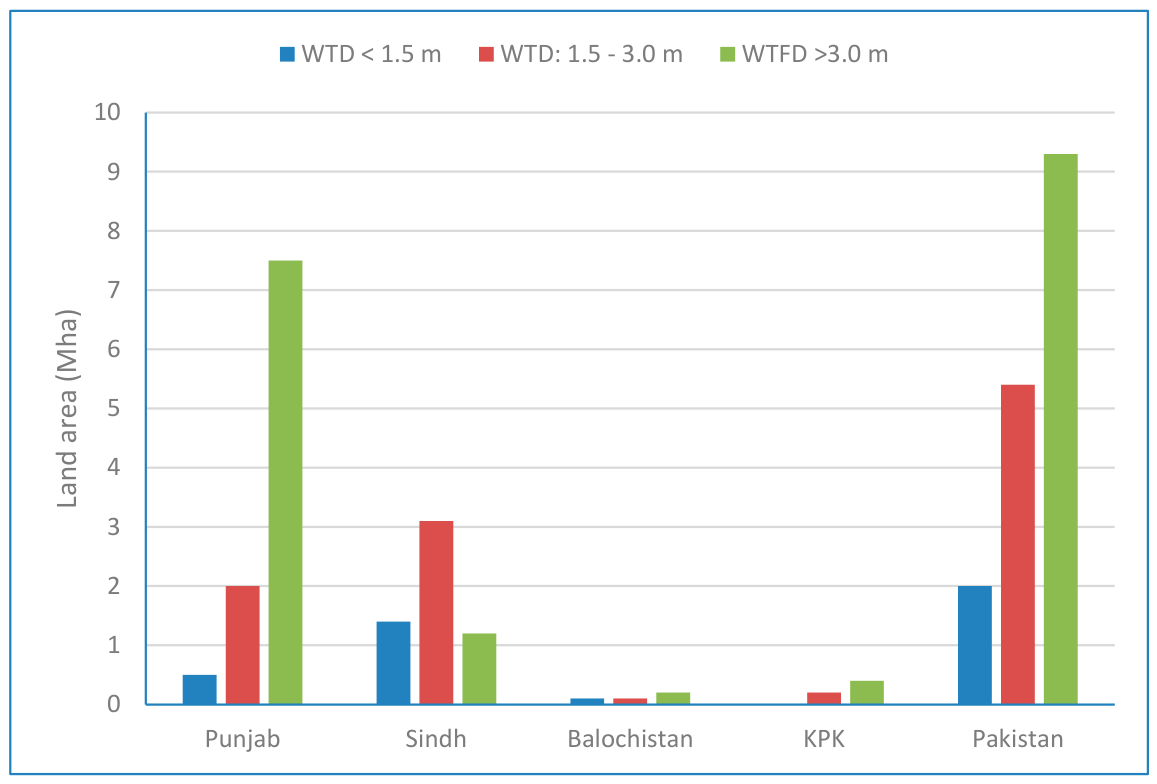
| Drainage | Total Surveyed Area (Mha) | Area (Mha & %) with WTD of 0–1.5 m | Area (Mha & %) with WTD of 1.5–3.0 m | Area (Mha & %) with WTD < 3 m | Area (Mha & %) with WTD > 3 m |
|---|---|---|---|---|---|
| Basin | |||||
| Punjab | 10 | 0.59 (6%) * | 1.41 (14%) | 2.00 (20%) | 8.00 (80%) |
| Sindh | 5.74 | 3.04 (53%) | 1.60 (28%) | 4.64 (81%) | 1.10 (19%) |
| KPK | 0.40 | 0.40 (100%) | 0.00 (0%) | 0.40 (100%) | - |
| Balochistan | 0.60 | 0.02 (3%) | 0.13 (22%) | 0.15 (25%) | 0.45 (75%) |
| Pakistan | 16.74 | 4.05 (24%) | 3.14 (19%) | 7.19 (43%) | 9.55 (57%) |
| Physical Task | Implementation Period | Details of Physical Works |
|---|---|---|
| Surface drainage systems | 1999–2007 | Construction of new surface drains and rehabilitation of existing ones to carry saline effluent to outfalls. |
| Subsurface (tile) drainage | 2000–2005 | Installation of perforated pipes underground to lower the water table, particularly in “disaster areas” with water tables less than 1.5 m deep. |
| LBOD repairs | 2002–2006 | Critical repairs and remodeling of the LBOD spinal drain and related structures after damage from extreme weather events. |
| Canal remodeling & modernizing | 2001–2007 | Lining and remodeling of irrigation canals and watercourses to reduce seepage and improve water distribution efficiency. |
| Public SCARP tubewell phase-out | 1998–2004 | Decommissioning of old public tubewells and replacing them with community-managed systems to promote private-sector participation. |
| Land acquisition & resettlement | 1996–2007 | Acquisition of approximately 0.0038 Mha of land to clear paths for new drainage infrastructure and relocate affected populations. |
| Year | Institution | Purpose |
|---|---|---|
| 1917/18 | Drainage Board created for Upper Chenab Canal | Investigations for controlling canal seepage. Made recommendations for canal seepage control: frequent canal closures, lowering of canal water level, and growing of trees along irrigation channels. |
| 1920 | Drainage division created in Upper Bari Doab Canal with a drainage engineer | |
| 1925 | Waterlogging Inquiry Committee (WIC) created with a superintending engineer | Advisor to government. Waterlogging investigations (1927). |
| 1928 | WIC replaced by Waterlogging Board | |
| 1930/31 | Irrigation Research Institute established in provincial irrigation department. | Research on seepage drains in Upper and Lower Chenab Canals. |
| 1932 | Drainage circle created with superintending engineer. Reorganization of drainage circle, i.e., two divisions (jurisdiction over Chaj and Rechna) | Organized around natural drainage basins to better tackle construction of seepage and seepage-cum-storm drains. Investigations in deep-water-table areas (1937). |
| 1939 | United with Upper Jhelum Canal Circle and Lower Chenab Canal Circle | |
| 1940 | Land Reclamation Board created | Recommended nonstructural measures for salinity and alkalinity survey in Punjab (1943). |
| 1944 | Northern Drainage Circle created with jurisdiction over Chaj and Rechna doabs | Independent circles better suited to construct and maintain drains. |
| 1945 | Directorate of Land Reclamation created | To reclaim saline and sodic soils. |
| 1947 | Drainage circles closed | |
| 1951 | Drainage divisions attached to irrigation circles | Drainage divisions better suited because already in charge of maintenance of canals. |
| 1952 | Soil Reclamation Board created for groundwater management | Established after FAO investigations. In 1954–1955 initiated a pilot scheme for the installation of 25 drainage tubewells. |
| 1954 | Groundwater Development Organization created | Later transformed into WAPDA with a Water and Soil Investigation Division. |
| 1954 | Drainage circles abolished | To economize expenditures. |
| 1958 | Drainage circles reestablished | To improve land reclamation and drainage. |
| Director of drainage appointed in the office of the chief engineer, irrigation (West Pakistan) | ||
| 1958 | WAPDA established | For investigation, planning and implementation of control measures. |
| Master Plan, Regional Plan (1967). | ||
| Action Program for Irrigation and Drainage (1965–75) Accelerated Program “Waterlogging and Salinity Control” (1974/75 to 1984/85), revised in 1985 for a 21-year period. | ||
| 1964/65 | Soil Reclamation Board suspended | Responsibilities/power transferred to PIDs except groundwater management. |
| 1977 | Federal Flood Commission | Approval of flood control schemes; forecasting; evaluation/monitoring of National Flood Protection Plan. |
| 1977 | Drainage circles in Lahore, Faisalabad, Sargodha; drainage divisions in other zones | Functional units (O&M of drains). |
| 1995 | WAPDA takes over O&M responsibility for inter-provincial drains | Cost-sharing between federal state and provinces. |
| Province | GCA (Mha) | CCA (Mha) | Surface Drains (km) | Subsurface Drainage | ||||||
|---|---|---|---|---|---|---|---|---|---|---|
| Tubewells (No.) | Interceptor Drains (km) | Tile Drainage | ||||||||
| FGW | SGW | SCW | Length (km) | Area (Mha) | ||||||
| GCA | CCA | |||||||||
| Punjab | 1.7 | 1.51 | 3402 | 8065 | 1985 | - | 6 | 2810 | 0.04 | 0.03 |
| Sindh | 1.1 | 0.93 | 9031 | 4190 | 1587 | 361 | 154 | 2046 | 0.02 | 0.02 |
| KPK | 0.14 | 0.15 | 971 | 491 | - | - | - | 7756 | 0.11 | 0.02 |
| Balochistan | 0.03 | 0.03 | 322 | - | - | - | - | - | - | - |
| Total | 2.97 | 2.62 | 13,726 | 12,746 | 3572 | 361 | 160 | 12,612 | 0.17 | 0.07 |
| Number | SCARP | Project Total Area (Mha) | Pre-Project | Post-Project | ||||
|---|---|---|---|---|---|---|---|---|
| 1987 | 1988 | 1989 | 1998 | |||||
| Year | Area (Mha) | Area (Mha) | Area (Mha) | Area (Mha) | Area (Mha) | |||
| 1 | SCARP I | 0.49 | 1961 | 0.07 | 0.01 | 0.00 | 0.01 | 0.00 |
| 2 | SCARP II | 0.68 | 1964 | 0.07 | 0.05 | 0.01 | 0.03 | 0.03 |
| 3 | SCARP III | 0.46 | 1969 | 0.19 | 0.11 | 0.07 | 0.12 | 0.12 |
| 4 | Khairpur | 0.15 | 1960 | 0.05 | 0.07 | 0.03 | 0.05 | 0.03 |
| 5 | North Rohri | 0.28 | 1966 | 0.03 | 0.01 | 0.02 | 0.02 | 0.03 |
| 6 | Drainage IV | 0.14 | 1985 | 0.04 | 0.01 | - | - | 0.04 |
| Total area of six projects | 2.20 | 0.25 | ||||||
| Component Drain | Area Covered | Length | Discharge Capacity | Annual Effluent Volume |
|---|---|---|---|---|
| (Mha) | (Km) | (m3/s) | (BCM/year) | |
| RBOD-I | 0.52 | 231 | 64.3 | 2.03 |
| RBOD-II | 1.74 | 273 | 98.28 | 3.10 |
| RBOD-III | 0.29 | 113 | 33.98 | 1.07 |
| Province | Volume of Drainage Effluent (BCM) |
|---|---|
| Punjab | 3.63 |
| Sindh/Balochistan | 9.82 |
| Total | 13.45 |
Disclaimer/Publisher’s Note: The statements, opinions and data contained in all publications are solely those of the individual author(s) and contributor(s) and not of MDPI and/or the editor(s). MDPI and/or the editor(s) disclaim responsibility for any injury to people or property resulting from any ideas, methods, instructions or products referred to in the content. |
© 2026 by the authors. Licensee MDPI, Basel, Switzerland. This article is an open access article distributed under the terms and conditions of the Creative Commons Attribution (CC BY) license.
Share and Cite
Aslam, M.; Hanif, F.; Petroselli, A. Waterlogging and Land System Transformation in Pakistan’s Indus Basin Irrigation System: Six Decades of Management and Governance Lessons. Land 2026, 15, 662. https://doi.org/10.3390/land15040662
Aslam M, Hanif F, Petroselli A. Waterlogging and Land System Transformation in Pakistan’s Indus Basin Irrigation System: Six Decades of Management and Governance Lessons. Land. 2026; 15(4):662. https://doi.org/10.3390/land15040662
Chicago/Turabian StyleAslam, Muhammad, Fatima Hanif, and Andrea Petroselli. 2026. "Waterlogging and Land System Transformation in Pakistan’s Indus Basin Irrigation System: Six Decades of Management and Governance Lessons" Land 15, no. 4: 662. https://doi.org/10.3390/land15040662
APA StyleAslam, M., Hanif, F., & Petroselli, A. (2026). Waterlogging and Land System Transformation in Pakistan’s Indus Basin Irrigation System: Six Decades of Management and Governance Lessons. Land, 15(4), 662. https://doi.org/10.3390/land15040662