Article

Improving the Urban Thermal Environment in Chengdu: A Multi-Objective Land-Use Optimization Framework Integrating Remote Sensing, Numerical Simulation, and NSGA-II

1
School of Architecture, Southwest Jiaotong University, Chengdu 611756, China
2
Independent Researcher, Shenzhen 518100, China
3
School of Architecture and Design, Beijing Jiaotong University, Beijing 100044, China
4
College of Civil Engineering and Architecture, Shandong University of Science and Technology, Qingdao 266590, China
5
School of Information Innovation and Big Data, Shanxi Jinzhong Institute of Technology, Jinzhong 030600, China
6
Department of Architecture, Chang’an University, Xi’an 710064, China
*
Authors to whom correspondence should be addressed.
These authors contributed equally to this work and should be regarded as co-second authors.
Land 2026, 15(4), 630; https://doi.org/10.3390/land15040630
Submission received: 11 February 2026 / Revised: 8 April 2026 / Accepted: 9 April 2026 / Published: 11 April 2026

Abstract

This study examines how the city’s evolving spatial structure shapes its thermal environment. Using Google Earth Engine (GEE) and the Local Climate Zone (LCZ) scheme, we tracked structural changes across Chengdu and its central districts (Jinjiang and Wuhou) in 2017, 2021, and 2025. We then combined the Weather Research and Forecasting (WRF) model with the NSGA-II algorithm. This allowed us to explore links between LCZ patterns and the Universal Thermal Climate Index (UTCI) in the urban center. Results confirm a strong but non-linear relationship between built form and the local climate. Optimized scenarios, respecting practical planning constraints, show that rebalancing LCZ proportions can reduce peak temperatures in the core area by 1.72–2.75 °C. Future plans for Chengdu should therefore limit high-risk compact types (LCZ 1, 3, 8), expand mid-rise and open arrangements (LCZ 4, 5), and preserve or restore natural surfaces (LCZ A–C) to achieve a more thermally equitable urban landscape.

1. Introduction

Rapid urbanization has profoundly transformed the Earth’s surface, with natural land cover being replaced by impervious materials, buildings, and infrastructure, leading to significant changes in land use and land cover (LULC) [1,2]. Urban LULC types exert substantial impacts on local climate and hydrological processes [3].
Urbanization plays a crucial role in determining regional warming trends [4,5]. As UN-Habitat reports, cities cover under 2% of the planet’s surface yet account for roughly 78% of energy consumption and over 60% of greenhouse gas emissions. Rapid population growth and increasingly complex urban forms have sharply raised cooling-related energy demand, adding to anthropogenic heat release [6,7]. At the same time, taller and denser street canyons impede ventilation, trapping heat that cannot easily escape [8,9]. Together, these processes intensify the urban heat island (UHI) effect [10] and seriously degrade outdoor thermal comfort [11].
Extreme heat events are among the deadliest consequences of climate change [12]. Global temperatures have continued to climb over recent decades. The 2021 IPCC report [13] forecasts a 1.4–4.8 °C rise in global mean temperature by 2100. In this context, how urban growth alters local thermal environments has become a central research topic. Assessing the climatic role of built-up areas demands finer descriptions of evolving land use and urban forms [14,15,16]. The Local Climate Zone (LCZ) classification offers a universal and systematic framework for reducing the impact of UHI and strengthening urban climate resilience [17]. This approach has been widely adopted in cities across numerous countries worldwide [18,19,20,21,22,23,24,25].
Machine learning algorithms have been widely adopted by numerous scholars due to their ability to process complex remote sensing image information [26,27,28,29,30,31,32,33,34]. At present, there are twelve commonly used machine learning algorithms [35]. Among these, CNN, RF, and SVM dominate in LULC tasks [36]. Specifically, the RF model has gained greater popularity due to its superior accuracy, robustness, and wide applicability across various classification and regression problems [37,38,39]. Meanwhile, research has shown that in land use systems, Sentinel-2 imagery outperforms Landsat-8 and Planet images, offering better classification results. Particularly in rapidly classified, heterogeneous, and fragmented regions, Sentinel-2 imagery with 10 m spatial resolution has proven to be a superior choice over other datasets [40,41,42,43].
As numerical models keep advancing, they have become a key tool for weather and climate change studies, and are widely used in urban climate research [44,45]—with main types including mesoscale models, boundary-layer models, and computational fluid dynamics (CFD) models. To tackle urban meteorological processes across multiple scales, many studies have coupled urban canopy models with mesoscale or global climate models [46]. This has markedly enhanced the simulation of urban wind and thermal environments [47]. The Weather Research and Forecasting (WRF) model is currently one of the most advanced numerical simulation tools. Previous studies have shown that integrating the Single-Layer Urban Canopy Model (SLUCM) with the WRF model can effectively estimate urban heat transfer and generate reliable simulation results [48,49].
As the process of urbanization accelerates, major challenges persist in optimizing the urban built environment and promoting coordinated, sustainable regional development [50]. Land-use spatial optimization is a complex combinatorial optimization problem that involves numerous spatial and non-spatial objectives and constraints, which may be nonlinear and prone to conflicts among objectives. Traditional mathematical models often struggle to determine optimal solutions within an acceptable time frame. As a trade-off between computational time and solution optimality, multi-objective optimization (MOO) algorithms have been applied to land-use spatial optimization because they effectively address these challenges [51,52]. In recent years, MOO algorithms have seen widespread use in efforts to mitigate urban heat. Lin [53] combined XGBoost with NSGA-II to develop a multi-objective framework for reconfiguring urban green space layouts, thereby cooling the urban environment and informing renewal strategies. Benincá [54] applied NSGA-II to identify optimal building orientations that minimize both heating and cooling loads across different contexts, with separate analyses for detached houses and apartments to guide energy-efficient design. Liu [55] built a Grasshopper-based optimization platform that simultaneously targeted the lowest building energy use, highest solar potential, and longest sunlight exposure; using NSGA-II for iterative simulation, they derived practical recommendations for low-energy urban forms. Wang [56] pioneered the integration of Zipf’s Law into a multi-objective land-use allocation model for urban agglomerations, implementing a genetic algorithm to evaluate and compare future development pathways in the Beijing–Tianjin–Hebei region.
Previous work has shown that genetic algorithms (GAs) are highly robust in locating near-optimal solutions within large, complex search spaces, yielding results that are typically “sufficiently good” and thus well-suited to land-use optimization [57]. Originally introduced by Holland [58] and later refined by Goldberg [59], the GA is a heuristic search method grounded in natural selection principles, capable of handling both linear and nonlinear problems. Of the various implementations, NSGA-II remains by far the most popular, appearing in nearly 70% of relevant studies [60]. Its fast runtime and strong convergence properties make NSGA-II one of the most effective tools for multi-objective optimization problems [61].
This study employed Google Earth Engine (GEE) in conjunction with remote sensing imagery to generate LCZ maps for the study area. These maps enable the identification and long-term monitoring of urban land-use structures. In addition, it uses machine learning classification methods and Sentinel satellite imagery to enhance the reliability of classification results. Additionally, the WRF-SLUCM model was employed in conjunction with LCZ maps to simulate the thermal environment of the study area. Finally, the NSGA-II algorithm was applied to perform multi-objective optimization of the urban structure, aiming to identify the optimal solution for future urban planning and thereby contribute to improving the local thermal environment.
This study aims to: (1) Analyze changes in Chengdu’s urban land use over 8 years. (2) Investigate the correlation between LCZ types and thermal comfort. (3) Identify the LCZ scheme for improving the urban thermal environment in the study area. Research findings indicate that LCZ types can help improve the urban thermal environment, providing a useful reference for future urban planning.

2. Research Methods

2.1. Research Design

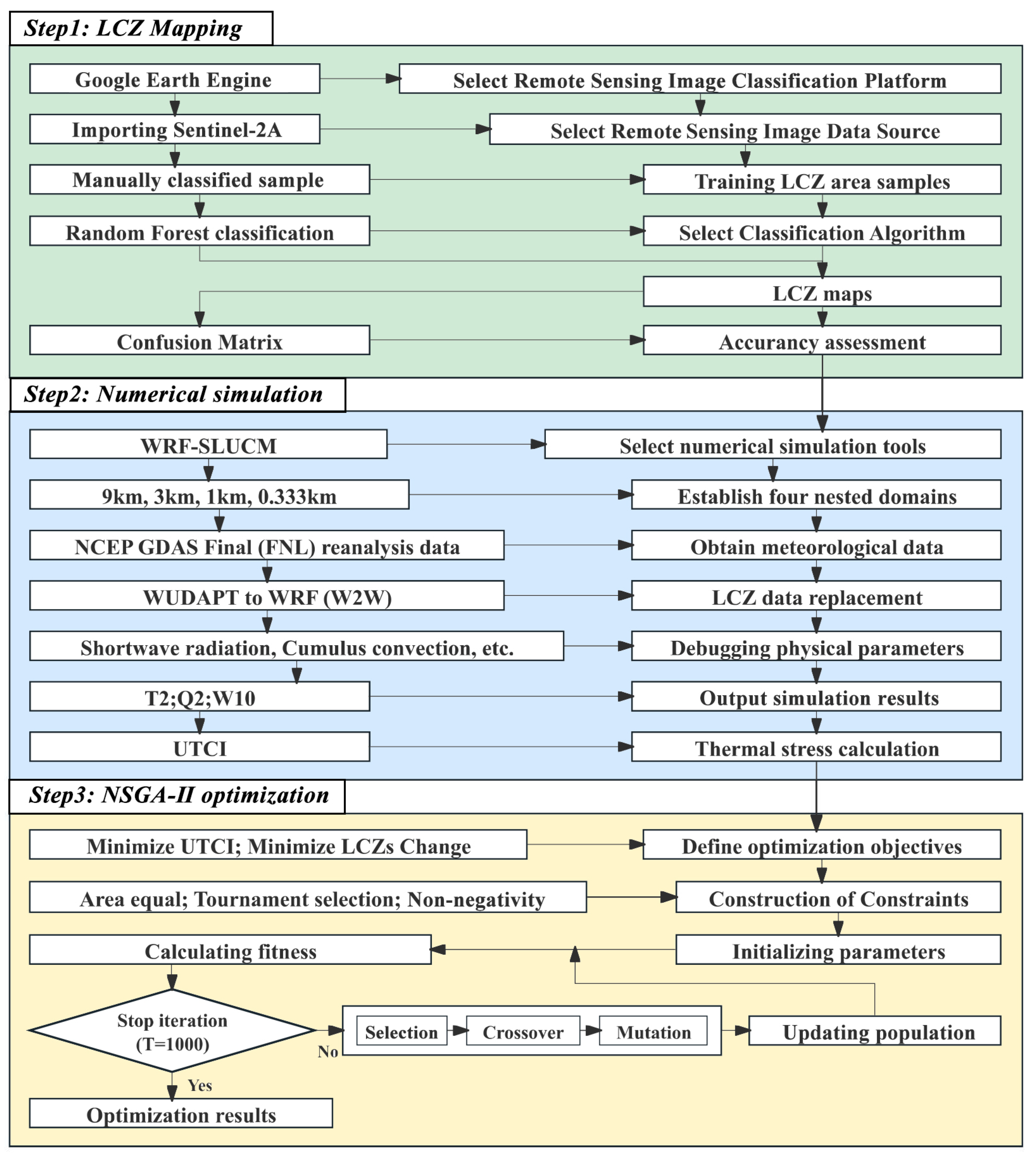
Figure 1 illustrates the technical workflow of this study. First, Chengdu City, Sichuan Province, China was selected as the study area. Sentinel-2 remote sensing images for the years 2017, 2021, and 2025 were classified into LCZs on the GEE platform using the Random Forest classifier, with classification accuracy validated through confusion matrices. Subsequently, the resulting LCZ maps were integrated into the WRF-SLUCM to simulate the urban thermal environment. Based on the simulation outputs, the Universal Thermal Climate Index (UTCI) was calculated to quantify outdoor thermal comfort. Finally, the NSGA-II multi-objective optimization algorithm was employed to quantitatively analyze the correlation between each LCZ type and the regional thermal environment, thereby deriving urban planning and construction strategies conducive to improving outdoor thermal comfort.

2.2. Study Area and Data

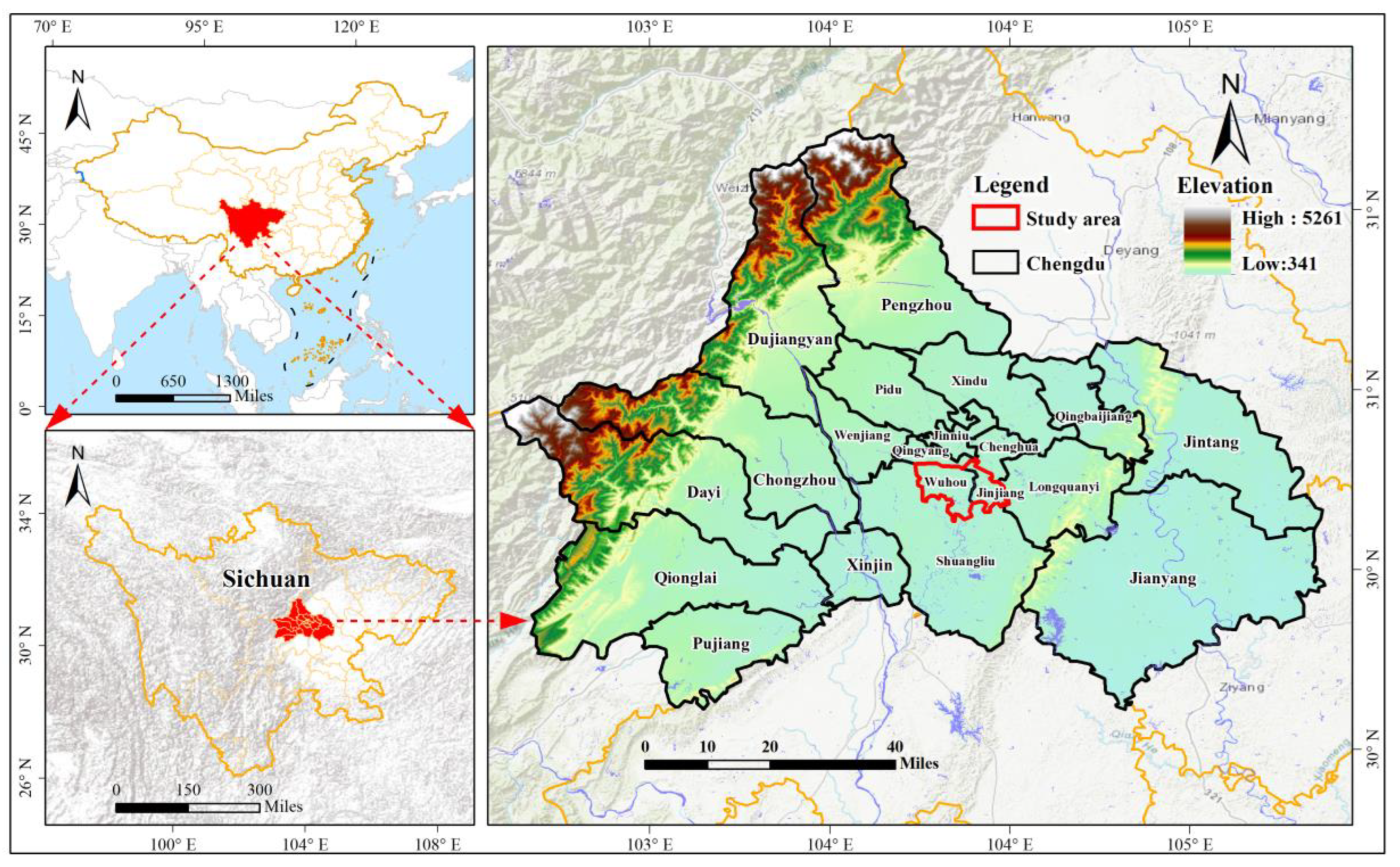
Chengdu lies on the western edge of the Sichuan Basin and the eastern fringe of the Qinghai-Tibet Plateau (102°54′ to 104°53′ E and 30°05′ to 31°26′ N) (Figure 2). The annual average temperature is 16 °C, 1–2 °C higher than that of the Yangtze River at the same latitude. The annual precipitation ranges from 900 to 1300 mm (https://www.scggqx.com/sc_cd/qxkp/bdqh/, accessed on 28 September 2025). As one of China’s most important megacities, it has a built-up area of 1344.2 km2, a permanent population of 21.474 million, and an urbanization rate of 80.8% (http://cdstats.chengdu.gov.cn/). Its topography is diverse, including mountains, hills, and plains, which shape its climatic and environmental conditions. The city lies in the subtropical monsoon climate zone, featuring hot and humid summers, low wind speeds year-round, and over 240 calm days annually [62,63,64]. Due to its inland location, complex surrounding terrain, and humid weather, high temperatures combined with static air intensify the UHI effect and summer heat risks. Table 1 provides remote sensing image information for Chengdu.

2.3. LULC Classification

The LCZ framework provides a promising approach for studying urban heat islands (UHIs) and lays the foundation for further research. Methods for mapping LCZs are primarily categorized into remote sensing (RS)-based approaches [65], geographic information system (GIS)-based approaches [66], and integrated RS-GIS approaches [67].
Other approaches, however, are often limited by manpower, funding, and equipment, and the resulting classification accuracy can be inconsistent. Therefore, this study adopts the Google Earth Engine (GEE) cloud computing platform developed by Google LLC, Mountain View, CA, USA (https://earthengine.google.com) [68] for LCZ mapping, taking advantage of its massive parallel processing power, rich built-in geospatial archives, and ready-to-use algorithms [69]. Running on Google’s cloud infrastructure, GEE offloads all computation to high-performance servers and handles the intricacies of parallel execution automatically [70]. Purpose-built for geospatial tasks, the platform can efficiently process petabyte-scale remote sensing data across large areas and long time spans, making it ideally suited for regional to global-scale studies [71].
In this study, to improve the accuracy of LCZ classification results, we employed Sentinel-2A remote sensing imagery with a 10 m spatial resolution for land cover/use classification.
Spectral indices are used to distinguish 17 LCZ types, as the spectral characteristics of different land cover types can be enhanced through band mathematics. These indices include the Normalized Difference Vegetation Index (NDVI) [72], Normalized Difference Water Index (NDWI) [73], Normalized Difference Built-up Index (NDBI) [74], Enhanced Vegetation Index (EVI) [75], Bare Soil Index (BSI) [76], and Index-Based Built-up Index (IBI) [77]. Additionally, elevation information (DEM) [78] and average daytime/nighttime band radiance values (Avg_rad) [79] are incorporated into the inputs to refine the classification of LCZ building types. Ren [80] demonstrated that DEM data can effectively improve LCZ classification accuracy, while Gao [26] showed that Avg_rad is one of the most critical variables for LCZ classification.
The calculation formulas and contribution degrees of these indicators are presented in Table 2.
The satellite imagery was first processed on the GEE platform, which involved cloud removal and cropping to the study area. Subsequently, a total of 500 training samples across the 17 LCZ types were selected from Google Earth Imagery. An RF Classifier was employed for the LCZ classification [81], using a 70/30 split of the samples for training and testing. Accuracy assessment [68,82] was conducted using a confusion matrix, from which the overall accuracy (OA), Kappa index, producer’s accuracy (PA), and user’s accuracy (UA) were derived. In accordance with established research standards, the LCZ map is considered to meet quality requirements only if it achieves a minimum OA of 50% and a Kappa coefficient of at least 0.5.

2.4. Mesoscale Environmental Simulation

2.4.1. Basic Settings

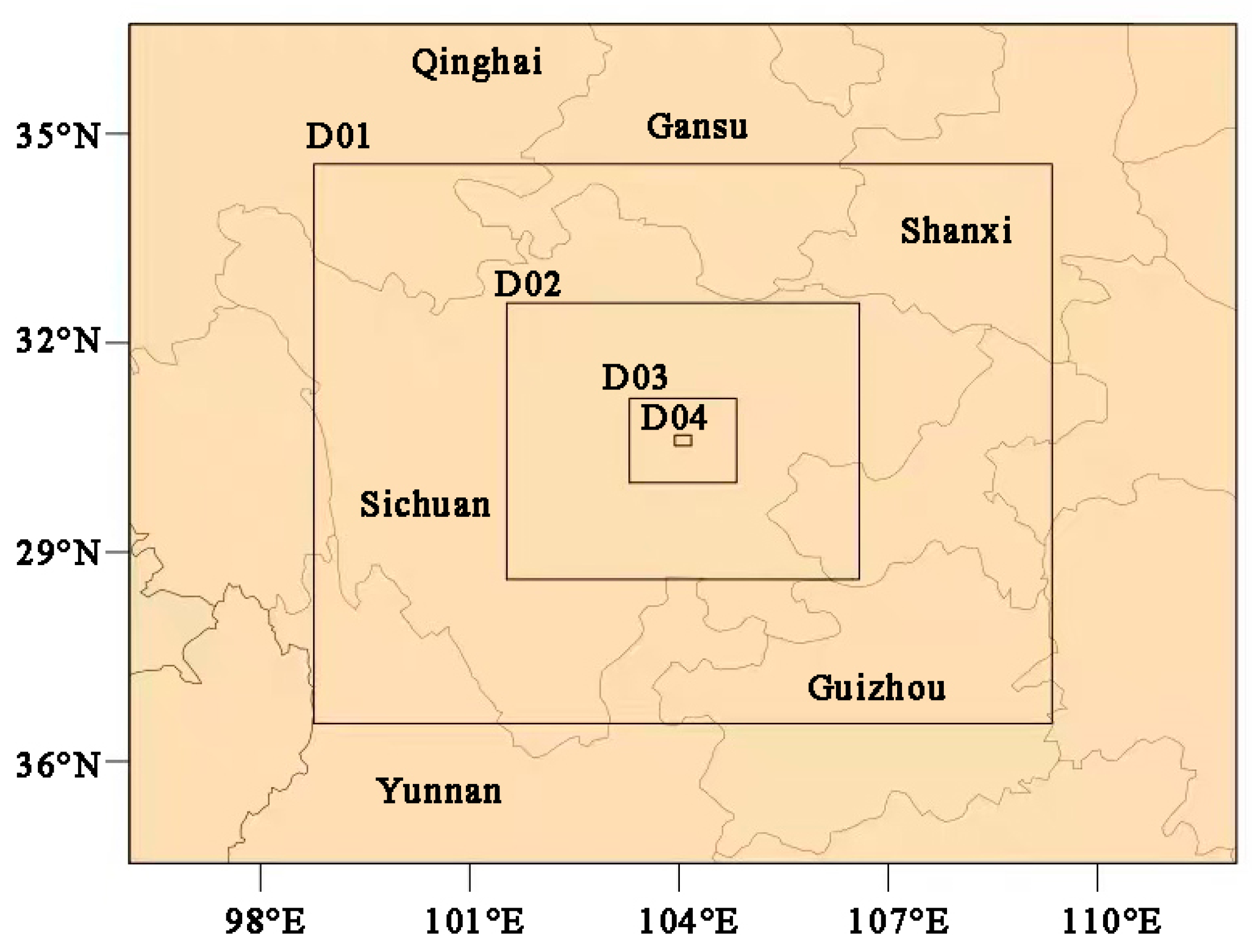
Numerical simulations were performed using the WRF–SLUCM modeling system based on WRF version 4.7, developed by the Mesoscale and Microscale Meteorology Laboratory (MMM) of the National Center for Atmospheric Research (NCAR), Boulder, CO, USA. The model source code is publicly available at the official GitHub repository (https://github.com/wrf-model/WRF, accessed on 08 January 2026). Detailed model documentation is provided by Skamarock et al. [83]. This version incorporates the LCZ classification in its land use dataset [84]. The parameterization schemes selected for this study are listed in Table 3. The simulation uses four nested domains, as shown in Figure 3, with horizontal grid spacings of 9 km (D01), 3 km (D02), 1 km (D03), and 0.333 km (D04). Initial and boundary conditions were provided by the GDAS of the NCEP (https://rda.ucar.edu/datasets/ds083.3/, accessed on 10 January 2026). To quantify the impact of land use change on the thermal environment, we designed three experiments using land cover data from 2017, 2021, and 2025. The model was run for a 24 h period, starting at 00:00 local time on the summer solstice (21 June), to characterize the year’s most pronounced diurnal thermal conditions.

2.4.2. Reclassification of LCZ Maps

To enhance the accuracy of the simulation results, the LCZ map was incorporated into the WRF simulations. Specifically, within the WRF Preprocessing System (WPS), the WUDAPT to WRF (W2W) tool (version 0.6.0), developed by Demuzere and the WUDAPT community [92] (Leuven, Belgium; available at https://github.com/matthiasdemuzere/w2w, accessed on 17 January 2026), was used to replace the default land-use data of the innermost nested domain with LCZ-based land-use information.
In the default configuration of W2W version 0.6.0, LCZ classes 1–10 are mapped to the legacy WRF land-use codes 31–41. However, WRF version 4.7 adopts an updated land-use classification scheme in which LCZ classes should be mapped to the new codes 51–61 to avoid conflicts with other land-use datasets (e.g., NLCD). Because the default W2W mapping still follows the legacy coding scheme, directly applying the generated dataset would lead to inconsistencies in WRF 4.7 simulations. Therefore, considering the updated land-use coding system in WRF 4.7, we performed a secondary development of the W2W tool. Specifically, the mapping rules for the land-use index (LU_INDEX) were adjusted in the core script w2w.py, where the correspondence between LCZ classes and WRF land-use categories is defined. The original mapping range of LCZ classes 1–10 to WRF codes 31–41 was updated to the new range of 51–61 required by WRF version 4.7. This modification ensures that the LCZ-derived land-use dataset is correctly recognized by the updated WRF land-use classification system and avoids conflicts with other predefined land-use categories.

2.5. Thermal Comfort Index

There are currently more than 100 thermal comfort indices that have been developed to assess human thermal stress in outdoor environments [93]. Among these indices, the Universal Thermal Climate Index (UTCI) has been widely adopted in urban climatology and biometeorological studies because of its strong physiological basis and its applicability under diverse climatic conditions [94]. The UTCI is derived from an advanced multi-node human thermoregulation model and evaluates thermal stress by integrating the combined effects of key meteorological variables, including air temperature, wind speed, humidity, and mean radiant temperature [95]. Through this framework, complex atmospheric conditions are translated into an equivalent temperature representing the thermal response perceived by the human body.
Compared with other commonly used thermal comfort indices, such as the Physiological Equivalent Temperature (PET) and the Standard Effective Temperature (SET*), UTCI has been shown to provide a more physiologically consistent and comparable assessment of outdoor thermal conditions [96]. The core value of the UTCI is converting complex meteorological conditions into a temperature that is perceptible to humans [97]. It is a complete way to measure outdoor heat stress. Previous studies have also demonstrated that UTCI exhibits high sensitivity to variations in meteorological variables and performs robustly across different climates, seasons, and spatial scales [98]. Because of these advantages, UTCI has been widely applied in studies investigating urban heat stress and thermal comfort [99].
Therefore, the UTCI was selected in this study as the primary indicator to evaluate outdoor thermal stress.

2.6. Optimization Algorithm

2.6.1. Formulation of the Optimization Problem

In MOO problems, the objective functions often impose mutual constraints and conflicts, which can be mathematically expressed as follows (1):
min F ( x ) = [ f 1 ( x ) , f 2 ( x ) , , f m ( x ) ] , x Ω
Here, x = [ x 1 , x 2 , , x n ] denotes the decision variable vector, Ω represents the feasible solution space, f i ( x ) is the -th objective function, and m is the number of objectives.
A solution x * is called a non-dominated solution (Pareto optimal solution) if no other x Ω is better in at least one objective function without being worse in any other. All non-dominated solutions make up the Pareto Front, which captures the optimal trades among competing objectives. The NSGA-II algorithm uses a population-based evolutionary search, fast non-dominated sorting, and crowding distance calculations to balance global exploration and local convergence. This enables efficient, well-distributed attainment of a Pareto-optimal set.
Compared with “static snapshot” analyses based on a single time point, an approach that extends over time and collects samples at multiple time points is more scientifically robust. This method can capture the temporal characteristics of the data, such as trends, fluctuations, and periodicity, thereby revealing its dynamic patterns. Data from a single time point are easily influenced by transient anomalies or instrument errors, have weak representativeness, and make it difficult to distinguish long-term trends from short-term variations, leading to less reliable conclusions. In contrast, longitudinal analysis across multiple time points, through continuous sampling, can utilize statistical methods such as mean and standard deviation to filter out incidental errors and identify the temporal evolution of the data, making the results more practically meaningful. Therefore, we divided the study area into 25 samples, generating a total of 75 samples over three years as input for the simulations.
In this study, the NSGA-II algorithm parameters were initialized with a population size of 250 to ensure diversity in the solution space. Each individual was encoded as a chromosome, with gene loci representing the number of grids for each LCZ type. In each generation, the objective functions of individuals were first evaluated and constraints applied. Parent individuals were then selected via tournament selection, and offspring were generated using simulated binary crossover (SBX) and polynomial mutation. The mutation rate was set no higher than 0.4 to balance search diversity and convergence speed. Subsequently, non-dominated sorting and crowding distance calculations were performed on the combined population, and the next generation was updated according to the elitism strategy. The algorithm was iterated for 1000 generations, ultimately producing a Pareto-optimal solution set that balances LCZ adjustment costs with improvements in thermal comfort.

2.6.2. Setting of Decision Variables

The selection of decision variables should be consistent with the LCZ classification results. Based on the LCZ classification results for Chengdu, 17 decision variables were established in this study, each representing one of the 17 LCZ types. As expressed in the following Equation (2):
x = [ x 1 , x 2 , , x 17 ]
Here, x i represents the number of grids for each LCZ type, reflecting the spatial distribution of different underlying surface characteristics. The initial solutions were derived from the actual LCZ distribution data of the study area, serving as a baseline for the optimization process. To enhance the search diversity and global convergence capability of the algorithm, the initial population was generated using a multi-strategy hybrid initialization approach, including:
Large-perturbation initialization: Apply substantial random perturbations to the original solutions to expand the search space.
Directed-perturbation initialization: Implement targeted adjustments for key LCZ types based on their sensitivity to UTCI.
Sparse-change initialization: Alter the area proportions of only a few LCZ types to reduce the magnitude of solution perturbations.
Neighborhood-perturbation initialization: Introduce small-scale variations within the neighborhood of the original solutions to enhance local search performance.
This multi-strategy initialization approach enables the initial population to possess both global dispersion and similarity to the actual urban structure, providing higher search efficiency and physical plausibility for subsequent iterations.

2.6.3. Definition of Objective Functions

Optimizing LCZ configurations aligns with the objectives of improving urban thermal environments and achieving coordinated regional sustainable development. However, large-scale LCZ adjustments incur substantial economic and social costs while increasing planning complexity. Therefore, this study defines two optimization objectives: minimizing changes to the built environment and minimizing the thermal comfort index. These objectives are formulated as fitness functions, as expressed in the following Equations (3) and (4):
min f UTCI ( x ) = i = 1 n U i x i
min f change ( x ) = i = 1 n x i a x i b
Here, min f UTCI ( x ) and min f change ( x ) correspond to the objectives of optimizing thermal comfort and minimizing LCZ changes, respectively. x i represents the number of grid cells of LCZ type i, and U i denotes the average thermal comfort of LCZ type i. x i a and x i b refer to the number of LCZ type i grid cells after and before optimization, respectively. During the optimization process, the algorithm performs non-dominated sorting to stratify individuals and employs crowding distance to preserve the diversity of the Pareto frontier. The resulting set of non-dominated solutions represents the optimal balance between the cost of LCZ spatial structure adjustment and the improvement of the urban thermal environment.

2.6.4. Construction of Constraints

To ensure the feasibility of the optimization results and the rationality of the planning, the algorithm imposes the following constraints:
Non-negativity constraint: The area proportion of each LCZ type must be non-negative to ensure the physical plausibility of the solutions, as expressed in the following Equation (5):
x i 0 , i = 1 , 2 , , 17
Total area constraint: Maintain the total number of grid cells unchanged to ensure consistency in land use, as shown in Equation (6).
i = 1 n x i a = i = 1 n x i b
Guided constraint for key LCZ types: During mutation and initialization, higher adjustment weights are assigned to LCZ types that are significantly negatively correlated with UTCI, guiding the algorithm to prioritize exploration of spatial configurations that are favorable for improving thermal comfort.
Mutation range constraint: To avoid unrealistic extreme solutions, the variation of each LCZ type is limited within ±30% of its original area proportion.
Under the influence of the aforementioned constraint mechanisms, the stability of the model and the feasibility of the optimization results are ensured. The Pareto solution set output by the algorithm provides a basis for land use optimization.

3. Results

3.1. Classification Results

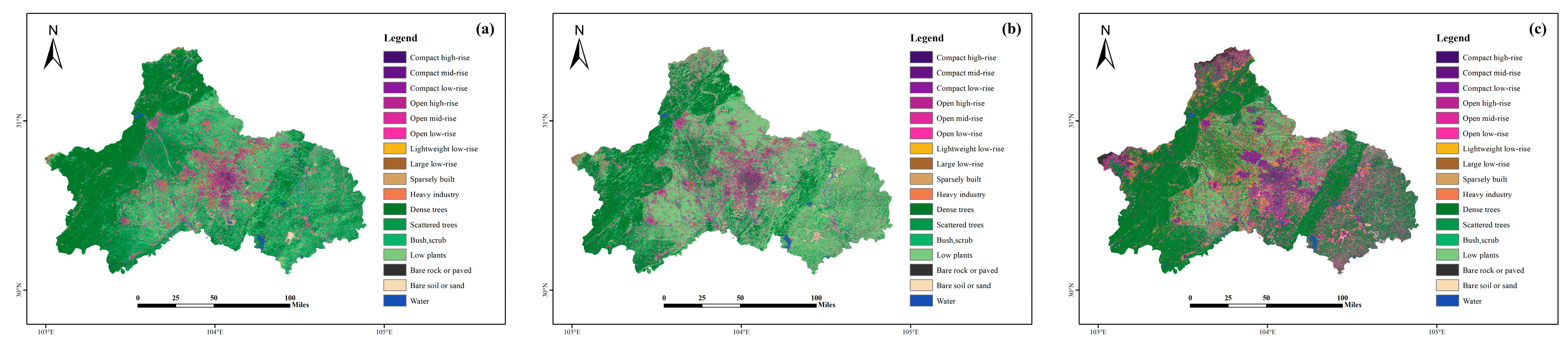
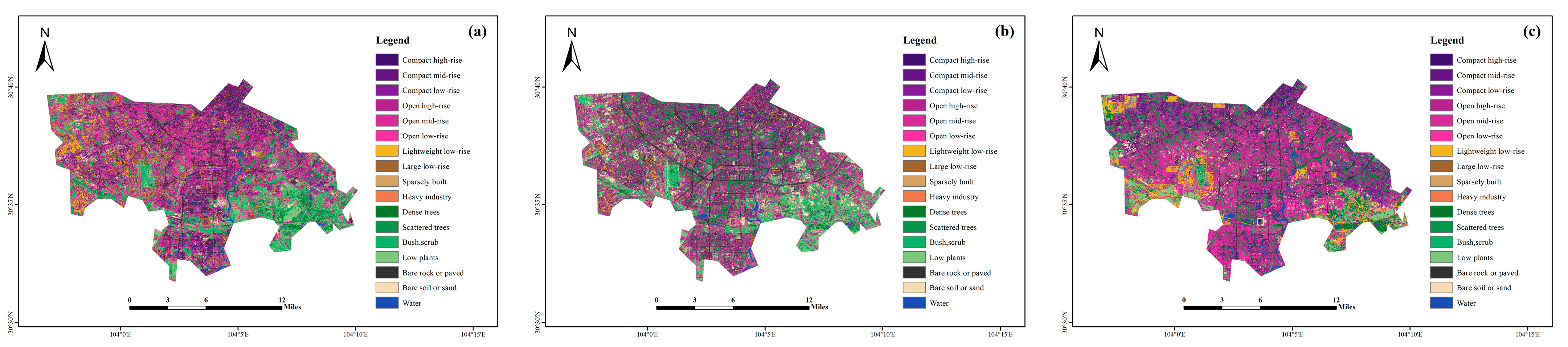
The distribution of LCZs is illustrated in Figure 4 and Figure 5. Specifically, Figure 4a–c illustrate the LCZ classification results of Chengdu for 2017, 2021, and 2025, respectively, while Figure 5a–c show the corresponding results for the study area over the same period.
Table 4 presents the proportion of each LCZ class in Chengdu. From 2017 to 2025, the built-up area of Chengdu expanded rapidly. The expansion trend spread outward from the urban core, with particularly significant growth in the southern and eastern parts of the city. Among the built-up types, LCZ 2, LCZ 3, and LCZ 4 all exhibited varying degrees of increases, with LCZ 4 rising from 2.68% in 2017 to 4.23% in 2025. This trend is closely related to Chengdu’s spatial development strategy of “Eastward Expansion, Southward Extension, Westward Control, Northward Renovation, and Central Optimization,” which prioritizes development in these key areas.
Among the natural land cover types, LCZ A showed a fluctuating upward trend, decreasing from 35.01% in 2017 to 30.88% in 2021, then sharply increasing to 46.65% in 2025. In contrast, LCZ B and LCZ C continued to decline, dropping from 16.24% and 15.32% in 2017 to 0.89% and 4.15% in 2025, respectively. LCZ D first increased and then decreased—rising from 18.37% in 2017 to 40.46% in 2021, before falling back to 18.86% in 2025, nearly returning to the 2017 level. LCZ E, F, and G all showed varying degrees of growth, with LCZ G increasing from 1.18% in 2017 to 2.43% in 2025. Notably, the proportion of LCZ 10 dropped to 0.00% by 2025. These changes are closely linked to Chengdu’s implementation of the “Park City Demonstration Zone” initiative, through which the local government has optimized urban spatial structure and strengthened ecological and environmental protection to promote sustainable and green urban development.
Table 5 present the percentage of each LCZ type across the entire study area. As the core urban district of Chengdu, the study area exhibited a significant structural adjustment in built-up land types between 2017 and 2025. Specifically, the proportions of LCZ 2, LCZ 4, and LCZ 5 showed a continuous upward trend, with LCZ 2 increasing steadily from 7.14% in 2017 to 11.41% in 2025, LCZ4 rising from 10.92% to 17.02%, and LCZ 5 surging from 9.45% to 16.23%. These changes clearly indicate a continuous increase in building density and land development intensity, which aligns closely with the ongoing population concentration and the rapid growth of commercial and residential demands in Chengdu’s central urban area in recent years.
In sharp contrast, LCZ 3 experienced a dramatic decline, dropping from 7.70% in 2017 to 1.04% in 2025—a decrease of more than 86%. This suggests that this land-use type has been largely replaced during the processes of urban renewal and functional optimization, gradually retreating from the dominant land-use categories in the city core. Meanwhile, LCZ 8, LCZ 9, and LCZ 10 all showed a consistent downward trend. Notably, LCZ 10 decreased from 0.72% in 2017 to 0.32% in 2021, and completely disappeared (0.00%) by 2025, directly reflecting the gradual withdrawal of heavy industrial land from the central urban development pattern. This transformation aligns with Chengdu’s goals of urban environmental optimization and functional upgrading.
Overall, the evolution of LCZ types in the study area reflects a trend toward more efficient and intensive land use within the core urban district during the process of urbanization. This trend is highly consistent with the objectives of Chengdu’s “Central Optimization” strategy, which emphasizes enhancing the functional quality and spatial efficiency of the city’s central area.
From the central district of Chengdu to the surrounding suburban areas, the pixel colors gradually transition from darker tones—representing high-density, high-rise buildings—to lighter tones, which indicate open spaces or low-density developments. This gradient pattern reveals a decreasing trend in both building density and height from the urban core outward.
As shown in Table 4, the proportion of built-up LCZ types in Chengdu increased steadily from 2017 to 2025, rising from 12.46% in 2017 to 15.25% in 2021, and reaching 24.71% in 2025. The study area is located in the central part of Chengdu. As mentioned above, LCZ 2, LCZ 4, and LCZ 5 constitute the dominant LCZ types in this region. Meanwhile, natural space categories such as LCZ B and LCZ E exhibited some fluctuations in their proportions but maintained a stable presence overall, reflecting a coordinated pattern of development between built-up structures and natural spaces within the urban area.
Table 6, Table 7 and Table 8 present the confusion matrices used for accuracy assessment in 2017, 2021, and 2025, respectively. It can be observed that LCZ 10 exhibited the lowest classification accuracy, as it was frequently misclassified as LCZ 8 or LCZ 9. The overall accuracies (OAs) were calculated to be 73.20%, 70.60%, and 71.40%, with corresponding Kappa coefficients of 0.7073, 0.6789, and 0.6877. The classification performance was further evaluated using additional metrics derived from the confusion matrix, including producer’s accuracy (PA) and user’s accuracy (UA), as shown in Table 9. These values meet the accuracy requirements established for this study. To assess potential geographic bias, random samples from each LCZ class were visually compared with the corresponding original remote sensing imagery. The inspection did not reveal any evident geographic bias in the classification results. Representative examples of the classified patches and their corresponding remote sensing images are presented in Table A1. Observations show that errors are not regionally concentrated but sparsely distributed uniformly within a credible range, with no systematic geographic bias in the classification results.

3.2. Urban Thermal Environment Simulation Results

We selected the meteorological station inside the study area as the source of observed data. The dataset comprised hourly records from both Chengdu and this local station. Error analysis (Figure A1) shows that simulated temperature and wind speed agreed well with observations overall. Only wind speed exhibited noticeable deviation from 12:00 to 24:00.
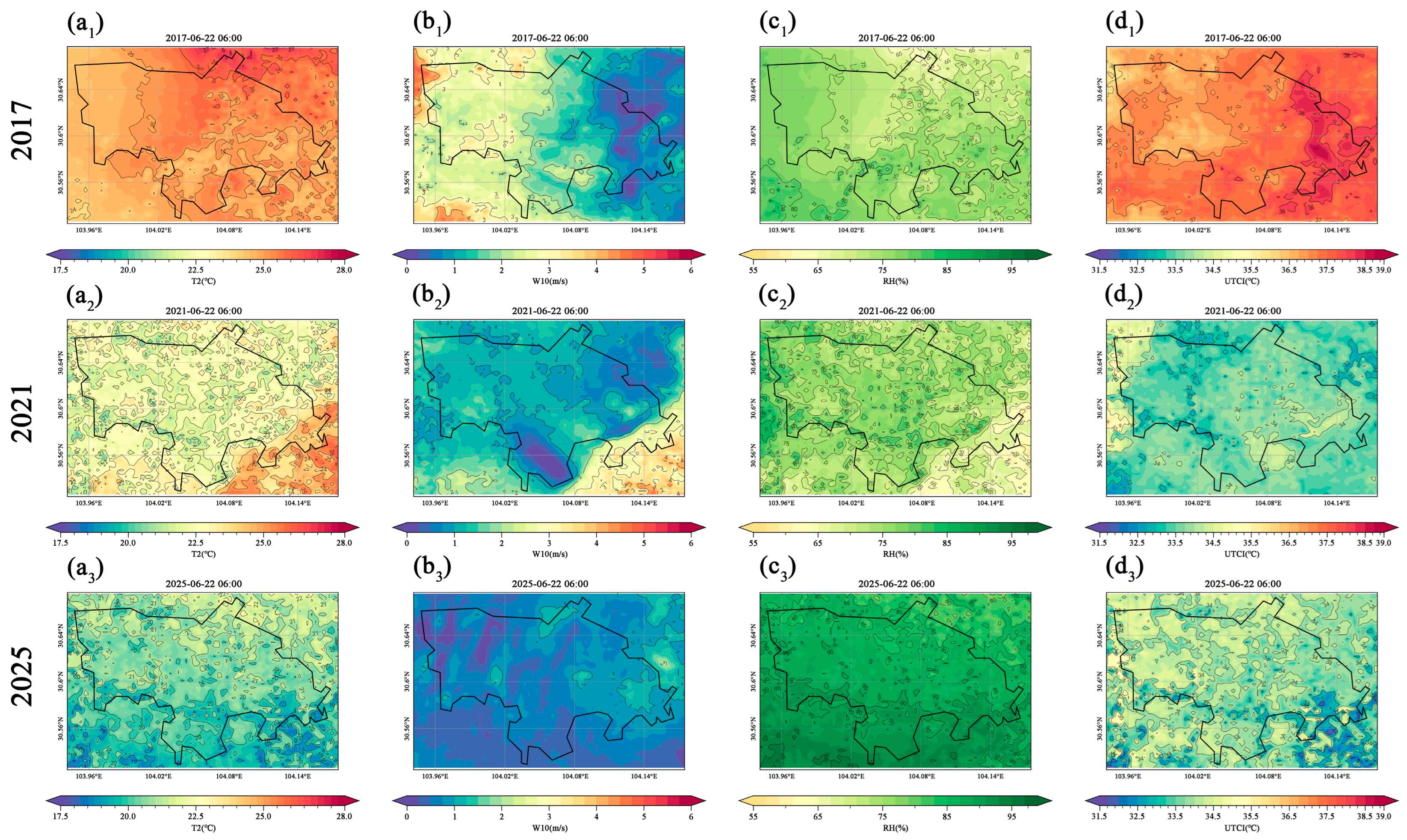
Figure 6 illustrates the spatial distributions of air temperature, wind speed, specific humidity, and UTCI across the core study area in 2017, 2021, and 2025 at 06:00.
At 06:00, the minimum temperatures were 24.12 °C, 22.59 °C, and 20.90 °C in 2017, 2021, and 2025, respectively, mainly distributed across the western, northern, and southern parts of the urban core. The maximum temperatures were 26.80 °C, 24.77 °C, and 22.69 °C, primarily concentrated in the northern and eastern regions (Figure 6(a1–a3)).
The minimum wind speeds (m/s) were 0.13, 0.14, and 0.10, mainly distributed in the eastern, southern, and western areas. The maximum wind speeds (m/s) were 3.14, 3.22, and 1.53, concentrated in the western part in 2017 and 2021, and in the eastern part in 2025 (Figure 6(b1–b3)).
The minimum specific humidities (%) were 71.21, 71.29, and 80.42, located in the northern part of the study area in 2017 and 2025, and in the eastern part in 2021. The maximum specific humidities (%) were 82.59, 83.16, and 91.23, concentrated in the southern area in 2021 and 2025, and in the eastern area in 2017 (Figure 6(c1–c3)).
The minimum UTCI values were 34.21 °C, 33.39 °C, and 33.01 °C, primarily in the western, northern, and eastern zones, while the maximum UTCI values were 38.18 °C, 35.19 °C, and 34.94 °C, concentrated in the western area in 2021 and 2025 and in the eastern area in 2017 (Figure 6(d1–d3)).
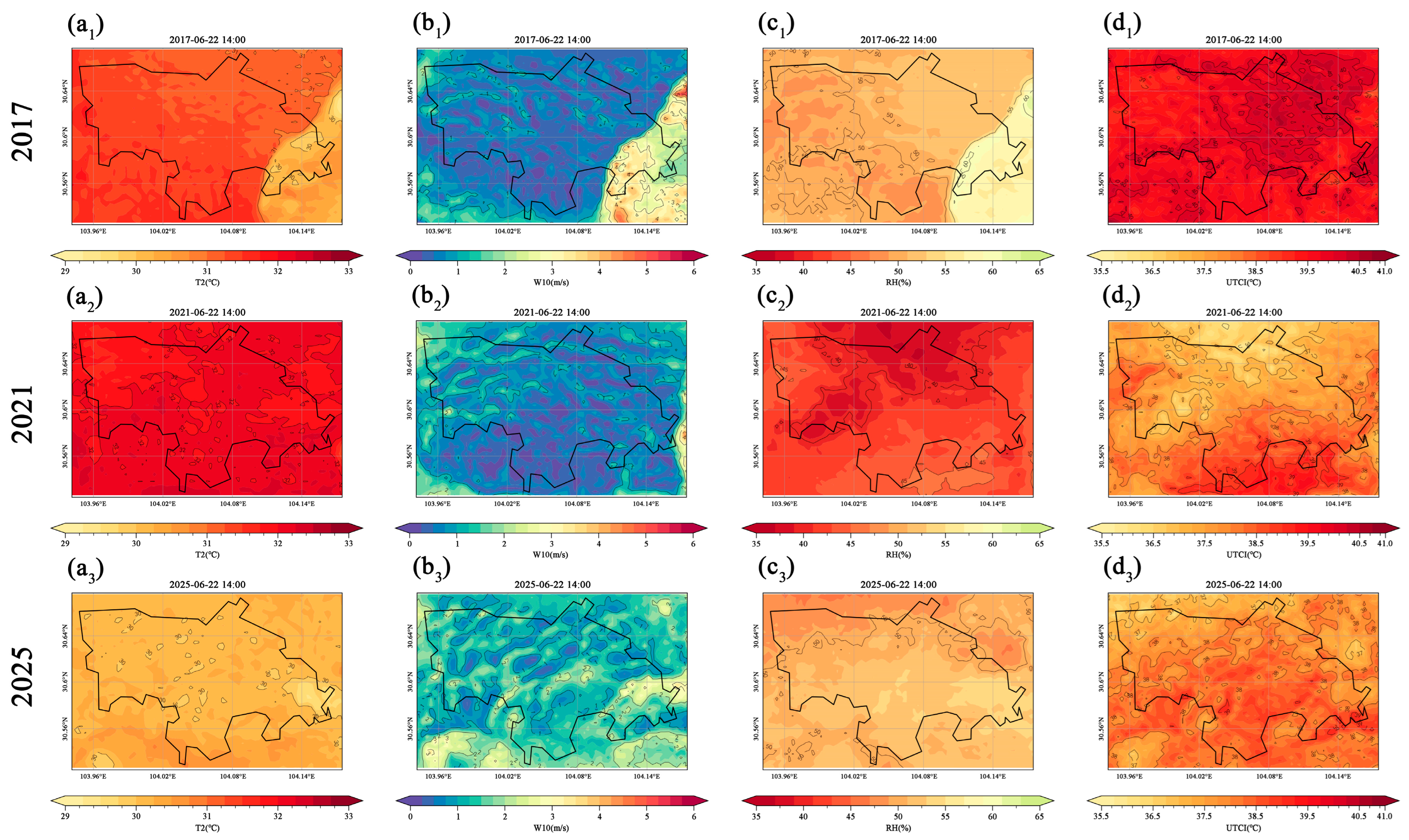
Figure 7 illustrates the corresponding distributions at 14:00.
At 14:00, air temperatures increased significantly. The minimum temperatures were 30.22 °C, 31.34 °C, and 30.72 °C, mainly located in the eastern part in 2017 and 2025 and in the western part in 2021. The maximum temperatures were 31.12 °C, 32.24 °C, and 31.47 °C, all concentrated in the southern part across the three years (Figure 7(a1–a3)).
The minimum wind speeds (m/s) were 0.34, 0.43, and 0.44, concentrated in the southern area in 2017 and 2021 and in the northern area in 2025. The maximum wind speeds were 4.13, 2.36, and 2.85 m/s, located in the eastern area in 2017 and 2025 and in the western area in 2021 (Figure 7(b1–b3)).
The minimum relative humidities (%) were 45.56, 37.54, and 45.14, mainly found in the southern, northern, and western regions, while the maximum values (%) were 60.16, 45.78, and 57.69, concentrated in the eastern region in 2017 and 2025 and in the southern region in 2021 (Figure 7(c1–c3)).
The minimum UTCI values were 39.03 °C, 37.17 °C, and 37.72 °C, concentrated in the western area in 2017 and 2025 and in the northern area in 2021. The maximum UTCI values were 40.53 °C, 39.57 °C, and 39.64 °C, mainly concentrated in the southern region in 2021 and 2025 and in the eastern region in 2017 (Figure 7(d1–d3)).
High-heat zones were generally concentrated in the southern part of the study area, as natural land cover in this region has been progressively replaced by built-up areas with ongoing urban development. Conversely, the eastern region exhibited relatively lower temperatures, owing to its location within Chengdu’s urban ecological ring, which maintains a high level of vegetation coverage. Notably, in the 2017 simulation results, temperature and LCZ distribution showed a positive correlation—although the eastern region had fewer built-up LCZs, its UTCI values were relatively higher. Further analysis revealed that the UTCI tends to vary positively with wind speed, suggesting that the UTCI calculation gives considerable weight to wind effects. In contrast, the 2025 simulation showed high humidity and low wind speed, leading to only a modest increase in the UTCI.
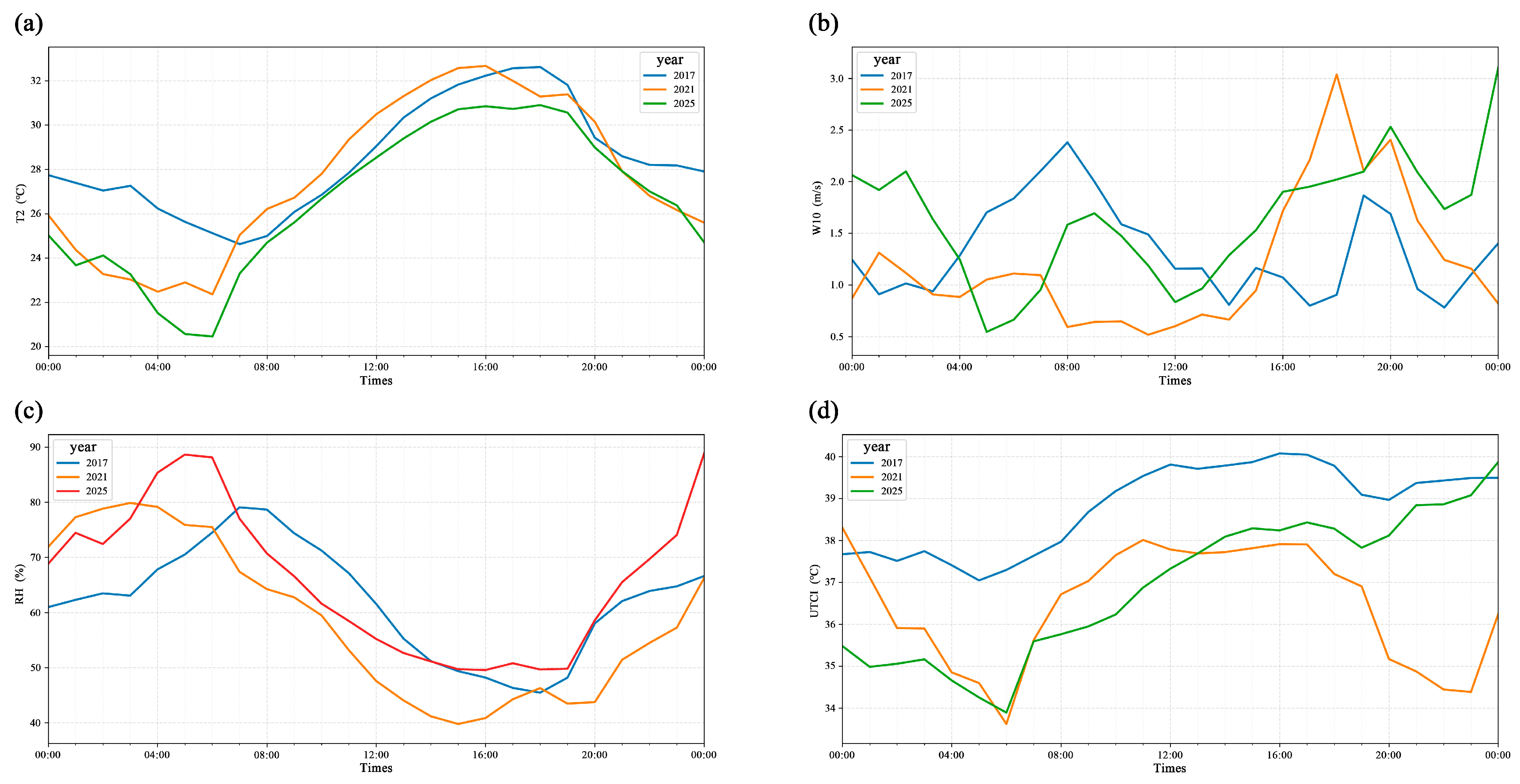
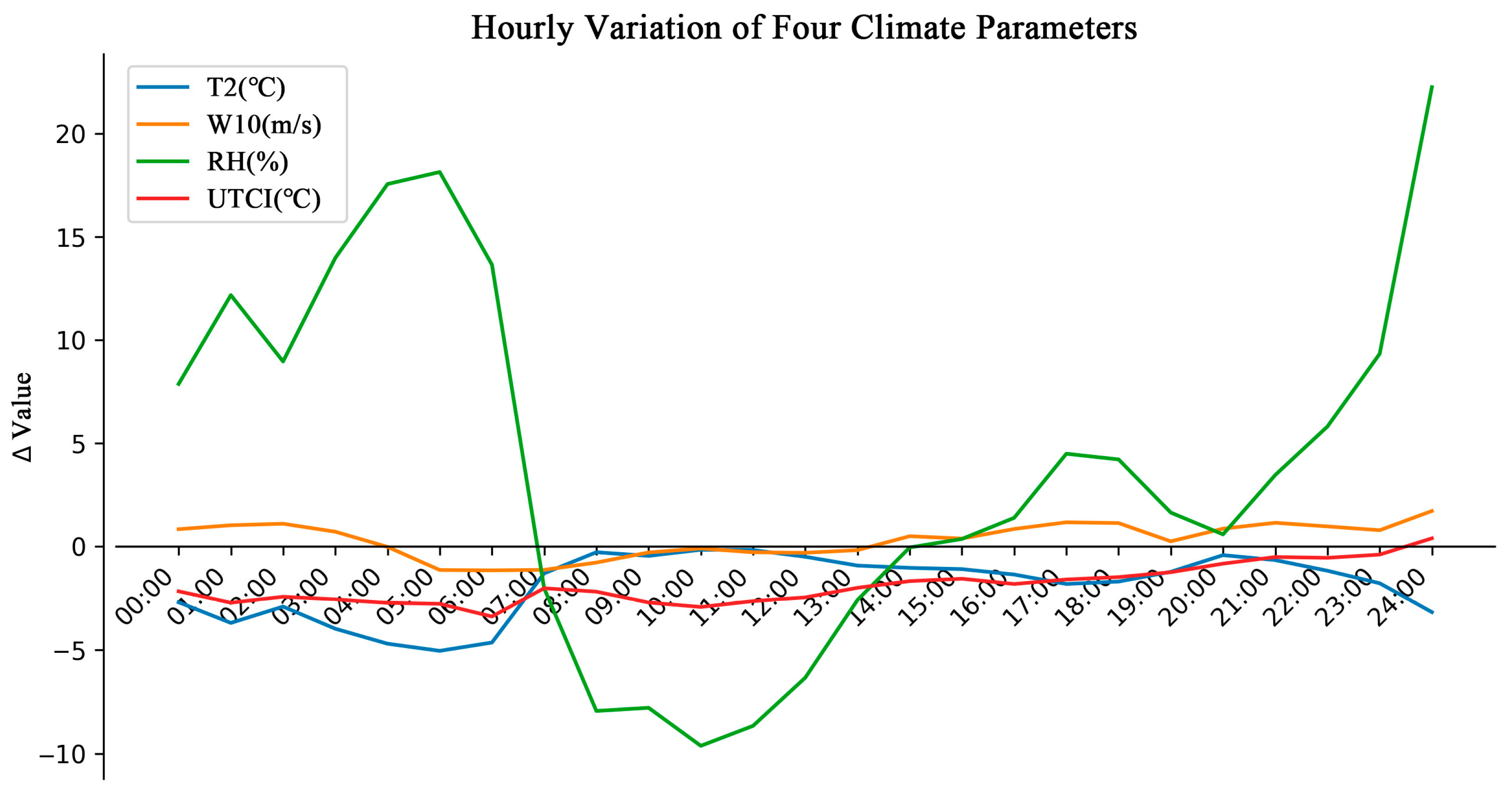
Figure 8 shows the diurnal cycles of mean air temperature, wind speed, specific humidity, and the UTCI for the three simulated years. From 2017 to 2025, the largest drop in mean air temperature, showing a decrease of 5.06 °C, occurred at 05:00, while mean specific humidity rose most sharply at midnight, with an increase of 22.24%. Mean wind speed increased most at the same hour, increasing by 1.70 m/s. The greatest rise in the UTCI, with an increase of 3.41 °C, took place at 06:00, though the years compared here are 2019–2023. To facilitate cross-validation and improve the readability of the simulation results, the hourly mean values of the main simulated variables are summarized in Table A2, Table A3, Table A4 and Table A5.
Figure 9 summarizes thermal environment trends from 2017 to 2025. Specific humidity displays the strongest upward trend and the highest variability, whereas the overall change in the UTCI remains small. This suggests that, over these eight years, urban expansion in Chengdu has not worsened thermal comfort, indicating that the city’s planning measures have been largely effective.
Notably, the diurnal amplitude of the UTCI has gradually increased. The proliferation of buildings and impervious surfaces, with their low albedo and high heat capacity, absorbs more solar radiation by day and slows nighttime cooling. To avoid future degradation of the thermal environment as the city keeps growing, targeted improvements to urban form will be required.

3.3. Optimal LCZ Configuration Under Multi-Objective Coordination

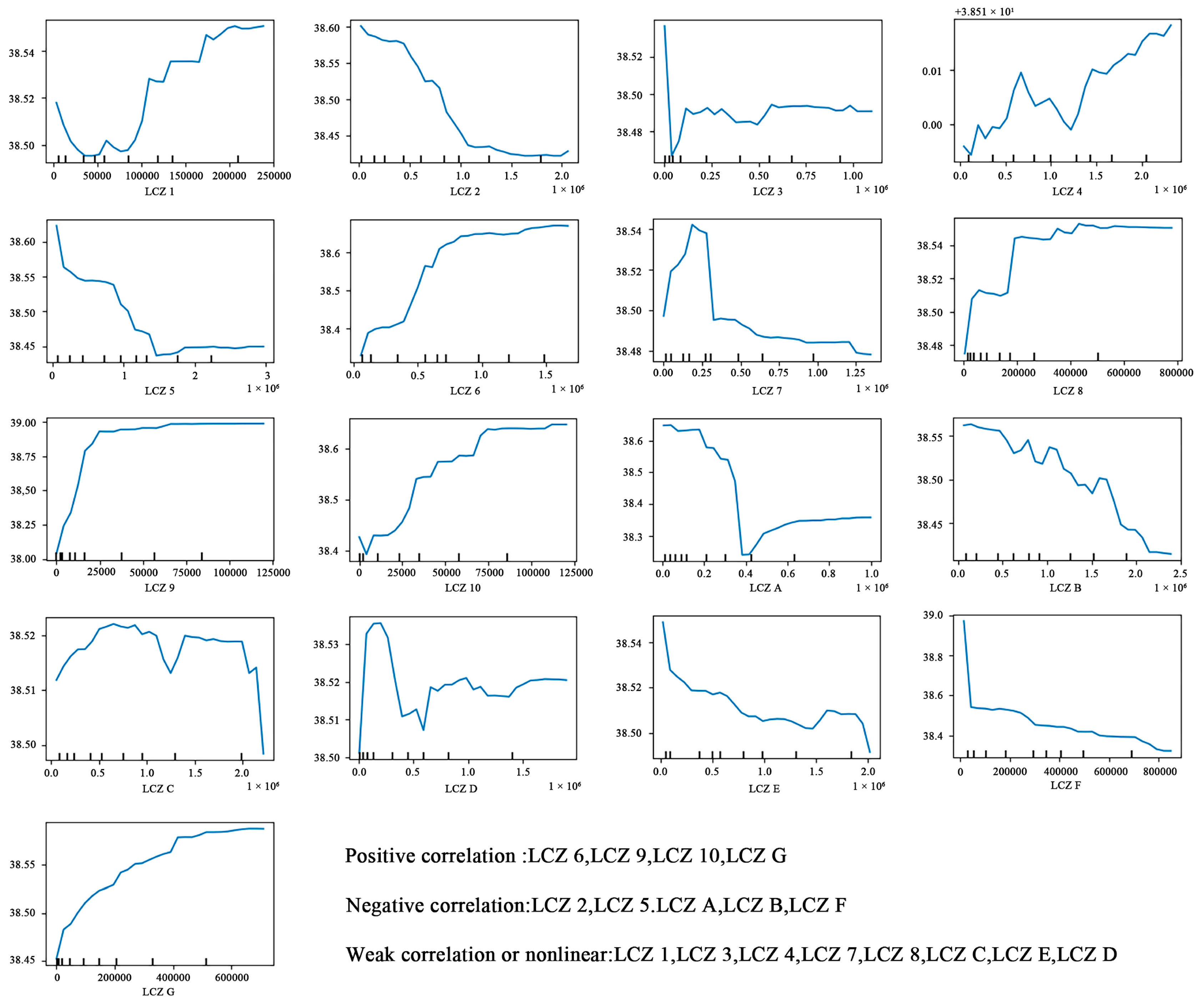
We employed the NSGA-II algorithm to analyze the nonlinear relationships between LCZ configurations and the UTCI in the core area of Chengdu. The results are shown in Figure 10, which illustrates the nonlinear response curves between each LCZ type and the UTCI.
Based on these relationships, the LCZ types were classified into three categories to provide targeted strategies for improving the urban thermal environment:
  • Warming type—including LCZ 6, LCZ 9, LCZ 10, and LCZ G.
For these LCZ types, the UTCI increases significantly as their area expands. Therefore, their spatial extent should be controlled during optimization to reduce thermal risks.
2.
Cooling type—including LCZ 2, LCZ 5, LCZ A, LCZ B, and LCZ F.
For these LCZ types, the UTCI decreases notably with an increase in area. They are key zones for improving thermal comfort, and expanding their coverage can effectively mitigate the urban heat island effect.
3.
Weak or nonlinear impact type—including LCZ 1, LCZ 3, LCZ 4, LCZ 7, LCZ 8, LCZ C, LCZ D, and LCZ E.
These LCZ types exert a weaker or complex nonlinear influence on the UTCI. Their optimization should be evaluated case by case, with careful consideration of local conditions before adjusting their spatial distribution.
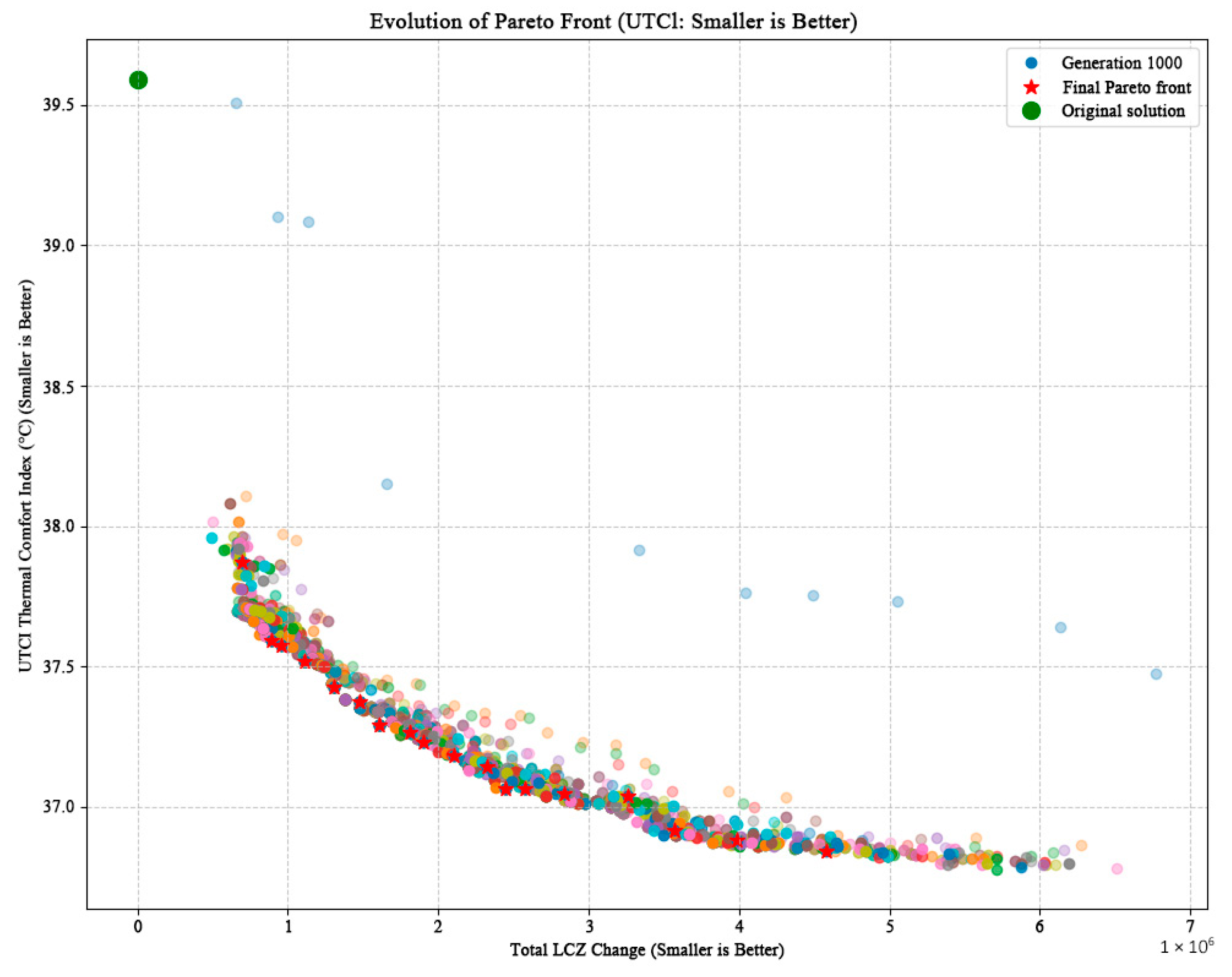
Figure 11 illustrates the evolution of the Pareto front during the NSGA-II optimization process. As the iterations progressed, the distribution of the population in the bi-objective space gradually converged, evolving from a scattered and uneven pattern toward a stable and well-defined non-dominated front.
It can be observed that there exists a significant negative correlation between the UTCI and the total LCZ variation, indicating that reducing the UTCI requires greater spatial adjustment costs. This pattern reflects a typical multi-objective trade-off characteristic.
After 1000 generations of iteration, the algorithm obtained 18 Pareto-optimal solutions that satisfy all constraints. Compared with the initial configuration, the UTCI values decreased substantially, demonstrating that the overall urban thermal environment has been significantly improved through the optimization process.
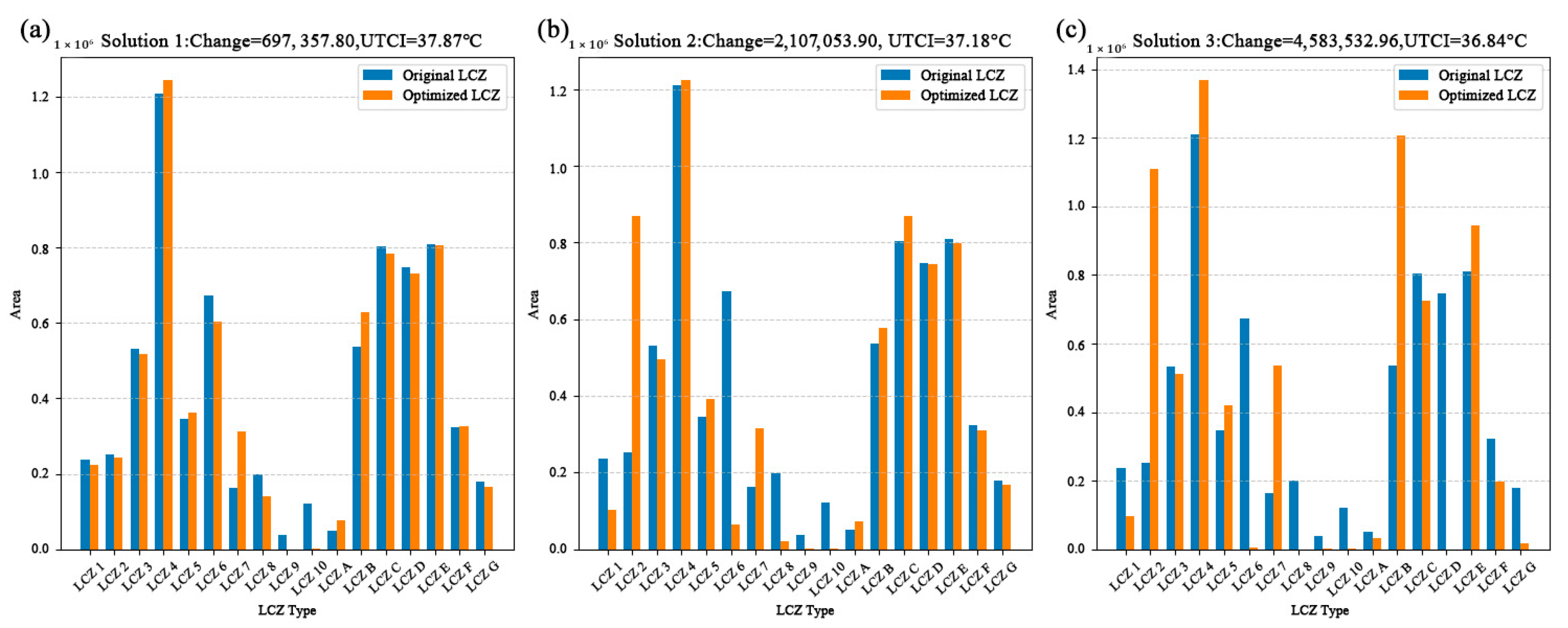
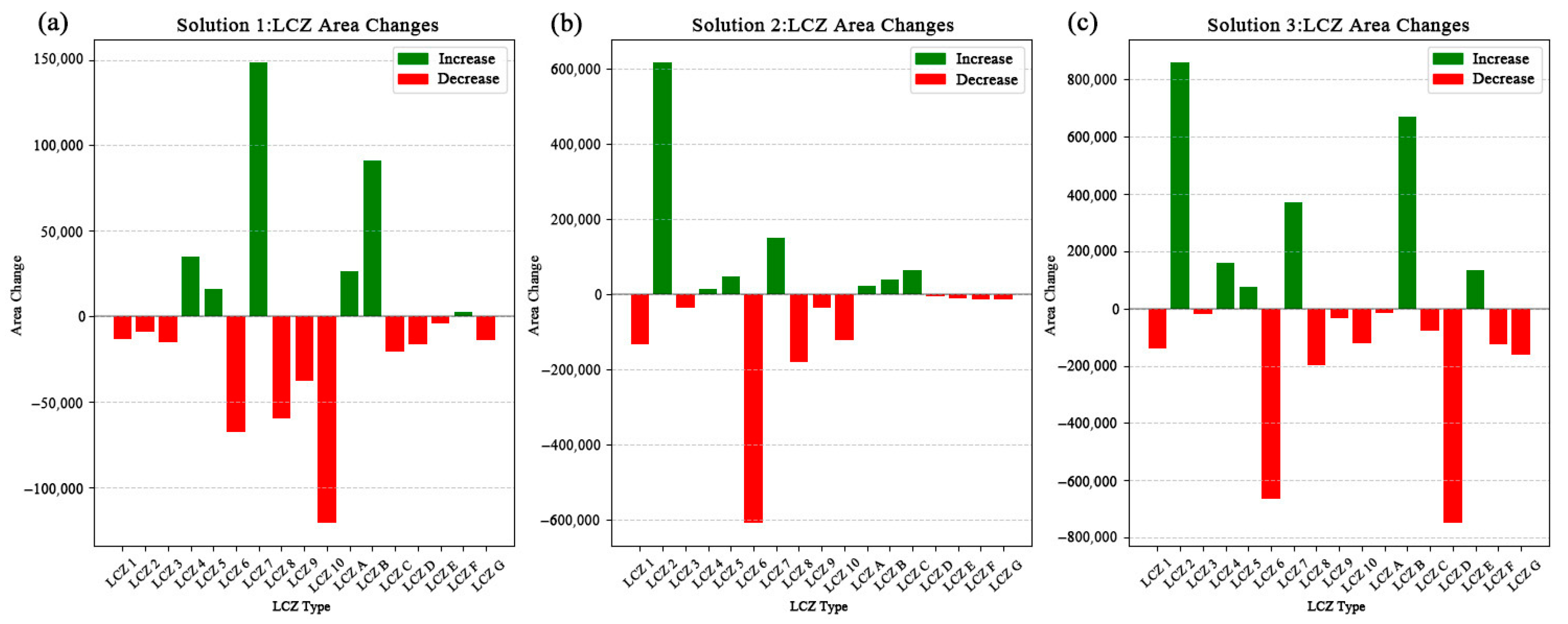
To illustrate the spatial optimization outcomes under different trade-off scenarios, Figure 12 presents the LCZ distribution changes for three representative Pareto-optimal solutions. The original UTCI value is 39.59 °C. Under constraint conditions, adjusting the areas of different LCZs can lead to a temperature reduction of 1.72 °C to 2.75 °C in the core area.
Solution 1 (Figure 12a) prioritizes minimizing the total LCZ variation, resulting in a change of 697,357.80 m2 and a reduction in the UTCI to 37.87 °C. In this case, the overall LCZ configuration remains largely similar to the original state, with slight decreases observed in LCZ 1, LCZ 2, LCZ 3, LCZ C, LCZ D, and LCZ E, and minor increases in LCZ 4, LCZ 5, and LCZ F. This indicates that a modest degree of spatial adjustment can already yield measurable cooling benefits.
Solution 2 (Figure 12b) assigns equal weights to minimizing UTCI and LCZ variation. The total LCZ change increases to 2,107,053.90 m2, while the UTCI further decreases to 37.18 °C. In this configuration, the areas of LCZ 1, LCZ 3, LCZ 6, LCZ 8, LCZ 9, LCZ 10, LCZ D, LCZ F, and LCZ G decrease, whereas LCZ 2, LCZ 4, LCZ 5, LCZ 7, LCZ A, LCZ B, and LCZ C expand. This adjustment achieves a notable improvement in thermal comfort while maintaining overall spatial balance.
Solution 3 (Figure 12c) gives the highest priority to optimizing the UTCI. The total LCZ change reaches 4,583,532.96 m2, corresponding to a UTCI reduction of 36.84 °C. LCZ 6 and LCZ D exhibit the most significant decreases, whereas LCZ B shows the largest increase. Although this scheme achieves the best thermal comfort outcome, it also requires substantially greater spatial restructuring and higher implementation costs.
It is worth noting that in both Solution 2 and Solution 3, LCZ 2 increases while LCZ 6 decreases. This pattern is consistent with the response relationships identified in Figure 10, where LCZ 2 exhibits a negative correlation with the UTCI and LCZ 6 shows a positive correlation. This agreement further confirms that the NSGA-II algorithm effectively captures the nonlinear influence of LCZ configurations on thermal conditions.
From a physical perspective, the increase in LCZ 2 (compact mid-rise buildings, 3–9 stories) may enhance the urban canyon effect, promoting local air circulation and ventilation. Improved ventilation facilitates heat dissipation and reduces surface temperature and humidity, thereby lowering the UTCI. In addition, the moderate building height and density provide effective shading, reducing solar radiation absorption and further contributing to thermal comfort improvement.
In contrast, although LCZ 6 (open low-rise structures) can support airflow, its cooling effect is limited under Chengdu’s typically low-wind conditions. As a result, reducing LCZ 6 helps limit heat accumulation and enhances overall heat exchange efficiency, leading to further reductions in the UTCI.
Figure 13 further quantifies the direction and magnitude of LCZ area changes for each scheme. Comparisons among the three schemes reveal that reducing compact LCZs (1–3) and low-rise built types (LCZ 8–10), while increasing open mid- to low-rise and natural surface LCZs (4, 5, A–C), is the primary strategy for mitigating urban heat risk. This optimization trend aligns with Chengdu’s urban renewal and “Park City” development strategy, indicating that spatial structural adjustment is a feasible and effective approach to improving the urban thermal environment. The pattern also corresponds to the spatial distribution characteristics of heat risk, confirming that the algorithm effectively identified LCZ types with the highest contribution to UTCI improvements.

4. Discussion

4.1. Impact of Different LCZs on Thermal Risk

This study reveals significant structural changes in Chengdu’s LCZ composition between 2017 and 2025. Building-dominated LCZs increased from 12.46% to 24.72% citywide, while in the core districts (Wuhou and Jinjiang), their proportion fluctuated between 46.52% and 62.24%, indicating ongoing urban densification combined with spatial restructuring (Table 4).
Natural LCZs exhibited substantial temporal variability. LCZ A decreased from 35.01% in 2017 to 30.88% in 2021 and then increased sharply to 46.65% in 2025, while LCZ D showed an opposite trend. This transition is temporally consistent with the implementation of green space-oriented urban development policies. Following the launch of the “Park City” initiative in 2018 and the strengthening of ecological planning around 2020, green space construction and management were significantly enhanced. As a result, natural LCZs not only expanded after 2021 but also shifted toward forms with stronger ecological and thermal regulation functions.
At the same time, building-type LCZs showed clear differentiation. LCZ 2 increased from 0.41% in 2017 to 1.09% in 2025, LCZ 3 expanded from 0.87% to 3.90%, and LCZ 4 rose from 2.68% to 4.23%, particularly in the southern and eastern urban expansion zones. Spatially, these changes were concentrated in the southern and eastern parts of the city, where expansion was dominated by mid- to high-rise residential and mixed-use commercial complexes. This pattern can be attributed to the real estate industry becoming one of the primary drivers of Chengdu’s economic growth since 2017. LCZ 7 reached 8.25% in 2025, marking one of the most significant increases among all types, reflecting the proliferation of lightweight, low-density buildings in peri-urban and newly developed areas. This trend not only represents the outward expansion of the city but also highlights the role of suburban zones in accommodating industrial relocation and population redistribution.
In contrast, LCZ 1 slightly decreased from 0.07% to 0.06%, while LCZ 10 declined from 0.16% to 0.00%. This suggests that high-density development in the urban core has reached saturation, while heavy industrial land is being progressively reduced and relocated to the urban periphery.
In the study area, LCZ evolution shows a transition from compact low-rise forms (LCZ 3 decreased from 7.70% to 1.04%) to more open and vertically developed forms (LCZ 4 and LCZ 5 increased to 17.02% and 16.23%, respectively) (Table 5). This transformation is associated with improved ventilation and reduced thermal accumulation.
The reduction in compact LCZs in 2017 was mainly concentrated in the already developed northern part of the core area (Figure 5), which overlapped spatially with high-heat regions. The changes in UTCI were positively correlated with the decrease in compact built LCZs and the increase in natural LCZs. Simulation results indicate that compact LCZs (1–3) are characterized by higher imperviousness and lower vegetation cover, making them relatively warmer than natural LCZs and resulting in higher UTCI values—consistent with their classification. This finding further corroborates existing studies [100,101,102].
Simulation results indicate that compact LCZs (LCZ 1–3), characterized by high imperviousness and low vegetation cover, consistently exhibit higher UTCI values, confirming their contribution to urban heat stress. Conversely, natural LCZs (e.g., LCZ A and LCZ E), which increased from 1.99% to 4.71% and from 8.76% to 11.54%, respectively, are associated with lower temperatures due to enhanced evapotranspiration.
Conversely, natural LCZs (e.g., LCZ A and LCZ E), which increased from 1.99% to 4.71% and from 8.76% to 11.54%, respectively, are associated with lower temperatures due to enhanced evapotranspiration. These findings are in agreement with previous studies showing that natural LCZs contribute to surface cooling and improved thermal conditions [103,104,105].
The evolution of natural LCZs further indicates a growing integration of ecological spaces into the urban core. Between 2017 and 2021, the increase in natural LCZs corresponded with an overall temperature decline. However, by 2025, continued urban expansion led to a reduction in natural LCZs, partially offsetting the cooling effect and resulting in higher temperatures compared with 2021. These findings suggest that, although ecological restoration can effectively mitigate urban heat, its benefits may be constrained by ongoing urban development. In addition to enhancing blue–green infrastructure, optimizing LCZ configurations within urban clusters may help alleviate this conflict by improving local ventilation conditions and reducing heat accumulation. However, the effectiveness of such strategies in regulating urban thermal environments still requires further investigation.

4.2. Implications for Urban Renewal

The research results indicate that the NSGA-II algorithm, within a multi-objective optimization framework, can effectively identify the key LCZ types influencing urban heat risk and achieve optimal urban structural adjustments under multiple constraints. Through iterative optimization, the model significantly reduced the overall heat risk while maintaining a balance in both building area and population capacity. The optimization outcomes (Figure 13) show a marked reduction in the proportion of high-heat-risk LCZs (e.g., LCZ 1, 3, and 8), accompanied by an increase in medium- and low-heat-risk LCZs (e.g., LCZ 4 and LCZ 5), resulting in a more rational spatial configuration. The proportion of natural LCZs (A–C), which contribute to lowering the UTCI, also increased. This transformation not only reflects the potential for optimizing urban surface structures but also reveals the relative importance of different LCZ types in regulating the thermal environment.
At the spatial level, high-heat-risk areas in the study area are mainly concentrated in old, densely populated residential zones, traditional industrial lands, and high-density urban centers. These areas are predominantly characterized by LCZ 3 and LCZ 8 (Figure 5), exhibiting a pronounced urban heat island effect (Figure 7). The optimization results suggest that gradually transforming these zones into patterns dominated by LCZ 4 and LCZ 5 can effectively reduce regional heat intensity while maintaining population capacity. Previous studies have shown that the contribution of different LCZ types to thermal risk is primarily determined by variations in surface thermal properties [17]. The underlying surfaces of LCZ 3 and LCZ 8 are mainly impervious, with few or no trees. Due to the low albedo and high heat capacity of building and pavement materials, these areas absorb a large amount of solar radiation during the day, while the stored heat released at night suppresses surface cooling, leading to persistently high thermal conditions throughout the day and night. In contrast, LCZ 4 and LCZ 5 consist of open building arrangements with largely permeable surfaces, which have a lower heat capacity and better ventilation and heat dissipation capabilities [106]. As a result, they store less heat during the day and cool more rapidly at night, thus exhibiting lower heat intensity.
Previous research consistently shows that the spatial pattern of Local Climate Zones (LCZs) strongly influences the Urban Heat Island (UHI) effect. For instance, Dian used MODIS land-surface temperature data to examine summer and winter-surface UHI intensity in Budapest’s continental climate and found the strongest signal in LCZ 2 [106]. Other studies similarly report a higher UHI intensity in compact built types (LCZ 1–3) and large low-rise zones (LCZ 10) [107,108,109], while open-built settings and vegetation-dominated LCZs generally offer greater thermal comfort [110,111].
In this study, 10 m resolution remote sensing data were employed for LCZ classification, and the resulting LCZ map was subsequently used in WRF simulations, with a DEM incorporated into the model input. This integration improved the spatial resolution of the WRF simulation to 10 m, substantially enhancing its accuracy. The results revealed that the relationship between LCZ types and UTCI in the study area generally follows the order (Figure 10): LCZ 9 > LCZ 10 > LCZ 6 > LCZ G > LCZ 8 > LCZ 1 > LCZ 4 > LCZ C > LCZ D > LCZ 3 > LCZ 7 > LCZ B > LCZ 2 > LCZ 5 > LCZ F.
Among these, LCZ 1, LCZ 3, LCZ 4, LCZ 7, LCZ 8, LCZ C, LCZ E, and LCZ D exhibit complex nonlinear relationships with the UTCI. Our analysis suggests that the 10 m resolution is fine enough to capture street-scale urban features—such as canyon ventilation, elevation differences among LCZs, and micro-scale energy exchanges—that were previously overlooked in simulations based on low-resolution LCZ maps. This represents a new finding, highlighting that improving simulation resolution can yield a more precise understanding of local urban thermal environments.
To mitigate the UHI effect, multiple cooling strategies based on urban spatial optimization have been proposed. Studies have shown that increasing urban canopy cover [112], applying high-albedo roofing materials [113], and enhancing the sky view factor [114] can all effectively reduce surface temperatures. Meanwhile, optimizing urban spatial structure is considered the most sustainable approach to heat mitigation [115]. Singh [116] found that urban morphology and the thermal properties of buildings are the primary determinants of urban heat intensity.
Overall, this study achieved a quantitative optimization of Chengdu’s LCZ spatial structure using the NSGA-II algorithm, providing an operational technical basis for urban heat risk regulation. The results highlight the importance of structural adjustments—rather than relying solely on greening measures—to improve the thermal environment, and they demonstrate the potential of optimization algorithms in climate-adaptive urban planning. This research offers a methodological reference for Chengdu’s future land-use management, urban renewal strategies, and climate resilience enhancement, and provides new scientific support for building a “low-heat-risk city” that balances livability and sustainability.
It should be noted that the theoretically optimal configuration cannot be fully achieved in practice. Factors such as saturated land use in urban cores, high renewal costs, and infrastructure constraints make the large-scale replacement of LCZ types difficult. Therefore, heat-risk mitigation should be coordinated with urban renewal policies, especially in old residential areas, traditional industrial lands, and other high-risk urban spaces. In practice, urban planning should combine overall optimization with localized improvement. At the macro level, this can be achieved by controlling development intensity in new urban areas, limiting the growth of high-heat LCZs, optimizing building height distribution and ventilation corridors, and improving the connectivity of blue–green spaces to increase low-heat LCZs and reduce overall heat risk. At the local level, phased renewal, green infrastructure improvement, and targeted interventions can support the gradual transformation of compact built types into more open LCZ forms.

4.3. Limitations of the Study

Despite the systematic framework developed in this study, several sources of uncertainty and limitations should be acknowledged.
First, uncertainties in LCZ classification may propagate into the simulation results. Although the classification achieved high actual accuracy (Table 6, Table 7, Table 8 and Table 9), misclassification among spectrally similar LCZ types remains inevitable, particularly in mixed urban environments, as indicated by the confusion matrix and validation results. However, these errors are relatively limited and are unlikely to affect the overall spatial patterns and comparative conclusions of the optimization results. Future studies should integrate multi-source datasets to develop more refined and robust LCZ identification methods, thereby improving the accuracy and interpretability of urban structural classification.
Second, the applicability of the WRF model is influenced by regional characteristics. The parameterization schemes and boundary conditions were calibrated for Chengdu, which features a humid subtropical climate and relatively low wind conditions (Table 3). As a result, the quantitative results may not be directly transferable to cities with different climatic or morphological conditions. Future studies should conduct cross-city comparisons to evaluate the generalizability of the framework.
Third, the UTCI calculation involves a complex interaction among temperature, humidity, and wind speed. This study found that the UTCI is particularly sensitive to wind speed variations (Section 3.2), which may introduce additional uncertainty under low-wind conditions. As the UTCI formulation involves a high-order polynomial structure, uncertainties persist in the relative weighting of its parameters. Future research is expected to further investigate these issues and refine the UTCI formula to enhance its applicability to urban thermal environment studies.
Finally, practical implementation constraints should be considered. In this study, two optimization objectives were defined within the NSGA-II framework—minimizing thermal discomfort and limiting changes to the built environment—to partially reflect practical constraints (Section 2.6.3). However, these objectives do not fully capture the complexity of real-world urban systems. In practice, urban transformation is further constrained by socio-economic factors, such as land-use regulations, redevelopment costs, and existing infrastructure. Therefore, the optimized solutions should be interpreted as strategic guidance rather than directly implementable plans. Future research should incorporate broader socio-economic factors to improve the practical applicability of the optimization framework.
Overall, while these uncertainties may influence the absolute magnitude of the results, they do not alter the key findings regarding the relationships between LCZ configurations and urban thermal risk. Future work should integrate multi-source data and field observations to further quantify and reduce these uncertainties.

5. Conclusions

This study tested the suitability of the LCZ scheme in a complex, urban setting. Using GEE and RS remote sensing data, we applied an RF Classifier to map urban structure. The approach successfully separated building types and land-cover classes with high accuracy, satisfying the needs of large-scale urban climate research. The results demonstrate that the LCZ system performs reliably in Chengdu, a typical inland megacity in western China.
By integrating temperature, wind speed, relative humidity, and the UTCI, this study further examined the thermal responses of different LCZ types. The results reveal a strong correlation between the urban thermal environment and underlying surface structures. Compact LCZ types (LCZ 1 and LCZ 3) and low-rise built-up zones (LCZ 8, LCZ 9, and LCZ 10) show a positive correlation with thermal risk, while open mid- and low-rise building zones (LCZ 4 and LCZ 5) and natural surface types (LCZ A–C) exhibit a negative correlation. LCZ 2 and LCZ 6 demonstrate distinct behaviors—negative and positive correlations, respectively—due to Chengdu’s unique local wind and climatic conditions. Between 2017 and 2025, the city’s overall urban structure shifted from a “high-density, low-green” to a “medium-density, high-green” configuration. In the urban core, the proportion of high-density built-up areas decreased, while open LCZ types (LCZ 4–6) and vegetated zones (LCZ A and LCZ B) increased substantially. This structural evolution corresponds to the observed improvement in the spatial distribution of heat risk, indicating that optimizing urban structure directly enhances thermal comfort.
The multi-objective optimization results derived from the NSGA-II algorithm further validate these findings. Under the dual constraints of maintaining thermal comfort and minimizing modifications to the built environment, the algorithm achieved a significant reduction in overall heat exposure and identified optimal LCZ distribution schemes. Despite these encouraging results, several limitations remain. First, challenges persist in accurately identifying LCZ types in complex urban settings, where topographic variation and local climatic effects may cause classification ambiguity. Second, the current thermal environment assessment primarily relies on surface-level indicators, without fully incorporating the combined effects of three-dimensional building morphology and urban wind corridors.
Overall, this study demonstrates the reliability and applicability of the LCZ framework in Chengdu and reveals the intrinsic linkage between urban structural optimization and thermal environment improvement. The findings, supported by advanced optimization algorithms, provide quantitative insights for climate-adaptive planning and urban renewal in Chengdu. Beyond the local context, the integrated framework developed in this study may also support urban thermal environment assessment and planning decision-making in other rapidly urbanizing cities. Although the applicability of this framework to different cities is constrained by site-specific conditions, including local climate, topography, urban morphology, and planning contexts, it can still be adapted by selecting appropriate WRF simulation schemes according to local meteorological characteristics and by defining suitable optimization objectives in line with city-specific policy priorities. Therefore, the combination of LCZ classification, thermal simulation, and multi-objective optimization provides a transferable methodological reference for improving thermal comfort, urban resilience, and the development of livable, low-heat-risk, and sustainable cities.

Author Contributions

J.R.: Software, validation, visualization, conceptualization, writing—original draft, writing—review and editing. Y.C.: Conceptualization, data curation, investigation, writing—review and editing. M.P.: Investigation, visualization, writing—review and editing. L.W.: Validation, writing—review and editing. J.L.: Software, writing—review and editing. Y.B.: Data curation, writing—review and editing. K.H.: Conceptualization, methodology, investigation, visualization, writing—review and editing. X.M.: Writing—review and editing. J.W.: Writing—review and editing. All authors have read and agreed to the published version of the manuscript.

Funding

This research received no external funding.

Data Availability Statement

The original contributions presented in the study are included in the article. Further inquiries can be directed to the corresponding authors.

Conflicts of Interest

The authors declare no conflicts of interest.

Appendix A

Figure A1. Hourly comparison between WRF-simulated and observed (a) temperature, (b) wind speed, and (c) relative humidity over the analysis period (00:00 21 June–00:00 22 June 2025).
Land 15 00630 g0a1
Table A1. Random samples from each LCZ class used for geographic bias assessment.
LCZ IDLCZ 1LCZ 2LCZ 3LCZ 4
Classification resultsLand 15 00630 i001Land 15 00630 i002Land 15 00630 i003Land 15 00630 i004
Sentinel-2 imageryLand 15 00630 i005Land 15 00630 i006Land 15 00630 i007Land 15 00630 i008
LCZ IDLCZ 5LCZ 6LCZ 7LCZ 8
Classification resultsLand 15 00630 i009Land 15 00630 i010Land 15 00630 i011Land 15 00630 i012
Sentinel-2 imageryLand 15 00630 i013Land 15 00630 i014Land 15 00630 i015Land 15 00630 i016
LCZ IDLCZ 9LCZ 10LCZ ALCZ B
Classification resultsLand 15 00630 i017Land 15 00630 i018Land 15 00630 i019Land 15 00630 i020
Sentinel-2 imageryLand 15 00630 i021Land 15 00630 i022Land 15 00630 i023Land 15 00630 i024
LCZ IDLCZ CLCZ DLCZ ELCZ F
Classification resultsLand 15 00630 i025Land 15 00630 i026Land 15 00630 i027Land 15 00630 i028
Sentinel-2 imageryLand 15 00630 i029Land 15 00630 i030Land 15 00630 i031Land 15 00630 i032
LCZ IDLCZ G
Classification resultsLand 15 00630 i033
Sentinel-2 imageryLand 15 00630 i034
Table A2. Hourly mean air temperature (°C) simulated for the 2017, 2021, and 2025 scenarios.
HourT2_2017T2_2021T2_2025
027.7325.9225.02
127.3824.3623.67
227.0423.2724.11
327.2523.0223.26
426.2322.4821.51
525.6322.9020.57
625.1222.3620.46
724.6225.0423.30
824.9926.2124.70
926.0826.7225.61
1026.8527.8026.67
1127.8429.3527.65
1229.0530.4928.53
1330.3431.3029.39
1431.2032.0230.14
1531.8232.5630.71
1632.2232.6630.84
1732.5631.9930.72
1832.6131.2830.90
1931.8031.3830.56
2029.4230.1428.98
2128.5927.9027.91
2228.2026.8027.00
2328.1726.1626.37
2427.9025.5924.71
Table A3. Hourly mean wind speed (m/s) simulated for the 2017, 2021, and 2025 scenarios.
HourW10_2017W10_2021W10_2025
01.240.872.06
10.911.311.92
21.011.112.10
30.940.911.64
41.280.881.25
51.701.050.54
61.841.110.66
72.101.090.95
82.380.591.58
92.000.641.69
101.590.651.47
111.490.521.19
121.160.600.83
131.160.710.96
140.810.661.29
151.160.951.53
161.071.721.90
170.802.211.95
180.903.042.02
191.872.112.10
201.692.412.5
210.961.622.09
220.781.241.73
231.101.161.87
241.400.823.10
Table A4. Hourly mean relative humidity (%) simulated for the 2017, 2021, and 2025 scenarios.
HourRH_2017RH_2021RH_2025
060.9871.9168.83
162.3077.2974.46
263.4878.8472.42
363.0679.8777.03
467.8279.1685.36
570.5275.9088.64
674.5075.4988.13
779.0867.3977.04
878.6764.2570.72
974.3862.7566.58
1071.2459.4961.61
1167.1353.1858.46
1261.5647.5855.21
1355.2744.0652.66
1451.2041.1851.13
1549.3639.7849.71
1648.2040.8649.57
1746.3244.2750.80
1845.4646.2949.66
1948.1843.4749.80
2058.0343.7558.59
2162.0751.4365.52
2263.9054.4869.69
2364.7557.2674.08
2466.6266.2588.85
Table A5. Hourly mean UTCI (°C) simulated for the 2017, 2021, and 2025 scenarios.
HourUTCI_2017UTCI_2021UTCI_2025
037.6738.3035.48
137.7237.1234.98
237.5135.9135.06
337.7435.8935.16
437.4134.8534.6
537.0434.6034.25
637.2933.6233.89
737.6335.6235.59
837.9736.7135.76
938.6837.0335.95
1039.1837.6436.23
1139.5438.0136.87
1239.8137.7837.32
1339.7137.6937.69
1439.7837.7238.09
1539.8737.8138.29
1640.0737.9138.24
1740.0437.9038.43
1839.7837.2038.28
1939.0936.9037.82
2038.9735.1738.12
2139.3734.8738.84
2239.4334.4438.86
2339.4934.3839.08
2439.4936.2439.87

References

  1. Yu, W.; Shi, J.; Fang, Y.; Xiang, A.; Li, X.; Hu, C.; Ma, M. Exploration of Urbanization Characteristics and Their Effect on the Urban Thermal Environment in Chengdu, China. Build. Environ. 2022, 219, 109150. [Google Scholar] [CrossRef]
  2. Zhou, S.; Diao, H.; Wang, J.; Jia, W.; Xu, H.; Xu, X.; Wang, M.; Sun, C.; Qiao, R.; Wu, Z. Multi-Stage Optimization Framework for Synergetic Grey-Green Infrastructure in Response to Long-Term Climate Variability Based on Shared Socio-Economic Pathways. Water Res. 2025, 274, 123091. [Google Scholar] [CrossRef] [PubMed]
  3. Bechtel, B.; See, L.; Mills, G.; Foley, M. Classification of Local Climate Zones Using SAR and Multispectral Data in an Arid Environment. IEEE J. Sel. Top. Appl. Earth Obs. Remote Sens. 2016, 9, 3097–3105. [Google Scholar] [CrossRef]
  4. Li, H.; Zhou, Y.; Li, X.; Meng, L.; Wang, X.; Wu, S.; Sodoudi, S. A New Method to Quantify Surface Urban Heat Island Intensity. Sci. Total Environ. 2018, 624, 262–272. [Google Scholar] [CrossRef] [PubMed]
  5. Wang, Z.; Yang, Z.; Yu, X.; Peng, J. Mutation Thresholds of Resident Heat Exposure along Urbanization Intensity Gradient. Sustain. Cities Soc. 2025, 126, 106399. [Google Scholar] [CrossRef]
  6. Zhang, M.; Kafy, A.-A.; Xiao, P.; Han, S.; Zou, S.; Saha, M.; Zhang, C.; Tan, S. Impact of Urban Expansion on Land Surface Temperature and Carbon Emissions Using Machine Learning Algorithms in Wuhan, China. Urban Clim. 2023, 47, 101347. [Google Scholar] [CrossRef]
  7. Wu, H.; Ming, Y.; Liu, Y. Investigating the Influence of Morphologic and Functional Polycentric Structures on Urban Heat Island: A Case of Chongqing, China. Sustain. Cities Soc. 2024, 114, 105790. [Google Scholar] [CrossRef]
  8. Huang, J.; Huang, Z.; Liu, W. Combining the WRF Model and LCZ Scheme to Assess Spatiotemporal Variations of Thermal Comfort in Shenzhen’s Built-up Areas. Sustain. Cities Soc. 2025, 122, 106252. [Google Scholar] [CrossRef]
  9. Du, Y.; Mak, C.M.; Tang, B. Effects of Building Height and Porosity on Pedestrian Level Wind Comfort in a High-Density Urban Built Environment. Build. Simul. 2018, 11, 1215–1228. [Google Scholar] [CrossRef]
  10. Zhao, H.; Fang, Y.; Xu, X. Quantifying Morphology Evolutions of Urban Heat Islands and Assessing Their Heat Exposure in a Metropolis. Sustain. Cities Soc. 2024, 102, 105244. [Google Scholar] [CrossRef]
  11. Patel, S.; Kollarath, R.M.; Azad, A.; Indraganti, M. Remotely Sensed Analysis of Land Cover and Its Impact on Summer Outdoor Thermal Comfort in the Bengaluru Metropolitan Area (1993–2023). Urban Transit. 2025, 2, 100007. [Google Scholar] [CrossRef]
  12. Yan, H.; Li, Y.; Xing, Y.; Chen, X.; Guo, X.; Yin, Y.; Yu, W.; Huang, M.; Zhuang, J. Increasing Human-Perceived Temperature Exacerbated by Urbanization in China’s Major Cities: Spatiotemporal Trends and Associated Driving Factors. Sustain. Cities Soc. 2025, 118, 106034. [Google Scholar] [CrossRef]
  13. Calvin, K.; Dasgupta, D.; Krinner, G.; Mukherji, A.; Thorne, P.W.; Trisos, C.; Romero, J.; Aldunce, P.; Barrett, K.; Blanco, G.; et al. IPCC, 2023: Climate Change 2023: Synthesis Report. Contribution of Working Groups I, II and III to the Sixth Assessment Report of the Intergovernmental Panel on Climate Change; Core Writing Team, Lee, H., Romero, J., Eds.; IPCC: Geneva, Switzerland, 2023. [Google Scholar]
  14. Mahata, B.; Sankar Sahu, S.; Sardar, A.; Laxmikanta, R.; Maity, M. Spatiotemporal Dynamics of Land Use/Land Cover (LULC) Changes and Its Impact on Land Surface Temperature: A Case Study in New Town Kolkata, Eastern India. Reg. Sustain. 2024, 5, 100138. [Google Scholar] [CrossRef]
  15. Grimm, N.B.; Faeth, S.H.; Golubiewski, N.E.; Redman, C.L.; Wu, J.; Bai, X.; Briggs, J.M. Global Change and the Ecology of Cities. Science 2008, 319, 756–760. [Google Scholar] [CrossRef]
  16. Hong, S.; Hui, E.C.; Lin, Y. Relationship between Urban Spatial Structure and Carbon Emissions: A Literature Review. Ecol. Indic. 2022, 144, 109456. [Google Scholar] [CrossRef]
  17. Rahmani, N.; Sharifi, A. Urban Heat Dynamics in Local Climate Zones (LCZs): A Systematic Review. Build. Environ. 2025, 267, 112225. [Google Scholar] [CrossRef]
  18. O’Malley, C.; Kikumoto, H. An Investigation into Urban Heat Mitigation by Adopting Local Climate Zones and Land Surface Temperatures in the Tokyo Prefecture. Jpn. Archit. Rev. 2022, 5, 728–739. [Google Scholar] [CrossRef]
  19. Wang, C.; Middel, A.; Myint, S.W.; Kaplan, S.; Brazel, A.J.; Lukasczyk, J. Assessing Local Climate Zones in Arid Cities: The Case of Phoenix, Arizona and Las Vegas, Nevada. ISPRS J. Photogramm. Remote Sens. 2018, 141, 59–71. [Google Scholar] [CrossRef]
  20. Choudhury, D.; Das, A.; Das, M. Investigating Thermal Behavior Pattern (TBP) of Local Climatic Zones (LCZs): A Study on Industrial Cities of Asansol-Durgapur Development Area (ADDA), Eastern India. Urban Clim. 2021, 35, 100727. [Google Scholar] [CrossRef]
  21. Kotharkar, R.; Ghosh, A.; Kotharkar, V. Estimating Summertime Heat Stress in a Tropical Indian City Using Local Climate Zone (LCZ) Framework. Urban Clim. 2021, 36, 100784. [Google Scholar] [CrossRef]
  22. Smithson, C.; Adams, B.R. Use of LCZs with Urban Canopy Modeling to Evaluate Urban Growth Effects on Meteorological Conditions in the Salt Lake Valley. Urban Clim. 2024, 57, 102106. [Google Scholar] [CrossRef]
  23. Žgela, M.; Herceg-Bulić, I.; Lozuk, J.; Jureša, P. Linking Land Surface Temperature and Local Climate Zones in Nine Croatian Cities. Urban Clim. 2024, 54, 101842. [Google Scholar] [CrossRef]
  24. Du, S.; Kuang, X.; Chen, J.; Ye, Y.; Li, P.; Shi, X. Development of an Expanded Local Climate Zone Scheme to Accommodate Diversified Urban Morphological Evolution: A Case Study of Shanghai, China. Urban Clim. 2024, 56, 102009. [Google Scholar] [CrossRef]
  25. Zhang, L.; Zhou, L.; Yuan, B.; Wang, B.; Wei, W. Multifactorial Influences on Land Surface Temperature within Local Climate Zones of Typical Global Cities. Urban Clim. 2024, 57, 102130. [Google Scholar] [CrossRef]
  26. Gao, S.; Zhan, Q.; Yang, C.; Liu, H. The Diversified Impacts of Urban Morphology on Land Surface Temperature among Urban Functional Zones. Int. J. Environ. Res. Public Health 2020, 17, 9578. [Google Scholar] [CrossRef] [PubMed]
  27. Deng, Z.; Sun, H.; Zhou, S.; Zhao, J.; Lei, L.; Zou, H. Multi-Scale Object Detection in Remote Sensing Imagery with Convolutional Neural Networks. ISPRS J. Photogramm. Remote Sens. 2018, 145, 3–22. [Google Scholar] [CrossRef]
  28. Liu, Y.; Song, W.; Deng, X. Understanding the Spatiotemporal Variation of Urban Land Expansion in Oasis Cities by Integrating Remote Sensing and Multi-Dimensional DPSIR-Based Indicators. Ecol. Indic. 2019, 96, 23–37. [Google Scholar] [CrossRef]
  29. Misra, M.; Kumar, D.; Shekhar, S. Assessing Machine Learning Based Supervised Classifiers for Built-up Impervious Surface Area Extraction from Sentinel-2 Images. Urban For. Urban Green. 2020, 53, 126714. [Google Scholar] [CrossRef]
  30. Zhang, C.; Pan, X.; Li, H.; Gardiner, A.; Sargent, I.; Hare, J.; Atkinson, P.M. A Hybrid MLP-CNN Classifier for Very Fine Resolution Remotely Sensed Image Classification. ISPRS J. Photogramm. Remote Sens. 2018, 140, 133–144. [Google Scholar] [CrossRef]
  31. Huang, F.; Yu, Y.; Feng, T. Automatic Extraction of Impervious Surfaces from High Resolution Remote Sensing Images Based on Deep Learning. J. Vis. Commun. Image Represent. 2019, 58, 453–461. [Google Scholar] [CrossRef]
  32. Akbar, M.U.; Mirchi, A.; Arshad, A.; Alian, S.; Mehata, M.; Taghvaeian, S.; Khodkar, K.; Kettner, J.; Datta, S.; Wagner, K. Multi-Model Ensemble Mapping of Irrigated Areas Using Remote Sensing, Machine Learning, and Ground Truth Data. Agric. Water Manag. 2025, 312, 109416. [Google Scholar] [CrossRef]
  33. Feng, H.; Hu, Q.; Zhao, P.; Ai, M.; Wang, S.; Zheng, D. Geothermal Detection Study Using Remote Sensing Data by Combining Machine Learning and Deep Learning: A Case Study of Huanggang City. Geothermics 2024, 130, 103338. [Google Scholar] [CrossRef]
  34. Wang, R.; Gao, W.; Zhou, N.; Kammen, D.M.; Peng, W. Urban Structure and Its Implication of Heat Stress by Using Remote Sensing and Simulation Tool. Sustain. Cities Soc. 2021, 65, 102632. [Google Scholar] [CrossRef]
  35. Zhou, P.; Chang, Y. Automated Classification of Building Structures for Urban Built Environment Identification Using Machine Learning. J. Build. Eng. 2021, 43, 103008. [Google Scholar] [CrossRef]
  36. Li, F.; Yigitcanlar, T.; Nepal, M.; Nguyen, K.; Dur, F. Machine Learning and Remote Sensing Integration for Leveraging Urban Sustainability: A Review and Framework. Sustain. Cities Soc. 2023, 96, 104653. [Google Scholar] [CrossRef]
  37. Jamei, M.; Ahmadianfar, I.; Karbasi, M.; Malik, A.; Kisi, O.; Yaseen, Z.M. Development of Wavelet-Based Kalman Online Sequential Extreme Learning Machine Optimized with Boruta-Random Forest for Drought Index Forecasting. Eng. Appl. Artif. Intell. 2023, 117, 105545. [Google Scholar] [CrossRef]
  38. Ali, M.; Prasad, R.; Xiang, Y.; Khan, M.; Ahsan Farooque, A.; Zong, T.; Yaseen, Z.M. Variational Mode Decomposition Based Random Forest Model for Solar Radiation Forecasting: New Emerging Machine Learning Technology. Energy Rep. 2021, 7, 6700–6717. [Google Scholar] [CrossRef]
  39. Breiman, L. Random Forests. Mach. Learn. 2001, 45, 5–32. [Google Scholar] [CrossRef]
  40. Bakhshi, R.; Agrawal, I.; DeFries, R. Indicators for Equitable Restoration of Commons through Invasive Species Removal in Central India. Environ. Sustain. Indic. 2025, 28, 100989. [Google Scholar] [CrossRef]
  41. Rahman, A.; Abdullah, H.M.; Tanzir, M.T.; Hossain, M.J.; Khan, B.M.; Miah, M.G.; Islam, I. Performance of Different Machine Learning Algorithms on Satellite Image Classification in Rural and Urban Setup. Remote Sens. Appl. Soc. Environ. 2020, 20, 100410. [Google Scholar] [CrossRef]
  42. Alshari, E.A.; Abdulkareem, M.B.; Gawali, B.W. Classification of Land Use/Land Cover Using Artificial Intelligence (ANN-RF). Front. Artif. Intell. 2023, 5, 964279. [Google Scholar] [CrossRef]
  43. Abd El-sadek, E.; Elbeih, S.; Negm, A. Coastal and Landuse Changes of Burullus Lake, Egypt: A Comparison Using Landsat and Sentinel-2 Satellite Images. Egypt. J. Remote Sens. Space Sci. 2022, 25, 815–829. [Google Scholar] [CrossRef]
  44. Chen, Y.; Zhang, N.; Zhu, Y. High-Resolution Simulations of the Urban Thermal Climate in Suzhou City, China. Atmosphere 2019, 10, 118. [Google Scholar] [CrossRef]
  45. Li, H.; Zhou, Y.; Wang, X.; Zhou, X.; Zhang, H.; Sodoudi, S. Quantifying Urban Heat Island Intensity and Its Physical Mechanism Using WRF/UCM. Sci. Total Environ. 2019, 650, 3110–3119. [Google Scholar] [CrossRef] [PubMed]
  46. Oleson, K.W.; Bonan, G.B.; Feddema, J.; Vertenstein, M.; Grimmond, C.S.B. An Urban Parameterization for a Global Climate Model. Part I: Formulation and Evaluation for Two Cities. J. Appl. Meteorol. Clim. 2008, 47, 1038–1060. [Google Scholar] [CrossRef]
  47. Wang, Q.; Zhang, C.; Ren, C.; Hang, J.; Li, Y. Urban Heat Island Circulations over the Beijing-Tianjin Region under Calm and Fair Conditions. Build. Environ. 2020, 180, 107063. [Google Scholar] [CrossRef]
  48. Kanda, M.; Kawai, T.; Kanega, M.; Moriwaki, R.; Narita, K.; Hagishima, A. A Simple Energy Balance Model for Regular Building Arrays. Bound. Layer Meteorol. 2005, 116, 423–443. [Google Scholar] [CrossRef]
  49. Zhang, X.; Steeneveld, G.-J.; Zhou, D.; Ronda, R.J.; Duan, C.; Koopmans, S.; Holtslag, A.A.M. Modelling Urban Meteorology with Increasing Refinements for the Complex Morphology of a Typical Chinese City (Xi’an). Build. Environ. 2020, 182, 107109. [Google Scholar] [CrossRef]
  50. Wang, Y.; Akbari, H. Analysis of Urban Heat Island Phenomenon and Mitigation Solutions Evaluation for Montreal. Sustain. Cities Soc. 2016, 26, 438–446. [Google Scholar] [CrossRef]
  51. Cao, K.; Huang, B.; Wang, S.; Lin, H. Sustainable Land Use Optimization Using Boundary-Based Fast Genetic Algorithm. Comput. Environ. Urban Syst. 2012, 36, 257–269. [Google Scholar] [CrossRef]
  52. Liu, Y.; Tang, W.; He, J.; Liu, Y.; Ai, T.; Liu, D. A Land-Use Spatial Optimization Model Based on Genetic Optimization and Game Theory. Comput. Environ. Urban Syst. 2015, 49, 1–14. [Google Scholar] [CrossRef]
  53. Lin, L.; Zhao, Y.; Zhao, J. Optimizing Urban Green Space Spatial Patterns for Thermal Environment Improvement: A Multi-Objective Approach in the Context of Urban Renewal. Comput. Environ. Urban Syst. 2025, 121, 102320. [Google Scholar] [CrossRef]
  54. Benincá, L.; Crespo Sánchez, E.; Passuello, A.; Karini Leitzke, R.; Grala Da Cunha, E.; Maria González Barroso, J. Multi-Objective Optimization of the Solar Orientation of Two Residential Multifamily Buildings in South Brazil. Energy Build. 2023, 285, 112838. [Google Scholar] [CrossRef]
  55. Liu, K.; Xu, X.; Zhang, R.; Kong, L.; Wang, W.; Deng, W. Impact of Urban Form on Building Energy Consumption and Solar Energy Potential: A Case Study of Residential Blocks in Jianhu, China. Energy Build. 2023, 280, 112727. [Google Scholar] [CrossRef]
  56. Wang, Y.; Lyu, J.; Liang, X.; Luo, C.; Ma, X.; Li, J.; Li, Q.; Zheng, L.; Guan, Q. Using Zipf’s Law to Optimize Urban Spatial Layouts in an Urban Agglomeration Area. Ann. Am. Assoc. Geogr. 2024, 114, 1342–1364. [Google Scholar] [CrossRef]
  57. Castrejon-Esparza, N.M.; González-Trevizo, M.E.; Martínez-Torres, K.E.; Santamouris, M. Optimizing Urban Morphology: Evolutionary Design and Multi-Objective Optimization of Thermal Comfort and Energy Performance-Based City Forms for Microclimate Adaptation. Energy Build. 2025, 342, 115750. [Google Scholar] [CrossRef]
  58. Holland, J.H. Adaptation in Natural and Artificial Systems: An Introductory Analysis with Applications to Biology, Control, and Artificial Intelligence; The MIT Press: Cambridge, MA, USA, 1992. [Google Scholar]
  59. Goldberg, D.E. Genetic Algorithms in Search, Optimization, and Machine Learning; Addison-Wesley Pub. Co.: Reading, MA, USA, 1989. [Google Scholar]
  60. Cao, X.; Yao, R.; Ding, C.; Zhou, N.; Yu, W.; Yao, J.; Xiong, J.; Xu, Q.; Pan, L.; Li, B. Energy-Quota-Based Integrated Solutions for Heating and Cooling of Residential Buildings in the Hot Summer and Cold Winter Zone in China. Energy Build. 2021, 236, 110767. [Google Scholar] [CrossRef]
  61. Calama-González, C.M.; Escandón, R.; Suárez, R.; Ascione, F. Decision-Making for Renovating the Mediterranean Social Housing: A Practical Approach through an Interactive Open Access Tool. Energy Build. 2025, 336, 115629. [Google Scholar] [CrossRef]
  62. Li, Y.; Luo, X.; Wang, M.; Di, B.; Li, Y.; Tan, C.; Pan, Y. Spatiotemporal Variations and Influencing Factors of Heatwaves in Chengdu, China. Ecol. Inform. 2024, 84, 102924. [Google Scholar] [CrossRef]
  63. Zong, H.; Liu, Y.; Wang, Q.; Liu, M.; Chen, H. Usage Patterns and Comfort of Gardens: A Seasonal Survey of Internal Garden Microclimate in the Aged Care Homes of Chengdu City. Int. J. Biometeorol. 2019, 63, 1181–1192. [Google Scholar] [CrossRef]
  64. Wu, S.; Yang, H.; Luo, P.; Luo, C.; Li, H.; Liu, M.; Ruan, Y.; Zhang, S.; Xiang, P.; Jia, H.; et al. The Effects of the Cooling Efficiency of Urban Wetlands in an Inland Megacity: A Case Study of Chengdu, Southwest China. Build. Environ. 2021, 204, 108128. [Google Scholar] [CrossRef]
  65. Bechtel, B.; Alexander, P.; Böhner, J.; Ching, J.; Conrad, O.; Feddema, J.; Mills, G.; See, L.; Stewart, I. Mapping Local Climate Zones for a Worldwide Database of the Form and Function of Cities. ISPRS Int. J. Geo-Inf. 2015, 4, 199–219. [Google Scholar] [CrossRef]
  66. Quan, S.J.; Bansal, P. A Systematic Review of GIS-Based Local Climate Zone Mapping Studies. Build. Environ. 2021, 196, 107791. [Google Scholar] [CrossRef]
  67. Vavassori, A.; Oxoli, D.; Venuti, G.; Brovelli, M.A.; Siciliani De Cumis, M.; Sacco, P.; Tapete, D. A Combined Remote Sensing and GIS-Based Method for Local Climate Zone Mapping Using PRISMA and Sentinel-2 Imagery. Int. J. Appl. Earth Obs. Geoinf. 2024, 131, 103944. [Google Scholar] [CrossRef]
  68. Gorelick, N.; Hancher, M.; Dixon, M.; Ilyushchenko, S.; Thau, D.; Moore, R. Google Earth Engine: Planetary-Scale Geospatial Analysis for Everyone. Remote Sens. Environ. 2017, 202, 18–27. [Google Scholar] [CrossRef]
  69. Wang, R.; Voogt, J.; Ren, C.; Ng, E. Spatial-Temporal Variations of Surface Urban Heat Island: An Application of Local Climate Zone into Large Chinese Cities. Build. Environ. 2022, 222, 109378. [Google Scholar] [CrossRef]
  70. Ravanelli, R.; Nascetti, A.; Cirigliano, R.V.; Di Rico, C.; Leuzzi, G.; Monti, P.; Crespi, M. Monitoring the Impact of Land Cover Change on Surface Urban Heat Island through Google Earth Engine: Proposal of a Global Methodology, First Applications and Problems. Remote Sens. 2018, 10, 1488. [Google Scholar] [CrossRef]
  71. Amani, M.; Ghorbanian, A.; Ahmadi, S.A.; Kakooei, M.; Moghimi, A.; Mirmazloumi, S.M.; Moghaddam, S.H.A.; Mahdavi, S.; Ghahremanloo, M.; Parsian, S.; et al. Google Earth Engine Cloud Computing Platform for Remote Sensing Big Data Applications: A Comprehensive Review. IEEE J. Sel. Top. Appl. Earth Obs. Remote Sens. 2020, 13, 5326–5350. [Google Scholar] [CrossRef]
  72. Rouse, J.W.; Haas, R.H.; Deering, D.W.; Schell, J.A.; Harlan, J.C. Monitoring the Vernal Advancement and Retrogradation (Green Wave Effect) of Natural Vegetation; NASA: Washington, DC, USA, 1974.
  73. McFeeters, S.K. The Use of the Normalized Difference Water Index (NDWI) in the Delineation of Open Water Features. Int. J. Remote Sens. 1996, 17, 1425–1432. [Google Scholar] [CrossRef]
  74. Zha, Y.; Gao, J.; Ni, S. Use of Normalized Difference Built-up Index in Automatically Mapping Urban Areas from TM Imagery. Int. J. Remote Sens. 2003, 24, 583–594. [Google Scholar] [CrossRef]
  75. Liu, H.Q.; Huete, A. A Feedback Based Modification of the NDVI to Minimize Canopy Background and Atmospheric Noise. IEEE Trans. Geosci. Remote Sens. 1995, 33, 457–465. [Google Scholar] [CrossRef]
  76. Ridd, M.K. Exploring a V-I-S (Vegetation-Impervious Surface-Soil) Model for Urban Ecosystem Analysis through Remote Sensing: Comparative Anatomy for Cities. Int. J. Remote Sens. 1995, 16, 2165–2185. [Google Scholar] [CrossRef]
  77. Xu, H. A New Index for Delineating Built-up Land Features in Satellite Imagery. Int. J. Remote Sens. 2008, 29, 4269–4276. [Google Scholar] [CrossRef]
  78. Galin, E.; Guérin, E.; Peytavie, A.; Cordonnier, G.; Cani, M.; Benes, B.; Gain, J. A Review of Digital Terrain Modeling. Comput. Graph. Forum 2019, 38, 553–577. [Google Scholar] [CrossRef]
  79. Elvidge, C.D.; Zhizhin, M.; Ghosh, T.; Hsu, F.-C.; Taneja, J. Annual Time Series of Global VIIRS Nighttime Lights Derived from Monthly Averages: 2012 to 2019. Remote Sens. 2021, 13, 922. [Google Scholar] [CrossRef]
  80. Ren, C.; Cai, M.; Li, X.; Zhang, L.; Wang, R.; Xu, Y.; Ng, E. Assessment of Local Climate Zone Classification Maps of Cities in China and Feasible Refinements. Sci. Rep. 2019, 9, 18848. [Google Scholar] [CrossRef]
  81. Huang, F.; Jiang, S.; Zhan, W.; Bechtel, B.; Liu, Z.; Demuzere, M.; Huang, Y.; Xu, Y.; Ma, L.; Xia, W.; et al. Mapping Local Climate Zones for Cities: A Large Review. Remote Sens. Environ. 2023, 292, 113573. [Google Scholar] [CrossRef]
  82. Li, X.-X.; Liu, X. Effect of Tree Evapotranspiration and Hydrological Processes on Urban Microclimate in a Tropical City: A WRF/SLUCM Study. Urban Clim. 2021, 40, 101009. [Google Scholar] [CrossRef]
  83. Skamarock, A.W.; Klemp, A.J.; Dudhia, A.J.; Gill, A.D.O.; Liu, A.Z.; Berner, A.J.; Wang, A.W.; Powers, A.J.G.; Duda, A.M.G.; Barker, A.D.; et al. A Description of the Advanced Research WRF Model Version 4.3; NCAR: Boulder, CO, USA, 2021. [Google Scholar]
  84. Cao, Q.; Huang, H.; Hong, Y.; Huang, X.; Wang, S.; Wang, L.; Wang, L. Modeling Intra-Urban Differences in Thermal Environments and Heat Stress Based on Local Climate Zones in Central Wuhan. Build. Environ. 2022, 225, 109625. [Google Scholar] [CrossRef]
  85. Chen, S.-H.; Sun, W.-Y. A One-Dimensional Time Dependent Cloud Model. J. Meteorol. Soc. Japan. Ser. II 2002, 80, 99–118. [Google Scholar] [CrossRef]
  86. Kain, J.S. The Kain–Fritsch Convective Parameterization: An Update. J. Appl. Meteorol. 2004, 43, 170–181. [Google Scholar] [CrossRef]
  87. Mlawer, E.J.; Taubman, S.J.; Brown, P.D.; Iacono, M.J.; Clough, S.A. Radiative Transfer for Inhomogeneous Atmospheres: RRTM, a Validated Correlated-k Model for the Longwave. J. Geophys. Res. Atmos. 1997, 102, 16663–16682. [Google Scholar] [CrossRef]
  88. Dudhia, J. Numerical Study of Convection Observed during the Winter Monsoon Experiment Using a Mesoscale Two-Dimensional Model. J. Atmos. Sci. 1989, 46, 3077–3107. [Google Scholar] [CrossRef]
  89. Monin, A.S.; Obukhov, A.M. Basic Laws of Turbulent Mixing in the Surface Layer of the Atmosphere. Contrib. Geophys. Inst. Acad. Sci. 1954, 151, e187. [Google Scholar]
  90. Ek, M.B.; Mitchell, K.E.; Lin, Y.; Rogers, E.; Grunmann, P.; Koren, V.; Gayno, G.; Tarpley, J.D. Implementation of Noah Land Surface Model Advances in the National Centers for Environmental Prediction Operational Mesoscale Eta Model. J. Geophys. Res. Atmos. 2003, 108, 2002JD003296. [Google Scholar] [CrossRef]
  91. Janjić, Z.I. The Step-Mountain Eta Coordinate Model: Further Developments of the Convection, Viscous Sublayer, and Turbulence Closure Schemes. Mon. Weather. Rev. 1994, 122, 927–945. [Google Scholar] [CrossRef]
  92. Demuzere, M.; Argüeso, D.; Zonato, A.; Kittner, J. W2W: A Python Package That Injects WUDAPT’s LocalClimate Zone Information in WRF. J. Open Source Softw. 2022, 7, 4432. [Google Scholar] [CrossRef]
  93. Epstein, Y.; Moran, D.S. Thermal Comfort and the Heat Stress Indices. Ind. Health 2006, 44, 388–398. [Google Scholar] [CrossRef]
  94. Jendritzky, G.; De Dear, R.; Havenith, G. UTCI—Why Another Thermal Index? Int. J. Biometeorol. 2012, 56, 421–428. [Google Scholar] [CrossRef]
  95. Bröde, P.; Fiala, D.; Błażejczyk, K.; Holmér, I.; Jendritzky, G.; Kampmann, B.; Tinz, B.; Havenith, G. Deriving the Operational Procedure for the Universal Thermal Climate Index (UTCI). Int. J. Biometeorol. 2012, 56, 481–494. [Google Scholar] [CrossRef]
  96. Blazejczyk, K.; Epstein, Y.; Jendritzky, G.; Staiger, H.; Tinz, B. Comparison of UTCI to Selected Thermal Indices. Int. J. Biometeorol. 2012, 56, 515–535. [Google Scholar] [CrossRef]
  97. Vinogradova, V. Using the Universal Thermal Climate Index (UTCI) for the Assessment of Bioclimatic Conditions in Russia. Int. J. Biometeorol. 2021, 65, 1473–1483. [Google Scholar] [CrossRef] [PubMed]
  98. Błażejczyk, K.; Broede, P.; Fiala, D.; Havenith, G.; Holmér, I.; Jendritzky, G.; Kampmann, B. UTCI—Nowy Wskaźnik Oceny Obciążeń Cieplnych Człowieka. Pol. Akad. Nauk. 2010, 82, 49–71. [Google Scholar]
  99. Di Napoli, C.; Pappenberger, F.; Cloke, H.L. Assessing Heat-Related Health Risk in Europe via the Universal Thermal Climate Index (UTCI). Int. J. Biometeorol. 2018, 62, 1155–1165. [Google Scholar] [CrossRef] [PubMed]
  100. Zhou, M.; Wang, R.; Guo, Y. How Urban Spatial Characteristics Impact Surface Urban Heat Island in Subtropical High-Density Cities Based on LCZs: A Case Study of Macau. Sustain. Cities Soc. 2024, 112, 105587. [Google Scholar] [CrossRef]
  101. Cai, M.; Wang, R.; Ren, C.; Ng, E. Chapter 16—Investigating the Intra-Urban Urban Heat Island Effect for Two Subtropical Mega-Urban Regions in China by Adopting Local Climate Zone. In Global Urban Heat Island Mitigation; Khan, A., Akbari, H., Fiorito, F., Mithun, S., Niyogi, D., Eds.; Elsevier: Amsterdam, The Netherlands, 2022; pp. 335–361. [Google Scholar]
  102. Geletič, J.; Lehnert, M.; Savić, S.; Milošević, D. Inter-/Intra-Zonal Seasonal Variability of the Surface Urban Heat Island Based on Local Climate Zones in Three Central European Cities. Build. Environ. 2019, 156, 21–32. [Google Scholar] [CrossRef]
  103. Ziaul, S.K.; Pal, S. Analyzing Control of Respiratory Particulate Matter on Land Surface Temperature in Local Climatic Zones of English Bazar Municipality and Surroundings. Urban Clim. 2018, 24, 34–50. [Google Scholar] [CrossRef]
  104. Norton, B.A.; Coutts, A.M.; Livesley, S.J.; Harris, R.J.; Hunter, A.M.; Williams, N.S.G. Planning for Cooler Cities: A Framework to Prioritise Green Infrastructure to Mitigate High Temperatures in Urban Landscapes. Landsc. Urban Plan. 2015, 134, 127–138. [Google Scholar] [CrossRef]
  105. Das, M.; Das, A. Assessing the Relationship between Local Climatic Zones (LCZs) and Land Surface Temperature (LST)—A Case Study of Sriniketan-Santiniketan Planning Area (SSPA), West Bengal, India. Urban Clim. 2020, 32, 100591. [Google Scholar] [CrossRef]
  106. Wang, R.; Cai, M.; Ren, C.; Bechtel, B.; Xu, Y.; Ng, E. Detecting Multi-Temporal Land Cover Change and Land Surface Temperature in Pearl River Delta by Adopting Local Climate Zone. Urban Clim. 2019, 28, 100455. [Google Scholar] [CrossRef]
  107. Dian, C.; Pongrácz, R.; Dezső, Z.; Bartholy, J. Annual and Monthly Analysis of Surface Urban Heat Island Intensity with Respect to the Local Climate Zones in Budapest. Urban Clim. 2020, 31, 100573. [Google Scholar] [CrossRef]
  108. Stewart, I.D.; Krayenhoff, E.S.; Voogt, J.A.; Lachapelle, J.A.; Allen, M.A.; Broadbent, A.M. Time Evolution of the Surface Urban Heat Island. Earth’s Future 2021, 9, e2021EF002178. [Google Scholar] [CrossRef]
  109. Leconte, F.; Bouyer, J.; Claverie, R.; Pétrissans, M. Using Local Climate Zone Scheme for UHI Assessment: Evaluation of the Method Using Mobile Measurements. Build. Environ. 2015, 83, 39–49. [Google Scholar] [CrossRef]
  110. Bechtel, B.; Demuzere, M.; Mills, G.; Zhan, W.; Sismanidis, P.; Small, C.; Voogt, J. SUHI Analysis Using Local Climate Zones—A Comparison of 50 Cities. Urban Clim. 2019, 28, 100451. [Google Scholar] [CrossRef]
  111. Geletič, J.; Lehnert, M.; Savić, S.; Milošević, D. Modelled Spatiotemporal Variability of Outdoor Thermal Comfort in Local Climate Zones of the City of Brno, Czech Republic. Sci. Total Environ. 2018, 624, 385–395. [Google Scholar] [CrossRef] [PubMed]
  112. Balogun, I.A.; Daramola, M.T. The Outdoor Thermal Comfort Assessment of Different Urban Configurations within Akure City, Nigeria. Urban Clim. 2019, 29, 100489. [Google Scholar] [CrossRef]
  113. Feyisa, G.L.; Dons, K.; Meilby, H. Efficiency of Parks in Mitigating Urban Heat Island Effect: An Example from Addis Ababa. Landsc. Urban Plan. 2014, 123, 87–95. [Google Scholar] [CrossRef]
  114. Cutter, S.L.; Barnes, L.; Berry, M.; Burton, C.; Evans, E.; Tate, E.; Webb, J. A Place-Based Model for Understanding Community Resilience to Natural Disasters. Glob. Environ. Change 2008, 18, 598–606. [Google Scholar] [CrossRef]
  115. Hu, J.; Zhou, Y.; Yang, Y.; Chen, G.; Chen, W.; Hejazi, M. Multi-City Assessments of Human Exposure to Extreme Heat during Heat Waves in the United States. Remote Sens. Environ. 2023, 295, 113700. [Google Scholar] [CrossRef]
  116. Singh, V.K.; Mughal, M.O.; Martilli, A.; Acero, J.A.; Ivanchev, J.; Norford, L.K. Numerical Analysis of the Impact of Anthropogenic Emissions on the Urban Environment of Singapore. Sci. Total Environ. 2022, 806, 150534. [Google Scholar] [CrossRef]
Figure 1. Research process flow diagram.
Land 15 00630 g001
Figure 2. The location and elevation information of Chengdu and the study area.
Land 15 00630 g002
Figure 3. Illustration of the four nested model domains used for WRF simulation.
Land 15 00630 g003
Figure 4. Local Climate Zone (LCZ) classification results of Chengdu: (a) 2017; (b) 2021; (c) 2025.
Land 15 00630 g004
Figure 5. Local Climate Zone (LCZ) classification results of the study area: (a) 2017; (b) 2021; (c) 2025.
Land 15 00630 g005
Figure 6. Spatial distribution of temperature, wind speed, humidity, and UTCI in the core area at 6:00 for 2017, 2021, and 2025: (a1a3) Temperature; (b1b3) Wind speed; (c1c3) Humidity; (d1d3) UTCI.
Land 15 00630 g006
Figure 7. Spatial distribution of temperature, wind speed, humidity, and UTCI in the core area at 14:00 for 2017, 2021, and 2025: (a1a3) Temperature; (b1b3) Wind speed; (c1c3) Humidity; (d1d3) UTCI.
Land 15 00630 g007
Figure 8. The 24 h average trends of temperature, wind speed, specific humidity, and UTCI for three simulated days in the core area in 2017, 2021, and 2025: (a) Temperature; (b) Wind speed; (c) Humidity; (d) UTCI.
Land 15 00630 g008
Figure 9. The Δ values of temperature, specific humidity, wind speed and UTCI for four climate parameters in the core area from 2017 to 2025.
Land 15 00630 g009
Figure 10. Nonlinear relationships between each LCZ type and UTCI.
Land 15 00630 g010
Figure 11. Pareto-optimal solution set.
Land 15 00630 g011
Figure 12. Three optimized LCZ distribution schemes: (a): Solution 1: Minimum LCZ change; (b): Solution 2: Compromise scheme; (c): Solution 3: Minimum UTCI index.
Land 15 00630 g012
Figure 13. The Δ values of LCZ types under different optimization schemes. (a) Solution 1: Minimum LCZ change, (b) Solution 2: Compromise scheme, (c) Solution 3: Minimum UTCI index.
Land 15 00630 g013
Table 1. Remote sensing image information of Chengdu.
LocationChengdu City, Sichuan Province
Remote sensing dataSentinel-2A
Start time01 June 201701 June 202101 June 2025
End time30 June 201730 June 202130 June 2025
Cloud cover0~10%
Table 2. Features used in the classification.
Spectral IndexFormulaFeature Importance
NDVI (Normalized Vegetation
Index)
NDVI = ( ρ NIR ρ Red ) / ( ρ NIR + ρ Red ) Moderate
NDWI (Normalized Water Index) NDWI = ( ρ Green ρ NIR ) / ( ρ Green + ρ NIR ) High
NDBI(Normalized Built-Up Index)) NDBI = ( ρ SWIR ρ NIR ) / ( ρ SWIR + ρ NIR ) Moderate
EVI (Enhanced Vegetation Index) EVI = 2.5 × ρ NIR ρ Red ρ NIR + 6.0 ρ Red 7.5 ρ Blue + 1 Moderate
BSI (Bare Land Index) BSI = ( ( ρ NIR + ρ Red ) 2 ρ Green ) / ( ( ρ NIR + ρ Red ) + 2 ρ Green ) Moderate
IBI (Urban Construction Index) IBI = 2 ρ SWIR 1 ρ SWIR 1 + ρ NIR ρ NIR ρ NIR + ρ Red + ρ Green ρ Green + ρ SWIR 1 2 ρ SWIR 1 ρ SWIR 1 + ρ NIR + ρ NIR ρ NIR + ρ Red + ρ Green ρ Green + ρ SWIR 1 Moderate
DEM (Digital Elevation Model)/High
Avg_rad (Average daily/night band radiation value)/High
Table 3. WRF physical parameterizations.
Model versionVersion 4.7
Land use/cover dataMODIS land cover data in 2017, 2021 and 2025
Meteorological initial conditions and boundary conditionsNCEP GDAS Final (FNL) reanalysis data
MicrophysicsPurdue Lin [85]
Cumulus ParameterizationKain–Fritsch scheme [86]
Longwave radiationRRTMG scheme [87]
Shortwave radiationDudhia scheme [88]
Surface layerMonin-Obukhov scheme [89]
Land surfaceNoah land-surface model [90]
Planetary boundary layerMYJ [91]
Urban canopy modelSLUCM
Land cover dataLCZ maps
Table 4. LCZ classification results of Chengdu in 2017, 2021, and 2025.
LCZ IDYear 2017Year 2021Year 2025
LCZ 10.07%0.07%0.06%
LCZ 20.41%0.73%1.09%
LCZ 30.87%1.33%3.90%
LCZ 42.68%2.24%4.23%
LCZ 50.64%3.45%0.96%
LCZ 64.46%4.70%4.12%
LCZ 70.96%0.37%8.25%
LCZ 81.55%1.02%1.27%
LCZ 90.66%1.20%0.83%
LCZ 100.16%0.14%0.00%
LCZ A35.01%30.88%46.65%
LCZ B16.24%1.87%0.89%
LCZ C15.32%8.24%4.15%
LCZ D18.37%40.46%18.86%
LCZ E0.47%0.59%0.67%
LCZ F0.95%1.72%1.61%
LCZ G1.18%1.00%2.43%
Table 5. LCZ classification results of the core urban area in 2017, 2021, and 2025.
LCZ IDYear 2017Year 2021Year 2025
LCZ 11.41%0.60%0.98%
LCZ 27.14%8.22%11.41%
LCZ 37.70%4.69%1.04%
LCZ 410.92%9.62%17.02%
LCZ 59.45%12.45%16.23%
LCZ 610.55%5.57%9.68%
LCZ 75.84%3.36%4.74%
LCZ 83.72%1.39%1.02%
LCZ 90.61%0.30%0.11%
LCZ 100.72%0.32%0.00%
LCZ A1.99%2.98%4.71%
LCZ B8.60%12.54%10.98%
LCZ C10.40%12.80%4.97%
LCZ D6.94%7.50%4.18%
LCZ E8.76%11.54%6.91%
LCZ F2.92%5.11%3.15%
LCZ G2.33%1.00%2.86%
Table 6. Confusion matrices of classification results in 2017.
LCZ ID12345678910ABCDEFGTotal
1122 1 1 1 17
21242412 34
31114311 1 3 2 27
4 147 3 1 222 58
511 11021 1 17
6 232 56 1 2 1 67
7 1 112 14
8 1 12 1 1 1 16
9 1 112 1911 11 1 29
102 1 14 7 1 16
A 2 60122 168
B 1 1512 19
C 1 11 215112 24
D 1 1 18 2 22
E 2 2 22 1113 23
F 121 1 11114123
G1 111 1 2 11826
Total1833246516711617251162212433202420500
Overall Accuracy/%: 73.20 Kappa index: 0.7073
Table 7. Confusion matrices of classification results in 2021.
LCZ ID12345678910ABCDEFGTotal
1133 31 1 1 22
21242322 1 35
3 114312 1 211 26
42 185 3 11 212 98
511 15611 2 1 64
6 232 23 1 2 1 34
7 1 1 111 14
8 14 15 1 1 1 23
9 112 1611 11 1 25
102 1 14 4 1 13
A 2 10122 118
B 1 1312 17
C 1 1 11 215112 25
D 1 1 1 1422 21
E 2 1 12 1113 21
F 121 1 11112121
G1 111 1 2 11523
Total20352410863381521211012182529222217500
Overall Accuracy/%: 70.60 Kappa index: 0.6789
Table 8. Confusion matrices of classification results in 2025.
LCZ ID12345678910ABCDEFGTotal
1122 11 1 1 18
21222 12 1 29
31114211 1 1 11 24
4 26452 11 1 76
521 32132 1 2 1 36
6 2323591 1 1 1 73
7 1 1 2243 31
8 12 14 1 1 1 20
91 112 1611 11 1 26
10 1 14 521 1 15
A 2 17122 125
B 1 1311 16
C 1 1 11 214111 23
D 1 1 1 172 22
E 2 1 12 214 22
F 1 1 1 11113120
G1 11 1 1 11824
Total1832257835753023221121182328212020500
Overall Accuracy/%: 71.40 Kappa index: 0.6877
Table 9. Producer’s accuracy (PA) and user’s accuracy (UA) of LCZ classification for 2017, 2021 and 2025.
LCZ IDPA 2017 (%)UA 2017 (%)PA 2021 (%)UA 2021 (%)PA 2025 (%)UA 2025 (%)
LCZ 166.770.665.059.166.766.7
LCZ 272.770.668.668.668.875.9
LCZ 358.351.958.353.856.058.3
LCZ 472.381.078.786.782.184.2
LCZ 562.558.888.987.560.058.3
LCZ 678.983.660.567.678.782.8
LCZ 775.085.773.378.680.077.4
LCZ 870.675.071.465.260.970.0
LCZ 976.065.576.264.072.761.5
LCZ 1063.643.840.030.845.533.3
LCZ A96.888.283.355.681.068.0
LCZ B71.478.972.276.572.281.3
LCZ C62.562.560.060.060.960.9
LCZ D54.581.848.366.760.777.3
LCZ E65.056.559.161.966.763.6
LCZ F58.360.954.557.165.065.0
LCZ G90.069.288.265.290.075.0
Disclaimer/Publisher’s Note: The statements, opinions and data contained in all publications are solely those of the individual author(s) and contributor(s) and not of MDPI and/or the editor(s). MDPI and/or the editor(s) disclaim responsibility for any injury to people or property resulting from any ideas, methods, instructions or products referred to in the content.