TOD-Oriented Multi-Objective Optimization of Land Use Around Metro Stations in China: An Empirical Study of Xi’an Based on an Adaptively Improved NSGA-III Algorithm


Abstract
1. Introduction
1.1. Research Background
1.2. Literature Review
1.2.1. Multi-Objective Optimization in Urban Planning
1.2.2. Improvement and Application of the NSGA-III Algorithm
1.2.3. Research on Land Use in Metro Station Areas
1.2.4. Research Gaps
1.3. Paper Structure
2. Research Methods
2.1. Data Source and Preprocessing
2.1.1. Data Overview
2.1.2. Data Preprocessing
2.2. Construction of Optimization Objectives
2.2.1. Richness of Public Services ()
2.2.2. Transportation Accessibility ()
2.2.3. Population Distribution Balance ()
2.2.4. Constraint Conditions of the Multi-Objective Optimization Model
2.3. Design of the Improved NSGA-III Algorithm
2.3.1. Framework of the Traditional NSGA-III Algorithm
- Population initialization: randomly generate an initial population of a certain scale according to the problem constraints, and determine the range of decision variables and the coding method of solutions;
- Non-dominated sorting: perform non-dominated sorting on the individuals in the population according to the objective function values, and divide the population into different non-dominated fronts (F1, F2, F3…) according to the dominance relationship;
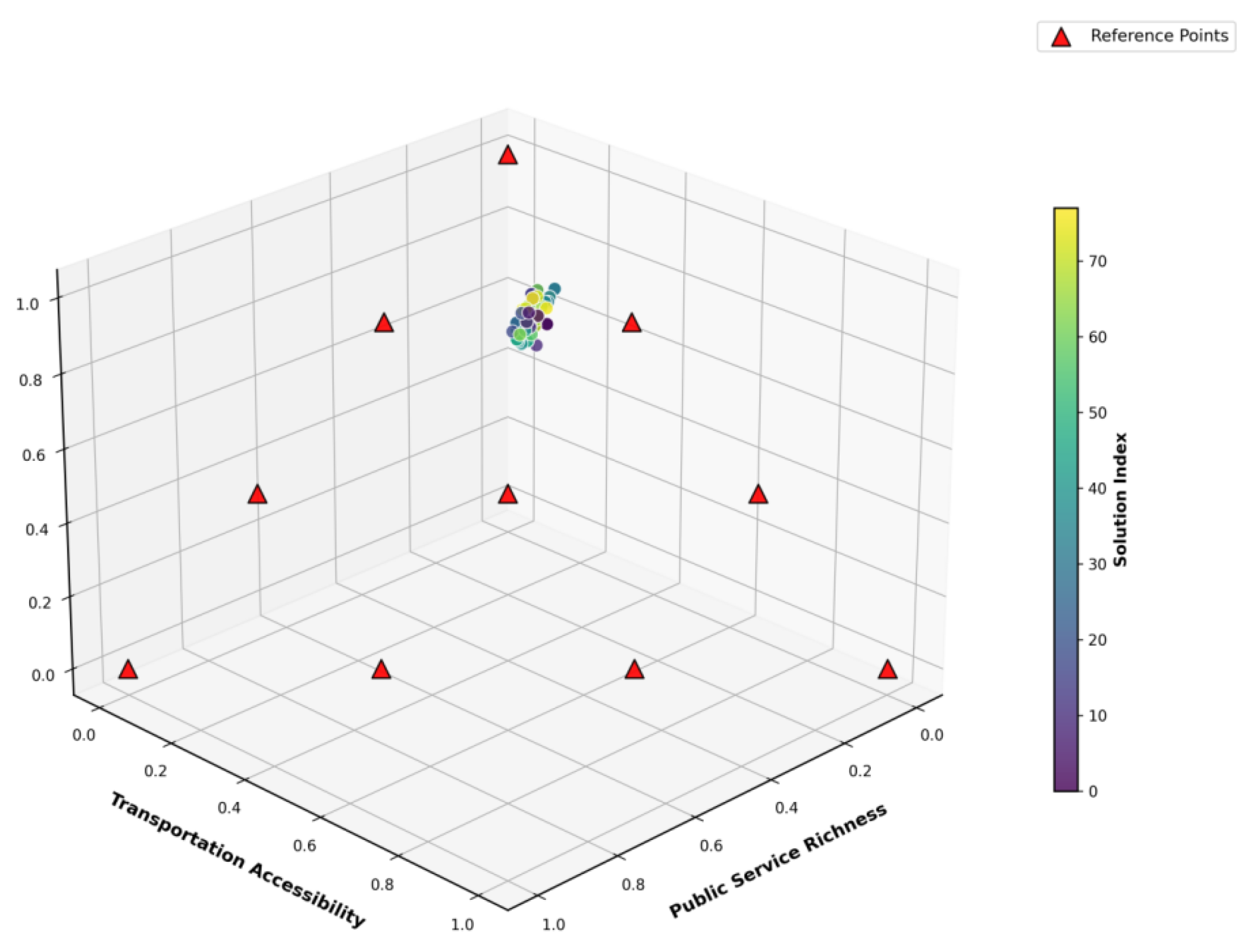
- Reference point setting: set a set of fixed reference points in the objective space to guide the search direction of the algorithm and maintain the diversity of solutions;
- Environmental selection: select excellent individuals from the non-dominated fronts to form the next generation population according to the correlation between individuals and reference points and the crowding distance;
- Genetic operation: perform selection, crossover and mutation operations on the selected population to generate offspring individuals and merge the parent and offspring populations for the next iteration.
2.3.2. Key Improvements of the Algorithm
- Multi-dimensional adaptive reference point adjustment
- Real-Integer Hybrid Coding Genetic Operator
- Enhanced Multi-Criteria Environmental Selection Mechanism
- Dynamic Regulation Mechanism of Algorithm Iteration
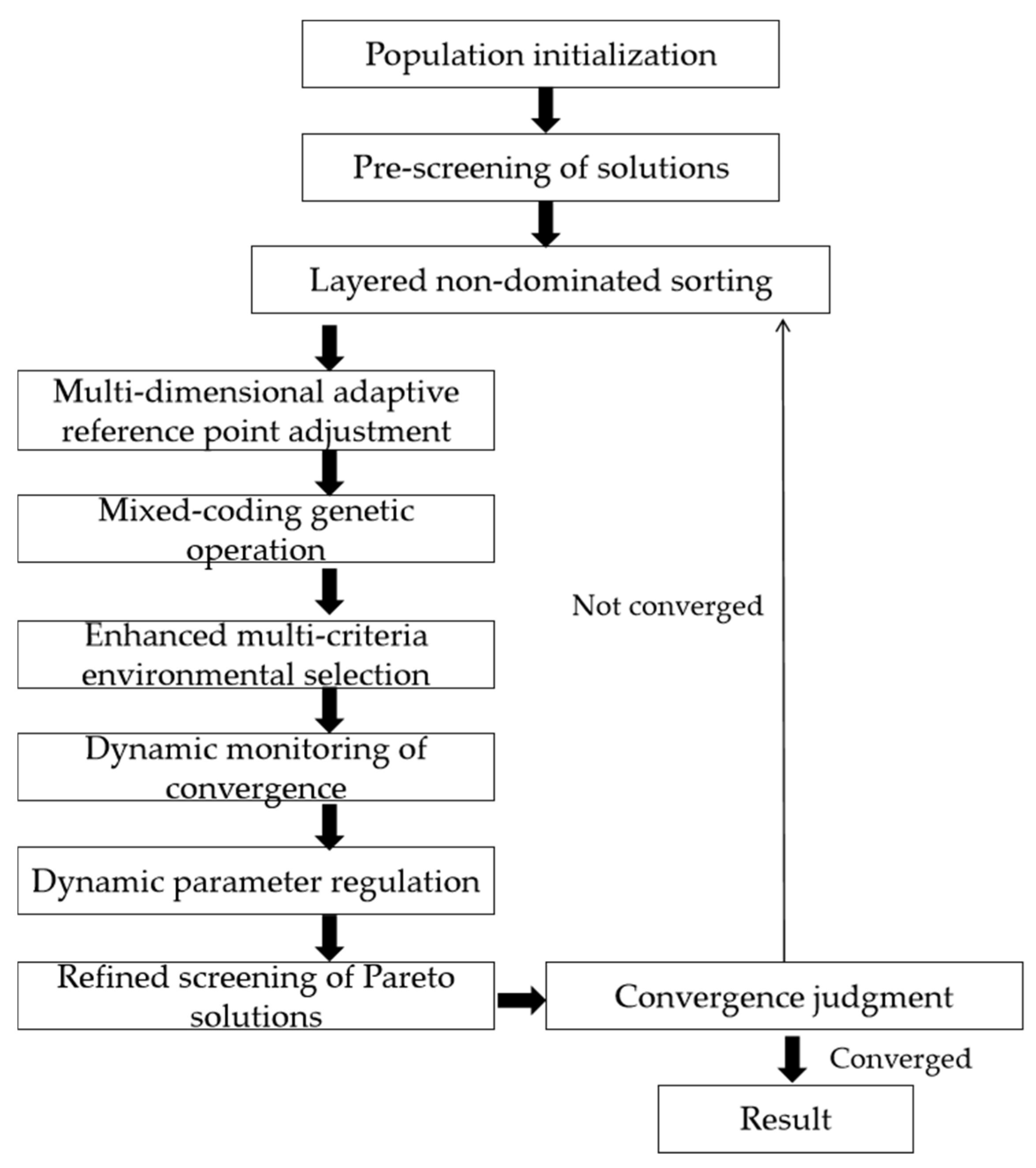
2.3.3. Algorithm Flow Chart
2.3.4. Algorithm Parameter Setting
2.3.5. Software and Analysis Tools
3. Experimental Results and Analysis
3.1. Analysis of Original Objective Data
3.1.1. Descriptive Statistics of Optimization Objectives
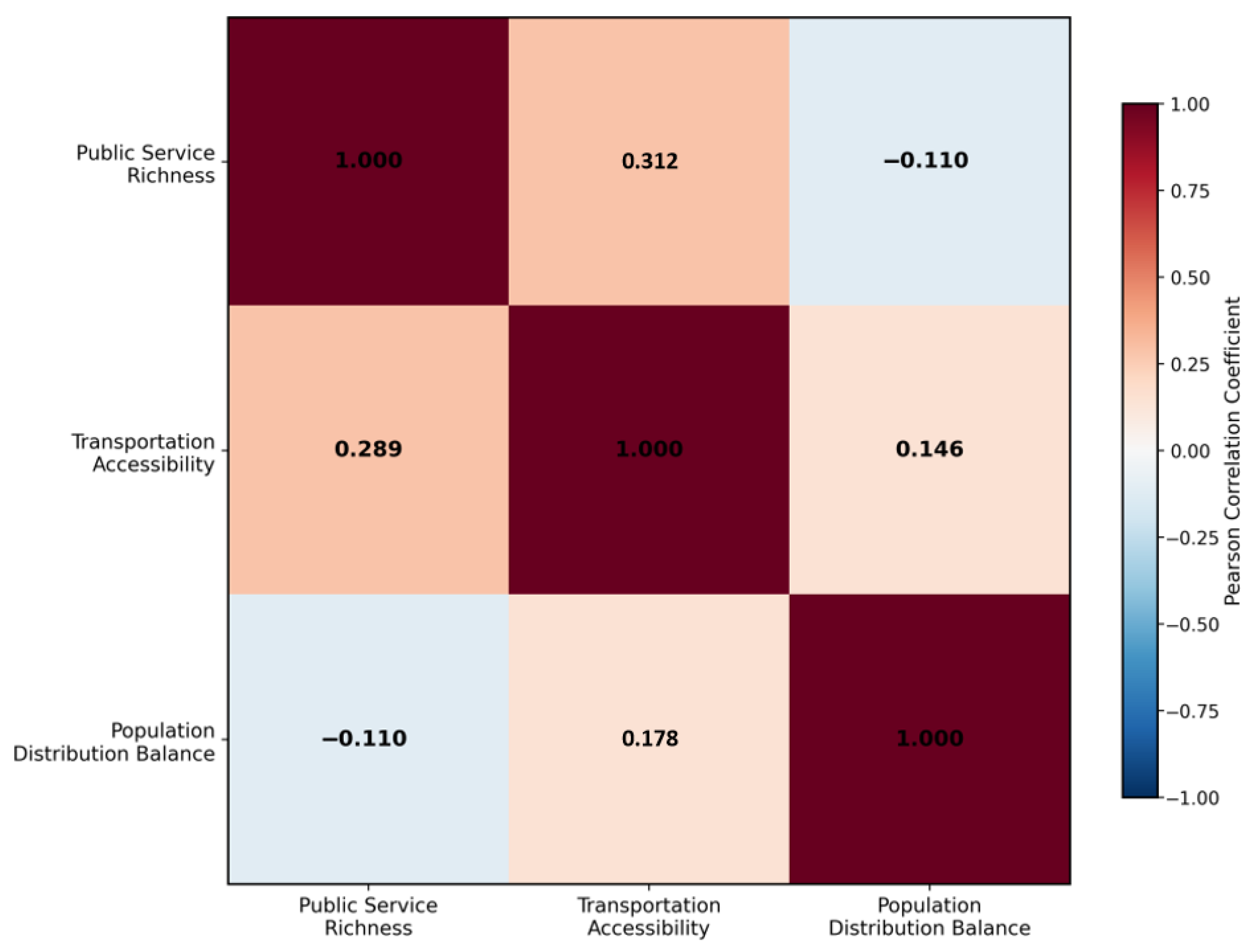
3.1.2. Correlation Analysis of Optimization Objectives
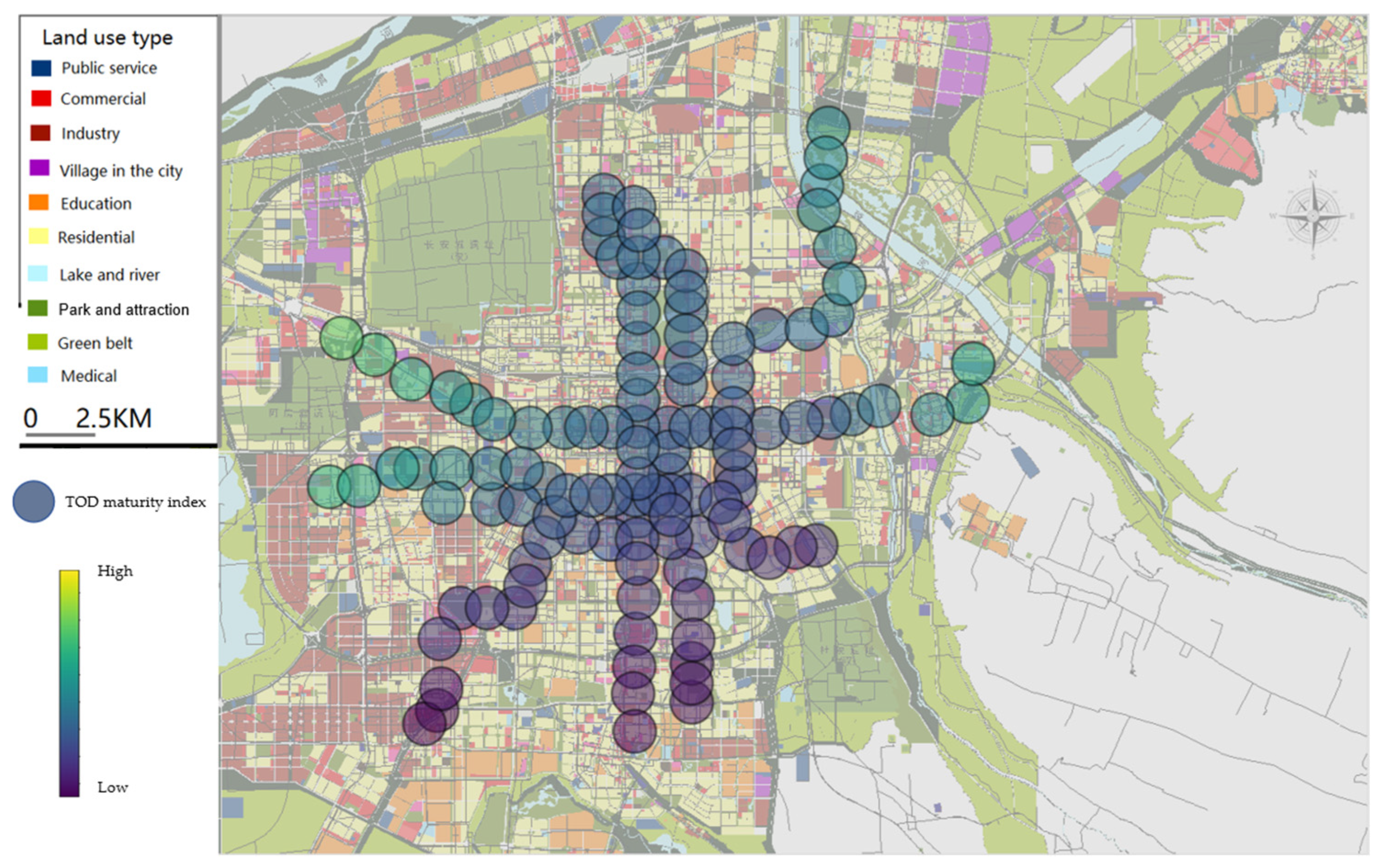
3.1.3. Spatial Distribution Characteristics of Optimization Objectives
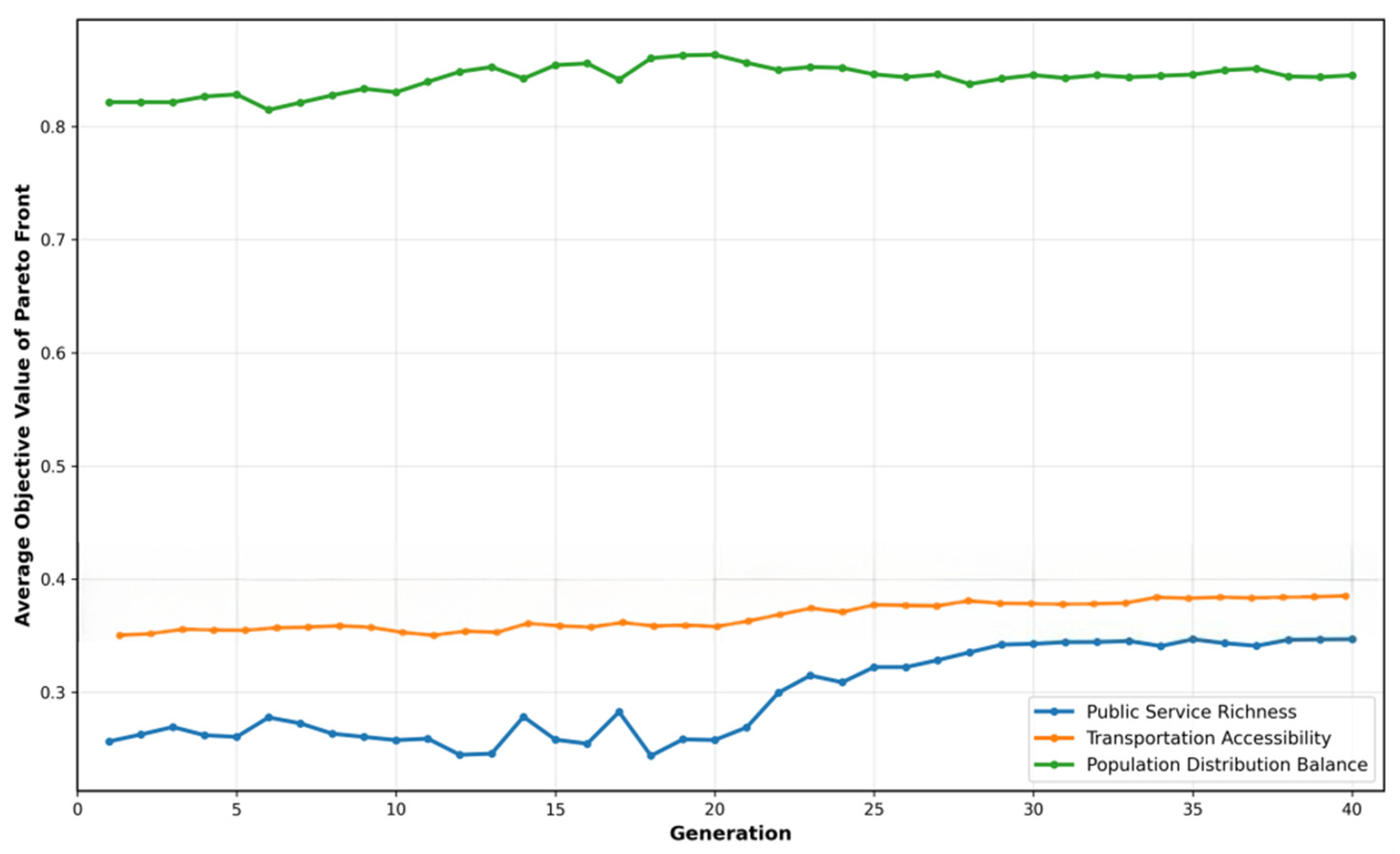
3.2. Convergence Performance Analysis of the Improved NSGA-III Algorithm
3.3. Characteristic Analysis of the Pareto Optimal Front
3.4. Comparative Performance Analysis of the Improved and Traditional NSGA-III Algorithms
3.4.1. Quantitative Improvement of Objective Function Values
3.4.2. Quantitative and Qualitative Improvement of Pareto Front Quality
3.4.3. Significant Improvement in Algorithm Convergence Efficiency
3.4.4. Substantial Improvement in Solution Feasibility
3.5. Analysis of the Pareto Optimal Solution Set
3.5.1. Identification and Characteristic Analysis of the Global Optimal Solution
- Objective Value Level of the Global Optimal Solution
- Core Characteristics of the Global Optimal Solution
- Core Metro Stations in the Global Optimal Solution
3.5.2. Distribution Characteristics of the Optimal Solution Set
3.5.3. Functional Zoning Adaptability Analysis of the Solutions
4. Discussion
4.1. Core Research Findings
4.1.1. Necessity and Intrinsic Logic of Multi-Objective Optimization for Metro Station Land Use
4.1.2. Effectiveness and Core Mechanism of the Improved NSGA-III Algorithm
4.1.3. High Coupling Between Optimization Results and Xi’an’s Urban Spatial Planning
4.1.4. Core Path of Land Use Optimization Around Xi’an’s Metro Stations Under the TOD Model
4.2. Targeted Land Use Optimization Suggestions for Metro Stations
4.2.1. Hierarchical Land Use Optimization Strategy
4.2.2. Policy Guarantee Measures for the Implementation of Optimization Strategies
5. Conclusions
Author Contributions
Funding
Data Availability Statement
Acknowledgments
Conflicts of Interest
References
- Shen, H.; Ma, G. TOD mode: Study on land planning and land use optimization for urban rail transit station area. Arch. Transp. 2023, 66, 33–43. [Google Scholar] [CrossRef] [Scilit]
- Sicuaio, T.; Zhao, P.; Pilesjö, P.; Shindyapin, A.; Mansourian, A. Sustainable and Resilient Land Use Planning: A Multi-Objective Optimization Approach. ISPRS Int. J. Geo-Inf. 2024, 13, 99. [Google Scholar] [CrossRef] [Scilit]
- Huang, X.; Liang, Q.; Feng, Z.; Chai, S. A TOD Planning Model Integrating Transport and Land Use in Urban Rail Transit Station Areas. IEEE Access 2021, 9, 1103–1115. [Google Scholar] [CrossRef] [Scilit]
- Wang, G.; Han, Q.; De Vries, B. The multi-objective spatial optimization of urban land use based on low-carbon city planning. Ecol. Indic. 2021, 125, 107540. [Google Scholar] [CrossRef] [Scilit]
- Maleki, J.; Masoumi, Z.; Hakimpour, F.; Coello, C. Many-objective land use planning using a hypercube-based NSGA-III algorithm. Trans. GIS 2021, 26, 609–644. [Google Scholar] [CrossRef] [Scilit]
- Wan, T.; Lu, W.; Sun, P. Equity impacts of the built environment in urban rail transit station areas from a transit-oriented development perspective: A systematic review. Environ. Res. Commun. 2023, 5, 092001. [Google Scholar] [CrossRef] [Scilit]
- Dong, S.; Wang, Y.; Dou, M.; Gu, Y.; Zhang, P.; Gong, J. A Multiobjective Land Use Design Framework with Geo-Big Data for Station-Level Transit-Oriented Development Planning. ISPRS Int. J. Geo-Inf. 2022, 11, 364. [Google Scholar] [CrossRef] [Scilit]
- Pan, T.; Zhang, Y.; Su, F.; Lyne, V.; Cheng, F.; Xiao, H. Practical Efficient Regional Land-Use Planning Using Constrained Multi-Objective Genetic Algorithm Optimization. ISPRS Int. J. Geo-Inf. 2021, 10, 100. [Google Scholar] [CrossRef] [Scilit]
- Xi’an Annual Report on Urban Traffic Development 2024. Available online: https://zygh.xa.gov.cn/web_files/zygh/file/2025/10/14/202510141603315846257.pdf (accessed on 1 June 2024).
- China Urban Rail Transit TOD Monthly Report. Available online: https://www.chinatod.com.cn/uploadfile/2024/0607/20240607040613709.pdf (accessed on 1 June 2024).
- Fan, J.; Shi, Z.; Liu, J.; Wang, J. Space efficiency of transit-oriented station areas: A case study from a complex adaptive system perspective. ISPRS Int. J. Geo-Inf. 2025, 14, 20. [Google Scholar] [CrossRef] [Scilit]
- Feng, X.; Tao, Z.; Niu, X.; Ruan, Z. Multi-objective land use allocation optimization in view of overlapped influences of rail transit stations. Sustainability 2021, 13, 13219. [Google Scholar] [CrossRef] [Scilit]
- Gu, M.; Ye, C.; Li, X.; Hu, H. Land-use optimization based on ecosystem service value: A case study of urban agglomeration around Poyang Lake, China. Sustainability 2022, 14, 7131. [Google Scholar] [CrossRef] [Scilit]
- Li, X.; Lu, Z. Exploring the balance between ecosystem services and economic benefits via multi-objective land use optimization. Land 2025, 14, 920. [Google Scholar] [CrossRef] [Scilit]
- Ma, S.; Wen, Z. Optimization of land use structure to balance economic benefits and ecosystem services under uncertainties: A case study in Wuhan, China. J. Clean. Prod. 2021, 292, 125310. [Google Scholar] [CrossRef] [Scilit]
- Tong, H.; Dong, X.; Liu, J. Optimization method for land use of the Xi’an rail transit station area based on a multi-objective model. Land 2023, 12, 1705. [Google Scholar] [CrossRef] [Scilit]
- Yao, J.; Murray, A.T.; Wang, J.; Zhang, X. Evaluation and development of sustainable urban land use plans through spatial optimization. Trans. GIS 2019, 23, 438–461. [Google Scholar] [CrossRef] [Scilit]
- Yao, C.; Li, G.; Yan, S. Design strategies to improve metro transit station walking environments: Five stations in Chongqing, China. Buildings 2024, 14, 1025. [Google Scholar] [CrossRef] [Scilit]
- Zhao, M.; Tong, H.; Li, B.; Duan, Y.; Li, Y.; Wang, J.; Lei, K. Analysis of land use optimization of metro station areas based on two-way balanced ridership in Xi’an. Land 2022, 11, 1124. [Google Scholar] [CrossRef] [Scilit]
- Deb, K.; Jain, H. An evolutionary many-objective optimization algorithm using reference-point based nondominated sorting approach, part I: Solving problems with box constraints. IEEE Trans. Evol. Comput. 2014, 18, 577–601. [Google Scholar] [CrossRef] [Scilit]
- Wietheger, S.; Doerr, B. A mathematical runtime analysis of the Non-dominated Sorting Genetic Algorithm III (NSGA-III). In Proceedings of the GECCO 24 Genetic and Evolutionary Computation Conference Companion, Melbourne, Australia, 14–18 July 2024; pp. 63–64. [Google Scholar]
- Ma, H.; Zhang, Y.; Sun, S.; Liu, T.; Shan, Y. A comprehensive survey on NSGA-II for multi-objective optimization and applications. Artif. Intell. Rev. 2023, 56, 6349–6408. [Google Scholar] [CrossRef] [Scilit]
- Qi, L.; Chen, C.; Dong, J. Multi-objective optimization methods for university campus planning and design—A case study of Dalian University of Technology. Buildings 2025, 15, 2551. [Google Scholar] [CrossRef] [Scilit]
- Sun, X.; Wang, J.; Wang, W. Complex path planning for manipulators based on an improved NSGA-III algorithm with Hopfield network. IEEE Access 2024, 12, 123456–123470. [Google Scholar] [CrossRef] [Scilit]
- Zhang, H.; Wang, G.-G. Improved NSGA-III using transfer learning and centroid distance for dynamic multi-objective optimization. Complex Intell. Syst. 2021, 7, 2427–2444. [Google Scholar] [CrossRef] [Scilit]
- Qiang, D.; Zhang, L.; Huang, X. Quantitative Evaluation of TOD Performance Based on Multi-Source Data: A Case Study of Shanghai. Front. Public Health 2022, 10, 820694. [Google Scholar] [CrossRef] [Scilit]
- Chen, T.; Chen, Y.; Zhou, Y.; Guo, J. Efficiency Assessment of Transit-Oriented Development Focusing on the 500-m Core Catchment of Metro Stations Based on the Concept of a Metro Microcenter in Beijing. J. Transp. Eng. Part A Syst. 2023, 149. [Google Scholar] [CrossRef] [Scilit]
- Chen, Z.; Wu, T.; Gao, L.; Zhou, Y. Comparative Analysis of Transit-Oriented Development (TOD) Types in the Metropolitan Region Along the Middle Reaches of the Yangtze River. Sustainability 2024, 16, 9884. [Google Scholar] [CrossRef] [Scilit]
- Ding, C.; Song, Y.; Qiao, X.; Zhang, Y.; Yu, B.; Zhang, X. Integrating land use and greenway network for metro station area transit-oriented development. Transp. Res. Part D Transp. Environ. 2022, 113, 103539. [Google Scholar] [CrossRef] [Scilit]
- Yahia, O.; Chohan, A.; Arar, M.; Awad, J. Toward Sustainable Urban Mobility: A Systematic Review of Transit-Oriented Development for the Appraisal of Dubai Metro Stations. Smart Cities 2025, 8, 21. [Google Scholar] [CrossRef] [Scilit]
- Peng, J.; Hu, Y.; Liang, C.; Wan, Q.; Dai, Q.; Yang, H. Understanding nonlinear and synergistic effects of the built environment on urban vibrancy in metro station areas. J. Eng. Appl. Sci. 2023, 70, 18. [Google Scholar] [CrossRef] [Scilit]
- Lee, E. eXplainable DEA approach for evaluating performance of public transport origin-destination pairs. Res. Transp. Econ. 2024, 108, 101491. [Google Scholar] [CrossRef] [Scilit]
- Yin, M.; Fan, Y.; Wang, Y. Can TOD help metro station ridership ‘early recovery’ from COVID-19? An empirical evidence from Nanjing. J. Transp. Geogr. 2025, 123, 104107. [Google Scholar] [CrossRef] [Scilit]
- Xi’an Statistical Yearbook. Available online: https://tjj.xa.gov.cn/tjnj/2024/zk/indexch.htm (accessed on 1 June 2024).
- Xi’an Rail Transit and Urban Integration Design Guidelines. Available online: https://www.xa.gov.cn/gk/zcfg/szfbgtwj/5d4922b3f99d6572b768d961.html (accessed on 1 June 2024).
- Xi’an 14th Five-Year Plan for the Development of the Public Service System. Available online: https://www.xa.gov.cn/gk/ghjh/fzgh/632ae3b4f8fd1c4c211a9012.html (accessed on 1 June 2022).
- Xi’an Municipal Master Plan of Territorial Spatial Development (2021–2035). Available online: https://zygh.xa.gov.cn/zwgk/ghjh/1895045821011337217.html (accessed on 1 July 2025).





| Indicator Category | Indicator Name | Unit | Data Type |
|---|---|---|---|
| Transportation Infrastructure | Road Density | km/km2 | Continuous |
| Minimum Transfer Times | Times | Continuous | |
| Minimum Transfer Distance | m | Continuous | |
| Bus Station Density | Number/km2 | Continuous | |
| Daily Metro Ridership | Person/time | Continuous | |
| Population Distribution | Residential Population | Person | Continuous |
| Employment Population | Person | Continuous | |
| Public Services | Density of Land for Science, Education, Culture and Health | Number/km2 | Continuous |
| Catering Density | Number/km2 | Continuous | |
| Medical Land Density | Number/km2 | Continuous | |
| Spatial Layout | Distance to Central Business District (CBD) | m | Continuous |
| Land Use Mix Index | Index | Continuous | |
| Basic Information | Station Name | - | Categorical |
| Parameter Category | Parameter Name | Setting Value/Value Range |
|---|---|---|
| Basic Population Parameters | Population Size | 80 |
| Number of Iterations | 40 | |
| Solution Scale (Number of Stations per Solution) | 25 | |
| Genetic Operator Parameters | Crossover Rate | 0.6~0.9 (Adaptive) |
| Mutation Rate | 0.08 (Fixed) | |
| Number of Mutation Nodes per Solution | 1~3 (Dynamically Regulated to 2~4) | |
| Retention Ratio of Excellent Gene Segments | 20% | |
| Reference Point Parameters | Total Number of Reference Points | 10 |
| Proportion of Reference Points in Main/Secondary Objective Layers | 70%/30% | |
| Reference Point Splitting/Merging Threshold | ||
| Multi-Criteria Selection Parameters | Feasibility Coefficient Elimination Threshold | (Eliminated Directly) |
| Gaussian Mutation Standard Deviation | 0.05 | |
| Dynamic Regulation Parameters | Convergence Monitoring Index Threshold | |
| Random Disturbance Ratio | 5% (Triggered in Case of Premature Convergence) | |
| Hybrid Coding Parameters | Integer Coding Bits | 8 bits |
| Real Coding Bits | 6 bits |
| Optimization Objective | Mean | Standard Deviation | Minimum | Maximum | Median |
|---|---|---|---|---|---|
| ) | 0.2192 | 0.1877 | 0.0000 | 0.8128 | 0.1950 |
| ) | 0.3586 | 0.0812 | 0.0952 | 0.5713 | 0.3579 |
| ) | 0.7879 | 0.1492 | 0.3191 | 0.9956 | 0.7917 |
| Characteristic Indicator | Pareto Optimal Solution Set | All Original Solutions | Improvement/Improvement Amplitude |
|---|---|---|---|
| Mean of Public Service Richness | 0.3468 | 0.2192 | 59.58% |
| Mean of Transport Accessibility | 0.4052 | 0.3586 | 12.94% |
| Mean of Population Distribution Balance | 0.8458 | 0.7879 | 7.35% |
| Coefficient of Variation Among Objectives | 0.11 | 0.32 | 65.63% reduction |
| Average Spatial Correlation Degree | 0.87 | 0.52 | 67.31% |
| Feasibility Proportion | 100% | 76% | 31.58% |
| Station Type | Representative Station | Before Optimization (Key Indicators) | Core Land Use Adjustment Measures | After Optimization (Key Indicators) |
|---|---|---|---|---|
| CBD Core Station | Zhonglou Station | Public service richness: 0.6215; population distribution balance: 0.7236; commercial land ratio: 65%; public service land ratio: 12% | 1. Reduce commercial land ratio to 55%, increase public service land to 20%; 2. add community medical and cultural facilities; 3. optimize pedestrian connection between commercial complexes and metro entrances | Public service richness: 0.7892 (↑ 27%); population distribution balance: 0.8561 (↑ 18.3%); transportation accessibility: 0.5235 (↑ 2.5%) |
| Residential-Oriented Station | Qujiangchi XI Station | Public service richness: 0.1896; transportation accessibility: 0.3015; residential land ratio: 78%; public service land ratio: 8% | 1. Reduce residential land ratio to 70%, increase public service land to 15%; 2. add primary school and community medical center; 3. improve bus station density and non-motor vehicle facilities | Public service richness: 0.4218 (↑ 122.5%); Transportation accessibility: 0.3987 (↑ 32.2%); Population distribution balance: 0.9105 (↑ 2.0%) |
| Comprehensive Transfer Hub | Shuangzhai Station | Public service richness: 0.2568; population distribution balance: 0.7512; transportation land ratio: 45%; commercial service land ratio: 15% | 1. Reduce transportation land ratio to 35%, increase commercial service land to 25%; 2. add catering, retail and leisure facilities; 3. arrange affordable housing to balance residential-employment population | Public service richness: 0.4897 (↑ 90.7%); population distribution balance: 0.8693 (↑ 15.7%); transportation accessibility: 0.5789 (↑ 2.2%) |
Disclaimer/Publisher’s Note: The statements, opinions and data contained in all publications are solely those of the individual author(s) and contributor(s) and not of MDPI and/or the editor(s). MDPI and/or the editor(s) disclaim responsibility for any injury to people or property resulting from any ideas, methods, instructions or products referred to in the content. |
© 2026 by the authors. Licensee MDPI, Basel, Switzerland. This article is an open access article distributed under the terms and conditions of the Creative Commons Attribution (CC BY) license.
Share and Cite
Li, W.; Chen, H. TOD-Oriented Multi-Objective Optimization of Land Use Around Metro Stations in China: An Empirical Study of Xi’an Based on an Adaptively Improved NSGA-III Algorithm. Land 2026, 15, 629. https://doi.org/10.3390/land15040629
Li W, Chen H. TOD-Oriented Multi-Objective Optimization of Land Use Around Metro Stations in China: An Empirical Study of Xi’an Based on an Adaptively Improved NSGA-III Algorithm. Land. 2026; 15(4):629. https://doi.org/10.3390/land15040629
Chicago/Turabian StyleLi, Wei, and Hong Chen. 2026. "TOD-Oriented Multi-Objective Optimization of Land Use Around Metro Stations in China: An Empirical Study of Xi’an Based on an Adaptively Improved NSGA-III Algorithm" Land 15, no. 4: 629. https://doi.org/10.3390/land15040629
APA StyleLi, W., & Chen, H. (2026). TOD-Oriented Multi-Objective Optimization of Land Use Around Metro Stations in China: An Empirical Study of Xi’an Based on an Adaptively Improved NSGA-III Algorithm. Land, 15(4), 629. https://doi.org/10.3390/land15040629