1. Introduction
Farmland titling programs strengthen tenure security and, in theory, encourage agricultural investment and productivity growth [
1,
2,
3]. China’s titling program, initiated around 2009 and expanded nationwide by 2018, issued certificates confirming contracted land area to approximately 200 million rural households [
4]. By 2020, coverage reached approximately 95 percent of eligible households [
5]. Whether this large-scale property rights formalization translates into measurable gains in grain production capacity remains contested. Existing empirical evidence yields mixed results: several studies document positive effects on land rental market participation [
6,
7], rural–urban migration [
5,
8], and aggregate productivity [
9], while others find null or context-dependent effects on investment decisions [
10] and technical efficiency [
11,
12]. These divergent findings suggest that the effect of titling on grain production depends on local conditions that enable or constrain factor adjustment. Agricultural infrastructure, including irrigation systems, mechanization capacity, and land transfer arrangements, represents a plausible conditioning factor because it determines whether farmers can act on the investment incentives that secure tenure provides [
13,
14,
15]. Existing research has examined titling effects across multiple outcome domains, but explanations for this conditional variation remain insufficient.
Three gaps in the current literature limit understanding of how titling affects grain production capacity. First, most studies measure titling effects on a single agricultural outcome, such as land rental participation, plot-level investment, or household technical efficiency [
6,
7,
10,
11,
12]. Few studies simultaneously distinguish among grain output, grain yield, and per capita grain production, which capture different dimensions of food production capacity and respond to different mechanisms [
16,
17,
18]. Second, the predominant research design operates at the farm or household level, leaving open the question of whether micro-level behavioral responses aggregate into measurable production effects at the prefecture level, the administrative scale at which regional food security, cultivated land quality, non-grain conversion pressure, and infrastructure investment decisions must be considered jointly [
19,
20,
21,
22]. Third, although prior research notes that titling effects may depend on complementary conditions such as rental market development [
23] or governance quality [
24], few studies explicitly model agricultural infrastructure as a moderating factor that shapes the direction and magnitude of titling effects on grain production. These three gaps call for a study that simultaneously addresses outcome dimensionality, spatial scale, and conditional heterogeneity within a single identification framework.
This study places farmland titling, agricultural infrastructure conditions, and grain production capacity within a unified empirical framework to examine how infrastructure moderates the effect of tenure reform on food production.
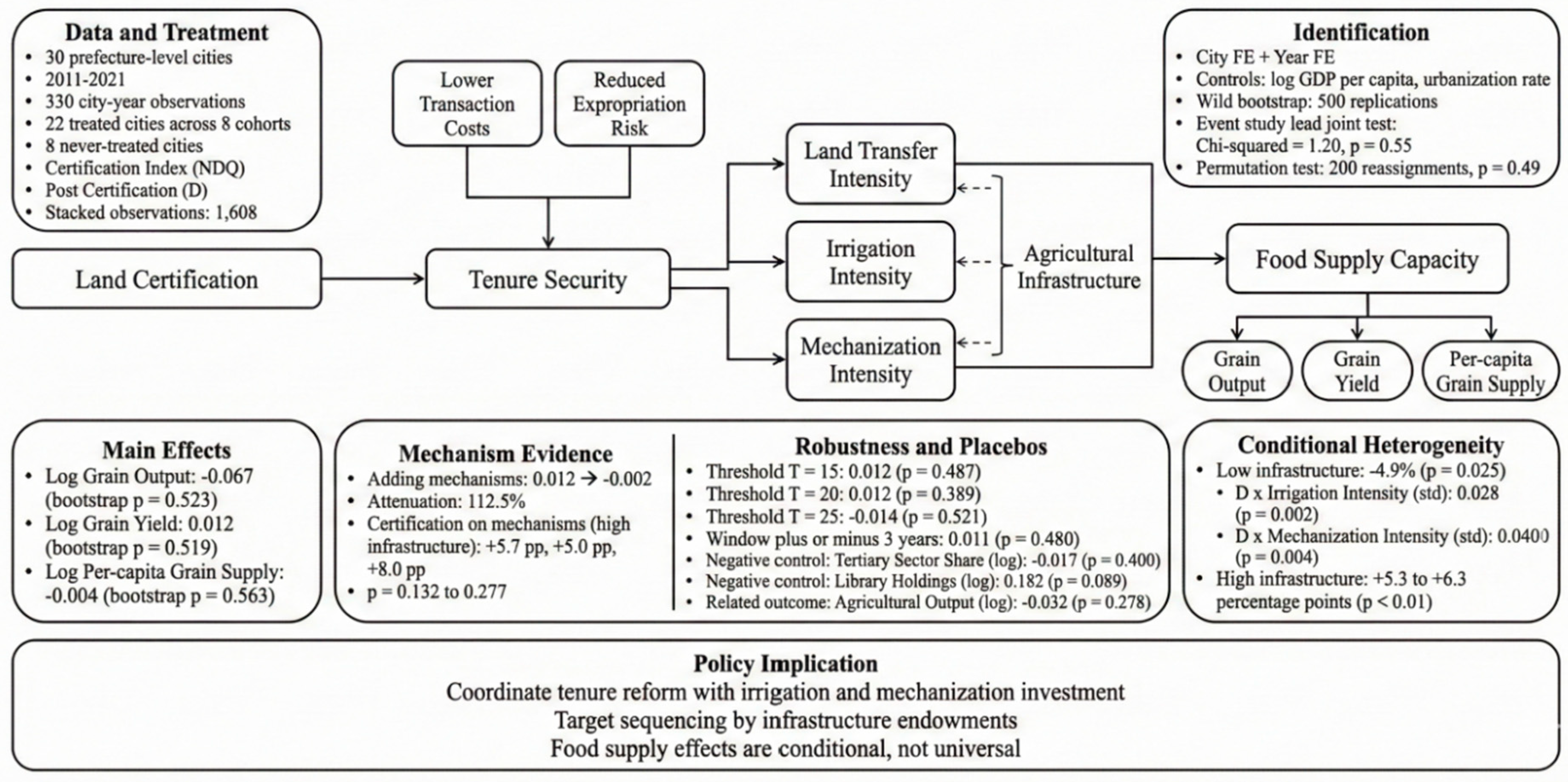
Figure 1 summarizes the conceptual framework, identification strategy, and the expected moderating role of agricultural infrastructure. On identification, the analysis employs a stacked Difference-in-Differences (DID) estimator that exploits variation in the timing of titling milestones across 30 Chinese cities over 2011–2021. The stacking approach constructs cohort-specific subsamples and avoids the heterogeneity bias inherent in standard two-way fixed effects (TWFE) estimation when treatment effects vary across units or time [
25]. On outcomes, this study simultaneously estimates effects on three distinct measures of grain production capacity: total grain output, grain yield per unit of sown area, and per capita grain production. This separation allows the analysis to detect whether titling operates through land productivity channels, aggregate production channels, or per capita food availability channels. On heterogeneity, this study introduces irrigation intensity and mechanization intensity as moderating variables and tests whether titling effects on grain yield vary systematically with local infrastructure conditions.
The central objective of this study is to identify the causal effect of farmland titling on prefecture-level grain production capacity and to determine how agricultural infrastructure investment shapes this policy effect. This research aligns with United Nations Sustainable Development Goal 2 (Zero Hunger) by providing evidence on whether land tenure reform can enhance food production capacity and under what infrastructure conditions such enhancement occurs. The findings are intended to inform three groups of decision-makers. Land administration agencies can use the results to evaluate the conditions under which titling generates measurable production returns. Agricultural infrastructure investment departments can assess the complementarity between tenure security and infrastructure provision. Local policymakers can draw on the heterogeneity evidence to coordinate titling implementation with infrastructure investment in regions where factor adjustment constraints currently limit policy effectiveness.
The remainder of this paper proceeds as follows.
Section 2 reviews the institutional context of land tenure reform in China and situates this study within the related literature on property rights and agricultural productivity.
Section 3 presents the materials and methods, covering data sources, variable definitions, the empirical strategy, and identification assumptions.
Section 4 reports the main results, heterogeneity analysis, mechanism evidence, and robustness checks.
Section 5 discusses policy implications and limitations.
Section 6 concludes.
2. Background and Related Literature
2.1. Institutional Evolution of Rural Land Tenure in China
China’s rural land tenure system has undergone substantial transformation since the economic reforms initiated in the late 1970s. Understanding this institutional evolution provides essential context for interpreting titling effects and assessing the external validity of empirical findings.
The Household Responsibility System (HRS), introduced between 1978 and 1984, decollectivized agricultural production by allocating village land to individual households under 15-year use contracts [
26]. Under the HRS, land remained collectively owned by the village, but households obtained rights to make production decisions and retain residual income after meeting state procurement obligations. The HRS dramatically increased agricultural output and rural incomes during the 1980s, demonstrating the productivity potential of strengthened individual incentives.
Despite the HRS’s success, the initial tenure arrangements contained sources of insecurity that emerged as constraints on long-term investment. Village collectives retained authority to conduct periodic land reallocations that adjusted household landholdings in response to demographic changes such as births, deaths, marriages, and household divisions [
27]. Such reallocations occurred at irregular intervals and varied widely across villages, creating uncertainty about future land access. The negative effect of reallocation risk on organic fertilizer application operates primarily through full-scale reallocations that redistribute all village land, with partial adjustments having attenuated effects [
27]. The “two rights separation” under the HRS has struggled to meet the demands of agricultural production in the new era. Its inherent limitations have led to land fragmentation, ambiguous land tenure relations, and the misallocation of land resources, thereby impeding agricultural modernization [
28].
The 1998 Land Management Law extended contract duration from 15 to 30 years and introduced provisions restricting village authority to conduct reallocations. However, implementation remained incomplete, and many villages continued periodic adjustments [
29]. The gap between legal provisions and actual village practice highlighted the distinction between formal tenure security, embodied in laws and regulations, and perceived tenure security, shaped by local enforcement and expectations about future policy changes [
10].
The 2003 Rural Land Contracting Law (RLCL) represented a more decisive effort to strengthen tenure security. The RLCL prohibited “large-scale” reallocations during the contract period, formally permitted land transfers through rental, lease, exchange, or other arrangements, and established procedures for dispute resolution [
14]. The RLCL increased protection of land rights against unauthorized reallocation, with effects equivalent to increasing land values by 30 percent. The effects concentrated in villages with democratic election of leaders, indicating complementarity between legal reform and local governance quality [
14].
The land titling program, known as “quequan dengji banzheng” (confirmation of rights, registration, and certificate issuance), was built upon the RLCL framework beginning around 2009. The principal method of confirming agricultural land rights draws upon the ‘three rights separation’ reform. Through the registration and titling of contracted land, this approach formally validates and secures the contractual rights of rural households [
30]. The program involved three steps: (1) measurement of plot boundaries using GPS and other surveying technologies; (2) registration of plot information and household rights in official databases; and (3) issuance of household-level certificates documenting contracted land area, location, and rights [
15]. Titling proceeded gradually across provinces and counties, with pilot programs in some regions preceding nationwide rollout during 2014–2018.
Titling aimed to strengthen tenure security through multiple channels. First, certificates provide documentary evidence that households can invoke in disputes with village authorities, other households, or government agencies [
10]. Second, registration in official databases creates administrative records that deter unauthorized reallocations by making such actions more visible and potentially costly for village leaders [
14]. Third, standardized documentation reduces transaction costs in land rental markets by lowering information asymmetries and facilitating contract enforcement [
6,
31].
A subsequent reform, the “three rights separation” (sanquan fenzhi) policy, formalized in 2016–2018, further distinguished among collective ownership rights, household contract rights, and operational rights that can transfer through rental markets. This framework clarified that households transferring operational rights to other farmers retain underlying contract rights and cannot permanently alienate their land position [
7]. The “three rights separation” reform, grounded in land titling, provides both the theoretical foundation and the institutional mechanism for the registration and certification of agricultural land [
32]. It establishes a legal framework to support an increasingly dynamic land rental market. Conversely, agricultural land titling plays a crucial role in operationalizing this “three rights separation” framework [
33].
In early 2026, China’s farmland titling efforts transitioned from the phase of “comprehensive titling” to one focused on “integrating certified outcomes with the extension of land contracts”. The core of the current farmland rights policy is the nationwide rollout of pilots for extending rural land contracts for an additional 30 years upon expiry. The guiding principles for these provincial pilot programs mandate the effective utilization of the results from the registration and certification of rural contracted land to ensure that the vast majority of rural households can maintain their existing contracted land stably and achieve a smooth contract extension.
2.2. Property Rights and Agricultural Investment
This section discusses agricultural investment, which encompasses land improvement (irrigation, terracing, soil quality), machinery and equipment, and the optimization of labor allocation through land transfer. A foundational study in development economics examines how property rights affect agricultural investment decisions. The theoretical argument holds that secure tenure encourages investments in land improvements that yield returns over multiple years or growing seasons. When farmers face risk that others will capture investment returns through expropriation, reallocation, or inability to transfer improved land at fair value, they underinvest relative to the social optimum [
1,
2].
Influential evidence from Ethiopia demonstrates that transfer rights are unambiguously investment-enhancing. Investments in terracing, which improve soil conservation and long-term productivity, respond positively to more secure tenure and transferable rights. The large productivity effect of terracing implies that even where households undertake investments to signal tenure claims, investment levels may remain below socially optimal levels, justifying government action to strengthen rights [
1].
However, in many African countries, agricultural land rights are shaped by the dual influence of both statutory and customary legal systems [
34]. Agricultural investment in Uganda is significantly influenced by the variation in tenure security created by overlapping customary and formal rights. Using within-household analysis comparing plots with different ownership status, the authors find that full ownership generates larger investment effects than registration alone. The results suggest that interventions to increase tenure security require context-specific design to achieve full effectiveness [
35]. Securing land rights through formal legal registration is widely regarded as the preferred approach [
36,
37]. In Burkina Faso, formal land rights serve as an incentive for large-scale private investment in land, exerting a significant positive effect on land productivity [
38].
In the Chinese context, several studies document relationships between tenure arrangements and investment decisions. Rental contracts without stipulated duration reduce farmyard manure application by 64–67% compared to owned plots among apple growers. Each one percent increase in land rents is associated with a 1.7 percent increase in organic fertilizer input, indicating that market incentives affect soil-improving investments [
39].
The role of perceived versus formal tenure security in Northwest China was examined, specifically distinguishing between security from land certificates and from the expected absence of land reallocations. The authors find that perceived security affects self-governed irrigation investments conducted through collective action, while individual investments respond less consistently. The results highlight that titling effects depend on which dimension of security farmers perceive as most relevant [
10].
Written contracts have been shown to increase the application of organic fertilizer and green manure on rented plots in large-scale production units in Jiangsu and Jiangxi provinces. The written nature of contracts positively affects soil-improving investments through both tenure security and collateralization channels, as plots with written contracts are more likely to serve as collateral for credit [
40]. Agricultural land titling enhances rural households’ access to financial assets by facilitating mortgage loans secured by land management rights [
41]. Households in possession of land certificates exhibit a significantly higher probability of successfully applying for agricultural investment loans, with the positive effect of land titling on credit supply being particularly pronounced among households with previously limited financial access [
42]. Furthermore, the interplay between land registration and households’ prior experience with land adjustments positively influences the adoption of agricultural machinery [
43]. By further clarifying and subdividing land management rights, the latest round of land titling has reduced transaction costs associated with vertical specialization in agriculture, thereby encouraging farmers to outsource the use of agricultural machinery [
44]. Research examining how variations in land tenure security influence ecological conservation behaviors on cultivated land reveals that agricultural land titling also exerts a positive impact on farmland quality, particularly that of contracted land [
45]. Research findings also reveal that a higher proportion of informally leased land among farmers correlates with a lower likelihood of adopting eco-friendly agricultural practices. The primary reasons are the instability of land tenure and policy changes leading to insecure leases. Land titling can effectively mitigate the inhibitory effect of land leasing on farmers’ ecological conservation behaviors [
46].
2.3. Land Titling and Factor Reallocation
Beyond direct investment effects, land titling may affect agricultural outcomes through factor reallocation channels. Agricultural land titling strengthens the “endowment effect”. This effect is further intensified by “property rights identity monopoly” and “property rights geographical monopoly”, thereby exacerbating the suppression of the transfer of land management rights [
47]. Nevertheless, titling reduces transaction costs in rental markets, potentially enabling land to flow from less productive to more productive operators [
6]. Titling may also affect labor allocation by providing security that enables household members to pursue off-farm employment without risking loss of land rights [
5]. A study into whether the land titling program promotes internal migration in China was conducted using nationally representative household data and a triple difference approach. The authors found that titling exerts a positive effect on migration for non-farm work, with regional variation in effects driven by the relative strength of labor absorption versus migration promotion mechanisms [
8]. There exists a strong positive correlation between the volume of completed land transactions and the scale of land devoted to grain production [
48], thereby exerting an influence on food security.
Using panel data from six Chinese provinces allows for an examination of how land documents affect rental market participation. The authors find that possession of documents and fewer major land reallocations encourage households to engage in land renting to non-family members. The effects of land documents strengthened between 2000 and 2008, suggesting that formal documentation became more salient as rental markets developed [
6].
Following the 2003 RLCL reform that legalized land transfers, a significant increase in rental activity and aggregate productivity gains of approximately 10 percent were observed. Obviously, the issuance of rural land contracts and management rights certificates promotes the large-scale transfer of land [
49]. The reform led to the redistribution of land toward more productive farmers, with output and allocative efficiency increasing in response to formalized transfer rights. The results indicate that property rights reform can generate economy-wide gains through improved factor allocation [
9].
In South Africa’s black homeland areas, the majority of households lack land titles, remaining in a state of sustained vulnerability. Weak institutional capacity, inadequate coordination, and a lack of post-settlement support further constrain progress in land reform. The most fundamental policy priority is to establish a unified national framework to secure land tenure through the issuance of titles [
50].
The conventional “orthodoxy of land governance” asserts that all tenure forms not formally certified are regarded as inadequate, informal, insecure, and lacking vitality. The authors examine the features of “institutional pluralism” manifested in Tanzania’s rural land formalization process, revealing a dense and chaotic landscape of land-registration practices, with progress remaining extremely slow. The study argues that there is an urgent need to return to a broader, more integrated rural development pathway and to recognize that local land-holding systems themselves can offer high levels of tenure security [
51].
2.4. Land Tenure and Agricultural Efficiency
A related study examined relationships between land tenure arrangements and technical or allocative efficiency in agricultural production. Efficiency effects may arise through investment channels, factor allocation channels, or behavioral responses to tenure arrangements.
Research into the impact of perceived tenure security on technical efficiency was conducted in Minle County, Gansu Province. The authors found that tenure security provided by land certificates encourages part-time farming with relatively low technical efficiency. Because land rental markets are thin and highly fragmented, the renting out of land by households with migrant members only partly compensates for reduced farming intensity. The provision of land certificates therefore has a negative net effect on technical efficiency in this context, though it may improve household welfare through income diversification [
11]. More importantly, secure agricultural land property rights contribute to enhancing production efficiency [
52], while farmland regulation policies significantly improve agricultural production within a purely technical environment [
53].
In Ya’an City, Sichuan Province, studies have documented that land tenure security and titling positively affect the technical efficiency of smallholder tea producers. The authors found that elimination of tenure insecurity through registration and certification makes a clear difference in production efficiency, recommending that tea farmland be expanded through comprehensive land consolidation programs with certified tenure [
12].
The relationships among formalized property rights, land tenure contracts, and productive efficiency were tested in rice farms in the Philippines. Using stochastic production frontier methods, the authors found that despite the presence of formalized titles, the rental market remains inefficient at allocating land. However, informal tenure contracts appear to provide tenure security comparable to formal titles, suggesting that formal registration is neither necessary nor sufficient for efficient outcomes [
54].
Research utilizing a Difference-in-Differences framework has examined how titling affects both factor reallocation and aggregate output. The authors find that titling leads to land and labor reallocation toward more efficient farms, with positive aggregate effects on output. The reform increases renting-out by low-productivity farmers and renting-in by more productive farmers, while changing the likelihood of households remaining in agriculture [
4]. Research indicates that in Andean countries, farmers with formal land tenure certificates exhibit, on average, 25% higher technical efficiency than those without legal tenure, although the magnitude of this effect varies across countries [
55].
2.5. Agricultural Infrastructure and Food Security
The effectiveness of land tenure reforms in improving grain production may depend on the availability of complementary agricultural infrastructure. In this study, we define agricultural infrastructure broadly to encompass both fixed capital (irrigation facilities, water management systems) and mobile capital (agricultural machinery) that enhance land productivity. While mechanization is not infrastructure in the narrow sense, we include it alongside irrigation as a complementary condition because both represent capital endowments that may interact with tenure security to affect productivity outcomes. Irrigation, mechanization, and other infrastructure investments enhance the returns to land and labor, potentially moderating the effects of tenure security on productivity outcomes.
Adaptation capacity to climate change varies with local agricultural conditions, as evidenced by an examination of its effects on cropland adjustments in China. Areas with better infrastructure can more readily adjust cropping patterns in response to changing climate norms. The results suggest that infrastructure availability shapes how farmers respond to changing conditions, a pattern that may extend to institutional reforms [
17].
Investments in High Standard Farmland (HSF) increase grain production. Future HSF investment with diversified planting provides more favorable outcomes than restricting farms to grain crops. The results demonstrate that infrastructure investment generates multiple benefits relevant to food security [
56].
A review of 40 years of irrigation development and reform in China documents the transformation of institutional and incentive structures in irrigation management, indicating that irrigation governance interacts with tenure arrangements in affecting outcomes [
57].
The importance of properly defined land rights for building adaptive capacity to climate change is highlighted by findings from Guangdong Province, where farmers with contracted land show a greater propensity to implement adaptation measures in response to flooding than those with rented land [
58].
The improvement of agricultural infrastructure helps to reduce energy consumption per unit of grain production, thereby enhancing grain production efficiency [
59]. Accordingly, specialized agricultural operation entities—including large professional households, family farms, and agricultural cooperatives—have been shown to reduce farmland abandonment and safeguard the area under grain cultivation [
60].
These effects operate through channels such as promoting land leasing, providing technical guidance, and facilitating agricultural product sales. Benefits concentrate in regions with better land tenure security, suggesting complementarity between tenure arrangements and organizational innovations.
2.6. Research Gap and Hypotheses
The existing literature establishes several patterns relevant for understanding titling effects on grain production. Property rights reform generally encourages agricultural investment, though effects depend on the specific rights strengthened and the local context. Titling facilitates land rental market activity and labor reallocation, with efficiency implications. Technical efficiency effects vary across contexts, with some studies finding positive effects and others finding null or negative effects depending on complementary conditions.
A gap remains in understanding how titling effects vary systematically with agricultural infrastructure endowments. Prior research notes that titling interacts with rental market development and governance quality, but few studies explicitly model infrastructure as a moderating factor for productivity outcomes. Given that irrigation and mechanization enhance the returns to land investment and efficient factor allocation, titling effects may depend on whether complementary infrastructure exists to realize productivity gains from improved tenure security.
Drawing on the institutional context and prior evidence, we derive three hypotheses:
Hypothesis 1 (Average Effect). Land titling increases grain production capacity on average, as measured by grain output, grain yield, or per capita grain production.
This hypothesis reflects the canonical property rights prediction that tenure security enhances agricultural investment and productivity. If titling strengthens perceived and actual tenure security, farmers should respond with increased investment in land quality and productivity-enhancing inputs.
Hypothesis 2 (Conditional Heterogeneity). The titling effect depends on agricultural capital conditions, with stronger positive effects in cities with better irrigation infrastructure and higher mechanization levels.
This hypothesis follows from the argument that property rights reforms require complementary inputs to generate productivity gains. In regions with developed infrastructure, titling may promote efficient land reallocation and enable productive use of improved tenure security. In regions with weak infrastructure, titling alone may prove insufficient or may even induce behavioral responses that reduce measured productivity.
Hypothesis 3 (Mechanism). Land transfer and agricultural input intensity mediate the titling–productivity relationship.
This hypothesis proposes specific channels through which titling affects grain production. Titling reduces transaction costs in rental markets, enabling land transfers to more productive operators. Titling may also encourage investment in irrigation and mechanization by reducing concerns about expropriation of immobile capital.
3. Materials and Methods
3.1. Data Sources and Sample
The analysis uses a balanced panel dataset covering 30 prefecture-level cities in China over the period 2011–2021, yielding 330 city-year observations. Data on grain output, cultivated land area, and agricultural input variables come from the China Statistical Yearbook, Statistical Yearbooks, and Statistical Communiqués on National Economic and Social Development issued by provincial and municipal bureaus of statistics. Population and economic indicators (GDP per capita, urbanization rate) derive from the China City Statistical Yearbook. The data for the Land Tenure Certification Progress Index consist of agricultural land titling records sourced from the “Rural Land” module of the China Academy for Rural Development—Qiyan China Agri-research Database (CCAD), Zhejiang University.
The sample period of 2011–2021 covers the main cycle of China’s farmland titling program, from the launch of large-scale provincial pilots around 2011 to the phased completion of nationwide titling by the late 2010s. The endpoint of 2021 corresponds to the most recent year for which prefecture-level statistical yearbook data are available.
The sample size of 30 cities is determined by the construction requirements of the titling progress variable. The titling progress index (NDQ) requires city-level continuous annual data on titling implementation from the Ministry of Agriculture administrative records. Each city must report title progress indicators under consistent statistical definitions across the full sample period to permit valid index construction and threshold-based treatment assignment. Agricultural and economic outcome data are widely available for most of China’s approximately 300 prefecture-level units through national and provincial statistical yearbooks. The binding constraint on sample size is the titling progress variable: only 30 cities possess verifiable continuous annual titling records that satisfy the index construction requirements. The 30 cities are distributed across six provinces and encompass diversity in agricultural conditions, economic development levels, grain production structures, and titling implementation timing. The sample includes both major grain-producing regions and areas where grain constitutes a smaller share of agricultural output. Expanding the sample beyond 30 cities would require access to additional verified titling progress records that are currently unavailable in the data sources used for this study.
Table 1 compares the 30-city sample means with two benchmarks: all prefecture-level cities nationwide and prefecture-level cities within the six provinces from which the sample is drawn, using 2011–2018 averages. On the agricultural production variables central to this study, the sample closely approximates both benchmarks. Grain output differs from the national benchmark by 0.053 standard deviation (SD) units and from the six-province benchmark by −0.045 SD. Agricultural machinery power and effective irrigation area differ from the national benchmark by 0.171 SD and 0.169 SD, respectively. All agricultural production variables fall within 0.2 SD of the national benchmark. On economic development dimensions, the sample skews toward more urbanized and economically developed cities: GDP per capita exceeds the national benchmark by 0.49 SD, urbanization rate by 0.43 SD, and first-industry employment share falls below the benchmark by 0.19 SD. The sample thus maintains basic representativeness on the agricultural variables that this study analyzes, while the economic development bias defines the boundary for generalizing findings to less developed regions.
The external validity of the findings is bound by several sample characteristics. The 30-city sample covers a subset of China’s approximately 300 prefecture-level units, so the estimates apply most directly to cities with complete titling implementation records. Cities that maintain continuous administrative records may also possess higher governance capacity and more developed data infrastructure, potentially biasing the sample toward better-administered jurisdictions.
Table 1 confirms this pattern: the sample’s higher GDP per capita and urbanization rate indicate that results may understate constraints faced by less developed regions where infrastructure and institutional capacity are weaker. Extrapolation to such regions warrants lower confidence.
The identification strategy relies on staggered adoption across cities with diverse agricultural conditions. The 30 cities exhibit variation in titling timing, with 22 treated cities entering treatment across eight different cohorts and 8 never-treated cities serving as controls throughout the period. This variation permits credible estimation of titling effects within the sample, while the stacked DID approach addresses potential heterogeneity bias from comparing early-treated and late-treated units.
City-level aggregation introduces measurement error and potential effect attenuation by combining heterogeneous farm-level outcomes. Within-city variation in titling effects may wash out at the aggregate level, and cross-sectional differences in farm structures may confound city-level comparisons. The mechanism analysis provides partial mitigation by examining channels that connect titling to productivity outcomes. However, farm-level or plot-level analysis would be needed to isolate individual-level responses that may aggregate inconsistently.
Table 2 presents descriptive statistics for the main variables. Log grain output averages 5.17 with a standard deviation of 0.67, reflecting substantial cross-sectional variation in production scale. Log grain yield per unit of cultivated land averages 0.51, while log per capita grain production averages 0.32. The treatment indicator (post-titling milestone) averages 0.28, indicating that 28 percent of city-year observations occur after cities reach the titling threshold. The titling progress index (NDQ) averages 13.8 index units with values ranging from 1 to 51.
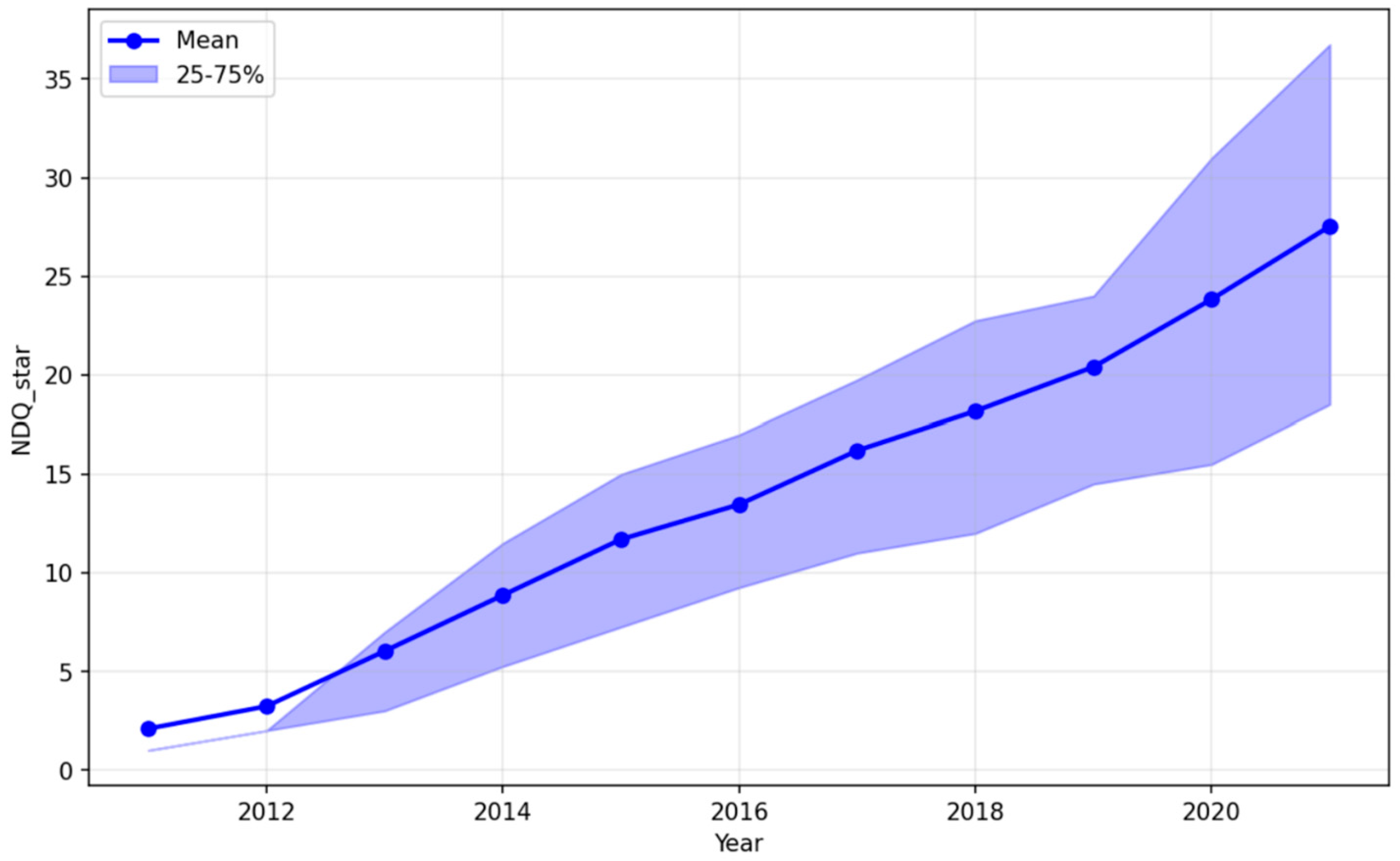
Figure 2 displays the time trend of the titling progress index across sample cities. The mean titling index increases from approximately 2 index units in 2011 to approximately 28 index units in 2021, reflecting sustained policy implementation over the sample period. The shaded region shows the 25th–75th percentile range, revealing substantial cross-city variation throughout the period. This variation in titling progress creates the identifying variation exploited in the empirical design.
3.2. Variable Definitions
This study employs three outcome variables and two treatment variables. Grain Output measures total grain production in 10,000 tons at the prefecture level, capturing the aggregate volume of grain produced within each city in each year. Grain Yield equals grain output divided by cultivated land area, representing land productivity and isolating intensive margin effects from extensive margin changes. Per Capita Grain production equals grain output divided by resident population, providing a production-side measure of local grain availability that does not account for interregional trade or storage. The Certification Index (NDQ) aggregates administrative data on land titling progress at the city level, with higher values indicating more advanced implementation. The corrected index NDQ* applies a cumulative maximum transformation to address temporary reversals in reported values. Post Certification (D) is a binary indicator equal to one when a city’s NDQ* first reaches or exceeds the treatment threshold. The baseline threshold of 20 index units represents a substantive implementation milestone. This study also examines sensitivity to alternative thresholds of 15 and 25 index units to verify that results do not depend on the specific threshold choice.
3.2.1. Treatment Variable
The treatment variable captures entry into a substantive titling milestone. We construct a titling progress index (NDQ) that aggregates information on titling activity at the city level. The index measures cumulative progress in the titling process, with higher values indicating more advanced implementation.
To address potential measurement issues from temporary reversals or reporting inconsistencies, we apply a cumulative maximum correction. The corrected index (NDQ*) equals the maximum value of NDQ observed for that city through the current year, ensuring monotonic progression. This correction addresses situations where administrative changes or reporting errors create apparent decreases in titling progress.
The treatment indicator
Dit equals one when city i’s corrected titling index (NDQ*) first reaches or exceeds a threshold of 20 index units:
where
Gi denotes the first year in which city i achieves NDQ* ≥ 20. Cities that never reach this threshold during the sample period constitute the never-treated control group.
The threshold of 20 index units represents a substantive implementation milestone rather than a precise policy threshold. We select this value to ensure that treated observations reflect meaningful titling activity rather than early-stage pilot programs. Robustness checks examine sensitivity to alternative threshold values of 15 and 25 index units.
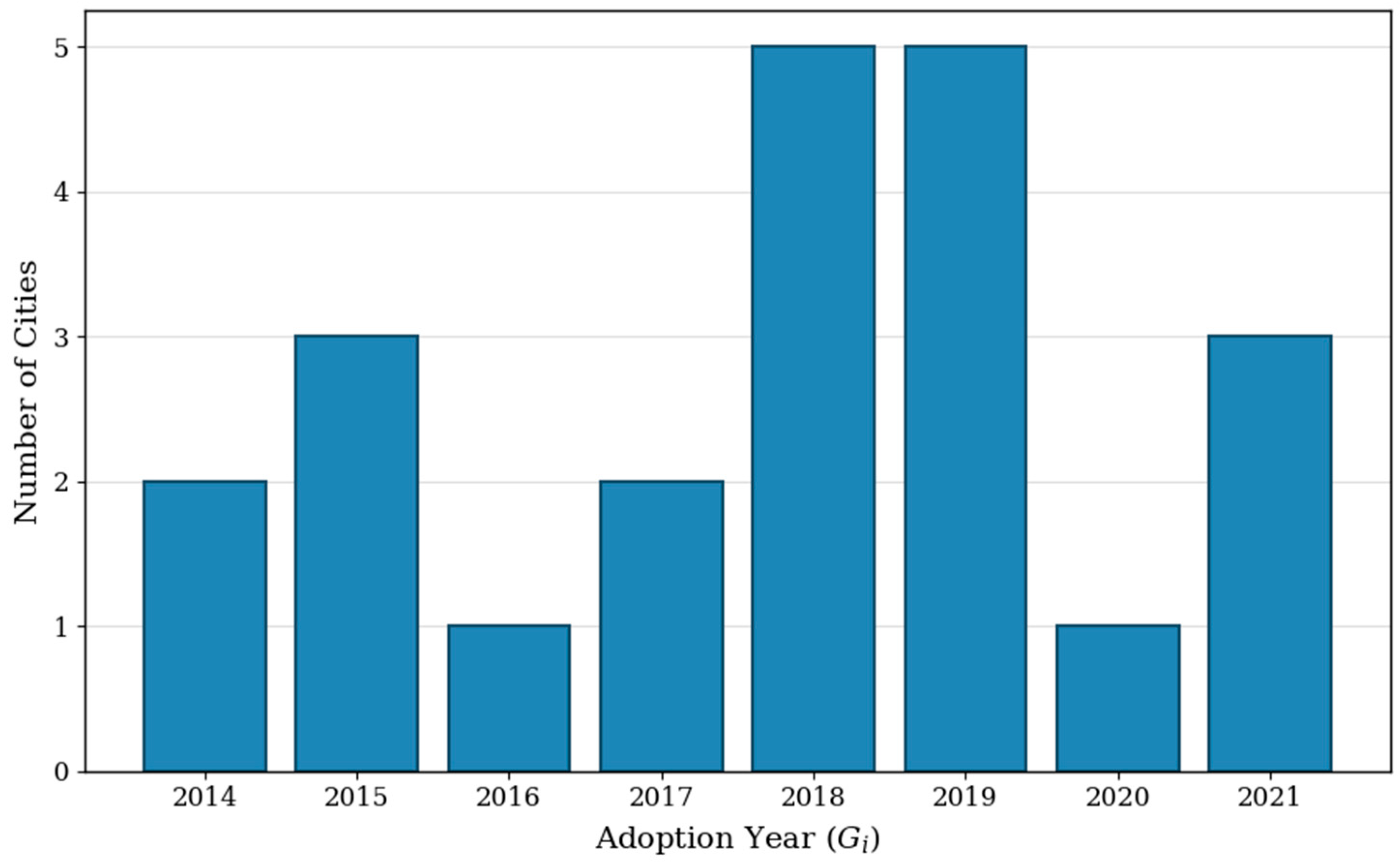
Table 3 documents the sample structure and treatment timing distribution. Of the 30 cities, 22 enter the titling milestone during the sample period (treated group) while 8 remain below the threshold throughout (never-treated group). Treatment cohorts span 2014–2021, with concentrations in 2018 (5 cities) and 2019 (5 cities). The average post-treatment duration is 2.15 years, reflecting that most treated cities enter treatment in the latter half of the sample period.
Figure 3 visualizes the cohort distribution, showing the number of cities entering treatment in each year. The staggered pattern provides variation in treatment timing essential for identification. The presence of never-treated cities throughout the sample period provides a control group that does not change treatment status, strengthening identification relative to designs that rely solely on not-yet-treated comparisons.
3.2.2. Outcome Variables
We measure grain production capacity using three variables that capture different dimensions of agricultural production:
Log Grain Yield: Natural logarithm of grain production divided by cultivated land area. This measure captures productivity per unit of land, isolating intensive margin effects from extensive margin changes. Grain yield serves as the primary outcome for productivity analysis because it directly reflects land productivity independent of total cultivated area.
Log Per Capita Grain Production: Natural logarithm of grain production divided by resident population. This measure captures food availability on a per-person basis, relevant for local food security assessment. Changes in per capita production may reflect production changes or population changes.
The log transformation addresses skewness in the distribution of production variables and facilitates interpretation of coefficients as approximate percentage changes. For the main analysis, we use the natural logarithm of levels without adding a constant, as no observations have zero values.
3.2.3. Mechanism Variables
Three variables capture potential channels through which titling affects grain production:
Land Transfer Intensity: Land transfer area divided by total cultivated land area. Higher values indicate more active land rental markets, which may facilitate reallocation of land to more productive operators. Land transfer intensity ranges from 0.04 to 1.07 in the sample, with a mean of 0.45.
Irrigation Intensity: Effective irrigated area divided by cultivated land area. Higher values indicate better water management infrastructure and greater capacity for irrigated crop production. Irrigation intensity ranges from 0.07 to 1.60, with a mean of 0.84.
Mechanization Intensity: Total machinery power (in kilowatts) divided by cultivated land area. Higher values indicate greater mechanical capital deployment, which enhances labor productivity and enables timely field operations. Mechanization intensity ranges from 0.50 to 2.69, with a mean of 1.13.
These mechanism variables are measured at the city-year level and may respond to titling treatment. The analysis examines both whether these variables predict grain yield and whether titling affects these variables.
3.2.4. Control Variables
All specifications include two time-varying controls:
Log GDP per capital: Natural logarithm of gross domestic product per resident. This variable captures economic development level, which may affect both titling implementation and agricultural outcomes through income effects, opportunity costs, and institutional capacity channels.
Urbanization Rate: Percentage of resident population classified as urban. This variable captures structural transformation, which affects agricultural labor production, land use pressure, and the relative importance of agriculture in the local economy.
3.3. Empirical Strategy
3.3.1. Baseline Specification
The baseline specification employs a generalized Difference-in-Differences framework:
where
Yit denotes the outcome variable for city
i in year
t,
αi captures city fixed effects that absorb time-invariant city characteristics,
λt captures year fixed effects that absorb common shocks affecting all cities,
Dit indicates post-treatment status,
Xit includes time-varying controls, and
εit is the error term. The coefficient
β estimates the average treatment effect on the treated cities (ATT).
The city fixed effects control for differences in geographic conditions, soil quality, historical agricultural development, and other time-invariant factors that affect both titling timing and grain production outcomes. The year fixed effects control for national policy changes, commodity price movements, weather patterns, and other shocks common to all sample cities. The identifying assumption is that, conditional on fixed effects and controls, the timing of titling milestone achievement is uncorrelated with unobserved determinants of grain production trajectories.
3.3.2. Stacked DID Estimator
Recent methodological research demonstrates that the standard two-way fixed effects (TWFE) estimator can produce biased estimates when treatment effects vary across units or over time. In staggered adoption designs, the TWFE estimator implicitly uses already-treated units as controls for later-treated units, generating “forbidden comparisons” that can produce bias when treatment effects are heterogeneous or dynamic.
The staggered adoption structure in our setting creates potential for such heterogeneity bias. Different cohorts may experience different treatment effects due to variation in titling implementation quality, pre-existing conditions, or macroeconomic context. Treatment effects may also evolve over time as farmers adjust to the new tenure environment.
We address these concerns using the stacked DID estimator. This approach constructs cohort-specific subsamples, each containing one treatment cohort and an appropriate control group consisting of never-treated units and not-yet-treated units. For each treatment cohort g, we create a subsample including all city-year observations for cities in cohort g and all observations for cities serving as controls for that cohort.
The subsamples are then stacked (combined), and the model includes cohort-by-city and cohort-by-year fixed effects:
where g indexes treatment cohorts,
αig captures cohort-specific city effects, and
λgt captures cohort-specific year effects. The coefficient
β estimates a weighted average of cohort-specific treatment effects, with weights proportional to sample size.
The stacking procedure increases the effective sample size from 330 to 1608 observations. This increase occurs because each city may appear in multiple cohort-specific subsamples when serving as a control for different treatment cohorts. The city appearing in multiple stacked subsamples represents the same underlying city-year observation, not new information. The cohort-specific fixed effects account for this repeated inclusion, and clustering standard errors at the city level addresses correlation within cities across cohort subsamples.
3.3.3. Event Study Specification
To examine dynamic effects and assess the parallel trends assumption, we estimate an event study specification:
where k indexes event time relative to treatment year
Gi. The coefficients {
βk} trace out the treatment effect trajectory before and after treatment. We normalize
β−1 = 0 to set the year immediately before treatment as the baseline.
Pre-treatment coefficients (k < −1) test the parallel trends assumption. If treated and control cities followed parallel trajectories before titling, pre-treatment coefficients should be statistically indistinguishable from zero. Statistically detectable pre-trends would indicate differential trajectories that undermine causal interpretation. We report a joint test of whether all pre-treatment coefficients equal zero, providing a summary assessment of parallel trends.
Post-treatment coefficients (k ≥ 0) reveal the dynamic pattern of treatment effects. Persistent positive effects following treatment would indicate sustained productivity gains from titling. Transitory effects that dissipate over time might suggest adjustment dynamics or anticipation effects. Delayed effects that emerge only several years post-treatment might indicate that investments induced by titling require time to generate productivity returns.
3.3.4. Identification Assumptions and Threats
The DID identification strategy requires several assumptions that merit discussion.
Parallel Trends: The fundamental assumption is that treated and control cities would have followed parallel outcome trajectories in the absence of treatment. We assess this assumption using pre-treatment event study coefficients and a joint test of lead coefficients. However, pre-trend tests have limited power against smooth differential trends or anticipation effects that begin close to treatment.
No Anticipation: The design assumes that titling does not affect outcomes before the city reaches the treatment threshold. If farmers anticipate titling and adjust behavior before formal implementation reaches the threshold, treatment effects may be understated, or pre-trends may appear.
Treatment Exogeneity: The variation in treatment timing must be conditionally uncorrelated with potential outcomes. If cities with stronger agricultural growth potential systematically reach titling thresholds earlier, positive effects may reflect selection rather than causation. Alternatively, if titling prioritizes areas with agricultural challenges, negative selection could attenuate estimated effects.
No Spillovers: The stable unit treatment value assumption (SUTVA) requires that one city’s treatment does not affect other cities’ outcomes. Spatial spillovers through labor migration, land rental markets extending across city boundaries, or competitive effects could violate this assumption.
Measurement Error: The titling progress index may measure implementation with error, potentially attenuating treatment effect estimates. The threshold-based treatment definition reduces sensitivity to small measurement errors but may miss variation in implementation intensity above the threshold.
Short Post-Treatment Window: The average post-treatment duration of 2.15 years may be insufficient to capture long-term investment effects. Soil improvements, irrigation infrastructure upgrades, and perennial plantings require multiple years to generate measurable productivity returns. This limitation is more pronounced with prefecture-level aggregated data, where detectable production effects require accumulation of micro-level behavioral responses across the jurisdiction. To directly test how post-treatment duration affects the results, this study constructs a restricted sample that retains only cities with the first treatment year at or before 2018, extending the average post-treatment period to approximately 3.5 years (see
Section 4.5). Extending the panel timeframe to capture medium- and long-term adjustment effects remains a priority for future research.
3.3.5. Inference
Standard errors cluster at the city level throughout the analysis to account for serial correlation within cities over time. Given the modest number of clusters (30 cities), we supplement cluster-robust inference with wild bootstrap procedures that provide more reliable inference in small-cluster settings. We report both cluster-robust p-values and bootstrap p-values, basing significance assessments primarily on bootstrap results given cluster-sample concerns.
The wild bootstrap procedure uses 500 replications and the Webb six-point distribution, which performs well with small numbers of clusters. We compute bootstrap p-values as the proportion of bootstrap replications yielding test statistics more extreme than the observed statistic.
3.3.6. Heterogeneity Specification
To test Hypothesis 2, we estimate models with interaction terms between the treatment indicator and infrastructure variables:
where
Zi denotes either a continuous standardized infrastructure measure or an indicator for above-median infrastructure. The coefficient
β1 captures the treatment effect at the mean or baseline infrastructure level, while
β2 captures differential treatment effects across infrastructure levels. For categorical specifications, the total effect in high-infrastructure cities equals
β1 +
β2.
4. Results
4.1. Main Effects
Table 4 presents the stacked DID estimates of titling effects on grain production capacity. Across all three outcome variables, the estimated treatment effect is statistically indistinguishable from zero at conventional significance levels.
For log grain output, the coefficient is −0.068 with a cluster-robust standard error of 0.041. The cluster-robust p-value of 0.100 suggests marginal statistical detectability, but the bootstrap p-value of 0.529 indicates that the effect is not robust to small-sample inference adjustments. The coefficient implies that titling is associated with approximately 6.8 percent lower grain output, but this estimate is imprecise and could plausibly range from substantial negative effects to modest positive effects.
For log grain yield, the coefficient is −0.002 with a standard error of 0.015 and p-values of 0.873 (cluster) and 0.866 (bootstrap). The point estimate is very close to zero and precisely estimated, providing relatively strong evidence of no average effect on grain yield. A one-standard-deviation change in treatment status is associated with essentially no change in log yield.
For log per capita grain production, the coefficient is −0.005 with standard error 0.008 and p-values of 0.508 (cluster) and 0.603 (bootstrap). As with grain yield, the effect is small and not statistically detectable.
These results do not support Hypothesis 1. Land titling does not generate a statistically detectable average effect on grain production capacity in our sample. The point estimates are small in magnitude and carry negative signs, contrary to the theoretical prediction of positive effects from improved tenure security.
Table 5 reports traditional TWFE estimates for comparison. The patterns align closely with the stacked DID results. For log grain output, the TWFE coefficient is −0.067 (
p = 0.063 cluster,
p = 0.523 bootstrap). For log grain yield, the coefficient is 0.012 (
p = 0.389 cluster,
p = 0.519 bootstrap). For log per capita production, the coefficient is −0.004 (
p = 0.468 cluster,
p = 0.563 bootstrap).
The consistency between stacked DID and TWFE estimates suggests that heterogeneity bias does not substantially affect inference in this application. Both estimators yield null effects with similar magnitudes, increasing confidence that the null finding reflects genuine absence of average treatment effects rather than methodological artifacts.
Several explanations may account for the null average effect. First, titling effects may depend on complementary conditions that vary across cities. The average effect pools cities with different infrastructure endowments, potentially combining positive effects in some contexts with negative effects in others. Second, behavioral responses to titling may offset productivity gains. If titling encourages part-time farming or shifts labor toward off-farm employment, measured grain yield may decline even as household welfare improves. Third, the short average post-treatment duration (2.15 years) may be insufficient to capture long-term investment effects. Fourth, statistical power may be inadequate to detect modest but real effects given the sample size and outcome variance.
4.2. Event Study and Parallel Trends
Table 6 and
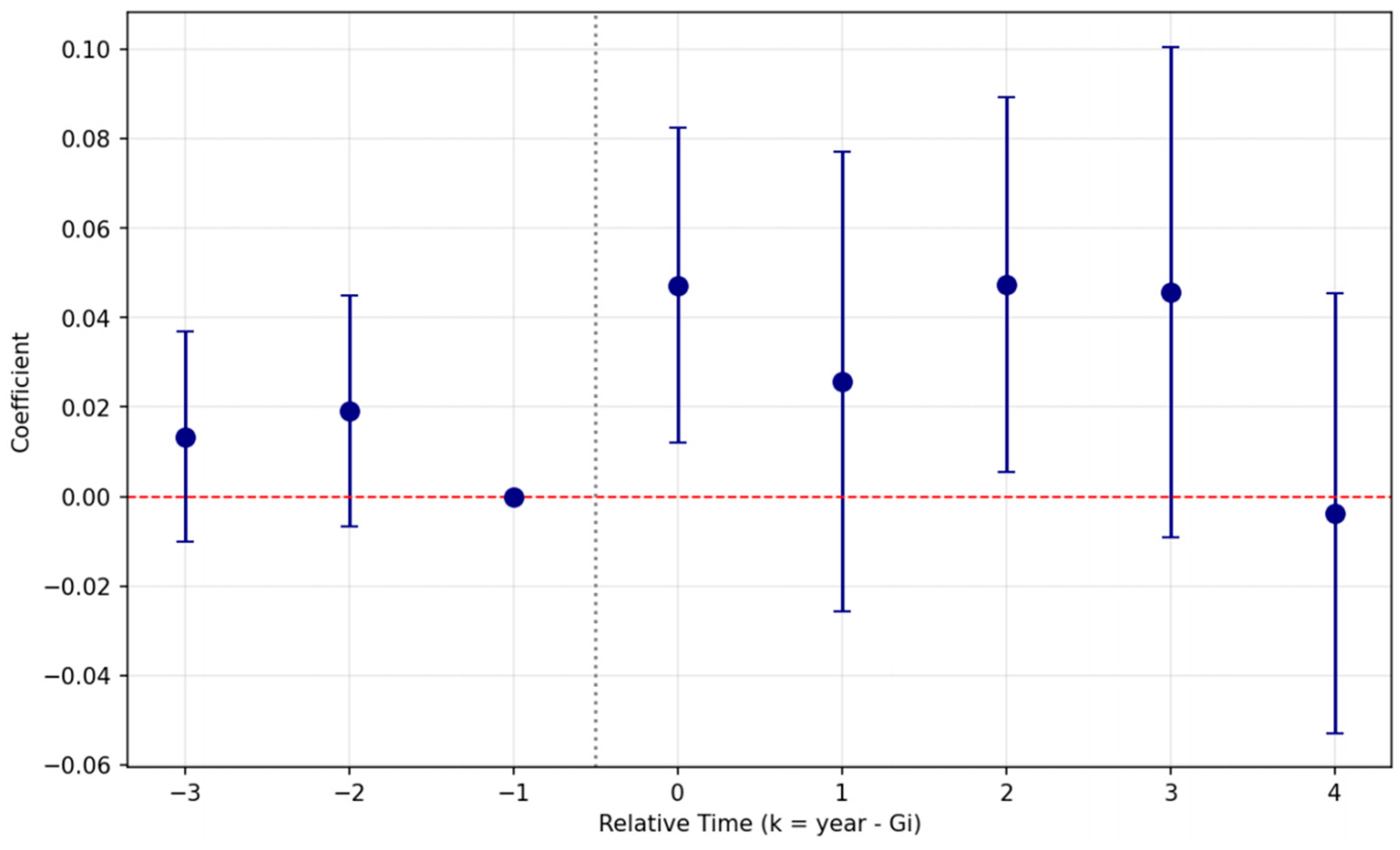
Figure 3 present the event study results for log grain yield. The pre-treatment coefficients provide a direct test of the parallel trends assumption underlying the DID design.
At event time k = −3 (three years before treatment), the coefficient is 0.009 with standard error 0.012 and p-value 0.455. At k = −2 (two years before treatment), the coefficient is 0.011 with standard error 0.014 and p-value 0.425. Neither pre-treatment coefficient differs detectably from zero, providing support for the parallel trends assumption.
The joint test of pre-treatment coefficients yields a chi-squared statistic of 1.20 with p-value 0.550, indicating failure to reject the null hypothesis of parallel pre-trends. This evidence supports the identifying assumption that treated and control cities followed similar trajectories before titling milestones.
The treatment-period coefficient at k = 0 (the year of reaching the threshold) equals 0.025 with a p-value of 0.095. This coefficient suggests a marginally detectable contemporaneous effect, with grain yield approximately 2.5 percent higher in the treatment year relative to the baseline. However, this effect is not robust at conventional significance levels.
Figure 4 plots the event-study coefficients for log grain yield. The estimates show no detectable pre-treatment trend and no sustained post-treatment effect.
The event study pattern is consistent with the null average effect reported in
Table 4. Pre-treatment coefficients support the parallel trends assumption. Post-treatment coefficients are imprecisely estimated and do not indicate sustained positive or negative effects. The transitory positive effect at k = 0 could reflect measurement timing or anticipation rather than causal effects of titling.
4.3. Heterogeneity Analysis
The null average effect may mask heterogeneity across cities with different characteristics. We examine whether titling effects vary with agricultural infrastructure endowments, testing Hypothesis 2.
Table 7 presents heterogeneity analysis using continuous interaction terms. The infrastructure variables are standardized to have mean zero and unit variance, so the main effect of titling (D) represents the effect at mean infrastructure levels, and interaction coefficients indicate how effects change per standard deviation increase in infrastructure.
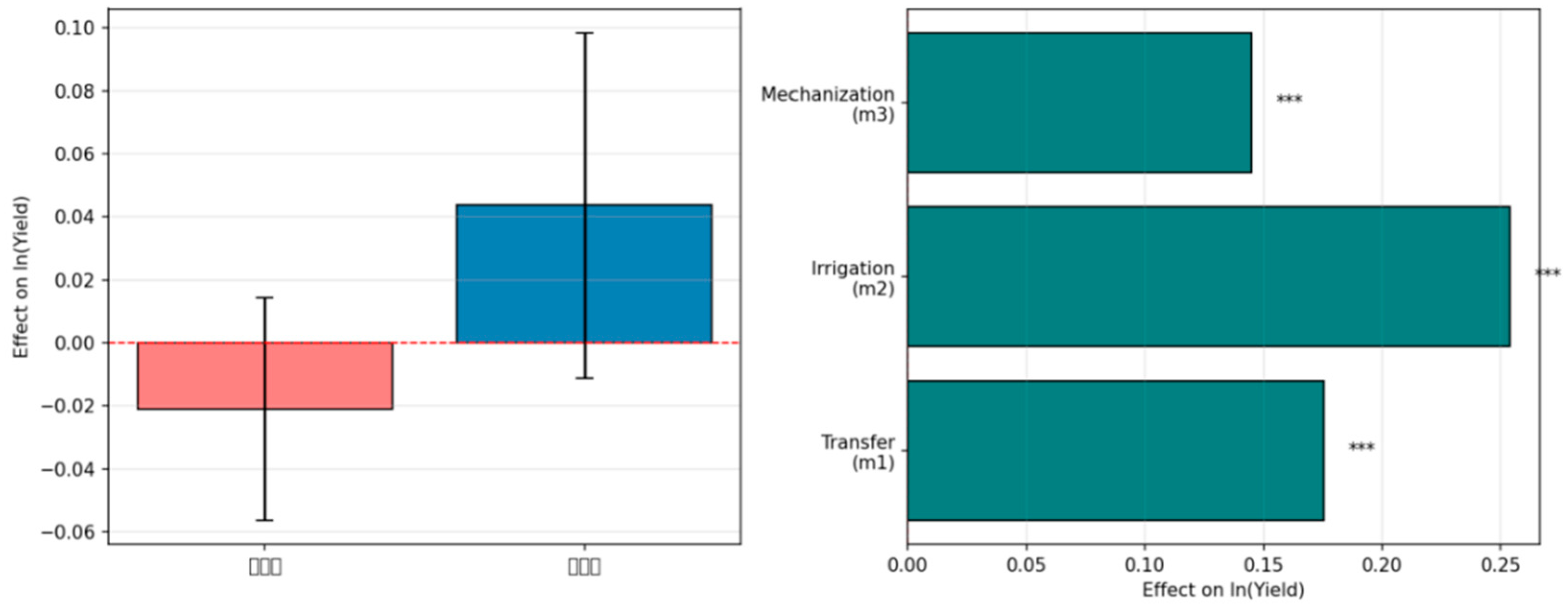
For log grain yield, both interaction terms are statistically detectable. The titling-by-irrigation interaction coefficient is 0.028 (p = 0.002), indicating that a one-standard-deviation increase in irrigation intensity associates with a 2.8 percentage point increase in the titling effect on grain yield. The titling-by-mechanization interaction is 0.040 (p = 0.004), indicating that a one-standard-deviation increase in mechanization intensity associates with a 4.0 percentage point increase in the titling effect.
The interaction patterns indicate that titling effects on grain yield vary systematically with infrastructure conditions. At mean infrastructure levels, the titling effect is approximately zero (0.002, not detectable). At one standard deviation above mean irrigation intensity, the effect increases by 2.8 percentage points; at one standard deviation above mean mechanization intensity, the effect increases by 4.0 percentage points. Cities with both high irrigation and high mechanization experience titling effects of approximately 7 percentage points higher than cities at mean infrastructure levels.
Table 8 presents results using categorical infrastructure indicators defined by above-median versus below-median values. This specification provides more direct interpretation of effects in high versus low infrastructure contexts.
For log grain yield, the baseline effect in low-infrastructure cities (below median on both irrigation and mechanization) is −0.049 with a p-value 0.025. This coefficient indicates that titling reduces grain yield by approximately 4.9 percent in cities with weak agricultural infrastructure. The negative effect in low-infrastructure contexts is economically meaningful and statistically detectable.
The interaction terms for high-irrigation (0.053, p = 0.006) and high-mechanization (0.063, p < 0.001) cities are both positive and statistically detectable. These interaction effects fully offset or exceed the negative baseline effect.
Panel B reports total effects calculated as the sum of baseline and interaction coefficients. In high-irrigation cities, the total titling effect on log grain yield equals −0.049 + 0.053 = +0.003, essentially zero. In high-mechanization cities, the total effect equals −0.049 + 0.063 = +0.013, a small positive effect. Cities with both high irrigation and high mechanization would experience even larger positive effects.
These findings strongly support Hypothesis 2. Land titling does not uniformly affect grain yield; rather, the effect depends critically on agricultural infrastructure conditions. Cities with developed irrigation and mechanization infrastructure experience zero or slightly positive effects on grain yield, while cities with weak infrastructure experience negative effects. The contrast between low-infrastructure and high-infrastructure cities is approximately 5–6 percentage points for each infrastructure dimension.
Figure 5 visualizes the heterogeneity pattern and the mechanism associations with log grain yield.
The conditional heterogeneity concentrates on grain yield and does not appear in grain output or per capita grain production (
Table 8). This concentration follows from the transmission mechanism through which titling affects agricultural production. Titling strengthens tenure security and thereby incentivizes operators to increase factor inputs: fertilizer application, improved seed adoption, and field management intensity. The marginal returns to these inputs register directly in output per unit of sown area, making grain yield the most sensitive indicator of input intensification. The mechanism analysis reported below confirms this link: irrigation intensity and mechanization intensity are associated with grain yield at coefficients of 0.180 (
p < 0.001) and 0.080 (
p = 0.001), establishing that the factor adjustment channels through which titling operates connect to the yield dimension. Grain output combines yield changes with sown area changes. The mechanism analysis below also indicates that titling may promote land transfer, and transferred land may undergo planting structure adjustments or temporary area reallocation by new operators. These area-dimension responses dilute the input-intensity signal that drives the yield result. Per capita grain production introduces an additional source of noise: the population denominator shifts as urbanization draws residents from rural to urban registration. The sample cities average 54.9 percent urbanization, and this ongoing demographic transition generates variation in the per capita measure unrelated to agricultural factor adjustment. The titling effect on factor input intensity, conditioned on infrastructure, therefore produces the clearest signal in the yield dimension and progressively weaker signals in output and per capita measures.
The null average treatment effect reflects a combination of negative effects in low-infrastructure cities and zero or positive effects in high-infrastructure cities. Pooling across infrastructure levels obscures this heterogeneity and produces the appearance of no effect. The 4.9 percent yield decline in low-infrastructure cities translates to approximately 109,000 metric tons of foregone grain output per city at sample mean production levels. This magnitude represents roughly 4.9 percent of the average city’s annual grain output in the sample, a scale that can shift regional grain supply–demand balances in cities where agriculture constitutes a primary economic function. The positive interaction effects of 5.3 to 6.3 percentage points in high-infrastructure cities offset the negative baseline, producing net effects near zero. Titling in these cities therefore poses no measurable risk to grain production capacity. The divergent pattern indicates that titling’s effect on grain production capacity depends on the infrastructure environment in which the reform operates, and that policy evaluation based on average effects alone obscures this conditional structure.
Table 9 provides supplementary evidence on this differential pattern.
Table 9 tests whether titling differentially affects mechanism variables across infrastructure conditions by having the treatment indicator interact with the infrastructure group dummy. All three interaction coefficients are positive: land-transfer intensity 0.086 (
p = 0.110), mechanization intensity 0.095 (
p = 0.165), and irrigation intensity 0.081 (
p = 0.161). The consistent positive direction indicates that titling generates stronger factor adjustment responses in high-infrastructure cities across all three mechanism channels. None of the interaction coefficients reach conventional significance levels. The 30-city sample limits statistical power for detecting interaction effects, so these results constitute directional evidence. This pattern aligns with the grain yield heterogeneity: titling activates factor adjustment channels in high-infrastructure cities but faces binding constraints in low-infrastructure cities.
4.4. Mechanism Channels
The heterogeneity findings raise the question of why titling effects differ across infrastructure contexts. Mechanism analysis provides suggestive evidence on the channels that may explain this conditional pattern, though causal interpretation remains tentative given the observational nature of the mechanism variables.
Table 10 presents mechanism analysis examining the channels through which titling may affect grain yield. The analysis proceeds in three parts: (1) testing whether mechanism variables predict grain yield; (2) examining how the titling coefficient changes when controlling for mechanisms; and (3) testing whether titling affects mechanism variables.
Panel A examines associations between mechanism variables and log grain yield. Land transfer intensity has a coefficient of 0.068 (p = 0.059), indicating that a 10 percentage point increase in land transfer intensity is associated with approximately 0.7 percent higher grain yield. The association is marginally detectable and economically modest.
Irrigation intensity has a coefficient of 0.180 (p < 0.001), the largest among the mechanism variables. A 10 percentage point increase in irrigation intensity is associated with approximately 1.8 percent higher grain yield. This strong association confirms that irrigation infrastructure contributes meaningfully to agricultural productivity.
Mechanization intensity has a coefficient of 0.080 (p = 0.001). Higher mechanization is associated with higher grain yield, consistent with the productivity benefits of mechanical capital.
Panel B examines how controlling for mechanism variables affects the titling coefficient. In the baseline TWFE specification without mechanism controls, the titling coefficient for log grain yield is 0.012 (p = 0.389). Adding land transfer intensity, irrigation intensity, and mechanization intensity as controls attenuates the coefficient to −0.002 (p = 0.856). This attenuation of 112.5 percent suggests that the mechanism variables absorb whatever titling effect exists and potentially more.
The substantial attenuation is consistent with mediation: titling affects grain yield through channels captured by the mechanism variables. However, causal interpretation requires establishing that titling affects these mechanism variables.
Panel C tests whether titling directly affects mechanism variables in the high-infrastructure subsample, where titling effects on yield are neutral or positive. The coefficients are all positive: titling associates with 5.7 percentage points higher land transfer intensity, 5.0 percentage points higher irrigation intensity, and 8.0 percentage points higher mechanization intensity. However, none of these coefficients achieves statistical detectability at conventional levels (p-values range from 0.132 to 0.277).
The evidence of the mechanism is therefore suggestive rather than conclusive. The mechanism variables clearly predict grain yield and substantially attenuate the titling coefficient when included as controls. However, the direct effect of titling on these mechanism variables is not statistically detectable. This pattern may reflect several factors: insufficient statistical power to detect modest effects on mechanism variables; measurement error in city-level mechanism variables that attenuates estimated effects; operation of mechanisms at more disaggregated levels (farm or plot) that aggregate inconsistently to the city level; or time lags between titling and mechanism responses that exceed the sample period.
Taken together, the heterogeneity and mechanism evidence traces a single transmission chain linking titling to grain yield through factor adjustment. Titling stabilizes tenure expectations and thereby strengthens incentives for land transfer, irrigation investment, and machinery adoption. Panel A confirms that these three factor adjustment channels associate positively with grain yield (coefficients 0.068, 0.180, and 0.080). Infrastructure conditions determine whether this chain reaches completion. In high-infrastructure cities, existing irrigation and mechanization capacity enables operators to convert titling-induced incentives into higher factor input intensity, producing zero or slightly positive yield effects (
Table 8, Panel B). In low-infrastructure cities, the same incentive operates on labor reallocation, but insufficient irrigation capacity and low mechanization levels prevent capital from substituting for departed labor. The chain breaks at the factor adjustment stage, and yield declines by 4.9 percent.
Table 9 corroborates this asymmetry: titling generates directionally stronger factor adjustment responses in high-infrastructure cities across all three mechanism channels (interaction coefficients 0.086, 0.095, and 0.081), although the 30-city sample limits statistical power for detecting these interaction effects at conventional significance levels. This framework accounts for three layers of results simultaneously: the null average effect reflects offsetting positive and negative conditional effects; the concentration of heterogeneity on grain yield reflects the direct link between factor input intensity and output per unit of sown area; and the consistent but underpowered interaction terms in
Table 9 reflect the small cross-sectional dimension. Completing the causal identification of this chain requires larger samples that provide adequate power for interaction and mediation tests.
4.5. Robustness Checks
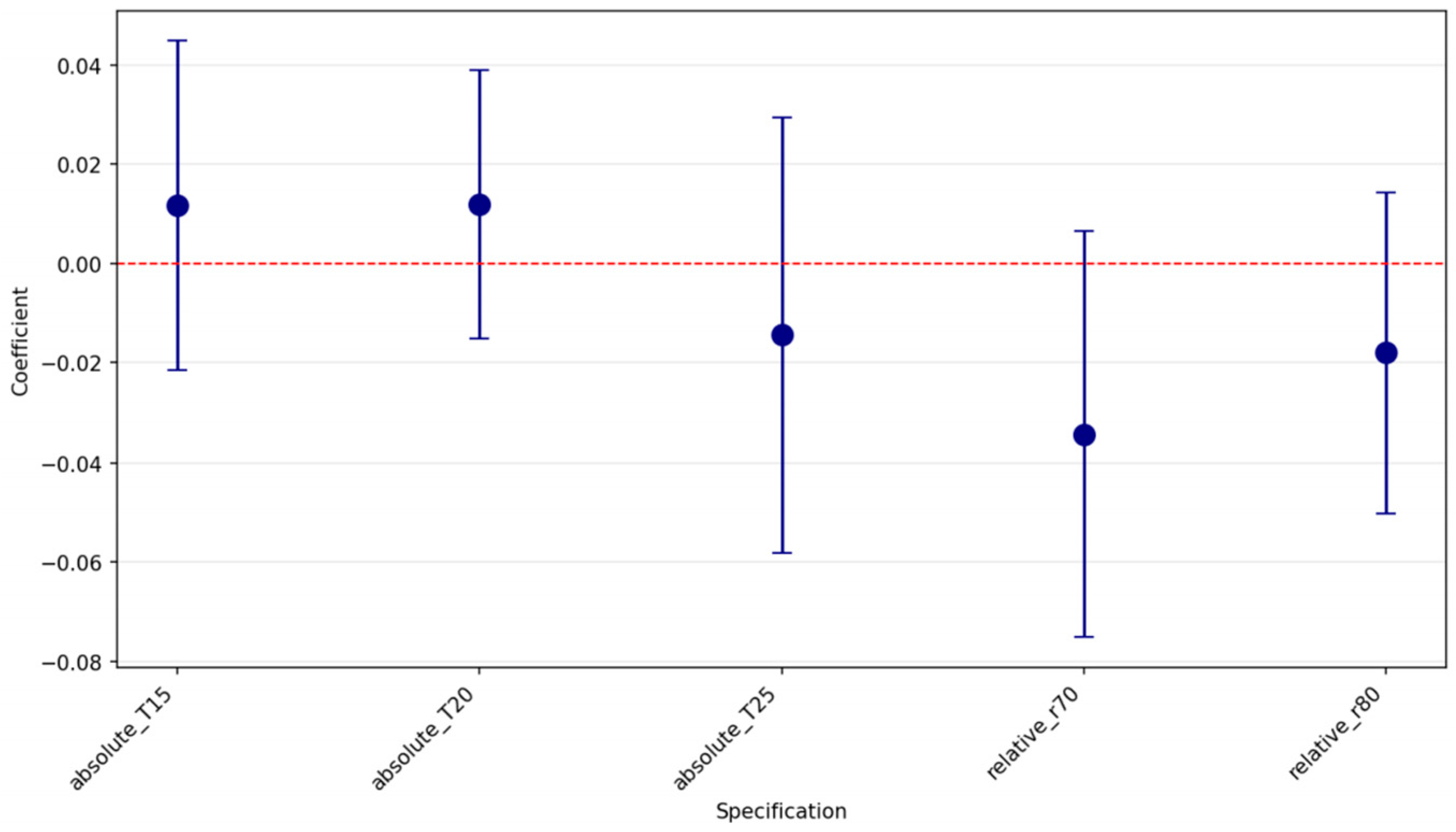
Table 11 presents robustness checks examining sensitivity to specification choices. Panel A tests threshold sensitivity by varying the NDQ* threshold defining treatment. Results remain consistent across thresholds of 15, 20, and 25 index units. At threshold 15, the coefficient for log grain yield is 0.012 (
p = 0.487). At threshold 20 (baseline), the coefficient is 0.012 (
p = 0.389). At threshold 25, the coefficient is −0.014 (
p = 0.521). All coefficients are small and not statistically detectable.
The threshold insensitivity provides confidence that results do not depend on the specific threshold choice. The null finding is robust across a range of implementation milestone definitions.
Panel B restricts the sample to a balanced event window of ±3 years around treatment, yielding 138 observations. The coefficient (0.011, p = 0.480) remains consistent with baseline results. The balanced window specification reduces concerns about compositional changes in the sample over the event horizon but also reduces precision due to a smaller sample size.
Panel C reports placebo and validation tests using alternative outcome variables. Tertiary sector share serves as a negative control: land titling should not directly affect non-agricultural sectoral composition through agricultural productivity channels. The coefficient (−0.017, p = 0.400) is not statistically detectable, supporting the identification strategy by showing that titling does not associate with changes in variables that it should not affect.
Library holdings provide another negative control. The coefficient (0.182, p = 0.089) is marginally detectable, which warrants caution. This result could reflect spurious correlation, omitted variables that affect both titling timing and local public goods, or multiple comparison issues. Given that the primary hypotheses involve agricultural outcomes, the library holdings result does not invalidate the main findings but suggests that the identification strategy has some vulnerability to confounding with local development trends.
Agricultural output (log total agricultural production value) serves as a related positive outcome. The coefficient (−0.032, p = 0.278) is not statistically detectable, consistent with the main findings showing no average effect on grain output.
Table 12 tests whether the short average post-treatment duration compresses the detectable average treatment effect. The restricted sample retains the 13 treated cities with the first treatment year at or before 2018 and all 8 never-treated cities, yielding 21 cities and 231 observations with an average post-treatment period of approximately 3.5 years. For log grain output, the coefficient narrows from −0.073 (
p = 0.090) in the full sample to −0.050 (
p = 0.392) in the restricted sample. For log grain yield, the coefficient shifts from +0.000 (
p = 0.997) to +0.038 (
p = 0.453). For log per capita grain production, the coefficient narrows from −0.059 (
p = 0.185) to −0.032 (
p = 0.594). All three coefficients move toward improvement in the longer-exposure sample, and grain yield shifts from near zero to a positive direction. The
p-values remain above conventional thresholds because the restricted sample contains only 13 treated cities, which limits statistical power. The consistent directional shift across all three outcomes suggests that the short post-treatment window in the full sample compresses detectable average effects, and longer observation periods may facilitate detection of positive titling effects on grain production capacity.
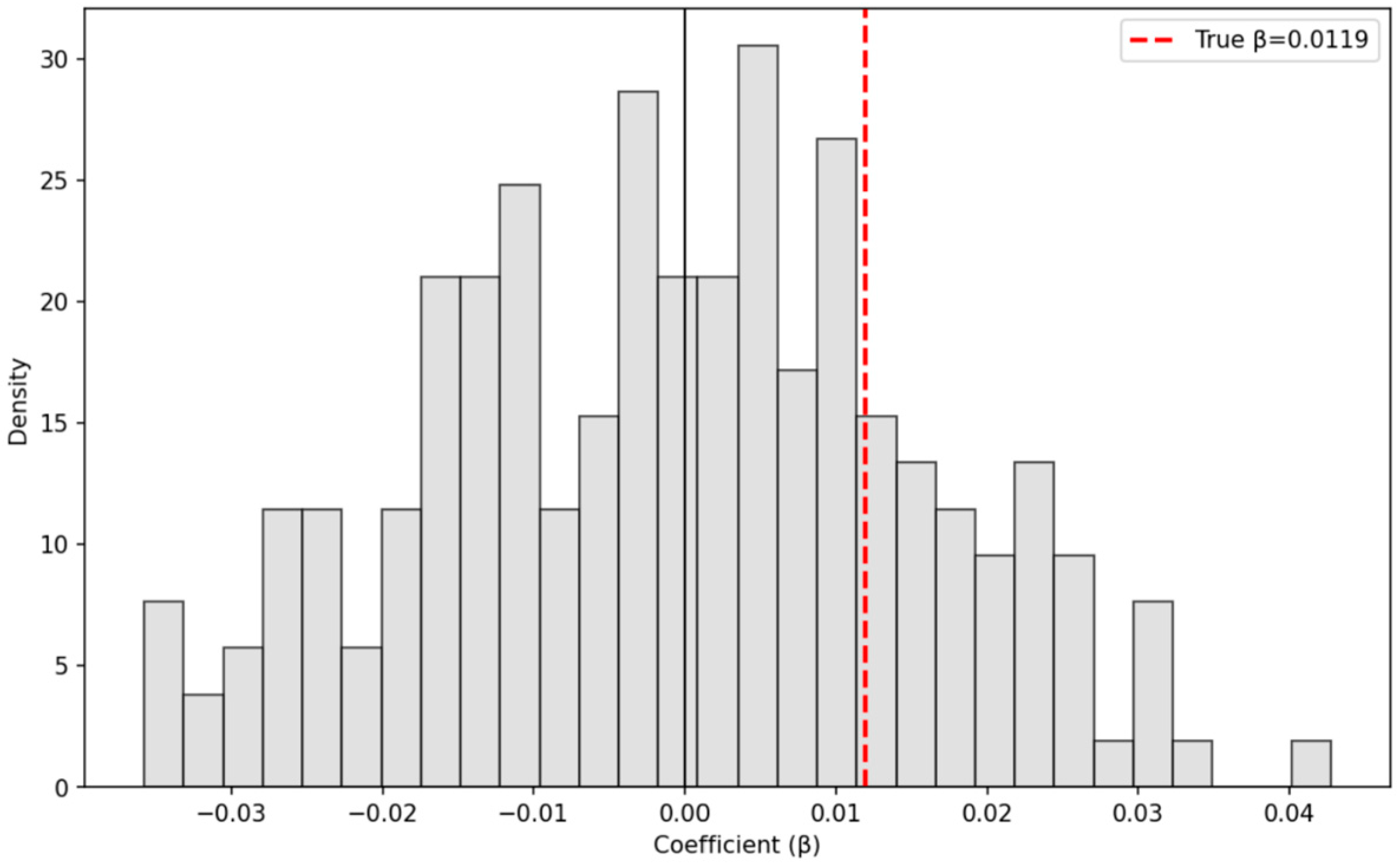
Figure 6 displays the permutation test distribution. The actual estimate lies near the center of the simulated null distribution, consistent with the null average effect.
Figure 7 presents coefficient estimates under alternative threshold definitions and shows that all confidence intervals include zero.
City-level agricultural outcomes may exhibit spatial dependence through shared climate conditions, inter-city factor mobility, and regional policy diffusion. The current design does not incorporate spatial econometric modeling because the cross-sectional dimension of 30 non-contiguously distributed cities constrains reliable estimation of spatial weight matrix parameters, and the compatibility of spatial panel specifications with the stacked DID estimator remains methodologically unresolved.
Section 5.3 discusses spatial dependence as a boundary condition, and future research with expanded geographic coverage can address this limitation.
5. Discussion and Policy Implications
5.1. Interpretation and Relation to Prior Literature
The empirical results present a nuanced picture of land titling effects on grain production capacity that both aligns with and extends prior research. The absence of a statistically detectable average effect contrasts with theoretical predictions that tenure security should enhance agricultural productivity [
1,
2]. However, the conditional heterogeneity findings reconcile this apparent puzzle by demonstrating that titling effects depend critically on complementary conditions.
Importantly, these findings should not be interpreted as evidence that land titling policy lacks value. Rather, the results indicate that titling’s productivity effects are conditional on complementary inputs. The policy itself may generate substantial benefits through channels not captured in our grain production measures, including reduced land disputes, enhanced credit access, and facilitated labor mobility. Our findings suggest that maximizing titling’s contribution to food security requires coordinated infrastructure investment, not abandonment of the titling program.
The null average effect in our prefecture-level analysis echoes findings from some farm-level studies that document conditional or null titling effects. Land certificates encourage part-time farming with reduced technical efficiency in Gansu Province, where thin rental markets limit productive reallocation [
11]. Formal titles do not improve allocative efficiency in Philippine rice farming when informal tenure arrangements already provide adequate security. Our results extend these findings by documenting that the conditioning factor operates at the infrastructure level rather than solely through market or governance channels [
54].
The positive interaction between titling and infrastructure aligns with the broader literature emphasizing complementarity in institutional reform. RLCL effects concentrate in villages with democratic election of leaders, indicating complementarity between legal reform and governance quality. Tenure security effects on migration depend on rental market development. Our findings add infrastructure as another dimension of complementarity: titling generates productivity gains only when physical capital enables productive use of improved tenure security [
23].
The negative baseline effect in low-infrastructure cities admits multiple potential explanations that may operate simultaneously. First, titling may accelerate labor reallocation to off-farm activities across all contexts, but the productivity consequence depends on whether remaining operators can intensify production. In low-infrastructure areas, limited irrigation and machinery constrain intensification, so labor outflow reduces output without offsetting yield gains.
Table 9 shows that titling’s effect on mechanization and irrigation intensity is directionally stronger in high-infrastructure cities (interaction coefficients 0.095 and 0.081), consistent with the interpretation that high-infrastructure cities can substitute capital for departed labor while low-infrastructure cities cannot. Second, titling facilitates land transfer and may change operator composition. New operators in low-infrastructure environments may face adjustment costs or efficiency losses during the transition period, temporarily reducing yield. The current data do not contain household-level operator turnover information, so this study cannot directly test this mechanism. Third, in areas with weak infrastructure, the property rights incentives that titling creates cannot translate into effective factor adjustment because insufficient irrigation capacity and low mechanization levels constrain productive responses. The three positive interaction coefficients in
Table 9 all point toward more active factor adjustment in high-infrastructure cities, directionally supporting this explanation. Hypotheses 2 and 3 receive directional support from the evidence in
Table 8 and
Table 9, although the available data do not permit a direct mediation test. All three mechanisms may operate concurrently, and the current analysis cannot fully isolate their individual contributions.
The magnitude of these conditional effects falls within the range reported by land tenure reform studies in other developing economies. Randomized and quasi-experimental evaluations of land certification in Ethiopia estimate yield increases of 7 to 14 percent [
61,
62], and Rwanda’s systematic land regularization associates with yield gains of approximately 6 percent [
63]. The 4.9 percent conditional negative effect and 5 to 6 percentage point positive interaction terms documented here occupy a comparable band, yet the distinctive finding is that the sign of the effect reverses across infrastructure conditions within a single country. This conditional structure implies that aggregate program evaluations based on average treatment effects understate the yield losses in under-equipped regions and the yield gains in well-equipped regions.
The mechanism evidence, while suggestive, does not establish complete causal chains. The attenuation of titling coefficients when controlling for mechanism variables is consistent with mediation but could also reflect over-control bias if mechanism variables respond to unobserved confounders correlated with titling. The non-detectable direct effect of titling on mechanism variables in Panel C of
Table 10 limits causal interpretation. This pattern may reflect insufficient statistical power, measurement error in aggregate mechanism variables, or operation of mechanisms at finer geographic scales that aggregate inconsistently to the city level.
5.2. Policy Implications
The findings carry several implications for land tenure policy in developing economies pursuing agricultural modernization alongside property rights formalization.
Coordinate tenure reform with infrastructure investment: The conditional heterogeneity results demonstrate that titling generates yield gains only where irrigation and mechanization capacity exceed the sample median (
Table 8). Tenure reform and agricultural infrastructure investment are frequently administered by separate agencies or financed through separate programs in developing countries. The present evidence indicates that bundling these interventions can enhance the productivity returns to tenure security. Sequencing infrastructure upgrades before or alongside title distribution equips farmers to convert strengthened property rights into higher factor input intensity. For countries currently implementing systematic land registration programs, such as the ongoing efforts across Sub-Saharan Africa, assessing baseline infrastructure conditions in target regions prior to rollout can identify areas where titling alone risks the yield decline documented in low-infrastructure cities in this study.
Consider regional targeting of reform sequencing: The differential effects by infrastructure level (
Table 8) support prioritizing tenure formalization in regions where complementary infrastructure already exists, thereby maximizing short-term productivity returns under resource constraints. Many developing countries face binding fiscal and administrative capacity limits when scaling land reform programs. Allocating early-phase resources to regions with adequate irrigation and mechanization infrastructure captures the positive conditional effect, while parallel infrastructure development prepares lagging regions for subsequent phases. Targeting strategies require balancing efficiency against equity: low-infrastructure regions may derive smaller grain yield gains from titling yet benefit from improved credit access, labor mobility, and rental market participation that tenure security facilitates.
Attend to behavioral responses in low-infrastructure contexts: The negative effects in low-infrastructure cities suggest that titling may induce behavioral changes. The directional evidence in
Table 9, showing that titling generates stronger factor adjustment effects in high-infrastructure cities, reinforces the case for prioritizing complementary infrastructure investment in regions where titling alone has not produced measurable yield gains.
Integrate tenure reform into sustainable land use planning: The conditional heterogeneity bears directly on Sustainable Development Goal 2 (Zero Hunger), whether titling enhances grain production capacity depends on infrastructure conditions, so advancing food security targets through tenure reform requires complementary investment. Sustainable land use planning in developing economies requires joint assessment of tenure institutions and productive infrastructure because post-titling labor outflow and yield decline in under-equipped areas can weaken the food production function of cultivated land. Over longer horizons, the tenure stability from titling may incentivize operators to undertake long-cycle land quality investments such as soil improvement and water-saving irrigation. The long-exposure restricted sample in
Table 12 shows the grain yield coefficient shifting from near zero to +0.038, offering preliminary directional evidence that productivity effects strengthen as post-treatment observation periods extend. Embedding tenure reform within a broader framework that jointly addresses property rights, infrastructure provision, and cultivated land protection constitutes a viable policy pathway for reconciling food security with sustainable development objectives.
Recognize multiple objectives of land titling: This analysis focuses on grain production outcomes, but titling may generate benefits through other channels. The effects on migration and rental market participation are documented [
5]. Certification stimulates rural entrepreneurship [
15]. Credit access effects are examined [
31]. A comprehensive assessment of titling programs requires evaluating multiple outcome dimensions. The null grain production effect does not imply that titling lacks value; it implies that grain production improvement should not serve as the primary justification for titling absent complementary infrastructure.
Consider implications for other developing economies: These findings hold relevance beyond the Chinese context. Benefit–cost ratios as high as 18:1 have been estimated for rural land tenure programs in Sub-Saharan Africa, yet such estimates assume that tenure security translates directly into productivity gains. The conditional heterogeneity documented here suggests that in regions lacking complementary agricultural infrastructure, the productivity benefits of land formalization may be attenuated or reversed. Land reform program design in developing economies should incorporate infrastructure diagnostics as a standard pre-implementation step and consider phased rollout strategies that align tenure formalization with infrastructure readiness [
3].
5.3. Limitations and Boundary Conditions
Several limitations qualify interpretation of the findings and define boundary conditions for external validity.
The 30-city sample constitutes a subset of China’s approximately 300 prefecture-level units, constrained by the availability of continuous annual titling progress records required to construct the treatment variable.
Table 1 shows that standardized differences between the sample and national benchmarks fall within 0.2 SD for grain output (0.053 SD), agricultural machinery power (0.171 SD), and effective irrigation area (0.169 SD), confirming that the sample approximates the national distribution on agricultural production dimensions central to this study. The sample skews toward more economically developed and urbanized cities, with GDP per capita exceeding the national benchmark by 0.49 SD and urbanization rate by 0.43 SD. Extrapolation to regions with weaker economic conditions or less developed agricultural infrastructure warrants lower confidence. Accessing broader titling progress data sources to expand sample coverage constitutes a priority for future research aimed at strengthening external validity.
Prefecture-level analysis aggregates heterogeneous farm-level outcomes, potentially obscuring within-city variation in titling effects. Farm-level studies can identify effects on specific farms and plots that may wash out at higher aggregation levels. However, prefecture-level analysis captures whether farm-level responses aggregate into production effects relevant for regional food security, which constitutes the policy outcome of interest.
The threshold-based treatment definition captures whether cities reach a titling milestone but not intensity of implementation above the threshold. Cities that barely reach the threshold may experience weaker effects than cities with comprehensive titling. The index-based measure also differs from individual certificate issuance, which might generate sharper treatment contrasts.
The average post-treatment duration of 2.15 years may be insufficient to capture long-term investment effects, as soil improvements and irrigation infrastructure investments require multiple years to generate measurable productivity returns. The restricted sample in
Table 12, which extends the average post-treatment period to approximately 3.5 years, shows all three outcome coefficients shifting toward improvement. Grain yield moves from near zero (+0.000) to a positive direction (+0.038), suggesting that longer observation periods may facilitate detection of positive titling effects. The restricted sample contains only 13 treated cities, and these coefficients do not reach conventional significance levels, so the directional evidence remains suggestive. Extending the panel timeframe to encompass medium- and long-term post-titling adjustment effects constitutes a priority direction for future research.
Identification concerns: While event study evidence supports parallel trends, the design cannot rule out smooth differential trends, anticipation effects, or time-varying confounders correlated with titling timing. The permutation test provides additional support for the null finding but does not address all threats to identification.
Mechanism interpretation: The mechanism analysis provides suggestive evidence but does not establish causal mediation. The non-detectable direct effect of titling on mechanism variables limits confidence in the proposed channels. Alternative mechanisms not examined here, such as crop choice adjustments, input quality changes, or management practice adoption, may also contribute to titling effects.
Spatial dependence: Agricultural production outcomes at the city level may exhibit spatial autocorrelation through correlated climate shocks, inter-regional factor flows, and technology diffusion across neighboring jurisdictions. Three constraints prevent the incorporation of spatial econometric models in the current analysis. The cross-sectional dimension of 30 cities provides insufficient degrees of freedom for reliable spatial parameter estimation alongside city and year fixed effects. The sample cities distribute across six provinces in a non-contiguous pattern, rendering contiguity-based weight matrices sparse and distance-based alternatives sensitive to the choice of decay function. The stacked DID estimator used in this study addresses heterogeneity bias in staggered treatment adoption, but integrating spatial dependence structures into stacked estimation frameworks lacks established methodological guidance. Spatial autocorrelation primarily affects standard error estimation rather than point estimate consistency under the city-level clustering already employed in this study, so this limitation qualifies inference precision rather than the direction of estimated effects. Expanding sample coverage to achieve contiguous geographic representation and applying spatial panel DID methods constitute a priority direction for future research.
6. Conclusions
This study examines whether land titling affects grain production capacity in China using prefecture-level panel data and a staggered Difference-in-Differences design. The analysis exploits variation in the timing of titling milestones across 30 cities over 2011–2021, implementing stacked DID estimation to address potential heterogeneity bias in staggered adoption designs.
Three principal findings emerge from the analysis.
- (1)
Land titling does not generate a statistically detectable average treatment effect on grain output, grain yield, or per capita grain production. The estimated coefficients are small in magnitude, precisely estimated for yield and per capita production, and robust across stacked DID and traditional TWFE specifications, alternative threshold definitions, and balanced event windows. Event study evidence supports the parallel trends assumption underlying identification.
- (2)
The null average effect masks substantial conditional heterogeneity in the effect on grain yield. In cities with below-median irrigation intensity or mechanization intensity, titling is associated with approximately 4.9 percent lower grain yield (p = 0.025). In cities with above-median infrastructure, interaction terms are positive (5.3–6.3 percentage points) and statistically detectable (p < 0.01), yielding total effects near zero or slightly positive. The contrast between low-infrastructure and high-infrastructure cities amounts to 5–6 percentage points per infrastructure dimension.
The conditional heterogeneity concentrates on grain yield and does not appear as a comparable pattern in grain output or per capita grain production. This concentration is consistent with the interpretation that titling primarily operates through factor input intensity, which registers most directly in yield per unit of sown area.
- (3)
Mechanism analysis provides suggestive evidence that land transfer intensity, irrigation intensity, and mechanization intensity predict grain yield and substantially attenuate the titling coefficient when included as controls.
Table 9 provides supplementary evidence that titling generates directionally stronger effects on mechanism variables in high-infrastructure cities, with all three interaction coefficients positive but below conventional significance thresholds.
However, the direct effect of titling on these mechanism variables is not statistically detectable in the high-infrastructure subsample, limiting causal interpretation of the mediation evidence.
These findings contribute to understanding the conditions under which property rights reforms translate into agricultural productivity gains. The canonical prediction that tenure security enhances investment and productivity holds conditionally: titling generates positive effects only when complementary infrastructure enables productive use of improved security.
This finding reflects short-to-medium-term average effect identification. The long-exposure restricted sample in
Table 12 shows grain yield shifting from near zero to +0.038, suggesting that long-term effects may differ as post-treatment observation periods extend.
In contexts lacking irrigation and mechanization capacity, titling may induce behavioral responses that reduce measured productivity even while potentially improving household welfare through other channels.
The results have direct policy implications for land tenure reform design. Land titling should not be viewed as a standalone intervention for improving grain production capacity. Coordinating tenure reform with agricultural infrastructure investment, considering regional targeting based on infrastructure endowments, and attending to behavioral responses in low-infrastructure contexts may enhance the effectiveness of titling programs. Comprehensive program evaluation should examine multiple outcome dimensions, as titling may generate benefits through labor reallocation, rental market development, and entrepreneurship channels not captured in grain production measures.
Future research should extend the analysis through several dimensions. Longer panel data would enable assessment of whether titling effects strengthen, dissipate, or reverse as tenure arrangements mature and investment pay offs materialize. Farm-level or plot-level analysis could identify micro-level responses that aggregate inconsistently to the city level and provide sharper treatment contrasts based on individual titling status. Direct measurement of proposed mechanisms, including land transfer contracts, irrigation infrastructure investments, and machinery purchases at the farm level, would strengthen causal interpretation of mediation evidence.
Measuring titling’s direct impact on household-level factor adjustment behaviors, such as labor allocation changes, mechanization adoption, and irrigation investment decisions, can test the conditional complementarity mechanism proposed in this study. Expanding sample coverage to achieve contiguous spatial representation would enable spatial panel DID estimation that tests for cross-city spillover effects of titling on neighboring jurisdictions’ agricultural outcomes.
As China’s land titling program matures and more comprehensive data become available, subsequent studies can assess whether the conditional patterns documented here persist, strengthen, or evolve. The findings suggest that realizing the food security potential of property rights reform requires attention to the complementary conditions that enable tenure security to translate into agricultural productivity gains.