1. Introduction
The upper Yangtze River, characterized by uneven spatiotemporal distribution of water resources and increasing ecological stress, has witnessed the rapid development of multi-reservoir joint water diversion projects to mitigate basin-wide water shortages and promote sustainable socio-economic growth [
1]. However, large-scale joint operations substantially modify hydrological regimes, hydrodynamic patterns, and riverine ecological processes in both source and downstream reaches, thereby influencing the stability of key ecological factors and exerting profound impacts on aquatic community structure and function [
2,
3]. As a vital national water conservation region and ecological security barrier, the upper Yangtze supports diverse endemic and economically important fish species, whose spawning and habitat activities are highly sensitive to variations in flow regime, velocity, and water temperature.
Joint operations of major reservoirs—including Lianghekou and Reba on the Yalong River, Yebatan on the Jinsha River, and Shuangjiangkou on the Dadu River—alter natural runoff processes and potentially diminish ecological functions such as channel scouring and substrate renewal during peak flows. Moreover, these operations reshape the temporal dynamics of critical ecohydrological indicators, including flow velocity, depth, and pulses. Such alterations may reduce habitat suitability for key spawning grounds, elevate ecological risks, and compromise overall ecosystem stability. Balancing diversion benefits with ecological protection therefore requires urgent identification of ecological risk threshold dynamics under alternative operation scenarios, providing a scientific basis for optimizing reservoir regulation and ecohydrological management.
Previous studies have primarily focused on ecological water requirements under single-reservoir operations or mean annual flow conditions [
4], often neglecting the dynamic interactions and nonlinear feedback mechanisms inherent in multi-reservoir joint operation systems. In particular, systematic investigations into the temporal evolution of ecological risk thresholds under coordinated reservoir regulation remain scarce, highlighting a critical gap in understanding the coupled hydrological–ecological processes in complex basin systems. In light of growing demands for ecological civilization and ecological flow regulation, a comprehensive simulation framework integrating hydrological operations, ecological risk responses, and habitat suitability assessment is essential for quantifying ecological risk thresholds, optimizing diversion strategies, and achieving coordinated ecological–water management [
5]. Addressing this gap, the present study focuses on representative control reservoirs in the upper Yangtze River and develops a dynamic simulation model based on ecohydrological principles and system dynamics. The model incorporates three modules—habitat ecological risk, water environment ecological risk, and ecohydrological risk—to quantify threshold evolution under multiple diversion scenarios, identify key hydrological and ecological drivers, and propose eco-friendly optimization strategies. The findings provide theoretical insights and practical guidance for ecological risk management, aquatic ecosystem conservation, and integrated water resource allocation in inter-basin diversion projects across the upper Yangtze River.
1.1. Study on the Impact of Multi-Reservoir Joint Water Diversion on the Basin Ecosystem
Joint water transfer from multiple reservoirs has become an important engineering measure to alleviate the temporal and spatial unevenness of water resources in river basins and ensure water supply security [
6], but its impact on ecosystems cannot be ignored [
7]. Water transfer changes the timing and amplitude of natural hydrological processes, which may lead to phenomena such as weakening of flood peaks during spawning periods and abnormal changes in water temperature and flow velocity [
8,
9], thereby interfering with the reproduction and migration of endemic fish species and changing community structure and ecological functions [
10]. The multiple controlled reservoirs distributed in the Yalong River, Jinsha River, and Dadu River basins in the upper reaches of the Yangtze River directly affect the ecological hydrological conditions and habitat pattern of the downstream river sections through changes in discharge flow, storage and regulation cycles, and water transfer ratios during operation [
11]. Previous studies have shown that if the proportion of water transfer to incoming water is too high [
12,
13], it will reduce the level of ecological flow protection and increase ecological risks, especially in key spawning areas, posing a threat to the spatial distribution and quality of suitable fish habitats [
14,
15].
1.2. Research Progress in Ecological Risk Assessment and Threshold Identification
Ecological risk assessment aims to quantify changes in ecosystem stability caused by human activities and identify critical points of ecological functions [
16,
17]. In the context of water diversion, risk assessment often involves indicators such as changes in hydrological conditions, decline in habitat suitability, and changes in biological populations [
18,
19]. A variety of ecological flow calculation and assessment methods have been developed internationally [
20,
21], such as the Tennant method [
22], the Qp method, and the WUA calculation method based on habitat simulation, to determine the minimum flow to ensure ecosystem functions [
23]. In terms of risk threshold identification, researchers have determined the critical conditions for the system to transition from stability to instability under different hydrological scenarios through a comprehensive analysis of factors such as the degree of flow recovery, the rate of change in spawning ground length, and the suitability of flow velocity and water depth [
24]. However, there is still a lack of systematic research on the dynamic coupling relationship between different risk factors and their impact on thresholds under the conditions of joint water diversion from multiple reservoirs [
25,
26].
1.3. Application of System Dynamics in Water Diversion Ecological Risk Simulation
System dynamics (SD), with its strength in representing multivariable feedbacks and nonlinear processes, has been increasingly employed in watershed ecological regulation and risk management [
4,
27]. Under multi-reservoir joint regulation, SD models can integrate hydrological variables—such as reservoir storage deficits, outflows, and runoff—with ecological subsystems, including habitat, water environment, and ecohydrological risk levels, thereby enabling dynamic simulation and prediction of ecological risk thresholds [
28]. By explicitly incorporating the feedback between risk generation and risk mitigation [
29], SD provides a framework to evaluate the long-term impacts of alternative regulation strategies on ecosystem stability. Although integrated hydrological–ecological models have been developed at the watershed scale, most existing studies emphasize annual mean conditions, while lacking fine-resolution simulations and dynamic risk assessments during critical spawning periods and ecologically sensitive river reaches.
1.4. Summary
Existing research provides a valuable foundation for coupled analyses of multi-reservoir operation and ecological protection, yet several critical gaps remain: (1) Spatial resolution—most studies focus at the basin scale, with insufficient attention to ecologically sensitive zones and representative fish spawning habitats; (2) Process mechanisms—the nonlinear feedbacks between hydrological alterations induced by multi-reservoir operations and ecological risk thresholds are inadequately characterized; (3) Methodological system—dynamic identification of ecological risk thresholds and scenario-based evaluations of operation optimization remain underdeveloped. To address these gaps, this study applies a system dynamics approach within the context of joint operations in the Yalong, Jinsha, and Dadu River source regions of the upper Yangtze River. A multi-module coupled dynamic simulation framework of ecological risk thresholds is constructed to provide novel theoretical tools and empirical evidence for optimizing water diversion strategies and enhancing ecological security management.
2. Materials and Methods
Cross-basin multi-reservoir joint water diversion projects involve strong coupling and complexity in their impacts on upstream ecosystems and basin-scale water security. When assessing ecological risk thresholds, hydrological alterations often display nonlinear relationships and temporal lags with ecological processes. Key factors—including diversion scale, operation mode, discharge, flow recovery, and reservoir–river connectivity—directly affect ecological flow compliance, habitat structure, and water quality, while indirectly influencing ecosystem stability and safety thresholds through the three interlinked subsystems of ecohydrological, habitat, and water environmental risks. System dynamics, with its capacity to capture multivariable and multi-loop feedbacks as well as scenario dynamics, offers a robust framework for elucidating the mechanisms and dynamic responses of ecological risk thresholds under water diversion scenarios. Existing evidence indicates that reliance solely on ecological flow replenishment or scheduling rules is insufficient to balance diversion benefits and ecosystem stability. Thus, integrating hydrological scheduling, ecological risk assessment, and ecological processes into comprehensive simulation models is essential for identifying critical thresholds and supporting optimized reservoir operation.
2.1. System Boundary
To comprehensively assess the dynamic characteristics of ecological risk thresholds under a multi-reservoir water diversion scenario in the upper Yangtze River, this paper constructs a system dynamics model encompassing hydrological regulation, ecological risk evolution, and the interaction of multiple risk subsystems. The system boundaries are defined as follows:
Spatial Boundary: The study covers the reservoir area and key downstream river sections. The focus is on analyzing the regulatory effects of multi-reservoir regulation on hydrological factors such as outflow, runoff, flow velocity, and water depth, as well as the transmission effects of these changes on habitat ecological risk levels, water environment ecological risk levels, and ecohydrological risk levels. Furthermore, variables reflecting ecosystem sensitivity, such as flow recovery, ecological flow compliance rate, available habitat area, and rate of change in key spawning ground length, are incorporated to ensure the model covers key aspects of ecological risk threshold formation.
Temporal Boundary: The simulation period is set to 36 months, with a time step of 1 month. This time scale can capture the short-term dynamic responses of changes in habitat ecological risks, water environment ecological risks, and eco-hydrological risks after water diversion is implemented, as well as the medium-term evolution trends of threshold variables such as upstream ecological risk thresholds and water diversion safety thresholds corresponding to water diversion ratios, thereby providing a reliable time series data basis for scenario analysis and scheduling optimization.
2.2. Research Hypothesis
From a systems science perspective, variations in the ecological risk threshold of the upper Yangtze River under multi-reservoir joint water transfer scenarios constitute a complex and dynamic process shaped by the combined effects of reservoir operation characteristics, ecological flow guarantee capacity, basin-scale hydrological connectivity, and multiple categories of ecological risk indicators. The influence of water transfer on the ecological risk threshold depends not only on key hydrological variables—such as reservoir release, runoff volume, flow velocity, and water depth—but is also constrained by ecologically sensitive indicators including the degree of flow recovery, ecological flow compliance rate, available habitat area, and the rate of change in the length of critical spawning grounds. Furthermore, socio-economic variables such as agricultural GDP, forestry GDP, and fishery GDP, along with water resource utilization metrics such as production water consumption and the rate of ecological water encroachment, exert additional influence on the dynamic evolution of ecological risk levels through feedback pathways. The system dynamics approach enables the integrated representation of nonlinear relationships, causal feedbacks, and time-lag effects among these variables, thereby providing a scientific tool and decision-making support framework for dynamically evaluating the response characteristics of ecological risk thresholds to alternative water transfer schemes.
To ensure the scientific robustness, structural logic, and operational feasibility of the model, the following assumptions are proposed:
- (1)
During the simulation period, regional climate patterns and upstream inflow conditions remain generally stable, with no occurrence of exceptional hydrological years or extreme events; hydrological inputs such as runoff and reservoir storage are based on long-term mean values.
- (2)
Ecological risk responses exhibit significant time lags, whereby the reduction in habitat ecological risk, water environment ecological risk, and eco-hydrological risk occurs through a gradual process of “hydrological condition optimization → habitat quality restoration → cumulative risk reduction.”
- (3)
Hydrological information and water transfer effects are transmitted unidirectionally in a cascade manner between reservoirs, with the operation of upstream reservoirs directly influencing the storage deficit, release volume, and transfer proportion corresponding to the safety threshold of downstream reservoirs.
- (4)
Changes in socio-economic activities over the simulation period are primarily driven by ecological benefits, fishery resource fluctuations, and adjustments in water resource availability induced by water transfer, while the overall trend of industrial structure evolution remains consistent with the initial state.
2.3. System Structure Analysis
To elucidate the dynamic formation mechanism of the ecological risk threshold in the upper Yangtze River under multi-reservoir joint water transfer conditions, the overall system is conceptualized as three interlinked core subsystems: the habitat ecological risk subsystem, the water environment ecological risk subsystem, and the eco-hydrological risk subsystem. These subsystems are interconnected through variable interactions and feedback loops, collectively forming a complete dynamic causal network.
- (1)
Habitat Ecological Risk Subsystem
This subsystem captures the influence of water transfer operations on habitat suitability and spawning ground conditions. Variations in hydrological processes affect habitat quality, spawning suitability, and resource status, thereby driving fluctuations in habitat risk levels. These changes, subject to certain time lags, feed back into the adjustment of the ecological risk threshold.
- (2)
Water Environment Ecological Risk Subsystem
This subsystem characterizes the combined effects of water resource utilization patterns, ecological water allocation security, and land-use dynamics on water environment risk. Alterations in water distribution induced by transfer operations not only reshape the water-use structure but also modify water quality, indirectly influencing ecosystem stability.
- (3)
Eco-Hydrological Risk Subsystem
This subsystem directly represents the driving effects of reservoir operations and river hydrological changes on ecological risk. Factors such as release flow, flow velocity, water depth, and flow recovery degree determine the hydrological risk level. Through mechanisms of ecological flow assurance and storage regulation, these factors establish bidirectional feedbacks with the other subsystems.
Collectively, the three subsystems constitute a closed feedback structure of “hydrological process–ecological risk response–threshold regulation,” enabling a systematic representation of how different operational schemes under multi-reservoir joint transfer scenarios dynamically influence the ecological risk threshold and overall system stability.
2.4. Causal Loop Analysis
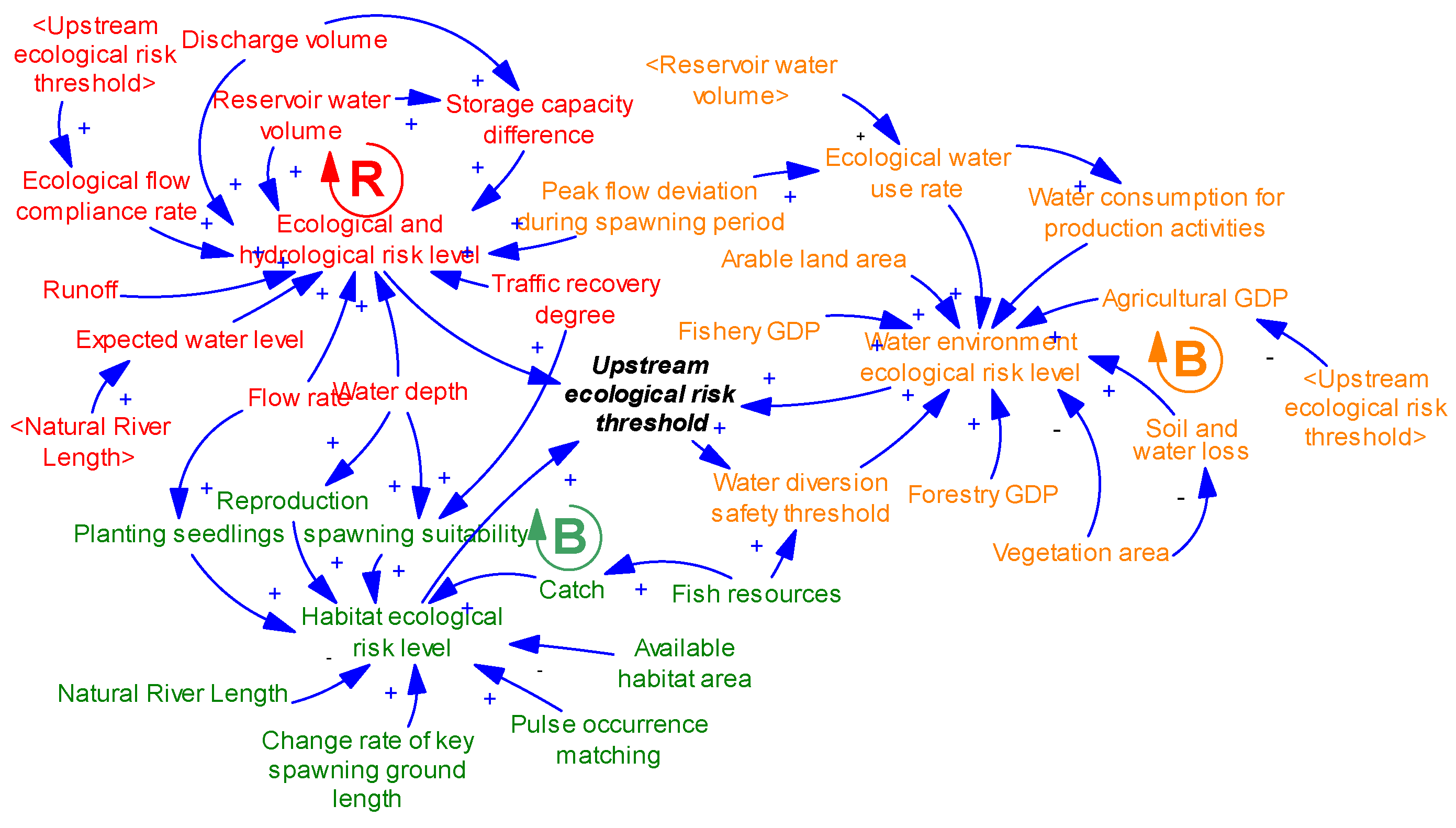
Building upon the decomposition of the system structure and the identification of interaction mechanisms described earlier, this study employs Vensim PLE software to construct a causal loop diagram representing the ecological risk threshold of the upper Yangtze River under multi-reservoir joint water transfer scenarios. The diagram depicts multi-level, nonlinear dynamic coupling relationships among variables, encompassing eco-hydrological risk, habitat ecological risk, and water environment ecological risk. These interactions form multiple positive and negative feedback loops, jointly characterizing the composite driving mechanism linking water transfer operations to the evolution of ecological risk. As illustrated in
Figure 1, the model incorporates both ecological risk reduction loops and ecological risk accumulation loops.
The model’s core feedback pathways are organized around three subsystems: reservoir operation, hydrological processes, and ecological risk threshold variation. This structure systematically reveals the interactive effects among policy regulation, changes in hydrodynamic conditions, and the ecological vulnerability response. For example, joint water transfer schemes alter release flows, storage capacity differentials, and flow recovery levels, directly influencing hydrodynamic parameters such as flow velocity and water depth, while indirectly affecting water surface area dynamics and habitat suitability, thereby driving temporal changes in ecological risk values.
The causal loop diagram not only provides an intuitive representation of the mechanisms underlying the formation and regulation of ecological risk under multi-reservoir joint water transfer conditions, but also establishes a systematic framework and theoretical foundation for subsequent dynamic simulations based on feedback loops. The specific types and functions of the principal feedback loops are summarized in
Table 1.
2.5. System Model Building
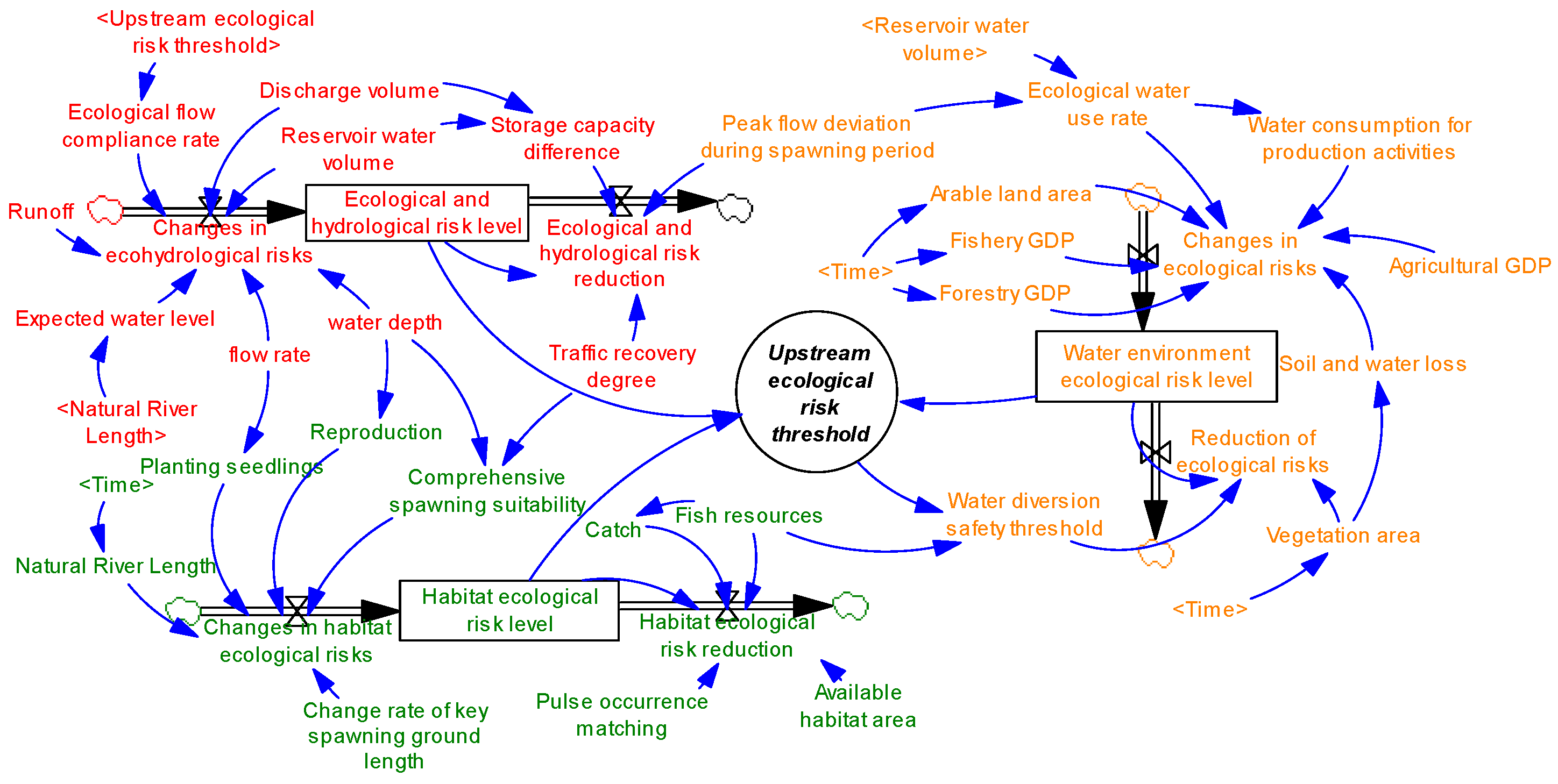
Building upon the aforementioned causal framework of the upstream ecological risk threshold, this study further employs a system dynamics approach to develop a stock–flow diagram (
Figure 2) for simulating the dynamic evolution of the ecological risk threshold in the upper reaches of the Yangtze River under multiple-reservoir joint water diversion scenarios. The model strictly adheres to system dynamics modeling principles, focusing on the multi-level coupling and feedback pathways among state variables, rate variables, and auxiliary variables.
The model design is grounded in the stated research assumptions, with the simulation period set to 0–36 months and divided into a water diversion preparation phase and an implementation phase. It emphasizes the dynamic impacts of water diversion initiation on the upstream ecological risk threshold, water environment ecological risk level, eco-hydrological risk level, and associated economic variables. Model parameters are primarily derived from the Yangtze River Basin Water Resources Bulletin, the Annual Report on Aquatic Ecological Monitoring in the Upper Yangtze River, and operational records of major regional reservoirs. These were supplemented with field surveys and historical monitoring data, and parameterization was achieved through trend extrapolation, table function specification, and expert consultation, ensuring both structural logic and interpretability of simulation results.
To address the system’s time-lag and nonlinear characteristics, the model incorporates multiple types of dynamic response functions. Examples include a threshold response function describing changes in the water diversion ratio corresponding to the diversion safety threshold, a regulatory function capturing the influence of ecological flow compliance rates on eco-hydrological risk, and a delay function reflecting the sensitivity of water environment ecological risk levels to variations in agricultural GDP. These functions enhance the model’s capacity to represent the interlinked “water diversion–ecological risk–economy” mechanism, thereby providing a robust foundation for subsequent multi-scenario simulations of water diversion strategies and the optimization of ecological risk management schemes.
The upstream ecological risk threshold is constructed as a composite indicator integrating three key subsystems: habitat ecological risk, water environmental ecological risk, and eco-hydrological risk. The weighting coefficients (0.32, 0.30, and 0.38) are determined based on a combination of literature-informed judgment and the relative functional importance of each subsystem in influencing overall ecological stability. Specifically, eco-hydrological risk is assigned a slightly higher weight due to its direct role in regulating flow regime and hydrodynamic conditions, which serve as primary drivers of habitat suitability and water quality dynamics. This weighting scheme ensures a balanced yet mechanism-oriented representation of ecological risk formation.
The main variable equations and function specifications are summarized in
Table 2.
3. Results
3.1. Model Validity Test
Following the construction of the system dynamics model, it is essential to validate both its structural integrity and the plausibility of its behavioral outputs to ensure that variable selection, causal structure, and dynamic behavior simulation are closely aligned with real-world conditions and possess robust explanatory power. Such validation provides a reliable foundation for subsequent scenario simulations and the optimization of water transfer schemes. The model validation process comprises two key components: system boundary testing and historical behavior testing, which jointly assess the logical consistency and operational stability of the model.
- (1)
System Boundary Test
The system dynamics model developed in this study focuses on the dynamic evolution of the upstream ecological risk threshold under the context of multi-reservoir joint water transfer, with clearly defined system boundaries encompassing three core components: “joint water transfer operations—ecological risk response—management regulation.” The core model variables include the upstream ecological risk threshold, the water transfer ratio corresponding to the safety threshold, the water environmental ecological risk level, the ecological flow compliance rate, the eco-hydrological risk level, and agricultural GDP. These variables form a complete set of positive and negative feedback loops capable of systematically depicting the coupled impacts of water transfer operations on eco-hydrological processes, environmental risk levels, and economic factors.
In boundary definition, short-term, uncontrollable external shock variables—such as extreme climate events and fluctuations in international commodity prices—were excluded to maintain the system’s closure and the stability of its internal relationships, thereby avoiding the interference of non-structural factors in simulation results. Parameterization and data sources are primarily derived from hydrological monitoring records in the upper Yangtze River, regional reservoir operation logs, watershed ecological monitoring yearbooks, and related socio-economic statistical yearbooks. The dataset spans critical stages before and after water transfer operations, ensuring an accurate representation of the actual evolution of the eco-hydrological–economic system under multi-reservoir joint water transfer scenarios.
Results of the system boundary test indicate that the model demonstrates strong closure, structural rationality, and real-world applicability, thereby providing an effective foundation for multi-scenario simulation analyses and the optimization of ecological risk management strategies. This ensures that the model serves as a robust theoretical and decision-support tool for coordinated reservoir dispatch and ecological security assurance.
- (2)
Sensitivity Analysis
To assess the robustness and reliability of the multi-reservoir joint water transfer ecological risk model under varying conditions of key parameters, this study employs a parameter sensitivity analysis to quantitatively evaluate the influence of perturbations in critical parameters on model outputs. Parameters closely related to the upstream ecological risk threshold—specifically, flow recovery degree, fishery GDP, and catch volume—were selected as the primary sensitivity testing variables.
Under the condition that the model structure and all other parameter values remain unchanged, each of the selected parameters was perturbed individually within a range of ±10%, ±20%, and ±30% relative to its baseline value. Multiple simulation runs were then conducted using Vensim PLE software to capture the resultant variations in model behavior. The sensitivity analysis was implemented based on the relative change rate formula:
where
is the sensitivity coefficient of parameter
to output variable
,
and
are the changes in output variable and parameter respectively, and
and
are the reference values.
The upstream ecological risk threshold was selected as the output variable (
Table 3).
The results indicate that all three categories of variables exhibit notable sensitivity to the upstream ecological risk threshold, with sensitivity coefficients remaining within a stable and interpretable range. Importantly, despite parameter perturbations of up to ±30%, the overall dynamic trends and relative scenario rankings remain consistent, indicating that the model structure is robust and not overly sensitive to individual parameter variations. This stability demonstrates that the model effectively captures the intrinsic feedback mechanisms governing ecological risk evolution, thereby supporting its reliability for scenario-based analysis.
The model’s behavioral patterns remain stable under variations in key hydrological and ecological parameters, demonstrating its capability to accurately capture the dynamic evolution characteristics of the upstream ecological risk threshold in the context of multi-reservoir joint water transfer.
This ensures a reliable computational basis for subsequent multi-scenario regulation simulations and the optimization of risk control strategies.
3.2. Simulation Scenario Design
To systematically evaluate the impacts of multi-reservoir joint water transfer strategies on the ecological risk thresholds of the upper Yangtze River and their dynamic evolution, this study incorporated key ecological risk and water transfer management variables into a system dynamics framework reflecting basin-wide joint reservoir scheduling. Based on this model, four simulation scenarios were designed (
Table 4).
Scenario S0 (Baseline): Maintains current reservoir operation rules and dispatching patterns. Core variables—including ecological risk thresholds, the safe water transfer ratio, aquatic environmental risk levels, ecological flow compliance, ecohydrological risk levels, and agricultural GDP—evolve along historical trajectories, serving as the reference case without external intervention.
Scenario S1 (Optimized Water Transfer Ratio): Increases the safe water transfer ratio by 15% relative to S0, enhancing transfer capacity, improving hydrological conditions during critical ecological periods, and reducing aquatic environmental risks.
Scenario S2 (Ecological Flow Guarantee): Raises the ecological flow compliance rate by 15% relative to S0, simulating the effect of enhanced ecological flow supply capacity through joint reservoir operations, thereby stabilizing ecohydrological risk levels.
Scenario S3 (Agricultural Economy Regulation): Reduces agricultural GDP by 10% relative to S0, simulating an ecological-priority strategy in which reduced agricultural water demand indirectly mitigates both aquatic environmental and ecohydrological risks.
Scenario S4 (Comprehensive Optimization): Combines multiple strategies by increasing both the safe water transfer ratio and ecological flow compliance rate by 5% each, while reducing agricultural GDP by 5%, to evaluate the synergistic effects on improving ecological risk thresholds.
4. Discussion
4.1. Risk Variable Analysis
- (1)
Upstream Ecological Risk Threshold
Across scenarios S0–S4, the upstream ecological risk threshold exhibits a consistent declining trend; however, the magnitude and stability of reduction differ significantly due to distinct underlying regulatory mechanisms. Specifically, scenarios that directly enhance ecological flow compliance (S2) or integrate multi-factor regulation (S4) achieve more stable and sustained reductions, indicating that ecological flow assurance plays a dominant role in stabilizing ecohydrological processes. In contrast, strategies relying solely on water transfer expansion (S1) or indirect demand-side regulation (S3) demonstrate diminishing marginal effects, reflecting the limited capacity of single-mechanism interventions to regulate complex ecological systems.
- (2)
Ecological Hydrological Risk Level
Under S0–S4, ecological hydrological risk levels show an overall fluctuating downward trend, with clear scenario differentiation. In S0, insufficient ecological flow assurance leads to pronounced increases in risk during the dry season and substantial interannual variability. S1’s optimized water transfer ratio effectively reduces hydrological risk during transitional periods between wet and dry seasons but still exhibits high peaks under extreme low-flow conditions. S2, by directly improving the ecological flow compliance rate, significantly reduces annual hydrological risk, with pronounced benefits during peak fish reproduction periods. S3’s agricultural economic regulation strategy improves hydrological risk more indirectly, achieving less impact than S1 and S2, but attenuating fluctuations during the dry season. S4 consistently maintains the lowest hydrological risk levels across all periods, with the most pronounced peak control effect.
- (3)
Habitat Ecological Risk Level
The habitat ecological risk level decreases progressively under S0–S4, with improvement magnitudes dependent on the specific scenario strategies. In S0, risk levels remain relatively high, with limited habitat quality enhancement. S1, by increasing the water transfer ratio, creates more favorable hydrodynamic conditions during critical habitat periods, reducing risk levels significantly, though the effect stabilizes in the mid-to-late stages. S2’s ecological flow guarantee directly improves habitat connectivity and hydrological suitability, achieving a greater reduction than S1. S3 alleviates the competition between agricultural and ecological water use, but its impact on habitat conditions is indirect and limited. S4 achieves the strongest effect through multi-factor synergies, maintaining the lowest habitat ecological risk levels year-round.
- (4)
Water Environmental Ecological Risk Level
Water environmental ecological risk levels decline overall under S0–S4, but improvement rates and stability vary significantly. In S0, limited ecological flow and water transfer capacity result in persistently high risk levels during dry and high water-demand periods. S1’s increased water transfer ratio effectively dilutes pollutants and improves water quality in the early stages, reducing water environmental risk, though mid-term improvement slows due to limited replenishment capacity. S2’s ecological flow guarantee directly enhances dilution and flushing capacity, maintaining consistently good water quality and significantly lowering risk levels. S3, by reducing agricultural GDP, alleviates non-point source pollution pressure from agriculture, yielding some improvement, though less than S1 and S2. S4 performs best overall, maintaining the lowest water environmental risk levels throughout the year with the most stable water quality improvement effect.
4.2. Comparative Analysis of Four Development Scenarios
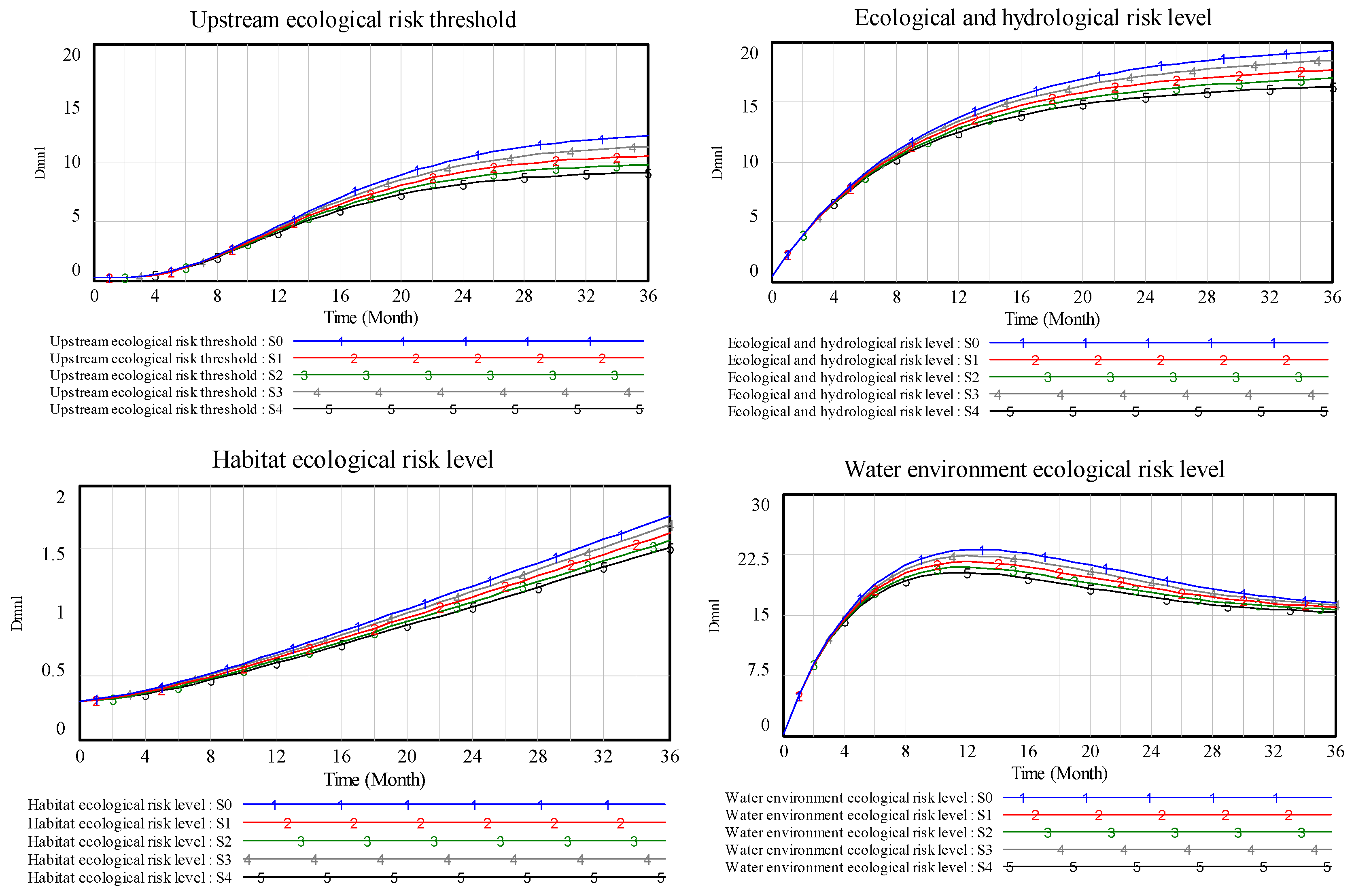
Under the conditions of multi-reservoir joint water transfer, changes in the upstream ecological risk threshold and associated ecological risk levels directly reflect the extent to which dispatching strategies safeguard basin ecological security and maintain system stability. To comprehensively evaluate the integrated effects of different strategies on ecological risk control and ecosystem function maintenance, this study designed five scenarios: the baseline scenario (S0), optimized water transfer ratio scenario (S1), ecological flow guarantee scenario (S2), agricultural water-use reduction scenario (S3), and comprehensive scheduling optimization scenario (S4). Four core indicators—upstream ecological risk threshold, ecological hydrological risk level, habitat ecological risk level, and water environmental ecological risk level—were used as evaluation metrics to systematically analyze the performance and differences among scenarios (
Figure 3).
- (1)
Comparative Characteristics of Upstream Ecological Risk Threshold Changes
Across S0–S4, the upstream ecological risk threshold shows an overall declining trend, with substantial inter-scenario differences. S0 maintains the status quo, resulting in limited reductions and pronounced fluctuations during dry seasons. S1, by optimizing the water transfer ratio, achieves a notable early-stage decline, but the rate slows in the mid-to-late stages due to reservoir storage and inflow variability constraints. S2, by improving ecological flow compliance, maintains low and more stable risk levels year-round compared to S1. S3 indirectly improves the threshold by reducing agricultural water-use pressure, but with delayed and limited effects. S4, benefiting from multi-factor synergies, achieves the greatest decline, maintaining the lowest and most stable levels throughout the year, thereby substantially enhancing ecological safety margins.
- (2)
Comparison of Ecological Hydrological Risk Levels
In S0, ecological hydrological risk levels rise sharply during the dry season, with large intra-annual fluctuations. S1 effectively reduces risk during wet–dry transition periods, though peak values remain prominent under extreme low-flow conditions. S2, through ecological flow guarantees, significantly improves hydrological continuity, markedly lowering annual risk levels, with particularly strong effects during fish breeding periods. S3’s improvements are primarily driven by agricultural water-use reduction, moderating dry-season fluctuations but achieving smaller declines than S1 or S2. S4 maintains the lowest hydrological risk across the entire period, with the most effective peak control, ensuring stable transmission of ecological hydrological processes.
- (3)
Comparison of Habitat Ecological Risk Levels
In S0, habitat risk remains high with minimal improvement in habitat quality. S1 forms more favorable hydrodynamic conditions during critical habitat periods, substantially reducing risk, though the effect stabilizes in later stages. S2 improves habitat connectivity and hydrological suitability throughout the year, with a greater decline than S1. S3 alleviates competition between agricultural and ecological water use, indirectly improving habitat conditions, but with limited overall impact. S4, through multi-strategy synergy, maintains the lowest and most stable habitat risk levels year-round, with habitat quality significantly superior to other scenarios.
- (4)
Comparison of Water Environmental Ecological Risk Levels
In S0, limited ecological flows and high water demand during peak consumption periods result in persistently elevated water environmental risks during both dry and high-pollution seasons. S1’s early-stage optimization of water transfer ratios effectively dilutes pollutants and improves water quality, reducing risk, but the improvement rate slows in the mid-to-late period. S2’s ecological flow guarantee directly strengthens dilution and flushing capacity, resulting in significant and stable risk reduction. S3 reduces risks by lowering agricultural non-point source pollution, though the effect is weaker than S1 and S2. S4 performs best overall, maintaining the lowest risk levels year-round with the most consistent improvements in water quality.
- (5)
Integrated Comparison and Management Implications
Considering the magnitude of change, stability, and long-term improvement effects across the four ecological risk indicators, the scenarios rank as follows: S4 > S2 > S1 > S3 > S0. S4’s superiority lies in its synergistic integration of optimized water transfer ratios, ecological flow guarantees, and reduced agricultural water use, balancing ecosystem stability with efficient water resource utilization. While S1 and S2 perform strongly for specific indicators, they lack overall coordination and are more susceptible to external hydrological variability. S3 can alleviate some water-use conflicts but yields limited overall improvement. Therefore, future multi-reservoir joint water transfer should prioritize a comprehensive optimization model, supplemented with seasonal ecological flow guarantees, to achieve a dynamic balance between ecological risk control and water resource utilization.
5. Conclusions
5.1. Conclusions
This study focuses on the dynamics of the ecological risk threshold in the upper Yangtze River under multi-reservoir joint water diversion conditions. Using a system dynamics approach, we developed a dynamic simulation model that integrates ecological risk threshold determination, eco-hydrological risk propagation, habitat suitability variation, and aquatic environmental carrying capacity. The model emphasizes the evolutionary patterns of four core ecological indicators—upper-reach ecological risk threshold, eco-hydrological risk level, habitat ecological risk level, and aquatic environmental ecological risk level. It reveals multiple feedback pathways linking water diversion, eco-hydrological conditions, and ecological risk, and conducts systematic simulations and comparative analyses across five scenarios (S0–S4). The main conclusions are as follows:
- (1)
Simulation results indicate that the upper-reach ecological risk threshold exhibits distinct upstream–downstream propagation characteristics under different scenarios. The core mechanism can be conceptualized as a closed-loop structure of “water diversion strategy optimization → improvement of ecological flow and water quality conditions → reduction of ecological risk levels → expansion of threshold margins → feedback to enhance scheduling precision,” thereby achieving intrinsic coupling between ecological security and efficient water resource utilization.
- (2)
Scenario comparisons show that:
① S1 (Outflow Optimization) most directly reduces eco-hydrological risk levels, with particularly notable improvements in the ecological risk threshold during the dry season, though it is less effective in mitigating aquatic environmental risks.
② S2 (Water Level Regulation) stabilizes reservoir water levels and moderates flow fluctuations, effectively lowering habitat ecological risks, but with smaller gains in the overall ecological risk threshold compared to S1 and S4.
③ S3 (Enhanced Ecological Diversion) performs best in reducing aquatic environmental risks, significantly improving downstream water quality, although it may exert pressure on upstream water level stability.
④ S4 (Comprehensive Scheduling Optimization) achieves balanced improvements across all four key indicators, resulting in the highest ecological risk threshold by the end of the simulation, concurrent reductions in both eco-hydrological and aquatic environmental risks, and superior overall adaptability relative to single-measure scenarios.
- (3)
Overall, the improvement of the upper-reach ecological risk threshold cannot be achieved through single-mechanism regulation. Instead, it requires coordinated interventions targeting hydrological processes, ecological flow assurance, and water use structure. The findings suggest that ecological risk mitigation in multi-reservoir systems is fundamentally a problem of multi-dimensional coupling regulation, where the effectiveness of management strategies depends on their ability to simultaneously influence hydrodynamic stability, habitat conditions, and water quality processes. This highlights the necessity of adopting integrated scheduling frameworks to achieve long-term ecological resilience and system stability.
5.2. Policy Recommendations and Limitations
- (a)
Policy Recommendations
- (1)
Implement phased ecological risk control: Establish minimum ecological flow and water quality thresholds for ecologically sensitive periods (e.g., fish spawning season, dry season) and integrate S1 outflow optimization with S3 ecological diversion to reduce synchronous peaks in eco-hydrological and aquatic environmental risks.
- (2)
Optimize coordinated control of water level and ecological flow: Apply S2 water level regulation to reduce habitat disturbances from reservoir level fluctuations, and combine with the S4 comprehensive scheduling mode to maintain dynamic equilibrium of water levels and flows across the entire basin.
- (3)
Establish cross-basin ecological risk joint prevention mechanisms: Integrate reservoir operation, fisheries protection, and water environment monitoring into a unified scheduling and evaluation platform, forming a multi-department collaborative ecological risk prevention and control system.
- (b)
Limitations and Future Directions
- (1)
The current model does not incorporate the impact of extreme climate events (e.g., sudden floods or prolonged droughts) on the ecological risk threshold. Future work should integrate climate scenario simulations for risk forecasting.
- (2)
The model is primarily based on macro-scale hydrological and ecological risk indicators and does not capture micro-scale hydrodynamic processes within specific habitats. Subsequent research could employ high-resolution hydrodynamic–ecological coupled models to enhance spatial granularity.
- (3)
Current ecological risk assessment mainly relies on hydrological and water quality conditions, without fully considering biodiversity and ecosystem structural changes. Future studies could introduce a multi-indicator integrated evaluation framework to achieve holistic “water quantity–water quality–biology” risk analysis.