Article

Exploring the Land Use Mismatch Phenomenon in the Urbanization Process: A Temporal–Spatial Perspective from Urban China


1
Research Institute for Urban Planning and Development, Hangzhou City University, 51 Huzhou Street, Hangzhou 310015, China
2
School of Spatial Planning and Design, Hangzhou City University, 51 Huzhou Street, Hangzhou 310015, China
3
School of Management Science and Real Estate, Chongqing University, Chongqing 400044, China
4
Department of Urban Planning and Design, Xi’an Jiaotong-Liverpool University, Suzhou 215123, China
5
Department of Building and Real Estate, The Hong Kong Polytechnic University, Hong Kong, China
6
UniSA STEM, University of South Australia, Adelaide, SA 5000, Australia
*
Authors to whom correspondence should be addressed.
Land 2026, 15(4), 591; https://doi.org/10.3390/land15040591
Submission received: 21 February 2026 / Revised: 31 March 2026 / Accepted: 2 April 2026 / Published: 3 April 2026

Abstract

Improving urban land use efficiency is a critical pathway toward sustainable urban development, particularly in large countries undergoing rapid urbanization such as China. However, significant disparities in land use efficiency exist across cities, largely due to differences in economic development, resource endowments, and governance practices. These disparities highlight the necessity of conducting a systematic spatiotemporal assessment of land use mismatch at the city level to identify regional weaknesses and inform differentiated policy mechanisms. This study extends the land use mismatch (LUM) model, which introduces a supply–demand framework for analyzing the mismatch phenomenon of urban land use. Building on the LUM model, this study innovatively develops a classification system of five mismatch zones across eight construction land types, which provides a more systematic and comprehensive approach to identifying land use mismatch patterns. The empirical analysis is conducted using data from 283 prefecture-level cities in China. The results reveal substantial spatial heterogeneity in land use mismatch across Chinese cities. Most of the cities in East China generally fall within acceptable mismatch zones, where market mechanisms play a more effective role in land allocation. Cities in Western China exhibit more serious mismatch levels, where policy intervention seems more significant in land use planning. Cities in Central China demonstrate mixed patterns, ranging from acceptable to severe mismatch. The findings further indicate that these disparities are associated not only with economic and geographical differences but also with variations in governance practices, particularly the interaction between policy intervention and market mechanisms. This study introduces a new approach to examining the patterns of land use mismatch and provides evidence-based policy recommendations for cities in different regions to reduce land mismatch and promote more efficient use of urban land.

1. Introduction

Land resources serve as the foundation for urban economic activities and are indispensable for fostering economic and social development. Efficient management of land resources plays a vital role in promoting sustainable growth in cities. Effective use of urban land resources has been a typical research focus, particularly in large developing countries such as China, where land use for urbanization has been a major national development scheme in the past few decades. The efficient utilization of urban land has been a key topic of study, particularly in rapidly developing nations like China, where urban expansion has been a central strategy of national development over recent decades [1,2,3].
However, numerous studies have highlighted that urban land has often been used inefficiently and unsustainably during the rampant urbanization process [4,5,6]. Previous studies have argued that the mismatch in urban land use is a typical indicator of the inefficiency in utilizing urban land resources. Various issues arising from this mismatch have been widely reported, such as misguiding urban planning, hindering economic and social development, and causing damage to the urban environment [7,8]. For example, Huang et al. [9] show the degradation of urban land resources due to improper land use allocation. Li and Li [10] argued that the mismatch of urban land use presents a barrier to both industrial transformation and economic development.
Considering the detrimental effects and consequences associated with mismatched land use, a comprehensive understanding of how and to what degree these mismatches occur in urban land management is essential for developing effective corrective measures. Midrigan and Xu [11] emphasized that understanding the nature of land use mismatches provides critical insights for designing corrective measures to mitigate the mismatch, and that this will contribute to achieving sustainable urban development. This understanding is considered particularly essential in China. Gao et al. [12] appreciate that the rapid urbanization in China was accompanied not only by the consumption of a large amount of urban land resources but also by the problem of mismatched use of land resources. According to Sun et al. [13], China has accounted for 47.5% of the total newly added urban area worldwide over the past 18 years. China, therefore, bears both the opportunity and the responsibility to reduce land use mismatch and enhance the efficiency and effectiveness of urban land resource utilization. Considering the size of the country, China can make significant contributions to sustainable urban development in global terms by mitigating the above problem of land use mismatch.
Land development is the primary vehicle for urban growth [14]. The concept of urban land use mismatch refers to the deviation from the optimal allocation of land resources, which indicates an imbalance between land resource supply and demand shaped by the dual driving forces of governmental regulation and market operation [15,16]. Given that China has developed a land-centered urbanization development model, many studies have been conducted to examine land use mismatch under this specific context. For example, Shi et al. [17] introduced a novel framework for assessing the spatial mismatch of construction land by considering planning deviation and economic mismatch, revealing substantial heterogeneity across 285 Chinese cities between 2002 and 2021. With respect to 273 public primary schools in China, Sun et al. [18] quantified the spatial mismatch of school land by calculating the proportion of the supply–demand difference relative to the original land supply. The results indicate that the mismatch is primarily due to supply exceeding demand. Shen et al. [19] proposed a model for measuring land use mismatches in quantitative terms and validated its practical use on a sample of 35 Chinese cities. The findings indicate that land use mismatches are substantial in Chinese cities.
However, on the one hand, although some studies have conducted spatiotemporal analyses of land use mismatch in Chinese cities, those studies mainly focus on a single type of construction land. In fact, the built-up areas in the context of urban China consist of eight construction land types; all types of these lands should be incorporated in investigating the mismatch pattern of land use. On the other hand, although some studies have proposed frameworks to analyze the mismatch degree of the eight construction land types, there is a lack of in-depth empirical analysis referring to a sufficient number of sample cities from a spatiotemporal perspective. Nevertheless, considerable variations in land use efficiency exist among Chinese cities, reflecting differences in their economic, social, and resource endowments, which in turn affect urban land planning and management. As a result, the overall situation of land use mismatch in China remains ambiguous, which affects the efficient allocation of urban land resources and the pursuit of sustainable development across cities. Further analysis uncovers distinct regional heterogeneity in mismatch patterns. Economically developed regions display milder mismatch patterns, whereas less developed areas exhibit more pronounced mismatches. Furthermore, some scholars have analyzed land resource mismatch from the perspective of production efficiency, demonstrating a close association between land resource mismatch and total factor productivity (TFP); specifically, a higher degree of land resource mismatch is often accompanied by lower TFP [20,21]. In other words, the specific manifestation of urban land use mismatch lies in the loss of land use efficiency.
This study is based on the land use mismatch (LUM) model proposed by Shen et al. [19], with the aim of systematically examining the temporal evolution and spatial heterogeneity of land use mismatch across Chinese cities. It is expected to indicate the differentiation in land use mismatch patterns across different cities, where the differences exist in economic, social, and resource endowments. It is these differences that affect urban land use planning and management [22]. The innovation of this paper is the development of a classification system comprising five mismatch zones across eight land types. This classification offers a new methodological framework for investigating land use mismatch patterns, which can be extended to conduct research in the discipline in other regions and countries beyond China. The analysis results can offer policymakers practical recommendations for optimizing land resource allocation and enhancing land use efficiency.

2. Methodology

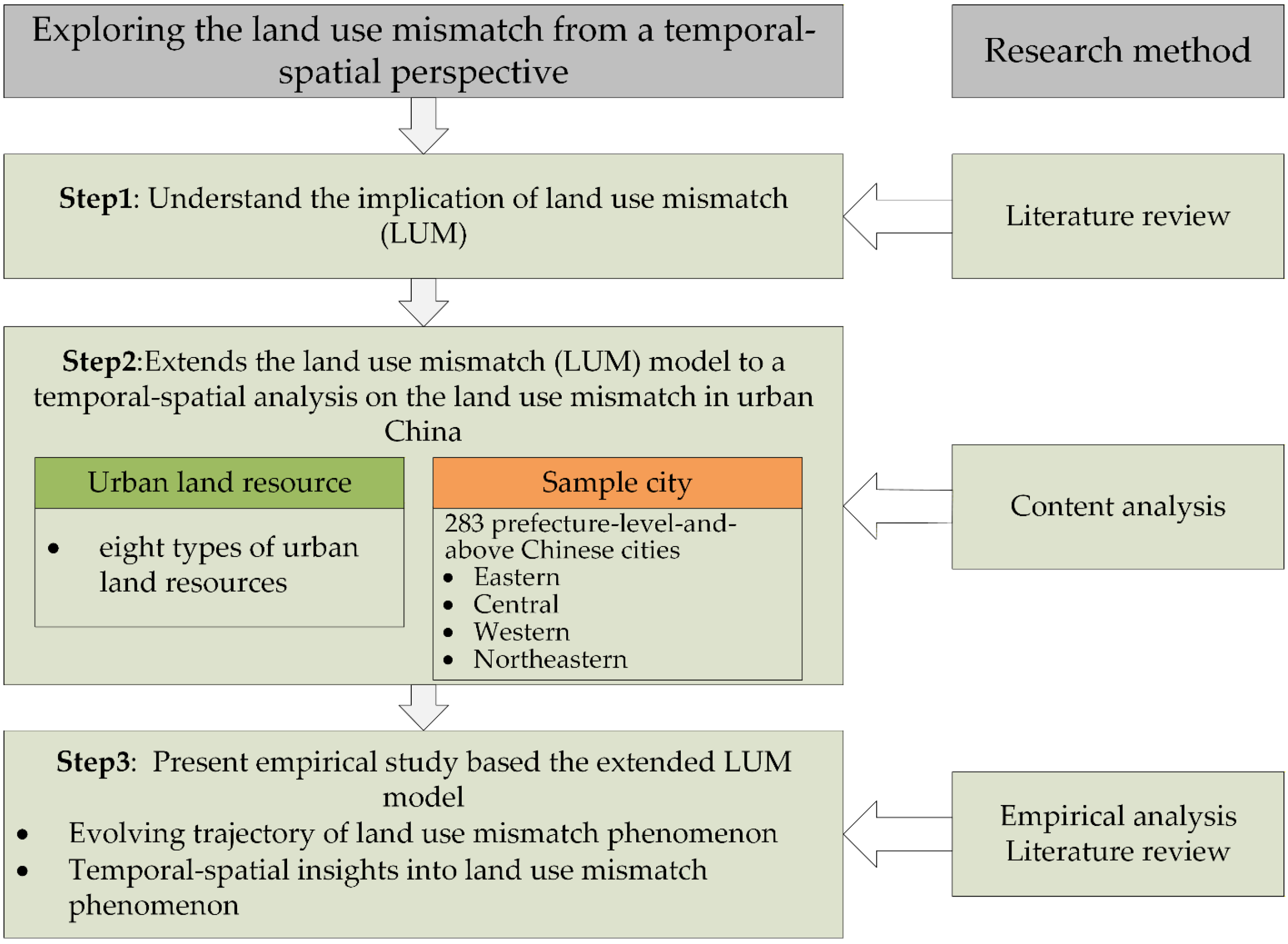
According to the research framework illustrated in Figure 1, this study aims to investigate the phenomenon of land use mismatch (LUM) from a temporal–spatial perspective. In the first step, a literature review is conducted to comprehend the implications of land use mismatch. In the second research procedure, the LUM model is extended by incorporating it into a temporal–spatial analytical framework, with a particular focus on urban land use issues in China. The research objects consist of 283 prefecture-level and above cities, covering eight types of urban land resources, and content analysis is performed across four major regions: Eastern, Central, Western, and Northeast China. Finally, by integrating the literature review with empirical analysis, this study reveals the evolutionary trajectory of the LUM phenomenon and offers temporal–spatial insights into LUM, thereby providing systematic support for effectively improving the mismatch in urban land resource utilization.
The main research method for conducting this empirical study is to adopt the land use mismatch (LUM) model introduced by Shen et al. [19]. The principal assumption of the LUM framework posits that land use mismatch exists when the allocation of land resources deviates from actual requirements, thereby creating a disparity between supply (S) and demand (D). This supply–demand analytical lens is well-supported in other studies. For instance, studies such as Zhang et al. [23] have measured land use mismatch by evaluating gaps between planned demand and actual supply, while Sun et al. [18] and Zhang et al. [24] have emphasized the importance of examining the problem of land use mismatch from a supply–demand perspective and underscored that understanding such disparities is crucial for formulating policies to enhance land use efficiency. Based on these analogies, the generic model of LUM is expressed as follows [19]:
LUM = S D D
where S denotes the supply of land resources, and D represents the corresponding demand. The resulting LUM coefficient quantifies the relative deviation of supply from demand, reflecting the degree of imbalance in land resource allocation within urban social and economic activities.
The LUM coefficient in Equation (1) may take positive or negative values. A positive LUM value will appear when supply is greater than demand, representing an oversupply land use mismatch, in which case some land resources are in an idle state. On the other hand, a negative LUM occurs when demand is greater than supply, representing a supply–shortage mismatch, in which case there is a land supply shortage in meeting the demand.
In establishing the LUM model, Shen et al. [19] appreciated that there are typically eight types of urban land resources, and each of them represents different levels of land use mismatch. Thus, it is necessary to examine the mismatch status against each type of urban land. The indicators for measuring the variables S and D in Equation (1) against all eight types of urban land therefore need to be established, as listed in Table 1 [19].
Accordingly, the LUM Equation (1) can be specified by referring to different types of urban land as follows:
lum i , j = S i , j D i , j D i , j
where lumi,j represents the mismatch coefficient for land type i (i = 1, 2, …, 8) in sample city j; and Si,j and Di,j refer to the respective supply and demand indicators for that land type in the given city.
To ensure comparability across indicators with varying magnitudes, the calculated lumi,j values are normalized using the following equations:
lrm i , j = lrm i , j min ( lrm i , j ) max ( lrm i , j ) min ( lrm i , j ) , ( lrm i , j > 0 )
lrm i , j = lrm i , j min ( lrm i , j ) max ( lrm i , j ) min ( lrm i , j ) , ( lrm i , j < 0 )
where lumi,j denotes the normalized mismatch coefficient. Equation (3) applies to positive values, where higher normalized results indicate greater degrees of oversupply mismatch, scaled within [0, 1]. Equation (4) normalizes negative values, with results within [−1, 0] reflecting the severity of supply shortage mismatch.
The above Equations (2)–(4) will be adopted to conduct the empirical calculation and analysis in the following sections.

3. Data Processing

The data used for analysis in this study refer to all prefecture-level and above cities in China. The choice of these sample cities is to ensure that the research findings can reflect the characteristics of the overall urban land use system in China. During the data collection process, due to missing or incomplete statistical data for some cities, the final valid sample consists of 283 prefecture-level and above cities. The data for these indicators listed in Table 1 are collected for 283 prefecture-level and above cities in China for a ten-year period from 2012 to 2021. The data of the supply (S) indicators were collected from the China Urban Construction Statistical Yearbook (Ministry of Housing and Urban-Rural Development, China, 2013–2022), and the data for the demand (D) indicators were collected from the Code for Classification of Urban Land Use and Planning Standards of Land Development (Ministry of Housing and Urban-Rural Development, China, 2012). For the indicators with no specified criterion, including D3, D4, D5 and D7, their values were calculated by referring to the existing average supply quotas across the sample cities. The calculated demand indicators for different land types can be found in Table A2 in Appendix A.
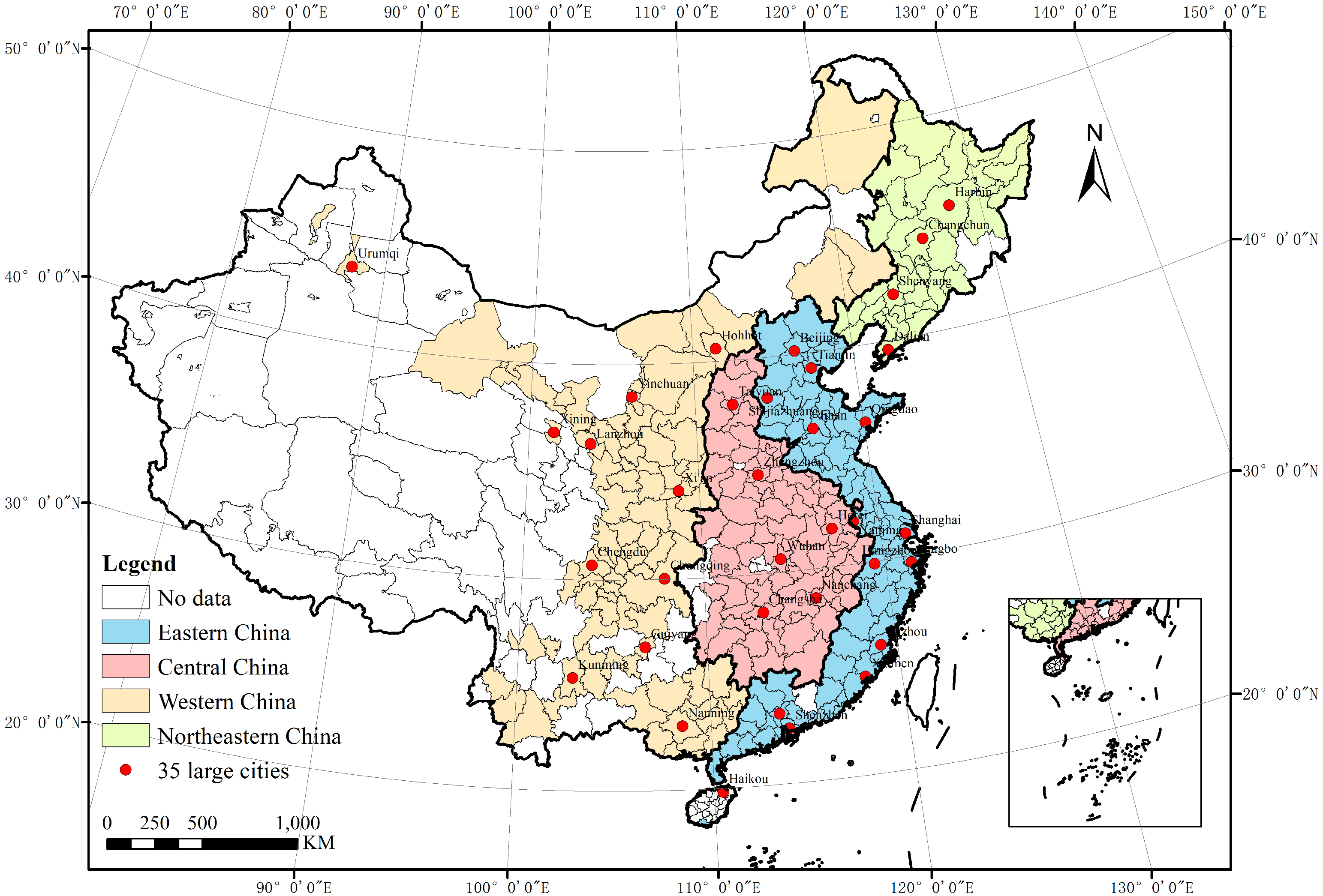
On the other hand, the 283 sample cities in China are grouped into four regions to conduct spatial analysis, namely, the Eastern, Central, Western, and Northeastern regions. This spatial classification is in line with the official specification defined by the National Bureau of Statistics of China (NBSC, 2011). The composition of the cities in each region is listed in Table A1 and Figure A1 in Appendix A. The number of cities in the Eastern, Central, Western, and Northeastern regions is 85, 80, 84 and 34, respectively.
By applying the data described above to the calculation Equations (2)–(4), the normalized values of the mismatch coefficient lumi,j were obtained.
Furthermore, with reference to the mismatch classification framework proposed by Shen et al. [19], there are five mismatch zones, as shown in Table 2. The values for the parameters a1, a2, b1 and b2 in Table 2 are derived by applying the natural breaks method in ArcGIS 10.8 software with reference to the mismatch coefficient. The natural breaks method determines class boundaries by minimizing within-class variance and maximizing between-class variance, thereby revealing inherent grouping patterns in the data, which has already been widely applied in previous studies [25,26]. Compared with other common classification methods, such as equal interval or quantile classification, the natural breaks method better reflects the natural distribution of the dataset and reduces distortions caused by arbitrary interval division. In this study, the land use mismatch values across the sample cities exhibit clear spatial heterogeneity; thus, the natural breaks method is more suitable for identifying meaningful classification boundaries. As a result, the values of the parameters (a1, a2, b1 and b2) across all eight land types were obtained, as shown in Table 3. By referring to the information in Table 2 and Table 3, the classification criteria for LUM zones were established, as shown in Table 4.
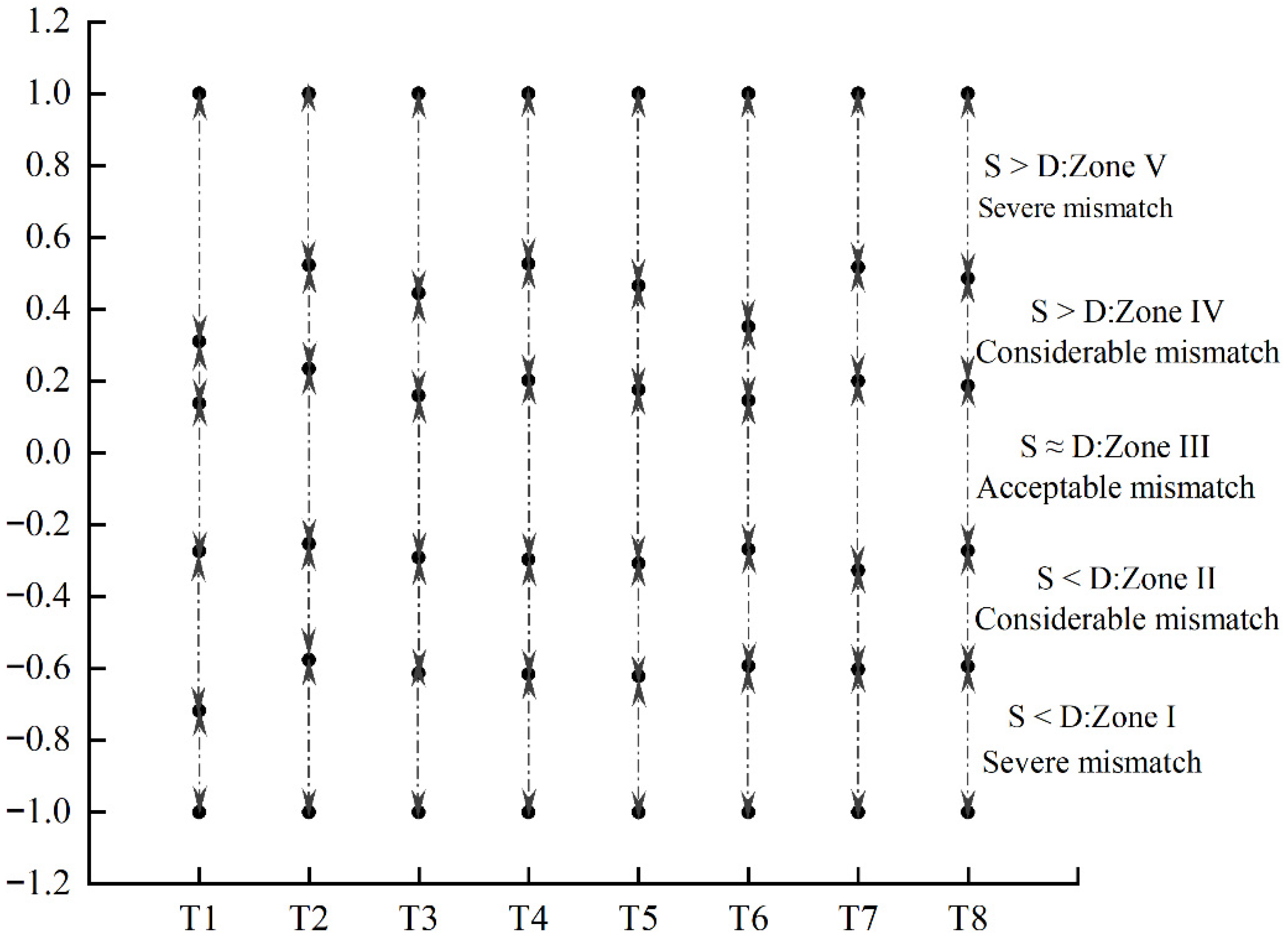
The classification criteria for LUM zones across eight land types in Table 2, Table 3 and Table 4 is also visualized in Figure 2.
As shown in Figure 2, for the eight land types, Zone III represents the minimal mismatch degree (Acceptable mismatch), where land supply is close to land demand. Zones I and II represent scenarios where land supply is significantly less than land demand, with Zone I indicating a Considerable mismatch and Zone II indicating a Severe mismatch. Zones IV and V represent scenarios where land supply significantly exceeds land demand, with Zone IV indicating a Considerable mismatch and Zone V indicating a Severe mismatch.

4. Results

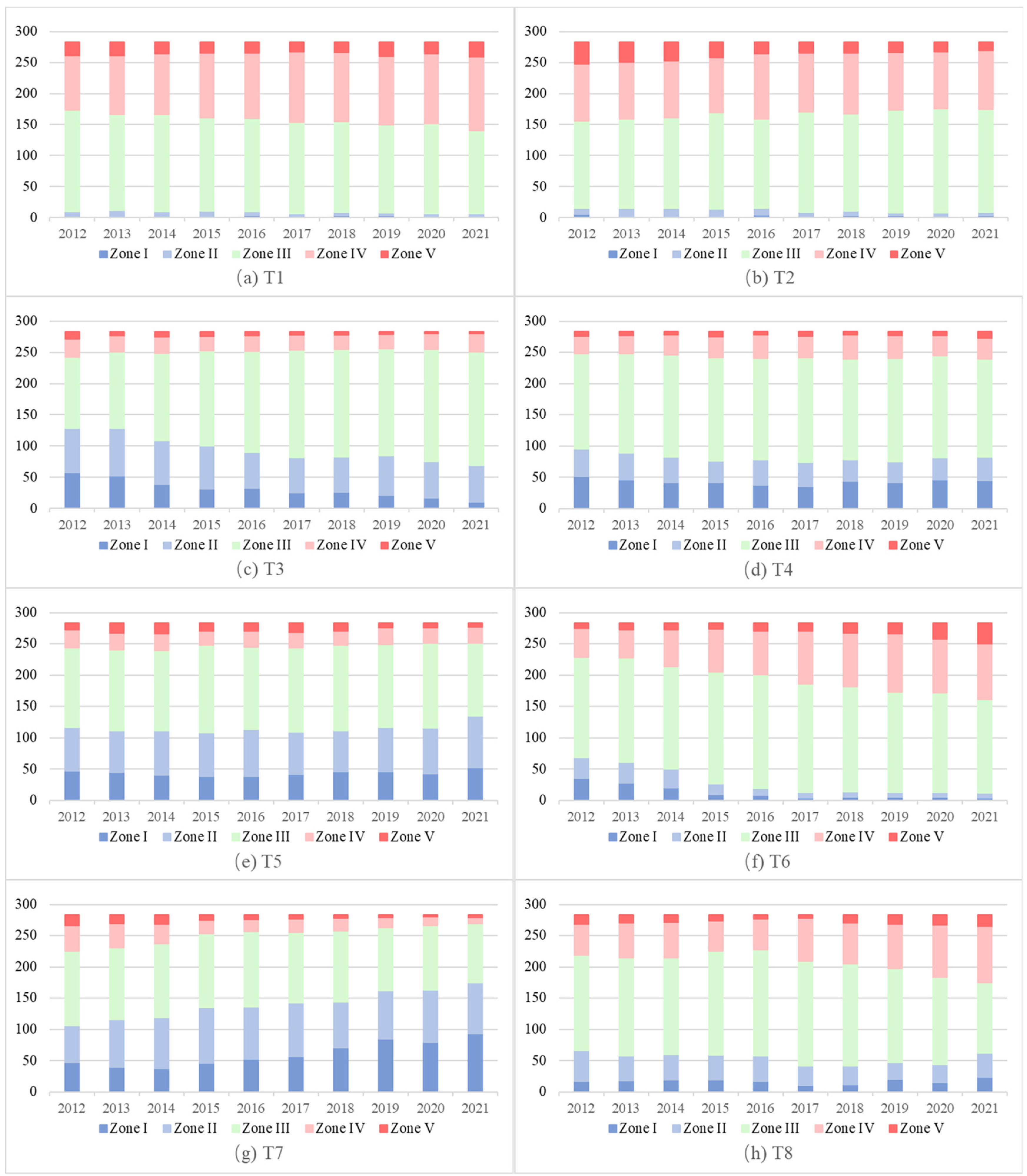
By referring to the data in Appendix A (composition of the cities in different spatial regions), the data values of mismatch coefficients, and the data in Table 4 (classification criteria for LUM zones), the evolution of the number of cities positioned in different mismatch zones across eight land types during the survey period (2012–2021) can be obtained, and the evolution profile can be presented in Figure 3.
Based on the results presented in Figure 3, the evolving trajectory of the land use mismatch phenomenon is categorized into three types: unchanged cases, improved cases, and mixed cases. During the 10-year survey period, the land use mismatch patterns in Land Type T1 (residential land), T2 (land for administration and public services), T4 (land for industry and manufacturing), and T5 (land for logistics and warehouses) showed no obvious changes. In contrast, Land Type T3 (land for commercial and business facilities) exhibited more significant improvement in the land use mismatch phenomenon, particularly for its “S<D” mismatch pattern. The other three land types, namely T6 (land for roads, streets and transportation), T7 (land for municipal utilities), and T8 (land for green space and squares), presented mixed patterns in land use mismatch.
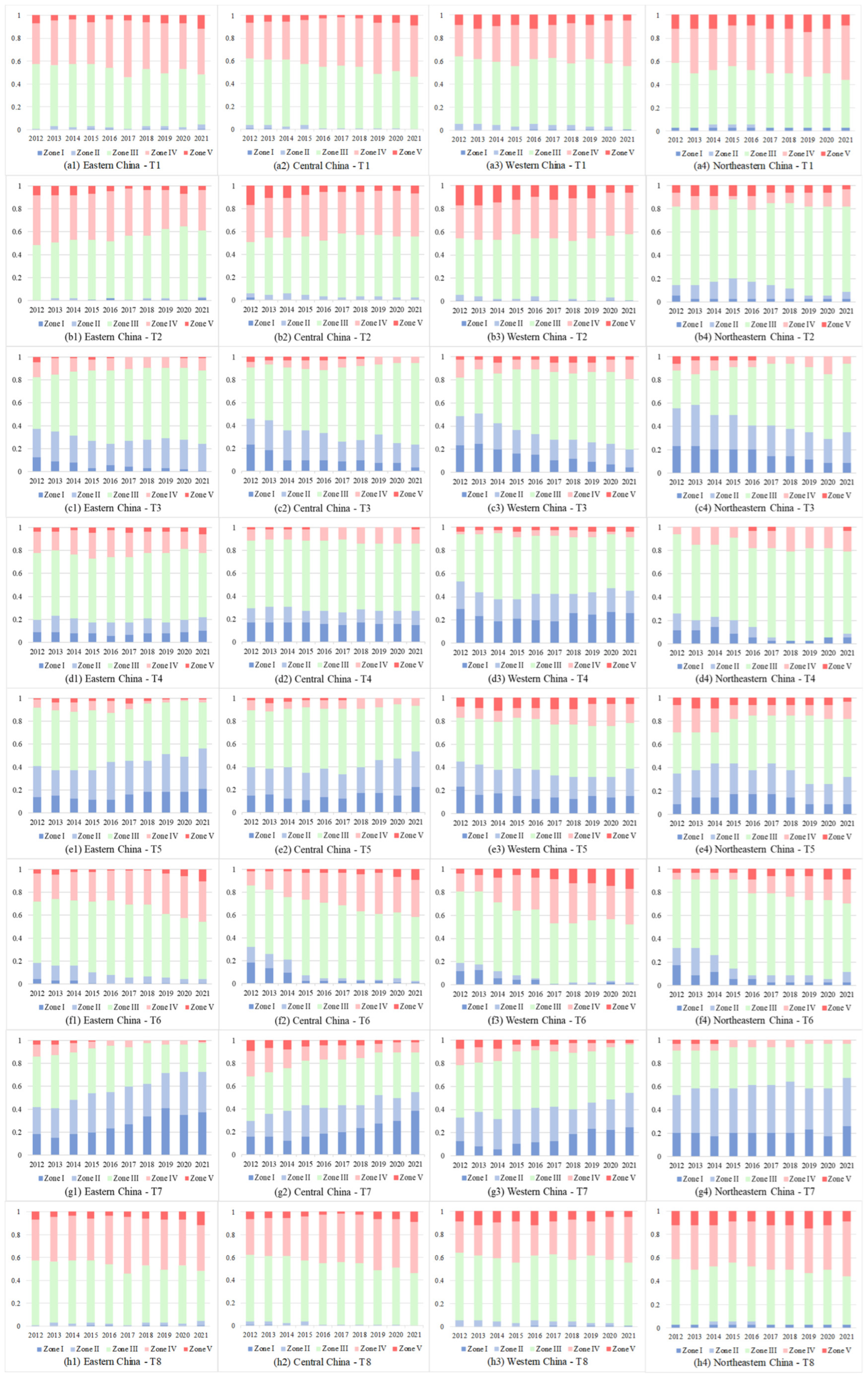
The overall profile of the land use mismatch between various spatial regions can be examined from an integrative temporal–spatial perspective, as shown in Figure 4.
Figure 4 presents the number of cities with proportional positioning in different LUM zones during the survey period (2012–2021). As illustrated in the figure, it can be observed that the mismatch performance of the eight land use types not only exhibits significant differences among the various land use types but also demonstrates obvious spatial differences across the four regions, namely Eastern, Central, Western, and Northeast China.

5. Discussion

5.1. Evolving Trajectory of Land Use Mismatch Phenomenon

(1) Unchanged cases: Land Types T1 and T2 remain serious or significant “S>D” mismatch phenomena, which are located in mismatch Zones IV and V, namely oversupply. This mismatch phenomenon is particularly obvious for real estate Land Type T1. This scenario can be analyzed as follows. The governments at the city level have been very keen on developing the real estate market since the late 1990s in China. The local governments’ financial revenues largely relied on selling land for real estate development, and this phenomenon is often described as land finance in existing scholarly work. The local governments are therefore highly motivated to provide real estate land, although it is more than sufficient; thus, it is always the case that land supply for real estate exceeds demand. Unfortunately, this land finance practice has resulted in many problems, and the vast amount of urban land consumption threatens sustainable urban development. According to Wu et al. [27], land finance practice was adopted by local governments in the early 1990s and has contributed significantly to the industrialization and urbanization of China for decades. Driven by this practice, the real estate market in China has developed rapidly and has become an important component of the Chinese economy [28]. Another serious problem induced by land finance practice is the uncertainty of generating revenues. The finance revenue would decrease dramatically when there is a problem in the real estate market, which affects the operation of government offices and the provision of public services. The study by Chen et al. [29] reveals that, because of the current shrinking real estate market, many local governments in China have serious problems of financial deficits since the revenues collected from selling real estate land dropped substantially. Although this land finance problem has been well recognized by the government at both central and local levels, it seems difficult to find effective solutions in the short term. The local governments must adjust the economic structure and avoid the overreliance on obtaining financial revenues by selling land for real estate development.
Land Type T2 is for the development of administration and public services, typically including governmental office buildings, hospital and medical facilities, education and library buildings, sports grounds, entertainment facilities, and others. It is interesting that the land for these public facilities has been in a state of significant oversupply “S>D”. This suggests that the Chinese government has been putting public interests as a priority by providing more than sufficient land for development. However, the idle state of these lands presents the problem of land waste. The local governments should take the opportunity of urban renewal to review the land allocation for administration and public services and take actions to reinvigorate the wasted land resources and reduce the mismatch phenomenon.
On the other hand, Land Types T4 and T5 continue to show significant “S<D” mismatch phenomenon, namely supply shortage, which is located in mismatch Zones I and II in Table 2. This means that the land supply shortage for manufacturing and logistics industries has always been the case, which can be explained as follows. As these industries do not generate high-profit, quick-turnover revenues for local governments, they are usually not on the governments’ priority list for development; thus, the land supply for these industries is under very strict control. Nevertheless, manufacturing and logistics industries are important economic sectors for supporting long-term sustainable urban development, and an adequate amount of land must be provided for their development. As it can be perceived, the real estate industry will not be the main source of financial revenues for local governments; it is time for local governments to change their mentality of land finance and adjust local industrial structure as well as the land use pattern. Policy instruments should be designed and implemented to encourage the development of industries such as manufacturing and logistics industries by devoting more land resources.
(2) Improved cases: The land use mismatch phenomenon in Land Type T3 shows more improvement during the surveyed 10-year period with respect to its mismatch patterns “S<D”, as shown in Figure 2. This means that the degree of land supply shortage for commercial and business development has been decreasing over time. Decisions regarding the development of commercial and business facilities are commercial behaviors, which have less interference from government. It seems that the market mechanism has played an influential role in balancing the demand and supply of land for commercial and business development. In undertaking commercial activities, investors will carefully consider market factors when making decisions on what and how much land resources are needed. Consequently, the demand and supply for this type of land are more balanced. This further shows that the land use mismatch phenomenon will decrease if the market mechanism is properly adopted to facilitate the regulation of land supply and demand. From this case, the local governments may gain inspiration: Land supply and demand can be more balanced and subject to less mismatch if less governmental interference is imposed and more commercial behavior is allowed [30].
(3) Mixed cases: Three cases, namely Land Types T6 (land for roads, streets and transportation), T7 (land for municipal utilities), and T8 (land for green space and squares), have presented mixed results regarding the land use mismatch pattern.
For Land Type T6, the supply-shortage mismatch phenomenon “S<D” has been diminishing over the survey period, but at the same time the oversupply mismatch phenomenon “S>D” has been increasing. Land Type T6 is largely for the development of urban infrastructure. During the real estate boom in China, land for urban infrastructures had to make way for real estate development land, resulting in a supply shortage for urban infrastructure. In recent years, however, the Chinese government has realized this problem and has invested considerable resources, including land, for developing and improving infrastructure such as roads, streets and transportation; thus, the problem of land shortage for these purposes has been diminishing. However, blind land investment in infrastructures has emerged as a problem, which has led to the oversupply of land for the development of roads, streets and transportation. This is the result of the overreaction on the previous problem of supply shortage for this type of land, followed by improper feasibility study on land demands when infrastructure projects are planned. Previous studies also argue that the blind urban infrastructure investments have already brought various problems [31]. A typical problem is the serious fiscal deficits borne by local governments as, on the one hand, these infrastructure projects do not generate any revenues, and, on the other hand, the real estate industry, which used to be the main revenue source, has been shrinking [32,33].
On the contrary, for the oversupply mismatch phenomenon “S>D”, Land Type T7 (land for municipal utilities) has been diminishing, while the land shortage mismatch phenomenon “S<D” has been increasing. Land Type T7 mainly provides land for developing municipal utilities such as electricity supply systems, urban drainage systems, sewage systems, water supply systems, gas supply systems, heating systems, sanitation facilities, urban fire facilities, urban safety facilities, and others. In previous years, when urbanization was at an early stage, the Chinese government had been providing more than sufficient land for developing these municipal utilities. However, as the urban population has been increasing in line with the progress of urbanization, these utilities do not seem sufficient. Consequently, the problem of land shortage mismatch “S<D” has been emerging increasingly in recent years. It is noted that the Chinese government has prioritized urban renewal as a major development strategy for the near future. It is suggested that local governments should take the opportunity of urban renewal to properly plan land supply for municipal utilities to meet the municipal utilities demand of the urban population.
Furthermore, Land Type T8 (land for green space and squares) shows a similar phenomenon to that in Land Type T6. This means that the supply shortage phenomenon “S<D” has been diminishing to a certain extent over the survey period, but the oversupply phenomenon “S>D” has been showing an increasing trend. Land Type T8 is largely provided for the development of green areas and public squares. Traditionally, green space and public squares have been under very limited provision in cities in China, characterized by “S<D”. However, to improve urban residents’ well-being by providing good quality green space and public squares, the Chinese government has been investing more land resources for developing these public spaces in recent years. Consequently, the mismatch problem of land shortage for green space and squares has been diminishing. Nevertheless, similar to the case of Land Type T6, blind land investment committed in recent years on green space and squares has also emerged as a problem. Local governments should take this land oversupply problem into account when planning urban renewal projects to achieve a balanced supply–demand trade-off of urban green areas and public spaces to not only enhance residents’ well-being but also guarantee land use efficiency.

5.2. Temporal–Spatial Insights into the Land Use Mismatch Phenomenon

With respect to Land Type T1 (residential land), all regions continue to have the problem of mismatch “S>D” during the survey period, and this problem appears to be more serious in Western and Northeastern China, where many cities are positioned in LUM Zone V. This scenario has been discussed in Section 5.1. Real estate development has been the key economic driver throughout China over the past four decades, and the main source of revenue for all local governments is from selling real estate land. This land finance practice is particularly prominent in Western and Northeast China, where the economy is relatively less developed. The local governments in these regions therefore have been supplying more land than needed for real estate development, as shown in Figure 4. Unfortunately, the practice of overreliance on land finance has resulted in severe governmental debt in these regions. In the past, when the real estate market was booming, these governments could generate good revenue and had sufficient finance capability to invest in various infrastructures. However, the commitments to these infrastructures have become debts when the government cannot afford to pay for their construction. Therefore, the local government departments in these regions should adjust the structure among economic sectors by encouraging the development of industries other than real estate and reducing the reliance of financial revenues on the real estate industry.
With respect to Land Type T2 (land for administration and public services), all regions have experienced no significant changes in their state of significant oversupply mismatch (“S>D”) during the surveyed period. Nevertheless, the severe phenomenon of the mismatch has been diminishing across all regions. This suggests that local governments throughout the country have been improving their planning and regulatory performance in overseeing land use for public services; thus, the mismatch regarding land supply for this sector has been reduced, and land utilization efficiency has been improved.
Considering Land Type T3 (land for commercial and business facilities), the mismatch pattern of “S<D” has been diminishing in all regions during the survey period. It indicates that local governments have realized the importance of developing commercial and business facilities; thus, more land resources have been allocated to these industries. Consequently, the mismatch problem of land shortage for commercial and business facilities has been gradually tackled.
With respect to Land Type T4 (land for industry and manufacturing), the significant pattern of “S<D” remains largely unchanged in all regions except Northeast China. This means that most local governments have not given sufficient attention to the problem of land shortage for industry and manufacturing. As explained earlier, these economic sectors do not generate as much revenue as the real estate industry; this problem of “S<D” for Land Type T4 is particularly severe in Central and Western regions. However, it is interesting to note that this problem of “S<D” in the Northeast region has been diminishing, as shown in Figure 4. It appears that the local governments in Northeast China, where industry and manufacturing used to be their main economic sectors, have been adjusting the economic dominance of real estate towards other sectors, such as industry and manufacturing, by reshaping their policy of allocating land resources. The local governments in this region shall take advantage of their industry strength built traditionally as the driving force for their future economic reinvigoration and development.
With respect to Land Type T5 (land for logistics and warehouses), the typical land use mismatch phenomenon across all regions is “S<D”, namely land shortage. This problem remains, to large extent, unchanged across all four regions in China, although the severity of the phenomenon fluctuates during the survey period. Nevertheless, it is interesting to note that Western and Northeast regions present not only land shortage but also land oversupply problems, as shown in Figure 4. This indicates that different cities in these regions exhibit different patterns of land use mismatch, where some cities present land shortage problems, and others show land oversupply phenomena. Nevertheless, it is considered that logistics and warehouse industries hold great potential as important economic sectors in the digital era, and local governments should plan for the development of these sectors by providing proper land resources.
Two interesting scenarios co-existed with reference to Land Type T6 (land for roads, streets and transportation) across all four study regions. On the one hand, the significant mismatch problem of land shortage “S<D” has been diminishing, and on the other hand, the mismatch problem of land oversupply “S>D” has been increasing. The general reasons behind this contradictory scenario have been addressed in Section 5.1. Nevertheless, it should be noted that the problem of oversupply has been worsening in Western and Northeast regions than in the Eastern and Central regions. In relative terms, the Western and Northeast regions in China have more spare land suitable for developing roads, streets and transportation. On this basis, local governments may have less awareness of land value when planning land for the development of these infrastructure projects, thus easily moving from one extreme (severe “S>D”) to another (severe “S<D”).
Regarding Land Type T7 (land for municipal utilities), overall, all four study regions present a severe mismatch problem of “S<D” during the survey period. This problem shows a dramatic increase in Eastern China, suggesting that the problem of land shortage for developing municipal utilities has been worsening more in this region. This scenario is understandable, as the migration-driven urbanization process in Eastern China is far more advanced in China compared with other regions, and a large number of people have moved into the Eastern cities over the past decades of urbanization, which requires more land to accommodate municipal utilities. As a result, the mismatch phenomenon of land shortage becomes worse. Furthermore, the land shortage “S<D” problem has not changed much in the Central and Western regions, but it is less severe compared to that in the Eastern region, whilst this problem remains unchanged in the Northeastern region.
The last point is that, with respect to Land Type T8 (land for green space and squares), all four regions show little change in the mismatch patterns of either land shortage “S<D” or land oversupply “S>D”. Figure 4 suggests that neither land shortage nor land oversupply is severe in all other regions except for the Northeast region, which presents a severe problem of land oversupply “S>D”. This research finding indicates that the land use mismatch problem for green space and squares is overall under governmental control in most regions of China.

6. Conclusions

This study conducts a temporal–spatial empirical analysis of the land use mismatch phenomenon in urban China. The key research findings and contributions are synthesized as follows.
Overall, in line with governmental efforts to improve land use efficiency, the land use mismatch phenomenon in urban China has been weakening over the 10-year survey period, for both land shortage and oversupply problems. However, the evolution of land use mismatch varies when a specific type of land use is concerned. For example, Land Type T1 (residential land) and Land Type T2 (land for administration and public services) are typical cases where mismatch problems remain, to a large extent, unchanged over the years. Land Type T3 (land for commercial and business facilities) is the typical case where the land use mismatch phenomenon has been diminishing. Land Type T7 (land for municipal utilities) presents a typical case where the problem of land shortage “S<D” has been worsening in recent years.
From a spatial perspective, the land use mismatch phenomenon varies in a complex pattern, and all 283 sample cities have problems of either land shortage or oversupply to different extents and for different types of urban land. The pattern of the mismatch phenomenon also changes over time between two extremes, namely from severe land shortage to severe land oversupply. Nevertheless, in relative terms, cities in more developed regions such as Eastern China present less severe problems of land use mismatch, where the market has increasingly played a more active role in planning and utilizing land resources. It is therefore important that different cities located in different regions should consider different policy measures in addressing land use mismatch problems by considering the social and economic conditions in different regions.
Although the reasons for land use mismatch are multiple, the administrative role is the key factor. The degree of land use mismatch is higher when government administration plays a more dominant role; and vice versa, the mismatch problem becomes less serious if the market mechanism plays a more active role. It should be emphasized that either oversupply mismatch or supply–shortage mismatch will affect the sustainability of urban development. Thus, there is an urgent need to find solutions for mitigating the land use mismatch problem, as China will continue to implement urbanization projects and aim to consolidate the overall quality of the urbanization program in the foreseeable future. It needs to be appreciated, as pointed out by Shen et al. [19], that the government-led spatial planning system in China has limitations in achieving a balance between the supply and demand of urban land resources. In other words, the administrative interference should be conducted in conjunction with market forces in the process of utilizing urban land resources.
Furthermore, the market mechanism also has weaknesses in guiding urban land use, as it cannot ensure that the sustainability of urban land resources is fully considered. Local governments therefore should find the balance between administrative interference and market behavior and make the best use of these two approaches in a concerted manner for land resource utilization. Therefore, the empirical findings in this study provide holistic and valuable references for local governments in China to formulate tailor-made land use policies for mitigating the land use mismatch phenomenon and enhancing the urban land use efficiency.
This study makes both theoretical and practical contributions. Theoretically, it establishes a five-zone classification system for examining the land use mismatch phenomenon. This provides a more systematic approach for identifying and interpreting land use mismatch patterns. By integrating this classification system with the land use mismatch (LUM) model introduced in a previous study, this study offers an alternative methodological perspective for examining land use mismatch in the context of urbanization and urban renewal. This method has the potential of being a generic methodology for conducting research in the discipline in a general context beyond the case of this study. In this way, the research contributes to the advancement of the literature on land use mismatch and land use efficiency. Practically, it presents region-specific policy implications based on the identified patterns of land use mismatch, thus providing empirical evidence to support the designation of targeted policy improvement measures in urban land allocation, which consequently facilitates more effective and differentiated governance strategies for controlling the land use mismatch phenomenon.
However, the limitations of this study should be appreciated, as the reasons and factors contributing to the problem of urban land use mismatch can be further examined in a more detailed manner by future studies. Future research could employ advanced spatial analysis models to more accurately elucidate the spatial influence mechanisms embodied. Furthermore, future studies are also recommended to investigate land use mismatch problems across different regions or countries internationally, so that the lessons and experiences can be obtained and shared, which helps define more effective measures for tackling the land use mismatch and pursuing the mission of sustainable urban land use globally.

Author Contributions

Conceptualization, M.S. and L.S.; methodology, L.Z. and M.S.; software, L.Z. and X.X.; validation, L.Z., Y.Y. and Z.C.; formal analysis, L.Z. and Y.B.; investigation, L.Z., Y.R. and J.O.; data curation, L.Z. and Z.C.; writing—original draft preparation, L.Z. and M.S.; writing—review and editing, L.S., Y.Y. and S.W.; visualization, L.Z. and X.X.; supervision, L.S., H.B. and Y.L. All authors have read and agreed to the published version of the manuscript.

Funding

This research received no external funding.

Data Availability Statement

The original contributions presented in the study are included in the article, further inquiries can be directed to the corresponding authors.

Conflicts of Interest

The authors declare no conflicts of interest.

Abbreviations

The following abbreviations are used in this manuscript:
LUMLand use mismatch

Appendix A

Table A1. The composition of sample cities in the Eastern, Central, Western, and Northeastern regions.
Region
(The Number of Cities)
City Name
Eastern China
(85)
Beijing, Tianjin, Shiiazhuang, Tangshan, Qinhuangdao, Handan, Xingtai, Baoding, Zhangjiakou, Chengde, Cangzhou, Langfang, Hengshui, Shanghai, Nanjing, Wuxi, Xuzhou, Changzhou, Suzhou, Nantong, Lianyungang, Huaian, Yancheng, Yangzhou, Zhenjiang, Taizhou, Suqian, Hangzhou, Ningbo, Wenzhou, Jiaxing, Huzhou, Shaoxing, Jinhua, Quzhou, Zhoushan, Taizhou, Lishui, Fuzhou, Xiamen, Putian, Sanming, Quanzhou, Zhangzhou, Nanping, Longyan, Ningde, Jinan, Qingdao, Zibo, Zaozhuang, Dongying, Yantai, Weifang, Jining, Tai’an, Weihai, Rizhao, Linyi, Dezhou, Liaocheng, Binzhou, Heze, Guangzhou, Shaoguan, Shenzhen, Zhuhai, Shantou, Foshan, Jiangmen, Zhanjiang, Maoming, Zhaoqing, Huizhou, Meizhou, Shanwei, Yangjiang, Qingyuan, Dongguan, Zhongshan, Chaozhou, Jieyang, Yunfu, Haikou, Sanya.
Central China
(80)
Taiyuan, Datong, Yangquan, Changzhi, Jincheng, Shuozhou, Jinzhong, Yuncheng, Xinzhou, Linfen, Lvliang, Hefei, Wuhu, Bengbu, Huainan, Maanshan, Huaibei, Tongling, Anqing, Huangshan, Chuzhou, Fuyang, Suzhou, Luan, Bozhou, Chizhou, Xuancheng, Nanchang, Jingdezhen, Pingxiang, Jiujiang, Xinyu, Yingtan, Ganzhou, Jian, Yichun, Fuzhou, Shangrao, Zhengzhou, Kaifeng, Luoyang, Pingdingshan, Anyang, Hebi, Xinxiang, Jiaozuo, Puyang, Xuchang, Luohe, Sanmenxia, Nanyang, Shangqiu, Xinyang, Zhoukou, Zhumadian, Wuhan, Huangshi, Shiyan, Yichang, Xiangyang, Ezhou, Jingmen, Xiaogan, Jingzhou, huanggang, Xianning, Suizhou, Changsha, Zhuzhou, Xiangtan, Hengyang, Shaoyang, Yueyang, Changde, Zhangjiajie, Yiyang, Chenzhou, Yongzhou, Huaihua, Loudi.
Western China
(84)
Hohhot, Baotou, Wuhai, Chifeng, Tongliao, Ordos, Hulun Buir, Bayannur, Ulanqab, Nanning, Liuzhou, Guilin, Wuzhou, Beihai, Fangchenggang, Qinzhou, Guigang, Yulin, Baise, Hezhou, Hechi, Laibin, Chongzuo, Chongqing, Chengdu, Zigong, Panzhihua, Luzhou, Deyang, Mianyang, Guangyuan, Suining, Neijiang, Leshan, Nanchong, Meishan, Yibin, Guang’an, Dazhou, Ya’an, Bazhong, Ziyang, Guiyang, Liupanshui, Zunyi, Anshun, Kunming, Qujing, Yuxi, Baoshan, Zhaotong, Lijiang, Pu’er, Lincang, Xi’an, Tongchuan, Baoji, Xianyang, Weinan, Yan’an, Hanzhong, Yulin, Ankang, Shangluo, Lanzhou, Jiayuguan, Jinchang, Baiyin, Tianshui, Wuwei, Zhangye, Pingliang, Jiuquan, Qingyang, Dingxi, Longnan, Xining, Yinchuan, Shizuishan, Wuzhong, Guyuan, Zhongwei, Urumqi, Karamay.
Northeastern China
(34)
Shenyang, Dalian, Anshan, Fushun, Benxi, Dandong, Jinzhou, Yingkou, Fuxin, Liaoyang, Panjin, Tieling, Chaoyang, Huludao, Changchun, Jilin, Siping, Liaoyuan, Tonghua, Baishan, Songyuan, Baicheng, Harbin, Qiqihar, Jixi, Hegang, Shuangya shan, Daqing, Yichun, Jiamusi, Qitaihe, Mudanjiang, Heihe, Suihua.
Figure A1. The distribution of sample cities in the Eastern, Central, Western, and Northeastern regions.
Land 15 00591 g0a1
The 35 large cities marked in Figure A1 include the capital cities of 28 provinces in China, four municipalities (Beijing, Tianjin, Shanghai, and Chongqing), and three sub-provincial cities (Qingdao, Ningbo, Xiamen).
Table A2. Standard for per capita construction land demand (Di).
D1D2D3D4D5D6D7D8
2012235.58.434823.02133.7341124.682110
2013235.57.713822.14303.9434125.698910
2014235.58.371622.29874.0115125.525410
2015235.58.572422.60453.7562124.835610
2016235.58.475322.81813.7759124.712210
2017235.58.548724.07503.8270124.524510
2018235.58.390423.52833.6541124.288910
2019235.58.353323.73383.5829123.884010
2020235.58.547323.17623.5328123.796210
2021235.58.999823.95613.4063123.622910
Mean value
(Demand standard)
235.58.434823.02133.7341124.682110

References

  1. Han, W.; Zhang, X.; Zheng, X. Land use regulation and urban land value: Evidence from China. Land Use Policy 2020, 92, 104432. [Google Scholar] [CrossRef]
  2. Barman, D.; Chowdhury, S. Land for urbanization: Shifting policies and variegated accumulation strategies in a fast-growing city in eastern India. Land Use Policy 2024, 140, 107111. [Google Scholar] [CrossRef]
  3. Liu, T.; Cao, G.Z.; Yan, Y.; Wang, R.Y. Urban land marketization in China: Central policy, local initiative, and market mechanism. Land Use Policy 2016, 57, 265–276. [Google Scholar] [CrossRef]
  4. Koroso, N.H.; Zevenbergen, J.A.; Lengoiboni, M. Urban land use efficiency in Ethiopia: An assessment of urban land use sustainability in Addis Ababa. Land Use Policy 2020, 99, 105081. [Google Scholar] [CrossRef]
  5. Liu, S.; Xiao, W.; Li, L.; Ye, Y.; Song, X. Urban land use efficiency and improvement potential in China: A stochastic frontier analysis. Land Use Policy 2020, 99, 105046. [Google Scholar] [CrossRef]
  6. Yu, J.; Zhou, K.; Yang, S. Land use efficiency and influencing factors of urban agglomerations in China. Land Use Policy 2019, 88, 104143. [Google Scholar] [CrossRef]
  7. Batunova, E.; Gunko, M. Urban shrinkage: An unspoken challenge of spatial planning in Russian small and medium-sized cities. Eur. Plan. Stud. 2018, 26, 1580–1597. [Google Scholar] [CrossRef]
  8. Du, W.J.; Li, M.J. The impact of land resource mismatch and land marketization on pollution emissions of industrial enterprises in China. J. Environ. Manag. 2021, 299, 113565. [Google Scholar] [CrossRef]
  9. Huang, Z.J.; Wei, Y.D.; He, C.F.; Li, H. Urban land expansion under economic transition in China: A multilevel modeling analysis. Habitat Int. 2015, 47, 69–82. [Google Scholar] [CrossRef]
  10. Li, Y.; Li, H. Does Land Resource Misallocation Hinder the Upgrading of Industrial Structure? Empirical Evidence from Chinese 35 Large and Medium-sized Cities. Cai-Jing Yanjiu 2017, 43, 110–121. [Google Scholar] [CrossRef]
  11. Midrigan, V.; Xu, D.Y. Finance and Misallocation: Evidence from Plant-Level Data. Am. Econ. Rev. 2014, 104, 422–458. [Google Scholar] [CrossRef]
  12. Gao, Y.; Wang, Z.; Chai, J.; Zhang, H. Spatiotemporal mismatch of land use functions and land use efficiencies and their influencing factors: A case study in the Middle Reaches of the Yangtze River, China. J. Geogr. Sci. 2024, 34, 62–88. [Google Scholar] [CrossRef]
  13. Sun, L.; Chen, J.; Li, Q.; Huang, D. Dramatic uneven urbanization of large cities throughout the world in recent decades. Nat. Commun. 2020, 11, 5366. [Google Scholar] [CrossRef] [PubMed]
  14. Zhou, D.; Hu, Y.; Sun, Q.; Xie, D. Land resource mismatch and energy efficiency: Evidence from 243 cities in China. Energy Policy 2023, 183, 113800. [Google Scholar] [CrossRef]
  15. Jiang, C.; Li, J. Influence of the Market Supply of Construction Land on the Misallocation of Labor Resources: Empirical Evidence from China. Land 2022, 11, 1773. [Google Scholar] [CrossRef]
  16. Chen, M.; Chen, T.; Ruan, D.; Wang, X. Land Finance, Real Estate Market, and Local Government Debt Risk: Evidence from China. Land 2023, 12, 1597. [Google Scholar] [CrossRef]
  17. Shi, H.; Li, Q.; Zhang, S.; Chen, W.; Wang, Y.; Shen, Y. Does urban construction land in China achieve sustainable allocation and utilization? Land Use Policy 2024, 144, 107223. [Google Scholar] [CrossRef]
  18. Sun, W.W.; Jin, H.Y.; Chen, Y.; Hu, X.; Li, Z.R.; Kidd, A.; Liu, C.L. Spatial mismatch analyses of school land in China using a spatial statistical approach. Land Use Policy 2021, 108, 105543. [Google Scholar] [CrossRef]
  19. Shen, L.Y.; Zhang, L.Y.; Bao, H.J.; Wong, S.W.; Du, X.Y.; Wei, X.X. An Empirical Study on the Mismatch Phenomenon in Utilizing Urban Land Resources in China. Land 2023, 12, 1196. [Google Scholar] [CrossRef]
  20. Hsieh, C.-T.; Klenow, P.J. Misallocation and Manufacturing TFP in China and India. Q. J. Econ. 2009, 124, 1403–1448. [Google Scholar] [CrossRef]
  21. Restuccia, D.; Rogerson, R. Misallocation and productivity. Rev. Econ. Dyn. 2013, 16, 1–10. [Google Scholar] [CrossRef]
  22. Luo, X.; Luan, W.; Lin, Q.; Liu, Z.; Shi, Z.; Cao, G. Nonlinear Relationships Between Economic Development Stages and Land Use Efficiency in China’s Cities. Land 2025, 14, 1699. [Google Scholar] [CrossRef]
  23. Zhang, X.; Zhang, A.L.; Deng, C. Study on land resources distorted allocation and economic efficiency loss. China Popul. Resour. Environ. 2017, 27, 170–176. [Google Scholar]
  24. Zhang, S.Y.; Hu, W.Y.; Li, M.R.; Guo, Z.X.; Wang, L.Y.; Wu, L.H. Multiscale research on spatial supply-demand mismatches and synergic strategies of multifunctional cultivated land. J. Environ. Manag. 2021, 299, 113605. [Google Scholar] [CrossRef]
  25. Hanh, L.N.; Lang, L.P.C.; Hang, P.A.; An, N.V.; Son, N.H. A novel approach in comparing the performance of bivariate statistical methods, boosting, and stacking models in flood susceptibility assessment. J. Environ. Manag. 2025, 387, 125670. [Google Scholar] [CrossRef] [PubMed]
  26. Nasr, M.; Orwin, J.F. A geospatial approach to identifying and mapping areas of relative environmental pressure on ecosystem integrity. J. Environ. Manag. 2024, 370, 122445. [Google Scholar] [CrossRef]
  27. Wu, Y.; Mo, Z.; Peng, Y. Renewal of land-use term for urbanization in China: Sword of Damocles or Noah’s Ark? Land Use Policy 2017, 65, 238–248. [Google Scholar] [CrossRef]
  28. Wang, L.; Zhou, J.; Chen, K.; Zhang, W. The impacts of housing purchase restriction policy on residential land supply in China. Habitat Int. 2024, 153, 103175. [Google Scholar] [CrossRef]
  29. Chen, S.; Tian, C.; Dong, S.; Shu, T.; Huang, Y.; Huang, M. Urbanization and land finance dependence: Insights from China. Econ. Model. 2025, 152, 107253. [Google Scholar] [CrossRef]
  30. Wu, Y.; Liu, Y.; Liu, L. Can government informatization construction curb land resource misallocation? Evidence from China. J. Clean. Prod. 2025, 515, 145793. [Google Scholar] [CrossRef]
  31. Qi, X.; Wang, B.; Gao, Q. Environment, social and governance research of infrastructure investment: A literature review. J. Clean. Prod. 2023, 425, 139030. [Google Scholar] [CrossRef]
  32. Lu, Y.; Zhang, J.; Mao, J.; Gao, S. Land financialization and debt expansion: Evidence from city–county mergers in China. Cities 2024, 146, 104679. [Google Scholar] [CrossRef]
  33. Tian, C.; Luan, W.; Wang, X.; Jin, X. Land price, government debt, and land-use efficiency in the coastal cities of China under the constraint of land scarcity. J. Environ. Manag. 2024, 371, 123144. [Google Scholar] [CrossRef] [PubMed]
Figure 1. The framework of exploring land use mismatch from a temporal–spatial perspective.
Land 15 00591 g001
Figure 2. Criteria for the classification of LUM zones across eight land types.
Land 15 00591 g002
Figure 3. The evolution of land use mismatch zones across eight land types during the survey period.
Land 15 00591 g003
Figure 4. Temporal–spatial distribution of the land use mismatch phenomenon.
Land 15 00591 g004
Table 1. Indicators for measuring S and D in the LUM model.
Type of Urban LandSupply IndicatorDemand Indicator
T1: Residential landS1: Per capita available residential land areaD1: Specified per capita residential land area in national standard
T2: Land for administration and public servicesS2: Per capita available land area for administration and public servicesD2: Specified per capita land area for administration and public services in national standard
T3: Land for commercial and business facilitiesS3: Per capita available land area for commercial and business facilities D3: Referring to the existing average supply quota as no specified criterion available
T4: Land for industry and manufacturingS4: Per capita available land area for industrial and manufacturing D4: Referring to the existing average supply quota as no specified criterion available
T5: Land for logistics and warehousesS5: Per capita available land area for logistics and warehouses D5: Referring to the existing average supply quota as no specified criterion available
T6: Land for roads, streets and transportationS6: Per capita available land area for roads, streets and transportation D6: Specified per capita land area for roads, streets and transportation in national standard
T7: Land for municipal utilitiesS7: Per capita available land area for municipal utilitiesD7: Referring to the existing average supply quota as no specified criterion available
T8: Land for green space and squaresS8: Per capita available land area for green space and squaresD8: Specified per capita land area for green space and squares in national standard
Table 2. The classification of five mismatch zones.
Mismatch ZoneSpecificationCriterion
Zone ISevere S < D mismatch(−1 ≤ lum < a1)
Zone IIConsiderable S < D mismatch(a1 ≤ lum < a2)
Zone IIIAcceptable mismatch (S ≈ D)(a2 ≤ lum ≤ b1)
Zone IVConsiderable S > D mismatch(b1 < lum ≤ b2)
Zone VSevere S > D mismatch(b2 < lum ≤ 1)
Table 3. The values of the mismatch zone classification parameters.
Land TypeMismatch Zone Classification Parameters
a1a2b1b2
T1: Residential land−0.7177−0.27370.13790.3104
T2: Land for administration and public services−0.5764−0.25370.23470.5227
T3: Land for commercial and business facilities−0.6139−0.29210.15920.4449
T4: Land for industry and manufacturing−0.6162−0.29700.20150.5260
T5: Land for logistics and warehouses−0.6221−0.30840.17560.4653
T6: Land for roads, streets and transportation−0.5937−0.26870.14670.3509
T7: Land for municipal utilities−0.6028−0.32650.20090.5164
T8: Land for green space and squares−0.5944−0.27260.18670.4852
Table 4. The classification criteria for LUM zones across eight land-types.
Land TypeMismatch Zone
Zone IZone IIZone IIIZone IVZone V
T1[−1, −0.7177)[−0.7177, −0.2737)[−0.2737, 0.1379](0.1379, 0.3104](0.3104, 1]
T2[−1, −0.5764)[−0.5764, −0.2537)[−0.2537, 0.2347](0.2347, 0.5227](0.5227, 1]
T3[−1, −0.6139)[−0.6139, −0.2921)[−0.2921, 0.1592](0.1592, 0.4449](0.4449, 1]
T4[−1, −0.6162)[−0.6162, −0.2970)[−0.2970, 0.2015](0.2015, 0.5260](0.5260, 1]
T5[−1, −0.6221)[−0.6221, −0.3084)[−0.3084, 0.1756](0.1756, 0.4653](0.4653, 1]
T6[−1, −0.5937)[−0.5937, −0.2687)[−0.2687, 0.1467](0.1467, 0.3509](0.3509, 1]
T7[−1, −0.6028)[−0.6028, −0.3265)[−0.3265, 0.2009](0.2009, 0.5164](0.5164, 1]
T8[−1, −0.5944)[−0.5944, −0.2726)[−0.2726, 0.1867](0.1867, 0.4852](0.4852, 1]
Disclaimer/Publisher’s Note: The statements, opinions and data contained in all publications are solely those of the individual author(s) and contributor(s) and not of MDPI and/or the editor(s). MDPI and/or the editor(s) disclaim responsibility for any injury to people or property resulting from any ideas, methods, instructions or products referred to in the content.