Article

Spatiotemporal Evolution and Driving Mechanisms of Vegetation Coverage in the Dongting Lake Ecological Restoration Area Based on Multi-Source Remote Sensing Data


1
School of Environmental Science and Engineering, Xiamen University of Technology, Xiamen 361024, China
2
Field Observation and Research Station of Dongting Lake Natural Resource Ecosystem, Ministry of Natural Resources, Changsha 410004, China
3
School of Civil Engineering and Architecture, Xiamen University of Technology, Xiamen 361024, China
4
School of Architecture and Urban Planning, Beijing University of Civil Engineering & Architecture, Beijing 100044, China
5
Guangzhou Institute of Geography, Guangdong Academy of Sciences, Guangzhou 510070, China
*
Author to whom correspondence should be addressed.
Land 2026, 15(4), 592; https://doi.org/10.3390/land15040592
Submission received: 23 February 2026 / Revised: 27 March 2026 / Accepted: 31 March 2026 / Published: 3 April 2026

Abstract

Dongting Lake, a vital freshwater lake in China with substantial ecological, economic, and social significance, has fractional vegetation coverage (FVC) as a core indicator of regional ecological balance. To characterize the ecosystem’s health and support targeted protection, this study analyzed FVC’s spatio-temporal evolution and associated spatial factors in the Dongting Lake ecological restoration area using 2005–2020 MODIS imagery, integrating the dimidiate pixel model, slope trend analysis, and geographic detector model (noting the latter quantifies spatial explanatory power but not direct ecological causality). Results revealed distinct FVC heterogeneity: 2011 had the poorest vegetation (mean FVC = 0.60), while 2005, 2010, and 2012 showed higher FVC (mean = 0.65); summer exhibited the most vigorous growth due to favorable hydrothermal conditions. Slope was the dominant single factor with the highest spatial explanatory power for FVC (q = 0.50), its distribution strongly associated with soil moisture and erosion. The slope–soil moisture interaction had the strongest joint spatial explanatory power (q = 0.625), reflecting topographic–hydrological synergistic spatial association, implying slope may indirectly modulate vegetation water availability (inferred from spatial correlation, not causality). The slope–DEM interaction (q = 0.534) confirmed combined topographic explanatory effects. Overall, 70.3% of the region saw significant FVC improvement (notably in spring) from 2005 to 2020, with degradation in February, March, and December. Slope emerged as a key factor consistent with interannual and seasonal FVC variations. These findings provide a reliable scientific basis for targeted wetland restoration, emphasizing enhanced vegetation management in summer, autumn, and the growing season. Limitations include: MODIS’s 250 m resolution leading to mixed-pixel effects in fragmented wetlands, limited validation coverage of extreme habitats and single-year verification, and the Geodetector model’s reliance on spatial stratification and factor independence assumptions (deviating from wetland’s continuous factor variation) that preclude causal inference.

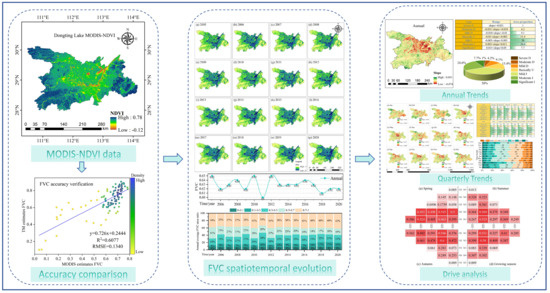
Graphical Abstract

1. Introduction

Vegetation is a core component of terrestrial ecosystems, linking the hydrosphere, pedosphere and atmosphere, and fractional vegetation coverage (FVC) serves as a key indicator for quantifying ecological landscape dynamics and assessing wetland ecosystem health [1,2,3,4,5,6,7,8,9]. Traditional ground-based FVC monitoring methods are constrained by inefficiency and poor spatial representativeness, making them unsuitable for large-scale and long-term dynamic analyses. By contrast, remote sensing (RS) technology enables continuous spatio-temporal monitoring of vegetation dynamics with multi-spectral bands and varying spatial resolutions, and has become the primary approach for regional FVC research [10,11,12,13,14,15,16,17,18,19]. Among RS-derived vegetation indices, the Normalized Difference Vegetation Index (NDVI) is the most widely used for FVC estimation, as it effectively reflects vegetation growth status and its response to environmental changes [20,21,22,23,24,25,26]. Previous studies have applied RS technology to analyze vegetation dynamics in various regions, including regression model-based FVC calculation [27], MODIS-NDVI driven spatio-temporal variation analysis [28], and machine learning-based assessment of human and natural factor impacts [29]. These studies confirm the pivotal role of RS in quantifying vegetation dynamics, laying a foundation for FVC research in complex wetland ecosystems.
Dongting Lake, the second-largest freshwater lake in China and an internationally important Ramsar wetland, plays irreplaceable roles in the Yangtze River Basin, including flood regulation, biodiversity conservation, water resource supply and regional climate regulation [29,30,31,32,33,34,35,36,37,38,39,40]. The wetland vegetation of Dongting Lake is the core of its ecosystem function, mediating water-sediment transport and supporting migratory bird habitats, yet it is highly sensitive to hydrological cycle changes and human disturbances [41,42,43]. Existing RS-based studies on Dongting Lake’s vegetation have focused on inter-annual FVC variation [44], identified human activity-driven degradation hotspots [45], and analyzed climatic factor responses [46], but critical research gaps remain: (1) fine-scale seasonal and monthly FVC evolution patterns are not systematically explored, limiting understanding of short-term vegetation dynamics; (2) synergistic driving mechanisms of topographic and hydro-climatic factors on FVC are not quantitatively revealed, with most studies focusing on single-factor analysis; (3) ecohydrological links between hydrological dynamics (e.g., lake water level, soil moisture) and FVC spatial differentiation are not sufficiently elaborated. Vegetation coverage variation in lake wetlands is a typical ecohydrological process, regulated by the synergistic effect of topographic spatial pattern (elevation, slope, aspect) and hydro-climatic dynamics (precipitation, soil moisture, surface water storage). Topographic factors modulate the spatial redistribution of water and soil in wetlands, while hydro-climatic factors determine the overall water availability for vegetation growth; their interaction shapes the spatio-temporal differentiation of FVC—this ecohydrological framework is the core theoretical basis for this study.
To address the above gaps, this study focuses on a core research question: what are the fine spatio-temporal (annual/seasonal/monthly) evolution characteristics of FVC in the Dongting Lake ecological restoration area from 2005 to 2020, and what are the key factors and their synergistic effects driving FVC spatial differentiation? Based on this, three testable research hypotheses are proposed: (i) the FVC of the Dongting Lake wetland exhibits significant fine-scale spatio-temporal variation, with an overall improving trend from 2005 to 2020 and the most vigorous growth in summer; (ii) topographic factors (especially slope) have the highest spatial explanatory power for FVC spatial differentiation, and the synergistic interaction of topographic and hydrological factors enhances this explanatory power significantly; (iii) FVC variation in the wetland shows a strong response to hydro-climatic anomalies, with seasonal water availability being the key driver of seasonal FVC dynamics. In this study, long-term MODIS NDVI data (2005–2020) were used to quantify FVC via the dimidiate pixel model, and slope trend analysis was applied to reveal FVC’s spatio-temporal evolution characteristics across multi-scales (annual, seasonal, monthly, and spatial gradient). The Geodetector model was further employed to quantitatively analyze the spatial explanatory power of topographic, soil and hydro-climatic factors on FVC, as well as their synergistic effects. This study aims to reveal the fine spatio-temporal pattern of FVC in the Dongting Lake wetland and its key associated factors, providing refined scientific evidence for wetland ecological restoration and adaptive management in the Yangtze River Basin.

2. Materials and Methods

2.1. Research Area

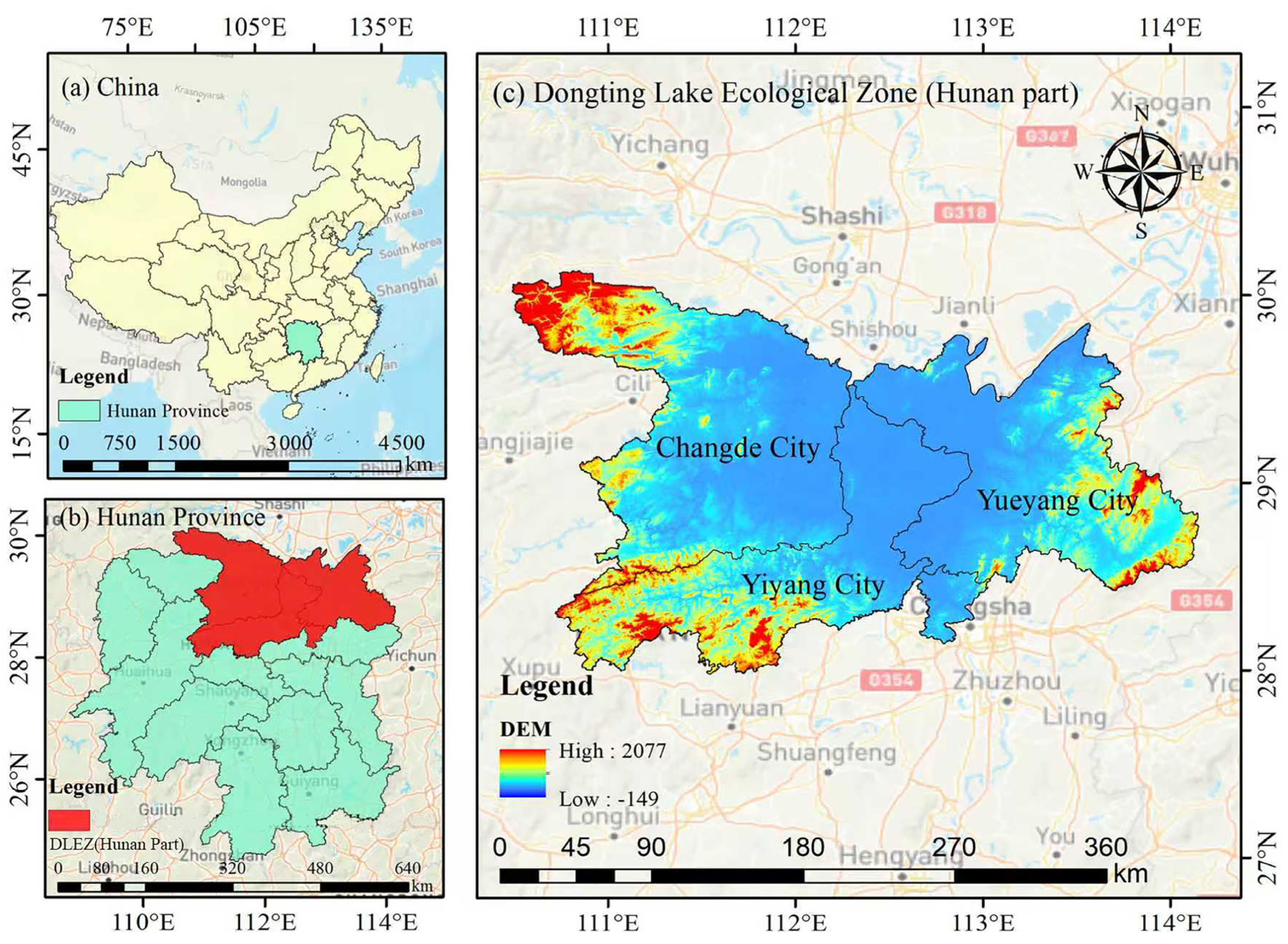
The Hunan part of Dongting Lake ecological zone (28°30′~29°38′ N, 112°18′~113°5′ E) is located in the northeast of Hunan Province. It is the largest lake in the middle reaches of the Yangtze River and an internationally important wetland (Ramsar Site No. 1445). The research scope covers Yueyanglou District, Junshan District, Huarong County in Yueyang City, as well as administrative districts such as Yuanjiang City and Nanxian County in Yiyang City, with a total area of approximately 18,900 square kilometers. The main water area of the lake shows significant seasonal changes (about 2600 square kilometers during the wet season reduced to 900 square kilometers during the dry season). This region is located in a subtropical humid climate zone, with an average annual precipitation of 1200–1400 mm. It is influenced by the combined action of the Yangtze River and the four rivers of Xiang, Zi, Yuan, and Li, forming a unique hydrological rhythm of “floods forming lakes and dry waters forming rivers”.
The wetland ecosystem is mainly composed of reed (Phragmites australis) and Carex spp. communities in the intertidal wetlands, nested with various habitat types such as lakes, swamps, and artificial ditches, supporting the wintering and resting of more than 300 species of birds (including nationally protected species such as white cranes and black storks) on the migration route from East Asia to Australia. In the past 50 years, due to the operation of the Three Gorges Project, the reclamation of farmland around the lake, and sand mining activities, the average annual sediment deposition in the lake area has reached 1.28 × 10⁸ m3 (Hunan Provincial Department of Water Resources, 2020), resulting in a shrinkage of about 40% of the natural wetland area and triggering reverse vegetation succession and a decline in biodiversity. At present, the region is facing multiple challenges such as changes in the relationship between rivers and lakes, intensified non-point source pollution (TN and TP exceedance rates > 65%), and contradictions between ecological protection and economic development, making it a typical sample area for studying the coordination mechanism of human–water relations in the Yangtze River Economic Belt (Figure 1).

2.2. Data Sources and Data Processing

2.2.1. Vegetation Coverage Data

NDVI is a critical index that reflects the proportion of photosynthetically active radiation absorbed by vegetation, serving as a key indicator of vegetation growth and surface cover changes. It is widely acknowledged as the most reliable measure of vegetation growth status [47,48,49], yet it has inherent limitations in wetland ecosystems like Dongting Lake: (i) Water body interference: Shallow water in wetlands has low NDVI values, which are easily confused with bare soil, leading to underestimation of FVC in the water-vegetation ecotone. (ii) Saturation effect: In dense vegetation areas (e.g., reed communities), NDVI tends to saturate, making it difficult to capture fine variations in high-coverage vegetation. (iii) Sensitivity to soil moisture: High soil moisture content in wetlands reduces NDVI values, indirectly affecting the accuracy of FVC estimation. These limitations are addressed by combining the dimidiate pixel model with strict threshold determination (cumulative frequency method) in this study, to minimize interference from non-vegetation factors.
In this study, NDVI data is derived from the MODIS NDVI dataset provided by NASA’s data center, spanning from 2005 to 2020. The MOD13Q1 dataset provides 16-day NDVI/EVI vegetation index products with 250 m spatial resolution, covering large areas at high temporal frequency. Throughout the year, from January to December, imaging data of Dongting Lake was selected using MOD13Q1 data spanning the 1st to the 353rd day annually from 2005 to 2020, totaling 23 temporal phases and 46 images per year, resulting in 736 scenes for the research period. MODIS MRT (MODIS Reprojection Tools) was employed for preprocessing tasks such as format conversion and reprojection of the MOD13Q1 data.
To mitigate the impacts of clouds, atmosphere, and solar altitude on images [50,51,52], the Maximum Value Composites (MVC) method [32,53,54,55] was adopted to generate monthly NDVI datasets, which selects the highest NDVI value in each 16-day window. The use of the MVC approach is justified for three key reasons: (i) Cloud interference elimination: Dongting Lake is located in a subtropical humid climate zone with frequent summer rainfall and cloud cover; the MVC method effectively retains the maximum NDVI value (representing the clearest vegetation signal) while filtering out cloud-contaminated pixels. (ii) Reduction in atmospheric and solar altitude effects: By selecting the maximum value in the time window, the method minimizes the influence of atmospheric scattering and varying solar angles on spectral signals, ensuring the stability of NDVI values. (iii) Consistency with vegetation growth characteristics: The 16-day window matches the growth rhythm of wetland vegetation (e.g., reeds, Carex spp.), avoiding loss of key growth stage information while ensuring temporal continuity. Additionally, the mean method [56,57,58] was employed to obtain annual and seasonal NDVI data, providing a clearer representation of surface vegetation dynamics.

2.2.2. Terrain Data

The DEM (Digital Elevation Model) data is sourced from the geospatial data cloud platform (http://www.gscloud.cn) ASTER GDEM V3. Elevation data with a spatial resolution of 30 m was selected over SRTM (Shuttle Radar Topography Mission). Data for three critical justifications aligned with the study’s objectives and wetland characteristics: (i) Spatial resolution consistency: ASTER GDEM V3’s 30 m resolution matches the Landsat TM data used for FVC validation, ensuring spatial scale alignment between terrain factors and FVC estimation results; this reduces scale mismatch errors when analyzing the spatial association between topography (e.g., slope) and vegetation coverage, which is critical for accurate geographic detector analysis. (ii) Superior accuracy in wetland environments: SRTM data exhibits notable elevation biases in low-lying, water-level-fluctuating wetland areas (e.g., Dongting Lake’s central basin) due to radar signal saturation in inundated regions. In contrast, ASTER GDEM V3 incorporates post-processing corrections for low-lying and water-covered areas, resulting in elevation data that more closely reflects the actual topographic characteristics of the Dongting Lake wetland (e.g., subtle variations in intertidal zones and floodplains). (iii) Complete spatial coverage: SRTM has data gaps in partial permanent water areas of Dongting Lake, whereas ASTER GDEM V3 provides continuous coverage across the entire study area; this ensures unbroken terrain data for the lake’s core, ecotone, and surrounding regions, enabling comprehensive analysis of FVC’s spatial gradient with elevation/slope.
Preprocessing tasks such as tiling, cropping, and resampling were conducted on the ASTER GDEM V3 data [59,60,61] to ensure consistency with other datasets (e.g., MODIS NDVI) in spatial projection and resolution.
Slope refers to the angle between the tangent plane passing through any point on the ground surface and the horizontal ground, obtained by calculating DEM data using the Slope tool [62]. Slope orientation (aspect) refers to the angle or orientation in which the surface tilts, usually expressed in degrees (0° to 360°), derived via the Aspect tool from DEM data.

2.2.3. Soil Data

Soil moisture content denotes the quantity of water present in the soil, typically measured as a mass or volume ratio. Through techniques like atmospheric correction, geometric correction, and other preprocessing methods, noise and errors in remote sensing data are eliminated. An established inversion model is then applied to process this data, enabling the inference of spatial soil moisture distribution.
The national 1:1,000,000 soil type dataset is sourced from the Resource and Environmental Science Data Center of the Chinese Academy of Sciences (http://www.resdc.cn). It categorizes soil types into seven main classifications: clay loam, silty clay loam, sandy clay, loam, sandy loam, and others.

2.2.4. Hydro-Climatic Data

Annual precipitation (AOP) and surface water storage (SW) data were obtained from statistical yearbooks published by the Hunan Provincial Meteorological Bureau and Water Resources Department (2005–2020). The data were spatially interpolated to generate raster layers spatially consistent with the NDVI data for driving factor analysis.

2.3. Research Methods

2.3.1. Dimidiate Pixel Model

The Vegetation Indices-based Mixed Model is a model that calculates vegetation coverage based on vegetation indices [3,63,64,65]. The principle is to assume that the spectral information of the image observed by remote sensing sensors is a linear weighted composite of pure vegetation and pure bare soil, and the weight is the proportion of their respective areas in the pixel.
In the dimidiate pixel model, the values of NDVIsoil and NDVIveg directly affect FVC estimation accuracy. This study uses the cumulative frequency method to determine thresholds. The cumulative frequency method relies on the overall distribution of pixel NDVI values, effectively avoiding interference from extreme values (e.g., cloud residuals and water pixels). Statistical analysis of all NDVI images in the study area from 2005 to 2020 shows that the 5% cumulative frequency corresponds to values of 0.05–0.12, mainly representing pure bare soil or water pixels; the 95% cumulative frequency corresponds to values of 0.78–0.85, mainly representing dense vegetation pixels. The calculation formula is:
F V C = ( N D V I N D V I s o i l ) ( N D V I v e g N D V I s o i l )
In the formula, FVC represents vegetation coverage, NDVIsoil represents the NDVI value of bare soil or areas without vegetation cover and NDVIveg represents pure vegetation pixel values completely covered by vegetation. This study selected NDVI with a cumulative frequency of 5% as the NDVIsoil, and the NDVI value with a cumulative frequency of 95% is NDVIveg.

2.3.2. Verification of Accuracy of Estimation Results

To ensure the representativeness and reliability of validation despite the fixed sample size (100 sampling points), a stratified targeted sampling strategy was adopted. Sampling points were intentionally distributed across three key ecological zones of the Dongting Lake wetland: robust vegetation growth areas (e.g., mature reed communities, 30 points), water-vegetation ecotones (e.g., intertidal zones with alternating water and vegetation cover, 40 points), and low vegetation coverage areas (e.g., sparse Carex spp. communities and bare floodplains, 30 points). This design ensures coverage of the core spatial heterogeneities (lake center, shoreline and surrounding uplands) and key ecohydrological zones, compensating for the limited sample size by prioritizing ecological representativeness over sheer quantity.
Validation was conducted using 30 m Landsat TM imagery (acquired in 2010, corresponding to the peak vegetation growth period) to compare with MODIS NDVI-derived FVC. Due to the resolution disparity between Landsat TM (30 m) and MODIS MOD13Q1 (250 m), the mixed pixel principle was applied: each MODIS pixel was matched to the corresponding 64 Landsat TM pixels (8 × 8 window), and the mean FVC of these Landsat pixels was used as the reference value for the MODIS pixel. The root mean square error (RMSE) and Pearson correlation coefficient (r) were employed to assess estimation accuracy, with the formula as follows [66,67]:
R M S E = i = 1 n ( x i x ^ i ) 2 / n
In the formula, xi is the vegetation coverage estimated by TM data, x ^ i is the vegetation coverage estimated by MODIS data and n is the number of samples, and a smaller RMSE value indicates higher accuracy.
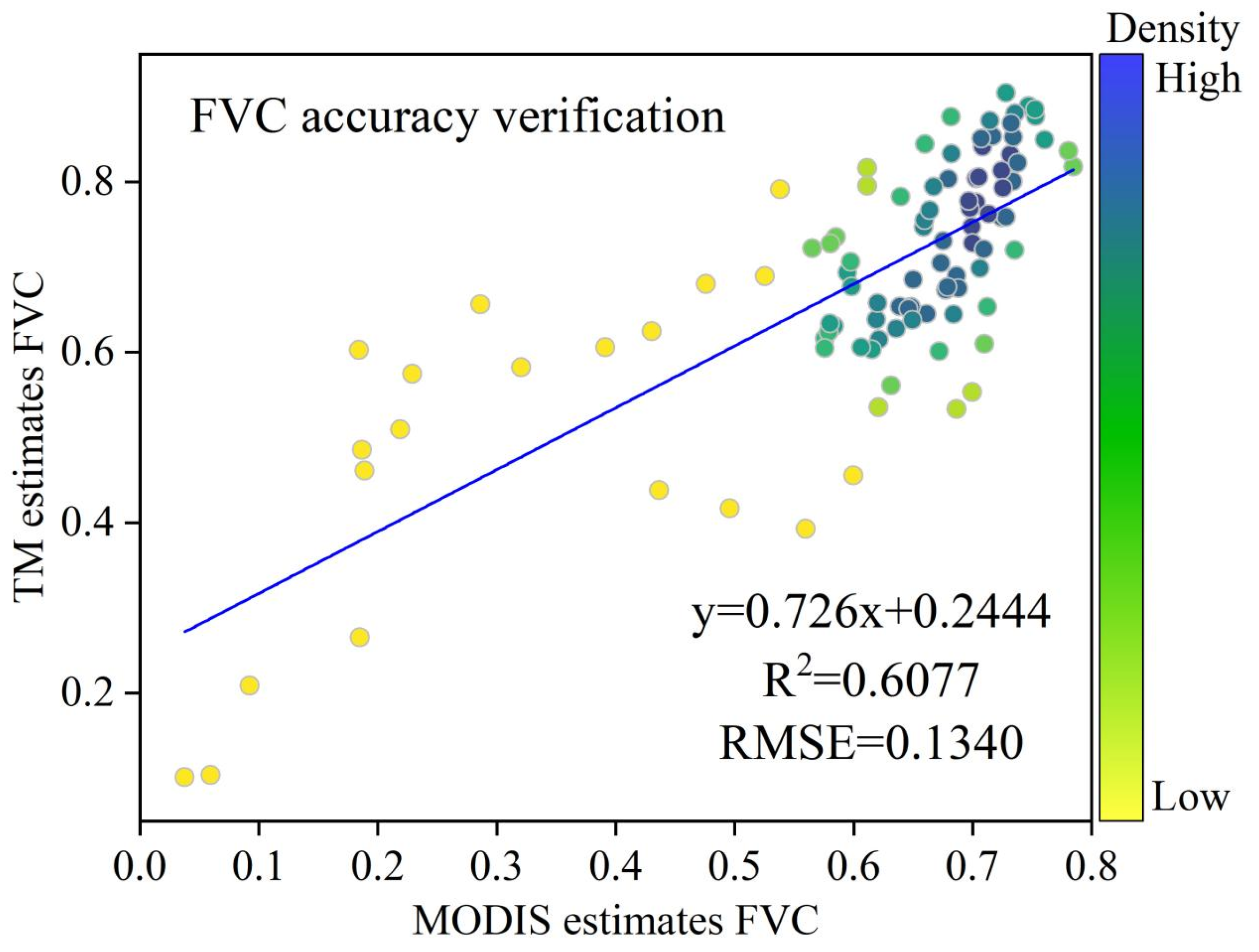
The validation results showed a Pearson correlation coefficient of r = 0.6077 and an RMSE of 0.1340 (Figure 2), confirming the feasibility of the MODIS-based FVC estimation method at the regional scale. The moderate correlation is primarily attributed to three key factors, which are exacerbated by the wetland’s unique ecosystem characteristics: (i) Spatial resolution discrepancy: MODIS’s 250 m resolution leads to severe mixed-pixel effects in the fragmented wetland landscape; each MODIS pixel often integrates water, vegetation, and bare soil components, whereas Landsat TM (30 m) captures finer-scale homogeneous patches. This scale mismatch results in pixel-level FVC inconsistencies, especially in the water-vegetation ecotone where land cover types shift sharply over short distances, and the limited sample size cannot fully offset the uncertainty from scale-induced mixed pixels. (ii) Temporal lag: Due to satellite orbit differences and cloud contamination, the acquisition dates of MODIS and Landsat TM images had a 7–14 day lag. In the Dongting Lake wetland, where hydrological conditions (e.g., water level fluctuations) and vegetation growth (e.g., rapid herbaceous germination) are highly dynamic, this lag causes phenological differences between the two datasets. With a fixed sample size, the impact of such temporal asynchrony on validation results cannot be diluted by increasing observations, further contributing to estimation deviations. (iii) Spectral mixing: The wetland is a complex mosaic of intertidal zones, shallow waters, and emergent vegetation, leading to intense spectral mixing within single MODIS pixels. Landsat TM’s higher resolution reduces this mixing, enabling more accurate FVC quantification for small patches. For the fixed sample size, the spectral ambiguity in MODIS data cannot be fully resolved by sampling, resulting in persistent differences between MODIS and Landsat-derived FVC.
To mitigate these limitations with a fixed sample size, future studies could optimize the sampling strategy by focusing on periods with minimal hydrological fluctuation (e.g., stable dry season) to reduce temporal lag effects, or supplement with in situ FVC measurements (e.g., quadrat surveys) at key sampling points to calibrate MODIS-derived results, enhancing validation reliability without increasing the overall sample count.

2.3.3. Trend Analysis

Regression analysis was used to calculate the slope of vegetation FVC change pixel by pixel [68] to reflect the temporal variation characteristics of vegetation FVC in the region. To evaluate the statistical significance of FVC change trends, pixel-based slope regression analysis was combined with the natural breaks method to classify the trends into seven levels (e.g., significant improvement and severe degradation). The area proportion of each level was quantified to reflect the spatial statistical pattern. Additionally, the reliability of the trend results was verified by the consistency of pixel-level variation and regional-scale statistical characteristics, the specific calculation formula is as follows:
θ s l o p e = n × i = 1 n ( i × F V C i ) i = 1 n i i = 1 n F V C i n × i = 1 n i 2 ( i = 1 n i ) 2
where n is the number of years of study (time series from 2005 to 2020, i.e., n = 16), FVCi is the FVC value for the i-th year and θslope is the dynamic slope, reflecting the overall trend of change. A positive value of θslope indicates an increasing trend in vegetation coverage over time, while a negative value indicates a decreasing trend.

2.3.4. Pearson Correlation Analysis

The Pearson correlation coefficient was calculated to quantify the relationships between FVC and hydroclimatic factors (runoff, precipitation, and surface water storage). Statistical significance tests were conducted for all correlation coefficients, with significance levels marked as * p ≤ 0.05, ** p ≤ 0.01, and *** p < 0.001. These results confirm the robust statistical significance of the observed correlations between FVC and environmental drivers. The specific calculation formula is as follows:
r = i = 1 n ( x i x ¯ ) ( y i y ¯ ) i = 1 n ( x i x ¯ ) 2 i = 1 n ( y i y ¯ ) 2
where r is Pearson correlation coefficient, ranging between [−1, 1]. r > 0 indicates a positive correlation, r < 0 indicates a negative correlation, and the closer ∣r∣ is to 1, the stronger the correlation. xi is the i-th observed value of the independent variable; yi is the i-th observed value of the dependent variable; x ¯ is the mean of the observed values of the independent variable; y ¯ is the mean of the observed values of the dependent variable; and n is the sample size.

2.3.5. Geographic Detector Model

Spatial differentiation is one of the fundamental characteristics of geographical phenomena. Geodetectors are tools for detecting and utilizing spatial differentiation [69]. The geographic detector includes four detectors. This study only used factor detectors.
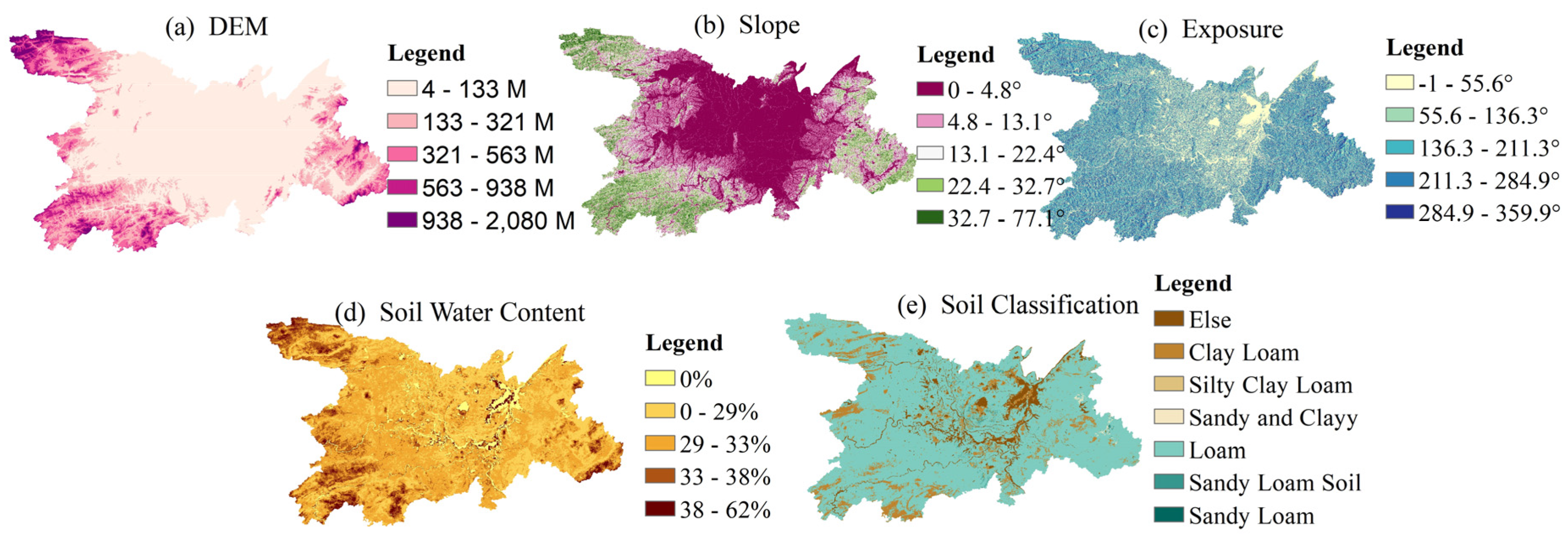
This study uses a geographic detector model to analyze the driving factors of vegetation FVC in Dongting Lake, mainly analyzing the relationship between geographic factors and the evolution of vegetation FVC in the Dongting Lake ecological zone from 2005 to 2020. Five geographical factors were selected: DEM, Slope (terrain inclination), slope direction (terrain inclination), soil moisture content, and soil type.
The geographic detector model requires discretization of continuous driving factors. In this study, three mainstream discretization schemes were compared: the equal interval method, quantile method, and natural breaks method. The optimal scheme was selected based on two quantitative criteria: (1) the stability of factor explanatory power (coefficient of variation in q-values) and (2) the spatial stratification heterogeneity index. The natural breaks method was ultimately adopted, as it minimizes intra-group differences and maximizes inter-group differences by following the inherent distribution characteristics of the original data. This method accurately reflects the spatial differentiation of topographic (DEM, slope, aspect), soil (soil moisture, soil type), and hydroclimatic factors in the Dongting Lake area. All driving factors were processed using this unified optimal scheme to ensure the consistency, standardization, and reproducibility of the geographic detector analysis.
Differentiation and factor detection: detecting the spatial differentiation of Y, and to what extent the detection of a certain factor X explains the spatial differentiation of attribute Y. Measure with q value, expressed as:
q = 1 h = 1 L N h σ h 2 N σ 2 = 1 S S W S S T
S S W = h = 1 L N h σ h 2 , S S T = N σ 2
In the formula, h = 1, L is the stratification of variable Y or factor X, that is, classification or partitioning; Nh and N represent the number of units in layer h and the entire region, respectively; and σh2 and σ2 are the variances of the Y values for layer h and the entire region, respectively. SSW and SST are the sum of intra layer variances (within Sum of Squares) and the total Sum of Squares, respectively. The value range of q is [0, 1].
The q-value output by the model reflects the strength of spatial consistency between the factor and FVC distribution, rather than indicating a direct causal effect of the factor on vegetation growth. Therefore, subsequent interpretations of the results focus on spatial association patterns rather than ecological driving mechanisms.

2.4. Technical Route

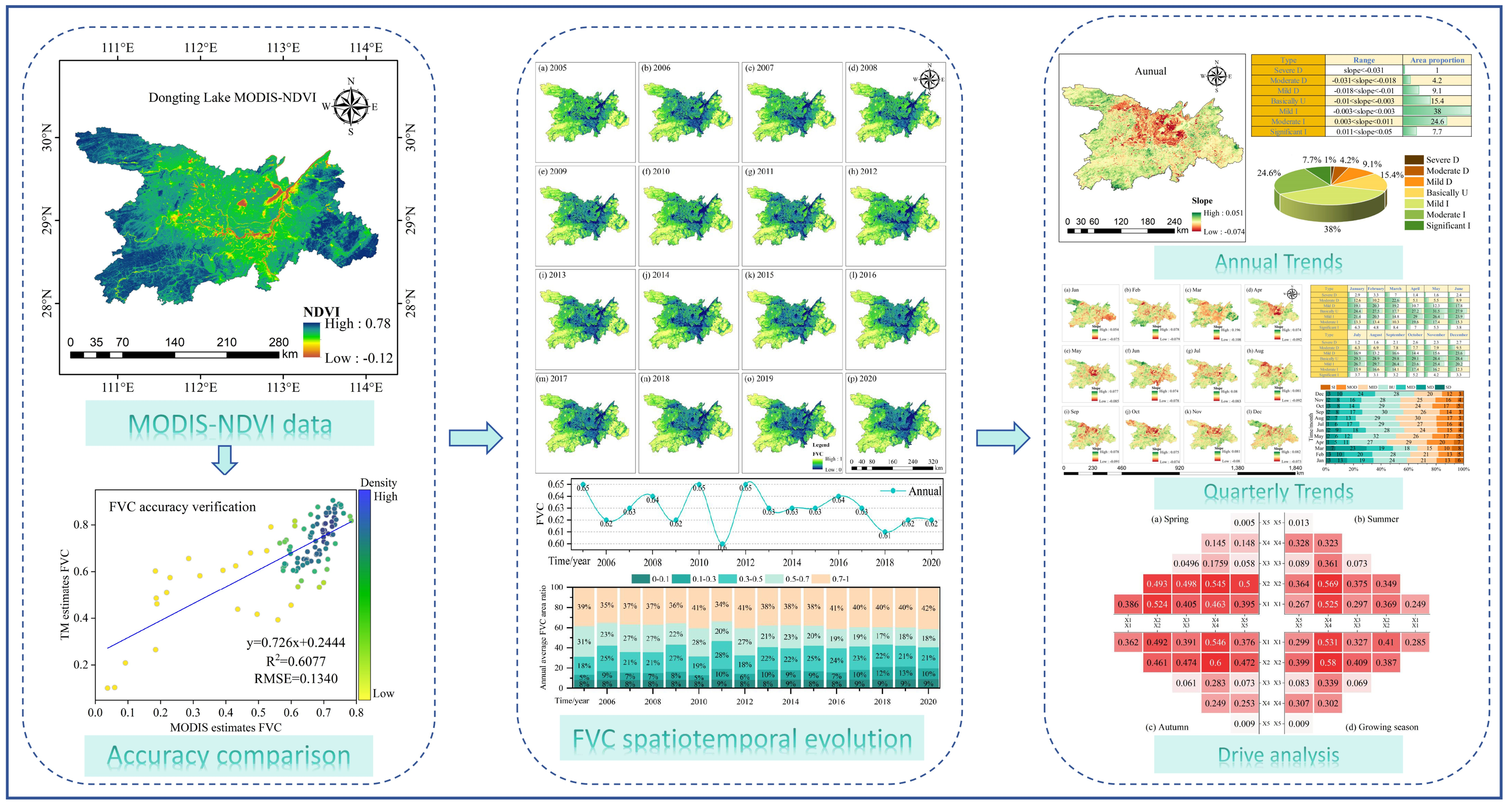
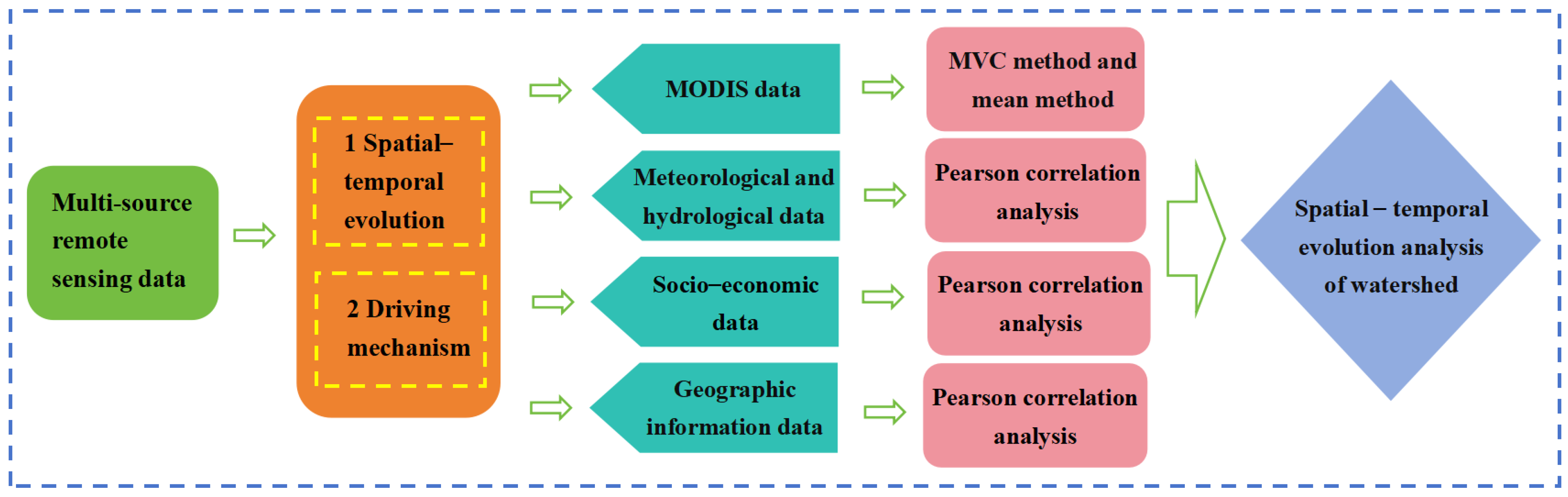
The key components of this research’s technical route encompass three crucial steps: multi-source remote sensing data processing, spatio-temporal evolution analysis, and driving mechanism analysis. Firstly, during the data processing stage, pre-processing is conducted on multi-source remote sensing data to obtain a long-term time-series dataset spanning from 2005 to 2020. Secondly, in the spatio-temporal evolution analysis stage, the NDWI (Normalized Difference Water Index) threshold method based on multi-source remote sensing images is employed to extract the water area of Dongting Lake from 2005 to 2020. Subsequently, spatio-temporal evolution, center-of-gravity migration, and density analyses are performed on the extracted water area data. Additionally, the dimidiate pixel model is utilized to explore the evolution pattern of vegetation coverage. Finally, during the driving mechanism analysis stage, Pearson correlation analysis and the geographic detector model are applied to gain an in-depth understanding of the impacts of different factors on the spatio-temporal evolution of the Dongting Lake ecological zone. The specific technical route is illustrated in Figure 3.

3. Results

3.1. FVC Spatio-Temporal Evolution

3.1.1. Annual Evolution of FVC

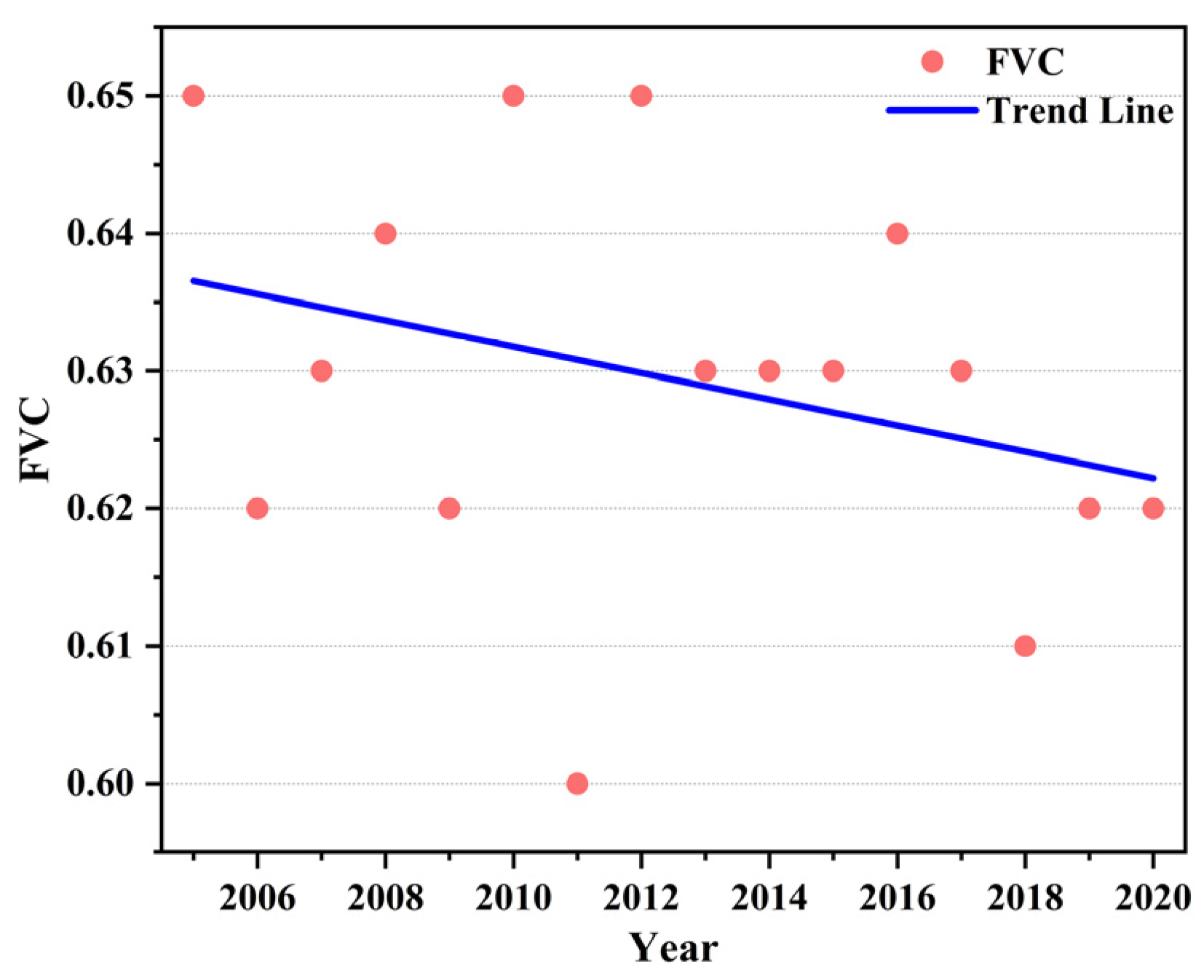
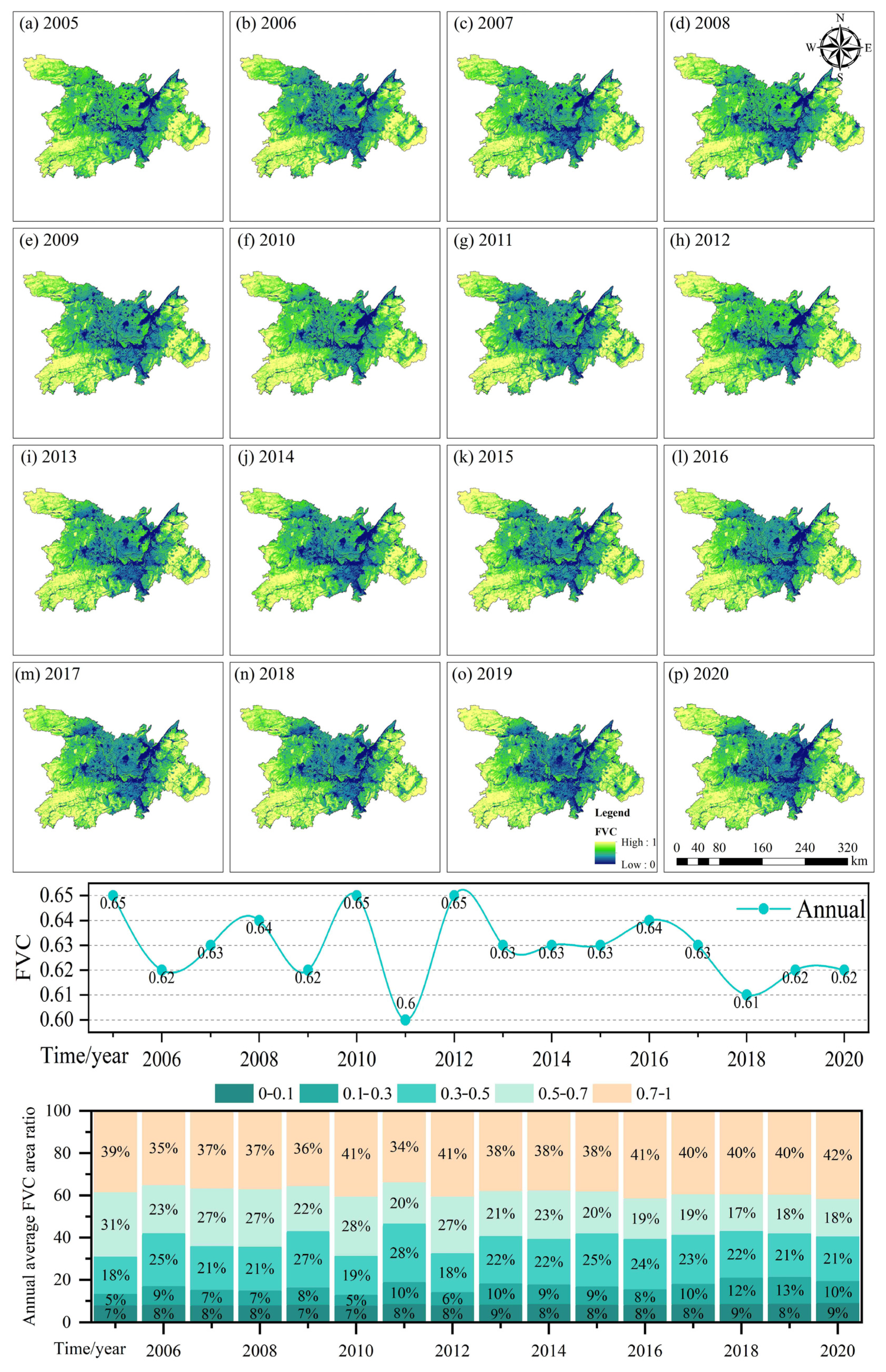
Based on the pixel binary model (Formula (1)), MODIS NDVI data from 2005 to 2020 were applied to analyze the spatio-temporal variations in Fractional Vegetation Cover (FVC) in Dongting Lake (Figure 4 and Figure 5). Our results are consistent with Han [44] and Fu [45], who detected a slight decreasing trend in vegetation coverage in this region.
Temporally, annual mean FVC fluctuated mildly, with a coefficient of variation of 0.032. The lowest mean FVC (0.60) occurred in 2011, while peak values (0.65) appeared in 2005, 2010 and 2020. Spatially, FVC showed a typical pattern of low values in the lake center and high values in the surrounding areas.
According to the five-level classification, the proportion of very high FVC (0.7–1) ranged from 34% (2011) to 42% (2020), and high FVC (0.5–0.7) varied from 17% (2018) to 31% (2005). The combined share of very low and low FVC (0–0.3) remained stable at 8–13%, with the minimum (5%) in 2005 and 2010. Overall, vegetation conditions were poorest in 2011 but optimal in 2005, 2010 and 2012.
These statistical characteristics carry clear ecological implications for Dongting Lake. The low inter-annual variation indicates overall stability of the wetland vegetation system. The low FVC core in the lake center reflects the natural landscape of open water and tidal flats. The notably low FVC in 2011 suggests a period of ecological stress, while the stable low-coverage proportion demonstrates that the basic wetland ecosystem pattern has not been severely degraded, reflecting the sensitivity and relative stability of this important lacustrine wetland ecosystem.

3.1.2. Monthly and Seasonal Evolution of FVC

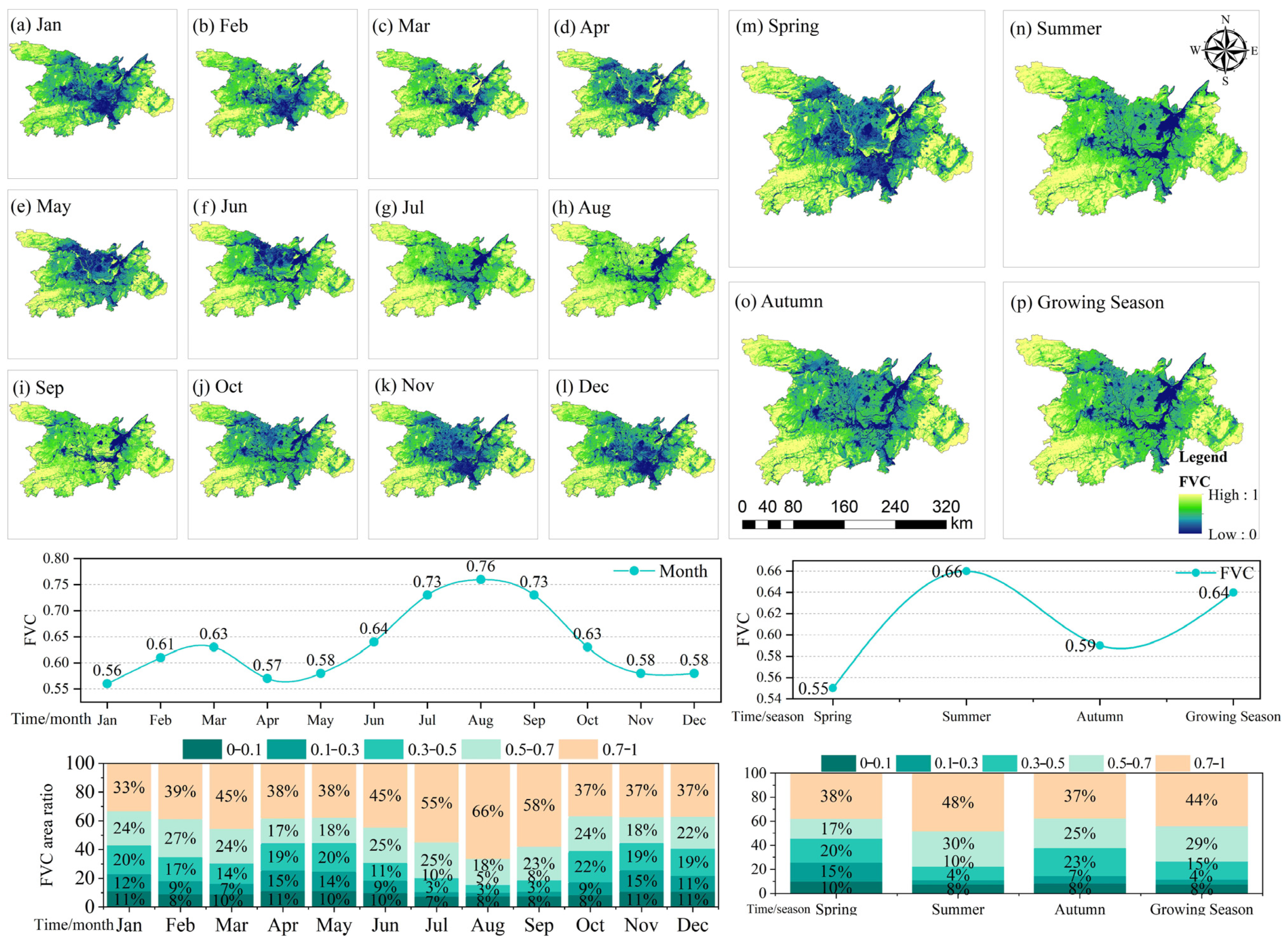
Based on the pixel binary model, monthly and seasonal Fractional Vegetation Cover (FVC) in the study area from 2005 to 2020 was estimated (Figure 6), with distinct temporal statistical characteristics. Monthly mean FVC varied from 0.56 (January) to 0.76 (August), with a monthly coefficient of variation of 0.12. Seasonally, the lowest mean FVC appeared in spring (0.55) and the highest in summer (0.66), while the mean FVC during the growing season reached 0.61.
Spatially, low FVC was concentrated in the southern lake basin (January–April, November–December) and northern lake basin (May–June), whereas high FVC prevailed from July to October. Statistically, the proportion of very high coverage peaked in August (66%) and bottomed in January (33%); low coverage (0–0.3) was highest in November (15%) and lowest in July–September (3%). Summer had the highest share of high-coverage areas (48%) and spring the lowest (38%), with a seasonal coefficient of variation of 0.09, reflecting moderate seasonal variability.
These patterns carry clear ecological implications for Dongting Lake. The distinct seasonal FVC rhythm corresponds to the regional hydrothermal gradient and wetland vegetation phenology. Summer vegetation flourishing aligns with sufficient rainfall and heat, while low winter and spring FVC reflects temperature and water stress in the lake-wetland system. The spatial shift in low FVC between southern and northern basins further indicates the sensitivity of vegetation to seasonal hydrological dynamics, highlighting the typical phenological characteristics and seasonal stability of the Dongting Lake wetland ecosystem.

3.1.3. Progressive FVC Changes in Elevation and Radius Range

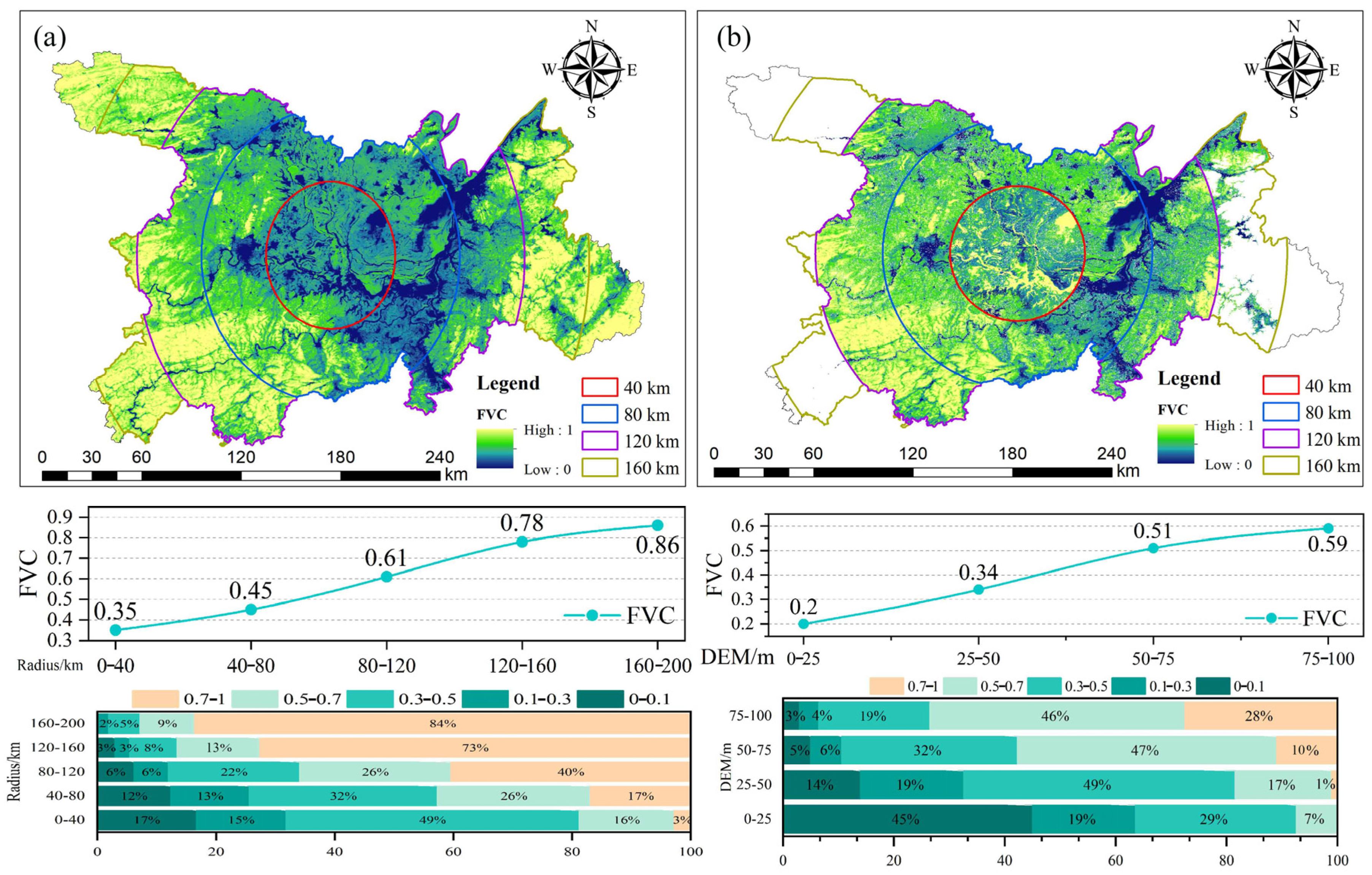
FVC exhibited a significant positive spatial gradient with increasing elevation and distance from the lake center (Figure 7), with robust statistical correlations. Within 0–100 m elevation, mean FVC increased from 0.20 (0–25 m) to 0.59 (75–100 m), with a Pearson correlation coefficient of r = 0.98 (p < 0.001). Within a 0–200 km radius, mean FVC rose from 0.35 (0–40 km) to 0.78 (120–160 km), with r = 0.96 (p < 0.001).
Spatially, the 0–40 km low-slope zone near the lake had the highest low-coverage proportion (49%), while the 160–200 km medium-high slope area showed the highest very high-coverage proportion (84%). The 75–100 m elevation zone had the highest high-coverage proportion (46%), and no very high coverage occurred in the 0–25 m near-lake lowland.
These spatial patterns reveal important ecological characteristics of Dongting Lake. The strong positive correlations reflect the combined influence of hydrological submergence, soil moisture, and human disturbance: near-lake lowlands are frequently inundated and disturbed, limiting vegetation growth, while higher and more distant areas experience less flooding and stronger vegetation development. The near absence of high FVC in low-lying zones further highlights the hydrological control over wetland vegetation distribution.

3.2. Spatiotemporal Trend Analysis of FVC

3.2.1. Analysis of Annual FVC Evolution Trends

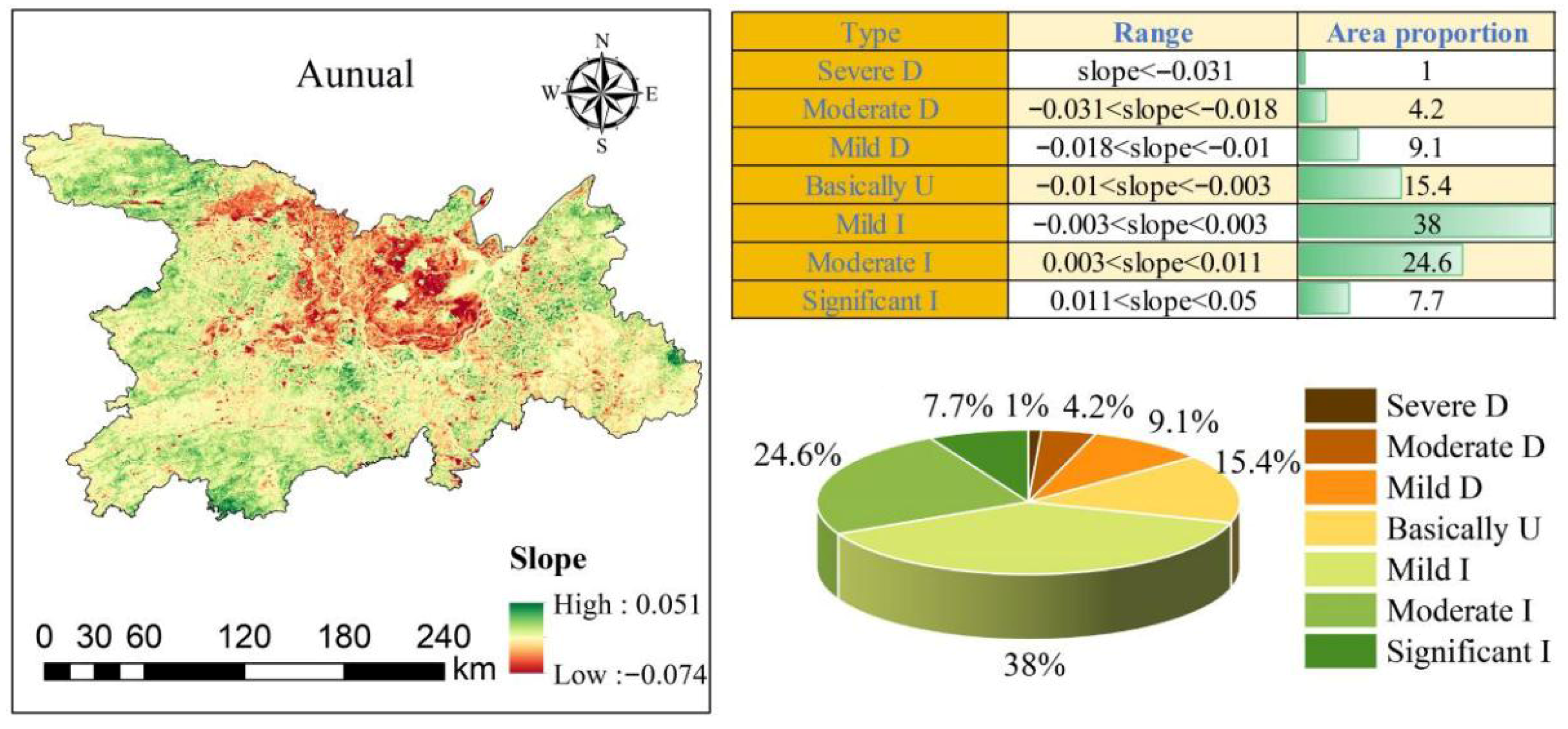
Pixel-scale slope trend analysis was conducted for FVC from 2005 to 2020 (Figure 8), with the trend slope classified into seven levels via the natural breaks method (a statistically robust discretization approach). Quantitatively, the total improved area (mild/moderate/significant improvement) accounted for 70.3% of the study area (mild improvement 38%, moderate 24.6%, significant 7.7%), the degraded area (mild/moderate/severe degradation) only 14.3% (mild 9.1%, moderate 4.2%, severe 1%), and the basically unchanged area 15.4%. Spatially, degraded areas were concentrated in the northern lake basin, while improved areas dominated the rest of the region. The mean trend slope of the whole study area was 0.0021 a−1, indicating a significant overall improving trend of FVC with statistical reliability.

3.2.2. Analysis of Seasonal FVC Evolution Trends

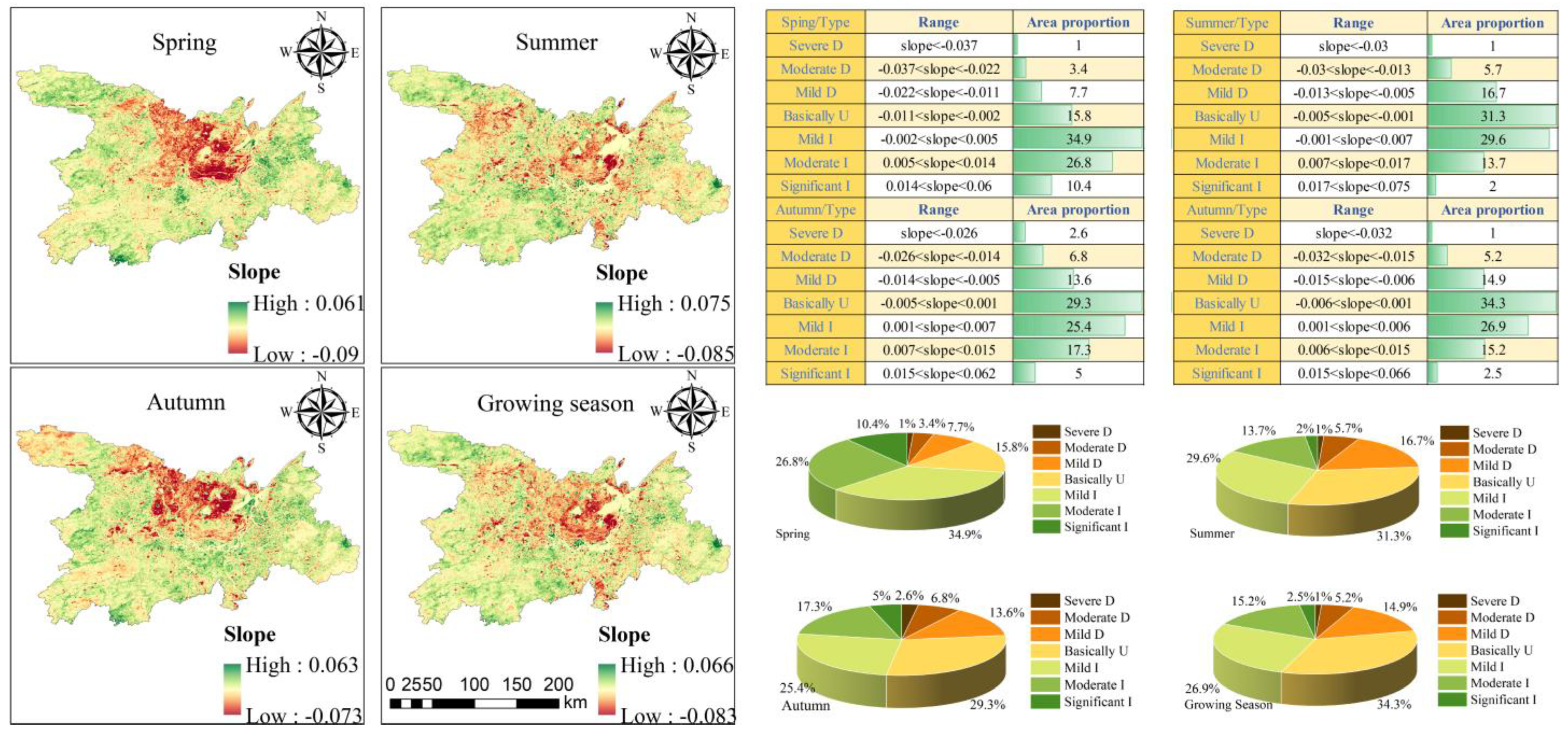
Seasonal FVC trend analysis (Figure 9) showed significant seasonal differences in improvement/degradation proportions with clear quantitative characteristics: spring had the highest improved area proportion (72.1%) and the lowest degraded area proportion (12.1%), with a mean seasonal trend slope of 0.0025 a−1 (the highest among four seasons); summer and autumn improved areas accounted for 45.3% and 47.7% and degraded areas 23.4% and 23.0%, with mean trend slopes of 0.0008 a−1 and 0.0010 a−1; the growing season improved area was 44.6%, the degraded area was 21.1%, and the mean trend slope was 0.0012 a−1. Spatially, degraded areas were concentrated in the northern lake basin (spring/summer) and western lake basin/Datong Lake (autumn/growing season). Statistically, the coefficient of variation in seasonal improved area proportion was 0.26, indicating moderate seasonal heterogeneity of FVC evolution trends.

3.2.3. Analysis of Monthly Vegetation FVC Evolution Trend

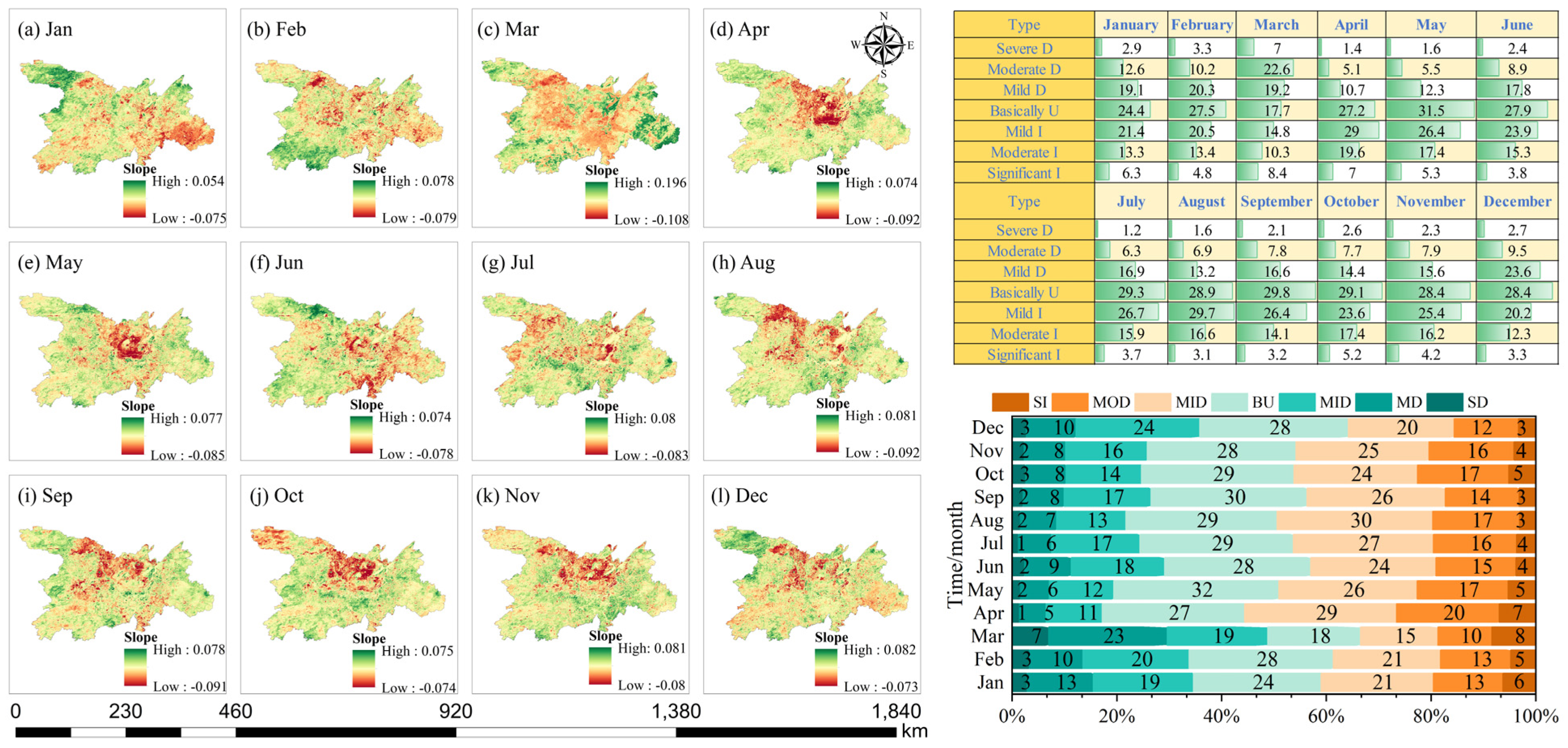
Monthly FVC trend analysis (Figure 10) revealed obvious monthly differentiation of improvement/degradation patterns, with the degraded area proportion exceeding 30% in February (33.8%), March (48.8%) and December (35.8%)—the three months with the most severe FVC degradation; the improved area proportion was the highest in April (55.6%), followed by August (49.4%) and May (49.1%), with the mean monthly trend slope of these months > 0.002 a−1. Spatially, improved areas in degradation-prone months (Feb/Mar/Dec) were concentrated in the southwestern lake basin, while degraded areas dominated the central/southern/northern lake basin; improved areas in growth-vigorous months (Apr/May/Aug) were widely distributed in the eastern/southern lake basin.

3.3. Driving Factors

3.3.1. Annual Average Vegetation FVC Driving Analysis

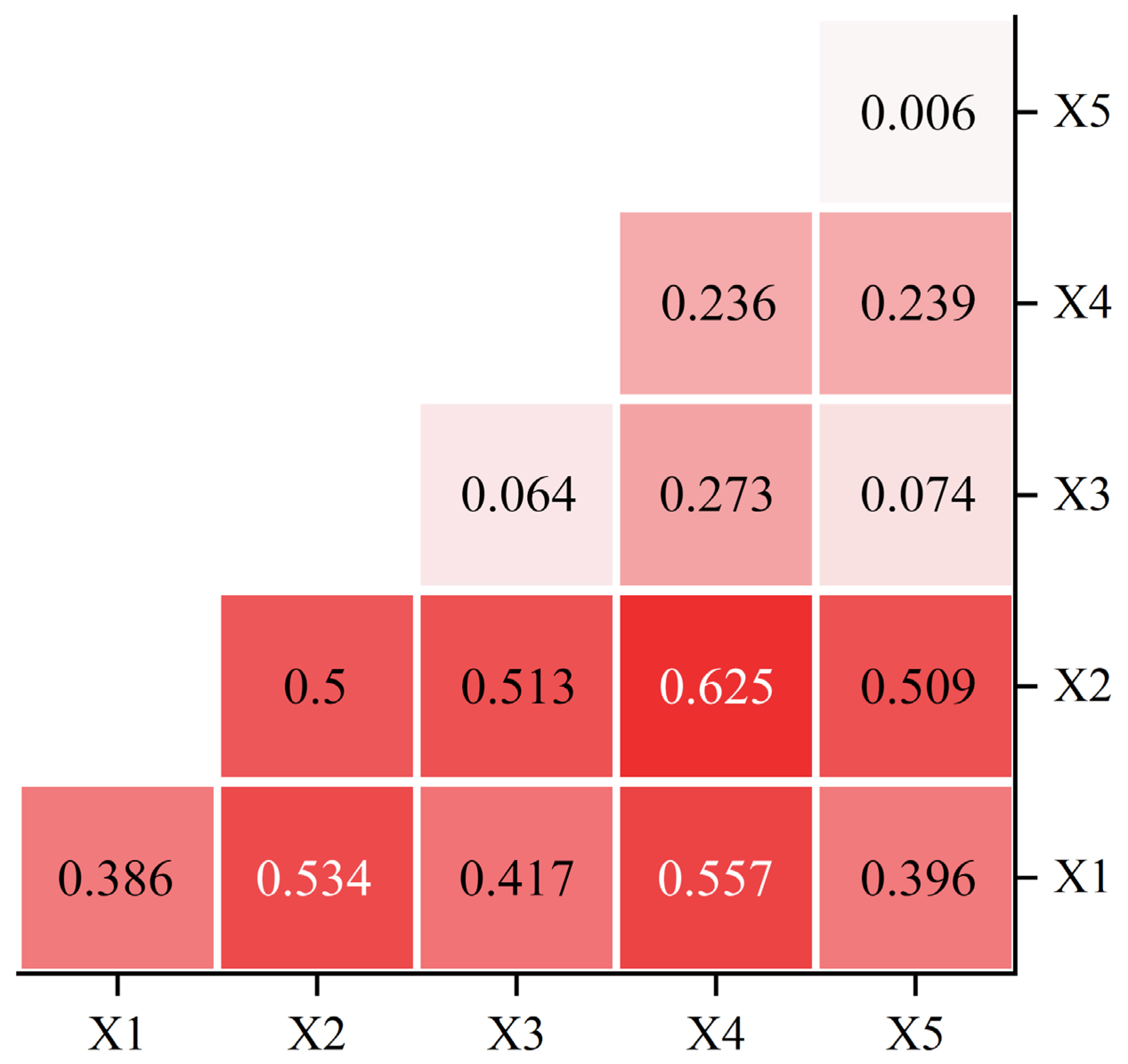
The geographic detector model (factor detector) was used to quantify the driving effect of five geographic factors (DEM/slope/aspect/soil moisture/soil type) on annual FVC (Figure 11 and Figure 12), with the natural breaks method for factor discretization (CV of q-value < 0.1, indicating high statistical stability of the detection result). Quantitatively, slope (X2) had the highest single-factor spatial explanatory power with a q-value of 0.50 (p < 0.001), explaining 50% of the spatial differentiation of annual FVC, which was the core spatial association factor. The combined spatial explanatory power was significantly higher than the single factor, indicating the synergistic spatial association effect of topographic and hydrological factors on FVC spatial differentiation.

3.3.2. Seasonal Vegetation FVC Driving Analysis

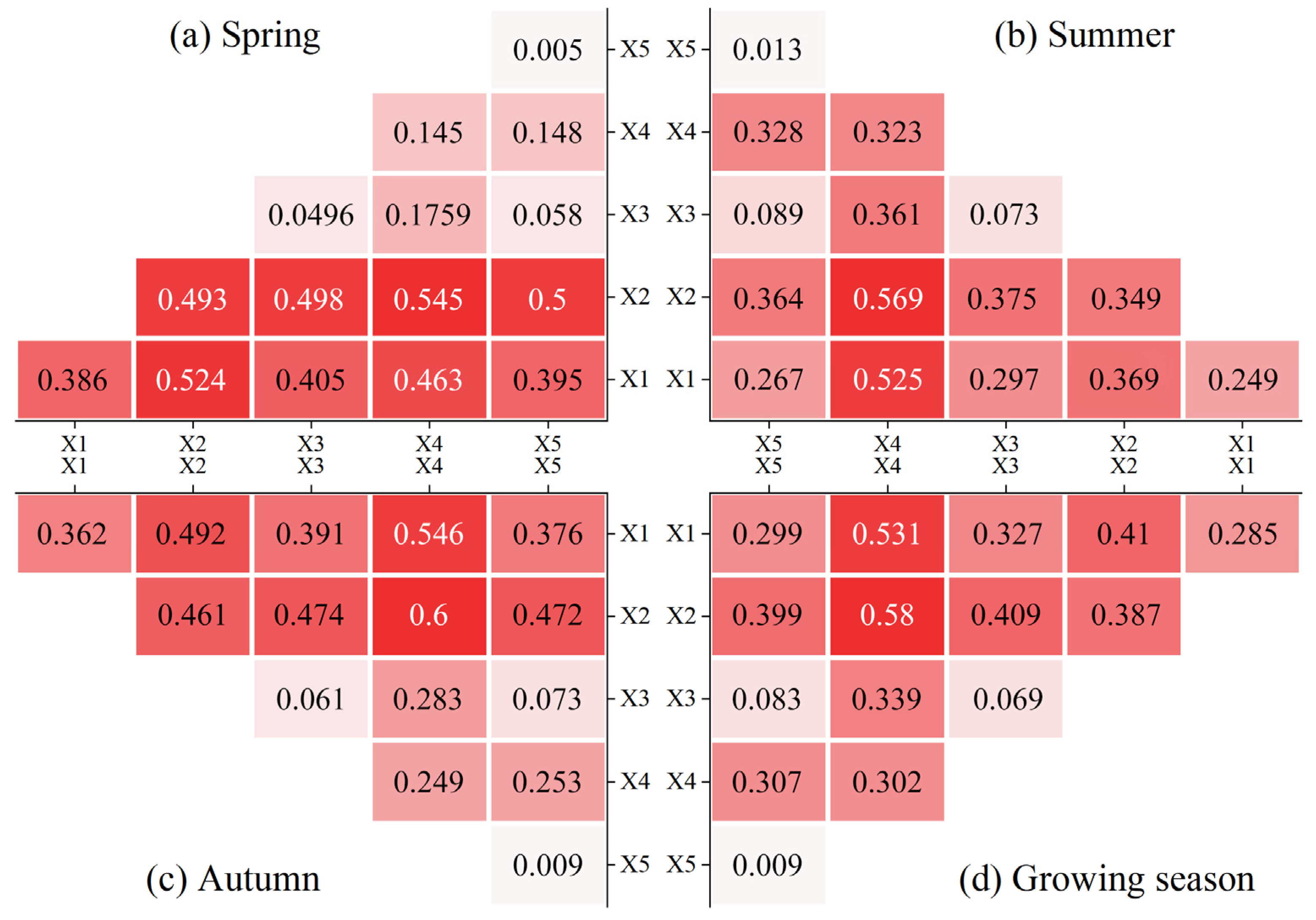
Seasonal factor detection (Figure 13) confirmed that slope was the core single factor driving seasonal FVC spatial differentiation, with high statistical significance (all p < 0.001) and stable detection results (CV of seasonal q-value < 0.15). The seasonal single-factor q-values of slope were 0.493 (spring), 0.349 (summer), 0.461 (autumn) and 0.387 (growing season), explaining 49.3%, 34.9%, 46.1% and 38.7% of the seasonal FVC spatial differentiations, respectively, with the strongest driving effect in spring and the weakest in summer. For factor interaction, slope and soil moisture (X2 ∩ X4) were the optimal synergistic combination in all seasons (non-linear enhancement, p < 0.001), with interaction q-values of 0.545 (spring), 0.569 (summer), 0.600 (autumn) and 0.580 (growing season); the enhancement amplitude of the synergistic effect was the highest in summer (63.0%), followed by the growing season (49.9%) and autumn (30.1%), and the lowest in spring (10.6%). In summary, slope (single factor) and the slope–hydrological factor synergy (interaction factor) were the core driving forces of annual and seasonal FVC evolution in the study area, with all detection results passing the significance test and having good statistical robustness.

4. Discussion

(i)
Vegetation communities provide critical habitats for animals and microorganisms and act as important carbon sinks in forest and grassland ecosystems. As a primary component of land cover, vegetation dynamics have long been a core topic in global change research [16]. Dongting Lake provides indispensable ecosystem services including water regulation and biodiversity conservation. However, its landscape pattern has been profoundly altered by the Three Gorges Dam operation, making research on wetland vegetation dynamics highly significant [44].
Analysis of spatio-temporal variations in fractional vegetation coverage (FVC) from 2005 to 2020 in the Dongting Lake basin reveals obvious interannual fluctuations accompanied by an overall improving trend, consistent with previous studies in similar regions [38], reflecting a broad-scale ecological response to changing environmental conditions and ecological management policies. Climatic anomalies, especially extreme precipitation deficits, exerted dominant control over interannual FVC fluctuations. The lowest FVC occurred in 2011, corresponding to an extreme climatic drought event with annual precipitation of only 807 mm. This sharp reduction in water availability directly restricted vegetation photosynthesis and growth, leading to a pronounced decline in FVC. This response highlights the high sensitivity of wetland vegetation to climatic anomalies, particularly drought stress, which directly alters water supply and thus constrains vegetation growth.
(ii)
To quantitatively link hydroclimatic dynamics with ecohydrological mechanisms, we performed statistical analyses using long-term observational data (Table 1). At the interannual scale, FVC showed significant positive correlations with annual precipitation (r = 0.68, p < 0.01) and annual surface water storage (r = 0.72, p < 0.001), explaining 46% and 52% of FVC variation, respectively. Seasonally, summer FVC was most strongly correlated with summer precipitation (r = 0.59, p < 0.01), spring FVC with winter surface water storage (r = 0.53, p < 0.05), and autumn FVC with autumn runoff (r = 0.48, p < 0.05). Partial correlation analysis controlling for slope and elevation confirmed the independent effects of hydroclimatic factors (r_partial = 0.57, p < 0.01). Geographical detector results further revealed synergistic effects of precipitation × slope (q = 0.589) and surface water storage × DEM (q = 0.612), with enhancement rates of 17.8% and 28.3%. These results support the ecohydrological framework that climatic anomalies and associated hydrological conditions determine regional water availability, while topography mediates spatial water redistribution to jointly shape FVC patterns. Regional differences were also detected: the FVC–precipitation correlation was weaker in the hydrologically variable northern lake basin (r = 0.42) than in the stable southern wetlands (r = 0.61), indicating heterogeneous vegetation sensitivity to climatic anomalies across the lake basin.
Slope acts as a key topographic factor controlling spatial FVC differentiation [70,71]. In this study, spatial gradient analysis showed that FVC increased significantly with elevation and slope: average FVC was only 0.20 in the 0–25 m low-elevation zone but reached 0.59 in the 75–100 m zone, and increased from 0.35 within 0–40 km of the lake center to 0.78 at 120–160 km. Geographical detector showed slope had strong independent explanatory power for annual FVC (q = 0.50) and seasonal FVC (0.349–0.493). Interactive effects between slope and hydrological factors further improved explanatory power up to 0.68, confirming that slope mediates soil water retention and runoff redistribution, thereby modulating vegetation responses to climatic and hydrological variability (Table 2).
(iii)
In addition, the Grain-for-Green program in the study area [72,73,74,75,76,77,78,79,80,81,82,83,84,85,86,87] has been mainly implemented in moderate-to-steep slope areas with relatively high FVC, suggesting that ecological restoration can effectively strengthen vegetation growth and enhance its resistance to climatic fluctuations.
However, several limitations exist in this study. Moderate-resolution MODIS data introduce mixed-pixel effects in fragmented wetlands, reducing FVC accuracy [88,89,90]. Single-year Landsat validation with sample bias and atmospheric discrepancies leads to moderate verification accuracy (r = 0.6077). Furthermore, the Geodetector model is constrained by assumptions of stratification heterogeneity and factor independence and can only quantify explanatory power rather than ecological causality. Future studies will integrate Sentinel-2 high-resolution imagery, long-term climate-hydrological data, and scenario-based ecological models to improve the understanding of vegetation dynamics under climatic anomalies and support ecological protection and sustainable management in the Dongting Lake region.

5. Conclusions

This study is based on MODIS remote sensing images and uses a pixel binary model to calculate the vegetation FVC of Dongting Lake. Regression analysis is used to predict the trend of vegetation FVC, and a geographic detector model is used to analyze the driving factors of vegetation FVC. The research results indicate that:
(i)
In 2011, vegetation was in a relatively poor state with the lowest average FVC (0.6) and a low proportion of high-coverage areas. In contrast, 2005, 2010, and 2012 had good vegetation conditions, high average FVC (0.65), and a high proportion of high-coverage areas. Vegetation growth was best in summer (July–September), with high average FVC and a large proportion of high-coverage areas, while it was relatively poor in other months.
(ii)
From 2005 to 2020, the FVC in Dongting Lake showed a significant improvement trend, with 70.3% of the total area seeing an increase. Spring’s overall vegetation FVC improved, while summer, autumn, and the growth season had a relatively large unchanged proportion, indicating that future ecological restoration should focus more on these three seasons. Vegetation FVC degradation was most severe in March and December.
(iii)
Slope, either alone or in interaction with other factors, had a strong influence on the annual and seasonal evolution of vegetation FVC in Dongting Lake from 2005 to 2020, suggesting it is an important driving factor.
This study has several limitations. The 250 m MODIS data produced obvious mixed-pixel effects in fragmented wetlands, reducing FVC estimation accuracy. The single-year Landsat validation is limited by sample bias and atmospheric differences, resulting in moderate verification accuracy. Meanwhile, the Geodetector model is restricted by its assumptions and cannot reflect real ecological causality. Future work will adopt Sentinel-2 high-resolution imagery, longer time-series climate-hydrological data, and advanced models to simulate vegetation dynamics under different scenarios to better reveal FVC driving mechanisms and support ecological conservation in Dongting Lake.

Author Contributions

M.F.: Conceptualization, Writing—original draft, Visualization, Formal analysis. Y.Z.: Conceptualization, Writing—original draft, Writing—review and editing, Formal analysis. C.Q.: Writing—original draft, Writing—review and editing, Visualization. H.L. (Haoxi Lin): Supervision, Data curation. H.L. (Hui Lin): Visualization, Formal analysis. S.L.: Data curation, Formal analysis. All authors have read and agreed to the published version of the manuscript.

Funding

This research was supported by the Science and Technology Planning Project of Fujian Province (2025Y4010), the National Natural Science Foundation of China (42501256, 42201219), the Open Topic of Field Observation and Research Station of Dongting Lake Natural Resource Ecosystem, Ministry of Natural Resources (FORS-DTL2025-04) and the GuangDong Basic and Applied Basic Research Foundation (2020A1515110768).

Data Availability Statement

The long-term spatial–temporal evolution datasets in the Dongting Lake can be accessed by the following website: https://pan.baidu.com/s/1krK4mK4x4ONLoLFSzL82Yg?pwd=ik1j, accessed on 30 March 2026, at the same time these data were also derived from the following resources available in the public domain: [https://www.gscloud.cn].

Acknowledgments

The authors thank the anonymous reviewers for their constructive comments and suggestions.

Conflicts of Interest

The authors declare no conflicts of interest.

References

  1. Tong, X.; Brandt, M.; Yue, Y.; Horion, S.; Wang, K.; Keersmaecker, W.D.; Tian, F.; Schurgers, G.; Xiao, X.; Luo, Y. Increased vegetation growth and carbon stock in China karst via ecological engineering. Nat. Sustain. 2018, 1, 44–50. [Google Scholar] [CrossRef]
  2. Huo, J.; Liu, C.; Yu, X.; Chen, L.; Zheng, W.; Yang, Y.; Yin, C. Direct and indirect effects of rainfall and vegetation coverage on runoff, soil loss, and nutrient loss in a semi-humid climate. Hydrol. Process. 2021, 35, e13985. [Google Scholar] [CrossRef]
  3. Lin, J.; Bo, W.; Dong, X.; Zhang, R.; Yan, J.; Chen, T. Evolution of vegetation cover and impacts of climate change and human activities in arid regions of Northwest China: A Mu Us Sandy Land case. Environ. Dev. Sustain. 2024, 27, 18977–18996. [Google Scholar] [CrossRef]
  4. Chang, J.; Liu, Q.; Wang, S.; Huang, C. Vegetation dynamics and their influencing factors in China from 1998 to 2019. Remote Sens. 2022, 14, 3390. [Google Scholar] [CrossRef]
  5. Gu, F.; Xu, G.; Wang, B. Vegetation cover change and restoration potential in the Ziwuling Forest Region, China. Ecol. Eng. 2023, 187, 106877. [Google Scholar] [CrossRef]
  6. Wang, H.; Qi, Y.; Huang, C. Analysis of vegetation changes and dominant factors on the Qinghai-Tibet Plateau, China. Sci. Cold Arid. Reg. 2019, 11, 150–158. [Google Scholar]
  7. Zhang, S.; Jia, W.; Zhu, H. Vegetation growth enhancement modulated by urban development status. Sci. Total Environ. 2023, 883, 163626. [Google Scholar] [CrossRef]
  8. Hwang, Y.; Ryu, Y.; Qu, S. Expanding vegetated areas by human activities and strengthening vegetation growth concurrently explain the greening of Seoul. Landsc. Urban. Plan. 2022, 227, 104518. [Google Scholar] [CrossRef]
  9. Paz-Kagan, T.; Alexandroff, V.; Ungar, E.D. Detection of goat herding impact on vegetation cover change using multi-season, multi-herd tracking and satellite imagery. Sci. Total. Environ. 2023, 895, 164830. [Google Scholar] [CrossRef]
  10. Yang, D.; Huang, X. Landscape design and planning methods for plant protection based on deep learning and remote sensing techniques. Crop Prot. 2024, 180, 106620. [Google Scholar] [CrossRef]
  11. Kumar, V.; Sharma, K.V.; Pham, Q.B.; Srivastava, A.K.; Bogireddy, C.; Yadav, S. Advancements in drought using remote sensing: Assessing progress, overcoming challenges, and exploring future opportunities. Theor. Appl. Climatol. 2024, 155, 4251–4288. [Google Scholar] [CrossRef]
  12. Wei, W.; Zhang, H.; Ma, L.; Wang, X.; Guo, Z.; Xie, B.; Zhou, J.; Wang, J. Reconstruction and application of the temperature-vegetation-precipitation drought index in mainland China based on remote sensing datasets and a spatial distance model. J. Environ. Manag. 2022, 323, 116208. [Google Scholar] [CrossRef] [PubMed]
  13. Zhou, Y.; Dong, J.; Xiao, X.; Liu, R.; Zou, Z.; Zhao, G.; Ge, Q. Continuous monitoring of lake dynamics on the Mongolian Plateau using all available Landsat imagery and Google Earth Engine. Sci. Total. Environ. 2019, 689, 366–380. [Google Scholar] [CrossRef]
  14. Xu, Q.; Zhao, B.; Dai, K.; Dong, X.; Li, W.; Zhu, X.; Ge, D. Remote sensing for landslide investigations: A progress report from China. Eng. Geol. 2023, 321, 107156. [Google Scholar] [CrossRef]
  15. Yang, S.; Song, S.; Li, F.; Yu, M.; Yu, G.; Zhang, Q.; Cui, H.; Wang, R.; Wu, Y. Vegetation coverage changes driven by a combination of climate change and human activities in Ethiopia, 2003–2018. Ecol. Inform. 2022, 71, 101776. [Google Scholar] [CrossRef]
  16. Zhai, L.; Cheng, S.; Sang, H.; Xie, W.; Gan, L.; Wang, T. Remote sensing evaluation of ecological restoration engineering effect: A case study of the Yongding River Watershed, China. Ecol. Eng. 2022, 182, 106724. [Google Scholar] [CrossRef]
  17. Almalki, R.; Khaki, M.; Saco, P.M.; Rodriguez, J.F. Monitoring and mapping vegetation cover changes in arid and semi-arid areas using remote sensing technology: A review. Remote Sens. 2022, 14, 5143. [Google Scholar] [CrossRef]
  18. Andreatta, D.; Gianelle, D.; Scotton, M.; Dalponte, M. Estimating grassland vegetation cover with remote sensing: A comparison between Landsat-8, Sentinel-2 and PlanetScope imagery. Ecol. Indic. 2022, 141, 109102. [Google Scholar] [CrossRef]
  19. Gromnicki, K.; Chudy, K. Impact Assessment of Mining Dewatering on Vegetation Based on Satellite Image Analysis and the NDVI Index—A Case Study of a Chalk Mine. Resources 2025, 14, 134. [Google Scholar] [CrossRef]
  20. Shafique, A.; Cao, G.; Khan, Z.; Asad, M.; Aslam, M. Deep learning-based change detection in remote sensing images: A review. Remote Sens. 2022, 14, 871. [Google Scholar] [CrossRef]
  21. Mašek, J.; Tumajer, J.; Lange, J.; Vejpustková, M.; Kašpar, J.; Šamonil, P.; Chuman, T.; Kolář, T.; Rybníček, M.; Jeníček, M. Shifting climatic responses of tree rings and NDVI along environmental gradients. Sci. Total. Environ. 2024, 908, 168275. [Google Scholar] [CrossRef]
  22. Xue, J.; Su, B. Significant remote sensing vegetation indices: A review of developments and applications. J. Sens. 2017, 2017, 1353691. [Google Scholar] [CrossRef]
  23. Benedetti, Y.; Callaghan, C.T.; Ulbrichová, I.; Galanaki, A.; Kominos, T.; Abou Zeid, F. EVI and NDVI as proxies for multifaceted avian diversity in urban areas. Ecol. Appl. 2023, 33, e2808. [Google Scholar] [CrossRef]
  24. Ma, C.; Xie, Y.; Duan, H.; Wang, X.; Bie, Q.; Guo, Z.; He, L.; Qin, W. Spatial quantification method of grassland utilization intensity on the Qinghai-Tibetan Plateau: A case study on the Selinco basin. J. Environ. Manag. 2022, 302, 114073. [Google Scholar] [CrossRef] [PubMed]
  25. Mohammad, L.; Bandyopadhyay, J.; Sk, R.; Mondal, I.; Nguyen, T.; Lama, G.; Anh, D. Estimation of agricultural burned affected area using NDVI and dNBR satellite-based empirical models. J. Environ. Manag. 2023, 343, 118226. [Google Scholar] [CrossRef]
  26. Fu, J.; Zhang, X.; Zhou, X.; Liu, M.; Fan, M.; Lu, S.; Du, W.; Wang, X. Analysis of Spatial and Temporal Evolution Characteristics and Driving Forces of NDVI in Gansu Province from 2000 to 2022. Land 2025, 14, 2184. [Google Scholar] [CrossRef]
  27. Cooper, S.; Okujeni, A.; Jänicke, C.; Clark, M.; Van Der Linden, S.; Hostert, P. Disentangling fractional vegetation cover: Regression-based unmixing of simulated spaceborne imaging spectroscopy data. Remote Sens. Environ. 2022, 246, 111856. [Google Scholar] [CrossRef]
  28. Anees, S.; Zhang, X.; Shakeel, M.; Al-Kahtani, M.; Khan, K.; Akram, M.; Ghramh, H. Estimation of fractional vegetation cover dynamics based on satellite remote sensing in Pakistan: A comprehensive study on the FVC and its drivers. J. King Saud. Univ. Sci. 2022, 34, 101848. [Google Scholar] [CrossRef]
  29. Shammi, S.A.; Meng, Q. Use time series NDVI and EVI to develop dynamic crop growth metrics for yield modeling. Ecol. Indic. 2021, 121, 107124. [Google Scholar] [CrossRef]
  30. Chu, H.; Venevsky, S.; Wu, C.; Wang, M. NDVI-based vegetation dynamics and its response to climate changes at Amur-Heilongjiang River Basin from 1982 to 2015. Sci. Total. Environ. 2019, 650, 2051–2062. [Google Scholar] [CrossRef]
  31. Simovié, I.; Radulović, M.; Dunjić, J.; Savić, S.; Šećerov, I. Influence of Urban Greenery on Microclimate Across Temporal and Spatial Scales. Forests 2025, 16, 1729. [Google Scholar] [CrossRef]
  32. Liu, Y.; Li, J.; Yan, D.; Chen, L.; Li, M.; Luan, Z. Typical vegetation dynamics and hydrological changes of Dongting Lake wetland from 1985 to 2020. Ecohydrol. Hydrobiol. 2024, 24, 910–919. [Google Scholar] [CrossRef]
  33. Zhou, Y.; Jeppesen, E.; Li, J.; Zhang, Y.; Zhang, X.; Li, X. Impacts of Three Gorges Reservoir on the sedimentation regimes in the downstream-linked two largest Chinese freshwater lakes. Sci. Rep. 2016, 6, 35396. [Google Scholar] [CrossRef]
  34. Zou, Y.; Zhang, P.; Zhang, S.; Chen, X.; Li, F.; Deng, Z.; Yang, S.; Zhang, H.; Li, F.; Xie, Y. Crucial sites and environmental variables for wintering migratory waterbird population distributions in the natural wetlands in East Dongting Lake, China. Sci. Total. Environ. 2019, 655, 147–157. [Google Scholar] [CrossRef]
  35. Xie, P. Biodiversity crisis in the Yangtze River: The culprit was dams, followed by overfishing. J. Lake Sci. 2017, 29, 1279–1299. [Google Scholar] [CrossRef]
  36. Liu, Y.; Wang, C.; Jiang, C.; Chin, R.J.; Xiang, Z.; Long, Y.; Deng, B.; Wu, Z. Water storage capacity estimation for a large complex lake system incorporating the water levels during flooding season. J. Hydrol. Reg. Stud. 2024, 51, 101634. [Google Scholar] [CrossRef]
  37. Yan, G.; Yin, X.; Wang, X.; Zhang, Y.; Wang, E.; Yu, Z.; Ma, X.; Huang, M. Effects of Summer and Autumn Drought on Eutrophication and the Phytoplankton Community in Dongting Lake in 2022. Toxics 2023, 11, 822. [Google Scholar] [CrossRef]
  38. Liu, Y.; Jiang, C.; Long, Y.; Deng, B.; Jiang, J.; Yang, Y.; Wu, Z. Study on the Water Level–Discharge Relationship Changes in Dongting Lake Outlet Section over 70 Years and the Impact of Yangtze River Backwater Effect. Water 2023, 15, 2057. [Google Scholar] [CrossRef]
  39. Deng, X.; Wu, L.; He, C.; Shao, H. Study on spatiotemporal variation pattern of vegetation coverage on Qinghai–tibet plateau and the analysis of its climate driving factors. Int. J. Environ. Res. Public Health 2022, 19, 8836. [Google Scholar] [CrossRef] [PubMed]
  40. Ge, H.; Zhu, L.; Long, R.; Deng, C.; Yin, S.; Zhang, O. Spatial and Temporal Evolution Characteristics of Low Water Level Based on 70 years’ Measured Data: A Case Study of Dongting Lake in China. Front. Earth Sci. 2022, 10, 933568. [Google Scholar] [CrossRef]
  41. Guo, M.; Zhou, N.; Cai, Y.; Zhao, W.; Lu, S.; Liu, K. Monitoring the Landscape Pattern Dynamics and Driving Forces in Dongting Lake Wetland in China Based on Landsat Images. Water 2024, 16, 1273. [Google Scholar] [CrossRef]
  42. Wang, H.; Bai, X.; Huang, L.; Hong, F.; Yuan, W.; Guo, W. The spatial variation of hydrological conditions and their impact on wetland vegetation in connected floodplain wetlands: Dongting Lake Basin. Environ. Sci. Pollut. Res. 2024, 31, 8483–8498. [Google Scholar] [CrossRef]
  43. Xu, Y.; Zheng, Z.; Guo, Z.; Dou, S.; Huang, W. Dynamic variation in vegetation cover and its influencing factor detection in the Yangtze River Basin from 2000 to 2020. Huan Jing Ke Xue 2022, 43, 3730–3740. [Google Scholar]
  44. Liu, L.; Chen, B.; Chen, H.; Zou, Z.; Shi, Z. Diverse Hyperspectral Remote Sensing Image Synthesis with Diffusion Models. IEEE Trans. Geosci. Remote Sens. 2023, 61, 5532616. [Google Scholar] [CrossRef]
  45. Han, Q.; Shao, J.; Chen, L.; Zhou, B. Analysis of the Causes of the Decline in Vegetation Coverage in Dongting Lake Area. Hubei Agric. Sci. 2021, 60, 27–31. [Google Scholar]
  46. Fu, J.; Qin, J.; Zhang, M.; Long, Y. The spatiotemporal variation characteristics of vegetation coverage in the Dongting Lake Basin from 2001 to 2013. Int. J. Geogr. Inf. Sci. 2016, 18, 1209–1216. [Google Scholar]
  47. Huang, S.; Tang, L.; Hupy, J.P.; Wang, Y.; Shao, G. A commentary review on the use of normalized difference vegetation index (NDVI) in the era of popular remote sensing. J. For. Res. 2021, 32, 1–6. [Google Scholar] [CrossRef]
  48. Martinez, A.; Labib, S. Demystifying normalized difference vegetation index (NDVI) for greenness exposure assessments and policy interventions in urban greening. Environ. Res. 2023, 220, 115155. [Google Scholar] [CrossRef] [PubMed]
  49. Zhong, Q.; Li, Z. Long-term trends of vegetation greenness under different urban development intensities in 889 global cities. Sustain. Cities Soc. 2024, 106, 105406. [Google Scholar] [CrossRef]
  50. Kuchler, P.C.; Bégué, A.; Simões, M.; Gaetano, R.; Arvor, D.; Ferraz, R.P. Assessing the optimal preprocessing steps of MODIS time series to map cropping systems in Mato Grosso, Brazil. Int. J. Appl. Earth Obs. Geoinf. 2020, 92, 102150. [Google Scholar] [CrossRef]
  51. Shao, Y.; Lunetta, R.S.; Wheeler, B.; Iiames, J.S.; Campbell, J.B. An evaluation of time-series smoothing algorithms for land-cover classifications using MODIS-NDVI multi-temporal data. Remote Sens. Environ. 2016, 174, 258–265. [Google Scholar] [CrossRef]
  52. Lunetta, R.S.; Knight, J.F.; Ediriwickrema, J.; Lyon, J.G.; Worthy, L.D. Land-cover change detection using multi-temporal MODIS NDVI data. Geospat. Inf. Handb. Water Resour. Watershed Manag. 2022, 2, 65–88. [Google Scholar]
  53. Wang, B.; Bao, J.; Peng, J.; Zhang, J.; Wang, P. An NDVI synthesis method for multi-temporal remote sensing images based on k–NN learning: A case based on GF-1 data. Remote Sens. Lett. 2018, 9, 541–549. [Google Scholar] [CrossRef]
  54. Wu, M.; Huang, W.; Niu, Z.; Wang, C.; Li, W.; Yu, B. Validation of synthetic daily Landsat NDVI time series data generated by the improved spatial and temporal data fusion approach. Inf. Fusion 2018, 40, 34–44. [Google Scholar] [CrossRef]
  55. Li, C.; Jia, X.; Zhu, R.; Mei, X.; Wang, D.; Zhang, X. Seasonal Spatiotemporal Changes in the NDVI and Its Driving Forces in Wuliangsu Lake Basin, Northern China from 1990 to 2020. Remote Sens. 2023, 15, 2965. [Google Scholar] [CrossRef]
  56. Han, W.; Chen, D.; Li, H.; Chang, Z.; Chen, J.; Ye, L.; Liu, S.; Wang, Z. Spatiotemporal Variation of NDVI in Anhui Province from 2001 to 2019 and Its Response to Climatic Factors. Forests 2022, 13, 1643. [Google Scholar] [CrossRef]
  57. Le, T.D.H.; Pham, L.H.; Dinh, Q.T.; Nguyễn, T.T.; Tran, T.A.T. Rapid method for yearly LULC classification using Random Forest and incorporating time-series NDVI and topography: A case study of Thanh Hoa province, Vietnam. Geocarto Int. 2022, 37, 17200–17215. [Google Scholar] [CrossRef]
  58. Sanz, E.; Sotoca, J.J.M.; Saa-Requejo, A.; Díaz-Ambrona, C.H.; Ruiz-Ramos, M.; Rodríguez, A.; Tarquis, A.M. Clustering Arid Rangelands Based on NDVI Annual Patterns and Their Persistence. Remote Sens. 2022, 14, 4949. [Google Scholar] [CrossRef]
  59. Ciglič, R.; Čonč, Š.; Breg Valjavec, M. The impact of digital elevation model preprocessing and detection methods on karst depression mapping in densely forested Dinaric Mountains. Remote Sens. 2022, 14, 2416. [Google Scholar] [CrossRef]
  60. Lu, L.; Wang, L.; Yang, Q.; Zhao, P.; Du, Y.; Xiao, F.; Ling, F. Extracting a Connected River Network from DEM by Incorporating Surface River Occurrence Data and Sentinel-2 Imagery in the Danjiangkou Reservoir Area. Remote Sens. 2023, 15, 1014. [Google Scholar] [CrossRef]
  61. Pei, H.; Owari, T.; Tsuyuki, S.; Hiroshima, T. Identifying Spatial Variation of Carbon Stock in a Warm Temperate Forest in Central Japan Using Sentinel-2 and Digital Elevation Model Data. Remote Sens. 2023, 15, 1997. [Google Scholar] [CrossRef]
  62. Hu, G.; Wang, C.; Li, S.; Dai, W.; Xiong, L.; Tang, G.; Strobl, J. Using vertices of a triangular irregular network to calculate slope and aspect. Int. J. Geogr. Inf. Sci. 2022, 36, 382–404. [Google Scholar] [CrossRef]
  63. Yan, K.; Gao, S.; Chi, H.; Qi, J.; Song, W.; Tong, Y.; Mu, X.; Yan, G. Evaluation of the vegetation-index-based dimidiate pixel model for fractional vegetation cover estimation. IEEE Trans. Geosci. Remote Sens. 2021, 60, 4400514. [Google Scholar] [CrossRef]
  64. Liu, C.; Zhang, X.; Wang, T.; Chen, G.; Zhu, K.; Wang, Q.; Wang, J. Detection of vegetation coverage changes in the Yellow River Basin from 2003 to 2020. Ecol. Indic. 2022, 138, 108818. [Google Scholar] [CrossRef]
  65. Li, N.; Guo, Y.; Wang, L.; Wang, Q.; Yan, D.; Zhao, S.; Lei, T. Evaluation and quantitative characterization for the ecological environment impact of open pit mining on vegetation destruction from landsat time series: A case study of Wulishan limestone mine. Ecol. Indic. 2024, 158, 111371. [Google Scholar] [CrossRef]
  66. Hodson, T.O. Root mean square error (RMSE) or mean absolute error (MAE): When to use them or not. Geosci. Model Dev. Discuss. 2022, 15, 5481–5487. [Google Scholar] [CrossRef]
  67. Karunasingha, D.S.K. Root mean square error or mean absolute error? Use their ratio as well. Inf. Sci. 2022, 585, 609–629. [Google Scholar] [CrossRef]
  68. Frimpong, B.; Koranteng, A.; Molkenthin, F. Analysis of temperature variability utilising Mann–Kendall and Sen’s slope estimator tests in the Accra and Kumasi Metropolises in Ghana. Environ. Syst. Res. 2022, 11, 24. [Google Scholar] [CrossRef]
  69. Wang, J.; Xu, C. Geodetectors: Principles and Prospects. J. Geogr. 2017, 72, 116–134. [Google Scholar]
  70. Deng, Y.; Jiang, W.; Ye, X.; Zhang, L.; Jia, K. Water Occurrence in the Two Largest Lakes in China Based on Long-Term Landsat Images: Spatiotemporal Changes, Ecological Impacts, and Influencing Factors. Remote Sens. 2022, 14, 3875. [Google Scholar] [CrossRef]
  71. Tao, S.; Peng, W.; Xiang, J. Spatiotemporal variations and driving mechanisms of vegetation coverage in the Wumeng Mountainous Area, China. Ecol. Inform. 2022, 70, 101737. [Google Scholar] [CrossRef]
  72. Cai, Y.; Zhang, F.; Duan, P.; Jim, C.; Chan, N.; Shi, J.; Ma, X. Vegetation cover changes in China induced by ecological restoration-protection projects and land-use changes from 2000 to 2020. Catena 2022, 217, 106530. [Google Scholar] [CrossRef]
  73. Gao, L.; Wang, X.; Johnson, B.A.; Tian, Q.; Wang, Y.; Verrelst, J.; Mu, X.; Gu, X. Remote sensing algorithms for estimation of fractional vegetation cover using pure vegetation index values: A review. ISPRS J. Photogramm. Remote Sens. 2020, 159, 364–377. [Google Scholar] [CrossRef] [PubMed]
  74. Ghaderizadeh, S.; Abbasi-Moghadam, D.; Sharifi, A.; Tariq, A.; Qin, S. Multiscale dual-branch residual spectral–spatial network with attention for hyperspectral image classification. IEEE J. Sel. Top. Appl. Earth Obs. Remote Sens. 2022, 15, 5455–5467. [Google Scholar] [CrossRef]
  75. Gurung, R.B.; Breidt, F.J.; Dutin, A.; Ogle, S.M. Predicting Enhanced Vegetation Index (EVI) curves for ecosystem modeling applications. Remote Sens. Environ. 2009, 113, 2186–2193. [Google Scholar] [CrossRef]
  76. Jalayer, S.; Sharifi, A.; Abbasi-Moghadam, D.; Tariq, A.; Qin, S. Modeling and predicting land use land cover spatiotemporal changes: A case study in chalus watershed, Iran. IEEE J. Sel. Top. Appl. Earth Obs. Remote Sens. 2022, 15, 5496–5513. [Google Scholar] [CrossRef]
  77. Jun, Z.; Yang, L.; Dongmei, Z.; Qiang, Z.; Wannai, C. Spatial-temporal character of vegetation cover and its influence factors in the Shule River Basin China, during 1985–2011. Hum. Ecol. Risk Assess. Int. J. 2022, 26, 608–620. [Google Scholar] [CrossRef]
  78. Majeed, M.; Tariq, A.; Anwar, M.M.; Khan, A.M.; Arshad, F.; Mumtaz, F.; Farhan, M.; Zhang, L.; Zafar, A.; Aziz, M. Monitoring of land use–land cover change and potential causal factors of climate change in Jhelum district, Punjab, Pakistan, through GIS and multi-temporal satellite data. Land 2021, 10, 1026. [Google Scholar] [CrossRef]
  79. Matsushita, B.; Yang, W.; Chen, J.; Onda, Y.; Qiu, G. Sensitivity of the enhanced vegetation index (EVI) and normalized difference vegetation index (NDVI) to topographic effects: A case study in high-density cypress forest. Sensors 2007, 7, 2636–2651. [Google Scholar] [CrossRef]
  80. Mumtaz, F.; Tao, Y.; De Leeuw, G.; Zhao, L.; Fan, C.; Elnashar, A.; Bashir, B.; Wang, G.; Li, L.; Naeem, S. Modeling spatio-temporal land transformation and its associated impacts on land surface temperature (LST). Remote Sens. 2020, 12, 2987. [Google Scholar] [CrossRef]
  81. Şen, Z.; Şişman, E. Risk attachment Sen’s Slope calculation in hydrometeorological trend analysis. Nat. Hazards 2024, 120, 3239–3252. [Google Scholar] [CrossRef]
  82. Sharifi, A.; Mahdipour, H.; Moradi, E.; Tariq, A. Agricultural field extraction with deep learning algorithm and satellite imagery. J. Indian Soc. Remote Sens. 2022, 50, 417–423. [Google Scholar] [CrossRef]
  83. Tariq, A.; Yan, J.; Gagnon, A.S.; Riaz Khan, M.; Mumtaz, F. Mapping of cropland, cropping patterns and crop types by combining optical remote sensing images with decision tree classifier and random forest. Geo-Spat. Inf. Sci. 2023, 26, 302–320. [Google Scholar] [CrossRef]
  84. Wahla, S.S.; Kazmi, J.H.; Sharifi, A.; Shirazi, S.A.; Tariq, A.; Joyell Smith, H. Assessing spatio-temporal mapping and monitoring of climatic variability using SPEI and RF machine learning models. Geocarto Int. 2022, 37, 14963–14982. [Google Scholar] [CrossRef]
  85. Wang, S.; Ma, Q.; Ding, H.; Liang, H. Detection of urban expansion and land surface temperature change using multi-temporal landsat images. Resour. Conserv. Recycl. 2018, 128, 526–534. [Google Scholar] [CrossRef]
  86. Yao, F.; Luo, J.; Shen, Z.; Dong, D.; Yang, K. Automatic urban vegetation extraction method using high resolution imagery. Int. J. Geogr. Inf. Sci. 2016, 18, 248–254. [Google Scholar]
  87. Li, Q.; Sun, Y.; Liu, Z.; Ning, B.; Wu, Z. Spatial Distribution, Influencing Factors and Sustainable Development of Fishery Cultural Resources in the Yangtze River Basin. Land 2024, 13, 1205. [Google Scholar] [CrossRef]
  88. Li, M.; Wang, P.; Tansey, K.; Sun, Y.; Guo, F.; Zhou, J. Improved field-scale drought monitoring using MODIS and Sentinel-2 data for vegetation temperature condition index generation through a fusion framework. Comput. Electron. Agric. 2025, 234, 110256. [Google Scholar] [CrossRef]
  89. Xu, Y.; Long, D.; Li, X.; Wang, Y.; Zhao, F.; Cui, Y. Unveiling lake ice phenology in Central Asia under climate change with MODIS data and a two-step classification approach. Remote Sens. Environ. 2024, 301, 113955. [Google Scholar] [CrossRef]
  90. Li, X.; Zhu, B.; Li, S.; Liu, L.; Song, K.; Liu, J. A comprehensive review of crop chlorophyll mapping using remote sensing approaches: Achievements, limitations, and future perspectives. Sensors 2025, 25, 2345. [Google Scholar] [CrossRef]
Figure 1. Geographical location of Dongting Lake. Note: DELZ (Hunan part): Dongting Lake Ecological Area (Hunan part).
Land 15 00592 g001
Figure 2. Comparison of MODIS and TM vegetation FVC estimation results.
Land 15 00592 g002
Figure 3. Technology roadmap.
Land 15 00592 g003
Figure 4. Trend of interannual FVC variation.
Land 15 00592 g004
Figure 5. Annual spatio-temporal evolution of FVC and proportion of graded area.
Land 15 00592 g005
Figure 6. Monthly and seasonal evolution of FVC and proportion of grade area.
Land 15 00592 g006
Figure 7. Distance DEM progressive FVC evolution and proportion of grade area. Note: (a) Spatial distance; (b) Height distance.
Land 15 00592 g007
Figure 8. Changes in FVC of Dongting Lake from 2005 to 2020. Note: Severe D: severe degradation; Moderate D: moderate degradation; Mild D: mild degradation; Basically U: basically unchanged; Mild I: mild improvement; Moderate I: moderate improvement; and Significant I: significant improvement.
Land 15 00592 g008
Figure 9. Seasonal FVC variation trend of Dongting Lake from 2005 to 2020.
Land 15 00592 g009
Figure 10. Monthly FVC variation trend of Dongting Lake from 2005 to 2020.
Land 15 00592 g010
Figure 11. Selection of geographic information factors.
Land 15 00592 g011
Figure 12. Analysis of driving forces of vegetation FVC changes from 2005 to 2020. Note: X1 (DEM); X2 (slope); X3 (exposure); X4 (soil water content); X5 (soil classification).
Land 15 00592 g012
Figure 13. Analysis of driving forces for seasonal vegetation FVC changes. Note: X1 (DEM); X2 (slope); X3 (exposure); X4 (soil water content); X5 (soil classification).
Land 15 00592 g013
Table 1. Hydrological factors.
Time/YearR/Billion Meters3SW/Billion Meters3AOP/mmAAT/°CAE/mm
2005241590.1131018.041034.24
2006199078.151177.718.711015.83
2007209472.241069.418.661041.25
2008225677.061178.918.261034.47
2009201880.321142.618.43991.3
20102799100.31612.118.031019.49
2011147556.31807.017.86994.15
20122860104.31595.417.4974.81
2013225984.351180.818.731084.68
2014272599.16143318.02915.18
2015261092.561362.318.12925.01
20163119110.91566.518.18977.88
20172776207.81566.818.26973.14
20181990120.41264.918.351031.43
20192873138.21195.418.33956.15
20203404278.81782.817.94945.45
Table 2. Quantitative characterization of slope driving effect on FVC in Dongting Lake ecological restoration area (2005–2020).
Analysis ScaleSlope Single-Factor q-ValueIndependent Explanatory PowerOptimal Synergistic FactorInteraction q-ValueJoint Explanatory PowerEnhancement Amplitude of Synergy
Annual0.5050.0%Soil moisture content0.62562.5%25.0%
Spring0.49349.3%Soil moisture content0.54554.5%10.6%
Summer0.34934.9%Soil moisture content0.56956.9%63.0%
Autumn0.46146.1%Soil moisture content0.60060.0%30.1%
Growing season0.38738.7%Soil moisture content0.58058.0%49.9%
Note: Enhancement amplitude refers to the percentage increase in explanatory power of slope–hydrological factor synergy relative to slope single factor.
Disclaimer/Publisher’s Note: The statements, opinions and data contained in all publications are solely those of the individual author(s) and contributor(s) and not of MDPI and/or the editor(s). MDPI and/or the editor(s) disclaim responsibility for any injury to people or property resulting from any ideas, methods, instructions or products referred to in the content.