Article

Integrating Structural Supply and Supply–Demand Matching to Assess Urban Ecological Recreation Spaces Equity: A Case Study of Urumqi City


1
State Key Laboratory of Ecological Safety and Sustainable Development in Arid Lands, Xinjiang Institute of Ecology and Geography, Chinese Academy of Sciences, Urumqi 830011, China
2
University of Chinese Academy of Sciences, Beijing 100049, China
3
Institute of Geographic Sciences and Natural Resources Research, Chinese Academy of Sciences, Beijing 100101, China
*
Author to whom correspondence should be addressed.
Land 2026, 15(4), 588; https://doi.org/10.3390/land15040588
Submission received: 2 March 2026 / Revised: 25 March 2026 / Accepted: 31 March 2026 / Published: 2 April 2026
(This article belongs to the Section Land Planning and Landscape Architecture)

Abstract

Urban ecological recreation space (UERS), as a crucial component of urban blue–green infrastructure, plays a pivotal role in supporting daily recreational activities and enhancing urban ecological resilience. However, existing equity studies often focus on supply–demand matching outcomes while neglecting the structural allocation of green space provision. Against this backdrop, this study constructs a dual-layer analytical framework of “structural supply–supply–demand matching” and introduces a quality factor to improve the Gaussian two-step floating catchment area method (G2SFCA). Focusing on Urumqi as an empirical case, the accessibility and equity of its UERS are analyzed. The results indicate: 1. The accessibility of UERS exhibits a “core–periphery” differentiation, with the old urban area demonstrating higher accessibility levels in terms of structural supply. However, due to the competitive effects of high population density, its accessibility advantage in the supply–demand matching layer is significantly diminished. 2. Population competition amplifies spatial imbalances, resulting in significantly higher inequality at the supply–demand matching layer than at the structural supply layer. 3. After considering the quality factors of UERS, its fairness has improved, which is more pronounced in the supply–demand matching layer. Optimizing the quality of UERS in high-density built-up areas contributes to the enhancement of fairness. This study emphasizes that UERS accessibility should be understood as a coupled outcome of structural supply and competitive redistribution. The proposed dual-layer framework provides a more comprehensive basis for diagnosing spatial inequalities and formulating differentiated blue–green infrastructure planning strategies.

1. Introduction

As environmental challenges from global climate change become increasingly severe, urban blue–green spaces, as a nature-based solution, play a central role in mitigating environmental risks and promoting sustainable urban development. Urban ecological recreational space (UERS) refers to areas or sites within urban and suburban regions that possess ecosystem service functions and can meet residents’ daily outdoor recreational needs [1]. Compared to urban green spaces, UERS places greater emphasis on residents’ accessibility and practical functionality, primarily including public parks and squares with sufficient greenery and recreational features.
As a crucial component of urban blue–green infrastructure, UERS not only serves as a primary recreational space for city residents [2,3,4], but also fulfills functions such as providing public recreational areas, promoting physical and mental well-being [5,6,7], and enhancing quality of life [8,9]. Additionally, it plays a significant role in improving air quality [10], mitigating urban climate issues [11,12,13], and protecting urban biodiversity [14]. The World Health Organization (WHO) further affirmed the critical role of green spaces in improving environmental, socio-economic, and health conditions in its report “Green Spaces—Sectoral Solutions for Air Pollution and Health.” [15] and subsequently called for increasing access to green spaces through compact mixed-use community planning in the published report “Land Use Planning: Sectoral Solutions for Air Pollution and Health” [16]. However, in the practice of UERS planning and construction, the accessibility of its ecological and social benefits often exhibits spatial injustice [17]. This not only reflects socio-economic disparities but also reveals asymmetries in climate resilience. Consequently, the issues of social equity, fairness, and even justice related to UERS distribution have become critical topics in promoting urban green transformation and achieving sustainable development.
Evaluating the fairness of UERS requires three aspects: (1) assessing the service capacity on the UERS supply side, (2) evaluating the access capacity on the resident demand side, and (3) quantifying fairness [18]. Recent studies have increasingly focused on the impact of internal quality within UERS on its supply capacity. The quality is assessed through factors such as internal landscapes and service facilities [19,20], which are then used to measure its service capability. Building on this foundation, Huang et al. [21] and Wang et al. [18] further focused on how resident satisfaction reflects the service capacity of UERS. From the residents’ perspective, they incorporated factors such as UERS popularity and visual comfort of greenery into the UERS quality evaluation framework. The evaluation of residents’ demand-side access capacity is primarily measured through accessibility. Methodologically, to refine accessibility measurement, approaches have evolved from gravity models and network analysis methods to more advanced techniques, such as the two-step floating catchment area method and the three-step floating catchment area method [18,22]. From a research perspective, recent studies have focused on how different social and economic statuses [23,24,25], as well as varying age and gender groups [26,27,28], exhibit distinct states of UERS accessibility. However, most studies treat UERS as a uniform plane and use their geometric centers as supply points when calculating accessibility [29], overlooking the fact that residents actually access UERS through specific entry and exit points. Meanwhile, existing research often combines potential supply and demand competition into a single metric, making it difficult to discern whether the root cause of inequity lies in insufficient supply structure or excessive population competition pressure. Unlike the rigid competition for limited resources such as hospital beds, competition for UERS is often implicit, and residents are usually unaware of it. Therefore, the level of accessibility and equity at the structural supply level is equally crucial. Moreover, current research has predominantly focused on developed regions [25,29]. However, the challenges faced by UERS vary across different areas. Wang et al. incorporated terrain complexity into equity assessments based on the actual conditions of mountainous cities like Chongqing [18], yet few studies have specifically addressed arid zone cities. Arid regions cover approximately 41% of the global land area [30], facing not only multiple challenges such as scarce precipitation and overexploitation of resources but also being more vulnerable to the impacts of climate change [31]. To optimize the sustainable development of cities and environments in arid regions, UERS is increasingly regarded as one of the most promising approaches [32,33]. However, although UERS can enhance public welfare, its uneven spatial distribution may exacerbate social disparities [34]. Therefore, exploring how to achieve a win–win situation between meeting residents’ needs and social equity through the optimization of UERS in resource-constrained arid cities has become an urgent issue to address.
Based on this, this study takes the arid region city of Urumqi as the research object. Building upon the gravity model and the Gaussian two-step floating catchment area method, it analyzes the distribution of UERS accessibility at two levels: the structural supply layer calculates the potential accessible supply of population points under distance decay constraints, depicting the supply distribution at the structural level; the supply–demand matching layer constructs a supply–demand matching index by introducing a supply–demand ratio weight, reflecting the role of the competition mechanism. This decomposition allows us to determine whether inequality stems from land allocation structure or competitive pressure. Furthermore, differences are compared in terms of area and quality dimensions, respectively, combined with equity measurements to reveal the impact of different travel modes and supply connotations on the equity pattern. Through analysis, we aim to address the following three research questions: (1) What are the differences in the distribution of UERS accessibility in Urumqi City between the structural supply layer and the supply–demand matching layer? (2) How does the consideration of quality factors affect the accessibility of UERS and its equity in Urumqi City? (3) Does the formation of inequity stem from insufficient supply structure or demand competition pressure?

2. Materials and Methods

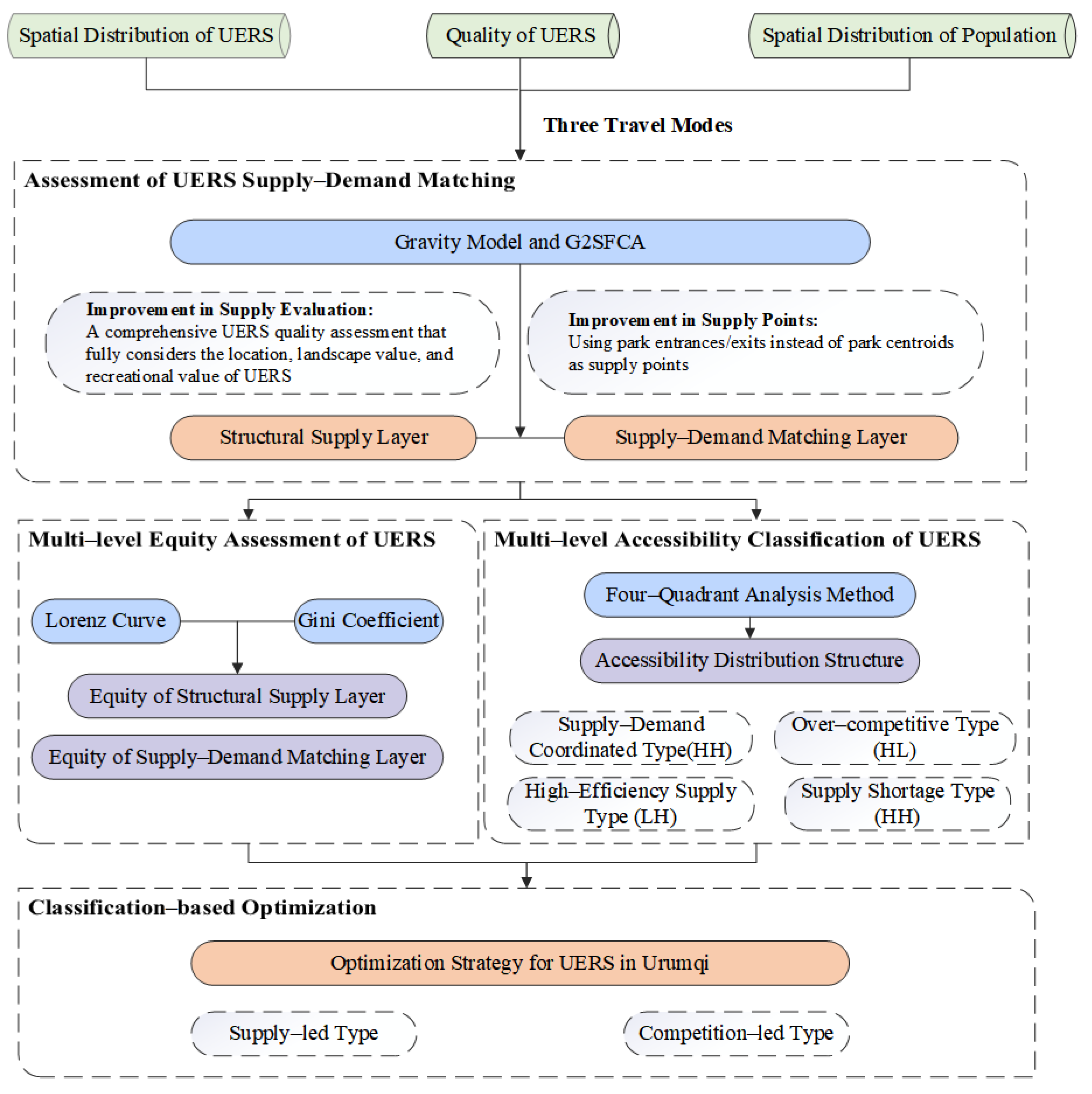
This study takes the urban ecological recreation space (UERS) in Urumqi as the research object. By integrating data on UERS spatial distribution, quality, and population distribution, it analyzes the accessibility of UERS from two dimensions: structural supply and supply–demand matching. On this basis, the study further examines its equity and type distribution using the Gini coefficient and four-quadrant analysis method, thereby formulating comprehensive optimization strategies tailored to different accessibility characteristics. First, from the “natural–social–spatial” perspective, a comprehensive evaluation system for UERS quality is constructed, incorporating landscape value, recreational value, and locational characteristics. Second, a multi-level analytical framework encompassing both the supply layer and supply–demand matching layer is established to deeply explore the underlying causes of supply–demand imbalance. Finally, based on the research findings, urban planning and management recommendations are proposed to promote the balance between UERS supply and demand. The technical approach adopted in this study is illustrated in Figure 1 below.

2.1. Study Area

Urumqi, located in Northwest China, is the capital of the Xinjiang Uygur Autonomous Region. As a typical oasis city in an arid zone and a major regional center with relatively strong economic and infrastructural foundations [35], it plays a key role in the urban system of Northwest China. By the end of 2024, the city had a permanent population of 4.13 million and an urbanization rate of 97%.
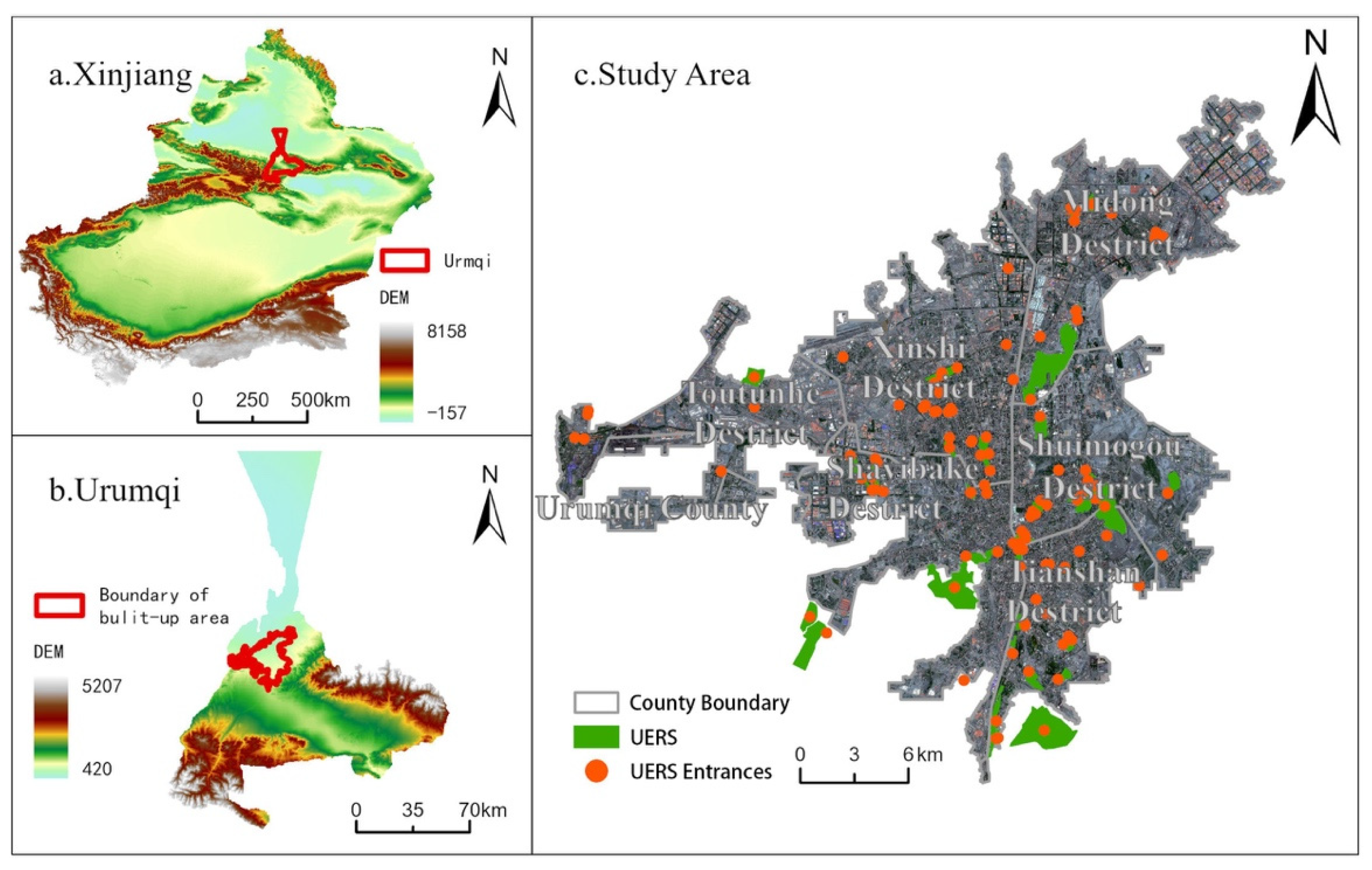
Urumqi covers a total administrative area of 13,800 km2, while its built-up area occupies only 545.10 km2. The southern mountainous area and northern Gobi region contain sparse population and infrastructure, making them unsuitable for the analytical framework of this study. Therefore, based on nighttime light data and China’s urban built-up area dataset [36], we applied a threshold segmentation method, supplemented by visual interpretation of remote sensing images, to delineate the actual built-up area of Urumqi as the final study area [35,37] (Figure 2).
In recent years, Urumqi has continuously improved its urban functions and environmental quality. From 2010 to 2020, urban park green space per capita increased from 6.4 m2 to 13.2 m2, a growth of 106.3%. However, with rapid outward expansion and population growth, recreational resources in newly developed districts remain insufficient. By 2020, per capita park green space had decreased by 5.7%, and the imbalance between old and new districts in UERS provision had become increasingly pronounced, making supply–demand mismatch a key obstacle to sustainable urban development.

2.2. Data Sources

This study selected multi-source data, primarily including remote sensing imagery data, POI data, road network and water system data, and nighttime light data (Table 1). This research utilized Sentinel 2 imagery data from July 2025. Sentinel 2 data demonstrated good accuracy in extracting urban vegetation, water bodies, and other land types [38,39]. The road network and water system data were integrated from OSM data and Tianditu data. Population data were sourced from the 100 m resolution gridded population dataset provided by the WorldPOP project official website (https://www.worldpop.org/). Based on the previous definition of urban ecological recreation spaces (UERSs), a total of 459 POI data points for scenic spots and parks/plazas were scraped from Baidu Maps and AMap. Using a 30 min walking distance (at a speed of 4 km/h), POI data within a 2 km radius of the built-up area were selected. Through manual screening of remote sensing imagery, parks and scenic areas lacking ecological functions or with less than 35% green space coverage (such as aquariums and mosques) were excluded, thus preliminarily identifying UERS locations. The entrance and exit data for UERS were also included in the previously scraped POI data, with additional supplementation based on online search results. The UERS boundary data were digitized around the UERS point data using Sentinel 2 imagery and Google Earth (https://earth.google.com/) image data to outline ecological patches.

2.3. Method

2.3.1. Spatial Accessibility Decomposition Framework

To uncover the formation mechanism of equity in the provision of urban ecological recreation spaces (UERSs), this study builds upon the Gaussian two-step floating catchment area method (G2SFCA) [24,26,40] to construct a decomposition framework of “structural supply layer–competition matching layer.” This framework breaks down the traditional composite accessibility indicator into two dimensions: potential supply level and competition-adjusted matching level, distinguishing between the land supply structure effect and the population competition effect.
  • Structural supply layer
In the first stage, the perceived supply intensity of demand point i under distance decay constraints is calculated based on the gravity model.
P S i = j S j × G d i j , d 0
Among them, P S i represents the potential supply level of demand point i.; S j represents the supply scale of supply point j (expressed in terms of area or quality); d i j represents the network distance between demand point i and supply point j; d 0 represents the distance thresholds for different modes of transportation; and G d i j , d 0 represents the Gaussian distance decay function. The formula is as follows:
G d i j , d 0 = e 1 2 × d i j d 0 2 e 1 2 1 e 1 2 , d i j d 0 0 , d i j > d 0
For the selection of search radius d0, this paper sets 30 min as the threshold, which is commonly regarded as the psychological limit for all travel modes in previous studies [22]. Based on road speed limits, the average speeds for walking, cycling, and driving are selected as 4 km/h, 20 km/h, and 40 km/h, respectively.
2.
Competition matching layer
In the second stage, a demand-side competition mechanism is introduced, and the supply–demand ratio of supply points is calculated after considering population competition factors.
C j = S j / k P k × G d k j , d 0
Among them, C j represents the supply–demand ratio of supply point j; P k represents the population size of demand point k; and d k j is the network distance between demand point k and supply point j.
Subsequently, taking demand point i as the center, we search for supply points within the threshold d 0 , and sum the supply–demand ratios ( C j ) of all these supply points to obtain the supply–demand matching ( M i ) for demand point i.
M i = j C j × G d i j , d 0
This level comprehensively considers the scale of supply and population competition, reflecting the matching status of supply and demand.

2.3.2. Calculation of the Quality Factor for UERS

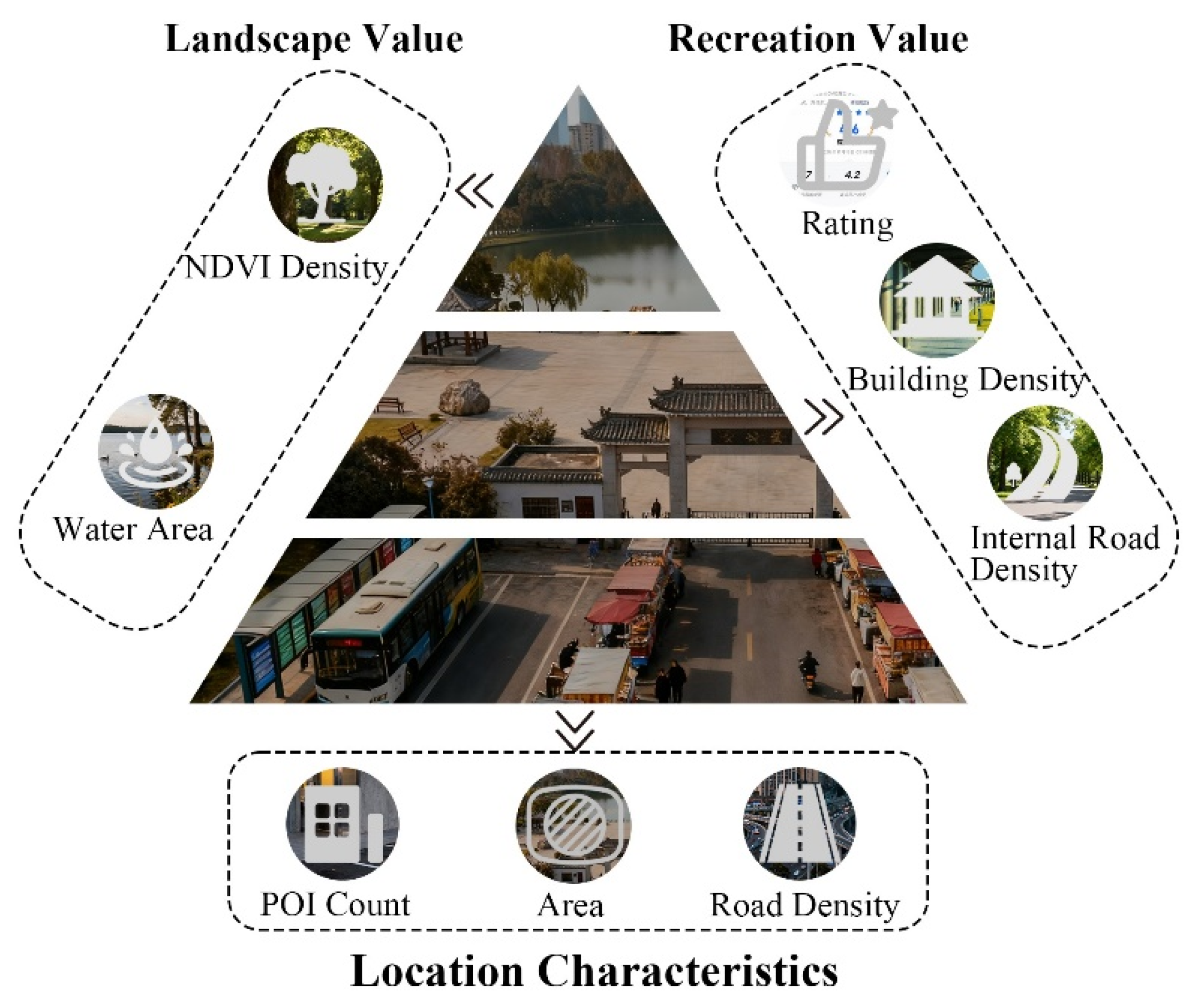
UERS is a multifunctional space that integrates natural ecological functions with social services. Based on the existing literature [19,20], the current conditions of the study area, and data availability, this study adopts a “nature–society–space” framework to select indicators most likely to influence UERS quality. Eight indicators were chosen across three dimensions (Figure 3), location characteristics, landscape value, and recreation value, to construct a comprehensive evaluation system (Table 2). Their weights were calculated using the entropy weight method [41]:
Y i , j = ( X i , j min X i ) / ( max X i min X i ) + ε
ε = 10 8
where X i , j and Y i , j denote the raw and normalized values for the jth indicator of the ith UERS. Information entropy ( E j ) quantifies each indicator’s discriminative power:
P i j = Y i j / i = 1 n Y i j
E j = i = 1 n P i j ln P i j / ln n
The final weight W i j and quality Q i are computed as:
W i j = 1 E j / ( m j = 1 m E j )
Q i = j = 1 m W i j Y i j
The rationale for indicator selection is as follows. Firstly, location characteristics reflect the spatial attributes of UERS. From the perspectives of supply potential and transportation accessibility, area and surrounding road density were selected as indicators [42]. The spatial scale of UERS determines its service capacity, as larger areas can support more complete facility systems and ecological functions [21], which typically also implies higher land costs and a more prominent position in planning. Surrounding road network density indicates accessibility, directly influencing the attractiveness of UERS. In addition, surrounding facilities—considered part of the location attributes—were included in the indicator system [42]. Facilities such as parking lots, restaurants, and public restrooms indirectly enhance the service capacity and attractiveness of UERS. Secondly, environmental quality reflects the natural and ecological attributes of UERS. From the perspectives of vegetation and waterscape, NDVI density and water area were selected as evaluation indicators. As a major city in an arid region, Urumqi lacks large rivers within its built-up area; existing waterways are short and scattered. Water bodies serve as the core element defining the uniqueness of UERS landscapes, yet are constrained by natural conditions. Some large-scale UERS may contain only minimal water features, while smaller-scale UERS could be predominantly water-based. Therefore, to prevent underestimating the aquatic landscape value of UERS due to their size, water area is used to measure the blue landscape value of UERS, whereas NDVI density is employed to assess their green landscape value. Finally, recreation constitutes the primary function of UERS. Accordingly, three indicators—building density, internal road density [29], and online rating [1]—were chosen to evaluate recreational facility provision and user experience. Building density is defined as the ratio of built-up area within a park to its total area. Under a controlled green space ratio (>35%), it reflects development intensity and service support capacity, indirectly indicating recreational use potential. In addition, a multicollinearity diagnosis was conducted for all the above indicators, with VIF values all below 5, indicating no high multicollinearity among the indicators.

2.3.3. Inequity and Mismatch Between UERS Supply and Demand

Based on the previously derived UERS supply–demand matching results, the Gini coefficient and Lorenz curve were employed to evaluate the extent of inequality and mismatch between UERS supply and demand under different travel modes within the study area. The Gini coefficient and Lorenz curve are widely used to measure spatial inequality [22,35,43,44]. A higher Gini coefficient indicates a greater mismatch between residents’ demand and the accessible UERS supply. The Gini coefficient is calculated as follows:
G i n i = 1 i = 1 n ( B D i B D i 1 ) ( B A i + B A i 1 )
where B A i denotes the cumulative proportion of UERS accessibility, and B D i represents the cumulative proportion of the population. The Lorenz curve, derived from the Gini coefficient, illustrates the cumulative distribution of UERS accessibility across residents of different administrative districts in Urumqi’s built-up area, visually reflecting equity in supply–demand.

3. Results

3.1. Structural Supply Pattern

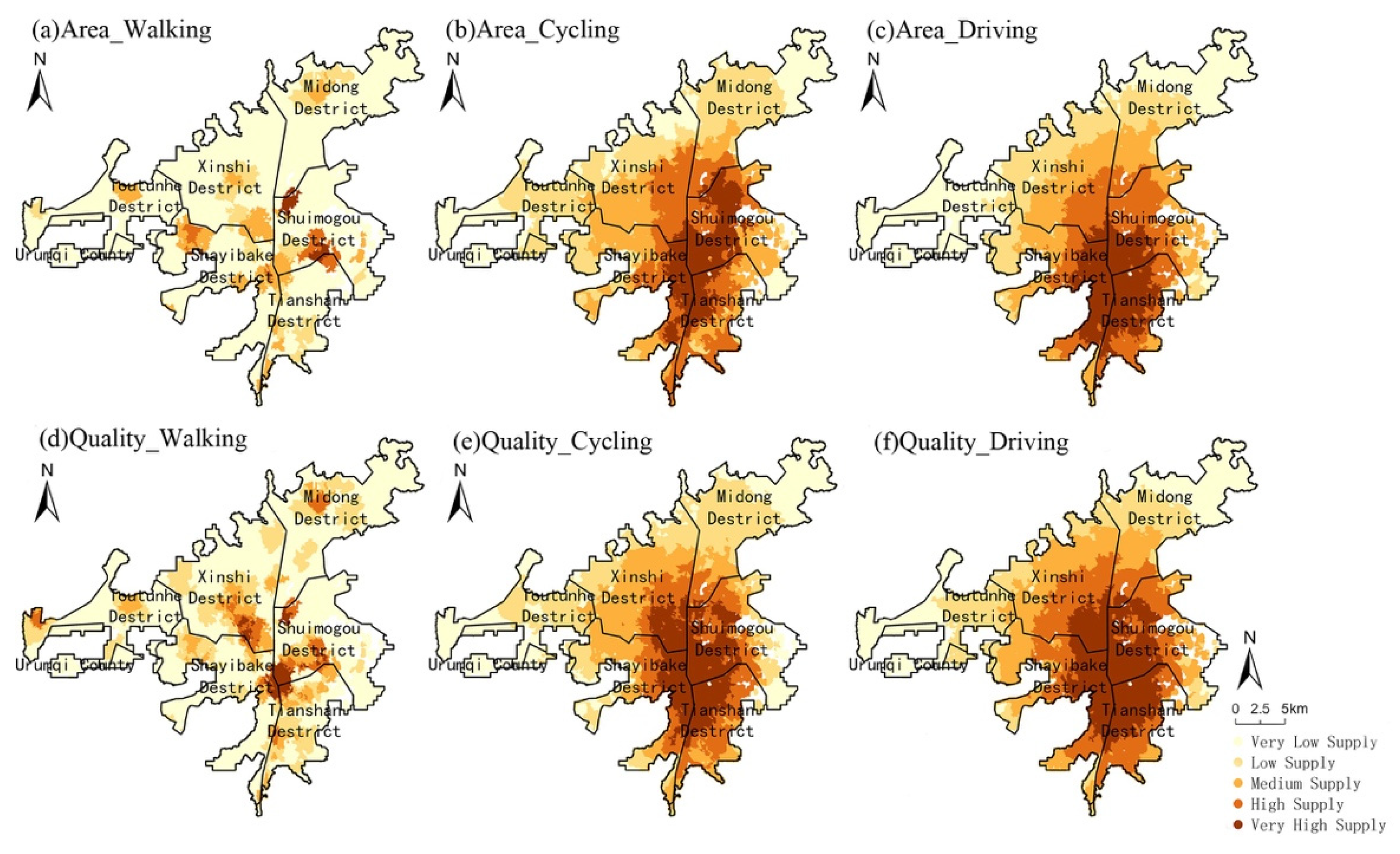
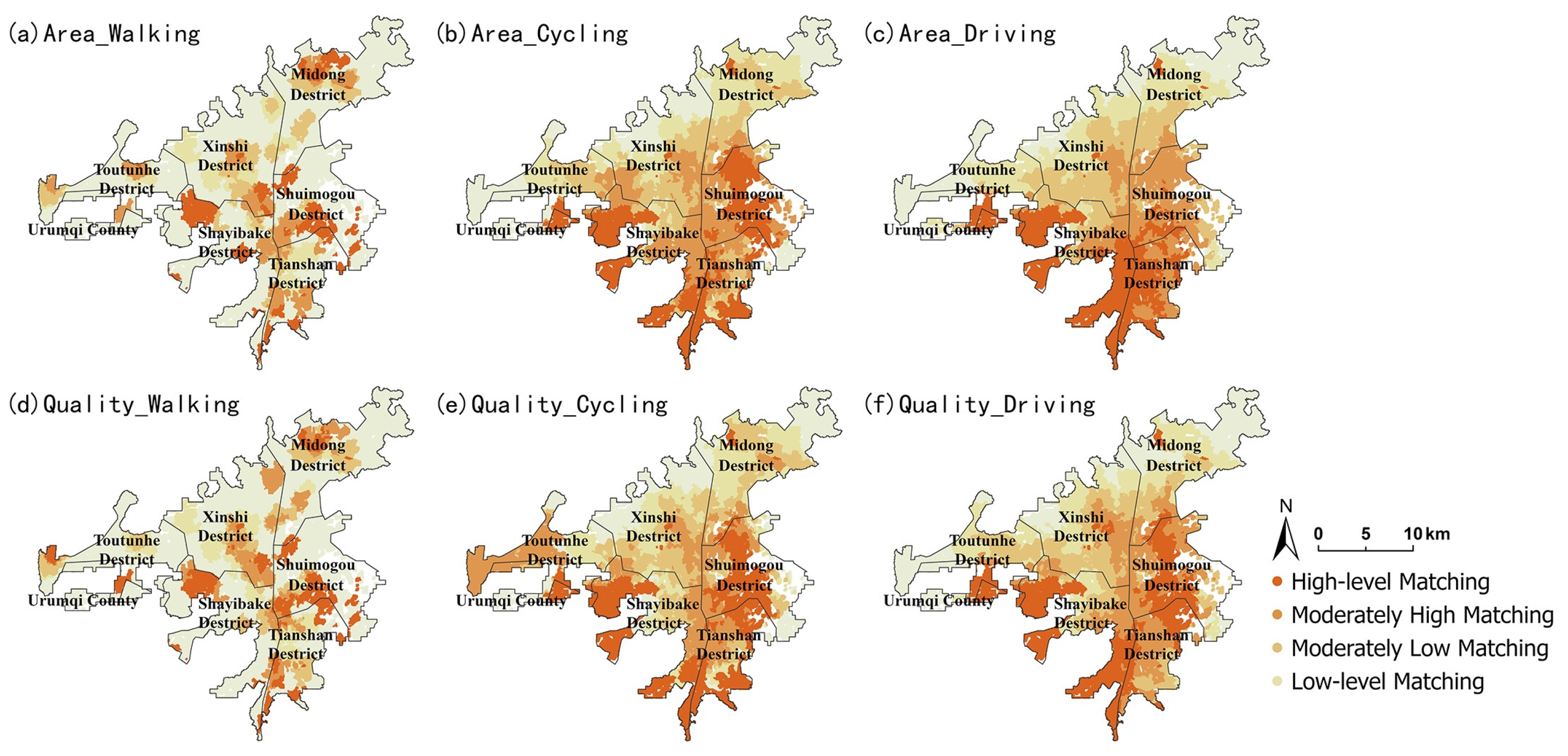
To ensure the comparability of spatial patterns and avoid distortions caused by extreme values, the quantile method was used to classify structural supply values (Figure 4). Overall, under the quantile classification, the UERS structural supply exhibits a pronounced core–periphery gradient. The core areas of the built-up region consistently show high supply levels, while the western and northern peripheral areas are predominantly characterized by low levels. The old urban districts (Shayibake District, Shuimogou District, and Tianshan District) demonstrate relatively high structural supply rankings across different travel modes, reflecting the accumulated advantages of historical built-up areas in green space allocation. Compared to results based solely on area measurements, the introduction of quality indicators has led to higher-level supply areas becoming more concentrated in the old urban districts in the southern part of the built-up region, indicating that the quality dimension reinforces the core area’s advantage and reduces the relative status of peripheral areas in the supply ranking.
At the level of travel modes, the structural supply under walking conditions shows significant spatial fragmentation, with many demand points failing to receive effective supply within the walking threshold, resulting in widespread low-level areas. High-level clusters are only formed in the core of the built-up region and some secondary centers. As the travel mode shifts from walking to cycling and driving, the service radius of UERS expands, and high-level areas extend outward to the periphery. However, the overall supply ranking maintains a stable core–periphery structure, indicating that travel modes alter the spatial scope of influence but do not fundamentally change the spatial imbalance in the supply structure.
The southern part of Urumqi serves as a water conservation area. In the context of arid regions, green space resources often form linear or clustered distributions along mountains and water sources rather than being evenly spread. Meanwhile, large-scale UERS are mainly distributed on the eastern and western sides of the southern built-up area due to barren mountain greening projects. In contrast, the northern region, with its relatively flat terrain and historically abundant farmland, mostly ranks in the middle to low levels of supply. This concentration of supply under resource constraints results in the overall southern bias of high-value UERS supply areas in Urumqi, further amplifying the impact of different travel modes on the structural supply pattern.

3.2. Supply–Demand Matching Pattern

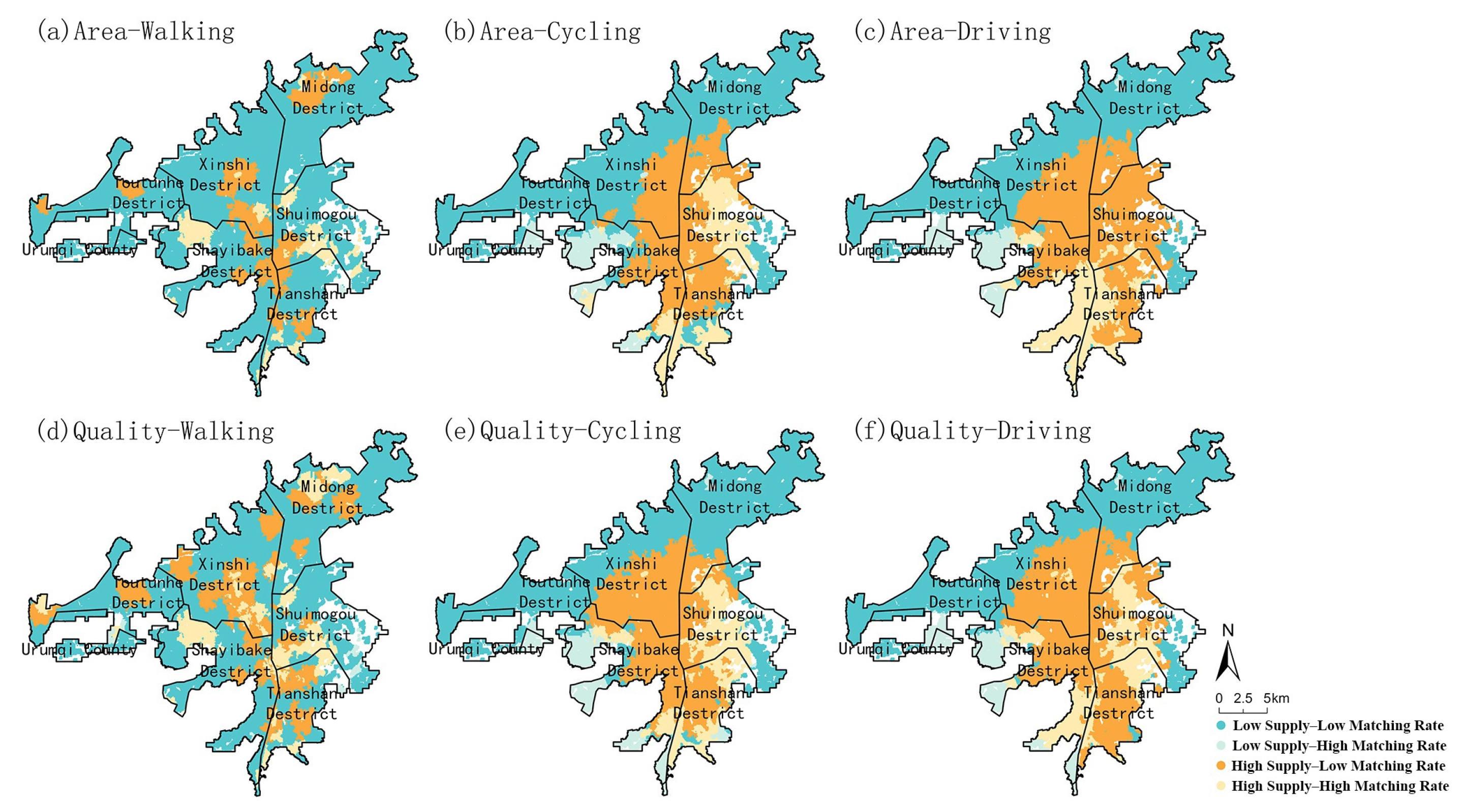
After the structural supply analysis revealed the agglomeration advantages of the old urban area, the supply–demand matching results based on quantile grading were further examined to determine whether the supply could effectively translate into matching advantages at the population level (Figure 5).
Firstly, the matching grades in the city center declined more significantly under cycling and driving modes. As the service radius expanded, the supply coverage incorporated more populations, leading to a substantial increase in the scale of competing populations, thereby intensifying the supply–demand competition pressure in the core area. In contrast, under the walking mode, since a large number of peripheral demand points failed to fall within the effective supply range, the competitive relationship was not fully formed, and the decline in matching grades in the core area appeared relatively less pronounced spatially. Secondly, in the area scenario, the southern UERS exhibited more pronounced matching advantages under the driving mode. However, in the quality scenario, high matching grades remained scattered in localized areas of the old urban area, indicating that the southern region’s area advantage had not been fully translated into a supply advantage at the quality level.

3.3. Dual-Layer Fairness Analysis

To comprehensively reveal the equity of urban ecological recreational spaces (UERS), this study simultaneously analyzes the characteristics of structural supply equity and supply–demand matching equity, and explores the impact of UERS quality and travel modes on these two dimensions of equity.

3.3.1. Fairness in Structural Supply Layer Fairness

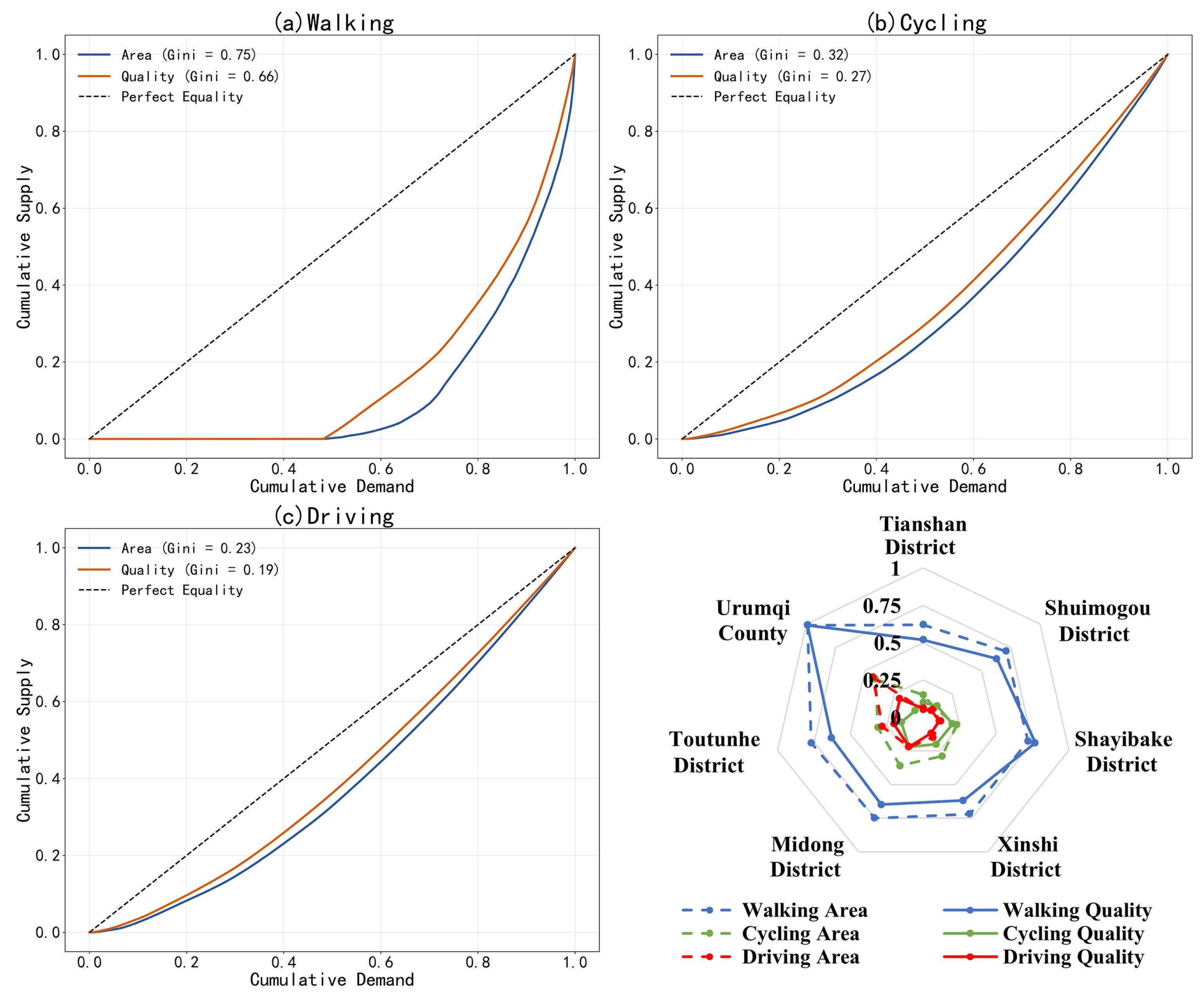
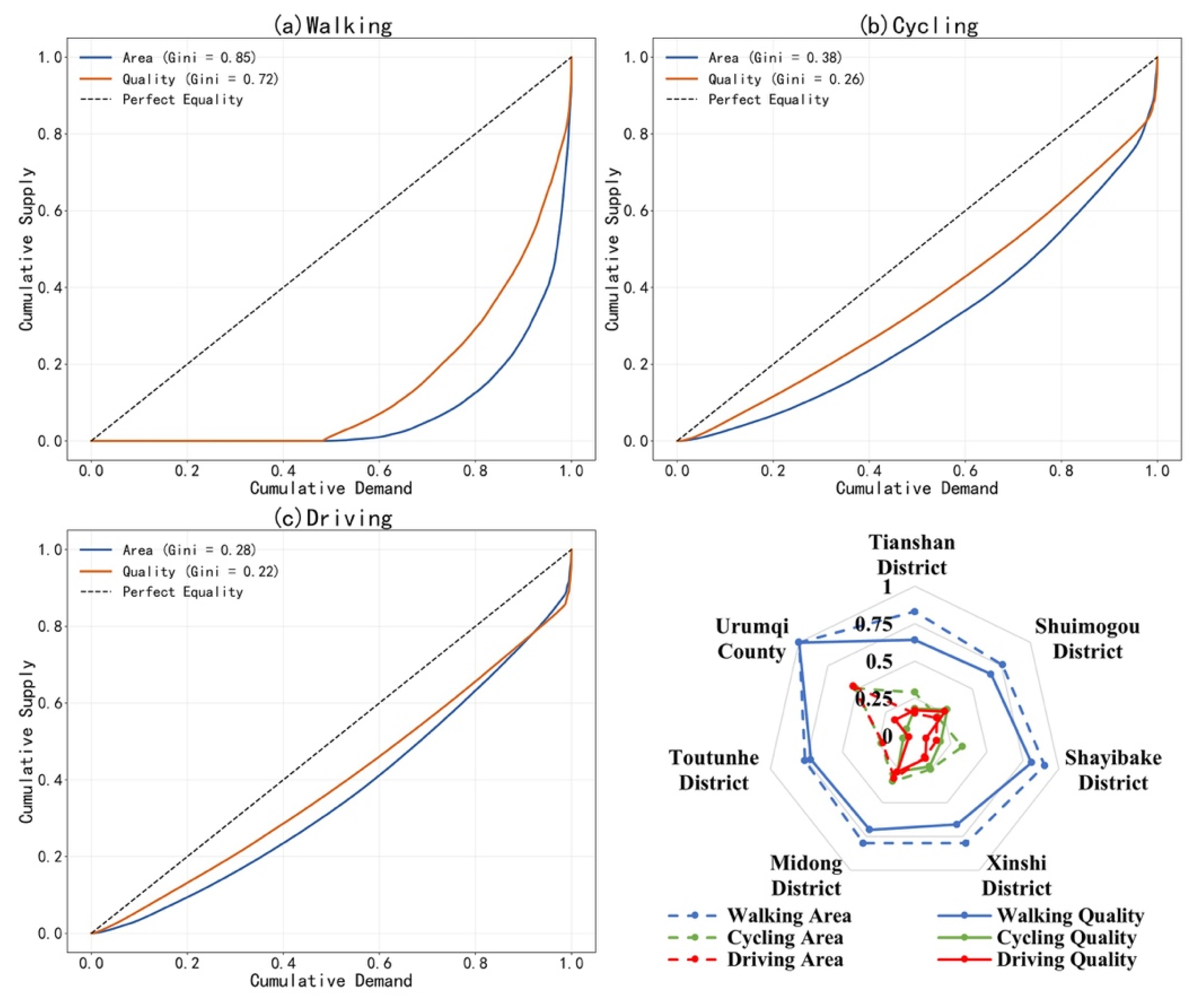
The Lorenz curve results (Figure 6) reveal significant disparities in the equity of urban ecological recreational spaces between the structural supply layer and the supply–demand matching layer across different travel modes, with distinct differentiation observed among various types of urban districts. In the structural supply layer, the curve deviates most from the diagonal under walking conditions, with an overall Gini coefficient exceeding 0.6, indicating highly concentrated supply at short-distance scales. Under cycling and driving modes, the curves gradually approach the equilibrium line (Gini index below 0.3), suggesting that improved mobility can mitigate structural concentration effects. Additionally, when quality indicators are considered, equity improves, as evidenced by the Lorenz curve moving noticeably closer to the equilibrium line.
From an administrative district perspective, the Gini indices of old urban areas (Tianshan District, Shuimogou District, and Shayibake District) are generally lower than those of new urban areas. Among them, Urumqi County exhibits the highest Gini index, revealing that supply is predominantly dominated by a few large-scale ecological spaces. This demonstrates that structural inequity primarily stems from large-scale concentration in peripheral county areas, while internal disparities within old urban districts remain relatively manageable.

3.3.2. Fairness in Supply–Demand Matching Layer

As Shown in Figure 7, similar to the structural supply layer, overall fairness improves when quality indicators are considered. However, in the supply–demand matching layer, the Lorenz curve shows a noticeable tail lift, with approximately 10% of the supply being occupied by a very small population.
At the administrative district level, the fairness advantage of the old urban area is not as pronounced as in the structural supply layer, especially when UERS quality is taken into account. Taking the driving mode as an example, in the area scenario, the Gini coefficient of the old urban area (0.15~0.19) is slightly lower than that of the new urban area (0.16~0.53). However, under the quality scenario, the difference in Gini coefficients between the old urban area (0.08~0.26) and the new urban area (0.04~0.27) is no longer significant.

3.3.3. Structural Supply Versus Fairness in Supply–Demand Matching

In comparison, after accounting for population competition, the Lorenz curve of the supply–demand matching layer deviates further from the equilibrium line than that of the structural layer, with a slight increase in the Gini coefficient, indicating that population distribution does not buffer supply concentration but instead amplifies accessibility disparities in high-density areas. The amplification effect is particularly pronounced in old urban areas: the Gini coefficient of the walking matching layer in Shayibake District rises to 0.90, which is significantly higher than its structural layer (0.72), suggesting that dense population combined with limited supply creates noticeable competitive pressure. In contrast, the increase is relatively smaller in new urban areas, with the Gini index of the supply–demand matching layer in Toutunhe District even slightly lower than that of the structural supply layer. Among them, Xinshi District, the most populous district in Urumqi, shows no significant rise in its Gini coefficient, indicating that high population density is not the sole influencing factor, and structural planning also plays a buffering role.
From an overall trend perspective, walking mode exhibits the highest level of inequality in both layers, followed by cycling and driving, reflecting clear scale dependency. The introduction of quality weighting significantly reduces the Gini coefficient in the structural layer, but its improvement diminishes in the supply–demand matching layer, implying that in high-density areas, population competition becomes the primary factor limiting the fairness-enhancing effect of quality weighting. Integrating the Lorenz curves and zonal Gini results reveals significant differences in the mechanisms driving fairness across urban areas at different spatial development stages: old urban areas are primarily driven by amplified population competition, new urban areas exhibit a relative balance between structure and competition, while county-level regions are dominated by insufficient supply.

3.4. Structure and Dual Matching Relationship

To further reveal the spatial correspondence between structural supply and supply–demand matching, this study constructs a four-quadrant classification (Figure 8) based on standardized structural supply and supply–demand matching indices, identifying four spatial types: high supply–high matching (HH), high supply–low matching (HL), low supply–high matching (LH), and low supply–low matching (LL). This method enables the identification of whether potential supply advantages are realized under competitive conditions within a unified framework.
Overall, the four-quadrant types exhibit significant spatial clustering rather than random distribution. The LL type is primarily distributed along the northern fringe of the urban built-up area. These regions are disadvantaged at the structural supply level and remain at a low matching level even after competition, indicating that their inequity is mainly driven by insufficient supply infrastructure rather than amplified by population competition, reflecting structural shortcomings in the spatial layout of UERS. In contrast, the HH type is mostly distributed on the periphery of the old urban area. These regions already exhibit high values at the structural supply level and maintain their advantage at the matching level. The HL type shows patchy clustering mainly in the southern and eastern peripheral areas. The HL type holds the most significant structural meaning spatially, which is concentrated primarily in the core areas of the old urban district. This type shows high values at the structural supply level but shifts to low values at the matching level, demonstrating a notable “advantage reversal” phenomenon. Specifically, although the old urban area possesses a mature and densely distributed ecological space system, its supply advantages are significantly weakened under competitive conditions due to high population density, residential crowding, and overlapping demand points. This phenomenon further corroborates the population competition amplification effect revealed earlier. The LH type is relatively limited in number and mainly distributed along the southwestern edge of the built-up area, where the population size is small but adjacent to large ecological spaces. These regions exhibit medium-to-low levels at the structural supply level but achieve high levels at the matching level due to weaker competitive pressure.
In summary, the four-quadrant analysis demonstrates that structural supply advantages do not necessarily correspond to achieved equity, as their spatial transformation is significantly influenced by population size and spatial structural conditions. These results concretize the overall inequality characteristics revealed by the Gini coefficient and Lorenz curve into spatial typological differences, uncovering the nonlinear relationship between potential equity and realized equity.

4. Discussion

4.1. Separation of Structural Supply Equity and Supply–Demand Matching Equity

Existing UERS studies often use supply–demand matching outcomes as the core evaluation metric, treating the post-competition accessibility distribution as a direct reflection of equity [45]. However, this single-layer analytical framework, while emphasizing allocation results, tends to overlook the spatial characteristics inherent in the structural supply pattern. Unlike rigid resources such as hospital beds, the supply competition for urban ecological recreational spaces (UERSs) is more implicit, making it difficult for residents to directly perceive the competitive dynamics. Therefore, the distribution and equity of the structural supply layer remain highly relevant.
By constructing a dual-layer analytical framework encompassing the structural supply layer and the supply–demand matching layer, this study reveals that equity in the structural supply layer does not correspond one-to-one with equity in the supply–demand matching layer. Instead, there is a significant moderating and amplifying effect between the two.
Gini index results show that in some areas, particularly older urban districts, inequity in the supply–demand matching layer is higher than in the structural supply layer, indicating that population competition exacerbates pre-existing spatial disparities. However, in other regions, the difference between the two layers is relatively limited, suggesting that inequity may stem more from the supply structure itself rather than being amplified by competition. This finding implies that relying solely on the supply–demand matching layer to assess equity fails to identify the underlying mechanisms of inequity. Some areas exhibit “structure-dominated inequity,” where insufficient supply infrastructure is the primary cause, while others display “competition-dominated inequity,” where structural advantages are weakened under high-density competition. A quadrant analysis further validates this relationship. Many areas in older urban districts exhibit a “high supply–low matching” pattern, indicating that structural advantages are diminished in high-competition environments. In contrast, the northern fringe of the built-up area shows a “low supply–low matching” pattern, reflecting inequity driven by structural supply deficiencies. This demonstrates that the supply–demand matching layer is not independently generated but rather a redistributive outcome built upon the foundation of structural supply. Equity thus emerges as a dynamic process shaped by both structural foundations and competitive processes, rather than a static result at a single level.
Within this framework, the structural supply layer and the supply–demand matching layer should be regarded as two indispensable analytical dimensions. The structural layer reveals the spatial starting point of equity, while the matching layer reveals the allocation outcomes under competitive conditions. Only by combining the two can we identify the multi-path mechanisms of equity formation and distinguish between different sources of inequity.

4.2. Hierarchical Differences in Quality Improvement

Considering the quality of UERS, this study observed the spatial variation of supply–demand matching results under two scenarios. At the city-wide and most regional levels, Scenario II, which incorporated quality indicators, showed a significant improvement in the equity of supply–demand matching, aligning with the findings of Hou et al. [20,21] but differing from those of Li et al. [46].
As an oasis city in an arid region, Urumqi has its unique characteristics. The allocation of UERS is constrained by natural conditions and the physical rigidity of urban functional zoning, making it difficult to adjust arbitrarily. The quality of UERS, however, is influenced by factors such as policies, regional development, management, and funding, which help alleviate the imbalance between supply and demand caused by uneven area allocation due to natural constraints. Additionally, large-scale UERS within Urumqi’s built-up areas primarily originate from barren mountain greening projects, yet they lack the landscape and recreational value commensurate with their size (Figure 4). This somewhat diminishes the advantages of large-scale UERS. For example, the Yamalike Mountain Forest Park in Shayibake District covers over 50 hectares but scores only 9.8 points in quality metrics, differing from findings in the existing literature [47,48]. This reflects that the quality supply of such large UERS still struggles to effectively meet residents’ needs.
Meanwhile, at the supply–demand matching level, considering the quality of UERS demonstrates a more significant improvement in fairness. This phenomenon suggests that in high-density urban environments, measuring supply solely by area is insufficient. In contrast, prioritizing the allocation of high-quality small-scale ecological recreational spaces in densely populated and facility-rich urban areas may more effectively enhance supply efficiency and feasibility [42]. This quality-oriented strategy helps alleviate competitive pressure under high-density conditions and achieves more substantive fairness improvements within limited spatial constraints.

4.3. Limitations and Prospects

With the method proposed in this study, we can gain a good understanding of the inequities in the construction of urban ecological recreational spaces (UERSs) in Urumqi, offer specific recommendations for improving UERS development, and formulate effective policies and strategies for the sustainable development of cities and regions. However, this study also has some limitations. It separately calculated and analyzed the supply–demand matching of UERS for each mode of transportation but overlooked residents’ preferences for different modes of transportation across various regions and time periods [22]. At the same time, in the dimension of recreation value evaluation, although the service capacity is indirectly reflected through indicators such as network score, impervious surface area, and road density, the diversity, distribution pattern, and functional configuration of internal service facilities have not been deeply examined. This data will require a large number of refined field surveys, which are expected to be completed in future studies.
In addition, as a temperate city, the supply type and capacity of urban ecological recreation space will be affected by the seasons [49]; for example, some urban ecological recreation spaces only provide ice and snow recreation projects in winter, and residents’ demand tendencies and travel choices will also be affected by seasons [50]. In winter, people may be more willing to spend extra travel time to visit larger urban ecological recreational spaces. Therefore, considering the seasonal variations in residents’ needs and the changing types of urban ecological recreational spaces, further research on the supply–demand matching and fairness of UERS could be a promising topic for future studies.

4.4. Optimization Path Suggestions

Proper planning of UERS can enhance urban livability, ecological resilience, and social inclusivity, thereby promoting spatial equity. Current green space management in China relies heavily on indicators such as per capita green space and green coverage, while neglecting accessibility and utilization efficiency [51]. Similarly, existing studies emphasize supply–demand matching indicators but underrepresent structural supply characteristics. To address the challenges posed by spatial inequity in UERS, its optimization should adhere to two principles:
1. Equity-oriented: For areas with more prominent supply–demand imbalances, structural optimization with an equity focus should be strengthened. According to the results of the quadrant analysis, these areas are concentrated in northern and eastern built-up zones. These regions suffer from both insufficient UERS provision and a lack of supporting facilities, resulting in a significant accessibility gap compared to the urban core [35]. The land rents in these areas are relatively lower compared to the urban core, but the population distribution is also relatively sparse. A hierarchical (neighborhood–community–district–city) UERS system should be established. Considering the actual conditions, large-scale UERS should be located near transport hubs, supplemented by small-scale facilities to form a balanced network. Additionally, based on the supply–demand matching results of UERS for walking, cycling, and driving modes in this study, the imbalance is particularly pronounced under walking conditions, which aligns with findings from related research [52,53]. Improving transport infrastructure and expanding shared micro mobility (bike/e-bike) can enhance accessibility for disadvantaged groups [19]. Figure 6 shows a significant improvement in the equity of UERS supply and demand in cycling mode, which is consistent with the findings of Liang et al. [22]. Optimizing shared mobility systems can effectively improve the spatial equity of UERS use.
2. Oriented by supply–demand balance: UERS resource allocation should match residents’ needs [54]. For areas where competition is more intense, the pressure of competition should be alleviated by dispersing demand and improving the quality of supply. In densely built-up urban areas, small pocket parks and quality upgrading of existing UERS should be prioritized [42]. Meanwhile, the findings of this study indicate that UERS supply exhibits a strong core–periphery structure, which aligns with the conclusions of related research [35,55]. However, the accessibility advantage in the core has weakened under supply–demand competition, with most of the population located in supply–demand imbalance zones dominated by “high supply–low matching” demographic competition. However, when considering the quality factor of UERS, the improvement in fairness in the supply–demand matching layer is more significant compared to the structural supply layer. This indicates that in high-density built-up areas, quality optimization can enhance the efficiency of unit supply and mitigate competitive pressures. Compared to simply expanding the area, improving the quality of UERS holds greater regulatory significance in the context of old urban areas. Optimization of existing land use should be prioritized to enhance the quality and attractiveness of small and medium-sized UERS, thereby alleviating supply pressure.

5. Conclusions

This study focuses on urban ecological recreation spaces (UERSs) and establishes a dual-layer analytical framework of “structural supply–supply–demand matching.” By incorporating population competition and UERS quality factors into the Gaussian two-step floating catchment area method, it systematically evaluates the accessibility and equity of UERS in Urumqi. The findings reveal that UERS accessibility cannot be solely explained by structural supply or supply–demand matching but is rather shaped by the interplay between spatial layout and competitive mechanisms.
First, both the structural supply layer and the supply–demand matching layer exhibit a core–periphery spatial differentiation pattern, with the structural supply layer being particularly pronounced. This spatial pattern is influenced by both natural endowments and urban development. The older southern districts near water sources show significant supply advantages, but their matching advantages are weakened by competition under high population density. In contrast, new urban areas and peripheral regions suffer from lower accessibility due to weaker supply foundations. The disparities in structural bases and competition intensity across urban areas at different development stages collectively contribute to spatial inequity.
Second, fairness is shaped by both the structural supply layer and the supply–demand matching layer. The competitive distribution of population in Urumqi has, to some extent, exacerbated the unfairness inherent in the original structural supply distribution. The degree of inequality in the supply–demand matching layer is generally higher than in the structural supply layer, indicating that population competition does not mitigate existing disparities but rather perpetuates and even exacerbates structural differentiation to some extent. Consequently, the equity pattern arises not only from supply distribution but also reflects the redistribution dynamics under competitive conditions.
Third, after considering the quality factors of UERS, the improvement in fairness at the supply–demand matching layer is more significant compared to that at the structural supply layer. Within the supply–demand matching layer, incorporating UERS quality significantly improves equity. This suggests that in high-density built-up areas, optimizing quality can enhance per-unit supply efficiency and alleviate competitive pressures. Compared to merely expanding spatial coverage, improving UERS quality holds greater regulatory significance in old urban contexts.
Fourth, the supply pressure in the old urban area is primarily driven by excessive competition, while in the northern new urban area, it is mainly due to insufficient supply. In the core area, despite high supply levels, the advantage is significantly weakened by intense population concentration during competition, resulting in a “high supply–low matching” reversal phenomenon. Meanwhile, some peripheral areas exhibit a relative advantage of “low supply–high matching” due to lower competitive pressure.
Additionally, equity patterns vary considerably across different transportation modes. Under walking conditions, UERS accessibility is low, with a large proportion of residents unable to reach UERS within 30 min. For cycling and driving modes, while the service range expands, the core–periphery structure of accessibility distribution remains fundamentally unchanged.

Author Contributions

Y.X.: Conceptualization, Data Curation, Software, Visualization, Writing—Original Draft; Z.Y.: Resources, Supervision, Project Administration; C.W.: Funding Acquisition, Supervision, Writing—Review and Editing; M.Y.: Writing—Review and Editing, Supervision; J.H.: Writing—Review and Editing. All authors have read and agreed to the published version of the manuscript.

Funding

This research was funded by National Key Research and Development Program of China, China under Grant [No. 2024YFF0809303].

Data Availability Statement

The original contributions presented in the study are included in the article. Further inquiries can be directed to the corresponding author.

Acknowledgments

Thank you to my fellow students for their suggestions and assistance with this research.

Conflicts of Interest

The authors declare no conflicts of interest.

Abbreviations

The following abbreviations are used in this manuscript:
UERSsUrban Ecological Recreational Spaces
POIPoint of Interest
G2SFCAGaussian Two-Step Floating Catchment Area

References

  1. Xu, X.; Hu, J.; Lv, L.; Yin, J.; Tian, X. Research on the Matching Relationship between the Supply of Urban Ecological Recreational Space and the Demand of Residents—A Case Study of an Urban Development Area in Wuhan. Int. J. Environ. Res. Public Health 2022, 19, 816. [Google Scholar] [CrossRef] [PubMed]
  2. Pretty, J.; Griffin, M.; Sellens, M.; Pretty, C. Green Exercise: Complementary Roles of Nature, Exercise and Diet in Physical and Emotional Well-Being and Implications for Public Health Policy; University of Essex: Colchester, UK, 2003. [Google Scholar]
  3. Bedimo-Rung, A.L.; Mowen, A.J.; Cohen, D.A. The Significance of Parks to Physical Activity and Public Health. Am. J. Prev. Med. 2005, 28, 159–168. [Google Scholar] [CrossRef] [PubMed]
  4. Poppe, L.; Van Dyck, D.; De Keyser, E.; Van Puyvelde, A.; Veitch, J.; Deforche, B. The Impact of Renewal of an Urban Park in Belgium on Park Use, Park-Based Physical Activity, and Social Interaction: A Natural Experiment. Cities 2023, 140, 104428. [Google Scholar] [CrossRef]
  5. Yao, W.; Zhang, X.; Gong, Q. The Effect of Exposure to the Natural Environment on Stress Reduction: A Meta-Analysis. Urban For. Urban Green. 2021, 57, 126932. [Google Scholar] [CrossRef]
  6. Cheng, X.; Liu, J.; Liu, H.; Lu, S. A Systematic Review of Evidence of Additional Health Benefits from Forest Exposure. Landsc. Urban Plan. 2021, 212, 104123. [Google Scholar] [CrossRef]
  7. Delgado-Serrano, M.M.; Melichová, K.; Mac Fadden, I.; Cruz-Piedrahita, C. Perception of Green Spaces’ Role in Enhancing Mental Health and Mental Well-Being in Small and Medium-Sized Cities. Land Use Policy 2024, 139, 107087. [Google Scholar] [CrossRef]
  8. Tost, H.; Reichert, M.; Braun, U.; Reinhard, I.; Peters, R.; Lautenbach, S.; Hoell, A.; Schwarz, E.; Ebner-Priemer, U.; Zipf, A.; et al. Neural Correlates of Individual Differences in Affective Benefit of Real-Life Urban Green Space Exposure. Nat. Neurosci. 2019, 22, 1389–1393. [Google Scholar] [CrossRef]
  9. Opdam, P. Implementing Human Health as a Landscape Service in Collaborative Landscape Approaches. Landsc. Urban Plan. 2020, 199, 103819. [Google Scholar] [CrossRef]
  10. Chen, M.; Dai, F.; Yang, B.; Zhu, S. Effects of Urban Green Space Morphological Pattern on Variation of PM2.5 Concentration in the Neighborhoods of Five Chinese Megacities. Build. Environ. 2019, 158, 1–15. [Google Scholar] [CrossRef]
  11. Georgescu, M.; Morefield, P.E.; Bierwagen, B.G.; Weaver, C.P. Urban Adaptation Can Roll Back Warming of Emerging Megapolitan Regions. Proc. Natl. Acad. Sci. USA 2014, 111, 2909–2914. [Google Scholar] [CrossRef]
  12. Ren, Z.; Zheng, H.; He, X.; Zhang, D.; Shen, G.; Zhai, C. Changes in Spatio-Temporal Patterns of Urban Forest and Its above-Ground Carbon Storage: Implication for Urban CO2 Emissions Mitigation under China’s Rapid Urban Expansion and Greening. Environ. Int. 2019, 129, 438–450. [Google Scholar] [CrossRef]
  13. Li, C.; Zhang, Y.; Liang, H.; Yu, Y.; Long, S.; Sun, Y.; Wang, T.; Wang, K.; Cao, Q. Field Effect and Coupling Influences of Urban Park Cold Islands under Varying Wind Speeds and Heat Island Gradients. Urban Clim. 2025, 61, 102447. [Google Scholar] [CrossRef]
  14. Sandström, U.G.; Angelstam, P.; Mikusiński, G. Ecological Diversity of Birds in Relation to the Structure of Urban Green Space. Landsc. Urban Plan. 2006, 77, 39–53. [Google Scholar] [CrossRef]
  15. WHO Team. Green Spaces—Sectoral Solutions for Air Pollution and Health; WHO: Geneva, Switzerland, 2025. [Google Scholar]
  16. World Health Organization. Land Use Planning—Sectoral Solutions for Air Pollution and Health: Technical Brief; World Health Organization: Geneva, Switzerland, 2025. [Google Scholar]
  17. Lin, Y.; Zhou, Y.; Lin, M.; Wu, S.; Li, B. Exploring the Disparities in Park Accessibility through Mobile Phone Data: Evidence from Fuzhou of China. J. Environ. Manag. 2021, 281, 111849. [Google Scholar] [CrossRef]
  18. Wang, Y.; Luo, K.; Wang, Z.; Fu, M. Modelling Green Space Accessibility and Equity in Mountainous Cities: A Case Study of Chongqing. Environ. Dev. Sustain. 2025. [Google Scholar] [CrossRef]
  19. Hu, S.; Song, W.; Li, C.; Lu, J. A Multi-Mode Gaussian-Based Two-Step Floating Catchment Area Method for Measuring Accessibility of Urban Parks. Cities 2020, 105, 102815. [Google Scholar] [CrossRef]
  20. Hou, Y.; Liu, Y.; Wu, Y.; Zhang, B. Assessment of Spatial and Socioeconomic Disparities in Urban Green Space Accessibility Based on a Physical Activity Diversity Index (PADI). Ecol. Indic. 2024, 166, 112478. [Google Scholar] [CrossRef]
  21. Huang, Y.; Hong, X.; Zheng, Y.; Zhang, Y.; Li, Z. Assessment and Optimization of Spatial Equity for Urban Parks: A Case Study in Nanjing, China. Ecol. Indic. 2024, 166, 112449. [Google Scholar] [CrossRef]
  22. Liang, H.; Yan, Q.; Yan, Y.; Zhang, Q. Using an Improved 3SFCA Method to Assess Inequities Associated with Multimodal Accessibility to Green Spaces Based on Mismatches between Supply and Demand in the Metropolitan of Shanghai, China. Sustain. Cities Soc. 2023, 91, 104456. [Google Scholar] [CrossRef]
  23. Liu, D.; Kwan, M.-P.; Kan, Z. Analysis of Urban Green Space Accessibility and Distribution Inequity in the City of Chicago. Urban For. Urban Green. 2021, 59, 127029. [Google Scholar] [CrossRef]
  24. Luo, F.; Zhang, Y.; Kong, Z.; Dai, Y. Which Green Is More Equitable? A Multi-Indicator Urban Green Space Assessment across Vulnerable Population Groups from an Environmental Justice Perspective. Ecol. Indic. 2025, 178, 113948. [Google Scholar] [CrossRef]
  25. Shan, L.; He, S. The Role of Peri-Urban Parks in Enhancing Urban Green Spaces Accessibility in High-Density Contexts: An Environmental Justice Perspective. Landsc. Urban Plan. 2025, 254, 105244. [Google Scholar] [CrossRef]
  26. Fang, C.; Zhao, J.; Kwan, M.-P.; Zhou, L.; Liu, X.; Ge, S. Urban Green Space Accessibility and Its Determinants at the Megaregion Scale. Cities 2026, 173, 106927. [Google Scholar] [CrossRef]
  27. Korkou, M.; Castilla, J.E.M.; Tarigan, A.K.M.; Sageidet, B.M. Travel Patterns and Factors Explaining Green Space Use for Outdoor Learning among School and Preschool Children. J. Place Manag. Dev. 2025, 18, 163–191. [Google Scholar] [CrossRef]
  28. Shrivastava, A.; Mehrotra, S. Measuring Disparity in the Distribution of ROS in Adolescents Using Geospatial Analysis. J. Urban Plan. Dev. 2024, 150, 04024037. [Google Scholar] [CrossRef]
  29. Fang, D.; Liu, D.; Kwan, M.-P. Evaluating Spatial Variation of Accessibility to Urban Green Spaces and Its Inequity in Chicago: Perspectives from Multi-Types of Travel Modes and Travel Time. Urban For. Urban Green. 2025, 104, 128593. [Google Scholar] [CrossRef]
  30. Li, C.; Fu, B.; Wang, S.; Stringer, L.C.; Wang, Y.; Li, Z.; Liu, Y.; Zhou, W. Drivers and Impacts of Changes in China’s Drylands. Nat. Rev. Earth Environ. 2021, 2, 858–873. [Google Scholar] [CrossRef]
  31. Song, J.; Przybysz, A.; Zhu, C. Revealing the Contribution of Urban Green Spaces to Improving the Thermal Environment under Realistic Stressors and Their Interactions. Sustain. Cities Soc. 2025, 126, 106426. [Google Scholar] [CrossRef]
  32. PreventionWeb. Planting Healthy Air: A Global Analysis of the Role of Urban Trees in Addressing Particulate Matter Pollution and Extreme Heat. Available online: https://www.preventionweb.net/publication/planting-healthy-air-global-analysis-role-urban-trees-addressing-particulate-matter (accessed on 13 November 2025).
  33. Wang, X.; Zhou, L.; López-Carr, D.; Song, Y.; Gao, H.; Che, T.; Liu, Z.; Wei, W. Urban Grey-Green Scales: A New Perspective for Assessing Dynamic Spatial Trade-Offs. Int. J. Appl. Earth Obs. Geoinf. 2025, 142, 104708. [Google Scholar] [CrossRef]
  34. Li, Q.; Wang, W.; Jiang, X.; Lu, D.; Zhang, Y.; Li, J. Optimizing the Reuse of Reclaimed Water in Arid Urban Regions: A Case Study in Urumqi, Northwest China. Sustain. Cities Soc. 2019, 51, 101702. [Google Scholar] [CrossRef]
  35. Zhang, S.; Lei, J.; Zhang, X.; Tong, Y.; Lu, D.; Fan, L.; Duan, Z. Assessment and Optimization of Urban Spatial Resilience from the Perspective of Life Circle: A Case Study of Urumqi, NW China. Sust. Cities Soc. 2024, 109, 105527. [Google Scholar] [CrossRef]
  36. Han, J.; Hu, Z.; Zhou, K. GHSL-Based Chinese Urban Entities (1975–2020) GHSL-Based Chinese Urban Entities (1975–2020) 2024, 25921244 Bytes, 1 Files. Available online: https://www.scidb.cn/detail?dataSetId=73a5b1b1b9d94c8cacbb24834ebf283b (accessed on 13 November 2025).
  37. Xu, Y.; Hao, S.; Cui, Y.; Li, P.; Sheng, L.; Liao, C. Analysis of the Spatiotemporal Expansion and Pattern Evolution of Urban Areas in Anhui Province, China, Based on Nighttime Light Data. Ecol. Indic. 2023, 157, 111283. [Google Scholar] [CrossRef]
  38. Küçük Matci, D. Development of a New Index for Mapping Urban Areas in Türkiye Using Sentinel-2 Images. Adv. Space Res. 2023, 72, 4677–4691. [Google Scholar] [CrossRef]
  39. Hosseiny, B.; Abdi, A.M.; Jamali, S. Urban Land Use and Land Cover Classification with Interpretable Machine Learning – A Case Study Using Sentinel-2 and Auxiliary Data. Remote Sens. Appl. Soc. Environ. 2022, 28, 100843. [Google Scholar] [CrossRef]
  40. Zhang, Y.; Luo, F. Linkages among Socio-Economic Status, Green Space Accessibility, and Health Outcomes: An Environmental Justice Perspective in Australia. Sustain. Cities Soc. 2024, 114, 105784. [Google Scholar] [CrossRef]
  41. Zhang, H.; Liu, Y.; Li, X.; Feng, R.; Gong, Y.; Jiang, Y.; Guan, X.; Li, S. Combing Remote Sensing Information Entropy and Machine Learning for Ecological Environment Assessment of Hefei-Nanjing-Hangzhou Region, China. J. Environ. Manag. 2023, 325, 116533. [Google Scholar] [CrossRef]
  42. Gao, F.; Liao, S.; Wang, Z.; Cai, G.; Feng, L.; Yang, Z.; Chen, W.; Chen, X.; Li, G. Revealing Disparities in Different Types of Park Visits Based on Cellphone Signaling Data in Guangzhou, China. J. Environ. Manag. 2024, 351, 119969. [Google Scholar] [CrossRef]
  43. Jang, S.; An, Y.; Yi, C.; Lee, S. Assessing the Spatial Equity of Seoul’s Public Transportation Using the Gini Coefficient Based on Its Accessibility. Int. J. Urban Sci. 2017, 21, 91–107. [Google Scholar] [CrossRef]
  44. Wang, X.; Yang, H.; Duan, Z.; Pan, J. Spatial Accessibility of Primary Health Care in China: A Case Study in Sichuan Province. Soc. Sci. Med. 2018, 209, 14–24. [Google Scholar] [CrossRef] [PubMed]
  45. Zou, Y.; Zhang, L.; Huang, W.; Chen, J. The Potential of Informal Green Space (IGS) in Enhancing Urban Green Space Accessibility and Optimization Strategies: A Case Study of Chengdu. Land 2025, 14, 1313. [Google Scholar] [CrossRef]
  46. Li, X.; Huang, Y.; Ma, X. Evaluation of the Accessible Urban Public Green Space at the Community-Scale with the Consieration of Temporal Accessibility and Quality. Ecol. Indic. 2021, 131, 108231. [Google Scholar] [CrossRef]
  47. Li, F.; Yao, N.; Liu, D.; Liu, W.; Sun, Y.; Cheng, W.; Li, X.; Wang, X.; Zhao, Y. Explore the Recreational Service of Large Urban Parks and Its Influential Factors in City Clusters—Experiments from 11 Cities in the Beijing-Tianjin-Hebei Region. J. Clean. Prod. 2021, 314, 128261. [Google Scholar] [CrossRef]
  48. Ma, Y.; Koomen, E.; Rouwendal, J.; Wang, Z. The Increasing Value of Urban Parks in a Growing Metropole. Cities 2024, 147, 104794. [Google Scholar] [CrossRef]
  49. Velea, L.; Chițu, Z.; Bojariu, R. Thermal Stress Information as a Tourism-Oriented Climate Product: Performance Analysis for Selected Urban Destinations in Romania and Italy. Heliyon 2024, 10, e24682. [Google Scholar] [CrossRef]
  50. Wilkins, E.J.; Chikamoto, Y.; Miller, A.B.; Smith, J.W. Climate Change and the Demand for Recreational Ecosystem Services on Public Lands in the Continental United States. Glob. Environ. Change-Hum. Policy Dimens. 2021, 70, 102365. [Google Scholar] [CrossRef]
  51. Liyan, X.; Yin, H.; Fang, J. Evaluating the Supply-Demand Relationship for Urban Green Parks in Beijing from an Ecosystem Service Flow Perspective. Urban For. Urban Green. 2023, 85, 127974. [Google Scholar] [CrossRef]
  52. Barboza, M.H.C.; Giannotti, M.; Grigolon, A.B.; Geurs, K.T. A Comparative Analysis of Leisure Accessibility and Equity Impacts Using Location-Based and Space–Time Accessibility Metrics. Transp. Res. Part A Policy Pract. 2024, 190, 104237. [Google Scholar] [CrossRef]
  53. Gong, F.-Y. Modeling Walking Accessibility to Urban Parks Using Google Maps Crowdsourcing Database in the High-Density Urban Environments of Hong Kong. Sci. Rep. 2023, 13, 20798. [Google Scholar] [CrossRef]
  54. Zheng, Y.; Lin, T.; Hamm, N.A.S.; Liu, J.; Zhou, T.; Geng, H.; Zhang, J.; Ye, H.; Zhang, G.; Wang, X.; et al. Quantitative Evaluation of Urban Green Exposure and Its Impact on Human Health: A Case Study on the 3–30-300 Green Space Rule. Sci. Total Environ. 2024, 924, 171461. [Google Scholar] [CrossRef]
  55. Chang, J.; Qu, Z.; Xu, R.; Pan, K.; Xu, B.; Min, Y.; Ren, Y.; Yang, G.; Ge, Y. Assessing the Ecosystem Services Provided by Urban Green Spaces along Urban Center-Edge Gradients. Sci. Rep. 2017, 7, 11226. [Google Scholar] [CrossRef]
Figure 1. Research framework.
Land 15 00588 g001
Figure 2. Study area (drawing review No. GS (2024)0650, with no changes to the base map).
Land 15 00588 g002
Figure 3. Selected indicators from three aspects.
Land 15 00588 g003
Figure 4. Spatial pattern of structural supply for UERS in the built-up area of Urumqi.
Land 15 00588 g004
Figure 5. Spatial pattern of supply–demand matching for UERS in the built-up area of Urumqi.
Land 15 00588 g005
Figure 6. Lorenz curves and Gini coefficients of UERS across districts in the built-up area (structural supply layer).
Land 15 00588 g006
Figure 7. Lorenz curves and Gini coefficients of UERS across districts in the built-up area (supply–demand matching layer).
Land 15 00588 g007
Figure 8. Quadrant analysis of the structural supply layer and supply–demand matching layer of UERS accessibility in the built-up area of Urumqi City.
Land 15 00588 g008
Table 1. Summary of data sources.
DataData Source (Website)Spatial Resolution
Sentinel 2 Remote Sensing ImageryEuropean Space Agency Copernicus Data Center (https://browser.dataspace.copernicus.eu/, accessed on 15 December 2025)10 m
NPP-VIIRS Nighttime Light DataEarth Observation Group (https://eogdata.mines.edu/products/vnl/, accessed on 16 June 2025)1 km
POI DataAMap API (https://lbs.amap.com/, accessed on 26 March 2025)
Baidu Maps API (https://lbsyun.baidu.com/, accessed on 27 May 2025)
/
Road Network/Hydrographic DataOpenStreetMap (https://www.openstreetmap.org/, accessed on 28 February 2025)
Map World (http://lbs.tianditu.gov.cn/server/MapService.html, accessed on 25 February 2025)
/
Population DataWorldPop (https://www.worldpop.org/, accessed on 24 January 2026)100 m
Urban Built-up Area DataScience Data Bank (https://www.scidb.cn/en/detail?dataSetId=73a5b1b1b9d94c8cacbb24834ebf283b accessed on 24 January 2026)/
Online Rating DataAMap API (https://lbs.amap.com/, accessed on 26 March 2025)/
Administrative Divisions DataMinistry of Natural Resources Standard Map Service Website (https://cloudcenter.tianditu.gov.cn/, accessed on 25 February 2025)/
Table 2. Evaluation index system.
Primary IndicatorSecondary IndicatorIndicator DescriptionWeight
Location CharacteristicsAreaUERS spatial coverage area0.21
POI CountNumber of service facilities within a 500 m service area around UERS entrances0.16
Road DensityRoad network density within a 1 km buffer zone surrounding the UERS0.02
Landscape ValueNDVI DensityDensity of NDVI values within the UERS0.03
Water AreaWater body area within the UERS0.29
Recreation ValueRatingUser-rated score of the UERS on digital platforms0.01
Building DensityDensity of impervious surfaces (buildings, roads) within the UERS0.13
Internal Road DensityDensity of internal road networks within the UERS0.15
Disclaimer/Publisher’s Note: The statements, opinions and data contained in all publications are solely those of the individual author(s) and contributor(s) and not of MDPI and/or the editor(s). MDPI and/or the editor(s) disclaim responsibility for any injury to people or property resulting from any ideas, methods, instructions or products referred to in the content.