Article

Quantitative Analysis of Wind Erosion Drivers Using Explainable Artificial Intelligence: A Case Study from Inner Mongolia, China

1
College of Geographical Science, Inner Mongolia Normal University, Hohhot 010022, China
2
Academician Expert Workstation for Ecological Security and Disaster Risk Reduction, Inner Mongolia Normal University, Hohhot 010022, China
3
Key Laboratory of Resources and Environmental Information Systems, Inner Mongolia Autonomous Region, Hohhot 010022, China
4
Institute of Forest Resource Information Techniques, Chinese Academy of Forestry, Beijing 100091, China
5
Key Laboratory of Forestry Remote Sensing and Information System, National Forestry and Grassland Administration, Beijing 100091, China
6
College of Resources and Environment, University of Chinese Academy of Sciences, Beijing 100049, China
*
Author to whom correspondence should be addressed.
Land 2026, 15(4), 531; https://doi.org/10.3390/land15040531
Submission received: 11 February 2026 / Revised: 14 March 2026 / Accepted: 22 March 2026 / Published: 25 March 2026
(This article belongs to the Section Land Innovations – Data and Machine Learning)

Abstract

Wind erosion is a multidimensional, dynamic process driven by natural and anthropogenic factors, but existing statistical methods struggle to capture its complex nonlinear relationships, resulting in incomplete quantification of drivers and their spatial variability. To address this, we integrate the Revised Wind Erosion Equation (RWEQ)model with explainable artificial intelligence to disentangle the spatiotemporal positive and negative effects of dominant drivers and their synergistic interactions in Inner Mongolia. Results show that, from 2000–2022, wind erosion has been decreasing on average by 1.1 t·ha−1·yr−1, mainly in the western deserts and locally in Hulunbuir sandy land. Severe erosion is mostly due to nature (78.7%) rather than anthropogenic (21.3%). Normalized difference vegetation index (NDVI), clay content (CL), windy days (WD), precipitation (PRE), temperature (TEM), and sand content (SA) were found to be the most important drivers of wind erosion. Critical threshold conditions for severe wind erosion are NDVI < 0.14, CL < 12%, GD > 26, PRE < 73.15 mm, and SA > 66%. When there is a certain combination of variables, wind erosion risk is greatly increased, which mainly happens in the western part of Alxa, Bayannur, and the area near the desert edge. Wind erosion control should shift toward region-specific precision management, including engineering protection, optimized grazing management, and vegetation restoration.

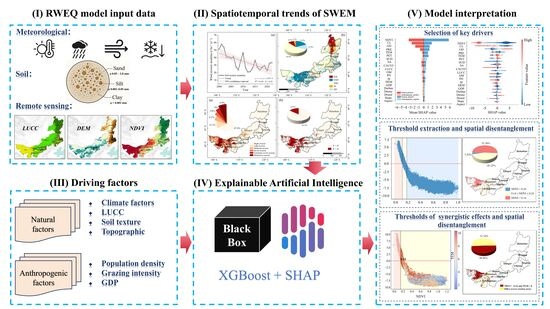
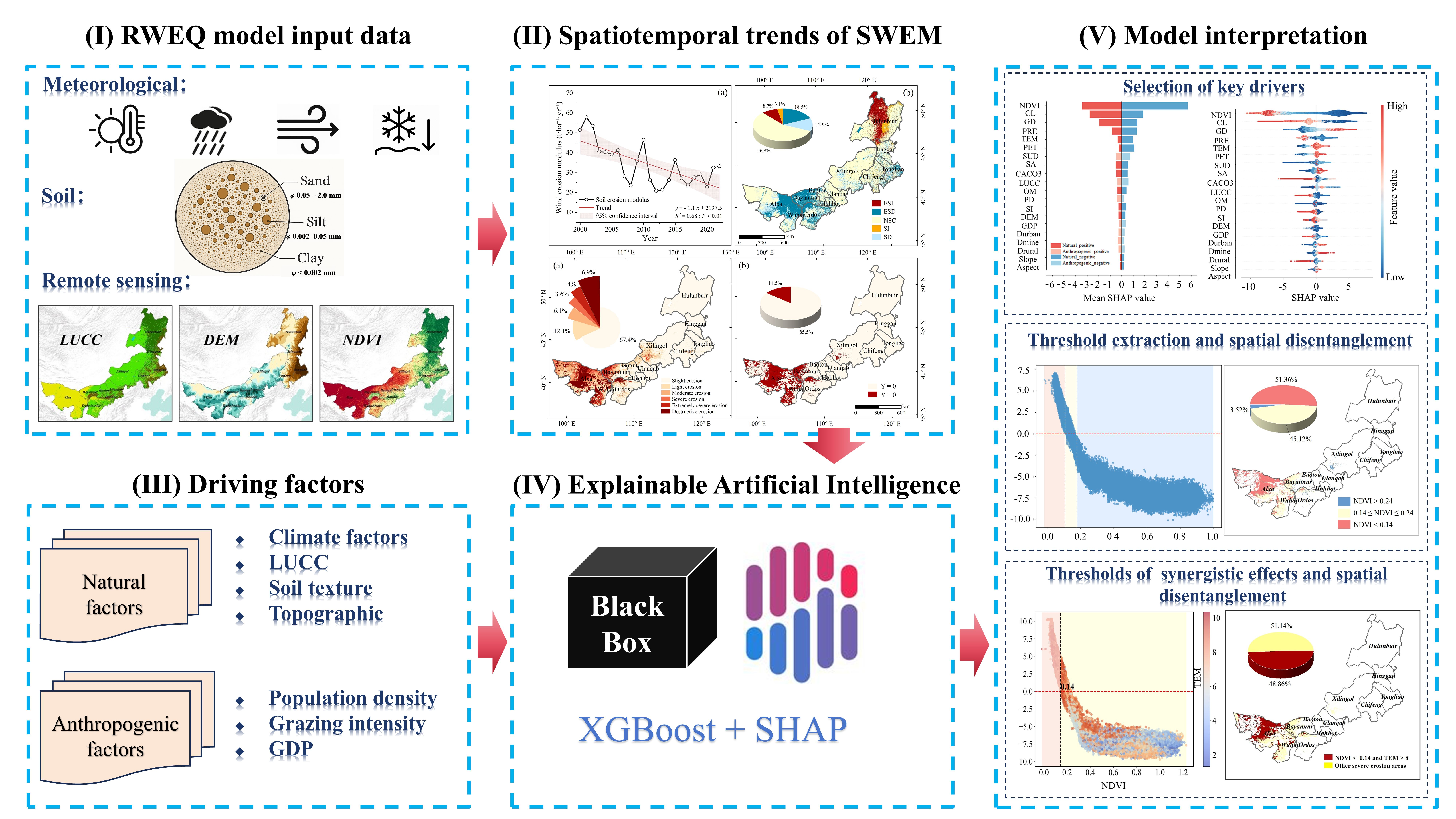
Graphical Abstract

1. Introduction

Wind erosion encompasses dynamic physical processes whereby soil particles undergo detachment, transport, and deposition through wind forces. This phenomenon represents a continuous and complex integrated natural geographical process [1]. Beyond reducing land productivity [2] and degrading soil fertility [3], it also constitutes a major source of air pollution and dust storms [4]. Comprehensive assessment of spatiotemporal dynamics of historical wind erosion, coupled with analysis of its driving factors, can elucidate underlying mechanisms and provide scientific foundations for targeted and effective erosion control strategies [5].
Accurate assessment of wind erosion magnitude and intensity is crucial for controlling wind erosion and mitigating desertification [6]. Various methodological approaches have been employed to evaluate wind erosion, including isotopic tracing techniques [7], wind tunnel simulations [8], and wind erosion models [9]. Although isotopic tracing and wind tunnel simulations can provide precise estimates of wind erosion rates, their associated high costs and methodological complexity present challenges for large-scale applications [10]. Given these challenges, various wind erosion models have been developed, among which the Revised Wind Erosion Equation (RWEQ) [11] has gained the widest application. This model comprehensively incorporates effects of topography, soil texture, wind speed, temperature, precipitation, and vegetation cover on wind erosion processes [12]. The model offers distinct advantages including simplified parameterization, accessible data requirements, and robust compatibility with geographic information systems [13], making it widely applicable for multi-regional and multi-scale wind erosion assessments [6,14,15].
As a multifactorial phenomenon, wind erosion arises from the interplay of climatic variables, land surface dynamics, and anthropogenic pressures [16]. This complexity manifests through two principle aspects. First, significant spatial heterogeneity exists among driving factors, whereby regional variations in climate, soil characteristics, and land use patterns result in distinct wind erosion intensities and spatial distributions. Second, wind erosion drivers exhibit both promotional and inhibitory effects, influencing erosion dynamics through complex regulatory mechanisms. Current research on wind erosion drivers primarily focuses on the impact of climate change and human activities on wind erosion trends. Methodologically, analyses of the factors influencing soil wind erosion and its mechanisms predominantly rely on correlation analysis. Zhang et al. [17] assessed the impact of climate change and human activities on soil wind erosion in Inner Mongolia through correlation analysis; Zhao et al. [18] employed the RWEQ model to evaluate the spatiotemporal dynamics of soil wind erosion in southern Africa from 1991 to 2015, and further examined the role of climatic factors via correlation analysis. Research has also employed residual analysis methods [17], constructing climate driver models and examining residual trend patterns to distinguish the relative contributions of natural versus anthropogenic factors. However, correlation and residual analysis are typically based on the assumption of linear relationships, thereby overlooking the complex non-linear interactions between driving factors [19]. Geodetector methods can quantitatively assess the explanatory power of drivers and reveal spatial heterogeneity among drivers and their interactive relationships. For example, our previous study applied the geographical detector method to identify the dominant drivers of wind erosion in Inner Mongolia [20]. However, this approach cannot determine the directional effects of drivers or reveal threshold and nonlinear interactions. Recent studies have introduced machine learning models and SHAP-based interpretability methods to generate wind erosion susceptibility maps and assess feature importance [21,22,23,24]. However, these applications primarily focus on predictive performance and global importance ranking, with systematic quantitative research remaining insufficient in quantifying the promoting and suppressing effects of driving factors, identifying threshold effects, and analyzing synergistic mechanisms. Therefore, developing models capable of effectively detecting and capturing nonlinear relationships and interactions among these factors remains crucial [19].
Machine learning (ML) provides an innovative paradigm for analyzing multivariable complex systems. Through autonomous identification of intrinsic data relationships [25], ML reduces human intervention while achieving predictive accuracy and generalization capabilities that exceeds those of traditional statistical models [26]. In recent years, ML techniques have been widely adopted for soil erosion assessment and sensitivity studies [24,27,28,29]. However, ML models frequently capture complex underlying patterns in forms that are difficult to interpret, thereby limiting transparency and explainability of their reasoning mechanisms [30]. Consequently, the “black box” nature of ML models presents significant challenge to their interpretability [31]. To enhance model interpretability, the game theory-based explainability algorithm Shapley Additive Explanations (SHAP) was developed [32]. SHAP can interpret contribution of individual input variables to model outputs from both local and global perspectives [33]. The method enables ranking, quantification, and visualization of feature importance, providing deeper understanding of nonlinear relationships and interactions within complex models [34]. This approach has been successfully applied to driving factor analysis in various fields, including soil science [35], hydrology [36], and meteorology [37], yielding promising results.
Inner Mongolia, characterized by its arid and semi-arid climate, possesses a vulnerable ecosystem and is prone to recurrent problems including desertification, wind erosion, and land degradation [6]. The RWEQ model provides physically-based estimations of soil wind erosion, while machine learning captures complex nonlinear relationships among multivariate drivers. The SHAP algorithm further decomposes model outputs into directional contributions, enabling quantitative interpretation of threshold-dependent effects and synergistic interactions. By integrating process-based modeling with explainable artificial intelligence, this framework enables simultaneous physical quantification and directional attribution of wind erosion dynamics. Against this background, this study aims to: (1) analyze the spatial distribution and long-term variation of soil wind erosion modulus (SWEM) in Inner Mongolia from 2000 to 2022; (2) quantify the positive and negative contributions of natural and anthropogenic factors to severe wind erosion, identify the dominant drivers, and further conduct quantitative analysis and spatial visualization of their positive and negative effects; and (3) explore synergistic effects among key drivers and reveal spatial distribution of their promotional influence on severe SWEM.

2. Materials and Methods

2.1. Study Area

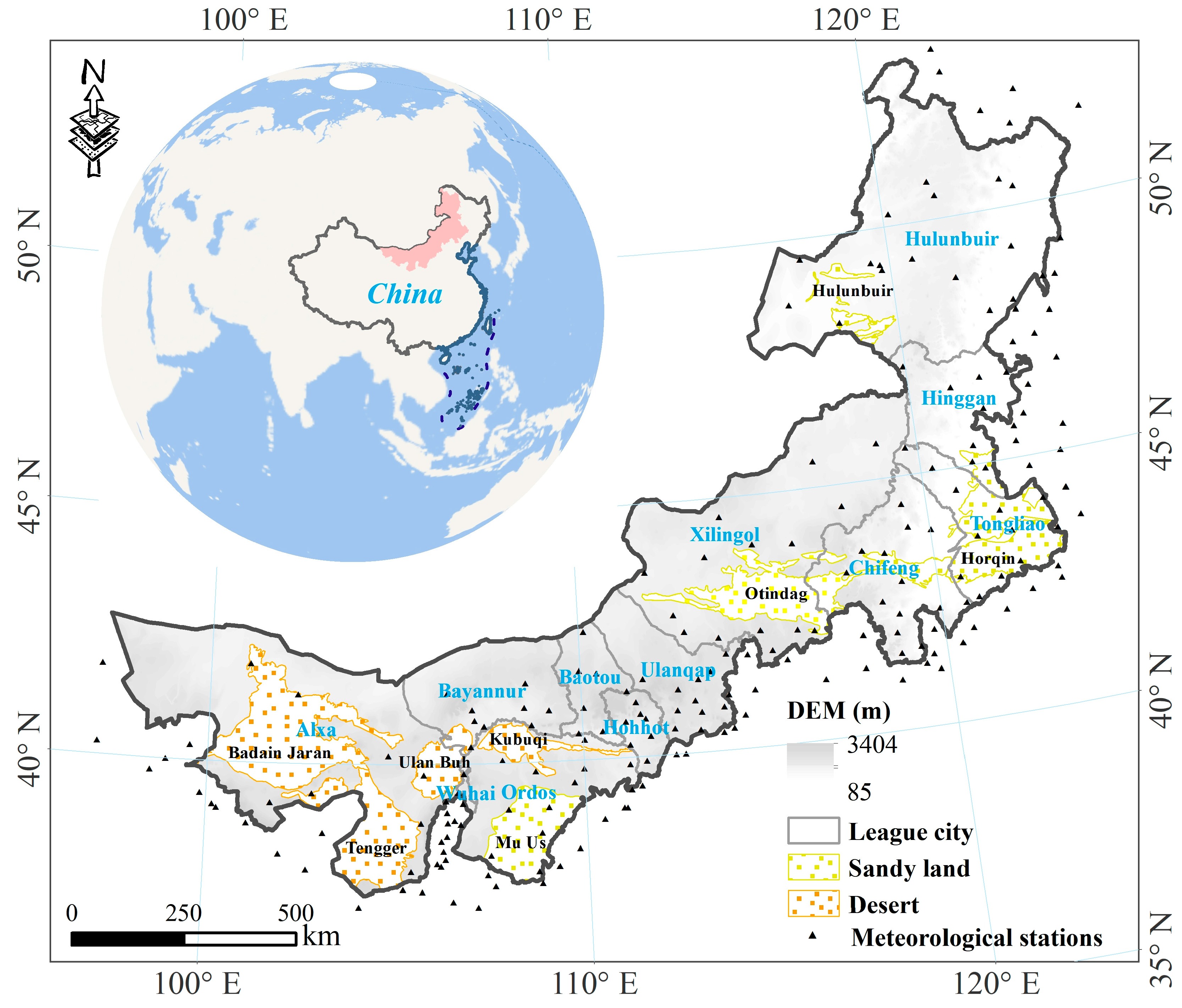
The Inner Mongolia is located in the mid-latitude inland area (34°24′–53°23′ N, 97°12′–126°04′ E), covering an area of approximately 1.18 × 10⁶ km2 (Figure 1). This area contains four major deserts: Badain Jaran, Ulanbuh, Kubuqi, and Tengger, as well as four big sandy areas: Otindag, Horqin, Mu Us, and Hulunbuir (Figure 1). This region experiences a temperate continental monsoon climate, characterized by significant spatiotemporal heterogeneity: dry and windy conditions in spring, short and warm summers, abrupt temperature drops in autumn, and long, harsh winters. According to the meteorological observation data from 2000–2022, the study area has obvious climate gradient: the annual average temperature decreases from southwest to northeast (11.1–1.3 °C), and the precipitation shows the opposite trend, increasing from southwest to northeast (33.5–543.6 mm). The multi-year average wind speed ranges from 1.0–4.1 m·s−1, with maximum wind speeds reaching up to 17 m·s−1. The type of soil found in this area is mainly made up of chestnut soil, grey calcium soil, and dark chestnut soil; these all have their own zones where they can be found. [38]. Most of these soils have a loose texture, making them highly susceptible to wind erosion. Land use/land cover (LUCC) analysis based on 2022 data indicates that natural ecosystems dominate the region, with grasslands (47.3%), forests (15.8%), and barren land (23.5%) collectively accounting for 86.6% of the total area. Croplands and impervious surfaces are more sparsely distributed, covering 11.9% and 1.0% of the total area, respectively.
Inner Mongolia serves as one of China’s primary livestock production bases, with livestock grazing being the dominant agricultural activity [17]. Over the past few decades, quite a lot of economic progress and resource utilization has taken place here. However, too much grazing and ineffective use of land have dried out or deteriorated many grasslands [6]. A thorough grasp of the pattern and cause of wind erosion here is essential to making sound plans for soil safeguarding and desertification prevention.

2.2. Data Source and Processing

In this paper, we mainly use the data to evaluate wind erosion and its drivers, including six categories (Table 1). The relevant data in this study were processed as follows:
(1)
Meteorological data
Meteorological data were obtained from the observed data from 205 meteorological stations within and nearby Inner Mongolia (Figure 1). Wind speed was adjusted to a 2 m height using Elliott’s one-seventh power law equation [40]. Windy days were defined as the number of days per year with wind speeds exceeding 5 m/s. Dust storm data were sourced from Surface Synoptic Observations (SYNOP), which report weather conditions every 3 or 6 h using a two-digit weather code (ww) ranging from 00 to 99 [41]. In this study, dust storm weather is categorized into two types: dust storms (ww = 09, ww = 30–32, ww = 98) and severe dust storms (ww = 33–35). The dust storm frequency was defined as the ratio of the number of dust storm occurrences to the total number of observation days within a given period.
(2)
Socioeconomic data
Population and GDP data were obtained from the Inner Mongolia Statistical Yearbook. After being aggregated at the county level, the data were spatialized into raster format using the Inverse Distance Weighting (IDW) interpolation method in ArcGIS 10.8. Grazing intensity data were obtained from a dataset published in 2024 on the Figshare platform (version 3, https://doi.org/10.6084/m9.figshare.26195684, accessed on 22 March 2026) by Prof. Wenping Yuan from the Institute of Carbon Neutrality, Peking University [42]. The dataset integrates livestock census data and satellite-derived vegetation indices to construct the first long-term high-resolution Livestock Grazing Intensity (LHGI) grassland dataset. It includes four livestock-specific grazing intensity indicators (large livestock such as cattle, horses, and camels; goats; and sheep), as well as one overall grazing intensity indicator. In this study, the overall grazing intensity raster dataset was used for analysis.
(3)
Land use–land cover data
Land use–land cover data is sourced from the Annual China Land Cover Dataset (CLCD) developed by Wuhan University [43]. The dataset encompasses nine land categories: arable land, forest land, shrubland, grassland, water bodies, ice and snow, wasteland, impervious surfaces, and wetlands. This study utilizes the 2000 and 2022 CLCD datasets to construct a land use transition matrix, extracting key land use conversion information as driving factors.
Finally, all data were resampled to a 1 × 1 km2 grid and projected to WGS_1984_Albers.

2.3. Assessment of SWEM

2.3.1. Estimation of SWEM Based on the RWEQ Model

The RWEQ model was employed to simulate soil wind erosion across Inner Mongolia from 2000 to 2022. This model, developed by the United States Department of Agriculture (USDA), is designed to estimate soil loss from agricultural fields at a standardized height of 2 m [44]. The calculation formula is as follows:
S L =   2 Z S 2 Q max e ( Z S ) 2
S = 150.7 ( W F × E F × K × S C F × C ) 0.3711
Qmax = 109.8 × WF × K′ × EF × C × SCF
where SL is the actual soil wind erosion modulus (t·ha−1·yr−1); Z is the maximum wind erosion distance in the downwind direction (m); S is the length of the critical area (m); Qmax is the maximum sand and dust transport capacity (kg/m); WF represents the weather factor (kg/m); K′, EF, C, and SCF are represent surface roughness, soil erodibility, vegetation and soil crusting factors, respectively.
The climate factor (WF) represents the combined effects of various meteorological elements, such as temperature, precipitation, and wind speed, on soil wind erosion. It is calculated is as follows:
WF = W f × ρ g × SW × SD
W f = i = 1 N U 2 × ( U 2 U t ) × N d N
ρ = 348.0   ×   ( 1.013 0.1183 E L + 0.0048 E L 2 T )
SW = E T P ( R + I ) × R d N d E T P
SD = 1 − P (snow cover > 25.4 mm)
where, Wf is the wind factor (m3/s3); SW is the soil wetness factor (dimensionless); SD refers to the snow cover factor; g is the acceleration due to gravity (m/s2); ρ is the air density (kg/m3); Ut is the threshold wind speed at a height of 2 m (set to 5 m/s); U2 is the wind speed at 2 m (m/s); Nd refers to the number of experimental days; N represents the number of observations; EL is the elevation (km), obtained from DEM data; T is the absolute temperature (degrees Kelvin); ETp is the potential evapotranspiration (mm); R is the average precipitation (mm); I is the total irrigation (set to 0 mm); Rd is the number of rainfall days; and P refers to the probability of snow depth exceeding 25.4 mm.
The soil erodibility factor represents the susceptibility of soil to erosion, while the soil crusting factor quantifies the ability of soil crusts to resist wind erosion. The calculation formula is as follows:
EF   =     29.9 + 0.31 S a + 0.17 S i + 0.33 S a / C l 2.59 O M 0.95 C A C O 3 100
SCF = 1 1 + 0.0066 C l 2 + 0.021 O M 2
where Sa, Si, and Cl represent the sand, silt, and clay contents, respectively (%); OM refers to the organic matter content (%); and CaCO3 denotes the calcium carbonate content (%).
The surface roughness factor represents the degree of surface roughness caused by variations in terrain elevation. The calculation formula is as follows:
K   =   e ( 1.86 K r 2.41 K r 0.934 0.127 C r r )
K r = 0.2   ×   ( H ) 2 L
where Kr is the ridge/oriented roughness (cm); Crr is the aggregate/random roughness factor (cm), which is set to 0 in this study; L is the terrain undulation parameter (m); and ∆H is the elevation difference within the range of L (m).
The vegetation cover factor (C) is a key factor influencing soil wind erosion, reflecting vegetation coverage across different land use units and representing the ability of vegetation to hinder the movement of fine surface particles. The calculation formula is as follows:
C   =   e a ( S C )
SC = (NDVINDVImim)/(NDVImaxNDVImin)
where α is the coefficient for different vegetation types, determined according to the Ecological Protection Red Line Delimitation Guidelines (see Table S1); SC denotes the vegetation coverage (%); NDVImin is the NDVI value for bare land, defined as the 2nd percentile of cumulative frequency; and NDVImax represents the maximum NDVI value, defined as the 98th percentile of cumulative frequency.

2.3.2. Wind Erosion Intensity Classification

According to the Chinese national standard “Classification criteria for soil erosion intensities” (SL190–2007) [45], wind erosion intensity was categorized into six levels (Table 2). According to the national wind erosion classification standard, severe, extremely severe, and destructive erosion were grouped as “severe erosion” in this study. To identify the driving mechanisms underlying severe wind erosion, these grades (SWEM ≥ 50 t·hm−2·a−1) were combined into a single category for subsequent binary classification modeling.

2.3.3. Trend Analysis of SWEM

To characterize the spatial dynamics of SWEM during 2000–2022, a trend analysis was performed using the following formula:
Slope   =   n × i = 1 n i × X i ( i = 1 n i ) ( i = 1 n X i ) n × i = 1 n i 2 ( i = 1 n i ) 2
In this analysis, n is the total observation years (23 in this study), and Xᵢ denotes the SWEM for year i. Statistical significance was determined using the Mann–Kendall test at the 0.05 level. According to slope and p-value combinations, five trend categories were defined: significant increase, extremely significant increase, no significant change, significant decrease, and extremely significant decrease.

2.3.4. Model Validation

Due to the lack of long-term and continuous wind erosion observations, previous studies have commonly evaluated the reliability of wind erosion models by comparing simulated results with indirect observational data. Particles in sandstorms predominantly originate from surface wind erosion, whose frequency and intensity directly determine the occurrence and severity of such events [46,47]. Therefore, sandstorm frequency has been widely used to evaluate wind erosion intensity in previous studies [46,47,48]. In addition, the 137Cs tracer technique has been widely applied to estimate soil erosion rates under different land-use types and can effectively reflect soil redistribution processes [49].
Therefore, sandstorm observations from meteorological records and 137Cs-derived erosion data reported in previous studies were used as validation data in this study. First, the frequency of sandstorm events recorded at meteorological stations within the study area was calculated as an indicator of regional wind erosion activity. Meanwhile, soil erosion data from 20 observation sites within the study area were collected from published studies based on the 137Cs tracer technique [50,51,52,53], including the geographic locations (latitude and longitude) of the sites and the corresponding soil erosion rates (t ha−1 yr−1) (see Table S4 for details). Linear regression analysis was conducted between the simulated SWEM and both sandstorm frequency and 137Cs-derived wind erosion observations to evaluate model performance. The agreement between simulated and observed values was evaluated using the coefficient of determination (R2) and the significance level (p-value).

2.4. Construction of XAI Model Framework for Severe Wind Erosion Drivers

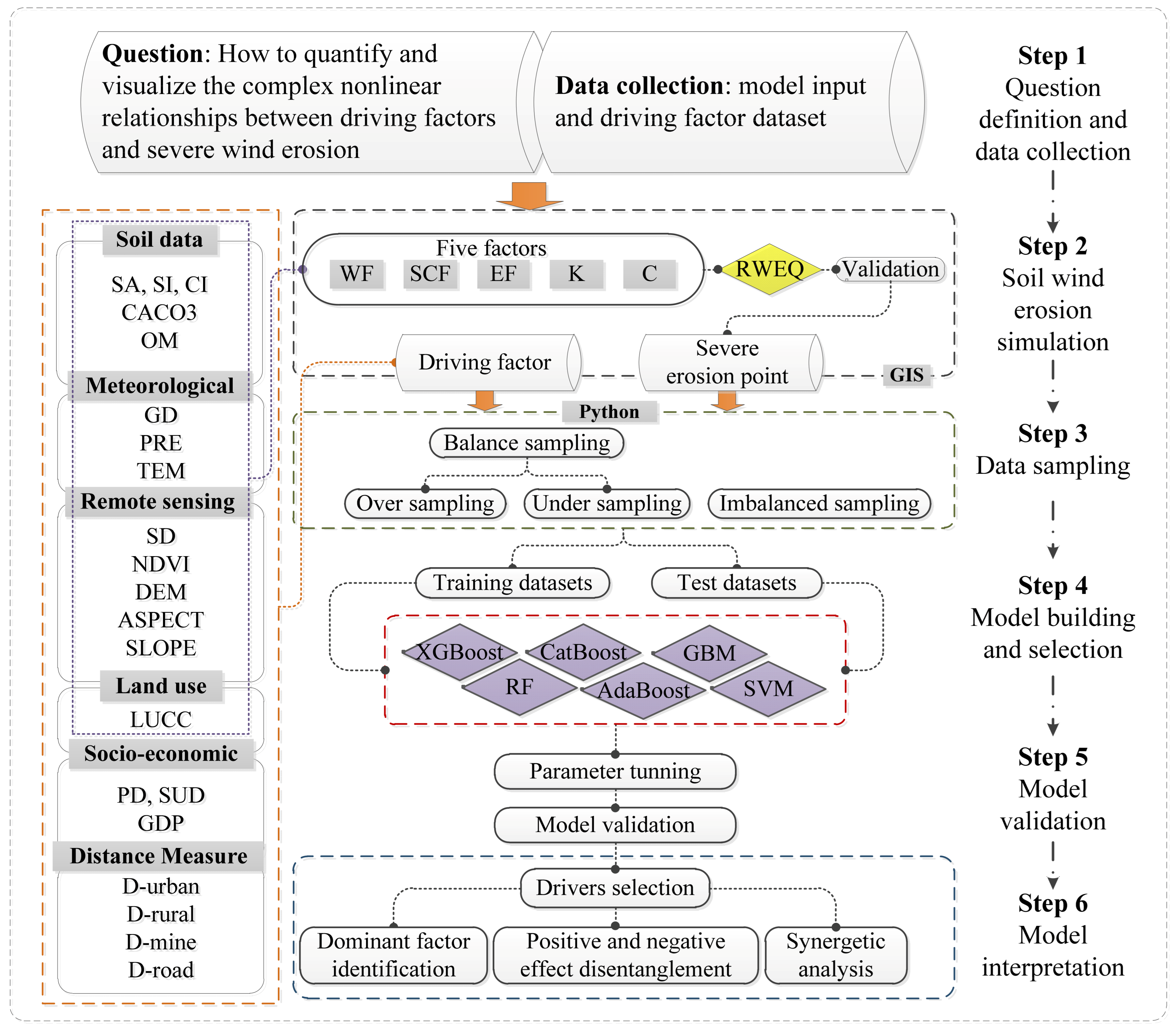
Figure 2 outlines the workflow. The present study first defined the research question and compiled model input data (purple boxes) and driving factor data (yellow boxes). SWEM intensity was simulated using the RWEQ model, from which tolerable and severe erosion points were extracted for classification modeling. Balanced and imbalanced datasets were generated via resampling, and six ML models were trained and evaluated. The optimal model was then applied in SHAP analysis to rank driver importance, map and quantify their positive/negative effects, and identify synergistic interactions.

2.4.1. Data Sampling

In classification model construction, data imbalance is a common and critical challenge. In this study, the classification target variable (Y) was constructed by calculating the average wind erosion rate from 2000 to 2022. Based on a threshold, wind erosion was classified into two classes: Class 1 for severe erosion area and Class 0 for non-severe area. As a result, we ended up with a highly imbalanced dataset where there were 964,899 pixels that belonged to the tolerable erosion class (class 0), but only 164,286 pixels that belonged to the severe erosion class (class 1) (refer to Section 3.2). To avoid potential data leakage caused by spatial autocorrelation between the training and testing datasets, a spatial block-based partitioning strategy was adopted during the sample splitting stage. At a spatial resolution of 1 km, the study area was divided into 20 km × 20 km spatial units, and the training and testing datasets were partitioned based on these spatial blocks to ensure that pixels within the same block would not simultaneously appear in both datasets. After establishing spatial independence, and to mitigate class imbalance, three resampling strategies were applied following Batunacun [54]: Random Sampling, Over-sampling, and Under-sampling. The sample sizes generated by each method were as follows: random sampling: 59,968 (class 0) and 10,032 (class 1), over-sampling: 59,968 (Class 0) and 59,968 (Class 1), under-sampling: 10,032 (Class 0) and 10,032 (Class 1).

2.4.2. Selection of the AI Model

The present study selected six widely applied machine learning models to evaluate their fitting accuracy in wind erosion prediction, including gradient boosting-based models (Extreme Gradient Boosting (XGBoost), Gradient Boosting Machine (GBM), and Categorical Boosting (CatBoost)), a decision tree-based ensemble method (Random Forest, RF), an adaptive boosting algorithm (Adaptive Boosting (AdaBoost)), and a kernel-based model (Support Vector Machine (SVM)). The theoretical foundations of these algorithms can be found in the literature [55,56,57,58,59,60].
To optimize model performance, Grid Search was employed for hyperparameter tuning, and the specific parameter settings are provided in Table S1.

2.4.3. Validation of the AI Model

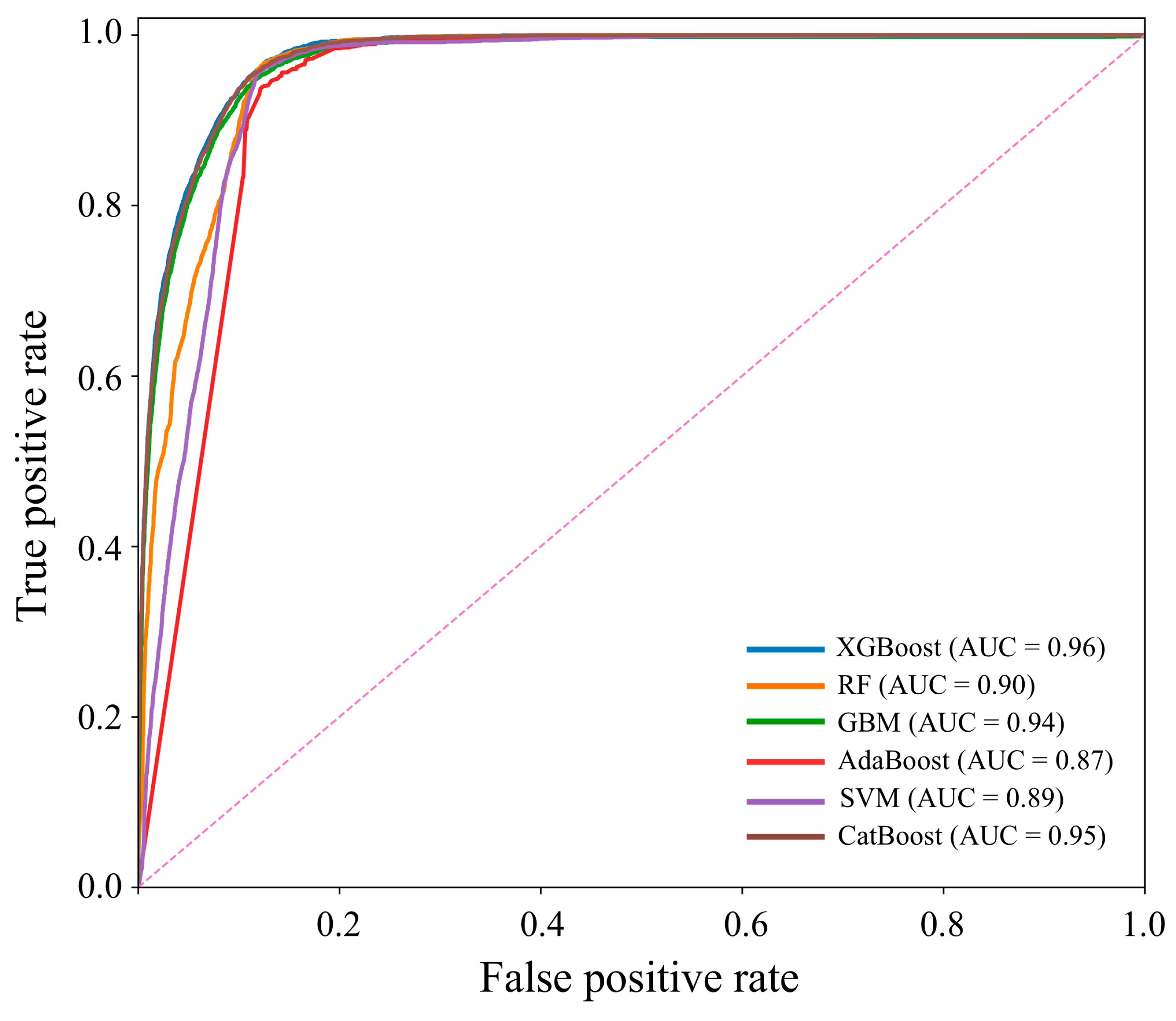
The classification outcomes in this study were assessed using a confusion matrix. In this framework, TP (True Positive) and TN (True Negative) indicate the counts of samples correctly recognized as wind erosion points (1) and non-wind erosion points (0), respectively. Conversely, FP (False Positive) and FN (False Negative) correspond to the numbers of samples incorrectly classified. We then used those to determine the overall classification accuracy. The model’s performance is illustrated through the Receiver Operating Characteristic (ROC) curve and the discrimination ability of the model is shown by the Area Under the Curve (AUC). The definitions of these metrics are summarized in Table 3.
A comprehensive evaluation of the metrics was conducted to identify the best-performing model. In this study, models with κ > 0.8 and AUC > 0.8 were defined as robust models, while those with 0.6 < κ < 0.8 and 0.7 < AUC < 0.8 were classified as acceptable models.

2.4.4. Model Explainability

The SHAP value originates from cooperative game theory and is designed to address the question of how to fairly allocate the gains generated through teamwork [61]. In a model with multiple features, SHAP treats each feature as a game participant, iterates over all possible feature subsets, adds a given feature sequentially, and computes the difference in model predictions before and after the inclusion of that feature. Assuming the input model has feature variables x = (x1, x2, …, xn), the explanatory model g(x) for the original model f(x) can be expressed as:
f ( x )   =   g ( x )   = ϕ 0   +   i = 1 n ϕ i x i
In the equation, x′ is the simplified input vector derived from the original input variables x in the dataset; n represents the total number of input features; ϕ0 is a constant when all inputs are empty; and ϕi indicates the attribution value of the ith feature.

3. Results

3.1. Performance of AI Models

ROC curve results indicate that all models demonstrate robust discriminative capabilities. XGBoost achieved the highest AUC value (0.96), followed by CatBoost (0.95) and GBM (0.94), whilst SVM (0.89) and AdaBoost (0.87) exhibited comparatively weaker performance (Figure 3).
Table S3 compares the model performance of different classifiers under three sampling strategies: random sampling, oversampling, and under sampling. Overall, most models achieved optimal performance under oversampling. Taking XGBoost, CatBoost, and GBM as examples, their accuracy reached 0.98 under oversampling, recall improved to 0.97–0.98, and Kappa values remained at a high level of 0.91–0.92. In contrast, under-sampling strategies demonstrated poorer overall performance, with notable declines particularly in Precision and Kappa metrics. For instance, the Kappa values for Random Forest and AdaBoost under-sampling conditions dropped to 0.81 and 0.66, respectively. The random sampling strategy performed intermediately. Whilst its Accuracy remained at a high level (approximately 0.96–0.98), Recall was generally lower than that of the oversampling method. After comprehensively comparing all models and sampling strategies, the combination of oversampling with the XGBoost model demonstrated the best performance. Consequently, subsequent driver factor explanations and threshold analyses were conducted based on this model.

3.2. Spatiotemporal Characteristics of SWEM

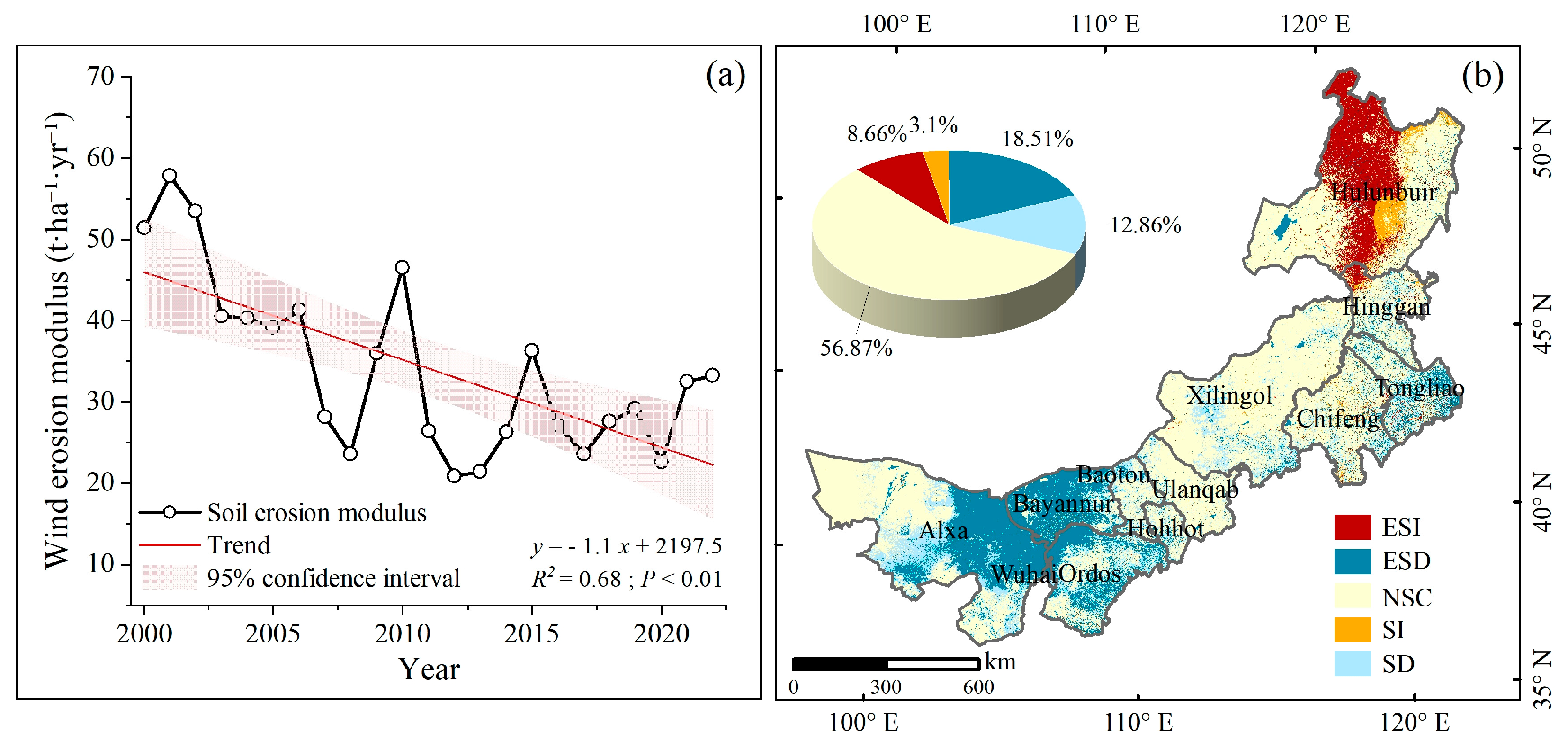
The interannual variation and spatial distribution characteristics of SWEM in Inner Mongolia from 2000 to 2022 are illustrated in Figure 4. Overall, SWEM exhibited a significant declining trend during the study period (R2 = 0.68, p < 0.01), with a decrease rate of approximately 1.1 t·ha−1·yr−1. Despite this overall downward trend, pronounced interannual fluctuations were observed. The highest SWEM value occurred in 2001 at 57.8 t·ha−1·yr−1, whilst the lowest value was recorded in 2012 at merely 18.9 t·ha−1·yr−1 (Figure 4a).
As shown in Figure 4b, SWEM displayed a predominantly decreasing trend across the study region. Areas exhibiting significant and extremely significant decreasing trends in SWEM were mainly located in the western desert regions, accounting for 31.37% of the total area. In contrast, areas exhibiting increasing trends were relatively limited, covering only 11.76% of the study area and primarily concentrated in the northeastern part of Hulunbuir City.
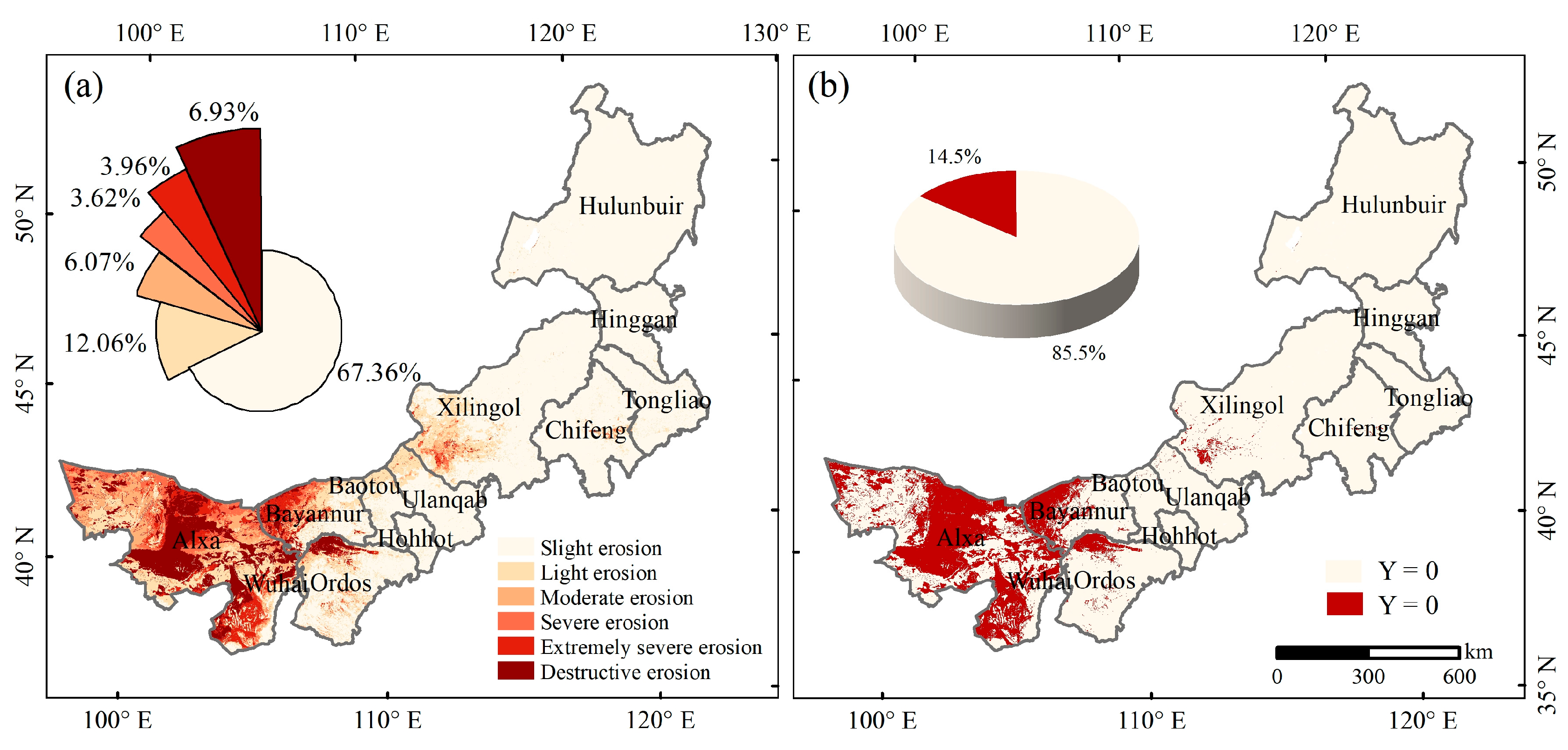
From 2000 to 2022, the annual mean wind erosion intensity in the study area showed a clear spatial gradient, decreasing from the northeast to the southwest (Figure 5a). Slight erosion zones dominated the landscape (67.36%), mainly in the eastern forests and central grasslands, followed by light erosion zones (12.06%) in central and western grasslands. Moderate erosion zones (6.07%) were concentrated in major sandy areas such as the Mu Us, Hunshandake, and Horqin lands. The combined severe, extremely severe, and destructive erosion zones (14.51%) occurred mainly in large deserts, sandy areas, and sparsely vegetated grasslands in the south.
Figure 5b shows the spatial distribution of the target variable Y. Pixels classified as Y = 0 totaled 974,202 (85.5% of the study area), while Y = 1 pixels numbered 165,360 (14.5%).

3.3. Identification and Interpretation of Key Drivers Influencing SWEM

3.3.1. Dominant Driver Selection of SWEM

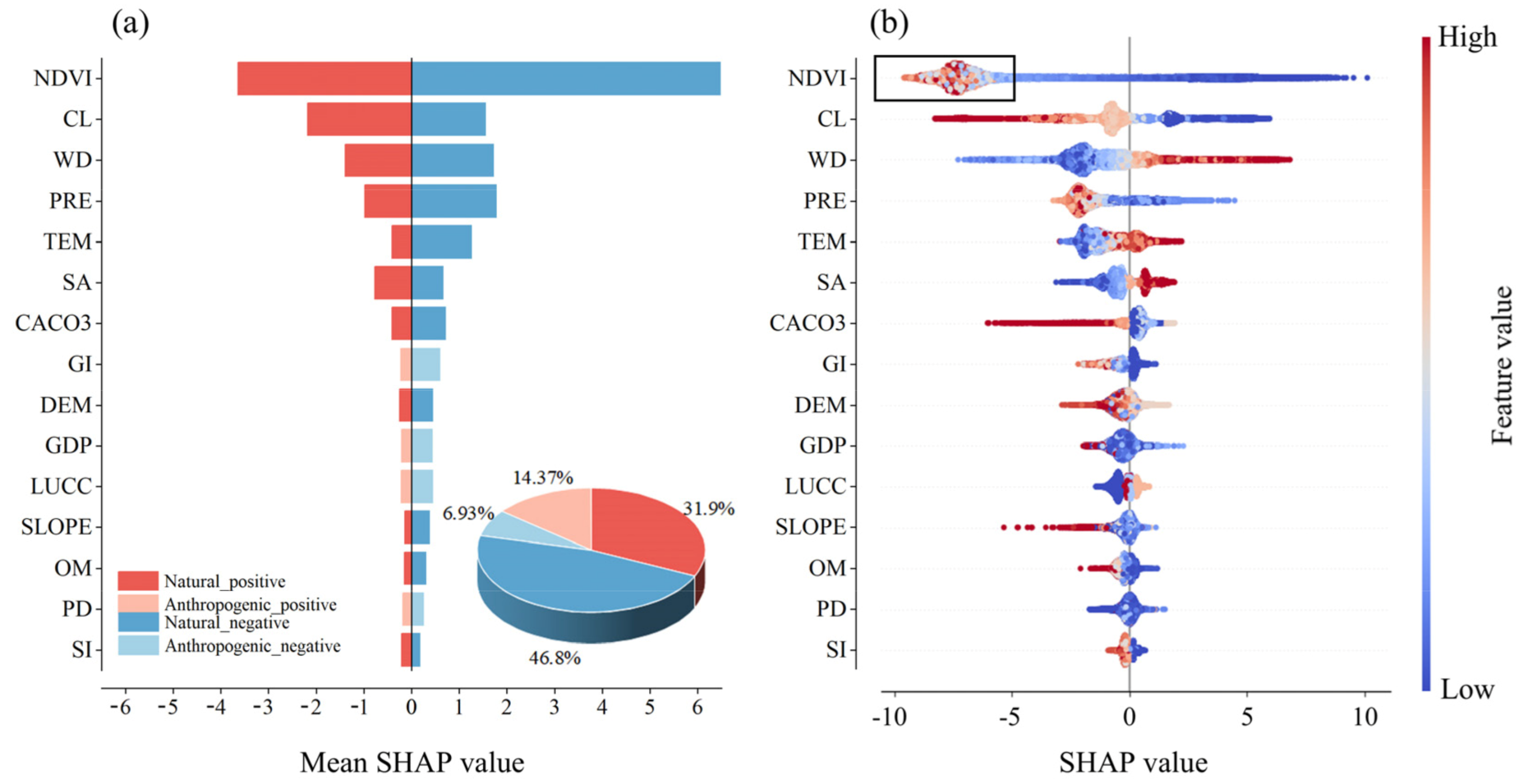
SHAP values were calculated based on the training dataset to quantify the influence of each driving factor on the spatial distribution of SWEM. Figure 6a shows the mean absolute SHAP values of the positive and negative effects of each driver, indicating their relative importance to the model output. Figure 6b illustrates the impact of drivers on the probability of SWEM occurrence. The x-axis represents SHAP values (>0 indicating a promoting effect on severe SWEM, <0 indicating an inhibiting effect). Along the y-axis, features are ordered from most to least important. Points represent samples, where warmer colors (red) indicate higher feature values and cooler colors (blue) indicate lower ones. With the increase in NDVI values, the wind erosion trend decreases.
Overall, severe wind erosion in the study area was jointly driven by natural factors (78.7%) and anthropogenic factors (21.3%) (Figure 6a). Natural drivers were primarily dominated by negative effects (46.80%), whereas positive effects accounted for 31.90%. In contrast, anthropogenic drivers were mainly characterized by positive effects (14.37%), while negative effects represented only 6.93%. Based on the SHAP summary plot (Figure 6b), NDVI, CL, PRE, CACO3, and OM are negatively correlated with SWEM, indicating that increases in these factors reduce the likelihood of wind erosion, exhibiting an inhibiting effect. In contrast, WD, TEM, and SA are positively correlated with SWEM, suggesting that as the number of gale days increases, the probability of wind erosion also rises.
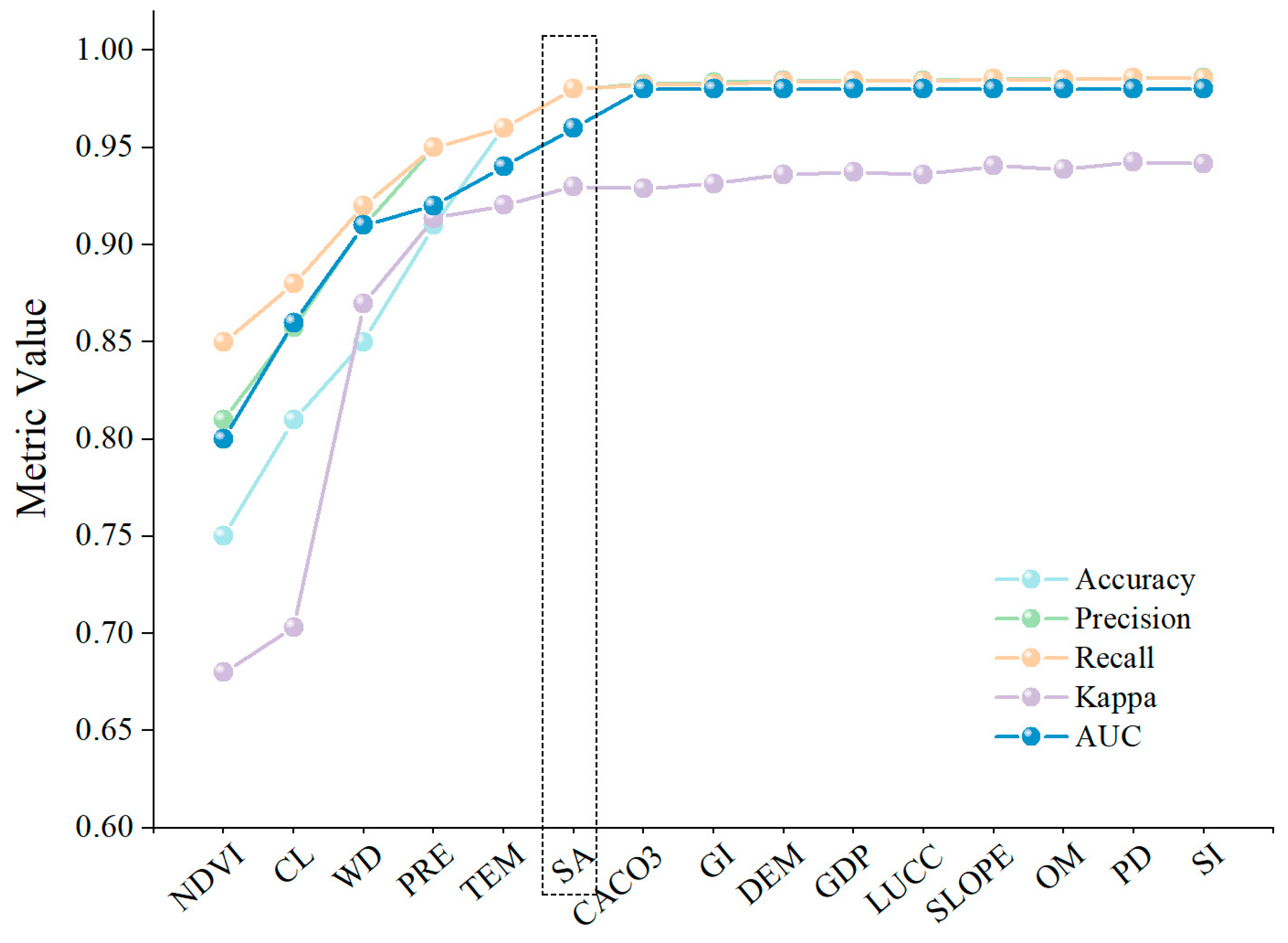
To identify the key drivers more precisely, the impact of different features on XGBoost modeling performance was investigated by employing the recursive attribute feature elimination method, gradually adding features to observe changes in model performance. Figure 7 indicates that when the input indicators include NDVI, CL, WD, PRE, TEM, and SA, the model demonstrated robust performance (ACC = 0.98, Precision = 0.98, Recall = 0.98, κ = 0.92, AUC = 0.96). Subsequently, the contribution of drivers and their synergetic effects were analyzed according to the above selection.

3.3.2. Threshold Analysis and Spatial Analysis of Positive and Negative Effects of Key Drivers

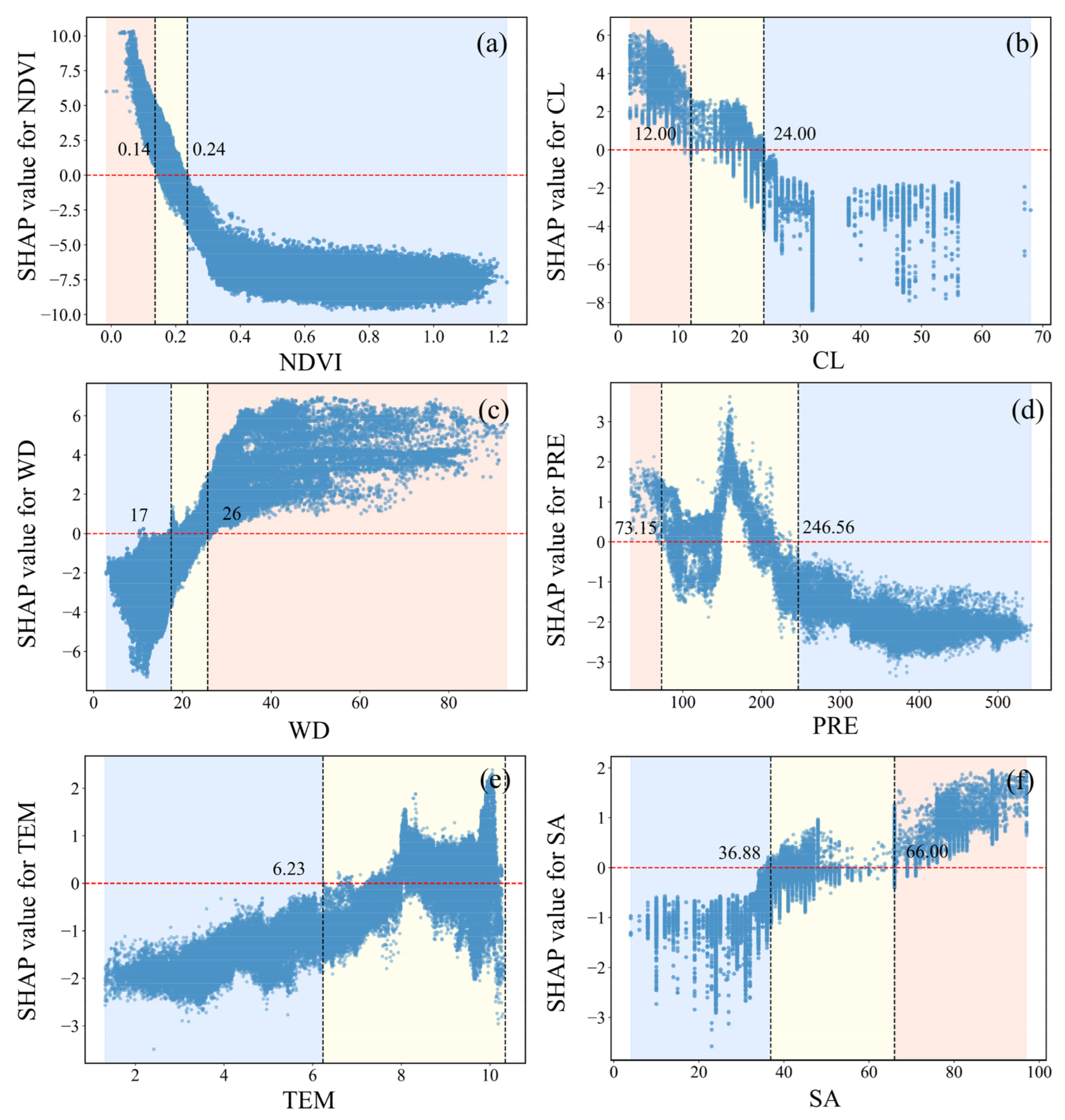
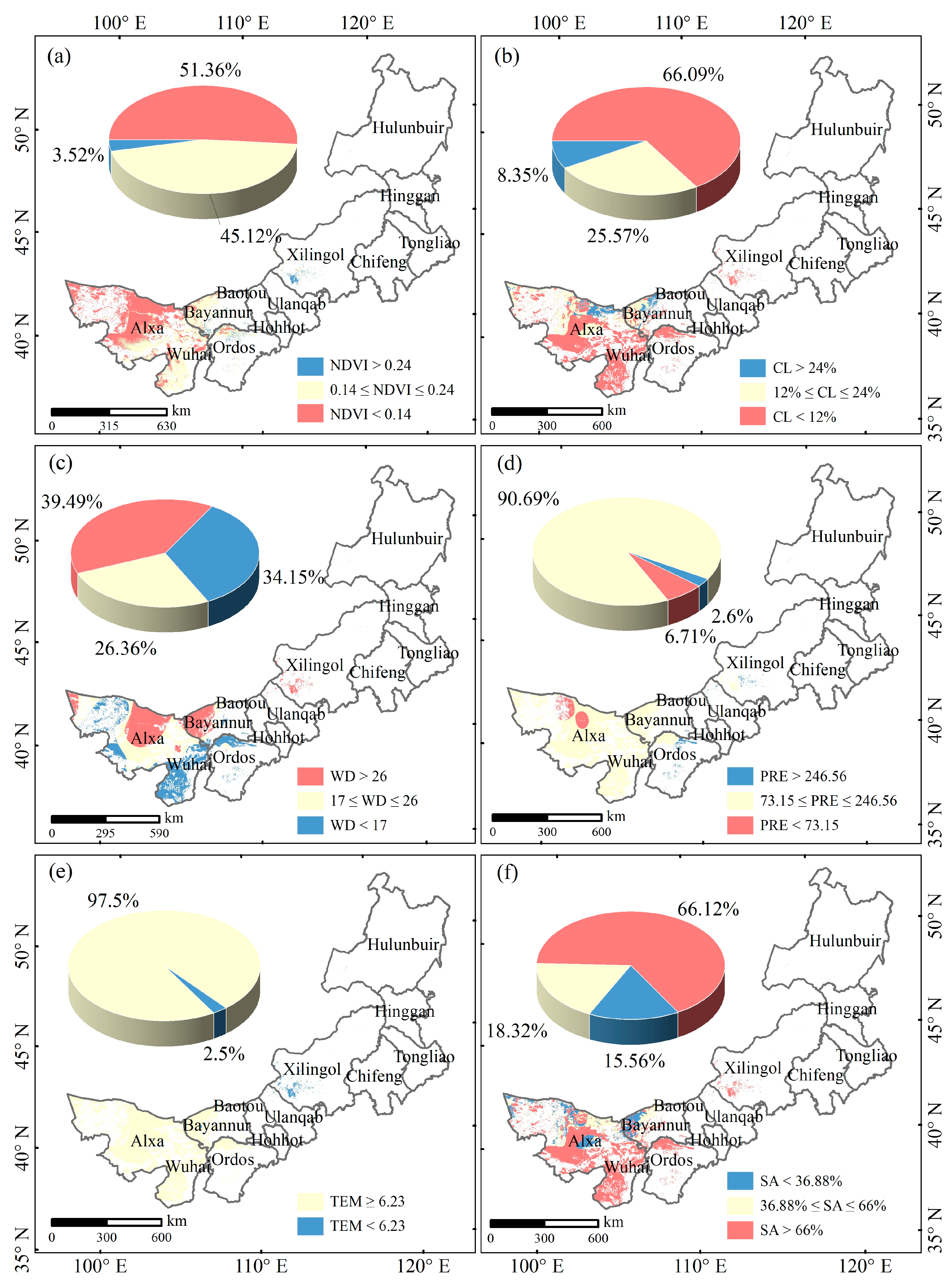
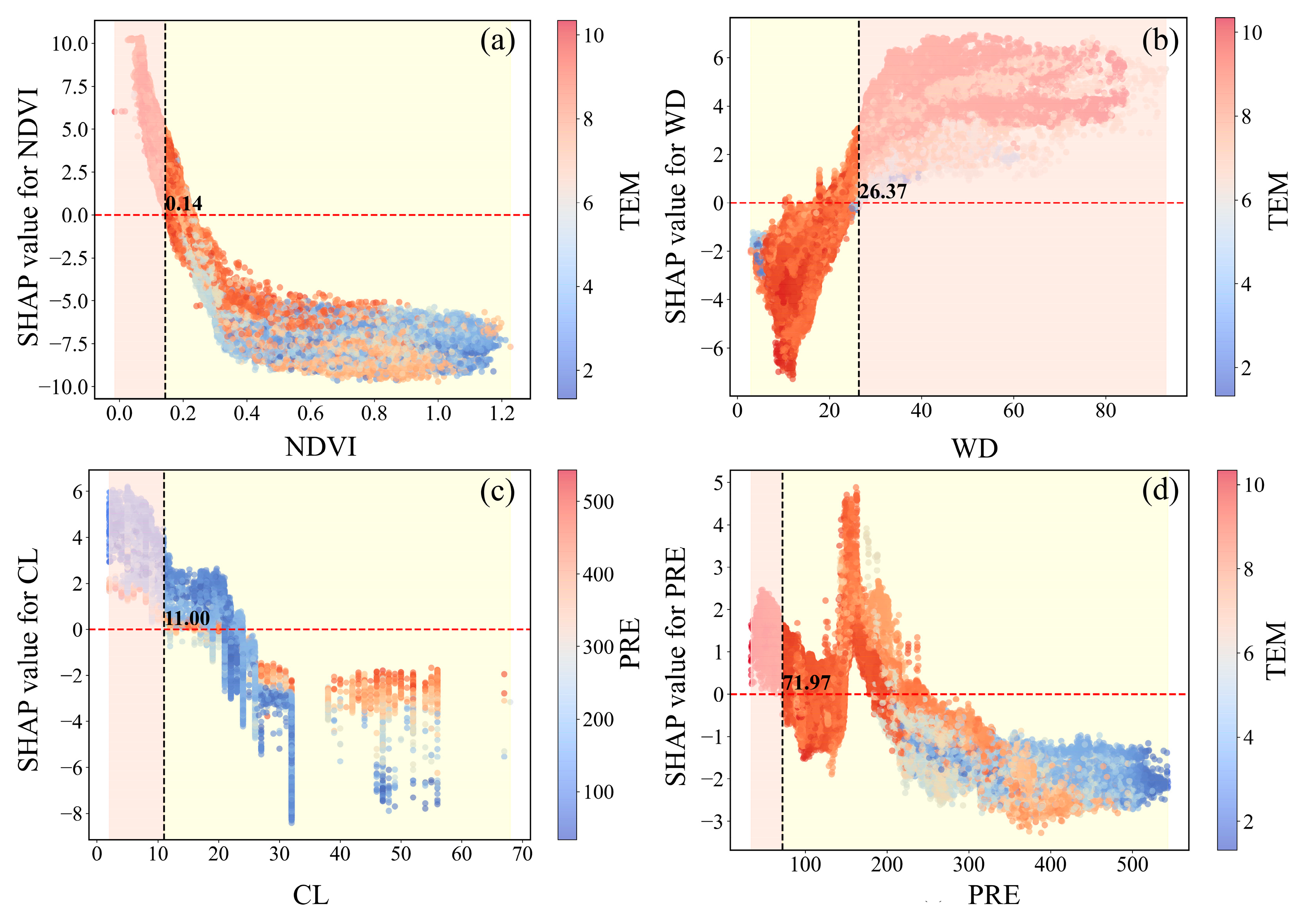
To reveal the nonlinear response relationships and threshold effects between the dominant drivers and SWEM, SHAP-based dependence plots were constructed. Threshold intervals were identified by analyzing the relationship between individual driver values and their corresponding SHAP values. Specifically, the zero-crossing points of SHAP values were used to determine where the contribution of a driver shifts from inhibitory to promoting effects. When both positive and negative SHAP values occur within a certain range, the interval is defined as a mixed-effect zone. The upper and lower boundaries of this zone are regarded as the critical thresholds, separating inhibitory and promoting intervals. As shown in Figure 8, the plots visualize the complex relationships between wind erosion and six key drivers, which can be categorized into positive (pink), negative (blue), and mixed effects (yellow).
NDVI below 0.14 markedly increased SWEM risk, particularly in the northwestern Badain Jaran Desert and surrounding areas (51.36% of severe SWEM pixels), whereas values above 0.24 inhibited SWEM, mainly in southwestern Xilingol League (3.52%) (Figure 8a and Figure 9a); Low clay content (<12.00%) promoted erosion in desert and sandy regions, while high content (>24.00%) inhibited SWEM in the northern Badain Jaran Desert and western Bayannur, with intermediate values showing mixed effects (Figure 8b and Figure 9b); WD exceeding 26 days strongly promoted SWEM in western Bayannur and parts of Alxa League, whereas values below 17 inhibited SWEM in the Tengger Desert and Kubuqi Sandy Land (Figure 8c and Figure 9c); Low precipitation (<73.15 mm) intensified SWEM in western Alxa League (6.71%), while higher precipitation (>246.56 mm) reduced SWEM in scattered areas of Ordos (Figure 8d and Figure 9d); TEM is largely characterized by mixed effects (97.50% of severe SWEM pixels, respectively), with lower values (TEM < 6.23 °C); inhibiting SWEM mainly in western Xilingol League (Figure 8e); When SA > 66%, it significantly promotes SWEM (66.12% of severe SWEM pixels) of the study area, mainly in western Inner Mongolia, especially Alxa League and northern Ordos. Conversely, SA < 36.88% inhibits SWEM and accounts for 15.56%, primarily in northwestern Bayannur (Figure 8f and Figure 9f).

3.4. Synergistic Effects of Key Drivers and Spatial Analysis of Their Positive Effect

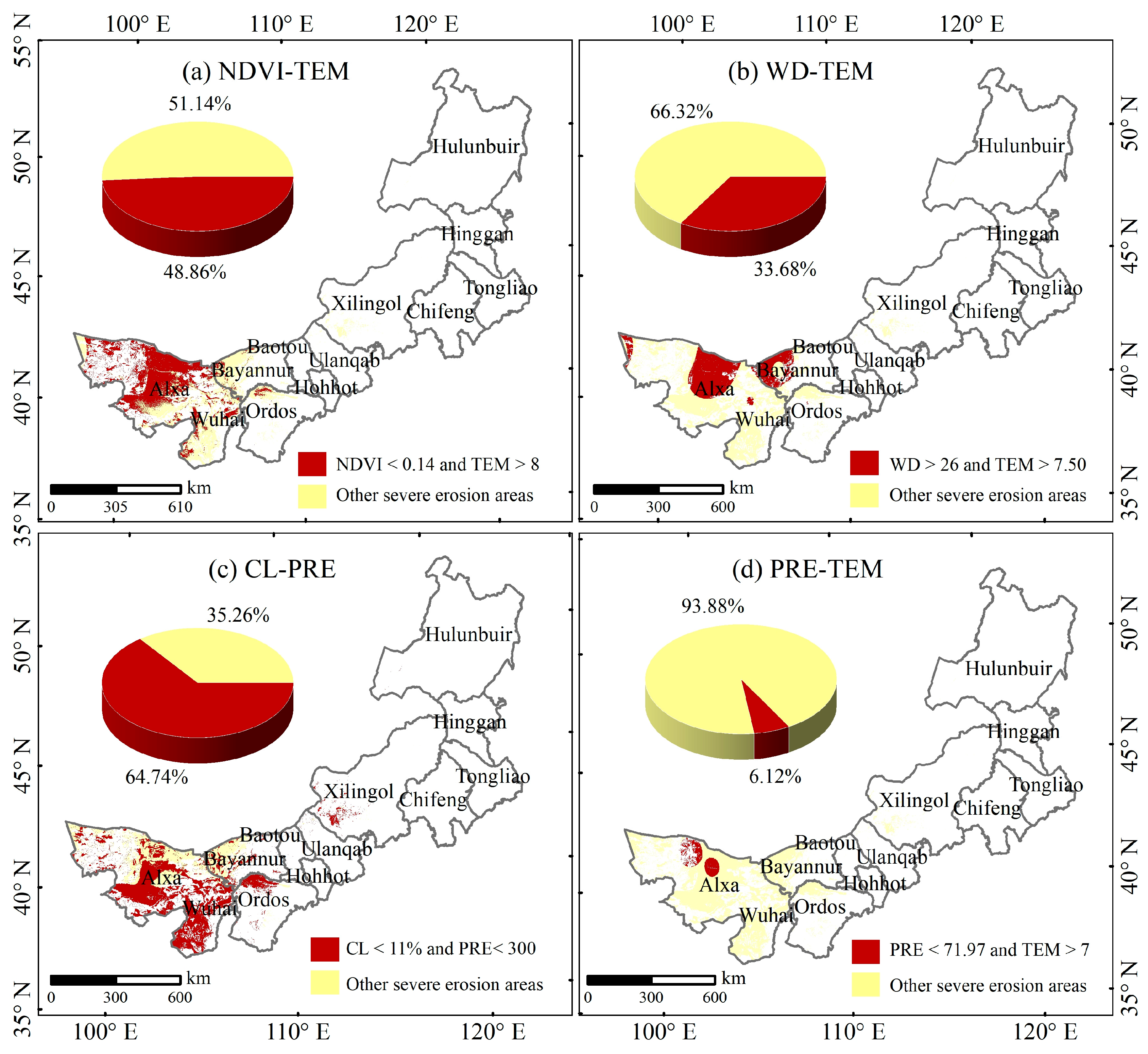
Synergistic effect analysis reveals how multiple driving factors interact to influence wind erosion, representing the combined impact of these factors. Such analysis is an important manifestation of the nonlinear relationships between driving factors and SWEM. Based on the six dominant drivers identified in Figure 7, a total of 30 SHAP interaction plots were generated to illustrate the synergistic effects among these variables (Figure S1). Four variable pairs with representative ecological significance were selected from the 30 combinations for synergistic effect analysis, based on which key response thresholds influencing SWEM were identified and subsequently visualized to reveal their spatial distribution patterns (Figure 10 and Figure 11).
As shown in Figure 10a and Figure 11a, NDVI < 0.14 combined with TEM > 8 °C strongly promotes SWEM in vegetation-sparse western Alxa, covering about 48.86% of severe erosion pixels. This reflects a typical synergistic mechanism in which high temperature coupled with low vegetation cover exacerbates soil surface vulnerability. Similarly, WD > 26 days and TEM > 7.5 °C jointly increase SWEM risk (33.68%), particularly in northern Alxa and western Bayannur (Figure 11b). This indicates that thermal stress and gale days act in concert to amplify wind erosion under extreme climatic conditions. CL < 11% combined with PRE < 300 mm markedly increases SWEM (64.74%), concentrated in the Badain Jaran Desert, Tengger Desert, and northern Ordos (Figure 10c and Figure 11c). Lastly, when PRE < 71.97 mm and TEM > 7 °C, a synergistic promoting effect on SWEM is observed (6.12%) spatially, mainly concentrated in a small area in northwestern Alxa League (Figure 10d and Figure 11d).

4. Discussion

4.1. Accuracy Assessment of the SWEM Evaluation Model in Inner Mongolia

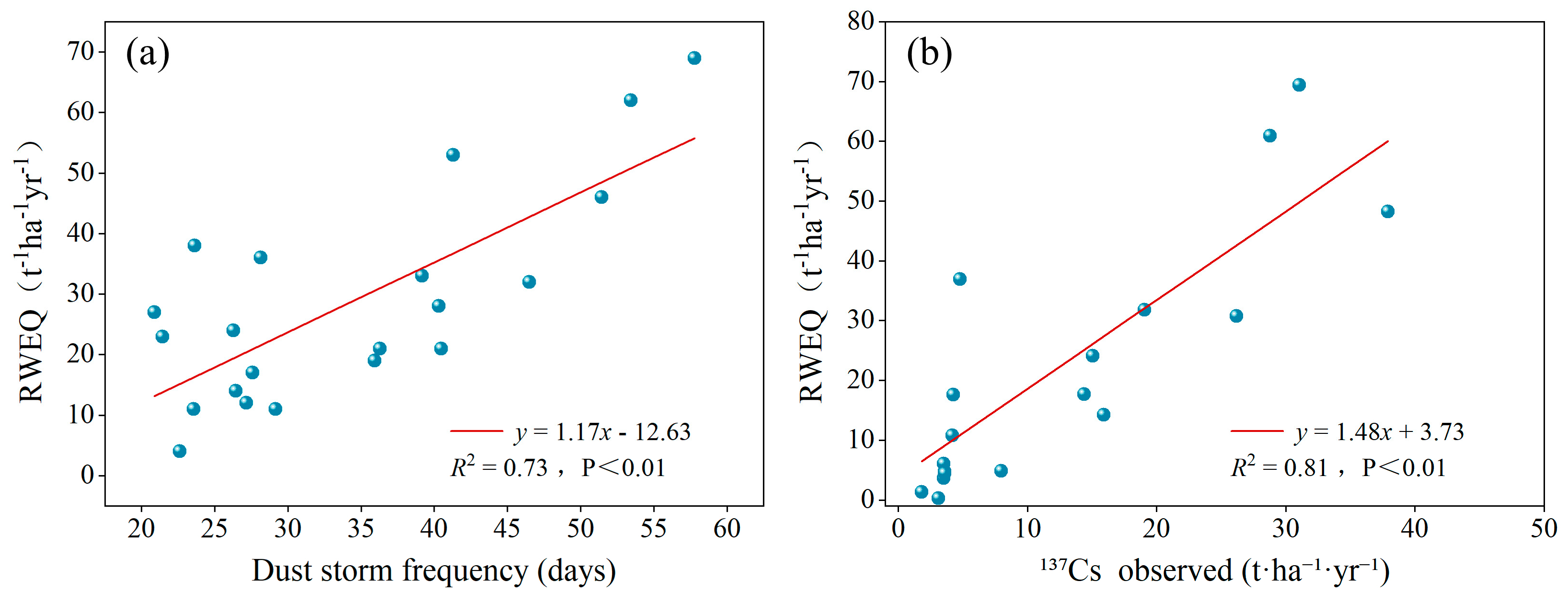
To evaluate the reliability of the RWEQ model simulations, linear regression analysis was used to compare the simulated SWEM with dust storm frequency and 137Cs-derived wind erosion observations (Figure 12).
The results show a significant positive relationship between SWEM and annual dust storm frequency (R2 = 0.73, p < 0.01) (Figure 12a), indicating that the model simulations are consistent with the regional wind erosion activity. To further evaluate the reliability of the model simulations, the mean SWEM simulated by the RWEQ model over the period 2000–2022 was compared with erosion rates derived from the 137Cs tracer technique reported in previous studies [50,51,52,53]. The locations of the observation sites and the corresponding model simulation results are provided in Table S4. The regression results show a significant positive relationship between the simulated and observed wind erosion rates (R2 = 0.81, p < 0.01) (Figure 12b). However, model simulation values generally exceed the observational data. This discrepancy may mainly be attributed to differences in data acquisition methods and spatial scales. Wind erosion rates derived from the 137Cs tracer technique are typically obtained through point observations, reflecting multi-year average erosion processes. Conversely, RWEQ model simulations yield grid-scale averages, resulting in spatial scale disparities between the two approaches.

4.2. Nonlinear Responses and Synergistic Effects of Driving Mechanisms of SWEM

4.2.1. Nonlinear Responses and Threshold Identification of SWEM Driving Mechanisms

According to the XGBoost-SHAP interpretation in this study, the area with severe wind erosion is mainly affected by vegetation, soil, and climate.
NDVI was identified as the dominant factor, highlighting its important role on dryland ecosystems. This is consistent with previous studies that mention the vegetation has a dual function for decreasing near-surface wind speed [62] and reducing sediment transport [1]. Our study discovered a key tipping point: NDVI drops below 0.14 and the danger of SWEM begins to escalate, in agreement with the threshold effect reported on the Loess Plateau (NDVI = 0.3) by Kimura et al. [63], where more vegetation greatly decreased the probability of the dust storms. In the extremely arid zones of Inner Mongolia like the Alxa League and the western part of Ordos, there is less ground cover, so soil is more easily blown away by the wind. These areas, which have low precipitation and poor vegetation regenerative capacity, are hotspots for wind erosion control. As they are highly erosive, these areas should be prioritized for grazing exclusion [64] and drought-tolerant afforestation [65] to restore vegetation and enhance resilience. Clay content was also found to have a key influence on SWEM and was positively correlated. This phenomenon is mostly distributed in the sandy and desert areas of the western part, like Alxa League and the western part of Ordos. These places are mostly composed of large soil particles such as coarse sand and gravel, so they have an open structure, not very cohesive, and unstable on the surface, making them very prone to being blown away by the wind [66]. From wind tunnel experiments, we see sandy soils are far lower in threshold wind speed and much more sensitive to wind erosion than silty and clay soils [67]. On the contrary, in the central and eastern study area, the main land types are natural grasslands and forests with more clay and organic matter content that improve soil aggregate stability and decrease erodible components [68,69]. Among climatic factors, the windy days are the most critical driver of wind erosion [70], playing a decisive role in determining both its spatial distribution and temporal dynamics [18]. Previous studies have demonstrated that among various causes of the movement of the soil particles, wind constitutes major cause in arid and semi-arid parts. It is especially obvious when there is little vegetation or exposed ground, the stronger the wind becomes, the more severe the wind erosion gets [5]. From threshold effect point of view, wind erosion is greatly increased with 26 more gale days per year, especially in north part of Alxa league and east part of Bayannur. Therefore, vegetation buffer zones are more urgent for areas with high WD to prevent SWEM. Other climatic factors like precipitation and temperature influence mostly the wind erosion in a wind degraded way via surface changes [71]. SHAP results show that the major effect of those variables is characterized by mixed effect, which indicates the complexity of the driving process. When annual precipitation is less than 73.15 mm, wind erosion risk increases. This means that when drought stress occurs, due to the lack of water resources, the vegetation degradation and exposed ground will be further aggravated, making the soil particles more easily eroded [72]. Wind erosion intensity decreases as precipitation increases beyond this point. But the negative effects of more precipitation were more spatially spread out, which indicated that the suppression effect of more precipitation on SWEM was regulated by other driving forces among the regions [48]. The influence of temperature is complex and nonlinear. In the western Xilingol region and the Hetao Irrigation District, low temperature values exhibit inhibitory effects on wind erosion. This indicates that under lower temperature conditions, increased soil moisture can support vegetation growth and improve surface stability, thereby reducing SWEM [73].

4.2.2. Mechanistic Analysis of the Synergistic Effects of Typical Ecological Factors on SWEM

In synergy analysis we find that the combination of factors can lead to a large boost in wind erosion response beyond the explanatory power of the individual driver under specific conditions. This is mainly due to the nonlinear and multi-factorial nature of SWE, where interacting drivers jointly influence soil moisture, vegetation, and surface stability within complex environmental systems [73]. For example, the NDVI–TEM interaction suggests that under low vegetation cover and high temperature conditions, accelerated soil moisture loss reduces surface stability, thereby increasing the risk of wind erosion. When strong wind is combined with high temperature, the wind erosion is intensified through increased moisture loss and surface particle movement under low vegetation cover. This firmly and locally deteriorates soil structure, causing low clay quantity and limited rainfall effect. Dry conditions and insufficient vegetation cover lead to the formation of land that is highly vulnerable to wind erosion, particularly in sandy and desert land interface. In addition, this sort of interactive driving is quite spatiotemporally selective, mostly centered over western Alxa, western Bayannur, and the Tengger-Ordors transitional area.
This indicates that wind erosion control requires a shift from traditional large-scale management approaches towards more precise and locally tailored management strategies. For instance, in extremely arid regions with sparse vegetation such as western Alashan, engineering measures such as sand barriers or artificial windbreaks should be prioritized to enhance surface stability. In areas such as western Bayannur and the Hetao irrigation district, where human activity and grazing pressure are high, measures such as year-round or seasonal grazing bans and rotational grazing should be implemented to alleviate grazing pressure and thereby reduce the risk of wind erosion. Moreover, in the desert-grassland transition zone, surface stability can be enhanced by establishing ecological buffer zones and increasing vegetation cover.

4.3. Construction of an XAI-Integrated Framework for Explaining Multi-Factor Influences on SWEM

Traditional methods employed to analyze wind erosion drivers primarily encompass correlation analysis [49], residual analysis [17], and geodetector models [20]. Although these methods help identify wind erosion drivers, they still have several limitations. Correlation analysis and residual analysis typically operate under global linearity assumptions, rendering them ill-suited to effectively capture the non-linear response characteristics of wind erosion processes to different drivers. While geographic detector models can quantify the explanatory power of drivers and identify spatial interactions between factors, they struggle to further distinguish whether individual drivers promote or inhibit wind erosion, nor can they readily identify potential threshold effects.
To address this research gap, we developed a regional wind erosion driver identification framework through the combination of machine learning and XAI approaches to perform the spatiotemporal disentanglement of the positive and negative impacts of wind erosion drivers.
Our method shows substantial strengths in recognizing many complicated factors and driving systems. On the other hand, the SHAP method can overcome the problem of global linear assumption, and it is able to capture the non-linear responses of wind erosion to variables across different value intervals, so as to determine the key factors’ critical threshold [74]. It can reflect the regional difference and spatial sensitivity of wind erosion mechanism by quantifying the spatial difference of variable contribution [75]. Furthermore, the combination of XGBoost and SHAP improves the visualization of synergistic effect between drivers, which is helpful to identify non-linear enhancement or suppression under certain combinations [75], which addresses the limitations of traditional models in capturing interaction effects. More importantly, the proposed framework presents a practical and adaptable approach for analyzing the driving forces for ecosystem service. From a spatial governance perspective, this framework provides scientific guidance for context-specific sand control strategies, supporting the delineation of tailored management units and promoting more effective ecological restoration and sustainable land use in arid and semi-arid regions.

4.4. Limitations and Future Research Directions

The present study still has certain limitations, which require further refinement in future research. Firstly, uncertainties in the input parameters of the RWEQ model may influence simulation outcomes. For instance, meteorological station data used for climate factors are derived through spatial interpolation, which may introduce errors. Furthermore, currently available wind speed data remains limited in both temporal and spatial resolution, whereas wind erosion processes are typically triggered by short-duration high-wind events. Employing daily-scale average wind speed data may prove inadequate for effectively capturing transient high-wind speed events. Secondly, as environmental variables typically exhibit strong spatial autocorrelation, neighboring pixels often display high similarity. Should spatial independence be lacking between training and test datasets, this may lead to an overestimation of the model’s predictive accuracy. Finally, in terms of temporal resolution, this study primarily analyzed the spatiotemporal dynamics of wind erosion at an annual scale and quantified the nonlinear relationships among driving factors using multi-year averages. This approach may to some extent obscure the dynamic characteristics of wind erosion processes and their driving mechanisms at seasonal or interannual scales.
Therefore, future research may employ wind speed data with higher temporal resolution, which can effectively capture transient strong wind events, thereby reducing the risk of underestimating wind erosion intensity. A spatial partitioning sampling strategy is employed during model training and validation to construct spatially independent training and test datasets, thereby mitigating potential data leakage and overfitting risks. Future research may incorporate data with higher temporal resolution (such as monthly or seasonal scales) to simulate wind erosion processes with greater precision, thereby further quantifying the seasonal variations and interannual fluctuations of climatic and anthropogenic drivers.

5. Conclusions

The present study developed a framework for identifying wind erosion drivers by integrating machine learning with explainable artificial intelligence, aimed at revealing the dominant factors underpinning severe wind erosion and their non-linear interaction mechanisms. Results indicate that wind erosion in the study area exhibited a significant overall decline during the research period. Wind erosion intensity decreased continuously at a rate of approximately 1.1 t·ha−1 per year between 2000–2022. Improvement areas were mainly observed in the western desert regions, whereas deterioration occurred primarily in the Hulunbuir Sandy Lands. Overall, severe wind erosion is predominantly driven by natural factors (78.7%), with human factors contributing relatively less (21.3%). The study identified key thresholds such as NDVI < 0.14, CL < 12%, GD > 26, PRE < 73.15 mm, and SA > 66%, under which wind erosion risk increases significantly. When vegetation cover diminishes, soil clay content is insufficient, and drought conditions coincide with high temperatures, the risk of wind erosion increases significantly. This creates distinct high-risk zones in western Alxa, western Bayannur, and the desert–grassland transition zone. Therefore, wind erosion control should transition from traditional large-scale management approaches to precision management strategies tailored to regional variations. In the extremely arid western Alashan region, engineering protection measures should be strengthened to stabilize the land surface. In areas with high human activity, such as western Bayannur and the Hetao irrigation district, optimizing grazing management should reduce anthropogenic disturbance. In the desert–grassland transition zone, enhancing land surface stability should be achieved by increasing vegetation cover and establishing ecological buffer zones.

Supplementary Materials

The following supporting information can be downloaded at: https://www.mdpi.com/article/10.3390/land15040531/s1, Figure S1: SHAP interaction plots of synergistic effects on SWEM; Table S1: Values of coefficients for different land use types; Table S2: Machine learning algorithm hyperparameter tuning and grid search examples; Table S3: Performance evaluation of different classifiers with various sampling methods; Table S4: Comparison of soil wind erosion modulus from 137CS tracer technique and inversion results from the RWEQ Model.

Author Contributions

Conceptualization, B.; methodology, Y.M.; software, Y.M.; validation, C.A.; writing—original draft preparation, Y.M.; writing—review and editing, Y.W., Y.H., and Y.S.; supervision, C.H.; project administration, B.; funding acquisition, B. All authors have read and agreed to the published version of the manuscript.

Funding

This research was funded by the following bodies: First-Class Discipline Scientific Research Special Project, grant number YLXKZX-NSD-028; the National Natural Science Foundation of China—Regional Fund, grant number Grant No.42261048; the National Natural Science Foundation of China—Youth Fund, grant number 42301362; the 2023 Young Scientific and Technological Talent Development Program (Young Scientific Talent), grant number NJYT23017; a project supported by the Research Start-Up Fund for Introducing High-Level Talents, Inner Mongolia Normal University, grant number 2021JYRC004; the 2023 Ministry of Human Resources and Social Security’s Talent Sponsorship Program for Studying Abroad; the Intelligent Ecological Decision-Making: Integrating AI and Partial Order Theory for Land Use Optimization, grant number 2025ZY0049; First-Class Discipline Scientific Research Special Project, grant number YXKZX-NSD-002; the First-Class Discipline Scientific Research Special Project, grant number YLXKZX-NSD-028; and the “Mission-oriented R&D Program with Open Competition for Project Leadership” of Inner Mongolia, grant number 2024JBGS0010.

Data Availability Statement

The datasets used in this study were obtained from publicly available sources. Soil property data were derived from the International Soil Reference and Information Centre (ISRIC) database (https://data.isric.org, accessed on 4 March 2025). Meteorological variables, including wind speed, temperature, precipitation, and snow depth, were obtained from the Copernicus Climate Data Store (https://cds.climate.copernicus.eu/, accessed on 10 March 2025), while dust storm frequency data were acquired from the NOAA National Centers for Environmental Information (https://www.ncei.noaa.gov/, accessed on 20 March 2025). Land cover data were sourced from the Global Land-Cover product with a Fine Classification System at 30 m resolution, available via Zenodo (https://zenodo.org/records/18180184, accessed on 21 March 2025). Remote sensing datasets, including NDVI, were obtained from NASA’s Land Processes Distributed Active Archive Center (https://lpdaac.usgs.gov/, accessed on 12 March 2025), and DEM data were accessed from the Geospatial Data Cloud (https://www.gscloud.cn/, accessed on 4 March 2025); Evapotranspiration data were provided by the National Tibetan Plateau Data Center (https://data.tpdc.ac.cn/, accessed on 11 March 2025); Socioeconomic datasets, including GDP and population density, were obtained from the Resource and Environment Science and Data Center (https://www.resdc.cn/, accessed on 1-2 March 2026), while livestock data were collected from the Inner Mongolia Statistical Yearbook (http://tj.nmg.gov.cn/, accessed on 2 March 2026); Road network and other distance-related spatial data were derived from OpenStreetMap and the Harvard Dataverse. The processed datasets generated during the current study are available from the corresponding author upon reasonable request.

Conflicts of Interest

The authors declare no conflicts of interest.

Abbreviations

The following abbreviations are used in this manuscript:
RWEQRevised Wind Erosion Equation
SWEMSoil Wind Erosion Modulus
LUCCLand use–land cover
SASoil sand content
SISoil silt content
CLSoil clay content
OMSoil organic matter content
CACO3Calcium Carbonate Content
WSWindy days
TEMTemperature
PREPrecipitation
SDSnow depth
NDVINormalized Difference Vegetation Index
DEMDigital Elevation Model
GDPGross Domestic Production
PDPopulation density
GIGrazing intensity
SLESlight erosion
LELight erosion
MEModerate erosion
SESevere erosion
ESEExtremely Severe erosion
DEDestructive erosion
SDSignificant decrease
ESDExtremely significant decrease
NSCNo significant change
ESIExtremely significant increase
SISignificant increase

References

  1. Meng, Z.; Dang, X.; Gao, Y.; Ren, X.; Ding, Y.; Wang, M. Interactive Effects of Wind Speed, Vegetation Coverage and Soil Moisture in Controlling Wind Erosion in a Temperate Desert Steppe, Inner Mongolia of China. J. Arid Land 2018, 10, 534–547. [Google Scholar] [CrossRef]
  2. Pelt, R.S.V.; Hushmurodov, S.X.; Baumhardt, R.L.; Chappell, A.; Strack, J.E. The Reduction of Partitioned Wind and Water Erosion by Conservation Agriculture. CATENA 2017, 148, 160–167. [Google Scholar] [CrossRef]
  3. Zarrinabadi, E.; Lobb, D.A.; Koiter, A.J.; Goharrokhi, M. Assessment of the Effects of Land Rolling on Wind Erosion and Crop Growth in Soybean Production in the Red River Valley, Canada. Soil Tillage Res. 2022, 222, 105439. [Google Scholar] [CrossRef]
  4. Jebali, A.; Zare, M.; Ekhtesasi, M.R.; Jafari, R. Detection of Areas Prone to Wind Erosion and Air Pollution Using DSI and PDSI Indices. Nat. Hazards 2021, 108, 1221–1235. [Google Scholar] [CrossRef]
  5. Zhang, H.; Peng, J.; Zhao, C. Wind Speed and Vegetation Coverage in Turn Dominated Wind Erosion Change With Increasing Aridity in Africa. Earth’s Future 2024, 12, e2024EF004468. [Google Scholar] [CrossRef]
  6. Dai, Y.; Tian, L.; Zhu, P.; Dong, Z.; Zhang, R. Dynamic Aeolian Erosion Evaluation and Ecological Service Assessment in Inner Mongolia, Northern China. Geoderma 2022, 406, 115518. [Google Scholar] [CrossRef]
  7. Evans, R.; Collins, A.L.; Zhang, Y.; Foster, I.D.L.; Boardman, J.; Sint, H.; Lee, M.R.F.; Griffith, B.A. A Comparison of Conventional and 137Cs-Based Estimates of Soil Erosion Rates on Arable and Grassland across Lowland England and Wales. Earth-Sci. Rev. 2017, 173, 49–64. [Google Scholar] [CrossRef]
  8. Fister, W.; Ries, J.B. Wind Erosion in the Central Ebro Basin under Changing Land Use Management. Field Experiments with a Portable Wind Tunnel. J. Arid Environ. 2009, 73, 996–1004. [Google Scholar] [CrossRef]
  9. Borrelli, P.; Lugato, E.; Montanarella, L.; Panagos, P. A New Assessment of Soil Loss Due to Wind Erosion in European Agricultural Soils Using a Quantitative Spatially Distributed Modelling Approach. Land Degrad. Dev. 2017, 28, 335–344. [Google Scholar] [CrossRef]
  10. Wu, X.; Fan, J.; Sun, L.; Zhang, H.; Xu, Y.; Yao, Y.; Yan, X.; Zhou, J.; Jia, Y.; Chi, W. Wind Erosion and Its Ecological Effects on Soil in the Northern Piedmont of the Yinshan Mountains. Ecol. Indic. 2021, 128, 107825. [Google Scholar] [CrossRef]
  11. Fryrear, D.W.; Bilbro, J.D.; Saleh, A.; Schomberg, H.M.; Zobeck, T.M. RWEQ: Improved Wind Erosion Technology. J. Soil Water Conserv. 2000, 55, 183–189. [Google Scholar] [CrossRef]
  12. Fu, Q.; Li, B.; Hou, Y.; Bi, X.; Zhang, X. Effects of Land Use and Climate Change on Ecosystem Services in Central Asia’s Arid Regions: A Case Study in Altay Prefecture, China. Sci. Total Environ. 2017, 607–608, 633–646. [Google Scholar] [CrossRef] [PubMed]
  13. Wang, W.; Samat, A.; Abuduwaili, J.; Maeyer, P.; Voorde, T. Machine Learning-Based Prediction of Sand and Dust Storm Sources in Arid Central Asia. Int. J. Digit. Earth 2023, 16, 1530–1550. [Google Scholar] [CrossRef]
  14. Kaplan, S.; Basaran, M.; Erpul, G. Assessing the Performance of Wind Erosion Prediction Models of RWEQ and SWEEP by Direct Measurements in an Arid Region. Soil Tillage Res. 2024, 240, 106086. [Google Scholar] [CrossRef]
  15. Liu, X.; Du, H.; Li, S.; Liu, X.; Fan, Y.; Wang, T. Dynamics of Soil Wind Erosion in the Mu Us Sandy Land (in Northern China) Affected by Cropland Reclamation from 2000 to 2020. Ecol. Indic. 2023, 154, 110717. [Google Scholar] [CrossRef]
  16. Keesstra, S.; Pereira, P.; Novara, A.; Brevik, E.C.; Azorin-Molina, C.; Parras-Alcantara, L.; Jordan, A.; Cerda, A. Effects of Soil Management Techniques on Soil Water Erosion in Apricot Orchards. Sci. Total Environ. 2016, 551–552, 357–366. [Google Scholar] [CrossRef]
  17. Zhang, H.; Fan, J.; Cao, W.; Harris, W.; Li, Y.; Chi, W.; Wang, S. Response of Wind Erosion Dynamics to Climate Change and Human Activity in Inner Mongolia, China during 1990 to 2015. Sci. Total Environ. 2018, 639, 1038–1050. [Google Scholar] [CrossRef]
  18. Zhao, C.; Zhang, H.; Wang, M.; Jiang, H.; Peng, J.; Wang, Y. Impacts of Climate Change on Wind Erosion in Southern Africa between 1991 and 2015. Land Degrad Dev 2021, 32, 2169–2182. [Google Scholar] [CrossRef]
  19. Zhao, Y.; Gao, G.; Ding, G.; Wang, L.; Chen, Y.; Zhao, Y.; Yu, M.; Zhang, Y. Assessing the Influencing Factors of Soil Susceptibility to Wind Erosion: A Wind Tunnel Experiment with a Machine Learning and Model-Agnostic Interpretation Approach. CATENA 2022, 215, 106324. [Google Scholar] [CrossRef]
  20. Mei, Y.; Batunacun; Hai, C.; Chang, A.; Chang, Y.; Wang, Y.; Hu, Y. Spatiotemporal Dynamics and Driving Factors of Soil Wind Erosion in Inner Mongolia, China. Remote Sens. 2025, 17, 2365. [Google Scholar] [CrossRef]
  21. Gholami, H.; Mohammadifar, A.; Song, Y.; Li, Y.; Rahmani, P.; Kaskaoutis, D.G.; Panagos, P.; Borrelli, P. An Assessment of Global Land Susceptibility to Wind Erosion Based on Deep-Active Learning Modelling and Interpretation Techniques. Sci. Rep. 2024, 14, 18951. [Google Scholar] [CrossRef]
  22. Gholami, H.; Jalali, M.; Rezaei, M.; Mohamadifar, A.; Song, Y.; Li, Y.; Wang, Y.; Niu, B.; Omidvar, E.; Kaskaoutis, D.G. An Explainable Integrated Machine Learning Model for Mapping Soil Erosion by Wind and Water in a Catchment with Three Desiccated Lakes. Aeolian Res. 2024, 67–69, 100924. [Google Scholar] [CrossRef]
  23. Fernández, D.; Adermann, E.; Pizzolato, M.; Pechenkin, R.; Rodríguez, C.G.; Taravat, A. Comparative Analysis of Machine Learning Algorithms for Soil Erosion Modelling Based on Remotely Sensed Data. Remote Sens. 2023, 15, 482. [Google Scholar] [CrossRef]
  24. Mohammed, S.; Jouhra, A.; Enaruvbe, G.O.; Bashir, B.; Barakat, M.; Alsilibe, F.; Cimusa Kulimushi, L.; Alsalman, A.; Szabó, S. Performance Evaluation of Machine Learning Algorithms to Assess Soil Erosion in Mediterranean Farmland: A Case-study in Syria. Land Degrad. Dev. 2023, 34, 2896–2911. [Google Scholar] [CrossRef]
  25. Dou, Y.; Kuang, W. A Comparative Analysis of Urban Impervious Surface and Green Space and Their Dynamics among 318 Different Size Cities in China in the Past 25 Years. Sci. Total Environ. 2020, 706, 135828. [Google Scholar] [CrossRef]
  26. Lary, D.J.; Alavi, A.H.; Gandomi, A.H.; Walker, A.L. Machine Learning in Geosciences and Remote Sensing. Geoence Front. 2016, 7, 3–10. [Google Scholar] [CrossRef]
  27. Gholami, H.; Mohammadifar, A.; Bui, D.T.; Collins, A.L. Mapping Wind Erosion Hazard with Regression-Based Machine Learning Algorithms. Sci. Rep. 2020, 10, 20494. [Google Scholar] [CrossRef]
  28. Avand, M.; Mohammadi, M.; Mirchooli, F.; Kavian, A.; Tiefenbacher, J.P. A New Approach for Smart Soil Erosion Modeling: Integration of Empirical and Machine-Learning Models. Env. Model. Assess. 2023, 28, 145–160. [Google Scholar] [CrossRef]
  29. Ge, Y.; Zhao, L.; Chen, J.; Li, X.; Li, H.; Wang, Z.; Ren, Y. Study on Soil Erosion Driving Forces by Using (R)USLE Framework and Machine Learning: A Case Study in Southwest China. Land 2023, 12, 639. [Google Scholar] [CrossRef]
  30. Murdoch, W.J.; Singh, C.; Kumbier, K.; Abbasi-Asl, R.; Yu, B. Definitions, Methods, and Applications in Interpretable Machine Learning. Proc. Natl. Acad. Sci. USA 2019, 116, 22071–22080. [Google Scholar] [CrossRef]
  31. Carvalho, D.V.; Pereira, E.M.; Cardoso, J.S. Machine Learning Interpretability: A Survey on Methods and Metrics. Electronics 2019, 8, 832. [Google Scholar] [CrossRef]
  32. Lundberg, S.M.; Erion, G.G.; Lee, S.I. Consistent Individualized Feature Attribution for Tree Ensembles. arXiv 2018, arXiv:1802.03888. [Google Scholar] [CrossRef]
  33. Wang, S.; Peng, H.; Liang, S. Prediction of Estuarine Water Quality Using Interpretable Machine Learning Approach. J. Hydrol. 2022, 605, 127320. [Google Scholar] [CrossRef]
  34. He, Z.; Yang, Y.; Fang, R.; Zhou, S.; Zhao, W.; Bai, Y.; Li, J.; Wang, B. Integration of Shapley Additive Explanations with Random Forest Model for Quantitative Precipitation Estimation of Mesoscale Convective Systems. Front. Environ. Sci. 2023, 10, 1057081. [Google Scholar] [CrossRef]
  35. Wadoux, A.M.J.-C.; Saby, N.P.A.; Martin, M.P. Shapley Values Reveal the Drivers of Soil Organic Carbon Stock Prediction. SOIL 2023, 9, 21–38. [Google Scholar] [CrossRef]
  36. Niu, X.; Lu, C.; Zhang, Y.; Zhang, Y.; Wu, C.; Saidy, E.; Liu, B.; Shu, L. Hysteresis Response of Groundwater Depth on the Influencing Factors Using an Explainable Learning Model Framework with Shapley Values. Sci. Total Environ. 2023, 904, 166662. [Google Scholar] [CrossRef]
  37. Ebrahimi-Khusfi, Z.; Dargahian, F.; Nafarzadegan, A.R. Predicting the Dust Events Frequency around a Degraded Ecosystem and Determining the Contribution of Their Controlling Factors Using Gradient Boosting-Based Approaches and Game Theory. Env. Sci. Pollut. Res. 2022, 29, 36655–36673. [Google Scholar] [CrossRef]
  38. Jiang, L.; Xiao, Y.; Zheng, H.; Ouyang, Z. Spatio-Temporal Variation of Wind Erosion in Inner Mongolia of China between 2001 and 2010. Chin. Geogr. Sci. 2016, 26, 155–164. [Google Scholar] [CrossRef]
  39. Xu, Z.; Mason, J.A.; Xu, C.; Yi, S.; Bathiany, S.; Yizhaq, H.; Zhou, Y.; Cheng, J.; Holmgren, M.; Lu, H. Critical Transitions in Chinese Dunes during the Past 12,000 Years. Sci. Adv. 2020, 6, eaay8020. [Google Scholar] [CrossRef]
  40. Elliott, D.L. Meteorological and Topographical Indicators of Wind Energy for Regional Assessments. In Proceedings of the Conference and Workshop on Wind Energy Characteristics and Wind Energy Siting, Portland, OR, USA, 19–21 June 1979. [Google Scholar]
  41. Wen, L.; Yong, M.; Bao, Y.; Fu, R.; Jin, E. Effect of Grassland Fires on Dust Storms in Dornod Aimag, Mongolia. Remote Sens. 2023, 15, 5629. [Google Scholar] [CrossRef]
  42. Wang, D.; Peng, Q.; Li, X.; Zhang, W.; Xia, X.; Qin, Z.; Ren, P.; Liang, S.; Yuan, W. A Long-Term High-Resolution Dataset of Grasslands Grazing Intensity in China. Sci. Data 2024, 11, 1194. [Google Scholar] [CrossRef] [PubMed]
  43. Yang, J.; Huang, X. The 30 m Annual Land Cover Dataset and Its Dynamics in China from 1990 to 2019. Earth Syst. Sci. Data 2021, 13, 3907–3925. [Google Scholar] [CrossRef]
  44. Fryrcar, D.W.; Chen, W.N.; Lester, C. Revised Wind Erosion Equation. Ann. Arid Zone 2001, 40, 265–279. [Google Scholar]
  45. SL190-2007; Ministry of Water Resources of the People’s Republic of China Classification Criteria of Soil Erosion Intensities. Ministry of Water Resources of the People’s Republic of China: Beijing, China, 2007.
  46. Zhang, G.; Azorin-Molina, C.; Shi, P.; Lin, D.; Guijarro, J.A.; Kong, F.; Chen, D. Impact of Near-Surface Wind Speed Variability on Wind Erosion in the Eastern Agro-Pastoral Transitional Zone of Northern China, 1982–2016. Agric. For. Meteorol. 2019, 271, 102–115. [Google Scholar] [CrossRef]
  47. Lin, J.; Guan, Q.; Pan, N.; Zhao, R.; Yang, L.; Xu, C. Spatiotemporal Variations and Driving Factors of the Potential Wind Erosion Rate in the Hexi Region, PR China. Land Degrad. Dev. 2021, 32, 139–157. [Google Scholar] [CrossRef]
  48. Wei, X.; Wu, X.; Wang, D.; Wu, T.; Li, R.; Hu, G.; Zou, D.; Bai, K.; Ma, X.; Liu, Y.; et al. Spatiotemporal Variations and Driving Factors for Potential Wind Erosion on the Mongolian Plateau. Sci. Total Environ. 2023, 862, 160829. [Google Scholar] [CrossRef]
  49. Teng, Y.; Zhan, J.; Liu, W.; Sun, Y.; Agyemang, F.B.; Liang, L.; Li, Z. Spatiotemporal Dynamics and Drivers of Wind Erosion on the Qinghai-Tibet Plateau, China. Ecol. Indic. 2021, 123, 107340. [Google Scholar] [CrossRef]
  50. Liu, J.; Qi, Y.; Shi, H. 137Cs Tracing Analysis in the Tariat–Xilingol Region of the Mongolian Plateau. Chin. Sci. Bull. 2007, 52, 2785. [Google Scholar]
  51. Chi, W. Spatiotemporal Characteristics of Soil Wind Erosion and the Ecosystem Service of Soil Conservation on the Inner Mongolia Plateau. Ph.D. Thesis, Chinese Academy of Sciences, Beijing, China, 2015. [Google Scholar]
  52. Wu, X. Impacts and Effects of Ecological Land Retirement on Soil Wind Erosion in the Northern Foothills of the Yinshan Mountains, Inner Mongolia. Ph.D. Thesis, Inner Mongolia Agricultural University, Hohhot, China, 2019. [Google Scholar]
  53. Hu, Y.; Zhang, Y. Combined 137Cs and 210Pbex Tracer Analysis of Soil Erosion in the Southern Margin of the Hunshandake Sandy Land, Inner Mongolia. Acta Geogr. Sin. 2019, 74, 1890–1903. [Google Scholar]
  54. Batunacun; Nendel, C.; Hu, Y.; Lakes, T. Land-use Change and Land Degradation on the Mongolian Plateau from 1975 to 2015—A Case Study from Xilingol, China. Land Degrad Dev 2018, 29, 1595–1606. [Google Scholar] [CrossRef]
  55. Breiman Random Forests. Mach. Learn. 2001, 45, 5–32. [CrossRef]
  56. Chen, T.; Guestrin, C. XGBoost: A Scalable Tree Boosting System. In Proceedings of the 22nd ACM SIGKDD International Conference on Knowledge Discovery and Data Mining, San Francisco, CA, USA, 13 August 2016; pp. 785–794. [Google Scholar]
  57. Cortes, C.; Vapnik, V. Support-Vector Networks. Mach. Learn. 1995, 20, 273–297. [Google Scholar] [CrossRef]
  58. Freund, Y.; Schapire, R.E. A Desicion-Theoretic Generalization of on-Line Learning and an Application to Boosting. J. Comput. Syst. Sci. 1997, 55, 119–139. [Google Scholar] [CrossRef]
  59. Friedman, J.H. Greedy Function Approximation: A Gradient Boosting Machine. Ann. Stat. 2001, 29, 1189–1232. [Google Scholar] [CrossRef]
  60. Prokhorenkova, L.; Gusev, G.; Vorobev, A.; Dorogush, A.V.; Gulin, A. CatBoost: Unbiased Boosting with Categorical Features. arXiv 2017, arXiv:1706.09516. [Google Scholar] [CrossRef]
  61. Lundberg, S.; Lee, S.I. A Unified Approach to Interpreting Model Predictions. arXiv 2017, arXiv:1705.07874. [Google Scholar] [CrossRef]
  62. Abdourhamane Touré, A.; Tidjani, A.D.; Rajot, J.L.; Marticorena, B.; Bergametti, G.; Bouet, C.; Ambouta, K.J.M.; Garba, Z. Dynamics of Wind Erosion and Impact of Vegetation Cover and Land Use in the Sahel: A Case Study on Sandy Dunes in Southeastern Niger. CATENA 2019, 177, 272–285. [Google Scholar] [CrossRef]
  63. Kimura, R.; Bai, L.; Wang, J. Relationships among Dust Outbreaks, Vegetation Cover, and Surface Soil Water Content on the Loess Plateau of China, 1999–2000. CATENA 2009, 77, 292–296. [Google Scholar] [CrossRef]
  64. Dong, L.; Wang, J.; Li, J.; Wu, Y.; Zheng, Y.; Zhang, J.; Li, Z.; Yin, R.; Liang, C. Assessing the Impact of Grazing Management on Wind Erosion Risk in Grasslands: A Case Study on How Grazing Affects Aboveground Biomass and Soil Particle Composition in Inner Mongolia. Glob. Ecol. Conserv. 2022, 40, e02344. [Google Scholar] [CrossRef]
  65. Han, Y.; Zhao, W.; Zhou, A.; Pereira, P. Water and Wind Erosion Response to Ecological Restoration Measures in China’s Drylands. Geoderma 2023, 435, 116514. [Google Scholar] [CrossRef]
  66. Zhang, H.; Gao, Y.; Sun, D.; Liu, L.; Cui, Y.; Zhu, W. Wind Erosion Changes in a Semi-Arid Sandy Area, Inner Mongolia, China. Sustainability 2019, 11, 188. [Google Scholar] [CrossRef]
  67. Zamani, S.; Mahmoodabadi, M. Effect of Particle-Size Distribution on Wind Erosion Rate and Soil Erodibility. Arch. Agron. Soil Sci. 2013, 59, 1743–1753. [Google Scholar] [CrossRef]
  68. Colazo, J.C.; Buschiazzo, D.E. Soil Dry Aggregate Stability and Wind Erodible Fraction in a Semiarid Environment of Argentina. Geoderma 2010, 159, 228–236. [Google Scholar] [CrossRef]
  69. Moosavi, A.A. Portable Wind Tunnel Experiments to Study Soil Erosion by Wind and Its Link to Soil Properties in the Fars Province, Iran. Geoderma 2019, 333, 69–90. [Google Scholar] [CrossRef]
  70. Jarrah, M.; Mayel, S.; Tatarko, J.; Funk, R.; Kuka, K. A Review of Wind Erosion Models: Data Requirements, Processes, and Validity. CATENA 2020, 187, 104388. [Google Scholar] [CrossRef]
  71. Bergametti, G.; Rajot, J.L.; Pierre, C.; Bouet, C.; Marticorena, B. How Long Does Precipitation Inhibit Wind Erosion in the Sahel? Geophys. Res. Lett. 2016, 43, 6643–6649. [Google Scholar] [CrossRef]
  72. Gao, X.; Zhao, X.; Wu, P.; Yang, M.; Siddique, K.H.M. The Economic–Environmental Trade-off of Growing Apple Trees in the Drylands of China: A Conceptual Framework for Sustainable Intensification. J. Clean. Prod. 2021, 296, 126497. [Google Scholar] [CrossRef]
  73. Webb, N.P.; Herrick, J.E.; Duniway, M.C. Ecological Site-based Assessments of Wind and Water Erosion: Informing Accelerated Soil Erosion Management in Rangelands. Ecol. Appl. 2014, 24, 1405–1420. [Google Scholar] [CrossRef]
  74. Li, K.; Zhao, J.; Li, Y.; Lin, Y. Identifying Trade-Offs and Synergies among Land Use Functions Using an XGBoost-SHAP Model: A Case Study of Kunming, China. Ecol. Indic. 2025, 172, 113330. [Google Scholar] [CrossRef]
  75. Tian, Y.; Zhang, Q.; Tao, J.; Zhang, Y.; Lin, J.; Bai, X. Use of Interpretable Machine Learning for Understanding Ecosystem Service Trade-Offs and Their Driving Mechanisms in Karst Peak-Cluster Depression Basin, China. Ecol. Indic. 2024, 166, 112474. [Google Scholar] [CrossRef]
Figure 1. Study area and spatial distribution of deserts, sandy lands, and meteorological stations. Note: The boundaries of deserts and sandy lands were extracted from the dataset provided by Xu et al. [39].
Land 15 00531 g001
Figure 2. Framework of the explainable machine learning approach for identifying drivers of wind erosion.
Land 15 00531 g002
Figure 3. ROC curves of the six machine learning models (XGBoost, RF, GBM, AdaBoost, SVM, and CatBoost). The dashed line indicates the performance of a random classifier (i.e., the diagonal reference line where TPR = FPR).
Land 15 00531 g003
Figure 4. Interannual variation (a) and spatial trend (b) of SWEM in Inner Mongolia during 2000–2022. ESI, ESD, NSC, SI, and SD represent extremely significant increase, extremely significant decrease, no significant change, significant increase, and significant decrease, respectively.
Land 15 00531 g004
Figure 5. Spatial distribution of (a) soil wind erosion intensity and (b) the target variable (Y) used for model construction in Inner Mongolia. The target variable Y represents the occurrence of severe wind erosion (Y = 1) and non-severe wind erosion (Y = 0).
Land 15 00531 g005
Figure 6. The contributions of each factor to severe wind erosion. (a) The average of the absolute SHAP value of each factor. (b) The beehive diagram of SHAP value.
Land 15 00531 g006
Figure 7. Driver selection based on recursive feature elimination and its impact on model performance. The dashed lines indicate the optimal threshold range for feature selection.
Land 15 00531 g007
Figure 8. SHAP dependence plots illustrating the threshold effects of dominant drivers on SWEM. (a) NDVI; (b) CL; (c) WD; (d) PRE; (e) TEM; (f) SA. The dashed lines indicate the threshold values of each driver, and the red dashed line represents the zero SHAP value. The background colors indicate the positive (pink), negative (blue), and mixed (yellow) effects.
Land 15 00531 g008
Figure 9. Spatial distribution of SHAP values showing the influence of dominant drivers on SWEM. (a) NDVI; (b) CL; (c) WD; (d) PRE; (e) TEM; (f) SA. The colors indicate the positive (pink), negative (blue), and mixed (yellow) effects.
Land 15 00531 g009
Figure 10. SHAP interaction dependence plots illustrate the synergistic effects of dominant drivers on SWEM. (a) NDVI-TEM interaction; (b) WD-TEM interaction; (c) CL-PRE interaction, and (d) PRE-TEM interaction. The dashed lines indicate the threshold values of the drivers, and the red dashed line represents the zero SHAP value. The shaded areas indicate the positive (pink) and mixed (yellow) effects.
Land 15 00531 g010
Figure 11. Spatial distribution of synergistic effects between dominant drivers on SWEM: (a) NDVI-TEM interaction; (b) WD-TEM interaction; (c) CL-PRE interaction, and (d) PRE-TEM interaction. Red areas indicate promoting effects while yellow areas represent mixed effects.
Land 15 00531 g011
Figure 12. Linear regression between RWEQ-simulated wind erosion and validation data: (a) dust storm frequency during 2000–2022 and (b) 137Cs-derived wind erosion.
Land 15 00531 g012
Table 1. Details of multi-source datasets applied in this study. Note: “constant” indicates that the variable does not change over time.
Data
Category
VariableAbbreviationResolutionData
Period
Sources
Soil Soil sand content (%)SA1 kmconstanthttps://data.isric.org/
(accessed on 4 March 2025)
Soil silt content (%)SI
Soil clay content (%)CL
Soil organic matter content (%)OM
Calcium Carbonate Content (%)CaCO3
Meteorological Wind speed
(m.s−1)
WSSite
statistics
2000–2022https://cds.climate.copernicus.eu/
(accessed on 10 March 2025)
Windy daysWD
Temperature (°C)TEM
PrecipitationPRE
Dust storm
frequency
DSF2000–2022https://www.ncei.noaa.gov/data/global-hourly/archive/csv/
(accessed on 20 March 2025)
Land use Land use–land coverLUCC30 m2000–2022https://zenodo.org/records/18180184 (accessed on 21 March 2025)
Remote
sensing
Snow depth (mm)SD0.1°2000–2022https://cds.climate.copernicus.eu/
(accessed on 10 March 2025)
Evapotranspiration (mm)PET1 km2000–2022https://data.tpdc.ac.cn/
(accessed on 11 March 2025)
NDVINDVI250 m2000–2022https://ladsweb.modaps.eosdis.nasa.gov/
(accessed on 12 March 2025)
DEM (m)DEM30 mconstanthttps://www.gscloud.cn/
(accessed on 4 March 2025)
AspectASPECTCalculate using DEM data
SlopeSLOPE
Socio-
economic
GDPGDPCounty statistics2000–2022https://tj.nmg.gov.cn/
(accessed on 1 March 2026)
Population
density
PD2000–2022https://tj.nmg.gov.cn/
(accessed on 2 March 2026)
Grazing IntensityGI2000–2022https://doi.org/10.6084/m9.figshare.26195684 (accessed on 2 March 2026)
Table 2. SWEM intensity classification and thresholds. Note: SWET refers to soil wind erosion thickness.
Severity CategoryVegetation
Coverage (%)
SWET
(mm/a)
SWEM
t·hm−2·a−1
Binary
Classification
Slight erosion>70<2<20
Light erosion50–702–102–250
Moderate erosion30–5010–2525–500
Severe erosion10–3025–5050–801
Extremely severe erosion<1050–10080–1501
Destructive erosion<10>100>1501
Table 3. Metrics and Formulas for Model Performance Assessment Evaluation.
MetricsFormulaEvaluation
ACC T P + T N T P + F N + F P + T N Overall accuracy of the classifier.
Precision TP TP + FP The percentage of true positives within the set of all positive predictions.
Recall TP TP + FN The percentage of actual positives that the model correctly recognizes.
Kappa
Index
P 0 P e 1 p e Assesses the concordance between observed data and the outputs generated by the model. P 0 and P e represent the observed agreement and expected agreement, respectively.
AUC 0 1 T P R ( F P R ) d ( F P R ) Describes how well the model can separate positive from negative classes under varying decision thresholds. TPR and FPR denote true positive rate and false positive rate, respectively.
Disclaimer/Publisher’s Note: The statements, opinions and data contained in all publications are solely those of the individual author(s) and contributor(s) and not of MDPI and/or the editor(s). MDPI and/or the editor(s) disclaim responsibility for any injury to people or property resulting from any ideas, methods, instructions or products referred to in the content.