Article

Enhanced Machine Learning for Reliable Water Body Extraction of Plateau Wetlands Caohai Using Remote Sensing and Big Geospatial Data from Optical Zhuhai-1 and Radar Sat-2 Satellites


1
College of Computer Science and Technology, Guizhou University, Guiyang 550025, China
2
The Guizhou Provincial Key Laboratory for Prevention and Control of Emerging Contaminants, Guiyang 550025, China
3
College of Resources and Environmental Engineering, Guizhou University, Guiyang 550025, China
4
The Natural Resources Technical Information Center of Guizhou Province, Guiyang 550004, China
5
School of Design, South China University of Technology, Guangzhou 511442, China
6
School of Environment and Energy, South China University of Technology, Guangzhou 510006, China
*
Authors to whom correspondence should be addressed.
Land 2026, 15(4), 530; https://doi.org/10.3390/land15040530
Submission received: 16 February 2026 / Revised: 11 March 2026 / Accepted: 20 March 2026 / Published: 25 March 2026
(This article belongs to the Section Land – Observation and Monitoring)

Abstract

In wetland ecological monitoring, accurate acquisition of water bodies is particularly crucial, especially for hydrological monitoring and eutrophication control. Water bodies can be clearly delineated by using optical remote sensors. Optical sensors can clearly delineate water boundaries and features when extracting water bodies via remote sensing. Meanwhile, synthetic aperture radar (SAR), with its unique microwave capabilities, can easily penetrate vegetation and operate regardless of weather conditions, enabling all-weather monitoring. Each sensor type exhibits distinct advantages in water body monitoring and research. This study focuses on Caohai Wetland in Guizhou Province, utilizing data from the optical satellite Zhuhai-1 (launched by China in 2017) and the radar satellite RadarSat-2 (launched by Canada) at identical resolutions during the same period. Five supervised classification methods were applied to extract water bodies using optical imagery within the wetland area, with results evaluated against SAR data. Results indicate that the optimal water body extraction methods based on optical and SAR data are Random Forest Classification and Support Vector Machine classification, respectively, achieving an overall accuracy of 0.896 and 0.940, with Kappa coefficients of 0.791 and 0.879. The water area extracted using SAR was significantly larger than that based on optical data, thereby identifying areas within Caohai Wetland that were not fully submerged in vegetation during this period. This study holds significant implications for accurate water body extraction and analysis benefited an improved monitoring and conserving the wetland environment.

1. Introduction

Wetland ecosystems play an irreplaceable role in global ecosystem conservation and represent vital natural resources for humanity [1,2,3]. Within these ecosystems, water bodies constitute a critical component, performing an indispensable function in maintaining wetland biodiversity with the vegetation [4,5]. The capacity of wetlands to regulate climate, preserve biodiversity, and purify water quality is intrinsically linked to variations in water body areas [6]. Accurate delineation of water body boundaries is paramount in studies examining wetland water characteristics and constitutes a fundamental prerequisite for research on wetland ecosystems and services [7].
As a quintessential example of a plateau wetland ecosystem, Caohai in Guizhou possesses complex biodiversity and intact internal structural functions, endowing it with exceptionally high ecological value [8]. However, excessive human disturbances have severely affected the Caohai wetland. Between the 1950s and 1980s, its water area shrank to a mere 5 km2. In recent years, the local government has implemented a series of restoration measures for ecological conservation of the Caohai wetlands, achieving notable results [9]. Since 2015, specific ecological restoration measures—including afforestation programs and soil erosion control—have expanded the wetland’s water area to approximately 25 km2. Monitoring the changes in water area is a critical aspect to reflect the effectiveness in wetland ecological restoration. Obtaining timely and accurate distribution data is also essential for wetland ecological research. However, the complex internal environment of Caohai Wetland—characterized by intertwined aquatic vegetation, terrestrial areas, and water bodies—poses challenges to precisely delineating water body boundaries. Therefore, as a representative case of a wetland ecosystem significantly affected by human activities and subsequently restored through human intervention, accurately determining the water body extent of Caohai Wetland holds significant importance for the conservation, eutrophication control, and research of local wetland ecosystems.
Remote sensing technology serves as a crucial method for extracting water bodies in wetland ecology research [10]. By integrating remote sensing data products, one can better understand water conditions within wetland ecosystems [11]. Currently, two primary types of remote sensing methods are used: optical and synthetic aperture radar (SAR) [12]. Optical imagery offers high spatial resolution and rich spectral information, clearly delineating water boundaries and details, and is predominantly employed for identifying shallow and transparent water bodies [13]. Li et al. [14] proposed an adaptive mutant particle swarm optimization (PSO)-support vector machine (AMPSO-SVM) method for river boundary extraction, demonstrating superior overall accuracy and Kappa coefficient compared to existing approaches. Krivoguz et al. [15] employed Sentinel-2 satellite data to construct a deep neural network for extracting water body areas on the Kerch Peninsula and generating a water body map, achieving a model prediction accuracy of 96%. However, optical imagery is constrained by weather and lighting conditions, susceptible to clouds, rain, and fog, which significantly affects the water body identification accuracy [16]. Particularly in wetlands with dense aquatic vegetation, optical imagery struggles to penetrate vegetation, making it difficult to extract water bodies covered by vegetation [17], leading to under-classifications in water body extraction.
In contrast, SAR imagery possesses outstanding penetration capabilities and observational characteristics, robust towards weather and lighting conditions, and performs equally well at night or beneath cloud cover conditions [17]. Chen et al. [18] proposed an adaptive thresholding method to extract rapid flood water coverage from Sentinel-1 data while addressing the limitation of low temporal resolution. Wan et al. [19] employed GF-3 imagery to extract water bodies in wetlands and lakes based on combined polarization and texture features. Results demonstrated that fully polarized SAR achieves 94.74% extraction accuracy, effectively compensating for the limitations of single-polarized SAR. Chen et al. [20] pioneered an interpretable deep neural network (DNN) framework for water body detection, utilizing SAR images from millimeter-wave and Sentinel-1 systems at varying resolutions and bands to extract flood areas. However, SAR imagery also suffers from long imaging times, complex data processing, and high susceptibility to noise and shadowing issues [21]. Particularly in areas with significant terrain undulations, radar shadows frequently occur during water body extraction, leading to reduced accuracies [17]. During SAR water extraction, the method is sensitive to water reflections. Factors like wind-induced surface ripples or terrain undulations can compromise results compared to optical imagery. Additionally, SAR is sensitive to hard objects like ground features, leading to potential misclassification as water bodies. Previous studies have employed either optical or SAR imagery exclusively for water extraction, without attempting to compare the differences in water extraction between the two remote sensing types within the same study area—particularly for complex wetland water bodies.
When extracting water bodies from remote sensing imagery, the selection of classification methods is particularly crucial [22]. Currently popular supervised classification methods demonstrate outstanding classification performance. These methods can be further categorized into object-based approaches and pixel-based thresholding techniques [23]. Object-based methods primarily extract feature information based on the spectral, shape, texture characteristics, and fundamental structure of the objects themselves [24]. Employing this approach for water body extraction effectively captures both spatial and semantic information, thereby enhancing accuracy and efficiency during the extraction process [25]. Object-Based Supervised classification methods primarily include Random Forest Classification and Support Vector Machine (SVM) classification. Güneralp et al. [26] successfully delineated river flow boundaries in aerial photographs by integrating SVM with auxiliary data. Shah et al. [27] demonstrated the applicability of SVM classification for accurately extracting small water bodies after applying it to Sentinel-1 data.
Pixel-based thresholding methods rely on the spectral characteristics and information of land cover features, establishing different land cover classification model structures and land cover indices to obtain land cover distribution information [28]. When extracting water bodies, this approach allows for more detailed processing of each pixel in the image, but is sometimes affected by noise or stray pixels. Primary pixel-based supervised classification methods include Parallelepiped Classification, Minimum Distance Classification, and Maximum Likelihood Classification. Zhu et al. [29] combined ZY-3 satellite imagery with Parallelepiped Classification for water body extraction. Results demonstrated that Parallelepiped Classification offers advantages such as independence from color features and strong noise resistance when applied to water body extraction. Wu et al. [30] combined high-resolution satellite data with the minimum distance method for water body extraction. Results indicated that this method can generally extract water body contours, offering advantages such as simplicity, intuitiveness, and broad applicability. Comparing these two methods reveals distinct strengths, though classification accuracy is influenced by factors including image quality, classification algorithms, and training samples [31]. Supervised classifiers offer exceptional flexibility while maintaining high predictive power and applicability, making them widely adopted in water body extraction research [32].
To date, there is limited study employing, comparing, and integrating both optical and SAR imagery for water extraction. In this study, optical and SAR imagery are investigated and compared for wetland water body extraction base on the Caohai Wetland in Guizhou Province. Five supervised classification methods—SVM classification, Random Forest classification, Rule-based Object-Oriented Classification, Parallelepiped Classification, and Minimum Distance Classification were employed. Ground observation data were integrated to evaluate classification accuracy, yielding optimal extraction results based on both optical and SAR imagery. Differences between these results were analyzed to identify water areas not completely submerged by vegetation. This study is expected to provide important reference for improved and accurate extraction of water bodies, benefiting enhanced water body research and protection.

2. Study Area and Data

2.1. Study Area

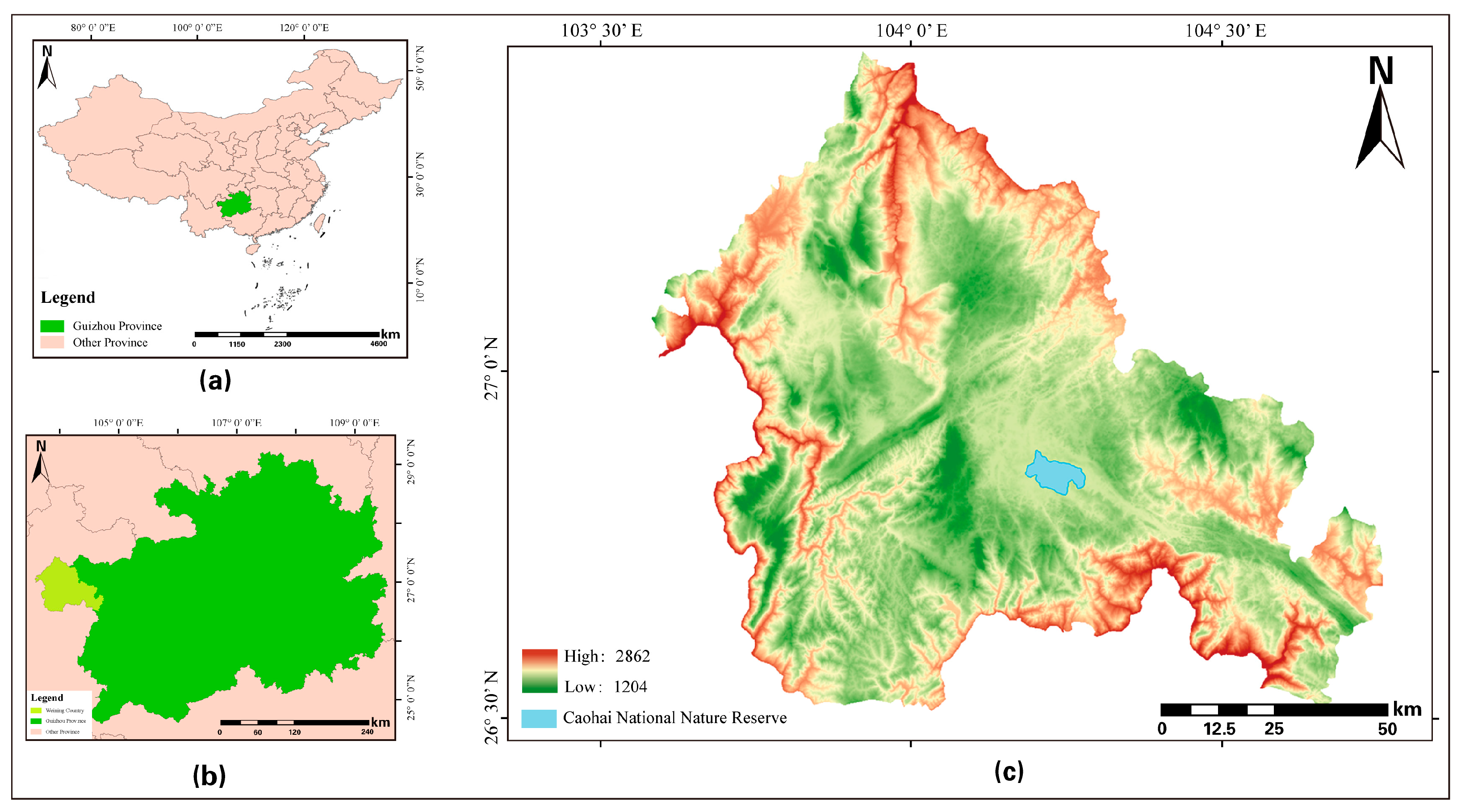
Caohai National Nature Reserve is located in Weining County, Guizhou Province (Figure 1, 26°47′32″ N–26°52′52″ N, 104°10′16″ E–104°20′40″ E). with a total area of 9600 hectares and an average elevation of 2200 m [33]. It is Guizhou’s largest natural karst dissolution lake, a typical wetland ecosystem, and the third-largest freshwater lake on China’s plateau [34]. It exhibits a subtropical plateau monsoon climate characterized by low latitude, high altitude, and plateau topography, supporting rich biological resources. Early human disturbances damaged the wetland ecosystem, but subsequent ecological restoration efforts have partially rejuvenated the area. Beyond open water bodies, pollution from artificially elevated water levels and long-term nutrient inputs has led to water bodies covered by aquatic vegetation.
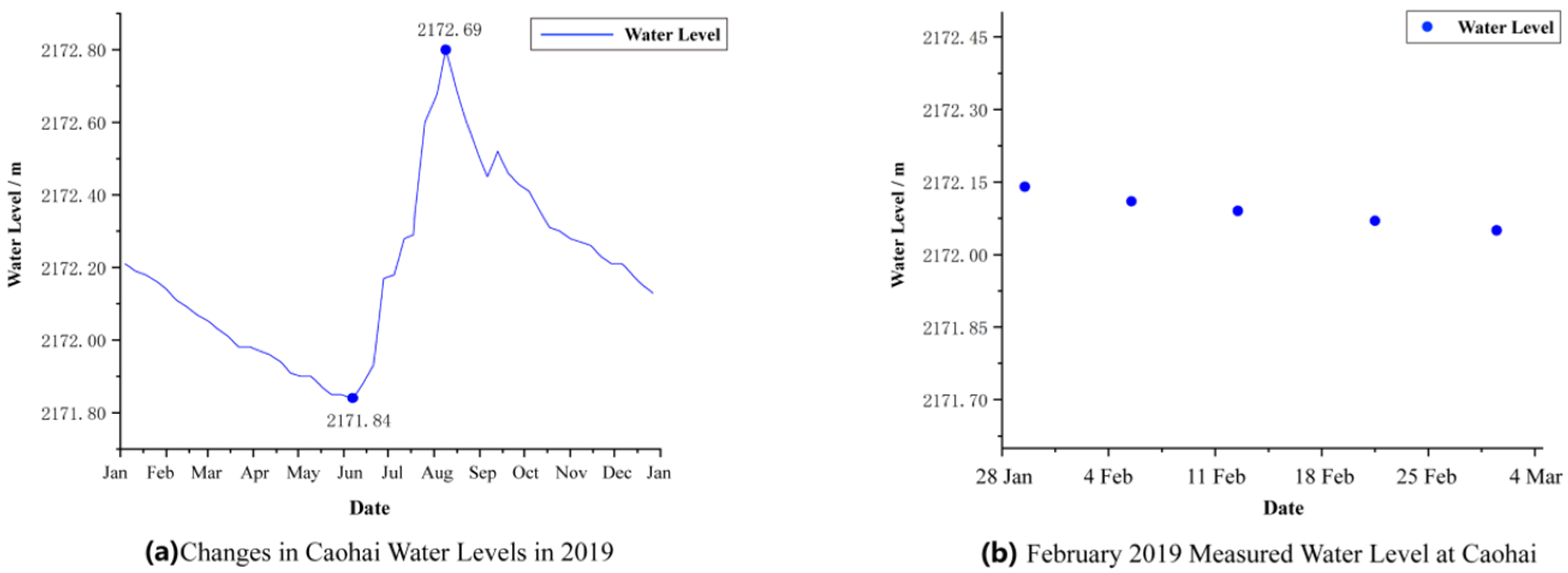
The annual average temperature is approximately 10.5 °C (50.9 °F), with an average annual precipitation of 950.9 mm (37.4 inches) and relative humidity around 80%. The region is characterized by abundant year-round sunshine, a mild climate, and distinct wet and dry seasons. Water level fluctuations represent a key geomorphological feature within the Caohai Wetland. The wet season spans May to October, while the dry season extends from November to April. During the dry season, daily water level variations are relatively low, which are more pronounced during the wet season [35]. The water level monitoring data we collected weekly for January and April of 2019 and 2020 showed that the water level varied with different years and periods around 2172 m. We found that water levels at the wet season (January) were higher than that at dry season (April) with a range of 0.05 m to 0.11 m.

2.2. Satellite Data Acquisition and Preprocessing

This study utilized optical and SAR data captured during the same time period. As shown in Table 1, the optical imagery consists of Zhuhai-1/Hyperspectral Image (HIS) data acquired on 6 February 2019; the SAR imagery comprises Radarsat-2/Single Look Complex (SLC) data collected on 13 February 2019.
Zhuhai-1/Hyperspectral Image (HIS) Data: The Zhuhai-1 satellite constellation is a commercial remote sensing microsatellite constellation launched and operated by the Zhuhai Orbita Aerospace Technology Co., Ltd., Zhuhai, China, which is China’s first satellite constellation built and operated by a privately owned company. Comprising 34 satellites, it includes video satellites, hyperspectral satellites, radar satellites, high-resolution optical satellites, and infrared satellites. Once fully deployed, the constellation simultaneously delivers high spatial resolution (0.44 m optical satellites, 0.9 m video satellites, 10 m hyperspectral satellites), high signal-to-noise ratio hyperspectral resolution (32 bands, 300 dB S/N ratio, wavelength range 400–1000 nm hyperspectral satellites), high temporal resolution (over 10 daily revisits) data with all-weather capability (SAR and infrared satellites) and wide-area observation (22.5 × 2500 km2 for video satellites, 150 × 2500 km2 for hyperspectral satellites). Four bands with a 10 m spatial resolution (B3, B8, B13 and B25) were selected for this study.
The data processing steps for hyperspectral images include downloading Level-1 data from Zhuhai Orbita Aerospace Technology Co., Ltd., followed by preprocessing of radiation correction, atmospheric correction, and geometric correction using SNAP 9.0.0 to ensure precise image alignment, resampling to a 10 m resolution and mosaicking to cover the study area, combining with the sampling data of field survey. SVM, RF, ROOC, PC and MDC were utilized as machine learning methods to construct inversion models using augmented samples the ground-collected to identify the most suitable interpolation method, sample size, and model, subsequently generating spatial distribution maps. The process flow is discussed in Section 3.1. These en.ables the Zhuhai-1 satellite to continuously image objects with both high spatial and hyperspectral resolution, effectively capturing and identifying wavelengths reflected by different materials, achieving precise extraction of object information while maintaining a degree of spectral penetration.
RadarSat-2/Single Look Complex (SLC) Data: RadarSat-2 is a high-resolution commercial radar satellite developed through a partnership between the Canadian Space Agency and the MDA Corporation, equipped with a C-band sensor. It can collect data regardless of extreme conditions such as adverse weather, cloud cover, and darkness. This capability allows SAR imagery to yield superior data compared to optical imagery even under the coverage of cloud or fog. SAR is highly sensitive to surface roughness and water bodies, allowing radar imagery to readily distinguish between aquatic and terrestrial features. Additionally, RadarSat-2’s polarization capability enhances soil moisture measurement, snow cover monitoring, and analysis, thereby boosting SAR’s potential for wetland mapping and identification.
For image processing, SNAP 9.0.0 (SeNtinel Applications Platform) was used for multi-view processing. An improved Lee filter is applied to reduce redundant noise in the SAR images. The images are then georeferenced and geometrically corrected using 30 m resolution Digital Elevation Model (DEM) data. Finally, the backscatter coefficient map is obtained.

2.3. Ground-Based Observation Data

2.3.1. Water Level Change Data

Five supervised classification methods were applied to extract water bodies using optical imagery within the wetland area, with results evaluated against SAR data. To understand the water level fluctuations during the time periods captured by the two images in Table 1, we obtained the full-year water level monitoring data for Caohai Lake in 2019 from the Guizhou Caohai Management Committee (Figure 2a). The annual water level variation chart indicates that February falls within Caohai Lake’s dry season, during which water level changes occur relatively slowly. And the water levels at the wet season (January) were higher than that at dry season (April) with a range from 0.05 m to 0.11 m.
Nevertheless, the actual water level measurements for February (Figure 2b) indicate a water level of 2172.11 m on 6 February 2019 and 2172.09 m on 13 February 2019. The difference of 0.02 m between these two dates facilitated a valid comparison between optical and SAR data. The actual water depth measurements demonstrated that the averaged depth is about 2.0 m.

2.3.2. Fixed-Point Observation Data

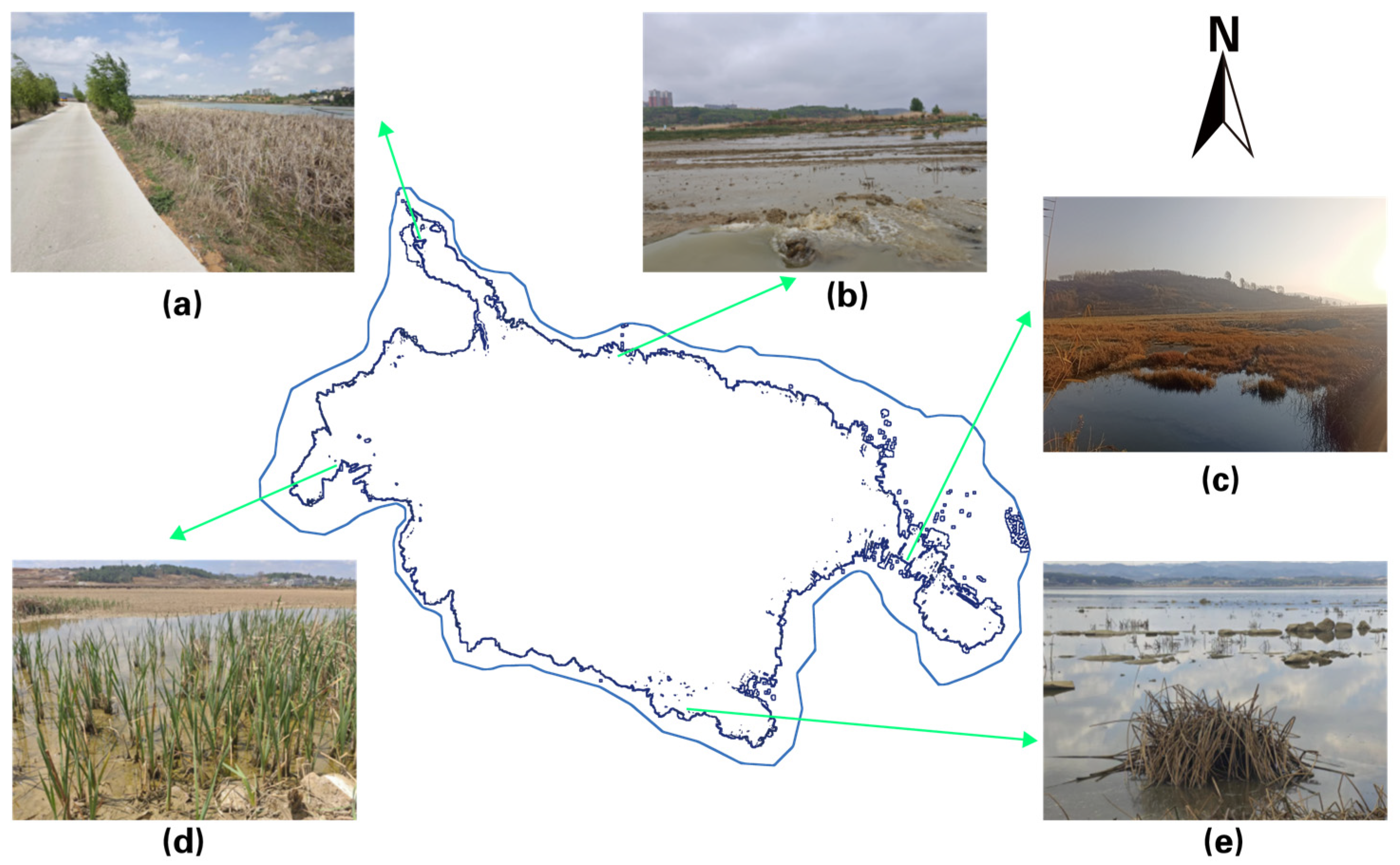
To validate the accuracy of random sampling points and provide a reliable basis for differential analysis, we conducted fixed-point observations at the water–land interface of Guizhou Caohai Wetland during the same period. The primary focus was to observe actual water coverage across different orientations, with a total of 41 observation points. Observations revealed that during this period that a road traversed the central water area on the northwest side (Figure 3a), flanked by distinct vegetation, with portions of the water body covered by vegetation. The north side (Figure 3b) featured small patches of partially submerged vegetation distributed in a strip-like pattern along the water–land interface. The eastern side (Figure 3c) exhibited complex terrain, with interlacing waterways of varying sizes, farmland, and vegetation communities. The western side (Figure 3d) primarily consisted of open shoals with a distinct land–water boundary, featuring extensive areas of partially submerged vegetation. The southern side (Figure 3e) contained water bodies with prominently exposed rocks and distributed aquatic vegetation.

3. Methods

3.1. Technical Process

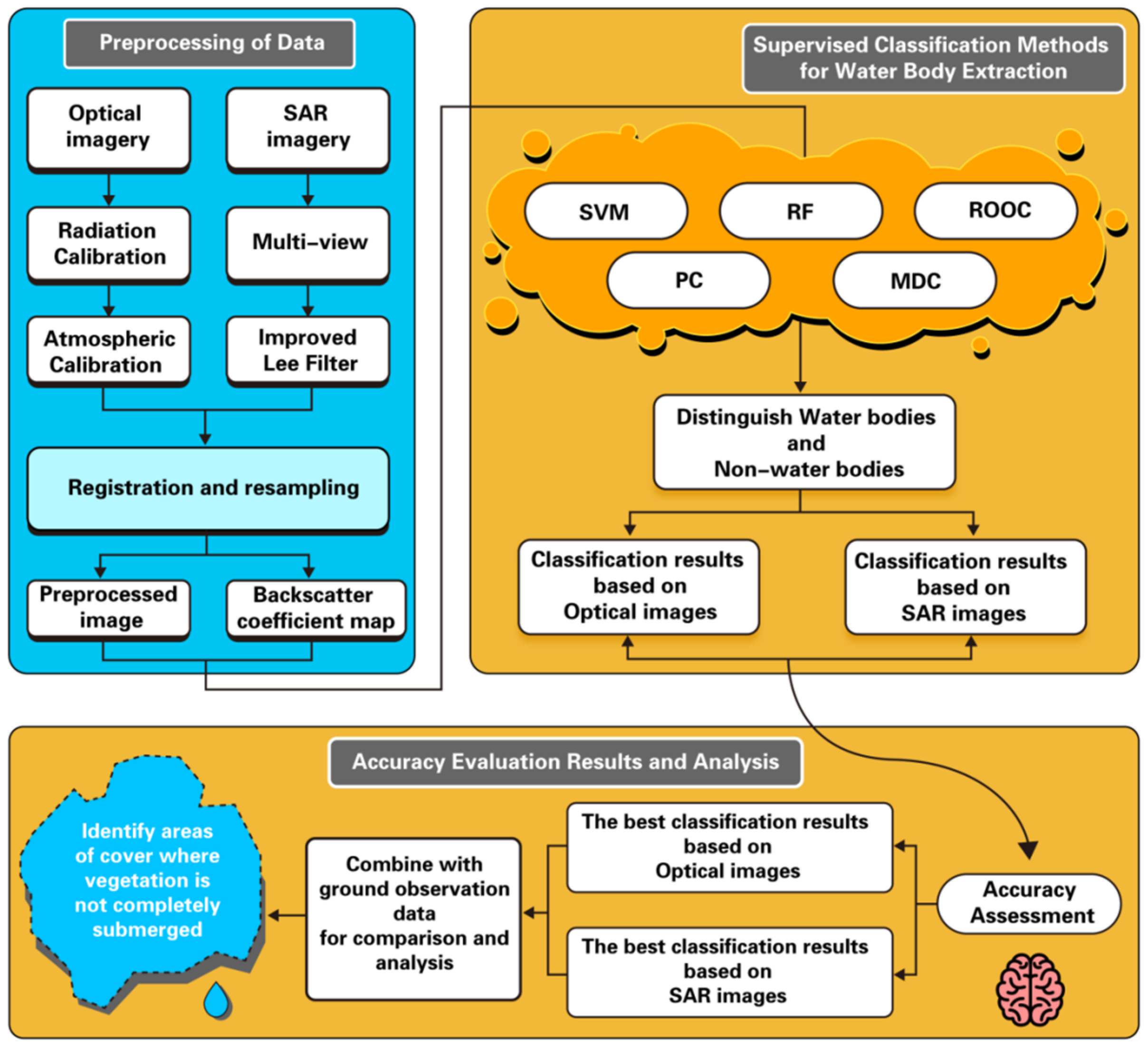
Wetland water bodies were extracted from both optical and SAR imagery captured during the same time period (Figure 4). The acquired images underwent preprocessing to generate optical images and backscatter coefficient maps for classification. Subsequently, five supervised classification methods were employed to extract water bodies within the study area. Accuracy evaluation was conducted based on different image types, yielding optimal water body extraction results from both optical and SAR data. Finally, ground observation data were integrated to compare the two optimal classification results, identifying areas with partially submerged vegetation cover during this period.

3.2. Machine Learning Method for Classification

Supervised Classification methods learn patterns or rules from labeled training datasets, thereby enabling classification of unseen data. Supervised Classification methods included Support Vector Machine (SVM), Random Forest (RF), Rule-based Object-Oriented Classification (ROOC), Parallelepiped Classification (PC) and Minimum Distance Classification (MDC). Compared to manual extraction, the automated extraction performed by supervised classifiers is more efficient and achieves desirable classification results even with limited training data.

3.2.1. Support Vector Machine (SVM) Classification

SVM is a nonparametric classification method based on statistical learning. Its core principle involves finding an optimal hyperplane in feature space to separate different categories. The decision function of this hyperplane can be expressed as
f ( x ) = w T x + b
Here, x is the input feature vector, w is the weight vector, and b is the bias term. The training process of SVM is achieved by minimizing the margin of the weight vector, with the optimization objective being
m i n w , b 1 2 w 2
and satisfies the constraint y i w t x i + b 1   where y i denotes the true class label of sample x i [36].
SVM demonstrate excellent applicability in water body extraction, particularly excelling at handling high-dimensional features and nonlinear classification problems. They exhibit strong robustness and generalization capabilities, maintaining high classification performance even with limited sample sizes.

3.2.2. Random Forest Classification

Random Forest (RF) is a supervised classification algorithm based on ensemble learning. It utilizes the distance and spatial relationships between pixels and training samples for feature recognition. Its ensemble model can be expressed as
f ( x ) = 1 N i = 1 N f i ( x )
f ( x ) represents the prediction result of a decision tree, and N denotes the total number of decision trees. The model constructs multiple trees by randomly selecting samples and features to enhance diversity and reduce the risk of overfitting [37].
This method offers advantages such as high classification accuracy, strong noise resistance, and ease of parameter tuning. However, it incurs high computational costs, is sensitive to imbalanced data, and exhibits limited model interpretability.

3.2.3. Rule-Based Object-Oriented Classification

Rule-based Object-Oriented Classification (ROOC) first segments remote sensing images into homogeneous objects, then makes classification decisions based on rules defined by expert knowledge (involving spectral, textural, shape, and other features). This method achieves high-precision, highly interpretable feature extraction through “if…then…” logic (e.g., “if texture is X and shape is Y, classify as water body”), but the rules themselves require manual optimization for specific scenarios [38].
There are three main steps for processing water body extraction using ROOC. Firstly, image segmentation is used to differentiate water and non-water areas. For optical imagery using the data of Zhuhai-1, a spectral weight of 0.75 and a shape weight of 0.25 are applied, with a segmentation scale of 10–20, ensuring accurate segmentation based on spectral information. For SAR imagery, a shape weight of 0.4 is used to reduce noise, and compactness is set to 0.5 to handle noise effectively. Secondly, feature selection is performed. In optical imagery, A NDWI threshold > 0.3 was used for water bodies are identified using, combined with textural uniformity > 0.9 and contrast < 0.15 to exclude non-water areas. For SAR imagery, water bodies are indicated by back scatter coefficients lower than −13 dB, with an aspect ratio < 3 used to exclude non-water regions. The shape parameters are selected as compactness > 0.65 and an aspect range < 3 further refine water body identification. Finally, rule-based classification applied for optical imagery, regions with NDWI > 0.3 and textural uniformity > 0.9 are classified as water, and other areas can be classified as non-water. For SAR imagery, regions with back scatter coefficients < −13 dB and an aspect ratio < 3 are classified as water, while all other regions are classified as non-water.

3.2.4. Parallelepiped Classification

The Parallelepiped Classification (PC) method achieves efficient pixel classification by defining decision boundaries in the feature space. Its core lies in setting feature thresholds for each band within the “water body” category. For a pixel x = ( x 1 ,   x 2 , , x n ) to be classified, where xi represents its value in the i-th band (or feature), the discriminant function is
C ( x ) = W a t e r         i f   a n d   o n l y   i f     L B i x i U B i
where L B i and U B i   represent the lower and upper bounds of the “water body” category, respectively, statistically derived from training samples in the ith feature dimension. If a pixel’s values across all feature dimensions fall within this threshold range, it is classified as water; otherwise, it is classified as non-water.

3.2.5. Minimum Distance Classification

The Minimum Distance Classification (MDC) method makes classification decisions by calculating the Euclidean distance between the sample point x to be classified and the class center μc. The distance formula is
d ( x , μ c ) = i = 1 n ( x i μ c i ) 2
This method achieves classification by identifying the minimum distance, offering the advantages of simplicity and efficiency. However, its performance is constrained by data distribution and simplistic spatial assumptions [39].

3.3. Accuracy Evaluation Based on Sample Points

We selected 10 m resolution of Optical imagery and RadarSat-2 imagery as the reference data. For distinct land–water boundaries within the study area, 600 sample points were randomly generated (250 samples points labeled as water and 350 sample points labeled as non-water). These points were classified into true values for water and non-water bodies, incorporating ground observation data. Subsequently, confusion matrices were generated by integrating the sample points with classification results generated from various supervised classification methods to evaluate model performance and accuracy [40].
To evaluate the classification performance of different supervised classification methods, corresponding evaluation metrics including producer accuracy (PA, refers to the ratio of correctly classified samples to the total number of true samples in that category, indicating how many true samples were correctly classified by the model, Equation (5)) [41,42,43], user accuracy (UA, the ratio of correctly classified samples to the total number of samples predicted to belong to a category, indicating how many predicted samples truly belong to that category, Equation (6)) [44], overall accuracy (OA, the ratio of correctly classified samples to the total number of samples, Equation (7)) [45], and the Kappa coefficient (Kappa, measures the consistency between a model’s classification results and random guessing, Equation (8)) [46] were selected to assess the accuracy of classification results.
P A = T P T P + F N
U A = T P T P + F P
O A = T P T P + T N + F N + F P
K a p p a = P 0 P c 1 P c
TP is the number of correctly detected positive examples, TN is the number of negative examples correctly classified as negative, FP is the number of negative examples incorrectly classified as positive, FN is the number of positive examples incorrectly classified as negative, P0 is the observed concordance probability, and Pc is the expected concordance probability.

4. Results and Analysis

4.1. Classification Results and Analysis

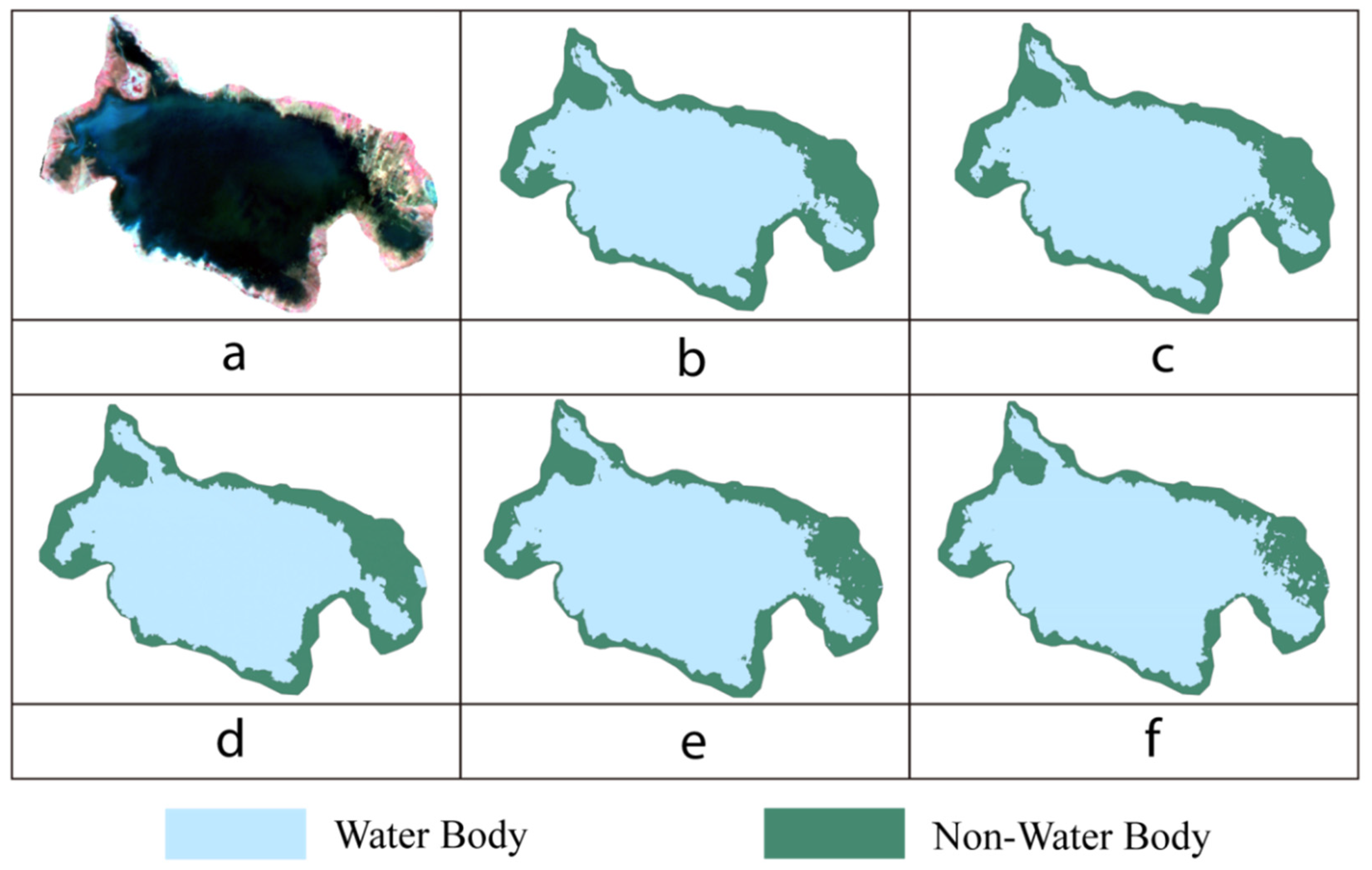
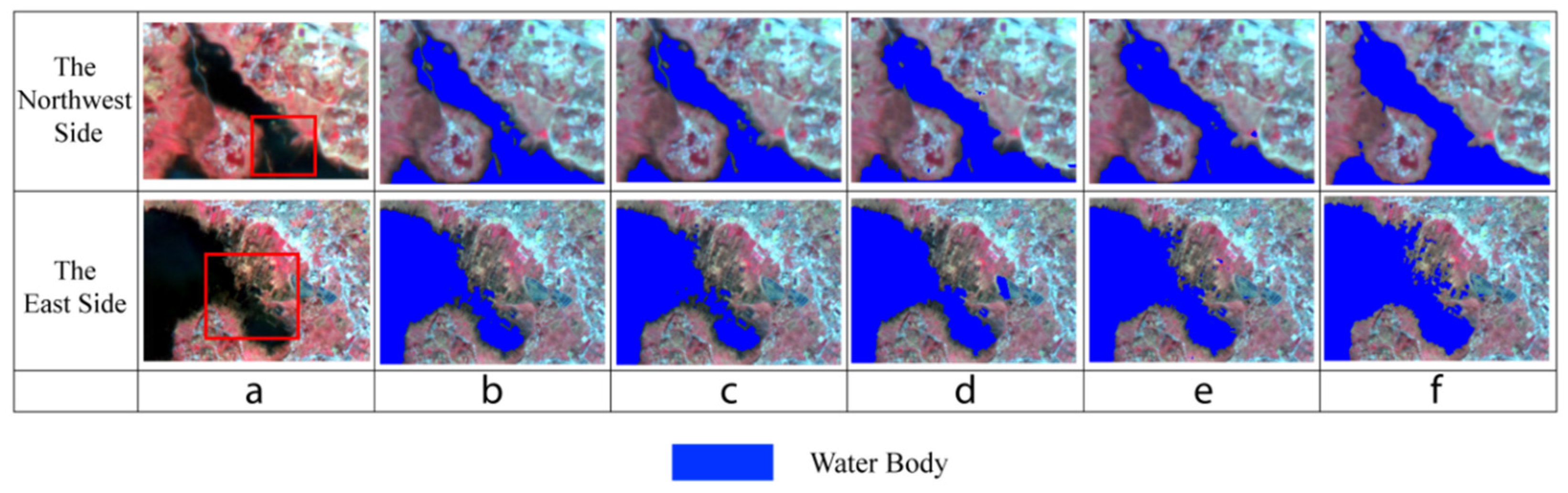
Five water body extraction results based on optical imagery (Figure 5), each supervised classification method clearly delineates the boundary between grassland water bodies and land, though their performance varies. Overall, SVM classification (Figure 5b) and Random Forest classification (Figure 5c) performed the best, followed by Rule-based Object-Oriented Classification (Figure 5d), Parallelepiped Classification (Figure 5e), and Minimum Distance Classification (Figure 5f). Differences in extraction results primarily manifest in the following aspects (Figure 6): Firstly, in the northwest part of the wetland, SVM and RF successfully distinguished water bodies from non-water features like roads and vegetation, accurately delineating the water body’s contour. In contrast, the other three methods misclassified portions of land covered by roads and vegetation as water bodies. Secondly, on the eastern side of the wetland, numerous small watercourses intertwined with vegetation and farmland led to significant differences in water body extraction among methods. SVM classification and Random Forest Classification extracted relatively clear water bodies. Rule-based Object-Oriented Classification, Parallelepiped Classification, and Minimum Distance Classification exhibited severe misclassifications, categorizing small areas of vegetation and farmland as water bodies, resulting in substantial misclassification of non-water features. Thirdly, in the southwest wetland area, atmospheric interference altered the illumination intensity and spectral characteristics along water edges in optical images, resulting in suboptimal extraction outcomes for all five methods. Therefore, comparatively, SVM and Random Forest Classifications demonstrated superior performance in water extraction from optical images, clearly delineating land–water boundaries. However, they remain susceptible to interference from factors such as weather conditions, leading to spectral information loss at given water boundaries.
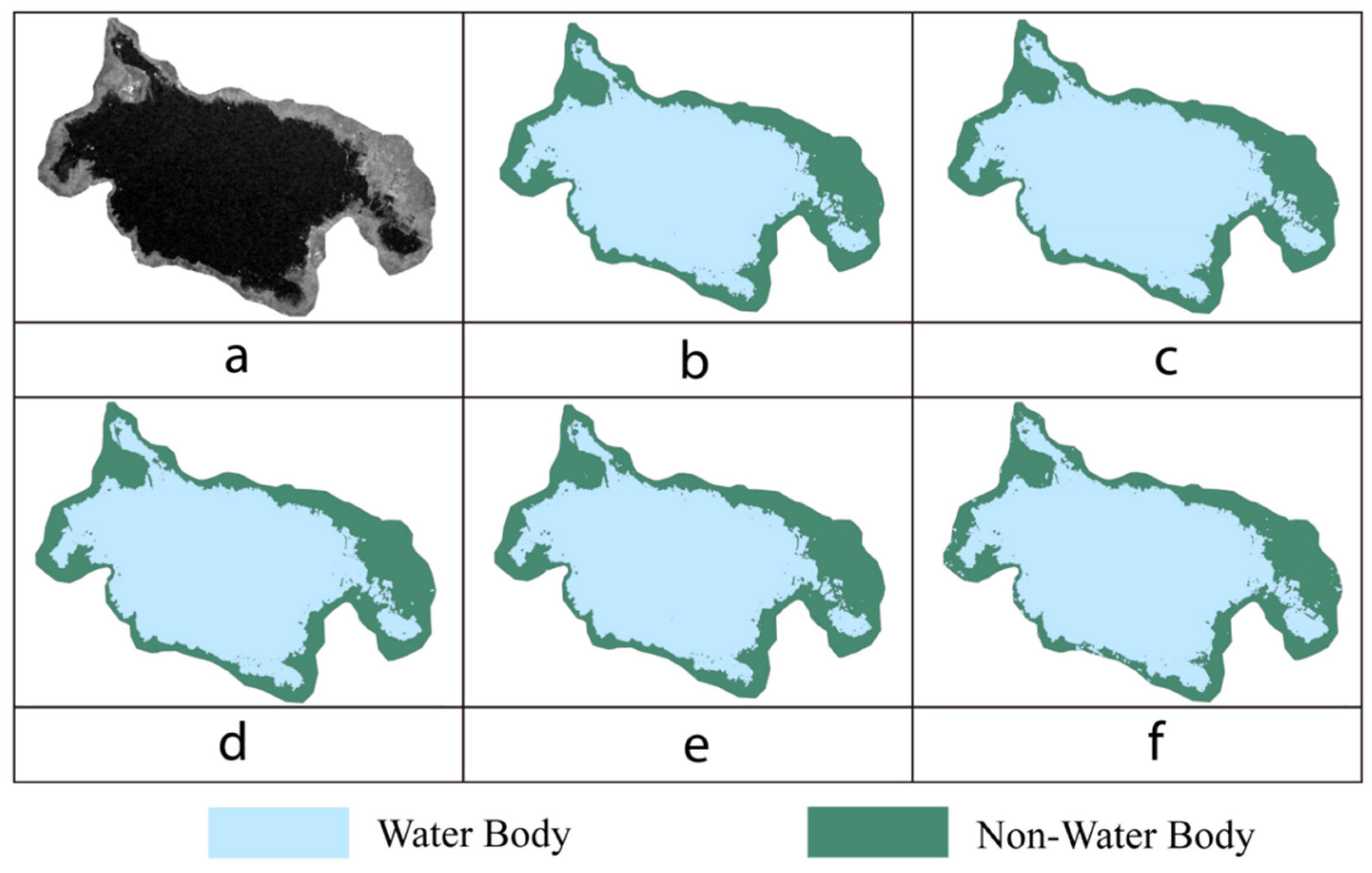
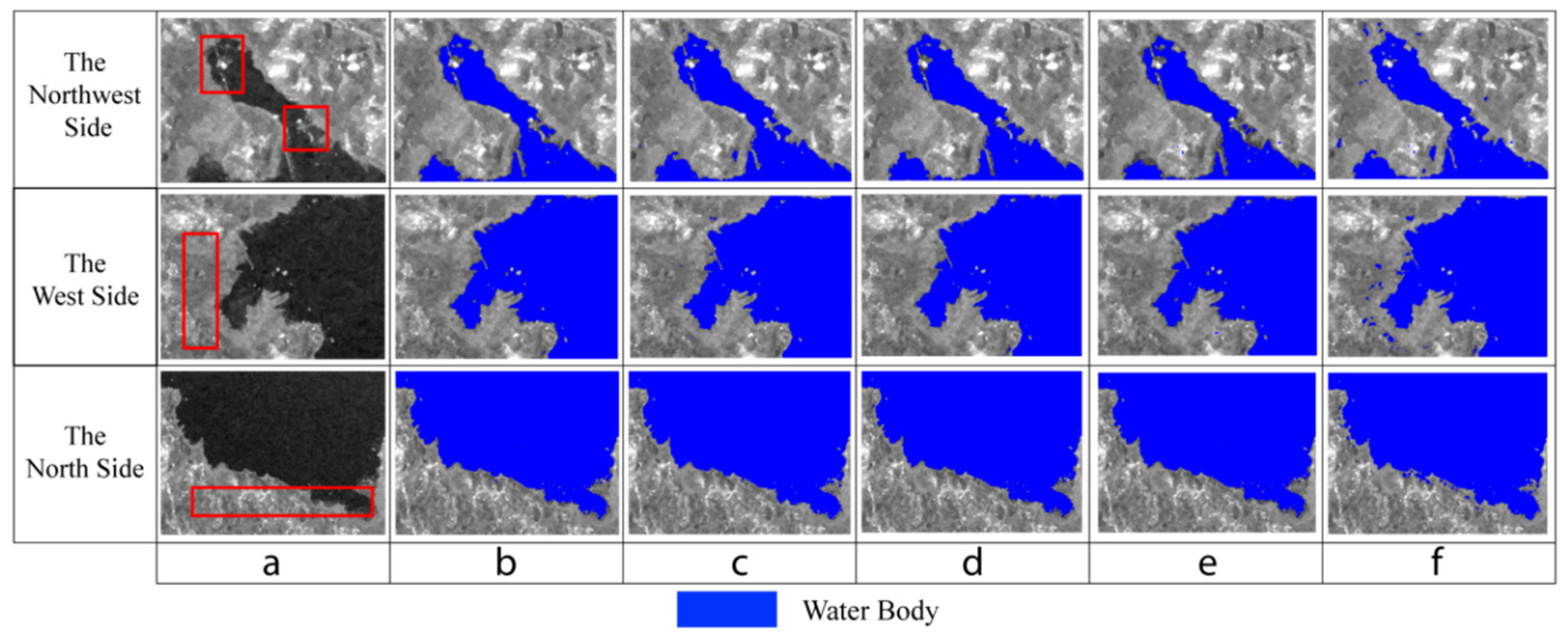
In the supervised classification results based on SAR imagery (Figure 7), all five supervised classification methods—SVM (Figure 7), Random Forest Classification (Figure 7c), Rule-based Object-Oriented (Figure 7d), Parallelepiped Classification (Figure 7e), and Minimum Distance Classification (Figure 7f)—successfully identified all water bodies under vegetation cover. However, subtle differences persisted, which are primarily manifested in the following aspects (Figure 8). Firstly, in the northwest section (analyzed using backscatter coefficient maps due to incomplete road coverage), SVM and Random Forest classifications performed the best, successfully distinguishing water bodies from roads, vegetation, and other non-water features. The remaining three methods misclassified portions of vegetation as water bodies due to noise factors, with the Minimum Distance Classification exhibiting the most severe misclassification. Secondly, during water bodies extraction on the wetland’s western and southern sides, while all five methods separated small features like rocks from water bodies, the Minimum Distance Classification exhibited the most severe misclassification compared to the other four methods, resulting in extensive land areas being incorrectly classified as water. Collective, the five SAR-based water body extraction methods demonstrate comparable performance in separating smaller features like rocks from water bodies. Whereas, compared to the other four methods, the Minimum Distance Classification exhibited severe misclassifications, incorrectly identifying substantial land areas as water bodies.
In summary, during water body extraction based on optical and SAR imagery, SVM and Random Forest classification demonstrate superior performances in distinguishing water bodies from non-water areas, achieving high accuracy in a complex scenario. In contrast, Rule-based Object-Oriented and Parallelepiped Classifications yield inferior results. Minimum Distance Classification performs poorly in both image types, exhibiting significant misclassifications, particularly in incorrectly labeling large areas of non-water features such as roads and vegetation as water bodies.

4.2. Accuracy Evaluation Results and Analysis

4.2.1. Optical-Based Accuracy Assessment

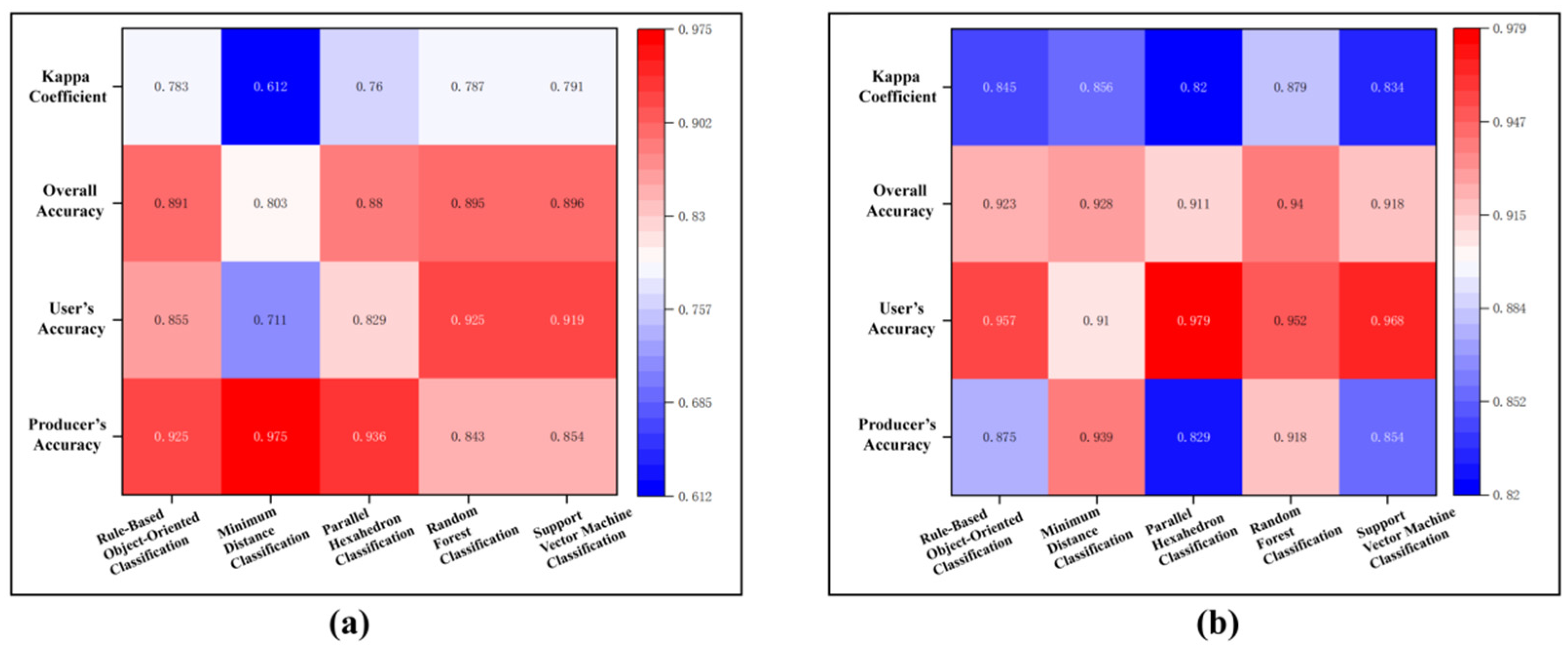
The results of optical-based water body extraction accuracy assessment (Figure 9a) indicate that the overall accuracy of the five supervised classification methods ranges between 0.8 and 0.9, with Kappa coefficients between 0.6 and 0.8, demonstrating that these methods perform well in distinguishing water bodies from non-water bodies. However, compared to SVM classification, other classification methods exhibit different trends in the following aspects.
As shown in Figure 9, in terms of producer accuracy, compared to the SVM classification, Rule-based Object-Oriented, Minimum Distance, and Parallelpiped Hexahedron Classifications showed improved accuracies by 7.1%, 12.1%, and 8.2%, respectively, while Random Forest Classification showed a reduced accuracy by 1.1%, exhibiting a higher misclassification rate when identifying water bodies. On the eastern side of the grassy sea area, both the SVM and random forest classifications identified smaller water body areas, leading to significant variations in producer accuracy.
As for the regarding user accuracy, the top three classification methods showed reduced accuracies of 6.4%, 20.8%, and 9%, respectively, compared to the SVM classification, due to higher misclassification rates in water extraction by these methods, particularly the Minimum Distance Classification, which tends to incorrectly classify non-water features like roads and vegetation as water bodies. Regarding overall accuracy and Kappa coefficient, the SVM classification method significantly outperformed the other four methods, demonstrating its high accuracy.

4.2.2. SAR-Based Accuracy Assessment

As shown in Figure 9, the overall accuracy of all five supervised classification methods exceeded 0.9, with Kappa coefficients above 0.8, indicating that these methods demonstrate high separation capability in distinguishing water bodies from non-water bodies. Compared to the Random forest classification, the other classification methods exhibit slight differences in the following aspects.
Regarding producer accuracy, the Minimum Distance Classification method showed an improvement by 2.1%, while the other three classification methods showed reductions by 4.3%, 8.9%, and 6.4%, respectively. In the northwest part of Caohai Wetland, the water body area extracted by the random forest classification along both sides of the road is larger than that of the other classification methods but slightly smaller than that of the SVM classification.
In terms of user accuracy, Random Forest classification exhibits a slightly higher misclassification rate than the other three methods (by 0.5%, 2.7%, and 1.6%, respectively), though it remains lower than the Minimum Distance Classification (by 4.2%). On the western side of the wetland, the Minimum Distance Classification misclassified extensive terrestrial areas as water bodies, resulting in a high misclassification rate. In terms of overall accuracy and Kappa coefficient, the Random forest classification outperformed the other four methods, demonstrating the best performance, exhibiting high accuracy and efficiency.

4.2.3. Comparison and Analysis

A comparison of the classification results of the SAR data against the those of the optical data revealed that the producer accuracy of Rule-based Object-Oriented Classification, Parallelepiped Classification, and Minimum Distance Classification decreased by 5%, 3.6%, and 10.7%, respectively. Random Forest Classification showed improved producer accuracy by 7.5%, while the SVM classification remain largely unchanged accuracy. Regarding user precision, with the SAR data, five classification methods showed improved precision by 10.2%, 15%, 19.9%, 2.6%, and 4.8%, respectively, indicating universal lower misclassification rates in water body extraction with SAR data. In terms of overall accuracy, compared to the optical data, all five methods showed improved accuracy by 3.2%, 3.2%, 12.5%, 4.5%, and 2.2%, respectively. A similar phenomenon was observed for the Kappa coefficient, improvements by 6.2%, 6%, 24.4%, 9.2%, and 4.3%, respectively with the SAR date comparing to the optical data. SAR-based extraction generally achieves higher accuracy than optical classification for this wetland water body.
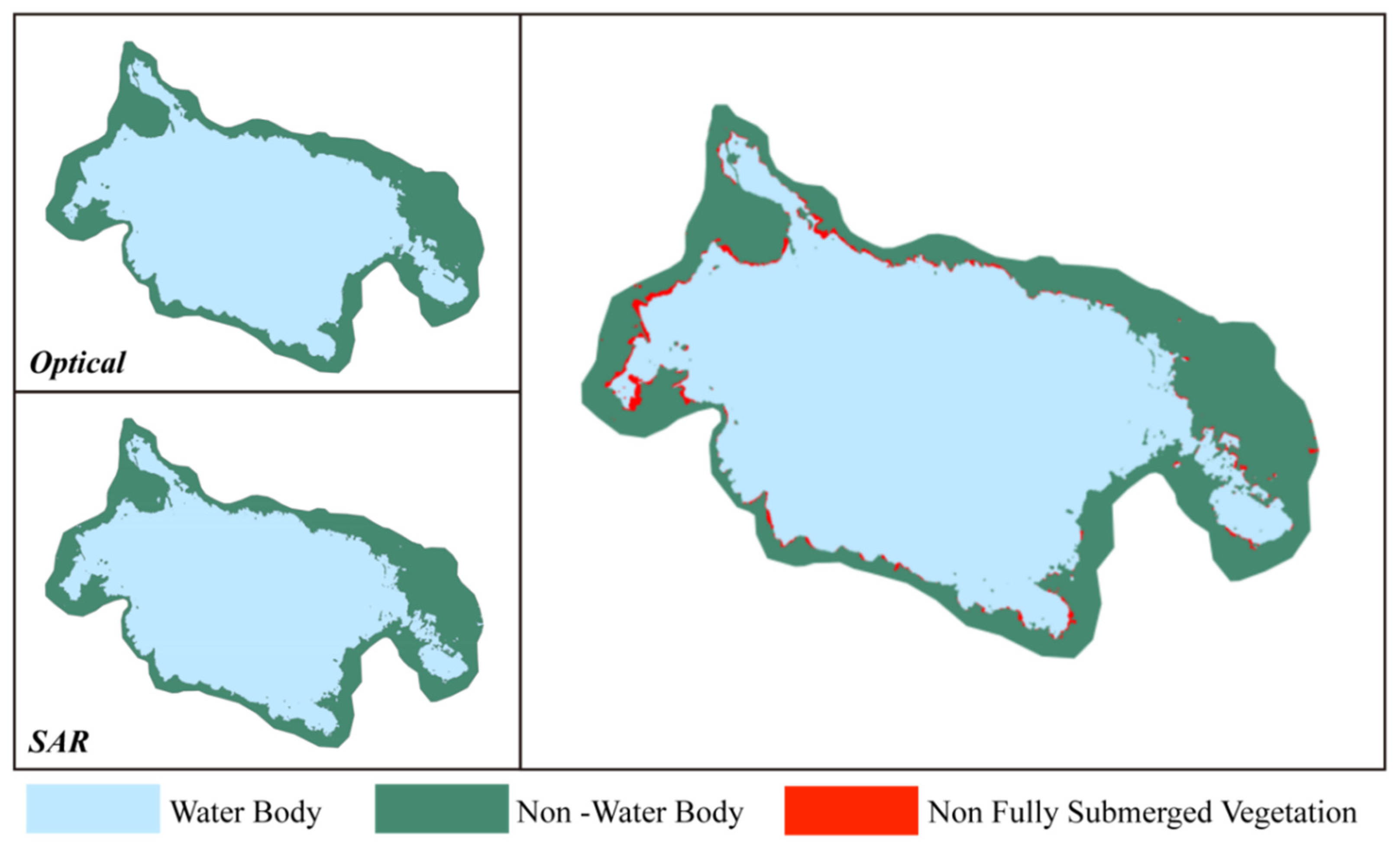
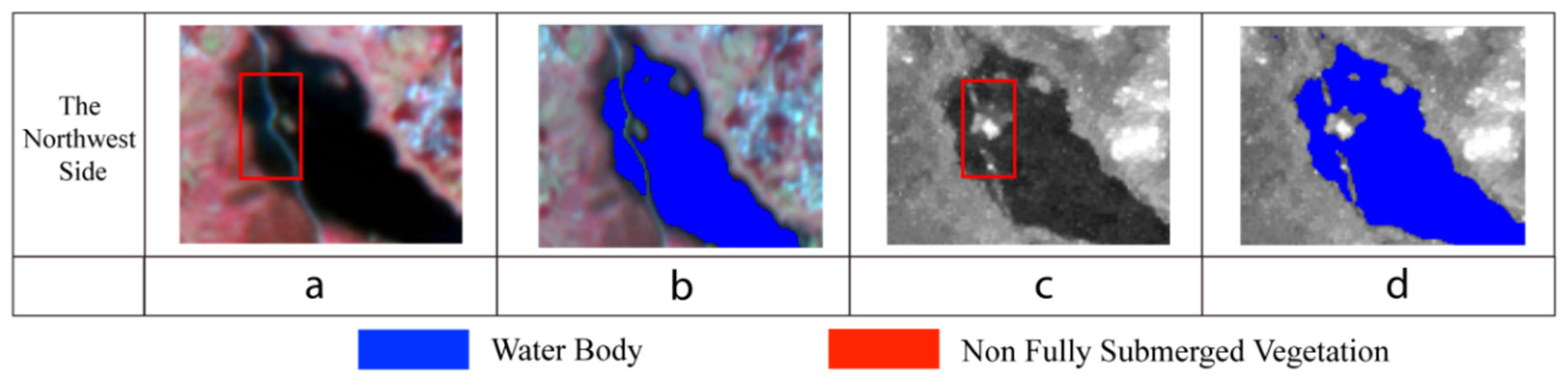
Overall, when using either optical or SAR imagery alone to extract wetland water bodies, SAR-based extraction yields significantly superior results compared to optical one (Figure 10). However, when comparing the two optimal classification sets—SVM classification based on optical imagery and Random Forest Classification based on SAR imagery—against the ground survey data, it was found that while optical imagery cannot extract water bodies beneath vegetation cover, it clearly delineates the boundaries between water and land surfaces. In contrast to optical imagery, SAR can directly penetrate vegetation to extract the beneath water bodies. However, radar pass directly through shallow water bodies to reach land, resulting in incomplete extraction of some low-water-level areas at the water–land interface. Therefore, relying solely on either optical or SAR imagery fails to comprehensively extract water bodies within wetlands.
To obtain a more accurate water distribution pattern, we used the optical extraction results with clear water–land boundaries as the base map and supplemented with SAR extraction results. By overlaying and integrating the vector maps of the two optimal water extraction results, combined with ground observation data, we obtained a more accurate water distribution map of Caohai Wetland during this period and identified areas where vegetation was not fully submerged. Calculations indicate that the actual water body area of Caohai Wetland during this period was 23.19 km2, while the area covered by vegetation not fully submerged was 0.17 km2.

5. Discussion

When extracting water bodies from optical images, spectral analysis-based methods require thresholding of water index images [22] to enhance the contrast between water bodies and land features. This process primarily relies on selecting an appropriate threshold to distinguish water from non-water areas with threshold settings which can vary from different cases. Additionally, several studies [47,48,49,50,51,52] have identified the following challenges in high-precision mapping of small water bodies using optical remote sensing due to complex environments. For instance, water index values for low-reflectance targets (shadows) and high-reflectance targets (clouds, building clusters, etc.) closely resemble those of water bodies, leading to numerous false positives that compromise the image’s ability to accurately provide water body data.
SAR imagery, utilizing synthetic aperture radar sensors based on energy reflection principles, enables acquisition under various weather conditions [53,54,55,56,57]. However, it struggles to distinguish between water bodies and water-like surfaces. It was noted that while SAR imaging thresholding methods perform well for flood and water body mapping, their effectiveness diminishes when images contain interference. Additionally, when water bodies constitute a small proportion of the image, the typical bimodal distribution may not be discernible. Therefore, selecting appropriate representative back scatter coefficient thresholds from the radiometric histogram is necessary to distinguish water from land pixels.

5.1. Vegetation Cover and Shallow Water Bodies

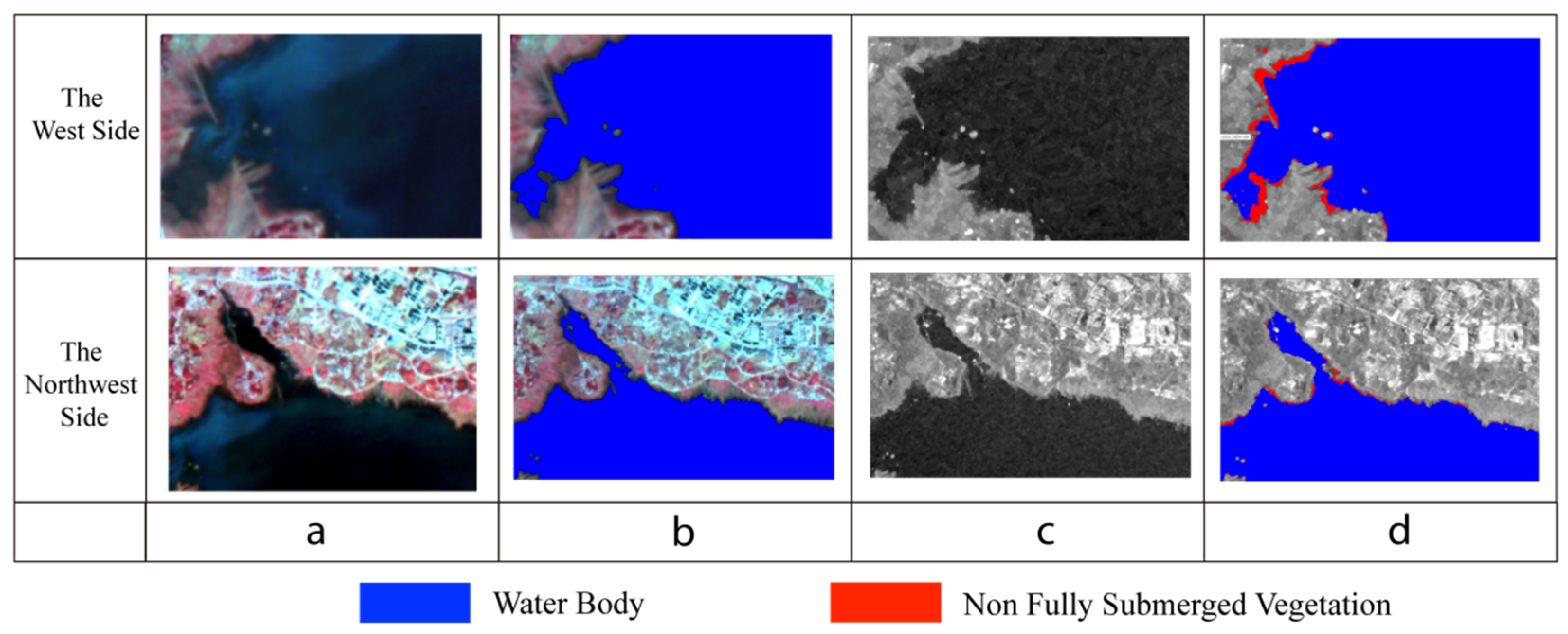
In addition to vegetation distributed around water bodies, significant amounts of partially submerged vegetation also exist at the water–land interface, which poses challenges to accurately identifying the complete water bodies within wetlands. Most areas on the west side and northwest sides of Caohai Wetland are covered by partially submerged vegetation (Figure 11). When extracting water bodies using optical imagery, the shorter wavelengths of optical images fail to penetrate vegetation, rendering them ineffective for identifying water bodies covered by vegetation. In contrast, SAR imagery possesses superior penetration capabilities compared to optical imagery, enabling effective extraction of water bodies beneath vegetation. Beyond vegetation coverage, certain flat terrain areas at the water–land interface are prone to forming shallow shoals with low water levels. During water body extraction, SAR’s excessive penetration capability may cause some shoal water areas to be erroneously identified as non-water bodies. In contrast, water bodies typically appear as darker and smoother features in optical images, allowing clear differentiation from other landforms.

5.2. Atmospheric Disturbances and Radar Imagery

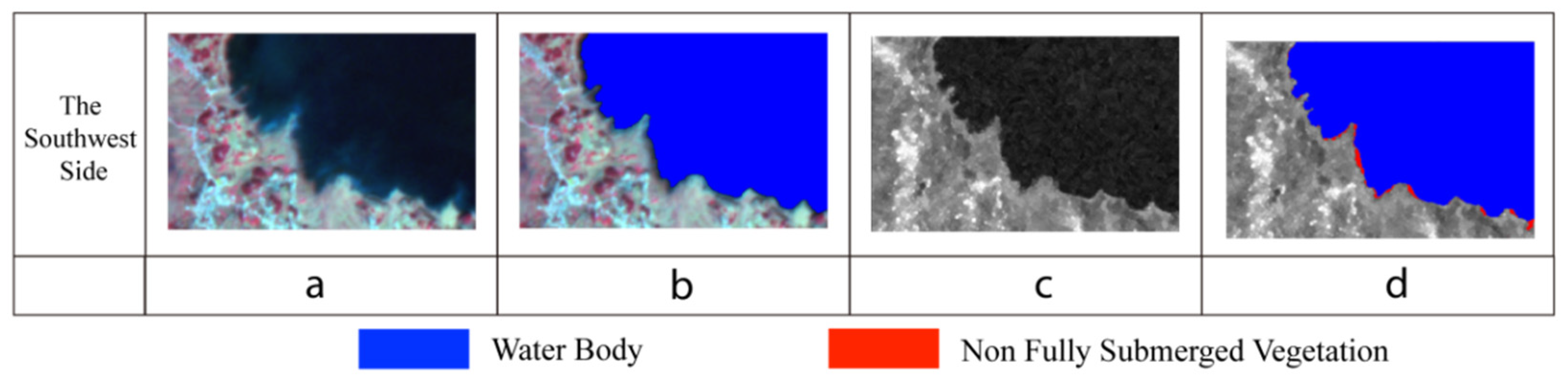
Optical imagery used in water body extraction can be affected by factors such as cloud cover and weather conditions. When extracting the water body on the southwest side of Caohai Wetland (Figure 12), atmospheric interference caused alterations in the color and texture features of the water body within the image. This resulted in low contrast between the water body and surrounding terrain features, with some water body boundaries appearing indistinct. In contrast, SAR demonstrates outstanding performance, accurately extracting water body boundaries even under cloudy conditions, unaffected by weather or cloud cover. However, during the side-looking SAR imaging process, significant elevation changes and terrain obstructions can affect radar imaging. As shown in Figure 13, a road crosses the central water area northwest of Caohai Lake. The road exhibits a noticeable elevation difference compared to the water bodies on either side and is surrounded by dense vegetation. During radar imaging, radar shadows can cause partial information loss or blurring in the image. Optical imagery, however, can reveal the true terrain features within radar shadowed areas.
Comparing water body extraction accuracy between optical and SAR imagery reveals that among optical-based extraction methods, SVM, Random Forest, and Rule-based Object-Oriented Classifications demonstrate slightly superior classification accuracy. In contrast, Parallelepiped Classification and Minimum Distance Classification exhibit poorer accuracy, erroneously classifying extensive rock formations and other non-water features in the eastern waters of Caohai Wetland as water bodies. Compared to optical imagery, water body extraction accuracy based on SAR images was generally higher, with only minor differences observed in the extraction results. Overall, SAR-based extraction demonstrated significantly superior accuracy compared to optical methods. Additionally, when using a single sensor for wetland water body extraction, all supervised classification methods showed slightly better performance with SAR images than with optical images. Both random forest and SVM classifications performed well with either image types.

5.3. Distinguishing Small Land Features and Water Bodies

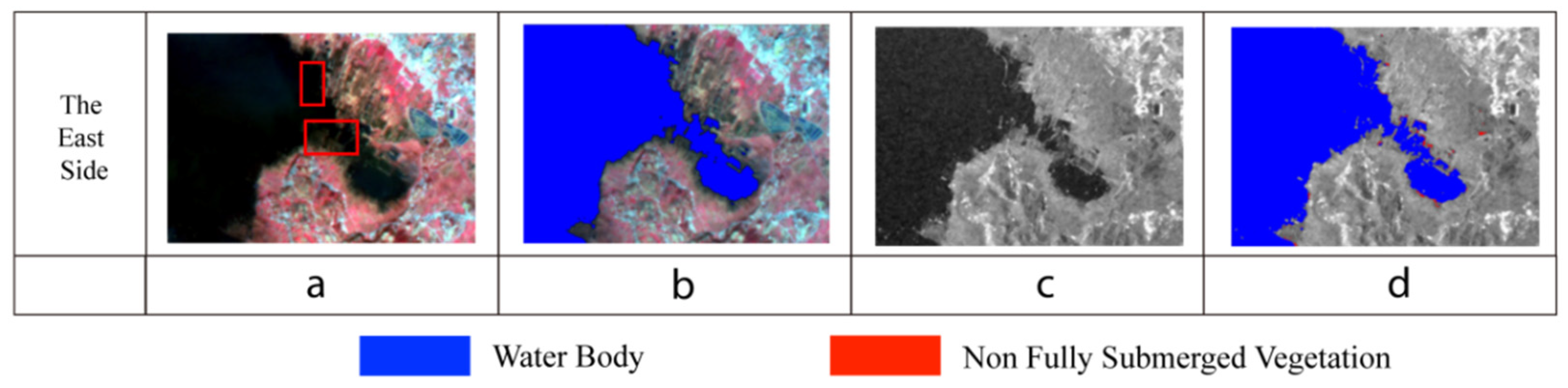
Typically, high-resolution optical imagery excels at capturing larger water features [58,59]. However, in environments where diverse landforms intersect with water bodies, the characteristics of smaller features become less distinctive, making it challenging for optical imagery to accurately delineate their boundaries and details [60,61,62]. On the east side of Caohai Wetland (Figure 14), during the dry season when small water bodies are sparse and the terrain is complex, rivers, exposed rocks, vegetation, and other landforms intermingle. During water body extraction, the overly complex terrain information in optical imagery made small features indistinct, leading to misclassification of minor objects like rocks as water bodies. In contrast, SAR imagery clearly distinguishes water bodies from other small features, enabling supervised classification methods to effortlessly separate water bodies from minor non-water features. Overall, compared to optical imagery, SAR imagery demonstrates superior performance in extracting water bodies within complex wetland areas.
This study employed an accuracy evaluation method based on sample points, using known-class sample points to construct confusion matrices for assessing the classification results’ accuracy. The validation sample points were derived from ground surveys conducted for the study period. After confirming the acquisition times of Zhuhai-1 and RadarSat-2 imagery, the ground survey was conducted with 600 random ground sample points being selected from the land–water boundary areas based on Landsat-8 imagery of the same month. And these points were verified through UAV aerial photography and field investigations to determine their land cover classes (water body or non-water body). Of these, 250 points were used for water body extraction, while the remaining 350 points were utilized for the first accuracy evaluation, assessing the performance of different classification methods in extracting water bodies.

5.4. Limitations of Supervised Classification Methods

The supervised classifier method has two major limitations. First, although it performs well in water body extraction, it remains challenging to identify small water bodies due to the limitations of classifier performance. This study was conducted during the dry season, when small water bodies occupy a minimal area, thereby mitigating the supervised classifier’s shortcomings in extracting such features. Second, the classification effectiveness of the method may be compromised by insufficient sample size. Therefore, to achieve optimal classification results with supervised classifiers, extensive ground surveys were conducted in advance at Caohai Wetland. These surveys were integrated with supervised classification to obtain the best classification outcomes by combing ground samples collected during the field survey (Figure 3) and the accuracy evaluation results (Figure 9). Results demonstrate that advanced supervised classification methods, such as Random Forest and Support Vector Machine classification, still exhibit high accuracy and stability in wetland water body extraction.

6. Conclusions

This study proposes an experimental approach for wetland water body extraction using optical and SAR imagery of identical resolution captured during the same period. The optical and SAR methods in wetland water body extraction were compared and investigated. Extraction method based on supervised classification were established. The conclusions are as follows:
Studies on wetland water body extraction using optical and SAR imagery exhibit the following features: (1) Water bodies beneath vegetation cover was ineffective extracted based on optical imagery, whereas SAR-base identification can fully extract such water bodies. (2) Due to excessive penetration capability, SAR-based identification failed to extract water bodies at low water levels in shoals, while optical imagery-based identification clearly displayed water–land boundaries. Optical imagery is susceptible to atmospheric and weather disturbances, causing alterations in land features along some water–land boundaries. SAR imagery is prone to radar shadow effects, leading to missing information for certain land cover categories post-imaging. (3) In complex wetland environments with multiple land cover types, SAR-based extraction outperforms optical methods in separating small features like rocks from water bodies. Comparing water extraction accuracy between the two image types reveals distinct advantages and disadvantages for each. However, when extracting wetland water bodies using a single sensor, SAR-based extraction yields significantly superior results compared to optical methods.
In summary, either Optical imagery or SAR imagery separately used for extract wetland water bodies showed their limitations. The supervised classification method demonstrates desirable performances in wetland water body extraction. SVM and Random Forest Classifications yield significantly superior results, followed by Rule-based Object-Oriented Classification and Parallelepiped Classification. The Minimum Distance Classification method showed the poorest performance. Therefore, the combination usage of Optical imagery and SAR imagery could couple machine learning methods to adequately overcome their shortcomings and can result in the compensation of their advantages, enabling accurate and reliable water bodies extraction of wetlands.

Author Contributions

Y.Z. (Yanwu Zhou): Data collection, Methodology, Validation, Writing—Original Draft. Y.Z. (Yu Zhang): Methodology, Validation, Writing—Original Draft. G.Z.: Conceptualization, Data collection, Methodology, Writing—Original Draft. C.S.: Conceptualization, Data collection, Methodology, Funding Acquisition. Y.T.: Conceptualization, Methodology, Validation, Writing—review and editing. J.Z.: Validation, Writing—Review and Editing. Y.G.: Writing—Review and Editing. J.H.: Data collection, Writing—Review and Editing. G.Q.: Conceptualization, Methodology, Validation, Writing—review and editing. All authors have read and agreed to the published version of the manuscript.

Funding

This research was funded by Guizhou Provincial Basic Research Program (Qiankehe Foundation-ZK [2023] 196) and Guizhou Provincial Key Laboratory of Remote Sensing Big Data Intelligent Processing and Application (Qiankehe Foundation-ZSYS [2025] 014). Moreover, sincere gratitude is extended to the editor and the anonymous reviewers who provide professional comments for this paper.

Data Availability Statement

The data presented in this study are available on request from the corresponding author.

Acknowledgments

All the authors sincerely appreciate the editor and the reviewers for their valuable suggestions on this study.

Conflicts of Interest

The authors declare that they have no competing interests.

References

  1. MacDougall, A.S.; McCann, K.S.; Gellner, G.; Rurkington, R. Dicersity loss with persistent human disturbance increases vulnerability to ecosystem collapse. Nature 2013, 494, 86–89. [Google Scholar] [CrossRef] [PubMed]
  2. Jiang, W.; Zhang, Z.; Ling, Z.; Deng, Y. Experience and future research trends of wetland protection and restoration in China. J. Geogr. Sci. 2024, 34, 229–251. [Google Scholar] [CrossRef]
  3. Wang, X.X.; Liu, Y.C.; Wang, J.; Wu, X.C. Monitoring environmental degradation and restoration of wetlands and arid lands using remote sensing and big geospatial Data. Land 2025, 14, 2430. [Google Scholar] [CrossRef]
  4. Zeng, L.; Xu, L.; Song, B.Y.; Wang, P.; Qiao, G.; Wang, T.Y.; Wang, H.; Jing, X.K. Multi-ecohydrological interactions between groundwater and vegetation of groundwater- dependent ecosystems in semi-arid regions: A case study in the Hailiutu river basin. Land 2026, 15, 60. [Google Scholar] [CrossRef]
  5. Qiu, J.; Zhang, Y.; Ma, J. Wetland habitats supporting waterbird diversity: Conservation perspective on biodiversity-ecosystem functioning relationship. J. Environ. Manag. 2024, 357, 120663. [Google Scholar] [CrossRef]
  6. Nath, A.J.; Sileshi, G.W.; Bania, J.K. Threats to inland wetlands and uncertainty around global soil carbon stocks and sequestration rates. Sci. Total Environ. 2024, 955, 177190. [Google Scholar] [CrossRef]
  7. Adawi, S.H.; Romdhane, M.S.; Hmida, L. Wetland ecosystems: Ecological functioning and value—A case study of the Wadi Qana protected area, Palestinian Authority. Wetlands 2025, 45, 92. [Google Scholar] [CrossRef]
  8. Mu, G.; Wen, X.; Zhang, Z. Characteristics and driving mechanism of wetland landscape pattern change in karst region of southwest China over past 35 years: A case study of Caohai wetland in Guizhou. Land Degrad. Dev. 2024, 35, 2813–2823. [Google Scholar] [CrossRef]
  9. Wang, Z.J.; Liu, S.J.; Yu, L.F. Spatiotemporal dynamics of landscape pattern and soil conservation function in the Caohai watershed. Res. Soil Water Conserv. 2020, 27, 105–112. [Google Scholar]
  10. Zhu, G.; Zhang, Y.; Shen, C.; Luo, X.; Yao, X.; Chen, G.; Dong, Z. Mapping Vegetation-Covered Water Areas Using Sentinel-2 and RadarSat-2 Data: A Case Study of the Caohai Wetland in Guizhou Province. Water 2025, 17, 729. [Google Scholar] [CrossRef]
  11. Ashok, A.; Rani, H.P.; Jayakumar, K.V. Monitoring of dynamic wetland changes using NDVI and NDWI based landsat imagery. Remote Sens. Appl. Soc. Environ. 2021, 23, 100547. [Google Scholar] [CrossRef]
  12. Kseňak, Ľ.; Pukanská, K.; Bartoš, K.; Blišťan, P. Assessment of the usability of SAR and optical satellite data for monitoring spatio-temporal changes in surface water: Bodrog river case study. Water 2022, 14, 299. [Google Scholar] [CrossRef]
  13. Dong, Y.; Fan, L.; Zhao, J.; Huang, S.; Geiß, C.; Wang, L.; Taubenböck, H. Mapping of small water bodies with integrated spatial information for time series images of optical remote sensing. J. Hydrol. 2022, 614, 128580. [Google Scholar] [CrossRef]
  14. Li, X.; Lyu, X.; Tong, Y.; Li, S.; Liu, D. An object-based river extraction method via optimized transductive support vector machine for multi-spectral remote-sensing images. IEEE Access 2019, 7, 46165–46175. [Google Scholar] [CrossRef]
  15. Krivoguz, D.; Bespalova, L.; Zhilenkov, A.; Chernyi, S. A deep neural network method for water areas extraction using remote sensing data. J. Mar. Sci. Eng. 2022, 10, 1392. [Google Scholar] [CrossRef]
  16. Yang, S.; Wang, L.; Yuan, Y.; Fan, L.; Wu, Y.; Sun, W.; Yang, G. Recognition of small water bodies under complex terrain based on SAR and optical image fusion algorithm. Sci. Total Environ. 2024, 946, 174329. [Google Scholar] [CrossRef]
  17. Adeli, S.; Salehi, B.; Mahdianpari, M.; Quackenbush, L.J.; Brisco, B.; Tamiminia, H.; Shaw, S. Wetland monitoring using SAR data: A meta-analysis and comprehensive review. Remote Sens. 2020, 12, 2190. [Google Scholar] [CrossRef]
  18. Chen, S.; Huang, W.; Chen, Y.; Feng, M. An adaptive thresholding approach toward rapid flood coverage extraction from Sentinel-1 SAR imagery. Remote Sens. 2021, 13, 4899. [Google Scholar] [CrossRef]
  19. Wan, J.; Wang, J.; Zhu, M. Water extraction from fully polarized SAR based on combined polarization and texture features. Water 2021, 13, 3332. [Google Scholar] [CrossRef]
  20. Chen, L.; Cai, X.; Xing, J. Towards transparent deep learning for surface water detection from SAR imagery. Int. J. Appl. Earth Obs. Geoinf. 2023, 118, 103287. [Google Scholar] [CrossRef]
  21. Shang, R.; Lin, J.; Jiao, L.; Li, Y. SAR image segmentation using region smoothing and label correction. Remote Sens. 2020, 12, 803. [Google Scholar]
  22. Li, J.; Ma, R.; Cao, Z.; Xue, K.; Xiong, J.; Hu, M.; Feng, X. Satellite detection of surface water extent: A review of methodology. Water 2022, 14, 1148. [Google Scholar] [CrossRef]
  23. Hussain, M.; Chen, D.; Cheng, A.; Wei, H.; Stanley, D. Change detection from remotely sensed images: From pixel-based to object-based approaches. ISPRS J. Photogramm. Remote Sens. 2013, 80, 91–106. [Google Scholar] [CrossRef]
  24. Ma, L.; Li, M.; Ma, X.; Cheng, L.; Du, P.; Liu, Y. A review of supervised object-based land-cover image classification. ISPRS J. Photogramm. Remote Sens. 2017, 130, 277–293. [Google Scholar]
  25. Nagaraj, R.; Kumar, L.S. Extraction of surface water bodies using optical remote sensing images: A review. Earth Sci. Inform. 2024, 17, 893–956. [Google Scholar]
  26. Güneralp, İ.; Filippi, A.M.; Hales, B.U. River-flow boundary delineation from digital aerial photography and ancillary images using support vector machines. GI Sci. Remote Sens. 2013, 50, 1–25. [Google Scholar]
  27. Shah, H.R.; Entezari, I.; Homayouni, S.; Motagh, M.; Mansouri, B. Classification of polarimetric SAR images using Support Vector Machines. Can. J. Remote Sens. 2018, 37, 220–233. [Google Scholar] [CrossRef]
  28. Kaplan, G.; Avdan, U. Object-based water body extraction model using Sentinel-2 satellite imagery. Eur. J. Remote Sens. 2017, 50, 137–143. [Google Scholar] [CrossRef]
  29. Zhu, Y.; Sun, L.J.; Zhang, C.Y. Summary of water body extraction methods based on ZY-3 satellite. In IOP Conference Series: Earth and Environmental Science; IOP Publishing: Bristol, UK, 2017; Volume 100, p. 012200. [Google Scholar]
  30. Wu, M.J. Water Body Extraction from High-Resolution Satellite Data Based on Deep Learning. Master’s Thesis, Nanjing University of Information Science and Technology, Nanjing, China, 2021. [Google Scholar] [CrossRef]
  31. Khatami, R.; Mountrakis, G.; Stehman, S.V. A meta-analysis of remote sensing research on supervised pixel-based land-cover image classification processes: General guidelines for practitioners and future research. Remote Sens. Environ. 2016, 177, 89–100. [Google Scholar] [CrossRef]
  32. Li, Y.; Dang, B.; Zhang, Y.; Du, Z. Water body classification from high-resolution optical remote sensing imagery: Achievements and perspectives. ISPRS J. Photogramm. Remote Sens. 2022, 187, 306–327. [Google Scholar] [CrossRef]
  33. Ren, X.X.; Chen, Y.X.; Feng, T.; Wang, J.J.; Li, W. A review on Caohai wetland in Weining of Guizhou Province. J. Guizhou Univ. Eng. Sci. 2017, 35, 18–34. [Google Scholar]
  34. Tian, Y.; Lin, T.; Xia, P.; Li, A.; Zheng, F.; Dong, J. Study on the Relationship between Plant Diversity and Soil Environmental Factors in Caohai Lakeside Wetland of Guizhou Province. Acad. J. Environ. Earth Sci. 2023, 5, 8–13. [Google Scholar] [CrossRef]
  35. Xu, M.; Zhi, J.J. Study on the water quality variation trend of Caohai in Guizhou Province in recent years. Environ. Sci. Manag. 2021, 46, 55–60. [Google Scholar]
  36. Awad, M.; Khanna, R. Support Vector Machines for Classification. In Efficient Learning Machines: Theories, Concepts, and Applications for Engineers and System Designers; Apress: Berkeley, CA, USA, 2015; pp. 39–66. [Google Scholar]
  37. Breiman, L. Random forests. Mach. Learn. 2001, 45, 5–32. [Google Scholar] [CrossRef]
  38. Stephenson, G.R. A Comparison of Supervised and Rule-Based Object-Orientated Classification for Forest Mapping. Master’s Thesis, University of Stellenbosch, Stellenbosch, South Africa, 2010. Available online: https://scholar.sun.ac.za/handle/10019.1/4363 (accessed on 24 February 2010).
  39. Wu, Y.J.; Feng, Y.; Xu, X.L. Applicability analysis of typical remote sensing image classification methods. Mod. Electron. Tech. 2024, 47, 137–141. [Google Scholar]
  40. Theissler, A.; Thomas, M.; Burch, M.; Gerschner, F. ConfusionVis: Comparative evaluation and selection of multi-class classifiers based on confusion matrices. Knowl. Based Syst. 2022, 247, 108651. [Google Scholar] [CrossRef]
  41. Liu, X.; Liu, L.; Shao, Y.; Zhao, Q.; Zhang, Q.; Lou, L. Water detection in urban areas from GF-3. Sensors 2018, 18, 1299. [Google Scholar] [CrossRef]
  42. Zhou, Q.H.; Tong, D.H.; Zhang, H.X. Analysis of ecological status and research on management measures of Caohai. Soil Water Conserv. China 2018, 69, 59–61. [Google Scholar]
  43. Zhou, Y.N.; Luo, J.; Shen, Z.; Hu, X.; Yang, H. Multiscale water body extraction in urban environments from satellite images. IEEE J. Sel. Top. Appl. Earth Obs. Remote Sens. 2014, 7, 4301–4312. [Google Scholar] [CrossRef]
  44. Story, M.; Congalton, R.G. Accuracy assessment: A user’s perspective. Photogramm. Eng. Remote Sens. 1986, 52, 397–399. [Google Scholar]
  45. Fitzgerald, R.W.; Lees, B.G. Assessing the classification accuracy of multisource remote sensing data. Remote Sens. Environ. 1994, 47, 362–368. [Google Scholar] [CrossRef]
  46. Kraemer, H.C. Kappa Coefficient. In Wiley StatsRef: Statistics Reference Online; Wiley Online Library: Hoboken, NJ, USA, 2014; pp. 1–4. [Google Scholar]
  47. Chen, Y.; Fan, R.; Yang, X.; Wang, J.; Latif, A. Extraction of urban water bodies from high-resolution remote-sensing imagery using deep learning. Water 2018, 10, 585. [Google Scholar] [CrossRef]
  48. Dan, L.I.; Baosheng, W.U.; Bowei, C.H.; Yuan, X.U.E.; Yi, Z.H. Review of water body information extraction based on satellite remote sensing. J. Tsinghua Univ. Sci. Technol. 2020, 60, 147–161. [Google Scholar]
  49. Deslippe, J.R.; Bentley, S.B. The role of wetland restoration in mediating phosphorus ecosystem services in agricultural landscapes. Curr. Opin. Biotechnol. 2025, 91, 103227. [Google Scholar] [CrossRef] [PubMed]
  50. Deutsch, E.S.; Fortin, M.J.; Cardille, J.A. Assessing the current water clarity status of ~100,000 lakes across southern Canada: A remote sensing approach. Sci. Total Environ. 2022, 826, 153971. [Google Scholar] [CrossRef] [PubMed]
  51. Dörnhöfer, K.; Oppelt, N. Remote sensing for lake research and monitoring–Recent advances. Ecol. Indic. 2016, 64, 105–122. [Google Scholar] [CrossRef]
  52. Dudgeon, D. Prospects for sustaining freshwater biodiversity in the 21st century: Linking ecosystem structure and function. Curr. Opin. Environ. Sustain. 2010, 2, 422–430. [Google Scholar] [CrossRef]
  53. Huang, C.; Chen, Y.; Zhang, S.; Wu, J. Detecting, extracting, and monitoring surface water from space using optical sensors: A review. Rev. Geophys. 2018, 56, 333–360. [Google Scholar] [CrossRef]
  54. Huang, X.; Xie, C.; Fang, X.; Zhang, L. Combining pixel-and object-based machine learning for identification of water-body types from urban high-resolution remote-sensing imagery. IEEE J. Sel. Top. Appl. Earth Obs. Remote Sens. 2015, 8, 2097–2110. [Google Scholar] [CrossRef]
  55. Mahdavi, S.; Salehi, B.; Granger, J.; Amani, M.; Brisco, B.; Huang, W. Remote sensing for wetland classification: A comprehensive review. GI Sci. Remote Sens. 2018, 55, 623–658. [Google Scholar]
  56. Mohammadimanesh, F.; Salehi, B.; Mahdianpari, M.; Brisco, B.; Motagh, M. Wetland water level monitoring using interferometric synthetic aperture radar (InSAR): A review. Can. J. Remote Sens. 2018, 44, 247–262. [Google Scholar] [CrossRef]
  57. Musa, Z.N.; Popescu, I.; Mynett, A. A review of applications of satellite SAR, optical, altimetry and DEM data for surface water modelling, mapping and parameter estimation. Hydrol. Earth Syst. Sci. 2015, 19, 3755–3769. [Google Scholar] [CrossRef]
  58. Ahmad, S.K.; Hossain, F.; Eldardiry, H.; Pavelsky, T.M. A fusion approach for water area classification using visible, near infrared and synthetic aperture radar for South Asian conditions. IEEE Trans. Geosci. Remote Sens. 2019, 58, 2471–2480. [Google Scholar] [CrossRef]
  59. Rahaman, M.H.; Masroor, M.; Sajjad, H. Integrating remote sensing derived indices and machine learning algorithms for precise extraction of small surface water bodies in the lower Thoubal river watershed, India. J. Clean. Prod. 2023, 422, 138563. [Google Scholar] [CrossRef]
  60. Tsai, Y.L.S.; Dietz, A.; Oppelt, N.; Kuenzer, C. Remote sensing of snow cover using spaceborne SAR: A review. Remote Sens. 2019, 11, 1456. [Google Scholar]
  61. Yang, L.; Driscol, J.; Sarigai, S. Towards synoptic water monitoring systems: A review of AI methods for automating water body detection and water quality monitoring using remote sensing. Sensors 2022, 22, 2416. [Google Scholar] [CrossRef]
  62. Yang, X.; Zhao, S.; Qin, X.; Zhao, N.; Liang, L. Mapping of urban surface water bodies from Sentinel-2 MSI imagery at 10 m resolution via NDWI-based image sharpening. Remote Sens. 2017, 9, 596. [Google Scholar] [CrossRef]
Figure 1. Location of the study area. (a) Guizhou Province in China; (b) Weining County in Guizhou Province; (c) Caohai wetland in Weining County.
Land 15 00530 g001
Figure 2. Water level of Caohai.
Land 15 00530 g002
Figure 3. Field survey findings: (a) Northwest side of Caohai flanked by distinct vegetation; (b) North side of Caohai with strip-like pattern of partially submerged vegetation; (c) Eastern Side of Caohai with interlacing waterways; (d) Western side of Caohai with open shoals and partially submerged vegetation; (e) Southern side of Caohai with exposed rocks and aquatic vegetation.
Land 15 00530 g003
Figure 4. Technical workflow.
Land 15 00530 g004
Figure 5. The classification results based on the optical images: (a) Preprocessed image based on optical imagery; (b) Support Vector Machine Classification; (c) Random Forest Classification; (d) Rule-based Object-Oriented Classification; (e) Parallelepiped Classification; (f) Minimum Distance Classification.
Land 15 00530 g005
Figure 6. Comparison of water body extraction results on the northwest side, east side: The red boxes are highlighting areas representing the selected optical imagery for analysis. (a) Optical image; (b) Support Vector Machine Classification; (c) Random Forest Classification; (d) Rule-based Object-Oriented Classification; (e) Parallelepiped Classification; (f) Minimum Distance Classification.
Land 15 00530 g006
Figure 7. The classification results of the RadarSat-2 images: (a) Backscattering coefficient image; (b) Support Vector Machine Classification; (c) Random Forest Classification; (d) Rule-based Object-Oriented Classification; (e) Parallelepiped Classification; (f) Minimum Distance Classification.
Land 15 00530 g007
Figure 8. Comparison of water body extraction results based on SAR images, the red boxes are highlighting areas representing the selected SAR imagery for analysis: (a) SAR image; (b) Support Vector Machine Classification; (c) Random Forest Classification; (d) Rule-based Object-Oriented Classification; (e) Parallelepiped Classification; (f) Minimum Distance Classification.
Land 15 00530 g008
Figure 9. (a) Accuracy assessment of classifications performed on optical imagery; (b) accuracy assessment of classifications performed on SAR imagery.
Land 15 00530 g009
Figure 10. Optimal extraction results based on optical (top left) and SAR (bottom left) imagery, along with vegetation-covered areas not fully submerged during this period.
Land 15 00530 g010
Figure 11. Comparison image of the West side and the Northwest side: (a) Optical image; (b) Optical best classification result; (c) SAR image; (d) SAR best classification result.
Land 15 00530 g011
Figure 12. Comparison image of the Southwest: (a) Optical image; (b) Optical best classification result; (c) SAR image; (d) SAR best classification result.
Land 15 00530 g012
Figure 13. Comparison image of the Northwest, the red boxes are highlighting areas representing the selected Optical or SAR imagery for analysis by using best classification methods: (a) Optical image; (b) Optical best classification result; (c) SAR image; (d) SAR best classification result.
Land 15 00530 g013
Figure 14. Comparison image of the East side, the red boxes are highlighting areas representing the selected Optical imagery for analysis by using best classification methods: (a) Optical image; (b) Optical best classification result; (c) SAR image; (d) SAR best classification result.
Land 15 00530 g014
Table 1. The optical and SAR data used in this study at case of cloudy weather.
Image NameImage TypeAcquisition DateSpatial Resolution/mWeather
Zhuhai-1Hyperspectral2019/02/0610Cloudy
RadarSat-2Single-view multiple product/HH Polarization2019/02/1310Cloudy
Disclaimer/Publisher’s Note: The statements, opinions and data contained in all publications are solely those of the individual author(s) and contributor(s) and not of MDPI and/or the editor(s). MDPI and/or the editor(s) disclaim responsibility for any injury to people or property resulting from any ideas, methods, instructions or products referred to in the content.