Initial Responses of Riparian Vegetation and Wetland Functions to Stage 0 Restoration of Whychus Creek, Oregon


Abstract
1. Introduction
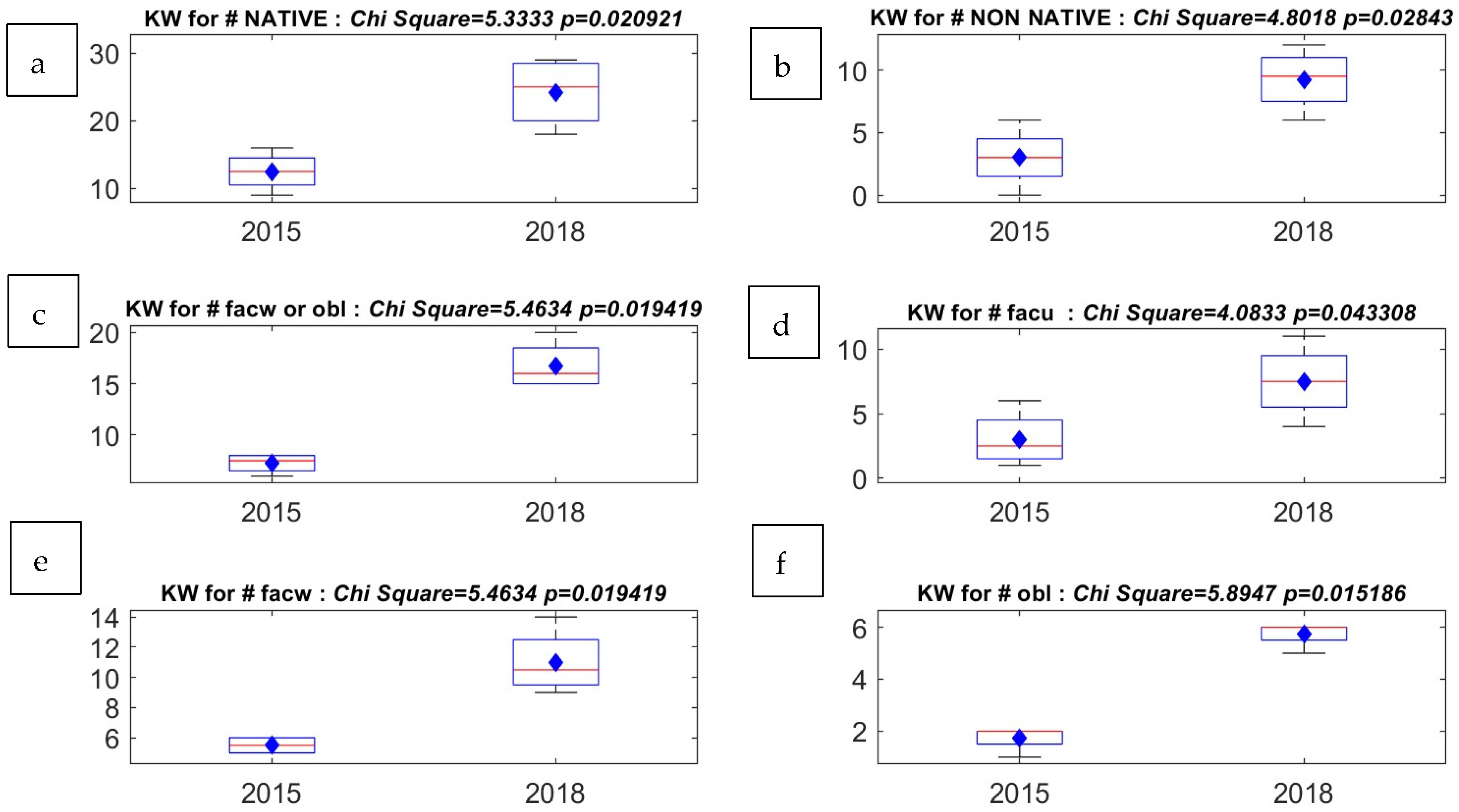
- Objective 1: Use statistical analyses of data gathered along multiple transects in ‘Canyon Reach 4’ to compare the vegetation present in 2018 to that observed in 2015, prior to restoration.
- Objective 2: Compare data gathered along multiple transects in ‘Canyon Reach 4’ in 2015 (prior to restoration) and 2018 (two years post-restoration) with those made in 2018 at ‘Camp Polk Meadow’ (six years post-restoration), in order to gauge the potential for the further development of vegetation in the more recently restored reach and make recommendations for further adaptive management.
- Objective 3: Use a well-established, standard riparian and wetland functions assessment method to compare ecosystem services provided by ‘Canyon Reach 4’ in 2018 to those provided by the adjacent, unrestored ‘Canyon Reach 3’ and by ‘Camp Polk Meadow’.
- Objective 4: Interpret our findings and consider their implications for restoration research, monitoring and restorative actions along Whychus Creek and more generally.
2. Whychus Creek: Historical Degradation and Recent Restoration to Stage 0
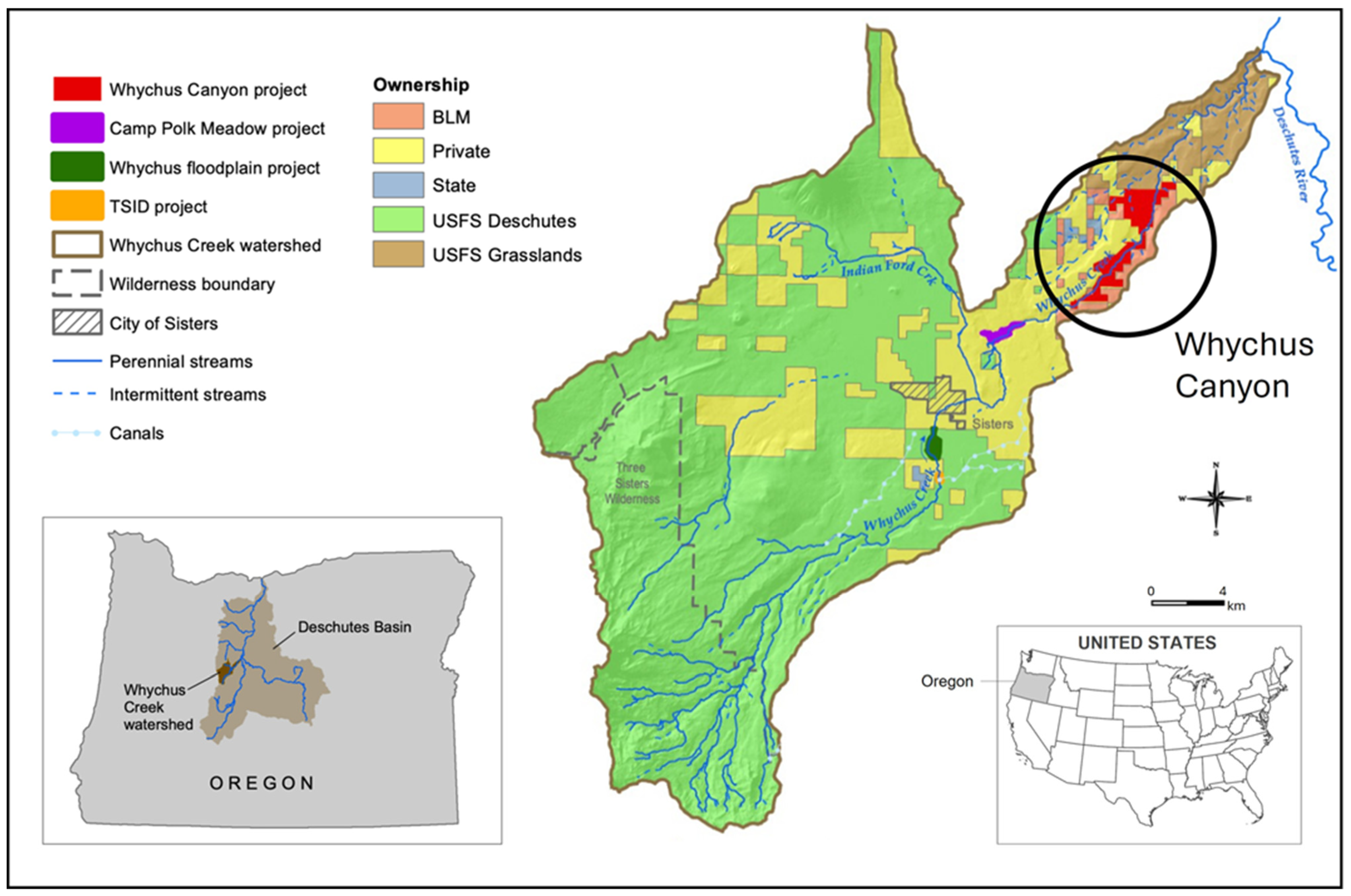
- ‘Canyon Reach 3’, which is immediately upstream of ‘Canyon Reach 4’ and which is unrestored;
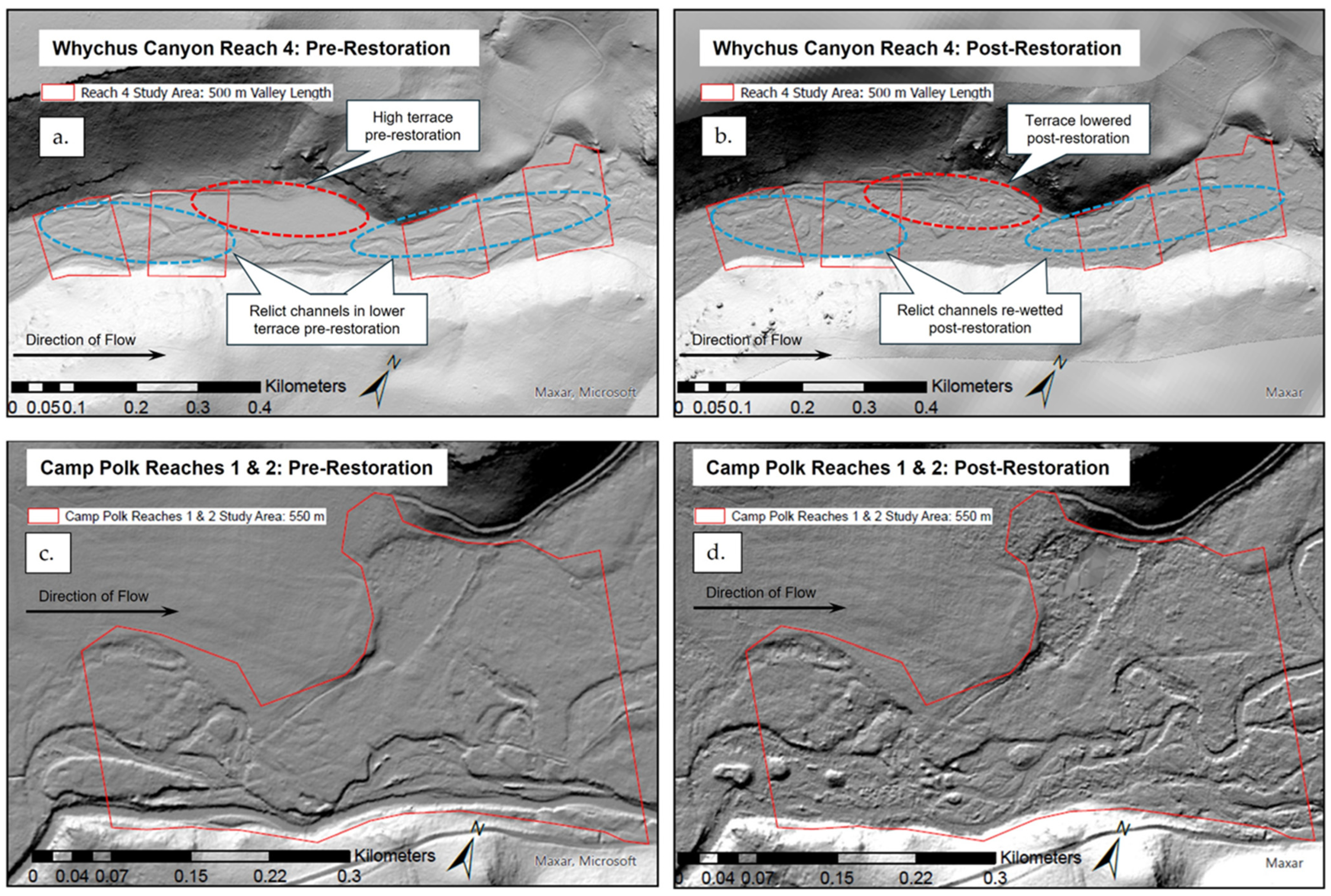
- The upper 550 m of Camp Polk Meadow Preserve, which was restored to the form of an alluvial fan between 2009 and 2012, and which subsequently evolved towards its multi-channel, pre-disturbance, or Stage 0, condition (see Figure 2c,d, above).
3. Study Reaches and Sampling Methodology
3.1. Study Reaches
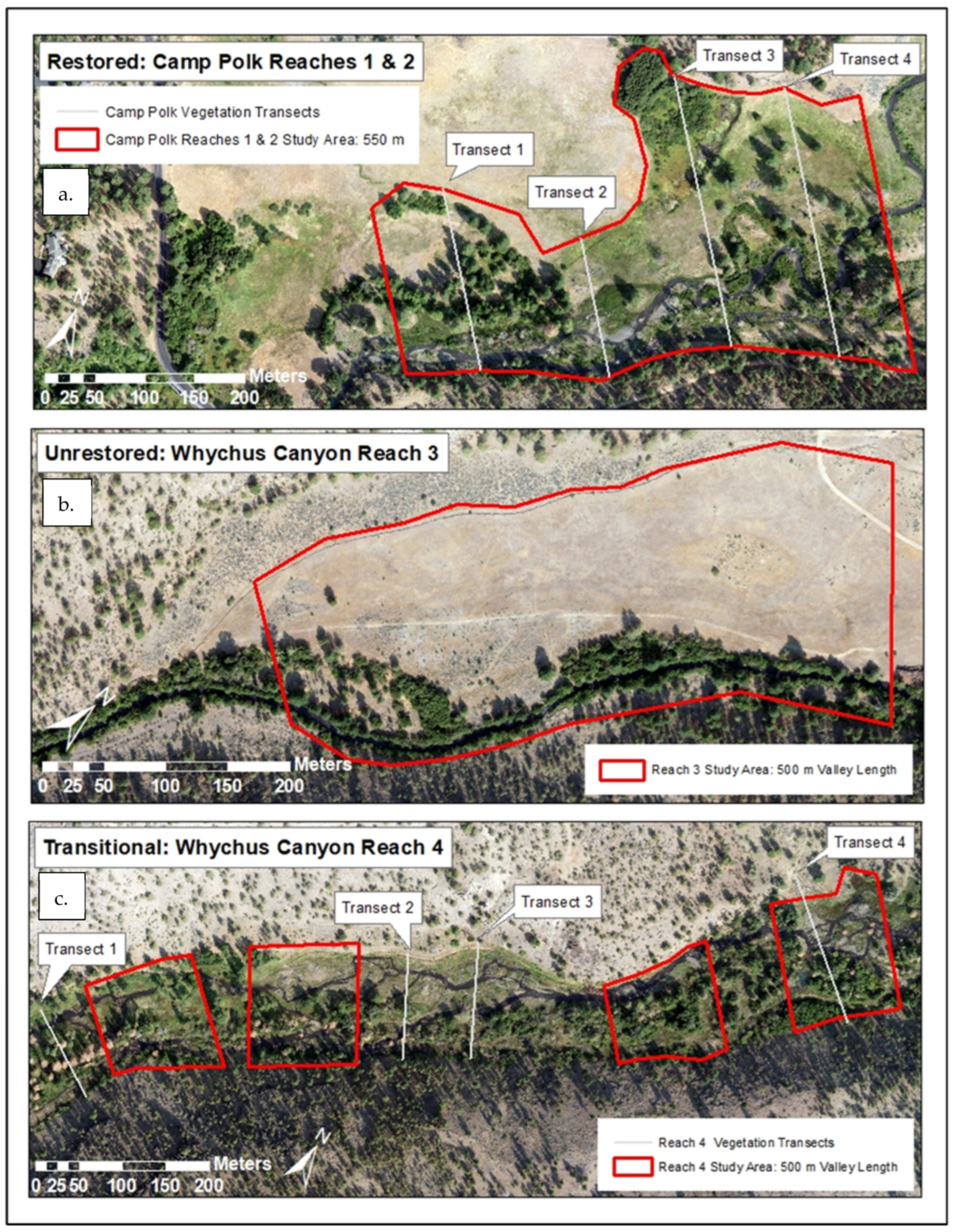
- Camp Polk Meadow Preserve (‘Camp Polk Meadow’), where 2.4 km of the valley floor was restored using a modified Natural Channel Design between 2009 and 2012. The uppermost 550 m of the meadow has since naturally developed a multi-channel river–wetland corridor that resembles a Stage 0 condition. Throughout this paper, we refer to this study reach as being ‘restored’ (Figure 4a);
- Whychus Canyon Reach 3 (‘Canyon Reach 3’), which is unrestored and represents the pre-restoration condition of degraded and simplified stream habitat along Whychus Creek. We refer to this reach as being the ‘control’ (Figure 4b);
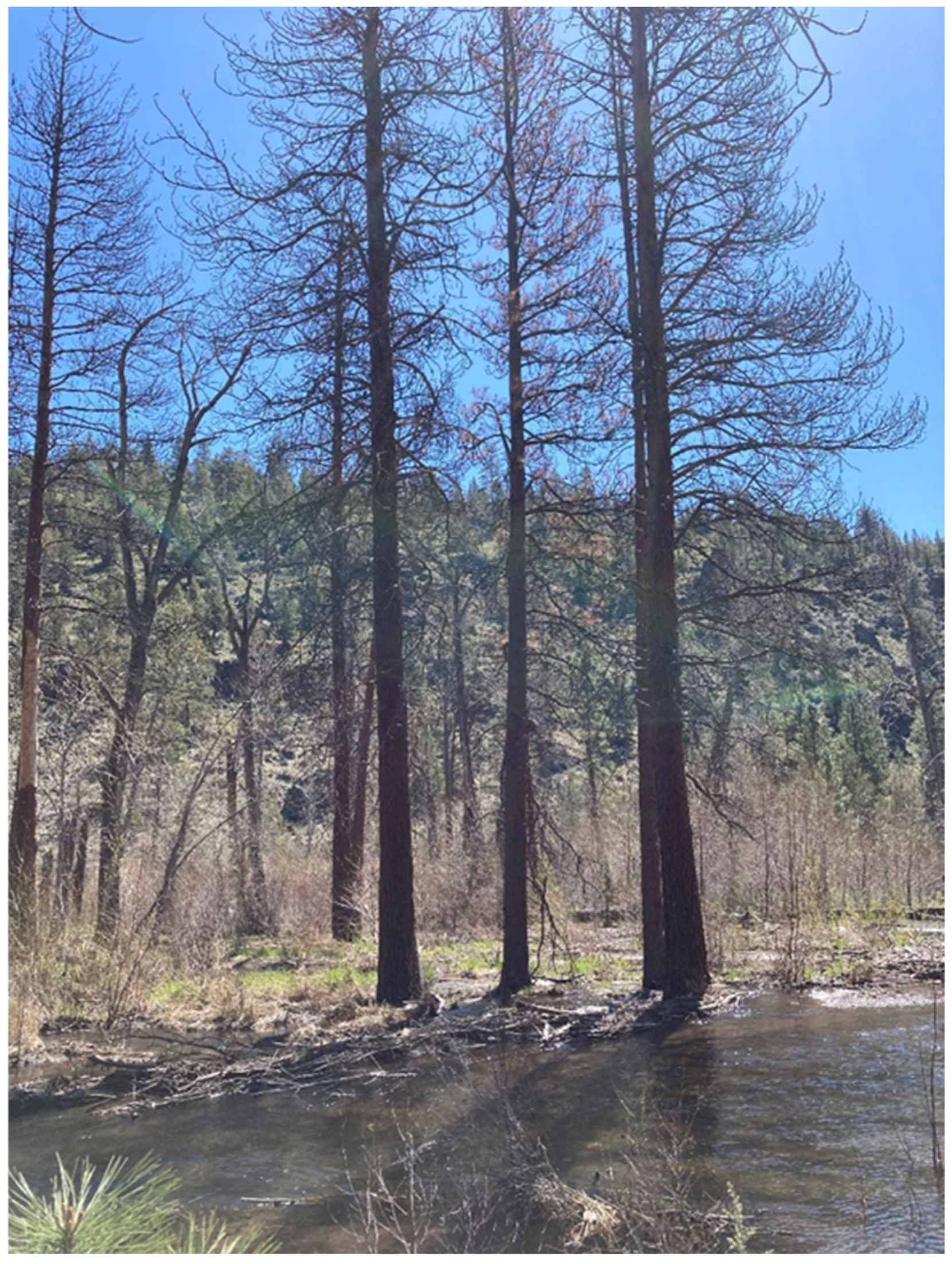
- Whychus Canyon Reach 4 (‘Canyon Reach 4’), where 1.6 km of the valley floor was restored to its Stage 0 condition in summer 2016. We refer to this reach as being in ‘transition’ (Figure 4c).
3.2. Vegetation Transect Sampling
3.3. Plant Community Focal Study Sampling
3.4. Riparian and Wetland Functions Assessment Method
- It was developed specifically for use in the State of Oregon.
- It provides numeric scores for wetland functions.
- It is a standard, legally approved method that is extensively referenced in the technical literature.
- It generates scores that are comparable with those for other wetlands across the State of Oregon.
- It has been applied in at least 50 similar studies.
- It is more time-efficient than alternative methods.
4. Data Processing
- Obligate Wetland (OBL) plants almost always occur in wetlands;
- Facultative Wetland (FACW) plants usually occur in wetlands, but are occasionally found in uplands;
- Facultative (FAC) plants occur in both wetlands and uplands;
- Facultative Upland (FACU) plants usually occur in uplands, but may occur in wetlands;
- Upland (UPL) plants almost always occur in uplands.
5. Results
5.1. Study Reach Plant Communities
5.1.1. Overview
5.1.2. ‘Canyon Reach 3’ (Control)
5.1.3. ‘Canyon Reach 4’ (Transition)
5.1.4. ‘Camp Polk Meadow’ (Restored)
5.2. Comparison of Pre-Restoration (2015) and Post-Restoration (2018) Transect Surveys in ‘Canyon Reach 4’ (Transition)
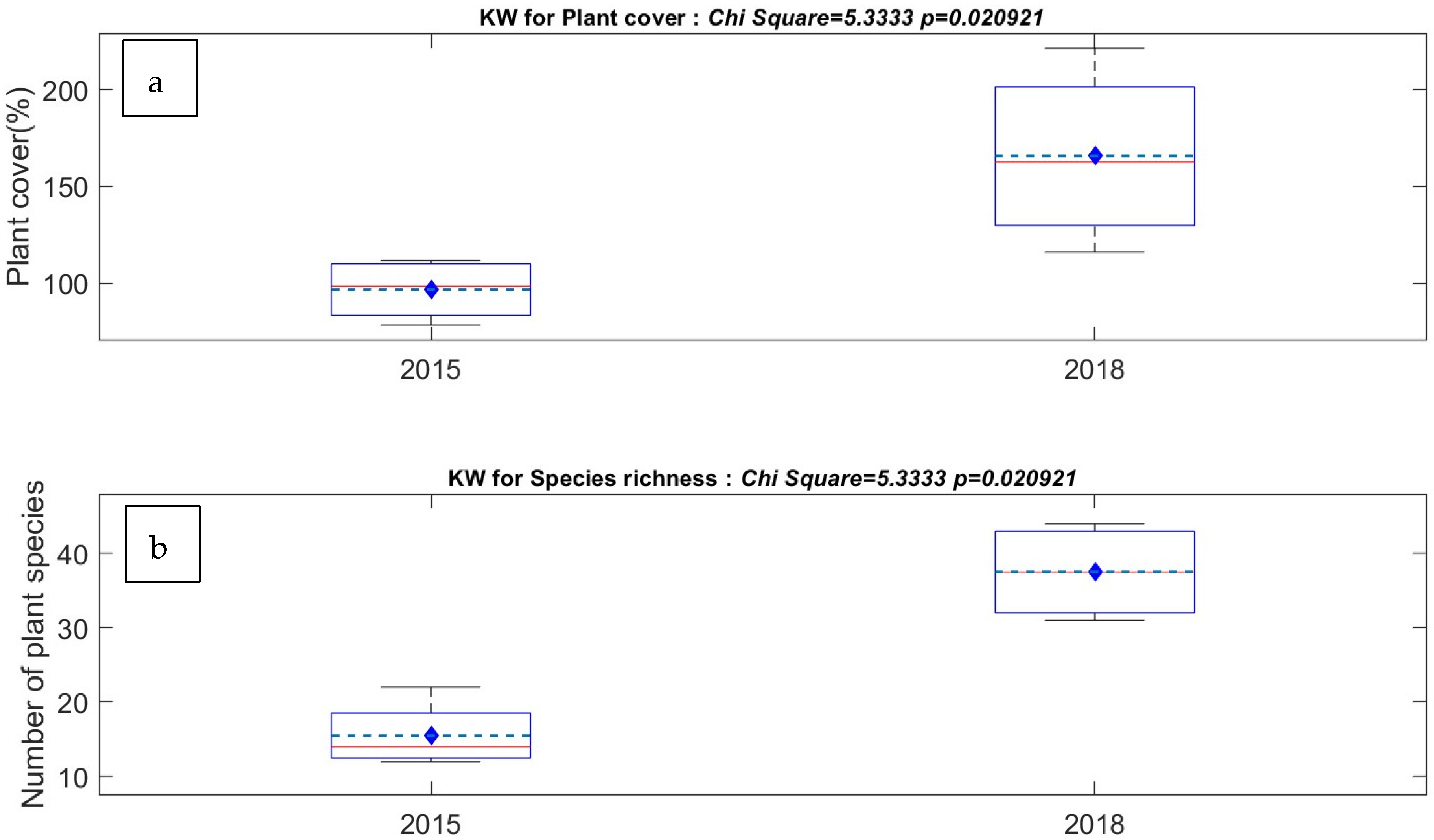
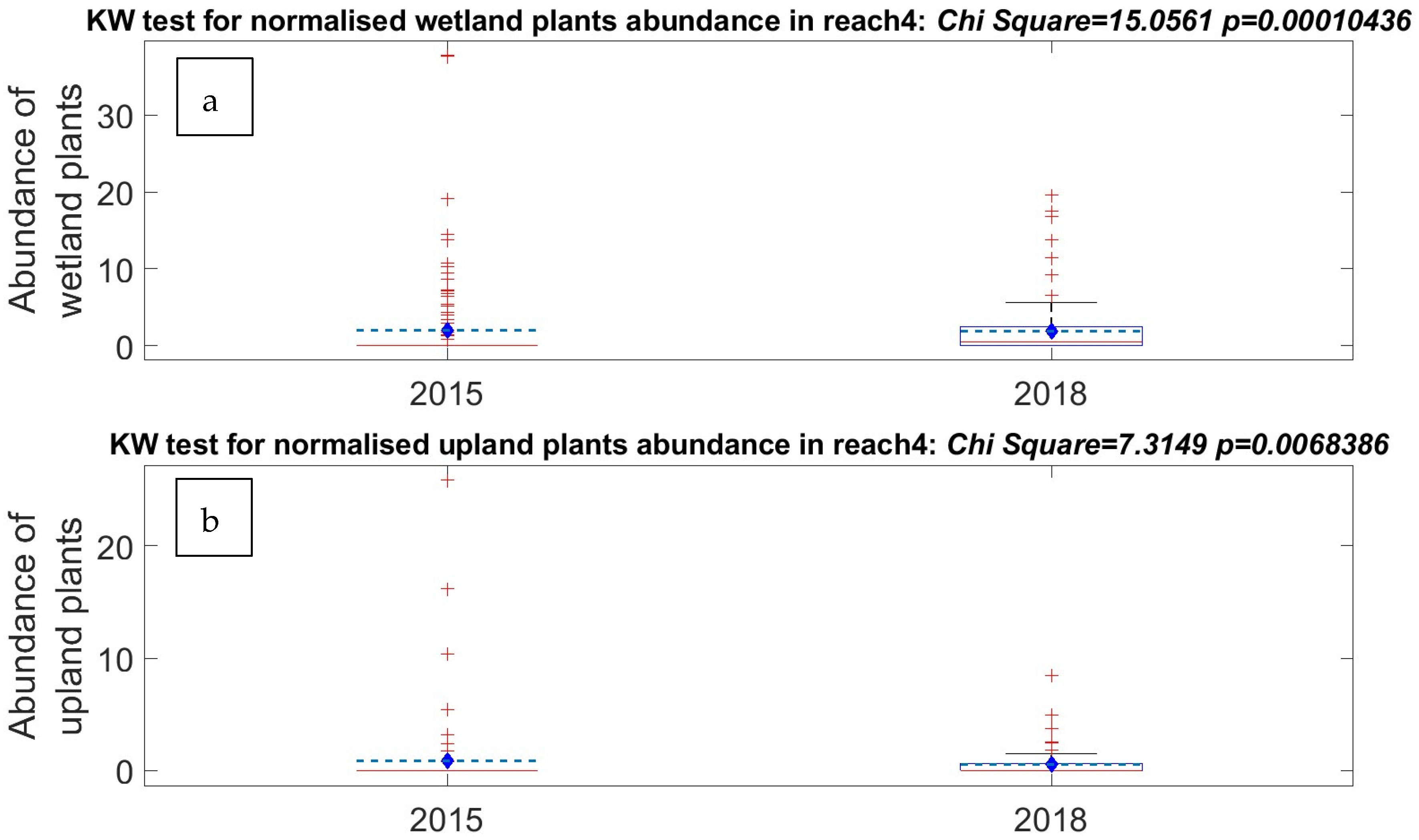
5.2.1. Changes in Plant Communities
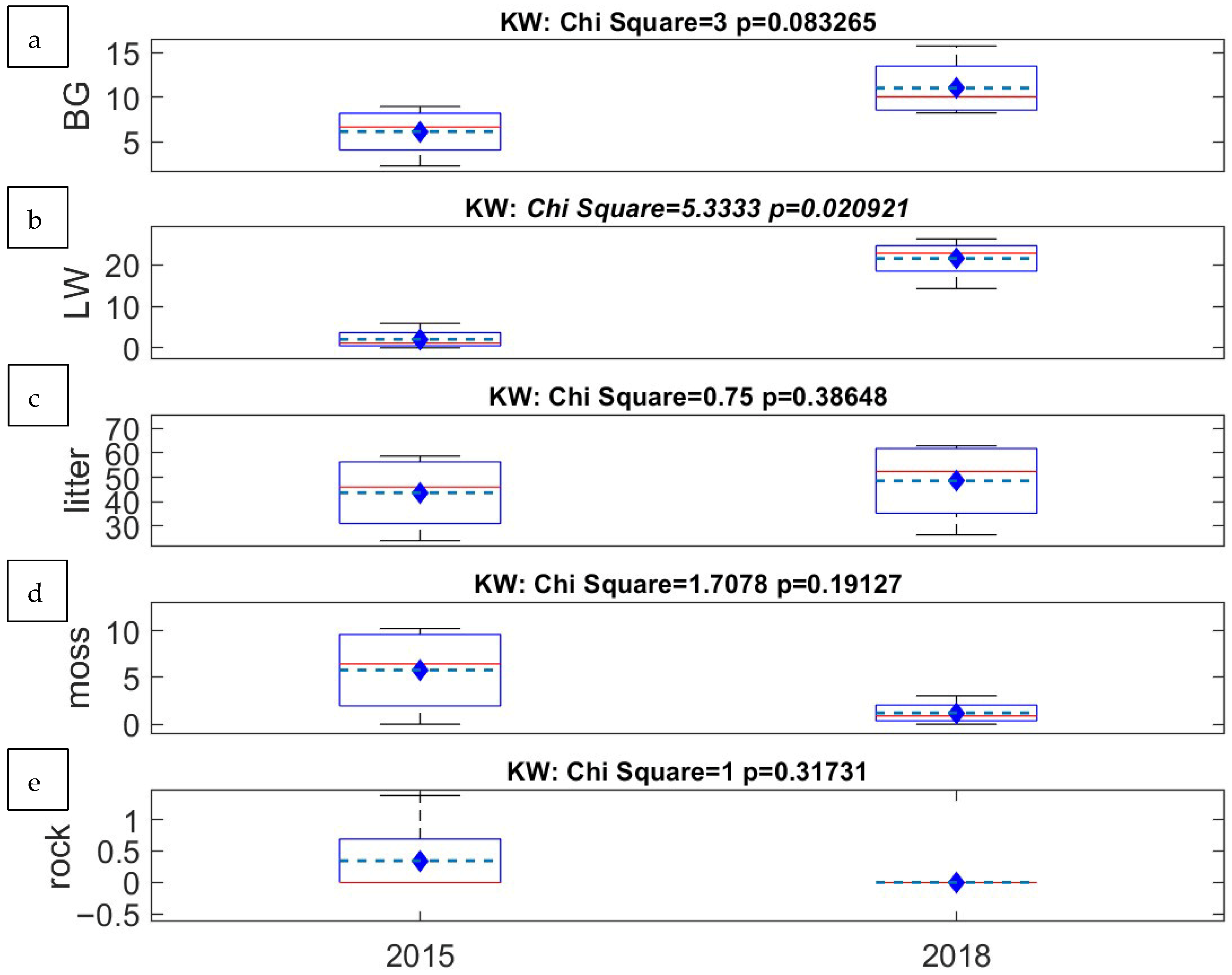
5.2.2. Changes in Ground Cover and Large Wood
5.3. Comparisons Between the Vegetation Transect Surveys in ‘Canyon Reach 4’ (2015, 2018) and ‘Camp Polk Meadow’ (2018)
5.4. Riparian and Wetland Functions Assessment (Objective 3)
6. Interpretation and Implications
6.1. Objective 1: Interpretation of Post-Restoration Changes in Vegetation and Ground Cover in Canyon Reach 4 (Transition)
6.1.1. Changes to Vegetation
- The purposeful construction of micro-terrain in the cut and fill surfaces created during restoration, including local depressions with enhanced stream, hyporheic, and groundwater connections, interspersed with low terraces and ‘leave islands’ that are slightly higher and, therefore, drier;
- The planting palette used in the restoration project (listed in Supplementary Materials Section S1) included both wetland and upland species, which accounted for hydrological patchiness related to the impacts of local terrain on soil wetness and micro-habitats;
- The alleviation of seasonal water stresses on established vegetation growing on the higher surfaces that were not disturbed during restoration;
- Recognition that the two years since restoration activity was completed is probably not enough time for wetland flora to have out-competed disadvantaged upland plants within the rehydrated margin areas on the valley floor.
6.1.2. Changes in Ground Cover
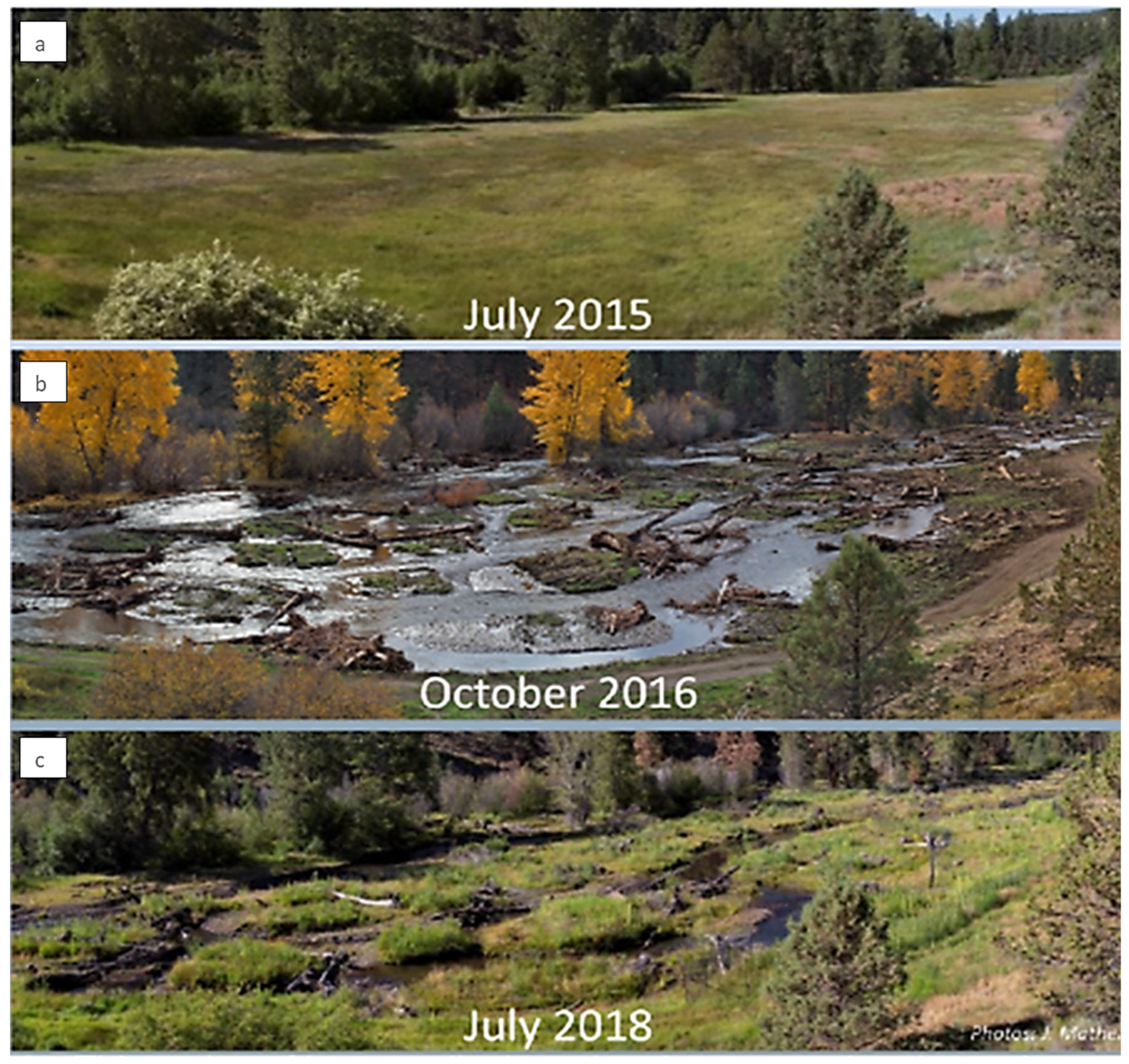
- The lowering of the high terrace in Figure 2a (above), which resulted in an extensive area of bare ground;
- The placement of multiple wood pieces to roughen lowered terrace surfaces and slow flows in bare areas where vegetation had to be cleared during construction.
6.2. Objective 2: Interpretation of Changes in Vegetation in ‘Canyon Reach 4’ (Transition) and ‘Camp Polk Meadow’ (Restored)
6.3. Objective 3: Interpretation of Changes in Wetland Ecosystem Functions
6.4. Implications for Habitat Heterogeneity and Biodiversity
6.5. Implications for Long-Term Monitoring of Stage 0 Restorations
6.6. Wider Implications
7. Conclusions
- Vegetation AssemblagesThe restoration of ‘Canyon Reach 4’ of Whychus Creek significantly increased riparian vegetation abundance and species richness within two years, creating a heterogeneous mosaic of aquatic, mesic, and upland habitats.
- Wetland FunctionsRiparian and Wetland Function scores increased markedly in restored and transition reaches compared to the unrestored control, particularly for water storage, sediment stabilization, and habitat support for fish, amphibians, and invertebrates. These improvements indicate enhanced ecosystem services and flood resilience.
- Habitat and BiodiversitySix years after restoration to the form of an alluvial fan, the upper part of Camp Polk Meadow Preserve exhibited greater geomorphic and biological diversity, supporting a wider range of taxa and providing evidence that Stage 0 restoration promotes biodiversity, ecological complexity and resilience.
- Vegetation SuccessionWhile the restored Camp Polk Meadow Preserve reach outperformed the transitional Canyon Reach 4 ecologically, similarities between their plant community compositions and Riparian and Wetland Functions suggest that both reaches are on a positive trajectory toward fully recovering from the adverse impacts of past anthropogenic channel straightening, relocation, incision, and floodplain disconnection.
- Salmon RecoveryVery large increases in numbers of both steelhead (O. mykiss) and juvenile Spring Chinook (O. tshawytscha) observed in Canyon Reach 4 in 2018 indicate that returning this reach to its Stage 0 condition was supporting salmon recovery, which is a regional goal, only 2 years post-restoration.
- Implications and Future WorkThe findings reported here support valley-wide, process-reset restoration approaches that prioritize full floodplain reconnection. However, continued, long-term monitoring is essential to confirm the initial trends we identified, guide adaptive management, and strengthen the evidence base for Stage 0 restoration as a future-resilient strategy. The results will also serve as a reference for a broader range of further research and applications in biodiversity and vegetation studies, hydrology, and fire ecology.
- Overall significanceOur research makes an important contribution by providing quantitative evidence that Stage 0 restoration accelerates ecological recovery compared to traditional channel-centric approaches. Beyond academic significance, the main practical implications are clear: rapid improvements in habitat quality, vegetation diversity, and ecosystem services can inform restoration design, funding priorities, and adaptive management strategies. However, the short-term nature of this study and its site-specific context highlight the need for extended monitoring and replication across diverse landscapes to validate long-term outcomes and broaden applicability.
Supplementary Materials
Author Contributions
Funding
Data Availability Statement
Acknowledgments
Conflicts of Interest
References
- Hauer, F.R.; Locke, H.; Dreitz, V.J.; Hebblewhite, M.; Lowe, W.H.; Muhlefeld, C.C.; Nelson, C.R.; Proctor, M.F.; Rood, S.B. Gravel-bed River Floodplains are the Ecological Nexus of Glaciated Mountain Landscapes. Sci. Adv. 2016, 2, e1600026. [Google Scholar] [CrossRef] [Scilit]
- Lawson, C.; Rothero, E.; Gowing, D.; Nisbet, T.; Barsoum, N.; Broadmeadow, S.; Skinner, A. The Natural Capital of Floodplains: Management, Protection and Restoration to Deliver Greater Benefits; Valuing Nature Natural Capital Synthesis Report VNP09; UKCEH: Crowmarsh Gifford, England, 2018; Available online: https://valuing-nature.net/FloodplainNC (accessed on 8 January 2026).
- Pugh, B.E.; Colley, M.; Dugdale, S.J.; Edwards, P.; Flitcroft, R.; Holz, A.; Johnson, M.; Mariani, M.; Means-Brous, M.; Meyer, K.; et al. A possible role for river restoration enhancing biodiversity through interaction with wildfire. Glob. Ecol. Biogeogr. 2022, 31, 1990–2004. [Google Scholar] [CrossRef] [Scilit]
- Brown, A.G.; Lespez, L.; Sear, D.A.; Macaire, J.-J.; Houben, P.; Klimek, K.; Brazier, R.E.; Van Oost, K.; Pears, B. Natural vs. Anthropogenic Streams in Europe: History, Ecology and Implications for Restoration, River-Rewilding and Riverine Ecosystem Services. Earth Sci. Rev. 2018, 180, 185–205. [Google Scholar] [CrossRef] [Scilit]
- Cluer, B.; Thorne, C. A Stream Evolution Model Integrating Habitat and Ecosystem Benefits. River Res. Applic. 2014, 30, 135–154. [Google Scholar] [CrossRef] [Scilit]
- Wohl, E.; Castro, J.; Cluer, B.; Merritts, D.; Powers, P.; Staab, B.; Thorne, C. Rediscovering, Reevaluating, and Restoring Lost River-Wetland Corridors. Front. Earth Sci. 2021, 9, 653623. [Google Scholar] [CrossRef] [Scilit]
- Bridges, T.S.; Bourne, E.M.; Suedel, B.C.; Moynihan, E.B.; King, J.K. Engineering with Nature: An Atlas; US Army Engineer Research and Development Center, Environmental Laboratory: Vicksburg, MS, USA, 2018; p. 0280. [Google Scholar]
- Carter, N.T.; Lipiec, E. Flood Risk Reduction from Natural and Nature-Based Features: Army Corps of Engineers Authorities; Congressional Research Service: Washington, DC, USA, 2020; Available online: https://www.everycrsreport.com/files/20200427_R46328_5ecc0e851941e017b50b62075a15c4abbbd36d19.pdf (accessed on 8 January 2026).
- Glassic, H.C.; Al-Chokhachy, R.; Wheaton, J.; Macfarlane, W.W.; Jordan, C.E.; Murphy, B.; Shahverdian, S.; Bennett, S.; Bouwes, N.; Fryirs, K.; et al. Principles of Riverscape Health. WIREs Water 2025, 12, e70028. [Google Scholar] [CrossRef] [Scilit]
- Lashford, C.; Lavers, T.; Reaney, S.; Charlesworth, S.; Burgess-Gamble, L.; Dale, J. Sustainable catchment-wide flood management: A review of the terminology and application of sustainable catchment flood management techniques in the UK. Water 2022, 14, 1204. [Google Scholar] [CrossRef] [Scilit]
- Piégay, H.; Cottet, M.; Lamouroux, N. Innovative approaches in river management and restoration. River Res. Appl. 2020, 36, 875–879. [Google Scholar] [CrossRef] [Scilit]
- Downs, P.; Gregory, K. River Channel Management: Towards Sustainable Catchment Hydrosystems; Routledge: Oxford, England, 2014. [Google Scholar]
- Geist, J.; Hawkins, S.J. Habitat recovery and restoration in aquatic ecosystems: Current progress and future challenges. Aquat. Conserv. Mar. Freshw. Ecosyst. 2016, 26, 942–962. [Google Scholar] [CrossRef] [Scilit]
- Johnson, M.F.; Thorne, C.R.; Castro, J.M.; Kondolf, G.M.; Mazzacano, C.S.; Rood, S.B.; Westbrook, C. Biomic river restoration: A new focus for river management. River Res. Appl. 2020, 36, 3–12. [Google Scholar] [CrossRef] [Scilit]
- Modi, A.; Kapoor, V.; Tare, V. River space: A hydro-bio-geomorphic framework for sustainable river-floodplain management. Sci. Total Environ. 2022, 812, 151470. [Google Scholar] [CrossRef] [Scilit]
- Hearnshaw, E.J.S.; Hughey, K.F.D. A Tolerance Range Approach for the Investigation of Values Provided by Te Waihora/Lake Ellesmere; Report 17; Centre for Land, Environment & People, Lincoln University: Christchurch, Aotearoa/New Zealand, 2010; 78p. [Google Scholar]
- Beechie, T.; Imaki, H.; Greene, J.; Wade, A.; Wu, H.; Pess, G.; Roni, P.; Kimball, J.; Stanford, J.; Kiffney, P.; et al. Restoring salmon habitat for a changing climate. River Res. Appl. 2013, 29, 939–960. [Google Scholar] [CrossRef] [Scilit]
- Bernhardt, E.S.; Palmer, M.A. River restoration: The fuzzy logic of repairing reaches to reverse watershed scale degradation. Ecol. Appl. 2011, 21, 1926–1931. [Google Scholar] [CrossRef] [Scilit]
- Booth, D.; Scholz, J.; Beechie, T.; Ralph, S.C. Integrating limiting factors analysis with process-based restoration to improve recovery of endangered salmonids in the Pacific Northwest, USA. Water 2016, 8, 174. [Google Scholar] [CrossRef] [Scilit]
- Powers, P.D.; Helstab, M.; Niezgoda, S.L. A Process-based Approach to Restoring Depositional River Valleys to Stage 0, an Anastomosing Channel Network. River Res. Appl. 2019, 35, 3–13. [Google Scholar] [CrossRef] [Scilit]
- Powers, P.; Staab, B.; Cluer, B.; Thorne, C. Rediscovering, reevaluating, and restoring Entiatqua: Identifying pre-Anthropocene valleys in North Cascadia, USA. River Res. Appl. 2022, 38, 1527–1543. [Google Scholar] [CrossRef] [Scilit]
- Behan, J.; Fetcho, K.; Davis, R.; Gaines, L. River Restoration to Achieve a Stage 0 Condition: Summary of a Workshop Held November 5–6, 2020; Oregon State University: Corvallis, OR, USA, 2021. [Google Scholar]
- Ciotti, D.C.; Mckee, J.; Pope, K.L.; Kondolf, G.M.; Pollock, M.M. Design criteria for process-based restoration of fluvial systems. Bioscience 2021, 71, 831–845. [Google Scholar] [CrossRef] [Scilit]
- Pollock, M.M.; Beechie, T.J.; Wheaton, J.M.; Jordan, C.E.; Bouwes, N.; Weber, N.; Volk, C. Using beaver dams to restore incised stream ecosystems. BioScience 2014, 64, 279–290. [Google Scholar] [CrossRef] [Scilit]
- Hinshaw, S.; Wohl, E. Quantitatively estimating carbon sequestration potential in soil and large wood in the context of river restoration. Front. Earth Sci. 2021, 9, 708895. [Google Scholar] [CrossRef] [Scilit]
- McCabe, C.L.; Matthaei, C.D.; Tonkin, J.D. The ecological benefits of more room for rivers. Nat. Water 2025, 3, 260–270. [Google Scholar] [CrossRef] [Scilit]
- Pollock, M.M.; Norman, L.M. Wet meadow regeneration through restoration of biophysical feedbacks. Front. Environ. Sci. 2025, 13, 1592036. [Google Scholar] [CrossRef] [Scilit]
- Riis, T.; Kelly-Quinn, M.; Aguiar, F.C.; Manolaki, P.; Bruno, D.; Bejarano, M.D.; Clerici, N.; Fernandes, M.R.; Franco, J.C.; Pettit, N.; et al. Global Overview of Ecosystem Services Provided by Riparian Vegetation. BioScience 2020, 70, 501–514. [Google Scholar] [CrossRef] [Scilit]
- Mohan, M.; Chacko, A.; Rameshan, M.; Gopikrishna, V.G.; Kannan, V.M.; Vishnu, N.G.; Sasi, S.A.; Baiju, K.R. Restoring Riparian Ecosystems During the UN-Decade on Ecosystem Restoration: A Global Perspective. Anthr. Sci. 2022, 1, 42–61. [Google Scholar] [CrossRef] [Scilit]
- Von Humboldt, A.; Bonpland, A. Essai sur la Géographie des Plantes (Essay on the Geography of Plants); Levrault & Schoell: Paris, France, 1807. [Google Scholar]
- Naiman, R.J.; Decamps, H.; Pollock, M. The role of riparian corridors in maintaining regional biodiversity. Ecol. Appl. 1993, 3, 209–212. [Google Scholar] [CrossRef] [Scilit]
- Graziano, M.P.; Deguire, A.K.; Surasinghe, T.D. Riparian Buffers as a Critical Landscape Feature: Insights for Riverscape Conservation and Policy Renovations. Diversity 2022, 14, 172. [Google Scholar] [CrossRef] [Scilit]
- Li, M.; Johnson, C.J.; Rex, J.F.; Todd, M. Long-term riparian forest loss around streams, lakes, and wetlands in ecologically diverse managed and unmanaged landscapes. For. Ecol. Manag. 2024, 562, 121931. [Google Scholar] [CrossRef] [Scilit]
- Davidson, N.C. How much wetland has the world lost? Long-term and recent trends in global wetland area. Mar. Freshw. Res. 2014, 65, 934–941. [Google Scholar] [CrossRef] [Scilit]
- Fluet-Chouinard, E.; Stocker, B.D.; Zhang, Z.; Malhotra, A.; Melton, J.R.; Poulter, B.; Kaplan, J.O.; Goldewijk, K.K.; Siebert, S.; Minayeva, T.; et al. Extensive global wetland loss over the past three centuries. Nature 2023, 614, 281–286. [Google Scholar] [CrossRef] [Scilit]
- Finlayson, C.M.; Davidson, N.C.; Spiers, A.G.; Stevenson, N.J. Global wetland inventory–current status and future priorities. Mar. Freshw. Res. 1999, 50, 717–727. [Google Scholar] [CrossRef] [Scilit]
- Hardouin, L.; Decharme, B.; Colin, J.; Delire, C. Climate-driven projections of future global wetlands extent. Earth’s Future 2024, 12, e2024EF004553. [Google Scholar] [CrossRef] [Scilit]
- Palmer, M.A.; Hondula, K.L.; Koch, B.J. Ecological restoration of streams and rivers: Shifting strategies and shifting goals. Annu. Rev. Ecol. Evol. Syst. 2014, 45, 247–269. [Google Scholar] [CrossRef] [Scilit]
- Moreno-Mateos, D.; Power, M.E.; Comín, F.A.; Yockteng, R. Structural and functional loss in restored wetland ecosystems. PLoS Biol. 2012, 10, e1001247. [Google Scholar] [CrossRef] [Scilit]
- Flitcroft, R.L.; Brignon, W.R.; Staab, B.; Bellmore, J.R.; Burnett, J.; Burns, P.; Cluer, B.; Giannico, G.; Helstab, J.M.; Jennings, J.; et al. Rehabilitating valley floors to a stage 0 condition: A synthesis of opening outcomes. Front. Environ. Sci. 2022, 10, 892268. [Google Scholar] [CrossRef] [Scilit]
- U.S. Forest Service. Sisters/Whychus Watershed Analysis; Sisters Ranger District, Deschutes National Forest: Sisters, OR, USA, 1998; 384p.
- Perle, M.; Mork, L.; Thorne, C. ‘Stage Zero’ Restoration of Whychus Creek, Oregon: Monitoring Results and Lessons Learned; UDWC: Bend, OR, USA, 2018; Available online: www.ecotoneinc.com (accessed on 8 January 2026).
- Mork, L.; Perle, M.; Thorne, C. Stage 0 Outcomes: Monitoring Results and Stakeholder Views; Upper Deschutes Watershed Council: Bend, OR, USA, 2018. [Google Scholar]
- Mork, L.; Allen, K.; Goss, T.; Thorne, C.; Krivtsov, V. Increase in riparian vegetation following a ‘Stage 0’ river restoration project on Whychus Creek, Oregon. In Proceedings of the 39th IAHR World Congress, Granada, Spain, 19–24 June 2022; International Association for Hydro-Environment Engineering and Research (IAHR): Madrid, Spain, 2022. [Google Scholar]
- Bauer, H.L. The statistical analysis of chaparral and other plant communities by means of transect samples. Ecology 1943, 24, 45–60. [Google Scholar] [CrossRef] [Scilit]
- Six, L.J.; Verschuyl, J.; Coble, A.A. Riparian vegetation layers differ three years after mixed severity wildfire in Oregon. Sci. Rep. 2025, 15, 36247. [Google Scholar] [CrossRef] [Scilit]
- Weaver, J.E. The quadrat method in teaching ecology. Plant World 1918, 21, 267–283. [Google Scholar]
- Yang, X.; Feng, Q.; Zhu, M.; Zhang, J.; Yang, L.; Zhang, C.; Wang, Z.; Feng, Y. Vegetation communities and soil properties along the restoration process of the Jinqianghe mine site in the Qilian Mountains, China. Front. Plant Sci. 2024, 15, 1358309. [Google Scholar] [CrossRef] [Scilit]
- Adamus, P.R. Guidebook for Hydrogeomorphic (HGM)—Based Assessment of Oregon Wetland and Riparian Sites: Statewide Classification and Profiles; Oregon Division of State Lands: Salem, OR, USA, 2001. Available online: https://www.oregon.gov/dsl/wetlands-waters/Documents/HGMGuide.pdf (accessed on 8 January 2026).
- Hruby, T.; Bruner, K.; Cooke, S.; Dublonica, K.; Gersib, R.; Granger, T.; Reinelt, L.; Richter, K.; Sheldon, D.; Wald, A.; et al. Methods for Assessing Wetland Functions. Volume 1: Riverine and Depressional Wetlands in the Lowlands of Western Washington; Ecology Publication 99–115; Washington State Department of Ecology: Olympia, WA, USA, 1999. [Google Scholar]
- Smith, R.D.; Ammann, A.; Bartoldus, C.; Brinson, M.M. An Approach for Assessing Wetland Functions Using Hydrogeomorphic Classification, Reference Wetlands and Functional Indices; US Army Corps of Engineers: Vicksburg, MS, USA, 1995. [Google Scholar]
- Mitsch, W.J.; Gosselink, J.G. Wetlands; John Wiley & Sons: Hoboken, NJ, USA, 2015. [Google Scholar]
- Lichvar, R.W.; Melvin, N.C.; Butterwick, M.L.; Kirchner, W.N. National Wetland Plant List Indicator Rating Definitions; ERDC/CRREL TR-12-1; U.S. Army Engineer Research and Development Center, Cold Regions Research and Engineering Laboratory: Hanover, NH, USA, 2012. [Google Scholar]
- U.S. Army Corps of Engineers. Regional Supplement to the Corps of Engineers Wetland Delineation Manual: Arid West Region (Version 2.0); Wakeley, J.S., Lichvar, R.W., Noble, C.V., Eds.; ERCD/EL TR-08-28; U.S. Army Engineer Research and Development Center: Vicksburg, MS, USA, 2008. [Google Scholar]
- Allen, C.D.; Breshears, D.D. Drought-induced shift of a forest/woodland ecotone: Rapid landscape response to climate variation. Proc. Natl. Acad. Sci. USA 1998, 95, 14839–14842. [Google Scholar] [CrossRef] [Scilit] [PubMed]
- Allen, C.; Savage, M.; Falk, D.; Suckling, K.; Swetnam, T.; Schulke, T.; Stacey, P.; Morgan, P.; Hoffman, M.; Klingel, J. Ecological restoration of southwestern ponderosa pine ecosystems: A broad perspective. Ecol. Appl. 2002, 12, 1418–1433. [Google Scholar] [CrossRef]
- Goss, T. Assessing the Wetlands of a Stage 0 River Restoration Project on Whychus Creek, Deschutes County, Oregon. MSc Master’s Thesis, School of Geography, University of Nottingham, Nottingham, England, 2020. [Google Scholar]
- Vasilas, L.M.; Hurt, G.W.; Berkowitz, J.F. Field Indicators of Hydric Soils in the United States: A Guide for Identifying and Delineating Hydric Soils, Version 8.1; United States Department of Agriculture, Natural Resources Conservation Service: Washington, DC, USA, 2017. [Google Scholar]
- Riehle, M.; Moberly, E. Population trends of redband trout and brown trout in habitat improvement reaches of Whychus Creek, Oregon. In Proceedings of the Portland General Electric Fisheries Workshop, Bend, OR, USA, 13 July 2023. [Google Scholar]
- Bucher, E.H.; Bonetto, A.; Boyle, T.; Canevari, P.; Castro, G.; Huszar, P.; Stone, T. Hidroviaan Initial Environmental Examination of the Paraguay—Parana Waterway; Publication No. 10; Wetlands for the Americas: Manomet, MA, USA, 1993. [Google Scholar]
- Maltby, E. (Ed.) Functional Assessment of Wetlands: Towards Evaluation of Ecosystem Services; Woodhead Publishing: Cambridge, England, 2009. [Google Scholar]
- Albert, C.; Galler, C.; Hermes, J.; Neuendorf, F.; Von Haaren, C.; Lovett, A. Applying ecosystem services indicators in landscape planning and management: The ES-in-Planning framework. Ecol. Indic. 2016, 61, 100–113. [Google Scholar] [CrossRef] [Scilit]
- Bullock, A.; Acreman, M.C. The role of wetlands in the hydrological cycle. Hydrol. Earth Syst. Sci. 2003, 7, 75–86. [Google Scholar] [CrossRef] [Scilit]
- Yarnell, S.M.; Mount, J.F.; Larsen, E.W. The influence of relative sediment supply on riverine habitat heterogeneity. Geomorphology 2006, 80, 310–324. [Google Scholar] [CrossRef] [Scilit]
- Henning, J. An Evaluation of Fish and Amphibian Use of Restored and Natural Floodplain Wetlands; Final Report EPA Grant CD-97024901-1; Washington Department of Fish and Wildlife: Olympia, WA, USA, 2004; 81p. [Google Scholar]
- Katz, S.L.; Barnas, K.; Hicks, R.; Cowen, J.; Jenkinson, R. Freshwater habitat restoration actions in the Pacific Northwest: A decade’s investment in habitat improvement. Restor. Ecol. 2007, 15, 494–505. [Google Scholar] [CrossRef] [Scilit]
- Krivtsov, V.; Buckman, J.; Birkinshaw, S.; Olive, V. Interactions of hydrology, geochemistry, and biodiversity in woodland ponds located in riverine floodplains: Case study from Scotland. Environ. Sci. Pollut. Res. 2024, 31, 40678–40693. [Google Scholar] [CrossRef] [Scilit] [PubMed]
- Krivtsov, V. Green and blue-green infrastructure–benefits, trade-offs, and optimisation of ecosystem services: An overview with perspectives for research and management. Plant Ecol. Divers. 2025, 18, 267–285. [Google Scholar] [CrossRef] [Scilit]
- Krivtsov, V.; Ahilan, S.; Arthur, S.; Birkinshaw, S.; Dawson, D.; Everett, G.; Fenner, R.; Glenis, V.; Kapetas, L.; Kilsby, C.; et al. Blue-Green Cities: Achieving Urban Flood Resilience, Water Security and Biodiversity. In The Palgrave Encyclopedia of Urban and Regional Futures; Springer: Berlin/Heidelberg, Germany, 2023. [Google Scholar] [CrossRef] [Scilit]
- Guitart, N.P.; Valor, T.; Krivtsov, V. Efectes postincendi en una torbera d’Escòcia. Treb. Soc. Catalana Geogr. 2011, 71–72, 93–114. [Google Scholar]
- Krivtsov, V.; Vigy, O.; Legg, C.; Curt, T.; Rigolot, E.; Lecomte, I.; Jappiot, M.; Lampin-Maillet, C.; Fernandes, P.; Pezzatti, G.B. Fuel modelling in terrestrial ecosystems: An overview in the context of the development of an object-orientated database for wild fire analysis. Ecol. Model. 2009, 21, 2915–2926. [Google Scholar] [CrossRef] [Scilit]
- Krivtsov, V.; Gray, A.; Valor, T.; Legg, C.J.; Davies, G.M. The fuel moisture content of peat in relation to meteorological factors. In Modelling, Monitoring and Management of Forest Fires; de la Heras, J., Brebbia, C.A., Viegas, D., Leone, V., Eds.; WIT Transactions on Ecology and the Environment; WIT Press: Ashurst, England, 2008; Volume 119, pp. 193–200. [Google Scholar]
- Krivtsov, V.; Legg, C. Modelling Soil Moisture Deficit and Moisture Content of Ground Vegetation: Progress Towards Development of a Fire Weather Index System Appropriate to the UK. Fire Technol. 2011, 47, 539–548. [Google Scholar] [CrossRef] [Scilit]
- Legg, C.J.; Pezzatti, G.B.; Rigolot, E.; Vigy, O.; Lecomte, I.; Marell, A.; Krivtsov, V. Development of an object-orientated database for wildfire modelling. In Modelling, Monitoring and Management of Forest Fires; de la Heras, J., Brebbia, C.A., Viegas, D., Leone, V., Eds.; WIT Transactions on Ecology and the Environment; WIT Press: Ashurst, England, 2008; Volume 119, pp. 39–47. [Google Scholar]






| Riparian and Wetland Function | Value Type | Brief Description |
|---|---|---|
| 1. Water Storage and Delay | Ecosystem | Temporarily retains water, reducing downstream flooding and peak flow. |
| 2. Sediment Stabilization and Phosphorus Retention | Ecosystem | Reduces erosion and traps sediment-bound phosphorus. |
| 3. Nitrogen Removal | N/A | Removes nitrogen via denitrification; not supported in study reaches. |
| 4. Thermoregulation | Ecosystem | Moderates temperature fluctuations in surface and groundwater. |
| 5. Primary Production | Ecosystem | Produces organic biomass that supports food webs. |
| 6. Resident Fish Habitat Support | Population | Provides habitat for non-migratory fish species. |
| 7. Anadromous Fish Habitat Support | Population | Supports migratory fish, like salmon, during breeding or juvenile stages. |
| 8. Invertebrate Habitat Support | Population | Offers feeding, breeding, and refuge sites for aquatic invertebrates. |
| 9. Amphibian and Turtle Habitat | Population | Supports breeding, foraging, and sheltering habitats. |
| 10. Breeding Waterbird Support | N/A | Requires large water bodies; not applicable in study reaches. |
| 11. Wintering and Migratory Waterbird Support | Population | Provides stopover or overwintering habitat along migratory routes. |
| 12. Songbird Habitat Support | Population | Supports nesting and feeding areas for passerines. |
| 13. Support of Characteristic Vegetation | Ecosystem | Maintains hydrophytic plant communities typical of natural wetlands. |
| Upland Inclusions (%) | N/A | Percent of upland area within wetland boundaries; not a function per se. |
| Indicator Status | Number | Indicated Conditions |
|---|---|---|
| Obligate Wetland (OBL) | 11 | Mesic (32) |
| Facultative Wetland (FACW) | 21 | |
| Facultative (FAC) | 17 | Indeterminate (17) |
| Facultative Upland (FACU) | 19 | Dry (34) |
| Upland (UPL) | 15 | |
| Unassigned | 7 |
| Component | |||
|---|---|---|---|
| 1 | 2 | 3 | |
| 18_WCR4T2 | 0.779 | ||
| 18_WCR4T3 | 0.903 | ||
| 18_WCR4T4 | 0.902 | ||
| 18_WCR4T5 | |||
| 15_WCR4T2 | 0.809 | ||
| 15_WCR4T3 | 0.716 | ||
| 15_WCR4T4 | 0.916 | ||
| 15_WCR4T5 | 0.842 | ||
| CPT1 | 0.826 | ||
| CPT2 | 0.775 | ||
| CPT3 | 0.808 | ||
| CPT4 | 0.757 | ||
| Comparison | Jaccard Correlation Coefficient (JC) | Sorensen Similarity Index (SS) |
|---|---|---|
| 2018 Canyon Reach 4 (transition) and 2018 Camp Polk Meadow (restored) | 0.7123 | 0.832 |
| 2018 Canyon Reach 4 (transition) and 2015 Canyon Reach 4 (pre-restoration) | 0.5556 | 0.7143 |
| 2018 Camp Polk (restored) and 2015 Reach 4 (pre-restoration) | 0.4706 | 0.64 |
| Reach and Quadrat | Wetland Functions (See Table 1, Above, for Function Numbering Key) | % Upland Inclusions | ||||||||||
|---|---|---|---|---|---|---|---|---|---|---|---|---|
| 1. | 2. | 4. | 5. | 6. | 7. | 8. | 9. | 11. | 12. | 13. | ||
| WCR4_P1u | 0.200 | 0.364 | 0.257 | 0.736 | 1.182 | 0.684 | 0.811 | 0.805 | 0.737 | 0.987 | 0.394 | 5 |
| WCR4_P1d | 0.060 | 0.332 | 0.343 | 0.718 | 1.143 | 0.807 | 0.732 | 0.815 | 0.474 | 0.987 | 0.716 | 5 |
| WCR4_P2u | 0.060 | 0.309 | 0.300 | 0.736 | 1.078 | 0.860 | 0.768 | 0.836 | 0.678 | 0.997 | 0.863 | 5 |
| WCR4_P2d | 0.100 | 0.273 | 0.386 | 0.691 | 1.000 | 0.982 | 0.989 | 0.779 | 0.467 | 0.974 | 0.848 | 5 |
| WCR4_P3u | 0.060 | 0.173 | 0.120 | 0.618 | 1.143 | 0.754 | 0.793 | 0.816 | 0.599 | 0.989 | 0.875 | 10 |
| WCR4_P3d | 0.060 | 0.264 | 0.171 | 0.645 | 1.143 | 0.737 | 0.763 | 0.800 | 0.414 | 0.987 | 0.840 | 10 |
| WCR4_P4u | 0.060 | 0.445 | 0.300 | 0.864 | 1.130 | 0.807 | 0.807 | 0.839 | 0.411 | 0.987 | 0.848 | 15 |
| WCR4_P4d | 0.100 | 0.523 | 0.257 | 0.900 | 1.195 | 0.789 | 0.831 | 0.619 | 0.474 | 0.987 | 0.863 | 20 |
| WCR3_P1 | 0.040 | 0.145 | 0.300 | 0.582 | 1.091 | 0.667 | 0.222 | 0.666 | 0.382 | 1.026 | 0.679 | 90 |
| WCR3_P2 | 0.040 | 0.145 | 0.300 | 0.582 | 1.091 | 0.667 | 0.222 | 0.666 | 0.382 | 1.026 | 0.679 | 90 |
| WCR3_P3 | 0.040 | 0.145 | 0.300 | 0.582 | 1.091 | 0.667 | 0.222 | 0.666 | 0.382 | 1.026 | 0.679 | 90 |
| WCR3_P4 | 0.040 | 0.182 | 0.300 | 0.545 | 1.091 | 0.667 | 0.689 | 0.660 | 0.382 | 1.026 | 0.675 | 90 |
| CP_P1 | 0.200 | 0.773 | 0.300 | 0.918 | 1.182 | 0.965 | 0.883 | 0.859 | 0.651 | 1.026 | 0.889 | 10 |
| CP_P2 | 0.200 | 0.795 | 0.386 | 1.045 | 1.247 | 2.386 | 0.861 | 0.870 | 0.638 | 1.026 | 0.881 | 20 |
| CP_P3 | 0.100 | 0.659 | 0.343 | 0.918 | 1.182 | 0.947 | 0.889 | 0.862 | 0.618 | 1.026 | 0.887 | 15 |
| CP_P4 | 0.120 | 0.414 | 0.257 | 0.791 | 1.130 | 0.860 | 0.813 | 0.866 | 0.720 | 1.026 | 0.870 | 20 |
| CP_P5 | 0.040 | 0.509 | 0.300 | 0.810 | 1.078 | 1.085 | 0.781 | 0.819 | 0.561 | 1.013 | 0.865 | 10 |
| CP_P6 | 0.450 | 0.800 | N/A | 1.052 | N/A | N/A | 0.948 | 1.127 | 0.560 | 1.028 | 0.416 | 30 |
| Wetland Function | Value Type | Reach 3 vs. Camp Polk | Reach 4 vs. Camp Polk | Reach 3 vs. Reach 4 | |||
|---|---|---|---|---|---|---|---|
| Chi Square | p | Chi Square | p | Chi Square | p | ||
| Water Storage and Delay | Ecosystem | 5.208 | 0.022 | 2.557 | 0.110 | 8.282 | 0.004 |
| Sediment Stabilization and Phosphorus Retention | Ecosystem | 6.708 | 0.010 | 7.350 | 0.007 | 6.582 | 0.010 |
| Thermoregulation | Ecosystem | 0.339 | 0.561 | 1.098 | 0.295 | 0.528 | 0.467 |
| Primary Production | Ecosystem | 6.750 | 0.009 | 6.696 | 0.010 | 7.516 | 0.006 |
| Resident Fish Habitat Support | Population | 2.378 | 0.123 | 0.551 | 0.458 | 1.941 | 0.164 |
| Anadromous Fish Habitat Support | Population | 6.545 | 0.011 | 5.866 | 0.015 | 7.680 | 0.006 |
| Invertebrate Habitat Support | Population | 6.708 | 0.010 | 2.817 | 0.093 | 7.489 | 0.006 |
| Amphibian and Turtle Habitat Support | Population | 6.708 | 0.010 | 8.067 | 0.005 | 4.213 | 0.040 |
| Wintering and Migratory Waterbird Support | Population | 6.968 | 0.008 | 2.021 | 0.155 | 7.680 | 0.006 |
| Songbird Habitat Support | Population | <0.001 | 1.000 | 10.278 | 0.001 | 8.250 | 0.004 |
| Support of Characteristic Vegetation | Ecosystem | 2.981 | 0.084 | 3.767 | 0.052 | 4.243 | 0.039 |
| Upland Inclusions (%) | N/A | 7.059 | 0.008 | 4.237 | 0.040 | 7.970 | 0.005 |
Disclaimer/Publisher’s Note: The statements, opinions and data contained in all publications are solely those of the individual author(s) and contributor(s) and not of MDPI and/or the editor(s). MDPI and/or the editor(s) disclaim responsibility for any injury to people or property resulting from any ideas, methods, instructions or products referred to in the content. |
© 2026 by the authors. Licensee MDPI, Basel, Switzerland. This article is an open access article distributed under the terms and conditions of the Creative Commons Attribution (CC BY) license.
Share and Cite
Krivtsov, V.; Allen, K.; Goss, T.; Mork, L.; Thorne, C.R. Initial Responses of Riparian Vegetation and Wetland Functions to Stage 0 Restoration of Whychus Creek, Oregon. Land 2026, 15, 500. https://doi.org/10.3390/land15030500
Krivtsov V, Allen K, Goss T, Mork L, Thorne CR. Initial Responses of Riparian Vegetation and Wetland Functions to Stage 0 Restoration of Whychus Creek, Oregon. Land. 2026; 15(3):500. https://doi.org/10.3390/land15030500
Chicago/Turabian StyleKrivtsov, Vladimir, Karen Allen, Tom Goss, Lauren Mork, and Colin R. Thorne. 2026. "Initial Responses of Riparian Vegetation and Wetland Functions to Stage 0 Restoration of Whychus Creek, Oregon" Land 15, no. 3: 500. https://doi.org/10.3390/land15030500
APA StyleKrivtsov, V., Allen, K., Goss, T., Mork, L., & Thorne, C. R. (2026). Initial Responses of Riparian Vegetation and Wetland Functions to Stage 0 Restoration of Whychus Creek, Oregon. Land, 15(3), 500. https://doi.org/10.3390/land15030500